A Look Back at Spider-Man and Batman: Disordered Minds (1995)

Disclaimer: This is my original work with details sourced from reading the comic book and doing personal research. Anyone who wants to use this article, in part or in whole, needs to secure first my permission and agree to cite me as the source and author. Let it be known that any unauthorized use of this article will constrain the author to pursue the remedies under R.A. No. 8293, the Revised Penal Code, and/or all applicable legal actions under the laws of the Philippines.

Welcome back, superhero enthusiasts, 1990s culture enthusiasts and comic book collectors! Today we will take a look back at a certain crossover comic book that involved both Marvel Comics and DC Comics published in the mid-1990s. On my part, it’s been some time since I last reviewed a Marvel-DC crossover comic book. That being said, you can read about my retro comic book reviews of Batman versus The Incredible Hulk and Superman and Spider-Man on this website.

For this new retro review, we will focus on the 1995 crossover that brought two of Marvel and DC’s icons together for the first time – Spider-Man and Batman! To put things in perspective, the 1990s still remembered as the decade when Bane broke Batman’s back while the publishing of Spider-Man comic books became highly controversial with the Spider-Clone Saga. In the 1995 crossover produced the two comic book giants, Spider-Man and Batman are presented in their classic identities as Peter Parker and Bruce Wayne.

With those details laid down, here is a look back at Spider-Man and Batman: Disordered Minds published in 1995 by Marvel Comics and DC Comics with a story written by J.M. DeMatteis and drawn by Mark Bagley.

The cover.

Early story

The story begins with a nightmare in which Peter Parker’s Uncle Ben got shot by an armed man in the presence of Aunt May inside their home. Immediately Spider-Man arrives and grabs the man by the neck. The armed man creepily laughs and his face suddenly turns into the Joker. Peter Parker wakes up in bed with Mary Jane on his side. After a short talk with his wife, Peter decides to leave their apartment and swing around the city as Spider-Man.

In another nightmare, a very young Bruce Wayne witnesses the death of his parents caused by a man with a gun. He suddenly turns into Batman and grabs the gunman by the neck. The gunman suddenly turns into the horrific Carnage. Bruce wakes up and decides to reflect. As soon as his butler Alfred opens the door to check on him, Bruce immediately leaves as Batman in the middle of the night.

Somewhere that same night inside a secret facility of the Ravencroft Institute, Cletus Kasady/Carnage is restrained in a secured chamber surrounded by armed security personnel with Spider-Man and psychotherapist Ashley Kafka watching him…

Quality

The two superhero icons together.

I’ll start first with the visual quality of this crossover comic book. Mark Bagley, who was the lead artist on Marvel’s Amazing Spider-Man comic book series, delivered an unsurprisingly stylized look at the two superhero icons, super villains and characters, as well as on DC’s Gotham City (which was the most prominent location in the story).

While Bagley’s work on Spider-Man and the characters associated with him were typical of his Amazing Spider-Man of the decade, I can say that his take on Batman, Joker, Alfred, the Bat Cave and others on the DC Comics side resulted a unique look. Bagley drew Joker looking sinister, maniacal, clueless and even tamed as the plot progressed. Bagley’s Batman has a larger yet familiar style of muscular body compared to Spider-Man, and the visual presentation of his cape ranged from dynamic to looking authoritarian. There were however a few moments wherein Bagley went over the limit on emphasizing the length of Batman’s cape which resulted a few inaccuracies. Remember how there were times that Bagley drew Marvel characters’ thighs to look excessive with muscle? You will see that too on Batman here.

When it comes to artistic dynamism, it is clear that Bagley pushed himself hard creating some mixed results. Some scenes (action scenes and talk scenes included) had the appropriate amount of flash and style, while other scenes had an excessive amount. When it came to spectacle, Bagley succeeded in making the action, hard-hitting moments and explosions look very lively. To be clear, this comic book is entertaining to look at but ultimately it will resonate best with readers who are best familiar to the way Bagley draws.

For the storytelling, J.M. DeMatteis crafted a script that did not reach its full potential as there were obvious limits imposed to ensure equality on presenting the characters and the situations. This explains why in the beginning Spider-Man and Batman each had nightmares related to their respective past and end up seeing their respective super villains interchanged (Spider-Man sees Joker, Batman sees Carnage). The characters of Ashley Kafka and Cassandra Briar are not only looking too similar to each other (just imagine their characters having no colors), they both feel like cardboard cut-outs of a single character who specializes on analyzing people with dangerous minds and coming up with solutions to help them. The more known supporting characters from the respective sides of the two icons – Mary Jane and butler Alfred – made short appearances but did not really contribute much to the plot.

The limitations are also felt on the way Spider-Man and Batman – plus Carnage and Joker – were presented, right down to their interactions with each other. While it was expected that Batman and Spider-Man would be brought together by an unfortunate development, the complete absence of a fight between the two superhero icons was itself the biggest surprise here effectively defying crossover superhero tradition. Even without a fight, you will see Batman and Spider-Man do things separately in accordance to their respective traditions or character traits before getting back together leading to the big conflict with the super villains.

As for Joker and Carnage being together, the spotlight on them in this comic book is pretty limited. There simply is not enough space in this comic book to bring out the full potential of the two super villains who each are known to be murderers and psychologically dangerous. What is interesting in their limited time together is that the story emphasized the differences between them when it comes harming people. The Joker has his own sadistic style of leading people to their deaths in time-consuming ways which is opposite of the quick deaths Carnage enjoys. Considering their respective reputations, it is just a shame that this comic book not only failed to bring out the full potential of Carnage-Joker, it also failed to establish them as clear and present dangers to the public.

More on the plot itself in relation to the comic book sub-title “Disordered Minds”, the elements of mental instability, psycho-therapy, psychology and rehabilitation are present but they are all thrown out by the time the second half of the story begins, clearly making space for the crossover dynamics of Batman, Spider-Man, Joker and Carnage.

Conclusion

Joker and Carnage.

Spider-Man and Batman: Disordered Minds (1995) is a flawed crossover event comic book that just so happens to have more positive stuff than negative ones. It is enjoyable but not great and certainly not memorable. The imposed limits on the presentation made this comic book’s story feel very staged and predictable. With what little creative space was left, it is quite an achievement for the creative team to tell a cohesive and stuffed story (note: there is a lot of filler and some psychology related stuff may not interest some readers) while featuring Batman and Spider-Man the best way they could. It has enough superhero spectacle to be enjoyed although the interactions between Batman and Spider-Man and between Joker and Carnage could have been better.

If you are seriously planning to buy an existing hard copy of Spider-Man and Batman: Disordered Minds (1995) be aware that as of this writing, MileHighComics.com shows that a near-mint copy costs $120 while the near-mint copy of the signed-and-numbered edition is at $120.

Overall, Spider-Man and Batman: Disordered Minds (1995) is satisfactory.

+++++

Thank you for reading. If you find this article engaging, please click the like button below and also please consider sharing this article to others. If you are looking for a copywriter to create content for your special project or business, check out my services and my portfolio. Feel free to contact me with a private message. Also please feel free to visit my Facebook page Author Carlo Carrasco and follow me on Twitter at  @HavenorFantasy as well as on Tumblr at https://carlocarrasco.tumblr.com/
A Look Back at Sludge #3 (1993)

Disclaimer: This is my original work with details sourced from reading the comic book and doing personal research. Anyone who wants to use this article, in part or in whole, needs to secure first my permission and agree to cite me as the source and author. Let it be known that any unauthorized use of this article will constrain the author to pursue the remedies under R.A. No. 8293, the Revised Penal Code, and/or all applicable legal actions under the laws of the Philippines.

Welcome back, superhero enthusiasts, 1990s culture enthusiasts and comic book collectors! Today we revisit the Ultraverse of Malibu Comics and examine one of its many stories through the Sludge comic book series.

Previously I reviewed issue #2 of the series which was a surprising and fun comic book to read as the creative team took the risk of emphasizing the violent character Bloodstorm over Sludge himself. Ultimately, this move served as a way to not just build up tension but to expand the specific place of Sludge and the dark forces within the Ultraverse. For this retro review, issue #3 is set during the events of the memorable Ultraverse crossover story Break-Thru.

With those details laid down, here is a look back at Sludge #3, published by Malibu Comics in 1993 with a story written by Steve Gerber and drawn by Aaron Lopresti.

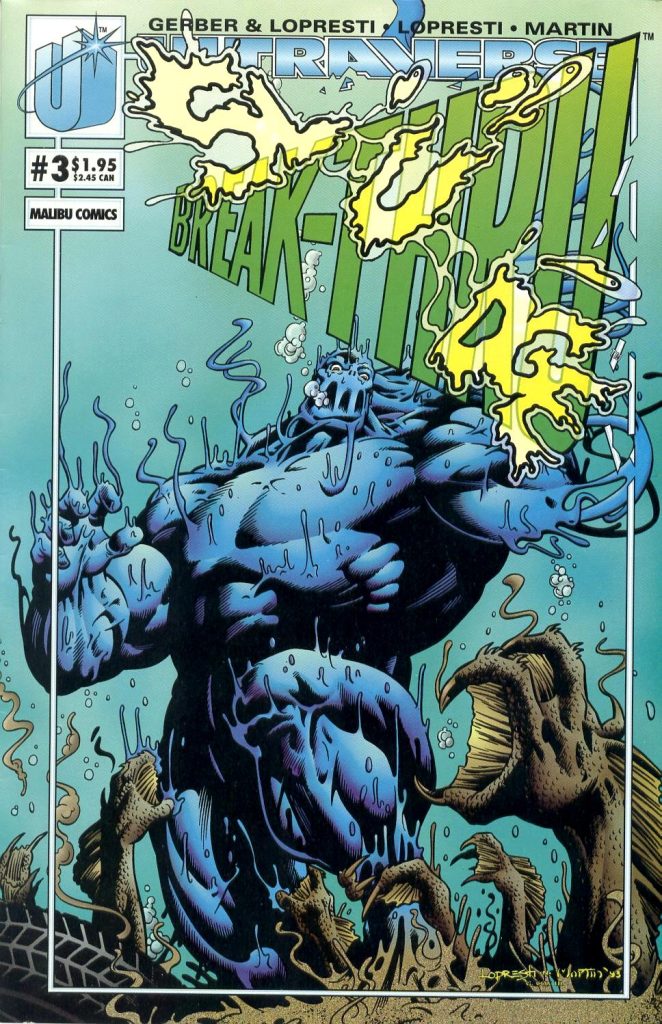
The cover.

Early story

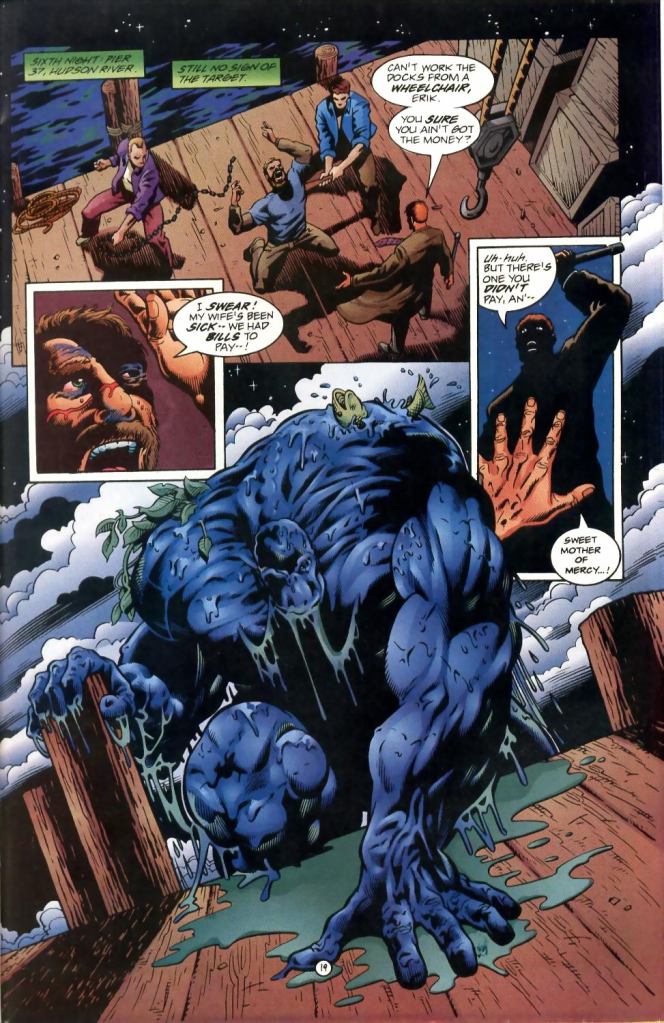
The story begins with Sludge still lying down at the dock after just being defeated by Bloodstorm. Suddenly a mob of chaotic people (driven mad by the effects of Break-Thru that just happened) lift him up and throw him into the water without any regrets whatsoever. In hiding, Bloodstorm witnesses their act and thought to himself that he should avoid the madness happening. Suddenly, other mad people ganged up on him forcing him to react by firing his gun and set himself free from their grip. He safely makes it to his car and speeds away, even bumping off a few people on the way.

As Bloodstorm speeds away, another man in hiding who knew him and the boss Marcello was found by the mad people. Out of desperation he runs away and jumps into the water. He realizes that the people are so obsessed with going up to the sky (the Break-Thru effect), they did not bother to follow him at all.

Deep down the water, Sludge finds himself alone and getting relieved of the pain he experienced above. Feeling hopeless, he waits for the river to wash him away…

Quality

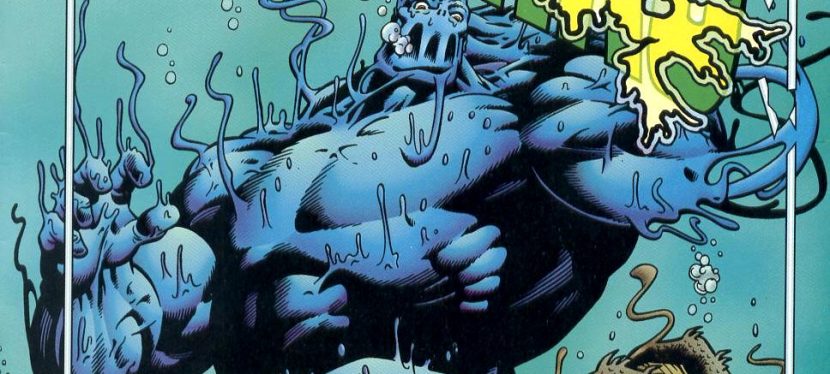
Sludge in trouble!

Being a standalone story set during the events of Break-Thru, this comic book focuses more on the protagonist while simultaneously raising the stakes with regards to the evil forces as the elements of crime gang combined with the supernatural took effect. To be clear, fantasy elements were added to this series which had darkness and grit dominating the plot of the first two issues.

This comic book has an early appearance of “lord” Pumpkin (AKA The Pump) who is the element of sorcery and, more notably, serves as the Ultraverse’s very own Satanic figure. Not only does the Pump have vast powers to take life away from others and has evil pawns to wield, he also leads and guides an apprentice (the kid gangster called Pistol) with pure wickedness, crafted plans of evil, is cunning in his ways of manipulating others to do evil, and he makes promises or deals with others who will receive some rewards but ultimately will be disregarded and lose a lot. This Ultraverse super-villain, as recorded in Malibu Comics’ publishing history, went on to become a walking symbol of pure evil, corruption, sins and danger in other UV comic books.

While there is indeed more focus on Sludge in this issue, it is the Pump who overshadows him. As for Bloodstorm, his presence has been drastically reduced here which is kind of jarring to read as he was the dominant and heavily emphasized in issue #2. Speaking of characters, the gang boss Marcello (who is Bloodstorm’s client) makes a short appearance but his connections not only with criminals but also with para-military forces emphasized his influence in the city.

More on the plot itself, this comic book is pretty loaded and the stakes were really raised high. In key scenes, Sludge finds himself in the middle of gangsters, the people driven mad by the Break-Thru effect, the para-military forces and the Pump’s ugly and evil pawns. Steve Gerber crafted a story that expectedly built up a lot and paid of strongly since the stakes were raised. I should state that Aaron Lopresti’s art here showed signs of improved creativity

Conclusion

The gang boss Marcello and Bloodstorm talk during the events of Break-Thru.

Sludge #3 (1993) is a more engaging and more intense comic book on its own complete with the literary debut of the Pump who is clearly the Ultraverse’s most evil villain. If issue #2 was twisting with the way it presented its characters, this comic book has more of its protagonist who went on to face new elements of evil while the story of Break-Thru transpired. I also noticed the Pump’s offer to Sludge symbolizes Satan offering a troubled soul a place in his force of evil. How did Sludge react to the offer from the evil one? You will have to read this comic book.

If you are seriously planning to buy an existing hard copy of Sludge #3 (1993) be aware that as of this writing, MileHighComics.com shows that the near-mint copy of the regular edition costs $16.

Overall, Sludge #3 (1993) is recommended!

+++++

Thank you for reading. If you find this article engaging, please click the like button below and also please consider sharing this article to others. If you are looking for a copywriter to create content for your special project or business, check out my services and my portfolio. Feel free to contact me with a private message. Also please feel free to visit my Facebook page Author Carlo Carrasco and follow me on Twitter at  @HavenorFantasy as well as on Tumblr at https://carlocarrasco.tumblr.com/
A Look Back at Sludge #2 (1993)

Disclaimer: This is my original work with details sourced from reading the comic book and doing personal research. Anyone who wants to use this article, in part or in whole, needs to secure first my permission and agree to cite me as the source and author. Let it be known that any unauthorized use of this article will constrain the author to pursue the remedies under R.A. No. 8293, the Revised Penal Code, and/or all applicable legal actions under the laws of the Philippines.

Welcome back, superhero enthusiasts, 1990s culture enthusiasts and comic book collectors! Today we revisit the Ultraverse of Malibu Comics and examine one of its many stories through the Sludge comic book series.

For the newcomers reading this, I published my retro review of Sludge #1 back in December of 2020. I really enjoyed that Ultraverse comic book and now is a good time to revisit that series and find out what will happen next to Sludge, the UV’s most notable monster protagonist. I should state that Steve Gerber (Man-Thing) and Aaron Lopresti made a solid creative duo in Sludge #1.

With those details laid down, here is a look back at Sludge #2, published by Malibu Comics in 1993 with a story written by Steve Gerber and drawn by Aaron Lopresti.

The cover.

Early story

The story begins with a quick flashback of a young blonde boy who got bullied by other kids due to his unusual appearance and the way he expresses himself. Fast forward to the present day, an armed man (the same kid in the flashback) fires his guns on a man who was on his bed inside his residence.

After finishing the killing, the armed man enters his unusual looking car and leaves in high speed. After passing through the city streets, he drives his vehicle into his secret hideout filled with several weapons. Shortly after cleaning himself, he takes his seat in his private study and starts communicating with Mr. Barnett who tells him that bad news that something happened to his father. The killer then states, “Payment is due.”

Somewhere in lower Manhattan, a man is being beaten by two men who are enforcers of a man wearing a trench coat in their presence. The beaten man named Mikey swears he will get the money to pay off his debt but the coated man tells him that he is a week late and will be penalized.

Suddenly out of nowhere, Sludge comes out and grabs the two enforcers which frees Mike whose ear just got cut off by the coated man. Sludge then calls the coated man by his nickname…

Quality

The situation only gets more intense whenever Sludge comes in.

I’ll go straight to the point on the storytelling by Steve Gerber. The biggest surprise is here is that the focus was shifted from the titular protagonist Sludge in favor of the first appearance of Bloodstorm who is more than just a typical villain. Gerber heavily emphasized Bloodstorm’s personality as one who enjoys inflicting violence or death to others (and get paid for it) as a result of his painful childhood and his eventual acceptance of the beliefs that violence itself is always part of life. Even so, this comic book shows that Bloodstorm does not believe in inflicting misery for money and he calls it a cowardly way of earning money. Even as he finds his client’s business appalling, he still proceeds to do the dirty work to make money. This, of course, puts Bloodstorm in the dark work organized, target-focused mobbing which also puts him on the same course as Sludge. 

As with issue #1, the violence here is pretty intense and adulterated which goes along almost perfectly with the story’s dark and gritty tone. There is a fine mix of suspense, shock moments and the revealing of key details. I assure you all reading that that even though Sludge himself was not so dominant as the centerpiece of the story, the payoff for all the build-up was still worth reading.

Conclusion

Get to know Bloodstorm through this comic book.

Sludge #2 (1993) is a pretty surprising comic book. One might think that it would become the natural progression of what was established in issue #1 (which itself was the first appearance and origin of Sludge) but ultimately it took a completely different approach. I should also state that the duo of Steve Gerber and Aaron Lopresti continued to deliver compelling stuff in this comic book. While the fact that Sludge is not the dominating force in the story might turn off some readers, I can say to you that Sludge #2 (1993) is still a very worthy read and it builds up on something waiting to be revealed in succeeding issues.

If you are seriously planning to buy an existing hard copy of Sludge #2 (1993) be aware that as of this writing, MileHighComics.com shows that the near-mint copy of the regular edition costs $16 while the near-mint copy of the newsstand edition costs $48

Overall, Sludge #2 (1993) is recommended!

+++++

Thank you for reading. If you find this article engaging, please click the like button below and also please consider sharing this article to others. If you are looking for a copywriter to create content for your special project or business, check out my services and my portfolio. Feel free to contact me with a private message. Also please feel free to visit my Facebook page Author Carlo Carrasco and follow me on Twitter at  @HavenorFantasy as well as on Tumblr at https://carlocarrasco.tumblr.com/

A Look Back at Spider-Man 2099 #4 (1993)

Disclaimer: This is my original work with details sourced from reading the comic book and doing personal research. Anyone who wants to use this article, in part or in whole, needs to secure first my permission and agree to cite me as the source and author. Let it be known that any unauthorized use of this article will constrain the author to pursue the remedies under R.A. No. 8293, the Revised Penal Code, and/or all applicable legal actions under the laws of the Philippines.

Welcome back, superhero enthusiasts, 1990s culture enthusiasts, and comic book collectors! Today we revisit the world of 2099 within the universe of Marvel Comics back in the 1990s, specifically through the Spider-Man 2099 monthly series.

Today we will look back at the early development of futuristic Spider-Man as published way back in 1993. The first three issues (read also my reviews of issue #2 and #3) formed a solid foundation on establishing Miguel O’Hara as his era’s Spider-Man thanks mainly to the high-quality writing done by Peter David. What issue #4 will deliver, we will find out here.

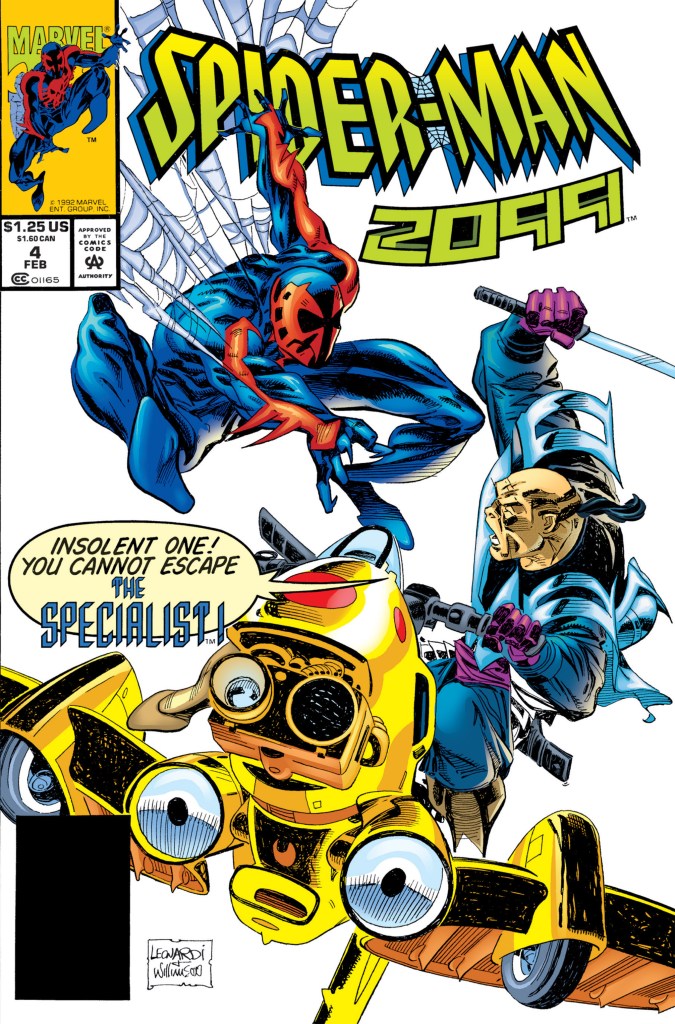
With those details laid down, here is a look back at Spider-Man 2099 #4, published in 1993 by Marvel Comics with a story written by Peter David and drawn by Ricky Leonardi.

The cover.

Early story

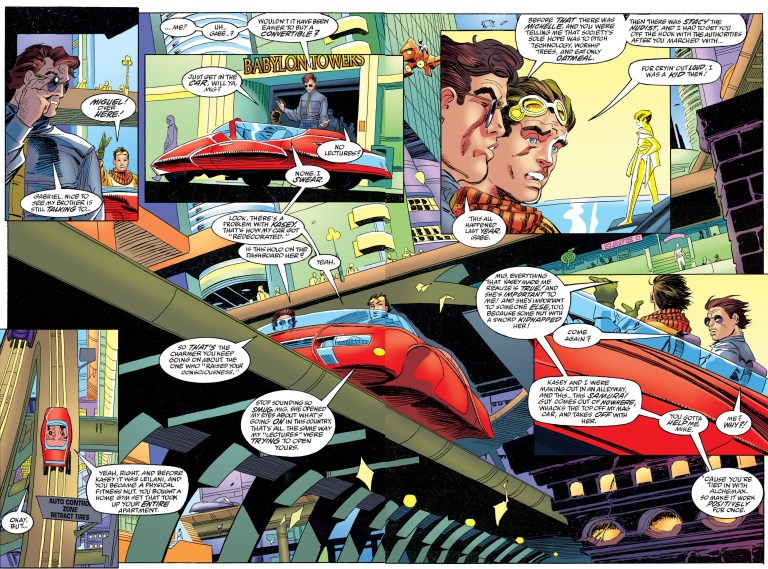
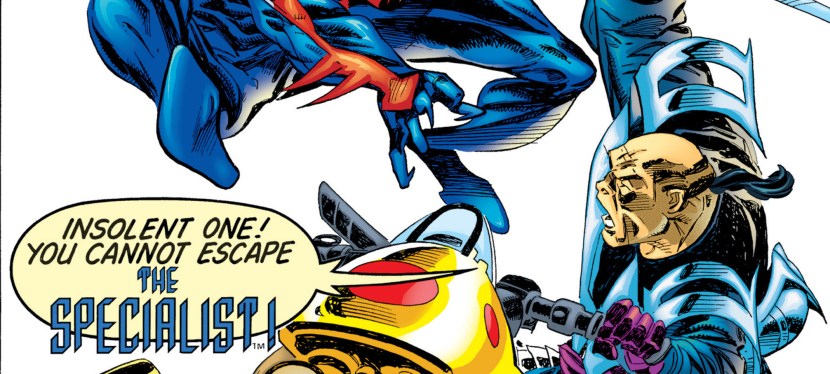
The story begins with Gabriel O’Hara (Miguel’s brother) and Kasey Nash trying to have a good time together inside a vehicle until a man armed with a sword interrupts them and tries to take the lady with him. As Gabriel makes his move to help Kasey, the swordman throws two sharp projectiles at him and moves away with the lady.

Over at the Babylon Towers residence, Miguel O’Hara gets visited by his boss Tyler Stone accompanied by armed personnel. Not realizing that Spider-Man 2099 and Miguel are one and the same person, Tyler tells him that the sudden appearance of the crawler put Alchemax on edge.

Tyler proposes peace between him and Miguel, offering him more of the hyper addictive substance Rapture. He tells him that Aaron Delgato was identified as the mysterious Spider-Man…   

Quality

Miguel O’Hara and his brother Gabriel ride and talk.

The plot really thickened in this comic book resulting a few very interesting sub-plot branches as well as more depth on the development of Miguel O’Hara. I really like the way Peter David explored the corporate side of Miguel’s life here creating suspense about Tyler’s limited knowledge of the Alchemax incidents that happened in issues #1 and #2 which actually involved the protagonist witnessing the fall of his corporate rival Aaron (the same guy responsible for the genetic manipulation of Miguel into Spider-Man). This comic book also focuses on the strained relationship Miguel has with his brother Gabriel who clearly lacks the will to be personally responsible.

I also enjoyed the way Miguel reacts to the classic Spider-Man expression of “with great power comes great responsibility” as he struggles to set things right even as being a civilian and a superhero in his society has major hassles.

The anticipated battle between Spider-Man and the sword-wielding Specialist was structured nicely. Instead of being the typical good-versus-evil conflict, what was presented started with nice moments as Spider-Man still struggles to make the best out of his capabilities. Be aware that the fight does not conclude in this issue.

Conclusion

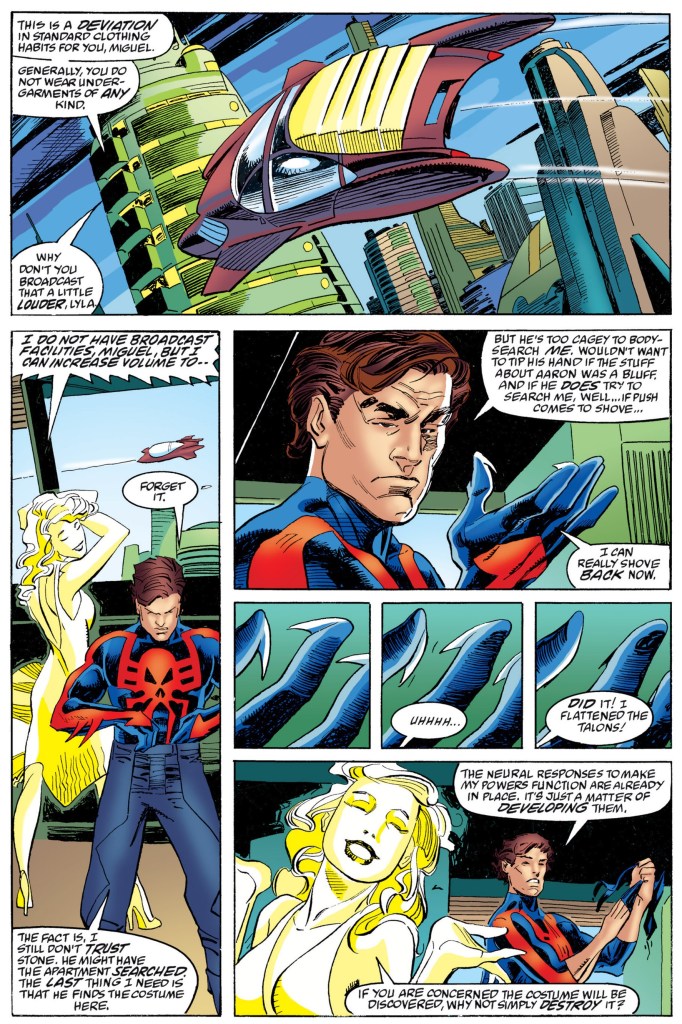
Miguel getting ready for work while having his Spider-Man costume worn.

Spider-Man 2099 #4 (1993) is a solid comic book to read. It had a nice balance of character development, plot with twists here and there, as well as a good amount of action and thrills. Its best feature, as expected, was the further development of the protagonist and you will see more of Miguel than Spider-Man. By the end of this comic book, I really felt I got to know Miguel more as a person, and not a mere character.

If you are seriously planning to buy an existing hard copy of Spider-Man 2099 #4 (1993) be aware that as of this writing, MileHighComics.com shows that the near-mint copy of the regular edition costs $30 while the near-mint copy of the newsstand edition costs $90.

Overall, Spider-Man 2099 #4 (1993) is recommended.

+++++

Thank you for reading. If you find this article engaging, please click the like button below and also please consider sharing this article to others. If you are looking for a copywriter to create content for your special project or business, check out my services and my portfolio. Feel free to contact me with a private message. Also please feel free to visit my Facebook page Author Carlo Carrasco and follow me on Twitter at  @HavenorFantasy as well as on Tumblr at https://carlocarrasco.tumblr.com/

A Look Back at Spider-Man 2099 #39 (1996)

Disclaimer: This is my original work with details sourced from reading the comic book and doing personal research. Anyone who wants to use this article, in part or in whole, needs to secure first my permission and agree to cite me as the source and author. Let it be known that any unauthorized use of this article will constrain the author to pursue the remedies under R.A. No. 8293, the Revised Penal Code, and/or all applicable legal actions under the laws of the Philippines.

Welcome back, superhero enthusiasts, 1990s culture enthusiasts and comic book collectors! Today we revisit the world of 2099 within the universe of Marvel Comics back in the 1990s, specifically through the Spider-Man 2099 monthly series.

In this retro review, the Venom 2099 storyline continues (for my previous reviews, click here, here, here and here). Since my previous review, the futuristic Venom has been captured by Spider-Man and is now in the custody of Alchemax where Miguel O’Hara (Spider-Man of 2099) holds considerable power and authority. As seen in issue #38, Miguel’s rage was clearly affecting him and pushed him to the point of wanting revenge (by means of death, no less) over the death of Dana.

With those details laid down, here is a look back at Spider-Man 2099 #39, published in 1996 by Marvel Comics with a story written by Peter David and drawn by Andrew Wildman.

The cover.

Early story

The story begins with Miguel O’Hara, still impacted by Dana’s death and what he personally discovered about Venom, walking through the offices of an Alchemax building where several employees greet him formally which he does not seem to enjoy. He walks into a laboratory where he sees the two that compose Venom – Kron Stone and the symbiote (living costume) – contained separately with hard glass containers.

Kron Stone, who is related to the powerful Tyler Stone and was responsible for the death of the family of Jake Gallows/Punisher 2099, was declared dead which puzzles Miguel. As the two exchange words, it turns out Kron and Miguel knew each other from long ago. Upon the orders of Miguel, the scientists left the laboratory which gave their boss more privacy to exchange words with the trapped Kron who called him gutless.

Miguel then releases Kron from containment (but still separated from the symbiote), declares terms for their private fist fight (which Kron accepts), and begins to fight him…

Quality

Spider-Man, in his form as Miguel O’Hara, spends time with Xina.

Not surprisingly, the high level of quality and engagement of the writing here is successfully maintained by Peter David and it is very clear to me that he had planned to dramatically shift the direction of the Spider-Man 2099 series and impact the key characters as the story of Venom 2099 went on.

That being said, Peter David went on to not only show Miguel literally burning with rage but also dramatized his move towards the extreme. Not only do we get to see Miguel really abusing his Alchemax authority, he also gets violent with Kron Stone who was powerless without the symbiote. These scenes clearly show that the border that separates good and evil got blurred which showed a very dark side of Miguel O’Hara struggling with his rage, emotions and whatever sanity he still has left.

To be clear, the story here was not purely about Miguel and Kron. There is also the scene in which a cooled down Miguel spends time with Xina who made clear to him her reaction over Dana’s death. Peter David also took the opportunity to not only show more of the return Vulture 2099 but also brought in the 2099 version of Green Goblin simply called Goblin who clearly has an agenda against Spider-Man which adds to the suspense and the overall narrative of the series. The appearance of Goblin also sheds light on the nature of vigilantism and elements of chaos within the 2099 universe.

Conclusion

Miguel and his half-brother Kron Stone begin their fight.

I can say that Spider-Man 2099 #39 (1996) is a very solid read. Not only did the Venom 2099 storyline reflect the serious changes on the characters, it is also led to a bold new direction for the monthly series. Carrying on the dramatic stuff from the previous issues, this comic book also serves as a character examination on Miguel O’Hara which will compel not only the fans but also comic book readers to reflect about what they knew about Spider-Man of the far future and speculate as to how he will turn out and how he would impact the people around him.

If you are seriously planning to buy an existing hard copy of Spider-Man 2099 #39 (1996) be aware that as of this writing, MileHighComics.com shows that the near-mint copy of the regular edition costs $80 while the near-mint copy of the newsstand edition costs $240.

Overall, Spider-Man 2099 #39 (1996) is highly recommended.

+++++

Thank you for reading. If you find this article engaging, please click the like button below and also please consider sharing this article to others. If you are looking for a copywriter to create content for your special project or business, check out my services and my portfolio. Feel free to contact me with a private message. Also please feel free to visit my Facebook page Author Carlo Carrasco and follow me on Twitter at  @HavenorFantasy as well as on Tumblr at https://carlocarrasco.tumblr.com/
A Look Back at Spider-Man 2099 #38 (1995)

Disclaimer: This is my original work with details sourced from reading the comic book and doing personal research. Anyone who wants to use this article, in part or in whole, needs to secure first my permission and agree to cite me as the source and author. Let it be known that any unauthorized use of this article will constrain the author to pursue the remedies under R.A. No. 8293, the Revised Penal Code, and/or all applicable legal actions under the laws of the Philippines.

Welcome back, superhero enthusiasts, 1990s culture enthusiasts and comic book collectors! Today we revisit the world of 2099 within the universe of Marvel Comics as published back in the 1990s, specifically through the Spider-Man 2099 monthly series.

Back in 2020, I reviewed the three key issues of Spider-Man 2099 (click here, here and here) particularly with the entry of Venom 2099. While tragedy happened in issue #37 (a very powerful story), the futuristic Venom was still on the loose.

With those details laid down, here is a look back at Spider-Man 2099 #38, published in 1995 by Marvel Comics with a story written by Peter David and drawn by Andrew Wildman.

The cover.

Early story

The story begins with Spider-Man 2099 grieving over the death of Dana in the presence of Xina and two armed law enforcers. As one of the law enforcers approach him, Spider-Man hits and damages his helmet. The other law enforcer tells his companion to give Spider-Man some room. The grieving web-slinger asks where Venom 2099 is.

Meanwhile at another location, Miguel O’Hara’s mother saw the breaking news on TV about what the tragedy and Dana’s death. Her son Gabriel comes in and gets updated about what happened. As soon as he heard Dana’s name, he becomes concerned and focuses on the TV screen. As images of Spider-Man and Dana appeared, Gabriel begins to make a connection between them and punches the TV screen hard…

Quality

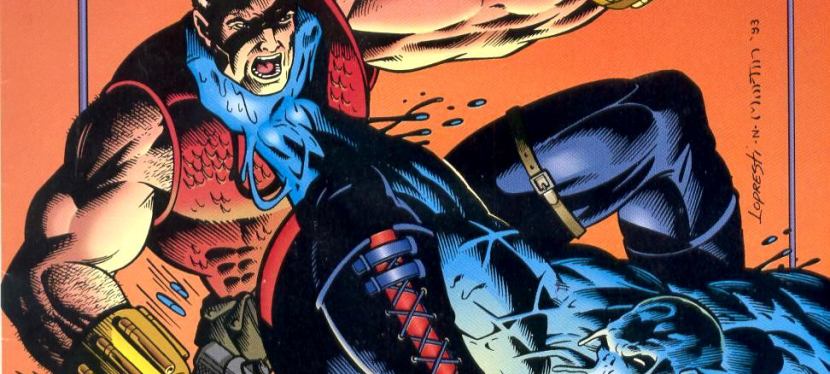
A very angry Miguel O’Hara using his corporate authority to find and get Venom 2099.

If you enjoyed the storytelling, tension and payoff that happened in issue #37, I can confirm to you that great stuff from that comic book continued smoothly in this comic book. As before, Peter David’s writing remains very engaging and gripping. So much so, issue #38 is a very believable and natural continuation of the events of the previous issue. In fact, the tension that started even as far as issue #35 continued in this comic book and at the same time David succeeded in developing the key characters further. Here, the death of Dana impacts not only Spider-Man/Miguel O’Hara, but also those connected with him.

Apart from the impact Venom 2099 left behind on those whom he victimized, the key selling point in this comic book was the portrayal of Miguel O’Hara wanting not only vengeance but also craves for the death of the vicious supervillain. I really find it very gripping to see Miguel using his authority as a high-ranking executive of his company to not only find Venom but also use company resources to get him. There was also the scene in which Miguel wants the captured living piece of Venom’s symbiote become dead which reflects the rage burning in him.

The way Peter David wrote Miguel’s rage is compelling not only because of the dramatics involved but also because it raises new questions about the personality and heart protagonist of the Spider-Man 2099 monthly series. I found myself wondering the following: Is Miguel O’Hara on the way to becoming a villain? Does he realize he is going off-track and could become a danger to others once he gets his way with Venom 2099?

When it comes to the visuals, Andrew Wildman did a really good job her. Not only was his art more detailed than what Rick Leonardi came up with, Wildman also brought to life the emotions of the characters through detailed facial expressions. Wildman also showed how skilled he is with pacing the story as well as being strategic on visualizing the spectacle.

Conclusion

Spider-Man 2099 in a very emotional state over the death of Dana.

I can clearly say that Spider-Man 2099 #38 (1995) is a great comic book to read. It is indeed a very worthwhile follow-up to the powerful and tragic story of issue #37 and the tension that started in issue #35 continued strongly in this comic book. Very clearly, Peter David carefully planned to shake up the Spider-Man 2099 series of the 1990s even as he built up Venom 2099 as the deadliest foe the futuristic Spider-Man faced. I should also state that the Spider-Man 2099 – Venom 2099 rivalry has a distinct style and flavor of its own, and there was simply nothing ripped off from the 20th century Spider-Man – Venom (Peter Parker and Eddie Brock) rivalry.

If you are seriously planning to buy an existing hard copy of Spider-Man 2099 #38 (1995) be aware that as of this writing, MileHighComics.com shows that the near-mint copy of the regular edition costs $80 while the near-mint copy of the newsstand edition costs $240. Spider-Man 2099 #38 (1995) also comes with a Venom 2099 cover edition which costs $200 for a near-mint copy.

Overall, Spider-Man 2099 #38 (1995) is highly recommended!

+++++

Thank you for reading. If you find this article engaging, please click the like button below and also please consider sharing this article to others. If you are looking for a copywriter to create content for your special project or business, check out my services and my portfolio. Feel free to contact me with a private message. Also please feel free to visit my Facebook page Author Carlo Carrasco and follow me on Twitter at  @HavenorFantasy as well as on Tumblr at https://carlocarrasco.tumblr.com/

A Look Back at X-Men #24 (1993)

Disclaimer: This is my original work with details sourced from reading the comic book and doing personal research. Anyone who wants to use this article, in part or in whole, needs to secure first my permission and agree to cite me as the source and author. Let it be known that any unauthorized use of this article will constrain the author to pursue the remedies under R.A. No. 8293, the Revised Penal Code, and/or all applicable legal actions under the laws of the Philippines.

Welcome back, superhero enthusiasts, 1990s culture enthusiasts, X-Men fans and comic book collectors! Today we revisit the X-Men monthly series of the 1990s and look back into the one of the comic books that was released in 1993 which was the year Marvel celebrated the 30th anniversary of the X-Men franchise. To be more specific, the comic book in this retro review took place right after the death of Colossus’ sister and just before the big Fatal Attractions stories in Uncanny X-Men #304 (1993) and X-Men #25 (1993).

With those details laid down, here is a look back at X-Men #24, published by Marvel Comics in 1993 with a story written by Fabian Nicieza and drawn by Andy Kubert.

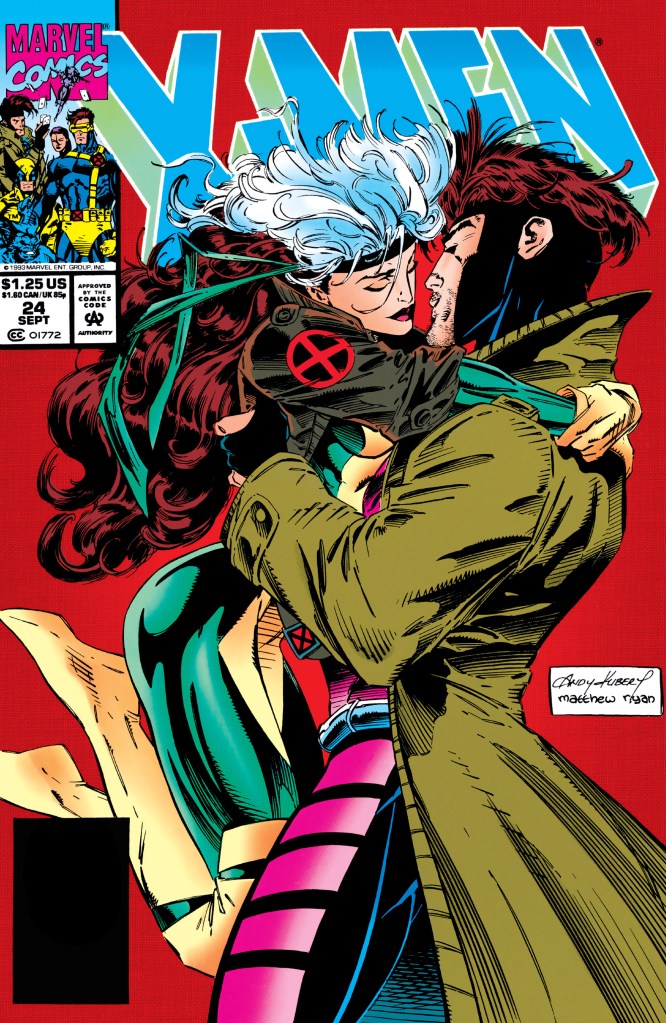
The cover.

Early story

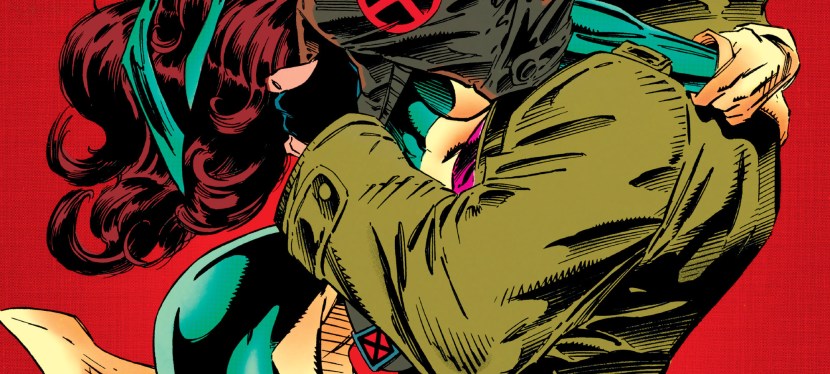
The story begins inside a high-end restaurant wherein Rogue and Gambit, both dressed in formal attire, have dinner and spend quality time together. Their private talk turns awkward when Rogue asks him about his silence about his wife (refer to X-Men #9). Gambit, in his attempt to change the subject, asks Rogue why other people do not know her real name. This leads them into staring at each other in silence.

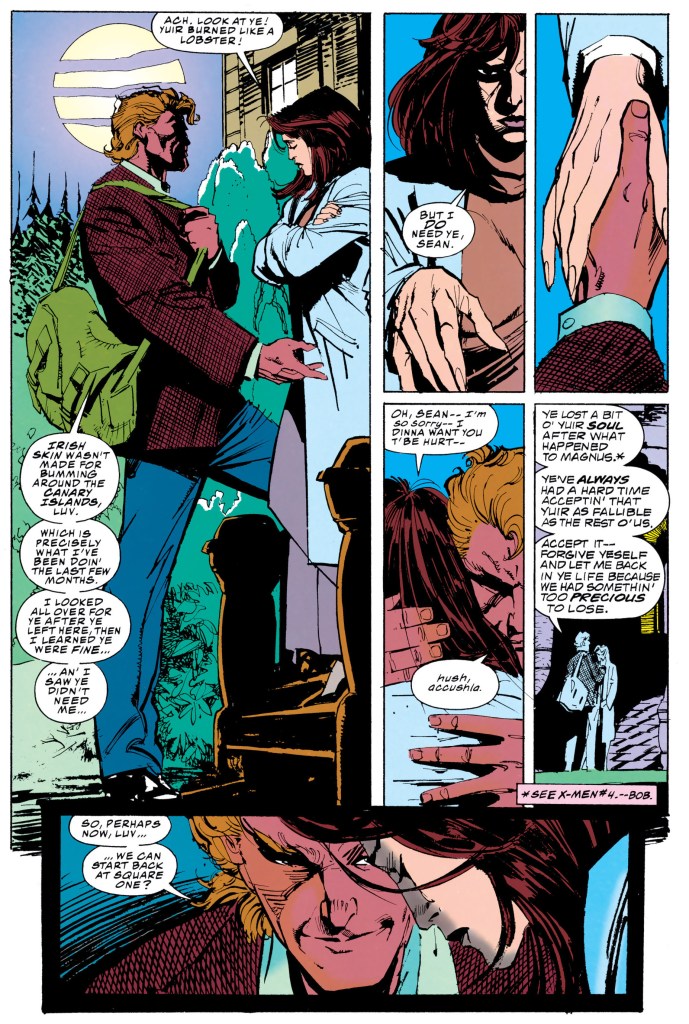
Over the mansion, Dr. Moira McTaggert and Banshee are reunited while Charles Xavier and Beast are inside the laboratory working and analyzing as to how Illyana Rasputin died. Over at a local airport, Jean Grey and Cyclops are reunited…

Quality

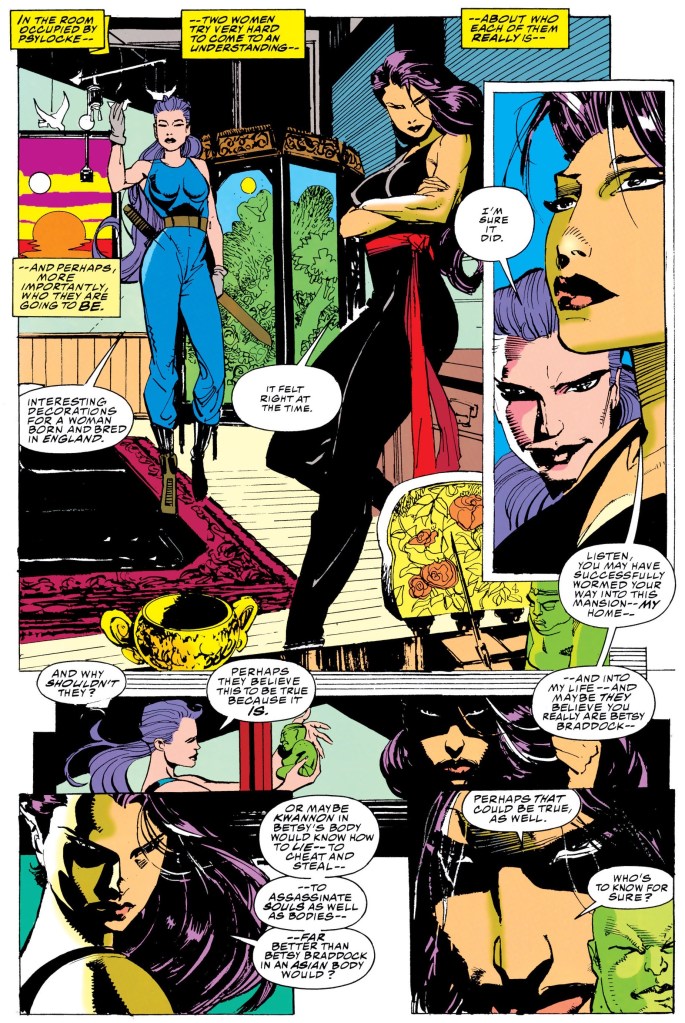
Psylocke and Revanche.

Have you heard about the expression “the calm before the storm”? That truly reflects what this comic book is all about. X-Men #24 (1993) was all about build-up of information and character developments, getting specific X-Men characters reunited, tying up some loose ends from the past while also building up tension for near-future events and more. There is no battle between good and evil here as this was written to set up the characters for specific storylines that were set to happen and Fatal Attractions was just a part of them. No superhero action here, just lots of dialogue plus romance, suspense and melodrama.

If there is anything notable here, it is the romantic time Rogue and Gambit have together. While their relationship got deeper, Fabian Nicieza also opened up the possibility that secrets between the two could still derail their romantic connection. Eventually, their relationship got strained as seen in X-Men #33 (1994).

This comic book also took time to explore further the mystery between Revanche and Psylocke, and also the negative impact Illyana’s death towards Jubilee. All throughout, Nicieza’s dialogue is solid and captured the personalities of each character.

To Andy Kubert…why did you draw Cyclops’ eyes like this?!

As for the art, I noticed there is a drop in the quality of Andy Kubert’s work in this comic book. The way I see it, his work looked rushed especially when compared to his more polished works in X-Men #20 to 23, X-Men #25 and others. As far as his X-Men works of 1993 are concerned, this is easily Kubert’s weakest work.

Conclusion

Banshee and Moira reunited.

X-Men #24 (1993) is easily the build-up comic book leading to the massive, highly dramatic events that took place in Uncanny X-Men #304, X-Men #25, the wedding of Cyclops and Jean Grey, the Phalanx Covenant storyline, and more. As the 30th anniversary was the most dominant event of the X-Men in 1993, this comic book served its purpose in getting key characters together as well as giving something meaningful (as opposed to being entertaining) for dedicated X-Men fans to enjoy and relate with. That being said, this comic book won’t resonate with newcomers or readers who decide to read this as their personal introduction into the lore of the X-Men within the Marvel Comics shared universe of the time.

If you are seriously planning to buy an existing hard copy of X-Men #24 (1993) be aware that as of this writing, MileHighComics.com shows that the near-mint copy of the regular edition costs $40 while the near-mint copy of the newsstand edition costs $120.

Overall, X-Men #24 (1993) is satisfactory.

+++++

Thank you for reading. If you find this article engaging, please click the like button below and also please consider sharing this article to others. If you are looking for a copywriter to create content for your special project or business, check out my services and my portfolio. Feel free to contact me with a private message. Also please feel free to visit my Facebook page Author Carlo Carrasco and follow me on Twitter at  @HavenorFantasy as well as on Tumblr at https://carlocarrasco.tumblr.com/
Gameplay footage of Suicide Squad: Kill the Justice League looks promising

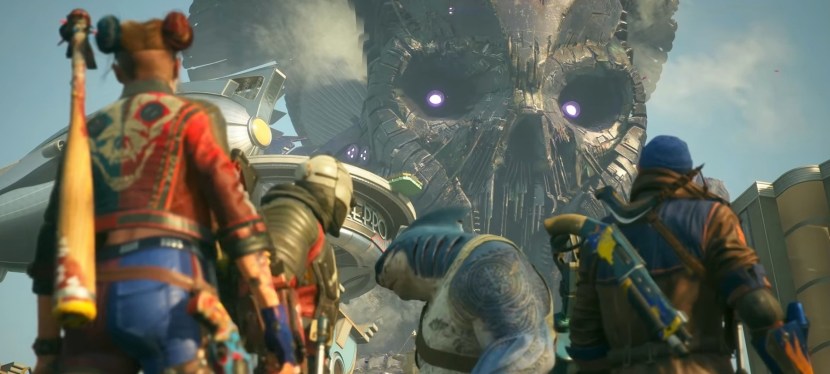
When Suicide Squad: Kill the Justice League was first unveiled with a cinematic trailer during the DC FanDome of 2020, I was just interested with its concept but wanted more in terms of gameplay. After more than one year of waiting, Warner Bros. Interactive Entertainment revealed at last the first gameplay footage of the Rocksteady Studios-developed game and I find it looking fun and promising. For your viewing pleasure, watch the official gameplay trailer below…

As seen in the above trailer, the developer behind the acclaimed Batman Arkham games really worked hard to not only make a wide variety of action and movements (in relation to the different members of the Suicide Squad), but also have them animate very smoothly and artistically resulting a cinematic look while still maintaining the DC Comics aesthetic.

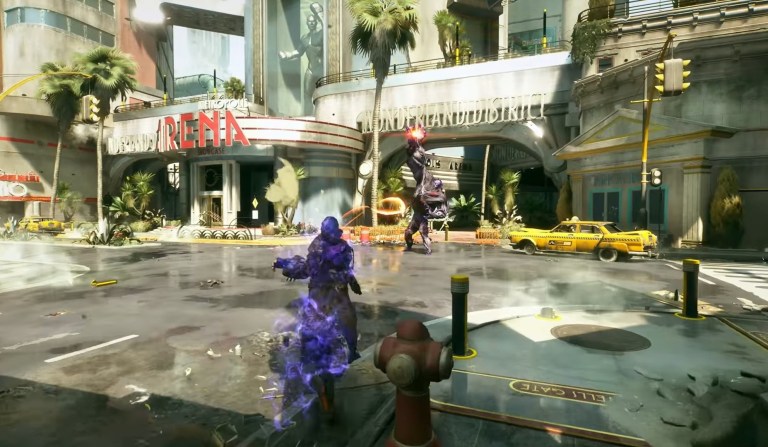
A quick look at Metropolis serving as the open world environment in the game.
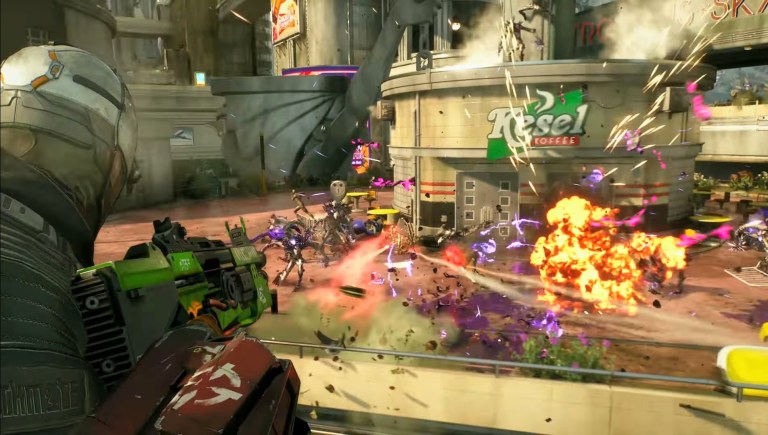
3rd person view shooting sequence with Deadshoot doing the shooting.

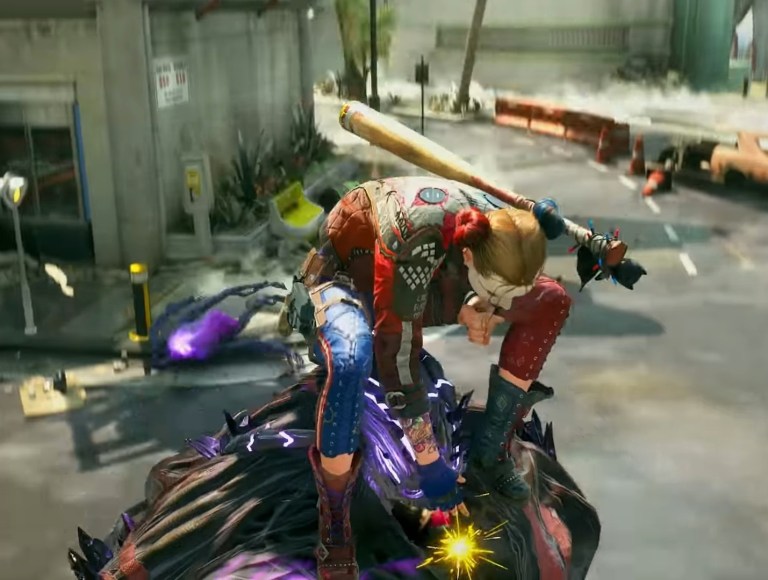
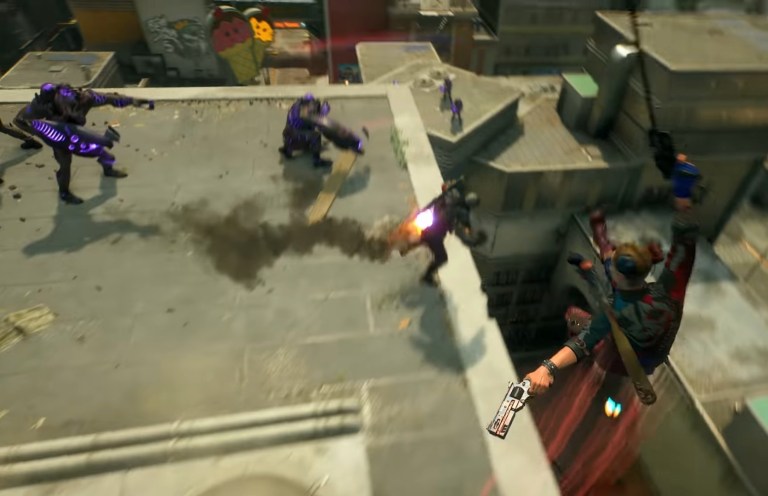
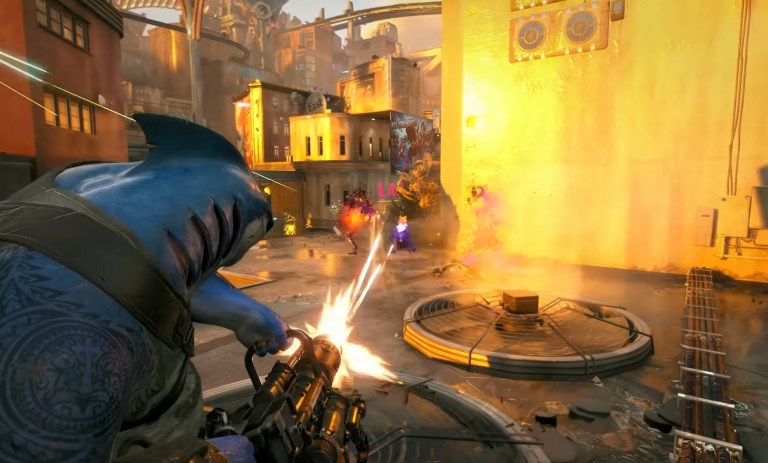
The gameplay trailer showed 3rd person view shooting sequences with not only Deadshot but also with King Shark. As for Harley Quinn, there were sequences of her swinging above ground and doing close combat. The in-game Metropolis (the fictional city often identified with Superman) was clearly designed to provide gamers a large, open world-inspired environment which opens up opportunities for action, exploration and storytelling. Metropolis in this game looks detailed and there are visual references to Superman and Wonder Woman shown.

An action sequence with Harley Quinn.
Harley swinging into action!
Players will get to do some shooting as King Shark.

Having seen the gameplay footage, I can say my interest in playing Suicide Squad: Kill the Justice League on my Xbox Series X in the near future has gotten stronger. I should state that it is a spectacle to see Rocksteady’s developers push their creativity hard, possibly more so than what they achieved in the Batman Arkham games. By the way, Rocksteady is being assisted by Unbroken Studios on the game.

As of this writing, Suicide Squad: Kill the Justice League does not have a final release date but it will be released for Xbox Series X, Xbox Series S and Windows PC sometime in 2022.

In closing this piece, posted below are Xbox-related videos for your viewing pleasure.

+++++

Thank you for reading. If you find this article engaging, please click the like button below and also please consider sharing this article to others. If you are looking for a copywriter to create content for your special project or business, check out my services and my portfolio. Feel free to contact me with a private message. Also please feel free to visit my Facebook page Author Carlo Carrasco and follow me on Twitter at  @HavenorFantasy as well as on Tumblr at https://carlocarrasco.tumblr.com/

A Look Back at X-Men #33 (1994)

Disclaimer: This is my original work with details sourced from reading the comic book and doing personal research. Anyone who wants to use this article, in part or in whole, needs to secure first my permission and agree to cite me as the source and author. Let it be known that any unauthorized use of this article will constrain the author to pursue the remedies under R.A. No. 8293, the Revised Penal Code, and/or all applicable legal actions under the laws of the Philippines.

Welcome back, superhero enthusiasts, 1990s culture enthusiasts, X-Men fans and comic book collectors! Today we revisit the X-Men monthly series of the 1990s and look back into the past between Sabretooth and X-Men member Gambit which was hinted in X-Men #28 (1994). Within the context of that comic book I previously reviewed, Sabretooth was already living in a contained manner in the mansion of Professor X who views him as a patient who could be rehabilitated even though he has an established record of murder and damage. At that particular time, Gambit and Rogue were in a relationship but certain things from the Cajun’s past could negatively affect them both.

With those details laid down, here is a look back at X-Men #33, published by Marvel Comics in 1994 with a story written by Fabian Nicieza and drawn by Andy Kubert.

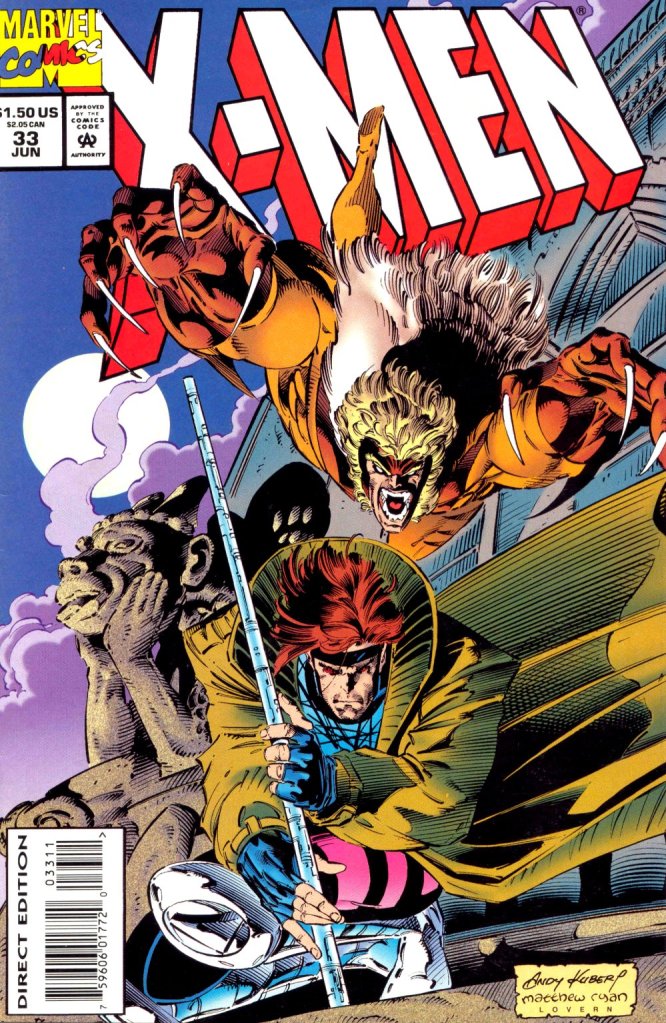
The cover.

Early story

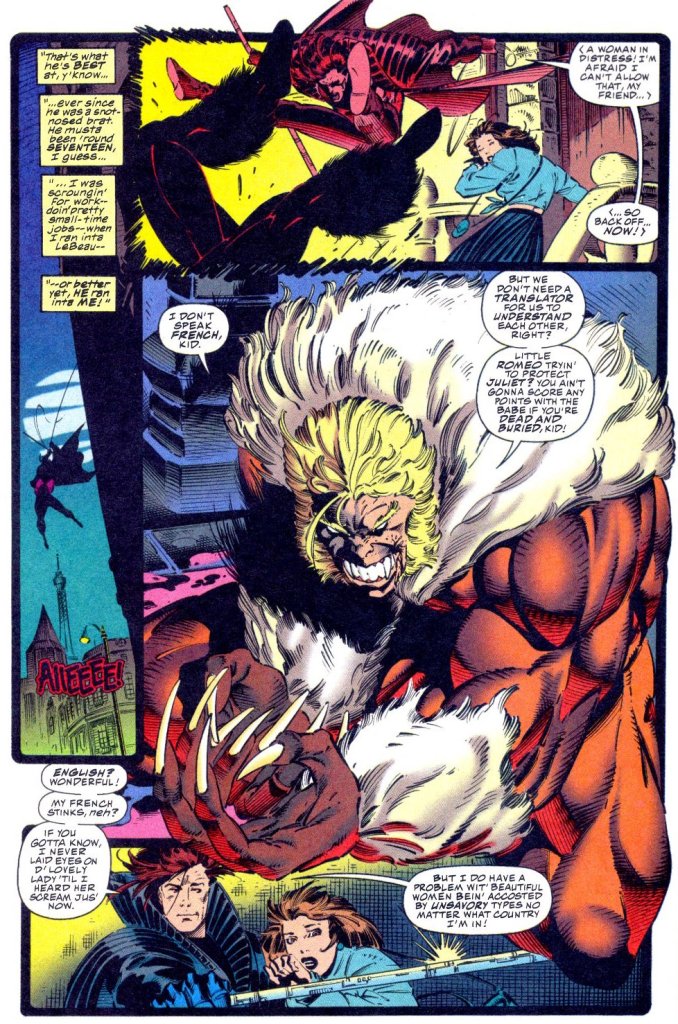
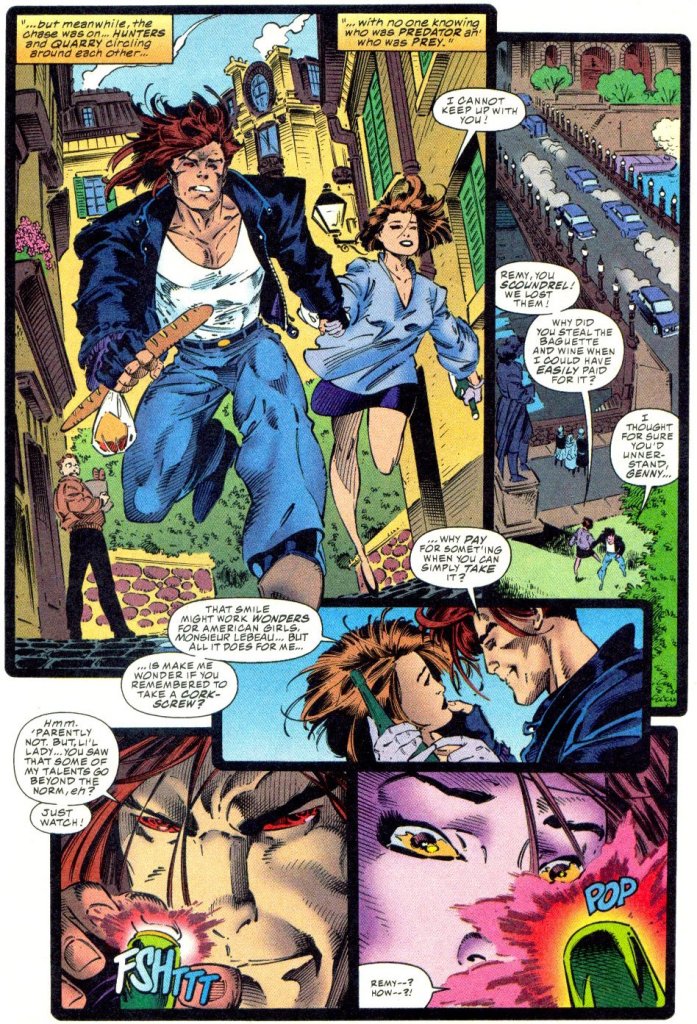
The story begins in the past with a much younger Gambit (wearing a dark coat and holding a rod) traversing through the city of Paris in France. As he moves, Gambit spots a pretty lady in distress in the presence of a huge man with an unusual look. He kicks the man out of the way and tells him to back off. It turns out, the man was none other than Sabretooth (in his more classic comic book look) who responds saying that Gambit won’t score any points with the lady he just saved if he were dead and buried.

Gambit sticks close with the lady and says some words back to Sabretooth. He flashes a card and charges it, revealing his mutant power to the beastly man. Sabretooth leaves promising he will be back.

In the present day, it turns out the restrained Sabretooth has been recalling the past and sharing the details to Rogue standing some feet away from him inside the mansion. Using a highly advanced devise, images of Gambit and the lady from the past are displayed in the form of holograms right in the view of Rogue. She tells him to keep telling her more about what happened in Paris…

Quality

Andy Kubert’s own take on Sabretooth and his classic look remains impressive.

This comic book has a very rich script by Fabian Nicieza who smoothly transitions from the past to the present while succeeding in telling a very cohesive story. Without spoiling the plot, I can say that by reading this comic book as well as the earlier issues, you will question the state of the relationship of Gambit and Rogue, and you will also reflect about Sabretooth’s purpose in X-Men lore.

The tale from Gambit’s past was beautifully told and it really gave me a new look into the personality and mindset of the character. Long before he joined the X-Men, Gambit was an impulsive and cocky guy who became a member of a guild of thieves through adoption (meaning he has yet to earn his place). This version of the Cajun was undisciplined and did not take life seriously. Young Gambit also had a thing with ladies and he showed no signs of cleverly betraying a woman in favor of materialism.

Believe it or not, the most interesting character here is actually Sabretooth who appears in both the past and the present. The way he was portrayed here, young Sabretooth was cunning and knew how to be strategic and paced himself even though he had key physical advantages to overwhelm young Gambit. Sabretooth in the present day is more mature and more articulate, especially during his storytelling and interactions with Rogue. The way Sabretooth’s dialogue was structured in telling about the past was very engaging and you can see he clearly understood what happened between him and Gambit.

While the story is great, the art done by Andy Kubert is very good. However, I believe it was a missed opportunity for Kubert to redesign Gambit from the past because the famous X-Men member does not look any different from the other version. In the scenes about the past, Gambit does NOT look like a 17-year-old at all and his hair style and length are just the same! As for drawing the younger version of Sabretooth, Kubert made him more menacing and more detailed while sticking close to his original comic book look.

Conclusion

The 17-year-old Gambit with the pretty lady in France.

X-Men #33 (1994) is one of the most intriguing X-Men stories I read that took place after the Fatal Attractions storyline and the wedding of Jean Grey and Cyclops. In fact, it is also the most memorable X-Men comic book I ever read in 1994 all thanks to the great work by Fabian Nicieza whose script was finely visualized by Andy Kubert. This is one very engaging read and by the time I finished it, I really felt the impact it had on Gambit and Rogue’s relationship. More notably, it made rethink about Gambit and his place with the X-Men.

If you are seriously planning to buy an existing hard copy of X-Men #33 (1994) be aware that as of this writing, MileHighComics.com shows that the near-mint copy of the regular edition costs $30 while the near-mint copy of the newsstand edition costs $90.

Overall, X-Men #33 (1994) is highly recommended!

+++++

Thank you for reading. If you find this article engaging, please click the like button below and also please consider sharing this article to others. If you are looking for a copywriter to create content for your special project or business, check out my services and my portfolio. Feel free to contact me with a private message. Also please feel free to visit my Facebook page Author Carlo Carrasco and follow me on Twitter at  @HavenorFantasy as well as on Tumblr at https://carlocarrasco.tumblr.com/
A Look Back at X-Men #29 (1994)

Disclaimer: This is my original work with details sourced from reading the comic book and doing personal research. Anyone who wants to use this article, in part or in whole, needs to secure first my permission and agree to cite me as the source and author. Let it be known that any unauthorized use of this article will constrain the author to pursue the remedies under R.A. No. 8293, the Revised Penal Code, and/or all applicable legal actions under the laws of the Philippines.

Welcome back, superhero enthusiasts, 1990s culture enthusiasts, X-Men fans and comic book collectors! Today we revisit the X-Men monthly series of the 1990s and look back at what happened after the ending of X-Men #28 (1994). For those who missed out on my previous X-Men retro review, issue #28 showed the X-Men being disturbed by the presence of Sabretooth living as a prisoner/patient in the mansion under the authority of Charles Xavier. Along the way, the wedding of Jean Grey and Cyclops is nearing.

With those details laid down, here is a look back at X-Men #29, published by Marvel Comics in 1994 with a story written by the Fabian Nicieza and drawn by Andy Kubert.

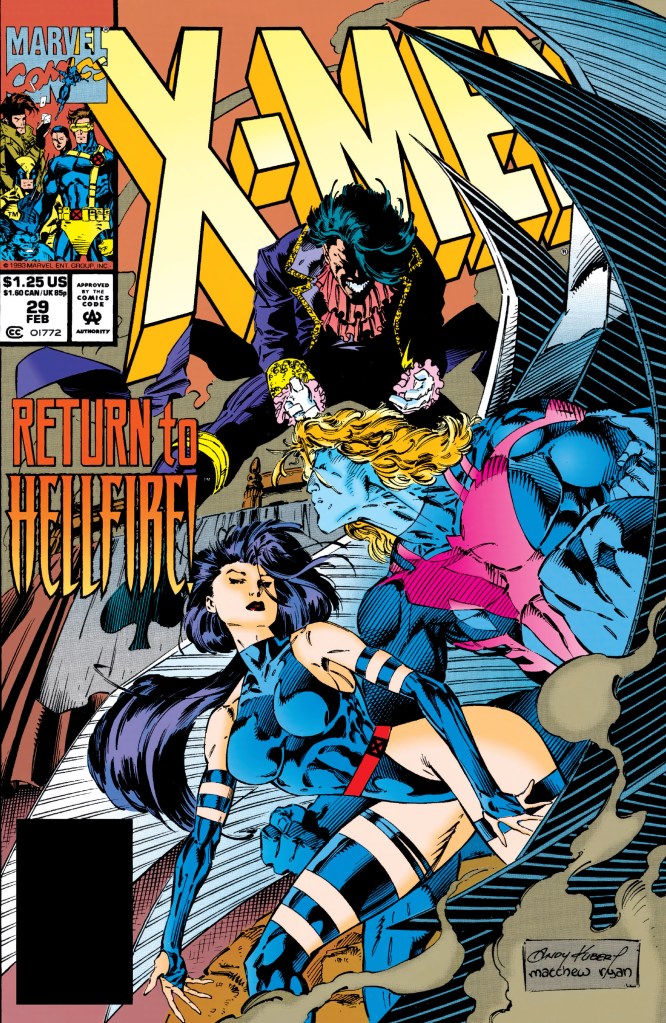
The cover.

Early story

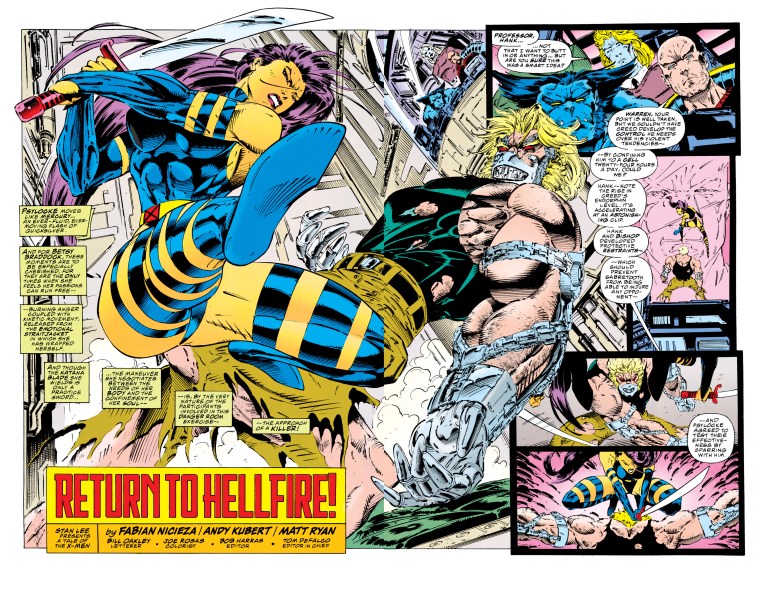
The story begins inside the danger room wherein Psylocke and Sabretooth (wearing cybernetic restraints on his arms as well as a mask) engage in a sparring session while being monitored by Professor X, Warren Worthington/Archangel and Hank McCoy/Beast. Warren expresses concern about the session and Xavier replies by saying that they could not have Sabretooth develop the control he needs over his violent tendencies by having him contained in a cell every day.

After some struggle, Psylocke gains the upper hand and tells Sabretooth that she sparred without using her mutant abilities (solely out of deference to his reduced capabilities caused by the restraints) and insisted she still fought to win.

After the danger room session, Warren leaves and thinks a lot as he takes time out to watch Cyclops and Jean Grey leading the wedding preparations outdoors. Jubilee passes by with lots of mail, hands over to Warren an unusual looking envelope, then leaves. As he opens the envelope, Psylocke arrives hearing Warren talking to himself as he reads the letter. It turns out to be an invitation from the Hellfire Club…

Quality

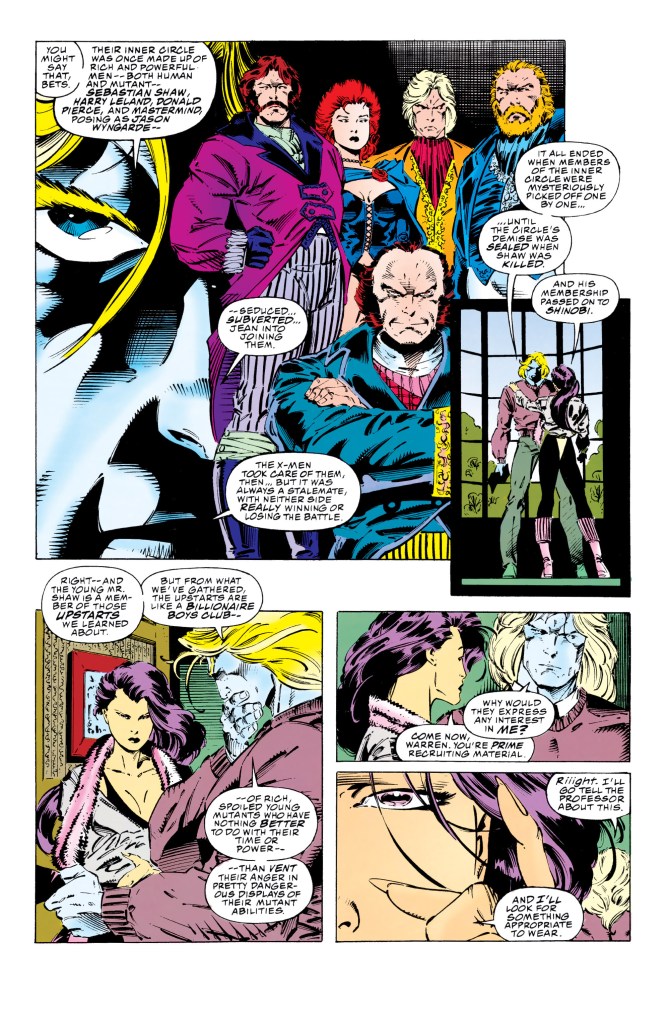
Expository dialogue and details laid down to help readers understand the Hellfire Club.

To put things in perspective, the Hellfire Club within the Marvel Comics universe is a fictional high-class society which became a formidable force of opposition for the X-Men. Their debut during the Dark Phoenix Saga is very memorable and since that time, varied comic books – specifically X-Men comics – revisited the club from time to time.

Within the pages of this particular comic book, the Hellfire Club itself went through some changes in terms of membership and organizational structure kind of similar to the X-Men themselves. In this case, the son of Sebastian Shaw – Shinobi – gains tremendous power and even went as far as revealing to Warren/Archangel his ambitious plan to re-establish the Inner Circle and have the mentioned X-Men member (one of the pioneering students of Charles Xavier) part of it as the White King.

A key element in this story is self-pity which Archangel and Shinobi Shaw both share. For these two, there are key parts of their past that are so hurtful they respectively question their existence and purpose. Quite symbolically, Archangel and Shinobi both have fathers involved with the Hellfire Club and Psylocke herself was familiar with the club’s presence in London. More on Archangel himself, his self-pity really puts him in a very awkward place among the X-Men, especially at a time when he is supposed to be happy for his long-time teammates Jean Grey and Cyclops about to get married.

In a way, X-Men #29 was an inspired attempt to reconnect the past with the contemporary times with the Hellfire Club as the enduring factor. In my opinion, Fabian Nicieza’s work here is solid.

Conclusion

Easily the best-looking images in the comic book. Andy Kubert really rocked with this!

X-Men #29 (1994) is symbolically a quick and yet inspired way of updating readers about the state of the Hellfire Club and hint what potential conflicts they could have with the X-Men of the 1990s. Psylocke and Archangel are the most prominent X-Men members to follow here and they both have past connections with the Hellfire Club which itself is changing as Shinobi Shaw gained power. Its story is pretty intriguing and there is a descent amount of spectacle to be enjoyed. The selling point here is the story concept itself backed with solid writing by Nicieza who seem to have researched the Hellfire Club carefully. Given the legacy behind the X-Men and the fictional club, this comic book will appeal more to long-time fans of the X-Men. Reading this as a first-time discovery of the club will surely challenge newcomers.

If you are seriously planning to buy an existing hard copy of X-Men #29 (1994) be aware that as of this writing, MileHighComics.com shows that the near-mint copy of the regular edition costs $30 while the near-mint copy of the newsstand edition costs $90.

Overall, X-Men #29 (1994) is recommended.

+++++

Thank you for reading. If you find this article engaging, please click the like button below and also please consider sharing this article to others. If you are looking for a copywriter to create content for your special project or business, check out my services and my portfolio. Feel free to contact me with a private message. Also please feel free to visit my Facebook page Author Carlo Carrasco and follow me on Twitter at  @HavenorFantasy as well as on Tumblr at https://carlocarrasco.tumblr.com/