Disclaimer: This is my original work with details sourced from reading the comic book and doing personal research. Anyone who wants to use this article, in part or in whole, needs to secure first my permission and agree to cite me as the source and author. Let it be known that any unauthorized use of this article will constrain the author to pursue the remedies under R.A. No. 8293, the Revised Penal Code, and/or all applicable legal actions under the laws of the Philippines.
Are you a fan of Venom and you want to find out how he was presented within the realm of alternate realities within the Marvel Comics universe as told through their What If? monthly series?
Join me in exploring something new in What If #44, written by Kurt Busiek, drawn by Luke McDonnell and published in 1992 by Marvel Comics.
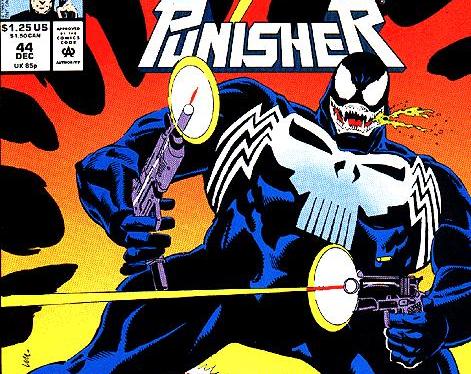
The key scenario here: What if Venom had possessed the Punisher?
The cover.
Early story
The story begins with Venom already armed with guns moving around the city. In broad daylight, he stalks criminals walking down the street. Using the symbiote’s ability to alter his looks, Venom approaches a certain Mr. Vance (accompanied by bodyguards) and kills him quickly in public.
It turns out, Venom is actually Frank Castle/Punisher already with the symbiote. With his intent to eliminate crooks, this new Venom daringly goes up against the gangs even without the usual hardware (weapons) since the symbiote already provides him with uncanny weapons.
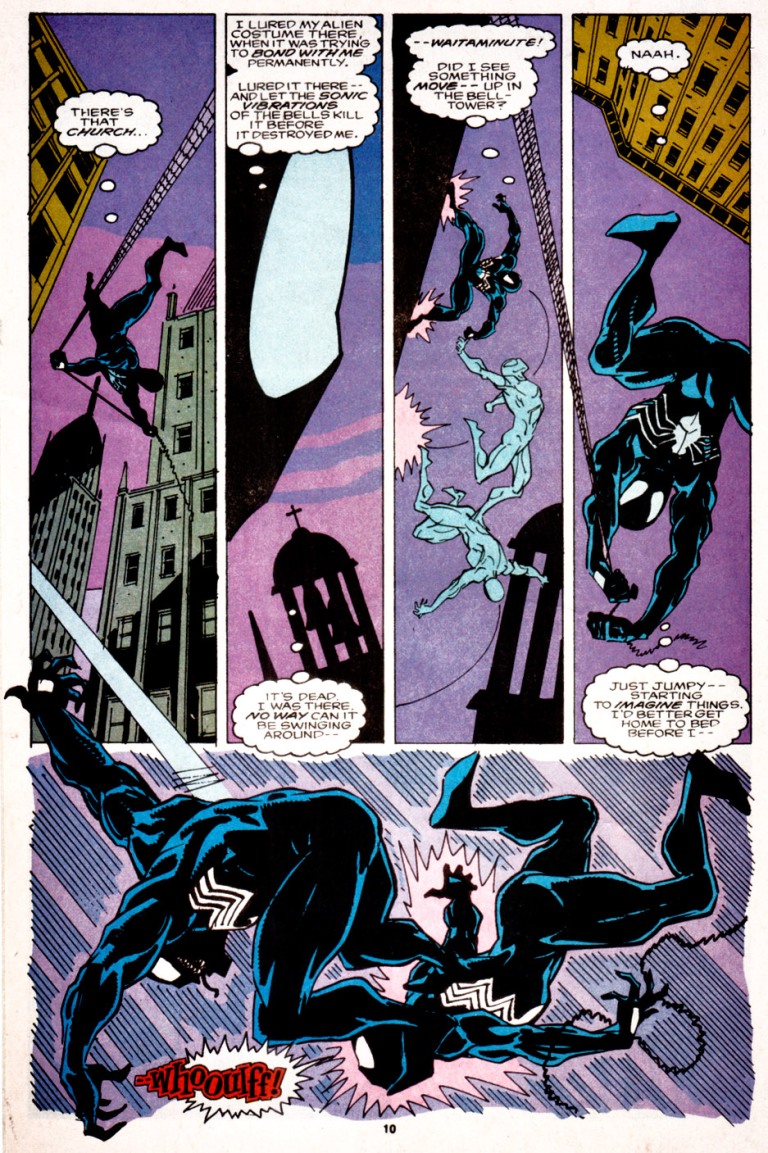
Elsewhere in the city, Spider-Man (wearing his black suit that shared the same style as Venom) swings by a lady who begged him not to hurt her. This sparks Spider-Man’s curiosity since he believes that he succeeded in killing the symbiote that tried to possess him.
Punisher/Venom goes against the criminals!
In another part of the city, Daredevil senses Venom passing by and recognizes the heartbeat as that of Frank Castle. He also senses other readings that something is odd. He decides to take a close look at Venom/Punisher.
Quality
Let me start with the core concept of this comic book: it’s a bold and great concept to explore, and it was well executed! To put things to perspective, I personally witnessed the debut of Venom in 1987 and back then seeing Eddie Brock/Venom as a new mortal enemy of Peter Parker’s was a tremendous event of its own. On top of that, having Brock already with the symbiote forming Venom together established an undeniable consequence that goes back to the alien world in Secret Wars where Spider-Man first got the symbiote. Gradually through the years in real life, Venom became one of the greatest super villains of not only Marvel but in superhero comics in general.
That being said, to show the Punisher getting possessed by the symbiote made a nice alternate reality. Frank Castle lost his family and this alone drove him to become a vigilante and often used lots of guns and explosives in his one-man war against crime. To see him have the symbiote and become the new Venom is both interesting and intriguing. I won’t forget how the Punisher used the symbiote to organically form guns on his arms and actually fire bullets.
One of the things I like most in this comic book was the presentation of the encounter between Spider-Man and Punisher/Venom. It’s a great alternative to the classic first encounter between Spider-Man and Eddie Brock/Venom!
Ultimately, Kurt Busiek’s storytelling is strong and engaging. Art by Luke McDonnell is serviceable at best but he really exerted effort to add impact on the action scenes which are plentiful to see.
Conclusion
Punisher/Venom and Spider-Man!
I really enjoyed reading this comic book. To put things in perspective, What If #44 was released several months before the Punisher and Venom actually appeared together in Venom: Funeral Pyre #1. This comic book was also released before Venom got his own mini-series with Lethal Protector.
If you are serious in collecting a hard copy of What If #44 soon, be aware that as of this writing and based on the ratings of Mile High Comics online, a near-mint copy of the regular edition costs $51 while a near-mint newsstand copy costs $153.
Overall, What If #44 (1992) is highly recommended.
Thank you for reading. If you find this article engaging, please click the like button below and also please consider sharing this article to others. If you are looking for a copywriter to create content for your special project or business, check out my services and my portfolio. Feel free to contact me as well. Also please feel free to visit my Facebook page Author Carlo Carrasco and follow me at HavenorFantasy@twitter.com
Disclaimer: This is my original work with details sourced from reading the comic book and doing personal research. Anyone who wants to use this article, in part or in whole, needs to secure first my permission and agree to cite me as the source and author. Let it be known that any unauthorized use of this article will constrain the author to pursue the remedies under R.A. No. 8293, the Revised Penal Code, and/or all applicable legal actions under the laws of the Philippines.
In early 1994, I was still in high-school. There was a time when I passed by a local comic book store that showed a new What If? comic book displayed among the many new titles. That particular comic book caught my attention because of its key question: What if the Punisher had killed Spider-Man?
That comic book was What If #58published by Marvel Comics with a story by Chuck Dixon and art by Gordon Purcell. Check out the cover below.
The cover of this comic book took a lot of inspiration from that of Amazing Spider-Man #129.
To put things in perspective, Spider-Man and Punisher are both heroes in the universe of Marvel Comics but with very drastic differences between them. Spider-Man/Peter Parker fights crooks and other types of bad guys while maintaining a lawfully good nature even as he struggles to live a normal, personal life. Punisher, who is privately Frank Castle, is a killer who is driven to fight criminals beyond the boundaries of the law. The Punisher resorts to extreme forms of violence and guns are his main weapons. Due to the tragic loss of his wife and children, Punisher lives to wage a one-man war against criminals which only reflects the huge loss of his humanity.
Spider-Man and the Punisher first encountered each other in Amazing Spider-Man #129. Through the years, the two would face-off again and again. In the mid-1980s, the Punisher went on to rise in high popularity with comic book readers as Marvel Comics published three regular series: The Punisher, The Punisher War Journal and The Punisher War Zone.
That being said, we take a look back at What If #58.
Early story
Without involving Marvel’s galactic Watcher, the comic book begins with the Punisher aiming his gun at a man seated behind his desk. It turns out Punisher is waiting for the police to arrive at the place they are in.
From this point, the story is told in flashback with Punisher narrating. He is with the Jackal on the roof top of a building in New York City. Even as the Jackal pushes him to shoot a certain target already, the Punisher decides not to do it. He stressed he wants to study the target.
“It seemed right. Taking down a high profile outlaw like Spider-Man looked like the right way to go,” Punisher thought. “And Jackal promised unlimited funding of my war on crime if I succeeded.”
Punisher doing research.
Gradually, the Punisher prepares himself to kill Spider-Man…
Quality
Let me start with the concept of this comic book. Exploring what would happen had the Punisher actually killed Spider-Man (note: this is so obvious from the cover) is a bold and clever story to tell. To put things in perspective, the Punisher’s attempt to kill Marvel’s iconic superhero happened way back in Amazing Spider-Man #129 which was published way back in 1974. Very clearly, Punisher failed and Spider-Man went on to live and fight for good.
When it comes to storytelling, Chuck Dixon delivered a strong script and carefully crafted a standalone story that looks at the Punisher’s first-ever attempt to shoot Spider-Man but the narrative was more on the vigilante’s point-of-view. The dialogue was solid and the narration gives readers a good look at the personality of Frank Castle. I also liked the way the story was paced.
What also makes this comic book really good is that it shows in convincing fashion what else would have happened after the successful assassination of Spider-Man. Without spoiling the surprise, you can ask yourself how would Punisher react once he learned who Spider-Man really was, how would the many people who personally knew Spider-Man (whether good or evil) would react and what the state of crime in New York would be like.
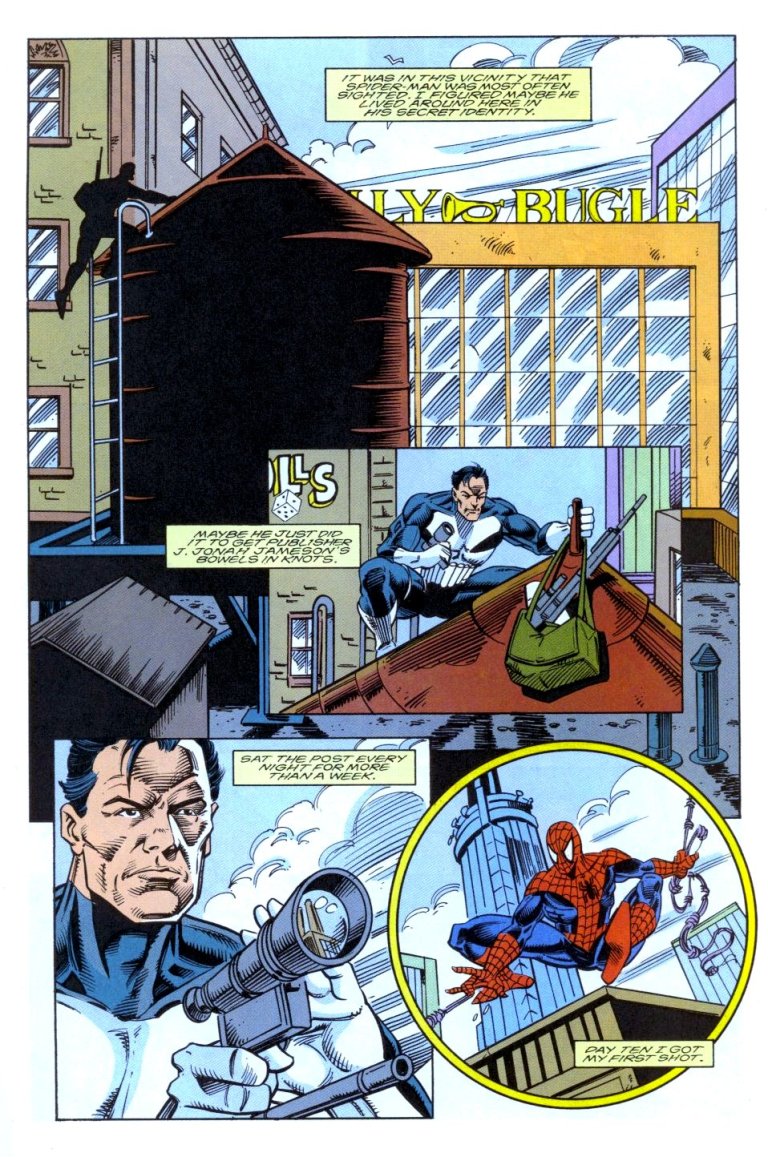
The Punisher anticipating Spider-Man outside The Daily Bugle.
As for the art, Gordon Purcell did a decent job. He captured what was back then modern day 1990s look of the Punisher (completely rejecting the way the character looked in Amazing Spider-Man #129) and he knew how to present him from different angles regardless of what action was taken. On drawing Spider-Man, Purcell proved to be good. I noticed in some parts of the comic book, he tried hard to make Spidey look dynamic while traveling high above the streets of the city. The big money shot (in terms of illustration) for me was the moment Spider-Man got killed.
Conclusion
Overall, What If #58 is a good and fun comic book to read. Historically, this was released at a time when Spider-Man and the Punisher were both wildly popular. The decision to tell an alternate reality off Amazing Spider-Man #129 was inevitable and ultimately was nicely pulled off.
If you are thinking about acquiring What If #58, as of this writing MileHighComics.com shows that a near-mint copy of the regular edition is at $26 while the near-mint copy of the newsstand edition is at $77.
What If #58 is recommended.
Thank you for reading. If you find this article engaging, please click the like button below and also please consider sharing this article to others. If you are looking for a copywriter to create content for your special project or business, check out my services and my portfolio. Feel free to contact me as well. Also please feel free to visit my Facebook page Author Carlo Carrasco and follow me at HavenorFantasy@twitter.com
Disclaimer: This is my original work with details sourced from reading the comic book and doing personal research. Anyone who wants to use this article, in part or in whole, needs to secure first my permission and agree to cite me as the source and author. Let it be known that any unauthorized use of this article will constrain the author to pursue the remedies under R.A. No. 8293, the Revised Penal Code, and/or all applicable legal actions under the laws of the Philippines.
When Marvel Comics first launched the 2099 imprint of comic books showcasing many futuristic versions of their present-day characters – like Spider-Man, Ravage and Dr. Doom – it was inevitable that the same treatment will be applied to their popular supervillains.
In 1993, the 2099 version of Vulture was introduced and he sure proved to be one tough opponent for Spider-Man 2099. Even back then, there already was clamor for a futuristic version of Venom which at the time was riding high with readers being the featured anti-hero in several limited series (starting with Lethal Protector) of comic books.
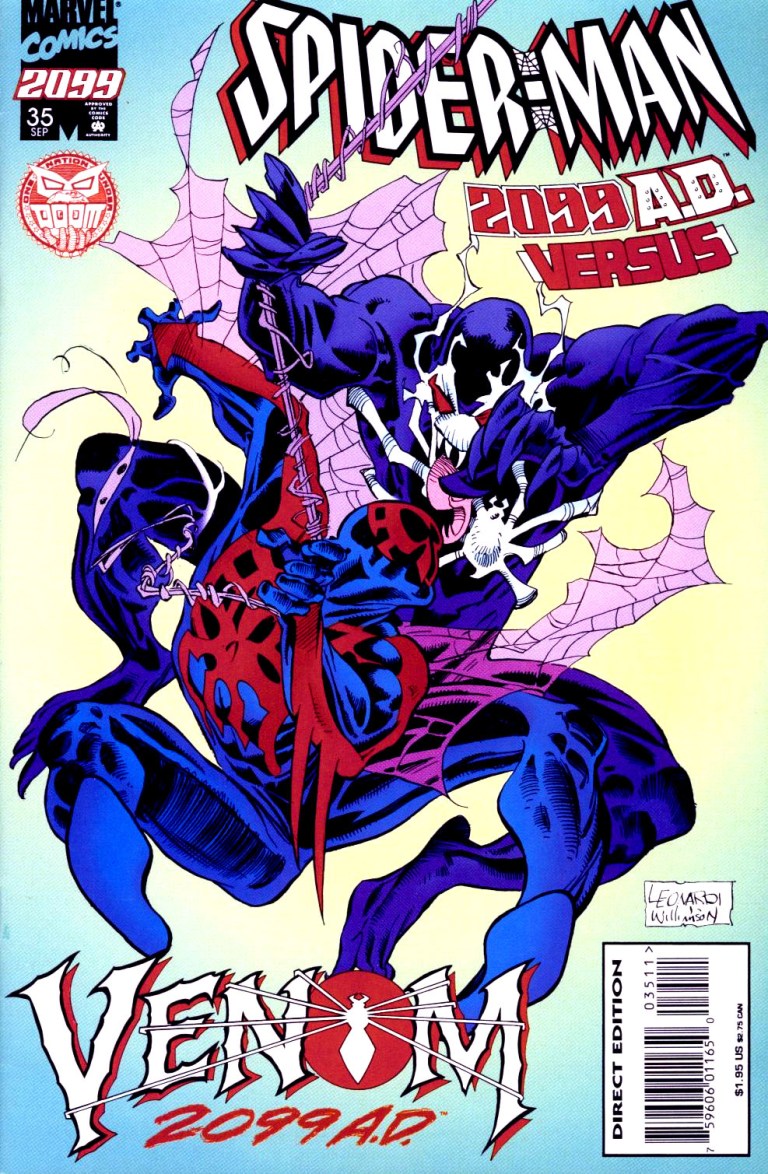
Then in 1995, after doing a creative teaser in issue #34, Marvel formally introduced Venom 2099 by releasing Spider-Man 2099 #35. This is my review of the comic book written by Peter David and drawn by Andrew Wildman (X-Men Adventures).
The cover drawn by Rick Leonardi.
Early story
Picking up from the events of issue #34, the story begins in Washington, DC with Dana freeing herself only to find out that Alchemax’s CEO Tyler Stone was down suffering from a gun shot and losing blood. Minutes later, emergency personnel take Stone’s body for immediate treatment.
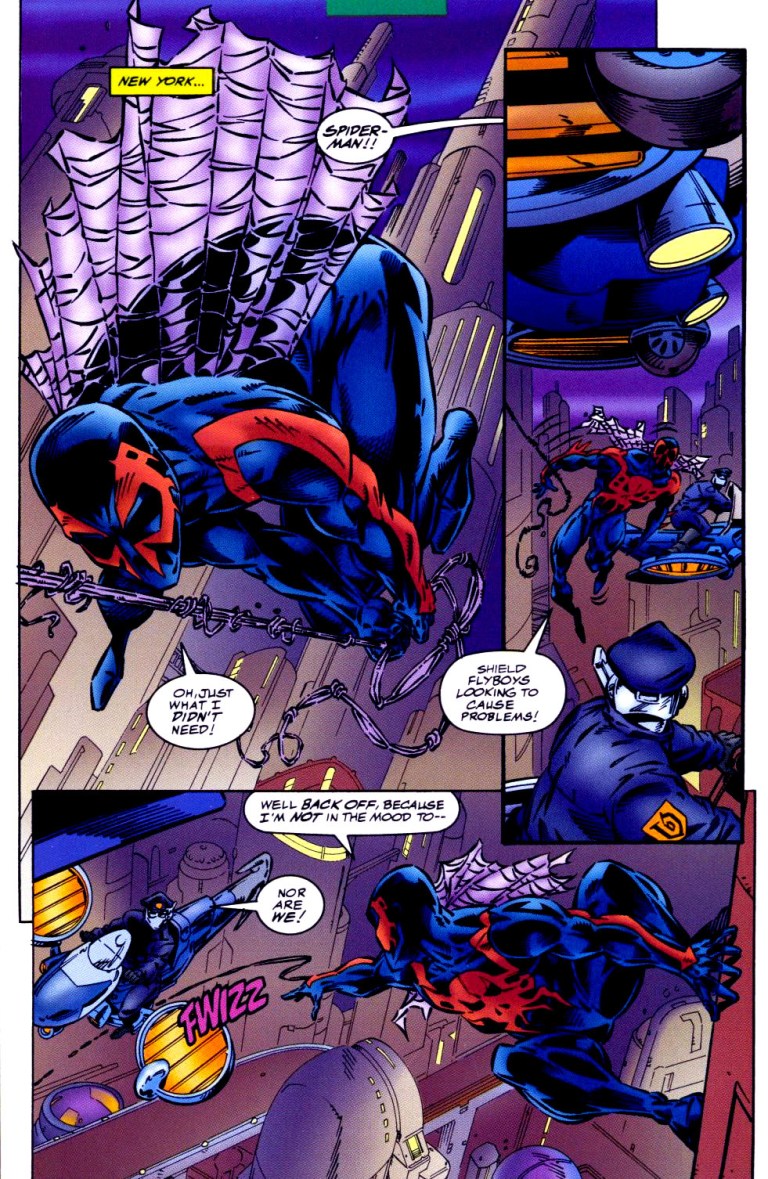
Meanwhile, Spider-Man 2099 (Miguel O’Hara) encounters the SHIELD flyboys in New York. After almost getting into trouble together, Spidey gets informed that US President Doom 2099 ordered them to leave him alone for a period of seventy-two hours while he considers a cabinet offer. Back in Washington, Dana gets interrogated by one of the authorities. President Doom enters the scene telling Dana that she will join Tyler Stone immediately in the medical center.
Andrew Wildman’s take on Spider-Man 2099 and the future was really nice to look at.
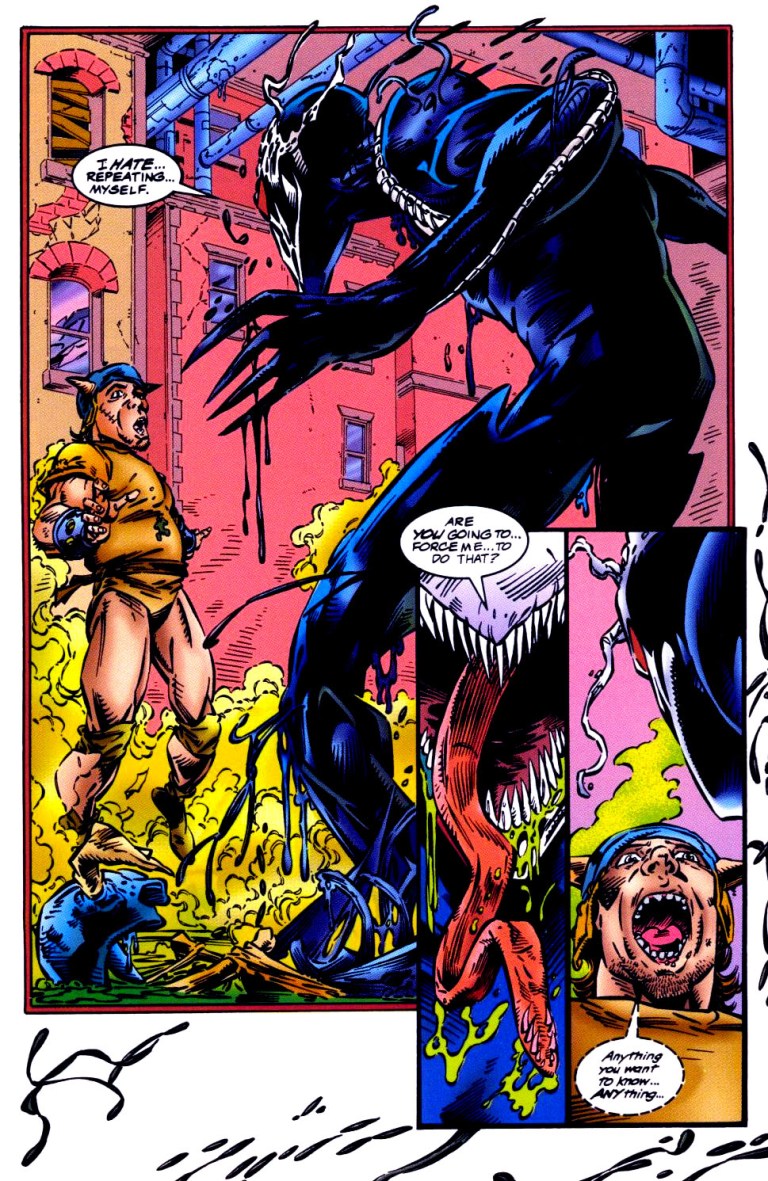
In New York, two guys sitting on the sidewalk witness a moving black liquid coming out of the sewer. The thing turns out to be a living symbiote (or alien costume) forming into a human-like shape – Venom 2099!
Quality
As with other comic books of this particular series, the writing by Peter David is pretty deep and engaging. The usual balance between dramatization, character development, plotting and spectacle is here once again but with a slight touch of horror in relation to the introduction of Venom of 2099. Speaking of dramatization, the portrayal of Venom 2099 as a vicious villain is similar to the 20th century Venom (Eddie Brock) but with a very powerful obsession to kill Miguel O’Hara and Tyler Stone.
Here’s an excerpt from the dialogue of Venom of 2099: Miguel O’Hara…and Tyler Stone…together again. We…I get to kill you…at the same time…how awfully…awfully…considerate. To show my appreciation…I’ll kill you slowly.
What makes this comic book unique is the artwork by Andrew Wildman who temporarily replaced regular illustrator Rick Leonardi. For comparison, I find Wildman’s art style a welcome thing in this comic book mainly because he draws with a lot more detail per panel and per page than Leonardi ever could. Instead of seeing the usual sketch-like art style of Leonardi, Wildman’s style is livelier and more expressive to look at. I also enjoyed Wildman’s visual take on Spider-Man 2099/Miguel O’Hara, Lyla, Tyle Stone, and the other established characters. Their facial expressions are also livelier to see.
Venom 2099 appears! Take note of the “liquid” at the edges of the page.
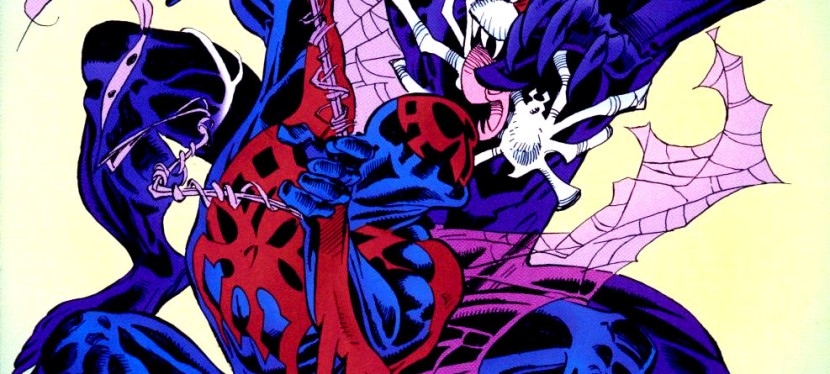
More on visuals, Wildman’s take on Venom 2099 is unforgettable. Like 20th century Venom, he has a dark suit, elongated jaw with rows of sharp teeth and an elongated tongue but with green acid dripping all the time. There are also those tentacles-like things that stretch from his body until the arms. Also his white-colored mask with large eyes make him look horrific.
Conclusion
Despite being shorter than the usual 22-pages, Spider-Man 2099 #35 is still a very engaging and fun old comic book to read. Its purpose was to build-up anticipation leading to the introduction of Venom 2099 was achieved nicely and the respective qualities of the writing and visuals are very good even by today’s standards. More on the presentation of Venom of 2099, it seems like Peter David took inspiration from movie director James Cameron on building-up tension and suspense before showing the villain. That’s a move I enjoyed in this comic book.
Overall, Spider-Man 2099 #35 is highly recommended. If you plan to acquire an existing and legitimate hard copy, be aware that the near-mint copy of it is over $100 for the newsstand version while the Rich Leonardi-drawn “Venom 2099 AD” cover version is priced at over $80 at MileHighComics.comas of this writing.
Thank you for reading. If you find this article engaging, please click the like button below and also please consider sharing this article to others. Also my fantasy book The World of Havenoris still available in paperback and e-book format. If you are looking for a copywriter to create content for your special project or business, check out my services and my portfolio. Feel free to contact me as well. Also please feel free to visit my Facebook page Author Carlo Carrasco and follow me at HavenorFantasy@twitter.com
When Marvel Comics launched its 2099 franchise back in 1992 with Spider-Man 2099, clamor for having the futuristic hero meet up with the classic Spider-Man (Peter Parker) quickly followed.
Back in those days, crossovers were already popular and sold nicely with collectors. The Infinity Gauntlet of 1991 was an epic, universe-wide crossover done nicely by Jim Starlin, George Perez and Ron Lim. That limited series sold well, Marvel followed it up with The Infinity War (1992) and The Infinity Crusade (1993). Even the disjointed The X-cutioner’s Song crossover of the X-Men comic books of 1992 kept the fans coming back for more.
For the 2099 universe, the franchise had strong launches with the respective first issues of Spider-Man 2099, Doom 2099, Punisher 2099, Ravage 2099 and even the first latecomer series X-Men 2099. Back in 1993, having the said 2099 heroes mix together was realized in the 5-part crossover The Fall of the Hammer.
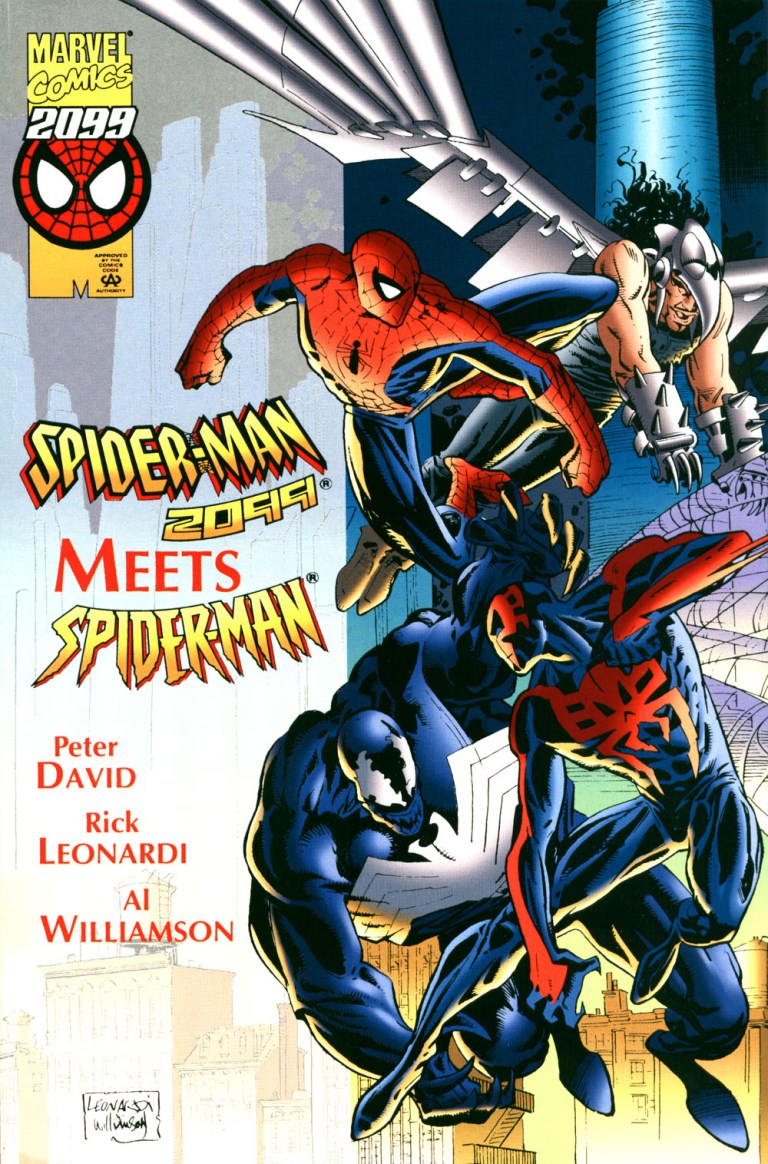
The cover by Rick Leonardi with ink work by Al Williamson.
No matter what the trends back then, Spider-Man 2099 proved to be the most engaging series of the 2099 line of comic books arguably due to the in-depth storytelling of Peter David. Back in the 1980s, David worked at the direct sales team of Marvel Comics before moving into the editorial team as a writer. And, yes, he got to write for the Spectacular Spider-Man (originally titled Peter Parker, The Spectacular Spider-Man). Early on, Peter David made quite an impact with readers with the 4-part story The Death of Jean DeWolff in the said monthly series.
Many years later, David joined other comic book creators – including the late Stan Lee – on launching the 2099 franchise with Spider-Man 2099. He created a lot from scratch to establish the futuristic Spidey and made his mark on the 2099 universe.
“I don’t remember exactly which aspects of the 2099 were already part of the initial setup when I came aboard. I do know, though, that there was almost nothing specific for Spider-Man other than that he was, well, Spider-Man and (I think this was part of what I was handed) an employee of Alchemax. I was the one, though, who came up with his identity, the way his powers worked, the supporting cast, all of that. I even had a hand in designing the costume; not that I could draw a lick, but I sat there with Rick Leonardi during the first 2099 get together and described to him what I wanted, and he executed it perfectly, building upon what I suggested and improving it. I watched that costume come to life for the first time under Rick’s pencil. It was one of the single best collaborative moments in my life,” David said in a CBR.com interview.
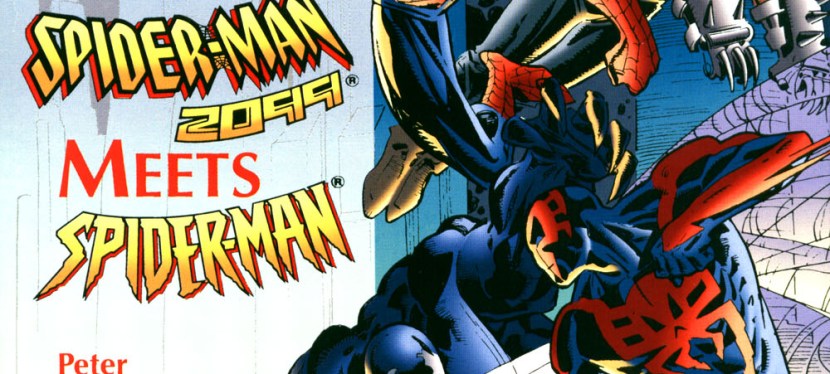
This brings us back to the year 1995 when Marvel published the one-shot special crossover comic book designed to attract Spider-Man 2099 fans and the many millions of followers of the classic Peter Parker Spider-Man. That comic book was Spider-Man 2099 Meets Spider-Man written by Peter David and drawn by Rick Leonardi.
Let’s take a close look.
The comic book
The story begins in the far future of 2099 wherein Spider-Man (Peter Parker) from the 20th century finds himself lost in time and chased by the floating law enforcers who saw him as a danger to the public. Even though his costume is different, one of the law enforcers mistook him for Spider-Man 2099. Predictably, Spider-Man struggles to overcome and get away from them.
Spider-Man in 2099!Spider-Man 2099 inside the Daily Bugle.
Meanwhile in the 20th century, Miguel O’Hara mistakenly arrives “home” only to find himself (naked no less) on the same bed as Mary Jane Parker (Spidey’s wife) who is also naked. This only confirms to him that he is lost in time. He immediately decides to get away from MJ and explore the city of New York which does not have the futuristic society he grew up with.
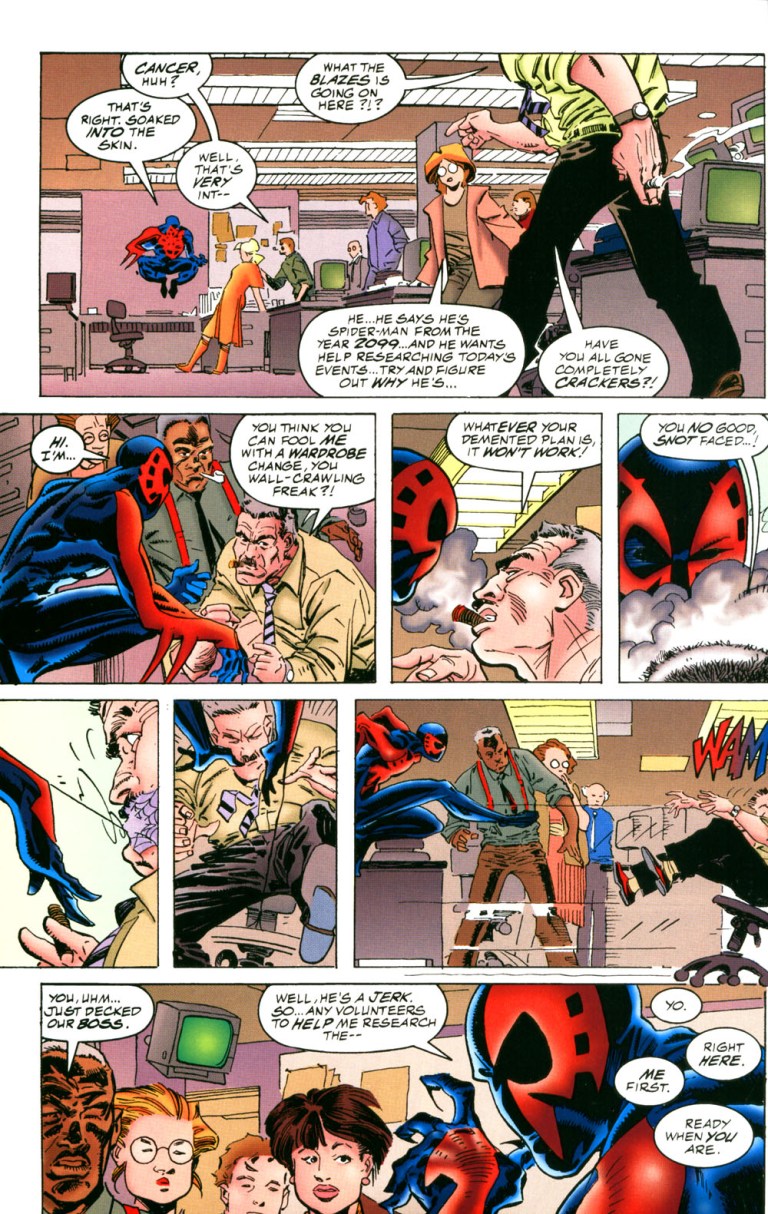
In an attempt to deal with the new reality, Spider-Man 2099 visits Peter Parker’s workplace – The Daily Bugle. He encounters Peter’s boss J. Jonah Jameson who mistook him as their time’s Spider-Man just wearing a new suit.
“You think you can fool me with a wardrobe change, you wall-crawling freak? Whatever your demented plan is, it won’t work,” Jameson told the disguised Miguel O’Hara who reacts by putting web on his mouth in front of the employees.
While the two superheroes struggle with being lost in time, Tyler Stone of Alchemax and Hikaru-Sama discuss something sinister.
Quality
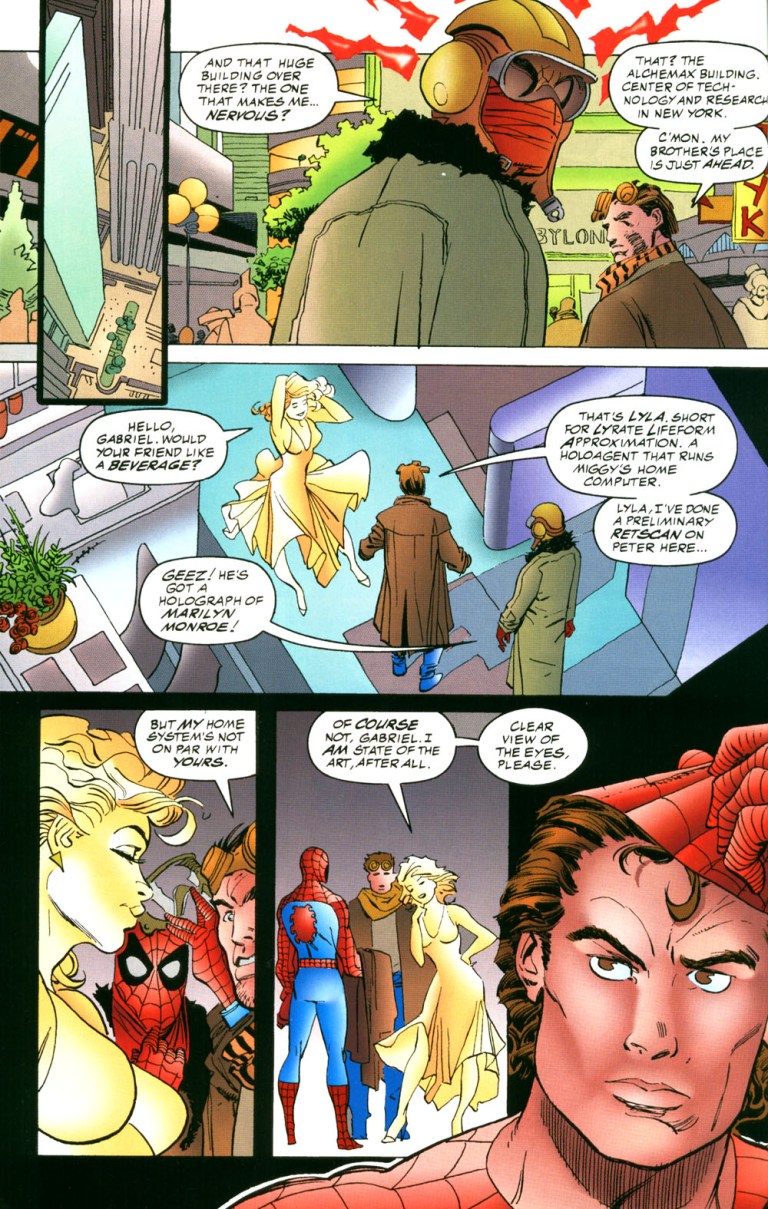
Spider-Man with Miguel O’Hara’s brother and Layla.
In terms of storytelling, Spider-Man 2099 Meets Spider-Man is messy even though there were efforts to have the two superheroes switch time settings that would allow them to explore different societies and mix up with their past supporting characters (example: Peter Parker Spidey meeting with Miguel’s brother and artificial intelligence Layla). What also hurt the storytelling was the lack of a very engaging antagonist. The futuristic Green Goblin the creators came up with was very lame.
The art by Rick Leonardi was barely satisfying and the sad thing is that none of his visuals – including the 2-page shot of the two superheroes together – delivered any impact. As Leonardi worked regularly on Spider-Man 2099, his art style of 20th century New York did not give me much immersion. J. Jonah Jameson was barely recognizable with Leonardi’s drawing.
To get straight to the point, this comic book is a major disappointment. It failed miserably to bring the two main characters together in a satisfying manner as there was an overabundance of build-up. By the time the two superheroes met, it was way too late for the comic book to be engaging and fun to read. With only seven pages available for the anticipated encounter, there was way too little of having Spider-Man and his 2099 counterpart together. So much could have been done to make the two superheroes interact and work together with a lot of impact but I suppose Marvel did not give the creative team enough time (and pages) to work with which resulted this disappointment.
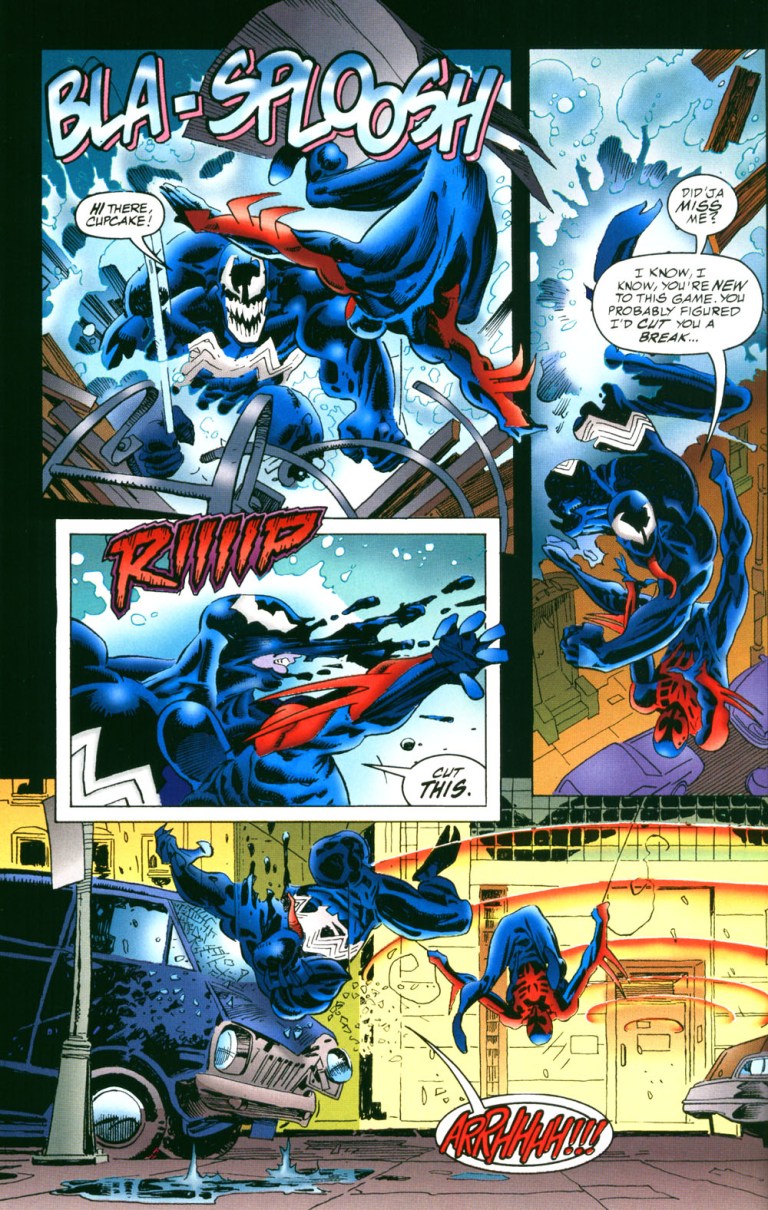
By comparison, I found Spider-Man 2099’s encounter with Venom much more satisfying to read. Spider-Man’s encounter with Vulture 2099, meanwhile, was satisfying. Sometimes I felt that it would have been better for Marvel to publish a Spider-Man 2099 versus Venom standalone crossover comic book than this 1995 crossover disappointment!
This is the BEST thing about this disappointing comic book.
If you are determined to risk wasting your money by actually getting a physical copy, then be aware that a near-mint copy of Spider-Man 2099 Meets Spider-Man will cost you, believe it or not, over $40 at MileHighComics.com
Financial value aside, this comic book’s entertainment value is pretty low. It’s not a badly made crossover comic book but it sure remains a big disappointment considering its concept. Ultimately, Spider-Man 2099 Meets Spider-Man is not recommended. You have been warned.
Thank you for reading. If you find this article engaging, please click the like button below and also please consider sharing this article to others. Also my fantasy book The World of Havenoris still available in paperback and e-book format. If you are looking for a copywriter to create content for your special project or business, check out my services and my portfolio. Feel free to contact me as well. Also please feel free to visit my Facebook page Author Carlo Carrasco and follow me at HavenorFantasy@twitter.com
Disclaimer: This is my original work with details sourced from reading the comic book and doing personal research. Anyone who wants to use this article, in part or in whole, needs to secure first my permission and agree to cite me as the source and author. Let it be known that any unauthorized use of this article will constrain the author to pursue the remedies under R.A. No. 8293, the Revised Penal Code, and/or all applicable legal actions under the laws of the Philippines.
I miss the old times when big rivals Marvel and DC Comics would set aside competition temporarily to team up and rely on their respective comic creators to make superhero crossover comic books that the fans can enjoy.
Back in the 1970s, key developments related to the comic book adaptation of The Wizard of Oz brought the two rivals together as partners. In 1976, Marvel and DC’s first superhero crossover Superman vs. The Amazing Spider-Man got published and to this day many comic book collectors and geeks I encountered still enjoy it. A few of them even called it a classic.
The collaboration between Marvel and DC continued in 1981 with Superman and Spider-Man which was published as issue number 28 of the Marvel Treasury Edition series.
The cover.
This is my look back at Superman and Spider-Man.
The comic book
Scripted by then Marvel Comic editor-in-chief Jim Shooter (with Marv Wolfman mentioned for plot suggestions) with art drawn by John Buscema and inkwork done by Terry Austin, Al Milgrom, Steva Leialoha, Walt Simonson, Bob Layton, Joe Rubinstein and Bob Wiacek, the comic book begins when Spider-Man swings into a construction site where he encounters several armed men and stops them singlehandedly.
Even though he stopped the bad guys, Spider-Man’s spider sense bothers him making him speculate that, because there’s no clear danger around him, the construction site seemed to be a threat.
After Spider-Man swings away from the police who just arrived, classic Marvel supervillain Doctor Doom watches via surveillance video and he was bother by the way things turned out.
“I did not like the way Spider-Man paused and look around after subduing the thieves – – as if he sensed something unusual about the excavation! Those accursed spider instincts of his,” Doom said before proceeding with his master plan.
A day later, the Hulk arrives in Metropolis causing lots of damage. Separately Superman and Spider-Man arrive to contain the green guy. However, things are not what they seem. This is where the story description ends.
Quality
What this comic book lacked compared to the 1976 Superman-Spider-Man crossover is visual impact. Clearly John Buscema had to follow closely the script which called for multiple panels per page and that left him little room to draw scenes dynamically. That’s not to see the art is weak. In fact, Buscema’s art is pretty good and he has deep knowledge about how the characters (including those many supporting characters and other minor characters from both Marvel and DC Comics) really looked from the size of Hulk’s body, the details on Wonder Woman’s costume, the distinctive look of J. Jonah Jameson, Perry White, etc. In short, I recognized the characters very easily.
This remains fun to read.Peter Parker in Metropolis along with the Superman supporting characters. This is one great element that made this comic book worth reading.
While the high number of panels per page limited him, Buscema managed to come up with some action shots that packed some impact.
When it comes to writing and storytelling, this comic book exceeds that of the 1976 Superman-Spider-Man crossover big time! To start with, the plot is much more elaborate, more detailed and yet consistently remained easy to follow.
While the 1976 crossover had the most popular villains of Superman and Spider-Man as the representation of evil, this one instead had Dr. Doom and Parasite. The great news is that these two super villains complement each other nicely and that itself adds good depth into the plot. Dr. Doom is a major schemer and Parasite fitted nicely within his master plan for global chaos.
Regarding dialogue, the script had a lot of strength and was also specific in capturing the personalities of the superheroes, the super villains and the supporting cast. I can easily identify J. Jonah Jameson, Perry White, Lois Lane and others through the dialogue.
Not to be outdone is the deeper approach to the crossover aspect of the story. Right from the start, the comic book creators expected us readers to suspend disbelief and start believing that while the story is non-canon, the respective universes of Marvel and DC Comics co-existed. Because there were TV shows of Wonder Woman and the Hulk playing, the two characters were included in the comic book adding depth to the crossover.
Speaking of crossovers, this comic book was not limited to Superman and Spider-Man. The encounter between the Hulk and Superman was a short but sweet spectacle to read. The encounter between Wonder Woman and Spider-Man meanwhile was short yet fun.
Adding more to the fun in this comic book was how Clark Kent interacted with the Spider-Man supporting characters while Peter Parker interacted with the Superman supporting characters. I enjoyed every moment of these scenes.
As far as narrative is concerned, this comic book is slightly slanted towards Superman. One factor behind this was the implementation of how local authorities interact with Superman and Spider-Man. Whenever he solves crime, Superman is highly respected by the public and the police. This is not the case with Spider-Man who is often perceived to be a social menace even though he helps solve crimes. Another factor was that Superman did more detective-type work (including a visit to Latveria) while Spidey hardly contributed anything to the plot’s development.
Nothing can be more frustrating than getting attacked by police officers when you try to help them solve their problems.
Regardless, the two icons got a fair share of the spotlight during the final stages of the story and there was enough spectacle to enjoy.
If there is any complaint I have, it would be the comic book creators’ reluctance on fully connecting itself to the 1976 crossover. In the scene wherein Peter Parker was guided into the film editing room by Jimmy Olsen, he recognized Lois Lane and remembered meeting her in the 1976 crossover (which ended with socializing). And yet when Spider-Man and Superman get together in this comic book, there was a noticeable lack of friendliness and personal cooperation between them even though they bonded nicely in the 1976 story.
Conclusion
Overall, Superman and Spider-Man is indeed a highly engaging, fun-filled superhero crossover comic book. For me, it is a true literary classic and definitely worth searching for out there. I read this crossover many times from start to finish and even though I knew the plot and the dialogue, I still had a lot of fun reading along the way. With the combined talents of Shooter, Buscema and many others, this superhero crossover was indeed one of the very best stories ever told by Marvel and DC Comics.
Given the current corporate climate Marvel and DC Comics are now in, it is very unlikely we will see another creatively fun superhero crossover collaboration between them happening soon. For the newcomers reading this, Marvel is owned by the Walt Disney Company while DC Comics is owned by Warner Bros.
Thank you for reading. If you find this article engaging, please click the like button below and also please consider sharing this article to others. Also my fantasy book The World of Havenoris still available in paperback and e-book format. If you are looking for a copywriter to create content for your special project or business, check out my services and my portfolio. Feel free to contact me as well. Also please feel free to visit my Facebook page Author Carlo Carrasco and follow me at HavenorFantasy@twitter.com
If there is anything I like most about Marvel Comics’ True Believers line of comic books, it’s that I get to read reprints of past stories without having to pay a whole lot of money to buy the original comic books or those pricey paperbacks.
A few years ago, out of curiosity, I bought a copy of True Believers which reprinted the first appearance of Deadpool in New Mutants #98.
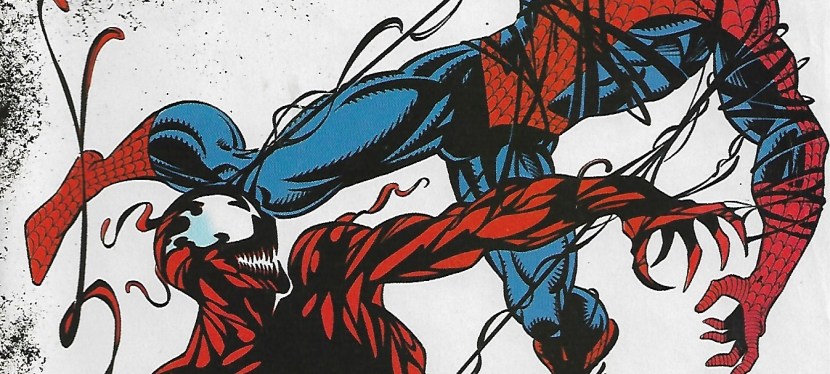
This time around I got to check on the first-ever encounter between Spider-Man and the vicious supervillain Carnage with True Believers: Absolute Carnage – Carnage #1 which is currently available for for only $1.
The cover.Hard-hitting action in the first encounter between Spidey and Carnage.
The comic book is a reprint of Amazing Spider-Man #361 which was released in 1992 just months before Marvel’s official celebration of the 30th anniversary of Spider-Man happened.
The story begins when Carnage causes trouble at the Agro-Lab Empire State University. He messes with a man named Chip (who claims to have done nothing wrong), cause property damage using his symbiote and eventually kills. This opening scene clearly shows that Carnage is a more troubling than Venom (who in turn was being turned into an anti-hero figure by Marvel’s creators).
Peter Parker/Spider-Man meanwhile spends quality time at home with his Aunt May. Unsurprisingly, a telephone call interrupts his private life causing him to go to the university to determine, secretly in costume, what happened. Peter personally knows Chip and the guy’s death only adds to his concern about the rise of brutal murders.
“Chip’s dead. And I’m worried that these serial killings may partly be my fault,” Peter told Mary Jane.
Using his access as a freelance photographer, Peter conducts computer research at the office of the Daily Bugle and discovers Cletus Kasady’s prison profile. Knowing that Kasady (Carnage) was a cellmate of Eddie Brock/Venom, he digs deeper and goes around the city to investigate. This sets up his first encounter with Carnage. What exactly happened between them? You just have to read to find out.
Tension builds up as Peter Parker researches Cletus Kasady.
Even by today’s standards, the story remains gripping, intriguing and entertaining at the same time. David Michelinie really knows how to balance spectacle, exposition and suspense with the Spidey-Carnage conflict as the highlight. Michelinie also showed Kasady’s insanity clearly and, even by his look, the villain is clearly a creative rip-off of DC Comics’ insane villain The Joker. Artist Mark Bagley’s art is still good to look at and he managed to pull off the daunting task of visualizing the present along with drawing images from Spidey’s past with original symbiote and Venom. The action scenes still have good visual impact.
Overall, if you are even a bit interested in Spider-Man, Carnage and 1990s comic book culture, then True Believers: Absolute Carnage – Carnage #1 is recommended. For only $1, this is one engaging and entertaining comic book to read.
Take note that there is a chance that Carnage will become the next popular supervillain in the movies once the character appears fully in the sequel to 2018’s Venom movie. Remember the mid-credits scene in Venom? Carnage could literally rise in pop culture.
Thank you for reading. If you find this article engaging, please click the like button below and also please consider sharing this article to others. Also my fantasy book The World of Havenoris still available in paperback and e-book format. If you are looking for a copywriter to create content for your special project or business, check out my services and my portfolio. Feel free to contact me as well. Also please feel free to visit my Facebook page Author Carlo Carrascoand follow me at HavenorFantasy@twitter.com
This past summer, the production of the pending Darna movie project suffered a major setback when Liza Soberano dropped out due to a serious injury of her finger. I wrote about that months ago and the fact that Soberano cried during the ABS-CBN interview (she admitted she let the fans down) only showed how heavy and painful the loss of the Philippine pop culture icon was to her deep inside. Not only that, the original director Erik Matti is no longer involved and has since been replaced by Jerrold Tarog.
As of this writing, the filmmakers are still quietly searching for a suitable replacement for Soberano.
As the search goes on in this age of social media and Hollywood-produced superhero movies that dominated the Philippine box office, the hot question remains – is a Darna movie still needed?
To understand things better, let’s go back to the beginning.
The past
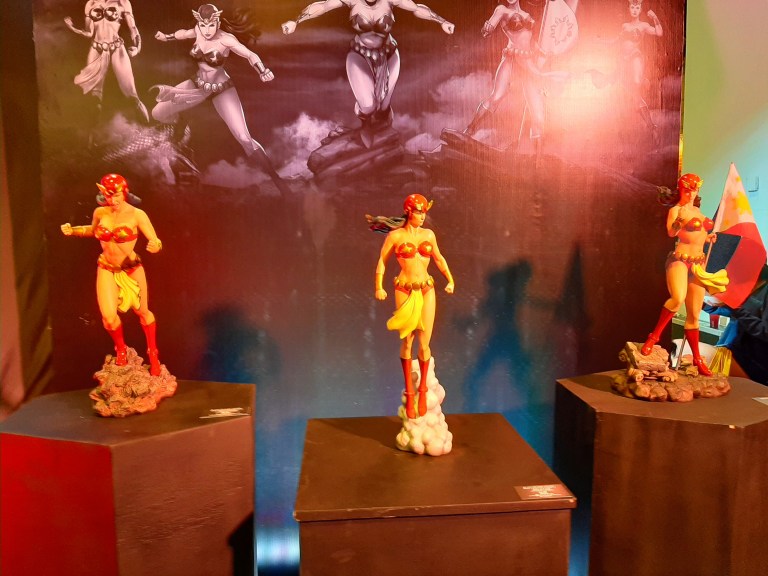
Darna with the Philippine flag on display at the Ravelo Komiks Universe booth during the recent Toycon.
Created by the late Mars Ravelo, Darna debuted in 1950 in illustrated print media and went on to appear in comic books, comic strips, magazine special features, television and movies to name some. Through the decades, Darna went on to become a Philippine pop culture icon and there were those who even compared her with Wonder Woman.
In Philippine cinema, Vilma Santos (who is now a public servant) made her mark with the public when she played Darna more than once. Other actresses who played the superhero in other movies were Sharon Cuneta, Anjanette Abayari and Regine Velasquez to name a few.
The 21st century
In the 21st century, Darna was unsurprisingly modernized in a TV series starring Angel Locsin and produced by GMA Network. The series became a hit nationwide and helped keep Ravelo’s icon relevant to Filipinos while also boosting Locsin’s popularity. A few years later, GMA lost Locsin to its rival network ABS-CBN and “replaced” her with then newcomer Marian Rivera who went on to become a star. While still holding the rights to Darna, GMA launched in 2009 a new series with Rivera as the superhero. Like the 2005 series before it, it became a hit as well.
While it was a success, the deal between GMA and the surviving members of Mars Ravelo came to an end. Unsurprisingly, in 2015, the Ravelos signed up with rival network ABS-CBN with upcoming Darna projects in mind. What made this new deal different was that it was in the form of a motion picture project through its movie-making arm Star Cinema.
Making a live-action Darna movie turned out to be tricky and time-consuming. In 2017, the project generated a lot of buzz and excitement when the young and pretty Liza Soberano was hired to play Ravelo’s creation. She was easily referred to as the “Millennial Darna”.
Of course, in this age of social media and smartphones, Filipinos expressed their reactions online. While there were those who welcomed Soberano as Darna, there were some who had problems with the actress’ American accent and heritage (note: Soberano was born in the United States) and some even claimed that she was “not Filipina enough” to play Darna who in the realm of fantasy is Narda, who is often portrayed as a simple Filipina.
And then there were some people who preferred Angel Locsin over Soberano. Take note that almost a decade before Soberano signed up to play Darna, Locsin was hired by ABS-CBN and starred in many big projects with the network achieving lots of success in both television and movies. As such, it was no surprise that there were still many craving for Locsin to play Darna under the banner of ABS-CBN.
Before losing the role, Liza Soberano worked really hard to play Darna. Videos and images of her physically training for the role were released online and it has been reported that she researched the icon behind the scenes. Soberano, by the way, studied at SISFU (Southville International School Affiliated with Foreign Universities) in BF International, Las Pinas City.
Do people really want to see a Darna movie at all?
While Star Cinema is slowly making the Darna movie, it is only fair to ask if people really want to see the movie at all. Do Filipinos, who collectively paid a good amount of money to enjoy Hollywood-made superhero movies in local cinemas since the year 2000, really need to watch Darna on the big screen?
Pick a Darna.
Now I am not a filmmaker nor have I gotten involved in the nation’s film industry but as a long-time geek, observer and former journalist, I should say that the odds are against Star Cinema.
Traditionally here in the Philippines, local film productions that became hits were the romantic comedy and horror types of movies. There were a few historical epic films that became hits along the way. A few fantasy movies were released and made some good money. Given the fact that these kinds of films became hits with Filipino moviegoers and given the fact that the Filipino action film genre has faded away since the early 2000s (note: Filipino action movies have been rarely produced since then), it comes to show that Filipino moviegoers are not that interested in locally made action scenes.
Action scenes combined with computer-generated images (CGI) are among the most attractive features of Hollywood superhero movies to Filipinos. There is nothing like watching Spider-Man’s classic fights with Doctor Octopus in Spider-Man 2 (2004), Wonder Woman leading the fight against the Germans in the No Man’s Land scene in Wonder Woman (2017), Batman fighting a gang of thugs in the warehouse in Batman v. Superman: Dawn of Justice (2016), and the massive battle between the superheroes and the evil ones in plains of Wakanda in Avengers: Infinity War (2018) all happen on the big screen!
Definitely those forms of spectacle look great, feel intense and were enjoyable to watch again and again. Moviegoers here in the Philippines paid good money to experience those sequences. For sure, all those on-screen action sequences were carefully crafted, choreographed and painstakingly laced with CGI at a high cost.
That being said, what can the Darna movie offer local moviegoers in terms of spectacle? Can the filmmakers come up with something stylish (if not original) with the action with Darna that can convince moviegoers to come back for more? How much money can the filmmakers afford to invest in such spectacle? For sure, there will be moviegoers who can’t help but make comparisons with Darna’s on-screen spectacle with those of movies from Marvel and DC.
There is also the challenge for the Darna filmmakers to tell a compelling story and have the moviegoers connect with the characters. Sure there is Darna (Narda is her civilian identity) but who else could they add as key cast members? The least the filmmakers could do is involve supporting characters who would end up annoying moviegoers. If the Darna movie would have humor, the producers should make sure that the comedy players should avoid annoying the viewers as they try to make comic relief.
Challenging also is the implementation of the villain to give Darna problems and compel her to act heroically. There is the long-time enemy Valentina but how can the filmmakers make her relevant and not look corny to the locally viewers who have gotten so used to villains in Hollywood superhero movies. Creating a brand new, all-original villain for Darna on the big screen could be a last resort if ever none of the Mars Ravelo-created villains would fit in. A weak cinematic villain is a big no-no.
And then there is the challenge of dramatizing and modernizing the origin of Darna on the big screen. This can make or break the movie because emphasizing the origin requires a good amount of build-up and however the story is written (with the expected big battle near the end) the movie should have balance. It is key to entertain the viewers, to connect them with the characters and make the plot relevant to them. If there is way too much build-up (read: Batman v. Superman: Dawn of Justice), moviegoers will end up getting burned out and the spectacle won’t save the movie. If the film has too much social commentary, it could turn off moviegoers.
Another issue is maintaining the relevance of Darna with the Filipinos as time passes. Each year that passes, a superhero movie of Marvel or DC Comics gets released in cinemas nationwide and adding more to the relevance of the superheroes in those movies is the presence of comic books and trade paperbacks of superheroes in retailers. I’m a comic reader and no matter how hard I try, I could not even find a Darna comic book at the retailers (including the comic book specialty stores) and not even reprints of old comics are available. As for the past TV series and movies of Darna, they can be viewed on YouTube but those productions are not too appealing to me.
Merchandise of Darna and the other Mars Ravelo heroes Lastikman and Captain Barbell are not that common commercially. The Ravelos however, in partnership with ABS-CBN, sell such merchandise (under the title Ravelo Komiks Universe) online.
During my time at the recent Toycon, there was a Ravelo Komiks Universe at the main exhibition floor which showcased statues and some merchandise of Darna, Captain Barbel and Lastikman. There were even hired models portraying the Ravelo superheroes in full costume.
One last issue to discuss here is movie competition. Hollywood superhero movies pretty much made tremendous commercial, and even social, impact here in the Philippines since the year 2000 when X-Men proved that superhero films can be taken seriously and be enjoyed for what they are. There is no denying that Marvel and DC Comics movies are major moneymakers among Filipinos. Wonder Woman grossed over P520 million nationwide in 2017. The disappointing X-Men: Apocalypse made over P400 million in 2016. Iron Man 3’s gross in 2013 was over P625 million. Lastly, Avengers: Endgame made over P1.6 billion this year!
Superhero movie competition is already tough and for sure moviegoers will compare Darna to those foreign superhero flicks on every detail. As if that was not hard enough, there is also movie competition with non-superhero flicks like Jurassic World (over P500 million) and the Star Wars movies to name a few. Some comedies and romantic comedies occasionally sell a lot. There are also those computer-generated animation films as well not to mention some Filipino movies that sometimes turn into major blockbusters.
Conclusion
I wonder if this classic Darna design will actually be used in the delayed movie. Whoever gets hired as the star should be ready to wear this swimsuit-type costume.
With these issues discussed, making a Darna movie is hard to do and selling it, if ever it gets made at all, is an even bigger challenge for Star Cinema. As a movie market, the Philippines and its moviegoers have an undeniable appetite for foreign movies and if it is spectacle they crave for, they search for it from Hollywood from the superhero movies, the sci-fi movies, the hard action films, fantasy movies, etc. Adding further to the challenge of making the Darna movie succeed is the advanced publishing of schedules of releases of future movies like Wonder Woman 1984 which will be released worldwide on the first week of June 2020.
If ever the film will be made, could Star Cinema’s Darna turn out as the complete package of really special superhero fun, engaging storytelling, memorable characters and great spectacle in the near future? Will it be released during the Metro Manila Film Festival or during the January-November period? How can Star Cinema make Darna relevant to young moviegoers, geeks and the many Filipinos who love watching Hollywood superhero movies?
The answers should unravel in the near future. There is, however, the possibility that the Darna movie would end up getting cancelled. Personally, I would not be surprised if that happens.
Don’t get me wrong. While I am not a fan of Darna, I still am interested to see a modern day film adaptation of Mars Ravelo’s superhero and hope it will happen with an engaging story, characters worth connecting with and carry lots of entertainment value. While I enjoy watching Hollywood superhero movies, I still will give the Darna movie a chance if it ever gets made as a solid film.
How about you, readers? Do you want to see a Darna film on the big screen?
Thank you for reading. If you find this article engaging, please click the like button below and also please consider sharing this article to others. Also my fantasy book The World of Havenoris still available in paperback and e-book format. If you are looking for a copywriter to create content for your special project or business, check out my services and my portfolio. Feel free to contact me as well. Also please feel free to visit my Facebook page Author Carlo Carrascoand follow me at HavenorFantasy@twitter.com
Back in the mid-1980s, the Marvel Comics universe had revisions as a result of the best-selling series Secret Wars. As a result of that series, Spider-Man went home with the alien costume or symbiote (read: Venom), Colossus’ feelings for Kitty Pryde weakened and the Thing decided not to go home yet with the Fantastic Four.
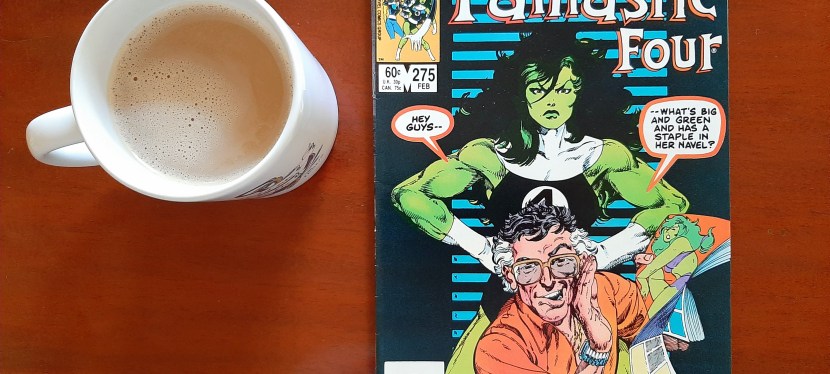
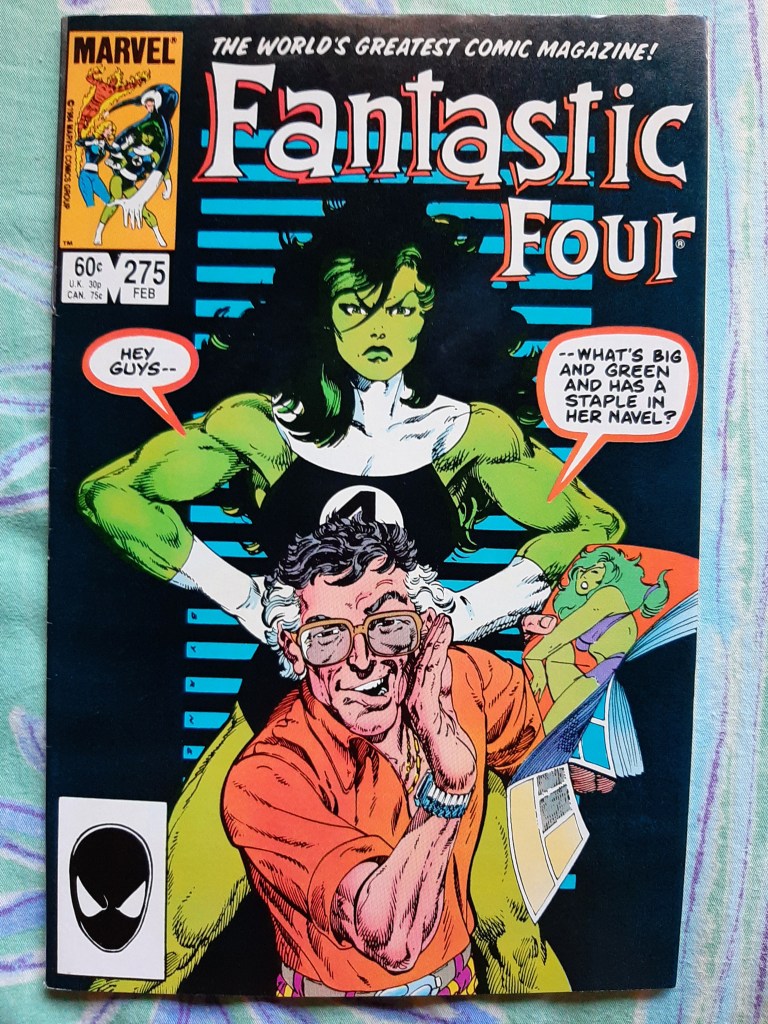
This resulted a temporary change in the lineup of the Fantastic Four. To make up for the loss (and strength) of the Thing, She-Hulk came in as the replacement. Reflecting this particular change, here is my retro review of Fantastic Four #275.
The cover.
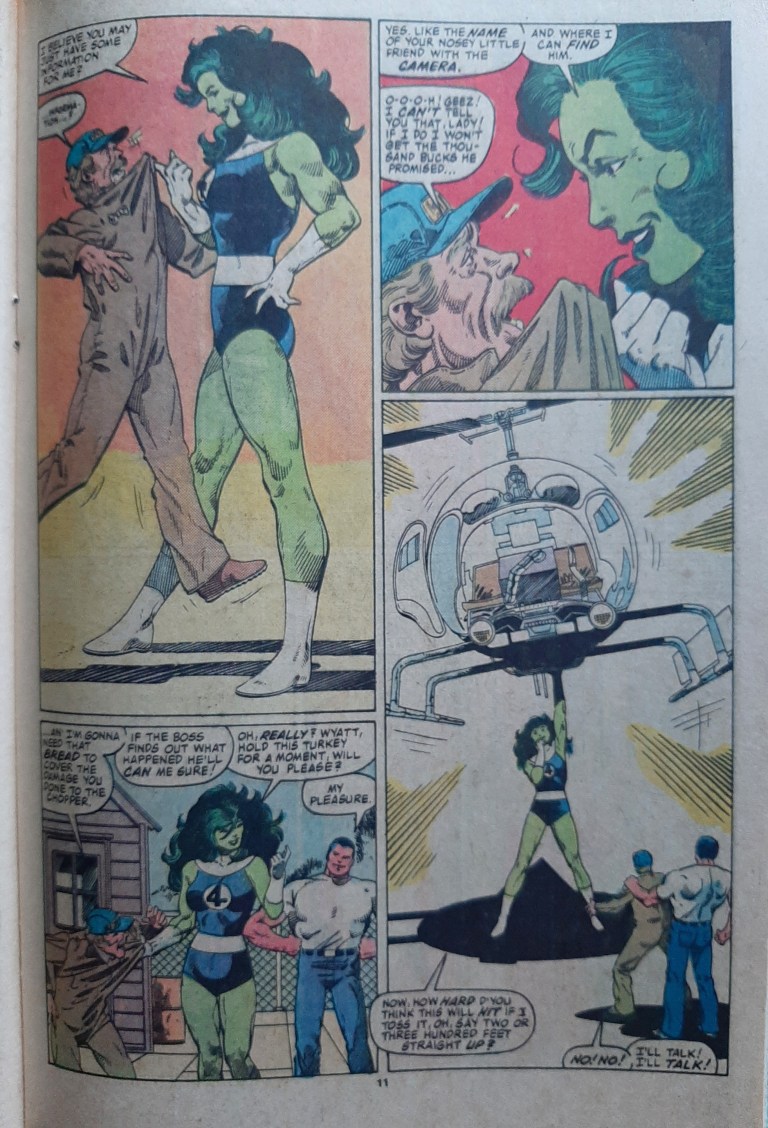
Released in 1985 with a story written and drawn by the legendary John Byrne, Fantastic Four #275 begins when a sun-bathing She-Hulk got photographed by a man riding a helicopter flying at the top of the Baxter Building in New York. The sheer force of air from the helicopter’s blades temporarily causes She-Hulk’s cover to loosen which exposes her body to the photographer.
“Here I was all braced for a super-baddie, and I end up getting photographed deshabillee by an airborne peeping-tom,” She-Hulk said during the encounter.
The green-skinned lady then decides to take a huge risk by leaping off the building and grab on to the helicopter.
While this is indeed a Fantastic Four comic book, it is very focused on She-Hulk. There is a short scene about Johnny Storm as well as an epilogue at the end of the comic book showing Reed and Sue Richards however.
In terms of storytelling, John Byrne did not tell the usual good-versus-evil story rather he focused more on how being a superhero can be challenging when it comes to personal privacy. This was emphasized through She-Hulk who became the object of a magazine whose editor-in-chief views her as a public figure and that puts her in the public domain along with other famous public figures whose faces and even their private lives got exposed to the masses.
From page 11.
If you are looking for superhero action, you won’t find much. There are some incidental forms of action in the form of collateral damage as She-Hulk crashes through walls.
Overall, Fantastic Four #275 is a fun read and its focus on how the print media treats superheroes viewed as public figures is a nice break from the typical good-versus-evil type of story. No clear villain here. Just the She-Hulk dealing with a magazine that violated her privacy.
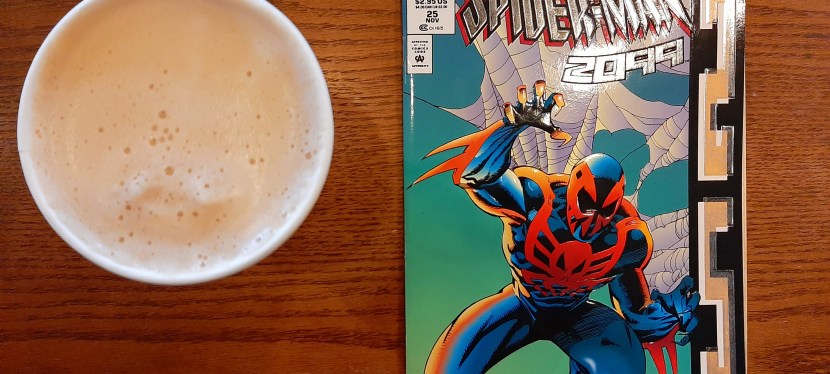
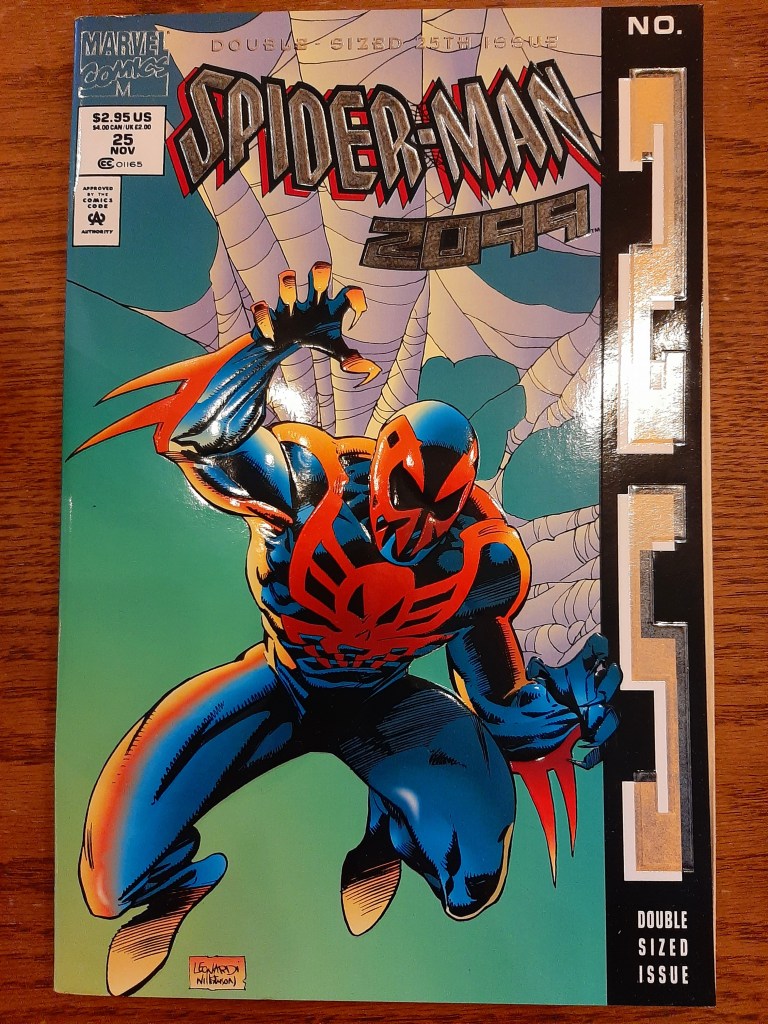
Released in late 1994 by Marvel Comics, Spider-Man 2099 #25 had a double-sized issue with an embossed cover that shined as it was laced with foil. The number 25 on the edge of the cover was stylized to capture people’s attention on the shelves of comic book specialty stores.
The cover of Spider-Man 2099 #25.
Back in the 1990s, Marvel had a “tradition” of releasing comic books with gimmick covers with anniversaries in mind. Notably the 25th, the 50th, the 75th and 100th issue and more got released with covers that came with foil or chromium or hologram or simply a hard embossed material. In other times, the anniversaries of the featured superhero/superheroes were celebrated with gimmick covers on comic books marking the celebration.
With regards to Spider-Man 2099 #25, the 2099 universe of Marvel had reached its 2nd year. By that point of time, the Marvel’s 2099 line of comics was already at full publishing blast with several monthly series (Spider-Man 2099, Ravage 2099, Punisher 2099, Doom 2099, X-Men 2099 and Ghost Rider 2099) plus a quarterly comic book (2099 Unlimited).
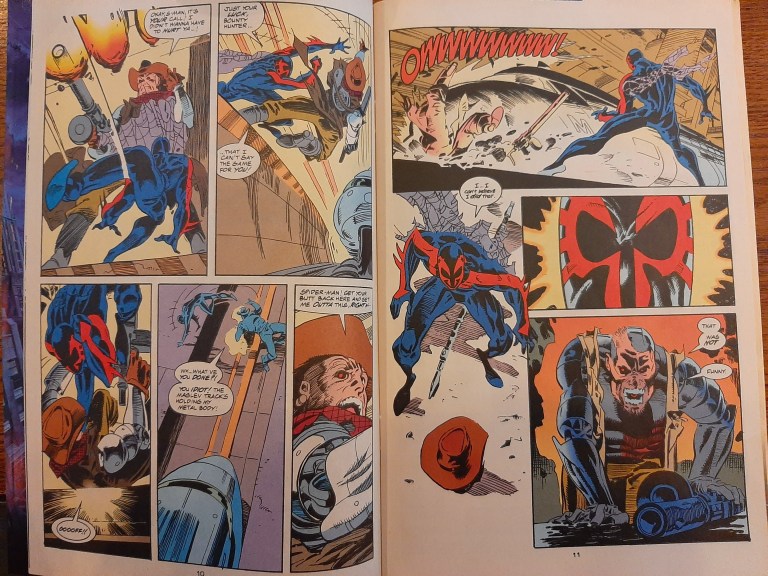
Written by Peter David and drawn by Rick Leonardi (with ink work by Al Williamson), the comic book begins with a short scene about Miguel O’Hara’s (Spider-Man 2099) mother moving on her way to meet someone. The spotlight then shifts into the heat of the rematch between Spider-Man and the cyborg Venture.
Later Miguel’s mother meets a certain tycoon at his mansion…
Spider-Man of 2099 fights with Venture.
When it comes to quantity, this comic book has a Spider-Man story of 22 pages, a Hulk 2099 story with 8 pages (a prequel to Hulk 2099 #1 specifically) and a story called Net Loss with 10 pages. The first time I read this comic book back in 1994, I anticipated more Spider-Man 2099 content but got surprised with the other two being part of it. Marvel decided back then to use Spider-Man #25’s content to expand and emphasize the 2099 universe.
When it comes to quality, I find the Spider-Man 2099 story here a worthy read not simply because Peter David wrote it but because he crafted a story that connects and relates well with what happened in Spider-Man 2099 #1. When I reached the end of the story, I really felt compelled to go back to the very first issue to re-examine what happened.
As this was the 25th issue of the series, Peter David and Rick Leonardi were more proficient as a creative team. The aesthetics of Leonardi’s art (inked by Williamson) is pretty much the same but I noticed that the illustrator added more power on key moments of the action. Ultimately this story is worthy of the 25th issue anniversary treatment.
The Hulk 2099 short story by Gerard Jones and Malcolm Davis meanwhile serves only to build up the mean green monster for its monthly series. Hulk 2099 was never an interesting character to me and this one did not change my view of him.
The final short story Net Loss was rather weird. Even though I read a lot of 2099 comic books, the story by Peter David and Tom Grindberg just did not captivate me.
Overall, I find Spider-Man 2099 #25 a worthy comic book to add to your collection and Spidey’s story alone is worth it.
Spider-Man 2099 #25 is recommended.
Thank you for reading. If you find this article engaging, please click the like button below and also please consider sharing this article to others. Also my fantasy book The World of Havenoris still available in paperback and e-book format. If you are looking for a copywriter to create content for your special project or business, check out my services and my portfolio. Feel free to contact me as well. Also please feel free to visit my Facebook page Author Carlo Carrascoand follow me at HavenorFantasy@twitter.com
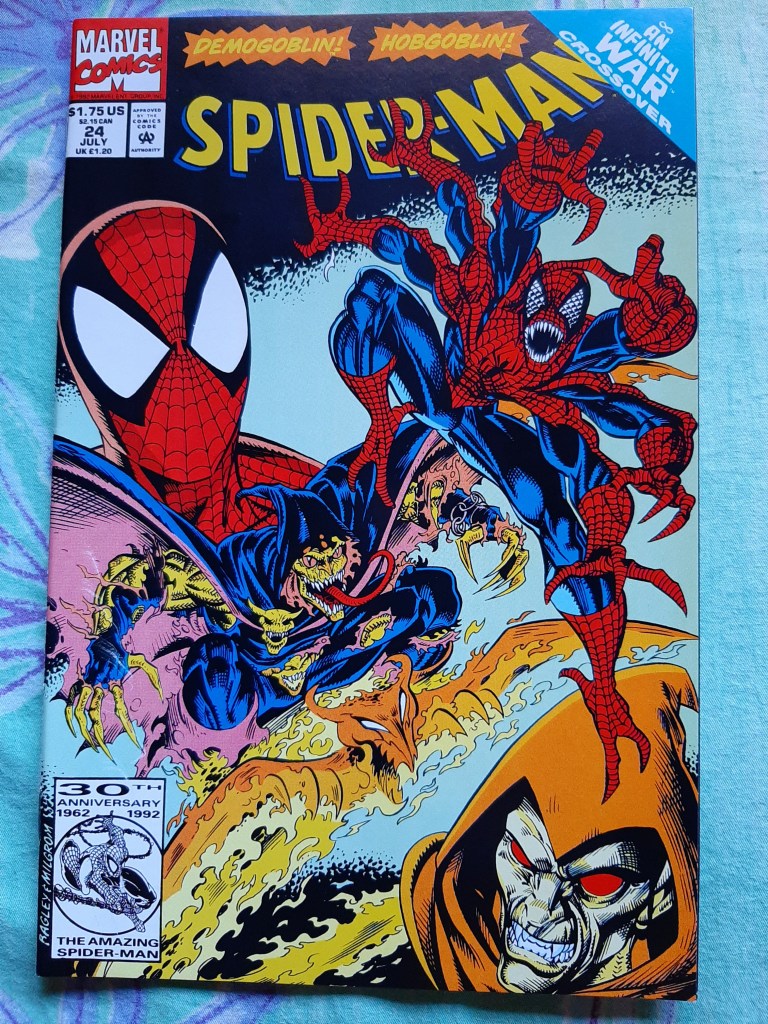
Back in 1992, Marvel Comics published the Infinity War limited series which dealt with a new conflict that brought the superheroes together. It was the sequel to 1991’s Infinity Gauntlet.
To emphasize the scope of Infinity War, several comic books from other regular series published by Marvel had specific issues serving as tie-ins. In this retro review, we take a look back at Spider-Man #24.
The cover with art by Mark Bagley.
Spider-Man #24 begins with Peter Parker waking up from a nightmare. Careful not to wake up his wife Mary Jane, he decides to go out in the middle of the night.
“Who ever said super heroes are supposed to sleep? At least I didn’t wake Mary Jane up this time. Got to get out to clear my head,” Peter Parker thought. “Sheesh! I’m Spider-Man and I love being me!”
As Spider-Man swings during the night, Jason Philip Macendale (the Hobgoblin) wakes up too from a nightmare. This makes him decide to work out a bit and then go out disguised as the Hobgoblin flying with a glider. He also happened to be training himself with the handgun.
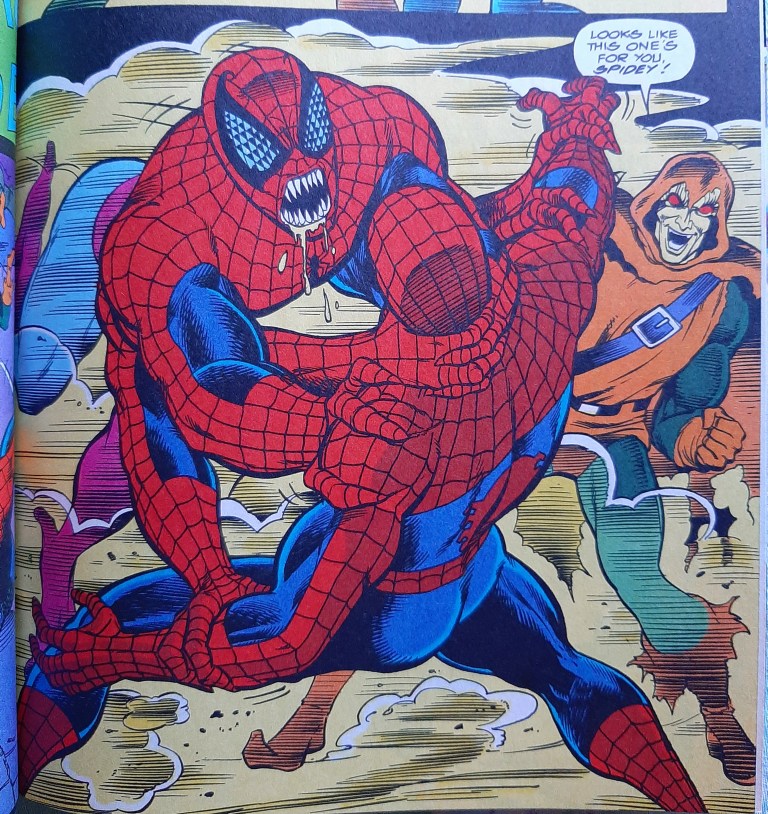
Eventually the two will encounter each other but not head-to-head. Rather they get into conflict with the Demogoblin (a more demonic version of the Green Goblin) and, more notably, the Spider-Man Doppelganger (a biologically monstrous version of the superhero with eight arms, sharp teeth and animal instinct).
Spider-Man meets his monster match.
With regards to its quality, the story sheds light on Spider-Man’s uneasy connection with Hobgoblin. As for its connection with Infinity War, the Spider-Man Doppelganger’s presence linked the Spider-Man monthly series in a serviceable fashion, specifically what happened near the end of this comic book was reflected in one of the pages of Infinity War #1.
Still I felt that this comic book was a missed opportunity to truly emphasize the Spider-Man Doppelganger as a new menace in Spider-Man’s part of the Marvel universe. There is not enough spotlight on the monster (whose first appearance was in Infinity War #1 by the way) nor was its battle with the superhero proved to be satisfying when it comes to emphasizing spectacle for the readers.
Quite notably, the narrative and action had to be shared with the Hobgoblin who is technically the 2nd lead character in this comic book. Sure he got to fight the Demogoblin and the Doppelganger providing comic book action but I preferred to see more of Spider-Man versus the Doppelganger as this was their first encounter.
When it comes to visuals, penciller Larry Alexander did a satisfactory job overall. While the faces and hairstyles of Peter Parker and Jason Macendale don’t look different enough from each other, Alexander clearly put more effort to make a few key moments of the action scenes stand out.
Overall, Spider-Man #24 is a satisfying read. It marked Spidey’s first-ever encounter with the Doppelganger but was bogged down by the way the story was crafted. If you plan to buy this old comic book at all, don’t pay a full dollar for it.
Thank you for reading. If you find this article engaging, please click the like button below and also please consider sharing this article to others. Also my fantasy book The World of Havenoris still available in paperback and e-book format. If you are looking for a copywriter to create content for your special project or business, check out my services and my portfolio. Feel free to contact me as well. Also please feel free to visit my Facebook page Author Carlo Carrascoand follow me at HavenorFantasy@twitter.com












 Author Carlo Carrasco