A Look Back at Mantra: Spear of Destiny #1 (1995)

Welcome back superhero enthusiasts, 1990s culture enthusiasts and comic book collectors! Today we go back to the mid-1990s to explore a part of the Ultraverse through a tale of Mantra, the male eternal warrior Lukasz who died during battle then returned in the body of a woman named Eden.

It has been a few years since the last time I reviewed a Mantra comic book. For the newcomers reading this, the Ultraverse was a franchise of superhero comic books launched by Malibu Comics in 1993 which produced a lot of fun, intriguing and memorable tales made by a variety of really talented creators. Mantra was one of the pioneering characters of the Ultraverse and the related comic book series lasted more than twenty issues. Along the way, a standalone story of Mantra was published in the form of a 2-part mini-series.

With those details laid down, here is a look back at Mantra: Spear of Destiny published in 1995 by Malibu Comics with a story written by Mike W. Barr and drawn by Paul Abrams.

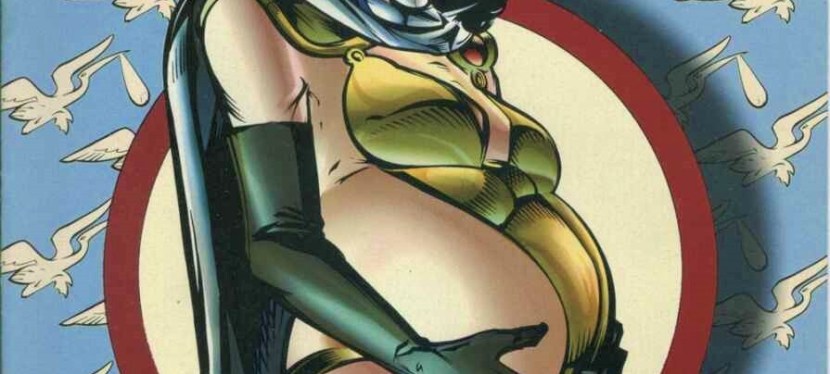
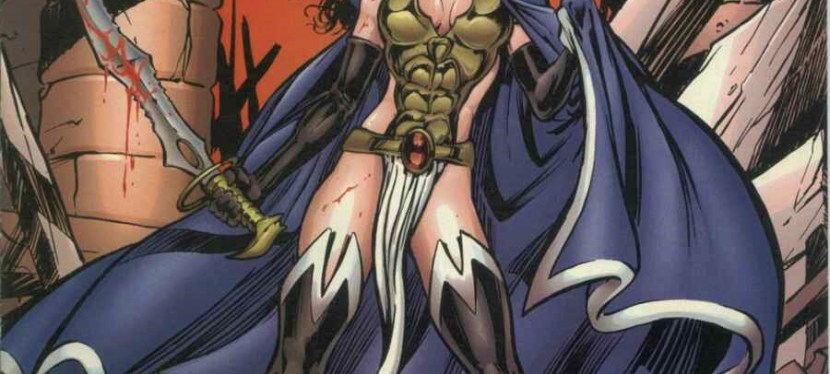
The cover.

Early story

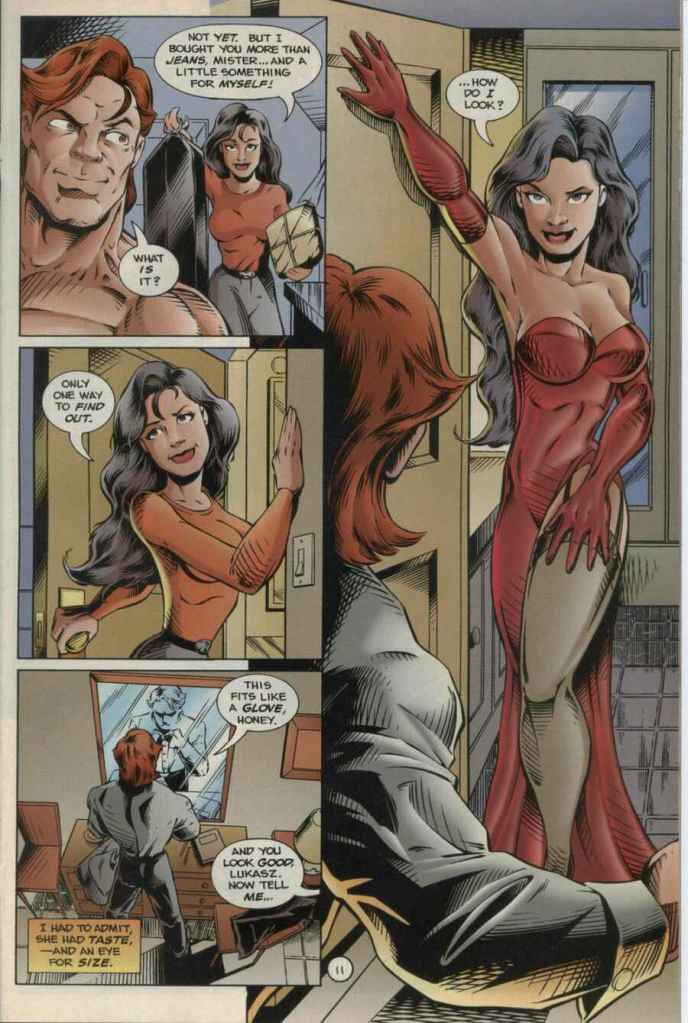
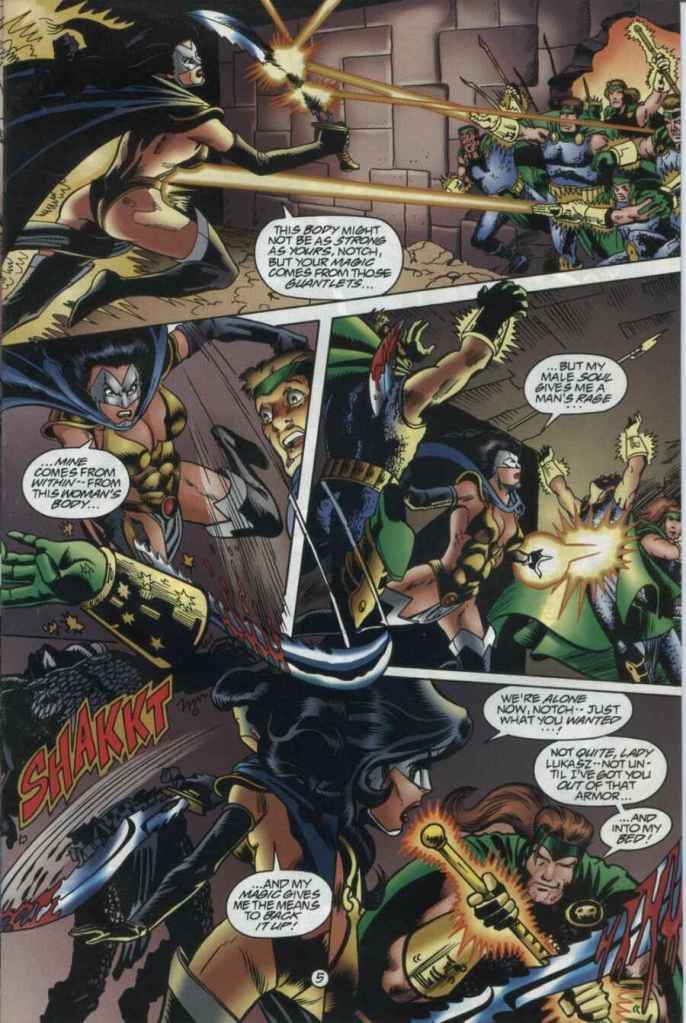
The story begins when Mantra arrives at a museum to start her attempt (in her civilian identity as Eden Blake) to obtain the Spear of Destiny. While wearing a revealing outfit to distract the men, Mantra gets close to the highly prized spear to observe it and see how the security personnel guard it.

At a different spot within the museum, Mantra decides to start obtaining the spear in magical outfit and with a mask. As Mantra arrives at the room where the Spear of Destiny, already there are monsters overwhelming the men guarding the Spear of Destiny…

Quality

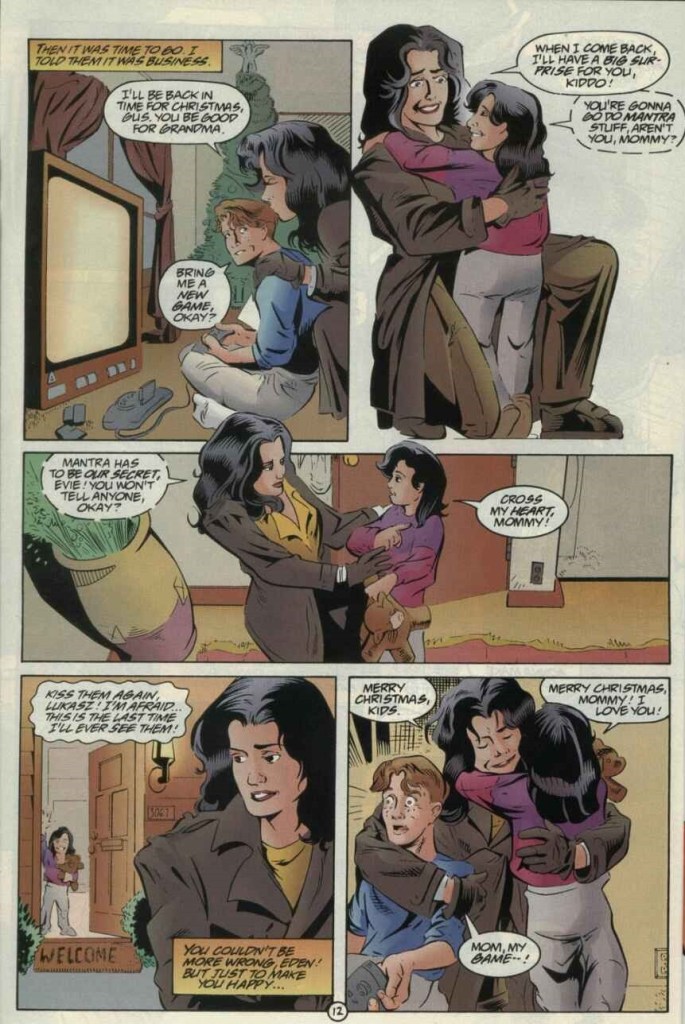
Eden Blake/Mantra reporting to work at Aladdin.

Having read most of the stories of the Mantra comic book series, I can say that Mike W. Barr came up with a fresh concept that emphasizes the quest to gain possession of a highly valuable item while also creating a new approach on presenting Mantra…by engaging in espionage (spying and infiltration).

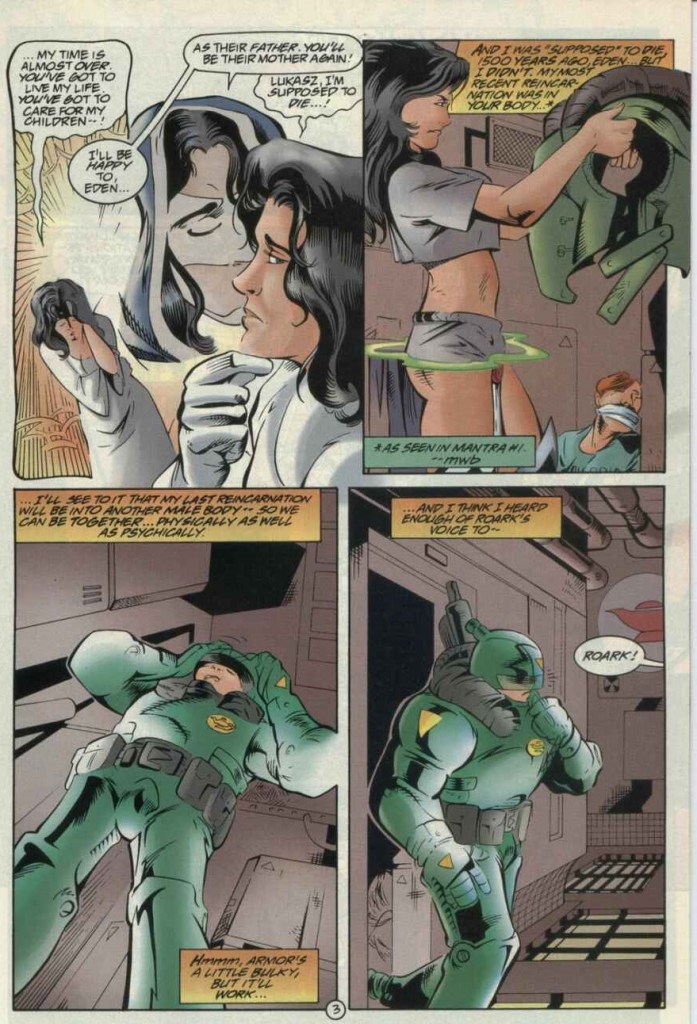
As I am already used to seeing the eternal warrior Lukasz/Mantra using magic in many struggles or missions, the concept of having the protagonist getting disguised and becoming an impostor on a spy mission is a very inspired move by the writer. The preparations taken by Mantra to becoming a certain blonde woman for the mission were nicely structured and detailed enough to make the transformation. As if that was not enough, a certain piece of technology was implemented which made using magic a huge risk for the eternal warrior. That being said, the story smoothly transitioned from magic-filled fantasy into a convincing spy thriller

Along the way, this comic book also emphasizes the darkness of the secret society Aladdin which Mantra (as Eden Blake) works for. Aladdin’s operations were dramatized several times in other Ultraverse comic books but this one has a more explicit portrayal of them.  

Conclusion

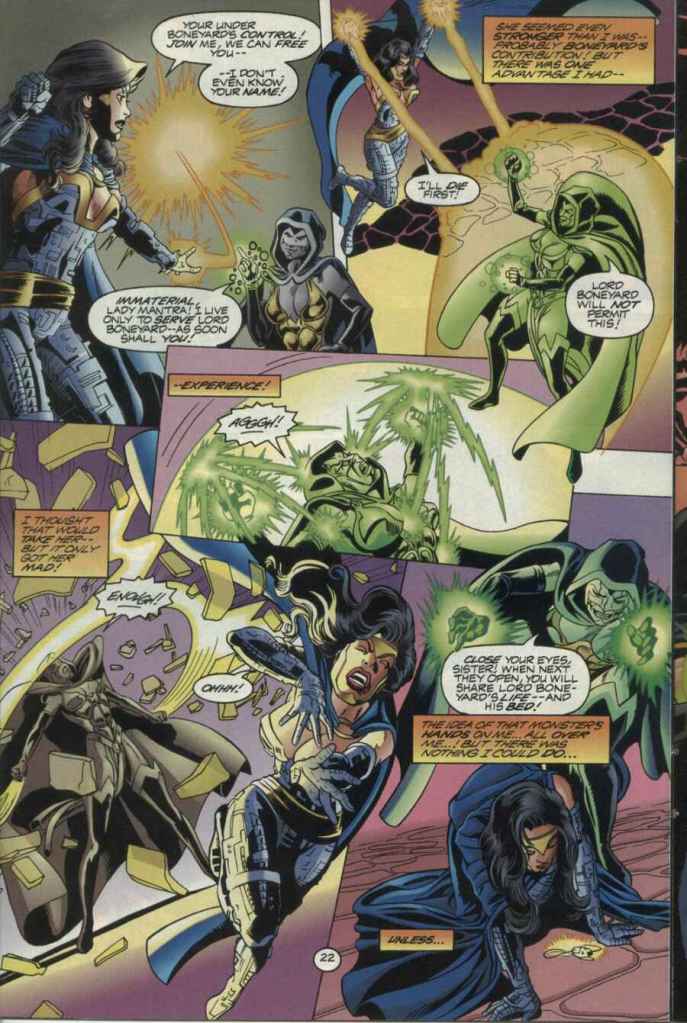
Mantra got hold of the Spear of Destiny but for how long?

Mantra: Spear of Destiny (1995) is really entertaining and compelling to read. This is easily one of the more creative and more unique tales of the Ultraverse character ever told and I can say that I am eager to find out what would happen next. This is also the one tale in which Mantra became a spy and gets into a dangerous mission in which the use of magic is too risky. The writing by Mike W. Barr is really strong with this one.

Overall, Mantra: Spear of Destiny (1995) is recommended.

+++++

Thank you for reading. If you find this article engaging, please click the like button below, share this article to others and also please consider making a donation to support my publishing. If you are looking for a copywriter to create content for your special project or business, check out my services and my portfolio. Feel free to contact me with a private message. Also please feel free to visit my Facebook page Author Carlo Carrasco and follow me on Twitter at  @HavenorFantasy as well as on Tumblr at https://carlocarrasco.tumblr.com/ and on Instagram at https://www.instagram.com/authorcarlocarrasco
A Look Back at Detective Comics #575 (1987)

Welcome back superhero enthusiasts, 1980s culture enthusiasts and comic book collectors! Today we go back to the late 1980s to explore a part of the DC Comics shared universe through a tale of the iconic Batman.

After DC Comics published the maxi-series Crisis on Infinite Earths, the publisher rebooted their entire comic book universe and that meant reintroducing their superheroes, villains and supporting characters with a touch of 1980s modernization. Frank Miller led the reintroduction of Batman as a new crime fighter in the Batman: Year One storyline in 1987. Also that same year, DC Comics went on to publish a sequel storyline through four issues of the Detective Comics series. That sequel was titled Batman: Year Two.

With those details laid down, here is a look back at Detective Comics , published in 1987 by DC Comics with a story written by Mike W. Barr (the same guy who did Mantra for Malibu Comics) and drawn by Alan Davis. This is the first chapter of the Batman: Year Two storyline.

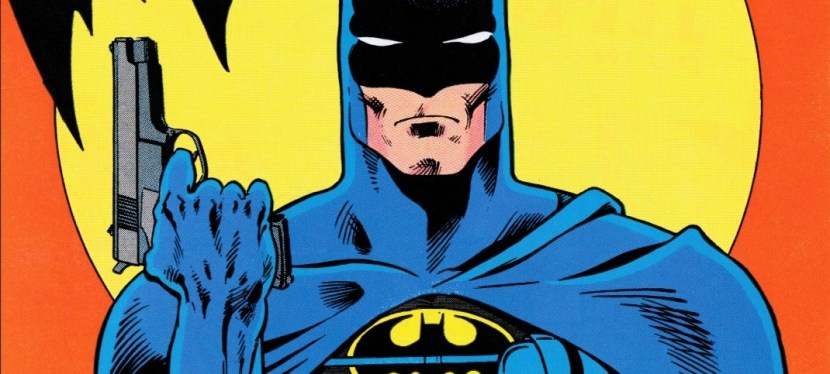
The cover.

Early story

The story begins in Gotham City where the newly appointed police commissioner Gordon participates in a TV talk show. The talk show host is aggressive towards Gordon cutting him off verbally and pointing out that Batman – who is working with the police fighting crime – is no better than the Reaper, a costumed vigilante who caused trouble and killed many people on Gotham’s streets twenty years prior. Gordon emphasizes that Batman works with the city police and he operates strictly on his own.

As the TV talk show goes on, a group of armed thugs carrying varied items enter an apartment that is dark. Outside the Bat Signal (coming from the machine Gordon recently got) flashes, and soon Batman himself appears inside the apartment and cleverly took the gang down. He leaves the place going to do other things.

The next day, Rachel Caspian is pleasantly surprised to see her father arrive earlier than expected…

Quality

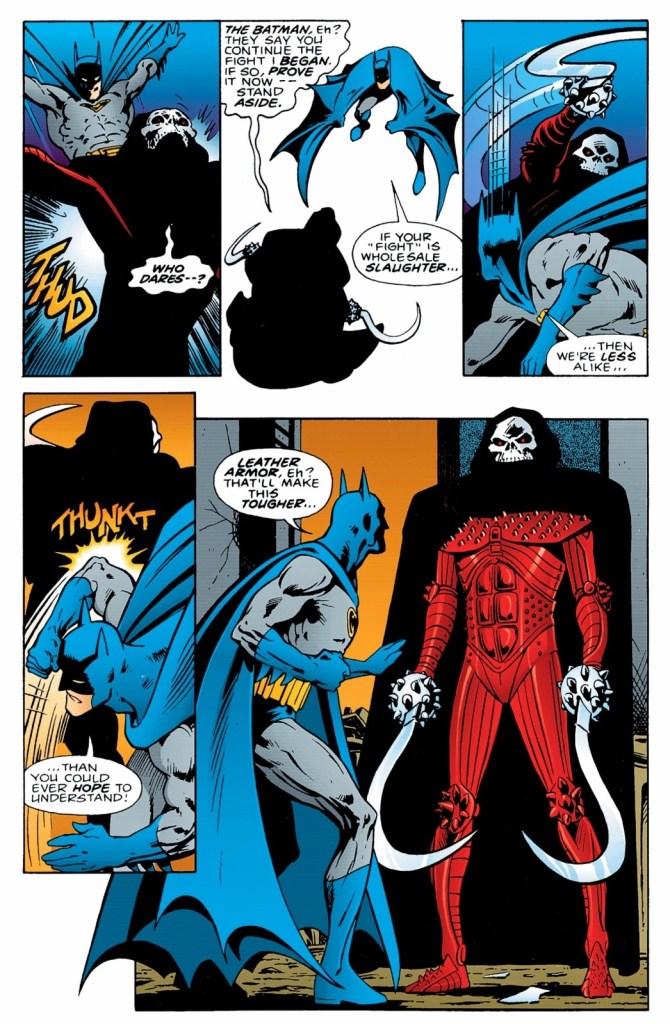
Batman strikes first in his encounter with the Reaper.

Set during the 2nd year of Batman engaging in crime-fighting in coordination with the Gotham City police force, this comic book dramatically portrays the city having a long-running disease and legacy of crime. The references to Gotham’s embarrassing past of being filled with thugs and wicked activities literally paved the way for the return of a masked vigilante who fights criminals with uncompromising violence (including killings). That vigilante’s legacy affects the way the public perceives Batman and why they have trouble seeing the differences between them. The writing and build-up here are very solid.

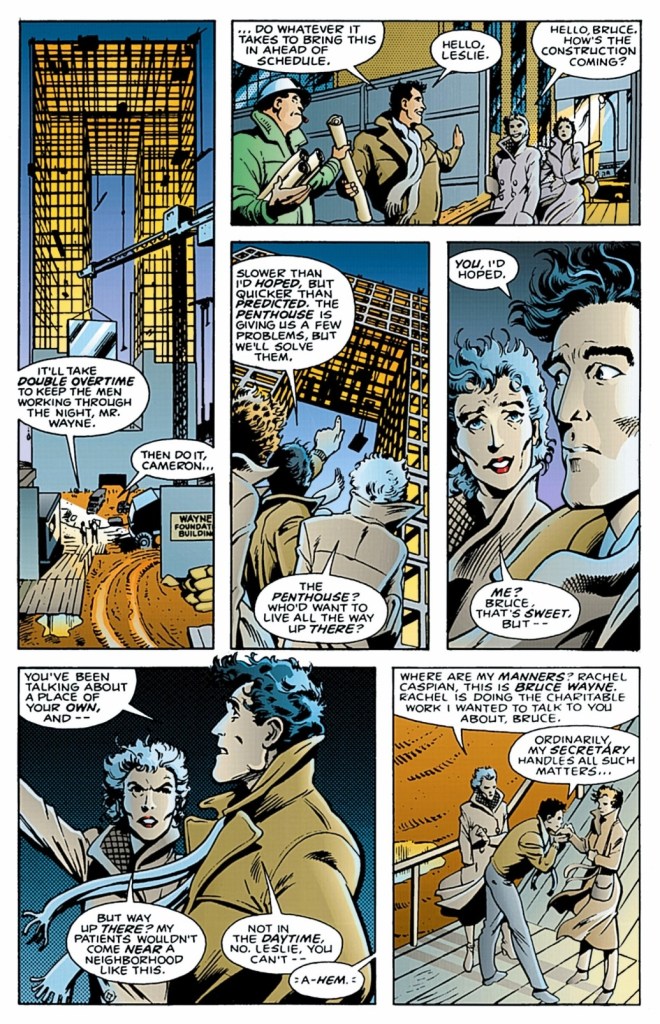
When it comes to portrayals, you will get to see a younger Bruce Wayne who is clearly pushing himself hard between engaging in business matters and secretly fighting crooks. This is a Batman who is only gaining more experience in the war against crime and he clearly is not the very tactical and very resourceful hero he would become. In his fight against the Reaper, you will really see Batman struggle hard and make really flawed moves that cost him a lot.

The introduction of the Reaper, who became the definitive vigilante of Gotham City long before Batman even started, is very engaging. This vigilante is also very intimidating to see and he clearly overshadows the Caped Crusader both visually and in action.

Conclusion

Bruce Wayne attending to business on-site.

As the first chapter of the Batman: Year Two storyline, Detective Comics (1987) is a very solid tale to read. The narrative moved at a medium pace and there were these balanced pay-offs to the build-up (that took place in the first half). The Reaper’s reputation as Gotham’s past blood-thirsty vigilante literally dwarfed that of Batman (the modern vigilante). I should also state that Mike W. Barr symbolized the common traits and differences between Batman and the Reaper which alone are worth reading.

Overall, Detective Comics (1987) is recommended.

+++++

Thank you for reading. If you find this article engaging, please click the like button below, share this article to others and also please consider making a donation to support my publishing. If you are looking for a copywriter to create content for your special project or business, check out my services and my portfolio. Feel free to contact me with a private message. Also please feel free to visit my Facebook page Author Carlo Carrasco and follow me on Twitter at  @HavenorFantasy as well as on Tumblr at https://carlocarrasco.tumblr.com/ and on Instagram at https://www.instagram.com/authorcarlocarrasco
A Look Back at Ultraverse Year One (1994)

Disclaimer: This is my original work with details sourced from reading the comic book and doing personal research. Anyone who wants to use this article, in part or in whole, needs to secure first my permission and agree to cite me as the source and author. Let it be known that any unauthorized use of this article will constrain the author to pursue the remedies under R.A. No. 8293, the Revised Penal Code, and/or all applicable legal actions under the laws of the Philippines.

Welcome back superhero enthusiasts, 1990s culture enthusiasts and comic book collectors! Today we go back to the mid-1990s which was a pretty wild time for comic collectors. To be more specific, this newest retro review revisits the Ultraverse through a comic-like publication in the form of a guide meant for UV fans and comic collectors.

The subject at hand is Ultraverse Year One which, as written on the edge of the front cover, was designed to be the “complete guide to the Ultraverse’s first year.” It is a reference guide for those who seriously want to discover each and every Ultraverse comic book that was published during its first year. In my experience as a comic collector, the Ultraverse launch in 1993 was very memorable even though my financial limitations prevented me from acquiring each and every launch comic book and subsequent releases of the time. How useful is this complete UV guide? We can go on and find out.

With those details laid down, here is a look back at Ultraverse Year One, published in 1994 by Malibu Comics.

The cover.

Quality

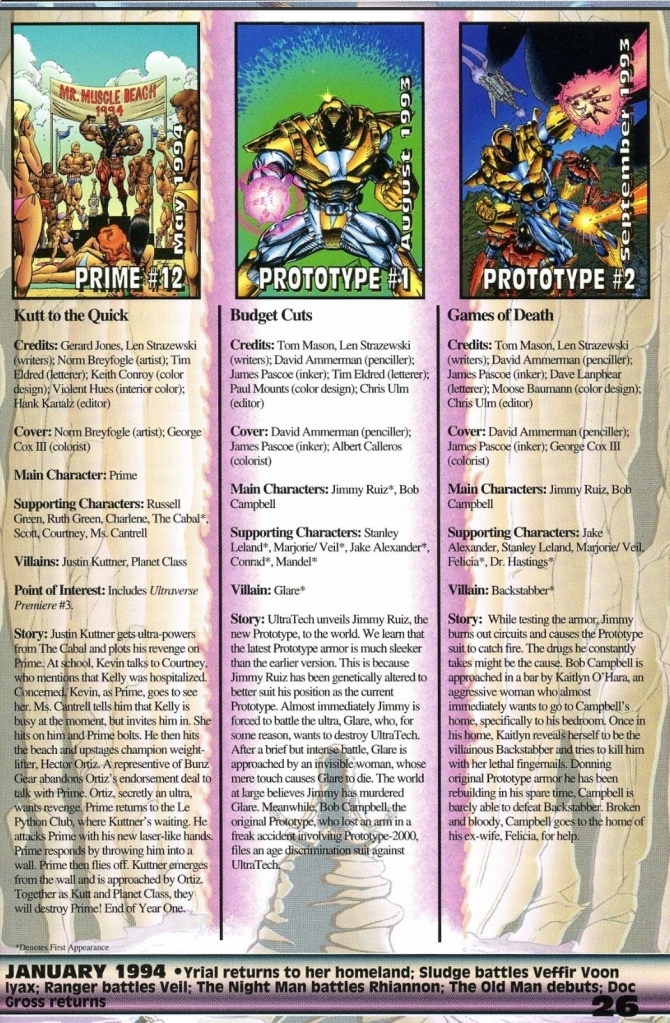
I can say without a doubt that this publication is indeed a complete guide to each and every Ultraverse comic book released during its first year from 1993 to 1994 specifically. You want to know exactly how many issues of Mantra, Prime, Hardcase, The Solution, Prototype, The Strangers and others were published in the first year? This one has it all listed! You want to know which UV comic book involved the talents of Steve Gerber, Norm Breyfogle, Rick Hoberg, Len Strazewski, Aaron Lopresti, George Perez, James Hudnall, Gerard Jones, Steve Englehart, Tom Mason, Terry Dodson, James Robinson, Howard Chaykin, Mike W. Barr and many others under the Malibu Comics banner? This guide has it all listed! What months were Exiles #1, Sludge #1, Firearm #0, Break-Thru #1 and Mantra #1 were published? The answers to each are included. The same can also be said when it comes to which characters appeared in each comic book.

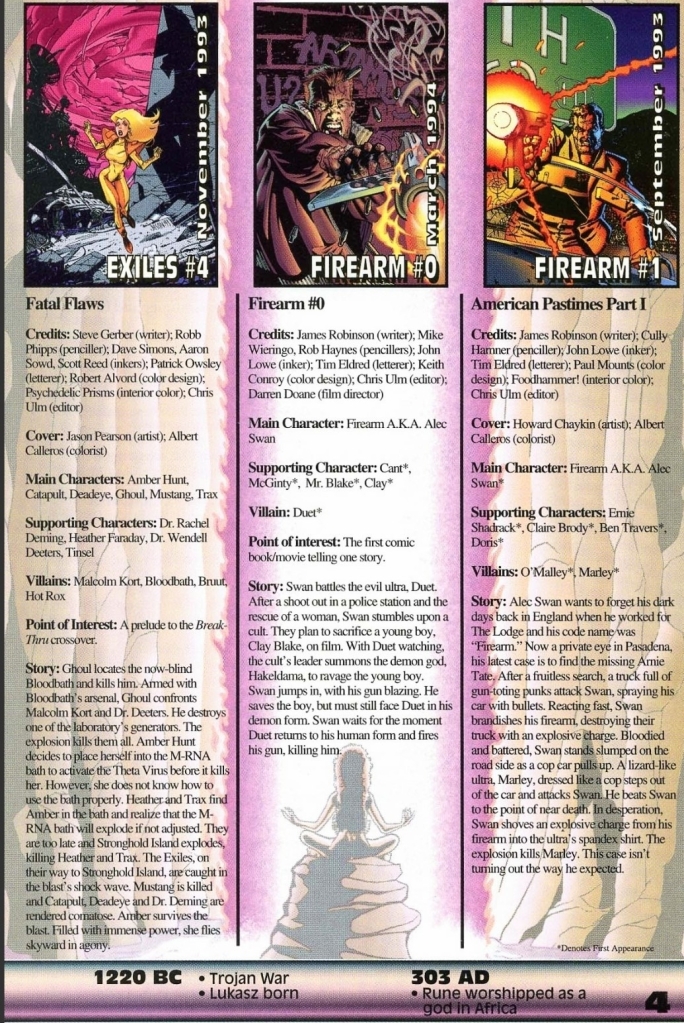
This is what each page typically looks like with details of the Ultraverse timeline on the lower part.
The timeline reveals that the male warrior Lukasz, who would later end up in woman’s body as Mantra/Eden Blake, was born in 1220 BC.

Very clearly, the Malibu Comics people worked hard to collect the essential types of information, organized them and put them all into print media form for readers and collectors to use when it comes to searching just about everything about the Ultraverse’s first year. Things did not just stop there, however.

What I found amusing to look at in each page of this Ultraverse guide are details of the shared universe’s timeline posted on the lowest part. The said timeline – which is limited to text and numbers – reveal interesting details such as what year was Lukasz (AKA Mantra) born, when did Rune begin, when was the Choice corporation established, what year did the island of Yrial’s people move up to the clouds, what years were infants injected by Wetware Mary and more. These details are actually quite encouraging to make readers discover or re-read Ultraverse comic books to see how they are dramatized on paper.

Conclusion

As you can see in the details above, Len Strazewski was involved in both the Prime and Prototype comic book series.

Ultraverse Year One (1994) is a pretty detailed guide that will not only help readers track down each and every UV comic book of the mentioned time period, but also help them spot the precise comic books that has characters included as well as the published works of varied comic book creators. If you are really determined to track down and buy all the Year One UV comic books, this guide is a must-have. If there are any weaknesses to mention, it would be the fact that each comic book’s entire plot got summarized in full which are actually spoilers.

Overall, Ultraverse Year One (1994) is recommended.

+++++

Thank you for reading. If you find this article engaging, please click the like button below and also please consider sharing this article to others. If you are looking for a copywriter to create content for your special project or business, check out my services and my portfolio. Feel free to contact me with a private message. Also please feel free to visit my Facebook page Author Carlo Carrasco and follow me on Twitter at  @HavenorFantasy as well as on Tumblr at https://carlocarrasco.tumblr.com/ and on Instagram at https://www.instagram.com/authorcarlocarrasco/
A Look Back at Break-Thru #2 (1994)

Disclaimer: This is my original work with details sourced from reading the comic book and doing personal research. Anyone who wants to use this article, in part or in whole, needs to secure first my permission and agree to cite me as the source and author. Let it be known that any unauthorized use of this article will constrain the author to pursue the remedies under R.A. No. 8293, the Revised Penal Code, and/or all applicable legal actions under the laws of the Philippines.

Welcome back superhero enthusiasts, 1990s culture enthusiasts and comic book collectors! Today we go back to the mid-1990s which was a really wild time for comic collectors. To be more specific, this newest retro comic book review revisits the conclusion of the epic Ultraverse storyline Break-Thru which was illustrated by the late George Perez (1954-2022). I encourage you readers – especially long-time fans of the iconic illustrator – to check out my commemorative article about George Perez by clicking here.

For the newcomers reading this, Break-Thru was a 2-part storyline that creatively involved almost all the main characters of the Ultraverse (The Strangers, Mantra, Prime, Prototype, Freex, The Solution, Hardcase, Sludge, Solitaire and others) who got impacted in varied ways by Amber (of the Exiles) who floated high in the air causing chaos on societies below. Specifically, that was the concept of Break-Thru (1993) and issue has the story continuing with a setting in outer space with the moon as the key destination.

With those details laid down, here is a look back Break-Thru , published in 1994 by Malibu Comics with a story scripted by Gerard Jones (plotted by Mike W. Barr, Steve Englehart, Steve Gerber, James Hudnall, Tom Mason, George Perez, James Robinson and Len Strazewski) and illustrated by the late George Perez.

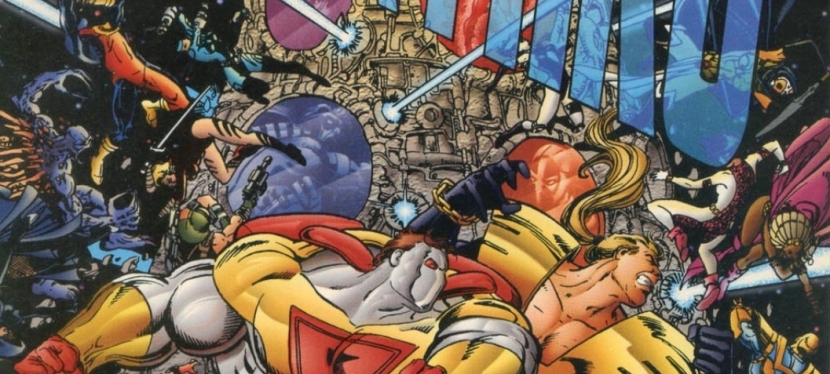
An epic cover by the late George Perez.

Early story

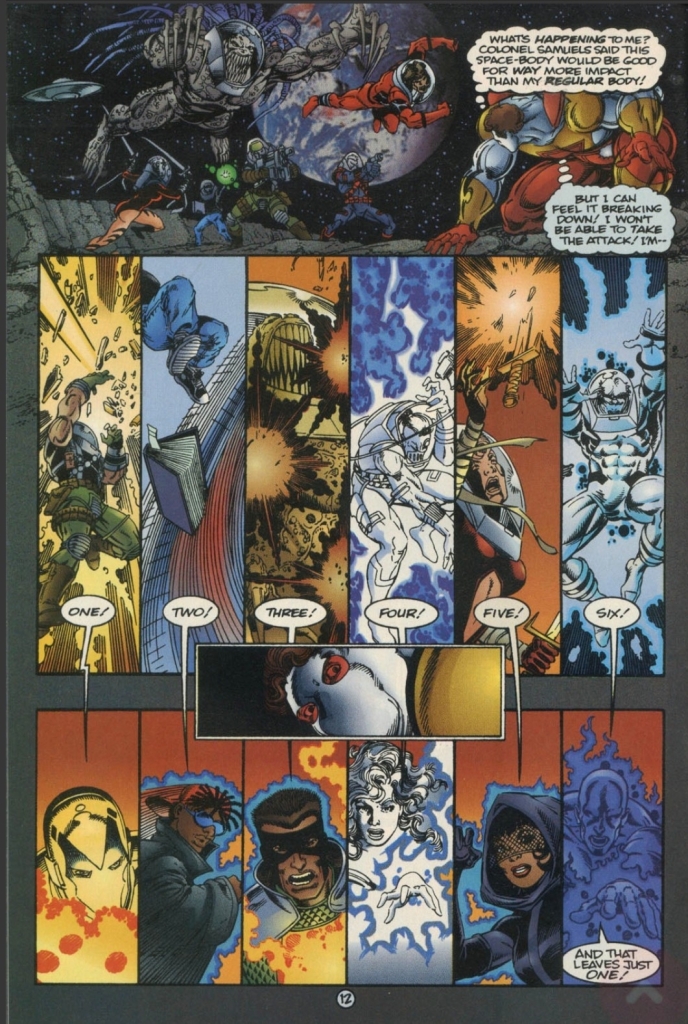
The story begins at the surface of the moon with Hardcase, Choice and the members of The Solution who just survived the explosion (connected with Hardcase #7 and The Solution #4) of the flying saucer they used on their journey. Nearby, the people responsible for the destruction are riding their own flying saucer, scanning the surface of the moon searching for an entity.

Behind the scenes, the very hidden yet powerful Rex Mundi watches and tells Gate that other ultras are seeking the entity. As the saucer floats to a cave detecting the presence of the entity, the occupants get shaken as Prime hits them hard. Prime tells himself that the entity in the cave feels danger from the searchers and he has to protect it as he has been connected with it (refer to Prime #7). After getting blasted in retaliation by the saucer, Prime finds himself hit even more as Rex Mundi’s enforcers suddenly come out of a portal very near him.  

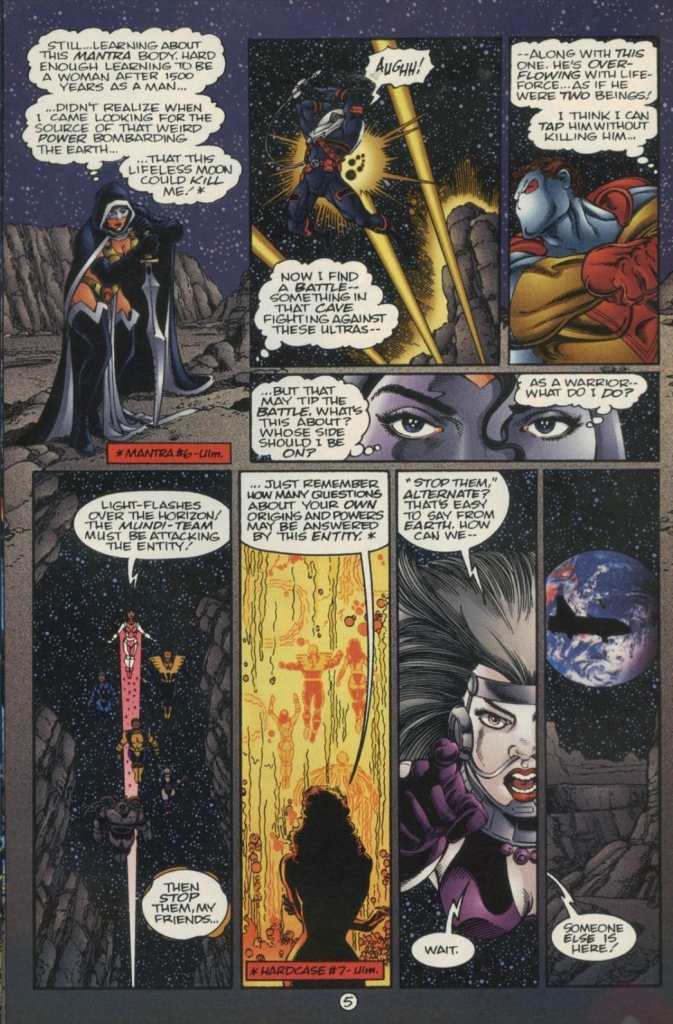
From a distance, Mantra (refer to Mantra #6) sees the fight happening and needs a life force to survive. Elsewhere, Hardcase, Choice and The Solution witness the arrival of a space shuttle. The Strangers and Prototype (refer to The Strangers #7 and Prototype #5) come out together…

Quality

This is classic George Perez presentation of action and characters using multiple panels in a single page.

Starting with the writing, I should mention that all the writers who were involved in plotting this comic book as well as the previous issue should be commended for their combined efforts on making the Break-Thru storyline happen complete with in-universe ramifications, developments and connections to almost all the monthly comic books via the Break-Thru tie-in issue (also check out Sludge #3, Freex #6, Solitaire #2 and Night Man #3). Clearly Break-Thru was planned to be a major turning point of the Ultraverse by involving and mixing most of the major characters together and have them struggle with tremendous obstacles they simply cannot ignore as the stakes were indeed too high.

More on this comic book, the major conflict was set on the moon which proved to be a very unique setting not just for dynamic battles to happen but also to serve as the place where a mysterious and powerful entity is hidden. When it comes to the story, the entity (more science fictional in concept) is mysterious and cleverly not blatantly evil. It is its mysteriousness that makes the entity a worthy force to have the UV’s heroes come after.

The writers added depth to the plot by showing Yrial of The Strangers and Prototype each having their own vested interests to get to the entity and acquire whatever it has that is valuable. At the same time, Mantra and Prime each discovered valuable knowledge about the entity that impacted their perceptions about their purpose as beings with super powers.

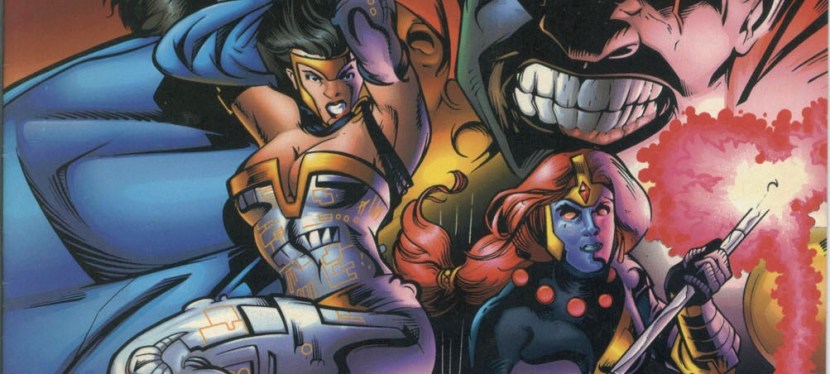
Mantra, Prime, The Solution, Hardcase and Choice.

While the story here still has so many characters expressing themselves and releasing expository information, the narrative is a little bit easier to understand and follow compared to issue (which had a lot more information to release via exposition). That being said, the scenes of spectacle became more enjoyable to read and along the way there were some notable character moments to look at.

Visually, this is unsurprisingly a great looking comic book as it was illustrated by the late George Perez. What I love most about Perez’s art style and visual presentation are all here: high details on each character drawn as well as their surroundings, the dynamic approach on setting up the panels on each page, fantastic looking superhero action, and much more! As with Break-Thru and other Ultraverse comic books drawn by Perez, this one is absolutely great to look at and it easily lifts up the visual/artistic quality of the UV and its heroes. As George Perez was involved in the plot of this comic book, the narrative was never overwhelmed by his great art and the artist really exerted a lot of effort on visualizing each and every one of the established UV characters (including the supporting characters).

Speaking of the established characters, I should state that Perez made Mantra’s face (with mask) look a bit more realistic and feminine while Kevin Green has a more convincing teenage boy look, Sludge looks a bit more creepier and Yrial looks visually identical to the way Rick Hoberg draws her. When it comes to the varied physiques of each established UV hero, Perez captured them all perfectly. Clearly the late artist did his research on every character.

Conclusion

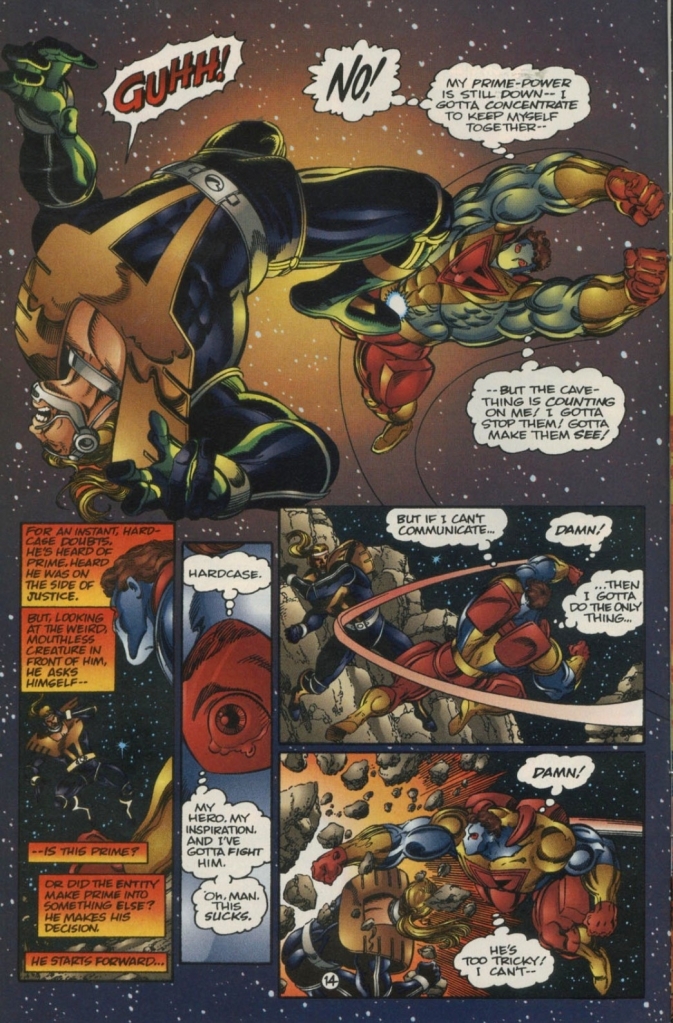
The first physical encounter between Prime and Hardcase. Remember this before reading the UltraForce comics.

Break-Thru (1994) is truly an epic Ultraverse story that also worked as a major turning point of the UV as a whole. Compared to other epic superhero stories that Marvel and DC Comics published, Break-Thru is not the usual large gathering of superheroes who have to work together to defeat an evil force that threatens everyone’s existence. It is more about the UV heroes getting together to solve major obstacles before reaching the main destination. By the time I reached the end of this comic book (and its storyline), I experienced great satisfaction not just from Break-Thru itself but also in relation to how the Ultraverse heroes realized what they are living for and what their respective purposes really are about. What also happened in this comic book explains why jumpstart events happened on Earth. Very clearly, this was an epic story that was planned early and even though this was published just months after the Ultraverse first debuted, the characters were developed enough to make Break-Thru’s concepts sensible and acceptable. There is a lot of fun and engagement in this comic book drawn by the late George Perez (who also worked on DC’s Crisis on Infinite Earths and Marvel’s The Infinity Gauntlet).

Overall, Break-Thru (1994) is highly recommended!

+++++

Thank you for reading. If you find this article engaging, please click the like button below and also please consider sharing this article to others. If you are looking for a copywriter to create content for your special project or business, check out my services and my portfolio. Feel free to contact me with a private message. Also please feel free to visit my Facebook page Author Carlo Carrasco and follow me on Twitter at  @HavenorFantasy as well as on Tumblr at https://carlocarrasco.tumblr.com/ and on Instagram at https://www.instagram.com/authorcarlocarrasco/
A Look Back at Mantra #18 (1995)

Disclaimer: This is my original work with details sourced from reading the comic book and doing personal research. Anyone who wants to use this article, in part or in whole, needs to secure first my permission and agree to cite me as the source and author. Let it be known that any unauthorized use of this article will constrain the author to pursue the remedies under R.A. No. 8293, the Revised Penal Code, and/or all applicable legal actions under the laws of the Philippines.

Welcome back, superhero enthusiasts, comic book collectors and fans of the Ultraverse! We take another journey into the Ultraverse through the exploits of Mantra whose story and character development got more intriguing since after the conclusion of the Archimage Quest.

Last time around, Lukasz and Eden took their relationship even further The infiltration of Aladdin’s secret facility took place and Mantra even met a certain tycoon (best known for interacting with The Strangers). The events of the last issue then continued into the Godwheel mini-series and into this next Mantra comic book I’m about to review.

Are you excited yet? What do you hope to see with regards to Lukasz and Eden? We can find out what happens next in Mantra #18, published in 1995 by Malibu Comics with a story written by Mike W. Barr and drawn by Scott Lee.

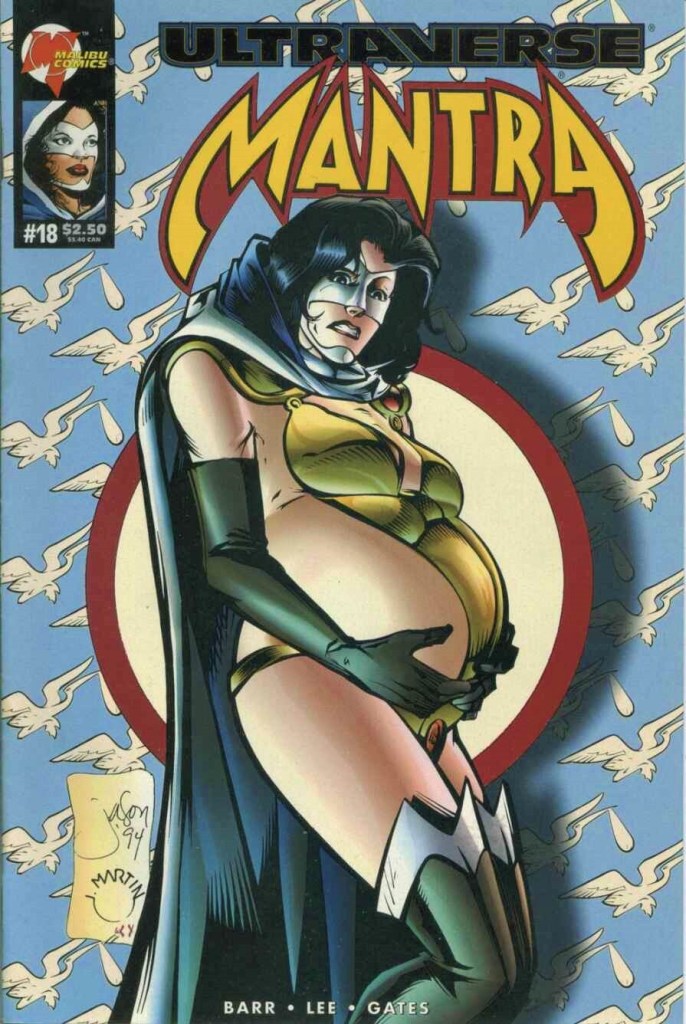
The cover.

Early story

The story begins inside a high-tech facility. An executive named Paul expressed that the laboratory will never be operational in time for the new year as a result of what happened previously. Several armed men are on the floor searching.

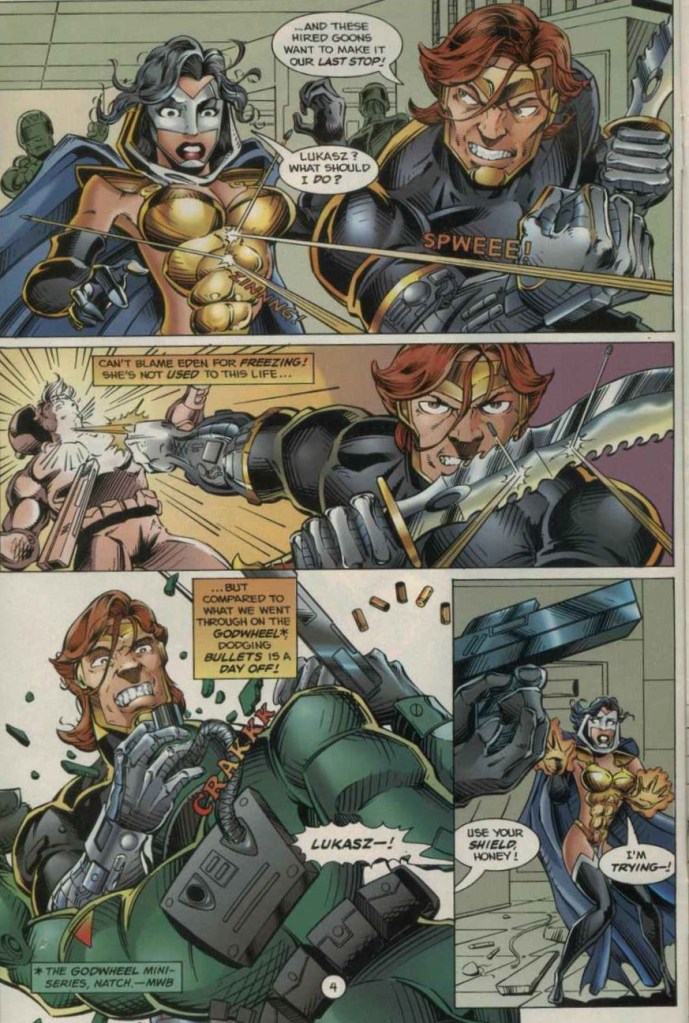
Suddenly, a pink portal opens with Lukasz (in a male body) and Mantra (now occupied by Eden’s soul) coming out. The two just came back from much struggle in another realm and Eden has not yet fully familiarized herself with Mantra’s body and magic. Noticing Eden/Mantra’s hesitation, Lukasz takes action against the armed men. Eden slowly blasts a few enemies before Lukasz saves her from being attacked from the rear.

Suddenly, someone from nowhere throws a few gas grenades at them…

Quality

The romance weakened by the art style.

Starting with the storytelling, the plot in this comic book can be quite jarring with regards to Lukasz and Eden as this one took place after the Godwheel mini-series. How Eden fully became Mantra (which is her rightful body of flesh in the first place) is fully explained in the said mini-series.

The romance between Lukasz and Eden here is easily the biggest selling point of this comic book. After going through rough action and misadventure in Godwheel, it is in this comic book where the two really express love for each other in the flesh. This is a welcome change considering how long we’ve seen Lukasz occupy Eden’s body followed by Lukasz and Eden being spiritually linked with each other. This one marks the start of a new chapter of the Mantra series. As for what the cover of the comic book showed, that is something you will have to discover for yourselves and it is worth the read.

Sadly, I should state that I found the art by Scott Lee here looking sub-par. There is this cartoony aesthetic to all the characters and there were shots in which their bodies looked disproportionate from certain angles. Lee’s take on visualizing Boneyard, Warstrike, NecroMantra and others all looked cartoony. This is the weakest looking Mantra issue I’ve read as of this writing.

Conclusion

Lukasz in a male body, Eden in Mantra form.

Once again, author Mike W. Barr succeeded in advancing the story and character developments with Mantra #18 (1995) putting the series into another storytelling phase with Lukasz (the long-time Mantra) and Eden as separate, living beings more involved with each other than ever before. The art quality this time went down a lot but the storytelling saved the comic book from turning into a disaster.

If you are seriously planning to buy an existing hard copy of Mantra #18 (1995), be aware that as of this writing, MileHighComics.com shows that the near-mint copy of the comic book costs $21.

Overall, Mantra #18 (1995) is satisfactory.

+++++

Thank you for reading. If you find this article engaging, please click the like button below and also please consider sharing this article to others. If you are looking for a copywriter to create content for your special project or business, check out my services and my portfolio. Feel free to contact me as well. Also please feel free to visit my Facebook page Author Carlo Carrasco and follow me at HavenorFantasy@twitter.com
A Look Back at Mantra #17 (1994)

Disclaimer: This is my original work with details sourced from reading the comic book and doing personal research. Anyone who wants to use this article, in part or in whole, needs to secure first my permission and agree to cite me as the source and author. Let it be known that any unauthorized use of this article will constrain the author to pursue the remedies under R.A. No. 8293, the Revised Penal Code, and/or all applicable legal actions under the laws of the Philippines.

A lot has changed with Mantra since the title character got more involved with the elements (both in character and in plotting) with the different realms which led to a particular quest about her captured leader Archimage. In the last issue, not only were Lukasz (the male soul who occupied the body of Eden Blake and became Mantra) and Eden Blake continued to spiritually interact with each other (going as far as having feelings for each other), the impostor living with Eden’s family was revealed.

Considering the events that took place since then, one has to wonder where would Mike W. Barr lead the Mantra series to next. We can all find out in this look back at Mantra , published in 1994 by Malibu Comics with a story by Barr and illustrations done by Jason Armstrong.  

The cover.

Early story

The story begins in a secret, high-tech facility of Aladdid. Lukasz (as Mantra) quietly begins infiltrating the place by taking out one of the armed guards and doing what he could to gain more access around. Eden tells Lukasz that she does not the fallen guard to be hurt and that her time is almost over. She reiterates to Lukasz that he has to live her life and take care of her children.

Shortly after wearing the Aladdin guard uniform, Lukasz starts to get involved with the other guards. He witnesses a wetware engineering work in progress which reveals a scientist working on a so-called patient (the subject).

Suddenly, the subject begins to move causing trouble in the laboratory. Realizing that the engineer is having trouble dealing with the subject already moving, the Aladdin guards (including Lukasz in disguise) enter the place. As the two guards fire their weapons against the subject, Lukasz instead uses one of the computers to gain access to classified information…

Quality

Time with Eden’s family.

After going through the mysticism, the intrigue and threads of Mantra’s past in the last several issues, this comic book’s story is a nice change of setting and concept. Instead of the fantasy elements that pretty much dominated Mantra stories, this one has a sci-fi flavor as well as corporate intrigue (which is pretty prominent in Prototype comics and Hardcase comics) and the very concept of this story is pretty good.

Along the way, the story shows the aftermath of the death of a certain uncle named Moe (once occupied by Thanasi, a long-time rival of Lukasz’s), Mantra having a reunion with a key character from issue and even meeting a notable supporting character from The Strangers comics. The good news here is that Mike W. Barr wrote a very strong script that not only resonates with Ultraverse fans but also tell a cohesive story packed with spectacle, character development and something very notable that happened (which I never anticipated).  

Conclusion

Infiltrating a top secret facility.

Mantra (1994) is not only fun and compelling to read. It is also refreshing and, as if the cover was not obvious enough, marked the beginning of a new chapter in the life of Mantra.

If you are seriously planning to buy an existing hard copy of Mantra (1994), be aware that as of this writing, MileHighComics.com shows that the near-mint copy of the comic book costs $15.

Overall, Mantra (1994) is recommended.

+++++

Thank you for reading. If you find this article engaging, please click the like button below and also please consider sharing this article to others. If you are looking for a copywriter to create content for your special project or business, check out my services and my portfolio. Feel free to contact me as well. Also please feel free to visit my Facebook page Author Carlo Carrasco and follow me at HavenorFantasy@twitter.com

A Look Back at Mantra #16 (1994)

Disclaimer: This is my original work with details sourced from reading the comic book and doing personal research. Anyone who wants to use this article, in part or in whole, needs to secure first my permission and agree to cite me as the source and author. Let it be known that any unauthorized use of this article will constrain the author to pursue the remedies under R.A. No. 8293, the Revised Penal Code, and/or all applicable legal actions under the laws of the Philippines.

Welcome back, superhero enthusiasts, comic book collectors and fans of the Ultraverse! This is my first Ultraverse retro comic book review of this new year and it will be about Mantra once again. To put things in order, the Archimage Quest is over and its aftermath has been done. Mantra is back in the contemporary world and, along the way, has communicated spiritually with the soul of Eden Blake (whose body has since been occupied by Lukasz). Quite intriguingly, Lukasz expresses romantic feelings for Eden in the spiritual realm. At the household of the Blakes, a certain Eden Blake returned to the lives of the children and has made moves to remarry ex-husband Gus.

You want to find out more about Lukasz and Eden? Who exactly is that woman in the Blake household? We can find out in this look back at Mantra , published in 1994 by Malibu Comics with a story written by Mike W. Barr and drawn by Jason Armstrong.

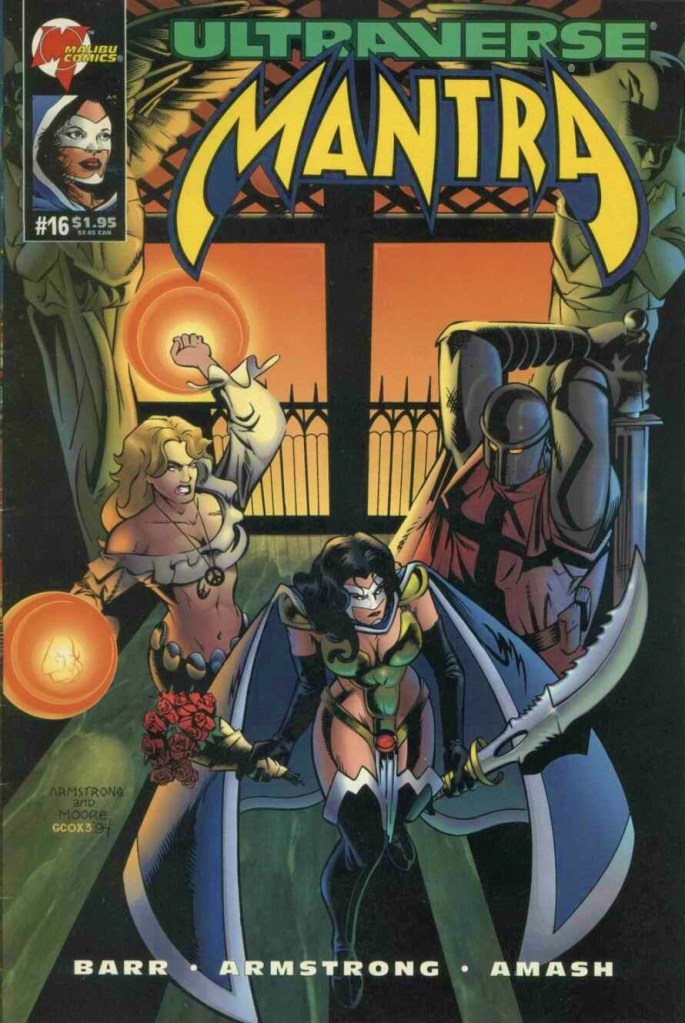
The cover.

Early story

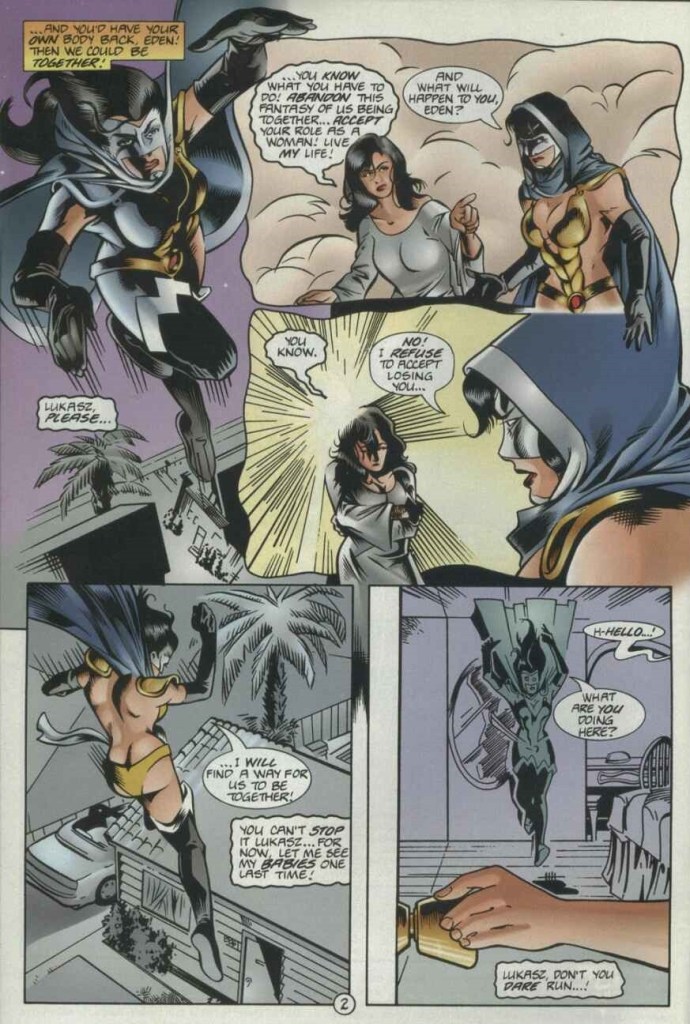
The story begins in California. Mantra started flying into the air leaving Kevin Green/Prime at the front of his home. While flying, Lukasz communicates with the soul of Eden Blake who continues to insist that he should abandon the fantasy of them loving each and other, and simply accept his role living as a woman and living her life. Still clinging on to feelings, Mantra/Lukasz refuses to accept losing Eden.

Mantra quietly enters the Blake household and quickly encounters Evie (Eden’s daughter), whom she has not seen since the Archimage Quest started. Evie does not realize that Mantra is actually her mother’s body in disguise and thus she treats her like a heroic celebrity. Evie reveals to Mantra that her parents are getting remarried.

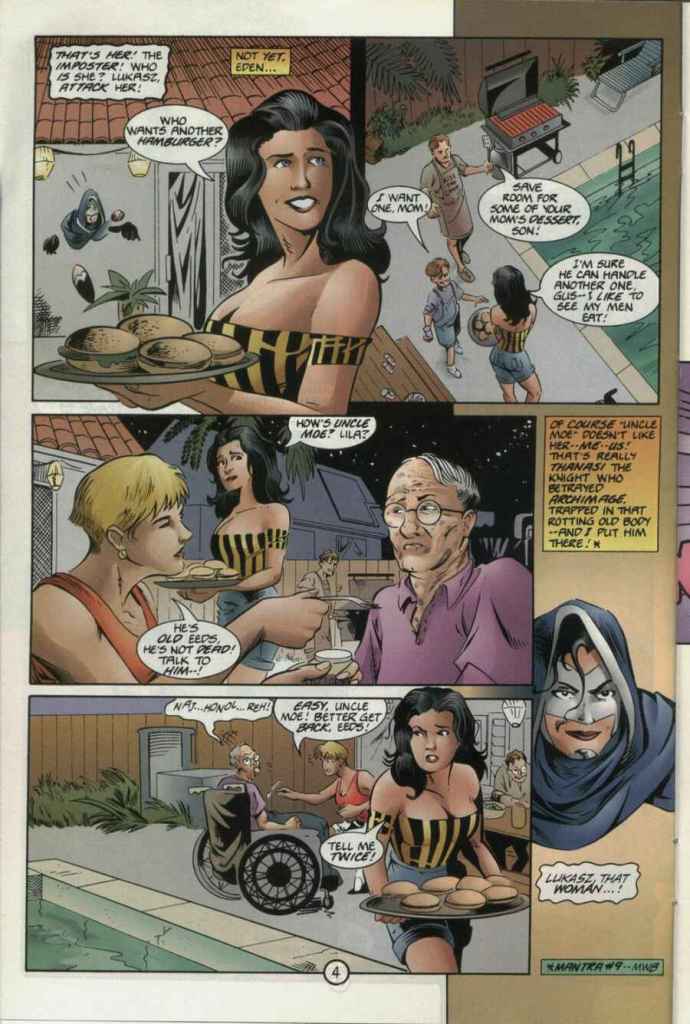
Just after leaving Evie and the room, Mantra spots the other Eden Blake by the poolside socializing with Gus and a few guests (including a certain old man on a wheel chair). Eden tells Mantra/Lukasz that the said lady is the impostor…

Quality

Pay close attention to the details.

I can say that the story and script were well-written by Mike W. Barr which is not surprising since he really set the overall direction of the Mantra monthly series and he took his time on doing twists and surprises. The theme of this particular issue is identity crisis which reflects Lukasz being in Eden’s body, Eden being in the spiritual realm as a displaced soul and the impostor living with Eden’s family.

When it comes to characterization, Lukasz is still focused on becoming a man again but already he adjusted a lot already filling Eden’s role as a mother as well as an employee of Aladdin. His newfound closeness with Eden’s soul added a lot of new freshness in this series and this is highlighted further now that the Archimage Quest has finally concluded. By this time, Lukasz and Eden are a romantic pair and the male warrior expressed that he has gotten tired of fifteen centuries of fighting and hopping from one body to another, displacing so many souls and ruining their respective personal lives.

As for the plot, this one will remind you about what happened in issue . It has a lot to do preparations for a wedding and a conflict between people who wield magic. The plot has a nice surprise which I urge you to find out yourselves.  

Conclusion

More interactions between Mantra and Eden.

Mantra (1994) is an entertaining Ultraverse comic book to read. As usual, it has a strong story as well as strong characterization which makes it compelling. Finding out who exactly is the impostor was well worth it

If you are seriously planning to buy an existing hard copy of Mantra (1994), be aware that as of this writing, MileHighComics.com shows that the near-mint copy of the comic book costs $8.

Overall, Mantra (1994) is recommended.

+++++

Thank you for reading. If you find this article engaging, please click the like button below and also please consider sharing this article to others. If you are looking for a copywriter to create content for your special project or business, check out my services and my portfolio. Feel free to contact me as well. Also please feel free to visit my Facebook page Author Carlo Carrasco and follow me at HavenorFantasy@twitter.com
A Look Back at Mantra #15 (1994)

Disclaimer: This is my original work with details sourced from reading the comic book and doing personal research. Anyone who wants to use this article, in part or in whole, needs to secure first my permission and agree to cite me as the source and author. Let it be known that any unauthorized use of this article will constrain the author to pursue the remedies under R.A. No. 8293, the Revised Penal Code, and/or all applicable legal actions under the laws of the Philippines.

Welcome back, superhero enthusiasts, comic book collectors and fans of the Ultraverse! As you might have seen in my most recent retro reviews of Mantra comic books, I’ve been following the Archimage Quest which really brought the title character (Lukasz occupying the body of Eden Blake whose soul he displaced) to a several places and situations. She got to be with The Strangers temporarily (The Strangers #13 and Mantra #12) in pursuing the wicked Boneyard, went into the fantasy realm where men and women are divided, and more.

While issue #14 marked the end of the said quest, there is still more to come in the next Mantra issue I recently reviewed. In fact it is the aftermath of the Archimage Quest and we can all find out more in Mantra , published in 1994 by Malibu Comics with a story written by Mike W. Barr and drawn by Mark Heike.

The cover.

Early story

The story begins with Mantra surprised by Boneyard while being bothered mentally by Eden who warns that they may end up both getting killed. Appearing in a misty form, Boneyard enjoys the fact that Mantra killed her superior Archimage (whom she thought was Boneyard). As the wicked man fades away, he tells her, “I shall return to take my revenge on our wedding night…”

Right then, Boneyard’s troops arrive led by Notch who at this point of time is very determined to defeat Mantra. Mantra makes short work of the troops until Notch is the one left standing. In response to Notch’s arrogance that he will be brought back to life by Boneyard as before, Mantra tells him that his leader abandoned him and notices him getting fearful suddenly. Mantra kills him successfully.

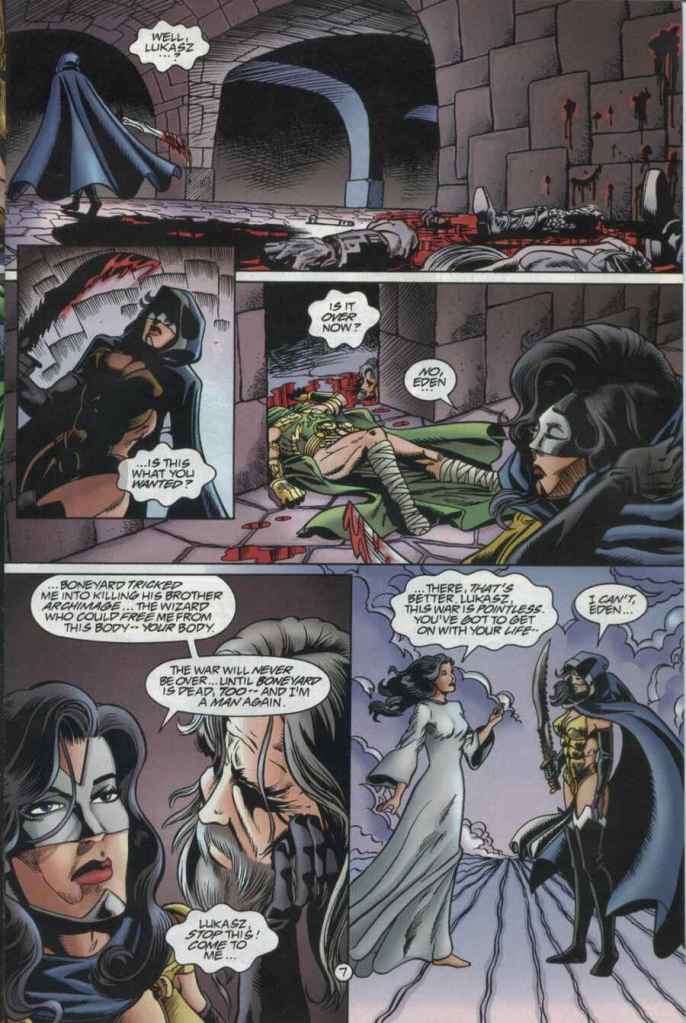
Mantra and Eden communicate with each other. The armed sorceress tells her that the war will never end until Boneyard is killed and she becomes a man again. As far as Eden is concerned the war is pointless…

Quality

Mantra (Lukasz inside) interacts with Eden Blake.

As before, Mike W. Barr continues to deliver very solid writing. To break it down, the aftermath of the Archimage Quest was done with nice care filled with lots of relevant details to read not to mention the lively portrayal of Mantra making an impact on the people in the fantasy realm especially in the absence of Topaz who, at this point in the story, was on her way to the contemporary world where she was destined to join UltraForce.

The 2nd half of the story is set in the contemporary world. While Mantra spent days in the fantasy realm, a certain Eden Blake returned to the lives of Evie, Gus, Jr. and former husband Gus. The Blake family, combined with Prime getting involved with Mantra in the contemporary world, were also nicely dramatized.

For the most part, Mark Heike’s art is good although his take on Prime looks awkward.

Conclusion

Mantra takes on Notch and other troops of Boneyard.

Mantra (1994) is a fun comic book to read and it is more layered this time mainly due to the settings and the character developments that happened in between. The Archimage Quest, in my opinion, ended satisfactorily and this aftermath added more punch to it.

If you are seriously planning to buy an existing hard copy of Mantra (1994), be aware that as of this writing, MileHighComics.com shows that the near-mint copy of the comic book costs $8.

Mantra (1994) is recommended.

+++++

Thank you for reading. If you find this article engaging, please click the like button below and also please consider sharing this article to others. If you are looking for a copywriter to create content for your special project or business, check out my services and my portfolio. Feel free to contact me as well. Also please feel free to visit my Facebook page Author Carlo Carrasco and follow me at HavenorFantasy@twitter.com
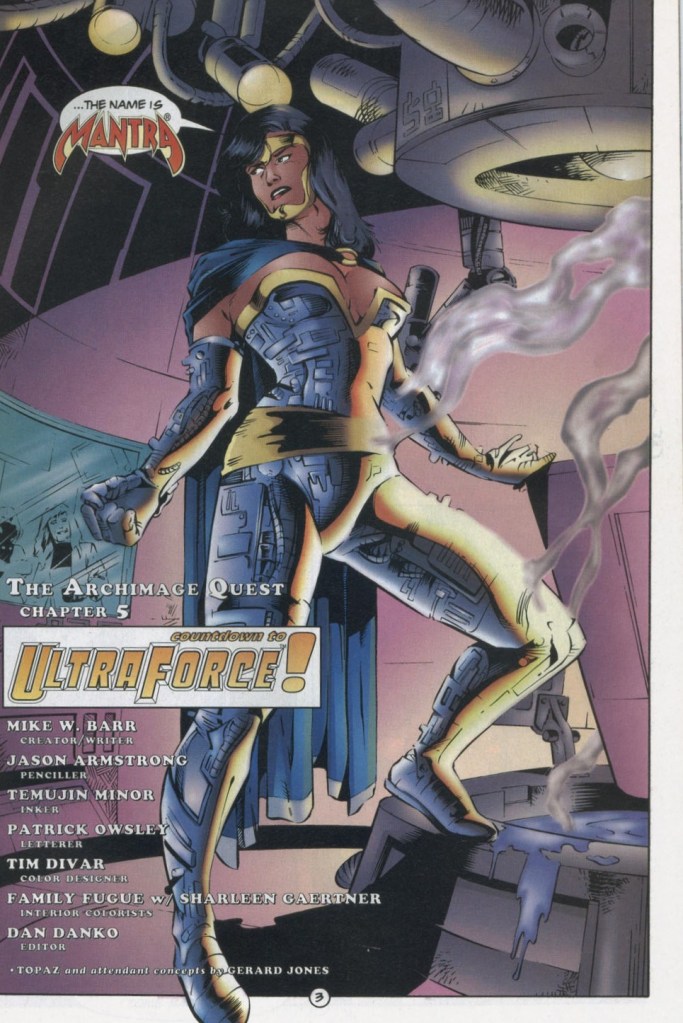
A Look Back at Mantra #14 (1994)

Disclaimer: This is my original work with details sourced from reading the comic book and doing personal research. Anyone who wants to use this article, in part or in whole, needs to secure first my permission and agree to cite me as the source and author. Let it be known that any unauthorized use of this article will constrain the author to pursue the remedies under R.A. No. 8293, the Revised Penal Code, and/or all applicable legal actions under the laws of the Philippines.

Hey comic book fans. Are you looking for more science fantasy stories and concepts within the Ultraverse? There is more in the Archimage Quest storyline told within the Mantra monthly series spearheaded by Mike W. Barr.

To put things in perspective, as recalled in issue , Lukasz got killed the last time he was in a male body shortly after the evil Boneyard defeated Archimage (Lukasz’s superior) which led to him getting reincarnated into the body of Eden Blake (displacing her soul). Lukasz-occupied Eden later acquired from Katinya a relic which helped her gain a mystical armor. Before dying, Katinya revealed that it was Archimage’s plan all along to have Lukasz placed in a woman’s body because his long-term use of weapons in fighting Boneyard did not work.

Since then, Lukasz has been struggling not only to stay alive, to keep on beating Boneyard’s forces and other forms of opposition, but also to live life as a woman with the family of Eden. After some time, Mantra temporarily joins The Strangers in confronting Boneyard (told in The Strangers #13 and Mantra #12). Afterwards, Mantra entered into a new dimension where two societies of separated men and women exist. The women are led by their queen Topaz. Together Topaz and Mantra led a group on a mission concerning Boneyard and Archimage.

With those details laid down, here is a look back at Mantra , published in 1994 by Malibu Comics with a story by Mike W. Barr and drawn by Mark Heike.

The cover.

Early story

The story begin with Mantra and Eden Blake together. Suddenly Mantra’s appearance changes into a man.

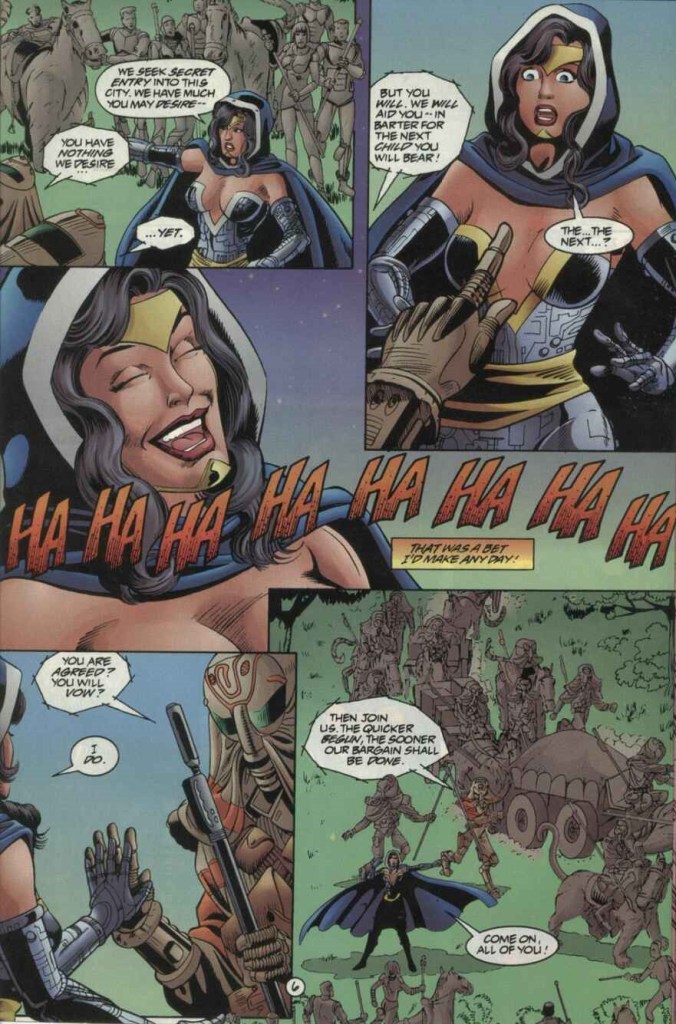
In the present, Mantra is leading the group of men and woman in the absence of Topaz. As they try to take Boneyard by surprise, they encounter a caravan of people called the Tradesmen. One of them recognizes her as Lukasz and they met in another place some time ago. Being trade-oriented and very focused on honor, they make a deal which provides Mantra’s group some much-needed assistance in their mission…

Quality

Mantra versus one of Boneyard’s wives.

At this stage of the Archimage Quest, Mike W. Barr really raised the stakes by adding more twists, more intrigue and more references to the past. All of that were achieved backed with very strong writing, resulting a story that was more engaging than the previous issue. Not to be outdone is the spotlight given on the family of Eden Blake on Earth during the absence of Lukasz/Mantra. When it comes to the art, Mark Heike did a good job drawing Mantra and other related characters all of which are recognizable.

Conclusion

A deal made with one of the Tradesmen.

Mantra (1994) is a fun read. At this stage in the life of the protagonist, the stakes were not only raised higher but things also got more complex particularly with Mantra’s interactions with certain enemies she encountered as well as certain characters who support opposition against Boneyard. It should be noted that there are still some fresh new details about Archimage’s organized strategy about having Lukasz contained in the body of Eden Blake. There was a solid build-up for the tension and intrigue, and there was nice pay-off in the end.

If you are seriously planning to buy an existing hard copy of Mantra (1994), be aware that as of this writing, MileHighComics.com shows that the near-mint copy of the comic book costs $8.

Overall, Mantra (1994) is recommended.

+++++

Thank you for reading. If you find this article engaging, please click the like button below and also please consider sharing this article to others. If you are looking for a copywriter to create content for your special project or business, check out my services and my portfolio. Feel free to contact me as well. Also please feel free to visit my Facebook page Author Carlo Carrasco and follow me at HavenorFantasy@twitter.com

A Look Back at Mantra #13 (1994)

Disclaimer: This is my original work with details sourced from reading the comic book and doing personal research. Anyone who wants to use this article, in part or in whole, needs to secure first my permission and agree to cite me as the source and author. Let it be known that any unauthorized use of this article will constrain the author to pursue the remedies under R.A. No. 8293, the Revised Penal Code, and/or all applicable legal actions under the laws of the Philippines.

Welcome back, superhero enthusiasts, comic book collectors and fans of 1990s comics! This is another examination of the Ultraverse as told through the exploits of Mantra, the pretty armored lady whose body is occupied by the soul of the male warrior Lukasz.

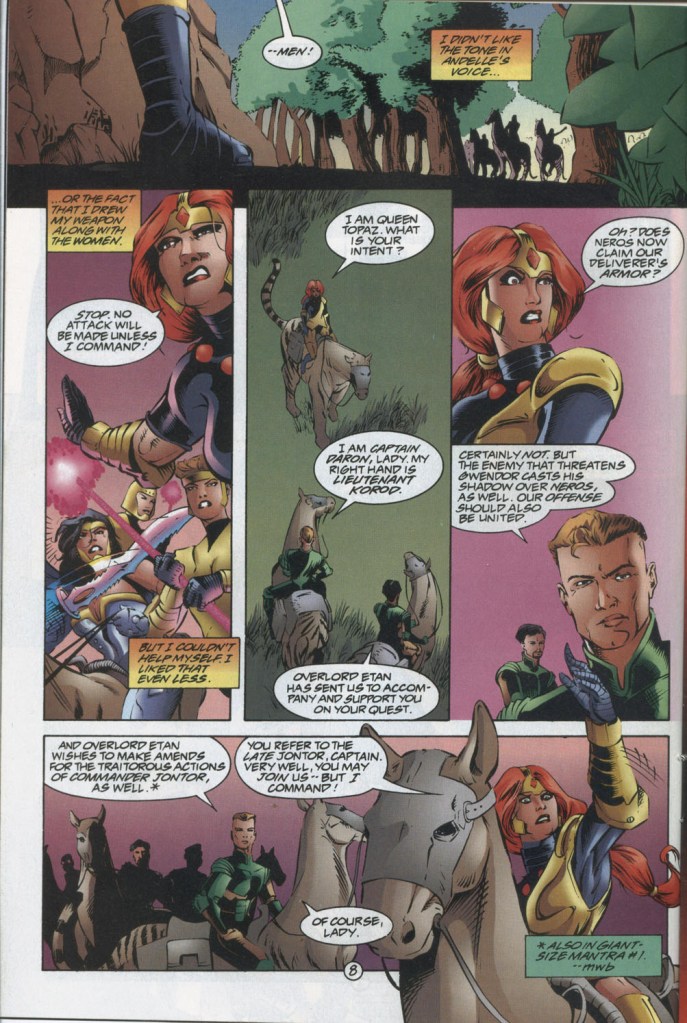
Previously I reviewed Giant Size Mantra, which was a one-shot comic book that was part of the Archimage Quest storyline and it was indeed a well-made Mantra story that fit in nicely with the monthly series. That same comic book is notable for having the debut of Gwendor’s queen Topaz who went on to become a member of the memorable superhero team UltraForce.

With the details made clear, we can find out what happens next in the Archimage Quest in this look back at Mantra , published in 1994 by Malibu Comics with a story written by Mike W. Barr and drawn by Jason Armstrong.

The cover.

Early story

The story begins in an unknown realm. Mantra (wearing her usual mask and armor) and Eden Blake are walking together and talking. After exchanging some words about the displacement of souls, Eden clings to Mantra and apologizes from now realizing what a shock the situation is to Mantra on top of everything else that happened. Eden tells Mantra there is something she wants from her and addresses Lukasz by name.

Suddenly Mantra/Eden Blake/Lukasz wakes up to the call of a technician. She is still in Gwendor and being completely naked, she goes through the process of armoring which is done with highly advanced technology. With her new armor on, Mantra is approached by queen Topaz who brings to her a notable sword to use. They discuss some matters as they walk together.

Meanwhile back in the United States, Eden’s daughter Evie visits a shop and talks to the old lady behind the counter. The young girl asks her about magic…

Quality

In the realm Mantra is in, it’s difficult for men and women to work together.

This is one very unique story of Mantra. Carrying over the elements from Giant Size Mantra, you will get to see the protagonist still spending time in the women-filled Gwendor (note: opposite it is another city filled with men) and starts her alliance with queen Topaz who is a very hands-on type of leader, willing to take risks going into battle. As Mantra does not have her mask and armor, she learns to use the magic power within her to make things happen. This is kinda like seeing Marvel’s Tony Stark adjusting and taking action without his Iron Man suit of armor.

Events aside, this story shows a significant development of Lukasz/Mantra’s personality as she adjusts to the ways of the men and women in their realm. The science fantasy elements of the story gave this comic book a unique style of visual presentation nicely pulled off by the illustrator. When it comes to the Archimage Quest, both Mantra and Boneyard are respectively struggling with disadvantages which is a nice storytelling touch. I should state that in this particular story, the complexities between males and females in the new realm is explored.

Conclusion

Yet another new thing worn by Mantra.

Mantra (1994) is another solid story to read. As it continues the quest for Archimage, it explores more of the science fantasy world Mantra finds herself in as well as the differences between the two local societies separated by gender.

If you are seriously planning to buy an existing hard copy of Mantra (1994), be aware that as of this writing, MileHighComics.com shows that the near-mint copy of the regular edition costs $8 while the near-mint copy of the variant edition costs $12.

Overall, Mantra (1994) is recommended.

+++++

Thank you for reading. If you find this article engaging, please click the like button below and also please consider sharing this article to others. If you are looking for a copywriter to create content for your special project or business, check out my services and my portfolio. Feel free to contact me as well. Also please feel free to visit my Facebook page Author Carlo Carrasco and follow me at HavenorFantasy@twitter.com

Fans of the Ultraverse are encouraged to visit the Ultraverse Facebook group at https://www.facebook.com/groups/73184525691