Disclaimer: This is my original work with details sourced from reading the comic book and doing personal research. Anyone who wants to use this article, in part or in whole, needs to secure first my permission and agree to cite me as the source and author. Let it be known that any unauthorized use of this article will constrain the author to pursue the remedies under R.A. No. 8293, the Revised Penal Code, and/or all applicable legal actions under the laws of the Philippines.
I can hardly believe that it has been a year since Marvel Comics organized the return of their 2099 universe with the release of several comic books. Among those, I bought 2099 Alpha #1 it was a very disappointing read. I also read some other 2099 comic books released late 2019, and none of those engaged me nor gave me much entertainment value in return for what I paid for.
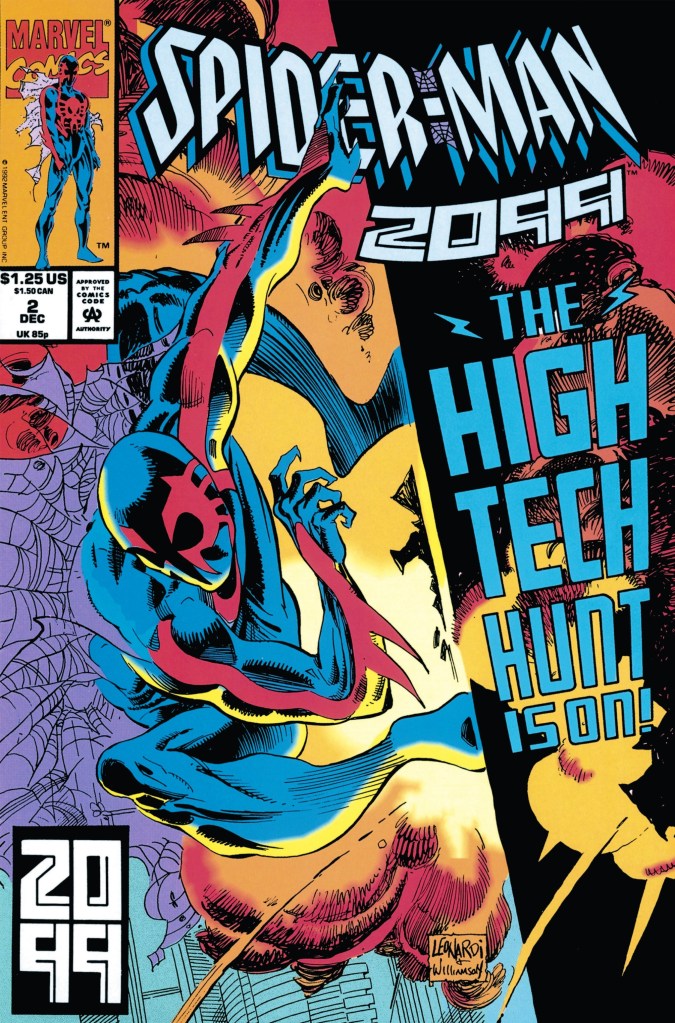
If you ask me, the Marvel 2099 universe of comics was at its best during the early 1990s. That being said, join me on this look back at Spider-Man 2099 #2, published in 1992 by Marvel Comics with a story written by Peter David and drawn by Rick Leonardi.
The cover.
Early story
The story begins at one of the Alchemax towers. Miguel O’Hara is standing naked in front of a shocked Aaron Delgato, a corporate rival of his who tried to kill him. As he noticed Miguel (with fangs) looking at him, he reacts by firing his gun. With fast reflexes, Miguel (whose DNA has been altered already at this point) dodges all of the shots and tries to get close to his rival. One of the bullets hit a tank which causes a large explosion at the tower. The tremendous force pushed them both to the exterior.
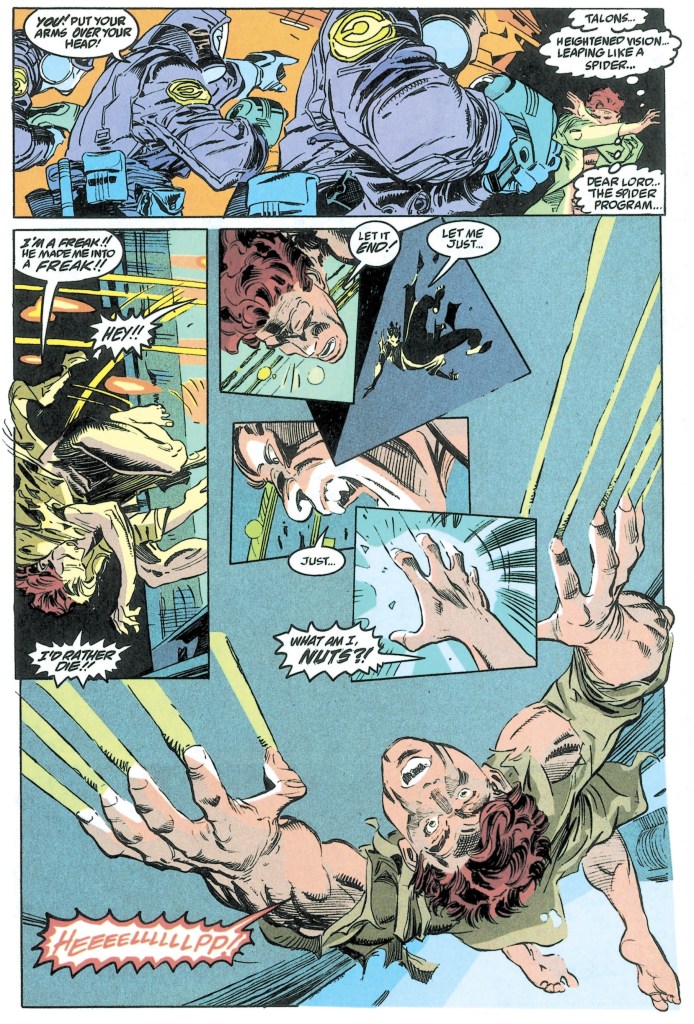
Miguel grabs Aaron’s arm not realizing that his talons are hurting his rival. The skin of Aaron’s arm got ripped off causing him to fall to his death below. Miguel gets dressed as armed personnel arrive. As shots were fired, Miguel falls off the edge…
Quality
The costume!
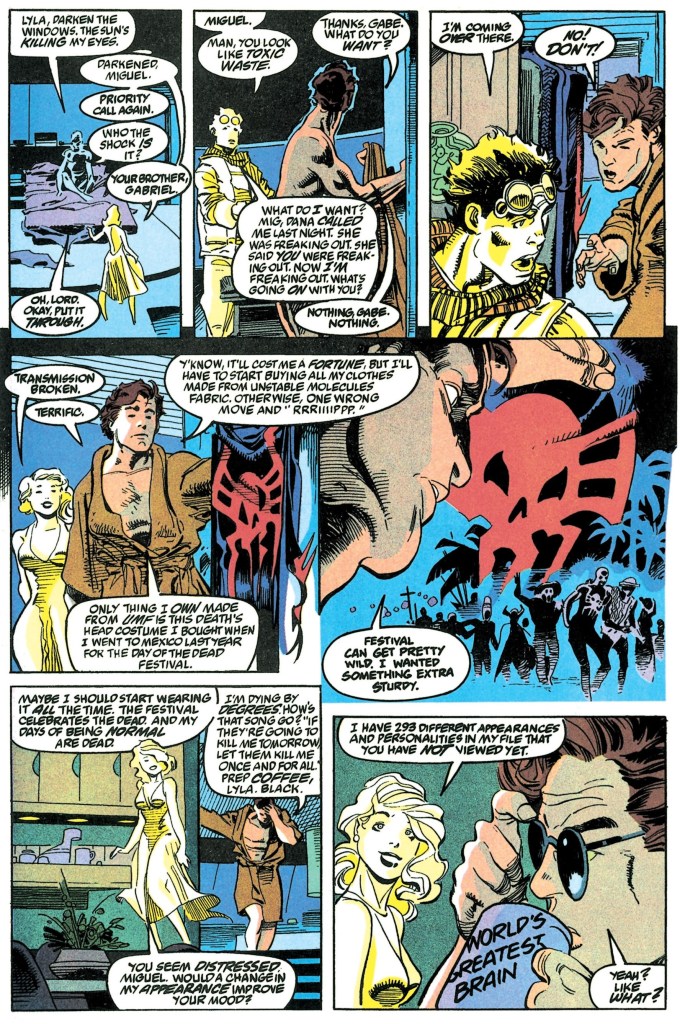
This is a very well-written story by Peter David. While the first issue established Miguel O’Hara’s personality and corporate standing, this one established his becoming Spider-Man 2099 by means of mutation. Not only does he have talons (which retract automatically when he touches his own skin) and sharp teeth, he also gains heightened vision, enhance leaping ability, and most notably his costume (backed with a reasonable explanation it exists). The scenes of corporate intrigue and the introduction of the cyber cowboy named Venture easily added a detective story element into the plot which was quite gripping. No doubt about it, I found the story in this comic book more satisfying than the first issue.
Conclusion
Spider-Man 2099’s talons save him from falling further.
Spider-Man 2099 #2 (1992) is a great read and this is the one comic book that fully establishes the title character as we know him.
If you are seriously planning to buy an existing hard copy of Spider-Man 2099 #2 (1992), be aware that as of this writing, MileHighComics.com shows that the near-mint copy of the regular edition costs $15 while the near-mint copy of the newsstand edition costs $45.
Overall, Spider-Man 2099 #2 (1992) is highly recommended!
+++++
Thank you for reading. If you find this article engaging, please click the like button below and also please consider sharing this article to others. If you are looking for a copywriter to create content for your special project or business, check out my services and my portfolio. Feel free to contact me as well. Also please feel free to visit my Facebook page Author Carlo Carrasco and follow me at HavenorFantasy@twitter.com
Disclaimer: This is my original work with details sourced from reading the comic book and doing personal research. Anyone who wants to use this article, in part or in whole, needs to secure first my permission and agree to cite me as the source and author. Let it be known that any unauthorized use of this article will constrain the author to pursue the remedies under R.A. No. 8293, the Revised Penal Code, and/or all applicable legal actions under the laws of the Philippines.
Welcome back, superhero geeks, comic book collectors and fans of the Ultraverse! Before we revisit the Ultraverse, I should state that I am not a fan of monsters as comic book protagonists, especially when it comes to the superhero genre. In the world of pop culture, a lot of people get fascinated with monsters especially those that are dangerous to people. You got the likes of the Swamp Thing, Dracula, the monster of Frankenstein, the Werewolf, etc.
When it comes to the Ultraverse, they have a monster for a protagonist named Sludge. What I find really intriguing was that Sludge was introduced to readers not by making appearances in existing Ultraverse comic books but by actually being featured in full force in the launch of issue of his own series – Sludge #1.
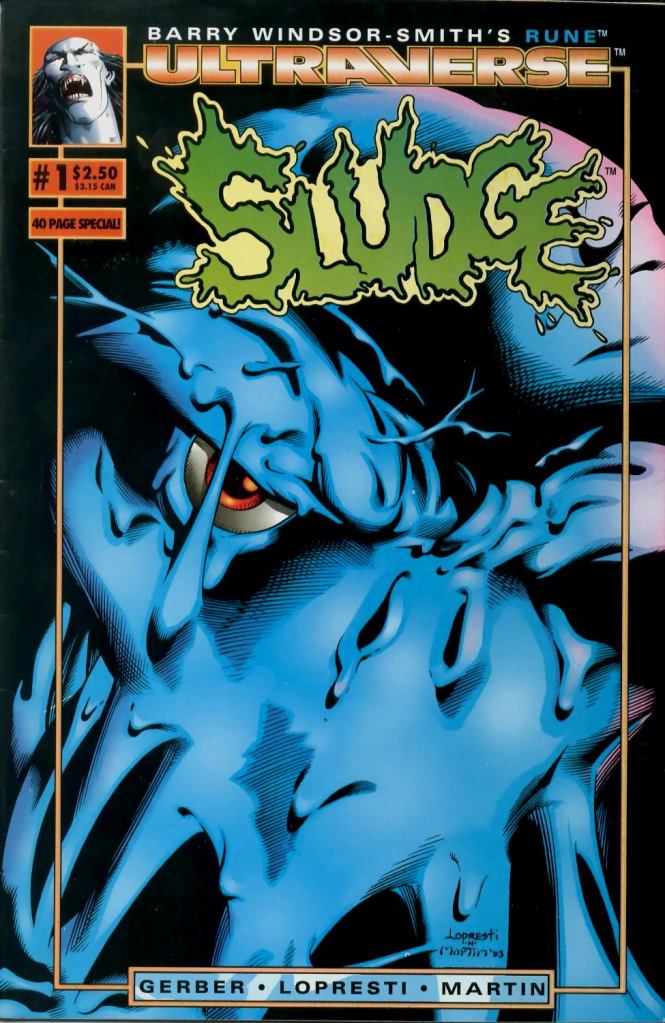
With those details settled, we can find out if there is something special or unique about the Ultraverse monster in this look back at Sludge #1, published by Malibu Comics in 1993 with a story written by Steve Gerber (who previously worked on Marvel’s Man-Thing) and drawn by Aaron Lopresti.
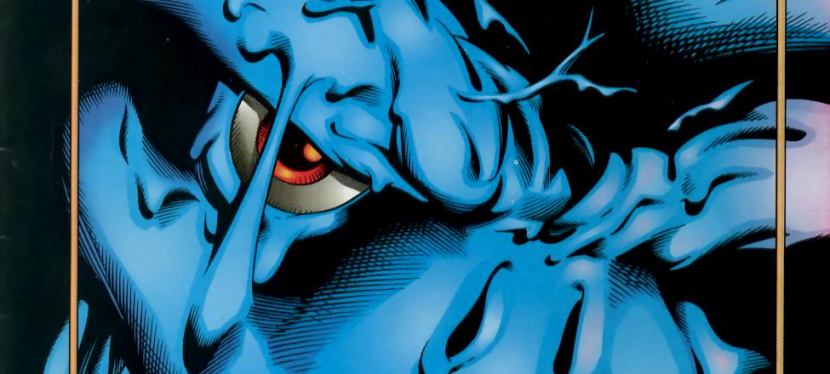
The cover.
Early story
The story begins in a very low place of Manhattan where society’s substratum meets the crust of the earth. Sludge, a grotesque monster with a human perception and a body made out of slime, slowly walks towards a group of poor and homeless people.
Elsewhere somewhere in the city, a radio talk show host talks to his listeners about Frank Hoag, a detective sergeant who worked for twenty years for the New York Police Department or NYPD. It turns out, Hoag has been missing for the past few weeks and the last thing someone knew about him was that he responded to a call about a break-in at the headquarters of a pharmaceutical firm. The next morning at the said place, company employees spotted signs of violence including blood, bullet holes and shell casings. No sign of the detective.
As the radio talk show host engages his listeners by making an issue out of the disappearance of Hoag, police officers got offended while a gang of armed thugs paid close attention to what was said. As the said gang (riding their car) move down the street of homes, they opened fire at the people.
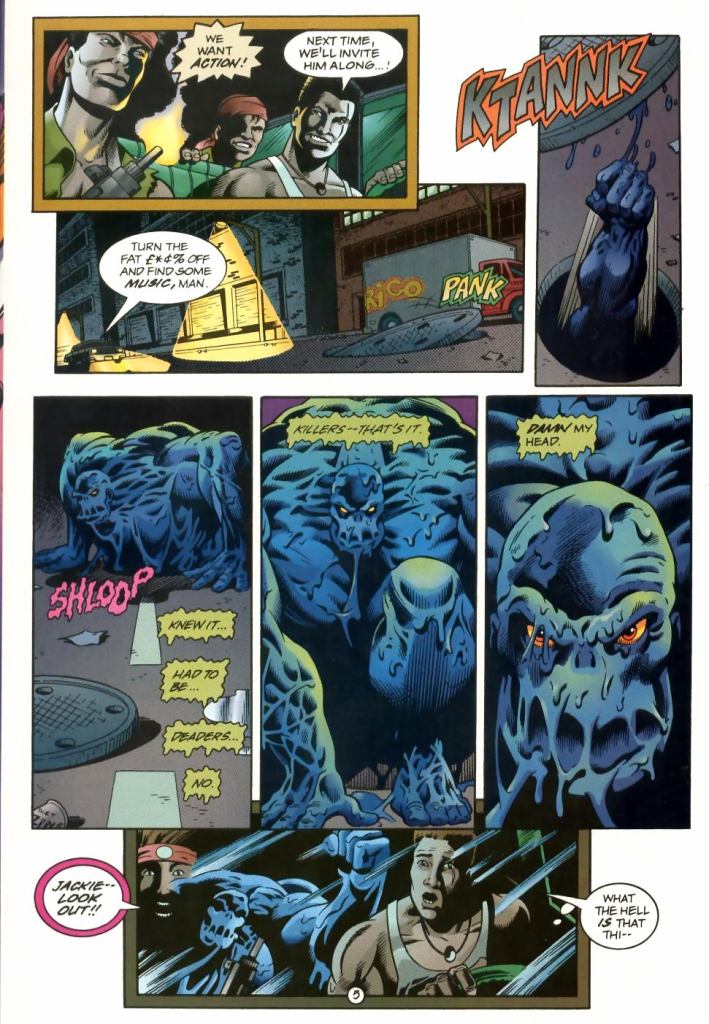
As the gang’s car moves on, the manhole ahead of them opens. Sludge comes out of it and finds himself right on the path of the moving car…
Quality
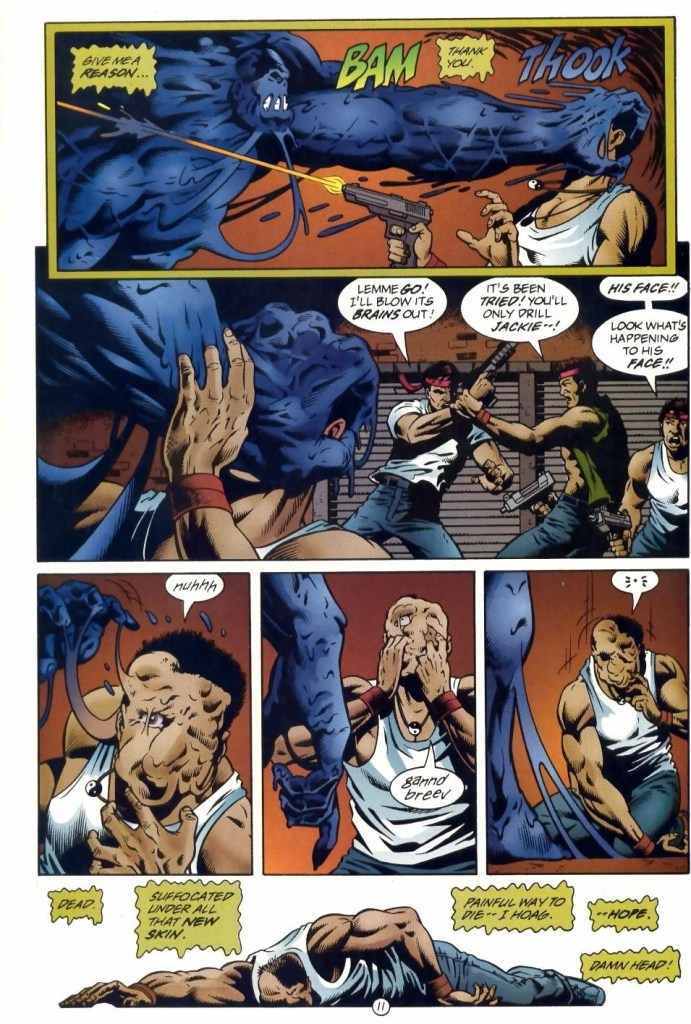
This is why you don’t mess with Sludge.
The writing is top-notch and this is no surprise not only because of Steve Gerber’s extensive writing experience but also because he knew how to write a story with a monster as a protagonist which was what he did with Marvel’s Man-Thing. Unlike that other monster, Sludge has intelligence and awareness, therefore he is a monster with humanity still existing within. Very cleverly, Gerber introduced Sludge and notable aspects of him in a very smooth and efficient manner. By the time I finished this reading this comic, I realized that I witnessed Sludge’s first appearance and origin story which were done very nicely. I should also state that Sludge here is not a mere monster but really a struggling character worth following.
For his part, Aaron Lopresti’s art is pretty good. His visualization of Sludge really stands out and he did not pull back his punches when it came to drawing the action and presenting the violence.
Conclusion
Considering his physical state, Sludge coming out of the manhole is justified.
I can say that I am very pleasantly surprised and entertained by what was presented in Sludge #1 (1993). It really is a great monster-protagonist story written by Steve Gerber and his work here really shines. By the time I reached the end of the story, I got eager to look forward to the next issue and find out what Sludge will do next. It is a very engaging read and one of the strongest debut issues of the Ultraverse.
If you are seriously planning to buy an existing hard copy of Sludge #1 (1993), be aware that as of this writing, MileHighComics.com shows that the near-mint copy of the regular edition costs $8 while the near-mint copy of the ultra-limited edition costs $32.
Overall, Sludge #1 is highly recommended!
+++++
Thank you for reading. If you find this article engaging, please click the like button below and also please consider sharing this article to others. If you are looking for a copywriter to create content for your special project or business, check out my services and my portfolio. Feel free to contact me as well. Also please feel free to visit my Facebook page Author Carlo Carrasco and follow me at HavenorFantasy@twitter.com
Disclaimer: This is my original work with details sourced from reading the comic book and doing personal research. Anyone who wants to use this article, in part or in whole, needs to secure first my permission and agree to cite me as the source and author. Let it be known that any unauthorized use of this article will constrain the author to pursue the remedies under R.A. No. 8293, the Revised Penal Code, and/or all applicable legal actions under the laws of the Philippines.
Welcome back superhero enthusiasts, comic book collectors and X-Men fans. I’m about to review an issue of Marvel Comics’ What If monthly series which was published 1990 and was related to the X-Men as the central figure of the comic book is Charles Xavier (AKA Professor X).
To put things in perspective, Charles Xavier is forever known as the founder and leader of the X-Men. Within the Marvel Comics universe, he is one of the most powerful telepaths as well as a genius in science and genetics. He is a paraplegic who can do quite a lot and make an impact on the delicate relationship between his fellow mutants and the humans. In the movies, Xavier was portrayed by Patrick Stewart (first performance as Xavier in X-Men) and James McAvoy (first performance as Xavier in X-Men: First Class). Given his legacy of helping mutants gain rights through peaceful means, Charles Xavier has been compared with Martin Luther King, Jr. Going back to the comics, Xavier has a step brother named Cain Marko who became the X-Men villain Juggernaut.
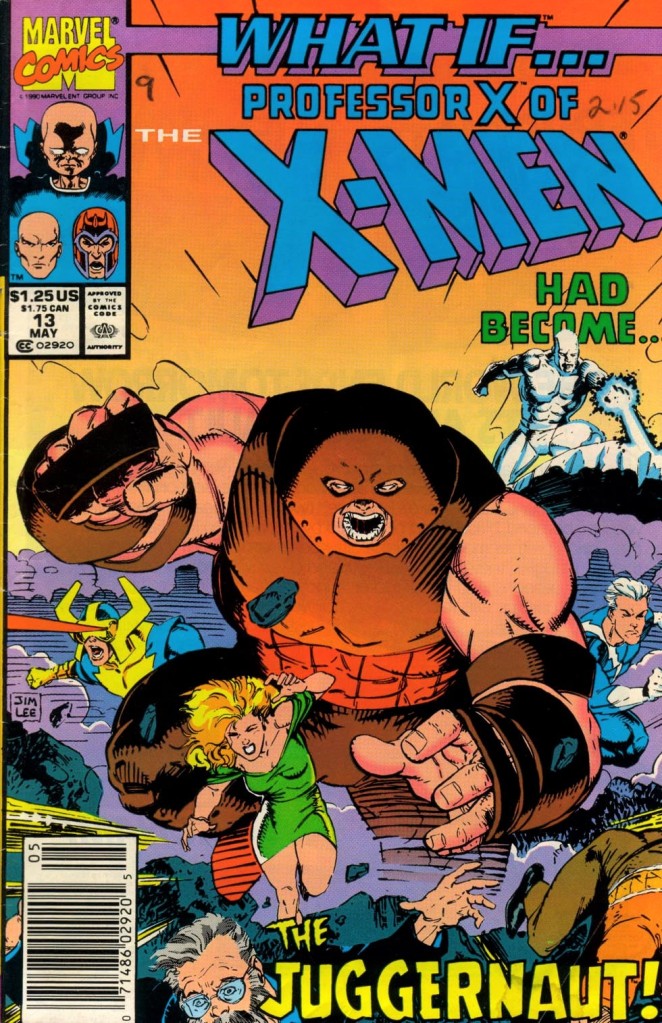
With the background lesson done, we can now take a look back at What If #13, published by Marvel Comics in 1990 with a story written by Kurt Busiek and drawn by Vince Mielcarek.
The cover drawn by Jim Lee.
Early story
The story begins in New York in the so-called near future. Graffiti artists attempt to run away from a team of mutants riding a floating vehicle. As Thunderbird is about to hit one of the humans, Cyclops stops him. Suddenly the mutants receive a telepathic message from their big boss who turns out to be Charles Xavier the Juggernaut.
Xavier is leading the effort against a group of humans who have been conspiring against them. Xavier declares, “They must be stopped—for the good of mutantkind!”
The X-Men in this particular story are fascist storm troopers policing a wretched, helpless humanity…
Quality
Xavier-Juggernaut with the X-Men and the invading Fantastic Four.
I can start by say that this comic book written by Kurt Busiek has one of the most compelling what-if scenarios that reflect not only its concept (of Charles Xavier becoming Juggernaut) but also the Marvel Comics universe as we know it. As dedicated X-Men fans know, Cain Marko was the one who touched the ruby in the cave which made him the mainstream Juggernaut. In here, the scenario was altered to make Charles Xavier become Juggernaut and the radical changes did not end there. Without spoiling the great stuff, I can say that this is one great exploration of an alternate version of events that affect not only the X-Men and their villains but also the many other superheroes of the Marvel universe as Xavier-Juggernaut went all-out with his dedication to mutantkind. I can say that in this story, symbolically speaking, Xavier easily outclasses the extreme Magneto on prioritizing mutants over humans.
Comic book concept aside, Kurt Busiek’s writing here is really excellent. Not only did he capture the traits of Xavier as he turned him into the alternate Juggernaut, Busiek also emphasized the many twisted events in the Marvel shared universe with sufficient details. The details implemented made the scenarios really believable. His script for this comic book was brought to life by Vince Mielcarek who did a good job making the characters recognizable (note: there were a lot of superheroes and villains here), showcasing the wide scope of changes made on people and places (in relation to Xavier-Juggernaut’s actions) and there was good pacing with the visuals.
Conclusion
Charles Xavier as you’ve never seen him before.
What If #13 (1990) is great to read and it is a must-have with its story alone. Apart from showing the concept’s deep impact on the Marvel Comics universe, I also enjoyed the way Kurt Busiek blurred the boundaries that separated good and evil. If you are an X-Men and you want to see something different with the mutants – especially Professor X – then you you will find a lot to enjoy here. This is a great alternate superhero story and definitely more people should be aware of this.
If you are seriously planning to buy an existing hard copy of What If #13 (1990), be aware that as of this writing, MileHighComics.com shows that the near-mint copy of the regular edition costs $30 while the near-mint copy of the newsstand edition costs $60.
Overall, What If #13 (1990) is highly recommended!
+++++
Thank you for reading. If you find this article engaging, please click the like button below and also please consider sharing this article to others. If you are looking for a copywriter to create content for your special project or business, check out my services and my portfolio. Feel free to contact me as well. Also please feel free to visit my Facebook page Author Carlo Carrasco and follow me at HavenorFantasy@twitter.com
Disclaimer: This is my original work with details sourced from reading the comic book and doing personal research. Anyone who wants to use this article, in part or in whole, needs to secure first my permission and agree to cite me as the source and author. Let it be known that any unauthorized use of this article will constrain the author to pursue the remedies under R.A. No. 8293, the Revised Penal Code, and/or all applicable legal actions under the laws of the Philippines.
As mentioned before (refer to my reviews of X-Men 2099 #1 and X-Men #25), 1993 was the year when the 30th anniversary of the X-Men was celebrated. Back then, Internet connection was not very accessible to the public, social media had not been invented and streaming movies and TV shows was not yet the norm. How did Marvel Comic organize the celebration for X-Men fans? By publishing a lot of comic books and selling merchandise.
In the first quarter of 1993, Marvel Comics went on to feed the perceived high demand of X-Men fans by launching X-Men Unlimited which was an all-new comic book series with a schedule of quarterly releases per new comic book (initially with 64 pages of content using glossy paper). They released X-Men Unlimited #1 in March 1993 and I bought a copy for a hefty $3.95.
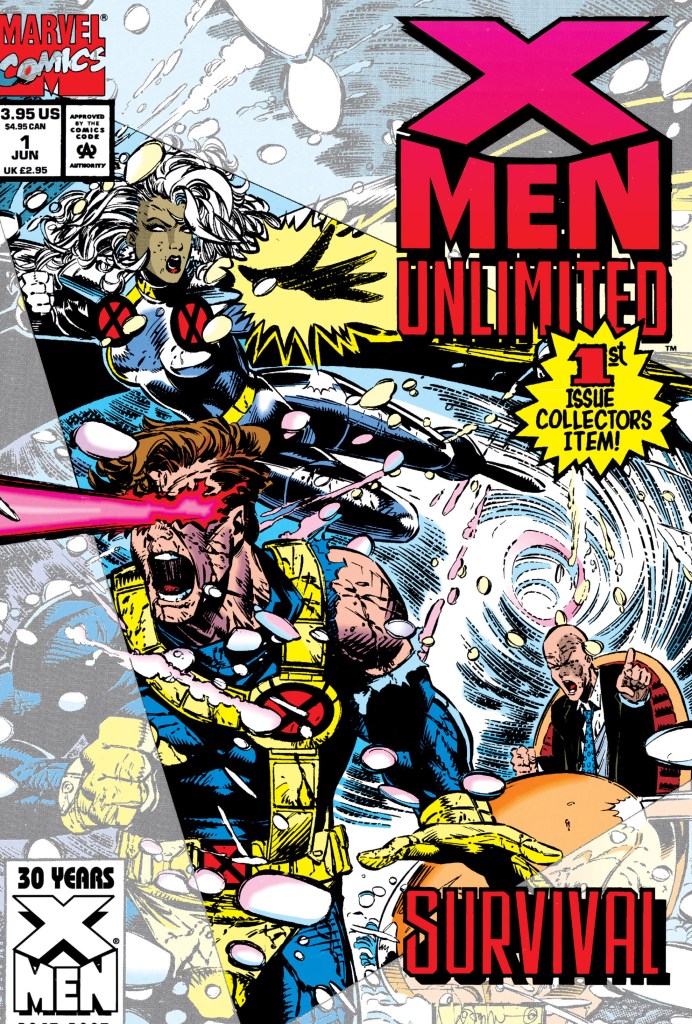
So what exactly did the said comic book feature? Was it good? We can all find out in this look back at X-Men Unlimited #1 published by Marvel Comics with a story written by Scott Lobdell and drawn by Chris Bachalo.
The cover.
Early story
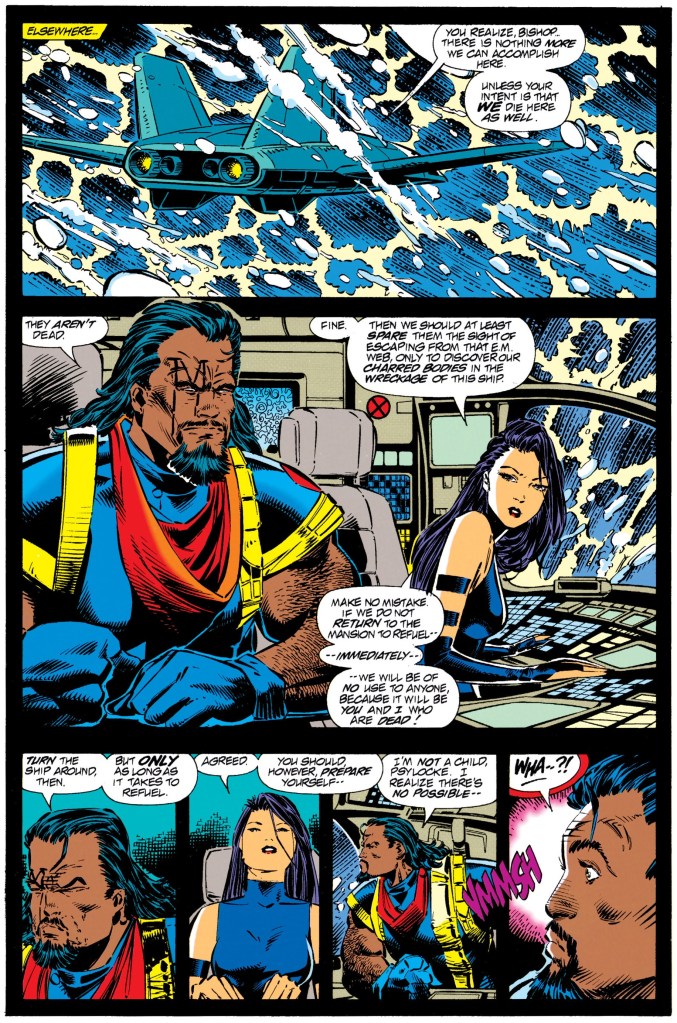
The story begins on the snowy surface of Antarctica where the Blackbird (the X-Men’s jet) has crashed. Cyclops is outside the crashed jet already suffering from internal bleeding and other injuries. As his ruby quartz visor has been lost, he desperately keeps his eyes shut to avoid firing any optic blast. Even with tremendous odds against him, Cyclops concentrates very hard to reach out to Charles Xavier and successfully makes contact. Xavier is surprised.
With telepathic assistance provided by Xavier, Cyclops successfully reaches him and carries him. After some searching, they spot Storm alone on the snow. Elsewhere, a lady gets up from the snow and walks towards a facility. Upon entering, there are scientists working with computers and they called her Ms. Blaze. She asked them if she succeeded in killing Cyclops, Storm and Xavier…
Quality
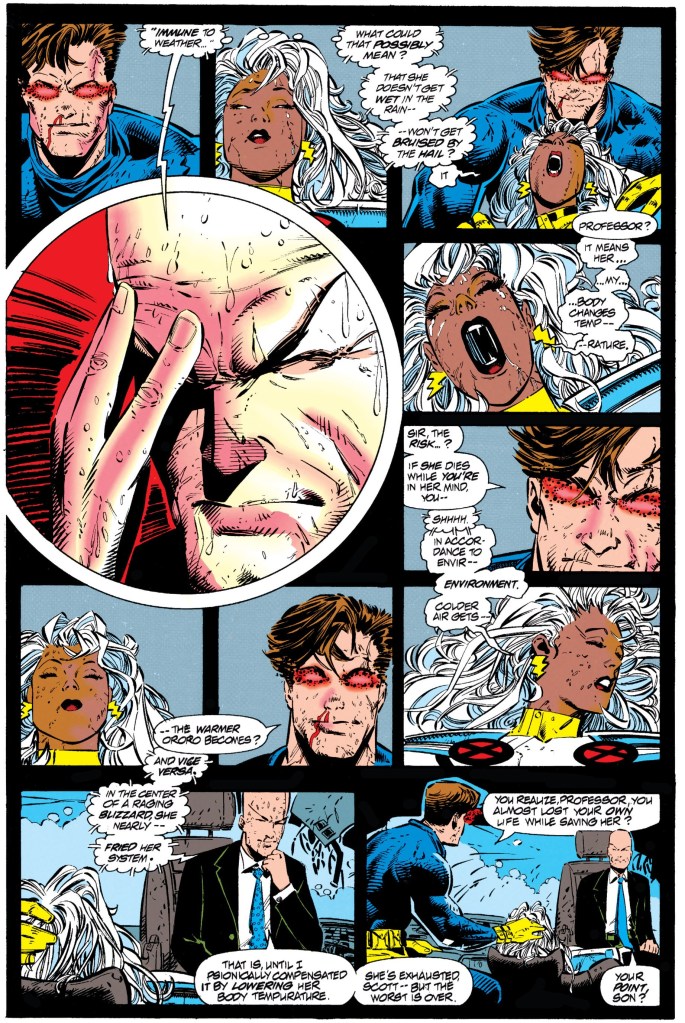
Artist Chris Bachalo failed to pace his art properly on this page.
To get to the point, I should state that the main lesson of this X-Men story written by Lobdell is about leadership mixed with responsibility and survival. Symbolically, the three leaders of the X-Men (Xavier the head with Blue Team leader Cyclops and Gold Team leader Storm) were placed in a situation of great odds and their respective powers cannot just help solve their problems nor help them get away easily. Here we get to see Cyclops, Storm and Xavier really struggling and having no choice but to use their wits as well as skills learned from the past in order to survive and progress. This is easily the comic book’s most unique feature and it is very rare to see Xavier and the two team leaders spend a lot of time together and work with each other. As far as emphasizing the leadership dynamics of the X-Men is concerned, Lobdell succeeded. I should also state that Lobdell really dramatized the respective personalities of the three.
Still there are some notable flaws. I should say the story had lots of dragging moments in between and the overall pace is between slow and medium. The dialogue is quite wordy and ultimately a lot of it felt like fillers than actual attempts to develop personalities and explain things. There were attempts to make the dialogue more philosophical but end up dragging the narrative. I should state that verbal descriptions or narrations in certain pages were quite excessive. If you are looking for superhero spectacle, there is actually little to enjoy here and by the time the final conflict is over, you will end up unsatisfied. Of course, there are also scenes of incidental moments (examples: explosions, the environment causing damage, etc.) that were emphasized as if to make up for the lack of superhero spectacle.
The antagonist Sienna Blaze is not a compelling villainess. There is no justification as to why she tried to kill the X-Men. The way she is presented, Blaze is more like a reckless and impulsive teenager than a real opposing force against Xavier and his mutants.
Psylocke and Bishop were the other X-Men members who appeared.
Lastly, there is the art by Chris Bachalo which has always been sub-par and disappointing to look at. While Bachalo did a decent job drawing disaster-related moments, his art on drawing the X-Men really sucked. There were many times when Charles Xavier LOOKED LIKE A DUMMY (think mannequin) than a living person as drawn by Bachalo. The art of this comic book was disappointing in 1993, and it has aged badly by today’s standards.
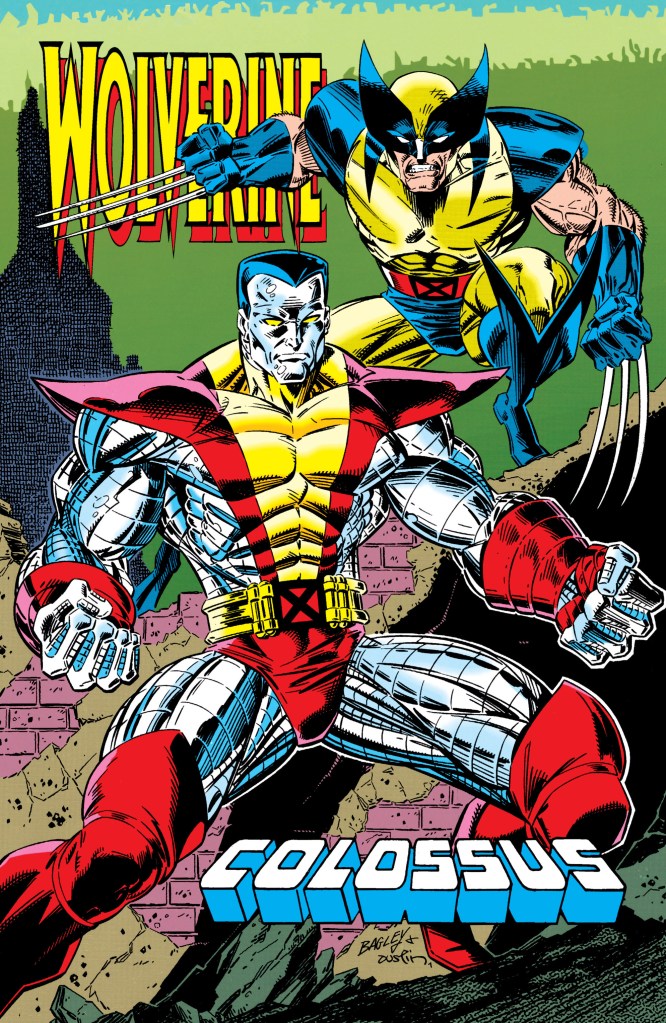
Apart from the main story, this comic book has a gallery of artworks highlighting the X-Men (including members who did not appear in the said story) done by varied illustrators. The quality of the art, unsurprisingly, is a mixed bag. Ultimately the art gallery served as convenient filler made to satisfy the cravings of X-Men fans.
Conclusion
This is how Wolverine and Colossus look as drawn by Mark Bagley who was the Amazing Spider-Man artist of the time.
Apart from being made to sell a bunch of copies and take advantage of the comic book collector craze of the time, X-Men Unlimited #1 (1993) was an effort to keep defining the X-Men for fans and comic readers of the 1990s by adding depth to the bond between Xavier, Storm and Cyclops. The problem is with the execution as the story dragged a lot, and a whole lot of dialogue and text descriptions were made as if to ensure that enough content would fit the 64-pages of content of the comic book. As far as 1993 X-Men comic books go, this one has one of the worst looking artworks used in storytelling. When it comes to its connection with the 30th anniversary of the X-Men, what happened to Xavier in this comic book is connected to the events of Uncanny X-Men #304 and #310.
If you are seriously planning to buy an existing hard copy of X-Men Unlimited #1 (1993), be aware that as of this writing, MileHighComics.com shows that the near-mint copy of the regular edition costs $10 while the near-mint copies of the signed edition (without certificate), the newsstand edition and the signed edition (with certificate of authenticity) cost $105, $32 and $105 respectively.
Overall, X-Men Unlimited #1 (1993) is unsatisfying. If I were you, I would avoid spending any money above its cover price. Considering its quality, the near-mint copy of this comic book is really worth only $1.
+++++
Thank you for reading. If you find this article engaging, please click the like button below and also please consider sharing this article to others. If you are looking for a copywriter to create content for your special project or business, check out my services and my portfolio. Feel free to contact me as well. Also please feel free to visit my Facebook page Author Carlo Carrasco and follow me at HavenorFantasy@twitter.com
Disclaimer: This is my original work with details sourced from reading the comic book and doing personal research. Anyone who wants to use this article, in part or in whole, needs to secure first my permission and agree to cite me as the source and author. Let it be known that any unauthorized use of this article will constrain the author to pursue the remedies under R.A. No. 8293, the Revised Penal Code, and/or all applicable legal actions under the laws of the Philippines.
Welcome back, X-Men fans, superhero enthusiasts and comic book collectors! Today I’m about to review another Chris Claremont-Jim Lee comic book of the X-Men from 1991.
Before getting to the retro comic book review, let’s take a look back at history. Marvel Comics started publishing comic book of the X-Men in 1963 which involved the combined talents of Stan Lee and Jack Kirby. The original X-Men members were Cyclops, Beast, Marvel Girl, Angel and Iceman all under the mentorship of Charles Xavier (AKA Professor X). That monthly series was not a strong seller and was weak compared to the other monthly titles of Marvel. Although Roy Thomas and Neal Adams were brought in to reinvigorate the X-Men series with new characters, success in sales did not materialize and eventually the series was turned into a reprint series (from issues #67 to #93).
In 1975, Len Wein and Dave Cockrum made Giant-Size X-Men #1 which introduced a new team. Along the way, Wein (who was also the editor-in-chief of Marvel at the time) hired Chris Claremont to become the lead writer of the X-Men series starting issue #94 which was released that same year. Claremont redefined the X-Men by developing the characters deep inside and emphasized their respective personalities. As the years passed by, Claremont wrote notable X-Men storylines such as The Dark Phoenix Saga, Days of Future Past, Mutant Massacre, and Fall of the Mutants to name some. Not only did Claremont write The New Mutants, he also co-created many other characters that became part of the X-Men franchise.
Then came the year 1991. The launch of the new X-Men monthly series (focused on the Blue Team led by Cyclops) saw sales tremendous success with issue #1 and by that time Jim Lee was established as one hot new creators under Marvel. Behind the scenes, however, Claremont clashed with then X-Men books editor Bob Harras. Eventually, issue #3 of the 2nd X-Men monthly series marked the end of the X-Men era of 1975-1991.
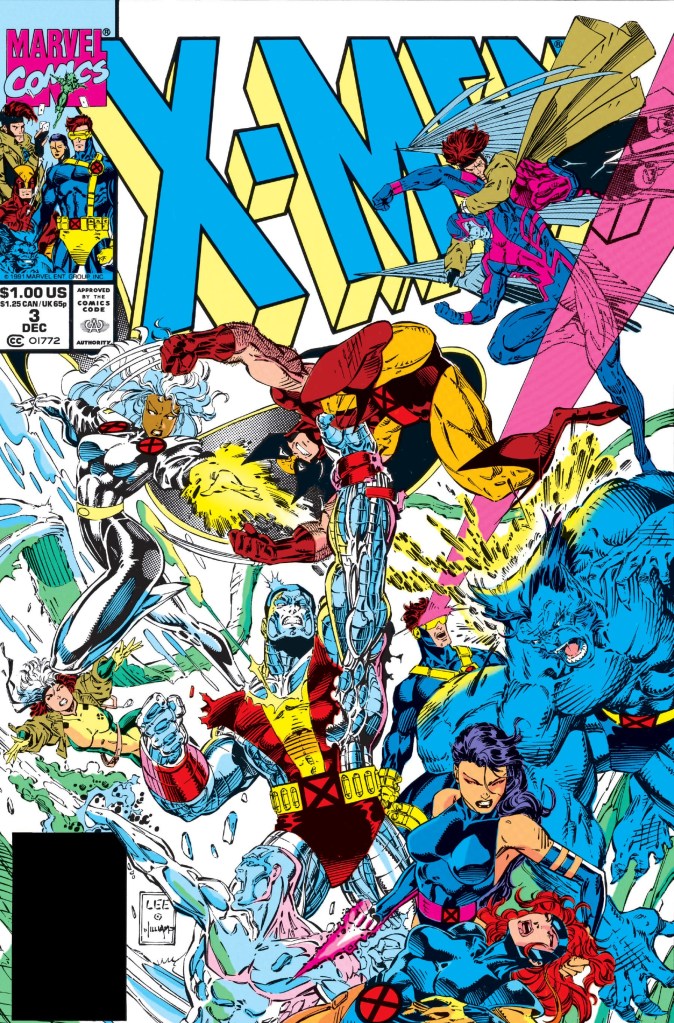
I should say that I enjoyed reading issue #2 in which Claremont wrote a story that not only raised the stakes but also pushed the entire group of mutants to the edge. We will find out soon enough if Claremont’s X-Men era of 1975-1991 will end strongly in this retro review of X-Men #3, published in 1991 by Marvel Comics with a story by Claremont and Jim Lee (who also illustrated).
The cover.
Early story
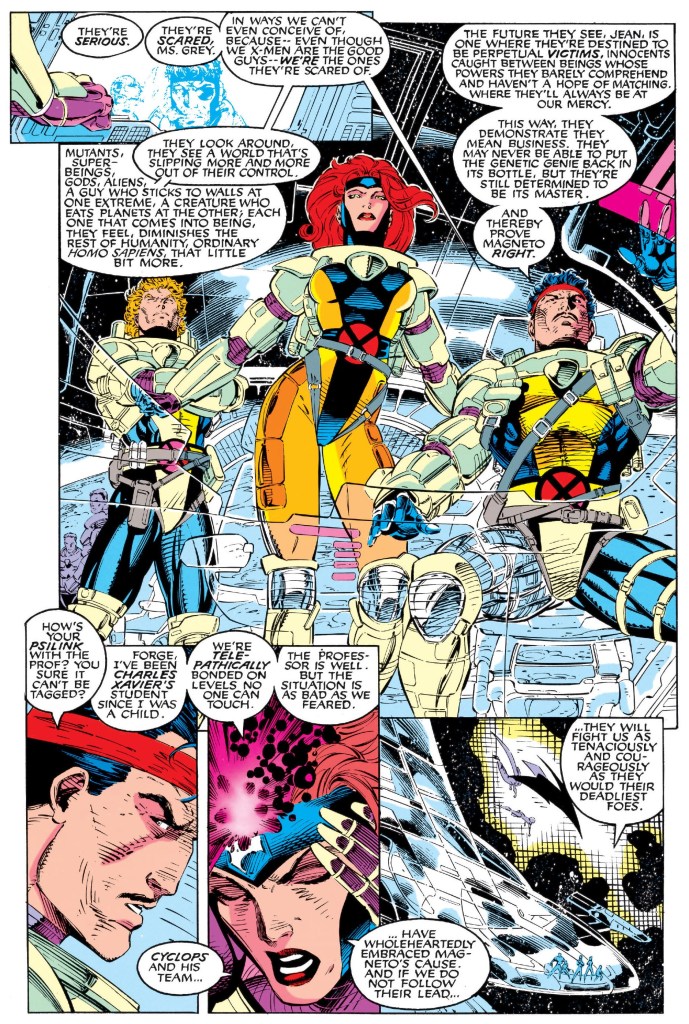
The story begins in outer space. Members of X-Men’s Gold Team (composed of Archangel, Storm, Jean Grey, Forge, Iceman, Colossus and Banshee) fly stealthily towards Asteroid M where Magneto and his Acolytes are with Charles Xavier and Moira MacTaggert held captive. With the exception of a few, members of the X-Men Blue Team were brainwashed by MacTaggert to follow Magneto.
On Earth, the plasma cannon is being prepared to destroy Asteroid M. Nick Fury warns his colleagues about the possibility of tremendous damage if ever Asteroid M hits the surface of the planet. Valerie Cooper tells him that the firing trajectory has been calculated to blast the target away and into deep space. An exchange of words follows over diplomacy and following orders issued by the leaders.
Over at Asteroid M, Charles Xavier is alone in a room with a wide view of the Earth and space. Behind the scenes, Fabian Cortez points to Xavier as Magneto’s deadliest enemy. He asked his master why not use Moira MacTaggert’s procedure (to brainwash and turn) on Xavier. Magneto, already suffering physically, does not want Xavier turned but be broken…
Quality
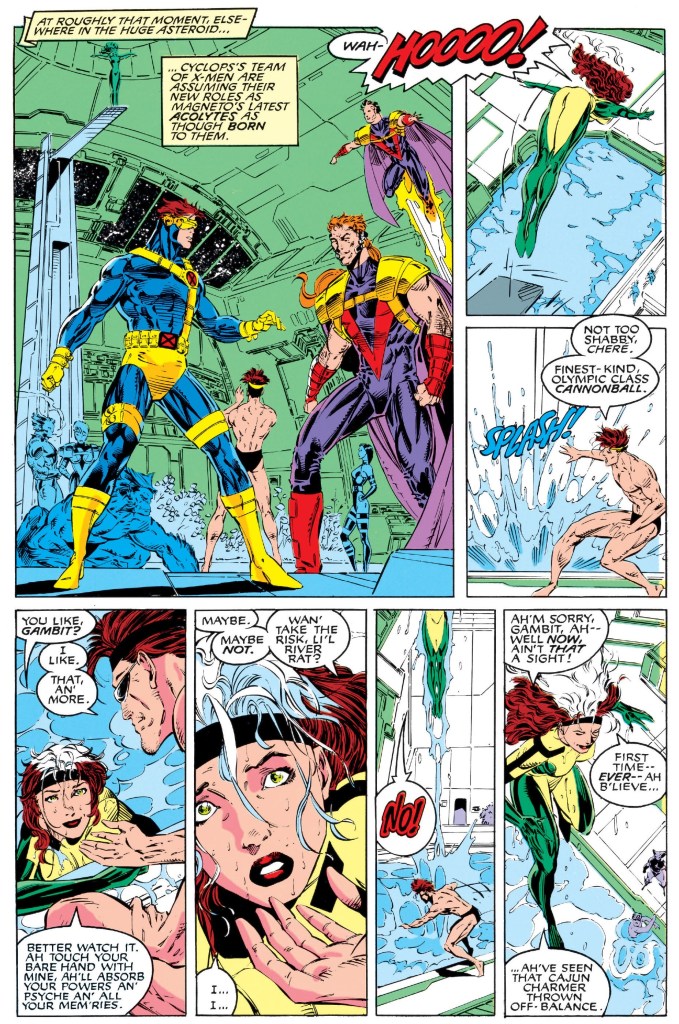
X-Men Blue Team members relaxing at Asteroid M in the presence of the Acolytes.
Like in issue #2, the story here is very engaging and highly dramatic. While it paid close attention to Magneto’s ruthlessness as well as his rage towards Moira who committed something unethical to him in the past, the story managed to focus enough on the X-Men which involves both the Blue Team and Gold Team mixed up. While this comic book’s cover shows a battle royale between the Blue and Gold teams, there is a lot of substance beyond the action. I’m talking about moments spent on the mutants of Xavier which was done in a satisfying manner (never felt crammed nor forced) considering the page limits of this comic book. Not only were the X-Men moments executed smoothly, there were pulled off efficiently and orderly.
More on the story, what adds intrigue is the group of Acolytes whose field leader Fabian Cortez has not only gotten very close with Magneto but also does something significant to him along the way. By this issue, the Acolytes led by the master of magnetism have gotten more established as a worthy opposition against Xavier’s mutants. This story also showed that the Acolytes were here to stay, and Fabian Cortez himself is very led by wickedness and ambition. Cortez is also an example about the distortion of righteousness
When it comes to defining the characters, Xavier and Magneto clashing together about their respective dreams about mutants is unsurprisingly epic to read. In this particular conflict, both Marvel icons were portrayed very dramatically and their respective expressions were indeed intense. Adding further intrigue to their clash is Moira’s long-past act of manipulating the very genetics of Magneto which itself raises serious questions about her perception, decision-making and ethics. In some ways, Moira looked more villain-like.
As expected, the art of Jim Lee is great to look at. There were some signs, however, that the very wordy script resulted an increased numbers of panels per page. Fortunately, the art did not look rushed and maintained a clear narrative. Also the action scenes are great to look at which is not surprising.
Conclusion
The Gold Team of the X-Men travel towards Asteroid M in a cloaked vehicle.
To put it straight, X-Men #3 (1991) is an epic read highlighting the very conflict between Magneto and Xavier over the course of mutants and their place in the world of humans. This comic book, which has a very powerful ending, was indeed a very satisfying way to conclude the Xavier-Magneto conflict as well as Chris Claremont’s long-term stint with the X-Men comic book franchise. Back in 1991, this one really looked like the end of an era both in-story and in real life. Of course, what this comic book achieved ultimately became temporary because Magneto was revived for the Fatal Attractions storyline in 1993 (celebrating X-Men’s 30th anniversary) and Chris Claremont himself returned to Marvel Comics some years later. Still, on its own, this comic book is worth reading and adding to your collection, even if you are not an X-Men fan. It is significant enough as a piece of X-Men history from the time when Jim Lee was with Marvel.
If you are seriously planning to buy an existing hard copy of X-Men #3 (1991), be aware that as of this writing, MileHighComics.com shows that the near-mint copy of the regular edition costs $9 while the near-mint copies of the Chris Claremont-signed edition, the signed newsstand edition, the newsstand edition and the Toy Biz edition cost $16, $26, $16 and $21 respectively.
Overall, X-Men #3 (1991) is highly recommended!
+++++
Thank you for reading. If you find this article engaging, please click the like button below and also please consider sharing this article to others. If you are looking for a copywriter to create content for your special project or business, check out my services and my portfolio. Feel free to contact me as well. Also please feel free to visit my Facebook page Author Carlo Carrasco and follow me at HavenorFantasy@twitter.com
Disclaimer: This is my original work with details sourced from reading the comic book and doing personal research. Anyone who wants to use this article, in part or in whole, needs to secure first my permission and agree to cite me as the source and author. Let it be known that any unauthorized use of this article will constrain the author to pursue the remedies under R.A. No. 8293, the Revised Penal Code, and/or all applicable legal actions under the laws of the Philippines.
I’ve been reading more of the work of the late Stan Lee through his contributions for Marvel’s 2099 franchise of the early 1990s. Lee’s comeback into comic book writing with Ravage 2099 #1 turned out to be a big disappointment and his writing style just ended up being outdated by 1992’s standards. Ravage 2099 #2 was a marginal improvement over its predecessor buy was overall still a very weak comic book. Ravage 2099 #3 meanwhile was surprisingly a clear improvement over issue #2 and also happened to be more entertaining and interesting to read. Of the first three issues published, issue #3 proved to be satisfying.
Will there be another improvement on the artistic and entertainment values of the next Ravage 2099 issue in this review? Find out in this look back at Ravage 2099 #4, published in 1993 by Marvel Comics with a story written by Stan Lee and drawn by Paul Ryan.
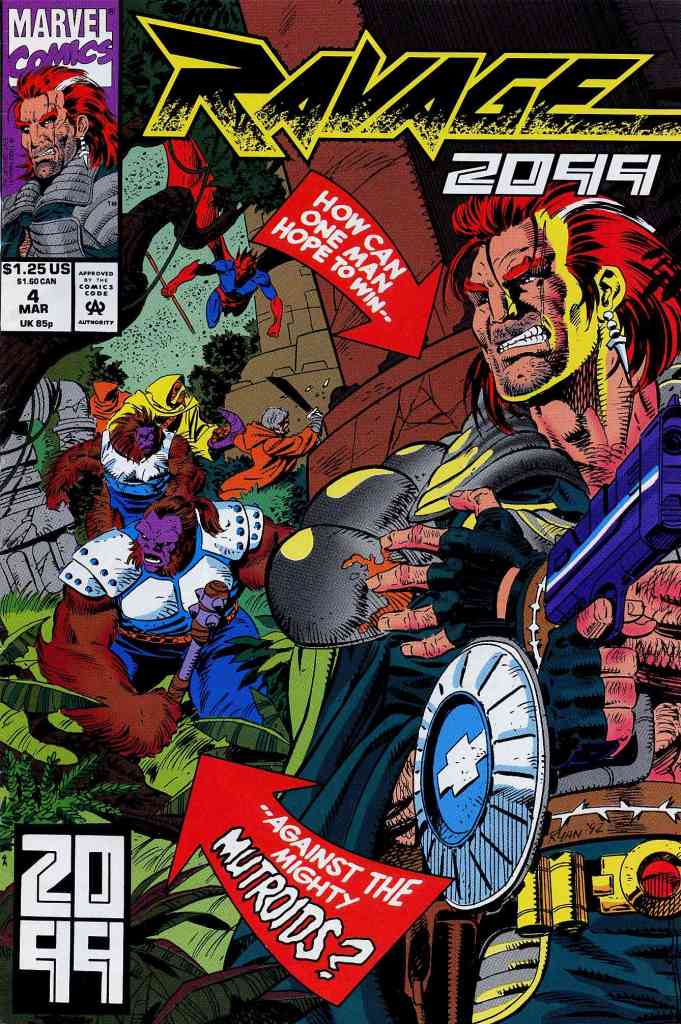
The cover.
Early story
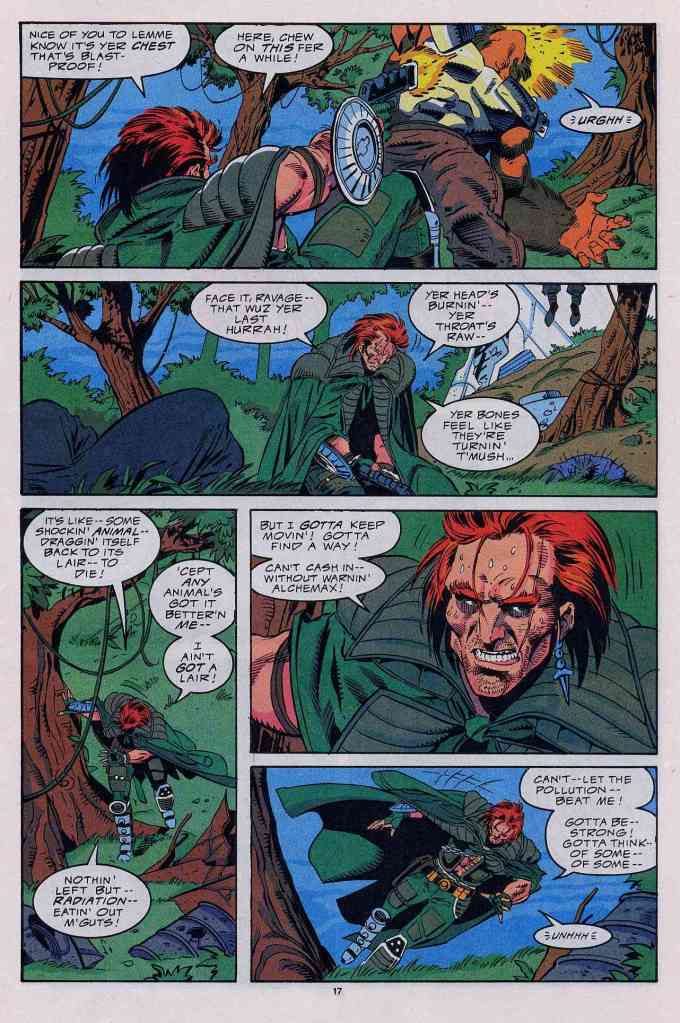
The story begins in the island of Hellrock where Ravage is on the run already suffering from the toxic air and only time will tell if ever-present radiation will kill him or turn into a mutroid. Dethstryk’s minions have been hunting him since he started running away from their main forces.
Even though he was able to avoid getting caught by the hunters, Ravage continues to suffer greatly with each passing moment. Despite the pain, he remains determined to fight back and keep moving but his chances of survival keep on fading…
Quality
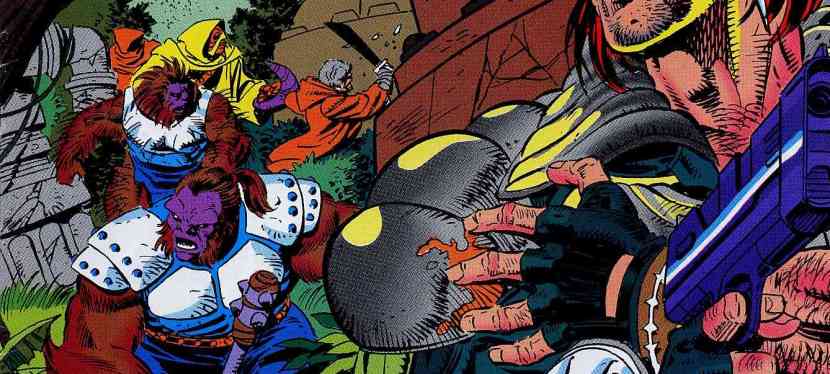
This is pretty much what you will see of Ravage in this comic book.
To put it short, the story was pretty much about Ravage struggling to survive in a very dangerous location while being hunted. The heroism he had in issue #3 is completely missing and the way Stan Lee wrote this story, the concept is pretty shallow. In fact, even the very weak story of issue #1 has more variety and depth than this one! More on Ravage, even as he struggled and got targeted, there is not much justification to make readers like you feel sympathetic to him especially if you followed Ravage’s so-called development starting in issue #1.
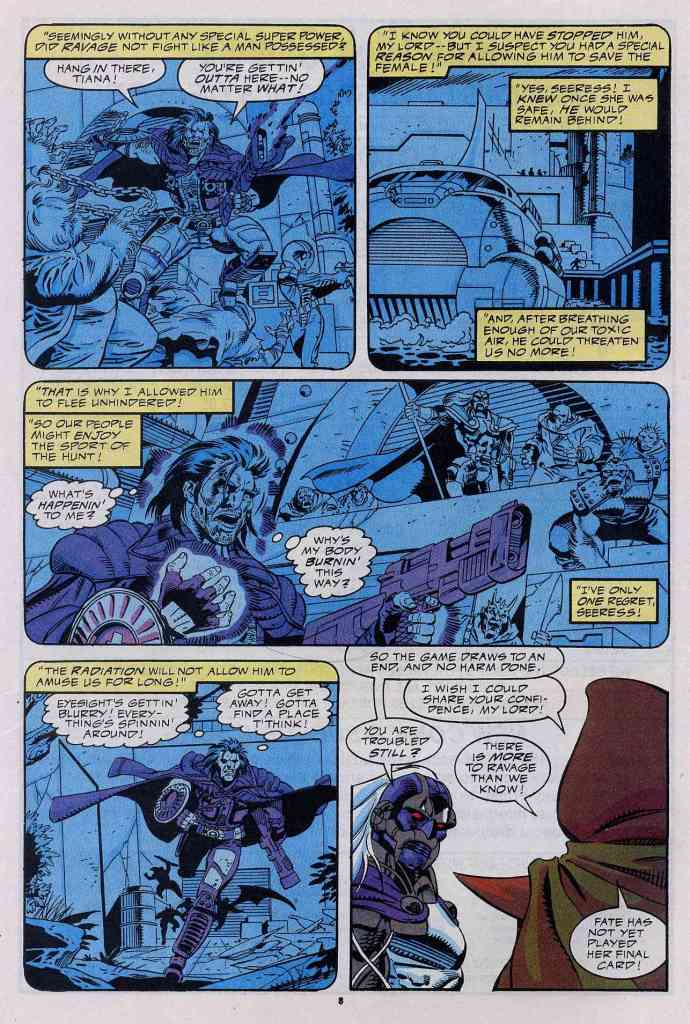
When it comes to plotting, this comic book would have worked better had it been released in the 1970s. It does not help that Stan Lee had to resort to adding fillers to the script by means of recapping lots of scenes from issue #3 (even though he tried to emphasize Dethstryk’s thoughts).
Character development? There is not much here except for Ravage. As for the supporting characters, don’t expect to see much of Tiana and Dack as they did not contribute anything to the shallow story. As for Ravage’s former boss Henton, Stan Lee went ahead to show just how obviously evil he is with nothing new to show (except his virtual reality escapade).
Conclusion
Stan Lee and his creative team lazily resorted to recapping key events that happened in issue #3.
Clearly, Ravage 2099 #4 (1993) falls short from becoming a satisfying read as it paled in comparison to issue #3. That’s too bad because the concept of showing Ravage as a fugitive in the middle of a very dangerous place could have turned into something more interesting and more intriguing. Instead, Ravage ended up being the target of hunters and it was clear that Stan Lee and Paul Ryan dragged the scenes of him struggling and fighting to survive.
If you are seriously planning to buy an existing hard copy of Ravage 2099 #4 (1993), be aware that as of this writing, MileHighComics.com shows that the near-mint copy of the regular edition costs $8 while the near-mint copy of the newsstand edition costs $24.
Overall, Ravage 2099 #4 (1993) is not recommended. If you really want to buy this comic book at all, better not pay more than fifty cents for it.
+++++
Thank you for reading. If you find this article engaging, please click the like button below and also please consider sharing this article to others. If you are looking for a copywriter to create content for your special project or business, check out my services and my portfolio. Feel free to contact me as well. Also please feel free to visit my Facebook page Author Carlo Carrasco and follow me at HavenorFantasy@twitter.com
Disclaimer: This is my original work with details sourced from reading the comic book and doing personal research. Anyone who wants to use this article, in part or in whole, needs to secure first my permission and agree to cite me as the source and author. Let it be known that any unauthorized use of this article will constrain the author to pursue the remedies under R.A. No. 8293, the Revised Penal Code, and/or all applicable legal actions under the laws of the Philippines.
Welcome back, Marvel 2099 fans and superhero comic book geeks! Are you ready for another trip into the high-tech future of Marvel’s comic book universe through the storytelling of the late Stan Lee? This is about the 3rd issue of the Ravage 2099 monthly series.
For the newcomers reading this, Ravage is an original character co-created by Stan Lee and artist Paul Ryan for the 2099 universe of Marvel Comics. By comparison, 2099 started in the 1990s with its own versions of Spider-Man, Dr. Doom and the Punisher. As such, Ravage stood out simply because he was different from them and that includes being idiotic and chaotic as a lead character.
Having already reviewed the first two issues (read my recent review), it became clear to me that Ravage started to deteriorate as a person even as he strived hard in doing what he thought was right. There are two established villains in the story and so far, Ravage does not look any different from them since he proved to be so chaotic, he became a danger not only to the thugs but also to law enforcers. As such, he is a danger to the public.
To find out if anything will improve creatively and artistically, here is a look back at Ravage 2099 #3, published in 1993 by Marvel Comics with a story written by Stan Lee and drawn by Paul Ryan.
The cover.
Early story
The story begins moments after Alchemax forces abducted Tiana from Ravage and Dack who find themselves busy with armed enemies on the street. The young Dack got hit by a gun blast. Somehow, Dack was brought to the nearest medical facility for treatment and placed in a medi-cell for questioning.
Already alone in the room, Dack is trapped and a bearded man delivering some candy arrives. It turns out it is Ravage in disguise and he wanted to make sure the youth was fine. Dack tells reveals that he was question for hours. Ravage updates Dack that Tiana was probably half-way to Hellrock, and he intends to get her back.
Meanwhile, armed personnel spot Ravage on surveillance video and rush to get him…
Quality
Most likely the portrayal of Tiana being helpless will turn off radical feminists and SJWs reading this.
To put things straight, this particular story has a retro vibe which reminds me of certain sci-fi and adventure comic books of the 1950s to the 1970s. This is not surprising given Stan Lee’s own style of plotting and writing. Like in issue #2, creative baggage was less of a hindrance and this allowed Lee and Paul Ryan to craft another action-hero tale that is straightforward and easier to follow. Unlike the previous issue, this one has stakes raised near the end of the story which is refreshing and it also involves a nice change of location. Compared to how he acted in issue #2, Ravage here begins to act more heroic and showed willingness to sacrifice something to help someone. He still is a chaotic person to be with, only this time he is in the company of a different kind of walking characters. To say the least, this story is an improvement over its predecessor.
Conclusion
Ravage in action inside Dak’s medi-cell.
I can say that Ravage 2099 #3 (1993) is surprisingly a satisfying read. It definitely is not great but the traditional elements of sci-fi, action adventure storytelling lifted its quality. It should be noted that the act of heroism on the part of Ravage begins here and the predicted rivalry between him and the villain Dethstryk (who looks generic as the leader of a band of baddies) finally starts.
If you are seriously planning to buy an existing hard copy of Ravage 2099 #3 (1993), be aware that as of this writing, MileHighComics.com shows that the near-mint copy of the regular edition costs $8 while the near-mint copy of the newsstand edition costs $24.
Overall, Ravage 2099 #3 (1993) is satisfactory. That being said, I don’t recommend spending any more than $1 for it.
+++++
Thank you for reading. If you find this article engaging, please click the like button below and also please consider sharing this article to others. If you are looking for a copywriter to create content for your special project or business, check out my services and my portfolio. Feel free to contact me as well. Also please feel free to visit my Facebook page Author Carlo Carrasco and follow me at HavenorFantasy@twitter.com
Disclaimer: This is my original work with details sourced from reading the comic book and doing personal research. Anyone who wants to use this article, in part or in whole, needs to secure first my permission and agree to cite me as the source and author. Let it be known that any unauthorized use of this article will constrain the author to pursue the remedies under R.A. No. 8293, the Revised Penal Code, and/or all applicable legal actions under the laws of the Philippines.
There is so much said about X-Men #1 of 1991 which was launched to major success by Marvel Comics selling at least eight million copies worldwide. That launch issue, written by Chris Claremont and drawn by Jim Lee, had multiple covers and a version with gatefold covers and high-quality paper which made it an instant hit with collectors chasing profit. In 2011, Marvel even released the so-called 20th anniversary edition of X-Men #1 which was digitally recolored.
In terms of substance, X-Men #1 marked the new era of the X-Men. Charles Xavier returned to his mansion to lead the X-Men which was so large as a group, it had to be divided into two team with Cyclops leading the Blue Team and Storm heading the Gold Team. In terms of publishing, Marvel published tales of the Gold Team in the Uncanny X-Men monthly series while the Blue Team’s stories were published in the adjective-less X-Men monthly series.
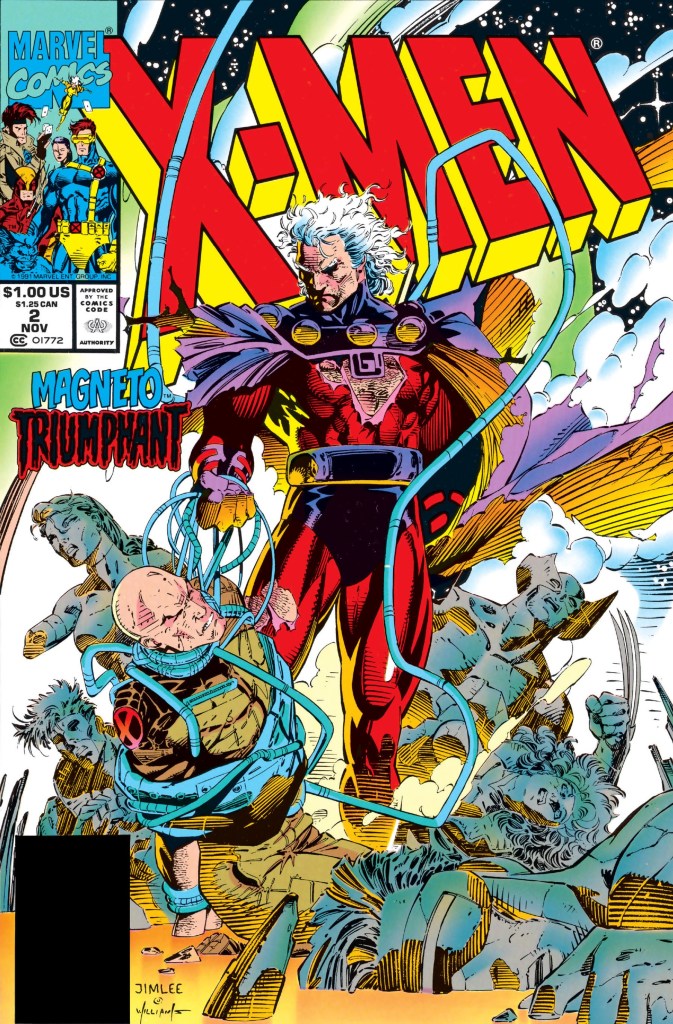
With all the attention paid to X-Men #1, I noticed that not too many people cared to talk about what happened after the end of that comic book. Without spoiling plot details, the massive seller of 1991 had its story end in a cliffhanger. To find out what followed and determine the quality of the creative team’s work, here is a look back at X-Men #2 published in 1991 by Marvel Comics with a story co-written by Chris Claremont and Jim Lee (who illustrated).
The cover.
Early story
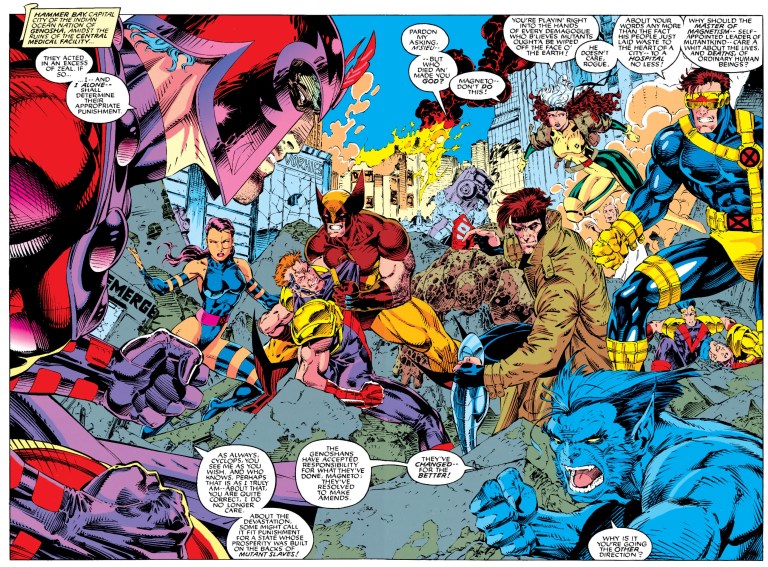
The story begins in the fictional island nation of Genosha which has a legacy of mutant slavery. Having fought with the Acolytes (led by Fabian Cortez), the X-Men now face Magneto who arrived and tells them that he will not abandon the Acolytes.
“They acted in an excess of zeal. If so…I..and I alone..shall determine their appropriate punishment,” Magneto tells the team of Cyclops, Gambit, Beast, Wolverine, Psylocke and Rogue. Near them are other Acolytes members down on the ground.
After words spoken by Gambit, Rogue and Cyclops, Magneto referred to the devastation of the city hospital as fitting for punishing a state (Genosha) whose prosperity was built on the backs of mutant slaves. Beast answered back saying that the Genoshans have accepted responsibility for what they have done and resolved to make amends.
While Magneto replies to Beast, a military Genoshan helicopter gunship fires missiles at them from above which the X-Men’s archvillain intercepts. Using his magnetic power, Magneto lifts steal beams and destroys the helicopter with them. He then turns against the X-Men restarting the chaos in the city…
Quality
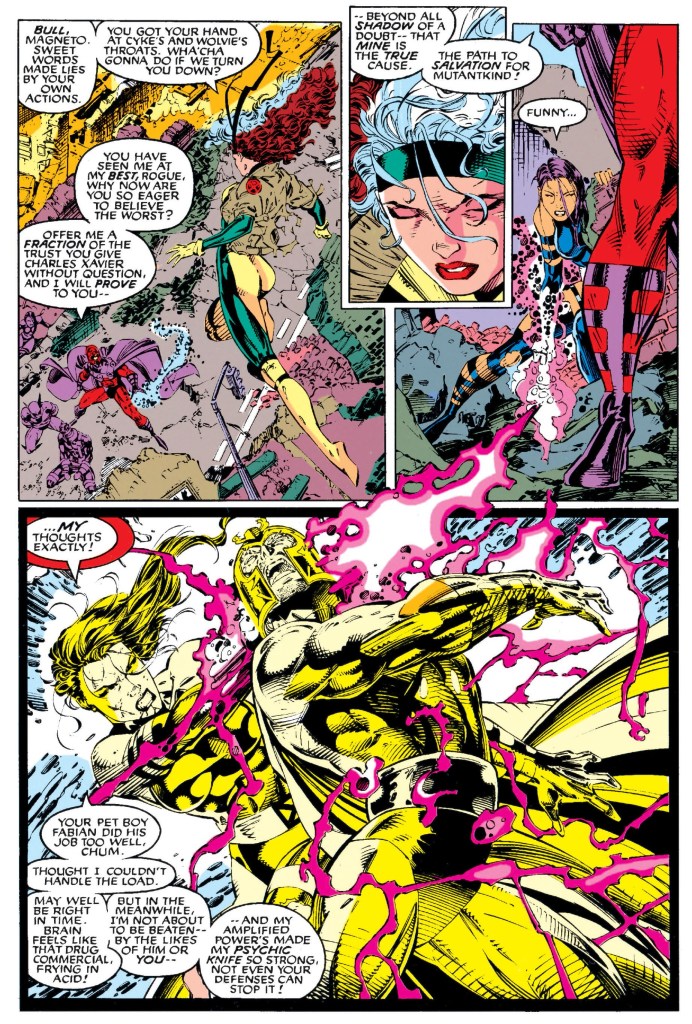
Magneto, Psylocke and Rogue in the middle of the chaos.
Being the middle of a 3-part story, this comic book pushes the entire X-Men group to the edge thanks to strong writing by Chris Claremont. I’m not simply referring to the traditional good-versus-evil formula of superhero storytelling as the story here emphasized themes about sanity, loyalty, legacy, idolatry and even diplomacy. It just so happens that there is a lot of superhero spectacle to enjoy here and there.
The stakes have been raised significantly in this story as Magneto is shown leading the Acolytes who in turn went ahead with their first mission which explains the chaos in Genosha. Magneto’s condition also deteriorates and gets himself healed by Fabian Cortez who is more sinister than what he seems. For his part, Charles Xavier of the X-Men gets to interact with his long-time friend Dr. Moira MacTaggert who is struggling with guilt from something she committed in the past. Through Magneto, Xavier and MacTaggert, there is this solid build-up of tension that led to a very powerful revelation in the 2nd half of the story which, ironically, put the X-Men on the sideline temporarily. There is high drama, deep tension and high intensity involving Magneto and MacTaggert, and their scene together is the highlight of the story.
Conclusion
The face-off!
To put it straight, as much as I loved X-Men #1 (1991), I find X-Men #2 (1991) more compelling to read. For one thing, it rewards X-Men fans who dedicatedly followed the events of not only the X-Men but also of that of the life of Magneto. It’s really great that Chris Claremont literally dug up the past for details that proved to be useful in this comic book. It also nicely sets up anticipation of the next issue by involving the X-Men’s Gold Team. Unsurprisingly, with the combined talents of Claremont and Jim Lee, this is an excellent read that really looks great.
If you are seriously planning to buy an existing hard copy of X-Men #2 (1991), be aware that as of this writing, MileHighComics.com shows that the near-mint copy of the regular edition costs $4 while the near-mint copies of the Chris Claremont-signed regular edition, the Chris Claremont-signed newsstand edition and the newsstand edition cost $9, $19 and $13 respectively.
Overall, X-Men #2 (1991) is highly recommended!
+++++
Thank you for reading. If you find this article engaging, please click the like button below and also please consider sharing this article to others. If you are looking for a copywriter to create content for your special project or business, check out my services and my portfolio. Feel free to contact me as well. Also please feel free to visit my Facebook page Author Carlo Carrasco and follow me at HavenorFantasy@twitter.com
Disclaimer: This is my original work with details sourced from reading the comic book and doing personal research. Anyone who wants to use this article, in part or in whole, needs to secure first my permission and agree to cite me as the source and author. Let it be known that any unauthorized use of this article will constrain the author to pursue the remedies under R.A. No. 8293, the Revised Penal Code, and/or all applicable legal actions under the laws of the Philippines.
Welcome back Ultraverse fans, geeks and comic book collectors! Here is another trip back into the Ultraverse, which for me is the most defining line of superhero comics that was realized in the 1990s. The UV lasted for only a few years and along the way publisher Malibu Comics got acquired by Marvel Comics.
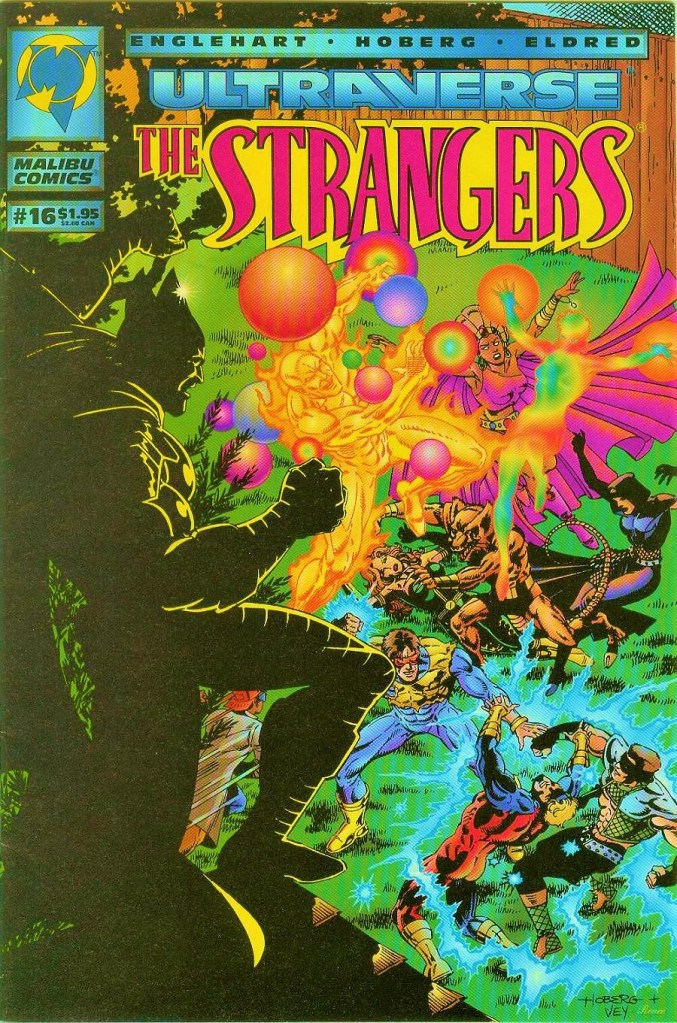
History aside, we are about to explore The Strangers again in the sixteenth issue of the monthly series that was spearheaded mainly by the creative duo of Steve Englehart and Rick Hoberg. Here is a look back at The Strangers #16, published in 1994 by Malibu Comics with a story written by Englehart and drawn by Hoberg.
The cover.
Early story
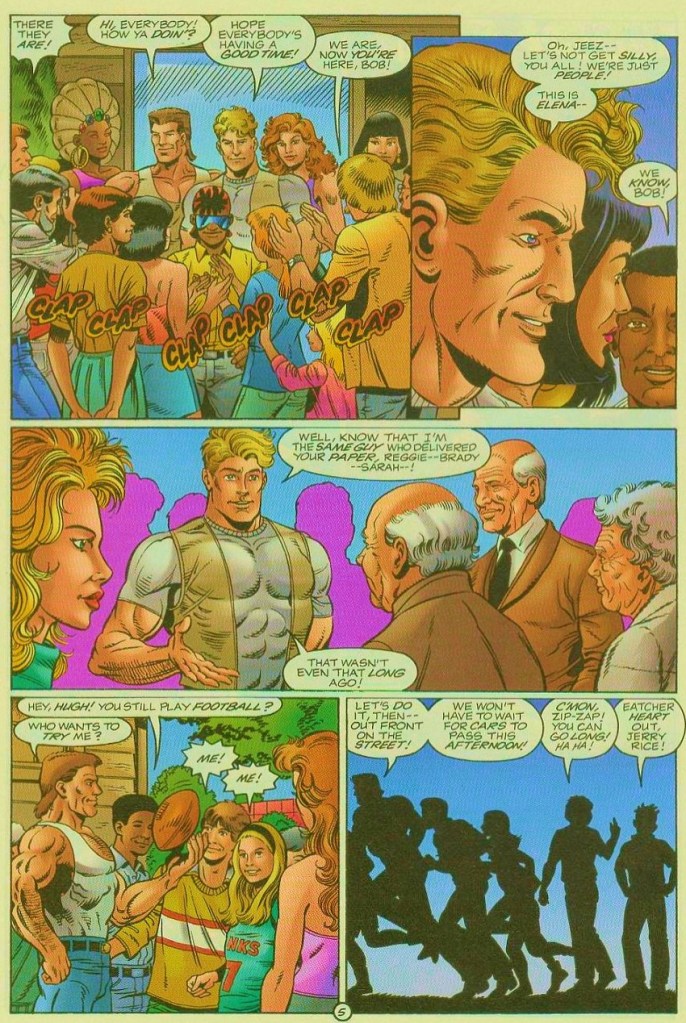
The story begins in a local community in California wherein one of the houses is hosting a block party. Already a disturbance to the neighbors (note: police officers had to temporarily close down a short stretch of the public road and restricted others from getting near), the said party offers people a chance to meet in person Atom Bob who has his teammates with him.
During a private meeting, The Strangers discuss what they encountered lately (note: this refers to their encounters with Gangsta and Brazen. Also involved was someone called the Pilgrim. As they keep talking, Lady Killer stressed that they all need to be ready for further encounters.
Meanwhile in the downtown area of the city, three costumed characters (who previously road a cable car just like The Strangers) are plotting something…
Quality
Meet the opposition.
Let me start first with the art done by Rick Hoberg with ink work by Tim Eldred. I should state that since issue #1, Hoberg not only drew characters, places, creatures and backgrounds with his captivating style, he also maintained a high level of quality and proved he can bring any comic book script into life with images. His art is so good, this comic book is fun reading again and again. I should also state that the coloring for this story is very lively and more dream-like in style thanks to the color design by Moose Baumann and interior color by Prisms.
When it comes to the story, this comic book’s concept is pretty unique and Steve Englehart deserves credit for coming up with something fresh while still leaving room for spectacle and characterization. The idea of a block party held in the middle of a community of family homes celebrating the presence of superheroes is cool and it opened up new ways to define the characters not to mention emphasizing how their presence affects people not on the city level but on the local community! Having worked as a local community newspaper journalist myself, I know what’s it like when local communities have special activities or events that bring together (or captivate) the neighbors. Along the way, the dialogue is varied (note: lots of characters other than The Strangers had lines), the portrayal of The Strangers is consistent and the story’s pace flowed smoothly.
Speaking of characterization, there is notable focus on Atom Bob and Lady Killer who already have feelings for each other. As the home of Atom Bob’s family serves as the venue of the party, you will get to see the character interact with the local neighbors and others he personally knew for a long time which is a very refreshing way of developing him. Lady Killer meanwhile tries to maintain balance between being the team’s professional leader and having feelings for Atom Bob while trying to respect his parents.
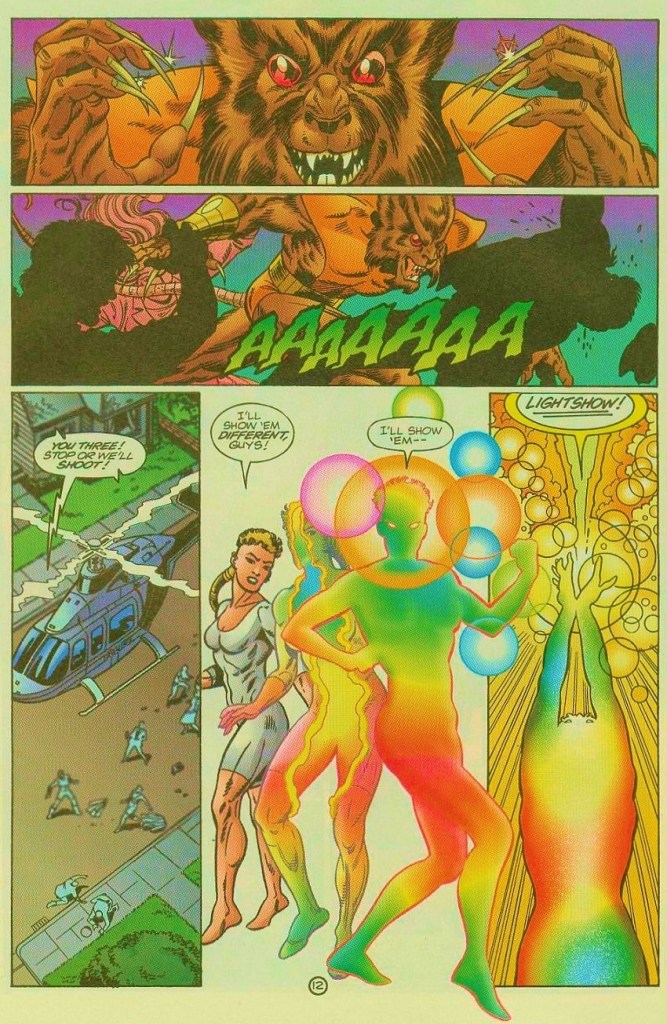
And then there is a growing group of ultras who intend to destroy The Strangers. It was at this stage in The Strangers monthly series in which a genuine opposition against the title team really started to take shape. The good news is that the Pilgrim and the other opposing ultras were not portrayed as generic bad guys but people who are struggling and have a cause.
Conclusion
The Strangers and the guests at the party.
There is no doubt that The Strangers #16 (1994) is a whole lot of fun, very compelling and intriguing to read from start to finish. Anyone who loves the title team will find something to enjoy and follow, while those who keep on enjoying the conflict between good-and-evil will find something new and entertaining here. Steve Englehart and Rick Hoberg not only continued to deliver high-quality superhero stories with The Strangers, they really were one of the best creative duos of the 1990s.
If you are seriously planning to buy an existing hard copy of The Strangers #16 (1994), be aware that as of this writing, MileHighComics.com shows that the near-mint copy of the comic book costs $8.
Overall, The Strangers #16 (1994) is highly recommended!
+++++
Thank you for reading. If you find this article engaging, please click the like button below and also please consider sharing this article to others. If you are looking for a copywriter to create content for your special project or business, check out my services and my portfolio. Feel free to contact me as well. Also please feel free to visit my Facebook page Author Carlo Carrasco and follow me at HavenorFantasy@twitter.com
Disclaimer: This is my original work with details sourced from reading the comic book and doing personal research. Anyone who wants to use this article, in part or in whole, needs to secure first my permission and agree to cite me as the source and author. Let it be known that any unauthorized use of this article will constrain the author to pursue the remedies under R.A. No. 8293, the Revised Penal Code, and/or all applicable legal actions under the laws of the Philippines.
Over a year ago, I reviewed Ravage 2099 #1 (1992) which marked the return of the late Stan Lee on writing stories for a monthly series. Unlike the main heroes of the 2099 universe of the time, Ravage was created by Stan Lee and illustrator Paul Ryan as an original character although he ended up being generic. In my review of the 1st issue of the Ravage 2099 series, I declared that the comic book itself was worth buying way below its original cover price.
Of course, it is understood that, apart from Stan Lee’s outdated style of writing, the debut issue is difficult to make because a lot of explaining (via expository dialogue most of the time) the concept had to be done which causes an imbalance between storytelling, character development and spectacle. That being said, it is time to find out if the Stan Lee-Paul Ryan creative team managed to improve their work together in this look back at Ravage 2099 #2 published in 1993 by Marvel Comics.
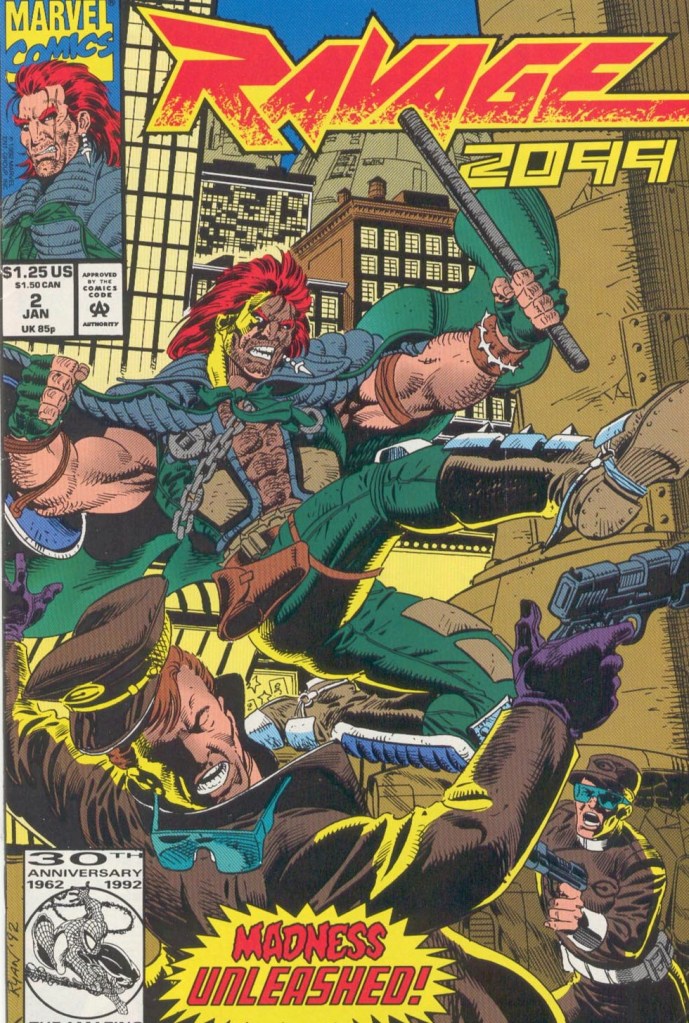
The cover.
Early story
The story begins in the dreaded place called Hellrock. A deformed being named Stormer tries to convince his fellow mutroids to make him their new leader as he believes that current leader Deathstryk is weak and afraid. Soon enough, Dethstryk personally arrives surprising everyone, including Stormer.
After hearing Dethstryk make statements about his temper tantrum and slaying of a fellow mutroid, Stormer attacks him suddenly. In front of many mutroids, Dethstryk easily overpowers Stormer as he lectures him about leadership and strategy. After being offered mercy, Stormer then submits to Dethstryke who in turn declares that their goal is to make the extinction of the human race happen.
Deep in the middle of the metropolis, Ravage drives a very old, fossil fuel truck and rams a law enforcement car with it causing two officers to react and draw their guns. Ravage leaps into action and beats the two officers in brutal fashion. Afterwards, he goes on to raid the car of its equipment…
Quality
Ravage only acts human with his friends.
I’ll start with the storytelling here. With the fact that there is much less creative baggage remaining since the exposition has been done in the first issue, this comic book’s pacing and overall structure showed some improvements. Not only will you see more of Ravage doing action and really starting out as a vigilante, you will also discover more of the core concept through the exposition focused more on the side of Dethstryk as the villain’s seeress informs him that Ravage is destined to be his nemesis.
What bogs this comic book down is the style of writing by Stan Lee which clearly lacks engagement and the presentation here has a lot in common with comic book storytelling of the 1960s and 1970s. That being said, the corporate intrigue Lee tried to sow here also suffered and the other villain Anderthorpe Henton just looks and acts cartoony.
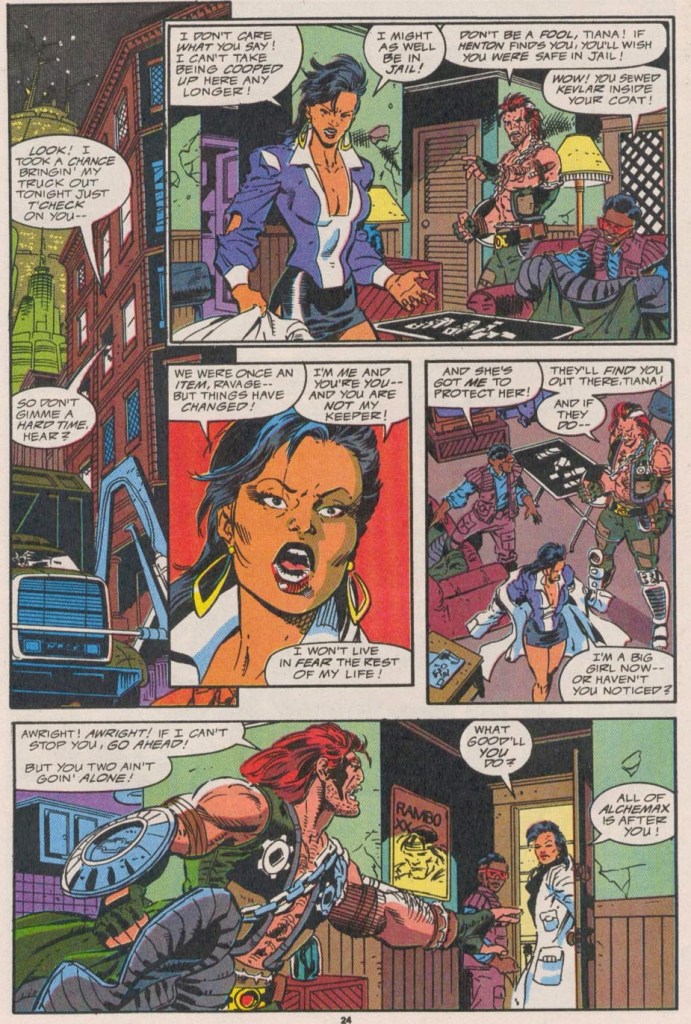
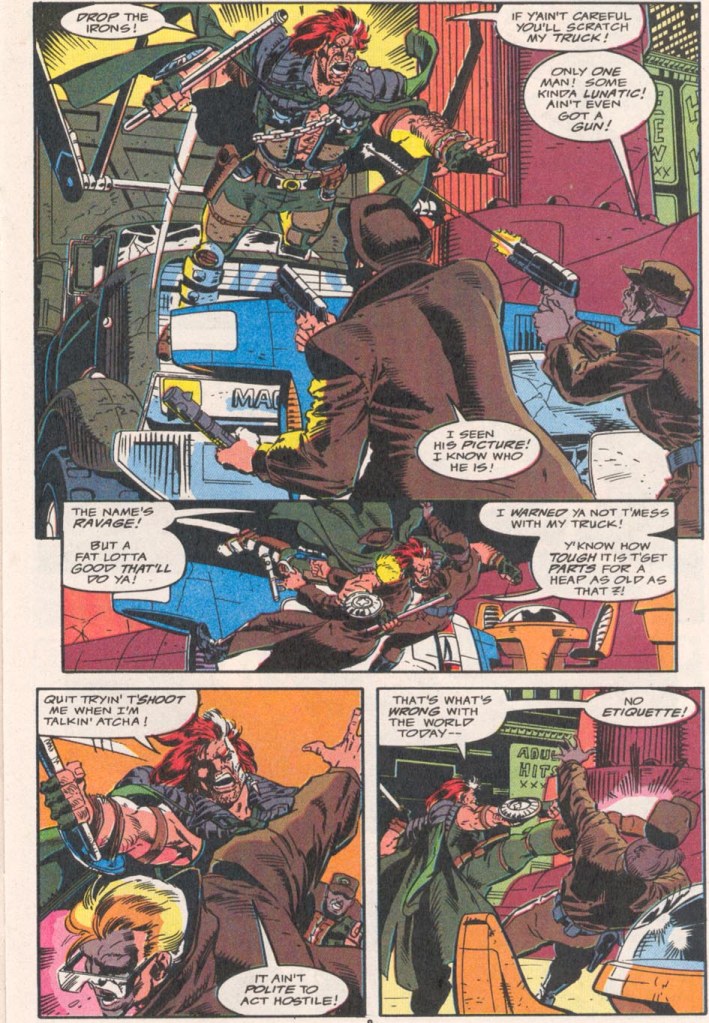
If there is anything notable that Stan Lee did with writing, it’s the consistency he showed on presenting Ravage as being more antagonistic than a heroic lead figure. If you look closely at what he did to the law enforcers, the armed city security personnel and the punks who encountered him, you will realize that Ravage is actually a menace to society and his humanity is deteriorating. He only acts human when he is with his sexualized former assistant Tiana and Dack.
With regards to the visuals, Paul Ryan’s work here is decent. His style is not that great but I like the effort he exerted on presenting future technology and clearly he took some inspiration from other sci-fi works to give this comic book a distinctive look.
Conclusion
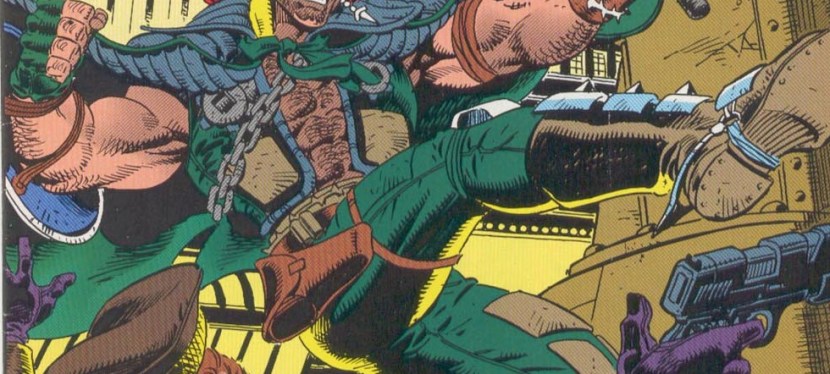
Anyone who despises law enforcers will most likely find this enjoyable.The spirit of rebellion really stinks!
Ravage 2099 #2 (1993), to say it bluntly, is a marginal improvement over its predecessor mainly due to the reduced amount of creative baggage. Exposition in this particular comic book is much lesser in terms of content and it is done efficiently which paved the way for more spectacle to happen. The problems here is that, apart from Stan Lee’s weak writing, there was no real effort to develop the lead character Ravage. I suppose this was intentionally done by the creators to let Ravage be more of an action figure and let the action do the talking about what defines him as a person. Even if that was the case, nothing changes the fact that Ravage here is not heroic and is in fact more antagonistic towards society. Is it any wonder why Ravage ended up as Stan Lee’s failure?
If you are seriously planning to buy an existing hard copy of Ravage 2099 #2 (1993), be aware that as of this writing, MileHighComics.com shows that the near-mint copy of the regular edition costs $8 while the near-mint copy of the newsstand edition costs $26.
Overall, Ravage 2099 #2 (1993) is not recommended. If you really want to buy this comic book at all, better not pay more than fifty cents for it.
+++++
Thank you for reading. If you find this article engaging, please click the like button below and also please consider sharing this article to others. If you are looking for a copywriter to create content for your special project or business, check out my services and my portfolio. Feel free to contact me as well. Also please feel free to visit my Facebook page Author Carlo Carrasco and follow me at HavenorFantasy@twitter.com