A Look Back at The Strangers #20 (1995)

Disclaimer: This is my original work with details sourced from reading the comic book and doing personal research. Anyone who wants to use this article, in part or in whole, needs to secure first my permission and agree to cite me as the source and author. Let it be known that any unauthorized use of this article will constrain the author to pursue the remedies under R.A. No. 8293, the Revised Penal Code, and/or all applicable legal actions under the laws of the Philippines.

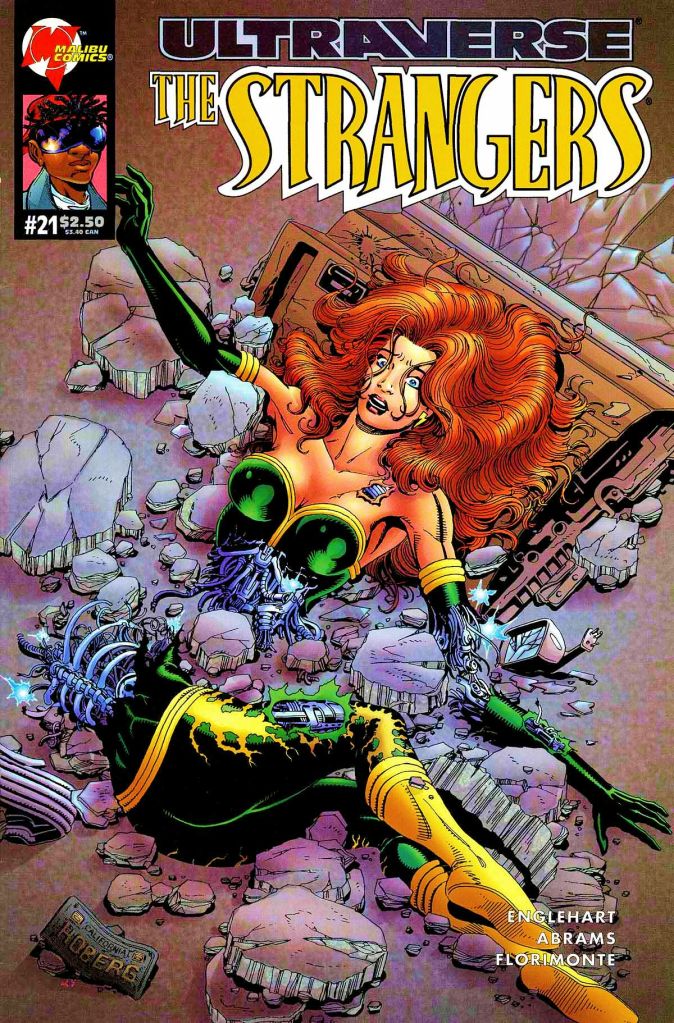
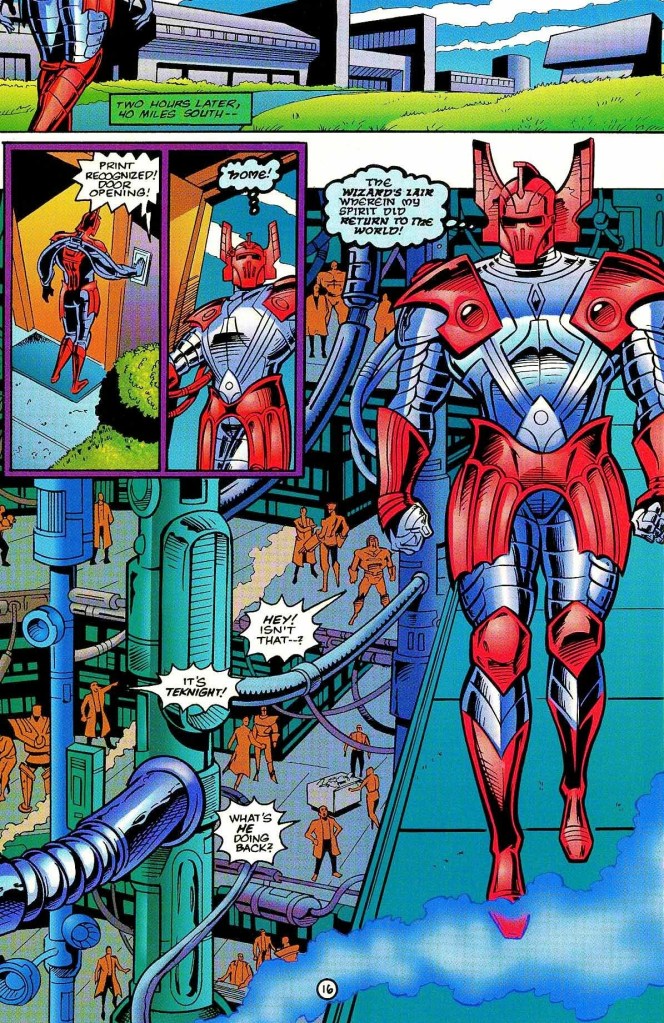
Welcome back, superhero enthusiasts, comic book collectors and fans of the Ultraverse. We revisit the Ultraverse once again to follow the continuing stories of The Strangers. Last time around, the team found itself struggling with adjusting to life without Atom Bob. For Lady Killer, the loss is very painful not only for her leadership of the team but also on her heart as she had a relationship with him.

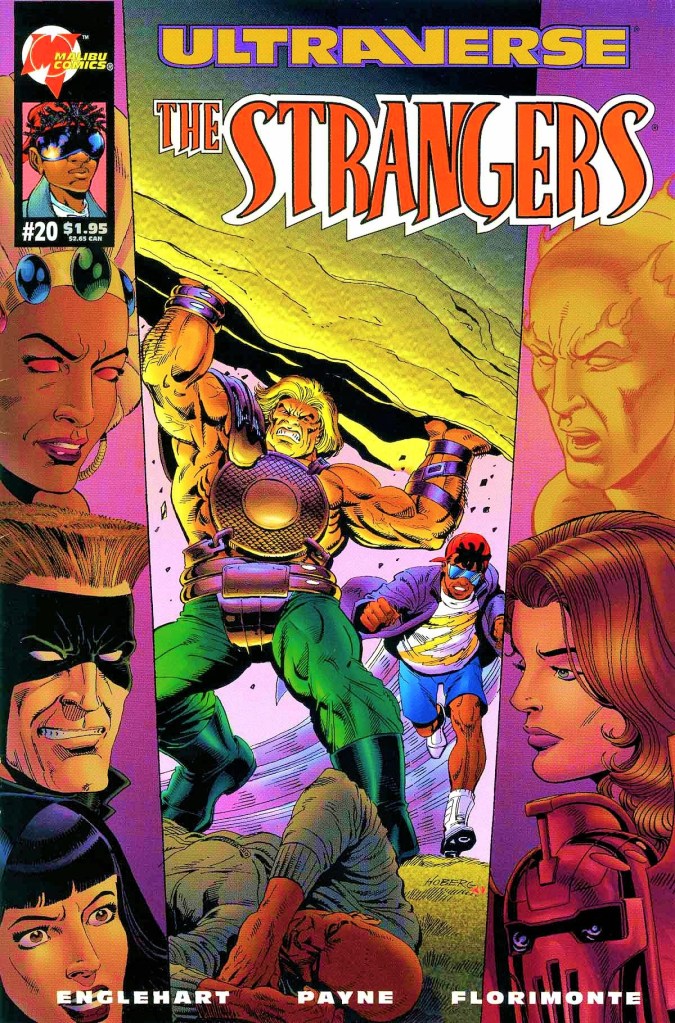
What will happen next? How will the team move forward without Atom Bob? We can all find out in this look back at The Strangers , published in 1995 by Malibu Comics with a story written by Steve Englehart and drawn by Sam Payne.

The cover.

Early story

The story begins inside the home of a mother and her son enjoying indoor basketball. Their happiness got disrupted when a large, muscular man with blonde hair crashes through their door. With him is another man named M.C. who tells the lady that he and his companion want to “borrow” her son. As the mother resisted, the slimmer man knocks her out while Beater (the large guy) grabs her son.

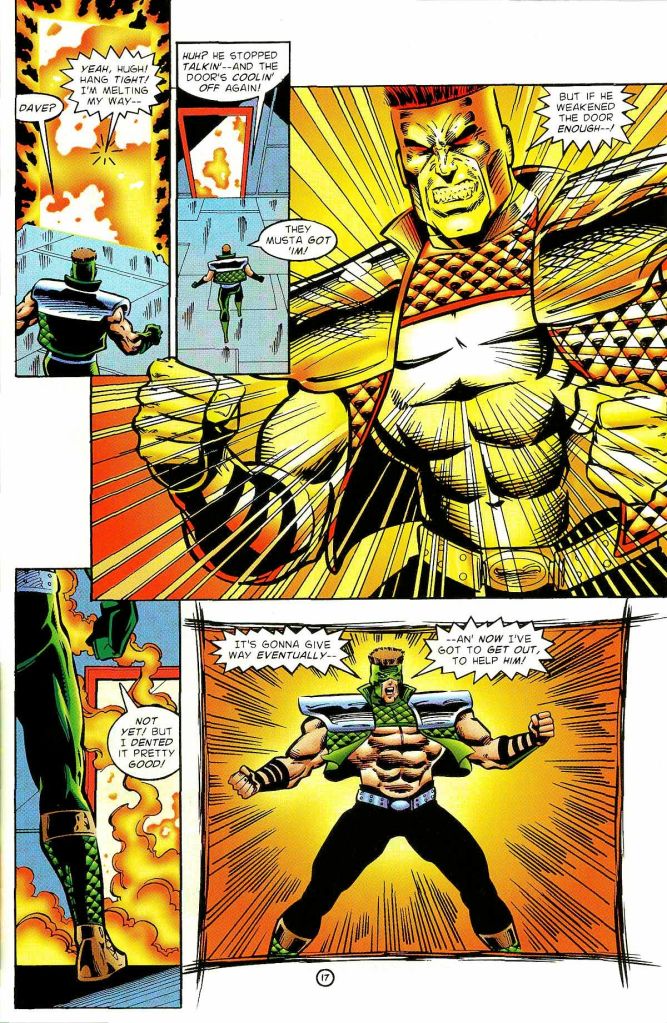
Elsewhere, The Strangers react to the official trading card featuring Candy/Electrocute. Leon/Zip-Zap is familiar with the value of trading cards and he shows them his card of a basketball player called Missile Monroe from his days as a rookie.

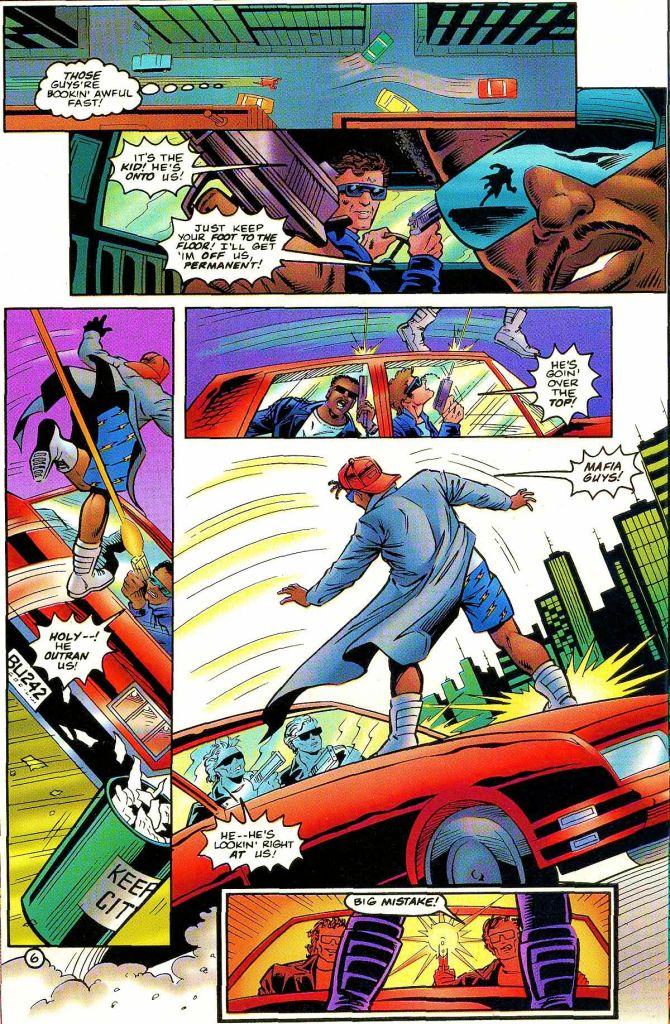
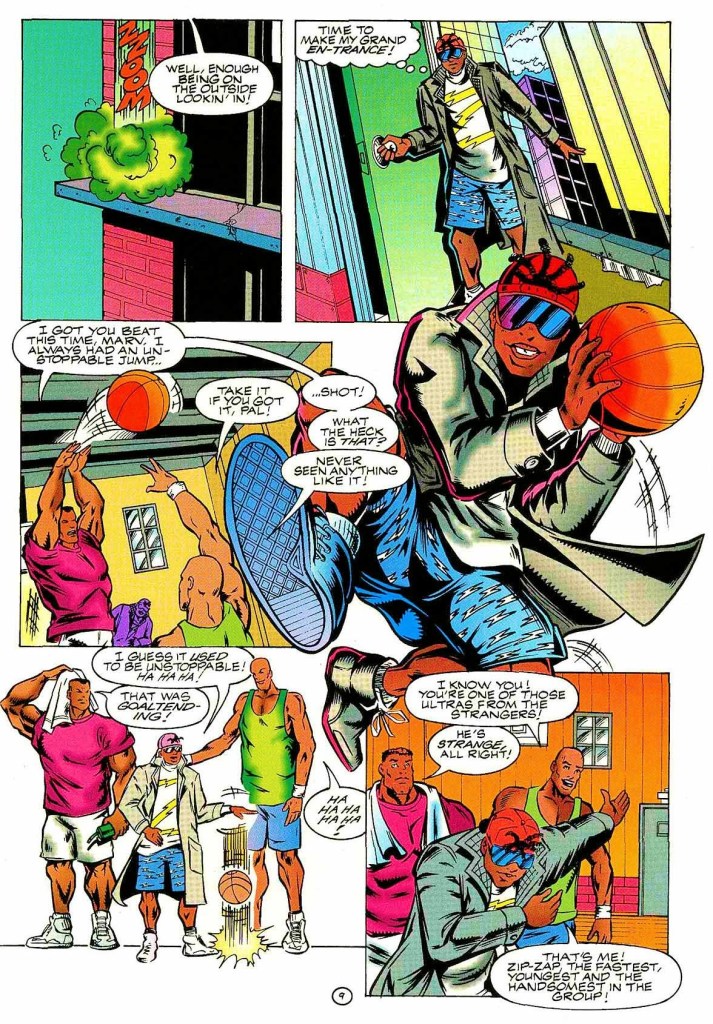
As he is eager to have the trading card signed by the basketball player, Zip-Zap heads on to the city. On his way, he notices people gathered outside Holt’s Gym which he heard is the place where Missile Monroe works out at. He then uses his super speed to go past a few more people, climb up the wall, step on the ledge and look through the window. Zip-Zap sees the basketball player shooting indoors in the presence of a friend.

Sensing opportunity, Zip-Zap decides to sneak in and make his grand entrance to meet Monroe..

Quality

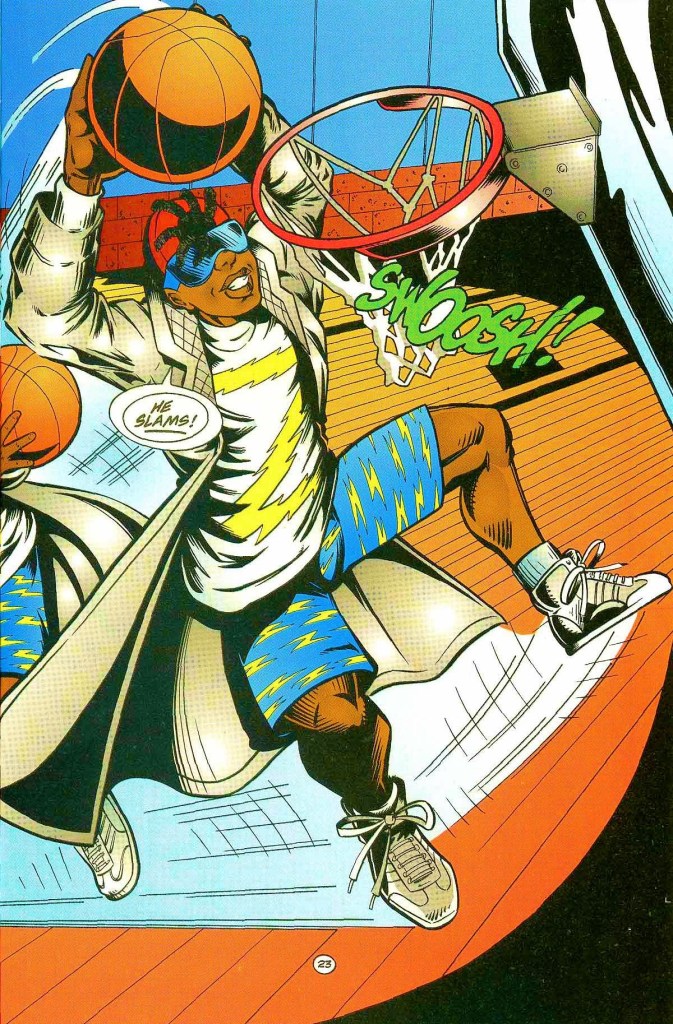
Zip-Zap slams!

I can start by saying that this comic book’s story is much less of The Strangers and more about their youngest and fastest member Zip-Zap. Rather than presenting a story about Zip-Zap going back to his old neighborhood, the story is about him meeting someone very important while taking advantage of his own celebrity status as a member of The Strangers (now known by the public) to get to him.

Other his personal obsession with a sports celebrity, this comic book also explores Zip-Zap’s determination to do something heroic without the presence of his teammates. As he is still a teenager, this part of the story alone is intriguing.

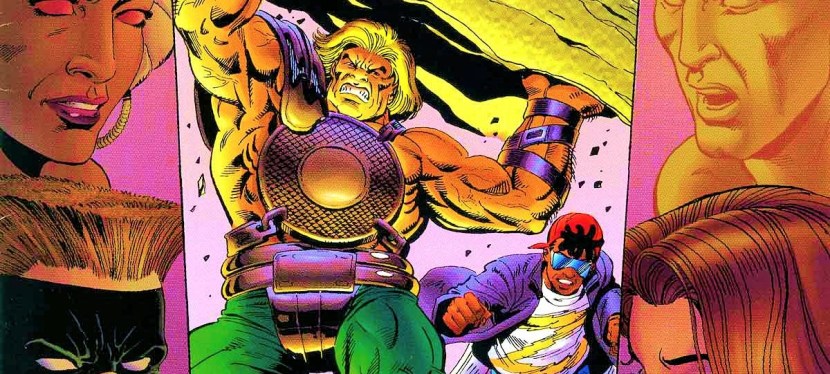
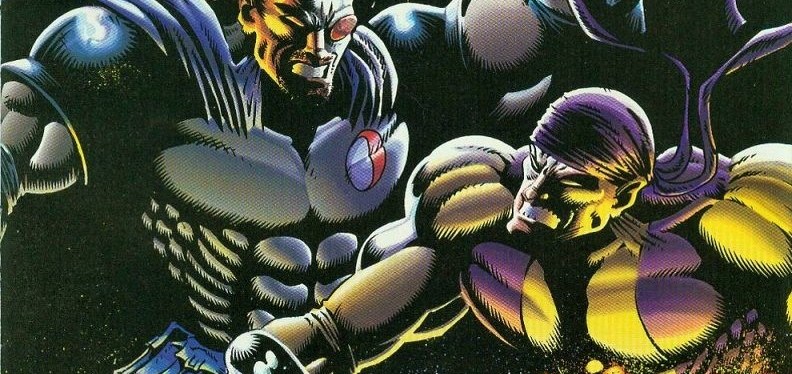
Also intriguing is the introduction of two new villains in this series, MC and Beater. How they became powerful and what their connection with Missile Monroe is something you readers should discover. I personally enjoyed what was revealed.

Other than heroic happenings, the story here explores the consequences that come with big money and lucrative deals. There is also the theme about social elevation with regards to the progress a person can make coming from the local communities to the big league. Also the events in this comic book will remind readers to respect the boundaries between them and the celebrities or important people they encounter in person.

Conclusion

Zip-Zap meets Missile Monroe and friend.

Even though it had much less of the team itself, The Strangers (1995) is a worthy and fun read. The story about Zip-Zap going solo temporarily for his pursuit was nicely crafted and the new characters introduced had personalities that were interesting, most notably with Missile Monroe. Apart from characterization, there is sufficient superhero spectacle to enjoy as well. Going back to Zip-Zap, anyone who loves the character will be pleased with the spotlight on him. I should also state that this story shows additional depth to Zip-Zap’s character.

If you are seriously planning to buy an existing hard copy of The Strangers (1995), be aware that as of this writing, MileHighComics.com shows that the near-mint copy of the comic book costs $14.

Overall, The Strangers (1995) is recommended.

+++++

Thank you for reading. If you find this article engaging, please click the like button below and also please consider sharing this article to others. If you are looking for a copywriter to create content for your special project or business, check out my services and my portfolio. Feel free to contact me as well. Also please feel free to visit my Facebook page Author Carlo Carrasco and follow me at HavenorFantasy@twitter.com
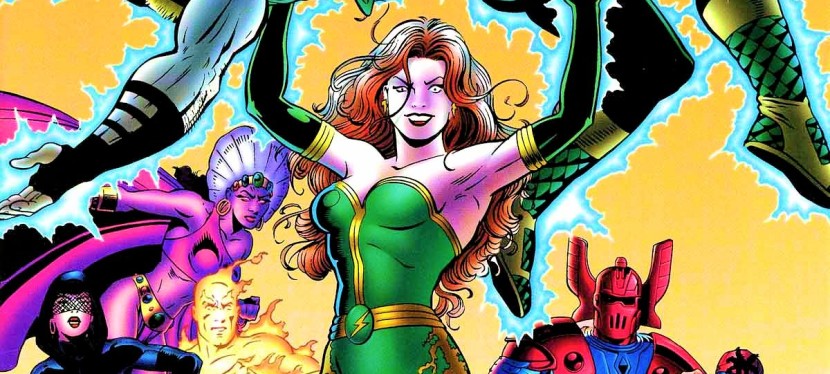
A Look Back at Prime #19 (1995)

Disclaimer: This is my original work with details sourced from reading the comic book and doing personal research. Anyone who wants to use this article, in part or in whole, needs to secure first my permission and agree to cite me as the source and author. Let it be known that any unauthorized use of this article will constrain the author to pursue the remedies under R.A. No. 8293, the Revised Penal Code, and/or all applicable legal actions under the laws of the Philippines.

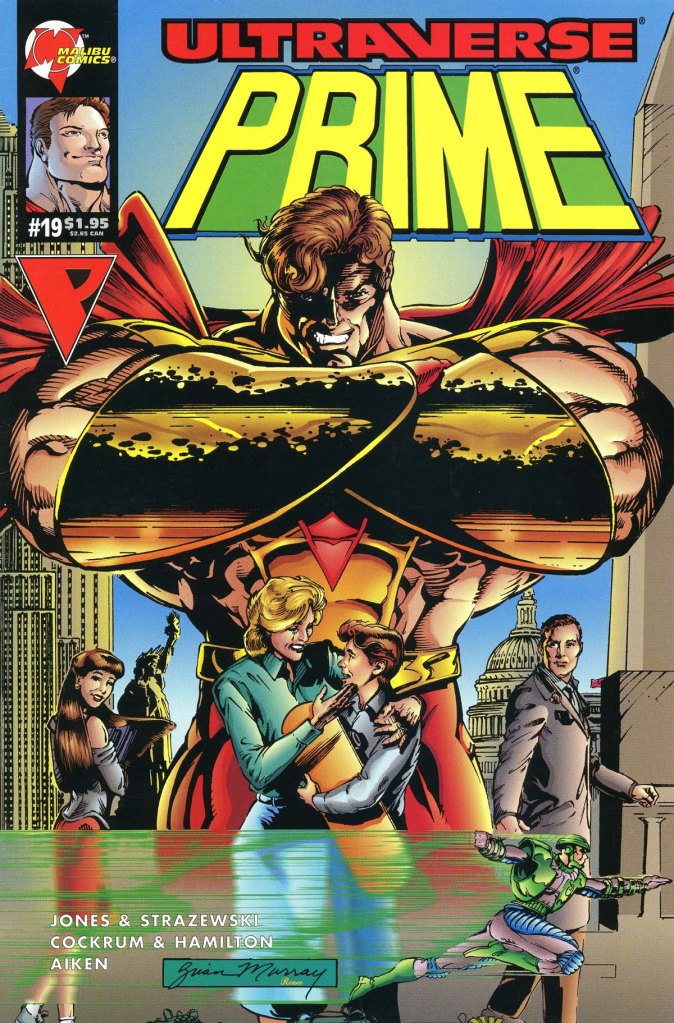
Welcome back, superhero enthusiasts, comic book collectors and fans of the Ultraverse! Today, we will revisit the Ultraverse through the exploits of Prime who has already established himself in the city of New York (the result of Kevin Green and his mom’s move into the city).

Not only have we seen Prime fight a gigantic monster (that reminds me a lot of Japan’s Godzilla) to save New York and its many people, we have seen Turbo Charge getting involved with him with a superhero-related passion.

What will happen next to Prime? Will Turbo Charge get even more involved in helping the people of New York? We can all find out in this look back at Prime , published in 1995 by Malibu Comics with a story written by Len Strazewski and Gerard Jones, and illustrated by Dave Cockrum (X-Men) and Tim Hamilton.

The cover.

Early story

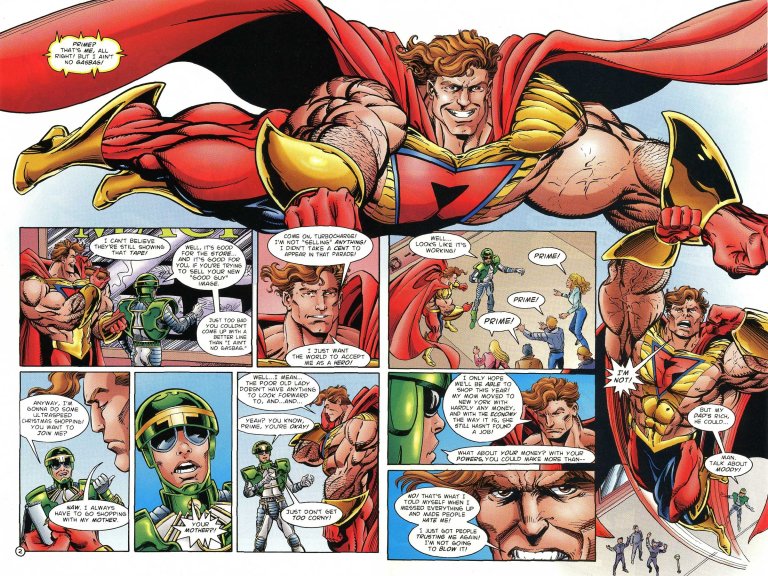
The story begins with Prime flying just above ground in the view of the many people attending the Macy’s Thanksgiving Day Parade in New York. Already he has been identified as the city’s newest Ultrahero.

Sometime later, within the city, Prime and Turbo Charge are watching television sets from outside a retailer’s window. As they talk about being in the spotlight, some fans approached Prime. The more Turbo Charge talks about taking advantage of the public trust and special abilities for financial gain, Prime rejects his suggestion as he remembers how he messed up previously.

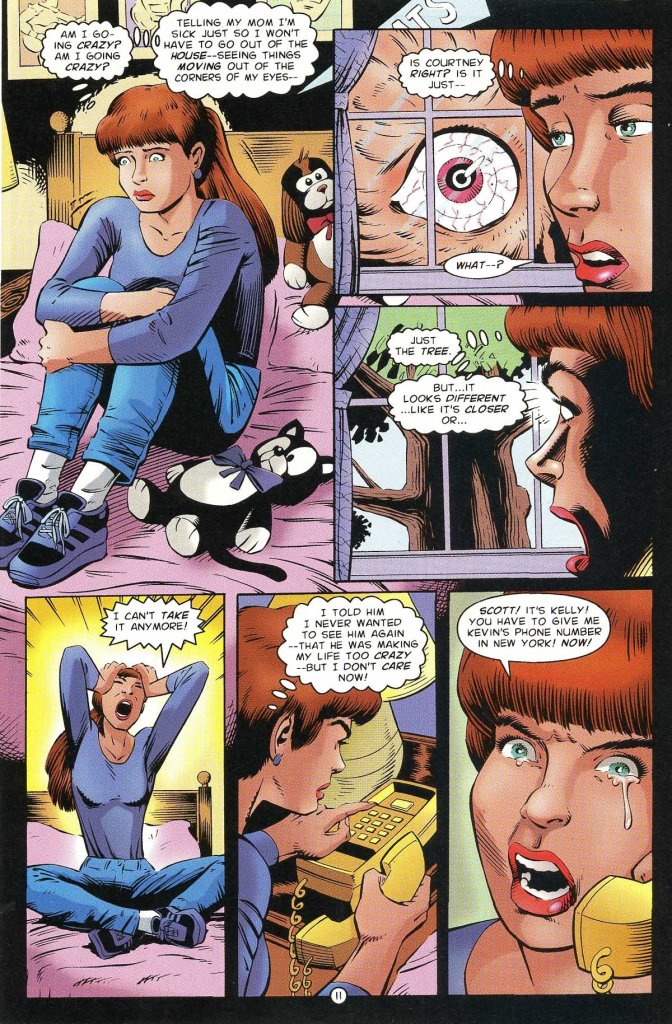
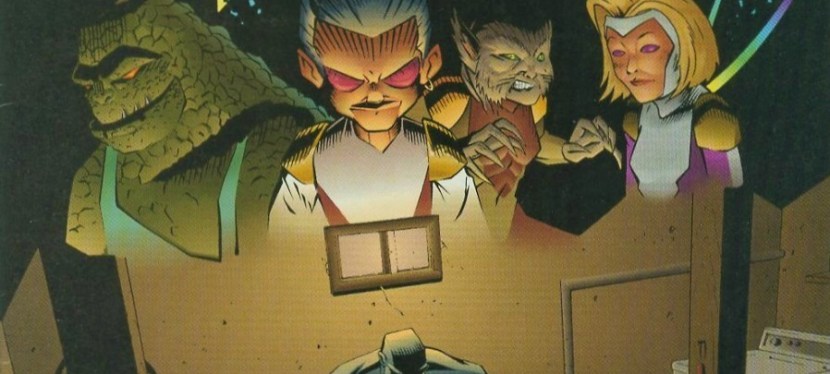
Meanwhile at Canoga Park, California, Kelly (Kevin’s romantic interest) is approached by Courtney (her best friend) who asked her what is she nervous about and what’s wrong with her lately. After their short talk, Kelly separates from her (who has a negative view of Kevin) and enters home at last. Suddenly a monster appears just outside the front door…

Quality

Kelly getting desperate.

I can confirm that the writing is rich and this story is much-more character-driven than the previous issue. The good news here is that there is a lot of engaging stuff and characterization to enjoy.

As before, Kevin’s struggle with balancing his personal life and his superhero ego together continues to be felt here. Not only has he been struggling with the media’s suspicion of Prime as a predator with teenagers, he also had difficulty talking with Turbo Charge (a teenager like Kevin) when it comes to sensitive bits of information that might expose his personal life. The way Strazewski and Jones wrote the script in dramatizing Kevin’s personal struggle came with really natural dialogue which made it all believable to read.

Within this story are three sub-plots about Kevin’s father, Kelly and Turbo Charge. Kevin’s father knows the whole truth about his son which makes him a valuable target by spies. Kelly’s struggle with monstrous visions are driving her nuts like never before. Turbo Charge meanwhile has a father who is well connected with the powerful in Washington, D.C. and the private sector. These sub-plots are well-written and add a good amount of depth and variety to the story.

As this issue was illustrated by Dave Cockrum and Tim Hamilton, there are noticeable changes in the aesthetics on Prime, Kevin and other related characters here and there. I just wish that the comic book pointed out which pages were drawn by whom. This is a fine-looking comic book.

Conclusion

Prime and Turbo Charge in New York.

Prime (1995) is a very solid read mainly due to the strong characterization and the mentioned sub-plots (one of which finally got resolved in a satisfying manner). The more you follow Kevin’s story and his adjustment with life in New York, the more this comic book draws you in. There is also a short yet effective round of superhero spectacle that complete it. More importantly, this story keeps Prime’s story moving forward and even Kevin’s mother got a good amount of the spotlight.

If you are seriously planning to buy an existing hard copy of Prime (1995), be aware that as of this writing, MileHighComics.com shows that the near-mint copy of the comic book costs $10.

Overall, Prime (1995) is recommended.

+++++

Thank you for reading. If you find this article engaging, please click the like button below and also please consider sharing this article to others. If you are looking for a copywriter to create content for your special project or business, check out my services and my portfolio. Feel free to contact me as well. Also please feel free to visit my Facebook page Author Carlo Carrasco and follow me at HavenorFantasy@twitter.com

A Look Back at Freex #10 (1994)

Disclaimer: This is my original work with details sourced from reading the comic book and doing personal research. Anyone who wants to use this article, in part or in whole, needs to secure first my permission and agree to cite me as the source and author. Let it be known that any unauthorized use of this article will constrain the author to pursue the remedies under R.A. No. 8293, the Revised Penal Code, and/or all applicable legal actions under the laws of the Philippines.

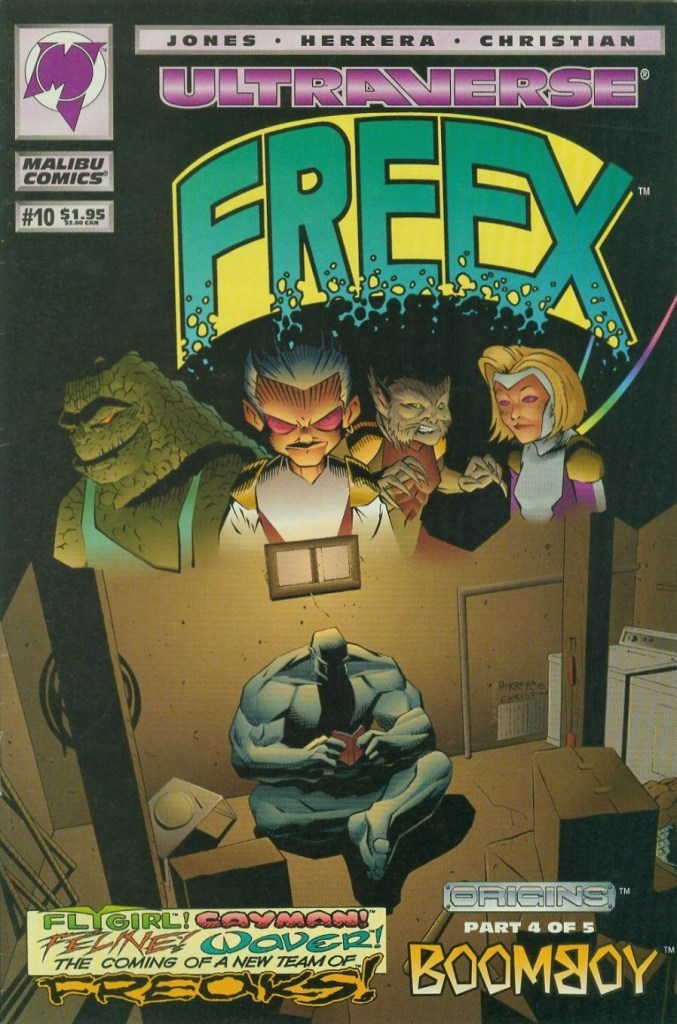
Welcome back, superhero enthusiasts, comic book collectors and fans of the Ultraverse! Today we will revisit the Ultraverse following the team of misfits called Freex. In my past Freex review, we saw the first appearance of Contrary who went on to become one of the more intriguing members of the superhero team UltraForce. As seen in the UltraForce monthly series, Contrary proved to be very intelligent, very resourceful and has what it takes to manipulate the behaviors and direction of even the likes of Hardcase (the team leader), Prototype and Prime.  

Of course, before the events of UltraForce happened, many of Contrary’s traits and operations were first explored in the Freex monthly series. To learn more about her, here is a look back at Freex , published in 1994 by Malibu Comics with a story written by Gerard Jones and drawn by Ben Herrera.

The cover.

Early story

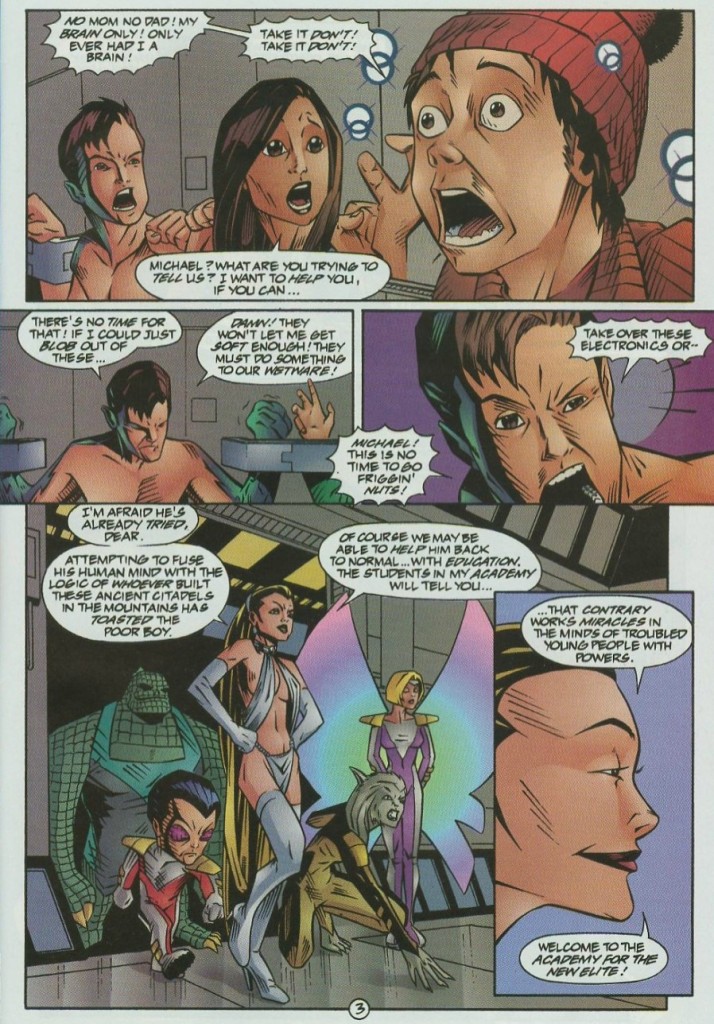
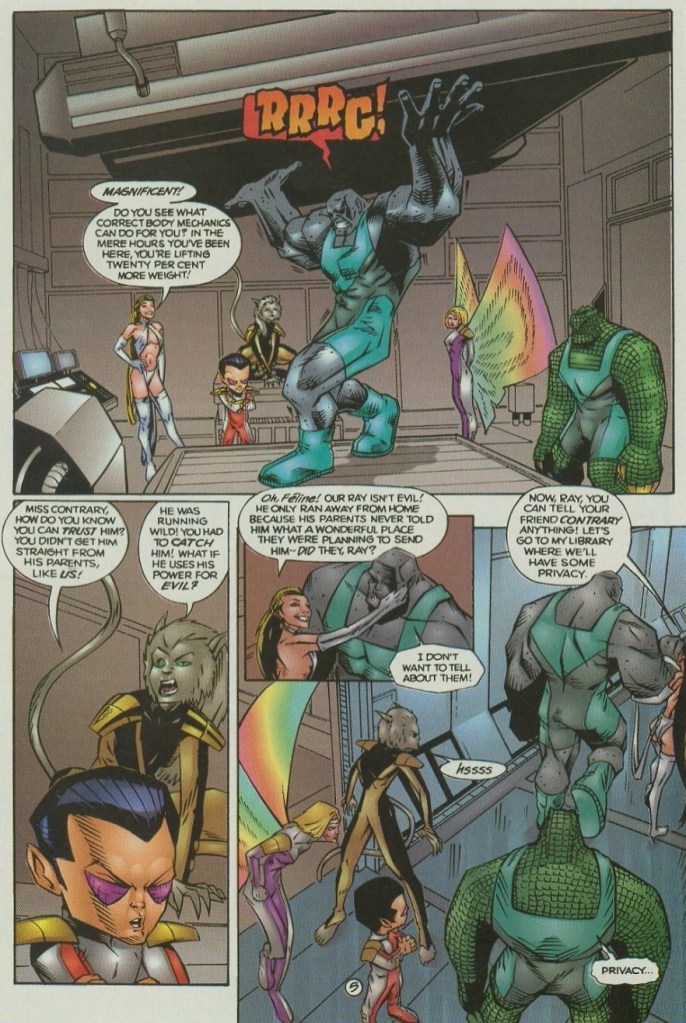
The story begins inside a secret facility. Ray/Boom Boy of Freex has just been abducted and is restrained in the presence of Contrary who is just seating near him looking sexy and comfortable. Knowing that Boom Boy has no chance to escape and fight back, she releases him and mentions that she has other students who will fight for her.

Slowly, Contrary leads him into another place of the facility telling him that he’s not locked up (like a prisoner) but rather he is home (implying there is a place for him at the facility). She introduces him to her Academy for the New Elite with her students engaging in a training session against drones and obstacles. Her students are Feline, Waver, Flygirl and Cayman.

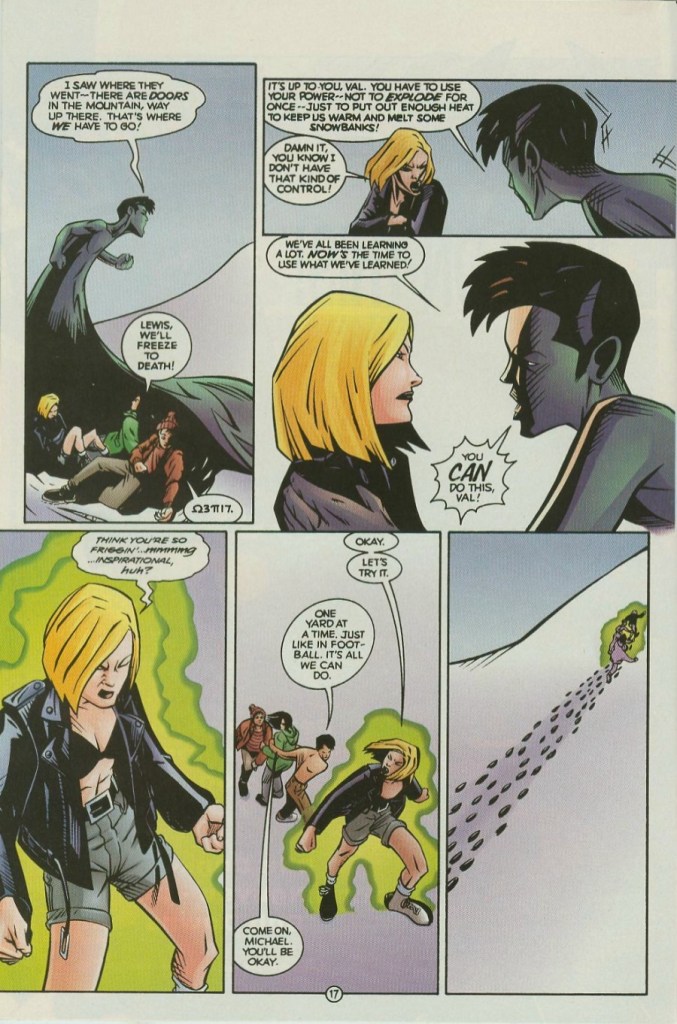
Meanwhile, members of the Freex are still homeless and are trying to figure out how to find Boom Boy… 

Quality

The Freex, without Boom Boy, struggling.

I want to start with the writing. This issue was clearly less about Freex and more of Boom Boy (note: his personal origin emphasized) and Contrary and her academy of people with powers and special abilities. Creatively, this story has strong X-Men vibes in it which I personally enjoyed. I do confirm that the writing is strong on storytelling, characterization and dialogue.

While the previous issue introduced her briefly, Contrary is heavily emphasized in this issue. Apart from being resourceful and highly intelligent, she is also erotic with her appearance (so much of her skin exposed always) and at the same time she is well portrayed as a mentor to her students complete with traits of motherly care to them. In comparison with what I’ve seen in X-Men comic books, Contrary is like a combination of Charles Xavier and Emma Frost with some traces of Moira MacTaggert. I should also state that Contrary has a keen perception on finding outstanding or special individuals that she can help develop in more ways than one.

Going back to Boom Boy, this comic book really redefined him not only as a questionable member of Freex but also as an Ultraverse character in general. By reading this story, you will not only relate with Boom Boy but also experience the challenge he is having on whether to decide to be with his old pals or join Contrary’s academy (which itself is inspired by Xavier’s School of Gifted Children in X-Men comics) to really leave his past behind and move forward personally.

While this comic book is heavy with characterization and exposition, there is still a good amount of superhero to enjoy here. The good news is that artist Ben Herrera showed a lot of creative stuff with the spectacle.   

Conclusion

This scene has very strong X-Men vibes.

Freex (1994) is a great Ultraverse comic book! I really found this particular issue to be very engaging from start to finish. As a story about the Freex themselves, this one saw their story as desperate nomads move forward a lot. Still the standouts of the story are Boom Boy and Contrary. If you have not read any issues of UltraForce yet, I highly recommend reading this so you can get to know Contrary better as she is one of the core UF members.

If you are seriously planning to buy an existing hard copy of Freex (1994), be aware that as of this writing, MileHighComics.com shows that the near-mint copy of the comic book costs $11.

Overall, Freex (1994) is highly recommended!

+++++

Thank you for reading. If you find this article engaging, please click the like button below and also please consider sharing this article to others. If you are looking for a copywriter to create content for your special project or business, check out my services and my portfolio. Feel free to contact me as well. Also please feel free to visit my Facebook page Author Carlo Carrasco and follow me at HavenorFantasy@twitter.com
A Look Back at The Strangers #19 (1995)

Disclaimer: This is my original work with details sourced from reading the comic book and doing personal research. Anyone who wants to use this article, in part or in whole, needs to secure first my permission and agree to cite me as the source and author. Let it be known that any unauthorized use of this article will constrain the author to pursue the remedies under R.A. No. 8293, the Revised Penal Code, and/or all applicable legal actions under the laws of the Philippines.

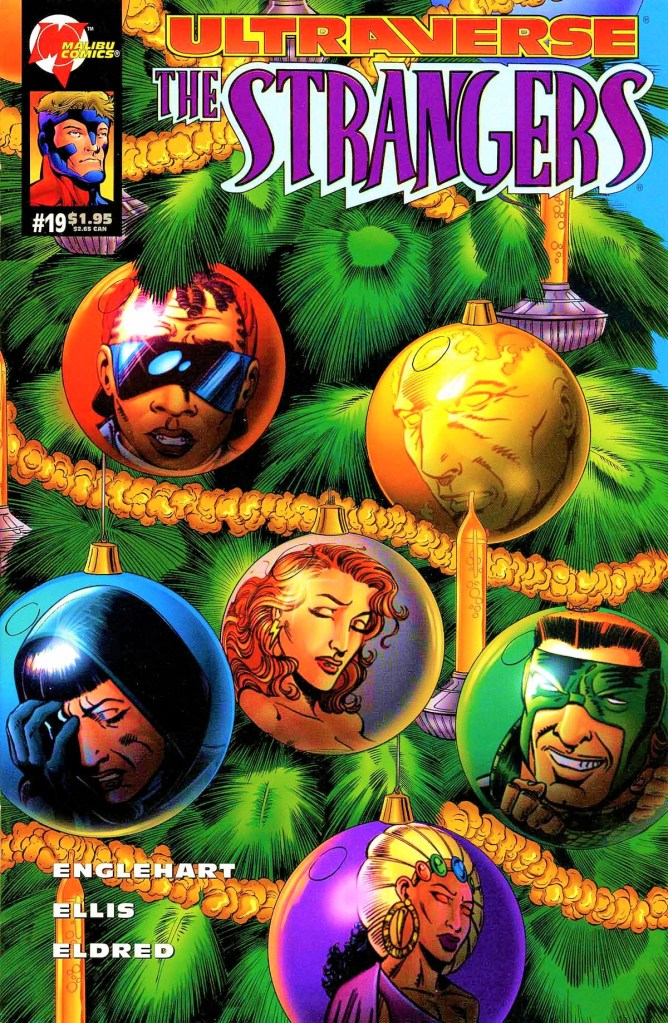
Welcome back, superhero enthusiasts, comic book collectors and fans of the Ultraverse! In this retro comic book review, we will revisit The Strangers in one of their later stories published in 1995. In issue #18, things got more complex as The Strangers not only had a genuine opposition to deal with but also another group of individuals with varied powers. For this new review, the story took place even way after issue #18 as there was a 100-page finale that took place in Night Man Annual #1 and The Strangers Annual #1.

To find out what happened next to the superhero team and its members, here is a look back at The Strangers , published in 1995 by Malibu Comics with a story written by Steve Englehart and drawn by Steve Ellis.

The cover.

Early story

The story begins in a private place where members of The Strangers each take time of silence across the floors. Noticeably absent was Atom Bob. Lady Killer recalls Atom Bob as her lover, their team’s brightest star and, unfortunately, a betrayer towards them all. She remembers several moments from recent times such as realizing Atom Bob’s desire to do something heroic, realizing that power to equal another one’s power is the better power, and the time he asked her to marry him. Deeply hurt by the betrayal, Lady Killer cries.

For his part, Grenade is feeling the anguish over the betrayal given the fact that they have been really close friends since childhood. When Grenade had trouble entering college, Atom Bob encouraged him to join him in enrolling at art school. The betrayal was so painful, he releases his anger using a bit of his power. A teammate appears behind him to try to talk sense to him…  

Quality

A very touching scene between Yrial and Zip-Zap.

Firstly, I should say that the writing done by Steve Englehart here is very rich with a strong emphasis on dramatizing the Strangers deeply. The dialogue written for each character reflects not only their emotions but also what is living within their respective hearts and what is in their minds. The character development is also rich and I love the way Englehart further developed the sister-brother-like bond between Yrial and Zip-Zap. As for Lady Killer, her pain will most likely resonate with readers who experienced betrayal and the loss of a loved one.

Secondly, the betrayal by Atom Bob really shows its emotional impact on the team. This one is not only a heavy burden on the characters but also a wave of shock via reading which long-time Strangers fans (who dedicatedly followed Atom Bob’s thoughts and exploits) can strongly relate with. Atom Bob’s overall value as a Strangers member is easily reevaluated in this comic book and his personal connections with Grenade, Yrial, Spectral, Zip-Zap, Electrocute and, most notably, Lady Killer are strongly emphasized. This should compel readers to revisit the early issues of The Strangers.

Of course, I should state that this comic book is not a pure emotion ride. There are still some scenes of action and spectacle that still make sense with the narrative. A certain character from The Strangers #4 makes a return here and another intriguing character appears here. They are both worth discovering.

The art done by Steve Ellis is very good, and his style is eerily very similar to that of Rick Hoberg. There were several images that reminded me of Hoberg’s take on each character.  

Conclusion

Lady Killer painfully remembering what happened.

There is no doubt about it. The Strangers (1995) is another very good Ultraverse comic book to read and collect! Not only does it succeed in serving as the aftermath to the stories in in Night Man Annual and The Strangers Annual , it also fulfilled its purpose in raising the stakes for the Strangers who are struggling with the pain and shock of Atom Bob’s betrayal. If you love character development, you will love this one.

If you are seriously planning to buy an existing hard copy of The Strangers (1995), be aware that as of this writing, MileHighComics.com shows that the near-mint copy of the comic book costs $11.

Overall, The Strangers (1995) is highly recommended!

+++++

Thank you for reading. If you find this article engaging, please click the like button below and also please consider sharing this article to others. If you are looking for a copywriter to create content for your special project or business, check out my services and my portfolio. Feel free to contact me as well. Also please feel free to visit my Facebook page Author Carlo Carrasco and follow me at HavenorFantasy@twitter.com

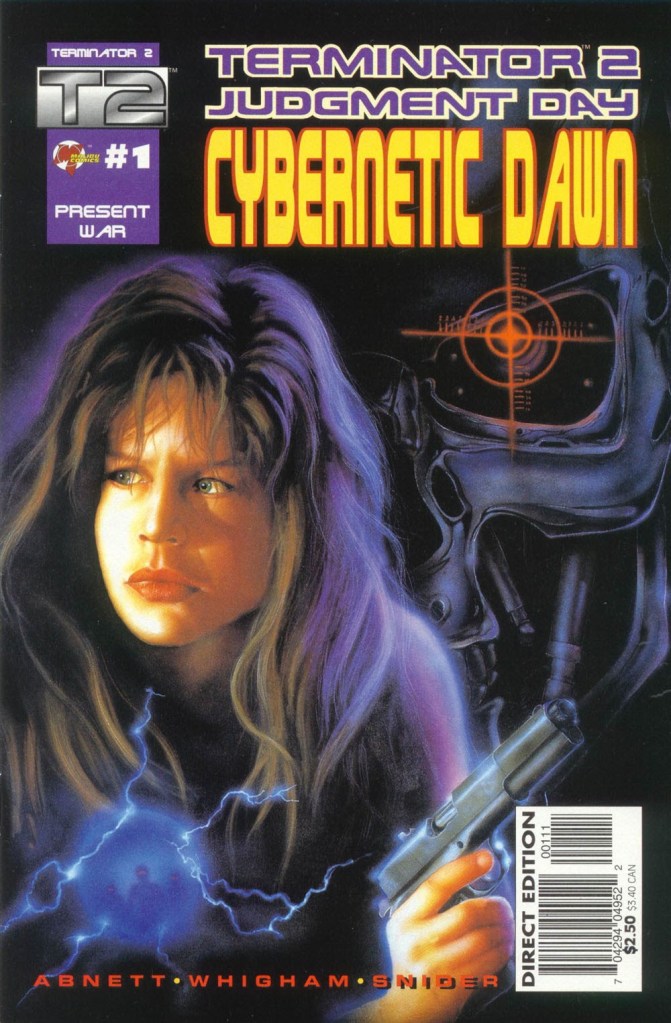
A Look Back at Terminator 2: Cybernetic Dawn #1 (1995)

Disclaimer: This is my original work with details sourced from reading the comic book and doing personal research. Anyone who wants to use this article, in part or in whole, needs to secure first my permission and agree to cite me as the source and author. Let it be known that any unauthorized use of this article will constrain the author to pursue the remedies under R.A. No. 8293, the Revised Penal Code, and/or all applicable legal actions under the laws of the Philippines.

Like any geek, I still love watching Terminator 2: Judgment Day, specifically its extended version which was James Cameron’s true vision. I’m not exactly a fan of Arnold Schwarzenegger, but I really love his work in T2 as well as in Total Recall. When it comes to James Cameron’s works, I personally prefer T2 over Avatar, Titanic and True Lies.

As for the Terminator franchise itself, it spawned cinematic sequels that only turned up as disappointments. Terminator 2 was indeed the high point of the film franchise and everything really went downhill afterwards. I should state that Terminator: Dark Fate should be avoided as it is not worth your time and money.

Recently, I searched for some comic books that served as sequels to Terminator 2 and I found one from the mid-1990s and it is a direct follow-up! We can find out more in this look back at Terminator 2: Cybernetic Dawn , published in 1995 by Malibu Comics with a story written by Dan Abnett and Rod Whigham.

The cover.

Early story

The story begins immediately after the end of Terminator 2 with the injured Sarah Connor (with a very exhausted John Connor sleeping) still managing to drive the car in the middle of the night. As she drives, Sarah recalled that she never asked for the responsibility of preserving mankind as it was forced on her way back in 1984. She also recalled the time in Tech Noir when the Terminator almost killed her as she got saved by Kyle Reese.

By morning, Sarah and John reached the desert and returned to the lonely home of her old ally Enrique. Suddenly a man with a shotgun comes out and aims his weapon directly at Sarah. Carrying a gun, John comes out to help his mother…

Quality

John and Sarah Connor.

Let me start with the story and make clear to you readers that this comic book easily defies the conclusion that was set in the movie Terminator 2. If you have seen the film, you should be aware that the way it was concluded made sure there is no more future war and no more Terminators. Like the 2003 movie Terminator 3: Rise of the Machines, this comic book just kept on pushing the concept that Judgement Day and the war with the machines are still inevitable and that Terminators from the future would only continue to arrive to hunt and kill John. As such, the hard struggle for Sarah and her son continues.

That being said, this comic book really pushed hard with its sequel approach. Remember what happened in the steel mill in Terminator 2? Several personnel investigated the facility and one particular detective arrived searching for Sarah Connor who has been labeled as an escapee from the state hospital. Inside the steel mill is the severed left arm of the Terminator (which got stuck to crushing mechanical wheels as seen in the 1991 movie) which is the storytelling key the comic book creators used to justify this sequel.  

To the comic creators’ credit, they did their research about T2 and even made references to other characters of that movie. As a result, this comic book appears loaded with fan service.

Even though it has many references and connections to the 1991 movie, this comic book also has some completely new stuff to expand on T2’s concept. The destruction of Cyberdyne’s facility in the movie resulted an emergency meeting of a corporation’s board of directors (and a certain senator) which creatively sets up further conflicts as well as struggles for Sarah and her son.

In terms of writing, this comic book’s story is cohesive enough. As for the art, the quality is fine and most notably, the illustrator managed to somewhat capture the likeness of Linda Hamilton on Sarah Connor.

Conclusion

The severed Terminator arm as the single factor that justified this sequel somewhat.

I can say that Terminator 2: Cybernetic Dawn (1995) is a surprisingly satisfying read mainly due to its writing and artistic quality. While its push to justify a sequel barely succeeds, there is more good stuff than negative ones overall. As far as making sequels to Terminator 2 is concerned, this one is somewhat more believable than the 2003 movie.

If you are seriously planning to buy an existing hard copy of Terminator 2: Cybernetic Dawn (1995), be aware that as of this writing, MileHighComics.com shows that the near-mint copy of the comic book costs $19.

Overall, Terminator 2: Cybernetic Dawn (1995) is satisfactory.

+++++

Thank you for reading. If you find this article engaging, please click the like button below and also please consider sharing this article to others. If you are looking for a copywriter to create content for your special project or business, check out my services and my portfolio. Feel free to contact me as well. Also please feel free to visit my Facebook page Author Carlo Carrasco and follow me at HavenorFantasy@twitter.com
A Look Back at Prime #18 (1994)

Disclaimer: This is my original work with details sourced from reading the comic book and doing personal research. Anyone who wants to use this article, in part or in whole, needs to secure first my permission and agree to cite me as the source and author. Let it be known that any unauthorized use of this article will constrain the author to pursue the remedies under R.A. No. 8293, the Revised Penal Code, and/or all applicable legal actions under the laws of the Philippines.

Welcome back, superhero enthusiasts, comic book collectors and fans of the Ultraverse! In this return to the Ultraverse, we will examine another mid-1990s issue of Prime who became a resident of the City of New York as a result of Kevin Green and his mother relocating there.

Last time around, a huge monster (clearly inspired by Godzilla) arrived in New York and Kevin had no choice but to change into Prime to save people. While his heroic act saved lives and spared the city from further damage, Prime still was not spared from the growing speculation that he molested children in California (which by today’s standards is a ravaged state as a result of unrestrained influence of the Left as well as economic complications).

So what will happen next to Kevin/Prime the more time he spends in New York? We can find out more in this look back at Prime #18, published in 1994 by Malibu Comics with a story written by Len Strazewski and Gerard Jones, and drawn by Kirk Jarvinen and Keith Conroy.

The cover.

Early story

The story begins with Prime (standing behind a podium with a crowd in front of him) and the people getting surprised when Turbo Charge (note: his debut in issue was overshadowed by the events of that comic book) suddenly arrived on stage holding civilian clothes and declaring he is Prime’s new partner.

Turbo Charge whispers to Prime that he arrived to help him by pretending that the clothes are his (note: the clothes actually belong to Kevin). He then speaks out to the audience stating distorted details. Just as members of the news media start asking Turbo Charge questions, Prime grabs him and flies away to leave the crowd behind.

As they got far enough, Prime tells the Turbo Charge he has no intention to accept him as a partner…

Quality

Prime’s private life as Kevin remains hard as ever.

As mentioned already, Turbo Charge’s debut in issue was overshadowed by what happened in that comic book. That being said, the story here made up for it not only by investing more pages to emphasize Turbo Charge but also dramatize his personality which was done in a pretty satisfying fashion. Like Prime, Turbo Charge’s life has gotten complicated as a result of his ability of super speed and his personal desire to do good even though he is a teenager with so much to learn.

What I find delightfully surprising in this comic book is the presence of Manhattan Project, a powerful character whose dedication to protect New York’s people from ultras (which he wants to neutralize) leads him to a big fight with Prime which alone has to be seen. It is quite enjoyable.

As for Prime himself, there is a good amount of pages dedicated to his alter ego as Kevin still struggling to adjust to life in New York. It should be noted that key elements from issue #17’s story impacted her perception of Prime (a secret Kevin still keeps successfully). The characterization here for the protagonist is really good.

Conclusion

The fight between Prime and Manhattan Project is a must-see.

Prime #18 (1994) is a really good read. It has a fine balance of storytelling, characterization and spectacle from start to finish. I should also state that the New York setting is looking good as far as telling Prime’s story goes.

If you are seriously planning to buy an existing hard copy of Prime #18 (1994), be aware that as of this writing, MileHighComics.com shows that the near-mint copy of this comic book costs $10.

Prime #18 (1994) is recommended.

+++++

Thank you for reading. If you find this article engaging, please click the like button below and also please consider sharing this article to others. If you are looking for a copywriter to create content for your special project or business, check out my services and my portfolio. Feel free to contact me as well. Also please feel free to visit my Facebook page Author Carlo Carrasco and follow me at HavenorFantasy@twitter.com
A Look Back at Mantra #18 (1995)

Disclaimer: This is my original work with details sourced from reading the comic book and doing personal research. Anyone who wants to use this article, in part or in whole, needs to secure first my permission and agree to cite me as the source and author. Let it be known that any unauthorized use of this article will constrain the author to pursue the remedies under R.A. No. 8293, the Revised Penal Code, and/or all applicable legal actions under the laws of the Philippines.

Welcome back, superhero enthusiasts, comic book collectors and fans of the Ultraverse! We take another journey into the Ultraverse through the exploits of Mantra whose story and character development got more intriguing since after the conclusion of the Archimage Quest.

Last time around, Lukasz and Eden took their relationship even further The infiltration of Aladdin’s secret facility took place and Mantra even met a certain tycoon (best known for interacting with The Strangers). The events of the last issue then continued into the Godwheel mini-series and into this next Mantra comic book I’m about to review.

Are you excited yet? What do you hope to see with regards to Lukasz and Eden? We can find out what happens next in Mantra #18, published in 1995 by Malibu Comics with a story written by Mike W. Barr and drawn by Scott Lee.

The cover.

Early story

The story begins inside a high-tech facility. An executive named Paul expressed that the laboratory will never be operational in time for the new year as a result of what happened previously. Several armed men are on the floor searching.

Suddenly, a pink portal opens with Lukasz (in a male body) and Mantra (now occupied by Eden’s soul) coming out. The two just came back from much struggle in another realm and Eden has not yet fully familiarized herself with Mantra’s body and magic. Noticing Eden/Mantra’s hesitation, Lukasz takes action against the armed men. Eden slowly blasts a few enemies before Lukasz saves her from being attacked from the rear.

Suddenly, someone from nowhere throws a few gas grenades at them…

Quality

The romance weakened by the art style.

Starting with the storytelling, the plot in this comic book can be quite jarring with regards to Lukasz and Eden as this one took place after the Godwheel mini-series. How Eden fully became Mantra (which is her rightful body of flesh in the first place) is fully explained in the said mini-series.

The romance between Lukasz and Eden here is easily the biggest selling point of this comic book. After going through rough action and misadventure in Godwheel, it is in this comic book where the two really express love for each other in the flesh. This is a welcome change considering how long we’ve seen Lukasz occupy Eden’s body followed by Lukasz and Eden being spiritually linked with each other. This one marks the start of a new chapter of the Mantra series. As for what the cover of the comic book showed, that is something you will have to discover for yourselves and it is worth the read.

Sadly, I should state that I found the art by Scott Lee here looking sub-par. There is this cartoony aesthetic to all the characters and there were shots in which their bodies looked disproportionate from certain angles. Lee’s take on visualizing Boneyard, Warstrike, NecroMantra and others all looked cartoony. This is the weakest looking Mantra issue I’ve read as of this writing.

Conclusion

Lukasz in a male body, Eden in Mantra form.

Once again, author Mike W. Barr succeeded in advancing the story and character developments with Mantra #18 (1995) putting the series into another storytelling phase with Lukasz (the long-time Mantra) and Eden as separate, living beings more involved with each other than ever before. The art quality this time went down a lot but the storytelling saved the comic book from turning into a disaster.

If you are seriously planning to buy an existing hard copy of Mantra #18 (1995), be aware that as of this writing, MileHighComics.com shows that the near-mint copy of the comic book costs $21.

Overall, Mantra #18 (1995) is satisfactory.

+++++

Thank you for reading. If you find this article engaging, please click the like button below and also please consider sharing this article to others. If you are looking for a copywriter to create content for your special project or business, check out my services and my portfolio. Feel free to contact me as well. Also please feel free to visit my Facebook page Author Carlo Carrasco and follow me at HavenorFantasy@twitter.com
A Look Back at Prime #17 (1994)

Disclaimer: This is my original work with details sourced from reading the comic book and doing personal research. Anyone who wants to use this article, in part or in whole, needs to secure first my permission and agree to cite me as the source and author. Let it be known that any unauthorized use of this article will constrain the author to pursue the remedies under R.A. No. 8293, the Revised Penal Code, and/or all applicable legal actions under the laws of the Philippines.

Welcome back, superhero enthusiasts, comic book collectors and fans of the Ultraverse! By now, many of you should be familiar with Prime who was one of the main heroes of the Ultraverse as published in the 1990s by Malibu Comics. Many times in comics, Prime fought with lots of thugs, some very notable enemies (check out Prime #5), got involved with other notable ultras as part of a team (check out UltraForce #0 and #1), got involved awkwardly with ladies like Mantra and the mother of Kelly, and more.

Surely, Prime (who is a teenage boy named Kevin under all the muscle) went through a lot. Now how about seeing the overly muscular ultra hero take on a monster about as large as Godzilla? We can all find out in this look back at Prime , published by Malibu Comics in 1994 with a story written by Len Strazewski and Gerard Jones, and drawn by John Statema.

The cover.

Early story

The story begins somewhere on the bottom of the ocean. King Atalon raises an entire island to the surface of the sea claiming it will be new court of his and his people. Doing so, he releases a gigantic monster to the surface and immediately it encounters a ship. The monster grabs two men from the ship and eats them.

In the city of New York, Kevin Green and his mother have a meal together in a first-rate deli. His mother expresses her thoughts about how hard it was for him to move away from California at a short notice, leaving behind his school and his friends. She stressed that something had to be done in response to what happened to their family.

She recalled that Kevin’s father acted so strangely and left them. That being said, she did not want to make the situation worse by smothering him. Kevin thought to himself how could he tell her mother the truth that he and Prime are one and the same, and he went through different versions of his alter-ego each with a different attitude.

As Kevin and his mother traveled via the subway of the city, the giant monster in the Atlantic Ocean continues to create havoc moving towards New York…

Quality

A possible Godzilla reference spotted.

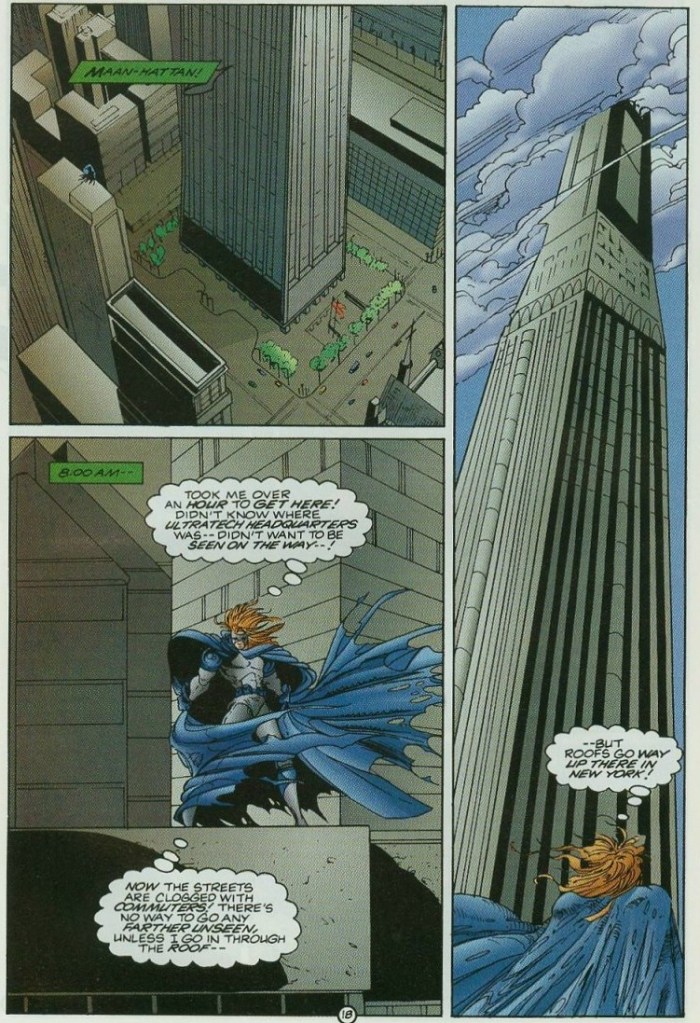
From a storytelling point of view, this comic book felt like the start of a new chapter in the life of Kevin/Prime. The sudden relocation to New York sparked Kevin to look back at the events he went through in the past year which, in my opinion, helped serve as an exposition dump to help readers – especially new ones – catch up with all the details on Prime. It was also interested to learn that Kevin’s mother is from New York and her action on having themselves relocate all the way from the West Coast was convincingly done. I also like the drama that unfolded when the mother brought Kevin to a spot to view the Statue of Liberty from a distance only to be shocked and hurt over the fact that the statue’s head is missing. Through really nice dialogue, you can feel the mother’s pain.

The highlight of this comic book is the uncanny match-up between Prime and the Godzilla-sized monster. While the battle between them was not too long, showing Prime struggle with fighting the monster while thinking a lot about strategizing, searching for weaknesses and even expressing concern for his mother all added a good layer of depth to bother the hero and the encounter.

Visually, I like the work done here by John Statema. His art on the monster was clearly Godzilla-inspired but he gave it a unique look of its own, especially with the way he drew its scaled which Prime found to be very tough. I also enjoyed Statema’s take on the events that happened in Prime’s life as seen in the exposition dump early in the comic book.

Conclusion

The big exposition dump.

Prime (1994) is a fun read and definitely has the look and feel of a new turning point in the life of a superhero. It has excellent dialogue, a pretty nice build-up leading to the big battle between Prime and the monster, and most notably there is a good amount of dramatizing through Kevin’s mother.

If you are seriously planning to buy an existing hard copy of Prime (1994), be aware that as of this writing, MileHighComics.com shows that the near-mint copy of the comic book costs $8.

Overall, Prime (1994) is recommended.

+++++

Thank you for reading. If you find this article engaging, please click the like button below and also please consider sharing this article to others. If you are looking for a copywriter to create content for your special project or business, check out my services and my portfolio. Feel free to contact me as well. Also please feel free to visit my Facebook page Author Carlo Carrasco and follow me at HavenorFantasy@twitter.com
A Look Back at Mantra #17 (1994)

Disclaimer: This is my original work with details sourced from reading the comic book and doing personal research. Anyone who wants to use this article, in part or in whole, needs to secure first my permission and agree to cite me as the source and author. Let it be known that any unauthorized use of this article will constrain the author to pursue the remedies under R.A. No. 8293, the Revised Penal Code, and/or all applicable legal actions under the laws of the Philippines.

A lot has changed with Mantra since the title character got more involved with the elements (both in character and in plotting) with the different realms which led to a particular quest about her captured leader Archimage. In the last issue, not only were Lukasz (the male soul who occupied the body of Eden Blake and became Mantra) and Eden Blake continued to spiritually interact with each other (going as far as having feelings for each other), the impostor living with Eden’s family was revealed.

Considering the events that took place since then, one has to wonder where would Mike W. Barr lead the Mantra series to next. We can all find out in this look back at Mantra , published in 1994 by Malibu Comics with a story by Barr and illustrations done by Jason Armstrong.  

The cover.

Early story

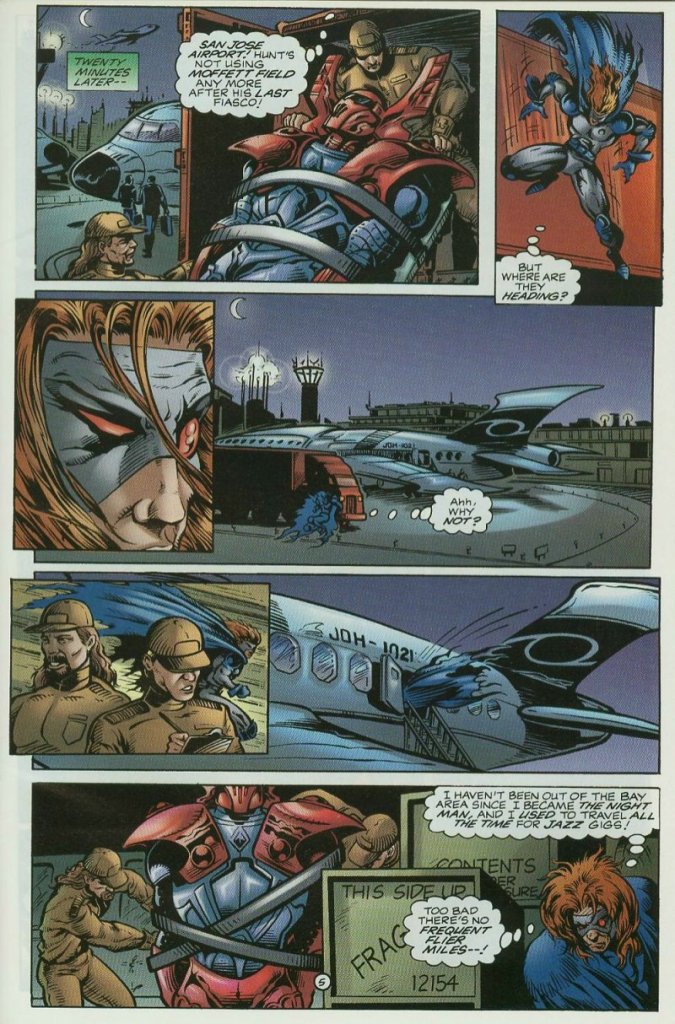
The story begins in a secret, high-tech facility of Aladdid. Lukasz (as Mantra) quietly begins infiltrating the place by taking out one of the armed guards and doing what he could to gain more access around. Eden tells Lukasz that she does not the fallen guard to be hurt and that her time is almost over. She reiterates to Lukasz that he has to live her life and take care of her children.

Shortly after wearing the Aladdin guard uniform, Lukasz starts to get involved with the other guards. He witnesses a wetware engineering work in progress which reveals a scientist working on a so-called patient (the subject).

Suddenly, the subject begins to move causing trouble in the laboratory. Realizing that the engineer is having trouble dealing with the subject already moving, the Aladdin guards (including Lukasz in disguise) enter the place. As the two guards fire their weapons against the subject, Lukasz instead uses one of the computers to gain access to classified information…

Quality

Time with Eden’s family.

After going through the mysticism, the intrigue and threads of Mantra’s past in the last several issues, this comic book’s story is a nice change of setting and concept. Instead of the fantasy elements that pretty much dominated Mantra stories, this one has a sci-fi flavor as well as corporate intrigue (which is pretty prominent in Prototype comics and Hardcase comics) and the very concept of this story is pretty good.

Along the way, the story shows the aftermath of the death of a certain uncle named Moe (once occupied by Thanasi, a long-time rival of Lukasz’s), Mantra having a reunion with a key character from issue and even meeting a notable supporting character from The Strangers comics. The good news here is that Mike W. Barr wrote a very strong script that not only resonates with Ultraverse fans but also tell a cohesive story packed with spectacle, character development and something very notable that happened (which I never anticipated).  

Conclusion

Infiltrating a top secret facility.

Mantra (1994) is not only fun and compelling to read. It is also refreshing and, as if the cover was not obvious enough, marked the beginning of a new chapter in the life of Mantra.

If you are seriously planning to buy an existing hard copy of Mantra (1994), be aware that as of this writing, MileHighComics.com shows that the near-mint copy of the comic book costs $15.

Overall, Mantra (1994) is recommended.

+++++

Thank you for reading. If you find this article engaging, please click the like button below and also please consider sharing this article to others. If you are looking for a copywriter to create content for your special project or business, check out my services and my portfolio. Feel free to contact me as well. Also please feel free to visit my Facebook page Author Carlo Carrasco and follow me at HavenorFantasy@twitter.com

A Look Back at Prime #16 (1994)

Disclaimer: This is my original work with details sourced from reading the comic book and doing personal research. Anyone who wants to use this article, in part or in whole, needs to secure first my permission and agree to cite me as the source and author. Let it be known that any unauthorized use of this article will constrain the author to pursue the remedies under R.A. No. 8293, the Revised Penal Code, and/or all applicable legal actions under the laws of the Philippines.

Welcome back, superhero enthusiasts, comic book collectors and fans of the Ultraverse! We revisit the Ultraverse yet again, only this time it will be through another issue from the Prime monthly series.

In Prime #15, an issue illustrated by the great George Perez, the overly muscular hero entered a certain Hollywood house which was believed to be the headquarters of a drug trafficking operation. What Prime found inside were not only junkies but also zombies and terrifying illusions that tested him mentally and emotionally.

So what happened next? We can find out in this look back at Prime , published in 1994 by Malibu Comics with a story written by Len Strazewski and Gerard Jones, and illustrated by Joel Thomas.

The cover.

Early story

The story begins with Prime struggling with questions from the media. Journalists ask him about his involvement with teenage boys, the truth about his youth crusade, and if he was recruiting boys for gangs. Prime, who is really teenager Kevin Greene inside, bluntly states he cares about teenagers and will do justice for them.

Questions about a certain backpack he (as Kevin) dropped and the young boy’s clothing that he carried bothered him deeply, making him remember he dropped a backpack filled with clothes at the office of Baker. Realizing he screwed up, he gets violent with the reporters who ask him hard questions.

Suddenly police helicopters arrive telling Prime he is under arrest….

Quality

The debut of Turbo Charge.

Set shortly after the events of UltraForce #2, the story here is pretty powerful on its own as the stakes were raised by Strazewski and Jones to develop Prime even further than before. Many times, we have seen how being Prime made life more complicated and harder for Kevin Green. In this comic book, the complications have gotten even bigger and deeper as the media has turned hostile towards Prime affecting not only Kevin but also his romantic interest Kelly and her mother. As if that was not enough, there are many fanatics of Prime called “Prime Gangs” who are so obsessed with their muscular idol, they serious believe they can do anything to honor him…even though it means harassing other people. Also notable here was the way Kevin (as Prime) tries to save his fragile friendship with Kelly. There is also the appearance of Turbo Charge here. Clearly, the writing here is really great.

I cannot say the same for the art done by Joel Thomas. His art style is too cartoony and he drew people’s bodies and faces lacking precision. Many times I had trouble recognizing Kevin, Kelly, her mother and other supporting characters. Visually, this is a letdown.

Conclusion

Powerful talk between Prime and Kelly ruined somewhat by the weak art.

Back by very strong writing, Prime (1994) is absolutely engaging to read and it truly served as a crucial turning point in telling the continuing story of Prime. In many ways, the dramatic events here serve as the climax of all the dramatic build-up seen in the previous Prime issues. This comic book’s portrayal of the overly hostile and unrelenting media will easily remind any reader about today’s news media in which unprofessional journalism, secret agendas, political bias, conspiracy between media and political groups, malice and political activism among so-called journalists are now the norm.  

The dramatic turn of events here are so powerful, Turbo Charge’s presence really got overshadowed a lot. Visually, this comic book has some of the weakest looking Prime art I’ve seen.

If you are seriously planning to buy an existing hard copy of Prime (1994), be aware that as of this writing, MileHighComics.com shows that the near-mint copy of the comic book costs $8.

Overall, Prime (1994) is recommended.

+++++

Thank you for reading. If you find this article engaging, please click the like button below and also please consider sharing this article to others. If you are looking for a copywriter to create content for your special project or business, check out my services and my portfolio. Feel free to contact me as well. Also please feel free to visit my Facebook page Author Carlo Carrasco and follow me at HavenorFantasy@twitter.com