Retro Gaming Ads Blast – Part 39 (RPG Special)

Welcome back readers, fellow geeks and electronic gaming fans!

In this edition of the Retro Gaming Ads Blast (RGAB) series, we will take a look at another batch of retro gaming print ads from the 1980s to the 1990s, particularly on role-playing games (RPGs) from the East and the West. This is the RPG Special!

For the newcomers reading this, Retro Gaming Ads Blast (RGAB) looks back at the many print ads of games (console, arcade, computer and handheld) that were published in comic books, magazines, flyers, posters and newspapers long before smartphones, social media, the worldwide web and streaming became popular. To put things in perspective, people back in the 1980s to the 1990s were more trusting of print media for information and images about electronic games and related products.

With those details laid down, here is the newest batch of retro gaming print ads for you to see and enjoy…

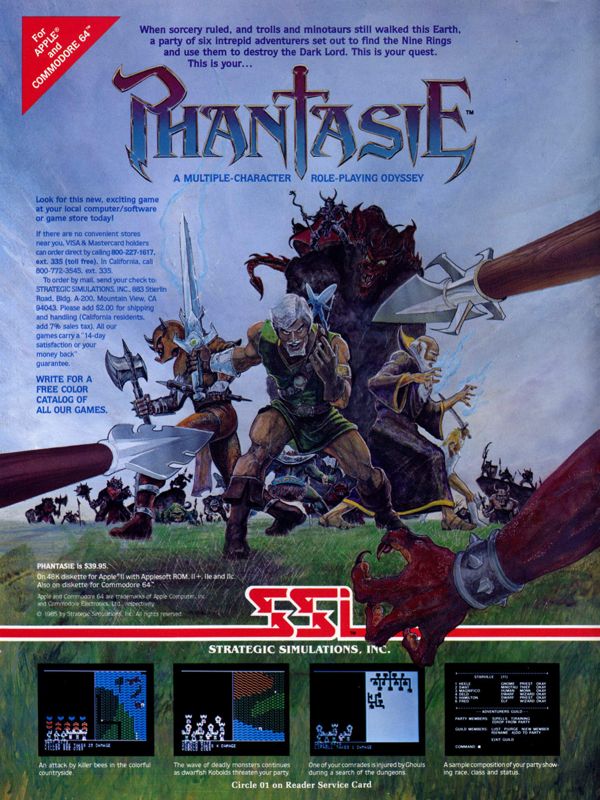
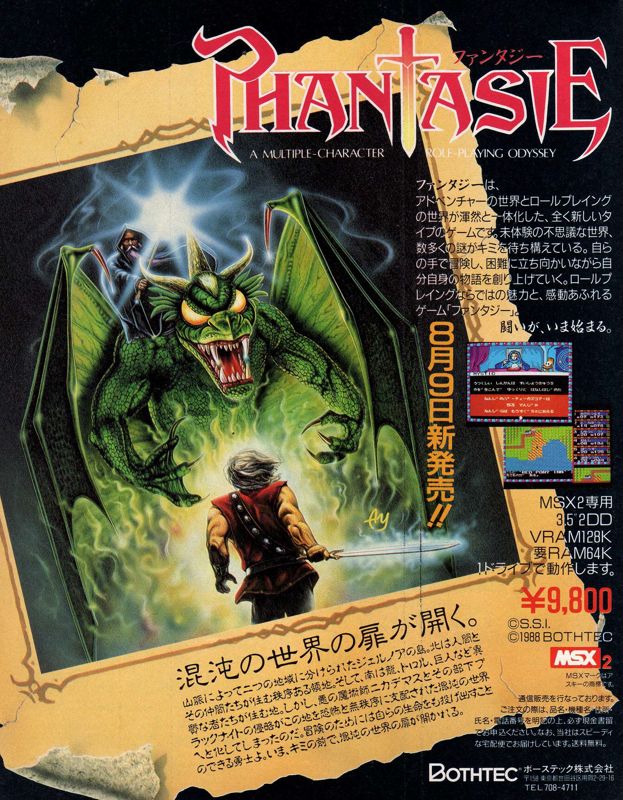
1. Phantasie North American and Japanese Print Ads

The North American print ad.
The Japanese print ad.

Released by Strategic Simulations in the mid-1980s, Phantasie was a fantasy role-playing game that became a huge commercial success paving the way for not only ports on other computer systems of the time but also sequels later. The ad they came up with for the North American market had strong fantasy vibes and the screenshots gave readers the impression that it looked playable or user friendly. For the Japanese market, Phantasie was ported to the MSX system and they came up with an ad using radically different art work that had a horror vibe.

2. Phantasy Star Japanese Print Ad

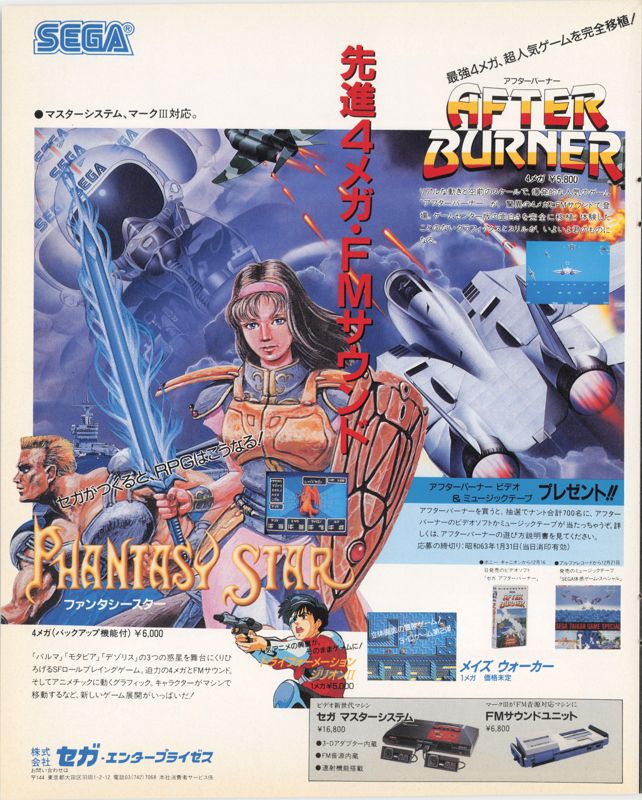
Phantasy Star in the Japanese print ad sharing the spotlight with After Burner.

In the 1980s, role-playing games started gaining popularity with Japanese console gamers and there were game developers who were inspired by established RPGs from the West. Enix released two Dragon Quest games and each of them sold a lot of copies on Nintendo’s Family Computer (Famicom). At the time, Sega already had the Master System (called the SG-1000 and its variants with revisions) in the console market and they were way behind Nintendo on hardware sales. Knowing there is a market for console RPGs, Sega went on to make their exclusive RPG Phantasy Star. In 1987, a print ad was released showing Phantasy Star sharing the spotlight with Sega’s blockbuster game After Burner in the background. While the ad felt a bit disorienting to see, the game achieved much-needed success for Sega which in turn brought the game to the Master System in America in 1988. The game sold more and eventually led to sequels in the years that followed.

3. Ultima III Japanese Print Ad

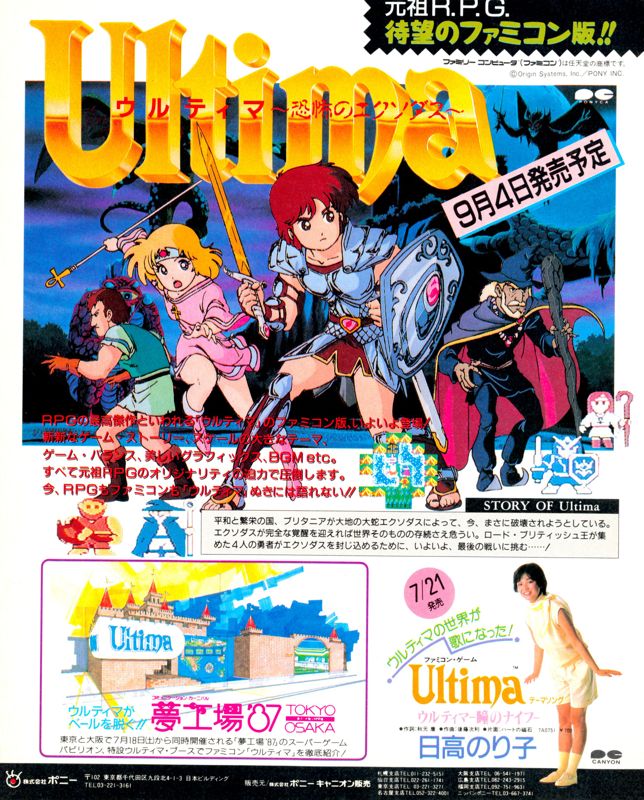
Remember the old days when anime or comic book-style artwork was used to promote games in the Japanese print media?

Released in Japan under the title Ultima: Kyoufu no Exodus, Ultima III: Exodus was a breakthrough for the series as the Famicom version marked the first console release for Japanese gamers (note: the game was also offered for MSX and other computer systems in the country). The anime-style artwork used for the print ad is the same virtually the same with the front cover of Famicom version. Very notably, the art on the covers of the PC-88 and PC-98 versions were different. 

4. Lunar: The Silver Star Japanese Print Ad

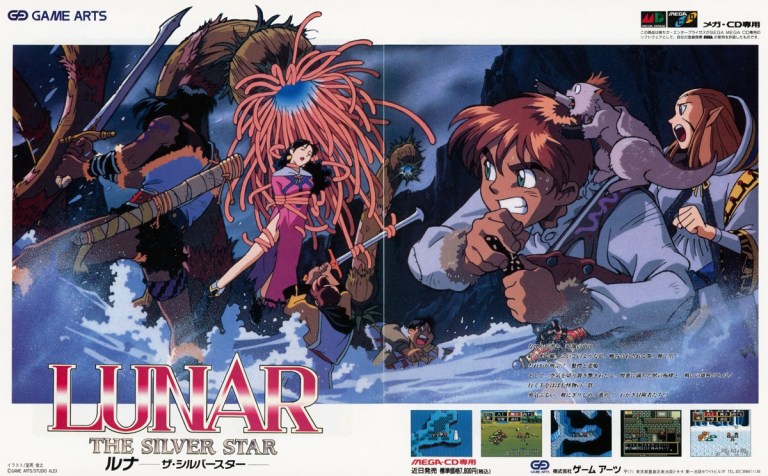
Game Arts’ Lunar: The Silver Star as advertized in Japanese magazines.

By the 1990s, console RPGs were very popular as franchises like Dragon Quest and Final Fantasy each released sequels that sold a lot of copies. The company Game Arts decided to make a role-playing game which can tell stories better using animation with voiceovers and music while being very playable and enjoyable. They came up with Lunar: The Silver Star and released it on the Mega-CD add-on (connected with the Mega Drive console of Sega) in 1992. As such, it was not surprising to see the print ad having anime-style artwork as the game itself had several minutes of anime cutscenes complete with audio. As most Japanese role-playing games (JRPGs) did not have playable anime cutscenes for storytelling, Lunar: The Silver Star really stood out. Sometime later, the small American company Working Designs would handle the game’s English version and start a healthy business relationship with Game Arts.

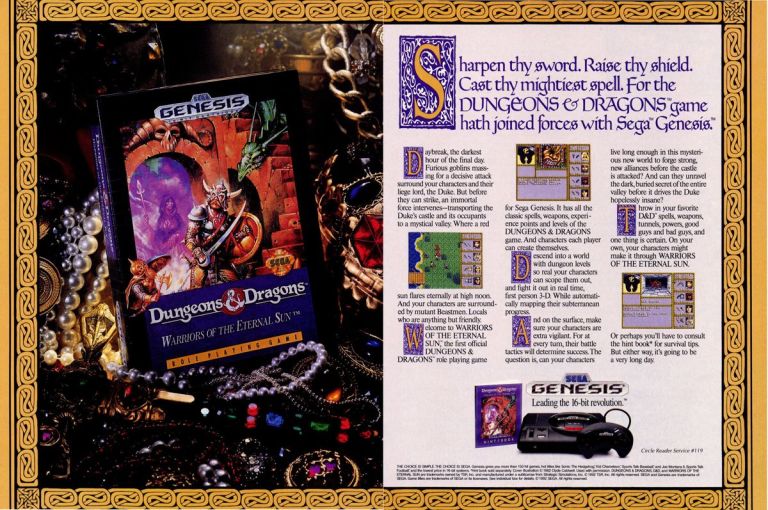
5. Dungeons & Dragons: Warriors of the Eternal Sun North American Print Ad

A print ad that strongly appealed to both Sega Genesis gamers as well as fans of Dungeons & Dragons.

By the year 1992, the fantasy games franchise Dungeons & Dragons was wildly popular as players around the world kept enjoying the tabletop RPG modules (using dice, pen paper) as well as many computer and video games already available. Sega acquired a D&D license and eventually released Dungeons & Dragons: Warriors of the Eternal Sun exclusively on their Genesis console in 1992. To promote it, Sega produced a 2-page print ad that had one half showing the game’s box placed with jewelry while using the other half to show the screenshots, descriptive text and other details. The way it was presented, the print ad was cleverly structured to attract the attention of Sega Genesis gamers as well as Dungeons & Dragons fans. The game ended up as the first and only official D&D product for the console.

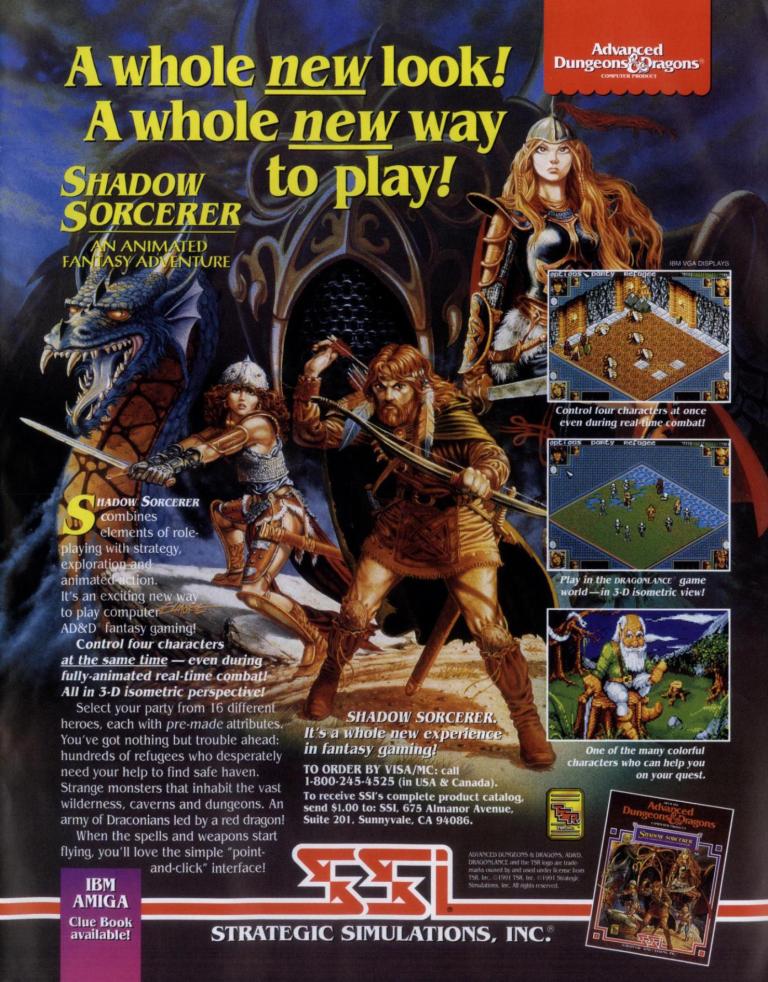
6. Shadow Sorcerer North American Print Ad

This is one of many Dungeons & Dragons computer games released. The use of painted art for marketing was done many times.

In the history of the Dungeons & Dragons franchise and electronic gaming, it was on computers where the more ambitious and more intricate licensed games were played by many fans. In 1991, the Advanced Dungeons & Dragons (AD&D) electronic game Shadow Sorcerer was released on MS-DOS PC, Amiga and the Atari ST. The painted artwork used on the print ad was virtually the same as that on the box covers of the MS-DOS and Amiga versions. I can only guess that the ad markers must have paid a lot of money on the painted art and decided to use it for both marketing and packaging since it looked so detailed.

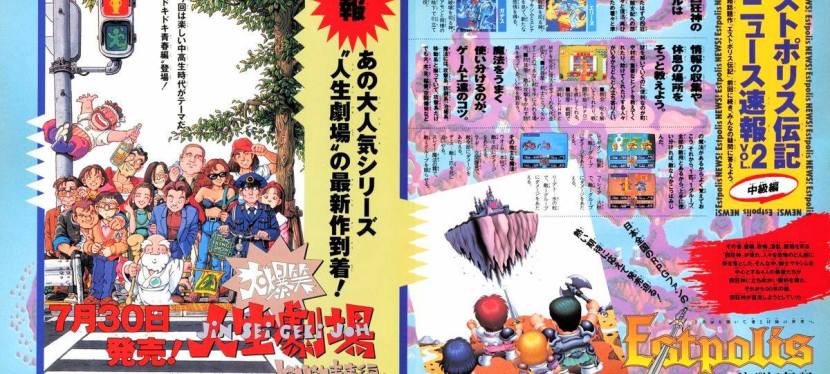
7. Estopolis Denki Japanese Print Ad

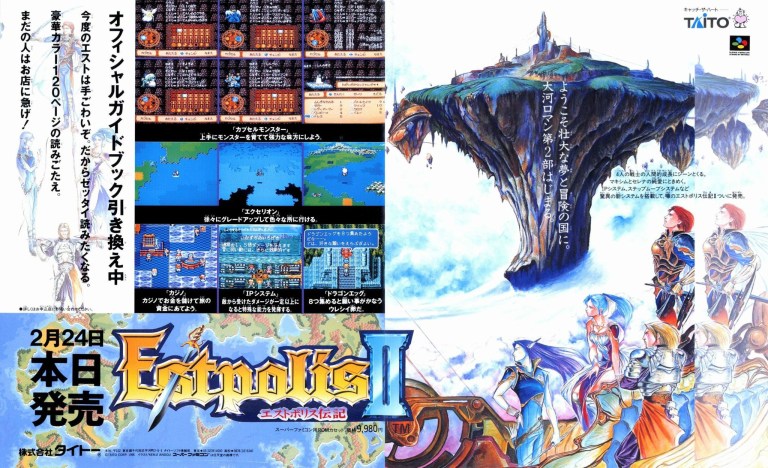
The 2-page Japanese print ad of Estopolis Denki.

In 1993, a brand-new Japanese developer called Neverland was established and its first project was the fantasy role-playing game Estopolis Denki for the Super Family Computer (Super Famicom). That same year, publisher Taito released the game and they promoted it with a 2-page print ad that featured a whimsical looking hand-drawn art work on one half and utilized the other half with details, screenshots and part of the art that was used on the game’s Super Famicom box cover. While Japanese game sales are not available, it seems Estopolis Denki sold enough to convince the publisher to release the game in North America as Lufia & The Fortress of Doom.

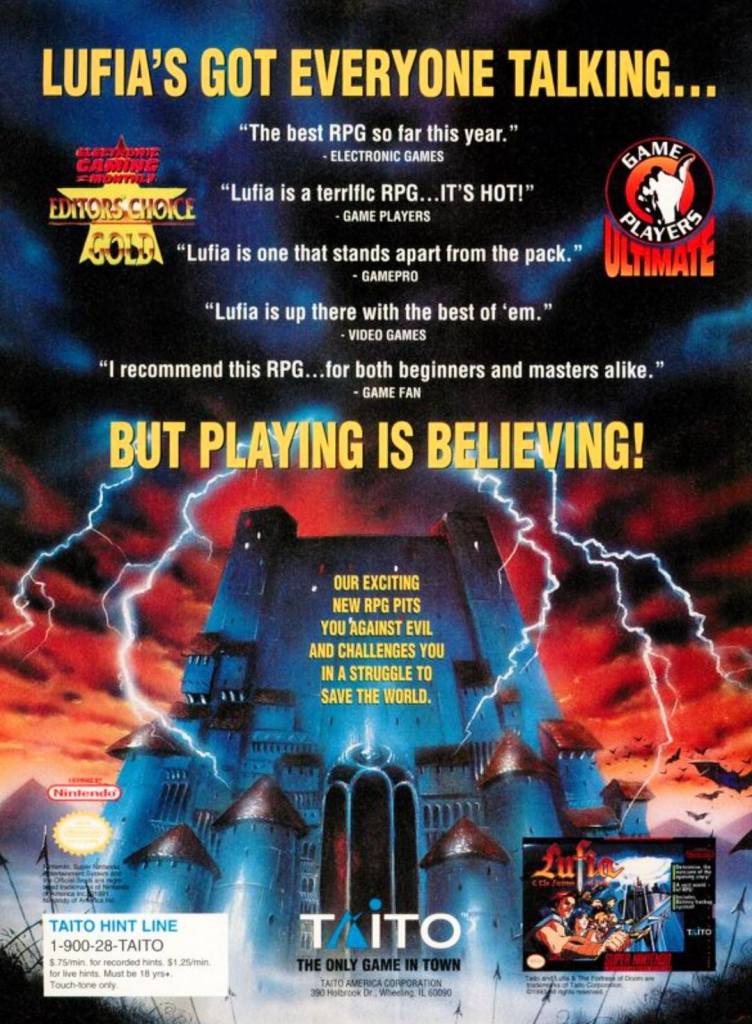
8. Lufia & The Fortress of Doom North American Print Ad

If you were able to play Lufia & The Fortress of Doom on the SNES, were you able to see this ad in a comic book or in a magazine?

Upon release in America in late 1993, Taito scored gold as Lufia & The Fortress of Doom on the Super Nintendo Entertainment System (SNES or Super NES) became a critical and commercial success. In fact, it literally gained steam during the early months of availability and ended up as the top-selling SNES game in America for the month of February of 1994. Take note that at this particular point of time, RPGs on game consoles in America were not yet in high demand as gamers’ tastes were different. When it comes to the marketing, Taito came up with a single-page print ad showing fantasy artwork, the game’s box cover and the published quotes from game critics who gave the game positive reviews. This is smart marketing on the part of Taito.

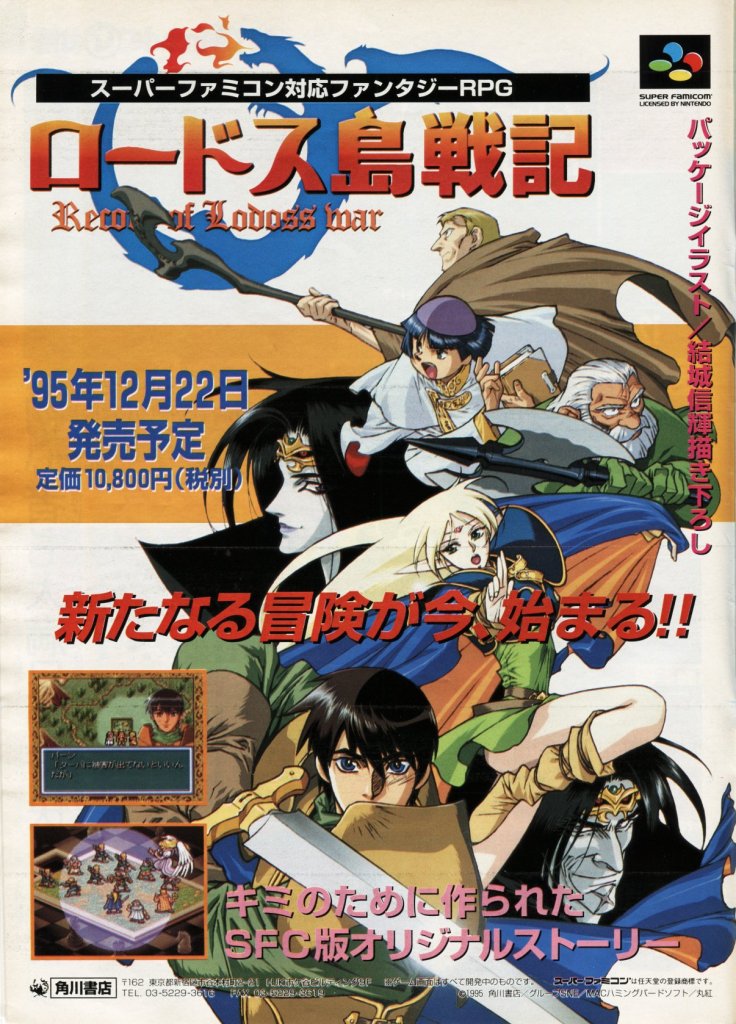
9. Record of Lodoss War Japanese Print Ad

The Japanese print ad of Record of Lodoss War for Super Famicom.

Have you ever heard of the Record of Lodoss War fantasy franchise? That one started as a series of fantasy novels by Ryo Mizuno who previously worked on an RPG project. Record of Lodoss War was eventually adapted into comics, anime and video games. One of those games was released on the Super Famicom in December 1995 published by Kadokawa Shoten which in turn made the one-page print ad for the Japanese market. Using established art from the anime OVA (original video animation) series was a strategic move by the publisher as millions of Japanese people viewed it. Unsurprisingly, the art on the ad is almost the same as the one displayed on the game box cover.

10. Fallout North American Print Ad

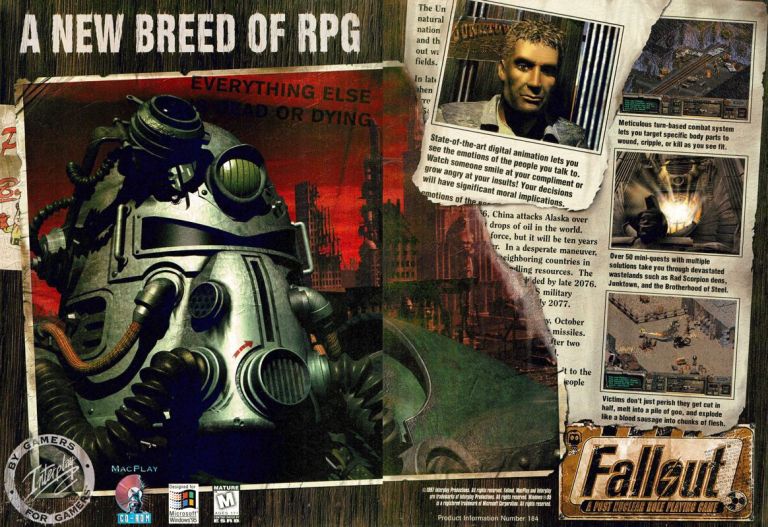
A gritty looking print ad of the original Fallout PC game.

In my gaming life, I played Fallout 3, Fallout 4 and Fallout: New Vegas on Xbox consoles. When the first-ever Fallout game was released in 1997, I did not notice it as I was more into console gaming than PC gaming. The above print ad appeared is several PC gaming magazines and it clearly shows what it offered which gamers eventually ended up enjoying a lot. The mechanical helmet – protection for the user during battles and from radiation in the nuclear wasteland – on the left side of the ad became a key symbol of the Fallout franchise as further games also featured mechanical helmets. Fallout was highly acclaimed for featuring open-ended gameplay and its immersive post-apocalyptic setting. It sold enough copies to convince publisher Interplay to proceed with a sequel and the rest was history.

11. Xenogears Japanese and North American Print Ad

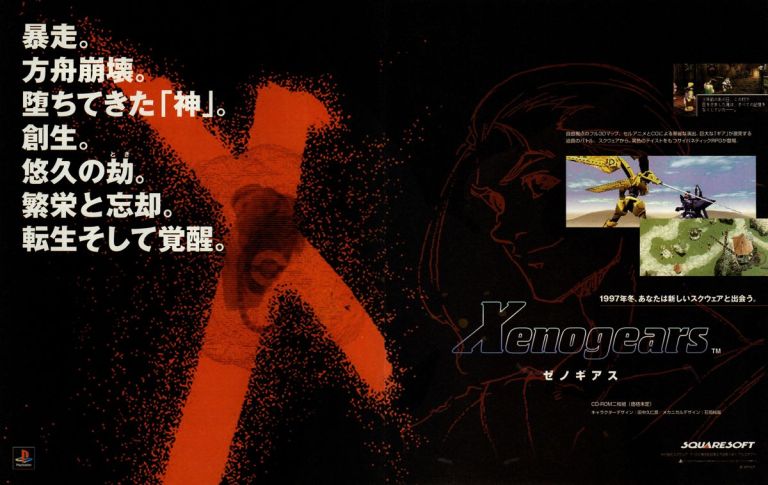
Japanese advertisement of Xenogears.
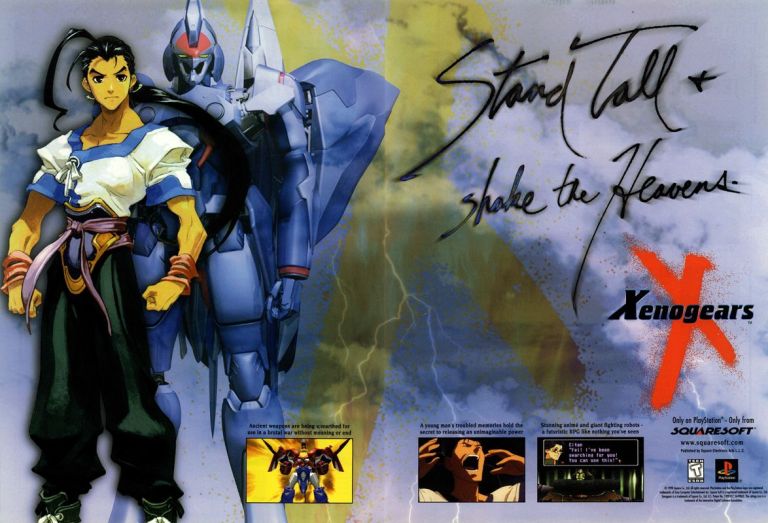
This North American print ad of Xenogears clearly showed the main character, a robot, the sci-fi setting and the visual style of the game.

Xenogears was a sci-fi JRPG I played on the PlayStation in 1998 but I was unable to finish it. Before it was released in America, there was speculation that Squaresoft would not be able to produce an English version for international release due to its religious content. The game was highly challenging to translate into English due to religious themes and psychological elements. Regardless, the game achieved successes commercially and critically in both Japan and America. Xenogears has since been considered by many as a classic JRPG and to play it today is pretty challenging as an existing PlayStation One, PlayStation 3 or PlayStation Vita is required as well as the physical PlayStation disc itself (note: digital copy of Xenogears for PS Vita). Square Enix – which previously remastered Chrono Cross and several Final Fantasy games for modern gaming platforms – has yet to remaster Xenogears for those with modern game consoles, mobile devices and the PC.

12. Final Fantasy Anthology Print Ad

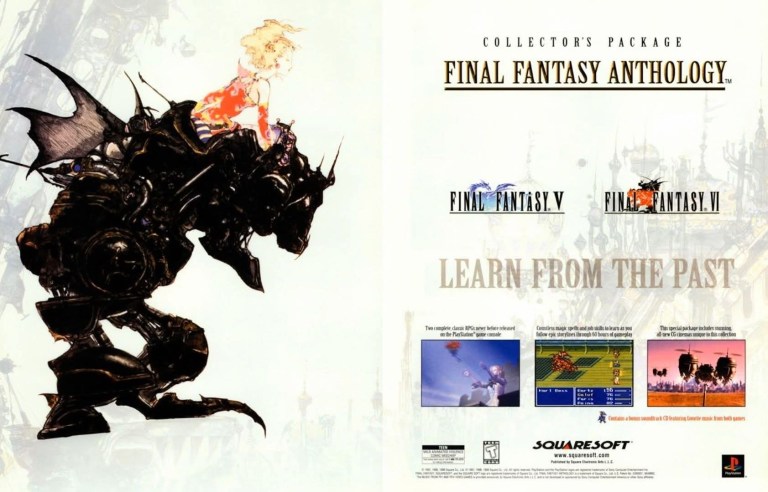
I remember seeing this 2-page print ad in many gaming magazines I read.

By the year 1999, Squaresoft established itself as the best role-playing game company as they achieved critical and commercial success with Final Fantasy VII in 1997, Brave Fencer Musashi, Parasite Eve and Xenogears in 1998. For 1999, Squaresoft decided to bring ports Final Fantasy V and Final Fantasy VI – both games were released in cartridge format on Super Famicom/Super NES some years prior – to their fans who owned PlayStation consoles by releasing the collection called Final Fantasy Anthology. For the North American market, Squaresoft aggressively promoted the 2-game collection with the above 2-page print ad on several video game publications. One half featured exquisite artwork by Yoshitaka Amano and the other half showed the screenshots, descriptions and details. Clearly the ad was made with Final Fantasy fans in mind and it was also clever with the use of nostalgia.

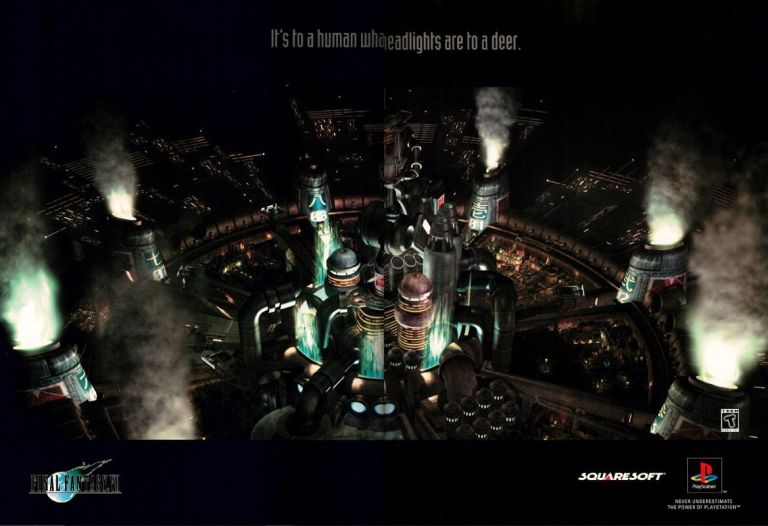
13. Final Fantasy VII North American Print Ad

While it did not show any of the characters, this 2-page print ad of Final Fantasy VII appeared in many gaming magazines and ultimately made the public aware of the game which went on to sell millions.

There is no denying that Final Fantasy VII is the most defining Japanese RPG of the 1990s. Given its huge pre-release promotions, the critical acclaim and the tremendous sales achieved in North America and Europe, the game arguably made the JRPG sub-genre more popular among gamers and game publishers while also making the original PlayStation console the must-have machine for video gaming. The above print ad is one of several released through print media and even though it did not show any characters, the image of a futuristic looking city caught the attention of not just gamers but also others who loved entertainment.

+++++

Thank you for reading. If you find this article engaging, please click the like button below, share this article to others and also please consider making a donation to support my publishing. If you are looking for a copywriter to create content for your special project or business, check out my services and my portfolio. Feel free to contact me with a private message. Also please feel free to visit my Facebook page Author Carlo Carrasco and follow me on Twitter at  @HavenorFantasy as well as on Tumblr at https://carlocarrasco.tumblr.com/ and on Instagram at https://www.instagram.com/authorcarlocarrasco
What to watch on YouTube right now – Part 44

Welcome back, my readers, YouTube viewers and all others who followed this series of articles focused on YouTube videos worth watching. Have you been searching for something fun or interesting to watch on YouTube? Do you feel bored right now and you crave for something to see on the world’s most popular online video destination?

I recommend you check out the following topics and the related videos I found.

#1 Konami’s failed fighting games of the 1990s – Remember back in the 1990s when a lot of fighting games were released on the arcades and game consoles? Japanese game companies Namco and Capcom released a lot of memorable fighting games of different styles such as Street Fighter II, Tekken, Marvel vs. Capcom, Tekken 3, Soulcalibur, X-Men: Children of the Atom, X-Men vs. Street Fighter and so on. Sega released Virtua Fighter games while Midway released Mortal Kombat games, and SNK had Fatal Fury, King of Fighters and Art of Fighting games. Looking back at the fighting game craze of the 1990s, I noticed that Konami – best known for Metal Gear, Contra, Gradius and Suikoden – released their own fighting games but never achieved the tremendous success that its competitors had. The retro gaming video is a must-see.

#2 Calvin Dyson’s lengthy review of The World is Not Enough – I can hardly believe that it has been twenty-five years since the James Bond movie The World Is Not Enough was released in cinemas as the 20th century was ending. The 3rd film of Pierce Brosnan as Agent 007 received mixed reviews from the critics and some fans found it to be really brainless and excessive with action which negatively affected the cinematic narrative. To find out if the 1999 Bond movie aged well or not, YouTuber Calvin Dyson recently posted his lengthy retro review and you can watch it now.

#3 In-depth documentary of Smash TV – Remember way back in 1990 when Smash T.V. (also referred to as Smash TV) was released in the arcades and attracted a lot of players with its enjoyable game design and concept? The game was a hit and went on to be ported to many platforms afterwards, and I played its Super Nintendo Entertainment System (SNES) version a lot. To find out how hit game started and who were the key people behind its production, watch the video documentary of PatmanQC now.

#4 Defeated Kamala Harris, Sharon Stone, Alec Baldwin and others highlighted in Lefties Losing It episode – It has been a few weeks since Donald Trump pulled off the greatest American comeback by winning again the US presidential election. Even until now, the Leftists are still agonizing over Trump’s victory and many of them cannot accept the reality of what happened. In the latest Lefties Losing It episode below, you will see a drunk-like Kamala Harris talking to her supporters, Sharon Stone bashing others and more. Watch it!

#5 Electric vehicles sparked into fire disasters as a result of salt water caused by Hurricane Helene – This news video should convince you not to buy and drive an electric car or any type of electric vehicle for that matter. Salt water touching the ion batteries of electric vehicles spark flame and this leads into fire incidents that simply could not be solved quickly. Hurricane Helene’s powerful wind brought salt water into affected communities and not even electric vehicles parked inside the garage were spared. Avoid electric vehicles and stick with vehicles that run on fossil fuel. 

#6 Ashleigh Burton’s Fantastic Four (2005) reaction video – Back in 2005, I never saw Fantastic Four in the local cinema. I was never a Fantastic Four fan nor did the team-up of Stan Lee and Jack Kirby starting the said superhero team interested me. Believe it or not, I finally saw the movie on home video in 2009. In recent times, YouTuber Ashleigh Burton posted her reaction video of Fantastic Four and it is fun to watch.

#7 Phantasy Star IV retrospective – Thanks to my physical copy of Sega Genesis Classics, I was able to play Phantasy Star IV: The End of the Millennium on my Xbox Series X console. For the newcomers reading this, Phantasy Star IV was a sci-fi Japanese role-playing game (JRPG) released on the Sega Genesis (Mega Drive in other markets) in Japan in 1993 followed by released in America and Europe in 1995. The production side of the game has very interesting details and you can learn all about it in GTV Japan’s retrospective video below.

#8 A look at Disney’s The Black Hole – Long before the Walt Disney Company became the super woke entity of modern times, they released the expensive sci-fi film The Black Hole. As far as the Disney legacy is concerned, the 1979 movie is significant as it marked a serious change of direction the company took with its movies. Disney was already known for wholesome and family oriented movies and TV shows and eventually entered a period of uncertainty. The Black Hole was both Disney’s attempt to cash-in on the sci-fi and disaster film craze of the 1970s and attract more adult moviegoers. You can learn more about this forgotten movie by watching the videos below.

#9 Popcorn in Bed’s What Lies Beneath reaction video – I saw What Lies Beneath inside a crowded cinema here in the Philippines way back in 2000. Directed by Robert Zemeckis, the film was an inspired work of suspense and horror mainly told through Michelle Pfeiffer’s character. I still remember some comments of disappointment over Harrison Ford’s lack of screen time compared with Pfeiffer’s. Regardless, you have to see Popcorn in Bed’s reaction video right here.

+++++

Thank you for reading. If you find this article engaging, please click the like button below, share this article to others and also please consider making a donation to support my publishing. If you are looking for a copywriter to create content for your special project or business, check out my services and my portfolio. Feel free to contact me with a private message. Also please feel free to visit my Facebook page Author Carlo Carrasco and follow me on Twitter at  @HavenorFantasy as well as on Tumblr at https://carlocarrasco.tumblr.com/ and on Instagram athttps://www.instagram.com/authorcarlocarrasco
Retro Gaming Ads Blast – Part 7 (Sega Special)

Welcome back readers, fellow geeks and electronic gaming fans!

In this edition of the Retro Gaming Ads Blast (RGAB) series, we will examine print ads of Sega from the 1990s which was a notable period of time when they went from being a prominent video game company into a desperate, struggling entity by the end of the decade. All the Sega ads in this edition are promotions of their own video games that were exclusive to their consoles during the 1990s.

For the newcomers reading this, Retro Gaming Ads Blast (RGAB) looks back at the many print ads of games (console, arcade, computer and handheld) that were published in comic books, magazines, flyers and newspapers long before smartphones, social media, the worldwide web and streaming became popular. To put things in perspective, people back in the 1980s and 1990s were more trusting of print media for information and images about electronic games and related hardware.

With those details laid down, here is the newest batch of retro gaming print ads for you to see and enjoy…

1. Phantasy Star IV print ad

This was the last single-player Phantasy Star game released. There is no sign of Sega revisiting the franchise for another single-player experience.

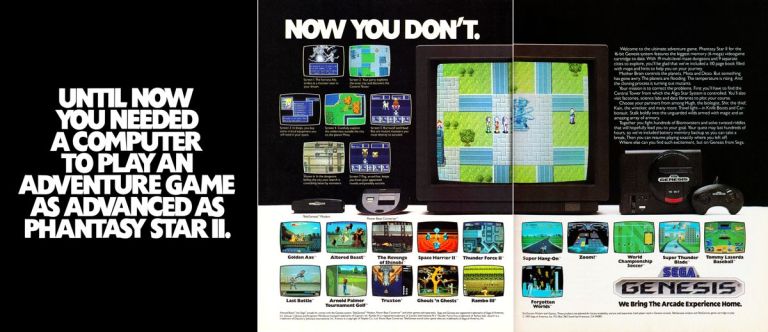
Long before the emergence of online console gaming that involved a high number of players, Sega released Phantasy Star IV for the Genesis console in America in 1994 which was praised by gamers and critics. This one also turned out to be the last single-player role-playing game (RPG) of the Phantasy Star series as Sega eventually turned it into a series of online RPGs since the year 2000.

This print ad is significant because a lot of gamers today are not aware that Phantasy Star started as a series of single-player RPGs the same year Final Fantasy debuted in Japan. Anyone interested to play Phantasy Star IV on a modern console should buy the Sega Genesis Classics collection. 

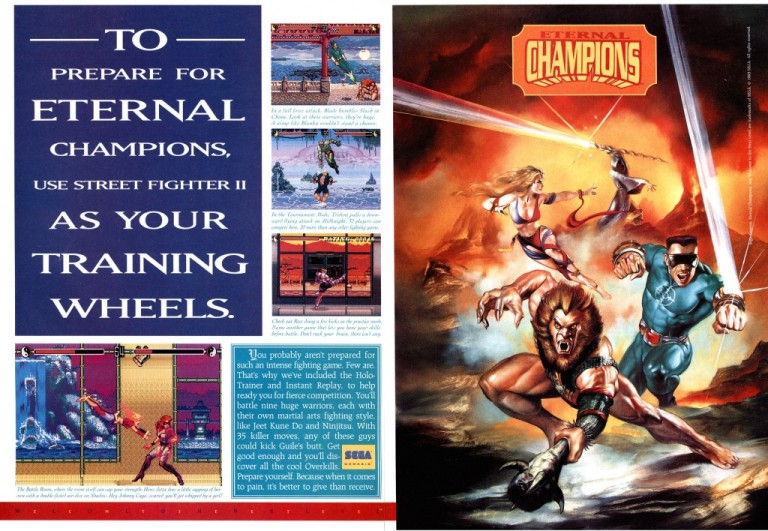
2.  Eternal Champions print ad

This 2-page print ad appeared in many comic books and some magazines that I read long ago.

Back in the 1990s, the fighting game genre became wildly popular with gamers at the arcades and on consoles at home. Capcom literally sparked a wild fire with the Street Fighter II game and its upgraded editions, and other companies went on to make their own 2D fighting games to cash in. Sega was one of them and they released their own 2D fighting game Eternal Champions for the Sega Genesis console.

Unsurprisingly, the game was marketed aggressively and this 2-page print ad really stood out as it had the great looking painted art on the right, screenshots and details of the game, and most notably made a sarcastic reference to Street Fighter II. Eternal Champions sold enough copies, it led to the release of the sequel Eternal Champions: Challenge from the Dark Side and two spin-off games. I can only guess that referencing Street Fighter II was helpful in achieving commercial success.

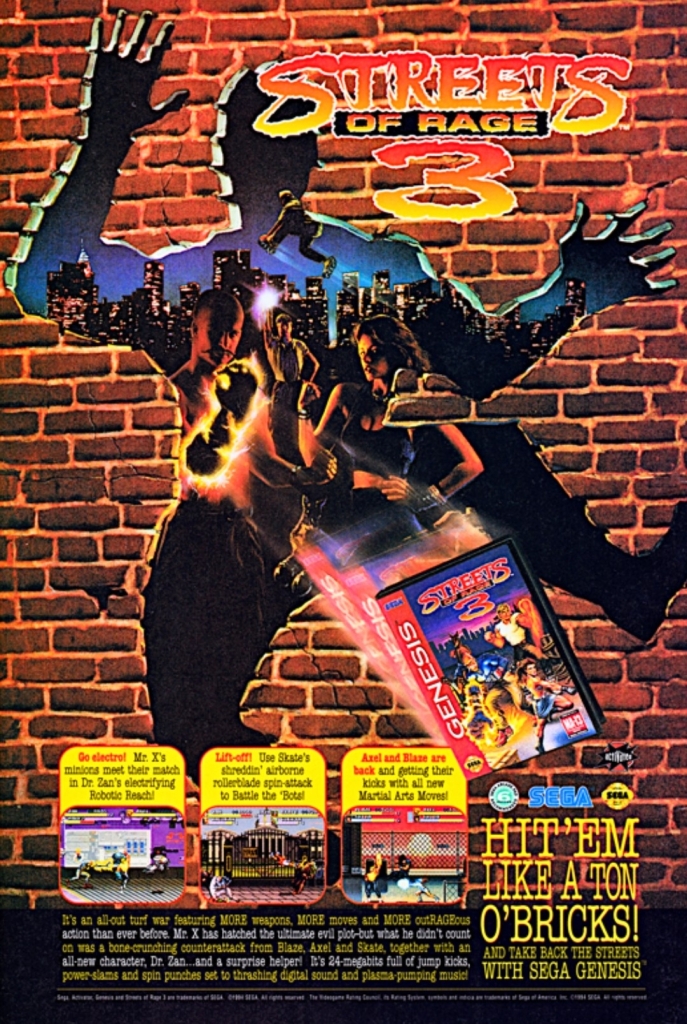
3. Streets of Rage 3 print ad

This ad caught my attention easily when I saw it in comic books I read.

Streets of Rage (Japanese title: Bare Knuckle) was one of the most defining game franchises Sega came up with and it started on the Sega Genesis console. It was a series of side-scrolling, 2D beat-them-up games that ensured action and excitement for gamers. As the first two games were critically and commercially successful, Sega was confident in aggressively marketing Streets of Rage 3 and the print ad seen had a very attention-grabbing artwork.

The artistic style emphasized power and intensity as it shows a damaged wall with the shape of a human body (symbolizing that someone was thrown through it) and then there were images of people on the other side. The game went on to attract mostly positive reviews although it paled in comparison to its predecessors in terms of sales.

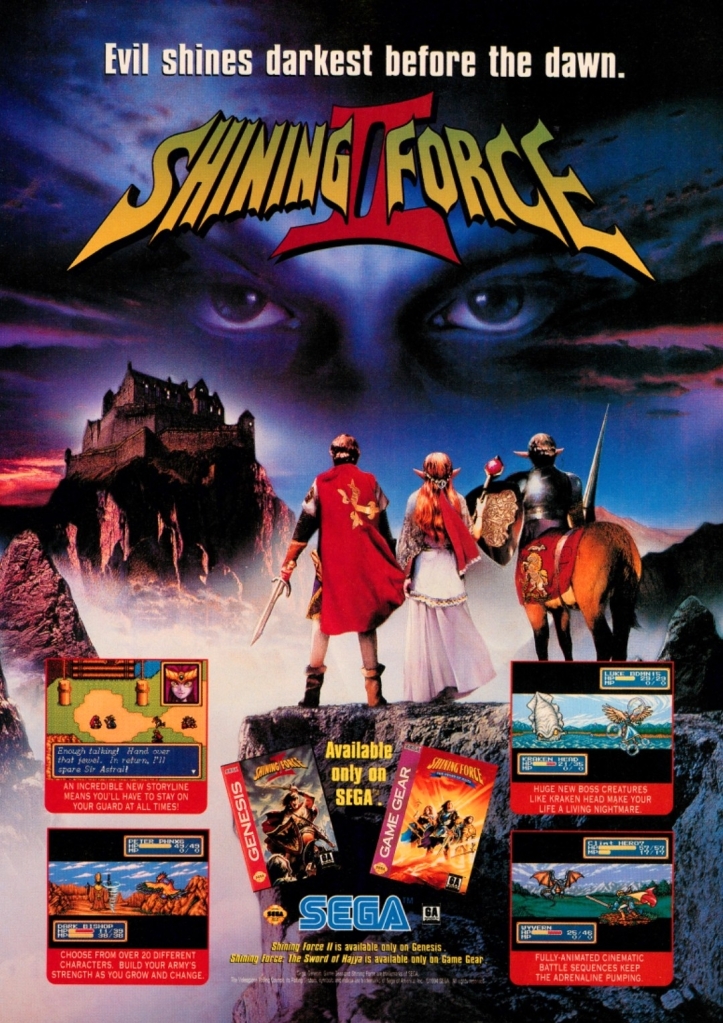
4. Shining Force II print ad

The first time I saw this ad, it made me interested to buy a Sega Genesis console to play it.

As Sega was so prolific with making and releasing games across different genres, they had their own tactical role-playing game series with Shining Force and the first game released on the Sega Genesis was a critical and commercial success. That being said, the company was confident with releasing Shining Force II on the same console more than a year later achieving critical and commercial success.

The North American print ad of the game had a visual presentation that closely captured the foreground-background style (characters facing the distance) used in-game, and the advertising team use photographic imagery to achieve a fantasy look. Very cleverly, Sega inserted the Sega Game Gear title Shining Force Shining Force: The Sword of Hajya into the ad. This print ad made me interested in acquiring a Sega Genesis for Shining Force II.

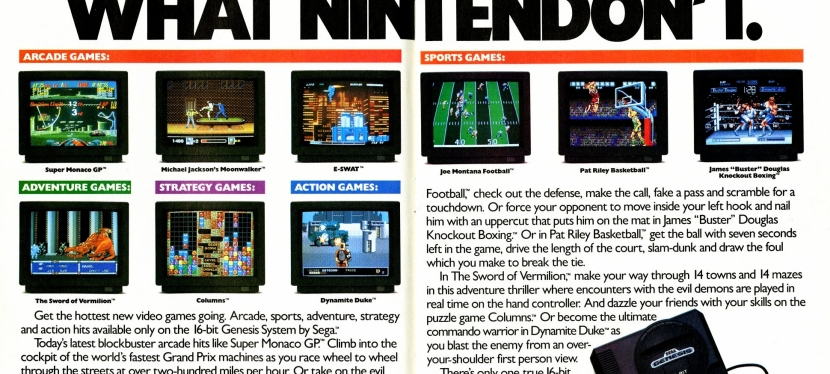
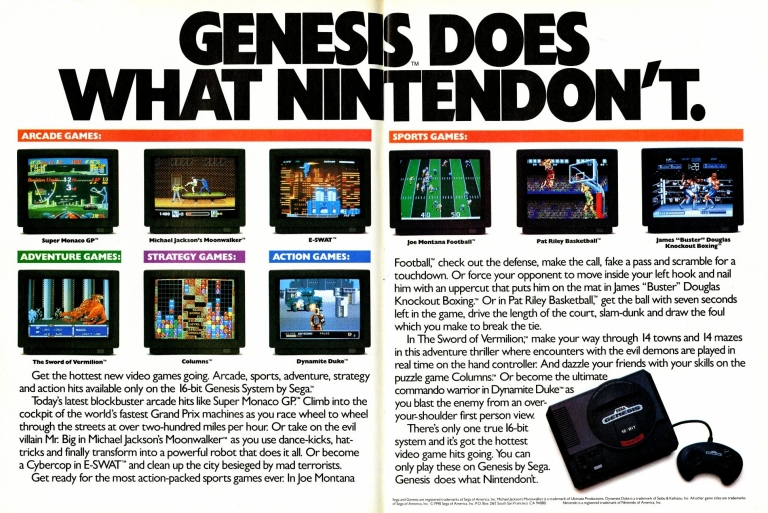
5. Genesis does what Nintendon’t print ad

With the famous line heavily emphasized, this print ad showed how bullish Sega really was in competing with Nintendo.

Now this print ad of Sega’s has the most definitive and best-known advertising line in the so-called 16-bit console generation: Genesis does what Nintendon’t. This was Sega’s aggressive marketing push to convince gamers to buy the Genesis console to play games and experience thrills of fun that they would not find on a Nintendo console at the time. Genesis was launched in America in 1989 with “16-bit” emphasized a lot, and the technological rival Super Nintendo Entertainment System (SNES) was released in the same market more than two years later.

The 2-year advantage helped Sega establish the Genesis as the next-gen machine for gaming at home and there were years in the 1990s when Sega’s console outsold Nintendo’s in America during the so-called 16-bit war. The Genesis also had lots of exclusive games plus strong software support from third-parties. While the SNES would eventually outsell the Genesis in other parts of the world, it was in America where Sega proved to be very competitive and successful. 

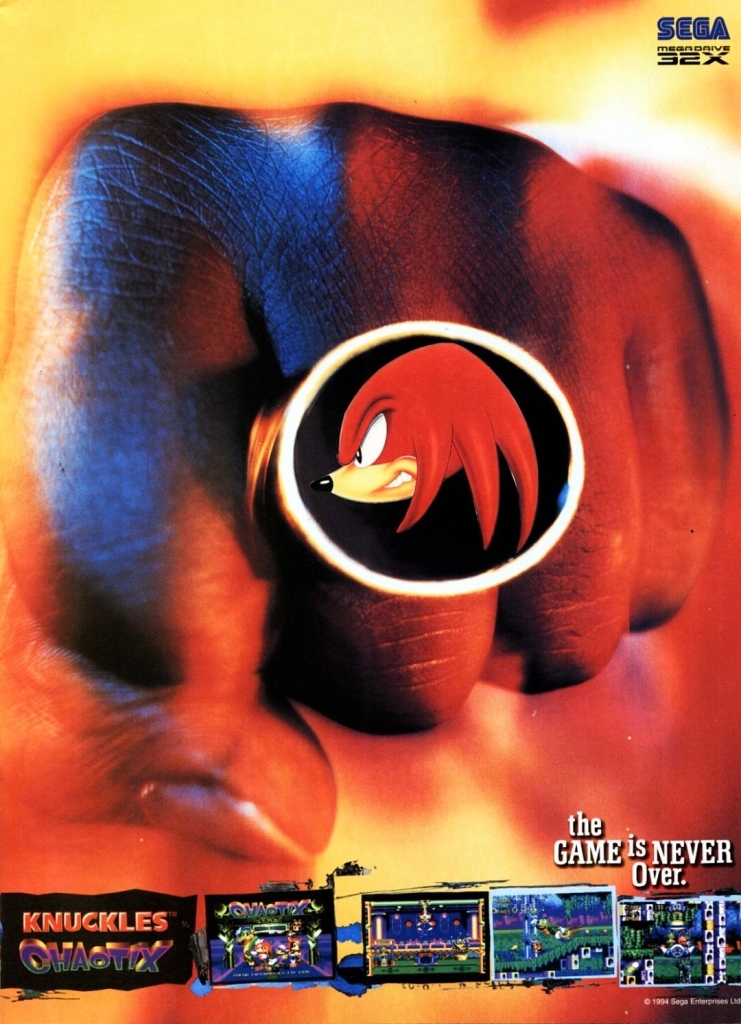
6. Knuckles’ Chaotix print ad

Sega was aggressive with marketing this game for the 32X.

In late 1994, Sega released in America and in Japan the 32X which was an add-on device for the Sega Genesis designed enhance its power while serving as a transition (a warm-up) into the so-called 32-bit era of console gaming. The 32X was the result of corporate decisions involving the American and Japanese executives of the company.

To keep 32X customers happy and boost hardware sales, Sega adjusted the development of Knuckles’ Chaotix (a Sonic spin-off) from being a Sonic project 32-bit console Sega Saturn into a standalone game for the add-on device. Even though Sega knew the game’s development was rushed, they went on to strongly promote the game and the print ad shown here was quite eye-catching.

The image of a fist with a ring showing the character Knuckles (a character from the Sonic games) emphasizes power and the colors used seem to express intensity. Then there were the selected screenshots shown without descriptive text. Although Sega tried hard, Knuckles’ Chaotix (launched in 1995) received mixed-to-positive reviews and sadly sold poorly. Unsurprisingly, the sales of the 32X dropped further and by then a lot of consumers knew that the Sega Saturn (the true successor to the Genesis) was all set to launch in America and Europe within 1995.

7. Sonic 3D Blast for Sega Saturn print ad

Too bad Sega and its teams failed to make the true Saturn Sonic game.

Back in the 1980s and 1990s, having a high-quality, console-exclusive game featuring a company mascot was crucial to sell game consoles while keeping dedicated fans happy. Like what Nintendo did with their icon Mario, Sega achieved great commercial success with the three Sonic the Hedgehog games they released exclusively on the Sega Genesis console and this naturally created expectations they would make new Sonic games on the Saturn console. Unfortunately, Sega and its teams failed to complete development of the Saturn-exclusive game Sonic X-treme and the company cancelled it which sent shockwaves through the games industry news.

With the 1996 holiday shopping season too crucial to ignore, Sega commissioned a Saturn version of the game Sonic 3D Blast which was originally made for the Genesis console. Sonic 3D Blast on the Saturn took seven weeks to make and there were some graphical enhancements implemented. While Sonic 3D Blast’s Genesis version attracted a positive reception from critics (and sold 700,000 copies), the reception for the Saturn version was mixed. This print ad of Sonic 3D Blast on Sega Saturn is a reminder of the company’s failed attempt to take their icon to the next-generation. They never replicated the big success they had with Sonic on the Genesis.

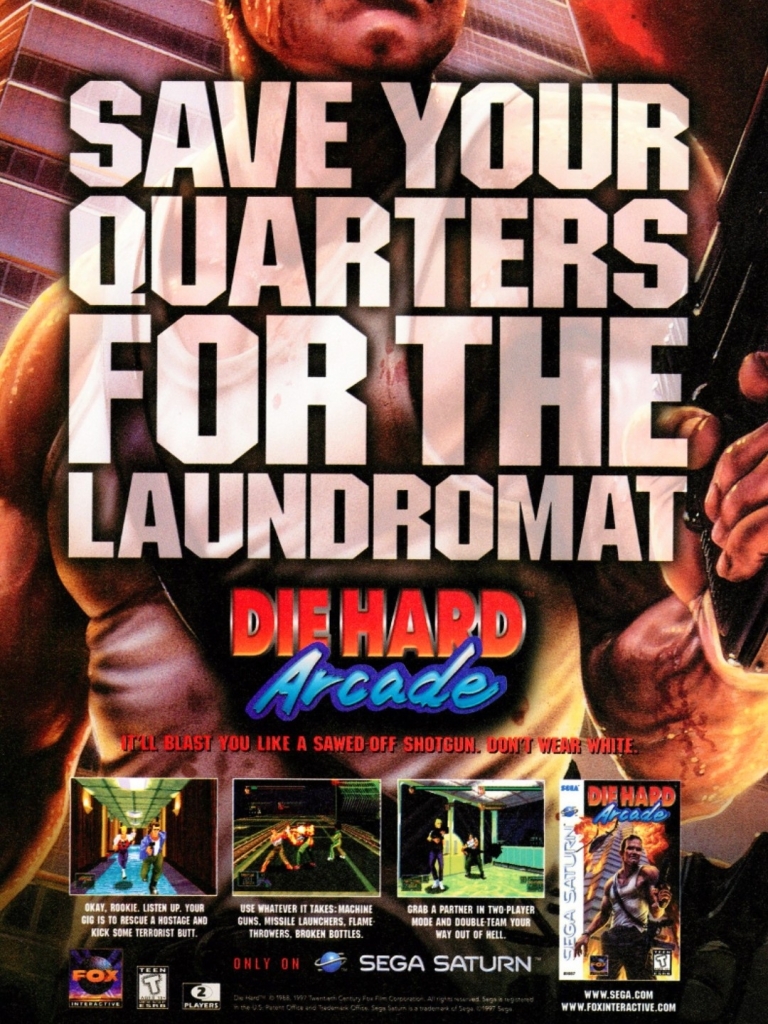
8. Die Hard Arcade print ad

Each time I saw this print ad, it easily reminded me of the classic action film of 1988.

Like many other movie franchises, Die Hard has many video game adaptations released through the decades. In 1997, Sega released Die Hard Arcade (Japanese title: Dynamite Deka) on the Sega Saturn and the game critics praised it for its fun gameplay as well as its flawless conversion of the arcade version (released in 1996). To say the least, the development history of Die Hard Arcade is not as straightforward as many would think. To get the details and explanations of the development of the game, click here.

As for the print ad itself, this one cleverly used official game art as the background with imagery which instantly reminded me of what I saw in the classic 1988 movie that starred Bruce Willis. This ad made me interested to buy a Sega Saturn or find a place to rent it to play the game.

9. Shenmue Japanese print ad

Simplistic with presentation and yet engaging to look at. The Dreamcast-exclusive Shenmue sold over a million copies in Japan alone.

When Shenmue was released exclusively on the Sega Dreamcast in Japan on December 29, 1999, it turned out to be a very mind-blowing experience for many gamers due to its ambitious game design, the intense attention to detail implemented, very high production values, in-depth exploration and very immersive gameplay.

It was the open-world game released at a time when “open-world” was not even a standard gaming term. Often called the masterpiece of the legendary game designer Yu Suzuki, Shenmue sold over 1.2 million copies in Japan and went on to be released worldwide in the months that followed. Sadly, the game failed to make a profit due to its very high budget of $70 million (which Suzuki himself said in English during an interview) and the fact that the number of Dreamcast units already sold to gamers was not massively high.

The Japanese print ad of Shenmue had a simplistic looking visual concept and yet it was engaging to look at because the way the characters appeared was how they appeared in the game during gameplay which was astounding. Take note that back in the 1990s, it was common for video game marketing materials to show human characters in high detail but in reality the polygonal models of those characters appeared looking blocky and much less detailed during gameplay.

+++++

Thank you for reading. If you find this article engaging, please click the like button below, share this article to others and also please consider making a donation to support my publishing. If you are looking for a copywriter to create content for your special project or business, check out my services and my portfolio. Feel free to contact me with a private message. Also please feel free to visit my Facebook page Author Carlo Carrasco and follow me on Twitter at  @HavenorFantasy as well as on Tumblr at https://carlocarrasco.tumblr.com/ and on Instagram at https://www.instagram.com/authorcarlocarrasco