Better than Streaming: Night Shift Blu-ray coming out on October 5, 2021

Welcome back, fellow geeks, movie buffs and fellow Blu-ray/4K Blu-ray collectors!

If you are nostalgic about 1980s Hollywood or you if you are discovering more of the said era for your Blu-ray collection, then you might be interested in the 1982 comedy Night Shift which is coming out on October 5, 2021 on Blu-ray format via the Warner Archive line of Warner Bros. Night Shift Blu-ray can be ordered right now online.

The cover.

What exactly is Night Shift? For one thing, it was one of the older films directed by Ron Howard (the same guy behind Solo: A Star Wars Story) and starred the famous Henry Winkler (Happy Days) and a very young Michael Keaton (Batman in 1989). Posted below is its synopsis according to Blu-ray.com…

Chuck (Henry Winkler) has given up life as a stockbroker because it was too stressful. Now, he works an easy gig as a night shift attendant at a New York City morgue. His co-worker, Bill Blazejowski (Michael Keaton), on the other hand, is always looking to make a quick buck. When Bill finds out that Chuck’s prostitute neighbor, Belinda (Shelley Long), needs a place to do her work, he convinces Chuck to turn the morgue into a brothel where they can work as her pimps.

Posted below are key details of Night Shift Blu-ray from its Blu-ray.com page.

Video

Codec: MPEG-4 AVC

Resolution: 1080p

Original aspect ratio: 1.85:1

Audio

TBA

Subtitles

None

Discs

Blu-ray Disc

Single disc (1 BD)

Playback

2K Blu-ray: Region A

I personally never saw Night Shift, not even on cable TV. The movie received an overall positive reception from movie critics and Keaton won the Kansas City Film Critics Circle Award for Best Supporting Actor. Henry Winkler meanwhile was nominated for Best Actor in a Motion Picture – Comedy or Musical at the Golden Globe Awards. To say the least, I find this upcoming Blu-ray release interesting and for those of you who have gotten sick and tired of modern-day Hollywood being dominated by socialists, social justice warriors (SJWs), Marxists, naked Communists and liberals, Night Shift could provide you much needed relief.

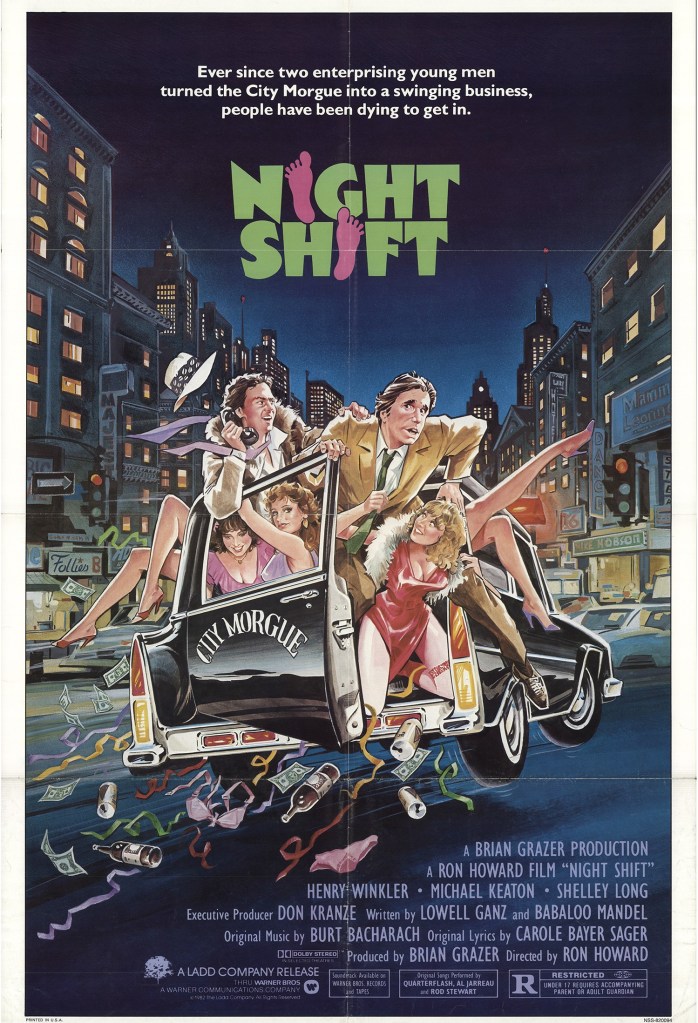
The movie poster.

In ending this piece, posted below is classic trailer of Night Shift. Anyone who loves the film or is nostalgic about the 1980s should watch it.

For more entries of my Better than Streaming series of articles, check out my pieces on The Beastmaster 4K Blu-rayThe Transformers: The Movie 4K Blu-rayMortal Kombat 2021 4K Blu-raySpace Jam 4K Blu-rayV: The Original Miniseries Blu-ray (read my retro review), V: The Final Battle Blu-rayHighlander 4K Blu-rayThe Suicide Squad, Super Dimension Century Orguss Blu-ray, Unbreakable 4K Blu-ray, Injustice 4K Blu-ray, The Suicide Squad 4K Blu-ray, Terminator 2: Judgment Day 30th Anniversary 4K Blu-ray, Final Fantasy: The Spirits Within 4K Blu-ray and Mad Max Anthology 4K Blu-ray.

+++++

Thank you for reading. If you find this article engaging, please click the like button below and also please consider sharing this article to others. If you are looking for a copywriter to create content for your special project or business, check out my services and my portfolio. Feel free to contact me as well. Also please feel free to visit my Facebook page Author Carlo Carrasco and follow me at HavenorFantasy@twitter.com

If you wish to join a group of movie enthusiasts and talk about cinema, visit the Movie Fans Worldwide Facebook group at https://www.facebook.com/groups/322857711779576

A Look Back at Dazzler #3 (1981)

Disclaimer: This is my original work with details sourced from reading the comic book and doing personal research. Anyone who wants to use this article, in part or in whole, needs to secure first my permission and agree to cite me as the source and author. Let it be known that any unauthorized use of this article will constrain the author to pursue the remedies under R.A. No. 8293, the Revised Penal Code, and/or all applicable legal actions under the laws of the Philippines.

Welcome back, superhero enthusiasts, comic collectors, 1990s culture enthusiasts and fans of Marvel Comics! After a very fine start, things really went downhill with the story and presentation in Dazzler #2. That comic book had Dazzler (then a hot new property for Marvel Comics) completely overshadowed by the big mix of established Marvel superheroes fighting opposition elements. To say the least, Dazzler #2 was a major letdown, a very big disappointment and anyone who loves Dazzler should avoided it.

Will we see Dazzler presented much better in the next issue? We can find out in this look back at Dazzler #3, released in 1981 by Marvel Comics with a story written by Tom DeFalco and drawn by John Romita, Jr., and A. Kupperberg.

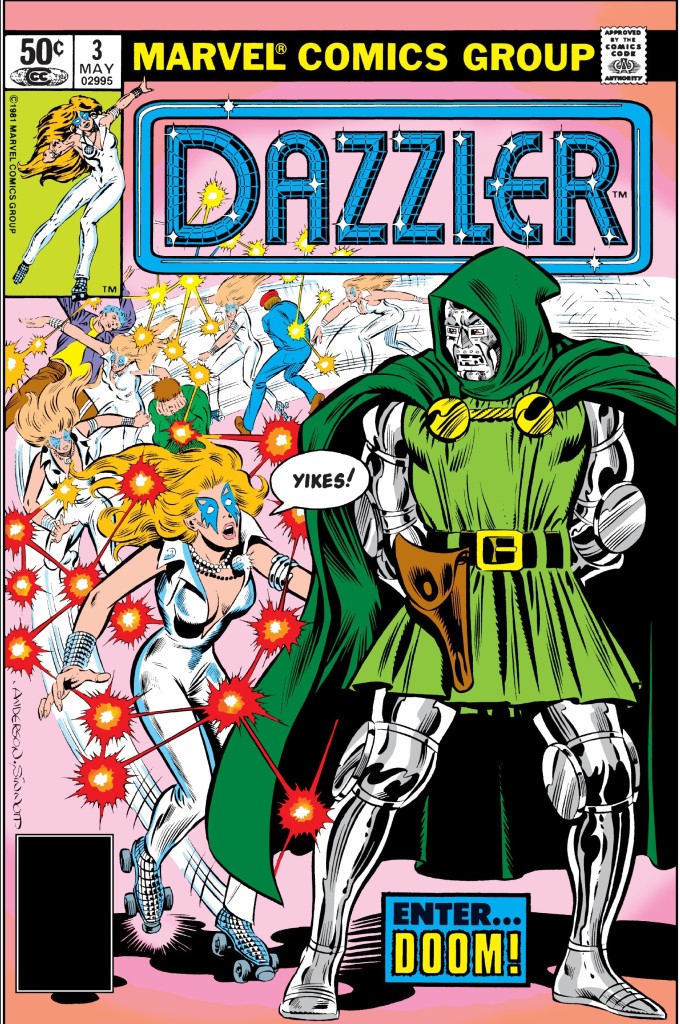
The cover.

Early story

The story begins with Dazzler (not wearing her face paint) participating scientific test conducted by Fantastic Four leader Reed Richards/Mr. Fantastic at his team’s headquarters in New York. Dazzler has been converting every nearby sound into radiance and she’s beginning to sense her limitations. The test was done to determine Alison Blaire’s mutant capabilities. Also present were Johnny Storm, Ben Grimm and Sue Richards. Johnny reads a newspaper report about the United Nations’ plan to display the crown jewels that once belonged to their deadliest enemy Dr. Doom.

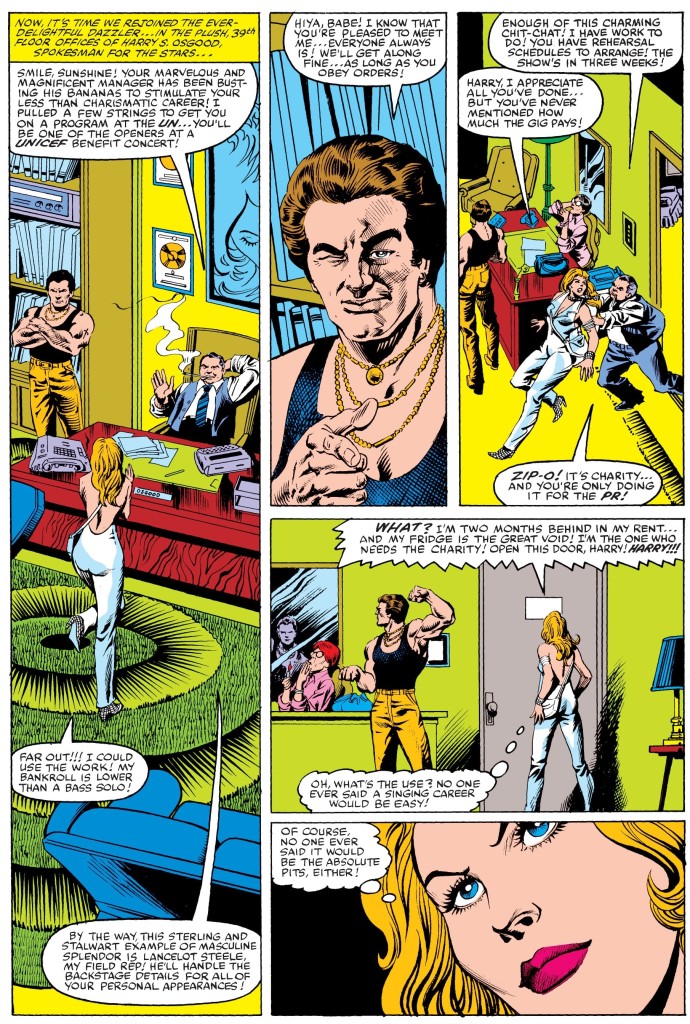
Afterwards, Dazzler meets her boss at his office and learns that she will be one of the openers at the benefit concert of UNICEF which is supposed to help her with her music career. The next morning, she decides to visit her old home where her father lives in. Over at the Bavarian Alps, Dr. Doom gets informed that among the jewels set to be displayed at the Unite Nations is the Merline stone. This compels him to make a move…

Quality

Dazzler versus Dr. Doom!

When compared to the disaster of issue #2, this comic book’s story is indeed an improvement as it has the expected superhero storytelling formula intact. The good news here is that the character development on Dazzler has returned and there is once again the strong emphasis on her relevance with the people of New York with regards to her being both a superhero and a musician.

The story moved at a moderate pace and it is clear that the creative team took the necessary steps to gradually build up the plot leading to the inevitable encounter between Dazzler and the Fantastic Four’s most definitive enemy (and Marvel Comics’ iconic villain). Take note, however, that the Dazzler-Dr. Doom conflict here is only the beginning.

As this story is more focused on Dazzler, you will get to see an early look at her tainted relationship with her father who desired her to become a lawyer like him, plus there is some focus on the behind-the-scenes development in one of the big events involving her. When it comes to spectacle, there is a right amount of it here which makes this comic book more fun to read than the previous issue.

Conclusion

A look at the business side of the music industry that Alison Blaire/Dazzler is involved with.

Dazzler #3 (1981) is indeed fun to read and the creators succeeded in developing Alison Blaire more while delivering the good stuff. While the match-up between her and Dr. Doom looks awkward from the surface, the strong writing justified it and all along Dazzler never looked like she was out of place being with Marvel’s iconic supervillain.

If you are seriously planning to buy an existing hard copy of Dazzler #3 (1981), be aware that as of this writing, MileHighComics.com shows that the near-mint copy of the regular edition costs $28 while the near-mint copy of the newsstand edition costs $60.

Overall, Dazzler #3 (1981) is recommended.

+++++

Thank you for reading. If you find this article engaging, please click the like button below and also please consider sharing this article to others. If you are looking for a copywriter to create content for your special project or business, check out my services and my portfolio. Feel free to contact me as well. Also please feel free to visit my Facebook page Author Carlo Carrasco and follow me at HavenorFantasy@twitter.com

A Look Back at Dazzler #1 (1981)

Disclaimer: This is my original work with details sourced from reading the comic book and doing personal research. Anyone who wants to use this article, in part or in whole, needs to secure first my permission and agree to cite me as the source and author. Let it be known that any unauthorized use of this article will constrain the author to pursue the remedies under R.A. No. 8293, the Revised Penal Code, and/or all applicable legal actions under the laws of the Philippines.

Welcome back, superhero enthusiasts, comic collectors, 1990s culture enthusiasts and fans of Marvel Comics! Previously, I reviewed Uncanny X-Men #130 which was the first appearance of Dazzler who went on to become one of the most notable new characters of Marvel Comics in the 1980s. After appearing in Uncanny X-Men #131 and Amazing Spider-Man #203, Dazzler became more prominent among all of Marvel’s superheroes as the publisher launched an all-new monthly series featuring her. There is more to that than meets the eye, however.

In his article titled “Dazzler and Me”, Danny Fingeroth wrote: Marvel decided to tray an experiment with the relatively new “direct market” – comic book shops. It was decided that Dazzler #1 would only be available in comic book shops, not at traditional newsstands.

Dazzler #1 sold over 400,000 copies.

Even the top-selling comics of the era sold perhaps 250,000 copies. So, the first issue, anyway, was a major hit.

Apart from the confirmed commercial success of the comic book, it is a wonder if it is still good to read by today’s standards. To find out, here is a look back at Dazzler #1, published in 1981 by Marvel Comics with a story written by Tom DeFalco and drawn by John Romita, Jr.

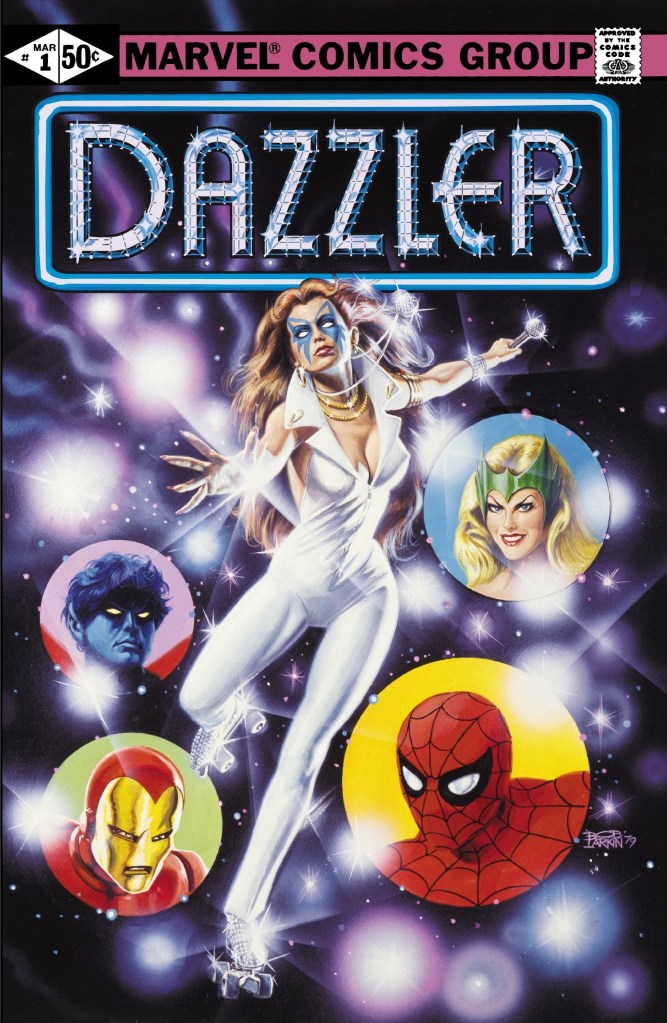
The cover.

Early story

The story begins with Dazzler running away from four armed men who had been following her since she left the disco. She finds herself corned at the dead end of an alley as the men approach her. While pretending to be reaching for her make-up in the bag, Dazzler grabs and activates her portable radio which plays music. With the music turned on, she uses her power to convert it all into a dazzling display of light and color which makes the men disoriented.

While swinging nearby, Spider-Man notices the display of light but before he begins his approach, Dazzler makes her move to knock two men out. Another man fires his gun and his bullet ricochets until it hits the portable radio stops the music and Dazzler’s lights altogether leaving her vulnerable once again…

Quality

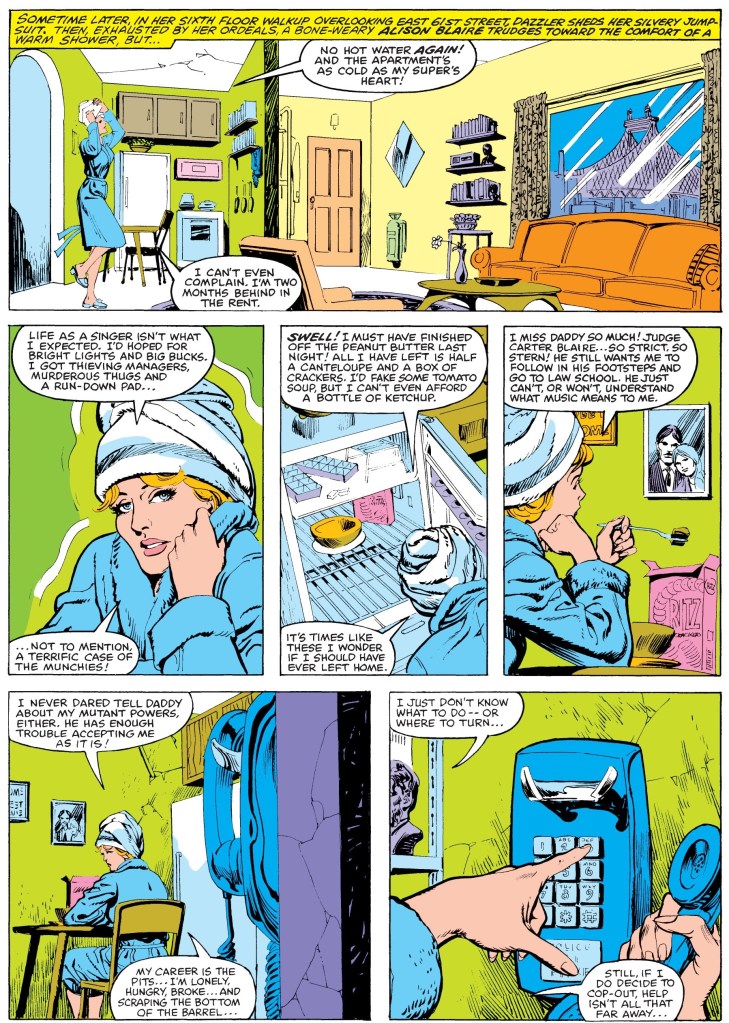
This page alone establishes Dazzler as a person struggling to make ends meet.

As far as telling a Dazzler story goes, this comic book is the complete package and it’s got very solid writing! Apart from showing what happened to her after her appearances in the Uncanny X-Men and Amazing Spider-Man series, this comic book formally introduces Dazzler in her civilian identity as Alison Blaire and thanks to efficient writing, it also reveals threads of her past and how her mutant powers manifested. Not only that, readers will get to see the title character as a typical person who is struggling to make ends meet even though she does her best with entertainment as a career.

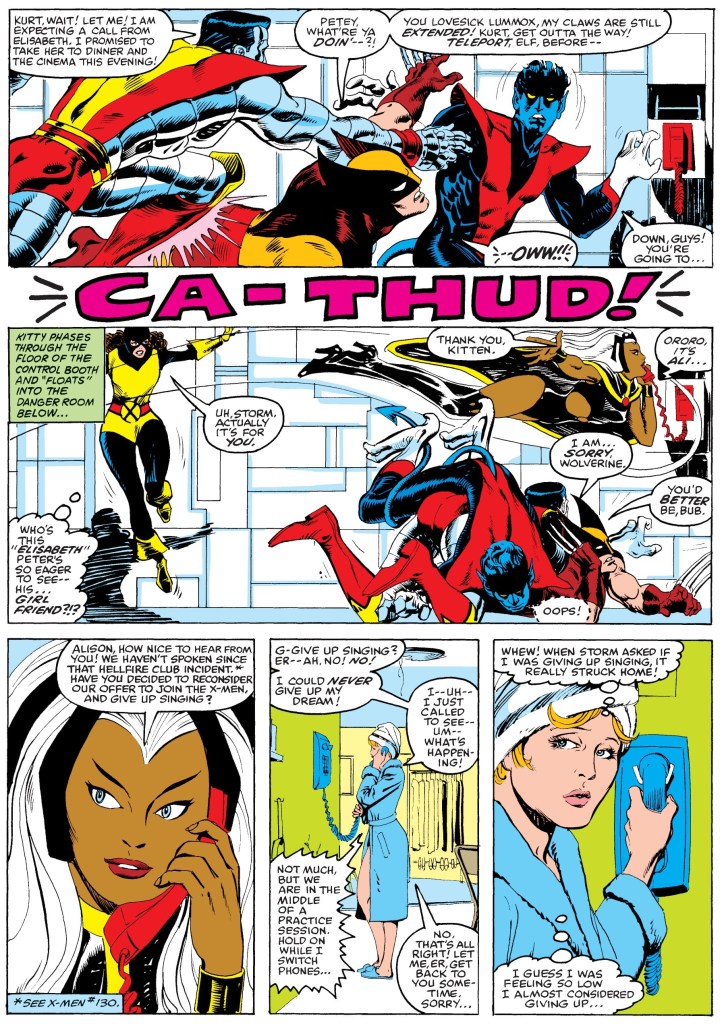
Strangely, the focus on Dazzler is relatively light in content and the result is several pages of Marvel universe-related filler which shows several other characters like Captain America, Iron Man, Storm, Wolverine and others present with little to no connection with the title character. The X-Men scene is a nice touch as it will remind readers about Dazzler’s first interaction with them.

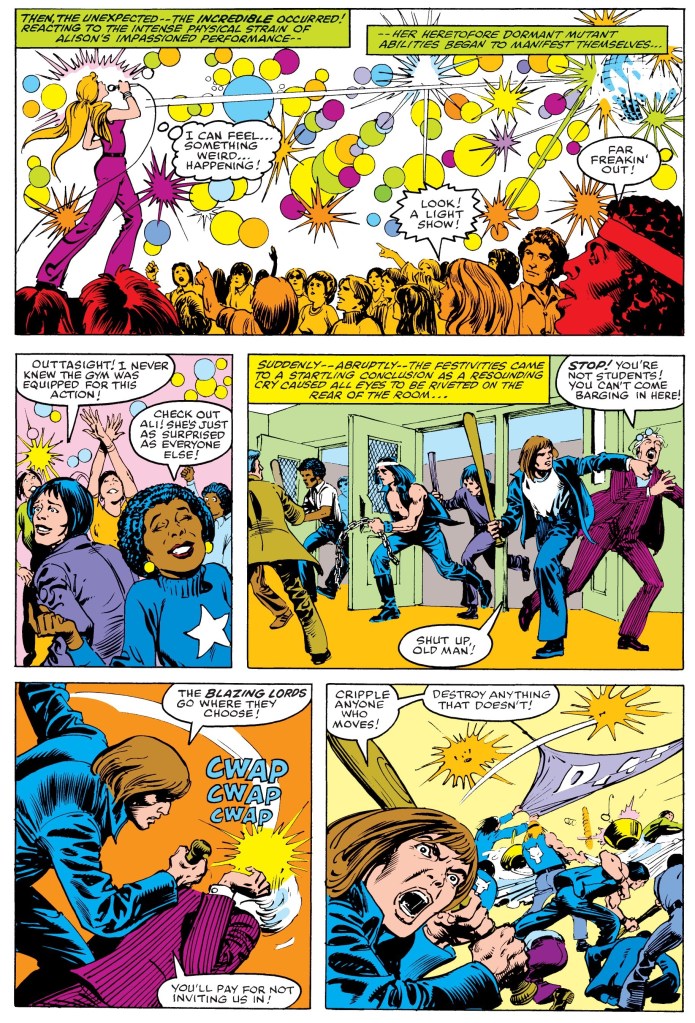
As a teenager, Alison Blaire’s power begins to manifest during this particular event in her life.

To build-up the first challenge for Dazzler, this comic book has the Enchantress as the villainess and ironically it also had some room of character development for her. Clearly this was done not only to build up anticipation for the next issue but to make readers root for Dazzler some more. In retrospect, the Enchantress would later emerge as an important figure in 1984’s crossover storyline Secret Wars.

Conclusion

The scene involving the X-Men is a nice touch as it connects with Dazzler’s previous interaction with them.

While it is indeed a product of the early 1980s carrying influences from the 1970s New York club scene, Dazzler #1 (1981) is still fun and engaging to read. Clearly this comic book is a must-have for anyone who loves Dazzler and it should be entertaining enough for geeks who love the 1980s and the Marvel-related crossovers of the time. Very clearly, this comic book succeeded in introducing and developing Dazzler as a person (as opposed to being a super hero) and the background story established fits in nicely with the character’s first appearance in Uncanny X-Men #130. Very clearly, there is a lot more to Dazzler than her unique super power and her disco look.

If you are seriously planning to buy an existing hard copy of Dazzler #1 (1981), be aware that as of this writing, MileHighComics.com shows that the near-mint copy of the comic book costs $70.

Overall, Dazzler #1 (1981) is highly recommended!

+++++

Thank you for reading. If you find this article engaging, please click the like button below and also please consider sharing this article to others. If you are looking for a copywriter to create content for your special project or business, check out my services and my portfolio. Feel free to contact me as well. Also please feel free to visit my Facebook page Author Carlo Carrasco and follow me at HavenorFantasy@twitter.com

A Look Back at V #5 (1985)

Disclaimer: This is my original work with details sourced from reading the comic book, watching the V mini-series (Original Miniseries and The Final Battle) and the 1984 TV series, and doing personal research. Anyone who wants to use this article, in part or in whole, needs to secure first my permission and agree to cite me as the source and author. Let it be known that any unauthorized use of this article will constrain the author to pursue the remedies under R.A. No. 8293, the Revised Penal Code, and/or all applicable legal actions under the laws of the Philippines.

Welcome back, science fiction enthusiasts, comic book collectors and fans of the V entertainment franchise of the 1980s! Before I start this newest retro comic book review, I am happy to say that I recently published my retro review of V: The Original Miniseries which is one of the most in-depth retro reviews I wrote so far. I recommend you to read it now. If you are a fan and you are interested to buy yourself the original mini-series on Blu-ray disc format, head on to Amazon. Now we can return to the 1980s comic book series.

Last time around, Ham Tyler and Chris continued their operation which resulted getting reunited with the star child Elizabeth Maxwell (refer to V: The Final Battle mini-series of 1984). Meanwhile, Mike Donovan and Julie Parrish met with delusional astronomer Earl Meagan (patterned after Carl Sagan) who is obsessing with meeting Diana of the Visitors.

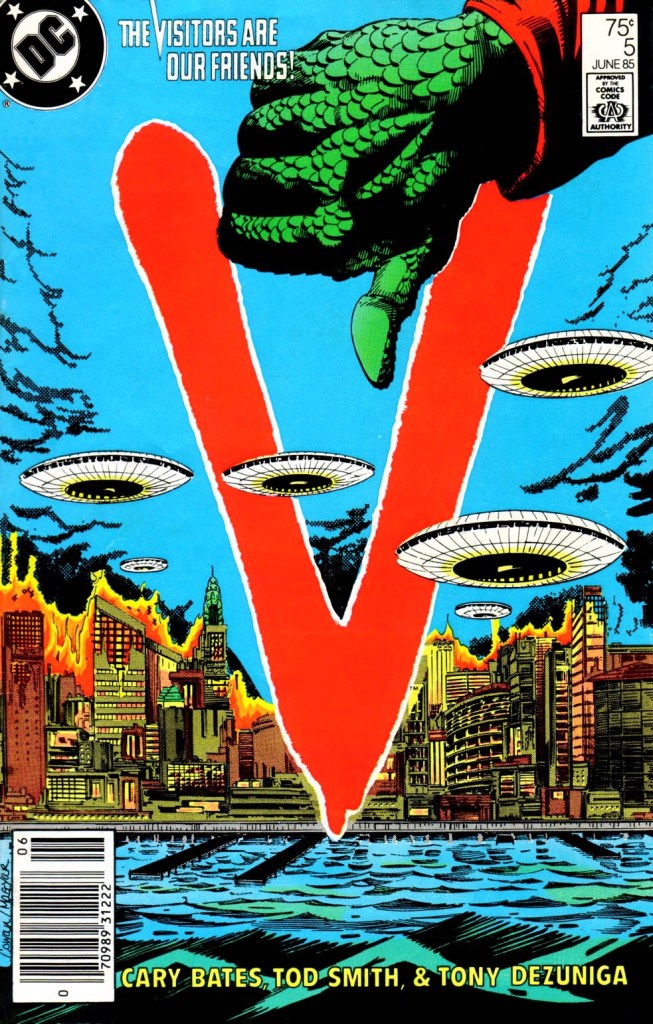
With those details laid down, here is a look back at V #5, published in 1985 by DC Comics with a story written by Cary Bates and drawn by Tod Smith.

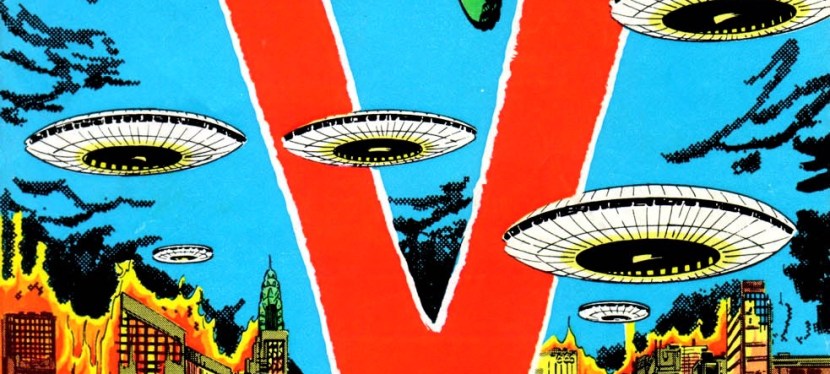
The cover.

Early story

The story begins with Diana, Linda and Charles watching a video message from the delusional Earl Meagan expressing his thanks to her (Diana) for accepting his peace proposal for a summit of peace between the humans and the Visitors. He expressed more of his delusion stating that he is confident that both of their races will benefit from the meeting.

Diana explains to her powerful companions that they have a lot to gain by turning one of Earth’s most influential figure to their side. After Diana left, Linda expresses that their commander has gone too far. Charles tells her what she is thinking of.

On Earth, in the presence of Ham, Chris and Bates, a weakened Elizabeth recalls her time with Kyle when they went into hiding away from the Visitors’ search team. She then makes mental contact with Kyle.

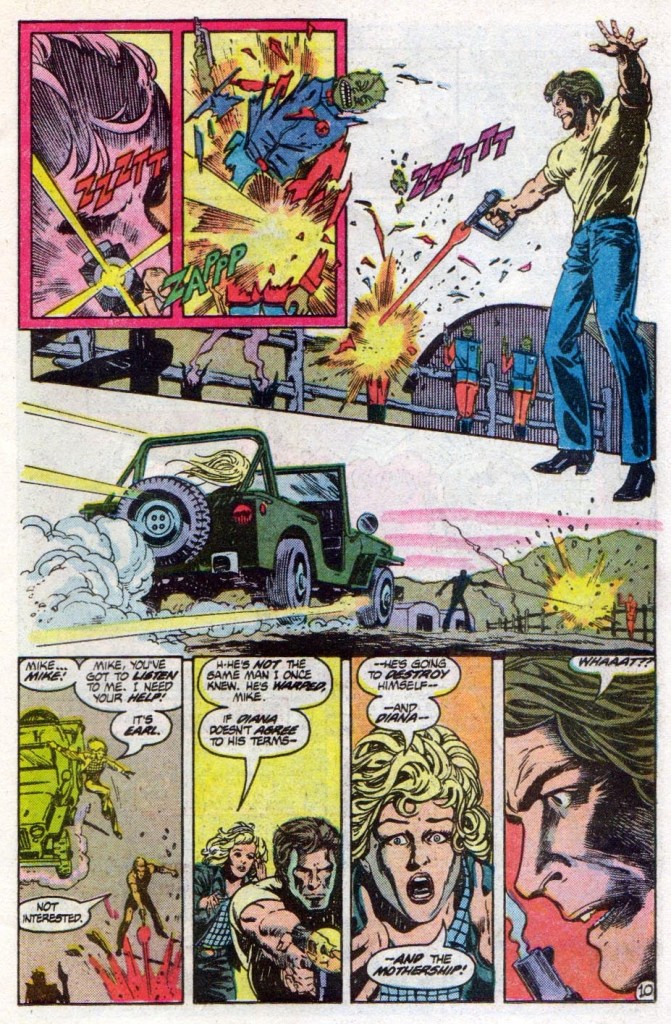
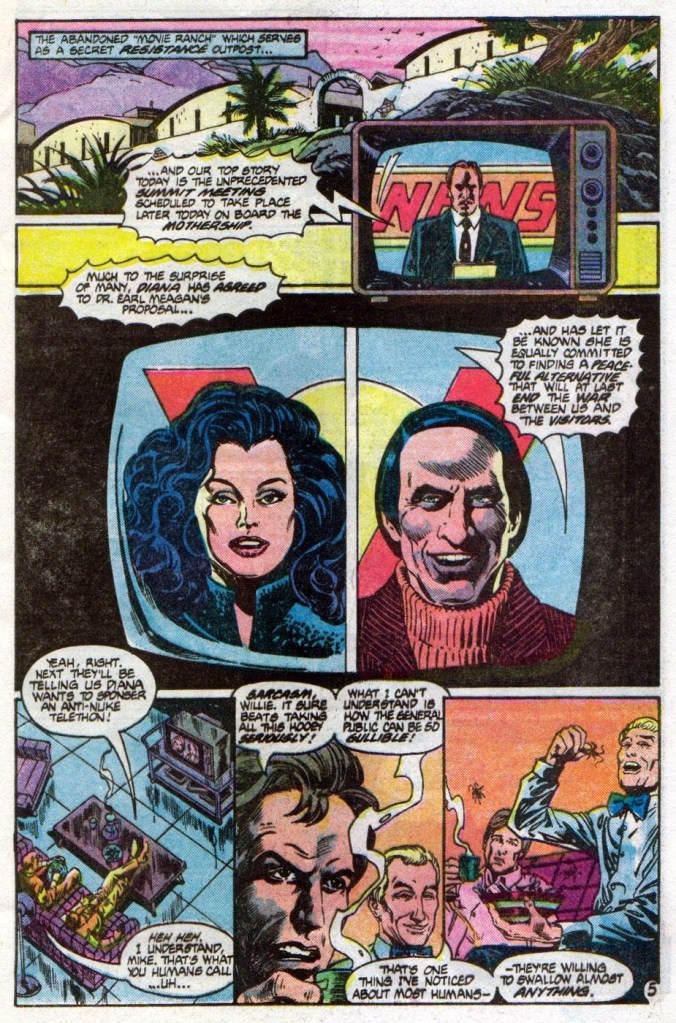
Elsewhere, as Mike Donovan and Willie watch the newscast about the peace summit between Diana and Earl Meagan set to happen soon, Julie Parrish personally tells the astronomer (by the helipad within a city) that he just can’t go as such a meeting is suicide. Still delusional, Meagan tells Julie that she is no different from her short-sighted friend Mike, leaves her and rides the helicopter to push through with the summit…

Quality

Realizing her mistake with the delusional astronomer Earl Meagan, Julie comes back to Mike.

First thing to mention is the good news that the quality of the writing and plotting by Cary Bates has the high quality maintained throughout. While the story about the peace summit between Earl Meagan and Diana is the highlight here, the other story (told through Ham and Chris) about the discovery of a secret camp where the Visitors conduct experiments on humans is itself very intriguing as it parallels what the Nazis did to prisoners during the dark days of World War II.

Going back to the highlighted plot of the comic book, Earl Meagan is not only delusional with his old belief that any extraterrestrial race capable of traveling through the depths of space is surely friendly and benevolent to humanity…he is completely wrong and a danger to his own people as clearly lost his touch with truth and reality. He is a perfect example of what happens when a scientist refuses to realize the limits of science and goes over the edge believing in the falsehood that another scientific breakthrough will prove him right and all others wrong. By today’s standards, Meagan can be compared with the radical socialists in America who foolishly believe that all foreigners (including criminals and terrorists) should be allowed free entry into their country without consequence and without responsibility, and at the expense of their fellow American citizens.

When it comes to characterization, I still recognize Ham and Chris as I remembered them from V: The Final Battle thanks to solid writing. Julie’s portrayal in this comic book, however, takes a drastic turn from powerful receiver of Earl Meagan in issue #4. More notably, it is refreshing to see the relationship between Mike and Julie getting strained as a result of Meagan.

Conclusion

The closest thing you can have about Carl Sagan betraying the entire human race in favor of aliens from outer space.

V #5 (1985) is another solid tale about the conflict between the Resistance and the Visitors, but with Earl Meagan as the mad scientist with charisma who puts his fellow humans into more danger. It’s a worthy read from start to finish.

If you are seriously planning to buy an existing hard copy of V #5 (1985), be aware that as of this writing, MileHighComics.com shows that the near-mint copy of the regular edition costs $28 while the near-mint copy of the newsstand edition costs $36.

Overall, V #5 (1985) is highly recommended.

+++++

Thank you for reading. If you find this article engaging, please click the like button below and also please consider sharing this article to others. If you are looking for a copywriter to create content for your special project or business, check out my services and my portfolio. Feel free to contact me as well. Also please feel free to visit my Facebook page Author Carlo Carrasco and follow me at HavenorFantasy@twitter.com

A Look Back at Superman Annual #10 (1984)

Disclaimer: This is my original work with details sourced from reading the comic book and doing personal research. Anyone who wants to use this article, in part or in whole, needs to secure first my permission and agree to cite me as the source and author. Let it be known that any unauthorized use of this article will constrain the author to pursue the remedies under R.A. No. 8293, the Revised Penal Code, and/or all applicable legal actions under the laws of the Philippines.

Before DC Comics ended their original superhero multiverse with Crisis on Infinite Earths (1985-1986) to restart all over again, there were a whole lot of stories about Superman ranging from the dramatic stuff, the epic tales and right down to the most outlandish tales.

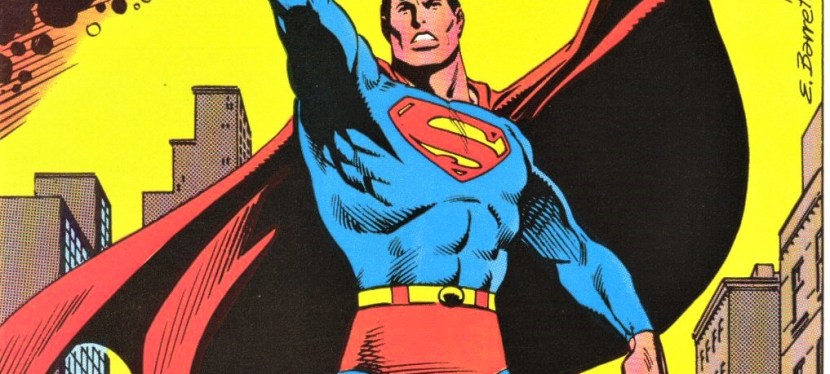
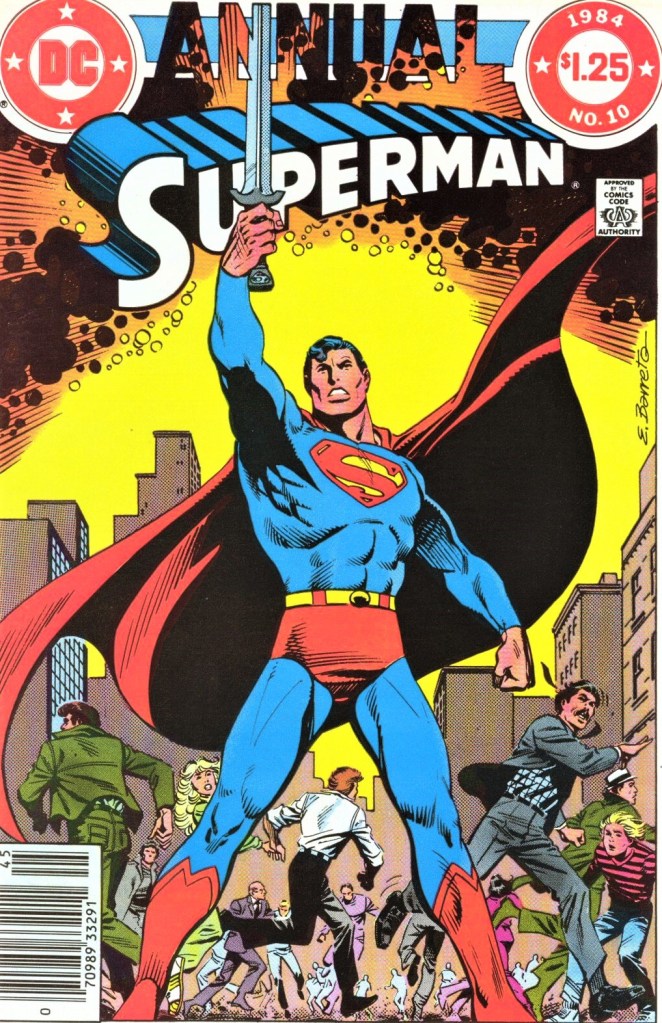
As a kid, I was fortunate enough to buy myself a copy of a 1984 Superman comic book, the cover of which really intrigued and caught my interest. It was a Superman annual comic book with a $1.25 cover price which was somewhat high at the time. Its cover showed the Man of Steel himself carrying a sword pointed up.

That image made me wonder: Why would Superman have to use a sword when he is so powerful and capable without weapons? Where did that sword come from? Who made it in the first place? Is the sword so special to Superman?

With those details laid down, here is a look back at Superman Annual #10, published by DC Comics in 1984 with a story written by Elliot Maggin and drawn by classic Superman artist Curt Swan.

The cover.

Early story

The story begins in a space where a group of diverse people composed of aliens and humans are gathered together watching a live video feed Superman on a large monitor above their heads. As it turns out, the Man of Steel is in space working to prevent meteoroids from entering the planet below him. He then speeds off into space heading back to Earth.

Along time ago deep in the galaxy, a big bang effect took place creating several new fragments in the vacuum of space and among them is a long, rough object that resembles a sword. As an unknown amount of time passed, the long object gradually turns into a smooth looking sword complete with a sharp blade and a letter “S” on one end that is the same as the one Superman carries. It is referred to as the sword of Superman!

In Metropolis, Clark Kent is passed by his officemate Jimmy Olsen who mentioned that he is rushing to interview the billionaire industrialist Oswald Mandias. Two days have passed and Jimmy Olsen remained missing. As his boss Perry White heads on to the office, Clark remains and changes into Superman when the coast got clear.

As the Man of Steel flies off into the city, a Galaxy Broadcasting live report on TV shows Lana Lang reporting from the Kennedy Space Center where the new space shuttle Magellan is about to make its first-ever commercial flight to launch a mysterious new communications satellite owned by Mandias Industries…

Quality

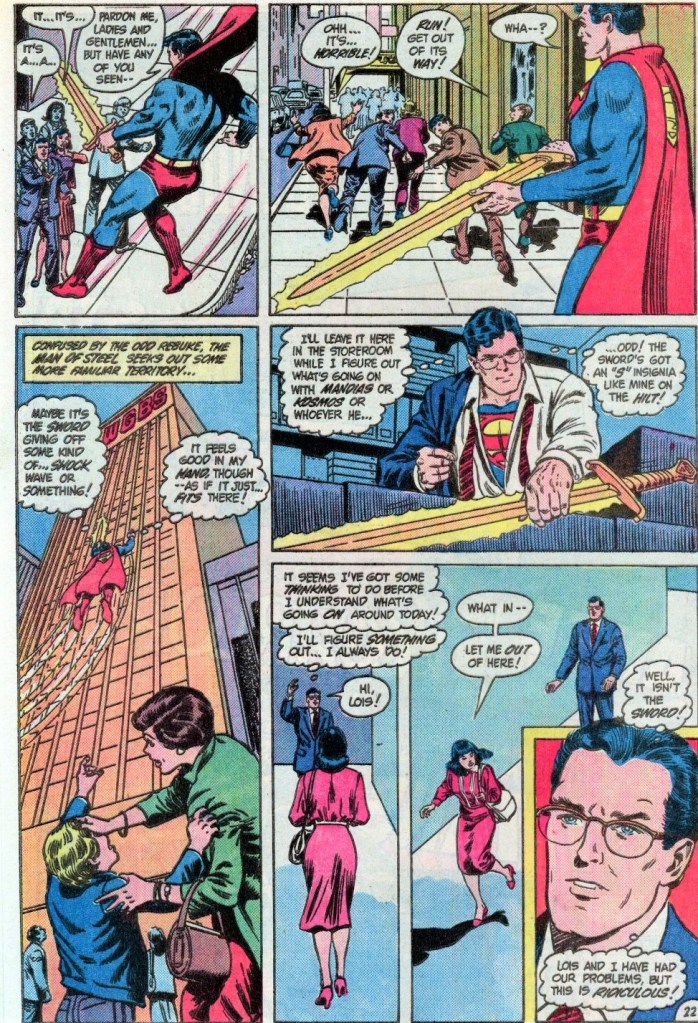
Clark Kent/Superman being a complete stranger to others added a lot to the story.
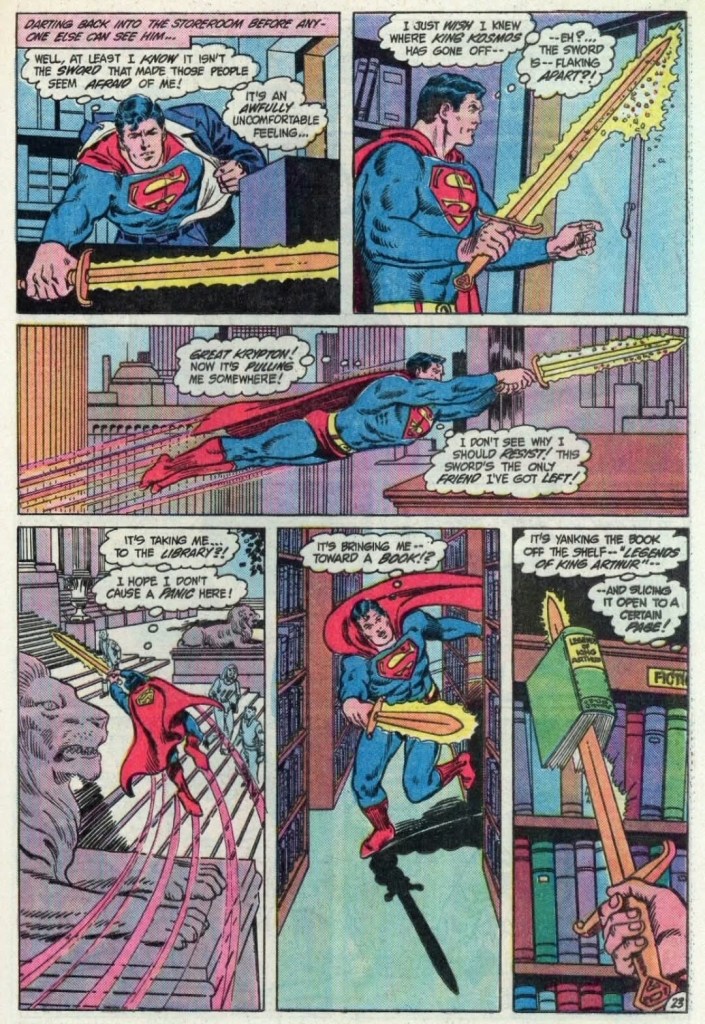
The sword led Superman to a book about the legend of King Arthur inside the city library.

Being an annual, I can say that the Sword of Superman story was well-written and nicely visualized by the creators which made it fun and engaging to read. It is a Superman story that further adds to his being an essential hero of the original DC Comics multiverse and a key factor here is the somewhat outlandish concept that the sword that he gained was an original material of the universe from the big bang and even had connections to the unseen omnipotent force.

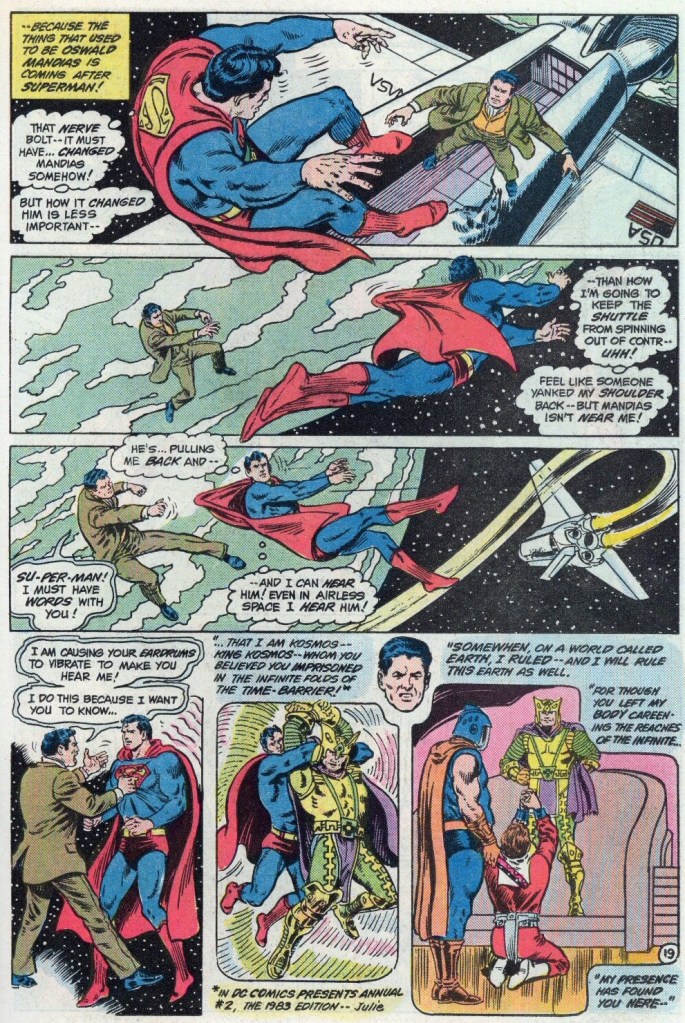
This story is not a simple, straightforward tale about Superman gaining a weapon required to defeat the supervillain King Kosmos. In fact, the sword opens up events that made the Man of Steel reevaluate himself, his situation and the people around him. King Kosmos, who is a time-travelling villain from the future (first appearance in DC Comics Presents Annual #2), served not just merely as the opposition but also adds a good amount of complexity within the reality of the story. For one thing, it is very intriguing and also refreshing to see people of Metropolis (even Clark’s friend Jimmy Olsen) failing to recognize Superman and perceive him with fear. This is a one-of-a-kind story of Superman that must be read, even though it is not really an epic tale.

All throughout, there is a fine balance between spectacle and intrigue. If you pay close attention to the dialogue and details, you will understand the story better and enjoy the comic book more eventually.

Conclusion

The return of King Kosmos!

I personally enjoyed reading Superman Annual #10 (1984) the first time back in 1984. The fact here is that after re-reading it recently, I do confirm that it is still an enjoyable comic book to read, and I am not even a Superman fan anymore. That is quite something! This is indeed a really good piece of Superman history from the pre-Crisis era. It also touches on themes about omnipotence, how ordinary people react to people who wield great power, and being whole with the entire universe.

If you are seriously planning to buy an existing hard copy of Superman Annual #10 (1984), be aware that as of this writing, MileHighComics.com shows that the near-mint copy of the regular edition costs $35 while the near-mint copy of the newsstand edition costs $70.

Overall, Superman Annual #10 (1984) is recommended.

+++++

Thank you for reading. If you find this article engaging, please click the like button below and also please consider sharing this article to others. If you are looking for a copywriter to create content for your special project or business, check out my services and my portfolio. Feel free to contact me as well. Also please feel free to visit my Facebook page Author Carlo Carrasco and follow me at HavenorFantasy@twitter.com