Disclaimer: This is my original work with details sourced from reading the comic book and doing personal research. Anyone who wants to use this article, in part or in whole, needs to secure first my permission and agree to cite me as the source and author. Let it be known that any unauthorized use of this article will constrain the author to pursue the remedies under R.A. No. 8293, the Revised Penal Code, and/or all applicable legal actions under the laws of the Philippines.
I can hardly believe that it has been a year since Marvel Comics organized the return of their 2099 universe with the release of several comic books. Among those, I bought 2099 Alpha #1 it was a very disappointing read. I also read some other 2099 comic books released late 2019, and none of those engaged me nor gave me much entertainment value in return for what I paid for.
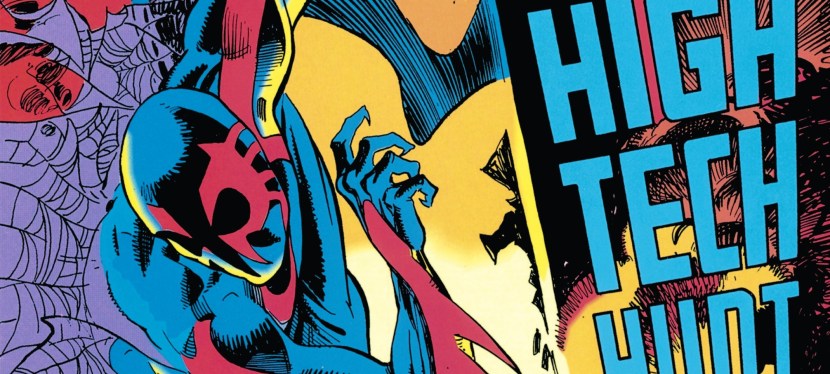
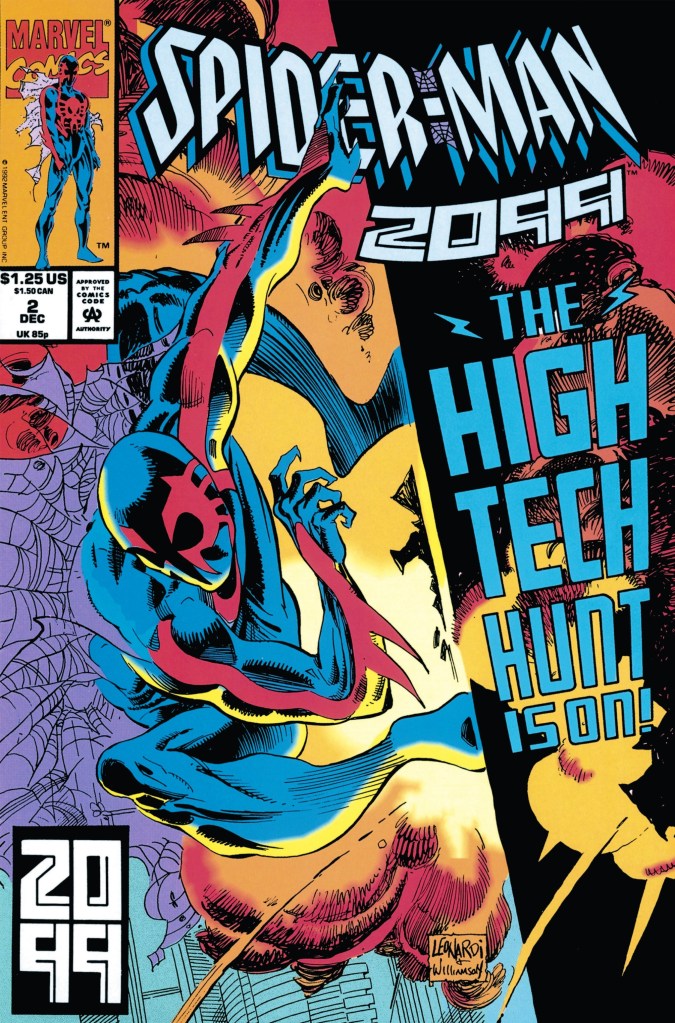
If you ask me, the Marvel 2099 universe of comics was at its best during the early 1990s. That being said, join me on this look back at Spider-Man 2099 #2, published in 1992 by Marvel Comics with a story written by Peter David and drawn by Rick Leonardi.
The cover.
Early story
The story begins at one of the Alchemax towers. Miguel O’Hara is standing naked in front of a shocked Aaron Delgato, a corporate rival of his who tried to kill him. As he noticed Miguel (with fangs) looking at him, he reacts by firing his gun. With fast reflexes, Miguel (whose DNA has been altered already at this point) dodges all of the shots and tries to get close to his rival. One of the bullets hit a tank which causes a large explosion at the tower. The tremendous force pushed them both to the exterior.
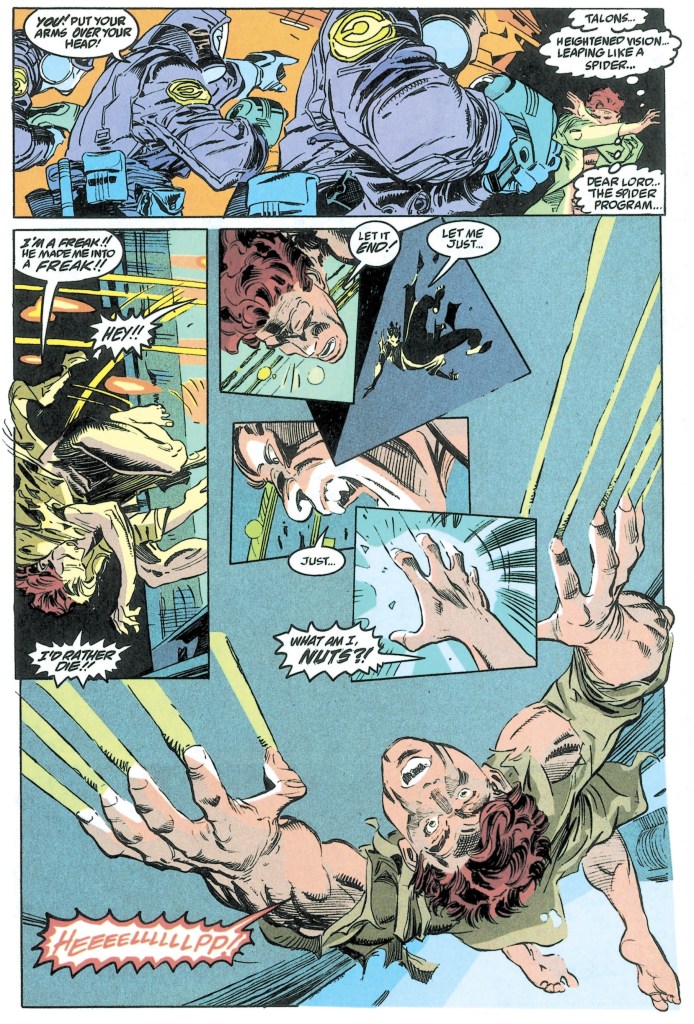
Miguel grabs Aaron’s arm not realizing that his talons are hurting his rival. The skin of Aaron’s arm got ripped off causing him to fall to his death below. Miguel gets dressed as armed personnel arrive. As shots were fired, Miguel falls off the edge…
Quality
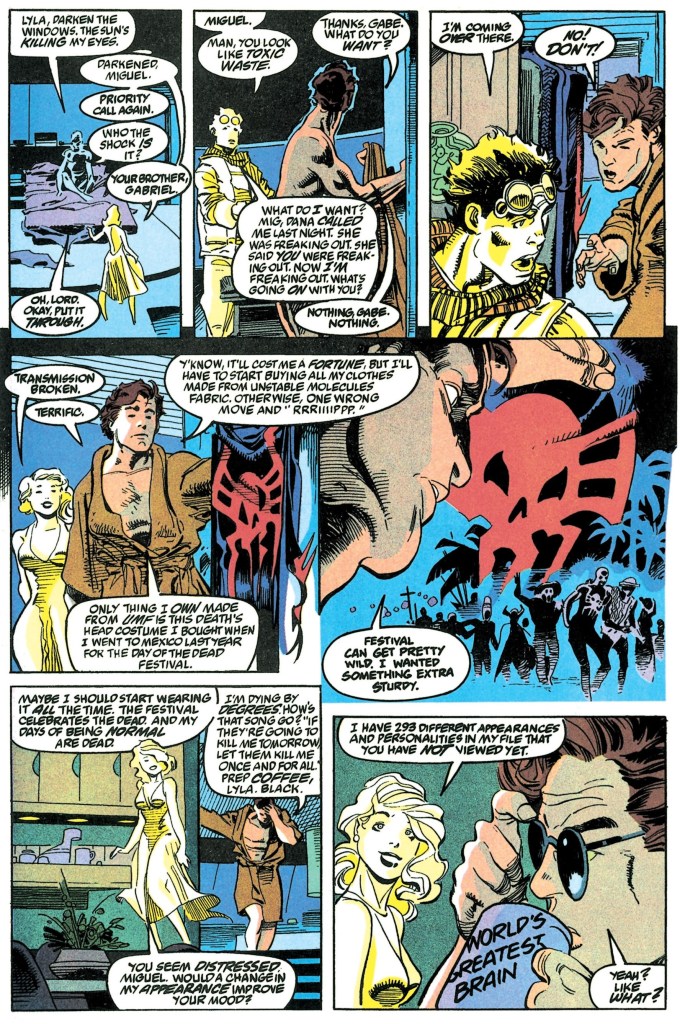
The costume!
This is a very well-written story by Peter David. While the first issue established Miguel O’Hara’s personality and corporate standing, this one established his becoming Spider-Man 2099 by means of mutation. Not only does he have talons (which retract automatically when he touches his own skin) and sharp teeth, he also gains heightened vision, enhance leaping ability, and most notably his costume (backed with a reasonable explanation it exists). The scenes of corporate intrigue and the introduction of the cyber cowboy named Venture easily added a detective story element into the plot which was quite gripping. No doubt about it, I found the story in this comic book more satisfying than the first issue.
Conclusion
Spider-Man 2099’s talons save him from falling further.
Spider-Man 2099 #2 (1992) is a great read and this is the one comic book that fully establishes the title character as we know him.
If you are seriously planning to buy an existing hard copy of Spider-Man 2099 #2 (1992), be aware that as of this writing, MileHighComics.com shows that the near-mint copy of the regular edition costs $15 while the near-mint copy of the newsstand edition costs $45.
Overall, Spider-Man 2099 #2 (1992) is highly recommended!
+++++
Thank you for reading. If you find this article engaging, please click the like button below and also please consider sharing this article to others. If you are looking for a copywriter to create content for your special project or business, check out my services and my portfolio. Feel free to contact me as well. Also please feel free to visit my Facebook page Author Carlo Carrasco and follow me at HavenorFantasy@twitter.com
Disclaimer: This is my original work with details sourced from reading the comic book and doing personal research. Anyone who wants to use this article, in part or in whole, needs to secure first my permission and agree to cite me as the source and author. Let it be known that any unauthorized use of this article will constrain the author to pursue the remedies under R.A. No. 8293, the Revised Penal Code, and/or all applicable legal actions under the laws of the Philippines.
Welcome back, superhero geeks, comic book collectors and fans of the Ultraverse! Join me on this trip back into the Ultraverse and witness the events in one of the early issues of the Mantra monthly series.
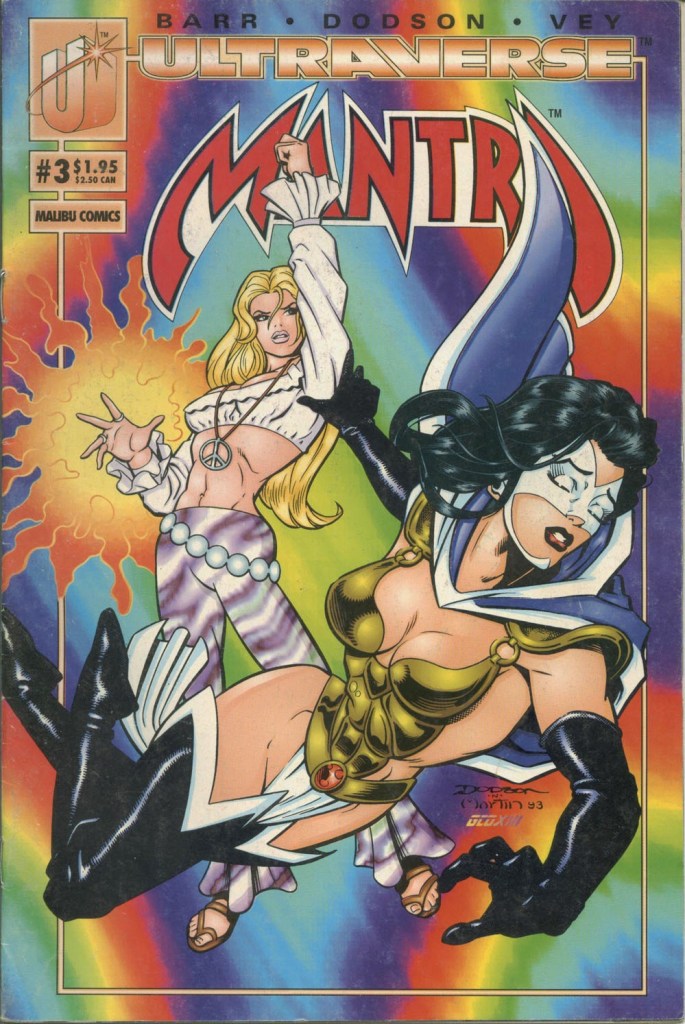
In issue #2, the male warrior Lukasz found himself really challenged being inside the body of a pretty single mother Eden Blake (Mantra) whose soul his displaced. Not only does Lukasz have to avoid getting killed by troops of Boneyard as he strives to somehow leave the lady’s body in favor of a male body, he has to adjust to living as Eden who has a home to keep, a private sector job to fulfill and two children to take care of. With those details laid down, it’s now time to take a look back at Mantra #3, published in 1993 by Malibu Comics with a story written by Mike W. Barr and drawn by Terry Dodson.
The cover.
Early story
The story begins in the hallway of the cinema wherein Mantra finds herself surrounded by the Repo Men who won’t stop at trying to overwhelm her. Mantra is at a disadvantage as she has yet to learn the ways of using magic.
As the Repo Men keep Mantra down, a group of bystanders witness what happened. Meanwhile, Eden’s daughter Evie and son Gus are in the middle of the hallway not realizing that Mantra is their mother in disguise. Eventually Mantra remembers her mantra and finally starts using magic to have the Repo Men off-balance and free herself from them. As the other Repo Men approach her, she blasts them with heat which burns them instantly in front of the bystanders. Mantra decides to fly away leaving behind Evie and Gus. The two kids are searching for their mother Eden.
Quality
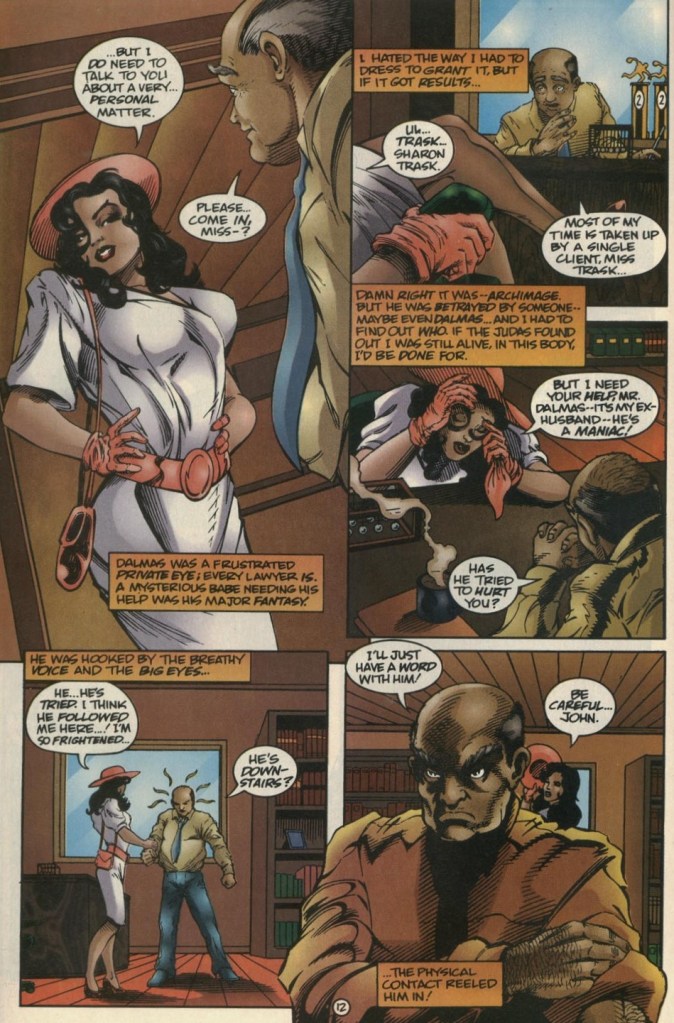
Being trapped in the body of Eden Blake, the male warrior Lukasz tries to gain an advantage by charming a man he knew.
The strong quality of storytelling that started in issue #1 and followed through issue #2 is present in this comic book. Mike W. Barr’s story here remains nicely balanced between plot, character development and spectacle. I can also confirm that this story explores more of Lukasz struggling with living the domestic life of Eden which unsurprisingly makes his struggle to meet his goals even tougher. When it comes to defining the characters, there is a very touching scene in which Lukasz as Eden talks privately with a crying Evie in her bedroom, and even with an attempt to somehow separate themselves the unexpected (but really touching) result happens. And then there was another scene in which Lukasz uses Eden’s beauty to charm his way with someone for answers. This comic book’s script was undoubtedly written cleverly by Mike W. Barr.
Like in the first two issues, Terry Dodson excelled with visualizing the script. By this particular issue, the looks of Mantra and other related characters have been well established and he drawn them with a pretty good amount of detail. Dodson’s art here shines even more once Mantra begins to encounter one very particular adversary (note: she’s on the cover) and how it all turns out is something for you readers to find out for yourselves.
Conclusion
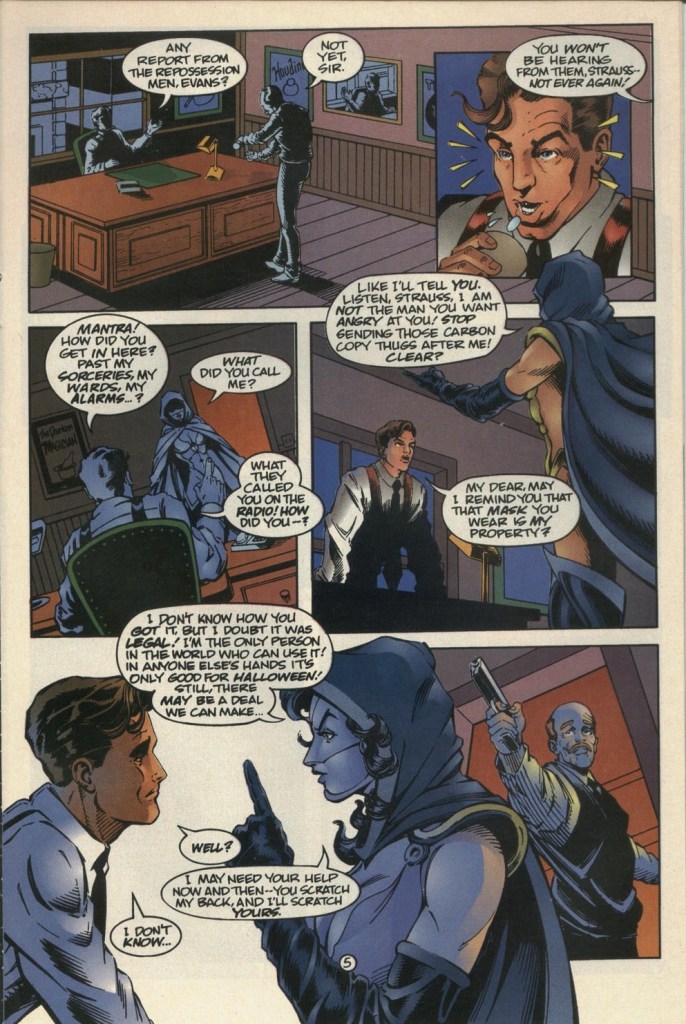
Mantra in a serious discussion.
I can confirm that Mantra #3 (1993) is a compelling Ultraverse story to read as it continues to be intriguing and define Mantra’s personality in an efficient and believable way. Along the way are revelations that further establish the core concepts of this monthly series and the way they were done shows strong preparations were made by Mike W. Barr before writing the script.
If you are seriously planning to buy an existing hard copy of Mantra #3 (1993), be aware that as of this writing, MileHighComics.com shows that the near-mint copy of the regular edition costs $8 while the near-mint copy of the newsstand edition costs $26.
Overall, Mantra #3 (1993) is recommended.
+++++
Thank you for reading. If you find this article engaging, please click the like button below and also please consider sharing this article to others. If you are looking for a copywriter to create content for your special project or business, check out my services and my portfolio. Feel free to contact me as well. Also please feel free to visit my Facebook page Author Carlo Carrasco and follow me at HavenorFantasy@twitter.com
If you are looking for fried chicken to eat here in South Metro Manila, there are plenty of places to find them such as Jollibee, KFC, Popeyes and McDonald’s among the many restaurants. You can even find fried chicken meals served in convenience stores like Ministop, 7-Eleven and FamilyMart. Rest assured the mentioned business joints provide a lot of fried chicken whenever you are in Las Piñas, Parañaque and Muntinlupa.
There is one food joint that stand out among them all – HOT STAR Large Fried Chicken Philippines. With its newest branch located inside Festival Mall in Filinvest City, Alabang, HOT STAR is making a comeback here in South Metro Manila. Previously they had a branch along Presidents Avenue, Barangay BF Homes in Parañaque City and I ate there a number of times while they lasted. That particular branch closed down a few years ago so it was nice to see them open a new one in Alabang (note: their space is shared with Dakasi).
The commercial space of HOT STAR with Dakasi.
For the newcomers reading this, the HOT STAR business started in Taiwan and has overseas branches. They are best known for selling the 12-inch fried chicken which has a nugget-like shape but really large and quite filling.
At their Festival Mall branch, I had two stops there. The first time I was there, I joined the line to order myself a meal composed of their signature 12-inch fried chicken (referred to as the Signature XXL Chicken), rice and a drink. When asked for what type and what flavor the chicken should be, I chose the original type flavored with salt and pepper. Soon enough I got served and went to a vacant table.
The 12-inch signature fried chicken of HOT STAR.
Looking at the 12-inch original, salt-and-pepper fried chicken, it really was exactly as I remembered what was served to customers at the previous branch in BF Homes. It was also a bit challenging to cut into pieces given its formation and texture, so there were moments when I had to take the chicken by hand and pull it apart before trying to cut it into pieces with the plastic utensils.
As before, the 12-inch signature fried chicken is pretty tasty on its own. It was tasty enough, I did not bother to use any condiments. What is also notable about it is that it sure has a lot of content of chicken meat to consume. In fact, it was more than enough to fill the stomach. While this might sound unusual to you, this is pretty normal given my previous dining experience at HOT STAR BF Homes. That being said, I had a tasty and really satisfying meal there at HOT STAR Filinvest.
A few weeks later, I returned to the Festival Mall branch mainly to take home one of their newer foods – the Cheese Bomb. After driving home with the chicken from the mall, I got home and placed it on a plate.
This is what the Cheese Bomb looks like on the outside.
On the surface, the Cheese Bomb fried chicken has a different shape compared to the signature fried chicken. It looked ordinary on the outside but it is the cheese content inside the makes the big different not only in terms of content but also on flavor. As I ate the Cheese Bomb, I really felt that fine combined taste of fried chicken and cheese in my mouth and it only made me want to keep consuming until it all ran out. I got my money’s worth.
The cheese of Cheese Bomb exposed.
A closer look at the Cheese Bomb. The cheese itself is tasty.
To put it in short, I can say that the 12-inch signature fried chicken and the Cheese Bomb were both well cooked by HOT STAR Festival Mall and were properly prepared. It is notable that the two fried chicken variants were pretty flavorful respectively which shows that the cooks made them with the utmost care for me. As such, I highly recommend the 12-inch signature fried chicken and the Cheese Bomb to anyone who loves fried chicken. I got my money’s worth and so should you.
So if you happen to be in the Alabang area and you crave for fried chicken, you should visit HOT STAR at Festival Mall. They are on the ground floor level of the mall. Keep in mind that HOT STAR has several other types of food to offer such as spaghetti, rice bowl meals, burgers and fries, and chicken wings to name some. HOT STAR is a standout among the sellers of friend chicken here in South Metro Manila.
+++++
For more South Metro Manila community news and developments, come back here soon. Also say NO to fake news, NO to irresponsible journalism, NO to misinformation, NO to plagiarists, NO to distorted views, NO to reckless publishers, and NO to sinister propaganda when it comes to news and developments. For South Metro Manila-related community developments, engagements, commerce and other relevant updates, visit and join the South Metro Manila FB group at https://www.facebook.com/groups/342183059992673
Disclaimer: This is my original work with details sourced from reading the comic book and doing personal research. Anyone who wants to use this article, in part or in whole, needs to secure first my permission and agree to cite me as the source and author. Let it be known that any unauthorized use of this article will constrain the author to pursue the remedies under R.A. No. 8293, the Revised Penal Code, and/or all applicable legal actions under the laws of the Philippines.
Welcome back, superhero geeks, comic book collectors and fans of the Ultraverse! Some time ago, I reviewed the sixth issue of The Solution and it turned out to be a pretty compelling and fun comic book to read. I was pleasantly surprised by its high quality and presentation, and by the end I found Lela Cho/Tech (the leader of The Solution) to be a very interesting character of the Ultraverse. Clearly the creative duo of James Hudnall (who also wrote Hardcase) and John Statema literally scored a home run with The Solution #6.
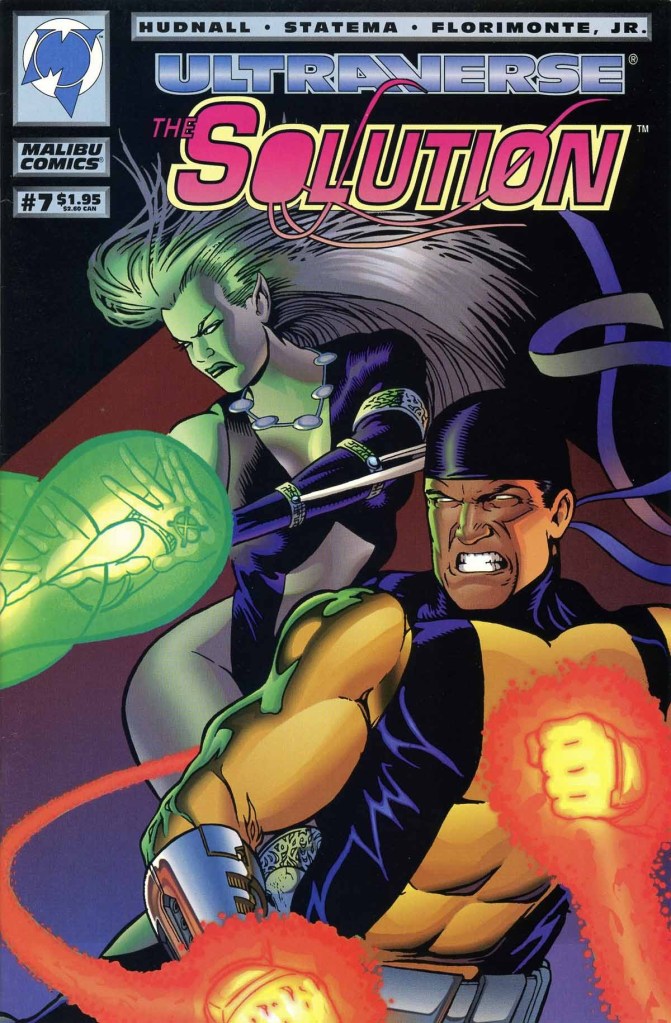
As The Solution #6 focused on the background story of Tech, its portrayal of the current-day events was laced with suspense, drama and intrigue that only teased what could happen in the next moment. What else could be told about Lela Cho’s past and what might happen next in the present day? We can find out in this look back at The Solution #7, published in 1994 by Malibu Comics with a story written by Hudnall and drawn by Statema.
The cover.
Early story
The story begins with Lela Cho accompanied by Troy Wilde standing in front of her father’s grave. The two don’t seem to know that they are being spied on from a distance. A group has set up snipers to take them down.
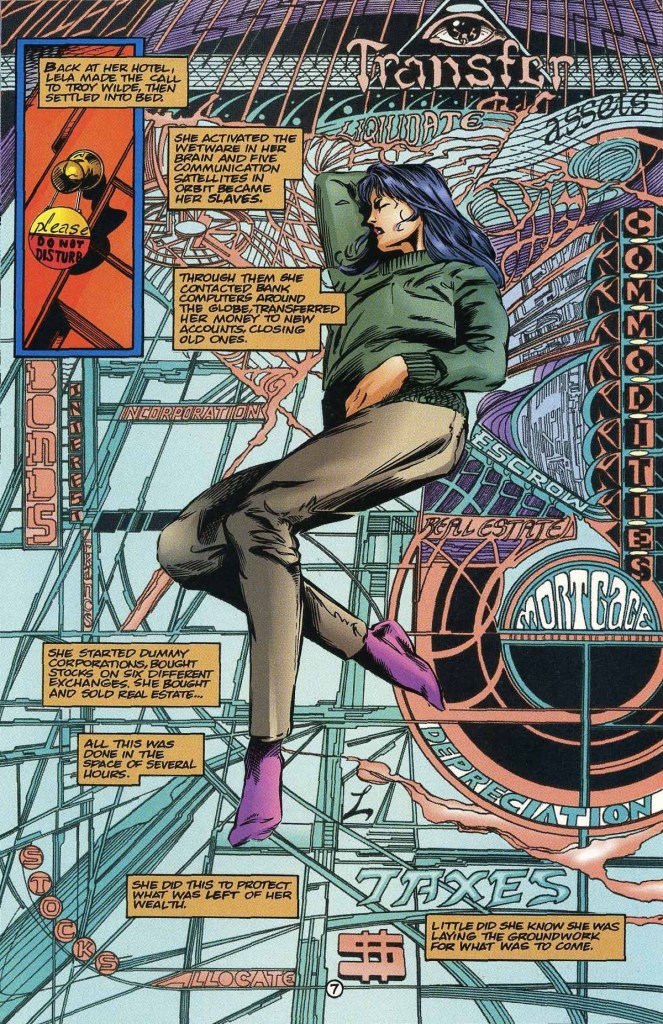
As the two begin to talk, Lela tells Troy details from her past. She recalls that after the sudden death of her father, she could not fully gain the inheritance from her father – the corporation – as its board of directors refused to accept her. As it turned out, a crime gang anticipated her every move and stole her company. To enhance herself, she paid specialists to install wetware implants into her body to make her the mistress of electronic devices.
She arrived in the city of New York already aware that she has been marked by her enemies, and she knew they would come for her. In New York, she meets with Peter Bazinni to seek help. Not only is he a man with many powerful connections, he was also her old flame. While Peter admitted he could not help her in her conflict with the international crime gang, she gives her a reference to another professional who is her best bet. His name was Troy Wilde…
Quality
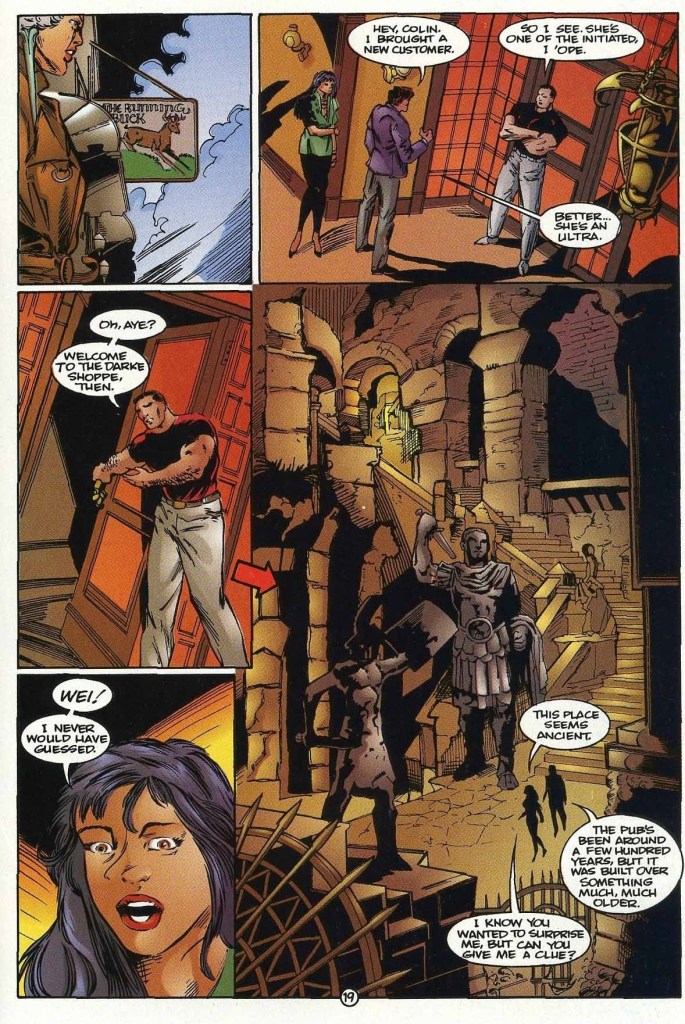
Discovering the secret locations.
James Hudnall delivered another pretty solid story. It’s got a nice mix of elements here and there. From time to time, I felt like I was reading a detective story, then a murder tale, then a hard action tale and then a hard-edged superhero tale. While this comic book continued on telling the origin of Lela Cho, it shifted focus on the background of Troy Wilde who would eventually join the team with the codename Dropkick. How Lela and Troy first interacted with each other was very carefully crafted with believable dialogue and well-defining personalities from each (as reflected in the way they talked with each other). Another member of The Solution appeared in here is as well.
What surprised me here was the revelation of a certain villainess. At first, she looked like a probably disposable villainess but proved to be more significant than meets the eye. If you get to read the succeeding issues of The Solution, you will realize what I just stated.
As with his past works, John Statema’s art here is pretty good. The good stuff he delivered in issue #6 continued to shine here.
Conclusion
Lela Cho’s ultra ability to hack systems and alter digital stuff would help her fit in nicely with this age of social media and streaming.
The Solution #7 (1994) is not only a worthy follow-up to its predecessor, it is one of the stronger origin-type comic books of the Ultraverse as a whole. While the previous issue was focused mainly on Lela Cho, this one shows Troy Wilde/Dropkick making his first involvement with her as well as the eventual formation of their team. At this stage, the story of how The Solution got formed really took shape here. I should state, however, that the level of engagement fell down a bit compared to the previous issue.
If you are seriously planning to buy an existing hard copy of The Solution #7 (1994), be aware that as of this writing, MileHighComics.com shows that the near-mint copy of the comic book costs $8.
Overall, The Solution #7 (1994) is recommended.
+++++
Thank you for reading. If you find this article engaging, please click the like button below and also please consider sharing this article to others. If you are looking for a copywriter to create content for your special project or business, check out my services and my portfolio. Feel free to contact me as well. Also please feel free to visit my Facebook page Author Carlo Carrasco and follow me at HavenorFantasy@twitter.com
Disclaimer: This is my original work with details sourced from reading the comic book and doing personal research. Anyone who wants to use this article, in part or in whole, needs to secure first my permission and agree to cite me as the source and author. Let it be known that any unauthorized use of this article will constrain the author to pursue the remedies under R.A. No. 8293, the Revised Penal Code, and/or all applicable legal actions under the laws of the Philippines.
Welcome back, superhero geeks, comic book collectors and fans of the Ultraverse! Before we revisit the Ultraverse, I should state that I am not a fan of monsters as comic book protagonists, especially when it comes to the superhero genre. In the world of pop culture, a lot of people get fascinated with monsters especially those that are dangerous to people. You got the likes of the Swamp Thing, Dracula, the monster of Frankenstein, the Werewolf, etc.
When it comes to the Ultraverse, they have a monster for a protagonist named Sludge. What I find really intriguing was that Sludge was introduced to readers not by making appearances in existing Ultraverse comic books but by actually being featured in full force in the launch of issue of his own series – Sludge #1.
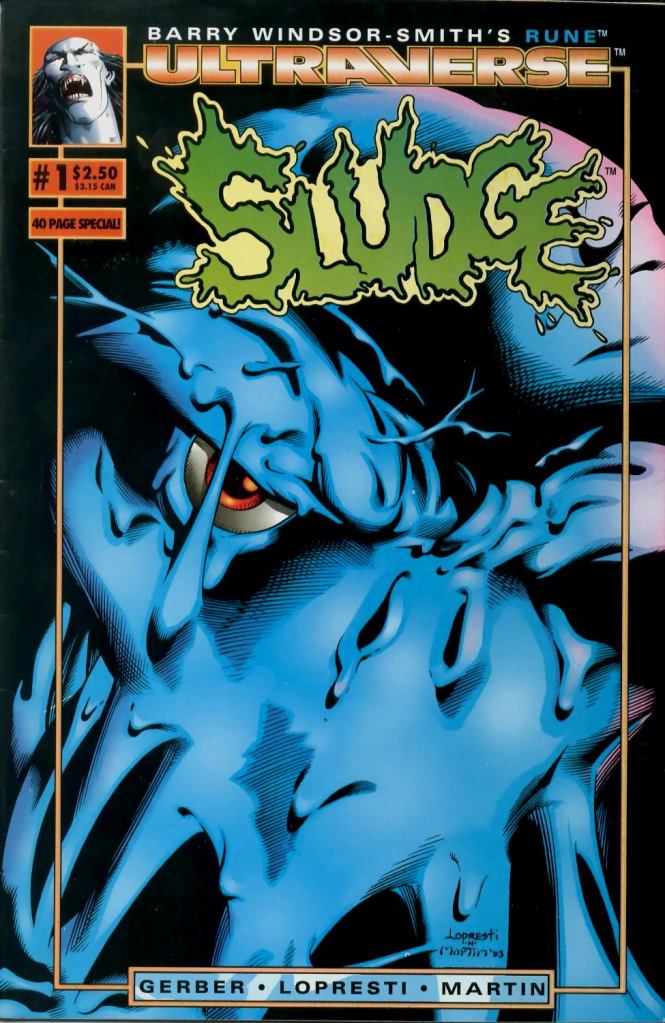
With those details settled, we can find out if there is something special or unique about the Ultraverse monster in this look back at Sludge #1, published by Malibu Comics in 1993 with a story written by Steve Gerber (who previously worked on Marvel’s Man-Thing) and drawn by Aaron Lopresti.
The cover.
Early story
The story begins in a very low place of Manhattan where society’s substratum meets the crust of the earth. Sludge, a grotesque monster with a human perception and a body made out of slime, slowly walks towards a group of poor and homeless people.
Elsewhere somewhere in the city, a radio talk show host talks to his listeners about Frank Hoag, a detective sergeant who worked for twenty years for the New York Police Department or NYPD. It turns out, Hoag has been missing for the past few weeks and the last thing someone knew about him was that he responded to a call about a break-in at the headquarters of a pharmaceutical firm. The next morning at the said place, company employees spotted signs of violence including blood, bullet holes and shell casings. No sign of the detective.
As the radio talk show host engages his listeners by making an issue out of the disappearance of Hoag, police officers got offended while a gang of armed thugs paid close attention to what was said. As the said gang (riding their car) move down the street of homes, they opened fire at the people.
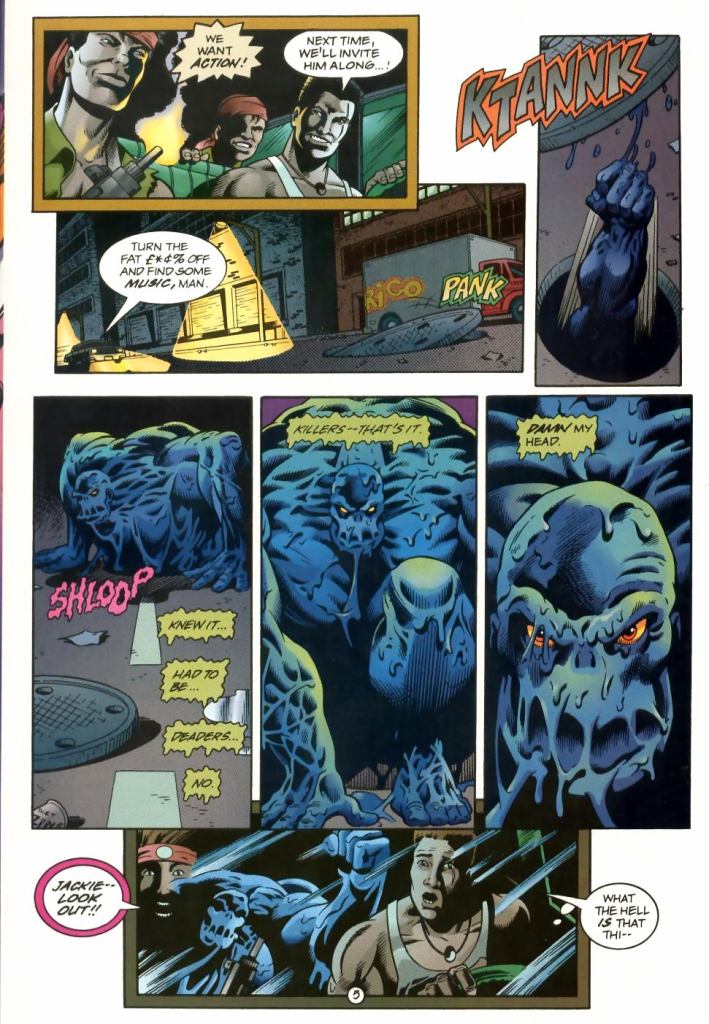
As the gang’s car moves on, the manhole ahead of them opens. Sludge comes out of it and finds himself right on the path of the moving car…
Quality
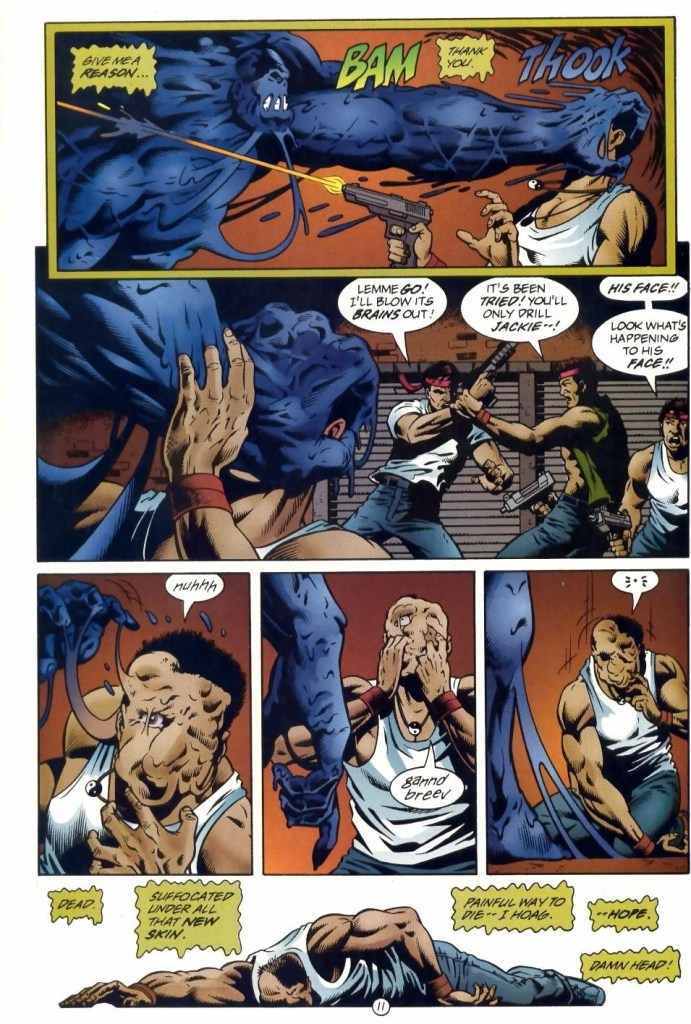
This is why you don’t mess with Sludge.
The writing is top-notch and this is no surprise not only because of Steve Gerber’s extensive writing experience but also because he knew how to write a story with a monster as a protagonist which was what he did with Marvel’s Man-Thing. Unlike that other monster, Sludge has intelligence and awareness, therefore he is a monster with humanity still existing within. Very cleverly, Gerber introduced Sludge and notable aspects of him in a very smooth and efficient manner. By the time I finished this reading this comic, I realized that I witnessed Sludge’s first appearance and origin story which were done very nicely. I should also state that Sludge here is not a mere monster but really a struggling character worth following.
For his part, Aaron Lopresti’s art is pretty good. His visualization of Sludge really stands out and he did not pull back his punches when it came to drawing the action and presenting the violence.
Conclusion
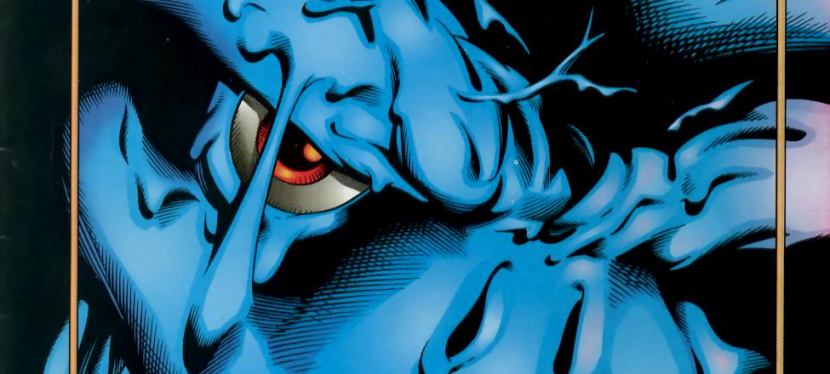
Considering his physical state, Sludge coming out of the manhole is justified.
I can say that I am very pleasantly surprised and entertained by what was presented in Sludge #1 (1993). It really is a great monster-protagonist story written by Steve Gerber and his work here really shines. By the time I reached the end of the story, I got eager to look forward to the next issue and find out what Sludge will do next. It is a very engaging read and one of the strongest debut issues of the Ultraverse.
If you are seriously planning to buy an existing hard copy of Sludge #1 (1993), be aware that as of this writing, MileHighComics.com shows that the near-mint copy of the regular edition costs $8 while the near-mint copy of the ultra-limited edition costs $32.
Overall, Sludge #1 is highly recommended!
+++++
Thank you for reading. If you find this article engaging, please click the like button below and also please consider sharing this article to others. If you are looking for a copywriter to create content for your special project or business, check out my services and my portfolio. Feel free to contact me as well. Also please feel free to visit my Facebook page Author Carlo Carrasco and follow me at HavenorFantasy@twitter.com
Disclaimer: This is my original work with details sourced from reading the comic book and doing personal research. Anyone who wants to use this article, in part or in whole, needs to secure first my permission and agree to cite me as the source and author. Let it be known that any unauthorized use of this article will constrain the author to pursue the remedies under R.A. No. 8293, the Revised Penal Code, and/or all applicable legal actions under the laws of the Philippines.
Welcome back, X-Men fans, superhero enthusiasts and comic book collectors! Today I’m about to review another Chris Claremont-Jim Lee comic book of the X-Men from 1991.
Before getting to the retro comic book review, let’s take a look back at history. Marvel Comics started publishing comic book of the X-Men in 1963 which involved the combined talents of Stan Lee and Jack Kirby. The original X-Men members were Cyclops, Beast, Marvel Girl, Angel and Iceman all under the mentorship of Charles Xavier (AKA Professor X). That monthly series was not a strong seller and was weak compared to the other monthly titles of Marvel. Although Roy Thomas and Neal Adams were brought in to reinvigorate the X-Men series with new characters, success in sales did not materialize and eventually the series was turned into a reprint series (from issues #67 to #93).
In 1975, Len Wein and Dave Cockrum made Giant-Size X-Men #1 which introduced a new team. Along the way, Wein (who was also the editor-in-chief of Marvel at the time) hired Chris Claremont to become the lead writer of the X-Men series starting issue #94 which was released that same year. Claremont redefined the X-Men by developing the characters deep inside and emphasized their respective personalities. As the years passed by, Claremont wrote notable X-Men storylines such as The Dark Phoenix Saga, Days of Future Past, Mutant Massacre, and Fall of the Mutants to name some. Not only did Claremont write The New Mutants, he also co-created many other characters that became part of the X-Men franchise.
Then came the year 1991. The launch of the new X-Men monthly series (focused on the Blue Team led by Cyclops) saw sales tremendous success with issue #1 and by that time Jim Lee was established as one hot new creators under Marvel. Behind the scenes, however, Claremont clashed with then X-Men books editor Bob Harras. Eventually, issue #3 of the 2nd X-Men monthly series marked the end of the X-Men era of 1975-1991.
I should say that I enjoyed reading issue #2 in which Claremont wrote a story that not only raised the stakes but also pushed the entire group of mutants to the edge. We will find out soon enough if Claremont’s X-Men era of 1975-1991 will end strongly in this retro review of X-Men #3, published in 1991 by Marvel Comics with a story by Claremont and Jim Lee (who also illustrated).
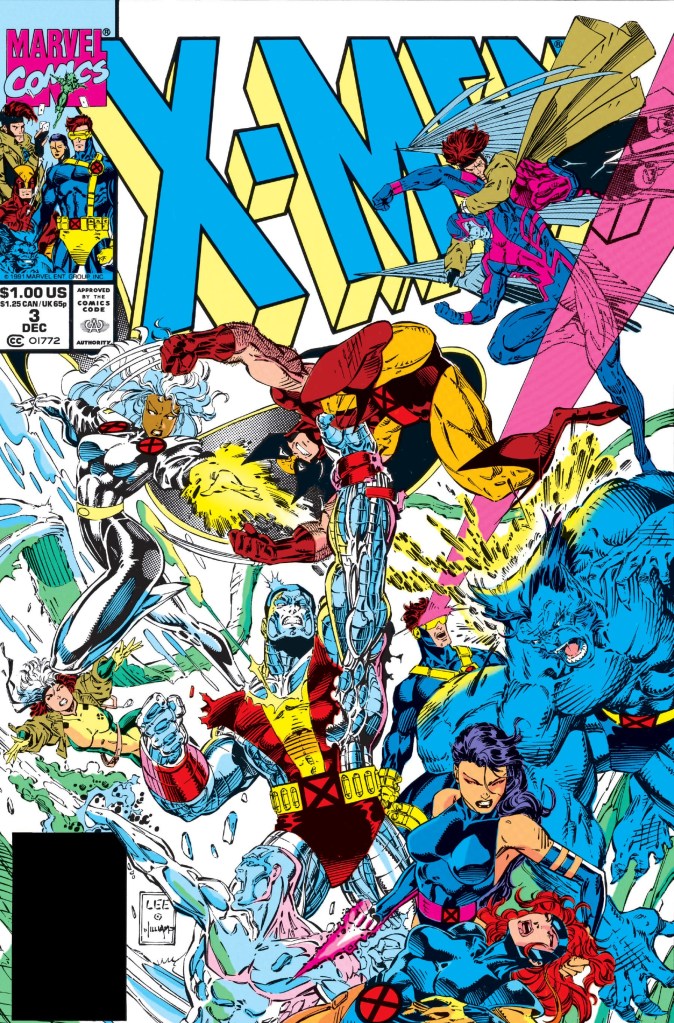
The cover.
Early story
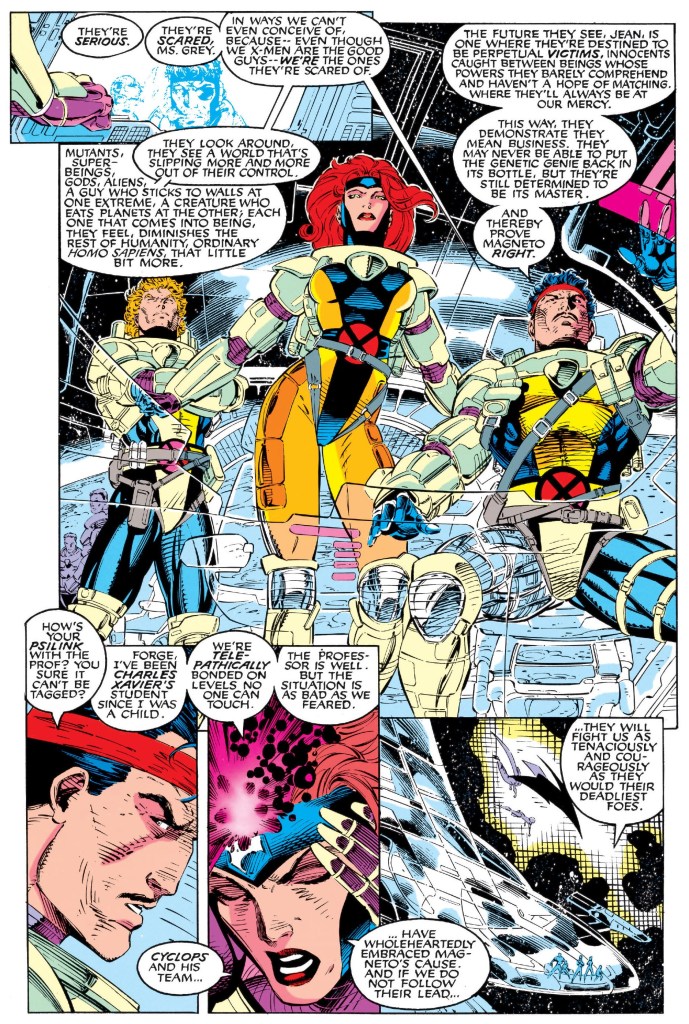
The story begins in outer space. Members of X-Men’s Gold Team (composed of Archangel, Storm, Jean Grey, Forge, Iceman, Colossus and Banshee) fly stealthily towards Asteroid M where Magneto and his Acolytes are with Charles Xavier and Moira MacTaggert held captive. With the exception of a few, members of the X-Men Blue Team were brainwashed by MacTaggert to follow Magneto.
On Earth, the plasma cannon is being prepared to destroy Asteroid M. Nick Fury warns his colleagues about the possibility of tremendous damage if ever Asteroid M hits the surface of the planet. Valerie Cooper tells him that the firing trajectory has been calculated to blast the target away and into deep space. An exchange of words follows over diplomacy and following orders issued by the leaders.
Over at Asteroid M, Charles Xavier is alone in a room with a wide view of the Earth and space. Behind the scenes, Fabian Cortez points to Xavier as Magneto’s deadliest enemy. He asked his master why not use Moira MacTaggert’s procedure (to brainwash and turn) on Xavier. Magneto, already suffering physically, does not want Xavier turned but be broken…
Quality
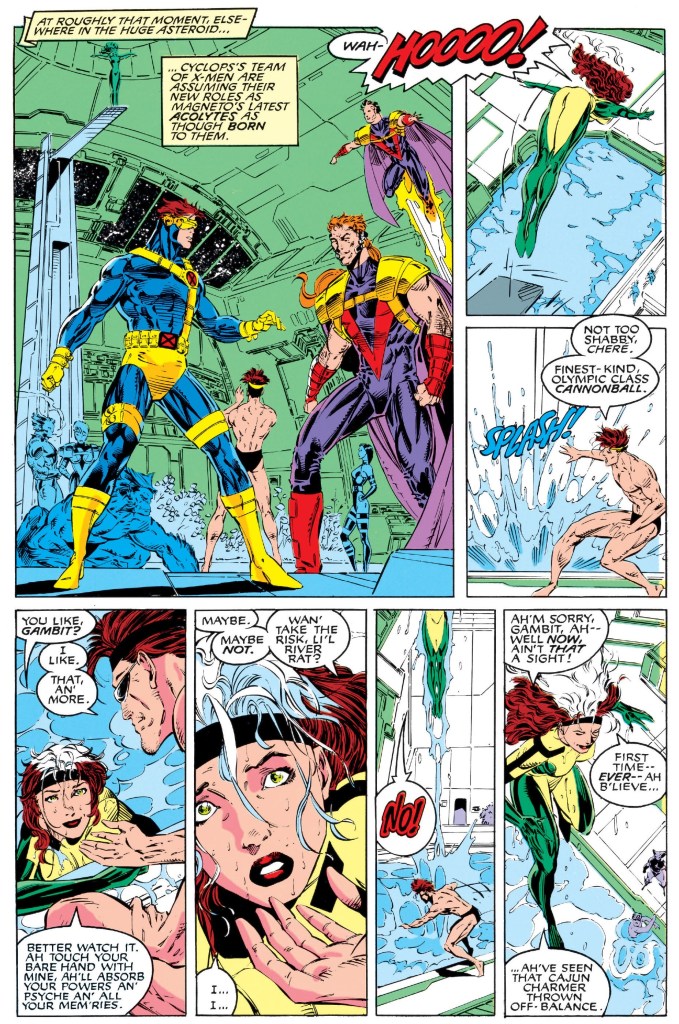
X-Men Blue Team members relaxing at Asteroid M in the presence of the Acolytes.
Like in issue #2, the story here is very engaging and highly dramatic. While it paid close attention to Magneto’s ruthlessness as well as his rage towards Moira who committed something unethical to him in the past, the story managed to focus enough on the X-Men which involves both the Blue Team and Gold Team mixed up. While this comic book’s cover shows a battle royale between the Blue and Gold teams, there is a lot of substance beyond the action. I’m talking about moments spent on the mutants of Xavier which was done in a satisfying manner (never felt crammed nor forced) considering the page limits of this comic book. Not only were the X-Men moments executed smoothly, there were pulled off efficiently and orderly.
More on the story, what adds intrigue is the group of Acolytes whose field leader Fabian Cortez has not only gotten very close with Magneto but also does something significant to him along the way. By this issue, the Acolytes led by the master of magnetism have gotten more established as a worthy opposition against Xavier’s mutants. This story also showed that the Acolytes were here to stay, and Fabian Cortez himself is very led by wickedness and ambition. Cortez is also an example about the distortion of righteousness
When it comes to defining the characters, Xavier and Magneto clashing together about their respective dreams about mutants is unsurprisingly epic to read. In this particular conflict, both Marvel icons were portrayed very dramatically and their respective expressions were indeed intense. Adding further intrigue to their clash is Moira’s long-past act of manipulating the very genetics of Magneto which itself raises serious questions about her perception, decision-making and ethics. In some ways, Moira looked more villain-like.
As expected, the art of Jim Lee is great to look at. There were some signs, however, that the very wordy script resulted an increased numbers of panels per page. Fortunately, the art did not look rushed and maintained a clear narrative. Also the action scenes are great to look at which is not surprising.
Conclusion
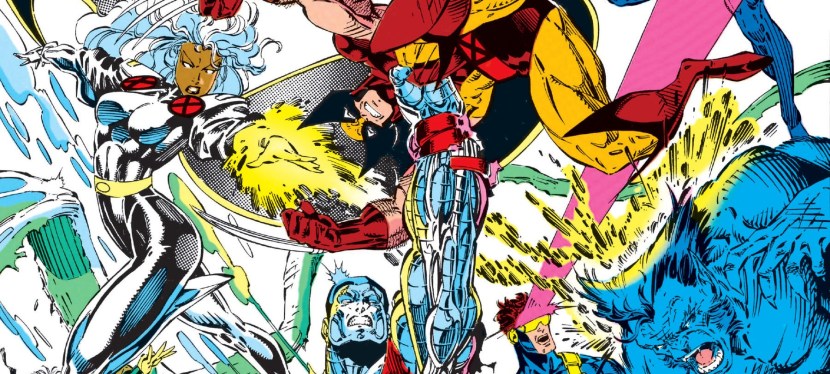
The Gold Team of the X-Men travel towards Asteroid M in a cloaked vehicle.
To put it straight, X-Men #3 (1991) is an epic read highlighting the very conflict between Magneto and Xavier over the course of mutants and their place in the world of humans. This comic book, which has a very powerful ending, was indeed a very satisfying way to conclude the Xavier-Magneto conflict as well as Chris Claremont’s long-term stint with the X-Men comic book franchise. Back in 1991, this one really looked like the end of an era both in-story and in real life. Of course, what this comic book achieved ultimately became temporary because Magneto was revived for the Fatal Attractions storyline in 1993 (celebrating X-Men’s 30th anniversary) and Chris Claremont himself returned to Marvel Comics some years later. Still, on its own, this comic book is worth reading and adding to your collection, even if you are not an X-Men fan. It is significant enough as a piece of X-Men history from the time when Jim Lee was with Marvel.
If you are seriously planning to buy an existing hard copy of X-Men #3 (1991), be aware that as of this writing, MileHighComics.com shows that the near-mint copy of the regular edition costs $9 while the near-mint copies of the Chris Claremont-signed edition, the signed newsstand edition, the newsstand edition and the Toy Biz edition cost $16, $26, $16 and $21 respectively.
Overall, X-Men #3 (1991) is highly recommended!
+++++
Thank you for reading. If you find this article engaging, please click the like button below and also please consider sharing this article to others. If you are looking for a copywriter to create content for your special project or business, check out my services and my portfolio. Feel free to contact me as well. Also please feel free to visit my Facebook page Author Carlo Carrasco and follow me at HavenorFantasy@twitter.com
Disclaimer: This is my original work with details sourced from reading the comic book and doing personal research. Anyone who wants to use this article, in part or in whole, needs to secure first my permission and agree to cite me as the source and author. Let it be known that any unauthorized use of this article will constrain the author to pursue the remedies under R.A. No. 8293, the Revised Penal Code, and/or all applicable legal actions under the laws of the Philippines.
Welcome back Ultraverse fans, superhero enthusiasts and comic book collectors. In this newest return to the Ultraverse originally launched by Malibu Comics and its many talented creators, we will witness what is supposed to be the rise of genuine opposition against The Strangers which was seen building up in issues #16 and #17.
To start with, the character called Pilgrim is quite intriguing being the apparent central figure that wants to smash The Strangers. Along the way, other ultras that opposed the said team end up getting involved with Pilgrim.
Will all these developments lead to the establishment of a powerful force against The Strangers? What can team leader Lady Killer do about it? We can all find out in this retro comic book review of The Strangers #18, published in 1994 by Malibu Comics with a story by Steve Englehart and drawn by Rick Hoberg.
The cover.
Early story
The story begins on sky island. The Pilgrim and his companion appear right next to Zara (one of the members of Yrial’s tribe) telling him, “I am the Pilgrim, Zara! I want you to help me destroy the Strangers!”
Even though the Pilgrim continued to elaborate more on offering him revenge on Yrial, Zara thinks that the foreigner is insane. Zara uses his magic powers while the Pilgrim activates his own special abilities.
Meanwhile on Pier 25, Grenade tries to regain Candy’s trust who recently started distancing herself from him. Grenade decides to let her be but remembered clearly that the division started since the Pilgrim showed up.
Over at Berkeley, the old ultra called Powerhouse looks for a job. Suddenly the Pilgrim appears to him and attempts to recruit him in his quest to destroy the Strangers. Like Zara of sky island, he doubts the Pilgrim, finds him insane and attempts to strike him.
In another location, flying in the air, Yrial tells Spectral that she feels the power of the Pilgrim is closing in on them. Inside the Strangers’ hangout, Bob/Atom Bob and Elena/Lady Killer spend quality time together. Bob expresses worry about the one that wants to destroy them (note: he fought with the Pilgrim in issue #17) and, in response to the lady’s question, he states that his arm is pretty much back to normal thanks to Spectral’s healing green flame. After further talk, Bob asks her, “Will you marry me?”
Quality
The battle begins!
As expected with the Englehart-Hoberg creative team, the story is fun and engaging to follow from start to finish. For one thing, apart from the rising opposition led by the Pilgrim, the character development for Bob and Elena as well as the rift between Electrocute and Grenade were executed nicely, even serving as a fine build-up before the story shifted into high gear with spectacle. Expect lots of action and banter between the characters fighting. This is one very wordy comic book to read and it sure is worth it!
Behind all the good stuff, there was even room for a nice surprise by the creative team and that is something you must read for yourselves. That alone made this one an intriguing read as well.
Conclusion
The rift between Grenade and Electrocute.
There is no doubt that The Strangers #18 (1994) is a very entertaining comic book to read. Apart from the solid character development and the big bonanza of action, this comic book highlights the effects of the Jumpstart not only the Strangers themselves but also on other people. At this stage, the Pilgrim has evolved into a more meaningful character and he simply cannot be dismissed as just another villain nor another anti-hero.
If you are seriously planning to buy an existing hard copy of The Strangers #18 (1994), be aware that as of this writing, MileHighComics.com shows that the near-mint copy of the comic book costs $8.
Overall, The Stranger #18 (1994) is highly recommended!
+++++
Thank you for reading. If you find this article engaging, please click the like button below and also please consider sharing this article to others. If you are looking for a copywriter to create content for your special project or business, check out my services and my portfolio. Feel free to contact me as well. Also please feel free to visit my Facebook page Author Carlo Carrasco and follow me at HavenorFantasy@twitter.com

Disclaimer: This is my original work with details sourced from reading the comic book and doing personal research. Anyone who wants to use this article, in part or in whole, needs to secure first my permission and agree to cite me as the source and author. Let it be known that any unauthorized use of this article will constrain the author to pursue the remedies under R.A. No. 8293, the Revised Penal Code, and/or all applicable legal actions under the laws of the Philippines.
Welcome back, Ultraverse fans and superhero comic collectors! Today, we will revisit the Mantra monthly series again and it has been almost two weeks since my last Mantra review. For the newcomers reading this, Mantra’s mortal enemy is Boneyard who got involved in the Mantra-Strangers crossover (refer to The Strangers #13 and Mantra #12).
Before those mentioned stories took place, something else happened involving Boneyard. That is what we will find out in this look back at Mantra #8, published in 1994 by Malibu Comics with a story written by Mike W. Barr and drawn by John Statema (who was involved in UltraForce #2).
The cover.
Early story
The story begins in an unknown location with Boneyard who commands Notch to speak as his patience dwindles. Notch states that he has devised a plane to capture the ever elusive Mantra (male warrior Lukasz occupying the body of Eden Blake) involving a betrayal by a friend. Notch requests for a few troops and the custody of the creature in cell 13. Boneyard reacts by saying that if Notch succeeds, he will have Mantra after she has borne an offspring for him )Boneyard). Failure would mean Notch will become occupant of cell 14.
Elsewhere Warstrike (riding with a lady) drives his car fast getting away from the car of armed men chasing him. The chase ends with a crash of two cars freeing Warstrike. Some time later, Warstrike arrives home and to his surprise, Mantra is already there. He gets kissed by Mantra (emphasizing a touch of homosexuality) and asked about a change of her attitude. As it turns out, the Mantra who made sexual advances to him transforms into a grotesque creature with lots of tentacles. Warstrike then realizes it was not really Mantra at all. Eventually, the creature wraps itself all over Warstrike. Notch suddenly appears and blows a substance to him.
The next morning, Eden Blake/Mantra arrives at the office catching everyone’s attention due to her beauty and sexy outfit. Eden suddenly notices that everyone around looks like Warstrike. Suspecting that what is happening is the manifestation of magic, she goes to her office to find answers…
Quality
Even though she has magic, Mantra still is physically weaker which Lukasz has trouble adjusting with.
Getting straight to the point with regards to the story, this one has a nice mix of action, intrigue, suspense and the search for answers. It also pays attention to the very awkward alliance between Mantra and Warstrike. Warstrike was the last person to have killed Lukasz in his male form which led to him getting reincarnated as Eden Blake (displacing Eden’s soul) and in this story, you will see he even has sexual interest with her even though he knows Lukasz is occupying that beautiful body. This comic book also shows how powerful a villain Boneyard is and how his soldiers are willing to do his commands. With regards to the locations, I should state that the use of a fantasy-themed amusement park in the story is an excellent concept to emphasize this comic book’s fantasy elements.
When it comes to the art, it is no surprise that John Statema did a pretty good job in capturing the looks of Mantra and the related characters, and his pacing of the visuals is similar to that of Terry Dodson. Statema worked on several other Ultraverse comic books including The Solution #6 which looked great and his art really brought the script to life. Mantra, Boneyard, Warstrike and other relevant characters look recognizable with Statema’s style. The artist also excelled in drawing fantasy visual elements like magic, swords, armor, monsters, etc.
Conclusion
Eden Blake is the center of attention at the office.
I can clearly say that Mantra #8 (1994) is an entertaining comic book to read. It has a self-contained story that is very well told and John Statema’s art made it a lively read.
If you are seriously planning to buy an existing hard copy of Mantra #8 (1994), be aware that as of this writing, MileHighComics.com shows that the near-mint copy of the regular edition costs $8 while the near-mint copy of the newsstand edition costs $26.
Overall, Mantra #8 (1994) is recommended.
+++++
Thank you for reading. If you find this article engaging, please click the like button below and also please consider sharing this article to others. If you are looking for a copywriter to create content for your special project or business, check out my services and my portfolio. Feel free to contact me as well. Also please feel free to visit my Facebook page Author Carlo Carrasco and follow me at HavenorFantasy@twitter.com
Disclaimer: This is my original work with details sourced from reading the comic book and doing personal research. Anyone who wants to use this article, in part or in whole, needs to secure first my permission and agree to cite me as the source and author. Let it be known that any unauthorized use of this article will constrain the author to pursue the remedies under R.A. No. 8293, the Revised Penal Code, and/or all applicable legal actions under the laws of the Philippines.
Welcome back, Ultraverse fans and superhero comic book collectors! We are about to return to the Ultraverse through The Strangers. Before doing so, I’d like to discuss one of their members named Elena La Brava AKA Lady Killer. Before the big incident that changed her life and those of her eventual teammates riding the cable car in San Francisco, Elena worked professionally as a fashion designer. She is quite resourceful, brave and organized. Apart from proving to be a very valuable member of the team, she has the special ability to track and this results helping her hit what she aims for. As seen in previous issues leading to issue #16, she has been romantically linked with Atom Bob and has struggled also on leading the team.
With those details mentioned, it’s now time to look back at The Strangers #17, published in 1994 by Malibu Comics with a story written by Steve Englehart and illustrated by Rick Hoberg.
The cover.
Early story
The story begins at the headquarters of The Strangers. Spectral arrives late and apologizes to his teammates who are already feeling disturbed by the Pilgrim. Lady Killer makes an issue about Spectral’s tardiness and reminds him he has not seen the Pilgrim as he was absent. Spectral replied emotionally stressing that he had to attend to his private life.
When asked about the Pilgrim, Grenade replies that nobody knows who their antagonist is. In recent times, the team faced off with various costumed individuals in two encounters and the Pilgrim appeared each time and took them with him. Each time, the Pilgrim swore he would continue to get back at The Strangers until he builds up a team large enough to oppose them.
Knowing that the Pilgrim will keep coming back at her team, Lady Killer states she has a plan…
Quality
The start of a pretty solid battle between the Pilgrim and Atom Bob.
The writing for this comic book is, as expected, very strong and undoubtedly it is a great follow-up to what happened in issue #16. Instead of just another encounter between The Strangers and another antagonist which turns into an opportunity for the Pilgrim to come out and do his thing, this one has a lot more compelling stuff backed with surprise and intrigue.
Before the big conflict happened, this comic book showed more of Lady Killer’s intelligence and her ability to organize something that is believable to read. Atom Bob, who missed out on the battle of issue #16, is more involved in this comic book and his battle with the Pilgrim was not only heavy on the spectacle but also showed more of his capabilities and his willingness to achieve something.
Unsurprisingly, there is a lot of what I would call the usual visual goodness from artist Rick Hoberg here. He continued to show a consistent high level of quality when drawing the characters, their expressions and making the superhero action scenes look spectacular.
Conclusion
The Strangers meeting early.
The Strangers #17 (1994) is a very good read and what I love about it is that it further added to the build-up of the growing opposition against The Strangers while at the same time developing the core characters more. You will see more of Lady Killer’s leadership values here and eventually, you’ll admire her more. I should state that Rafferty, a serial killer in the Ultraverse, had a notable presence in this comic book and added some impact to the plot.
If you are seriously planning to buy an existing hard copy of The Strangers #17 (1994), be aware that as of this writing, MileHighComics.com shows that the near-mint copy of the comic book costs $8.
Overall, The Strangers #17 (1994) is highly recommended!
+++++
Thank you for reading. If you find this article engaging, please click the like button below and also please consider sharing this article to others. If you are looking for a copywriter to create content for your special project or business, check out my services and my portfolio. Feel free to contact me as well. Also please feel free to visit my Facebook page Author Carlo Carrasco and follow me at HavenorFantasy@twitter.com
Disclaimer: This is my original work with details sourced from reading the comic book and doing personal research. Anyone who wants to use this article, in part or in whole, needs to secure first my permission and agree to cite me as the source and author. Let it be known that any unauthorized use of this article will constrain the author to pursue the remedies under R.A. No. 8293, the Revised Penal Code, and/or all applicable legal actions under the laws of the Philippines.
There is so much said about X-Men #1 of 1991 which was launched to major success by Marvel Comics selling at least eight million copies worldwide. That launch issue, written by Chris Claremont and drawn by Jim Lee, had multiple covers and a version with gatefold covers and high-quality paper which made it an instant hit with collectors chasing profit. In 2011, Marvel even released the so-called 20th anniversary edition of X-Men #1 which was digitally recolored.
In terms of substance, X-Men #1 marked the new era of the X-Men. Charles Xavier returned to his mansion to lead the X-Men which was so large as a group, it had to be divided into two team with Cyclops leading the Blue Team and Storm heading the Gold Team. In terms of publishing, Marvel published tales of the Gold Team in the Uncanny X-Men monthly series while the Blue Team’s stories were published in the adjective-less X-Men monthly series.
With all the attention paid to X-Men #1, I noticed that not too many people cared to talk about what happened after the end of that comic book. Without spoiling plot details, the massive seller of 1991 had its story end in a cliffhanger. To find out what followed and determine the quality of the creative team’s work, here is a look back at X-Men #2 published in 1991 by Marvel Comics with a story co-written by Chris Claremont and Jim Lee (who illustrated).
The cover.
Early story
The story begins in the fictional island nation of Genosha which has a legacy of mutant slavery. Having fought with the Acolytes (led by Fabian Cortez), the X-Men now face Magneto who arrived and tells them that he will not abandon the Acolytes.
“They acted in an excess of zeal. If so…I..and I alone..shall determine their appropriate punishment,” Magneto tells the team of Cyclops, Gambit, Beast, Wolverine, Psylocke and Rogue. Near them are other Acolytes members down on the ground.
After words spoken by Gambit, Rogue and Cyclops, Magneto referred to the devastation of the city hospital as fitting for punishing a state (Genosha) whose prosperity was built on the backs of mutant slaves. Beast answered back saying that the Genoshans have accepted responsibility for what they have done and resolved to make amends.
While Magneto replies to Beast, a military Genoshan helicopter gunship fires missiles at them from above which the X-Men’s archvillain intercepts. Using his magnetic power, Magneto lifts steal beams and destroys the helicopter with them. He then turns against the X-Men restarting the chaos in the city…
Quality
Magneto, Psylocke and Rogue in the middle of the chaos.
Being the middle of a 3-part story, this comic book pushes the entire X-Men group to the edge thanks to strong writing by Chris Claremont. I’m not simply referring to the traditional good-versus-evil formula of superhero storytelling as the story here emphasized themes about sanity, loyalty, legacy, idolatry and even diplomacy. It just so happens that there is a lot of superhero spectacle to enjoy here and there.
The stakes have been raised significantly in this story as Magneto is shown leading the Acolytes who in turn went ahead with their first mission which explains the chaos in Genosha. Magneto’s condition also deteriorates and gets himself healed by Fabian Cortez who is more sinister than what he seems. For his part, Charles Xavier of the X-Men gets to interact with his long-time friend Dr. Moira MacTaggert who is struggling with guilt from something she committed in the past. Through Magneto, Xavier and MacTaggert, there is this solid build-up of tension that led to a very powerful revelation in the 2nd half of the story which, ironically, put the X-Men on the sideline temporarily. There is high drama, deep tension and high intensity involving Magneto and MacTaggert, and their scene together is the highlight of the story.
Conclusion
The face-off!
To put it straight, as much as I loved X-Men #1 (1991), I find X-Men #2 (1991) more compelling to read. For one thing, it rewards X-Men fans who dedicatedly followed the events of not only the X-Men but also of that of the life of Magneto. It’s really great that Chris Claremont literally dug up the past for details that proved to be useful in this comic book. It also nicely sets up anticipation of the next issue by involving the X-Men’s Gold Team. Unsurprisingly, with the combined talents of Claremont and Jim Lee, this is an excellent read that really looks great.
If you are seriously planning to buy an existing hard copy of X-Men #2 (1991), be aware that as of this writing, MileHighComics.com shows that the near-mint copy of the regular edition costs $4 while the near-mint copies of the Chris Claremont-signed regular edition, the Chris Claremont-signed newsstand edition and the newsstand edition cost $9, $19 and $13 respectively.
Overall, X-Men #2 (1991) is highly recommended!
+++++
Thank you for reading. If you find this article engaging, please click the like button below and also please consider sharing this article to others. If you are looking for a copywriter to create content for your special project or business, check out my services and my portfolio. Feel free to contact me as well. Also please feel free to visit my Facebook page Author Carlo Carrasco and follow me at HavenorFantasy@twitter.com