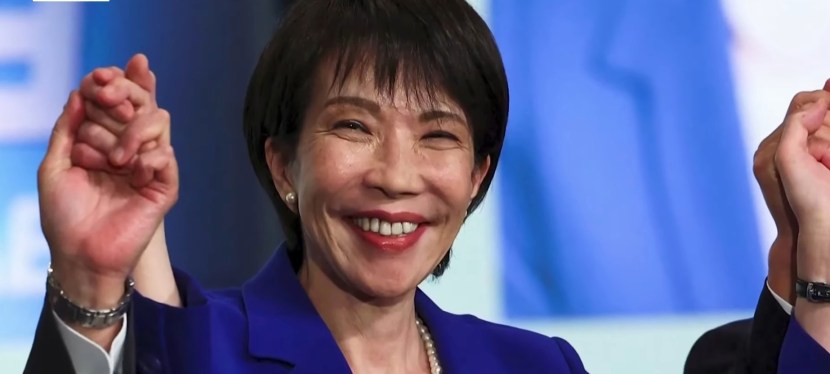
Japan now has a new Prime Minister and her name is Sanae Takaichi (Takaichi Sanae for those who communicate in Japanese) and already her administration has been formed. Prime Minister Takaichi is a strongly conservative woman who not only has friendship with US President Donald Trump, but also met the late Margaret Thatcher who is her main inspiration for conservative governance and leadership. Being conservative, her loyalty to her people and nation is uncompromising and she intends to preserve the Japanese culture and ways while other nations of the world gave in to illegal immigration, Islamic terrorists and woke ideology.
To get yourselves oriented with the new Prime Minister of Japan, watch the selected videos below.
Shortly after taking office, an official statement was released by the Prime Minister which you can read in English below.
Today, I was designated as the nation’s Prime Minister, and a new Cabinet has been inaugurated. Bolstered by a strong and unwavering belief in the latent power and vitality of Japan and the Japanese people, I will dedicate myself completely to discharging my duty of forging a path for Japan’s future.
I will work resolutely for the sake of our nation and the Japanese people, filled with the determination to press ahead tenaciously under any circumstances. I will strive to build a strong economy, turning people’s unease and apprehension over their current lives and the future into hope, and I will deal with the challenges facing the international community as I embark on restoring Japanese diplomacy that flourishes on the world’s center stage.
I ask the Japanese people for their understanding and cooperation as I take these responsibilities upon myself.
Prime Minister Takaichi has already formed her cabinet and the stock market jumped sharply in response to her election. Takaichi was first elected to the Diet (Japan’s Parliament) in 1993 and she went on to serve for decades notably under the administration of the late Shinzo Abe. Clearly she is very experienced as a public servant.
A younger Takaichi with former British Prime Minister and conservative icon Margaret Thatcher many years ago. (photo source – Nikkei Asia)
The new Prime Minister also declared that Japan will NOT take in Islamists and illegal immigrants. This is a strong stance that I admire in Takaichi. Illegal immigration is a global disease that leads to worsening crime, failed multiculturalism and a series of problems for citizens. Islamists meanwhile are focused on migrating in great numbers to new countries believing they can overwhelm the locals, spread violence and hatred, and then destroy the local societies and cultures with the intention to replace them with their own.
In my experience, I visited Japan as a tourist. I admired Japan for its rich culture, its conservative ways, long lasting traditions and how their people lived with discipline and harmony. I certainly do not want illegal immigration and Islamization to ruin Japan. In fact, wokeness and political correctness are diseases and they will never make Japan better. That said, it is only right that Takaichi took office as Prime Minister.
The woke, the Satanic Leftists, the unhinged rabid feminists, the diversity extremists, the illegal immigration extremists and the LGBTQ mob can always keep on condemning PM Takaichi all they want (note: they have been doing it since Takaichi was elected president of her party weeks ago) but Japan does not really have to bow to them nor does it need to follow their evil ideologies. Takaichi has a nation to rebuild, an economy to revive and a lot of fellow Japanese people to take care of.
Let me end this piece by asking you readers: What is your reaction to this development? What do you hope to see in Japan under the leadership of Prime Minister Takaichi? Did you see archive photos of Takaichi personally meeting former British Prime Minister Margaret Thatcher?
Housing companies located in Japan are looking towards the Philippines and other countries as sources of workers that can be hired for their services in connection with the surging local demand, according to a Nikkei Asia news report.
To put things in perspective, posted below is an excerpt from the Nikkei Asia news report. Some parts in boldface…
Companies in Japan that offer housekeeping services such as cleaning, laundry and ironing are increasingly turning to the Philippines and other places overseas as they rush to meet surging demand from time-strapped customers.
With working from home fading in the wake of the COVID-19 pandemic and the number of dual-income households rising, more people in the country are willing to pay for help handling chores.
Pushing to keep pace with this growing appetite for their services, housekeeping firms are accelerating their recruitment abroad — especially as relaxed immigration rules for the sector boost the appeal of hiring beyond Japan’s borders.
Indeed, Tokyo-based housekeeping service provider Bears plans to hire an extra 150 foreign workers in 2024 to bolster the 300 it already employs, with each person offered 400 hours of training.
The overseas recruitment drive comes as crushing labor shortages threaten a range of industries in Asia’s No. 3 economy and one of the world’s fastest-aging societies.
“Let’s make sure we clean windows and mirrors evenly by wiping in one direction,” an instructor said to 33-year-old Mundacruz Lizyldeci, who came to Japan from the Philippines this year, during a training session in a living room-like space at Bear’s head office. Listening to the instructions in early May with a serious look on her face, Lizyldeci said, “I will provide the high-quality services demanded by Japanese consumers.“
Bears says it plans to hire work-ready foreign housekeepers such as those licensed by the Philippine government.
Filipino workers hired through Bears’ subsidiary in the Philippines are given Japanese language and other lessons for two months before coming to Japan. They go through a two-week training program in Japan, which includes checks on their housekeeping skills. They are paid and assessed on the same basis as Japanese workers, with help available in Tagalog.
Housekeeping services by foreign nationals without permanent residence status began in areas designated as special economic zones in 2017. The government in 2020 extended the time such people are permitted to stay in the country to five years from three, while offering an additional three-year extension in 2023 for those who meet certain conditions.
In Japan, dual-income households began to outnumber those with stay-at-home housewives in 1992. The amount of two-paycheck families had increased to nearly 13 million by 2023, a roughly 40% rise over three decades, according to the Ministry of Internal Affairs and Communications.
Japan’s market for housekeeping services had grown to a value of 80.7 billion yen ($516 million) by fiscal 2021, more than doubling from five years earlier, according to the latest survey by Teikoku Databank. But in the research company’s 2023 consumer survey, only 1.8% of some 2,200 respondents in their 20s to 40s said they used housekeeping services. “I know of such services but have never used them” was the reply chosen by nearly 76%.
Nevertheless, potential demand for housekeeping services appears strong as roughly half of households in the survey considered home chores a burden. To convert potential demand into actual demand, fair prices for the services, as well as their quality and safety, need to be ensured.
Another driver for the rising demand is a shift from from the days of the COVID pandemic, when many people worked online from home. More employers are now telling their staff to come into the office.
A 35-year-old woman who has a job at a major financial institution in Tokyo often worked from home during the pandemic. But after restarting commuting to the office, she began using major housekeeping service provider CaSy’s so-called matching service from last November.
“I use ironing and laundry services once every two weeks,” she said. “I didn’t have much time to spare due to lots of overtime work. I can now go out on weekends.“
CaSy has some 170,000 registered customers and 15,000 housekeepers. The matching service introduces housekeepers to customers depending on the chores they need handling. But given frequent mismatches between customers and housekeepers over dates and places of work, CaSy created a program in February to complement orders, when necessary, with other housekeeping service providers. It has so far tied up with 15 companies for the program and hopes to increase the number to 100 in three years.
Before the registration of housekeepers, CaSy screens applicants’ records, including for any criminal convictions, through identity verification company Trustdock. While providing a sense of reassurance to customers, CaSy has set clear criteria for housekeepers about when and how to exit from customers’ homes to protect housekeepers from possible harassment by clients. “We must settle security-related problems while nurturing professional housekeepers,” said Yuki Shirasaka, a CaSy director.
The financial burden on customers is a major barrier to an increase in the use of housekeeping services. In France and Germany where over 10% of people use such services, financial support such as tax breaks are available to customers. Japan’s government will begin an experiment, possibly later in May, to provide subsidies to cover some costs when small and mid-size companies offer home services as a benefit for their employees.
Minimaid Service, which started housekeeping services for wealthy households back in 1983, is expanding its customer base by holding fees in check. A swift, inexpensive service introduced by Minimaid has helped stoke a threefold increase in the number of times its services have been used over the past five years. The company plans to increase its employee numbers by around 50% in two to three years.
Housekeeping services are roughly divided into three business models: the employment of housekeepers as staff, which prioritizes the quality of services through education; matching between customers and housekeepers commissioned by service providers; and websites for matching between customers and housekeepers on a person-to-person basis. Fees vary greatly.
Let me end this piece by asking you readers: What is your reaction to this recent development? Do you know anyone in your local community who is willing to work in Japan as housekeeping worker? Do you think the hiring of many Filipino workers by Japanese housekeeping companies will be economically beneficial for their families and the national economy in the long run?
To put things in perspective, posted below is an excerpt from the Nikkei Asia article. Some parts in boldface…
James Relativo thought he had landed a great deal on an electric drum set, but instead the Manila resident was cheated out of his money in a country gaining the dubious distinction as Asia’s worst for online sales scams.
Shoppers across the Philippines have been bilked out of millions of dollars so far this year, with some turning to victim chat groups on Facebook and other social media. A recent report found more than one-third of Filipinos surveyed had been scammed or encountered retail fraud online.
“Some people easily believe in false promises even if they are too good to be true,” warned Alexander Ramos, executive director of the Cybercrime Investigation and Coordinating Center (CICC).
In retrospect, Relativo might have been more skeptical about a drum set going for 8,000 pesos ($140), less than half the usual price, on e-commerce site Shopee.
But he hit ‘buy’ without hesitating, and soon things turned suspicious. The seller shifted its communications to a messaging app and demanded half the cost of the drums for “refundable taxes.”
More money demands followed until a frustrated Relativo agreed to bypass Shopee’s payment system and settle his remaining balance on GCash, a digital payments platform. He never got his drums.
“I just kept telling him I wanted my money back,” Relativo told Nikkei Asia, his voice laced with exasperation. “It wasn’t like I was dealing with a scammer — he was talking to me, sending me pictures of the drum set being packed.“
The journalist’s saga highlights a bitter experience for a growing number of people in the Philippines, which clocked the highest scam rate for online shoppers across nearly a dozen economies in the 2023 Asia Scam Report, published in November.
Commissioned by the Global Anti-Scam Alliance (GASA) and Taiwan-based tech security company Gogolook, the report surveyed 20,000 respondents about their online shopping experiences in Vietnam, China, Thailand, Hong Kong, Taiwan, Indonesia, South Korea, Japan, Malaysia, Singapore and the Philippines.
The shopping scam rate in the Philippines led the group at an eye-watering 35.9%, followed by mainland China at 27.2%. South Korea had the lowest incidence, at 4.2%.
The explosion in online shopping has created a lucrative market for scammers. And a lack of cybercrime awareness is aggravating the problem in the Philippines, where people spend an average of 10 hours a day online by some estimates.
“Although (Filipinos) are considered very connected and digitally wired, (they) do not have adequate digital literacy skills,” said Mark Manantan, director of cybersecurity and critical technologies at the Pacific Forum in Hawaii.
The survey found that Filipinos were easy prey for scammers because they “respond too quickly” to sellers’ demands.
Let me end this piece by asking you readers: What is your reaction about this recent development? Do you think Nikkei Asia’s article is detailed enough and trustworthy when it comes to gaining a strong awareness about online scams? How members of your household or your local community got scammed online over the past six months? Why do you think a lot of people in the Philippines are so determined to spend a lot of money to watch a Taylor Swift event overseas?
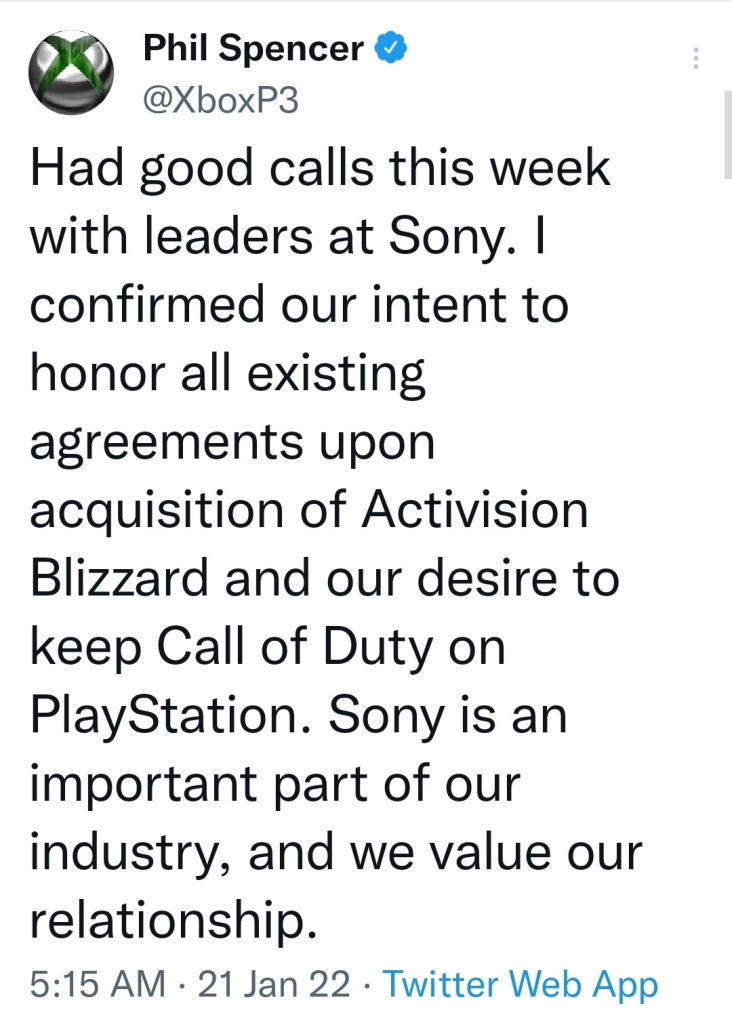
Take note of Spencer’s words “existing agreements” and “our desire to keep Call of Duty on PlayStation.” Existing agreements most likely refer to what Activision Blizzard made with Sony which I believe are years-long deals on games with regards to platform releases, marketing, post-release downloadable content, etc. Of course, such agreements can last long but NOT FOREVER. The business benefit for PlayStation from Activision Blizzard will someday come to an end.
As for Microsoft’s desire for keeping Call of Duty on PlayStation, that clearly means that the corporation of Xbox is technically in-charge of not just the COD franchise but on the decision making, marketing and releasing its games on specific platforms. Sony and its PlayStation team are not in the driver’s seat here anymore. Whatever deals Activision signed with PlayStation before the acquisition will expire and they certainly will not be renewed once Microsoft and its Xbox team takes over. In due time, future COD games as well as other upcoming games and new intellectual properties of Activision Blizzard will become Xbox-exclusive in accordance to what Spencer declared before…
“We have games that exist on other platforms, and we’re going to support those games on the platforms they’re on. There are communities of players. We love those communities and will continue to invest in them. And even in the future, there might be things that have either contractual things, or legacy on different platforms, that we’ll go do. But if you’re an Xbox customer, the thing I want you to know is this is about delivering great exclusive games for you that ship on platforms where Game Pass exists, and that’s our goal, that’s why we are doing this,”
This brings me to my next point – Sony as a global business entity is way behind Microsoft, Apple, Google and Amazon when it comes to establishing ecosystems that result tremendous business growth and reaching billions of customers worldwide respectively. The decades-old console-focused approach by Sony with PlayStation was indeed successful but not great enough to help it grow big time. Not even their Hollywood business nor Spider-Man could lift them up greatly. The weird thing was that Sony in previous decades had established an old ecosystem before PlayStation began.
To put things in perspective, posted below is a long excerpt from a recent Nikkei Asia article. Some parts in boldface…
The 10% drop in Sony’s stock price this week following Microsoft’s announcement that it will buy game content developer Activision Blizzard shows the market has belatedly awakened to an existential flaw in Sony’s kingdom. It lacks an ecosystem.
In terrifying contrast, Microsoft is a formidable ecosystem whose component elements, such as devices, operating system, browser, search engine, applications, content, cloud memory, work hand in glove to suck in captive users and never let them go. The ecosystem effect is all too familiar to owners of PCs that run on the Windows OS, which maddeningly redirects users to Microsoft’s Edge browser and Bing search engine against their will.
It is no accident that five of the world’s seven largest companies by market capitalization — Apple, Microsoft, Alphabet/Google, Amazon and Meta/Facebook — are ecosystems. Every consumer decision to buy a device, be it a PC, smartphone, Kindle reader, or game console, entails a surrender to an interconnected ecosystem. Promiscuity among ecosystems is possible but, by design, not easy. The ecosystems are at war and want to make you their captive.
Ironically, Sony was early to recognize the strategic significance of the ecosystem effect. Its decision to acquire CBS Records and Columbia Pictures in the late 1980s was inspired by the notion that controlling entertainment content could somehow push device sales, such as Betamax VCRs and Sony Walkman.
What Sony overlooked was that it would be self-defeating to make its controlled content exclusively available on Sony devices. Very few consumers would buy a Walkman just because it was the only way to listen to Michael Jackson. And Sony’s refusal to license Michael Jackson to non-Sony device users would perversely shut down third-party royalty revenue from the controlled content. Sony saw, but misunderstood and misapplied, the ecosystem effect between devices and content.
Sony’s next, more costly, wrong turn was its failure to anticipate and keep up with the morphing of portable audio devices like the Walkman launched in 1979 and iPod in 2001 into the iPhone debuted in 2007. The iPhone integrated, in a single handheld device, all of the functions formerly provided by the multiple discrete products in Sony’s consumer electronics lineup: phone, TV, camera, video and audio player and recorder, clock, calculator, and so on.
Sony’s stock price plunged from 30,000 yen ($260) per share in 2000 to 1,668 yen in 2009. Sony and the entire Japanese consumer electronics industry are still in disarray from the iPhone paradigm shift.
Unlike Sony, Apple founder Steve Jobs was a master at creating and orchestrating an ecosystem. In particular, he understood when to link content exclusively to a device and, just as important, when not to. Even now, Apple’s iOS is available only on Apple devices, unlike Microsoft’s device-agnostic Windows OS.Initially, Apple’s iTunes music store platform was available only on Apple’s own devices. Then, in October 2003, “the day that hell froze over,” Jobs made the strategic decision to make iTunes compatible with and freely downloadable by non-Apple devices.
The result was not only to massively increase the audience and revenues of the iTunes platform. Non-Apple device users discovered how great iTunes was and that it worked even better on an iPod, leading to a surge in new iPod owners conveniently prepped for the coming transfiguration of the iPod into the iPhone.
The same interplay between devices and content is at the center of intense competition in the $180 billion global PC gaming industry. Dedicated gamers have a choice among three game-specific consoles — Microsoft’s Xbox, Sony’s PlayStation and Nintendo’s Switch.
The choice of device, in turn, entails a menu of device-specific exclusive content. Xbox and PlayStation each offer about 2,000 titles, but the bestselling 200-300 games for each tend to be exclusive to one or the other. A gamer’s choice of console implies a decision about preferred content.
But the relationship between game devices and content is evolving rapidly, tracking changes elsewhere in the internet universe. Games today can be played on any device, PCs and smartphones, not just a dedicated game console.
Gaming is now mobile. Game content is increasingly being streamed, just like Netflix and Amazon Prime. You can play games on YouTube. And an Xbox can be used as a PC to surf the Internet and do your homework.
The immediate threat to Sony posed by Microsoft’s acquisition of Activision Blizzard is that Microsoft will make the content it is acquiring — global blockbusters like Call of Duty and World of Warcraft — exclusive to Xbox users and invite defections from PlayStation users who want to keep playing their favorite games.
But this is just one element of the multifaceted ecosystem effects Microsoft can deploy to squeeze Sony. Sony should be nervous, for example, that it has no cloud or streaming capability of its own and relies on Microsoft’s own Azure platform to deliver streaming content to Sony users.
Sony’s game and network services segment now accounts for 30% of its revenues. It is hard to see how Sony can compete in the long-term in a narrow game-specific segment without credibly competing with the likes of Microsoft, Alphabet/Google and Amazon across the board in all segments of the device-content spectrum.
From a financial point of view, Sony is not only behind the tech giants with ecosystems. Sony simply does not have the major financial muscle needed to pull off massive acquisitions of game publishers (massive meaning more than $5 billion per each acquisition) that each have lots of game developers, intellectual properties and technologies. The Japanese giant does have a business ecosystem but it’s too small and too narrow compared to its Western competitors. This also means Sony reaches much less customers worldwide.
In a possible response to Xbox-Activision-Blizzard deal, Sony can try to acquire its fellow Japanese gaming entities like Capcom, SEGA or Square Enix and integrate the entity(s) into PlayStation, but that will require not just a whole bunch of money but also willingness to not just make big offers the other party cannot turn down, but also the willingness to overcome all the legal obstacles, solve all the complications, absorb all the employees, fund future projects already in development, etc. If the PlayStation team is willing on building up its very own exclusive properties, they could expand the work forces as well as the projects of their very own game studios.
The Xbox-Activision-Blizzard deal is very hard to match not just because of the financial value and organizational weights involved, but also because the said deal covers consoles, Windows PC, mobile devices, cloud gaming, browser gaming and much more. The PlayStation ecosystem is still console-focused and so far team PlayStation released only a few of its games on PC. Is Sony even working to improve PlayStation Now? Are the PlayStation executives realizing that their 3rd party marketing deals won’t lift up their corporation and consumer base anymore? Has it occurred to the PlayStation executives that future games of the Crash Bandicoot and Spyro The Dragon franchises (both of which are permanently identified with Sony’s gaming brand due to exclusive games released on the first PlayStation console) will be released only on Xbox platforms?
As mentioned in the Nikkei Asia article above, business ecosystems are not perfect and they have their flaws that affect customers in bad ways. As such, the ecosystem powers and organizers should do their work to be more user-friendly and be more consumer-oriented. Still, the ecosystem approach to business has proven to be very effective with regards to reaching the widest number of consumers worldwide as well as driving business growth to new heights, not to mention generating economic benefits for business partners involved (example: credit card companies whose users buy on Amazon, Xbox network, Google, etc.) No amount of sales of Final Fantasy games and Street Fighter games exclusive to PlayStation consoles will ever match that.
As for the console fanboys who still hate Xbox, they should learn to stop living with fantasy and wake up to reality. Time to grow up.
In ending this piece, posted below are videos related to Xbox and the Activision Blizzard deal…
+++++
Thank you for reading. If you find this article engaging, please click the like button below and also please consider sharing this article to others. If you are looking for a copywriter to create content for your special project or business, check out my services and my portfolio. Feel free to contact me with a private message. Also please feel free to visit my Facebook page Author Carlo Carrasco and follow me on Twitter at @HavenorFantasy as well as on Tumblr at https://carlocarrasco.tumblr.com/
By the time you are reading this, you should be aware that what was once impossible for the Philippines became a tremendous breakthrough – national weightlifter Hidilyn Diaz (her official Twitter and Instagram) defeated her Chinese competitor in the Tokyo Olympics women’s 55 Kg. weightlifting competition and won for the Philippines its first-ever Olympic gold medal the other night. The mainstream media of the Philippines went full blast with their coverage of the pioneering achievement.
The Manila Bulletin front page.
The hard copy of the Manila times.
That being said, we Filipinos should praise and thank our Heavenly Father for anointing Diaz to win the often-elusive Olympic gold medal for the Filipino people. Her victory is a clear reminder that with God, nothing is impossible. The Olympic gold victory is pioneering for Diaz and also marks the beginning of a new age in the history of the Philippines even as it remains struggling with the COVID-19 crisis. Before checking on the official news story, watch first these three relevant videos.
And now we can proceed with the official story of the Philippine News Agency (PNA), the excerpt of which is posted below. Some parts in boldface…
After 97 years, the elusive Olympic gold has finally been taken by the Philippines.
Hidilyn Diaz became the first Filipino athlete to win it all in an Olympic event after winning the women’s 55-kg. weightlifting competition at the Tokyo International Forum in Japan on Monday night.
Diaz, the 2016 Rio Olympics silver medalist, prevailed in a neck and neck showdown with China’s Liao Qiuyun in the clean-and-jerk lift as their battle for the gold went down the wire.
Finishing tied with Diaz in the snatch with a 97-kg. maximum lift, Liao lifted 126 kg. in her final lift, forcing Diaz to go for 127 to steal the top spot from Liao.
Diaz, however, smoothly cleared the 127-kg. lift to win it all, also setting an Olympic record in the process.
Her 224-kg. total is also an Olympic record.
“I don’t know what to say. It’s a dream come true. I just want to say that we Filipinos are strong. We Filipinos can compete here at the Olympics. We can do it,” a high-spirited Diaz was quoted as saying by Xinhuanet.
The 30-year-old Diaz gave advice to younger Filipino athletes to “please dream high.”
“That’s how I started. I dreamed high and finally, I was able to do it,” she added.
Liao admitted that she was surprised by Diaz’s improvement.
“I feel good today. I can lift 123kg at most due to injuries, and never thought of a successful 126kg lift. I didn’t expect her strength like this,” Liao said.
“I didn’t expect such a situation,” he said. “Liao has gone all out, so it’s not a huge pity for her to lose the gold medal. It’s just because we did not expect our opponent (Diaz) to be so strong.”
Diaz has also assured herself of a total of PHP33 million from various people who pledged monetary rewards to the gold medal winners.
Zulfiya Chinshanlo of Kazakhstan claimed the bronze with a total of 213 kg. lifted.
Muattar Nabieva of Uzbekistan, despite setting the Olympic record for the snatch with a 98-kg. lift, missed out on the podium as she could only clear 114 in the C&J for a total of 212.
Malacañang joined the entire nation in celebrating the country’s first-ever Olympic gold medal since it joined the most prestigious quadrennial event in 1924.
As you can see in the above PNA story, the first-ever Olympic gold medal won for the Philippines is tremendous and the good news is that, as of this writing, there are still opportunities for other Filipino athletes competing at the Tokyo Olympics to win more medals (even gold) and help lift the nation in the medal rankings. Going back to Hidilyn Diaz (who was born in Zamboanga City in 1991), her pioneering achievement will earn her tremendous (and deserving) financial rewards from both the government and private sector. Check out the respective reports of the Manila Bulletin, GMA News and Nikkei Asia. To nobody’s surprise, a big welcome-back-home for her is being prepared.
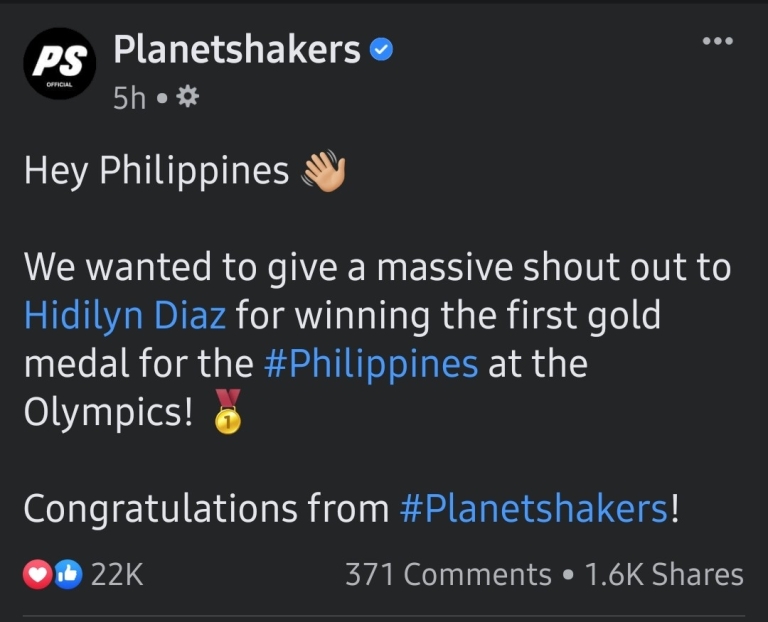
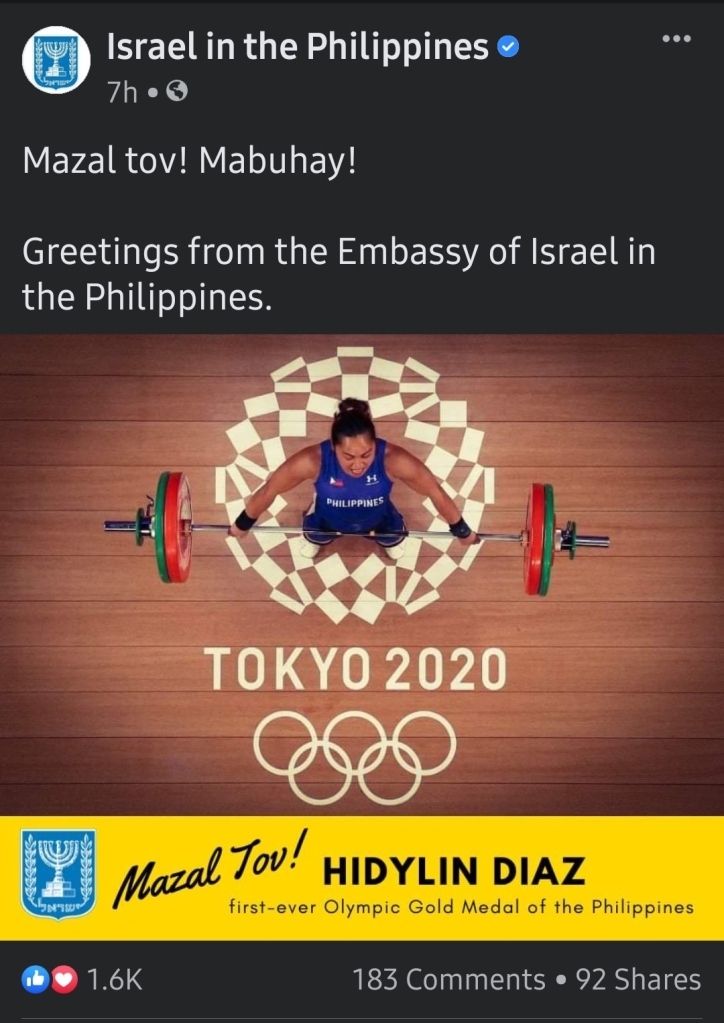
Unsurprisingly, a lot of people around the Philippines, notably public officials who enjoy the automatic mainstream media magnification, expressed their admiration for Diaz and congratulated her. Among the many acknowledgements and congratulatory messages for Diaz expressed by lots of people and organizations (both domestic and foreign), Planetshakers Church in Australia and the Embassy of Israel in the Philippines posted their congratulatory messages for her via their official their respective Facebook pages yesterday. Look at the screenshots below.
Facebook post by Planetshakers.
Post of the Embassy of Israel in the Philippines via Facebook.
Hours after her victory, Diaz posted a picture of herself and the Olympic gold medal on her Instagram as a picture story post. She thanked the people for their prayers.
National fame and Olympic achievement aside, Hidilyn Diaz’s gold medal achievement shows that nothing is impossible with God. Learn from the holy scriptures below…
Jesus looked at them and replied, “With people it is impossible, but not with God—God makes all things possible!”
Mark 10:27 (TPT)
Not one promise from God is empty of power. Nothing is impossible with God!
Luke 1:37 (TPT)
I am convinced that my God will fully satisfy every need you have, for I have seen the abundant riches of glory revealed to me through Jesus Christ!
Philippians 4:19 (TPT)
I know what it means to lack, and I know what it means to experience overwhelming abundance. For I’m trained in the secret of overcoming all things, whether in fullness or in hunger. And I find that the strength of Christ’s explosive power infuses me to conquer every difficulty.
Philippians 4:12-13 (TPT)
To our Lord is all the glory and let us praise and thank Him so much for anointing Hidilyn Diaz who not only won the Philippines’ first-ever Olympic gold medal but also all the many medals and honors she achieved in other international events as the representative of the Philippines. She truly deserves the financial rewards and the inevitable long-lasting fame that comes with being the nation’s first-ever Olympic gold medalist. Still you must always remember that worship is only for the Heavenly Father, Lord Jesus and the Holy Spirit. Never let idolatry dominate you for it is not only unholy, not only foolish but also will separate you from the Lord.
Let me ask you readers: How much of an impact did Hidilyn Diaz’s Olympic gold medal victory have on you as a citizen of the Philippines? Did you ever doubt she would win the gold medal in the Olympics? Does her gold medal victory inspire you to improve yourself?
In closing this article, posted below is a performance of the great Hillsong worship song King of Kings by Melody Hwang.
+++++
Thank you for reading. If you find this article engaging, please click the like button below and also please consider sharing this article to others. If you are looking for a copywriter to create content for your special project or business, check out my services and my portfolio. Feel free to contact me as well. Also please feel free to visit my Facebook page Author Carlo Carrasco and follow me at HavenorFantasy@twitter.com









 Author Carlo Carrasco