A Look Back at The Night Man #2 (1993)

Disclaimer: This is my original work with details sourced from reading the comic book and doing personal research. Anyone who wants to use this article, in part or in whole, needs to secure first my permission and agree to cite me as the source and author. Let it be known that any unauthorized use of this article will constrain the author to pursue the remedies under R.A. No. 8293, the Revised Penal Code, and/or all applicable legal actions under the laws of the Philippines.

Welcome back, superhero fans, comic book collectors, fans of 1990s arts and culture, and fans of Malibu Comics! Today we return to the Ultraverse for another tale of The Night Man, specifically from one of the early issues of its monthly series that launched in 1993.

For the newcomers reading this, Night Man is a solo hero within the Ultraverse who is a musician by day and a crime fighter by night. He was involved in a major accident with a certain cable car in San Francisco that got hit by a bolt of energy from the sky (as told in The Strangers #1). His life was never the same.

With those details laid down, here is a look back at The Night Man , published in 1993 by Malibu Comics with a story written by Steve Englehart and drawn by Gene Ha.
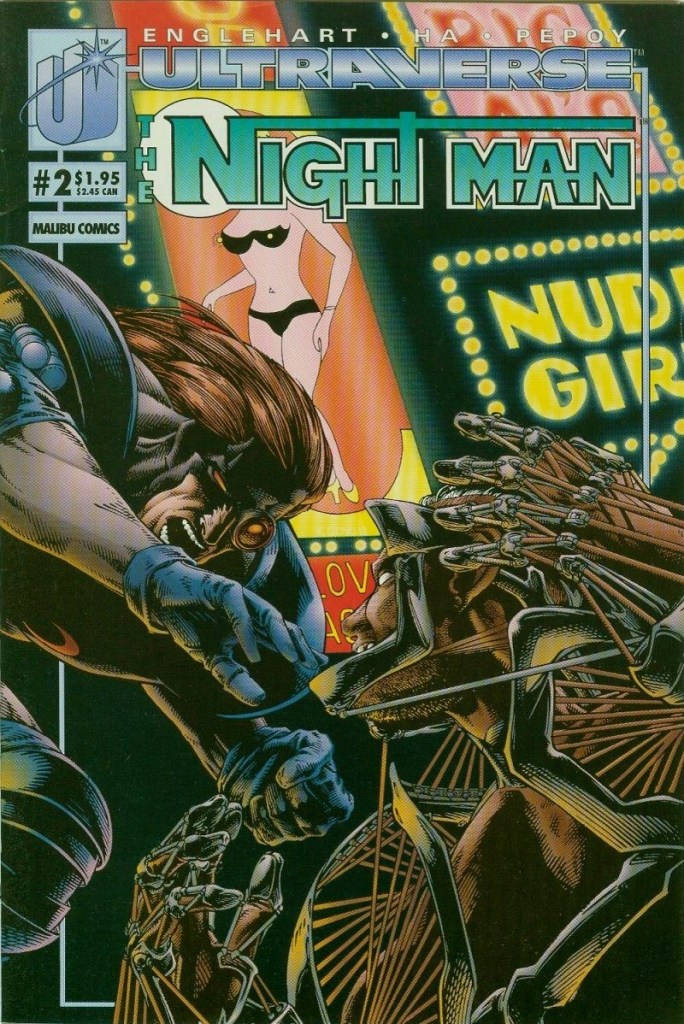
The cover.

Early story

The story begins with Johnny Domingo (Night Man) failing to sleep during the night. The operation he had recently kept him awake and his mind is just racing. He could not even properly play his saxophone.

He dresses again as the Night Man, takes his motorcycle out of his place and then he speeds away. Shortly after, he senses another person’s thoughts…those of a man wearing a trench coat messing with a young boy. Night Man decides to jump in, intervene and save the boy but to his surprise, the man easily hit him moving him back and making him fall on the road.

Unwilling to give up, Night Man goes back to him and strikes back with a kick to the head. During their conflict, Night Man pulls the man’s trench coat revealing a rather shocking form for a body that looked inhuman. This shocks the costumed vigilante giving the man time to pull down scaffoldings in an attempt to hurt him and the boy…

Quality
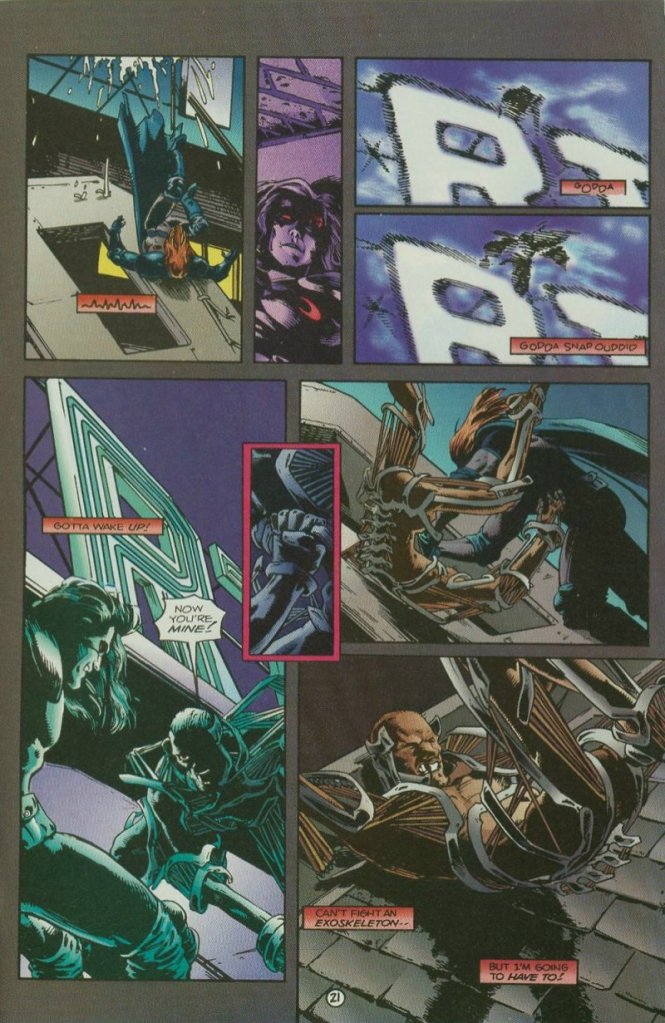
Night Man and Mangle fight!

Focusing on the plot, while the first issue showed Night Man beginning as a vigilante and self-made detective, this comic book shows him struggling to do what he believes to be good (by means of saving another person’s life) and having to face both rejection and skepticism from people. Of course, Night Man himself is flawed with his execution and the way he presents himself to others (note: including doing the radical thing of climbing a tall building just to talk to someone powerful). It does not help that he is restless which clearly impacts his perception even though he has the will to be helpful and make local society a bit safer from dangerous people.  

Back to the story, the introduction of a new villain named Mangle is quite intriguing and it seems very fitting that Night Man’s reaction to seeing him in his inhuman form would reflect the same shocked reaction on the part of the reader. Mangle is very distinct from the many other villains of the Ultraverse and he is indeed a powerful adversary to Night Man.

When it comes to the visuals, Gene Ha’s art style is excellent. He has this distinct, gritty style on drawing people as well as their facial expressions. His art on Mangle made the villain look really scary and intimidating. Gene Ha also proved to be good with framing the action scenes while keeping enough creative space for the dialogue or narration to come in for readers to follow.

Conclusion
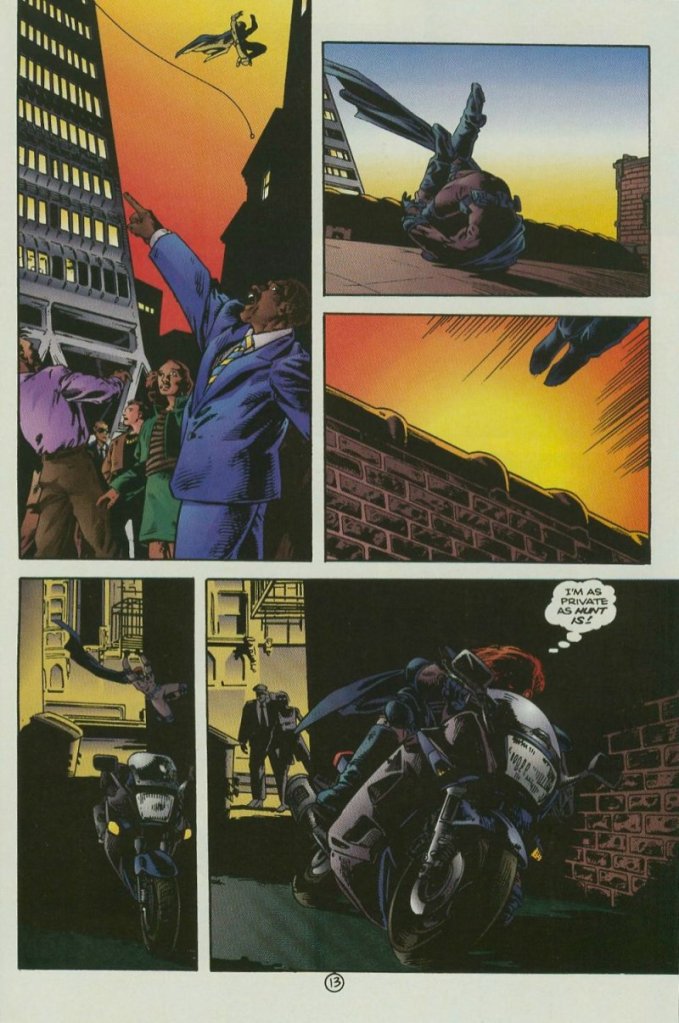
Nothing like coming all the way down from a very tall building to move on.

The Night Man (1993) is pretty compelling and as it is free from the baggage that came with building up the vigilante in issue , this one has a more cohesive story and shows more of the him doing his best to be helpful. The story is good enough to keep me interested for the next issue. I should also state that if readers love seeing a hero struggle in helping others, then there is a lot to like in this story.

If you are seriously planning to buy an existing hard copy of The Night Man (1993), be aware that as of this writing, MileHighComics.com shows that the near-mint copy of the comic book costs $14.

Overall, The Night Man (1993) is recommended.

+++++

Thank you for reading. If you find this article engaging, please click the like button below and also please consider sharing this article to others. If you are looking for a copywriter to create content for your special project or business, check out my services and my portfolio. Feel free to contact me as well. Also please feel free to visit my Facebook page Author Carlo Carrasco and follow me at HavenorFantasy@twitter.com
A Look Back at V #2 (1985)

Disclaimer: This is my original work with details sourced from reading the comic book, watching the V mini-series (Original Miniseries and The Final Battle) and the 1984 TV series, and doing personal research. Anyone who wants to use this article, in part or in whole, needs to secure first my permission and agree to cite me as the source and author. Let it be known that any unauthorized use of this article will constrain the author to pursue the remedies under R.A. No. 8293, the Revised Penal Code, and/or all applicable legal actions under the laws of the Philippines.

Welcome back, science fiction fans, comic book collectors and fans of the V entertainment series of the 1980s! Before I proceed with the newest retro review of the V comic book series, I must share to you – both V fans as well as those who plan to discover the 1980s mini-series and TV series – that V: The Original Miniseries, and V: The Final Battle are all available on Blu-ray disc format on Amazon while the V TV Series is available on DVD format. If you are eager to collect them for your home entertainment collection and with your passion for V of the 1980s still burning, I suggest checking them out now by clicking here, here and here.

Wow. It’s been several months since my review of V issue #1. Almost all the retro comic book reviews I published since then were about superheroes. After going through all the superhero stuff, going back to the V comic book series is refreshing on my part.

With those details laid down, here is a look back at V , published by DC Comics in 1985 with a story written by Cary Bates and drawn by Carmine Infantino.

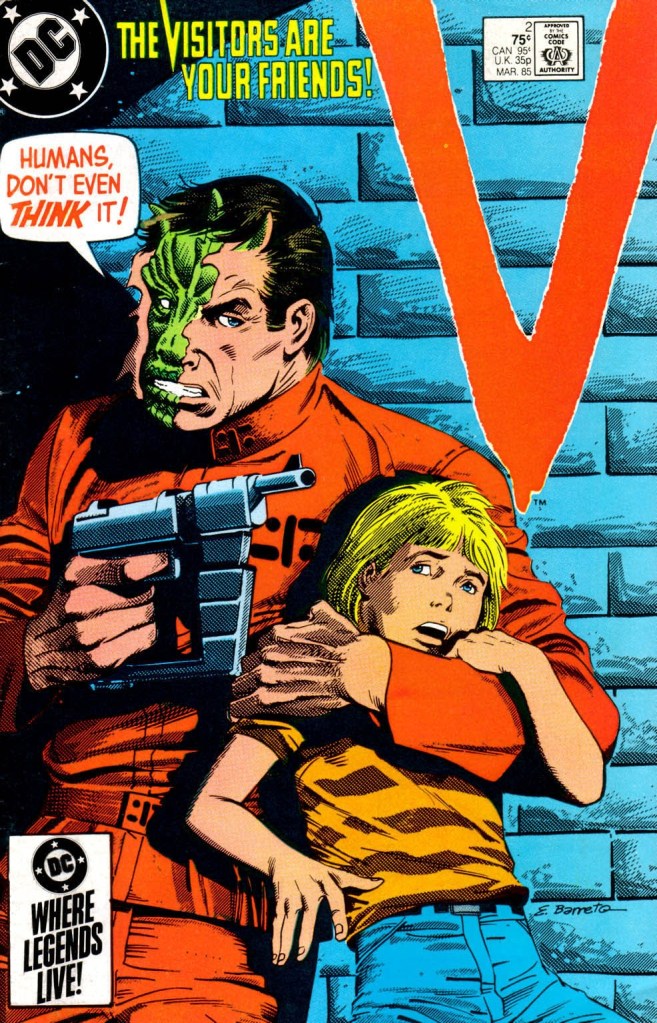
The cover.

Early story

The story begins in a desolate part of California where members of the Resistance get out of their downed skyfighter. They are actually a short walk away from a small town. Moments earlier, the local residents approached them with smiles and small crates containing something living. After Mike Donovan introduced himself to them, the locals were mystified and ran back to the town leaving the crates behind. It turns out, the town folks thought they were the Visitors and the way they reacted suggests that the race of Reptiloids from space were accepted by them.

Mike, Julie, Willie and Hart discover that the crates contained white mice (which are food for the Visitors) which they let go.

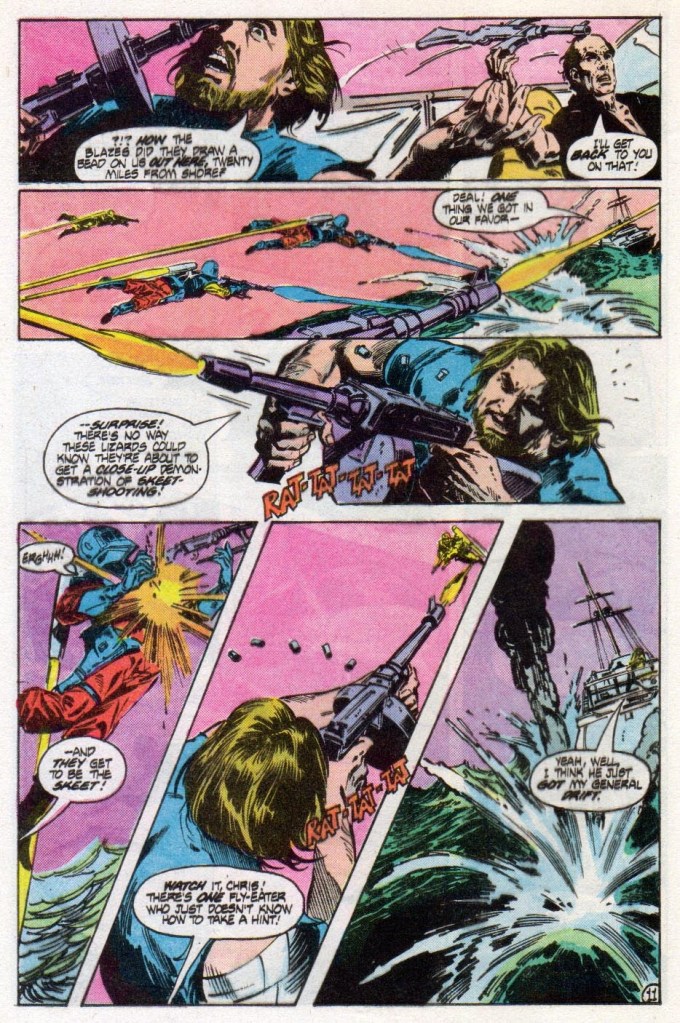
Elsewhere at the marina north of Redondo Beach, Ham Tyler and Chris Farber (still injured) are held at gun-point on boat which turned out to be a drug-runner model. The two Resistance members successfully fight back against the two armed men and quickly took the boat to head out to sea.

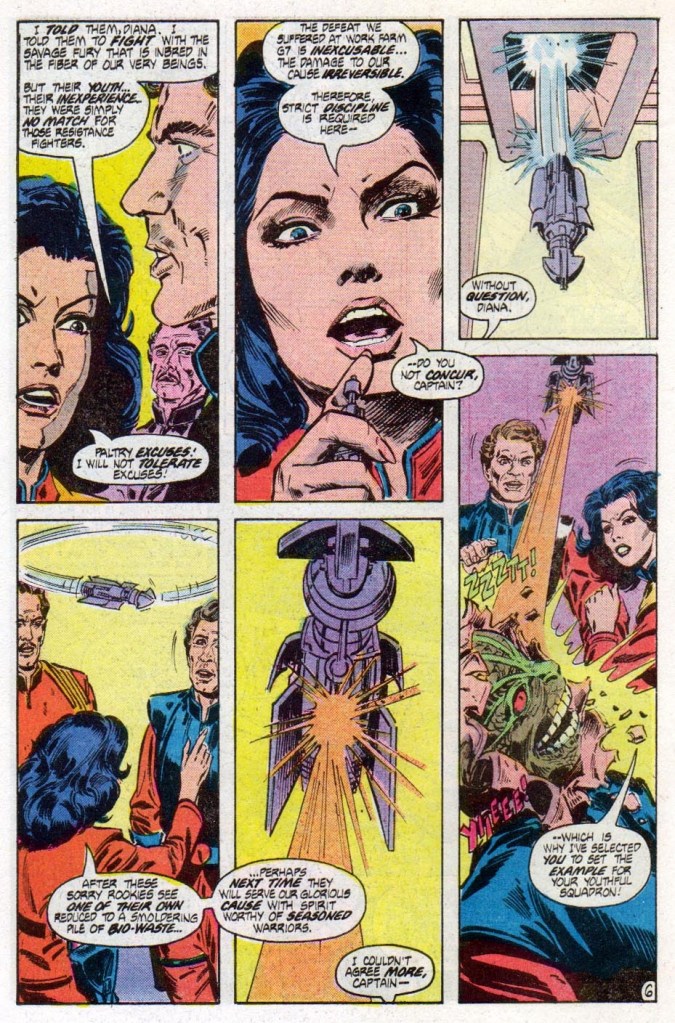
Inside the mothers ship orbiting Earth, the sadistic leader Diana rejects the claims of one of her soldiers over the failure related to work farm G7. Diana believes that because the soldiers have been among the humans for a long time, they learned to grovel like them. Finding the failure inexcusable, she releases a flying device that blasts one of them…

Quality

Ham and Chris take on the flying Visitors who approached them.

In terms of writing, this is indeed a solid follow-up to issue and I can say that the creators succeeded in not only continuing to capture the essence of the established V characters, balancing exposition, spectacle and suspense carefully but also raised the tension in key moments of the story which added to the engagement.

What I liked most about this comic book is its concept about a small town whose people (average age is above 60-years-old) bonded with the Visitors, engaged with them with an incredible deal (this alone will make you revisit the first episode of V: The Original Miniseries) and trusted them a lot. This story will also encourage you to reflect upon the whole concept of V and even consider other factors such as how many humans died for their freedom, how Diana’s command impacted Earth, and more.

Conclusion

This scene display’s Diana’s ruthlessness and her own way of improving her squad by making examples that involve death.

To be very clear, V (1985) is a very compelling comic book and it will surely resonate with fans who saw the Original Miniseries, The Final Battle and the TV series. The cerebral approach of this comic book made it a fun read.

If you are seriously planning to buy an existing hard copy of V# 2 (1985), be aware that as of this writing, MileHighComics.com shows that the near-mint copy of the regular edition costs $28 while the near-mint copy of the newsstand edition costs $35.

Overall, V (1985) is highly recommended!

+++++

Thank you for reading. If you find this article engaging, please click the like button below and also please consider sharing this article to others. If you are looking for a copywriter to create content for your special project or business, check out my services and my portfolio. Feel free to contact me as well. Also please feel free to visit my Facebook page Author Carlo Carrasco and follow me at HavenorFantasy@twitter.com
A Look Back at Prototype #18 (1995)

Disclaimer: This is my original work with details sourced from reading the comic book and doing personal research. Anyone who wants to use this article, in part or in whole, needs to secure first my permission and agree to cite me as the source and author. Let it be known that any unauthorized use of this article will constrain the author to pursue the remedies under R.A. No. 8293, the Revised Penal Code, and/or all applicable legal actions under the laws of the Philippines.

Welcome back, superhero fans, comic book collectors, fans of 1990s culture and fans of Malibu Comics! After going through reviewing seventeen issues of the Prototype monthly series that started with the 1993 launch of the Ultraverse, the end of the said series is here.

Before doing the retro review of the 18th and final issue of Prototype, I should state that the armored hero is indeed one of the most significant Ultraverse heroes of them all. Other than having a standalone monthly series (which includes issue #0) plus a giant size one-shot comic book, Prototype also was part of UltraForce and his presence and overall contribution in that short-lived series were undeniably good. Prototype is also memorable for his conflicts with Prime (read my review of Prime #4). As a series, Prototype also sheds light on the concept about how society would react to an actual functioning, flying armored hero who was also marketed for commercial purposes.

You must be wondering…is the 18th issue a conclusive story of the monthly series? What were the effects of Marvel’s acquisition of Malibu Comics on the creative team? We can all find out in this look back at Prototype #18, published in 1995 by Malibu Comics with a story written by R.A. Jones and drawn by Paul Abrams.

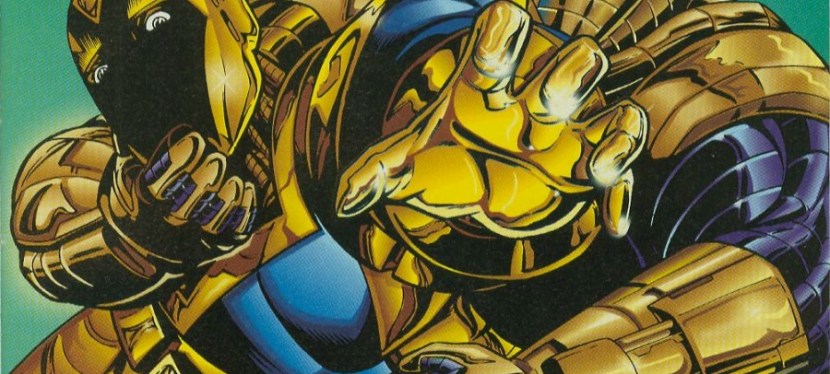
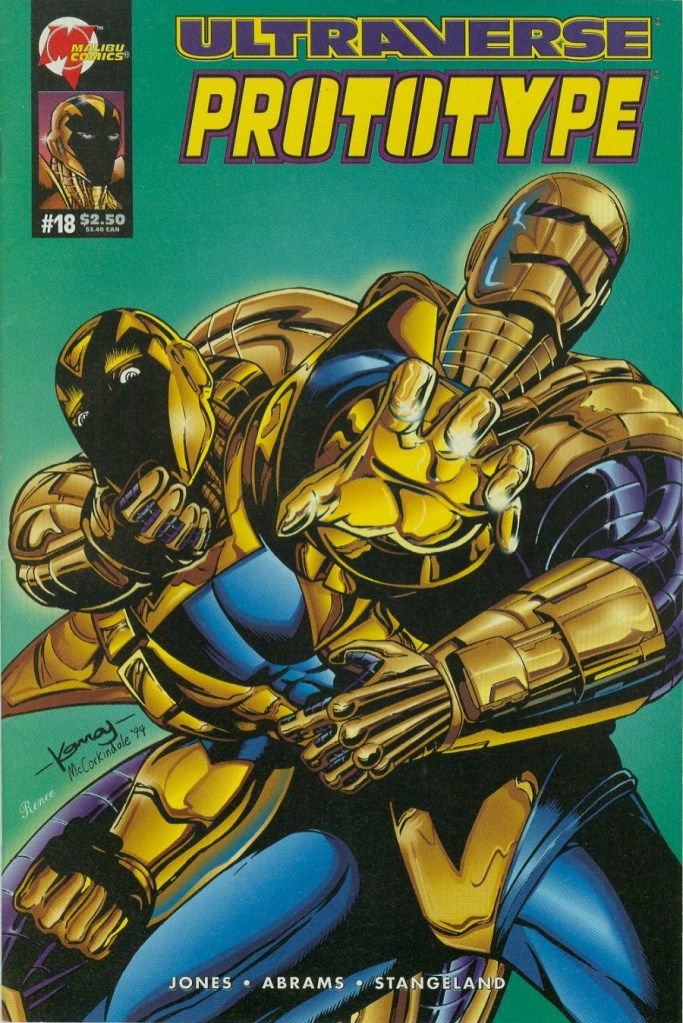
The cover.

Early story

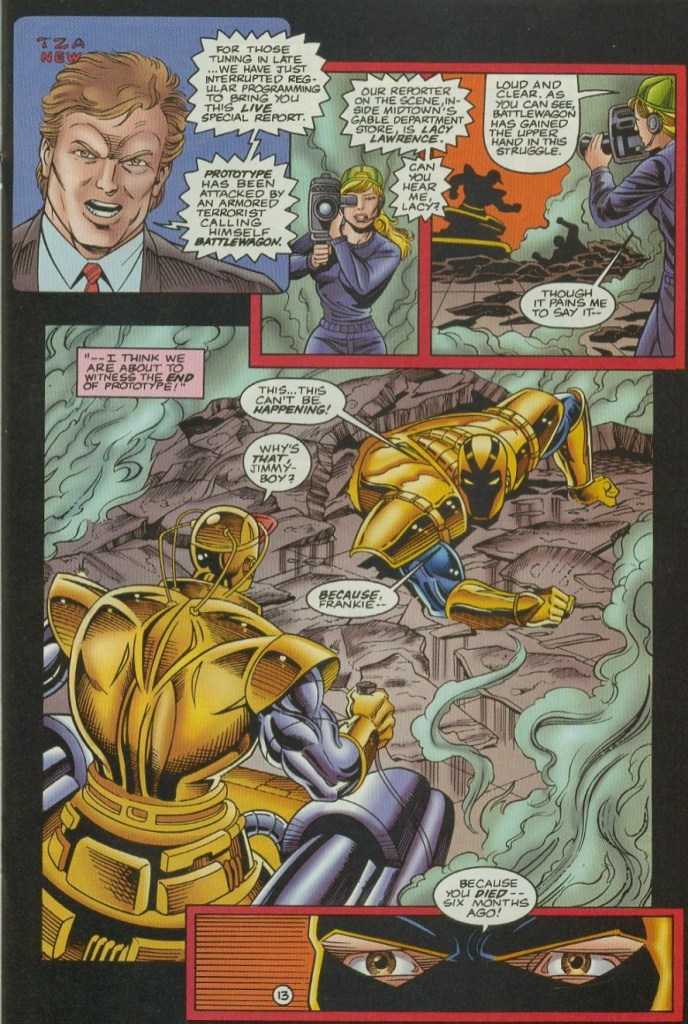
The story begins in a certain department store in Manhattan where a special anniversary celebration is being held and Prototype (piloted by Jimmy Ruiz) is the special guest. The affair turns out to be an assignment for him from his employer. Suddenly an armored figure (human-like above the belt, mechanical below the belt) breaks into the store causing a major disturbance. He calls himself Battlewagon.

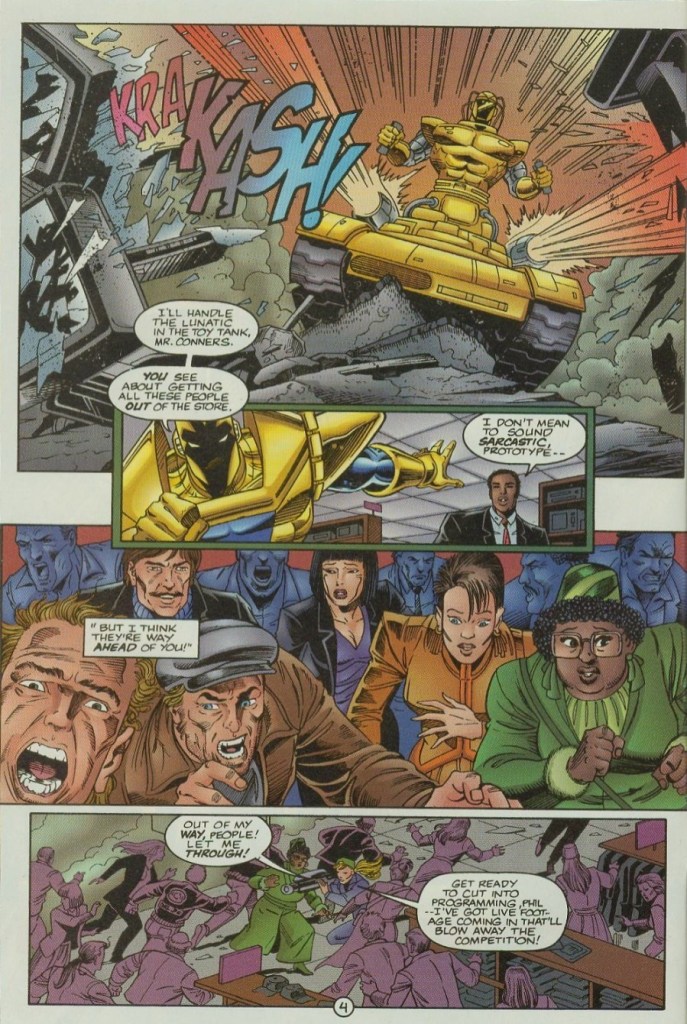
Battlewagon suddenly opens fire and hits many items around, causing people to panic. Prototype decides to take action and their conflict causes even more damage.

As Battlewagon speaks out against him, Prototype notices the use of a word which was a reference to the gang that he (Jimmy Ruiz) used to hang out with. Prototype also realizes that his new foe is after him in a rather personal way…

Quality

Does this scene remind you of today’s manipulative and irresponsible news media coverage?

To put it straight to the point, this comic book is not as conclusive as what Prototype fans would hope for. Sure the words “The end.” were written on the last page but, without fully spoiling the story of the comic book, sub-plots that started building up in the few previous issues were left unresolved. You hoped to see Jimmy reunited with Angella in this issue? You hoped to what happened to the deformed Stanley Leland? You will be disappointed.

More on the comic book itself, the conflict between Prototype and Battlewagon is actually written to be intense in terms of dialogue and interaction between the two. While that is a good thing, it does not hide the fact that Battlewagon, as a villain, felt more like an afterthought in terms of character introduction and the flashback relating to collateral damage in Prototype #7 does not really add much to the him. What I liked most in the script written by R.A. Jones was the look back at the past of Jimmy Ruiz when he was younger and was a thug on the streets.

Conclusion

Chaos inside the department store.

While it is not strong enough to be a worthy conclusion to its series, Prototype #18 (1995) managed to tell its own tale in a satisfying manner by adding another villain for the hero to fight with, and also expanding Jimmy Ruiz’s past as a gang member. Of course, I don’t have the details about what happened behind the scenes at Malibu Comics as a result of getting acquired by Marvel Comics, and how all that impacted the creators working on Prototype. I can only speculate that there were planned stories of Prototype that did not get published. In fact, there was a short announcement of Prototype: Turf War shown.

If this comic book is any indication, its story really felt more like a substitution as it had no references to the plot elements of the immediate few issues before it. Considering what happened at the end of issue , Jimmy Ruiz really acted out of character in this story.   

If you are seriously planning to buy an existing hard copy of Prototype #18 (1995), be aware that as of this writing, MileHighComics.com shows that the near-mint copy of the comic book costs $35.

Overall, Prototype #18 (1995) is satisfactory. As a series’ final issue, however, it is a disappointment.

+++++

Thank you for reading. If you find this article engaging, please click the like button below and also please consider sharing this article to others. If you are looking for a copywriter to create content for your special project or business, check out my services and my portfolio. Feel free to contact me as well. Also please feel free to visit my Facebook page Author Carlo Carrasco and follow me at HavenorFantasy@twitter.com
A Look Back at What If #20 (1990)

Disclaimer: This is my original work with details sourced from reading the comic book and doing personal research. Anyone who wants to use this article, in part or in whole, needs to secure first my permission and agree to cite me as the source and author. Let it be known that any unauthorized use of this article will constrain the author to pursue the remedies under R.A. No. 8293, the Revised Penal Code, and/or all applicable legal actions under the laws of the Philippines.

Welcome back superhero enthusiasts, comic book collectors, 1990s culture enthusiasts and fans of Marvel Comics! Before starting this newest retro comic book review, I should state that I really like Marvel’s way of exploring the unexplored scenarios related to the stories they published. Back in the 1980s, Marvel made its decision to have their icon Spider-Man – in his civilian form as Peter Parker – get married with Mary Jane Watson. Unsurprisingly, such an event added a whole lot of new elements into the life of the literary Spider-Man with regards to his struggle on balancing his life between superhero acts, domestic living and being attentive to his wife. If you really want to read about the wedding, I suggest searching for a copy of The Amazing Spider-Man Annual #21 (1987).

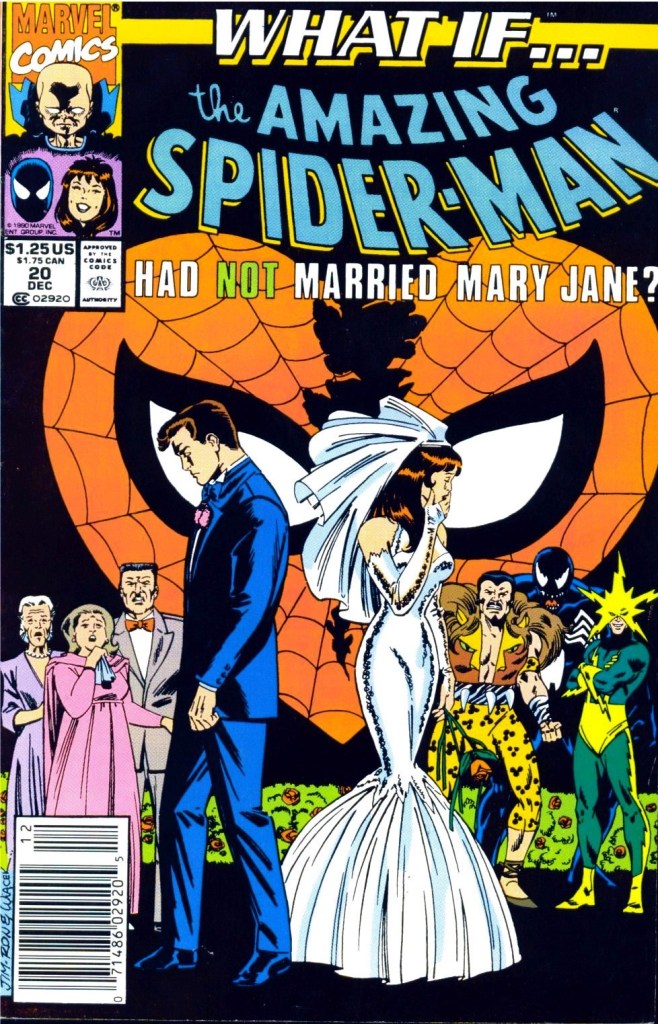
Imagine what would have happened had Spider-Man not married Mary Jane? That very scenario was explored in an issue of the What If monthly series (Volume 2) back in the early 1990s. We can find out more together in this look back at What If , published by Marvel Comics in 1990 with a story written by Danny Fingeroth and drawn by Jim Valentino.

The cover.

Early story

The story begins with the Watcher narrating key events in the life of Spider-Man. It is recalled how much pain Spider-Man endured when his beloved Gwen Stacy died during his conflict with the Green Goblin. Subsequently Peter Parker resumed his relationship with Mary Jane. When Mary Jane became absent, he got involved with Felicia Hardy/Black Cat who turned out to be too wild and reckless for him. Eventually, Peter married Mary Jane.

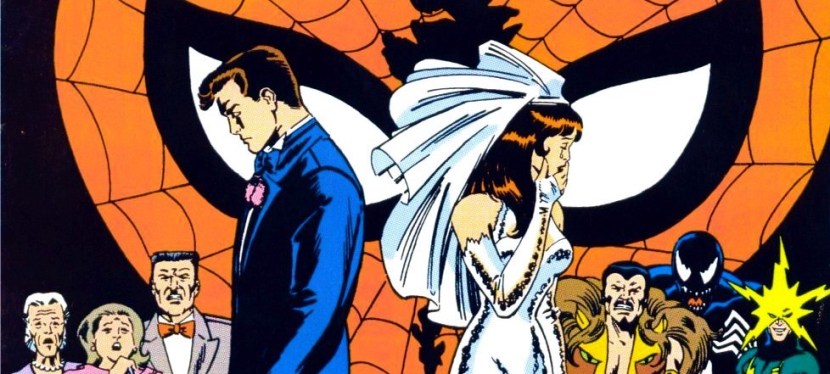
By pointing out that there are other realities, the Watcher then begins to explore another scenario in which Spider-Man realizes is far from being all right with him. During the wedding ceremony, Peter turns down Mary Jane which shocks the guests who were present. He tells her privately that even though he loves her, she will be in danger all the time as a wife. She walks away from him, still wearing her wedding dress.

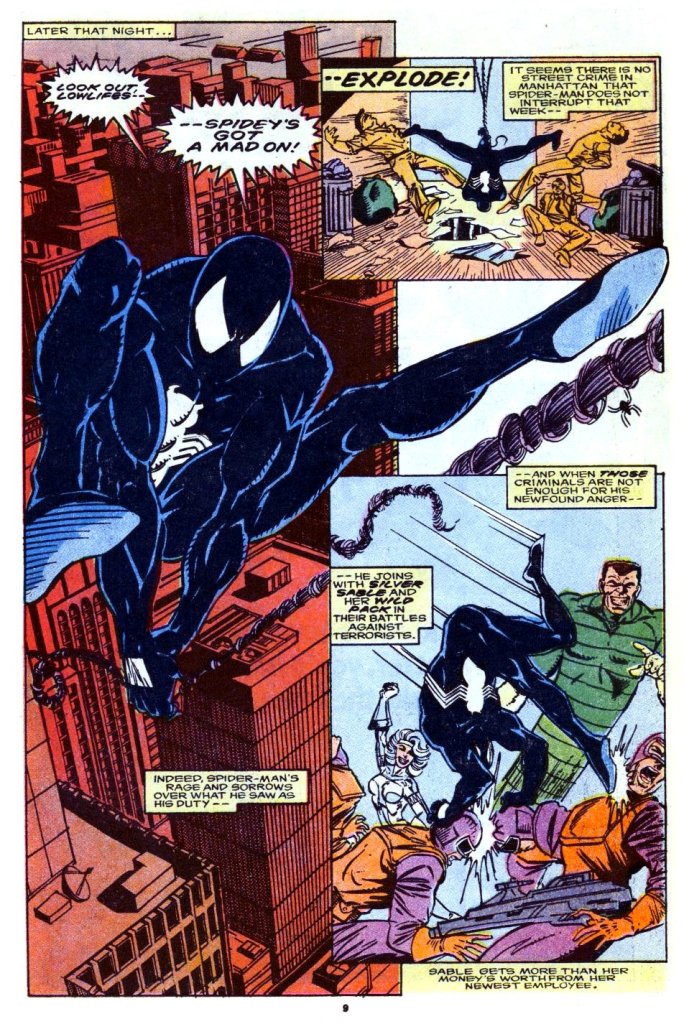
Some hours later, Spider-Man swings around New York and strikes the criminals really hard…

Quality

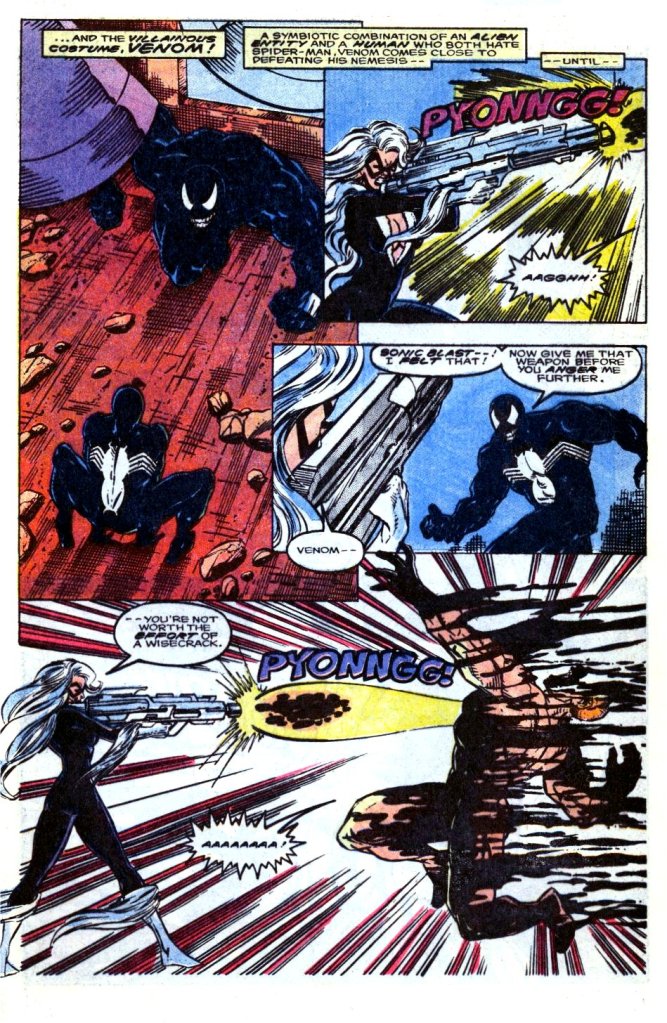
Spider-Man and Black Cat take on Venom!

To be clear, this comic book shows a Spider-Man who not only rejected marriage, but is also a tortured soul whose inner pain started even before the failed wedding ceremony. Silver Sable, who is often focused on missions, notices Spider-Man being too angry and careless with his performance with them taking on the bad guys. The old and frail Aunt May is deeply worried over Peter and hopes he would not harden his heart to the possibility of loving someone.

The thing about this story is that the writing done by Danny Fingeroth is pretty good as he captured Spider-Man’s essence while successfully steering him pretty close to the edge, almost blurring the boundary the separates the good and evil in him. The story moved with a nice pace and there is a good amount of suspense that will keep you wondering if Spider-Man can climb out of the deep hole of darkness he’s in.

More on the plot, I also enjoyed this comic book’s connection with Kraven’s Last Hunt and the early encounter with Venom. If there is any weak point with this story, it is the fact that it served as build-up of something set to happen in the next issue.

When it comes to the art, Jim Valentino did a good job bringing the script to life and that includes framing the character development scenes and the spectacle scenes in interesting ways. I personally enjoyed his take on Venom and Kraven.

Conclusion

Without Mary Jane as a wife, Spider-Man went on to fight the bad guys more intensely.

What If (1990) is indeed a solid, alternate story about Spider-Man. It was gripping right from the start but it lacked a solid conclusion as its last few pages started to build up anticipation for the following issue. In short, this is not a standalone story and to fully enjoy what it started, you have to read What If #21. Still, I love the way Spider-Man is portrayed here and there are some characters involved that long-time fans will enjoy.

If you are seriously planning to buy an existing hard copy of What If (1990), be aware that as of this writing, MileHighComics.com shows that the near-mint copy of the regular edition costs $53 while the respective near-mint copies of the newsstand edition and the signed edition both cost $105.

Overall, What If (1990) is recommended.

+++++

Thank you for reading. If you find this article engaging, please click the like button below and also please consider sharing this article to others. If you are looking for a copywriter to create content for your special project or business, check out my services and my portfolio. Feel free to contact me as well. Also please feel free to visit my Facebook page Author Carlo Carrasco and follow me at HavenorFantasy@twitter.com
A Look Back at X-Men #5 (1992)

Disclaimer: This is my original work with details sourced from reading the comic book and doing personal research. Anyone who wants to use this article, in part or in whole, needs to secure first my permission and agree to cite me as the source and author. Let it be known that any unauthorized use of this article will constrain the author to pursue the remedies under R.A. No. 8293, the Revised Penal Code, and/or all applicable legal actions under the laws of the Philippines.

Welcome back, superhero enthusiasts, comic book collectors, fans of 1990s culture and fans of Marvel Comics! Today we revisit the adjective-less X-Men monthly series (Volume 2) that started in 1991 with the combined talents of Chris Claremont and Jim Lee. For those who are unaware, Chris Claremont had his conflict behind the scenes with then X-Men comics editor Bob Harras which led to him departing the X-Men series with issue #3.

Previously I reviewed X-Men #4 which by today’s standards is highly significant and very expensive to acquire as it marked the literary debut of Omega Red who made quite an impact with X-Men fans. It should be noted that Wolverine and Omega Red had encountered each other far back in time and issue marked the renewal of their rivalry.

With those details laid down, here is a look back at X-Men , published in 1992 by Marvel Comics with a story written by Jim Lee (plot) and John Byrne (script), The art was done by Lee with ink work done by Scott Williams, Art Thibert, Bob Wiacek and Joe Rubinstein.

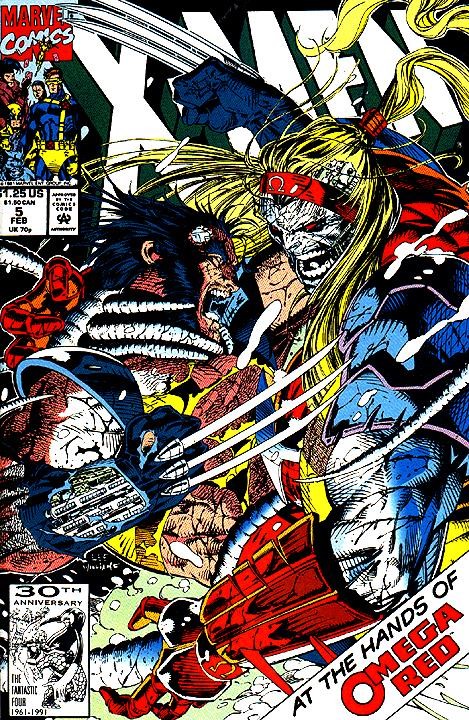
The cover.

Early story

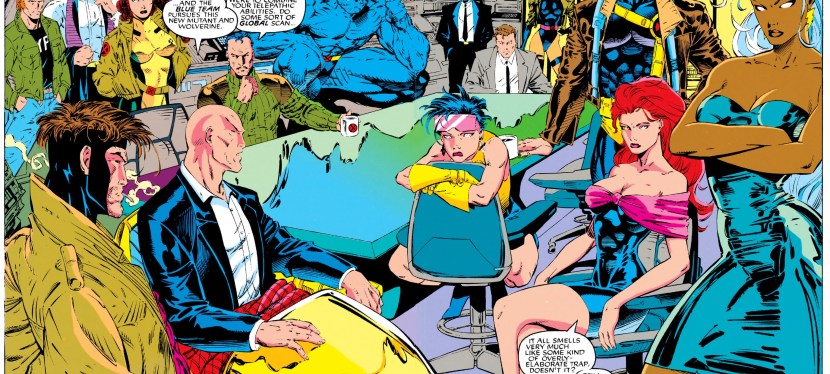
This for me is the money shot of the comic book. Although Wolverine is absent, you get to see the entire Blue and Gold teams with Charles Xavier as drawn by Jim Lee.

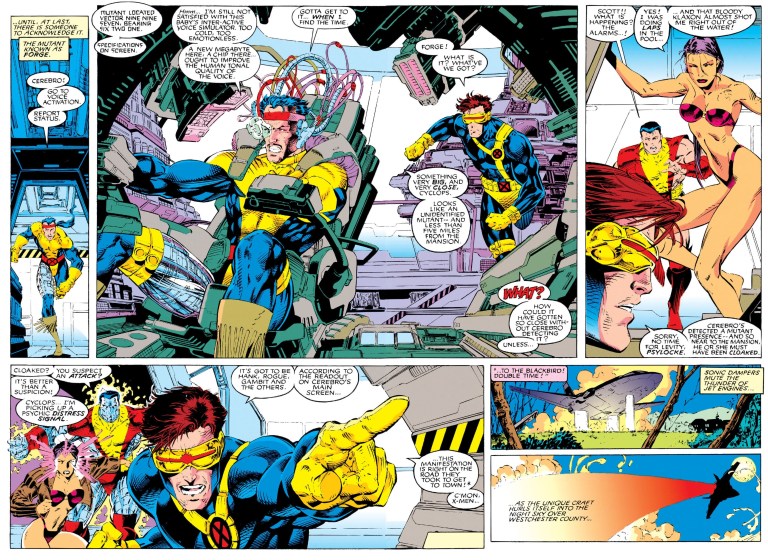
The story begins with Cerebro detecting an unidentified mutant signature in the presence of X-Men members who were out of the mansion. Forge tells Cyclops about the disturbance happening less than five miles away from their mansion. Colossus and Psylocke join in and quickly they leave the mansion with Cyclops using the Blackbird.

Not too far away, Gambit, Rogue, Jubilee and Beast are held captive inside a vehicle with an armed man in their presence. Gambit starts the effort to free his teammates using one of his charged cards.

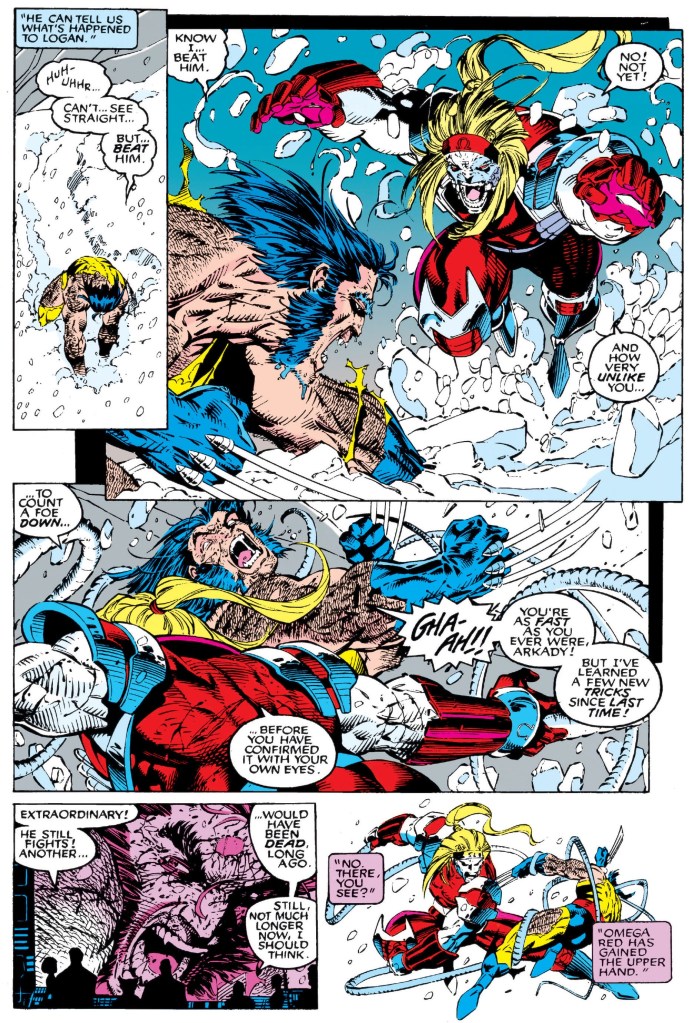
Elsewhere in a snowy place, Wolverine is seen struggling thinking he defeated his old rival Omega Red. Suddenly the Russian mutant jumped at him and the two resumed fighting. Their fight is being monitored from a distance…

Quality

The Wolverine-Omega Red rivalry is a must-see.

When it comes to storytelling, it is obvious that the writing duo of Jim Lee and John Byrne did their best to push the envelope and break new ground as far as telling an X-Men story goes. For one thing, there is the presence of paramilitary elements which are common with Jim Lee’s creations. There are even flashbacks into the past in which Wolverine (then called Logan) actually took part in a special forces operation with a few notable others. These flashbacks expands further the personal history of Wolverine in a really intriguing way. With the way the story was presented, it is clear that the new creative team pulled off serious moves in modernizing the way X-Men stories were told in comparison to the way Chris Claremont told all those many such stories during his long run.

When it comes to the visuals, Jim Lee did another great job as each page looks great and he proved to be clever with the way he visualized the script. As this comic book was inked by more than one inker, there were subtle differences with regards to contrast as well as ink intensity.

Conclusion

Cyclops and his teammates move out.

X-Men (1992) is another great comic book that involved Jim Lee’s art. Apart from the modernizing of the storytelling, this comic book further expanded the past of Wolverine while successfully giving readers more of Omega Red who is now a major supervillain of Marvel’s.

If you are seriously planning to buy an existing hard copy of X-Men (1992), be aware that as of this writing, MileHighComics.com shows that the near-mint copy of the regular edition costs $27 while the near-mint copy of the newsstand edition costs $79.

Overall, X-Men (1992) is highly recommended!

+++++

Thank you for reading. If you find this article engaging, please click the like button below and also please consider sharing this article to others. If you are looking for a copywriter to create content for your special project or business, check out my services and my portfolio. Feel free to contact me as well. Also please feel free to visit my Facebook page Author Carlo Carrasco and follow me at HavenorFantasy@twitter.com
A Look Back at The Strangers #11 (1994)

Disclaimer: This is my original work with details sourced from reading the comic book and doing personal research. Anyone who wants to use this article, in part or in whole, needs to secure first my permission and agree to cite me as the source and author. Let it be known that any unauthorized use of this article will constrain the author to pursue the remedies under R.A. No. 8293, the Revised Penal Code, and/or all applicable legal actions under the laws of the Philippines.

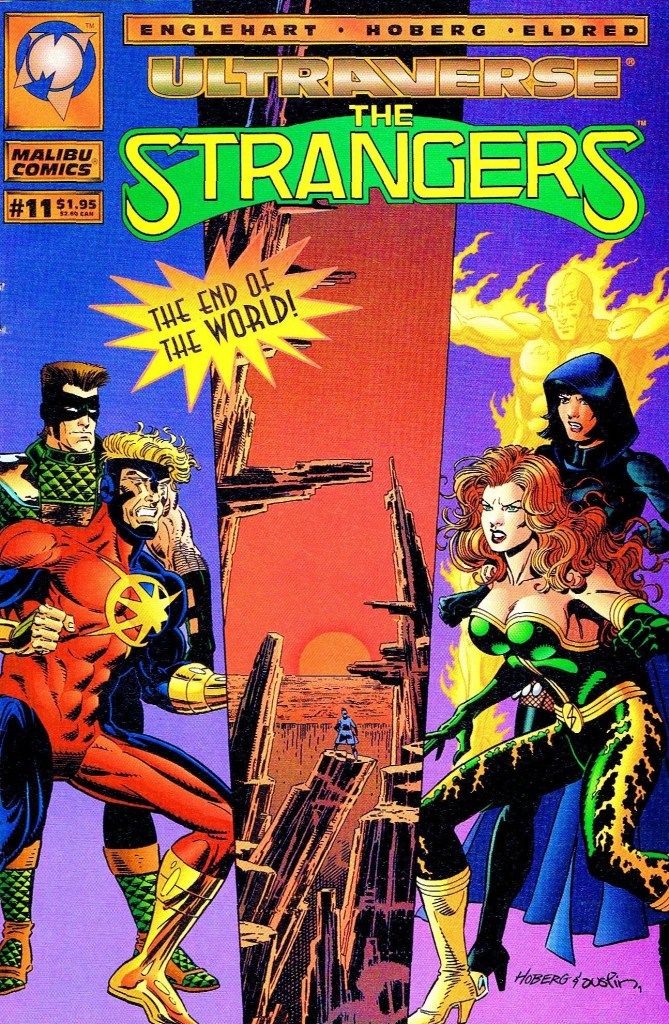
Welcome back, superhero enthusiasts, comic book collectors, 1990s culture enthusiasts and fans of Malibu Comics! Today we return to the Ultraverse through another tale of The Strangers which has been a pretty solid monthly series that I’ve been reviewing. As of this writing, I’m getting closer to finishing all 24 issues of this particular series and I can say that it has been a lot of fun doing retro comic book reviews of it. I’ve got a retro review about the 11th issue of The Strangers right here.

Before going to it, I should state a recap of the events in issue #10. That story had the Strangers (without Yrial who by then was held captive by her black tribe) doing a search by the sea in the Caribbean and they eventually discover a portal that sent them to another realm filled with monsters. After a big battle, the team attempted to get away only to fall over a cliff.

With those details laid down, here is a look back at The Strangers , published in 1994 by Malibu Comics with a story written by Steve Englehart and drawn by Rick Hoberg.

The cover.

Early story

The story begins with the Strangers falling down from what turned out to be a very great height. While his teammates could not do anything, Zip-Zap uses his power to make the air whirl around them and land safely on the ground below.

As they are in the middle of nowhere, searching for the way back seemed like an impossibility. Electrocute realizes there is an answer sensing the something is present in that lost world they are in and she points to some far-away direction. Zip-Zap then proceeds to run towards it leaving the team behind…

Quality

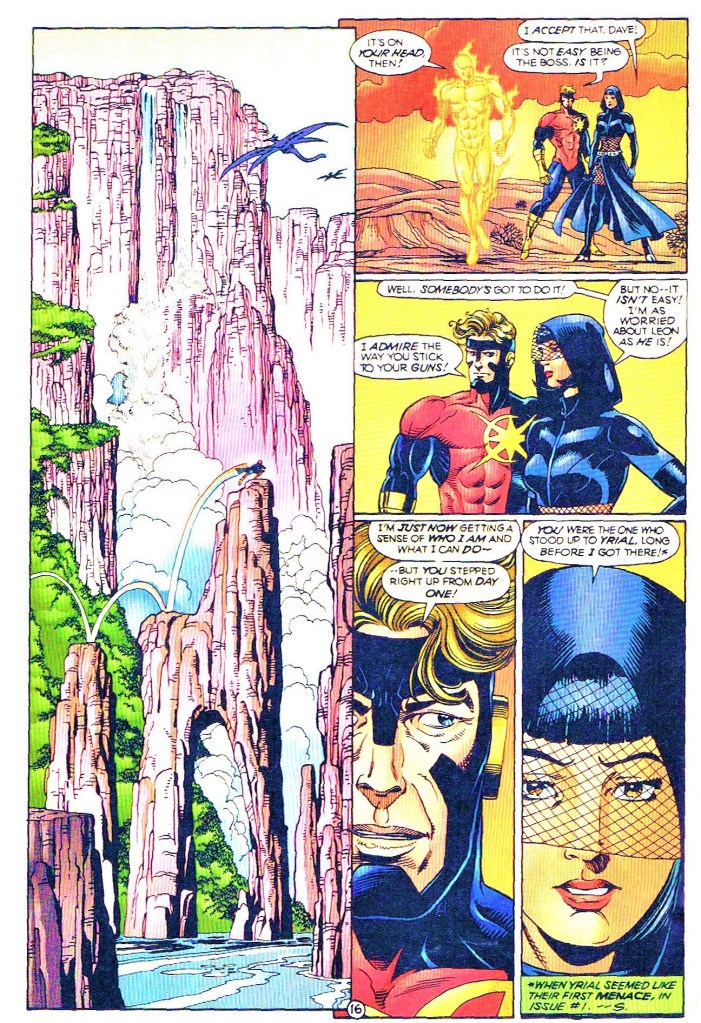
A nice display of fine art and character development.

Starting with the writing, I should say that this comic book’s plot is very simplistic with its concept and clearly lacks the richness of the story told in issue . Technically, this story is more like a filler serving as a build-up to issue #12 (which itself has a deeper story filled with spectacle and lots of intrigue). That’s not to say this is a disappointing issue of The Strangers in relation to the overall quality of the series as a whole. It’s just different with its plot structuring. Along the way, there were some short but sweet character development moments that took place most notably with regards to the romance between Atom Bob and Lady Killer.

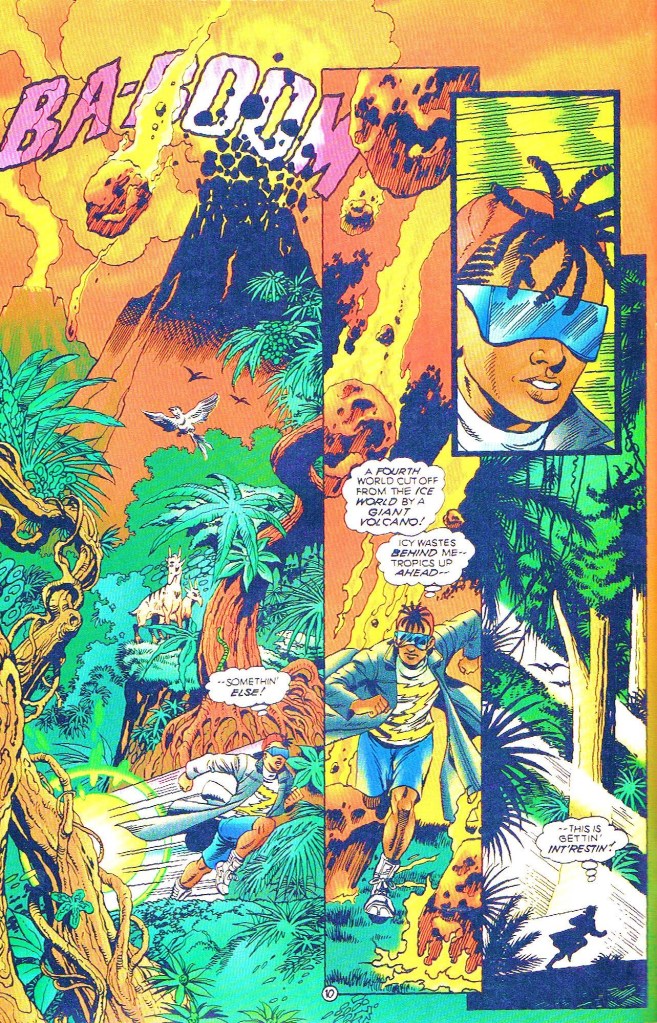
What this comic book excels at is the really fine and varied artwork done by Rick Hoberg. Through the scenes in which Zip-Zap runs and explores the unknown realm they are lost in, you will really see Hoberg’s great talent with visual details as well as his creativity with regards to making varied locations filled with creatures that are truly out of this world. For the lack of superhero action, Hoberg’s visuals are the true spectacle here.

Conclusion

Really great art by Rick Hoberg.

Even though its plot lacked depth and its execution in storytelling is very different, The Strangers (1994) succeeds in expanding the lost realm and zones within the Ultraverse. As for building up suspense or excitement for issue , this comic book achieved it as well. For a comic book that lacked superhero action, this one did not end up boring and that’s quite an achievement by the creators.

If you are seriously planning to buy an existing hard copy of The Strangers (1994), be aware that as of this writing, MileHighComics.com shows that the near-mint copy of the comic book costs $14.

Overall, The Strangers (1994) is recommended.

+++++

Thank you for reading. If you find this article engaging, please click the like button below and also please consider sharing this article to others. If you are looking for a copywriter to create content for your special project or business, check out my services and my portfolio. Feel free to contact me as well. Also please feel free to visit my Facebook page Author Carlo Carrasco and follow me at HavenorFantasy@twitter.com
A Look Back at Prototype #17 (1995)

Disclaimer: This is my original work with details sourced from reading the comic book and doing personal research. Anyone who wants to use this article, in part or in whole, needs to secure first my permission and agree to cite me as the source and author. Let it be known that any unauthorized use of this article will constrain the author to pursue the remedies under R.A. No. 8293, the Revised Penal Code, and/or all applicable legal actions under the laws of the Philippines.

Welcome back, superhero enthusiasts, comic book collectors, fans of 1990s culture and fans of Malibu Comics. Today we return to the Ultraverse and I should say that I am getting very close to closing my retro review run on the Prototype monthly series. So far, I found Prototype to be a really enjoyable and engaging series. It is too bad that the Ultraverse did not last too long because as far as armored superheroes go, Malibu Comics’ armored hero concept is very unique and fun to read. Had the Ultraverse lasted long, Prototype would have been explored a whole lot more and writers Tom Mason and Len Strazewski would have created more new stories of him.

Last time around, Jimmy Ruiz (who no longer has the high compensation and big-time perks of his original employer) got into trouble and had to use his armor as he was the target of another huge and powerful armored rival. The battle ended costly for Prototype.

What will happen next to him? We can all find out in this look back at Prototype , published by Malibu Comics in 1995 with a story written by Len Strazewski and drawn by George Dove.

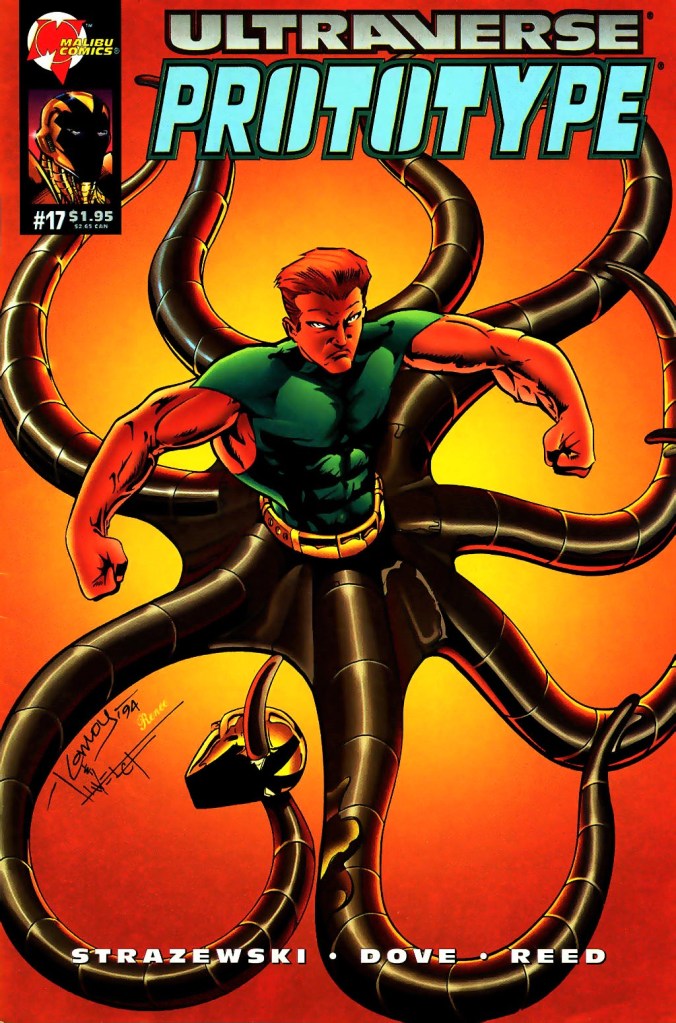
The cover.

Early story

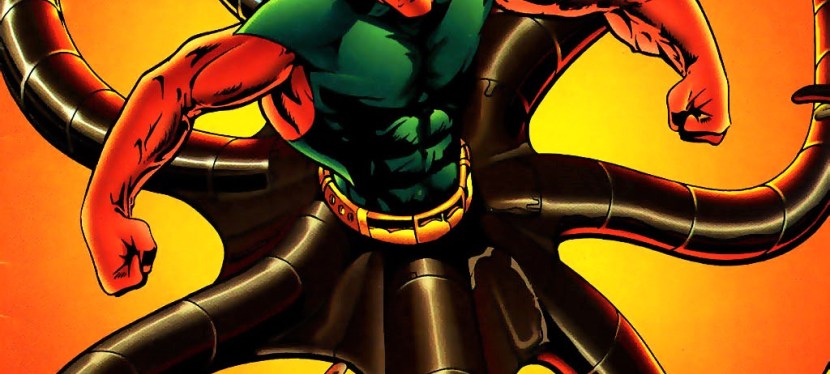
The story begins inside a top-secret facility. A man realizes that all the flesh below his waste are gone, completely replaced with metallic tentacles which make him look like a human octopus. The man in shock is none of other than Stanley Leland and his is welcomed to Terrordyne. Terrordyne makes clear they do not want to hurt him but have him as their new CEO  and they know he desires revenge against Prototype.

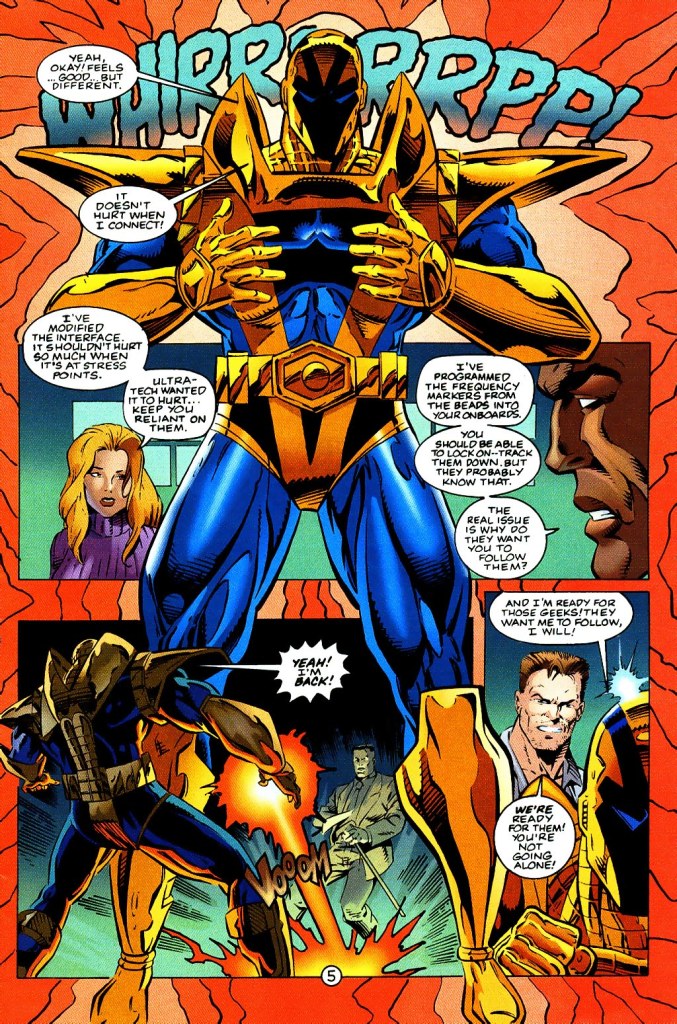
Elsewhere, the Prototype armor is being repaired by Bob Campbell (Ranger). Jimmy, who is desperate to get Angella back, is eager to get back into action but the repair of his armor is not moving as fast as he wanted. Fortunately, Bob’s wife arrives with a man who believes he can help them. She tells Jimmy that the Prototype armor’s power coupling will be improved by forty percent.

Soon enough, the armor gets enhanced and Jimmy could sense the differences already. Soon enough, he goes on a mission with Ranger accompanying him…

Quality

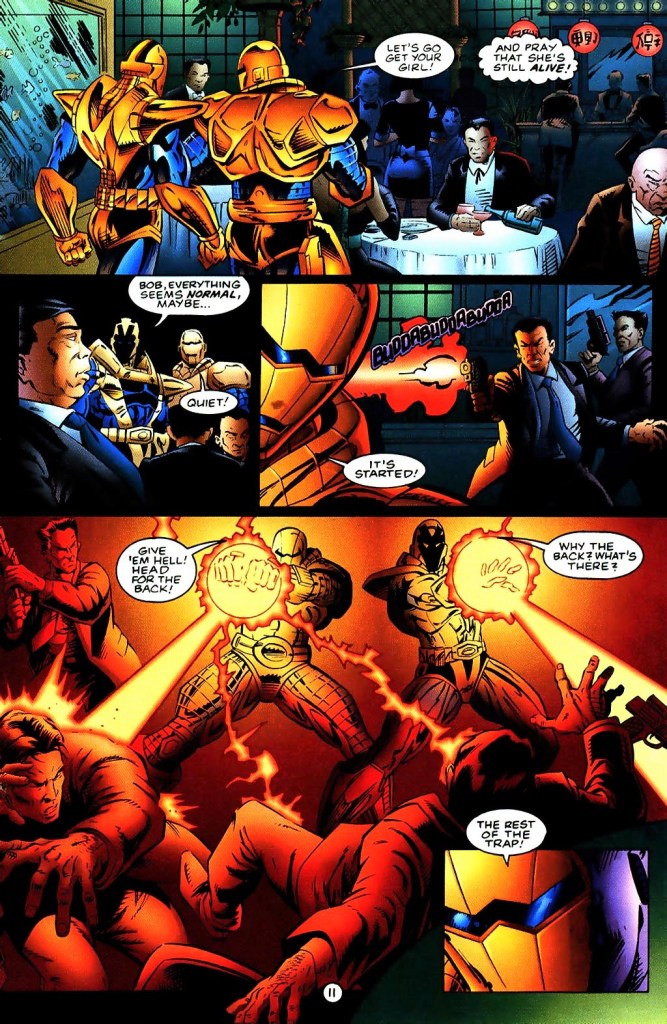
Prototype and Ranger inside a restaurant.

Starting with the story, I’m happy to say that the writing here is stronger, the dialogue has more depth and the plot is much more intriguing to read compared to the previous few issues. The concept of this comic book is about the effort to find and save Angella but with Ranger getting involved not only to add assist Prototype on the field but also provide him insight on dealing with a serious matter like the kidnapping done by very powerful opponents. In a way, having upgraded armor and weapons are not sufficient and even though he fought lots of enemies before, Jimmy Ruiz lacks the maturity, the self-control and strategy needed to do his mission. The scenes showing Ranger providing Prototype assistance in the form of strategies related to past experiences (that Bob Campbell went through) were done cleverly and never hampered the pace of the story.

As for the art, George Dove did a good job visualizing the armors of Prototype and Ranger. He also was good with drawing the action scenes.

Conclusion

Really nice art by George Dove.

To be clear, Prototype (1995) is a two-heroes-in-one type of story that is character-led. For one thing, Jimmy is desperate, impatient and does things recklessly while Bob Campbell does his best to keep him stable and to prevent him from screwing up everything due to recklessness. It shows that the protagonist is not only humanly fragile, but also getting close to his breaking point. The emotional element makes the story worth reading.

If you are seriously planning to buy an existing hard copy of Prototype #17 (1995), be aware that as of this writing, MileHighComics.com shows that the near-mint copy of the comic book costs $27.

Overall, Prototype (1995) is recommended.

+++++

Thank you for reading. If you find this article engaging, please click the like button below and also please consider sharing this article to others. If you are looking for a copywriter to create content for your special project or business, check out my services and my portfolio. Feel free to contact me as well. Also please feel free to visit my Facebook page Author Carlo Carrasco and follow me at HavenorFantasy@twitter.com
A Look Back at The Punisher Meets Archie #1 (1994)

Disclaimer: This is my original work with details sourced from reading the comic book and doing personal research. Anyone who wants to use this article, in part or in whole, needs to secure first my permission and agree to cite me as the source and author. Let it be known that any unauthorized use of this article will constrain the author to pursue the remedies under R.A. No. 8293, the Revised Penal Code, and/or all applicable legal actions under the laws of the Philippines.

Welcome back, superhero enthusiasts, comic book collectors, fans of 1990s culture, and fans of both Marvel Comics and Archie Comics! Today, I have a retro review of one of the most wild ideas for a comic book crossover that actually got published in 1994. Back then I was still in college and ramping up my comic book collection. Then one day, I saw a print ad for the Marvel-Archie special project about the iconic Archie Andrews crossing over with the Punisher!

That’s right! The unthinkable concept pushed through and way back in 1994, I ordered in advance a copy of the comic book (note: this was actually one comic book published respectively by Marvel Comics and Archie Comics but with their own packaging and slight adjustments to the title) and eventually got to read it.

Behind the scenes, the management of Archie Comics wanted to take part in the wildly popular trend of intercompany crossover comic book publishing not just to boost their sales but also establish a stronger presence in comic book specialty stores. Back then, Marvel Comics editor-in-chief Tom DeFalco and Archie Comics editor Victor Gorelick were good friends (note: DeFalco entered comic book publishing while working for Archie Comics) and sometimes they would joke with each other about potential crossover concepts between their companies. Gorelick eventually had lunch with independent comic creator Batton Lash and talked about Archie wanting to get involved with crossovers. The Archie editor told Lash about he and DeFalco joking about Archie encountering the Punisher, and in response the independent creator stated that they should really push through with it.

Lash went on to make a pitch for the series and Gorelick sent it to DeFalco. Marvel’s editor-in-chief loved it and eventually the concept was approved complete with strategic involvement in the production by key talents from both Archie and Marvel. For the artwork, Archie’s Stan Goldberg and Marvel’s John Buscema worked together to maintain different tones by means of drawing settings and characters that are specific with their respective companies. The inkwork was done by Tom Palmer.

Now you must be wondering…was the crazy crossover any good? We can find out in this look back at The Punisher Meets Archie , published by Marvel Comics in 1994 with a story written by Batton Lash and drawn by Punisher artist John Buscema and Archie artist Stan Goldberg.

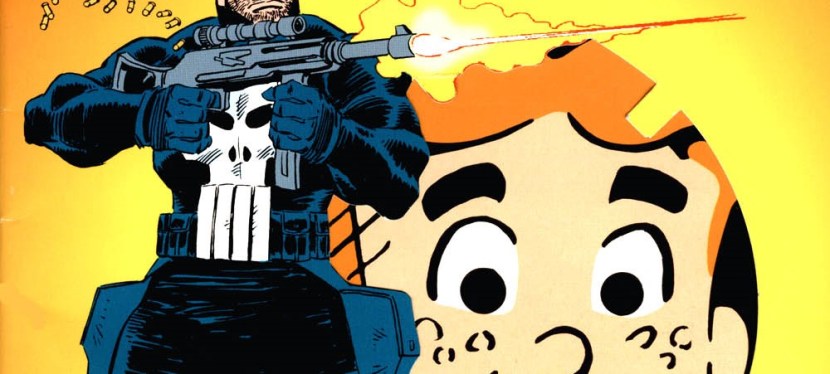
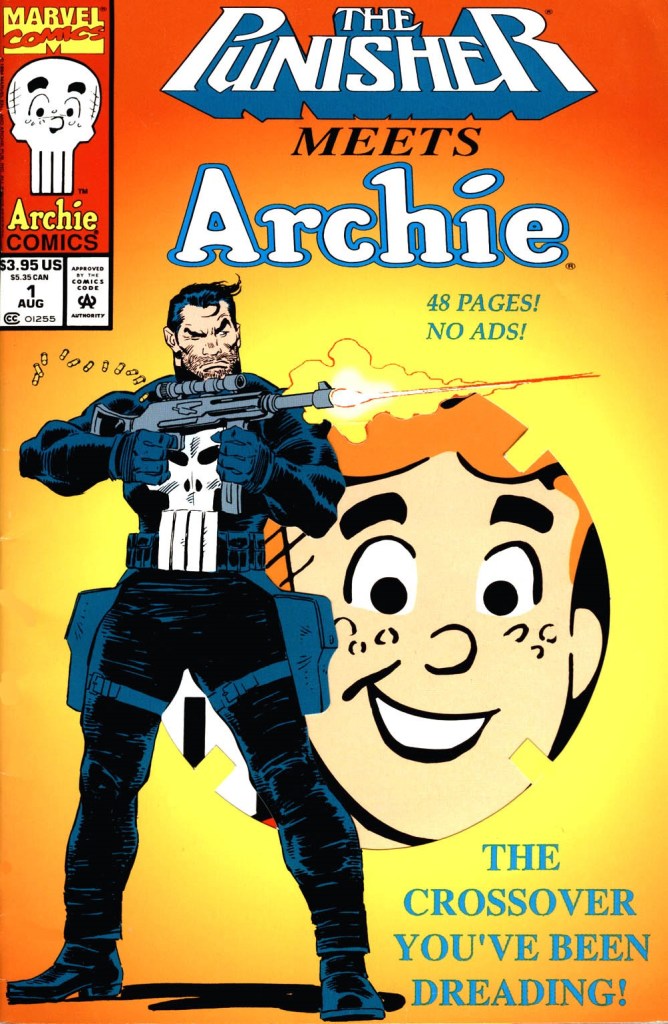
The cover with a die-cut design.

Early story

The story begins in a city where a man (in a trench coat and a cap) is seen running away from someone chasing him. As he hurriedly climbs over a wall, he hears the chaser’s gun click and responds by firing some bullets at him. The chaser climbs over the wall and he turns out to be Frank Castle, the Punisher. The Punisher notices that his target left his cap on the floor, and look at the nearby station full of people.

Inside the said station, the man who got away from the Punisher has red hair and a sinister looking face. He buys a ticket going to Riverdale.

The next day in the town of Riverdale, Archie Andrews rings the bell of the front door at the luxurious residence of the Lodge family. A little boy named Leroy (cousin of Veronica Lodge) surprises him and makes him wet using a water-filled plastic gun. In response, Archie grabs the hose nearby and unleashes water. He accidentally hits Veronica who got so angry, she decided to cancel her date with him.

Still wet, Archie walks down the sidewalk being followed by a car…

Quality

See your favorite Archie characters among them?

I’ll start with the story written by Batton Lash. To be clear, this comic book has a dominant Archie Comics tone meaning it is wholesome and fun, and at the same time never childish. The Punisher-focused scenes showed lots of signs of restraint meaning in order to connect well with the overall wholesome tone of the comic book, adulterated stuff and violent concepts related to the Punisher are absent. For me, having an overall wholesome tone works given the fact that most of the story is set in Riverdale and there are tremendously more Archie characters than there are Marvel characters.

More on the story, the concept by Batton Lash is wonderful and the way the plot was structured not only ensured a fun story but also made sense. The plot itself is pretty believable and the story is full of nice and interesting moments to read. There certainly were no boring scenes at all!

To have Punisher encounter Archie without ever using the now overuses versus-battle-type approach here was believable, sensible and even impressive. For the most part, as reflected in portrayals and dialogue, Lash captured the essence of the Archie characters and anyone who loves stories about Archie and the gang (plus Josie and the Pussycats and Katy Keene) will have a lot to enjoy here. Even the disruption in Riverdale caused by the gang of crooks and the Punisher has that strong Archie-tone and never went overboard.

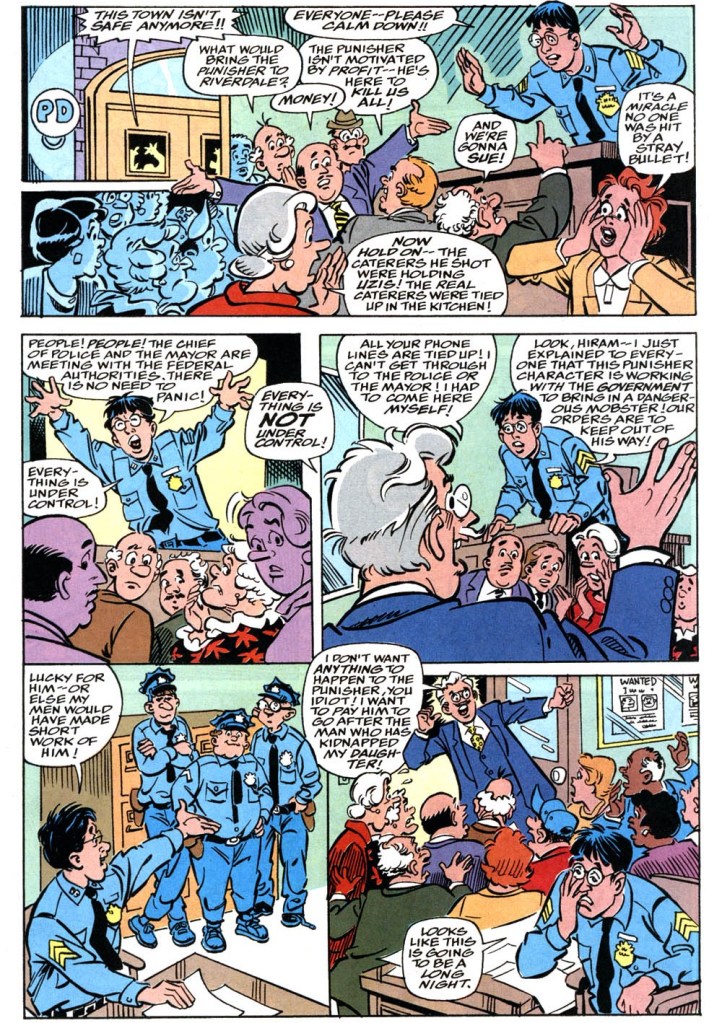
Punisher, Micro Chip, the local cops and a familiar face from the Riverdale high school’s cafeteria.

With regards to Lash presenting Marvel’s vigilante, the Punisher here is subdued in terms of seriousness. While he is not portrayed to be gritty (note: he’s also less violent), he is still rugged and you will still see him firing guns during the right moments. With the reduction of violent action, Punisher does a lot more detective work and has his companion Microchip with him. While rugged, the Punisher is not as snobbish as one might think here. In fact, there are a few pleasant surprise moments in the story with regards to his encountering certain supporting characters of Archie. These moments, although they make Punished look like he’s out of character, I still find pretty delightful.

More on the characters, there is a whole bunch of them here! As the story is set in Riverdale, it comes to no surprise that supporting characters of Archie Comics are present and for the most part they were presented to delight those who love Archie and the gang. Mr. Weatherbee, Mr. Lodge, Reggie Mantle, Betty Cooper, Jughead Jones, Pop Tate, Svenson, Ms. Grundy, Professor Flutesnoot and others are here and they don’t just make mere appearances.  

As this is a special project between Marvel Comics and Archie Comics, there is a lot of fan service here and there leaning towards the interests of Archie fans. For the most part, these fan service elements (note: there are some from Marvel Comics) were actually fun to look at and I personally did not find them distracting.

Conclusion

Punisher and Micro Chip explore Riverdale as Jughead and Archie are in Pop’s place.

While it is essentially an Archie comic book in terms of storytelling and visuals and lacks the kind of adulterated stuff that Punisher fans love, The Punisher Meets Archie (1994) is still a very enjoyable crossover to read, and it sure is fun from start to finish. For one thing, the concept about Archie meeting with Punisher with Riverdale as the main setting works wonderfully even by today’s standards. What was an unbelievable concept got executed nicely into a believable and fun product. I should state that this kind of intercompany crossover comic book is still one-of-a-kind and its literary value (as opposed to financial value) is undeniably high. No doubt about, this crossover is a comic book classic!

If you are seriously planning to buy an existing hard copy of The Punisher Meets Archie (1994), be aware that as of this writing, MileHighComics.com shows that the near-mint copy of the regular edition costs $53 while the near-mint copies of the deluxe newsstand edition and the direct edition cost $105 and $70 respectively.

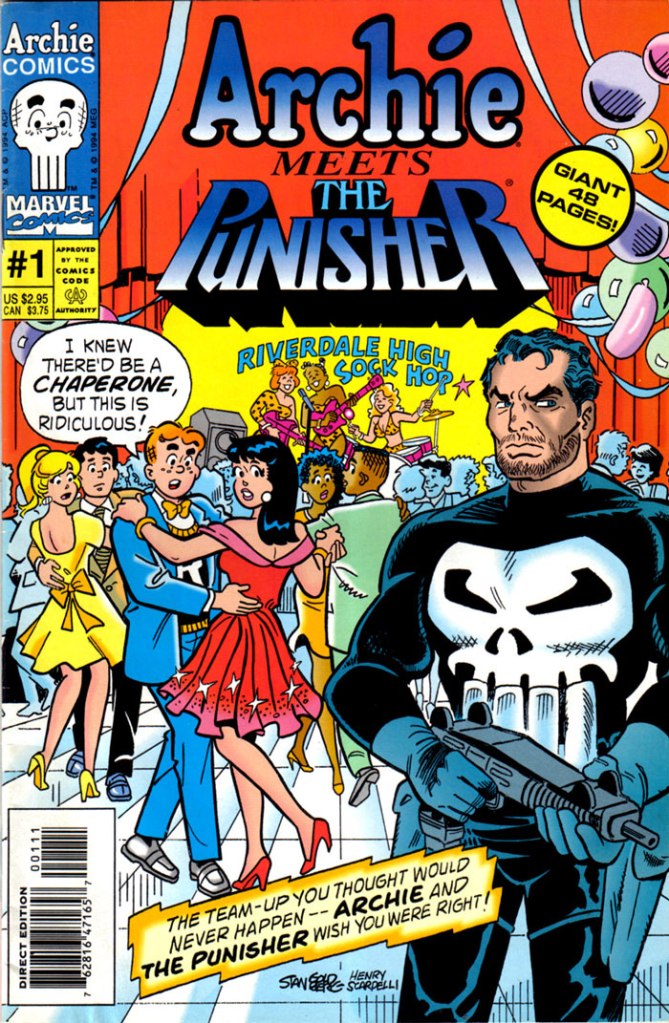
If you prefer the Archie Comics-published version – Archie Meets The Punisher (1994) – be aware that the near-mint copy of the comic book costs $70 according to Mile High Comics as of this writing.

The cover of the Archie Comics-published version of the same crossover. This one is more eye-catching than that of the Marvel version.

Overall, The Punisher Meets Archie (1994) is highly recommended!

+++++

Thank you for reading. If you find this article engaging, please click the like button below and also please consider sharing this article to others. If you are looking for a copywriter to create content for your special project or business, check out my services and my portfolio. Feel free to contact me as well. Also please feel free to visit my Facebook page Author Carlo Carrasco and follow me at HavenorFantasy@twitter.com
A Look Back at The Strangers #6 (1993)

Disclaimer: This is my original work with details sourced from reading the comic book and doing personal research. Anyone who wants to use this article, in part or in whole, needs to secure first my permission and agree to cite me as the source and author. Let it be known that any unauthorized use of this article will constrain the author to pursue the remedies under R.A. No. 8293, the Revised Penal Code, and/or all applicable legal actions under the laws of the Philippines.

Welcome back, superhero enthusiasts, comic book collectors, fans of 1990s culture and fans of Malibu Comics! Do you want to see another fight against evil within the Ultraverse? You will find it right here through The Strangers.

Last time around, The Strangers had to cut short their return to private life because they were need to deal with a new force of evil called Deathwish. What was revealed was that the person behind Deathwish turned out to be one of the many people who rode the very same San Francisco cable car with the members of The Strangers (when they were still civilians without powers) that was hit by energy from the sky.

With those details laid down, here is a look back at The Strangers , published by Malibu Comics in 1993 with a story written by Steve Englehart and drawn by Rick Hoberg.

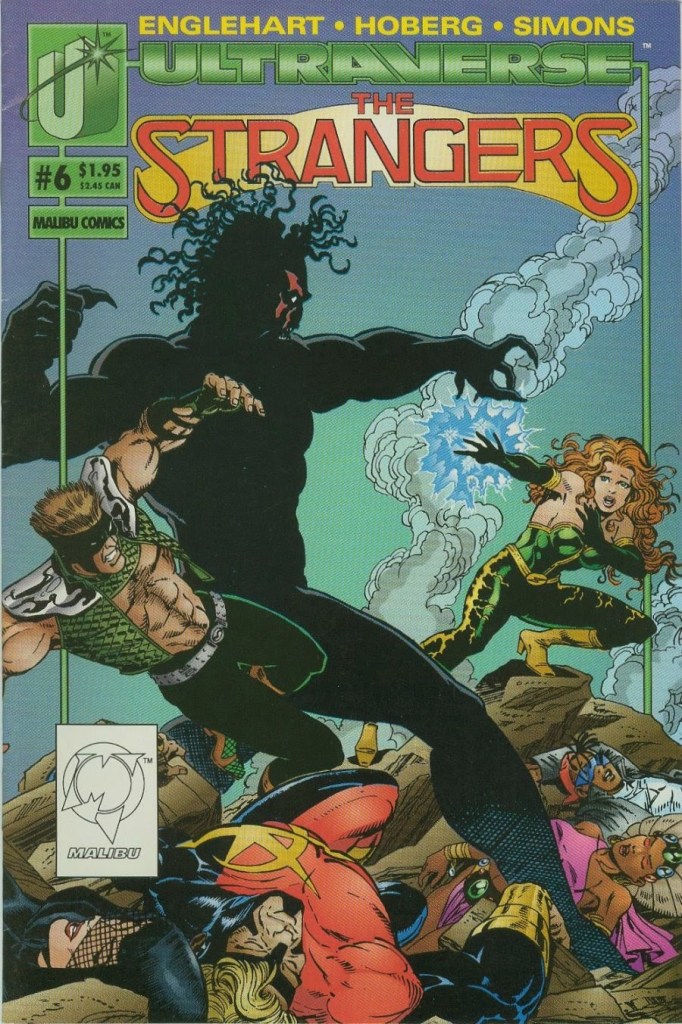
The cover.

Early story

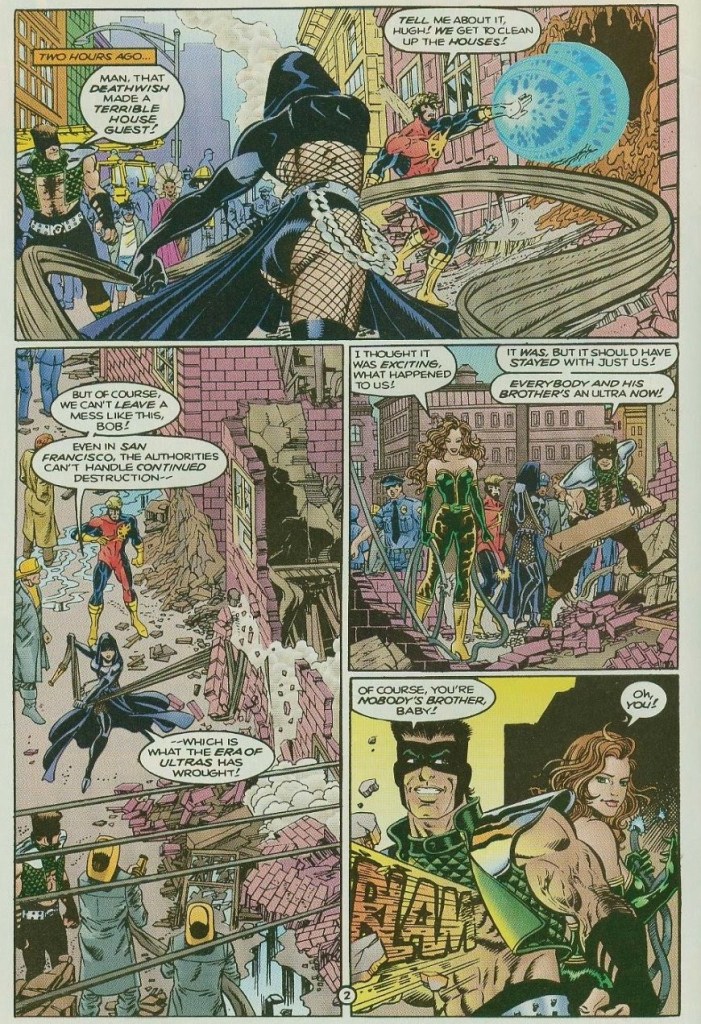
The story begins with the impact of Deathwish still felt by The Strangers and the locals. Deathwish left behind a lot of physical damage and the team does what it can to repair it even though some emergency personnel are already present.

A short time later, an old survivor was found and was brought to a hospital for treatment. Yrial, Zip-Zap and Lady Killer decide to go to the hospital and observe the emergency procedure. Suddenly, a loud voice from somewhere was heard and Zip-Zap speedily went around to find the source. He found a hospital room which had a patient warning others that darkness has arrived.

Back inside the emergency room, something happens to the old survivor and Deathwish suddenly emerges out of thin air. Lady Killer is stunned with the sight of the monster’s return…

Quality

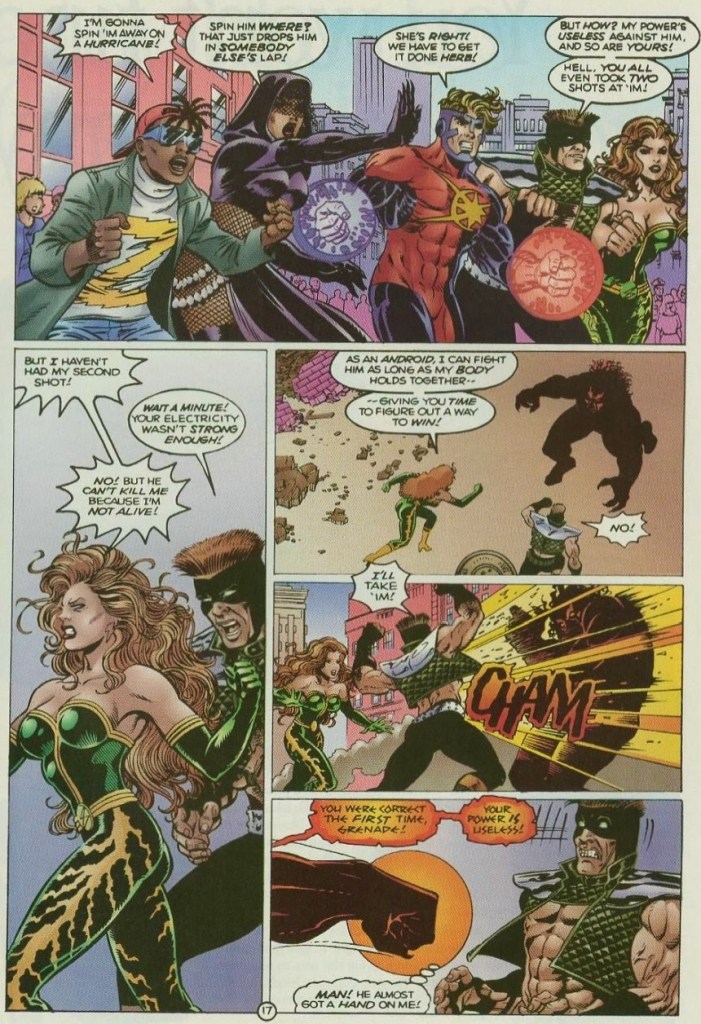
The Strangers fight Deathwish again.

Without spoiling important plot details, this story marks the second conflict between The Strangers and Deathwish. The good news here is that the script is well written and the creative duo found new ways to keep the rematch fresh and fun to read. What the Strangers did the previous time to beat Deathwish did not work anymore which forced their members to find new ways and tactics overcome the challenges. As for the villain, this comic book showed more of his personality (as opposed to his desire for power and absorbing life).

When it comes to character development, it’s pretty much non-existent here. The scene showing Yrial working with her magic does not count as character development but more of exposition of what she could do. It feels hollow but the visuals are nice to look at.

Conclusion

The Strangers helping with cleaning up the mess.

While The Strangers (1993) is a fun read and really nice art drawn by Rick Hoberg, it still is a step down from its predecessor in terms of engagement and depth. The rematch between The Strangers and Deathwish was fun but it ended in a way that felt like a creative way of cheating readers who preferred to see a more engaging conclusion.

If you are seriously planning to buy an existing hard copy of The Strangers (1993), be aware that as of this writing, MileHighComics.com shows that the near-mint copy of the comic book costs $14.

Overall, The Strangers (1993) is satisfactory.

+++++

Thank you for reading. If you find this article engaging, please click the like button below and also please consider sharing this article to others. If you are looking for a copywriter to create content for your special project or business, check out my services and my portfolio. Feel free to contact me as well. Also please feel free to visit my Facebook page Author Carlo Carrasco and follow me at HavenorFantasy@twitter.com
A Look Back at The Solution #3 (1993)

Disclaimer: This is my original work with details sourced from reading the comic book and doing personal research. Anyone who wants to use this article, in part or in whole, needs to secure first my permission and agree to cite me as the source and author. Let it be known that any unauthorized use of this article will constrain the author to pursue the remedies under R.A. No. 8293, the Revised Penal Code, and/or all applicable legal actions under the laws of the Philippines.

Welcome back, superhero enthusiasts, comic book collectors, 1990s culture enthusiasts and fans of Malibu Comics! Are you ready for another return to the Ultraverse? I’ve got another retro review of The Solution.

Last time around, The Solution went to Japan on a mission that involved a secret meeting between leader Lela Cho/Tech and a man referred to as Kronstein. However, something unfortunate happened that led to violence. What The Solution encountered was a force of opposition in the form of another team (that was introduced also in issue ).

With those details laid down, here is a look back at The Solution , published in 1993 by Malibu Comics with a story by the late James Hudnall and drawn by Darick Robertson (with ink work done by Barbara Kaalberg).

The cover.

Early story

The story begins in Los Angeles. A lady is struggling with finding her car key as two monstrous figures approach her. One of them is holding her set of keys. They fully transform into over-sized monsters with razor sharp teeth right in front of her. The monsters’ focus gets disrupted when they hear the sound of a harmonica being played by a man sitting on top of a car. As they approach him, the man grabs his rod and fights them fearlessly.

The next day in nearby Hollywood, Lela/Tech and her teammates have a meeting in a hotel room. Dropkick and Vurk express concern about Lela engaging in media interviews that could undercut what they have been trying to do. Lela does not see anything wrong about it and she reminds Dropkick that their team is a business and they could use the free advertising.

Apart from the media talk, The Solution is preparing to meet their new client at 9PM. Vurk, seeking some fresh air and use the free time, decides to head out for a while. Discreetly, Lela asks Aera to use her magic to put a trace on him…

Quality

Vurk in his monster form during his fight with the hunter of his race.

Like issue , this one continues to build-up the team but with one notable difference…more focus on the creepy looking Vurk (also referred to as Outrage). While it was established in issue that, like Aera/Shadowmage, he is not human. Rather he belongs to a race called the Darkurians which are oversized monsters in their true forms. In this story, you get to see more of Vurk’s nature as a Darkurian as well as his personality complete with how much he has learned to walk along the many people around him.

This comic book also introduces readers to a new character who hunts Darkurians as part of his campaign to rid the world of them. As it turns out, that man has a history of conflict with Vurk and this issue reignites their conflict. This easily produces the spectacle of this comic book which is filled with hard-hitting action, collateral damage and action moves that Vurk could pull off only in his monster form. It’s pretty entertaining stuff.

Conclusion

The team in their private meeting.

The Solution (1993) is a fun Ultraverse story that succeeded in building up the series’ concept but with more focus on Vurk. Vurk is not exactly an appealing character on face value but at least his background details and his rivalry with the hunter of his race added a good amount of depth into the story. It is also interesting to see Vurk trying his best to be good with the good guys (his team). Having read his incidental involvement with the team in issue #8, this comic book makes more sense out of him.

If you are seriously planning to buy an existing hard copy of The Solution (1993), be aware that as of this writing, MileHighComics.com shows that the near-mint copy of the regular edition costs $14 while the near-mint copy of the newsstand edition costs $42.

Overall, The Solution (1993) is recommended.

+++++

Thank you for reading. If you find this article engaging, please click the like button below and also please consider sharing this article to others. If you are looking for a copywriter to create content for your special project or business, check out my services and my portfolio. Feel free to contact me as well. Also please feel free to visit my Facebook page Author Carlo Carrasco and follow me at HavenorFantasy@twitter.com