A Look Back at Dazzler #4 (1981)

Disclaimer: This is my original work with details sourced from reading the comic book and doing personal research. Anyone who wants to use this article, in part or in whole, needs to secure first my permission and agree to cite me as the source and author. Let it be known that any unauthorized use of this article will constrain the author to pursue the remedies under R.A. No. 8293, the Revised Penal Code, and/or all applicable legal actions under the laws of the Philippines.

Welcome back superhero enthusiasts, 1980s culture enthusiasts and comic book collectors! Today we go back to the year 1981 to examine the Marvel Comics universe through the exploits of Dazzler!

Last time around, Alison Blaire was preparing herself for a big event as Dazzler. The event was something needed to help her boost her career as an entertainer and the stakes were high as there were many important guests. The weird thing was that she instead got involved with one of the most fearsome super villains of Marvel – Dr. Doom!

With those details laid down, here is a look back Dazzler , published by Marvel Comics in 1981 with a story written by Tom DeFalco and drawn by the late Frank Springer. This was Springer’s Dazzler debut.
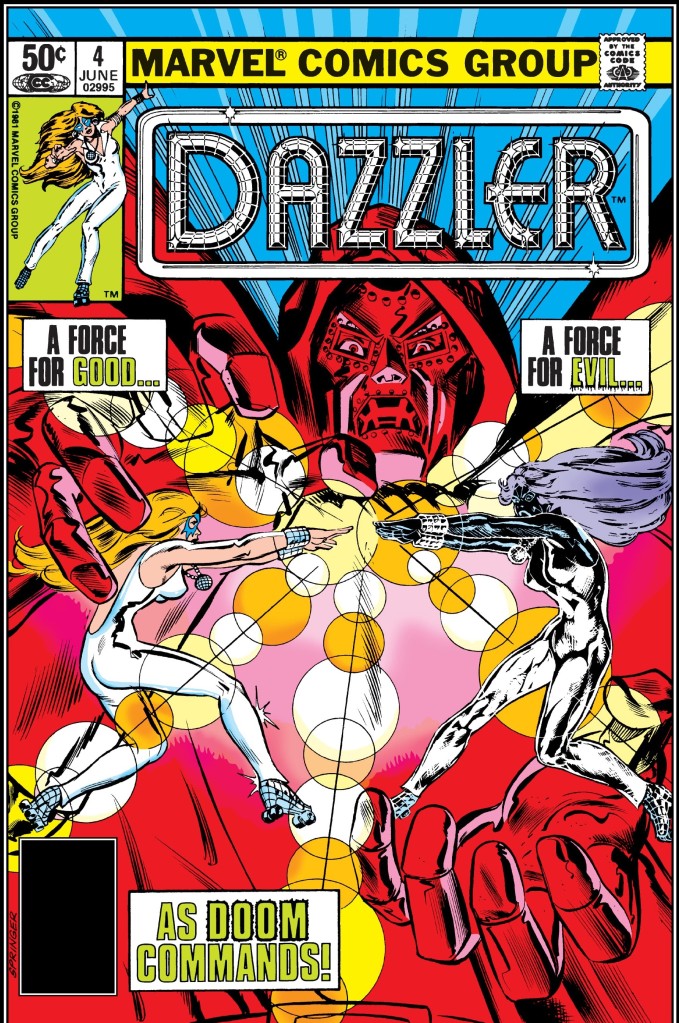
The cover.

Early story

The story begins inside a secret facility. Dr. Doom tells Dazzler that the Merlin Stone he just acquired mirrors her reflections as well as his own. The said stone has unique, mystical properties that Doom believes will help him achieve his dream of domination over mankind.

Dazzler, who is trapped inside a tube and is guarded by two of Dr. Doom’s guards, tries to recover after losing consciousness a short time back. Dr. Doom expresses his observation of her special ability to convert sound into light.

Dr. Doom turns his computer on energizing the tube that contains Dazzler. She suddenly turns into energy and disappears…

Quality

Dazzler in a new dimension.

The best way to describe this comic’s story…it is one wild ride that emphasizes a different kind of fantasy for readers. This is, of course, related to Dr. Doom’s immediate quest of finding another Merlin Stone within a different dimension which directly involved Dazzler against her will.

Dazzler here was in a very wild misadventure that goes way beyond the limits of New York City. Being in a completely new dimension, she finds herself literally lost in the sea of space and encounters creatures here and there. This misadventure, however, was not written to be mindless at all. In fact, as the tale in the new dimension goes on, Dazzler was presented to be more tactical, more analytical and do things to solve problems she encountered. She also gets to use her superpower in more creative ways.

The misadventure also has key moments that test Dazzler’s resolve on a personal level. As such, these moments added to her development which also raises the stakes as to what she could potentially do once she returns back to her life. Clearly, this is a story that carefully mixes spectacle and character development without losing track of the story.

On the art of the comic book, Frank Springer’s Dazzler debut is pretty solid. Not only does he capture the look of Dazzler herself, his creative visuals really brought the dimension into life filled with images of out space, fantasy monsters and more. Apart from drawing Dazzler and Dr. Doom, Springer’s art of the Fantastic Four is pretty good to look at.

Conclusion
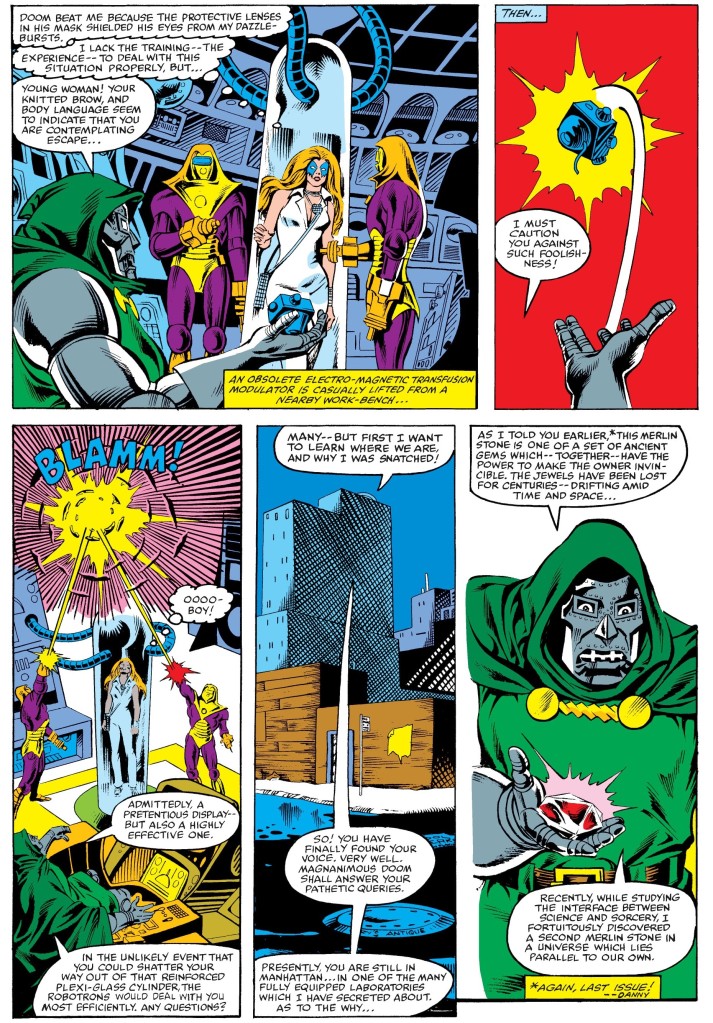
A helpless Dazzler in the presence of Dr. Doom.

Dazzler (1981) is a fun comic book to read and as a Dazzler story, it is a worthy continuation of the events that took place in issue . The concept about having Dazzler under the power of Dr. Doom was nicely executed which is a very hard feat to achieve since the said super villain was known to be a major force of opposition not only against the Fantastic Four but also against Spider-Man, the X-Men and more. Dazzler’s misadventure into the other dimension was wild and yet nicely structured which led to some nice character development of hers. This comic book had a strong series start for Frank Springer who went on to draw a great majority of the issues of the Dazzler monthly series.

If you are seriously planning to buy an existing hard copy of Dazzler (1981), be aware that as of this writing, MileHighComics.com shows that the near-mint copy of the regular edition costs $28 while the near-mint copy of the newsstand edition costs $60.

Overall, Dazzler (1981) is recommended.

+++++

Thank you for reading. If you find this article engaging, please click the like button below and also please consider sharing this article to others. If you are looking for a copywriter to create content for your special project or business, check out my services and my portfolio. Feel free to contact me with a private message. Also please feel free to visit my Facebook page Author Carlo Carrasco and follow me on Twitter at  @HavenorFantasy as well as on Tumblr at https://carlocarrasco.tumblr.com/
A Look Back at WildC.A.T.S: Covert Action Teams #6 (1993)

Disclaimer: This is my original work with details sourced from reading the comic book and doing personal research. Anyone who wants to use this article, in part or in whole, needs to secure first my permission and agree to cite me as the source and author. Let it be known that any unauthorized use of this article will constrain the author to pursue the remedies under R.A. No. 8293, the Revised Penal Code, and/or all applicable legal actions under the laws of the Philippines.

Welcome back superhero enthusiasts, 1990s culture enthusiasts and comic book collectors! Today we continue revisiting Jim Lee’s flagship title under Image Comics – WildC.A.T.S: Covert Action Teams!

For the newcomers reading this, I recently completed reviewing the 4-issue mini-series (read my retro reviews here, here, here and here), the first issue of which was one of the launch titles published under Image Comics’ banner through Malibu Comics. Back in 2020, I reviewed issue #5 which itself was highly unusual as it marked the beginning of what was back then the regular series of WildC.A.T.S (note: starting a brand new comic book series is often done with a new issue ). WildC.A.T.S: Covert Action Teams was conveniently part of the build-up for the Killer Instinct storyline that had featured Jim Lee’s creations crossing over with Marc Silvestri’s Cyber Force.

With those details laid down, here is a look back WildC.A.T.S: Covert Action Teams , published by Image Comics in 1993 with a story written by Brandon Choi and Jim Lee. Lee did the art.

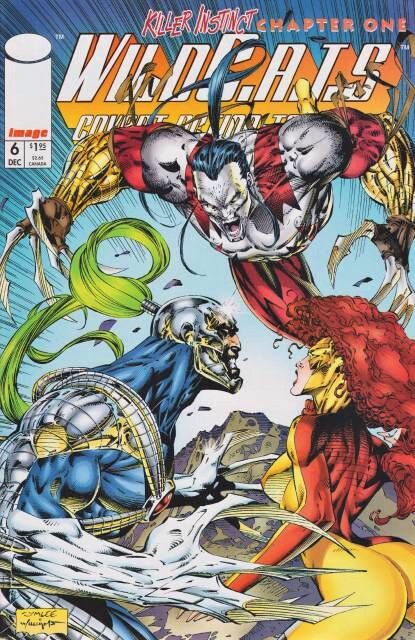
The cover.

Early story

The story begins with the WildC.A.T.S flying in their high-tech aircraft and observing the large explosion which marked the destruction of a top-secret research facility. Their teammate Warblade was left behind which concerns Grifter and Voodoo. Spartan says it is too risky for them to move close to the site of destruction for Warblade as their electronic counter measure and identification systems have been lost due to the explosion. Spartan also told them team that they need to fly away before the Gamorran security forces arrive.

They are too late, however, as three high-tech aircrafts of Gamorra have arrived to take them down. One of them launched several missiles at the WildC.A.T.S aircraft causing Spartan to tell Grifter to redirect all power to their shields.

As hard as he tried, Spartan could only fly their shielded jet to dodge the first four missiles and absorbing the impact of two missiles before getting hit by the other missiles launched by the other two enemy aircrafts.

While their jet got destroyed into pieces, the WildC.A.T.S managed to survive the explosion only to see themselves falling helplessly in the air. As Spartan catches Voodoo, Grifter warns him abou the incoming Gamorran aircraft…

Quality

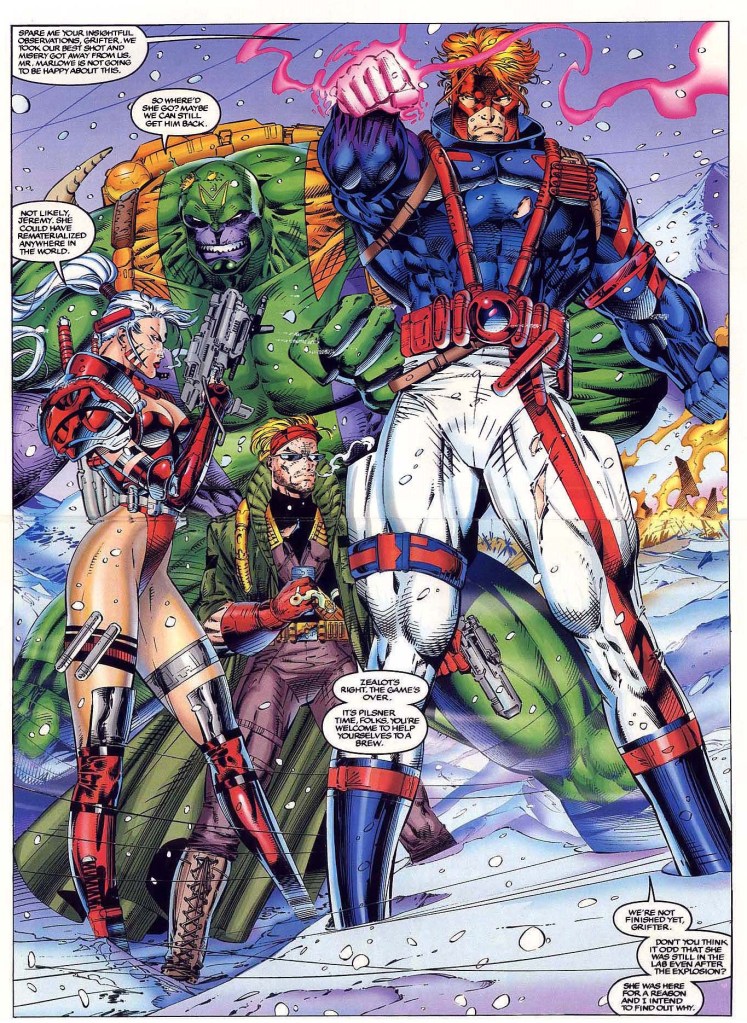
The team but without Jacob Marlowe, Warblade, Voodoo and Void at this point of the story.

To begin with, this comic book is very much like its predecessors – a very action-packed tale laced with the occasional character moments for fun while having little room left for character development. If there is any notable change in the way this comic book’s story was told, it is the detective work done collectively by key members of WildC.A.T.S followed by exposition dumps here and there. The detective work and exposition were done primarily to add to the build-up of the crossover with Cyber Force with the revelation of a love triangle from the past involving Misery (who gave Grifter a lot of trouble in issue ), Warblade and Ripclaw (from the other team).

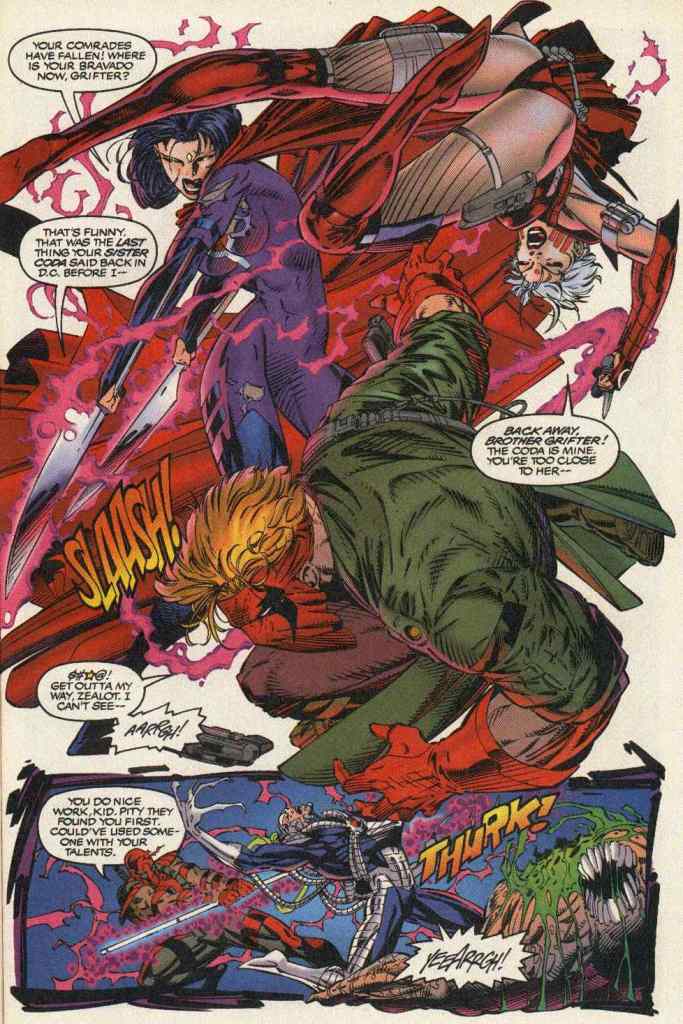
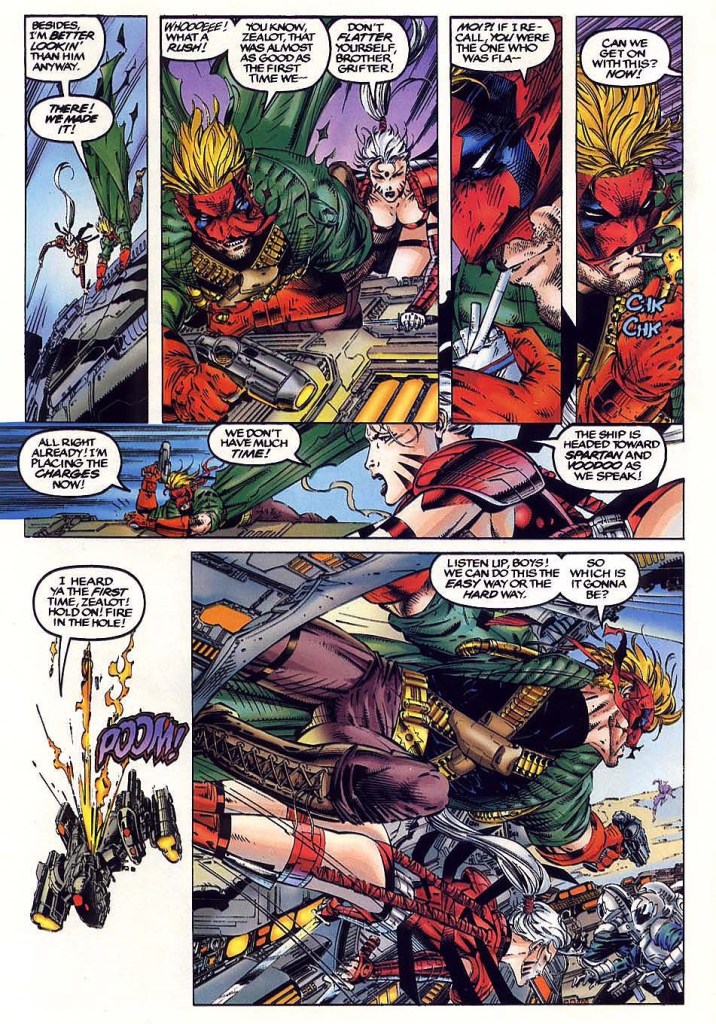
As with Jim Lee’s past works, the action here is highly charged and there is a lot of spectacle to enjoy most of the way. By the time this comic book got published, the respective capabilities of the WildC.A.T.S team members have already been established and the creators pushed the creative limits further on showing what else could the main characters do as envisioned by Jim Lee. There is even this 4-page sequence showing Grifter and Zealot infiltrating one of the Gamorran aircrafts and having lots of banter along the way which was fun to read. Considering the lack of space for character development, the creators made up for it somewhat with the dialogue.

As this is the first chapter of the Killer Instinct crossover storyline, the build-up for it is not really that engaging to me personally. While Ripclaw was already established as a major Cyber Force character and Warblade was a visible yet not so dominating as a member of WildC.A.T.S, the establishment of the personal connection between them through Misery (the woman right in the middle) is just not so strong. Not even a huge exposition dump about the past could have strengthened the background. It would have been more helpful had Jim Lee and Marc Silvestri agreed to publish a prequel comic book (or pages inserted into a few comic books of WildC.A.T.S and Cyber Force) about Warblade-Misery-Ripclaw in the past as a prelude to Killer Instinct. More on Misery herself, I could not help but think of her as a distorted and more wicked version of the X-Men’s Jean Grey complete with long red hair.

Conclusion

Grifter and Zealot infiltrate a Gamorran aircraft.

WildC.A.T.S: Covert Action Teams (1993) is another fun comic book to read filled with a lot of stuff that Jim Lee fans love to see again and again. As the opening chapter of Killer Instinct, the creators did the best they could to establish Misery as an important antagonist who happens to have been personally involved with Warblade and Ripclaw some years back. Sadly, the Warblade-Misery-Ripclaw triangle establishment is not so engaging and looked more like an afterthought. Still, this comic book’s story is not brainless and expanded the lore of the WildStorm universe a bit more. There is more good stuff than bad ones which make this worth reading.

If you are seriously planning to buy an existing hard copy of WildC.A.T.S: Covert Action Teams (1993), be aware that as of this writing, MileHighComics.com shows that the near-mint copy of the regular edition costs $20 while the near-mint copies of gold cover edition and newsstand edition cost $300 and $60 respectively.

Overall, WildC.A.T.S: Covert Action Teams (1993) is recommended.

+++++

Thank you for reading. If you find this article engaging, please click the like button below and also please consider sharing this article to others. If you are looking for a copywriter to create content for your special project or business, check out my services and my portfolio. Feel free to contact me with a private message. Also please feel free to visit my Facebook page Author Carlo Carrasco and follow me on Twitter at  @HavenorFantasy as well as on Tumblr at https://carlocarrasco.tumblr.com/
A Look Back at WildC.A.T.S: Covert Action Teams #4 (1993)

Disclaimer: This is my original work with details sourced from reading the comic book and doing personal research. Anyone who wants to use this article, in part or in whole, needs to secure first my permission and agree to cite me as the source and author. Let it be known that any unauthorized use of this article will constrain the author to pursue the remedies under R.A. No. 8293, the Revised Penal Code, and/or all applicable legal actions under the laws of the Philippines.

Welcome back superhero enthusiasts, 1990s culture enthusiasts and comic book collectors! Today we revisit the early days of Image Comics through Jim Lee’s WildC.A.T.S: Covert Action Teams comic book franchise which was one of the launch titles of the said company.

Last time around, I reviewed the third issue of the WildC.A.T.S mini-series and its quality was good enough for me. Other than the visual candies delivered by Jim Lee, WildC.A.T.S: Covert Action Teams featured a crossover with Rob Liefeld’s very own Youngblood which was really surprising and intriguing back in those times.

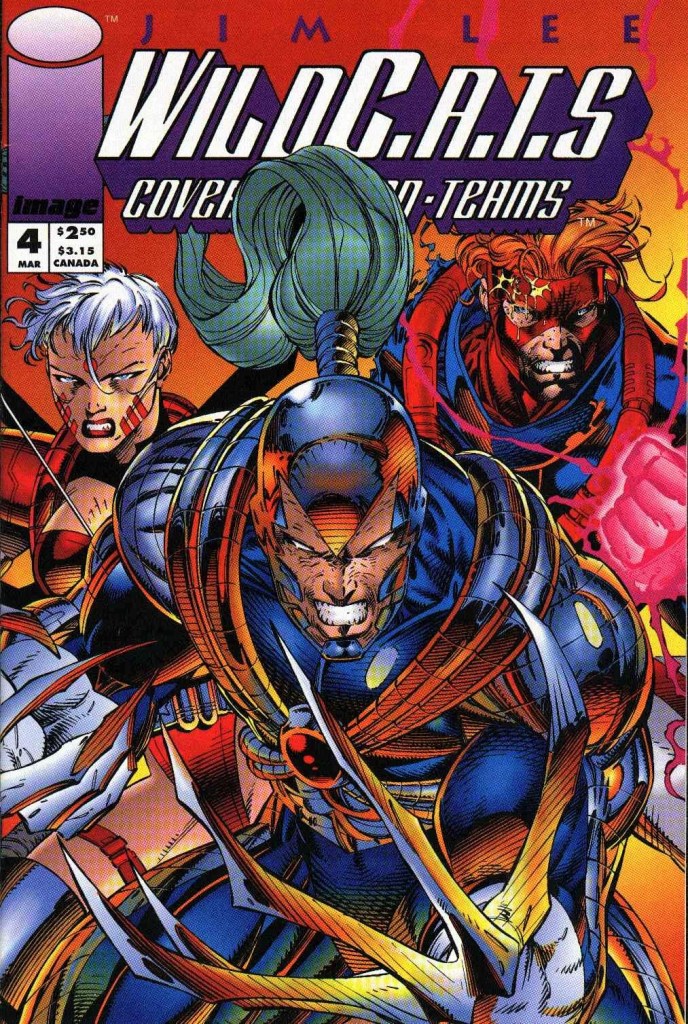
With those details laid down, here is a look back at the final issue of the mini-series…WildC.A.T.S: Covert Action Teams , published by Image Comics through Malibu Comics in 1993 with a story written by Brandon Choi and Jim Lee. Lee did the art.

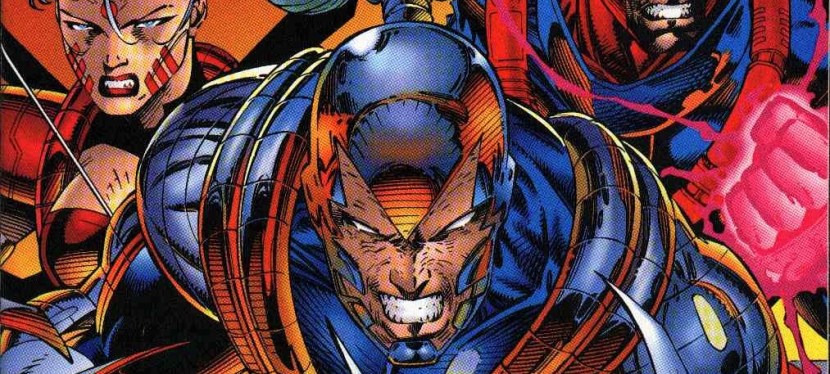
Jim Lee drew this cover very similarly to his cover art work on X-Men (1992).

Early story

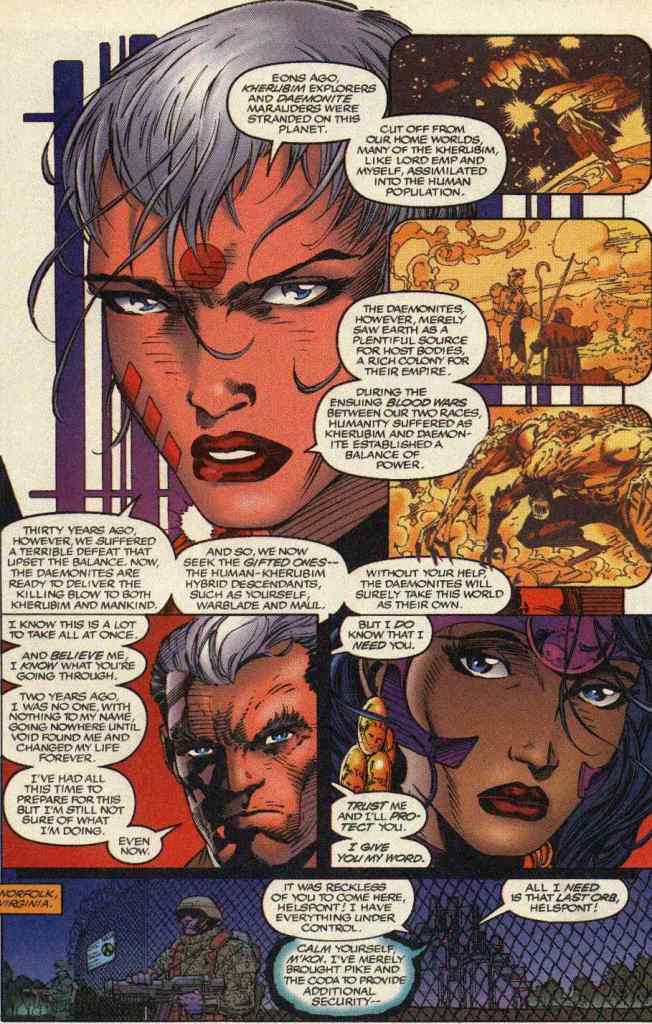
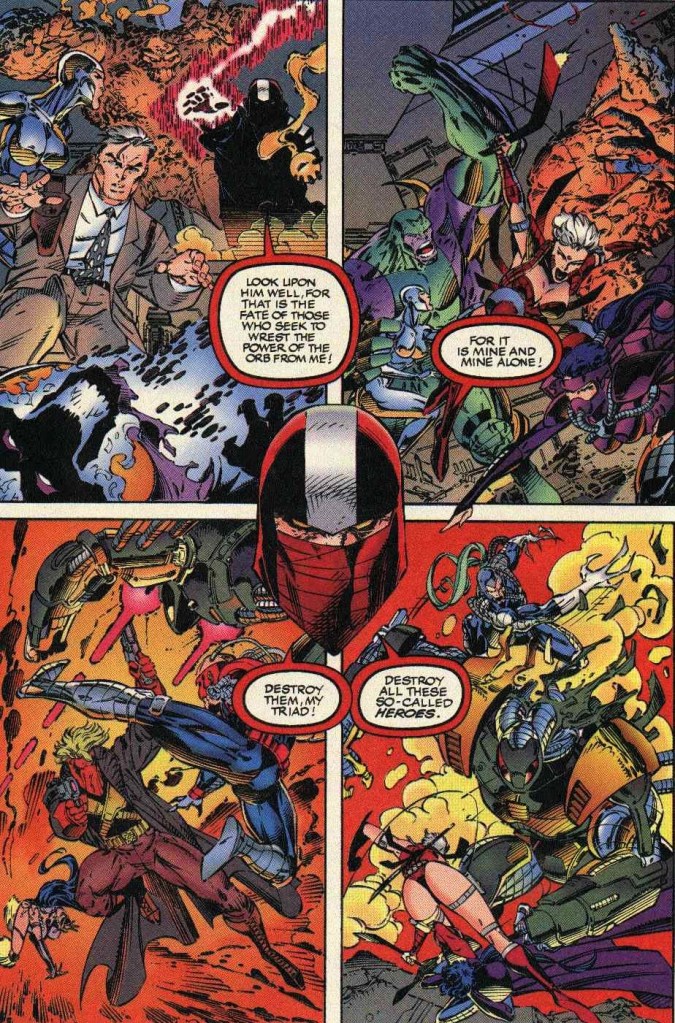
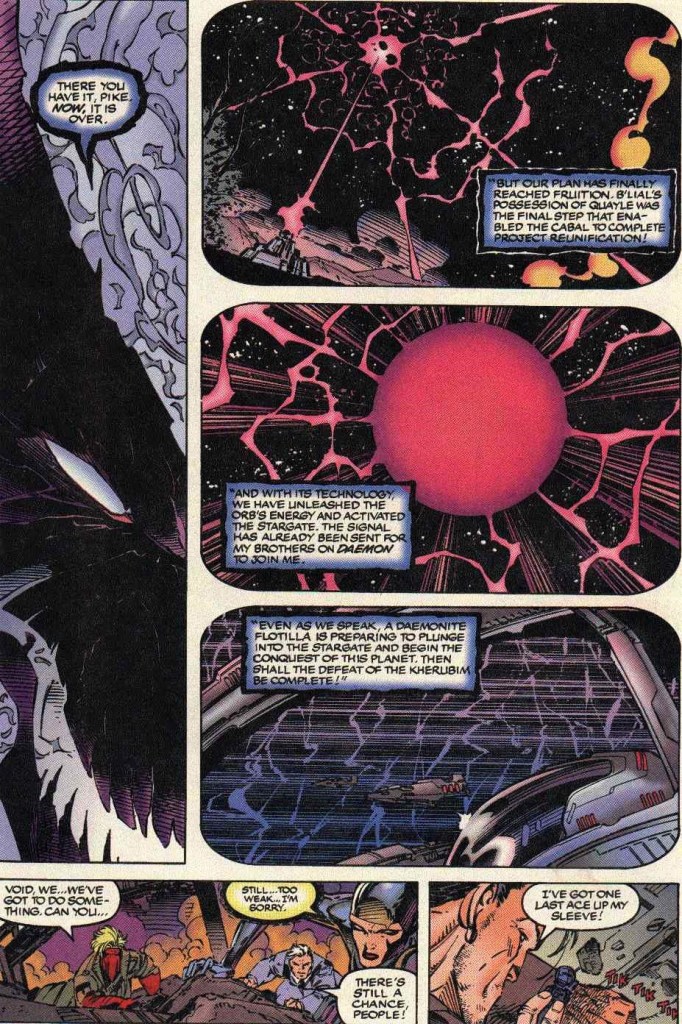
The story begins with Helspont already declaring victory as well as the beginning of his operation called Reunification which involves the use of the orb to activate a stargate which would allow his brethren of Daemonites to come to Earth to not only overwhelm the Kherubim but also to conquer the whole world. In his presence are two of his deadly companies standing with him and certain members of WildC.A.T.S – including their leader Jacob Marlowe – who are down on the rough surface having been hit hard moments earlier.

Suddenly a group composed of the six Youngblood members, Vice President Dan Quayle and WildC.A.T.S’ members Voodoo and Maul approach Helspont and his companions in an attempt to make them surrender.

As Voodoo realizes her power does not affect Helspont, the vicious Daemonite strikes the group with an energy blast aided by the orb and the high technology of the place. As this happens, Grift, Void and Jacob slowly make their moves. Jacob uses his communicator to send a signal to the heavily damaged Spartan…

Quality

WildC.A.T.S face strong opposition from the Gnome and his dangerous companions.

As the final tale of the mini-series, I can say that the script made for this comic book is a pretty satisfying read from start to finish. Like in issue , the pace here moves fast and there is a lot of spectacle that got executed while never overwhelming its narrative. More on the narrative, the conflict between the Kherubim and Daemonites is strongly symbolized by the WildC.A.T.S and Helspont’s forces going head to head. There are some pretty notable character moments that added to the fun factor such as Jacob sarcastically telling Helspont he could not access the back-up systems for his dreaded operation to bring the Daemonites to Earth.

Of course, this is not simply a WildC.A.T.S versus Helspont story in the good-versus-evil type of way. Apart from the inclusion of Rob Liefeld’s Youngblood, there is also the other dangerous party led by the Gnome who also have a strong interest in the orb. While their participation in the story happens pretty late, they do provide serious opposition against Jacob Marlowe and his team.

As mentioned earlier, there is a lot of action that expresses the intensity of the conflicts. While there is almost no room left for any real character development, the creators managed to craft a story that never felt brainless or unintelligent. As such, there is a lot of entertaining stuff to enjoy here and I personally find the establishment of WildC.A.T.S’ core concept to be solid and worth following.

Conclusion

As Helspont emphasizes his evil plan, Jacob Marlowe makes his move.

WildC.A.T.S: Covert Action Teams (1993) is a not just a fun comic book to read. It is also a worthy conclusion to its mini-series and also it succeeded in establishing the WildC.A.T.S as both Jim Lee’s passion project and as one of the most worthy early titles of Image Comics. By the time I reached the end of this comic book, it became clear to me back in 1993 that Jim Lee was moving forward to a new territory on superhero comic book creations leaving behind his legacy with Marvel and their X-Men franchise. While this comic book ended the 4-issue mini-series, the funny thing was that Jim Lee and his team went on to start a regular comic book series of WildC.A.T.S: Covert Action Teams by actually publishing issue #5 (in late 1993) instead of starting with a brand new issue .

If you are seriously planning to buy an existing hard copy of WildC.A.T.S: Covert Action Teams (1993), be aware that as of this writing, MileHighComics.com shows that the near-mint copy of the regular edition costs $20 while the near-mint copies of newsstand edition (without card) and the numbered-and-signed edition cost $48 and $160 respectively.

Overall, WildC.A.T.S: Covert Action Teams (1993) is recommended.

+++++

Thank you for reading. If you find this article engaging, please click the like button below and also please consider sharing this article to others. If you are looking for a copywriter to create content for your special project or business, check out my services and my portfolio. Feel free to contact me with a private message. Also please feel free to visit my Facebook page Author Carlo Carrasco and follow me on Twitter at  @HavenorFantasy as well as on Tumblr at https://carlocarrasco.tumblr.com/
A Look Back at WildC.A.T.S: Covert Action Teams #3 (1993)

Disclaimer: This is my original work with details sourced from reading the comic book and doing personal research. Anyone who wants to use this article, in part or in whole, needs to secure first my permission and agree to cite me as the source and author. Let it be known that any unauthorized use of this article will constrain the author to pursue the remedies under R.A. No. 8293, the Revised Penal Code, and/or all applicable legal actions under the laws of the Philippines.

Welcome back superhero enthusiasts, 1990s culture enthusiasts and comic book collectors! Today we revisit the early days of Image Comics through Jim Lee’s WildC.A.T.S: Covert Action Teams comic book franchise which was one of the launch titles of the said company.

Last time around, I reviewed the 2nd issue of WildC.A.T.S. which literally had more meat in its storytelling as the required introductions of the core characters were over. Issue had some really nice revelations as it helped expand the WildStorm universe a bit more and it was intriguing to see International Operations (I/O) emphasized more as the mini-series established the Kherubim-Daemonite conflict.

With those details laid down, here is a look back at WildC.A.T.S: Covert Action Teams , published by Image Comics through Malibu Comics in 1993 with a story written by Brandon Choi and Jim Lee. Lee did the art.

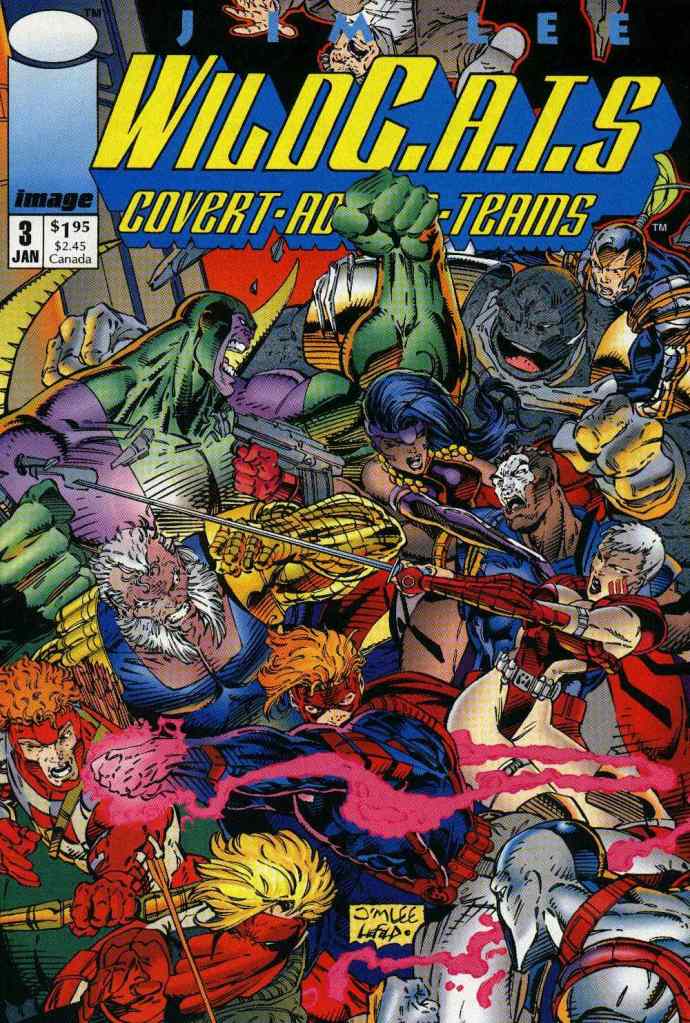
The cover.

Early story

The story begins inside the top-secret research facility of SDI with Maul holding a Daemonite disguised as US Vice President Dan Quayle off the ground with Spartan and Voodoo near him. The problem they have, however, is that the Youngblood team is facing them ready to fight. Shaft of Youngblood demands the release of the Vice President.

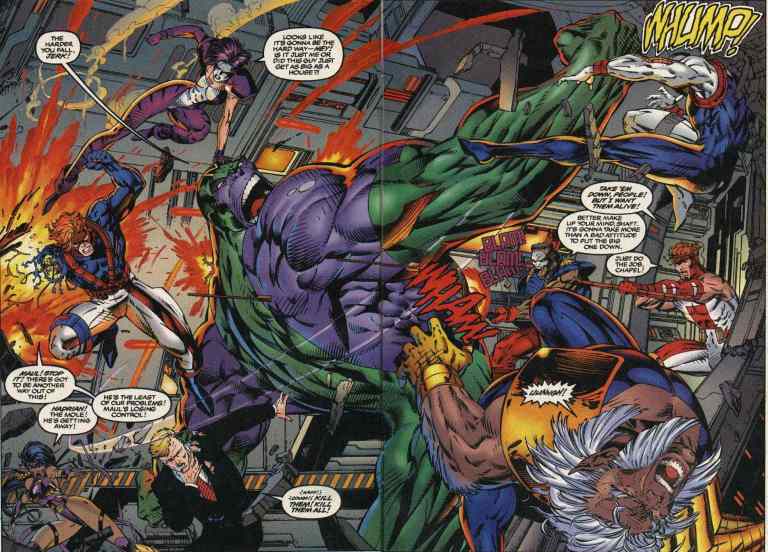
With his massive build, Maul lets go of the Vice President and hits Diehard sparking a battle between his team and Youngblood. Shaft tells his teammates that as they fight the three WildC.A.T.S, he wants them alive. The impostor Vice President Quayle tells Youngblood to kill them all.

After Diehard and Badrock knock off Maul, Chapel fires several blasts at Spartan to separate him from the impostor. Shaft then fires an arrow that generates disruptive sound which prevents Voodoo from executing her power.

Elsewhere within the facility, Grifter, Jacob Marlowe, Warblade, Void and Zealot quietly make their way to the control center where the Daemonite leader Helspont is overseeing secret operations…

Quality

You love Jim Lee-style action, you will find a lot to enjoy in this comic book.

Starting with the storytelling, this one is expectedly a natural progression from issue but the key difference is that the pace moved much faster as there was more emphasis on action and visual splendor. Along the way another sub-plot was dramatized complete with the showing of additional characters Attica, Slag, HARM and their superior who are after a key object that happens to be a crucial part of Helspont’s operation. The way the script was written, the narrative was told in a disciplined manner even though the pace was faster and the creators had to integrate Rob Liefeld’s Youngblood which resulted one of the earliest Image Comics crossovers that unfortunately did not justify the fancy cover art. Given the addition of Youngblood, the mentioned sub-plot and the way the script was made, there was clearly no room left for character development. In my experience, re-reading this comic book’s story was fun and engaging enough.

As this story was action-packed, fans of Jim Lee will surely enjoy what he presented here. Even by today’s standards, the art and presentation of the spectacle is great to see! Personally, I like Jim Lee’s visual take on Youngblood (except that I still find Rob Liefeld’s drawing of Chapel more detailed) and the short-but-sweet battle between the two superhero teams is quite a spectacle. In terms of visual details, Lee drew the characters and environment with a lot of detail all throughout. There were no signs of rushed art here.

Conclusion

The battle between three WildC.A.T.S members and Youngblood begins!

As mentioned earlier, WildC.A.T.S: Covert Action Teams (1993) is pretty entertaining and engaging. Compared to issue , this one has a lot more action and the narrative moved at a faster pace without becoming brainless. At the same time, there is a clear feeling that the stakes were raised as the WildC.A.T.S made their moves in what is clearly their final objective as a team. Also a factor here is the continued emphasis on the Kherubim-Daemonite war which was executed well. More on Rob Liefeld’s Youngblood being involved in the story, this results the illusion that Image Comics back then had a shared universe (note: read the legal stuff on the bottom of the credits). The crossover done here was more of an experiment done to emphasize the cooperation between Jim Lee and Liefeld as they were co-founders of Image.

If you are seriously planning to buy an existing hard copy of WildC.A.T.S: Covert Action Teams (1993), be aware that as of this writing, MileHighComics.com shows that the near-mint copy of the gimmick cover edition costs $20 while the near-mint copies of newsstand edition and the signed editions cost $60 each.

Overall, WildC.A.T.S: Covert Action Teams (1993) is recommended.

+++++

Thank you for reading. If you find this article engaging, please click the like button below and also please consider sharing this article to others. If you are looking for a copywriter to create content for your special project or business, check out my services and my portfolio. Feel free to contact me with a private message. Also please feel free to visit my Facebook page Author Carlo Carrasco and follow me on Twitter at  @HavenorFantasy as well as on Tumblr at https://carlocarrasco.tumblr.com/
A Look Back at WildC.A.T.S: Covert Action Teams #2 (1992)

Disclaimer: This is my original work with details sourced from reading the comic book and doing personal research. Anyone who wants to use this article, in part or in whole, needs to secure first my permission and agree to cite me as the source and author. Let it be known that any unauthorized use of this article will constrain the author to pursue the remedies under R.A. No. 8293, the Revised Penal Code, and/or all applicable legal actions under the laws of the Philippines.

Welcome back superhero enthusiasts, 1990s culture enthusiasts and comic book collectors! Today we revisit the early days of Image Comics through Jim Lee’s WildC.A.T.S: Covert Action Teams comic book franchise which was one of the launch titles of the said company.

For the newcomers reading this, Jim Lee is one of the co-founders of Image Comics and during his previous stint with Marvel Comics, he was instrumental in modernizing the X-Men both visually and creatively (note: look at all the paramilitary elements implemented during his X-Men days). WildC.A.T.S was his independent superhero team project which went on to not only grow as a comic book franchise in the 1990s, but also became an animated TV series. WildC.A.T.S dealt with conspiracy as well as aliens from outer space.

With those details laid down, here is a look back at WildC.A.T.S: Covert Action Teams , published by Image Comics in 1992 with a story written by Brandon Choi and Jim Lee. Lee did the art.

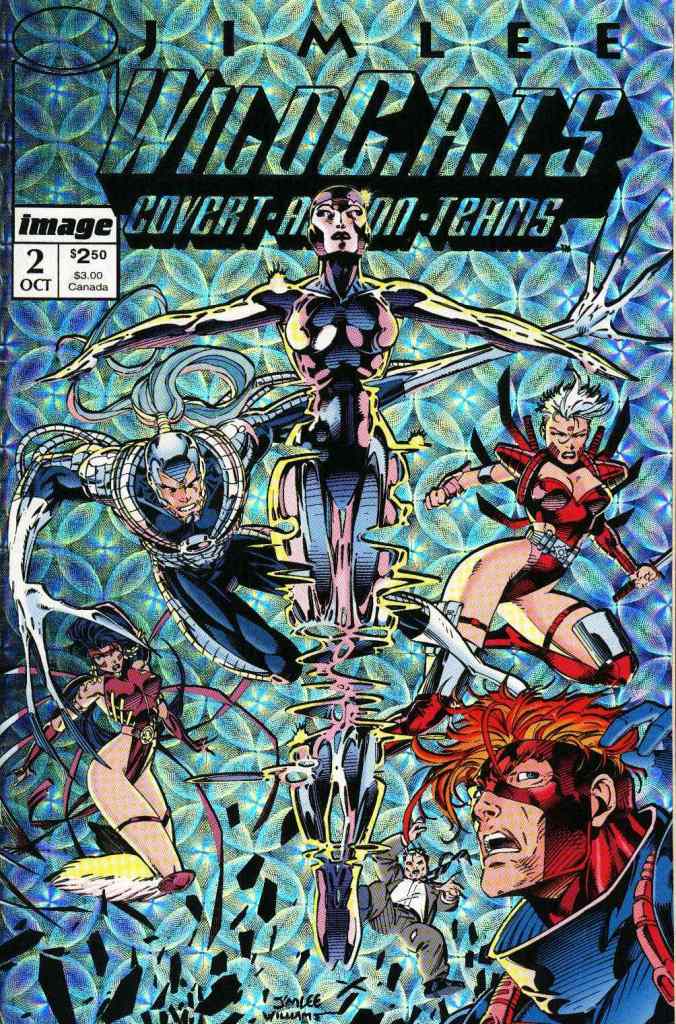
The cover.

Early story

The story begins in the headquarters of International Operations (I/O) whose officials have been monitoring a situation far away. Suddenly a portal appeared inside I/O which surprised director Lynch and his fellow officials. Seen through the portal – which appeared for only seconds in front I/O’s people – were Jacob Marlowe, Spartan, Grifter, Maul, Zealot, Voodoo, Void and Warblade who just escaped from certain death which is connected to the explosion monitored by I/O.

The WildC.A.T.S instantly arrived inside their highly advanced aircraft safe and sound. After some talk, they begin to move to a safehouse of Grifter’s near Quantico…

Quality

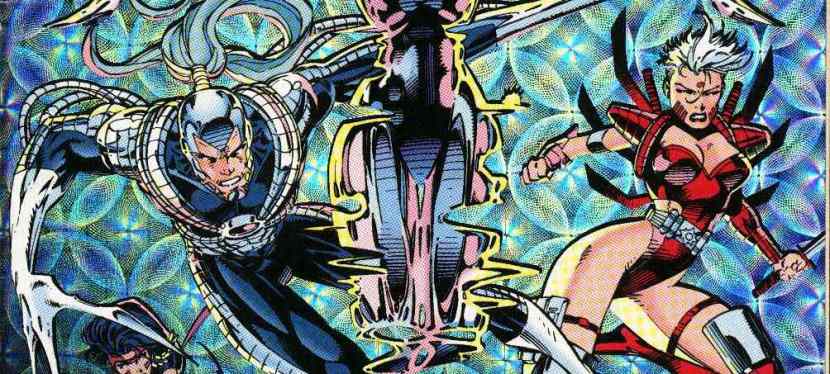
An efficient exposition about the science fiction concept of WildC.A.T.S.

As far as storytelling goes, this comic book has more depth to its plot. While the first issue was filled with introductions of characters and story concepts as well starting its narrative in cryptic fashion, there was more freedom in this issue for the writers to properly structure their story, gradually build-up tension, execute payoffs satisfactorily while still managing to insert spectacle to complete the work. The story moved with a moderate pace and things moved fast when it was needed. I find re-reading this WildC.A.T.S tale a more satisfying experience than before and it is also an improvement over the first issue.

More on the core concept about Daemonites infiltrating human societies on Earth with the involvement of the Cabal to enhance their efforts, there literally more meat to chew here as Jim Lee and Brandon Choi came up with clever and efficient ways on executing exposition. The I/O meanwhile literally jumped from being background decoration into the main story as a connection was made between one of the top officials of the organization and WildC.A.T.S leader Marlowe.

More on the WildC.A.T.S themselves, you will get to know more about each member and how their respective personalities differ from each other as they all struggle to keep up with the changes around them. Voodoo here is still the witness of a conflict she never anticipated would involve her and many times she is clueless and really struggling to figure out what has been happening. While Marlowe has the strong tycoon mentality all throughout, Spartan is the dedicated and focused operator while Grifter is the cocky gunslinger and Zealot is the battle-hardened warrior whose perception about life and survival could make readers wonder if she is truly brave or truly reckless. With the introductions of each character already done, in issue it was no surprise that there was a bit more space for the creators to define each team member with limited space (pages) they had during comic book production.

Conclusion

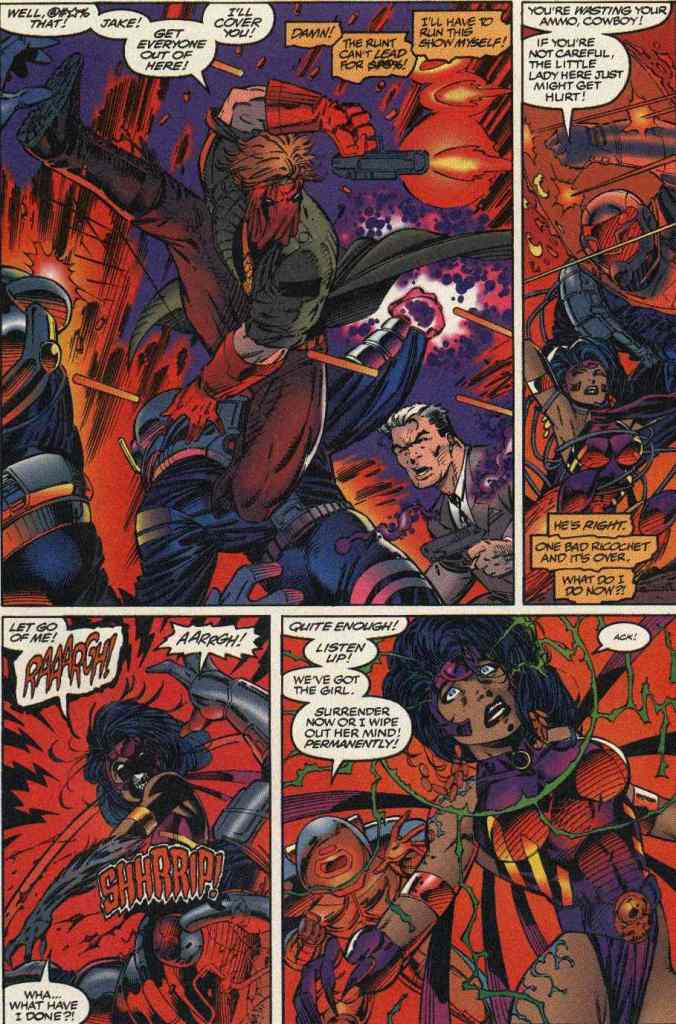
In the heat of the action, something visceral happened with Voodoo who is not even a fighter.

The best way to describe WildC.A.T.S: Covert Action Teams (1992) is that its core concept as well as its mini-series plot really started to take shape as Brandon Choi and Jim Lee got over all the creative hurdles in issue . The result was not only more focus on plotting but executing payoff for story build-up, characterization and putting enough action in a rather disciplined way. There was no sign of creative rush by Choi and Lee here. I should also state that it is in this same comic book where you will see more interesting traits of the WildC.A.T.S members which, in my experience, made me anticipate the next issue.

As one of the very early comic books of Image Comics, this one had one of the first, if not the first, gimmick covers of the said publisher and I can say that its content was good enough to justify the flashy cover and its rather high cover price of $2.50 (note: back in 1992 many of Marvel’s and DC’s comic books had cover prices of $1.25 while WildC.A.T.S: Covert Action Teams had a $1.95 cover price). I could not forget the day in 1992 when I visited a local comic book specialty store in Makati that had WildC.A.T.S: Covert Action Teams (1992) displayed with its cover really shining under a strong light source. I also remember there were others in the store staring at it.

If you are seriously planning to buy an existing hard copy of WildC.A.T.S: Covert Action Teams (1992), be aware that as of this writing, MileHighComics.com shows that the near-mint copy of the gimmick cover edition costs $20 while the near-mint copies of the signed gimmick cover edition and the newsstand edition cost $60 each.

Overall, WildC.A.T.S: Covert Action Teams (1992) is recommended.

+++++

Thank you for reading. If you find this article engaging, please click the like button below and also please consider sharing this article to others. If you are looking for a copywriter to create content for your special project or business, check out my services and my portfolio. Feel free to contact me with a private message. Also please feel free to visit my Facebook page Author Carlo Carrasco and follow me on Twitter at  @HavenorFantasy as well as on Tumblr at https://carlocarrasco.tumblr.com/
A Look Back at Spider-Man 2099 #6 (1993)

Disclaimer: This is my original work with details sourced from reading the comic book and doing personal research. Anyone who wants to use this article, in part or in whole, needs to secure first my permission and agree to cite me as the source and author. Let it be known that any unauthorized use of this article will constrain the author to pursue the remedies under R.A. No. 8293, the Revised Penal Code, and/or all applicable legal actions under the laws of the Philippines.

Welcome back, superhero enthusiasts, 1990s culture enthusiasts, and comic book collectors! Today we revisit the world of 2099 within the universe of Marvel Comics back in the 1990s, specifically through the Spider-Man 2099 monthly series.

Today we will look back at the sixth issue of Spider-Man 2099. Previously, Spider-Man struggled long and hard with the Japanese agent called the Specialist not knowing that they are being monitored by powerful forces behind the scenes. As Alchemax’s Tyler Stone wanted Spider-Man, something unexpected happened before issue ended.

With those details laid down, here is a look back at Spider-Man 2099 , published in 1993 by Marvel Comics with a story written by Peter David and drawn by Ricky Leonardi.

The cover.

Early story

The story begins in downtown New York which is the historic and original section of the city located far below the modern-day society and its skyscrapers (referred to as Uptown). Lots of people are living in poverty in downtown New York and even so they are not spared by people who claim to have authority over them as public service personnel. A woman and her child got approached by two men who believe that the mother is two months behind her security payments.

As the physical struggle between them went on, they all found themselves close to a dead end with a pile of trash located on it. Suddenly, a human arm comes out pushing the trash out of the way which stuns them all. Spider-Man then emerges and asks for help…

Quality

Spider-Man of 2099 is so weak and vulnerable, he could not even swing his way around and has to take a ride in downtown New York City.

If there is anything clear about this comic book, it is the fact that Peter David portrayed the futuristic Spider-Man as not only struggling for survival but also as a fugitive complete with a brand-new physical environment which is a dark, far futuristic vision of 20th century New York City. The good news is that David succeeded with what he executed and to say the least, this story has a completely different feel compared to issues #2, #3, #4 and .

On Spider-Man, the protagonist was shown to be very vulnerable. His fall from uptown to downtown really wrecked his health and due to the genetic modifications that happened to Miguel O’Hara in issue , his above-normal (albeit slow) recovery and strength to even move out the medical facility while being injured are justified creatively. Spider-Man being hunted together by Private Eye and their downtown counterparts (note: there is a clash of cultures and attitudes between them which was nicely dramatized) adds a new layer of suspense mixed with tension which easily reminds me of the fact that the futuristic web-slinger is just a worm within the futuristic and oppressive society of New York in 2099 under Alchemax (note: clearly anti-corporatism is a key element of Marvel 2099 which can be deceiving and misleading to readers, especially those who are vulnerable to the lies and deception of socialists, Marxists, Communists, liberals and other elements of the Satanic Left).

As expected, Peter David further dramatized relationships or connections between the supporting characters. He further spiced up the script with the gradual first appearance of a key 2099 villain for Spider-Man to face off with. I won’t reveal which villain is that and I encourage you to find out by reading this comic book.

Conclusion

Early in the comic book.

Spider-Man 2099 (1993) is fun and compelling to read. What makes it compelling is the creative way the author changed the mood of the story as it shifted into downtown New York of 2099 filled with poverty, darkness and hopeless living. Spider-Man as a fugitive here is similar yet different enough compared to how local authorities perceive the classic Spider-Man/Peter Parker. At this point of the monthly series, Spider-Man of 2099 is shown to be very vulnerable and Miguel O’Hara finally becomes desperate not just to survive but also get back home somehow.

If you are seriously planning to buy an existing hard copy of Spider-Man 2099 (1993) be aware that as of this writing, MileHighComics.com shows that the near-mint copy of the regular edition costs $30 while the near-mint copy of the newsstand edition costs $90.

Overall, Spider-Man 2099 (1993) is recommended.

+++++

Thank you for reading. If you find this article engaging, please click the like button below and also please consider sharing this article to others. If you are looking for a copywriter to create content for your special project or business, check out my services and my portfolio. Feel free to contact me with a private message. Also please feel free to visit my Facebook page Author Carlo Carrasco and follow me on Twitter at  @HavenorFantasy as well as on Tumblr at https://carlocarrasco.tumblr.com/
A Look Back at Punisher 2099 #2 (1993)

Disclaimer: This is my original work with details sourced from reading the comic book and doing personal research. Anyone who wants to use this article, in part or in whole, needs to secure first my permission and agree to cite me as the source and author. Let it be known that any unauthorized use of this article will constrain the author to pursue the remedies under R.A. No. 8293, the Revised Penal Code, and/or all applicable legal actions under the laws of the Philippines.

Welcome back superhero enthusiasts, 1990s culture enthusiasts and comic book collectors! Today we revisit the future of 2099 through the Punisher 2099 monthly series.

For the newcomers reading this, Punisher of 2099 is Jake Gallows who works during the day as a law enforcer which is a nice contrast to the concept of the classic Punisher identified as Frank Castle. In Punisher 2099 (1993), Jake Gallows witnesses the demise of his family that got attacked by a gang of killers led by Kron Stone who is not only the son of Alchemax’s Tyler Stone but also became the deadliest nemesis of Spider-Man 2099.

With those details laid down, here is a look back at Punisher 2099 , published by Marvel Comics in 1993 with a story written by Pat Mills and Tony Skinner, with art by Tom Morgan.

The cover.

Early story

The story begins with a funeral of Jake Gallows’ lost family members held at the church of Thor. In accordance to the traditions of the Thor religion, the dead bodies were placed on a burning boat floating on the water just outside the church building. As he and his fellow law enforcers watch the ritual happen, Jake confirms that he and the church of Thor do not believe in forgiveness and he himself believes in revenge.

When he is not on duty, Jake goes out as the Punisher hunting and killing criminals in his own brutal ways. Even as he does not wear a mask nor a helmet, his face is digitally covered from detection of security cameras thanks to a special technology he uses to protect his identity.

Meanwhile at an amusement park, lots of children enjoy floating in the air within an anti-gravity chamber. Kron Stone and his fellow killers arrive as they attempt to murder the children. Punisher suddenly comes out and successfully kills Stone’s companions, leaving them together in a standoff…

Quality

The Punisher has someone assisting him.

While the sub-par issue was composed mostly of the build-up and emphasis of the futuristic Punisher, this story is pretty much a big pay-off to it. Quite predictably, Jake gets to meet with the gang leader responsible for the death of his family in this issue not once but twice. Along the way, the comic book writers got to emphasize Kron Stone’s wickedness more as well as his continued disregard of human life. This time, Stone’s willingness to kill many children is very disturbing and Tom Morgan’s art style clearly emphasized the villain’s evil.

Within this comic book is a visual tour of the Gallows residence which has a large underground facility and pieces of technology that Jake uses for his campaign against crime (this makes Punisher 2099 becoming similar with Batman and his Bat Cave). He also has a technology oriented partner named Matt who helps him establish a working base of operations.

There is also a sub-plot about the side of crime with the introduction of the Fearmaster who, like Tyler Stone, is with Alchemax and has influence over Public Eye. Unsurprisingly, his introduction is short.

Conclusion

Jake Gallows and Kron Stone (AKA Venom 2099) meet again, only this time the former is now in his form as the Punisher.

The best way to describe Punisher 2099 (1993) is that its plot really thickened and unlike issue , this one has a more interesting story and the presentation done by the creative team has some entertainment value. While this is unsurprisingly the natural progression of defining the futuristic Punisher to readers, it is also a successful way of expanding his own part of the 2099 universe complete with the introduction of a new villain and conspiracy that connects to both criminals and law enforcers. To be clear, this is far from being an excellent comic book but it is clear that this one is an improvement over issue . In retrospect, the one thing that adds weight to this comic book is not Punisher himself nor the creative concepts involved, but rather the presence of Kron Stone who later on became Venom 2099 (read my retro reviews involving him in Spider-Man 2099 issues #35, #36, #37, #38 and #39).

If you are seriously planning to buy an existing hard copy of Punisher 2099 (1993) be aware that as of this writing, MileHighComics.com shows that the near-mint copy of the regular edition costs $90 while the near-mint copy of the newsstand edition costs $200.

Overall, Punisher 2099 (1993) is satisfactory.

+++++

Thank you for reading. If you find this article engaging, please click the like button below and also please consider sharing this article to others. If you are looking for a copywriter to create content for your special project or business, check out my services and my portfolio. Feel free to contact me with a private message. Also please feel free to visit my Facebook page Author Carlo Carrasco and follow me on Twitter at  @HavenorFantasy as well as on Tumblr at https://carlocarrasco.tumblr.com/
A Look Back at Spider-Man 2099 #5 (1993)

Disclaimer: This is my original work with details sourced from reading the comic book and doing personal research. Anyone who wants to use this article, in part or in whole, needs to secure first my permission and agree to cite me as the source and author. Let it be known that any unauthorized use of this article will constrain the author to pursue the remedies under R.A. No. 8293, the Revised Penal Code, and/or all applicable legal actions under the laws of the Philippines.

Welcome back superhero enthusiasts, 1990s culture enthusiasts and comic book collectors! Today we revisit the future of 2099 through the Spider-Man 2099 comic book series of the 1990s.

Last time around, Miguel O’Hara/Spider-Man found himself in a very tricky situation as he found himself in confrontation with the Specialist while making sure that Kasey Nash (the lady who is involved with Miguel’s brother Gabriel) is safe. It should be noted that at this particular point of time, Spider-Man is still adjusting to his special abilities and he also has deal with matters over his work at Alchemax in his civilian form.

With those details laid down, here is a look back at Spider-Man 2099 , published by Marvel Comics in 1993 with a story written by Peter David and drawn by Rick Leonardi.

The cover.

Early story

The story begins with a weakened Spider-Man who mask is being held by the sword-wielding Specialist. As soon as the Specialist realized that the mask can’t be pulled off easily, Spider-Man scratches his body with talons and gained some distance away from him enabling him to wear his mask properly.

Meanwhile inside the facility of Alchemax, Tyler Stone watches the conflict between Spider-Man the Specialist recorded live by cameras. He orders his assistant to interrupt the scheduled programming of Private Eye and direct the live feed of the fight to the entire city. Stone orders him to alert Private Eye’s personnel.

Stone specifically wants Private Eye’s armed members to converge at the fight of Spider-Man and the Specialist, but states that no apprehension will be done. Stone has something in mind for Spider-Man…

Quality

The battle between Spider-Man 2099 and the Specialist was viewed by Alchemax.

What started in issue , this comic book expanded greatly without letting the narrative turning dull. The fight between Spider-Man and the Specialist pretty much dominates the majority of the story, and yet Peter David successfully told stories about Kasey Nash and Gabriel O’Hara while giving readers an inside look at Alchemax and its control on society. In addition, the futuristic Stark-Fujikawa corporation was given its own spotlight in the story complete with their own connection with the Specialist.

As the universe of 2099 was further emphasized, Spider-Man got developed further as an action performer. The more Miguel used his special abilities, the more he becomes proficient not only with fighting but also with defensive moves aided by enhanced reflexes. It was also here where Spider-Man gets to use his organic web a lot more which really challenged his opponent from Stark-Fujikawa.

More the narrative, I like the way Peter David raised the stakes and intrigue all throughout. Not only will you get to see Kasey Nash, Alchemax and Stark-Fujikawa perceive the battle, there is also a short and yet intriguing scene of Gabriel O’Hara with a certain lady who would later become a crucial part of the Venom 2099 storyline (read my reviews of issues #35, #36 and #37). I should state that the battle between Spider-Man and the Specialist built up the tension for the impactful moment very near the end of the story, and that is something you must see.

Conclusion

Spider-Man reacts with his reflex and talons.

Spider-Man 2099 (1993) another compelling and enjoyable read from the team of Peter David and Rick Leonardi. The stakes were really raised high in the story complete with giving the reader a greater view of the 2099 New York society under the control of Alchemax and Spider-Man himself is just a small part of it who happens to stand out among all the people because of his special abilities. Clearly, the series at this point moved swiftly from the superhero origin stage into the dangerous society of the far future.

If you are seriously planning to buy an existing hard copy of Spider-Man 2099 (1993) be aware that as of this writing, MileHighComics.com shows that the near-mint copy of the regular edition costs $60 while the near-mint copy of the newsstand edition costs $180.

Overall, Spider-Man 2099 (1993) is recommended.

+++++

Thank you for reading. If you find this article engaging, please click the like button below and also please consider sharing this article to others. If you are looking for a copywriter to create content for your special project or business, check out my services and my portfolio. Feel free to contact me with a private message. Also please feel free to visit my Facebook page Author Carlo Carrasco and follow me on Twitter at  @HavenorFantasy as well as on Tumblr at https://carlocarrasco.tumblr.com/
A Look Back at Spider-Man and Batman: Disordered Minds (1995)

Disclaimer: This is my original work with details sourced from reading the comic book and doing personal research. Anyone who wants to use this article, in part or in whole, needs to secure first my permission and agree to cite me as the source and author. Let it be known that any unauthorized use of this article will constrain the author to pursue the remedies under R.A. No. 8293, the Revised Penal Code, and/or all applicable legal actions under the laws of the Philippines.

Welcome back, superhero enthusiasts, 1990s culture enthusiasts and comic book collectors! Today we will take a look back at a certain crossover comic book that involved both Marvel Comics and DC Comics published in the mid-1990s. On my part, it’s been some time since I last reviewed a Marvel-DC crossover comic book. That being said, you can read about my retro comic book reviews of Batman versus The Incredible Hulk and Superman and Spider-Man on this website.

For this new retro review, we will focus on the 1995 crossover that brought two of Marvel and DC’s icons together for the first time – Spider-Man and Batman! To put things in perspective, the 1990s still remembered as the decade when Bane broke Batman’s back while the publishing of Spider-Man comic books became highly controversial with the Spider-Clone Saga. In the 1995 crossover produced the two comic book giants, Spider-Man and Batman are presented in their classic identities as Peter Parker and Bruce Wayne.

With those details laid down, here is a look back at Spider-Man and Batman: Disordered Minds published in 1995 by Marvel Comics and DC Comics with a story written by J.M. DeMatteis and drawn by Mark Bagley.

The cover.

Early story

The story begins with a nightmare in which Peter Parker’s Uncle Ben got shot by an armed man in the presence of Aunt May inside their home. Immediately Spider-Man arrives and grabs the man by the neck. The armed man creepily laughs and his face suddenly turns into the Joker. Peter Parker wakes up in bed with Mary Jane on his side. After a short talk with his wife, Peter decides to leave their apartment and swing around the city as Spider-Man.

In another nightmare, a very young Bruce Wayne witnesses the death of his parents caused by a man with a gun. He suddenly turns into Batman and grabs the gunman by the neck. The gunman suddenly turns into the horrific Carnage. Bruce wakes up and decides to reflect. As soon as his butler Alfred opens the door to check on him, Bruce immediately leaves as Batman in the middle of the night.

Somewhere that same night inside a secret facility of the Ravencroft Institute, Cletus Kasady/Carnage is restrained in a secured chamber surrounded by armed security personnel with Spider-Man and psychotherapist Ashley Kafka watching him…

Quality

The two superhero icons together.

I’ll start first with the visual quality of this crossover comic book. Mark Bagley, who was the lead artist on Marvel’s Amazing Spider-Man comic book series, delivered an unsurprisingly stylized look at the two superhero icons, super villains and characters, as well as on DC’s Gotham City (which was the most prominent location in the story).

While Bagley’s work on Spider-Man and the characters associated with him were typical of his Amazing Spider-Man of the decade, I can say that his take on Batman, Joker, Alfred, the Bat Cave and others on the DC Comics side resulted a unique look. Bagley drew Joker looking sinister, maniacal, clueless and even tamed as the plot progressed. Bagley’s Batman has a larger yet familiar style of muscular body compared to Spider-Man, and the visual presentation of his cape ranged from dynamic to looking authoritarian. There were however a few moments wherein Bagley went over the limit on emphasizing the length of Batman’s cape which resulted a few inaccuracies. Remember how there were times that Bagley drew Marvel characters’ thighs to look excessive with muscle? You will see that too on Batman here.

When it comes to artistic dynamism, it is clear that Bagley pushed himself hard creating some mixed results. Some scenes (action scenes and talk scenes included) had the appropriate amount of flash and style, while other scenes had an excessive amount. When it came to spectacle, Bagley succeeded in making the action, hard-hitting moments and explosions look very lively. To be clear, this comic book is entertaining to look at but ultimately it will resonate best with readers who are best familiar to the way Bagley draws.

For the storytelling, J.M. DeMatteis crafted a script that did not reach its full potential as there were obvious limits imposed to ensure equality on presenting the characters and the situations. This explains why in the beginning Spider-Man and Batman each had nightmares related to their respective past and end up seeing their respective super villains interchanged (Spider-Man sees Joker, Batman sees Carnage). The characters of Ashley Kafka and Cassandra Briar are not only looking too similar to each other (just imagine their characters having no colors), they both feel like cardboard cut-outs of a single character who specializes on analyzing people with dangerous minds and coming up with solutions to help them. The more known supporting characters from the respective sides of the two icons – Mary Jane and butler Alfred – made short appearances but did not really contribute much to the plot.

The limitations are also felt on the way Spider-Man and Batman – plus Carnage and Joker – were presented, right down to their interactions with each other. While it was expected that Batman and Spider-Man would be brought together by an unfortunate development, the complete absence of a fight between the two superhero icons was itself the biggest surprise here effectively defying crossover superhero tradition. Even without a fight, you will see Batman and Spider-Man do things separately in accordance to their respective traditions or character traits before getting back together leading to the big conflict with the super villains.

As for Joker and Carnage being together, the spotlight on them in this comic book is pretty limited. There simply is not enough space in this comic book to bring out the full potential of the two super villains who each are known to be murderers and psychologically dangerous. What is interesting in their limited time together is that the story emphasized the differences between them when it comes harming people. The Joker has his own sadistic style of leading people to their deaths in time-consuming ways which is opposite of the quick deaths Carnage enjoys. Considering their respective reputations, it is just a shame that this comic book not only failed to bring out the full potential of Carnage-Joker, it also failed to establish them as clear and present dangers to the public.

More on the plot itself in relation to the comic book sub-title “Disordered Minds”, the elements of mental instability, psycho-therapy, psychology and rehabilitation are present but they are all thrown out by the time the second half of the story begins, clearly making space for the crossover dynamics of Batman, Spider-Man, Joker and Carnage.

Conclusion

Joker and Carnage.

Spider-Man and Batman: Disordered Minds (1995) is a flawed crossover event comic book that just so happens to have more positive stuff than negative ones. It is enjoyable but not great and certainly not memorable. The imposed limits on the presentation made this comic book’s story feel very staged and predictable. With what little creative space was left, it is quite an achievement for the creative team to tell a cohesive and stuffed story (note: there is a lot of filler and some psychology related stuff may not interest some readers) while featuring Batman and Spider-Man the best way they could. It has enough superhero spectacle to be enjoyed although the interactions between Batman and Spider-Man and between Joker and Carnage could have been better.

If you are seriously planning to buy an existing hard copy of Spider-Man and Batman: Disordered Minds (1995) be aware that as of this writing, MileHighComics.com shows that a near-mint copy costs $120 while the near-mint copy of the signed-and-numbered edition is at $120.

Overall, Spider-Man and Batman: Disordered Minds (1995) is satisfactory.

+++++

Thank you for reading. If you find this article engaging, please click the like button below and also please consider sharing this article to others. If you are looking for a copywriter to create content for your special project or business, check out my services and my portfolio. Feel free to contact me with a private message. Also please feel free to visit my Facebook page Author Carlo Carrasco and follow me on Twitter at  @HavenorFantasy as well as on Tumblr at https://carlocarrasco.tumblr.com/
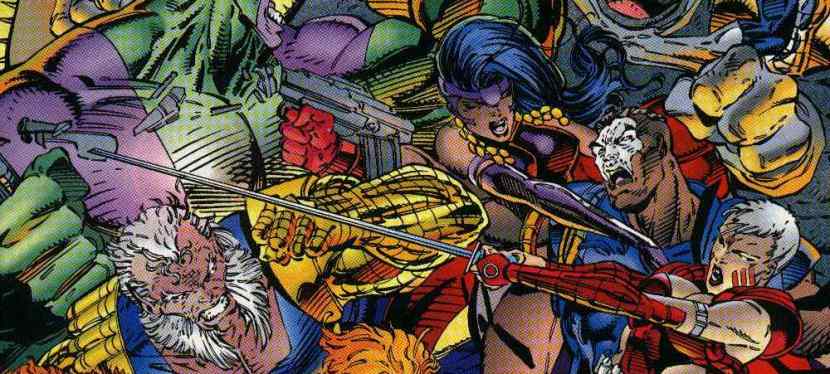
A Look Back at Sludge #3 (1993)

Disclaimer: This is my original work with details sourced from reading the comic book and doing personal research. Anyone who wants to use this article, in part or in whole, needs to secure first my permission and agree to cite me as the source and author. Let it be known that any unauthorized use of this article will constrain the author to pursue the remedies under R.A. No. 8293, the Revised Penal Code, and/or all applicable legal actions under the laws of the Philippines.

Welcome back, superhero enthusiasts, 1990s culture enthusiasts and comic book collectors! Today we revisit the Ultraverse of Malibu Comics and examine one of its many stories through the Sludge comic book series.

Previously I reviewed issue #2 of the series which was a surprising and fun comic book to read as the creative team took the risk of emphasizing the violent character Bloodstorm over Sludge himself. Ultimately, this move served as a way to not just build up tension but to expand the specific place of Sludge and the dark forces within the Ultraverse. For this retro review, issue is set during the events of the memorable Ultraverse crossover story Break-Thru.

With those details laid down, here is a look back at Sludge , published by Malibu Comics in 1993 with a story written by Steve Gerber and drawn by Aaron Lopresti.

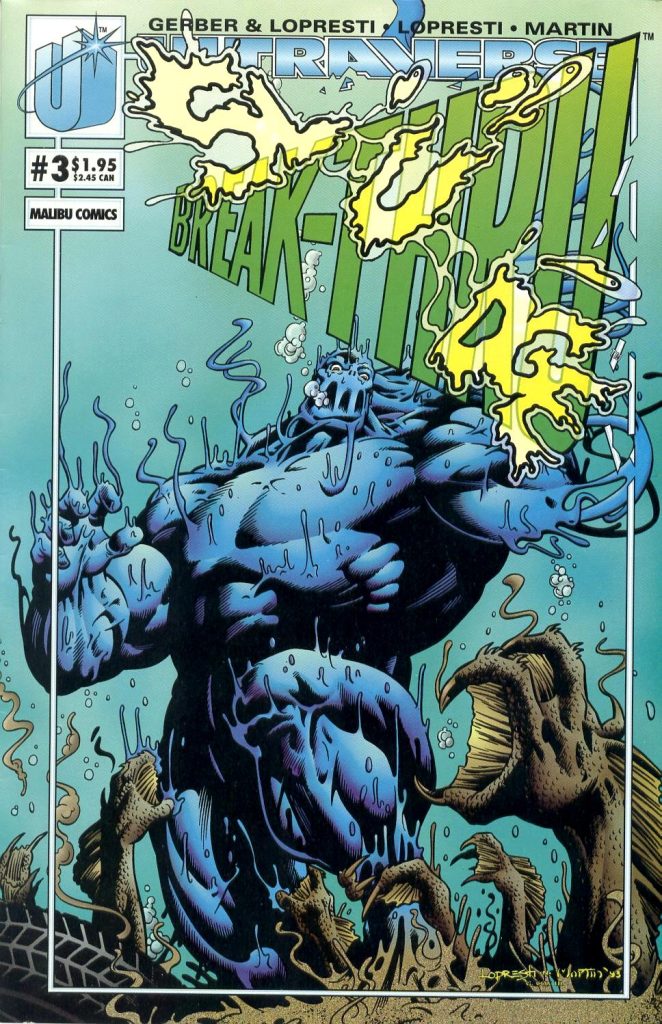
The cover.

Early story

The story begins with Sludge still lying down at the dock after just being defeated by Bloodstorm. Suddenly a mob of chaotic people (driven mad by the effects of Break-Thru that just happened) lift him up and throw him into the water without any regrets whatsoever. In hiding, Bloodstorm witnesses their act and thought to himself that he should avoid the madness happening. Suddenly, other mad people ganged up on him forcing him to react by firing his gun and set himself free from their grip. He safely makes it to his car and speeds away, even bumping off a few people on the way.

As Bloodstorm speeds away, another man in hiding who knew him and the boss Marcello was found by the mad people. Out of desperation he runs away and jumps into the water. He realizes that the people are so obsessed with going up to the sky (the Break-Thru effect), they did not bother to follow him at all.

Deep down the water, Sludge finds himself alone and getting relieved of the pain he experienced above. Feeling hopeless, he waits for the river to wash him away…

Quality

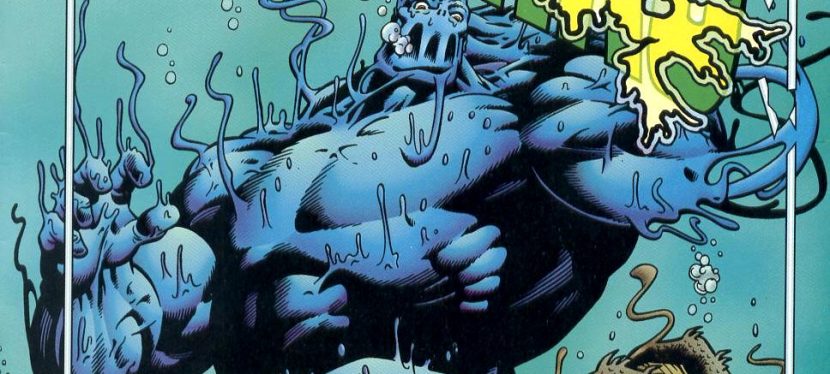
Sludge in trouble!

Being a standalone story set during the events of Break-Thru, this comic book focuses more on the protagonist while simultaneously raising the stakes with regards to the evil forces as the elements of crime gang combined with the supernatural took effect. To be clear, fantasy elements were added to this series which had darkness and grit dominating the plot of the first two issues.

This comic book has an early appearance of “lord” Pumpkin (AKA The Pump) who is the element of sorcery and, more notably, serves as the Ultraverse’s very own Satanic figure. Not only does the Pump have vast powers to take life away from others and has evil pawns to wield, he also leads and guides an apprentice (the kid gangster called Pistol) with pure wickedness, crafted plans of evil, is cunning in his ways of manipulating others to do evil, and he makes promises or deals with others who will receive some rewards but ultimately will be disregarded and lose a lot. This Ultraverse super-villain, as recorded in Malibu Comics’ publishing history, went on to become a walking symbol of pure evil, corruption, sins and danger in other UV comic books.

While there is indeed more focus on Sludge in this issue, it is the Pump who overshadows him. As for Bloodstorm, his presence has been drastically reduced here which is kind of jarring to read as he was the dominant and heavily emphasized in issue . Speaking of characters, the gang boss Marcello (who is Bloodstorm’s client) makes a short appearance but his connections not only with criminals but also with para-military forces emphasized his influence in the city.

More on the plot itself, this comic book is pretty loaded and the stakes were really raised high. In key scenes, Sludge finds himself in the middle of gangsters, the people driven mad by the Break-Thru effect, the para-military forces and the Pump’s ugly and evil pawns. Steve Gerber crafted a story that expectedly built up a lot and paid of strongly since the stakes were raised. I should state that Aaron Lopresti’s art here showed signs of improved creativity

Conclusion

The gang boss Marcello and Bloodstorm talk during the events of Break-Thru.

Sludge (1993) is a more engaging and more intense comic book on its own complete with the literary debut of the Pump who is clearly the Ultraverse’s most evil villain. If issue was twisting with the way it presented its characters, this comic book has more of its protagonist who went on to face new elements of evil while the story of Break-Thru transpired. I also noticed the Pump’s offer to Sludge symbolizes Satan offering a troubled soul a place in his force of evil. How did Sludge react to the offer from the evil one? You will have to read this comic book.

If you are seriously planning to buy an existing hard copy of Sludge (1993) be aware that as of this writing, MileHighComics.com shows that the near-mint copy of the regular edition costs $16.

Overall, Sludge (1993) is recommended!

+++++

Thank you for reading. If you find this article engaging, please click the like button below and also please consider sharing this article to others. If you are looking for a copywriter to create content for your special project or business, check out my services and my portfolio. Feel free to contact me with a private message. Also please feel free to visit my Facebook page Author Carlo Carrasco and follow me on Twitter at  @HavenorFantasy as well as on Tumblr at https://carlocarrasco.tumblr.com/