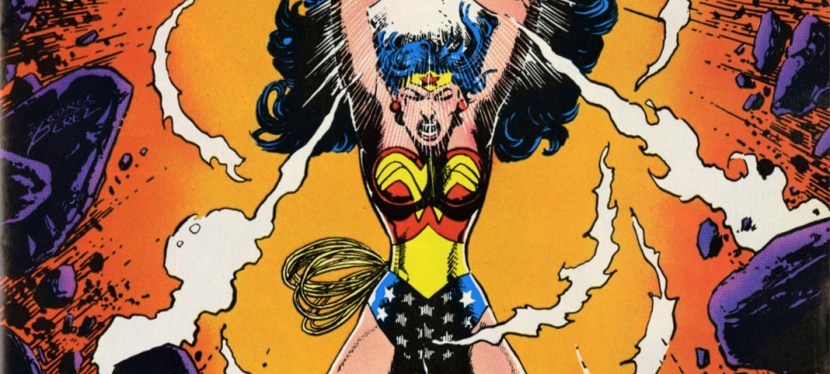
A Look Back at Wonder Woman #21 (1988)

Disclaimer: This is my original work with details sourced from reading the comic book and doing personal research. Anyone who wants to use this article, in part or in whole, needs to secure first my permission and agree to cite me as the source and author. Let it be known that any unauthorized use of this article will constrain the author to pursue the remedies under R.A. No. 8293, the Revised Penal Code, and/or all applicable legal actions under the laws of the Philippines.

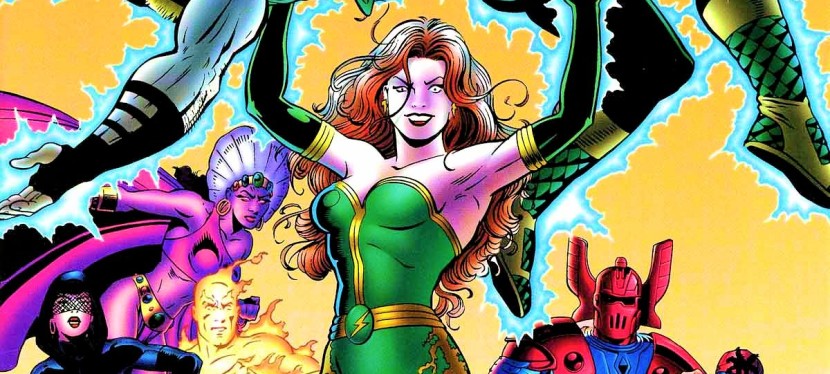
Welcome back, superhero enthusiasts, comic book collectors and fans of superhero universe of DC Comics! I don’t know with you, my readers, but I love the way George Perez and his fellow writers characterized Wonder Woman during the very early stage of the post-Crisis era of DC Comics. The character development was not only a great way to achieve balance with spectacle and plotting for each story of Wonder Woman, but also a solid way to redefine the Queen of Superheroes to new fans as well as other comic book readers of the late 1980s. Such characterization efforts include redefining other key elements of the Wonder Woman concept such as the development of Themyscira and its all-women society, the struggle that the deities of Olympus had while the Amazons struggled, and most notably the way Wonder Woman and the people of man’s world adjusted to each other.

With those details laid down, we can find out more about Wonder Woman’s development in this look back at Wonder Woman #21, published by DC Comics in 1988 with a story written and drawn by George Perez with Bob McLeod credited with the finished art.
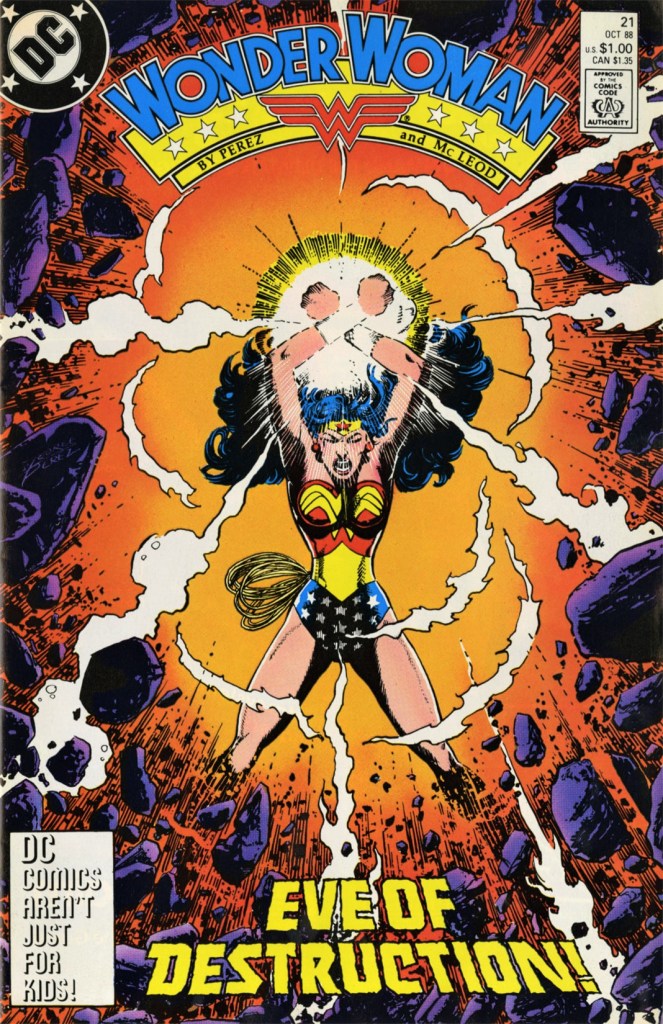
The cover.

Early story

The story begins in Themyscira. In the middle of the night, Menalippe, the oracle of the Amzons wakes up looking terrified. She makes a reference to the deities of Olympus. In Wakefield, Massachusetts, Diana/Wonder Woman, Julia Kapatelis and teenager Vanessa arrive home from the memorial service of the late Myndi Mayer. As Vanessa goes to her bedroom feeling depressed, Diana admits to Julia that she is deeply troubled over what happened in recent times. She also expressed that she can’t help feeling partially responsible for Mayer’s death.

As Julia tries to comfort Diana, several knocks were made at the house door. Upon opening it, a bird carrying a note suddenly flies into the house and heads straight to Diana who recognizes it and reads a new message written by her mother, the queen Hippolyte.

After reading it, Diana leaves for Themyscira with a promise to Julia and her daughter that she will return. Shortly after arriving in her nation, she, her mother and all their Amazon sisters assembled at the altar of Apollo and performed a ritual led by Menalippe. Menalippe claims to have made contact with the deities and states that she, Diana and Queen Hippolyte have been called to appear at the court in Mount Olympus…

Quality
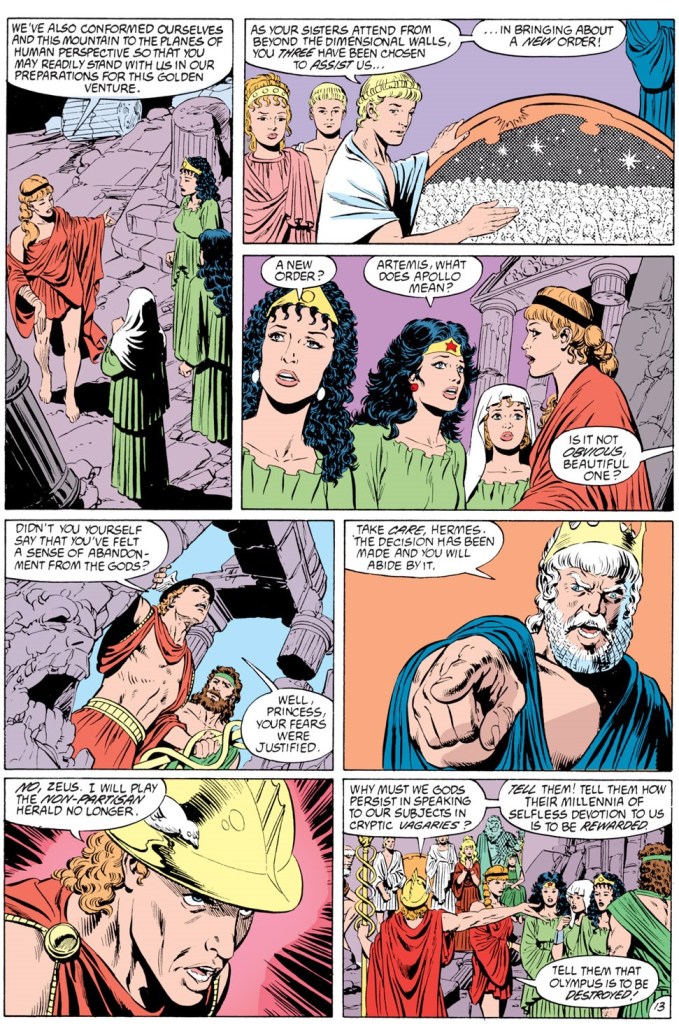
The deities of Olympus were never holy and were in fact very flawed beings who happen to hold tremendous power over Wonder Woman and the Amazons.

I can say that this is a story about the foundation of Wonder Woman’s place in the DC Comic universe as it involves the link between Olympus and Themyscira. The good news here is that this story is very well written and the plot structure was nicely organized by George Perez.

In many ways, this story is a continuation to Wonder Woman’s personal interaction with the deities of Olympus. The difference here is that her mother Queen Hippolyte and their oracle are much more involved and the deities – which include Zeus, Hera, Heracles and the rest – themselves have gotten into tremendous trouble as a result of what Darkseid did to them. This leads to the call of a new order which got the three Amazons chosen. This alone marks the new chapter in the lives of Amazons and Wonder Woman, who proved her worth in the Challenge of the Gods storyline, is unsurprisingly part of it.

When it comes to the character development of Wonder Woman, the golden part happened early in this comic book. I love the way that George Perez portrayed Diana to be fragile as a person who realizes that her being a very powerful icon in man’s world causes both blessings and problems around her. Diana admits getting blinded by the celebrity of being Wonder Woman to the many people around her. The dialogue Perez wrote for Diana in the early scene (in the presence of Julia) is very rich and so touching, you will feel sympathy for the Queen of all Superheroes.

Conclusion
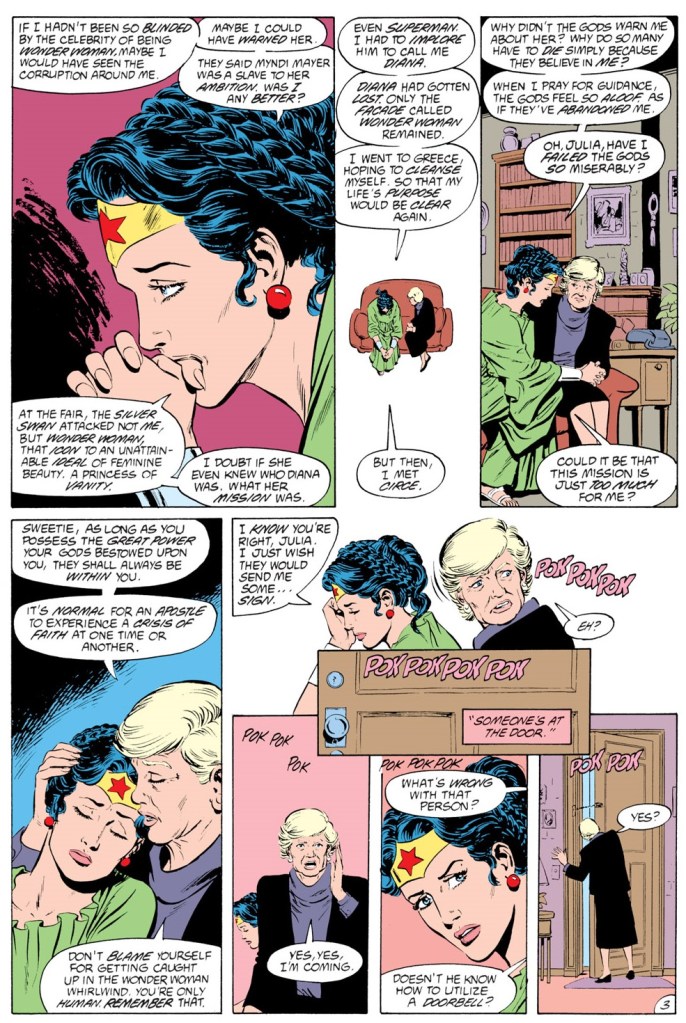
A very touching scene about Diana/Wonder Woman dealing with the responsibility of what went wrong recently.

Apart from being a new chapter for Wonder Woman and her Amazons, Wonder Woman #21 (1988) is a richly layered story to read. It does not have the usual good-versus-evil spectacle common with most superhero comic books, but the story succeeds in moving the narrative of the Amazons and Olympus deities forward while developing Diana as an even more human character (as opposed to being a superhero). This is another great work spearheaded by George Perez.

If you are seriously planning to buy an existing hard copy of Wonder Woman #21 (1988), be aware that as of this writing, MileHighComics.com shows that the near-mint copy of the regular edition costs $33 while the near-mint copy of the newsstand edition and the 2nd print edition cost $70 each.

Overall, Wonder Woman #21 (1988) is highly recommended!

+++++

Thank you for reading. If you find this article engaging, please click the like button below and also please consider sharing this article to others. If you are looking for a copywriter to create content for your special project or business, check out my services and my portfolio. Feel free to contact me as well. Also please feel free to visit my Facebook page Author Carlo Carrasco and follow me at HavenorFantasy@twitter.com
A Look Back at The Strangers #23 (1995)

Disclaimer: This is my original work with details sourced from reading the comic book and doing personal research. Anyone who wants to use this article, in part or in whole, needs to secure first my permission and agree to cite me as the source and author. Let it be known that any unauthorized use of this article will constrain the author to pursue the remedies under R.A. No. 8293, the Revised Penal Code, and/or all applicable legal actions under the laws of the Philippines.

Welcome back, superhero enthusiasts, comic book collectors and fans of Malibu Comics! I recently checked the publishing background of The Strangers and it showed that it only lasted a total of twenty-four issues. That means the end is nearing with regards to my doing retro comic book reviews about The Strangers. For the most part, I had a lot of fun reading these comic books and I can say that Steve Englehart always found ways to make each and every story fun to read and remain fresh.

We are nearing the end of retro comic reviews of this particular comic book series and we can find out more what happens next in this look back at The Strangers , published by Malibu Comics in 1995 with a story written by Steve Englehart and drawn by Rick Hoberg.

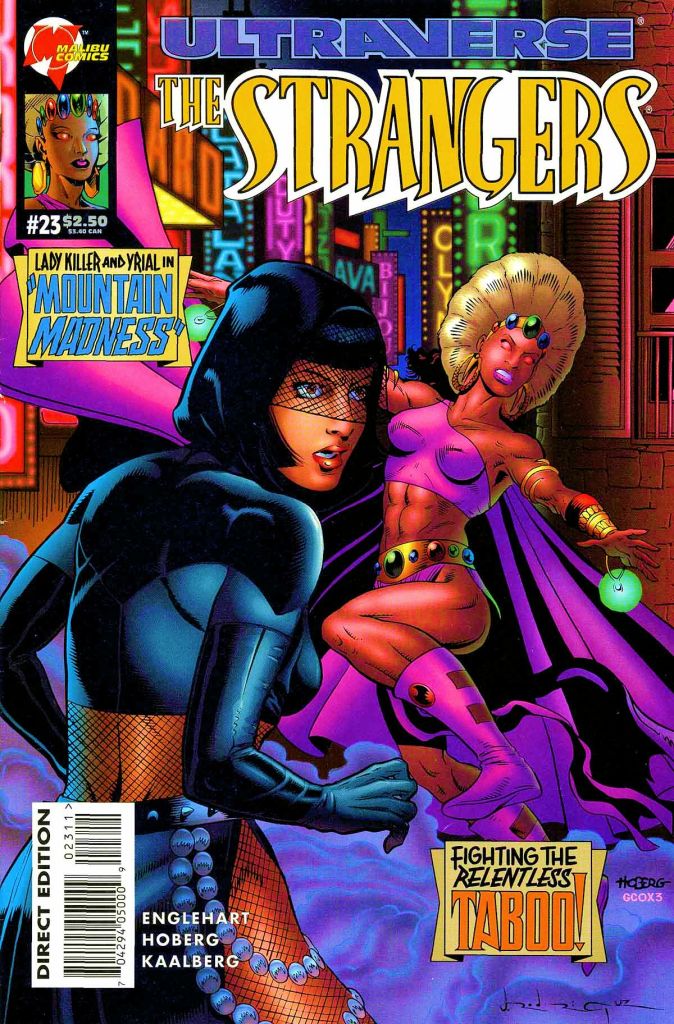
The cover.

Early story

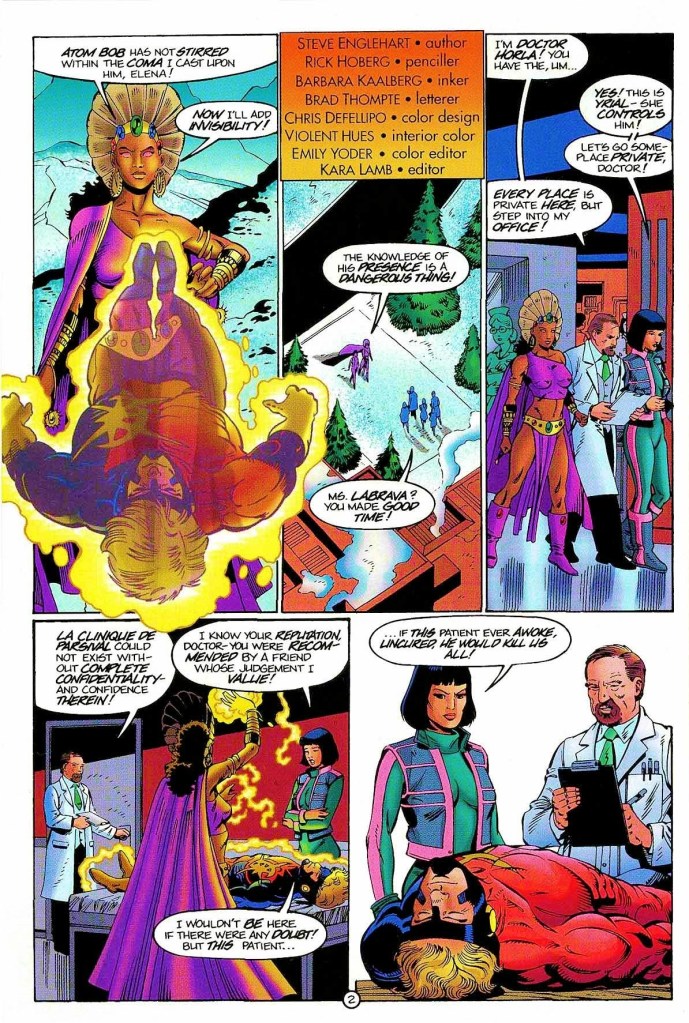
The story begins in Europe. Yrial and Lady Killer brought with them the comatose body of Atom Bob, the one man who loved the latter and betrayed their entire team. They entered a special and meet Dr. Horla. They presented Atom Bob to him as a patient and Dr. Horla expressed knowledge about the man’s power to change things which itself is very risky. As such, Lady Killer tells him that Atom Bob must remain comatose. The doctor assures her that they will report to them his condition every six months.

In response to the doctor’s suggestion of lobotomizing Atom Bob, Lady Killer rejects it and insists that if he can be returned to the man he was, then The Strangers will want him back.

After the meeting, Lady Killer and Yrial visit Andorra mainly to rest and relax. While having drinks at a fine place, a black man recognizes them. He begins to believe that Lady Killer and Yrial went there to find him and could have been working with the police in his native South Africa…

Quality

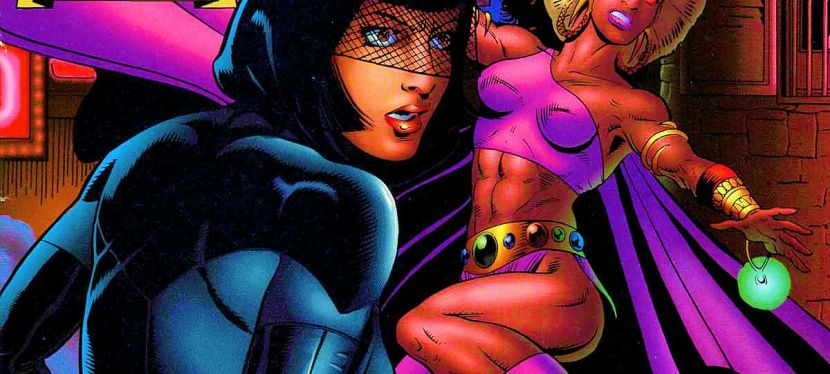
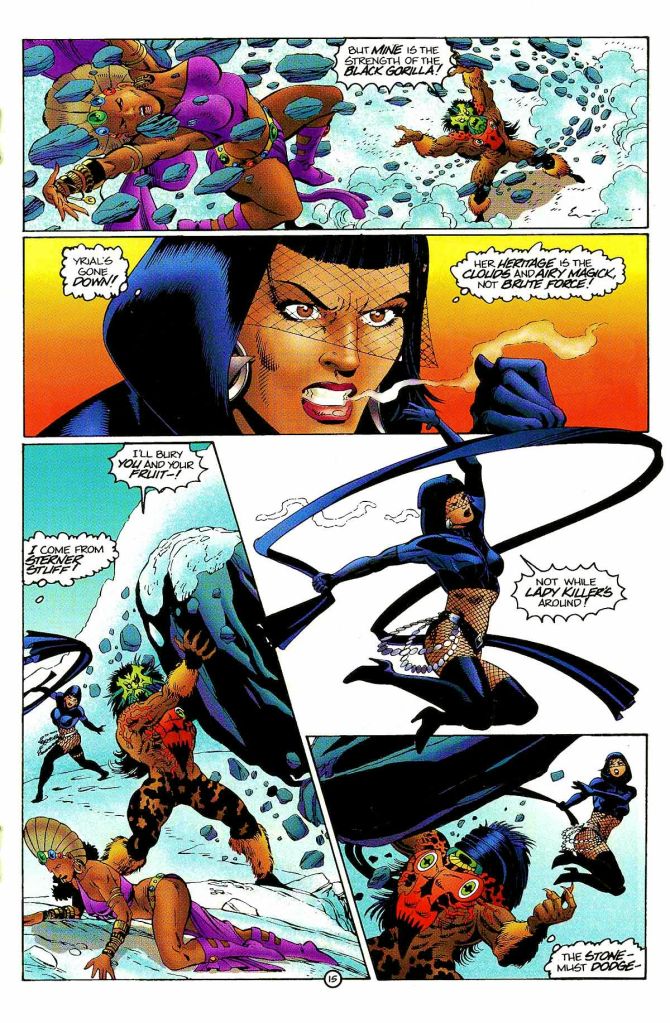
Yrial and Lady Killer in the heat of battle with a new enemy.

To make things clear, this particular story focuses mainly on Lady Killer and Yrial which is a nice change of pace given the events about their other teammates (as told in issues #21 and #22). Essentially, the story is not about the two Strangers’ friendship but rather a tale about a cursed man from South Africa who has been on the run for a long time. Without spoiling the plot, I can say that the cursed man’s encounter with Lady Killer and Yrial sparked the chain of superhero spectacle which contains lots of action that fans will enjoy.

Before the encounter, this story also serves as a continuation about The Strangers’ gradual adjustment to life without Atom Bob. By this time, Lady Killer’s stand as team leader has matured and became more decisive.

Given the way the story was structured, there was no room left for character development on Lady Killer and Yrial. That being said, the spotlight was more focused on the cursed man from South Africa and his motives were efficiently defined.

Conclusion

Bring Atom Bob into the clinic conveniently and invisibly.

To put it clearly, The Strangers (1995) is really the introduction of a new villain who gets into conflict with only two members of the team. It has enough spectacle to enjoy although the story may end up disappointing fans who expected to see the personalities if Yrial and Lady Killer get more developed. For the newcomers reading this, character development is one of the most defining factors of The Strangers monthly series.

If you are seriously planning to buy an existing hard copy of The Strangers (1995), be aware that as of this writing, MileHighComics.com shows that the near-mint copy of the comic costs $35.

Overall, The Strangers (1995) is recommended.

+++++

Thank you for reading. If you find this article engaging, please click the like button below and also please consider sharing this article to others. If you are looking for a copywriter to create content for your special project or business, check out my services and my portfolio. Feel free to contact me as well. Also please feel free to visit my Facebook page Author Carlo Carrasco and follow me at HavenorFantasy@twitter.com
A Look Back at Prototype #15 (1994)

Disclaimer: This is my original work with details sourced from reading the comic book and doing personal research. Anyone who wants to use this article, in part or in whole, needs to secure first my permission and agree to cite me as the source and author. Let it be known that any unauthorized use of this article will constrain the author to pursue the remedies under R.A. No. 8293, the Revised Penal Code, and/or all applicable legal actions under the laws of the Philippines.

Welcome back superhero enthusiasts, comic book collectors and fans of Malibu Comics! Today, I’ve decided to take a break from the Hostile Takeover storyline of the Ultraverse and focus more on the Prototype monthly series. Last time around, a new chapter in the life of Prototype pilot Jimmy Ruiz started and in the corporate world, he took a job that paid so much less than before.

What exactly will happen to Jimmy? We can all find out in this look back at Prototype , published in 1994 by Malibu Comics with a story written by Len Strazewski and drawn by Dean Zachary.

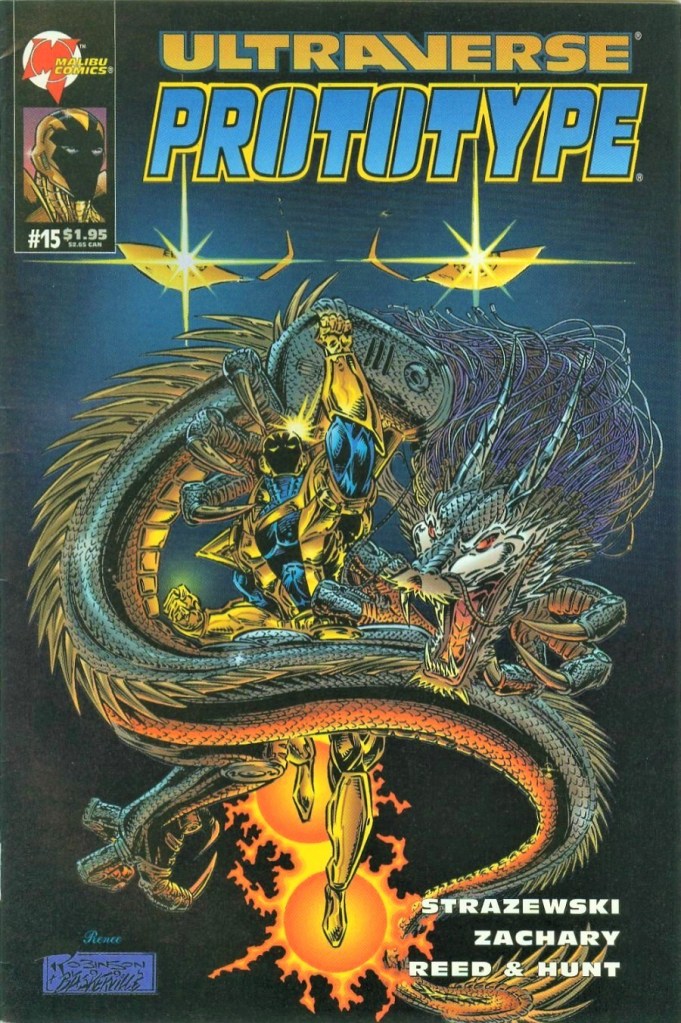
The cover.

Early story

The story begins inside a top-secret facility somewhere in the city of New York. A black man is going through the painful processes of cybernetic enhancements. His name is Donovan Jones and he is told by a shadowy figure that he is a failure and only their organization can turn him into something else…more than a human loser.

“You always were an ultra, Jones…and UltraTech knew this! But they never revealed this toyou,” said the shadowy figure.

Donovan Jones expresses his hatred for UltraTech. He also expresses his intention to destroy Prototype.

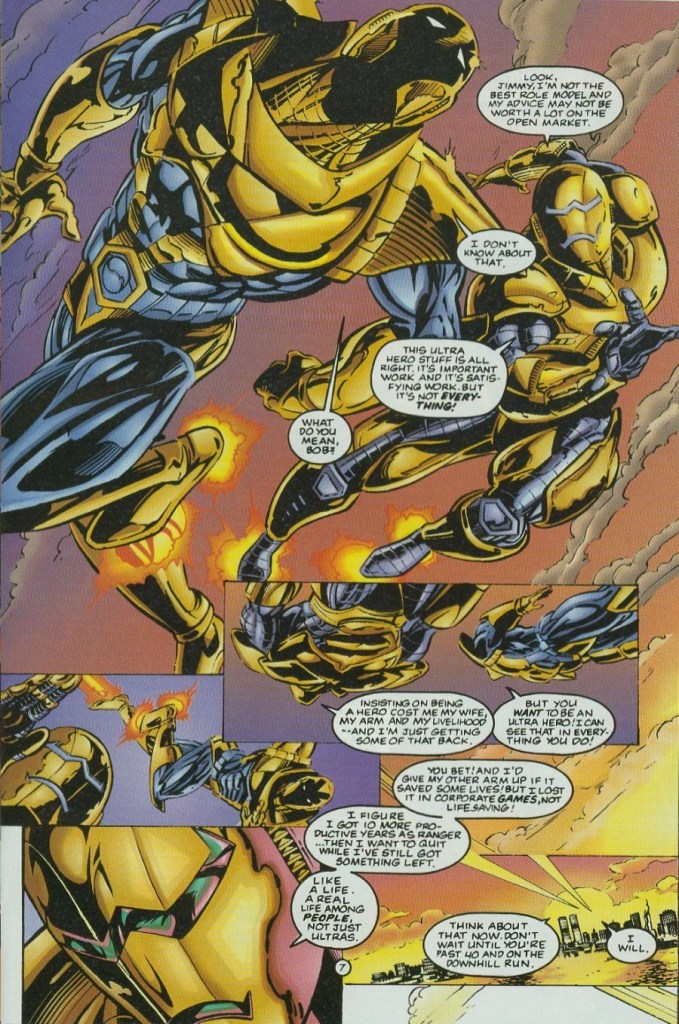
Elsewhere, a long vehicular bridge has been damaged. Helping the victims were Ranger (Bob Campbell) and Prototype (Jimmy Ruiz) trying to ensure that they could balance the bridge to prevent cars from falling over the edge. They managed to solve the problem paving the way for things to go back to normal. The affected people express their thanks and admiration to them.

As they fly away together, Bob and Jimmy talk about matters related to being ultra heroes. A short time later, Jimmy takes the train going to New Jersey as a civilian. He arrives at the facility of Direct Contact which is a division of NuWare. It turns out this is his first day of work with them and he is still struggling with the drastic changes now that his huge perks and privileges with UltraTech are no more…  

Quality

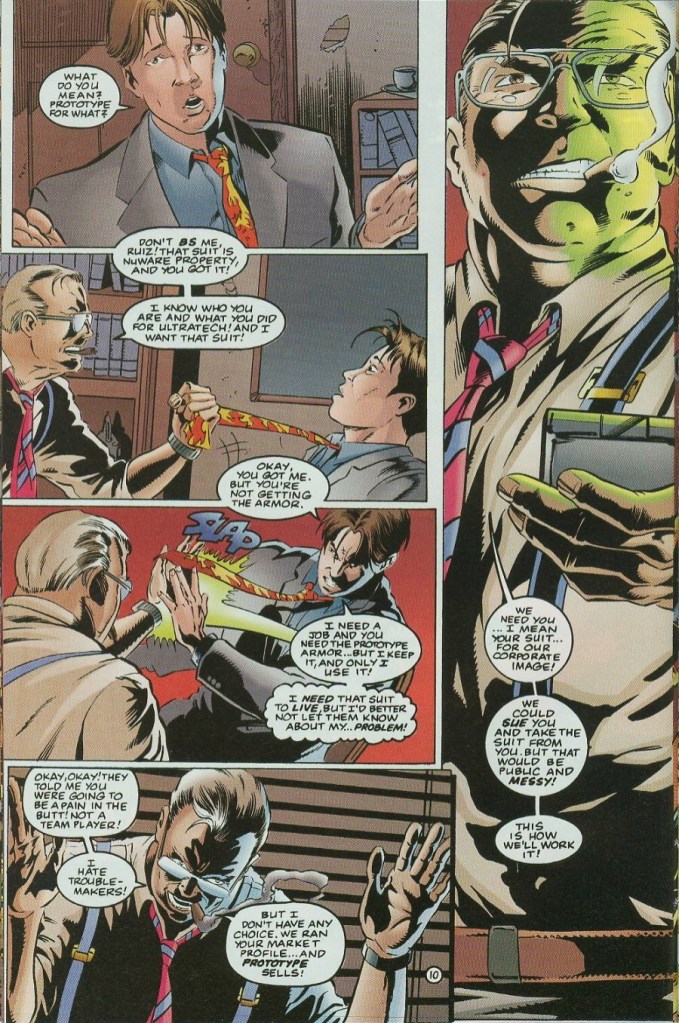
Jimmy Ruiz in a tough situation in front with his new boss on his first day at work.

I really like the story and the way Jimmy Ruiz was portrayed. This is really fine writing by Len Strazewski and it seems he organized a plan to not only redefine the protagonist but also change the status quo around him. I liked the way Strazewski set up the first-day-on-the-job struggles of Jimmy which really showed how fragile he is as a person without the armored suit to help him. His boss really was hard on him and made things a bit complicated for him as far as the use of Prototype is concerned under the control of NuWare. I also like the way Jimmy was portrayed in trying to be very responsible about his domestic life and the future ahead of him and his pregnant darling Angella.

Apart from the in-depth characterization, there is a good amount of superhero action to keep fans satisfied. The action was nicely drawn by Dean Zachary.

Conclusion

Prototype and Ranger.

Prototype (1994) is a lot of fun and pretty engaging. In fact, this comic book is a nice pay-off following the build-up that was done in issue . To see Jimmy Ruiz redefined as a person without the armor is compelling and the story was nicely structured by Len Strazewski. For serious Prototype fans, this is one comic book that is worth reading again and again. Lastly, this one has a very intriguing ending that you have to read and find out.

If you are seriously planning to buy an existing hard copy of Prototype (1994), be aware that as of this writing, MileHighComics.com shows that the near-mint copy of the comic book costs $14.

Overall, Prototype (1994) is highly recommended!

+++++

Thank you for reading. If you find this article engaging, please click the like button below and also please consider sharing this article to others. If you are looking for a copywriter to create content for your special project or business, check out my services and my portfolio. Feel free to contact me as well. Also please feel free to visit my Facebook page Author Carlo Carrasco and follow me at HavenorFantasy@twitter.com
A Look Back at The Solution #13 (1994)

Disclaimer: This is my original work with details sourced from reading the comic book and doing personal research. Anyone who wants to use this article, in part or in whole, needs to secure first my permission and agree to cite me as the source and author. Let it be known that any unauthorized use of this article will constrain the author to pursue the remedies under R.A. No. 8293, the Revised Penal Code, and/or all applicable legal actions under the laws of the Philippines.

If you’ve got a problem that needs solving, you call The Solution. That’s how it is in the Ultraverse with regards to hiring some specialists (and wild at that) for help. For the newcomers reading this, The Solution is a heroes-for-hire group led by Lela Cho/Tech (note: read about her origin story) with three unique teammates.

In recent times, I’ve been reviewing Ultraverse comic books of The Night Man and Solitaire which formed the first two parts of the Hostile Takeover crossover storyline. From this point on we can see the 3rd chapter in this look back at The Solution , published by Malibu Comics in 1994 written by the late James Hudnall and drawn by Scott Benefiel.

The cover.

Early story

The story begins with a look back at the private communication between J.D. Hunt and Rex Mundi (as seen in The Night Man ). After their talk, J.D. Hunt hires The Solution to find out what is going on at the headquarters of UltraTech in New York.

Later under the busy streets of Manhattan, the team make their way through the darkness with Aera using her magic to find the building. When asked by Troy why they took the mission considering J.D. Hunt’s reputation as a “sleaze on wheels”, Lela Cho states that she is certain that he only wants them to find information that could be used against UltraTech. She added that she does not believe Hunt.

As they talk, Night Man quietly listens to them staying still. Just after Aera found the way for the team to enter the basement of UltraTech’s building, Night Man follows them. Elsewhere, Gordon Bell becomes aware of the intrusion which Prototype (Jimmy Ruiz) and Ranger (Bob Campbell) witness. Bell tells Bob to go to the basement and tells Jimmy to go to the roof…

Quality

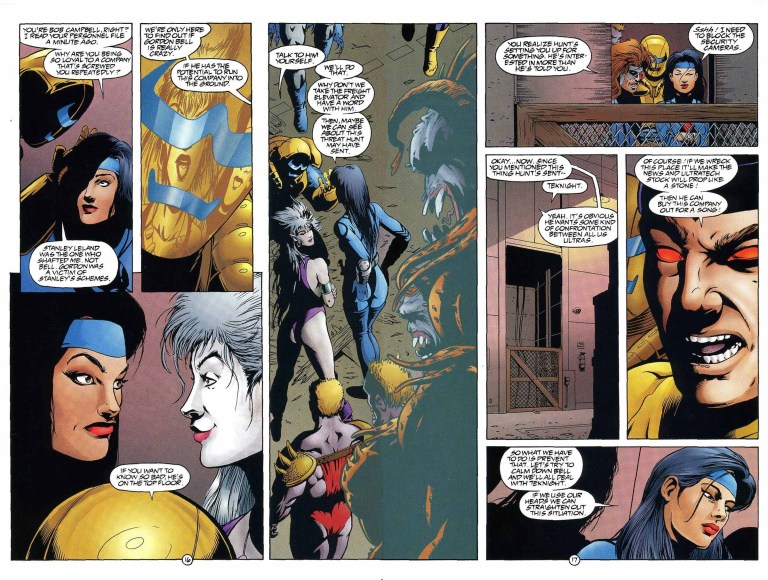
The Solution with Night Man and Ranger.

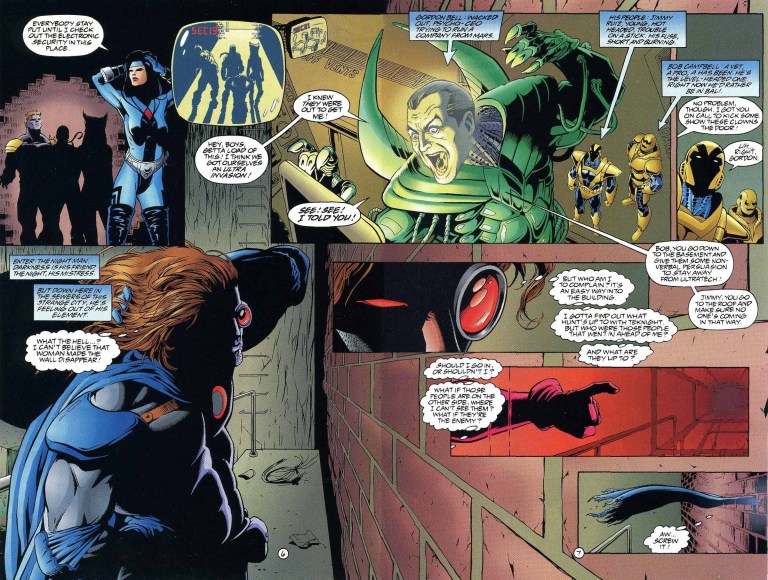
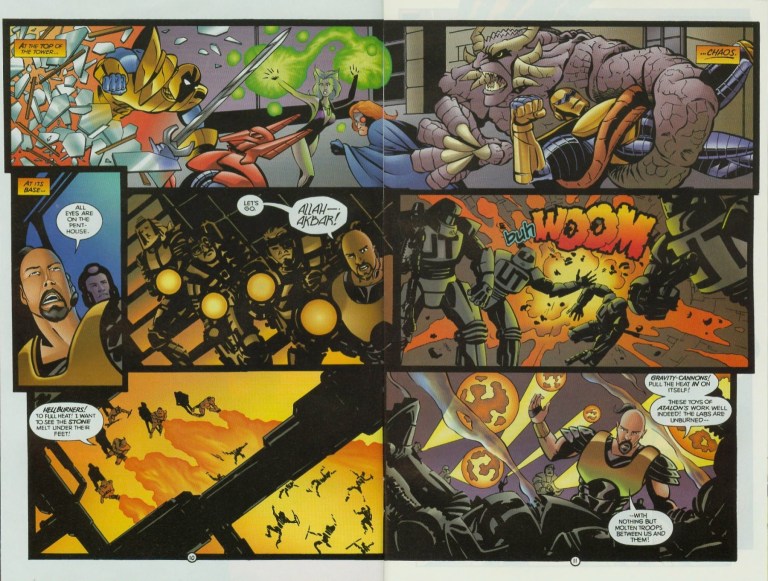
I will start with the visual presentation. This comic book has the unusual yet engaging approach of using pairs of pages to form these wide-angle images composed of a dominating view with panels of other images filling the remaining space. It can be jarring at first but once you get the hang of the story, these visuals will flow smoothly at a nice pace. It should be noted that artist Scott Benefiel is pretty good in visualizing Night Man, Prototype and other related Ultraverse characters. He also did a good job with images of action and superhero spectacle.

As far as storytelling goes, this 3rd chapter of the Hostile Takeover crossover storyline is the most interesting and the most enjoyable to read yet. While The Night Man worked as a big build-up and Solitaire worked as a mere side-story, there is a good payoff in this comic book and at the same time it moved the storyline forward to the next stage.

James Hudnall also kept the details tight and the way he wrote the interactions as the established Ultraverse characters got mixed up is simply great. I really enjoyed reading Lela Cho/Tech talking with Bob Campbell/Ranger about his getting screwed by the corporation, and Night Man’s interactions with The Solution’s members were nicely done.  

Conclusion

The stage is set for conflict.

The Solution (1994) is very enjoyable and compelling! It is the complete package of solid storytelling, memorable character interactions and spectacle that also adds depth to the narrative of the Hostile Takeover storyline. Superhero stuff aside, the element of corporate intrigue remains present which also serves as a lively reminder about what this crossover storyline is about.

If you are seriously planning to buy an existing hard copy of The Solution (1994), be aware that as of this writing, MileHighComics.com shows that the near-mint copy of the comic book costs $14.

Overall, The Solution (1994) is recommended.

+++++

Thank you for reading. If you find this article engaging, please click the like button below and also please consider sharing this article to others. If you are looking for a copywriter to create content for your special project or business, check out my services and my portfolio. Feel free to contact me as well. Also please feel free to visit my Facebook page Author Carlo Carrasco and follow me at HavenorFantasy@twitter.com
A Look Back at Solitaire #10 (1994)

Disclaimer: This is my original work with details sourced from reading the comic book and doing personal research. Anyone who wants to use this article, in part or in whole, needs to secure first my permission and agree to cite me as the source and author. Let it be known that any unauthorized use of this article will constrain the author to pursue the remedies under R.A. No. 8293, the Revised Penal Code, and/or all applicable legal actions under the laws of the Philippines.

Some time ago, I reviewed the first issue of the Solitaire series of the Ultraverse. I also published my retro reviews of issues #2 and #7. What makes Solitaire an interest part of the Ultraverse is that he fights crime without fear and takes a lot of risks. He has a special healing ability and is quite proficient in doing his own detective work. Creatively, Solitaire is like a combination of Wolverine and Batman.

In the 1994 crossover storyline Hostile Takeover (which started in The Night Man #12), a series of events took off when the secretive villain Rex Mundi orders corporate player J.D. Hunt to do something about the unstable corporation UltraTech. Hunt hires The Solution to do his dirty work and even went as far as sending his newest weapon Teknight to New York (where UltraTech is). The Night Man also made it to New York continuing his own quest.

With those details laid down, the stage is set for Solitaire’s role in the 2nd chapter of Hostile Takeover and we can find out more in this look back at Solitaire , published by Malibu Comics in 1994 with a story written by Gerard Jones and drawn by Jeff Parker and Ernie Steiner.

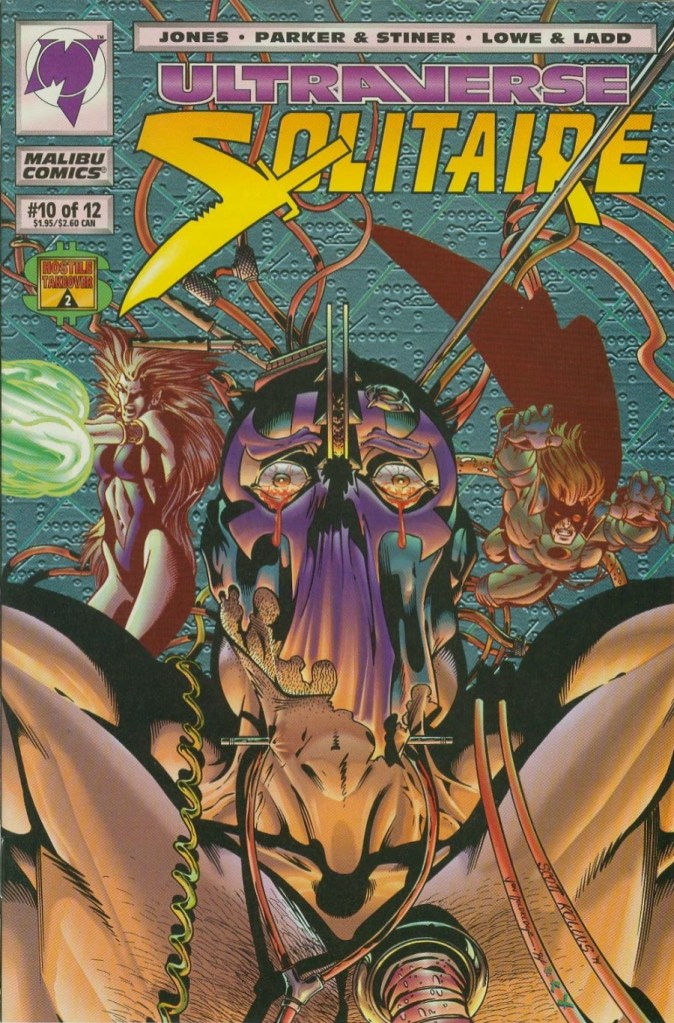
The cover.

Early story

The story begins with Solitaire moving through the city and meets several people at a public place. It turns out they are losing trust in him over something. As tension rises, the masked vigilante hears something that the others don’t which makes them think he is having a perception problem. Solitaire goes away searching for what he thought was an explosion. He saw nothing and this only confirmed that he cannot trust his own mind.

Elsewhere, Solitaire’s father (Mr. Lone) has a private meeting with top scientists. He expresses to them that his son has been wasting his money and points to it as another one of the scientists’ failures. After the meeting, a certain specialist approaches Lone and they negotiate something.

Back at his secret place, Solitaire talks with Iris about his current predicament. She tells him to do exactly what his mind is telling him not to do, and to go New York to stop the elder Lone…

Quality

This comic book has a good amount of action.

As far as the concept of Hostile Takeover goes, this one builds up on the corporate intrigue as it shows the evil Lone being involved with the events that took place. As for Solitaire himself, this story emphasizes his struggle not only with crime-fighting but himself. In connection with all the nanites inside his body, Solitaire struggles with a distorted perception and even control of himself.

When it comes to spectacle, this comic book has a good amount of action that is expected with Solitaire. Pretty satisfying to see.

Conclusion

Prototype, Night Man and The Solution in their short appearance in this comic book.

In the context of the Hostile Takeover crossover, Solitaire (1994) is really a standalone story of its title character. It will please Solitaire fans but it will disappoint readers who are hoping to see him mix in with other established Ultraverse characters involved in the storyline like The Solution, Night Man and others. Solitaire really has no crossover with those characters which is a bummer. So far, this issue of Solitaire has the least amount of entertainment and engagement for me.

If you are seriously planning to buy an existing hard copy of Solitaire (1994), be aware that as of this writing, MileHighComics.com shows that the near-mint copy of the comic book costs $14.

Overall, Solitaire (1994) is satisfactory.

+++++

Thank you for reading. If you find this article engaging, please click the like button below and also please consider sharing this article to others. If you are looking for a copywriter to create content for your special project or business, check out my services and my portfolio. Feel free to contact me as well. Also please feel free to visit my Facebook page Author Carlo Carrasco and follow me at HavenorFantasy@twitter.com
A Look Back at The Night Man #12 (1994)

Disclaimer: This is my original work with details sourced from reading the comic book and doing personal research. Anyone who wants to use this article, in part or in whole, needs to secure first my permission and agree to cite me as the source and author. Let it be known that any unauthorized use of this article will constrain the author to pursue the remedies under R.A. No. 8293, the Revised Penal Code, and/or all applicable legal actions under the laws of the Philippines.

Welcome back superhero enthusiasts, comic book collectors and fans of Malibu Comics!

I don’t know with you but I personally enjoyed reading the crossover stories of the Ultraverse. The Strangers had nice crossovers with Hardcase and Prototype in different times. The crossover encounter between Prime and Prototype was very memorable. There also was the first grand crossover of the Ultraverse in Break-Thru #1.

While the Ultraverse no longer exists, for me it was the one superhero comic book franchise or imprint that truly defined superhero comics of the 1990s. Malibu Comics really had great talents and other comic book creators who produced lots of fun comic books to read. Their creators also knew what it took to make Ultraverse crossovers stand out.

Today, we will start a close look at another particular crossover storyline within the Ultraverse titled Hostile Takeover which involves The Night Man, Prototype, Solitaire, Sludge and The Solution! With those details laid down, here is a look back at The Night Man , published in 1994 by Malibu Comics with a story written by Steve Englehart with Len Strazewski and James Hudnall as co-plotters. The art was drawn by John Dennis.

The cover.

Early story

The story begins in the fancy office of J.D. Hunt as he receives a call from the secretive and sinister Rex Mundi. Mundi expressed disappointment in Hunt’s handling of the so-called Ultra Problem but went on to give him a chance to redeem himself. Mundi tells Hunt to take over Ultratech which has gotten into trouble caused by Gordon Bell. Hunt noted that Ultratech is to blame for the Strangers’ hijacking of his space shuttle as the security was handled by the said company.

 After talking with Mundi, J.D. Hunt observes his employees finishing work on a high-tech armor (Teknight) and then communicates privately with The Solution. During the meeting, Hunt reveals to them that he is a major stockholder of Ultratech and he needs them to find out if they got Gordon Bell running things. The Solution takes the job.

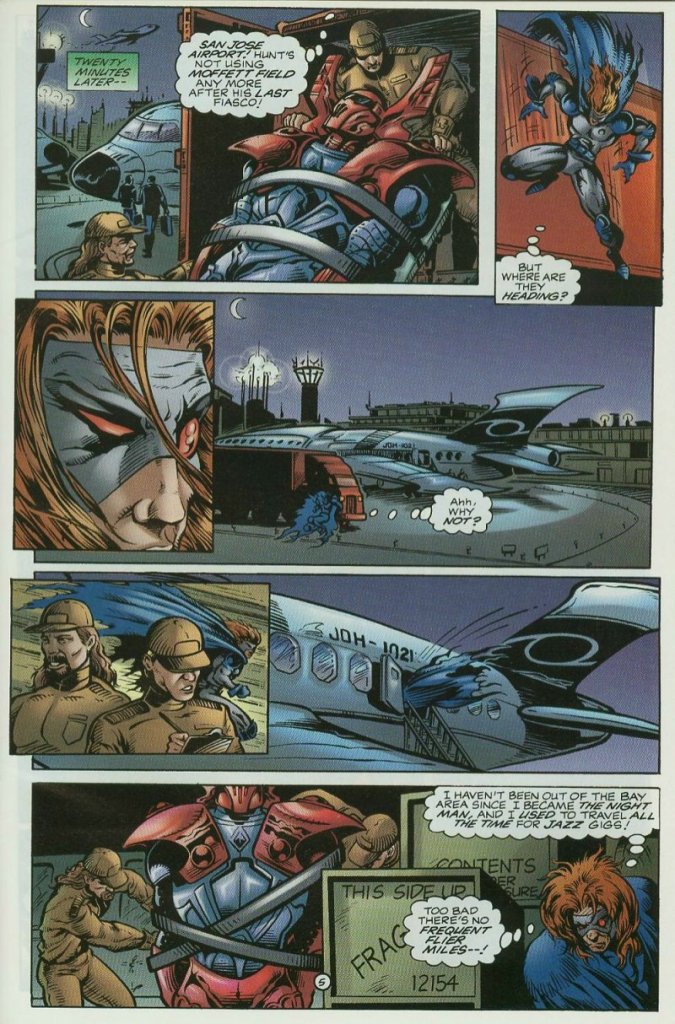
Elsewhere, the Night Man secretly jumps on the top of a moving truck which he knows carries NuWare’s secret project Teknight. Upon arrival at the airport of San Jose, California, Night Man carefully sneaks into an airplane which is where Teknight is loaded at…

Quality

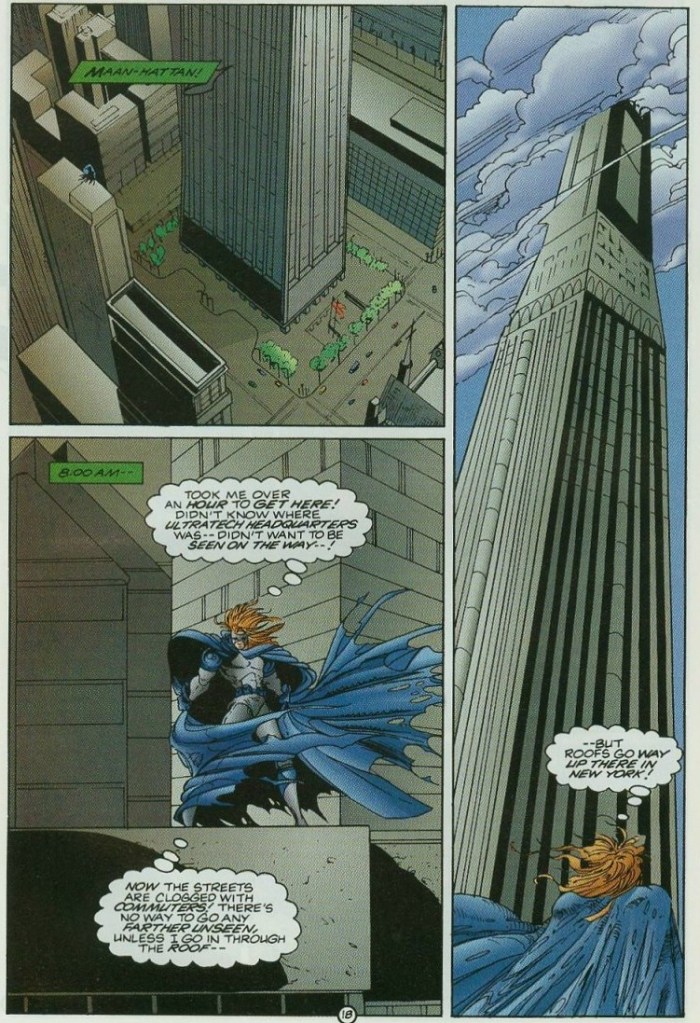
Imagine yourself being Night Man in New York and you do not have the technology nor the means to be able to rise up a skyscraper.

I’ll say it straight right now…the story of this comic book is nicely crafted. With Steve Englehart and the contributions of Len Strazewski and the late James Hudnall, this one score nice points when it came to building-up the concept behind Hostile Takeover which involves a strong sense of corporate intrigue (which was often present in comic books of Prototype). The presence of The Solution is pretty small (this is a Night Man comic book after all) but they contributed nicely to the build-up.

The story of Hostile Takeover was told mainly through the eyes of the Night Man. For the newcomers reading this, Night Man is a vigilante who also does a lot of problem solving similar to Batman. Unlike the mentioned comic book icon, Night Man does not have insufficient resources to back him up and pushes himself to travel around and complete his mission. In this comic book, you will see him really go as far as he could with tracking down the powered suit of armor of Teknight. You will also see him struggle and you might as well relate with his limitations.

There is not too much superhero spectacle to enjoy here but that’s okay because there is a nice amount of very interesting details presented in the build-up of Hostile Takeover’s concept.

Conclusion

Night Man on the pursuit as Teknight gets loaded into the jet.

Even though it lacked spectacle, The Night Man (1994) is still an engaging read and it should score well with readers or Ultraverse fans who enjoy detailed storytelling. This comic book succeeds in building up the concept of Hostile Takeover while setting up the crossover elements between key Ultraverse characters. The story also emphasizes more of Night Man’s struggle to get his mission done.

If you are seriously planning to buy an existing hard copy of The Night Man (1994), be aware that as of this writing, MileHighComics.com shows that the near-mint copy of the comic book costs $14.

Overall, The Night Man (1994) is recommended.

+++++

Thank you for reading. If you find this article engaging, please click the like button below and also please consider sharing this article to others. If you are looking for a copywriter to create content for your special project or business, check out my services and my portfolio. Feel free to contact me as well. Also please feel free to visit my Facebook page Author Carlo Carrasco and follow me at HavenorFantasy@twitter.com
A Look Back at Wonder Woman #20 (1988)

Disclaimer: This is my original work with details sourced from reading the comic book and doing personal research. Anyone who wants to use this article, in part or in whole, needs to secure first my permission and agree to cite me as the source and author. Let it be known that any unauthorized use of this article will constrain the author to pursue the remedies under R.A. No. 8293, the Revised Penal Code, and/or all applicable legal actions under the laws of the Philippines.

It’s the second week of March already. That means we are slowly but surely inching closer to the March 30, 2021 scheduled releases of Wonder Woman 1984 on 4K Blu-ray, Blu-ray and DVD! If you have not yet ordered a copy of the sequel starring Gal Gadot as the Queen of Superheroes, you can do so now if you want to. I already ordered my copy. You can also read my retro review of the 2017 Wonder Woman movie.

On to literature! Last time, the George Perez-led story not only saw the end of Diana’s visit of Greece, it also fully presented to readers what was back then the modern portrayal of Circe (DC Comics’ own take on the false Greek goddess) who proved to be at the time the most sinister and most powerful supervillain Wonder Woman faced. Wonder Woman also showed the Queen of Superheroes in her most vulnerable state.

Now that Diana and her friends have returned to America, we can find out what happens next in this look back at Wonder Woman , published by DC Comics in 1988 with a story written and illustrated by George Perez based on an idea by Carol Flynn. Bob McLeod was in charge of the finishes.

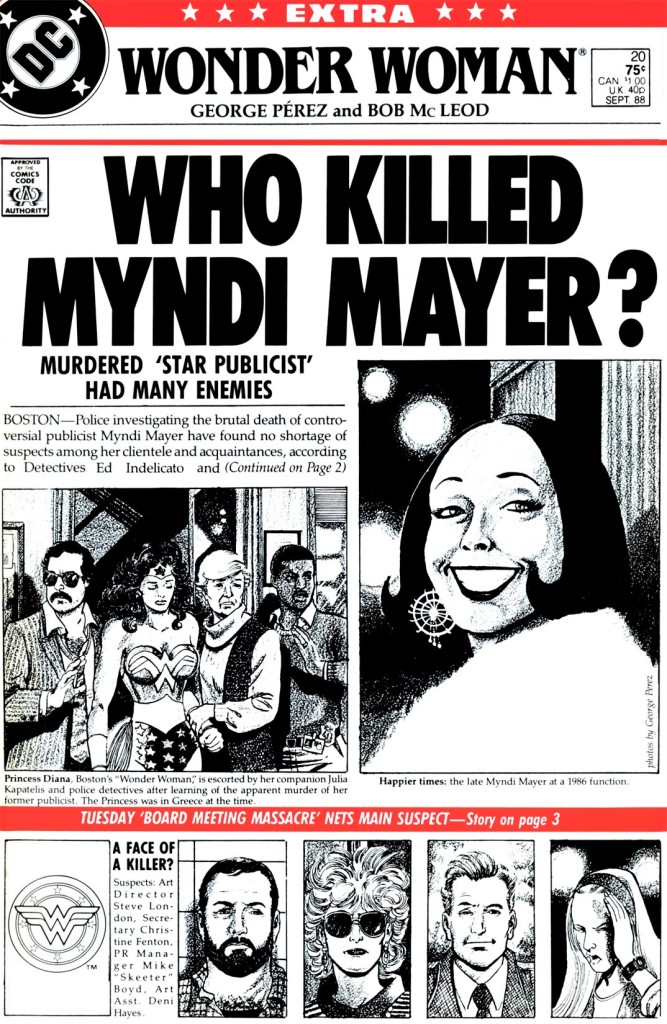
The cover.

Early story

The story begins in the City of Boston at night. Three Chinese men are running away from something until Wonder Woman confronts them. One of the men fires several bullets at her but each bullet got blocked by her using her tremendous reflexes and braces. After Wonder Woman disarms the gunman, another Chinese man tries attacking her with sharp weapons only to be defeated easily. The other Chinese man tries to run away but gets caught by Wonder Woman who uses her lasso. In reaction to his question, Wonder Woman demands answers.

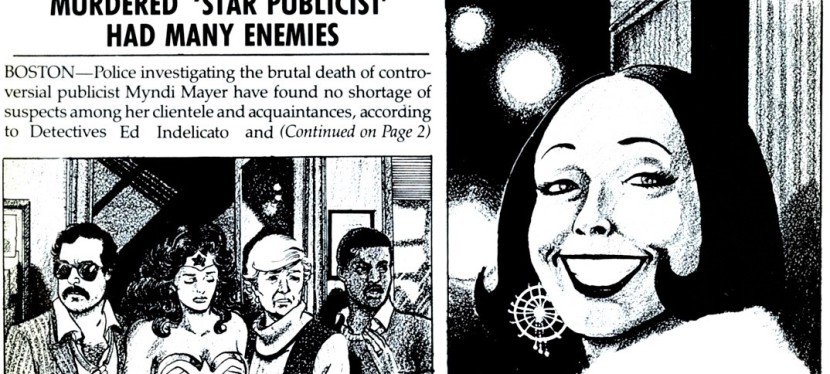
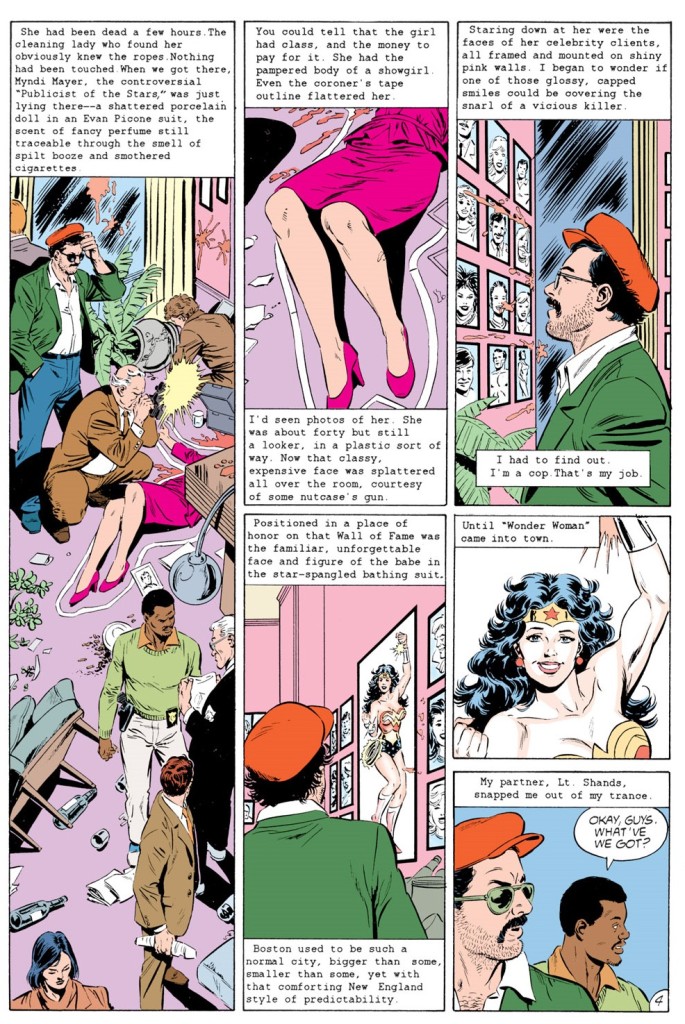
Elsewhere, investigators are searching for clues and details inside a lady’s modern looking office. Lying on the floor is the dead body of a victim and according to the investigator’s report, she had been dead for a few hours. The victim is none other than Myndi Mayer, a highly successful publicist who made a career out of the media and celebrities. Wonder Woman happened to be her most recent, high-profile client. Mayer was involved in the Wonder Woman fair.

Based on their findings, Myndi Mayer looked like she didn’t go without a fight. A bloody letter opener was found in her hand and her purse was found next to her body emptied. Traces of white powder were found on her desk. Mayer’s secretary Christine Fenton was visited by the investigators who told her about the death of her boss. She did not express any surprise and told them that it was only a matter of time before Mayer’s end came. Christine added that she warned Mayer about a certain man.

The investigators then show Christine the sketch of man based on the description of an eyewitness. She expressed surprise as she recognizes him…

Quality

Wonder Woman takes part in the search for truth.

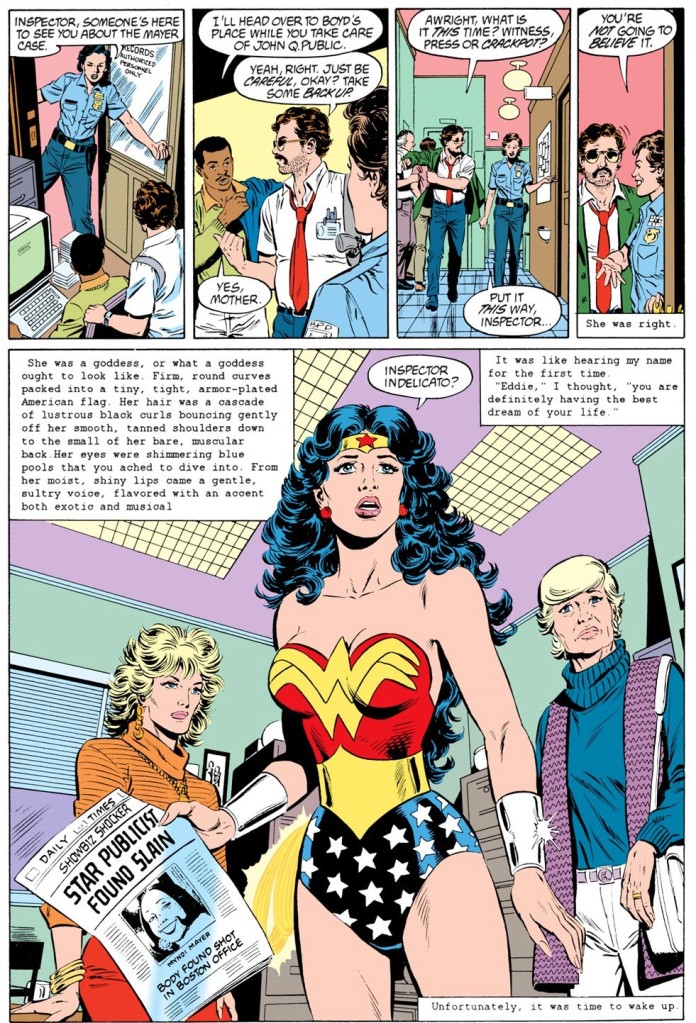
Wow! This is one dark Wonder Woman story to read and I can say that it is a very inspired work written by George Perez based on an idea by Carol Flynn. This is not your typical story of showing the Queen of Superheroes fighting someone evil or saving people from disaster. This is a murder mystery that is laced with corporate intrigue, crime, legal wrangling and the everlasting struggle to determine the truth.

Myndi Mayer’s death really set of a series of events and revelations that are no less striking. Considering the many details about law, crime, investigations and corporate intrigue, the in-depth writing here indicates that George Perez did a lot of researching and found ways to tell a very cohesive story with Wonder Woman playing a role. I should state that as of this writing, this particular story comes close to becoming realistic and reflective of 1980s life. This is top-notch writing by Perez!

When it comes to characterization, Myndi Mayer was deeply portrayed to be in deep trouble both personally and professionally. Of all the Wonder Woman comics of the post-Crisis era of DC Comics I’ve read so far, this one clearly defines Mayer and goes beyond her usual appearance as a prolific publicist.

On Wonder Woman, as mentioned earlier, she does not get to fight a super villain. Rather she takes part in the search for truth and tries her best to solve the mystery even though she is not even fully familiar with the way law and order works in the world of man. In some ways, her approach to literally putting pieces of the puzzle into place and approaching people in different places reminds me somewhat of Batman’s detective work but without the vigilante approach.

Conclusion

This page about the murder investigation at the scene of the crime has some Watchmen vibes to it.

I can say that Wonder Woman (1988) is not only a great comic book to read but also one of the most unique stories about the Queen of Superheroes ever published. By this time, George Perez has proven himself to be very prolific in storytelling on top of his great ability to draw art. I should state I love the way the story was structured and the way it ended delivered both impact and intrigue.

If you are seriously planning to buy an existing hard copy of Wonder Woman (1988), be aware that as of this writing, MileHighComics.com shows that the near-mint copy of the comic book costs $41.

Overall, Wonder Woman (1988) is highly recommended!

+++++

Thank you for reading. If you find this article engaging, please click the like button below and also please consider sharing this article to others. If you are looking for a copywriter to create content for your special project or business, check out my services and my portfolio. Feel free to contact me as well. Also please feel free to visit my Facebook page Author Carlo Carrasco and follow me at HavenorFantasy@twitter.com
A Look Back at Shogun Warriors #2 (1979)

Disclaimer: This is my original work with details sourced from reading the comic book and doing personal research. Anyone who wants to use this article, in part or in whole, needs to secure first my permission and agree to cite me as the source and author. Let it be known that any unauthorized use of this article will constrain the author to pursue the remedies under R.A. No. 8293, the Revised Penal Code, and/or all applicable legal actions under the laws of the Philippines.

Long before Pacific Rim (2013) presented giant robots and monsters slug it out on the big screen with a strong emphasis on action and scale, there were varied animated series of such giants shown in television sets in Japan way back in the 1970s. Then by the end of the decade, Marvel Comics published the Shogun Warriors comic book series in relation to a business deal with Mattel.

Last time, only one giant robot was heavily featured as a defender for human civilization as it became a target by a force of evil that unleashed a giant monster. That robot was Raydeen and as a result of what happened, something led to the unveiling of Combatra and Dangard Ace.

To find out more, here is a look back at Shogun Warriors , published by Marvel Comics in 1979 with a story written by Doug Moench and drawn by Herb Trimpe.

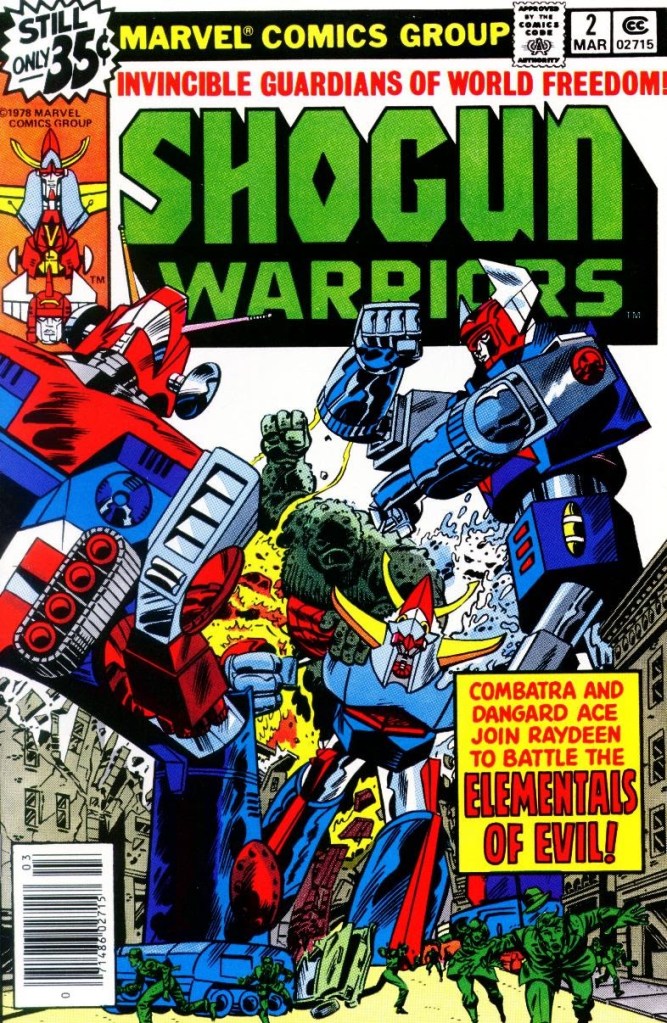
The cover.

Early story

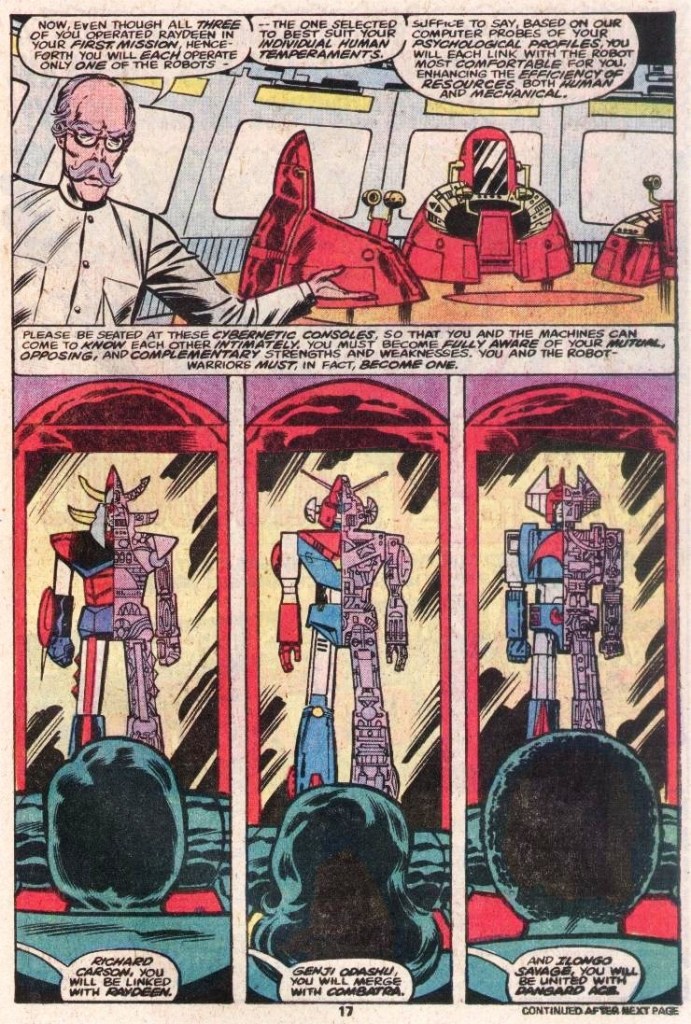
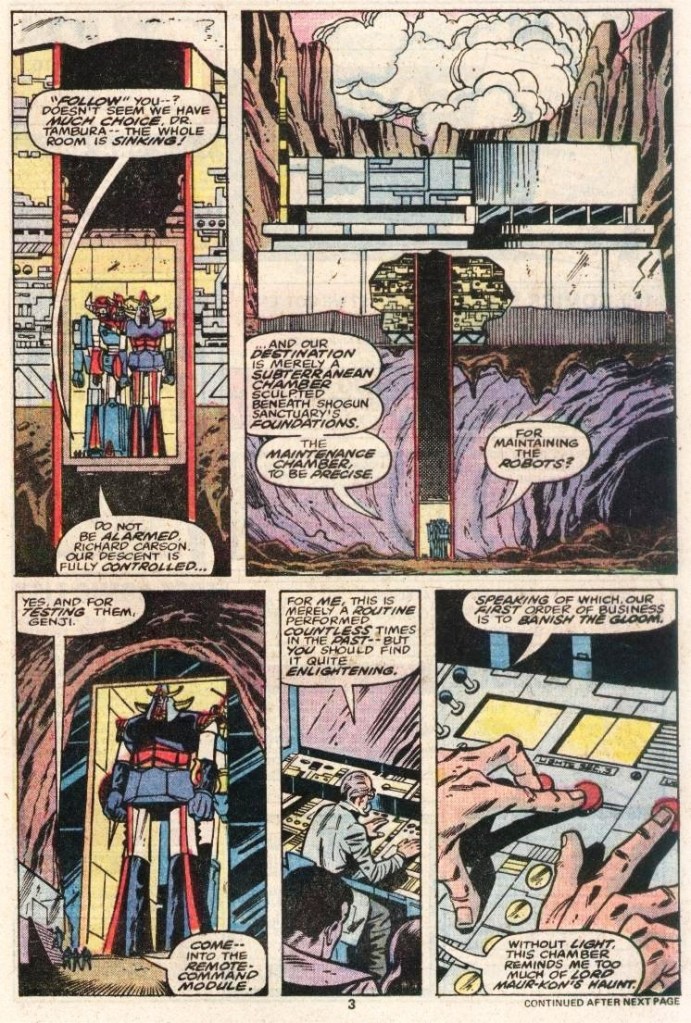
The story begins at the secret facility of Shogun. There the three pilots – Genji Odashu, Ilongo Savage and Richard Carson – are being briefed by Dr. Tambura explains to them that their first mission piloting Raydeen was not a failure at all. While acknowledging that the giant monster Rok-Korr is still a threat, he states to them that giant robots Combatra and Dangard Ace will be deployed and controlled by them.

After giving them a quick tour of their subterranean chamber (where the robots receive maintenance and get tested), Dr. Tambura bring the three pilots into another place filled with high-tech controls. From there, they watch Dangard Ace, Raydeen and Combatra perform in field tests via remote control.

Meanwhile on a different island, the evil leader Maur-Kon rallies his so-called dark agents to rise and work together in seeking vengeance for their defeat in the great war chaos as they have found the forces of eternal good anticipating them. After much talk, Maur-Kon and his minions bow and kneel over bubbling magma murmuring evil phrases…

Quality

The three pilots get assigned with each robot.

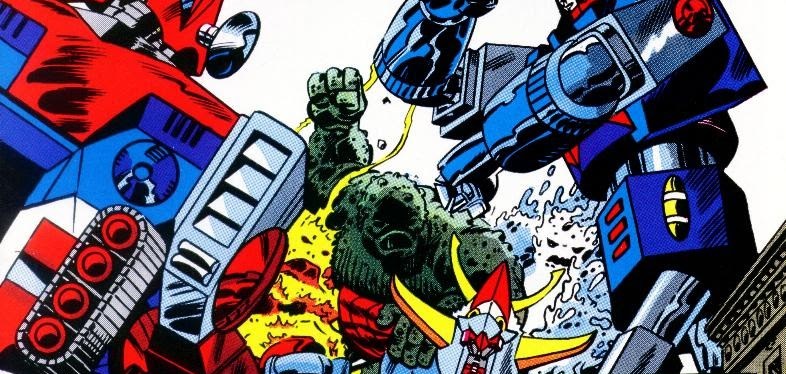
Like the previous issue, this comic book has less than twenty pages of story and art. This results another heavy load of exposition or information dump on readers, and the narrative had a rushed pace. With regards to the battle between Raydeen and the giant monster, there is indeed a continuation of it. The giant monster was given some personality.

Again, there is no real character development here. The three pilots were not written to display any personality nor did the writer exert any effort to make readers relate with them. Instead, you will see them in training in speed beyond belief.

The highlight here is that Dangard Ace and Combatra finally got revealed and emphasized. Be warned, however, that there is lesser spectacle in this comic book and the story predictably served as a setup for what could be a more promising battle.

Conclusion

The pilots and the Shogun Warriors (the robots) go deep down.

Shogun Warriors (1979) suffered from pretty much the same problems as issue . The noticeable difference here is that there is lesser action and lesser giant-sized spectacle shown here. That is not exactly surprising as the creators had to sacrifice something to make way for further explanation of the comic series’ grand concept.

If you are seriously planning to buy an existing hard copy of Shogun Warriors (1979), be aware that as of this writing, MileHighComics.com shows that the near-mint copy of the regular edition costs $35 while the near-mint copies of the price-less and the Whitman editions cost $350 and $35 respectively.

Overall, Shogun Warriors (1979) is less than satisfactory.

+++++

Thank you for reading. If you find this article engaging, please click the like button below and also please consider sharing this article to others. If you are looking for a copywriter to create content for your special project or business, check out my services and my portfolio. Feel free to contact me as well. Also please feel free to visit my Facebook page Author Carlo Carrasco and follow me at HavenorFantasy@twitter.com
A Look Back at The Strangers #22 (1995)

Disclaimer: This is my original work with details sourced from reading the comic book and doing personal research. Anyone who wants to use this article, in part or in whole, needs to secure first my permission and agree to cite me as the source and author. Let it be known that any unauthorized use of this article will constrain the author to pursue the remedies under R.A. No. 8293, the Revised Penal Code, and/or all applicable legal actions under the laws of the Philippines.

Welcome back, superhero enthusiasts, comic collectors and fans of 1990s comics culture! We go back to the Ultraverse to witness further events from The Strangers told during the late stage of their 24-issue run as a comic book series. In the previous review, Teknight became more prominent as a member of the team as Candy/Electrocute got heavily damaged which led the Strangers to having her repaired not in just any private facility but rather in the facility of a powerful organization.

And then something happened at the end of The Strangers #21.

With those details laid down, here is a look back at The Strangers #22, published by Malibu Comics in 1995 with a story written by Steve Englehart and drawn by Paul Abrams.

The cover.

Early story

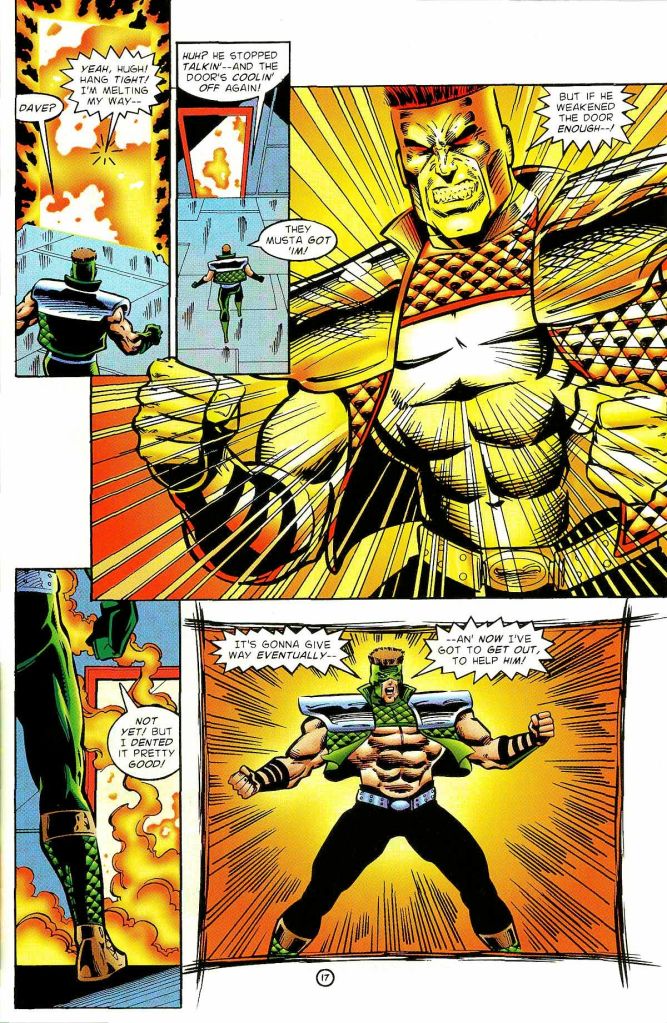
The story begins inside a high-tech facility when the newly repaired Electrocute gets up and attacks her teammates Grenade (her romantic partner) and Teknight. Electrocute is acting under someone’s control. In response to Teknight’s methodical approach on absorbing electric blasts from Electrocute, Grenade warns him about the how capable NuWare is when it comes to control and execution.

Even so, Teknight continues to stand until he gets overwhelmed by the lady’s power and ends up getting paralyzed. An executive walks near Teknight and Electrocute boasting that he loves seeing his designs in action and Grenade comes in to use his power on his romantic partner…

Quality

Grenade and the door.

Once again, Steve Englehart crafted another story that keeps this series fresh and fun to read. The story started with a good amount of action involving Grenade, Electrocute and Teknight. As I don’t want to spoil the plot, I can say that what happened after the action-packed opening sheds light on a new yet significant youth who wields a lot of power thanks to his father (clue: a powerful and ruthless executive who was involved not only with the Strangers but also with Mantra and Night Man). The story is very well structured and moves at a nice pace. Also I can say that the spotlight on the Strangers as a whole team was carefully balanced.

When it comes to character development, it is Grenade who clearly got a good dose of it. Apart from the usual display of his feelings towards Electrocute, this comic book dramatizes his effort to understand not only his lady and their new teammate Teknight, but also his realization about the delicate balance between being alive and being linked with technology.

Conclusion

I wonder how today’s SJWs, radical socialists and Black Lives Matter activists would react to this particular scene.

The Strangers #22 (1995) is another fun-filled superhero story which served its purpose in concluding the story that started in the previous issue. It also achieved its goal of emphasizing the role of NuWare (read: corporate intrigue) and the continued relevance of a certain corporate executive that the Strangers could not just get rid of.

If you are seriously planning to buy an existing hard copy of The Strangers #22 (1995), be aware that as of this writing, MileHighComics.com shows that the near-mint copy of the comic book costs $27.

Overall, The Strangers #22 (1995) is recommended.

+++++

Thank you for reading. If you find this article engaging, please click the like button below and also please consider sharing this article to others. If you are looking for a copywriter to create content for your special project or business, check out my services and my portfolio. Feel free to contact me as well. Also please feel free to visit my Facebook page Author Carlo Carrasco and follow me at HavenorFantasy@twitter.com
A Look Back at Prototype #14 (1994)

Disclaimer: This is my original work with details sourced from reading the comic book and doing personal research. Anyone who wants to use this article, in part or in whole, needs to secure first my permission and agree to cite me as the source and author. Let it be known that any unauthorized use of this article will constrain the author to pursue the remedies under R.A. No. 8293, the Revised Penal Code, and/or all applicable legal actions under the laws of the Philippines.

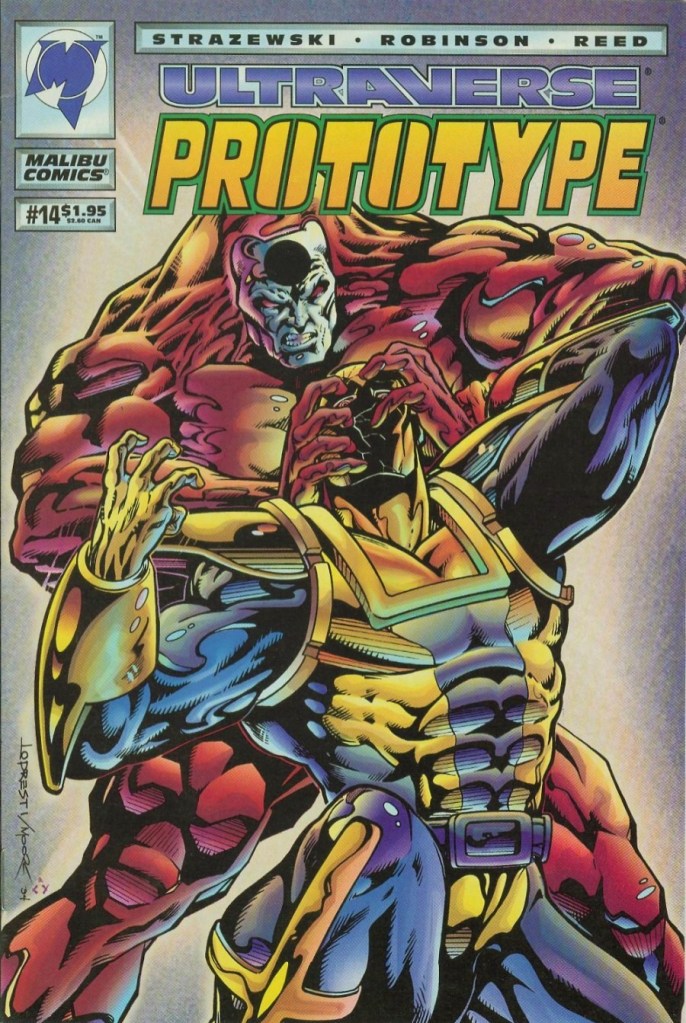
Welcome back superhero enthusiasts, comic book collectors and fans of the Malibu Comics! It’s been months since the last time I reviewed a comic book of Prototype. For me Prototype is one of the more defining characters of the entire Ultraverse and I really enjoyed reading each issue of the monthly series (which started in 1993 along with many other UV titles). Prototype is not a mere imitation of Marvel Comics’ Iron Man. In fact, the armored character has a lot more depth and the overall concept of the Prototype monthly series involves corporate intrigue.

Now we can see more of the armored ultra in this look back at Prototype , published in 1994 by Malibu Comics with a story written by Len Strazewski and drawn by Roger Robinson.

The cover.

Early story

The story begins inside a high-tech facility. An executive enters a room and approaches a powerful, technology enhanced being called Manhattan Project. He tells him to do his duty. In response, Manhattan Project (note: he appeared in Prime #18) grabs the executive by the throat and kills him.

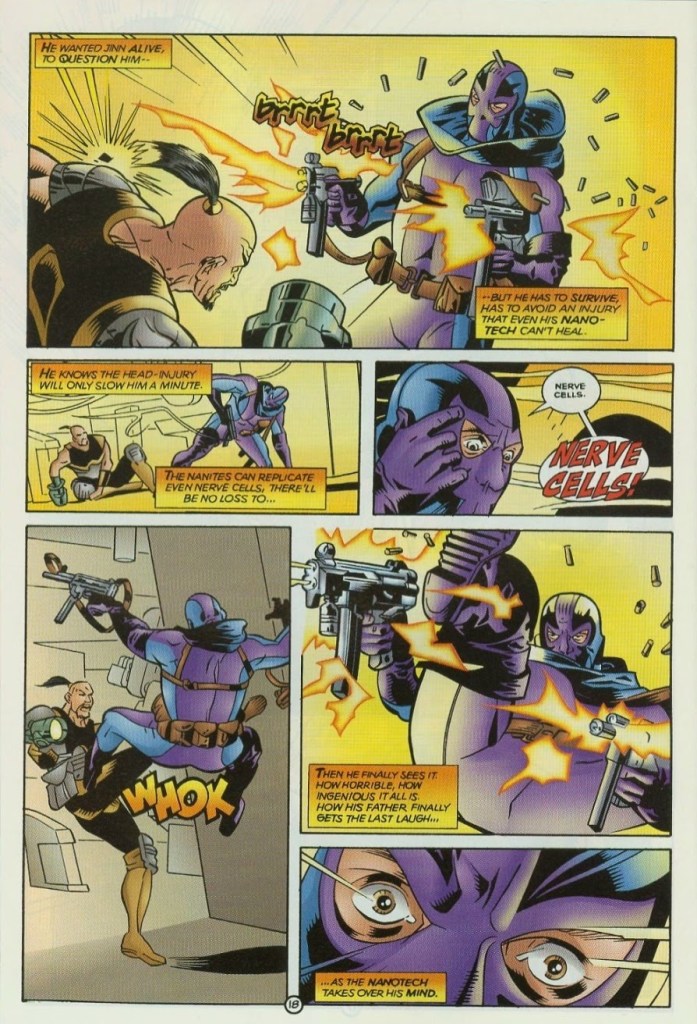
Elsewhere, chaos strikes the city as the armored Gordon Bell unleashes his fury which Prototype, Ranger, Night Man and The Solution witnessed. Bell pointed at Prototype promising he will come back for him.

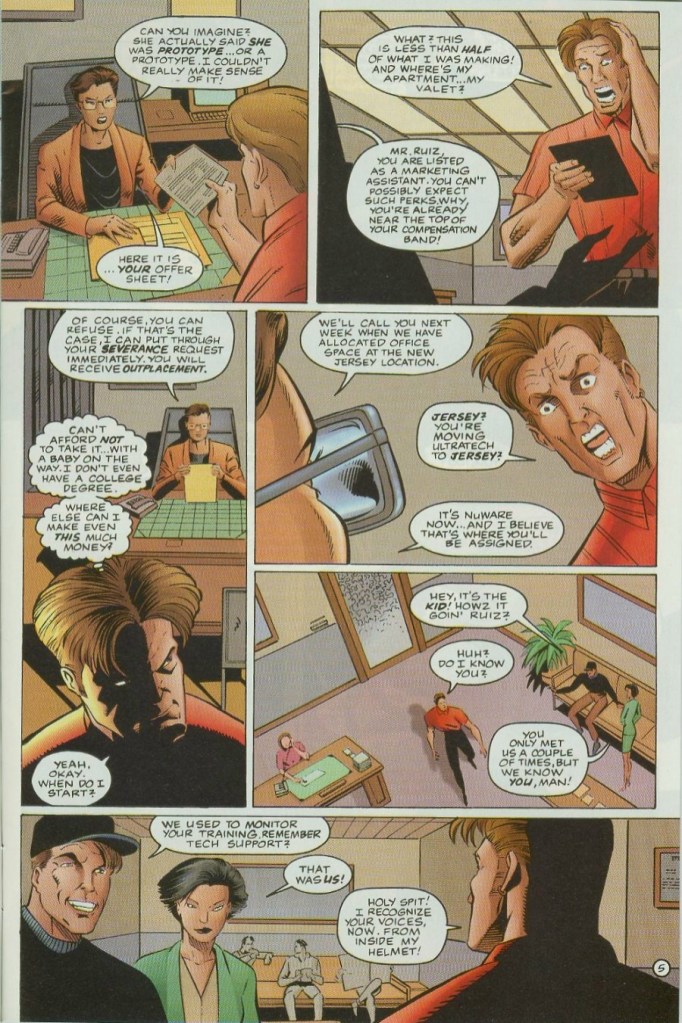
Some time later, Jimmy Ruiz (Prototype) visits and meets Lisa Lopez, the director of human resources. At this point, the destruction of Gordon Bell’s own office as well as the recent corporate merger put Jimmy in a bind with uncertainty. To his dismay, the job offered to him pays less than half of what he was making due to technical evaluations related to the merger. Even so, he decides to accept the new job…

Quality

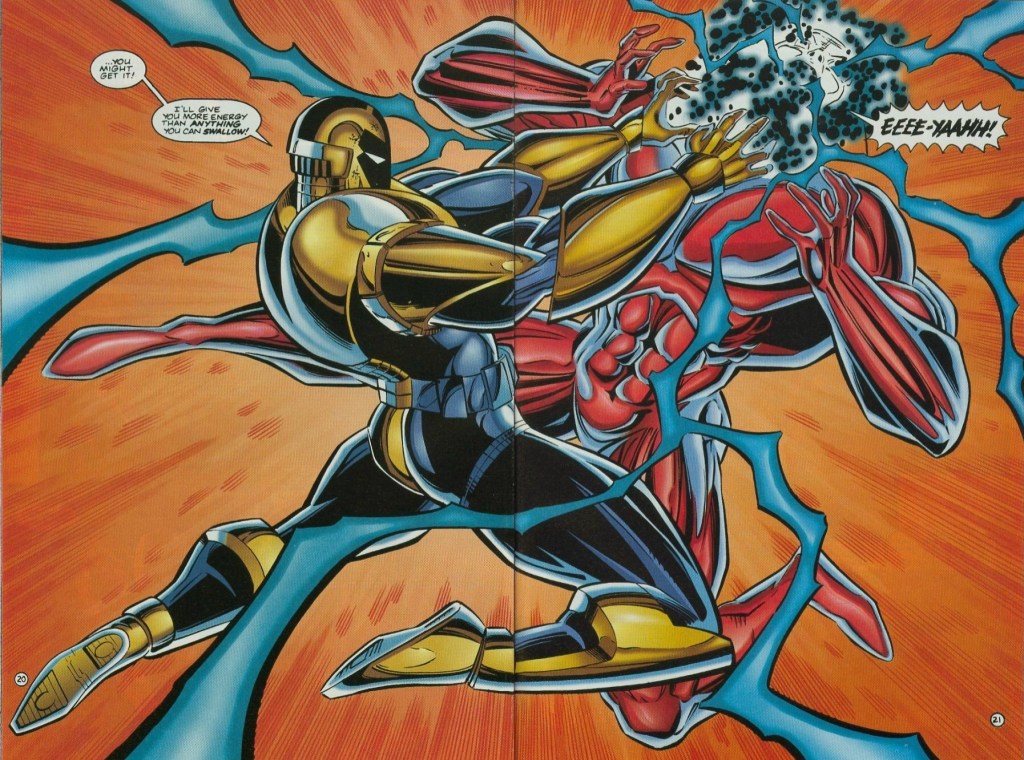
The money shot!

This is an enjoyable, character-driven story of Prototype. It is a refreshing way of presenting the title character after having read lots of Prototype comic books that had the spotlight divided between Jimmy Ruiz and Bob Campbell. The corporate intrigue continues nicely in this story but the stakes have been raised not only with NuWare and Ultratech, but also with Jimmy Ruiz.

The Prototype pilot finds himself in a new stage of his life, one that is full of uncertainty and pain as his high-paying job is no more and a lot of secret technology records got destroyed. Apart from a destroyed career, Jimmy also has to struggle with the power surging in him which requires him to use the Prototype armor to reduce the extra power.

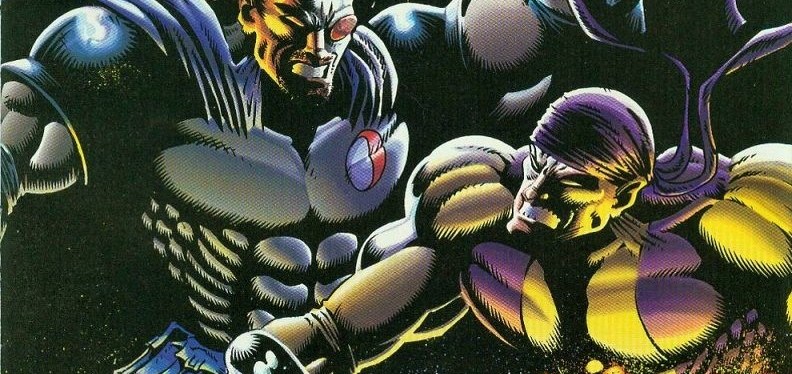
Prototype encounters Manhattan Project in this issue and I can say that it was not only action-packed but also had a nice combination of intensity and emotions. The said encounter was short but every moment of it was very enjoyable to read.

Conclusion

Major career challenge for Jimmy Ruiz.

Prototype (1994) is a lot of fun to read and anyone who is true follower to Jimmy Ruiz will be happy to that there is very strong focus on him. It seems that this story marks the turning point of his life and sets the stage for more surprises and intrigue as the corporate world turned upside down.

If you are seriously planning to buy an existing hard copy of Prototype (1994), be aware that as of this writing, MileHighComics.com shows that the near-mint copy of the comic book costs $14.
Overall, Prototype (1994) is recommended.

+++++

Thank you for reading. If you find this article engaging, please click the like button below and also please consider sharing this article to others. If you are looking for a copywriter to create content for your special project or business, check out my services and my portfolio. Feel free to contact me as well. Also please feel free to visit my Facebook page Author Carlo Carrasco and follow me at HavenorFantasy@twitter.com