A Look Back at Wonder Woman #20 (1988)

Disclaimer: This is my original work with details sourced from reading the comic book and doing personal research. Anyone who wants to use this article, in part or in whole, needs to secure first my permission and agree to cite me as the source and author. Let it be known that any unauthorized use of this article will constrain the author to pursue the remedies under R.A. No. 8293, the Revised Penal Code, and/or all applicable legal actions under the laws of the Philippines.

It’s the second week of March already. That means we are slowly but surely inching closer to the March 30, 2021 scheduled releases of Wonder Woman 1984 on 4K Blu-ray, Blu-ray and DVD! If you have not yet ordered a copy of the sequel starring Gal Gadot as the Queen of Superheroes, you can do so now if you want to. I already ordered my copy. You can also read my retro review of the 2017 Wonder Woman movie.

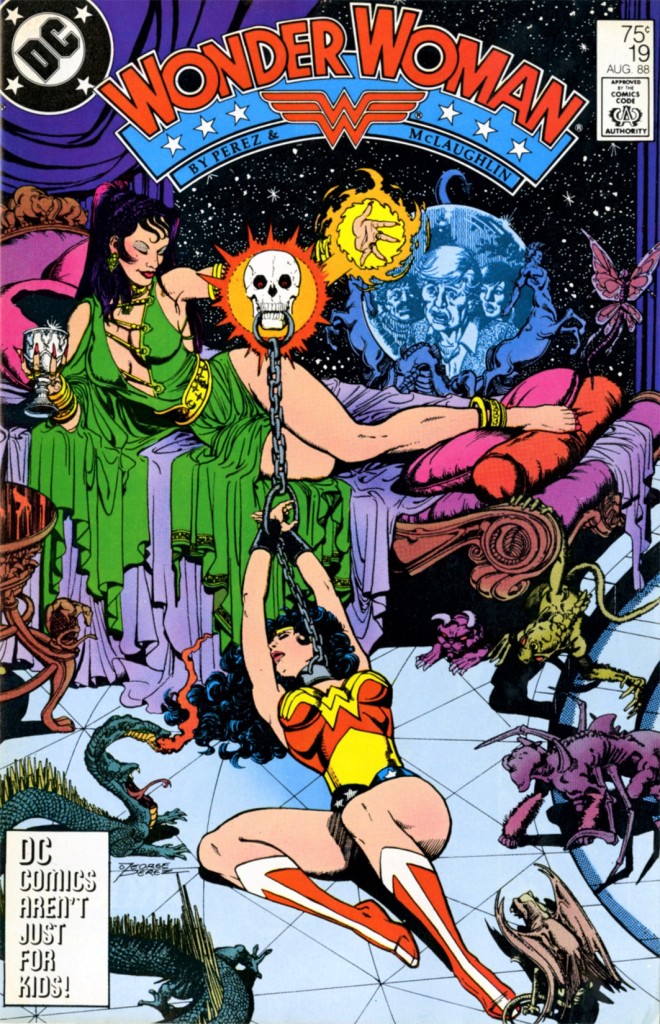
On to literature! Last time, the George Perez-led story not only saw the end of Diana’s visit of Greece, it also fully presented to readers what was back then the modern portrayal of Circe (DC Comics’ own take on the false Greek goddess) who proved to be at the time the most sinister and most powerful supervillain Wonder Woman faced. Wonder Woman #19 also showed the Queen of Superheroes in her most vulnerable state.

Now that Diana and her friends have returned to America, we can find out what happens next in this look back at Wonder Woman #20, published by DC Comics in 1988 with a story written and illustrated by George Perez based on an idea by Carol Flynn. Bob McLeod was in charge of the finishes.
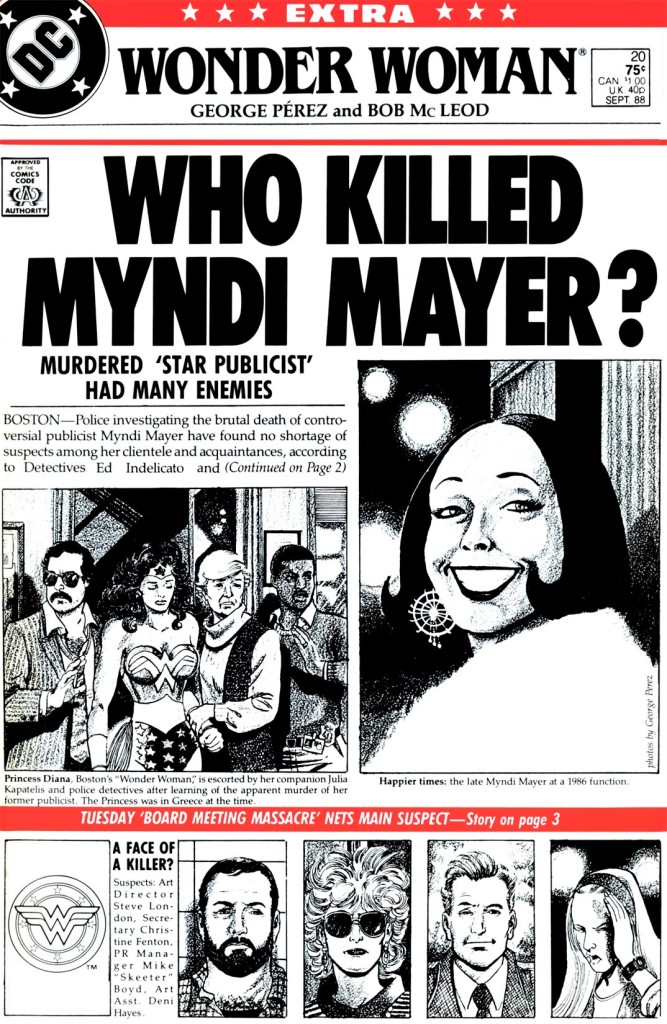
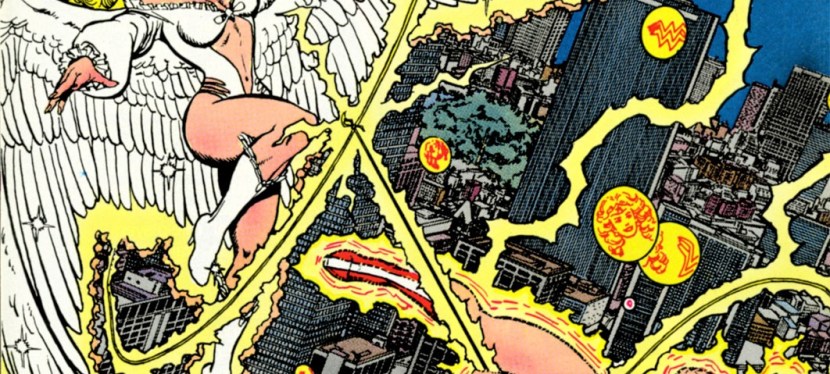
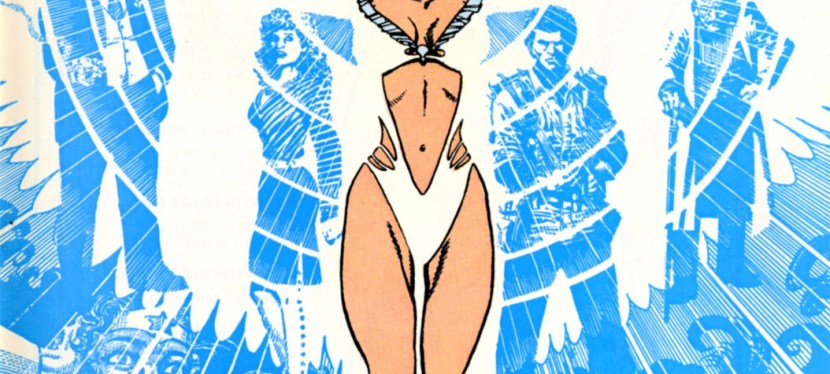
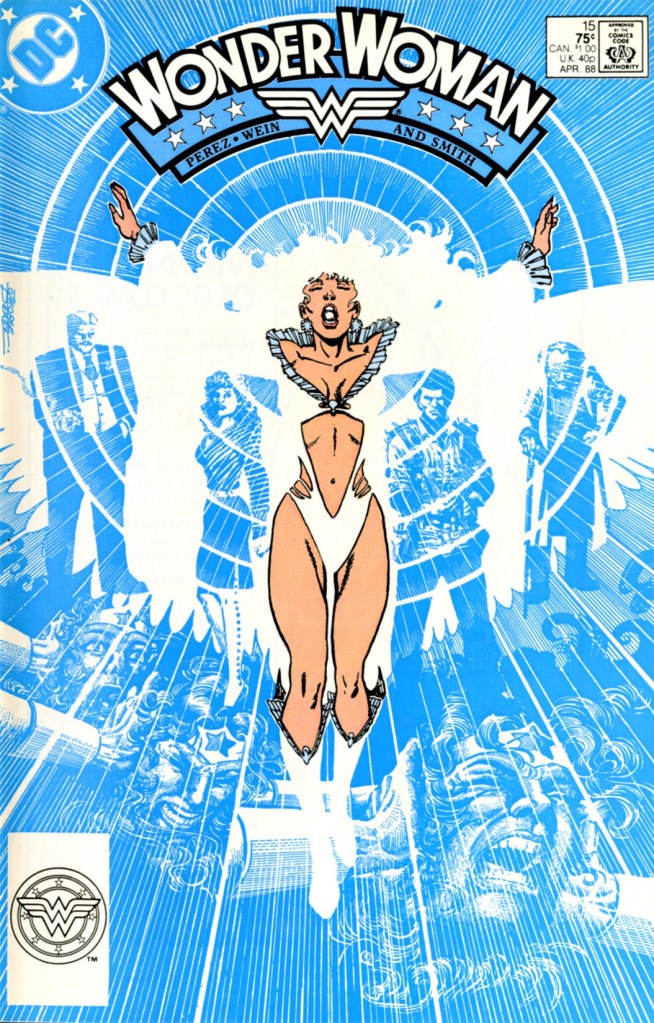
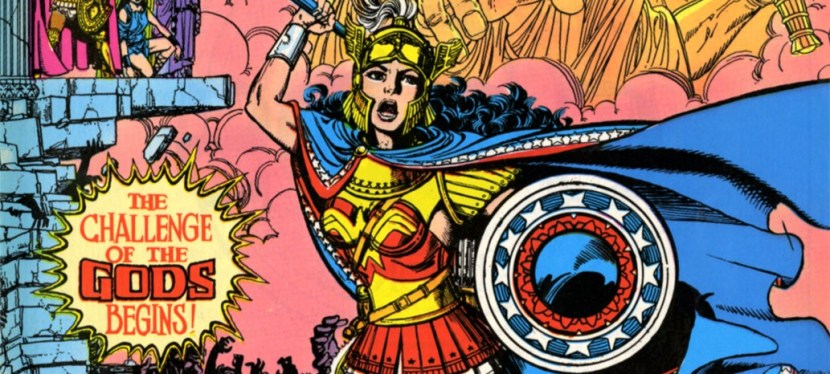
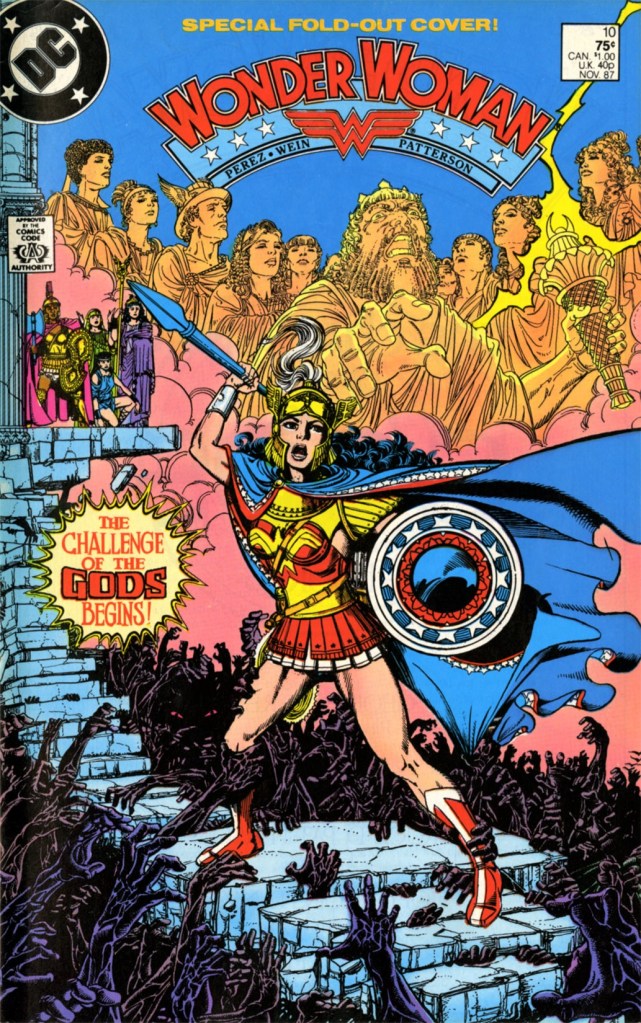
The cover.

Early story

The story begins in the City of Boston at night. Three Chinese men are running away from something until Wonder Woman confronts them. One of the men fires several bullets at her but each bullet got blocked by her using her tremendous reflexes and braces. After Wonder Woman disarms the gunman, another Chinese man tries attacking her with sharp weapons only to be defeated easily. The other Chinese man tries to run away but gets caught by Wonder Woman who uses her lasso. In reaction to his question, Wonder Woman demands answers.

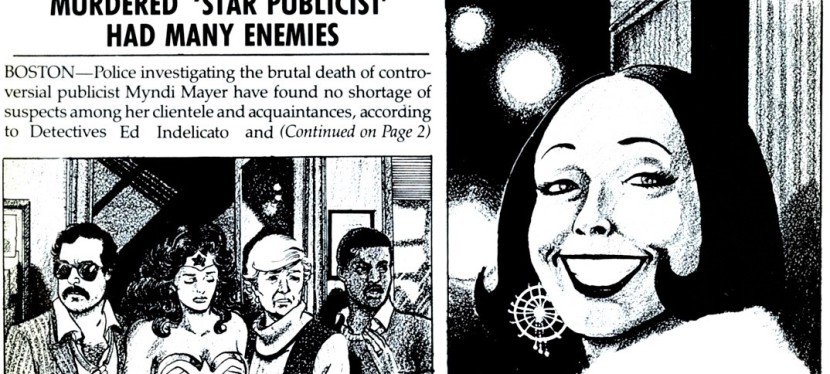
Elsewhere, investigators are searching for clues and details inside a lady’s modern looking office. Lying on the floor is the dead body of a victim and according to the investigator’s report, she had been dead for a few hours. The victim is none other than Myndi Mayer, a highly successful publicist who made a career out of the media and celebrities. Wonder Woman happened to be her most recent, high-profile client. Mayer was involved in the Wonder Woman fair.

Based on their findings, Myndi Mayer looked like she didn’t go without a fight. A bloody letter opener was found in her hand and her purse was found next to her body emptied. Traces of white powder were found on her desk. Mayer’s secretary Christine Fenton was visited by the investigators who told her about the death of her boss. She did not express any surprise and told them that it was only a matter of time before Mayer’s end came. Christine added that she warned Mayer about a certain man.

The investigators then show Christine the sketch of man based on the description of an eyewitness. She expressed surprise as she recognizes him…

Quality
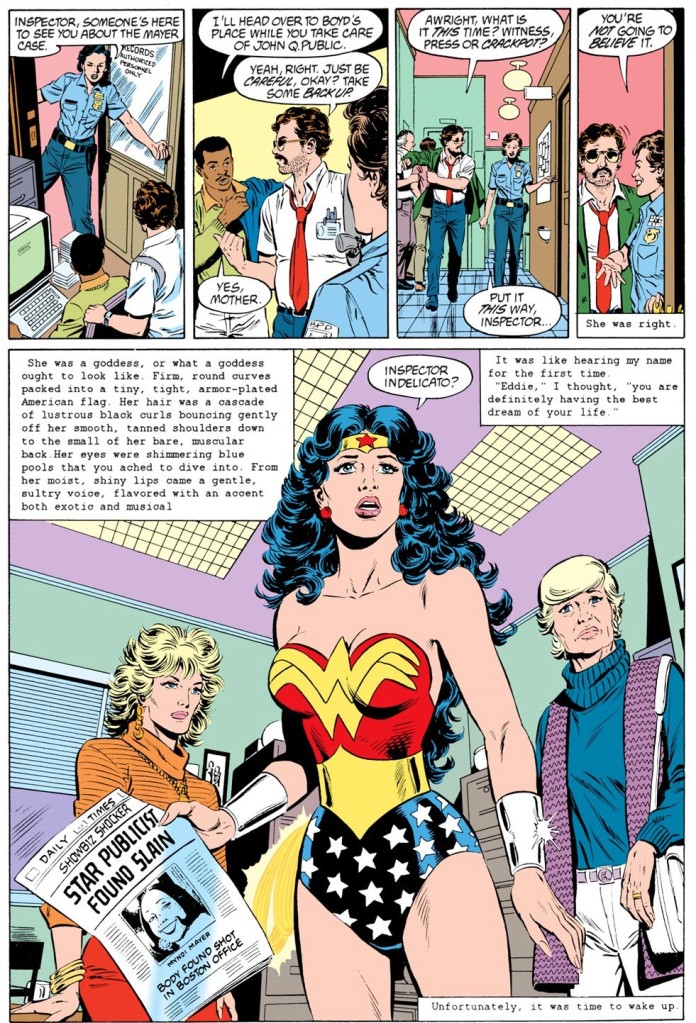
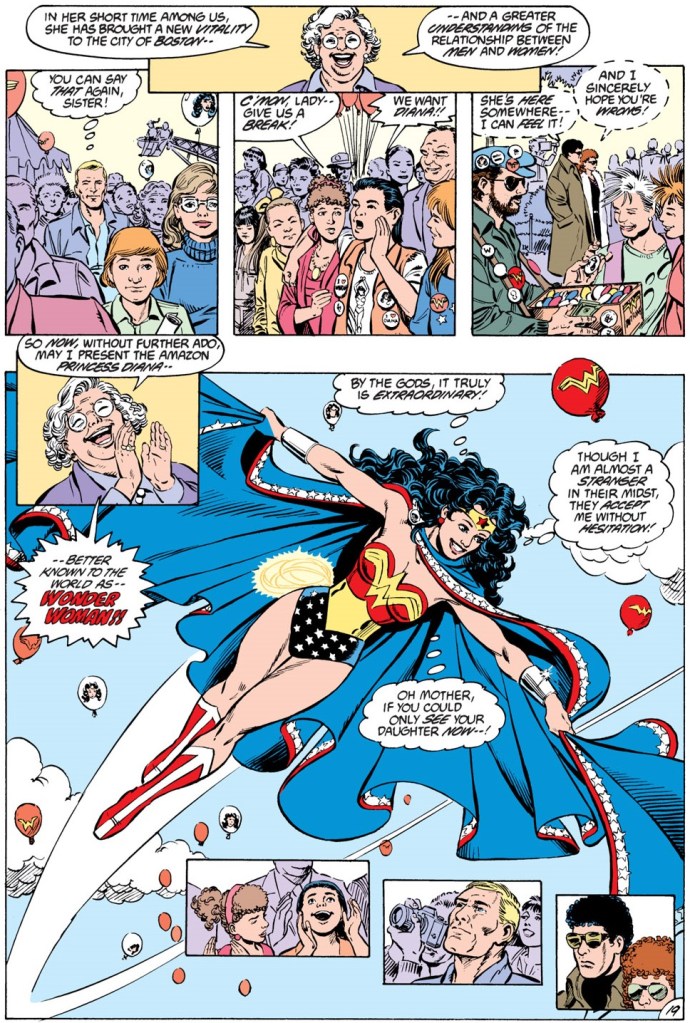
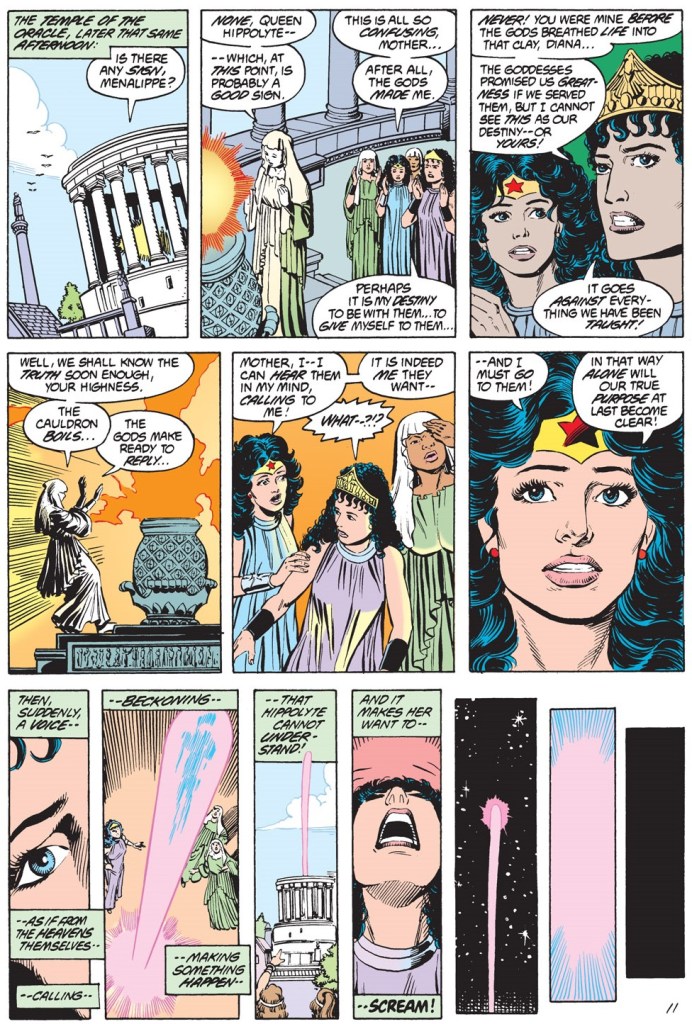
Wonder Woman takes part in the search for truth.

Wow! This is one dark Wonder Woman story to read and I can say that it is a very inspired work written by George Perez based on an idea by Carol Flynn. This is not your typical story of showing the Queen of Superheroes fighting someone evil or saving people from disaster. This is a murder mystery that is laced with corporate intrigue, crime, legal wrangling and the everlasting struggle to determine the truth.

Myndi Mayer’s death really set of a series of events and revelations that are no less striking. Considering the many details about law, crime, investigations and corporate intrigue, the in-depth writing here indicates that George Perez did a lot of researching and found ways to tell a very cohesive story with Wonder Woman playing a role. I should state that as of this writing, this particular story comes close to becoming realistic and reflective of 1980s life. This is top-notch writing by Perez!

When it comes to characterization, Myndi Mayer was deeply portrayed to be in deep trouble both personally and professionally. Of all the Wonder Woman comics of the post-Crisis era of DC Comics I’ve read so far, this one clearly defines Mayer and goes beyond her usual appearance as a prolific publicist.

On Wonder Woman, as mentioned earlier, she does not get to fight a super villain. Rather she takes part in the search for truth and tries her best to solve the mystery even though she is not even fully familiar with the way law and order works in the world of man. In some ways, her approach to literally putting pieces of the puzzle into place and approaching people in different places reminds me somewhat of Batman’s detective work but without the vigilante approach.

Conclusion
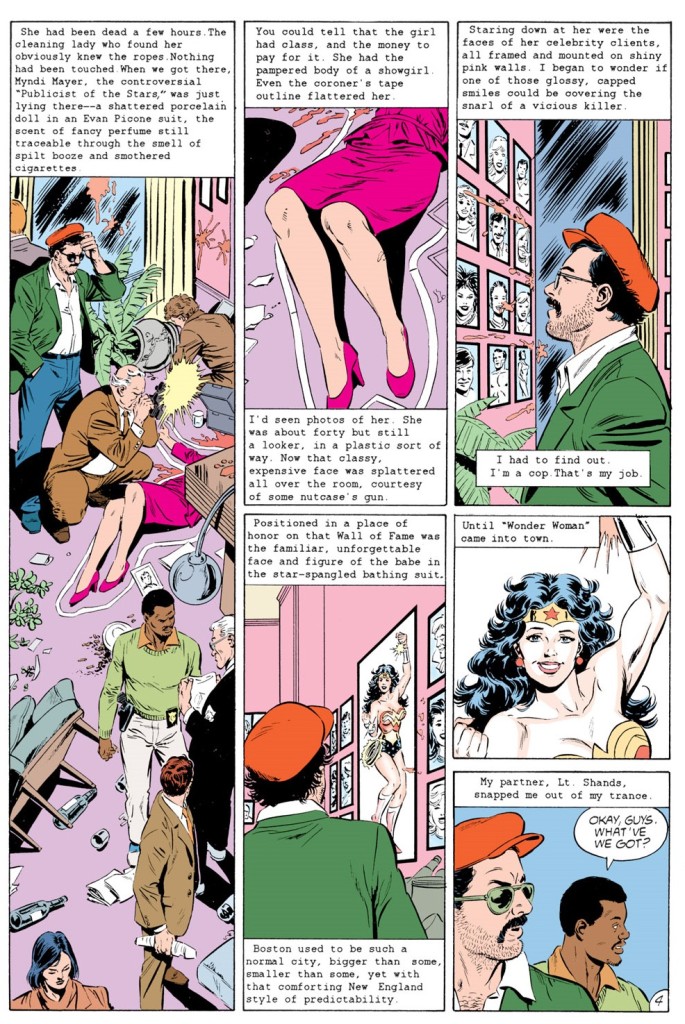
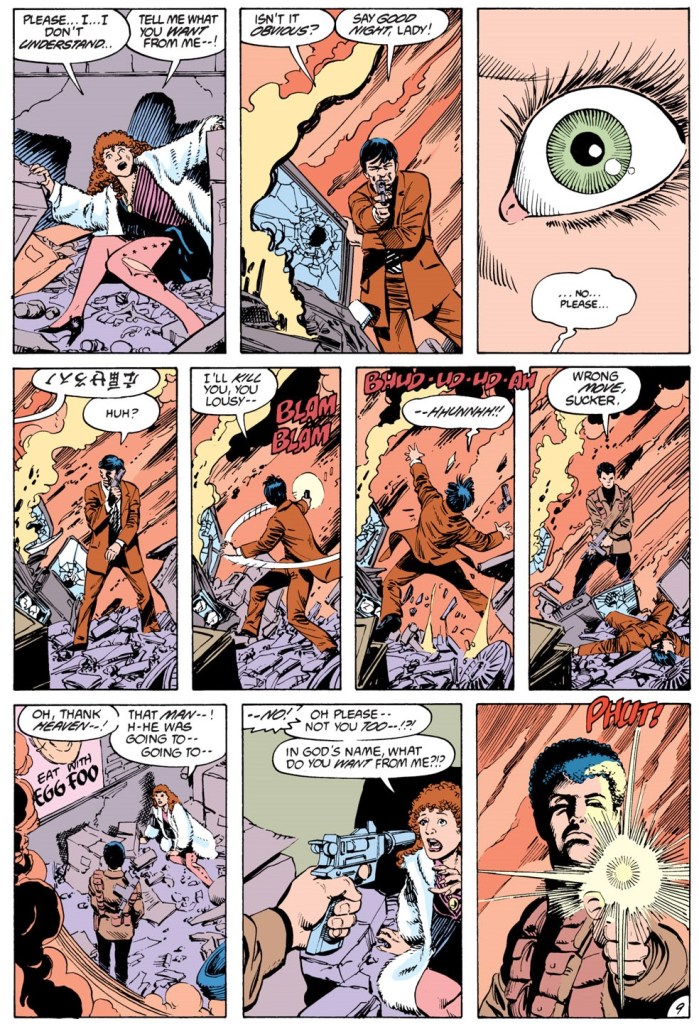
This page about the murder investigation at the scene of the crime has some Watchmen vibes to it.

I can say that Wonder Woman #20 (1988) is not only a great comic book to read but also one of the most unique stories about the Queen of Superheroes ever published. By this time, George Perez has proven himself to be very prolific in storytelling on top of his great ability to draw art. I should state I love the way the story was structured and the way it ended delivered both impact and intrigue.

If you are seriously planning to buy an existing hard copy of Wonder Woman #20 (1988), be aware that as of this writing, MileHighComics.com shows that the near-mint copy of the comic book costs $41.

Overall, Wonder Woman #20 (1988) is highly recommended!

+++++

Thank you for reading. If you find this article engaging, please click the like button below and also please consider sharing this article to others. If you are looking for a copywriter to create content for your special project or business, check out my services and my portfolio. Feel free to contact me as well. Also please feel free to visit my Facebook page Author Carlo Carrasco and follow me at HavenorFantasy@twitter.com
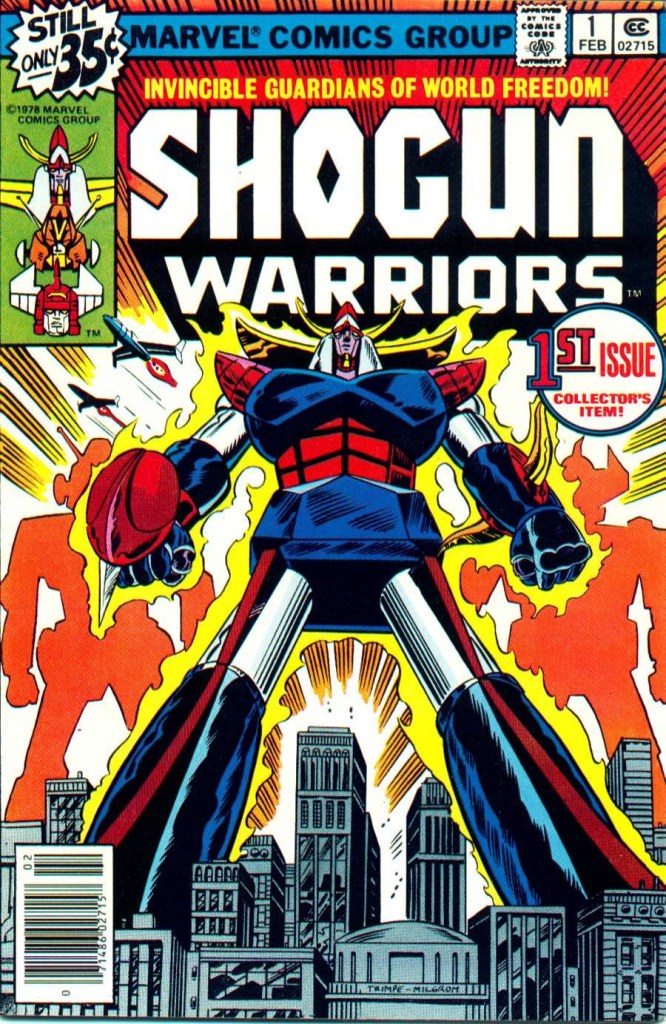
A Look Back at Shogun Warriors #1 (1979)

Disclaimer: This is my original work with details sourced from reading the comic book and doing personal research. Anyone who wants to use this article, in part or in whole, needs to secure first my permission and agree to cite me as the source and author. Let it be known that any unauthorized use of this article will constrain the author to pursue the remedies under R.A. No. 8293, the Revised Penal Code, and/or all applicable legal actions under the laws of the Philippines.

If you are fond of giant robots from Japanese pop culture as well as giant monsters and scenes of city structures getting destroyed, then you might want to take a look at the Shogun Warriors comic book series that was published by Marvel Comics from 1979 to 1980. To put things in perspective, Shogun Warriors was made possible through licensing deals and back in the 1970s, Marvel Comics had the rights to publish comic book about Japan’s famous icon Godzilla.

Specifically, Shogun Warriors involved Marvel Comics and Mattel which in turn organized a line of imported toys from Japan based on varied Japanese shows about giant robots. Among the many giant robots of the toy line, the robots Raideen, Combattler V and Dangard Ace became the featured fighting-for-good robots of the Shogun Warriors comic book series. For the literary works, Raideen was renamed as Raydeen while Combattler V was renamed as Combatra. Dangard Ace’s name was left unchanged.

With those details laid down, here is a look back at Shogun Warriors #1, published in 1979 by Marvel Comics with a story written by Doug Moench and drawn by Herb Trimpe.

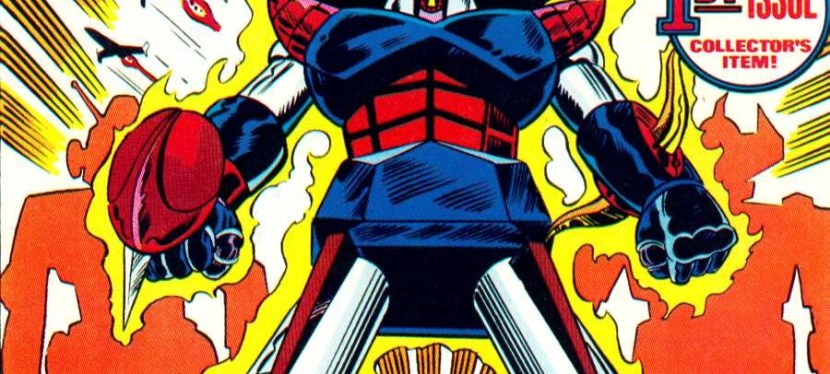
The cover.

Early story

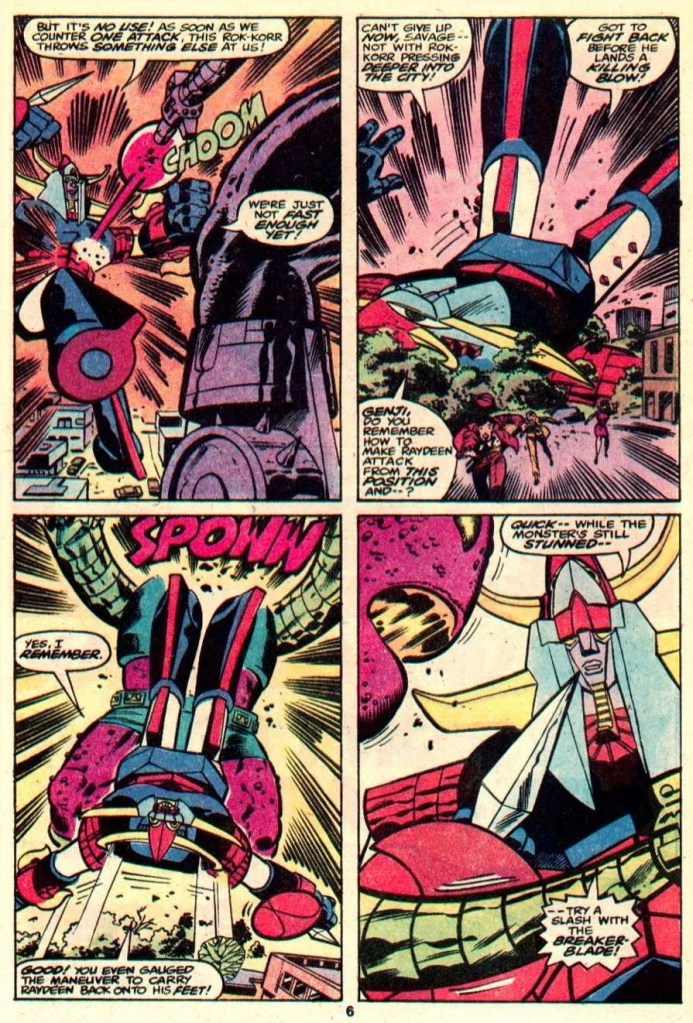
The story begins in the outskirts of Tokyo in Japan where giant robot Raydeen fights a large, tentacled creature enhanced with cybernetics. As the people on the street below them run away from the ongoing destruction, the monster fires a shot at Raydeen who blocks it but subsequently gets tied with one of the tentacles. The giant robot, which is operated by three pilots inside, breaks free and continues to fight the monster.

As the battle rages on, the city continues to get damaged heavily affecting the people…

Quality

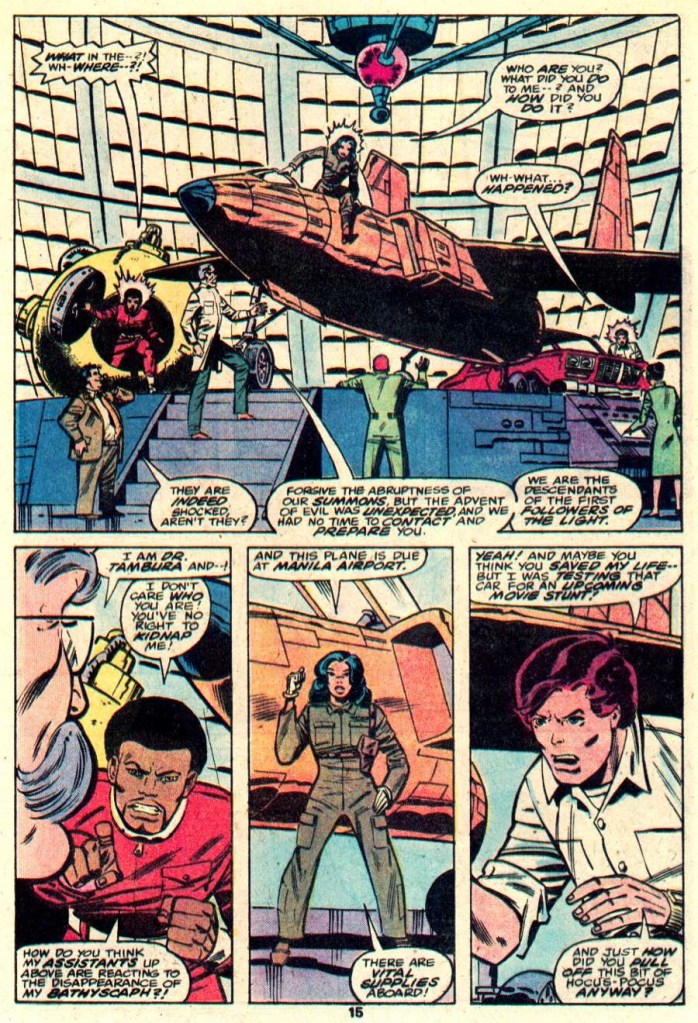
Technically the organization kidnapped three people to be the pilots of their robots for Earth’s defense.

Having seen a lot of anime TV series episodes about giant robots, I’m familiar already with the storytelling formula that often focuses first on the human characters and their struggles before shifting the narrative on the giant robots that often fight large monsters or opposition robots. This particular comic book has some of that but the way the story is structured, it is different and can be a bit jarring.

Doug Moench structured the story to have Raydeen and the monster fighting in the present time followed shortly by a flashback that took place just hours prior. The flashback, which occupies 9 of the comic book’s 18 pages, is heavily filled with exposition meant to introduce readers to the three pilots Genji Odashu/Ilongo Savage/Richard Carson, what Earth defense force The Followers of the Light is, and why there are giant monsters ravaging the world. The exposition’s writing felt crammed and rushed for reading although it still succeeds in establishing the comic book’s grand concept.

When it comes to spectacle, this comic book is loaded with giant robot action and it is quite varied in style and execution. The funny thing is that you will only get to see Raydeen in action as this is an introductory story with only 18 pages of story.

The dialogue is a bit of a mess here, particularly with the early Raydeen scenes. As the battle with the monster goes on, there are these lines of dialogue reflecting the conversations between the pilots inside Raydeen who are not shown talking until late in the comic book.

Conclusion

Raydeen and the giant monster in battle.

Shogun Warriors #1 (1979) has a nice concept and its Westernized take on portraying giant robots and human characters is clearly different from the way things were done in the varied giant robot anime TV series of Japan. There is clearly no Japanese style melodrama as this one has its characters portrayed straight with a touch of American science fiction. That being said, do not expect to see the Japan-made characters of Raideen, Combattler V and Dangard Ace appear here as new characters were made in their place. The comic book’s story structure is a bit jarring to follow and the heavy exposition dump makes reading a bit of a chore. It is fun to read but not great. Those of who are fans of Combatra and Dangard Ace will be disappointed about the near-total absence of those robots.

If you are seriously planning to buy an existing hard copy of Shogun Warriors #1 (1979), be aware that as of this writing, MileHighComics.com shows that the near-mint copy of the regular edition costs $63 while the near-mint copy of the Whitman edition costs $35.

Overall, Shogun Warriors #1 (1979) is satisfactory.

+++++

Thank you for reading. If you find this article engaging, please click the like button below and also please consider sharing this article to others. If you are looking for a copywriter to create content for your special project or business, check out my services and my portfolio. Feel free to contact me as well. Also please feel free to visit my Facebook page Author Carlo Carrasco and follow me at HavenorFantasy@twitter.com
A Look Back at Wonder Woman #19 (1988)

Disclaimer: This is my original work with details sourced from reading the comic book and doing personal research. Anyone who wants to use this article, in part or in whole, needs to secure first my permission and agree to cite me as the source and author. Let it be known that any unauthorized use of this article will constrain the author to pursue the remedies under R.A. No. 8293, the Revised Penal Code, and/or all applicable legal actions under the laws of the Philippines.

Welcome back, superhero enthusiasts, comic book collectors and fans of DC Comics! Today is the first day of March of 2021. Do you know what that means? It means that Wonder Woman 1984’s scheduled release on DVD, Blu-ray and 4K Blu-ray is just 29 days away! Even though I still have not seen the movie (which as of this writing has not been released in movie theaters here in the Philippines) and even though social media showed that WW fans are divided over it, I still went ahead ordering the 4K Blu-ray combo online. Just today, the online retailer gave me an important update as to when the 4K Blu-ray combo will arrive.

Personally, I’m excited to watch Gal Gadot play the Queen of Superheroes again and her performance in the 2017 Wonder Woman movie is phenomenal and captures the essence of the icon! I am also interested to see how director Patty Jenkins handled the storytelling as she herself co-wrote the screenplay.

More on Wonder Woman, I should say that I really love the way she was redefined by George Perez and Len Wein in the post-Crisis era of DC Comics. Today, we will find out what happens next to her during her time in Greece in this look back at Wonder Woman #19, published in 1988 by DC Comics with a story written and drawn by George Perez (with Frank McLaughlin on the finishes).

The cover.

Early story

The story begins with a short look back at the end of issue #18 which saw Wonder Woman fighting several monsters that surrounded her. Suddenly a powerful blast hits her and knocks her out.

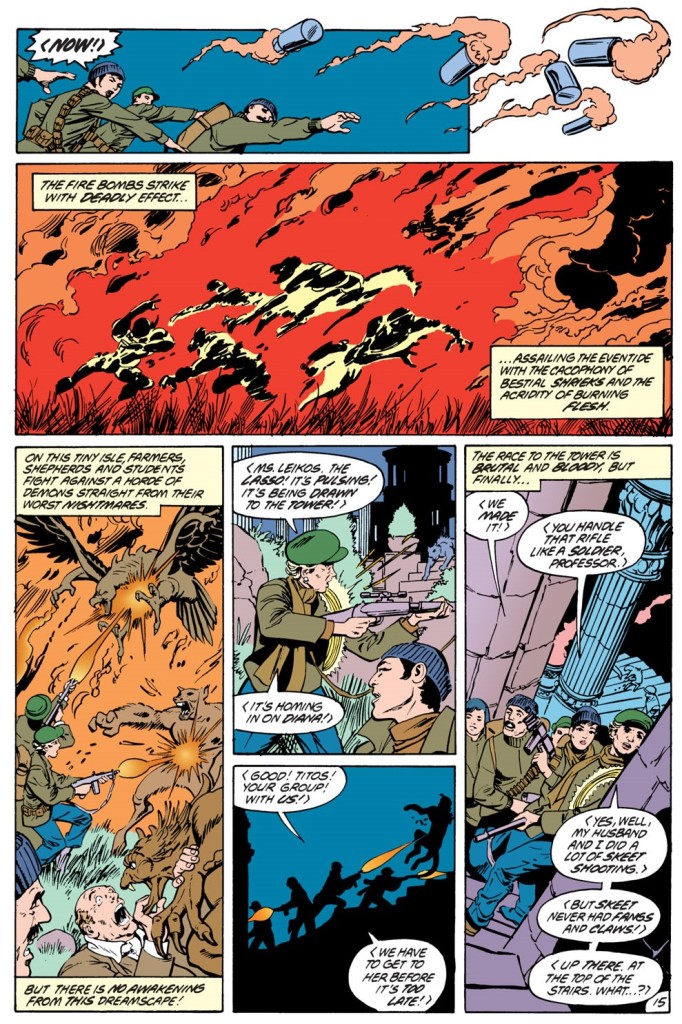
Vanessa, who survived thanks to Wonder Woman’s help, is found by her mom Julie who was accompanied by several armed Greeks. Vanessa states that the scroll she got from her uncle Stavros seemed to attract the monsters which drew a response from local rebel Katina Leikos who belongs to a group that oppose the fabled witch on the nearby island. She states that if they don’t stop the witch, she will destroy princess Diana/Wonder Woman.

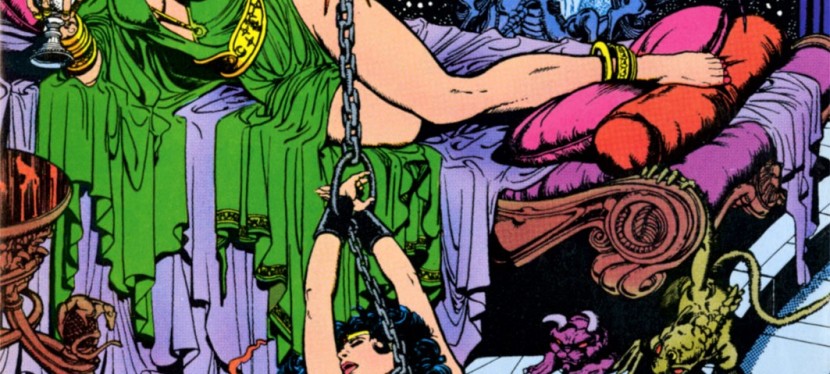
Inside the old structure on the said island, Wonder Woman wakes up finding herself on the floor chained by the neck and wrists. Located very near her is Circe, the enchantress who is the daughter of Hyperion and Perseis. The enchantress tells Wonder Woman that it is her destiny to execute her…

Quality

Julia Kapatelis is more involved with the action and mission.

Of all the comic books that I’ve reviewed so far on this particular monthly series in the post-Crisis era, this one is easily the darkest and most grim Wonder Woman story. It also has the heaviest emphasis on monsters and sorcery, complete with sinister rituals and connections to Greek mythology.

As expected, the story here further develops Wonder Woman and her place in man’s world but with emphasis on destiny and legacies. In this case, destiny related to the shared history between Wonder Woman’s fellow Amazons and Circe (who is DC Comics’ own take on the false Greek goddess) which puts the superhero icon in a rather complex situation. For Circe, Wonder Woman’s innocence means nothing because destiny and hatred matter a lot more. The way George Perez wrote, Circe in this particular issue proved to be more menacing than Ares and is also the most sinister villain of Wonder Woman’s.

More on this comic book, I can declare that it is right here where you will get to see the Queen of Superheroes in her most vulnerable and most helpless state yet. For several pages, you will see Wonder Woman struggle not only against Circe and her monsters, but also with the revelations of history. You will also get to see Wonder Woman’s emotional limits pushed.

Regarding the supporting cast, I really enjoyed seeing Julie Kapatelis really putting her academic skills and expertise to great use as well as getting involved in the action. With her Greek heritage and connections with the locals clearly defined, Julie got a good amount of the spotlight among the characters and nicely contributed to the story. I also love the part when Julie said that Diana (Wonder Woman) is like a daughter to her which really emphasize the bond of love and trust between them.

Conclusion

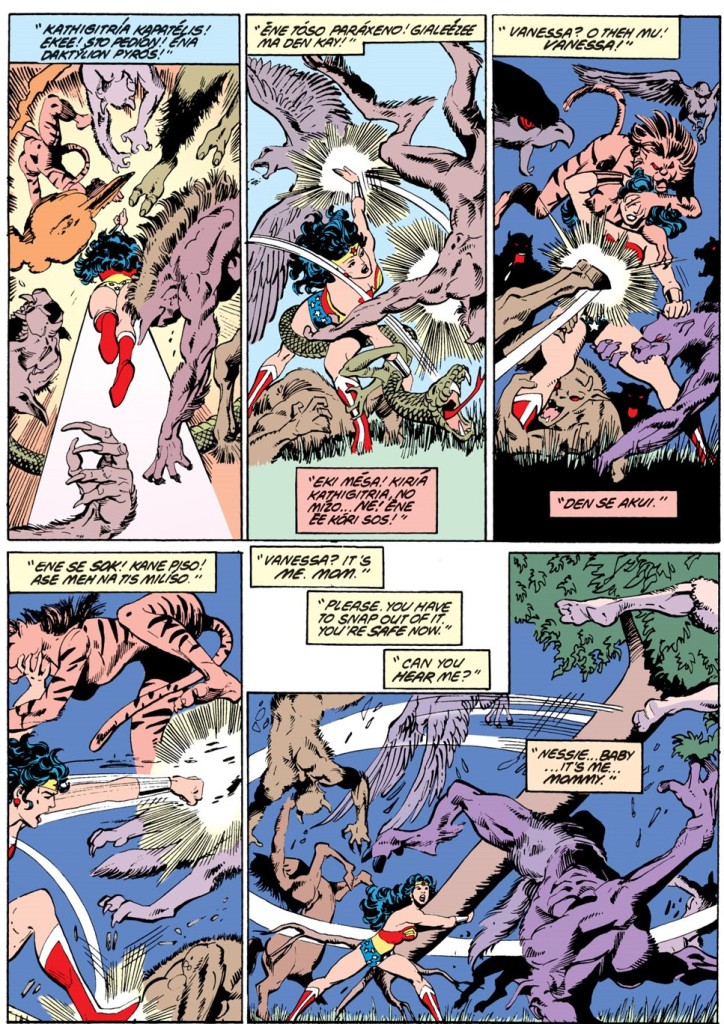
Wonder Woman bravely fights the monsters of Circe.

As far as the visit in Greece goes, Wonder Woman #19 (1988) really ramped up the stakes with Circe’s evil presence emphasized a lot while having Wonder Woman in a vulnerable state which added to her character development in this particular monthly series. It is indeed a very well written tale by Perez who proved to be capable of pushing the boundaries while redefining Wonder Woman in the post-Crisis era. Apart from being the most sinister villain in this monthly series so far, Circe is the complete opposite of Wonder Woman.

If you are seriously planning to buy an existing hard copy of Wonder Woman #19 (1988), be aware that as of this writing, MileHighComics.com shows that the near-mint copy of the regular edition costs $42 while the near-mint copy of the newsstand edition costs $44.

Overall, Wonder Woman #19 (1988) is highly recommended!

+++++

Thank you for reading. If you find this article engaging, please click the like button below and also please consider sharing this article to others. If you are looking for a copywriter to create content for your special project or business, check out my services and my portfolio. Feel free to contact me as well. Also please feel free to visit my Facebook page Author Carlo Carrasco and follow me at HavenorFantasy@twitter.com
A Look Back at Superman Annual #10 (1984)

Disclaimer: This is my original work with details sourced from reading the comic book and doing personal research. Anyone who wants to use this article, in part or in whole, needs to secure first my permission and agree to cite me as the source and author. Let it be known that any unauthorized use of this article will constrain the author to pursue the remedies under R.A. No. 8293, the Revised Penal Code, and/or all applicable legal actions under the laws of the Philippines.

Before DC Comics ended their original superhero multiverse with Crisis on Infinite Earths (1985-1986) to restart all over again, there were a whole lot of stories about Superman ranging from the dramatic stuff, the epic tales and right down to the most outlandish tales.

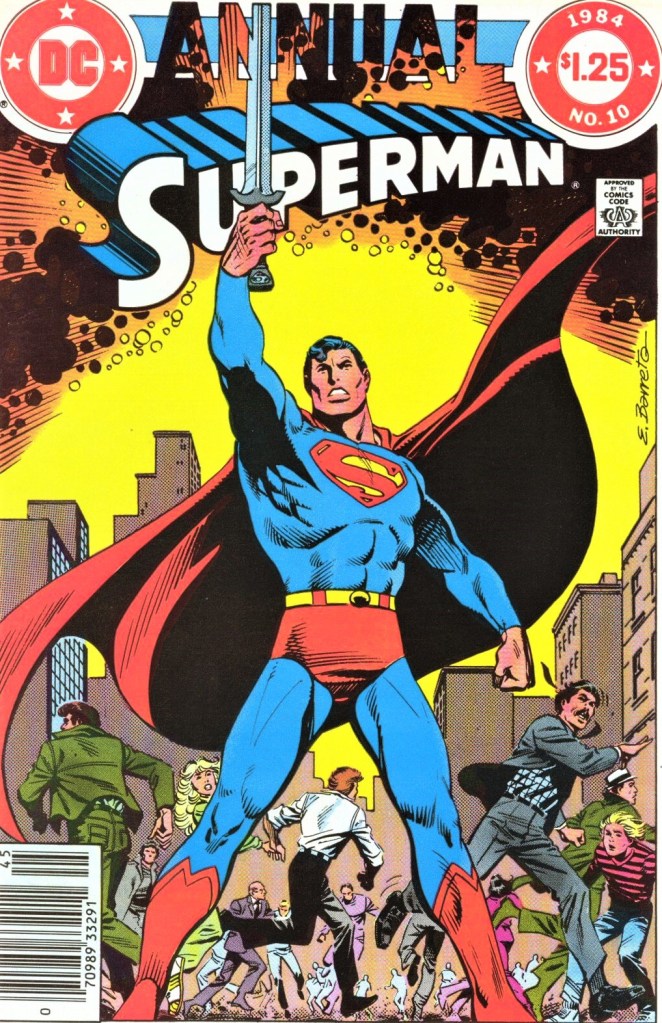
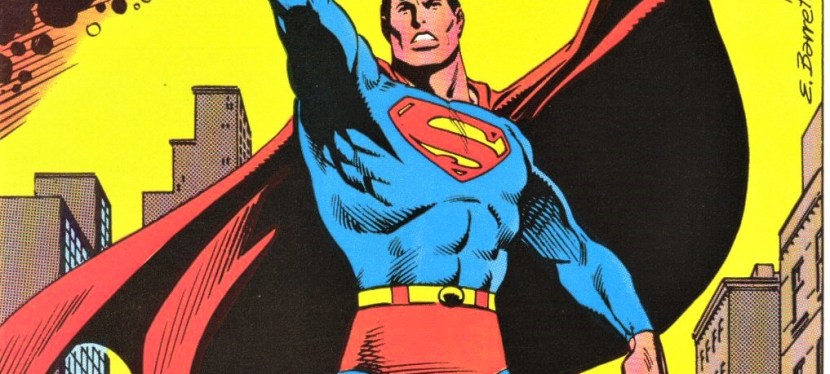
As a kid, I was fortunate enough to buy myself a copy of a 1984 Superman comic book, the cover of which really intrigued and caught my interest. It was a Superman annual comic book with a $1.25 cover price which was somewhat high at the time. Its cover showed the Man of Steel himself carrying a sword pointed up.

That image made me wonder: Why would Superman have to use a sword when he is so powerful and capable without weapons? Where did that sword come from? Who made it in the first place? Is the sword so special to Superman?

With those details laid down, here is a look back at Superman Annual #10, published by DC Comics in 1984 with a story written by Elliot Maggin and drawn by classic Superman artist Curt Swan.

The cover.

Early story

The story begins in a space where a group of diverse people composed of aliens and humans are gathered together watching a live video feed Superman on a large monitor above their heads. As it turns out, the Man of Steel is in space working to prevent meteoroids from entering the planet below him. He then speeds off into space heading back to Earth.

Along time ago deep in the galaxy, a big bang effect took place creating several new fragments in the vacuum of space and among them is a long, rough object that resembles a sword. As an unknown amount of time passed, the long object gradually turns into a smooth looking sword complete with a sharp blade and a letter “S” on one end that is the same as the one Superman carries. It is referred to as the sword of Superman!

In Metropolis, Clark Kent is passed by his officemate Jimmy Olsen who mentioned that he is rushing to interview the billionaire industrialist Oswald Mandias. Two days have passed and Jimmy Olsen remained missing. As his boss Perry White heads on to the office, Clark remains and changes into Superman when the coast got clear.

As the Man of Steel flies off into the city, a Galaxy Broadcasting live report on TV shows Lana Lang reporting from the Kennedy Space Center where the new space shuttle Magellan is about to make its first-ever commercial flight to launch a mysterious new communications satellite owned by Mandias Industries…

Quality

Clark Kent/Superman being a complete stranger to others added a lot to the story.
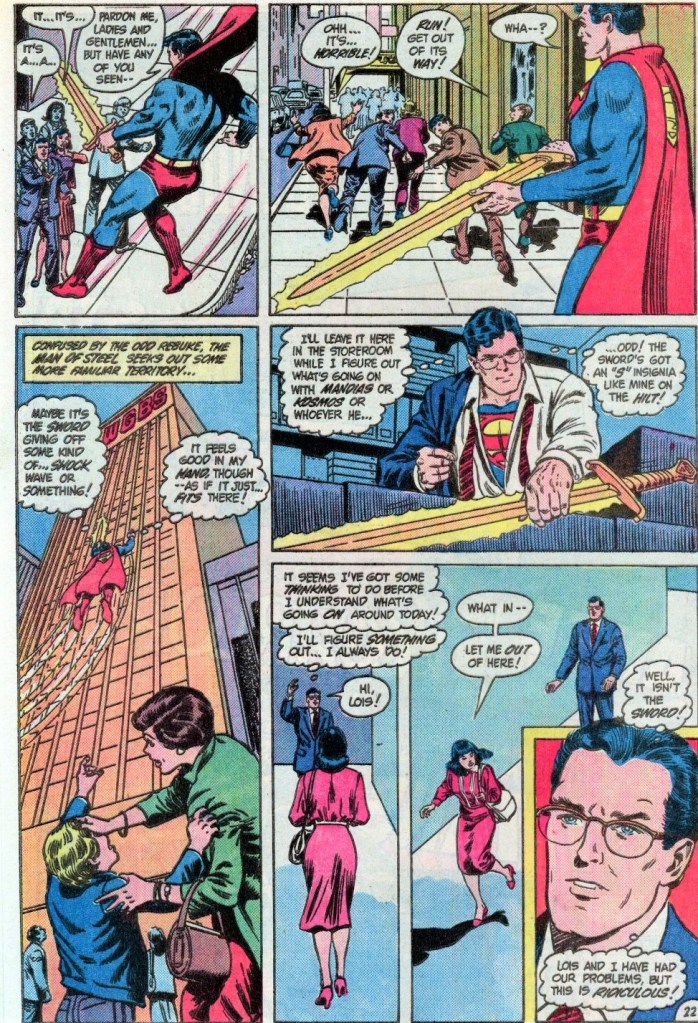
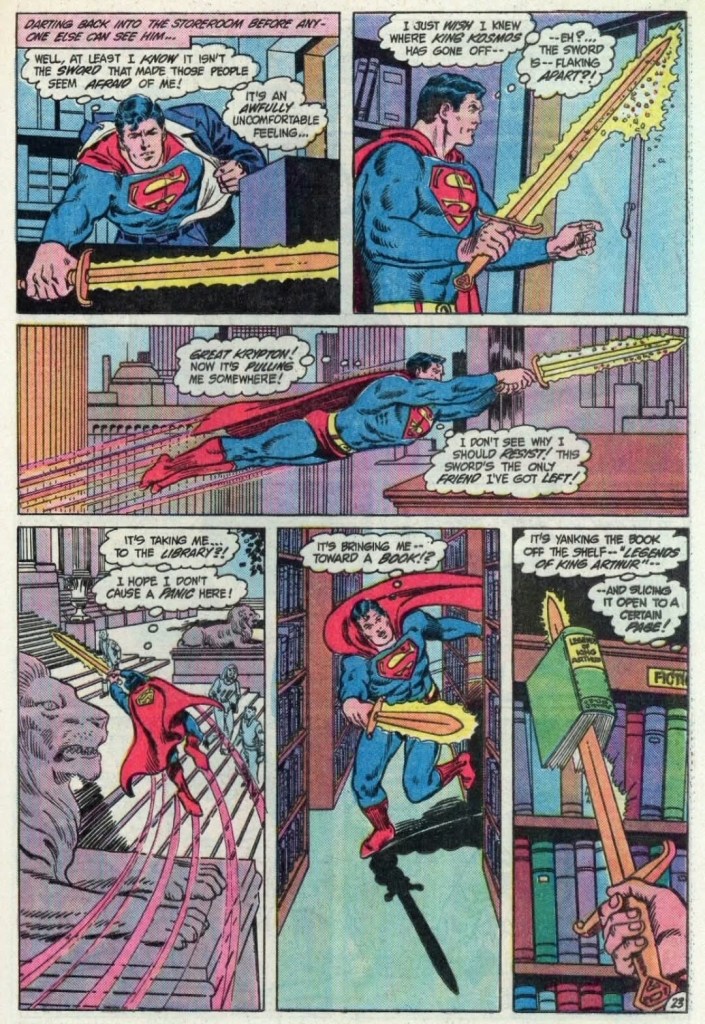
The sword led Superman to a book about the legend of King Arthur inside the city library.

Being an annual, I can say that the Sword of Superman story was well-written and nicely visualized by the creators which made it fun and engaging to read. It is a Superman story that further adds to his being an essential hero of the original DC Comics multiverse and a key factor here is the somewhat outlandish concept that the sword that he gained was an original material of the universe from the big bang and even had connections to the unseen omnipotent force.

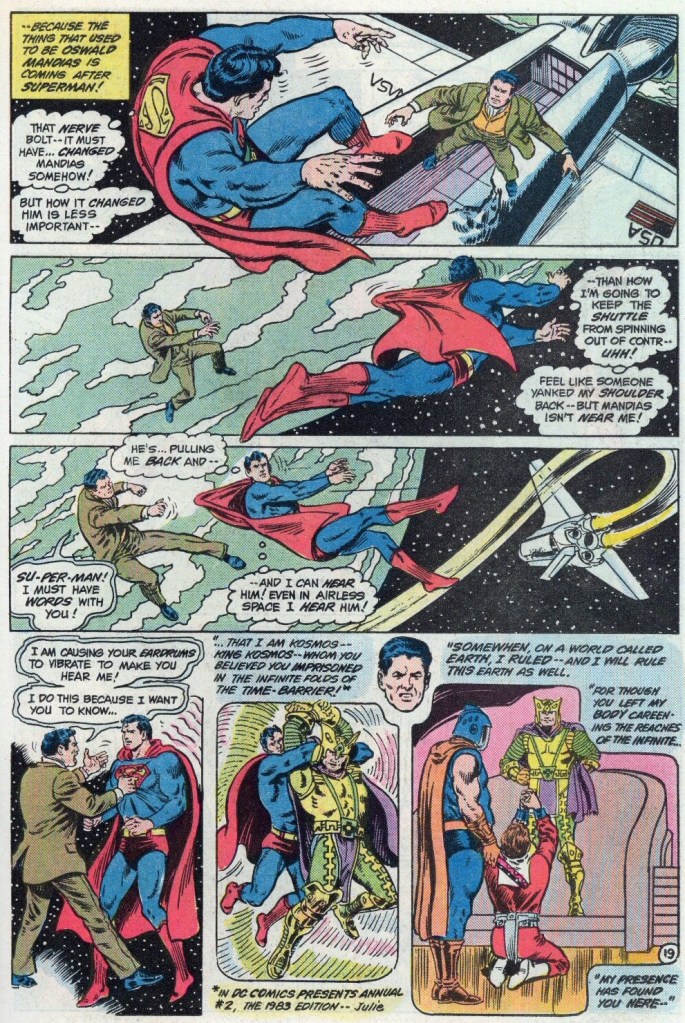
This story is not a simple, straightforward tale about Superman gaining a weapon required to defeat the supervillain King Kosmos. In fact, the sword opens up events that made the Man of Steel reevaluate himself, his situation and the people around him. King Kosmos, who is a time-travelling villain from the future (first appearance in DC Comics Presents Annual #2), served not just merely as the opposition but also adds a good amount of complexity within the reality of the story. For one thing, it is very intriguing and also refreshing to see people of Metropolis (even Clark’s friend Jimmy Olsen) failing to recognize Superman and perceive him with fear. This is a one-of-a-kind story of Superman that must be read, even though it is not really an epic tale.

All throughout, there is a fine balance between spectacle and intrigue. If you pay close attention to the dialogue and details, you will understand the story better and enjoy the comic book more eventually.

Conclusion

The return of King Kosmos!

I personally enjoyed reading Superman Annual #10 (1984) the first time back in 1984. The fact here is that after re-reading it recently, I do confirm that it is still an enjoyable comic book to read, and I am not even a Superman fan anymore. That is quite something! This is indeed a really good piece of Superman history from the pre-Crisis era. It also touches on themes about omnipotence, how ordinary people react to people who wield great power, and being whole with the entire universe.

If you are seriously planning to buy an existing hard copy of Superman Annual #10 (1984), be aware that as of this writing, MileHighComics.com shows that the near-mint copy of the regular edition costs $35 while the near-mint copy of the newsstand edition costs $70.

Overall, Superman Annual #10 (1984) is recommended.

+++++

Thank you for reading. If you find this article engaging, please click the like button below and also please consider sharing this article to others. If you are looking for a copywriter to create content for your special project or business, check out my services and my portfolio. Feel free to contact me as well. Also please feel free to visit my Facebook page Author Carlo Carrasco and follow me at HavenorFantasy@twitter.com
A Look Back at Wonder Woman #16 (1988)

Disclaimer: This is my original work with details sourced from reading the comic book and doing personal research. Anyone who wants to use this article, in part or in whole, needs to secure first my permission and agree to cite me as the source and author. Let it be known that any unauthorized use of this article will constrain the author to pursue the remedies under R.A. No. 8293, the Revised Penal Code, and/or all applicable legal actions under the laws of the Philippines.

Welcome back, superhero enthusiasts, literature enthusiasts, comic book collectors and fans of Wonder Woman! Reflecting on my previous retro comic book review, I can only imagine how disturbing it could be to me personally if there was a big event meant for a charitable purpose which gets overshadowed with the presentation making me the greater highlight.

That’s precisely what happened in Wonder Woman #15 (1988). As soon as Princess Diana/Wonder Woman arrived at the fair (which involves Myndi Mayer’s big-time publicity work and promotions) named after her (note: the Wonder Woman Fair was conceptualized for the benefit of needy children), she was astounded at first to see so many people anticipating her arrival. When she notices the gigantic poster with her image on it, she got disturbed by it.

“Look at the poster,” Wonder Woman thought to herself. “It’s almost as if they worship me! Yet I still find all this exploitation somewhat embarrassing!”

For the newcomers reading this, the post-Crisis Wonder Woman is a native of Themyscira which has a population of women called Amazons, led by her mother Queen Hippolyte. While her status among her fellow Amazons is notably very high, there are publicity gimmicks and no merchandising of her in Themyscira. Truly the world of man is vastly different to her.

To find out what happens next, let’s take a look back at Wonder Woman #16, published in 1988 by DC Comics with a story written by George Perez and the late Len Wein. Perez did the layouts while Bob Smith did the finishes.

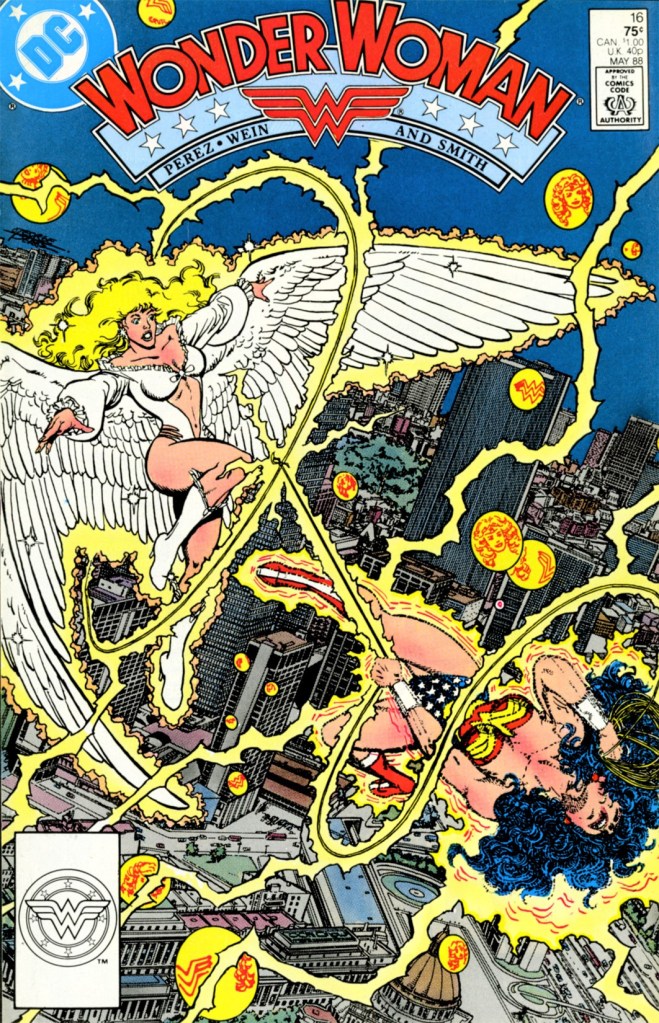
The cover.

Early story

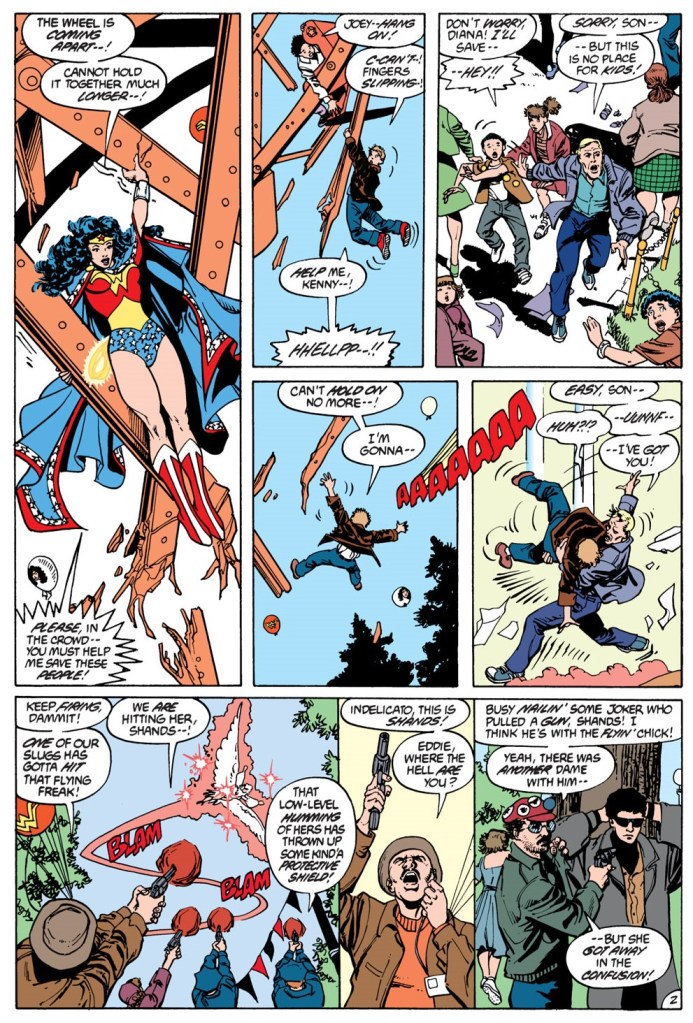
The story begins with people disrupted by the Silver Swan’s presence at the Wonder Woman Fair, a gala event organized on behalf of the needy children of Boston. Due to the Silver Swan’s sonic attack, the Ferris wheel begins to fall apart causing Wonder Woman to intervene and help those riding it.

As Steve Trevor successfully saved a passenger from falling to pavement, armed people (including two police officers) fired their guns at the Silver Swan who is protected by the protective shield made by her low-level humming. At another location in the fair, Maxine Sterenbuch sits by a tree tearfully agonizing over how her dear friend Valerie Beaudry became the Silver Swan all because of Henry C. Armbruster.

While in the air, Valerie realizes that it is her fault that people’s lives are in danger. Her objective was to hit Wonder Woman who proved too fast for her. Behind the scenes at a secret facility, Henry C. Armbruster tells Valerie to calm down and prepare for a level 3 force blast.

Then she screams so powerfully…

Quality

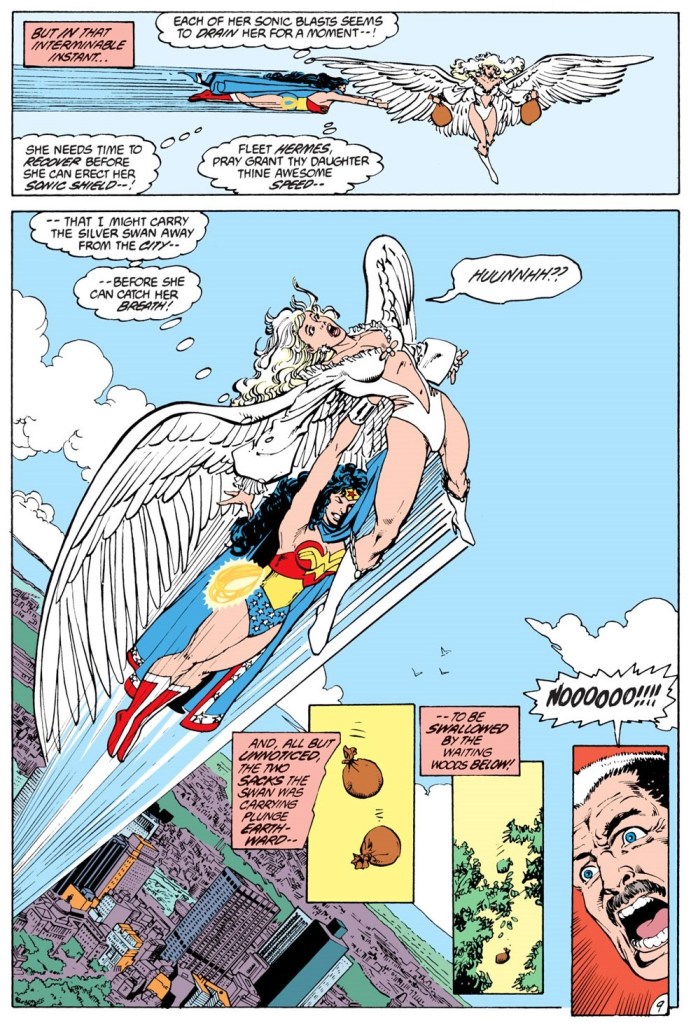
The conflict between Wonder Woman and Silver Swan is very engaging to read.

Let’s start with the writing. The story is a nice mix of superhero spectacle, intrigue and has some elements of science fiction. As a story set after Diana’s return to man’s world, it is a worthy conclusion to the events that started in issue #15. The conflict between Wonder Woman and the Silver Swan is laced with espionage and intrigue, and the arrogant Armbruster is the main force of evil behind the scenes. The spotlight on Maxine Sterenbuch was understandably reduced this time around as the conflict between Silver Swan and Wonder Woman took center stage.

As a story set after the Challenge of the Gods storyline, this comic book continues the further development of Diana as she endures the challenges of not just dealing with the people, places and events around her in man’s world but also the feelings she starts developing for one of the major superheroes of the DC universe. More on her development, Diana experiences for the first time the consequence that comes with being a celebrated figure in man’s world and she realizes that doing charity is much harder to fulfill.

When it comes to Valerie/Silver Swan, she is indeed an interesting rival opposite Wonder Woman although her lack of freedom and will prevents her from reaching her true potential as an anti-hero figure. To find out why, I urge you to read this comic book.

Conclusion

Early in the comic book…

Wonder Woman #16 (1988) is another solid post-Crisis Wonder Woman story as it further highlights a modernized Silver Swan and portrays her as an interesting form of opposition against the title character. The battle and interactions between the two are really engaging to read. As mentioned earlier, it is nice conclusion to the events that started in issue #15 and succeeds in further developing Diana as she spends more time in man’s world.

If you are seriously planning to buy an existing hard copy of Wonder Woman #16 (1988), be aware that as of this writing, MileHighComics.com shows that the near-mint copy of the regular edition costs $33 while the near-mint copy of the newsstand edition costs $70.

Overall, Wonder Woman #16 (1988) is highly recommended!

+++++

Thank you for reading. If you find this article engaging, please click the like button below and also please consider sharing this article to others. If you are looking for a copywriter to create content for your special project or business, check out my services and my portfolio. Feel free to contact me as well. Also please feel free to visit my Facebook page Author Carlo Carrasco and follow me at HavenorFantasy@twitter.com
A Look Back at The Strangers #20 (1995)

Disclaimer: This is my original work with details sourced from reading the comic book and doing personal research. Anyone who wants to use this article, in part or in whole, needs to secure first my permission and agree to cite me as the source and author. Let it be known that any unauthorized use of this article will constrain the author to pursue the remedies under R.A. No. 8293, the Revised Penal Code, and/or all applicable legal actions under the laws of the Philippines.

Welcome back, superhero enthusiasts, comic book collectors and fans of the Ultraverse. We revisit the Ultraverse once again to follow the continuing stories of The Strangers. Last time around, the team found itself struggling with adjusting to life without Atom Bob. For Lady Killer, the loss is very painful not only for her leadership of the team but also on her heart as she had a relationship with him.

What will happen next? How will the team move forward without Atom Bob? We can all find out in this look back at The Strangers #20, published in 1995 by Malibu Comics with a story written by Steve Englehart and drawn by Sam Payne.

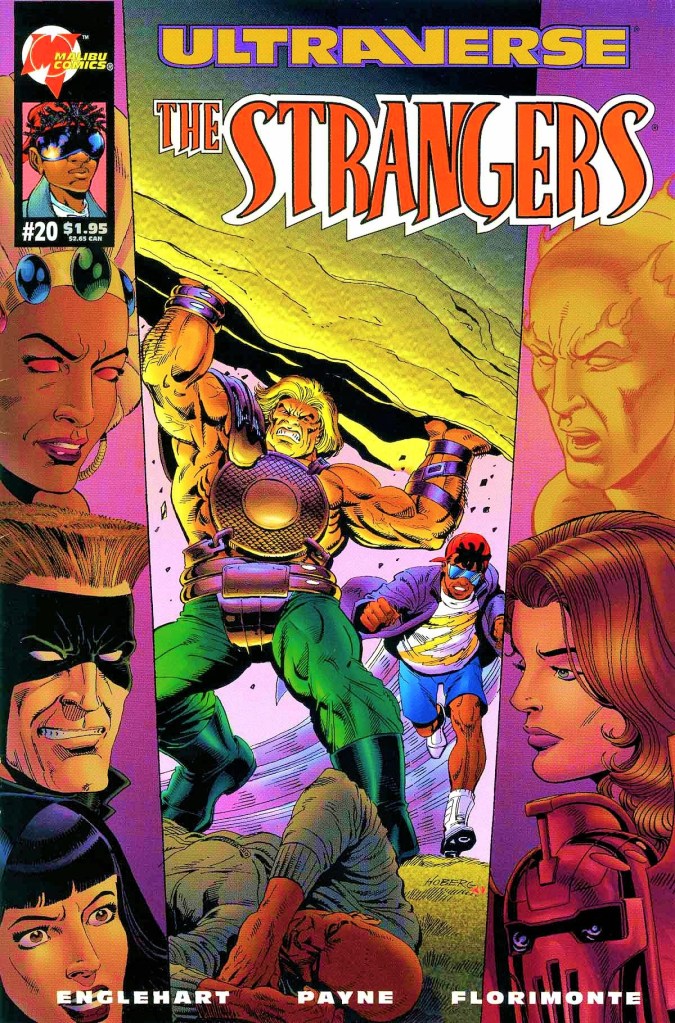
The cover.

Early story

The story begins inside the home of a mother and her son enjoying indoor basketball. Their happiness got disrupted when a large, muscular man with blonde hair crashes through their door. With him is another man named M.C. who tells the lady that he and his companion want to “borrow” her son. As the mother resisted, the slimmer man knocks her out while Beater (the large guy) grabs her son.

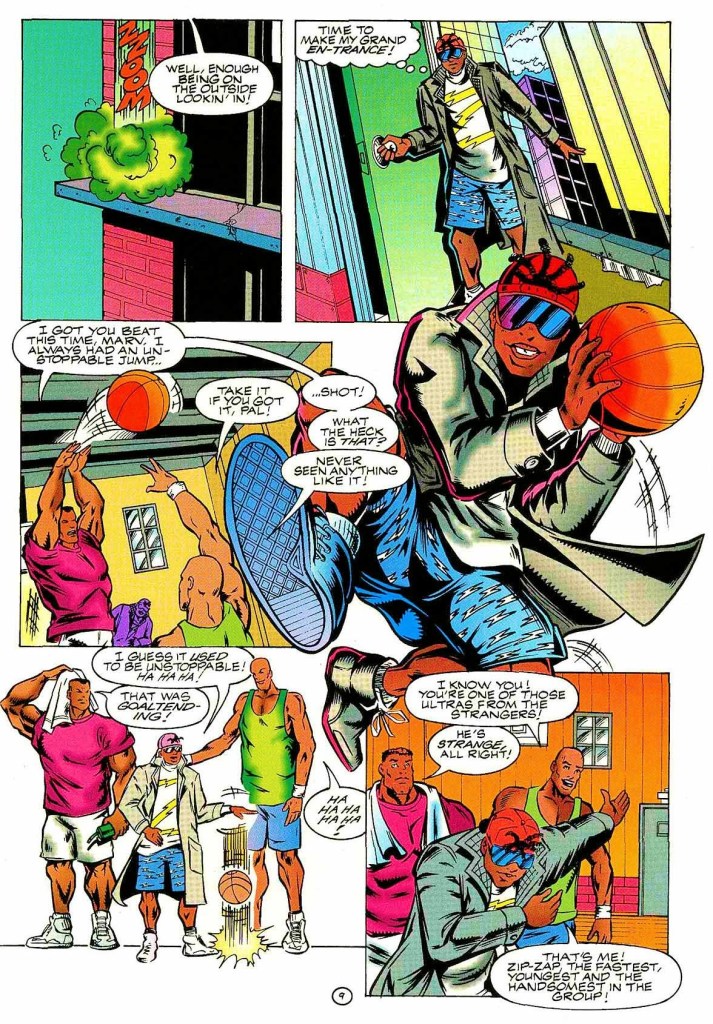
Elsewhere, The Strangers react to the official trading card featuring Candy/Electrocute. Leon/Zip-Zap is familiar with the value of trading cards and he shows them his card of a basketball player called Missile Monroe from his days as a rookie.

As he is eager to have the trading card signed by the basketball player, Zip-Zap heads on to the city. On his way, he notices people gathered outside Holt’s Gym which he heard is the place where Missile Monroe works out at. He then uses his super speed to go past a few more people, climb up the wall, step on the ledge and look through the window. Zip-Zap sees the basketball player shooting indoors in the presence of a friend.

Sensing opportunity, Zip-Zap decides to sneak in and make his grand entrance to meet Monroe..

Quality

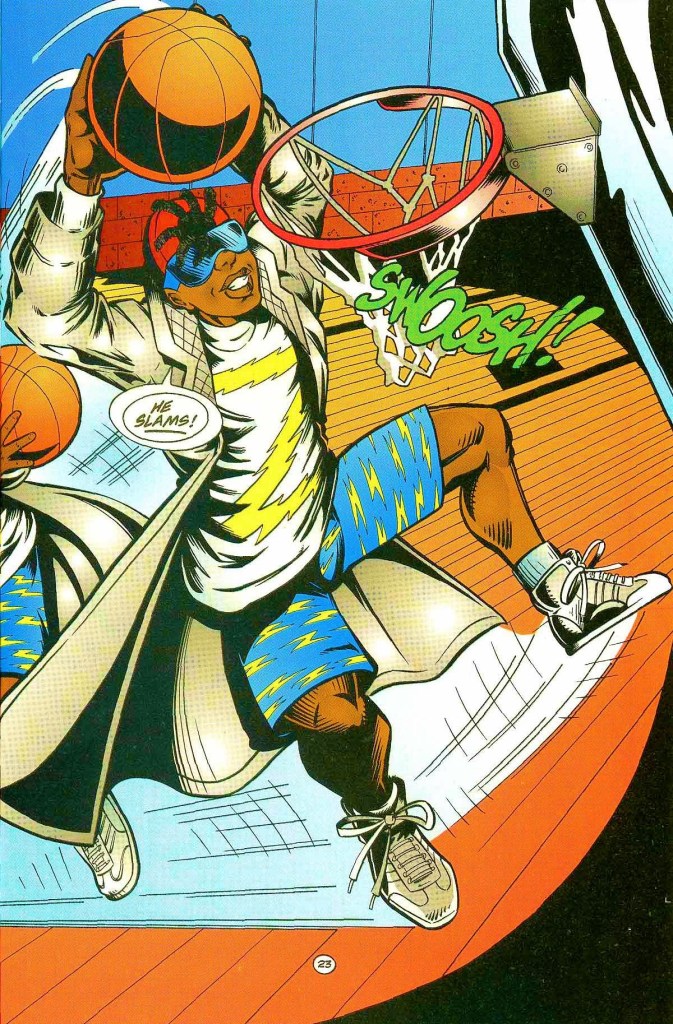
Zip-Zap slams!

I can start by saying that this comic book’s story is much less of The Strangers and more about their youngest and fastest member Zip-Zap. Rather than presenting a story about Zip-Zap going back to his old neighborhood, the story is about him meeting someone very important while taking advantage of his own celebrity status as a member of The Strangers (now known by the public) to get to him.

Other his personal obsession with a sports celebrity, this comic book also explores Zip-Zap’s determination to do something heroic without the presence of his teammates. As he is still a teenager, this part of the story alone is intriguing.

Also intriguing is the introduction of two new villains in this series, MC and Beater. How they became powerful and what their connection with Missile Monroe is something you readers should discover. I personally enjoyed what was revealed.

Other than heroic happenings, the story here explores the consequences that come with big money and lucrative deals. There is also the theme about social elevation with regards to the progress a person can make coming from the local communities to the big league. Also the events in this comic book will remind readers to respect the boundaries between them and the celebrities or important people they encounter in person.

Conclusion

Zip-Zap meets Missile Monroe and friend.

Even though it had much less of the team itself, The Strangers #20 (1995) is a worthy and fun read. The story about Zip-Zap going solo temporarily for his pursuit was nicely crafted and the new characters introduced had personalities that were interesting, most notably with Missile Monroe. Apart from characterization, there is sufficient superhero spectacle to enjoy as well. Going back to Zip-Zap, anyone who loves the character will be pleased with the spotlight on him. I should also state that this story shows additional depth to Zip-Zap’s character.

If you are seriously planning to buy an existing hard copy of The Strangers #20 (1995), be aware that as of this writing, MileHighComics.com shows that the near-mint copy of the comic book costs $14.

Overall, The Strangers #20 (1995) is recommended.

+++++

Thank you for reading. If you find this article engaging, please click the like button below and also please consider sharing this article to others. If you are looking for a copywriter to create content for your special project or business, check out my services and my portfolio. Feel free to contact me as well. Also please feel free to visit my Facebook page Author Carlo Carrasco and follow me at HavenorFantasy@twitter.com
A Look Back at Wonder Woman #15 (1988)

Disclaimer: This is my original work with details sourced from reading the comic book and doing personal research. Anyone who wants to use this article, in part or in whole, needs to secure first my permission and agree to cite me as the source and author. Let it be known that any unauthorized use of this article will constrain the author to pursue the remedies under R.A. No. 8293, the Revised Penal Code, and/or all applicable legal actions under the laws of the Philippines.

Welcome back, superhero enthusiasts, comic book collectors and Wonder Woman fans! Last time around, the Challenge of the Gods storyline concluded and it really had a lot of twists and profound surprises that really shook the foundation of the post-Crisis Wonder Woman monthly series that was spearheaded by George Perez and Len Win. The Challenge of the Gods started strongly in issue #10 and as each issue was released, the narrative got more intriguing and ultimately served its purpose on defining Wonder Woman as the ever-willing and pure Queen of Superheroes. Along the way, there was significant development of Queen Hippolyte who has been struggling between ruling her fellow Amazons and being a mother to Diana/Wonder Woman.

As the Challenge of the Gods was full of elements of fantasy and Greek mythology, it can be quite challenging for any comic book creator to start the next chapter of the Wonder Woman monthly series’ narrative without reusing the mentioned elements.

In the case of the next Wonder Woman comic book for review here, I can say that the creators literally brought Wonder Woman into the realm of realism and intrigue. With those details laid down, here is a look back at Wonder Woman #15, published by DC Comics in 1988 with a story written by George Perez and Len Wein. Perez illustrated the comic book.

The cover.

Early story

The story begins with Wonder Woman having a very vivid dream about a certain great hero. After waking up from it, she feels that trying to keep up with all the events of the world must be taking its toll on her. She expressed that she is ill-prepared to deal with new sensations.

“In this world, man and woman long for these feelings. They cherish them. I’ve read how they have even died for them,” Diana said. “And that truly frightens me.”

While Diana is staying at the Kapatelis residence, it turns out Julia (mother of Vanessa) is overseas. She wishes that Julia is with her to discuss what she has been feeling.

Meanwhile at the Ogawa headquarters in Boston, an armed man is using one of the company’s computers to acquire classified information about a subject referred to as Valerie Beaudry. A security guard arrives and decides to investigate as he realizes that his fellow guard was missing (knocked unconscious already). The infiltrator makes short work of him and leaves the building with the acquired information…

Quality

Wonder Woman appears at a major public event.

I can start with the sudden change of tone for the storytelling. Gone are the fantasy and mythology elements of the Challenges of the Gods storyline and fully implemented in this comic book are the elements of intrigue, suspense, assassination and even sci-fi. The story itself is more grounded with reality as far as the post-Crisis DC Comics universe goes and because it is well written, the sudden change of tone and style never felt jarring to me.

While the 9th issue of this monthly series introduced a modern Cheetah, this comic book introduced the modern Silver Swan in the form of Valerie Beaudry (who appears on the cover). The good news here is that the creators took their time in gradually building-up details about Valerie and how she became Silver Swan. By the time Silver Swan appears in the presence of Wonder Woman, her personal details and traits have been developed in a satisfying way. Unlike Wonder Woman #9, Silver Swan’s appearance in this comic book stretches on into the next issue.

Along the way, more new characters were introduced and the most notable ones are connected with Valerie Beaudry. Maxine Sterenbuch, who eerily resembles Wonder Woman’s teenage pal Vanessa but in adult form, has a close connection with Valerie over a period of many years. There was also Henry Cobb Armbruster, a tycoon who wield tremendous power and has been hiring assassins to do his bidding.

Going back to Wonder Woman herself, this issue explores more of her struggle with not only learning more about man’s world and its many divisions, but also the feelings she starts having as she connects more with other people – most notably with one of DC’s biggest icons. To have Julie Kapatelis absent left the creators room to have Diana not only bond more with daughter Vanessa but also strive more on analyzing what she learns in man’s world. The scene in which Wonder Woman notices a huge printed image of her is a vivid reminder about how negative and foolish idolatry is on people.

Conclusion

Intriguing action scene.

Even though it has no fantasy and mythology elements, Wonder Woman #15 (1988) is still a great comic book to read and it succeeds in progressing Diana’s discovery and learning of man’s world. Its introduction of the post-Crisis Silver Swan is memorable and her build-up (specifically her background story) is pretty engaging.

If you are seriously planning to buy an existing hard copy of Wonder Woman #15 (1988), be aware that as of this writing, MileHighComics.com shows that the near-mint copy of the regular edition costs $35 while the near-mint copy of the newsstand edition costs $70.

Overall, Wonder Woman #15 (1988) is highly recommended!

+++++

Thank you for reading. If you find this article engaging, please click the like button below and also please consider sharing this article to others. If you are looking for a copywriter to create content for your special project or business, check out my services and my portfolio. Feel free to contact me as well. Also please feel free to visit my Facebook page Author Carlo Carrasco and follow me at HavenorFantasy@twitter.com
A Look Back at Mantra #18 (1995)

Disclaimer: This is my original work with details sourced from reading the comic book and doing personal research. Anyone who wants to use this article, in part or in whole, needs to secure first my permission and agree to cite me as the source and author. Let it be known that any unauthorized use of this article will constrain the author to pursue the remedies under R.A. No. 8293, the Revised Penal Code, and/or all applicable legal actions under the laws of the Philippines.

Welcome back, superhero enthusiasts, comic book collectors and fans of the Ultraverse! We take another journey into the Ultraverse through the exploits of Mantra whose story and character development got more intriguing since after the conclusion of the Archimage Quest.

Last time around, Lukasz and Eden took their relationship even further The infiltration of Aladdin’s secret facility took place and Mantra even met a certain tycoon (best known for interacting with The Strangers). The events of the last issue then continued into the Godwheel mini-series and into this next Mantra comic book I’m about to review.

Are you excited yet? What do you hope to see with regards to Lukasz and Eden? We can find out what happens next in Mantra #18, published in 1995 by Malibu Comics with a story written by Mike W. Barr and drawn by Scott Lee.

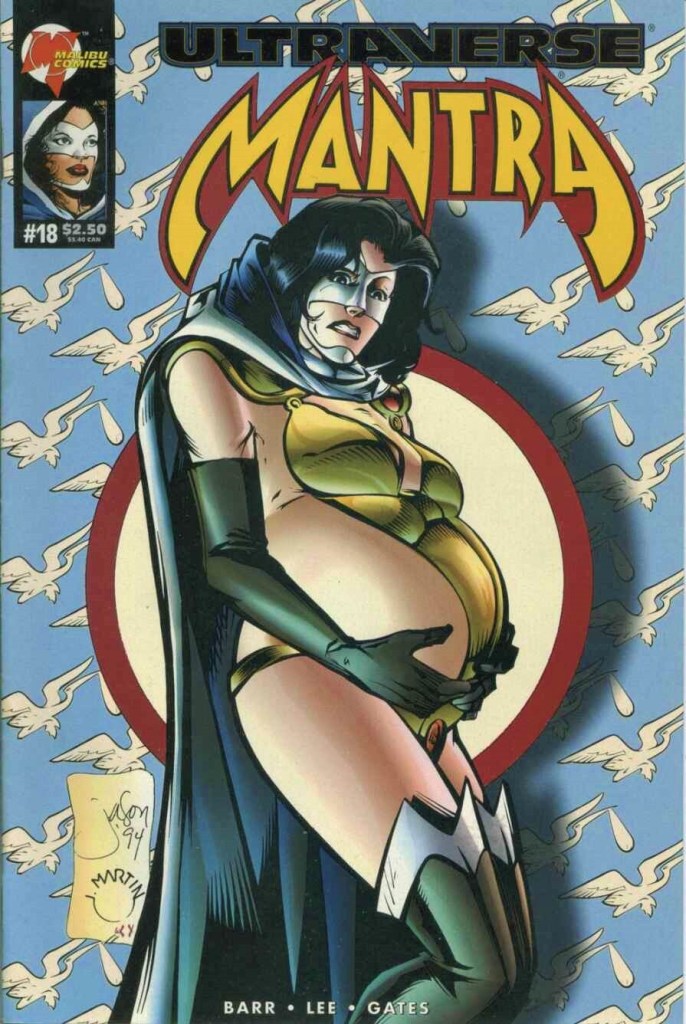
The cover.

Early story

The story begins inside a high-tech facility. An executive named Paul expressed that the laboratory will never be operational in time for the new year as a result of what happened previously. Several armed men are on the floor searching.

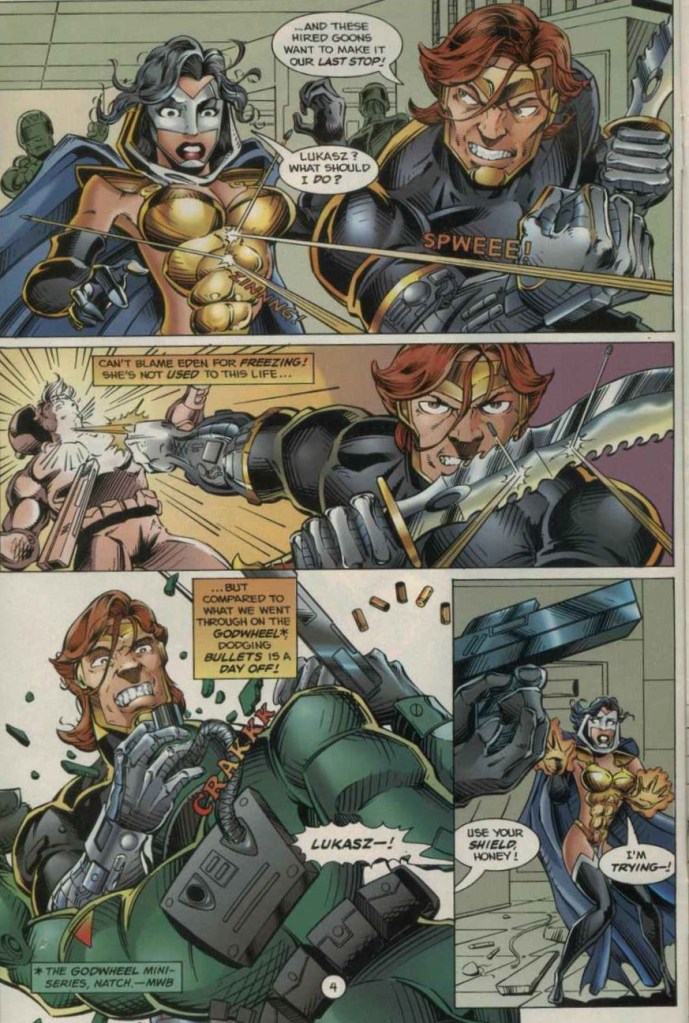
Suddenly, a pink portal opens with Lukasz (in a male body) and Mantra (now occupied by Eden’s soul) coming out. The two just came back from much struggle in another realm and Eden has not yet fully familiarized herself with Mantra’s body and magic. Noticing Eden/Mantra’s hesitation, Lukasz takes action against the armed men. Eden slowly blasts a few enemies before Lukasz saves her from being attacked from the rear.

Suddenly, someone from nowhere throws a few gas grenades at them…

Quality

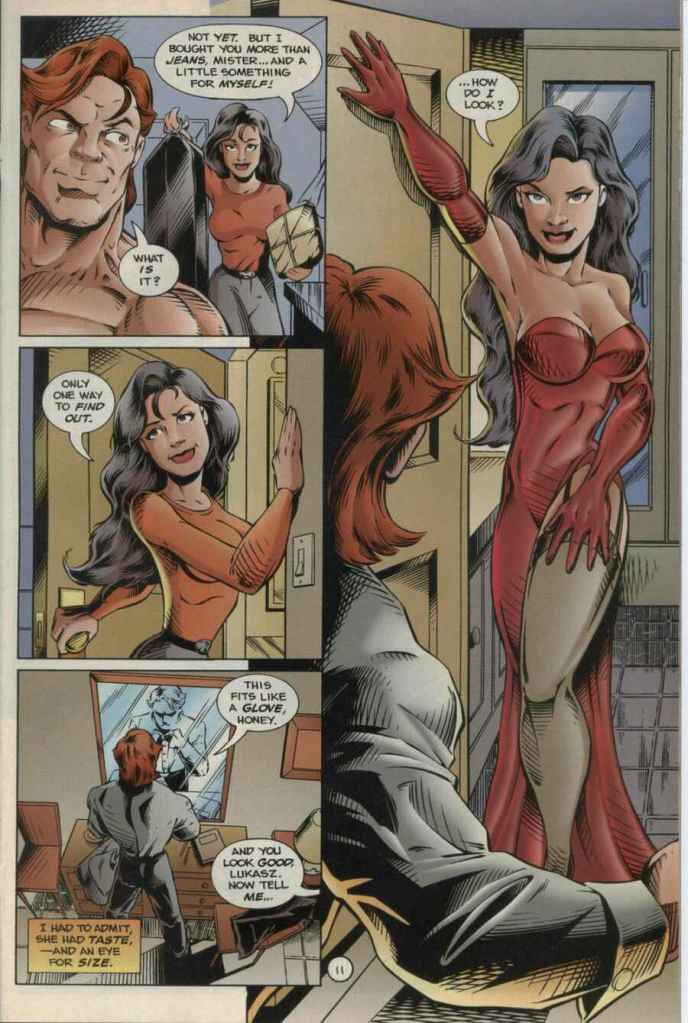
The romance weakened by the art style.

Starting with the storytelling, the plot in this comic book can be quite jarring with regards to Lukasz and Eden as this one took place after the Godwheel mini-series. How Eden fully became Mantra (which is her rightful body of flesh in the first place) is fully explained in the said mini-series.

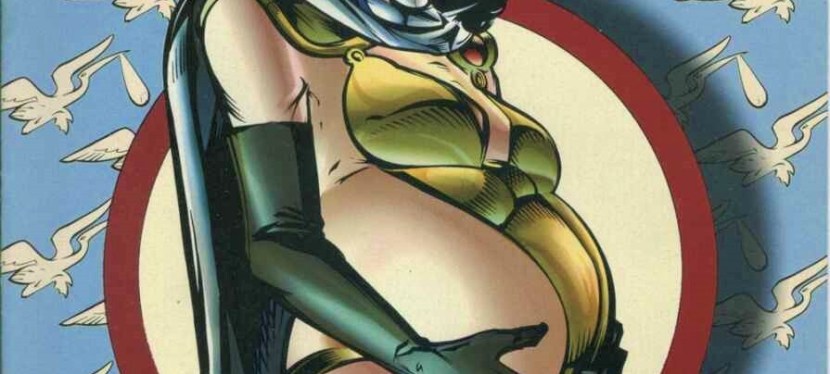
The romance between Lukasz and Eden here is easily the biggest selling point of this comic book. After going through rough action and misadventure in Godwheel, it is in this comic book where the two really express love for each other in the flesh. This is a welcome change considering how long we’ve seen Lukasz occupy Eden’s body followed by Lukasz and Eden being spiritually linked with each other. This one marks the start of a new chapter of the Mantra series. As for what the cover of the comic book showed, that is something you will have to discover for yourselves and it is worth the read.

Sadly, I should state that I found the art by Scott Lee here looking sub-par. There is this cartoony aesthetic to all the characters and there were shots in which their bodies looked disproportionate from certain angles. Lee’s take on visualizing Boneyard, Warstrike, NecroMantra and others all looked cartoony. This is the weakest looking Mantra issue I’ve read as of this writing.

Conclusion

Lukasz in a male body, Eden in Mantra form.

Once again, author Mike W. Barr succeeded in advancing the story and character developments with Mantra #18 (1995) putting the series into another storytelling phase with Lukasz (the long-time Mantra) and Eden as separate, living beings more involved with each other than ever before. The art quality this time went down a lot but the storytelling saved the comic book from turning into a disaster.

If you are seriously planning to buy an existing hard copy of Mantra #18 (1995), be aware that as of this writing, MileHighComics.com shows that the near-mint copy of the comic book costs $21.

Overall, Mantra #18 (1995) is satisfactory.

+++++

Thank you for reading. If you find this article engaging, please click the like button below and also please consider sharing this article to others. If you are looking for a copywriter to create content for your special project or business, check out my services and my portfolio. Feel free to contact me as well. Also please feel free to visit my Facebook page Author Carlo Carrasco and follow me at HavenorFantasy@twitter.com
A Look Back at Superman #423 (1986)

Disclaimer: This is my original work with details sourced from reading the comic book and doing personal research. Anyone who wants to use this article, in part or in whole, needs to secure first my permission and agree to cite me as the source and author. Let it be known that any unauthorized use of this article will constrain the author to pursue the remedies under R.A. No. 8293, the Revised Penal Code, and/or all applicable legal actions under the laws of the Philippines.

How do you end an entire era of a major pop culture icon like Superman? You end it with a very great story described as imaginary and leave it up to the readers to decide if the events never happened or had happened. The famous author Alan Moore wrote such a story (in two parts actually) to help DC Comics conclude the real-life legend of Superman as they transitioned from the original DC multiverse age (1938-1986, concluded with Crisis on Infinite Earths) into a new era of superhero comic book publishing back in 1986 (the post-Crisis era).

For those who were not able to read Crisis on Infinite Earths in 1985-1986, there was a time when DC Comics’ superhero universe started simple in the late 1930s and became too convoluted and confusing in the decades that followed. There were different universes in existence resulting not only different realms of existence but also different versions of the superheroes. Even Superman had different versions and there was also Superboy who went back and forth to the 30th century joining that era’s Legion of Superheroes. As Crisis on Infinite Earths concluded the old DC Comics multiverse, a fitting conclusion for Superman became inevitable so the publisher assembled Moore and other great talents to work on a definitive storyline.

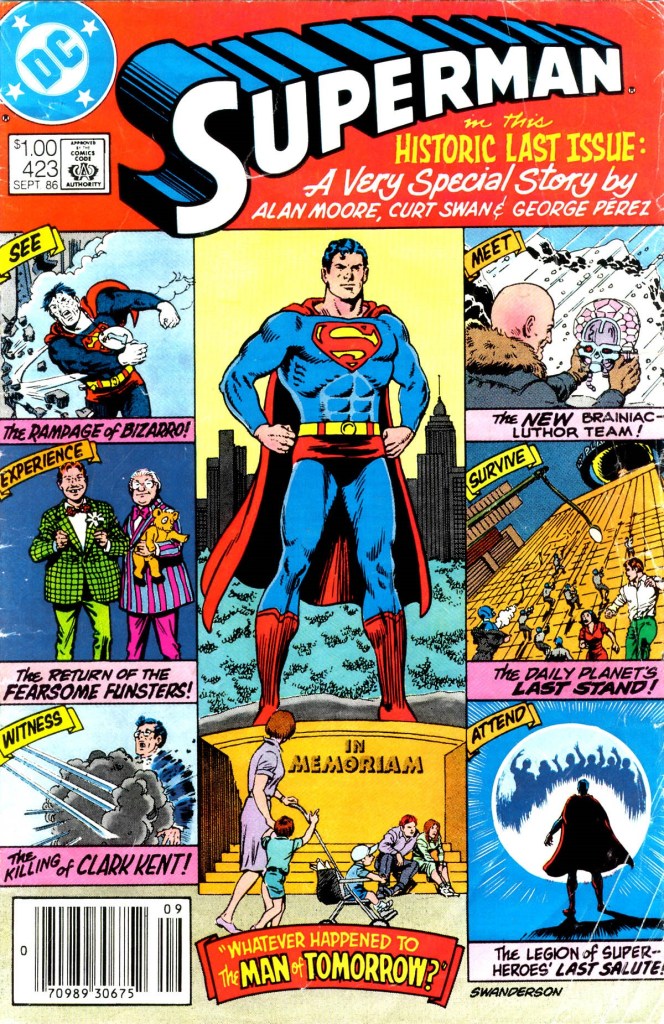
If you are ready to look at what Superman was like long before Zack Snyder directed Man of Steel and long before the New 52 and DC Rebirth happened, here is a look back at Superman #423, published by DC Comics in 1986 with a story written by Alan Moore and drawn by Curt Swan with ink work done by George Perez. This is the first chapter of the storyline Whatever Happened to the Man of Tomorrow?

The cover.

Early story

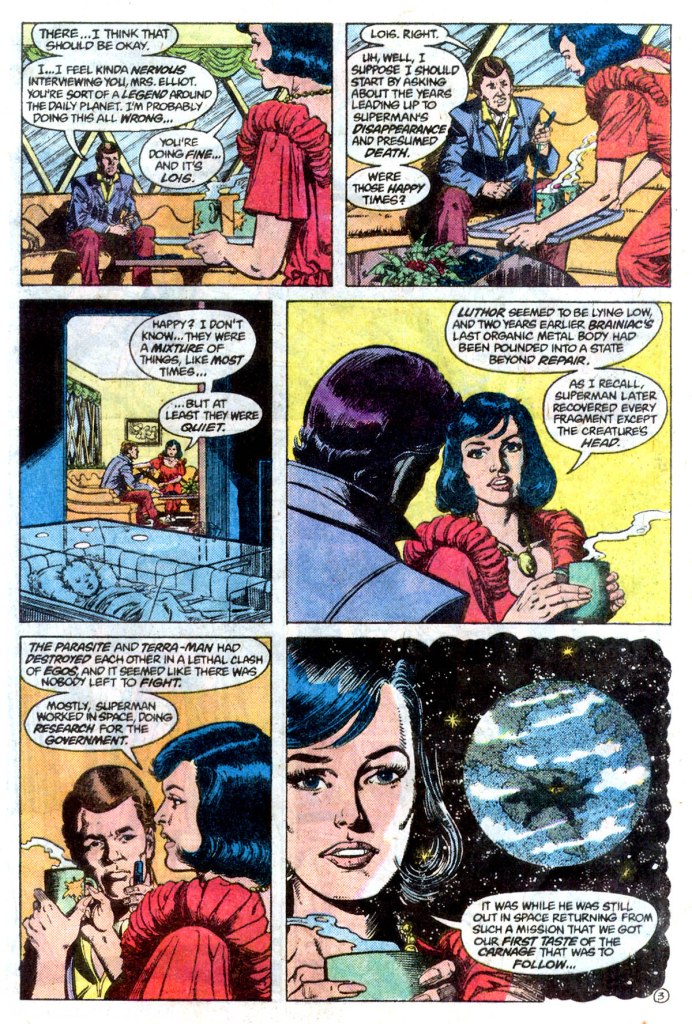
The story begins in the then-future of 1997 when a journalist from the Daily Planet visiting the home of Lois Lane who is now identified as Mrs. Lois Elliot. The journalist is Tim Crane and his assignment is to interview her for their newspaper’s upcoming Superman memorial edition.

Crane starts asking Lois about the years leading up to Superman’s disappearance and presumed death. Lois recalls the time when Superman’s arch-nemesis Lex Luthor laid low as well as the pounding of Brainiac’s last organic metal body into a state beyond repair. She remembers Superman recovering every fragment except for the head of the creature. Then two other super villains (Terra-Man and Parasite) destroyed each other due to a lack of people to fight with and Superman eventually worked in space helping the government do their research.

As it turned out, the events only led to what was the first taste of the carnage that was to follow. Some years prior, Superman arrived in a heavily damaged Metropolis. Lois told him that Bizarro caused it and Jimmy Olsen stated that the super villain retreated into a nearby department store and still has not come out since. Superman then walks into the department store to face off with Bizarro…

Quality

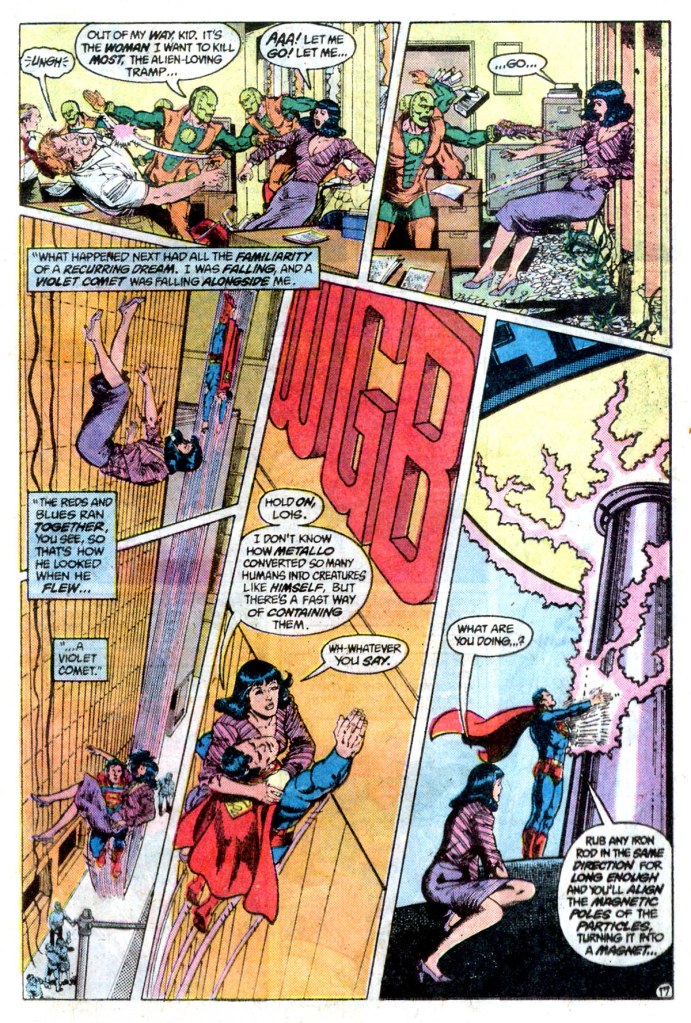
A classic moment of Superman saving Lois Lane.

I’ll start by saying that the writing done by Alan Moore here is very great to read and clearly he made in-depth research on Superman’s extensive history, exploring the personalities and traits of the supporting characters and super villains, and, most notably, he went on to create a lot of compelling and intriguing stuff to tell. The result was a clear creative challenge towards the conventional thinking of Superman fans of the time and Moore even managed to add some adulterated themes into the narrative without making the comic book going over the edge. For one thing, a certain super villain here concluded his pre-Crisis existence with elements of genocide, homicide and suicide. There was also a scene in which Superman, in his most vulnerable portrayal, expressed his view that nuances from his past were coming back as killers which made him fear for the lives of the people he cared for.

The interview-flashback format to tell the narrative is indeed excellent in form and Moore told each flashback in great detail while capturing the essence of not just Superman but also those of the supporting characters as well as Lex Luthor, Brainiac and others. Even as the stories get told, Moore managed to pull off some great twists which you my readers should find out for yourselves. I personally enjoyed these twists and I am sure you will.

Visually, Curt Swan went all out in making great art and his decades-long experience of drawing Superman and all the related characters really show it. Swan’s art in the final page is very powerful and dramatic to look at.

Conclusion

The interview-flashback format used is great and so was the storytelling itself.

Very clearly, Superman #423 (1986) is not only a great Superman story but also one of the greatest superhero comic books ever made! This is illustrated literature with gold quality all over it and the funny thing is that this happens to be only the first part of the storyline Whatever Happened to the Man of Tomorrow? The creative team of Moore and Swan produced the most striking and most engaging Superman work from start to finish. I should state that this one made me rethink and remember what I read about Superman in comic books before Crisis on Infinite Earths happened. The good news is that I enjoyed every bit of what was told in this comic book and it truly is a definitive way to conclude an age of Superman (and this is only the first chapter of the concluding storyline).

If you are seriously planning to buy an existing hard copy of Superman #423 (1986), be aware that as of this writing, MileHighComics.com shows that the near-mint copy of the regular edition costs $120 while the near-mint copy of the newsstand edition costs $240. A signed-copy in near-mint condition costs $240.

Overall, Superman #423 (1986) is highly recommended!

+++++

Thank you for reading. If you find this article engaging, please click the like button below and also please consider sharing this article to others. If you are looking for a copywriter to create content for your special project or business, check out my services and my portfolio. Feel free to contact me as well. Also please feel free to visit my Facebook page Author Carlo Carrasco and follow me at HavenorFantasy@twitter.com
A Look Back at Wonder Woman #10 (1987)

Disclaimer: This is my original work with details sourced from reading the comic book and doing personal research. Anyone who wants to use this article, in part or in whole, needs to secure first my permission and agree to cite me as the source and author. Let it be known that any unauthorized use of this article will constrain the author to pursue the remedies under R.A. No. 8293, the Revised Penal Code, and/or all applicable legal actions under the laws of the Philippines.

Having reviewed the first nine issues of the 2nd Wonder Woman monthly series (1987-2011) that was handled with care initially by great creators George Perez and Len Wein, I can say that the Queen of Superheroes herself was redefined not only for the readers of the post-Crisis era but in general. Under the Perez-Wein team, Wonder Woman was portrayed to be human and compassionate as she gradually discovers what her destiny is just as she takes part in the struggles and affairs of her fellow Amazons led by her mother Queen Hippolyte.

Also told along the way was the story of the deities of Olympus headed by Zeus. In their realm, the deities are divided and each has his or her own ego and agenda. Because they have tremendous power, they are able to manipulate events on the physical world and make mortals struggle. Under them, the Amazons have struggled and even people of Earth got affected as well.  

When I reviewed the ninth issue, it was the full debut of the modern Cheetah who proved to be a worthy adversary for Wonder Woman. By the way, Cheetah is the antagonist in the new film Wonder Woman 1984 portrayed by Kristen Wiig. By the end of issue #9, Wonder Woman returned home to Themyscira leaving her American friends Julia and Vanessa Kapatelis in tears.

So what happened next? We can all find out in this look back at Wonder Woman #10, published in 1987 by DC Comics with a story written by George Perez and Len Wein. Perez did the art with inkwork by Bruce Patterson. This is the first chapter of the Challenge of the Gods storyline.

The cover.

Early story

The story begins in the realm of the deities. They noticed Pan has been joyful recently and Zeus states that has been the case since Wonder Woman thwarted the scheme of Ares. Pan approaches Zeus and followed-up on him regarding a past conversation they had. Zeus then looks Themyscira, finding it secluded yet a true paradise. A paradise worthy of his personal favor.

On Themyscira, Princess Diana/Wonder Woman and a fellow Amazon ride horses not knowing Zeus and the others are watching them. Pan tells Zeus that as Heracles (Zeus’ son) once favored Queen Hippolyte (Diana’s mother), it is only fitting that Diana should be the first among the Amazons to experience his manly grace. Zeus then decides to come to the Amazons and tells Pan to play a love song.

Hestia and Artemis notice Zeus’ decision. An angry Artemis makes her move stating that Paradise Island (Themyscira) will be no one’s brothel.

Diana and Euboea talk while riding their horses slowly on a beach. She states that it is good to be home. She learned so much from the world of men finding its people so different and yet so much the same, that the Amazons all could learn from one another.

Meanwhile the Amazons’ council of justice discuss the gifts and records Diana brought home. Queen Hippolyte is in attendance…

Quality

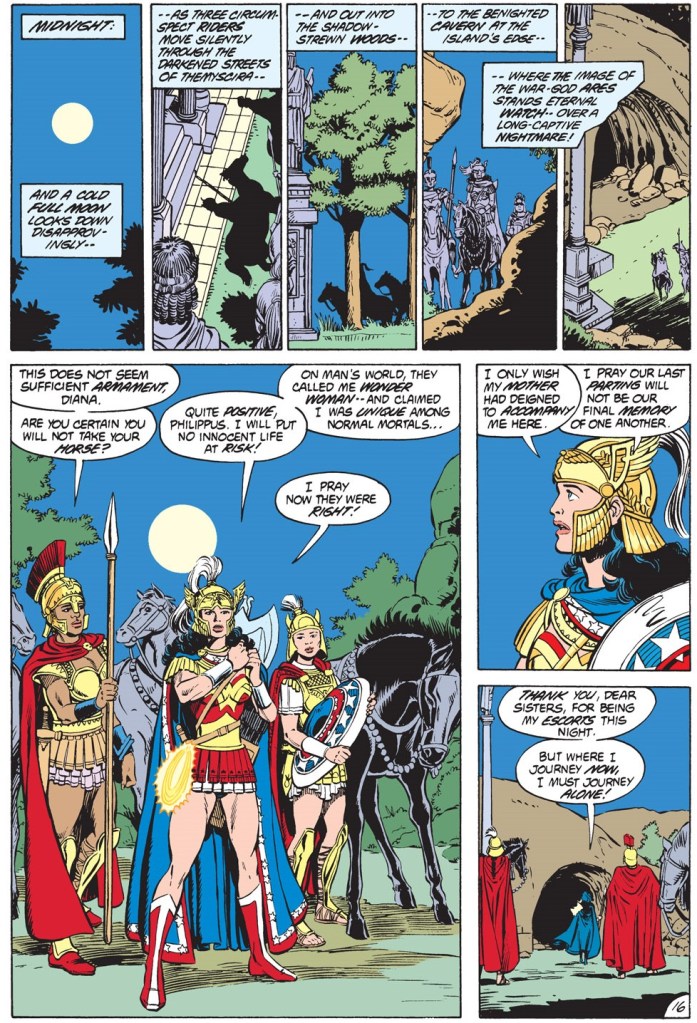
Wearing armor and a helmet, Wonder Woman prepares to start taking on the challenge of the deities.

I can say that this story not only marked the beginning of a new Wonder Woman storyline but also it marked a new turning point not just for the Queen of Superheroes but also for her fellow Amazons as this involves the Olympus deities a whole lot more. The good news here is that the script is of high-quality writing and has special care made on it by the Perez-Wein creative team. As the story is more focused on Themyscira and Olympus, more details about the history and legacy of the Amazons is revealed and it is all done with a deep amount of engagement. The way the details and events were handled, it looked like Perez and Wein had these story elements planned ahead of time as they continued to develop and redefine Wonder Woman in the post-Crisis era of DC Comics.

At the heart of the first chapter of the Challenge of the Gods storyline is the link between the Amazons (who rely on Wonder Woman to represent them) and the divided deities of Olympus. With very compelling writing and visuals, you will get to see how fragile Diana, Queen Hippolyte and their Amazon sisters really are when facing the deities. In relation to that, it is a unique reading experience to see Wonder Woman struggle with interacting with Zeus and the other deities directly.

Conclusion

Princess Diana, her mother Queen Hippolyte and the Amazons analyze their situation.

Wonder Woman #10 (1987) is clearly a great comic book to read and it marked the continued excellence done by George Perez, Len Wein and their creative team.

If you are seriously planning to buy an existing hard copy of Wonder Woman #10 (1987), be aware that as of this writing, MileHighComics.com shows that the near-mint copy of the regular edition costs $60 while the near-mint copies of the fold-out edition and the newsstand edition cost $30 and $120 respectively.
Overall, Wonder Woman #10 (1987) is highly recommended!

+++++

Thank you for reading. If you find this article engaging, please click the like button below and also please consider sharing this article to others. If you are looking for a copywriter to create content for your special project or business, check out my services and my portfolio. Feel free to contact me as well. Also please feel free to visit my Facebook page Author Carlo Carrasco and follow me at HavenorFantasy@twitter.com