A Look Back at Web of Spider-Man #90 (1992)

Disclaimer: This is my original work with details sourced from reading the comic book and doing personal research. Anyone who wants to use this article, in part or in whole, needs to secure first my permission and agree to cite me as the source and author. Let it be known that any unauthorized use of this article will constrain the author to pursue the remedies under R.A. No. 8293, the Revised Penal Code, and/or all applicable legal actions under the laws of the Philippines.

Welcome back superhero enthusiasts, 1990s culture enthusiasts and comic book collectors! Today we go back to the year 1992 and explore a part of what was back then the 30th anniversary celebration of Spider-Man

In what was back then a unique approaching to celebrating the anniversary of an American icon, Marvel Comics published not one but four specific Spider-Man comic books that had holographic covers and more pages than the usual. Each of those special comic books were from a different Spider-Man monthly series. Back in 2020, I published a retro review of one of those gimmick cover comic books from the Spider-Man monthly series.

With those details laid down, here is a look back at Web of Spider-Man #90, published in 1992 by Marvel Comics with a story by Howard Mackie and drawn by Alex Saviuk.  
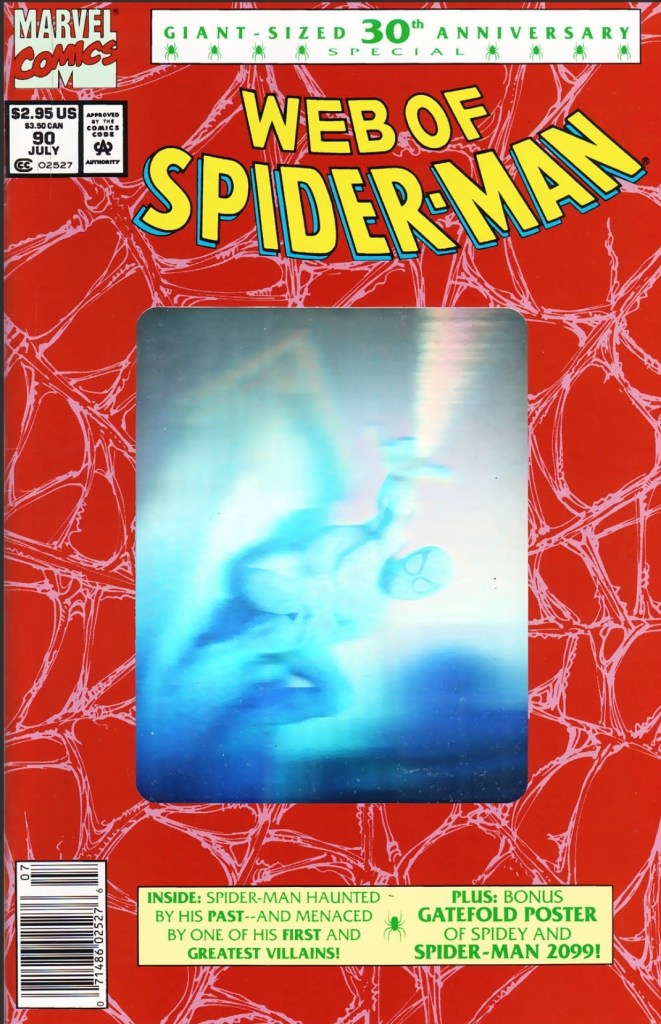
The cover.

Early story

The story begins inside an office in Los Angeles. A hat-wearing businessman has several varied figures of Spider-Man near him and recalls the time when the iconic hero participated in one of his events as the Masked Marvel. Moments later, the businessman’s wife arrives and together they departed in a limousine.

At the South Bronx in New York, Spider-Man chases a speeding car with one of its passengers firing a gun at him. Suddenly, his spider sense bothers him a lot and when he looks around, he suddenly sees Galactus standing with members of the Avengers, the X-Men and the Fantastic Four lying down helpless on the ground…

Quality
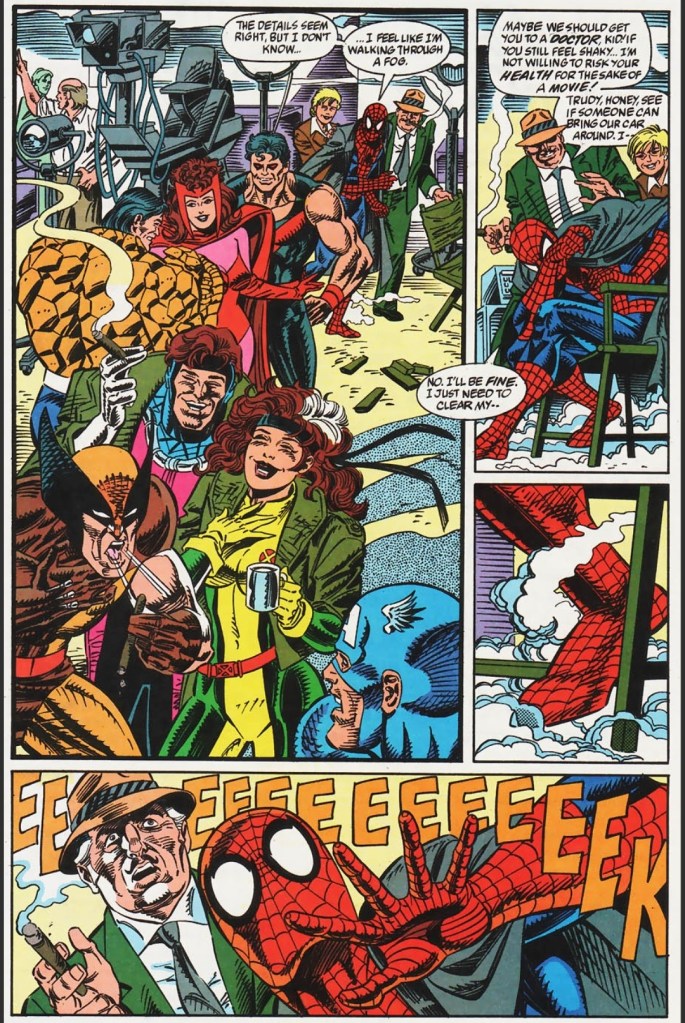
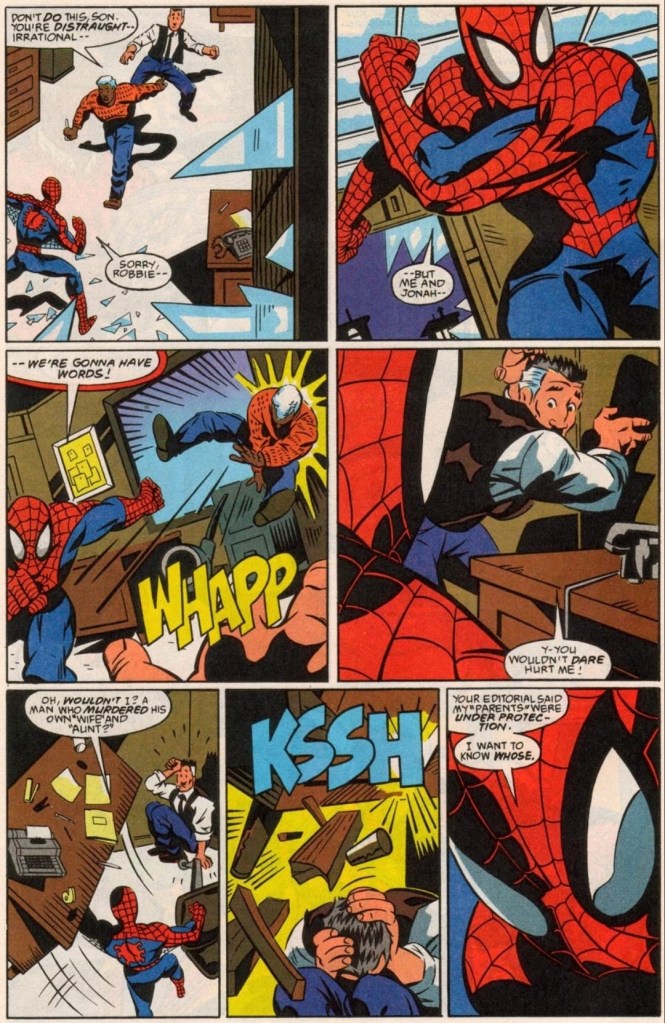
Spider-Man on the set of an entertainment project. It’s a lively reminder about how sickening Hollywood (AKA Commiewood) can get.

To make things clear and without spoiling the plot, this story deals with illusions and the distortion of reality. Quite ironically, the said distortion made it a challenge to follow the narrative and I can say that a good amount of the spotlight was on the businessman. Spider-Man is clearly the protagonist here but it made sense for the creative team to focus a bit on the businessman (who has been doing entertainment showcases for a long time) to justify the core concept about the conflicts between what is real and what is imaginary.

In relation to the illusion aspect of the story, you will get to see established Spider-Man arch-villains such as the Green Goblin, the Hobgoblin and Venom taking on the superhero himself. As the creative team focused more on providing a great amount of spectacle, there clearly was no room left for character development on Spider-Man. Don’t expect to see Peter Parker in dramatic moments nor see him interact with the established supporting characters.

If there is any moral lesson to learn from this comic book, it would be this – living with a powerful delusion (the result of personal obsession mixed with the personal failure to separate illusion from reality) can lead you to the wrong directions in life.

Conclusion
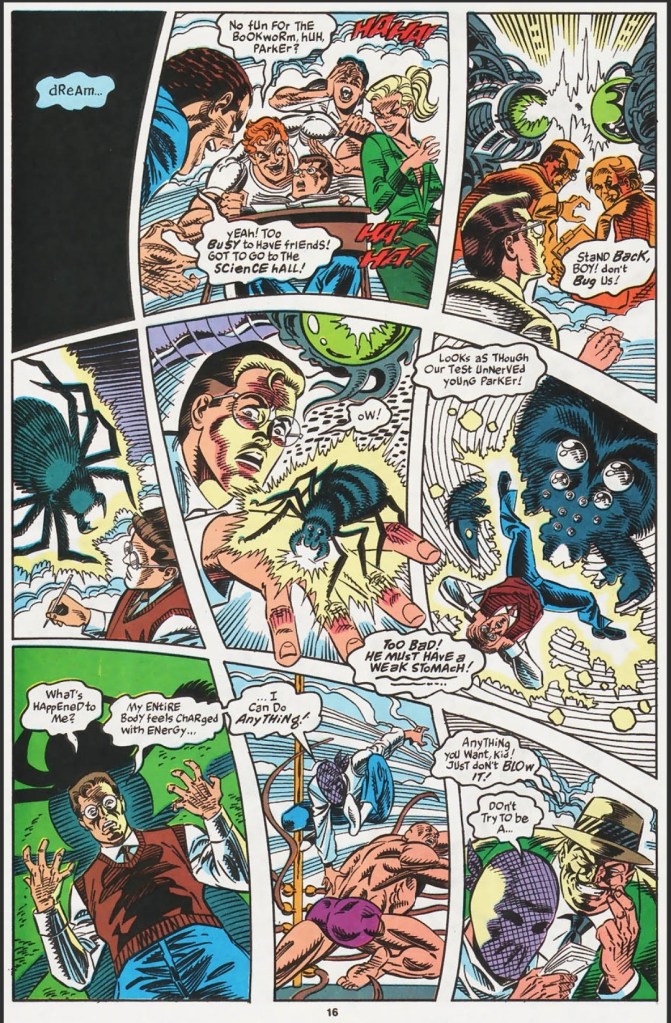
To justify the 30th anniversary celebration, distorted flashbacks into Peter Parker’s past were presented here.

Web of Spider-Man #90 (1992) does not have much depth for those who seek engaging storytelling. That being said, the story itself is not memorable nor would it leave a long lasting impact on you. This comic book was made to entertain readers with lots of action and wild fantasy images that eerily justify its concept about illusion and reality conflicting each other. In fairness to the creative team, the said conflict was consistently visualized and there were some dialogue that related to it in a somewhat philosophical manner. The comic book’s entertainment value is satisfying enough although it does not justify the holographic cover that was part of the gimmick with celebrating Spider-Man’s 30th anniversary. As for who was the main antagonist of the comic book, I simply encourage you all to read and find out for yourselves.

Overall, Web of Spider-Man #90 (1992) is satisfactory.

+++++

Thank you for reading. If you find this article engaging, please click the like button below, share this article to others and also please consider making a donation to support my publishing. If you are looking for a copywriter to create content for your special project or business, check out my services and my portfolio. Feel free to contact me with a private message. Also please feel free to visit my Facebook page Author Carlo Carrasco and follow me on Twitter at  @HavenorFantasy as well as on Tumblr at https://carlocarrasco.tumblr.com/ and on Instagram at https://www.instagram.com/authorcarlocarrasco
A Look Back at What If #31 (1982)

Disclaimer: This is my original work with details sourced from reading the comic book and doing personal research. Anyone who wants to use this article, in part or in whole, needs to secure first my permission and agree to cite me as the source and author. Let it be known that any unauthorized use of this article will constrain the author to pursue the remedies under R.A. No. 8293, the Revised Penal Code, and/or all applicable legal actions under the laws of the Philippines.

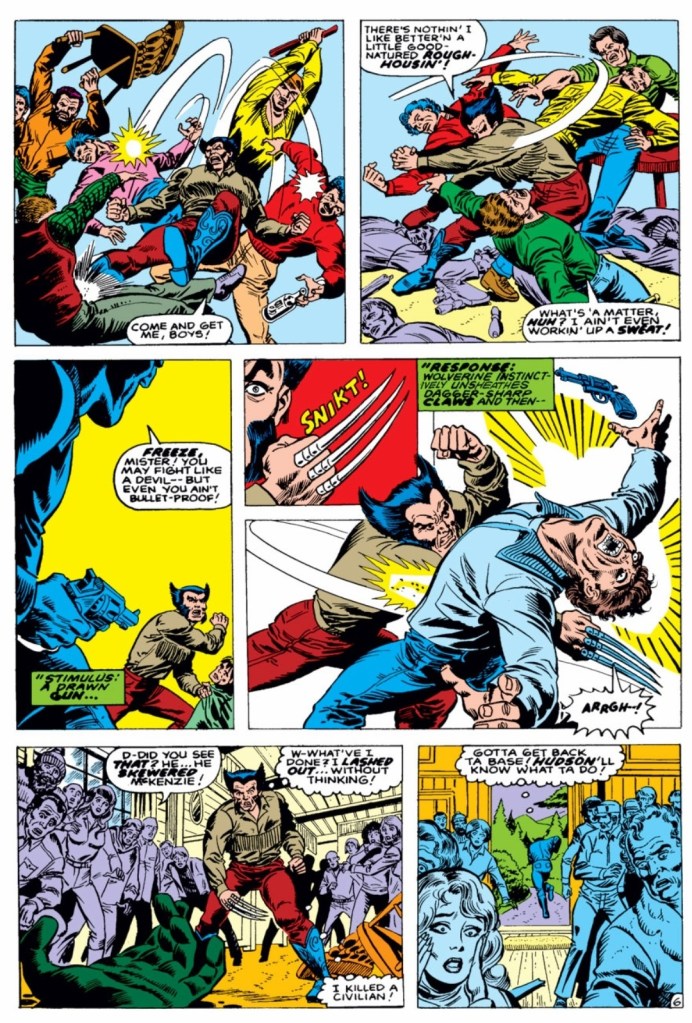
Welcome back superhero enthusiasts, 1980s arts and culture enthusiasts, Marvel Comics fans and comic book collectors! Today we go back to the early 1980s and examine an alternate universe portrayal of Wolverine and some other characters as told in one of the comic books of the first volume of the series What If.

Wolverine is one of the most iconic characters of Marvel Comics and he has been part of some of my retro reviews (click here, here, here, here, here, here and here). Wolverine made his first appearance in comics in Incredible Hulk #181 which was published way back in 1974 which marked the first conflict of the two Marvel icons. Years later, Marvel decided to revisit that event with a What If story.

With those details laid down, here is a look back at What If published in 1982 by Marvel Comics with a story written by Rick Margopoulos and drawn by Bob Budiansky.

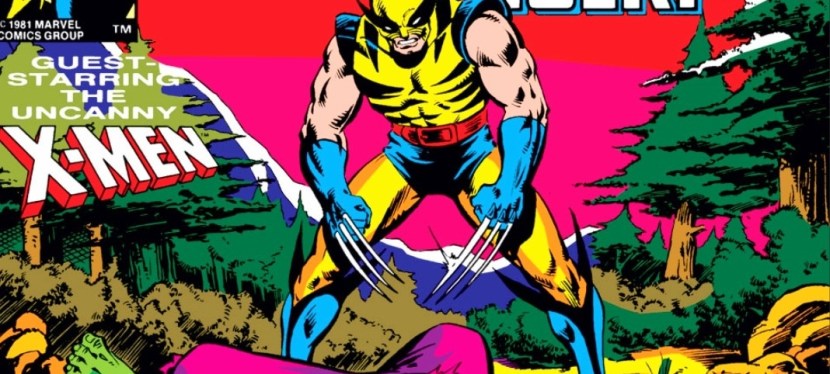
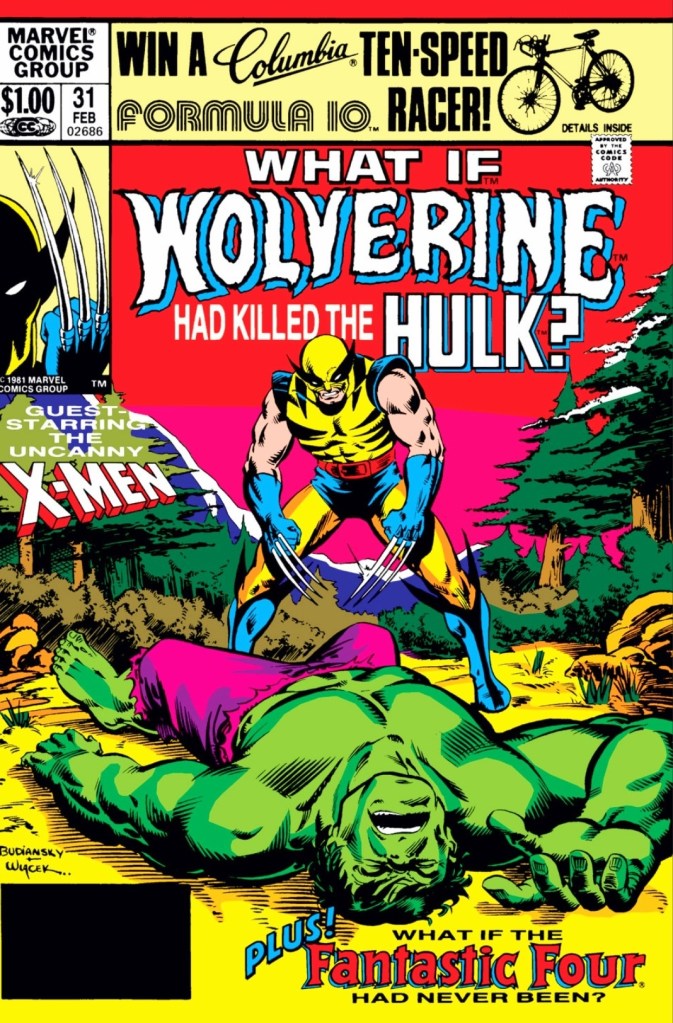
The cover.

Early story

The story begins with Wolverine and the Hulk in combat with each other in a forest within Canada. It turns out, Wolverine was sent by Canadian authorities to capture not just the Hulk but also the Wendigo.

With the Wendigo down on the ground, Wolverine and the Hulk struggle with each other. The Canadian’s speed helped him dodge the green giant’s powerful punches and as the fight goes on, so does the impulse and emotion from within. Suddenly, Wolverine decides to deliberately disobey his orders by deciding to kill the Hulk. In a few but strategic strikes with his Adamantium claws, Wolverine kills the Hulk. The Canadian authorities eventually got rid of the corpses of the Wendigo and the Hulk.

Soon enough, news about the Hulk’s death spread like wildfire all over America catching the attention of Spider-Man, the Avengers, the Fantastic Four and General Ross and his daughter Betty…

Quality

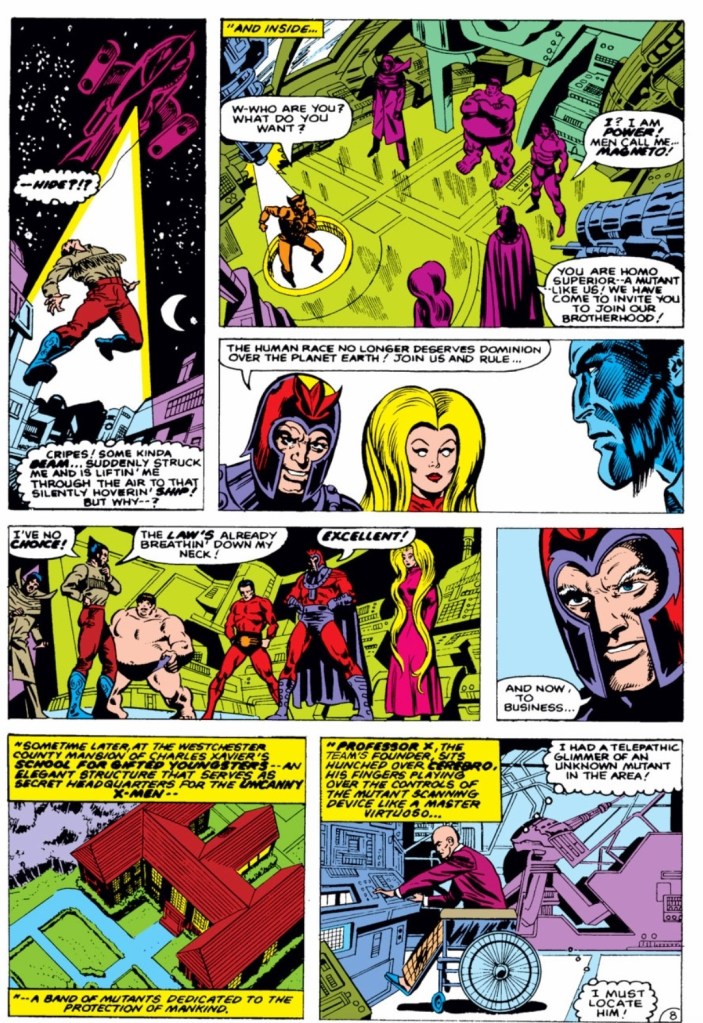
Wolverine gets abducted not by aliens from outer space but by Magneto and his Brotherhood of Evil Mutants.

To start with, I can say that I immensely enjoyed this alternate portrayal of the events that happened in relation to Wolverine’s first-ever appearance in comics. For one thing, the concept of Wolverine actually killing the Hulk is not only shocking on its own, it also set a chain reaction of events that involved or affect a whole lot of other characters within the Marvel Comics shared universe.

Let me start with Wolverine himself. As the story was set before he joined the X-Men, you will see Wolverine as a super-powered agent of Canada whose career really goes down as he failed to restrain his wild self from killing not once but twice. This results in a Wolverine who is deeply troubled with guilt and becomes desperate believing that running away and hiding will somehow solve his dilemma.

Wolverine’s entry into a gang of evil mutants led by Magneto (note: this comic book’s main villain) is itself worth getting this comic book. This shows Magneto – always obsessed with his belief that mutants are superior to humans – putting his diabolical plan into action with Wolverine as the key participant. This itself led to Wolverine’s encounter with the X-Men (the one team he was destined in reality to be with).

The creative team clearly exerted a lot of effort to not only ensure the plot made sense but also have a solid structure that can accommodate twists, intrigue and superhero spectacle altogether complete with enough room for character development. Lastly, I should say that this comic book’s climax is both compelling and shocking to read.

Conclusion

Wolverine’s 2nd kill in this comic book.

What If (1982) is indeed a great Marvel comic book to read. It has a very engaging alternate universe portrayal of Wolverine and this paved the way for a new and fresh approach on showcasing how the X-Men and Magneto’s gang reacted with the clawed Canadian. While the scope of the consequence of Wolverine’s killing of the Hulk ultimately ending up narrowing on Marvel’s mutants could be disappointing for those who seek a bigger impact on other Marvel universe characters, what was shown here in this comic book still made sense and ultimately turned out believable. This comic book also has another tale exploring what if there was no Fantastic Four which ultimately ended up as a decent additive.

Overall, What If (1982) is highly recommended.

+++++

Thank you for reading. If you find this article engaging, please click the like button below, share this article to others and also please consider making a donation to support my publishing. If you are looking for a copywriter to create content for your special project or business, check out my services and my portfolio. Feel free to contact me with a private message. Also please feel free to visit my Facebook page Author Carlo Carrasco and follow me on Twitter at  @HavenorFantasy as well as on Tumblr at https://carlocarrasco.tumblr.com/ and on Instagram at https://www.instagram.com/authorcarlocarrasco
A Look Back at What If #61 (1994)

Disclaimer: This is my original work with details sourced from reading the comic book and doing personal research. Anyone who wants to use this article, in part or in whole, needs to secure first my permission and agree to cite me as the source and author. Let it be known that any unauthorized use of this article will constrain the author to pursue the remedies under R.A. No. 8293, the Revised Penal Code, and/or all applicable legal actions under the laws of the Philippines.

Welcome back superhero enthusiasts, 1990s arts and culture enthusiasts, Marvel Comics fans and comic book collectors! Today we go back to the wild 1990s and examine an alternate universe portrayal of one of Spider-Man’s many events told through the What If monthly series!

If you are looking for a portrayal of Spider-Man going over the edge and into the extremes emotionally, you are about to experience something in this retro review of mine. Some time ago, I reviewed a What If comic book about Spider-Man becoming a murderer which was compelling but ended on a whimper.

With those details laid down, here is a look back at What If published in 1994 by Marvel Comics with a story written by Kurt Busiek and drawn by Kirk Jarvinen, Andrew Wildman, Derek Yaniger and Jim Amash.

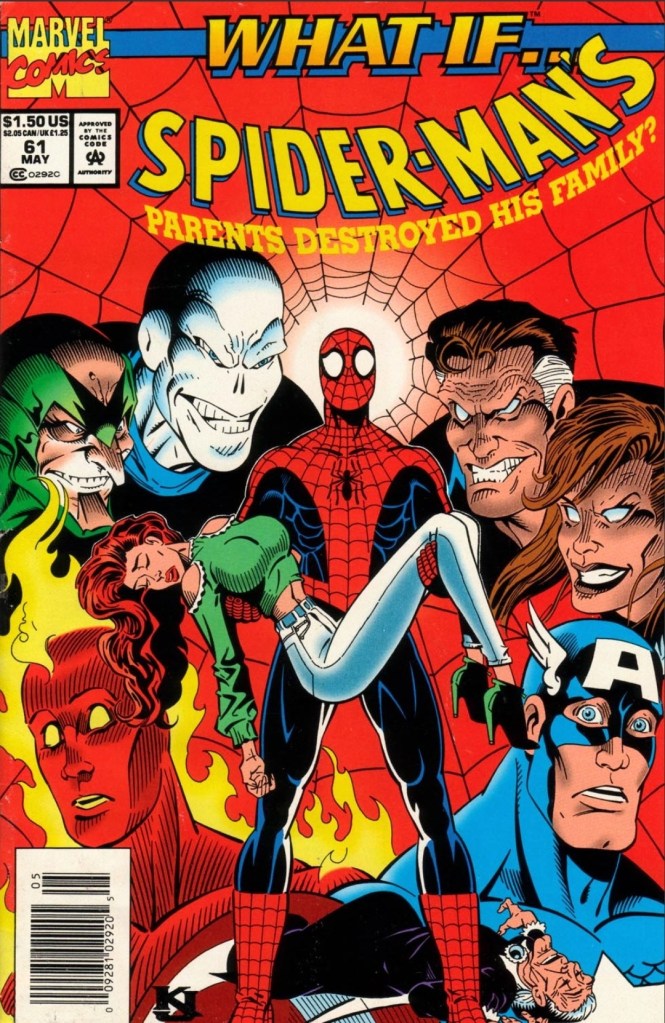
The cover.

Early story

The story begins with Richard and Mary Parker (Peter Parker’s parents) arriving in the presence of Aunt May who happens to be visited by their son Peter (Spider-Man). Having learned something from a while back, Aunt May tells Richard and Mary that they are not genuine persons. Suddenly, Peter Parker’s spider sense intensifies and in an attempt to defuse the situation, he leads his aunt to walk out of the house with him. Richard and Mary watch them walk away.

It turns out, Richard and Mary are impostors and they have been working all the time for a secretive boss. Richard calls his employer under an emergency and reports that they have completed phase one of their assignment, that Aunt May knows the truth about them and is about to inform Spider-Man. Richard is then told that under no circumstances is the plan to be jeopardized and anyone who suspects must die. He is also told to flush Mary’s programming and reset her as she showed signs of acting odd to the situation.

A short time later, Richard and Mary – now in morphed forms with vastly different bodies and half their heads resembling their human selves – suddenly break into an apartment surprising Peter, his wife Mary Jane and Aunt May. Violent action by one of them accidentally ripped open Peter’s shirt, revealing his Spider-Man suit to Aunt May. Just as Peter’s aunt figures out the secret, he tells Mary Jane to grab her and get out.

However, the sight of the morphed Mary Parker shocked Aunt May and Mary Jane so much, they failed to move. Mary Parker then morphs her two hands into large, makeshift hammers, and swiftly killed Aunt May and Mary Jane. Peter is instantly shocked by their sudden deaths but deep inside, rage begins to burn…

Quality

Spider-Man already over the edge and reacting violently to the abusive Daily Bugle.

I can start by confirming that Kurt Busiek’s writing is very strong and his alternate take on the events of Amazing Spider-Man (1994) is indeed very solid. In one way, I find the emotional stakes for Spider-Man has been raised a lot higher than what was portrayed in the canon story. The concept of losing his beloved family members to enemies who were impostors that looked like his long lost parents is indeed disturbing as well as emotionally charged. In relation to this, Busiek and the illustrators brought to life a Spider-Man who really went over the edge by taking matters into his own hands as the loss of beloved ones led to the blurring of the boundary between good and evil. Even the boundary between innocence and guilt gets blurred which adds more depth to the emotions of the story. As I read the story, there were moments when I felt that Spider-Man became as bad as the evil ones even though he is clearly the victim and his family was targeted.

Apart from showing Spider-Man getting outraged and pushed to the limits, Busiek inserted elements about how people perceive incidents without knowing all the facts and how easily they get manipulated by a news outlet – the Daily Bugle where Peter Parker worked as a freelance photographer – whose leader does not care about ethical journalism nor the pursuit of the truth. In this age of widespread fake news and liberal news media outlets in America doing propaganda for American Communists (read: Democrats, abortionists, LGBTQ, Black Lives Matter, Antifa, the terrorists, the climate change extremists and the socialist hordes), this particular aspect of the story makes this comic book strongly relevant to read today.

The story also sheds light on Spider-Man’s connections with other Marvel superheroes who happen to be in New York City. You will see Captain America and Johnny Storm express their concern about Spider-Man’s state of mind as they themselves still tried to figure out what really happened. In short, the superheroes here showed restraint even as Spider-Man goes to the extreme being a victim as well as a fugitive.

If there are any weak points in this comic book, it would be the art which has this cartoon-like aesthetic for much of the story. Considering the serious subject matter, the visuals are quite contradicting as they make this look like it was made for much younger readers. In fairness, the quality of the art improved during the 2nd half of the story.

Conclusion

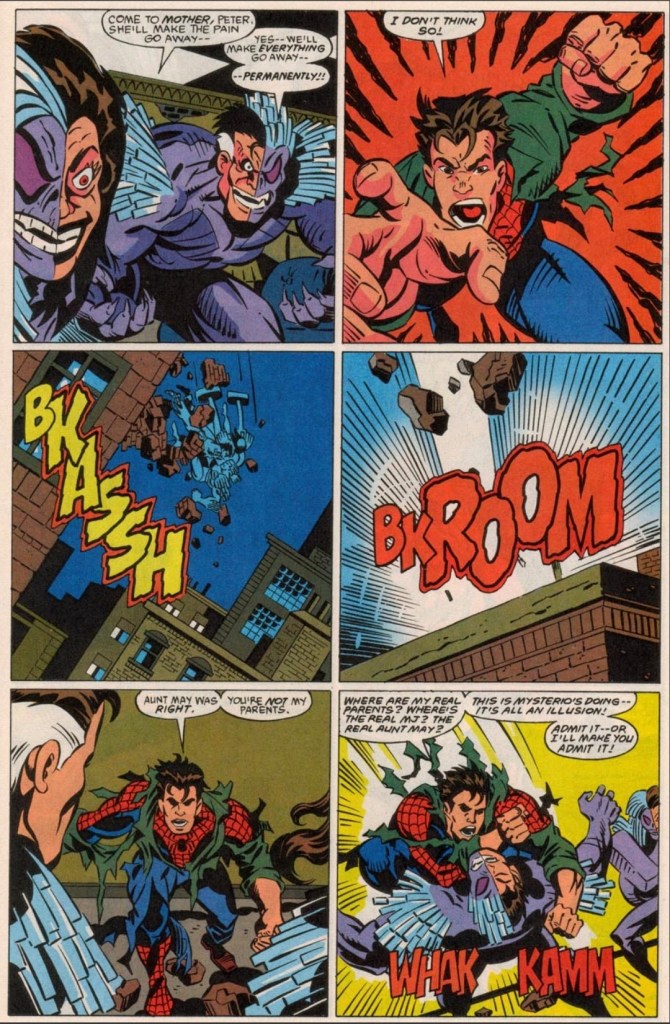
Spider-Man takes on the impostors who looked like his parents.

As far as storytelling and characterization goes, What If (1994) succeeded a lot on portraying the iconic Spider-Man as the superhero who went over the limits of his emotions and his reasoning which is the result of the tragic deaths of two beloved family members caused by individuals who pretended to be his parents. This is a very solid story which also has a powerful ending. Where What If failed, this comic book succeeded and even exceeded it with Spider-Man truly becoming unheroic. I should state that this comic book should convince readers to go to the Amazing Spider-Man series and follow the Lifetheft storyline in issues to (which were released months before this comic book). Kurt Busiek’s script is indeed great and it is easily the driving force of the comic book.

Overall, What If (1994) is highly recommended.

+++++

Thank you for reading. If you find this article engaging, please click the like button below, share this article to others and also please consider making a donation to support my publishing. If you are looking for a copywriter to create content for your special project or business, check out my services and my portfolio. Feel free to contact me with a private message. Also please feel free to visit my Facebook page Author Carlo Carrasco and follow me on Twitter at  @HavenorFantasy as well as on Tumblr at https://carlocarrasco.tumblr.com/ and on Instagram at https://www.instagram.com/authorcarlocarrasco
A Look Back at What If #4 (1989)

Disclaimer: This is my original work with details sourced from reading the comic book and doing personal research. Anyone who wants to use this article, in part or in whole, needs to secure first my permission and agree to cite me as the source and author. Let it be known that any unauthorized use of this article will constrain the author to pursue the remedies under R.A. No. 8293, the Revised Penal Code, and/or all applicable legal actions under the laws of the Philippines.

Welcome back superhero fans, 20th century arts and culture enthusiasts, Marvel Comics fans and comic book collectors! Today we go back to the year 1989 and explore a part of Marvel Comics’ universe through the reimagined tales emphasized in the What If monthly series (Volume 2).

For the newcomers reading this, I previously reviewed a variety What If comic books which you can find by clicking here, here, here, here, here, here, here and here. The joy of reading a What If comic book was the exploration of alternate outcomes in relation to the stories that have been counted by Marvel Comics as canon or official fictional history within their shared comic book universe. In this retro review, we will explore a key event from Spider-Man’s time with the alien costume (symbiote) which is related with the events of Secret Wars and the eventual establishment of his deadliest nemesis Venom.

With those details laid down, here is a look back What If , published in 1989 by Marvel Comics with a story written by Danny Fingeroth and drawn by Mark Bagley.

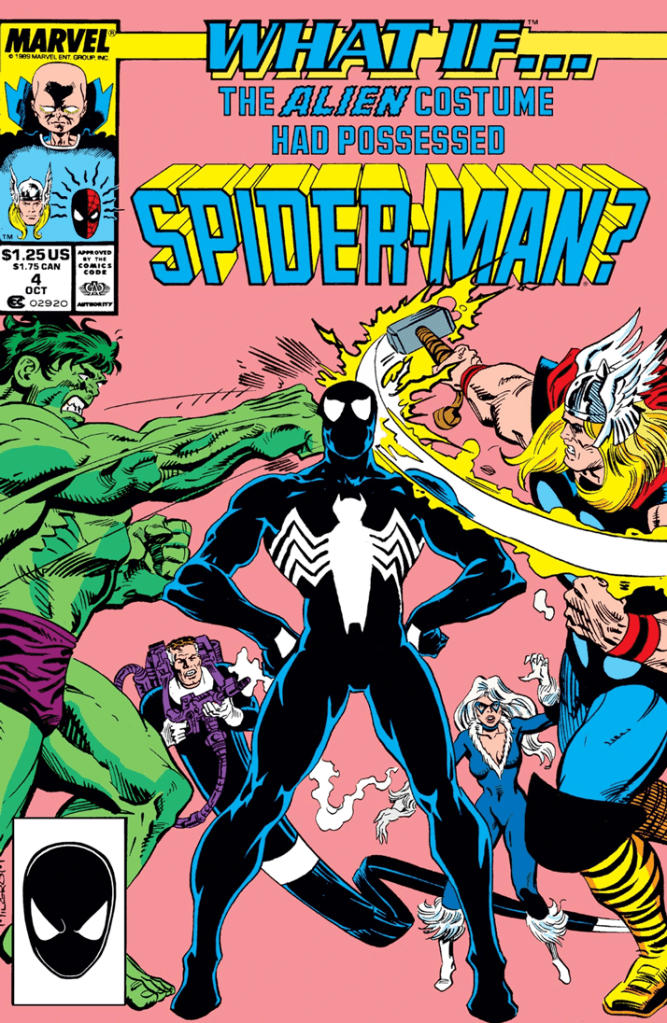
The cover.

Early story

The story begins with the Watcher examining Spider-Man’s involvement with the Secret Wars that took place on a faraway planet created by the Beyonder. There, his costume got damaged beyond  repair and he acquired a new one made of what he perceived to be an advanced form of material. After successfully returning home, Spider-Man goes through some mysterious developments and he could not understand why he remains fatigued even as he spent more time sleeping.

With the help of Mr. Fantastic at the Fantastic Four headquarters, Spider-Man learns that his new costume is a living entity that has attached itself to him mentally and physically. As Mr. Fantastic uses a sonic blaster, Spider-Man and the alien costume got separated at last. Some time later, the alien costume re-attached itself to Spider-Man who eventually used church bells loud sounds to separate it. The alien costume would go on to the find Eddie Brock to form Venom.

The alternate reality begins with Spider-Man having a joyful reunion with Black Cat shortly after coming back from Secret Wars. Learning from her advise to have himself checked properly, he visits Dr. Connors (the Lizard) for examination and testing…

Quality

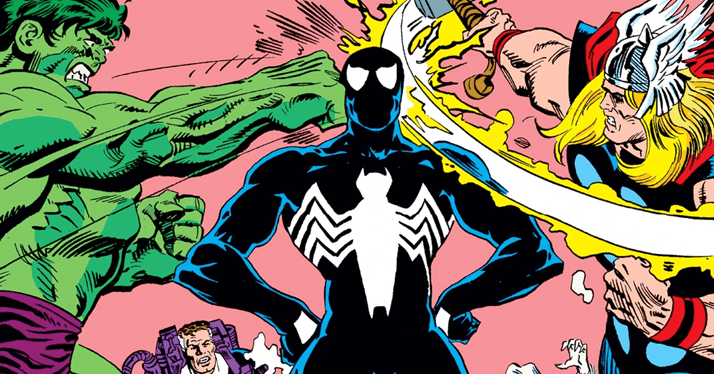
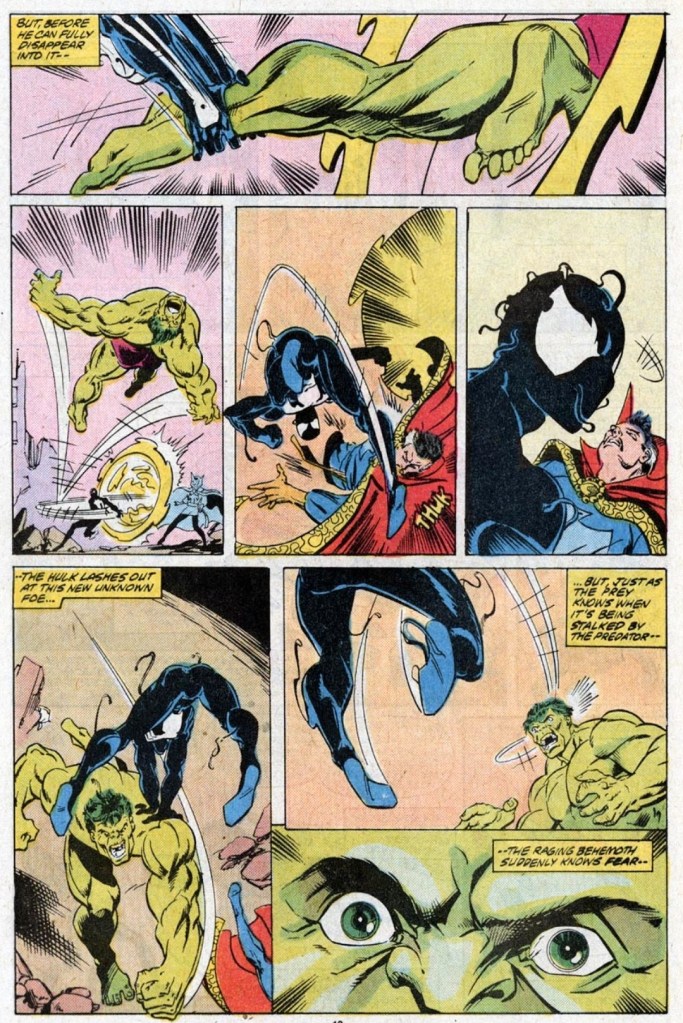
The possessed Spider-Man takes on Dr. Strange and the Hulk without hesitation.

To say that Danny Fingeroth’s script is very deep is an understatement. Specifically, this story is a great exploration of alternative events that not only affects the iconic Spider-Man/Peter Parker but also other elements of the Marvel Comics universe of the time. The concept of the alien costume fully bonding with Peter Parker with Mr. Fantastic and even Dr. Strange failing to help is indeed suspenseful and intriguing to read thanks to Fingeroth’s very solid writing. In fact, the story even shows Spider-Man as being possessed by the symbiote (complete with dialogue) and when you witness Peter Parker struggling to control himself consciously (while wrestling with the alien costume), you will really feel his pain. I should also state that there is a lot more about Spider-Man told here that goes beyond the possession which really turned out to be very compelling to read in my experience. This is easily the most engaging alternate portrayal of Spider-Man as we know him and it should be read by as many people as possible.

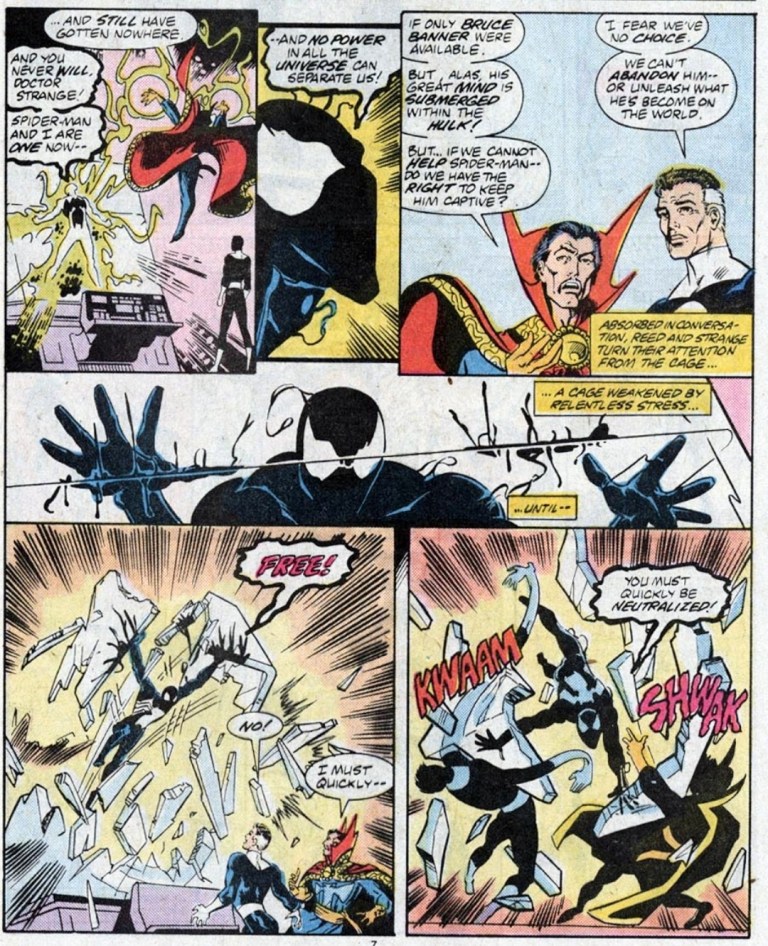
Along the way, this comic book portrays the alien costume as an insatiable being and the implementation of dialogue for it (structured in a way as using the vocal ability of the powered being it bonded with) gave it a very unique personality of its own. This is something that was not portrayed in the early appearances of Venom in which Eddie Brock does the talking and reacting to unseen messages from the symbiote. That being said, the alien costume here symbolizes possession within the Marvel Comics shared universe and its unknown state really challenges not only the intelligence of the superheroes but also their ability to decide on what final action to take with regards to sentient life.

As staged by the writer, the story’s narrative occasionally shifts away from Spider-Man to follow other characters such as Black Cat (Peter Parker’s love at the time), Mr. Fantastic (in a great portrayal of his proficiency in science and as a responsible superhero), Thor and others which made the reading experience really immersive in relation to emphasizing how this alternate reality affects others. You will get to see the Captain America, the Hulk, Iron Man, the Wasp, Captain Marvel, the Fantastic Four and the Avengers here.

Those who are fond of superhero spectacle will have a lot to enjoy here. Mark Bagley carefully paces the action scenes and he uses visual dynamism during the right moments.  

Conclusion

Through dialogue, the alien costume is portrayed as a sinister force.

I can say it out loud…What If (1989) is one of the best Marvel Comics alternate reality stories I have ever read and the creative team of Fingeroth-Bagley crafted an epic tale that goes beyond the featured question of “What if the alien costumer had possessed Spider-Man?”. The comic book works excellently as both a Spider-Man story as well as a Marvel superheroes struggle. The story touches on relevant topics such as possession, killing and scientific exploitation. This is a must-have comic book!

Overall, What If (1989) is highly recommended!

+++++

Thank you for reading. If you find this article engaging, please click the like button below and also please consider sharing this article to others. If you are looking for a copywriter to create content for your special project or business, check out my services and my portfolio. Feel free to contact me with a private message. Also please feel free to visit my Facebook page Author Carlo Carrasco and follow me on Twitter at  @HavenorFantasy as well as on Tumblr at https://carlocarrasco.tumblr.com/ and on Instagram at https://www.instagram.com/authorcarlocarrasco/

A Look Back at What If #17 (1990)

Disclaimer: This is my original work with details sourced from reading the comic book and doing personal research. Anyone who wants to use this article, in part or in whole, needs to secure first my permission and agree to cite me as the source and author. Let it be known that any unauthorized use of this article will constrain the author to pursue the remedies under R.A. No. 8293, the Revised Penal Code, and/or all applicable legal actions under the laws of the Philippines.

Welcome back superhero enthusiasts, 1990s arts and culture enthusiasts, Marvel Comics fans and comic book collectors! Today we go back to the year 1993 and explore a part of Marvel Comics’ universe through the reimagined tales emphasized in the What If monthly series.

Several years ago, I bought myself a trade paperback collection of the 1987 Spider-Man storyline Kraven’s Last Hunt written by J. M. DeMatteis and drawn by Mike Zeck. That particular storyline was very notable not just for its dark approach to storytelling and visualization, but it also explores what would happen had Spider-Man been defeated and someone very obsessed took his place and go on a rampage disguised as Spider-Man. The storyline also explored how Kraven perceived Spider-Man without ever knowing the defining traits of the man behind the mask – Peter Parker. Eventually, Marvel Comic went on to revisit Kraven’s Last Hunt and explored what would happen had Kraven actually killed Spider-Man through their What If? monthly comic book series.

With those details laid down, here is a look back at What If , published in 1990 by Marvel Comics with a story written and drawn by Richard Howell.

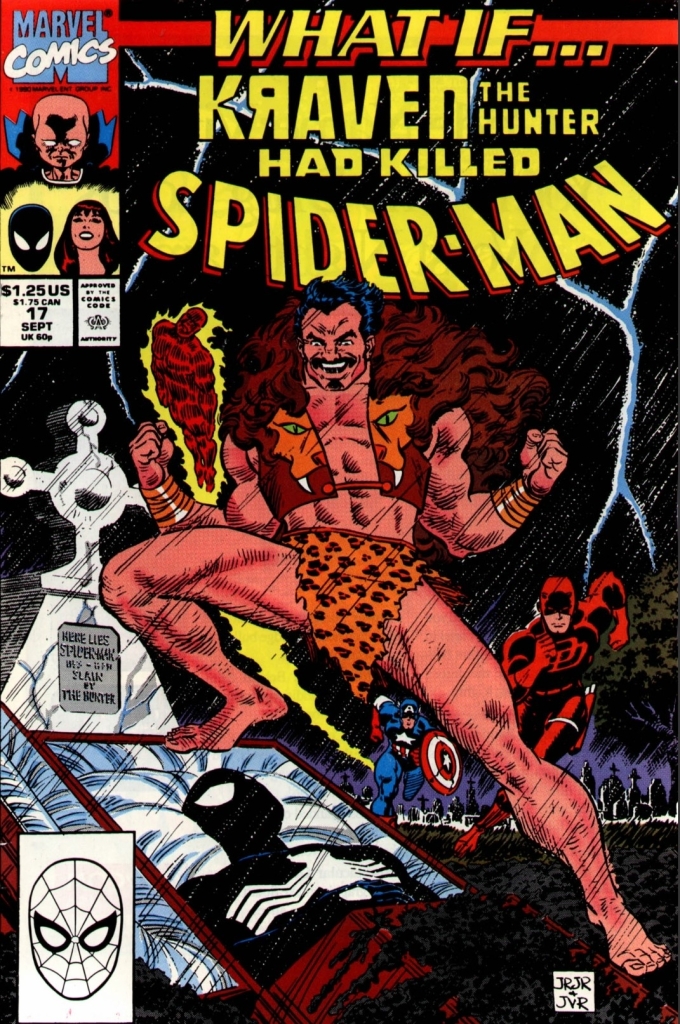
The cover.

Early story

The story begins with the Watcher revisiting key moments from the Kraven’s Last Hunt storyline. History then takes a turn towards the unexplored when Kraven, armed with a gun, shoots and kills Spider-Man. As the dead webslinger lies in a coffin, Kraven celebrates his victory with a lot of passion believing that he struck back at what he perceives to be the meaninglessness of the world. Kraven is quite mad as he equates spiders with Spider-Man as well as the decline of civilization.

After fearlessly and grotesquely eating spiders, Kraven wears a black body tight costume that looks almost the same as that of Spider-Man’s. While he is victorious, Kraven is not satisfied and he becomes obsessed by becoming Spider-Man and prove himself superior to him. He then moves into the city whose people are familiar with Spider-Man and also are unprepared with who is coming to them.

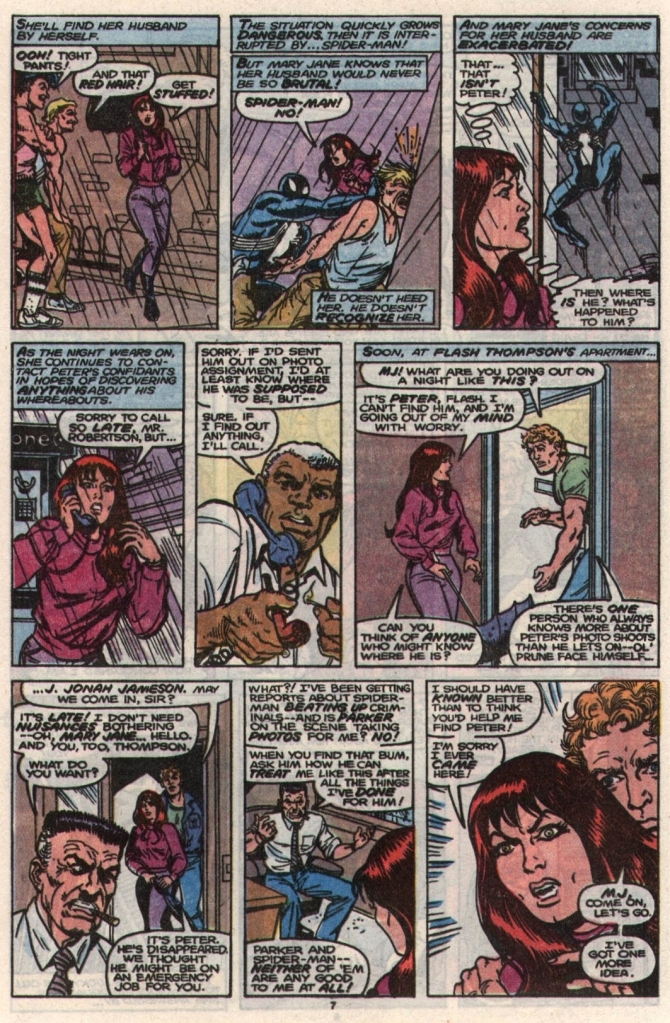
In an apartment, Spider-Man’s wife Mary Jane Parker is alone and worried. As she does not know that her beloved Peter Parker has been killed, she cannot help but agonize over the strain of his double-life as a civilian and as a superhero. Determined to find Peter, she walks out during the rainy night and is spotted by two men focused on her.

Suddenly the new Spider-Man (Kraven) appears and in an apparent effort to help Mary Jane, he grabs one of the men and brutally pushes the man’s head on to a nearby wall. As Kraven does not recognize Mary Jane, the wife realizes that the Spider-Man she just saw is definitely not her husband. This only makes her wonder again where he is and what happened to him. She then starts calling others for help…

Quality

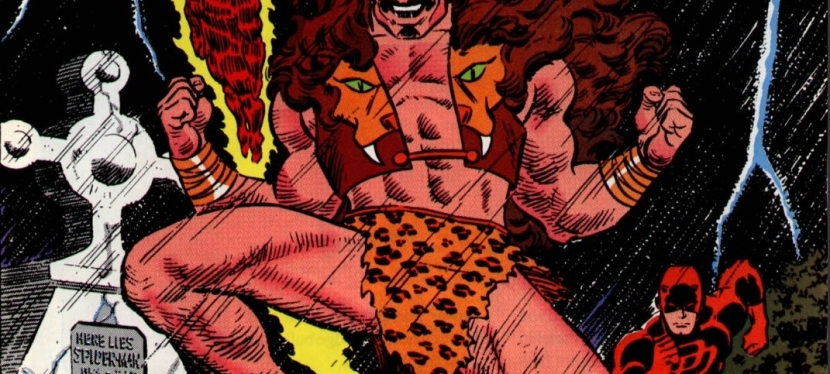
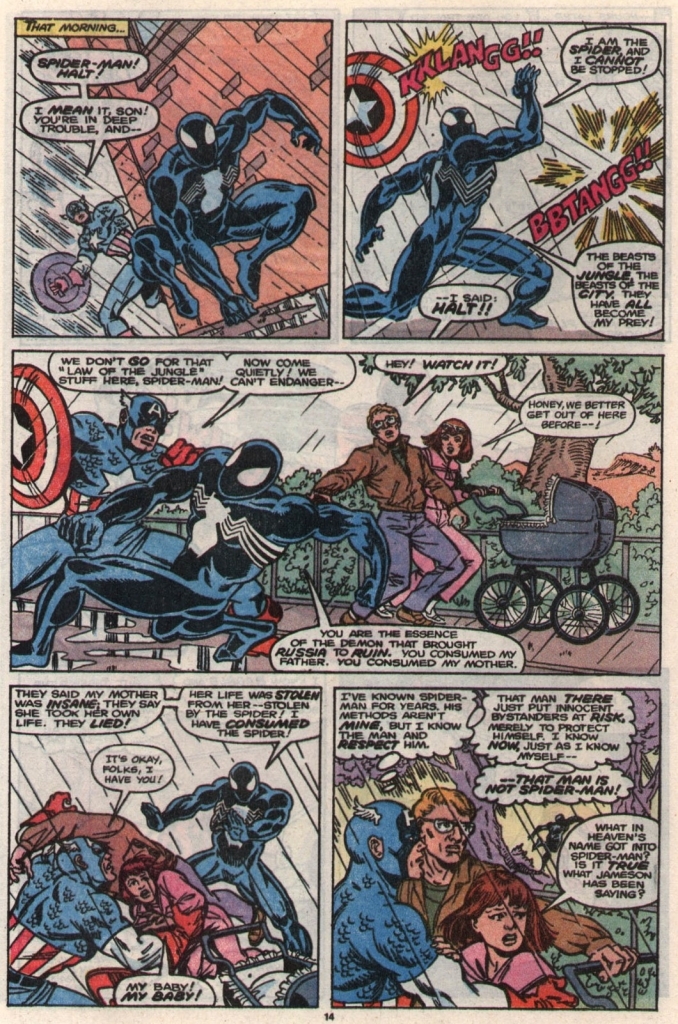
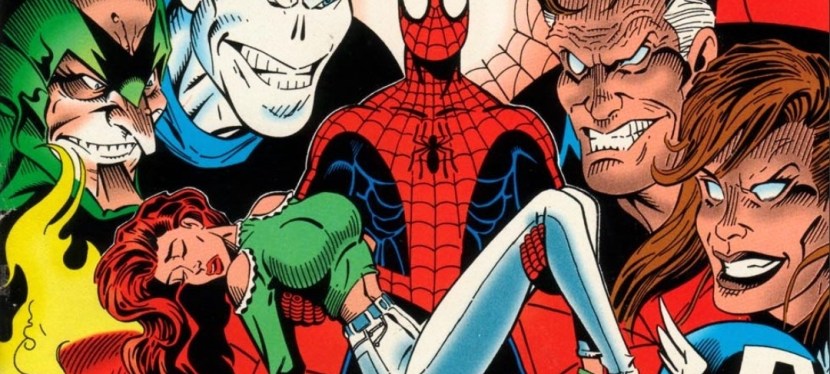
In addition to being ruthless, Kraven disguised as Spider-Man resembles Venom.

I’ll start with the visuals. This comic book took a serious effort to come close to capturing the look and visual tone of the Kraven’s Last Hunt storyline which I enjoyed. Richard Howell visualized the characters, the situations and details properly and there was not a single moment when the visuals overwhelmed the narrative. Howell’s artistic take on the characters is simplistic but they remain recognizable which is a plus. The superhero spectacle was presented with a clear and clean approach, and there were a few key moments of action that got highlighted with some dynamism.

As for the story itself, what I found surprising and also pleasant here was the presentation of Mary Jane Parker as the main character instead of Kraven. This makes sense as Kraven himself was the major attraction of the Kraven’s Last Hunt storyline while Spider-Man was out of commission. In the context of this What If story, it only made sense to have Mary Jane as the central figure. Going back to Kraven, Howell captured the essence of the character well when compared to his version in Kraven’s Last Hunt.

In terms of plotting, telling the story through the viewpoint and actions of the superhero’s concerned wife really works well. Without spoiling the plot, you will see Mary Jane get involved with three notable superheroes – including the iconic Captain America – and even with other notable Spider-Man supporting characters such as Flash Thompson and the irresponsible print media figure J. Jonah Jameson. Interactions aside, the plot works sufficiently as a couple of series of events take place before the big confrontation with Kraven (as the new Spider-Man). By the end of it all, I can say that the story is entertaining, engaging and intriguing to read.

Conclusion

Mary Jane Parker goes out in pursuit of her husband Peter Parker/Spider-Man who happens to be dead already at this particular point of the story.

I can say that What If (1990) is pretty captivating read and it is a worthy literary companion to Kraven’s Last Hunt. Of course, to really enjoy this alternative tale cleverly told by Howell, you must read Kraven’s Last Hunt first. Otherwise, you would not feel the impact of this comic book very much. I also liked how the death of Spider-Man (note: Spider-Man got killed in another What If tale that itself is worth reading) impacts Mary Jane, how it impacts the superheroes who know him, and most notably how it impacts the fragile relationship between society and superheroes. Lastly, this comic book has one of the more significant portrayals of Spider-Man’s most beloved woman. This is indeed a great story.

Overall, What If (1990) is highly recommended!

+++++

Thank you for reading. If you find this article engaging, please click the like button below, share this article to others and also please consider making a donation to support my publishing. If you are looking for a copywriter to create content for your special project or business, check out my services and my portfolio. Feel free to contact me with a private message. Also please feel free to visit my Facebook page Author Carlo Carrasco and follow me on Twitter at  @HavenorFantasy as well as on Tumblr at https://carlocarrasco.tumblr.com/ and on Instagram at https://www.instagram.com/authorcarlocarrasco
A Look Back at What If #47 (1993)

Disclaimer: This is my original work with details sourced from reading the comic book and doing personal research. Anyone who wants to use this article, in part or in whole, needs to secure first my permission and agree to cite me as the source and author. Let it be known that any unauthorized use of this article will constrain the author to pursue the remedies under R.A. No. 8293, the Revised Penal Code, and/or all applicable legal actions under the laws of the Philippines.

Welcome back superhero enthusiasts, 1990s arts and culture enthusiasts, Marvel Comics fans and comic book collectors! Today we go back to the year 1993 and explore a part of Marvel Comics’ universe through the reimagined tales emphasized in the What If monthly series.

Back in 2021, I reviewed What If #46 (1993) which told a compelling story about division between the mutants, the clash of beliefs between Professor X and Cable, and how terrorism affects everyone. The comic book was also a mesmerizing portrayal of how the X-Men would have organized themselves without Charles Xavier, Jean Grey and Cyclops.

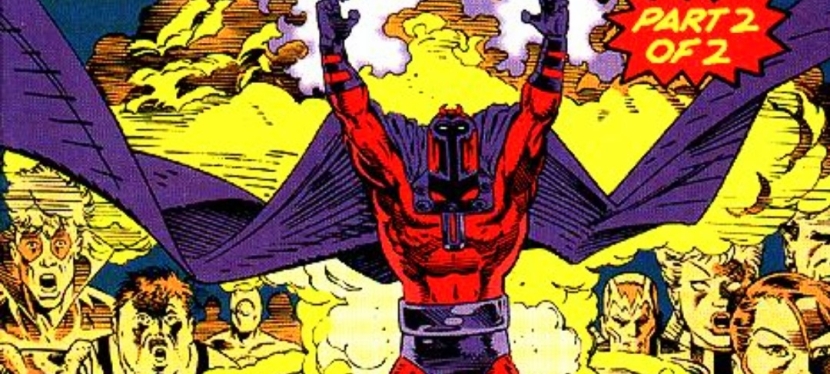
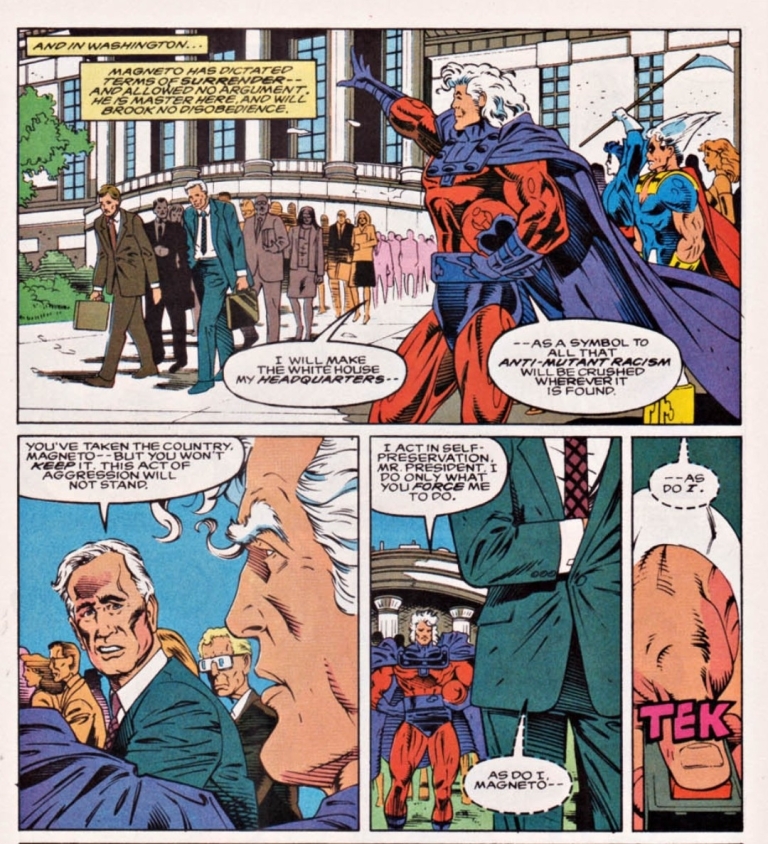
Considering all the chaos that happened in What If (1993), the time was just right for Magneto – the X-Men’s most dangerous enemy of all time – to come in and make an impact not only on mutants but on the world.

With those details laid down, here is a look back at What If , published in 1993 by Marvel Comics with a story written by Kurt Busiek and drawn by Tod Smith.

The cover.

Early story

The story begins with Magneto leading a huge legion of mutants to take overwhelm the remaining resistance – including Spider-Man, the Fantastic Four, Captain America, the Avengers and the dedicated American soldiers – in Washington, D.C.

A fierce battle then took place with both sides hitting each other hard. After noticing Magneto’s lack of presence during the battle, Captain America then realizes that the long-time enemy of the X-Men took advantage of the fighting to penetrate the U.S. Capitol’s bomb shelters and got the nation’s leaders hostage. After easing some of his fellow heroes, Captain America decides not to escalate the fight against Magneto in consideration of the lives of America’s top officials…

Quality

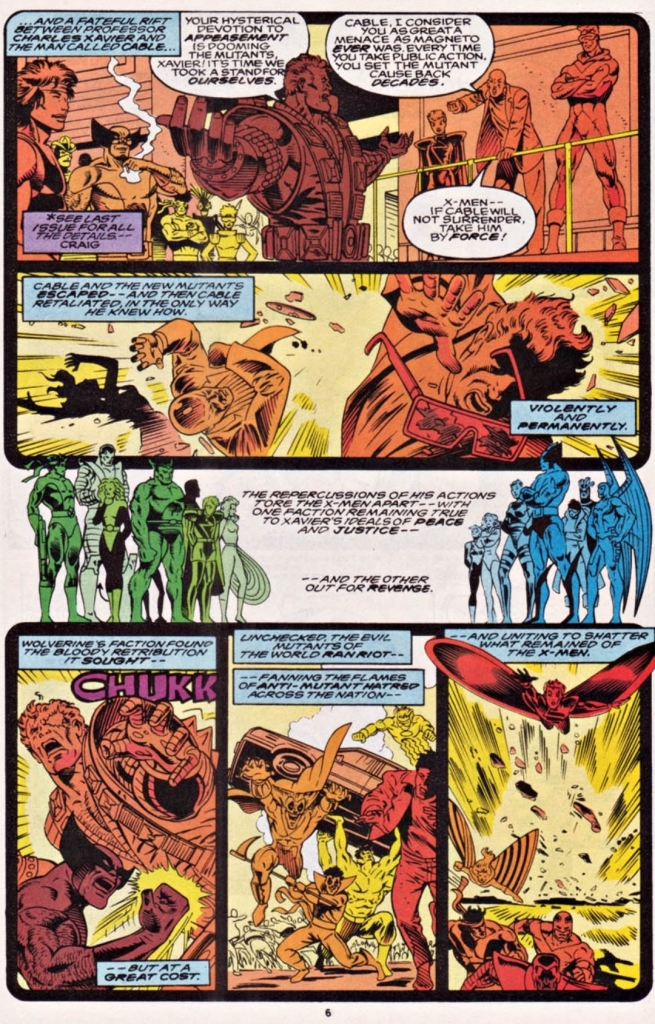
A recap of the events in issue .

To begin with, I can say that this story is a well-planned follow-up to the events of issue . While Magneto’s presence has been magnified a lot here, there are still strong story connections to the previous issue.

With regards to what was emphasized on the front cover of the comic book, this story explores what would happen if Magneto took power to control the entire United States while leading a group of mutants with a platform focused on crushing anti-mutant racism even though it includes pushing the non-mutant people (which is the great majority of America’s people) as well as the dissenting mutants out of the way.

For one thing, this superhero fantasy concept is actually socially relevant with today’s geopolitics and the way America has turned out under the fake leadership of Joe Biden (who is NOT leading as US President but only following the modern-day American Communists and reckless SJWs dictating him to do their evil bidding. Biden also arrogantly denies reality when it goes against the desires of his administration and his Satanic Democrats) It should be noted that the US President visualized in this comic book eerily looks like Joe Biden complete with that absent-minded facial expression.

Next, a clear theme in this What If story is absolute power and why groups who crave for it would sacrifice so much and hurt others just to acquire it. Magneto, who carries deep hatred towards people he perceives to be obstacles or opposition for his quest of uplifting mutants, takes advantage of mutants who have lost hope and are depending on someone to lead them. Indeed, the long-time X-Men nemesis gains power to control America but finds himself facing a new force of opposition which leads the nation into a drastic series of change that clearly do not alight with his vision of a better future for mutants.

Still on the theme of absolute power, the US government in this story was portrayed to have developed technologies designed to overwhelm its citizens, as well as the means to establish infrastructure and protocols to transform America into an automated dictatorial state that enslaves its citizens and violate their rights without restraint. Once again, this aspect of the story makes it socially relevant.  

Considering the epic concept and the dark turn of events the creative team prepared, this comic book does not have a clear good-versus-evil approach but rather it emphasizes chaos that comes with the pursuit and abuse of absolute power over the nation. You will see key elements from the classic X-Men storyline Days of Future Past here in relation to America’s deformation.

Conclusion

Wow! The US President in this comic book eerily looks so much like Joe Biden whose leadership led America into a lot of problems and hardship. Sky high inflation is just one of the problems that happened under Biden.

What If (1993) is truly a very captivating read mainly because of its core concept which goes way beyond the scenario of Magneto taking control of America. Considering its portrayal of America and the exploration of dark themes about people getting overwhelmed by power abusers, the story is a warning about the fall of America told in superhero fantasy form. Considering the intense social degradation that rocked America the past few years (note: riots by the Black Lives Matter terrorists, SJWs disturbing the peace, Democrats allowing more illegal immigrants into the country, socialists in colleges continuing to brainwash students and more), this story is very socially relevant. It will keep you thinking and reflecting deeply, even if you strongly desire whatever superhero entertainment you seek in this comic book.

Overall, What If (1993) is highly recommended!

+++++

Thank you for reading. If you find this article engaging, please click the like button below, share this article to others and also please consider making a donation to support my publishing. If you are looking for a copywriter to create content for your special project or business, check out my services and my portfolio. Feel free to contact me with a private message. Also please feel free to visit my Facebook page Author Carlo Carrasco and follow me on Twitter at  @HavenorFantasy as well as on Tumblr at https://carlocarrasco.tumblr.com/ and on Instagram at https://www.instagram.com/authorcarlocarrasco
A Look Back at Dazzler #21 (1982)

Disclaimer: This is my original work with details sourced from reading the comic book and doing personal research. Anyone who wants to use this article, in part or in whole, needs to secure first my permission and agree to cite me as the source and author. Let it be known that any unauthorized use of this article will constrain the author to pursue the remedies under R.A. No. 8293, the Revised Penal Code, and/or all applicable legal actions under the laws of the Philippines.

Welcome back superhero enthusiasts, 1980s culture enthusiasts and comic book collectors! Today we go back to the year 1982 to examine the Marvel Comics universe through the exploits of Dazzler!

While my most recent retro review of Dazzler was the 4th issue of its monthly series, I have decided to jump straight to issue #21 for this new retro review. By the time Dazzler #21 got published, the unusual superhero went through a lot and illustrator Frank Springer became fully established as the monthly series’ definitive artist.

With those details laid down, here is a look back Dazzler #21, published by Marvel Comics in 1982 with a story written by Danny Fingeroth and drawn by the late Frank Springer.

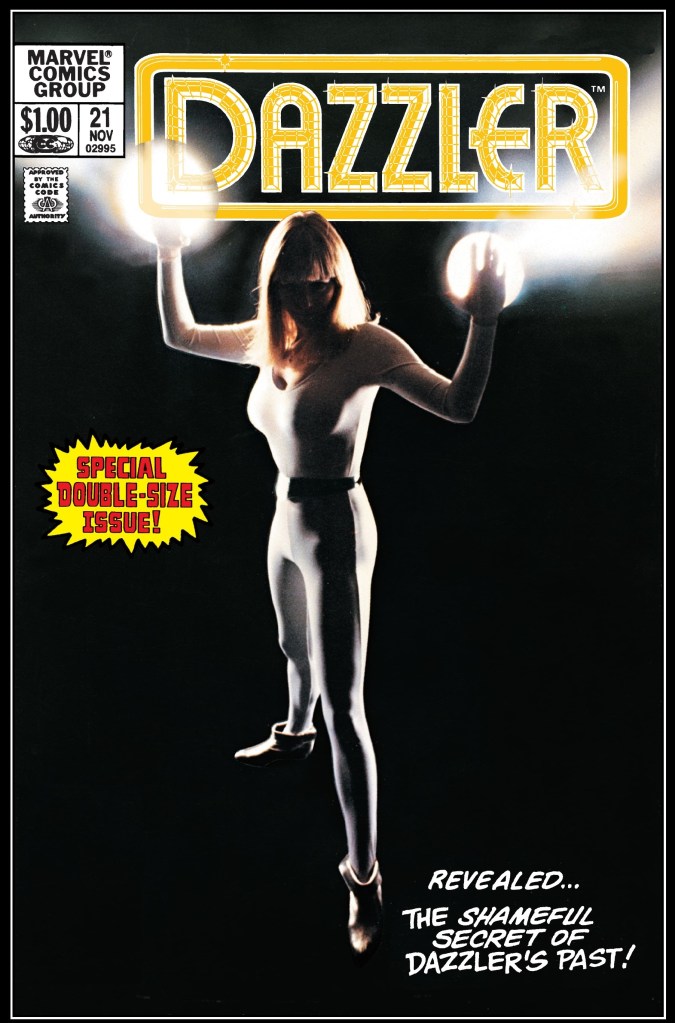
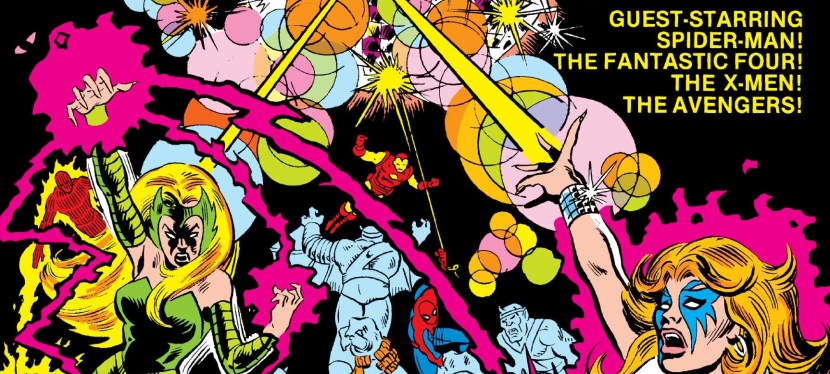
The cover.

Early story

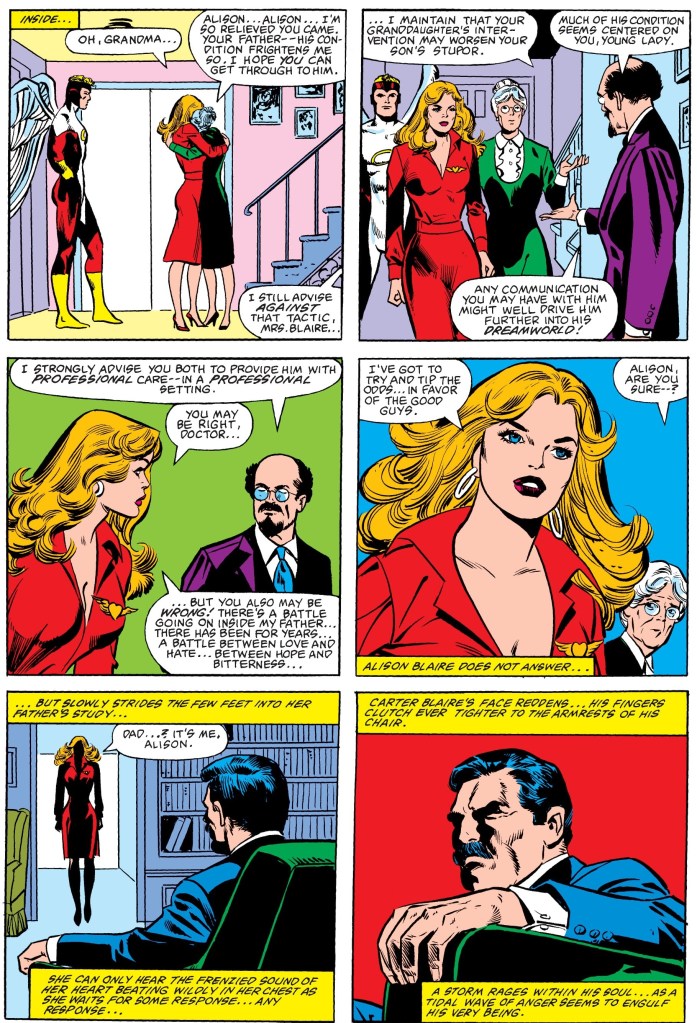
The story begins with Alison Blaire/Dazzler being carried above the buildings of New York City by Angel (Warren Worthington) of the X-Men. At this point in time, Alison’s father judge Carter Blaire snapped under the weight of turmoil related to the death of his wife and his daughter’s rebelliousness. As Dazzler, Alison had gone through intense encounters with the likes of the Incredible Hulk, She-Hulk, a top-secret syndicate that made her a test subject and even Galactus.

Recently, Bella – Alison’s grandmother – could not cope with her son’s breakdown and reached out to Warren Worthington to help her reach Alison. Since after being found, Alison had been traveling with Angel by air.

Along the way, Spider-Man sees them and recognizes Alison as Dazzler. He swings to try to get their attention but was ignored as they were so focused on their objective. A short time later, Angel and Alison arrive at judge Blaire’s home. Her grandmother greets them and tells her she hopes that she can get through to judge Blaire.

The doctor, however, advised against that tactic and states that Alison’s intervention may worsen her father’s condition as much of it was centered on her…

Quality

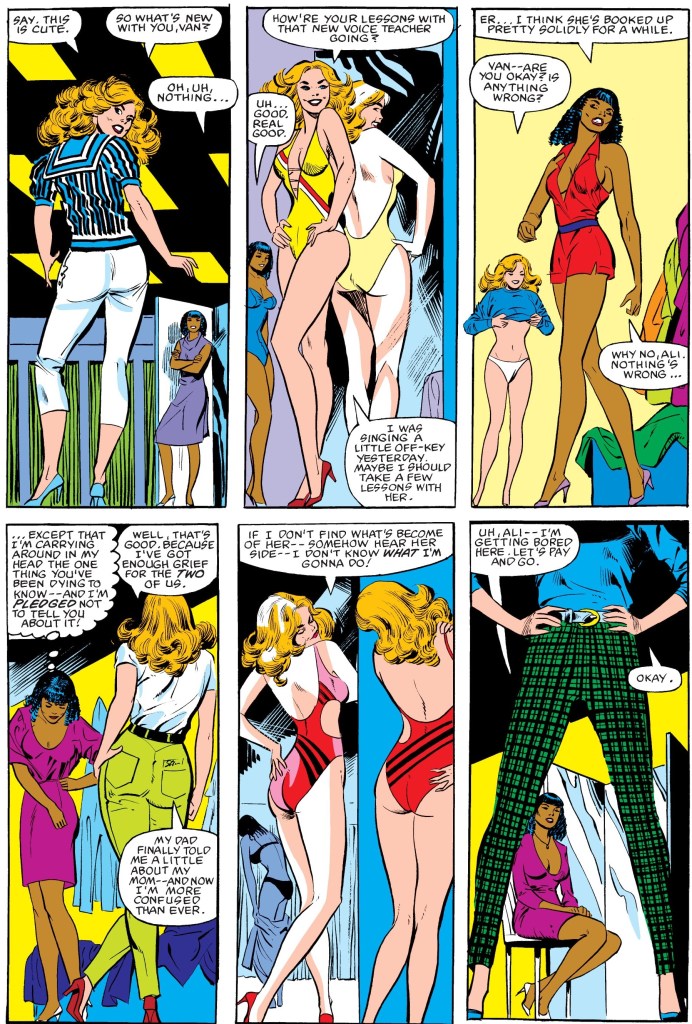
Alison Blaire and her friend Vanessa try out new clothes.

I’ll go straight to the point about what the story of this double-sized comic book is about without spoiling it. It is a pretty dramatic look at the protagonist in her civilian form as Alison Blaire. You will get to see her as Dazzler in this comic book but if you are looking for a lot of superhero moments of her or if you are looking for Dazzler in a conflict with evil elements, you won’t find it here.

More on the plot, this comic book explores deeply the emotional and personal dimensions of Alison and along the way, stories about her own past as well as the respect past events of both her father and mother got dramatized. The story tackles themes like independence, maturity, marriage, personal development, family ties and personal conflicts of interest. The good thing here is that the script by Danny Fingeroth is very well-written and it seems he did his research on constructing a personal story about Alison Blaire that is very grounded in reality. That being said, the superhero elements have been pushed aside most of the time and the ironic thing is the fact that the other Marvel superheroes – Spider-Man, Fantastic Four, The Avengers and more – appeared here as if to remind readers this is still a superhero tale.

Very clearly, this story was written for the very dedicated or even the die-hard Dazzler fans in mind. When it comes to the fun factor, the results could be mixed depending on what readers want to see in this comic book. For me personally, it is a pretty engaging story to read and at the same time it is fun enough as well.

Conclusion

Alison tries to help her troubled father.

Dazzler #21 (1982) could be barely received or strongly received or even rejected even though it has a very rich and dramatic script. The clear lack of the superhero presentation of Dazzler in favor of heavy drama and in-depth characterization may not win the approval of readers/collectors who love superhero stuff but it will resonate with the readers who really love the character and had immersed themselves into her life. As far as characterization goes, this comic book marks a significant turning point of Dazzler herself and in its story, she really developed a lot since making her first-ever appearance in Uncanny X-Men #130. If you are a Dazzler purist who does not mind the lack of superhero spectacle, this one could engage you.

If you are seriously planning to buy an existing hard copy of Dazzler #21 (1982), be aware that as of this writing, MileHighComics.com shows that the near-mint copy of the regular edition costs $28 while the near-mint copy of the newsstand edition costs $60.

Overall, Dazzler #21 (1982) is recommended.

+++++

Thank you for reading. If you find this article engaging, please click the like button below and also please consider sharing this article to others. If you are looking for a copywriter to create content for your special project or business, check out my services and my portfolio. Feel free to contact me with a private message. Also please feel free to visit my Facebook page Author Carlo Carrasco and follow me on Twitter at  @HavenorFantasy as well as on Tumblr at https://carlocarrasco.tumblr.com/
A Look Back at Dazzler #4 (1981)

Disclaimer: This is my original work with details sourced from reading the comic book and doing personal research. Anyone who wants to use this article, in part or in whole, needs to secure first my permission and agree to cite me as the source and author. Let it be known that any unauthorized use of this article will constrain the author to pursue the remedies under R.A. No. 8293, the Revised Penal Code, and/or all applicable legal actions under the laws of the Philippines.

Welcome back superhero enthusiasts, 1980s culture enthusiasts and comic book collectors! Today we go back to the year 1981 to examine the Marvel Comics universe through the exploits of Dazzler!

Last time around, Alison Blaire was preparing herself for a big event as Dazzler. The event was something needed to help her boost her career as an entertainer and the stakes were high as there were many important guests. The weird thing was that she instead got involved with one of the most fearsome super villains of Marvel – Dr. Doom!

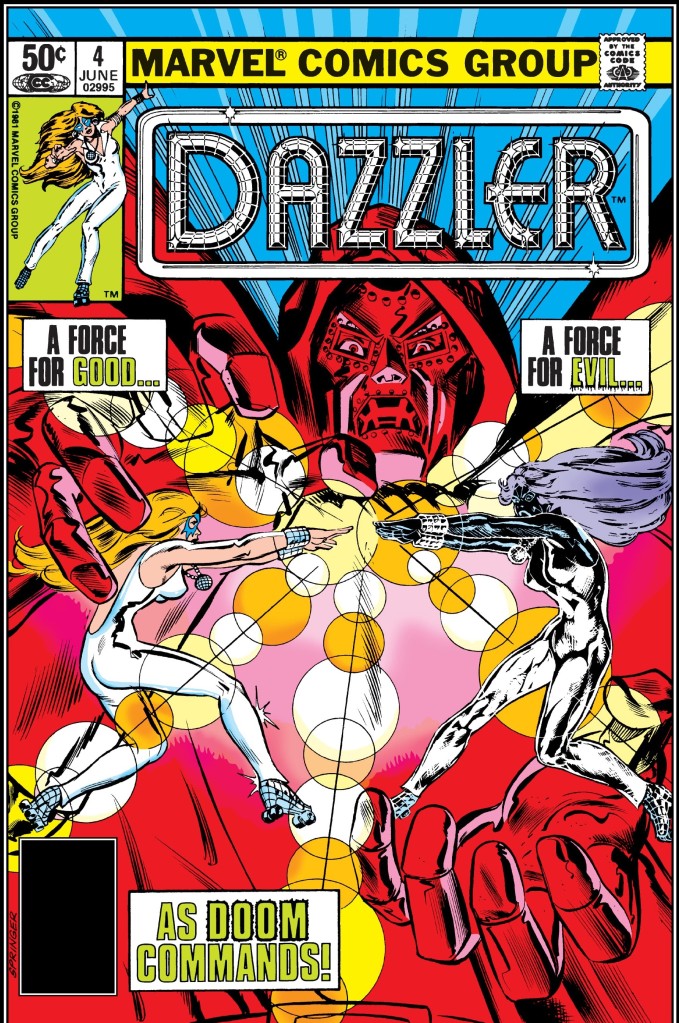
With those details laid down, here is a look back Dazzler , published by Marvel Comics in 1981 with a story written by Tom DeFalco and drawn by the late Frank Springer. This was Springer’s Dazzler debut.

The cover.

Early story

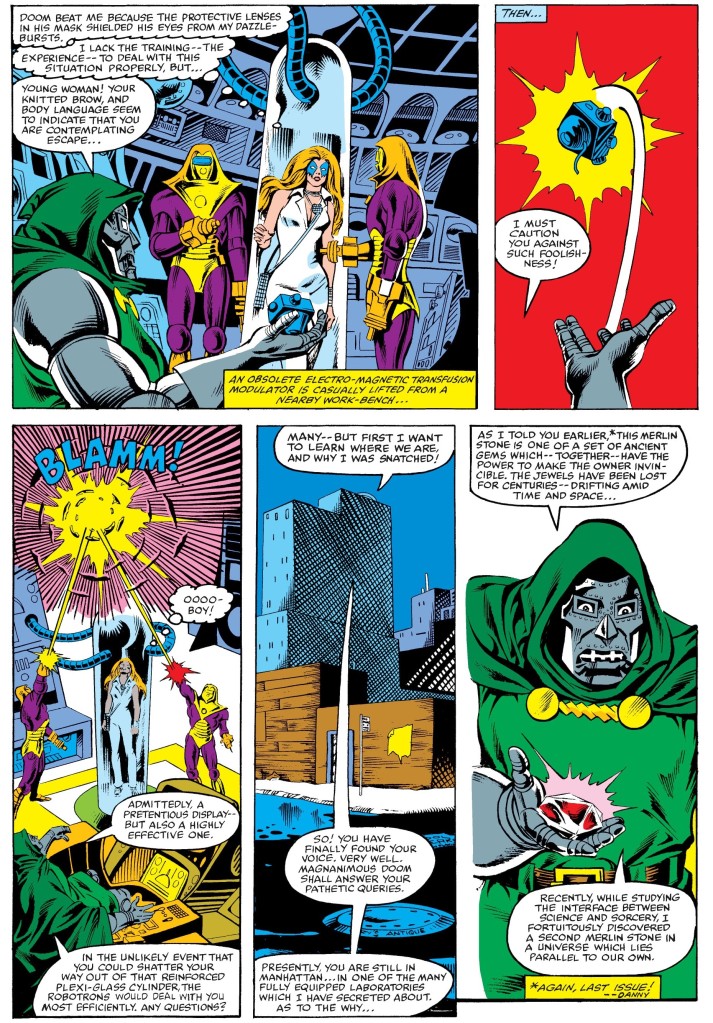
The story begins inside a secret facility. Dr. Doom tells Dazzler that the Merlin Stone he just acquired mirrors her reflections as well as his own. The said stone has unique, mystical properties that Doom believes will help him achieve his dream of domination over mankind.

Dazzler, who is trapped inside a tube and is guarded by two of Dr. Doom’s guards, tries to recover after losing consciousness a short time back. Dr. Doom expresses his observation of her special ability to convert sound into light.

Dr. Doom turns his computer on energizing the tube that contains Dazzler. She suddenly turns into energy and disappears…

Quality

Dazzler in a new dimension.

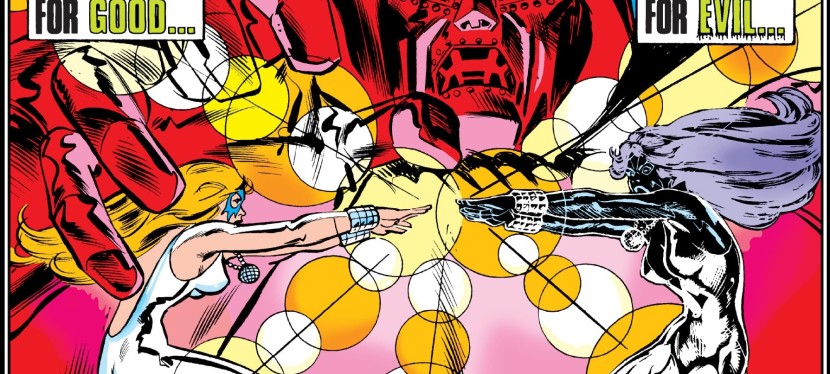
The best way to describe this comic’s story…it is one wild ride that emphasizes a different kind of fantasy for readers. This is, of course, related to Dr. Doom’s immediate quest of finding another Merlin Stone within a different dimension which directly involved Dazzler against her will.

Dazzler here was in a very wild misadventure that goes way beyond the limits of New York City. Being in a completely new dimension, she finds herself literally lost in the sea of space and encounters creatures here and there. This misadventure, however, was not written to be mindless at all. In fact, as the tale in the new dimension goes on, Dazzler was presented to be more tactical, more analytical and do things to solve problems she encountered. She also gets to use her superpower in more creative ways.

The misadventure also has key moments that test Dazzler’s resolve on a personal level. As such, these moments added to her development which also raises the stakes as to what she could potentially do once she returns back to her life. Clearly, this is a story that carefully mixes spectacle and character development without losing track of the story.

On the art of the comic book, Frank Springer’s Dazzler debut is pretty solid. Not only does he capture the look of Dazzler herself, his creative visuals really brought the dimension into life filled with images of out space, fantasy monsters and more. Apart from drawing Dazzler and Dr. Doom, Springer’s art of the Fantastic Four is pretty good to look at.

Conclusion

A helpless Dazzler in the presence of Dr. Doom.

Dazzler (1981) is a fun comic book to read and as a Dazzler story, it is a worthy continuation of the events that took place in issue . The concept about having Dazzler under the power of Dr. Doom was nicely executed which is a very hard feat to achieve since the said super villain was known to be a major force of opposition not only against the Fantastic Four but also against Spider-Man, the X-Men and more. Dazzler’s misadventure into the other dimension was wild and yet nicely structured which led to some nice character development of hers. This comic book had a strong series start for Frank Springer who went on to draw a great majority of the issues of the Dazzler monthly series.

If you are seriously planning to buy an existing hard copy of Dazzler (1981), be aware that as of this writing, MileHighComics.com shows that the near-mint copy of the regular edition costs $28 while the near-mint copy of the newsstand edition costs $60.

Overall, Dazzler (1981) is recommended.

+++++

Thank you for reading. If you find this article engaging, please click the like button below and also please consider sharing this article to others. If you are looking for a copywriter to create content for your special project or business, check out my services and my portfolio. Feel free to contact me with a private message. Also please feel free to visit my Facebook page Author Carlo Carrasco and follow me on Twitter at  @HavenorFantasy as well as on Tumblr at https://carlocarrasco.tumblr.com/
A Look Back at Dazzler #3 (1981)

Disclaimer: This is my original work with details sourced from reading the comic book and doing personal research. Anyone who wants to use this article, in part or in whole, needs to secure first my permission and agree to cite me as the source and author. Let it be known that any unauthorized use of this article will constrain the author to pursue the remedies under R.A. No. 8293, the Revised Penal Code, and/or all applicable legal actions under the laws of the Philippines.

Welcome back, superhero enthusiasts, comic collectors, 1990s culture enthusiasts and fans of Marvel Comics! After a very fine start, things really went downhill with the story and presentation in Dazzler #2. That comic book had Dazzler (then a hot new property for Marvel Comics) completely overshadowed by the big mix of established Marvel superheroes fighting opposition elements. To say the least, Dazzler was a major letdown, a very big disappointment and anyone who loves Dazzler should avoided it.

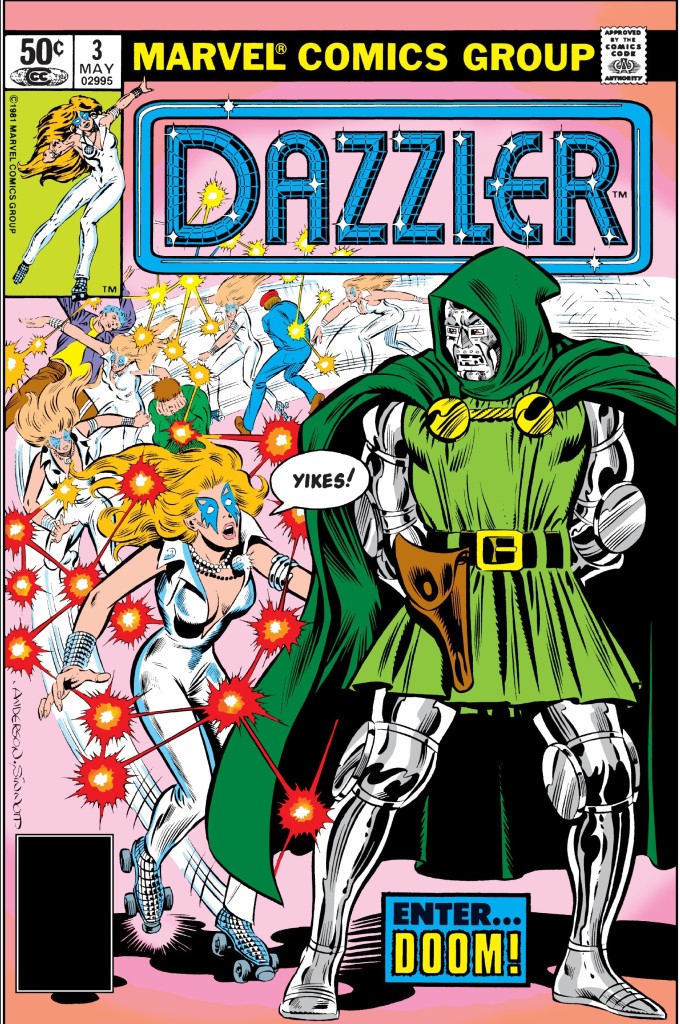
Will we see Dazzler presented much better in the next issue? We can find out in this look back at Dazzler , released in 1981 by Marvel Comics with a story written by Tom DeFalco and drawn by John Romita, Jr., and A. Kupperberg.

The cover.

Early story

The story begins with Dazzler (not wearing her face paint) participating scientific test conducted by Fantastic Four leader Reed Richards/Mr. Fantastic at his team’s headquarters in New York. Dazzler has been converting every nearby sound into radiance and she’s beginning to sense her limitations. The test was done to determine Alison Blaire’s mutant capabilities. Also present were Johnny Storm, Ben Grimm and Sue Richards. Johnny reads a newspaper report about the United Nations’ plan to display the crown jewels that once belonged to their deadliest enemy Dr. Doom.

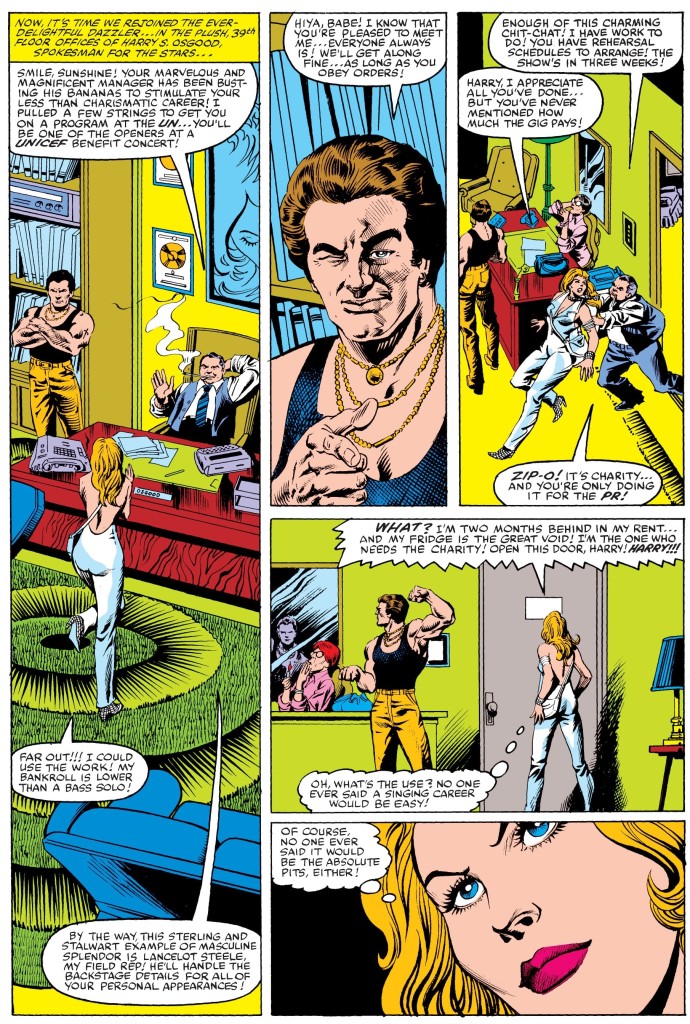
Afterwards, Dazzler meets her boss at his office and learns that she will be one of the openers at the benefit concert of UNICEF which is supposed to help her with her music career. The next morning, she decides to visit her old home where her father lives in. Over at the Bavarian Alps, Dr. Doom gets informed that among the jewels set to be displayed at the Unite Nations is the Merline stone. This compels him to make a move…

Quality

Dazzler versus Dr. Doom!

When compared to the disaster of issue , this comic book’s story is indeed an improvement as it has the expected superhero storytelling formula intact. The good news here is that the character development on Dazzler has returned and there is once again the strong emphasis on her relevance with the people of New York with regards to her being both a superhero and a musician.

The story moved at a moderate pace and it is clear that the creative team took the necessary steps to gradually build up the plot leading to the inevitable encounter between Dazzler and the Fantastic Four’s most definitive enemy (and Marvel Comics’ iconic villain). Take note, however, that the Dazzler-Dr. Doom conflict here is only the beginning.

As this story is more focused on Dazzler, you will get to see an early look at her tainted relationship with her father who desired her to become a lawyer like him, plus there is some focus on the behind-the-scenes development in one of the big events involving her. When it comes to spectacle, there is a right amount of it here which makes this comic book more fun to read than the previous issue.

Conclusion

A look at the business side of the music industry that Alison Blaire/Dazzler is involved with.

Dazzler (1981) is indeed fun to read and the creators succeeded in developing Alison Blaire more while delivering the good stuff. While the match-up between her and Dr. Doom looks awkward from the surface, the strong writing justified it and all along Dazzler never looked like she was out of place being with Marvel’s iconic supervillain.

If you are seriously planning to buy an existing hard copy of Dazzler (1981), be aware that as of this writing, MileHighComics.com shows that the near-mint copy of the regular edition costs $28 while the near-mint copy of the newsstand edition costs $60.

Overall, Dazzler (1981) is recommended.

+++++

Thank you for reading. If you find this article engaging, please click the like button below and also please consider sharing this article to others. If you are looking for a copywriter to create content for your special project or business, check out my services and my portfolio. Feel free to contact me as well. Also please feel free to visit my Facebook page Author Carlo Carrasco and follow me at HavenorFantasy@twitter.com
A Look Back at Dazzler #2 (1981)

Disclaimer: This is my original work with details sourced from reading the comic book and doing personal research. Anyone who wants to use this article, in part or in whole, needs to secure first my permission and agree to cite me as the source and author. Let it be known that any unauthorized use of this article will constrain the author to pursue the remedies under R.A. No. 8293, the Revised Penal Code, and/or all applicable legal actions under the laws of the Philippines.

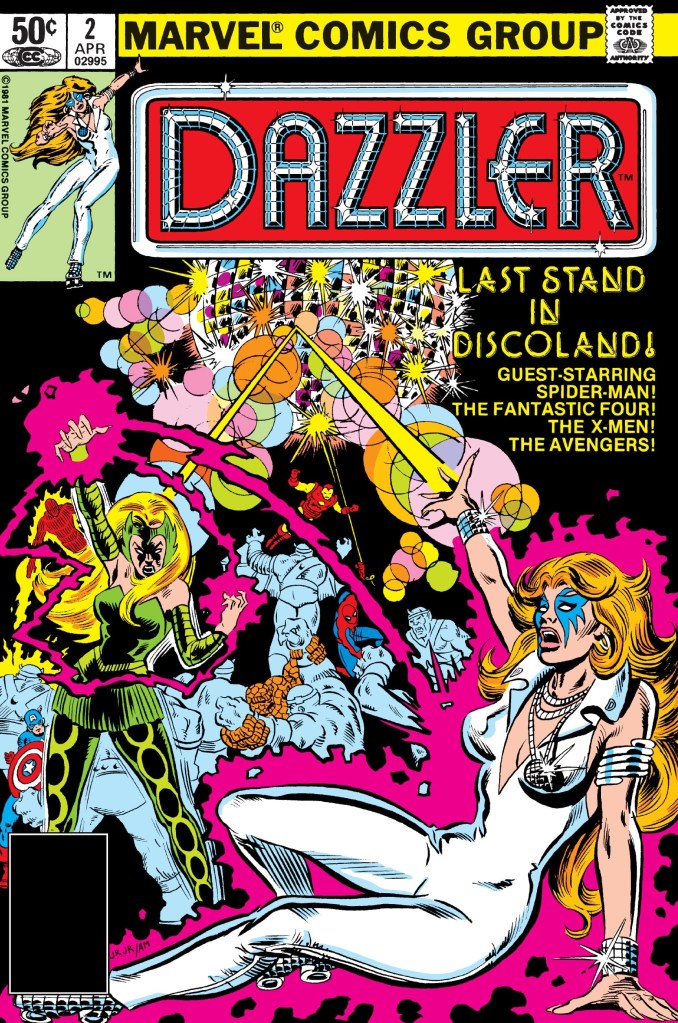
Welcome back, superhero enthusiasts, comic collectors, 1990s culture enthusiasts and fans of Marvel Comics! Way back in 1981, Marvel Comics had a successful comic book series launch with Dazzler (read my retro review by clicking here) which sold over 400,000 copies and further sealed Dazzler as an advantageous addition for the company’s superhero comics franchise. Dazzler, a creation of a deal between Marvel and a certain record company, debuted in Uncanny X-Men #130 and got involved with the X-Men until Uncanny X-Men . Dazzler appeared with Marvel’s famous webslinger in Amazing Spider-Man #203.

Dazzler ended with a brewing rivalry between the title character and Enchantress. With those laid down, here is a look back at Dazzler , published in 1981 by Marvel Comics with a story written by Tom DeFalco and drawn by John Romita, Jr.

The cover.

Early story

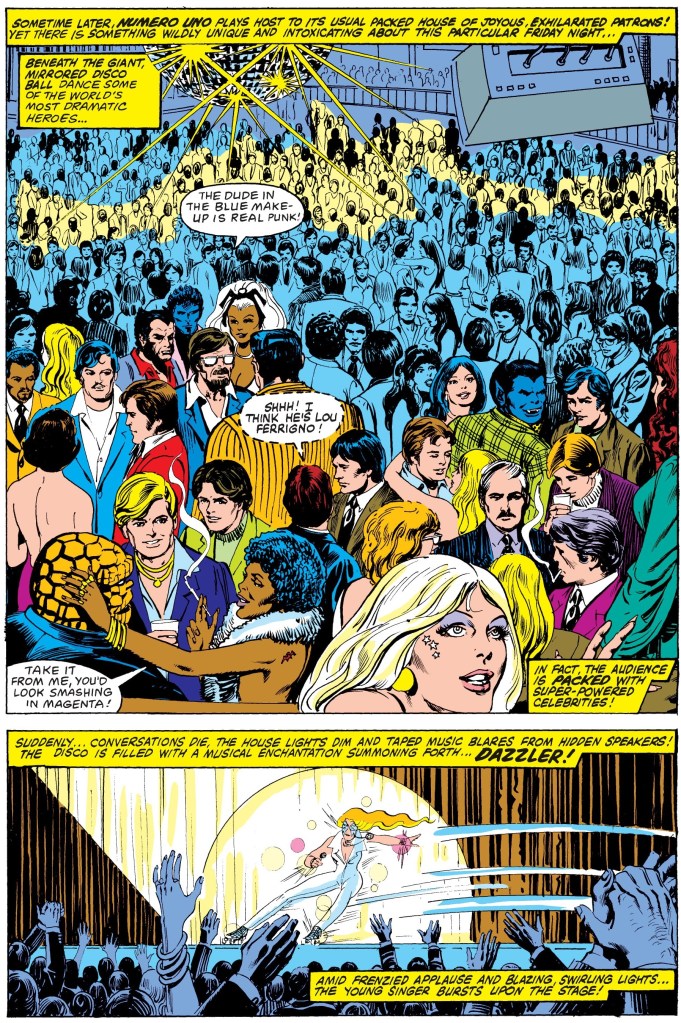
The story begins with Dazzler preparing for her big show at Numero Uno, a prestigious disco in the city of New York. Just before the show starts, a huge crowd of people are in attendance and among them are Wolverine, Peter Parker (Spider-Man), Captain America, Johnny Storm, Ben Grimm and Tony Stark (Iron Man) to name some.

Just as Dazzler appears on-stage and draws a frenzied applause from the audience, the revenger-hungry Enchantress slowly makes her moves to ruin the lady who outclassed her to be the main attraction of the club. Even with her desire for revenge, the Enchantress decides to use her magic sparingly on Dazzler. In the audience, Peter Parker/Spider-Man begins to sense something is about to happen…

Quality

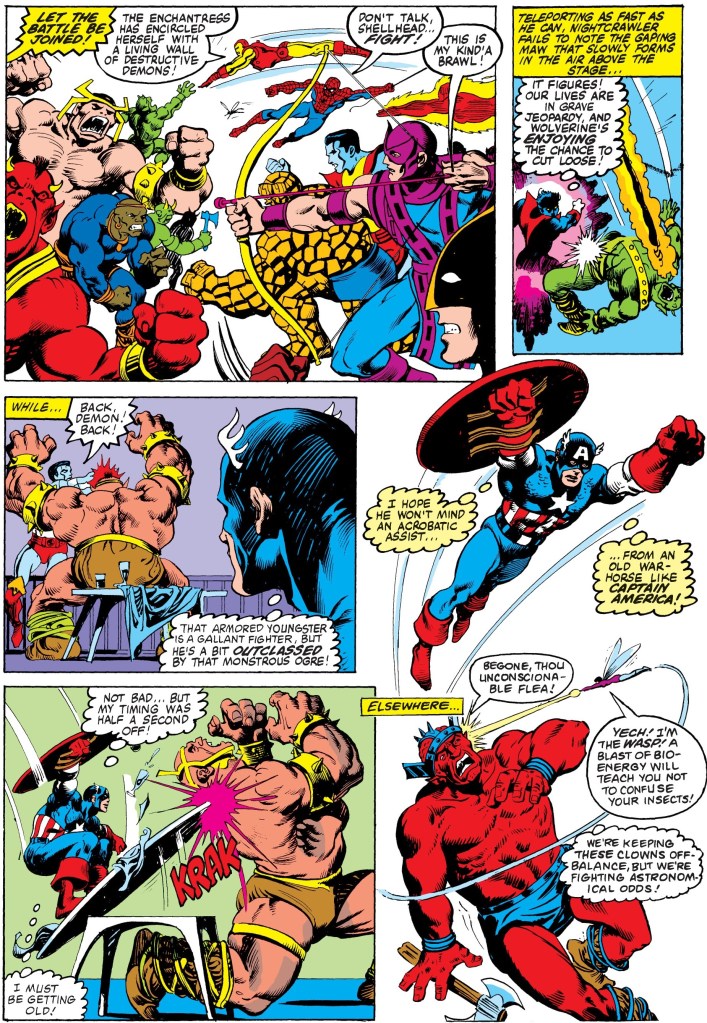
This shows what this comic book is really about.

The way the story was told is disappointing. This is because the spotlight on Dazzler and her anticipated conflict with the Enchantress got overwhelmed by the amount of superhero filler on the narrative. To be clear, it is fun and interesting to see a mix of the varied superheroes of Marvel together but this comic book ended up being an all-star showcase (X-Men, Avengers and Fantastic Four members included) than a real, standalone Dazzler story. In fairness, Tom DeFalco showed how skilled he is with plot structuring and capturing the personalities and tropes of the different superheroes (note: unsurprisingly, DeFalco accurately captured Spider-Man’s personality and he went on to be a major force behind Spider-Man comic books) but that does not change the fact that this comic book should have been more about Dazzler.

When it comes to the conflict between Dazzler and the Enchantress, it was executed with no depth at all. Literally speaking, there is not enough meat to consume here and it the conflict really ended up looking very rushed. As if that was not bad enough, there is not enough justification to show Dazzler defeating a monster summoned by the Enchantress.  Considering how shallow the Dazzler-Enchantress match-up turned out, it’s no wonder why there is so much Marvel all-star filler in the script.

As for the late-stage attempt to shift the narrative back to Dazzler, it is rather over-the-top and unsatisfying.

Conclusion

You recognize someone in the audience?

Dazzler (1981) is an example about a creative team’s lack of confidence on crafting a decent story to develop a new superhero and ultimately resorting to fill it with a mix of other superheroes involved which itself symbolizes desperation. This comic book is not really a Dazzler story but an all-star showcase with Dazzler becoming a minor character in her own monthly series.

If you are seriously planning to buy an existing hard copy of Dazzler (1981), be aware that as of this writing, MileHighComics.com shows that the near-mint copy of the regular edition costs $28 while the near-mint copy of the newsstand edition costs $60.

Overall, Dazzler (1981) is unsatisfactory. Anyone who loves Dazzler or who wishes to discover more of her will be disappointed with this comic book.

+++++

Thank you for reading. If you find this article engaging, please click the like button below and also please consider sharing this article to others. If you are looking for a copywriter to create content for your special project or business, check out my services and my portfolio. Feel free to contact me as well. Also please feel free to visit my Facebook page Author Carlo Carrasco and follow me at HavenorFantasy@twitter.com