Disclaimer: This is my original work with details sourced from reading the comic book and doing personal research. Anyone who wants to use this article, in part or in whole, needs to secure first my permission and agree to cite me as the source and author. Let it be known that any unauthorized use of this article will constrain the author to pursue the remedies under R.A. No. 8293, the Revised Penal Code, and/or all applicable legal actions under the laws of the Philippines.
Welcome back superhero enthusiasts, 1990s culture enthusiasts and comic book collectors! Today we go back to the year 1993 and explore a chapter of the Reign of the Supermen storyline through one of the issues of the Superman monthly series.
To put things in perspective, DC Comics fulfilled its promise to kill the iconic Man of Steel in Superman #75 (1993) which sold a whole lot of copies and the daring death concept made Superman a hot news item. After a brief period showing what the world is like without Superman, DC resurrected him in Adventures of Superman #500 which spawned the different Supermen and a new storyline (the Reign of the Supermen) which took effect on the four Superman monthly series of the time.
With those details laid down, here is a look back at Superman #78, published in 1993 by DC Comics with a story written and drawn by Dan Jurgens.
The cover.
Early story
The story begins with Lois Lane still thinking about Superman as she drives her car on a rainy night. At the moment, she still has not learned to live without him. As she is granted access into a facility of Lexcorp, she carefully thinks about the sudden number of many people around the country who claimed to have seen Superman.
Inside the facility, Dr. Meyer meets her and tells her that had met the Man of Steel sometime prior and he believes that the certain person who saved him and others was definitely the same person. Being skeptical, Lois Lane asked him if some other superhero saved them from certain death. In response, he shows to her an image of the heroic figure captured by security cameras. Lois recognizes the face and head even though some parts were shadowed…
Quality
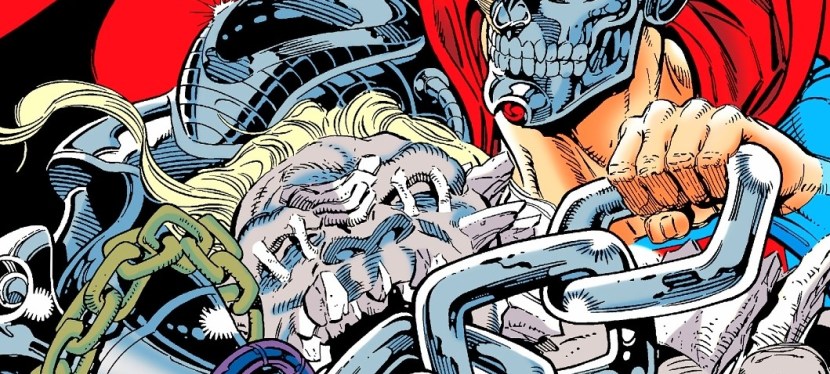
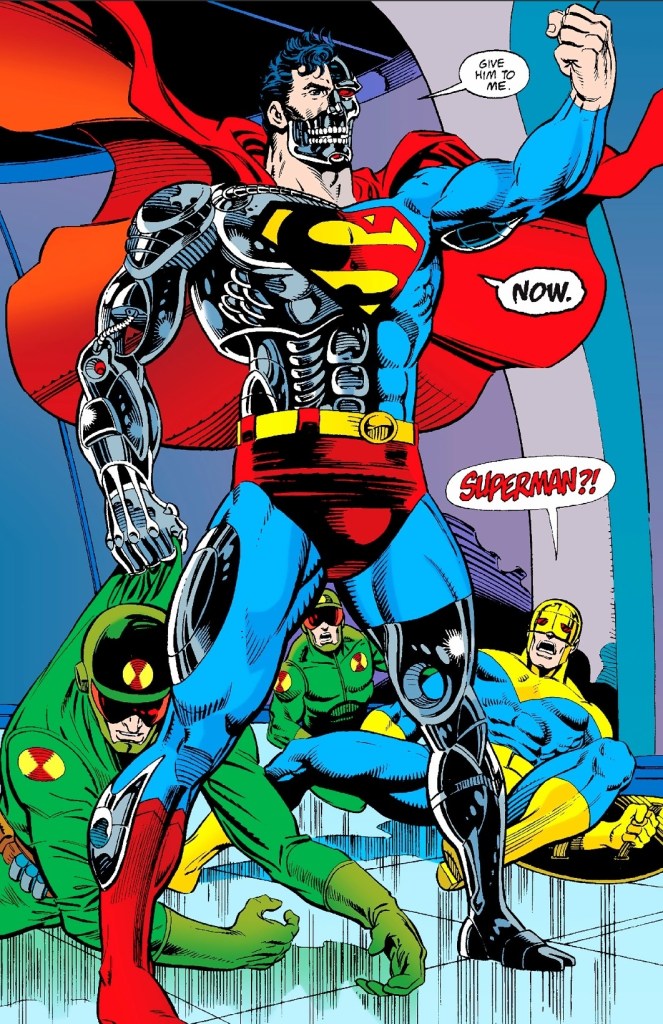
Cyborg Superman in full appearance.
Starting with the storytelling, I can say that this is one solid tale that really pokes the curiosity regarding Cyborg Superman…is he the real Superman or some very clever and capable impostor? Dan Jurgens really knows his Superman stuff and he used a clever approach on arousing the readers’ curiosity while still managing to move the story forward. As one of the early chapters of the Reign of the Supermen storyline, it was very obvious that things were set in motion to set up future post-death Superman stories.
The most engaging parts of this tale were the scenes between Lois Lane and Cyborg Superman (note: he sure looks like a Terminator-inspired take on the Man of Steel which itself was a daring concept back in 1993). Lois Lane here is clearly intelligent and for personal and professional reasons, she would not settle for words as definitive answers but have evidence scientifically analyzed right in front of her. Once again, this is a lively reminder that in the post-Crisis universe of DC Comics, Lois Lane is persistent on verifying facts to realize the truth (which is something clearly missing in today’s world of social media and news media outlets serving as loudspeakers for political forces).
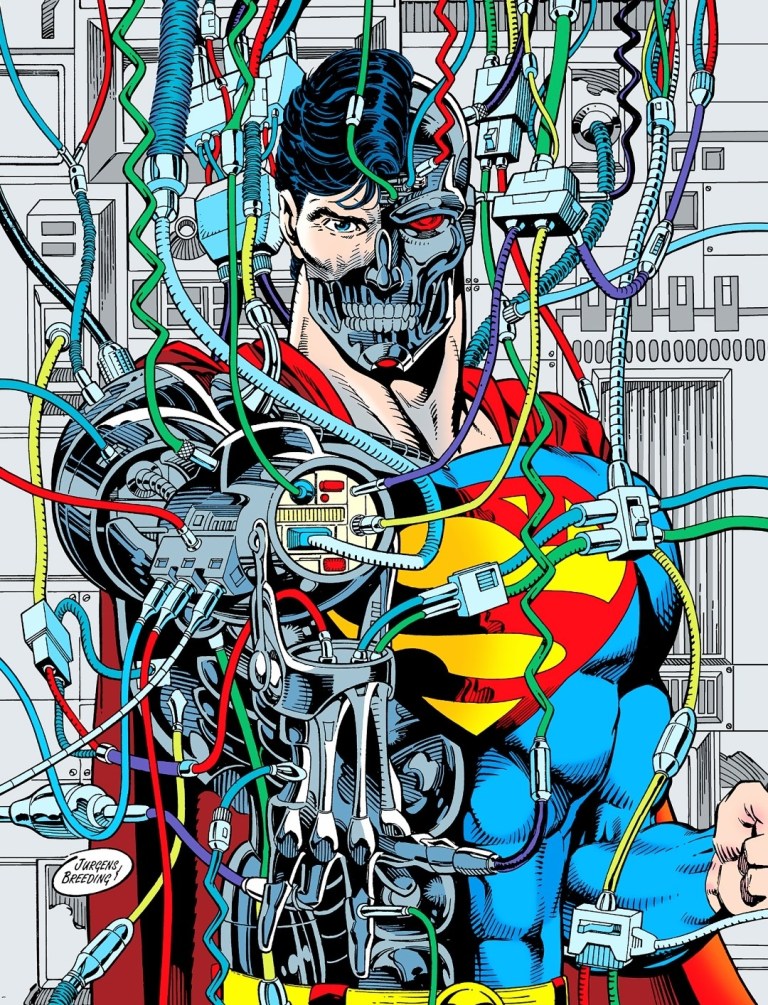
While the storytelling remains good all these decades, what really aged badly in this comic book was the bastardization of Superman’s iconic imagery with some robotic influences of the Terminator mixed in that made him look science fictional in appearance. Of course, Cyborg Superman was just one of the Supermen in this storyline and the Reign of the Supermen concept was clearly an extension of DC Comics’ dishonesty behind the death and return of the Man of Steel. This also shows DC’s irresponsible handling of one of America’s icons. Let’s be honest with ourselves here…how many of you really want to see Cyborg Superman in live-action form in a future DC superhero movie from Warner Bros. and James Gunn?
Conclusion
How many of you have this poster of a very bastardized image of Superman in your homes right now?
While Superman #78 (1993) has a good story told and added to the mystery about the resurrection of Superman, it ultimately served as a build-up platform to set up further stories not only about the Man of Steel but also that of Doomsday (note: a big rematch happened a few years later). The image of Cyborg Superman is clearly a defamation of the iconic look of the Man of Steel and that alone really brought the overall entertainment value of this comic book way down in my view. I find it baffling that there was no major backlash nor an outrage from Superman fans back in 1993 over this.
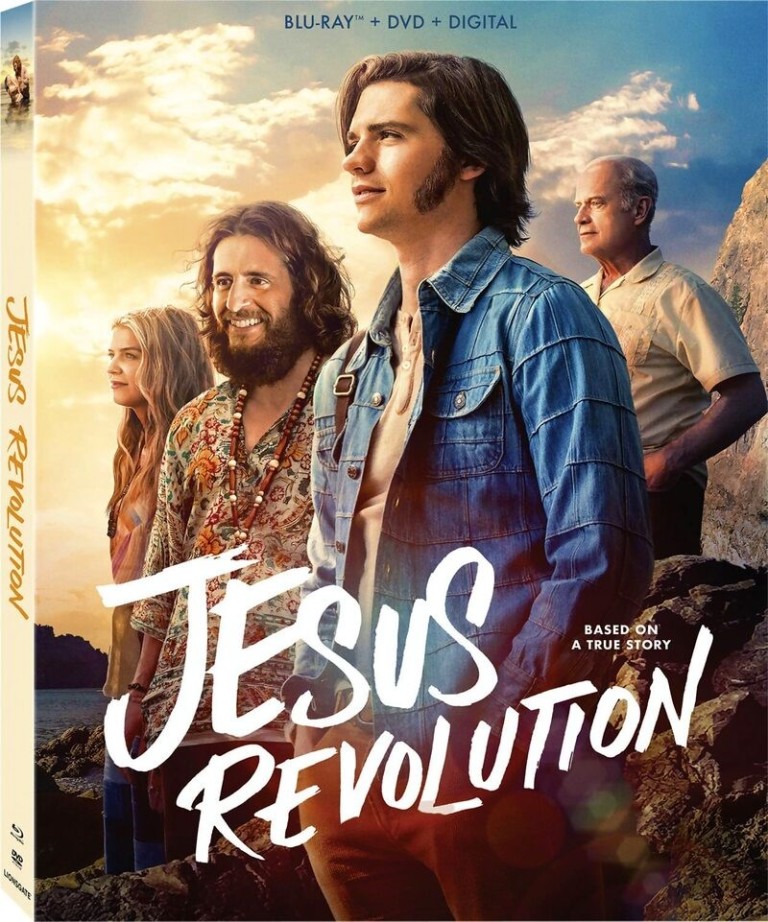
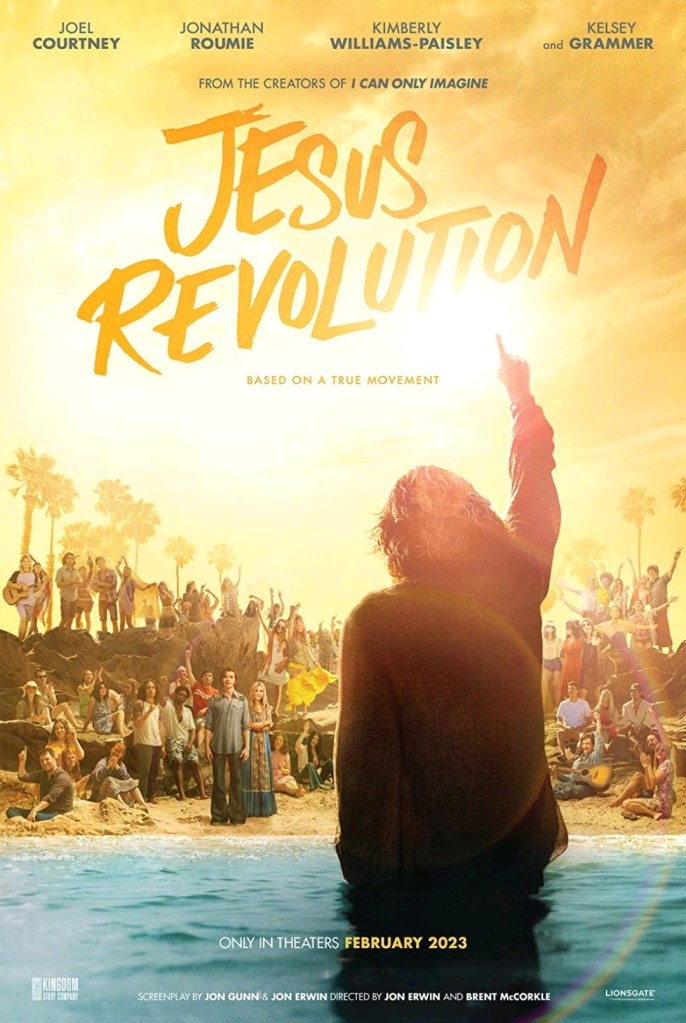
Welcome back, fellow geeks, Blu-ray collectors and movie buffs! If you are into films about faith and Lord Jesus told through an American perspective, then you should check out Jesus Revolution on Blu-ray disc format which has been available in the market since April 25, 2023. It also emerged as a top-selling Blu-ray disc release and you can order it online right now!
Jesus Revolution Blu-ray cover.
To put things in perspective, posted below is the description of Jesus Revolution as well as its official trailer…
In the 1970s, young Greg Laurie (Joel Courtney) is searching for all the right things in all the wrong places: until he meets Lonnie Frisbee (Jonathan Roumie), a charismatic hippie-street-preacher. Together with Pastor Chuck Smith (Kelsey Grammer), they open the doors of Smith’s languishing church to an unexpected revival of radical and newfound love, leading to what TIME Magazine dubbed a JESUS REVOLUTION.
Posted below are the technical details about Jesus Revolution Blu-ray disc as sourced from the Blu-ray.com page of the movie…
Video
Codec: MPEG-4 AVC
Resolution: 1080p
Aspect ratio: 2.39:1
Original aspect ratio: 2.39:1
Audio
English: Dolby Atmos
English: Dolby TrueHD 7.1 (48kHz, 24-bit)
French: Dolby Digital 5.1
Spanish: Dolby Digital 5.1
Subtitles – English SDH, French, Spanish
Discs – Blu-ray Disc, Two-disc set (1 BD-50, 1 DVD), DVD copy
Digital, Digital HD, Digital copy included
Packaging – Slipcover in original pressing
Playback – 2K Blu-ray: Region A
While I have not seen Jesus Revolution in the local cinemas, I myself am interested in buying the Blu-ray disc soon. I am a person with unbreakable faith in Jesus who is truly the Lord and Savior! More on the what the movie has to offer, its release is timely as America has been so divided as many people moved away from the Lord to embrace evil elements such as critical race theory, homosexuality, LGBTQ culture, transgender concepts, abortion, anti-police movements, anti-Semitism, terrorism, illegal immigration, witchcraft, Communist/socialist/Marxist ideologies, negative elements affecting churches, vandalism of places of worship, Satanic values inserted through entertainment media, and a whole lot more. Watch the related CBN News videos below…
By today’s standards, the social unrest America had during the Vietnam War era looks smaller compared to what has been going on over the past few years. People are getting divided over race, gender, social class and a whole lot more. As such, Jesus Revolution has something that viewers can reflect about.
When it comes to restoring people and societies from the damage caused by evil forces, only the Lord can provide restoration and healing. That being said, you must praise the Lord and have unwavering faith in Him no matter what happens. Being a worldly person means living with unholy elements. A lot of people may not realize it but it is clear they need Jesus in their lives and in their societies! Learn from the holy scriptures below…
For God so loved the world, that He gave His only Son, so that everyone who believes in Him will not perish, but have eternal life.
John 3:16 (NASB)
Jesus once again addressed them: “I am the world’s Light. No one who follows me stumbles around in the darkness. I provide plenty of light to live in.”
John 8:12 (MSG)
Jesus answered and said to him, “Most assuredly, I say to you, unless one is born again, he cannot see the kingdom of God.”
Disclaimer: This is my original work with details sourced from reading the comic book and doing personal research. Anyone who wants to use this article, in part or in whole, needs to secure first my permission and agree to cite me as the source and author. Let it be known that any unauthorized use of this article will constrain the author to pursue the remedies under R.A. No. 8293, the Revised Penal Code, and/or all applicable legal actions under the laws of the Philippines.
Welcome back superhero enthusiasts, 1990s culture enthusiasts and comic book collectors! Today we go back to the year 1992 and explore a part of what was back then the 30th anniversary celebration of Spider-Man
In what was back then a unique approaching to celebrating the anniversary of an American icon, Marvel Comics published not one but four specific Spider-Man comic books that had holographic covers and more pages than the usual. Each of those special comic books were from a different Spider-Man monthly series. Back in 2020, I published a retro review of one of those gimmick cover comic books from the Spider-Man monthly series.
With those details laid down, here is a look back at Web of Spider-Man #90, published in 1992 by Marvel Comics with a story by Howard Mackie and drawn by Alex Saviuk.
The cover.
Early story
The story begins inside an office in Los Angeles. A hat-wearing businessman has several varied figures of Spider-Man near him and recalls the time when the iconic hero participated in one of his events as the Masked Marvel. Moments later, the businessman’s wife arrives and together they departed in a limousine.
At the South Bronx in New York, Spider-Man chases a speeding car with one of its passengers firing a gun at him. Suddenly, his spider sense bothers him a lot and when he looks around, he suddenly sees Galactus standing with members of the Avengers, the X-Men and the Fantastic Four lying down helpless on the ground…
Quality
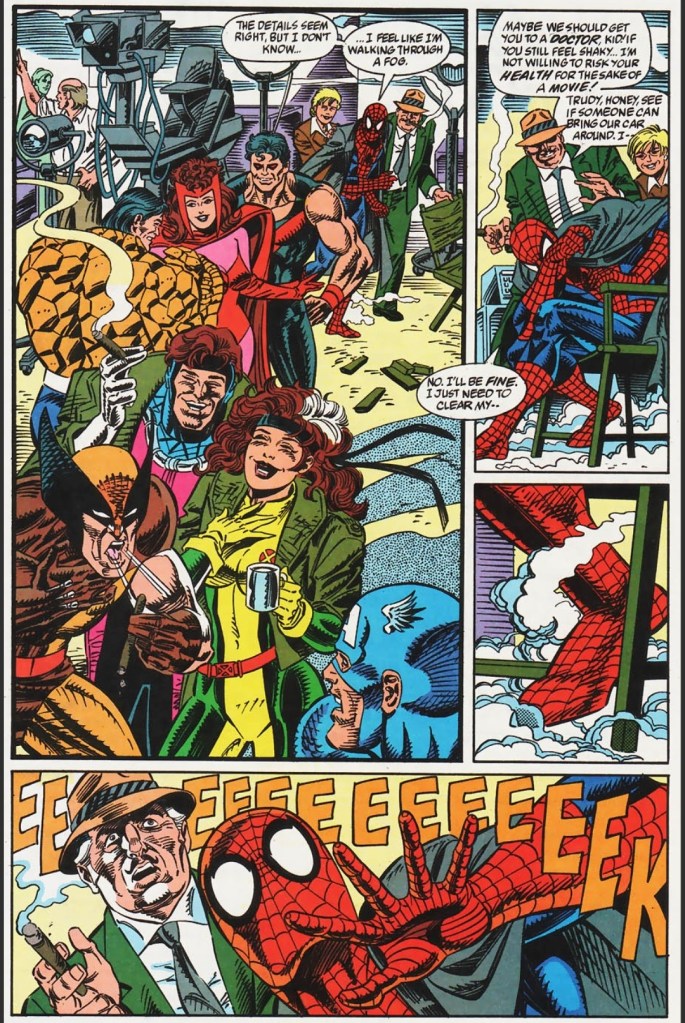
Spider-Man on the set of an entertainment project. It’s a lively reminder about how sickening Hollywood (AKA Commiewood) can get.
To make things clear and without spoiling the plot, this story deals with illusions and the distortion of reality. Quite ironically, the said distortion made it a challenge to follow the narrative and I can say that a good amount of the spotlight was on the businessman. Spider-Man is clearly the protagonist here but it made sense for the creative team to focus a bit on the businessman (who has been doing entertainment showcases for a long time) to justify the core concept about the conflicts between what is real and what is imaginary.
In relation to the illusion aspect of the story, you will get to see established Spider-Man arch-villains such as the Green Goblin, the Hobgoblin and Venom taking on the superhero himself. As the creative team focused more on providing a great amount of spectacle, there clearly was no room left for character development on Spider-Man. Don’t expect to see Peter Parker in dramatic moments nor see him interact with the established supporting characters.
If there is any moral lesson to learn from this comic book, it would be this – living with a powerful delusion (the result of personal obsession mixed with the personal failure to separate illusion from reality) can lead you to the wrong directions in life.
Conclusion
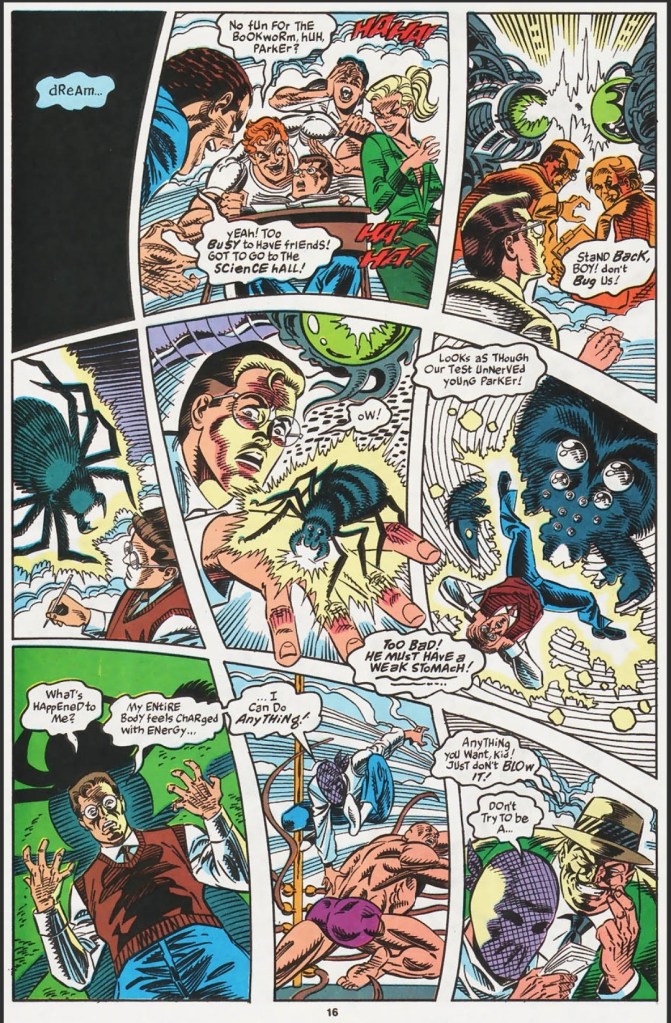
To justify the 30th anniversary celebration, distorted flashbacks into Peter Parker’s past were presented here.
Web of Spider-Man #90 (1992) does not have much depth for those who seek engaging storytelling. That being said, the story itself is not memorable nor would it leave a long lasting impact on you. This comic book was made to entertain readers with lots of action and wild fantasy images that eerily justify its concept about illusion and reality conflicting each other. In fairness to the creative team, the said conflict was consistently visualized and there were some dialogue that related to it in a somewhat philosophical manner. The comic book’s entertainment value is satisfying enough although it does not justify the holographic cover that was part of the gimmick with celebrating Spider-Man’s 30th anniversary. As for who was the main antagonist of the comic book, I simply encourage you all to read and find out for yourselves.
Overall, Web of Spider-Man #90 (1992) is satisfactory.
Welcome back my readers, fellow people of faith and those who love entertainment. Today, I want to emphasize something within the 1983 sci-fi epic TV miniseries V: The Original Miniseries.
Before I proceed, I want to address the newcomers reading this. V: The Original Miniseries was about alien humanoids from space who arrived on Earth “in peace” but gradually took control of the world and its people through varied means. Told through the viewpoints of affected Americans in California, V: The Original Miniseries was a cerebral and reflective form of science fiction entertainment that strongly parallels Nazi German’s occupation and takeover of countries in Europe in relation to World War II. As expected, a group of resisting people forms led by a reluctant young woman.
I personally love V: The Original Miniseries as well as its 1984 sequel V: The Final Battle. I own Blu-ray discs of the two mini-series (click here and here) and I encourage you to check out my retro reviews (click here and here). To this day, both mini-series remain solid to watch and are worth replaying all over again in my experience.
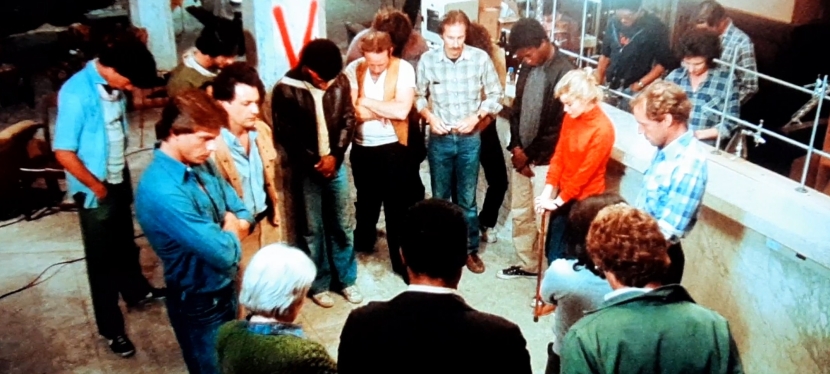
Going back to the subject matter of this post, the one significant scene of V: The Original Miniseries I want to emphasize is the prayer scene in the 2nd episode. The prayer scene took place just before the human resistance (led by Julie Parrish played by Faye Grant supported by Mike Donovan played by Marc Singer, Caleb Taylor played by Jason Bernard and others) execute their desperate moves to free their people from the Visitors (the aliens). Watch below the video clip I recorded off-screen while replaying V: The Original Miniseries on Blu-ray disc…
The prayer scene of V: The Original Miniseries.
As you can see in the above clip, the affected people were about to pull off a major push back against the Visitors from outer space. They no longer had the local police (who are already working with the aliens) nor the National Guard, nor the State Government of California nor any American authority to help them. Caleb, who lost a son, reminded Julie of having a prayer as he knew that without the Lord, everything they will do will fail. Caleb knew that as a rebelling force, they could not succeed against the Visitors by focusing on themselves, their resources and their abilities. Caleb knew they had to look up to God even though he does not know the state of each group member’s personal connection with Him. It was also symbolic to see Julie Parrish declare amen before finally giving the go-signal for their next operation which eventually served as the series of spectacle (action scenes) and suspense serving as the big pay-off for viewers.
Within the context of the what happened in the 2nd episode of the mini-series, Julie and her crew moved to secure essential equipment and military hardware at a local facility guarded by the Visitors which results in acts of violence as both sides fire at each other. These scenes happened after the prayer scene.
That being said, I want to make clear that I am not emphasizing the concept of praying to God to be able to win against the oppositionby means of violence. Violence and using the very methods of wicked people as a means of getting back at them are clearly not the ways under the watch of the Lord. God has a plan for each and every one of us and we have Lord Jesus to follow to save the lost and unsaved souls. The Lord has His ways of defeating Satan and his pawns, and we only need to follow the Lord instead of taking matters on our own hands.
If you are oppressed and you truly need the Lord’s help for favor and breakthroughs, let the Holy Spirit guide you instead of giving in to your fleshly desire of using force on those who attacked you. Do not even think about using the ways the evil ones used against you. Trust in Him, not the worldly and certainly not your flesh. Always remember that vengeance is the Lord’s. Read the bible verses below…
Beloved, do not avenge yourselves, but rather give place to wrath; for it is written, “Vengeance is Mine, I will repay,” says the Lord. Therefore
“If your enemy is hungry, feed him;
If he is thirsty, give him a drink;
For in so doing you will heap coals of fire on his head.”
Do not be overcome by evil, but overcome evil with good.
Romans 12:19-21 (NKJV)
Beloved, never avenge yourselves, but leave the way open for [God’s] wrath; for it is written, Vengeance is Mine, I will repay (requite), says the Lord.
But if your enemy is hungry, feed him; if he is thirsty, give him drink; for by so doing you will heap burning coals upon his head.
Do not let yourself be overcome by evil, but overcome (master) evil with good.
Romans 12:19-21 (AMPC)
Vengeance is Mine, and recompense, in the time when their foot shall slide; for the day of their disaster is at hand and their doom comes speedily.
Deuteronomy 32:35 (AMPC)
But God shows his anger from heaven against all sinful, wicked people who suppress the truth by their wickedness.
Romans 1:18 (NLT)
For I, the Lord your God, will hold your right hand, Saying to you, ‘Fear not, I will help you.’
Isaiah 41:13 (NKJV)
As seen among the bible scriptures above, Romans 12:19-21 should remind you all that vengeance is the Lord’s and we only need to follow Him because He knows best and has the means to help us overcome the forces of evil. In relation to that, this should remind you all that V: The Original Miniseries is not a faith-based story. Rather, it is a science fiction tale designed to entertain viewers while emphasizing the concept of what the world would be like if people welcomed foreign entities to come in peace pretentiously and take over societies by means of force, violence and fascism. Take note that the mini-series was released at a time when science fiction movies and TV shows were in high demand arguably due to George Lucas’ Star Wars.
The prayer sceneshould serve as a reminder that we the faithful in real life should keep trusting in the Lord and we need to support each other and strengthen our faith in Him no matter how twisted the world is around us. That is what makes it significant as part of the mini-series. Learn from the scriptures below…
For wherever two or three come together in honor of my name, I am right there with them!
Matthew 18:20 (TPT)
Now may the God of patience and comfort grant you to be like-minded toward one another, according to Christ Jesus, that you may with one mind and one mouth glorify the God and Father of our Lord Jesus Christ.
Romans 15:5-6 (NKJV)
In Whom, because of our faith in Him, we dare to have the boldness (courage and confidence) of free access (an unreserved approach to God with freedom and without fear).
Ephesians 3:12 (AMPC)
Then if my people who are called by my name will humble themselves and pray and seek my face and turn from their wicked ways, I will hear from heaven and will forgive their sins and restore their land.
2 Chronicles 7:14 (NKJV)
Rejoice always, pray without ceasing, in everything give thanks; for this is the will of God in Christ Jesus for you.
1 Thessalonians 5:16-18 (NKJV)
For God has not appointed us to [incur His] wrath [He did not select us to condemn us], but [that we might] obtain [His] salvation through our Lord Jesus Christ (the Messiah)
Who died for us so that whether we are still alive or are dead [at Christ’s appearing], we might live together with Him and share His life.
Therefore encourage (admonish, exhort) one another and edify (strengthen and build up) one another, just as you are doing.
1 Thessalonians 5:9-11 (AMPC)
Finally, while focusing on being with other people of faith and praying to the Lord together as a united body of His, learn from the scriptures below pertaining to Lord Jesus’ ascension to Heaven and His faithful followers (the early Christians) who stayed united together at the Upper Room in Jerusalem and prayed together knowing they are living on with His victory. May this encourage you to be with your fellow spiritual family (God’s family) members and pray to Him together.
Now when He had spoken these things, while they watched, He was taken up, and a cloud received Him out of their sight. And while they looked steadfastly toward heaven as He went up, behold, two men stood by them in white apparel, who also said, “Men of Galilee, why do you stand gazing up into heaven? This same Jesus, who was taken up from you into heaven, will so come in like manner as you saw Him go into heaven.”
Then they returned to Jerusalem from the mount called Olivet, which is near Jerusalem, a Sabbath day’s journey. And when they had entered, they went up into the upper room where they were staying: Peter, James, John, and Andrew; Philip and Thomas; Bartholomew and Matthew; James the son of Alphaeus and Simon the Zealot; and Judas the son of James. These all continued with one accord in prayer and supplication, with the women and Mary the mother of Jesus, and with His brothers.
Acts 1:9-14 (NKJV)
Now watch this video I recorded during my first-ever visit to the Upper Room in Jerusalem which was part of the pilgrimage tour I joined with my local church.
This was from my 2nd visit to the Upper Room in Jerusalem. I went to Israel on a pilgrimage tour with my local church because I desired to seek God’s kingdom there (read Matthew 6:33).
From this point on, I would like to reach out to all the lost and the unsaved people reading this. Did a religious and idolatrous extremist ruin your life? Have you been living in bondage for too long? Did the atheists, the humanists and the secularists fool you and abused you? Were you involved in the terrorist activities of Iran or the Palestinians? Have you been living as a homosexual or as a transgendered person? Are you still addicted to sex, drugs and other inappropriate elements? Did you spend an entire life worshiping statues, statuettes, images, people and relics? Are you a toxic person or one of those modern-day Leftist activists (Black Lives Matter, Democratic Socialists of America, Antifa, the abortionists and others) who got fed up fighting for worthless causes? Did you kill someone and have been living so long with the guilt?
All of the darkness related to what was mentioned above can finally end and you can decide to do it! How? You can save yourselves by submitting yourselves to the Lord Jesus willingly and realize He is the Light! There is no force and no coercion here. You have time and freedom to decide to receive Jesus as your Lord and Savior. For those who have decided to get born again now and gain salvation, please read the instructions and follow the prayer that I learned from a pastor.
Are you ready? Firstly, open your heart to the Lord and pray this simple prayer in sincerity from your heart:
Father God,
I thank You. I believe Jesus is Your Son. I believe that He died for me and redeemed me from all of my sins. He took my sins and, Father, thank You for loving me and You demonstrated Your love for me through Your Son Jesus Christ. Forgive me for all of my sins. Jesus, I open my heart to You. I welcome You to enter into my heart. I confess today that You are now my Lord and Savior. Thank You for forgiveness. I receive forgiveness. Thank You for Your blood that cleansed me from all of my sins. I will follow You, Jesus. Thank You for Your plan. I receive the Holy Spirit. And Holy Spirit, help me to follow the will of God in my life in Jesus’ name. Amen.
Congratulations! You are now a child of God! You have received Holy Spirit in your heart! This is easily your greatest decision ever made and also the greatest miracle of your life. Always praise, thank and honor the Lord. No more darkness in your life caused by politics, radicalism, toxicity, rebellion, religion, unbelief, evil, idolatry, traditions and rituals! Leave behind the darkness of your life and don’t look back to it. Remember that idolatry is evil, Purgatory is a lie, penance is a deception and Satan always used religion and unbelief to prevent people from being saved by the Lord. Also, do not ever hail Mary (the mother of Lord Jesus) because all the praise and honor belong to God, Lord Jesus and the Holy Spirit only.
With Lord Jesus, you are already moving forward and the best is yet to come! You also have a personal relationship with God, a relationship that is strictly off-limits to others (even to your household members or biological family members).
The Holy Bible is the ultimate authority and nothing else comes close to it for it is the Word of God. Remember always that Lord Jesus did not die on the cross to start religion. He died to redeem us all and showed that we must be led by faith in Him, faith in the Holy Spirit and faith in God the Heavenly Father. He rose from the dead and made His earthly presence felt once more to those who believed in Him. Lord Jesus ascended to Heaven and He promised to return in the future. His return is what we must always remember and keep living with holiness under the watch of God. We can do our part in building up God’s kingdom here on Earth by preaching His Word, blessing the Jewish people and saving the countless lost and unsaved souls around us by leading them to Lord Jesus. Living as a Christian is always about the personal relationship with the Lord, and it is certainly not about religion. Never let the idolaters, the idol makers, the ritual practitioners and other sinister forces fool you into becoming unholy.
Thank you for reading. If you find this article engaging, please click the like button below, share this article to others and also please consider making a donation to support my publishing. Sharing this Christian piece means spreading the good news of the Lord to others. It can help you save the unsaved and the lost souls out there.
Disclaimer: This is my original work with details sourced from watching the movie and doing personal research. Anyone who wants to use this article, in part or in whole, needs to secure first my permission and agree to cite me as the source and author. Let it be known that any unauthorized use of this article will constrain the author to pursue the remedies under R.A. No. 8293, the Revised Penal Code, and/or all applicable legal actions under the laws of the Philippines.
Welcome back, readers! For only the 2nd time since the COVID-19 pandemic affected the world, I managed to watch a movie inside the local cinema at SM Southmall in Las Piñas City. What is intriguing is that the movie I saw is actually a carefully edited compilation of footage sourced from an upcoming live-action series that is an ambitious Philippine adaptation of a certain giant robot anime from Japan. The movie I saw was Voltes V: Legacy – The Cinematic Experience. Behind it all, the movie is part of GMA Network’s strategy of building up awareness for the Voltes V: Legacy TV series set to launch on May 8, 2023.
For the newcomers reading this, the original Voltes V anime series (Japanese title: Chôdenji mashin Borutesu Faibu) was launched in Japan in 1977. Shortly after, it made its English language debut here in the Philippines (note: Japanese characters’ names were Westernized) and ultimately it became very popular and it made an impact on millions of Filipinos who saw it and replayed it in the many years that followed. I noticed that many Filipinos of my generation think of Voltes V first when anime comes to mind. While I myself never became a fan, I saw lots of Voltes V anime episodes on TV at a time when Internet access, video streaming and social media were not yet realized here in the Philippines. I even saw GMA’s edited Voltes V anime movie (containing footage of the final five episodes of the anime series) in the cinema in 1999.
In recent years, GMA Network and its local talents joined forces with Toei Company of Japan to create a live-action TV series adaptation of the anime and there will be eighty episodes (double the anime TV series’ episode count) for broadcasting nationwide. This is Voltes V: Legacy and already the local production team went through lots of hard work making the episodes, the sets, the props, the costumes and the computer-generated images (CGI) to bring the classic series into life in coordination with Toei which reviewed and supervised the production. A lot of money has been spent into Voltes V: Legacy which was felt in GMA’s increased production costs.
As for Voltes V: Legacy – The Cinematic Experience, the so-called movie contains varied footage allegedly from the first three weeks’ worth of TV episodes and it was exclusively screened in SM Cinema sites around the country for a limited time.
The story begins in the planet of Boazan where people with horns live in prosperity and privilege while those without horns have no choice but to live a hard, lower life. A gifted young Boazanian man named Hrothgar – who was born into royalty without horns and lived with his personal secret long enough into adulthood – was exposed by Zambojil’s group to be hornless and unworthy of Boazan’s throne. Sometime later, Hrothgar leads several fellow slaves and prisoners in an uprising against Emperor Zambojil’s authority. Before getting overwhelmed by the imperial forces, Hrothgar escapes into space with an Boazanian spacecraft and crashes into the sea on Earth.
He is discovered by Mary Ann and he gets introduced to Dr. Smith and Commander Robinson. Hrothgar informs them of his Boazanian origin and he expressed to them that Earth’s defenses are too weak to protect its people from alien invaders. As he adjusts with Earth life, Hrothgar changes his name into Ned Armstrong, marries Mary Ann and have children together. After several years on Earth, Ned Armstrong worked closely with Dr. Smith to prepare the people for future invasions…
Quality
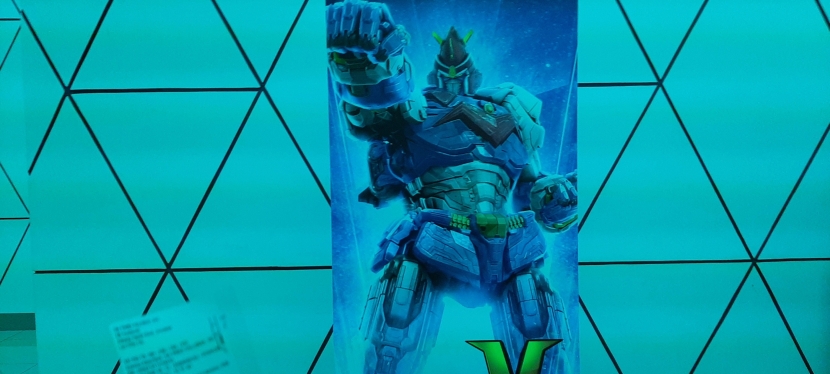
The iconic Voltes V looks bulkier and more mechanical in CGI form and the good news is that the overall quality is great and there is a lot of fun seeing the giant robot in action. (photo source – the Voltes V: Legacy – The Cinematic Experience trailer)
To begin with, the creative team of GMA managed to establish a cohesive narrative for the cinematic experience which is not an easy thing to do considering all the content from many selected episodes that had to be edited and arranged properly. This involves the presentation of the story details, the live-action elements, the CGI-heavy shots and the human performances to create a narrative that was easy enough to follow and absorb in my experience. I noticed that the so-called movie moved at a medium-to-fast pace which is not surprising because the goal of GMA was to entertain moviegoers and convince them to anticipate the live action TV series. Considering the speed of the pacing, there were some moments when I felt that some scenes were missing which only reminded me that the slower and more dramatic moments were being saved for the TV series.
When it comes to adapting the classic anime’s elements into live action, the creative team did a pretty good job most of the time. The costumes of the five pilots were made with a more practical physical design (note: they are not body tight) while retaining the classic colors and the V logo. The interior set of the Camp Big Falcon operations room looked more futuristic complete with having many people simultaneously operating. The interior set showing Prince Zardoz and his trusted companions closely resembles that of the anime. There was one particular physical set that did not look convincing – the outdoor street market in Boazan early in the movie had that indoor feel which not even the lighting could hide and the CGI shot showing the rest of the outdoor area and the far distance did not match with the place.
More on the artistic side of the presentation, I enjoyed the way the production people emulated the classic anime designs of not only the characters but also the key structures (places) and the giant robots (Voltes V and the two beast fighters) into live action. The cinematic Prince Zardoz looks so much like his anime counterpart and the same can be said about Dr. Smith and Mrs. Armstrong. The two beast fighters here were rendered to look much like their anime versions but were animated in a way to emphasize mass and scale.
The strategic posing in this notable shot is a fun and honorable throwback to a key moment in the very first episode of the original Voltes V anime TV series. (photo source – the Voltes V: Legacy – The Cinematic Experience trailer)
There were some notable artistic discrepancies and flaws however. The cinematic Princess Zandra, Draco and Commander Robinson clearly did not quite match their anime counterparts. For some reason, Princess Zandra appeared with a very different costume displaying subtle sexiness instead of royalty. Could it be possible the creative team took inspiration from the Fatima Blush character (played by Barbara Carrera) in the 1983 James Bond movie Never Say Never Again while modernizing Princess Zandra? As for Draco, he does not look as intimidating as his anime version and he even looks more like a cosplayer! Commander Robinson here does not display the maturity of the anime version due to the questionable quality of the costume provided and the actor’s appearance. In my experience watching the anime series, Commander Robinson looked and felt like a military man in his early fifties which the live action version never captured.
Now I want to talk about Voltes V itself. The highlight of the CGI combined with really good art direction is the iconic giant robot, including the five vehicles that compose it. To begin with, the use of CGI emphasizing multiple moving mechanical parts to emphasize Voltes V is a very smart move done by special effects team. While each vehicle has a new visual aesthetic to match the live action approach, they still remained recognizable to me. The biggest visual highlight in the movie is the volt-in sequence when each vehicle combined to form Voltes V in robotic form. As each vehicle connected to each other, the classic sequence from the anime was replicated excellently. Given the artistic direction and the CGI’s emphasis of multiple moving parts, the volt-in sequence here is much more detailed than the anime version! I should state that it is very likely that the visual effects team worked overtime to achieve the high-level of detail, the vibrant colors and the impressive animation on Voltes V.
Watch this. Share to others. Thanks!
With the approach on multiple moving parts, Voltes V itself looks bulkier in a mechanical fashion which I really admire. It should be stated that showcasing the iconic giant robot in action – complete with CGI presentation of the many Voltes weapons – is a visual feast complete with very vibrant colors! Each time Voltes V hits a beast fighter by punching or using a weapon, there is strong impact felt with each blow! The sound effects team really did good work adding weight and power to the action.
The work done by the special effects crew in this external shot of Jamie Robinson’s cockpit is very impressive and detailed! Ysabel Ortega acted convincingly to what happened. (photo source – the Voltes V: Legacy – The Cinematic Experience trailer)
Considering the high detail and strong animation on Voltes V, the two beast fighters shown in this movie had very similar visual qualities. There was no major discrepancy on visual quality between the iconic robot and the enemy during battles.
More on the CGI, I can declare that the locally produced visual effects (by GMA Video and Riot, Inc.) looked very good for the most part! Apart from the battles between the giant figures, the sequences of animating the Voltes V vehicles, the Boazanian flying saucers (with fast moving sharp edges that make them resemble motorized wood-cutting blades), the fighter planes and physical damage of places were nice to see. There were, however, several explosions that were badly rendered (note: even looking flat and out of place) in key scenes and there were moments when military vehicles looked more like they belong in video games from a few console generations ago. The formation of the blade of Voltes V’s laser sword clearly needs more work as it looks unpolished. In the post-credits scene, CGI for Octo 1 was badly done!
Apart from action scenes, the giant robots and their weapons, CGI was also used on established places or structures. Camp Big Falcon really looks magnificent while the floating mechanical Boazanian skull appeared very creepy. In shots showing the far distance, Camp Big Falcon in the background still looks good even though the visual quality falls short of capturing true photo-realism.
Considering the way GMA edited the footage and selected visual effects shots for this so-called movie, the overall quality of the CGI literally landed some notches short of photo-realistic levels. That’s not criticism at all but a confirmation that Filipino-produced CGI showcased here is the best I have seen yet! All in all, an impressive ton of work by the special effects teams using computers.
As for the human performances, I can say that the cast collectively did a good job bringing the characters to life and this includes paying special attention to details from anime while adding certain elements that reflect modernization. Zardoz was portrayed to be sadistic and obsessed on conquering planet Earth which reflects his imperial task and the pressure that comes with it. Sometimes, Zardoz looked and acted even psychotic. Mary Ann Armstrong is the definitive mother figure here and the producers emphasized her more with scenes showing her as a very focused authority during crisis as well as a tender and loving woman during her time with the family. In some ways, Mary Ann Armstrong is almost like the protagonist of this so-called movie and the live action version looks deeper than the anime version. While the live action Commander Robinson needs a lot of improving, Dr. Smith here really looks and feels like he was instantly ripped off the anime resulting in a very straightforward version fans will recognize. The live action Ned Armstrong here has some elements that deviate from what was portrayed in the anime (note: a very skilled fighter whose moves were so obviously choreographed during an action scene) while retaining key elements that still made him recognizable.
The actors who played the five pilots of Voltes V performed nicely. Even with all the layered Tagalog expressions (including gestures that we Filipinos are familiar with), Steve, Big Bert, Little Jon, Mark and Jamie are all very recognizable not in terms of looks but through the dialogue, character details and acting. The production team really worked hard to not only balance their respective shares of the spotlight, but also get good enough performances from the actors. Take note that apart from the on-set dramatization, the actors of the Voltes V team had to perform accordingly in their respective cockpit scenes (note: the special effects teams painstakingly provided all the CGI to specifically reflect what had been happening with the pilots and with their machines) and this includes internal communications between the members. What we have right now are the best actors available portraying Steve, Big Bert, Little Jon, Mark and Jamie and making them recognizable in terms of characterization.
With regards to the music, I can say that this one clearly needs improvement. There is orchestrated music in this cinematic experience that played new tunes while also redoing/recycling classic tunes from the anime TV series. When the anime tunes were played by the orchestra with a modern approach, they were recognizable to my ears but the power and essence of the original tunes were not replicated successfully. Sometimes, I just wished that the anime tunes were played more while the orchestra focused more on providing new music.
As for the famous Voltes V theme song, the new version performed by Julie Anne San Jose is a letdown! I’m not saying San Jose is a bad singer but her version – which even used the Japanese lyrics – lacked impact compared to the original version. While the volt-in sequence proved to be a grand visual feast for the fans and viewers who love great looking CGI sequences, its cinematic impact was brought down a bit by San Jose’s version of the theme song. How I wish that the movie producers just used the classic song from the 1970s anime series!
This original theme song should have been used in Voltes V: Legacy instead of the new version.
Conclusion
As expected, Voltes V: Legacy – The Cinematic Experience has a mix of strong points and flaws. The good news is that the good outweighed the bad and I pretty much enjoyed this cinematic version of the live action adaptation done by GMA, its strategic partners and the local talents. As this so-called movie was a mix of content from several episodes edited to form a suitable narrative, it succeeded in entertaining and engaging me. Yes, there were flaws and there were some parts showing weaknesses but those things did not damage the viewing experience too much. There is a good amount of fun with this so-called movie.
Obviously this cinematic version is part of GMA Network’s strategy to build up anticipation for the upcoming TV series (which has a declared 80 episodes for broadcasting). While some people will perceive Voltes V: Legacy – The Cinematic Experience as a blatant form of marketing or even as corporate gimmick, I personally see it as a worthy showcase in the local cinema (note: cinemas here in the Philippines are still recovering from the massive damage of COVID-19) and it just might not be repeated. Let me remind you readers that this newest Voltes V adaptation highlights the peak of Filipino-produced CGI visuals and the Filipinos’ collective efforts to really make a worthy live action adaptation of a foreign entertainment property. This so-called movie is clearly not perfect (note: it is not deserving of perfect 10/10 scores that others gave it) but it is pretty good to watch in the cinema.
Voltes V looks better than ever and made a big entertaining impact in the cinema. How will Voltes V: Legacy turn out on TV given the fact that there are so many episodes set for broadcasting?(photo source – the Voltes V: Legacy – The Cinematic Experience trailer)
As mentioned earlier, I’m not a fan of the Voltes V anime and I’m not exactly anticipating the Voltes V: Legacy TV series. I do confirm that the long-lasting legacy Voltes V is clearly thriving here in the Philippines and the new TV series could potentially make a deep impact on Filipinos who love entertainment and possibly replicate what happened in the 1970s and 1980s when the classic anime TV aired on TV nationwide. How the new TV series will turn out is clearly GMA’s own problem.
Overall, Voltes V: Legacy – The Cinematic Experience is recommended.
Disclaimer: This is my original work with details sourced from reading the comic book and doing personal research. Anyone who wants to use this article, in part or in whole, needs to secure first my permission and agree to cite me as the source and author. Let it be known that any unauthorized use of this article will constrain the author to pursue the remedies under R.A. No. 8293, the Revised Penal Code, and/or all applicable legal actions under the laws of the Philippines.
Welcome back superhero enthusiasts, 1990s culture enthusiasts and comic book collectors! Today we go back to the early 1990s and explore a part of the Valiant Comics shared universe through the Armorines monthly series.
In my previous retro review, the armored Marines and their US Navy SEALs managed to survive from the destruction of the submarine deep under the sea as they managed to complete their goal. One of the Armorines – Sirot – got separated from them and found himself in the presence of aliens who have been organizing secret operations on Earth, including the recent destruction of X-O Manowar’s armor. Knowing that their teammate is missing, the Armorines went back to the water on a search-and-rescue mission.
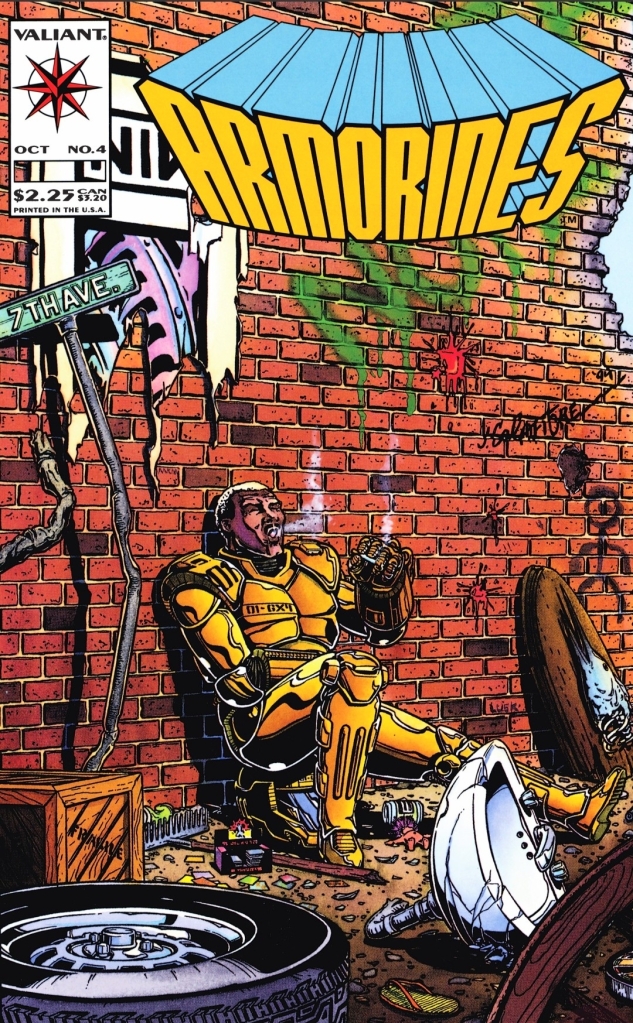
With those details laid down, here is a look back at Armorines #4, published in 1994 by Valiant Comics with a story written by Jorge Gonzalez and drawn by Jim Calafiore.
The cover.
Early story
The story begins inside one of the training domes located just outside Camp Pendleton in California (note: now a Commie-filled state). Teammates Gunny and Sirot engage in a close combat training session using the specialized technology provided to them by Dr. Zhan who carefully watches the statistics. As the session goes on, Sirot sarcastically tells the older Gunny that Senator Ackerman wants him off the Armorines as soon as their superior General Kendall feels the other recruits are properly trained. Sirot mocks him over his age (38-years-old).
Behind closed doors, Senator Ackerman tells General Kendall that even though the Armorines were successful with the mission in Australia and even managed to uncover a nest of aliens, the team were all more than capable without Gunny in their unit. Kendall defends Gunny and stressed that the man is their team’s most experienced member. Ackerman states that once the alien problem is over, he will force Gunny to retire…
Quality
Scenes like this will help readers get to know the Armorines members better.
To be clear, this story is more focused on the characters and is also a suitable build-up for the next turn of events ahead of the Armorines. As with issue #1, Gunny is the closest thing this series has to a lead character and he gets a good amount of character development scenes even though the story showed the other characters. Quite conveniently, the creative team used the military base setting to shift focus on the other Armorine team members similar to what was shown in Hollywood movies or TV shows about military personnel. There is the military club setting where the officers are relaxing and socializing with each other. There were also scenes showing specific soldiers at their respective residences where their true personalities (note: private life moments) are emphasized. All of these were done with solid writing and good artwork.
Without spoiling the details, I can say that the final page of this comic book was surprising and added to my anticipation of the next issue.
Conclusion
Alien vessels leaving Earth for space.
Armorines #4 (1994) is another solid entry in this particular monthly series which served as a good build-up for the next story that happens to be part of a big event that Valiant Comics published (read: The Chaos Effect). It is also within this comic book that you get to know the Armorines, their superiors and other characters better.
Great news! The Lord is blessing the Philippines once again as Planetshakers announced it will be having another worship event in the country on the evening of July 22, 2023 at the SM Mall of Asia Arena in Pasay City. The selling of tickets for the worship event will commence online at SM Tickets on May 11, 2023. This newest event is part of the Show Me Your Glory Planetshakers Tour 2023.
To put things in perspective, posted below is an excerpt from the Planeshakers official announcement. Some parts in boldface…
Planetshakers is so excited to visit Manila once again in July 2023!
It has always been our desire and pursuit to run after God with the intent of seeing His glory. Just as Moses would not go anywhere unless God’s presence accompanied Him, we have that same heart’s cry, and this year, people from all over Asia will be coming together with that same common passion.
Show me Your glory.
We cannot wait to encounter Him and sit back in wonder at all the incredible things that will take place. It’s going to be awe-inspiring!
To those who intend to attend the worship event, the ticket prices have been confirmed as follows: VIP for P1,600, Patron for P1,600, LB Premium for P1,600, Lower Box for P1,200, Upper Box for P1,200, and General Admission for P600.
In preparation for booking tickets online on May 11, 2023, I encourage you to prepare your credit cards and be early to log-in at SMTickets.com because in my experience, there was long virtual line of over 2,600 ahead of me before I got my turn to purchase my tickets and choose my seat.
Whenever a very anointed church like Planershakers holds an event here in the Philippines, it is God’s blessing for the country! Apart from the excellent worship music, Planetshakers has very anointed worship leaders like Pastor and church co-founder Sam Evans and Joth Hunt. If you attend the worship event and pray to the Lord with Pastor Sam Evans leading the prayer, it is a blessing from the Lord because whenever she leads prayers, it is always powerful, truly wholehearted, engaging and compelling! I got blessed like that during the Planetshakers event I attended! The event is, indeed, fellowship with the almighty God, His Son Lord Jesus and the Holy Spirit! The same can be said about this July’s Planetshakers event!
If you are thinking about this July’s Planetshakers worship event, I encourage you to seek the Lord’s Kingdom and praising Him with all your heart and passion. Learn from the holy scriptures below…
“So above all, constantly seek God’s kingdom and his righteousness, then all these less important things will be given to you abundantly.”
Matthew 6:33 (TPT)
Praise the Lord!
Praise God in His sanctuary;
Praise Him in His mighty firmament!
Praise Him for His mighty acts;
Praise Him according to His excellent greatness!
Praise Him with the sound of the trumpet;
Praise Him with the lute and harp!
Praise Him with the timbrel and dance;
Praise Him with stringed instruments and flutes!
Praise Him with loud cymbals;
Praise Him with clashing cymbals!
Let everything that has breath praise the Lord.
Praise the Lord!
Psalm 150:1-6 (NKJV)
The view from my spot during the Planetshakers worship event I attended on September 2022.
If you want to discover and learn more about Planetshakers, I encourage you to click here (Facebook page), here (Instagram), here (Twitter) and here (YouTube). To know more about Planetshakers itself, visit https://www.planetshakers.com/
In closing this, posted below are some Planetshakers worship music videos (including a few from their September 2022 Philippines events) for your faith in the Lord and viewing pleasure. Jesus is our Lord and Savior! Move forward with unbreakable and uncompromising faith in Him! Be the fearless and aggressive church of Lord Jesus!
For more South Metro Manila community news and developments, come back here soon. Also say NO to fake news, NO to irresponsible journalism, NO to misinformation, NO to plagiarists, NO to reckless publishers and NO to sinister propaganda when it comes to news and developments. For South Metro Manila community developments, member engagements, commerce and other relevant updates, join the growing South Metro Manila Facebook group at https://www.facebook.com/groups/342183059992673
Disclaimer: This is my original work with details sourced from reading the comic book and doing personal research. Anyone who wants to use this article, in part or in whole, needs to secure first my permission and agree to cite me as the source and author. Let it be known that any unauthorized use of this article will constrain the author to pursue the remedies under R.A. No. 8293, the Revised Penal Code, and/or all applicable legal actions under the laws of the Philippines.
Welcome back superhero enthusiasts, 1990s culture enthusiasts and comic book collectors! Today we go back to the early 1990s and explore a part of the Valiant Comics shared universe through the Harbinger monthly series.
In my previous review, the conflict between the Harbinger Foundation and Sting’s team got renewed violently. This resulted in an attack on the team of teenagers which led to one of them getting killed. With his other companions missing, Sting finds himself alone, desperate and outraged.
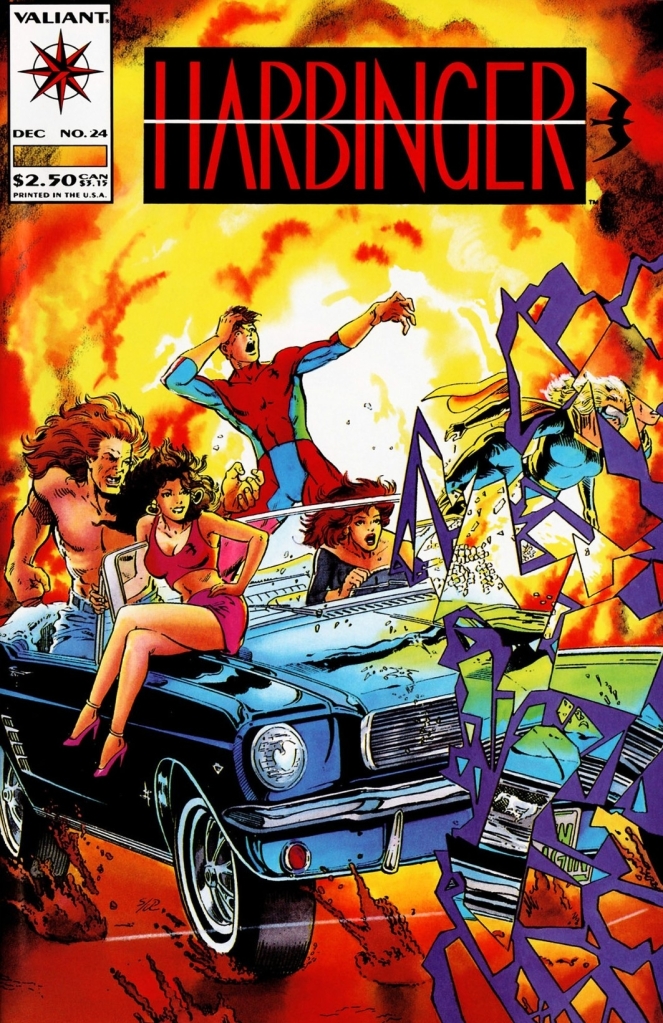
With those details laid down, here is a look back at Harbinger #23, published in 1993 by Valiant Comics with a story written by Maurice Fontenot and illustrated by Howard Simpson.
The cover.
Early story
The story begins on a very early morning. Desperate and very stressed out, Sting causes a disturbance inside a hospital in New Jersey by lifting one of their workers above the floor while pressing them for answers about the whereabouts of his surviving friends Flamingo, Faith and Kris. Already he has visited three other hospitals since the tragedy struck his team and took the life of Shatiqua. Sting remembers that an ambulance took his friends away after their rented house got burned down.
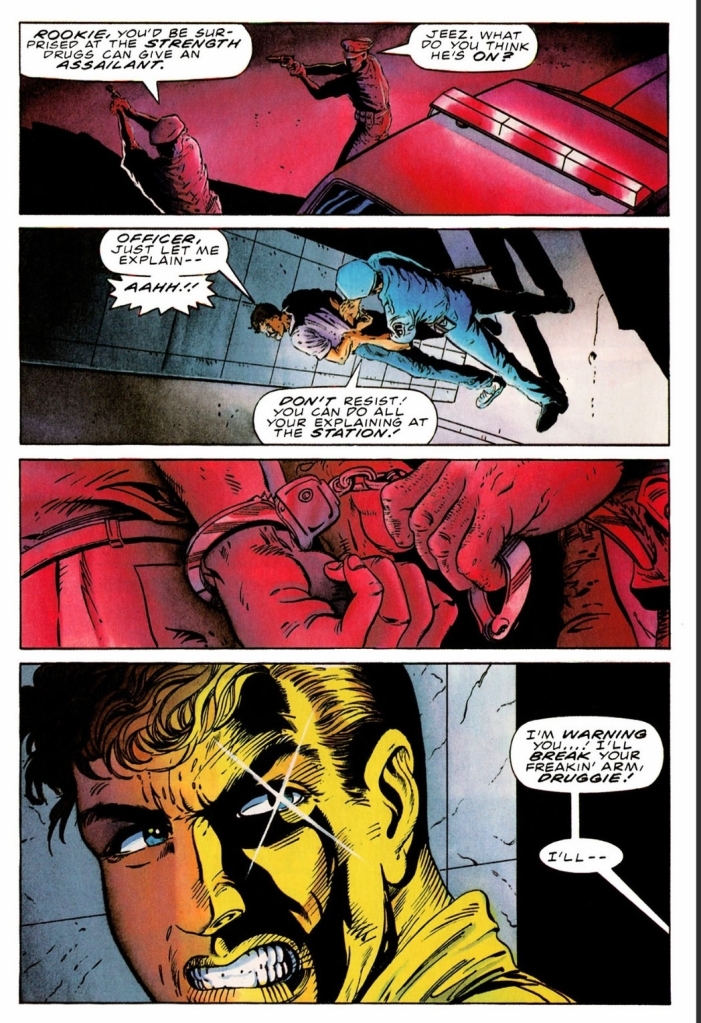
After calming down and getting told by one of the hospital workers that they have notified the police of his presence, Sting walks out and quickly got caught by a police officer. Also present were a few other police officers with their guns aimed at Sting.
As the tension of the arrest rises, Sting gets enraged and starts using his power to free himself…
Quality
This is Sting at his most violent yet.
I can that this Harbinger tale is not only a very solid follow-up to the previous issue, it also showed that the stakes and the suspense have been raised significantly. It also shows that the Fontenot-Simpson team had prepared something for the anticipated conflict between Sting and his former mentor Toyo Harada.
As the other team members were completely absent (note: the nightmare sequence does not count as presence for Faith, Flamingo and Kris), the story strongly focuses on Sting. Yes, as before, he remains reckless and impulsive, he lacks morals (note: he has a bad relationship with his father) and it is no surprise that he becomes suicidal in his desperate search for his companions. Along the way, you will see Sting at his most violent yet which not only blurs the line separating good and evil but also highlights him as a destructive force in human form. Simply put, this series’ so-called hero became as bad as the bad guys and this only added to the anticipation of the one-on-one battle with Harada. While Sting is relatable when it comes to caring and seeking his lost companions, he is also unlikable and very clearly his redemption has yet to happen.
Of course, Sting is not the lone character to follow here as a former Eggbreakers member gets involved. This is significant as the two had some things in common – both were under Harada as Harbinger Foundation’s pupils and left after they realized the wickedness within the organization. The difference here is that the other character spent much more time than Sting under Harada and he went on to get extensive training with the Eggbreakers which is the special team of powered youth under the Harbinger Foundation.
Conclusion
Even though the police officer was doing his duty in accordance to law, Sting does not care.
Harbinger #24 (1993) is a great comic book to read and it also served as a powerful build-up for the anticipated showdown between Sting and Harada (which itself was declared in the final page). The creative team delivered high-quality work here and this Harbinger tale highlights not only the conflict between Sting’s team and the Harbinger Foundation, but also what this monthly series was all about. This comic book has a powerful final page and even before reaching it, you will realize that the stakes have been raised a lot while the line between good and evil got blurred away.
Overall, Harbinger #24 (1993) is highly recommended.
Disclaimer: This is my original work with details sourced from reading the comic book and doing personal research. Anyone who wants to use this article, in part or in whole, needs to secure first my permission and agree to cite me as the source and author. Let it be known that any unauthorized use of this article will constrain the author to pursue the remedies under R.A. No. 8293, the Revised Penal Code, and/or all applicable legal actions under the laws of the Philippines.
Welcome back superhero enthusiasts, 1990s culture enthusiasts and comic book collectors! Today we go back to the early 1990s and explore a part of the Valiant Comics shared universe through the Harbinger monthly series.
In my previous review, Faith, Flamingo and Kris – with her uncle as a companion – accidentally got reunited with Archer and Armstrong at Coney Island. It turns out Kris’ uncle had a negative encounter with Armstrong decades prior which compels him to approach a local crime boss for assistance. This led to a wild chase.
With those details laid down, here is a look back at Harbinger #23, published in 1993 by Valiant Comics with a story written by Maurice Fontenot and illustrated by Howard Simpson.
The cover.
Early story
The story begins with Sting, Flamingo and Faith surrounded by armed personnel at the Harbinger Foundation’s private hangar at La Guardia Airport in New York. Faith does something drastic causing a heavy object from above to start falling down on the armed men. One of the men fires his gun at a barrel of fuel which causes a big explosion.
In a room nearby, Shatiqua and Kris hacked a computer to acquire lots of confidential information from the Harbinger Foundation. After realizing the explosion that happened, they decide to work fast getting the information they need.
On the airport’s tarmac, a private jet is on standby waiting for clearance to take off. Inside is Walter Sakai, who is one of the most trusted men under Toyo Harada…
Quality
Sting, his teammates and their major enemy Toyo Harada.
Without spoiling the crucial details of the plot, the Fontenot-Simpson clearly made the moves to raise the stakes between Sting’s team and the Harbinger Foundation, complete with the build-up of a pending high-stakes conflict between their respective leaders.
Of course, this is the latest conflict between the two sides – one side has super-powered teens who want to live freely while the other is a powerful organization that has been developing its of super-powered youth members using vast resources as well as political connections. This time around, the creative team not only raised the stakes but also came up with some really dark and bizarre scenarios within Sting’s own team. The good news is that Fontenot came up with something new and surprising to keep this series going with a clear direction ahead. The mentioned dark scenarios visually have a horror film vibe.
As for Sting himself, he continues to take action recklessly and without any backup, he impulsively goes after one of Harada’s top executives without considering the consequences. At this stage, Sting has turned unlikable and it really looks like the boundary separating good and evil got blurred away. That being said, there will be moments in which you will feel like wanting to tell Sting he is doing things the wrong way.
Conclusion
Very recklessly, Sting goes after one of Toyo Harada’s most trusted men.
Harbinger #23 (1993) revives the rivalry between Sting’s team and the Harbinger Foundation, only this time there are some very solid twists that resulted in both surprise and intrigue when I read this tale. It seems to me that something tremendous between Harada and Sting was being built up. Considering the really good quality of this comic book and how the story ended, I can say I am looking forward to the next issue.
Disclaimer: This is my original work with details sourced from reading the comic book and doing personal research. Anyone who wants to use this article, in part or in whole, needs to secure first my permission and agree to cite me as the source and author. Let it be known that any unauthorized use of this article will constrain the author to pursue the remedies under R.A. No. 8293, the Revised Penal Code, and/or all applicable legal actions under the laws of the Philippines.
Welcome back superhero enthusiasts, 1990s culture enthusiasts and comic book collectors! Today we go back to the early 1990s and explore a part of the Valiant Comics shared universe through the Armorines monthly series.
In my previous retro review, the armored Marines and their US Navy SEALs counterparts encountered mutated sharks as they struggled to accomplish their mission. Along the way, one of the Armorines literally got swallowed by a huge, organic object that went directly to him during the struggle.
With those details laid down, here is a look back at Armorines #3, published in 1994 by Valiant Comics with a story written by Jorge Gonzalez and drawn by Jim Calafiore.
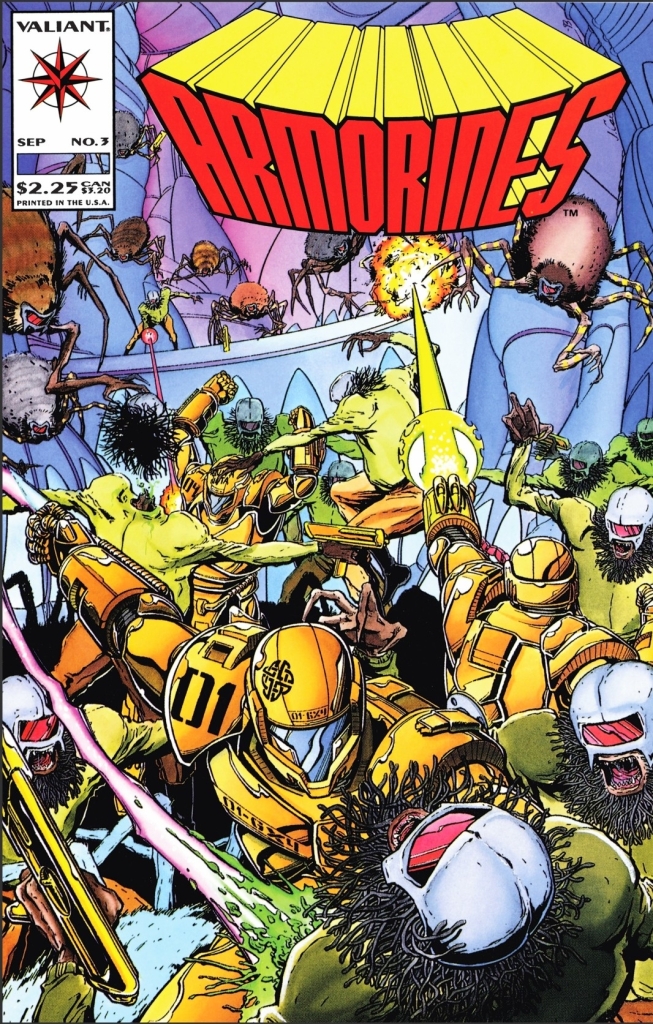
The cover.
Early story
The story begins deep under the sea as the Benchley explodes and falls down further as a result of the mission. Gunny finds himself falling down as well as he no longer has his ballast and propulsion unit. Fortunately, an armored teammate of his saves him and pulls him up to the surface.
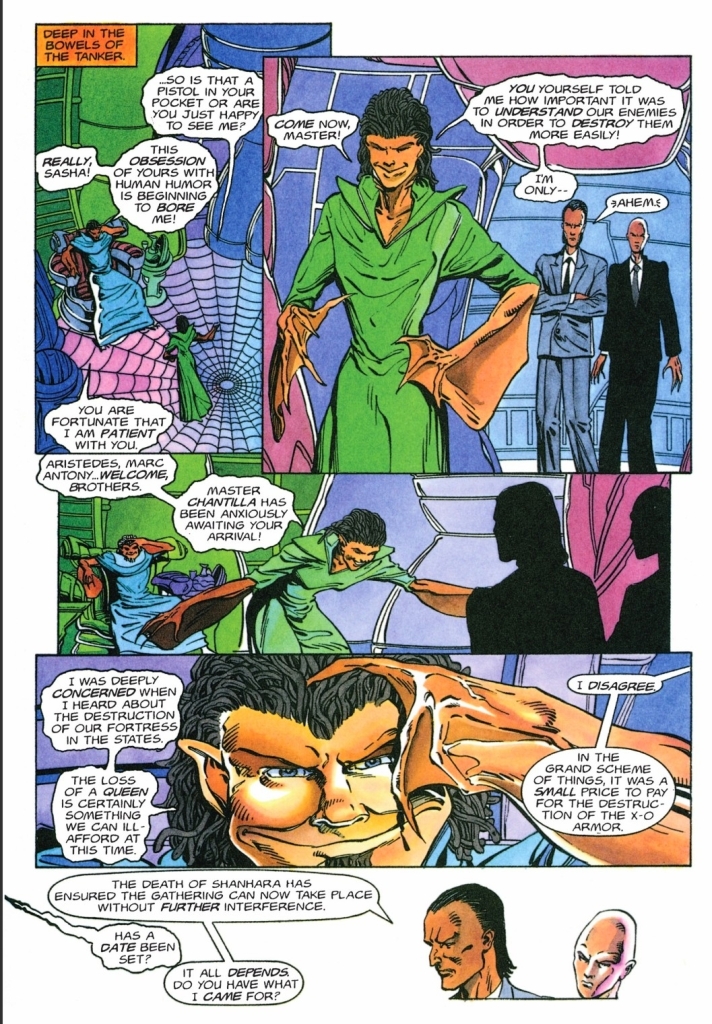
Several kilometers away from the site of the ill-fated Benchley, a huge organic-looking object enters the large hole on the side of a derelict ship. Strangely enough, the interiors have an alien design and the organic-looking object turns out to be a ship of its own. Two human figures with unnatural physical features come out of it and told their alien-looking troops to enter the refrigeration unit to “bring the ‘meat’” to Chantilla.
Inside the refrigeration unit filled with lots of dead human bodies, the armed aliens approach the Armorines suit only to find it empty. As they did not bother to search around to find answers, the Armorines pilot cleverly concealed himself among the other dead bodies pretending to be dead. He gets up after the aliens leave…
Quality
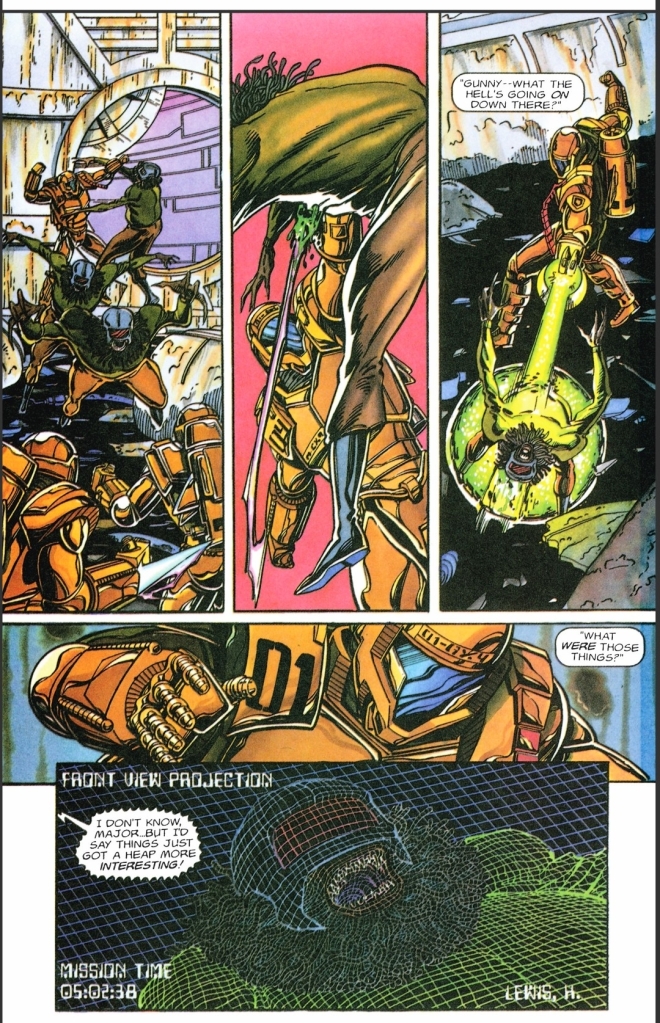
The first display of the Armorines in action without the aquatic environment.
After a good amount of build-up executed by the creative team in the first two issues, this particular comic book served as a big pay-off as well as a creative build-up of its own with the future events in mind. In fact, the sci-concepts introduced here along with new figures of opposition (specifically the humans with physical aquatic features) really lifted the storytelling to a whole new level of imagination laced with intrigue. Instead of seeing armed terrorists or an opposing force with military hardware to counter the high-tech Armorines, we see people who have a sinister plan, have been organizing violent operations on Earth and are of alien origin. These aliens, who are even studying human characteristics, were involved in conflicts with X-O Manowar and Turok elsewhere within the Valiant Comics shared universe. In fact, the two individuals who arrived early in the story came from their act of destroying X-O Manowar’s armor (read X-O Manowar #28). I should also state that the duo of Gonzalez-Calafiore cleverly emphasized the aliens’ plan to weaken the coordination and security of Earth’s forces so that they can escape undetected. What is even more intriguing within this comic book is the visualization of the aliens’ secret scientific developments and experiments on Earth.
Going back to the Armorines, you will see them in action without the aquatic environment. The way the creative team showed the Armorines in action against their alien counterparts turned out to be entertaining to read.
Conclusion
Given the fact that Democrats in America today love illegal immigrants so much, can you imagine them and their hordes of woke/socialist/Communist/Marxist/liberal/LGBTQ/transgendered voters welcoming aliens from outer space and allowing them to do bad things against humanity here on Earth? Imagine Joe Biden or Hillary Clinton making secret deals with these aliens.
I can say that Armorines #3 (1994) is a well-executed story that successfully paid off what was built in the first two issues and raised the stakes further with sci-fi concepts and a force of opposition that made impact elsewhere in the Valiant Comics shared universe. As I enjoyed this old comic book, I am looking forward to the next issue.




















 Author Carlo Carrasco