A Look Back at Amazing Spider-Man #387 (1994)

Welcome back superhero enthusiasts, 1990s arts and culture enthusiasts, Marvel Comics fans and comic book collectors! Today we go back to the 1990s to examine a small part of the Marvel Comics shared universe through a tale of the Amazing Spider-Man monthly series.

In my previous retro review, Spider-Man had a match-up with his arch-enemy the Vulture who returned with a strong obsession within. The rematch is significant not only because it the two have a rivalry that lasted decades in reality, but also because the story was structured to function as a light reintroduction of Adrian Toomes (Vulture) for new Spider-Man fans of the 1990s.

With those details laid down, here is a look back at Amazing Spider-Man , published in 1994 by Marvel Comics with a story written by David Michelinie and drawn by Mark Bagley.
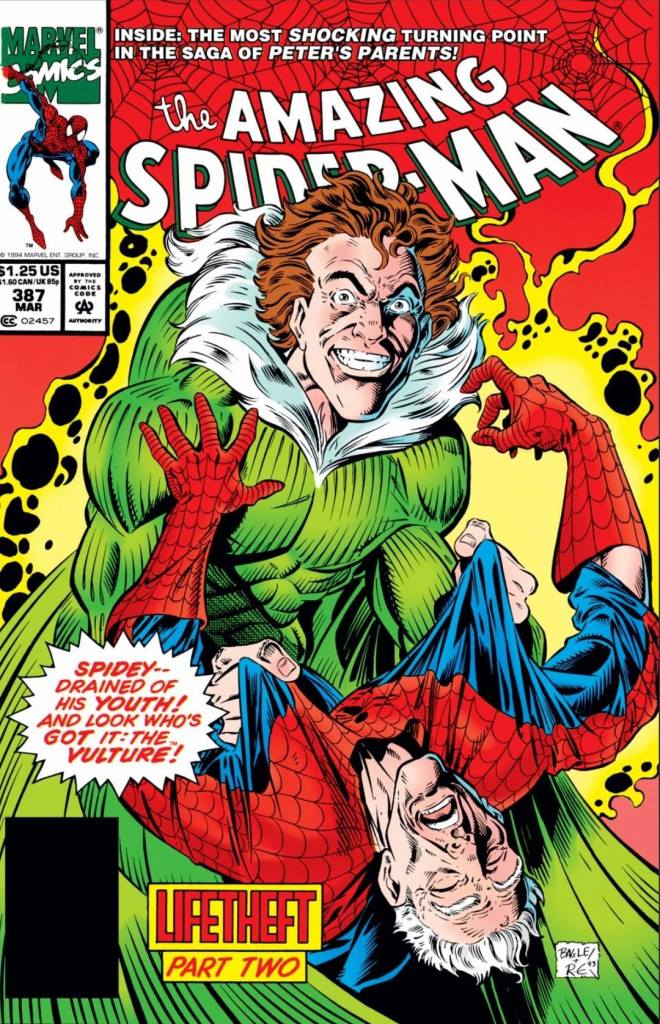
The cover.

Early story

The story begins with the Vulture absorbing energy and the youth of Spider-Man using the Juvenator in front of Dr. Sanchez. As a result, Adrian Toomes/Vulture physically turned much younger with rejuvenated skin, cancer getting health, a stronger body and his hair grown back. He declares himself as the new vital Vulture. Spider-Man is down on the floor clearly weakened and with a change of his body’s shape.

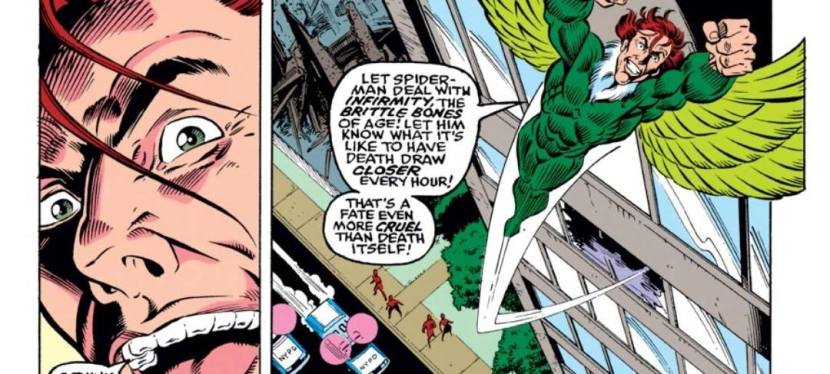
Instead of taking the opportunity to kill Spider-Man, the Vulture decides to fly away knowing that his long-time rival will have to deal with brittle bones of old age. As Dr. Sanchez tries to help him, Spider-Man feels exhausted, his lungs feeling gummy and his ears ringing. Knowing that police officers are coming, the webslinger decides to get away and leave Dr. Sanchez behind.

Moments later at the top of the building, the weakened Spider-Man takes his mask and glove off realizing that he has turned into an elderly man…

Quality
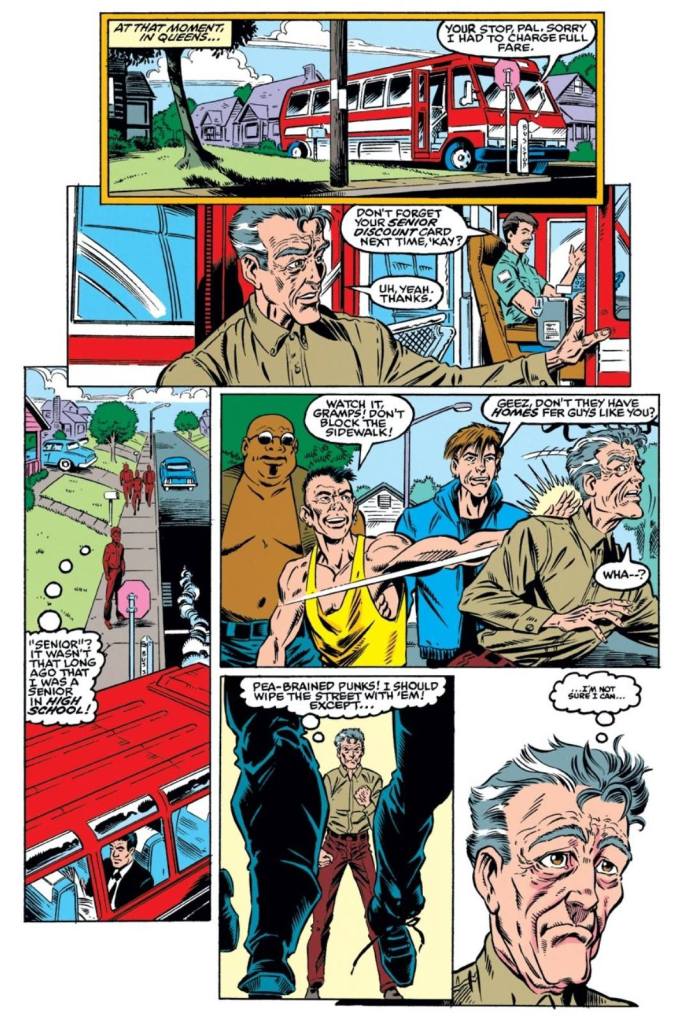
Can you recognize Peter Parker?

To get straight to the point, this continued rematch between Spider-Man and the Vulture is so outlandish (backed with the science fiction approach to life energy and the so-called fountain of youth), it almost felt like it was a story crafted for the What If series of comic books. In fact, the sudden aging of Peter Parker into an actually elderly man getting into close calls with two notable family members made this tale even more suitable for the What If series (note: What If #4 of 1989 had a severely aged Peter Parker in it).

Still on the storytelling aspect of this comic book, the creators used the fountain of youth concept to pull off a significant twist on the enduring Spider-Man/Vulture rivalry. As Spider-Man grew so old, the Vulture became much younger which in turn convinced him he could reinvent himself and put his genius of electro-magnetism to great use.  

To make things clear, this tale is not purely a Spider-Man/Vulture rivalry with sci-fi twists. In fact, there is more to the plot than meets the eye here as the Juvenator machine becomes an important element of the story (leading to something intriguing in the next issue), and a sinister revelation concluded this comic book.

Conclusion
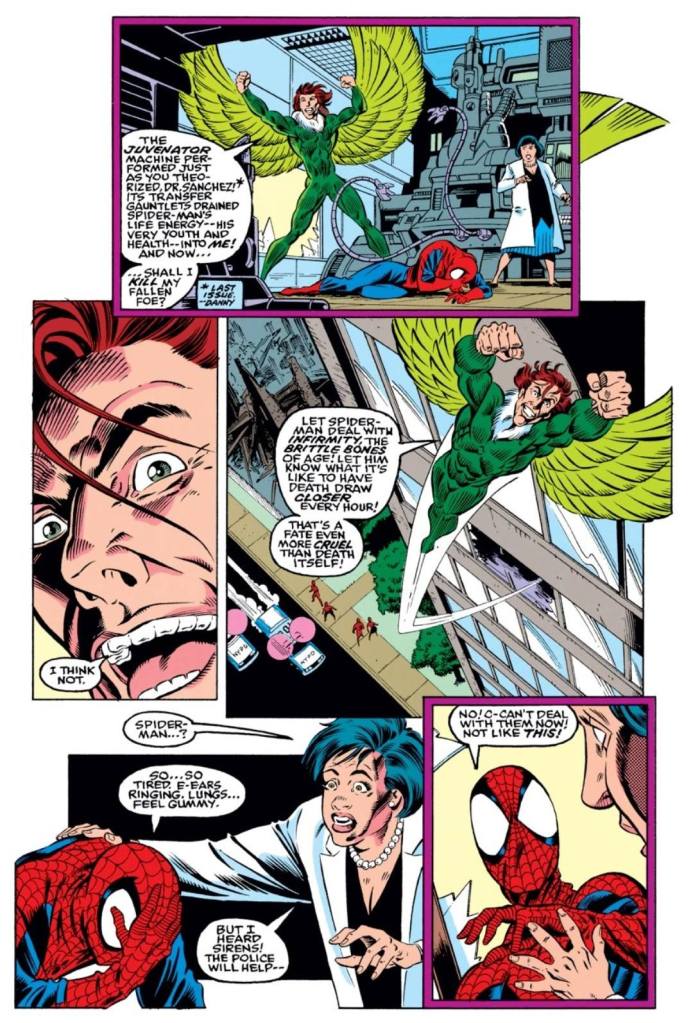
The Vulture rejuvenated into a young man at the expense of Spider-Man.

Amazing Spider-Man (1994) is a solid follow-up to the previous issue and it also was a radical attempt to twist the Spider-Man/Vulture rivalry a lot reaching to the point of making it look and feel like a What If story. There is a good amount of suspense, character development and enough superhero spectacle that paid-off the build-up nicely. Ultimately, this tale is actually a part of a short storyline leading to the intriguing events of issue .  

Overall, Amazing Spider-Man (1994) is recommended.

+++++

Thank you for reading. If you find this article engaging, please click the like button below, share this article to others and also please consider making a donation to support my publishing. If you are looking for a copywriter to create content for your special project or business, check out my services and my portfolio. Feel free to contact me with a private message. Also please feel free to visit my Facebook page Author Carlo Carrasco and follow me on Twitter at  @HavenorFantasy as well as on Tumblr at https://carlocarrasco.tumblr.com/ and on Instagram at https://www.instagram.com/authorcarlocarrasco
A Look Back at Amazing Spider-Man #386 (1994)

Welcome back superhero enthusiasts, 1990s arts and culture enthusiasts, Marvel Comics fans and comic book collectors! Today we go back to the 1990s to examine a small part of the Marvel Comics shared universe through a tale of the Amazing Spider-Man monthly series.

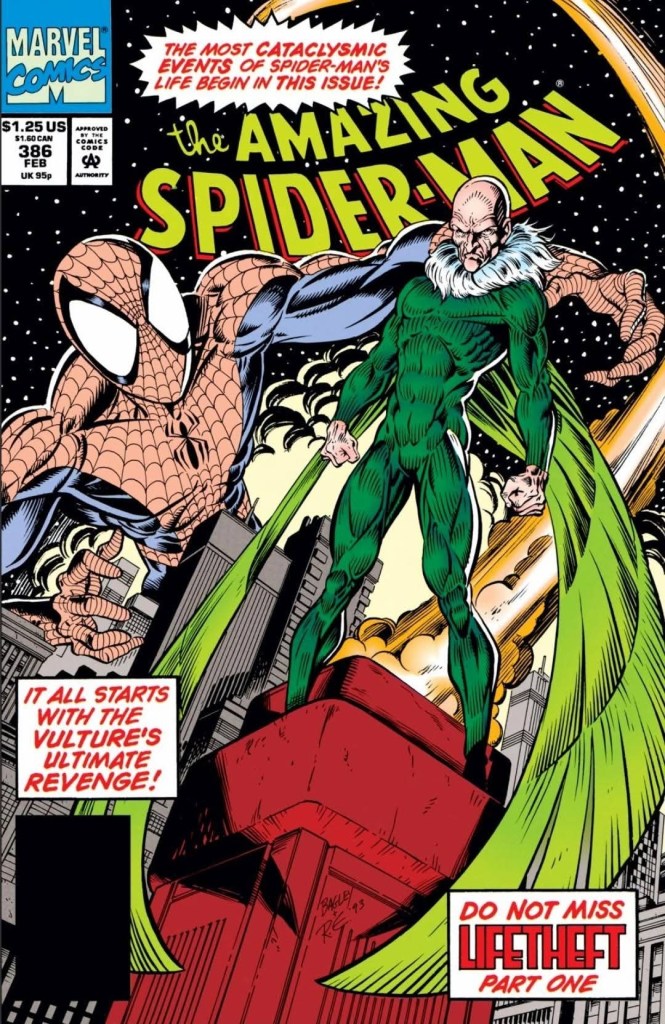
Following a serious of unfortunate events that kept Spider-Man away from his wife Mary Jane (read my retro reviews by clicking here, here and here), the Amazing Spider-Man creators decided it was time to have the iconic webslinger in a new rematch with the classic villain The Vulture (specifically Adrian Toomes whose first appearance was in Amazing Spider-Man in 1963). What makes Toomes Vulture notable (note: there were other versions of Vulture in Marvel’s history) is that he is an old man who happens to be a brilliant electrical engineer who proved to be a very capable criminal. He is also a co-founder of the Sinister Six.

With those details laid down, here is a look back at Amazing Spider-Man , published in 1994 by Marvel Comics with a story written by David Michelinie and drawn by Mark Bagley.

The cover.

Early story

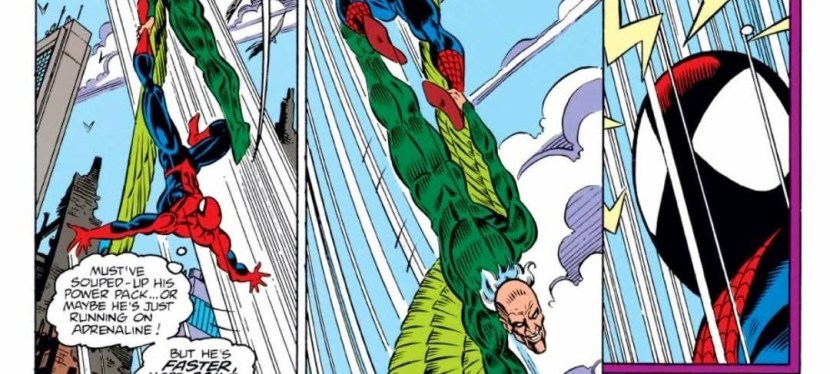
The story begins in the prison complex at Ryker’s Island. Adrian Toomes (Vulture) is inside his prison cell working on a small device with a guard watching from his back. It turns out the device has a tractor beam and Toomes uses it on the guard to physically slam his body on the sliding door of the prison cell. Toomes then uses the tractor beam to pull the metal bars of the other side of the cell to create an opening. He equips himself with mechanical wings and flew out of his cell and reach the speed boat prepared by two companions.

At the residence of May Parker, Peter and his Aunt May talk with an investigator. It turns out Aunt May hired the investigator to follow and observe Richard and Mary Parker. When asked by Peter, she tells him she does not think Richard and Mary are his parents. As far as the investigator is concerned, there is nothing suspicious with Richard and Mary Parker. He tells peters that his aunt needs professional help (related to Alzheimer’s Disease)…

Quality

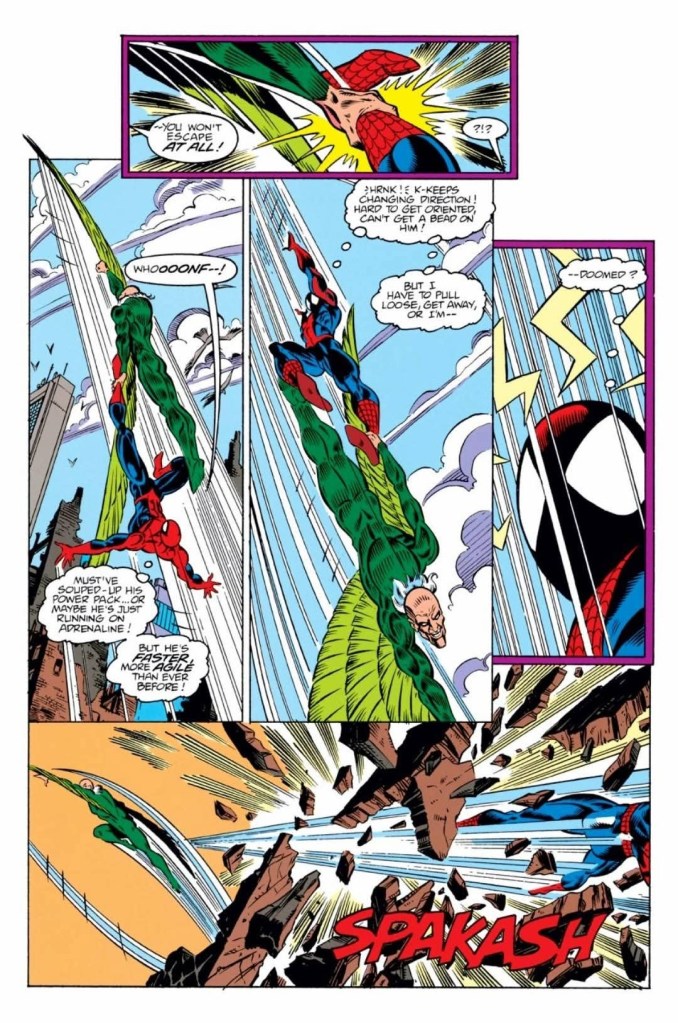
The physical conflict between Spidey and the Vulture is intense to see!

Perceived as modern during the time of publication, the conflict between Spider-Man and the Vulture in this comic book utilized the concept of everlasting youth with science fiction (combined with the villain’s own obsession). This in turn resulted in a unique approach executed by the Michelinie-Bagley duo to make something new with the rematch between Spidey and his winged nemesis.

The Vulture here is not only very obsessed with obtaining everlasting life as there is something deep inside him that has been raging. This explains why the winged super villain is more visceral in his battle with Spider-Man which Mark Bagley visualized with dynamism and intensity. For the newcomers reading this, the two have fought each other a lot since the 1960s and this 1994 rematch was very unique. The Vulture here is not unhinged but rather strategic while being obsessed, and this made him even more dangerous for Spider-Man.

Apart from the promised rematch, this comic book continued building up the tension for the eventual tragedy in Peter Parker’s life (which happened in Amazing Spider-Man ) while also dramatizing the lasting hardships Mary Jane experiences as Peter’s wife. Peter Parker meanwhile is focused on his family and his intention to find professional help for Aunt May smoothly connected with his rematch with the Vulture.  

Conclusion

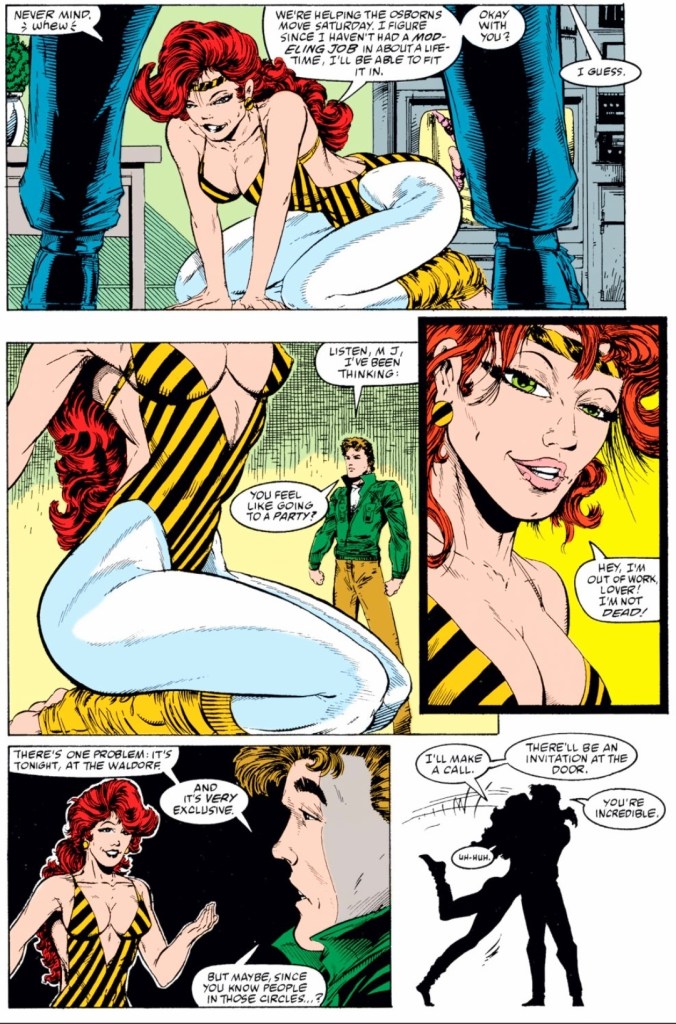
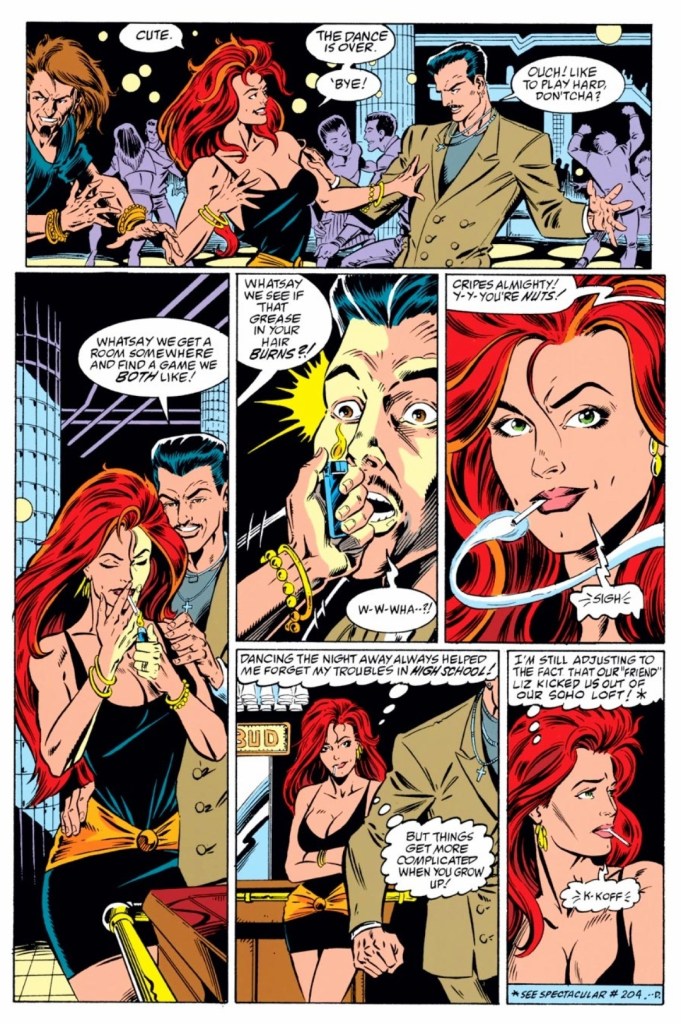
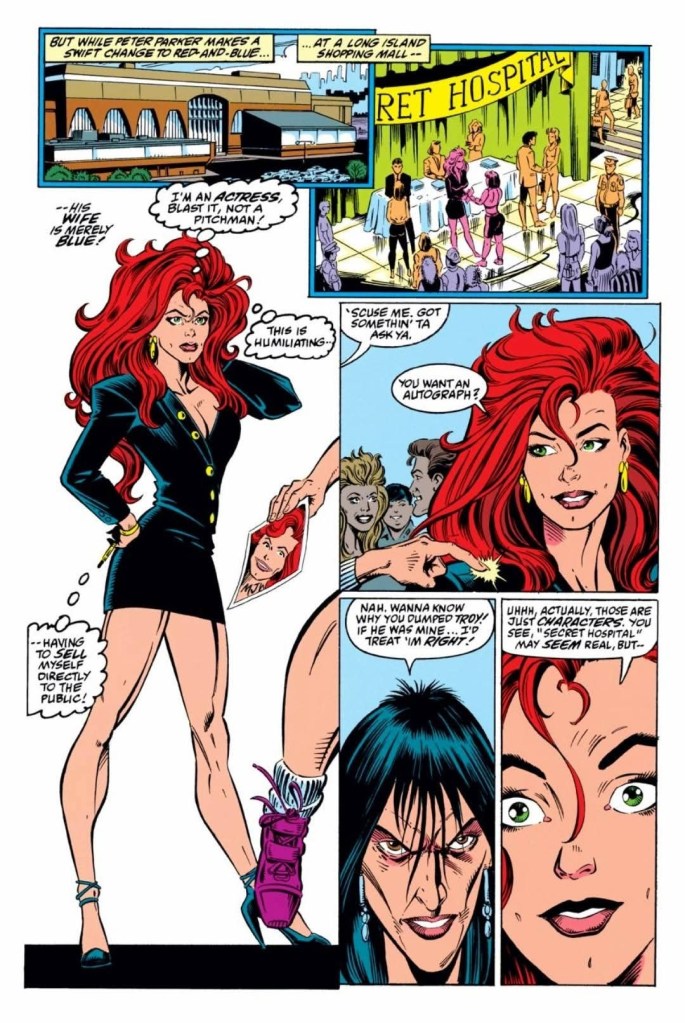
Mary Jane Parker participates in a promotional event of her TV show in a shopping mall.

There is a lot to enjoy in Amazing Spider-Man (1994). The rematch between the Vulture and Spider-Man is engaging and intriguing to read. There is also a good amount of suspense applied on the main plot as well as on the sub-plot about Aunt May being suspicious about Richard and Mary Parker. The result here is a reading experience that is entertaining and also balanced with regards to tone and storytelling.  

Overall, Amazing Spider-Man (1994) is recommended.

+++++

Thank you for reading. If you find this article engaging, please click the like button below, share this article to others and also please consider making a donation to support my publishing. If you are looking for a copywriter to create content for your special project or business, check out my services and my portfolio. Feel free to contact me with a private message. Also please feel free to visit my Facebook page Author Carlo Carrasco and follow me on Twitter at  @HavenorFantasy as well as on Tumblr at https://carlocarrasco.tumblr.com/ and on Instagram at https://www.instagram.com/authorcarlocarrasco
A Look Back at What If #85 (1996)

Welcome back superhero enthusiasts, 1990s arts and culture enthusiasts, Marvel Comics fans and comic book collectors! Today we go back to the year 1996 and explore a part of Marvel Comics’ universe through the reimagined tales emphasized in the What If monthly series.

Back in 1993 – the year that Marvel Comics celebrated the 30th anniversary of the X-Men – the definitive rival of the X-Men, Magneto, made a major comeback and he was so resourceful as a threat to everyone. With the massive space station Avalon as his lair, Magneto sent out Exodus to lure mutants to join him. As time passed, Magneto’s own force grew and arrogantly disrupted the funeral of Illyana Rasputin in the presence of the X-Men, X-Force, Excalibur and X-Factor (as told in Uncanny X-Men #304). As the conflict went on, Colossus betrayed the X-Men to join Magneto.

Can you just imagine what would it be like had Magneto became the ruler of mutants?

With those details laid down, here is a look back at What If , published in 1996 by Marvel Comics with a story written by David Michelinie and drawn by Arnie Jorgensen.

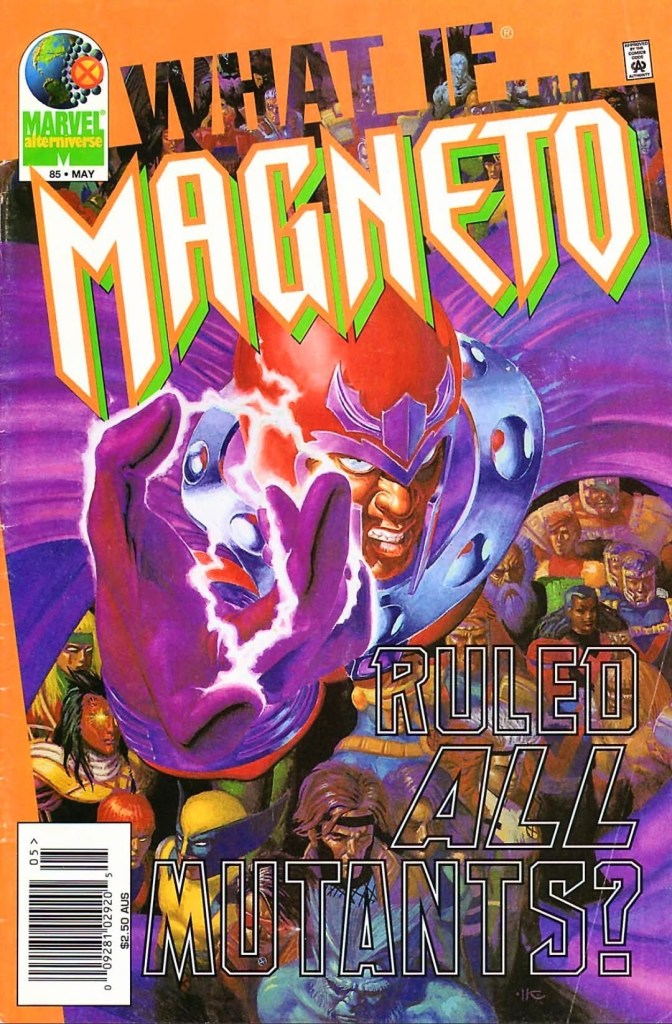
The cover.

Early story

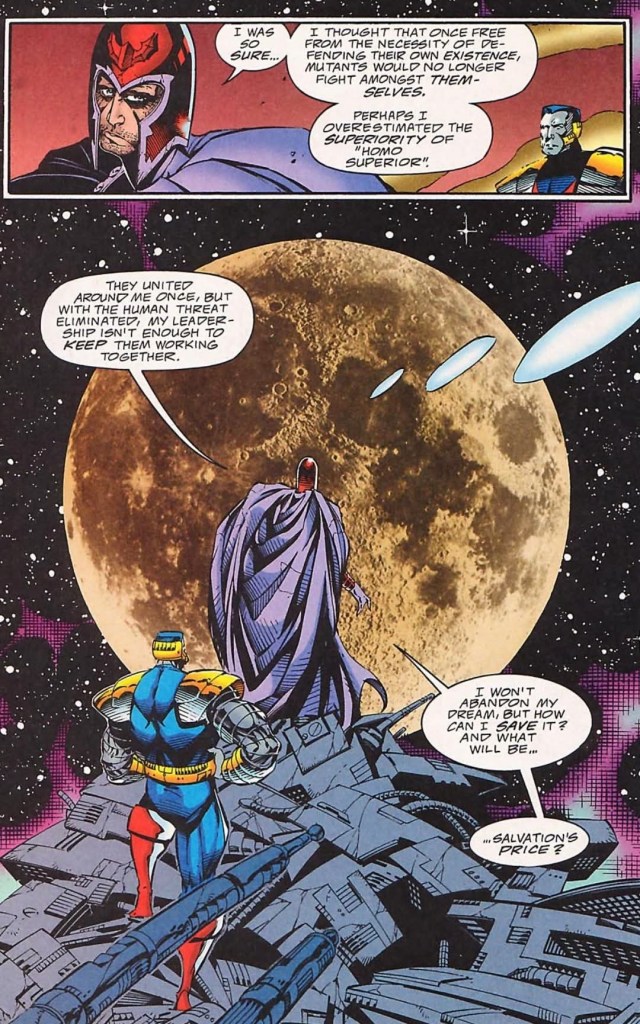
The story begins inside Avalon with Magneto and Colossus watching recorded footage of Charles Xavier announcing his decision to stop opposing the ascension of Avalon. It turns out, Xavier’s decision paved the way for mutants to relocate to Avalon (orbiting Earth) in return for assurance that those who remain in it will do so unmolested. With the intention to let Avalon’s residents achieve their full and glorious potential, Magneto allowed the mutants to rule themselves without any dictatorship by him.

Through the years, division between Avalon’s mutants – Acolytes who believe in isolation and the Acolytes who believe in annihilation – intensified and proved that the spirit of mutant unity has faded away. As violence between the mutants went on, the number of explosions inside Avalon kept increasing…

Quality

A magnificent view for Magneto, Colossus and the readers.

What I like most about this What If tale is its core concept exploring what would have happened had Magneto ruled the mutants specifically those living in his own realm (Avalon). Writer David Michelinie (best known for writing Amazing Spider-Man stories) wrote a really inspired script that emphasized Magneto’s vision of mutant utopia isolated from the twisted and complicated societies of Earth (which still has lots of people who are afraid of and hostile towards mutants) while leaving room for conflict in the form of ideological division between mutants on Avalon. As the growing division and violence are shattering Magneto’s vision of mutant utopia, the birth of an infant whose presence adds to the tension and fear of Avalon’s inhabitants.

The good news here is that Michelinie’s script is pretty solid and Arnie Jorgensen did a good enough job visualizing it all. The characters, mainly Magneto, Colossus and Beast, were portrayed clearly in character and to see the master of magnetism struggling with maintaining order on Avalon is a nice portrayal of his human side which makes him have a lot more in common with his opposite Professor X when it comes mutant matters. Considering Magneto’s long history of intense evil and obsession with leading humanity, his portrayal of insecurity, doubt and weakness is very believable to read.

Colossus, whose betrayal of the X-Men in Uncanny X-Men remains unforgettable, is the loyal and sensible servant of Magneto. Beast, meanwhile, remains the very bright and insightful mutant scientist as he has always been which makes Michelinie’s writing really impressive.

Also at the heart of the story is mutant order. Apart from the division between Avalon mutants who want full separation from humanity and those who want to conquer Earth by eliminating all human beings, the very fabric of mutant society got shaken all because of an infant who was born there on Avalon (Avalon’s first natural birth ever). I like the way this sub-plot added tension to the mutant division because it is, in some ways, socially relevant to this day. It will remind you that certain groups of people out there who would go as far as committing murder only because they are so obsessed with their foolish, worldly beliefs. Look at the Palestinian terrorists, the Iranian terrorists and the woke mobs in many parts of the world.

Conclusion

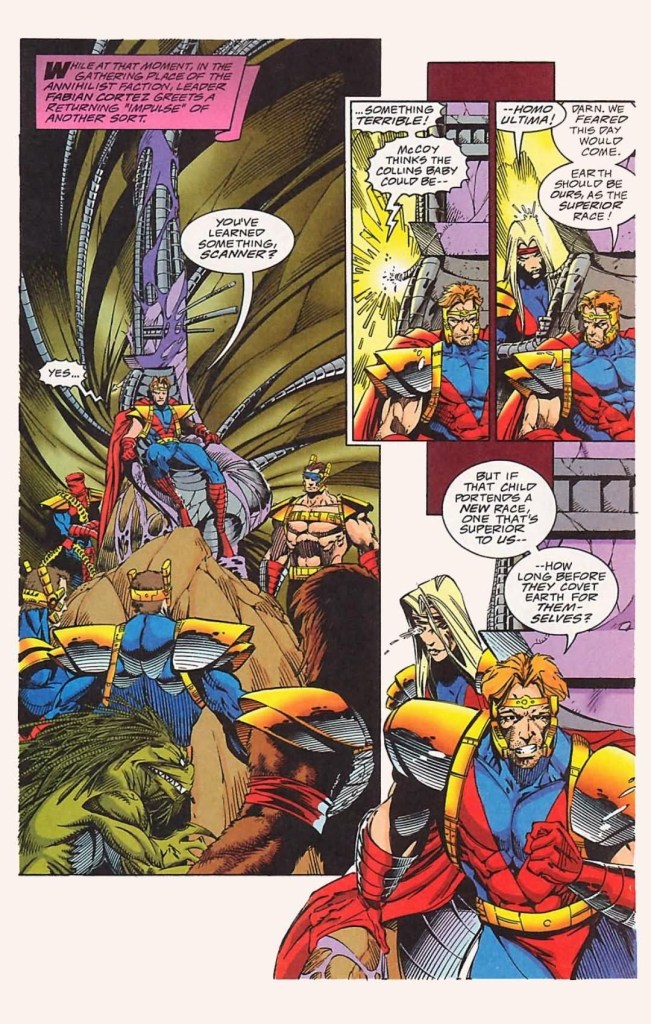
Remember Fabian Cortez and the Acolytes?

With a very solid script filled with intrigue, social relevance and portrayals, What If (1996) is a pretty engaging read. As it is strongly focused on Magneto and his mutants on Avalon, this comic book gives readers a fine dramatization of its core concept as well as developments on what would have happened had mutant utopia been realized far away from human society. I should state that for every build-up in the story, the payoff is fortunately solid. Consider this comic book a dramatic portrayal of mutants of Magneto without the involvement of the X-Men.

Overall, What If (1996) is recommended.

+++++

Thank you for reading. If you find this article engaging, please click the like button below, share this article to others and also please consider making a donation to support my publishing. If you are looking for a copywriter to create content for your special project or business, check out my services and my portfolio. Feel free to contact me with a private message. Also please feel free to visit my Facebook page Author Carlo Carrasco and follow me on Twitter at  @HavenorFantasy as well as on Tumblr at https://carlocarrasco.tumblr.com/ and on Instagram at https://www.instagram.com/authorcarlocarrasco
A Look Back at Amazing Spider-Man #320 (1989)

Welcome back superhero enthusiasts, 1980s arts and culture enthusiasts, Marvel Comics fans and comic book collectors! Today we go back to the year 1985 to examine a small part of the Marvel Comics shared universe through a tale of the Amazing Spider-Man monthly series.

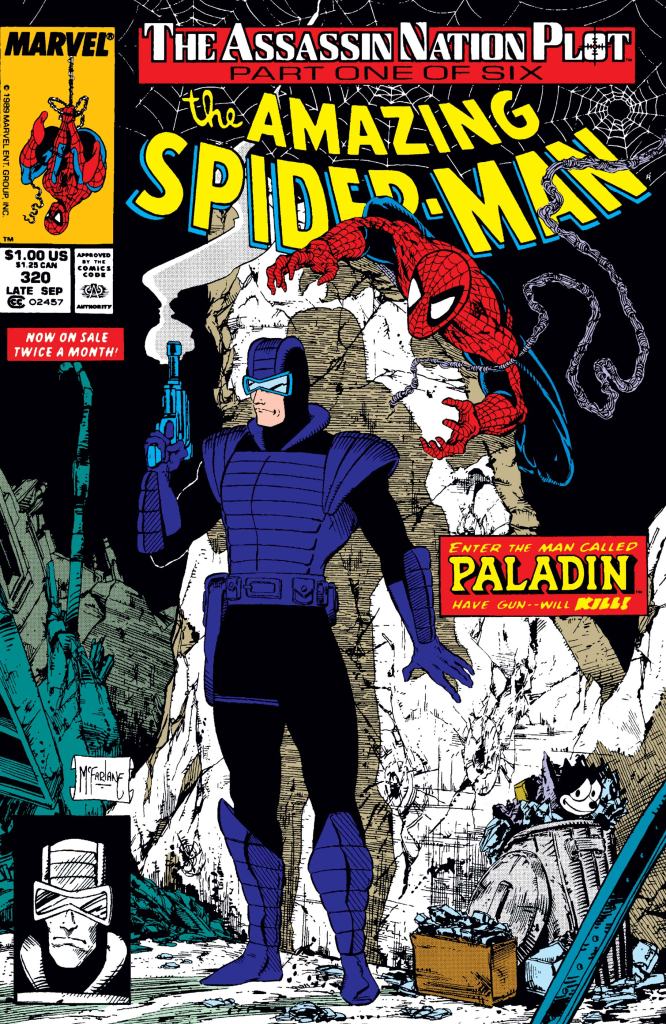
For this particular review, we will explore the first chapter of The Assassin Nation Plot storyline that took place within the Amazing Spider-Man series.  

With those details laid down, here is a look back at Amazing Spider-Man , published in 1989 by Marvel Comics with a story written by David Michelinie and drawn by Todd McFarlane.

The cover.

Early story

The story begins inside Empire State University where Peter Parker – working as an assistant in the science lab – takes advantage of the free time and resources to create web fluid using a new formula. He notices that the acetylene torch does not even leave a smudge on the new web he made.

To his surprise, his boss doctor Evan Sloan catches him doing an interesting experiment. Parker comes up with a convincing excuse for the experiment which spares him from getting into trouble. After promising doctor Sloan he will get on the neutron project first thing in the morning of Thursday, Parker leaves, secretly changes into Spider-Man and equipped his brand new web. He then leaves the university and moves deep into the city…

Quality

Peter Parker and Mary Jane having a discussion.

I really like the story David Micheline came up with as the start of The Assassin Nation Plot storyline. This is clearly not your typical good-versus-evil superhero tale starring the webslinger. Instead, there are layers of secrecy, suspense and intrigue that involves a powerful private organization, private armies and diplomats.

Instead of facing off with super villains, Spider-Man finds himself in the middle of something very big brewing behind the scenes, and that puts him in deep danger. That being said, Michelinie’s approach on building up the details of the plot moved very smoothly and the payoff for each buildup was executed on a timely manner. The buildup of details was never boring nor too slow to absorb, and Todd McFarlane excelled with visualizing the plot while still delivering dynamic superhero action.

I should mention that the character Paladin has a strong presence in the story and there were moments when he outweighed Spider-Man in terms of importance.

Conclusion

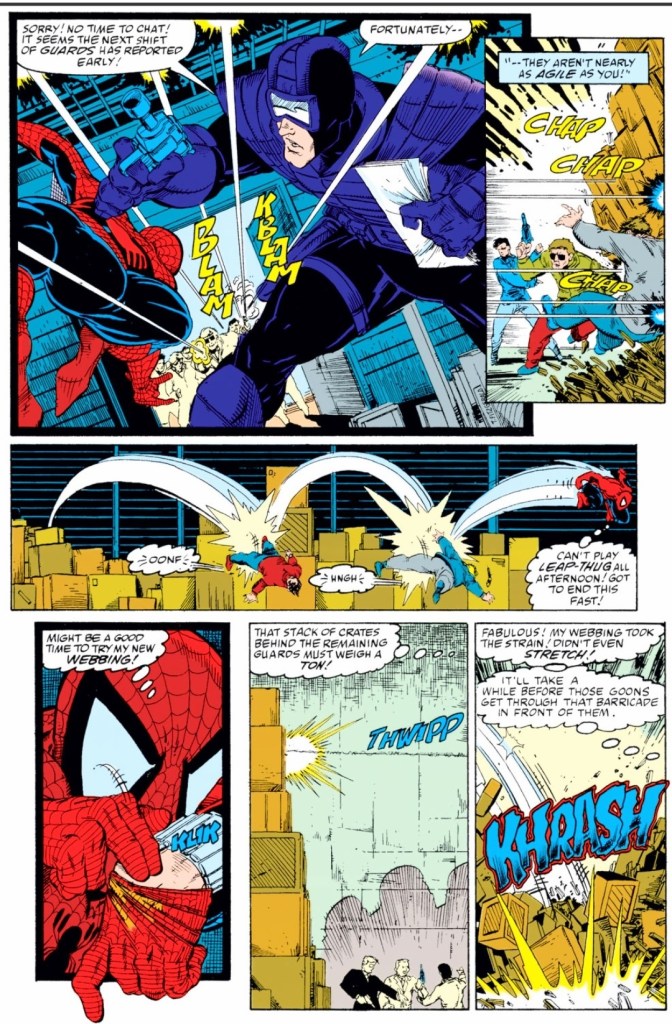
Spider-Man and Paladin targeted by armed guards.

Amazing Spider-Man (1989) is indeed a very solid story to read and a powerful start of The Assassin Nation Plot storyline. With the way the core concept was presented, this comic book symbolically showed that there are high stakes and other matters that are clearly too overwhelming for Spider-Man to deal with. The story is nicely paced and the creative team knew when and how to execute worthy payoffs for each buildup. By the time I reached the end of the comic book, I became convinced to read the next chapter of this storyline.

Overall, Amazing Spider-Man (1989) is highly recommended.

+++++

Thank you for reading. If you find this article engaging, please click the like button below, share this article to others and also please consider making a donation to support my publishing. If you are looking for a copywriter to create content for your special project or business, check out my services and my portfolio. Feel free to contact me with a private message. Also please feel free to visit my Facebook page Author Carlo Carrasco and follow me on Twitter at  @HavenorFantasy as well as on Tumblr at https://carlocarrasco.tumblr.com/ and on Instagram at https://www.instagram.com/authorcarlocarrasco
A Look Back at Amazing Spider-Man #375 (1993)

Welcome back superhero enthusiasts, 1990s arts and culture enthusiasts, Marvel Comics fans and comic book collectors! Today we go back to the year 1993 and examine a small part of the Marvel Comics universe through a tale of the Amazing Spider-Man monthly series.

In my previous retro comic book review, the insane murderer Venom returned to antagonize Spider-Man by targeting his parents. While it was a fact that Venom – who knew Spider-Man’s true identity – got into close contact with Aunt May (symbolizing the danger he poses on the Peter Parker’s family) a few years prior, going after the mother and father of Peter really raised the stakes.

With those details laid down, here is a look back at Amazing Spider-Man , published in 1993 by Marvel Comics with a story written by David Michelinie and drawn by Mark Bagley. This comic book marked the 30th anniversary of Amazing Spider-Man (1963).

The cover.

Early story

The story begins inside one of the facilities of the closed amusement park in Brooklyn. In his vicious form, Venom tells Richard and Mary Parker (both restrained) that they belong to him and declares that he would protect them from Spider-Man.

When Richard Parker asked why would he think that they would have anything to do with Spider-Man, Venom realizes that the couple does not even know their son is the webslinger. Venom tells the couple that their innocence is what he is sworn to preserve.

Over at Manhattan, Spider-Man swings back to the Daily Bugle building and discreetly changes his clothes before moving in as photographer Peter Parker. Inside one of the offices, J. Jonah Jameson reaches out to Silver Sable by telephone…

Quality

Peter Parker had to commit a crime by trespassing into Anne Weying’s residence. His disguise as Spider-Man does not protect him from the law.

I have mixed feelings about this follow-up to the great story of the previous issue. For one thing, David Michelinie’s script had a completely different tone and direction even though he intended this comic book to conclude what issue started. Another thing is that this story has even more characters added in which clearly diluted the intensity of the Venom-Spider-Man rivalry that was so intense in the previous issue.

There are two sub-plots – one of which deals with someone from Eddie Brock’s past – that were emphasized with sufficient details and the creative team integrated them into the main story. It seems that the creators intended to make the main story look grander in scope while sacrificing the very elements that made issue a great and intense reading experience.

Remember the suspense and danger that came with Venom targeting the older Parker couple? Those elements are almost totally absent in this comic book even though this story concluded the previous issue’s conflict build-up. Richard and Mary Parker are both present as captives of Venom but there really is no tension nor any sense of danger here due to the drastic change of tone and direction in the script.

I should also stress that the introduction of Anne Weying (previously Anne Brock) as Eddie Brock’s ex-wife looked and felt like an afterthought inserted into the story. While Anne’s presence brought out some traces of humanity and sanity from Venom during the 2nd half of the story, it did not add much impact on the conflict between the webslinger and the symbiote-wearer murderer. Ultimately, the creative team had to do something to explain the story build-up on Venom’s part leading into the Lethal Protector limited series which is set in the city of San Francisco.

And then there was the presence of Silver Sable’s team called the Wild Pack. The Wild Pack is the result of J. Jonah Jameson’s agreement with Silver Sable with the objective of achieving a journalistic exclusive for the Daily Bugle. This particular sub-plot is really lousy and not even the dynamic looking action sequences involving the Wild Pack could hide lousiness.

If there is anything symbolic about the script, it is the emphasis on family as well as the impact that comes with elements of the past emerging unexpectedly. In this very comic book, you will get to see Eddie Brock/Venom react like a sane person in response to the sudden re-appearance of his former wife. No matter what the creative team did here, I can say that the Spidey/Venom conflict did not really intensify (note: the dynamic action scenes did not solve the shortcomings) and there was no reason to worry about the captive Parker couple.

Conclusion

The insane murderer Venom with the parents of Peter Parker.

Considering the great stuff and raised stakes that made issue a very compelling read, Amazing Spider-Man (1993) is clearly a disappointing conclusion. This is not a terrible comic book as it has some good stuff for fans to enjoy but the overall presentation of the creators here is not too great due to their approach with the storytelling (with two sub-plots that did not add much). Overall, I am glad I never bought this comic book (with flashy cover and more pages) at full price in 1993.

Overall, Amazing Spider-Man (1993) is satisfactory.

+++++

Thank you for reading. If you find this article engaging, please click the like button below, share this article to others and also please consider making a donation to support my publishing. If you are looking for a copywriter to create content for your special project or business, check out my services and my portfolio. Feel free to contact me with a private message. Also please feel free to visit my Facebook page Author Carlo Carrasco and follow me on Twitter at  @HavenorFantasy as well as on Tumblr at https://carlocarrasco.tumblr.com/ and on Instagram at https://www.instagram.com/authorcarlocarrasco
A Look Back at Amazing Spider-Man #374 (1993)

Welcome back superhero enthusiasts, 1990s arts and culture enthusiasts, Marvel Comics fans and comic book collectors! Today we go back to the year 1993 and examine a small part of the Marvel Comics universe through a tale of the Amazing Spider-Man monthly series.

In early 1993, the supervillain and murderer Venom was in very high demand among Marvel readers and comic collectors. The Venom: Lethal Protector mini-series launched with issue selling a lot of copies and it portrayed Spider-Man’s greatest enemy as a very twisted and violent makeshift hero who dedicated himself to protecting what he (Eddie Brock specifically) to innocent people. As Venom was one of the few supervillains who knew Spider-Man’s true identity, the creative team behind the Amazing Spider-Man series decided to raise the stakes temporarily by having him encounter Peter Parker’s parents (the ones that appeared in Amazing Spider-Man ).

With those details laid down, here is a look back at Amazing Spider-Man , published in 1993 by Marvel Comics with a story written by David Michelinie and drawn by Mark Bagley.

The cover.

Early story

The story begins inside the bunker beneath the grounds of the deserted Brooklyn amusement park. As Eddie Brock struggles to lift a very heavy piece of equipment, the symbiote forms over his body helping him lift it up above the head. Venom is obsessed with killing Spider-Man and Eddie Brock remains totally bitter over the webslinger’s responsibility on destroying his career. Eddie sees a page of the Daily Bugle on the wall and it contains a news photo of Peter Parker with his mother and father.

At New York’s famous Central Park, Peter, wife Mary Jane and his parents enjoy quality time skating on ice. Aunt May is standing on a wooden platform watching them…

Quality

Lots of intense action scenes in this comic book for fans and readers to be entertained with. The action scenes are not mindless as they serve as reflections of Venom’s powerful quest for revenge.

To begin with, I can say that this tale by David Michelinie is a very intense and dramatic read and it added a new layer of depth into the enduring rivalry between Spider-Man and Venom. At this point in Marvel Comics’ shared universe history, the two icons have encountered each other so many times, the time was right for Michelinie to raise the stakes and have the elderly Parkers (note: Aunt May excluded) as the new targets of Venom (already made obvious on the cover which in turn added tremendous stress on the part of Spider-Man and his wife.

For the newcomers reading this, Eddie Brock’s journalistic career was destroyed over the Sin-Eater story as a result of Spider-Man’s public revelation of Stanley Carter as the said figure (note: Brock’s Sin-Eater article series was based on interviews with Emil Gregg who actually turned out to be a delusional neighbor of Carter’s).

As Brock’s life went way downhill with his reputation destroyed, his hatred of Spider-Man grew and so did his quest for revenge. That being said, what happened in this particular comic book was a very reflective extension of what happened years prior. Anyone who has basic knowledge of the origin of Venom and early appearances of Brock in comics will be able to understand the intensified rivalry in this tale.  

Apart from the great story, this comic book has lots of superhero spectacle for readers to enjoy. That being said, the smashing action of the fight between Spider-Man and Venom was clearly made to be more violent which suitably reflected the supervillain’s lust for revenge. Spidey, meanwhile, had no choice but to avoid causing any more damage or harm as Venom goes after him in public surrounded with lots of bystanders. Along the way, you will see a key moment of the insanity of Venom which served as a useful pause of the fight. Finally, when it comes to the art, this comic book has some of the finest artworks I have seen from Mark Bagley.

Conclusion

At the time of this comic book’s publication, Venom was one of the few supervillains who knew Spider-Man and Peter Parker are one and the same person. The inclusion of Peter’s parents only added to the raising of the stakes.

Amazing Spider-Man (1993) is undeniably a great read complete with intense action scenes, lots of intrigue and, most notably, a rock solid development of the Spider-Man-Venom rivalry. This is the kind of story that will compel long-time Spider-Man fans to revisit Venom’s origin as well as Spider-Man’s involvement with the Sin-Eater. At the same time, this tale will help readers understand the insanity and murderous mind of Venom that took place not only in the Venom: Lethal Protector mini-series in also other mini-series about the symbiotic killer that Marvel published throughout the 1990s.

Overall, Amazing Spider-Man (1993) is highly recommended!

+++++

Thank you for reading. If you find this article engaging, please click the like button below, share this article to others and also please consider making a donation to support my publishing. If you are looking for a copywriter to create content for your special project or business, check out my services and my portfolio. Feel free to contact me with a private message. Also please feel free to visit my Facebook page Author Carlo Carrasco and follow me on Twitter at  @HavenorFantasy as well as on Tumblr at https://carlocarrasco.tumblr.com/ and on Instagram at https://www.instagram.com/authorcarlocarrasco
A Look Back at Turok: Dinosaur Hunter #3 (1993)

Welcome back superhero enthusiasts, 1990s culture enthusiasts and comic book collectors! Today we go back to the early 1990s and explore a part of the Valiant Comics shared universe through a tale of the Turok: Dinosaur Hunter series.

Previously, Turok went on exploring Colombia after leaving the village of his romantic interest Serita. The village was decimated by the intelligent dinosaurs (also referred to as bionisaurs) that served Mon-ark, a fierce enemy of Turok’s. Eventually Turok got involved with the Colombian drug lord Comacho who has gang of armed men and lots of resources. Ever the dedicated hunter, Turok makes a deal with the drug lord to pursue dinosaurs.

With those details laid down, here is a look back at Turok: Dinosaur Hunter , published in 1993 by Valiant Comics with a story written by David Michelinie and drawn by Bernard Chang.

The cover.

Early story

The story begins in Colombia in 1987. Turok tries to sell the severed head of a bionisaur to a local buyer (collector of hunt-related trophies) who offers him only three hundred Pesos.

After concluding a disappointing deal, Turok leaves the local joint only to encounter a lady driving a jeep…the scientist Maria Cortez. She tells him that the drug lord Comacho is planning a raid against the dinosaurs very soon and the gang wants Turok to come along. Cortez, who is obsessed with researching dinosaurs, tells him her single condition that one dinosaur should be spared for scientific study. After some thinking, Turok agrees to join…

Quality

The evil of Mon-ark emphasized.

Starting first with the plot, I can say that David Michelinie’s script is well-written and never lost focus on the inevitable encounter between Turok and his vicious dinosaur rival Mon-Ark. Right from the start, it is clear that the stakes have been raised higher which is the result of Turok’s successful killing of Mon-ark’s mate. Like in the previous issue, Mon-ark here was portrayed again to be very evil and even abusive to his fellow dinosaurs.

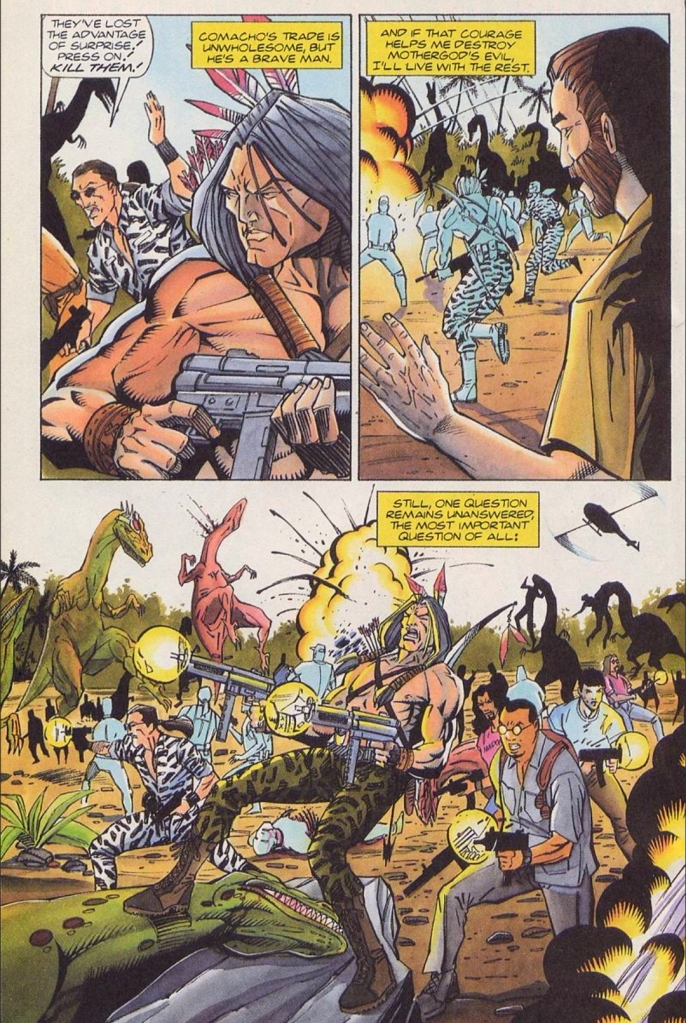
The raid mentioned early in the story is easily the action-packed highlight and it has some notable forms of symbolism. For one thing, the raid was organized by Comacho not because of concern towards Mon-ark nor Turok, but because he wants to stop the disruptions on his illegal drug business caused by the dinosaurs. Cortez meanwhile sees the dinosaurs as animals meant to be studied for the sake of science. And then there is a certain photographer who wants to record everything visually no matter what happens. I can say the raid scenes are entertaining to follow.

As this comic book was not drawn by Bart Sears, I can say that the visual quality and style went way down. I’m not saying that Bernard Chang is a terrible artist at all. It’s just that Chang’s art style does not live up to the gritty, exquisite and intense visuals of the first two issues which clearly defined how Turok stories should look. Along the way, there are several instances wherein Chang’s art style made some characters and facial expressions look somewhat cartoony. The dinosaurs themselves also looked cartoony at times and the heavy loss of visual details on them is very clear.

Conclusion

The armed raid against the dinosaurs with Turok as a willing participant looking like Rambo.

Similar to its predecessor, Turok: Dinosaur Hunter (1993) has enough stuff worth following to be entertained even though the visual quality went down several notches. For one thing, the promised battle between Turok and Mon-ark happened and the way it was written was strong on its own. At the same time, the Indian hunter of dinosaurs got more involved Comacho’s gang which raises questions about his ability to differentiate right from wrong, and good from evil. At this stage of the series, Turok’s direction remains clouded.

Overall, Turok: Dinosaur Hunter (1993) is recommended.

+++++

Thank you for reading. If you find this article engaging, please click the like button below, share this article to others and also please consider making a donation to support my publishing. If you are looking for a copywriter to create content for your special project or business, check out my services and my portfolio. Feel free to contact me with a private message. Also please feel free to visit my Facebook page Author Carlo Carrasco and follow me on Twitter at  @HavenorFantasy as well as on Tumblr at https://carlocarrasco.tumblr.com/ and on Instagram at https://www.instagram.com/authorcarlocarrasco
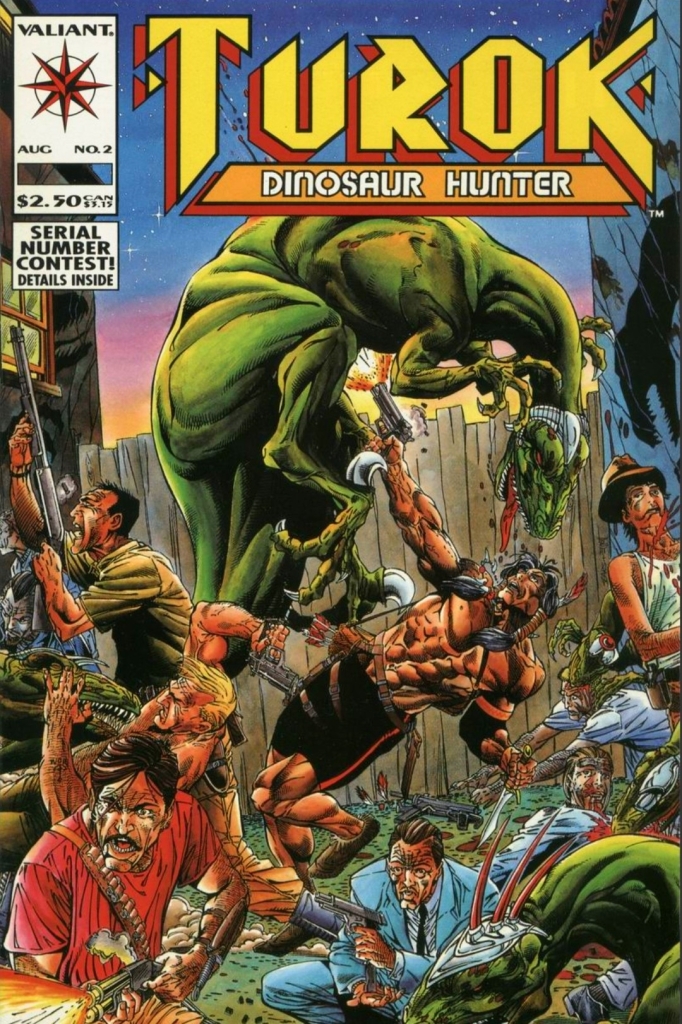
A Look Back at Turok: Dinosaur Hunter #2 (1993)

Welcome back superhero enthusiasts, 1990s culture enthusiasts and comic book collectors! Today we go back to the early 1990s and explore a part of the Valiant Comics shared universe through a tale of the Turok: Dinosaur Hunter series.

While issue turned out to be entertaining enough, the Indian protagonist Turok was not too engaging. The story worked primarily due to the combined creative works of David Michelinie and Bart Sears.

With those details laid down, here is a look back at Turok: Dinosaur Hunter , published in 1993 by Valiant Comics with a story written by David Michelinie and drawn by Bart Sears.

The cover.

Early story

The story begins in Colombia in 1987. Set some time after he left the village of Serita (a Colombian lady he connected with), Turok finds himself in the middle of a fight with multiple intelligent dinosaurs that serve his rival and target Mon-ark. Turok recently started using locally produced poison for his arrows as part of his unrelenting hunt for dinosaurs.

Meanwhile in another part of Colombia, the drug lord Comacho holds a private meeting and express his frustration over the decimation of his drug shipments. It turns out, the couriers were slaughtered and eaten by the dinosaurs. Upon learning of the presence of an Indian who makes it his business to hunt dinosaurs, Comacho gives an order to find him…

Quality

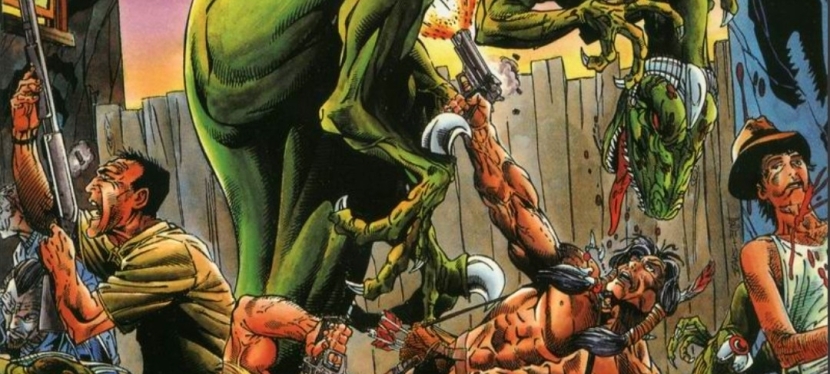
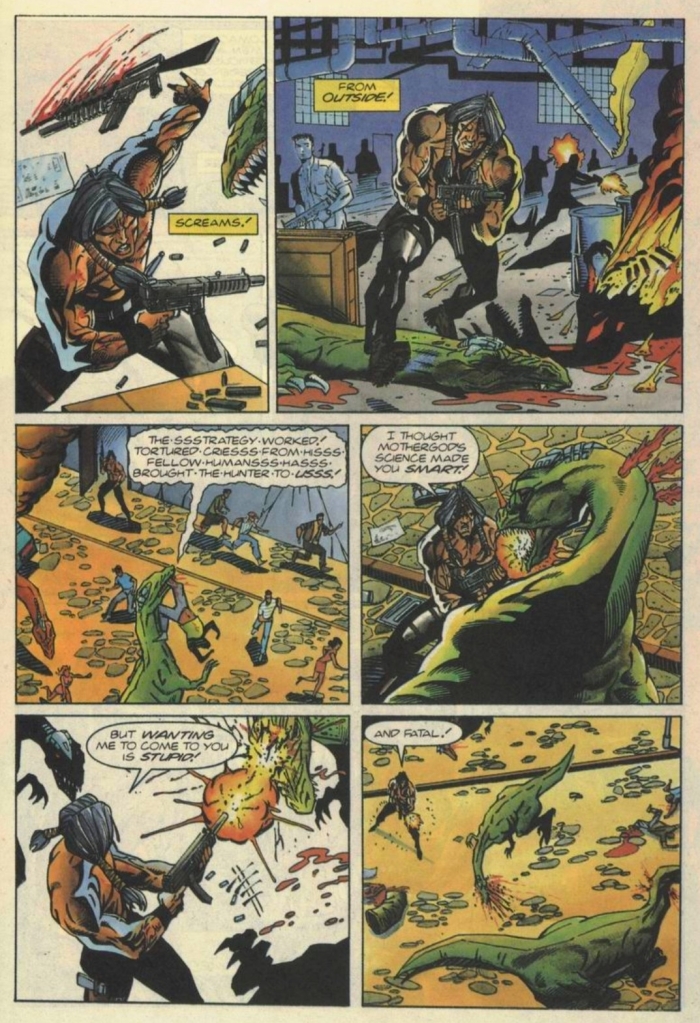
You will see Turok in a lot of action scenes fighting these intelligent and savage dinosaurs.

As the follow-up to the 1st issue, this is a story about Turok really hunting dinosaurs as part of his effort to get to Mon-ark (the leader of a pack of dinosaurs present in Colombia) in relation to what happened during the Unity storyline. In addition, you will get to see the protagonist get involved the Colombia drug lord who really needs him as the dinosaurs tremendously disrupted the shipment of illegal substances. As a newcomer in this particular time and place within the shared universe of Valiant Comics, Turok here does not care much about the reputation of Comacho as he is obsessed with hunting dinosaurs.

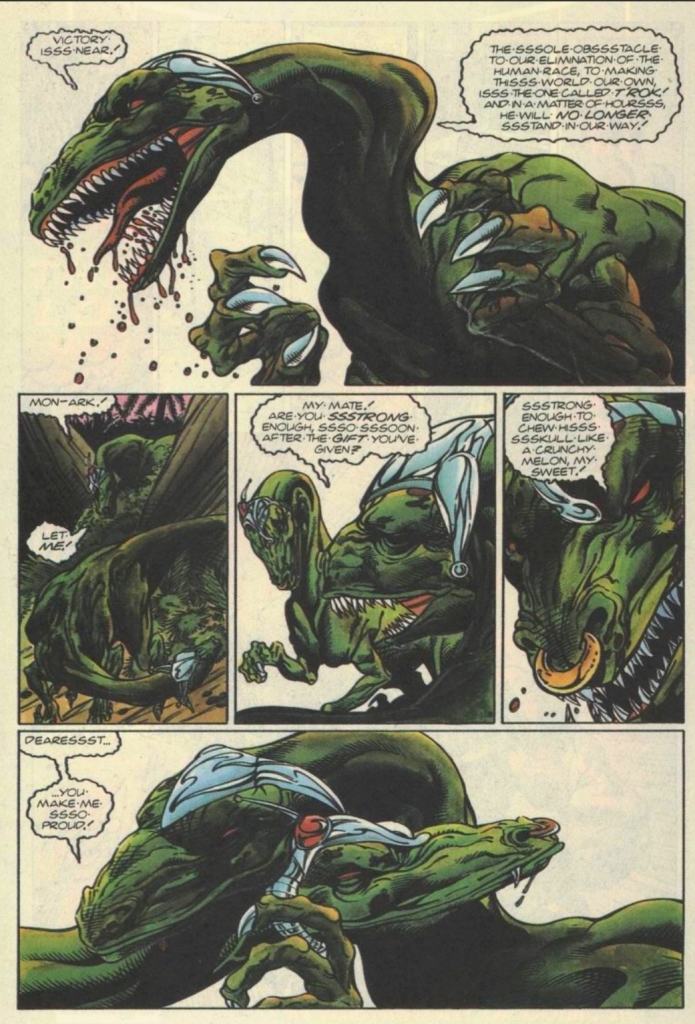
Speaking of the dinosaurs (who were granted human-like intelligence by the Mothergod), you will get to see Mon-ark have his own share of the spotlight and see him being a leader of his fellow dinosaurs. The showcase of his ruthlessness was expectedly done here to symbolize the element of evil in a violent way.

The plot by Michelinie is nicely structured and the narrative moved in a smooth enough pace leading to an obvious new direction.

Like in the previous issue, Bart Sears drew the art but with the involvement of Bernard Chang. For the most part, I recognized Sears’ work and there were some subtle visual differences here and there. The good news here is that if you enjoyed the gritty look as well as the uncompromised approach to violence in issue , then you will find those here as well.

Conclusion

A look at the intelligence and interaction between these two evil dinosaurs in love. There’s no homosexuality here nor anything related to transgender or the disease called wokeness.

Turok: Dinosaur Hunter (1993) is entertaining and compelling enough to read. It further explores Turok’s story as a man lost in time who simply would not run away from the dinosaurs as he is obsessed with eliminating Mon-ark. The tale, however, involves a Colombian drug lord as well as his private army which adds depth to the narrative as well as Turok’s place within Valiant’s shared universe of the time. Lastly, this one nicely sets up a big conflict between the Indian and his dinosaur rival.

Overall, Turok: Dinosaur Hunter (1993) is recommended.

+++++

Thank you for reading. If you find this article engaging, please click the like button below, share this article to others and also please consider making a donation to support my publishing. If you are looking for a copywriter to create content for your special project or business, check out my services and my portfolio. Feel free to contact me with a private message. Also please feel free to visit my Facebook page Author Carlo Carrasco and follow me on Twitter at  @HavenorFantasy as well as on Tumblr at https://carlocarrasco.tumblr.com/ and on Instagram at https://www.instagram.com/authorcarlocarrasco
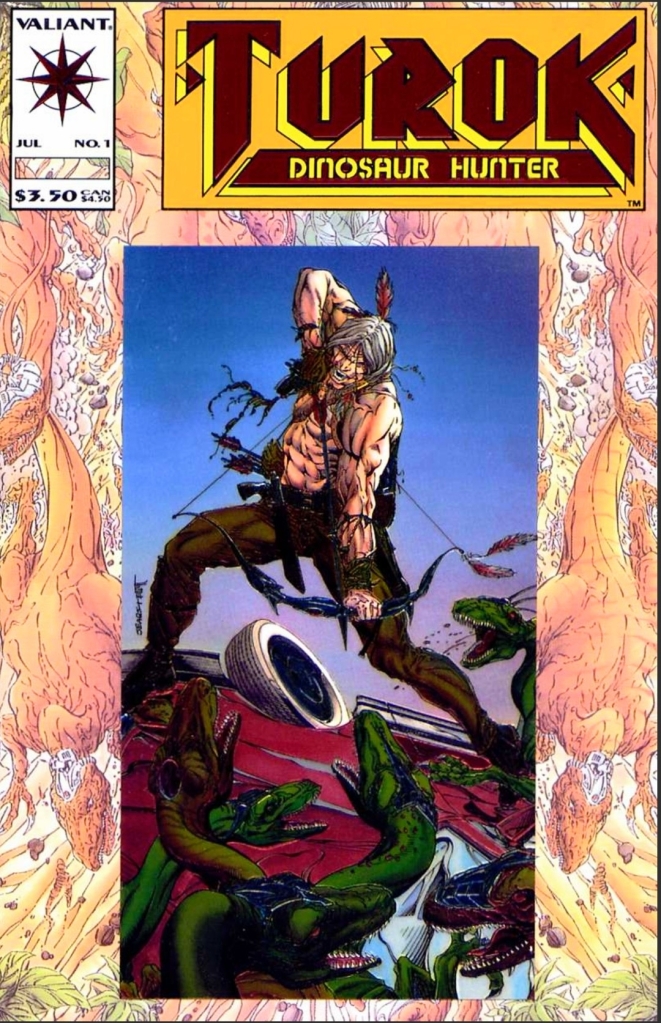
A Look Back at Turok: Dinosaur Hunter #1 (1993)

Welcome back superhero enthusiasts, 1990s culture enthusiasts and comic book collectors! Today we go back to the early 1990s and explore a part of the Valiant Comics shared universe through a tale of a very notable illustrated literature character named Turok.

I say very notable because Turok, an Indian (North American native), started in comics in the 1950s published by Western Publishing through its licensee Dell Comics. The comic book series Turok: Son of Stone started from 1956 until the early 1980s. In 1989, Valiant Comics was established by former Marvel Comics editor-in-chief Jim Shooter and business partner Steven Massarsky which was the result of a failed 1988 attempt to purchase Marvel Entertainment. In 1991, Valiant published Magnus: Robot Fighter and Solar: Man of the Atom as its early titles which is notable because both characters were licensed properties from Gold Key Comics (which itself was involved in the original Turok series).

Then in 1992, a newer version of Turok was introduced by Valiant Comics in the 12th issue of Magnus: Robot Fighter and subsequently the character (along with established side-kick Andar) became involved in the Unity storyline which was Valiant’s first major crossover comics event. By the time Unity ended, the road was cleared for Valiant to further emphasize Turok for the modern comic book readers of the time.

With those details laid down, here is a look back at Turok: Dinosaur Hunter , published in 1993 by Valiant Comics with a story written by David Michelinie and drawn by Bart Sears.

The cover.

Early story

The story begins in Colombia (note: written as Columbia in the comic book) in South America in the year 1987. Deep in the forest, Turok performs a ritual believing that his spirit is getting cleansed and purified. He remembers the times when he and Andar discovered a land – filled with dinosaurs and other animals they never encountered previously – where time no longer held much meaning.

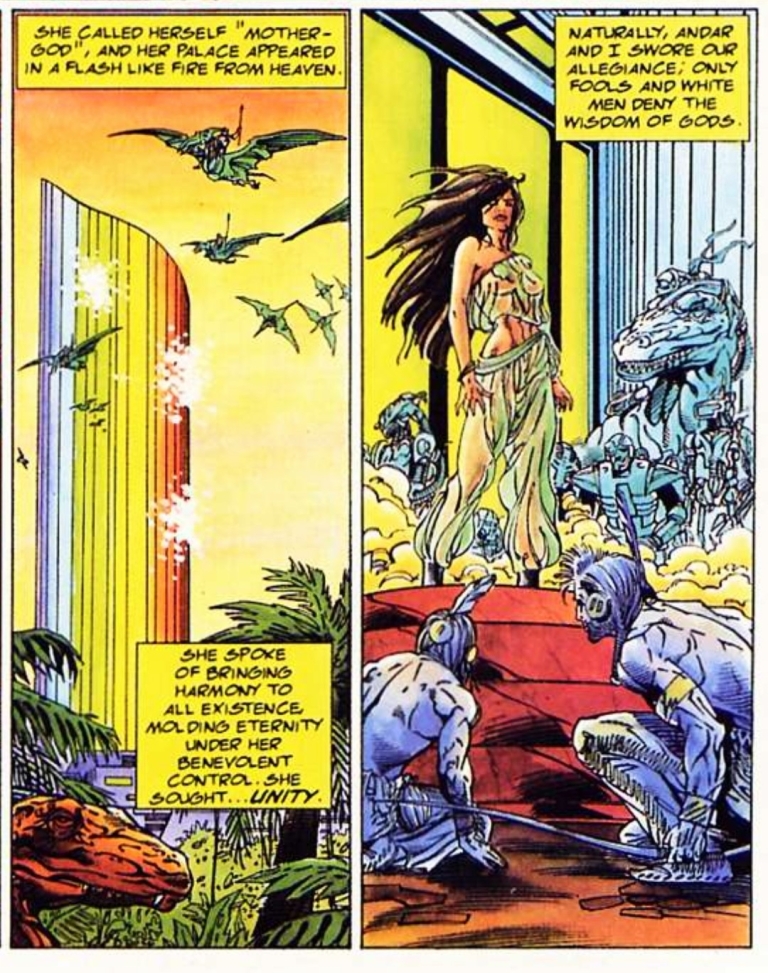
He and Andar got involved in an armed conflict with invaders who arrived with advanced technologies. The robot fighter Magnus then got involved and helped Turok and their side turn the tide of battle. Eventually a stunning phenomenon happened as a woman who called herself Mothergod appeared. Turok and Andar foolishly submitted themselves to her and soon, they started operating in her service with violence against those who opposed her.

After encountering Archer and Armstrong, Turok realized the error of his devotion to Mothergod and eventually joined forces with Rai, X-O Manowar and others who waged battle against her.

Back in the present, an intelligent, cybernetically enhance dinosaur attacks Turok…

Quality

Very intense violence drawn by Bart Sears which reflected the high intensity of Turok’s fight with the dinosaurs.

To get straight to the point here, when it comes to emphasizing a new version of Turok for comic book readers in the early 1990s, the creative team was quite successful in achieving that goal. By the time I reached the end of this comic book, Turok’s place within the huge shared universe of Valiant got established solidly and the Michelinie-Sears duo dramatized the Indian’s struggle (being lost in time and far away from where he belongs) in South America in the late 1980s.

Being lost in time and having to deal with deadly, intelligent dinosaurs brought not only the warrior within Turok but also the determine survivor in him as well. There is a good amount of character emphasis of Turok which served as an effective balance to all the spectacle (read: uncompromised bloody violence) the creative duo prepared. Instead of using thought balloons, you will read Turok’s thoughts through narration boxes all throughout which made an effective and interesting reading experience.

Considering his great skills in hunting and fighting, Turok is not really a super protagonist. He is as vulnerable as any other person and you will get to see him suffer and become so helpless, he has no choice but to avail of assistance from South American villagers who lived by the land but are themselves very vulnerable to the savagery of the intelligent dinosaurs. The symbolism regarding vulnerability as well as the ramifications of the Unity crossover on this tale is very strong. This is indeed very solid writing by Michelinie.

As for the art, Sears’ work here is very unique and his style on drawing people, monsters and locations made this comic book a visual standout among 1993 comic books. When it comes to the graphic violence, it is clear to me that Sears enjoyed the creative freedom he got and he really emphasized his imagination as to how gruesome violence caused by dinosaurs on human beings would be. That being said, there are lots of violent action scenes and images of physical damage (damage on the flesh specifically) that remain visually disturbing to this day.

Conclusion

Very foolishly, Turok and Andar submitted themselves to a walking, evil idol. This should remind you that idolatry is both foolish and unholy.

Turok: Dinosaur Hunter (1993) works nice as modern portrayal of Turok and it succeeds in establishing his place within Valiant’s comic book universe thanks primarily to the Michelinie-Sears duo. Turok himself is not exactly an interesting protagonist to me but I can say it is the creators’ way of portraying him that makes the plot and the comic book work as an entertainment piece. I also liked the way Turok was emphasized as a character who got lost not only in time but also dimensionally lost as he has to live within a whole new world while focusing on survival as well as his desire to kill his rival Mon-Ark (the intelligent dinosaur). If you know your American pop culture history, you will realize that this comic book incidentally paved the way for the Turok video games (starting with 1997’s Turok: Dinosaur Hunter of Nintendo 64) that happened years later.

Overall, Turok: Dinosaur Hunter (1993) is recommended.

+++++

Thank you for reading. If you find this article engaging, please click the like button below, share this article to others and also please consider making a donation to support my publishing. If you are looking for a copywriter to create content for your special project or business, check out my services and my portfolio. Feel free to contact me with a private message. Also please feel free to visit my Facebook page Author Carlo Carrasco and follow me on Twitter at  @HavenorFantasy as well as on Tumblr at https://carlocarrasco.tumblr.com/ and on Instagram at https://www.instagram.com/authorcarlocarrasco
A Look Back at Amazing Spider-Man #385 (1994)

Disclaimer: This is my original work with details sourced from reading the comic book and doing personal research. Anyone who wants to use this article, in part or in whole, needs to secure first my permission and agree to cite me as the source and author. Let it be known that any unauthorized use of this article will constrain the author to pursue the remedies under R.A. No. 8293, the Revised Penal Code, and/or all applicable legal actions under the laws of the Philippines.

Welcome back superhero enthusiasts, 1990s culture enthusiasts and comic book collectors! Today we go back to the year 1994 and explore a part of the Marvel Comics universe through one of the many tales of the Amazing Spider-Man comic book series.

In my previous retro review, Spider-Man has been caught by the Jury and gets tried in a makeshift court that is so secretive, getting help from outside is impossible. The trial explored how Spider-Man, who brought the alien costume into their world which later led to the beginning of his murderous mortal enemy, is responsible for the deaths and other tragedies connected to Venom.

With those details laid down, here is a look back at Amazing Spider-Man , published in 1994 by Marvel Comics with a story by David Michelinie and drawn by Mark Bagley. This issue marks the final chapter of a 3-part storyline between the iconic webslinger and the Jury.

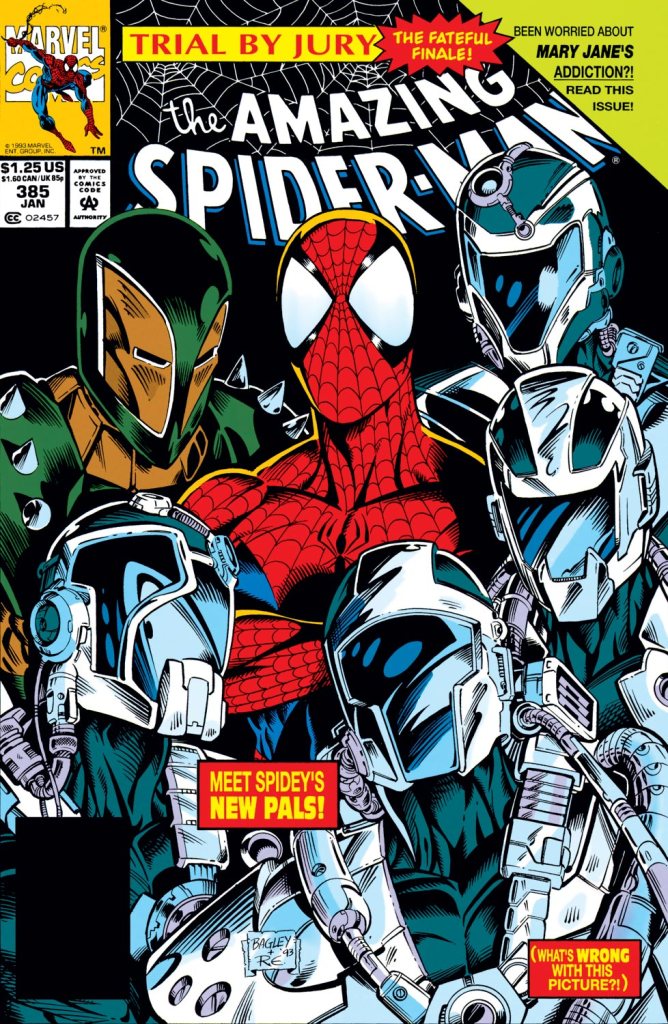
The cover.

Early story

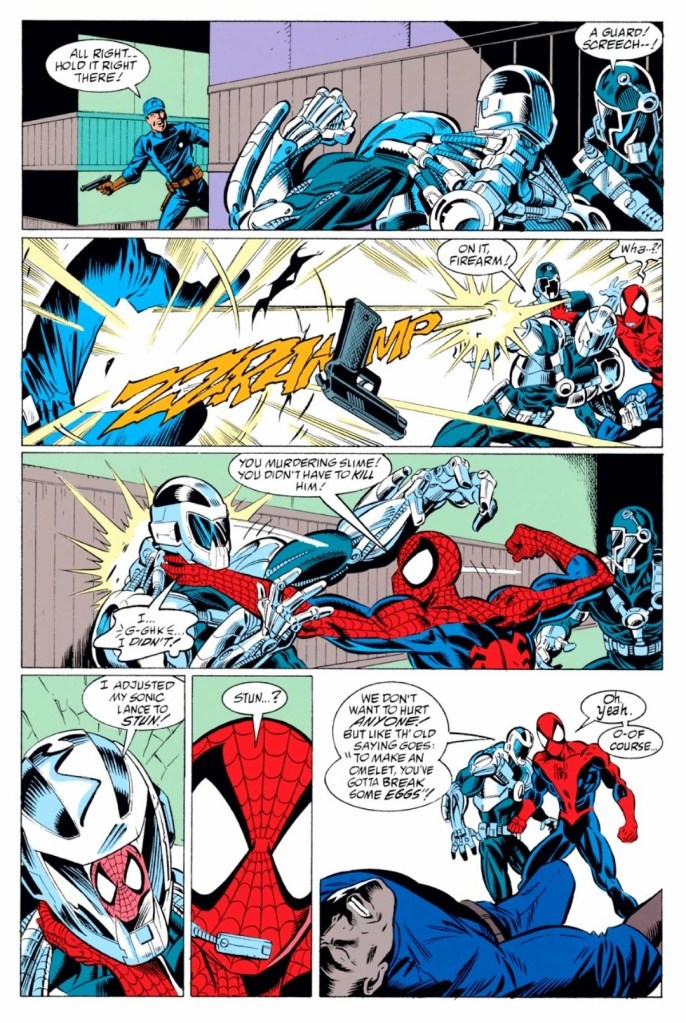
The story begins with a restrained Spider-Man declared guilty and sentenced to death by the so-called court of Orwell Taylor and the Jury. Just as the team members are about to execute the webslinger, their teammate Ramshot intervenes and says that Spider-Man saves lives which is a matter of public record. Disappointed by Ramshot’s behavior, Taylor mentions their secondary mission is to obtain a weapon that might allow them to eliminate their true enemy – Venom.

Taylor then says that if Spider-Man would help them destroy the greater evil, then the court would consider commuting his sentence…

Quality

Something unfortunate happens during the mission involving Spider-Man and the Jury.

Considering all the drama and tension that was built up in the previous two issues, the story here is a letdown. For one thing, all the discussions about Spider-Man being responsible for the killings and violence caused by Venom lead to nowhere as the story took a turn for the bizarre concept of the hero getting spared to work with the very team that went after him. Secondly, the mission that Spidey and the Jury worked on really did not have a justifiable goal. This resulted in a disappointing turn of events. Ironically, in this comic book you will see more of Taylor’s cunning on top of his own distorted view about justice.

If there is anything notable here, it is the fact that Spider-Man’s wife Mary Jane gets a good share of the spotlight as she literally moves towards the edge in relation to the deteriorating marriage. This shows that as Spidey spends more time away to do what is good and push back against the forces of evil, his wife gets lonelier and desperate as life turns for the worse. At the very least, this comic book expresses that the marriage of Peter and Mary Jane could be doomed.

Conclusion

This is how Mary Jane deals with loneliness and the decline in her life.

Considering what was built up and heavily dramatized in issues #383 and #384, Amazing Spider-Man (1994) is a rather weak conclusion. The way Spider-Man and the Jury parted ways felt more like sudden retreat than a real finish to what was started between them. Strangely enough, the focus on Mary Jane’s decline and desperation literally saved this comic book from becoming a creative disaster. The ending does not have much to do between Spider-Man and the Jury, but it was surprising in a crude way.

Overall, Amazing Spider-Man (1994) is serviceable.

+++++

Thank you for reading. If you find this article engaging, please click the like button below, share this article to others and also please consider making a donation to support my publishing. If you are looking for a copywriter to create content for your special project or business, check out my services and my portfolio. Feel free to contact me with a private message. Also please feel free to visit my Facebook page Author Carlo Carrasco and follow me on Twitter at  @HavenorFantasy as well as on Tumblr at https://carlocarrasco.tumblr.com/ and on Instagram at https://www.instagram.com/authorcarlocarrasco