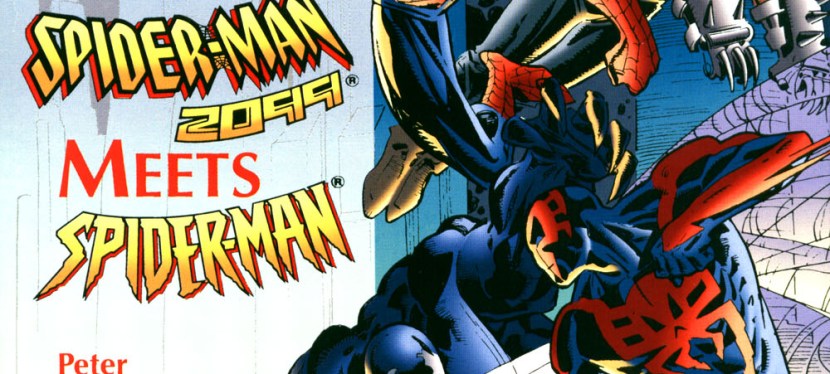
A Look Back At Spider-Man 2099 Meets Spider-Man

When Marvel Comics launched its 2099 franchise back in 1992 with Spider-Man 2099, clamor for having the futuristic hero meet up with the classic Spider-Man (Peter Parker) quickly followed.

Back in those days, crossovers were already popular and sold nicely with collectors. The Infinity Gauntlet of 1991 was an epic, universe-wide crossover done nicely by Jim Starlin, George Perez and Ron Lim. That limited series sold well, Marvel followed it up with The Infinity War (1992) and The Infinity Crusade (1993).  Even the disjointed The X-cutioner’s Song crossover of the X-Men comic books of 1992 kept the fans coming back for more.

For the 2099 universe, the franchise had strong launches with the respective first issues of Spider-Man 2099, Doom 2099, Punisher 2099, Ravage 2099 and even the first latecomer series X-Men 2099. Back in 1993, having the said 2099 heroes mix together was realized in the 5-part crossover The Fall of the Hammer.
1
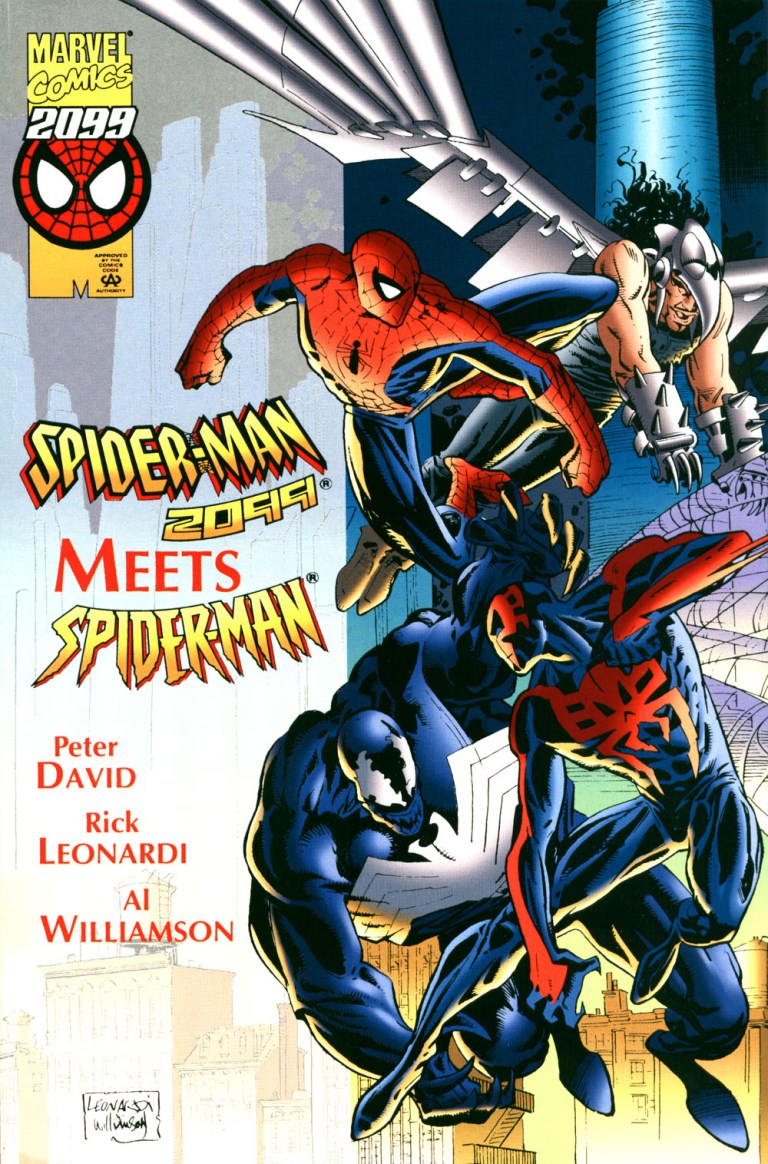
The cover by Rick Leonardi with ink work by Al Williamson. 

No matter what the trends back then, Spider-Man 2099 proved to be the most engaging series of the 2099 line of comic books arguably due to the in-depth storytelling of Peter David. Back in the 1980s, David worked at the direct sales team of Marvel Comics before moving into the editorial team as a writer. And, yes, he got to write for the Spectacular Spider-Man (originally titled Peter Parker, The Spectacular Spider-Man). Early on, Peter David made quite an impact with readers with the 4-part story The Death of Jean DeWolff in the said monthly series.

Many years later, David joined other comic book creators – including the late Stan Lee – on launching the 2099 franchise with Spider-Man 2099. He created a lot from scratch to establish the futuristic Spidey and made his mark on the 2099 universe.

“I don’t remember exactly which aspects of the 2099 were already part of the initial setup when I came aboard. I do know, though, that there was almost nothing specific for Spider-Man other than that he was, well, Spider-Man and (I think this was part of what I was handed) an employee of Alchemax. I was the one, though, who came up with his identity, the way his powers worked, the supporting cast, all of that. I even had a hand in designing the costume; not that I could draw a lick, but I sat there with Rick Leonardi during the first 2099 get together and described to him what I wanted, and he executed it perfectly, building upon what I suggested and improving it. I watched that costume come to life for the first time under Rick’s pencil. It was one of the single best collaborative moments in my life,” David said in a CBR.com interview.

This brings us back to the year 1995 when Marvel published the one-shot special crossover comic book designed to attract Spider-Man 2099 fans and the many millions of followers of the classic Peter Parker Spider-Man. That comic book was Spider-Man 2099 Meets Spider-Man written by Peter David and drawn by Rick Leonardi.

Let’s take a close look.

The comic book

The story begins in the far future of 2099 wherein Spider-Man (Peter Parker) from the 20th century finds himself lost in time and chased by the floating law enforcers who saw him as a danger to the public. Even though his costume is different, one of the law enforcers mistook him for Spider-Man 2099. Predictably, Spider-Man struggles to overcome and get away from them.

8
Spider-Man in 2099!
13
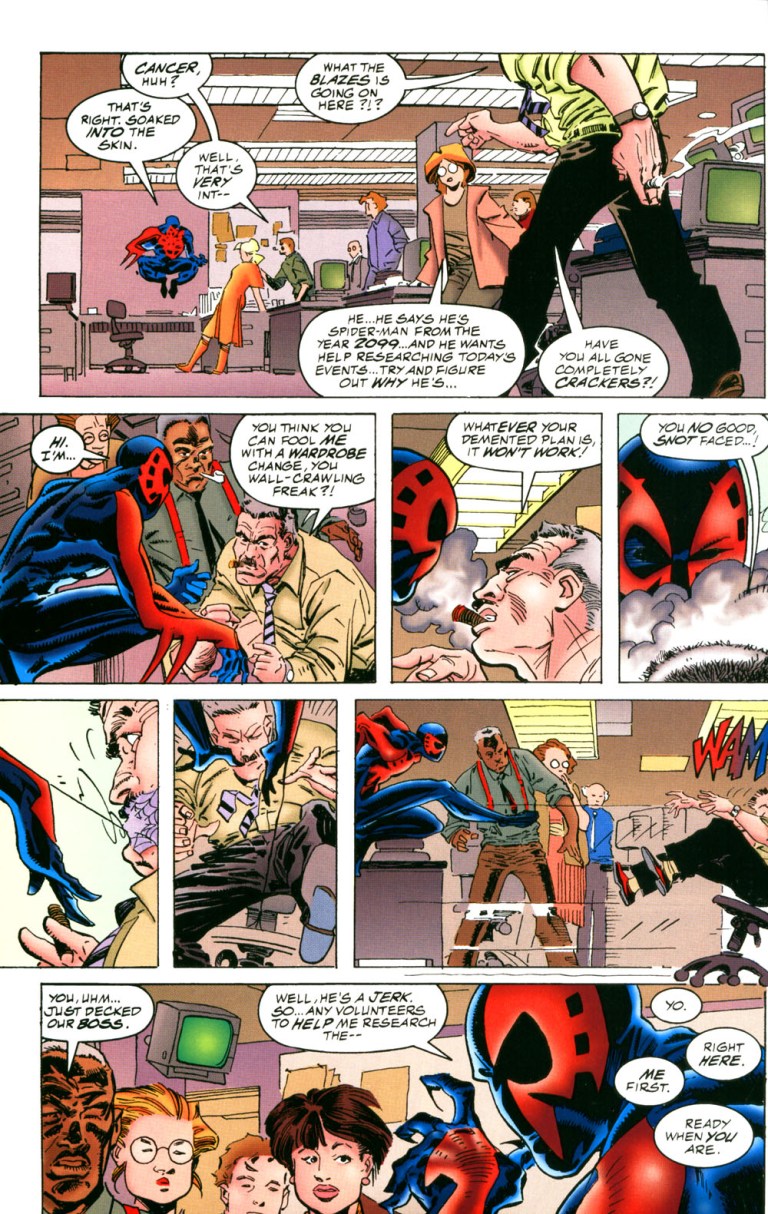
Spider-Man 2099 inside the Daily Bugle.

Meanwhile in the 20th century, Miguel O’Hara mistakenly arrives “home” only to find himself (naked no less) on the same bed as Mary Jane Parker (Spidey’s wife) who is also naked. This only confirms to him that he is lost in time. He immediately decides to get away from MJ and explore the city of New York which does not have the futuristic society he grew up with.

In an attempt to deal with the new reality, Spider-Man 2099 visits Peter Parker’s workplace – The Daily Bugle. He encounters Peter’s boss J. Jonah Jameson who mistook him as their time’s Spider-Man just wearing a new suit.

“You think you can fool me with a wardrobe change, you wall-crawling freak? Whatever your demented plan is, it won’t work,” Jameson told the disguised Miguel O’Hara who reacts by putting web on his mouth in front of the employees.

While the two superheroes struggle with being lost in time, Tyler Stone of Alchemax and Hikaru-Sama discuss something sinister.

Quality
25
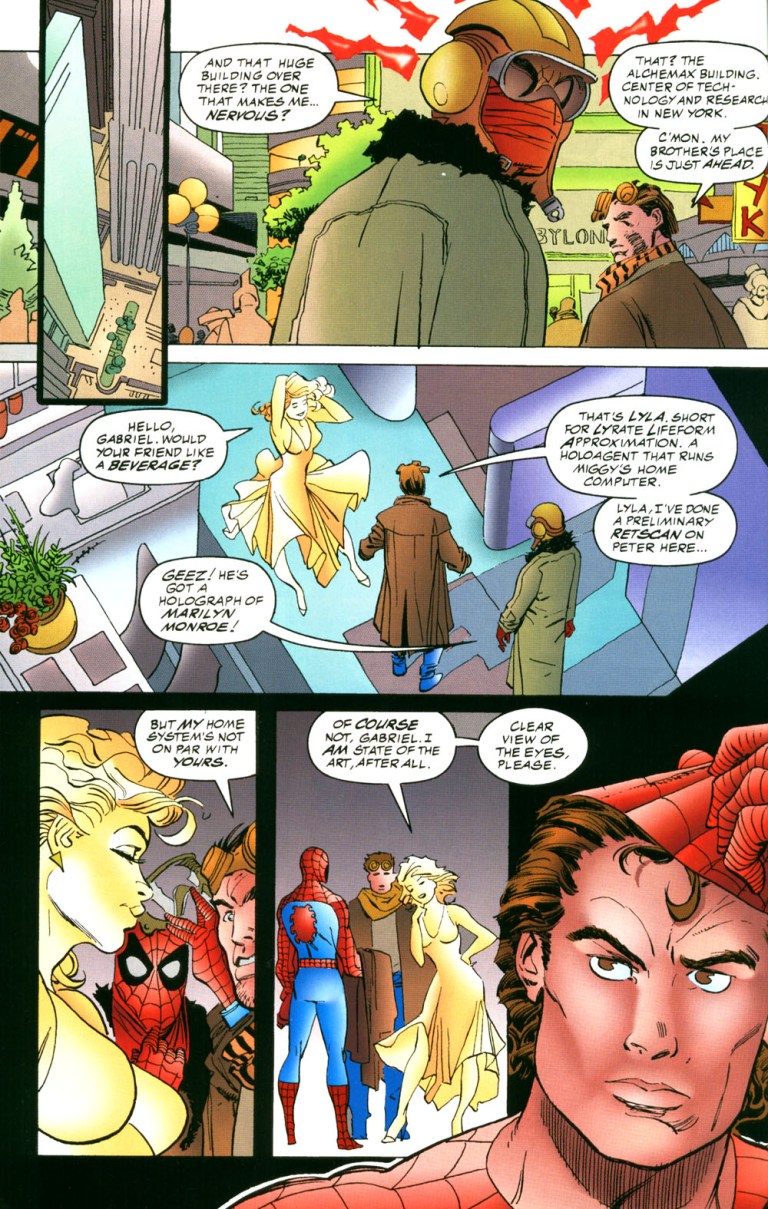
Spider-Man with Miguel O’Hara’s brother and Layla.

In terms of storytelling, Spider-Man 2099 Meets Spider-Man is messy even though there were efforts to have the two superheroes switch time settings that would allow them to explore different societies and mix up with their past supporting characters (example: Peter Parker Spidey meeting with Miguel’s brother and artificial intelligence Layla). What also hurt the storytelling was the lack of a very engaging antagonist. The futuristic Green Goblin the creators came up with was very lame.

The art by Rick Leonardi was barely satisfying and the sad thing is that none of his visuals – including the 2-page shot of the two superheroes together – delivered any impact. As Leonardi worked regularly on Spider-Man 2099, his art style of 20th century New York did not give me much immersion. J. Jonah Jameson was barely recognizable with Leonardi’s drawing.

To get straight to the point, this comic book is a major disappointment. It failed miserably to bring the two main characters together in a satisfying manner as there was an overabundance of build-up. By the time the two superheroes met, it was way too late for the comic book to be engaging and fun to read. With only seven pages available for the anticipated encounter, there was way too little of having Spider-Man and his 2099 counterpart together. So much could have been done to make the two superheroes interact and work together with a lot of impact but I suppose Marvel did not give the creative team enough time (and pages) to work with which resulted this disappointment.

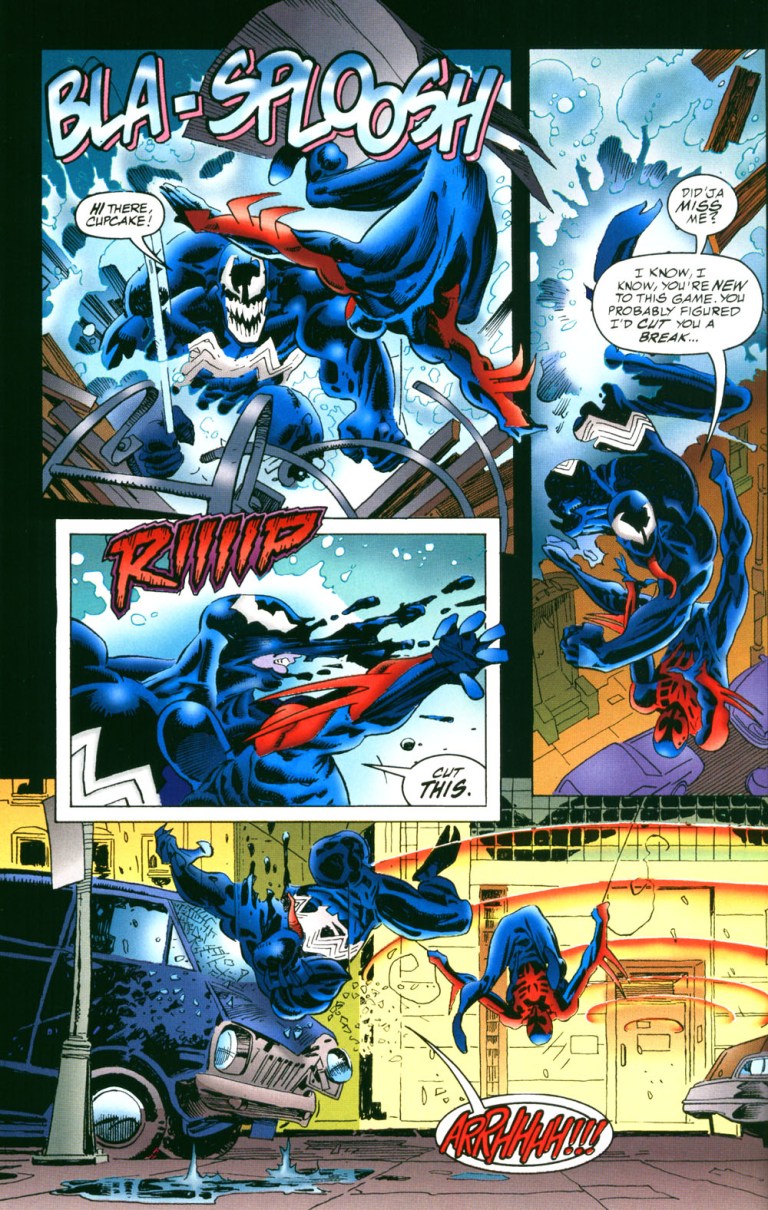
By comparison, I found Spider-Man 2099’s encounter with Venom much more satisfying to read. Spider-Man’s encounter with Vulture 2099, meanwhile, was satisfying. Sometimes I felt that it would have been better for Marvel to publish a Spider-Man 2099 versus Venom standalone crossover comic book than this 1995 crossover disappointment!
31
This is the BEST thing about this disappointing comic book. 

If you are determined to risk wasting your money by actually getting a physical copy, then be aware that a near-mint copy of Spider-Man 2099 Meets Spider-Man will cost you, believe it or not, over $40 at MileHighComics.com

Financial value aside, this comic book’s entertainment value is pretty low. It’s not a badly made crossover comic book but it sure remains a big disappointment considering its concept. Ultimately, Spider-Man 2099 Meets Spider-Man is not recommended. You have been warned.


Thank you for reading. If you find this article engaging, please click the like button below and also please consider sharing this article to others. Also my fantasy book The World of Havenor is still available in paperback and e-book format. If you are looking for a copywriter to create content for your special project or business, check out my services and my portfolio. Feel free to contact me as well. Also please feel free to visit my Facebook page Author Carlo Carrasco and follow me at HavenorFantasy@twitter.com
Carlo Carrasco’s Comic Book Review: 2099 Alpha #1

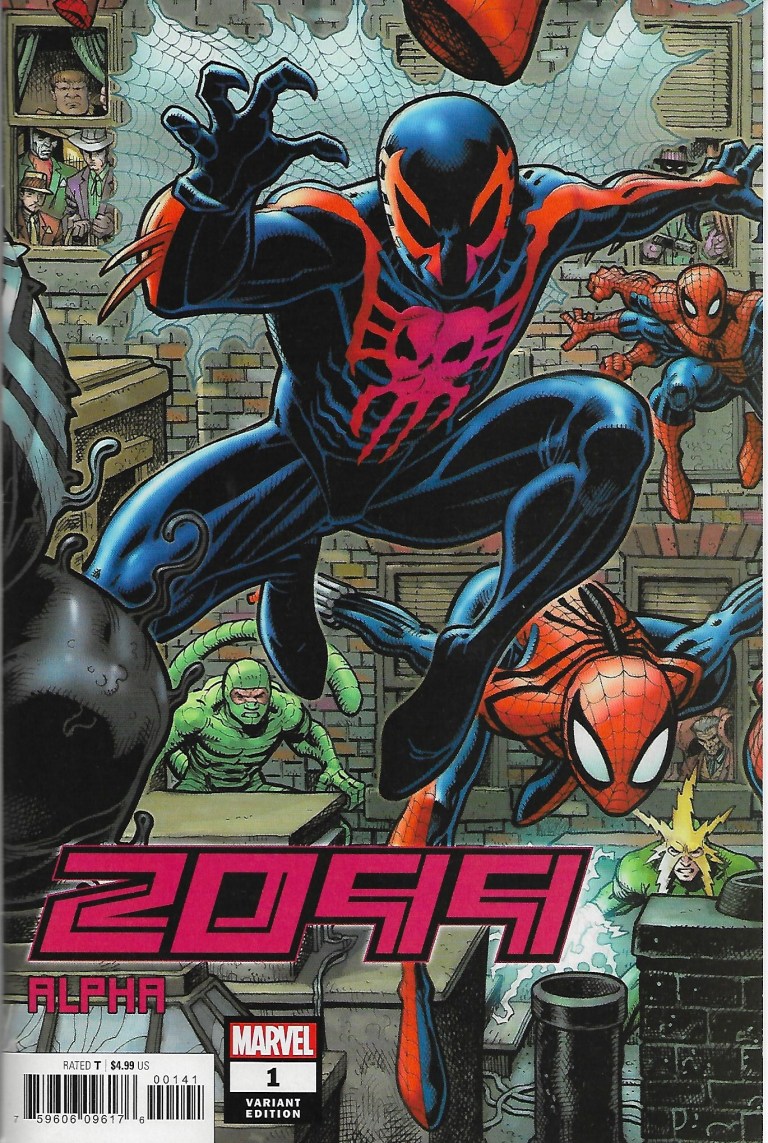
Hey comic book fans! It is finally official! The 2099 universe of Marvel Comics has been revived with the release of 2099 Alpha #1 which I bought at the local comic book store here in Alabang, Muntinlupa, Philippines. The comic book that was available had a Spider-Man 2099 variant cover and it carried a hefty $4.99 price!

So you must be wondering…is the comic book any good? Does it capture the look and feel of the 2099 universe that first appeared in comic books back in the 1990s? Any significant changes in terms of storytelling and visuals?

Here is my review of 2099 Alpha #1.

2019-11-21_100919~2.jpg
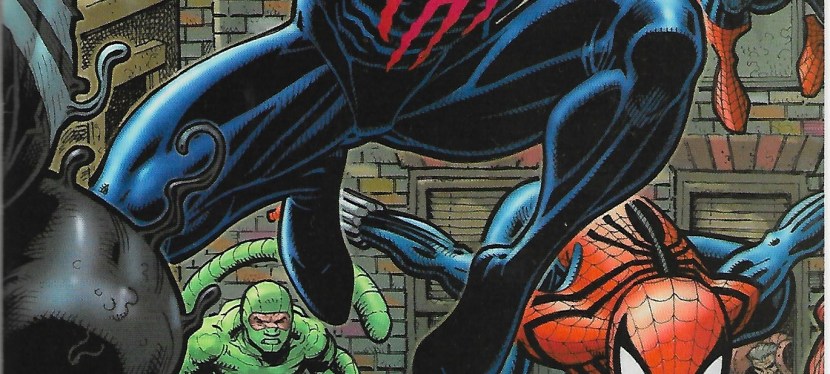
The variant cover showing Spider-Man 2099 with Spidey and related characters from the past.

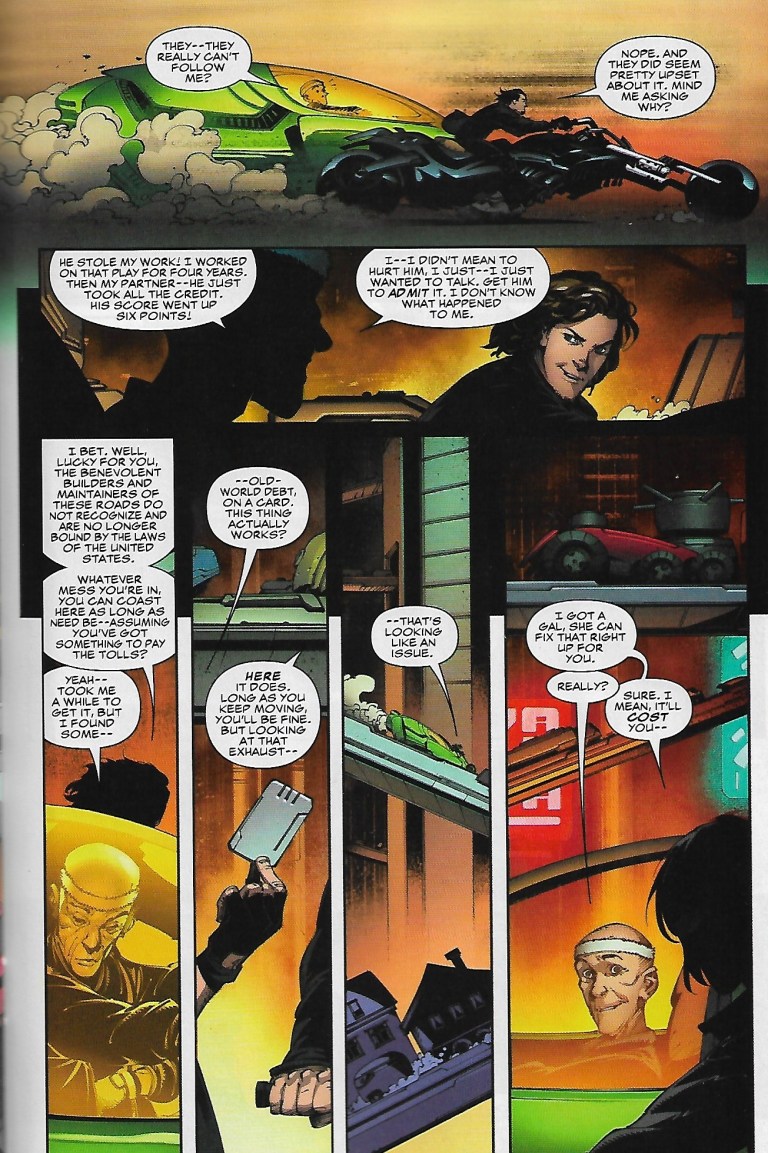
Written by Nick Spencer with art by Viktor Bogdanovic (colors provided by Marte Garcia), the comic begins in The Ravage (note: this is NOT the failed 2099 hero of Stan Lee and Paul Ryan) where a little boy finds Thor’s hammer but abandons it as he saw some monsters coming. The story then shifts to Brooklyn where Jake Gallows (Punisher 2099) gets into a violent encounter with a man before finally meeting the backup he called for. Then they see a sign that their god, Thor, is now in a merciful mood.

In Nueva York, Miguel O’Hara (Spider-Man 2099) talks with Tyler Stone inside an Alchemax tower. Tyler examines what Miguel brought to them and he mentions an incoming threat. Elsewhere, Conan appears struggling in battle with some people. From a distance, Doom 2099 watches and he has the Watcher captive.

Quality

To put it short, 2099 Alpha #1 is really a set-up type of comic book designed to immerse readers into the 2099 universe which now looks darker, grittier and more twisted than the way it was first presented back in the 1990s. Because the spotlight shifts from one place to the next, showing multiple characters, there really is not much meat in the storytelling. Really, thirty pages of art and story were made but ultimately ended up being not so engaging.

The art of Viktor Bogdanovic shows the 2099 universe to be a depressing setting and his art on classic characters like Spider-Man 2099, Punisher 2099 and Doom 2099 make them look unrecognizable. I remember Jake Gallows being huge and buff but in this comic book, he looks like he lost a lot of muscle and ended up looking ordinary.

Conclusion

Overall, 2099 Alpha #1 is an expensive disappointment and it is easily the weakest new comic book I bought all year long. There is a lot of suspense, expository details and even some horrific imagery, but ultimately there is no real fun to experience here. At $4.99, this is too expensive and it is a waste as it failed to engage and entertain me. Let me add that I lowered my expectation for this revival of the 2099 universe since the teaser announcement was made months ago. Back then, I anticipated that the new guys handling the 2099 universe of comics will take it to a new direction (move far away from what made the 2099 universe in the 1990s memorable and distinct) and this overpriced comic book is an early confirmation of it.

2019-11-21_101114~2.jpg
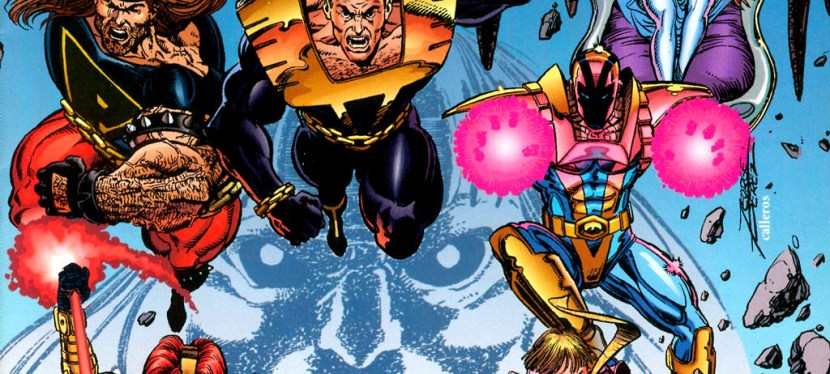
Recognize any of these characters?

Of course, there are still several other 2099 comics from Marvel that will be launched next month, including Spider-Man 2099 #1, Venom 2099 #1, Ghost Rider 2099 #1 and more. We will find out soon enough if those comic books will share the same dark and gritty style of 2099 Alpha #1 or not.

Ultimately, 2099 Alpha #1 is not recommended. As long as it is sold at cover price, avoid it.

+++++

If you are nostalgic of the 1990s 2099 universe, check out my reviews of Spider-Man 2099 #1 and #25, Ravage 2099 #1 and X-Men 2099 #1.


Thank you for reading. If you find this article engaging, please click the like button below and also please consider sharing this article to others. Also my fantasy book The World of Havenor is still available in paperback and e-book format. If you are looking for a copywriter to create content for your special project or business, check out my services and my portfolio. Feel free to contact me as well. Also please feel free to visit my Facebook page Author Carlo Carrasco and follow me at HavenorFantasy@twitter.com


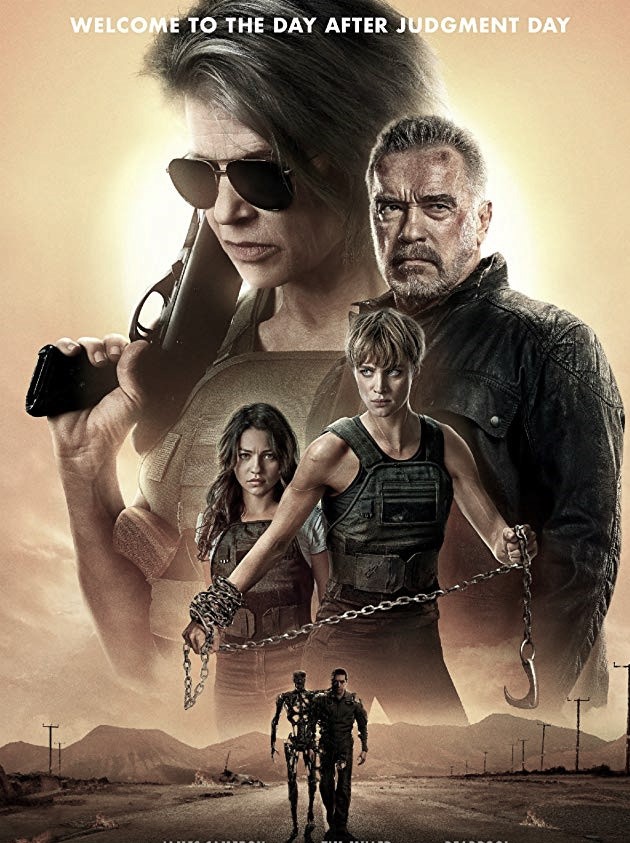
Carlo Carrasco’s Movie Review: Terminator: Dark Fate

I will just say it straight and clearly – the Terminator film franchise is truly unnecessary today and, having seen its debut in the year 1984 (written and directed by a very young James Cameron), I should say that the saga really ended with 1991’s Terminator 2: Judgment Day (Cameron’s masterpiece).

Out of curiosity, instead of anticipation, I got to watch Terminator: Dark Fate at the local cinema. Having been disappointed with Terminator 3: Rise of the Machines, Terminator: Salvation (a bad movie notorious for Christian Bale’s loss of self-control) and Terminator: Genisys (the most insulting and most screwed up film of the franchise), I had low expectations for Dark Fate.

Ultimately, I left the cinema disappointed yet again although the experience was not as bad as that of 2015 (with Genisys).

Screenshot_20191113-134912_YouTube.jpg
Clearly, the filmmakers took inspiration from Star Wars: The Force Awakens and mix the more established film franchise stars (in supporting roles) with the younger actors.

To put it short, Terminator: Dark Fate took creative inspiration from 2015’s Star Wars: The Force Awakens. This means it was made with recycled concepts, told the story through its new characters (played by actors who are much younger and who are supposed to appeal to younger viewers) and back them up with the old, more iconic actors (Arnold Schwarzenegger and Linda Hamilton) limited to supporting roles. When it comes to presentation, this new movie felt more like a roller coaster ride than an actual story laced with spectacle stage-by-stage.

That is pretty much how Terminator: Dark Fate turned out. It does not matter that this was directed by Tim Miller, the guy behind 2016’s Deadpool. It does not matter that the great James Cameron got involved with producing and story credit (he shared with a few other names). It does not matter that this movie was made with a large budget of $185 million and relied heavily on computers to generate the visuals (which look fake most of the time). Whatever the preparations made, they did not matter at all because Terminator: Dark Fate is a rushed and creative disappointment that does not deserve your time nor your money.

The movie opened with archived footage of Sarah Connor expressing the darkness of the future coming. This was immediately followed by a scene set in 1998 showing Sarah and her son John living in an age in which Judgment Day did NOT occur on August 29, 1997. Suddenly another Terminator T-800 Model 101 (another Schwarzenegger-type Terminator) appears and actually kills John Connor leaving Sarah in turmoil.

Screenshot_20191113-135025_YouTube.jpg
This is the protector sent through time by the human resistance.

John Connor, who has been a central story element in the 1984 and 1991 (memorably played by Edward Furlong) movies as he was destined to be the human resistance leader in the war with Skynet, was eliminated so quickly in the opening of this new movie very similar to how the character of Dwayne Hicks (played by Michael Biehn in the James Cameron-directed Aliens) got killed in a very dismissive way in the beginning of Alien 3. This move was nothing less than cynical, ill-conceived and even a daring disservice to Terminator fans.

From this point on, Terminator: Dark Fate turns into a “what if John Connor was dead and a new future war followed?” type of story.

Even though Judgment Day got prevented in relation to what Sarah and John achieved in Terminator 2, a new war between man and machines in the far future still occurs only this time Skynet is no more and the new enemy artificial intelligence (AI) this time is called Legion. This new story concept, by the way, is pretty insulting to any fan who loved the first two films directed by James Cameron as those flicks told a complete saga.

Screenshot_20191113-135131_YouTube.jpg
This is the new, future leader of the human resistance.

And then the plot of The Terminator got recycled. A human fighter is sent back through time to protect a person who is destined to become the leader of the human resistance. Also sent back through time is a Terminator designed to look human and infiltrate society with a mission to kill the future human resistance leader. This is essentially what Terminator: Dark Fate truly is and even though Sarah Connor returned (plus another Terminator T-800 played by Schwarzenegger), there really is nothing new, nothing fresh and nothing worth enjoying.

When it comes to quality, this movie does not have much standing for it. The new characters are not engaging at all and their respective performers really had nowhere to go to engage moviegoers. Mackenzie Davis playing the new combat-ready protector only served to beef the film with action and there is nothing compelling about her act, nor did the script provide anything to make her androgynous character memorable. The new human resistance leader played by Natalia Reyes is forgettable and unbelievable even though she tried hard being dramatic. Compared with Sarah Connor in 1984’s The Terminator, the chosen one Dani Ramos in the film was transformed from a struggling, working-class person into a brave fighter in a very rushed and unconvincing manner. Also, if you take a close look at Natalia Reyes, she is too short to be a figure of authority, too small to use weapons and her act is clearly sub-par in terms of quality making her big misfire in terms of casting. The performance, script and directing really had no depth when it comes to developing the characters.

The new Terminator (Rev-9) played by Gabriel Luna was nothing more than an uninspired attempt to outdo the T-1000 of Terminator 2. Luna was decent with playing cold and emotionless but when he acts human to infiltrate human society, he’s just generic at best.

Screenshot_20191113-135243_YouTube.jpg
This is the new cinematic villain that won’t stop to kill the future leader of the human resistance. Oh, the computer-generated visuals are often fake to look at.

As for Arnold Schwarzenegger and Linda Hamilton returning, it is sad for me to say that these two iconic performers of the film franchise got wasted. Sarah Connor in this movie was poorly written and this modern version ruins the legacy the character had since 1991. Schwarzenegger meanwhile played another T-800 Terminator whose adjustment into human society turned out to be unconvincing, even outlandish. A Terminator adjusting into domestic human life? Totally unbelievable!

If there is anything to admire in this ill-conceived movie, it is Schwarzenegger’s delivery of his lines as the Terminator. He was over 70-years-old at the time of filming and he no longer has the super fit, muscular build he was famous for but he still proved to be excellent in being robotic with the dialogue. Sadly, this good stuff from the ex-governor of California was not enough to save this movie from its dark fate.

The film has a lot of action and there is a notable variety of it here. Even though action-packed and the action quality is an improvement over Terminator 3, Salvation and Genisys, Terminator: Dark Fate is ultimately a ride that can only provide temporary relief from the pain of the weak script. Oh, the use of fake-looking CGI hurts the action and stunts

Conclusion

TermiDF
Let this be the LAST Terminator movie and let it fade away. How? By NOT spending your precious time and money on it.

Terminator: Dark Fate clearly failed to be a solid film and definitely it is NOT worthy of being the official follow-up (the “real Terminator 3”) to the first two films written and directed by James Cameron. Cameron’s involvement with this movie did not really improve the situation of the deteriorating Terminator film franchise and even worse, this big disappointment taints his record of excellence as a producer. Director Tim Miller, in my opinion, should go back to superhero film making or try directing a brand new project of science fiction that does not involve an established intellectual property.

Bottom line – Terminator: Dark Fate is absolutely not recommended. You definitely should NOT spend your money on this movie (the cinema, future release on streaming services, Blu-ray, DVD, etc.). The movie is also woke garbage and the product of DEI (diversity, equity and inclusion).

If you want to experience the cinematic greatness of the Terminator film franchise, go back to watching The Terminator and Terminator 2: Judgment Day instead.


Thank you for reading. If you find this article engaging, please click the like button below and also please consider sharing this article to others. Also my fantasy book The World of Havenor is still available in paperback and e-book format. If you are looking for a copywriter to create content for your special project or business, check out my services and my portfolio. Feel free to contact me as well. Also please feel free to visit my Facebook page Author Carlo Carrasco and follow me at HavenorFantasy@twitter.com
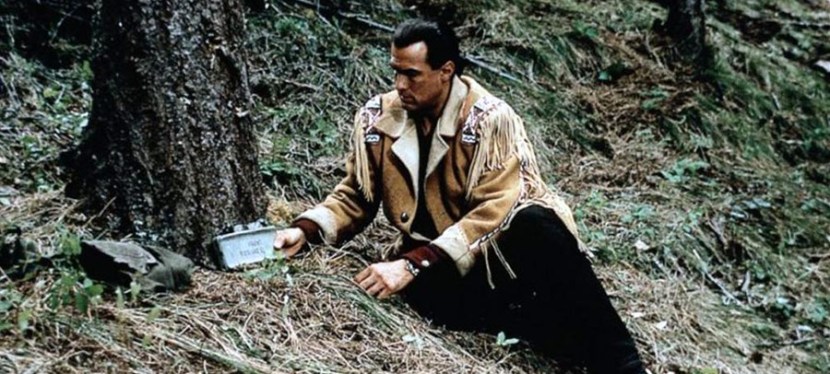
A Look Back at On Deadly Ground

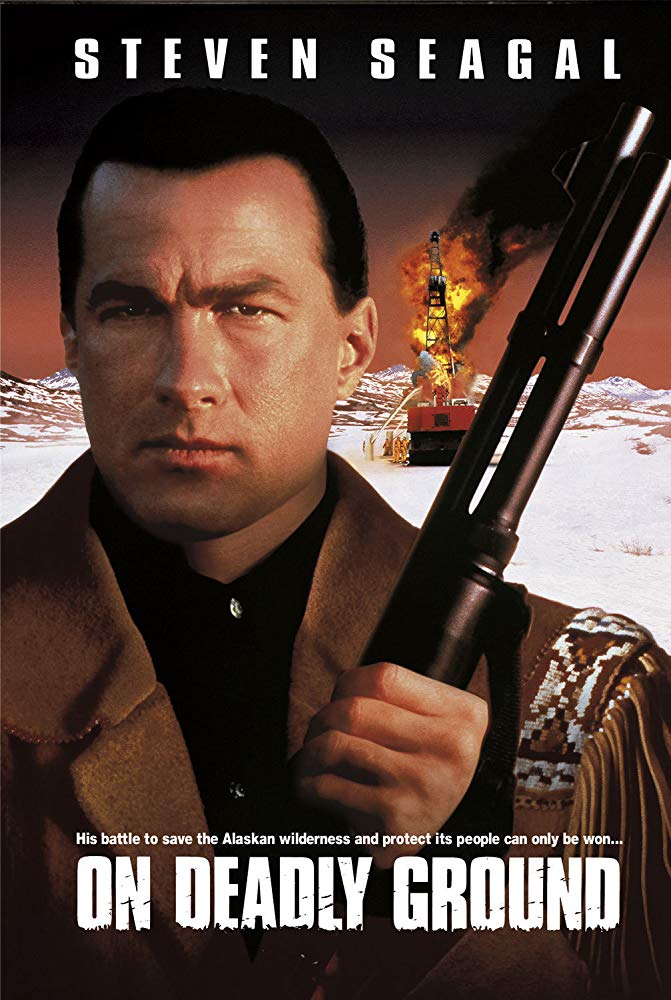
Way back in 1994, Warner Bros. released the action movie On Deadly Ground which marked the directorial debut of its star Steven Seagal. The movie had a poster that easily attracted the attention of avid Steven Seagal fans and eventually the film lured quite a lot of moviegoers to the cinemas.

ODG1
Even though it had a boring design, this image at cinemas excited Steven Seagal fans and moviegoers craving for action.

I never saw it in the cinemas due to a lack of time and money. Instead I saw On Deadly Ground on VHS format (and later on cable TV) in the comfort of home. That comfort however turned into disappointment after watching it.

For starters it’s a Steven Seagal movie which guarantees lots of hard-hitting action with lots of swearing. What makes it feel unique was its focus of the environment and its very forced concept about a very greedy top executive of an oil company is creating danger towards the environment as his team rushes to complete an oil rig called Aegis One in Alaska.

The execution of the movie, to say the least, is rather poor. Just about every character in the movie is one-dimensional. When it comes to action, it is typical (and very predictable) Seagal as the star gets to fight lots of bad guys without ever being hurt by them! Ironically Seagal in the film expresses pain over the treatment of his wounds.

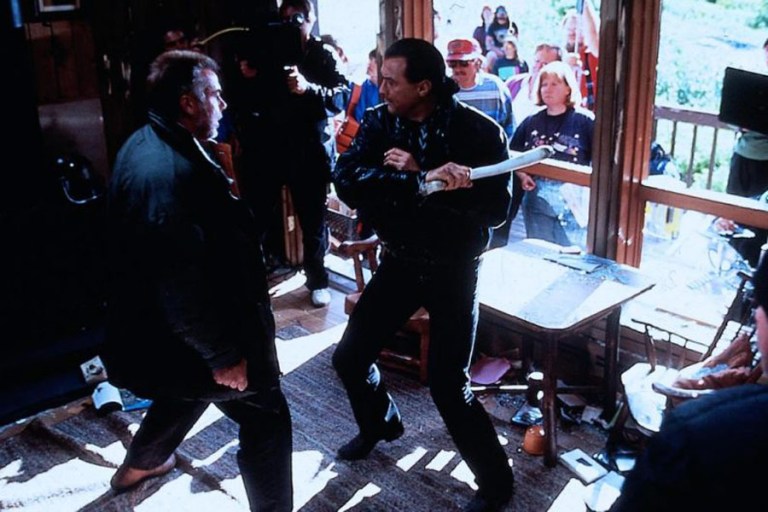
ODG6
Star-director Steven Seagal and the film crew working on an action sequence.

And then there is the emphasis on the environment. The movie narrowly portrays the fictional oil company as the force of danger to nature and threat to indigenous people of Alaska because it is led by Michael Jennings (played by Michael Caine) who is too greedy and desperate to beat a deadline  and prevent the oil rights from reverting back to native Alaskans.

That’s right! Jenning’s Aegis had the oil rights for twenty years and all they could do is try to launch an oil refinery so near the end of the time period. Does it really take that long to construct an oil rig? What exactly did Jennings do during those twenty years? I mean, he acquired the oil rights from the natives and I could speculate he did not prioritize the construction of any oil-related business project using those same rights. Perhaps Jennings spent years touring the world, suddenly was advised that his corporation has financial trouble and only then did he go to work to make oil rig.

More on the environment, Steven Seagal plays Forrest Taft who initially serves Jennings. He eventually checks the computers of the company to find out that faulty equipment has been used and the delivery of better and more reliable equipment is coming in way too late. Taft even asked Jennings (who eventually learned about Taft’s unauthorized computer access) how much money is enough and this predictably leads to a scene in which Taft gets set up to die in an explosion.

ODG2
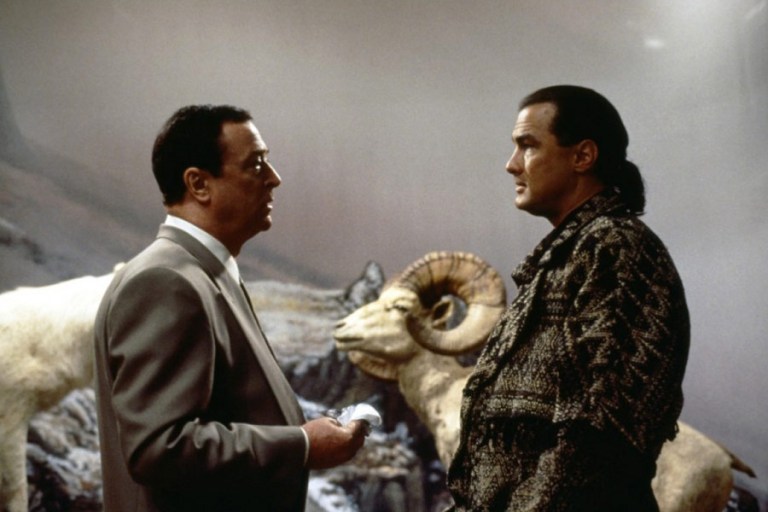
Michael Caine and Steven Seagal.

Unfortunately for Jennings and the other bad guys, Taft survived and got assistance from native Alaskans. Very predictably, he makes a comeback, collects weapons, performed a few destructive operations before proceeding to Aegis Oil’s rig to cause further destruction and kill bad guys!

Then the film ends with Taft giving a speech at the Alaska State Capitol focused on uncontrolled pollution, environmental destruction and big businesses’ contribution to environmental decline.

ODG4
Chinese actress Joan Chen pretending to be a native tribe member.

It’s funny how Taft got to deliver his speech. He was not arrested for causing the oil rig’s devastation nor was held accountable for killing other people. Where were the local authorities who could have initiated an investigation? Even without Michael Jennings, the oil company could have gone to the local authorities or the federal government to accuse Forrest Taft for murder and even acts of terrorism! Also where in the world are those staunch, loudmouth environmental activists, SJWs and climate change activists? The damage caused by Taft on the oil rig clearly caused damage to the natural environment with those toxic fumes from the explosions! Logic was clearly thrown out for the sake of senseless violence.

When it comes to performances, this movie is a showcase of shallow acting and cinematic expressions. Not only are the characters one-dimensional and the script really had no character development, the actors really had no where to go as far as acting is concerned. Chinese actress Joan Chen plays Masu who only serves as the English-speaking expository dialogue delivery person to help the audience understand the norms and concerns of a native tribe. Shari Shattuck  (who is an author and has her own Facebook page) played the pretty, bland and straight-forward special assistant to Michael Jennings. R. Lee Ermey, who is best known for playing military officers, plays the leader of a group of mercenaries who got defeated too easily by Seagal.

In terms of directing and overall presentation, this movie is clearly nothing more than a vanity project of Steven Seagal. There were many moments in the film that looked like it suggested viewers to worship and idolize Seagal. The pacing of the film is very lackluster overall.

Poorly directed scenes? One of them is the excessively violent torture scene of Hugh Palmer (played by a then 73-year-old Richard Hamilton) which showed no restraint on the part of filmmakers. The scene, which was clearly designed to make moviegoers see the evil of Michael Jennings through the acts of his henchmen, would have worked better had the on-screen torture been reduced and shortened.

More on the movie’s violence, the scene showing Forrest Taft easily beating up multiple oil workers in response to the mistreatment towards a native man was unnecessary and overly long. Taft looked more like a senseless superhero who does not care about humanity and laws. And then there was that hand-slap game between him and “the man’s man” Big Mike (Mike Starr). The presentation of violence and bloodily injuring a man as means of enlightenment is senseless.

Ultimately On Deadly Ground is a worthless action to film to watch and I believe only die-hard Steven Seagal fans will love it. It was a very bad movie back in 1994, it’s even worse by today’s standards. On Deadly Ground is filled with bad ideas turned into film. A pro-environment concept presented as a senseless action film is a big waste. And then there is the old stereotype that a giant corporation’s head is unabashedly evil, inhuman and greedy (note: not all corporate heads of billion-dollar corporations are like that).

As such, I should say that you should never waste your time nor your money on this piece of crap.

+++

Note: This retro movie review was originally published at my old blog Geeks and Villagers. What you just read was the updated and expanded version. As such, this retro movie review is the most definitive version.


Thank you for reading. If you find this article engaging, please click the like button below and also please consider sharing this article to others. Also my fantasy book The World of Havenor is still available in paperback and e-book format. If you are looking for a copywriter to create content for your special project or business, check out my services and my portfolio. Feel free to contact me as well. Also please feel free to visit my Facebook page Author Carlo Carrasco and follow me at HavenorFantasy@twitter.com
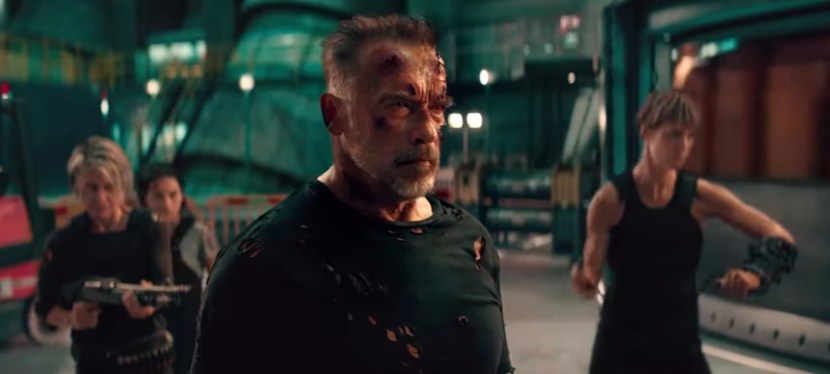
A Look Back At Break-Thru #1

When done right, a crossover storyline showcasing a big mix of superheroes getting involved in a huge event can be memorable and worth revisiting years after getting published.

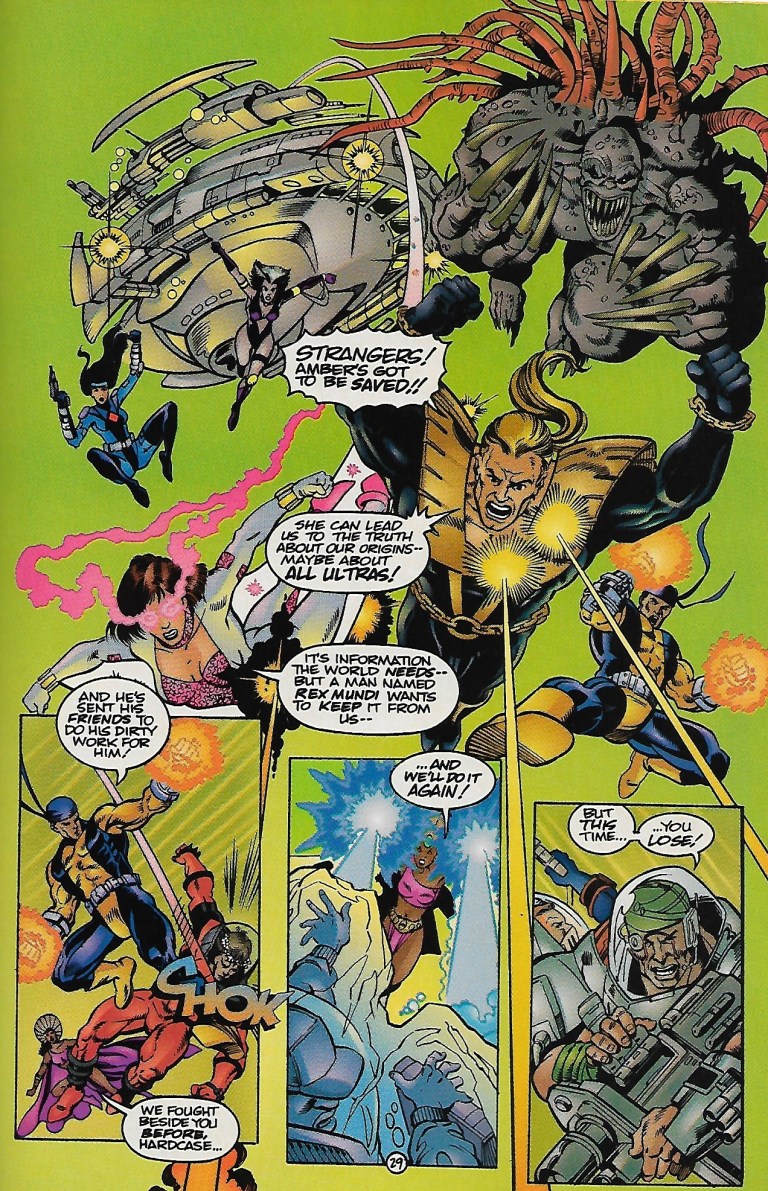
Back in 1993, Malibu Comics launched the Ultraverse which involved many talented creators. Right from the start, it was made clear that there was a shared universe occupied by The Strangers, Night Man, Prototype, Prime, Mantra, Hardcase and many others.

Before the end of 1993, Malibu launched Break-Thru #1 which started a new storyline that involved many of the above characters plus Firearm, The Solution, Sludge and Solitaire. Adding more punch to this comic book was Malibu’s hiring of legendary artist George Perez who worked on the classic Crisis on Infinite Earths maxi-series of DC Comics.

2019-10-17_074138~2.jpg
A great cover! One of the best ever for any Ultraverse comic book!

Here is a close look at Break-Thru #1 mainly written by Gerard Jones, drawn by George Perez and inked by John Lowe with colors by Moose Baumann. Credited as contributing writers were Steve Englehart, Mike W. Barr, Steve Gerber, James D. Hudnall, Tom Mason, George Perez, James Robinson and Len Strazewski.

Early story

The story begins immediately after the end of Exiles #4. A man falls to his death from the top of a tower thinking he was reaching the moon at night. Elsewhere, an airplane sharply goes up with too much altitude as the pilot obsesses with going to the moon

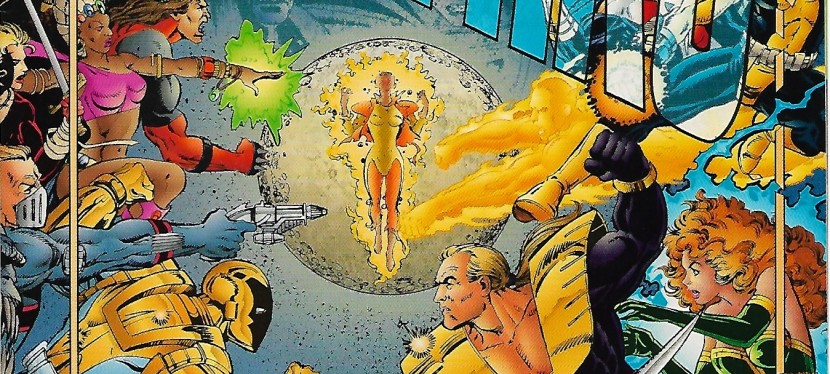
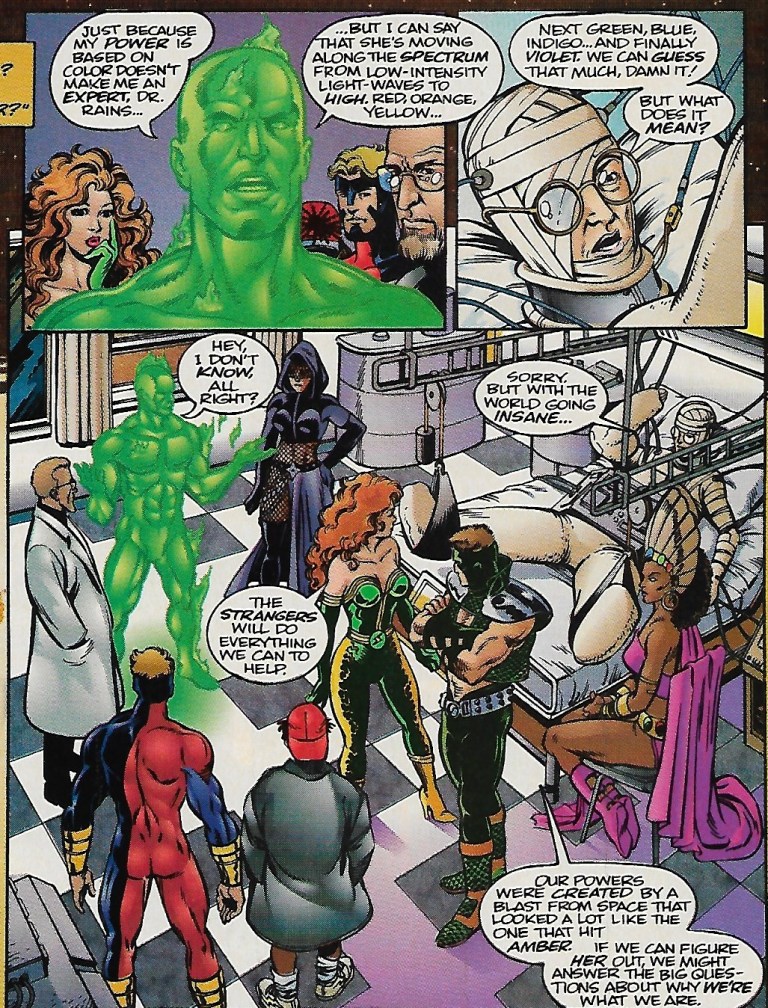
As it turns out, the media reports about people trying to reach the moon and getting restless. A member of Exiles lies helplessly on a bed with his entire body covered with medical materials for his injuries. A doctor presses him for answers and he claims to know that Amber, one of the Exiles members, looks a lot like a young lady floating over Los Angeles. He thinks she is responsible for the madness that has been going around the world.

The injured confirmed that the lady, floating high above with reddish energy around her, is none other than Amber. He claims, however, that he has no idea what happened but shared that she was already prone to volatile energy blasts.

Behind the scenes, members of Aladdin discuss what has been happening. One of them believes that Amber may hold important clues to the nature and origin of Ultras. The Aladdin people get distracted with noise caused by Eden Blake (Mantra in civilian form) who secretly eavesdropped on them pretending to be lost (note: a reference is made to Mantra #5 to explain her new employment with Aladdin.)

2019-10-17_075309~2.jpg
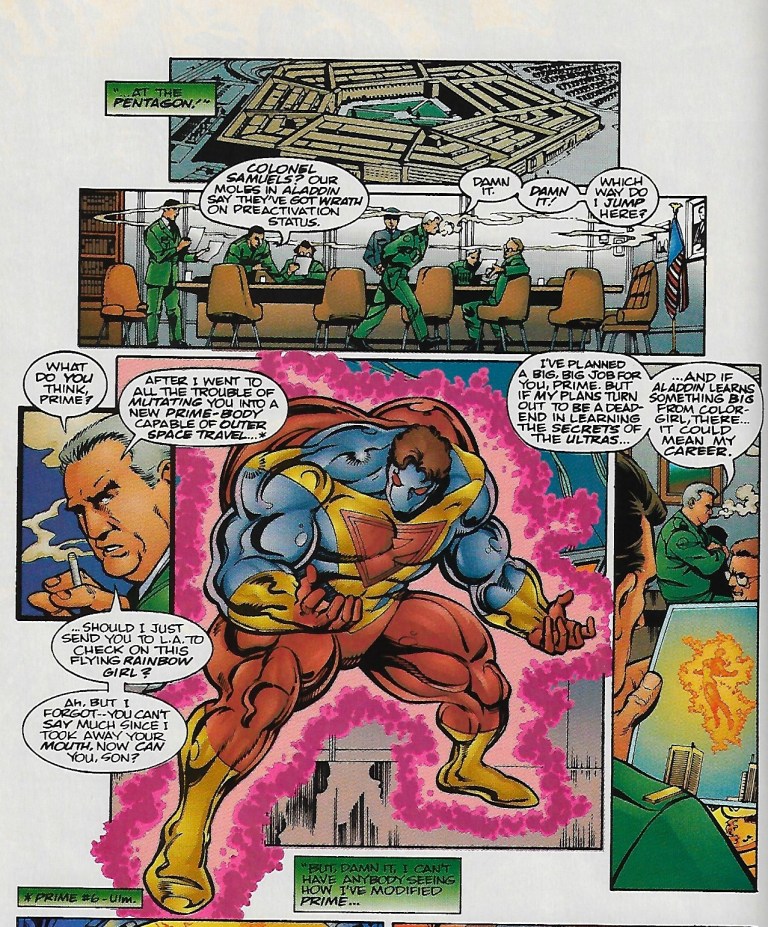
The military and Prime.

Aladdin decides to activate their own Ultra named Wrath. Over at the Pentagon, military officers discuss the information about Wrath they got received from their moles at Aladdin. Their leader wondered about sending Prime (with a modified look) on a mission but he can’t have anyone see how he modified the Ultra.

Meanwhile in the bowels of the Earth, a man who is not really a man watches…

Quality

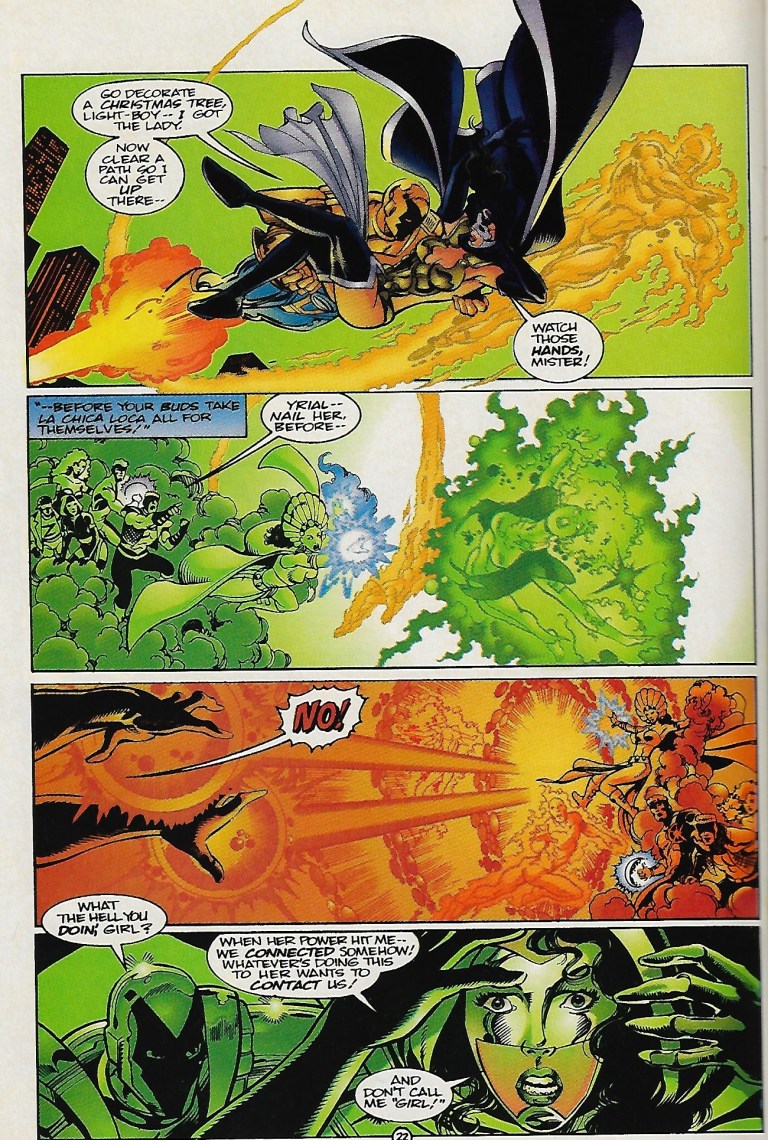
In terms of storytelling, Break-Thru #1 has a nice build-up. It took its time making references to the many, many characters of the Ultraverse. By the end of the comic book, you will realize there are different kinds of Ultras: the solo Ultras, the corporate Ultras, the freelancers, the work-for-hire Ultras, the accidental Ultras and the like. With regards to emphasizing the shared universe, this comic book shows that connections with the individual comic books are tight. References in what happened in Exiles #4, Prime #6, Mantra #5 and others all helped build-up the concept of Break-Thru. The story is 35-pages long which, in my opinion, was sufficient not only to emphasize the conflict Break-Thru but also give readers enough space to get to know what exactly is going on, who are these many characters, what the institutions involved are, etc.

2019-10-17_075441~2.jpg
Mantra with Prototype.

2019-10-17_075133~2.jpg
The Strangers discuss what has been happening.

More on Break-Thru’s concept, I like the way the comic book emphasized how the sudden presence of multiple Ultras affected local societies, members of the public, the government, the secret groups and others. It also sheds light on how people, regardless of social class or status, react to the presence of people who carry special powers or have unusual talents over them. This reminds me of a key scene in the 2012 Avengers movie in which Col. Fury mentioned how the sudden presence of super beings caused a disturbance.

Spectacle? Unsurprisingly there is a good amount of action as well as incidental moments that kept the narrative entertaining.

Visually, Break-Thru #1 is a great looking comic book thanks to George Perez who is famous for drawing multiple characters environments with his distinctive style complete with a high level of detail. There is not a single boring moment with his art and each panel has really nice visuals. The action scenes and incidental happenings (example: Valerie’s sudden burst of energy) come with a lot of punch.

2019-10-17_075541~2.jpg
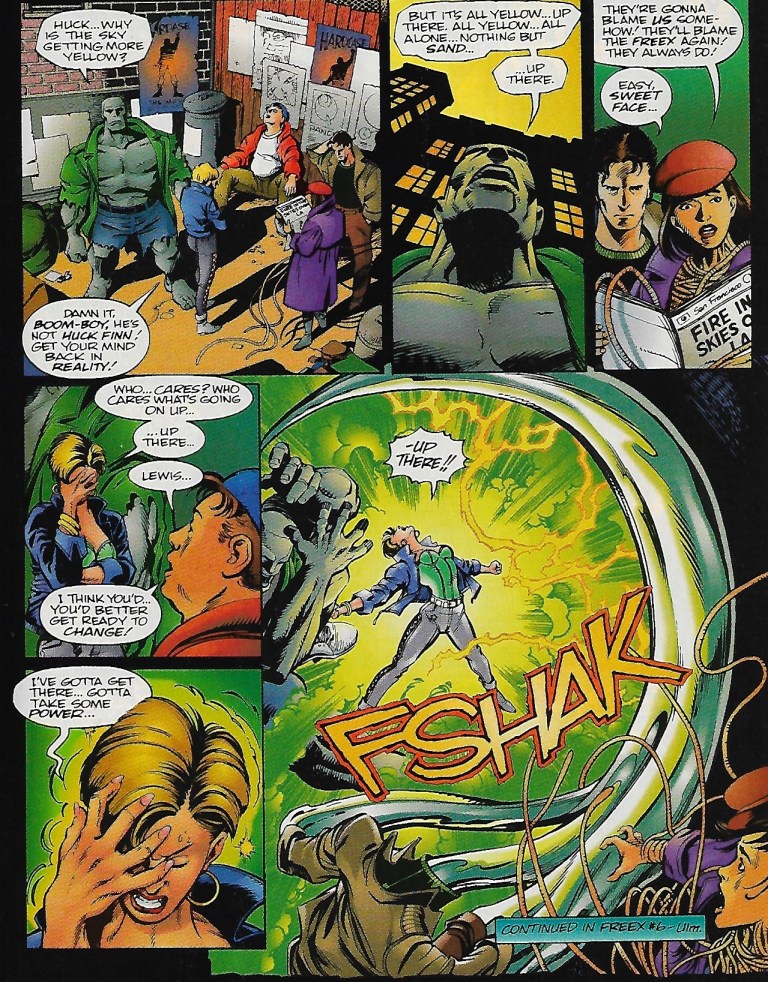
Freex got affected.

Very notably, Perez’s take on each of the Ultraverse characters is very good to look at and in some ways, certain characters look a lot better than they did in their respective comic book series. A perfect example here is the team Freex whose characters look more human (in style) and more lively. Of course, I don’t mean to say that the illustrators of the Freex series did not do a good job.

Perez’s drawing of Mantra is very good. Similar results with The Strangers, Hardcase, Solitaire and Prototype. Very clearly George Perez carefully did his research on the characters and their respective designs.

Conclusion

2019-10-17_074728~2.jpg
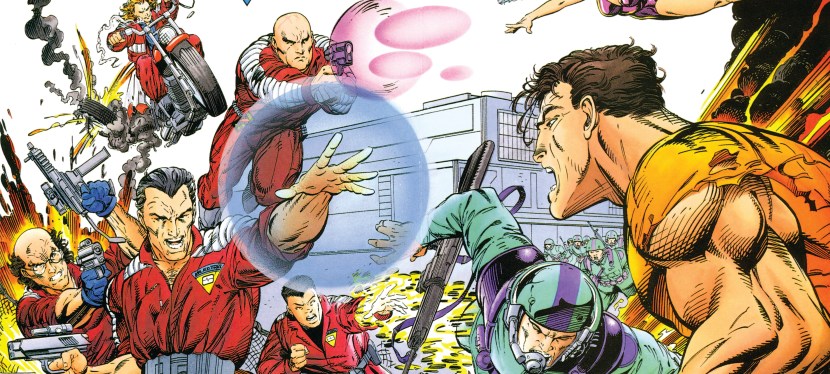
Hardcase, Choice and The Solution on the move!

Overall, Break-Thru #1 is a great comic book to read and it reflects the high quality and deep engagement the Ultraverse had when it was still under the control of Malibu Comics (note: Marvel Comics acquired them and drastically changed the UV for the worse in the mid-1990s). It definitely still is one of the finest superhero crossover comic books of the 1990s and, personally, I found it to be more engaging than the launch issues of other crossover storylines like Zero Hour and The Infinity Gauntlet. If you are interested, Break-Thru continued in Firearm #4, Freex #6, Hardcase #7, Mantra #6, The Night Man #3, Prime #7, Prototype #5, Sludge #3, Solitaire #2, The Solution #4, The Strangers #7 and then in Break-Thru #2.

Break-Thru #1 is highly recommended and you can buy a near-mint copy of it for $4 at Mile High Comics’ website.


Thank you for reading. If you find this article engaging, please click the like button below and also please consider sharing this article to others. Also my fantasy book The World of Havenor is still available in paperback and e-book format. If you are looking for a copywriter to create content for your special project or business, check out my services and my portfolio. Feel free to contact me as well. Also please feel free to visit my Facebook page Author Carlo Carrasco and follow me at HavenorFantasy@twitter.com
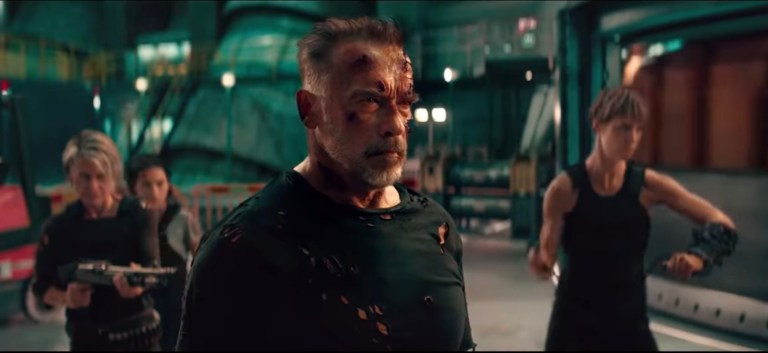
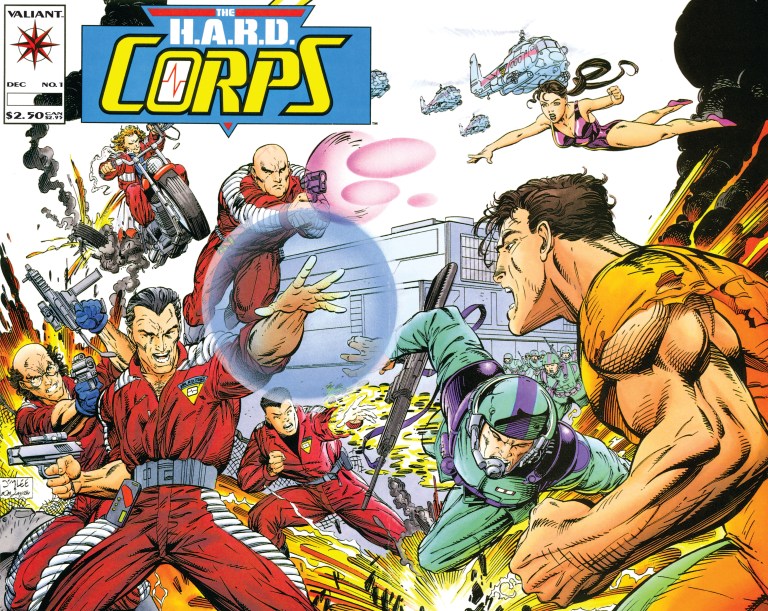
A Look Back At The H.A.R.D. Corps #1

The 1990s was a decade of excess when it comes to superhero comic books. Apart from the persistent hoarding of comic books and the quest for profit, there were also these wide superhero franchises (or superhero universes) that popped up and even challenged Marvel Comics and DC Comics. Malibu Comics launched the Ultraverse while Valiant Comics came up with its own universe.

Valiant established itself nicely with popular characters like Bloodshot, X-O Manowar, Turok and Ninjak, and each one had its own regular series of comic books published. When it comes to teams, there was H.A.R.D. Corps (H.A.R.D. stood for Harbinger Active Resistance Division).

During the recent Hobby Con held at Las Piñas City, I luckily found myself a copy of The H.A.R.D. Corps #1 and read it for the first time ever. This is my review of the comic book which has a cover drawn by the great Jim Lee.

RCO002_1472443923.jpg
Cover with art by Jim Lee.

Early story

The story begins with the 5-member team in the middle of a mission inside the secured facility of the Harbinger Foundation. Under fire from the facility’s armed personnel, the team (riding a floating vehicle) struggle to find their way and evacuate. Along the way, an oversized man called Big Boy grabbed one of their members and separated him from the others. With the situation getting worse, the captured member got “brain popped” (a remote form of self-destruction via the neural flash implanted inside the person’s brain). The remaining four manage to get away by means of aerial transport provided by their company.

Then a section of the facility exploded causing financial damage to Mr. Harada who decided to visit and inspect the site.

RCO017_1472443923~2.jpg
Expository information done cleverly.

Some time later, the H.A.R.D. Corps enjoy the privacy and security at their headquarters in the Nevada desert. Team members Shakespeare, Major Palmer, Softcore, Hammerhead and Superstar wait for instructions at the debriefing room.

Quality

The H.A.R.D. Corps #1 is very well written by David Michelinie. Within twenty-two pages, Michelinie loaded enough details to explain the comic book’s core concept efficiently while at the same time he managed to tell an engaging story with a light touch on character development (note: there were many characters and there was not enough space for further personality emphasis). By the time the story ended, I really felt enlightened, entertained and wanting to find out what would happen next.

Michelinie’s handling of expository dialogue was done very efficiently. I’m talking about the private briefing done by an executive of the Cartel explaining to a recovering man named Kim (who was almost killed during the Los Angeles Riot) what H.A.R.D. Corps is, why the Cartel is in a race against Harada who has been manipulating Harbingers (persons with unique abilities). The Cartel opposes Harada with neural implants.

More on the team, H.A.R.D. Corps members are people who have gone through training programs and each of them had neural implants in their heads which enable them to mimic Harbinger powers (one at a time) through signals broadcast from a base station. Each of them was comatose and the use of the implants reversed the coma.

RCO007_1472443923~2.jpg
Some action for you.

When it comes to visuals, the art by David Lapham (inked by Bob Layton) was pretty good. I like the high amount of detail placed on the surroundings in most of the panels. Action shots had a good amount of impact.

Conclusion

This comic book from late 1992 is a good and engaging read. I really enjoyed it and I like its core concept about a team of enhanced individuals who are technically living properties of very business-minded people opposed to Harada. Even by today’s standards, H.A.R.D. Corps concept really stands out among all superhero team comic books.

The H.A.R.D. Corps #1 is recommended and you can acquire a near-mint copy of it for only $4 at MileHighComics.com (as of this writing).

Carlo Carrasco’s Movie Review: Joker

Let me make it clear to all of you readers. The movie Joker is NOT a superhero movie at all even though it is a cinematic adaptation focused on one of DC Comics’ biggest super villains. It is also not a movie to watch for fun and enjoyment, but it is still engaging in a very different way.

The truth is, Joker is a large art film made to shock viewers with darkness, deep grit and some graphic violence. The good news here is that the movie is very engaging and easily reminds me of two certain movies that Robert De Niro and director Martin Scorsese worked together on. It’s a victory for Warner Bros. and DC Comics.

Screenshot_20191010-172920_YouTube.jpg
Joaquin Phoenix as the new cinematic Joker will be remembered for a long time.

Joker follows the exploits and Arthur Fleck (Joaquin Phoenix), a struggling man who is hardly surviving working as an entertainer (a clown, specifically) supporting his mother and dealing with the hard life of Gotham City which was stylistically made to look like 1970s New York City. Arthur, who is living with a condition of uncontrolled laughter, looks up to TV show host Franklin Murray (played by Robert De Niro) as an inspiring figure to try out comedy and hopefully make it big to free himself and his mother from poverty.

While performing as a clown surrounded by children in a hospital, Arthur accidentally drops a gun he just received from a co-worker. Because of this, he gets fired and learns that the man who gave him the gun lied to their boss. While riding the subway still looking like a clown, he gets beaten up by three business executives who were drunk. In response, Arthur kills them with the gun and gets away. This incident starts a chain of events that causes friction between the upper class and the lower class, and then protesters wearing clown masks multiply.

On face value, Joker is clearly inspired by character-driven films of the 1970s. While it is not necessarily based on any particular comic book, it carried some slight elements from Batman: The Killing Joke. What is more obvious is that it took inspiration from De Niro-Scorsese films Taxi Driver and The King of Comedy.

As a psychological thriller, Joker is a great portrayal of how low a desperate man could go only to strive and survive. Arthur Fleck is greatly played by Joaquin Phoenix who carefully blends drama, anger, violence and even humor altogether. He really made the cinematic Joker his own and along the way, his Joker laught is more effective than that of Heath Ledger and the Joker physical appearance is almost as memorable as that of Jack Nicholson’s. The movie is indeed very violent but it is not overly violent. To be specific, there are a lot more deaths, acts of violence and shooting in Brian De Palma’s Scarface than this movie.

Joker also has a lively portrayal of the conflict between social classes. The scenes of the clown-masked protesters filling the trains and the streets still resonate with the socio-political rallies that happened in modern society. There is also the aspect of poor and desperate people depending on government for survival and they are easily vulnerable to getting cut off whenever resources run out.

Desperation is also a solid theme in the narrative. To see Arthur Fleck look up to Franklin Murray and imagine sharing the stage with him on TV reminds me a lot about some real-life people (who don’t have too much money) I encountered in Cebu City who can’t help but stop studying (even the older ones quit their legitimate jobs) and get into local entertainment hoping that fame and fortune will lift them up. Of course, when things get worse, desperate people would either get back to what they can live with or, worse, turn to a life of crime just to survive. With regards to Arthur’s attempt to become a comedian on screen, that easily reminds me of similar people in real life who thought they are very talented to be the next great superstars but ended up failing.

Conclusion

With its very solid direction by Todd Philips, great dramatic performances, nostalgic presentation and in-depth characterization, Joker is a must-watch movie mainly for moviegoers who want to be engaged with psychological thrills and bouts. As a DC Comics movie that is NOT connected with Warner Bros.’ current franchise of superhero movies (that started with Man of Steel in 2013), Joker works as an adulterated, standalone movie. To compare it with comic books published DC, I should say Joker is very much like an Elseworlds story. For the new comers reading this, Elseworlds was a franchise of comic books published by DC Comics that had stories using established characters but were told outside of DC universe canon.

Joker is highly recommended. Just don’t expect to see the usual superhero movie elements in this very solid DC Comics movie.


Thank you for reading. If you find this article engaging, please click the like button below and also please consider sharing this article to others. Also my fantasy book The World of Havenor is still available in paperback and e-book format. If you are looking for a copywriter to create content for your special project or business, check out my services and my portfolio. Feel free to contact me as well. Also please feel free to visit my Facebook page Author Carlo Carrasco and follow me at HavenorFantasy@twitter.com
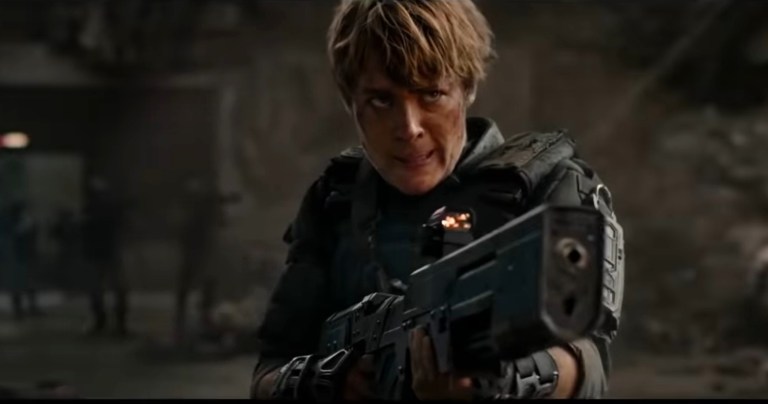
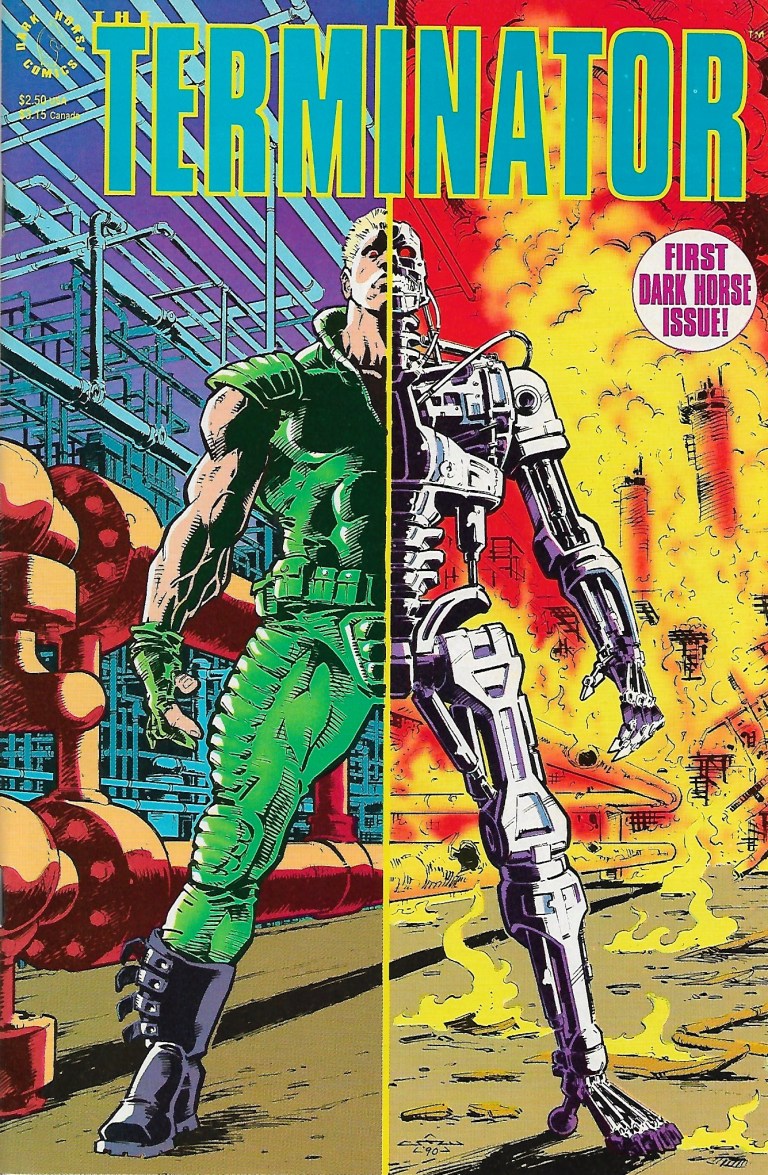
A Look Back At The Terminator #1 (1990)

Way back in 1984, a low-budget movie titled The Terminator became a hit with moviegoers which greatly helped the careers of Arnold Schwarzenegger, Linda Hamilton and writer-director James Cameron. Terminator 2: Judgment Day became a massive hit worldwide in 1991 establishing the Terminator franchise as an important one leading to more movies (released in 2003, 2009 and 2015), video games and even a TV series. Oh yes, the upcoming film Terminator: Dark Fate will be released very soon and it now involves James Cameron.

Way back in 1990, a follow-up to the 1984 classic was released that did NOT involve Schwarzenegger, Cameron and Hamilton at all. The follow-up was a 4-issue mini-series titled The Terminator and was published by Dark Horse Comics which back then was licensed to do comic books of the Terminator franchise.

This is my review of The Terminator #1, written by John Arcudi and drawn by Chris Warner with ink work by Paul Guinan.

2019-09-30_082047~2.jpg

Early story

The comic book opens in the year 2029. In the ruins of Los Angeles, a band armed humans struggle against the machines of Skynet during the night. They infiltrate a facility to find one of Skynet’s time displacement chambers which they learned previously from their leader John Connor. Thanks to Connor’s intervention, Skynet’s attempt to change history failed but the big catch is that only a prototype of the time displacement chamber was discovered. The final model of the chamber remains.

2019-09-30_082201~2.jpg

As the armed guys make their way through, a Terminator watches them secretly….

Quality

When it comes to the writing, I can clearly see that John Arcudi (best known for The Mask) exerted effort to make this comic book relevant to the 1984 movie using key details such as the humans operating on the field only at night time (because Skynet will easily detect them during the day). Arcudi, however, expanded a bit on the franchise’s cinematic elements by emphasizing the use specific machines (steel-and-chrome wombs or tissue-generating chambers) to cover Terminator units with flesh and blood, and most notably, the use electronic communication between Terminator units which resemble telepathy among humans.

Cyberdyne, the fictional corporation heavily emphasized in Terminator 2, made an appearance in this comic book. With regards to Skynet, Arcudi emphasized that the living network was a lot more resourceful than what the movies suggested. The comic book has a nice build-up and along the way, the use of expository dialogue was pretty efficient and they are quite helpful for readers to grasp the story and key details.

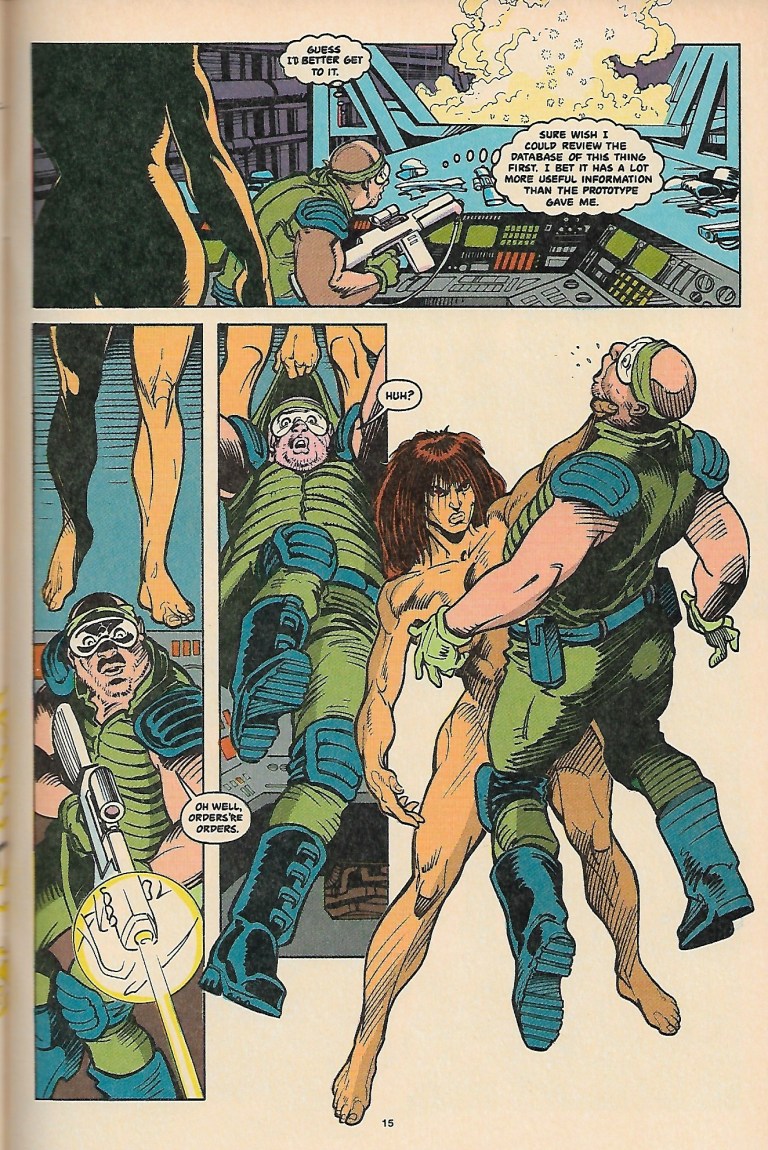
With regards to the art work, Warner’s art style has that somewhat cartoony aesthetic on not just the humans but even on the machines. There were several Terminator units displayed without the flesh and from the way they were drawn, I could not even tell if those units were the T-800 type. Warner’s drawings on the physical environments carry a good amount of detail.

2019-09-30_082306~2.jpg
Terminator stealthy approach captured nicely.

While Warner’s drawing has a cartoony aesthetic, the illustrated action is pretty violent and has quite an impact in some shots. There are some bloody images and implied nude shots as well.

Conclusion

What can I say? I bought The Terminator #1 at the Hobby Con this past weekend out of pure curiosity. After reading it thrice, I should say that I found this comic book proving to be better than what I expected. It is a surprisingly good read and the fact that this was published roughly a year BEFORE the release of Terminator 2: Judgment Day, I found this to be a worthy follow-up to the 1984 movie. In fact, it’s so good a follow-up I’d rather read it than waste my time watching Terminator 3: Rise of the Machines, Terminator Salvation and the very awful Terminator: Genisys.

As such, I declare that The Terminator #1 is recommended.


Thank you for reading. If you find this article engaging, please click the like button below and also please consider sharing this article to others. Also my fantasy book The World of Havenor is still available in paperback and e-book format. If you are looking for a copywriter to create content for your special project or business, check out my services and my portfolio. Feel free to contact me as well. Also please feel free to visit my Facebook page Author Carlo Carrasco and follow me at HavenorFantasy@twitter.com

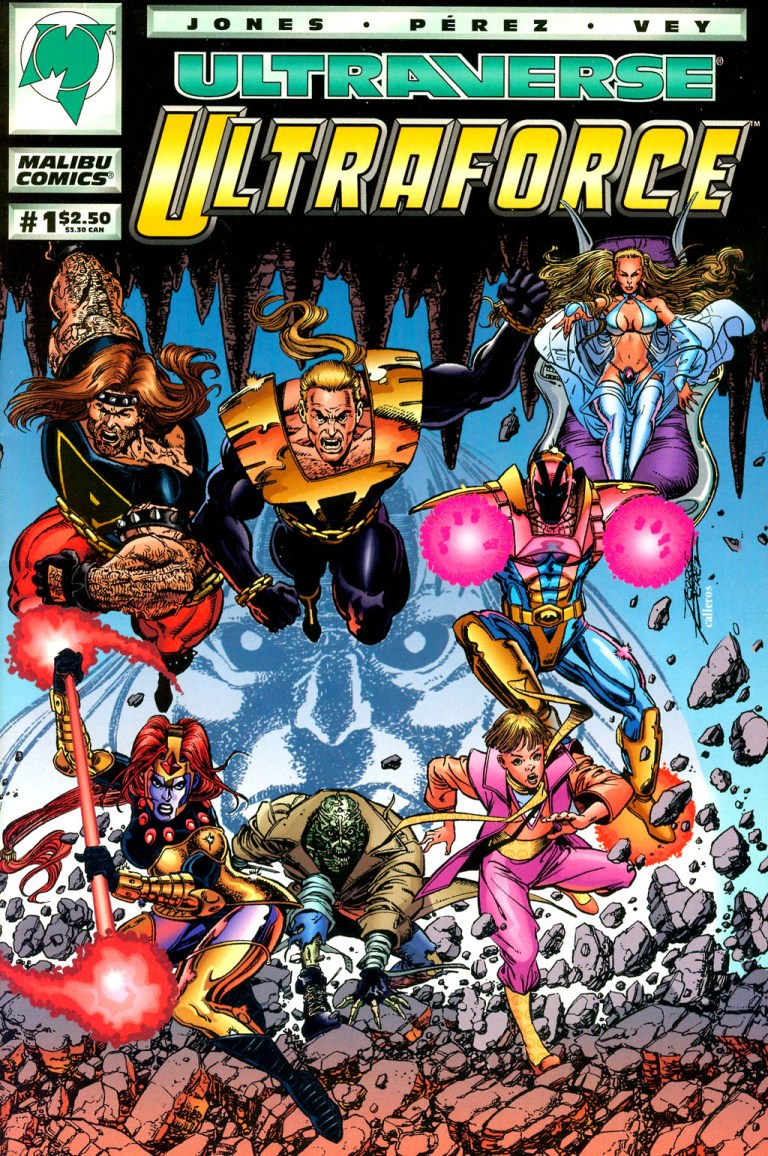
A Look Back At UltraForce #1 (1994)

There is nothing like seeing squabbling individuals (each with a unique talent or two) realize that they have to end the division between them and work together to solve a problem that affects everyone.

Tropes like that are common in superhero comic books, animation, movies and other forms of media. The concept of having superheroes is precisely the key element behind the UltraForce of the Ultraverse.

To put things in perspective, UltraForce is a team of superheroes (called Ultras in the Ultraverse) composed of Prime, Hardcase, Prototype, Topaz, Ghoul, Pixx and Contrary. The team was formed to protect the public while, at the same time, keep their fellow Ultras (examples: Mantra, The Strangers, Night Man, etc.) from getting out of line with the general public and their government leaders.

Previously, I discussed what would it be like had superheroes conspired with government officials and corporate media as told in UltraForce #2. For this article, we take a look back at the formation of the team in UltraForce #1, published by Malibu Comics in August 1994 with a story by Gerard Jones and art by the legendary George Perez.

RCO001_1463648135.jpg
Great cover by George Perez.

Early story

The story begins with a disaster as fighter planes get pulled down to the ground by an unknown force. A pilot who ejected and flew by parachute finds himself pulled down as well. Down on his back, he feels intense pain and could not get himself up. His body begins to get destroyed when a voice is heard.

“You thought your little flying toys would stop me. You thought your mastery of light and air made you invincible. And no creature of the dark, hidden places could possibly beat you. Now feel the weight. Feel what we feel. The weight of the core of the Earth. The weight of eons of darkness. The age of light and air is done. Prepare for a new age. The age of Atalon!”

Inside a ship above the desert, Hardcase reacts as he watches multiple monitors showing current events highlighting people’s fear of the Ultras, citizen demanding controls, Hardcase reported as saying “only Ultras can control Ultras”, plus an image of Prime and Prototype in action. With him were Contrary, Pixx and Ghoul.

“No!” said Hardcase. “I won’t go through that again!”

Harcase clarifies to his companions that, due to his past with The Squad ending in tragedy, he won’t join a group and end up counting friends’ bodies again. Regarding his reported quote in the media, he stated that he specifically said that government could never control Ultras plus he did not say an UltraForce should try to do it. Being an actor in Hollywood, he decides to go to the media and wash his hands of this.

Contrary, who is the schemer in the team, asked him, “Won’t the public fear Ultras more and more…unless someone steps up to teach Ultras how to function in the world?”

Hardcase asked if she was the one to do the teaching.

Pixx butts into the conversation telling them that Prime and Prototype are about to approach the press. After calling Pixx an attentive student, Contrary tells Hardcase she is the to teach the Ultras which she claims is her business.

In front of the press, Prime (who is a kid inside that overly muscular body) talks impulsively to them and Prototype (who is receiving communication feed from Ultratech which seeks a public coup with the idea of him gathering the team) who states that an UltraForce is needed and that he will recruit one.

This sets off Prime to act even more impulsively over who has credit over the UltraForce idea. Behind the scenes, Ultratech’s Leland and Hardcase watch as things turn wrong (between Prime and Prototype) in front of the press.

RCO006_1463648135~2.jpg
An incident like that in front of the media is enough to mislead the public into thinking negatively about who got covered in the press. There are those who acted badly in front of the press and there are media operators who practice journalism wrongly.

“They’re going to force the government to crack down on Ultras!” – Hardcase.

Concerned that the embarrassment could start a civil war between Ultras and Normals (the people), Hardcase tells Contrary he wants to leave the ship to prevent things from getting worse. Contrary gets on his way saying she was going to talk to Prime and Prototype and even have their ship fly after them.

Hardcase disagrees with her idea and insisted she should not be near the mess (about Ultras and the public) until she comes clean with all her secrets and explain what her academy for Ultras is about.

“Is this the same Hardcase who didn’t want responsibility of leading other Ultras…laying down the law for me?” – Contrary

Eventually Contrary sends Hardcase away and tells Pixx to bring their ship to the Redstone Arsenal.

Meanwhile, in Los Angeles, Topaz appears suddenly in the middle of a football game causing confusion to the players and the spectators.

RCO015_1463648135.jpg
The power of Prime!

Quality

I absolutely enjoyed reading UltraForce #1 for the fact that it has a very engaging story, great art, in-depth characterization and a great presentation of superheroes banding together for a higher cause. It is the complete package of what a fun yet thoughtful superhero comic book should be!

The story written by Gerard Jones shows lots of signs that things were carefully planned not just for the comic book but for the Ultraverse as a whole as it focused on the concept about the Ultras being on the edge of getting misunderstood by the general public (the people who don’t have powers) who in turn relied on the news coverage of corporate media (which itself has lapses or made deliberate moves that did not give the viewers an accurate look at the events that happened) to take a look at beings with powers.

This concept kinda reminds me of the traditional concept behind the X-Men. Charles Xavier founded the X-Men to train mutants to use their gifts for good while trying to establish a bond of understanding and tolerance between mutants and humans.

UltraForce’s concept of the fragile link between Ultras and ordinary people really went deep as it involved not only the media but also the private sector, the government leaders and the armed forces. Heck, in Prototype #1 the corporation Ultratech made its move with Ultras by having a flying, armored guy representing them. In Prime #1, the element of militarism was involved.

The comic book’s concept is nicely reflected in Hardcases thoughts below.

“Great. The military, the media, the eyes of the world…dying for a sign. Are Ultras for them or against them? And what sign are we giving them?”

Gerard Jones also achieved a great job with the characterization. Prime is the impulsive powerful superhero who is also a loose canon because he’s really a kind inside the large, muscular body of a man. Prototype is piloted by a young guy working for a corporation and along the way, he has trouble balancing himself between duty and personal interest. Hardcase, who has been living with guilt as one of two surviving members of The Squad, struggles between his internal struggle and keeping the peace between humans and Ultras. The way I remember these three notable Ultraverse lead characters from their respective comic book series, their personalities were successfully replicated and developed in this comic book.

Contrary meanwhile is subtle yet brainy and strategic figure of the team. For the most part, she is mysterious and yet already has a clear vision about mentoring people with super powers. She is easily the most defining member of UltraForce who does not have her own comic book series. Topaz, who comes from a society of women, is clearly the Ultraverse parallel to DC Comics’ Wonder Woman. She appeared in prior issues of Mantra and her addition to UltraForce added more depth and variety. Of course, given her background, working alongside men is a challenge for her personally. Pixx and Ghoul, meanwhile, contributed nicely as supporting characters in this comic book. For the villain King Atalon, he succeeded in presenting himself and his group as a credible threat to the world. Not only is he powerful in combat, he is very driven with a mission for his kingdom and his people strongly love him and support him.

Even though this was just the first story, UltraForce #1 is already a nice exploration of each member’s personality and the personal relationships between them. How these characters formed a team was not only convincing but was done with a lot of depth and focus. At the same time, the dialogue written for each character is lively to read. Take note how Atalon reacted to Prototype’s attack on him.

“Didn’t your Dr. Einstein tell your people decades ago that great gravity could bend even energy? But you never do listen to your own wise men, do you? Just like my people. We wise ones must find ways to make you listen.”

Spectacle and action? There’s lot of them in this comic book. More than enough to satisfy anyone who enjoys reading superhero stories that pack a lot of hard-hitting action, intense moments of damage on the surrounding made only possible by superheroes, energy blasts and the like.

This bring me to the next aspect of the comic book….George Perez’s great art! I should say that Malibu Comics made the best decision to hire Perez for UltraForce #1 given his established talent of drawing multiple superheroes in high detail (with that distinct style on drawing human faces) and ensuring that what was written on Gerard Jones’ script would come out not only looking great but also always look very lively. I love the way Perez drew the facial expressions of Hardcase, the visualization of Prime’s immense strength, Pixx looking really like a teenager, the high level of detail on the backgrounds, Ghoul’s creepy look and much more. No doubt about it, each and every panel drawn by Perez is great to look at!

Conclusion

I really love reading and re-reading UltraForce #1. It succeeded in its goal of getting the divided superheroes together to form a team in convincing fashion complete with a clear and present danger (Atalon and his people) that justifies the events. It’s got great writing and art, very engaging characters, heavy action and a good amount of characterization. The good news about this comic book is that it can be found in good supply online and you don’t have to worry about paying high prices for it. As of this writing, you can order a near-mint copy of UltraForce #1 for only $4 at the website of Mile High Comics. Apart from comic books, there were some action figures of UltraForce released and there was a short-lived animated series of it on TV.

If you are a comic book reader who is dissatisfied with today’s comic books (and even superhero movies), if you are reader looking for a great superhero team reading experience, or if you want the best superhero comic book experiences of not only the Ultraverse but of the 1990s as a whole, then UltraForce #1 is highly recommended! This comic book is a classic of its decade!


Thank you for reading. If you find this article engaging, please click the like button below and also please consider sharing this article to others. Also my fantasy book The World of Havenor is still available in paperback and e-book format. If you are looking for a copywriter to create content for your special project or business, check out my services and my portfolio. Feel free to contact me as well. Also please feel free to visit my Facebook page Author Carlo Carrasco and follow me at HavenorFantasy@twitter.com
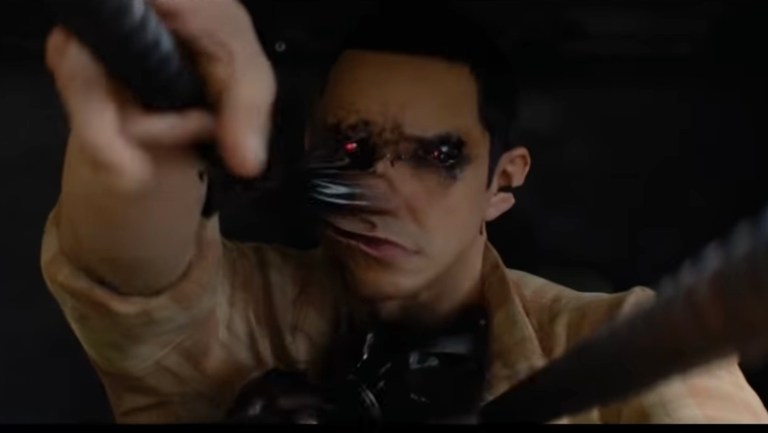
A Look Back At Batman vs. The Incredible Hulk

Disclaimer: This is my original work with details sourced from reading the comic book and doing personal research. Anyone who wants to use this article, in part or in whole, needs to secure first my permission and agree to cite me as the source and author. Let it be known that any unauthorized use of this article will constrain the author to pursue the remedies under R.A. No. 8293, the Revised Penal Code, and/or all applicable legal actions under the laws of the Philippines.

I love reading a crossover comic book that was made by very talented creators to be a whole lot of fun from start to finish. Back in the early 1980s, rivals Marvel Comics and DC Comics collaborated temporarily with inter-company crossover comic books that were made to be entertaining to fans of their respective properties.

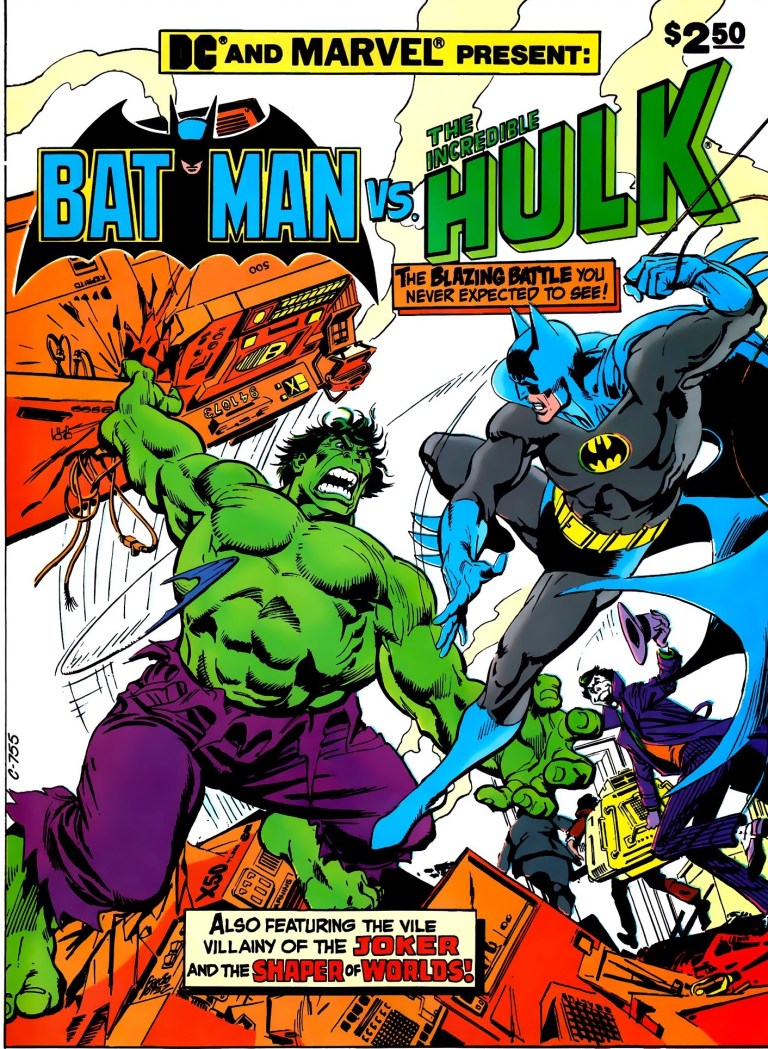
What I’m going to review here is the 3rd superhero crossover comic book between Marvel and DC titled Batman vs. The Incredible Hulk.

Cover
The cover.

Background

Before I start, let me clarify that this particular comic book was specifically published as issue number 27 of the DC Special Series which was a series of one-shot comic books. By comparison, the 1981 crossover comic book Superman and Spider-Man (which I reviewed previously) was published under the Marvel Treasury Edition line of Marvel Comics as issue number 28.

Going back to Batman vs. The Incredible Hulk, the comic book was the final issue of the DC Special Series line and it carried a cover price of $2.50 which was quite high for its time.

The people at DC Comics made sure that the crossover was handled by the best talents they had back then. The late Len Wein (best know for creating Wolverine) was assigned to write the script (and ensure that elements from both the Hulk and Batman would mix nicely) while José Luis García-López was hired to illustrate. Dick Giordano was the embellisher and editor while Allen Milgrom and then Marvel editor-in-chief Jim Shooter were the consulting editors. In return for their assistance, Marv Wolfman and Mike DeCarlo were acknowledged with thanks.

Now we can begin with this retro review of Batman vs. The Incredible Hulk.

The early story

The story begins when a few persons in Gotham City witness their dreams turning real beyond logic. A man dreamed he was in the arctic hunting and wakes up to discover his room was filled with snow. In a cinema where a horror movie was shown, a couple kissing each other discover, to their shock, that monsters of different sizes surrounded them out of thin air.

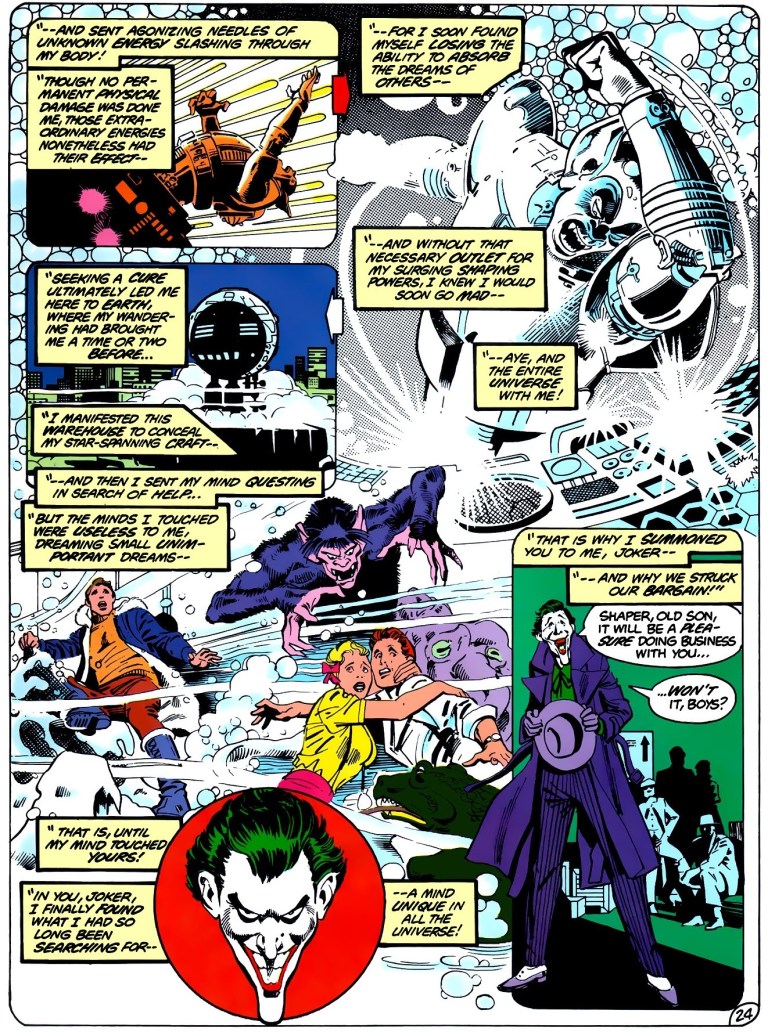
At the waterfront of the city, the Joker (accompanied by his gang members) talks to an unseen being (Shaper of Worlds). He gives his assurance to the being that he and his gang will acquire a specific item (needed by the being). For the Joker, what was discussed was a simple business arrangement.

A short time later inside a high-tech facility of Wayne Research, Bruce Banner (the Hulk) secretly works under the false identity as David Banks. He works along with the scientists but not on the scientific projects. Rather, he works odd tasks such as lifting hardware and putting them into places that need them. Of course, Banner did not get hired for a salary but for something much essential to him and his condition with Gamma Rays.

“I had to get a job here somehow so I could get close to the experimental Gamma-gun they’re working on,” he thought to himself.

Suddenly the facility gets filled with laughing gas incapacitating all the people inside. Banner fortunately manages to wear a radiation suit for protection. Moments later, the Joker and his gang enter searching for the Gamma-gun. From this point on, Banner decides to act.

Quality

When it comes to the selection of characters from Marvel and DC, having the mismatch of Batman and the Hulk was a very splendid idea. Not only was having the large green brute and the world’s greatest detective together as temporary rivals a fascinating concept, having them work together as a duo turned out to be a really great move. When it comes to the selected villains of the Joker and the Shaper of Worlds as the anti-hero figures of the story, the two looked like an odd pair but if you focus on the details of the story, you will realize that it made a lot of sense having them two together. The Shaper needs something which requires him to depend on the Joker who in turn brings his gang with him to cause chaos to acquire what the alien needs

All of the above details would not have worked had it not been for the excellent writing by Len Wein. Clearly Wein knew a whole lot about the defining elements of the Hulk and Batman (and the same with the Joker and Shaper), and he carefully blended those elements together to make a story that is thrilling, intriguing, engaging and at the same time still made sense. More on crossing over, there are other characters connected to Batman and the Hulk that made appearances and a few of them fit in nicely into the story.

As this was released in 1981, it was typical of the time for writers to use thought balloons to help readers understand what the characters were thinking. The use of thought balloons in this comic book truly defined Batman who not only had to fight the bad guys but also manage his way with the Hulk and do a lot of detective work.

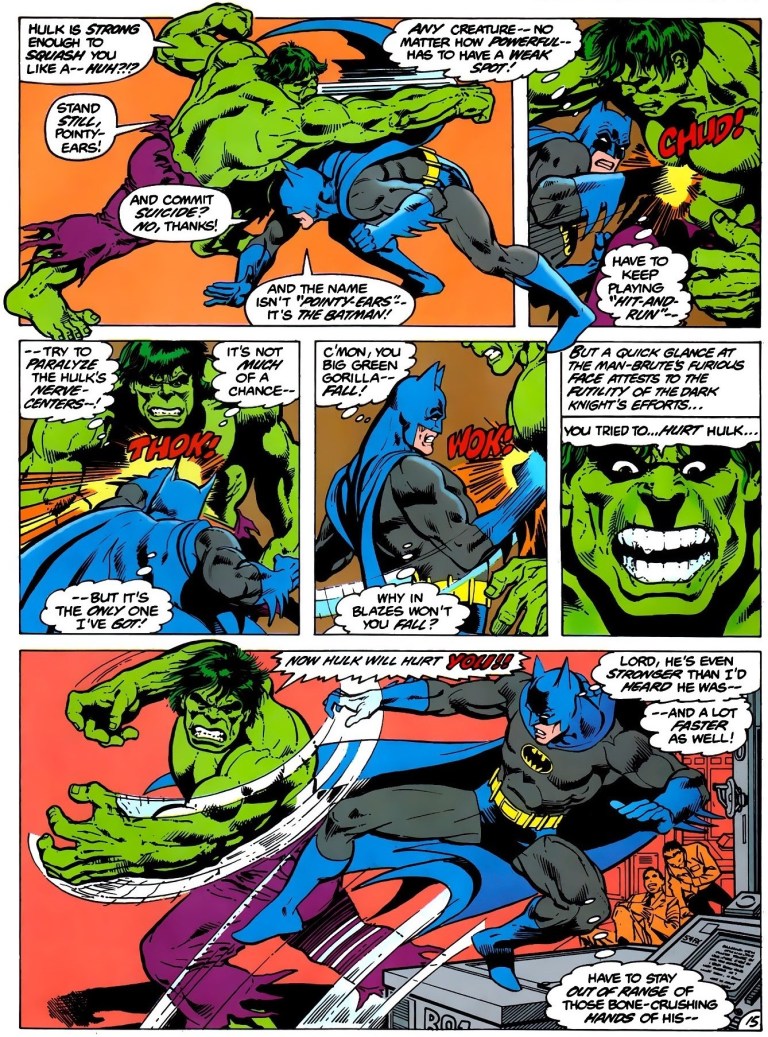
Going back to the Hulk and Batman, this comic book has a lot of fun stuff. More than once did the two superheroes engage in action-packed encounters and their exchange of words was very nicely done. Their match-up (or mismatch) really works.

Prev1
A perfectly crafted action scene between the Hulk and Batman, complete with accurate depictions of each character! 

When it comes to the common complaint by some readers out there that the comic book was more of a Batman story and made the Hulk less prominent, I should say that the slight imbalance is not a problem at all. In fact, for me it makes perfect sense that Batman has more spotlight than the Hulk. Why? Because Batman is a detective and he performed a lot of researching, information gathering and other moves to solve problems. His detective work in the story made perfect sense for the narrative. As for the Hulk, his character really has very limited options other than causing destruction and disturbing the public. Since early on, the Hulk was best known for attracting the attention of the American military (led by General Ross) and huge destruction defined the encounters. For this crossover, the creators did not show the Hulk engaging with the military (save for the phonies) but rather he struggled to figure things out whenever he encountered Batman or the Joker. There is no way the Hulk could do detective work like Batman and having him fight the military would have weakened this comic book’s presentation. Clearly, having the story slightly slanted towards Batman is still the right move.

Prev2
Very highly imaginative and dynamic artwork by José Luis García-López.

The artwork done by José Luis García-López is excellent! He really captured the looks and details of each and every character Marvel and DC that appeared in this comic book. Back in the early 1980s, I got to read several comic books that showed Batman, the Hulk, the Joker and others and the way they appeared in this comic book was indeed accurate of the time. José Luis García-López also knew how to balance spectacle with character development and expository dialogue in terms of visual pacing and framing shots. Also his work becomes even more imaginative during the final conflict. Undoubtedly this is still a great looking comic book!

Conclusion

Overall, Batman vs. The Incredible Hulk is a great comic book and easily it is one of the greatest intercompany superhero crossover comic books ever published! From start to finish, this comic book proved to be highly engaging and there never was a single boring moment. The creators led by Len Wein (he is sorely missed) made the best possible story anyone can make involving Batman and the Hulk.

You can read a hard copy of this comic book by getting Volume 1 of Crossover Classics or, if you can afford to, hunt for a copy of this in its DC Special Series form which now sells for $280 for a very fine copy to as much as $400 for a near mint copy as of this writing according to MileHighComics.com
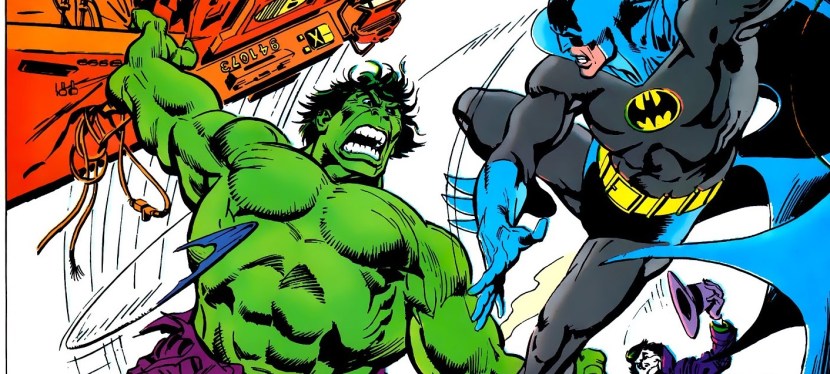
In ending this, I declare that Batman vs. The Incredible Hulk is highly recommended!


Thank you for reading. If you find this article engaging, please click the like button below and also please consider sharing this article to others. Also my fantasy book The World of Havenor is still available in paperback and e-book format. If you are looking for a copywriter to create content for your special project or business, check out my services and my portfolio. Feel free to contact me as well. Also please feel free to visit my Facebook page Author Carlo Carrasco and follow me at HavenorFantasy@twitter.com