A Look Back at Elven #3 (1995)

Welcome back, superhero fans, 1990s arts and culture enthusiasts, Ultraverse fans and comic book collectors! Today we go back to the mid-1990s to examine one of the many tales of the Ultraverse through the Elven mini-series.

Having read the first two issues (click here and here), I can say that there is indeed progressive development of the personality of Elvia and her fantasy inspired identity as Elven. At the same time, the fantasy elements of the Ultraverse itself were portrayed in lively fashion. Clearly, Elven’s own corner of the Ultraverse has been established and there is some excitement to find out what would happen next and how it could affect others within the UV.

With those details laid down, here is a look back at Elven #3, published by Malibu Comics in 1995 with a story written by Len Strazewski and illustrated by Aaron Lopresti (Sludge).
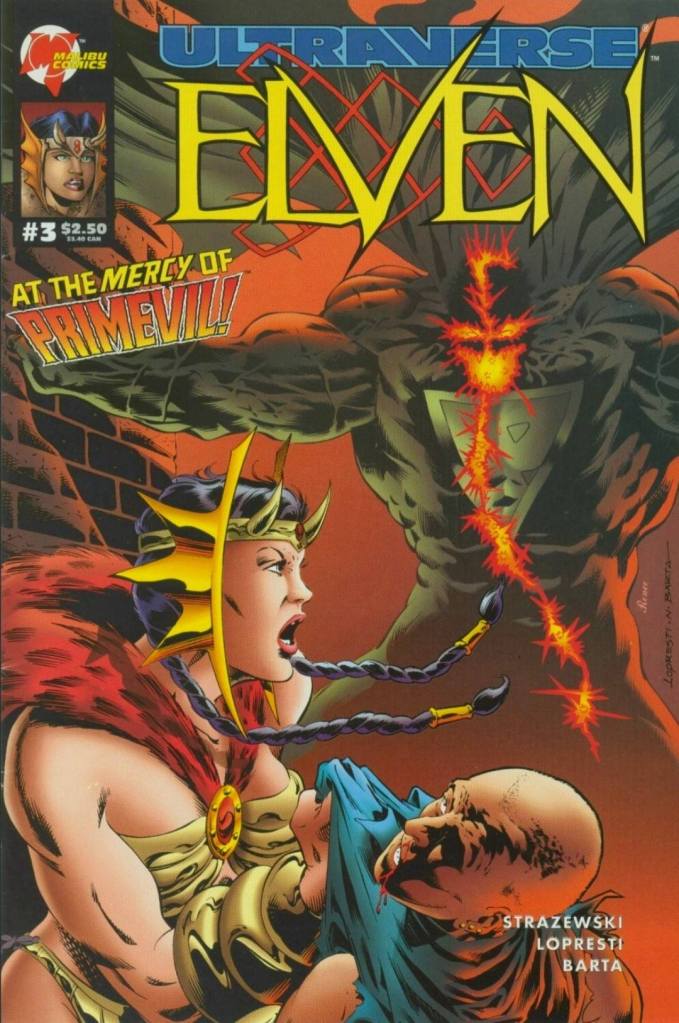
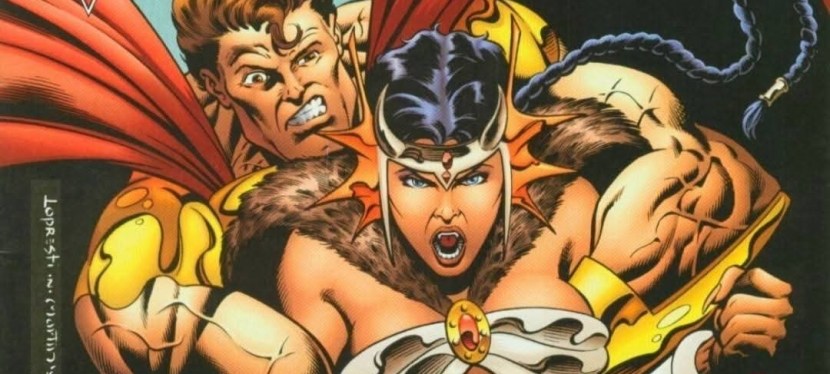
The cover.

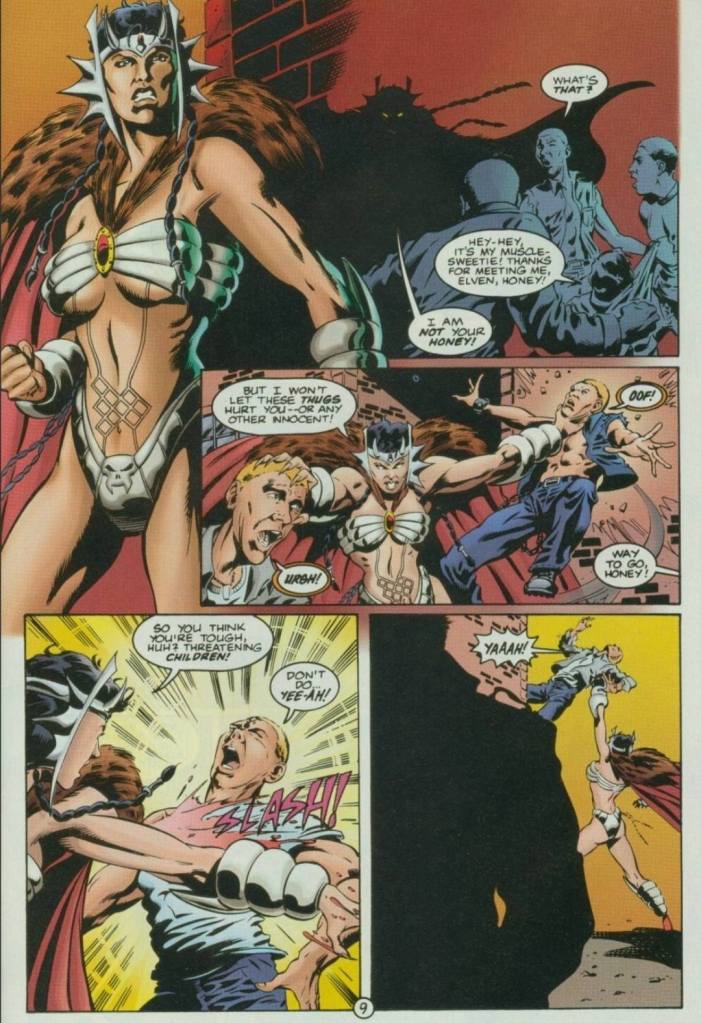
Early story

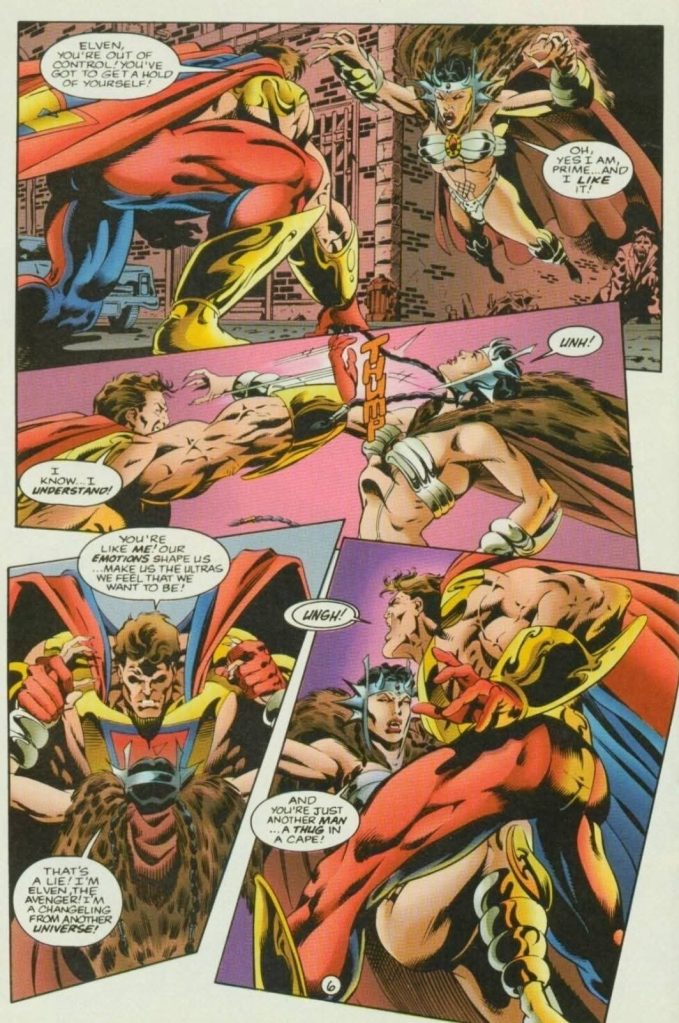
The story begins on top of the building with Elven and Prime meeting again. Tensions are high as Elven accuses him of lying. By this time, she learned a lot of details about her origin from the demon she fought with which convinced her that Prime lied to her about their genetic connections with each other (note: Doctor Vincent Gross was involved as he wanted to create ultras).

Elven rejects the science as she is strong convinced she is of magical origin from a mystical world and happens to be trapped on Earth. As Prime tries to put sense into her, Elven strikes him with a blast of energy to push him back. The blast turned to be of biological energy instead of magic.

As Elven reveals that she learned crucial information from the demon she fought with, Prime realizes it is none other than the one enemy he fought with some time ago

Quality

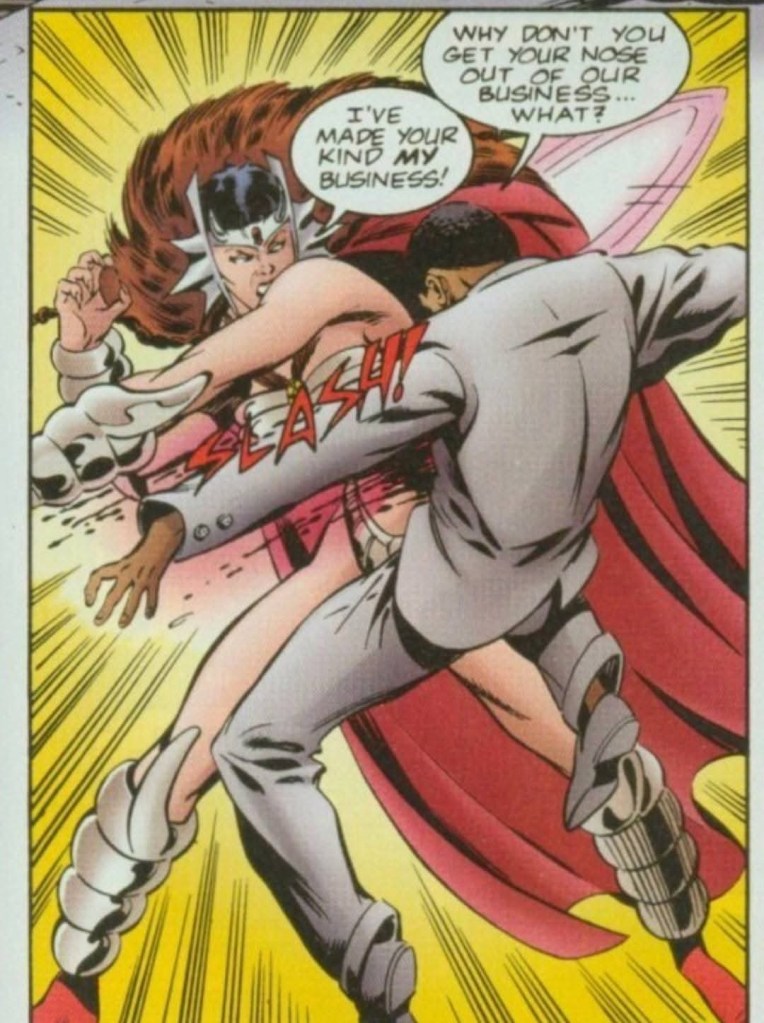
Once again, Elven impulsively uses violence on individuals to help Bruno.

Following the events of issue #2, Elven here remains confused and even lost as she has a lot of trouble figuring out the facts. Of course, being a fanatic of fantasy and Elfquest, Elven clings on to the belief that the fantasy realm is real and that she is of magical origin (which conflicts with the biology and science of her abilities and physical transformation). This is evident in the early part of the comic book when she has a tense reunion with Prime who did his best to explain details and help her understand.

When it comes to the very conflict of the story itself, the stakes were raised when Strazewski has Prime-Evil and elements of unethical science present during the later stage. Apart from abducting Elven, Prime-Evil has his own agenda pursuing Mantra (who in turn has an evil version called Necro Mantra) and a lot of arrogance within. Literally, Prime-Evil’s presence added intrigue to the plot and only made Elven’s struggle to realize the truth of her origin – both the scientific and fantasy aspects – even more complicated.

Bruno, who was a significant and surprising factor behind the conflict in issue #2, gets his nice share of the spotlight. Without spoiling the plot, I can say that he is a lot more than what he seems and has more to add to the conflict.

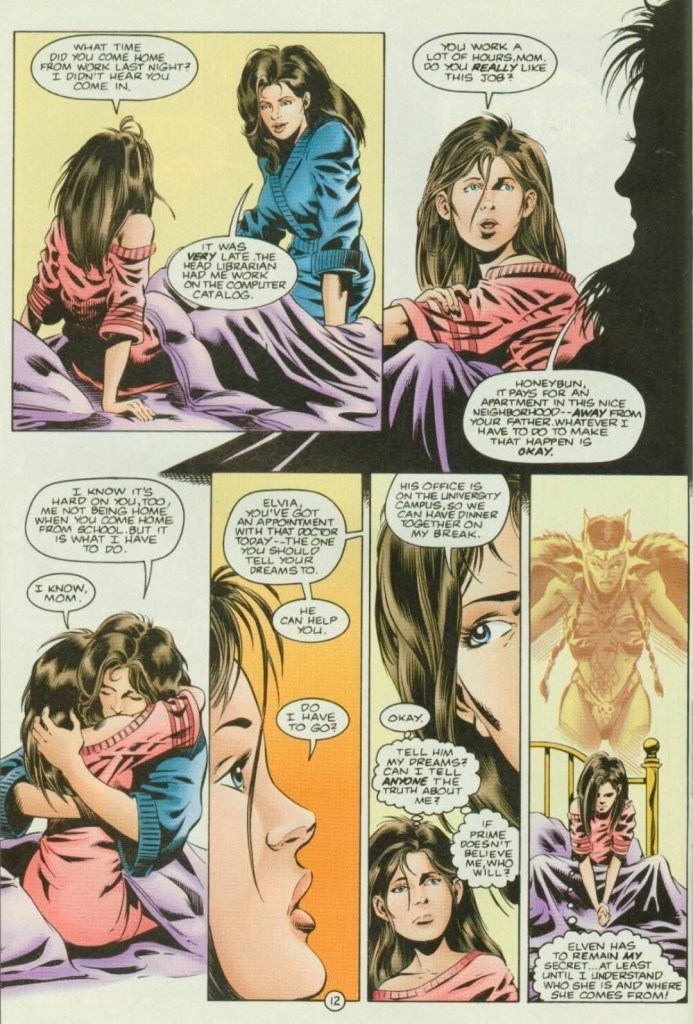
Considering the intensity of the conflict in issue #2, I find it very weird that Bruno and Elvia were not even reported to the local authorities for questioning and accountability. Perhaps the psychiatrist did not bother to do what is right since he was so fascinated with the fantastic conflict and unexplained moments that happened in his office (note: his own office assistant even became naked suddenly), and he has ambitions to become America’s next big name with his knowledge.

Conclusion
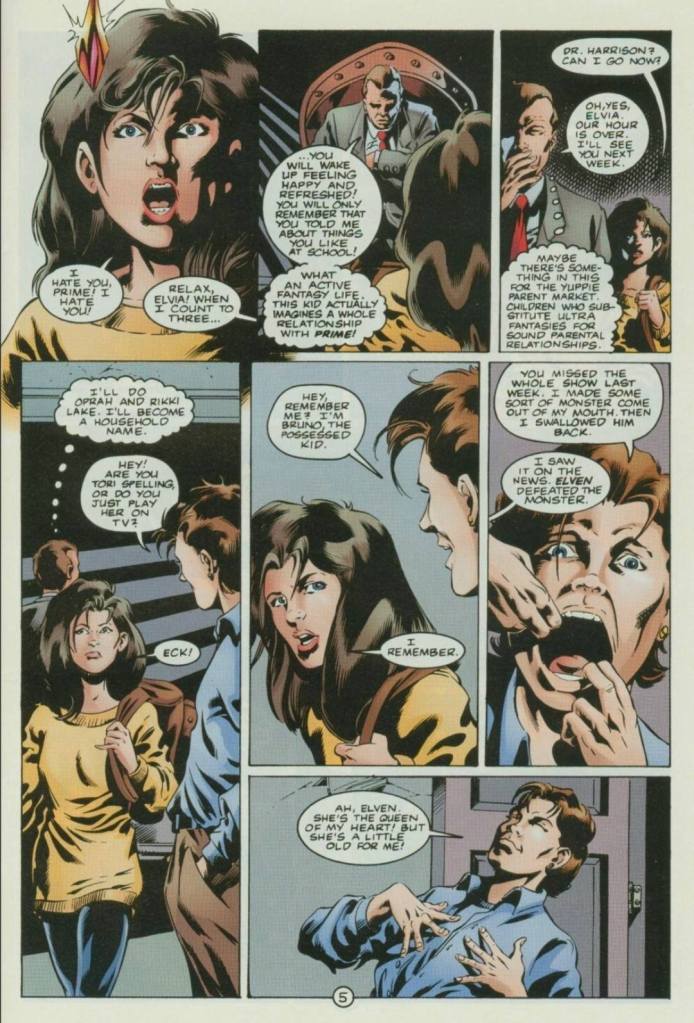
Elvia with Bruno and their psychiatrist.

At this particular stage of the mini-series, Elven #3 (1995) had an even more intriguing story to tell while gradually moving forward with Elven’s quest for the truth of her origin and her own purpose. The Strazewski-Lopresti duo did fine work in this comic book for the most part and ultimately the story convinced me to look forward to the next issue. I can say that the ending of this comic book is more suspenseful than that of issue #2.

Overall, Elven #3 (1995) is recommended.

+++++

Thank you for reading. If you find this article engaging, please click the like button below and also please consider sharing this article to others. If you are looking for a copywriter to create content for your special project or business, check out my services and my portfolio. If you want to support my website, please consider making a donation. Feel free to contact me with a private message. Also please feel free to visit my Facebook page Author Carlo Carrasco and follow me on Twitter at  @HavenorFantasy as well as on Tumblr at https://carlocarrasco.tumblr.com/ and on Instagram at https://www.instagram.com/authorcarlocarrasco/.
A Look Back at Elven #2 (1995)

Welcome back, superhero fans, 1990s arts and culture enthusiasts, Ultraverse fans and comic book collectors! Today we go back to the mid-1990s to examine one of the many tales of the Ultraverse through the Elven mini-series.

When I grabbed a copy of Elven #1, I did not expect much entertainment and surprise. But as I started reading it and witnessed Elven’s interactions with Prime, the narrative became even more engaging to read. In addition, Len Strazewski’s writing clearly defined the personality of fantasy fanatic and confused girl Elvia Swanson and established Elven as a twisted female parallel to Prime. Along the way, Aaron Lopresti’s art showed a lot of details, emotions and dynamism (on the action).

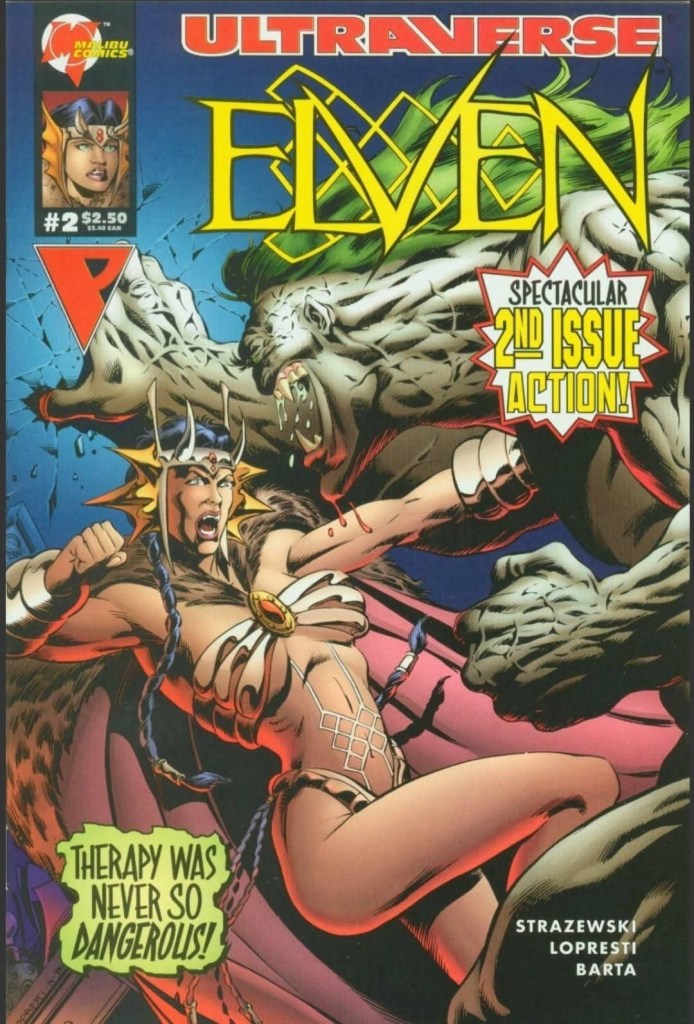
With those details laid down, here is a look back at Elven #2, published by Malibu Comics in 1995 with a story written by Len Strazewski and illustrated by Aaron Lopresti (Sludge).

The cover.

Early story

The story begins inside the office of a psychiatrist where Elven encounters a demon which just came out of the teenage boy Bruno. As the two fight each other violently, the psychiatrist watches them obsessively and writes down the notable details for a potential advancement in his career. Bruno, who carried the demon in him some time prior, watches the fight from a distance marveling at Elven while also observing how chaotic the demon is.

Elven fights the demon hard while maintaining a mindset of pride and even being superior. The demon reveals his link with Boneyard (for reference, click here) confirming he came from a distant world.

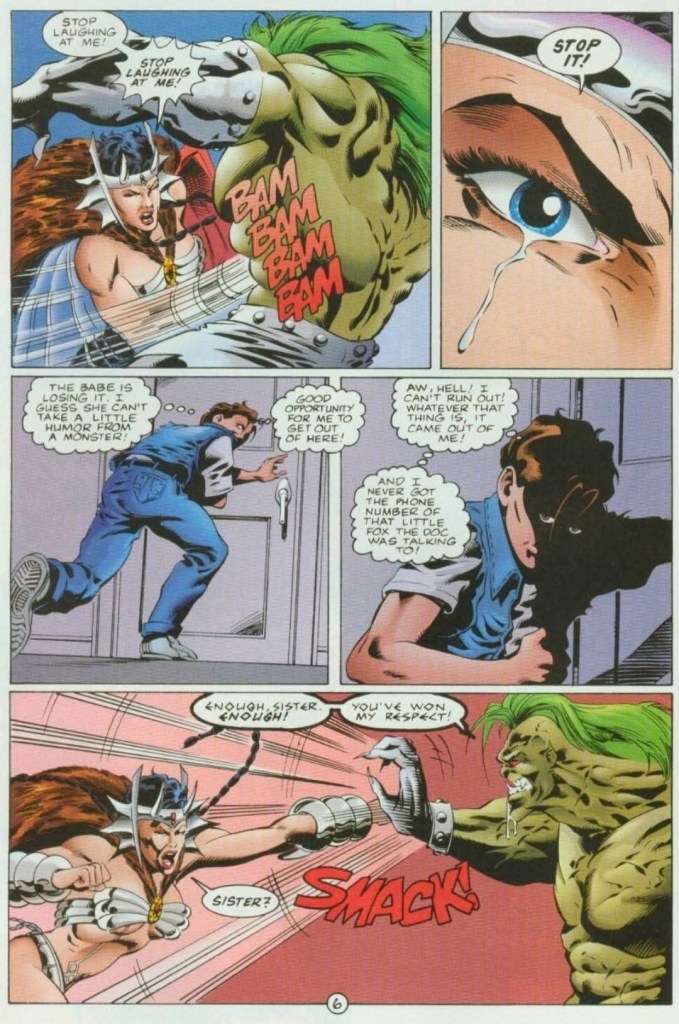
After getting hit by Elven’s elf-fire, the demon begins to laugh at her. Elven gets triggered and starts hitting the demon more…

Quality

By giving in to her impulses, Elven commits a very violent move on a man. This also shows her inability to restrain herself.

While issue #1 established Elvia Swenson personality and her super-powered, fantasy inspired Elven identity who has a genetic connection with Prime, this comic book emphasizes the deeper fantasy aspects of the Ultraverse while expanding the lore within Elven’s part of the shared comic book universe.

Similar to Prime (Kevin Green in disguise), Elven gets triggered emotionally which is the result of the youth and obvious lack of maturity of Elvia. That being said, the moments of Elven getting more violent and shedding a few tears after getting laughed at by the demon deserve any reader’s attention.

Len Strazewski’s writing is pretty rich here and he pulled of some clever moves with the narrative. As the battle between Elven and the demon intensified, there were signs that the conflict would turn into an even bigger and more destructive battle. Instead, there were these deep revelations that happened (note: for relevance, you will have to read Prime #5 which I reviewed some time ago) and even the arrogant boy Bruno has his own share of what has been going on. Even the psychiatrist turned out to be a pretty significant bystander during the battle which suggests a build-up for a sub-plot.

As such, Strazewski wrote the story to be very intriguing and the plot threads are not limited to Elven and the demon. The way I see it, something is being built up and to grasp the relevance, you will have to read some issues of the Prime and Mantra comic book series.

If there is any weakness in the storytelling, it is the fact that the psychiatrist and his office assistant very easily forgot the moments of Bruno turning evil during the late part of issue #1. The way they reacted in this comic book after the end of the battle between Elven and the demon, they did not make any moves to hold Bruno accountable nor did they question Elven’s way of handling matters (which includes the eventual ruining of the office).

Conclusion

After getting triggered (being laughed at by the demon), Elven acted move violently and impulsively.

While there were a few weak spots in certain parts of the story, Elven #2 (1995) is another solid read from the Strazewski-Lopresti duo. Elven got developed even more through conflict with the demon, and her own search for the truth about her origin. Aside from that, the fantasy elements implemented in the story expanded the lore of the Ultraverse in a very unique way. Ultimately, I am looking forward to reading the next chapter of this mini-series.

Overall, Elven #2 (1995) is recommended.

+++++

Thank you for reading. If you find this article engaging, please click the like button below and also please consider sharing this article to others. If you are looking for a copywriter to create content for your special project or business, check out my services and my portfolio. If you want to support my website, please consider making a donation. Feel free to contact me with a private message. Also please feel free to visit my Facebook page Author Carlo Carrasco and follow me on Twitter at  @HavenorFantasy as well as on Tumblr at https://carlocarrasco.tumblr.com/ and on Instagram at https://www.instagram.com/authorcarlocarrasco/.
A Look Back at Elven #1 (1995)

Welcome back, superhero fans, 1990s arts and culture enthusiasts, Ultraverse fans and comic book collectors! Today we go back to the mid-1990s to examine one of the many tales of the Ultraverse.

For the newcomers to the Ultraverse, Prime is one of its most definitive heroes and his true identity is the teenager Kevin Green who can transform into an overly muscular caped adult superhero. The Prime monthly series of comic books ran for two years and the title character appeared in many other Ultraverse comic books.

Considering the prominence of Prime, it is not surprising that Malibu Comics proceeded to create comic books featuring a female counterpart to Prime. That counterpart is called Elven who appeared in a few early issues of the Ultraverse Premiere series and eventually Prime interacted with her.

With those details laid down, here is a look back at Elven #1, published by Malibu Comics in 1995 with a story written by Len Strazewski and illustrated by Aaron Lopresti (Sludge).

The cover.

Early story

The story begins deep within a city when a beautiful blonde woman got hurt by a very angry man named Billy. With the lady down on the floor, the man raises his metallic weapon intending to strike her not realizing that someone is emerging from behind. He turns and sees a scantily clad caped woman who immediately hits him hard. The caped woman is Elven who believes she is helping the blonde woman.

To Elven’s surprise, the blonde woman tells her to stop and not hurt the man who was violent towards her. The man hits Elven on the face with his weapon but ended up getting hit hard again in retaliation. Elven then uses an optic blast at the wall as she tells the blonde woman to leave.

With the violent man down and hurt, Elven decides to kill him but is prevented by Prime from behind. After telling Prime that she told him not to interfere with her, she hits him with an energy blast…

Quality

Elvia with her hard-working mother. The lack of a loving father affected Elvia deeply.

Being written by Prime co-creator and series co-author Len Strazewski, this Ultraverse tale about Elven is very good and there is a lot of depth in the plot. You will meet Elven and the true human behind her named Elvia Swenson, a teenage girl who has a painful past, has an obsession with fantasy tales, and was created through the very same secret government fertility research program as Kevin Green/Prime. Elven’s disturbing look (with elvish features) reflects Elvia’s fantasy obsession and personally belief of using violence against men. She and Prime are genetically related due to the top secret project.

This comic book examines Elvia whose life lacks direction and her abusive father really impacted her negatively. With her mother’s love and guidance remaining in her life, Elvia is literally in a quest to find purpose, happiness and friendship. Unfortunately, the young guy Bruno is in the neighborhood and he is actually a demon. Bruno’s presence literally raised the stakes of the story which justifies Elvia’s transformation into Elven for the eventually good-versus-evil conflict. All throughout, there is tension and drama which got balanced with superhero spectacle. The way Elven is portrayed here makes her comparable with the arrogant, man-bashing, rabid feminists of modern society.

When it comes to Prime himself, this comic book features a really mature portrayal of him. I am talking about the early part of the story when Prime did his best to calm Elven down, restrain her and convince her to think first as a way to prevent her recklessness. Long-time Ultraverse readers should now that Prime is actually teenager Kevin Green inside all that muscle and he often has an awkward or a tense way of communicating with others (note: imagine the teenager pretending to think and act like an adult). That said, Prime here really interacts maturely and his attempt to put a lot of sense into the impulsive Elven is very believable. This is clever writing by Strazewski and it is one of the more notable portrayals of Prime.  

When it comes to the visual side, artist Aaron Lopresti’s style worked smoothly in this comic book. I have seen his works in the Sludge series and he really excels with facial expressions, spectacle and the monsters looking very creepy. Strangely enough, Lopresti’s take on Elven is noticeable smaller and less muscular when compared to how the character appeared in Elven #0 and Ultraverse Premiere drawn by Greg Luzniak.

Conclusion

Prime struggles to calm the impulsive and reckless Elven down. Without Prime’s intervention, Elven definitely would have committed murder against a man who harmed a woman moments earlier.

Elven #1 (1995) is clearly a very solid read and easily one of the best spin-off comic books of the Ultraverse. Strazewski and Lopresti crafted a tale that was intense and dramatic while successfully defining Elven and her true identity as the teenage Elvia. Considering her painful background and current situation, Elvia is sympathetic although things got twisted when she becomes Elven which brings out her violent side, her recklessness and distorted view about helping women by using violence. That being said, Elven at this stage in the Ultraverse is not really a likable lead character and that only makes her more unique when compared to Prime. Will Elven become as terrible as the evil ones? There is more to discover as this comic book is part of the limited series.

The specific portrayals of Elvia and Elven is very tricky to write down and Strazewski succeeded in making it work. Ultimately, this comic book added strong fantasy elements within the Ultraverse.

Overall, Elven #1 (1995) is recommended.

+++++

Thank you for reading. If you find this article engaging, please click the like button below and also please consider sharing this article to others. If you are looking for a copywriter to create content for your special project or business, check out my services and my portfolio. If you want to support my website, please consider making a donation. Feel free to contact me with a private message. Also please feel free to visit my Facebook page Author Carlo Carrasco and follow me on Twitter at  @HavenorFantasy as well as on Tumblr at https://carlocarrasco.tumblr.com/ and on Instagram at https://www.instagram.com/authorcarlocarrasco/.
A Look Back at Sludge #11 (1994)

Disclaimer: This is my original work with details sourced from reading the comic book and doing personal research. Anyone who wants to use this article, in part or in whole, needs to secure first my permission and agree to cite me as the source and author. Let it be known that any unauthorized use of this article will constrain the author to pursue the remedies under R.A. No. 8293, the Revised Penal Code, and/or all applicable legal actions under the laws of the Philippines.

Welcome back, superhero fans, 1990s arts and culture enthusiasts and comic book collectors! Today we revisit the Ultraverse of Malibu Comics and examine one of its many stories told through an issue of the Sludge comic book series.

In my previous retro review, a more character-driven story about Sludge was told as the city crime war story has ended. What made issue #10’s story standout was the unexpected physical change Sludge goes through which is something he had desired apart from wanting death. Ironically, this made him more vulnerable to physical attacks. Needing help on something, he reaches out to the New York Daily Globe’s reporter Shelley Rogers.

With those details laid down, here is a look back at Sludge #11, published by Malibu Comics in 1994 with a story written by Steve Gerber and drawn by Robb Phipps.

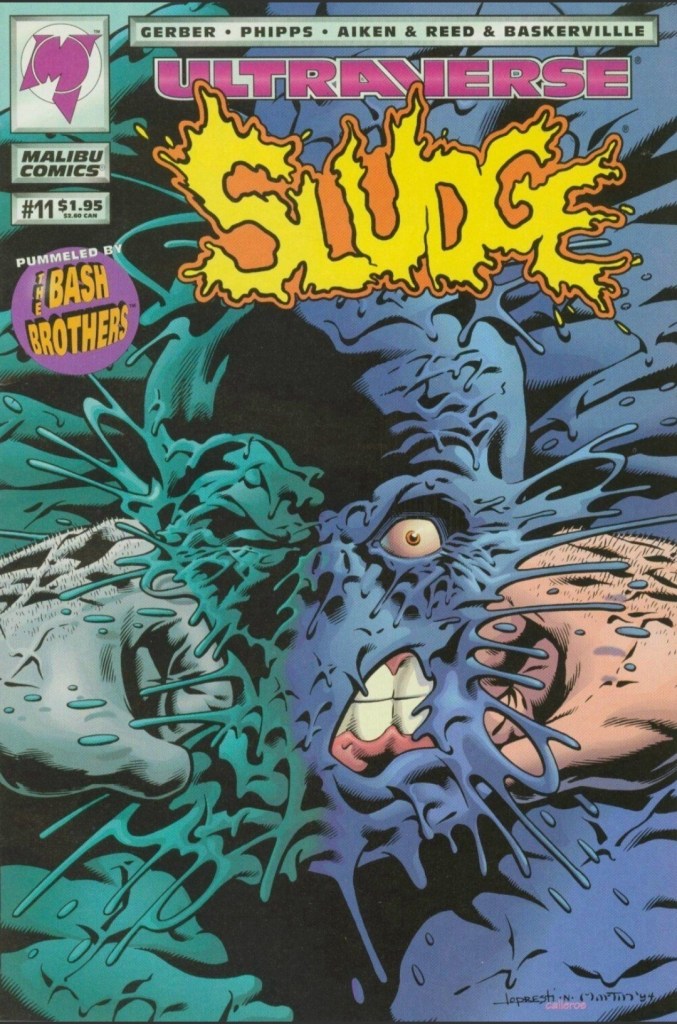
The cover.

Early story

The story begins with Sludge about to engage in a physical battle with the Bash Brothers just outside the Lalama Clinic. Shelley Rogers is just standing nearby. The Bash Brothers proved to be troublesome for Sludge until Shelley explains to one of them that their mother was not harmed. The said mother comes out and after an exchange of talk between them all, they realize Sludge needs the help of Dr. Ferdinand Lalama who was involved with the Caldwell Pharmaceuticals which itself was responsible for the stuff that affected Sludge in the first place.

Shelley then notices that Sludge is reverting back to his previous gooey state. At the same time, Dr. Lalama made no communication for almost a week…

Quality

Something wild is about to happen.

As a story that started with Sludge needing to find a specialist to help treat him, this one went wild with the fantasy concepts. Without spoiling the plot, this wild ride has strong science fiction elements such as energy streaming and traveling to another dimension through a portal. The sci-fi elements are indeed a factor that made this tale of the search of Dr. Lalama a really intriguing read.

With regards to the titular hero, this story encourages researching details of his origin (how he went from human into a chemical being) as well as reading issue #1. Sludge himself is more vulnerable than before and the unpredictable changes with him added suspense to the narrative. This story also contains themes of scientific experimentation and molecular manipulation which were nicely planted into the story’s sci-fi aspect. That being said, I can say that what was explained near the end of the comic book was both intriguing and worth reading.

Conclusion

A really interesting discussion here.

Sludge #11 (1994) is indeed a really intriguing and entertaining read. Without spoiling anything, I can say that it cleverly answered questions about how Sludge came to be, what Zuke and a regeneration formula did to his state and what forces behind the pharmaceutical company took place that affected the titular character. This is really fitting as this comic book was the 2nd-to-the-last issue ever published. That being said, I can say that I am looking forward to what will be told in issue #12.

Overall, Sludge #11 (1994) is highly recommended.

+++++

Thank you for reading. If you find this article engaging, please click the like button below, share this article to others and also please consider making a donation to support my publishing. If you are looking for a copywriter to create content for your special project or business, check out my services and my portfolio. Feel free to contact me with a private message. Also please feel free to visit my Facebook page Author Carlo Carrasco and follow me on Twitter at  @HavenorFantasy as well as on Tumblr at https://carlocarrasco.tumblr.com/ and on Instagram at https://www.instagram.com/authorcarlocarrasco

A Look Back at Ultraverse Year One (1994)

Disclaimer: This is my original work with details sourced from reading the comic book and doing personal research. Anyone who wants to use this article, in part or in whole, needs to secure first my permission and agree to cite me as the source and author. Let it be known that any unauthorized use of this article will constrain the author to pursue the remedies under R.A. No. 8293, the Revised Penal Code, and/or all applicable legal actions under the laws of the Philippines.

Welcome back superhero enthusiasts, 1990s culture enthusiasts and comic book collectors! Today we go back to the mid-1990s which was a pretty wild time for comic collectors. To be more specific, this newest retro review revisits the Ultraverse through a comic-like publication in the form of a guide meant for UV fans and comic collectors.

The subject at hand is Ultraverse Year One which, as written on the edge of the front cover, was designed to be the “complete guide to the Ultraverse’s first year.” It is a reference guide for those who seriously want to discover each and every Ultraverse comic book that was published during its first year. In my experience as a comic collector, the Ultraverse launch in 1993 was very memorable even though my financial limitations prevented me from acquiring each and every launch comic book and subsequent releases of the time. How useful is this complete UV guide? We can go on and find out.

With those details laid down, here is a look back at Ultraverse Year One, published in 1994 by Malibu Comics.

The cover.

Quality

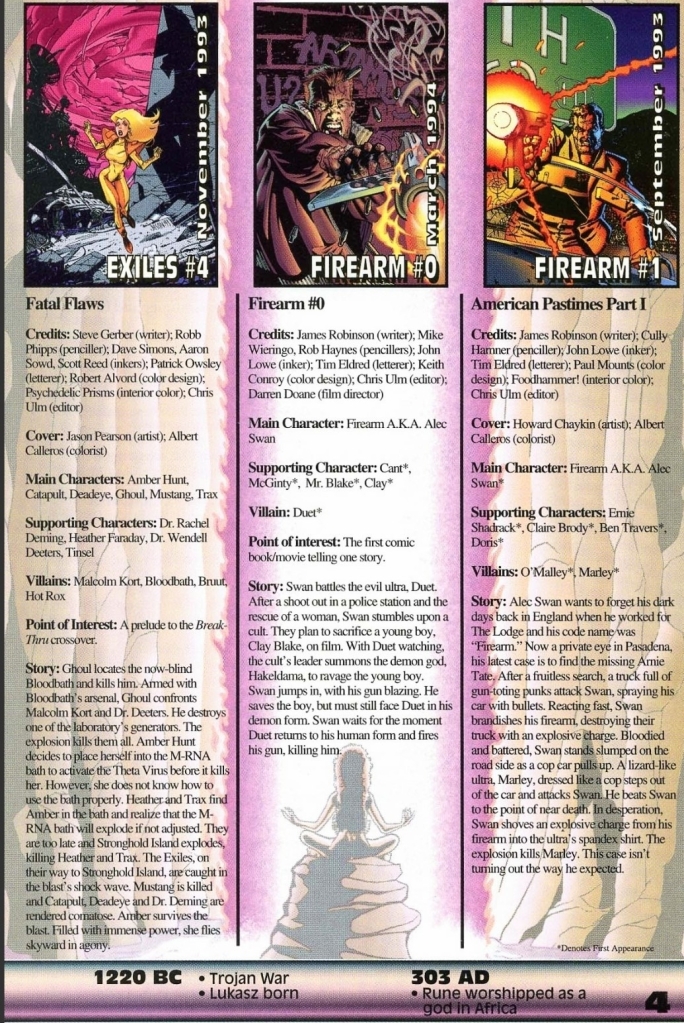
I can say without a doubt that this publication is indeed a complete guide to each and every Ultraverse comic book released during its first year from 1993 to 1994 specifically. You want to know exactly how many issues of Mantra, Prime, Hardcase, The Solution, Prototype, The Strangers and others were published in the first year? This one has it all listed! You want to know which UV comic book involved the talents of Steve Gerber, Norm Breyfogle, Rick Hoberg, Len Strazewski, Aaron Lopresti, George Perez, James Hudnall, Gerard Jones, Steve Englehart, Tom Mason, Terry Dodson, James Robinson, Howard Chaykin, Mike W. Barr and many others under the Malibu Comics banner? This guide has it all listed! What months were Exiles #1, Sludge #1, Firearm #0, Break-Thru #1 and Mantra #1 were published? The answers to each are included. The same can also be said when it comes to which characters appeared in each comic book.

This is what each page typically looks like with details of the Ultraverse timeline on the lower part.
The timeline reveals that the male warrior Lukasz, who would later end up in woman’s body as Mantra/Eden Blake, was born in 1220 BC.

Very clearly, the Malibu Comics people worked hard to collect the essential types of information, organized them and put them all into print media form for readers and collectors to use when it comes to searching just about everything about the Ultraverse’s first year. Things did not just stop there, however.

What I found amusing to look at in each page of this Ultraverse guide are details of the shared universe’s timeline posted on the lowest part. The said timeline – which is limited to text and numbers – reveal interesting details such as what year was Lukasz (AKA Mantra) born, when did Rune begin, when was the Choice corporation established, what year did the island of Yrial’s people move up to the clouds, what years were infants injected by Wetware Mary and more. These details are actually quite encouraging to make readers discover or re-read Ultraverse comic books to see how they are dramatized on paper.

Conclusion

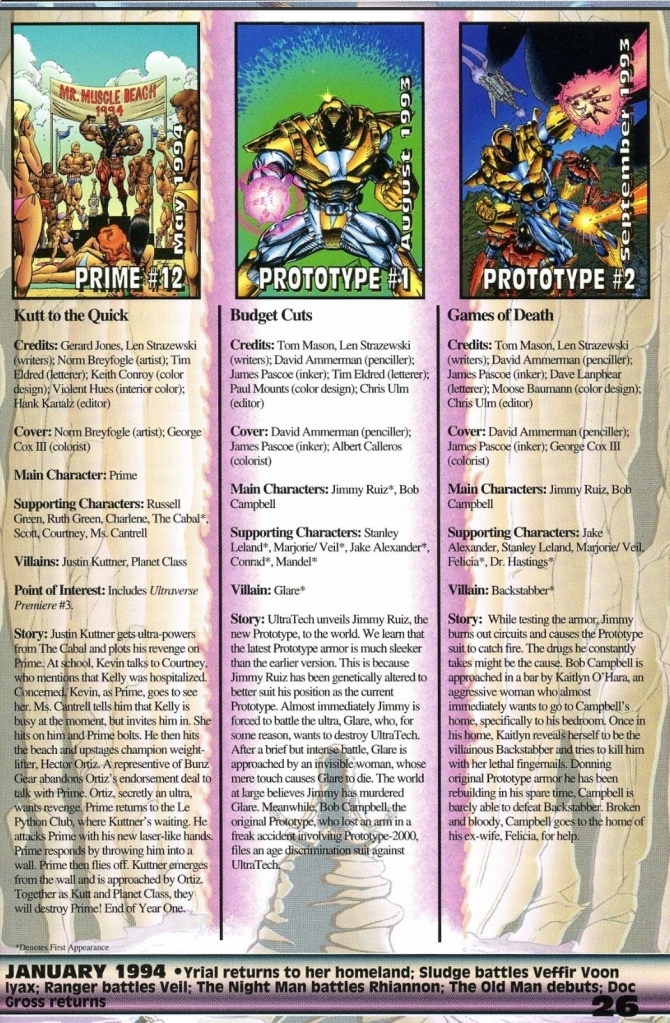
As you can see in the details above, Len Strazewski was involved in both the Prime and Prototype comic book series.

Ultraverse Year One (1994) is a pretty detailed guide that will not only help readers track down each and every UV comic book of the mentioned time period, but also help them spot the precise comic books that has characters included as well as the published works of varied comic book creators. If you are really determined to track down and buy all the Year One UV comic books, this guide is a must-have. If there are any weaknesses to mention, it would be the fact that each comic book’s entire plot got summarized in full which are actually spoilers.

Overall, Ultraverse Year One (1994) is recommended.

+++++

Thank you for reading. If you find this article engaging, please click the like button below and also please consider sharing this article to others. If you are looking for a copywriter to create content for your special project or business, check out my services and my portfolio. Feel free to contact me with a private message. Also please feel free to visit my Facebook page Author Carlo Carrasco and follow me on Twitter at  @HavenorFantasy as well as on Tumblr at https://carlocarrasco.tumblr.com/ and on Instagram at https://www.instagram.com/authorcarlocarrasco/

A Look Back at Sludge #10 (1994)

Disclaimer: This is my original work with details sourced from reading the comic book and doing personal research. Anyone who wants to use this article, in part or in whole, needs to secure first my permission and agree to cite me as the source and author. Let it be known that any unauthorized use of this article will constrain the author to pursue the remedies under R.A. No. 8293, the Revised Penal Code, and/or all applicable legal actions under the laws of the Philippines.

Welcome back, superhero fans, 1990s arts and culture enthusiasts and comic book collectors! Today we revisit the Ultraverse of Malibu Comics and examine one of its many stories told through an issue of the Sludge comic book series.

In my previous retro review, the “Street Wars” storyline came to a solid and even shocking end which ultimately left Sludge free and yet desperate and unfulfilled. At this stage, Sludge is clearly a very lost soul and this opens another opportunity for readers to follow him and see where he will go next.

With those details laid down, here is a look back at Sludge #10, published by Malibu Comics in 1994 with a story written by Steve Gerber and drawn by Robb Phipps.

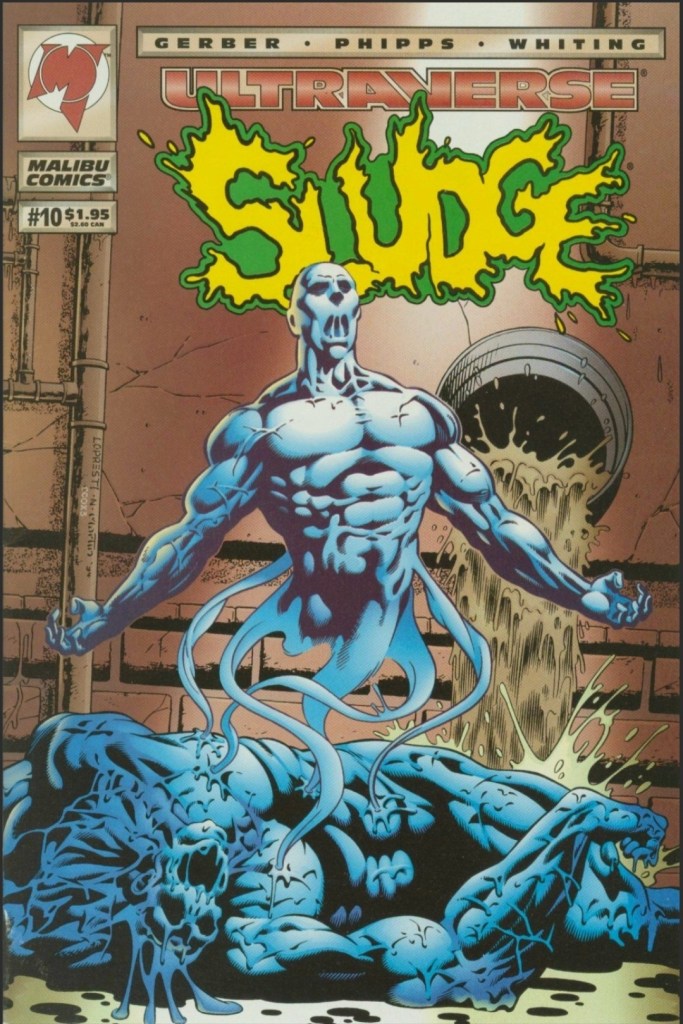
The cover.

Early story

The story begins with Sludge once again alone in the sewers. This time, he holds large quantities of the illegal substance Zuke which he believes will help him achieve something he desires in relation to his existence. Life has been very hard for him since he became a slimy creature.

Then he remembers when the mercenary Bloodstorm was forced fed with Zuke. Afterwards, he consumes the large Zuke containers expecting them to fix him. Nothing happened. No instant results whatsoever which frustrates him. Sludge then walks into the darkness.

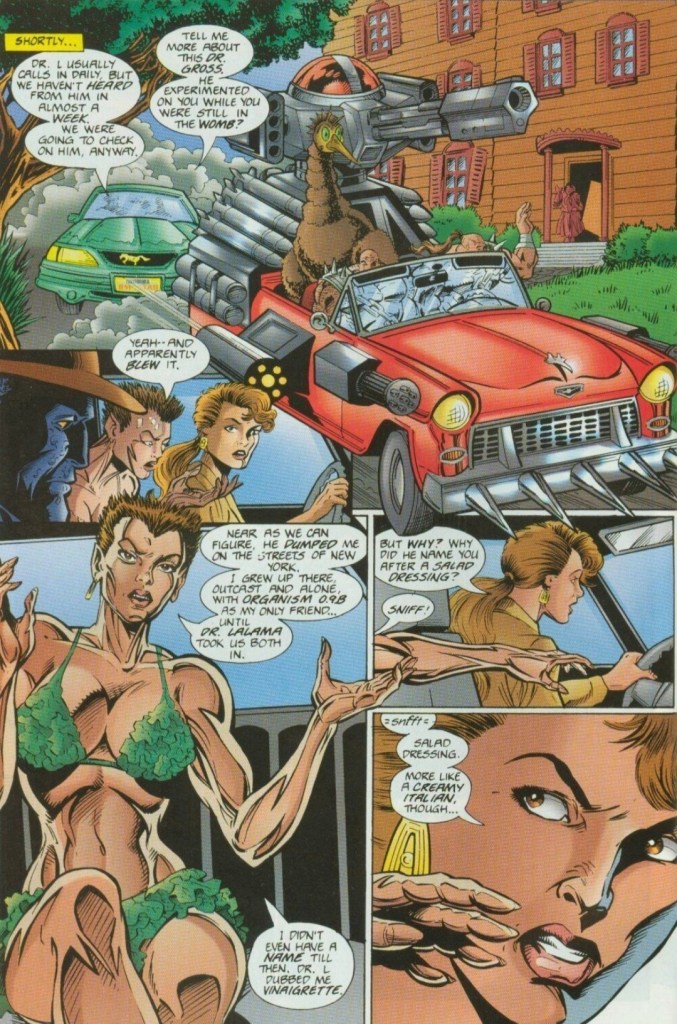
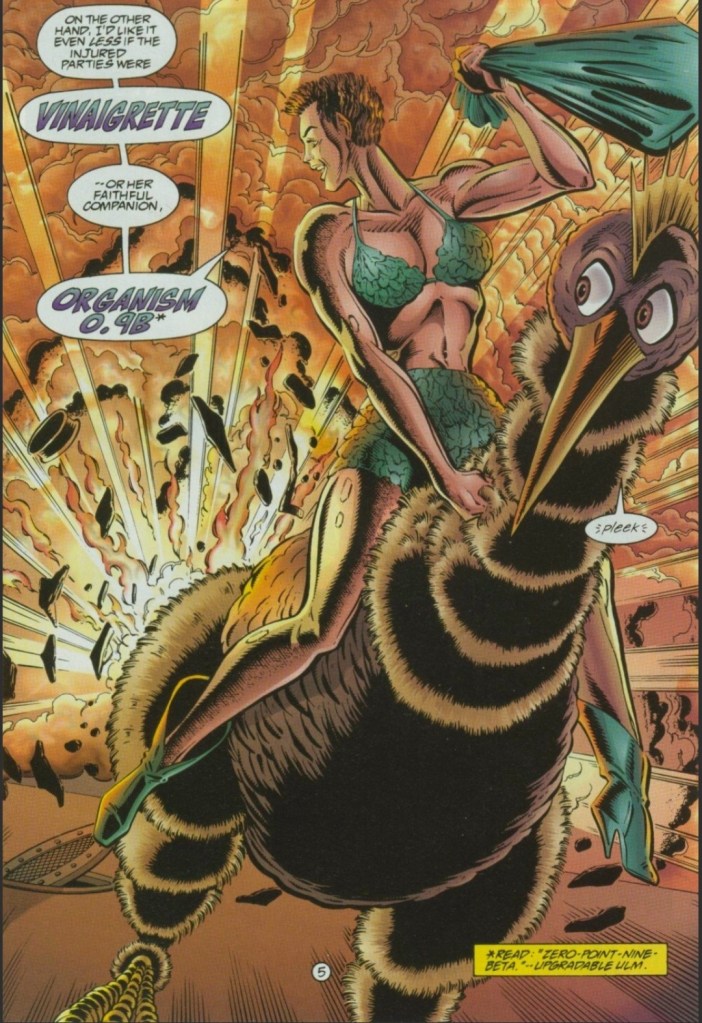
On the city street, police officers in cars chase an unusual target…a lady riding a large bird of unknown species. After causing her pursuers to crash and explode, the lady rider reveals herself to be Vinaigrette.

Just as Vinaigrette and her speedy bird move into an alley, Sludge sees them…

Quality

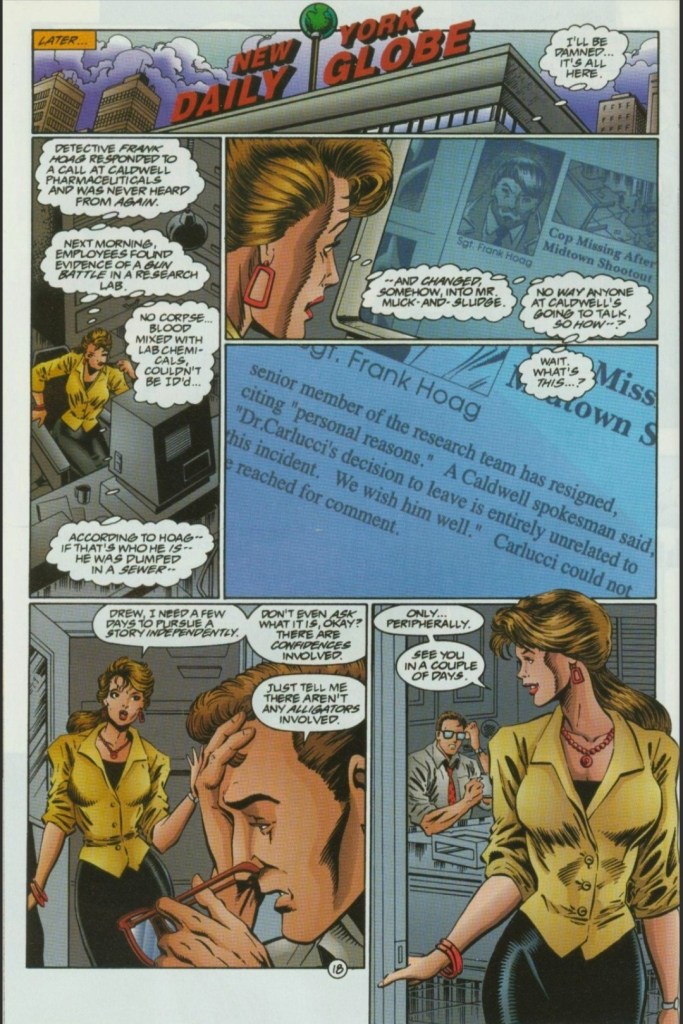
Investigative journalism being done.

When it comes to the story, I can say that the Sludge series really made a serious turn towards a different direction here. Without spoiling the rest of the plot, I can say that very significant changes await readers, so much so their usual expectations towards Sludge become unnecessary. Are you so used to seeing Sludge think or talk inconsistently? Be ready for something really new about him, something that makes him more human moving a bit closer to his past life as a civilian.

Moreover, with the gang war aspect of New York already out of the narrative, this comic book not only follows Sludge more significantly, its story is also more character-driven than before. What Steve Gerber wrote here is very nicely structured and it is also clear he also adjusted his portrayal of the titular character to give readers something fresh and yet familiar to follow.

So what kind of story does this comic book present other than being a more character-driven piece? Definitely it’s not a monster story nor a superhero tale but something more of a misadventure mixed with elements of detective story plus a bit of investigative journalism (mainly due to the series’ notable lady journalist).

Conclusion

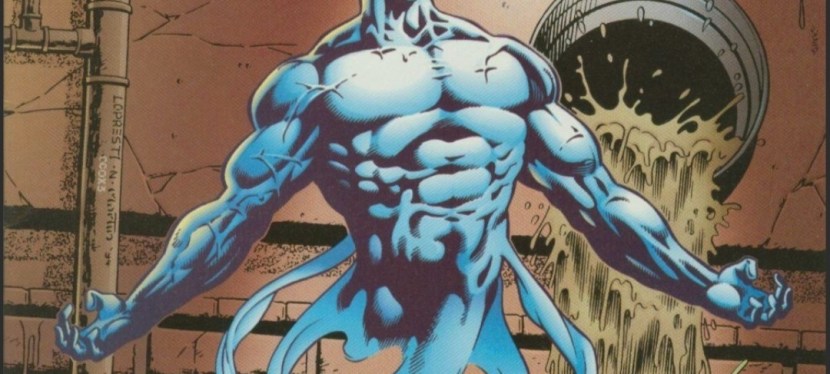
A lady and her speedy ride.

In my view, Sludge #10 (1994) is a successful attempt by the creative team to emphasize Sludge’s exploits and personality even more while taking a new direction without ever feeling alienating. I should state that after reading back-to-back issues about the New York gang war which had the titular character caught in the middle, this comic book’s character-driven approach with Sludge is literally like a breath of fresh air. Not only will you see even more of Sludge, you will also enjoy the creators’ attempt on exploring his past life while showing lots of significant new things in connection to the changes he goes through. The story is nicely paced, the storytelling is creatively stylized and there are nice pay-offs for each build-up.

Overall, Sludge #10 (1994) is highly recommended.

+++++

Thank you for reading. If you find this article engaging, please click the like button below and also please consider sharing this article to others. If you are looking for a copywriter to create content for your special project or business, check out my services and my portfolio. Feel free to contact me with a private message. Also please feel free to visit my Facebook page Author Carlo Carrasco and follow me on Twitter at  @HavenorFantasy as well as on Tumblr at https://carlocarrasco.tumblr.com/ and on Instagram at https://www.instagram.com/authorcarlocarrasco/

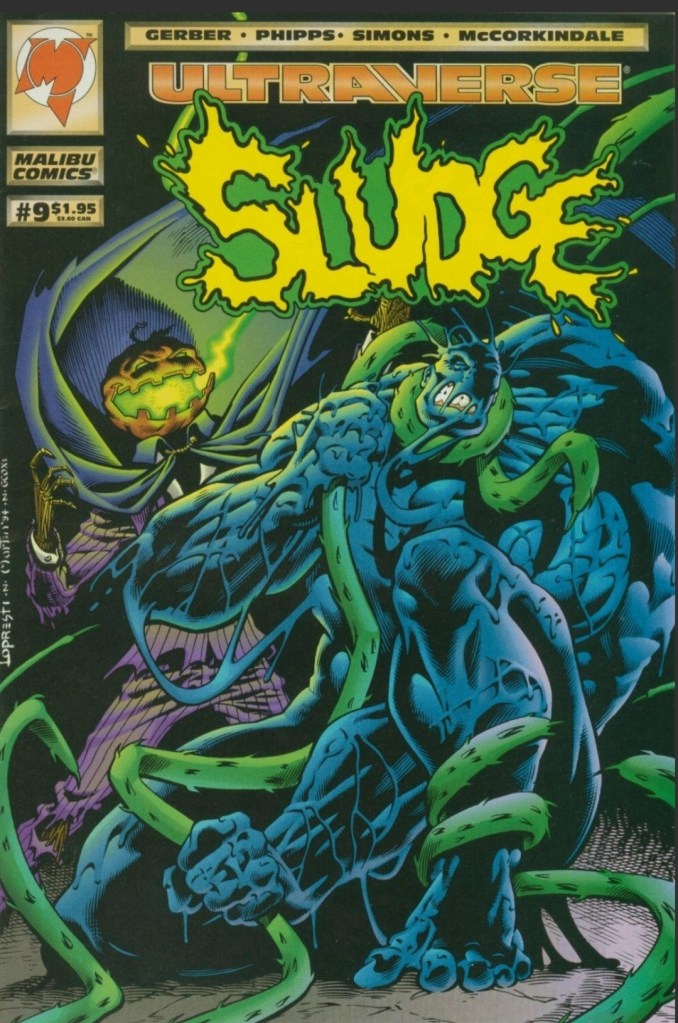
A Look Back at Sludge #9 (1994)

Disclaimer: This is my original work with details sourced from reading the comic book and doing personal research. Anyone who wants to use this article, in part or in whole, needs to secure first my permission and agree to cite me as the source and author. Let it be known that any unauthorized use of this article will constrain the author to pursue the remedies under R.A. No. 8293, the Revised Penal Code, and/or all applicable legal actions under the laws of the Philippines.

Welcome back, superhero fans, 1990s arts and culture enthusiasts and comic book collectors! Today we revisit the Ultraverse of Malibu Comics and examine one of its many stories told through an issue of the Sludge comic book series.

In my previous Sludge retro review, the conflict between the crime organizations intensified as the titular character continued to struggle with achieving his desired goal which includes getting involved with the Pump’s evil schemes. Eventually something unexpected happened Sludge which involved Zuke, the potent illegal substance the Pump keeps on unleashing to the public.

With those details laid down, here is a look back at Sludge #9, published by Malibu Comics in 1994 with a story written by Steve Gerber and drawn by Robb Phipps.

The cover.

Early story

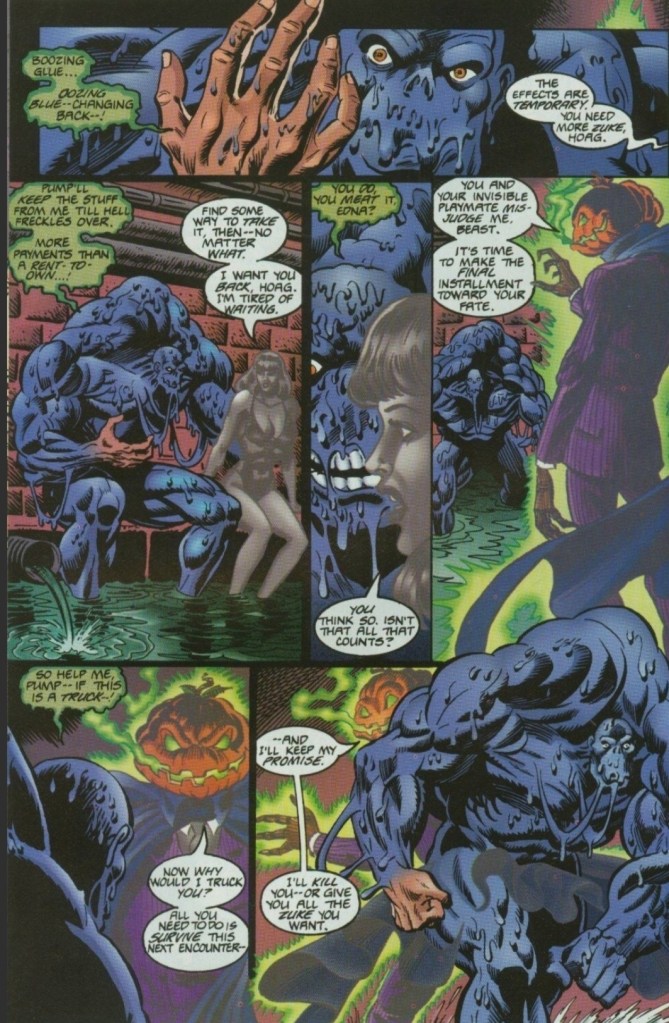
The story begins with Sludge in pain as he pulls out a long spike from his right hand which became flesh again. This was the result of his holding Zuke which his right hand somehow absorbed. Wanting answers, he calls out to the Pump who (along with his teenage protégé) was no longer present in the room. A female ghost appears to Sludge and tells him that the crime boss is downstairs.

It turns out, the Pump has an evil plan in mind which would involve the mercenary Bloodstorm. The crime boss puts a very large capsule of Zuke into the mouth of the restrained Bloodstorm. Just as Sludge arrives, Bloodstorm becomes very enraged as a result of absorbing a high quantity of the illegal substance. Shortly after Pump quells the drugged mercenary, Sludge approaches him for more Zuke as he is convinced that the drug will turn him to normal just like how it turned his right hand back to normal.

The Pump orders Sludge to take Bloodstorm’s body back to his employer Sabatini then return. He reminds him that he has the Zuke and is capable of eradicating him…

Quality

Sludge has yet to realize he could really go up against the very evil Pump.

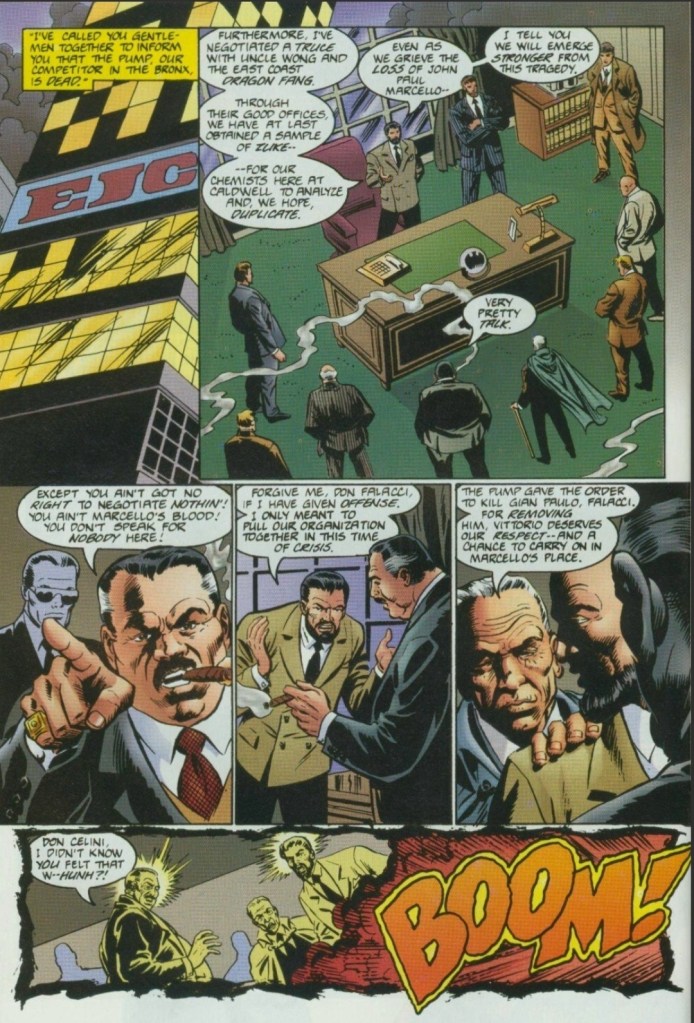
Now this is the most intriguing tale of Sludge in relation to the unstable relations between the gangs of New York. Vittorio, the one trusted assistant of the late crime boss Marcello, leads the gang and tries to craft a new direction with emergence in mind by negotiating a truce with the Dragon Fang while also starting efforts to duplicate the very addicting substance called Zuke which has long been an asset to the Pump’s gang. Unsurprisingly, Vittorio encounters trouble trying to win the trust of the more established crime bosses and he is also unaware that they are all being targeted by the Pump.

Once the Pump unleashes his newest move against the gangs, the situation intensifies and gets twisted which makes this a really solid reading experience. Steve Gerber crafted this story to be intense and unpredictable at the same time, while also showing how Sludge deals with his situation being powerless under the Pump. There is one notable addition to the plot which involves violent action which you must discover for yourselves.

When it comes to the visuals, Robb Phipps take on Sludge is vastly different compared to Aaron Lopresti’s Sludge. The result is that Phipps’ art style made Sludge and the other characters have that cartoony aesthetic and yet they are still recognizable. What visual style and elements Phipps had on certain issues of Mantra he illustrated (click here, here and here) are pretty much present in this comic book.  

Conclusion

A high-stakes meeting disrupted.

Sludge #9 (1994) is another solid read and one of the most intriguing stories of the Sludge series. As the concluding chapter of the “Street Wars” storyline, this comic book has the usual elements that defined Sludge stories while also succeeding in moving the plot forward (note: the storyline conclusion is engaging, even shocking) complete with twists and noticeable intensified violence. At this point in the monthly series, Sludge is off on a path of despair and he is clearly lost. This element alone should compel readers to examine Sludge’s personality closely and analyze where he is heading to and what purpose does he have left.

Overall, Sludge #9 (1994) is recommended.

+++++

Thank you for reading. If you find this article engaging, please click the like button below and also please consider sharing this article to others. If you are looking for a copywriter to create content for your special project or business, check out my services and my portfolio. Feel free to contact me with a private message. Also please feel free to visit my Facebook page Author Carlo Carrasco and follow me on Twitter at  @HavenorFantasy as well as on Tumblr at https://carlocarrasco.tumblr.com/ and on Instagram at https://www.instagram.com/authorcarlocarrasco/

A Look Back at Break-Thru #2 (1994)

Disclaimer: This is my original work with details sourced from reading the comic book and doing personal research. Anyone who wants to use this article, in part or in whole, needs to secure first my permission and agree to cite me as the source and author. Let it be known that any unauthorized use of this article will constrain the author to pursue the remedies under R.A. No. 8293, the Revised Penal Code, and/or all applicable legal actions under the laws of the Philippines.

Welcome back superhero enthusiasts, 1990s culture enthusiasts and comic book collectors! Today we go back to the mid-1990s which was a really wild time for comic collectors. To be more specific, this newest retro comic book review revisits the conclusion of the epic Ultraverse storyline Break-Thru which was illustrated by the late George Perez (1954-2022). I encourage you readers – especially long-time fans of the iconic illustrator – to check out my commemorative article about George Perez by clicking here.

For the newcomers reading this, Break-Thru was a 2-part storyline that creatively involved almost all the main characters of the Ultraverse (The Strangers, Mantra, Prime, Prototype, Freex, The Solution, Hardcase, Sludge, Solitaire and others) who got impacted in varied ways by Amber (of the Exiles) who floated high in the air causing chaos on societies below. Specifically, that was the concept of Break-Thru #1 (1993) and issue #2 has the story continuing with a setting in outer space with the moon as the key destination.

With those details laid down, here is a look back Break-Thru #2, published in 1994 by Malibu Comics with a story scripted by Gerard Jones (plotted by Mike W. Barr, Steve Englehart, Steve Gerber, James Hudnall, Tom Mason, George Perez, James Robinson and Len Strazewski) and illustrated by the late George Perez.

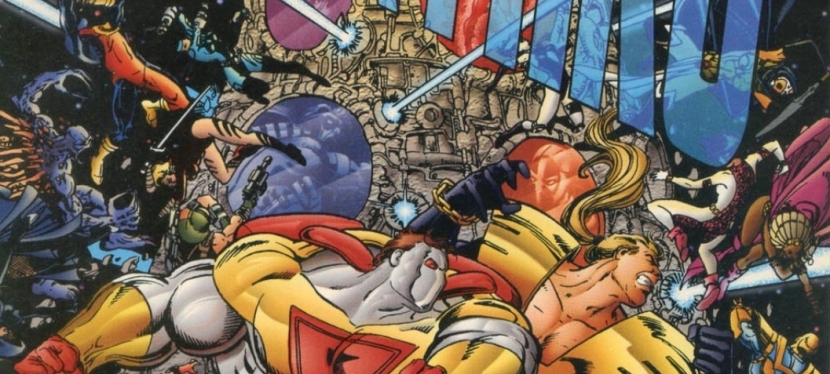
An epic cover by the late George Perez.

Early story

The story begins at the surface of the moon with Hardcase, Choice and the members of The Solution who just survived the explosion (connected with Hardcase #7 and The Solution #4) of the flying saucer they used on their journey. Nearby, the people responsible for the destruction are riding their own flying saucer, scanning the surface of the moon searching for an entity.

Behind the scenes, the very hidden yet powerful Rex Mundi watches and tells Gate that other ultras are seeking the entity. As the saucer floats to a cave detecting the presence of the entity, the occupants get shaken as Prime hits them hard. Prime tells himself that the entity in the cave feels danger from the searchers and he has to protect it as he has been connected with it (refer to Prime #7). After getting blasted in retaliation by the saucer, Prime finds himself hit even more as Rex Mundi’s enforcers suddenly come out of a portal very near him.  

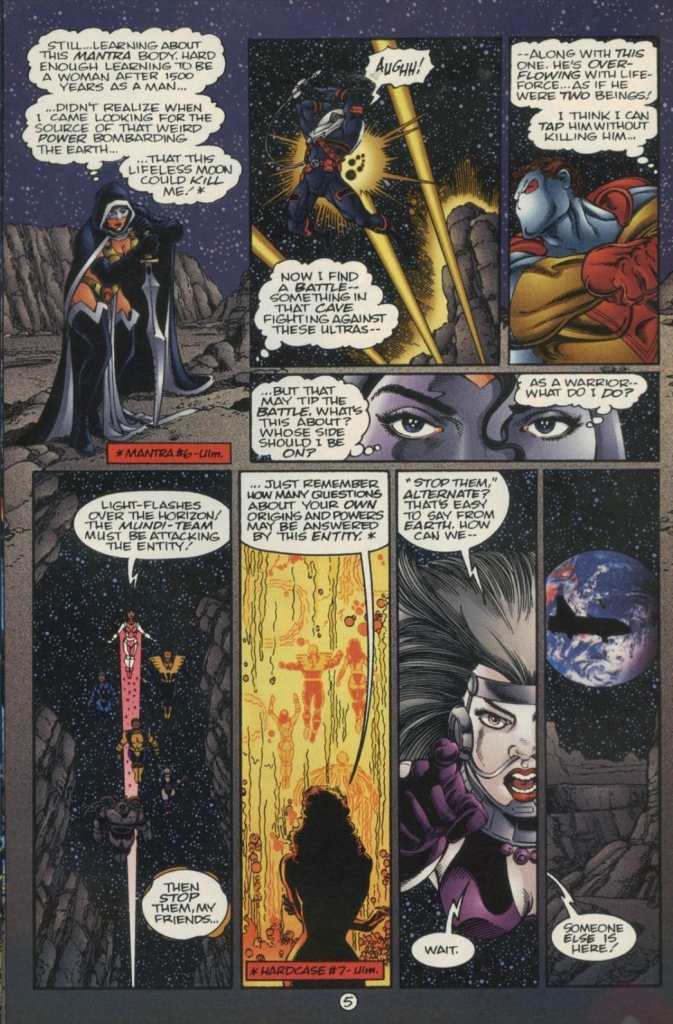
From a distance, Mantra (refer to Mantra #6) sees the fight happening and needs a life force to survive. Elsewhere, Hardcase, Choice and The Solution witness the arrival of a space shuttle. The Strangers and Prototype (refer to The Strangers #7 and Prototype #5) come out together…

Quality

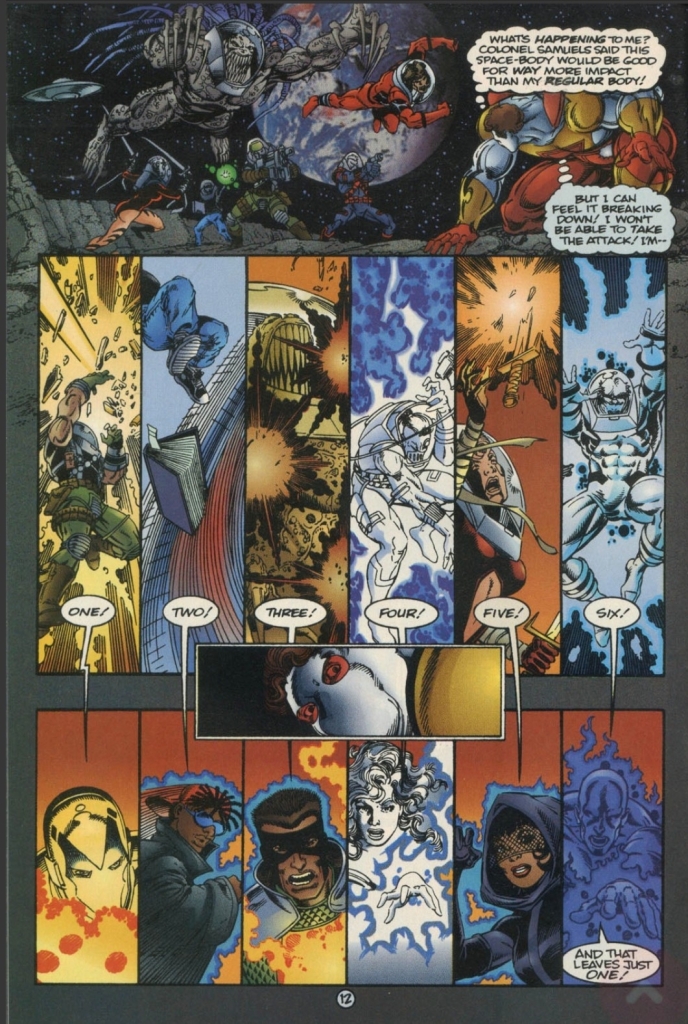
This is classic George Perez presentation of action and characters using multiple panels in a single page.

Starting with the writing, I should mention that all the writers who were involved in plotting this comic book as well as the previous issue should be commended for their combined efforts on making the Break-Thru storyline happen complete with in-universe ramifications, developments and connections to almost all the monthly comic books via the Break-Thru tie-in issue (also check out Sludge #3, Freex #6, Solitaire #2 and Night Man #3). Clearly Break-Thru was planned to be a major turning point of the Ultraverse by involving and mixing most of the major characters together and have them struggle with tremendous obstacles they simply cannot ignore as the stakes were indeed too high.

More on this comic book, the major conflict was set on the moon which proved to be a very unique setting not just for dynamic battles to happen but also to serve as the place where a mysterious and powerful entity is hidden. When it comes to the story, the entity (more science fictional in concept) is mysterious and cleverly not blatantly evil. It is its mysteriousness that makes the entity a worthy force to have the UV’s heroes come after.

The writers added depth to the plot by showing Yrial of The Strangers and Prototype each having their own vested interests to get to the entity and acquire whatever it has that is valuable. At the same time, Mantra and Prime each discovered valuable knowledge about the entity that impacted their perceptions about their purpose as beings with super powers.

Mantra, Prime, The Solution, Hardcase and Choice.

While the story here still has so many characters expressing themselves and releasing expository information, the narrative is a little bit easier to understand and follow compared to issue #1 (which had a lot more information to release via exposition). That being said, the scenes of spectacle became more enjoyable to read and along the way there were some notable character moments to look at.

Visually, this is unsurprisingly a great looking comic book as it was illustrated by the late George Perez. What I love most about Perez’s art style and visual presentation are all here: high details on each character drawn as well as their surroundings, the dynamic approach on setting up the panels on each page, fantastic looking superhero action, and much more! As with Break-Thru #1 and other Ultraverse comic books drawn by Perez, this one is absolutely great to look at and it easily lifts up the visual/artistic quality of the UV and its heroes. As George Perez was involved in the plot of this comic book, the narrative was never overwhelmed by his great art and the artist really exerted a lot of effort on visualizing each and every one of the established UV characters (including the supporting characters).

Speaking of the established characters, I should state that Perez made Mantra’s face (with mask) look a bit more realistic and feminine while Kevin Green has a more convincing teenage boy look, Sludge looks a bit more creepier and Yrial looks visually identical to the way Rick Hoberg draws her. When it comes to the varied physiques of each established UV hero, Perez captured them all perfectly. Clearly the late artist did his research on every character.

Conclusion

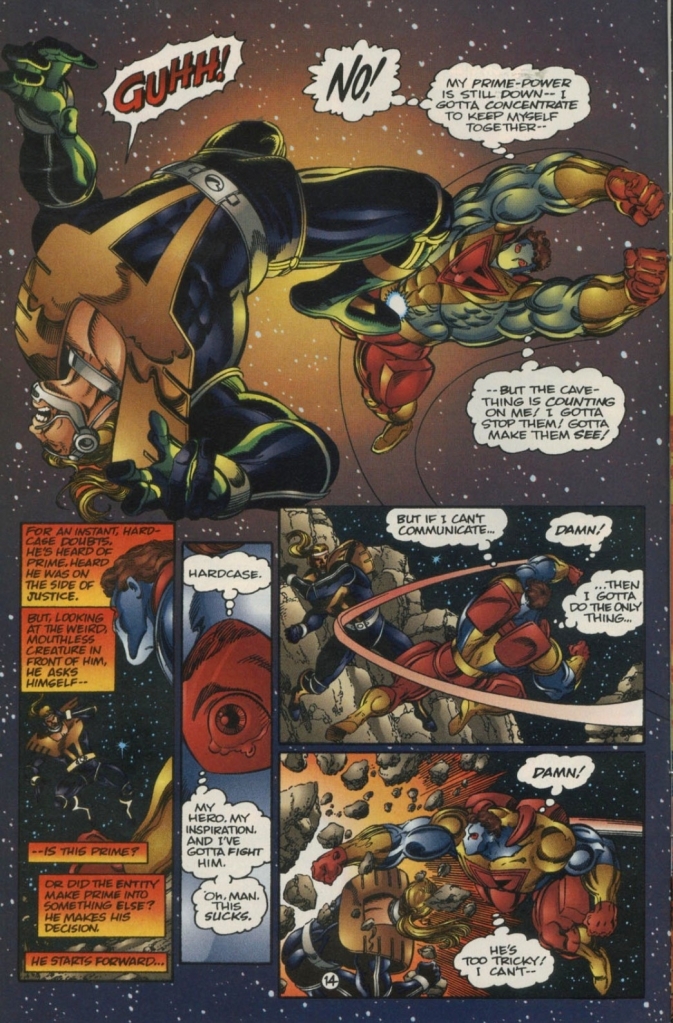
The first physical encounter between Prime and Hardcase. Remember this before reading the UltraForce comics.

Break-Thru #2 (1994) is truly an epic Ultraverse story that also worked as a major turning point of the UV as a whole. Compared to other epic superhero stories that Marvel and DC Comics published, Break-Thru is not the usual large gathering of superheroes who have to work together to defeat an evil force that threatens everyone’s existence. It is more about the UV heroes getting together to solve major obstacles before reaching the main destination. By the time I reached the end of this comic book (and its storyline), I experienced great satisfaction not just from Break-Thru itself but also in relation to how the Ultraverse heroes realized what they are living for and what their respective purposes really are about. What also happened in this comic book explains why jumpstart events happened on Earth. Very clearly, this was an epic story that was planned early and even though this was published just months after the Ultraverse first debuted, the characters were developed enough to make Break-Thru’s concepts sensible and acceptable. There is a lot of fun and engagement in this comic book drawn by the late George Perez (who also worked on DC’s Crisis on Infinite Earths and Marvel’s The Infinity Gauntlet).

Overall, Break-Thru #2 (1994) is highly recommended!

+++++

Thank you for reading. If you find this article engaging, please click the like button below and also please consider sharing this article to others. If you are looking for a copywriter to create content for your special project or business, check out my services and my portfolio. Feel free to contact me with a private message. Also please feel free to visit my Facebook page Author Carlo Carrasco and follow me on Twitter at  @HavenorFantasy as well as on Tumblr at https://carlocarrasco.tumblr.com/ and on Instagram at https://www.instagram.com/authorcarlocarrasco/

A Look Back at Sludge #8 (1994)

Disclaimer: This is my original work with details sourced from reading the comic book and doing personal research. Anyone who wants to use this article, in part or in whole, needs to secure first my permission and agree to cite me as the source and author. Let it be known that any unauthorized use of this article will constrain the author to pursue the remedies under R.A. No. 8293, the Revised Penal Code, and/or all applicable legal actions under the laws of the Philippines.

Welcome back, superhero fans, 1990s arts and culture enthusiasts and comic book collectors! Today we revisit the Ultraverse of Malibu Comics and examine one of its many stories told through an issue of the Sludge comic book series.

As seen in my previous Sludge retro review, the stakes were raised even higher and Sludge finds himself in the middle of a major conflict between the gangs of the city with the involvement of the group of the Pump. By this point, the titular character is not only desperate but also is getting torn between good and evil.

With those details laid down, here is a look back at Sludge #8, published by Malibu Comics in 1994 with a story written by Steve Gerber and drawn by Aaron Lopresti.

The cover.

Early story

The story begins with TV news coverage doing a recap of events that shook New York City and its people – the abduction of a drug mule, the destruction of a ship filled with illegal immigrants, the destruction in the cemetery left behind by a major conflict there, and the death of crime boss John Paul Marcello which involved action by Sludge.

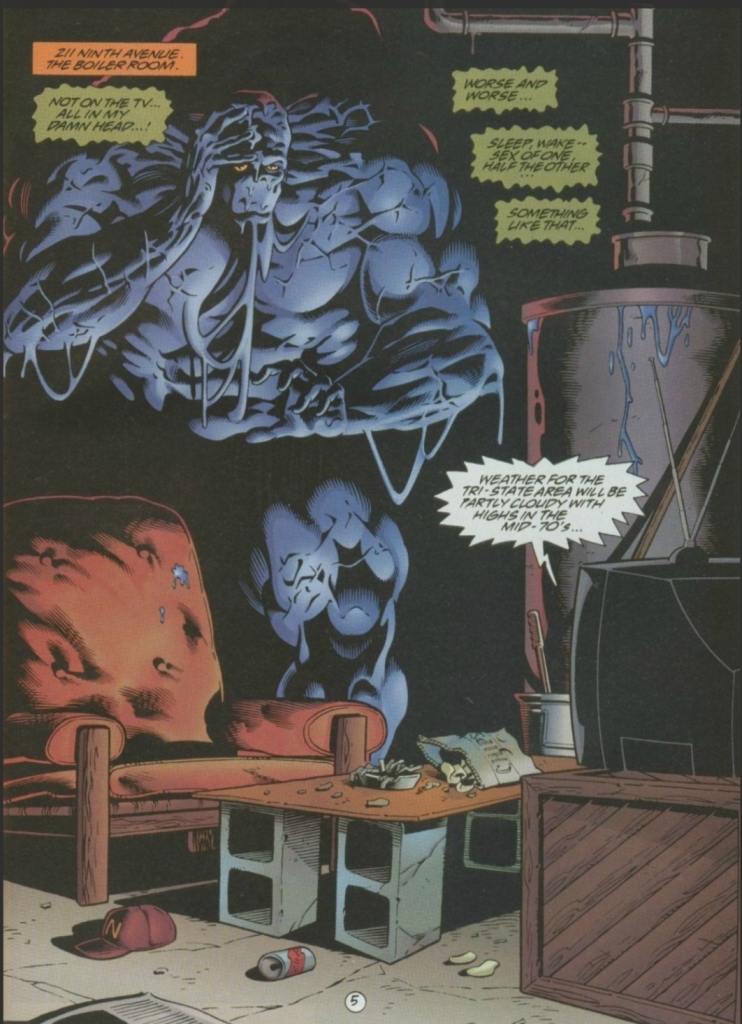
Sludge then wakes up from another nightmare and finds himself inside a boiler room which has a TV set and a chair. It turns out the place was set up by a janitor who does not even know Sludge is present. Slowly, Sludge sneaks his way back to the sewer.

At a cemetery, the burial of Marcello is being attended by many people and among them is Don Celini who regarded the late crime boss as a man of vision who made a lot of money for many people. Vittorio, the former loyal assistant to Marcello, is told by Don Celini to demonstrate leadership qualities to the heads of the other gangs. In the evening at a discreet place, Vittorio meets with Bloodstorm with a lot of money on the side…

The reporter Shelley on the pursuit for details.

Quality

To make things clear about the storytelling, the conflict between the crime gangs not only became more intense but also turned out quite intriguing. Clearly writer Steve Gerber carefully planned out the events, character developments and twists for this series. That being said, this comic book has a fine mix of suspense, crime story and even the supernatural for the narrative’s progress, and the good news is that these elements were presented in a believable way.

As presented in the previous issues, Sludge’s desperation and death wish will keep on intriguing you especially when he gets bothered by the Pump (arguably the most evil figure of the entire Ultraverse). Even as the war between gangs heat up, the story even had space for investigative journalism moments through the news reporter Shelley (who encountered Sludge in person before) whose pursuit for the facts remains unrelenting.

Conclusion

Sludge in a dark boiler room.

While the previous issue made me think deeply about the state of Sludge’s character and the gang war he became involved with, Sludge #8 (1994) is an even more intriguing Ultraverse read complete with solid twists that must be seen. Without spoiling the story, this comic book will strongly resonate with readers who really started the Sludge series from issue #1 (note: Bloodstorm’s involvement in this comic book will be more relevant if you have previously read his detailed introduction in issue #2). The current storyline – Street Wars – went significant steps forward in this story and I can say that the creative team of Gerber and Aaron Lopresti were successful in making me anticipate the conclusion.

Overall, Sludge #8 (1994) is recommended.

+++++

Thank you for reading. If you find this article engaging, please click the like button below and also please consider sharing this article to others. If you are looking for a copywriter to create content for your special project or business, check out my services and my portfolio. Feel free to contact me with a private message. Also please feel free to visit my Facebook page Author Carlo Carrasco and follow me on Twitter at  @HavenorFantasy as well as on Tumblr at https://carlocarrasco.tumblr.com/ and on Instagram at https://www.instagram.com/authorcarlocarrasco/

A Look Back at Sludge #7 (1994)

Disclaimer: This is my original work with details sourced from reading the comic book and doing personal research. Anyone who wants to use this article, in part or in whole, needs to secure first my permission and agree to cite me as the source and author. Let it be known that any unauthorized use of this article will constrain the author to pursue the remedies under R.A. No. 8293, the Revised Penal Code, and/or all applicable legal actions under the laws of the Philippines.

Welcome back, superhero fans, 1990s arts and culture enthusiasts and comic book collectors! Today we revisit the Ultraverse of Malibu Comics and examine one of its many stories told through an issue of the Sludge comic book series.

In my previous Sludge retro comic book review, the stakes were raised for Sludge and the city of New York as a new conflict started brewing that brought in two gangs along with the Pump and his own gang, and even mercenaries. Issue #6 was the start of a new multi-part storyline that Steve Gerber crafted and it encouraged re-reading the early issues of the Sludge series to understand the scope of the new conflict.

With those details laid down, here is a look back at Sludge #7, published by Malibu Comics in 1994 with a story written by Steve Gerber and drawn by Aaron Lopresti.

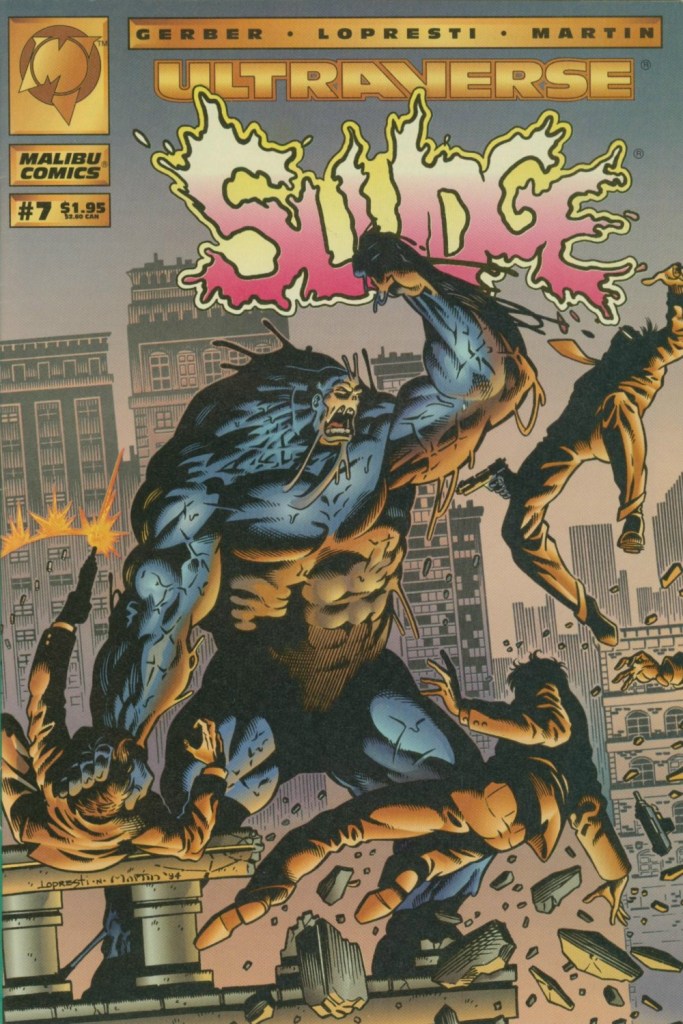
The cover.

Early story

The story begins with a man and a woman on bed. Their privacy gets interrupted when the Pump suddenly appears in frightening fashion. It turns out, Sludge was in the middle of a nightmare and even sees a frightening vision of Edna. He then makes his way through in the sewer.

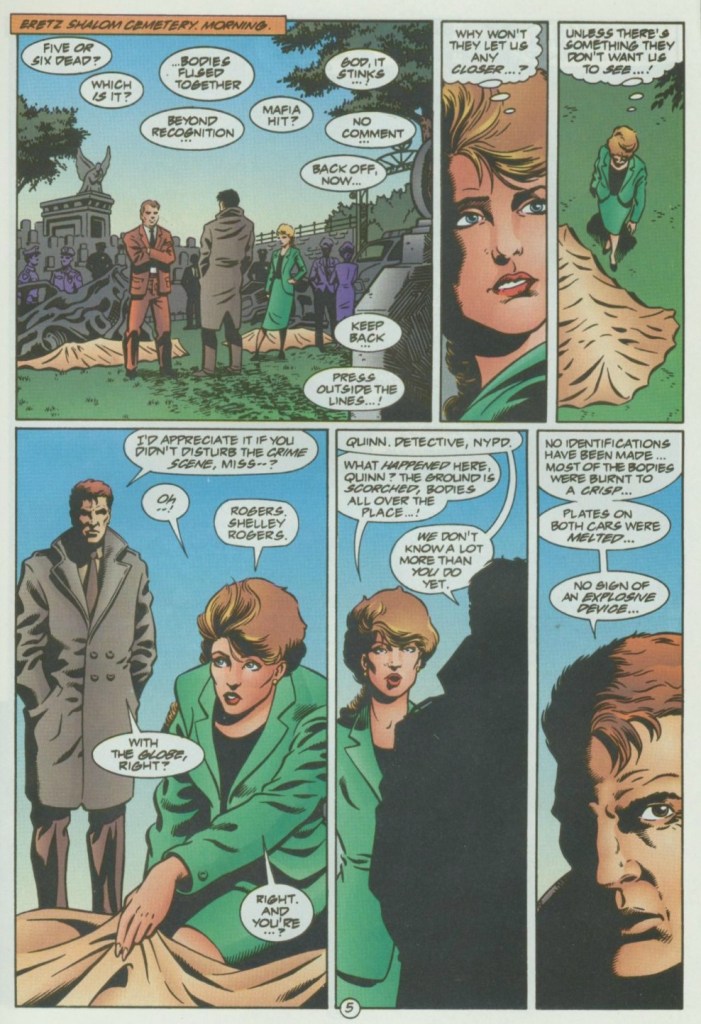
One morning at the Eretz Shalom Cemetery, a police investigation is being conducted as the local authorities found several dead bodies as well as scorched ground, bodies fused together and a some odor. Shelley, the very determined reporter of the New York Daily Globe, tries to uncover details at the crime scene only to be interrupted by a detective named Quinn. In response to her question, Quinn admits they are just discovering things and trying to figure things out.

Suddenly a lady wearing a suit and necktie approaches them…

Quality

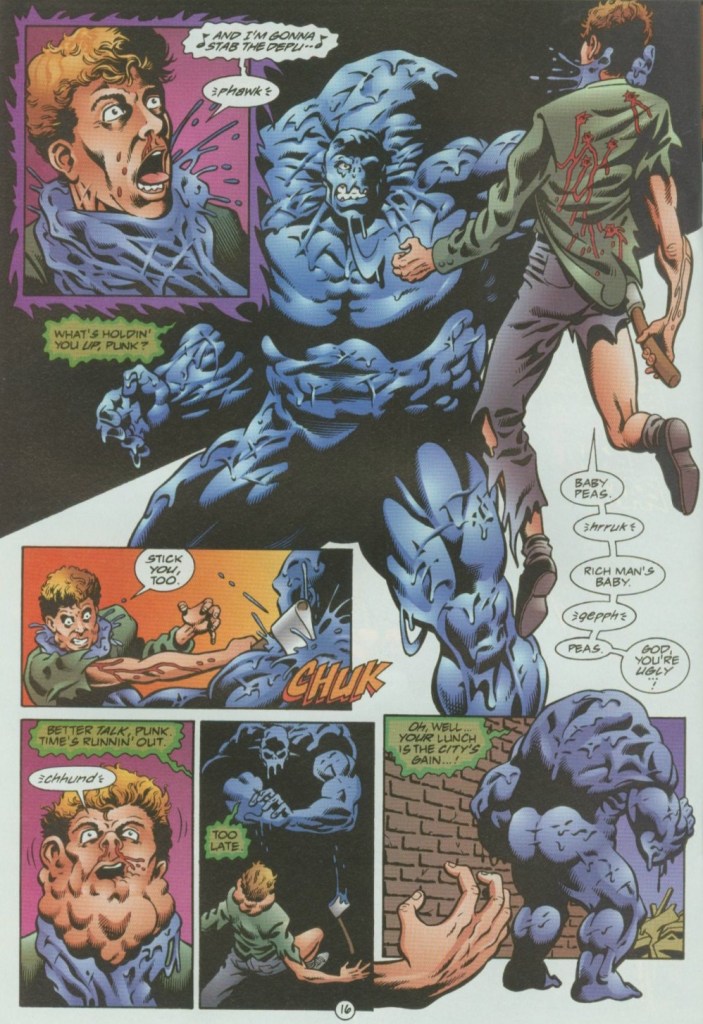
Avoiding the touch of Sludge is a must!

As far as storytelling goes, this tale is a very solid follow-up to the previous issue. While issue #6 showed the start of a big conflict involving three groups, this one shows the emotional and physical impact on the gang leaders (John Paul Marcello and the Dragon Fang) and the unrelenting pursuit of the Pump and his minions on wrecking down society by means of drug pushing and violence. In a way, this Ultraverse story daringly showed its own portrayal of illegal drugs and gang wars while also showing Sludge suffering more and getting even more desperate with his life. I should also state that there are scenes that added detective story and suspense vibes into the narrative.

It should be noted that at this point in the Sludge series, the titular character does some things here that would maker readers question his moves and his sanity, especially since the Pump (note: the Ultraverse’ very own Satan figure) keeps on tempting and manipulating him. Sludge, who was once a crooked cop when he was still human, clearly is vulnerable deep inside and he also is not resistant to the evil influences around him. Very notably, the story by Steve Gerber is strong enough to make me go on to read the next issue.

Conclusion

Shelley of the city newspaper at the scene of the crime.

Sludge #7 (1994) is the kind of comic book that will make you think deeply about the true nature of the titular character and why should you keep on reading each new comic book of this series when you learn that the said character is far from being heroic. The lines that separate good and evil is very blurred at this stage of the Sludge series. This is one clever and really engaging piece of work done by the Gerber-Lopresti team, and at the same time it is also one of the most intriguing Ultraverse tales ever told. That being said, the comic book’s concept is incidentally not ideal for readers who seek good-versus-evil conflicts that get resolved.

If you are seriously planning to buy an existing hard copy of Sludge #7 (1994) be aware that as of this writing, MileHighComics.com shows that the near-mint copy of the regular edition costs $16.

Overall, Sludge #7 (1994) is recommended.

+++++

Thank you for reading. If you find this article engaging, please click the like button below and also please consider sharing this article to others. If you are looking for a copywriter to create content for your special project or business, check out my services and my portfolio. Feel free to contact me with a private message. Also please feel free to visit my Facebook page Author Carlo Carrasco and follow me on Twitter at  @HavenorFantasy as well as on Tumblr at https://carlocarrasco.tumblr.com/and on Instagram at https://www.instagram.com/authorcarlocarrasco/