Disclaimer: This is my original work with details sourced from reading the comic book and doing personal research. Anyone who wants to use this article, in part or in whole, needs to secure first my permission and agree to cite me as the source and author. Let it be known that any unauthorized use of this article will constrain the author to pursue the remedies under R.A. No. 8293, the Revised Penal Code, and/or all applicable legal actions under the laws of the Philippines.
I remember back in 1993 how excited I was with Marvel Comics’ celebration of the 30th anniversary of the X-Men. Back then the X-Men line of comic books had the Fatal Attractions storyline which was not a crossover but a story arc that connects with the X-Men, Uncanny X-Men, X-Force, X-Factor, Excalibur and Wolverine monthly series highlighted by specific comic books that had hologram cards on the cover.
It was an exciting time. Of course, many geeks who followed the X-Men closely knew that the very comic book that would mark the 30th anniversary was Uncanny X-Men #304 (dated September 1993) which was previewed with a Magneto hologram card on the cover.
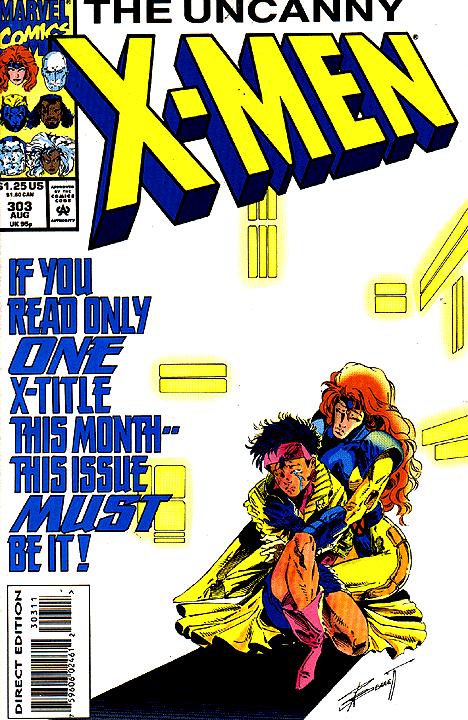
Of course, before getting to that comic book, it’s nice to take a look back at one of the comic books that was released before it. I’m talking about Uncanny X-Men #303 which had a dramatic and even somber looking cover with the words: “If you read only one X-title this month—this issue must be it!”
The eye-catching cover.
Are you curious now? Let’s take a look back at Uncanny X-Men #303 published in 1993 by Marvel Comics with a story by Scott Lobdell and artwork by Richard Bennett.
Early story
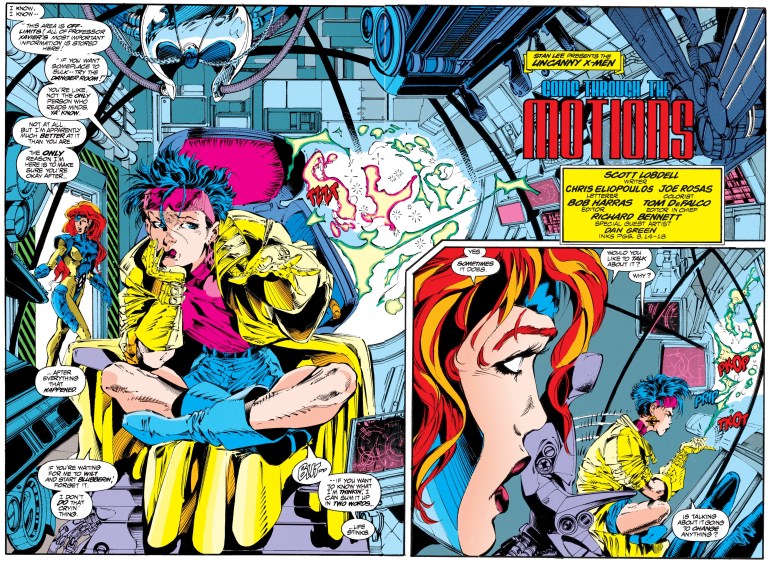
The story begins with Jean Grey finding Jubilee sitting on the chair (read: Cerebro) doing some makeshift fireworks with her power. She noticed that the youth is troubled. Jubilee expressed her thoughts and mentioned that life stinks. Jean asked her if she wants to talk about it but Jubilee asked if talking would change anything. As the two talk on, it turns out that Xavier’s mansion is nearly deserted.
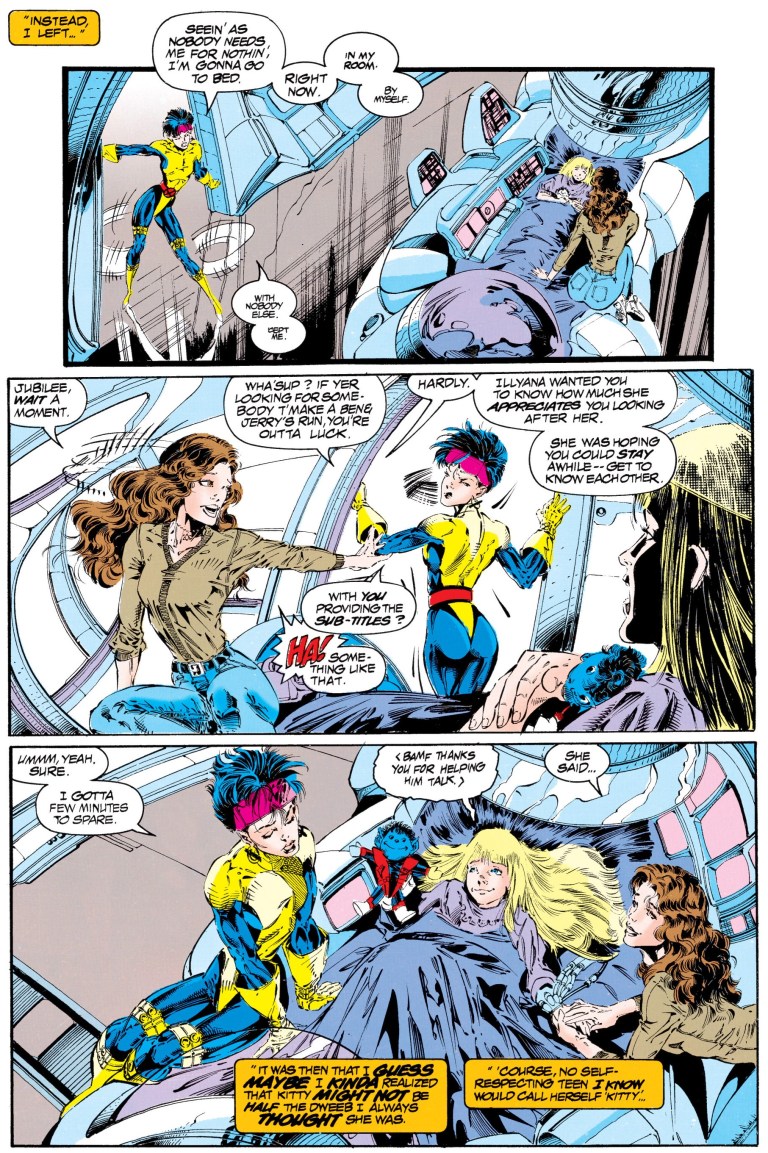
The story then shifts to what happened just several hours back. Jubilee was spending quality time with Colossus’ sister Illyana who is lying on a bed in the med-lab. Illyana was sick and nearby was Charles Xavier and Moira McTaggert struggling to figure out what to do for the blonde girl.
Moira tells Professor X that they need a fresh perspective on the information they have about the genetic deterioration within Illyana, and they need a miracle. Xavier replies that once the gold team of the X-Men returns, he is certain that they can find some treatment to arrest the disorder’s progress.
Suddenly, Illyana recognizes someone special from her past…
Quality
By today’s standards, Uncanny X-Men #303 is a good comic book to read and it is an effective way of setting up events leading into the 30th anniversary story of the next issue. On its own, the comic book is clearly very dramatic and cleverly uses nostalgia that is meant to resonate with readers who were fortunate enough to read issues of Uncanny X-Men which had Kitty Pryde/Shadowcat as a newcomer (around the time of the classic Dark Phoenix Saga).
Kitty Pryde and Illyana symbolize the X-Men youth of the 1980s while Jubilee symbolizes the 1990s.
As X-Men comic book history showed, Kitty Pryde was the resident teenage girl of her time and eventually she bonded by Colossus and got close with his sister Illyana whose own exploits involved a lot of twists and turns (she was even a young adult for a time) and made her own mark with The New Mutants.
Nostalgia aside, the writing done by Scott Lobdell is pretty good. The wordy approach to presentation kind reminds me of the descriptive writing and character expression styles of Chris Claremont (who left the X-Men franchise in 1991). More importantly, Lobdell’s writing shows he researched the characters Illyana and Kitty Pryde. After seeing those two reunited in this 1993 comic book, I recognized them not just visually but rather in terms of personality. In addition to characterization, the dialogue is richly layered and the script’s pacing was good (I was never bored even though this comic book clearly lacked action scenes). On Jubilee, this comic book is very notable for showing her NOT being annoying.
The art by Richard Bennett, in my view, is satisfactory at best. He’s not a bad artist but his style gives this comic book and the characters a rather imbalanced visual presentation. In fairness, Bennett did his own research on the history of the X-Men and his drawings about key moments from the past (example: The New Mutants) added to the nostalgia. Bennett’s best showing in this comic book happened during the most dramatic moments, especially in the 2nd half.
Conclusion
Jean Grey and Jubilee.
I really like this comic book. Even though it lacked action scenes, Uncanny X-Men #303 remains engaging by means of emphasizing the characters while touching into past of the X-Men. It is through dramatizing and defining the characters that made this comic book worth reading until now. Even if the nostalgia does not resonate with you, you will still feel for the characters.
By the time you finish reading this comic book, you will feel prepared for the big 30th anniversary story of Uncanny X-Men #304. In fact, this is an essential read in order to truly enjoy and understand Uncanny X-Men #304.The art could have been better, though.
In case you are interested to acquire an existing copy of Uncanny X-Men #303, take note of the rates from MileHighComics.com. As of this writing, a near-mint copy of the regular edition is priced at $5. The near-mint copy of the 2nd printing (gold cover) costs $128 while the near-mint copy of the newsstand costs $15.
Overall, Uncanny X-Men #303 is recommended.
Thank you for reading. If you find this article engaging, please click the like button below and also please consider sharing this article to others. If you are looking for a copywriter to create content for your special project or business, check out my services and my portfolio. Feel free to contact me as well. Also please feel free to visit my Facebook page Author Carlo Carrasco and follow me at HavenorFantasy@twitter.com
Disclaimer: This is my original work with details sourced from reading the comic book and doing personal research. Anyone who wants to use this article, in part or in whole, needs to secure first my permission and agree to cite me as the source and author. Let it be known that any unauthorized use of this article will constrain the author to pursue the remedies under R.A. No. 8293, the Revised Penal Code, and/or all applicable legal actions under the laws of the Philippines.
Recently I mentioned how much I enjoyed reading X-Men 2099 #25 which marked the end of the initial direction of the futuristic mutants transitioning into a new creative direction that is no less intriguing. From being nomads, the X-Men of the future suddenly became authority personnel in Halo City (read my review of X-Men 2099 #26) which was nicely told.
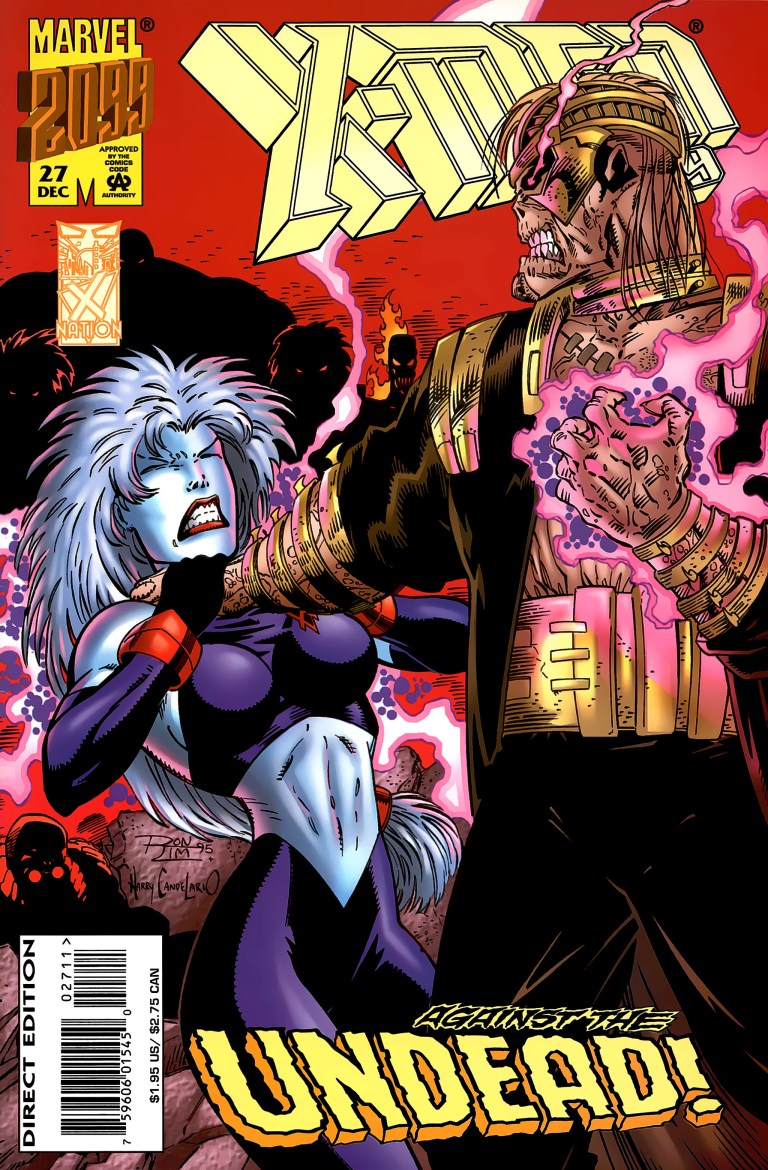
Now we can proceed with a look back at X-Men 2099 #27, published in 1995 by Marvel Comics with a story by John Francis Moore and art by Ron Lim.
The cover.
Early story
The story begins a short time after the incident at Halo City. Tim Fitzgerald, AKA Skullfire, has been captured by the Undead. As it turns out, Serpentina (who actually died in X-Men 2099 #3) is among them. One of the Undead performs a ritual on Skullfire who finds himself somewhere in the afterlife.
Meanwhile at Halo City, the X-Men, who are now operating as the city’s Protectorate, report back to their boss Somers at the city’s administrative tower. As Meanstreak states that he could not find any trace of Skullfire’s mutant energy signature, Shakti responds by confirming that their missing teammate is dead. This outrages Luna (who got romantically involved with Skullfire).
“I don’t care what Shakti or anyone says! Tim is not dead! I’m going to find him and if you’re not going to help me,” Luna said. “Stay out of my way!”
At this stage, the X-Men discuss what to do next knowing that as authority personnel, they have obligations to attend to.
Quality
When it comes to the story, X-Men 2099 #27 is indeed an engaging follow-up to the previous comic book which ended with a strong twist. The energy from that twist carried on nicely here as John Francis Moore efficiently explored more of the Undead complete with a resurrected and even deformed Serpentina, while still being able to develop the X-Men struggling with their new roles.
A lot really went on with the plot. Not only was Xi’an revisited to be unsure and guilty of himself, there is also the sub-plot of a man spying around Halo City secretly doing his mission as well as further development of the X-Men’s boss.
What I like best about this comic book is the continued development of Skullfire, specifically his continued struggle with his purpose. As seen since X-Men 2099 #4, Skullfire’s humanity gradually slipped away becoming a more visceral, and even somewhat unlikable member of the team. John Francis Moore took this trend several notches higher now that he has been captured by the Undead which involves Serpentina, the one former X-Men member who oriented him about their team. A story like this motivates me to read the first three issues of X-Men 2099.
On the visuals, Ron Lim continued to deliver good stuff. His art on the Undead continues to be scary looking and, unsurprisingly, his take on action scenes remains good.
Conclusion
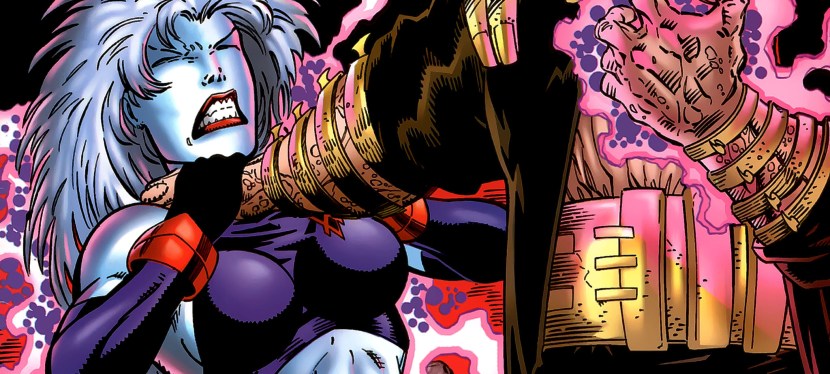
Skullfire with the Undead. Can you spot Serpentina?
X-Men 2099 #27 continued the reinvigorated storytelling engagement as the series brought the futuristic mutants further with the bold new direction that started in issue #25. In other words, it is a creative success and it is clear that John Francis Moore and Ron Lim were laser-focused on redefining 2099’s X-Men. Fun and intriguing to read.
If you are seriously considering buying an existing hard copy of X-Men 2099 #27, be aware that based on the listings of MileHighComics.com, as of this writing, a near-mint copy of the comic book’s regular edition is $4 while a near-mint-copy of the newsstand edition is priced at $8.
Overall, X-Men 2099 #27 is recommended.
Thank you for reading. If you find this article engaging, please click the like button below and also please consider sharing this article to others. If you are looking for a copywriter to create content for your special project or business, check out my services and my portfolio. Feel free to contact me as well. Also please feel free to visit my Facebook page Author Carlo Carrasco and follow me at HavenorFantasy@twitter.com
Disclaimer: This is my original work with details sourced from reading the comic book and doing personal research. Anyone who wants to use this article, in part or in whole, needs to secure first my permission and agree to cite me as the source and author. Let it be known that any unauthorized use of this article will constrain the author to pursue the remedies under R.A. No. 8293, the Revised Penal Code, and/or all applicable legal actions under the laws of the Philippines.
Believe it or not, there was a time when the iconic superhero Spider-Man had additional arms on both sides of his body which made him even more like a spider. Such a story was told in Amazing Spider-Man #100 and #101 published decades ago by Marvel Comics.
In 1992, Marvel Comics published What If #42 to revisit the old crazy story and tell an alternate reality of it. Take note that this comic book we’re about to examine together was released the same year Marvel celebrated the 30th anniversary of Spider-Man.
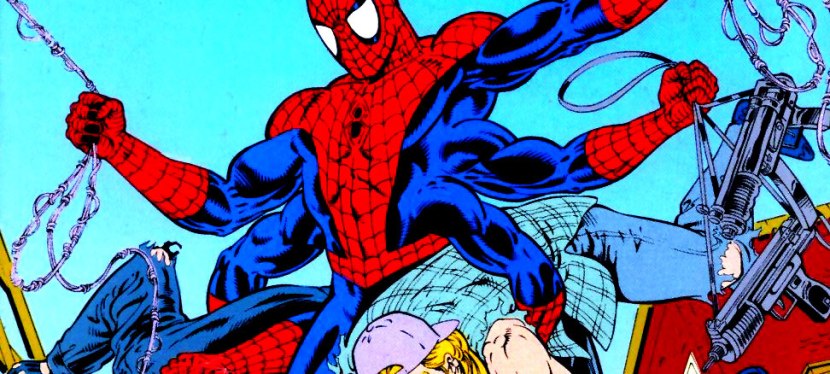
A very eye-catching cover.
Here’s a look back at What If #42 written by Michael Gallagher and drawn by Kevin West. The hot question: What if Spider-Man had kept his six arms?
Early story
The comic book begins with the Watcher telling readers a recap of what happened to Spider-Man in Amazing Spider-Man #100 and #101. It is recalled that Peter Parker got fed up with being Spider-Man as it complicated his personal life with a bunch of problems. After he attempted to eliminate his super powers by creating and using a potion, Peter Parker suddenly grew four additional arms instead.
In reaction, Parker reached out to his friend Dr. Connors/Lizard (who was in Florida) who granted him access to his laboratory in Long Island. Tried as hard as he could, Parker could not come up with a solution.
Meanwhile, many miles away, the vampire Morbius harms the crew of a ship on the sea before diving into the water. Morbius gets overwhelmed by multiple sharks and dies. His death, as it turns out, marked the end of the solution to Spider-Man’s extra arms problem. Morbius had an enzyme unique only to vampire body chemistry which would have cured Spider-Man’s condition.
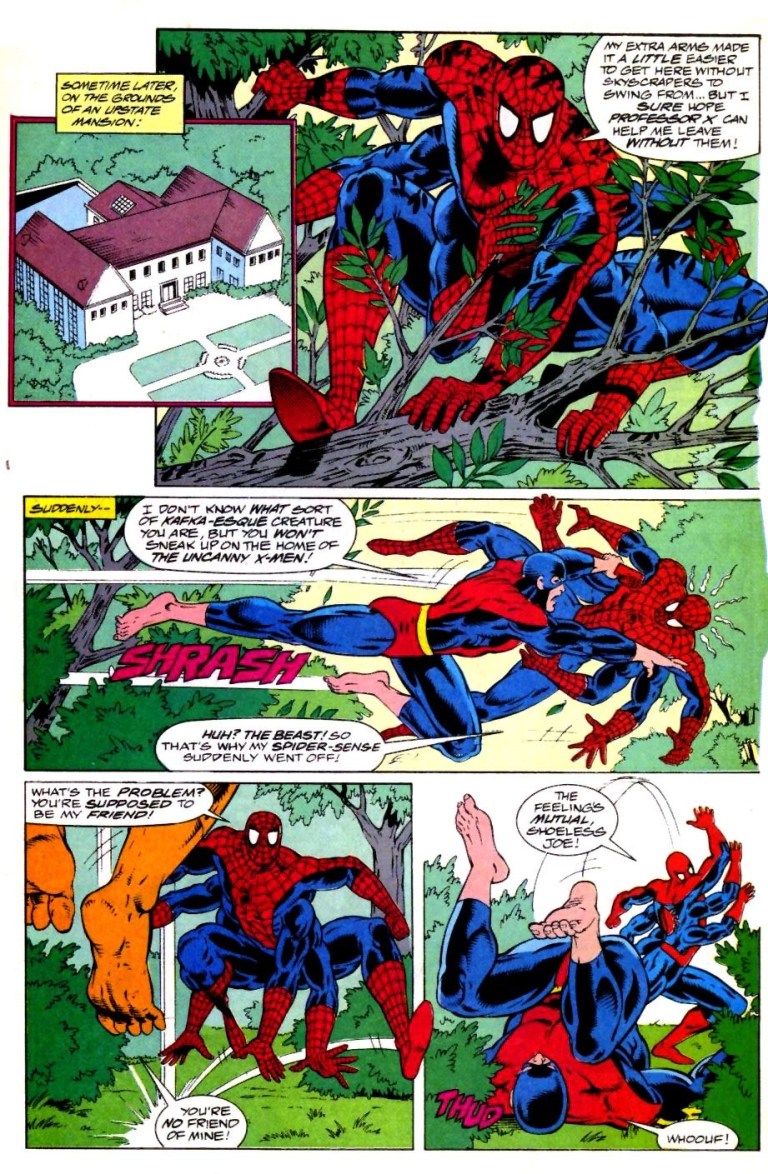
Spider-Man and Beast of the X-Men.
This leaves Spider-Man with an even longer lasting problem leading to a new reality.
Quality
The story is well written and nicely paced. There is a nice balance between storytelling, characterization and action here. As far as the alternate reality of events go, What If #42 is a smash in the sense that it nicely explores what would happen not only to Peter Parker had he actually kept those extra arms of his, but also what would happen to the people around him as well as balance of superheroes in the state of New York. If you just imagine yourself as Peter Parker having four extra arms, try visualizing how your personal life got destroyed and your connections with people you care about getting strained or even cut off. Nobody in real life would want to end up living like a freak, and this concept is well emphasized with Spider-Man.
Character development on Spider-Man is well done. As you read his lines and thoughts, you will feel the pressure and hassle he is experiencing with the extra arms. You’ll wonder how his Aunt May would react not only to those new arms but also his prolonged absence. As Peter Parker becomes very determined to find a solution in the absence of Morbius, you’ll even relate with his struggle. On top of these, the dialogue was well written and there were even a few intriguing moments.
I also enjoyed the way the comic book creators emphasized the shared universe of Marvel Comics here. You will see the X-Men and Fantastic Four plus several more Marvel characters make appearances.
Along the way, there is a nice scene at the Daily Bugle (the newspaper where Peter Parker works as a photographer) showing how sinister and abusive J. Jonah Jameson really is as he remains obsessed with destroying Spider-Man by means of distorted presentation of news. In this age of fake news, sinister propaganda, distorted views and local community print media publications being operated by people who don’t really know journalism, the Daily Bugle scene is pretty relevant by today’s standards.
As such, Michael Gallagher’s script and story structure here are very strong. For the art, Kevin West did good work. Not only was I able to recognize the Spider-Man-related characters and other Marvel superheroes, West’s notably made the Lizard look visceral enough and the same can be said of his take on Venom. The comic book art had a nice flow as the story was told and West provided enough impact on the action scenes.
Conclusion
What If #42 is a pretty good comic book to read exploring how things would have been had Spider-Man kept those extra arms and really looked truly spider-like. Apart from the good quality of storytelling and visuals, the presence of other Marvel Comics universe characters further add some depth into the story as Peter Parker struggled to find a solution to his problem.
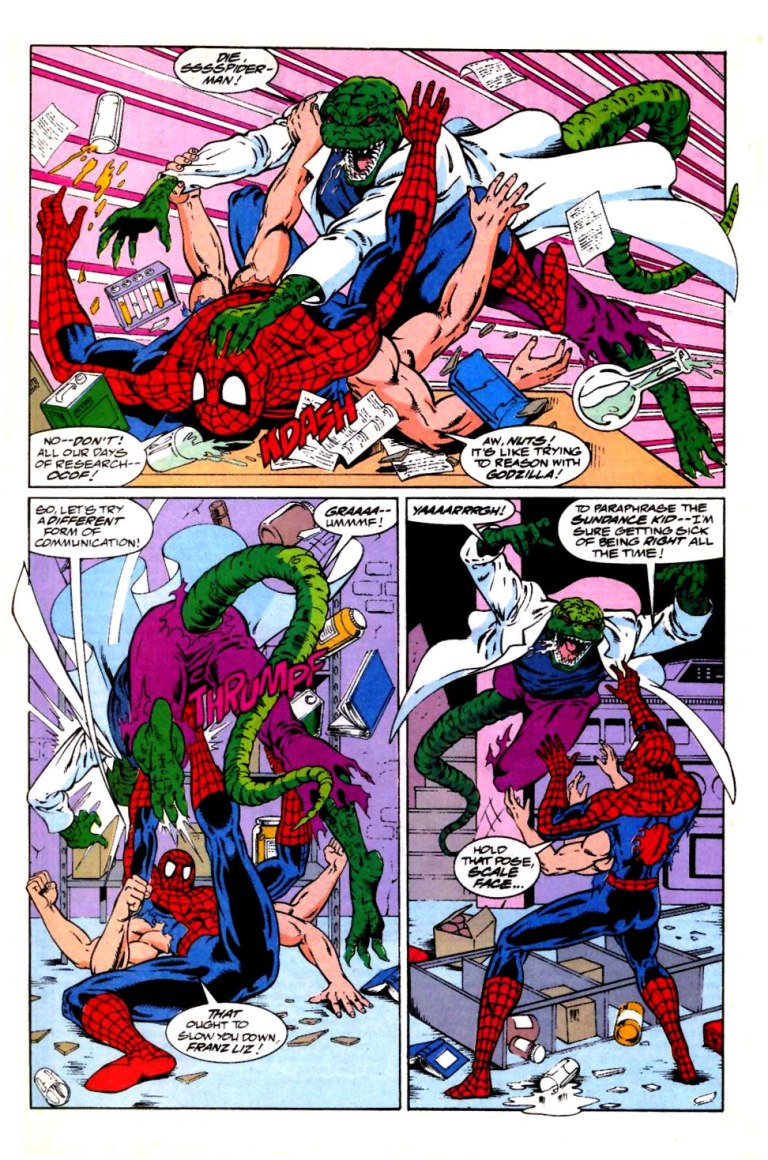
Spidey and Lizard!
This is the kind of story that I don’t believe we will ever see happen on the big screen. It’s just too jarring and even shocking for Sony Pictures and Marvel Studios to actually show Tom Holland as Spider-Man with extra arms. Such a cinematic move will surely outrage fans and might even put a dent on the credibility and believability of the Marvel Cinematic Universe.
If you are seriously considering buying an existing hard copy of What If #42, be aware that as of this writing based on the ratings of MileHighComics.com, a near-mint copy of the regular edition is at $12 while the near-mint copy of the newsstand edition is priced at $39.
Overall, What If #42 is recommended.
Thank you for reading. If you find this article engaging, please click the like button below and also please consider sharing this article to others. If you are looking for a copywriter to create content for your special project or business, check out my services and my portfolio. Feel free to contact me as well. Also please feel free to visit my Facebook page Author Carlo Carrasco and follow me at HavenorFantasy@twitter.com
Disclaimer: This is my original work with details sourced from reading the comic book and doing personal research. Anyone who wants to use this article, in part or in whole, needs to secure first my permission and agree to cite me as the source and author. Let it be known that any unauthorized use of this article will constrain the author to pursue the remedies under R.A. No. 8293, the Revised Penal Code, and/or all applicable legal actions under the laws of the Philippines.
When X-Men 2099 #1 was released in 1993, it was an instant hit with comic book collectors and became one of the top-selling comic books in America during its month of release. That was no surprise not simply because the comic book speculator boom was still in effect back then, but also because the X-Men 2099 monthly series was launched at a time when Marvel Comics spent a lot of money promoting the 30th anniversary celebration of the X-Men franchise and, on the other hand, agreed to expand the Marvel 2099 universe apart from Spider-Man 2099, Ravage 2099, Doom 2099 and Punisher 2099.
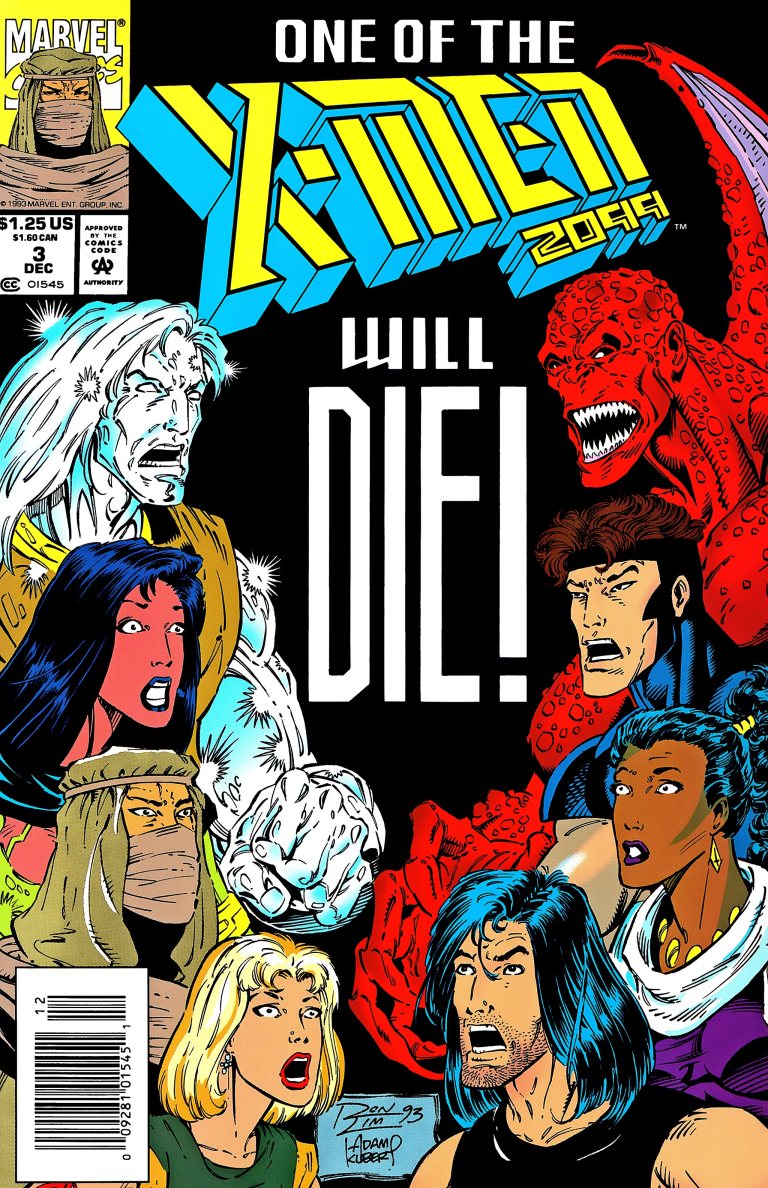
And there I was eager to witness how the 2099 universe got expanded through the futuristic X-Men whose adventures took place far away from New York. After reading the first two issues, I was hooked already on X-Men 2099. And then X-Men 2099 #3 appeared at the shelves of the local comic book store with a rather intriguing cover.
The intriguing cover complete with a coloring error (Tim’s red hair ended up black).
I admit that after seeing that cover, I became more eager to find out if anyone from the futuristic mutants would actually die. By that time, the story that started with issue #1 turned out to be a 3-part story with the objective of establishing X-Men 2099 to readers.
Anyway, let’s start with the retro comic book review of X-Men 2099 #3 published in 1993 by Marvel Comics with a story by John Francis Moore and illustrations by Ron Lim.
Early story
Picking up shortly after the events of issue #2, the comic book begins with Xi’an’s cocooned body being transported back to headquarters by Junkpile (who turned traitor on the X-Men) while captured X-Men team members Meanstreak and Metalhead were placed into liquid-filled chambers. Team member Krystalin managed to elude capture while her teammates Serpentina, Cerebra, Skullfire and Bloodhawk are temporarily free.
The free X-Men members try to infiltrate the place to rescue their teammates.
Lytton, who took over the family corporation since the death of his father Noah Synge, is running a brutal operation. His sister Desdemona does not fully trust him. Bloodhawk flies and breaks into a building in Las Vegas causing trouble for the Synge security personnel.
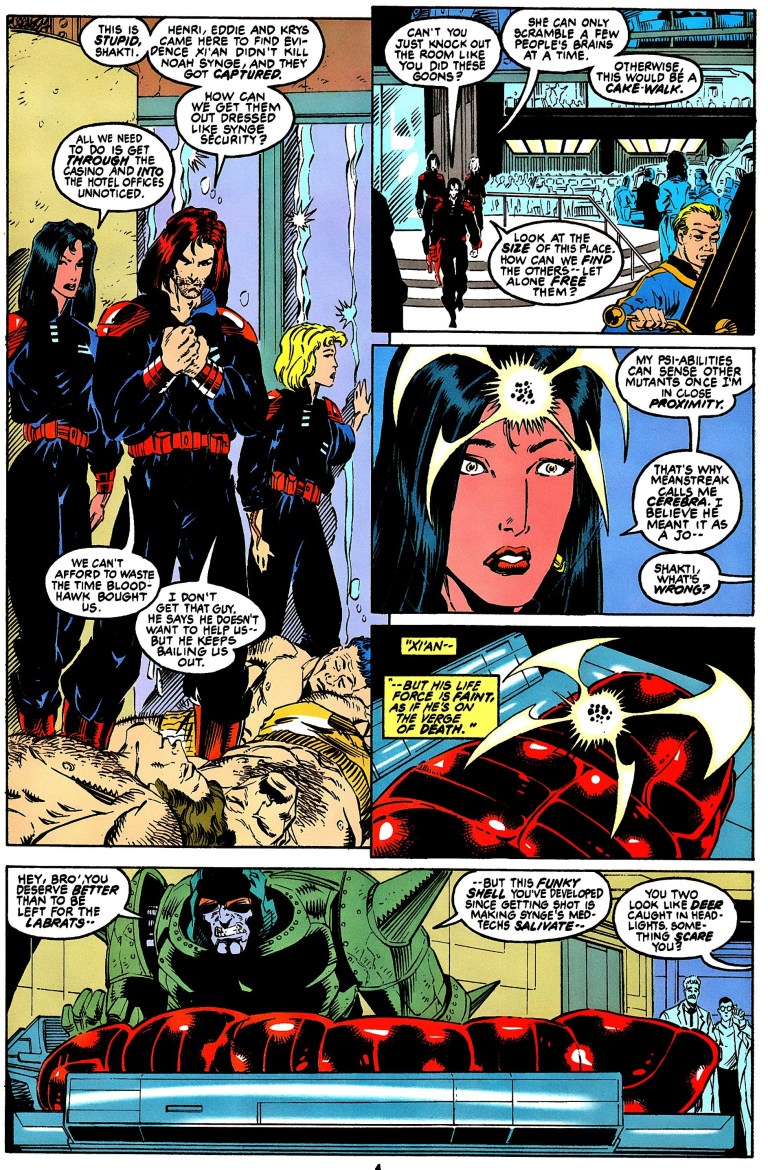
On the side of the chaos, Shakti/Cerebra, Tim/Skullfire and Tina/Serpentina quiet grab uniforms of Synge security personnel to infiltrate the place to rescue Meanstreak, Metalhead and their cocooned leader Xi’an…..
Quality
When it comes to storytelling, the creators delivered a satisfying ending to the 3-story arc complete with actually killing one of the X-Men 2099 members. John Francis Moore was successful in creating a 3-part story that ultimately gave me clear views of the respective personalities of each X-Men member (examples: Tim is the newcomer who is slowly finding his purpose, Shakti is the strong lady with leadership values who supports the leadership of the reformed Xi’an, Bloodhawk is a hard-headed rebel, etc.) while also succeeded in telling a cohesive story that placed the mutants in conflict with the Synge corporate family.
The twist regarding the murder of Noah Synge (the patriarch) was decently pulled off and the executed death of an X-Men 2099 member actually raised the stakes for the team. By the end of issue #3, the purpose of the futuristic X-Men became clear and was different enough from the mainstream X-Men. Unlike Charles Xavier’s mutants, Xi’an’s X-Men have to reclaim their heritage in a totally different America where corporations ruled the cities and outlaws ruled the wasteland and wilderness of the American southwest region. The X-Men of 2099 are nomadic and they don’t have the facilities nor a safe place to live in which Charles Xavier’s X-Men had.
Desdemona, Junkpile and the cocooned Xi’an.
When it comes to art, I noticed that Ron Lim exerted more effort not only with visualizing John Francis Moore’s script but added noticeable visual details on key moments in the comic book. Seeing Tim/Skullfire so enraged followed by a violent impact of action was unforgettable when compared to other highly charged, emotional scenes Lim drew in his other works. Lim also delivered good stuff with the action scenes and further visualized the look of Las Vegas of 2099. His design of Desdemona, however, really looks uninspired and generic.
Conclusion
On its own, X-Men 2099 #3 is a good and fun comic book to read complete with a good amount of characterization. To really know the X-Men on a personal level, you really have to buy issues #1 and #2. On the creative side of things, I like the fact that John Francis Moore kept references to Charles Xavier’s X-Men to a bare minimum which nicely kept a strong focus on the X-Men of 2099 and the world they live in.
For the comic collectors reading this, if you are seriously considering acquiring a hard copy of X-Men 2099 #3, be aware that according to Mile High Comics, a near-mint copy of the regular edition costs $4 while the near-mint copy of the newsstand edition is priced at $8.
Overall, X-Men 2099 #3 is recommended.
Thank you for reading. If you find this article engaging, please click the like button below and also please consider sharing this article to others. If you are looking for a copywriter to create content for your special project or business, check out my services and my portfolio. Feel free to contact me as well. Also please feel free to visit my Facebook page Author Carlo Carrasco and follow me at HavenorFantasy@twitter.com
Disclaimer: This is my original work with details sourced from reading the comic book and doing personal research. Anyone who wants to use this article, in part or in whole, needs to secure first my permission and agree to cite me as the source and author. Let it be known that any unauthorized use of this article will constrain the author to pursue the remedies under R.A. No. 8293, the Revised Penal Code, and/or all applicable legal actions under the laws of the Philippines.
As already mentioned in my retro review of X-Men 2099 #25, a new creative direction was taken for the futuristic mutants of Marvel (who got back together after being apart for long) and the monthly series itself while still maintaining connection with the rule of Doom 2099 (already driven by Warren Ellis as the writer) as the US President. That story ended with noticeable changes on the characters, especially on Xi’an who ended up nothing like the strong and driven X-Men leader he was in X-Men 2099 #1. As such Tim Fitzgerald/Skullfire, who went through a lot of emotional struggles and confusion, finally learned to be strong to become the mutants’ new leader.
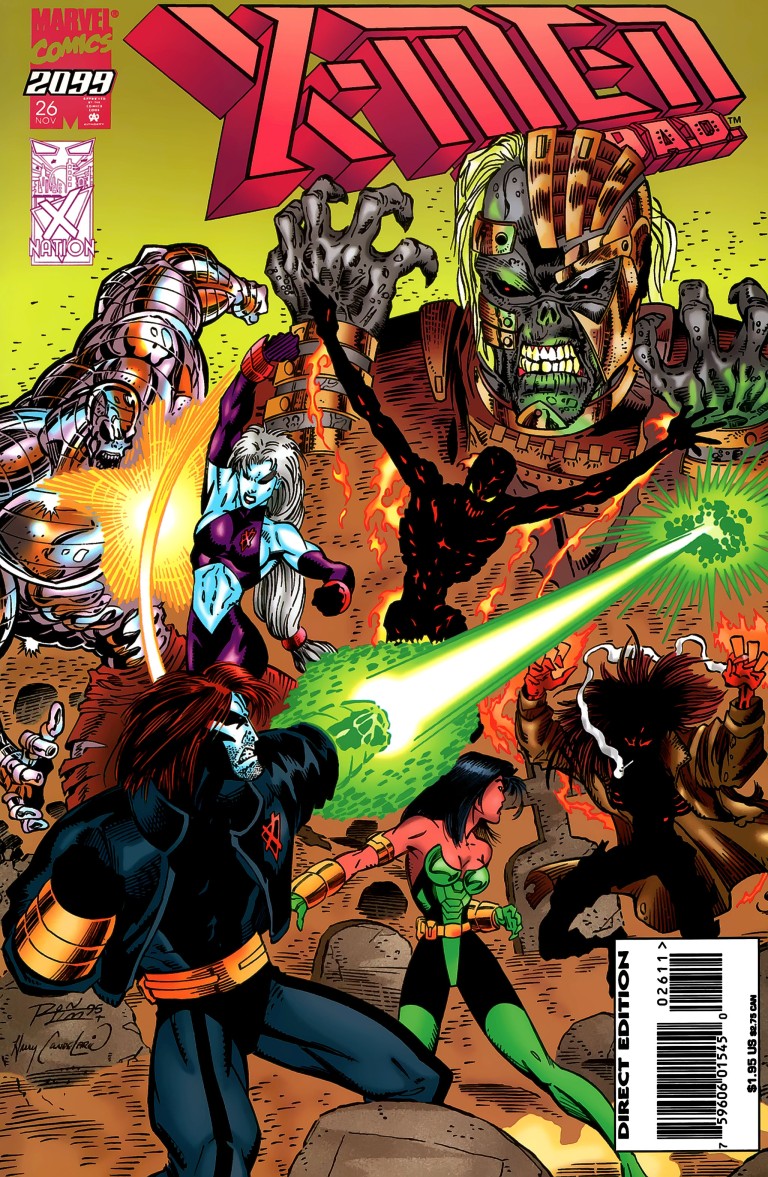
In this review, we will take a look at the aftermath of the events that happened in the above-mentioned anniversary celebration issue. Series lead creators John Francis Moore and Ron Lim took another shot heading towards the new direction in X-Men 2099 #26 published by Marvel Comics in 1995.
The cover by Ron Lim.
Early story
The comic book opens with Doom 2099’s Minister for Humanity Morphine Somers waking up and learns from his digital assistant that disaster happened in the White House (refer to Doom 2099 #33).
The story then shifts to Halo City which is the walled mecca which continues to attract some hundreds of thousands of misfits, mutants and refugees who seek sanctuary from the mega corporations which have dominated societies in most cities around the United States. In the middle of the traffic jam going into the city, a man decides to get out of the taxi and head on by foot.
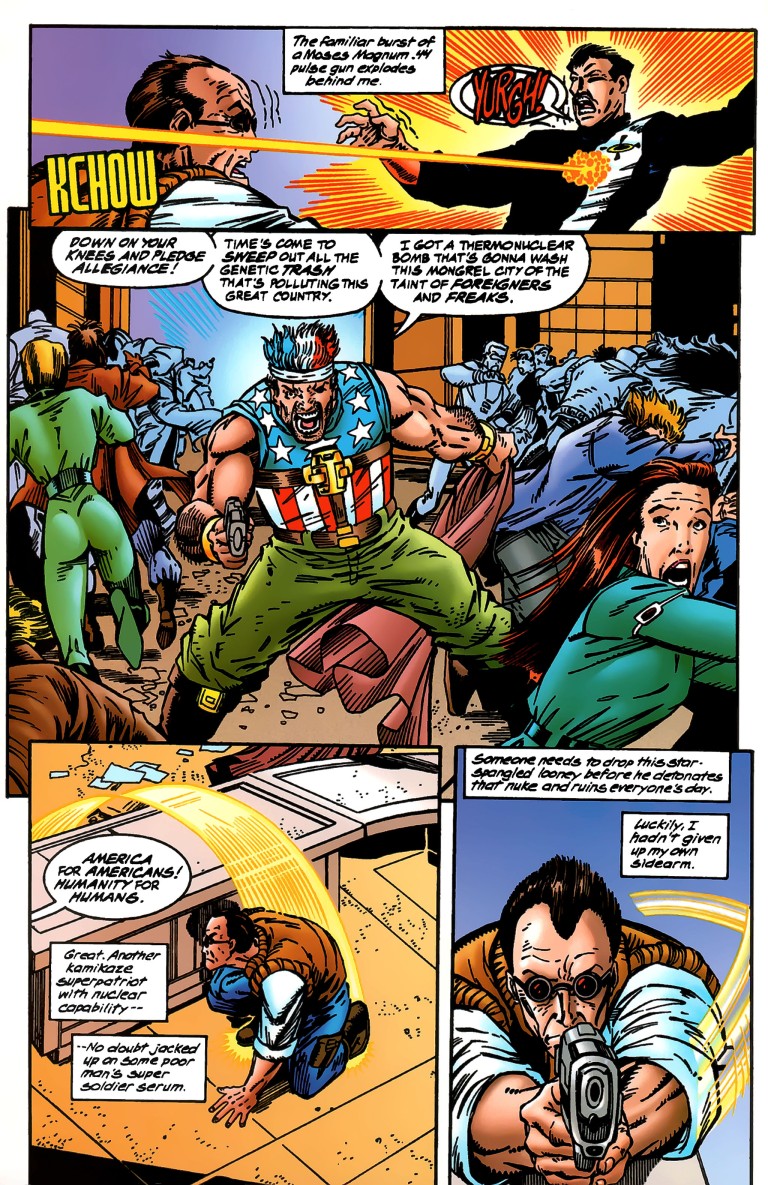
The man is identified as Gunnar Tristan, an entertainment journalist. As the city authorities examines Gunnar, a man wearing a shirt looking like the American flag fires a shot at one of the security personnel.
“Down on your knees and pledge allegiance! The time’s come to sweep out all the genetic trash that’s polluting this great country. I got a thermonuclear bomb that’s gonna wash this mongrel city of the taint of foreigners and freaks,” said the armed man.
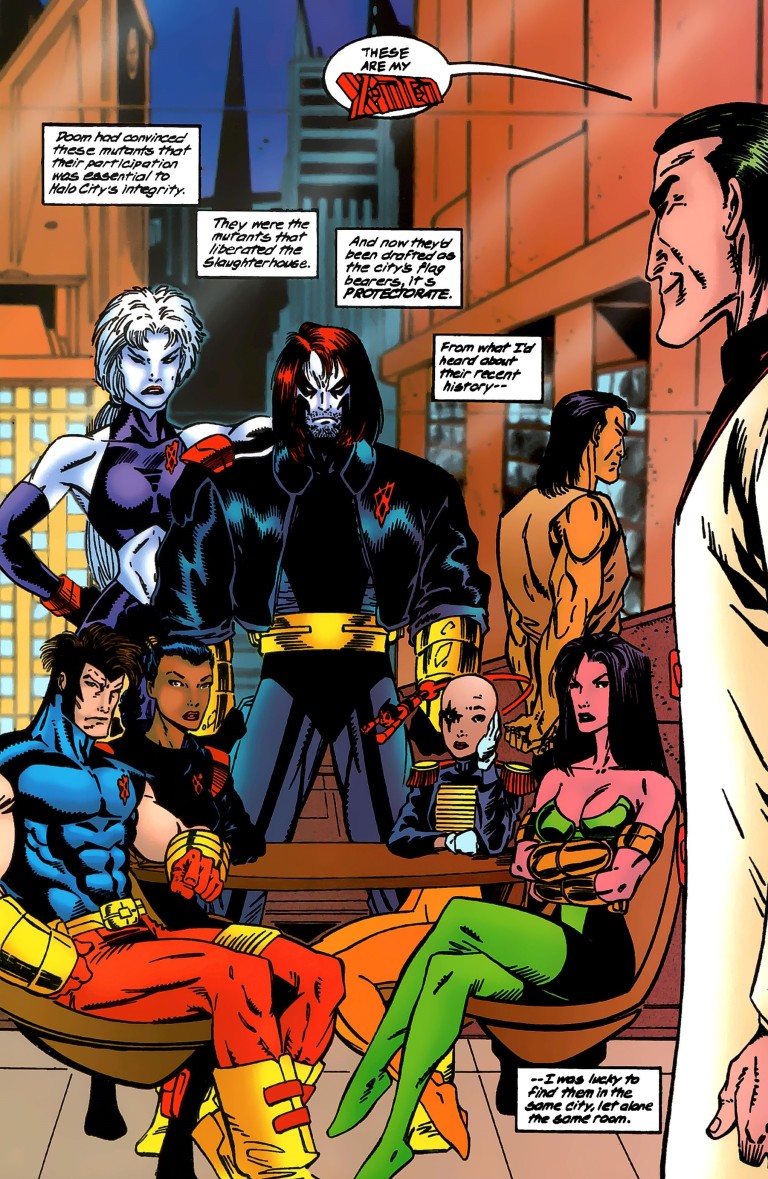
Just as Gunnar is about to fire, Henri Huang/Meanstreak of X-Men 2099 intervenes to prevent anymore danger from happening. Meanstreak is with teammate Krystalin and seen on their clothes are V-like symbols. They are now officially working for the city authorities as the mutant protectorate….
Quality
Clearly following up on the ending of X-Men 2099 #25, this story delivered strongly on showing the futuristic X-Men as Halo City authority members which is a drastic change from their past as outlaws and misadventure participants.
The X-Men as members working for the authorities.
A strong element in this comic book is character development and it shows the former X-Men leader Xi’ian feeling guilty and has gotten obsessed with healing sick people as a way to atone for his sins. At this point of time, Xi’an went from a bag guy into a reformed man (X-Men leader) into a bad guy again before ending up weak and confused. This puts him yet again into conflict with his long-time trustee Shakti/Cerebra (who by this time can be seen as a suitable team leader with a very strong moral direction). Skullfire meanwhile is feeling uneasy with his team working for an administration and it can be seen that the time he spent in the wilderness took its toll on him.
When it comes to art, Ron Lim pushed his creativity hard this time by establishing the overall look of Halo City and how it is transforming into a hot bed for people who don’t want to live in a place monitored always by mega corporations. On characters, I should say that Lim’s designs for the new villain group The Undead is not very captivating although one of them really looked horrifying. On action scenes, Lim continued to deliver the goods.
Conclusion
I should say that I like this comic book a lot. It’s got more character development scenes and story build-up with noticeably lesser spectacle (which is not a problem at all). Being the 26th issue of the X-Men 2099 monthly series, characterization really had to be prioritized by the creative team to emphasize the bold, new direction taken. Just to see the X-Men become authority members even though they are not really qualified is just intriguing!
What makes this particular old comic book special in a rather bizarre and accidental manner is the raging debate about how America of today should handle its immigration problems especially with hot topics like securing the borders, building the wall along the south border with Mexico, and deporting as many illegal immigrants (even those who have families in America, established business and paid taxes) as possible. Back in the year this old comic book was published, immigration was not such a hot topic and there were even more Democrats (including then US President Bill Clinton) who favored stricter moves to curb illegal immigration.
The presence of the armed man who despises foreigners and mutants is now more socially relevant to see. It’s so symbolic, you should look at the page below.
I wonder if anyone from the Democratic Party or the Political Left in America who support open borders had seen this page.
If you are seriously collecting comic books, be aware that as of this writing, MileHighComics.com shows that a near-mint copy of X-Men 2099 #26 regular edition is worth $4 while the near-mint copy of the newsstand edition is worth $8.
Overall, X-Men 2099 #26 is highly recommended.
Thank you for reading. If you find this article engaging, please click the like button below and also please consider sharing this article to others. If you are looking for a copywriter to create content for your special project or business, check out my services and my portfolio. Feel free to contact me as well. Also please feel free to visit my Facebook page Author Carlo Carrasco and follow me at HavenorFantasy@twitter.com
Disclaimer: This is my original work with details sourced from reading the comic book and doing personal research. Anyone who wants to use this article, in part or in whole, needs to secure first my permission and agree to cite me as the source and author. Let it be known that any unauthorized use of this article will constrain the author to pursue the remedies under R.A. No. 8293, the Revised Penal Code, and/or all applicable legal actions under the laws of the Philippines.
Long before the renaissance of Hollywood-produced superhero movies even started, the X-Men established itself as one of the most popular franchises of Marvel Comics. What some readers do not know was that while the X-Men indeed started in 1963 under Stan Lee and Jack Kirby, Marvel’s mutants actually started getting successful in the mid-1970s with the 2nd X-Men team (Cyclops, Wolverine, Storm, Sunfire, Nightcrawler, Colossus, Banshee and Thunderbird) handled by Len Wein and Dave Cockrum.
That new team literally made a splash with readers with the release of Giant-size X-Men #1 in 1975. That comic book, which is very valuable now, saw Charles Xavier recruiting new mutants to form a new team with Cyclops being the only pioneer remaining. Subsequently the X-Men monthly series of that era saw lots of stories of this particular team solving problems and fighting evil. Along the way, Chris Claremont got hired as the new writer and then the rest was history.
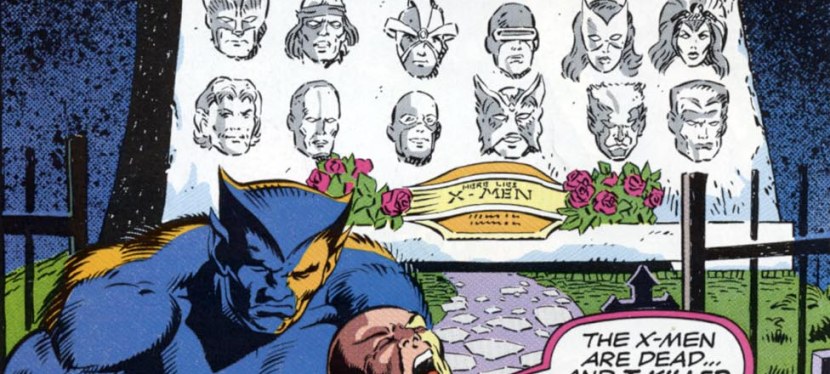
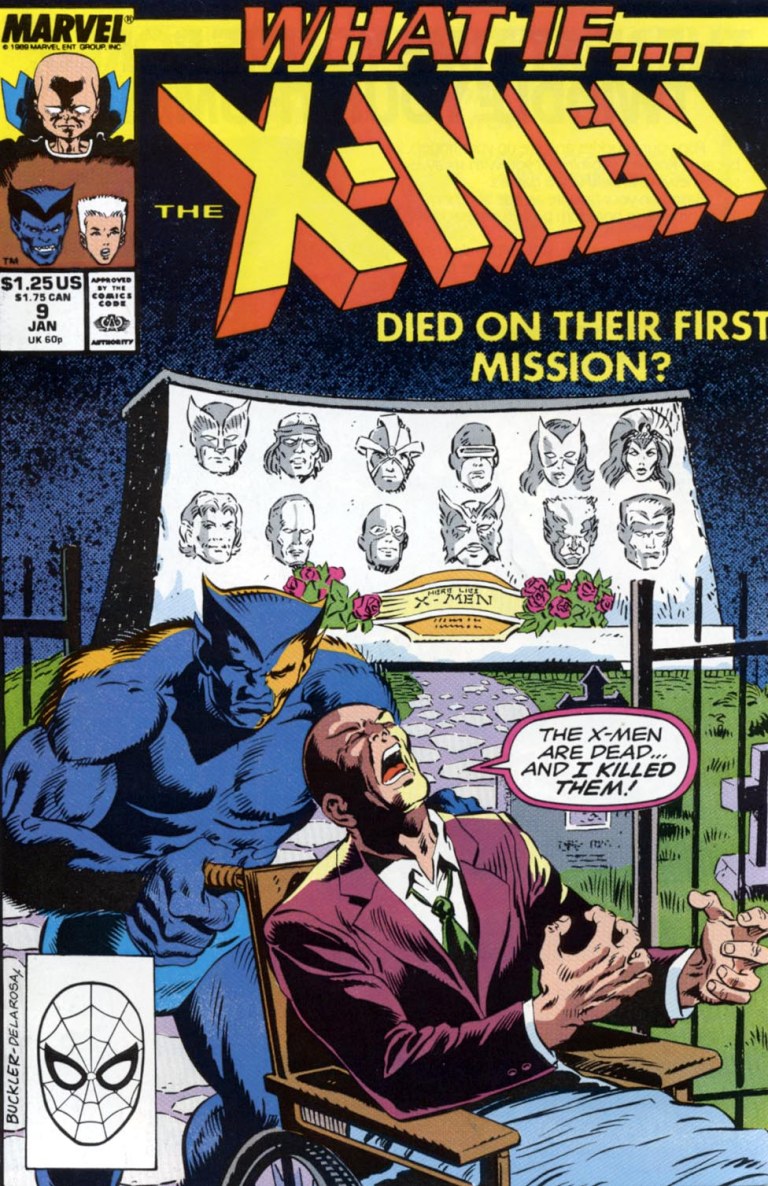
In this retro comic book review, we will take an interesting look at what would have happened had the 2nd team of the X-Men died on their first mission.
This is What If #9 written by Roy Thomas, drawn by Rich Buckler and published by Marvel Comics in 1990.
The cover.
Early story
The comic book begins with the Watcher of Marvel’s universe explaining what actually happened during the X-Men’s mission in Giant-size X-Men #1. Then he offers an alternate version of the events asking “What if…the new X-Men had died on their very first mission?”
The new reality begins in Scotland where Moira McTaggert receives a telegram from the United States. The message read that her friend Charles Xavier is ill which compels her to leave immediately. Before leaving, a little girl named Rahne comes to Moira followed by Craig who asserts his authority on her. Subsequently Moira and Rahne arrive at Salem Center, New York, greeted by Hank McCoy/Beast who confirmed that he was the one who sent the telegram to her.
Moira finally meets Xavier who expressed surprise to see her. As it turned out, Xavier had isolated himself in a room using Cerebro. After separating from Xavier, Beast explains to Moira what happened previously to Cyclops, Jean Grey, Havoc, Polaris and Ice Man on a far away island (read Giant-size X-Men #1). Cyclops was fortunate enough to survive and return to Xavier who was compelled to use Cerebro to trace mutants around the world (note: the 2nd X-Men team).
When trouble hits the world…
This leads to events told in Giant-size X-Men #1 but something drastic happened…
Quality
Storytelling is easily the strongest and most defining element of this comic book, especially if you are fortunate enough to read what happened in Giant-size X-Men #1 from 1975. The alternate plot by Roy Thomas is pretty intriguing and highly dramatic, and yet it still manages to add some spectacle to maintain balance.
What If #9 strongly delivered on what it promised what would have happened had the 2nd X-Men team died on their first mission complete with the narrative shifting dramatically through the eyes of Moira McTaggert, Xavier and Beast.
In terms of characterization, I really enjoyed the dramatization of the close friendship between Xavier and McTaggert. Having read lots of X-Men comic books through the decades, I should say that McTaggert was often limited to supporting roles or guest appearances. As seen in this comic book, she and Xavier made a solid pair of mentors. Lastly, the portrayal of Xavier being somewhat broken and regretful is wonderfully executed. Adding to that, the portrayal of McTaggert as a strong provider of direction and support for a fragile Xavier is memorable.
When it comes to the visuals, Rich Buckler scored nicely. The characters are all recognizable (with Beast looking a bit more visceral than how he actually appeared in the 1970s to 1980s) and their facial expressions were nice to see. Buckler also proved to be good with visualizing the action and the suspenseful parts.
Conclusion
Very nice artistic presentation by Rich Buckler. Readers of 1975’s Giant-size X-Men #1 will be able to relate with this.
Overall, What If #9 is a great comic book to read. It is the closest thing you can get when it comes to seeing Marvel’s mutants led by Xavier with McTaggert working behind the scenes together. Roy Thomas and Rich Buckler really scored a homerun with this non-canon X-Men story!
For the comic collectors reading this, based on the rates at MileHighComics.com as of this writing, a near-mint copy of this comic book’s regular version is $24 while the near-mint copy of the newsstand edition is priced at $51.
What If #9 (1990) is highly recommended!
Thank you for reading. If you find this article engaging, please click the like button below and also please consider sharing this article to others. If you are looking for a copywriter to create content for your special project or business, check out my services and my portfolio. Feel free to contact me as well. Also please feel free to visit my Facebook page Author Carlo Carrasco and follow me at HavenorFantasy@twitter.com
Disclaimer: This is my original work with details sourced from reading the comic book and doing personal research. Anyone who wants to use this article, in part or in whole, needs to secure first my permission and agree to cite me as the source and author. Let it be known that any unauthorized use of this article will constrain the author to pursue the remedies under R.A. No. 8293, the Revised Penal Code, and/or all applicable legal actions under the laws of the Philippines.
Back in the 1990s, comic books with gimmick covers and higher cover prices were abundant and also were easy targets for collectors. In the case of Marvel Comics, the concept of the “anniversary issue” was important because it gave them a chance to sell comics at a higher price.
To put things in perspective, many times back then Marvel would produce comic books with slightly more pages and a gimmick cover in celebration of a so-called anniversary such as the comic book series reaching its 25th or 50th or 75th or 100th issue and so on. Other anniversary celebrations include a character specific anniversary such as Spider-Man’s 30th anniversary celebrated with the comic book Amazing Spider-Man #365 which had a lot of pages and a hologram cover.
Of course, such anniversary celebrations were implemented on the Marvel 2099 line of comic books. Check out my review of Spider-Man 2099 #25.
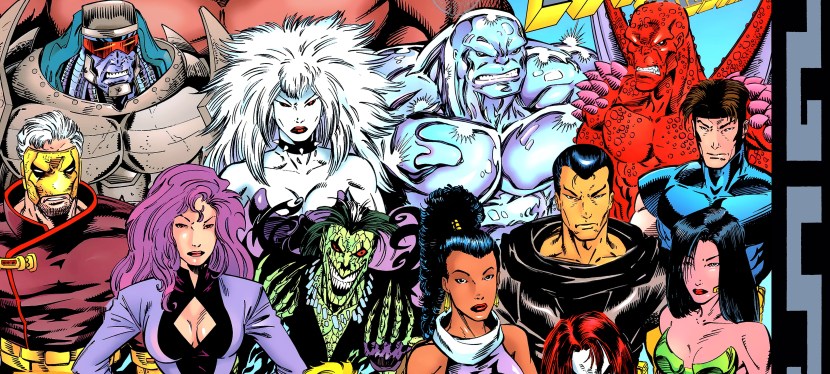
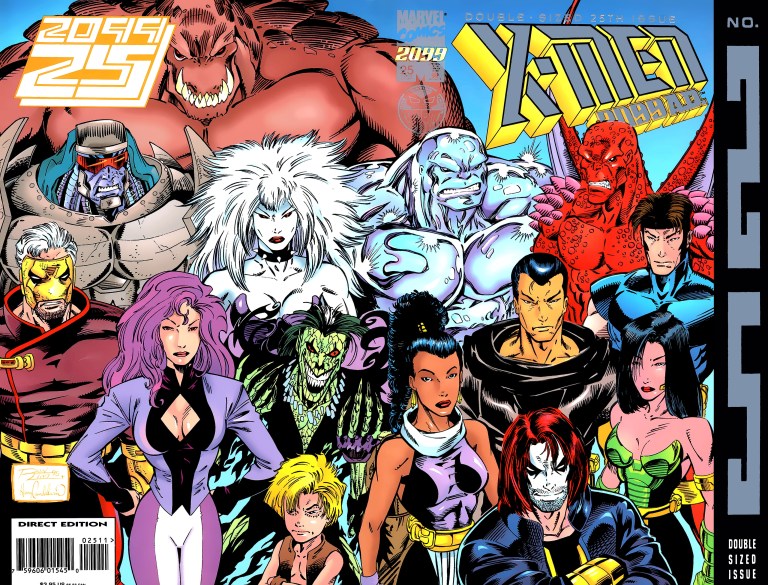
Right here we will take a look at the first-ever anniversary celebration issue of the X-Men of the far future with X-Men 2099 #25 written by John Francis Moore and drawn by Ron Lim. This comic book was released in 1995 and Marvel already published multiple series of other franchises of their 2099 line. Prior to X-Men 2099 #25, the team saw its members separated from each other and went through lots of misadventures and unfortunate events before finally getting back together.
The full cover drawn by Ron Lim.
Early story
X-Men 2099 #25 begins with a research of Xi’an and his band of mutants being presented by the Minister of Humanity (Morphine Somers) to the President in their airship flying above California.
“I see in this current generation of X-Men an untapped potential,” said the President. “Now, tell me you have finally relocated them.”
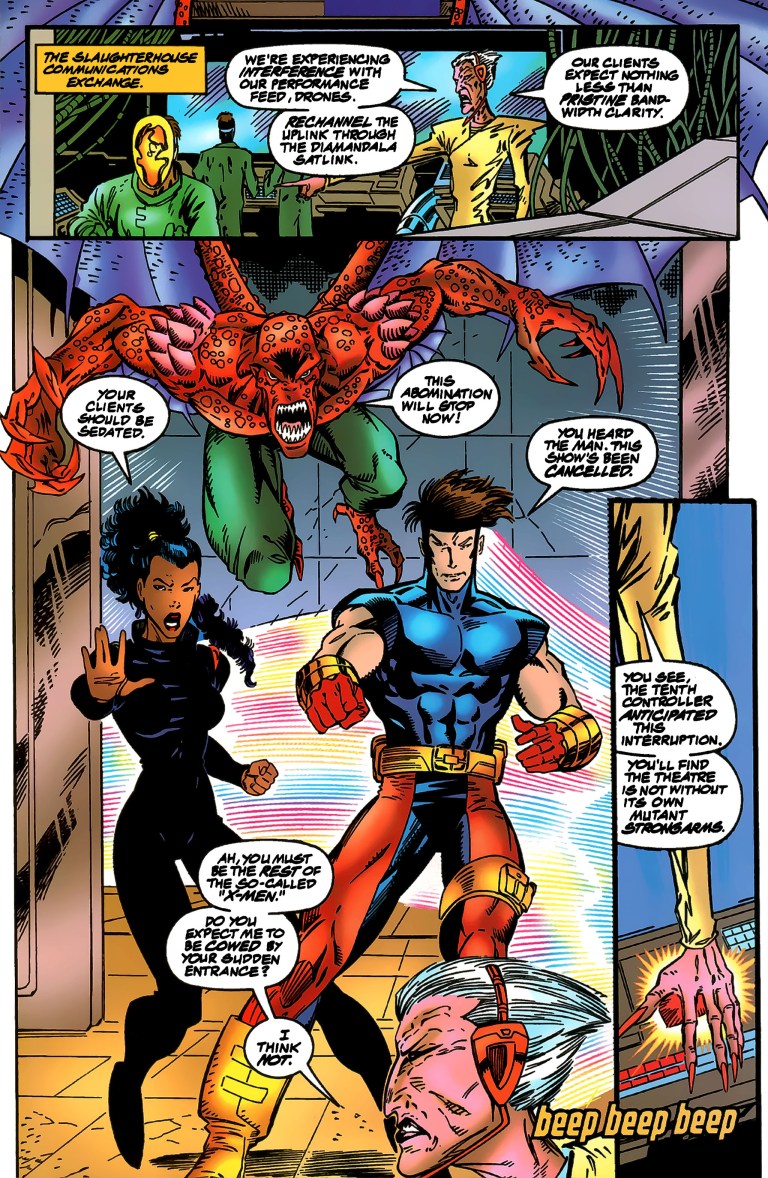
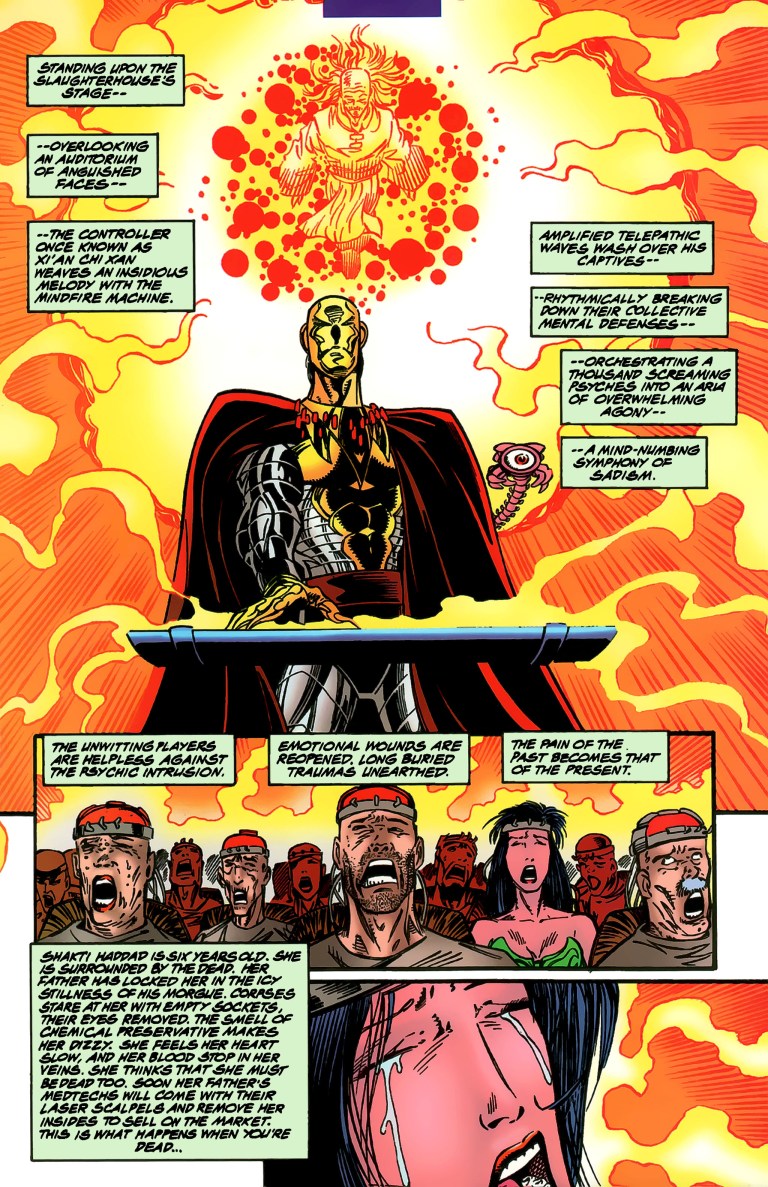
The story then shifts to the slaughterhouse of the Theater of Pain wherein a restrained Shakti/Cerebra is standing helpless next to Brimstone Love and a masked Xi’an who are about to execute a sinister plan. Shakti speaks out against them and tells Brimstone that they are parasites preying on the pain and vulnerability of innocent people. Brimstone insists that the weak and helpless provide sport for the rich and powerful, and that his group was founded for the select powerful few who crave for and pay a lot for performances. Xi’an, who had a sinister past before getting reformed to revive the X-Men (before reverting back to evil due to Zhao’s invasion of his mind), only emphasized the theater’s importance.
Defiant, Shakti tries to reach deep into Xi’an and turn him around.
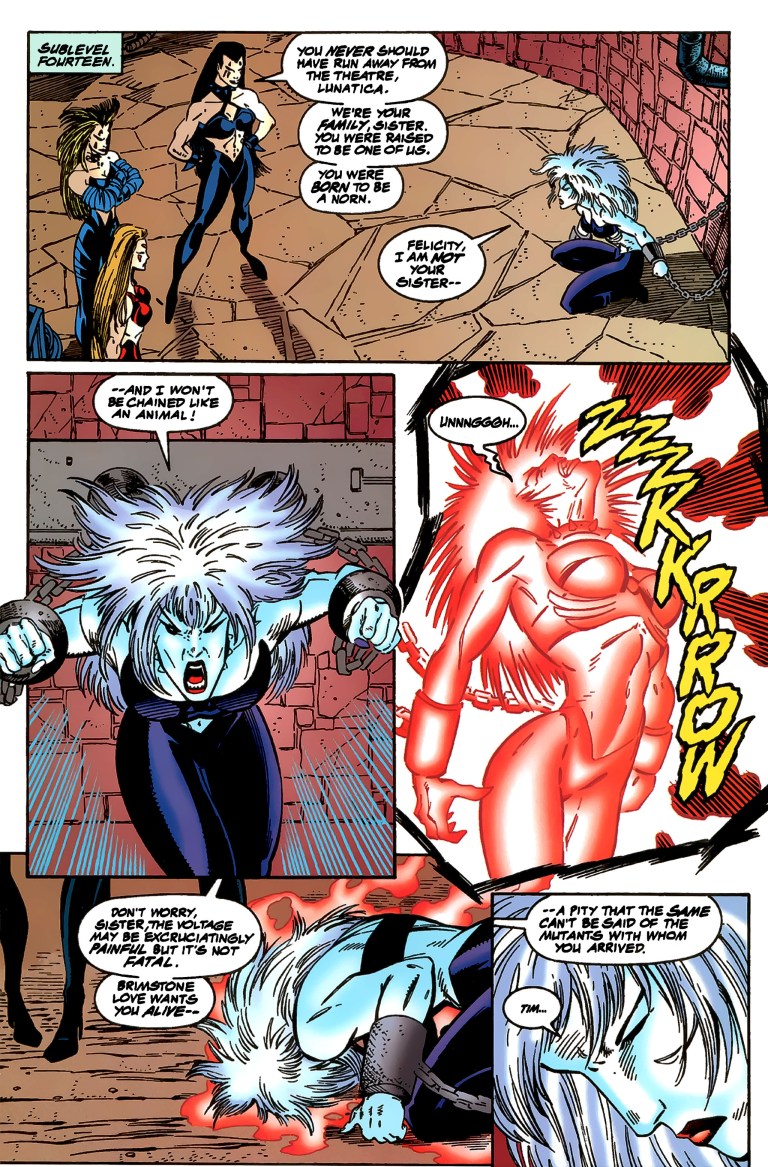
Elsewhere, the former Theater of Pain member Luna (who by this time got close with Tim/Skullfire) is chained and is confronted by her sisters in the theater. Skullfire meanwhile is in the waste disposal center where he meets someone who betrayed their team. They both thought about setting aside their differences to do something before time runs out…
Quality
X-Men 2099’s Krystalin, Meanstreak and Bloodhawk get into the action.
In terms of visuals, I can say that Ron Lim’s art is pretty good and, most likely in tandem with the writer, took careful steps to control the pace enough to keep readers entertained without ever making things look disorienting. When there is action, the pace moves fast and the impact of the action done is always visible. As seen throughout the X-Men 2099 series, the look of the southwestern region of America is always striking and I like the fact that the wilderness setting comes with lesser presence of futuristic technology (compare this to what was seen in 2099’s New York) which gives this comic book a more laid-back concept.
When it comes to the storytelling, character development is nicely emphasized in this comic book. If you read enough of the early comic books (let’s say the first ten issues) and paid close attention to the futuristic X-Men, you will be able to relate with their struggles which add a lot of depth to the usual good-versus-evil storytelling here. Without spoiling the story, I should say that this comic book concluded with a believable new direction emphasized which in turn made me want to look to the next issue. It’s that strong of an ending!
It sure is intriguing to see Shakti, one of the most prominent X-Men 2099 members, really suffer along with others.
I also liked the way this comic book emphasized the connections between the Theater of Pain with the Chosen (another group of villains) and most notably with Zhao (a previous leader of the X-Men before Xi’an’s time).
As for in-universe crossing-over, this comic book nicely ties up with Doom 2099 which, at the time of publishing, was under the creative direction of Warren Ellis who is now one of the best comic book writers.
If there is anything I have an issue with, it’s the cover art. It has a few characters who appeared on the cover, most notably Desdemona, and yet were absent in this comic book’s story. They ended up looking like cover art filler. Not a problem but distracting and meaningless.
Conclusion
Let me make it clear here…I really like this comic book. It definitely has the best and most engaging story of the X-Men of 2099 ever and that’s because this particular monthly series had an extensive build-up on all the characters since issue #1 and issue #25 executed a great payoff.
In retrospect, the X-Men drastically changed since the start of issue #4 and this includes members who went far away or decided to exclude themselves. X-Men 2099 #25 tied up most the loose threads not only by having the team members back together but also emphasized how much they developed over the past few years (in real life, that is). This is also the kind of comic book that will make you want to revisit the very start of its series and rediscover the characters.
Luna in chains.
If you are seriously collecting comic books, be aware that based on the listings of MileHighComics.com as of this writing, as a near-mint copy of the comic book’s regular edition is $4 while a near-mint-copy of the deluxe edition (with gimmick cover) is at $6. X-Men 2099 #25’s newsstand edition is worth $8 for a near-mint copy.
Overall, X-Men 2099 #25 is highly recommended. The creators outdid themselves and made the best story of titled characters. Truly, this comic book is where the mutants of 2099 really got defined in their respectful place within the Marvel Comics universe of the 1990s.
Thank you for reading. If you find this article engaging, please click the like button below and also please consider sharing this article to others. If you are looking for a copywriter to create content for your special project or business, check out my services and my portfolio. Feel free to contact me as well. Also please feel free to visit my Facebook page Author Carlo Carrasco and follow me at HavenorFantasy@twitter.com
Disclaimer: This is my original work with details sourced from reading the comic book and doing personal research. Anyone who wants to use this article, in part or in whole, needs to secure first my permission and agree to cite me as the source and author. Let it be known that any unauthorized use of this article will constrain the author to pursue the remedies under R.A. No. 8293, the Revised Penal Code, and/or all applicable legal actions under the laws of the Philippines.
It’s funny how adaptations of adaptations turn out in real life. Long before the first live-action X-Men movie was released, an animated TV series (popularly referred to as X-Men: The Animated Series or X-Men TAS) was produced and arguably brought together the fans of both the X-Men comic books along with the animated X-Men followers.
Along the way, Marvel Comics went on to publish a monthly comic book series called X-Men Adventures which themselves were adaptations of the animated series (which itself adapted stories and concepts from the comic books).
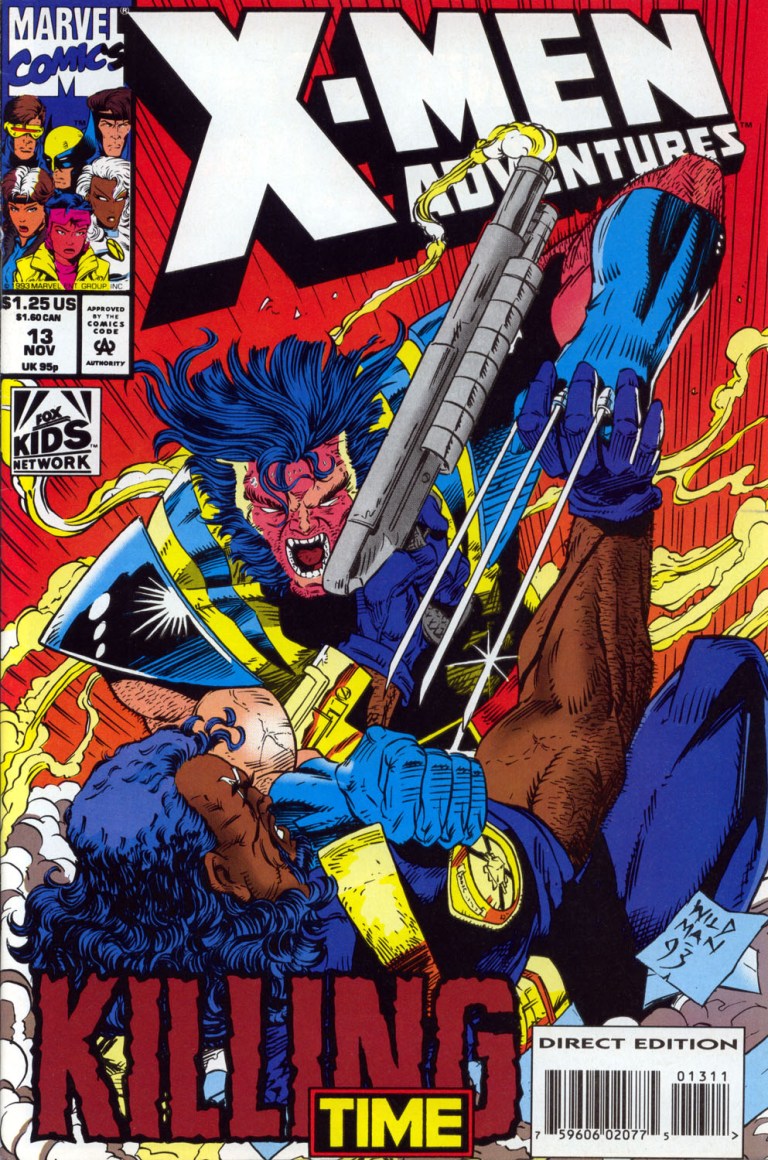
The adaptation-of-an-adaptation approach went deep further when the animated series adapted loosely the story of the classic X-Men comic book storyline Days of Future Past (by legends Chris Claremont and John Byrne) which resulted a story told in two episodes on TV. And then there was also a comic book adaptation that followed starting with X-Men Adventures #13 which is the subject of this retro comic book review.
The cover.
Early story
Written by Ralph Macchio and drawn by Andrew Wildman, the comic book begins in the dark future of 2055 in New York. The city is in ruins and mutants on the loose are being hunted by Sentinels. A very old Wolverine appears to help two loose mutants but ends up getting stunned with them by Bishop who turns out to be helping the automated authority of the Sentinels.
As he turns over the captured mutants, the Sentinels betray Bishop telling him that they no longer required him. Afterwards, Bishop and Wolverine (who woke up) each carry a person under the watch of a Sentinel. Suddenly, the two other mutants use their powers to attack the Sentinel and Wolverine followed to back up their efforts. The Sentinel however grabbed Wolverine.
Quality
A very old Wolverine in the dark future of 2055.
With the exception of some liberties, this comic book closely followed what was told in the first of the 2-episode Days of Future Past animated adaptation. As a comic book story, the story was heavily loaded with details and exposition designed to orient readers about the setting and why the future became a time of darkness in relation to the rise of machines having ultimate power over people.
While the time travel concept of the literary classic involved the mind of Kitty Pryde going into the past, this comic book used the more common concept of having Bishop travel back through time physically which easily reminds me of Kyle Reese arriving from the future in 1984’s The Terminator.
The build-up leading to Bishop’s move to travel back through time was nicely done by the creative team. There was a lot of exposition followed by an incoming attack complete with explosions happening just as Bishop is about to leave. In short, the pay-off was worth it.
The engagement did not end there. In fact, it continued nicely as Bishop meets the X-Men in 1993 with the details of his mission carefully unveiled. Professor Charles Xavier’s reaction to future history (Sentinels taking control of the world) was dramatic and worth re-reading.
As with his other works in the X-Men Adventures comic book series, Andrew Wildman’s art is very good to look at and he knows how to make each scene look engaging whether it’s just an exchange of dialogue between characters or an action scene loaded with a lot of impact.
Conclusion
While it is only half of a 2-issue adaptation of a 2-episode animated adaptation of the Days of Future Past literary classic, X-Men Adventures #13 is still a fun-filled reading experience complete with a lot of engaging moments.
The money shot by Andrew Wildman!
If you are a serious collector of comic books, be aware that, as of this writing, a near-mint copy of X-Men Adventures #13 costs $6 while its newsstand edition copy is worth $21 in near-mint condition according to Mile High Comics.
Overall, X-Men Adventures #13 is highly recommended. Both dedicated X-Men fans as well as newcomers will have something a lot to enjoy with it.
Thank you for reading. If you find this article engaging, please click the like button below and also please consider sharing this article to others. If you are looking for a copywriter to create content for your special project or business, check out my services and my portfolio. Feel free to contact me as well. Also please feel free to visit my Facebook page Author Carlo Carrasco and follow me at HavenorFantasy@twitter.com
Disclaimer: This is my original work with details sourced by means of watching the movie and doing research. Anyone who wants to use this article, in part or in whole, needs to secure first my permission and agree to cite me as the source and author. Let it be known that any unauthorized use of this article will constrain the author to pursue the remedies under R.A. No. 8293, the Revised Penal Code, and/or all applicable legal actions under the laws of the Philippines.
I just love watching superhero movies, especially the ones that were well crafted by the filmmakers complete with solid storytelling, sufficient spectacle as well as memorable performances by the hired talents (both behind and in front of the camera).
Of all the superhero movies made by the forces of Hollywood starting with 1978’s Superman, I can clearly say that 2017’s Wonder Woman is my favorite. Don’t get me wrong. I did not limit myself to just DC Comics superhero movies. I saw all the X-Men movies and their spinoffs, almost all the Spider-Man flicks, almost all of the Marvel Cinematic Universe movies and even the obscure ones. Along the way, there were some great superhero flicks that became modern-day classics like Logan and Avengers: Infinity War.
Still it is the Gal Gadot-led, Patty Jenkins-directed Wonder Woman that I loved watching the most.
Let’s start with my retro review of Wonder Woman, the one film that arguably saved the DC Comics Cinematic Universe for Warner Bros.
The Wonder Woman movie poster from 2017.
Early Story
The story begins sometime after the end of Batman v. Superman: Dawn of Justice during which Diana finds a long lost photograph recovered by Bruce Wayne. Then she remembers her past in Themyscira where she grew up as the only little girl among the women called the Amazons and her mother is none other than Queen Hippolyta. Concerned that the wicked Aries is still alive, Hippolyta’s sister Antiope trains Diana (initially in secret until they were discovered) to be strong, brave and more capable than their fellow Amazon warriors.
One day, Steve Trevor arrives in Themyscira becoming the first-ever man Diana ever met. Tension rises when the Germans (from World War I Earth) arrive on their island causing the Amazons to fight in defense. A lot of people lost their lives, including someone very close to Diana.
While interrogated with the Lasso of Truth, Steve reveals who he is and what he has been doing. He states that back in his world, World War I is ravaging the world costing many people their lives. This causes Diana to stand up and stop the war somehow (she believes Aries is responsible). Queen Hippolyta disapproves of Diana’s analysis. After privately meeting with Steve, Diana then starts her move for a mission to stop the war in Man’s World.
Quality
Gal Gadot as Wonder Woman in the middle of German soldiers.
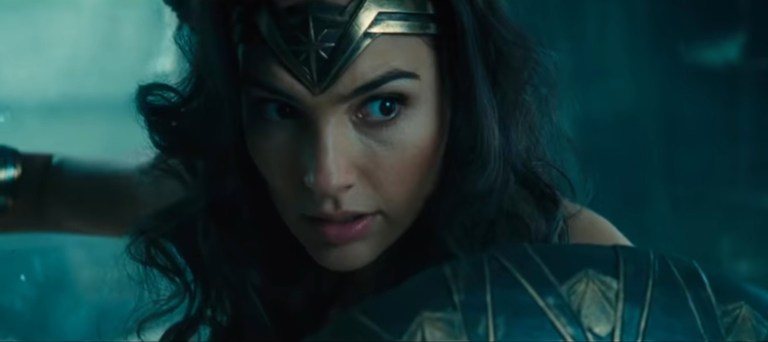
Let me start with the performances. Gal Gadot definitely IS Wonder Woman in this movie. Regardless of how many versions of Wonder Woman there are in comics, the Israeli actress truly captured the essence of Diana’s early development which includes her special place among the Amazons (note: she is the only Amazon who was born in Themyscira and grew up from infant into a mature woman), her fateful meeting with Steve Trevor, her entry into Man’s World and how she adapts with the events and people outside of Themyscira. Wonder Woman’s purity on saving the world, doing what is right and emphasizing love and compassion were all nicely translated into cinematic art by Gal Gadot. From doing the action scenes to saving people, speaking her mind among her fellow Amazons and interacting with others as she adapts with Man’s World, I really love Gadot’s work on bringing Wonder Woman to life. As her cinematic work is great, there is no doubt that Gadot will always be iconic to fans of the Queen of Superheroes and superhero enthusiasts in general in the decades to come right beside Lynda Carter (who played the icon on TV), Christopher Reeve (Superman), Robert Downey, Jr. (Iron Man) and Chris Evans (Captain America). Meanwhile, the portrayals of Diana as an 8-year-old girl as well as a 12-year-old were perfectly done by Lilly Aspell (who is truly skilled with horse riding) and Emily Carey.
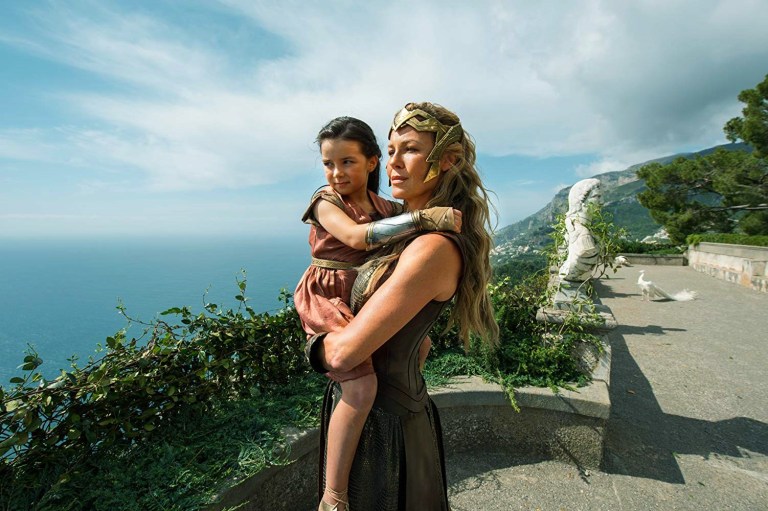
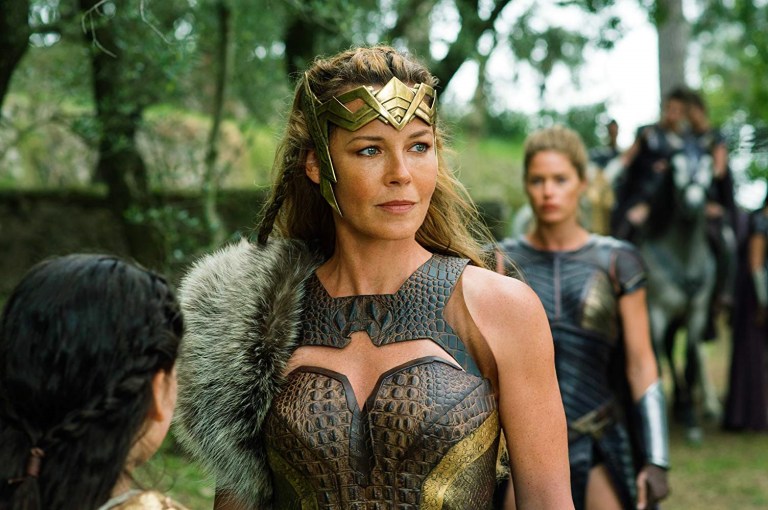
Lilly Aspell as young Diana with Connie Nielsen as Queen Hippolyta.
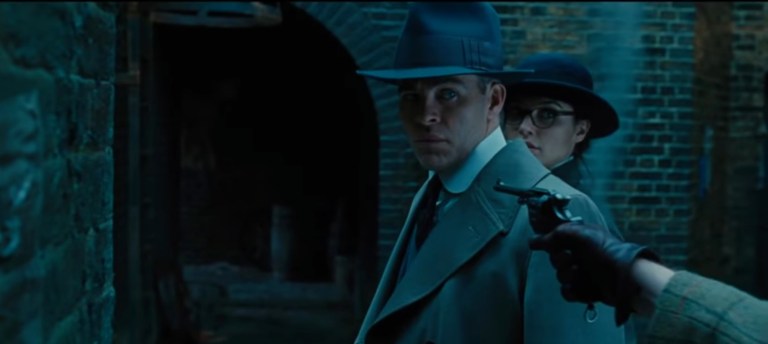
Chris Pine is excellent as Steve Trevor who is portrayed to be very dedicated to his work, brave in what he does and still shows compassion instead of arrogance towards others. He also has great chemistry with Gal Gadot and, like in the comic books, their relationship is nicely translated on the big screen. Pine’s performance here is, in my view, the best superhero movie supporting role to date.
Chris Pine as Steve Trevor with Gal Gadot as Diana in disguise.
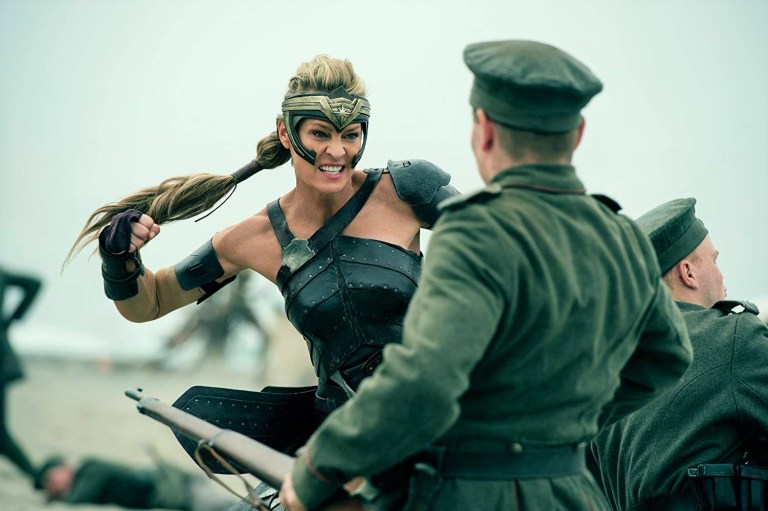
Connie Nielsen meanwhile is great in playing Queen Hippolyta and all throughout, there is always a sense of leadership complete with a touch of motherly love just like in the comic books. Her sister Antiope was nicely portrayed by Robin Wright as the one Amazon who taught Diana to be brave, strong and highly capable as an Amazon warrior.
Danny Huston, who played the lead villain in the 2009 movie X-Men Origins: Wolverine, played yet another military bad guy here but this time he’s a World War I German officer. He’s a villain with a purpose who not only fights for the glory of Germany but also strongly believes that war is natural and inevitable for humanity. In some ways, Huston’s Ludendorff reminds me Michael Shannon’s General Zod in Man of Steel.
Robin Wright is excellent as Antiope.
When it comes to presentation, this film is Patty Jenkins’ 2nd movie as director (her debut was way back in 2003) and the great turnout of Wonder Woman as a high quality movie (as opposed to being a critical and commercial success) only proved yet again that the old saying in Hollywood – The director’s second movie is his/her best movie – is true. Jenkins, who also worked on television, not only prepared a lot to make this movie but also researched Wonder Woman, developed ways to get the most out of the cast members, tweak the written story of the film (by Allan Heinberg, Zach Snyder and Jason Fuchs) and, most notably, she led the production with a lot of passion. To put it short, Wonder Woman is a labor of love (and the No Man’s Land scene is iconic) that not only resonated with fans of the Queen of Superheroes but also with the film critics and moviegoers.
Regarding storytelling, I noticed that a key story from Wonder Woman’s origin in the comics (the contest of the Amazons) did not happen at all in the film. While there were die-hard fans of the icon who complained about it, I felt that the contest of the Amazons would have made this movie more complicated and surely would have lessened the impact of World War I as a key story element. Since the purpose of this movie was to emphasize Diana’s origin and her entry into Man’s World with a major mission, I believe that the contest of the Amazons can be made cinematically later in a future movie.
The way the story was told cinematically, it also captured Diana’s reactions to the events that happened around her. The scene in which she saw the village destroyed showed how death and destruction compelled Wonder Woman to accomplish her mission even though others find ending the war impossible. Along the way, the actors – specifically Gal Gadot – really added life into the narrative with their strong performances.
When it comes to on-screen humor, which is popular among moviegoers and is almost a requirement for most new superhero movies that come out, having it done by supporting players Lucy Davis and Saïd Taghmaoui was a clever move since it allows Gal Gadot to portray Wonder Woman without any performance disruption. Considering her short screen time, Davis as Etta Candy is really funny. The amount of humor in this film, in my view, was just right and never annoying.
Spectacle? Wonder Woman is loaded with action, stunts and exciting stuff! The action involving Wonder Woman was brutal and satisfying to watch, and Patty Jenkins’ use of slow motion on key moments was great (even comparable to John Woo’s past work) and at the same time not too excessive. The Themyscira battle between the Germans and the Amazons at the beach was engaging and strategically filmed. Also, it was fitting that the action ramped up nicely starting with the iconic No Man’s Land sequence. The final battle in the film, unsurprisingly, had lots of computer-generated images (CGI) which is understandable considering the fantasy element of Wonder Woman.
More on the action, I love the way Patty Jenkins had Gal Gadot, Robin Wright, Connie Nielsen and Chris Pine perform the action themselves which all made their characters even more believable. Of course, there were certain moments in which stunt doubles were used to do the more dangerous moments on behalf of the actors.
This happened just before the iconic No Man’s Land scene.
Apart from the core cast, a lot of the actresses playing the Amazons trained for several months not just to look the part but also to perform action sequences using weapons with actual skill. The stunt coordinators and specialists hired by the filmmakers deserve praise for contributing nicely on making the cinematic Amazons highly believable. This alone not only makes Wonder Woman stand out nicely among all Hollywood superhero movies but also reflects nicely what was portrayed in the comic books.
The production design is also top-notch. I love the scenic locations of Italy used for scenes set in Themyscira. The filmmakers also did a great job recapturing the look of World War I Europe from the historical pictures to the big screen. The costume designs were fantastic, and the standout designs were, unsurprisingly, the costumes of the Amazons which really made their fantasy culture look believable. The filmmakers decided to have much more colorful visuals instead of following the look of Man of Steel, Batman v. Superman: Dawn of Justice and Suicide Squad.
On the music, the work by Rupert Gregson-Williams was great. His rendition of the Wonder Woman theme was very lively to listen to. The same can be said about the music he provided in the memorable No Man’s Land scene which had a nice build-up as Wonder Woman made her first full appearance in costume on the field. Other tunes played in the film suited the scenes well.
If there were any weak spots in this movie, it would be certain shots of action that were not filmed with precision. I’m talking about filming action scenes way too close to the camera combined with music video-style editing that’s supposed to make film look flashy. It’s not only disorienting, it also took me out of the movie.
Conclusion
Overall, Wonder Woman is one of the best-ever superhero movies ever made and easily my favorite of them all. It has an excellent balance between storytelling, character development and spectacle, and Gal Gadot gave the performance of a lifetime not only by bringing Wonder Woman into life in cinematic form but also emphasizing what the Queen of Superheroes stood for. As part of the current DC Comics Cinematic Universe, this movie stood out by having optimism and heroism as core themes (as opposed to the dark, gritty and even cynical approach of Man of Steel, Batman v. Superman: Dawn of Justice and Suicide Squad) and, more importantly, by focusing strongly on Wonder Woman instead of building up for the Justice League movie (which was released months after this one).
Apart from high-quality production values and a strong creative approach, the cast and cinematic performances are easily among the best in the superhero movie genre. Chris Pine’s Steve Trevor is an excellent example of a supporting role that is engaging without ever overshadowing the lead role. By the end of the film, you will realize the impact that Queen Hippolyta and Antiope had on Diana’s personal development.
Connie Nielsen made a great queen and mother in this movie.
Being strongly focused on heroism with optimism, director Patty Jenkins and her crew succeeded in making this film without ever succumbing to the extreme views of the Political Left in Hollywood and the loudmouth social feminists. When I see the battle between the Amazons and the German soldiers on the beach of Themyscira happen, I simply saw armed women defending their homeland not from men who intend to rape them but rather men who had no right to intrude in the first place. Even as there were scenes showing men in power in World War I Europe (putting Diana in a powerless position), there still was no feminist-inspired hatred towards men. Also the bond between Steve and Diana developing from friendship into a romantic relationship literally shut the door on extreme feminism.
As a Wonder Woman-focused story, this film succeeded on emphasizing the Queen of Superheroes to both long-time fans and mainstream moviegoers. This movie also had a nice mix of having a fantasy setting with Themyscira moving on to a historic setting with World War I Europe. On the origins of Wonder Woman herself, I don’t mind at all that the contest of Amazons was not told because this movie’s concept is already great to begin with and its running time of 141 minutes was just right.
Gal Gadot will be remembered for a very long time for her excellent portray of Wonder Woman in cinema.
With all the greatness it was made with, I kept coming back to Wonder Woman when replaying superhero movies here at the comfort of home. In the cinemas back in 2017, I saw the film three times. Ultimately, I can say out loud that Wonder Woman is highly recommended and it is truly essential!
Thank you for reading. If you find this article engaging, please click the like button below and also please consider sharing this article to others. Also my fantasy book The World of Havenoris still available in paperback and e-book format. If you are looking for a copywriter to create content for your special project or business, check out my services and my portfolio. Feel free to contact me as well. Also please feel free to visit my Facebook page Author Carlo Carrasco and follow me at HavenorFantasy@twitter.com
If there is any particular superhero comic book title I could compare Freex of the Ultraverse with, it’s Marvel’s famous X-Men. Similar to the mutants of the big M, Freex is a team of teenagers who each have different super powers or special abilities while struggling with being social outcasts. What makes them different is that the Ultraverse teenagers have no mature adult to look forward to for guidance. They don’t have a mansion to live in, and they have no choice but to move around constantly and survive the best way they could.
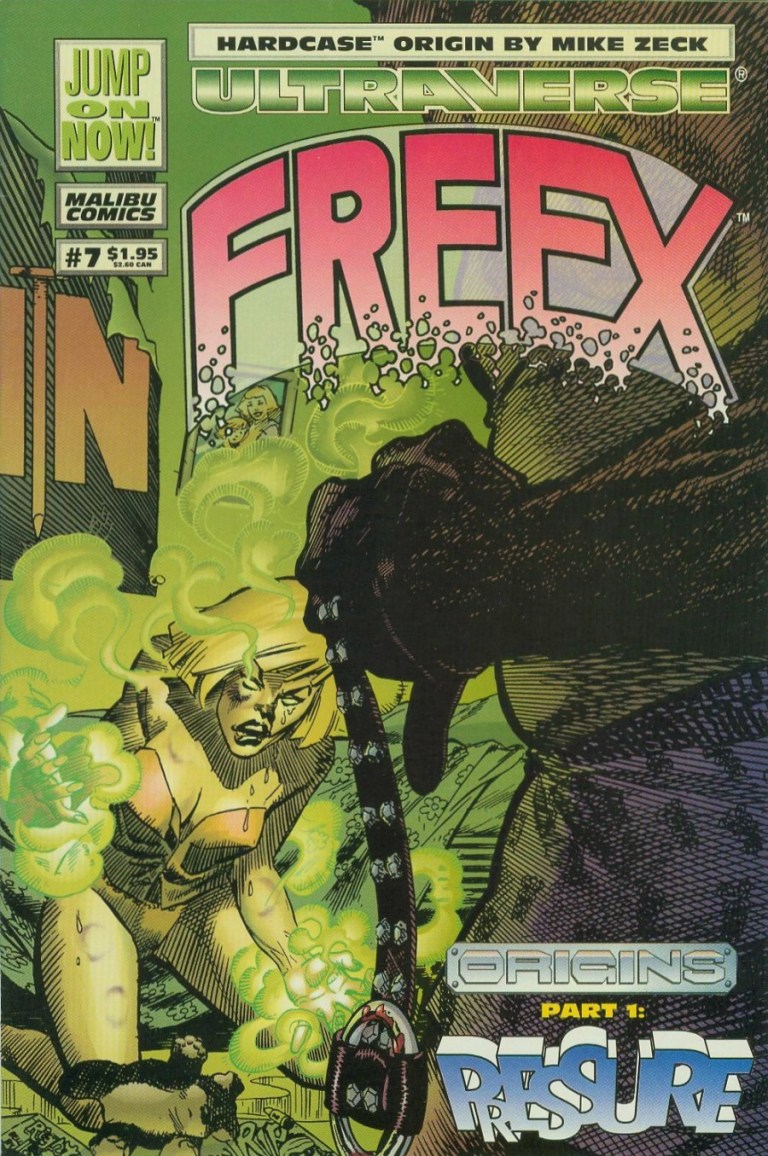
I took a look at the other existing back issues of Freex in my collection and what caught my attention was Freex #7.
The cover.
Let’s now take a look back at Freex #7 and see what makes it unique (if not special).
Early story
The story begins with the Freex hastily stealing clothes from a store in city. While the others are desperately grabbing what they could (note: the store’s glass window was shown smashed already), Angela/Sweetface looks scared. One of her male companions tell her to be tough like Valerie/Pressure.
Just as they start leaving the store behind, the alarm system goes off. The sudden rush only adds pressure to them, causing Lewis/Anything to confront Michael/Plug only because the latter said something about team leadership. As Angela separates Michael and Lewis using her fleshy tentacles, Valerie loses her cool when Ray/Boomboy calls her by her codename. Valerie hits Boomboy with a blast of plasma. With their momentum disrupted by division and tension, Lewis tries to calm his teammates down but Plug won’t have any of it as he desires to find out about the source of all of their powers referred to as Wetware Mary. Plug finds a telephone booth and instantly transfers himself into it in the form of energy.
Division between members of Freex is common.
As the Freex remain divided, a local resident living nearby watches them from a distance.
Quality
The story written by Gerard Jones is pretty engaging mainly due to characterization (as opposed to storytelling and structuring). Through the dialogue, you can really sense the thoughts and emotions of each member of Freex, especially Valerie since this particular comic book focused on her origin. Without spoiling Valerie’s background, her origin was efficiently emphasized and never, ever felt dragging. By the time her origin story concluded, I got to understand Valerie better and why is she so mean. After the conclusion of the Freex’ story, there is also an Aladdin Datafile on Valerie who turned out to be 16-years-old, 5 feet and 9 inches tall, and even has a low threat assessment by Aladdin.
Adding further value to this comic book is a 2-page quick feature of Hardcase which shows a nice look back at his past before the establishment of The Squad.
Conclusion
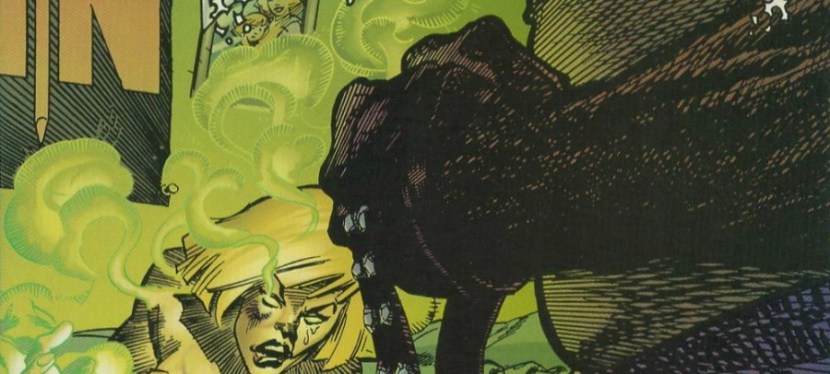
From the past of Pressure.
Freex #7 is a good read. The story about the teenage social outcasts of the Ultraverse is well balanced in terms of characterization and action. Anyone who is a fan of Valerie/Pressure or female superheroes who are mean, angry and rebellious will find a lot to enjoy in this comic book. A near-mint copy of Freex #7 is worth $4 at MileHighComics.com as of this writing.
Overall, Freex is recommended.
Meanwhile, check out my retro review of Freex #1 right here.
Thank you for reading. If you find this article engaging, please click the like button below and also please consider sharing this article to others. Also my fantasy book The World of Havenoris still available in paperback and e-book format. If you are looking for a copywriter to create content for your special project or business, check out my services and my portfolio. Feel free to contact me as well. Also please feel free to visit my Facebook page Author Carlo Carrasco and follow me at HavenorFantasy@twitter.com