A Look Back at Amazing Spider-Man #387 (1994)

Welcome back superhero enthusiasts, 1990s arts and culture enthusiasts, Marvel Comics fans and comic book collectors! Today we go back to the 1990s to examine a small part of the Marvel Comics shared universe through a tale of the Amazing Spider-Man monthly series.

In my previous retro review, Spider-Man had a match-up with his arch-enemy the Vulture who returned with a strong obsession within. The rematch is significant not only because it the two have a rivalry that lasted decades in reality, but also because the story was structured to function as a light reintroduction of Adrian Toomes (Vulture) for new Spider-Man fans of the 1990s.

With those details laid down, here is a look back at Amazing Spider-Man , published in 1994 by Marvel Comics with a story written by David Michelinie and drawn by Mark Bagley.
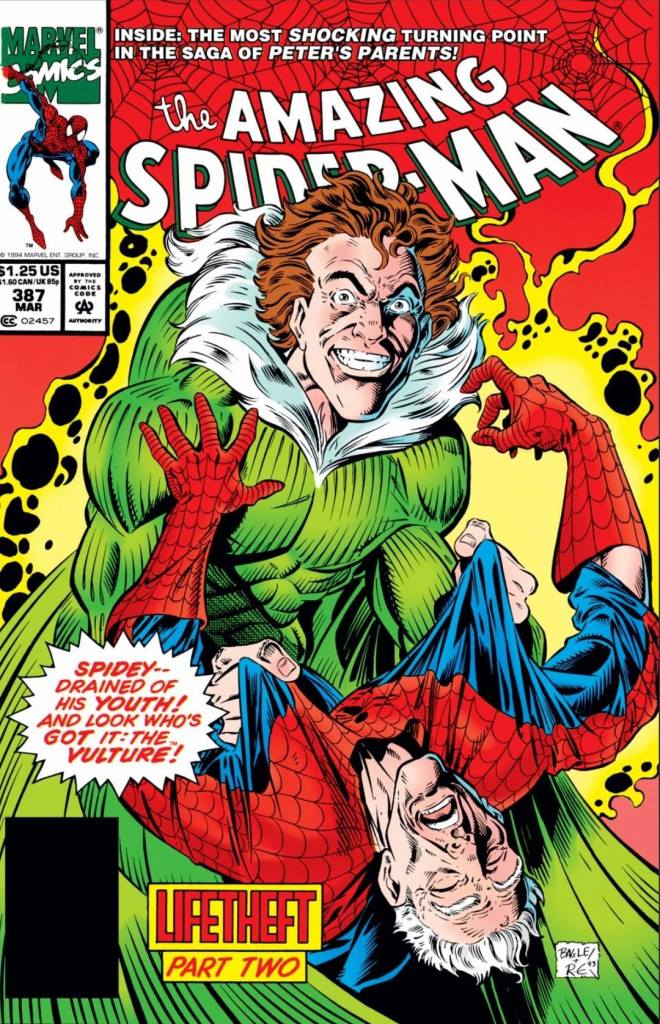
The cover.

Early story

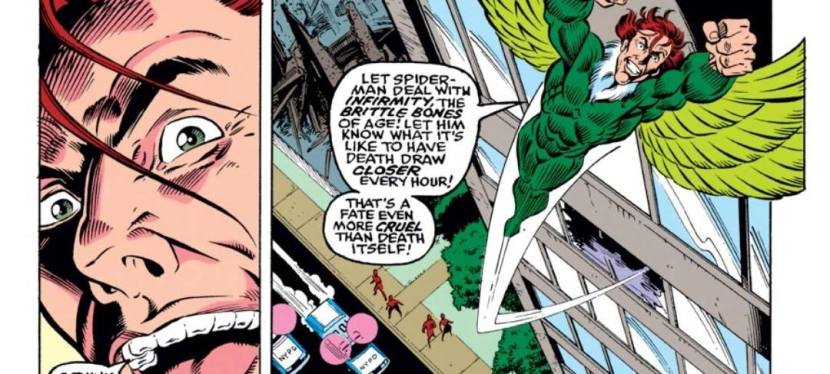
The story begins with the Vulture absorbing energy and the youth of Spider-Man using the Juvenator in front of Dr. Sanchez. As a result, Adrian Toomes/Vulture physically turned much younger with rejuvenated skin, cancer getting health, a stronger body and his hair grown back. He declares himself as the new vital Vulture. Spider-Man is down on the floor clearly weakened and with a change of his body’s shape.

Instead of taking the opportunity to kill Spider-Man, the Vulture decides to fly away knowing that his long-time rival will have to deal with brittle bones of old age. As Dr. Sanchez tries to help him, Spider-Man feels exhausted, his lungs feeling gummy and his ears ringing. Knowing that police officers are coming, the webslinger decides to get away and leave Dr. Sanchez behind.

Moments later at the top of the building, the weakened Spider-Man takes his mask and glove off realizing that he has turned into an elderly man…

Quality
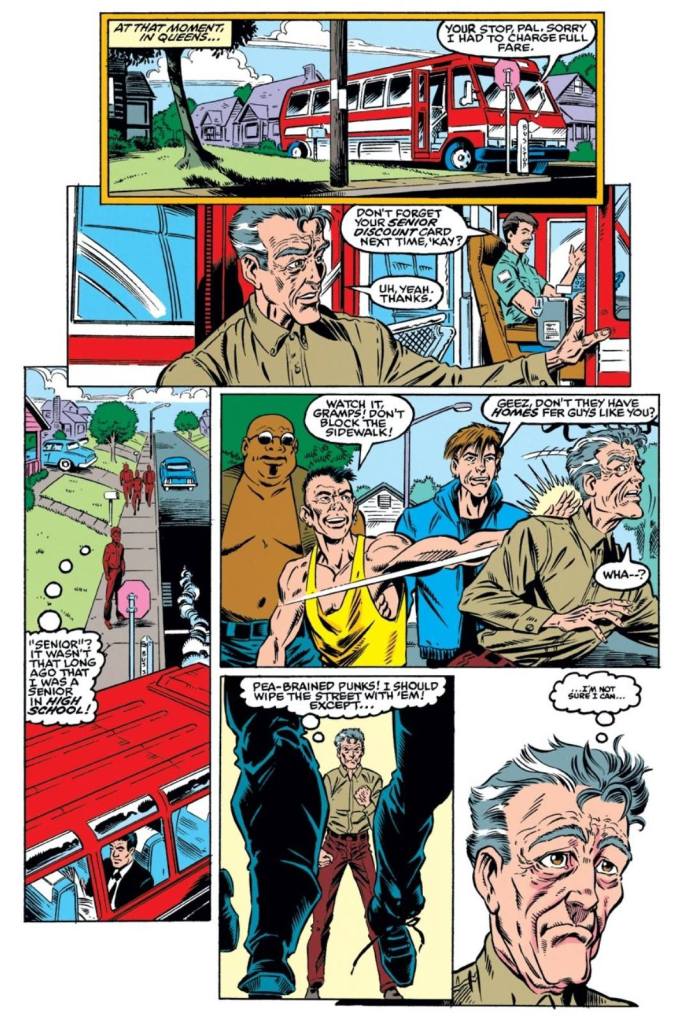
Can you recognize Peter Parker?

To get straight to the point, this continued rematch between Spider-Man and the Vulture is so outlandish (backed with the science fiction approach to life energy and the so-called fountain of youth), it almost felt like it was a story crafted for the What If series of comic books. In fact, the sudden aging of Peter Parker into an actually elderly man getting into close calls with two notable family members made this tale even more suitable for the What If series (note: What If #4 of 1989 had a severely aged Peter Parker in it).

Still on the storytelling aspect of this comic book, the creators used the fountain of youth concept to pull off a significant twist on the enduring Spider-Man/Vulture rivalry. As Spider-Man grew so old, the Vulture became much younger which in turn convinced him he could reinvent himself and put his genius of electro-magnetism to great use.  

To make things clear, this tale is not purely a Spider-Man/Vulture rivalry with sci-fi twists. In fact, there is more to the plot than meets the eye here as the Juvenator machine becomes an important element of the story (leading to something intriguing in the next issue), and a sinister revelation concluded this comic book.

Conclusion
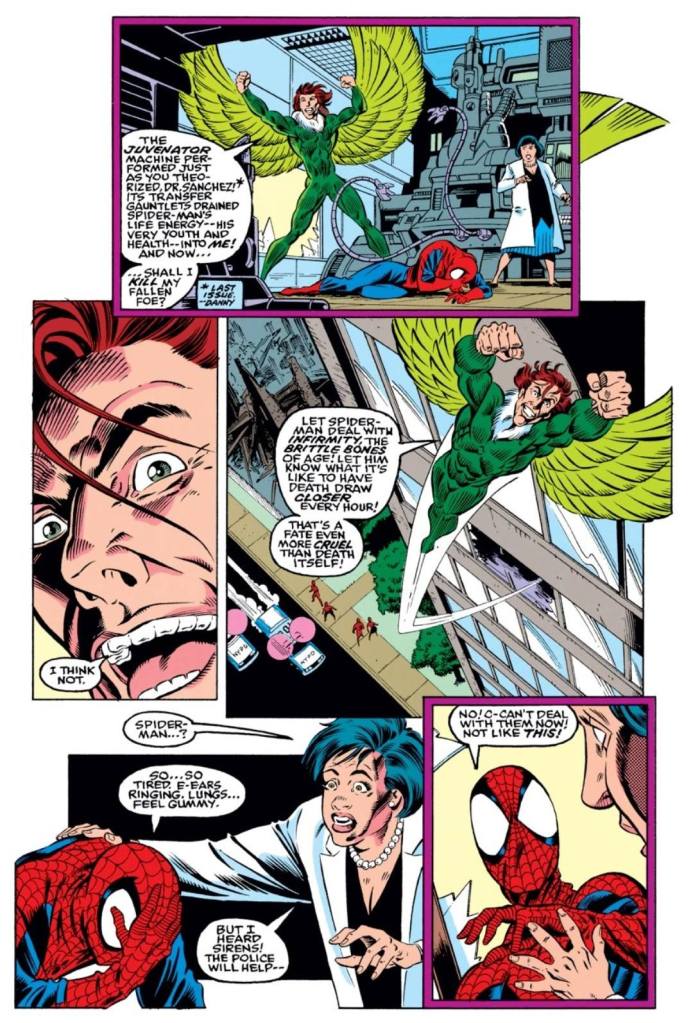
The Vulture rejuvenated into a young man at the expense of Spider-Man.

Amazing Spider-Man (1994) is a solid follow-up to the previous issue and it also was a radical attempt to twist the Spider-Man/Vulture rivalry a lot reaching to the point of making it look and feel like a What If story. There is a good amount of suspense, character development and enough superhero spectacle that paid-off the build-up nicely. Ultimately, this tale is actually a part of a short storyline leading to the intriguing events of issue .  

Overall, Amazing Spider-Man (1994) is recommended.

+++++

Thank you for reading. If you find this article engaging, please click the like button below, share this article to others and also please consider making a donation to support my publishing. If you are looking for a copywriter to create content for your special project or business, check out my services and my portfolio. Feel free to contact me with a private message. Also please feel free to visit my Facebook page Author Carlo Carrasco and follow me on Twitter at  @HavenorFantasy as well as on Tumblr at https://carlocarrasco.tumblr.com/ and on Instagram at https://www.instagram.com/authorcarlocarrasco
A Look Back at Amazing Spider-Man #386 (1994)

Welcome back superhero enthusiasts, 1990s arts and culture enthusiasts, Marvel Comics fans and comic book collectors! Today we go back to the 1990s to examine a small part of the Marvel Comics shared universe through a tale of the Amazing Spider-Man monthly series.

Following a serious of unfortunate events that kept Spider-Man away from his wife Mary Jane (read my retro reviews by clicking here, here and here), the Amazing Spider-Man creators decided it was time to have the iconic webslinger in a new rematch with the classic villain The Vulture (specifically Adrian Toomes whose first appearance was in Amazing Spider-Man in 1963). What makes Toomes Vulture notable (note: there were other versions of Vulture in Marvel’s history) is that he is an old man who happens to be a brilliant electrical engineer who proved to be a very capable criminal. He is also a co-founder of the Sinister Six.

With those details laid down, here is a look back at Amazing Spider-Man , published in 1994 by Marvel Comics with a story written by David Michelinie and drawn by Mark Bagley.

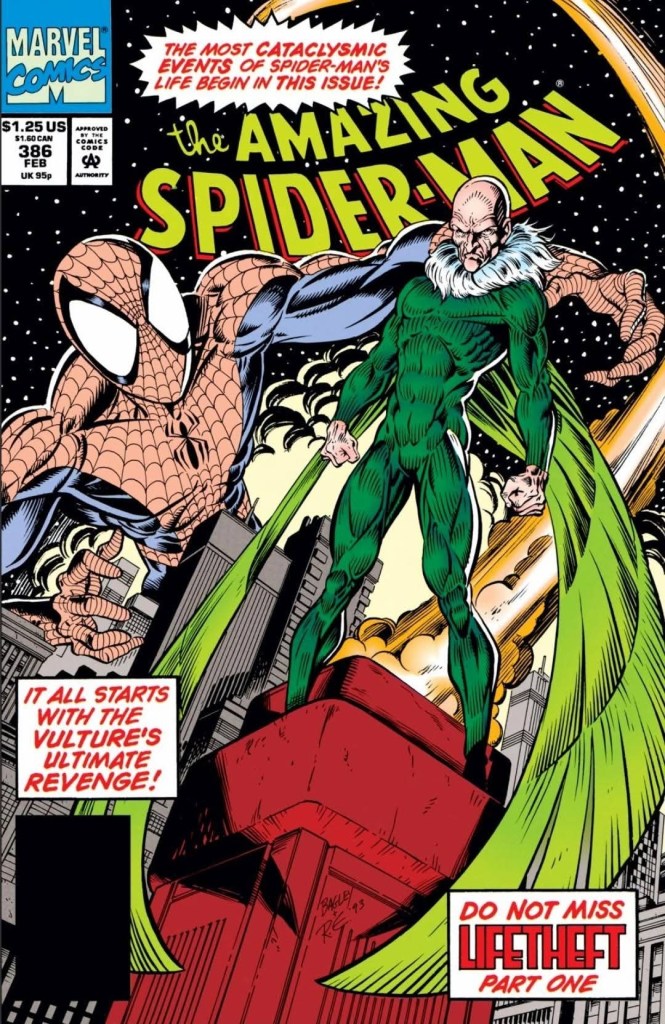
The cover.

Early story

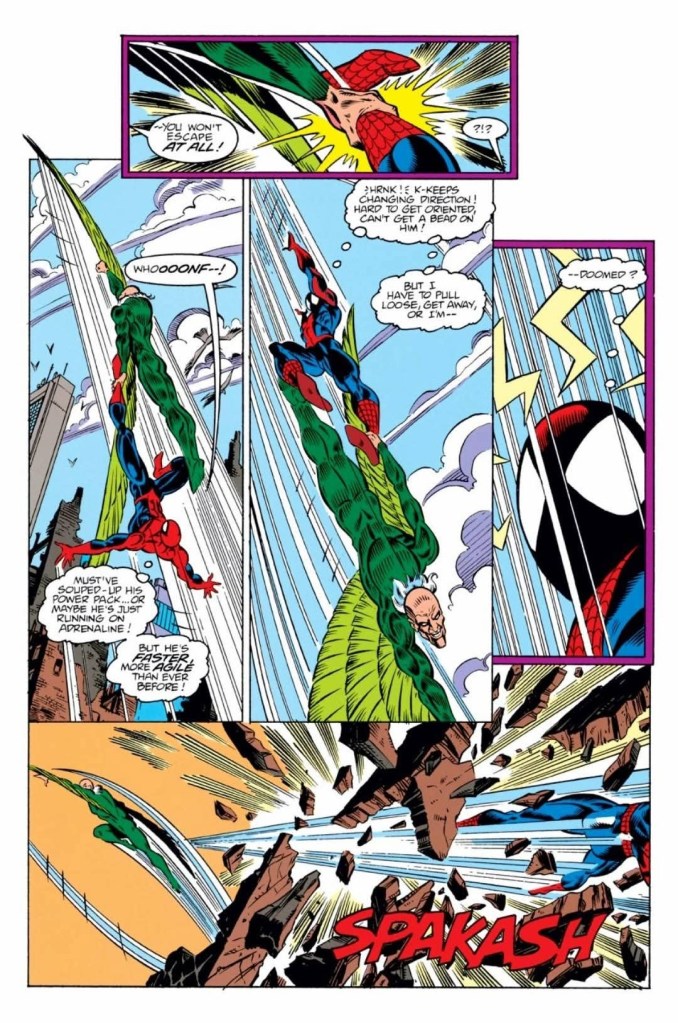
The story begins in the prison complex at Ryker’s Island. Adrian Toomes (Vulture) is inside his prison cell working on a small device with a guard watching from his back. It turns out the device has a tractor beam and Toomes uses it on the guard to physically slam his body on the sliding door of the prison cell. Toomes then uses the tractor beam to pull the metal bars of the other side of the cell to create an opening. He equips himself with mechanical wings and flew out of his cell and reach the speed boat prepared by two companions.

At the residence of May Parker, Peter and his Aunt May talk with an investigator. It turns out Aunt May hired the investigator to follow and observe Richard and Mary Parker. When asked by Peter, she tells him she does not think Richard and Mary are his parents. As far as the investigator is concerned, there is nothing suspicious with Richard and Mary Parker. He tells peters that his aunt needs professional help (related to Alzheimer’s Disease)…

Quality

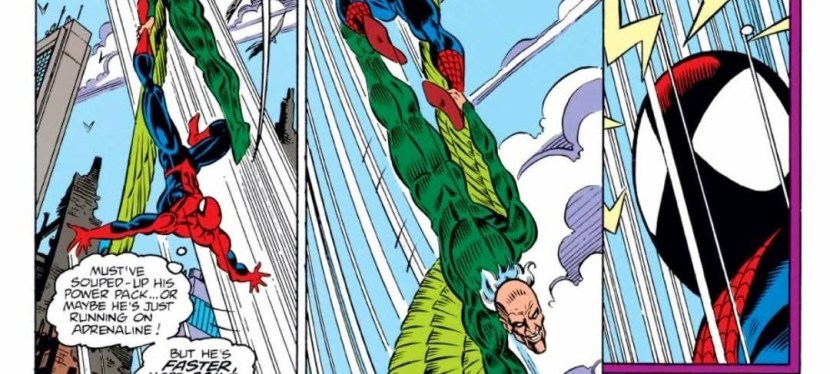
The physical conflict between Spidey and the Vulture is intense to see!

Perceived as modern during the time of publication, the conflict between Spider-Man and the Vulture in this comic book utilized the concept of everlasting youth with science fiction (combined with the villain’s own obsession). This in turn resulted in a unique approach executed by the Michelinie-Bagley duo to make something new with the rematch between Spidey and his winged nemesis.

The Vulture here is not only very obsessed with obtaining everlasting life as there is something deep inside him that has been raging. This explains why the winged super villain is more visceral in his battle with Spider-Man which Mark Bagley visualized with dynamism and intensity. For the newcomers reading this, the two have fought each other a lot since the 1960s and this 1994 rematch was very unique. The Vulture here is not unhinged but rather strategic while being obsessed, and this made him even more dangerous for Spider-Man.

Apart from the promised rematch, this comic book continued building up the tension for the eventual tragedy in Peter Parker’s life (which happened in Amazing Spider-Man ) while also dramatizing the lasting hardships Mary Jane experiences as Peter’s wife. Peter Parker meanwhile is focused on his family and his intention to find professional help for Aunt May smoothly connected with his rematch with the Vulture.  

Conclusion

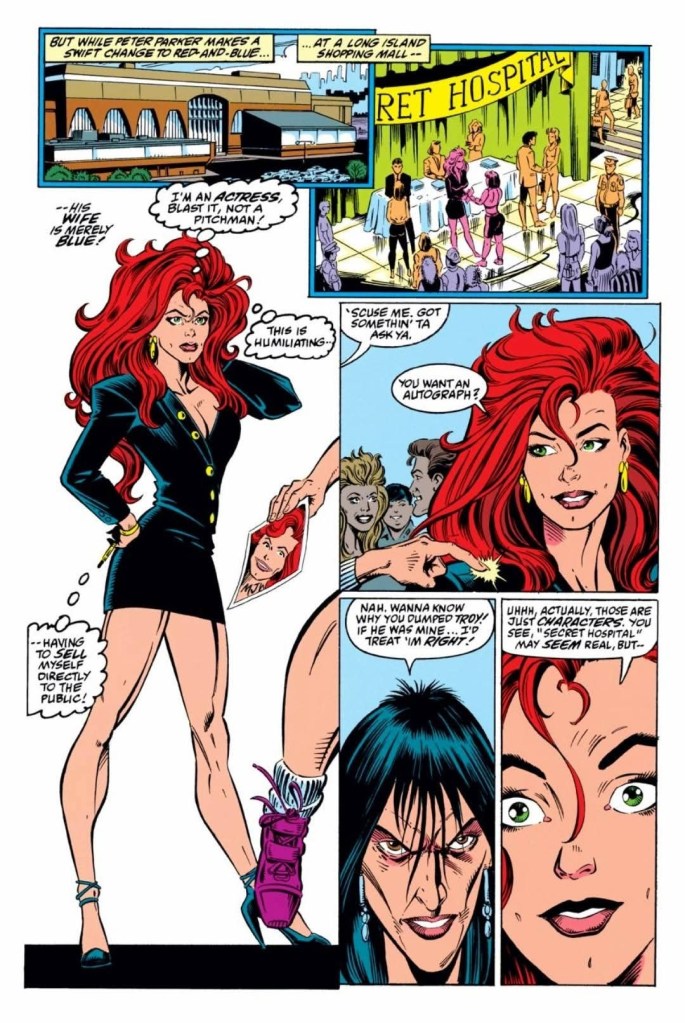
Mary Jane Parker participates in a promotional event of her TV show in a shopping mall.

There is a lot to enjoy in Amazing Spider-Man (1994). The rematch between the Vulture and Spider-Man is engaging and intriguing to read. There is also a good amount of suspense applied on the main plot as well as on the sub-plot about Aunt May being suspicious about Richard and Mary Parker. The result here is a reading experience that is entertaining and also balanced with regards to tone and storytelling.  

Overall, Amazing Spider-Man (1994) is recommended.

+++++

Thank you for reading. If you find this article engaging, please click the like button below, share this article to others and also please consider making a donation to support my publishing. If you are looking for a copywriter to create content for your special project or business, check out my services and my portfolio. Feel free to contact me with a private message. Also please feel free to visit my Facebook page Author Carlo Carrasco and follow me on Twitter at  @HavenorFantasy as well as on Tumblr at https://carlocarrasco.tumblr.com/ and on Instagram at https://www.instagram.com/authorcarlocarrasco
A Look Back at Spider-Man 2099 #10 (1993)

Disclaimer: This is my original work with details sourced from reading the comic book and doing personal research. Anyone who wants to use this article, in part or in whole, needs to secure first my permission and agree to cite me as the source and author. Let it be known that any unauthorized use of this article will constrain the author to pursue the remedies under R.A. No. 8293, the Revised Penal Code, and/or all applicable legal actions under the laws of the Philippines.

Welcome back, superhero enthusiasts, 1990s culture enthusiasts, Marvel 2099 fans and comic book collectors! Today we revisit the Marvel 2099 franchise within Marvel Comics’ shared universe during the 1990s. Specifically speaking, we take a look back at one of the early tales of Spider-Man 2099.

In this retro comic book review, Spider-Man made it back to his home after encountering Vulture 2099 and seeing the low life and inhabitants of the people living in the old City of New York far below. His return, however, is not joyful not only because of the growing tension between Miguel O’Hara and the people his connected with but also because his mother suffered a health-related attack.

With those details laid down, here is a look back at Spider-Man 2099 , published by Marvel Comics in 1993 with a story written by Peter David and drawn by Rick Leonardi.

The cover.

Early story

The story begins inside a hospital room. Conchata O’Hara is slowly recovering and near her are her sons Miguel (Spider-Man) and Gabriel as well as Dana. Conchata starts to feel and move restlessly but for Miguel (who heard his mother call his brother Gabriel a good son), she was just acting. Conchata then gets up from her bed and Gabriel encourages his brother to talk to her. Miguel responds saying that their mother hates him because he reminds her of his father – George O’Hara. Dana and Gabriel tell him to talk to her…

Quality

Spider-Man takes on the local authorities. Does this make him a criminal or a social justice symbol? Read the comic book.

To put it straight, this comic book tells the story of the O’Hara family complete with flashbacks from key points of the past. Unsurprisingly, Peter David’s writing is very rich and in-depth with details which made it a compelling read in my experience, and it should be more engaging for readers who passionate follow Spider-Man 2099 and his civilian life as Miguel.

Without going too far with the details, I can say that this comic book explains why Miguel has a very uneasy relationship with his own mother who in turn is close with Gabriel while also resentful of George. As this is a Spider-Man 2099 story, you will see Miguel do his best to make his mother understand his views and himself better no matter the rift between them. There is also a notable superhero-related twist within the Miguel-Conchata interactions that readers who have troubled relationships with their own mothers (especially those who engage in idolatry which is foolish and unholy) will find strongly relevant personally. Miguel’s own personal assessment of his 2nd life as Spider-Man alone deserves your deep attention. Again, Peter David’s writing here is literally solid gold in terms of richness and characterization.

Conclusion

A quick look at the past of the O’Hara family.

While there is no good-versus-evil conflict for superhero enthusiasts to look forward to, Spider-Man 2099 (1993) is a highly engaging, character-driven story that highlights Miguel O’Hara on a very personal level while also having enough space to explain to readers why the O’Hara family relationships are strained. There are even flashbacks that nicely dramatized the past and the one scene in which Miguel goes out in public in full costume as Spider-Man will make you wonder what the protagonist really believes in and where he plans to take his life to. Peter David’s writing here made all the difference.

Overall, Spider-Man 2099 (1993) is recommended!

+++++

Thank you for reading. If you find this article engaging, please click the like button below and also please consider sharing this article to others. If you are looking for a copywriter to create content for your special project or business, check out my services and my portfolio. If you want to support my website, please consider making a donation. Feel free to contact me with a private message. Also please feel free to visit my Facebook page Author Carlo Carrasco and follow me on Twitter at  @HavenorFantasy as well as on Tumblr at https://carlocarrasco.tumblr.com/ and on Instagram at https://www.instagram.com/authorcarlocarrasco/.

A Look Back at Spider-Man 2099 #8 (1993)

Disclaimer: This is my original work with details sourced from reading the comic book and doing personal research. Anyone who wants to use this article, in part or in whole, needs to secure first my permission and agree to cite me as the source and author. Let it be known that any unauthorized use of this article will constrain the author to pursue the remedies under R.A. No. 8293, the Revised Penal Code, and/or all applicable legal actions under the laws of the Philippines.

Welcome back superhero enthusiasts, 1990s arts and culture enthusiasts, Marvel Comics fans and comic book collectors! Today we go back to the wild 1990s and explore the far future of 2099 within the Marvel Comics shared universe through one of the tales of Spider-Man 2099.

In my previous retro review, the futuristic Spider-Man got involved with his era’s version of Vulture (Vulture 2099 to us readers). It turns out, Vulture 2099 is not your typical evil supervillain but the leader of a group of violent radical people who are willing to dominate society with a destructive mindset even though there are other opposing groups around them. And then Spidey 2099 realized something very wrong about the Vulture which leads to a big battle between them.

With those details laid down, here is a look back at Spider-Man 2099 , published in 1993 by Marvel Comics with a story written by Peter David and drawn by Rick Leonardi.

The cover.

Early story

The story begins with Spider-Man 2099 and Vulture 2099 crashing into the interiors of the ancient St. Patrick’s Cathedral located in old New York City (underneath the modern city). Unsurprisingly, the people inside the cathedral got very surprised about the unexpected entry of the two fighters.

Elsewhere, Miguel O’Hara’s brother Gabriel helps Kasey with her head. She tells him that she saw Miguel but Gabriel does not believe her. Suddenly, members of a gang knock on the door and Kasey opens it.

Inside St. Patrick’s Cathedral, the fight between Spider-Man and Vulture continues. Spider-Man remembers that he has lapsed as a Catholic and he feels very uneasy about the trouble he and his enemy are causing inside the old church structure. Vulture suddenly throws a wooden bench at Spidey but breaks open a glass window and then goes outside. Upon looking outside, Spider-Man notices a group of Vulture’s gang…the Freakers.

Quality

The battle between Spider-Man 2099 and Vulture 2099 is intense and very compelling to read.

Here is the good news about this comic book…the story here is a fitting conclusion to what happened in issue . The conflict between Spider-Man and Vulture here was carefully crafted and there were several key moments or scenes the provided readers some breathing room to grasp and understand the society of 2099 New York as well as the conflict between the downtown social groups who are deprived of the higher standard of living many miles above them. In some ways, the social divisions portrayed in this comic book is a sad reminder about modern day America and the many radical groups or gangs of people who divide society on race, ethnicity, social class, gender and ideology.

As expected, there is a lot of action executed in the fight between Spider-Man and Vulture of 2099 but there were pauses in between. This is not surprising considering how Peter David crafted the action-packed battles Spidey 2099 had with other enemies in the comic books released before this one. Without spoiling what happened, I can say that the battle between the two was nicely built-up and the conclusion turned out very satisfying to see.

Still on the story, Peter David added some layers of complexity into the conflict that easily made things much more difficult for Spider-Man 2099 on a personal level. I’m talking about his brother Gabriel and Kasey getting involved in the gang war against the Freakers.

Vulture 2099 is once again a standout opposition figure here. Not only is his ability to fly and cause chaos above his obsessed Freakers below is symbolic, his distorted, hardcore beliefs are reflected with his unrelenting use of violence as he fights Spider-Man. Not only that, he turns out to be very philosophical thanks to the rich dialogue Peter David came up with. It is also here that the futuristic Vulture is opposed to God and being the socialist-indoctrinated person he is, he easily blames Alchemax for God’s absence. This should remind you that through Vulture 2099, evil comes with fatal attraction that people could not realize until it is too late. The futuristic Vulture has a lot of common with the evil leaders of Black Lives Matter, Antifa, the Democratic Socialists of America and the long-time regime of Iran. Lastly, I should state that radical socialists are always wrong about God and they often live with distorted perceptions about Him. Vulture 2099 qualifies as a woke figure of 2099 and ultimately wokeness is foolishness.

Speaking of sub-plots, this comic book emphasizes Tyler Stone on how he handles ambitious projects of Alchemax that he believes will benefit people. His interactions with Dana here also sheds light about his very own obsession about the future of humanity.

Conclusion

Spider-Man in trouble with the Vulture’s gang members.

With rich writing, notable in-story details and a very well designed conflict between the futuristic Spider-Man and Vulture, Spider-Man 2099 (1993) is both very engaging and entertainting to read from start to finish. It is a great pay-off to what was built-up in issue . Very notably, the conflict between Vulture 2099 and the protagonist is great to see and it is clear that Vulture is not a disposable supervillain but one of the most definitive forces of opposition against Spider-Man 2099. Of course, as comic book history turned out, Vulture 2099 made it in the crossover comic book event between classic Spider-Man and Spidey of 2099. Along the way, the creative team succeeded with expanding the lore of 2099 and the social underclass of New York.

Overall, Spider-Man 2099 (1993) is highly recommended.

+++++

Thank you for reading. If you find this article engaging, please click the like button below, share this article to others and also please consider making a donation to support my publishing. If you are looking for a copywriter to create content for your special project or business, check out my services and my portfolio. Feel free to contact me with a private message. Also please feel free to visit my Facebook page Author Carlo Carrasco and follow me on Twitter at  @HavenorFantasy as well as on Tumblr at https://carlocarrasco.tumblr.com/ and on Instagram at https://www.instagram.com/authorcarlocarrasco
A Look Back at What If #21 (1991)

Disclaimer: This is my original work with details sourced from reading the comic book and doing personal research. Anyone who wants to use this article, in part or in whole, needs to secure first my permission and agree to cite me as the source and author. Let it be known that any unauthorized use of this article will constrain the author to pursue the remedies under R.A. No. 8293, the Revised Penal Code, and/or all applicable legal actions under the laws of the Philippines.

Welcome back superhero enthusiasts, 1990s arts and culture enthusiasts, Marvel Comics fans and comic book collectors! Today we go back to the year 1993 and explore a part of Marvel Comics’ universe through the re-imagined tales emphasized in the What If monthly series.

Some time ago, I reviewed What If #20 (1990) which explored what would have happened had Peter Parker/Spider-Man did not marry Mary Jane Watson. While that comic book’s story and visuals were engaging, the narrative weakened before the end and it turns out the tales was not really designed as standalone What If story. That being said, the story continues on in the 21st issue of the What If series that I just reviewed.

With those details laid down, here is a look back at What If #21, published in 1991 by Marvel Comics with a story written by Danny Fingeroth and drawn by Jim Valentino.

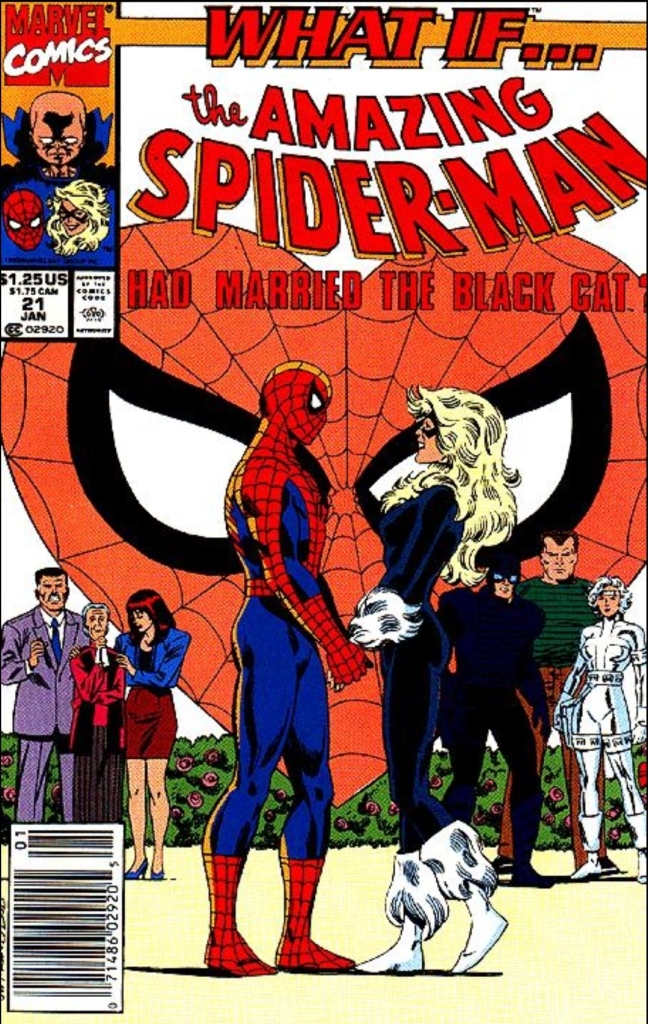
The cover.

Early story

The story begins with a man – who overheard the talk between Black Cat and Mary Jane Watson during the end of issue – who calls someone and starts a negotiation. The unseen person on the other end of the call is not seen but the man knows about the other person’s history of attempts to kill Spider-Man.

Within the City of New York, the romantically bonded Spider-Man and Black Cat work as a crime-fighting duo bringing crooks down. Shortly after, they get married in a private ceremony in Niagara Falls, New York using fake names (Peter Parker as Peter Palmer, and Felicia Hardy as Felina Marvey). During their first night together as husband and wife, Felicia gets out of bed surprising Peter. It turns out, Felicia is in the mood for crime-fighting. This brings them back to New York City where they resume their anti-crime crusade as Spider-Man and Black Cat.

Peter Parker notices something with his new wife. No matter what she says as Black Cat, she is still in love with his Spider-Man identity and only tolerates his true, civilian identity. He wonders if Felicia will come to accept the real him…

Quality

The Vulture attacks Spider-Man’s wife Black Cat.

To begin with, this comic book has a much stronger story, deeper character development, solid twists and a very intriguing conclusion that also happens to be a lot more satisfying compared with issue .

For one thing, the team of Fingeroth-Valentino really ramped up their imaginative creations and took this tale to more daring directions. The core concept of Spider-Man and Black Cat being married is deeply explored which resulted in a tale that is intriguing for most of the time. Their marriage also raises questions as to how Spider-Man and Black Cat perceive each other both as civilians and as costumed crime fighters. Also explored nicely was how they handled their secret identities while struggling with their own emotions deep inside. To say the least, seeing Spider-Man and Black Cat as a married couple as well as a dynamic duo of crime fighters makes a solid reading experience.

I should also state that there is a lot of story and characterization-development pay-offs that reflect not only what was built up in this comic book but also in issue . To really enjoy and experience this issue, you must read the previous issue as well.

Conclusion

Spider-Man and Black Cat as the married couple and duo of crime fighters.

What If #21 (1991) is a very captivating read. To put it short, it exceeds issue on just about everything and the conclusion is a lot more satisfying and intriguing to read. The Fingeroth-Valentino team created an in-depth look at an alternate married life of Spider-Man as well as what would happen once the webslinger and Black Cat work together in fighting criminals while managing their personal secrets and the stress that comes with marriage. I should also state that the twists within the story are much more satisfying than in issue . This is truly a must-read not just for Spider-Man fans but for any superhero enthusiast!

Overall, What If #21 (1991) is highly recommended!

+++++

Thank you for reading. If you find this article engaging, please click the like button below, share this article to others and also please consider making a donation to support my publishing. If you are looking for a copywriter to create content for your special project or business, check out my services and my portfolio. Feel free to contact me with a private message. Also please feel free to visit my Facebook page Author Carlo Carrasco and follow me on Twitter at  @HavenorFantasy as well as on Tumblr at https://carlocarrasco.tumblr.com/ and on Instagram at https://www.instagram.com/authorcarlocarrasco

A Look Back at What If #61 (1994)

Disclaimer: This is my original work with details sourced from reading the comic book and doing personal research. Anyone who wants to use this article, in part or in whole, needs to secure first my permission and agree to cite me as the source and author. Let it be known that any unauthorized use of this article will constrain the author to pursue the remedies under R.A. No. 8293, the Revised Penal Code, and/or all applicable legal actions under the laws of the Philippines.

Welcome back superhero enthusiasts, 1990s arts and culture enthusiasts, Marvel Comics fans and comic book collectors! Today we go back to the wild 1990s and examine an alternate universe portrayal of one of Spider-Man’s many events told through the What If monthly series!

If you are looking for a portrayal of Spider-Man going over the edge and into the extremes emotionally, you are about to experience something in this retro review of mine. Some time ago, I reviewed a What If comic book about Spider-Man becoming a murderer which was compelling but ended on a whimper.

With those details laid down, here is a look back at What If published in 1994 by Marvel Comics with a story written by Kurt Busiek and drawn by Kirk Jarvinen, Andrew Wildman, Derek Yaniger and Jim Amash.

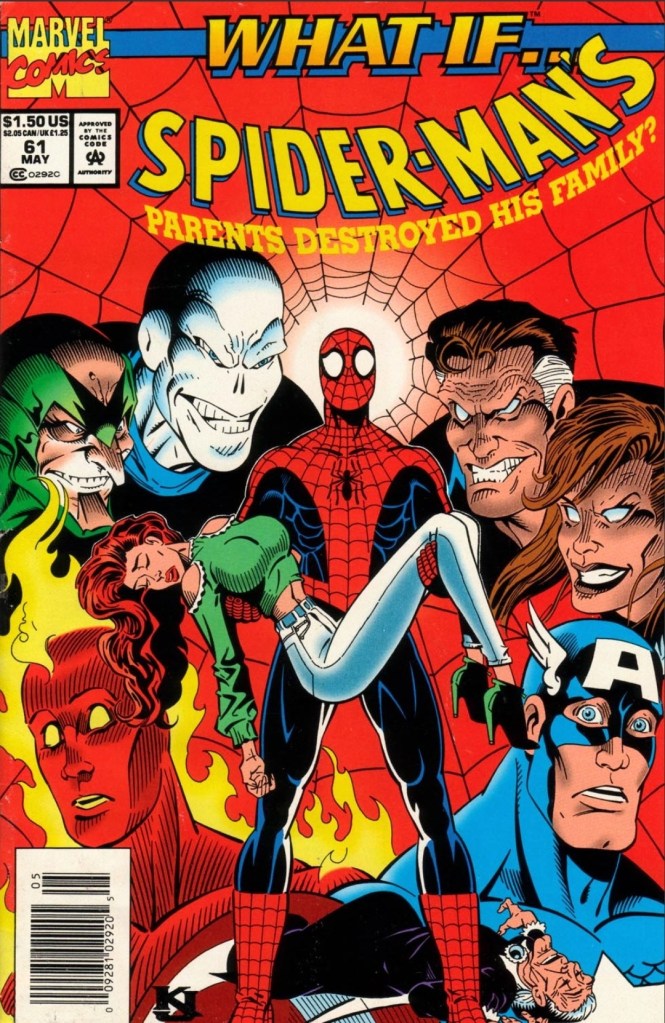
The cover.

Early story

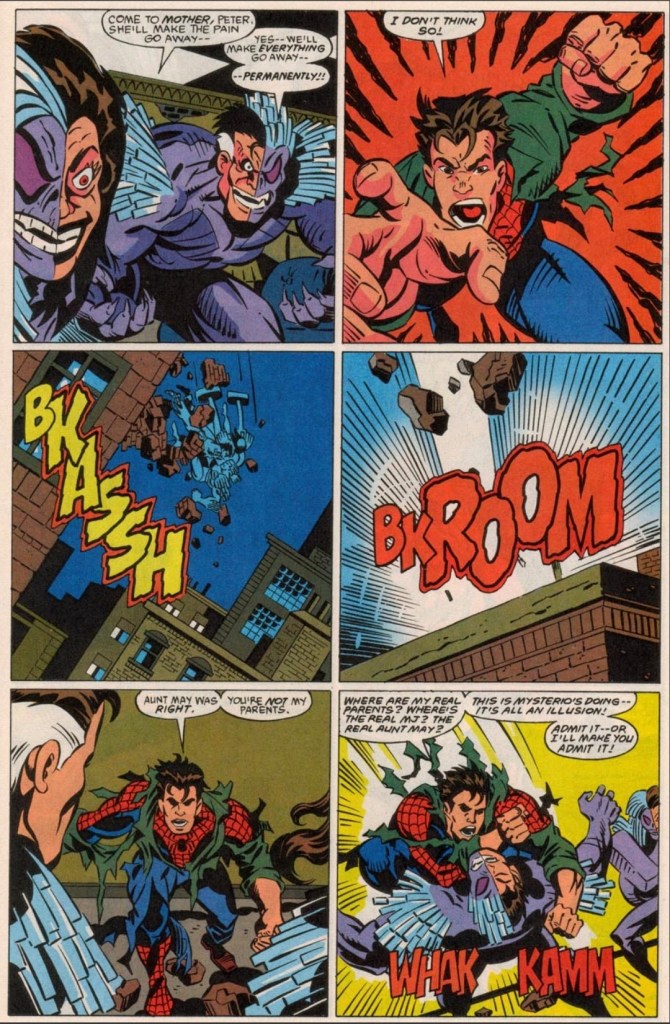
The story begins with Richard and Mary Parker (Peter Parker’s parents) arriving in the presence of Aunt May who happens to be visited by their son Peter (Spider-Man). Having learned something from a while back, Aunt May tells Richard and Mary that they are not genuine persons. Suddenly, Peter Parker’s spider sense intensifies and in an attempt to defuse the situation, he leads his aunt to walk out of the house with him. Richard and Mary watch them walk away.

It turns out, Richard and Mary are impostors and they have been working all the time for a secretive boss. Richard calls his employer under an emergency and reports that they have completed phase one of their assignment, that Aunt May knows the truth about them and is about to inform Spider-Man. Richard is then told that under no circumstances is the plan to be jeopardized and anyone who suspects must die. He is also told to flush Mary’s programming and reset her as she showed signs of acting odd to the situation.

A short time later, Richard and Mary – now in morphed forms with vastly different bodies and half their heads resembling their human selves – suddenly break into an apartment surprising Peter, his wife Mary Jane and Aunt May. Violent action by one of them accidentally ripped open Peter’s shirt, revealing his Spider-Man suit to Aunt May. Just as Peter’s aunt figures out the secret, he tells Mary Jane to grab her and get out.

However, the sight of the morphed Mary Parker shocked Aunt May and Mary Jane so much, they failed to move. Mary Parker then morphs her two hands into large, makeshift hammers, and swiftly killed Aunt May and Mary Jane. Peter is instantly shocked by their sudden deaths but deep inside, rage begins to burn…

Quality

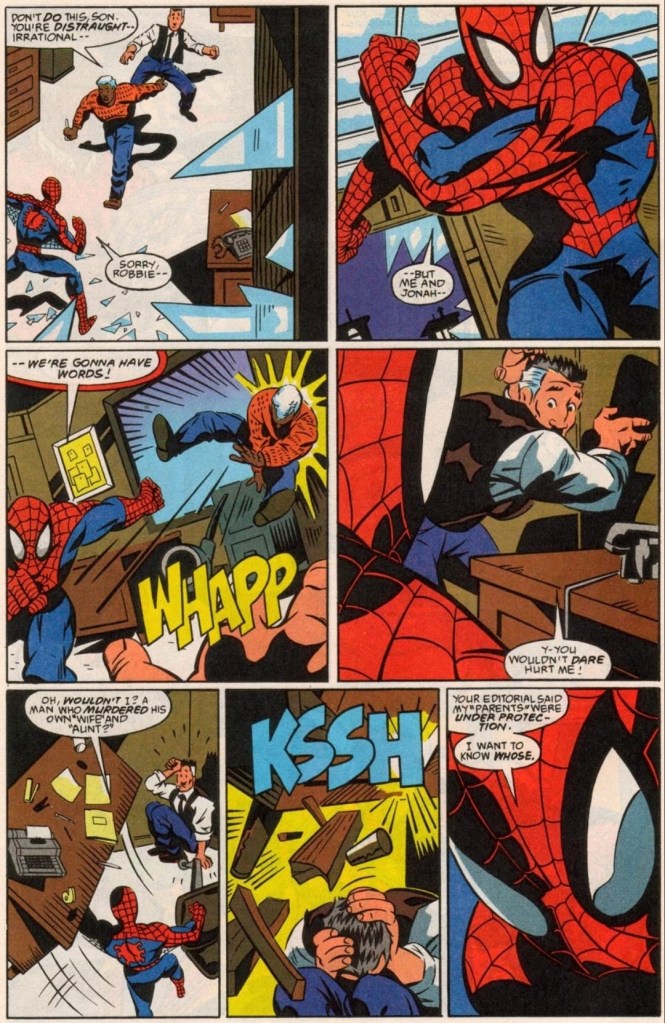
Spider-Man already over the edge and reacting violently to the abusive Daily Bugle.

I can start by confirming that Kurt Busiek’s writing is very strong and his alternate take on the events of Amazing Spider-Man (1994) is indeed very solid. In one way, I find the emotional stakes for Spider-Man has been raised a lot higher than what was portrayed in the canon story. The concept of losing his beloved family members to enemies who were impostors that looked like his long lost parents is indeed disturbing as well as emotionally charged. In relation to this, Busiek and the illustrators brought to life a Spider-Man who really went over the edge by taking matters into his own hands as the loss of beloved ones led to the blurring of the boundary between good and evil. Even the boundary between innocence and guilt gets blurred which adds more depth to the emotions of the story. As I read the story, there were moments when I felt that Spider-Man became as bad as the evil ones even though he is clearly the victim and his family was targeted.

Apart from showing Spider-Man getting outraged and pushed to the limits, Busiek inserted elements about how people perceive incidents without knowing all the facts and how easily they get manipulated by a news outlet – the Daily Bugle where Peter Parker worked as a freelance photographer – whose leader does not care about ethical journalism nor the pursuit of the truth. In this age of widespread fake news and liberal news media outlets in America doing propaganda for American Communists (read: Democrats, abortionists, LGBTQ, Black Lives Matter, Antifa, the terrorists, the climate change extremists and the socialist hordes), this particular aspect of the story makes this comic book strongly relevant to read today.

The story also sheds light on Spider-Man’s connections with other Marvel superheroes who happen to be in New York City. You will see Captain America and Johnny Storm express their concern about Spider-Man’s state of mind as they themselves still tried to figure out what really happened. In short, the superheroes here showed restraint even as Spider-Man goes to the extreme being a victim as well as a fugitive.

If there are any weak points in this comic book, it would be the art which has this cartoon-like aesthetic for much of the story. Considering the serious subject matter, the visuals are quite contradicting as they make this look like it was made for much younger readers. In fairness, the quality of the art improved during the 2nd half of the story.

Conclusion

Spider-Man takes on the impostors who looked like his parents.

As far as storytelling and characterization goes, What If (1994) succeeded a lot on portraying the iconic Spider-Man as the superhero who went over the limits of his emotions and his reasoning which is the result of the tragic deaths of two beloved family members caused by individuals who pretended to be his parents. This is a very solid story which also has a powerful ending. Where What If failed, this comic book succeeded and even exceeded it with Spider-Man truly becoming unheroic. I should state that this comic book should convince readers to go to the Amazing Spider-Man series and follow the Lifetheft storyline in issues to (which were released months before this comic book). Kurt Busiek’s script is indeed great and it is easily the driving force of the comic book.

Overall, What If (1994) is highly recommended.

+++++

Thank you for reading. If you find this article engaging, please click the like button below, share this article to others and also please consider making a donation to support my publishing. If you are looking for a copywriter to create content for your special project or business, check out my services and my portfolio. Feel free to contact me with a private message. Also please feel free to visit my Facebook page Author Carlo Carrasco and follow me on Twitter at  @HavenorFantasy as well as on Tumblr at https://carlocarrasco.tumblr.com/ and on Instagram at https://www.instagram.com/authorcarlocarrasco

A Look Back at Spider-Man 2099 #35 (1995)

Disclaimer: This is my original work with details sourced from reading the comic book and doing personal research. Anyone who wants to use this article, in part or in whole, needs to secure first my permission and agree to cite me as the source and author. Let it be known that any unauthorized use of this article will constrain the author to pursue the remedies under R.A. No. 8293, the Revised Penal Code, and/or all applicable legal actions under the laws of the Philippines.

When Marvel Comics first launched the 2099 imprint of comic books showcasing many futuristic versions of their present-day characters – like Spider-Man, Ravage and Dr. Doom – it was inevitable that the same treatment will be applied to their popular supervillains.

In 1993, the 2099 version of Vulture was introduced and he sure proved to be one tough opponent for Spider-Man 2099. Even back then, there already was clamor for a futuristic version of Venom which at the time was riding high with readers being the featured anti-hero in several limited series (starting with Lethal Protector) of comic books.

Then in 1995, after doing a creative teaser in issue , Marvel formally introduced Venom 2099 by releasing Spider-Man 2099 #35. This is my review of the comic book written by Peter David and drawn by Andrew Wildman (X-Men Adventures).

Cover
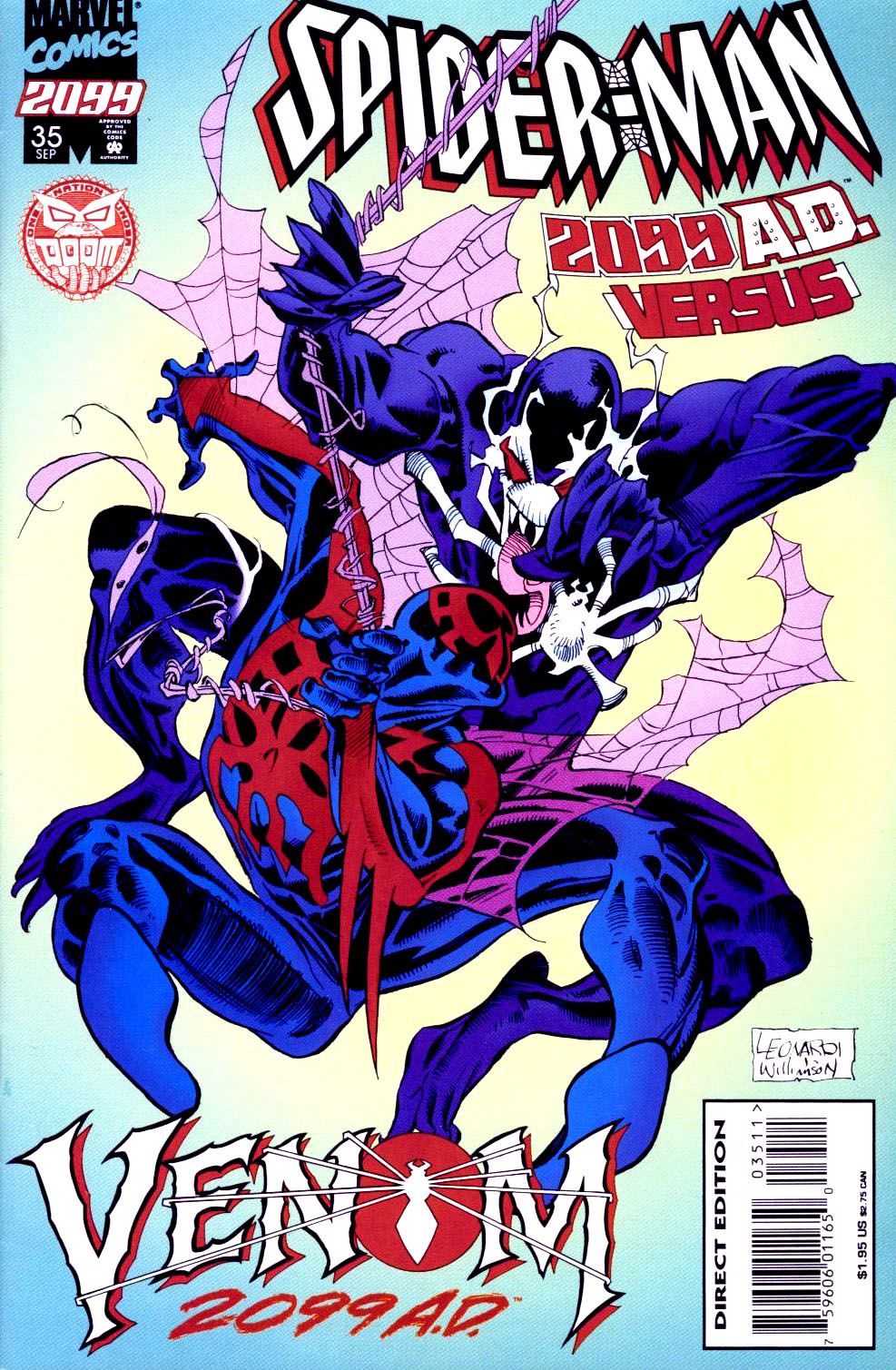
The cover drawn by Rick Leonardi.

Early story

Picking up from the events of issue , the story begins in Washington, DC with Dana freeing herself only to find out that Alchemax’s CEO Tyler Stone was down suffering from a gun shot and losing blood. Minutes later, emergency personnel take Stone’s body for immediate treatment.

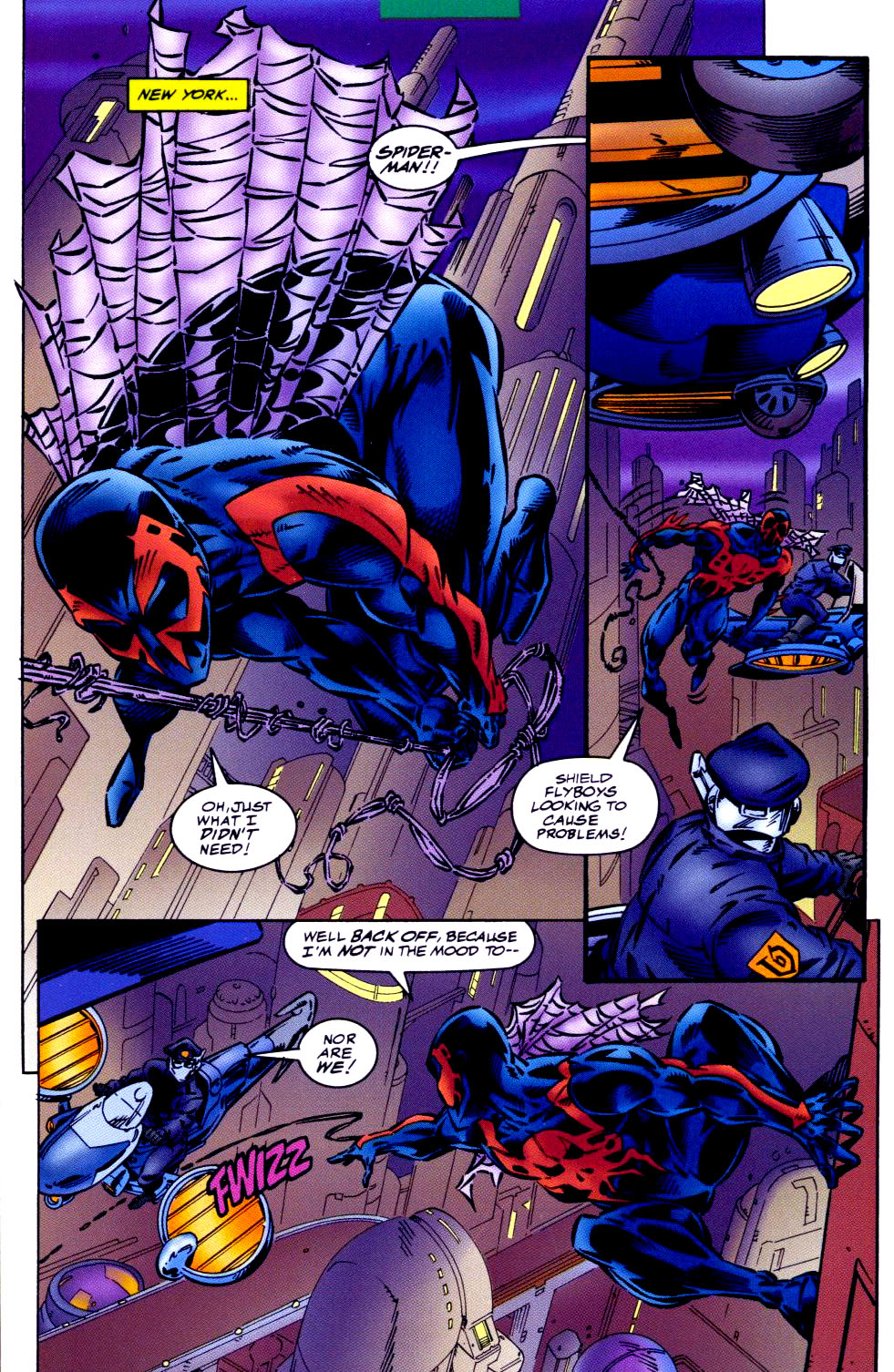
Meanwhile, Spider-Man 2099 (Miguel O’Hara) encounters the SHIELD flyboys in New York. After almost getting into trouble together, Spidey gets informed that US President Doom 2099 ordered them to leave him alone for a period of seventy-two hours while he considers a cabinet offer. Back in Washington, Dana gets interrogated by one of the authorities. President Doom enters the scene telling Dana that she will join Tyler Stone immediately in the medical center.

3
Andrew Wildman’s take on Spider-Man 2099 and the future was really nice to look at.

In New York, two guys sitting on the sidewalk witness a moving black liquid coming out of the sewer. The thing turns out to be a living symbiote (or alien costume) forming into a human-like shape – Venom 2099!

Quality

As with other comic books of this particular series, the writing by Peter David is pretty deep and engaging. The usual balance between dramatization, character development, plotting and spectacle is here once again but with a slight touch of horror in relation to the introduction of Venom of 2099. Speaking of dramatization, the portrayal of Venom 2099 as a vicious villain is similar to the 20th century Venom (Eddie Brock) but with a very powerful obsession to kill Miguel O’Hara and Tyler Stone.

Here’s an excerpt from the dialogue of Venom of 2099: Miguel O’Hara…and Tyler Stone…together again. We…I get to kill you…at the same time…how awfully…awfully…considerate. To show my appreciation…I’ll kill you slowly.

What makes this comic book unique is the artwork by Andrew Wildman who temporarily replaced regular illustrator Rick Leonardi. For comparison, I find Wildman’s art style a welcome thing in this comic book mainly because he draws with a lot more detail per panel and per page than Leonardi ever could. Instead of seeing the usual sketch-like art style of Leonardi, Wildman’s style is livelier and more expressive to look at. I also enjoyed Wildman’s visual take on Spider-Man 2099/Miguel O’Hara, Lyla, Tyle Stone, and the other established characters. Their facial expressions are also livelier to see.

9
Venom 2099 appears! Take note of the “liquid” at the edges of the page.

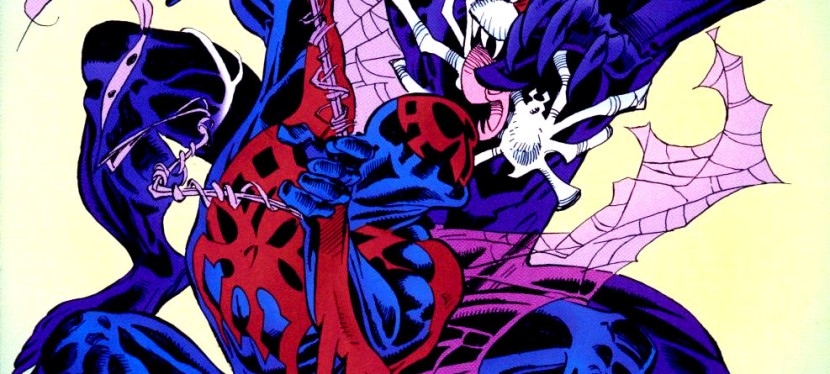
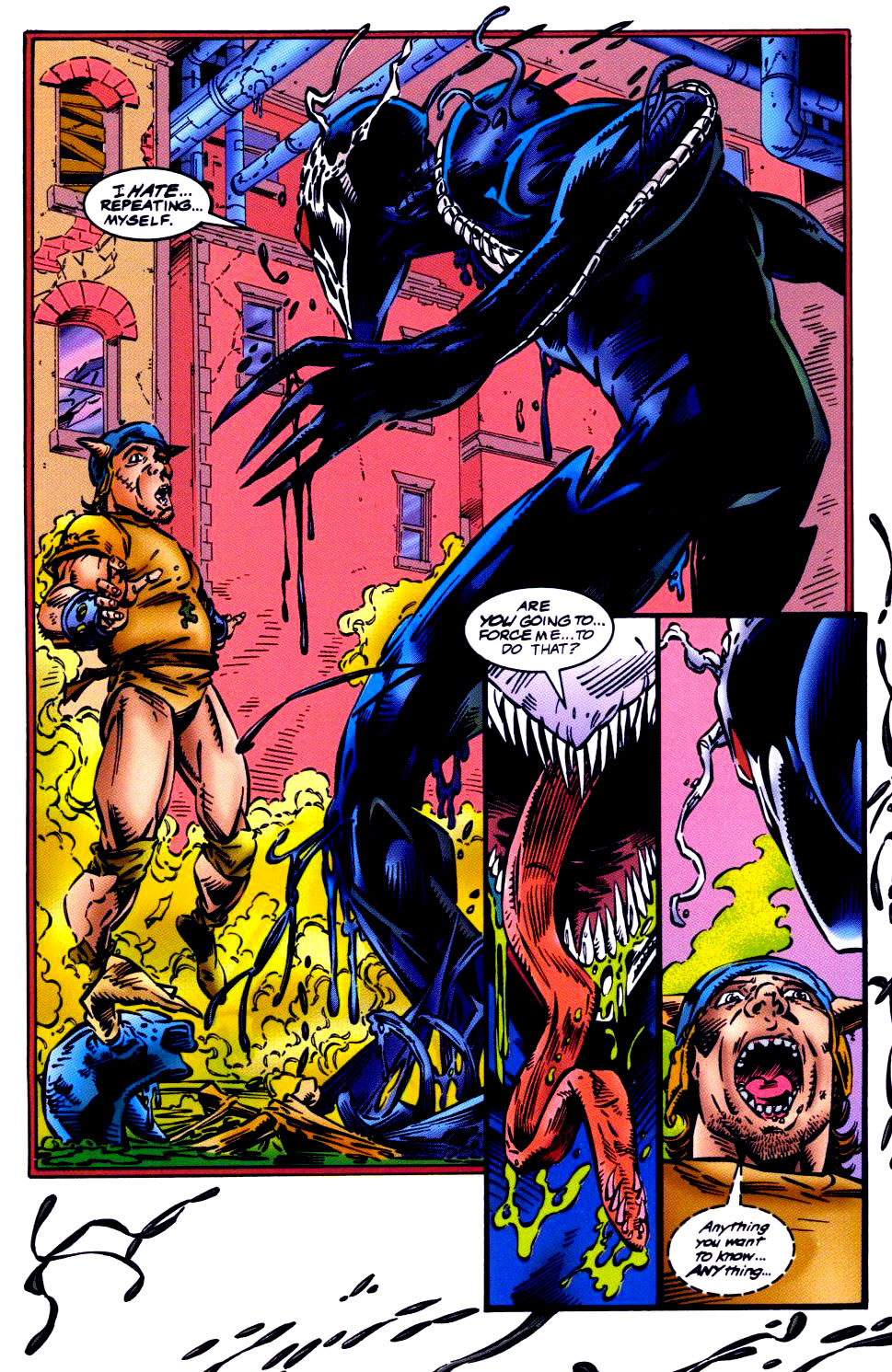
More on visuals, Wildman’s take on Venom 2099 is unforgettable. Like 20th century Venom, he has a dark suit, elongated jaw with rows of sharp teeth and an elongated tongue but with green acid dripping all the time. There are also those tentacles-like things that stretch from his body until the arms. Also his white-colored mask with large eyes make him look horrific.

Conclusion

Despite being shorter than the usual 22-pages, Spider-Man 2099 #35 is still a very engaging and fun old comic book to read. Its purpose was to build-up anticipation leading to the introduction of Venom 2099 was achieved nicely and the respective qualities of the writing and visuals are very good even by today’s standards. More on the presentation of Venom of 2099, it seems like Peter David took inspiration from movie director James Cameron on building-up tension and suspense before showing the villain. That’s a move I enjoyed in this comic book.

Overall, Spider-Man 2099 #35 is highly recommended. If you plan to acquire an existing and legitimate hard copy, be aware that the near-mint copy of it is over $100 for the newsstand version while the Rich Leonardi-drawn “Venom 2099 AD” cover version is priced at over $80 at MileHighComics.com as of this writing.


Thank you for reading. If you find this article engaging, please click the like button below and also please consider sharing this article to others. Also my fantasy book The World of Havenor is still available in paperback and e-book format. If you are looking for a copywriter to create content for your special project or business, check out my services and my portfolio. Feel free to contact me as well. Also please feel free to visit my Facebook page Author Carlo Carrasco and follow me at HavenorFantasy@twitter.com