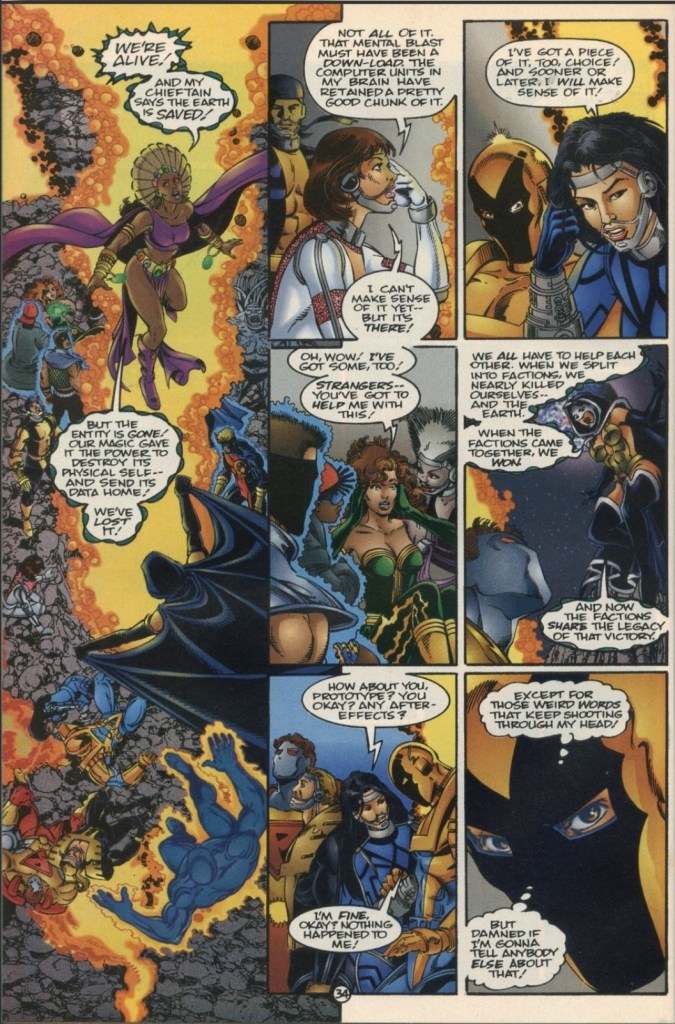
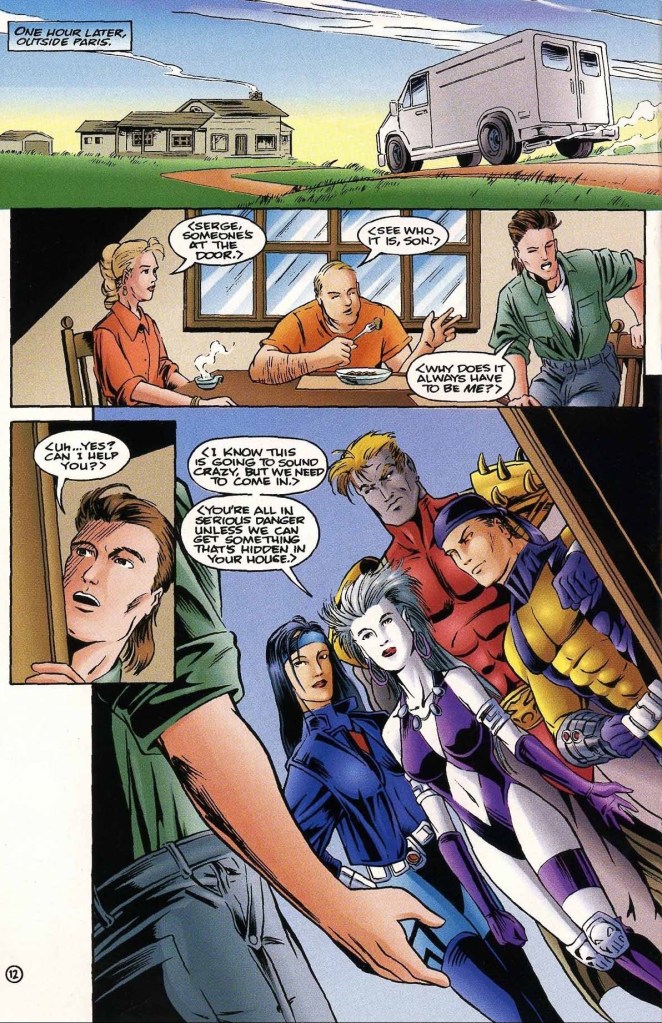
A Look Back at Ultraverse Premiere #4 (1994)

Disclaimer: This is my original work with details sourced from reading the comic book and doing personal research. Anyone who wants to use this article, in part or in whole, needs to secure first my permission and agree to cite me as the source and author. Let it be known that any unauthorized use of this article will constrain the author to pursue the remedies under R.A. No. 8293, the Revised Penal Code, and/or all applicable legal actions under the laws of the Philippines.

Welcome back, superhero fans, 1990s arts and culture enthusiasts and comic book collectors! Today we revisit the Ultraverse of Malibu Comics and examine one of its many stories told through an issue of the Ultraverse Premiere series.

For the newcomers reading this, Ultraverse Premiere was a series of comic books published by Malibu Comics that showcased several tales of the Ultraverse and its characters. These stories were made to expand the lore of the UV, emphasize key characters and give fans a lot of content to enjoy. Certain issues of Ultraverse Premiere served as flip comic books which are thick (a lot more than the normal 32 pages) and allow you to read Ultraverse Premiere tales on side and read another UV comic book on the other side. The Ultravere Premiere comic book I am about to review here had The Strangers #13 on its flip side.

With those details laid down, here is a look back at Ultraverse Premiere , published by Malibu Comics in 1994 with stories written by Len Strazewski and Kurt Busiek, and drawn by Frank Gomez and Kris Renkewitz.

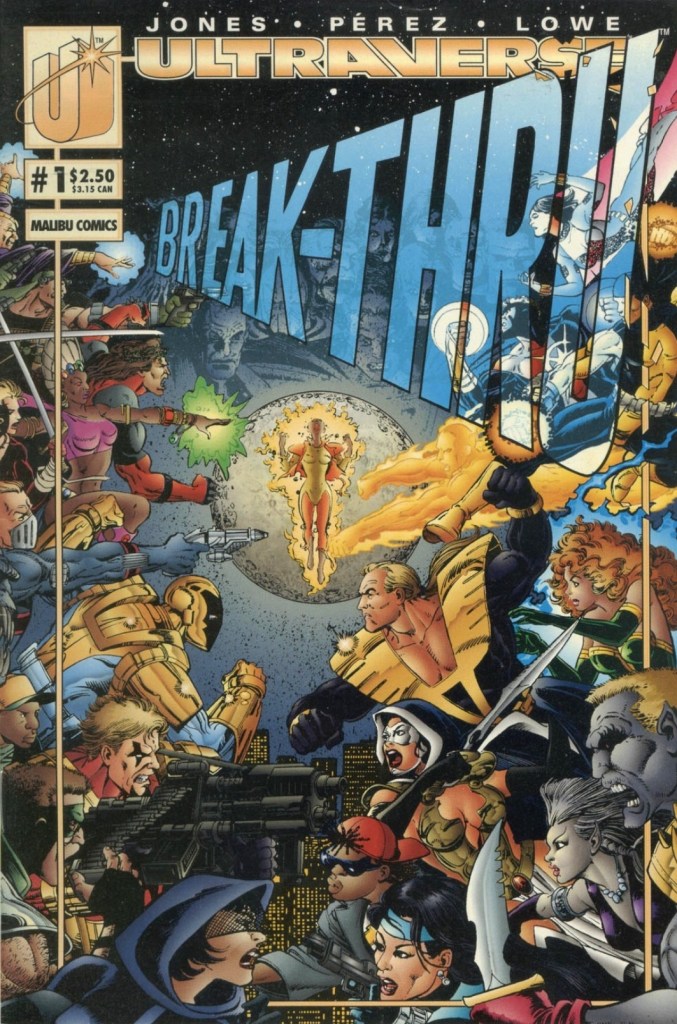
The cover.

Early stories

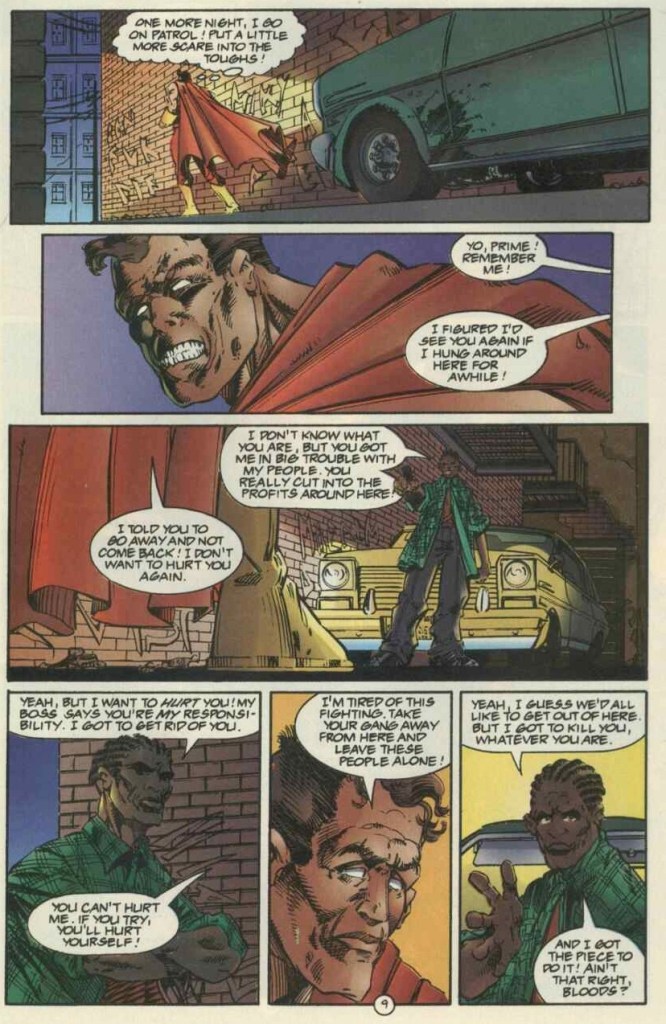
Story 1 – the story begins with Prime making several appearances protecting innocent people from gangs, muggers, thieves and natural disasters. Specifically, his presence is making an impact on the lives of many neighborhoods and its people.

Sometime later, inside a private facility, the figure identified as Prime turns out to be fake and was designed as a human-shaped suit that was piloted inside by Sy Bernstein. He is personally determined to make an impact on crime in his local community with the fake Prime as his main tool.

Story 2 – the story begins with Lady Killer privately viewing a cartoon preview based on her team – The Strangers – with an executive of Imagine-Arts. Shortly after, Lady Killer meets with more executives of the said company and she is told that Imagine-Arts and Labrava Company (Lady Killer’s own enterprise) make a business deal match and they offer to buy her out. Lady Killer tells them that her company and herself are not for sale…

Quality

Lady Killer talking hard on business.

As far as storytelling goes, this comic book’s two tales succeeded in expanding the lore of the Ultraverse through Prime (as a figure to certain members of the public) and Lady Killer, the leader of The Strangers. The Prime-related story offers a nice take on one small part of the Ultraverse that deals with a local community tainted with crime and how Prime’s influence on the ordinary people impacts the said community in varied ways. Of course, these are all executed not with Prime/Kevin Green himself but rather with someone who happens to have the means to pose as Prime and pretend to be the ultrahero himself. Having read a lot of the adventures of the real Prime, this Prime tale is a really nice take although I should say that the art by Frank Gomez has that very rough look all throughout.

The second story meanwhile is an interesting side-story of The Strangers specifically limited to Lady Killer. She gets into business talk with one company which only leads to an intriguing turn of events which creatively emphasizes capitalism to be corrupt and twisted. In some ways, the anti-corporate theme of the story overshadows the plot itself and as the story progressed, Lady Killer slightly becomes less relevant. To be fair to the creative team, this side-story happens to be the first portion of a storyline that involves J.D. Hunt. To say the least, this tale is worth reading even though its protagonist lost some relevance due to a plot twist that started before reaching the end.

Conclusion

Something very odd here.

Ultraverse Premiere (1994) indeed carries enough entertainment and literary value on its two UV tales alone. Just consider The Strangers as a notable additive thanks to the flip side feature. Prime fans will most likely be intrigued and even entertained with the first story while The Strangers fans might end up dissatisfied with the story centered on Lady Killer not because it is the first chapter of a multi-part story but more on its storytelling quality. At least the art of the Lady Killer tale done by Kris Renkewitz is good to look at.

Overall, Ultraverse Premiere (1994) is recommended.

+++++

Thank you for reading. If you find this article engaging, please click the like button below and also please consider sharing this article to others. If you are looking for a copywriter to create content for your special project or business, check out my services and my portfolio. Feel free to contact me with a private message. Also please feel free to visit my Facebook page Author Carlo Carrasco and follow me on Twitter at  @HavenorFantasy as well as on Tumblr at https://carlocarrasco.tumblr.com/and on Instagram at https://www.instagram.com/authorcarlocarrasco/

A Look Back at Sludge #7 (1994)

Disclaimer: This is my original work with details sourced from reading the comic book and doing personal research. Anyone who wants to use this article, in part or in whole, needs to secure first my permission and agree to cite me as the source and author. Let it be known that any unauthorized use of this article will constrain the author to pursue the remedies under R.A. No. 8293, the Revised Penal Code, and/or all applicable legal actions under the laws of the Philippines.

Welcome back, superhero fans, 1990s arts and culture enthusiasts and comic book collectors! Today we revisit the Ultraverse of Malibu Comics and examine one of its many stories told through an issue of the Sludge comic book series.

In my previous Sludge retro comic book review, the stakes were raised for Sludge and the city of New York as a new conflict started brewing that brought in two gangs along with the Pump and his own gang, and even mercenaries. Issue was the start of a new multi-part storyline that Steve Gerber crafted and it encouraged re-reading the early issues of the Sludge series to understand the scope of the new conflict.

With those details laid down, here is a look back at Sludge , published by Malibu Comics in 1994 with a story written by Steve Gerber and drawn by Aaron Lopresti.

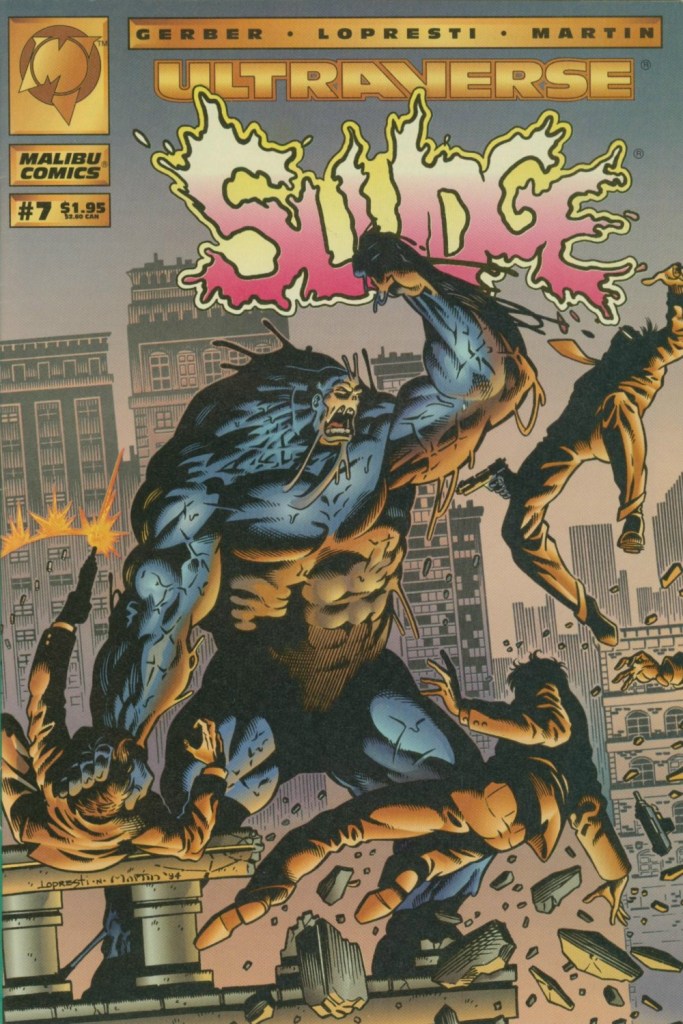
The cover.

Early story

The story begins with a man and a woman on bed. Their privacy gets interrupted when the Pump suddenly appears in frightening fashion. It turns out, Sludge was in the middle of a nightmare and even sees a frightening vision of Edna. He then makes his way through in the sewer.

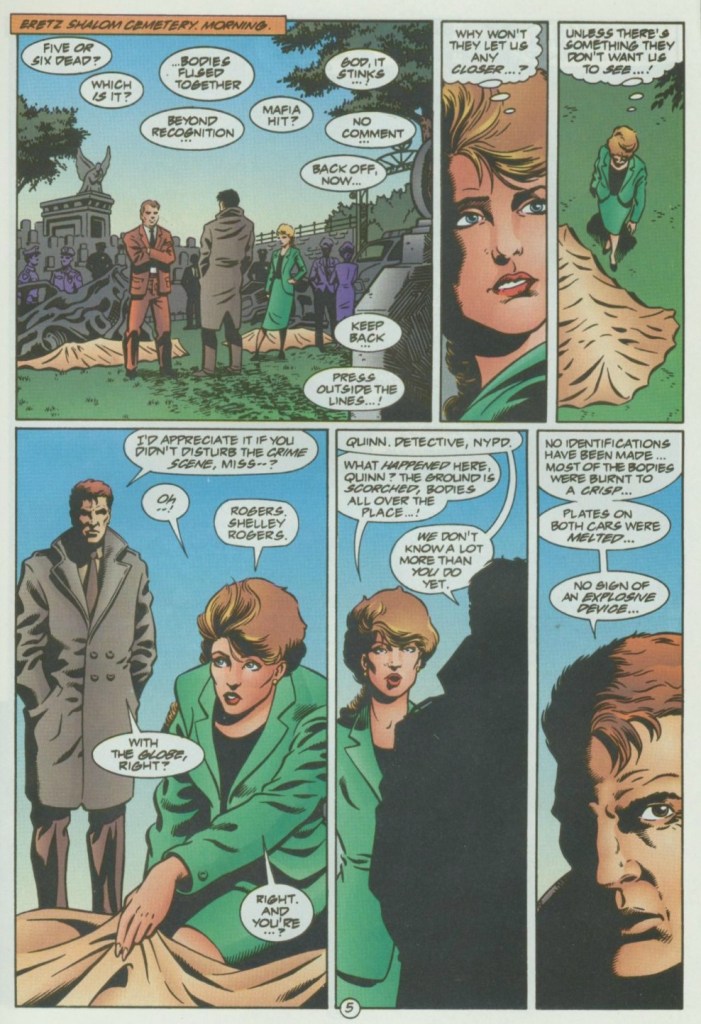
One morning at the Eretz Shalom Cemetery, a police investigation is being conducted as the local authorities found several dead bodies as well as scorched ground, bodies fused together and a some odor. Shelley, the very determined reporter of the New York Daily Globe, tries to uncover details at the crime scene only to be interrupted by a detective named Quinn. In response to her question, Quinn admits they are just discovering things and trying to figure things out.

Suddenly a lady wearing a suit and necktie approaches them…

Quality

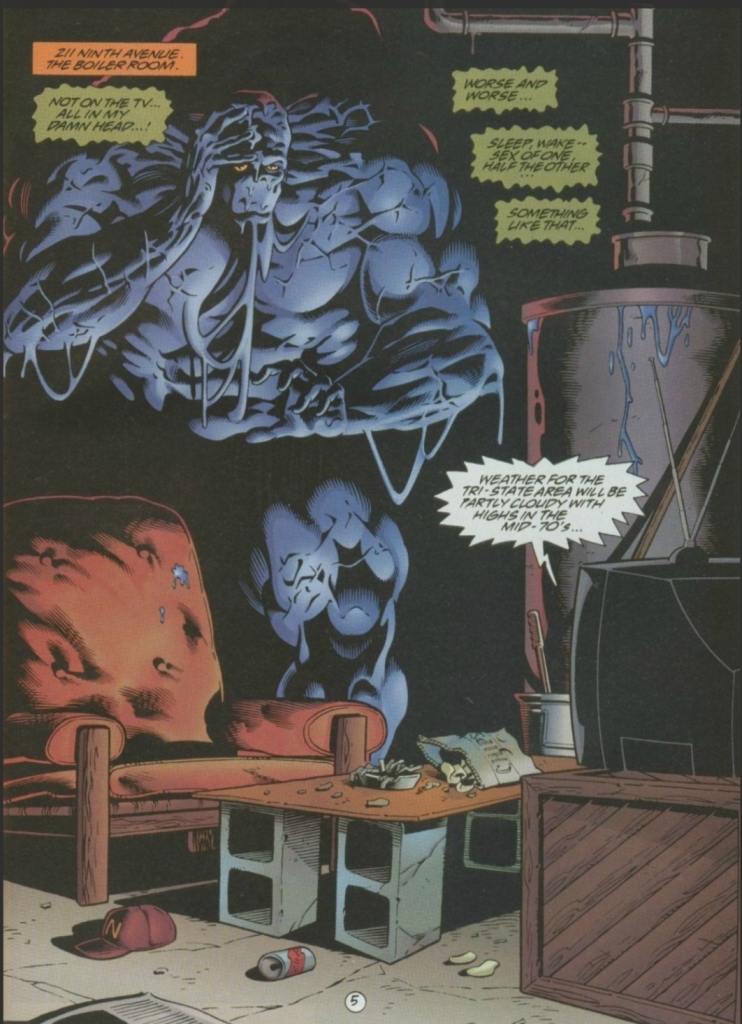
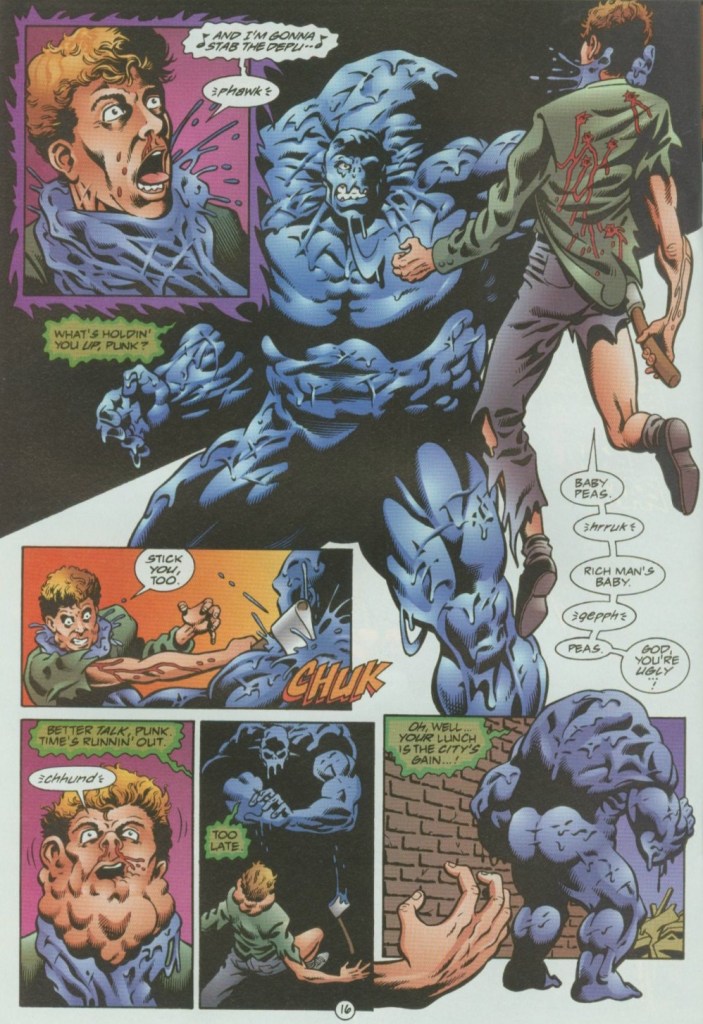
Avoiding the touch of Sludge is a must!

As far as storytelling goes, this tale is a very solid follow-up to the previous issue. While issue showed the start of a big conflict involving three groups, this one shows the emotional and physical impact on the gang leaders (John Paul Marcello and the Dragon Fang) and the unrelenting pursuit of the Pump and his minions on wrecking down society by means of drug pushing and violence. In a way, this Ultraverse story daringly showed its own portrayal of illegal drugs and gang wars while also showing Sludge suffering more and getting even more desperate with his life. I should also state that there are scenes that added detective story and suspense vibes into the narrative.

It should be noted that at this point in the Sludge series, the titular character does some things here that would maker readers question his moves and his sanity, especially since the Pump (note: the Ultraverse’ very own Satan figure) keeps on tempting and manipulating him. Sludge, who was once a crooked cop when he was still human, clearly is vulnerable deep inside and he also is not resistant to the evil influences around him. Very notably, the story by Steve Gerber is strong enough to make me go on to read the next issue.

Conclusion

Shelley of the city newspaper at the scene of the crime.

Sludge (1994) is the kind of comic book that will make you think deeply about the true nature of the titular character and why should you keep on reading each new comic book of this series when you learn that the said character is far from being heroic. The lines that separate good and evil is very blurred at this stage of the Sludge series. This is one clever and really engaging piece of work done by the Gerber-Lopresti team, and at the same time it is also one of the most intriguing Ultraverse tales ever told. That being said, the comic book’s concept is incidentally not ideal for readers who seek good-versus-evil conflicts that get resolved.

If you are seriously planning to buy an existing hard copy of Sludge (1994) be aware that as of this writing, MileHighComics.com shows that the near-mint copy of the regular edition costs $16.

Overall, Sludge (1994) is recommended.

+++++

Thank you for reading. If you find this article engaging, please click the like button below and also please consider sharing this article to others. If you are looking for a copywriter to create content for your special project or business, check out my services and my portfolio. Feel free to contact me with a private message. Also please feel free to visit my Facebook page Author Carlo Carrasco and follow me on Twitter at  @HavenorFantasy as well as on Tumblr at https://carlocarrasco.tumblr.com/and on Instagram at https://www.instagram.com/authorcarlocarrasco/

A Look Back at The Night Man #6 (1994)

Disclaimer: This is my original work with details sourced from reading the comic book and doing personal research. Anyone who wants to use this article, in part or in whole, needs to secure first my permission and agree to cite me as the source and author. Let it be known that any unauthorized use of this article will constrain the author to pursue the remedies under R.A. No. 8293, the Revised Penal Code, and/or all applicable legal actions under the laws of the Philippines.

Welcome back, superhero fans, 1990s arts and culture enthusiasts, and comic book collectors! Today we revisit the Ultraverse of Malibu Comics and examine one of its many stories through The Night Man monthly series.

Remember the group TNTNT? That group appeared in The Strangers #3 and proved to be a strong force of opposition against the team of Atom Bob, Lady Killer, Grenade, Zipzap, Electrocute, Spectral and Yrial. As revealed in that comic book, TNTNT – composed of Tyrannosaur, Naiad, Torso, Neu-Ronnie and Tugun – was trained and equipped by the corporation called NuWare under the watch of their powerful executive J.D. Hunt who clearly has something planned.

That being said, can you imagine what would it be like if TNTNT had ganged up on a solo ultra…like the Night Man?

With those details laid down, here is a look back at The Night Man , published by Malibu Comics in 1994 with a story written by Steve Englehart and drawn by Kyle Hotz.

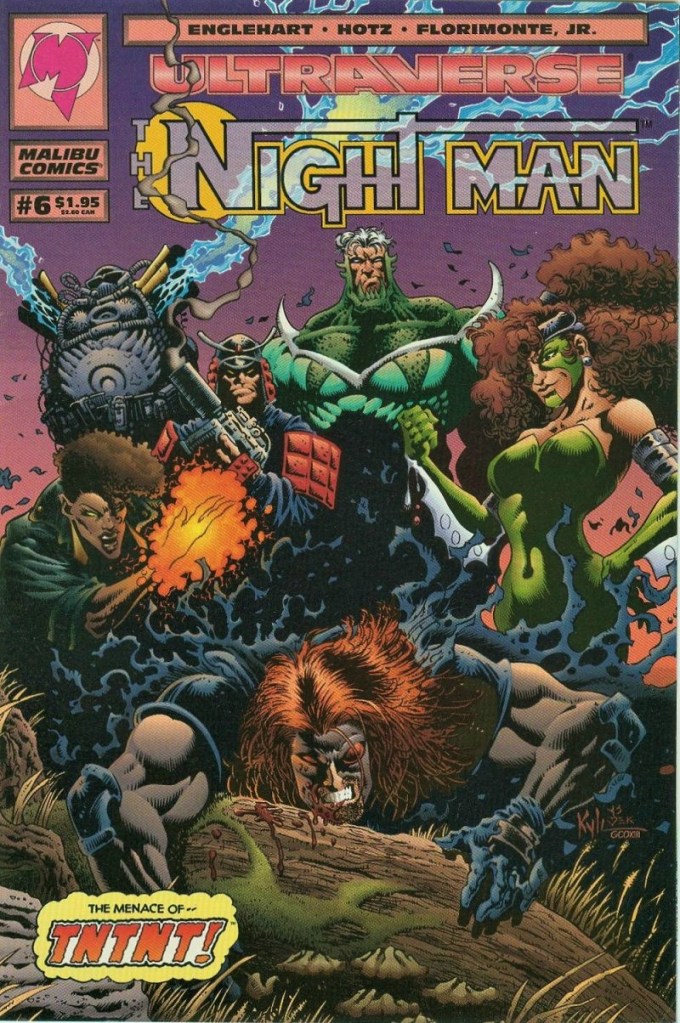
The cover.

Early story

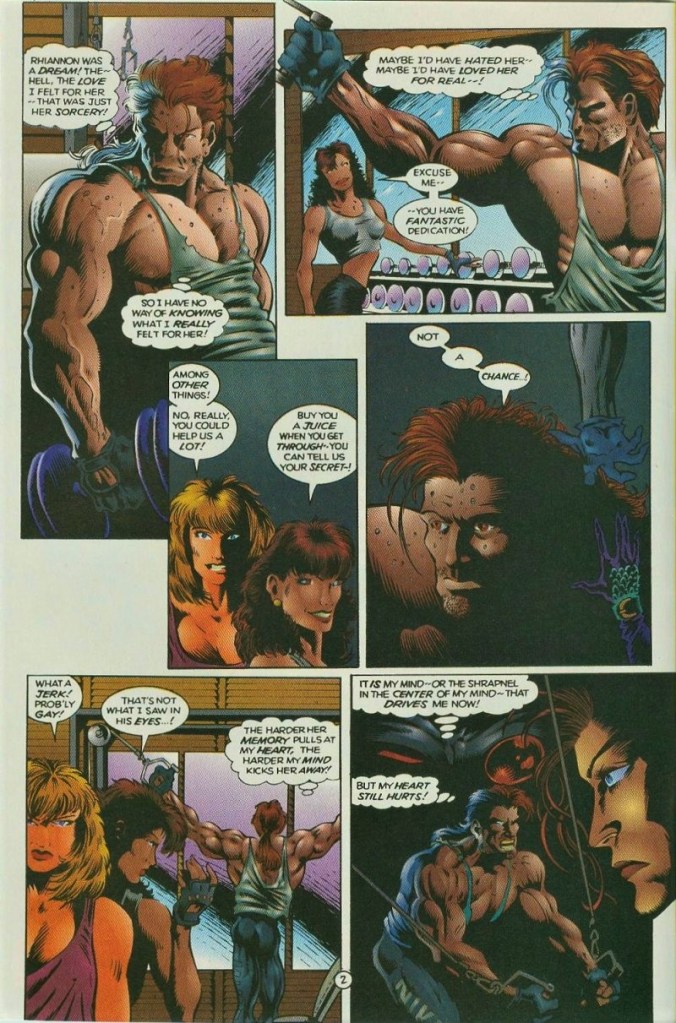
The story begins with Johnny/Night Man working out hard in a gym observed closely by two attractive ladies. While thinking about what happened recently, the two ladies tried to interact with him. He rejects them and continues to work out hard.

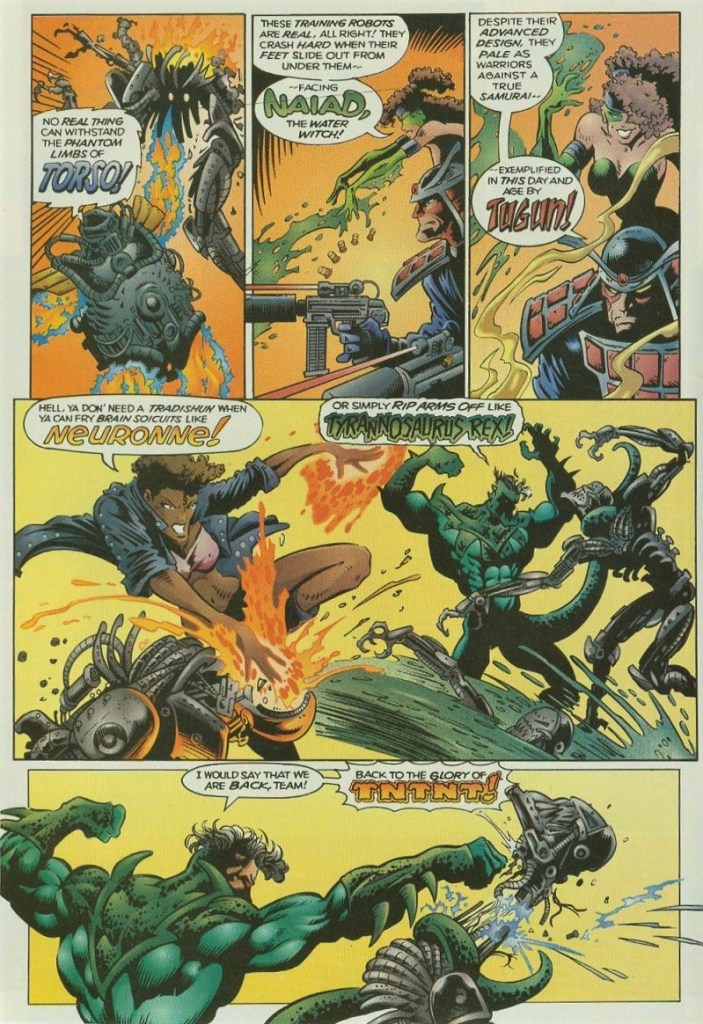
Meanwhile over at a high-tech facility in Sunnyvale, California, the group called TNTNT begins to act in a private training session surrounded by fierce looking robots. One by one, Tyrannosaur, Naiad, Torso, Neu-Ronnie and Tugun make short work of the training robots. Tyrannosaur even declares that the glory of their team is back.

However, the man operating the session from behind a control booth talks to them, reminds them that they are still employees of J.D. Hunt, and he tells them that they recovery from their loss to the Strangers will be realized only after killing the Night Man…

Quality

The TNTNT members in training.

Wow! This is one well-paced ride with a structured narrative! Without spoiling the plot details, I can confirm that the creators succeeded in delivering the big mismatch of the Night Man facing off with the 5-member TNTNT with a good amount of spectacle balanced with really interesting character moments.

By comparison with their previous appearance in The Strangers , the members of the TNTNT each got more defined in terms of personality in this comic book even during their pages-long encounter with the Night Man. Take for example Tugun whose culture really shaped his perception on such things like insults. Tyrannosaur meanwhile is always confident he’ll win for sure as he knows his super strength and very tough skin make him almost invincible. The way Night Man dealt with each TNTNT member was moderately paced, backed with quick details (to explain things) and was executed in rather believable ways.  On characterization, Steve Englehart convincingly portrayed TNTNT like they are real people who happen to be paid and trained by some powerful employer who really wants things done for him.

At the point of this comic book’s publishing, the Night Man established himself as San Francisco’s radio commentator-in-hiding believing he can inspire people to stand up for themselves when encountering evil elements. At the same time, this comic book further emphasized connectivity within the Ultraverse. In addition to Night Man’s crossover with Freex, his encounter with TNTNT technically links him with The Strangers.

More on the writing, there are these subtle yet clear traces of socialism and anti-corporatism particularly with the way Night Man confronted a man who bought a stretch of a beach perceived by the protagonist as public. The portrayal of J.D. Hunt as a power-mad and sinister business executive is not surprising, but the way he was portrayed in dealing with his employees TNTNT symbolizes the capitalist being abusive towards his laborers. Whatever this comic book tried to say, nothing changes the fact that socialism sucks and it is wicked, twisted and corrupting.

Conclusion

Johnny focused on his workout.

The Night Man (1994) is entertaining and compelling to read. Its substance is quite rich and it is surprisingly good that the creators managed to develop the TNTNT members even as they proceeded with their mission to kill the protagonist. As for Night Man, he’s clearly a vigilante with a cause and as a symbolic tool of socialism, he was portrayed to be pro-people and an arrogant opponent of capitalism. This made him look more like a foolish pawn of socialism and less of a hero.

Speaking of San Francisco, could you imagine what would it be like if Night Man was real today and witnesses how the Satanic Left of San Francisco led the city into social deterioration and disorder? Watch the videos below for insight…

If you are seriously planning to buy an existing hard copy of The Night Man (1994) be aware that as of this writing, MileHighComics.com shows that the near-mint copy of the regular edition costs $16.

Overall, The Night Man (1994) is recommended.

+++++

Thank you for reading. If you find this article engaging, please click the like button below and also please consider sharing this article to others. If you are looking for a copywriter to create content for your special project or business, check out my services and my portfolio. Feel free to contact me with a private message. Also please feel free to visit my Facebook page Author Carlo Carrasco and follow me on Twitter at  @HavenorFantasy as well as on Tumblr at https://carlocarrasco.tumblr.com/ and on Instagram at https://www.instagram.com/authorcarlocarrasco/
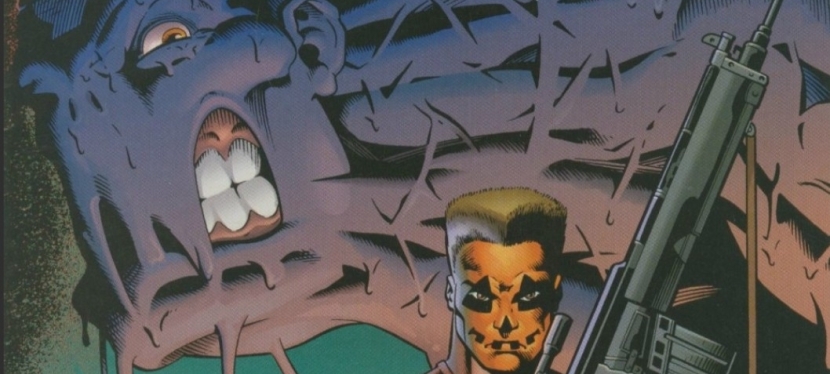
A Look Back at WildC.A.T.S: Covert Action Teams #9 (1994)

Disclaimer: This is my original work with details sourced from reading the comic book and doing personal research. Anyone who wants to use this article, in part or in whole, needs to secure first my permission and agree to cite me as the source and author. Let it be known that any unauthorized use of this article will constrain the author to pursue the remedies under R.A. No. 8293, the Revised Penal Code, and/or all applicable legal actions under the laws of the Philippines.

Welcome back superhero fans, 1990s arts and culture enthusiasts and comic book collectors! Today we continue revisiting Jim Lee’s flagship title under the Image Comics label – WildC.A.T.S: Covert Action Teams!

Last time around, members of the WildC.A.T.S were split apart in terms of locations as they had their rest-and-relaxation period. While Grifter went away to do something urgent (read: the Kindred comic books), Zealot, Void and Jacob Marlowe’s executive assistant Jules picked up Warblade and Maul using their high-tech aircraft to head on to the Bahamas where an entire cruise ship disappeared with Marlowe, Voodoo and Spartan on it.

Unbeknownst to the WildC.A.T.S flying in their jet, Voodoo, Spartan and Marlowe found themselves as captives of an armored man (wearing a half-helmet) called Entropy inside his domain in an undetermined location. Entropy refers to Marlowe as lord Emp and states that he will suffer from his wrath. Marlowe does not recognize him.

With those details laid down, here is a look back WildC.A.T.S: Covert Action Teams , published by Image Comics in 1994 with a story written by Brandon Choi and Jim Lee. Lee did the art with Scott Williams in-charge with the ink work.

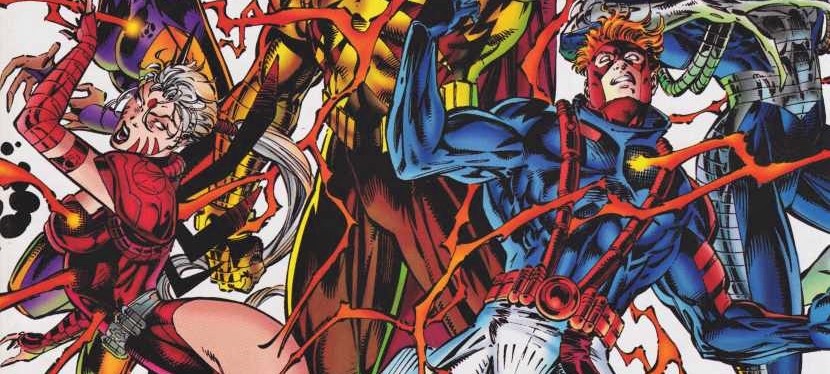
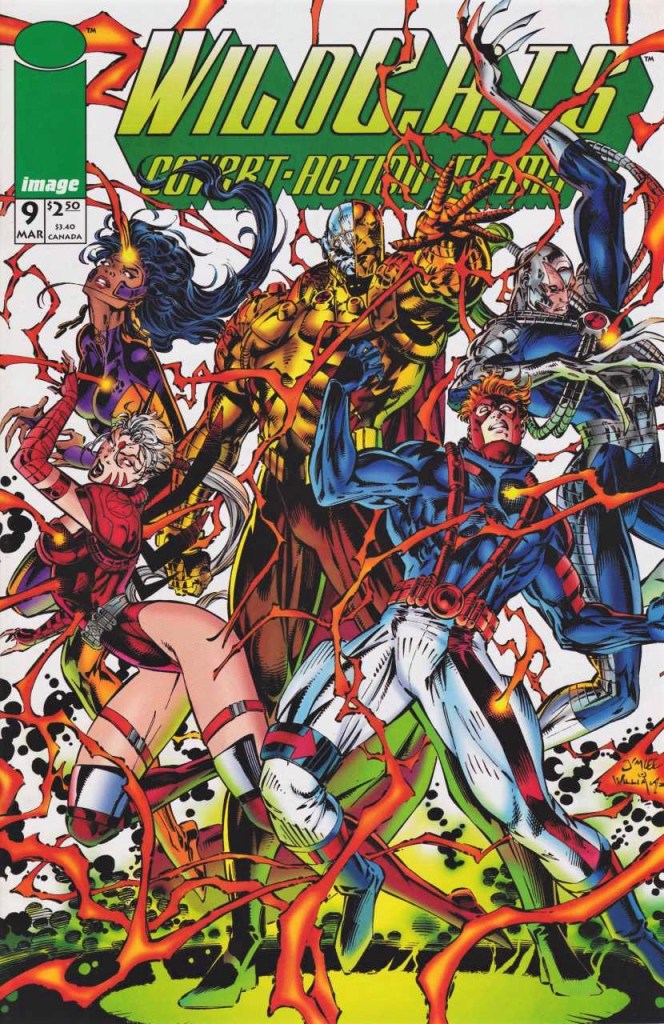
The cover.

Early story

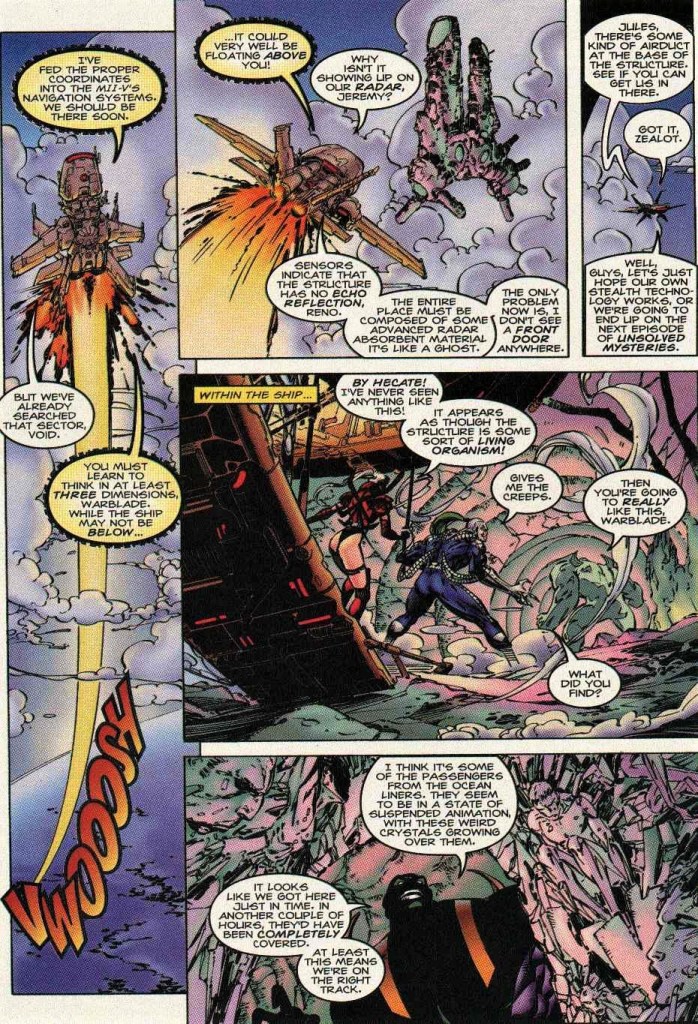
The story begins with the partial WildC.A.T.S team arriving in the area of the Bermuda triangle with their aircraft. From their view, there was nothing to spot but Zealot insists that they keep on searching as they must be overlooking something.

Meanwhile, Spartan and Voodoo find themselves in deep trouble as a horde of Daemonites persistently attack them. Already heavily damaged, Spartan keeps on using his energy blasts to hold the monsters off. Voodoo on the other hand is too weak and could not concentrate to help her teammate.

Suddenly one of the Daemonites slashes Spartan’s left arm which neutralizes his energy blast. His body got pierced by one of the monsters which pinned him down, leaving Voodoo completely helpless…

Quality

The WildC.A.T.S on search-and-rescue.

On face value, this comic book looks like another generic or even disposable good-versus-evil story drawn by Jim Lee. In reality, its story has more significance to it and the creators themselves came up with something fresh for WildC.A.T.S fans. Firstly, this is a story about one group of WildC.A.T.S trying to rescue their boss and their two other teammates from Entropy in a location that could not be easily found. Secondly, this comic book puts strong focus back on the Kherubim-Daemonite war which creatively looks back at one of the many events that took place in Jacob Marlowe’s past (which he could not remember at first) complete with implementing a strong fantasy (read: swords and armors) element which gives the story a mixed-genre aesthetic.

The good news here is that the storytelling and visual presentation by the creators are really well done! While the dual approach of storytelling involving both the present and the far past was used in Jim Lee’s past X-Men works with Marvel, the said approach was well executed with WildC.A.T.S which not only expanded its lore further but also developed Jacob Marlowe’s personality even further.

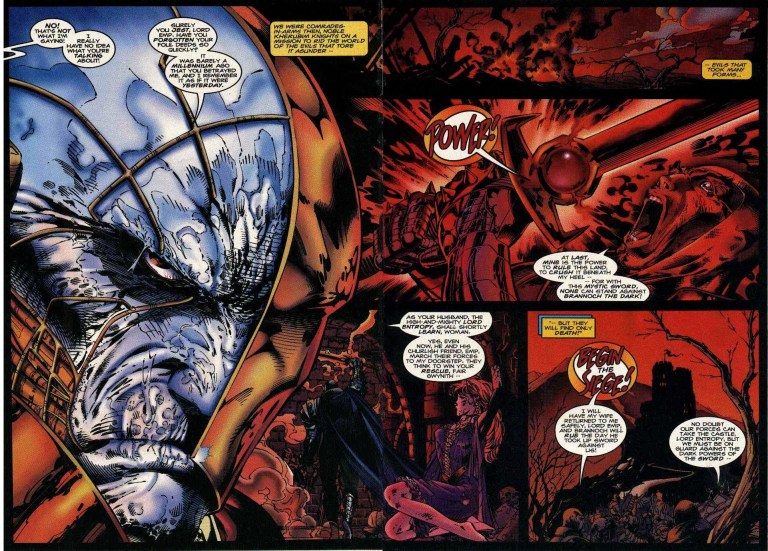
To have Entropy (note: he eerily resembles’ Mantra arch-villain Boneyard in the Ultraverse) as an enraged opposition figure living with a lust for revenge against Marlowe is a smart move and at the same time this adds variety to the kind of opposition WildC.A.T.S have. More on what happened in the past involving both Marlowe and Entropy, the flashback raises new questions about the value and true nature of the WildC.A.T.S’ leader who at this point was a brash manager who wields lots of resources to operate with. The flashback also challenges readers on how to evaluate Jacob Marlowe when it comes to being accountable about his past actions, including the many things he did but could not remember. All of these lead to a really impactful ending that you readers must see.

Conclusion

Meet Entropy, a man with a shared past with Jacob Marlowe.

WildC.A.T.S: Covert Action Teams (1994) is a Jim Lee-drawn tale that has solid depth and a very creative approach to its presentation, specifically its daring and well-executed method of mixing the superhero and fantasy elements. When it comes to the narrative, the creative team succeeded in telling both the present and the past tales followed by connecting them with each other while ultimately telling an overall cohesive tale. This is a Wild.C.A.T.S story that must be read from start to finish, and it is a powerful follow-up to issue .

If you are seriously planning to buy an existing hard copy of WildC.A.T.S: Covert Action Teams (1994), be aware that as of this writing, MileHighComics.com shows that the near-mint copy of the regular edition costs $30.

Overall, WildC.A.T.S: Covert Action Teams (1994) is highly recommended.

+++++

Thank you for reading. If you find this article engaging, please click the like button below and also please consider sharing this article to others. If you are looking for a copywriter to create content for your special project or business, check out my services and my portfolio. Feel free to contact me with a private message. Also please feel free to visit my Facebook page Author Carlo Carrasco and follow me on Twitter at  @HavenorFantasy as well as on Tumblr at https://carlocarrasco.tumblr.com/and on Instagram at https://www.instagram.com/authorcarlocarrasco/

A Look Back at The Solution #11 (1994)

Disclaimer: This is my original work with details sourced from reading the comic book and doing personal research. Anyone who wants to use this article, in part or in whole, needs to secure first my permission and agree to cite me as the source and author. Let it be known that any unauthorized use of this article will constrain the author to pursue the remedies under R.A. No. 8293, the Revised Penal Code, and/or all applicable legal actions under the laws of the Philippines.

Welcome back superhero fans, enthusiasts of 1990s arts and culture, and comic book collectors! As the old saying goes…if you’ve got a problem that needs solving, you call The Solution. What if, for example, The Solution is in another world dealing with major problems and are out of reach?

In the previous two issues I reviewed (click here and here), The Solution got themselves in conflict with the powerful alien force called the Vyr as their member Shadowmage (also referred to as Aera) stole the Vorlexx from them many years prior. During the confrontation in France, the Vyr captured Aera who managed to discreetly pass the Vorlexx to Lela Cho (Tech) before their separation. Since after, The Solution traveled to different worlds with the Vorlexx and teamed up with a man called Harmonica who is knowledgeable about the Aerwan and the Darkur. Unbeknowst to them, the Vyr are watching them from a distance.

With those details laid down, here is a look back The Solution , published by Malibu Comics in 1994 with a story written by the late James Hudnall and drawn by John Statema with ink work by Barbara Kaalberg.

The cover.

Early story

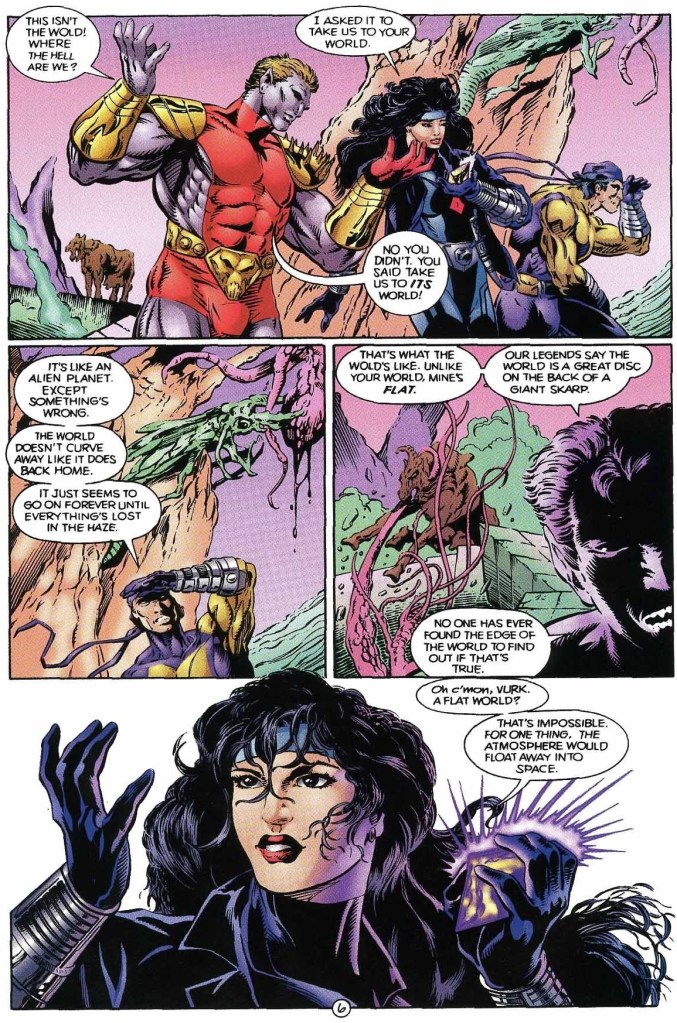
The story begins with Dropkick, Harmonica, Tech and Vurk in a desperate situation. Just as they need to get away fast, Dropkick notices that the Vorlexx is not working. Harmonica points to the cliffs as the only way out. With his wings, Vurk takes Tech with him to fly up while Harmonica takes Dropkick. As soon as they arrived up the cliff, they find themselves facing the massive Aerwan army whose members are scattered across the ground and the air. An Aerwan military leader tells The Solution to surrender the Vorlexx.

Meanwhile, the Vyr are watching the live video feed of The Solution and the Aerwan army. Shadowmage, who has been restrained in a very painful and humiliating position, has been watching her friends since they exited the cave. While she still remains unharmed by her captors, she knows that her torments are just beginning. The Vyr want her to see what will happen to her friends…

Quality

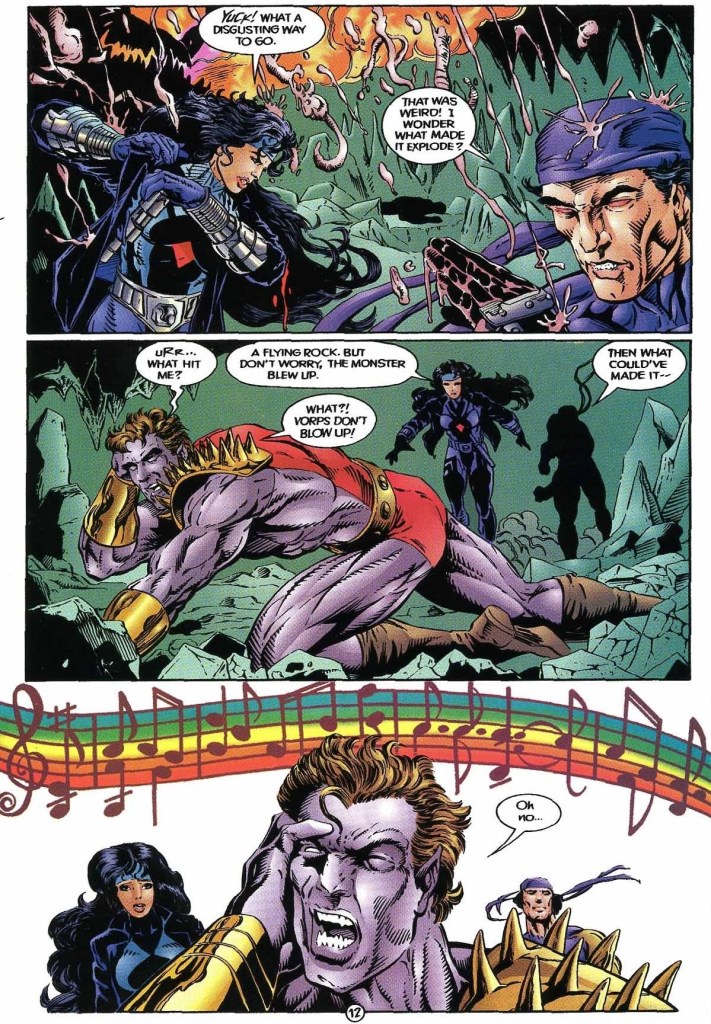
In the middle of a major battle between two alien armies, The Solution were really pushed to their limits as they pursue their dangerous rescue mission of their captured teammate.

Wow! The storytelling and visual presentation in this comic book got even wilder and the sci-fi element of this particular storyline really went into overdrive! For one thing, much of the tension which started building up in issues and paid off big time in the early part of this comic book as the inevitable battle between the Darkur (Vurk’s people) and the Aerwans (Shadowmage’s people) which easily made The Solution and Harmonica ending up tiny in the middle. Of course, as this is still about the team’s desperate attempt to rescue Aera from the very powerful Vyr, you will really see Lela Cho, Vurk, Dropkick (who carries the Vorlexx) struggle a lot in close encounters with aliens just as they keep on trusting Harmonica (whom they formed an uneasy alliance with) to help them. It is compelling to see how the three mentioned Solution teammates not only struggle to survive but also strive to overcome great odds knowing that if they fail, Aera/Shadowmage will perish. Very clearly, this is a very high-stakes story that James Hudnall prepared and the way I see it, this storyline really added a lot to the development of The Solution.

As for the art, I can say that this, in my opinion, is John Statema at his grandest with the Ultraverse. While being supported by by Barbara Kaalberg’s detailed ink work, Statema really captured the wild sci-fi tale Hudnall prepared and showed The Solution within a very strange environment surrounded by death and uncertainty. A lot of this comic book’s pages are filled with action scenes (note: lots of bloody scenes but without the color red) that are also nicely structured and each member of The Solution had the appropriate dynamic visuals that fitted nicely with their respective big moments. More notably, Statema really worked hard showing the many, many Aerwans and Darkur warriors who filled the pages – especially the two 2-page shots that each showed a wide view of the field – and succeeded in presenting monsters that were scary and very alien in design.

Conclusion

This is one of two epic views in this comic book by illustrator John Statema, inker Barbara Kaalberg and the colorists. Look at all the details!

The Solution (1994) is a wild Ultraverse concept that succeeded in engaging and entertaining me from start to finish. It is a great pay-off to what was built up since The Solution and having the team lost in another world in their pursuit of their captured teammate really moved this series forward. In fact, when it comes to expanding the boundaries of the Ultraverse itself, this comic book really achieved that! This is also the most ambitious sci-fi tale of the UV that I’ve read.  The ironic thing is that this comic book is not even the conclusion to its storyline. There is still more to come and I can say I’m really motivated to read the next issue.

If you are seriously planning to buy an existing hard copy of The Solution (1994), be aware that as of this writing, MileHighComics.com shows that the near-mint copy of the regular edition costs $16 while the near-mint copy of the newsstand edition costs $48.

Overall, The Solution (1994) is highly recommended!

+++++

Thank you for reading. If you find this article engaging, please click the like button below and also please consider sharing this article to others. If you are looking for a copywriter to create content for your special project or business, check out my services and my portfolio. Feel free to contact me with a private message. Also please feel free to visit my Facebook page Author Carlo Carrasco and follow me on Twitter at  @HavenorFantasy as well as on Tumblr at https://carlocarrasco.tumblr.com/

A Look Back at Sludge #5 (1994)

Disclaimer: This is my original work with details sourced from reading the comic book and doing personal research. Anyone who wants to use this article, in part or in whole, needs to secure first my permission and agree to cite me as the source and author. Let it be known that any unauthorized use of this article will constrain the author to pursue the remedies under R.A. No. 8293, the Revised Penal Code, and/or all applicable legal actions under the laws of the Philippines.

Welcome back, superhero fans, 1990s culture enthusiasts and comic book collectors! Today we revisit the Ultraverse of Malibu Comics and examine one of its many stories told through an issue of the Sludge comic book series.

In my previous retro review about Sludge #4 (1994), we got to see an inspired monster-versus-monster conflict between the protagonist and a huge, intelligent alligator aced with elements of society, urban legends, idolatry and journalism. That particular issue also showed more of the creative side of series artist Aaron Lopresti when it comes to writing. The next issue reviewed also involved Lopresti as writer.

With those details laid down, here is a look back at Sludge , published by Malibu Comics in 1994 with a story written and drawn by Aaron Lopresti.

The cover.

Early story

The story begins in New York City. Darkness descends on Manhattan like a shroud, providing haven for those who shun the light. As a man and a lady walk down the sidewalk talking to each other, a very hideous human-like monster comes out of the shadow of the alley and grabs them both.

In the sewers, Sludge hears one of the victims scream which compels him to run to where the trouble happened. As soon as he climbs out of the sewer, he sees the monster in the alley which makes eye-contact with him. As Sludge approaches the alley, the monster gets away leaving the dead bodies of the man and woman behind. As Sludge examines the dead bodies and realizes that the monster ate them, a police car with two officers arrived.

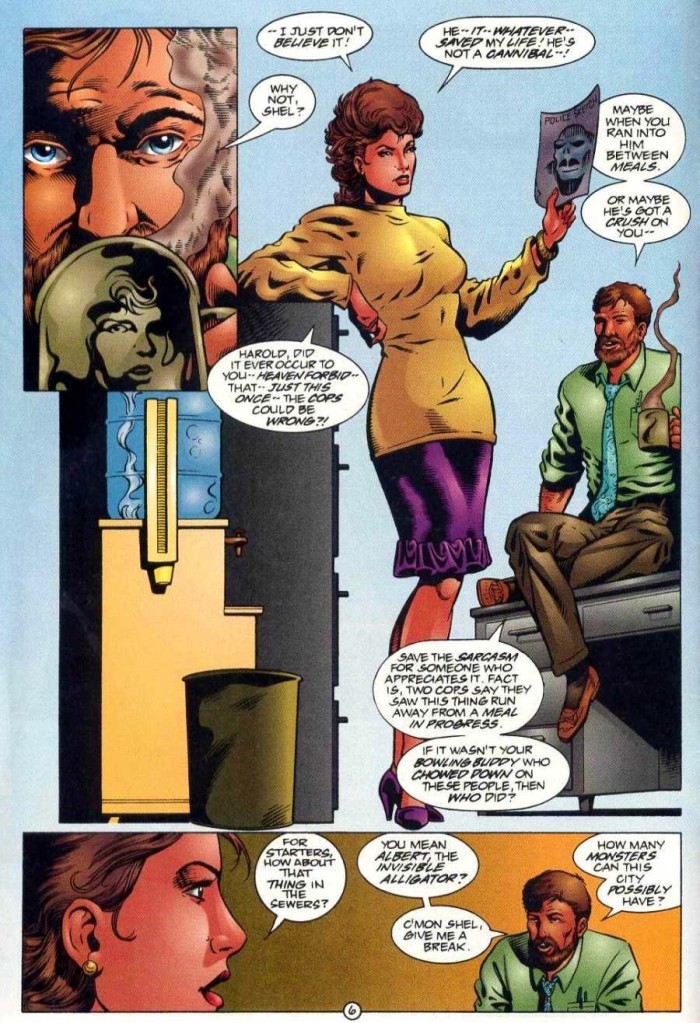
In reaction, Sludge quickly grabs one part of the police car and turns it upside down to buy himself time to get back into the sewer. The details of the encounter between the police and Sludge made it to Shelley, the same New York Daily Globe news reporter who encountered him and the intelligent alligator Veffir Voon Iyax. She discusses the newest information with her skeptical boss…

Quality

Obvious parallel to Mary Shelley’s Frankenstein here.

Let me start first with what is obvious with regards to the plot and presentation. Similar to what happened in Sludge #2, there is noticeably less spotlight on Sludge as creative space had to be used to develop the new monster, emphasize its background story (with an additional new character who has significance) and there were even scenes focused on Shelley and what goes on inside the office of her newspaper which became aware of the events that took place.

The next thing I want to point out is the creative inspiration used in this particular story. This comic book has really clear parallels to the literary classic Frankenstein: or, The Modern Prometheus and there was even a mention of its author Mary Shelley. That being said, there is a scientist-and-walking-abomination aspect with regards to the mentioned additional significant character connected with the new monster. That is not to say that this comic book copied Victor Frankenstein and his nameless monster, rather Aaron Lopresti took inspiration from them, mixed things up and implemented them in telling this new tale of Sludge. When it comes to keeping things fresh in telling another Sludge story, I can say that Lopresti succeeded.

More on the story itself, this one has a clever mix with regards to the dimensions used. In here, Sludge is more determined on helping people who shouted for help while Shelley won’t give up on finding out the truth about the tragic events in their city. Without spoiling the details, I can say that there is this deep dramatization about the monster and the new character responsible for its return from the dead.

As for the quality of the writing, Aaron Lopresti’s work here is not only expressive but also impressive. There is this one page near the end that has these few yet powerful words that strongly connect with the images of Sludge and the monster (who is so creepily drawn!).  

Conclusion

This is the 2nd straight Sludge comic book that has reporter Shelley and her newspaper focused on what has been happening. At this point, Shelley had encountered Sludge.

Sludge (1994) in my view is another inspired and intriguing Ultraverse tale to read! While issue had parallels to the 1980 film Alligator, this comic book took inspiration from Mary Shelley’s most famous work of fiction which added elements about resurrection, man’s abuse of science, and the consequences of dealing with the unnatural into Sludge’s side of the Ultraverse. I should state that this comic book also has the scariest looking monster Aaron Lopresti drew for the Ultraverse at the time of publication.

If you are seriously planning to buy an existing hard copy of Sludge (1994) be aware that as of this writing, MileHighComics.com shows that the near-mint copy of the regular edition costs $16 while the near-mint copy of the newsstand edition costs $48.

Overall, Sludge (1994) is highly recommended.

+++++

Thank you for reading. If you find this article engaging, please click the like button below and also please consider sharing this article to others. If you are looking for a copywriter to create content for your special project or business, check out my services and my portfolio. Feel free to contact me with a private message. Also please feel free to visit my Facebook page Author Carlo Carrasco and follow me on Twitter at  @HavenorFantasy as well as on Tumblr at https://carlocarrasco.tumblr.com/

A Look Back at The Solution #10 (1994)

Disclaimer: This is my original work with details sourced from reading the comic book and doing personal research. Anyone who wants to use this article, in part or in whole, needs to secure first my permission and agree to cite me as the source and author. Let it be known that any unauthorized use of this article will constrain the author to pursue the remedies under R.A. No. 8293, the Revised Penal Code, and/or all applicable legal actions under the laws of the Philippines.

Welcome back superhero enthusiasts, 1990s culture enthusiasts and comic book collectors! If you’ve got a problem that needs solving, you call The Solution. For the newcomers reading this, The Solution was spearheaded by the late James Hudnall who also led the storytelling of the Hardcase monthly series.

In my previous The Solution retro comic book review, the team had to act as a result of what Aera had done long before she even joined her teammates. Alien forces had arrived on Earth which sparked a chain reaction of unfortunate events. Ultimately, Aera was taken away but not before handing over to Lela, Vurk and Dropkick the one powerful thing that the Vyr wanted – the Vorlexx.

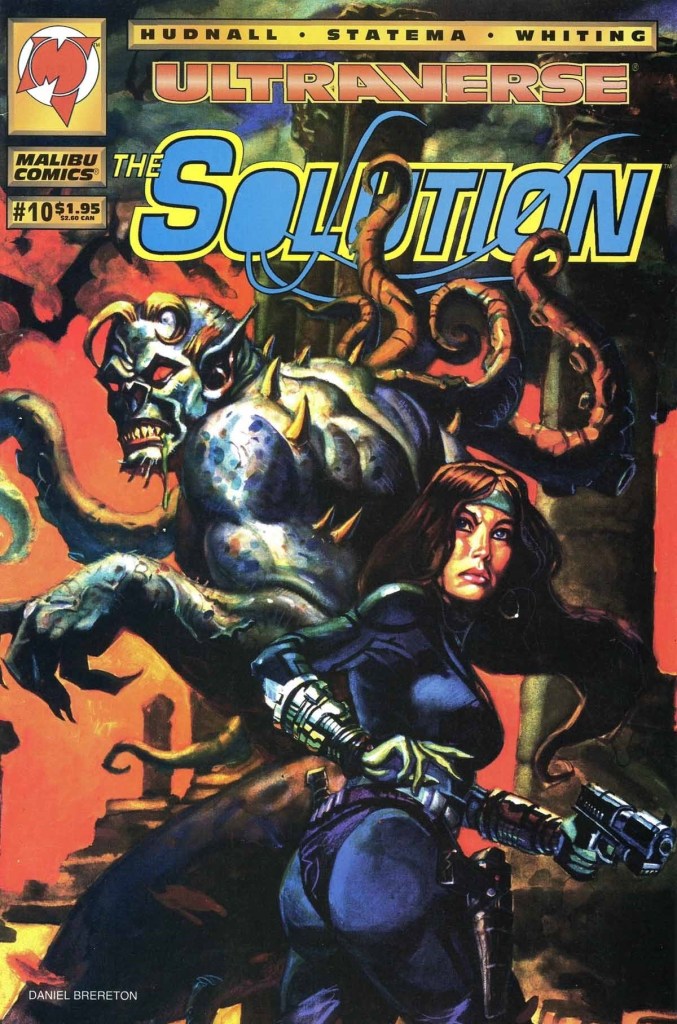
With those details laid down, here is a look back The Solution , published by Malibu Comics in 1994 with a story written by the late James Hudnall and drawn by John Statema.

The cover.

Early story

The story begins with Dropkick hitting his alien teammate Vurk and accuses him for trying to leave their snatched teammate Aera in the hands of the Vyr. As Vurk transforms into his more monstrous form, Tech comes in between them and tells them to stop and come to their senses. As they have the Vorlexx, Tech insists that they should leave Earth before the Vyr comes back to get the precious items.

Holding the Vorlexx, Tech states that they should all travel together to Vurk’s homeworld and anticipate that the Vyr will come there searching for them. She stresses that they might stand a better chance of rescuing Aera this way. Vurk warns Tech that the Vorlexx will corrupt its user every time it gets used.

Tech issues a command to the Vorlexx and they all disappear to another world…

Quality

Lela Cho, Dropkick and Vurk struggle during their quest to save Aera.

While the story of the previous issue brought the fantasy elements of the series raised really high, things went even higher this time as the team went to new worlds far away from Earth which results completely alien environments with creatures that people of Earth had not encountered. This helped pave the way for an encounter between The Solution and a giant monster that reminded about some classic sci-fi tales of EC Comics (note: the Weird Science series) from the 1950s.

More on the plot itself, James Hudnall crafted a script that succeeded in building up suspense and tension as Tech (Lela Cho), Dropkick and Vurk push through with their very difficult mission to rescue Aera. Along the way, you will get to see really nice character moments such as Lela’s leadership traits and Vurk using his knowledge of his past encounters with the Vyr.

There is also a notable twist in the tale which I won’t spoil. In fact, I encourage you readers and those who are just discovering the Ultraverse and The Solution to read this comic book to find out. That twist really added depth to the plot and resulted in some memorable reactions from The Solution.

Conclusion

The Solution arrived in an alien world by mistake.

The Solution (1994) is fun and engaging to read. As it follows The Solution’s dangerous attempt to save Aera in unknown parts of the universe, the story became more of a science fiction misadventure that remains believable and stable thanks to Hudnall’s strong writing. John Statema’s return as illustrator in this comic book easily raised the visual quality higher compared to the previous issue. I can say that Statema, by this point in this Ultraverse series, is clearly the definitive artist of The Solution.

If you are seriously planning to buy an existing hard copy of The Solution (1994), be aware that as of this writing, MileHighComics.com shows that the near-mint copy of the regular edition costs $16.

Overall, The Solution (1994) is recommended.

+++++

Thank you for reading. If you find this article engaging, please click the like button below and also please consider sharing this article to others. If you are looking for a copywriter to create content for your special project or business, check out my services and my portfolio. Feel free to contact me with a private message. Also please feel free to visit my Facebook page Author Carlo Carrasco and follow me on Twitter at  @HavenorFantasy as well as on Tumblr at https://carlocarrasco.tumblr.com/

A Look Back at The Solution #9 (1994)

Disclaimer: This is my original work with details sourced from reading the comic book and doing personal research. Anyone who wants to use this article, in part or in whole, needs to secure first my permission and agree to cite me as the source and author. Let it be known that any unauthorized use of this article will constrain the author to pursue the remedies under R.A. No. 8293, the Revised Penal Code, and/or all applicable legal actions under the laws of the Philippines.

Welcome back superhero enthusiasts, 1990s culture enthusiasts and comic book collectors! If you’ve got a problem that needs solving, you call The Solution. For the newcomers reading this, The Solution was an Ultraverse monthly series about a team composed of very unique individuals who help their clients solve special problems. Such operations are done with business agreements made between the team and their clients.

But what if one of the members of The Solution becomes a target of some very deadly forces that are not even human? What solutions can The Solution come up with?

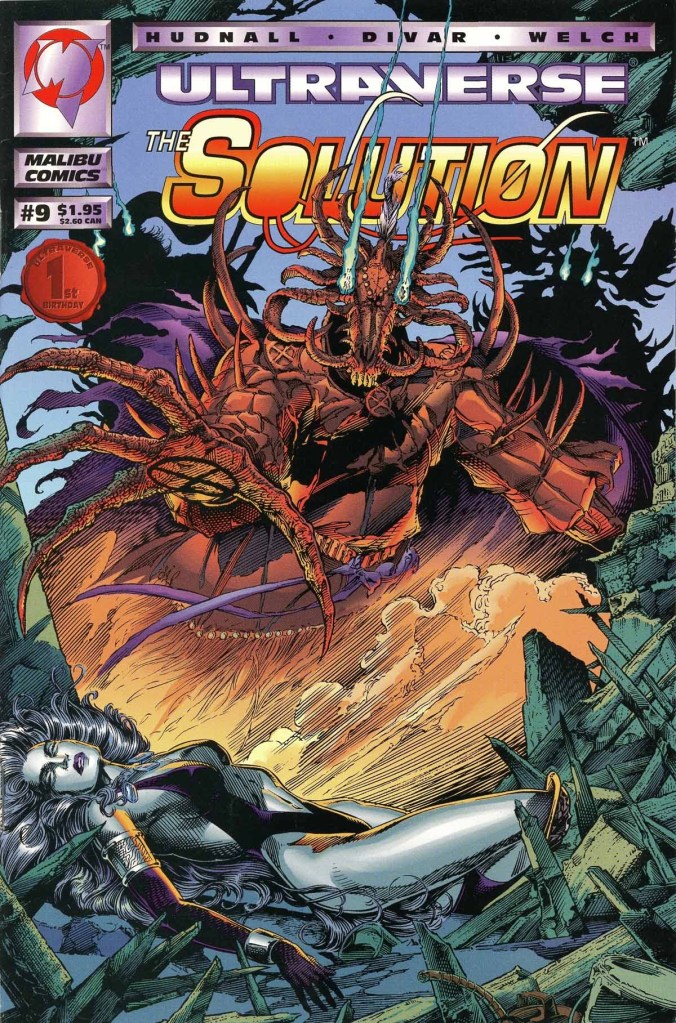
With those details laid down, here is a look back The Solution , published by Malibu Comics in 1994 with a story written by the late James Hudnall and drawn by Timothy D. Divar.

The cover.

Early story

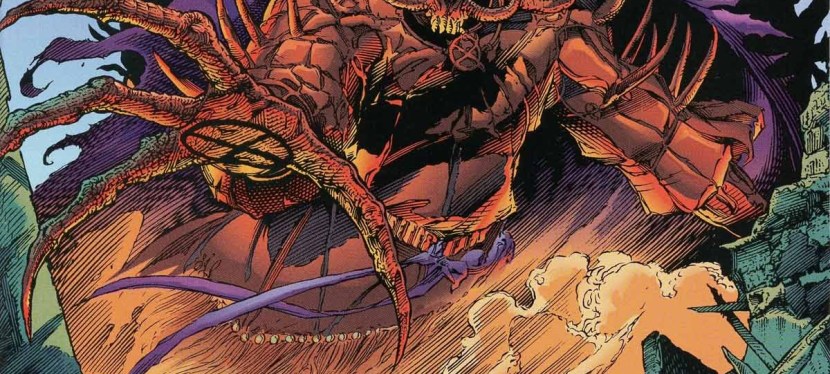
The story begins somewhere in North America where three mystical monsters arrived on a mission to hunt. The prey they are hunting is to be taken alive and to be tortured for decades. One of them displays the image of Aera/Shadowmage.

A long distance away, in the presence of The Solution traveling by yacht, Aera senses danger and that she has been found by the monsters. The three who arrived from nowhere suddenly cast magic together and summoned a beast which arrived out of thin air. The beast is then instructed to search and hunt Shadowmage.

Over at the Chinese sea, Aera tells Lela Cho that she has been found by the mystical monsters which she previously referred to as the Vyr. She describes them to be very powerful, the most deadly and the most evil creatures on her home world. Aela admits that she does not have the power to stop the Vyr and their team cannot stop them even when combined in power. Their teammate Vurk expresses deep concern and asked Aera what she did that angered the Vyr. Vurk admits his fear of the Vyr and as long as they after Aera, the team would be better off letting them have her…

Quality

Aera, her monstrous teammate Vurk and the unstoppable monster.

When it comes to storytelling, I should say that the late James Hudnall really ramped up the fantasy aspect of this series right here. That being said, this comic book made the previous issues look more grounded in reality by comparison. Among the members of The Solution, there is a clear shift towards Aera/Shadowmage whose act from a long time ago led to the Vyr hunting her down on Earth which, unsurprisingly, gets her teammate involved. Along the way, key details from the past of Aera (a native from a foreign world) and Vurk/Outrage (the native of another world which is in conflict with Aera’s own people) get revealed which add some depth on the development of the team as a whole. The way the details were presented made for a really intriguing read in my experience.

With a story concept like this, The Solution could have been a creative mess but it turned out orderly, intriguing and engaging thanks to the way Hudnall structured the story and wrote down the dialogue and text descriptions.

If there is any weakness in this comic book’s presentation, it is the artistic style of Timothy D. Divar. Compared to issue , I find the visual quality here drop significantly and there were some shots of The Solution members looking a bit like some characters I saw in 1990s comic books published by Valiant Comics. The characters’ faces and expressions also looked clearly less detailed.

Conclusion

There is nothing like seeing The Solution at your household’s front door.

The Solution (1994) is a good read. The strong selling point in it is the team getting involved in a very dangerous encounter with the Vyr (which are way too powerful for them to deal with) which is the result of Aera’s dangerous act. Just as Aera explained what she did and what happened in the past, the tension in the story really went up which makes it engaging to read.

If you are seriously planning to buy an existing hard copy of The Solution (1994), be aware that as of this writing, MileHighComics.com shows that the near-mint copy of the regular edition costs $16.

Overall, The Solution (1994) is recommended.

+++++

Thank you for reading. If you find this article engaging, please click the like button below and also please consider sharing this article to others. If you are looking for a copywriter to create content for your special project or business, check out my services and my portfolio. Feel free to contact me with a private message. Also please feel free to visit my Facebook page Author Carlo Carrasco and follow me on Twitter at  @HavenorFantasy as well as on Tumblr at https://carlocarrasco.tumblr.com/

A Look Back at Sludge #4 (1994)

Disclaimer: This is my original work with details sourced from reading the comic book and doing personal research. Anyone who wants to use this article, in part or in whole, needs to secure first my permission and agree to cite me as the source and author. Let it be known that any unauthorized use of this article will constrain the author to pursue the remedies under R.A. No. 8293, the Revised Penal Code, and/or all applicable legal actions under the laws of the Philippines.

Welcome back, superhero enthusiasts, 1990s culture enthusiasts and comic book collectors! Today we revisit the Ultraverse of Malibu Comics and examine one of its many stories through an issue of the Sludge comic book series.

Previously, I reviewed Sludge #3 which was a tie-in comic book to the first big crossover event of the entire Ultraverse – Break-Thru. In that issue, he encountered the “lord” Pumpkin who himself became a notable super villain in the UV. That story also showed the first major test of Sludge when it comes to resisting temptation and evil.

With those details laid down, here is a look back at Sludge , published by Malibu Comics in 1994 with a story written and drawn by Aaron Lopresti, and scripted by Steve Gerber.

The cover.

Early story

The story begins when two black teenagers go down the city sewer to look for something as part of a job of them agreed to do for someone named Gordy. They accidentally find Sludge whose appearance and ability to talk scares them away. As the two keep running to another direction, a reptilian monster sees them. The monster grabbed and killed the taller youth, leaving the shorter one scared.

A short time later, a police officer finds the scared teenager hiding behind plants at Central Park. The survivor is in a state of shock repeating his friend’s name a lot. The police update about the boy eventually reaches the office of the New York Daily Globe and an attractive reporter named Shelley intends to follow what could be a hot scoop…

Quality

The battle between these two has a lot of stuff that should be seen.

In this comic book, I can see that the creative team of Steve Gerber and Aaron Lopresti decided to shake things up a bit when it comes to telling a new story of Sludge laced with elements of society, urban legends and journalism. The good news here is that this story is well-written and the visuals really brought the script to life for readers to be engaged with.

When it comes the elements that inspired this particular story, the concept about alligators occupying the sewers instantly reminds me of the 1980 film Alligator and along the way, Gerber-Lopresti went on pounce on the concept resulting in the introduction of a brand new Ultraverse villain in the form of a monstrous, human-like alligator named Veffir Voon Iyax which can also talk and reason like humans. This new villain is really interesting and its background about being part of a species of alligators worshipped by people from long ago sheds light on the idolatry which is both unholy and foolish.  

On the aspects of society and journalism, the story sheds light on how some people – even minors – would go to really unsafe places and do very risky jobs for a variety of reasons. The journalistic aspect of this comic book emphasizes how far journalists would go to write stories based on questionable data and that a newspaper would recklessly publish such stories even though they lacked solid evidence to prove the unbelievable is true. The newspaper journalist Shelley had quite an amount of the spotlight, she became a clear supporting character in this comic book.

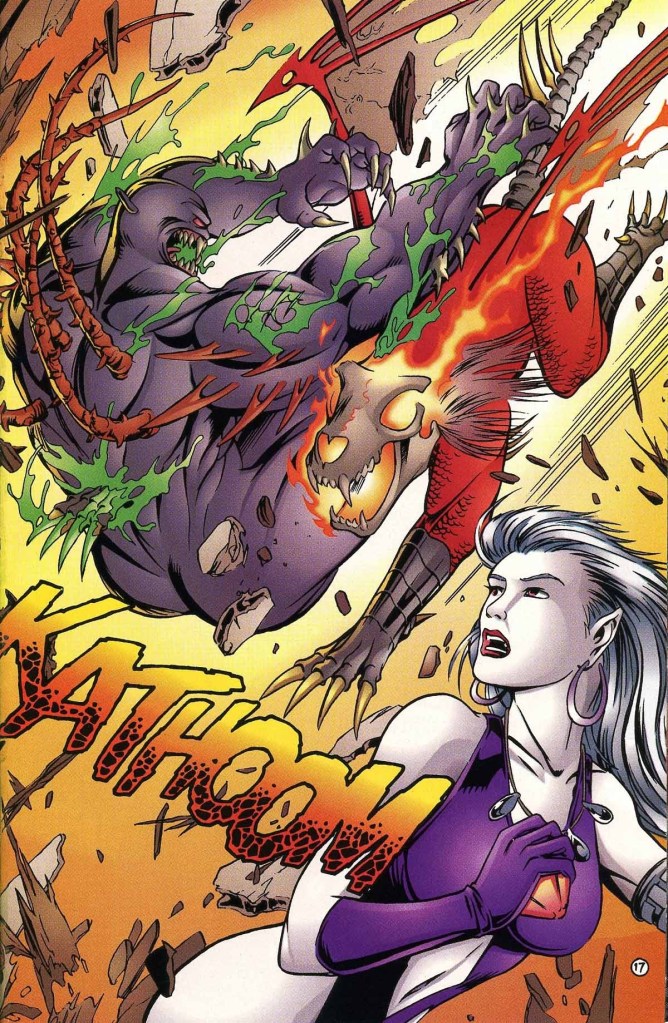
In keeping up with the superhero flavor of the Ultraverse, there is a good amount of spectacle here as it has a big battle between Sludge and the monstrous alligator which is nicely presented. This is a battle between monsters that was carefully structured and executed well.

Conclusion

A look at what happens behind the scenes at a city newspaper.

Sludge (1994) is both an intriguing and enjoyable read. The Gerber-Lopresti team succeeded in telling another Sludge tale that is fresh as it took inspiration from pop culture and society. At the same time, this comic book show that Sludge is clearly not the only monster in New York City’s sewers. As such, his place within the Ultraverse is really unique.

If you are seriously planning to buy an existing hard copy of Sludge (1994) be aware that as of this writing, MileHighComics.com shows that the near-mint copy of the regular edition costs $16 while the near-mint copy of the newsstand edition costs $48.

Overall, Sludge (1994) is recommended.

+++++

Thank you for reading. If you find this article engaging, please click the like button below and also please consider sharing this article to others. If you are looking for a copywriter to create content for your special project or business, check out my services and my portfolio. Feel free to contact me with a private message. Also please feel free to visit my Facebook page Author Carlo Carrasco and follow me on Twitter at  @HavenorFantasy as well as on Tumblr at https://carlocarrasco.tumblr.com/

A Look Back at Sludge #3 (1993)

Disclaimer: This is my original work with details sourced from reading the comic book and doing personal research. Anyone who wants to use this article, in part or in whole, needs to secure first my permission and agree to cite me as the source and author. Let it be known that any unauthorized use of this article will constrain the author to pursue the remedies under R.A. No. 8293, the Revised Penal Code, and/or all applicable legal actions under the laws of the Philippines.

Welcome back, superhero enthusiasts, 1990s culture enthusiasts and comic book collectors! Today we revisit the Ultraverse of Malibu Comics and examine one of its many stories through the Sludge comic book series.

Previously I reviewed issue #2 of the series which was a surprising and fun comic book to read as the creative team took the risk of emphasizing the violent character Bloodstorm over Sludge himself. Ultimately, this move served as a way to not just build up tension but to expand the specific place of Sludge and the dark forces within the Ultraverse. For this retro review, issue is set during the events of the memorable Ultraverse crossover story Break-Thru.

With those details laid down, here is a look back at Sludge , published by Malibu Comics in 1993 with a story written by Steve Gerber and drawn by Aaron Lopresti.

The cover.

Early story

The story begins with Sludge still lying down at the dock after just being defeated by Bloodstorm. Suddenly a mob of chaotic people (driven mad by the effects of Break-Thru that just happened) lift him up and throw him into the water without any regrets whatsoever. In hiding, Bloodstorm witnesses their act and thought to himself that he should avoid the madness happening. Suddenly, other mad people ganged up on him forcing him to react by firing his gun and set himself free from their grip. He safely makes it to his car and speeds away, even bumping off a few people on the way.

As Bloodstorm speeds away, another man in hiding who knew him and the boss Marcello was found by the mad people. Out of desperation he runs away and jumps into the water. He realizes that the people are so obsessed with going up to the sky (the Break-Thru effect), they did not bother to follow him at all.

Deep down the water, Sludge finds himself alone and getting relieved of the pain he experienced above. Feeling hopeless, he waits for the river to wash him away…

Quality

Sludge in trouble!

Being a standalone story set during the events of Break-Thru, this comic book focuses more on the protagonist while simultaneously raising the stakes with regards to the evil forces as the elements of crime gang combined with the supernatural took effect. To be clear, fantasy elements were added to this series which had darkness and grit dominating the plot of the first two issues.

This comic book has an early appearance of “lord” Pumpkin (AKA The Pump) who is the element of sorcery and, more notably, serves as the Ultraverse’s very own Satanic figure. Not only does the Pump have vast powers to take life away from others and has evil pawns to wield, he also leads and guides an apprentice (the kid gangster called Pistol) with pure wickedness, crafted plans of evil, is cunning in his ways of manipulating others to do evil, and he makes promises or deals with others who will receive some rewards but ultimately will be disregarded and lose a lot. This Ultraverse super-villain, as recorded in Malibu Comics’ publishing history, went on to become a walking symbol of pure evil, corruption, sins and danger in other UV comic books.

While there is indeed more focus on Sludge in this issue, it is the Pump who overshadows him. As for Bloodstorm, his presence has been drastically reduced here which is kind of jarring to read as he was the dominant and heavily emphasized in issue . Speaking of characters, the gang boss Marcello (who is Bloodstorm’s client) makes a short appearance but his connections not only with criminals but also with para-military forces emphasized his influence in the city.

More on the plot itself, this comic book is pretty loaded and the stakes were really raised high. In key scenes, Sludge finds himself in the middle of gangsters, the people driven mad by the Break-Thru effect, the para-military forces and the Pump’s ugly and evil pawns. Steve Gerber crafted a story that expectedly built up a lot and paid of strongly since the stakes were raised. I should state that Aaron Lopresti’s art here showed signs of improved creativity

Conclusion

The gang boss Marcello and Bloodstorm talk during the events of Break-Thru.

Sludge (1993) is a more engaging and more intense comic book on its own complete with the literary debut of the Pump who is clearly the Ultraverse’s most evil villain. If issue was twisting with the way it presented its characters, this comic book has more of its protagonist who went on to face new elements of evil while the story of Break-Thru transpired. I also noticed the Pump’s offer to Sludge symbolizes Satan offering a troubled soul a place in his force of evil. How did Sludge react to the offer from the evil one? You will have to read this comic book.

If you are seriously planning to buy an existing hard copy of Sludge (1993) be aware that as of this writing, MileHighComics.com shows that the near-mint copy of the regular edition costs $16.

Overall, Sludge (1993) is recommended!

+++++

Thank you for reading. If you find this article engaging, please click the like button below and also please consider sharing this article to others. If you are looking for a copywriter to create content for your special project or business, check out my services and my portfolio. Feel free to contact me with a private message. Also please feel free to visit my Facebook page Author Carlo Carrasco and follow me on Twitter at  @HavenorFantasy as well as on Tumblr at https://carlocarrasco.tumblr.com/