A Look Back at Freex #16 (1995)

Disclaimer: This is my original work with details sourced from reading the comic book and doing personal research. Anyone who wants to use this article, in part or in whole, needs to secure first my permission and agree to cite me as the source and author. Let it be known that any unauthorized use of this article will constrain the author to pursue the remedies under R.A. No. 8293, the Revised Penal Code, and/or all applicable legal actions under the laws of the Philippines.

Welcome back superhero enthusiasts, 1990s culture enthusiasts and comic book collectors! Today we go back to the year 1995 to revisit one of the many tales of Malibu Comics’ Ultraverse through the Freex monthly series.

In my previous review, the Freex encountered someone very deadly (note: Rafferty who also encountered The Strangers) and out of nowhere one of their members got killed as he made his move to protect someone’s life.

With those details laid down, here is a look back at Freex published in 1995 by Malibu Comics with a story written by Gerard Jones and drawn by Klebs de Moura e Silva.   

The cover.

Early story

The story begins at midnight when Ruby arrives at a sorrowful gathering composed of Contrary, her academic students, the Night Man, the Old Man and the remaining members of Freex. They are all mourning over the dead body of Michael. Just after Old Man declared that everyone should move on and let Michael (Plug) rest, Contrary (now an established member of UltraForce) stated that her academy will keep him in the company of others like him at their Mt. Shasta Citadel headquarters as the dead Freex member does not have any known surviving family members.

The loss of Michael then begins to take its toll on Angela/Sweetface as she cries and states that there is nothing left to live for. Suddenly, something appears to the Freex…an angel-like figure who tells Angela to end the pain and join the only one who still cares for her. Valerie and Lewis try to help Angela resist the one who spoke…

Quality

The Old Man becomes the target of Freex.

What is obvious to me here is that this comic book is all about the consequences of the death of original Freex team member Michael and how his death impacted specific teammates who had really grown close with him. The plot in this comic book is pretty light as this was clearly written to have strong character dramatization and development.

While there were indeed a whole lot of characters who appeared here, this comic book highlights Sweetface as the one most affected by the sudden death of Michael. That being said, any dedicated Freex fan who seriously followed the series right from the start will be able to relate with Sweetface’s emotions and even feel her deep feelings with Michael. Incidentally, this paves the way for her to interact more with Lewis who also got impacted by the death of their teammate. As the story went on, there were key developments here that strongly symbolized that Freex will take a serious change of direction focusing more on team survival and avenging Michael while severing ties with the Old Man. Clearly the creative team were building up something for the team who at this point have been on a very long and painful journey as nomads.

All throughout, the script really is detailed, richly layered and engaging. Apart from Freex, Night Man, Contrary and her students, and other characters had their fair share of the spotlight strongly symbolizing the current state of the Ultraverse at the time.

Conclusion

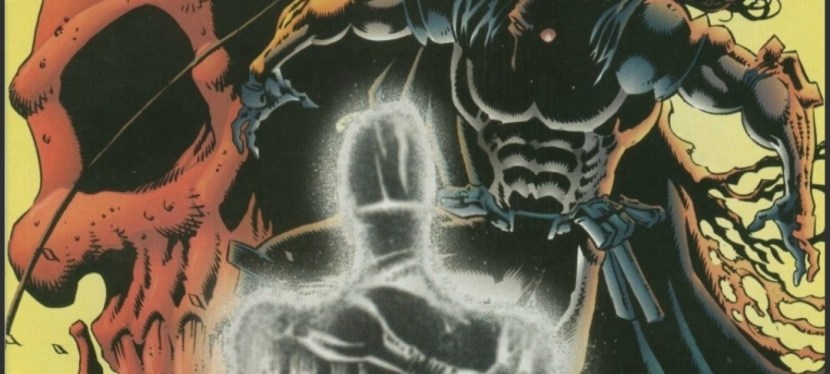
Even as she is mourning over the death of Michael, Angela suddenly sees a mesmerizing vision in front of the others.

Freex (1995) is indeed a solid comic book to read. The strong writing is its strongest feature and it really delivered the compelling stuff that will resonate most with the long-time Freex fans. The dramatization of the effects of Michael’s death really is strong and the new change of direction for the surviving Freex was implemented really smoothly. The lack of a good-versus-evil element was no problem at all here. By the end of the comic book, I became eager to find out what would happen next to Freex.

Overall, Freex (1995) is recommended.

+++++

Thank you for reading. If you find this article engaging, please click the like button below, share this article to others and also please consider making a donation to support my publishing. If you are looking for a copywriter to create content for your special project or business, check out my services and my portfolio. Feel free to contact me with a private message. Also please feel free to visit my Facebook page Author Carlo Carrasco and follow me on Twitter at  @HavenorFantasy as well as on Tumblr at https://carlocarrasco.tumblr.com/ and on Instagram at https://www.instagram.com/authorcarlocarrasco
A Look Back at Freex #15 (1994)

Disclaimer: This is my original work with details sourced from reading the comic book and doing personal research. Anyone who wants to use this article, in part or in whole, needs to secure first my permission and agree to cite me as the source and author. Let it be known that any unauthorized use of this article will constrain the author to pursue the remedies under R.A. No. 8293, the Revised Penal Code, and/or all applicable legal actions under the laws of the Philippines.

Welcome back superhero enthusiasts, 1990s arts and culture enthusiasts and comic book collectors! Today we go back to the wild 1990s and explore a part of Malibu Comics’ Ultraverse through a tale of Freex.  

Since after facing off with Contrary (who eventually became part of UltraForce) and her so-called school and students, Freex had been traveling far and long (refer to my previous Freex reviews here, here and here) and gained Old Man as a useful companion. Along the way, they encountered the unknown deep underground and even saw a powerful being. They even got to the city of Denver temporarily. As they went on, they found the path that led them back to civilization.

With those details laid down, here is a look back at Freex , published in 1994 by Malibu Comics with a story written by Gerard Jones and drawn by Scott Kolins. This is a flip-side comic book with Ultraverse Premiere (1994) on the other side.  

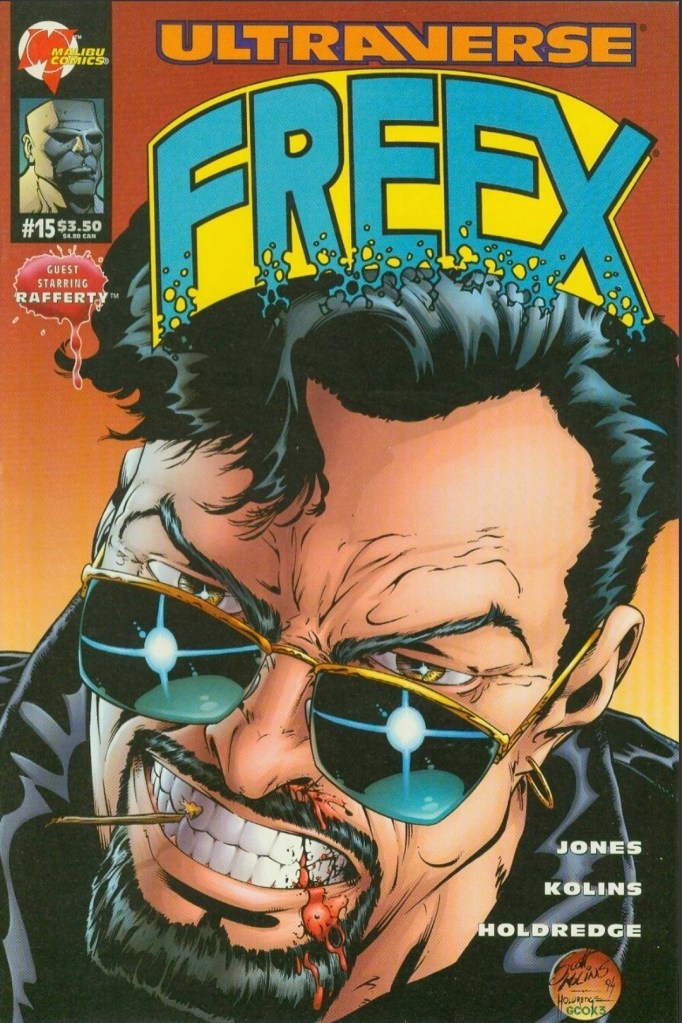
The cover.

Early story

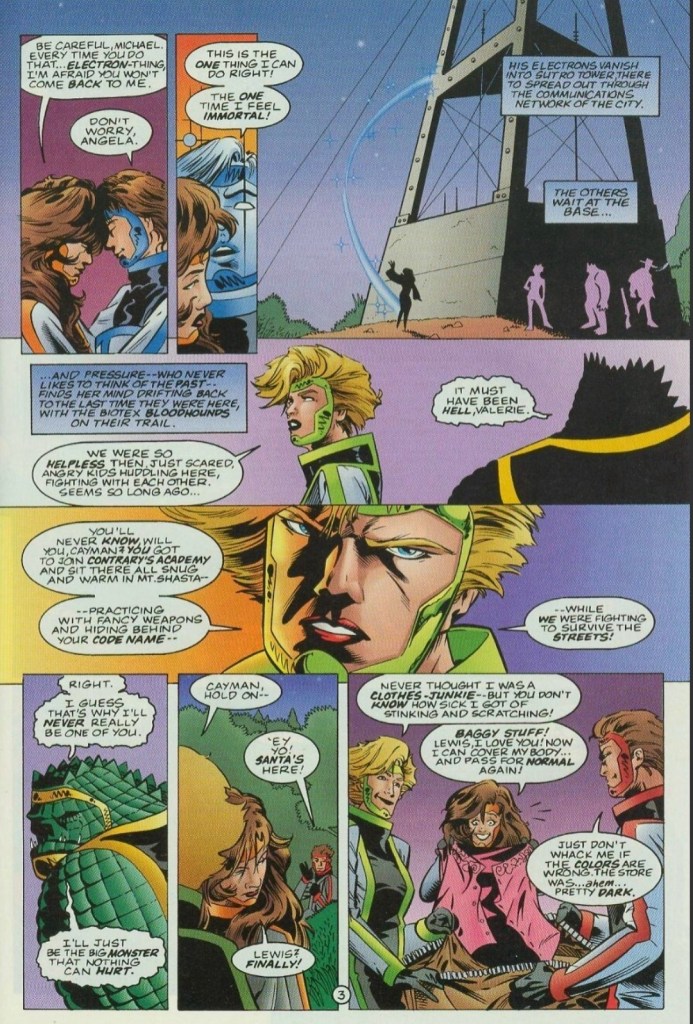
The story begins with Freex – composed of Plug, Sweet-Face, Pressure, Anything and new member Cayman – have been traveling for some time deep underground with Old Man. They find themselves back in San Francisco, the one city that brought them together. While still a long distance away from the city proper and there are no locals who could see them, the team cautiously move to a high communications tower. Michael/Plug uses his special ability to transform himself into electronic matter and makes his way through the communications network of the city to do something very important. Cayman meanwhile becomes the object of discussion between Pressure and Sweet-Face as he has yet to share with them details about himself.

As Cayman himself was part of Contrary’s academy and joined Freex recently, he has trouble gaining the trust of the others. After wearing new clothes that Lewis found, a guy suddenly appears to them. He introduces himself to them as Evan…  

Quality

The very evil Rafferty monitoring Freex secretly and enjoying his advantage over them.

Considering what happened in the previous issues, this story feels like a breath of fresh air not only because of the new location the team got into but also because of strong twists that happened. Instead of going through fantastical encounters, Freex found themselves in situations that are more grounded with reality (within Ultraverse standards specifically) and more notably, the story emphasized crossover as Freex and Old Man encountered Firearm. The said crossover, quite cleverly, sets up Freex into a collision course with the serial killer Rafferty (who encountered The Strangers elsewhere within the Ultraverse). For the newcomers reading this, Rafferty is one of the most evil characters of the Ultraverse who has murdered a lot of people – including his own parents – and has developed tremendous hatred of Ultras.

The inclusion of Rafferty here also sheds light on the Freex’s past connection with the Night Man (click here and here). More notably, the said serial killer turned out to be so resourceful and totally obsessed with murdering people with special abilities, he became a formidable force towards Freex. This leads to a pretty powerful and twisting conclusion that must be seen.  

Conclusion

The gang by the tower.

With a good amount of intrigue, characterization spectacle, strong dialogue and the element of crossover, Freex (1994) is a pretty engaging comic book to read. The biggest feature here is having Freex in a conflict with a very obsessed killer who not only hates Ultras but also has an extensive record of murdering many people over a long period of time. In my view, the Freex-Rafferty conflict was nicely structured and it added depth to the plot. What happened in the end of this comic book should resonate with dedicated fans of Freex.

Overall, Freex (1994) is highly recommended.

+++++

Thank you for reading. If you find this article engaging, please click the like button below, share this article to others and also please consider making a donation to support my publishing. If you are looking for a copywriter to create content for your special project or business, check out my services and my portfolio. Feel free to contact me with a private message. Also please feel free to visit my Facebook page Author Carlo Carrasco and follow me on Twitter at  @HavenorFantasy as well as on Tumblr at https://carlocarrasco.tumblr.com/ and on Instagram at https://www.instagram.com/authorcarlocarrasco

A Look Back at The Solution #14 (1994)

Disclaimer: This is my original work with details sourced from reading the comic book and doing personal research. Anyone who wants to use this article, in part or in whole, needs to secure first my permission and agree to cite me as the source and author. Let it be known that any unauthorized use of this article will constrain the author to pursue the remedies under R.A. No. 8293, the Revised Penal Code, and/or all applicable legal actions under the laws of the Philippines.

Welcome back superhero fans, 1990s arts and culture enthusiasts, Ultraverse fans and comic book collectors! Today we revisit the Ultraverse through the monthly series of The Solution.

Under the direction of the late James Hudnall, issues #9, #10, #11 and #12 told a very wild and compelling story about The Solution that literally was out of this world and gave readers a wide view of the vastness of the Ultraverse. Issue #13 meanwhile saw The Solution involved in a crossover storyline that involved Prototype, Solitaire and the Night Man. Just what happened next in The Solution series?

With those details laid down, here is a look back The Solution , published by Malibu Comics in 1994 with a story written by the late James Hudnall and drawn by Huang Nguyen.

The cover.

Early story

The story begins when an armed, muscular man carrying two large guns sees Dropkick. He immediately fires at him. Then he sees Shadowmage and Tech and then fires at them. It turns out they are just non-moving physical models. The aggressive use of weapons is called Incoming. He is a Communist Cambodian man who was hardened by the events in his native country and he served the tyrant Pol Pot by killing others. He is living with brutality and unstoppable rage which makes him dangerous to The Solution.

In New York, Black Tiger anticipates the arrival of a van carrying heroin set to be released to buyers. Suddenly a gang of thugs serving the Pump appear heading attacking the van. Black Tiger suddenly comes in and kills many of the thugs.

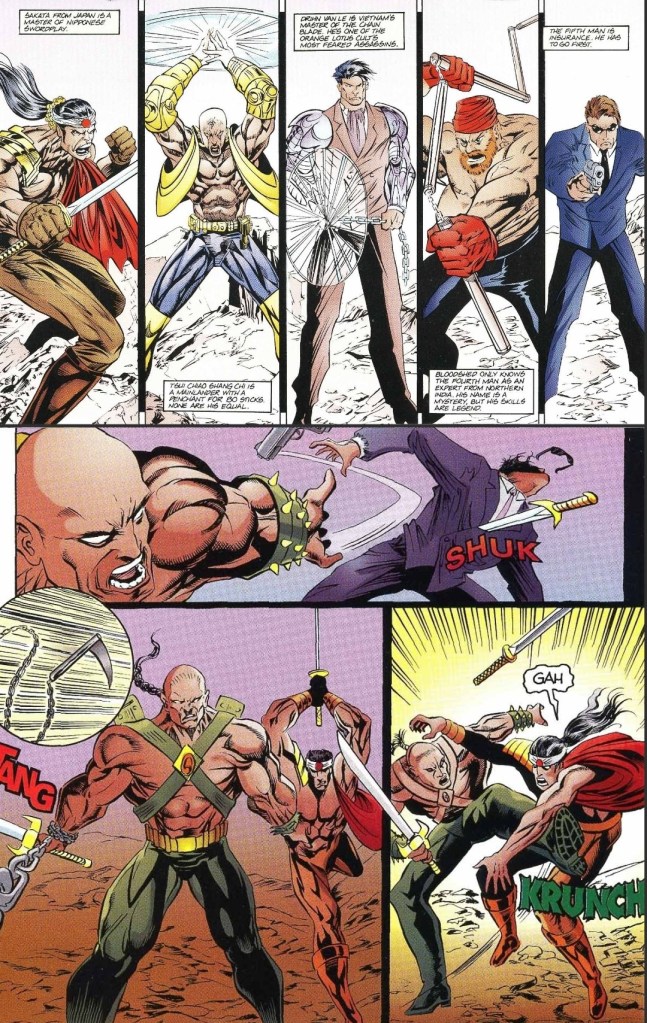
On a far-away location in Hong Kong, a fighter called Bloodshed finds himself surrounded by five other fighters who are determined to kill him…

Quality

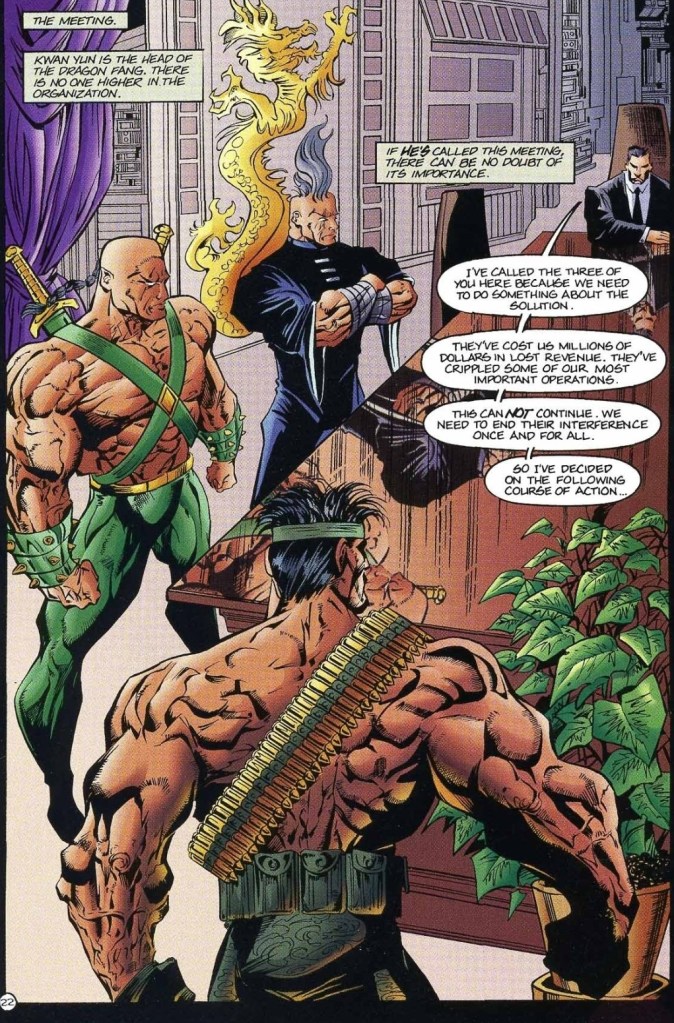
The three assassins in a meeting for a mission against The Solution.

I’ll get straight to the point here. This comic book has the most jarring story I have read about this series and even among all the Ultraverse comic books I have read so far. The story was truly a build-up of an opposing force composed of assassins who are serving one powerful boss who really targets The Solution. It’s so alienating to read this tale that never really had Tech, Outrage, Dropkick, and Shadowmage at all.

More on what was presented here, Hudnall exerted effort to build up the three assassins (note: they all appeared in issue ) not merely as villains but as characters with background details that emphasize their personalities. Incoming is a veteran Communist who lives with intense violence which is connected to the events that happened in his past. Considering his background and how he appears, Incoming looks like a fantasized version of Rambo but in Asian form that modern day Communists in America (read: SJWs, diversity freaks, inclusion freaks and socialists) would love to have in their Satanic Leftist movement. Black Tiger, who has this uncanny offensive capability, is similarly violent as he witnessed lots of killing, rapes, robbery and drug deals in his life and went on to join the Dragon Fang gang. Bloodshed meanwhile grew up with opium acquired by his family, joined a gang at a young age and got trained with violence to rise up.

As the three assassins were being prepared for an anticipated rematch with The Solution, the story here really looked like it was crafted to be a direct follow-up to issue . That being said, The Solution’s impact against crime was also emphasized with some interesting details told.

On the visual side of things, Huang Nguyen gave this comic book a new but not so polished look. There’s not enough visual detail on his art on the characters. In fact, the three assassins were not that recognizable to me when I first read this comic book and I had to go back to issue to view how they looked in it. On action, Nguyen’s work looks sub-par in quality and presentation. There were even some cartoonish moments along the way.

Conclusion

Five against Bloodshed.

The Solution (1994) is so far the weakest story I’ve read in this series as well as one of the weakest Ultraverse stories I’ve read so far. It is truly a build-up for an upcoming conflict with The Solution which so happens to focus mainly on the villains. You won’t find The Solution themselves here at all and this for me is a turn-off. Ultimately, the story feels hollow and the assassins Incoming, Black Tiger and Bloodshed are themselves not too interesting as Ultraverse villains.

Overall, The Solution (1994) is unsatisfactory.

+++++

Thank you for reading. If you find this article engaging, please click the like button below and also please consider sharing this article to others. If you are looking for a copywriter to create content for your special project or business, check out my services and my portfolio. If you want to support my website, please consider making a donation. Feel free to contact me with a private message. Also please feel free to visit my Facebook page Author Carlo Carrasco and follow me on Twitter at  @HavenorFantasy as well as on Tumblr at https://carlocarrasco.tumblr.com/ and on Instagram athttps://www.instagram.com/authorcarlocarrasco/.

A Look Back at The Night Man #10 (1994)

Disclaimer: This is my original work with details sourced from reading the comic book and doing personal research. Anyone who wants to use this article, in part or in whole, needs to secure first my permission and agree to cite me as the source and author. Let it be known that any unauthorized use of this article will constrain the author to pursue the remedies under R.A. No. 8293, the Revised Penal Code, and/or all applicable legal actions under the laws of the Philippines.

Welcome back superhero enthusiasts, 1990s culture enthusiasts and comic book collectors! Today we go back to the mid-1990s which was a pretty wild time for comic collectors. To be more specific, this newest retro comic book review revisits the Ultraverse through The Night Man monthly series.

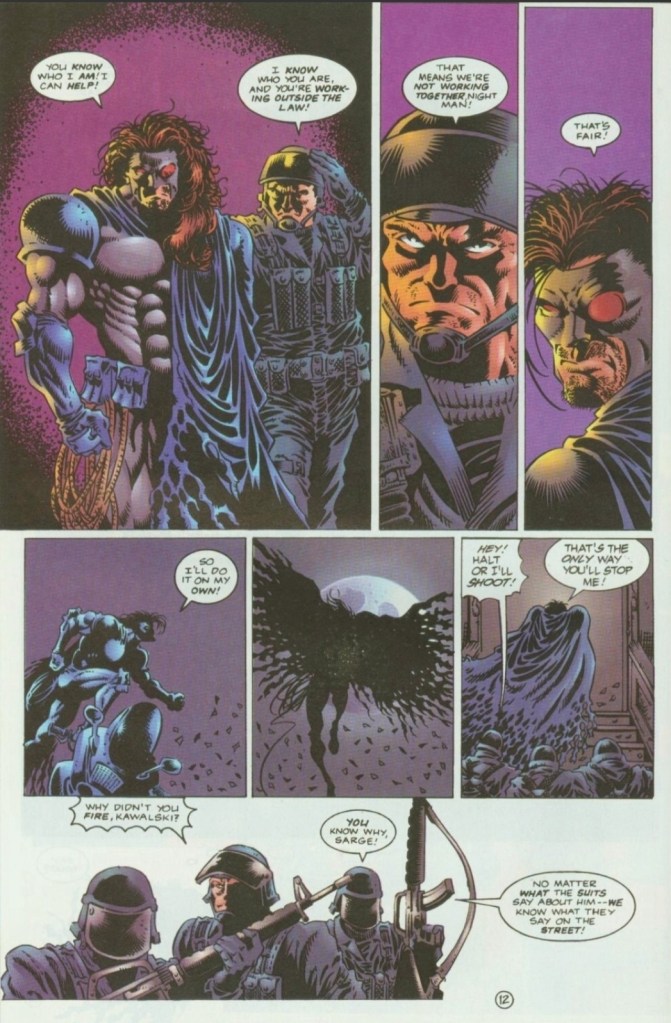
In my previous retro review, the Teknight armor remotely controlled by J.D. Hunt and his son broke into a prison to free the defeated Apocaloff. Unsurprisingly, the Night Man arrived to stop Teknight’s operation even though the police were not willing to get involved with the vigilante. Eventually, Teknight and Apocaloff were defeated thanks to a masked man who fired a canister from a distance. The Night Man approached the masked man and discovered that he is someone essential in life.

With those details laid down, here is a look back The Night Man , published in 1994 by Malibu Comics with a story written by Steve Englehart and drawn by Kyle Hotz.  

The cover.

Early story

The story begins one week in the past with the shooting of a man witnessed by his lady companion in the presence of three men wearing dark clothes. As the lady agonizes over the injured man, the three men move away, got chased by police officers, and escaped after climbing over a fence.

Moments later, the police isolated the scene of the crime and Johnny Domingo’s father Eddie (the head of Playland security) talks with one of the police officers about what happened. At 3AM the next morning, Eddie returns to the scene of the crime and looks at the blood and the white outline where the victim was marked. At 4:25 AM, with Eddie no longer present, the white outline begins to move and leave the scene of the crime.

In the present day, Eddie and his son Johnny (still in costume as the Night Man) enter an office at Playland…

Quality

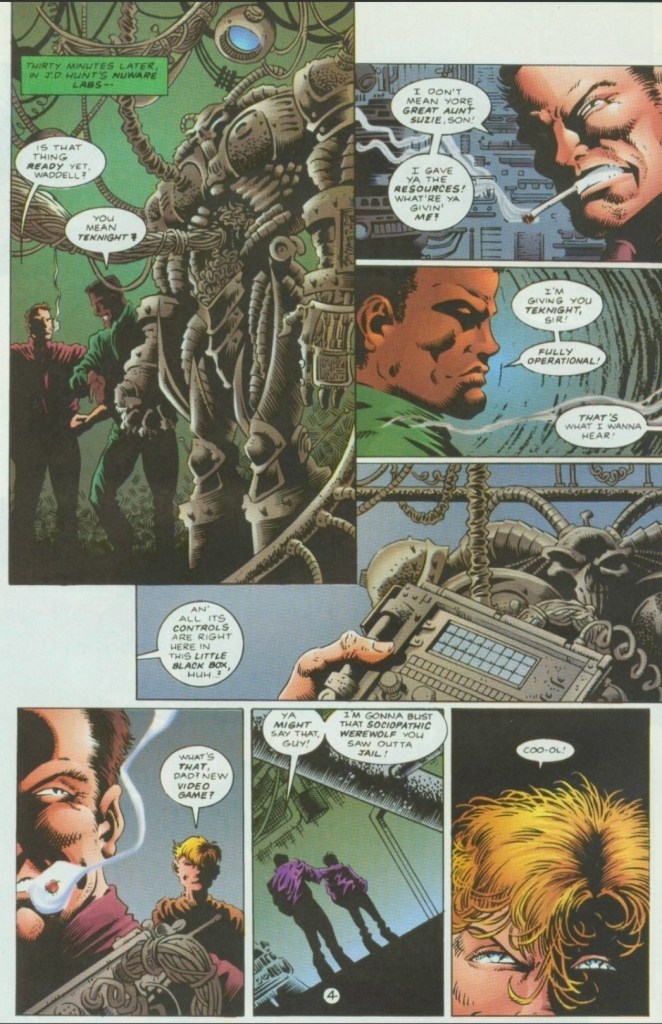
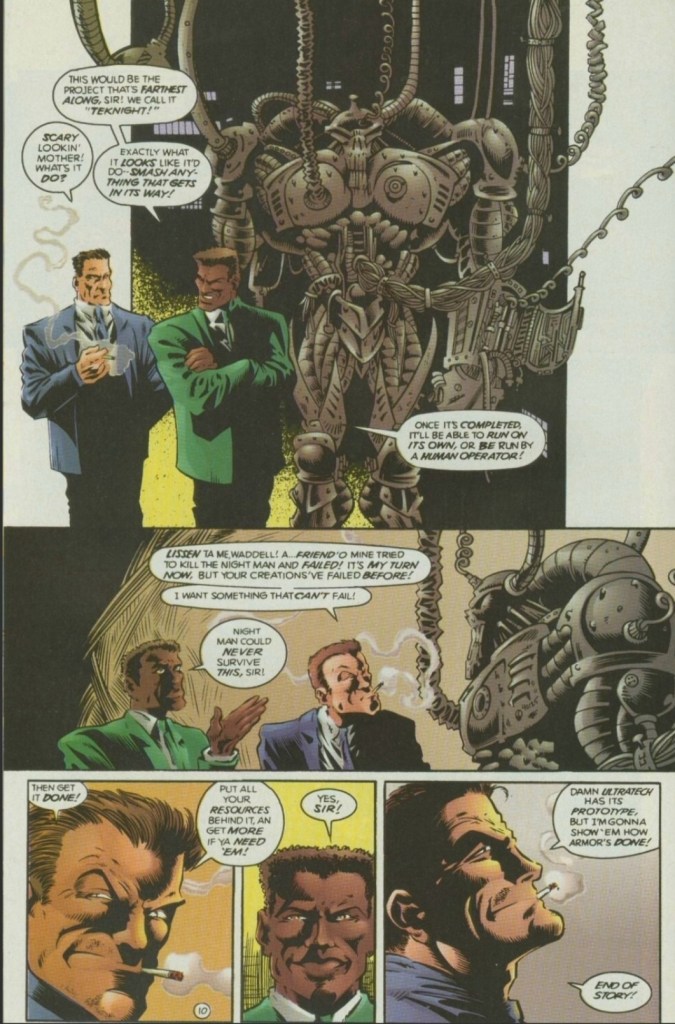
J.D. Hunt calls for the production of a new and improved Teknight armor.

After reading back-to-back issues that had Apocaloff as the main opposition for the Night Man, this comic book not only made a drastic change of storytelling direction but also came up with something could change the way readers perceive the titular hero.

For one thing, having Eddie know that his son and Night Man are one and the same person is quite striking and this became even more evident when they have this very meaningful private talk early in the story. That exchange of dialogue is a must-read. Next, while Night Man made clear he prefers to continues his vigilante acts against evil without his father’s involvement, he accepts the suggestion of moving into Playland as he knew the place a lot since childhood and found it advantageous for his covert operations.

Along the way, a brand new and highly unusual villain got introduced here and provided the Night Man a new form of challenge. The battle between the titular hero and the new villain was well executed and the special attention to detail during key moments were amusing to read.

With regards to the killing that took place at the start of this comic book, there is a sub-plot related to it and it includes a reference to a key event in the past within the Ultraverse which itself is connected with Night Man’s origin.

Conclusion

Kyle Hotz’s art made the images look creepy. Even the Night Man himself looks creepy.

The creative team of Englehart and Hotz set the stage for the new direction of storytelling while succeeded in telling an engaging standalone story in The Night Man (1994). The Night Man fans and Ultraverse fans will have a lot of things to enjoy in this comic book. I personally liked the way the creative team executed story twists and added depth to the plot.

Overall, The Night Man (1994) is recommended.

+++++

Thank you for reading. If you find this article engaging, please click the like button below, share this article to others and also please consider making a donation to support my publishing. If you are looking for a copywriter to create content for your special project or business, check out my services and my portfolio. Feel free to contact me with a private message. Also please feel free to visit my Facebook page Author Carlo Carrasco and follow me on Twitter at  @HavenorFantasy as well as on Tumblr at https://carlocarrasco.tumblr.com/ and on Instagram at https://www.instagram.com/authorcarlocarrasco
A Look Back at The Night Man #9 (1994)

Disclaimer: This is my original work with details sourced from reading the comic book and doing personal research. Anyone who wants to use this article, in part or in whole, needs to secure first my permission and agree to cite me as the source and author. Let it be known that any unauthorized use of this article will constrain the author to pursue the remedies under R.A. No. 8293, the Revised Penal Code, and/or all applicable legal actions under the laws of the Philippines.

Welcome back superhero enthusiasts, 1990s culture enthusiasts and comic book collectors! Today we go back to the mid-1990s which was a pretty wild time for comic collectors. To be more specific, this newest retro comic book review revisits the Ultraverse through The Night Man monthly series.

In my previous retro review, the titular character had another encounter with Nik Apocaloff away from civilization. Meanwhile, the obsessive tycoon J.D. Hunt approved a new high-tech project called Teknight which is capable of intense combat and other functions. I personally enjoyed the way the creative team presented the big rematch between Night Man and Apocaloff in his werewolf form.

With those details laid down, here is a look back The Night Man , published in 1994 by Malibu Comics with a story written by Steve Englehart and drawn by Kyle Hotz.  

The cover.

Early story

The story begins with the defeated Apocaloff standing behind bars in prison with other inmates and police officers present. The police officer tells him of his acts of murdering women and society was fortunate enough to have the Night Man responsible for his capture. Apocaloff then has a small chat with the inmate Martini whose wife just made bail for him again. Upon release from prison, Martini meets his wife and kids outside but excuses himself to help a certain someone. Martini then proceeds to a high-end and meets with a lady inside who pays him for his work and then makes an important call to J.D. Hunt. Knowing that Apocaloff knows sensitive information, Hunt then goes to Nuware Labs where the Teknight project is ready for operation.

Meanwhile, the Night Man searches for Rhiannon…  

Quality

Even though they share common goals, Night Man and the law enforcers have a conflict.

Once again, the creative team of Englehart and Hotz crafted another pretty engaging story that has surprises and moments of intrigue while keeping the narrative fresh. Without spoiling the plot, this comic book had a strong focus on J.D. Hunt and his young yet very aggressive son who use Teknight to do something very daring regarding the captured Apocaloff.  This, of course, lures the Night Man to take action but in a very different way as the conflict happened within the city and with elements of the police and the local government involved.

Apart from showing the conflict between good and evil, Englehart managed to include a few reflective scenes that will make you think about the differences the police have with Night Man with regards to law enforcement and vigilantism clashing with each other even though they all want the same achievement: defeating criminals and handing them over to the justice system. There is also this rather sinister portrayal of the father-and-son relationship between J.D. Hunt and his blonde son. More on the villain Apocaloff, it is very clear that by this point in the Night Man series, he is indeed a major character of opposition against the titular character in this series. I should state that Englehart really delivered a very compelling portrayal of evil with J.D. Hunt and Apocaloff involved. Lastly, this story ended with a twist that  really surprised me.

Conclusion

The Teknight project.

The Night Man (1994) is indeed another compelling story that has a nice mix of action, intrigue and characterization. This is a notable achievement by the Englehard-Hotz team as the Night Man himself was less prominent compared to the previous issue. This is understandable since there was the stronger focus and development of J.D. Hunt and his son as both of them got involved in the story’s main conflict. I should also state that off all the Ultraverse comic books I reviewed so far, this one has a strong father-and-son element that has to be read.  

Overall, The Night Man (1994) is recommended.

+++++

Thank you for reading. If you find this article engaging, please click the like button below and also please consider sharing this article to others. If you are looking for a copywriter to create content for your special project or business, check out my services and my portfolio. Feel free to contact me with a private message. Also please feel free to visit my Facebook page Author Carlo Carrasco and follow me on Twitter at  @HavenorFantasy as well as on Tumblr at https://carlocarrasco.tumblr.com/ and on Instagram at https://www.instagram.com/authorcarlocarrasco/
A Look Back at The Night Man #8 (1994)

Disclaimer: This is my original work with details sourced from reading the comic book and doing personal research. Anyone who wants to use this article, in part or in whole, needs to secure first my permission and agree to cite me as the source and author. Let it be known that any unauthorized use of this article will constrain the author to pursue the remedies under R.A. No. 8293, the Revised Penal Code, and/or all applicable legal actions under the laws of the Philippines.

Welcome back superhero enthusiasts, 1990s culture enthusiasts and comic book collectors! Today we go back to the mid-1990s which was a pretty wild time for comic collectors. To be more specific, this newest retro comic book review revisits the Ultraverse through The Night Man monthly series.

In my previous retro review, Night Man encountered a new, murderous villain who could change into a werewolf. The mentioned villain named Nik Apocaloff is a lot more than being able to become a monster…he has a notable family background, is highly education and is connected with powerful figures like J.D. Hunt. That makes him a formidable antagonist versus Night Man and his civilian identity as Johnny Domino. Apocaloff proved to be such a powerful villain, he became the center of attention of Night Man during one of his radio broadcasts.

With those details laid down, here is a look back The Night Man , published in 1994 by Malibu Comics with a story written by Steve Englehart and drawn by Kyle Hotz.  

The cover.

Early story

The story begins somewhere inside one of the many rooms of city hall. An intense meeting goes on with the mayor present and what happened recently involving both the Night Man and the werewolf made an impact on the matters of discussion.

In an apartment somewhere in the city, Apocaloff is in his monster form and he just murdered a lady and consumed a lot of her flesh. Suddenly the door is knocked by someone who knew the victim. This causes Apocaloff to leave through the window and climb the steps to the rooftop. There, he changes back into his human form.

Elsewhere, Lt. Carleton Briggs arrives back in his office where Sergeant Dade is waiting. After a s short chat, they hug and kiss each other. The Night Man suddenly enters through the window…

Quality

J.D. Hunt and the Teknight project.

Wow! This is one very compelling tale of the Night Man. To get straight to the point, the highlight of this comic book is the rematch between the title character and Apocaloff. To be clear, the rematch was not handled with brainless action in mind but rather with a lot of strategy combined with a medium-paced approach on progression which brought back a lot of vibes from Night Man’s encounters with the members of TNTNT a few issues back. Storywise, the stakes behind the rematch are much higher as the Night Man makes a solid pitch to the local police in the fight against crime (which made me think about the key elements of Batman comic books)  while the tycoon J.D. Hunt (whom Apocaloff interacted with previously) just gave his approval for the Teknight project.

When it comes to character development, Apocaloff’s strong adherence to the past (Russian legacy, old world sensibilities, connections with California’s history) are emphasized some more. For his part, Night Man’s intelligence and approach to vigilantism got developed even more.  

Conclusion

Night Man comes to the police with evidence about Apocaloff.

The Night Man (1994) is another solid comic book of the Ultraverse. The story was told with an overall medium pace and the payoffs for each build-up were indeed satisfying. Considering the presence of the police in the story, this particular Night Man issue has the strongest similarities with DC Comics’ Batman. More importantly, this issue succeeded in developing both the titular hero and his most elaborate villain. It seems to me that Night Man and Apocaloff were made to clash with each other beyond this issue and the previous one.

Overall, The Night Man (1994) is recommended.

+++++

Thank you for reading. If you find this article engaging, please click the like button below and also please consider sharing this article to others. If you are looking for a copywriter to create content for your special project or business, check out my services and my portfolio. Feel free to contact me with a private message. Also please feel free to visit my Facebook page Author Carlo Carrasco and follow me on Twitter at  @HavenorFantasy as well as on Tumblr at https://carlocarrasco.tumblr.com/ and on Instagram at https://www.instagram.com/authorcarlocarrasco/

A Look Back at The Night Man #7 (1994)

Disclaimer: This is my original work with details sourced from reading the comic book and doing personal research. Anyone who wants to use this article, in part or in whole, needs to secure first my permission and agree to cite me as the source and author. Let it be known that any unauthorized use of this article will constrain the author to pursue the remedies under R.A. No. 8293, the Revised Penal Code, and/or all applicable legal actions under the laws of the Philippines.

Welcome back superhero enthusiasts, 1990s culture enthusiasts and comic book collectors! Today we go back to the mid-1990s which was a pretty wild time for comic collectors. To be more specific, this newest retro comic book review revisits the Ultraverse through The Night Man monthly series.

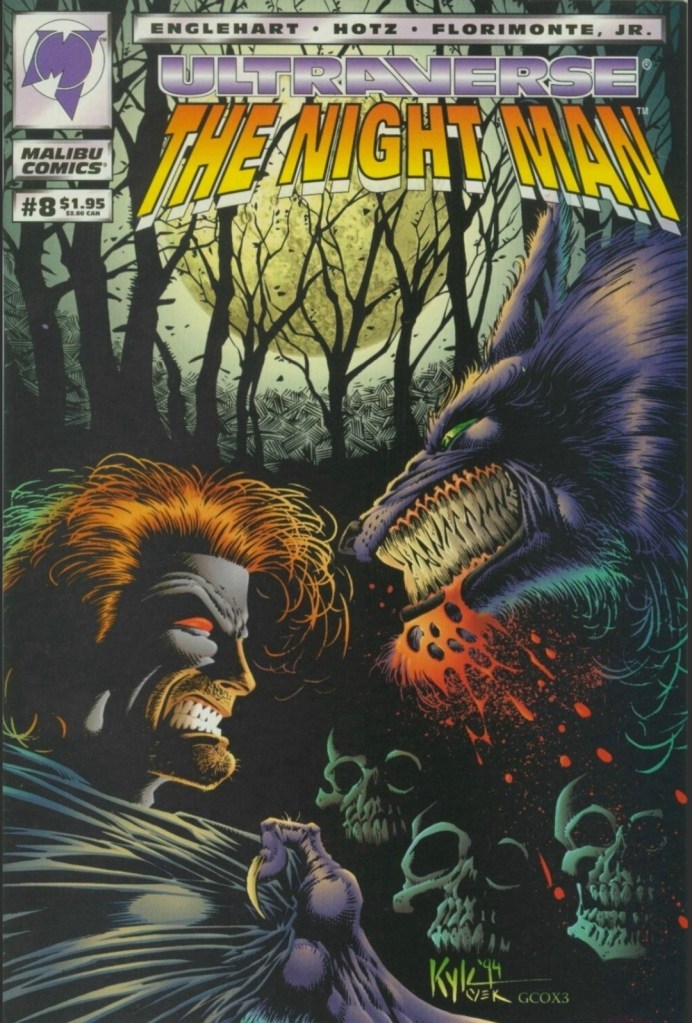
In my previous review, the Night Man was pitted against TNTNT which was the same group of villains who fought against The Strangers. The encounter was not only packed with solid action, the pacing was done strategically and I loved the way how the comic book creators presented the Night Man taking on each TNTNT member creatively. For this new issue, a new enemy awaits the titular hero which the scary looking cover clearly shows.

With those details laid down, here is a look back at The Night Man , published in 1994 by Malibu Comics with a story written by Steve Englehart and drawn by Kyle Hotz.  

The cover.

Early story

The story begins in an unknown place where a man talks to a lady who just died. After wearing his coat and grabbing his cane, he leaves behind a place with lots of blood around and things ruined. The body of the dead lady had been damaged so much, the flesh on the front of her upper body is gone leaving the bones exposed.

The said man walks down the street of San Francisco. As he recalls a key part of California’s history, he witnesses three armed men coming out of a jewelry store followed by Night Man. Immediately, he witnesses the city’s vigilante fight two of the men with brutal violence. The third thug (with long hair) takes the opportunity to move away only to face the man with the cane…

Quality

The new villain meeting with the tycoon JD Hunt.

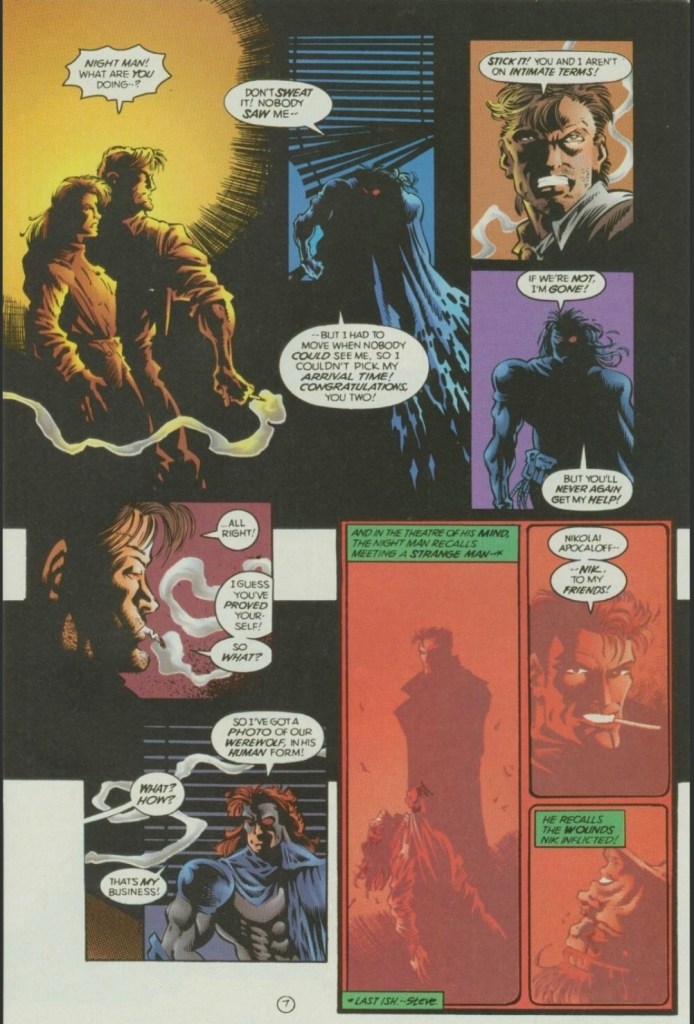
This tale of The Night Man is gritty and engaging to read from start to finish. It introduces an all-new villain who has a Russian legacy with historical connections to the city of San Francisco and northern part of California. The new figure of evil (note: quite obvious due to his murdering of the innocent) is quite a layered character and he seemed to be designed by Steve Englehart to be a recurring villain against the Night Man.

At this point in the comic book series, Night Man has established himself to be a very capable vigilante who truly believes in helping the people of the city on his own and his victories in the previous issues solidified his reputation. This essentially sets the stage for the debut of the new villain (note: the scary looking wolf on the cover) and the next big challenge for the titular hero. Without spoiling what happened, I can say the pay-off was indeed worth the build-up.

Another strong point of this comic book is the way the creators dramatized the differences and similarities between the Night Man and the new villain. Both men are violent and their each have their own obsessions directly related to their respective goals.

Conclusion

The Night Man takes on thugs as the new villain watches.

The Night Man (1994) is a pretty engaging read on its own and it shows how much the Night Man himself progressed as the Ultraverse’s San Francisco-based vigilante who really pushes himself to the limits fighting evil even though his resources are very limited. The introduction of the new villain in this comic book not only proved to be a solid addition into the Ultraverse lore but also added to the titular hero’s development as well as his vigilante justice campaign. This comic book may not be as action packed as the previous issue, but you can rest assured there is a really good quality writing here and the build-up was nicely paid-off by the end. As with the previous issues, Kyle Hotz’s gritty art made this Night Man tale really look lively and very stylish.

Overall, The Night Man (1994) is recommended.

+++++

Thank you for reading. If you find this article engaging, please click the like button below and also please consider sharing this article to others. If you are looking for a copywriter to create content for your special project or business, check out my services and my portfolio. Feel free to contact me with a private message. Also please feel free to visit my Facebook page Author Carlo Carrasco and follow me on Twitter at  @HavenorFantasy as well as on Tumblr at https://carlocarrasco.tumblr.com/ and on Instagram at https://www.instagram.com/authorcarlocarrasco/
A Look Back at Exiles #2 (1993)

Disclaimer: This is my original work with details sourced from reading the comic book and doing personal research. Anyone who wants to use this article, in part or in whole, needs to secure first my permission and agree to cite me as the source and author. Let it be known that any unauthorized use of this article will constrain the author to pursue the remedies under R.A. No. 8293, the Revised Penal Code, and/or all applicable legal actions under the laws of the Philippines.

Welcome back superhero enthusiasts, 1990s culture enthusiasts and comic book collectors! Today we go back to the mid-1990s which was a really wild time for comic collectors. To be more specific, this newest retro comic book review revisits Ultraverse through the very short series titled Exiles.

It has been years since I reviewed Exiles #1 (1993). Since after, I reviewed a lot of Ultraverse comic books and went through notable storylines such as the Atalon Saga in UltraForce, the Hostile Takeover in Prototype, The Solution, The Night Man and Solitaire, and more. That being said, it was just right that I returned to Exiles for retro reviewing.

With those details laid down, here is a look back Exiles , published in 1993 by Malibu Comics with a story written by Steve Gerber and drawn by Robb Phipps.

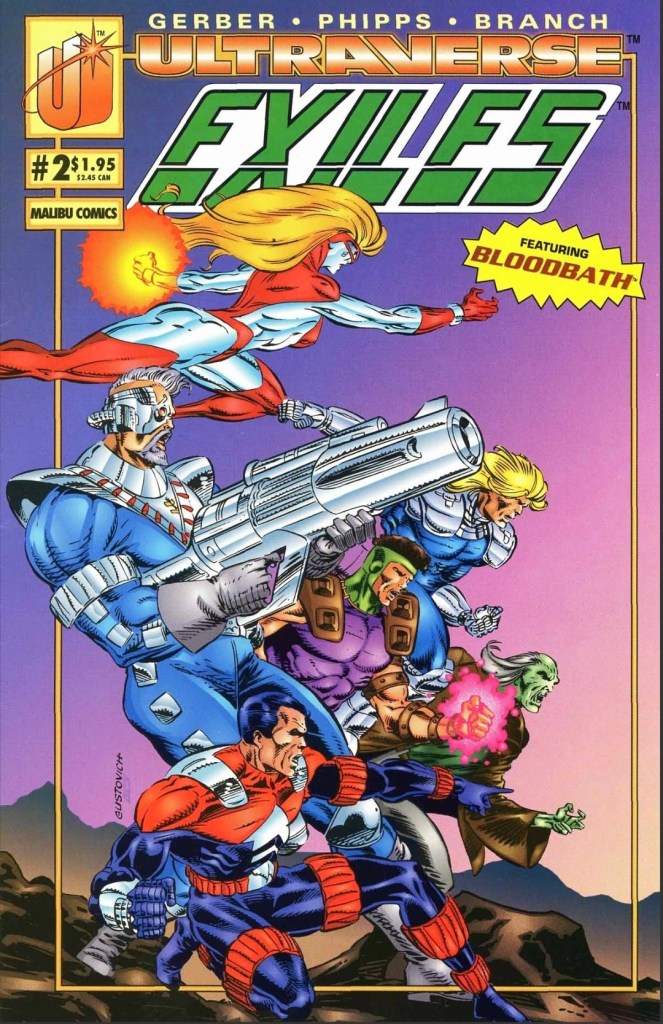
The cover.

Early story

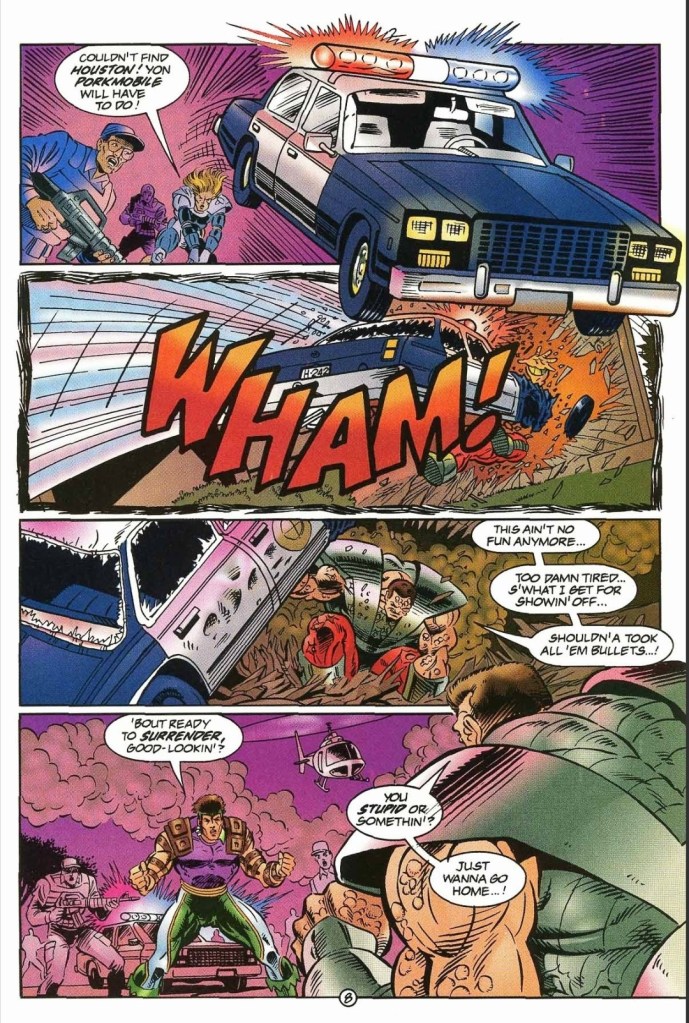
The story begins with Exiles members Catapult and Mustang staring at two bodies (a large man and a lady) on the floor. It turns out their mission was a failure as Timmy Halloran (the young guy they tried to save) went missing while his mother just died.

As soon as the two step out of the house feeling bad about their failure, they suddenly find themselves confronted by several police officers. Police cars and a helicopter have surrounded the place. Just as Catapult and Mustang turned themselves in, the large man named Bruut suddenly regains consciousness and attacks the police.

The police officers respond by firing several bullets at Bruut which slowed him down. After noticing that Bruut was only regaining his strength, the two Exile members made their moves before the large man strikes the police…

Quality

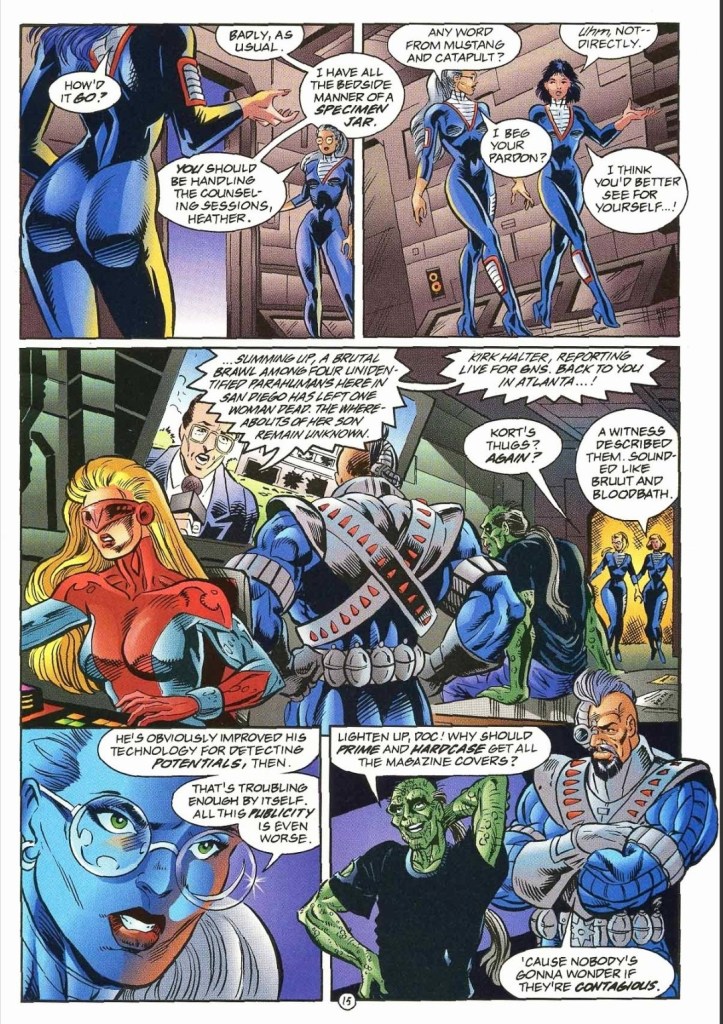
Inside the headquarters of Exiles. Ghoul’s mentioning of Prime and Hardcase seems to foreshadow his eventual part in UltraForce.

As expected, the storytelling in this comic book really progressed and paid off some of the build-up that happened in issue . Here, the conflict between the Exiles and the enhanced forces of business tycoon Victor Kort got clearly defined and what they have in common other than having enhanced beings is their pursuit of individuals who carry within their bodies the Theta virus which unlocks unexpected powers or capabilities. Such developments could impact the people and the world around them when left unguarded or deliberately developed with assistance of guidance.

Amber, who was a key figure in issue , appears much less in this comic book but her purpose with the Exiles gets more elaborated. The lack of spotlight on Amber is not surprising as the creators had to emphasize the conflict between the titular team and Kort’s forces while also introducing Timmy Halloran as a new Theta-carrying individual.

There is a good amount of superhero spectacle here and along the way, the dialogue is good and got witty as well. By the time I reached the end, I found myself anticipating what would come next in issue .

Conclusion

The two Exiles members take on Bruut right in the presence of police officers.

Exiles (1993) is a worthy follow-up to its predecessor and the creators succeeded in making the conflict more engaging while cleverly releasing new details that defined what is at stake and what could follow. In retrospect, Amber Hunt later became a key figure in the 2-part Break-Thru crossover storyline (which was memorably drawn by the late George Perez) and the story here defined how much impact super beings can have on societies filled with mostly people who don’t have super powers or special talents. The conflict between the Exiles and Kort’s forces not only got emphasized a lot, their respective agendas and resources are also well defined.

Overall, Exiles (1993) is recommended.

+++++

Thank you for reading. If you find this article engaging, please click the like button below and also please consider sharing this article to others. If you are looking for a copywriter to create content for your special project or business, check out my services and my portfolio. Feel free to contact me with a private message. Also please feel free to visit my Facebook page Author Carlo Carrasco and follow me on Twitter at  @HavenorFantasy as well as on Tumblr at https://carlocarrasco.tumblr.com/ and on Instagram at https://www.instagram.com/authorcarlocarrasco/
A Look Back at Break-Thru #2 (1994)

Disclaimer: This is my original work with details sourced from reading the comic book and doing personal research. Anyone who wants to use this article, in part or in whole, needs to secure first my permission and agree to cite me as the source and author. Let it be known that any unauthorized use of this article will constrain the author to pursue the remedies under R.A. No. 8293, the Revised Penal Code, and/or all applicable legal actions under the laws of the Philippines.

Welcome back superhero enthusiasts, 1990s culture enthusiasts and comic book collectors! Today we go back to the mid-1990s which was a really wild time for comic collectors. To be more specific, this newest retro comic book review revisits the conclusion of the epic Ultraverse storyline Break-Thru which was illustrated by the late George Perez (1954-2022). I encourage you readers – especially long-time fans of the iconic illustrator – to check out my commemorative article about George Perez by clicking here.

For the newcomers reading this, Break-Thru was a 2-part storyline that creatively involved almost all the main characters of the Ultraverse (The Strangers, Mantra, Prime, Prototype, Freex, The Solution, Hardcase, Sludge, Solitaire and others) who got impacted in varied ways by Amber (of the Exiles) who floated high in the air causing chaos on societies below. Specifically, that was the concept of Break-Thru (1993) and issue has the story continuing with a setting in outer space with the moon as the key destination.

With those details laid down, here is a look back Break-Thru , published in 1994 by Malibu Comics with a story scripted by Gerard Jones (plotted by Mike W. Barr, Steve Englehart, Steve Gerber, James Hudnall, Tom Mason, George Perez, James Robinson and Len Strazewski) and illustrated by the late George Perez.

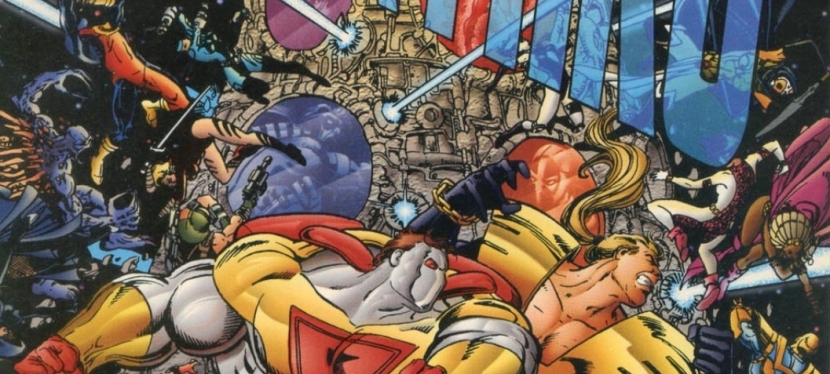
An epic cover by the late George Perez.

Early story

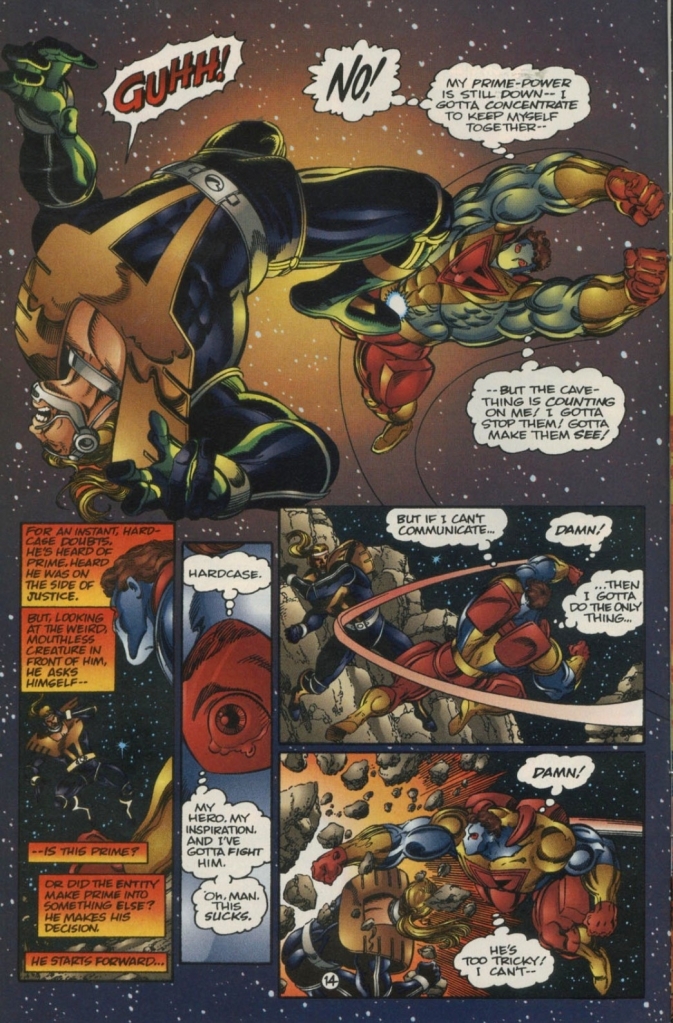
The story begins at the surface of the moon with Hardcase, Choice and the members of The Solution who just survived the explosion (connected with Hardcase #7 and The Solution #4) of the flying saucer they used on their journey. Nearby, the people responsible for the destruction are riding their own flying saucer, scanning the surface of the moon searching for an entity.

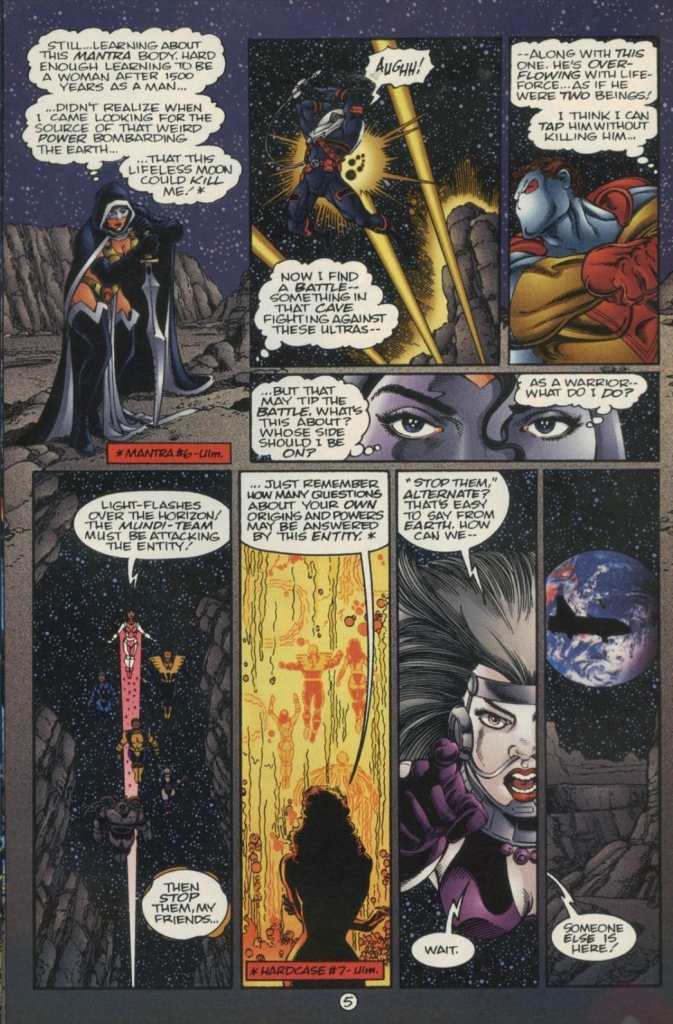
Behind the scenes, the very hidden yet powerful Rex Mundi watches and tells Gate that other ultras are seeking the entity. As the saucer floats to a cave detecting the presence of the entity, the occupants get shaken as Prime hits them hard. Prime tells himself that the entity in the cave feels danger from the searchers and he has to protect it as he has been connected with it (refer to Prime #7). After getting blasted in retaliation by the saucer, Prime finds himself hit even more as Rex Mundi’s enforcers suddenly come out of a portal very near him.  

From a distance, Mantra (refer to Mantra #6) sees the fight happening and needs a life force to survive. Elsewhere, Hardcase, Choice and The Solution witness the arrival of a space shuttle. The Strangers and Prototype (refer to The Strangers #7 and Prototype #5) come out together…

Quality

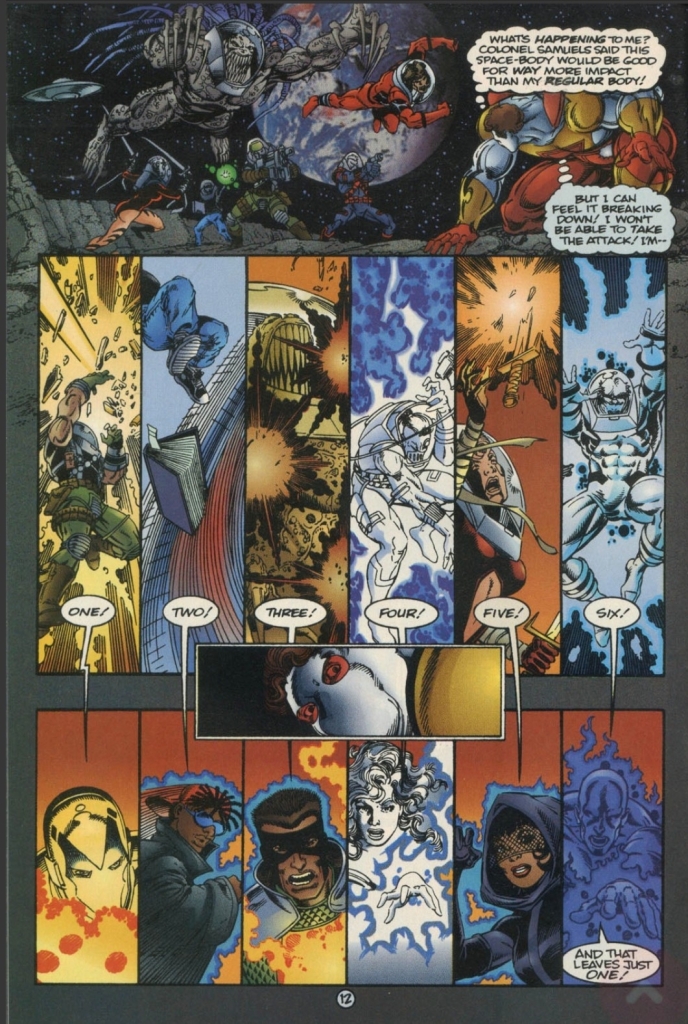
This is classic George Perez presentation of action and characters using multiple panels in a single page.

Starting with the writing, I should mention that all the writers who were involved in plotting this comic book as well as the previous issue should be commended for their combined efforts on making the Break-Thru storyline happen complete with in-universe ramifications, developments and connections to almost all the monthly comic books via the Break-Thru tie-in issue (also check out Sludge #3, Freex #6, Solitaire #2 and Night Man #3). Clearly Break-Thru was planned to be a major turning point of the Ultraverse by involving and mixing most of the major characters together and have them struggle with tremendous obstacles they simply cannot ignore as the stakes were indeed too high.

More on this comic book, the major conflict was set on the moon which proved to be a very unique setting not just for dynamic battles to happen but also to serve as the place where a mysterious and powerful entity is hidden. When it comes to the story, the entity (more science fictional in concept) is mysterious and cleverly not blatantly evil. It is its mysteriousness that makes the entity a worthy force to have the UV’s heroes come after.

The writers added depth to the plot by showing Yrial of The Strangers and Prototype each having their own vested interests to get to the entity and acquire whatever it has that is valuable. At the same time, Mantra and Prime each discovered valuable knowledge about the entity that impacted their perceptions about their purpose as beings with super powers.

Mantra, Prime, The Solution, Hardcase and Choice.

While the story here still has so many characters expressing themselves and releasing expository information, the narrative is a little bit easier to understand and follow compared to issue (which had a lot more information to release via exposition). That being said, the scenes of spectacle became more enjoyable to read and along the way there were some notable character moments to look at.

Visually, this is unsurprisingly a great looking comic book as it was illustrated by the late George Perez. What I love most about Perez’s art style and visual presentation are all here: high details on each character drawn as well as their surroundings, the dynamic approach on setting up the panels on each page, fantastic looking superhero action, and much more! As with Break-Thru and other Ultraverse comic books drawn by Perez, this one is absolutely great to look at and it easily lifts up the visual/artistic quality of the UV and its heroes. As George Perez was involved in the plot of this comic book, the narrative was never overwhelmed by his great art and the artist really exerted a lot of effort on visualizing each and every one of the established UV characters (including the supporting characters).

Speaking of the established characters, I should state that Perez made Mantra’s face (with mask) look a bit more realistic and feminine while Kevin Green has a more convincing teenage boy look, Sludge looks a bit more creepier and Yrial looks visually identical to the way Rick Hoberg draws her. When it comes to the varied physiques of each established UV hero, Perez captured them all perfectly. Clearly the late artist did his research on every character.

Conclusion

The first physical encounter between Prime and Hardcase. Remember this before reading the UltraForce comics.

Break-Thru (1994) is truly an epic Ultraverse story that also worked as a major turning point of the UV as a whole. Compared to other epic superhero stories that Marvel and DC Comics published, Break-Thru is not the usual large gathering of superheroes who have to work together to defeat an evil force that threatens everyone’s existence. It is more about the UV heroes getting together to solve major obstacles before reaching the main destination. By the time I reached the end of this comic book (and its storyline), I experienced great satisfaction not just from Break-Thru itself but also in relation to how the Ultraverse heroes realized what they are living for and what their respective purposes really are about. What also happened in this comic book explains why jumpstart events happened on Earth. Very clearly, this was an epic story that was planned early and even though this was published just months after the Ultraverse first debuted, the characters were developed enough to make Break-Thru’s concepts sensible and acceptable. There is a lot of fun and engagement in this comic book drawn by the late George Perez (who also worked on DC’s Crisis on Infinite Earths and Marvel’s The Infinity Gauntlet).

Overall, Break-Thru (1994) is highly recommended!

+++++

Thank you for reading. If you find this article engaging, please click the like button below and also please consider sharing this article to others. If you are looking for a copywriter to create content for your special project or business, check out my services and my portfolio. Feel free to contact me with a private message. Also please feel free to visit my Facebook page Author Carlo Carrasco and follow me on Twitter at  @HavenorFantasy as well as on Tumblr at https://carlocarrasco.tumblr.com/ and on Instagram at https://www.instagram.com/authorcarlocarrasco/
A Look Back at The Night Man #6 (1994)

Disclaimer: This is my original work with details sourced from reading the comic book and doing personal research. Anyone who wants to use this article, in part or in whole, needs to secure first my permission and agree to cite me as the source and author. Let it be known that any unauthorized use of this article will constrain the author to pursue the remedies under R.A. No. 8293, the Revised Penal Code, and/or all applicable legal actions under the laws of the Philippines.

Welcome back, superhero fans, 1990s arts and culture enthusiasts, and comic book collectors! Today we revisit the Ultraverse of Malibu Comics and examine one of its many stories through The Night Man monthly series.

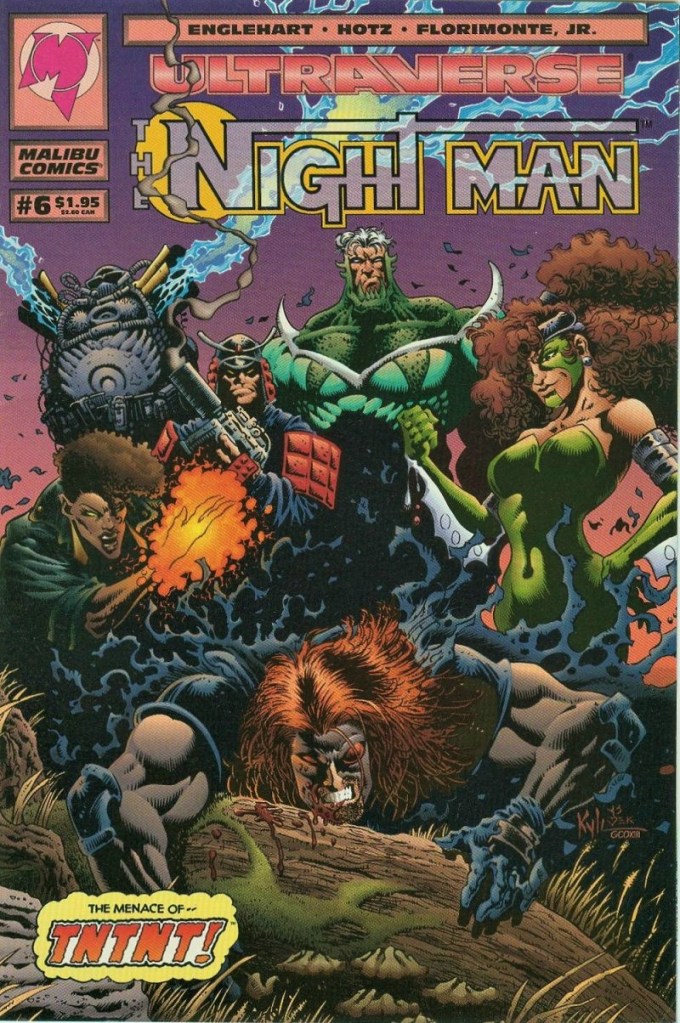
Remember the group TNTNT? That group appeared in The Strangers #3 and proved to be a strong force of opposition against the team of Atom Bob, Lady Killer, Grenade, Zipzap, Electrocute, Spectral and Yrial. As revealed in that comic book, TNTNT – composed of Tyrannosaur, Naiad, Torso, Neu-Ronnie and Tugun – was trained and equipped by the corporation called NuWare under the watch of their powerful executive J.D. Hunt who clearly has something planned.

That being said, can you imagine what would it be like if TNTNT had ganged up on a solo ultra…like the Night Man?

With those details laid down, here is a look back at The Night Man , published by Malibu Comics in 1994 with a story written by Steve Englehart and drawn by Kyle Hotz.

The cover.

Early story

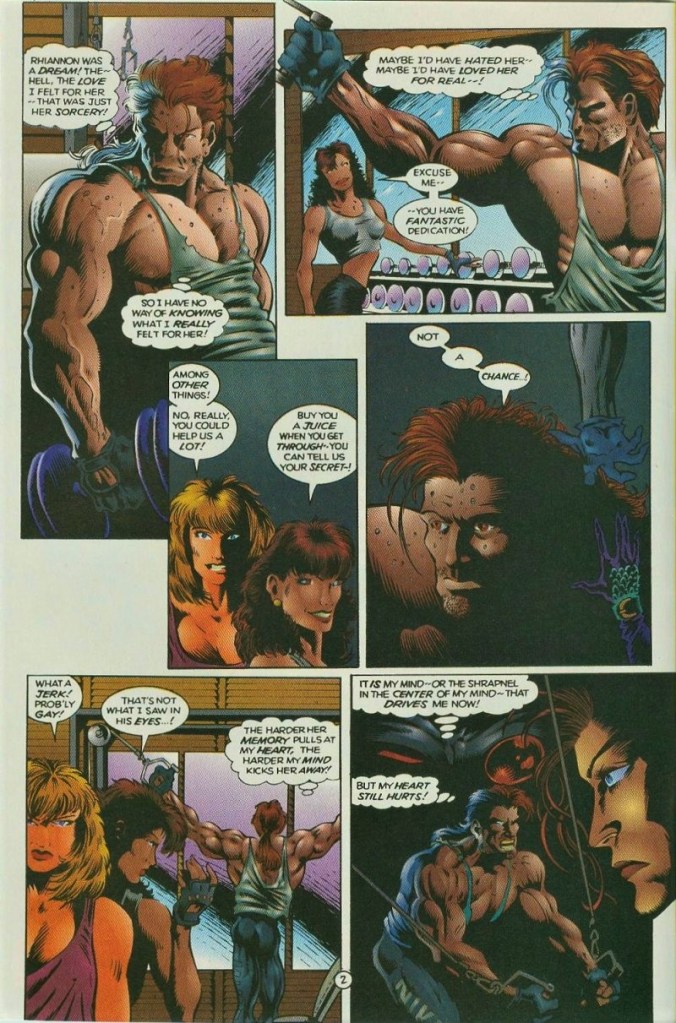
The story begins with Johnny/Night Man working out hard in a gym observed closely by two attractive ladies. While thinking about what happened recently, the two ladies tried to interact with him. He rejects them and continues to work out hard.

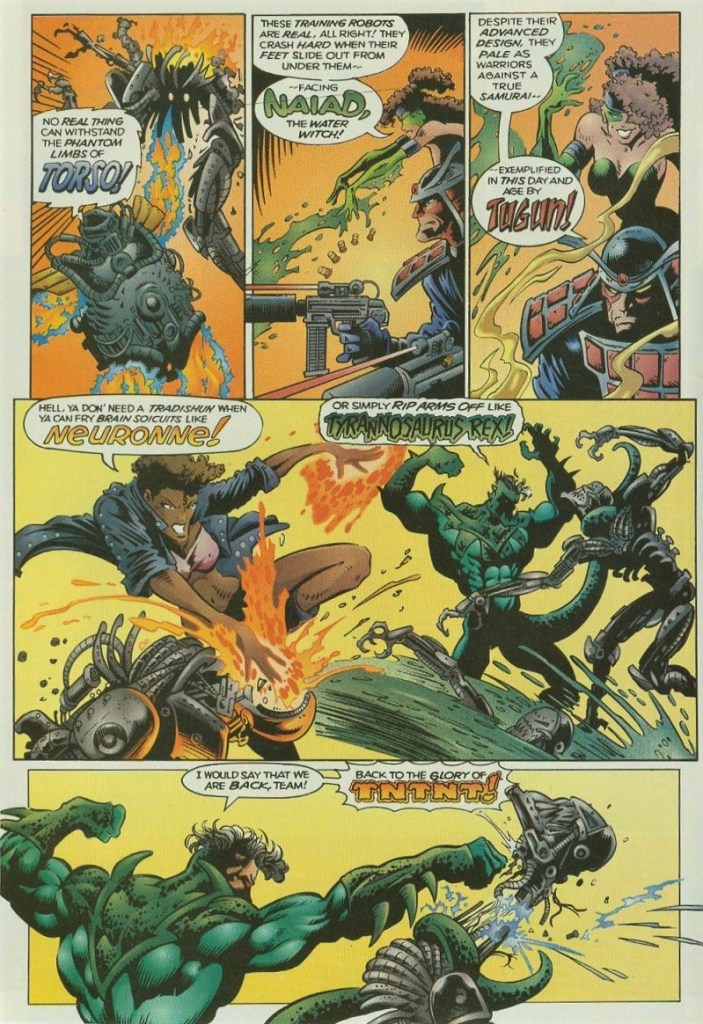
Meanwhile over at a high-tech facility in Sunnyvale, California, the group called TNTNT begins to act in a private training session surrounded by fierce looking robots. One by one, Tyrannosaur, Naiad, Torso, Neu-Ronnie and Tugun make short work of the training robots. Tyrannosaur even declares that the glory of their team is back.

However, the man operating the session from behind a control booth talks to them, reminds them that they are still employees of J.D. Hunt, and he tells them that they recovery from their loss to the Strangers will be realized only after killing the Night Man…

Quality

The TNTNT members in training.

Wow! This is one well-paced ride with a structured narrative! Without spoiling the plot details, I can confirm that the creators succeeded in delivering the big mismatch of the Night Man facing off with the 5-member TNTNT with a good amount of spectacle balanced with really interesting character moments.

By comparison with their previous appearance in The Strangers , the members of the TNTNT each got more defined in terms of personality in this comic book even during their pages-long encounter with the Night Man. Take for example Tugun whose culture really shaped his perception on such things like insults. Tyrannosaur meanwhile is always confident he’ll win for sure as he knows his super strength and very tough skin make him almost invincible. The way Night Man dealt with each TNTNT member was moderately paced, backed with quick details (to explain things) and was executed in rather believable ways.  On characterization, Steve Englehart convincingly portrayed TNTNT like they are real people who happen to be paid and trained by some powerful employer who really wants things done for him.

At the point of this comic book’s publishing, the Night Man established himself as San Francisco’s radio commentator-in-hiding believing he can inspire people to stand up for themselves when encountering evil elements. At the same time, this comic book further emphasized connectivity within the Ultraverse. In addition to Night Man’s crossover with Freex, his encounter with TNTNT technically links him with The Strangers.

More on the writing, there are these subtle yet clear traces of socialism and anti-corporatism particularly with the way Night Man confronted a man who bought a stretch of a beach perceived by the protagonist as public. The portrayal of J.D. Hunt as a power-mad and sinister business executive is not surprising, but the way he was portrayed in dealing with his employees TNTNT symbolizes the capitalist being abusive towards his laborers. Whatever this comic book tried to say, nothing changes the fact that socialism sucks and it is wicked, twisted and corrupting.

Conclusion

Johnny focused on his workout.

The Night Man (1994) is entertaining and compelling to read. Its substance is quite rich and it is surprisingly good that the creators managed to develop the TNTNT members even as they proceeded with their mission to kill the protagonist. As for Night Man, he’s clearly a vigilante with a cause and as a symbolic tool of socialism, he was portrayed to be pro-people and an arrogant opponent of capitalism. This made him look more like a foolish pawn of socialism and less of a hero.

Speaking of San Francisco, could you imagine what would it be like if Night Man was real today and witnesses how the Satanic Left of San Francisco led the city into social deterioration and disorder? Watch the videos below for insight…

If you are seriously planning to buy an existing hard copy of The Night Man (1994) be aware that as of this writing, MileHighComics.com shows that the near-mint copy of the regular edition costs $16.

Overall, The Night Man (1994) is recommended.

+++++

Thank you for reading. If you find this article engaging, please click the like button below and also please consider sharing this article to others. If you are looking for a copywriter to create content for your special project or business, check out my services and my portfolio. Feel free to contact me with a private message. Also please feel free to visit my Facebook page Author Carlo Carrasco and follow me on Twitter at  @HavenorFantasy as well as on Tumblr at https://carlocarrasco.tumblr.com/ and on Instagram at https://www.instagram.com/authorcarlocarrasco/