Disclaimer: This is my original work with details sourced from reading the comic book and doing personal research. Anyone who wants to use this article, in part or in whole, needs to secure first my permission and agree to cite me as the source and author. Let it be known that any unauthorized use of this article will constrain the author to pursue the remedies under R.A. No. 8293, the Revised Penal Code, and/or all applicable legal actions under the laws of the Philippines.
Welcome back, superhero enthusiasts, 1990s culture enthusiasts, and comic book collectors! Today we revisit the world of 2099 within the universe of Marvel Comics back in the 1990s, specifically through the Spider-Man 2099 monthly series.
Today we will look back at the early development of futuristic Spider-Man as published way back in 1993. The first three issues (read also my reviews of issue #2 and #3) formed a solid foundation on establishing Miguel O’Hara as his era’s Spider-Man thanks mainly to the high-quality writing done by Peter David. What issue #4 will deliver, we will find out here.
With those details laid down, here is a look back at Spider-Man 2099 #4, published in 1993 by Marvel Comics with a story written by Peter David and drawn by Ricky Leonardi.
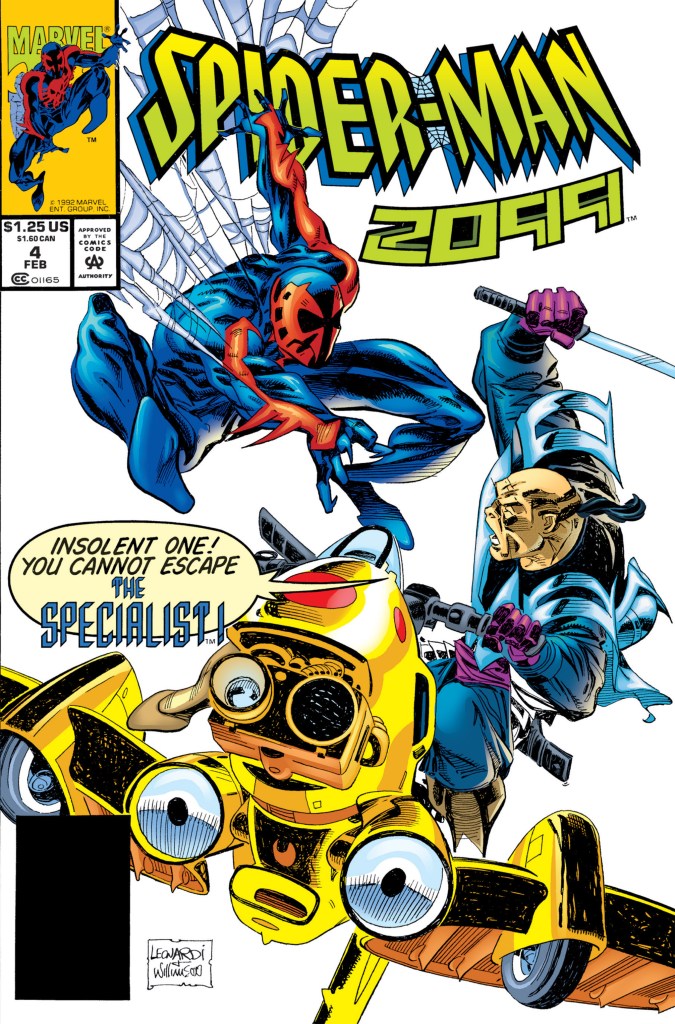
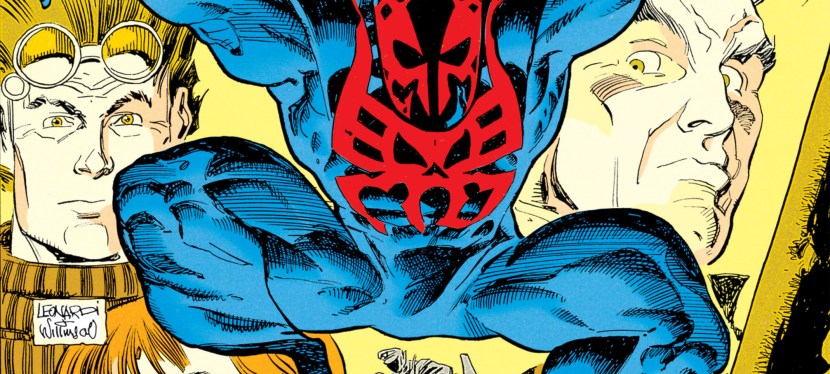
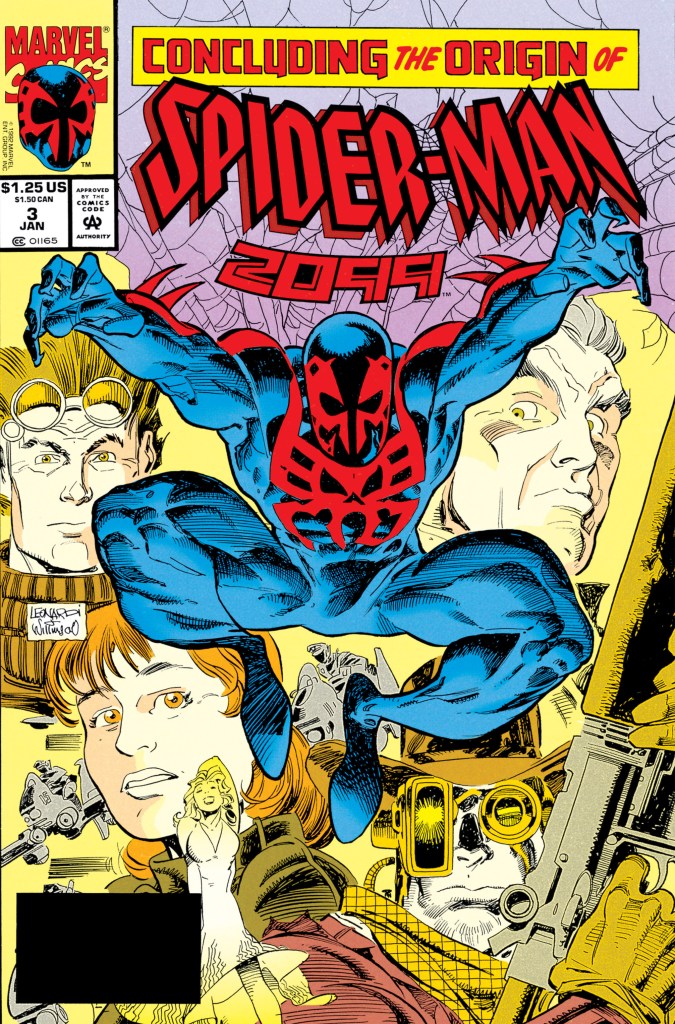
The cover.
Early story
The story begins with Gabriel O’Hara (Miguel’s brother) and Kasey Nash trying to have a good time together inside a vehicle until a man armed with a sword interrupts them and tries to take the lady with him. As Gabriel makes his move to help Kasey, the swordman throws two sharp projectiles at him and moves away with the lady.
Over at the Babylon Towers residence, Miguel O’Hara gets visited by his boss Tyler Stone accompanied by armed personnel. Not realizing that Spider-Man 2099 and Miguel are one and the same person, Tyler tells him that the sudden appearance of the crawler put Alchemax on edge.
Tyler proposes peace between him and Miguel, offering him more of the hyper addictive substance Rapture. He tells him that Aaron Delgato was identified as the mysterious Spider-Man…
Quality
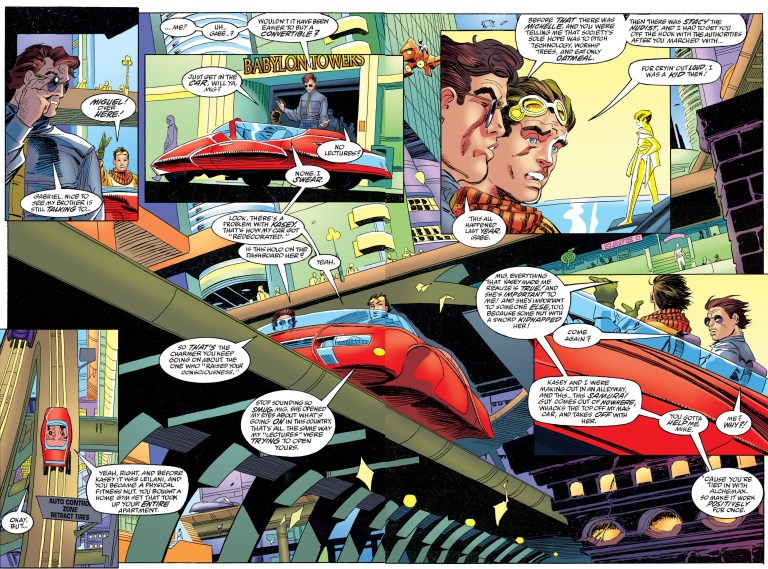
Miguel O’Hara and his brother Gabriel ride and talk.
The plot really thickened in this comic book resulting a few very interesting sub-plot branches as well as more depth on the development of Miguel O’Hara. I really like the way Peter David explored the corporate side of Miguel’s life here creating suspense about Tyler’s limited knowledge of the Alchemax incidents that happened in issues #1 and #2 which actually involved the protagonist witnessing the fall of his corporate rival Aaron (the same guy responsible for the genetic manipulation of Miguel into Spider-Man). This comic book also focuses on the strained relationship Miguel has with his brother Gabriel who clearly lacks the will to be personally responsible.
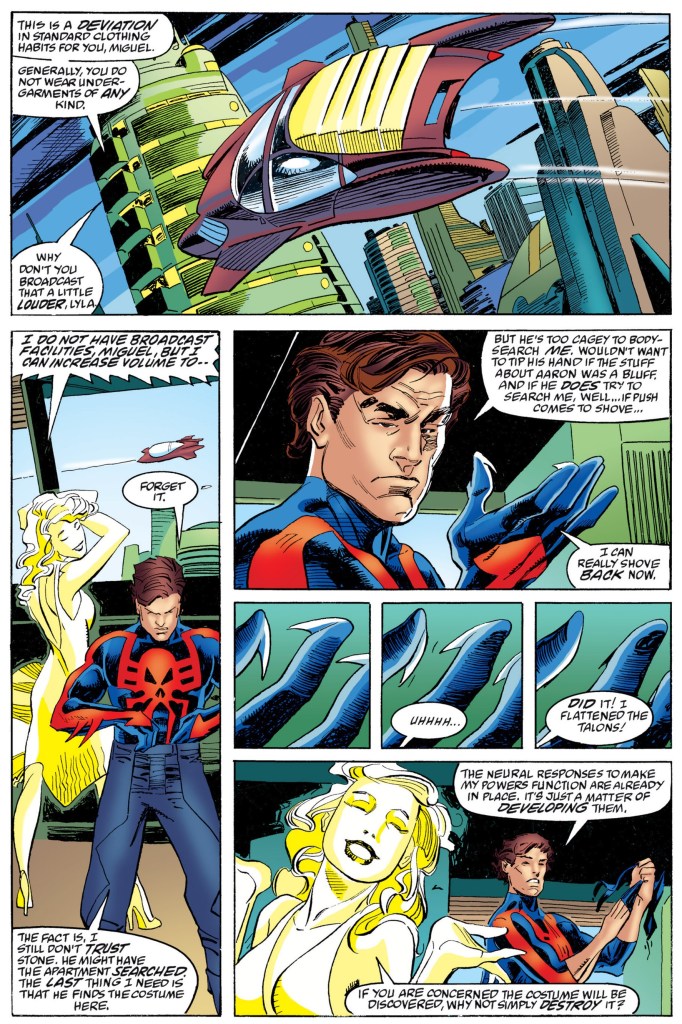
I also enjoyed the way Miguel reacts to the classic Spider-Man expression of “with great power comes great responsibility” as he struggles to set things right even as being a civilian and a superhero in his society has major hassles.
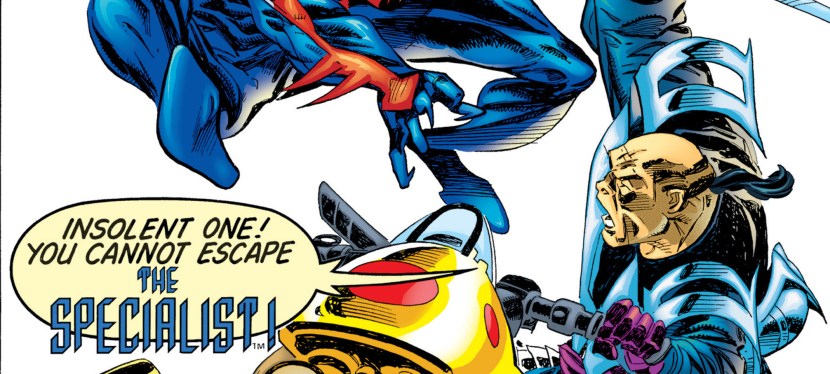
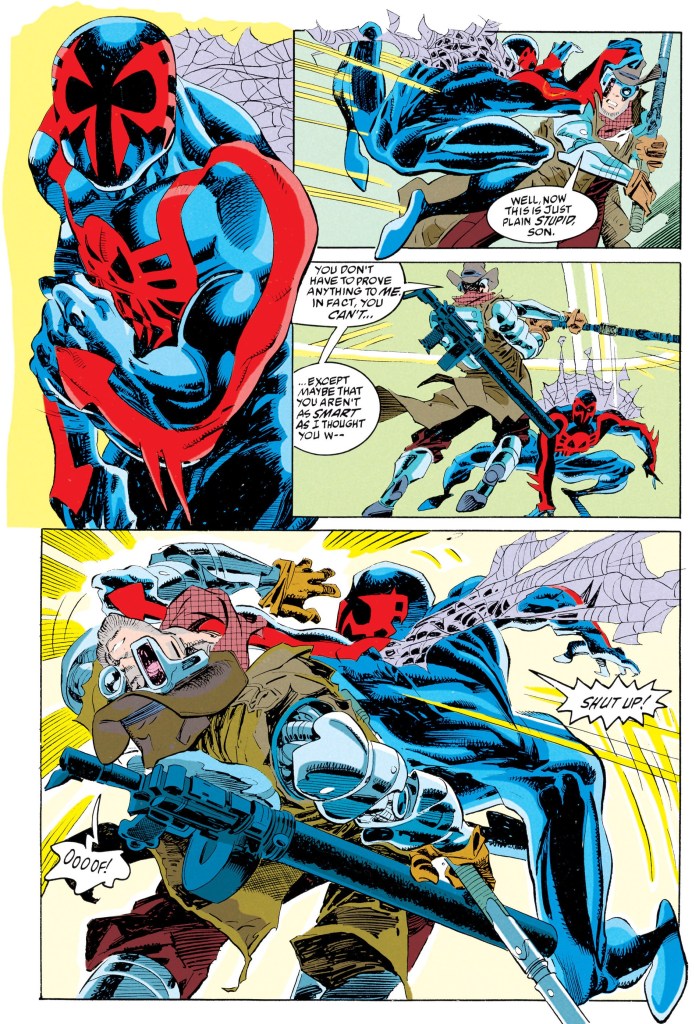
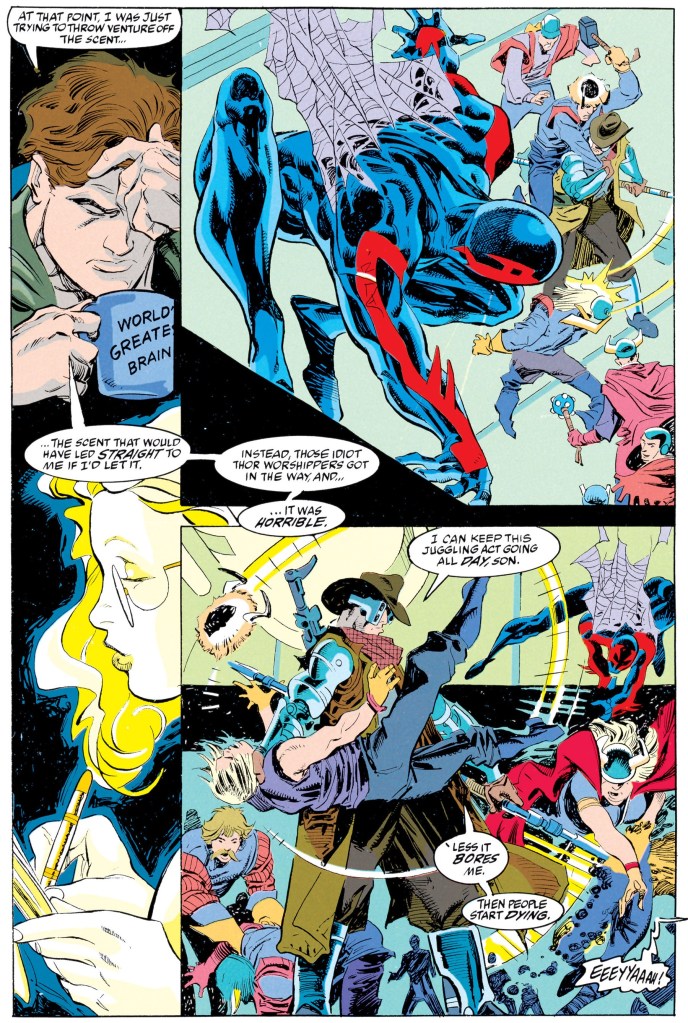
The anticipated battle between Spider-Man and the sword-wielding Specialist was structured nicely. Instead of being the typical good-versus-evil conflict, what was presented started with nice moments as Spider-Man still struggles to make the best out of his capabilities. Be aware that the fight does not conclude in this issue.
Conclusion
Miguel getting ready for work while having his Spider-Man costume worn.
Spider-Man 2099 #4 (1993) is a solid comic book to read. It had a nice balance of character development, plot with twists here and there, as well as a good amount of action and thrills. Its best feature, as expected, was the further development of the protagonist and you will see more of Miguel than Spider-Man. By the end of this comic book, I really felt I got to know Miguel more as a person, and not a mere character.
If you are seriously planning to buy an existing hard copy of Spider-Man 2099 #4 (1993) be aware that as of this writing, MileHighComics.com shows that the near-mint copy of the regular edition costs $30 while the near-mint copy of the newsstand edition costs $90.
Overall, Spider-Man 2099 #4 (1993) is recommended.
+++++
Thank you for reading. If you find this article engaging, please click the like button below and also please consider sharing this article to others. If you are looking for a copywriter to create content for your special project or business, check out my services and my portfolio. Feel free to contact me with a private message. Also please feel free to visit my Facebook page Author Carlo Carrasco and follow me on Twitter at @HavenorFantasy as well as on Tumblr at https://carlocarrasco.tumblr.com/
Disclaimer: This is my original work with details sourced from reading the comic book and doing personal research. Anyone who wants to use this article, in part or in whole, needs to secure first my permission and agree to cite me as the source and author. Let it be known that any unauthorized use of this article will constrain the author to pursue the remedies under R.A. No. 8293, the Revised Penal Code, and/or all applicable legal actions under the laws of the Philippines.
Welcome back, superhero enthusiasts, 1990s culture enthusiasts and comic book collectors! Today we revisit the world of 2099 within the universe of Marvel Comics back in the 1990s, specifically through the Spider-Man 2099 monthly series.
This time around, we take a look back at the early stage of the futuristic Spider-Man’s story and learn more about Miguel’s struggle in becoming something he was not ready for. On my part, the 3rd issue of Spider-Man 2099 was the first-ever hard copy of the monthly series I bought.
With those details laid down, here is a look back at Spider-Man 2099 #3, published in 1993 by Marvel Comics with a story written by Peter David and drawn by Rick Leonardi.
The cover.
Early story
The story begins immediately after the ending of issue #2 with Miguel O’Hara in disguise as Spider-Man facing off with Venture who has been working for Alchemax’s head to find precisely him. The presence of idolaters of Thor view Venture as an enemy and Spider-Man (who knows he is being hunted by the cybernetic guy) tells them to get back to stay out of danger.
Instead of listening to him, the idolaters did the foolish thing by physically attacking Venture who is just too proficient in combat and his high-tech weapon hurts them. With great risk, Spider-Man leaps to Venture to try to convince him to leave him alone. Unfortunately he loses his balance and gets touched by Venture’s weapon which leaves his right arm numb.
Venture tells Spider-Man that Alchemax wants him…
Quality
Even though he has a numb right arm, Spider-Man 2099 still got up-close and personal with Venture.
This comic book is one action-packed thrill ride laced with solid character development. While issues #1 and #2 showed how Miguel O’Hara became Spider-Man of 2099, this story shows him in his first-ever battle with someone who happens to be doing a mission for Alchemax (Miguel’s employer no less).
Peter David carefully structured the story and the result were lots of moments in which Spider-Man 2099 witnesses the unexpected happenings which readers can relate with. As Spider-Man learns more about the enhancements within him (better reflexes, ability to leap far, etc.), he gets to do the unbelievable which is a classic superhero trope done but within a futuristic, science fiction setting. What he does with his abilities, he does his best to adjust himself. I also like the fact that Spider-Man of 2099 does not have the Spider Sense of the classic Spider-Man (Peter Park) which in a creative way adds to the suspenseful moments in this comic book series.
As for Venture, he is not your typical villain nor is a one-dimension character designed to merely provide opposition to the protagonist. He is a cybernetic bounty hunter on a mission and does not harbor any personal grudge nor hatred against Spider-Man. On his own, Venture is deadly and is clearly one of the best villains to ever take on Spidey 2099.
Conclusion
The idolaters and worshipers of Thor take on Venture which Spider-Man witnesses.
Spider-Man 2099 #3 (1993) is a very solid read and it succeeded in further defining the futuristic Spider-Man’s personality as well as his origin. The first time I read this comic book, I got very immersed in learning about the protagonist and how he does his best to save himself and overcome the opposition while finding out ways to ensure that bystanders and witnesses will not get hurt. This comic book also has an immersive sci-fi setting and shows more of the society of 2099. I can clearly say that this is one enjoyable and compelling comic book which aged nicely to this day.
If you are seriously planning to buy an existing hard copy of Spider-Man 2099 #3 (1993) be aware that as of this writing, MileHighComics.com shows that the near-mint copy of the regular edition costs $30 while the near-mint copy of the newsstand edition costs $90.
Overall, Spider-Man 2099 #3 (1993) is highly recommended.
+++++
Thank you for reading. If you find this article engaging, please click the like button below and also please consider sharing this article to others. If you are looking for a copywriter to create content for your special project or business, check out my services and my portfolio. Feel free to contact me with a private message. Also please feel free to visit my Facebook page Author Carlo Carrasco and follow me on Twitter at @HavenorFantasy as well as on Tumblr at https://carlocarrasco.tumblr.com/
Disclaimer: This is my original work with details sourced from watching V: The Final Battle and doing personal research. Anyone who wants to use this article, in part or in whole, needs to secure first my permission and agree to cite me as the source and author. Let it be known that any unauthorized use of this article will constrain the author to pursue the remedies under R.A. No. 8293, the Revised Penal Code, and/or all applicable legal actions under the laws of the Philippines.
With a very engaging story, memorable characters, intriguing concepts and innovative marketing, the $13 million production V: The Original Miniseries (simply called V back then) became a major TV hit in America over two nights in May, 1983. I personally loved watching the said mini-series back in the 1980s and I still love replaying it in this age of high-definition and Blu-ray discs. For me, at least, it is a timeless classic and it carries several lessons about the fragility of society, the rise of fascism, the spread of evil in many forms and the human desire for freedom from oppression.
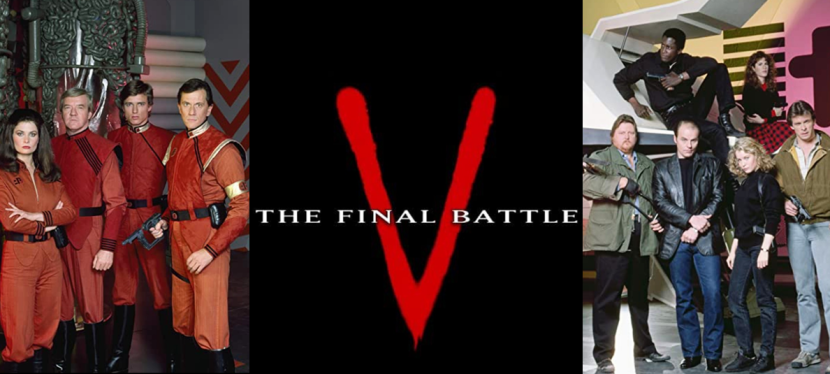
The cover and the title that did not live up to its purpose.
Early story
The story begins with Mike Donovan (Marc Singer) having a nightmare of him and his son Sean (who was abducted during the events of V: The Original Miniseries) in a desperate escape attempt while inside one of the motherships of the Visitors. He wakes up in the presence of Julie Parrish (Faye Grant) and realizes they have a dangerous mission to execute at a local facility used by the red-uniformed Visitors. It turns out, the Resistance movement led by Julie has been losing ground to the alien humanoids and Mike has been helping them out while prioritizing the state of his son who has been in captivity in one of the mother ships.
During the night, a truck carrying many local civilians inside its trailer arrives at a local factory controlled by the Visitors with officer Steven (Andrew Pine) watching over. After the civilians got directed to enter the factory, it turns out they got processed and came out in the form of food cocoons. The sight shocks Julie watching from a distance with her armed teammates waiting on stand-by.
Easily the most engaging shot in this sequel. A clear reminder about the fascist takeover by the aliens from outer space.
After causing damage on the nearest fence, the Resistance begins their attempt to raid the facility and free their fellow cocooned people but the tide turned against them. It turns out, the Visitors’ troops are wearing stronger armor and bright lights were installed on the top of the facility to forcing Julie, Marc and the rest of their team to retreat. They lost some members along the way. During a closed-door meeting with the Resistance stakeholders, Mike Donovan says a key event is needed to make a significant gain against the Visitors.
Over at the mothership hovering over Los Angeles and in the presence of Diana (Jane Badler), the leader John (Richard Herd) tells Kristine Walsh (Jenny Sullivan) that a major medical announcement will be held in the form of an organized special event very soon and that she will be part of the presentation for the global TV audience…
Quality
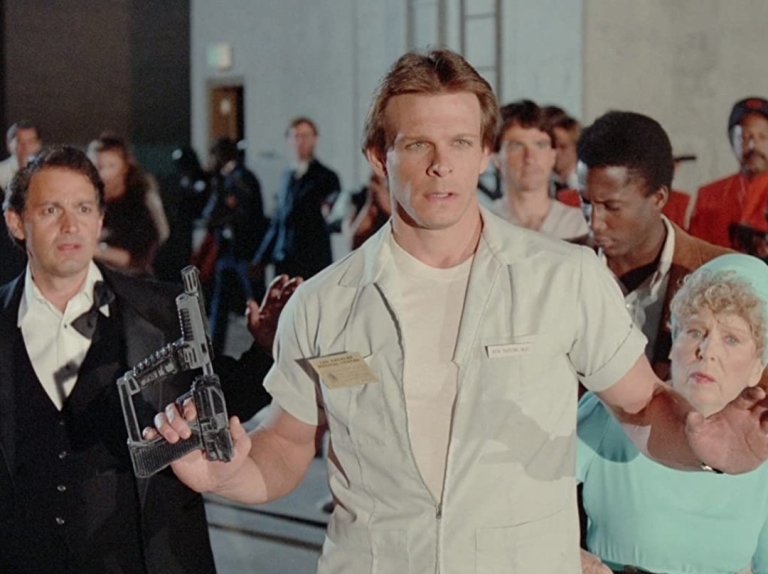
Marc Singer as Mike Donovan with Michael Durrel and Michael Wright as Robert Maxwell and Elias Taylor near him.
I’ll star first with the presentation here. This sequel mini-series was composed of three episodes totaling over 270 minutes. In what looks like to be attempts to ensure more spectacles for the viewers’ enjoyment, each episode of V: The Final Battle has a battle near the end and the creative team succeeded in not only providing on-screen action but also scored well in making the spectacle more varied while still making sense within the main narrative. For the most part, this sequel is indeed a natural progression of what was established in V: The Original Miniseries and that is something to admire given the fact that V creator Kenneth Johnson left this production early.
On the storytelling, V: The Final Battle expands a bit on the Visitors’ dictatorship of Los Angeles and its surrounding areas while the Resistance led by Julie Parrish and supported by close companions Robert Maxwell (Michael Durrell), Elias Taylor (Michael Wright) and Caleb Taylor (Jason Bernard) are shown to be struggling on taking down the alien humanoids even though they secured noticeably more weapons and equipment. The storytelling and the dramatization about the Resistance changes dramatically with the addition of Ham Tyler (Michael Ironside) and partner Chris Farber (Mickey Jones) in the 2nd episode and from that point on, you get to see a human opposition that becomes more flexible with their operations.
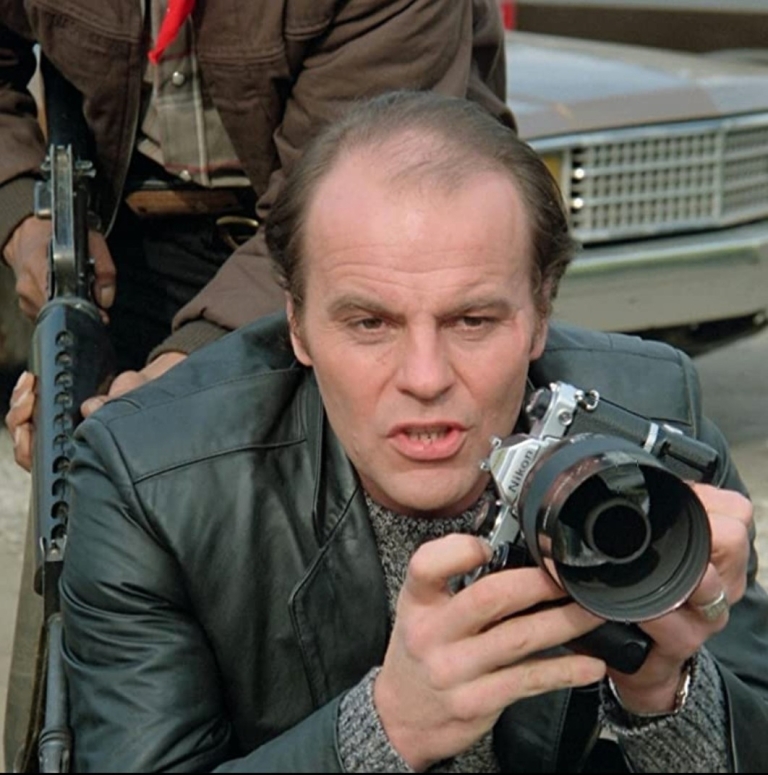
Michael Ironside as Ham Tyler is the most significant new addition to the cast.
As mentioned earlier, Kenneth Johnson’s involvement in this sequel was minimal and it is seen on the presentation. The symbolism Johnson implemented in the original mini-series that established parallels between 1980s America to the Nazi occupation of Europe did not continue here which results a more straightforward presentation of details, character moments and story progression. There was also a noticeable lack of suspense when it comes to executing big scenes with big reveals. The pacing, like in the 1983 mini-series, moves smoothly at a moderate pace throughout and there were no boring moments at all.
The quality of script is still good. For the most part, the writers managed to capture the essence of the established characters from the original mini-series as they told the further developments of this sequel. For example, Caleb and Elias’ father-and-son moments quickly remind me of what I saw in V: The Original Miniseries. Robert Maxwell’s struggle to help his troubled daughter Robin (Blair Tefkin) while assisting Julie and the Resistance is a very natural progression of what was shown in 1983. The friendship between good natured alien Willie (Robert Englund) and Harmony (Diane Cary) got developed a lot more than expected eventually adding to one particular side of the conflict. The local collaborators Daniel Bernstein (David Packer) and Eleanor Dupres (Neva Patterson) developed further with their treason towards their fellow humans as they enjoyed further the power they gained from the Visitors. These two characters will surely get on the nerves of viewers rooting for the Resistance.
Denise Galik as Maggie is a fine new addition to the cast.
David Packer returns as Daniel Bernstein.
Sarah Douglas as Pamela, a superior of Diana’s.
When it comes to new additions to the cast, Ham Tyler and Chris Farber are not the only new players to add depth to this sequel. There is also Maggie (Denise Galik) who is an attractive, brave and strategic Resistance member whose contribution makes an impact. On the downside, there is also Andrew Doyle (Thomas Hill) who is bad choice the creative team came up with as the on-screen representative of faith when he in fact represents religion, idolatry, rituals and distortion. On the side of the Visitors is Pamela (Sarah Douglas) who is a higher-ranking officer than Diana and even John. Pamela is the more militaristic type of leader who is more focused on achieving goals while keeping things in order.
If there is anything flawed about the characterization, it is the romantic relationship of Julie Parrish and Mike Donovan which starts in the first episode. Considering how dramatic the performances of Faye Grant and Marc Singer were in this sequel, Julie and Mike still don’t make a believable pair of lovers in my view. While this romantic relationship opens up new dimensions within Julie and Mike and offer viewers something new to focus, it brings down the former’s value as Resistance leader somewhat while also setting aside the hinted personal connection between her and Elias in the 2nd episode of the 1983 mini-series.
Faye Grant as Julie Parrish in the conversion process scene watched closely by Jane Badler’s Diana.
More on Faye Grant, her performance here is more varied. Not only does she play the brave and struggling leader who is talented in fighting, science and medical practice, she also portrayed Julie as an even more vulnerable character this time around. Her act as the traumatized Julie during the conversion process (read: mental and psychological torture using a more detailed form of virtual reality or nightmare generation) scenes under the watch of Diana is very dramatic and compelling to watch. Just seeing Julie in the conversion process will make grip you with despair and you will eventually feel sorry for her. I should state that the nightmare scenes of Julie were presented with a clear touch of horror.
Marc Singer as Mike Donovan is no longer the reluctant action hero but rather a driven man with a mission to get his missing son back while maintaining a secret connection with Martin (Frank Ashmore) of the Fifth Column (secret dissenters among the Visitors) hoping to achieve breakthroughs for the Resistance and their friends among the dissenting aliens. Singer did the best he could with the script provided to him and he remain likable all throughout. Other than the unbelievable romance with Julie as well as his past encounters with Ham Tyler, there is not much new to expect from the way Mike Donovan was written here. What I should point out, however, is that Mike Donovan’s support for the unholy act of abortion (along with the so-called right to abort) is very wrongful, highly immoral and makes the hero having a sinister presence within him even though he is a father searching for his son.
Jane Badler’s performance as Diana deserves admiration here. Not only did she successfully recapture the charismatic and sinister nature of her character in the 1983 mini-series, Badler was very convincing in showing the more desperate side of Diana, especially when it comes to power struggle within the ranks of the Visitors. You can clearly see the desperation and struggle as soon as Pamela appeared. This sequel also showed a lot more of Diana when it comes to personally supervising her conversion process which is much more elaborate here (note: the conversion process in the 1983 mini-series was limited to the showing of a chair with torture devices). Being the very symbol of charisma and evil in the V franchise, Diana’s place in pop culture is solid and her real-world comparative counterparts would be none other than Hillary Clinton and Kamala Harris.
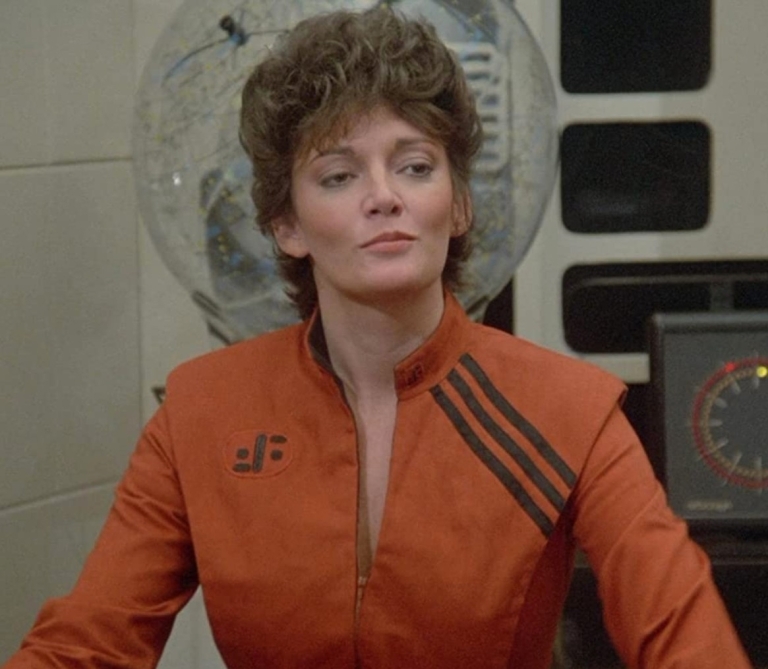
Jane Badler as the ever charismatic yet very wicked Diana.
As mentioned earlier, Michael Ironside’s Ham Tyler is the most significant addition to the cast and the script. Ironside had that excellent mix of toughness, cruelty and sarcasm portrayed in here and at the same time Ham Tyler brought out very interesting and intriguing interactions with the more established Julie and Mike. As seen in entertainment history, Ironside went on to climb up the ranks in Hollywood with Total Recall (1990), Starship Troopers (1997) and in the Splinter Cell video game franchise. Ironside’s Ham is easily the fourth major character of the V franchise of the 1980s.
Going into the spectacle part of this sequel, the action is more varied as mentioned earlier and the 3-episode structure was a factor. You will see lots of shooting with the use of guns and laser blasters here and there, and with the in-story locations and props as key factors, there are action sequences that are uniquely done. There is a lot to enjoy for any V fan and casual viewers watching this sequel.
As for the special effects part of the spectacle, this one is a mixed bag similar to what was presented in the 1983 mini-series. To put things in perspective, the use of in-camera effects, practical effects and optical effects for TV back in the 1980s was ambitious. That being said, certain effect shots here did not age well such as the miniature shots looking fake (because the camera used did not have a special lens to capture visuals that would have made the miniatures look believable). I should also state that there were certain effects shots that were recycled and reused in key sequences in this sequel which remains embarrassing to see. What is even more embarrassing to see here is the very poor-quality monster effects used during the nightmare scenes (conversion process) of Julie and, more notably, the presentation of Robin’s other child. The monster effects are so fake, they are laughable to watch.
On the bright side of the special effects, the quality of the laser blasts remains good to watch right down to the precise timing with the explosions that were simulated on-set and in-camera.
Conclusion
The Visitors and Resistance key characters in the sequel.
While it has its strengths and weaknesses, V: The Final Battle is still engaging and enjoyable to watch, and at the same time it is a worthy addition for your Blu-ray collection when it comes to HD viewing (note: this is the sequel with the best visuals yet albeit with black borders on the sides). Even though creator Kenneth Johnson was not too involved on the production side, the creative team managed to deliver a long story that proved to be a natural progression of the original mini-series while providing more spectacle (especially action), developing the established characters and resolving key plot threads that started in 1983.
The lack of Kenneth Johnson’s personal touch on the presentation was noticeable and somewhat brought this sequel down a bit in terms of style. What brought V: The Final Battle’s quality down were the overall cheaper looking visual effects, the Julie-Mike love relationship and the climax of the final episode which seemed executed with desperation on the part of the creative team (note: giving a little new character instant purpose). In fairness, this sequel still succeeded in showing what fascism in America (or California specifically which is now dominated by Commies) would look like and it built up on its predecessor’s themes such as the deception of power and the collaboration with foreign enemies. This mini-series even added themes of teenage pregnancy and abortion (note: someone from the creative team wanted to promote the wrongful Roe v. Wade Supreme Court decision of 1973) to its narrative.
Does V: The Final Battle live up to its title? Absolutely not because a regular TV series that deteriorated in quality followed. In retrospect, it’s clear that this sequel marked the beginning of the decline of the V franchise in pop culture. What more, V: The Final Battle was never counted as canon in Kenneth Johnson’s 2008 novel (and sequel to the 1983 mini-series) V: The Second Generation. On its own, V: The Final Battle still has more positive stuff than negative ones and in my experience, it remains enjoyable and compelling to watch from start to finish. Compared to V: The Original Miniseries, I can say this sequel falls short. It is good, not great.
Overall, V: The Final Battle (1984) is recommended. That being said, let this 1984 mini-series remind you that there is so much evil in the real world in the forms of Iran, the terrorists of Palestine, the social justice warriors (SJWs), the Black Lives Matter (BLM) movement and liberal media to name some. Always keep in mind to avoid becoming evil no matter how tempting power in this divided world becomes to you. You also do not want to let the evil ones take over your government and have authority over you, your family members and your community. Push back against evil and stand up strong by faithfully taking sides with the one true Savior whose name is Jesus!
+++++
Thank you for reading. If you find this article engaging, please click the like button below and also please consider sharing this article to others. If you are looking for a copywriter to create content for your special project or business, check out my services and my portfolio. Feel free to contact me with a private message. Also please feel free to visit my Facebook page Author Carlo Carrasco and follow me on Twitter at @HavenorFantasy as well as on Tumblr at https://carlocarrasco.tumblr.com/
Disclaimer: This is my original work with details sourced from reading the comic book and doing personal research. Anyone who wants to use this article, in part or in whole, needs to secure first my permission and agree to cite me as the source and author. Let it be known that any unauthorized use of this article will constrain the author to pursue the remedies under R.A. No. 8293, the Revised Penal Code, and/or all applicable legal actions under the laws of the Philippines.
Welcome back, superhero enthusiasts, 1990s culture enthusiasts and comic book collectors! Today we revisit the world of 2099 within the universe of Marvel Comics as published back in the 1990s, specifically through the Spider-Man 2099 monthly series.
Back in 2020, I reviewed the three key issues of Spider-Man 2099 (click here, here and here) particularly with the entry of Venom 2099. While tragedy happened in issue #37 (a very powerful story), the futuristic Venom was still on the loose.
With those details laid down, here is a look back at Spider-Man 2099 #38, published in 1995 by Marvel Comics with a story written by Peter David and drawn by Andrew Wildman.
The cover.
Early story
The story begins with Spider-Man 2099 grieving over the death of Dana in the presence of Xina and two armed law enforcers. As one of the law enforcers approach him, Spider-Man hits and damages his helmet. The other law enforcer tells his companion to give Spider-Man some room. The grieving web-slinger asks where Venom 2099 is.
Meanwhile at another location, Miguel O’Hara’s mother saw the breaking news on TV about what the tragedy and Dana’s death. Her son Gabriel comes in and gets updated about what happened. As soon as he heard Dana’s name, he becomes concerned and focuses on the TV screen. As images of Spider-Man and Dana appeared, Gabriel begins to make a connection between them and punches the TV screen hard…
Quality
A very angry Miguel O’Hara using his corporate authority to find and get Venom 2099.
If you enjoyed the storytelling, tension and payoff that happened in issue #37, I can confirm to you that great stuff from that comic book continued smoothly in this comic book. As before, Peter David’s writing remains very engaging and gripping. So much so, issue #38 is a very believable and natural continuation of the events of the previous issue. In fact, the tension that started even as far as issue #35 continued in this comic book and at the same time David succeeded in developing the key characters further. Here, the death of Dana impacts not only Spider-Man/Miguel O’Hara, but also those connected with him.
Apart from the impact Venom 2099 left behind on those whom he victimized, the key selling point in this comic book was the portrayal of Miguel O’Hara wanting not only vengeance but also craves for the death of the vicious supervillain. I really find it very gripping to see Miguel using his authority as a high-ranking executive of his company to not only find Venom but also use company resources to get him. There was also the scene in which Miguel wants the captured living piece of Venom’s symbiote become dead which reflects the rage burning in him.
The way Peter David wrote Miguel’s rage is compelling not only because of the dramatics involved but also because it raises new questions about the personality and heart protagonist of the Spider-Man 2099 monthly series. I found myself wondering the following: Is Miguel O’Hara on the way to becoming a villain? Does he realize he is going off-track and could become a danger to others once he gets his way with Venom 2099?
When it comes to the visuals, Andrew Wildman did a really good job her. Not only was his art more detailed than what Rick Leonardi came up with, Wildman also brought to life the emotions of the characters through detailed facial expressions. Wildman also showed how skilled he is with pacing the story as well as being strategic on visualizing the spectacle.
Conclusion
Spider-Man 2099 in a very emotional state over the death of Dana.
I can clearly say that Spider-Man 2099 #38 (1995) is a great comic book to read. It is indeed a very worthwhile follow-up to the powerful and tragic story of issue #37 and the tension that started in issue #35 continued strongly in this comic book. Very clearly, Peter David carefully planned to shake up the Spider-Man 2099 series of the 1990s even as he built up Venom 2099 as the deadliest foe the futuristic Spider-Man faced. I should also state that the Spider-Man 2099 – Venom 2099 rivalry has a distinct style and flavor of its own, and there was simply nothing ripped off from the 20th century Spider-Man – Venom (Peter Parker and Eddie Brock) rivalry.
If you are seriously planning to buy an existing hard copy of Spider-Man 2099 #38 (1995) be aware that as of this writing, MileHighComics.com shows that the near-mint copy of the regular edition costs $80 while the near-mint copy of the newsstand edition costs $240. Spider-Man 2099 #38 (1995) also comes with a Venom 2099 cover edition which costs $200 for a near-mint copy.
Overall, Spider-Man 2099 #38 (1995) is highly recommended!
+++++
Thank you for reading. If you find this article engaging, please click the like button below and also please consider sharing this article to others. If you are looking for a copywriter to create content for your special project or business, check out my services and my portfolio. Feel free to contact me with a private message. Also please feel free to visit my Facebook page Author Carlo Carrasco and follow me on Twitter at @HavenorFantasy as well as on Tumblr at https://carlocarrasco.tumblr.com/
The wave of high excitement and fun for both Team Xbox and all the gamers playing on Xbox One, Xbox Series S, Xbox Series X or Windows PC continues to be felt as the universally acclaimed Forza Horizon 5 achieved tremendous success before and during launch in terms of being played by MILLIONS of gamers around the world! The success was so tremendous, Team Xbox chief Phil Spencer confirmed it on Twitter!
In addition, the Grand Theft Auto Trilogy – The Definitive Edition just launched digitally and Grand Theft Auto: San Andreas became available on Xbox Game Pass (XGP). Oh yes, Bethesda just released The Elder Scrolls V: Skyrim Anniversary Edition which has new content related to its predecessors The Elder Scrolls III: Morrowind and The Elder Scrolls IV: Oblivion (note: this I played on Xbox 360 way back in 2006.)
Adding even more to the excitement of gaming on the Xbox ecosystem, Thundeful announced officially via Xbox.com that The Gunk will be released worldwide on December 16, 2021 exclusively on Xbox One, Xbox Series S, Xbox Series X, Windows PC and also on Xbox Game Pass! To start with, watch the latest video about the game below…
Personally, I am interested in playing The Gunk on Xbox Game Pass as soon as it becomes available. At the same time, I am more interested in the talents of game developer Thunderful which is responsible for the SteamWorld franchise of games. I never got to play any SteamWorld game before and as such, The Gunk will be the first Thunderful-made game for me to play ever!
The Gunk, as it turns out, will NOT be the last Xbox-exclusive coming from Thunderful. In fact, the SteamWorld developer is working on another console-exclusive game for Xbox Series consoles and the aging Xbox One which will be released in 2023…Planet of Lana. Check out the trailer below…
In closing this piece, posted below are Xbox-related videos for your viewing pleasure.
+++++
Thank you for reading. If you find this article engaging, please click the like button below and also please consider sharing this article to others. If you are looking for a copywriter to create content for your special project or business, check out my services and my portfolio. Feel free to contact me as well. Also please feel free to visit my Facebook page Author Carlo Carrasco and follow me at HavenorFantasy@twitter.com
Finally! Team Xbox and 343 Industries came out with a much needed preview about the single player campaign of Halo Infinite (set for a December 8, 2021 release for Xbox One, Xbox Series S, Xbox Series X and Windows PC with Xbox Game Pass availability on launch day) very recently and it not only looks awesome visually but also succeeded in showing to gamers a fine taste of how the game will play, how immersive the new Halo is with open-world in mind and why a lot of fun awaits them all.
To start with, watch this official Halo Infinite Campaign Overview video…
Posted next is the official description from the video: The Banished have defeated UNSC forces and taken control of the mysterious Zeta Halo, threatening the survival of humankind. When all hope is lost and humanity’s fate hangs in the balance, the Master Chief returns to confront the most ruthless foe he’s ever faced. Here’s a fresh look at the Halo Infinite campaign that introduces players to true Spartan freedom in the biggest, most wide open and adventure-filled Halo experience yet, launching on December 8 2021.
Check out Dealer Gaming’s Halo Infinite video below and listen to his opinion…
And also check out Colteastwood’s own video about the same game and campaign overview video, complete with visual comparisons that you must see.
My opinion
To begin with, the announcement by Team Xbox that they would release via YouTube the Halo Infinite Campaign Overview video (115K thumbs up and 3K thumbs down reactions as of this writing) was done on a short notice. I learned about its YouTube premiere several hours ahead of time but I made a point to anticipate its launch and view it all not on my smartphone nor on my computer but on our HDTV at home.
Ultimately, the campaign overview video proved to be a great preview and the team behind it went all-out not just to show the improved graphics (I noticed the adjustments made on the in-game lighting as well as the ramped-up detail on textures and many other elements) and in-game art, but also emphasized effectively the gameplay, what the opposition awaits players (as the iconic Master Chief) and what else to expect. Truly it was well worth the wait!
On Zeta Halo is a whole, wide and breathing world for gamers to explore. Think of the world in Halo: Combat Evolved (2001) but with a very detailed open-world design that encourages exploration, discovery and action complete with lots of freedom on doing your objectives.
This map shows a fraction of the world of Zeta Halo and few of the potential many new sites to discover.
Exploring Zeta Halo on foot and discovering one of many facilities of the Banished.
Apart from using it to reach far places, the grappleshot can also be used on enemies for a tactical attack.
Apart from Halo Infinite having a true next-generation look, I find the game’s concept of a massive, breathing open-world environment on Zeta Halo astounding and it clearly is the true essence of enjoying the game. For comparisons, I find Halo Infinite’s in-game world concept a cross between the memorable ring world in Halo: Combat Evolved and the inviting nature of the open-world maps in certain Assassin’s Creed games that I played. This reflects the new game’s offer of a lot of freedom for gamers to explore the wide environment of Zeta Halo, discover new places here and there, and take on the outposts or strongholds of the Banished in more ways than one. Along the way, gamers will have to find the scattered UNSC soldiers, regroup them and form a stronger force to take down the many enemy forces out there.
The next-generation visuals of this game made this classic Halo foe look more detailed and more menacing yet!
The equipment of Master Chief can be upgraded. This is one of the signs that this new game has RPG-inspired gameplay elements.
Shooting and action in Halo Infinite look intense!
Apart from the core mission, there reportedly will be side missions or additional activities throughout Zeta Halo for gamers to engage in. This game design, I believe, will fully immerse gamers into playing Master Chief in the most engaging and most immersive ways possible. No more playing as the Arbiter (Halo 2) and definitely no more wasting time playing as Agent Locke (Halo 5: Guardians). Master Chief is here to stay for players to portray and that’s the way I want Halo to be about. It’s great that 343 Industries learned from its shortcomings as well as those from previous Halo developer Bungie. That being said, I anticipate that Halo Infinite will offer gamers a lot more hours of gameplay based on their will to complete the game.
Meet the new AI companion called The Weapon. She looks like Cortana but has a completely different personality. Remember Cortana’s evil and destructive acts in Halo 5: Guardians? It seems The Weapon will have a key role to do in the new game.
There is nothing like driving a Warthog and then having surviving UNSC soldiers join you for both the ride and the fight!
More on the story, I was intrigued about the new AI called The Weapon who visually looks like Cortana (who in turn went evil in Halo 5: Guardians) and will be the new constant companion Master Chief will interact with. The Banished, meanwhile, look more varied in terms of presentation this time. Visually, they look like rehashed versions of the Covenant and the Brutes in the first 3 Halo games made by Bungie. In Halo Infinite, 343 Industries went the extra steps forward introducing enemies with personalities and boss fights (take note of the visible health bars on-screen on the boss opponents). And then there are two new enemies that were designed to be so formidable, the UNSC’s Spartans now have true challengers to face.
This is one very dangerous Banished enemy to deal with.
This new enemy is known for slaying Spartans.
The way I see the Xbox-exclusive Halo Infinite right now, it is looking great and its single-player campaign looks very ambitious and promising at the same time. This is truly the one video game to look forward to on December 8, 2021. How it will perform with the game critics, Halo fans, Xbox fans and all other gamers remains to be seen. Still, there is no denying that now is a great time for fans of Xbox and Halo, and gamers surely have something fun to look forward to in the final quarter of twenty-twenty-one. As a long-time Halo gamer myself, I can say that I am more confident about Halo Infinite.
Team Xbox and 343 Industries clearly learned from the criticism regarding Halo Infinite’s initial unveiling in July 2020, and the 1-year delay of the game’s release now looks justified. Remember that this year happens to be the 20th anniversary of both Xbox (click here and here) and Halo. The next thing Xbox fans and gamers should look forward to is the 20th anniversary celebration of Xbox on November 15, 2021.
Halo Infinite is coming to Xbox One, Xbox Series, Xbox Series X and Windows PC on December 8, 2021.
In closing this piece, posted below are Xbox-related videos as well as more videos related to Halo Infinite’s campaign overview for your viewing pleasure.
+++++
Thank you for reading. If you find this article engaging, please click the like button below and also please consider sharing this article to others. If you are looking for a copywriter to create content for your special project or business, check out my services and my portfolio. Feel free to contact me as well. Also please feel free to visit my Facebook page Author Carlo Carrasco and follow me at HavenorFantasy@twitter.com
In case you are wondering, Chorus is a science fiction 3D space shooter developed by Deep Silver FISHLABS and published by Deep Silver. You get to play as the female pilot named Nara and you must guide her on a quest to destroy the dark cult that made her. You will get to fly an AI-controlled spaceship called Forsaken and together you will not only travel through the depths of space and engage in battle, but also explore lots of places that will test your abilities to fly and figure which paths to take.
To put things in perspective, posted below is the excerpt from the game’s official announcement published on Xbox.com written by Deep Silver’s Global Community Manager David Robson. Some parts in boldface…
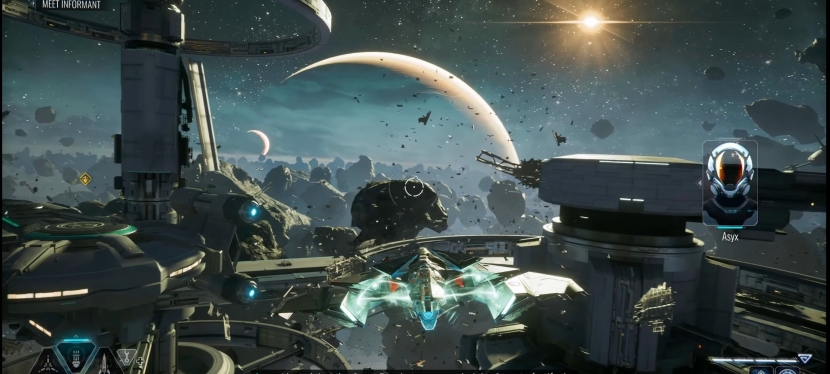
This flight into an asteroid field looks really intriguing and suspenseful.
Chorus is an exciting sci-fi adventure where you play as Nara, an ace pilot with a haunted past, alongside her sentient starfighter, Forsaken, as you unravel their mysterious backstory and join their fight for redemption.
A cinematic single-player experience, Chorus empowers you with devastating weapons and mind-bending abilities, known as the Rites of Power, to fight to free the galaxy from the oppressive cult, the Circle.
Huge structures like that are just waiting to be explored.
Nara’s journey spans across the galaxy and beyond the boundaries of reality in a dark new universe teeming with mystery and rife with conflict. Explore epic locations, such as sprawling space stations and strange plains of existence beyond our own, and experience thrilling zero-g dogfights; the fast-paced spectacular action evolves the spirit of classic space shooters.
The game is also fully engineered to take advantage of Xbox Series X|S hardware, you can enjoy glorious sci-fi visuals, 4K resolution at 60fps, advanced enemy ship destruction, higher quality volumetrics, and richer environmental effects.
Nothing like communicating with someone while enjoying a magnificent view of space.
Based on the 2020 unveiling video and the most recent video, Chorus sure looks flashy and it is easily the most eye-catching 3D polygonal space shooter of this new console generation. Games of this kind are not too many and if the game turns out to be very good, it could win the approval of game critics and the gamers themselves. I personally am interested with Chorus but also cautious. While its art direction and use of 3D polygons and effects look great, I am concerned that the gameplay might lack variety and end up being repetitive. Will there be many interesting objectives to accomplish within the game apart from the typical fly-search-attack approach seen in many other shooter-type games? Will the story cutscenes be compelling for gamers when it comes to following the story? Will the in-flight communication with other characters be varied and interesting? Will there be a lot of customization options for your spaceship? Will there be options for players to make decisions that would affect the story? We can only find out this December.
Players will be offered options to customize their spaceship.
To its credit, Chorus has a story concept that looks promising on face value and if the game developers could strike a fine balance between storytelling and gameplay to ensure bouts of fun for gamers complete with a good amount of variety, then the game might just be a hit waiting to be realized. As stated in the official announcement above, this game has been made to take advantage of the advanced technologies of the Xbox Series consoles ensuring that gamers will have a truly great looking game on both 1080p and 4K. The version on Xbox Series X is, unsurprisingly, the 4K60 (4K resolution with 60 frames-per-second frame rate) experience gamers will find. Anyone looking forward to Chorus should mark their calendars for December 3, 2021!
Thank you for reading. If you find this article engaging, please click the like button below and also please consider sharing this article to others. If you are looking for a copywriter to create content for your special project or business, check out my services and my portfolio. Feel free to contact me as well. Also please feel free to visit my Facebook page Author Carlo Carrasco and follow me at HavenorFantasy@twitter.com
Disclaimer: This is my original work with details sourced from reading the comic book and doing personal research. Anyone who wants to use this article, in part or in whole, needs to secure first my permission and agree to cite me as the source and author. Let it be known that any unauthorized use of this article will constrain the author to pursue the remedies under R.A. No. 8293, the Revised Penal Code, and/or all applicable legal actions under the laws of the Philippines.
Welcome back, superhero enthusiasts, fans of the 2099 universe of Marvel Comics, 1990s culture enthusiasts and comic book collectors! Today we revisit the X-Men 2099 comic book series by focusing on the seventh issue. If there is anything that makes the series of Marvel’s futuristic mutants distinct from other Marvel 2099 monthly series, it is the fact that it shows more of wasteland of America which easily reminds me of the Mad Max movies.
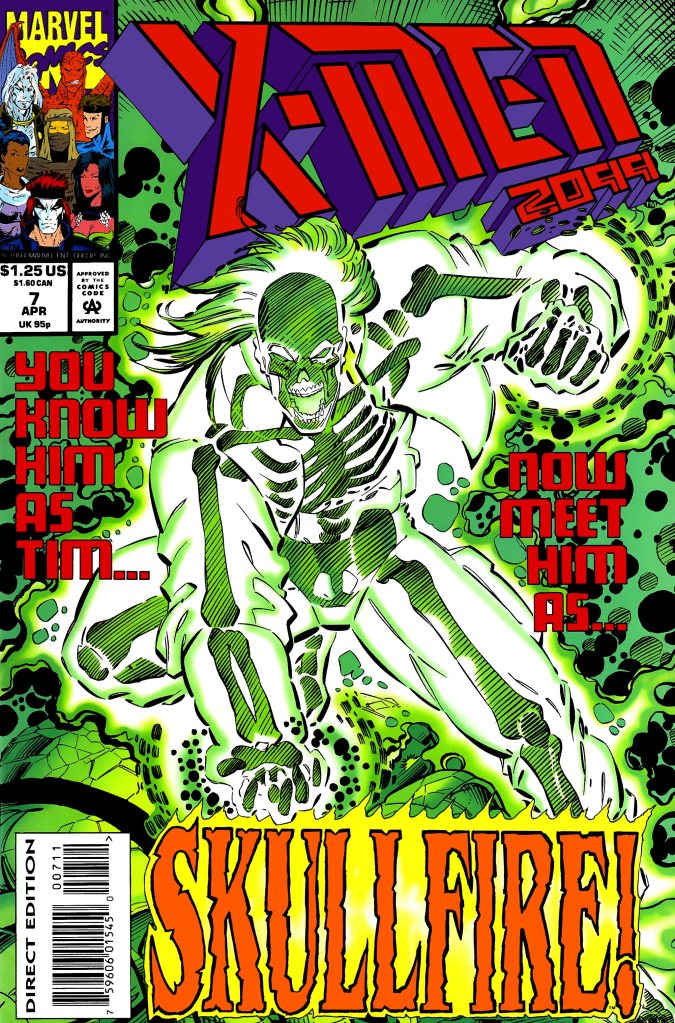
With those details laid down, here is a look back at X-Men 2099 #7, published by Marvel Comics in 1994 with a story written by John Francis Moore and drawn by Ron Lim.
The cover.
Early story
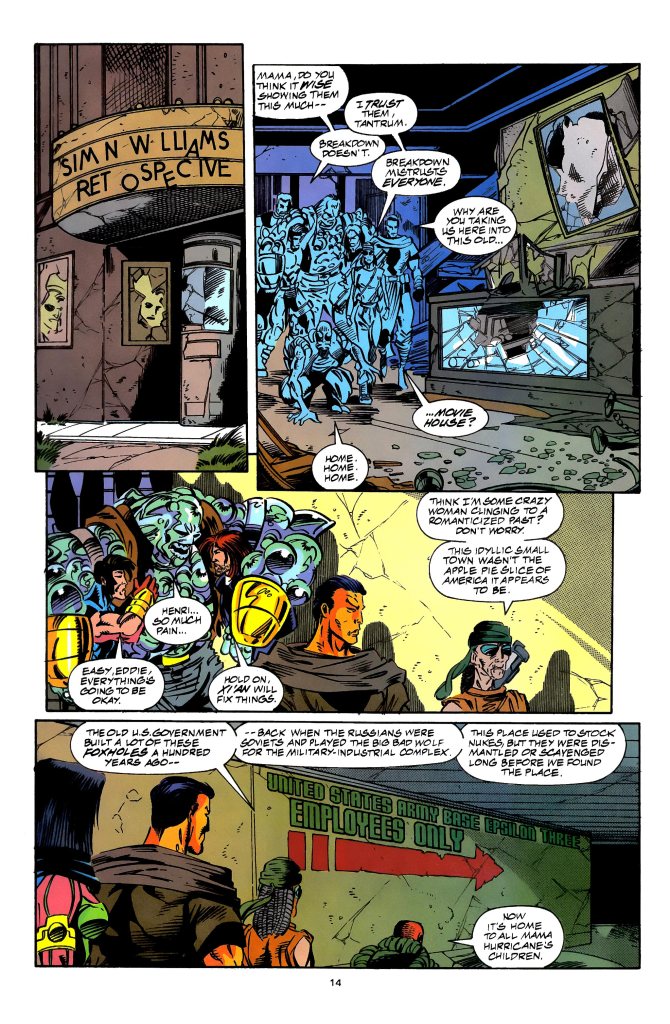
The story begins in the middle of an abandoned town with the X-Men in battle with the Freakshow. Xi’an fights their leader Breakdown while his teammates struggle with the other members of the Freakshow. Already infected by one of the Freakshow members, Eddie is suffering severe pain even in his metallic form.
The fight suddenly ends when an old lady fires a blast with her rifle. It turns out she is Breakdown’s superior and she is precisely whom the X-Men have been searching for…
Quality
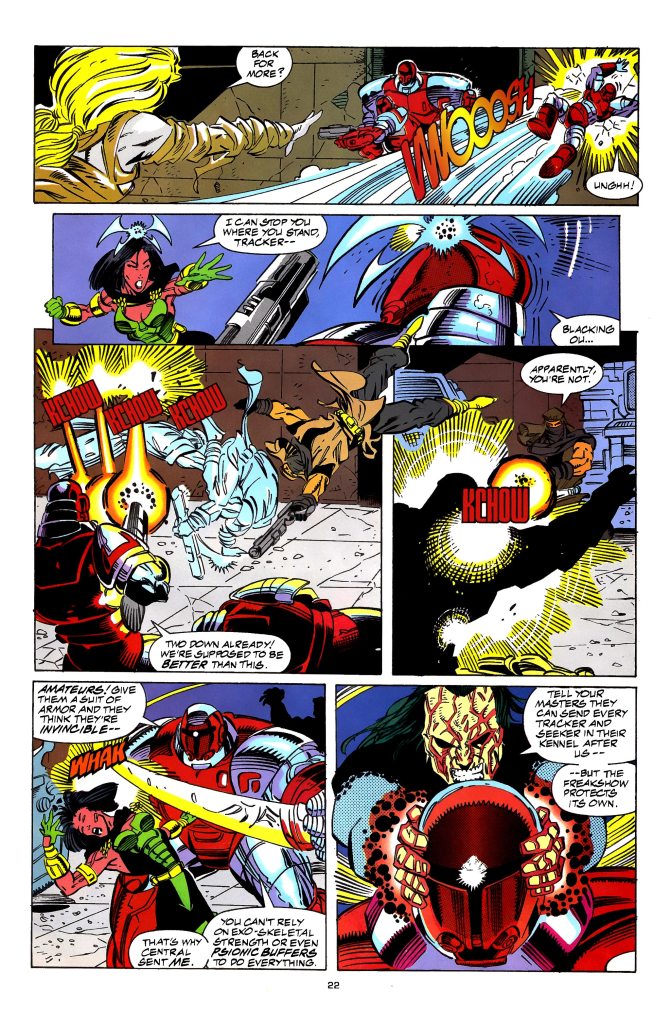
In the heat of battle.
As one of the early stories showing the X-Men of 2099 exploring the American wasteland, this is a well-written piece of work by John Francis Moore which is expected. While it has the usual superhero elements of spectacle and special moves, discovery and exposition are easily the most obvious elements of the story. What I like most about this comic book is that it reveals more of the history about the mutants’ struggle to survive not only with the harshness of the wilderness but also with dealing with rejection from the people who are not mutants (which symbolizes prejudice). This also reveals that the mutants are still searching for a fabled place called Avalon which could be a better destination for all mutants to live in.
As the narrative about the past gets emphasized, the creative team added some elements of emotion and concern on the X-Men visually. This makes a lot of sense since the mutants are clearly searching for purpose and trying to make the most out of their current situation in the hope of having a brighter future. This is similar to the original X-Men and yet X-Men 2099 has its distinct style and concept about mutant survival.
Conclusion
At an abandoned old town that has government secret facilities.
X-Men 2099 #7 (1994) is indeed a good comic book to read. As the X-Men of the far future encounter more people in the wasteland, the discoveries they get impacts them and their efforts to survive. As discovery and exposition are strong elements in the story, the comic book is definitely not your typical good-versus-evil superhero story. The strong writing by John Francis Moore and his approach on expanding the world of 2099 America to the readers really made this comic book a solid read.
If you are seriously planning to buy an existing hard copy of X-Men 2099 #7 (1994), be aware that as of this writing, MileHighComics.com shows that the near-mint copy of the regular edition costs $30 while the near-mint copy of the newsstand edition costs $90.
Overall, X-Men 2099 #7 (1994) is recommended!
+++++
Thank you for reading. If you find this article engaging, please click the like button below and also please consider sharing this article to others. If you are looking for a copywriter to create content for your special project or business, check out my services and my portfolio. Feel free to contact me as well. Also please feel free to visit my Facebook page Author Carlo Carrasco and follow me at HavenorFantasy@twitter.com
Welcome back, fellow geeks, film enthusiasts and Blu-ray/4K Blu-ray collectors!
If you are based in England and you love the works of Arnold Schwarzenegger and James Cameron, as well as the bastardized Terminator film franchise, then you might be interested in the just announced new 4K Blu-ray of Terminator 2: Judgment Day coming from StudioCanal which you can order online right now for £60.00. It is set for a December 6, 2021 release as of this writing.
Coming out this December.
To be more specific, this newest 4K Blu-ray of the 1991 blockbuster film is a commemorative edition highlighting its 30th anniversary.
Posted below are key details of Terminator 2: Judgment Day 4K Blu-ray combo from its Blu-ray.com page.
Video
Codec: HEVC / H.265
Resolution: Native 4K (2160p)
HDR: HDR10
Aspect ratio: 2.35:1
Original aspect ratio: 2.39:1
Audio
English: DTS-HD Master Audio 5.1
English: Dolby Digital 2.0
Subtitles
English SDH
Discs
4K Ultra HD
Blu-ray 3D
Blu-ray Disc
Five-disc set (1 BD-66, 2 BD-50, 2 LPs)
Packaging
Slipbox
DigiPack, Inner print
Playback
4K Blu-ray: Region free
2K Blu-ray: Region B
And here are details of the special features and technical specs from the Blu-ray.com announcement…
PREVIOUSLY COMPLETED 4K RESTORATION OF THE FILM
T2: Reprogramming The Terminator documentary (including exclusive interviews with James Cameron, Arnold Schwarzenegger, Edward Furlong and many more) – 55 mins
2 Feature Commentaries; 23 Members of Cast & Crew (1993)/Director James & Co-Author William Wisher
The Making of T2 (1993)
Seamless Branching Of The Theatrical Version (137 mins approx.)
Special Edition Version (154 mins approx.)
Extended Special Edition Version (156 mins approx.)
2 Deleted Scenes With Audio Commentary
Trailers – T2:3D (2017)
T2 Theatrical Trailer ‘This Time There Are Two’/’Same Make New Mission’/’Building The Perfect Arnold
Optional English SDH subtitles for the main feature
Extra stuff and fine packaging aside, the above-mentioned “PREVIOUSLY COMPLETED 4K RESTORATION OF THE FILM” confirms that the new 4K Blu-ray will not have a brand new remaster which alone concerns me as a collector and fan of the movie. I’ve read Blu-ray.com’s review of the previous 4K Blu-ray of Terminator 2 (the product released by Lionsgate Films) which rated its 4K video quality with a score of 2.5 out of 5 while the 2K video quality was rated 3/5. In that same review, it was mentioned that there was a near absence of film grain and an altered color palette resulting “a kind of greenish-teal tone to several scenes that never had them before.”
Personally I’m not too confident about this upcoming release from StudioCanal. The picture quality for 2K and 4K viewing should be nothing less than excellent. As for you movie fans and Blu-ray collectors reading this, you will have to do your analysis before making the crucial decision to buy this 4K Blu-ray of Terminator 2.
Thank you for reading. If you find this article engaging, please click the like button below and also please consider sharing this article to others. If you are looking for a copywriter to create content for your special project or business, check out my services and my portfolio. Feel free to contact me as well. Also please feel free to visit my Facebook page Author Carlo Carrasco and follow me at HavenorFantasy@twitter.com
Disclaimer: This is my original work with details sourced from playing Flashback: The Quest for Identity and doing personal research. Anyone who wants to use this article, in part or in whole, needs to secure first my permission and agree to cite me as the source and author. Let it be known that any unauthorized use of this article will constrain the author to pursue the remedies under R.A. No. 8293, the Revised Penal Code, and/or all applicable legal actions under the laws of the Philippines.
We live in an age in which software exclusivity defines not only the relevance of game consoles but also nature of the entire video game industry right down to the many varied communities of very avid fans (and fanboys).
While the Super Nintendo Entertainment System (SNES or Super NES) and Sega Genesis each had their own exclusive games back in the 1990s, there was one particular game that was made for and released on not just one, not two but rather on more than fifteen different platforms – both consoles and computers – starting with Amiga way back in 1992. That game is none other than Flashback: The Quest for Identity which I first played on our Super NES back in 1994.
The cover of the game box.
For the newcomers reading this, Flashback was a 2D side-scrolling adventure game in the form of a cinematic platformer (note: similar to Prince of Persia and Out of This World) with a strong flavor of science fiction. It was cinematic in the sense that all the in-game animation were rotoscoped resulting unique smoothness combined with hand-drawn backgrounds and the computer-generated cutscenes were used in key parts of the game as the story progressed. Flashback on SNES in America even came with a Marvel Comics-published Flashback comic book and on the rear of the SNES game box were the words “The first CD-ROM game in a cartridge!”
A Flashback remake was released in 2013, followed by a port of the original game released on Sega Dreamcast in 2017, and a remastered version got released for varied platforms in 2018.
I got to play that game at a time when I have not even started playing Final Fantasy II (AKA Final Fantasy IV), Final Fantasy III (AKA Final Fantasy VI) and other great role-playing games (RPGs) of the Super NES. I also remember that Flashback was a nice change of pace for me after playing Super Star Wars: The Empire Strikes Back.
With those details laid down, here is a look back at Flashback: The Quest for Identity, released on Super NES in 1993 by U.S. Gold and developed by Delphine Software International.
The start and options screen.
Early story
The story begins with Conrad running away from two armed persons chasing him. He flies away riding a solo vehicle but those chasing him (riding a huge vehicle) managed to get close and blast his vehicle causing to crash into the forest.
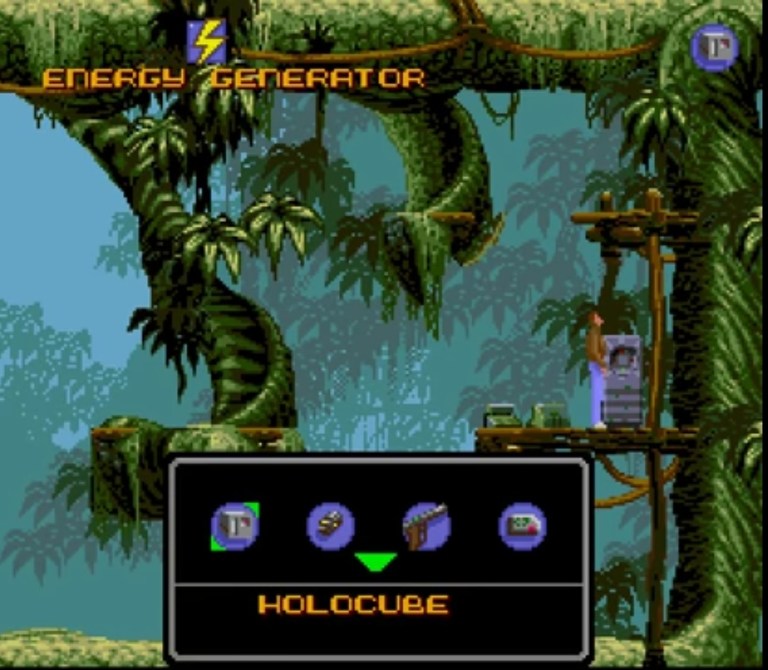
Sometime later, he wakes up and accidentally pushes a mechanical cube to fall down. He climbs down to reach it and activates it. The cube displays a holographic video of himself telling him that he recorded it without remembering it. As Conrad watches, he learns that he must contact a friend named Ian who can explain important things to him.
After viewing the message, Conrad sets off to find his way out of the jungle and somehow get to Ian in New Washington…
Game design and quality
You have to pay close attention to what’s going on, what items do you have and what the in-game prompts tell you.
This game is not your typical fast-paced, action-oriented 2D side-scrolling adventure in which you move from left to right to progress. As it is a cinematic platform game by design complete with very specific controls, players will have to be patient, adaptive and strategic in order to learn how exactly you can control your character, what moves will be executed (and when to execute). For one thing, the very fluid 24 frames-per-second animation on your character limits you in terms of control as timing is required.
To do things properly, you have to execute specific controls. To ascend on a lift, you press Up and the Y button. To do a small jump, have your character stand still and then press Up and Y button. To go down on level (on foot, no lift), stand by the edge of a level then press Down and Y button. To run and hang on to a higher floor automatically, have your character stand still, press Right and Y button, press Y button (once your character moves) and watch him pull it off. With controls like these, the usual 2D platforming approach is out of the question. In my experience, these controls are indeed challenging but never impossible to learn and eventually I got proficient with the controls as I played more.
The in-game animation for the characters are very good and there is also a sensation of weight with your character. Falling straight down from a very high place is a big no-no.
Apart from character controls, you don’t just move Conrad from one screen to the next…you also should do key objectives along the way apart from engaging in action scenes (read: shooting). That being said, you must watch out for icons that appear on screen when your character steps on a particular spot that requires interaction. For example, if you stop by a terminal, an icon will appear serving as a prompt to start the interaction. Another example is when your character steps on the same spot as an item located at which you can pick up once prompted.
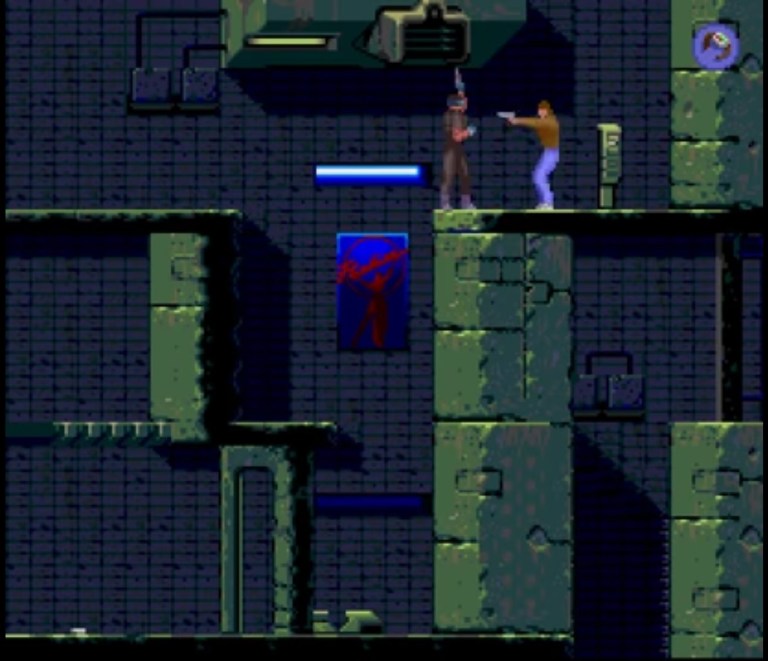
More on the action on the screen, you will encounter armed enemies as well as high-tech machines (including floating drones). To overcome them, doing straightforward shooting is not recommended as you have to be strategic before firing a shot. You have to learn how each enemy or machine moves, how much physical space is available right there and how you can maximize your limited time and space to overcome them. In fact, you will also be compelled to take advantage of whatever seconds you have while the enemies’ animation (between moves) take place. There will also be times when you need to have your character armed with the gun before jumping to a lower level where an armed enemy is located and on the lookout. Coming down armed gives you an advantage to shoot first at the enemy who
Considering the 24 frames-per-second animation, you will have to time your moves carefully, especially during moments when you face an armed enemy.
Apart from shooting, you can also use grenades which requires opening your inventory to select a grenade and then do your timing and calculation of the distance in order to pull of a successful throw and explosion. You can also throw stones to distract enemies or to apply weight on key platforms in order to open mechanical doors.
With regards to the quality of gameplay, Flashback is enjoyable but only if you get over its rather high learning curve with regards to the controls which themselves serve as the game’s advantage and even as a disadvantage. In addition to being patient and strategic, you will really have to pace yourself, think more and get used to the rather slow pace of the game in relation to its cinematic platformer design. I should state that as you keep progressing, there will be places, or new obstacles or new enemies that will compel you to change your tactics in order to overcome them. Anyone who is used to playing 2D side-scrolling games the fast and easy way might find the high learning curve and pacing of Flashback a turnoff but if they are willing to learn, adjust and pace themselves, only then can this game’s gameplay be really enjoyed.
Cut scenes like this move at a sluggish pace which shows the limitations of the SNES and cartridge technology.
As for the visuals, the obvious highlight here is the 24 FPS animation which is the result of rotoscoping and careful visualizing (note: observe those alien humanoids who morph into moving blobs). The rotoscoped animation, however, would not have been that effective had the quality of the art used for the backgrounds been made of lower quality. I can say that the background artworks here look pretty good even by today’s standards. The standout among them were the background artworks of Morph’s home planet which really looked very alien and creepy at the same time. What hurts this particular version of Flashback is the lackluster (read: choppy) frame rate whenever the computer-generated cinematic cutscenes (obviously they were meant for more powerful PCs) play which, in my experience, took me out of the story. There were also bouts of slowdown during the gameplay, especially when you encounter enough enemies that were animated sophistically.
With regards to narrative, Conrad is literally your avatar to learn, discover and interact with the many elements of the universe he is part of. There is obvious influence that the game makers took from the movie Total Recall as they crafted Conrad to be someone who lost his memory, moves on to regain it and do a lot of things as he realizes his true purpose and what is really at stake. Unlike Total Recall’s protagonist, Conrad himself is not too interesting mainly due to the way the in-game story was structured. Just play as Conrad and do what needs to be done to complete the game.
When it comes to understanding the narrative, you will have to do lots of reading. You will spot and read the short description of the prompts that appear. You’ll also have to read the on-screen text whenever your character talks with someone during the levels of the game. And there are the captions shown during the slow animated cutscenes.
Conclusion
The background artworks during the late stage of the game are great and truly creative with science fiction in mind.
I can clearly say that Flashback: The Quest for Identity on Super NESis fun and engaging mainly to those who are willing to adjust themselves to it. If you don’t have patience, if you are not willing to think while playing, if you cannot pace yourself and if you are not willing to learn all the specific controls of the game, then you should not be playing Flashback. It is a cinematic platformer and that should tell you that you will need to adjust to enjoy it.
Overall, Flashback: The Quest for Identity on SNES is recommended.
+++++
Thank you for reading. If you find this article engaging, please click the like button below and also please consider sharing this article to others. If you are looking for a copywriter to create content for your special project or business, check out my services and my portfolio. Feel free to contact me as well. Also please feel free to visit my Facebook page Author Carlo Carrasco and follow me at HavenorFantasy@twitter.com