A Look Back at Terminator 2: Cybernetic Dawn #1 (1995)

Disclaimer: This is my original work with details sourced from reading the comic book and doing personal research. Anyone who wants to use this article, in part or in whole, needs to secure first my permission and agree to cite me as the source and author. Let it be known that any unauthorized use of this article will constrain the author to pursue the remedies under R.A. No. 8293, the Revised Penal Code, and/or all applicable legal actions under the laws of the Philippines.

Like any geek, I still love watching Terminator 2: Judgment Day, specifically its extended version which was James Cameron’s true vision. I’m not exactly a fan of Arnold Schwarzenegger, but I really love his work in T2 as well as in Total Recall. When it comes to James Cameron’s works, I personally prefer T2 over Avatar, Titanic and True Lies.

As for the Terminator franchise itself, it spawned cinematic sequels that only turned up as disappointments. Terminator 2 was indeed the high point of the film franchise and everything really went downhill afterwards. I should state that Terminator: Dark Fate should be avoided as it is not worth your time and money.

Recently, I searched for some comic books that served as sequels to Terminator 2 and I found one from the mid-1990s and it is a direct follow-up! We can find out more in this look back at Terminator 2: Cybernetic Dawn , published in 1995 by Malibu Comics with a story written by Dan Abnett and Rod Whigham.

The cover.

Early story

The story begins immediately after the end of Terminator 2 with the injured Sarah Connor (with a very exhausted John Connor sleeping) still managing to drive the car in the middle of the night. As she drives, Sarah recalled that she never asked for the responsibility of preserving mankind as it was forced on her way back in 1984. She also recalled the time in Tech Noir when the Terminator almost killed her as she got saved by Kyle Reese.

By morning, Sarah and John reached the desert and returned to the lonely home of her old ally Enrique. Suddenly a man with a shotgun comes out and aims his weapon directly at Sarah. Carrying a gun, John comes out to help his mother…

Quality

John and Sarah Connor.

Let me start with the story and make clear to you readers that this comic book easily defies the conclusion that was set in the movie Terminator 2. If you have seen the film, you should be aware that the way it was concluded made sure there is no more future war and no more Terminators. Like the 2003 movie Terminator 3: Rise of the Machines, this comic book just kept on pushing the concept that Judgement Day and the war with the machines are still inevitable and that Terminators from the future would only continue to arrive to hunt and kill John. As such, the hard struggle for Sarah and her son continues.

That being said, this comic book really pushed hard with its sequel approach. Remember what happened in the steel mill in Terminator 2? Several personnel investigated the facility and one particular detective arrived searching for Sarah Connor who has been labeled as an escapee from the state hospital. Inside the steel mill is the severed left arm of the Terminator (which got stuck to crushing mechanical wheels as seen in the 1991 movie) which is the storytelling key the comic book creators used to justify this sequel.  

To the comic creators’ credit, they did their research about T2 and even made references to other characters of that movie. As a result, this comic book appears loaded with fan service.

Even though it has many references and connections to the 1991 movie, this comic book also has some completely new stuff to expand on T2’s concept. The destruction of Cyberdyne’s facility in the movie resulted an emergency meeting of a corporation’s board of directors (and a certain senator) which creatively sets up further conflicts as well as struggles for Sarah and her son.

In terms of writing, this comic book’s story is cohesive enough. As for the art, the quality is fine and most notably, the illustrator managed to somewhat capture the likeness of Linda Hamilton on Sarah Connor.

Conclusion

The severed Terminator arm as the single factor that justified this sequel somewhat.

I can say that Terminator 2: Cybernetic Dawn (1995) is a surprisingly satisfying read mainly due to its writing and artistic quality. While its push to justify a sequel barely succeeds, there is more good stuff than negative ones overall. As far as making sequels to Terminator 2 is concerned, this one is somewhat more believable than the 2003 movie.

If you are seriously planning to buy an existing hard copy of Terminator 2: Cybernetic Dawn (1995), be aware that as of this writing, MileHighComics.com shows that the near-mint copy of the comic book costs $19.

Overall, Terminator 2: Cybernetic Dawn (1995) is satisfactory.

+++++

Thank you for reading. If you find this article engaging, please click the like button below and also please consider sharing this article to others. If you are looking for a copywriter to create content for your special project or business, check out my services and my portfolio. Feel free to contact me as well. Also please feel free to visit my Facebook page Author Carlo Carrasco and follow me at HavenorFantasy@twitter.com
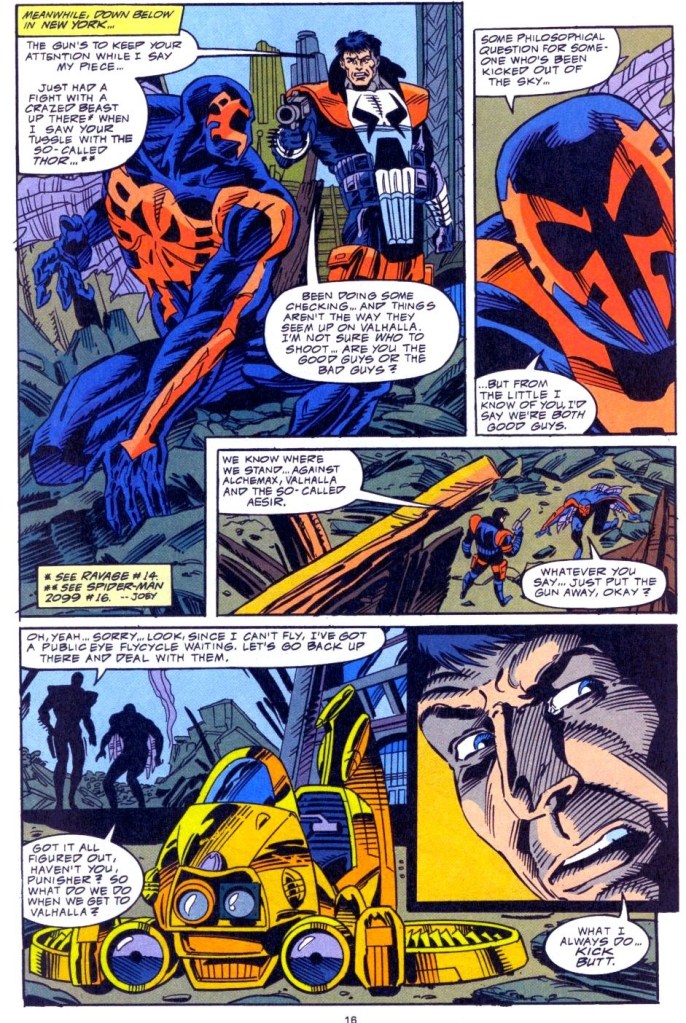
A Look Back at Ravage 2099 #7 (1993)

Disclaimer: This is my original work with details sourced from reading the comic book and doing personal research. Anyone who wants to use this article, in part or in whole, needs to secure first my permission and agree to cite me as the source and author. Let it be known that any unauthorized use of this article will constrain the author to pursue the remedies under R.A. No. 8293, the Revised Penal Code, and/or all applicable legal actions under the laws of the Philippines.

If there is anything that truly defines the 2099 universe of Marvel Comics, it is the sci-fi element. Science fiction that not only shows one possible future of Marvel’s United States but also how immense futuristic technology is present all around the people who are undoubtedly impacted by it all. Whether it is within the metropolis (think Spider-Man 2099) or in the wilderness (think X-Men 2099), the sci-fi element clearly defines the 2099 universe.

In the middle of it, there was Ravage (co-created by the late Stan Lee and artist Paul Ryan) who went from a corporate executive to a violent rebel. In my last review, Ravage escaped the toxic island and returned to the metropolis only to realize that his pals Dack and Tiana have been captured again.

To find out what happens next, here is a look back at Ravage 2099 , published in 1993 by Marvel Comics with a story written by Stan Lee and drawn by Paul Ryan.

The cover.

Early story

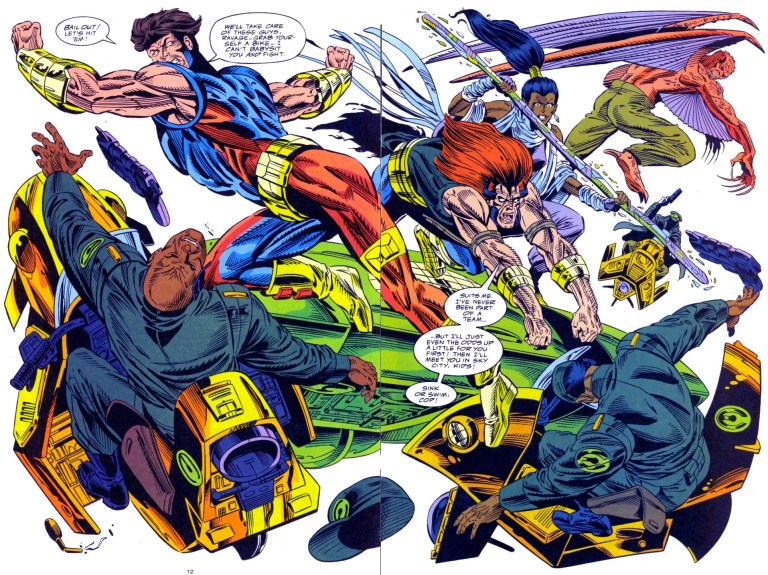
The story begins with Ravage struggling to save Dack and Tiana from different captors, both already separated from each other. Ravage springs into action taking control of the remaining section of the Fantastic Four’s Fantasticar and decides to try to save Dack while facing floating armed personnel. After successfully getting to two armed men hit each other, Ravage chases the flying craft and thanks to his gadget, he is able to hit one of the craft’s personnel.

After a few moments of struggle, Ravage manages to save Dack. He tells the young guy he will drop him off somewhere safe. Dack tells him that he will be blasted on sight by the Public Eye personnel and this convinces Ravage to take him on his dangerous attempt to rescue Tiana from the aquatic invaders…

Quality

I wonder if the social justice warriors (SJWs), the feminists, the socialists and so-called progressives will find this scene offensive to their feelings and beliefs.

Let me first point out the obvious weaknesses of the script Stan Lee wrote: repetition and lack of creative ideas. Alchemax’s Anderthorp Henton being portrayed as ruthless and evil towards his loyal employees yet again – check. Tiana captured again – check. Dack captured again – check. Anderthorp Henton being nice to ladies – check. Tiana being eroticized visually in a state of helplessness – check. Having these repetitions seem to be Stan Lee’s way of filling the script just to ensure there are 22 pages of story to be made.

In fairness to the late Lee, he did something new for this comic book – revealing the underwater lair of the aquatic invaders and having Ravage and Dack involved. The change of environment made this comic book look and feel refreshing, and this added a lot to the science fiction element of the 2099 universe of Marvel. However, it was all a temporary place to show off Ravage doing something heroic. In terms of storytelling, Lee missed out on the opportunity to emphasize to readers why they intend to invade the surface, why are they obsessed on eliminating the human race, and what is the true value of their planned on experiment on naked Tiana (other than learning how to process oxygen).

Another positive point here is Ravage doing heroic acts at last. It’s all technically a repeat of the title character saving his companions but ultimately it helps this comic book achieve its goal of portraying Ravage as a determined and flawed hero. It definitely is much better than his struggle to survive in the toxic island.

Conclusion

An action-packed chase.

As usual, Ravage 2099 (1993) is another flawed comic book like the previous issues. It has, however, more good stuff than bad stuff. True, the repetition of creative elements hurt it but it still has enough entertainment value to justify a read.

If you are seriously planning to buy an existing hard copy of Ravage 2099 (1993), be aware that as of this writing, MileHighComics.com shows that the near-mint copy of the regular edition costs $8 while the near-mint copy of the newsstand edition costs $26.

Overall, Ravage 2099 (1993) is satisfactory.

+++++

Thank you for reading. If you find this article engaging, please click the like button below and also please consider sharing this article to others. If you are looking for a copywriter to create content for your special project or business, check out my services and my portfolio. Feel free to contact me as well. Also please feel free to visit my Facebook page Author Carlo Carrasco and follow me at HavenorFantasy@twitter.com
A Look Back at Ravage 2099 #6 (1993)

Disclaimer: This is my original work with details sourced from reading the comic book and doing personal research. Anyone who wants to use this article, in part or in whole, needs to secure first my permission and agree to cite me as the source and author. Let it be known that any unauthorized use of this article will constrain the author to pursue the remedies under R.A. No. 8293, the Revised Penal Code, and/or all applicable legal actions under the laws of the Philippines.

Welcome back, superhero enthusiasts, comic book collectors, pop culture geeks and fans of Marvel Comics! Today, we will revisit the 2099 universe that Marvel established in the 1990s through another issue of Ravage 2099 which featured the writing and imagination of the late Stan Lee. Lee wrote the first eight issues of the said series.

For the newcomers reading this, Ravage is a co-creation of Lee and illustrator Paul Ryan. Compared to the other major characters of the 2099 universe of Marvel, Ravage is an all-original character who went from being a corporate executive to a hard-hitting rebel. Last time around, Ravage struggled with his new found power (energy within his fists) while still being hunted by Dethstryk’s thugs.

With those details laid down, here is a look back at Ravage 2099 , published by Marvel Comics in 1993 with a story written by Stan Lee and drawn by Paul Ryan.

The cover.

Early story

The story begins at a far-away island. Dethstryk’s thugs just attacked Ravage and his native companion in a cave, destroying the interior and causing a cave-in. Believing that Ravage is dead, the last of the thugs left the rubble behind. As it turned out, Ravage is still alive and uses his newfound power to free himself, pushing all the rocks off as if they were like pebbles. He realizes that the more he uses his power, the weaker he gets. Due to his being exposed to the island’s toxic environment, his condition continues to deteriorate. He uses one of the gadgets to aid him in seeing.

After looking around further in the ruined cave, he discovers a relic from the past – the Fantastic Four’s Fantasticar…

Quality

Ravage uses the old vehicle made by the Fantastic Four.

If you are looking for something adventurous or fun while following Ravage, you won’t find much here. Without spoiling the plot, this one has Ravage preparing himself for survival and moving back to civilization. There is not much heroic acts from the title character here and I noticed that Stan Lee’s script is filled with lots of filler-type dialogue designed to prolong scenes (that were meant to be short but had to be stretched) and fill the page. Really, there is not much stuff to engage you with here.

The build-up in issue regarding the sub-plots for Tiana, Dack and the invaders from the sea had too little pay-off here but, in fairness, it does set up something for the next issue. I should also state that Stan Lee did not really do much with the villains – Dethstryk and Anderthorp Henton – and ended up recycling ways to show how cruel, cold-blooded and evil they are WITHOUT ever raising the stakes in their conflict with Ravage.

Conclusion

Just another scene to show how evil and ruthless Anderthorp Henton is towards his own employee. This should make you wonder what Stan Lee really thought about corporations, the labor union and the Leftist forces.

Once again, the Ravage 2099 series at this point only showed the lack of consistency in terms of quality and reader engagement. Ravage 2099 has a story that is actually hollow and the creators resorted to stretching sequences to create the illusion that there is depth throughout. Clearly this is a step down from the previous issue.

If you are seriously planning to buy an existing hard copy of Ravage 2099 (1993), be aware that as of this writing, MileHighComics.com shows that the near-mint copy of the regular edition costs $8 while the near-mint copy of the newsstand edition costs $26.

Overall, Ravage 2099 (1993) is not recommended but if you really want to acquire a copy of it, better wait until the price reaches fifty cents.

+++++

Thank you for reading. If you find this article engaging, please click the like button below and also please consider sharing this article to others. If you are looking for a copywriter to create content for your special project or business, check out my services and my portfolio. Feel free to contact me as well. Also please feel free to visit my Facebook page Author Carlo Carrasco and follow me at HavenorFantasy@twitter.com
A Look Back at 2099 Unlimited #1 (1993)

Disclaimer: This is my original work with details sourced from reading the comic book and doing personal research. Anyone who wants to use this article, in part or in whole, needs to secure first my permission and agree to cite me as the source and author. Let it be known that any unauthorized use of this article will constrain the author to pursue the remedies under R.A. No. 8293, the Revised Penal Code, and/or all applicable legal actions under the laws of the Philippines.

During the first half of 1993, Marvel Comics had published four monthly series of their 2099 franchise of comic books: Spider-Man 2099, Ravage 2099, Doom 2099 and Punisher 2099. X-Men 2099 debuted in the 2nd half of 1993 but months before that happened, Marvel went ahead with expanding their 2099 franchise by launching what was back then a new, quarterly comic book series simply titled 2099 Unlimited.

That being said, the mentioned quarterly series was officially launched with 2099 Unlimited which, as its cover showed, featured Spider-Man 2099 as well as Hulk 2099. The comic book came with a high price of $3.95 on its cover and it had 64 pages of content (including ads and bulletins). I myself bought a copy of it as soon as it appeared on the shelves of the local comic book store here in the Philippines.

Was the debut comic book fun? Is it good by today’s standards? We can all find out in this look back at 2099 Unlimited , published in 1993 by Marvel Comics with stories written by Evan Skolnick and Gerard Jones, and drawn by Chris Wozniak and Dwayne Turner.

The cover.

Early stories

“Nothing ever changes!” – the story begins at New York City’s Koop Memorial Hospital where an investigation is happening. A married couple arrives and noticed the unusual activity happening there. As they arrive at another floor to visit their son Michael, they noticed the hallway is full of dead bodies. They panic and start running to find their son. Suddenly a muscular man appears and kills the husband, stating his action is justified by his belief about the natural order of things and his effort to ensure humanity’s survival. The killer escapes.

Weeks later, Spider-Man/Miguel O’Hara returns home from fighting crime just in time to rush and prepare himself for his date with Anna. During their date, Anna talks about her sister who has a rare genetic deformity. She intends to visit her sister at the hospital, and Miguel asked if she wants him to come along…

“Hulk 2099” – the story begins in the Mojave Desert with the Hulk traveling alone in the middle of the night. He has been traveling for over three hundred miles alone hunting something. The Hulk arrives at the private residence of a lady who spots him and alerts the armed personnel of Sweat Dreams Security Services. Soon enough, Sweet Dreams personnel arrive and its tank charges at the green monster…

Quality

Imagine Hulk 2099 trespassing on your property.

The first story featuring Spider-Man 2099 has a pretty interesting concept that was nicely executed and proved to be surprisingly satisfying. The creative team introduced the new villain Mutagen and they succeeded in building his personality (including his obsession with perfecting human genetics and altering the so-called gene pool) which resulted a justified conflict with Spider-Man. The character development, focused mainly on Mutagen, was well done and by the end of the story, he became a pretty interesting villain.

As for Spider-Man, his character development was pretty limited to his interactions with Anna laced with little references to his career with Alchemax, and there were no references to his personal life and the people who mattered most to him. Clearly, the first story was more about Mutagen than Spider-Man, and it has a very satisfying conflict between the two. I also enjoyed the way the creative team presented Mutagen being able to adapt to his environment and the attacks Spider-Man threw at him. While the story is strong, I should say that Chris Wozniak’s art is uneven. His drawings on Mutagen were pretty details but the same cannot be said about his art on Spider-Man.

The second story, featuring Hulk of 2099, is the actual gem in this comic book. Not only was it the first-ever appearance of the character, it unsurprisingly took inspiration from the origin of the classic Hulk (Bruce Banner) and made some twists with themes of the business of entertainment and the human desire of idolatry (always unholy). The new Hulk here is an entertainment executive named John Eisenhart who has been researching the Knights of Banner, a group of people who worship the classic Hulk. What he does in the real world and with people, he strives to make something out of them to boost his career and stand out in the business of amusement. Eisenhart sees Banner’s idolaters having the makings of a new cult of Thor complete with living in isolation

Eisenhart is not the typical good-natured protagonist. Quite the opposite in fact as he is obsessed with success and is a walking tool of Hollywood who exploits people and insists that being civilized is essential and that strength is knowing where the power is. That being said, this story has a lot of build-up on Hulk 2099 while still having sufficient space to tell his origin that arguably links him with the legacy of Banner Hulk. For the most part, the bouts of build-up resulted worthy pay-offs that readers can enjoy.

More on Hulk 2099 himself, this version of the classic character is more monstrous and freakish looking. While Hulk 2099 maintains the intelligence of Eisenhart, he still is deadly and unpredictable. Supporting characters like Gawain and Quirk both lacked scenes and dialogue but that is not surprising since the focus of the comic book is on Hulk 2099. For the art, Dwayne Turner’s work here is satisfying.

Conclusion

Spider-Man 2099 and Mutagen in battle!

When I first read this way back in 1993, I felt underwhelmed. By today’s standards, 2099 Unlimited (1993) surprisingly aged well and it is actually deeper, more meaningful and engaging than I previously thought. Apart from Hulk 2099’s debut, the introduction of Mutagen was pretty engaging and he had a lot of potential to be a major 2099 universe villain. Too bad that Mutagen was not used to be a nemesis against Ravage 2099 or Punisher 2099 or even X-Men 2099. Hulk 2099 meanwhile went on to have a dedicated monthly series which came at a time when the 2099 imprint and the comic book industry in general went way down. This comic book, in my opinion, is more cerebral than it looks and that is thanks to the writers.

If you are seriously planning to buy an existing hard copy of 2099 Unlimited (1993), be aware that as of this writing, MileHighComics.com shows that the near-mint copy of the regular edition costs $15 while the near-mint copy of the newsstand edition costs $32.

Overall, 2099 Unlimited (1993) is recommended.

+++++

Thank you for reading. If you find this article engaging, please click the like button below and also please consider sharing this article to others. If you are looking for a copywriter to create content for your special project or business, check out my services and my portfolio. Feel free to contact me as well. Also please feel free to visit my Facebook page Author Carlo Carrasco and follow me at HavenorFantasy@twitter.com
A Look Back at X-Men: Days of Future Past (2014)

Disclaimer: This is my original work with details sourced from watching the movie and doing personal research. Anyone who wants to use this article, in part or in whole, needs to secure first my permission and agree to cite me as the source and author. Let it be known that any unauthorized use of this article will constrain the author to pursue the remedies under R.A. No. 8293, the Revised Penal Code, and/or all applicable legal actions under the laws of the Philippines.

We all know that the 20th Century Fox franchise of X-Men movies has ended and everything cinematic about Marvel’s famous mutants are now in the hands of Marvel Studios. From the year 2000 to 2020, the original X-Men cinematic universe produced a whole bunch of movies (including spinoffs) which ultimately led to uneven results with regards to commercial success, critical feedback, artistry, production values and cultural impact. Even so, 20th Century Fox-produced X-Men movies generated more than $6 billion in ticket sales worldwide.

When it comes to the spinoff movies, I like Logan the best (sorry, Deadpool).

For the main X-Men movies, the one film that really delivered the great stuff and tons of fun for me was none other than X-Men: Days of Future Past (2014). For one thing, the movie had two generations of X-Men cinematic performers (the original team led by Patrick Stewart and the newer ones from X-Men: First Class led by James McAvoy) and its story literally had them linked together with Hugh Jackman’s Wolverine as the living bridge between them. To put it short, it was a cinematic crossover story made with X-Men fans in mind. That film scored highly with critics and most moviegoers, and it grossed almost $750 million worldwide which makes it the highest-grossing X-Men movie ever until now.

It has been years since X-Men: Days of Future Past made waves in the cinemas and through post-theater businesses like Blu-ray, cable TV, pay-per-view, streaming and the like. Along the way, movies like Wonder Woman, Aquaman, Avengers: Infinity War and Avengers: Endgame collectively raised the standards of Hollywood superhero movies in varied ways. I should state that X-Men (2000), X2: X-Men United and X-Men: The Last Stand did not age well.

To find out if the 2014 X-Men film aged well or not, here is my retro review of X-Men: Days of Future Past directed by Bryan Singer with a screenplay written by Simon Kinberg with a story done by Kinberg, Jane Goldman and Matthew Vaughn.

A great image of the cinematic X-Men, both the old and newer cast.

Early story

The story begins in the dark future. Countless mutants and human allies have been caught and imprisoned by very sophisticated Sentinels (operating for an unnamed authority that also has armed human personnel as watchers) which continue to hunt more of them down along with any humans caught aiding them. In Russia, a small X-Men team composed of Colossus, Kitty Pryde, Iceman, Sunspot, Bishop, Warpath and Blink take action when they realized that the Sentinels found their hideout. Kitty Pryde, who by this time gained the new ability to send a person’s consciousness back through time, runs along with Bishop to hide in a vault to send his consciousness into the past. Fortunately for them, their teammates delayed the unstoppable Sentinels enough to succeed.

Some time later at another location, an aging Charles Xavier, Magneto, Wolverine and Storm arrive to meet with Kitty Pryde and her teammates. Xavier gives the team an in-depth history lesson about the Sentinels which were created decades earlier by the late Bolivar Trask who was assassinated by Mystique (who believed she could make a difference for her fellow mutants). After the assassination, Mystique got caught by the authorities and became a live experiment for scientists working for the government. Her DNA helped accelerate the development of the Sentinel program which made them able to adapt to most mutant attacks and powers.

A plan gets formed for Kitty Pryde to send Xavier back through time to his younger self in 1973 to prevent the assassination from happening. Kitty states it’s too risky for the old Xavier to go through time as it may kill him. Wolverine volunteers to take Xavier’s place as his healing factor (regeneration) will ensure his survival with the process. Xavier presses Wolverine to convince the 1973 Charles Xavier to help prevent the assassination given the fact that he was a broken man at the time.

Wolverine arrives in his younger self’s body in New York of 1973. He makes his way to the mansion of Charles Xavier. As it turns out, Xavier’s school has been closed for some time and has been decaying…   

Quality

Nicholas Hoult, James McAvoy and Hugh Jackman as Beast, Charles Xavier and Wolverine respectively.

Considering what was made and what were presented through this movie, the creative team and the cast of X-Men: Days of Future Past literally scored a home run here resulting true greatness! Bryan Singer, whose previous X-Men directorial job was 2003’s X2, finally struck gold with regards to storytelling, directing and, finally, spectacle (previous his big weakness).  

In terms of storytelling, this movie, first and foremost, is not a faithful adaptation of the classic Days of Future Past storyline at all. In fact, there was no need for it to be faithful. What the screenwriters came up with was a loose adaptation which allowed them to craft a more original story that involved the established X-Men characters (from the early movies) and the other X-Men characters (who started in 2011’s X-Men: First Class) and have them set apart in terms of time periods (similar to what was done in 1994’s Star Trek: Generations, but much better and more compelling in writing). The result is a crossover tale with Wolverine being the traveler through time.

The Sentinels are clearly terrifying and unstoppable!

The great news here is that the script has very strong structuring done and even had enough space to briefly acknowledge events and characters from the first three X-Men films plus 2009’s X-Men Origins: Wolverine as canon. All of these add to the narrative very well and when the stakes were raised, the overall plot made sense. Let me add that it was a smart move for the writers to raise the stakes in the two time periods during the final act of the movie, which really made the story more engaging to viewers. I should state that having two conflicts happening simultaneously on screen in this X-Men movie was done efficiently and without ever becoming confusing nor messy.

Apart from the narrative, the portrayal of the X-Men was, indeed, spot-on. Noticeably, the major characters here were Charles Xavier (both old and young), Wolverine (both old and young), Mystique, Magneto (specifically the young version), Beast and Bolivar Trask. Strong writing was evident in the dialogue of the mentioned characters, as well as in those with minor roles. Through dialogue alone, I easily recognized these cinematic characters.

Michael Fassbender delivered his best performance as young Magneto.

Given his strength in telling stories, I should say that Bryan Singer succeeded in executing the script into cinematic narrative. Not only that, he succeeded in getting really good performances from the cast. James McAvoy (young Xavier), Jennifer Lawrence (Mystique), Michael Fassbender (young Magneto) and Nicholas Hoult (Beast) were evidently more confident and more comfortable in reprising their characters (note: they debuted together in X-Men: First Class).

The old cast composed of Patrick Stewart (old Xavier), Ian McKellen (old Magneto), Ellen Page (Kitty Pryde), Halle Berry (Storm), Shawn Ashmore (Iceman) and Daniel Cudmore (Colossus) all made a very welcome return. To be specific, it was only Patrick Stewart among them who had the most engaging dialogue with Ian McKellen being a distant second to him. As most of the film was set in the past, it was understandable that the old cast’s dialogue would not be that rich which translates to limited performance. The filmmakers tried bouncing back with mutant variety by having Bingbing Fan as Blink, Adan Canto as Sunspot and Booboo Stewart as Warpath, who all provided nicely in the action scenes and special effects use.

Bingbing Fan and Booboo Stewart as Blink and Warpath.

Hugh Jackman’s performance as Wolverine in this movie is the most unique of them all. Not only does he have to play TWO versions of his character, he as the only member of the old X-Men cast spent a great deal of time interacting with the newer X-Men players. The great news here is that Jackman has great chemistry with James McAvoy, Nicholas Hoult and Michael Fassbender, which ultimately justified the crossover! Speaking of McAvoy, his scene with the older version of his character is very memorable and a highlight! Peter Dinklage as Bolivar Trask is excellent but to my surprise, he is not exactly villainous nor did he express cruelty. He’s more of an obsessed scientist and as such, Michael Fassbender’s Magneto easily overshadows him when it comes to being the main antagonist. This is surprising but not exactly a problem.

More on the anti-hero factor of the movie, I should say that the Sentinels in this movie are the most dangerous and the most intimidating non-sentient, scientific antagonists since the Terminator. Being programmed to deal with mutants, the Sentinels are unrelenting and often used violence to complete their objectives. The futuristic Sentinels, which are evolved versions thanks to Mystique’s DNA, are so formidable the mutants cannot simply defeat them. Even the 1970s Sentinels are quite formidable.

As mentioned earlier, I do confirm that Bryan Singer really outdid himself on delivering the spectacle back with support from the special effects team, the stunt team and the like. The action scenes involving the X-Men are top-notch, in fact they make the action in Singer’s previous X-Men films look minor in terms of creativity, quality and fun! The computer-generated effects in this movie still look great by today’s standard, although some CGI used in the floating stadium sequence looked rushed. Also it was quite a marvel to see Wolverine and Beast face-off with a 1970s Sentinel in the final act. I should mention that the slow-motion sequence involving Quicksilver (played by Evan Peters) is one great and funny spectacle to watch, well worth replaying!

Conclusion

Jennifer Lawrence in her best-ever performance as Mystique.

I declare that X-Men: Days of Future Past (2014) is the best-ever X-Men movie I have seen and it has aged very well! Its overall quality is very great and the combined talents of director Singer, the cast, the writers and all the technical teams justified it all. By today’s standards, this X-Men movie still stands very high among all superhero movies of Hollywood ever released! As an X-Men film, this one is truly epic and the true highlight of all X-Men movies under 20th Century Fox. As a time-travel film, this one has a very unique approach and it should be noted that director Bryan Singer approached James Cameron to talk about time travel, parallel universes and the like.

More on personal viewing, I can say that this film greatly entertained me in the cinema back in 2014, and it still succeeds in doing so whenever I replayed it on Blu-ray in the comfort of home. If there is anything I regret, it’s the fact that I never saw this movie in the IMAX cinema.

If you are seriously planning to buy an existing hard copy of X-Men: Days of Future Past (2014), visit Amazon for the Blu-ray release as well as the 4K Blu-ray combo release. There is also the Rogue Cut of the movie also on Blu-ray.

Overall, X-Men: Days of Future Past (2014) is highly recommended!

+++++

Thank you for reading. If you find this article engaging, please click the like button below and also please consider sharing this article to others. If you are looking for a copywriter to create content for your special project or business, check out my services and my portfolio. Feel free to contact me as well. Also please feel free to visit my Facebook page Author Carlo Carrasco and follow me at HavenorFantasy@twitter.com
A Look Back at RoboCop versus The Terminator #4 (1992)

Disclaimer: This is my original work with details sourced from reading the comic book and doing personal research. Anyone who wants to use this article, in part or in whole, needs to secure first my permission and agree to cite me as the source and author. Let it be known that any unauthorized use of this article will constrain the author to pursue the remedies under R.A. No. 8293, the Revised Penal Code, and/or all applicable legal actions under the laws of the Philippines.

Hey fellow geeks and comic book collectors plus the fans of RoboCop and Terminator! This is it! I have finally reached the end of the 4-issue RoboCop versus The Terminator mini-series of comic books spearheaded by Frank Miller.

To give a recap without spoiling plot details, issue #1 was mainly a build-up issue which did not entertain on its own. In issue #2, there was a huge pay-off to the build-up and seeing RoboCop battle the Terminator was a grand spectacle! Issue #3 meanwhile saw some very daring creative twists taken that further mixed elements of the respective Terminator and RoboCop universes together which ultimately served as a build-up for what could be a potential epic in the comic book featured in this review.

Is the build-up worth it? Did the issue twists pave the way for something memorable? We will all find out in this look back at RoboCop versus The Terminator 4, published in 1992 by Dark Horse Comics with a story written by Frank Miller and drawn by Walt Simonson.

The cover.

Early story

The story begins again in the dark future when the world is ravage by the war between man and machines. As the human resistance falters, the machines of Skynet march further toward their prey. Suddenly, RoboCop flies in and hits them with a very powerful rocket.

Inside a cybernetic hideout, a familiar short-haired lady gets shaken by the blast. As a result, she will not go back in time and will no longer try to kill RoboCop. On the monitors, she watches the armed cyborg cop destroy Skynet’s troops and saved the human resistance from certain death.

Shortly after, the human warriors take a much-needed rest. Feeling restless, the lady warrior approaches RoboCop privately and states that she figured he is not a Terminator. RoboCop, whose helmet was taken off showing his human face as officer Murphy, pets a dog as the lady approaches them.

It turns out the lady’s name is Flo (short for Florence) and she starts conversing with him peacefully. She then starts trusting RoboCop, even resting by his side. RoboCop, however, knows what has been going on that the humans don’t and he knows that Skynet and its army of Terminators acknowledge him as their creator. How his decision to help the human resistance in the war against the machines will turn out remains to be seen.

Quality

Another twist, another scenario for the war between man and machines.

When it comes to its story, Frank Miller really exerted efforts to give this comic book’s final conflict an epic presentation which is no surprise since the stakes were already raised as a result of the big twists in issue . Epic concept aside, the concept of RoboCop helping the humans fight Skynet is indeed awesome and daring to see. There is one additional idea Miller came up with which raise the stakes even further in the war, and what that idea was about is something you readers should find out on your own by getting a copy of this comic book.

If there are any weaknesses here, it’s the presentation of the concept of time travel and time distortion which, even in this concluding part of the mini-series, remains used to justify scenario twists. As a result, the ending of this comic book made the whole conflict look and feel like a twisted, wild dream. Another thing to point out was that Skynet, even in its cybernetic form, was portrayed with human-like patterns and even tried to reason with RoboCop. This one weakened the Terminator concept a bit. Still, the series ended with enough satisfaction for me.

Conclusion

RoboCop and the human resistance.

RoboCop versus The Terminator is worthy conclusion to its mini-series. On its own, it had an epic concept and the creators really did what they could to raise the stakes of the conflict as well as raising the quality of their presentation. When it comes to combining the creative elements of the Terminator and RoboCop franchises, Miller did a solid job. It’s just that time travel and time distortion were used to create new scenarios once again in this particular comic book which I found unnecessary. On the bright side, this comic book is loaded with lots of action scenes and the quality of the dialogue was improved.

If you are seriously planning to buy an existing hard copy of RoboCop versus The Terminator (1992), be aware that as of this writing, MileHighComics.com shows that the near-mint copy of this comic book costs $10.

Overall, RoboCop versus The Terminator (1992) is recommended.

+++++

Thank you for reading. If you find this article engaging, please click the like button below and also please consider sharing this article to others. If you are looking for a copywriter to create content for your special project or business, check out my services and my portfolio. Feel free to contact me as well. Also please feel free to visit my Facebook page Author Carlo Carrasco and follow me at HavenorFantasy@twitter.com

A Look Back at Batman versus Predator II #3 (1995)

Disclaimer: This is my original work with details sourced from reading the comic book and doing personal research. Anyone who wants to use this article, in part or in whole, needs to secure first my permission and agree to cite me as the source and author. Let it be known that any unauthorized use of this article will constrain the author to pursue the remedies under R.A. No. 8293, the Revised Penal Code, and/or all applicable legal actions under the laws of the Philippines.

I am currently enjoying the Batman versus Predator II mini-series of the mid-1990s which was a joint effort between DC Comics and Dark Horse Comics. The first issue was great and nicely built up the energy for the first encounter between Batman and the Predator in issue #2. Along the way, I do enjoy the adulterated tone that came with the presentation. This made each issue look and feel like an R-rated cinematic segment.

Will the strong quality of this crossover continue in the third issue? Find out with me in this look back at Batman versus Predator II , published in 1995 by DC Comics and Dark Horse Comics with a story written by Doug Moench and drawn by Paul Gulacy.

The cover.

Early story

The story begins with Batman emerging from the sewer. He finds himself alone in the middle of a city street and senses danger is around him. Suddenly someone from one of the nearby buildings fires at Batman who dodges and takes cover by a car. He grabs a tool and throws it at the window which hits the rifle. And then, on the street, a man throws a grenade at the caped crusader who deflects it. The grenade enters a nearby establishment and explodes. Batman kicks the antagonist and then encounters a speeding vehicle heading towards him.

The detective fires his weapon which causes the car’s windshield to get smashed. He dodges the car and sees it crash. Suddenly the floor beneath him opens which compels him to use his grapnel to avoid falling down to spikes below.

Meanwhile at another location, the Predator dissolves the decapitated head of a man (killed in issue ) with hot liquid and keeps the skull for his collection of trophies.

Back at the Bat Cave, Batman and Alfred analyze what happened recently. Alfred states that the Predator killed two of the seven assassins hired by Terraro to kill Batman. The great detective wonders why…

Quality

The Huntress and Batman.

Let me start with the storytelling. The writing by Doug Moench is solid and, more importantly, there is a nice payoff here in relation what was gradually built up in the first two issues – Terraro’s assassins and operations getting more lively within the plot. This alone adds some nice variety into the ongoing Batman-Predator rivalry, and symbolically the Huntress (who is after Terraro) is involved with the mafia plot and the said rivalry between Gotham’s detective and the hunter from space.

More on Batman and the Huntress, I like the way Moench wrote these two heroes as being divided even though they both face threats from the crime gang and from the Predator. Both characters are vigilantes but Batman has justice in mind while the Huntress is focused on hunting the powerful crime boss. Adding more depth to the story is the subplot about Commissioner Gordon being helpless and recovering in the hospital which complicates matters for the Gotham City police department.

Another thing that makes this issue more unique is the in-depth presentation of Batman doing detective work in the Bat Cave with Alfred providing insight. This alone makes this issue an improvement over issue .

When it comes to the visuals, artist Paul Gulacy continues to provide really nice artwork backed with strong support by the colorists. Gulacy took his time pacing the story by following the script closely and made key action scenes look dynamic visually when needed.

Conclusion

Remember the armor Batman wore in the previous crossover story against the Predator?

Considering all the good stuff I enjoyed in it, Batman versus Predator II is a great read. It has a better balance on plotting, detective work, spectacle and intrigue. In fact, this comic book has a much more powerful ending than issues and , and the ironic thing is that this only leads to the 4th and final issue which I’ll review soon.

If you are seriously planning to buy an existing hard copy of Batman versus Predator II (1995), be aware that as of this writing, MileHighComics.com shows that the near-mint copy of the comic book costs $40.

Overall, Batman versus Predator II (1995) is highly recommended!

+++++

Thank you for reading. If you find this article engaging, please click the like button below and also please consider sharing this article to others. If you are looking for a copywriter to create content for your special project or business, check out my services and my portfolio. Feel free to contact me as well. Also please feel free to visit my Facebook page Author Carlo Carrasco and follow me at HavenorFantasy@twitter.com
A Look Back at Mantra #2 (1993)

Disclaimer: This is my original work with details sourced from reading the comic book and doing personal research. Anyone who wants to use this article, in part or in whole, needs to secure first my permission and agree to cite me as the source and author. Let it be known that any unauthorized use of this article will constrain the author to pursue the remedies under R.A. No. 8293, the Revised Penal Code, and/or all applicable legal actions under the laws of the Philippines.

It’s been a long time since I reviewed the first issue of Mantra. For the newcomers reading this, Mantra is one of the major protagonists of the Ultraverse and as the series progressed, several stories containing elements of fantasy and even science fiction got published. With the way Mike W. Barr wrote the stories, the Mantra series really had its very own flavor and style among all Ultraverse comic books. What also made the character Mantra unique was that she was established with the use of the unholy element of reincarnation.

Before Mantra came to be, there was a male eternal warrior called Lukasz who was a part of a group that fought a rival group of warriors through the ages. Their leader Archimage used magic to ensure that whenever Lukasz or any of his teammates die, he would get reincarnated (his soul enters a new body belonging to an already living person whose soul gets displaced) and continue the fight. Then something happened in issue which led to Lukasz occupying the body of a pretty woman named Eden.

To find out more, join me in this look back at Mantra , published in 1993 by Malibu Comics with a story written by Mike W. Barr and drawn by Terry Dodson.

The cover.

Early story

The story begins at the home of Eden Blake in the evening. An armed man named Warstrike knows that Lukasz is occupying Eden’s body. Lukasz/Eden/Mantra starts to resist him but notices that Eden’s son and daughter are both present and seeing them. Quickly and cleverly, Mantra tells the children to get back to bed and hope they did not notice something wrong.

Filled with emotions, Mantra asked Warstrike not to kill her. As it turns out, Warstrike did not come to take her life and reveals that he had been used by Notch (a rival warrior Lukasz often fought with) as a tool to kill him (Lukasz) the last time he was in a male body. Warstrike tells her he’s going to help her.

After the talk and another attempt by Warstrike to charm her, Mantra slams the door and goes to bed. She sleeps to prepare herself for the next day…

Quality

As Eden, Lukasz inherits the responsibility of taking care of her son and daughter.

I’ll star with the most obvious thing about this comic book…the writing done by Mike W. Barr is very strong and has a nice balance between plotting, spectacle and characterization all throughout. For his part, Terry Dodson nicely translated the writing into engaging visuals.

For the most part, this comic book is very character driven which is a nice pay-off considering the plot build-up in issue . We get to see Lukasz struggling more not only because he displaced Eden’s soul (again, reincarnation is unholy) as he occupied her body, but because he is living Eden’s life which involves being the single mother of two children, going to work at the office, wearing women’s clothes and shoes, and dealing with a certain someone from Eden’s past. All of these add to the tremendous challenge of Lukasz who already has his own mission to fulfill.

Conclusion

Living Eden’s domestic life alone is a big challenge already for Lukasz who has always been male.

Mantra is a very strong read from start to finish. As it develops Mantra even further, it also adds to the build-up of another story element: Eden’s domestic life. As the armored Mantra, the protagonist has a mission to find and free Archimage. As Eden, spending time with the two little ones is not only challenging but also crucial to their development. These elements are nice twists to the old hero-civilian formula of superhero comics. Indeed, this one is worthy follow-up to issue .

If you are seriously planning to buy an existing hard copy of Mantra (1993), be aware that as of this writing, MileHighComics.com shows that the near-mint copy of the regular edition costs $8, the near-mint copy of the bagged edition costs $16 and the near-mint copy of the newsstand edition costs $26.

Overall, Mantra (1993) is recommended.

+++++

Thank you for reading. If you find this article engaging, please click the like button below and also please consider sharing this article to others. If you are looking for a copywriter to create content for your special project or business, check out my services and my portfolio. Feel free to contact me as well. Also please feel free to visit my Facebook page Author Carlo Carrasco and follow me at HavenorFantasy@twitter.com
A Look Back at Batman versus Predator II #2 (1995)

Disclaimer: This is my original work with details sourced from reading the comic book and doing personal research. Anyone who wants to use this article, in part or in whole, needs to secure first my permission and agree to cite me as the source and author. Let it be known that any unauthorized use of this article will constrain the author to pursue the remedies under R.A. No. 8293, the Revised Penal Code, and/or all applicable legal actions under the laws of the Philippines.

When done right with the comic book format, fantasy crossover concepts can become very entertaining and memorable. Such was the case with the comic book Batman versus Predator II: Bloodmatch which I enjoyed reading a lot.

Now we can find out if the creative team behind that memorable comic book could maintain the high quality of fun and engagement in this look back at Batman versus Predator II , published in 1995 by DC Comics and Dark Horse Comics with a story written by Doug Moench and drawn by Paul Gulacy.

The cover.

Early story

The story begins in the forest outside of Gotham City. A fake use of the Batman signal was lighted there by the Predator which was meant to lure Batman into a potential trap. As soon as he arrived, Batman believes that his old ally commissioner James Gordon bought a portable Batman signal meant to call him to a crime scene far away from the urbanized areas.

Expecting to see Gordon in the woods, Batman sees a tree with several men’s heads hanging each with a net. He realizes that the Predator lured him into what he calls the hunting ground. Batman is correct as the Predator, standing nearby, unleashes a weapon to attack him…

Quality

This one really looked out of place in this comic book.

A pretty good crossover comic book. When it comes to storytelling, the comic book starts paying off the anticipation built up in issue by presenting Batman in an early encounter with the Predator which, I must say, was smartly handled complete with key references to the previous Batman versus Predator crossover series from the early 1990s. What happened in the said encounter between the two pop culture icons will make you reflect about what you know about Batman and the Predator. Given how the story turned out, clearly the encounter (which was quite beefy) served as a sign of what is more to come between Batman and the Predator (or the race of Predators). The Huntress meanwhile has a slightly reduced spotlight which is not surprising but she still proved her worth in the conflict. When it comes to presenting the respective views of Batman and the Huntress, I admire the use of narration boxes (instead of the traditional thought balloons) which added depth to the story.

Meanwhile, there is a subplot about an assassin from Asia who came all the way to America for a key transaction. However, this subplot (which does not even look like it’s related to the Batman-Predator conflict) ended up looking like filler.  

Conclusion

An action-packed encounter between the Dark Knight and the warrior from outer space!

Batman versus Predator II (1995) is almost as good as issue but its first, action-packed encounter between the Dark Knight and the warrior from outer space alone makes it worth collecting.

If you are seriously planning to buy an existing hard copy of Batman versus Predator II (1995), be aware that as of this writing, MileHighComics.com shows that the near-mint copy costs $30.

Overall, Batman versus Predator II (1995) is recommended.

+++++

Thank you for reading. If you find this article engaging, please click the like button below and also please consider sharing this article to others. If you are looking for a copywriter to create content for your special project or business, check out my services and my portfolio. Feel free to contact me as well. Also please feel free to visit my Facebook page Author Carlo Carrasco and follow me at HavenorFantasy@twitter.com
A Look Back at RoboCop versus The Terminator #3 (1992)

Disclaimer: This is my original work with details sourced from reading the comic book and doing personal research. Anyone who wants to use this article, in part or in whole, needs to secure first my permission and agree to cite me as the source and author. Let it be known that any unauthorized use of this article will constrain the author to pursue the remedies under R.A. No. 8293, the Revised Penal Code, and/or all applicable legal actions under the laws of the Philippines.

Hey everyone! It’s time to go back to the comic book crossover featuring two metallic titans, The Terminator and RoboCop! I have already reviewed two issues of the 4-issue mini-series published by Dark Horse Comics and so far, it’s been a mixed ride. Issue #1 was pretty much a huge build-up that led to a nice pay-off in issue #2. Considering what happened at the end of the last issue, I got hooked with wanting to see what follows next.

As such, here is my look back at RoboCop versus The Terminator , published in 1992 by Dark Horse Comics with a story written by Frank Miller and drawn by Walt Simonson.

The cover.

Early story

The story begins in the far future in with planet Earth already saved but at the expense of humanity. The human race not only got crushed but also flattened, processed and converted into energy to fuel the Terminators. While things look certain and final for machines and man in the far future, a universe is about to organize.

Back in the present day, RoboCop just defeated the Terminator in a high-octane battle that caused a whole lot of damage. The lady from the far future asked RoboCop if he understood what has happened and if he finally believes she told the truth. Realizing the truth, RoboCop allows her to come close and try to blast him with her huge weapon. The attempt failed and RoboCop walks away.

RoboCop visits the cemetery and spends time at his grave that states his name: Alex Murphy. After some deep reflection, RoboCop recalls his vision of the far future. This prompts him to take the most drastic action he could think of…

Quality

Something suspenseful…

Considering how the story turned out in the first two issues, it was no surprise that some drastic twists had to be taken to not only continue the combined universes of RoboCop and the Terminator, but also keep things fresh. The good news here is that Frank Miller’s writing is pretty good and he successfully kept the story cohesive even though drastic twists were made.

At the very core of the story is the theme about RoboCop being acknowledged as the creator of Skynet and the Terminators. As a police officer, RoboCop’s duty is to protect the innocent and uphold the law for the good of his local society, and yet for as long as he exists, so will Skynet and the Terminators of the far future. How Frank Miller fused key elements of RoboCop’s mythos with those of the Terminator franchise was pretty clever and believable from a fantasy viewpoint.

When it comes to weak points, I should say that Walt Simonson’s are here is not great although he does a descent job with drawing RoboCop. Simonson’s visual take on the Terminators has that cartoony look which is alienating.

Conclusion

It sure is hard to make the moves to drastically alter the future for the good of humanity.

RoboCop versus The Terminator is a successfully told chapter in its 4-issue mini-series. It falls short of the greatness of issue but it still proved to be fun and compelling to read. By the time the comic book ended, the stakes were raised for the next issue which I look forward to read.

If you are seriously planning to buy an existing hard copy of RoboCop versus The Terminator (1992), be aware that as of this writing, MileHighComics.com shows that the near-mint copy costs $15.
Overall, RoboCop versus The Terminator (1992) is recommended.

+++++

Thank you for reading. If you find this article engaging, please click the like button below and also please consider sharing this article to others. If you are looking for a copywriter to create content for your special project or business, check out my services and my portfolio. Feel free to contact me as well. Also please feel free to visit my Facebook page Author Carlo Carrasco and follow me at HavenorFantasy@twitter.com