With countless challenges – both internal and external – affecting Japan every day, Prime Minister Sanae Takaichi is determined to make the nation stronger and more prosperous by implementing reforms, according to a Kyodo News article. The Prime Minister delivered her New Year’s statement.
To put things in perspective, posted below is an excerpt from the news release of Kyodo News. Some parts in boldface…
Prime Minister Sanae Takaichi on Thursday pledged to make Japan “strong and prosperous” by carrying out “necessary reforms” to address various domestic and global challenges.
In her New Year’s statement, Takaichi, who became Japan’s first female prime minister on Oct. 21, said her government is committed to building a nation where younger generations can believe in the future and live in hope.
Takaichi emphasized that Japan faces a shrinking population, rising living costs after decades of deflation, and what she described as “the most severe and complex security environment” since the end of World War II.
Globally, political and economic uncertainties are growing as “the free and open international order is being shaken and hegemonic moves are increasing,” she said, in an apparent reference to China’s escalating military activities and Russia’s invasion of Ukraine.
Takaichi took office after winning the Liberal Democratic Party leadership race in early October, succeeding Shigeru Ishiba, who had announced the previous month that he would resign following the party’s heavy setback in the House of Councillors election in July.
With Takaichi’s Cabinet maintaining high approval ratings — well above those of her immediate predecessors — parliament is set to begin this year’s 150-day regular session on Jan. 23.
Let me end this piece by asking you readers: What is your reaction to this development? Apart from the pending new rules on foreigners, what kind of social and economic reforms do you think Prime Minister Takaichi and her administration will come up with over the next six months? Do you think the government will be able to come up with new policies to encourage married couples to have more children?
The 3rd quarter growth of only 4% the Philippines achieved has been on people’s minds a lot lately. As such, the country is at risk of falling behind its neighbors in Southeast Asia in terms of economic growth and gross domestic product (GDP) per capita, according to a BusinessWorld news report.
To put things in perspective, posted below is an excerpt from the news report of BusinessWorld. Some parts in boldface…
The Philippine economy is at risk of further falling behind its Southeast Asian neighbors, an economist said, noting it may take two years to catch up with Vietnam and up to 70 years to catch up with Singapore.
“(T)he Philippines could find itself lagging behind if alleged public spending issues continue to divert attention and resources away from the structural reforms needed to accelerate economic development,” Bank of the Philippine Islands (BPI) Lead Economist Emilio S. Neri, Jr. said in a commentary on Wednesday.
In the third quarter, Philippine gross domestic product (GDP) grew by 4%, its slowest pace in over four years amid slower household and public infrastructure spending as the flood control scandal dampened investor and con-sumer sentiment.
In the nine months to September, GDP growth averaged 5%, putting the government’s 5.5%-6.5% full-year growth target further out of reach.
“The Philippine economy is growing, but not enough to close the economic gap with other countries,” Mr. Neri said.
He noted the Philippine GDP per capita is lower compared with other economies in the region. Citing International Monetary Fund (IMF) data, he said the Philippines’ GDP per capita stood at $4,078 in 2024.
“At the current growth rate, it would take the Philippines two years to catch up with the GDP per capita of Vietnam, 4 years with Indonesia, 14 years with Thailand, 26 years with Malaysia, and 70 years with Singapore, assuming their incomes remain stagnant. In reality, their GDP per capita continues to grow, which means the gap could persist or even widen,” Mr. Neri said.
The Philippines lagged behind Singapore which had a GDP per capita of $90,674 in 2024, followed by South Korea ($36,128), Japan ($32,498), China ($13,312), Malaysia ($12,540), Thailand ($7,491), Indonesia ($4,958) and Vietnam ($4,535).
“Before the pandemic, the Philippines had a higher GDP per capita than Vietnam, but has since been overtaken. At current trends, it would take the Philippines two years to catch up with Vietnam, but that gap could increase to 13 years by 2044,” Mr. Neri said.
The BPI economist said the Philippines needs structural reforms to accelerate growth in order to close the widening gap with its neighbors.
“The current economic model of the country is not enough, as shown by the country’s inability to grow faster than 6% in recent years,” he said.
Mr. Neri said the economy has been “too reliant” on consumer spending, driven by overseas Filipino worker (OFW) remittances and the business process outsourcing industry.
“There is a need to diversify its sources of growth. The economy must improve in terms of production, especially in agriculture and manufacturing, as they will allow the economy to be more self-sufficient and to reach foreign markets. These industries have been critical to Vietnam’s success and could play a similar role for the Philippines,” he said.
However, Mr. Neri said implementing these reforms will be hard if the government lacks focus.
“Public spending issues divert fiscal resources and policymaking focus away from long-term development priorities. Efforts to strengthen safeguards against potential issues in government spending are essential, enabling the country to work on structural reforms that could improve the economy,” he said.
Let me end this post by asking you readers: What is your reaction to this recent development? What do you think should the government do to accelerate economic growth?
To put things in perspective, posted below is an excerpt from the news report of BusinessWorld. Some parts in boldface…
APPROVED foreign investment pledges plunged nearly 50% in the third quarter as investor sentiment soured due to the corruption scandal involving government infrastructure projects, the local statistics agency said.
Preliminary data from the Philippine Statistics Authority (PSA) showed the value of foreign commitments approved by investment promotion agencies (IPAs) fell by 48.7% to P73.68 billion in the July-to-September period from P143.74 billion in same period last year.
However, this was the highest amount of investment pledges since the third quarter of 2024.
Ser Percival K. Peña-Reyes, director of the Ateneo Center for Economic Research and Development, said the decline in approved investments can be attributed to the weaker investor sentiment.
“Tingin ko. Wala pang nakukulong eh (I think so. No one has been imprisoned yet),” he said in a Viber message, when asked if this sharp slump in approved investments will likely persist in the fourth quarter until 2026.
Quarter on quarter, the approved pledges rose by 9.34% from P67.38 billion in the second quarter.
Singapore was the top source of foreign investment pledges in the third quarter with P20.26 billion (27.5%), followed by Japan with P13.59 billion (18.4%) and Cayman Islands with P13.14 billion (17.8%).
Investment commitments from South Korea stood at P5.57 billion (7.6%), while those from China stood at P4.51 billion (6.1%)
PSA data showed the investment pledges were approved by seven IPAs — the Authority of the Freeport Area of Bataan, Bases Conversion and Development Authority (BCDA), Board of Investments (BoI), Clark Development Corp., Clark International Airport Corp., Philippine Economic Zone Authority (PEZA), and Subic Bay Metropolitan Authority.
Let me end this post by asking you readers: What is your reaction to this recent development? What do you think the government must do to convince foreign investors to become more confident about investing in the Philippines? Do you think the investigation and pace of justice related to the flood control corruption scandal is moving too slowly?
They finally did it! The United States Agency for International Development (USAID) –the independent agency of the American government responsible for administering civilian and foreign aid – was formally shut down by the Trump administration and has been incorporated into the State Department, according to a news report by Breitbart.
It should be remembered that USAID was heavily abused for a long time and a lot of taxpayers’ money was abused for questionable and wrongful purposes around the world such as funding LGBTQ projects, pushing abortion overseas, overseas tourism promotions, terrorist funding, creating a Sesame Street in Iraq, creating a mural in Parañaque City, and more.
As expected, there are high-profile figures who still want USAID to continue even though the abuses have been exposed. This new development with USAID is undeniably a major change decades in the making and United States Secretary of State Marco Rubio issued statements defending the move.
To put things in perspective, posted below is an excerpt from the Breitbart news report. Some parts in boldface.
The US foreign aid agency formally closed down Tuesday, with President Donald Trump’s administration trumpeting the end of the “charity-based model” despite predictions that millions of lives will be lost.
Founded in 1961 as John F. Kennedy sought to leverage aid to win over the developing world in the Cold War, the US Agency for International Development (USAID) has now been incorporated into the State Department — after Secretary of State Marco Rubio slashed 85 percent of its programming.
In a farewell to remaining staff on Monday, former presidents George W. Bush and Barack Obama — as well as U2 frontman Bono — saluted their work and said it was still needed.
Bush pointed to PEPFAR, the massive US effort to fight HIV/AIDS that he considers one of the top achievements of his 2001-2009 Republican presidency.
“This program shows a fundamental question facing our country — is it in our nation’s interest that 25 million people who would have died now live? I think it is,” Bush said in a video message seen by AFP.
Obama, who like Bush has been sparing in openly criticizing Trump, said that ending USAID was “inexplicable” and “will go down as a colossal mistake.”
“Gutting USAID is a travesty and it is a tragedy because it’s some of the most important work happening anywhere in the world,” the Democrat said.
A study published in the medical journal The Lancet predicted that more than 14 million people would die, a third of them small children, by 2030 due to the foreign aid cuts.
‘Little to show’ – Rubio painted a drastically different picture of USAID, which was an early target of a sweeping government cost-cutting drive led for Trump by billionaire Elon Musk.
Rubio said that USAID’s “charity-based model” fueled “addiction” by developing nations’ leaders and that trade was more effective.
“Beyond creating a globe-spanning NGO industrial complex at taxpayer expense, USAID has little to show since the end of the Cold War,” Rubio wrote in an essay.
He also complained that many recipients of US aid do not vote with the United States at the United Nations and that rival China often enjoys higher favorability among the public.
A senior State Department official, speaking on condition of anonymity, said that The Lancet study relied on “incorrect assumptions” and said the United States will continue aid but in a “more efficient” way.
He said that PEPFAR will remain, with a priority on stopping HIV transmission from mothers to children.
But he acknowledged the United States was no longer funding PrEP medication, which significantly reduces the rate of HIV transmission and has been encouraged by high-risk communities.
“No one is saying that gay men in Africa shouldn’t be on PrEP. That’s wonderful. It doesn’t mean that the United States has to pay for every single thing,” the official said.
He said the Trump administration was looking at “new and innovative solutions” and pointed to food deliveries in war-battered Gaza staffed by US military contractors and surrounded by Israeli troops.
Witnesses, the United Nations and local Gaza officials have reported that Israeli troops have repeatedly opened fire and killed Palestinians waiting for aid — although the US-backed initiative, the Gaza Humanitarian Foundation, denies any deadly incidents.
Let me end this piece by asking you readers: What is your reaction to this development? Are you satisfied with the formal end of USAID and its incorporation into the State Department? Do you think a lot of people’s lives around the world will suffer from the shutdown of assistance from USAID?
The United States Agency for International Development (USAID) – the independent agency of the American government responsible for administering civilian and foreign aid – was exposed big-time by the Trump administration revealing a growing list of overseas projects funded by American taxpayers’ money.
These projects were approved by the failed Biden-Harris administration and a lot of them are related with the toxic DEI (Diversity, Equity and Inclusion) and woke principles of the Satanic Left which explains why the Democrats are angry and outraged now.
To put things into perspective, posted below is the Sky News Australia news video plus the related news report (some parts in boldface)…
White House Press Secretary Karoline Leavitt has blasted the United States Agency for International Development for having “insane priorities”.
USAID was formed in the early 1960s to administer humanitarian aid programmes on behalf of the United States government around the world.
The United States spent around $US68 billion on international aid in 2023, according to government data. Ms Leavitt publicly took aim at the agency’s Diversity, Equity and Inclusion projects.
Some of the projects listed included $1.5 million to advance DEI in Serbia’s workplace, $70,000 for a production of a DEI Musical in Ireland, $47,000 for a transgender opera in Colombia and $32,000 for a transgender comic book in Peru.
For the newcomers reading this, USAID was founded in the 1960s which was the result of US Congress approving the Foreign Assistance Act in 1961 which mandated the agency’s creation and was followed with the executive order of then US President John F. Kennedy.
Going back to the USAID scandal, it is one thing for America to come up with taxpayer-funded overseas projects to help foreigners, it is completely another thing to have projects that emphasized the Satanic Leftist ideologies. Seriously, does the $32,000 for a transgender comic book in Peru and the $70,000 for a DEI musical production in Ireland have anything relevant with USAID’s traditional purposes of disaster relief, poverty relief, bilateral interests and socioeconomic development. USAID was also abused by the Democrats to fund Leftist news media outlets as well. For more insight, watch the videos below.
But there is still a lot more! The list of questionable overseas projects funded by USAID continues to grow and it includes funding for terrorism, contraception, opium growth, sex change and more. Posted below is the excerpt from the CBN News story (some parts in boldface).
Senator Joni Ernst (R-Iowa) published another list of projects and programs she says the agency has funded over the years until DOGE stepped in.
“From funneling tax dollars to risky research in Wuhan to sending Ukrainians to Paris Fashion Week, USAID is one of the worst offenders of waste in Washington… all around the world,” Ernst posted to X this week.
The Iowa senator gave more detail in a thread noting the organization spent millions on wasteful projects including:
* “A whopping $20 million to create a Sesame Street in Iraq
* $2 million for Moroccan pottery classes and promotion
* $2 million promoting tourism to Lebanon
* More than $9 million of USAID’s ‘humanitarian aid’ intended to feed civilians in Syria ended up in the hands of violent terrorists, including an affiliate of Al Qaeda in Iraq.“
Ernst points out that millions of dollars were sent to farmers in Afghanistan to get them to grow food crops instead of opium.
“The results: opium poppy cultivation across the country nearly doubled, according to the U.N.,” Ernst wrote.
“USAID has long been a reckless, out-of-control, unaccountable rogue agency,” she concluded. “USAID has failed to put the American people first and routinely tried to cloak its actions in secrecy. Those days are over.“
A White House fact sheet also contends that American taxpayer dollars were inadvertently used to fund terrorism.
It notes:
* As much as $10 million was used by an al Qaeda-linked group for meals.
* $78,000 to a non-profit linked to designated terrorist organizations including Pakistan’s Falah-e-Insaniat Foundation — even after an inspector general launched an investigation.
* $15 million in taxpayer funds to Taliban-controlled Afghanistan to help distribute ‘oral contraceptives and condoms.’
The fact sheet lists millions of dollars in additional wasteful spending, including:
* $6 million was used to fund tourism in Egypt
* $2.5 million for electric vehicles for Vietnam
* $1.5 million to ‘advance diversity equity and inclusion in Serbia’s workplaces and business communities.’
Here in my native Philippines, there were several projects and recipients of USAID as reported by the Philippine Star. Environmental – check, health – check, assistance for LGBT – check, a mural painting event – check.
Thank the Lord for the return of US President Donald Trump whose administration has been working hard to restore dignity and meritocracy in America. The Trump administration is focused on wiping away the Democrats’ corruption and waste of taxpayers’ funds.
Let me end this piece by asking you readers: What is your reaction to the USAID scandal? Did your local government participate in any USAID-related projects that were done locally in recent years? Are you tired of seeing wokeness, Leftist and DEI being emphasized in USAID projects that were launched during the years of the failed Biden-Harris administration? Do you think USAID should be abolished and the countries that benefited from it should move on and launch their own projects to help their respective people independently?
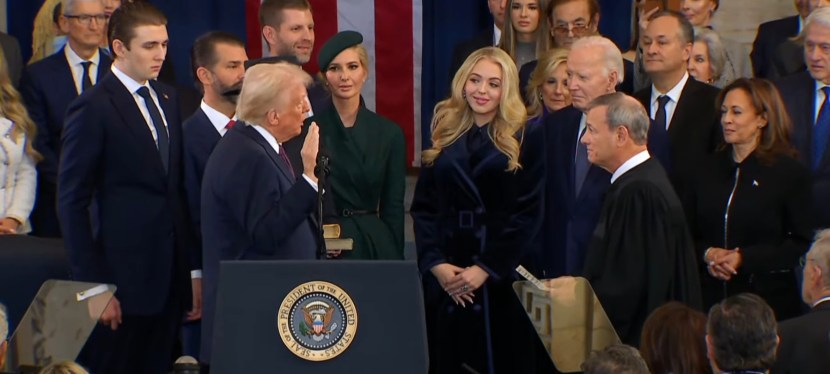
Last November, Donald Trump pulled off the greatest American comeback ever by winning the US Presidential Election again. A few days ago, the inauguration in Washington, DC, took place indoors and Trump formally returned as US President (starting his non-consecutive 2nd term). Indeed, the craziness and wickedness of the Biden-Harris administration has ended much to the relief of the many Americans who suffered over the previous four years (the lost years).
For insight, watch the selected YouTube videos below…
To read the content of President Trump’s 2025 inaugural address, click here.
Trump did not just return to the Oval Office. He really accelerated the start of his 2nd term by signing so many executive orders (EOs), proclamations, memoranda and executive actions to initiate serious reforms with improvements, prosperity and common sense in mind. Think very carefully about all the woke garbage, all the blunders and all the nonsense left behind by Joe Biden and the demonic Democrats. President Trump is reversing the Biden standards to make America great again while also fulfilling the promises he made to the people with regards to policy.
The early presidential actions done by Trump is all about making America better in many ways. This is about change that people can really believe in. American citizens are meant to be prioritized, the national sovereignty is meant to be protected, while the illegal immigrants are meant to be deported. Common sense, not the wicked DEI (diversity, equity and inclusion) and not the disease called wokeness, should be the standard when it comes to education, corporate ethics and the labor force.
Democrats and woke mob can shout and cry all they want, but President Trump’s mission is to make America great again and that means restoring sanity, common sense and meritocracy around the nation.
Overseas, America’s enemies are already feeling intimidated by Trump’s return. The terrorist state of Iran knows that a reinvigorated Israel-America alliance will cripple them severely. The renewed Israel-America alliance involving Prime Minister Benjamin Netanyahu collaborating with President Trump could potentially change the Middle East in the near future.
Thank the Lord for the return of President Trump.
Let me end this piece by asking you readers: Are you delighted to see the return of Donald Trump as the President of the United States? Do you believe that the many executive orders Trump signed on his first day will result in reforms? Are you convinced that the woke influence on America will significantly fade away as Trump restores sanity and common sense around the country?
In a move to boost the Philippines’ standing in international tourism, President Ferdinand “Bongbong” Marcos, Jr., signed into law the priority measure of providing Value Added Tax (VAT) refund for foreign tourists, according to a Philippine News Agency (PNA) news article.
To put things in perspective, posted below is an excerpt from the PNA news article. Some parts in boldface…
President Ferdinand R. Marcos Jr. on Monday signed into law a measure providing refund of Value Added Tax (VAT) for foreign tourists to attract more travelers and position the country as a “premier global shopping destination.”
Republic Act (RA) 12079 or the VAT Refund for Non-Resident Tourists will establish a VAT Refund System on locally purchased goods, Marcos said in his speech during the ceremonial signing in Malacañang.
Under the new law, tourists can claim a refund on the VAT for goods personally purchased at accredited retail outlets, provided these goods are taken out of the country within 60 days and meet a minimum transaction requirement of PHP3,000.
This initiative opens a new chapter in the Philippines’ tourism landscape, according to the President, allowing the country to compete with other tourism markets that attract tourists who are eager to take home authentic, high-quality Filipino products.
With the new law, an estimated 30 percent increase in tourist spending is projected which will benefit both large-scale industries and micro, small, and medium enterprises.
“These products tell our stories, and now, with the VAT refund, they will be able to be more accessible to global consumers, elevating once again our stature in the global market,” Marcos said.
Let me end this post by asking you readers: What is your reaction to this recent development? With the new law signed already, do you expect it to help the Philippines attract more foreign tourists as well as better spending from each of them during they stay in the country?
The Department of Foreign Affairs (DFA) announced that Chinese tourists who intend to secure a temporary visitor’s visa for travel to the Philippines will have to come up with an additional requirement, according to a GMA Network news report.
To put things in perspective, posted below is an excerpt from GMA Network news report. Some parts in boldface…
The Department of Foreign Affairs (DFA) released details on Thursday on the additional requirement for Chinese citizens applying for a temporary visitor’s visa.
The DFA said that Chinese nationals applying for a 9(a) Temporary Visitor’s Visa at Philippine Foreign Service Posts will be required to submit their Chinese Social Insurance Record Certificates.
According to the DFA, the certificates must be registered for at least six months at the time of the visa application.
Those exempted from the visa requirement are Chinese citizens who are currently enrolled in primary, secondary, or college education—who will be required to submit proof of enrollment—and retirees over 55 years old.
Meanwhile, the department said other exceptions will be considered on a case-by-case basis.
“The additional visa requirement is part of the DFA’s continuing efforts to enhance its visa policies and regulations for the safe and efficient entry of foreign visitors,” it said in a statement.
Last month, the DFA announced that the Philippines would tighten its visa requirements for Chinese tourists amid many fraudulent applications received in its embassy and consulates in China.
Foreign Affairs Undersecretary Jesus Domingo said on May 9 that the stricter visa requirements intend to “weed out” the “illegitimate and unsavory” tourists from the legitimate ones.
Several Chinese nationals have reportedly been involved in organized crimes such as human trafficking, prostitution, kidnapping, and fraud.
Let me end this piece by asking you readers: What is your reaction to this recent development? Do you think the new requirement the DFA came up with will reduce the number of Chinese nationals who intend to commit crime while in the Philippines? Considering the recent conflicts between China and the Philippines at sea as well as the high number crimes committed by Chinese nationals in the Philippines, do you think the new requirement is justified? Do you think the new requirement will severely reduce the number of Chinese tourists visiting the country?
Recently in the United States, President Ferdinand “Bongbong” Marcos, Jr., met with members of the American business community and enticed them to invest in the Philippines stating that a wealth of opportunity awaits them and the country is set to take off as a major Asian investment destination, according to a news article published by the Philippine News Agency (PNA).
To put things in perspective, posted below is an excerpt from the PNA news article. Some parts in boldface…
The Philippines is all set to become the “leading” investment destination in Asia, President Ferdinand R. Marcos Jr. said Thursday (Manila time).
“With a solid reform agenda and unabating growth amid headwinds, the Philippines is ready to take off as a leading investment hub in Asia,” Marcos said during the Philippine Economic Briefing (PEB) in San Francisco, California, as he enticed the business community in the United States (US) to invest in the Philippines.
“A wealth of opportunity awaits you in the Philippines, and we are ready to explore new horizons with your investments in the coming years,” he added.
Marcos assured the US businesses of a favorable business environment in the Philippines, adding that his administration is committed to promoting high-value investments.
He said an influx of highly-desirable investments in strategic sectors of the Philippine economy is expected, considering the amendments to the Public Service Act, Foreign Investments Act, Retail Trade Liberalization Act and the Implementing Rules and Regulations of the Renewable Energy Act.
He noted that the government has also introduced reforms to the Philippines’ fiscal incentives structure through the Corporate Recovery and Tax Incentives for Enterprises (CREATE) Act to attract both domestic and global firms to invest in strategically important sectors.
“Investments in rural areas and highly-advanced and technology-enabled projects and activities are given top priority and, consequently, greater and longer incentives,” Marcos said.
“Investments in the digital space are also highly prioritized. Incentives are given to projects covering research and development and those adopting advanced digital production technologies such as, for example, artificial intelligence, additive manufacturing, data analytics, cloud computing, and nanotechnology,” he added.
Marcos said the public-private partnerships (PPP) framework has also been modified to simplify the approval processes, ensure the viability and bankability of PPP projects, cut red tape, and pave the way for quality infrastructure development.
“These reforms support the Philippines’ massive infrastructure drive. We are prioritizing the implementation of 197 infrastructure flagship projects worth around USD155 billion, with a sharp focus on upgrading physical and digital connectivity, water, agriculture, health, transport, and energy,” he said.
Let me end this piece by asking you readers: What do you think about this recent development? Do you think a huge amount of investments from American businesses into the Philippines will be realized in due time? What do you think the government should do to keep attracting more foreign investors as the Philippines is now in the post-pandemic age?
It looks like the Philippines will make a major step forward in the highly competitive field of tourism as the House of Representatives recently approved on 3rd and final reading the proposal on granting Value Added Tax (VAT) refund for outbound tourists, according to a GMA Network news report. The newly approved bill is a measure backed by President Ferdinand “Bongbong” Marcos, Jr.
Having been to Israel recently, I noticed that the VAT refunds for foreign tourists who are about to leave the country is the norm.
To put things in perspective, posted below is an excerpt from the Manila Bulletin news article. Some parts in boldface…
The House of Representatives on Monday approved on third and final reading a bill granting Value Added Tax (VAT) refund for outbound tourists, a bill backed by President Ferdinand Marcos, Jr.
House Bill 7292 earned 304 “yes” votes, four “no” votes, and zero abstention.
Under the proposed measure, tourists will be eligible for a VAT refund on goods purchased from accredited retailers in the Philippines as long as such goods are taken out of the country within 60 days from the date of purchase and the value of goods purchased per transaction amounts to at least P3,000.
The bill also authorizes the Secretary of Finance to adjust the P3,000 threshold, taking into account the following indicators: administration costs in processing refunds; consumer price index; and other market conditions, upon the recommendation of the Secretary of Tourism and the Commissioner of Internal Revenue.
“This measure [is being passed] to adopt best practices in VAT refund schemes among Asia Pacific tourism destinations and expand the country’s competitiveness among its peers and neighboring countries,” the committee report on the measure read.
The bill defines a “tourist” as a foreign passport holder who is a non-resident individual not engaged in trade or business in the Philippines.
House ways and means panel chairperson Representative Joey Salceda earlier said the measure will generate P10 billion to P40 billion worth of increased sales for local suppliers.
Salceda was one of the principal authors of the measure, alongside House ways and means panel vice chairperson Mikaela Suansing of Nueva Ecija who chaired the technical working group drafting amendments to the original proposed bill.
“Generally, for every P1 refunded, the tourist spends an additional 1.5 pesos. That will create an additional twenty to eighty thousand jobs, and will also improve our gross international reserves,” Salceda said.
Let me end this piece by asking you readers: What is your reaction to this recent development? Do you think the newly approved measure will pass in the Philippine Senate soon? Do you think the measure will make the Philippines more competitive in international tourism?