A Look Back at Spider-Man 2099 #39 (1996)

Disclaimer: This is my original work with details sourced from reading the comic book and doing personal research. Anyone who wants to use this article, in part or in whole, needs to secure first my permission and agree to cite me as the source and author. Let it be known that any unauthorized use of this article will constrain the author to pursue the remedies under R.A. No. 8293, the Revised Penal Code, and/or all applicable legal actions under the laws of the Philippines.

Welcome back, superhero enthusiasts, 1990s culture enthusiasts and comic book collectors! Today we revisit the world of 2099 within the universe of Marvel Comics back in the 1990s, specifically through the Spider-Man 2099 monthly series.

In this retro review, the Venom 2099 storyline continues (for my previous reviews, click here, here, here and here). Since my previous review, the futuristic Venom has been captured by Spider-Man and is now in the custody of Alchemax where Miguel O’Hara (Spider-Man of 2099) holds considerable power and authority. As seen in issue #38, Miguel’s rage was clearly affecting him and pushed him to the point of wanting revenge (by means of death, no less) over the death of Dana.

With those details laid down, here is a look back at Spider-Man 2099 #39, published in 1996 by Marvel Comics with a story written by Peter David and drawn by Andrew Wildman.

The cover.

Early story

The story begins with Miguel O’Hara, still impacted by Dana’s death and what he personally discovered about Venom, walking through the offices of an Alchemax building where several employees greet him formally which he does not seem to enjoy. He walks into a laboratory where he sees the two that compose Venom – Kron Stone and the symbiote (living costume) – contained separately with hard glass containers.

Kron Stone, who is related to the powerful Tyler Stone and was responsible for the death of the family of Jake Gallows/Punisher 2099, was declared dead which puzzles Miguel. As the two exchange words, it turns out Kron and Miguel knew each other from long ago. Upon the orders of Miguel, the scientists left the laboratory which gave their boss more privacy to exchange words with the trapped Kron who called him gutless.

Miguel then releases Kron from containment (but still separated from the symbiote), declares terms for their private fist fight (which Kron accepts), and begins to fight him…

Quality

Spider-Man, in his form as Miguel O’Hara, spends time with Xina.

Not surprisingly, the high level of quality and engagement of the writing here is successfully maintained by Peter David and it is very clear to me that he had planned to dramatically shift the direction of the Spider-Man 2099 series and impact the key characters as the story of Venom 2099 went on.

That being said, Peter David went on to not only show Miguel literally burning with rage but also dramatized his move towards the extreme. Not only do we get to see Miguel really abusing his Alchemax authority, he also gets violent with Kron Stone who was powerless without the symbiote. These scenes clearly show that the border that separates good and evil got blurred which showed a very dark side of Miguel O’Hara struggling with his rage, emotions and whatever sanity he still has left.

To be clear, the story here was not purely about Miguel and Kron. There is also the scene in which a cooled down Miguel spends time with Xina who made clear to him her reaction over Dana’s death. Peter David also took the opportunity to not only show more of the return Vulture 2099 but also brought in the 2099 version of Green Goblin simply called Goblin who clearly has an agenda against Spider-Man which adds to the suspense and the overall narrative of the series. The appearance of Goblin also sheds light on the nature of vigilantism and elements of chaos within the 2099 universe.

Conclusion

Miguel and his half-brother Kron Stone begin their fight.

I can say that Spider-Man 2099 #39 (1996) is a very solid read. Not only did the Venom 2099 storyline reflect the serious changes on the characters, it is also led to a bold new direction for the monthly series. Carrying on the dramatic stuff from the previous issues, this comic book also serves as a character examination on Miguel O’Hara which will compel not only the fans but also comic book readers to reflect about what they knew about Spider-Man of the far future and speculate as to how he will turn out and how he would impact the people around him.

If you are seriously planning to buy an existing hard copy of Spider-Man 2099 #39 (1996) be aware that as of this writing, MileHighComics.com shows that the near-mint copy of the regular edition costs $80 while the near-mint copy of the newsstand edition costs $240.

Overall, Spider-Man 2099 #39 (1996) is highly recommended.

+++++

Thank you for reading. If you find this article engaging, please click the like button below and also please consider sharing this article to others. If you are looking for a copywriter to create content for your special project or business, check out my services and my portfolio. Feel free to contact me with a private message. Also please feel free to visit my Facebook page Author Carlo Carrasco and follow me on Twitter at  @HavenorFantasy as well as on Tumblr at https://carlocarrasco.tumblr.com/
A Look Back at Punisher 2099 #13 (1994)

Disclaimer: This is my original work with details sourced from reading the comic book and doing personal research. Anyone who wants to use this article, in part or in whole, needs to secure first my permission and agree to cite me as the source and author. Let it be known that any unauthorized use of this article will constrain the author to pursue the remedies under R.A. No. 8293, the Revised Penal Code, and/or all applicable legal actions under the laws of the Philippines.

Welcome back, superhero enthusiasts, comic book collectors, 1990s pop culture enthusiasts and fans of Marvel Comics! We finally made it at last with the conclusion of The Fall of the Hammer crossover storyline that highlighted Marvel’s 2099 franchises.

Last time around, Doom 2099 saw the raising of the stakes and tension of the storyline leading up to the sudden team-up of the 2099 universe’s pioneering heroes – Spider-Man 2099, Ravage 2099, Doom 2099 and Punisher 2099 – facing the so-called Thor (the flying idol of the people in 2099), the minions and the secret forces behind the conflict.

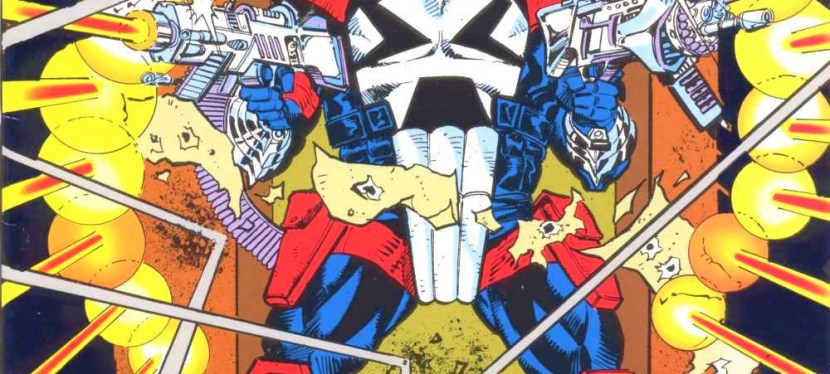
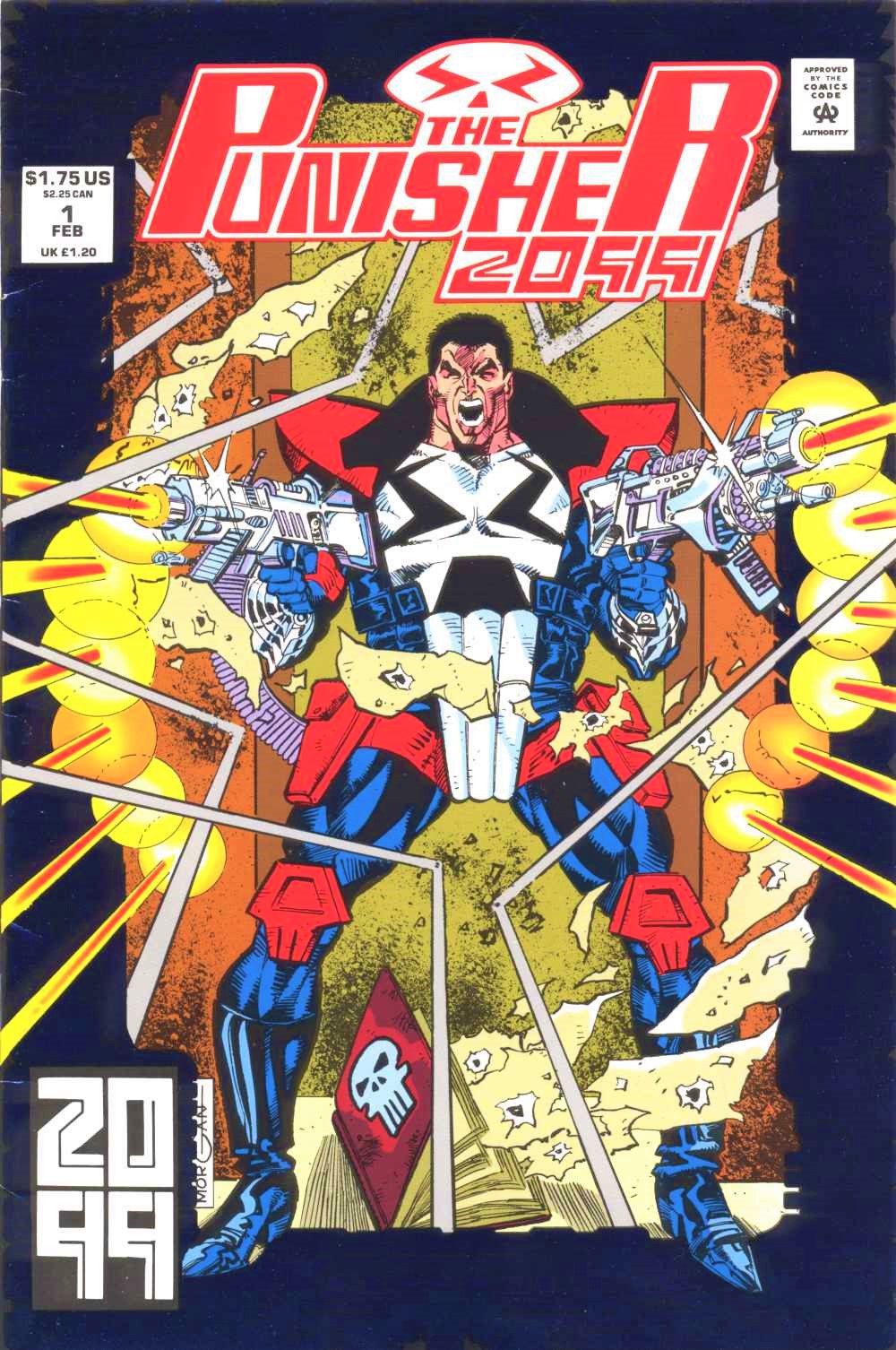
With those details laid down, here is a look back at Punisher 2099 , published in 1993 (cover dated 1994) by Marvel Comics with a story written by Pat Mills and Tony Skinner, and illustrated by Tom Morgan.

The cover.

Early story

The story begins with Spider-Man, Punisher, Doom and Ravage together facing a horde of Berzerkers approaching them. The four engaged with the horde using violent action. When things calmed down, Doom 2099 tells them that they need to split into duos so that they can prevent the city of Valhalla from harming the millions of people below (in New York).

Before they start their tasks, the schemer Avatarr appears to them through holographic imagery and tells them that Valhalla was created as a base for the heroes that would destroy them and lead mankind along more productive lines. Thanks to Ravage’s move, Doom detects Avatarr’s frequency…

Quality

As Punisher 2099 arms himself, look closely and you will see the conflict between him and Jake Gallows.

When it comes to the storytelling, this conclusion to The Fall of the Hammer storyline felt unsatisfying. There were clear signs of rush on the resolution to the plot that preceded the ending which itself had a sudden shift of focus on Punisher 2099.

The real meat of this comic book is the team-up of the Marvel 2099’s pioneering protagonists, including the duos that were spawned as the plot required it. For most of this crossover storyline, Spider-Man 2099 and Punisher 2099 were just riding together going to Valhalla. In this comic book, you will really see the two work together which was satisfying enough as pay-off (to the build-up the preceded this issue). The duo of Doom 2099 and Ravage 2099, however, was nowhere as satisfying and, more notably, there was no real chemistry between them.

This comic book continues the theme of false deities and a series of unfortunate events pulled off from a distance by some sinister force located in a secret place. While this storyline had touched on the faith of the Thorites (most notably in Doom 2099 ), this one simply abandoned it to focus more on 2099’s original heroes doing something heroic.   

When it comes to Punisher 2099 himself, fans will have a lot of stuff to enjoy. There is a short but notable moment in the story implying that Punisher 2099 and Jake Gallows are separate entities presented in the character’s mind.

Conclusion

This opening image is easily the best image of the comic book. Things went downhill from after this image.

Punisher 2099 (1994) is not the solid conclusion The Fall of the Hammer storyline deserved. There were clear signs of rush as well as compression of details that had to be done in order to fit the 22 story pages. The so-called final conflict felt hollow and 2099 fans who got invested with the era’s self-declared Thor (who was initially the main antagonist) in the previous chapters will be disappointed with the way he turned out here. That being said, Avatarr as the main villain is just not convincing and was unsatisfying. Having Punisher 2099, Spider-Man 2099, Doom 2099 and Ravage 2099 together to do some saving was pretty interesting and symbolic, as well as the main attraction of this comic book. Sadly, not even those pioneers could save this comic book and the storyline from ending with a whimper.

If you are seriously planning to buy an existing hard copy of Punisher 2099 (1994), be aware that as of this writing, MileHighComics.com shows that the near-mint copy of the regular edition costs $6 while the near-mint copies of the signed-and-numbered and the newsstand editions cost $50 and $16 respectively.

Overall, Punisher 2099 (1994) is worth getting below its cover price.

+++++

Thank you for reading. If you find this article engaging, please click the like button below and also please consider sharing this article to others. If you are looking for a copywriter to create content for your special project or business, check out my services and my portfolio. Feel free to contact me as well. Also please feel free to visit my Facebook page Author Carlo Carrasco and follow me at HavenorFantasy@twitter.com

A Look Back at Spider-Man 2099 #16 (1994)

Disclaimer: This is my original work with details sourced from reading the comic book and doing personal research. Anyone who wants to use this article, in part or in whole, needs to secure first my permission and agree to cite me as the source and author. Let it be known that any unauthorized use of this article will constrain the author to pursue the remedies under R.A. No. 8293, the Revised Penal Code, and/or all applicable legal actions under the laws of the Philippines.

By the year 1993, Marvel Comics’ new comic book line of the 2099 universe kept filling the shelves of retailers and made it into the hands of collectors and fans with the monthly series composed of Spider-Man 2099, Ravage 2099, Doom 2099, Punisher 2099 and the new addition of the year X-Men 2099. Back then, the Marvel 2099 line expanded a lot and saw the establishment of new fans. Even the quarterly series 2099 Unlimited caught the attention of some readers as it told the early stories of Hulk 2099 (who debuted in 2099 Unlimited ).

Unsurprisingly, there were fans of the 2099 universe who wished for a crossover storyline that would bring together their respective favorite futuristic heroes. Remember the rivalry between classic Spider-Man (Peter Parker) and the Punisher (Frank Castle)? Some wanted Spider-Man 2099 and Punisher 2099 to encounter each other.

Eventually, the crossover dream of the fans came through in the form of The Fall of the Hammer storyline that took place in five parts. Specifically one issue each of Spider-Man 2099, Ravage 2099, Doom 2099, Punisher 2099 and X-Men 2099. It was also an opportunity for the 2099 creative teams (note: the legendary Stan Lee and Peter David were among the writers at the time) to get together and contribute to make something special under the watch of 2099 editor Joey Cavalieri.

With those details laid down, we can finally start examining the beginning of The Fall of the Hammer storyline in this look back at Spider-Man 2099 , published in 1993 (cover dated 1994) by Marvel Comics with a story written by Peter David and drawn by Rick Leonardi.

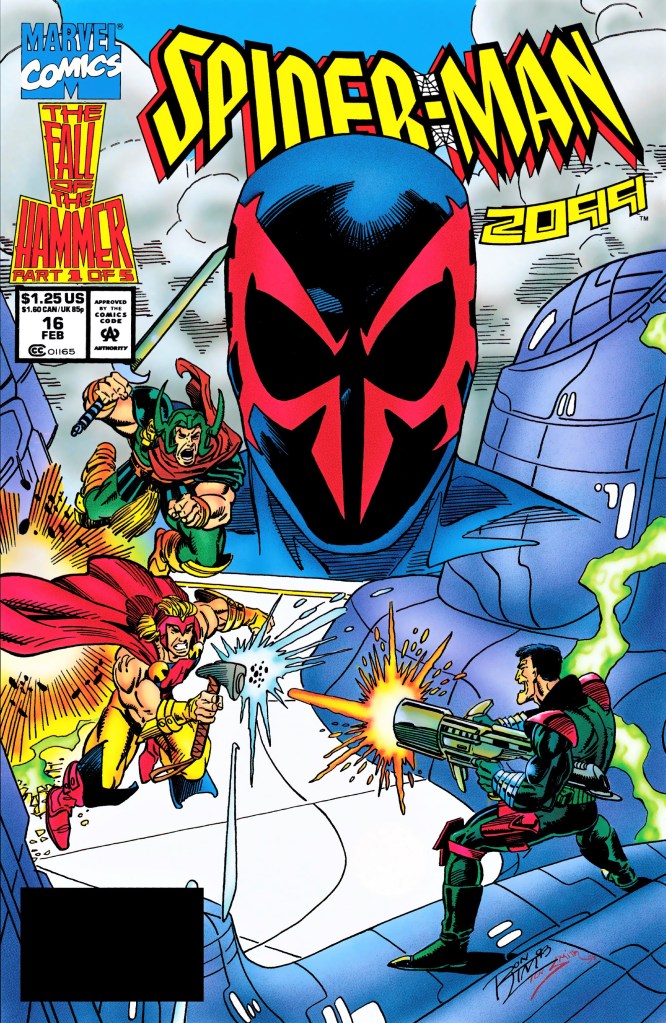
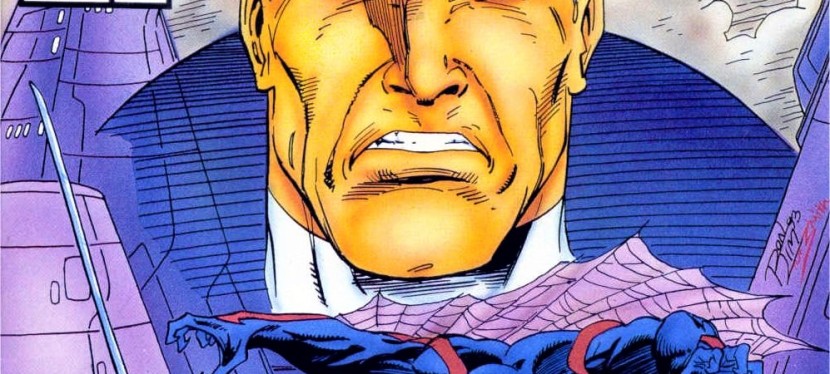
The cover drawn by Ron Lim.

Early story

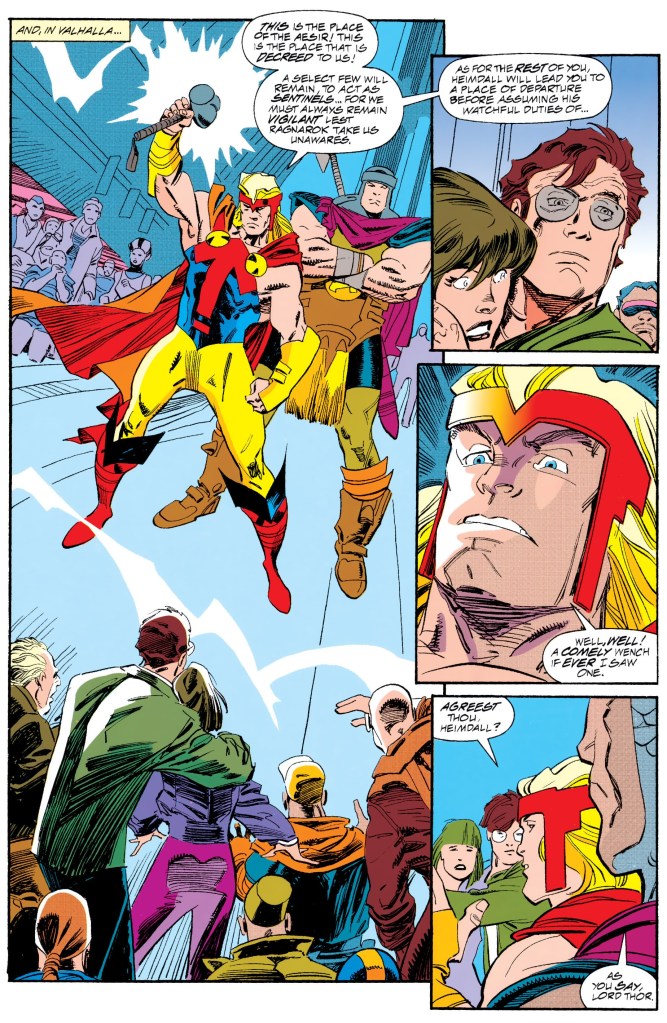
The story begins with the arrival of the floating city of Valhalla, disturbing the people of the town of Randall below. On the floating city itself, a crowd of people – with Miguel O’Hara and Dana among them – stare at a hammer-wielding, caped blonde man who claims to be Thor (their idol). Accompanied by Heimdall, Thor tells them that a select few among them will remain in the city to act as sentinels while the rest will come with Heimdall to a place of departure.

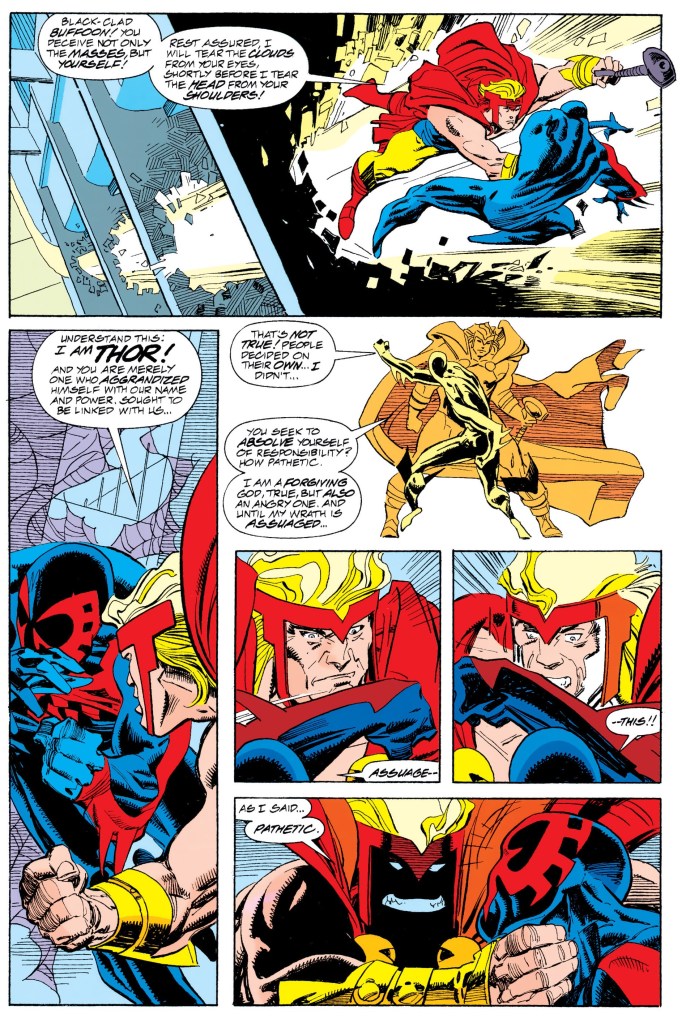
Thor turns his attention on Dana causing Miguel to intervene and challenge his so-called authority. As Thor reacts to Miguel’s defiance, he throws a punch which got deflected. This causes the so-called god of thunder to be surprised given Miguel looking ordinary to him. In reaction, Thor grabs him and throws his body several feet over many people’s heads. This leaves Dana helpless.

Miguel crashes through a glass window, falling outside until he shoots a web to control his movement. He takes off his civilian clothes, revealing his costume as Spider-Man of 2099. He sets off to get back at Thor…  

Quality

The highlight of the comic book is Spider-Man 2099’s conflict with Thor.

To make clear the obvious, the writing by Peter David is indeed solid although the sketch-like aesthetic of the art of Rick Leonardi badly needed more visual details.

As for the story itself, it is succeeded in creating tension with regards to the caped figure who believes himself to be Thor who is the central figure of religion in 2099 America and has the means to wield power by even involving technology (with Valhalla as the center piece). That being said, Spider-Man 2099’s encounter with him was inevitable, and so was the result (a bit predictable). The story also sheds light on the perceived omnipotence of Thor and how Spider-Man 2099 (who was previously referred to by some people as Thor’s harbinger) got associated with his legend.

To make things clear, this one is purely a Spider-Man 2099 story that justifies the concept of needing other 2099 heroes as the threat was simply too great for any one hero to handle. I should also state that the crossover between any heroes does not begin until the final page of this comic book.

Conclusion

Nothing like being in a crowd of people watching helplessly in front of two so-called omnipotent figures.

Spider-Man 2099 (1994) is still a good read and as the first chapter of The Fall of the Hammer storyline, it served its purpose well. This is mainly due to the strong writing by Peter David who also succeeded in establishing 2099’s Thor not only as the villain but also as a figure who truly is a threat to the people. This comic book also shows that people in 2099 failed to realize who their true Creator is as they embraced religion (instead of faith) and committed idolatry (which is truly unholy) by believing in a false god like Thor.

If you are seriously planning to buy an existing hard copy of Spider-Man 2099 (1994), be aware that as of this writing, MileHighComics.com shows that the near-mint copy of the regular edition costs $40 while the near-mint copies of the newsstand and the signed-and-numbered editions cost $120 and $300 respectively.

Overall, Spider-Man 2099 (1994) is recommended.

+++++

Thank you for reading. If you find this article engaging, please click the like button below and also please consider sharing this article to others. If you are looking for a copywriter to create content for your special project or business, check out my services and my portfolio. Feel free to contact me as well. Also please feel free to visit my Facebook page Author Carlo Carrasco and follow me at HavenorFantasy@twitter.com

A Look Back at The Punisher Meets Archie #1 (1994)

Disclaimer: This is my original work with details sourced from reading the comic book and doing personal research. Anyone who wants to use this article, in part or in whole, needs to secure first my permission and agree to cite me as the source and author. Let it be known that any unauthorized use of this article will constrain the author to pursue the remedies under R.A. No. 8293, the Revised Penal Code, and/or all applicable legal actions under the laws of the Philippines.

Welcome back, superhero enthusiasts, comic book collectors, fans of 1990s culture, and fans of both Marvel Comics and Archie Comics! Today, I have a retro review of one of the most wild ideas for a comic book crossover that actually got published in 1994. Back then I was still in college and ramping up my comic book collection. Then one day, I saw a print ad for the Marvel-Archie special project about the iconic Archie Andrews crossing over with the Punisher!

That’s right! The unthinkable concept pushed through and way back in 1994, I ordered in advance a copy of the comic book (note: this was actually one comic book published respectively by Marvel Comics and Archie Comics but with their own packaging and slight adjustments to the title) and eventually got to read it.

Behind the scenes, the management of Archie Comics wanted to take part in the wildly popular trend of intercompany crossover comic book publishing not just to boost their sales but also establish a stronger presence in comic book specialty stores. Back then, Marvel Comics editor-in-chief Tom DeFalco and Archie Comics editor Victor Gorelick were good friends (note: DeFalco entered comic book publishing while working for Archie Comics) and sometimes they would joke with each other about potential crossover concepts between their companies. Gorelick eventually had lunch with independent comic creator Batton Lash and talked about Archie wanting to get involved with crossovers. The Archie editor told Lash about he and DeFalco joking about Archie encountering the Punisher, and in response the independent creator stated that they should really push through with it.

Lash went on to make a pitch for the series and Gorelick sent it to DeFalco. Marvel’s editor-in-chief loved it and eventually the concept was approved complete with strategic involvement in the production by key talents from both Archie and Marvel. For the artwork, Archie’s Stan Goldberg and Marvel’s John Buscema worked together to maintain different tones by means of drawing settings and characters that are specific with their respective companies. The inkwork was done by Tom Palmer.

Now you must be wondering…was the crazy crossover any good? We can find out in this look back at The Punisher Meets Archie , published by Marvel Comics in 1994 with a story written by Batton Lash and drawn by Punisher artist John Buscema and Archie artist Stan Goldberg.

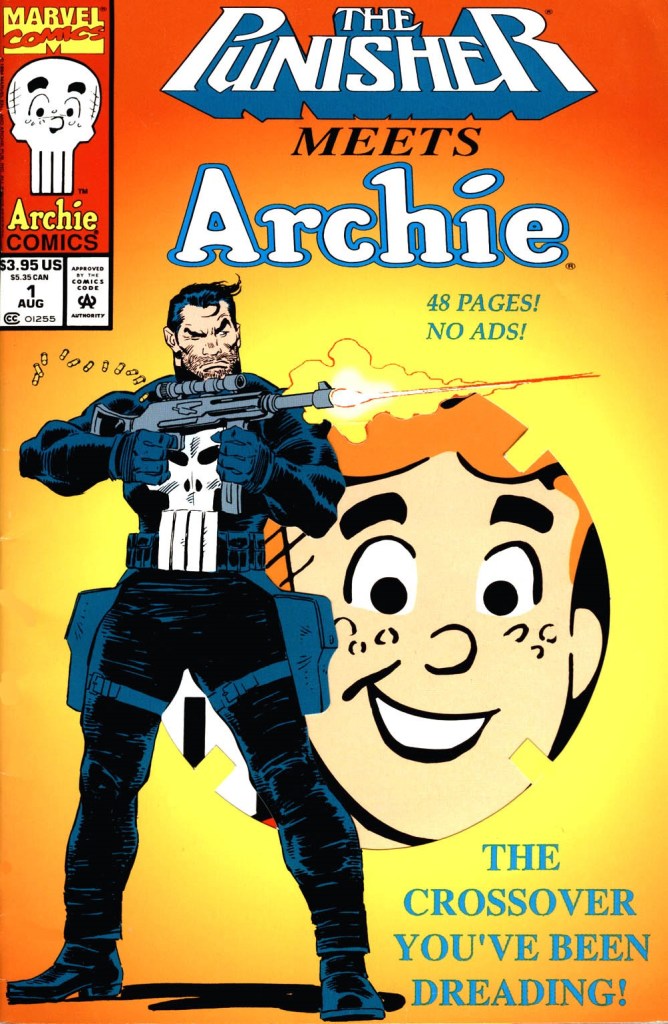
The cover with a die-cut design.

Early story

The story begins in a city where a man (in a trench coat and a cap) is seen running away from someone chasing him. As he hurriedly climbs over a wall, he hears the chaser’s gun click and responds by firing some bullets at him. The chaser climbs over the wall and he turns out to be Frank Castle, the Punisher. The Punisher notices that his target left his cap on the floor, and look at the nearby station full of people.

Inside the said station, the man who got away from the Punisher has red hair and a sinister looking face. He buys a ticket going to Riverdale.

The next day in the town of Riverdale, Archie Andrews rings the bell of the front door at the luxurious residence of the Lodge family. A little boy named Leroy (cousin of Veronica Lodge) surprises him and makes him wet using a water-filled plastic gun. In response, Archie grabs the hose nearby and unleashes water. He accidentally hits Veronica who got so angry, she decided to cancel her date with him.

Still wet, Archie walks down the sidewalk being followed by a car…

Quality

See your favorite Archie characters among them?

I’ll start with the story written by Batton Lash. To be clear, this comic book has a dominant Archie Comics tone meaning it is wholesome and fun, and at the same time never childish. The Punisher-focused scenes showed lots of signs of restraint meaning in order to connect well with the overall wholesome tone of the comic book, adulterated stuff and violent concepts related to the Punisher are absent. For me, having an overall wholesome tone works given the fact that most of the story is set in Riverdale and there are tremendously more Archie characters than there are Marvel characters.

More on the story, the concept by Batton Lash is wonderful and the way the plot was structured not only ensured a fun story but also made sense. The plot itself is pretty believable and the story is full of nice and interesting moments to read. There certainly were no boring scenes at all!

To have Punisher encounter Archie without ever using the now overuses versus-battle-type approach here was believable, sensible and even impressive. For the most part, as reflected in portrayals and dialogue, Lash captured the essence of the Archie characters and anyone who loves stories about Archie and the gang (plus Josie and the Pussycats and Katy Keene) will have a lot to enjoy here. Even the disruption in Riverdale caused by the gang of crooks and the Punisher has that strong Archie-tone and never went overboard.

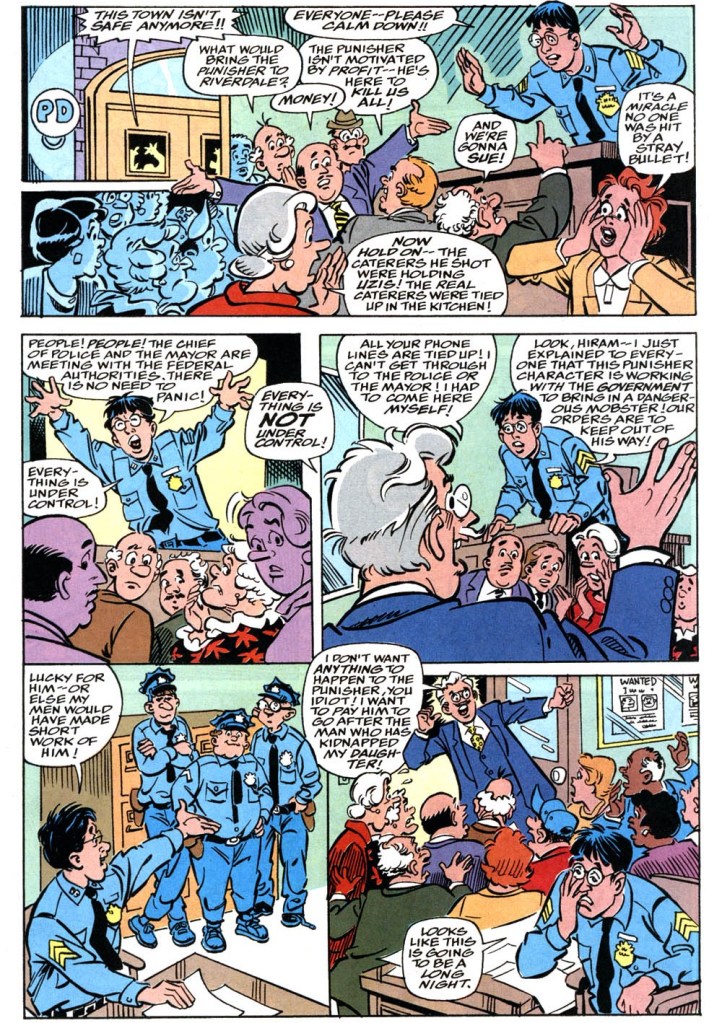
Punisher, Micro Chip, the local cops and a familiar face from the Riverdale high school’s cafeteria.

With regards to Lash presenting Marvel’s vigilante, the Punisher here is subdued in terms of seriousness. While he is not portrayed to be gritty (note: he’s also less violent), he is still rugged and you will still see him firing guns during the right moments. With the reduction of violent action, Punisher does a lot more detective work and has his companion Microchip with him. While rugged, the Punisher is not as snobbish as one might think here. In fact, there are a few pleasant surprise moments in the story with regards to his encountering certain supporting characters of Archie. These moments, although they make Punished look like he’s out of character, I still find pretty delightful.

More on the characters, there is a whole bunch of them here! As the story is set in Riverdale, it comes to no surprise that supporting characters of Archie Comics are present and for the most part they were presented to delight those who love Archie and the gang. Mr. Weatherbee, Mr. Lodge, Reggie Mantle, Betty Cooper, Jughead Jones, Pop Tate, Svenson, Ms. Grundy, Professor Flutesnoot and others are here and they don’t just make mere appearances.  

As this is a special project between Marvel Comics and Archie Comics, there is a lot of fan service here and there leaning towards the interests of Archie fans. For the most part, these fan service elements (note: there are some from Marvel Comics) were actually fun to look at and I personally did not find them distracting.

Conclusion

Punisher and Micro Chip explore Riverdale as Jughead and Archie are in Pop’s place.

While it is essentially an Archie comic book in terms of storytelling and visuals and lacks the kind of adulterated stuff that Punisher fans love, The Punisher Meets Archie (1994) is still a very enjoyable crossover to read, and it sure is fun from start to finish. For one thing, the concept about Archie meeting with Punisher with Riverdale as the main setting works wonderfully even by today’s standards. What was an unbelievable concept got executed nicely into a believable and fun product. I should state that this kind of intercompany crossover comic book is still one-of-a-kind and its literary value (as opposed to financial value) is undeniably high. No doubt about, this crossover is a comic book classic!

If you are seriously planning to buy an existing hard copy of The Punisher Meets Archie (1994), be aware that as of this writing, MileHighComics.com shows that the near-mint copy of the regular edition costs $53 while the near-mint copies of the deluxe newsstand edition and the direct edition cost $105 and $70 respectively.

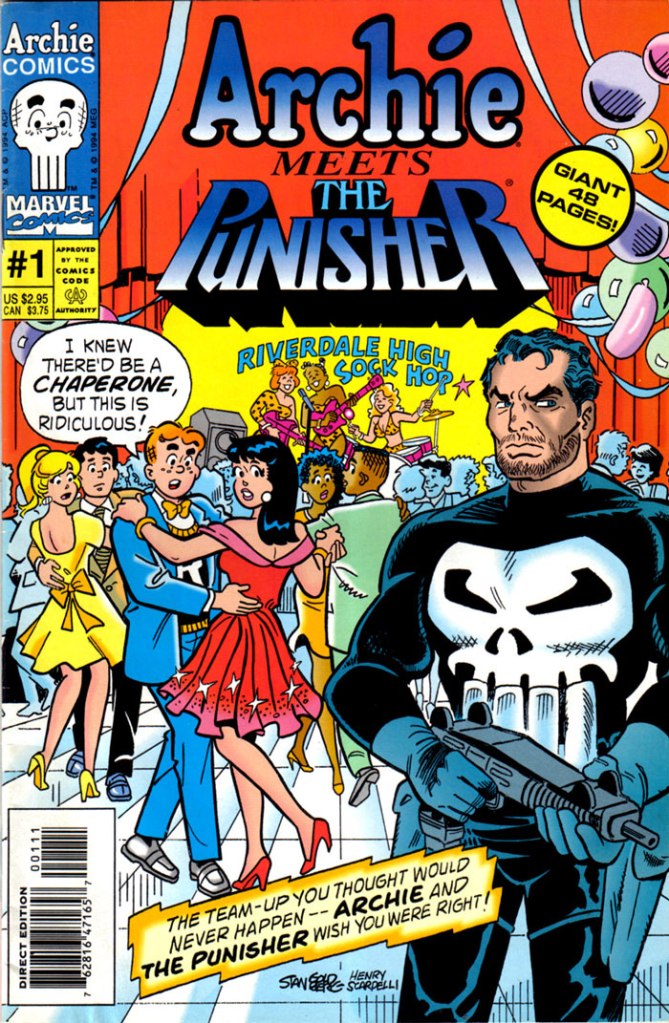
If you prefer the Archie Comics-published version – Archie Meets The Punisher (1994) – be aware that the near-mint copy of the comic book costs $70 according to Mile High Comics as of this writing.

The cover of the Archie Comics-published version of the same crossover. This one is more eye-catching than that of the Marvel version.

Overall, The Punisher Meets Archie (1994) is highly recommended!

+++++

Thank you for reading. If you find this article engaging, please click the like button below and also please consider sharing this article to others. If you are looking for a copywriter to create content for your special project or business, check out my services and my portfolio. Feel free to contact me as well. Also please feel free to visit my Facebook page Author Carlo Carrasco and follow me at HavenorFantasy@twitter.com

A Look Back at Ravage 2099 #3 (1993)

Disclaimer: This is my original work with details sourced from reading the comic book and doing personal research. Anyone who wants to use this article, in part or in whole, needs to secure first my permission and agree to cite me as the source and author. Let it be known that any unauthorized use of this article will constrain the author to pursue the remedies under R.A. No. 8293, the Revised Penal Code, and/or all applicable legal actions under the laws of the Philippines.

Welcome back, Marvel 2099 fans and superhero comic book geeks! Are you ready for another trip into the high-tech future of Marvel’s comic book universe through the storytelling of the late Stan Lee? This is about the 3rd issue of the Ravage 2099 monthly series.

For the newcomers reading this, Ravage is an original character co-created by Stan Lee and artist Paul Ryan for the 2099 universe of Marvel Comics. By comparison, 2099 started in the 1990s with its own versions of Spider-Man, Dr. Doom and the Punisher. As such, Ravage stood out simply because he was different from them and that includes being idiotic and chaotic as a lead character.

Having already reviewed the first two issues (read my recent review), it became clear to me that Ravage started to deteriorate as a person even as he strived hard in doing what he thought was right. There are two established villains in the story and so far, Ravage does not look any different from them since he proved to be so chaotic, he became a danger not only to the thugs but also to law enforcers. As such, he is a danger to the public.

To find out if anything will improve creatively and artistically, here is a look back at Ravage 2099 , published in 1993 by Marvel Comics with a story written by Stan Lee and drawn by Paul Ryan.

The cover.

Early story

The story begins moments after Alchemax forces abducted Tiana from Ravage and Dack who find themselves busy with armed enemies on the street. The young Dack got hit by a gun blast. Somehow, Dack was brought to the nearest medical facility for treatment and placed in a medi-cell for questioning.

Already alone in the room, Dack is trapped and a bearded man delivering some candy arrives. It turns out it is Ravage in disguise and he wanted to make sure the youth was fine. Dack tells reveals that he was question for hours. Ravage updates Dack that Tiana was probably half-way to Hellrock, and he intends to get her back.

Meanwhile, armed personnel spot Ravage on surveillance video and rush to get him…

Quality

Most likely the portrayal of Tiana being helpless will turn off radical feminists and SJWs reading this.

To put things straight, this particular story has a retro vibe which reminds me of certain sci-fi and adventure comic books of the 1950s to the 1970s. This is not surprising given Stan Lee’s own style of plotting and writing. Like in issue , creative baggage was less of a hindrance and this allowed Lee and Paul Ryan to craft another action-hero tale that is straightforward and easier to follow. Unlike the previous issue, this one has stakes raised near the end of the story which is refreshing and it also involves a nice change of location. Compared to how he acted in issue , Ravage here begins to act more heroic and showed willingness to sacrifice something to help someone. He still is a chaotic person to be with, only this time he is in the company of a different kind of walking characters. To say the least, this story is an improvement over its predecessor.

Conclusion

Ravage in action inside Dak’s medi-cell.

I can say that Ravage 2099 (1993) is surprisingly a satisfying read. It definitely is not great but the traditional elements of sci-fi, action adventure storytelling lifted its quality. It should be noted that the act of heroism on the part of Ravage begins here and the predicted rivalry between him and the villain Dethstryk (who looks generic as the leader of a band of baddies) finally starts.

If you are seriously planning to buy an existing hard copy of Ravage 2099 (1993), be aware that as of this writing, MileHighComics.com shows that the near-mint copy of the regular edition costs $8 while the near-mint copy of the newsstand edition costs $24.

Overall, Ravage 2099 (1993) is satisfactory. That being said, I don’t recommend spending any more than $1 for it.

+++++

Thank you for reading. If you find this article engaging, please click the like button below and also please consider sharing this article to others. If you are looking for a copywriter to create content for your special project or business, check out my services and my portfolio. Feel free to contact me as well. Also please feel free to visit my Facebook page Author Carlo Carrasco and follow me at HavenorFantasy@twitter.com

A Look Back at X-Men 2099 #35 (1996)

Disclaimer: This is my original work with details sourced from reading the comic book and doing personal research. Anyone who wants to use this article, in part or in whole, needs to secure first my permission and agree to cite me as the source and author. Let it be known that any unauthorized use of this article will constrain the author to pursue the remedies under R.A. No. 8293, the Revised Penal Code, and/or all applicable legal actions under the laws of the Philippines.

This is it! The thirty-fifth and final issue of the X-Men 2099 monthly series from Marvel Comics is at hand. How times have changed in the American comic book industry back in the 1990s. When X-Men 2099 #1 was released in 1993, there was still good demand and room for expanding the 2099 imprint beyond the pioneering characters Spider-Man 2099, Punisher 2099, Ravage 2099 and Doom 2099. By the time the X-Men 2099 series came to an end, Marvel Comics was in turmoil internally and several 2099 series talents behind the scenes left as a result of the termination of 2099 line editor Joey Cavalieri.

With the short history lesson done, we can now take a look back at X-Men 2099 #35, published in 1996 by Marvel Comics with a story written by John Francis Moore (who wrote ALL the series’ issues) and drawn by Jan Duursema.

Cover
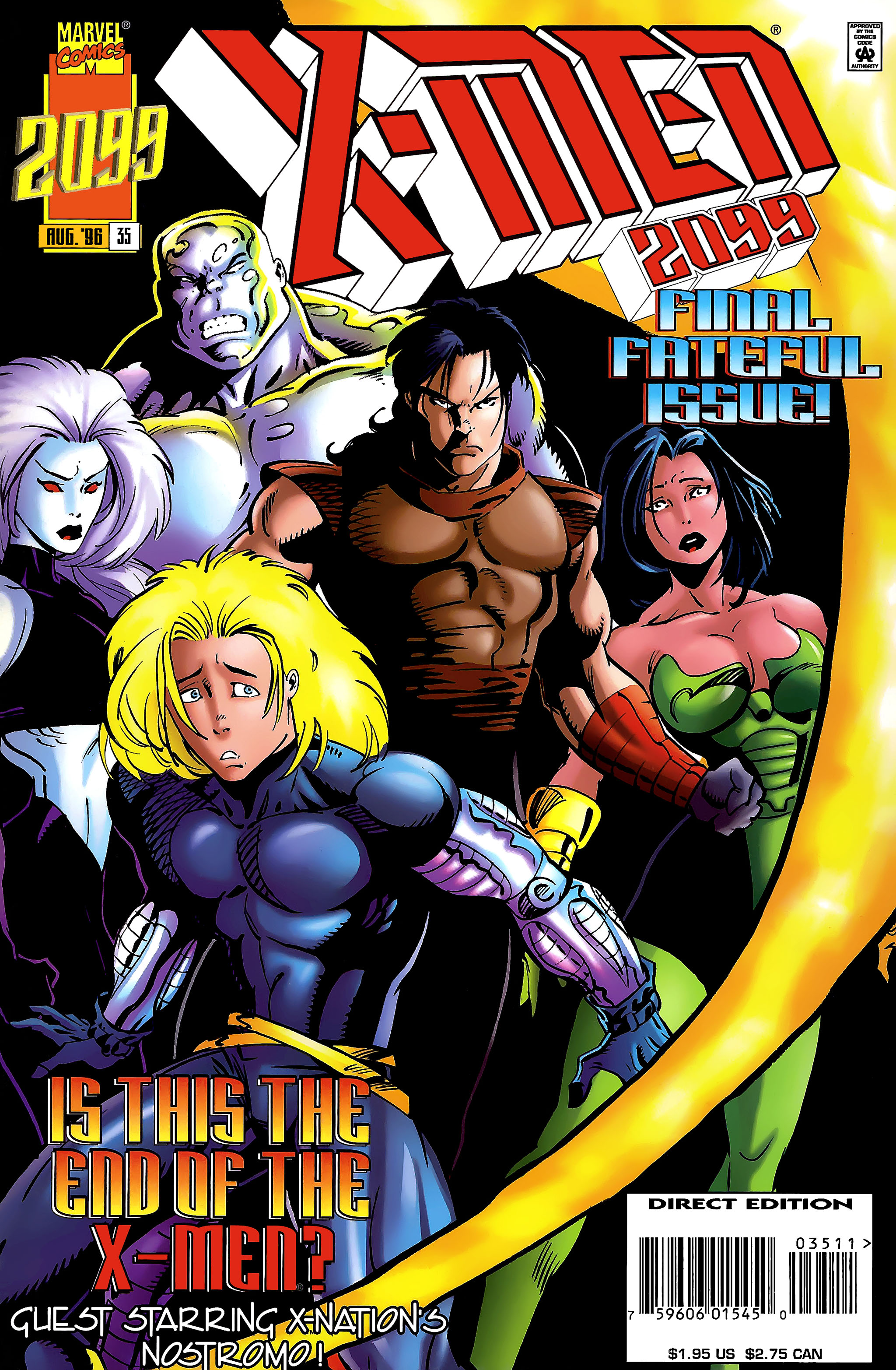
The cover.

Early story

The story begins with some members of the X-Men facing off with Darkson (his name is Joaquim, the accelerated grown-up son of Metalhead and Rosa) and his evil mentor Vulcan. Following Vulcann’s command, Darkson lets go of Luna (who was carried earlier by him) who lands on the ground in a weakened state and was approached by Krystallin. In reaction, Krystallin launches some crystals to Vulcann and Darkson but got blocked by a protective aura.

The X-Men realize that Darkson is as potentially dangerous as Zhao. Darkson then strikes at Bloodhawk with a psionic blast and then attacks the other X-Men…

Quality

7
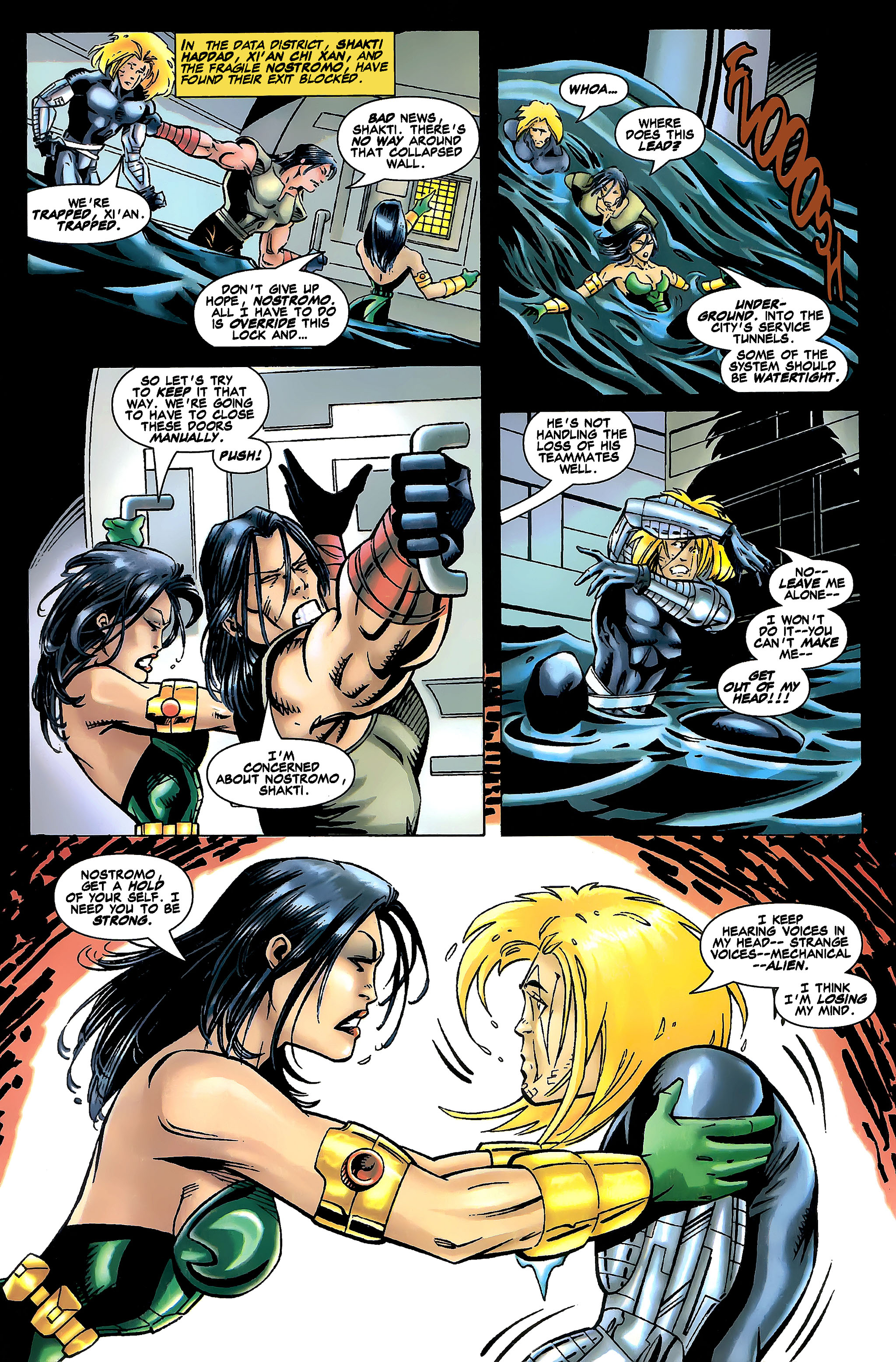
Two X-Men veterans and one X-Nation member in a scene.

In terms of storytelling, John Francis Moore did what he could with all the plot details and with what was built up during the previous issues leading to this issue’s final conflict. The problem, however, is that the pay-off was ultimately unsatisfactory.

Firstly, having Vulcann and Darkson parallel God and Jesus (complete with doing something about the destiny of people who need saving, which in this comic book referred to the futuristic mutants) in a twisted fashion was just hollow and never engaging. Secondly, the way the X-Men members got together was very rushed in execution. Thirdly and more importantly, the final conflict was pretty shallow and only led to a sequel-bait ending designed to lead into 2099: World of Tomorrow .

If you are looking for superhero spectacle, you will find some here but they all feel rushed and unsatisfying. If you care about key X-Men 2099 characters like Skullfire and Xi’an, the way they developed and appeared here will disappoint you. In fairness, Shakti remains the strong-willed mutant as before.

To say the least, there was an effort to emphasize what was at stake for the mutants of 2099 living in Halo City and there was also the idea that the world was coming to an end. The problem here was the execution as the comic book basically showed the X-Men in the presence of Vulcann and Darkson. There was no epic battle here at all and the climax at the end clearly showed rush and even a lack of creativity (note: most likely due to the internal turmoil at Marvel at the time).

Conclusion

2
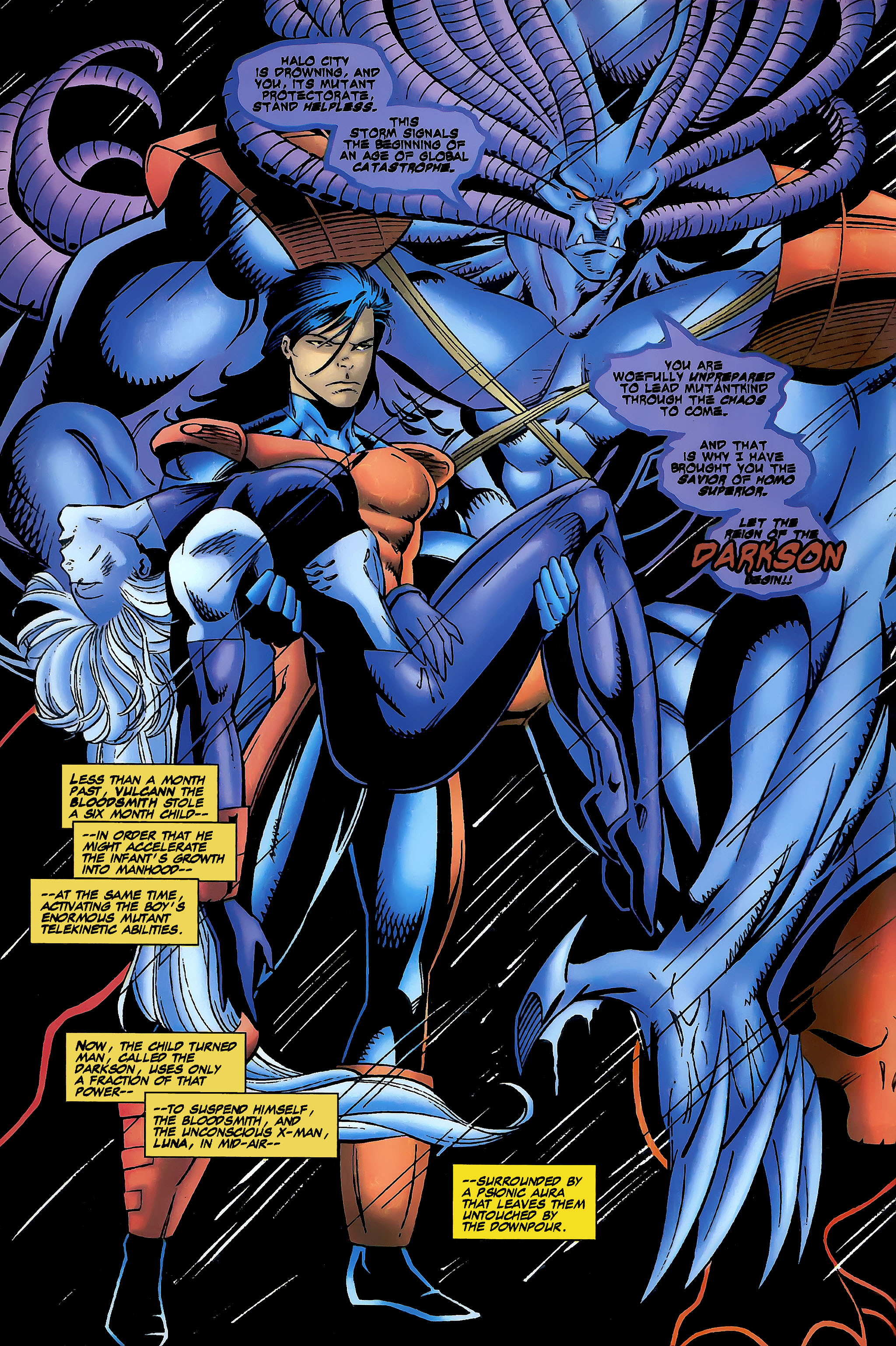
Vulcan and Darkson (carrying the X-Men’s Luna).

I should say that X-Men 2099 #35 is indeed a disappointing conclusion not only to its series but also in the final conflict the X-Men had with Vulcann and Darkson. The pay-off was very unsatisfying and it did not help that this comic book served as just another build-up leading to another Marvel 2099 publication. By the time the conflict ended, I did not care much about the X-Men which, for the most part, became irrelevant. This is too bad because in issue they were very interesting and (after some stories of misadventures showing the X-Men members separated) they became interesting again with the events in issue .

If you are seriously planning to buy an existing hard copy of X-Men 2099 #35 (1996), be aware that as of this writing, MileHighComics.com shows that the near-mint copy of the regular edition costs $17 while the near-mint copy of the newsstand edition costs $51.

Overall, X-Men 2099 #35 (1996) is unsatisfying. I don’t recommend spending a lot of money for it. Better save your money.


Thank you for reading. If you find this article engaging, please click the like button below and also please consider sharing this article to others. If you are looking for a copywriter to create content for your special project or business, check out my services and my portfolio. Feel free to contact me as well. Also please feel free to visit my Facebook page Author Carlo Carrasco and follow me at HavenorFantasy@twitter.com

A Look Back at What If #44 (1992)

Disclaimer: This is my original work with details sourced from reading the comic book and doing personal research. Anyone who wants to use this article, in part or in whole, needs to secure first my permission and agree to cite me as the source and author. Let it be known that any unauthorized use of this article will constrain the author to pursue the remedies under R.A. No. 8293, the Revised Penal Code, and/or all applicable legal actions under the laws of the Philippines.

Are you a fan of Venom and you want to find out how he was presented within the realm of alternate realities within the Marvel Comics universe as told through their What If? monthly series?

Join me in exploring something new in What If , written by Kurt Busiek, drawn by Luke McDonnell and published in 1992 by Marvel Comics.

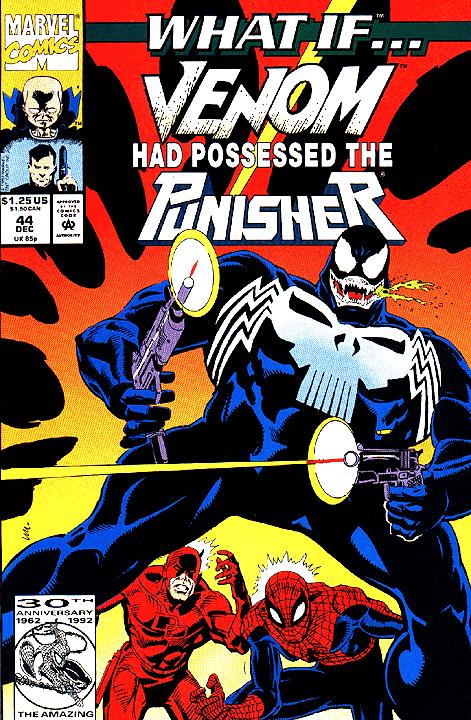
The key scenario here: What if Venom had possessed the Punisher?

Cover
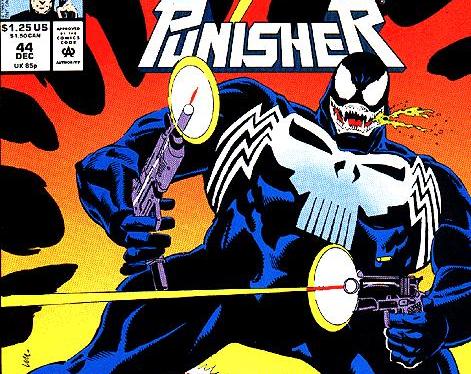
The cover.

Early story

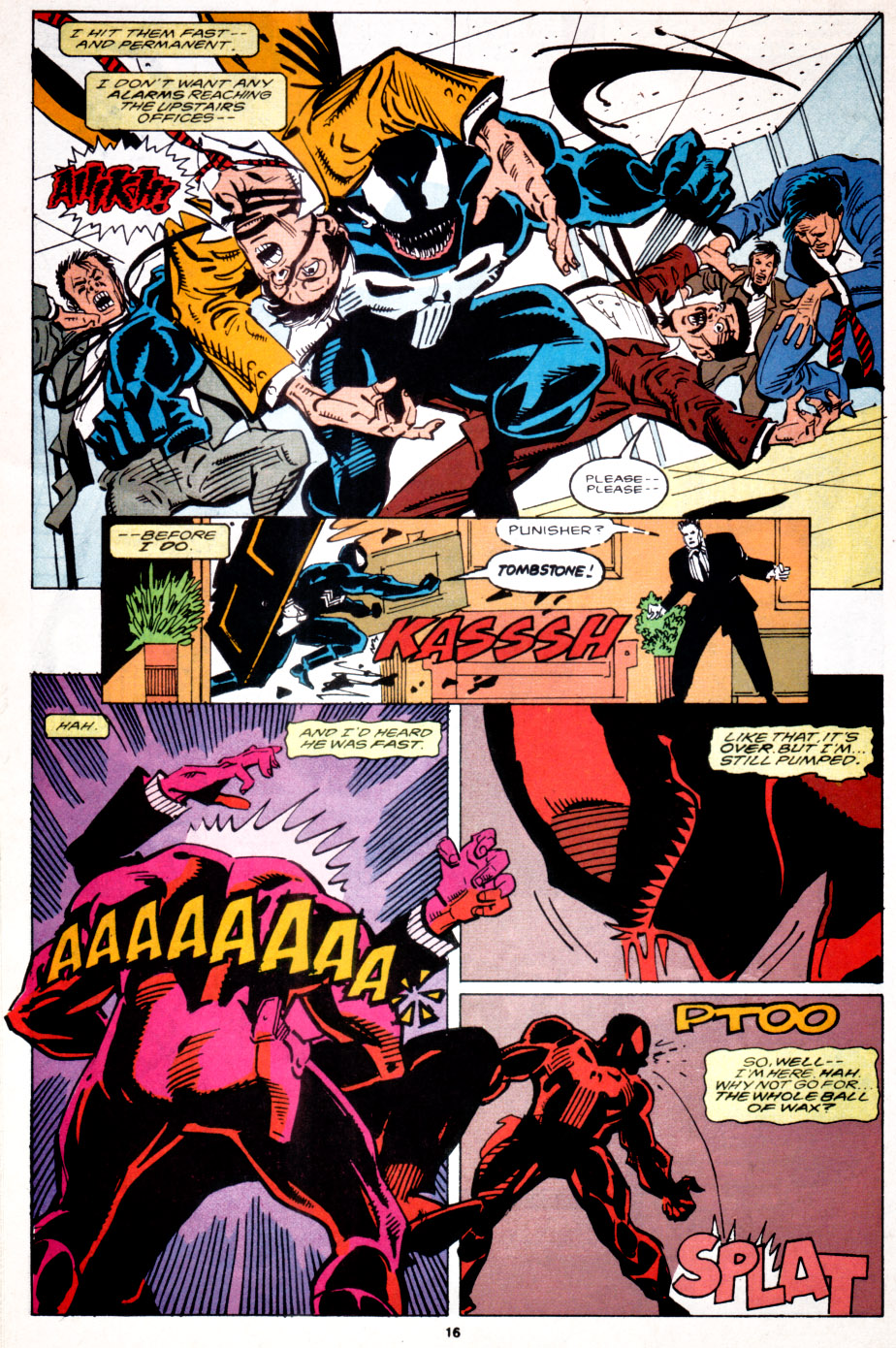
The story begins with Venom already armed with guns moving around the city. In broad daylight, he stalks criminals walking down the street. Using the symbiote’s ability to alter his looks, Venom approaches a certain Mr. Vance (accompanied by bodyguards) and kills him quickly in public.

It turns out, Venom is actually Frank Castle/Punisher already with the symbiote. With his intent to eliminate crooks, this new Venom daringly goes up against the gangs even without the usual hardware (weapons) since the symbiote already provides him with uncanny weapons.

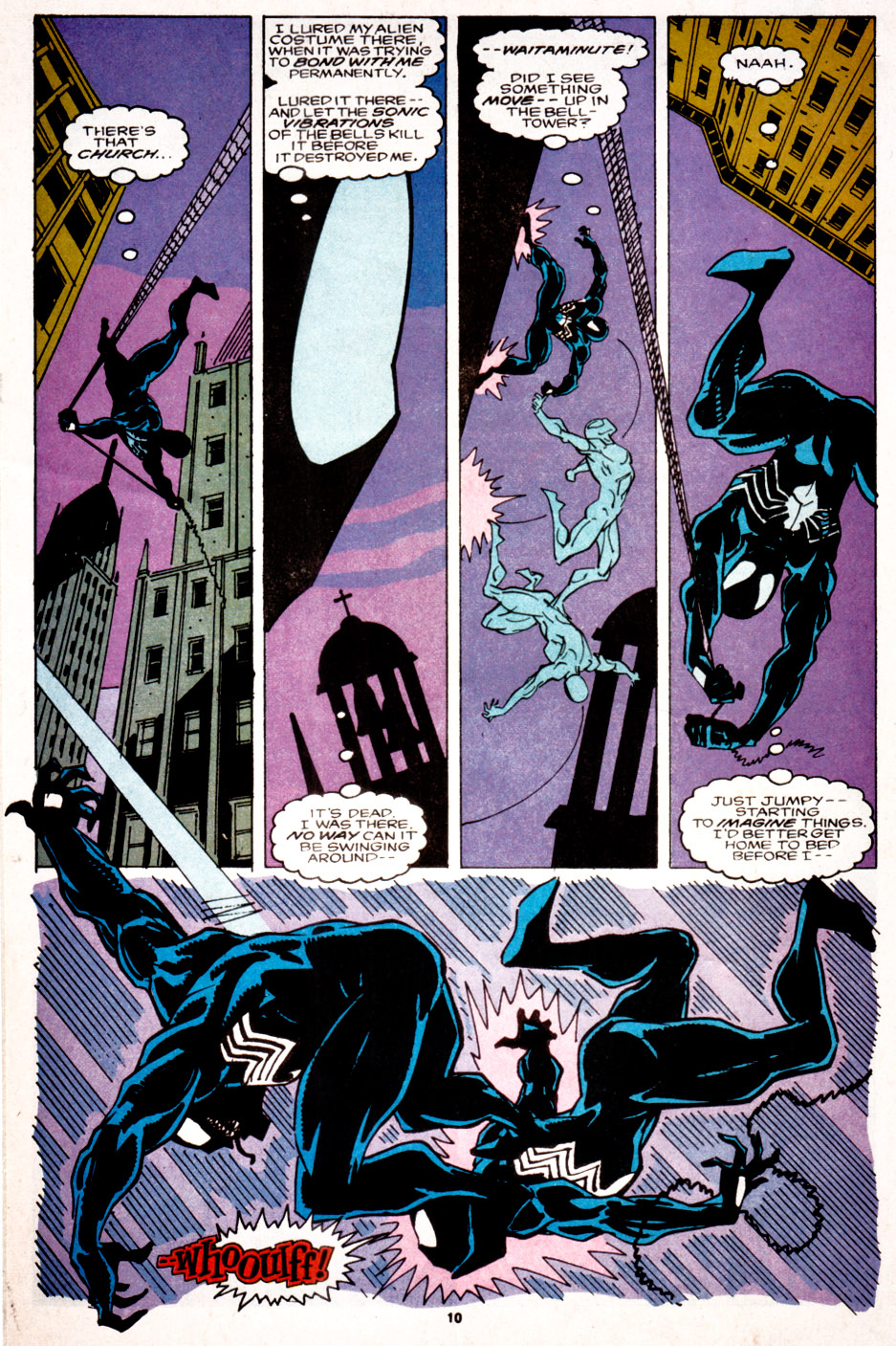
Elsewhere in the city, Spider-Man (wearing his black suit that shared the same style as Venom) swings by a lady who begged him not to hurt her. This sparks Spider-Man’s curiosity since he believes that he succeeded in killing the symbiote that tried to possess him.

15
Punisher/Venom goes against the criminals!

In another part of the city, Daredevil senses Venom passing by and recognizes the heartbeat as that of Frank Castle. He also senses other readings that something is odd. He decides to take a close look at Venom/Punisher.

Quality

Let me start with the core concept of this comic book: it’s a bold and great concept to explore, and it was well executed! To put things to perspective, I personally witnessed the debut of Venom in 1987 and back then seeing Eddie Brock/Venom as a new mortal enemy of Peter Parker’s was a tremendous event of its own. On top of that, having Brock already with the symbiote forming Venom together established an undeniable consequence that goes back to the alien world in Secret Wars where Spider-Man first got the symbiote. Gradually through the years in real life, Venom became one of the greatest super villains of not only Marvel but in superhero comics in general.

That being said, to show the Punisher getting possessed by the symbiote made a nice alternate reality. Frank Castle lost his family and this alone drove him to become a vigilante and often used lots of guns and explosives in his one-man war against crime. To see him have the symbiote and become the new Venom is both interesting and intriguing. I won’t forget how the Punisher used the symbiote to organically form guns on his arms and actually fire bullets.

One of the things I like most in this comic book was the presentation of the encounter between Spider-Man and Punisher/Venom. It’s a great alternative to the classic first encounter between Spider-Man and Eddie Brock/Venom!

Ultimately, Kurt Busiek’s storytelling is strong and engaging. Art by Luke McDonnell is serviceable at best but he really exerted effort to add impact on the action scenes which are plentiful to see.

Conclusion

9
Punisher/Venom and Spider-Man!

I really enjoyed reading this comic book. To put things in perspective, What If was released several months before the Punisher and Venom actually appeared together in Venom: Funeral Pyre . This comic book was also released before Venom got his own mini-series with Lethal Protector.

If you are serious in collecting a hard copy of What If soon, be aware that as of this writing and based on the ratings of Mile High Comics online, a near-mint copy of the regular edition costs $51 while a near-mint newsstand copy costs $153.

Overall, What If (1992) is highly recommended.


Thank you for reading. If you find this article engaging, please click the like button below and also please consider sharing this article to others. If you are looking for a copywriter to create content for your special project or business, check out my services and my portfolio. Feel free to contact me as well. Also please feel free to visit my Facebook page Author Carlo Carrasco and follow me at HavenorFantasy@twitter.com

A Look Back at Punisher 2099 #1 (1993)

Disclaimer: This is my original work with details sourced from reading the comic book and doing personal research. Anyone who wants to use this article, in part or in whole, needs to secure first my permission and agree to cite me as the source and author. Let it be known that any unauthorized use of this article will constrain the author to pursue the remedies under R.A. No. 8293, the Revised Penal Code, and/or all applicable legal actions under the laws of the Philippines.

As already established here on my website, I reviewed several comic books of the Marvel 2099 line of superhero comics. I reviewed the respective launch issues of X-Men 2099, Spider-Man 2099 and Ravage 2099 to name a few.

Some of you must be wondering what was the first-ever Marvel 2099 comic book I bought back in the 1990s. Believe it or not, it was not Spider-Man 2099 (the one comic book that launched the Marvel 2099 line in late 1992). It was actually Punisher 2099 which I bought in December 1992 (comic book was cover dated February 1993).

You read that right. I was a latecomer on discovering the Marvel 2099 universe in the late 1990s. Prior to the launch of Punisher 2099, comic books of Spider-Man 2099, Ravage 2099 and Doom 2099 were already on the shelves of comic book stores.

One day in Makati here in the Philippines, I passed by a comic book stall in a department store and saw Punisher 2099 (which had a gimmick cover) and other 2099-related comic books displayed. After observing the available 2099 comics, I decided to buy Punisher 2099 not simply because of its gimmick cover but because I wanted to discover the 2099 universe through the futuristic version of the Punisher (which I’m not even a fan of).

Here is my retro comic book review of Punisher 2099 published by Marvel Comics in late 1992 with a story by Pat Mills and Tony Skinner with illustrations done by Tom Morgan.

Cover
The cover.

Early story

The story begins with a man running away from danger. Because he does not have enough money to summon law enforcement for protection (note: cities in 2099 are all run by corporations and even public services have been privatized), he easily gets ganged up and killed by crooks armed with surgical devices. They killed him to get his heart.

Shortly after, the Punisher of 2099 arrives and easily kills the crooks. His action caught the attention of Public Eye Police Force (note: a service of police protection that responds to transactions by paying clients) via the city surveillance system, the cameras of which are unable to identify him because his head is automatically covered digitally (the Punisher here has his own identity protection system).

86

Jake Gallows, who is Punisher 2099 himself, enters the office of Public Eye. He is an employed enforcer of theirs and he notices that his employer has been watching his acts of violence against criminals…..

Quality

When it comes to establishing Punisher of 2099, the creators of this comic book pulled of a decent job. They not only introduced Marvel’s vigilante of the far future efficiently, they also made him look interesting temporarily. They also did a nice job with connecting Jake Gallows with Frank Castle, the 20th century Punisher.

Still, Punisher 2099 #1’s clear weak point in presentation was the back story of Jake Gallows who became the Punisher as a result of his family getting killed by group of armed, wicked people. In concept, this is too similar to the origin of the original Punisher who also lost his family.

While the origin lacked creativity, the creative team at least tried something new by introducing Kron Stone as the first-ever villain for Punisher 2099. Kron Stone, if you know your 1990s Marvel 2099 history, was not only the son of Alchemax chief Tyler Stone (a key character in the Spider-Man 2099 series) but also went on to become Venom 2099 (who debuted fully in Spider-Man 2099 #35).

The creative team also made a nice move establishing Jake Gallows as an actual working law enforcer who took a huge risk as he also secretly made moves as a vigilante when he’s not working.

While the comic book writers did a decent job with the story and characterization even though they had less than 25 pages of storytelling, the art by Tom Morgan will only please readers who enjoy violent and gritty imagery. Personally, I’m not impressed with Morgan’s art and his work on the cover of this comic book is laughable. Punisher 2099’s character design (what’s with those three frontal tubes that formed the teeth of the skull design?) is really corny to look at and not even famous painter Joe Jusko could improve the character’s overall look.

JuskoCardPun2k99
Punisher 2099 as painted by Joe Jusko for the Marvel Masterpieces card series.

Conclusion

Given the fact that Punisher 2099 never became a significant character of Marvel Comics all these decades, I would suggest thinking very carefully before spending any money to buy or even rent Punisher 2099 . It’s not a terrible comic book, just flawed with some limited engaging stuff here and there. If you are really craving for early 1990s Marvel superhero stuff, then this one could be worth it.

If you are seriously considering acquiring an existing copy of Punisher 2099 , be aware that as of this writing, and according to the rates of Mile High Comics online, a near-mint copy of the regular edition costs $6 while a near-mint copy of the newsstand edition is priced at $16.

Overall, I say that it’s best to purchase a copy of Punisher 2099 BELOW its cover price.


A Look Back at What If #58 (1994)

Disclaimer: This is my original work with details sourced from reading the comic book and doing personal research. Anyone who wants to use this article, in part or in whole, needs to secure first my permission and agree to cite me as the source and author. Let it be known that any unauthorized use of this article will constrain the author to pursue the remedies under R.A. No. 8293, the Revised Penal Code, and/or all applicable legal actions under the laws of the Philippines.

In early 1994, I was still in high-school. There was a time when I passed by a local comic book store that showed a new What If? comic book displayed among the many new titles. That particular comic book caught my attention because of its key question: What if the Punisher had killed Spider-Man?

That comic book was What If #58 published by Marvel Comics with a story by Chuck Dixon and art by Gordon Purcell. Check out the cover below.

Cover
The cover of this comic book took a lot of inspiration from that of Amazing Spider-Man .

To put things in perspective, Spider-Man and Punisher are both heroes in the universe of Marvel Comics but with very drastic differences between them. Spider-Man/Peter Parker fights crooks and other types of bad guys while maintaining a lawfully good nature even as he struggles to live a normal, personal life. Punisher, who is privately Frank Castle, is a killer who is driven to fight criminals beyond the boundaries of the law. The Punisher resorts to extreme forms of violence and guns are his main weapons. Due to the tragic loss of his wife and children, Punisher lives to wage a one-man war against criminals which only reflects the huge loss of his humanity.

Spider-Man and the Punisher first encountered each other in Amazing Spider-Man . Through the years, the two would face-off again and again. In the mid-1980s, the Punisher went on to rise in high popularity with comic book readers as Marvel Comics published three regular series: The Punisher, The Punisher War Journal and The Punisher War Zone.

That being said, we take a look back at What If #58.

Early story

Without involving Marvel’s galactic Watcher, the comic book begins with the Punisher aiming his gun at a man seated behind his desk. It turns out Punisher is waiting for the police to arrive at the place they are in.

From this point, the story is told in flashback with Punisher narrating. He is with the Jackal on the roof top of a building in New York City. Even as the Jackal pushes him to shoot a certain target already, the Punisher decides not to do it. He stressed he wants to study the target.

“It seemed right. Taking down a high profile outlaw like Spider-Man looked like the right way to go,” Punisher thought. “And Jackal promised unlimited funding of my war on crime if I succeeded.”

6
Punisher doing research.

Gradually, the Punisher prepares himself to kill Spider-Man…

Quality

Let me start with the concept of this comic book. Exploring what would happen had the Punisher actually killed Spider-Man (note: this is so obvious from the cover) is a bold and clever story to tell. To put things in perspective, the Punisher’s attempt to kill Marvel’s iconic superhero happened way back in Amazing Spider-Man which was published way back in 1974. Very clearly, Punisher failed and Spider-Man went on to live and fight for good.

When it comes to storytelling, Chuck Dixon delivered a strong script and carefully crafted a standalone story that looks at the Punisher’s first-ever attempt to shoot Spider-Man but the narrative was more on the vigilante’s point-of-view. The dialogue was solid and the narration gives readers a good look at the personality of Frank Castle. I also liked the way the story was paced.

What also makes this comic book really good is that it shows in convincing fashion what else would have happened after the successful assassination of Spider-Man. Without spoiling the surprise, you can ask yourself how would Punisher react once he learned who Spider-Man really was, how would the many people who personally knew Spider-Man (whether good or evil) would react and what the state of crime in New York would be like.

10
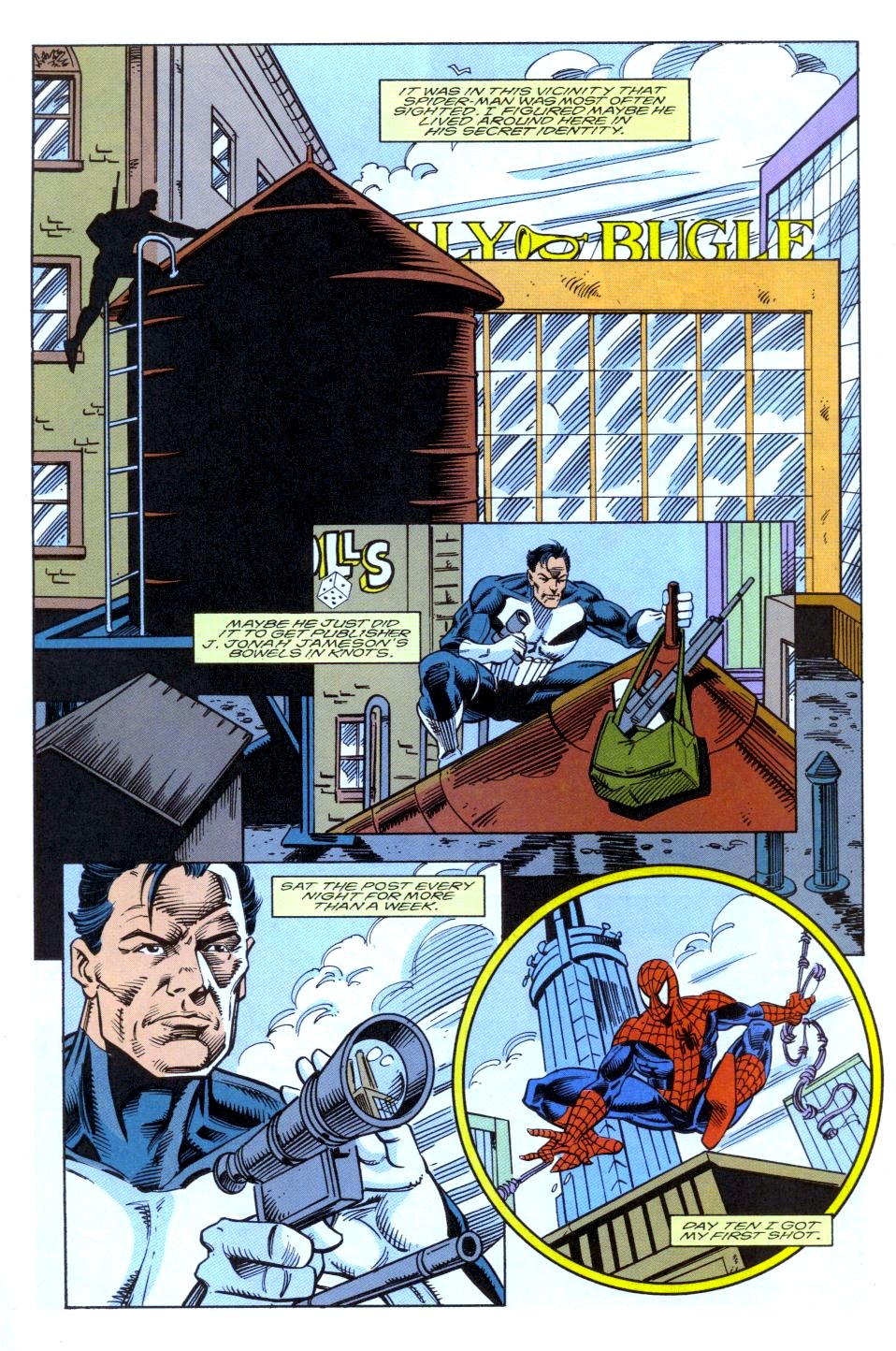
The Punisher anticipating Spider-Man outside The Daily Bugle.

As for the art, Gordon Purcell did a decent job. He captured what was back then modern day 1990s look of the Punisher (completely rejecting the way the character looked in Amazing Spider-Man ) and he knew how to present him from different angles regardless of what action was taken. On drawing Spider-Man, Purcell proved to be good. I noticed in some parts of the comic book, he tried hard to make Spidey look dynamic while traveling high above the streets of the city. The big money shot (in terms of illustration) for me was the moment Spider-Man got killed.

Conclusion

Overall, What If #58 is a good and fun comic book to read. Historically, this was released at a time when Spider-Man and the Punisher were both wildly popular. The decision to tell an alternate reality off Amazing Spider-Man was inevitable and ultimately was nicely pulled off.

If you are thinking about acquiring What If #58, as of this writing MileHighComics.com shows that a near-mint copy of the regular edition is at $26 while the near-mint copy of the newsstand edition is at $77.

What If #58 is recommended.


Thank you for reading. If you find this article engaging, please click the like button below and also please consider sharing this article to others. If you are looking for a copywriter to create content for your special project or business, check out my services and my portfolio. Feel free to contact me as well. Also please feel free to visit my Facebook page Author Carlo Carrasco and follow me at HavenorFantasy@twitter.com

A Look Back at Solitaire #1 of the Ultraverse

When you fight evil, you do it alone.

solitaire2
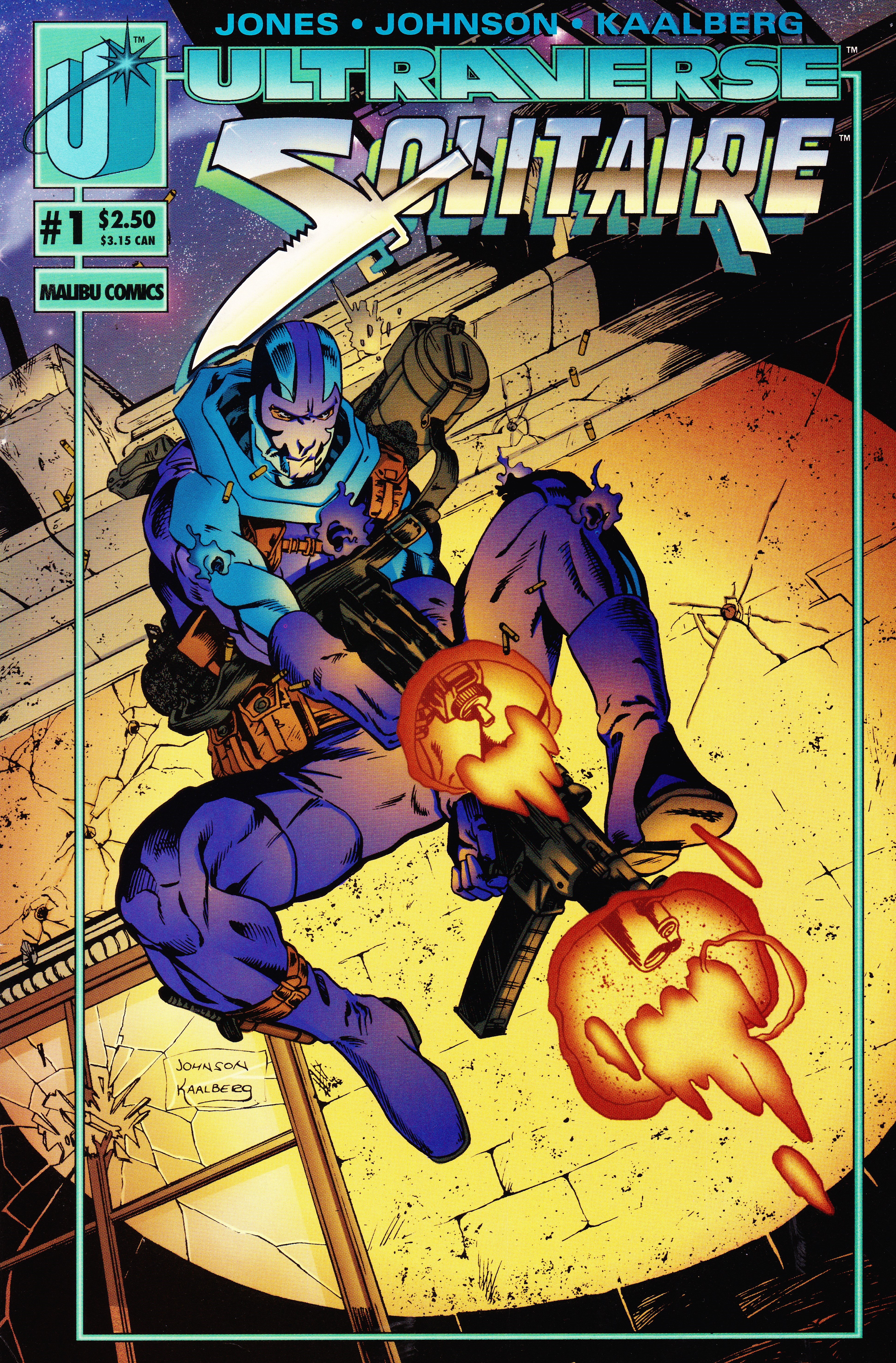
Solitaire in action in Solitaire published in 1993 by Malibu Comics under their Ultraverse line of comic books.

The concept of vigilante figures taking the fight against crime alone backed with resources (in the form of weapons) is a long running tradition in superhero comic books. DC Comics has its iconic Batman doing lots of detective work and fighting criminals many times on his own. Similar stories were seen with the Punisher and Daredevil over at Marvel.

When Malibu Comics launched the Ultraverse line of superhero comics in 1993, they added variety into the big mix. They had their own parallel to Marvel’s Punisher and DC’s Batman in the form of Solitaire and they boldly launched a comic book series of the character.

Released in late 1993 with story by Gerard Jones and art by Jeff Johnson and Barb Kaalberg, Solitaire introduced readers to Nicholas Lone who wears a purple-and-blue costume with mask and fights criminals as Solitaire. He’s not just a brave, tough guy who daringly goes against thugs. He’s is very talented with martial arts, acrobatics and weapon use.

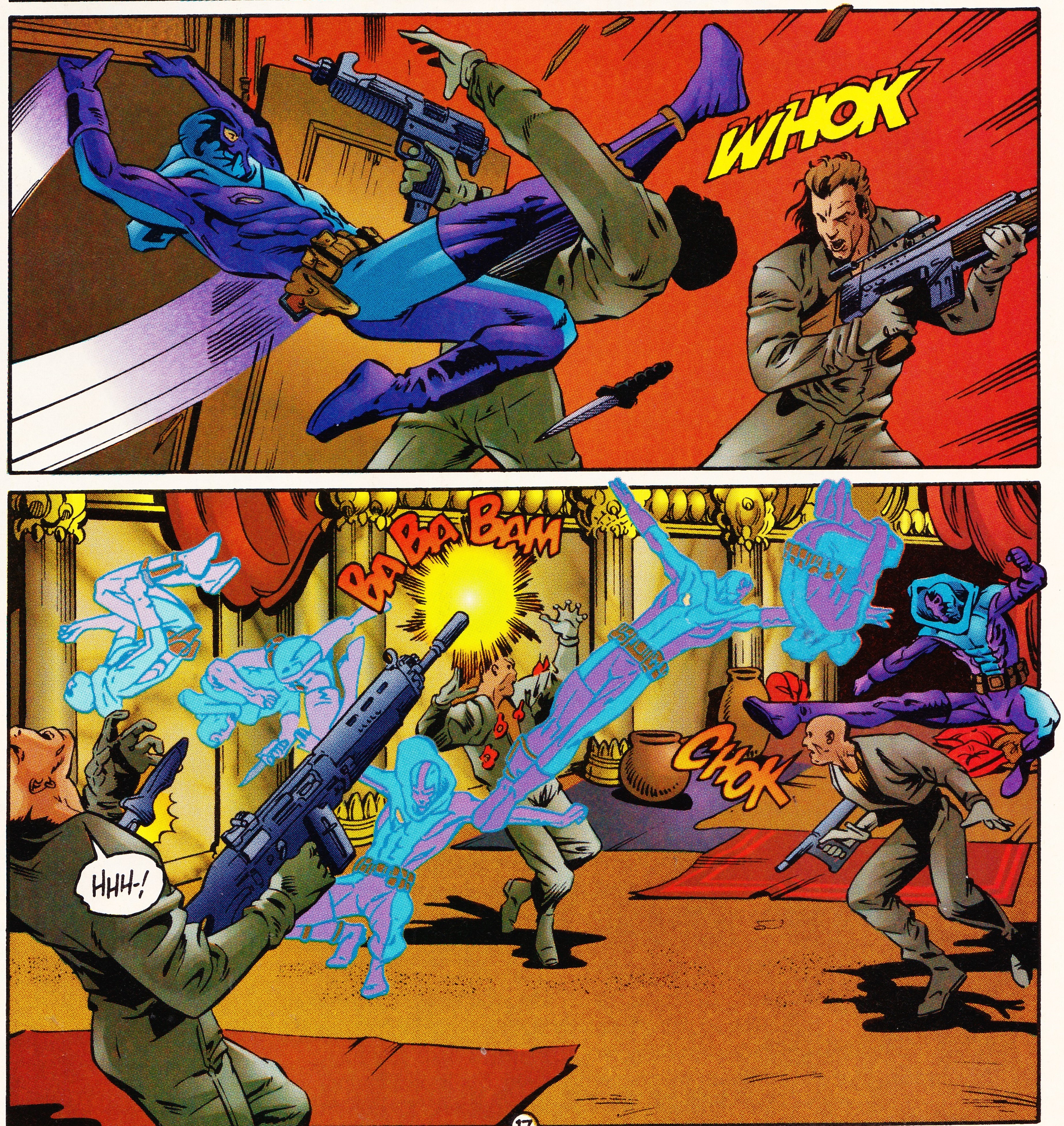
The comic book begins when thugs working for a crime lord called the King are about to catch a helpless lady who gets saved by Solitaire. The hero easily outmaneuvers the bad guys and he proved to them that he really is hard to hurt.

At his headquarters, the King made it clear to readers that Solitaire has been a problem to him for some time already and feels bad when the hero disrupts his operation. Solitaire meanwhile prepares himself for the next move against the King by returning to his hideout (an old theater), doing some research by computer and coordinating with his contacts on the streets.

Regarding the quality of the comic book, I say the script is nicely paced as it does a good job introducing Solitaire to readers while still having spare spotlight for the King. Within twenty-five pages, the hero got clearly defined as a man of action as well as a person with a purpose. His fight against crime is defined by key parts of his past especially with the fact that his own father – Antone Lone – is a crime lord.

When it comes to super powers, Solitaire has very quick reflexes which makes him a hard target for armed thugs. He also has healing factor which works rapidly and gives him a major advantage over the bad guys. In fact, the presence of the healing factor (which works like that of Wolverine) makes Solitaire more daring and more willing to take risks engaging the bad guys with violence. He can get stabbed and his body can be shot with several bullets and still he will recover quickly to get the job done.

Solitaire is indeed super and yet there is something intriguing with his personality. Apart from being the son of a crime lord, Nicholas Lone’s acquisition of his powers is a painful mark on him personally. This was because his father gave him those powers as a result of his attempt to commit suicide. The powers are the result of the installation of nano-machines into his body.

solitaire1

Overall, Solitaire is a good and intriguing read. It really comes with a flavor that makes it distinct from other superhero-versus-criminals stories and the introduction of Solitaire alone is worth the cover the price. If you can find copies of Solitaire on the back issue shelves of the comic book stores, I recommend buying it as well as the other issues.

It’s too bad that the Ultraverse ended after Marvel Comics acquired Malibu Comics back in the 1990s because like Prime, Hardcase and Prototype, Solitaire is very unique and intriguing at the same time. In my opinion, Solitaire is the most defining crime fighter of the entire Ultraverse and it’s too bad stories featuring him are not too many.

Thank you for reading. If you enjoyed this article, please click the like button below and also please consider sharing this article to your fellow comic book geeks and Ultraverse fans. Also my fantasy book The World of Havenor is still available in paperback and e-book format for you to order.

Author’s Note: This article was originally published at my old Geeks and Villagers blog. What you read on this website was an updated and expanded version. In other words, this newest version you just read is the most definitive version