A Look Back at Uncanny X-Men #273 (1991)

Welcome back superhero enthusiasts, 1990s arts and culture enthusiasts, Marvel Comics fans and comic book collectors! Today we go back to the year 1991 to explore a chapter of the Uncanny X-Men series that took place between X-Tinction Agenda and Mutant Genesis (the modernization point of Marvel’s mutants for the 1990s).

For the newcomers reading this, X-Tinction Agenda was a very notable part of the history of the X-Men comic book franchise as it marked the first time that the X-Men, X-Factor and the New Mutants were combined and also reunited several X-Men members who were scattered around the world. That being said, the state of mutants within Marvel Comics’ shared universe created a sense of uncertainty towards Charles Xavier’s grand dream of establishing a peaceful co-existence between humans and mutants.

With those details laid down, here is a look back at Uncanny X-Men , published in 1991 by Marvel Comics with a story written by Chris Claremont and drawn by Whilce Portacio, Klaus Janson, Jim Lee, John Byrne, Rick Leonardi, Marc Silvestri, Michael Golden and Larry Stroman.

The cover.

Early story

The story begins in the control center within the complex located deep under the ruins of Charles Xavier’s mansion. Storm (X-Men), Jean Grey (X-Factor), Cyclops (X-Factor) and Cable (New Mutants) carefully examine the worldly forces that oppose them. After Storm asked about what they could do about the opposing forces located in different parts of the world, Cable says that they should hit them hard and fast as they have the power to do so.

Storm asked Cable if violence is his only solution. Even though violence got things done for Cable, Cyclops rejects it and states that his fellow mutants (pertaining to the X-Men and X-Factor) are not like him.

As the conversation intensifies, Jean Grey tells Cable that they are not warriors and the school was not founded by Professor X to have mutants to fight wars. Cable replied that war is what they got and reminded them of the two mutants they lost and another one who ended up as a genetically engineered slave. Cable asked them if they want to see more of their fellow mutants end up badly…

Quality
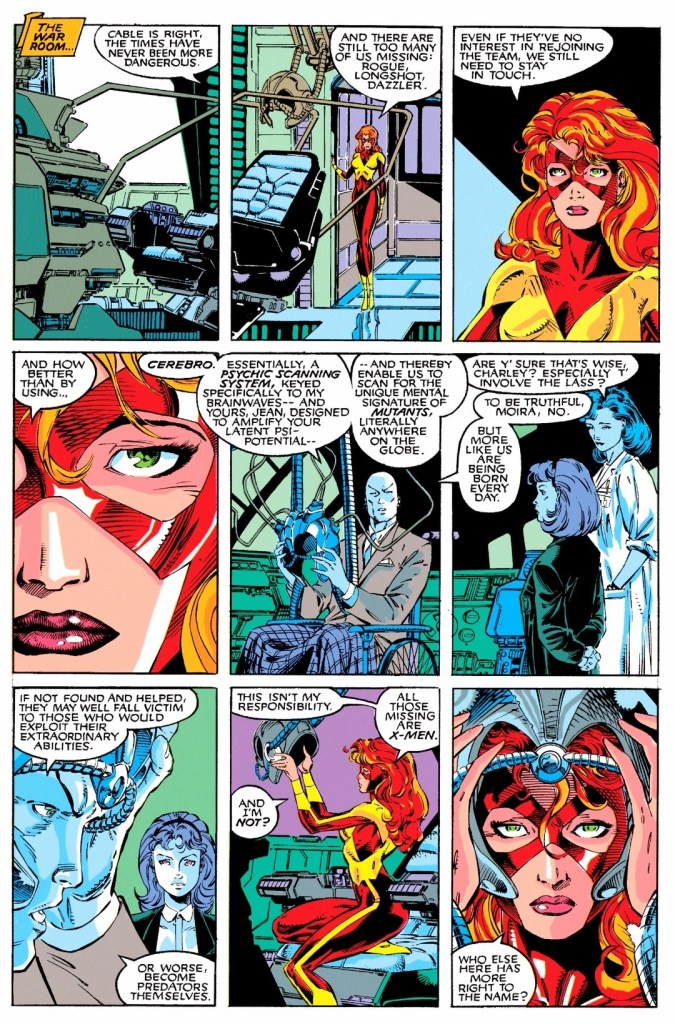
In the absence of Professor X, Jean Grey (then a member of X-Factor) revisits Cerebro and recalls what she learned long ago.

In relation to the mentioned fact that this particular story took place between X-Tinction Agenda and Mutant Genesis, this is a tale that reflects a period of transition leading to the latter. That being said, Chris Claremont took the opportunity to emphasize the current state of the X-Men and the other mutants, as well as the uncertainty ahead of them all. To be clear, this story does not have Marvel’s mutants going up against another super villain nor a group that opposes them.

The story opened very strongly with the leading figures of the X-Men (Storm), X-Factor (Cyclops and Jean Grey) and the New Mutants (Cable) being together analyzing the global situation and the forces that oppose them.

For Cable, violence is necessary for their survival and progress because he sees war against mutants already happening and there is simply no room left for error nor compromise. Very symbolically, Storm, Cyclops and Jean Grey – who all were nurtured by Professor X with his pacifist dream of bridging the gap between mutants and humans – reject Cable’s beliefs as they don’t see themselves as warriors and they do not dream of conquering their enemies at all. All the dialogue that took place in the argument are very richly written and there are layers of meanings which long-time X-Men fans will able to relate with.

Along the way, Claremont and the other creators made good use of available comic book space to develop the other characters which resulted in the gradual developments within each team of mutants. Gambit here is a brand new member of the X-Men and his talk with Storm is very sensible to read. There was also this notable Danger Room training session between Archangel and Cannonball in which the former (who is already very experienced as one of the original X-Men and a current member of X-Factor) shares wisdom to the very young mutant (who later went on to lead X-Force some time later). The creative team also inserted a few moments of humor on the other character development scenes.

Conclusion

Truly this is one of the most symbolic and most engaging arguments between the leading figures of the X-Men, X-Factor and New Mutants (which later became X-Force).

Even though it was mainly focused on character development and has no battle with any enemy, Uncanny X-Men (1991) remained a very engaging read as it tackles not only the current state of the three mutant teams of the time but also realigned their direction creatively and the results were fully realized through the eventual Muir Island saga as well as Mutant Genesis and even in further tales (including Fatal Attractions). In many ways, this comic book served as a solid foundation of things to come and this partially explains the eventual reform of the X-Men into a much larger group that had to be composed of two teams shortly after the return of Professor X (as seen in X-Men #1 and Uncanny X-Men in 1991).

Overall, Uncanny X-Men (1991) is highly recommended.

+++++

Thank you for reading. If you find this article engaging, please click the like button below, share this article to others and also please consider making a donation to support my publishing. If you are looking for a copywriter to create content for your special project or business, check out my services and my portfolio. Feel free to contact me with a private message. Also please feel free to visit my Facebook page Author Carlo Carrasco and follow me on Twitter at  @HavenorFantasy as well as on Tumblr at https://carlocarrasco.tumblr.com/ and on Instagram at https://www.instagram.com/authorcarlocarrasco

A Look Back at Wetworks #1 (1994)

Welcome back superhero enthusiasts, 1990s arts and culture enthusiasts, and comic book collectors! Today we go back to the mid-1990s to explore the comic book launch of a notable fictional team co-created by the Whilce Portacio and Brandon Choi…Wetworks.

For the newcomers reading this, Whilce Portacio was one of the highly talented illustrators who left Marvel Comics and co-founded Image Comics in the early 1990s. While his fellow co-founders Todd McFarlane, Jim Lee, Rob Liefeld, Marc Silvestri, Jim Valentino and Erik Larsen were able to launch their respective dream projects (creator-owned properties) during Image’s first year of publishing, the launch of Wetworks was delayed by two years due to a death in Portacio’s family.

As a very young comic book reader in those days, I remember hearing rumors about Wetworks inside comic book stores I visited. There were rumors of business negotiations, solicitations and scheduled launches (ranging from October 1993 to January 1994). I also noticed some comic book enthusiasts who bought old copies of X-Factor and Uncanny X-Men that Portacio illustrated while waiting for Wetworks to debut.

In the middle of 1994, Wetworks was finally launched under the Image Comics label and I still remember the day when I saw lots of copies of issue displayed on the shelves and windows of comic book stores.

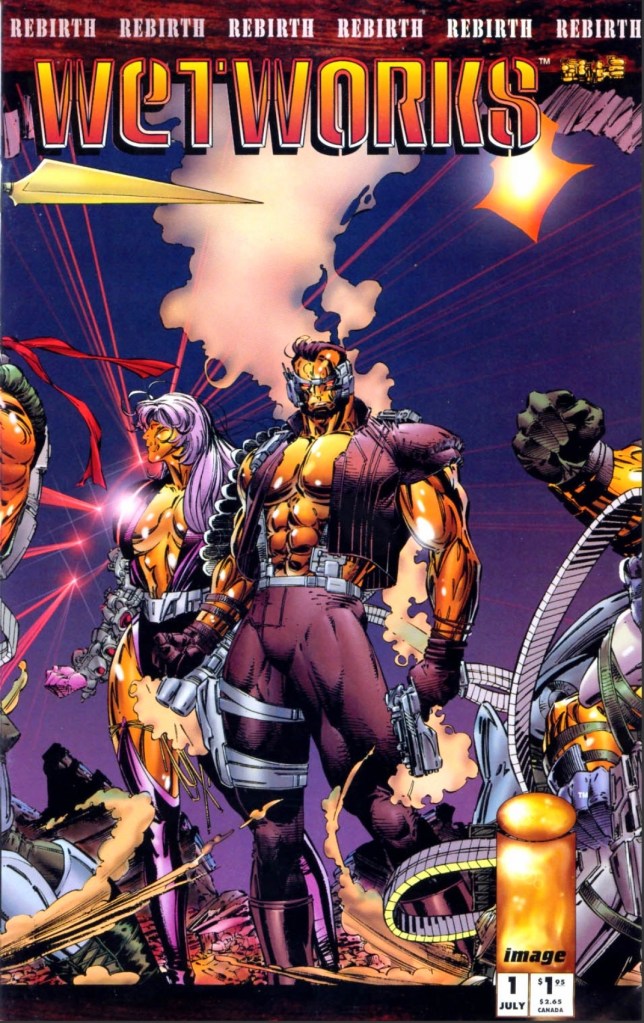
With those details laid down, here is a look back at Wetworks , published in 1994 by Image Comics with a story written by Whilce Portacio and Brandon Choi. The art was done by Portacio with ink work by Scott Williams.

The cover.

Early story

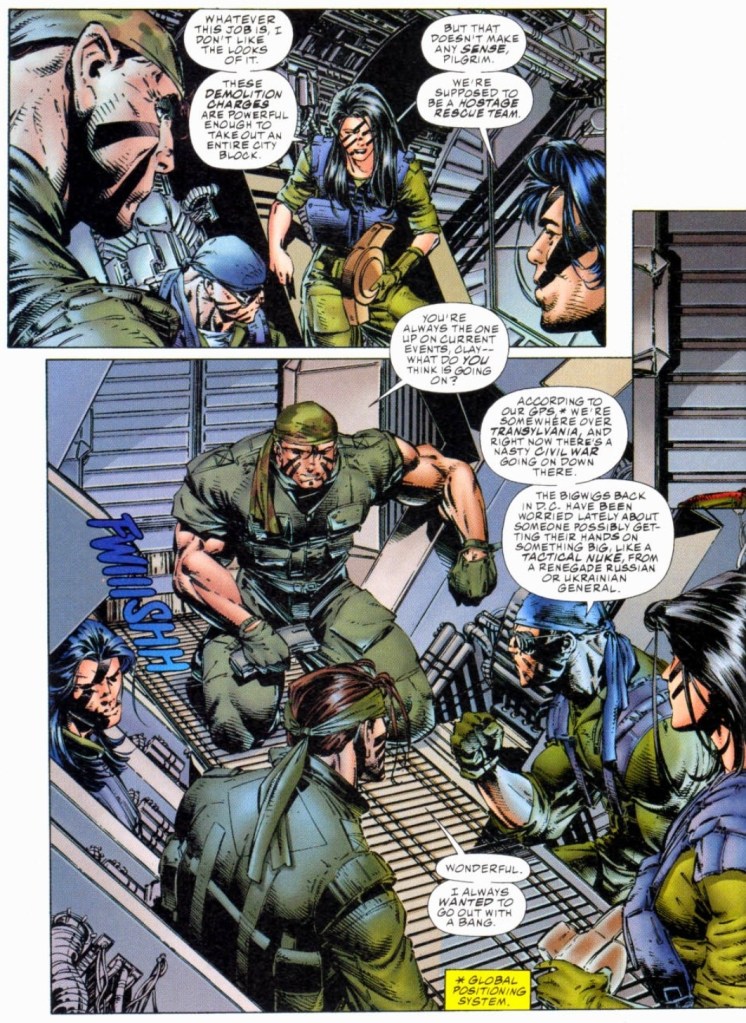
The story begins when a covert operations team working under International Operations (IO) travels to eastern Europe to infiltrate and destroy the base of operations of a certain warring faction and retrieve a biological agent (highly contagious) no matter what the cost. As it turns out, this new mission for the team (led by Colonel Jackson Dane, one of the pioneers of Team 7) started less than twenty four houses after their previous mission and their female member Pilgrim (reconnaissance specialist) pointed out that the demolition charges they are carrying are strong enough to wipe out an entire city block. Another teammate called Grail (the Filipino named Salvador Joel Alonday) stated that they are supposed to be a hostage rescue team.

Meanwhile deep inside the command center of IO in Washington, D.C., Admiral Halsey tells Miles Craven that Team 7 (the team led by Dane) are under his command and states that his sources tell him that there is more to the mission than just a group of ethnic nationalists obsessed on a biological terror campaign. It turns out, Craven sent the team to eastern Europe without fully informing them of what they are going up against. Craven insists that Team 7 are paid to put their lives on the line and to die if necessary just to get the job done. Craven then reveals to Halsey the true nature of the mission. The admiral then realizes Craven is right and certain sacrifices must be made for the greater good.

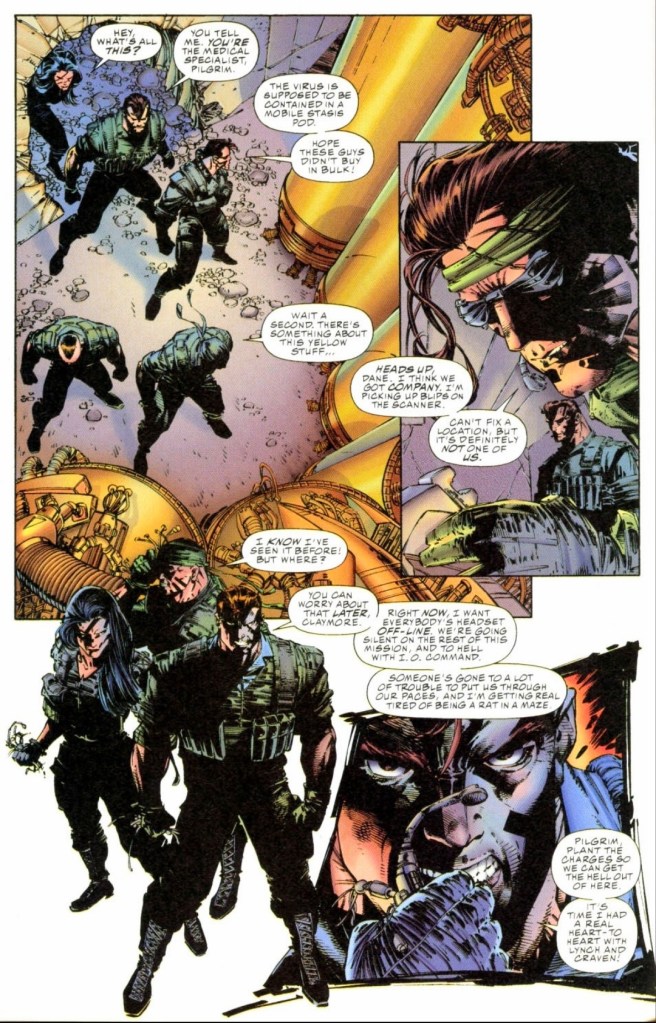
Craven and his team arrived at the location in Transylvania. They started seeing signs that someone else arrived ahead of them…

Quality

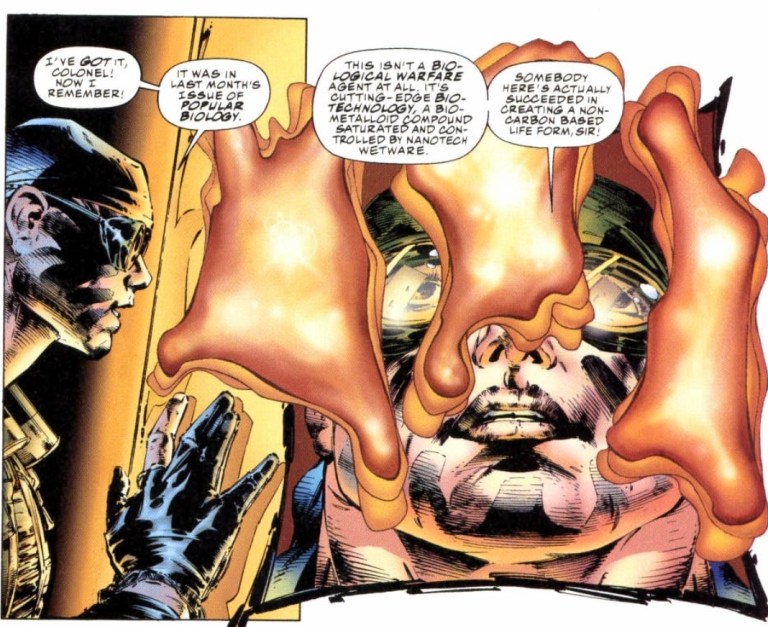
One of the team members looks at a symbiote.

I’ll start first with the fantasy concept and the storytelling. Whilce Portacio and Brandon Choi’s joint creation of Wetworks is indeed an inspired move with connections to real-life military influences the creators had. The Wetworks team – initially referred to as Team 7 – started looking and acting like typical military squad in the world of fiction but the major twist that happened drastically redefined and refined them into the most unique military team in the world of superhero comics. It’s the closest thing to seeing G.I. Joe fused with living symbiotes (another inspired move most likely influenced by a certain Marvel murderer with a symbiote whose origin is linked with one of the most iconic superheroes ever) there is and I can say Wetworks remains relevant and stands out nicely among superhero comic book teams to this day.

With regards to the plot, it looks cliched on face value. I’m talking about the trope in which a team is sent by their powerful superiors on a mission without knowing all the crucial details needed (because the superiors hid it from them) and they eventually encounter immense danger. As mentioned earlier, the major twist in the plot not only completed a major transformation of Dane and his teammates but also ramped up the fantasy aspect of the tale to much higher levels.

Still on the plot, Portacio and Choi came up with a solid structure for the narrative. The build-up of details and tension was very good and the pay-offs (lots of spectacle plus twists) were great. As the story moved on, the suspense grew stronger and the narrative succeeded in making me care about the team led by Dane.

Meet the team members who would later become Wetworks.

When it comes to the art, Portacio’s work here (with ink by Scott Williams) still looks great and, more notably, it is a fine departure from the superhero visuals he worked in years prior. As with his past works, you will see the artist’s stylized approach on visualizing the narrative related to how he implements the panels per page.

Portacio did a very good job with the military look of Wetworks and he drew their guns with a high amount of detail that should be seen (you should try using a magnifying glass on this comic book). Not only that, his art on military hardware such as the gunships, the interiors plus equipment all have that detailed appearance. When it comes to action, I believe that Portacio took a lot inspiration from Hollywood action flicks (most notably Predator) on portraying Wetworks members using their guns and positioning during battle.

Of course, the spectacle is not totally limited to military stuff. There is a touch of fantasy and horror visuals involved which is directly related to what was set-up for Wetworks to encounter in the near future. To realize what I am saying here, you must read this comic book until the intense end.

Conclusion

Wetworks from 1994 is still great to read!

I can say without a doubt that Wetworks (1994) remains as gripping and as entertaining as when I first read it decades ago. In short, it has aged well and reading it all over again today is compelling and a lot of fun to do. If you ask me, this is one of the finest works ever by Whilce Portacio in terms of art and storytelling. As one of the many comic books Image published during its first few years in the industry, Wetworks (1994) clearly stands out with its military theme and fantasy concept. Lastly, Wetworks is set within the WildStorm universe as dramatically symbolized with the presence of International Operations (the team’s superiors).

Overall, Wetworks (1994) is highly recommended!

+++++

Thank you for reading. If you find this article engaging, please click the like button below, share this article to others and also please consider making a donation to support my publishing. If you are looking for a copywriter to create content for your special project or business, check out my services and my portfolio. Feel free to contact me with a private message. Also please feel free to visit my Facebook page Author Carlo Carrasco and follow me on Twitter at  @HavenorFantasy as well as on Tumblr at https://carlocarrasco.tumblr.com/ and on Instagram at https://www.instagram.com/authorcarlocarrasco
A Look Back at WildC.A.T.S: Covert Action Teams #8 (1994)

Disclaimer: This is my original work with details sourced from reading the comic book and doing personal research. Anyone who wants to use this article, in part or in whole, needs to secure first my permission and agree to cite me as the source and author. Let it be known that any unauthorized use of this article will constrain the author to pursue the remedies under R.A. No. 8293, the Revised Penal Code, and/or all applicable legal actions under the laws of the Philippines.

Welcome back superhero enthusiasts, 1990s culture enthusiasts and comic book collectors! Today we continue revisiting Jim Lee’s flagship title under the Image Comics label – WildC.A.T.S: Covert Action Teams!

In my previous retro review of WildC.A.T.S #7, that story marked the 3rd chapter of the 4-part Killer Instinct crossover storyline which brought Jim Lee’s team together with Marc Silvestri’s Cyber Force. That storyline ended in a Cyber Force comic book which leads to the questions – what is next for WildC.A.T.S? Will there be a new and fresh storyline set up for them?

With those details laid down, here is a look back WildC.A.T.S: Covert Action Teams , published by Image Comics in 1994 with a story written by Brandon Choi and Jim Lee. Lee did the art along with Richard Bennett and Scott Williams.

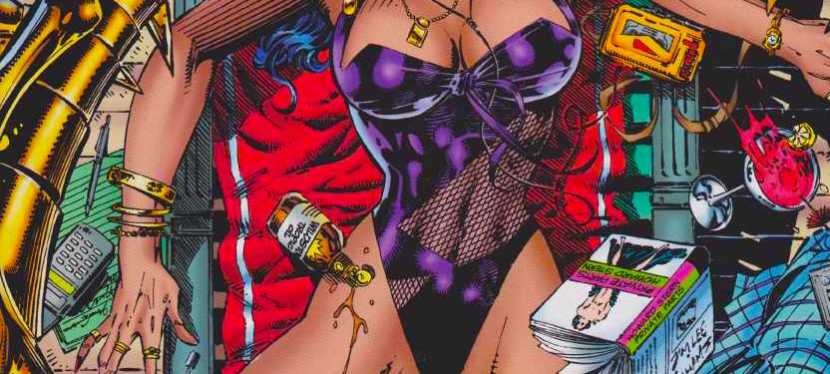
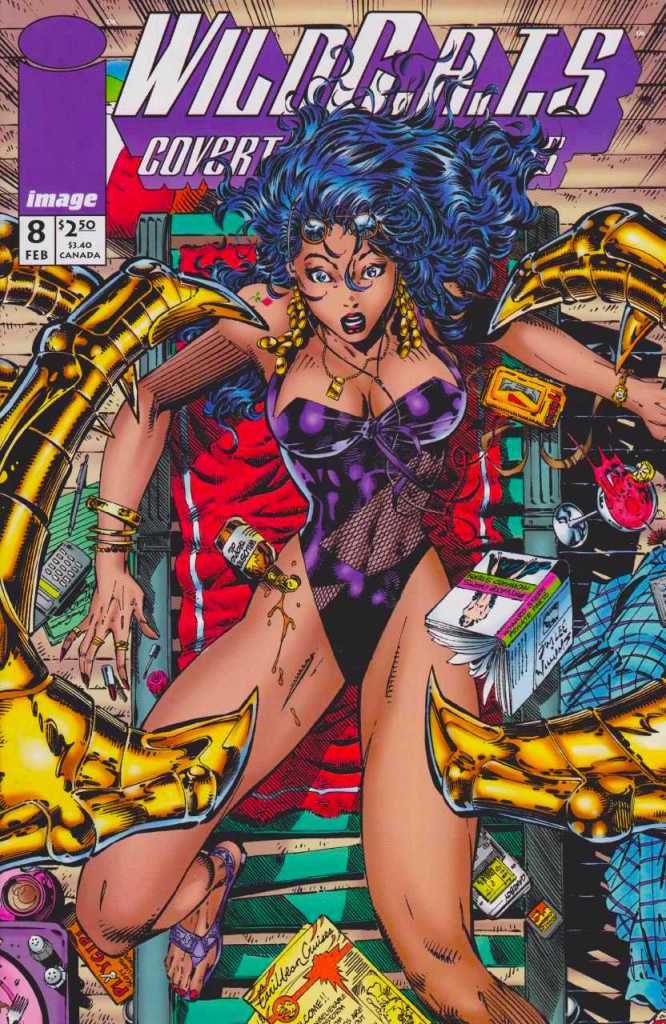
The cover.

Early story

The story begins inside a large bar within New York City where Cole Cash/Grifter and Zealot (both of them in civilian clothes) spend time together playing pool. There are men nearby staring at them. While Grifter tries to unwind and have fun with the game, Zealot still sticks to her warrior mindset even though they are no longer in a battle field. Suddenly, one man arrogantly pours beer on Grifter’s head while another man touches Zealot’s hair.

The two WildC.A.T.S members struck the two violators and subsequently made short physical work of the other men who tried to hurt them. After that, Zealot and Grifter talk outside. The latter receives an urgent message which compels him to leave Zealot behind and do something important…

Quality

Spartan and Voodoo on holiday in their civilian forms.

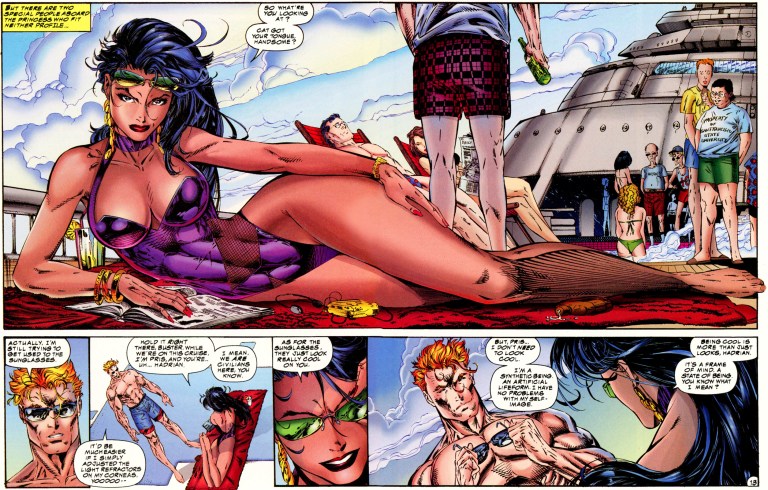
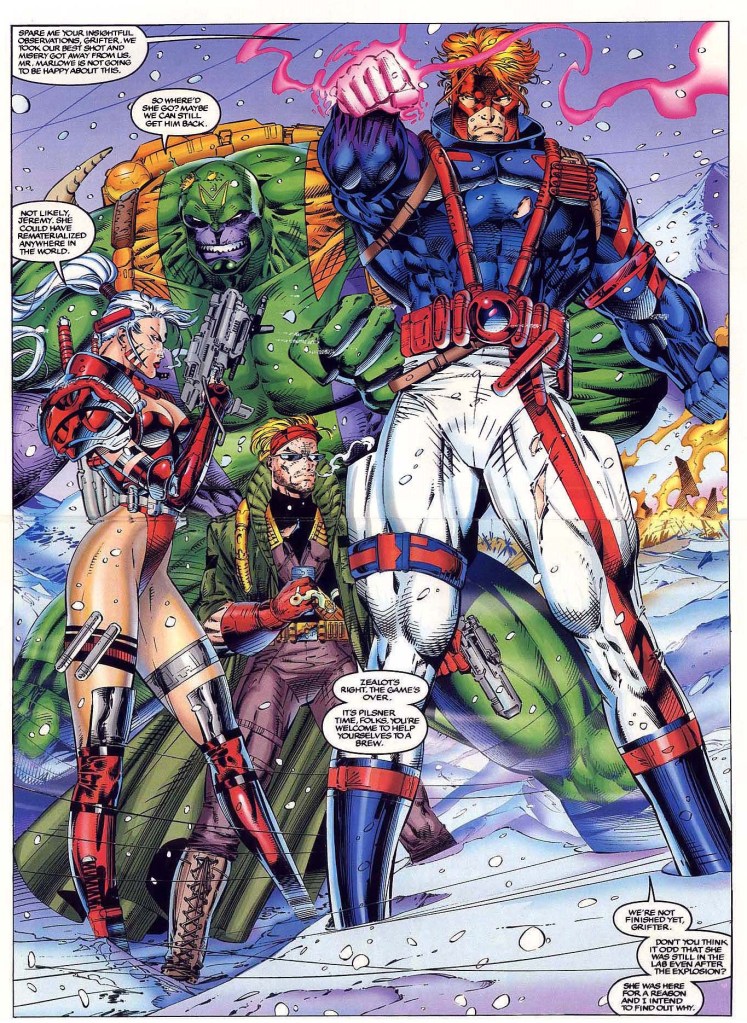
I’ll be straight to the point here. If you enjoyed Jim Lee’s previous work on Marvel’s X-Men that include bombastic action, misadventures, team members appearing in swimwear and character moments, you will find that in this story which is really a transitional tale of the team taking a break from action only to find themselves facing new danger. That being said, the concept and structure of the plot in this comic book is pretty simple and it does succeed in setting up WildC.A.T.S for another misadventure while cleverly emphasizing the Kherubim-Daemonite concept of the WildStorm universe back then.

As expected, Jim Lee’s artwork here is really great to look at and he sure always finds ways to make the dialogue scenes look interesting. What stands out to me the most in this comic book are the character moments which more than made up for the lightness of the plot. While the romantic interactions between Spartan and Voodoo is interesting, the interactions between Zealot and Grifter (referred to as Brother Grifter) really gave me additional insight on their respective personalities and, more notably, their feelings for each other.

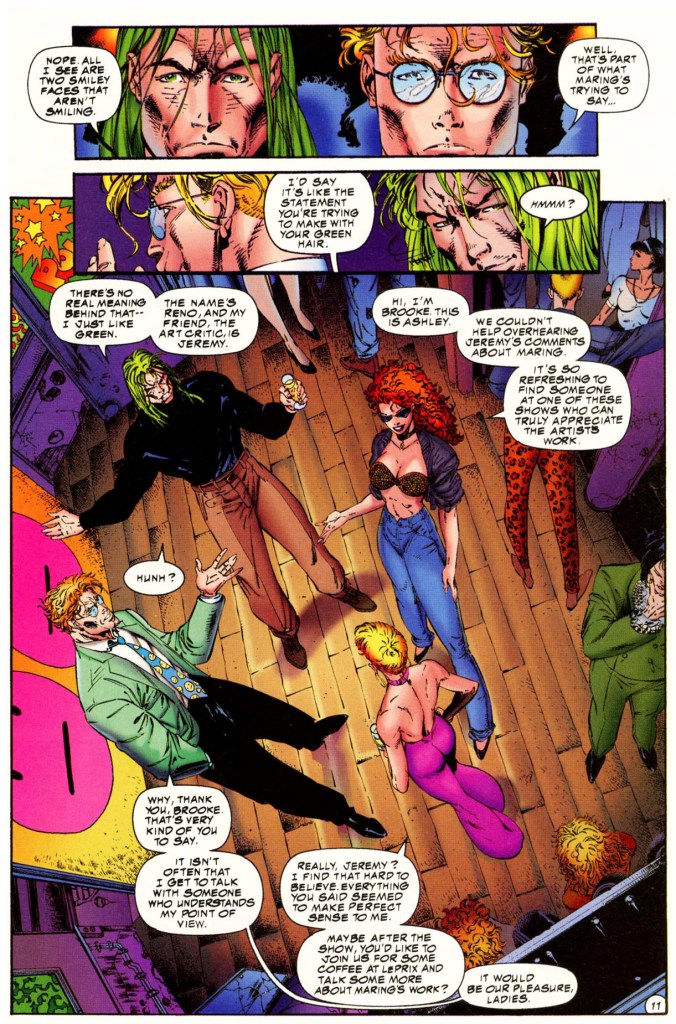
More on character moments, you will see Maul and Warblade in their respective civilian identities as Reno and Jeremy. If you only see those two as violent action performers based on the previous issues of WildC.A.T.S, you will be surprised with the way Brandon Choi and Jim Lee presented them in this story.  

Conclusion

Can you recognize Maul and Warblade?

While its story was pretty light, WildC.A.T.S: Covert Action Teams (1994) still manages to entertain me mainly due to the character moments that the creators came up with. In many ways, this comic book showed how human the team members are which is a nice change from all the action-focused stuff they were so busy with in the previous issues. Along the way, you will see a few creative gimmicks Jim Lee inserted visually, including the unofficial cameo appearance of two pretty notable members of X-Men (note: they just got married). Meanwhile, those who love Pris/Voodoo will find some extra entertainment here as this comic book has an additional short story about her past (set after WildC.A.T.S Trilogy ) which was written by Peter Seagle and drawn by Travis Charest (who would later replace Jim Lee as illustrator of this comic book series).

If you are seriously planning to buy an existing hard copy of WildC.A.T.S: Covert Action Teams (1994), be aware that as of this writing, MileHighComics.com shows that the near-mint copy of the regular edition costs $40 while the near-mint copy of the newsstand edition costs $120.

Overall, WildC.A.T.S: Covert Action Teams (1994) is recommended.

+++++

Thank you for reading. If you find this article engaging, please click the like button below and also please consider sharing this article to others. If you are looking for a copywriter to create content for your special project or business, check out my services and my portfolio. Feel free to contact me with a private message. Also please feel free to visit my Facebook page Author Carlo Carrasco and follow me on Twitter at  @HavenorFantasy as well as on Tumblr at https://carlocarrasco.tumblr.com/

A Look Back at WildC.A.T.S: Covert Action Teams #7 (1994)

Disclaimer: This is my original work with details sourced from reading the comic book and doing personal research. Anyone who wants to use this article, in part or in whole, needs to secure first my permission and agree to cite me as the source and author. Let it be known that any unauthorized use of this article will constrain the author to pursue the remedies under R.A. No. 8293, the Revised Penal Code, and/or all applicable legal actions under the laws of the Philippines.

Welcome back superhero enthusiasts, 1990s culture enthusiasts and comic book collectors! Today we continue revisiting Jim Lee’s flagship title under the Image Comics label – WildC.A.T.S: Covert Action Teams!

While the 3rd and 4th issues of the WildC.A.T.S: Covert Action Teams mini-series had Lee’s superhero team crossing over with Rob Liefeld’s Youngblood, a bigger crossover was agreed upon with Image Comics co-founder Marc Silvestri – Killer Instict! This marked a creative collaboration between Lee and Silvestri resulting a multiple issue crossover between WildC.A.T.S and Cyber Force. For clarification, I already mentioned in my retro review of WildC.A.T.S: Covert Action Teams (1993) that its story was the first chapter of the 4-part Killer Instinct crossover. For your reference, Killer Instinct’s 2nd and 4 chapters were published as Cyber Force issues and of its regular series under Marc Silverstri. This WildC.A.T.S retro review is about the 3rd chapter of Killer Instinct.

With those details laid down, here is a look back WildC.A.T.S: Covert Action Teams , published by Image Comics in 1994 with a story written by Brandon Choi and Jim Lee. Lee did the art.

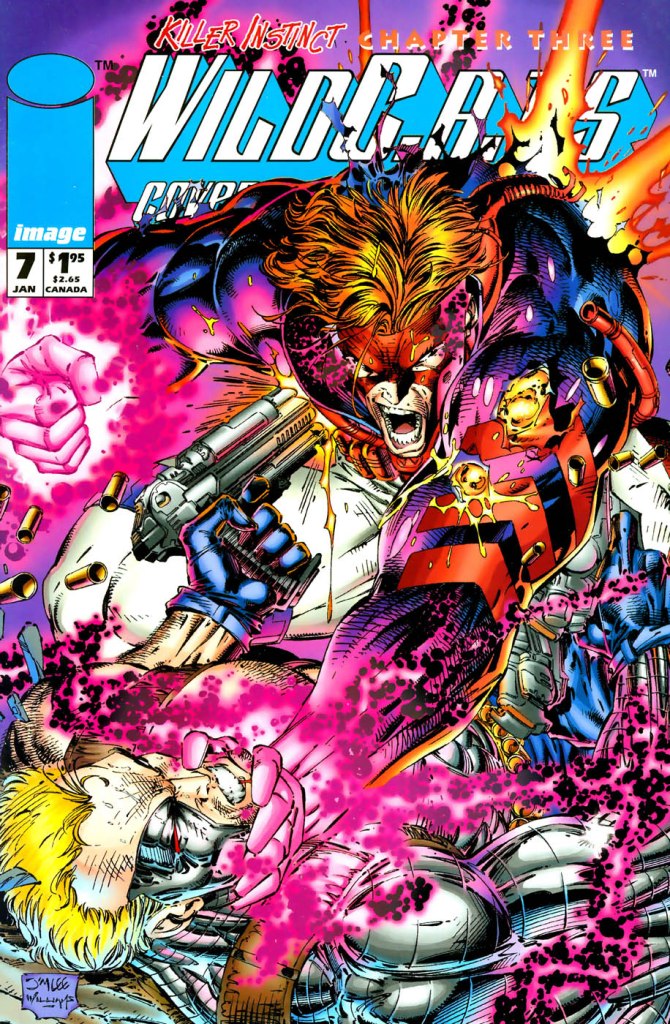
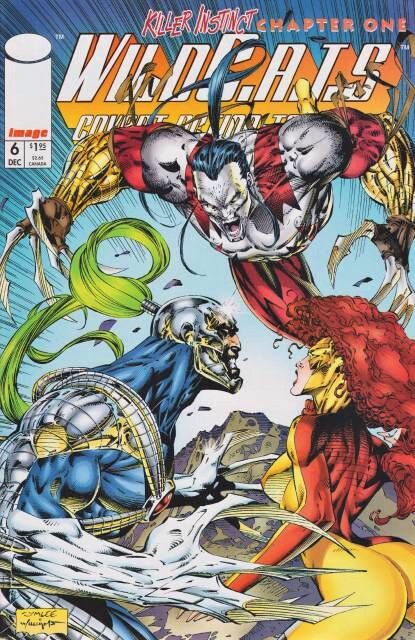
The cover.

Early story

The story begins somewhere in the skies above Gamorra, off the coast of the Philippines! Stryker, the Cyber Force member with three cybernetic right arms, communicates with his teammates and tells them that if half of what Misery said is true about the new Cyberdata S.H.O.C.S., they’re in for a nasty fight and they have to hit the ground.

Stryker, Impact, Heatwave, Velocity and Ripclaw jump off their high-tech jet (which has Cyblade and Misery inside) and land safely. Using his enhanced ability of smell, Ripclaw begins detecting tracks of what they are look for.

Meanwhile at the back of the Isle of the Dead, a high-tech craft arrives with three passengers who are prepared to do a drug deal. Slowly, someone bleeding and with blades on his hands climbs into the craft surprising the passengers. He takes control of the craft, throws the passengers off and leaves.

As Cyber Force starts its ground search with Misery advising them while carefully using her telepathy on them. As Stryker enters a ravaged high-tech place, his sensors detect nothing and yet his instincts tell him something is present nearby. Standing near him is Spartan of WildC.A.T.S…

Quality

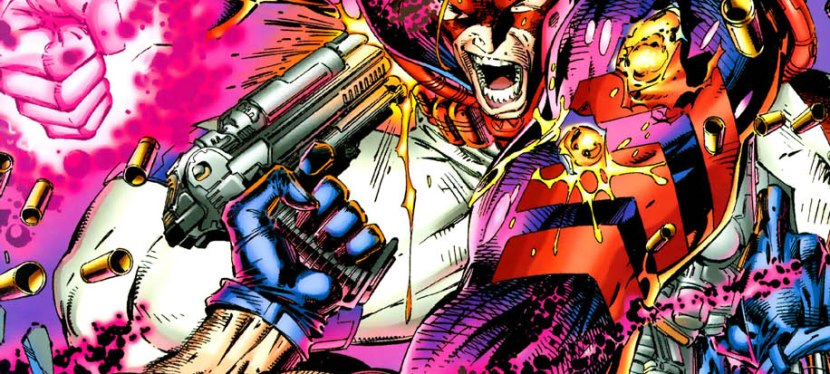
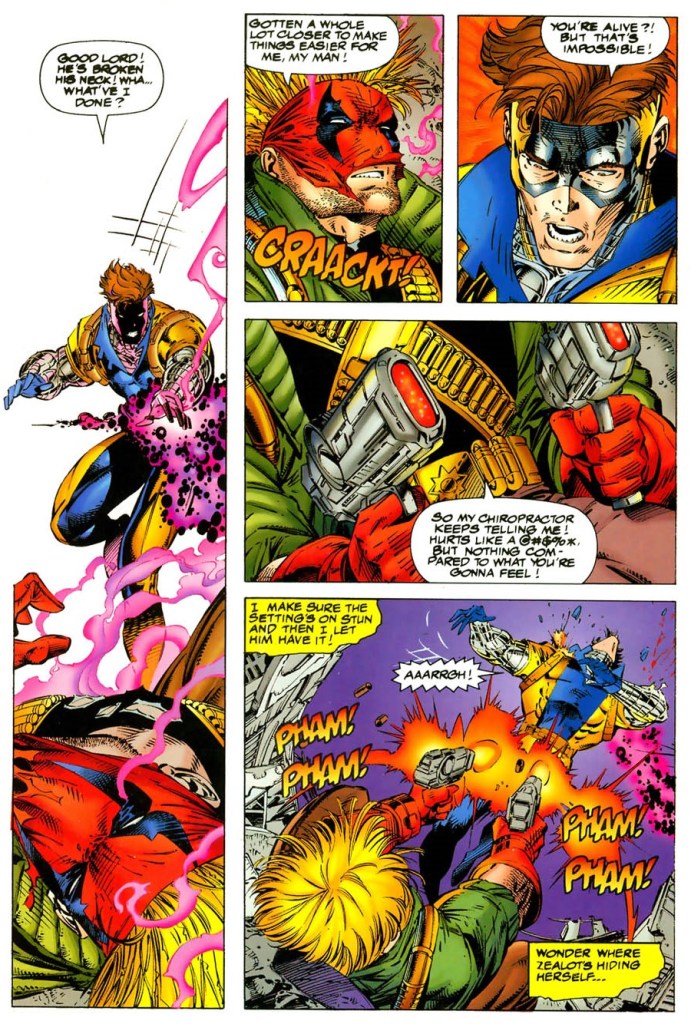
In this encounter between Grifter and Heatwave, do you notice something lacking visually?

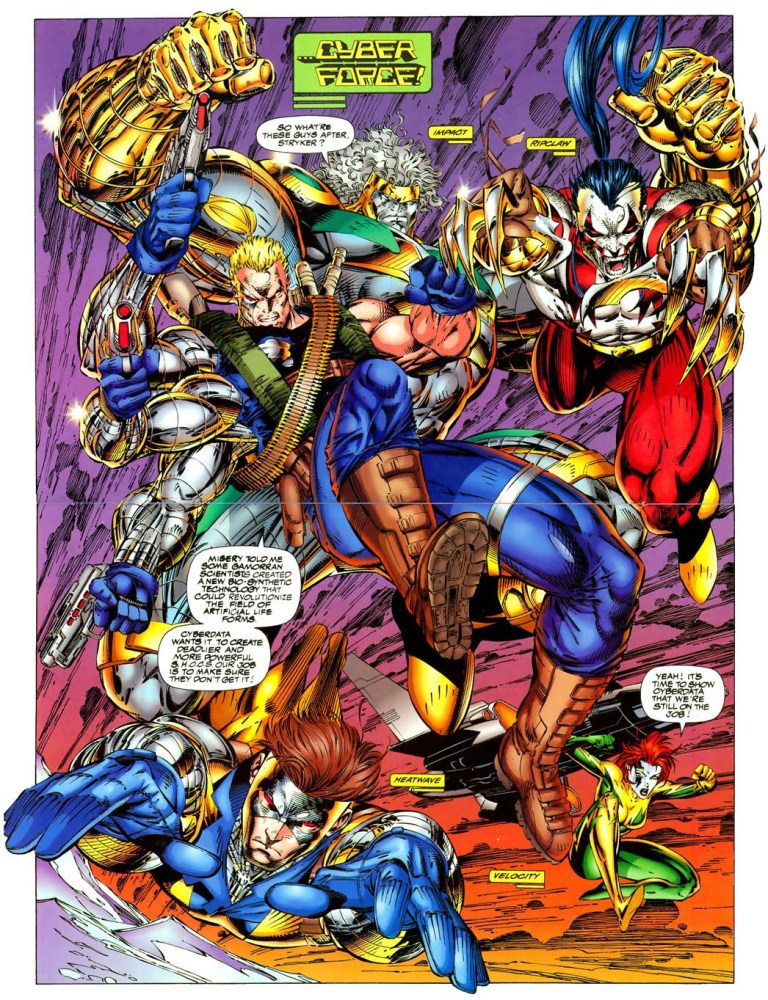
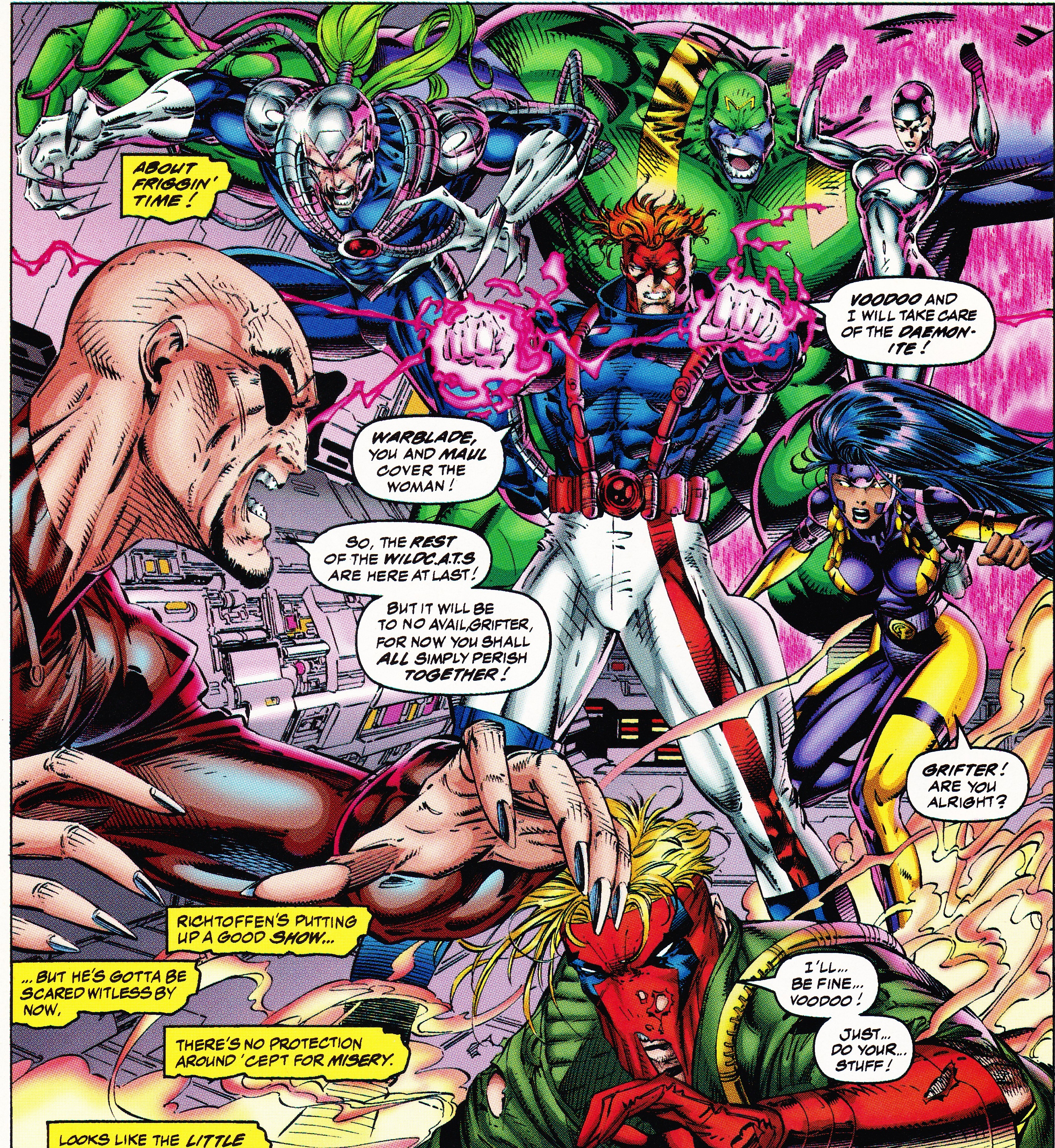
I’ll start with the very obvious purpose of this comic book. After the build-up done in the first two chapters of the Killer Instinct storyline, this story serves as the start of what turned out to be the big pay-off as WildC.A.T.S and Cyber Force members finally got together with an action-packed battle to kick things off. From a storytelling view point, this one is mainly a WildC.A.T.S versus Cyber Force tale with really nice match-ups between their members such as Spartan-Stryker, Cyblade-Zealot and Maul-Impact to name a few. These match-ups and fights are excellently drawn by Jim Lee and I really enjoyed his own artistic visuals of Marc Silvestri’s Cyber Force.

More on the plot, it is pretty simple in concept and structure. The members of the two teams get to fight each other which gets the attention of Skywatch which itself has vested interest with the operations of Stormwatch (note: this is within the WildStorm lore) and the secret facility on that blew up (as seen in WildC.A.T.S ). Misery remains the key factor in the story and in this tale, she gets to guide and manipulate Cyber Force to find something valuable while Warblade remains mostly absent. Apart from the battles, the absent Voodoo, Void and Jacob Marlowe have their respective spotlights mainly for the character developments as well as reminding readers about the continuing Kherubim-Daemonite conflict.

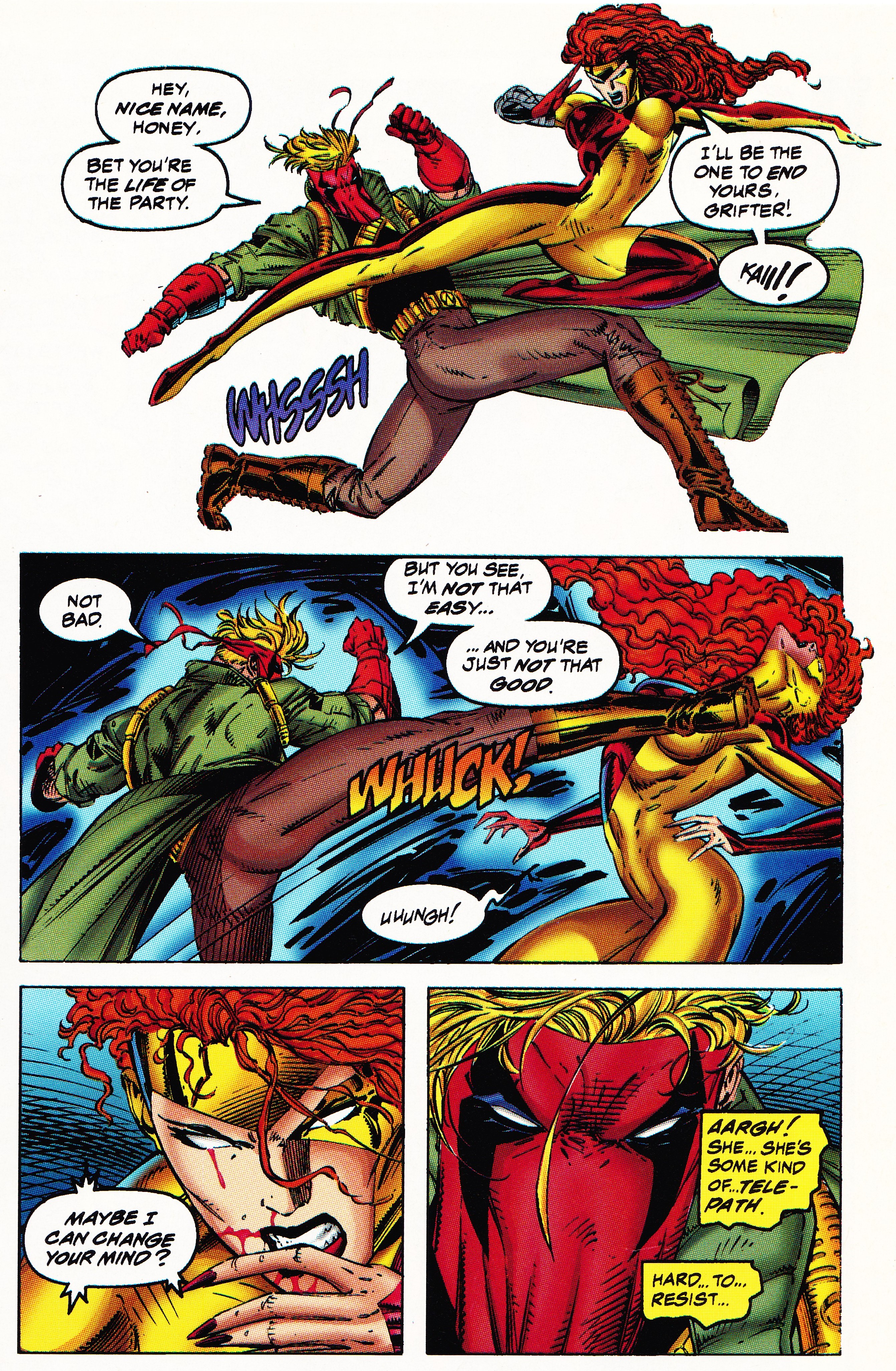
The quality of the writing is serviceable and the way I look at this comic book, it is mainly driven by spectacle and match-ups. The amount of crossover action is of top-notch quality (note: Jim Lee apparently missed out on key details while drawing Heatwave in a scene with Grifter) and clearly Jim Lee planned the visuals carefully. While there is little character development here, the ironic thing is that Misery (note: visually she is a wicked version of Jean Grey of the X-Men) is the one who gets a good chunk of the said development. Not only does she become a force in the minds of Cyber Force members, she also has her intimate moments with Ripclaw which is a reminder to readers that they have a shared past together (note: this will resonate more with those who read Cyber Force of the regular series).

Conclusion

This is how Cyber Force looks like as drawn by Jim Lee.

To make things clear, WildC.A.T.S: Covert Action Teams (1994) will strongly appeal to the respective fans of WildC.A.T.S and Cyber Force, to the readers who love high-quality superhero action, and to those who simply enjoy superhero crossover stories. While it is not a surprise that this comic book has great visuals, the writing this time clearly lacks depth and I really felt that the dialogue and text descriptions were done mainly to fit the obvious spectacle-led concept. If you are the kind of reader who wants storytelling and characterization prioritized in an action-packed crossover comic book, this one might not satisfy you. Ultimately, this one is a fun read even though the quality of the writing does not even come close to the quality of the visuals.  

If you are seriously planning to buy an existing hard copy of WildC.A.T.S: Covert Action Teams (1994), be aware that as of this writing, MileHighComics.com shows that the near-mint copy of the regular edition costs $30 while the near-mint copy of the newsstand edition costs $90. The near-mint copy of the silver cover edition costs $300.

Overall, WildC.A.T.S: Covert Action Teams (1994) is recommended.

+++++

Thank you for reading. If you find this article engaging, please click the like button below and also please consider sharing this article to others. If you are looking for a copywriter to create content for your special project or business, check out my services and my portfolio. Feel free to contact me with a private message. Also please feel free to visit my Facebook page Author Carlo Carrasco and follow me on Twitter at  @HavenorFantasy as well as on Tumblr at https://carlocarrasco.tumblr.com/

A Look Back at WildC.A.T.S: Covert Action Teams #6 (1993)

Disclaimer: This is my original work with details sourced from reading the comic book and doing personal research. Anyone who wants to use this article, in part or in whole, needs to secure first my permission and agree to cite me as the source and author. Let it be known that any unauthorized use of this article will constrain the author to pursue the remedies under R.A. No. 8293, the Revised Penal Code, and/or all applicable legal actions under the laws of the Philippines.

Welcome back superhero enthusiasts, 1990s culture enthusiasts and comic book collectors! Today we continue revisiting Jim Lee’s flagship title under Image Comics – WildC.A.T.S: Covert Action Teams!

For the newcomers reading this, I recently completed reviewing the 4-issue mini-series (read my retro reviews here, here, here and here), the first issue of which was one of the launch titles published under Image Comics’ banner through Malibu Comics. Back in 2020, I reviewed issue #5 which itself was highly unusual as it marked the beginning of what was back then the regular series of WildC.A.T.S (note: starting a brand new comic book series is often done with a new issue ). WildC.A.T.S: Covert Action Teams was conveniently part of the build-up for the Killer Instinct storyline that had featured Jim Lee’s creations crossing over with Marc Silvestri’s Cyber Force.

With those details laid down, here is a look back WildC.A.T.S: Covert Action Teams , published by Image Comics in 1993 with a story written by Brandon Choi and Jim Lee. Lee did the art.

The cover.

Early story

The story begins with the WildC.A.T.S flying in their high-tech aircraft and observing the large explosion which marked the destruction of a top-secret research facility. Their teammate Warblade was left behind which concerns Grifter and Voodoo. Spartan says it is too risky for them to move close to the site of destruction for Warblade as their electronic counter measure and identification systems have been lost due to the explosion. Spartan also told them team that they need to fly away before the Gamorran security forces arrive.

They are too late, however, as three high-tech aircrafts of Gamorra have arrived to take them down. One of them launched several missiles at the WildC.A.T.S aircraft causing Spartan to tell Grifter to redirect all power to their shields.

As hard as he tried, Spartan could only fly their shielded jet to dodge the first four missiles and absorbing the impact of two missiles before getting hit by the other missiles launched by the other two enemy aircrafts.

While their jet got destroyed into pieces, the WildC.A.T.S managed to survive the explosion only to see themselves falling helplessly in the air. As Spartan catches Voodoo, Grifter warns him abou the incoming Gamorran aircraft…

Quality

The team but without Jacob Marlowe, Warblade, Voodoo and Void at this point of the story.

To begin with, this comic book is very much like its predecessors – a very action-packed tale laced with the occasional character moments for fun while having little room left for character development. If there is any notable change in the way this comic book’s story was told, it is the detective work done collectively by key members of WildC.A.T.S followed by exposition dumps here and there. The detective work and exposition were done primarily to add to the build-up of the crossover with Cyber Force with the revelation of a love triangle from the past involving Misery (who gave Grifter a lot of trouble in issue ), Warblade and Ripclaw (from the other team).

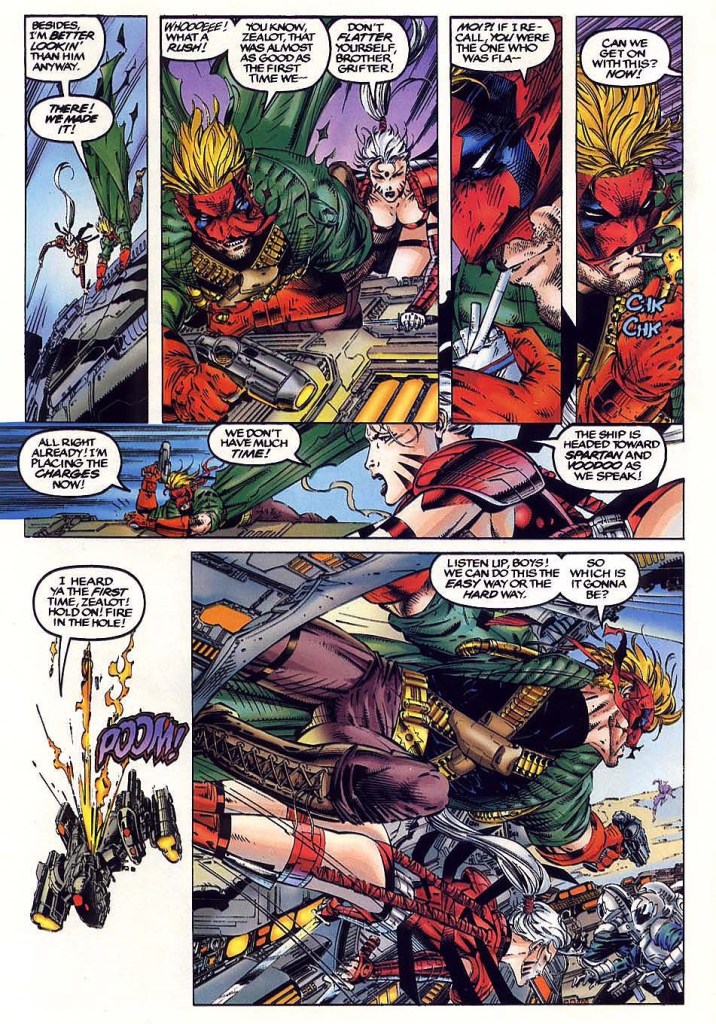
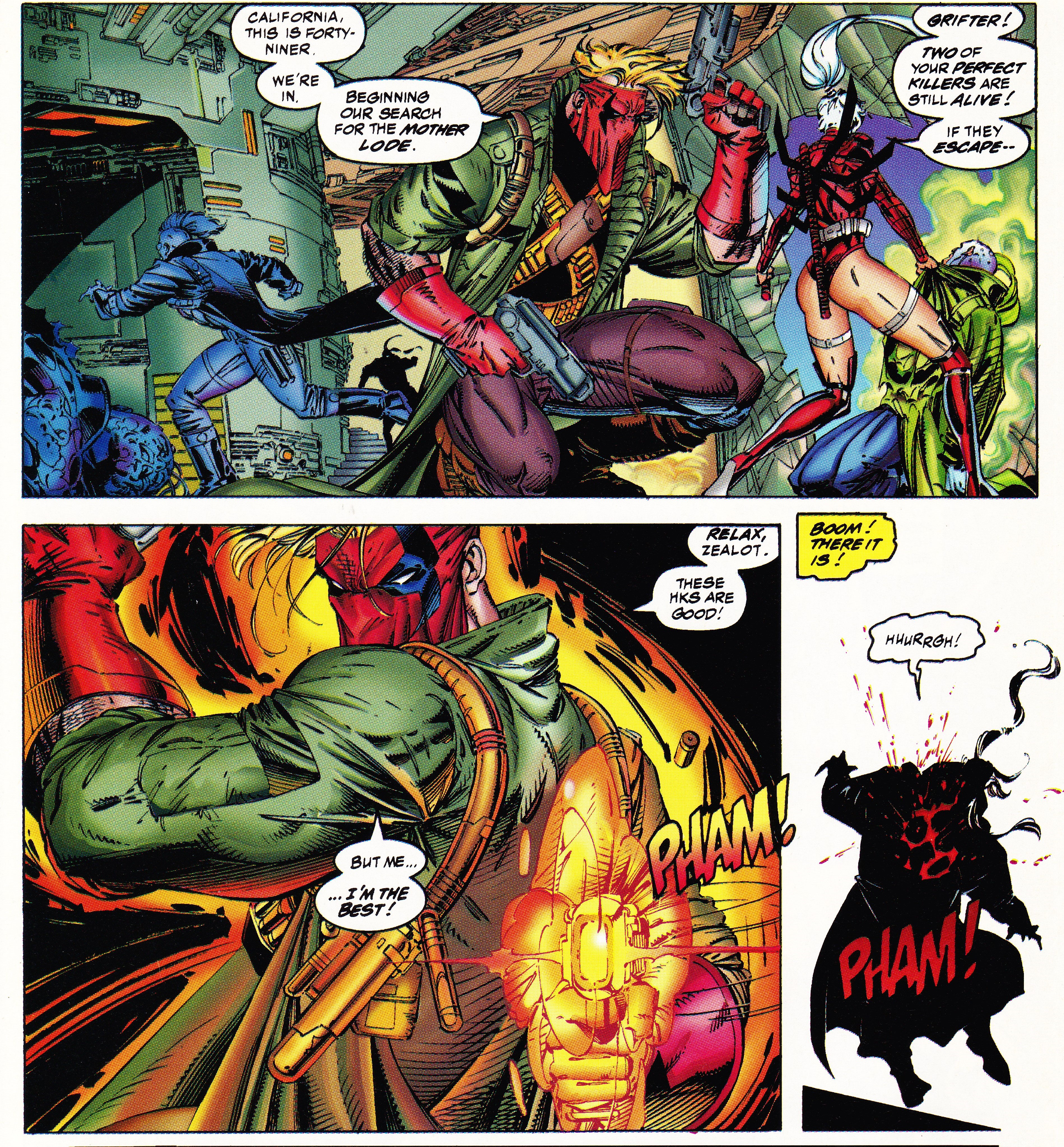
As with Jim Lee’s past works, the action here is highly charged and there is a lot of spectacle to enjoy most of the way. By the time this comic book got published, the respective capabilities of the WildC.A.T.S team members have already been established and the creators pushed the creative limits further on showing what else could the main characters do as envisioned by Jim Lee. There is even this 4-page sequence showing Grifter and Zealot infiltrating one of the Gamorran aircrafts and having lots of banter along the way which was fun to read. Considering the lack of space for character development, the creators made up for it somewhat with the dialogue.

As this is the first chapter of the Killer Instinct crossover storyline, the build-up for it is not really that engaging to me personally. While Ripclaw was already established as a major Cyber Force character and Warblade was a visible yet not so dominating as a member of WildC.A.T.S, the establishment of the personal connection between them through Misery (the woman right in the middle) is just not so strong. Not even a huge exposition dump about the past could have strengthened the background. It would have been more helpful had Jim Lee and Marc Silvestri agreed to publish a prequel comic book (or pages inserted into a few comic books of WildC.A.T.S and Cyber Force) about Warblade-Misery-Ripclaw in the past as a prelude to Killer Instinct. More on Misery herself, I could not help but think of her as a distorted and more wicked version of the X-Men’s Jean Grey complete with long red hair.

Conclusion

Grifter and Zealot infiltrate a Gamorran aircraft.

WildC.A.T.S: Covert Action Teams (1993) is another fun comic book to read filled with a lot of stuff that Jim Lee fans love to see again and again. As the opening chapter of Killer Instinct, the creators did the best they could to establish Misery as an important antagonist who happens to have been personally involved with Warblade and Ripclaw some years back. Sadly, the Warblade-Misery-Ripclaw triangle establishment is not so engaging and looked more like an afterthought. Still, this comic book’s story is not brainless and expanded the lore of the WildStorm universe a bit more. There is more good stuff than bad ones which make this worth reading.

If you are seriously planning to buy an existing hard copy of WildC.A.T.S: Covert Action Teams (1993), be aware that as of this writing, MileHighComics.com shows that the near-mint copy of the regular edition costs $20 while the near-mint copies of gold cover edition and newsstand edition cost $300 and $60 respectively.

Overall, WildC.A.T.S: Covert Action Teams (1993) is recommended.

+++++

Thank you for reading. If you find this article engaging, please click the like button below and also please consider sharing this article to others. If you are looking for a copywriter to create content for your special project or business, check out my services and my portfolio. Feel free to contact me with a private message. Also please feel free to visit my Facebook page Author Carlo Carrasco and follow me on Twitter at  @HavenorFantasy as well as on Tumblr at https://carlocarrasco.tumblr.com/

A Look Back at WildC.A.T.S: Covert Action Teams #5 (1993)

Disclaimer: This is my original work with details sourced from reading the comic book and doing personal research. Anyone who wants to use this article, in part or in whole, needs to secure first my permission and agree to cite me as the source and author. Let it be known that any unauthorized use of this article will constrain the author to pursue the remedies under R.A. No. 8293, the Revised Penal Code, and/or all applicable legal actions under the laws of the Philippines.

Hey fellow comic book geeks! Remember before that I reviewed X-Men #1 of 1991 drawn by the great Jim Lee? That was over a year ago and so far, that is my only retro review of a dominant Jim Lee-drawn comic book.

Instead of reviewing another X-Men comic book drawn by Lee or any of the illustrator’s other works, I’ve decided to focus on the 1990s particularly on Image Comics. Back in those days, Lee was one of the main figures of Image and through that company he turned his dream projects into published comic books. When Image Comics launched in 1992, Jim Lee launched his superhero team project titled WildC.A.T.S: Cover Action Teams and issue of that sold a lot. Eventually WildC.A.T.S. finished as a 4-issue mini-series.

Along with WildC.A.T.S were other projects launched under Lee and his company WildStorm (previously referred to as Aegis Entertainment) such as Stormwatch and Gen13.

Then in 1993, Jim Lee, Scott Williams and Brandon Choi worked again to produce even more WildC.A.T.S comic books for fans to enjoy and keep business at WildStorm moving. The result was the release of WildC.A.T.S: Covert Action Teams which symbolically marked the start of a new regular series without starting with a new issue . Here’s an excerpt of Jim Lee’s explanation printed inside the said comic book:

I’m baaack!!! But rather than starting over with a new first issue, I decided to just “extend” the WildCATs miniseries into a regular series. Why? Well, I did it mostly for psychological reasons as first issues are always the most difficult ones to tell and draw. You have to get the readers to accept and understand a whole legion of new concepts and characters—characters which you’re illustrating often for the very first time. And as ant professional in the business can tell you, it takes a while for an artist to get the hang of certain characters-the way they movie, the way they talk, the way they reaction to different situations. And U’ve found that I haven’t really “connected” with any new characters until I’ve had four or five issues worth under my belt. ~ Jim Lee

That being said, here is a look back at WildC.A.T.S: Covert Action Teams published in 1993 by Image Comics with a story written by Jim Lee and Brandon Choi, and with art drawn by Lee and inked by Scott Williams.

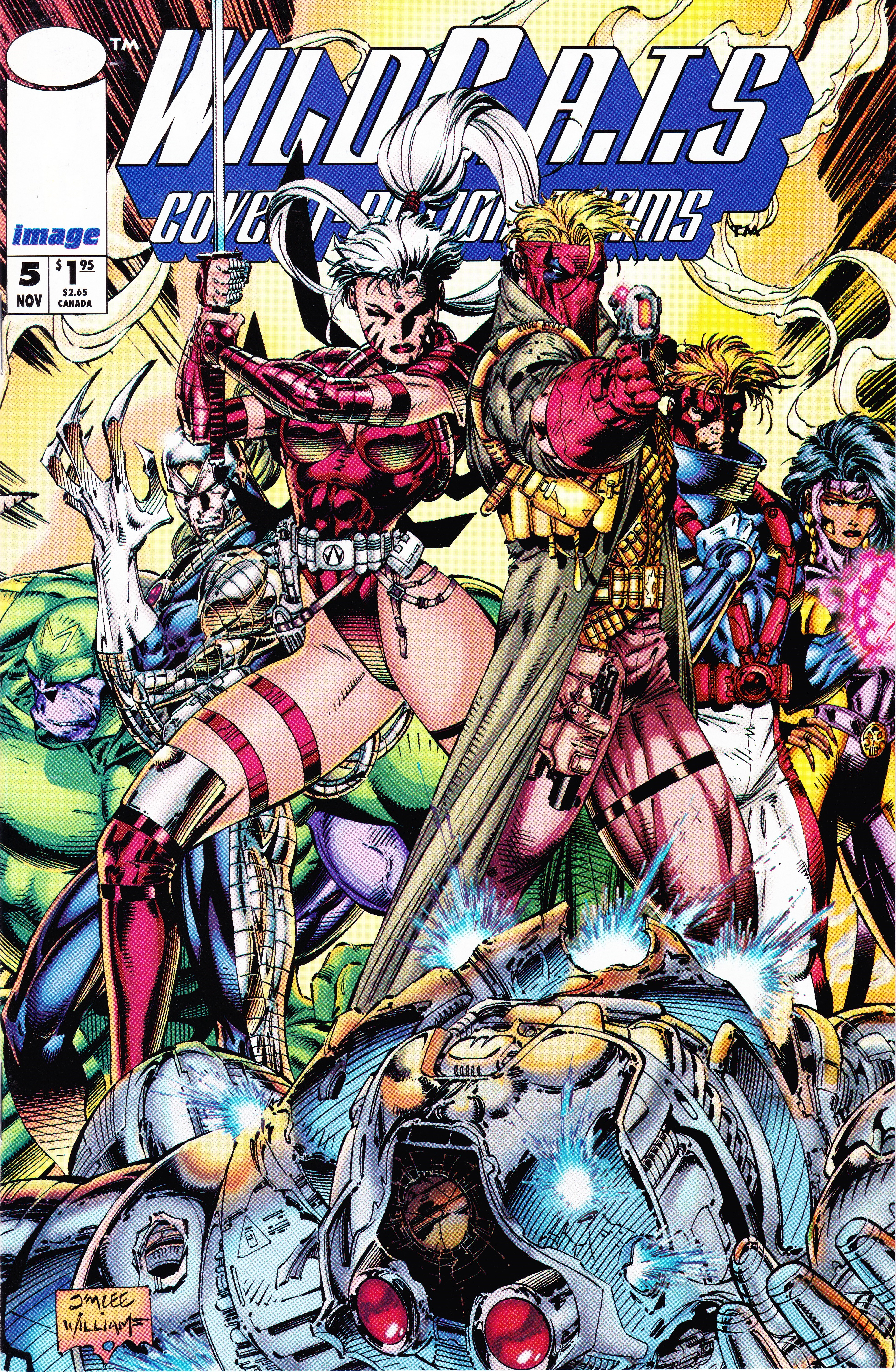
Cover
The cover.

Early story

The story begins with WildC.A.T.S members Grifter and Zealot gliding quietly approaching a secret base. Following Grifter’s lead to go into action, Zealot joins him to crash through the glass window and take out the perceived enemy troops called the hunter killers shooting and assaulting them. It turns the two are in search for something and they have their other teammates ready to come in to provide back-up.

Even though they tried to sneak around the place quietly, mechanical enemy reinforcements spotted them and chased them. As a metallic door shuts and separates the two, Grifter successfully got through the armed defense system and finds himself at the vault. After informing his other teammates of his new location, Grifter opens the vault revealing something very captivating with regards to the Daemonites’ secret operations…

Quality

Action3
The team and the villain.

Visually, this is one great looking comic book filled with lots of dynamism and flare provided by Jim Lee and Scott Williams. Each and every character looks great and come with a good amount of visual details on them. Also I love the futuristic technology look that dominated most of the scenes. When it comes to spectacle, this one is loaded and Jim Lee’s presentation of adulterated action and stunts is undeniably fantastic. I should also state that the colors are very vibrant thanks to Joe Chiodo.

Action2
Great action drawn by Jim Lee.

When it comes to storytelling, however, this one lacks depth. In terms of plotting, it’s pretty basic and goes like this: two heroes infiltrate the base of an enemy, they get discovered and more enemy troops come in, the top villains come in followed by the rest of the heroes’ teammates. As the focus here was more on spectacle and suspense, there was definitely no room left for character development. There is a subplot here worth mentioning and it serves as a link leading to the eventual Killer Instinct crossover with Marc Silvestri’s Cyberforce.

Conclusion

Action1
Great visuals and action here but not much in terms of storytelling.

I should say that WildC.A.T.S: Cover Action Teams is pretty tricky to recommend to all comic book geeks and superhero enthusiasts. I can easily recommend it to die-hard fans of Jim Lee, the die-hard fans of WildC.A.T.S, as well as those who love Image Comic books from the 1990s. If you are looking for a short bout of fun with action in mind, this comic book will serve you. If you are the kind of reader who wants deep storytelling and solid character development, this one will fall short.

If you are seriously planning to buy an existing hard copy of WildC.A.T.S: Cover Action Teams (1993), be aware that as of this writing, MileHighComics.com shows that the near-mint copy of the regular edition costs $4.

Overall, WildC.A.T.S: Cover Action Teams (1993) is satisfactory. It’s a great looking comic book (with gate-fold pages) that does not have much to fulfill readers looking for the solid combination of art, storytelling, characterization and entertainment.


Thank you for reading. If you find this article engaging, please click the like button below and also please consider sharing this article to others. If you are looking for a copywriter to create content for your special project or business, check out my services and my portfolio. Feel free to contact me as well. Also please feel free to visit my Facebook page Author Carlo Carrasco and follow me at HavenorFantasy@twitter.com