Retro Gaming Ads Blast – Part 18 (Fighting Games Special)

Welcome back readers, fellow geeks and electronic gaming fans!

In this edition of the Retro Gaming Ads Blast (RGAB) series, we will take a look at another batch of retro gaming print ads – including arcade flyers – specifically about fighting games that were released in the 1990s. The said decade marked the time when Street Fighter II became a massive hit in the video arcades (and on game consoles) which sparked a wave of new fighting games from business competitors. In that same decade, 3D polygonal fighting games were also released which added greater choices of fighting games at the arcades and on game consoles that players could choose from.

For the newcomers reading this, Retro Gaming Ads Blast (RGAB) looks back at the many print ads of games (console, arcade, computer and handheld) that were published in comic books, magazines, flyers, posters and newspapers long before smartphones, social media, the worldwide web and streaming became popular. To put things in perspective, people back in the 1980s and 1990s were more trusting of print media for information and images about electronic games and related products.

With those details laid down, here is the newest batch of retro gaming print ads for you to see and enjoy…

1. Dead or Alive Japanese arcade flyer
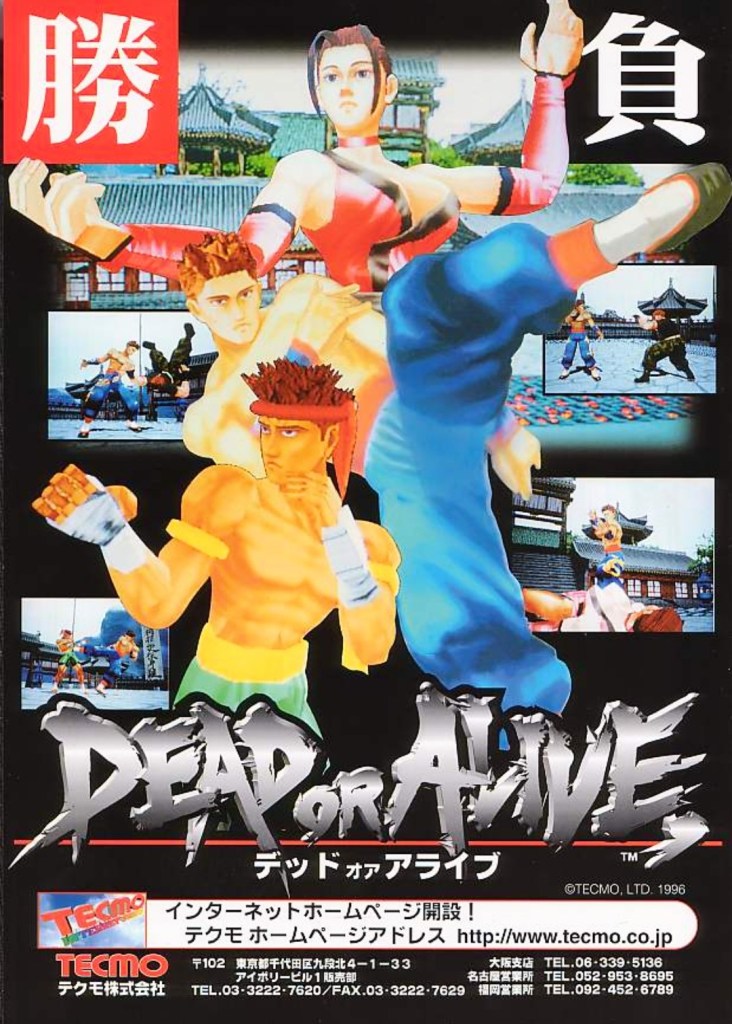
Dead or Alive was the start of new success that impacted the direction of Tecmo in the gaming industry.

The above arcade flyer of Dead or Alive gave Japanese arcade operators and gamers a taste of what to expect with the game. While the screenshots showed some resemblance with what gamers saw in Virtua Fighter 2, the character designs Tecmo and its developers came up with were unique.

Before Dead or Alive was released in Japanese arcades in 1996, company Tecmo was in financial trouble and they asked Tomonobu Itagaki to make a fighting game similar to Sega’s polygonal blockbuster Virtua Fighter. A breakthrough for Tecmo happened when Sega announced they were licensing their Model 2 arcade to third-party companies which paved the way for Itagaki’s team to make Dead or Alive with it. The game became a big hit and it paved the way for Tecmo to release it on Sega Saturn and PlayStation, and the sequels that followed years later.

2. North American Soulcalibur Dreamcast version print ad
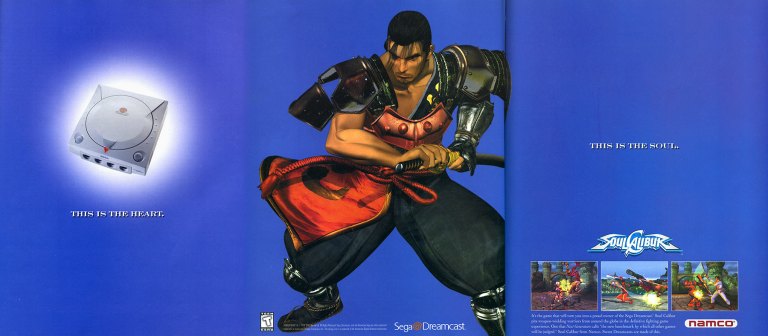
Namco came up with a creative approach to emphasize heart-and-soul promoting their game and the Dreamcast.

On September 9, 1999, Sega launched their Dreamcast console in America. With a gap of around ten months between the Japanese launch (November 1998) and the American launch, Sega had time to prepare Dreamcast’s release to American gamers with a huge lineup of games (both Sega’s games and from other publishers). Fortunately for Sega, they had Namco (their rival on arcade games) supporting their console.

Behind the scenes, Namco’s developers worked hard to not only port their arcade hit Soulcalibur to the Dreamcast, but to enhance the graphics using the console’s more advanced technology. The visual enhancements include rendering all of the games stages (and backgrounds) into full 3D polygonal environments. Namco also implemented different game modes and added even more content to ensure satisfaction to Dreamcast gamers.

The above 3-page print ad of Soulcalibur on Dreamcast was undeniably strategic and captivating to look at. The ad described the console as the heart, showed Soulcalibur character Mitsurugi (one of the game’s most popular characters) in the middle and then described the game (with 3 screenshots of game rendered with Dreamcast graphics) as the soul. It was a strong way to promote both the game and the console. In the years that followed, Soulcalibur grew into a popular fighting game franchise and the Dreamcast version will always be remembered as the crucial turning point.

3. X-Men: Children of the Atom arcade flyer
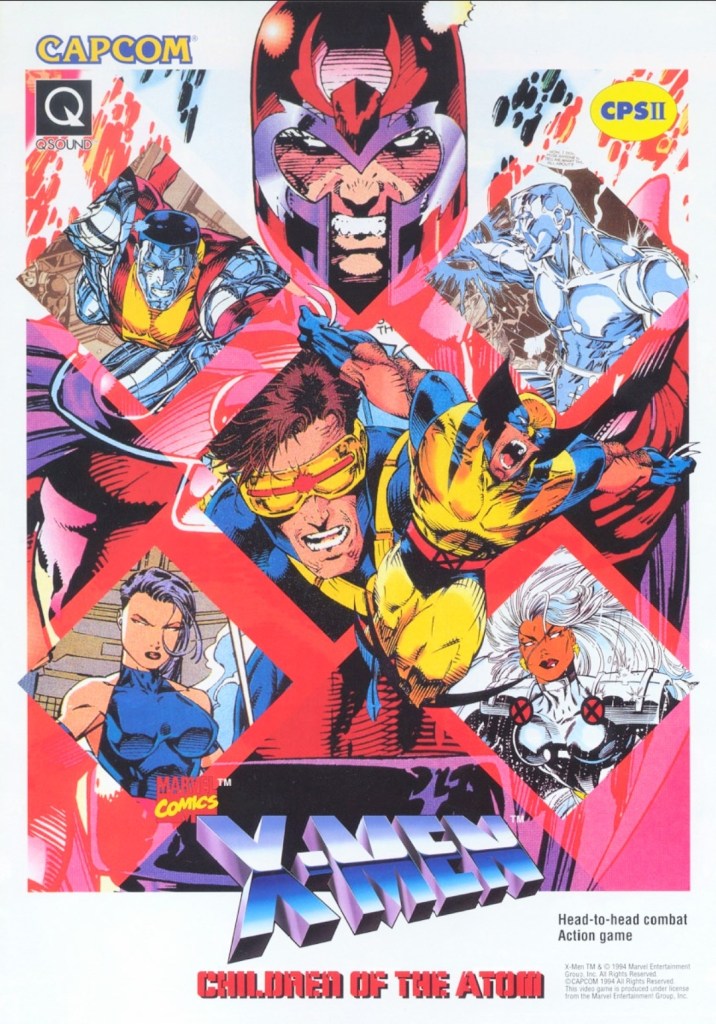
Anyone who read lots of X-Men comic books in the 1990s should be able to tell which character was drawn by which artist.

When Capcom first released X-Men: Children of the Atom in the arcades in the mid-1990s, I was surprised because I did not anticipate the day would come when the company behind Street Fighter II would actually make a 2D fighting game showcasing the Marvel’s mutants. Even more intriguing was the X-Men art Capcom used for the arcade flyer to promote the game. I recognize Jim Lee’s artworks of Magneto, Cyclops and Colossus. The art of Wolverine shown was drawn by Andy Kubert. It was a wise move for Capcom (with Marvel as a business partner) to use established X-Men comic book artworks instead of having their internal illustrator draw the characters. That being said, this arcade flyer still looks great and captivating to look at.

4. North American Ranma ½: Hard Battle print ad
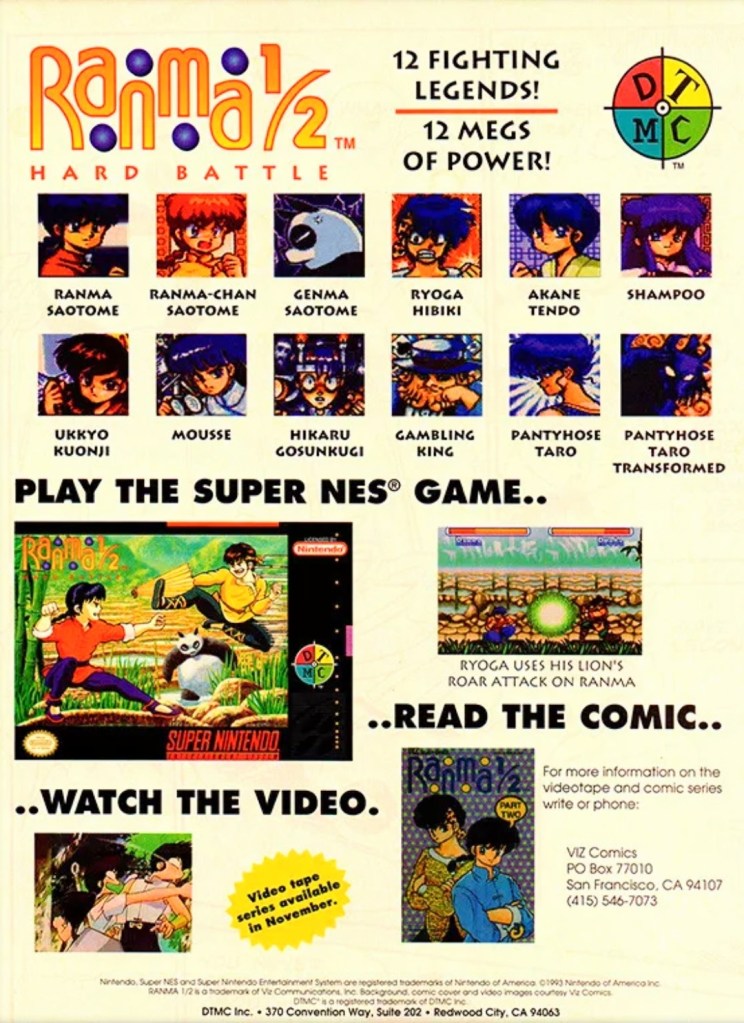
A print ad promoting the game while saving some space to promote the anime and comic books.

By 1993, Street Fighter II and its upgraded follow-ups were wildly popular both in the arcades and on game consoles around the world. At the same time, there were many other 2D fighting games released to compete with and cash-in on Street Fighter II’s success. Believe it or not, the established anime franchise Ranma ½ saw a video game adaptation in the form of a 2D fighting game – Ranma ½: Hard Battle.

The North American print ad above published by DTMC (in cooperation with Viz Communications) promoted the game (one screenshot, the SNES game box and images of the characters as they appeared in the game) as well as Ranma ½ on anime videos and comic books. The way it was presented, the print ad promoted Ranma ½: Hard Battle without much heart nor passion.

5. Fatal Fury: King of Fighters arcade flyer
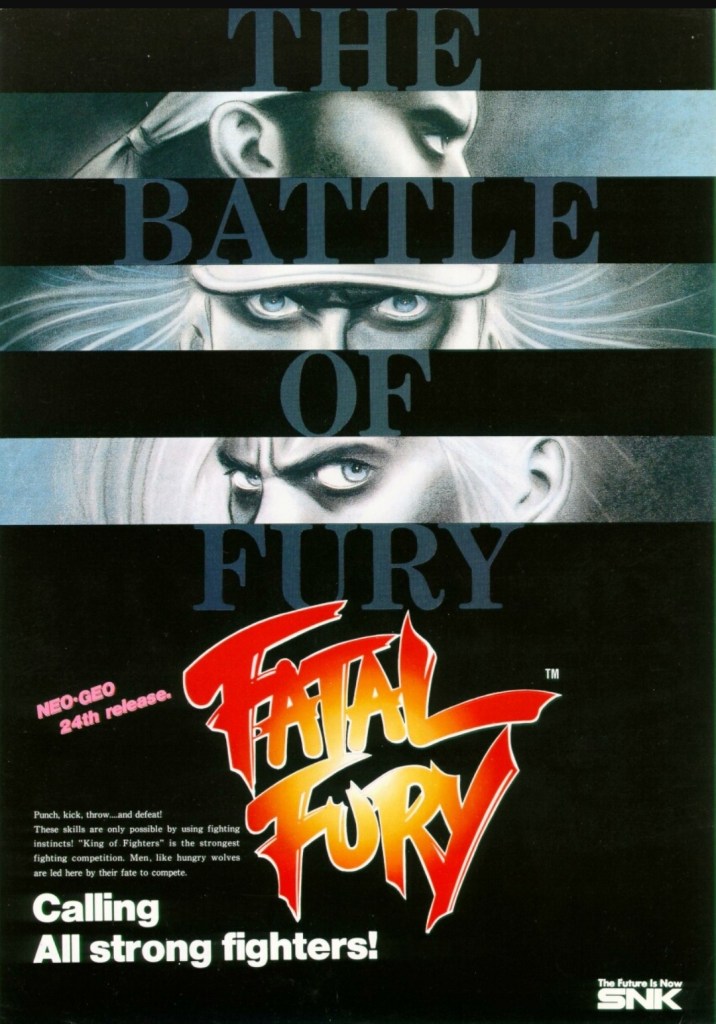
An intriguing visual presentation on the front.
You get to know the characters and what the game features are.

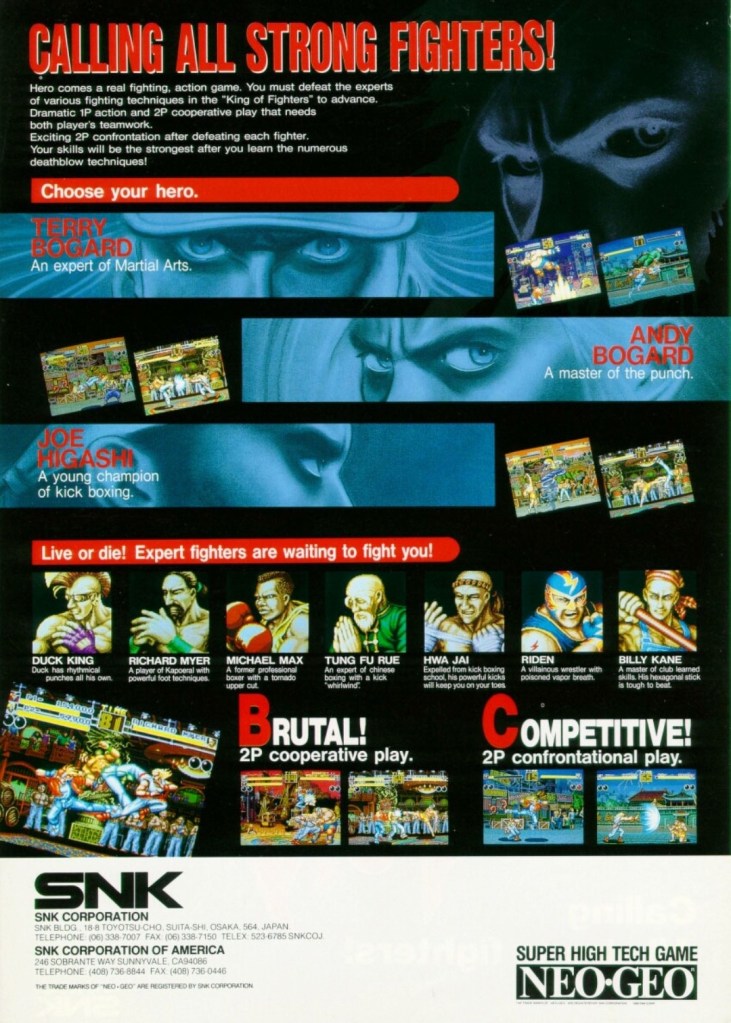
There is no doubt that Fatal Fury: King of Fighters is the most significant game that SNK made. Apart from being the company’s first fighting game for the Neo Geo system, it established the fictional “king of fighters” tournament that became the core concept for The King of Fighters series of games in the years that followed. Fatal Fury itself is notable for being designed by Takashi Nishiyama, a former Capcom employee who created the original Street Fighter game. What Nishiyama could not do with Street Fighter, he accomplished while making SNK’s fighting game. Compared with the combo-oriented approach of Street Fighter II, Fatal Fury was designed to emphasize the timing of special moves, confrontational play, cooperative play and the 3D-like spacing between characters (background row and foreground row in each stage) while telling a story in a solid way.  

The above arcade flyer of Fatal Fury has this unique looking artwork on the front showing stylized rectangular shots of the major characters Terry Bogard, Andy Bogard and Joe Higashi. On the other side of the flyer are the details that emphasized the creative concept of the game, who the characters are and what they could expect with regards to gameplay features. This flyer is still captivating to look at and it could entice you to try playing the original Fatal Fury game before trying out the sequels and spin-offs.

6. Marvel vs. Capcom: Clash of Super Heroes arcade flyer
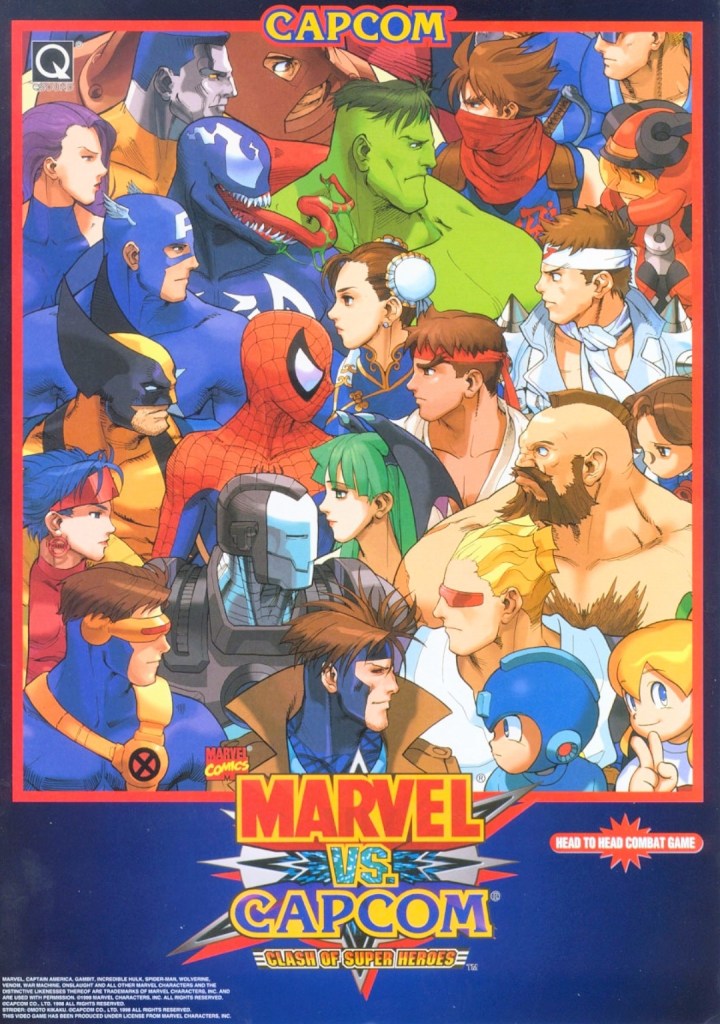
This is NOT a comic book crossover.

If there is anything that truly emphasizes the essence of a fictional crossover in terms of visuals, it’s the art that Capcom and Marvel agreed to for Marvel vs. Capcom: Clash of Superheroes which is evident on the front of the above arcade flyer. By looking at how the Marvel characters were drawn, it looks like someone at Capcom illustrated the artwork as the Capcom characters still maintained that particular art style seen in the artworks of the Japanese company’s other games like Street Fighter, Darkstalkers, Mega Man and Strider. Regardless, the artwork still is amusing to look at.

7. Art of Fighting arcade flyer
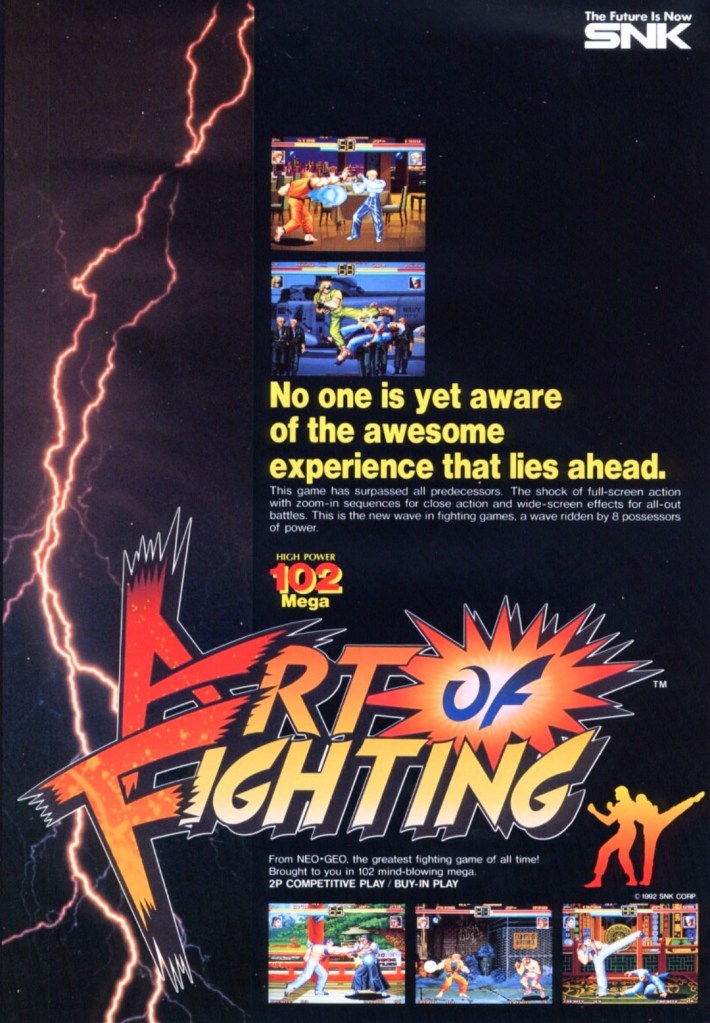
The front of the flyer.
The cast of characters showcased on the other side of the flyer.

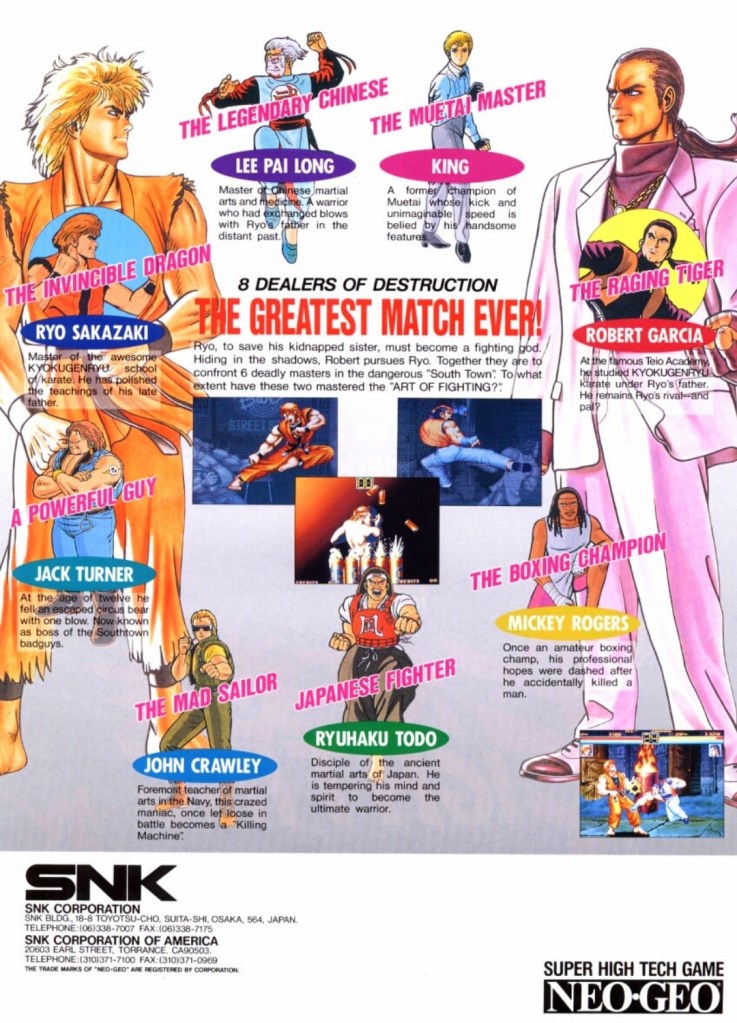
Following the success of Fatal Fury, SNK went on to release Art of Fighting in arcades in 1992 and it became successful enough for the company to make sequels. With regards to the realm of fantasy, Art of Fighting was part of the same fictional universe as Fatal Fury and The King of Fighters, and there were times when its own characters appeared in other SNK games.

Art of Fighting’s arcade flyer had an energetic visual concept on the front with a rectangular lightning portion on the left balanced with five screenshots of the game itself. Once you get to the other side of the flyer, you will see really nice art of the characters with Ryo Sakazaki and Robert Garcia as the most dominating figures. Sakazaki and Garcia are the major characters of the Art of Fighting series. This flyer confidently introduced the characters and succeeded in making them look interesting.

8. Fighter’s History arcade flyer and print ad
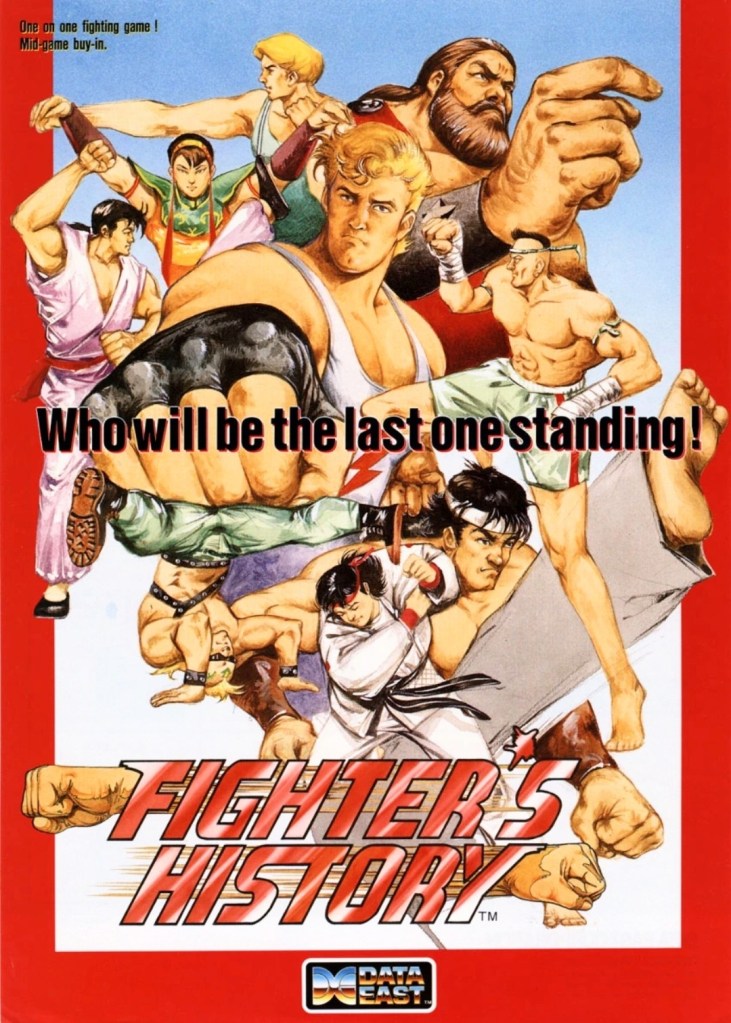
Great looking front artwork showing the game’s characters, posing and some action.
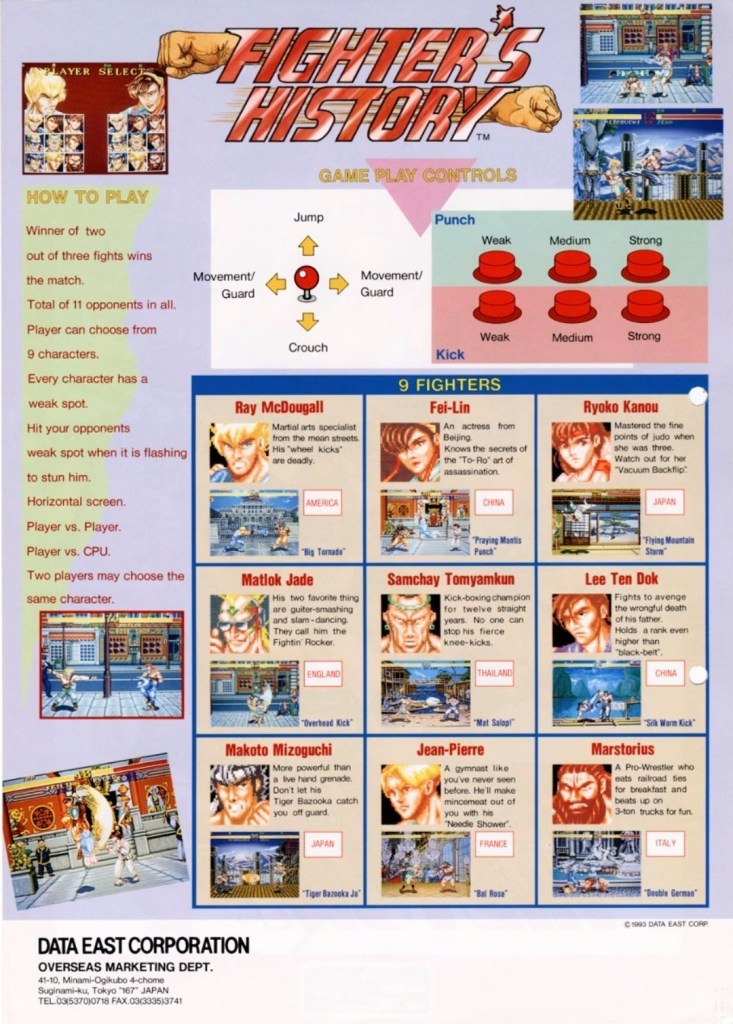
If you look closely at the controls, you will see the six-button layout and functions which are the same with those used in Street Fighter II.
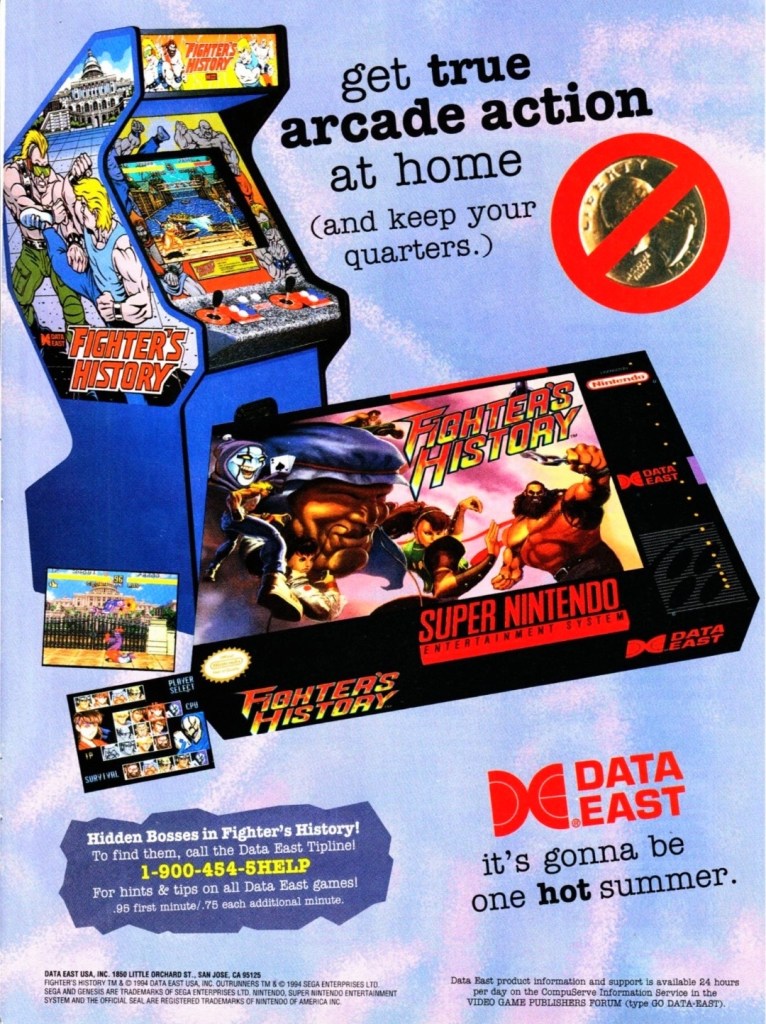
Data East offered two ways for gamers to enjoy Fighter’s History – pay a high price for the SNES version or gamers can go play the game in the arcade by dropping a few coins.

In 1993, Data East released their fighting game Fighter’s History in the arcades around the world. Along the way, the company released their arcade flyer which had a very captivating art work on the front featuring their characters and some action. The other side of the flyer showed the technical details on how to play, how the control works and who the characters are. Fighter’s History was nicely received in the arcades and the success led Data East into porting the game for the Super Nintendo Entertainment System (SNES). If you look at the print ad above, you can see how clever Data East was promoting the SNES version of the game while keeping an image of the arcade machine which serves like a subtle reminder that the same game is still available in video arcades.

Shortly after the release of Fighter’s History in the arcades, there were gamers who noticed that it had certain visual and gameplay elements that made it so familiar with what Street Fighter II had. When Capcom became aware of the similarities, they sued Data East claiming that Fighter’s History was too similar to their game and that copyright infringement was committed. Capcom lost the case ultimately and Data East went on to release two more Fighter’s History games.

9. Virtua Fighter 3 arcade flyer
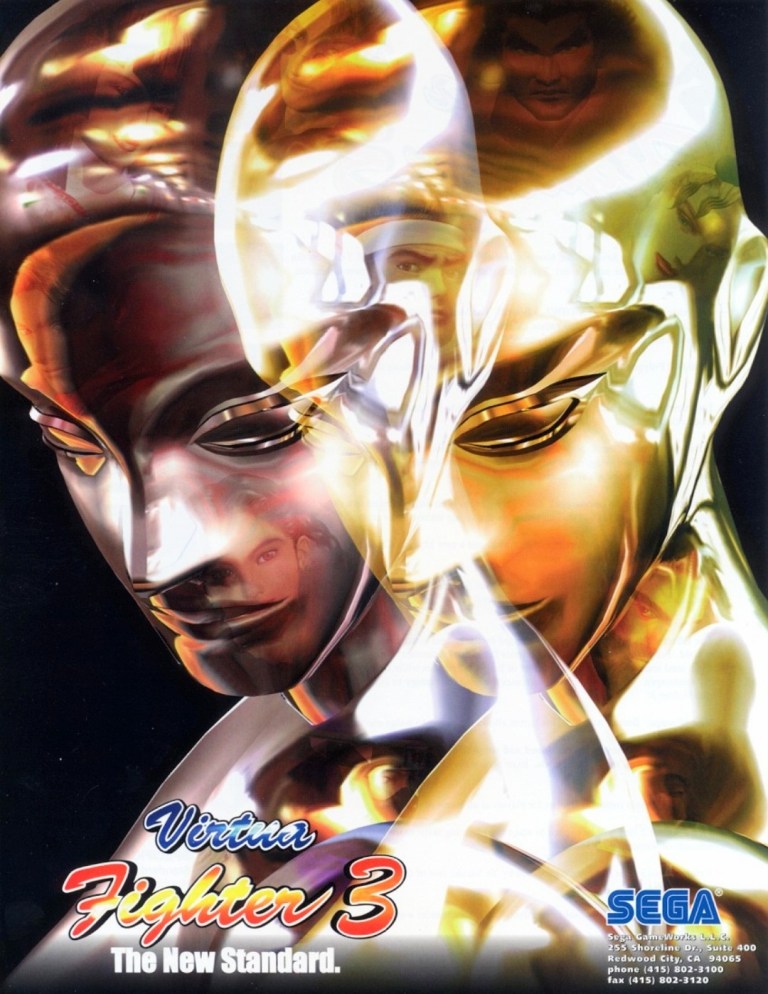
Virtua Fighter 3 truly raised the standards for arcade game graphics back in 1996.

When it comes to gaming innovation and standing out among the rest, Sega did exactly those when they released Virtua Fighter 3 in arcades in 1996 and it had the best-looking and really mind-blowing graphics at the time. Developed by AM2 (led by Yu Suzuki) on the very expensive Model 3 arcade hardware, Virtua Fighter 3 broke new ground on graphics as it moved over 1 million polygons per second, had highly detailed visuals on the characters and surroundings, realistic reflection effects, detailed shining, parallel lighting and high-specular Gouraud shading to name some. Even the characters’ eyes followed the opponent’s position.

The Virtua Fighter 3 arcade flyer showcased their reflective, metallic character Dural who in turn was part of the graphical showcase (emphasizing reflections, smooth animation and liquid metal effects) when the game was previewed in the 1996 AOU event in Japan. The words “The New Standard” written on the lower-left corner of the front of the flyer was justified and truthful.

10. Teenage Mutant Ninja Turtles: Tournament Fighters print ad
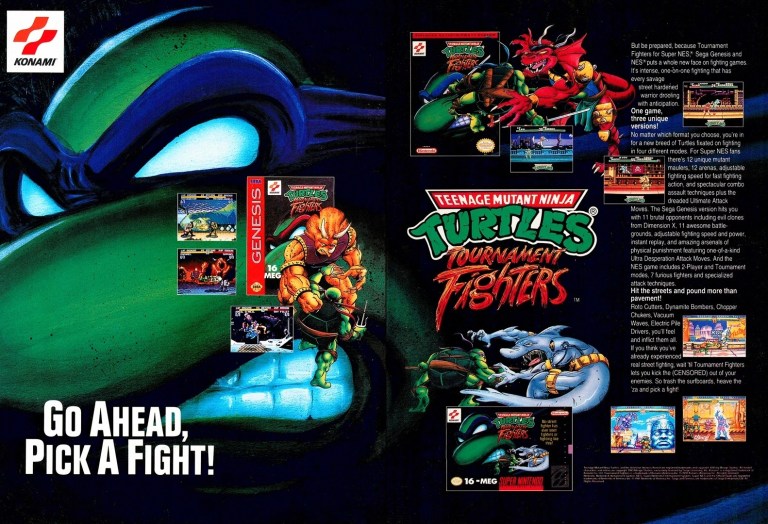
This print ad had a nice visual presentation and was easily recognizable to the many TMNT fans.

In 1989, the Teenage Mutant Ninja Turtles (TMNT) franchise made quite a splash on video games which is not surprising as the multimedia franchise was already a popular in the West. More video game adaptation of TMNT were released in the early 1990s providing fans and gamers a lot of fun gameplay at the arcades (click here) and on consoles. Konami had the video game rights of TMNT and in a clear response to the sudden popularity of fighting games, they released Teenage Mutant Ninja Turtles: Tournament Fighters on the most popular game consoles of the time achieving varying levels of success critically and commercially (note: the SNES version stood out as the best). This print ad of the fighting game was effective in visually promoting the three console versions and the displayed text contained enough information to lure the attention of both fans and gamers.

+++++

Thank you for reading. If you find this article engaging, please click the like button below, share this article to others and also please consider making a donation to support my publishing. If you are looking for a copywriter to create content for your special project or business, check out my services and my portfolio. Feel free to contact me with a private message. Also please feel free to visit my Facebook page Author Carlo Carrasco and follow me on Twitter at  @HavenorFantasy as well as on Tumblr at https://carlocarrasco.tumblr.com/ and on Instagram at https://www.instagram.com/authorcarlocarrasco

A Look Back at X-Men #30 (1994)

Disclaimer: This is my original work with details sourced from reading the comic book and doing personal research. Anyone who wants to use this article, in part or in whole, needs to secure first my permission and agree to cite me as the source and author. Let it be known that any unauthorized use of this article will constrain the author to pursue the remedies under R.A. No. 8293, the Revised Penal Code, and/or all applicable legal actions under the laws of the Philippines.

Welcome back, superheo enthusiasts, 1990s culture enthusiasts, X-Men fans and comic book collectors! Today we revisit the X-Men monthly series of the 1990s and look back at one of its most significant events it ever published – the wedding of Scott Summers/Cyclops and Jean Grey. By the time this particular comic book was published, the 30th anniversary celebration of the X-Men (note: Read my Fatal Attractions storyline retro reviews by clicking here and here) had just been concluded and that includes a major change of direction for the iconic X-Men member Wolverine. It is also notable that the X-Men had Sabretooth contained within Charles Xavier’s mansion (for retro reviews, click here, here and here).

With those details laid down, here is a look back at X-Men , published by Marvel Comics in 1994 with a story written by Fabian Nicieza and drawn by Andy Kubert.

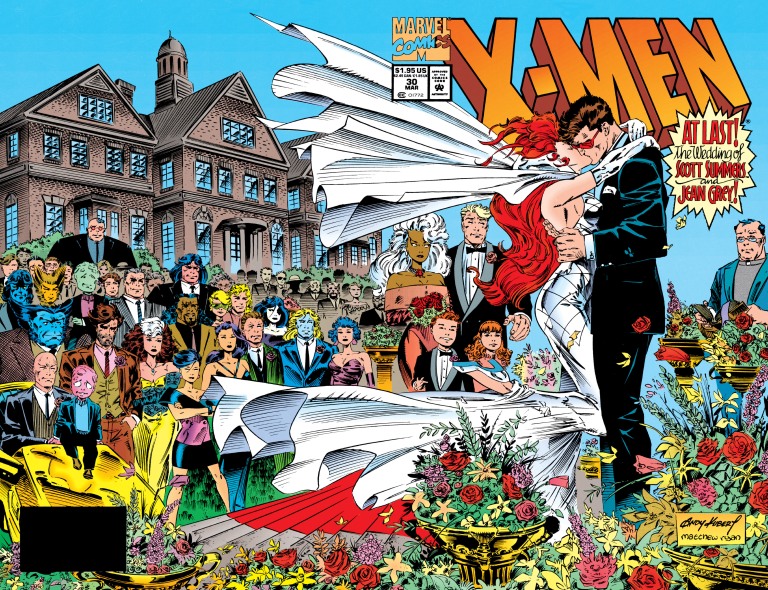
The cover.

Early story

The story begins inside Xavier’s mansion. Jean Grey reads a handwritten letter from Logan/Wolverine, who left the household after getting traumatized from their last encounter with Magneto. Logan refers to her and Scott Summers as special. While reading, Jean is already in her fancy wedding dress being assisted by her mother and storm as Rachel Summers looks on. For Jean, the wedding is about her dedication on spending the rest of her life with Scott as well as possibly gaining Rachel (who comes from one possible future) as a daughter.

Professor X with four of his original team members plus Alex Summers.

Elsewhere in the mansion, the groom Scott spends quality time with his original teammates Bobbdy Drake/Ice Man, Warren Worthington/Archangel and Hank McCoy/Beast. With them also is his brother Alex Summers/Havok. Alex tells Scott that the day of his wedding is the first day of the rest of his life which causes Bobby to say something inappropriate.

Suddenly, Professor X comes in to join them…

Quality

Jean Grey in her wedding dress with her mother, Storm and Rachel Summers present.

To get straight to the point here, this comic book serves two purposes: highlighting Scott and Jean’s relationship to an all new level with the wedding as the main event, and offering long-time or die-hard X-Men fans a whole lot of stuff to chew on. Very clearly, Fabian Nicieza wrote the script with X-Men fans in mind while also making references to the past with some creative touches or shortcuts so that the comic book would not be bloated with excessive fan service.

The wedding itself was executed nicely by the Nicieza-Kubert team and was clearly conceptualized to not only be memorable for the fans but also creatively serve as a major pay-off to all those years of Scott and Jean Grey being together early as teammates, getting separated temporarily and getting together again (note: they were also the original X-Factor team). Right after the wedding was executed, the visuals and words elevated the emotions higher and any long-time X-Men fan will find the moment sentimental.

Opposite the wedding are several scenes showing the other X-Men characters plus those from X-Factor and X-Force (with a not-so-recognizable Cable present). The dialogue written ranged from sentimental to comedic. And then there were also a few lines that I felt were just thrown in as fillers.

As far as visuals go, Andy Kubert’s art here are pretty good to look at. While he did his best to really make the story visually appealing and memorable, there were a few panels of art that look rushed.

Conclusion

So many guests. Can you recognize many of them?

Since it highlights the wedding of Scott and Jean Grey with several other X-Men-related characters mixed in, X-Men (1994) is clearly a commemorative story made with X-Men fans in mind. While a lot of work was done to make the story momentous on its own, readers who are unable to immerse themselves deeply into the X-Men mythos (plus X-Force, X-Factor and others) prior to reading this comic book won’t be able to relate to the wedding and the character moments very much. While it may not be significant to newcomers who find this comic book for the first time, it still marks a significant chapter in the history of X-Men within the Marvel Comics universe of the late 20th century. For the long-time fans who were able to read enough of Scott and Jean Grey’s times together from 1963 until the early 1990s, this is one X-Men tale that they can relate with deeply.

Overall, X-Men (1994) is recommended.

+++++

Thank you for reading. If you find this article engaging, please click the like button below and also please consider sharing this article to others as well as making a donation to support my publishing.. If you are looking for a copywriter to create content for your special project or business, check out my services and my portfolio. Feel free to contact me with a private message. Also please feel free to visit my Facebook page Author Carlo Carrasco and follow me on Twitter at  @HavenorFantasy as well as on Tumblr at https://carlocarrasco.tumblr.com/ and on Instagram at https://www.instagram.com/authorcarlocarrasco

A Look Back at Wolverine #75 (1993)

Disclaimer: This is my original work with details sourced from reading the comic book and doing personal research. Anyone who wants to use this article, in part or in whole, needs to secure first my permission and agree to cite me as the source and author. Let it be known that any unauthorized use of this article will constrain the author to pursue the remedies under R.A. No. 8293, the Revised Penal Code, and/or all applicable legal actions under the laws of the Philippines.

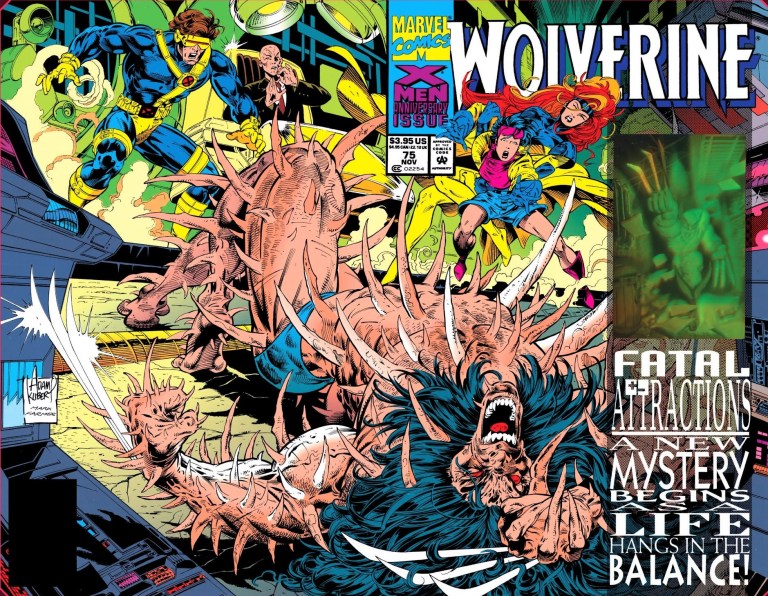
Welcome back, superhero enthusiasts, comic collectors, 1990s culture enthusiasts and fans of the X-Men! We go back to the year 1993 when the 30th anniversary of the X-Men was celebrated with the 6-part Fatal Attractions storyline. Already I reviewed Uncanny X-Men #304 (Part 3) which was not worthy of the X-Men’s 30th anniversary celebration. X-Men #25 (Part 4) meanwhile was not only great but also shocking and had a years-long impact on X-Men comics.

So now the focus is on the 5th chapter of the Fatal Attractions storyline handled by the Larry Hama-Adam Kubert team on the Wolverine monthly series of the time. With those details laid down, here is a look back at Wolverine , published by Marvel Comics in 1993 with a story written by Larry Hama and drawn by Adam Kubert.

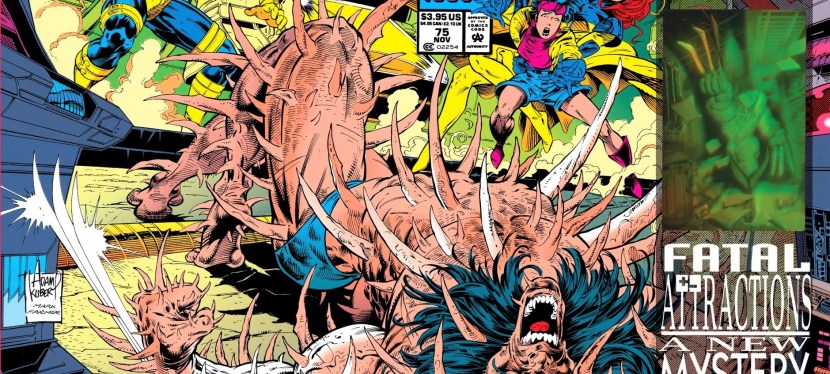
The cover.

Early story

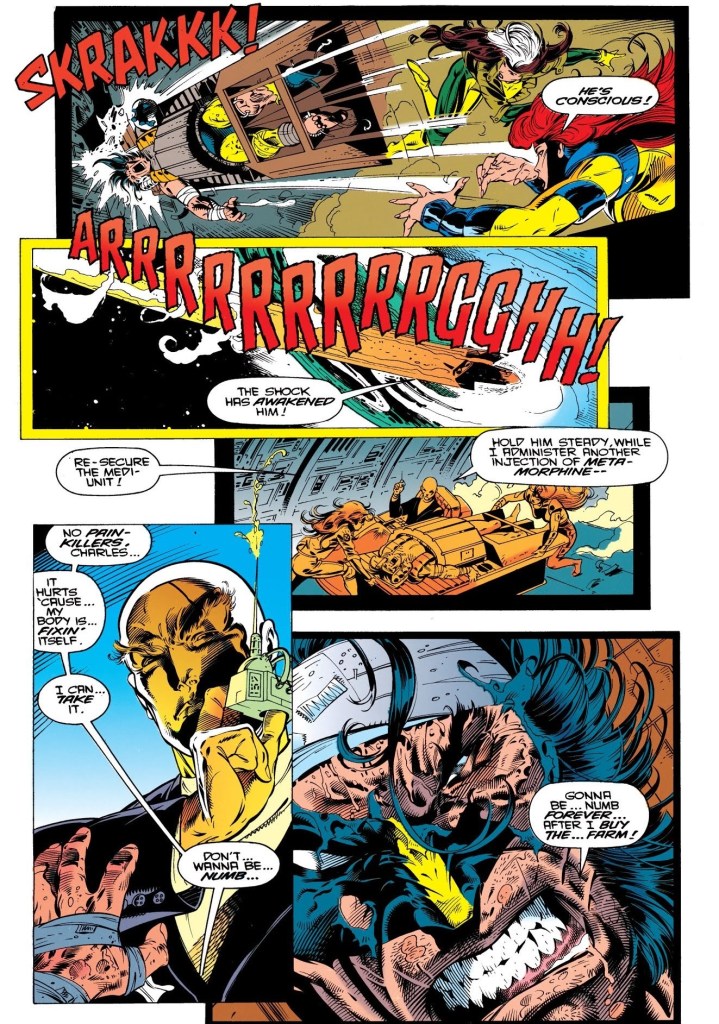
The story begins in outer space. Carrying Charles Xavier, Wolverine, Gambit, Jean Grey, Rogue and Quicksilver (who participated in the dangerous mission in X-Men ), the X-Men’s jet (piloted by Bishop) struggles mechanically as it was not designed for space travel. Worse, Wolverine is under very serious condition and the medical unit has been operating in full capacity dealing with his intense trauma.

In an attempt to alleviate Wolverine’s psychic trauma, Charles Xavier and Jean Grey enter his mind and discover that there is a world full of pain and horror. They see visions of a restrained Wolverine (from his Weapon X days) being attacked by Sabretooth and Lady Deathstrike. Xavier explains that they are at the epicenter of Logan’s most suppressed cataclysmic memories which were clearly triggered by the physical damage Magneto inflicted on him (see X-Men ).

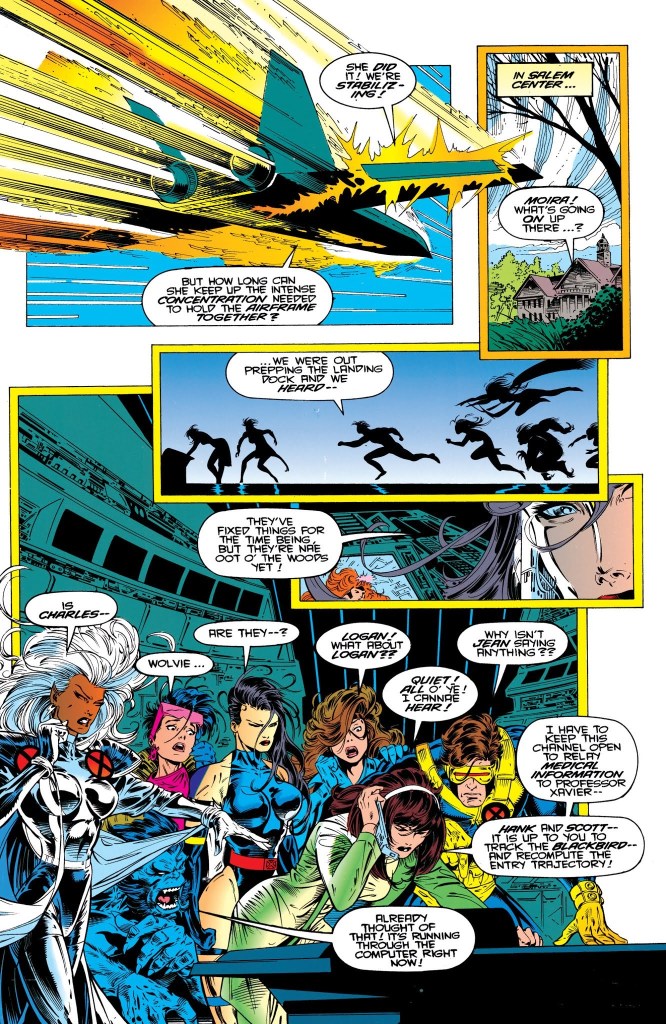
As the X-Men’s jet attempts to enter Earth’s atmosphere, its exteriors heat up dramatically shaking everyone inside. This complicates the situation on stabilizing Wolverine…

Quality

The other X-Men team members at their headquarters expressing worry and concern about the situation of their teammates struggling to come back home from space.

To be clear, this story continues the events of Fatal Attractions but with a bit more focus on Wolverine (compared to the earlier chapters of the storyline that is). There is no real battle between good and evil at all. It’s really all about Wolverine struggling to survive just as his teammates struggle to arrive home.

Before the stories of this comic book and X-Men happened, Wolverine has often been portrayed to be very tough, brave and a walking machine of violence which has been reflected in other X-Men stories told in video games and movies. In this very comic book, Wolverine has been presented to coming close to death. This means Logan, at this particular stage of the history of the literary X-Men, was at his most vulnerable state. In my experience, this was both alienating and shocking to see.

With regards to the writing, Larry Hama did an excellent job with pacing the story from start to finish. Right from the beginning, the story pulls you into the X-Men’s tough situation and as each page gets turned, the tension as well as the suspense builds up until the execution of the climax. Along the way, the comic book not only portrays Wolverine struggling on the edge, it also works to make you care more or be more concerned towards him. Oh yes, the shocking moment near the end of this comic book remains very powerful and you who read this retro review should read Wolverine and see it for yourselves.

Conclusion

Wolverine at his most vulnerable state.

By today’s standards, Wolverine (1993) is still a very great comic book to read. In fact, I can say it is not only one of most defining chapters of the Fatal Attractions storyline as well as one of the most significant X-Men comic books of the 1990s, it is indeed a true illustrated literature classic ever published by Marvel Comics. In retrospect, this comic book marks a major turning point in the life of Wolverine who is still one of the most iconic characters in all of superhero literature. All of these were achieved thanks to the creative team of Larry Hama and Adam Kubert (whose are here was great and stylized at the same time). Hama succeeded in writing the continuation of the Fatal Attractions storyline while balancing all of the exposition and still putting Wolverine in the center. That itself is a very great work of writing.

If you are seriously planning to buy an existing hard copy of Wolverine (1993), be aware that as of this writing, MileHighComics.com shows that the near-mint copy of the regular edition costs $60 while the near-mint copies of the signed-and-numbered edition and the newsstand edition cost $300 and $180 respectively.

Overall, Wolverine (1993) is highly recommended!

+++++

Thank you for reading. If you find this article engaging, please click the like button below and also please consider sharing this article to others. If you are looking for a copywriter to create content for your special project or business, check out my services and my portfolio. Feel free to contact me as well. Also please feel free to visit my Facebook page Author Carlo Carrasco and follow me at HavenorFantasy@twitter.com

A Look Back at X-Men #3 (1991)

Disclaimer: This is my original work with details sourced from reading the comic book and doing personal research. Anyone who wants to use this article, in part or in whole, needs to secure first my permission and agree to cite me as the source and author. Let it be known that any unauthorized use of this article will constrain the author to pursue the remedies under R.A. No. 8293, the Revised Penal Code, and/or all applicable legal actions under the laws of the Philippines.

Welcome back, X-Men fans, superhero enthusiasts and comic book collectors! Today I’m about to review another Chris Claremont-Jim Lee comic book of the X-Men from 1991.

Before getting to the retro comic book review, let’s take a look back at history. Marvel Comics started publishing comic book of the X-Men in 1963 which involved the combined talents of Stan Lee and Jack Kirby. The original X-Men members were Cyclops, Beast, Marvel Girl, Angel and Iceman all under the mentorship of Charles Xavier (AKA Professor X). That monthly series was not a strong seller and was weak compared to the other monthly titles of Marvel. Although Roy Thomas and Neal Adams were brought in to reinvigorate the X-Men series with new characters, success in sales did not materialize and eventually the series was turned into a reprint series (from issues #67 to #93).

In 1975, Len Wein and Dave Cockrum made Giant-Size X-Men which introduced a new team. Along the way, Wein (who was also the editor-in-chief of Marvel at the time) hired Chris Claremont to become the lead writer of the X-Men series starting issue #94 which was released that same year. Claremont redefined the X-Men by developing the characters deep inside and emphasized their respective personalities. As the years passed by, Claremont wrote notable X-Men storylines such as The Dark Phoenix Saga, Days of Future Past, Mutant Massacre, and Fall of the Mutants to name some. Not only did Claremont write The New Mutants, he also co-created many other characters that became part of the X-Men franchise.

Then came the year 1991. The launch of the new X-Men monthly series (focused on the Blue Team led by Cyclops) saw sales tremendous success with issue #1 and by that time Jim Lee was established as one hot new creators under Marvel. Behind the scenes, however, Claremont clashed with then X-Men books editor Bob Harras. Eventually, issue of the 2nd X-Men monthly series marked the end of the X-Men era of 1975-1991.

I should say that I enjoyed reading issue #2 in which Claremont wrote a story that not only raised the stakes but also pushed the entire group of mutants to the edge. We will find out soon enough if Claremont’s X-Men era of 1975-1991 will end strongly in this retro review of X-Men , published in 1991 by Marvel Comics with a story by Claremont and Jim Lee (who also illustrated).

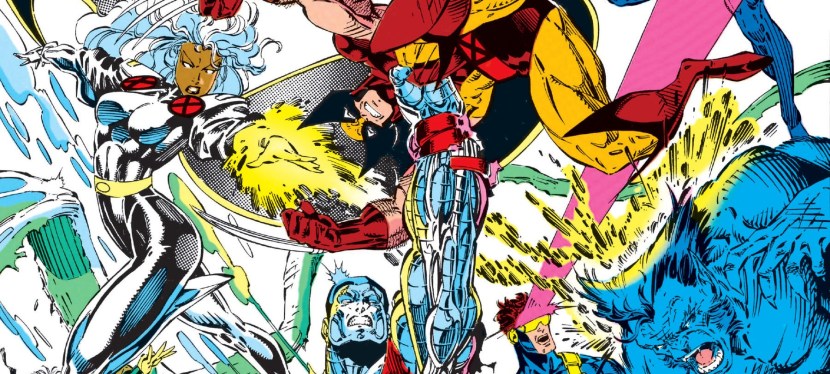
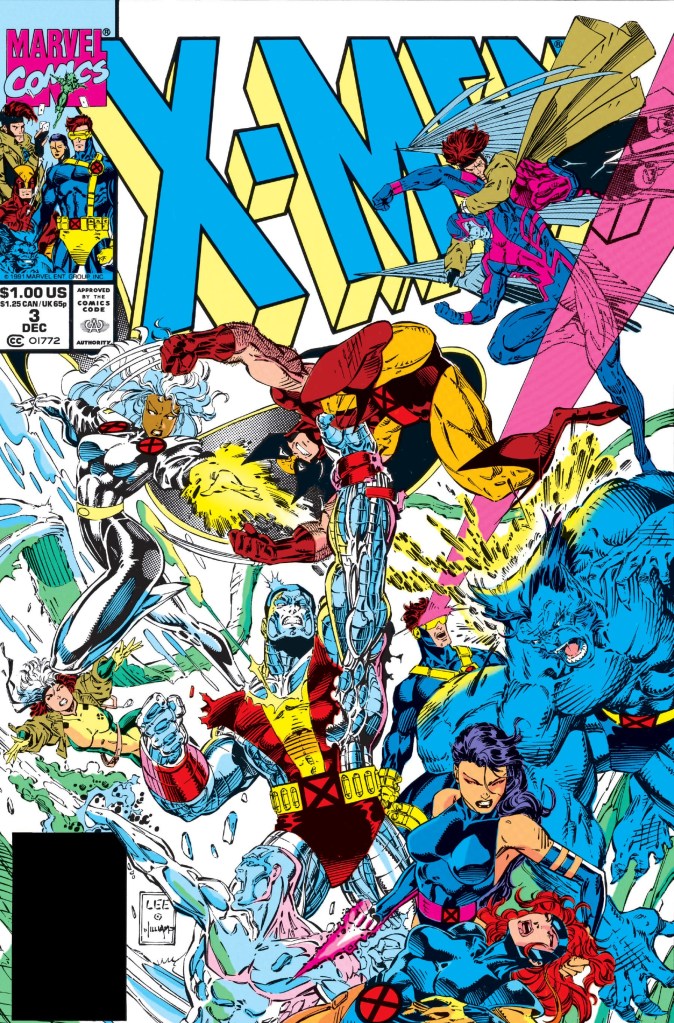
The cover.

Early story

The story begins in outer space. Members of X-Men’s Gold Team (composed of Archangel, Storm, Jean Grey, Forge, Iceman, Colossus and Banshee) fly stealthily towards Asteroid M where Magneto and his Acolytes are with Charles Xavier and Moira MacTaggert held captive. With the exception of a few, members of the X-Men Blue Team were brainwashed by MacTaggert to follow Magneto.

On Earth, the plasma cannon is being prepared to destroy Asteroid M. Nick Fury warns his colleagues about the possibility of tremendous damage if ever Asteroid M hits the surface of the planet. Valerie Cooper tells him that the firing trajectory has been calculated to blast the target away and into deep space. An exchange of words follows over diplomacy and following orders issued by the leaders.

Over at Asteroid M, Charles Xavier is alone in a room with a wide view of the Earth and space. Behind the scenes, Fabian Cortez points to Xavier as Magneto’s deadliest enemy. He asked his master why not use Moira MacTaggert’s procedure (to brainwash and turn) on Xavier. Magneto, already suffering physically, does not want Xavier turned but be broken…

Quality

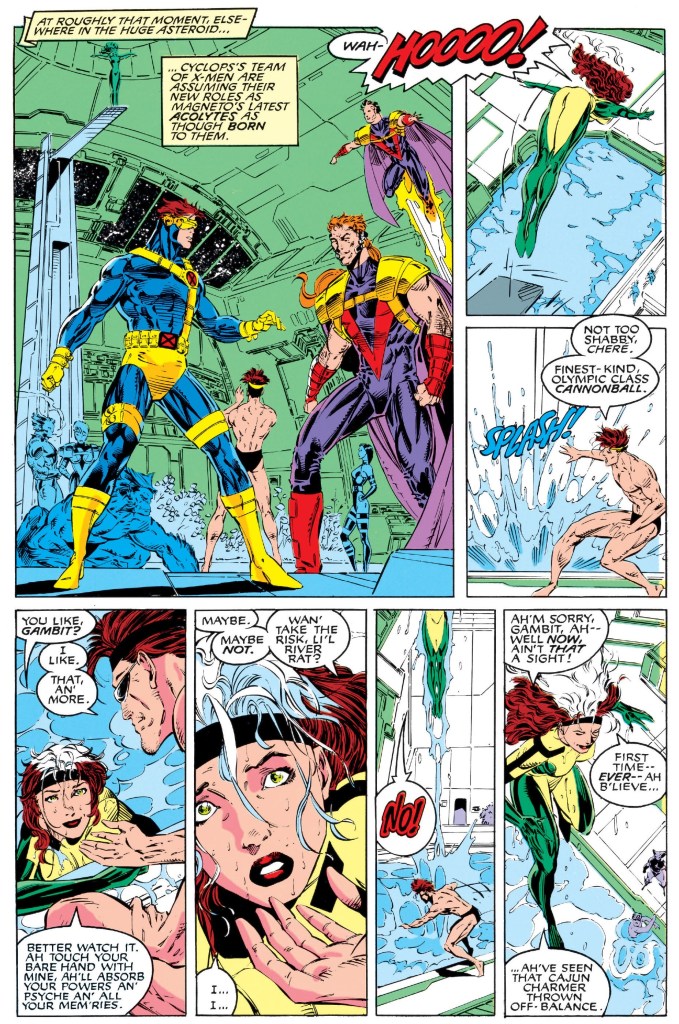
X-Men Blue Team members relaxing at Asteroid M in the presence of the Acolytes.

Like in issue , the story here is very engaging and highly dramatic. While it paid close attention to Magneto’s ruthlessness as well as his rage towards Moira who committed something unethical to him in the past, the story managed to focus enough on the X-Men which involves both the Blue Team and Gold Team mixed up. While this comic book’s cover shows a battle royale between the Blue and Gold teams, there is a lot of substance beyond the action. I’m talking about moments spent on the mutants of Xavier which was done in a satisfying manner (never felt crammed nor forced) considering the page limits of this comic book. Not only were the X-Men moments executed smoothly, there were pulled off efficiently and orderly.

More on the story, what adds intrigue is the group of Acolytes whose field leader Fabian Cortez has not only gotten very close with Magneto but also does something significant to him along the way. By this issue, the Acolytes led by the master of magnetism have gotten more established as a worthy opposition against Xavier’s mutants. This story also showed that the Acolytes were here to stay, and Fabian Cortez himself is very led by wickedness and ambition. Cortez is also an example about the distortion of righteousness

When it comes to defining the characters, Xavier and Magneto clashing together about their respective dreams about mutants is unsurprisingly epic to read. In this particular conflict, both Marvel icons were portrayed very dramatically and their respective expressions were indeed intense. Adding further intrigue to their clash is Moira’s long-past act of manipulating the very genetics of Magneto which itself raises serious questions about her perception, decision-making and ethics. In some ways, Moira looked more villain-like.

As expected, the art of Jim Lee is great to look at. There were some signs, however, that the very wordy script resulted an increased numbers of panels per page. Fortunately, the art did not look rushed and maintained a clear narrative. Also the action scenes are great to look at which is not surprising.

Conclusion

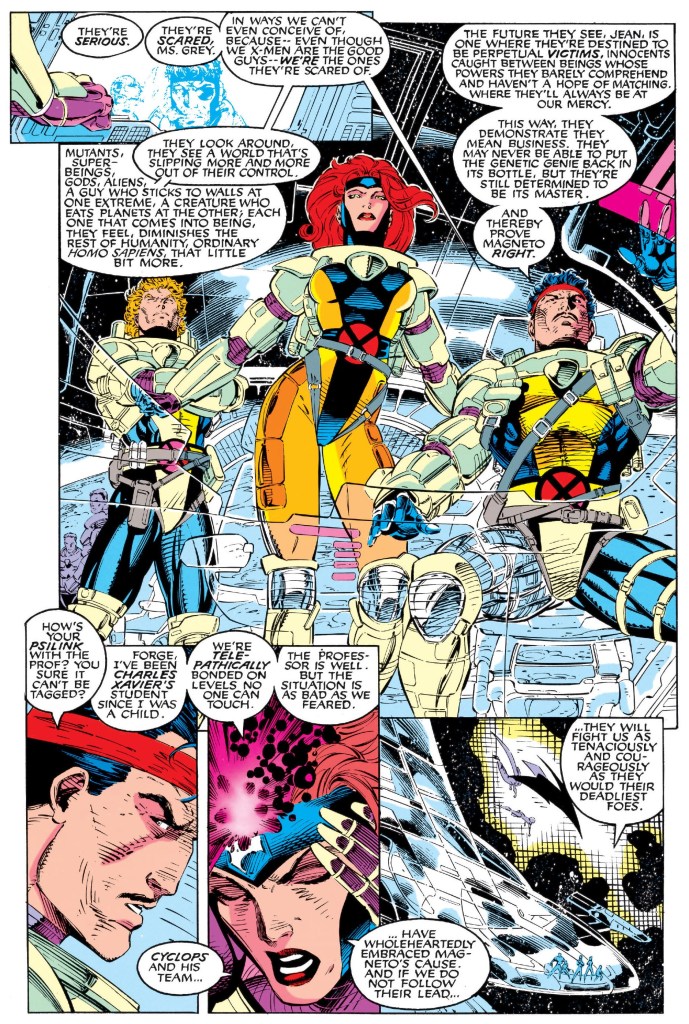
The Gold Team of the X-Men travel towards Asteroid M in a cloaked vehicle.

To put it straight, X-Men (1991) is an epic read highlighting the very conflict between Magneto and Xavier over the course of mutants and their place in the world of humans. This comic book, which has a very powerful ending, was indeed a very satisfying way to conclude the Xavier-Magneto conflict as well as Chris Claremont’s long-term stint with the X-Men comic book franchise. Back in 1991, this one really looked like the end of an era both in-story and in real life. Of course, what this comic book achieved ultimately became temporary because Magneto was revived for the Fatal Attractions storyline in 1993 (celebrating X-Men’s 30th anniversary) and Chris Claremont himself returned to Marvel Comics some years later. Still, on its own, this comic book is worth reading and adding to your collection, even if you are not an X-Men fan. It is significant enough as a piece of X-Men history from the time when Jim Lee was with Marvel.

If you are seriously planning to buy an existing hard copy of X-Men (1991), be aware that as of this writing, MileHighComics.com shows that the near-mint copy of the regular edition costs $9 while the near-mint copies of the Chris Claremont-signed edition, the signed newsstand edition, the newsstand edition and the Toy Biz edition cost $16, $26, $16 and $21 respectively.

Overall, X-Men (1991) is highly recommended!

+++++

Thank you for reading. If you find this article engaging, please click the like button below and also please consider sharing this article to others. If you are looking for a copywriter to create content for your special project or business, check out my services and my portfolio. Feel free to contact me as well. Also please feel free to visit my Facebook page Author Carlo Carrasco and follow me at HavenorFantasy@twitter.com