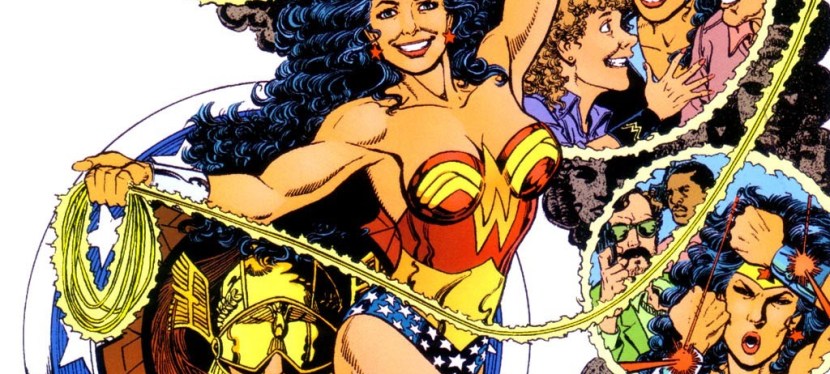
A Look Back at Wonder Woman Gallery (1996)

Disclaimer: This is my original work with details sourced from reading the comic book and doing personal research. Anyone who wants to use this article, in part or in whole, needs to secure first my permission and agree to cite me as the source and author. Let it be known that any unauthorized use of this article will constrain the author to pursue the remedies under R.A. No. 8293, the Revised Penal Code, and/or all applicable legal actions under the laws of the Philippines.

Welcome back, superhero enthusiasts, comic book collectors and fans of Wonder Woman! I should say that this is the most unusual comic book I have reviewed so far due to its main presentation of varied artworks featuring the Queen of all Superheroes herself – Wonder Woman!

For the newcomers reading this, there were several comic books back in the 1990s that did not really tell stories but showcased artworks of varied superheroes done by several artists. Such publications were in the form of swimsuit specials, apparently inspired by Sports Illustrated’s own publications. There were WildStorm Swimsuit Special #1, Ballistic Studios Swimsuit Special #1, Homage Studios Swimsuit Special #1, Lady Death Swimsuit Special #1 and the Avengelyne/Glory: Swimsuit Special #1 to name some.

The 1990s saw a rise of eroticism in superhero comic books. Not even the Wonder Woman monthly series of that time was spared from the trend. There was a time when DC Comics hired Mike Deodato to illustrate a number of Wonder Woman comic books in the mid-1990s which resulted a more eroticized look of Diana/Wonder Woman and her fellow Amazons. John Byrne took over after Deodato and his stint was not an improvement.

While the 1990s was a weak decade of Wonder Woman comics for me personally, not all was doom and gloom. Around twenty years before Gal Gadot debuted on the big screen as the cinematic Wonder Woman, DC Comics published an art gallery of the Queen of Superheroes in the form of a comic book.

With the details established, here is a look back at Wonder Woman Gallery, published by DC Comics in 1996 featuring the works of multiple artists.
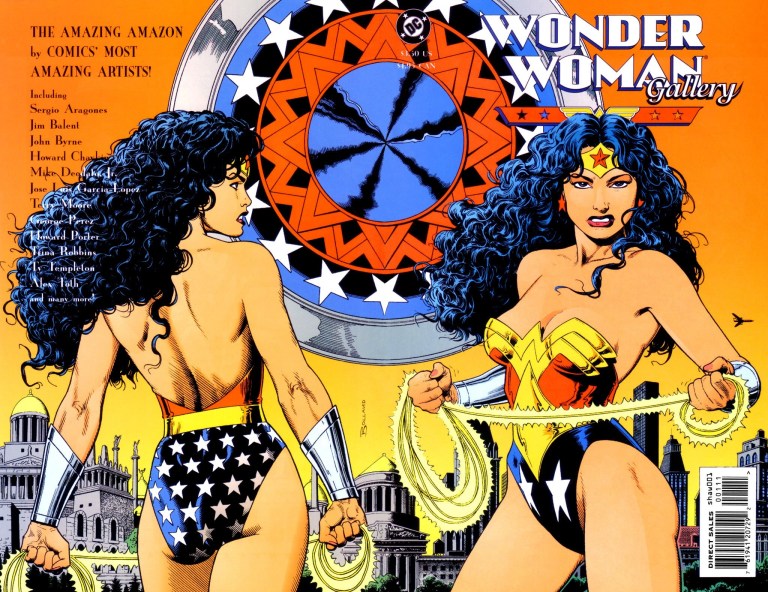
The cover.

What it is

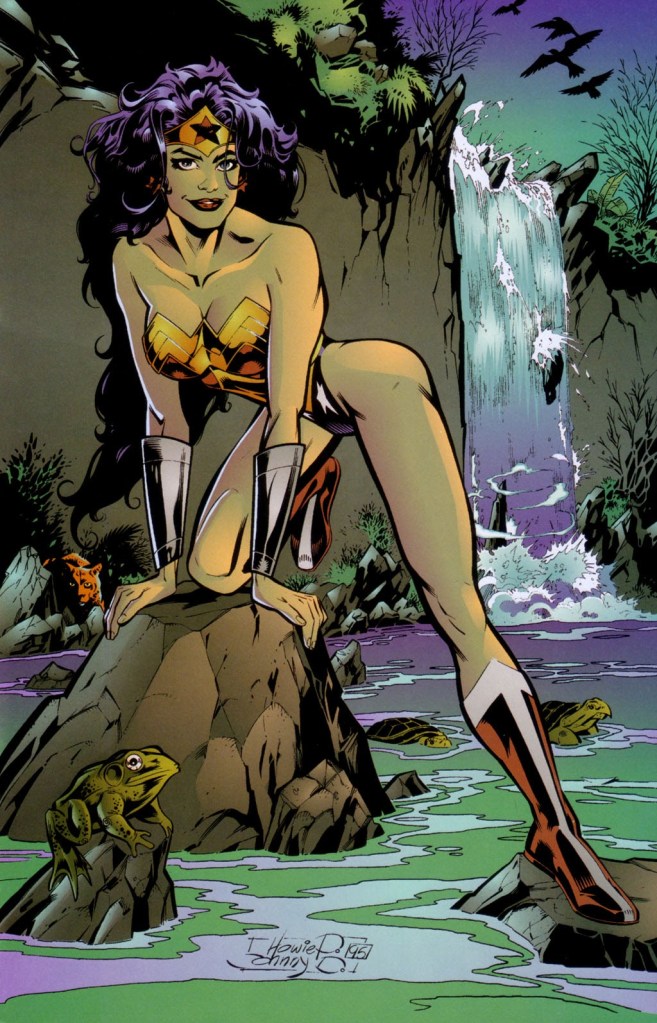
Wonder Woman Gallery is a showcase of thirty-two artworks done by George Perez, Stuart Immonen, Mike Wieringo and Richard Case, Brent Anderson, Howard Porter and John Dell, Jim Balent (misspelled as Jim Balant), Amanda Conner, Chuck Wojtkiewicz and Will Blyberg, Howard Chaykin, Steve Lightle and 22 others.

As this is an art gallery, there is clearly no story to tell. It is all artwork showcasing the different talents of the artists (and the inkers who helped them) on presenting Wonder Woman (note: the only exception here is a solo image of the forgettable WW replacement Artemis).
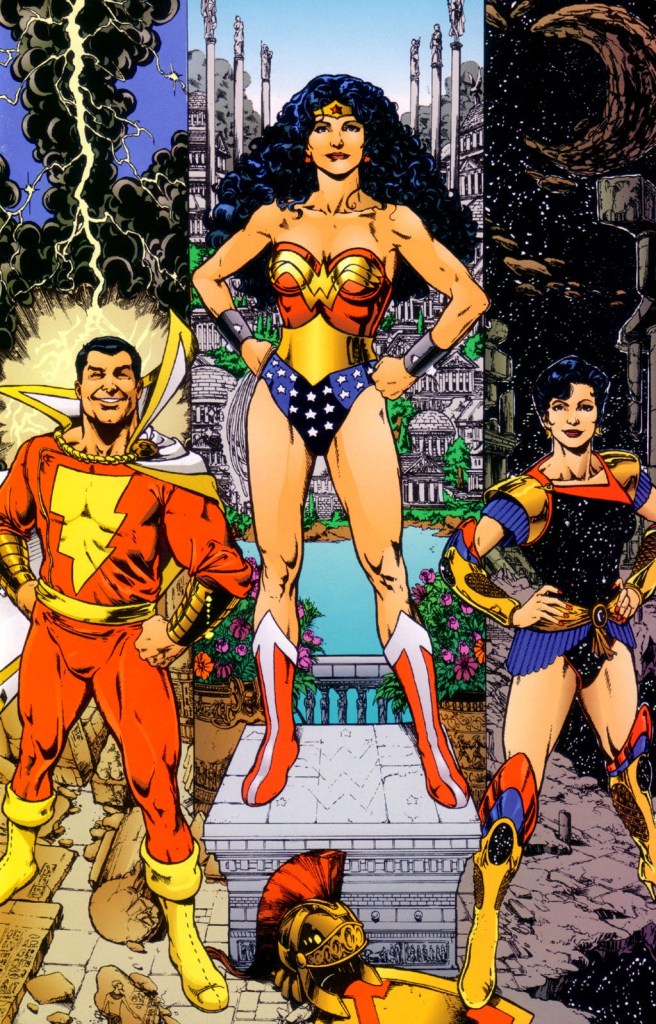
This artistic contribution by Phil Jimenez looks great.
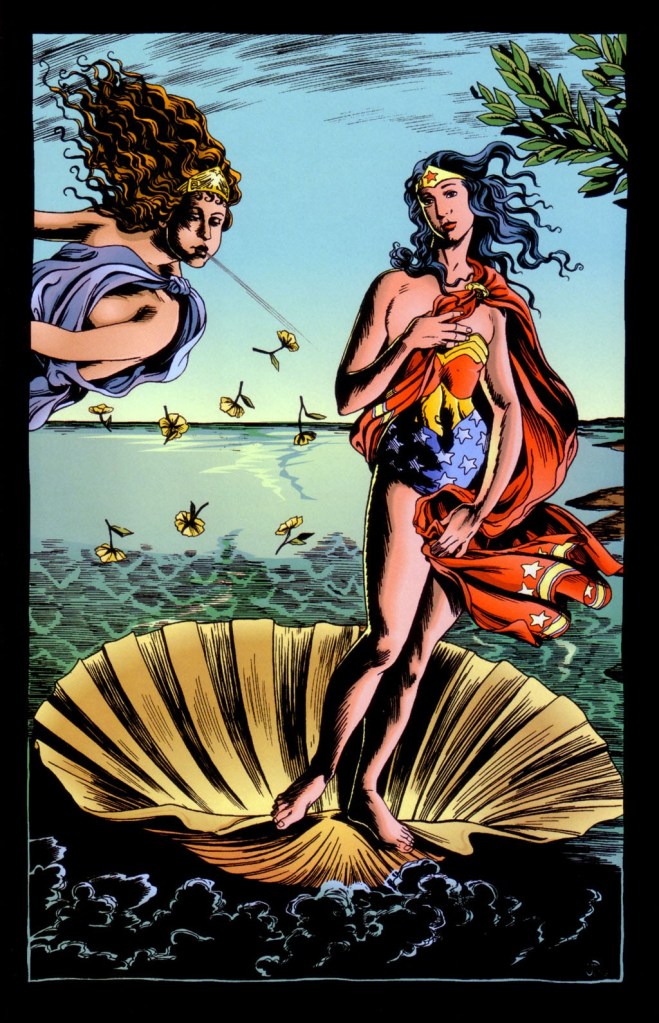
Jill Thompson’s inspired take on Wonder Woman.
Wonder Woman by Howard Porter and John Dell.
Wonder Woman by Ivan Reis and Barbara Kaalberg.

Quality

As this is an art showcase, the overall quality of the collected art here varies. Such a collection of different art styles will appeal to Wonder Woman fans depending on how they like their favorite superhero presented visually.

In my honest opinion, I always love the art style done by George Perez on Wonder Woman, her fellow Amazons, the supporting characters and more. His presentation here is flawless and timeless. What surprised me here in this collection is the contribution of Phil Jimenez whose quality and art style seem inspired by George Perez’s Wonder Woman legacy. As many of us know already, Jimenez later went on to become one of the top illustrators of DC Comics in the 2000s and his work here is nice to look.

There were a few artworks that showed Wonder Woman with a very cartoony look. Among them is the Wonder Woman piece done in the very distinct style of Sergio Aragones. Some art pieces here showed WW with a bizarre look and then there were a few others whose take on the Queen of Superheroes turned out good.

Conclusion
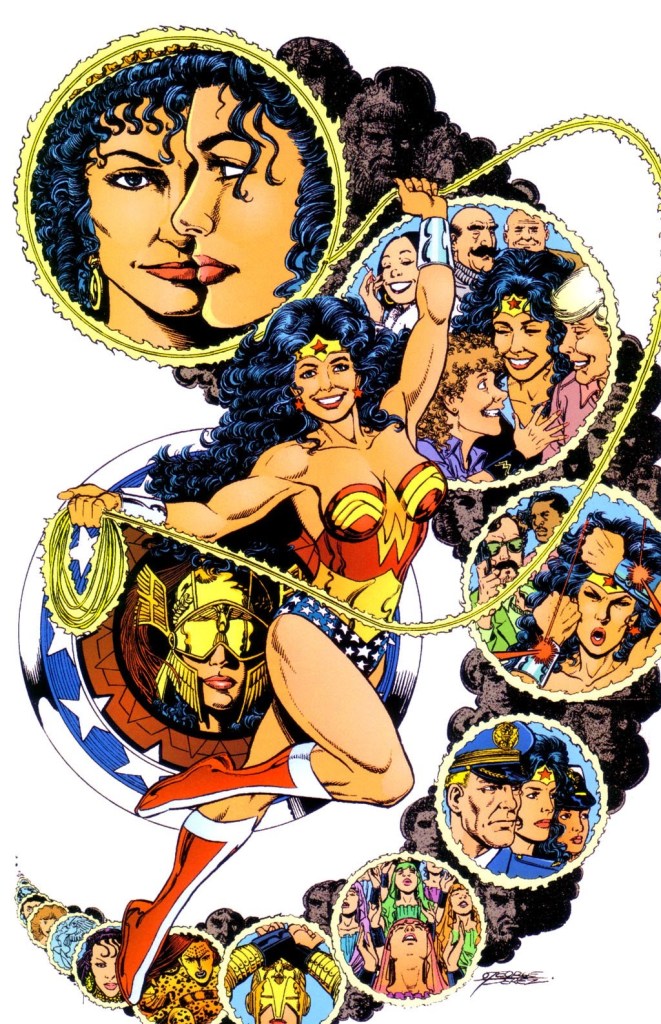
This work by George Perez is my favorite in this collection.

I can say that Wonder Woman Gallery (1996) is a published work that Wonder Woman fans will enjoy for as long as they are willing to accept images of their favorite superhero with styles ranging from realistic to cartoony, obscure and simple. Art styles aside, there is a lot here that fans will marvel at again and again, while art enthusiasts (who are not necessarily fans of the Queen of Superheroes) could find something eye-catching here.

If you are seriously planning to buy an existing hard copy of Wonder Woman Gallery (1996), be aware that as of this writing, MileHighComics.com shows that the near-mint copy of the comic book costs $40.

Overall, Wonder Woman Gallery (1996) is recommended.

+++++

Thank you for reading. If you find this article engaging, please click the like button below and also please consider sharing this article to others. If you are looking for a copywriter to create content for your special project or business, check out my services and my portfolio. Feel free to contact me as well. Also please feel free to visit my Facebook page Author Carlo Carrasco and follow me at HavenorFantasy@twitter.com
A Look Back at Mantra #3 (1993)

Disclaimer: This is my original work with details sourced from reading the comic book and doing personal research. Anyone who wants to use this article, in part or in whole, needs to secure first my permission and agree to cite me as the source and author. Let it be known that any unauthorized use of this article will constrain the author to pursue the remedies under R.A. No. 8293, the Revised Penal Code, and/or all applicable legal actions under the laws of the Philippines.

Welcome back, superhero geeks, comic book collectors and fans of the Ultraverse! Join me on this trip back into the Ultraverse and witness the events in one of the early issues of the Mantra monthly series.

In issue #2, the male warrior Lukasz found himself really challenged being inside the body of a pretty single mother Eden Blake (Mantra) whose soul his displaced. Not only does Lukasz have to avoid getting killed by troops of Boneyard as he strives to somehow leave the lady’s body in favor of a male body, he has to adjust to living as Eden who has a home to keep, a private sector job to fulfill and two children to take care of. With those details laid down, it’s now time to take a look back at Mantra #3, published in 1993 by Malibu Comics with a story written by Mike W. Barr and drawn by Terry Dodson.

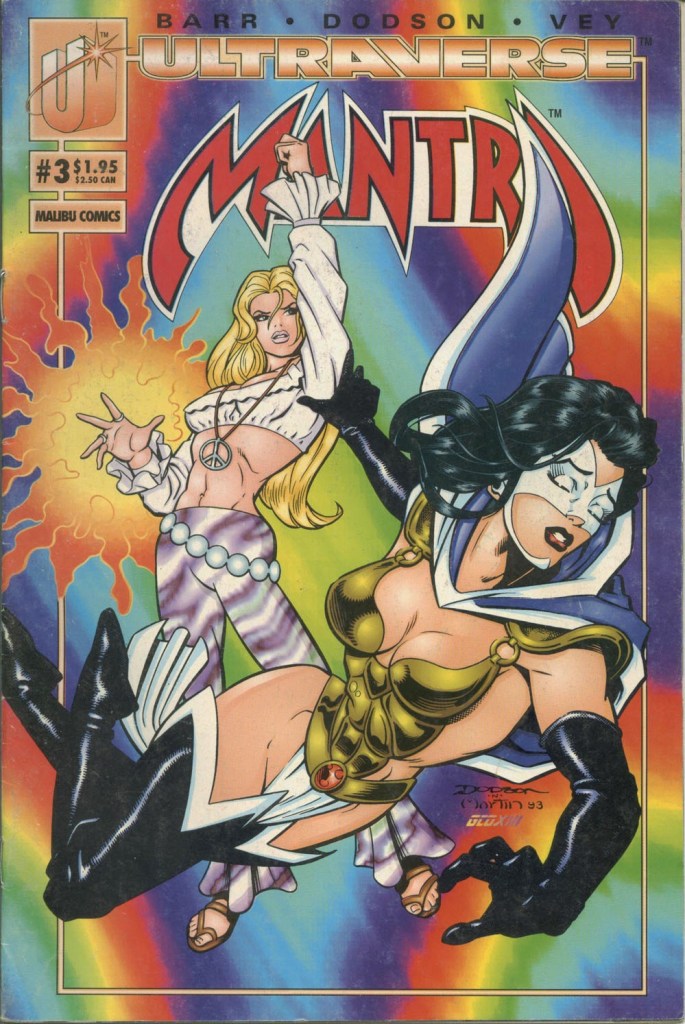
The cover.

Early story

The story begins in the hallway of the cinema wherein Mantra finds herself surrounded by the Repo Men who won’t stop at trying to overwhelm her. Mantra is at a disadvantage as she has yet to learn the ways of using magic.

As the Repo Men keep Mantra down, a group of bystanders witness what happened. Meanwhile, Eden’s daughter Evie and son Gus are in the middle of the hallway not realizing that Mantra is their mother in disguise. Eventually Mantra remembers her mantra and finally starts using magic to have the Repo Men off-balance and free herself from them. As the other Repo Men approach her, she blasts them with heat which burns them instantly in front of the bystanders. Mantra decides to fly away leaving behind Evie and Gus. The two kids are searching for their mother Eden.

Quality

Being trapped in the body of Eden Blake, the male warrior Lukasz tries to gain an advantage by charming a man he knew.

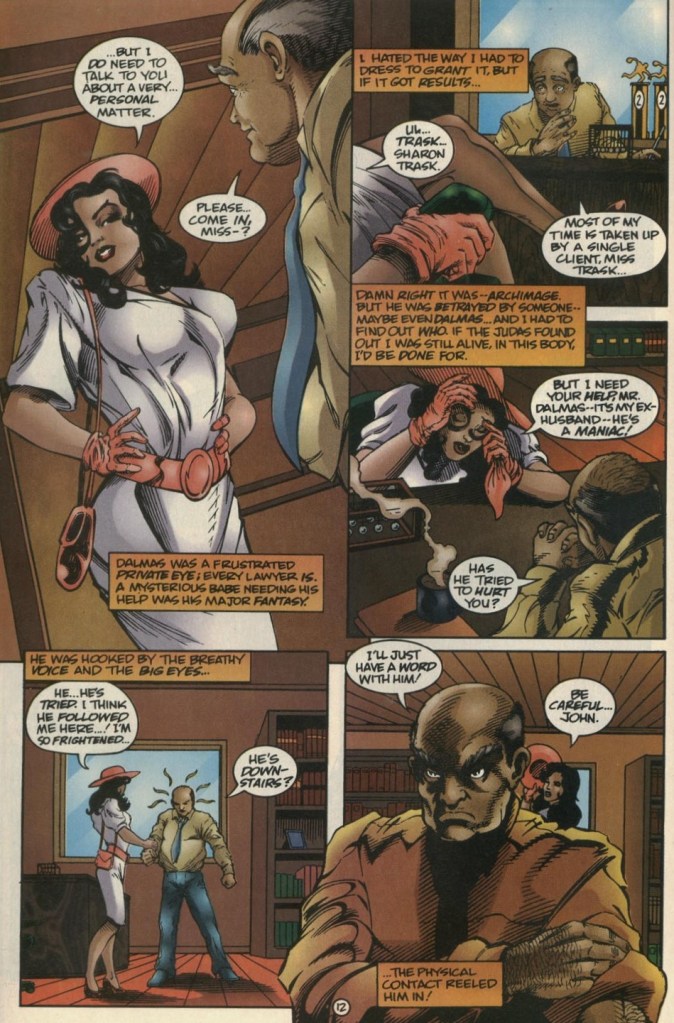
The strong quality of storytelling that started in issue #1 and followed through issue #2 is present in this comic book. Mike W. Barr’s story here remains nicely balanced between plot, character development and spectacle. I can also confirm that this story explores more of Lukasz struggling with living the domestic life of Eden which unsurprisingly makes his struggle to meet his goals even tougher. When it comes to defining the characters, there is a very touching scene in which Lukasz as Eden talks privately with a crying Evie in her bedroom, and even with an attempt to somehow separate themselves the unexpected (but really touching) result happens. And then there was another scene in which Lukasz uses Eden’s beauty to charm his way with someone for answers. This comic book’s script was undoubtedly written cleverly by Mike W. Barr.

Like in the first two issues, Terry Dodson excelled with visualizing the script. By this particular issue, the looks of Mantra and other related characters have been well established and he drawn them with a pretty good amount of detail. Dodson’s art here shines even more once Mantra begins to encounter one very particular adversary (note: she’s on the cover) and how it all turns out is something for you readers to find out for yourselves.

Conclusion

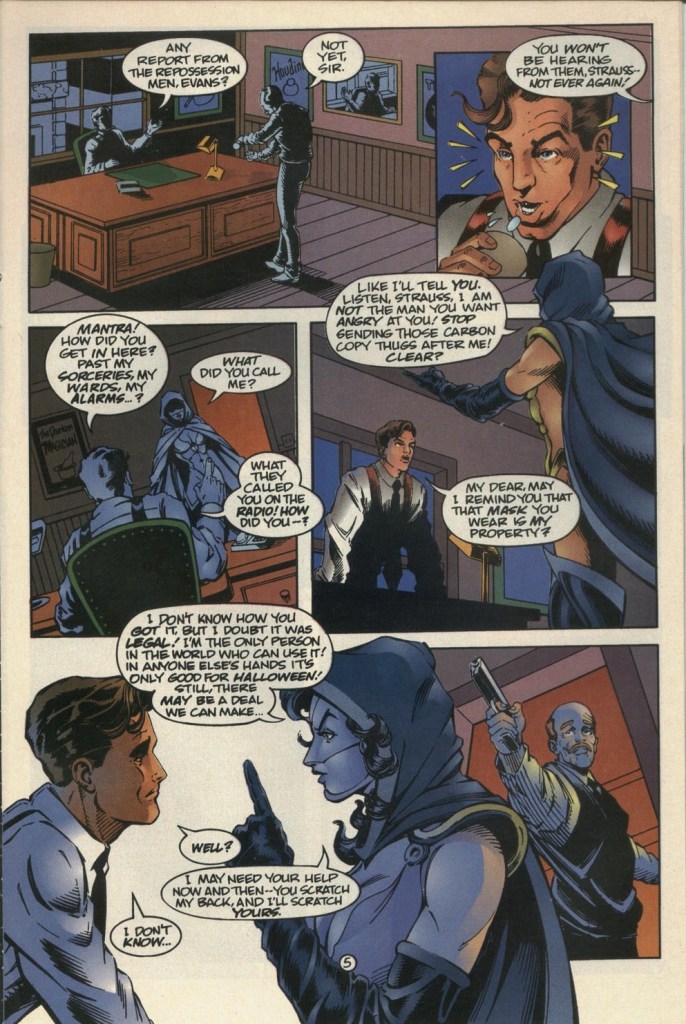
Mantra in a serious discussion.

I can confirm that Mantra #3 (1993) is a compelling Ultraverse story to read as it continues to be intriguing and define Mantra’s personality in an efficient and believable way. Along the way are revelations that further establish the core concepts of this monthly series and the way they were done shows strong preparations were made by Mike W. Barr before writing the script.

If you are seriously planning to buy an existing hard copy of Mantra #3 (1993), be aware that as of this writing, MileHighComics.com shows that the near-mint copy of the regular edition costs $8 while the near-mint copy of the newsstand edition costs $26.

Overall, Mantra #3 (1993) is recommended.

+++++

Thank you for reading. If you find this article engaging, please click the like button below and also please consider sharing this article to others. If you are looking for a copywriter to create content for your special project or business, check out my services and my portfolio. Feel free to contact me as well. Also please feel free to visit my Facebook page Author Carlo Carrasco and follow me at HavenorFantasy@twitter.com
Darna project starring Jane de Leon now an upcoming TV series

It’s been quite a long time since there has been any official news released about the much-delayed Darna project that currently has Jane de Leon as its star. It is true that the current pandemic set much of the whole world back and that is very true with businesses, governments and entertainment to name a few. Making a production of television or movies is more challenging than before which probably explains why the Darna project with De Leon has been turned into a TV series.

That’s right! The Darna project that was conceived to be a movie that had Liza Soberano as its original star (before De Leon replaced her) will be remade for television audiences here in the Philippines. The new series should debut in 2021.

Jane de Leon is still the star of the Darna project which is now an upcoming TV series set for 2021. (photo a property of ABS-CBN)

In an article at ABS-CBN.com, the hard adjustment of the Darna project was announced on December 5, 2020 during the special contract signing event titled Star Magic Shines On. ABS-CBN’s chief operating officer of broadcast Cory Vidanes said that the Darna TV series has been approved and will indeed push through with its broadcasting sometime next year. It was also made clear that Jane de Leon is still the star in portraying the Philippine superhero icon.

Below are excerpts from the article:

“I’m overwhelmed by the happiness I feel. I am so excited for the next chapters of my life,” Jane said.

“It’s another dream come true. I have so much gratitude for our bosses because until now, they still entrust me with Darna’s stone,” she added.

Those were the details as of this writing. It remains to be seen who else will star in the Darna TV series and what characters as well as what villains will be featured. How many episodes will be made, what costume design of Darna for Jane de Leon will be used, and what the frequency of the series will be have yet to be revealed.

The way I look at it, the pandemic made ABS-CBN rethink its current strategy on selling entertainment. For many months now, most movie theaters here in the Philippines have been closed which makes a Darna movie not feasible.

This not the first time that stories of Darna will be broadcast to many households nationwide. ABS-CBN’s rival GMA Network produced a Darna series starring the famous Angel Locsin, and another series starring Marian Rivera. Both Darna TV series were released just a few years apart from each other. By the time ABS-CBN’s own series of the superhero icon finally starts broadcasting, it will be the first time in over a decade Filipinos saw new Darna stories on their TV sets.

In ending this article, I want to ask you my readers: What do you think of this latest move by ABS-CBN? Do you still want to see a Darna movie starring Jane de Leon? To answer, please comment below. Thank you and come back here for future updates about Darna.

+++++

Thank you for reading. If you find this article engaging, please click the like button below and also please consider sharing this article to others. If you are looking for a copywriter to create content for your special project or business, check out my services and my portfolio. Feel free to contact me as well. Also please feel free to visit my Facebook page Author Carlo Carrasco and follow me at HavenorFantasy@twitter.com
A Look Back at Mantra #11 (1994)

Disclaimer: This is my original work with details sourced from reading the comic book and doing personal research. Anyone who wants to use this article, in part or in whole, needs to secure first my permission and agree to cite me as the source and author. Let it be known that any unauthorized use of this article will constrain the author to pursue the remedies under R.A. No. 8293, the Revised Penal Code, and/or all applicable legal actions under the laws of the Philippines.

Welcome back, superhero geeks, comic collectors and fans of the Ultraverse! We are about to return to the Ultraverse through the view of Mantra. Since the story of issue #9 and issue #10, the stakes have been raised as Mantra not only found herself in bigger danger as well as revelations from the past related to the long-time war between Archimage and Boneyard. Not only is Mantra still being targeted by Boneyard (who is so evil he wants to marry Mantra and make love to her body even though he knows the soul of the male warrior Lukasz is occupying it) but also by sorcerers from the Earth’s realm. In other words, Mantra/Lukasz really has trouble in different realms.

Will something unexpected turn out in the next story of Mantra? We can find out in this look back at Mantra #11, published in 1994 by Malibu Comics with a story written by Mike W. Barr and drawn by Robb Phipps.

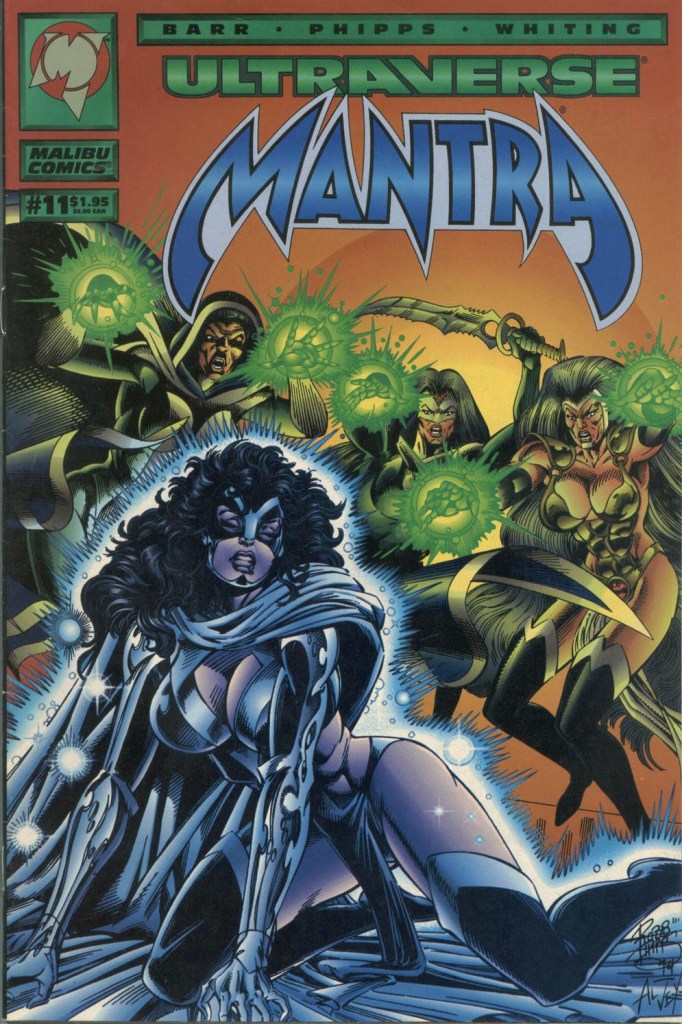
The cover.

Early story

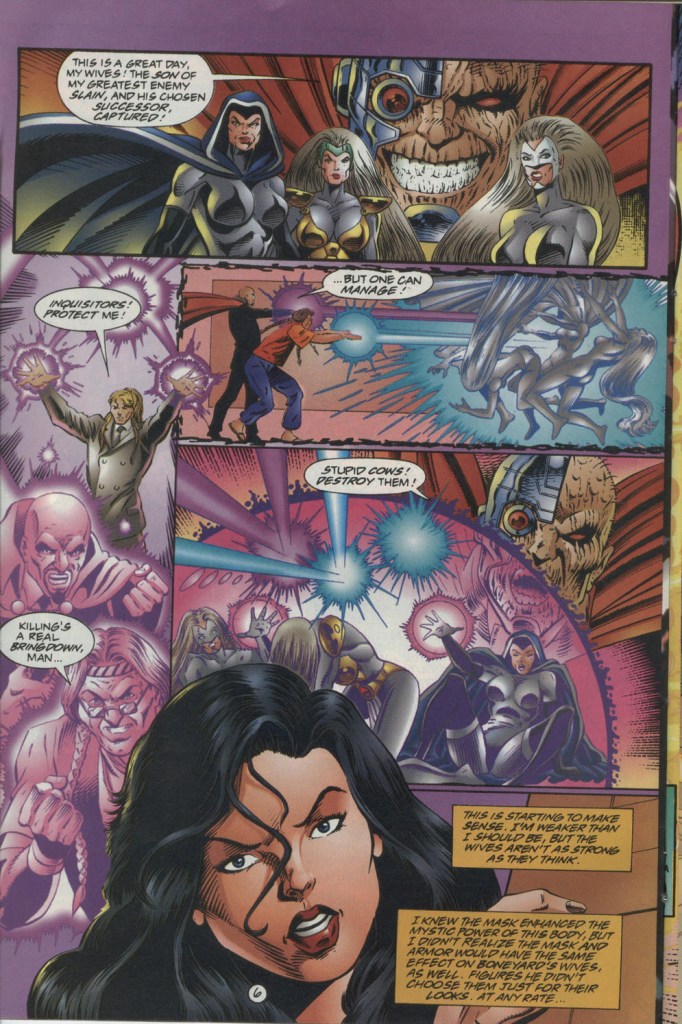
The story begins with Mantra standing completely naked in the full view of Boneyard, his three wives and the four other thugs (who hunted Mantra). Boneyard states, “Your choices are clear, Lukasz—surrender to me and become first among equals in my harem…or be destroyed by my wives—whose powers now equal yours!”

Suddenly the three wives fire beams of energy towards Mantra who successfully blocks them using magic to create a transparent shield. Very quickly, Mantra sees an opportunity to get the other thugs involved as targets of the three wives so she moves toward her previous attackers. The three wives’ attacks cause the thugs to retreat. Boneyard recognizes one of the thugs as the son of his rival Archimage.

Suddenly, the thugs attack Boneyard’s three wives with energy causing them to fall down on the floor. As the conflict shifted, Mantra begins to realize something.

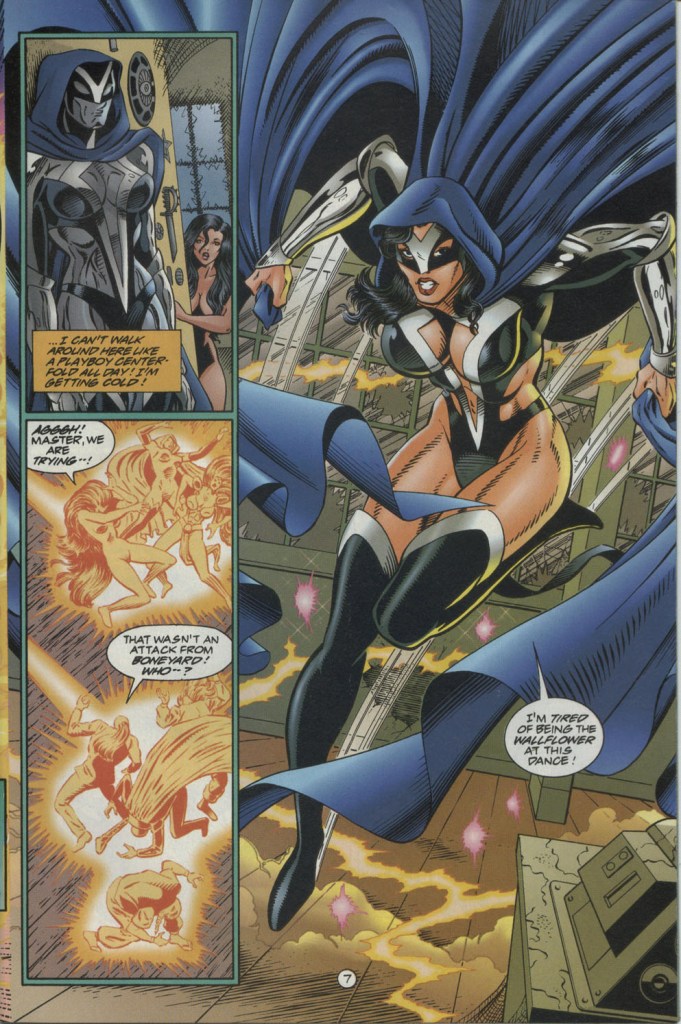
“I knew the mask enhance the mystic power of this body, but I didn’t realize the mask and armor would have the same effect on Boneyard’s wives as well. Figures he didn’t choose them just for their looks. At any rate…I can’t walk around here like a Playboy centerfold all day! I’m getting cold,” Mantra thought.

Quality

This is the first time Mantra wore a new costume which was carried over to issue #12.

No surprise, Mike W. Barr successfully kept the story engaging not only maintaining the engagement carried over from the few previous issues but by raising the stakes for Mantra personally while pulling off some pretty notable revelations that date back before the events of issue #1. Going beyond Boneyard and his three wives, there is a lot of fantasy related stuff waiting to be discovered which further adds depth to Mantra’s struggle (finding a male body to occupy and the ways to leave Eden Blake’s body). The plot really thickened with the revelations and how they turned out is something that you yourselves must pick up a copy of this comic book and read.

Of course, having reviewed issue #12 recently, it is no surprise that the build-up of engagement and suspense in this comic book contributed to its successor. More importantly, by the time you reach the end of this comic book, you will get a deeper understanding of what has been going and what preceded them. Clearly Mike W. Barr made solid preparations and took his time with the revelations just as he kept on telling the present-day story of Mantra.

Like the previous issue, I enjoyed Robb Phipps’ artwork here. If you were disappointed with the cartoony aesthetic of Terry Dodson’s work in issue #10, you will like the expressions as well as the overall style of Phipps.

Conclusion

With a male soul inside the body of Eden Blake, Mantra quickly analyzes the messy situation to find an advantage.

Mantra #11 (1994) is indeed a pretty entertaining and compelling Ultraverse comic book. There is nothing like watching the spectacle happen in between moments of Mantra realizing answers to her questions, and learning new details (including stuff that emphasized how rotten, how wicked and twisted Boneyard truly is as the major villain of not only this particular series but also of the Ultraverse itself) that deepened the narrative for readers.

If you are seriously planning to buy an existing hard copy of Mantra #11 (1994), be aware that as of this writing, MileHighComics.com shows that the near-mint copy of the comic book costs $8.

Overall, Mantra #11 (1994) is recommended.

+++++

Thank you for reading. If you find this article engaging, please click the like button below and also please consider sharing this article to others. If you are looking for a copywriter to create content for your special project or business, check out my services and my portfolio. Feel free to contact me as well. Also please feel free to visit my Facebook page Author Carlo Carrasco and follow me at HavenorFantasy@twitter.com
A Look Back at The Solution #7 (1994)

Disclaimer: This is my original work with details sourced from reading the comic book and doing personal research. Anyone who wants to use this article, in part or in whole, needs to secure first my permission and agree to cite me as the source and author. Let it be known that any unauthorized use of this article will constrain the author to pursue the remedies under R.A. No. 8293, the Revised Penal Code, and/or all applicable legal actions under the laws of the Philippines.

Welcome back, superhero geeks, comic book collectors and fans of the Ultraverse! Some time ago, I reviewed the sixth issue of The Solution and it turned out to be a pretty compelling and fun comic book to read. I was pleasantly surprised by its high quality and presentation, and by the end I found Lela Cho/Tech (the leader of The Solution) to be a very interesting character of the Ultraverse. Clearly the creative duo of James Hudnall (who also wrote Hardcase) and John Statema literally scored a home run with The Solution #6.

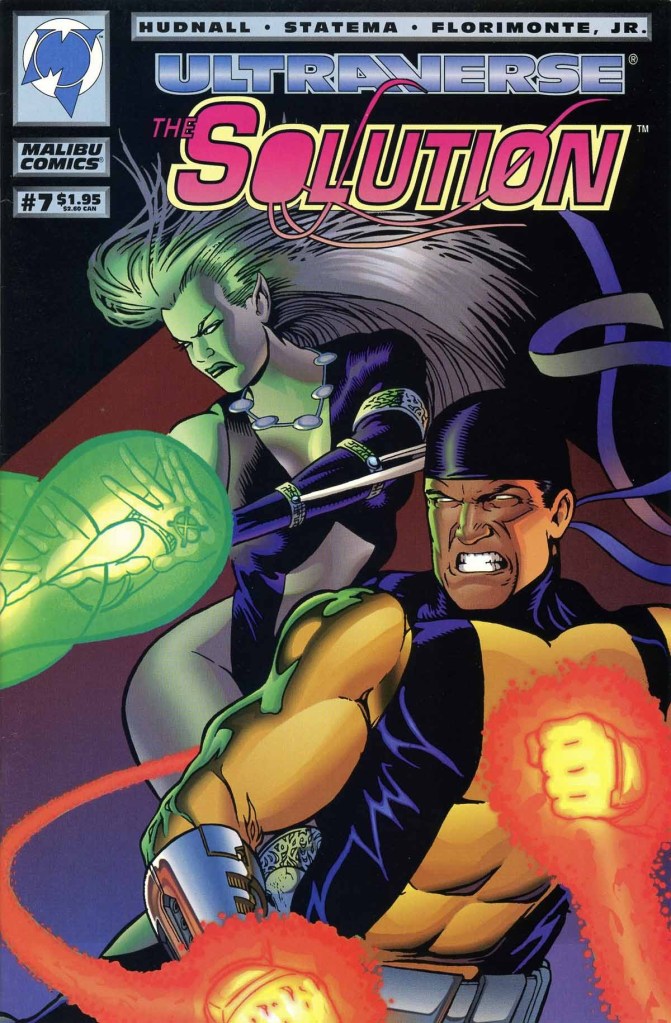
As The Solution #6 focused on the background story of Tech, its portrayal of the current-day events was laced with suspense, drama and intrigue that only teased what could happen in the next moment. What else could be told about Lela Cho’s past and what might happen next in the present day? We can find out in this look back at The Solution #7, published in 1994 by Malibu Comics with a story written by Hudnall and drawn by Statema.

The cover.

Early story

The story begins with Lela Cho accompanied by Troy Wilde standing in front of her father’s grave. The two don’t seem to know that they are being spied on from a distance. A group has set up snipers to take them down.

As the two begin to talk, Lela tells Troy details from her past. She recalls that after the sudden death of her father, she could not fully gain the inheritance from her father – the corporation – as its board of directors refused to accept her. As it turned out, a crime gang anticipated her every move and stole her company. To enhance herself, she paid specialists to install wetware implants into her body to make her the mistress of electronic devices.

She arrived in the city of New York already aware that she has been marked by her enemies, and she knew they would come for her. In New York, she meets with Peter Bazinni to seek help. Not only is he a man with many powerful connections, he was also her old flame. While Peter admitted he could not help her in her conflict with the international crime gang, she gives her a reference to another professional who is her best bet. His name was Troy Wilde…   

Quality

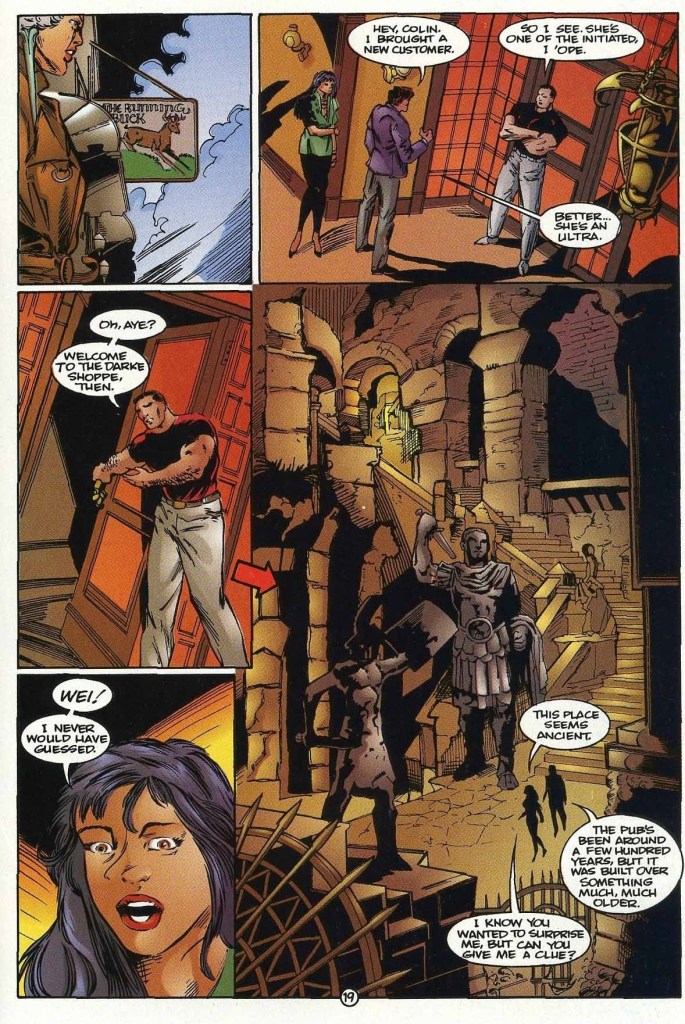
Discovering the secret locations.

James Hudnall delivered another pretty solid story. It’s got a nice mix of elements here and there. From time to time, I felt like I was reading a detective story, then a murder tale, then a hard action tale and then a hard-edged superhero tale. While this comic book continued on telling the origin of Lela Cho, it shifted focus on the background of Troy Wilde who would eventually join the team with the codename Dropkick. How Lela and Troy first interacted with each other was very carefully crafted with believable dialogue and well-defining personalities from each (as reflected in the way they talked with each other). Another member of The Solution appeared in here is as well.

What surprised me here was the revelation of a certain villainess. At first, she looked like a probably disposable villainess but proved to be more significant than meets the eye. If you get to read the succeeding issues of The Solution, you will realize what I just stated.

As with his past works, John Statema’s art here is pretty good. The good stuff he delivered in issue #6 continued to shine here.

Conclusion

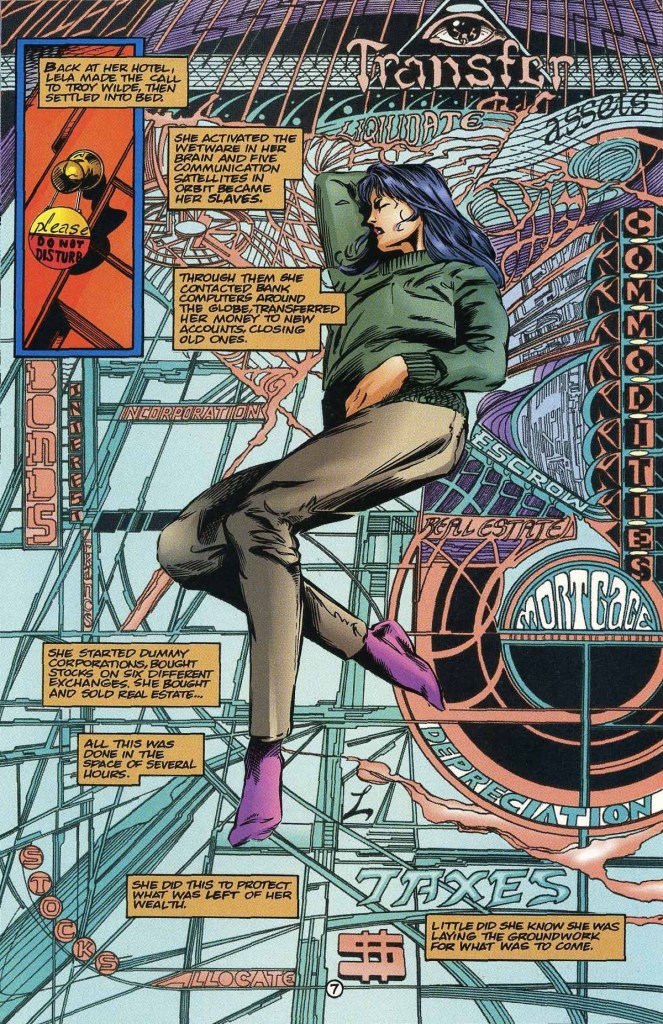
Lela Cho’s ultra ability to hack systems and alter digital stuff would help her fit in nicely with this age of social media and streaming.

The Solution #7 (1994) is not only a worthy follow-up to its predecessor, it is one of the stronger origin-type comic books of the Ultraverse as a whole. While the previous issue was focused mainly on Lela Cho, this one shows Troy Wilde/Dropkick making his first involvement with her as well as the eventual formation of their team. At this stage, the story of how The Solution got formed really took shape here. I should state, however, that the level of engagement fell down a bit compared to the previous issue.

If you are seriously planning to buy an existing hard copy of The Solution #7 (1994), be aware that as of this writing, MileHighComics.com shows that the near-mint copy of the comic book costs $8.

Overall, The Solution #7 (1994) is recommended.

+++++

Thank you for reading. If you find this article engaging, please click the like button below and also please consider sharing this article to others. If you are looking for a copywriter to create content for your special project or business, check out my services and my portfolio. Feel free to contact me as well. Also please feel free to visit my Facebook page Author Carlo Carrasco and follow me at HavenorFantasy@twitter.com

A Look Back at X-Men Unlimited #1 (1993)

Disclaimer: This is my original work with details sourced from reading the comic book and doing personal research. Anyone who wants to use this article, in part or in whole, needs to secure first my permission and agree to cite me as the source and author. Let it be known that any unauthorized use of this article will constrain the author to pursue the remedies under R.A. No. 8293, the Revised Penal Code, and/or all applicable legal actions under the laws of the Philippines.

As mentioned before (refer to my reviews of X-Men 2099 #1 and X-Men #25), 1993 was the year when the 30th anniversary of the X-Men was celebrated. Back then, Internet connection was not very accessible to the public, social media had not been invented and streaming movies and TV shows was not yet the norm. How did Marvel Comic organize the celebration for X-Men fans? By publishing a lot of comic books and selling merchandise.

In the first quarter of 1993, Marvel Comics went on to feed the perceived high demand of X-Men fans by launching X-Men Unlimited which was an all-new comic book series with a schedule of quarterly releases per new comic book (initially with 64 pages of content using glossy paper). They released X-Men Unlimited #1 in March 1993 and I bought a copy for a hefty $3.95.

So what exactly did the said comic book feature? Was it good? We can all find out in this look back at X-Men Unlimited #1 published by Marvel Comics with a story written by Scott Lobdell and drawn by Chris Bachalo.

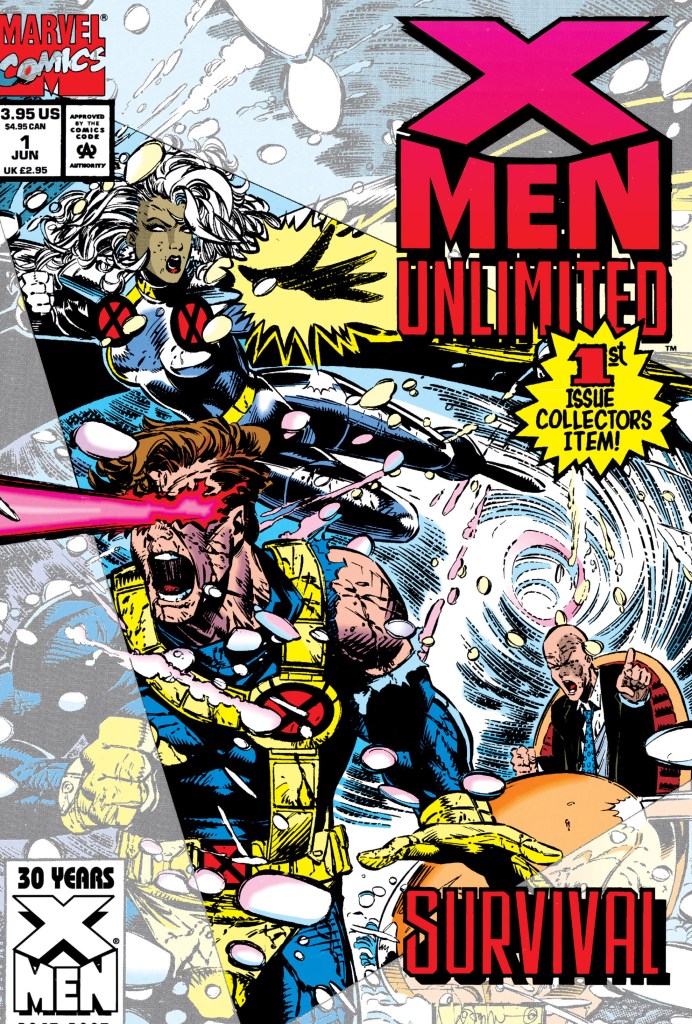
The cover.

Early story

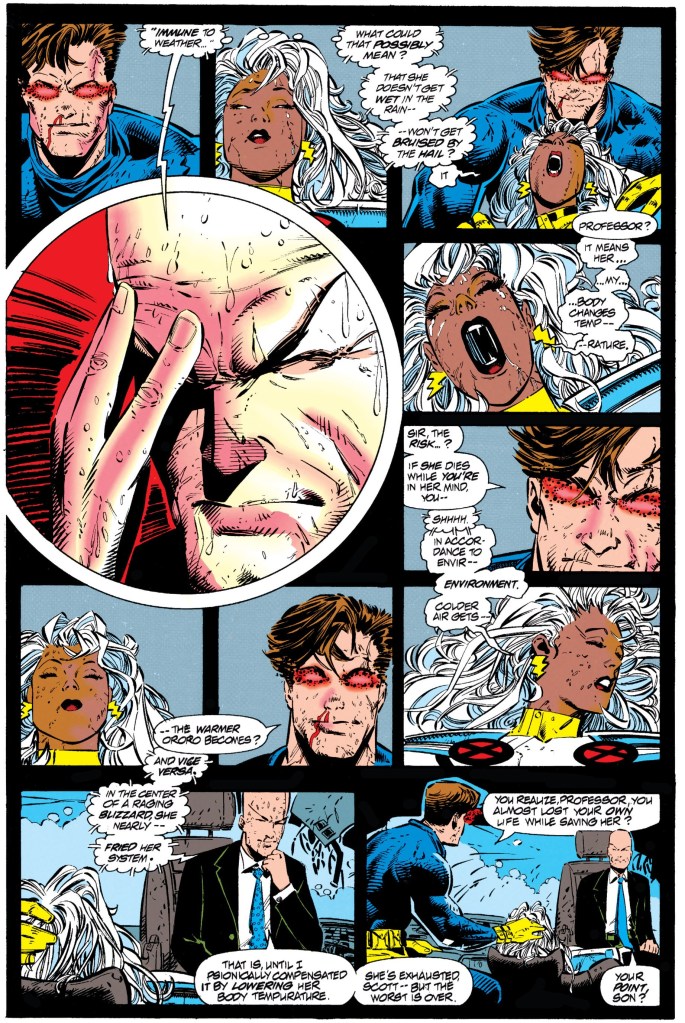
The story begins on the snowy surface of Antarctica where the Blackbird (the X-Men’s jet) has crashed. Cyclops is outside the crashed jet already suffering from internal bleeding and other injuries. As his ruby quartz visor has been lost, he desperately keeps his eyes shut to avoid firing any optic blast. Even with tremendous odds against him, Cyclops concentrates very hard to reach out to Charles Xavier and successfully makes contact. Xavier is surprised.

With telepathic assistance provided by Xavier, Cyclops successfully reaches him and carries him. After some searching, they spot Storm alone on the snow. Elsewhere, a lady gets up from the snow and walks towards a facility. Upon entering, there are scientists working with computers and they called her Ms. Blaze. She asked them if she succeeded in killing Cyclops, Storm and Xavier…

Quality

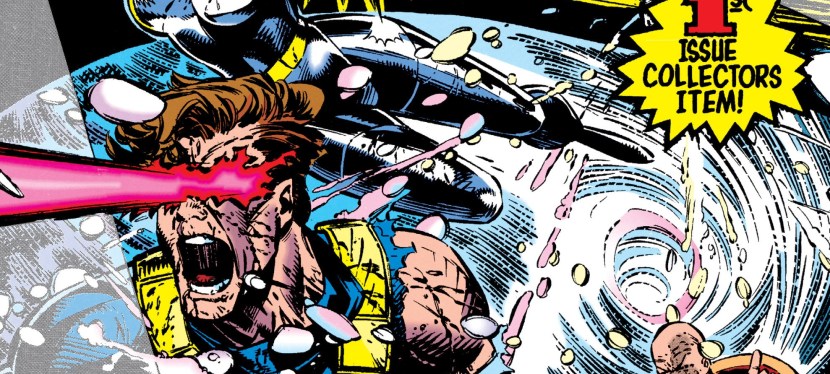
Artist Chris Bachalo failed to pace his art properly on this page.

To get to the point, I should state that the main lesson of this X-Men story written by Lobdell is about leadership mixed with responsibility and survival. Symbolically, the three leaders of the X-Men (Xavier the head with Blue Team leader Cyclops and Gold Team leader Storm) were placed in a situation of great odds and their respective powers cannot just help solve their problems nor help them get away easily. Here we get to see Cyclops, Storm and Xavier really struggling and having no choice but to use their wits as well as skills learned from the past in order to survive and progress. This is easily the comic book’s most unique feature and it is very rare to see Xavier and the two team leaders spend a lot of time together and work with each other. As far as emphasizing the leadership dynamics of the X-Men is concerned, Lobdell succeeded. I should also state that Lobdell really dramatized the respective personalities of the three.

Still there are some notable flaws. I should say the story had lots of dragging moments in between and the overall pace is between slow and medium. The dialogue is quite wordy and ultimately a lot of it felt like fillers than actual attempts to develop personalities and explain things. There were attempts to make the dialogue more philosophical but end up dragging the narrative. I should state that verbal descriptions or narrations in certain pages were quite excessive. If you are looking for superhero spectacle, there is actually little to enjoy here and by the time the final conflict is over, you will end up unsatisfied. Of course, there are also scenes of incidental moments (examples: explosions, the environment causing damage, etc.) that were emphasized as if to make up for the lack of superhero spectacle.  

The antagonist Sienna Blaze is not a compelling villainess. There is no justification as to why she tried to kill the X-Men. The way she is presented, Blaze is more like a reckless and impulsive teenager than a real opposing force against Xavier and his mutants.

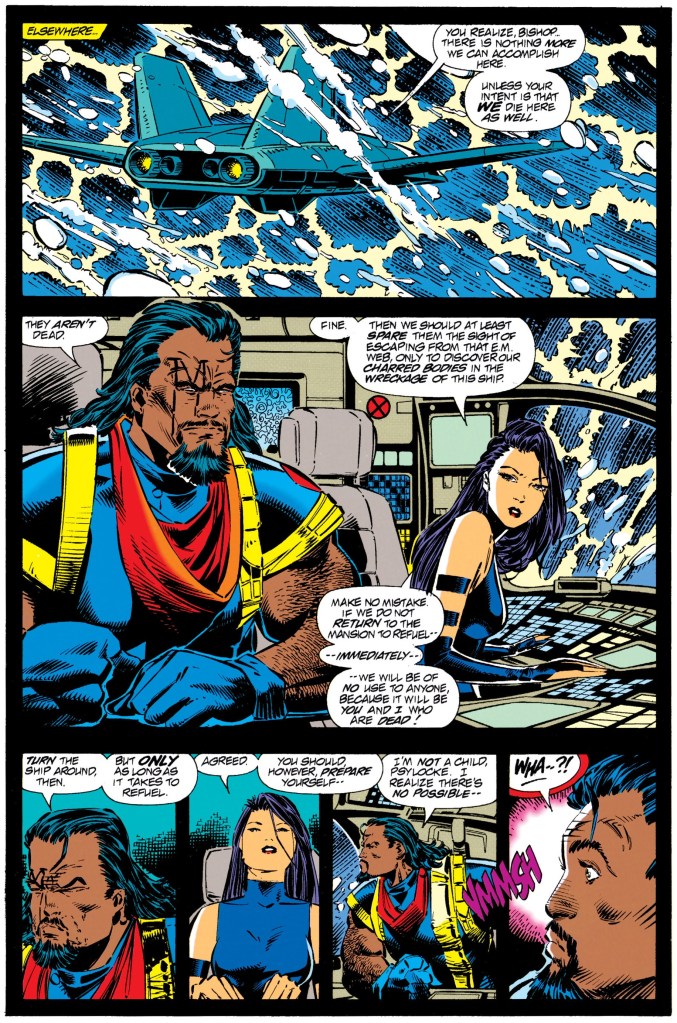
Psylocke and Bishop were the other X-Men members who appeared.

Lastly, there is the art by Chris Bachalo which has always been sub-par and disappointing to look at. While Bachalo did a decent job drawing disaster-related moments, his art on drawing the X-Men really sucked. There were many times when Charles Xavier LOOKED LIKE A DUMMY (think mannequin) than a living person as drawn by Bachalo. The art of this comic book was disappointing in 1993, and it has aged badly by today’s standards.

Apart from the main story, this comic book has a gallery of artworks highlighting the X-Men (including members who did not appear in the said story) done by varied illustrators. The quality of the art, unsurprisingly, is a mixed bag. Ultimately the art gallery served as convenient filler made to satisfy the cravings of X-Men fans.

Conclusion

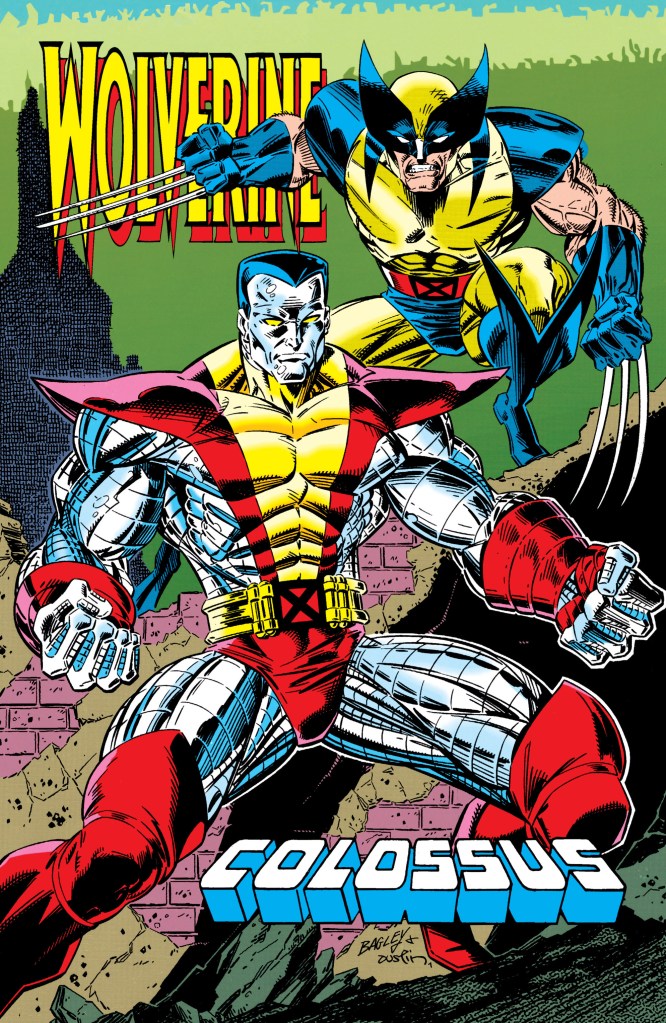
This is how Wolverine and Colossus look as drawn by Mark Bagley who was the Amazing Spider-Man artist of the time.

Apart from being made to sell a bunch of copies and take advantage of the comic book collector craze of the time, X-Men Unlimited #1 (1993) was an effort to keep defining the X-Men for fans and comic readers of the 1990s by adding depth to the bond between Xavier, Storm and Cyclops. The problem is with the execution as the story dragged a lot, and a whole lot of dialogue and text descriptions were made as if to ensure that enough content would fit the 64-pages of content of the comic book. As far as 1993 X-Men comic books go, this one has one of the worst looking artworks used in storytelling. When it comes to its connection with the 30th anniversary of the X-Men, what happened to Xavier in this comic book is connected to the events of Uncanny X-Men #304 and #310.

If you are seriously planning to buy an existing hard copy of X-Men Unlimited #1 (1993), be aware that as of this writing, MileHighComics.com shows that the near-mint copy of the regular edition costs $10 while the near-mint copies of the signed edition (without certificate), the newsstand edition and the signed edition (with certificate of authenticity) cost $105, $32 and $105 respectively.

Overall, X-Men Unlimited #1 (1993) is unsatisfying. If I were you, I would avoid spending any money above its cover price. Considering its quality, the near-mint copy of this comic book is really worth only $1.

+++++

Thank you for reading. If you find this article engaging, please click the like button below and also please consider sharing this article to others. If you are looking for a copywriter to create content for your special project or business, check out my services and my portfolio. Feel free to contact me as well. Also please feel free to visit my Facebook page Author Carlo Carrasco and follow me at HavenorFantasy@twitter.com

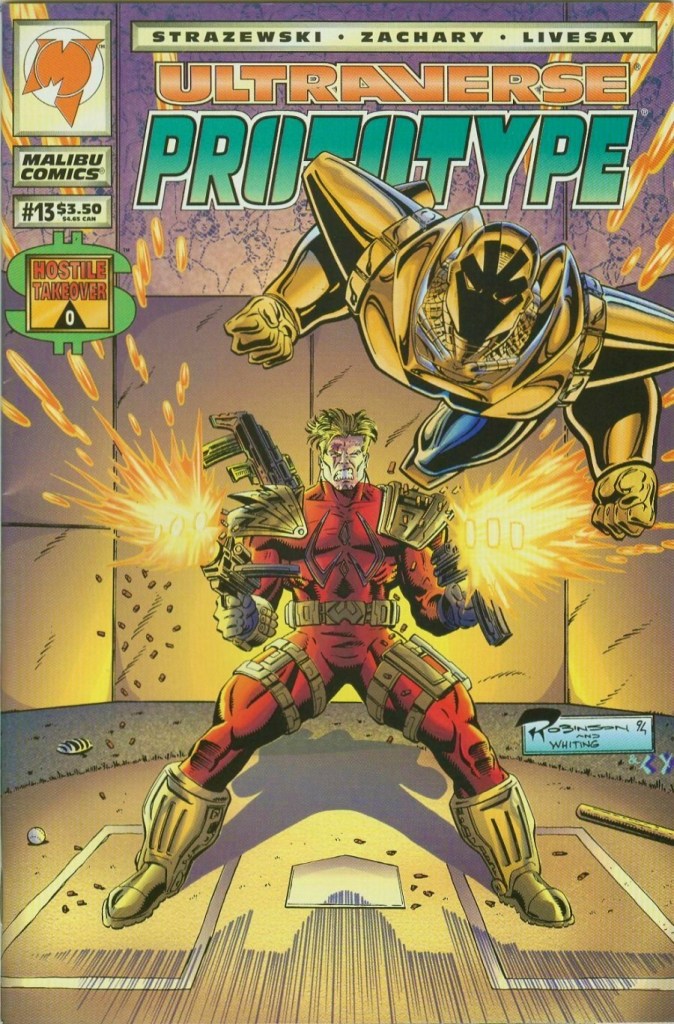
A Look Back at Prototype #13 (1994)

Disclaimer: This is my original work with details sourced from reading the comic book and doing personal research. Anyone who wants to use this article, in part or in whole, needs to secure first my permission and agree to cite me as the source and author. Let it be known that any unauthorized use of this article will constrain the author to pursue the remedies under R.A. No. 8293, the Revised Penal Code, and/or all applicable legal actions under the laws of the Philippines.

Welcome back superhero geeks, comic book collectors and fans of the Ultraverse. In this latest Ultraverse-related retro comic book review, we will check out what happened to Prototype and his companions after the events that took place in issue #12. I personally enjoyed that particular comic book and it has been almost three months since I last reviewed an issue of Prototype.

Now we can start this look back at Prototype #13, published in 1994 by Malibu Comics with a story written by Len Strazewski and drawn by Dean Zachary.

The cover.

Early story

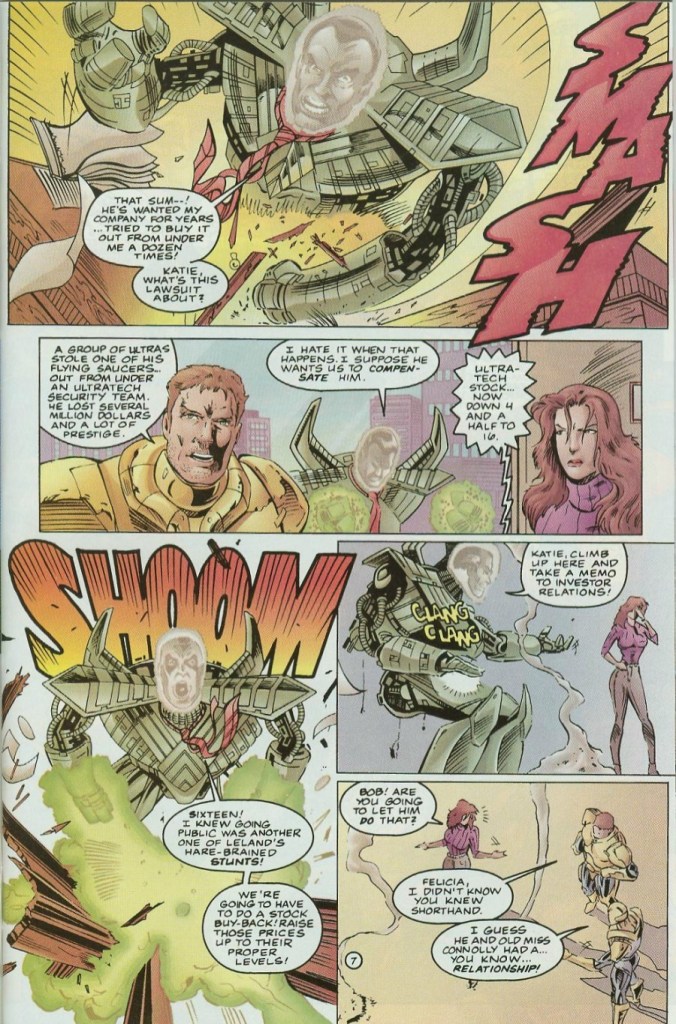
The story begins with TV news coverage of an explosion that happened at one of the buildings along Wall Street. The TV newscaster reports that another battle between ultras rocked the headquarters of Ultratech in downtown Manhattan which sparks rumors of corporate infighting.

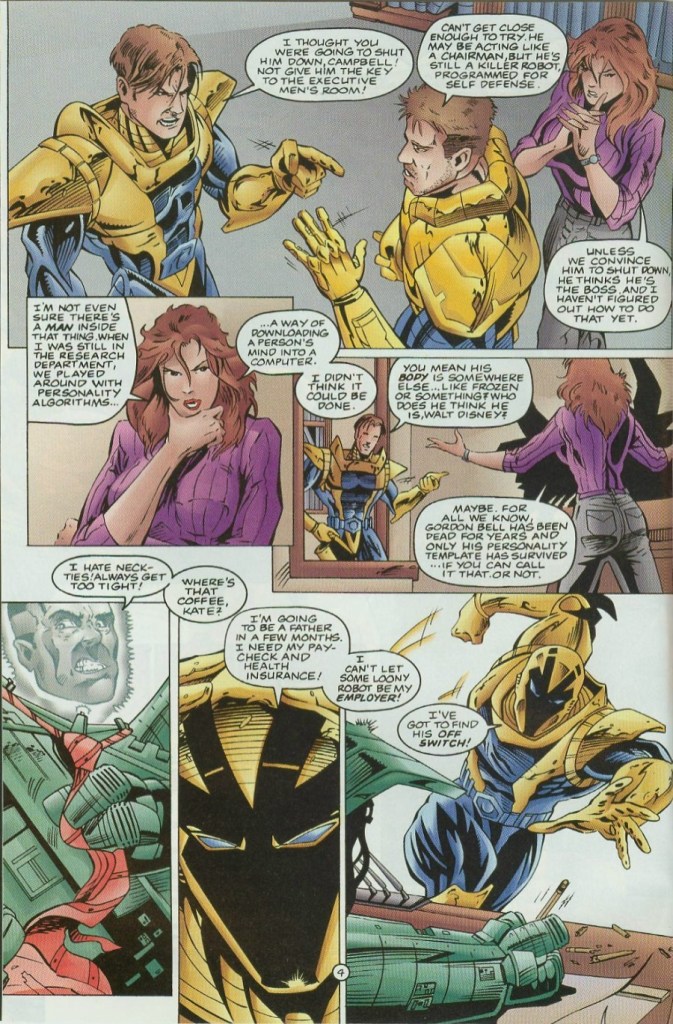
Behind the scenes at the corporate tower, Jimmy Ruiz/Prototype, Bob Campbell/Ranger and Felicia Campbell discuss matters in front of the robot Prototype 2000 (the same machine responsible for the loss of Bob’s arm) which projects an image of Ultratech chairman Gordon Bell as its head. They noticed that the robot thinks and acts like Gordon Campbell, even going as far as calling the name of a secretary who left the company some years back. Felicia believes the robot has some sort of body detachment syndrome. For Bob, it does not matter as Gordon Bell still owns a controlling interest in the corporation.

After some intense talk, Jimmy uses his Prototype armor switch off Prototype 2000 but got blasted by energy which pushed him back to Bob and Felicia. Prototype 2000 then shows the virtual Gordon Bell telling “Katie” to turn the TV on so he can see how the company stock is performing…

Quality

How do you you deal with a machine that actually thinks and acts like a human?

I can declare that Len Strazewski really ramped up the corporate intrigue several notches high in this particular issue. There is a lot of corporate world talk and the good news here was that nothing ended up being boring. The most notable aspect of the story was the presence of Prototype 2000 with the mind of Gordon Bell really reacting to the corporate developments. Of course, there was still sufficient focus on the protagonist Prototype piloted by Jimmy Ruiz. At this stage of the Prototype series, Jimmy has gone through not only many battles using the powered suit of armor but several setbacks in his personal life. Apart from the turmoil at Ultratech, Jimmy not only has to keep his job but also save his reputation. Not to be outdone is Bob Campbell (the original Prototype pilot) whose relationship with Felicia got developed a bit more and their exchange of dialogue was nicely written.

Within the story is a major twist that really added a whole lot of depth into the narrative. It’s a twist that I did not anticipate and I strongly recommend you discover it yourselves once you read this comic book. Oh, and there is a certain supporting character from the Mantra series who also appeared here.

As for the art, Dean Zachary did a descent job visualizing Len Strazewski’s script and capturing the typical smooth sequencing of Prototype in action scenes. There is enough scenes of spectacle here to keep you entertained.

Conclusion

Jimmy Ruiz, Bob Campbell and Felicia discuss matters in the presence of virtual Gordon Bell.

I can say that I had a blast reading Prototype #13 (1994). To put things in perspective, this one is just a part of the Hostile Takeover storyline that eventually connected with other characters of the Ultraverse such as the Night Man and The Solution (a heroes-for-hire team). The writing of Len Strazewski is so good, this one is worth reading all over again. It should be noted that topics like corporate intrigue or business world internal affairs got presented with a strong flavor of superhero stuff that prevented the story from turning into a bore. This is one intriguing and compelling read. Lastly, I should state that this comic book is one of those Ultraverse Premiere flipside issues, the other side of which contained short stories about Iron Clad, Pixx of UltraForce, Flood and Lady Killer of The Strangers.

If you are seriously planning to buy an existing hard copy of Prototype #13 (1994), be aware that as of this writing, MileHighComics.com shows that the near-mint copy of the comic book costs $8.

Overall, Prototype #13 (1994) is highly recommended!

+++++

Thank you for reading. If you find this article engaging, please click the like button below and also please consider sharing this article to others. If you are looking for a copywriter to create content for your special project or business, check out my services and my portfolio. Feel free to contact me as well. Also please feel free to visit my Facebook page Author Carlo Carrasco and follow me at HavenorFantasy@twitter.com
A Look Back at Mantra #9 (1994)

Disclaimer: This is my original work with details sourced from reading the comic book and doing personal research. Anyone who wants to use this article, in part or in whole, needs to secure first my permission and agree to cite me as the source and author. Let it be known that any unauthorized use of this article will constrain the author to pursue the remedies under R.A. No. 8293, the Revised Penal Code, and/or all applicable legal actions under the laws of the Philippines.

Welcome back superhero geeks, comic book collectors and fans of the Ultraverse! Can’t get enough of Mantra? There is a lot to look forward to in my latest review of the Mantra monthly series of the 1990s under the creative leadership of Mike W. Barr.

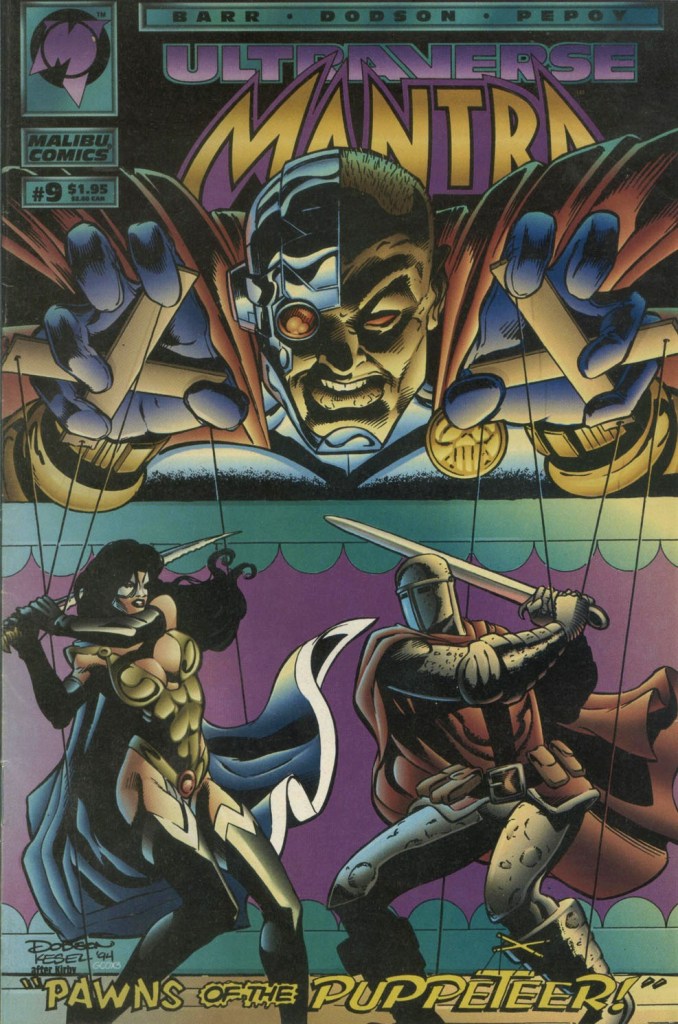
In Mantra #8, the male soul in the lady’s body had an encounter with Boneyard’s soldiers in a fantasy-themed amusement park which was a very intriguing setting considering the mysticism the series often used. Will there be another intriguing event that awaits Mantra? Find out in this look back at Mantra #9, published in 1994 by Malibu Comics with a story written by Mike W. Barr and drawn by Terry Dodson.

The cover.

Early story

The story begins with Mantra arriving home from battle during the evening. Using magical powers, she instantly changes her clothes to become Eden Blake. As she approaches the entrance, she thought to herself, “It’s hard to believe I’m really a man, wearing the body of Eden Blake. I hope I don’t have to live her life much longer.”

Suddenly a ball of light arrives and Mantra senses it to be an attack. After instantly changing into her armor, she strikes the ball with the sword of fangs, zaps it and watches it fly away. She instantly changes back to Eden Black and enters the home.

Upon entering, she gets a surprise hug by Eden Blake’s old roommate Lila and guy named Jim. Lila reveals that she and Jim are going to get married, and Eden will get to be their maid of honor.

Lukasz, who has been living in Eden’s body for some time now, finds the situation uncomfortable…

Quality

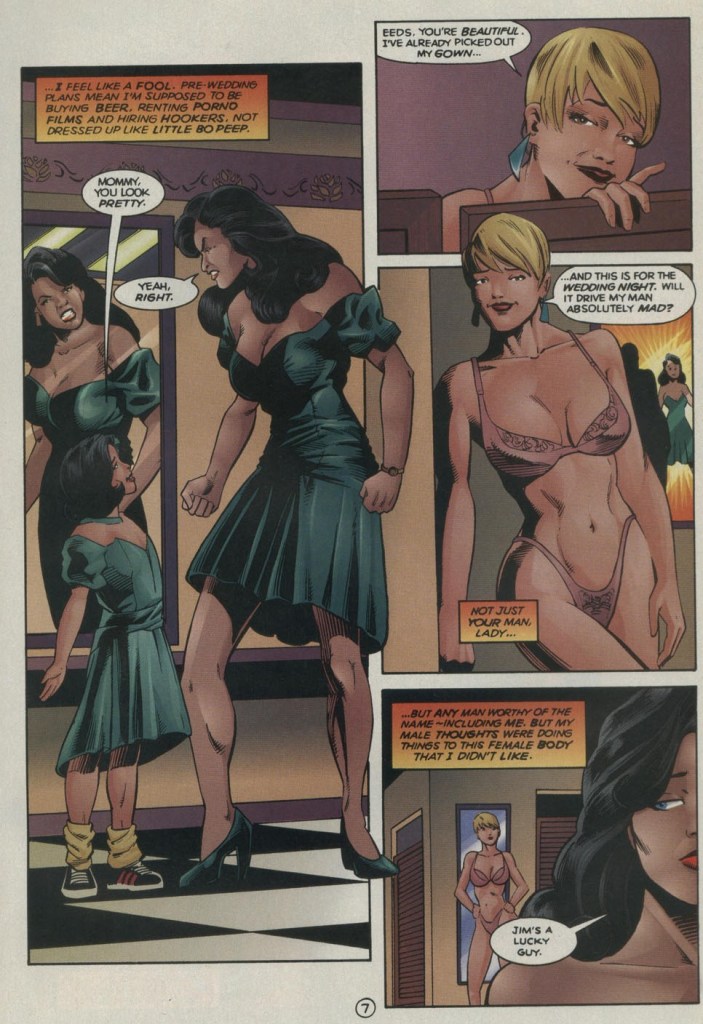
The male warrior Lukasz (occupying Eden Blake’s body) taking part in preparation for Lila’s wedding.

This one has a truly intriguing story about Lukasz struggling not only with being a mother in the body of Eden Blake, but also with dealing with one of Eden’s closest friends in life. It is very cleverly written by Mike W. Barr and the core concept of the story really developed Lukasz/Mantra in a rather refreshing way. In many ways, Lukasz does not find himself trapped by Boneyard’s armed soldiers nor by monsters, rather he finds himself trapped by remnants of Eden’s past (imagine him pretending to remember Eden’s old friends) while dealing with all the pre-wedding preparations. If you expect the usual spectacle of action and sorcery, you will find them here. Who exactly will Mantra fight, that you should find out yourself and there is something here that will convince you to go back reading issue #1.

When it comes to the art, I find it baffling that this one was credited to Terry Dodson. The art here is cartoony in style and Dodson’s art in the first few issues of the Mantra series were more realistic in style, especially with the way people were drawn.  

Conclusion

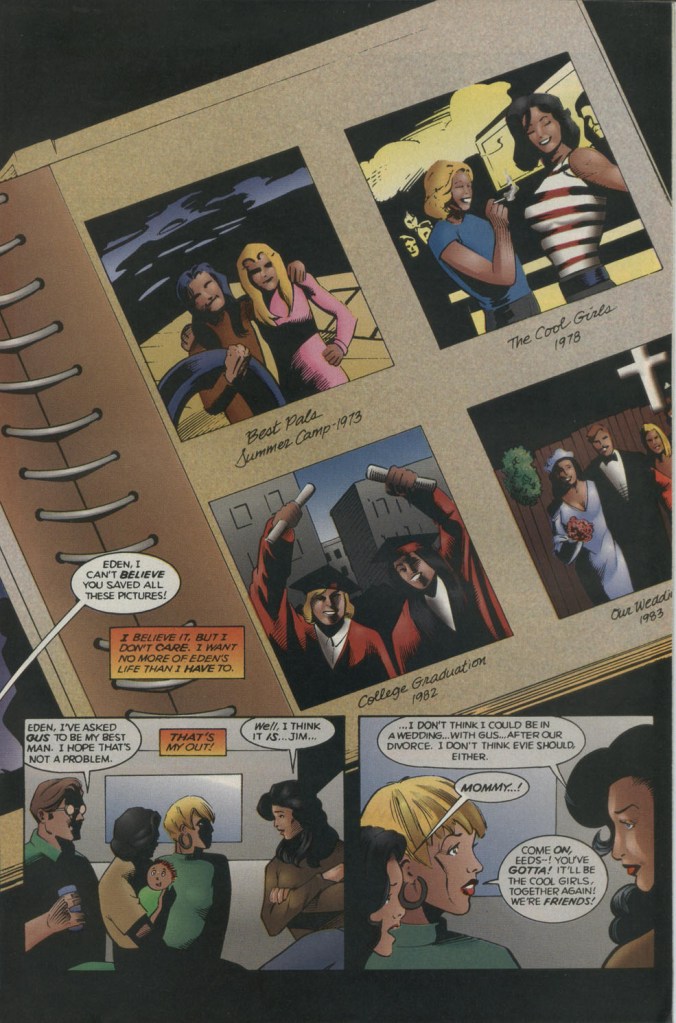
Some pictures from Eden Blake’s past.

For its story concept alone, Mantra #9 (1994) is an engaging read. I also enjoyed the way this issue connects itself to key details in issues #1, #3 and #5 which encourages re-reading that ultimately will help readers understand the series concept even more. There is also a nice mix of action and drama, and the way the battle concluded is pretty satisfying. Furthermore, the continued development of Mantra is a must-read.

If you are seriously planning to buy an existing hard copy of Mantra #9 (1994), be aware that as of this writing, MileHighComics.com shows that the near-mint copy of the regular edition costs $8 while the near-mint copy of the newsstand edition costs $26.

Overall, Mantra #9 (1994) is recommended.

+++++

Thank you for reading. If you find this article engaging, please click the like button below and also please consider sharing this article to others. If you are looking for a copywriter to create content for your special project or business, check out my services and my portfolio. Feel free to contact me as well. Also please feel free to visit my Facebook page Author Carlo Carrasco and follow me at HavenorFantasy@twitter.com
A Look Back at The Strangers #18 (1994)

Disclaimer: This is my original work with details sourced from reading the comic book and doing personal research. Anyone who wants to use this article, in part or in whole, needs to secure first my permission and agree to cite me as the source and author. Let it be known that any unauthorized use of this article will constrain the author to pursue the remedies under R.A. No. 8293, the Revised Penal Code, and/or all applicable legal actions under the laws of the Philippines.

Welcome back Ultraverse fans, superhero enthusiasts and comic book collectors. In this newest return to the Ultraverse originally launched by Malibu Comics and its many talented creators, we will witness what is supposed to be the rise of genuine opposition against The Strangers which was seen building up in issues #16 and #17.

To start with, the character called Pilgrim is quite intriguing being the apparent central figure that wants to smash The Strangers. Along the way, other ultras that opposed the said team end up getting involved with Pilgrim.

Will all these developments lead to the establishment of a powerful force against The Strangers? What can team leader Lady Killer do about it? We can all find out in this retro comic book review of The Strangers #18, published in 1994 by Malibu Comics with a story by Steve Englehart and drawn by Rick Hoberg.

The cover.

Early story

The story begins on sky island. The Pilgrim and his companion appear right next to Zara (one of the members of Yrial’s tribe) telling him, “I am the Pilgrim, Zara! I want you to help me destroy the Strangers!”

Even though the Pilgrim continued to elaborate more on offering him revenge on Yrial, Zara thinks that the foreigner is insane. Zara uses his magic powers while the Pilgrim activates his own special abilities.

Meanwhile on Pier 25, Grenade tries to regain Candy’s trust who recently started distancing herself from him. Grenade decides to let her be but remembered clearly that the division started since the Pilgrim showed up.

Over at Berkeley, the old ultra called Powerhouse looks for a job. Suddenly the Pilgrim appears to him and attempts to recruit him in his quest to destroy the Strangers. Like Zara of sky island, he doubts the Pilgrim, finds him insane and attempts to strike him.

In another location, flying in the air, Yrial tells Spectral that she feels the power of the Pilgrim is closing in on them. Inside the Strangers’ hangout, Bob/Atom Bob and Elena/Lady Killer spend quality time together. Bob expresses worry about the one that wants to destroy them (note: he fought with the Pilgrim in issue #17) and, in response to the lady’s question, he states that his arm is pretty much back to normal thanks to Spectral’s healing green flame. After further talk, Bob asks her, “Will you marry me?”  

Quality

The battle begins!

As expected with the Englehart-Hoberg creative team, the story is fun and engaging to follow from start to finish. For one thing, apart from the rising opposition led by the Pilgrim, the character development for Bob and Elena as well as the rift between Electrocute and Grenade were executed nicely, even serving as a fine build-up before the story shifted into high gear with spectacle. Expect lots of action and banter between the characters fighting. This is one very wordy comic book to read and it sure is worth it!

Behind all the good stuff, there was even room for a nice surprise by the creative team and that is something you must read for yourselves. That alone made this one an intriguing read as well.

Conclusion

The rift between Grenade and Electrocute.

There is no doubt that The Strangers #18 (1994) is a very entertaining comic book to read. Apart from the solid character development and the big bonanza of action, this comic book highlights the effects of the Jumpstart not only the Strangers themselves but also on other people. At this stage, the Pilgrim has evolved into a more meaningful character and he simply cannot be dismissed as just another villain nor another anti-hero.

If you are seriously planning to buy an existing hard copy of The Strangers #18 (1994), be aware that as of this writing, MileHighComics.com shows that the near-mint copy of the comic book costs $8.

Overall, The Stranger #18 (1994) is highly recommended!

+++++

Thank you for reading. If you find this article engaging, please click the like button below and also please consider sharing this article to others. If you are looking for a copywriter to create content for your special project or business, check out my services and my portfolio. Feel free to contact me as well. Also please feel free to visit my Facebook page Author Carlo Carrasco and follow me at HavenorFantasy@twitter.com
A Look Back at Ravage 2099 #4 (1993)

Disclaimer: This is my original work with details sourced from reading the comic book and doing personal research. Anyone who wants to use this article, in part or in whole, needs to secure first my permission and agree to cite me as the source and author. Let it be known that any unauthorized use of this article will constrain the author to pursue the remedies under R.A. No. 8293, the Revised Penal Code, and/or all applicable legal actions under the laws of the Philippines.

I’ve been reading more of the work of the late Stan Lee through his contributions for Marvel’s 2099 franchise of the early 1990s. Lee’s comeback into comic book writing with Ravage 2099 #1 turned out to be a big disappointment and his writing style just ended up being outdated by 1992’s standards. Ravage 2099 #2 was a marginal improvement over its predecessor buy was overall still a very weak comic book. Ravage 2099 #3 meanwhile was surprisingly a clear improvement over issue #2 and also happened to be more entertaining and interesting to read. Of the first three issues published, issue #3 proved to be satisfying.

Will there be another improvement on the artistic and entertainment values of the next Ravage 2099 issue in this review? Find out in this look back at Ravage 2099 #4, published in 1993 by Marvel Comics with a story written by Stan Lee and drawn by Paul Ryan.

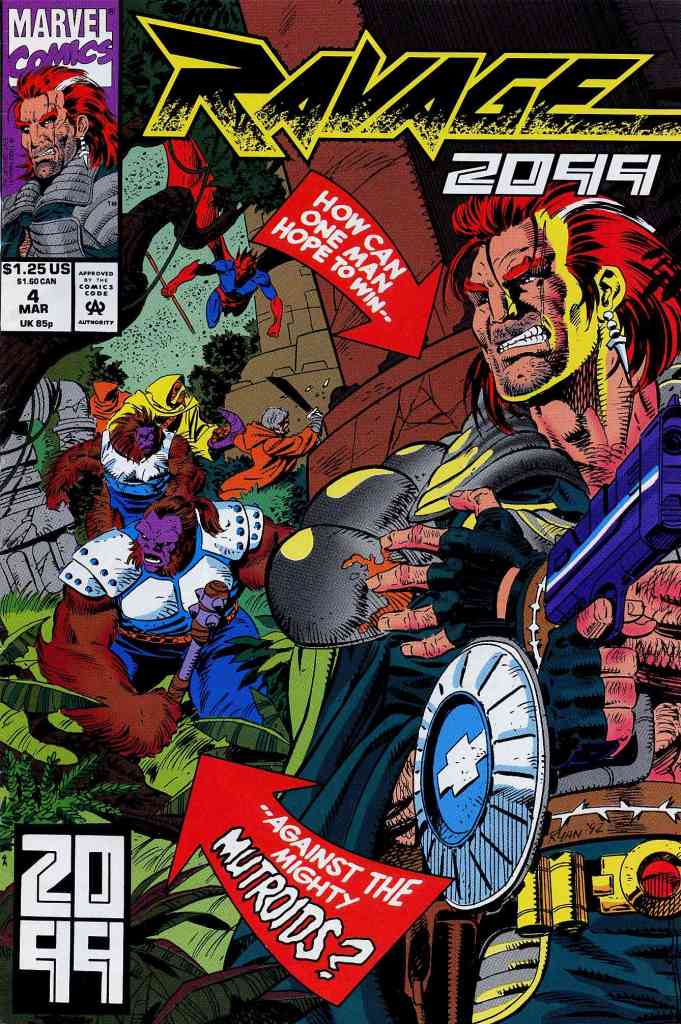
The cover.

Early story

The story begins in the island of Hellrock where Ravage is on the run already suffering from the toxic air and only time will tell if ever-present radiation will kill him or turn into a mutroid. Dethstryk’s minions have been hunting him since he started running away from their main forces.

Even though he was able to avoid getting caught by the hunters, Ravage continues to suffer greatly with each passing moment. Despite the pain, he remains determined to fight back and keep moving but his chances of survival keep on fading…

Quality

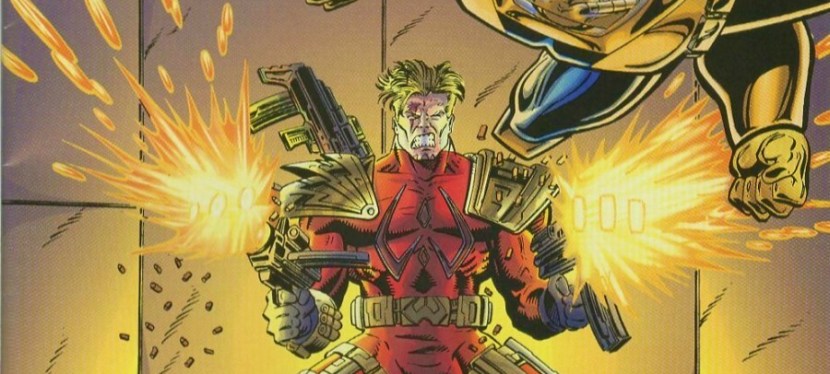
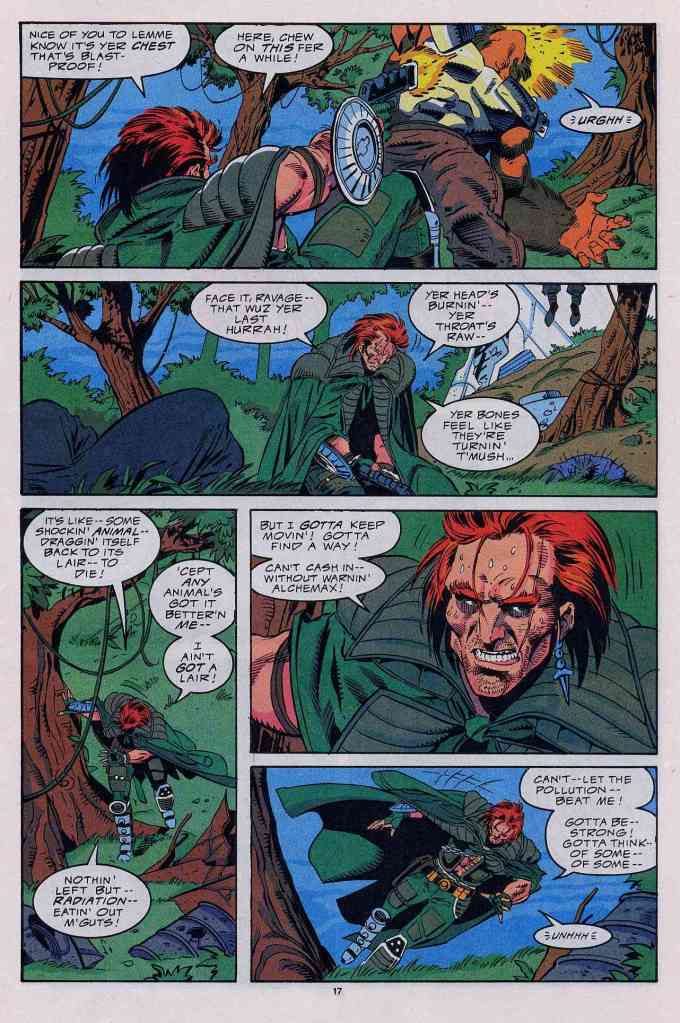
This is pretty much what you will see of Ravage in this comic book.

To put it short, the story was pretty much about Ravage struggling to survive in a very dangerous location while being hunted. The heroism he had in issue #3 is completely missing and the way Stan Lee wrote this story, the concept is pretty shallow. In fact, even the very weak story of issue #1 has more variety and depth than this one! More on Ravage, even as he struggled and got targeted, there is not much justification to make readers like you feel sympathetic to him especially if you followed Ravage’s so-called development starting in issue #1.

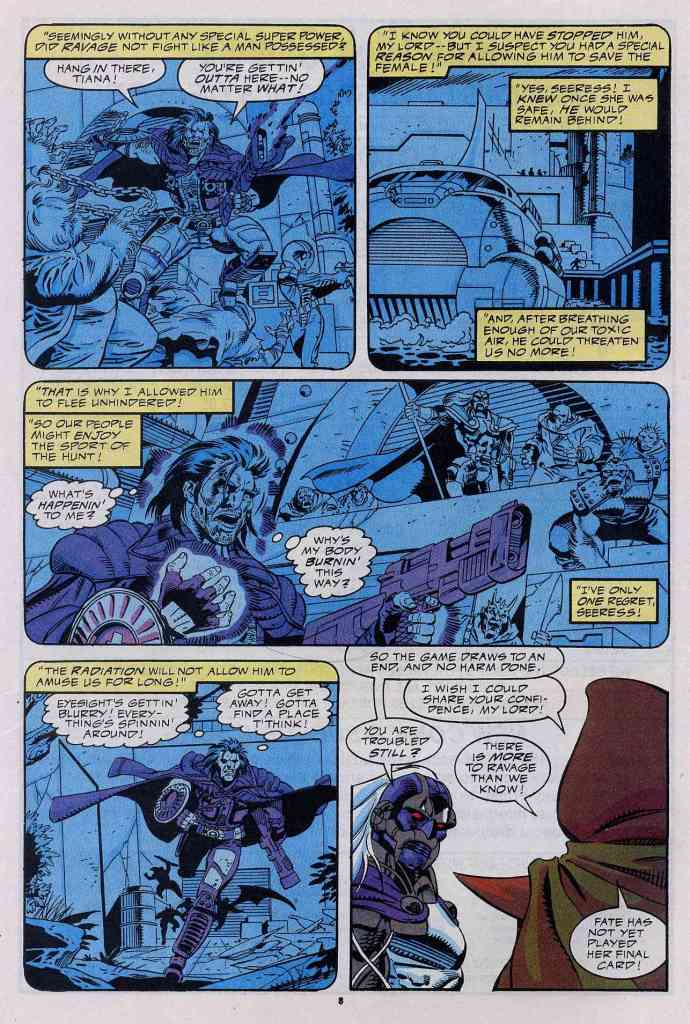
When it comes to plotting, this comic book would have worked better had it been released in the 1970s. It does not help that Stan Lee had to resort to adding fillers to the script by means of recapping lots of scenes from issue #3 (even though he tried to emphasize Dethstryk’s thoughts).

Character development? There is not much here except for Ravage. As for the supporting characters, don’t expect to see much of Tiana and Dack as they did not contribute anything to the shallow story. As for Ravage’s former boss Henton, Stan Lee went ahead to show just how obviously evil he is with nothing new to show (except his virtual reality escapade).

Conclusion

Stan Lee and his creative team lazily resorted to recapping key events that happened in issue #3.

Clearly, Ravage 2099 #4 (1993) falls short from becoming a satisfying read as it paled in comparison to issue #3. That’s too bad because the concept of showing Ravage as a fugitive in the middle of a very dangerous place could have turned into something more interesting and more intriguing. Instead, Ravage ended up being the target of hunters and it was clear that Stan Lee and Paul Ryan dragged the scenes of him struggling and fighting to survive.

If you are seriously planning to buy an existing hard copy of Ravage 2099 #4 (1993), be aware that as of this writing, MileHighComics.com shows that the near-mint copy of the regular edition costs $8 while the near-mint copy of the newsstand edition costs $24.

Overall, Ravage 2099 #4 (1993) is not recommended. If you really want to buy this comic book at all, better not pay more than fifty cents for it.

+++++

Thank you for reading. If you find this article engaging, please click the like button below and also please consider sharing this article to others. If you are looking for a copywriter to create content for your special project or business, check out my services and my portfolio. Feel free to contact me as well. Also please feel free to visit my Facebook page Author Carlo Carrasco and follow me at HavenorFantasy@twitter.com