A Look Back at Superman #78 (1993)

Disclaimer: This is my original work with details sourced from reading the comic book and doing personal research. Anyone who wants to use this article, in part or in whole, needs to secure first my permission and agree to cite me as the source and author. Let it be known that any unauthorized use of this article will constrain the author to pursue the remedies under R.A. No. 8293, the Revised Penal Code, and/or all applicable legal actions under the laws of the Philippines.

Welcome back superhero enthusiasts, 1990s culture enthusiasts and comic book collectors! Today we go back to the year 1993 and explore a chapter of the Reign of the Supermen storyline through one of the issues of the Superman monthly series.

To put things in perspective, DC Comics fulfilled its promise to kill the iconic Man of Steel in Superman (1993) which sold a whole lot of copies and the daring death concept made Superman a hot news item. After a brief period showing what the world is like without Superman, DC resurrected him in Adventures of Superman #500 which spawned the different Supermen and a new storyline (the Reign of the Supermen) which took effect on the four Superman monthly series of the time.

With those details laid down, here is a look back at Superman , published in 1993 by DC Comics with a story written and drawn by Dan Jurgens.  

The cover.

Early story

The story begins with Lois Lane still thinking about Superman as she drives her car on a rainy night. At the moment, she still has not learned to live without him. As she is granted access into a facility of Lexcorp, she carefully thinks about the sudden number of many people around the country who claimed to have seen Superman.

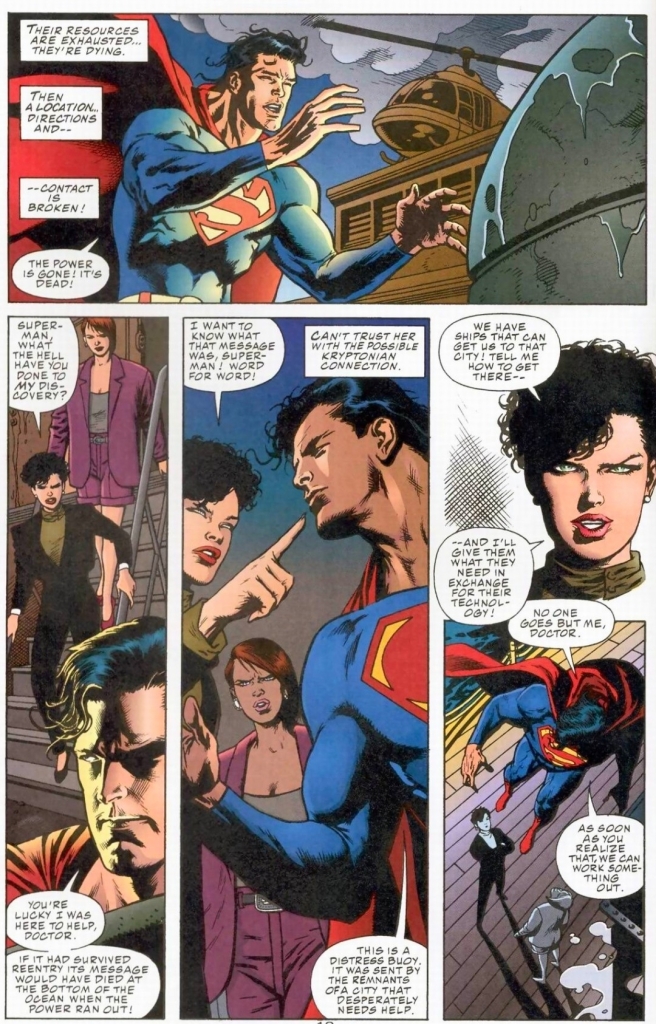
Inside the facility, Dr. Meyer meets her and tells her that had met the Man of Steel sometime prior and he believes that the certain person who saved him and others was definitely the same person. Being skeptical, Lois Lane asked him if some other superhero saved them from certain death. In response, he shows to her an image of the heroic figure captured by security cameras. Lois recognizes the face and head even though some parts were shadowed…

Quality

Cyborg Superman in full appearance.

Starting with the storytelling, I can say that this is one solid tale that really pokes the curiosity regarding Cyborg Superman…is he the real Superman or some very clever and capable impostor? Dan Jurgens really knows his Superman stuff and he used a clever approach on arousing the readers’ curiosity while still managing to move the story forward. As one of the early chapters of the Reign of the Supermen storyline, it was very obvious that things were set in motion to set up future post-death Superman stories.

The most engaging parts of this tale were the scenes between Lois Lane and Cyborg Superman (note: he sure looks like a Terminator-inspired take on the Man of Steel which itself was a daring concept back in 1993). Lois Lane here is clearly intelligent and for personal and professional reasons, she would not settle for words as definitive answers but have evidence scientifically analyzed right in front of her. Once again, this is a lively reminder that in the post-Crisis universe of DC Comics, Lois Lane is persistent on verifying facts to realize the truth (which is something clearly missing in today’s world of social media and news media outlets serving as loudspeakers for political forces).

While the storytelling remains good all these decades, what really aged badly in this comic book was the bastardization of Superman’s iconic imagery with some robotic influences of the Terminator mixed in that made him look science fictional in appearance. Of course, Cyborg Superman was just one of the Supermen in this storyline and the Reign of the Supermen concept was clearly an extension of DC Comics’ dishonesty behind the death and return of the Man of Steel. This also shows DC’s irresponsible handling of one of America’s icons. Let’s be honest with ourselves here…how many of you really want to see Cyborg Superman in live-action form in a future DC superhero movie from Warner Bros. and James Gunn?

Conclusion

How many of you have this poster of a very bastardized image of Superman in your homes right now?

While Superman (1993) has a good story told and added to the mystery about the resurrection of Superman, it ultimately served as a build-up platform to set up further stories not only about the Man of Steel but also that of Doomsday (note: a big rematch happened a few years later). The image of Cyborg Superman is clearly a defamation of the iconic look of the Man of Steel and that alone really brought the overall entertainment value of this comic book way down in my view. I find it baffling that there was no major backlash nor an outrage from Superman fans back in 1993 over this.

Overall, Superman (1993) is serviceable.

+++++

Thank you for reading. If you find this article engaging, please click the like button below, share this article to others and also please consider making a donation to support my publishing. If you are looking for a copywriter to create content for your special project or business, check out my services and my portfolio. Feel free to contact me with a private message. Also please feel free to visit my Facebook page Author Carlo Carrasco and follow me on Twitter at  @HavenorFantasy as well as on Tumblr at https://carlocarrasco.tumblr.com/ and on Instagram at https://www.instagram.com/authorcarlocarrasco

A Look Back at Web of Spider-Man #90 (1992)

Disclaimer: This is my original work with details sourced from reading the comic book and doing personal research. Anyone who wants to use this article, in part or in whole, needs to secure first my permission and agree to cite me as the source and author. Let it be known that any unauthorized use of this article will constrain the author to pursue the remedies under R.A. No. 8293, the Revised Penal Code, and/or all applicable legal actions under the laws of the Philippines.

Welcome back superhero enthusiasts, 1990s culture enthusiasts and comic book collectors! Today we go back to the year 1992 and explore a part of what was back then the 30th anniversary celebration of Spider-Man

In what was back then a unique approaching to celebrating the anniversary of an American icon, Marvel Comics published not one but four specific Spider-Man comic books that had holographic covers and more pages than the usual. Each of those special comic books were from a different Spider-Man monthly series. Back in 2020, I published a retro review of one of those gimmick cover comic books from the Spider-Man monthly series.

With those details laid down, here is a look back at Web of Spider-Man #90, published in 1992 by Marvel Comics with a story by Howard Mackie and drawn by Alex Saviuk.  

The cover.

Early story

The story begins inside an office in Los Angeles. A hat-wearing businessman has several varied figures of Spider-Man near him and recalls the time when the iconic hero participated in one of his events as the Masked Marvel. Moments later, the businessman’s wife arrives and together they departed in a limousine.

At the South Bronx in New York, Spider-Man chases a speeding car with one of its passengers firing a gun at him. Suddenly, his spider sense bothers him a lot and when he looks around, he suddenly sees Galactus standing with members of the Avengers, the X-Men and the Fantastic Four lying down helpless on the ground…

Quality

Spider-Man on the set of an entertainment project. It’s a lively reminder about how sickening Hollywood (AKA Commiewood) can get.

To make things clear and without spoiling the plot, this story deals with illusions and the distortion of reality. Quite ironically, the said distortion made it a challenge to follow the narrative and I can say that a good amount of the spotlight was on the businessman. Spider-Man is clearly the protagonist here but it made sense for the creative team to focus a bit on the businessman (who has been doing entertainment showcases for a long time) to justify the core concept about the conflicts between what is real and what is imaginary.

In relation to the illusion aspect of the story, you will get to see established Spider-Man arch-villains such as the Green Goblin, the Hobgoblin and Venom taking on the superhero himself. As the creative team focused more on providing a great amount of spectacle, there clearly was no room left for character development on Spider-Man. Don’t expect to see Peter Parker in dramatic moments nor see him interact with the established supporting characters.

If there is any moral lesson to learn from this comic book, it would be this – living with a powerful delusion (the result of personal obsession mixed with the personal failure to separate illusion from reality) can lead you to the wrong directions in life.

Conclusion

To justify the 30th anniversary celebration, distorted flashbacks into Peter Parker’s past were presented here.

Web of Spider-Man #90 (1992) does not have much depth for those who seek engaging storytelling. That being said, the story itself is not memorable nor would it leave a long lasting impact on you. This comic book was made to entertain readers with lots of action and wild fantasy images that eerily justify its concept about illusion and reality conflicting each other. In fairness to the creative team, the said conflict was consistently visualized and there were some dialogue that related to it in a somewhat philosophical manner. The comic book’s entertainment value is satisfying enough although it does not justify the holographic cover that was part of the gimmick with celebrating Spider-Man’s 30th anniversary. As for who was the main antagonist of the comic book, I simply encourage you all to read and find out for yourselves.

Overall, Web of Spider-Man #90 (1992) is satisfactory.

+++++

Thank you for reading. If you find this article engaging, please click the like button below, share this article to others and also please consider making a donation to support my publishing. If you are looking for a copywriter to create content for your special project or business, check out my services and my portfolio. Feel free to contact me with a private message. Also please feel free to visit my Facebook page Author Carlo Carrasco and follow me on Twitter at  @HavenorFantasy as well as on Tumblr at https://carlocarrasco.tumblr.com/ and on Instagram at https://www.instagram.com/authorcarlocarrasco

A Look Back at Harbinger #24 (1993)

Disclaimer: This is my original work with details sourced from reading the comic book and doing personal research. Anyone who wants to use this article, in part or in whole, needs to secure first my permission and agree to cite me as the source and author. Let it be known that any unauthorized use of this article will constrain the author to pursue the remedies under R.A. No. 8293, the Revised Penal Code, and/or all applicable legal actions under the laws of the Philippines.

Welcome back superhero enthusiasts, 1990s culture enthusiasts and comic book collectors! Today we go back to the early 1990s and explore a part of the Valiant Comics shared universe through the Harbinger monthly series.

In my previous review, the conflict between the Harbinger Foundation and Sting’s team got renewed violently. This resulted in an attack on the team of teenagers which led to one of them getting killed. With his other companions missing, Sting finds himself alone, desperate and outraged.

With those details laid down, here is a look back at Harbinger , published in 1993 by Valiant Comics with a story written by Maurice Fontenot and illustrated by Howard Simpson.

The cover.

Early story

The story begins on a very early morning. Desperate and very stressed out, Sting causes a disturbance inside a hospital in New Jersey by lifting one of their workers above the floor while pressing them for answers about the whereabouts of his surviving friends Flamingo, Faith and Kris. Already he has visited three other hospitals since the tragedy struck his team and took the life of Shatiqua. Sting remembers that an ambulance took his friends away after their rented house got burned down.

After calming down and getting told by one of the hospital workers that they have notified the police of his presence, Sting walks out and quickly got caught by a police officer. Also present were a few other police officers with their guns aimed at Sting.

As the tension of the arrest rises, Sting gets enraged and starts using his power to free himself…

Quality

This is Sting at his most violent yet.

I can that this Harbinger tale is not only a very solid follow-up to the previous issue, it also showed that the stakes and the suspense have been raised significantly. It also shows that the Fontenot-Simpson team had prepared something for the anticipated conflict between Sting and his former mentor Toyo Harada.

As the other team members were completely absent (note: the nightmare sequence does not count as presence for Faith, Flamingo and Kris), the story strongly focuses on Sting. Yes, as before, he remains reckless and impulsive, he lacks morals (note: he has a bad relationship with his father) and it is no surprise that he becomes suicidal in his desperate search for his companions. Along the way, you will see Sting at his most violent yet which not only blurs the line separating good and evil but also highlights him as a destructive force in human form. Simply put, this series’ so-called hero became as bad as the bad guys and this only added to the anticipation of the one-on-one battle with Harada. While Sting is relatable when it comes to caring and seeking his lost companions, he is also unlikable and very clearly his redemption has yet to happen.

Of course, Sting is not the lone character to follow here as a former Eggbreakers member gets involved. This is significant as the two had some things in common – both were under Harada as Harbinger Foundation’s pupils and left after they realized the wickedness within the organization. The difference here is that the other character spent much more time than Sting under Harada and he went on to get extensive training with the Eggbreakers which is the special team of powered youth under the Harbinger Foundation.   

Conclusion

Even though the police officer was doing his duty in accordance to law, Sting does not care.

Harbinger #24 (1993) is a great comic book to read and it also served as a powerful build-up for the anticipated showdown between Sting and Harada (which itself was declared in the final page). The creative team delivered high-quality work here and this Harbinger tale highlights not only the conflict between Sting’s team and the Harbinger Foundation, but also what this monthly series was all about. This comic book has a powerful final page and even before reaching it, you will realize that the stakes have been raised a lot while the line between good and evil got blurred away.

Overall, Harbinger #24 (1993) is highly recommended.

+++++

Thank you for reading. If you find this article engaging, please click the like button below, share this article to others and also please consider making a donation to support my publishing. If you are looking for a copywriter to create content for your special project or business, check out my services and my portfolio. Feel free to contact me with a private message. Also please feel free to visit my Facebook page Author Carlo Carrasco and follow me on Twitter at  @HavenorFantasy as well as on Tumblr at https://carlocarrasco.tumblr.com/ and on Instagram athttps://www.instagram.com/authorcarlocarrasco

A Look Back at Harbinger #23 (1993)

Disclaimer: This is my original work with details sourced from reading the comic book and doing personal research. Anyone who wants to use this article, in part or in whole, needs to secure first my permission and agree to cite me as the source and author. Let it be known that any unauthorized use of this article will constrain the author to pursue the remedies under R.A. No. 8293, the Revised Penal Code, and/or all applicable legal actions under the laws of the Philippines.

Welcome back superhero enthusiasts, 1990s culture enthusiasts and comic book collectors! Today we go back to the early 1990s and explore a part of the Valiant Comics shared universe through the Harbinger monthly series.

In my previous review, Faith, Flamingo and Kris – with her uncle as a companion – accidentally got reunited with Archer and Armstrong at Coney Island. It turns out Kris’ uncle had a negative encounter with Armstrong decades prior which compels him to approach a local crime boss for assistance. This led to a wild chase.

With those details laid down, here is a look back at Harbinger , published in 1993 by Valiant Comics with a story written by Maurice Fontenot and illustrated by Howard Simpson.

The cover.

Early story

The story begins with Sting, Flamingo and Faith surrounded by armed personnel at the Harbinger Foundation’s private hangar at La Guardia Airport in New York. Faith does something drastic causing a heavy object from above to start falling down on the armed men. One of the men fires his gun at a barrel of fuel which causes a big explosion.

In a room nearby, Shatiqua and Kris hacked a computer to acquire lots of confidential information from the Harbinger Foundation. After realizing the explosion that happened, they decide to work fast getting the information they need.

On the airport’s tarmac, a private jet is on standby waiting for clearance to take off. Inside is Walter Sakai, who is one of the most trusted men under Toyo Harada…

Quality

Sting, his teammates and their major enemy Toyo Harada.

Without spoiling the crucial details of the plot, the Fontenot-Simpson clearly made the moves to raise the stakes between Sting’s team and the Harbinger Foundation, complete with the build-up of a pending high-stakes conflict between their respective leaders.

Of course, this is the latest conflict between the two sides – one side has super-powered teens who want to live freely while the other is a powerful organization that has been developing its of super-powered youth members using vast resources as well as political connections. This time around, the creative team not only raised the stakes but also came up with some really dark and bizarre scenarios within Sting’s own team. The good news is that Fontenot came up with something new and surprising to keep this series going with a clear direction ahead. The mentioned dark scenarios visually have a horror film vibe.

As for Sting himself, he continues to take action recklessly and without any backup, he impulsively goes after one of Harada’s top executives without considering the consequences. At this stage, Sting has turned unlikable and it really looks like the boundary separating good and evil got blurred away. That being said, there will be moments in which you will feel like wanting to tell Sting he is doing things the wrong way.

Conclusion

Very recklessly, Sting goes after one of Toyo Harada’s most trusted men.

Harbinger (1993) revives the rivalry between Sting’s team and the Harbinger Foundation, only this time there are some very solid twists that resulted in both surprise and intrigue when I read this tale. It seems to me that something tremendous between Harada and Sting was being built up. Considering the really good quality of this comic book and how the story ended, I can say I am looking forward to the next issue.

Overall, Harbinger (1993) is recommended.

+++++

Thank you for reading. If you find this article engaging, please click the like button below, share this article to others and also please consider making a donation to support my publishing. If you are looking for a copywriter to create content for your special project or business, check out my services and my portfolio. Feel free to contact me with a private message. Also please feel free to visit my Facebook page Author Carlo Carrasco and follow me on Twitter at  @HavenorFantasy as well as on Tumblr at https://carlocarrasco.tumblr.com/ and on Instagram at https://www.instagram.com/authorcarlocarrasco

A Look Back at Armorines #3 (1994)

Disclaimer: This is my original work with details sourced from reading the comic book and doing personal research. Anyone who wants to use this article, in part or in whole, needs to secure first my permission and agree to cite me as the source and author. Let it be known that any unauthorized use of this article will constrain the author to pursue the remedies under R.A. No. 8293, the Revised Penal Code, and/or all applicable legal actions under the laws of the Philippines.

Welcome back superhero enthusiasts, 1990s culture enthusiasts and comic book collectors! Today we go back to the early 1990s and explore a part of the Valiant Comics shared universe through the Armorines monthly series.

In my previous retro review, the armored Marines and their US Navy SEALs counterparts encountered mutated sharks as they struggled to accomplish their mission. Along the way, one of the Armorines literally got swallowed by a huge, organic object that went directly to him during the struggle.

With those details laid down, here is a look back at Armorines , published in 1994 by Valiant Comics with a story written by Jorge Gonzalez and drawn by Jim Calafiore.

The cover.

Early story

The story begins deep under the sea as the Benchley explodes and falls down further as a result of the mission. Gunny finds himself falling down as well as he no longer has his ballast and propulsion unit. Fortunately, an armored teammate of his saves him and pulls him up to the surface.

Several kilometers away from the site of the ill-fated Benchley, a huge organic-looking object enters the large hole on the side of a derelict ship. Strangely enough, the interiors have an alien design and the organic-looking object turns out to be a ship of its own. Two human figures with unnatural physical features come out of it and told their alien-looking troops to enter the refrigeration unit to “bring the ‘meat’” to Chantilla.

Inside the refrigeration unit filled with lots of dead human bodies, the armed aliens approach the Armorines suit only to find it empty. As they did not bother to search around to find answers, the Armorines pilot cleverly concealed himself among the other dead bodies pretending to be dead. He gets up after the aliens leave…

Quality

The first display of the Armorines in action without the aquatic environment.

After a good amount of build-up executed by the creative team in the first two issues, this particular comic book served as a big pay-off as well as a creative build-up of its own with the future events in mind. In fact, the sci-concepts introduced here along with new figures of opposition (specifically the humans with physical aquatic features) really lifted the storytelling to a whole new level of imagination laced with intrigue. Instead of seeing armed terrorists or an opposing force with military hardware to counter the high-tech Armorines, we see people who have a sinister plan, have been organizing violent operations on Earth and are of alien origin. These aliens, who are even studying human characteristics, were involved in conflicts with X-O Manowar and Turok elsewhere within the Valiant Comics shared universe. In fact, the two individuals who arrived early in the story came from their act of destroying X-O Manowar’s armor (read X-O Manowar ). I should also state that the duo of Gonzalez-Calafiore cleverly emphasized the aliens’ plan to weaken the coordination and security of Earth’s forces so that they can escape undetected. What is even more intriguing within this comic book is the visualization of the aliens’ secret scientific developments and experiments on Earth.

Going back to the Armorines, you will see them in action without the aquatic environment. The way the creative team showed the Armorines in action against their alien counterparts turned out to be entertaining to read.

Conclusion

Given the fact that Democrats in America today love illegal immigrants so much, can you imagine them and their hordes of woke/socialist/Communist/Marxist/liberal/LGBTQ/transgendered voters welcoming aliens from outer space and allowing them to do bad things against humanity here on Earth? Imagine Joe Biden or Hillary Clinton making secret deals with these aliens.

I can say that Armorines (1994) is a well-executed story that successfully paid off what was built in the first two issues and raised the stakes further with sci-fi concepts and a force of opposition that made impact elsewhere in the Valiant Comics shared universe. As I enjoyed this old comic book, I am looking forward to the next issue.

Overall, Armorines (1994) is recommended.

+++++

Thank you for reading. If you find this article engaging, please click the like button below, share this article to others and also please consider making a donation to support my publishing. If you are looking for a copywriter to create content for your special project or business, check out my services and my portfolio. Feel free to contact me with a private message. Also please feel free to visit my Facebook page Author Carlo Carrasco and follow me on Twitter at  @HavenorFantasy as well as on Tumblr at https://carlocarrasco.tumblr.com/ and on Instagram at https://www.instagram.com/authorcarlocarrasco
A Look Back at Harbinger #22 (1993)

Disclaimer: This is my original work with details sourced from reading the comic book and doing personal research. Anyone who wants to use this article, in part or in whole, needs to secure first my permission and agree to cite me as the source and author. Let it be known that any unauthorized use of this article will constrain the author to pursue the remedies under R.A. No. 8293, the Revised Penal Code, and/or all applicable legal actions under the laws of the Philippines.

Welcome back superhero enthusiasts, 1990s culture enthusiasts and comic book collectors! Today we go back to the early 1990s and explore a part of the Valiant Comics shared universe through the Harbinger monthly series.

In my previous review, Sting has been suffering and was revealed to have mononucleosis. After having a nightmare, he stubbornly re-entered his family’s home in the middle of the night trying to reconnect to his past life as Pete Stanchek. He eventually learned something harsh about his estranged father and went on to visit him in the hospital.

With those details laid down, here is a look back at Harbinger #22, published in 1993 by Valiant Comics with a story written by Maurice Fontenot and illustrated by Howard Simpson.

The cover.

Early story

The story begins with Archer and Armstrong having fun at the amusement of Coney Island. They eventually bump into Flamingo, Faith, Shatiqua and Kris who happens to be with her uncle named Mel. Armstrong found Mel looking familiar causing the latter to feel uneasy.

Sometime later that day, Mel visits a bar in Brooklyn managed by a local crime boss called Anthony Carino. After going through some initial trouble with Carino’s tough talking employees, Mel finally meets with their boss and told him that decades Armstrong made a move on his fiancé and then he and his buddies ran him out of town. After revealing Armstrong’s name and his presence at Coney Island, the crime boss reacts with knowledge about him. It turns out, Armstrong busted up his bar sometime in the past. Carino agreed to help Mel get back on Armstrong… 

Quality

The wild chase!

To start with, I can say that this comic book’s main feature is the crossover between the team (minus Sting) and the duo of Archer and Armstrong which also serves as a reunion in relation to their time together during the Unity crossover storyline. This time around, these established Valiant Comics characters get to interact with each other during a more peaceful time and if you remember Armstrong delivering Kris’ child (note: Magnus Robot Fighter) during the Unity storyline, there is a nice scene between the two characters talking about it. As with other Valiant works of the 1990s, the crossover element here is strong and engaging.

On the story itself, Armstrong’s past encounter with Mel sparks a conflict here which eventually pulled Archer and the other team members into a wild chase that was somewhat entertaining. How the story ended was surprising and even intriguing. If you are looking for character development regarding Faith, Flamingo, Kris and Shatiqua, you won’t find much here which is a bummer. Again, the mentioned crossover is the key feature of this comic book.

Conclusion

A reunion between Archer & Armstrong and the team (minus their leader Sting).

While it shifted the focus away from the unlikable Sting, Harbinger #22 (1993) was more about a shared universe crossover between the other team members and Archer and Armstrong. In some ways, Armstrong himself was almost the main character in this tale and what he did in the past sparked a chain of unfortunate events that involved Kris, Faith, Flamingo and Shatiqua. As this comic book was more about crossover, it turned out to be a missed opportunity for the creative team to further develop the other team members. Still, this tale delivered some entertainment value and there definitely is something being built up for further issues.

Overall, Harbinger #22 (1993) is satisfactory.

+++++

Thank you for reading. If you find this article engaging, please click the like button below, share this article to others and also please consider making a donation to support my publishing. If you are looking for a copywriter to create content for your special project or business, check out my services and my portfolio. Feel free to contact me with a private message. Also please feel free to visit my Facebook page Author Carlo Carrasco and follow me on Twitter at  @HavenorFantasy as well as on Tumblr at https://carlocarrasco.tumblr.com/ and on Instagram at https://www.instagram.com/authorcarlocarrasco
A Look Back at Harbinger #21 (1993)

Disclaimer: This is my original work with details sourced from reading the comic book and doing personal research. Anyone who wants to use this article, in part or in whole, needs to secure first my permission and agree to cite me as the source and author. Let it be known that any unauthorized use of this article will constrain the author to pursue the remedies under R.A. No. 8293, the Revised Penal Code, and/or all applicable legal actions under the laws of the Philippines.

Welcome back superhero enthusiasts, 1990s culture enthusiasts and comic book collectors! Today we go back to the early 1990s and explore a part of the Valiant Comics shared universe through the Harbinger monthly series.

In my previous review, Sting and new recruit Natalie (Stunner) were inside the stronghold of Kaliph deep within the terrorist state of Iran. Sting’s teammates went there on a high-risk mission to rescue the two even though they had no real resources to deal with Kaliph (first appearance in issue #19) and his private army, and they also had very little time to spare. Regardless, the dangerous mission proceeded and the rescue miraculously turned out successful. The success, however, came with a certain loss.

With those details laid down, here is a look back at Harbinger #21, published in 1993 by Valiant Comics with a story written by Maurice Fontenot and illustrated by Howard Simpson.

Cover.

Early story

The story begins inside the New Jersey apartment occupied by Sting and his teammates. Although weeks had passed since the dangerous mission in Iran, Sting remains in weak physical condition and he had to be carried by Faith/Zepplin and Flamingo as his lover Kris checks out a letter that was hidden from her.

Even though he is obviously not feeling well, Sting lies to Kris that he is fine. Kris reads the letter which turned out to be medical results on Sting done by Doctor Heyward. Sting was diagnosed with Mononucleosis. The weak leader of the group then falls into sleep.

Sometime later, Sting endures a nightmare and wakes up sweating and feeling very troubled…

Quality

A look at Sting’s troubled relationship with his father in the past.

As a way of taking a change of direction following the previous two issues, this particular Harbinger story shifts the focus mainly on Sting and went ahead in explaining why he is such a flawed person, why he is reckless and even unworthy to be leading his teammates.

The core issue in this tale is Sting’s painful relationship with his father. Without spoiling the story details, I can say that the creative team succeed in not only dramatizing the strained father-son relationship, they also explored other elements from Sting’s past as Peter Stanchek – the young guy who had friends and lived a normal American life before his powers manifested and gradually changed everything.

More on Sting’s poor relationship with his father, the creative team came up with a pretty solid script and visuals that creatively emphasized the emotions, the pain and uncertainties on the part of the protagonist. More importantly, what they dramatized here clarified why Sting is immature, reckless and continues to live on with a distorted view of life that can be perceived as anti-family and even anti-social. Given the fact that he is unforgiving towards his father, the young team leader was revealed to be unworthy of not only of having super abilities but also unworthy of leading a group of friends who pretty much have faith in him. Sting is more than just a deeply flawed protagonist…he is also an unlikable superhero.   

Conclusion

Even though he is sick, Sting still remains dishonest with Kris.

Harbinger #21 (1993) is a very power character study of Sting and the creative team deserve admiration for what is clearly the most in-depth development of the character so far in this series. It should be noted that the story, whether intention or not, clearly dramatizes that a person who rejects his or her father is often destined for frustration, pain, suffering and other negative elements in life. Even with super powers, the negative elements won’t disappear and the personal problems will continue to last long. If there is one thing that Sting could do to save himself and his family, it would be coming to his father with forgiveness and having the strong will to make peace with him and be willing to love him unconditionally. Ultimately, this comic book sets up Sting for a potential series of events that could challenge him personally as he continues to lead his team.

Overall, Harbinger #21 (1993) is highly recommended!

+++++

Thank you for reading. If you find this article engaging, please click the like button below, share this article to others and also please consider making a donation to support my publishing. If you are looking for a copywriter to create content for your special project or business, check out my services and my portfolio. Feel free to contact me with a private message. Also please feel free to visit my Facebook page Author Carlo Carrasco and follow me on Twitter at  @HavenorFantasy as well as on Tumblr at https://carlocarrasco.tumblr.com/ and on Instagram at https://www.instagram.com/authorcarlocarrasco
A Look Back at Armorines #1 (1994)

Disclaimer: This is my original work with details sourced from reading the comic book and doing personal research. Anyone who wants to use this article, in part or in whole, needs to secure first my permission and agree to cite me as the source and author. Let it be known that any unauthorized use of this article will constrain the author to pursue the remedies under R.A. No. 8293, the Revised Penal Code, and/or all applicable legal actions under the laws of the Philippines.

Welcome back superhero enthusiasts, 1990s culture enthusiasts and comic book collectors! Today we go back to the early 1990s and explore a part of the shared universe of Valiant Comics through the Armorines monthly series.

Before I start, I should state that the superhero concept of an armored human protagonist who could do many incredible things made possible by high technology made an impact on comic book storytelling for decades. Look at Marvel’s Iron Man and the Ultraverse’s Prototype for examples.

While Valiant Comics already had its own armored superhero with X-O Manowar (note: his armor is symbiotic, not technological), they decided to move forward with the concept of armored figures in the form of a military team.

With those details laid down, here is a look back at Armorines , published in 1994 by Valiant Comics with a story written by Jorge Gonzalez and drawn by Jim Calafiore.

The cover.

Early story

The story begins five hundred kilometers off the southern coast of Australia. Four people dive very deeply to explore nuclear-powered submarine U.S.S. Benchley which has been dormant for some time already. While exploring the interiors of the submarine, the divers got attacked by something in the dark.

At Camp Pendleton in California, an armored U.S. marine goes through an intense training session fighting machines not knowing that there could be traps waiting to get triggered. As Gunny (the armored marine in the session) falls into a trap, his teammates, General Kendall and the scientist Zahn watch the proceedings behind the scenes as another teammate (operating with virtual reality on her high-tech station) continues to communicate with him.

As time passes by, the situation gets even worse for Gunny physically…

Quality

Armorines has members who go out on the field wearing high-tech suits of armor while there are other members who serve as co-pilots using virtual technology and constant communication behind closed doors.

In terms of storytelling, the creative team focused mainly on the build-up of not just the plot but also the importance and the ways of the Armorines themselves. As weapons of the government, Armorines are an expensive team to run due to the use of very advanced technologies for operations. The Armorines have members who go out on the field wearing high-tech suits of armor that provide enhanced protection while also carrying high-tech weapons for offense. The team also has members who stay behind closed doors to use individual stations with virtual reality and enhanced communication with their brothers on the field.

When it comes to the characters, the smoking Gunnery is noticeably the one who got the most exposure and the most development. The other Armorine members got token exposure for the readers.

More on the plot itself, there is a mission that requires the Armorines to go deep underwater to solve a mystery and do something dangerous secretly. The mission was essentially all about protecting America’s top-secret weapons from falling into the wrong hands. To be clear, the mission itself happens in the 2nd half of this comic book which ultimately serves as a pay-off to the build-up the happened earlier. In fairness to the creative team, there was a good amount of suspense presented when the mission really started moving. There definitely something worth seeing during the mission.

Conclusion

In this story, Gunny is the closest thing to a definitive protagonist.

To be very clear, Armorines (1994) is not exactly the high-powered, action-packed story people could expect from seeing the armored marines looking capable of fighting terrorists and other enemies of America in militaristic fashion. This comic book’s story is indeed surprising to me and the creative team was not hesitant to push hard with the concept they came up with here. As this comic book was clearly executed with build-up, introductions and emphasizing concepts in mind, it is not surprising that the pay-off in the 2nd half led to moments of intrigue and suspense with momentum going into the next issue. Lastly, I should state that this comic book is free from political influence and its focus on the team has been very consistent.

Overall, Armorines (1994) is recommended.

+++++

Thank you for reading. If you find this article engaging, please click the like button below, share this article to others and also please consider making a donation to support my publishing. If you are looking for a copywriter to create content for your special project or business, check out my services and my portfolio. Feel free to contact me with a private message. Also please feel free to visit my Facebook page Author Carlo Carrasco and follow me on Twitter at  @HavenorFantasy as well as on Tumblr at https://carlocarrasco.tumblr.com/ and on Instagram at https://www.instagram.com/authorcarlocarrasco
A Look Back at Harbinger #20 (1993)

Disclaimer: This is my original work with details sourced from reading the comic book and doing personal research. Anyone who wants to use this article, in part or in whole, needs to secure first my permission and agree to cite me as the source and author. Let it be known that any unauthorized use of this article will constrain the author to pursue the remedies under R.A. No. 8293, the Revised Penal Code, and/or all applicable legal actions under the laws of the Philippines.

Welcome back superhero enthusiasts, 1990s culture enthusiasts and comic book collectors! Today we go back to the early 1990s and explore a part of the Valiant Comics shared universe through the Harbinger monthly series.

In my previous review, the team led by Sting daringly broke into the Harbinger Foundation’s New York facility and freed the pretty blonde Natalie Toynbee (codename: Stunner) who happened to have a big ego and was not comfortable with the organization’s rules. While Sting and his team secured Natalie as their newest member, a sinister force from Iran arrives in America. 

With those details laid down, here is a look back at Harbinger , published in 1993 by Valiant Comics with a story written by Maurice Fontenot and illustrated by Howard Simpson.

The cover.

Early story

The story begins deep in the nation of Iran on February 1, 1993. Thanks to the tremendous help of Screen, the Harbinger renegades composed of Flamingo, Kris, Shatiqua and Faith/Zephyr make their way through the busy section of Mashad, carefully communicating with each other while disguised in cultural clothing. Their mission is to find the hideout of Kaliph and rescue Sting and Natalie/Stunner knowing they only have ten hours left.

Inside Kaliph’s fortress, a very weak and uneasy Sting finds himself alone in a dark room while Natalie is being treated nicely by the servants of Kaliph in preparation for dinner with the sinister master himself…

Quality

During their rescue effort, Sting’s teammates face off with the armed Iranians of Kaliph.

In terms of storytelling, this is a very solid continuation to the events that happened in the previous issue and it was a clever move by the creators to have the story set in enemy territory which easily raised the stakes for Sting’s team. While this is not the first time that the group went out on dangerous missions going into the turf of the opposition, having Iran as the setting and Kaliph as the powerful villain really made things fresh for this particular comic book series.

It should be noted that having Sting being very vulnerable added a nice layer of depth in this tale given the fact that he is still living with a false sense of maturity as well as traces of arrogance on his part believing that he could make positive changes by fighting powerful enemies and freeing powered youth from captivity without vast amounts of resources. For the newcomers reading this, Sting and his companions do not have much money to live with nor do they have technologies or connections to be powerful as a team. They simply have their own super powers and the will to move on and make things happen which makes them different compared to many other superhero teams in comics.

There are also signs of suicidal thoughts on Sting’s part as he recklessly moved to get to Kaliph even though the villain’s men were armed. By contrast, his teammates moved cautiously into Kaliph’s fortress and the way they handled the armed Iranians was believably presented. Not to be outdone here in Natalie who got a good share of the spotlight.

This comic book’s evil Iranian Kaliph was presented to be not only powerful but also talented as a business negotiator (which makes him somewhat similar with this comic book series’ super villain Toyo Harada) and even as a host of special guests. His evil nature here got emphasized further through his treatment of people as pawns of negotiations backed by his power of manipulation.

Conclusion

Natalie Toynbee being treated nicely by the servants not realizing the evil of the man she is about to meet.

Harbinger (1993) is both engaging and intriguing to read from start to finish. Having Sting’s team on a high-risk rescue mission in Iran made for a great setting and Kaliph turned out to be a more significant figure of evil. Through Kaliph and his violence-oriented servants, you will see the symbolism of the evil of Iran in real-life even though this comic book does not show any links between him and the regime that took power in 1979. Geopolitics are pretty much absent in the story but the evil presented through Kaliph make this old comic book highly relevant in relation to the evil of Iran today (for reference, click here, here, here, here, here and here). It should be noted that within the comic book, the Iranian people in general are not condemned and in real life, there are Iranians standing up against their government which itself has been sponsoring terrorists and organizing terrorism for a long time now. The brutality committed by Iran’s regime made several Iranians escape their country to be free.

Considering the very sensitive matter of Iran and other issues related with contemporary geopolitics, Harbinger (1993) not only aged well but is also a living reminder that people whose minds got poisoned with wickedness, political correctness and wokeness would not dare make a comic book showing the evil of Iran. The Leftist-oriented people prefer to make deals with terrorists (for examples, click here and here).

Overall, Harbinger (1993) is highly recommended!

+++++

Thank you for reading. If you find this article engaging, please click the like button below, share this article to others and also please consider making a donation to support my publishing. If you are looking for a copywriter to create content for your special project or business, check out my services and my portfolio. Feel free to contact me with a private message. Also please feel free to visit my Facebook page Author Carlo Carrasco and follow me on Twitter at  @HavenorFantasy as well as on Tumblr at https://carlocarrasco.tumblr.com/ and on Instagram at https://www.instagram.com/authorcarlocarrasco
A Look Back at Hulk 2099 #1 (1994)

Disclaimer: This is my original work with details sourced from reading the comic book and doing personal research. Anyone who wants to use this article, in part or in whole, needs to secure first my permission and agree to cite me as the source and author. Let it be known that any unauthorized use of this article will constrain the author to pursue the remedies under R.A. No. 8293, the Revised Penal Code, and/or all applicable legal actions under the laws of the Philippines.

Welcome back superhero enthusiasts, 1990s arts and culture enthusiasts, Marvel Comics fans and comic book collectors! Today we go back to the wild 1990s by examining one of the many tales of Marvel Comics’ 2099 line of franchises, specifically through the Hulk 2099 monthly series.

For the newcomers reading this, Hulk 2099 first appeared in 2099 Unlimited #1 (1993) which also had his origin story told. Hulk 2099 was not a mere version of the classic Incredible Hulk with a futuristic touch. In fact, the futuristic green creature highlighted the protagonist John Eisenhart as a very selfish and obsessed Hollywood studio executive who happens to stumble upon the idolaters/worshipers of the classic Hulk Bruce Banner because he was searching for new properties and stories for his studio. Hulk 2099’s origin has notable similarities to that of the classic Hulk and gamma radiation exposure is one of them. As tales of the futuristic Hulk were told through the quarterly releases of 2099 Unlimited, Marvel decided it was time to give the green creature his own monthly series.

With those details laid down, here is a look back at Hulk 2099 published in 1994 by Marvel Comics with a story written by Gerard Jones and drawn by Malcolm Davis.

The cover.

Early story

The story begins with the Hulk of 2099 destroying security droids and verbally attacking civilization. As he retains the intellect of John Eisenhart, he expresses his opposition against civilization for keeping people out of the water reclamation zone.

The story then shifts to California where Lotus Entertainment (Eisenhart’s employer) and its crew work on producing a film which is a dishonest telling of Eisenhart’s dealings with the Knights of Banner (already eliminated in 2099 Unlimited ). During the production, one of the executives notices the absence of Eisenhart.

Elsewhere, John Eisenhart drives his flying car with Knights of Banner youth survivor Gawain as his passenger. Already struggling with the guilt over the deaths of all the adult Knights of Banner members, Eisenhart intends to end his employment and cash out of his contract. Gawain remains hostile towards Eisenhart.

Quality

The creative team used flashback images that look really similar to what was told in 2099 Unlimited .

If there is anything that is very obvious to talk about, it is the fact that this tale shows a radically different John Eisenhart who wants to get out of Hollywood’s multiple mazes of crookedness as he feels very guilty over what happened to the Knights of Banner. This happens just as a new entity took corporate control of Eisenhart’s employer before he could leave the company. In many ways, Eisenhart’s distress and struggle with being guilty reminds me a lot about Hardcase of the Ultraverse and the way the creative dramatized him was engaging.

For the story, there is a lot of corporate intrigue going on and Eisenhart’s failure to quit quickly was inevitable because the new enemy he faces here has a lot to do with the sudden takeover of Lotus Entertainment. At least on face value, this looks like an attempt by the creative team to change the status quo and move Hulk 2099 to a new creative direction away from what was established in 2099 Unlimited. Without spoiling the details, I can say that something very significant happened before the comic book’s ending and it will impact readers who followed the futuristic Hulk’s stories closely in the 2099 Unlimited series.

Along the way, there is a lot of action and unfortunate physical happenings which symbolize the chaos concept of the script. The notable thing here is that you won’t see very much of Hulk 2099’s monstrous form as the script was specifically written to tell a tale that went beyond one issue. Clearly, the creative team were sparing Hulk 2099 for a conflict in the next issue.

Malcolm Davis’ art has that visceral aesthetic that fits the established look of Marvel’s 2099 universe of the time but there were instances when he showed so much happening, the visuals looked chaotic and even disorienting. In fairness, his take on Eisenhart, Quirk, Gawain and others made them looked recognizable.

Conclusion

The future of Commiewood, wokeness, and dishonesty.

While its story has little of the green monster in it, Hulk 2099 (1994) does a decent job building up the tension on top of the guilt-filled Eisenhart while setting up events that looked like a bold new creative direction was coming. By the time this comic book was published, several Hulk 2099 tales were already published in the quarterly 2099 series. On its own, this comic book lightly builds up the lore of the 2099 universe as it was clearly focused on Hulk 2099’s creative concept and characters.

While Eisenhart was indeed determined to change, it is a turnoff to see him lie and exaggerate details to protect himself from a certain corporate psychologist who is after the truth. There is also a lot of anti-corporate expressions here which seems to suggest that someone within the creative team had been thinking with socialist concepts and decided to use the script as an outlet of expression. The weird but true thing is that by today’s standards, Hollywood is filled with Commies/socialists/Marxists/liberals/woke nuts from the film crew up to the executives that run studios and produce films or shows that are dumb, lies about reality, self-centered and extensions of their ideologies. This showed that this comic book was prophetic in some ways.

Overall, Hulk 2099 (1994) is satisfactory.

+++++

Thank you for reading. If you find this article engaging, please click the like button below, share this article to others and also please consider making a donation to support my publishing. If you are looking for a copywriter to create content for your special project or business, check out my services and my portfolio. Feel free to contact me with a private message. Also please feel free to visit my Facebook page Author Carlo Carrasco and follow me on Twitter at  @HavenorFantasy as well as on Tumblr at https://carlocarrasco.tumblr.com/ and on Instagram at https://www.instagram.com/authorcarlocarrasco