Almost a billion Pesos worth of coins have been deposited through the many coin deposit machines (CoDMs) of the Bangko Sentral ng Pilipinas (BSP) as of September 15, 2024, as published on their website.
Based on the latest statistics, a total of P950,361,380.76 (14.26% higher than the previous count ofP831,774,151.23) in coins got deposited into BSP machines on 228,482 transactions (13% higher than the previous count of202,110 transactions) from customers. In terms of physical quantity, 250,352,704 in coins were deposited. The previous count of deposited coins was 223,021,306
Doing the math on the latest statistics, customers averaged P4,159.46 per transaction (versus the previous count of P4,115.45 per transaction) at the machines. As for the grand total Peso amount divided by the number of coins deposited, the average is P3.7961 per coin deposited (versus the previous average of P3.7296 per coin deposited).
When it comes to the number of coins involved with each transaction, 250,352,704 coins divided by 228,482 transactions resulted in an average of 1,095.72 coins per transaction. This result shows that a lot of people out there are making big deposits by the jars and bags at the coin deposit machines.
Let me end this piece by asking you readers: What is your reaction to this recent development? Does your household or your local business still have plenty of loose change that you could possibly deposit into the nearest BSP coin deposit machine? Are many members of your local community aware that they can deposit their excessive coins into BSP coin deposit machines so that they can money into their respective GCash accounts?
For more South Metro Manila community news and developments, come back here soon. Also say NO to fake news, NO to irresponsible journalism, NO to misinformation, NO to plagiarists, NO to reckless publishers and NO to sinister propaganda when it comes to news and developments. For South Metro Manila community developments, member engagements, commerce and other relevant updates, join the growing South Metro Manila Facebook group at https://www.facebook.com/groups/342183059992673
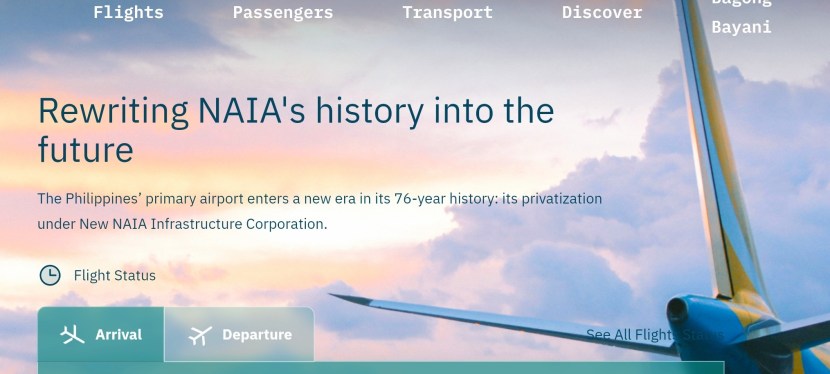
In its pursuit to keep the public informed and oriented, the new operator of the Ninoy Aquino International Airport (NAIA) – San Miguel-led New NAIA Infra Corporation (NNIC) – recently launched its official website as well as social media accounts, according to a Manila Bulletin news report.
To put things in perspective, posted below is an excerpt from the Manila Bulletin news report. Some parts in boldface…
San Miguel-led New NAIA Infra Corporation (NNIC), the new private operator of the Ninoy Aquino International Airport has launched the official website and social media pages of NAIA as the transformation of the Philippines’ primary gateway begins.
The new website, www.newnaia.com.ph, focuses on providing comprehensive information about NAIA — including details on the ongoing transformation project, its progress, and the future vision for the airport.
It serves as a hub for travelers, offering real-time flight information as well as updates on airport services and amenities.
In honor of the Philippines’ modern-day heroes, the website will feature a regular section called Bagong Bayani dedicated to inspiring stories about Overseas Filipino Workers (OFWs).
NNIC has also launched its social media pages on Facebook and X (formerly Twitter)under the name newnaiaph. These will serve as additional channels for sharing updates, engaging the public, and building a community around the NAIA transformation.
The public can also connect via email (feedback@newnaia.com), hotline (+63 2 8877 1111), and SMS (TextNAIA) at +63 917 839 6242.
“The launch of our website and social media pages is part of our commitment to open communication and transparency,” said San Miguel Corporation Chairman and NNIC President and CEO Ramon S. Ang.
Let me end this piece by asking you readers: What is your reaction to this recent development? As a traveler, have you tried searching for relevant information on newnaia.com.ph? Have you been following NNIC’s accounts on Facebook and Twitter? Is the flight status tool of the official website working properly?
For more South Metro Manila community news and developments, come back here soon. Also say NO to fake news, NO to irresponsible journalism, NO to misinformation, NO to plagiarists, NO to reckless publishers and NO to sinister propaganda when it comes to news and developments. For South Metro Manila community developments, member engagement, commerce and other relevant updates, join the growing South Metro Manila Facebook group at https://www.facebook.com/groups/342183059992673
More than five hundred fifty thousand voter applications for reactivation were processed by the Commission on Elections (COMELEC), according to a Philippine News Agency (PNA) news article.
To put things in perspective, posted below is an excerpt from the PNA news article. Some parts in boldface…
The Commission on Elections (Comelec) said Monday it has processed more than half a million applications for voter reactivation.
Citing its latest data, the poll body said it has received 556,231 applications for reactivation from Feb. 12 to Sept. 11. Of the number, 342,991 applicants have sought for their voter registration to be reactivated.
There are 102,410 individuals applied for reactivation with correction of entries while 81,649 people applied for transfer with reactivation. A total of 29,181 applicants sought a transfer with reactivation and correction of entries.
The number of reactivation applications is only 10 percent of the number of deactivated voter registration records. Latest data showed that there are 5,376,630 voters, whose records have been deactivated.
Majority of them, or 5,371,376, were due to their failure to vote in two successive preceding elections.
A total of 4,212 were deactivated due to exclusion orders from courts and 1,004 for failure to validate.
Let me end this piece by asking you readers: What is your reaction to this recent development? Are there many members of your local community who visited the nearest COMELEC office for voter registration or reactivation?
A Chinese national was arrested at the Ninoy Aquino International Airport (NAIA) Terminal 3 for stealing the handbag and money that belong to a judge while inside the airplane, according to a Manila Bulletin news report. A flight attended saw the said Chinese traveler stealing from the judge who was traveling with two lawyers.
To put things in perspective, posted below is an excerpt from the Manila Bulletin news report. Some parts in boldface…
A Chinese national was arrested after he was caught stealing from a female judge aboard a plane at the Ninoy Aquino International Airport (NAIA), the Bureau of Immigration (BI) said on Wednesday, Sept. 18.
In a statement, BI Officer-in-Charge Joel Anthony Viado identified the Chinese national as Lyu Shuming, 48, who was arrested at the NAIA Terminal 3 last Sept. 15. The BI did not identify the female judge.
“We will not allow these kinds of foreigners to victimize our kababayan,” Viado declared. Based on his statement, it can be presumed that the judge is a Filipino.
“The BI will continue to monitor the progress of this case, and blacklist any other members that might be found,” he added.
The BI said that Lyu, who was found to have a valid Philippine visa, was traveling with two other Chinese nationals identified as Xu Xianpu, 41, and Xie Xiaoyong, 54.
“All three have been recommended for inclusion in the BI’s blacklist,” the BI said as it noted that Xu and Xie were also suspected to be thieves and have been allowed to board an outbound flight.
The BI said the three Chinese nationals were transiting the Philippines from Malaysia to Hong Kong.
While aboard the plane, the BI said a flight attendant caught Lyu stealing a handbag and P63,000 in cash owned by a female judge who was traveling with two lawyers.
“He was said to have opened the overhead stowage bin to retrieve the bag owned by the judge,” it said.
Let me end this piece by asking you readers: What is your reaction to this recent development? Did you encounter people stealing the belongings of others while riding the airplane? Do you think the arrested Chinese traveler knew that the judge was traveling with lots of money?
For more South Metro Manila community news and developments, come back here soon. Also say NO to fake news, NO to irresponsible journalism, NO to misinformation, NO to plagiarists, NO to reckless publishers and NO to sinister propaganda when it comes to news and developments. For South Metro Manila community developments, member engagement, commerce and other relevant updates, join the growing South Metro Manila Facebook group at https://www.facebook.com/groups/342183059992673
Welcome back readers, fellow geeks and electronic gaming fans!
In this edition of the Retro Gaming Ads Blast (RGAB) series, we will take a look at another batch of retro gaming print ads – including arcade flyers – specifically about fighting games that were released in the 1990s. The said decade marked the time when Street Fighter II became a massive hit in the video arcades (and on game consoles) which sparked a wave of new fighting games from business competitors. In that same decade, 3D polygonal fighting games were also released which added greater choices of fighting games at the arcades and on game consoles that players could choose from.
For the newcomers reading this, Retro Gaming Ads Blast (RGAB) looks back at the many print ads of games (console, arcade, computer and handheld) that were published in comic books, magazines, flyers, posters and newspapers long before smartphones, social media, the worldwide web and streaming became popular. To put things in perspective, people back in the 1980s and 1990s were more trusting of print media for information and images about electronic games and related products.
With those details laid down, here is the newest batch of retro gaming print ads for you to see and enjoy…
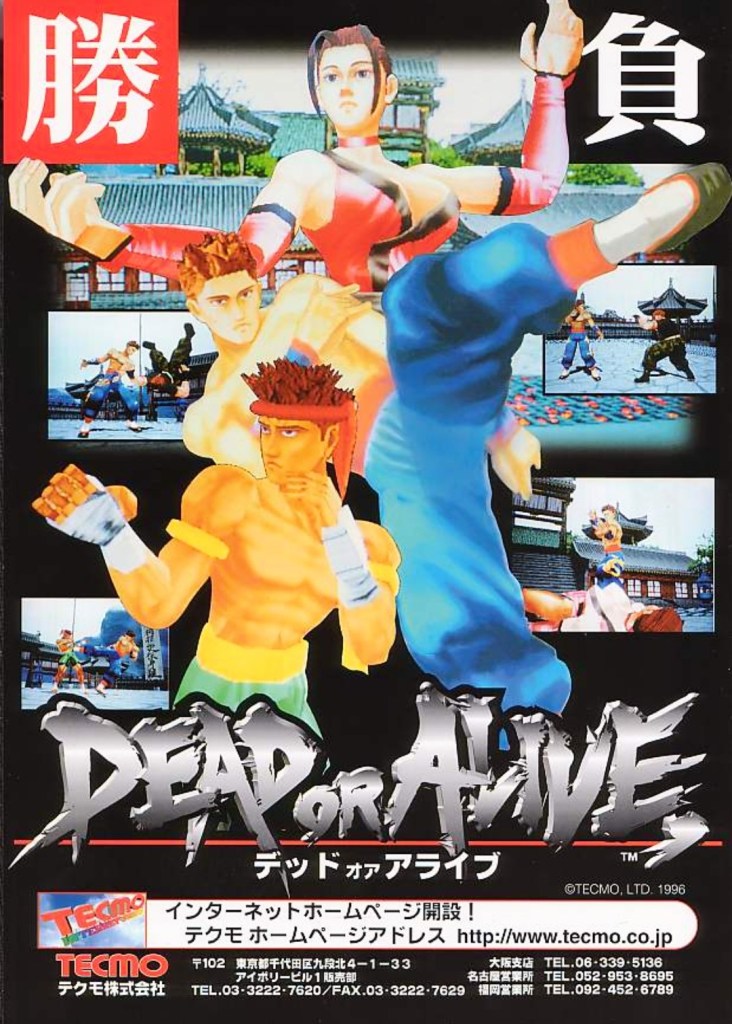
1. Dead or Alive Japanese arcade flyer
Dead or Alive was the start of new success that impacted the direction of Tecmo in the gaming industry.
The above arcade flyer of Dead or Alive gave Japanese arcade operators and gamers a taste of what to expect with the game. While the screenshots showed some resemblance with what gamers saw in Virtua Fighter 2, the character designs Tecmo and its developers came up with were unique.
Before Dead or Alive was released in Japanese arcades in 1996, company Tecmo was in financial trouble and they asked Tomonobu Itagaki to make a fighting game similar to Sega’s polygonal blockbuster Virtua Fighter. A breakthrough for Tecmo happened when Sega announced they were licensing their Model 2 arcade to third-party companies which paved the way for Itagaki’s team to make Dead or Alive with it. The game became a big hit and it paved the way for Tecmo to release it on Sega Saturn and PlayStation, and the sequels that followed years later.
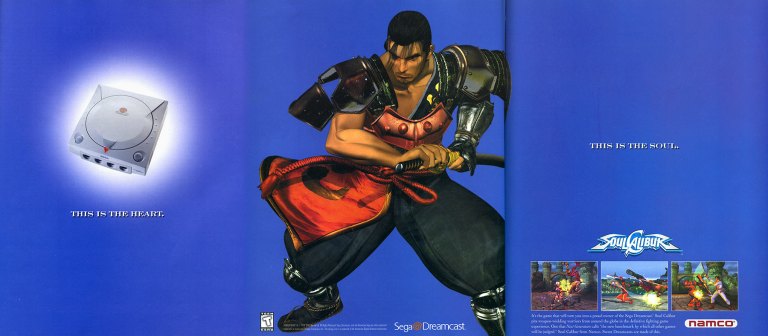
2. North American Soulcalibur Dreamcast version print ad
Namco came up with a creative approach to emphasize heart-and-soul promoting their game and the Dreamcast.
On September 9, 1999, Sega launched their Dreamcast console in America. With a gap of around ten months between the Japanese launch (November 1998) and the American launch, Sega had time to prepare Dreamcast’s release to American gamers with a huge lineup of games (both Sega’s games and from other publishers). Fortunately for Sega, they had Namco (their rival on arcade games) supporting their console.
Behind the scenes, Namco’s developers worked hard to not only port their arcade hit Soulcalibur to the Dreamcast, but to enhance the graphics using the console’s more advanced technology. The visual enhancements include rendering all of the games stages (and backgrounds) into full 3D polygonal environments. Namco also implemented different game modes and added even more content to ensure satisfaction to Dreamcast gamers.
The above 3-page print ad of Soulcalibur on Dreamcast was undeniably strategic and captivating to look at. The ad described the console as the heart, showed Soulcalibur character Mitsurugi (one of the game’s most popular characters) in the middle and then described the game (with 3 screenshots of game rendered with Dreamcast graphics) as the soul. It was a strong way to promote both the game and the console. In the years that followed, Soulcalibur grew into a popular fighting game franchise and the Dreamcast version will always be remembered as the crucial turning point.
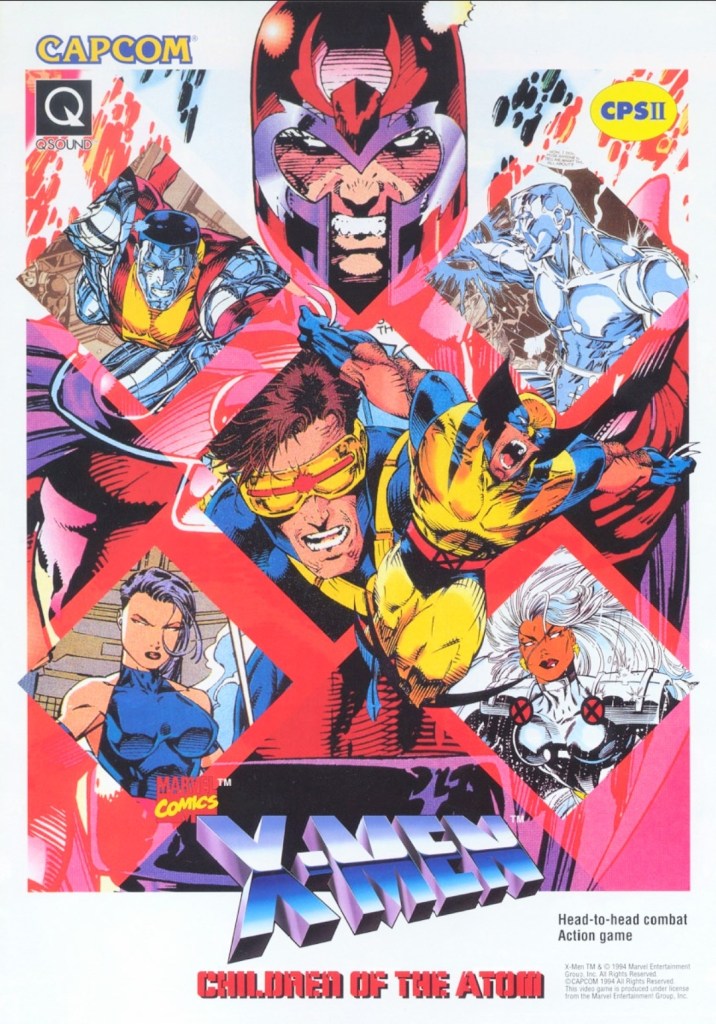
3. X-Men: Children of the Atom arcade flyer
Anyone who read lots of X-Men comic books in the 1990s should be able to tell which character was drawn by which artist.
When Capcom first released X-Men: Children of the Atom in the arcades in the mid-1990s, I was surprised because I did not anticipate the day would come when the company behind Street Fighter II would actually make a 2D fighting game showcasing the Marvel’s mutants. Even more intriguing was the X-Men art Capcom used for the arcade flyer to promote the game. I recognize Jim Lee’s artworks of Magneto, Cyclops and Colossus. The art of Wolverine shown was drawn by Andy Kubert. It was a wise move for Capcom (with Marvel as a business partner) to use established X-Men comic book artworks instead of having their internal illustrator draw the characters. That being said, this arcade flyer still looks great and captivating to look at.
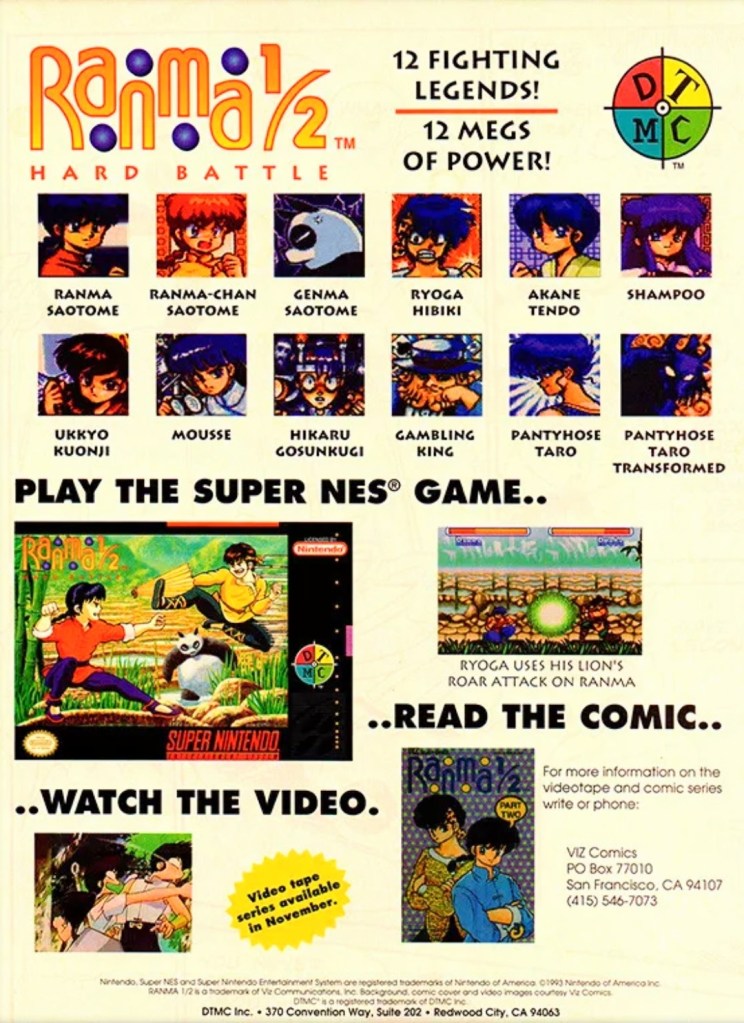
4. North American Ranma ½: Hard Battle print ad
A print ad promoting the game while saving some space to promote the anime and comic books.
By 1993, Street Fighter II and its upgraded follow-ups were wildly popular both in the arcades and on game consoles around the world. At the same time, there were many other 2D fighting games released to compete with and cash-in on Street Fighter II’s success. Believe it or not, the established anime franchise Ranma ½ saw a video game adaptation in the form of a 2D fighting game – Ranma ½: Hard Battle.
The North American print ad above published by DTMC (in cooperation with Viz Communications) promoted the game (one screenshot, the SNES game box and images of the characters as they appeared in the game) as well as Ranma ½ on anime videos and comic books. The way it was presented, the print ad promoted Ranma ½: Hard Battle without much heart nor passion.
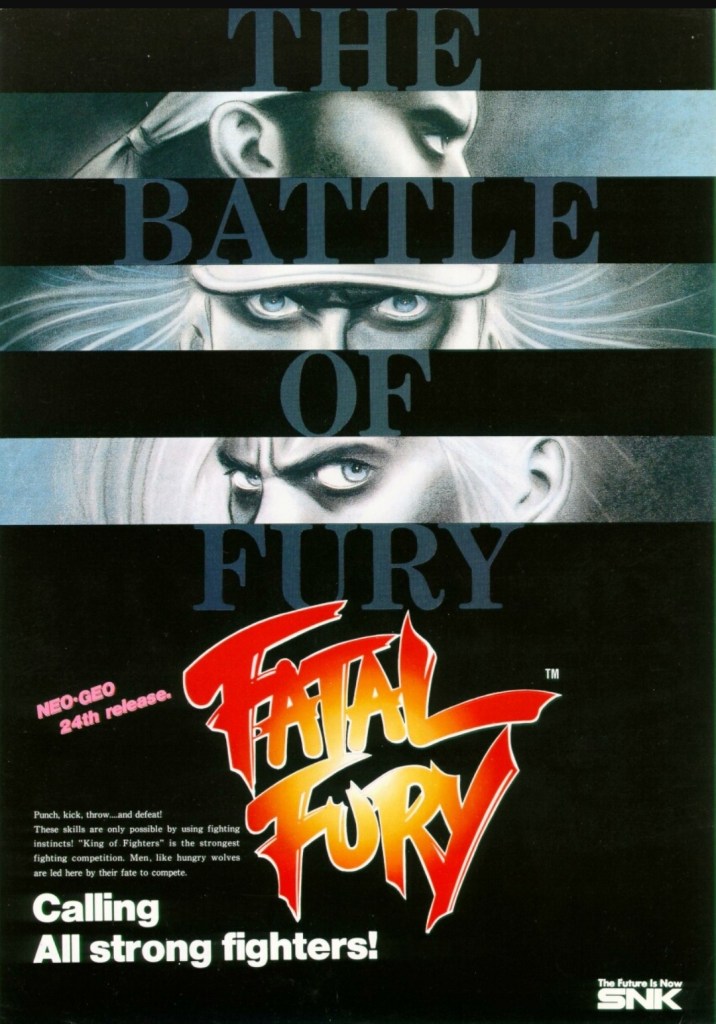
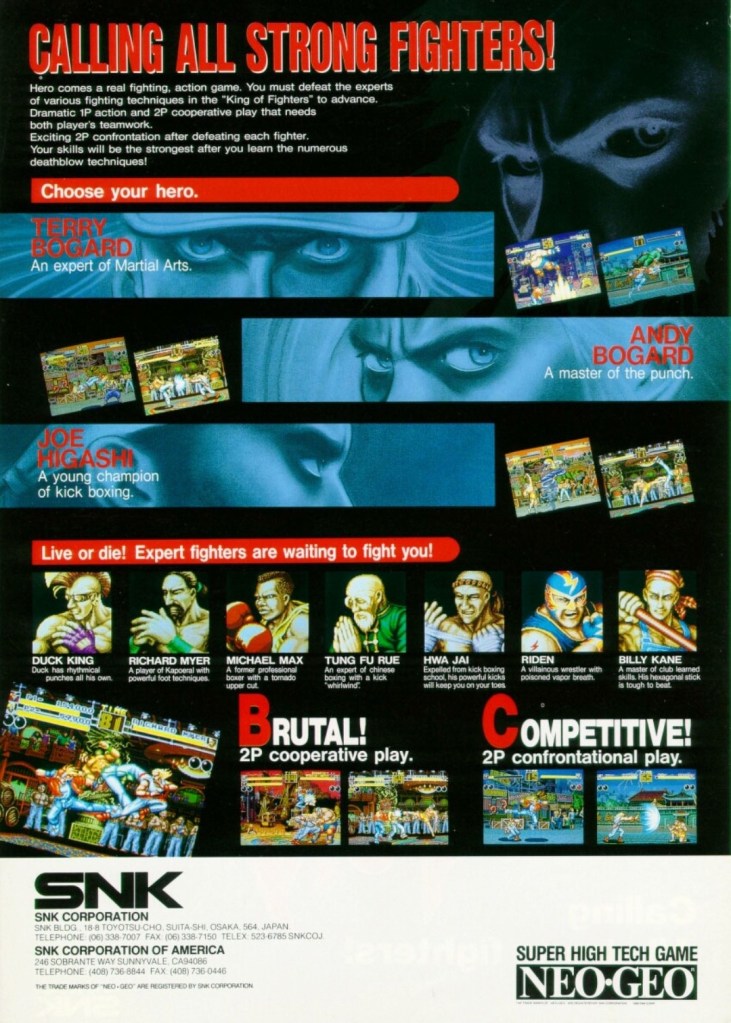
5. Fatal Fury: King of Fighters arcade flyer
An intriguing visual presentation on the front.
You get to know the characters and what the game features are.
There is no doubt that Fatal Fury: King of Fighters is the most significant game that SNK made. Apart from being the company’s first fighting game for the Neo Geo system, it established the fictional “king of fighters” tournament that became the core concept for The King of Fighters series of games in the years that followed. Fatal Fury itself is notable for being designed by Takashi Nishiyama, a former Capcom employee who created the original Street Fighter game. What Nishiyama could not do with Street Fighter, he accomplished while making SNK’s fighting game. Compared with the combo-oriented approach of Street Fighter II, Fatal Fury was designed to emphasize the timing of special moves, confrontational play, cooperative play and the 3D-like spacing between characters (background row and foreground row in each stage) while telling a story in a solid way.
The above arcade flyer of Fatal Fury has this unique looking artwork on the front showing stylized rectangular shots of the major characters Terry Bogard, Andy Bogard and Joe Higashi. On the other side of the flyer are the details that emphasized the creative concept of the game, who the characters are and what they could expect with regards to gameplay features. This flyer is still captivating to look at and it could entice you to try playing the original Fatal Fury game before trying out the sequels and spin-offs.
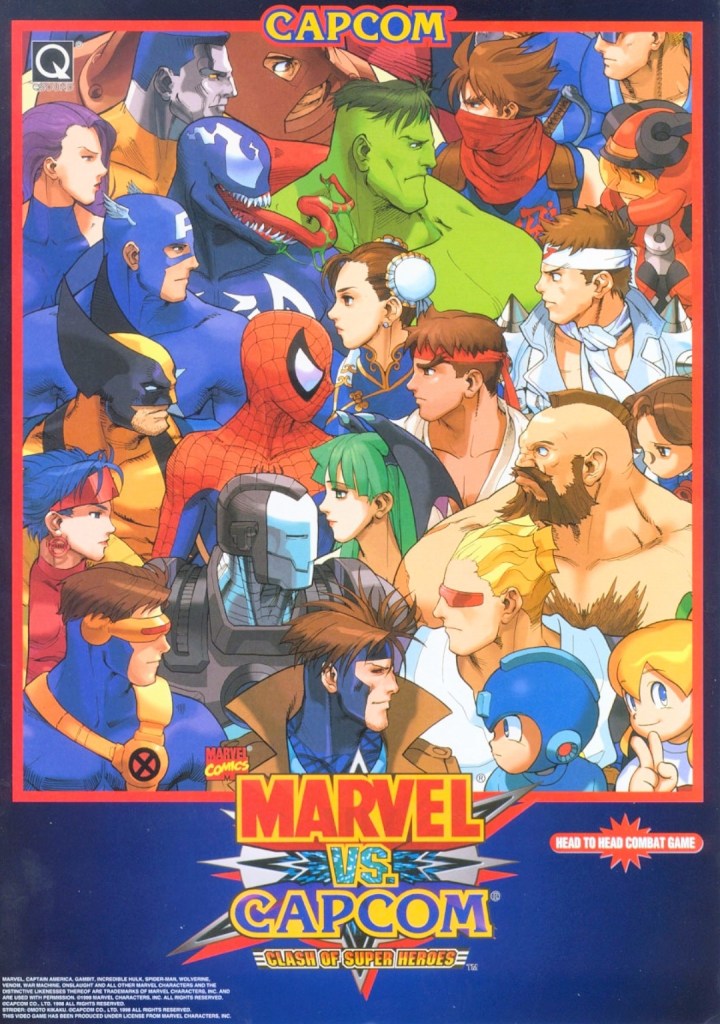
6. Marvel vs. Capcom: Clash of Super Heroes arcade flyer
This is NOT a comic book crossover.
If there is anything that truly emphasizes the essence of a fictional crossover in terms of visuals, it’s the art that Capcom and Marvel agreed to for Marvel vs. Capcom: Clash of Superheroes which is evident on the front of the above arcade flyer. By looking at how the Marvel characters were drawn, it looks like someone at Capcom illustrated the artwork as the Capcom characters still maintained that particular art style seen in the artworks of the Japanese company’s other games like Street Fighter, Darkstalkers, Mega Man and Strider. Regardless, the artwork still is amusing to look at.
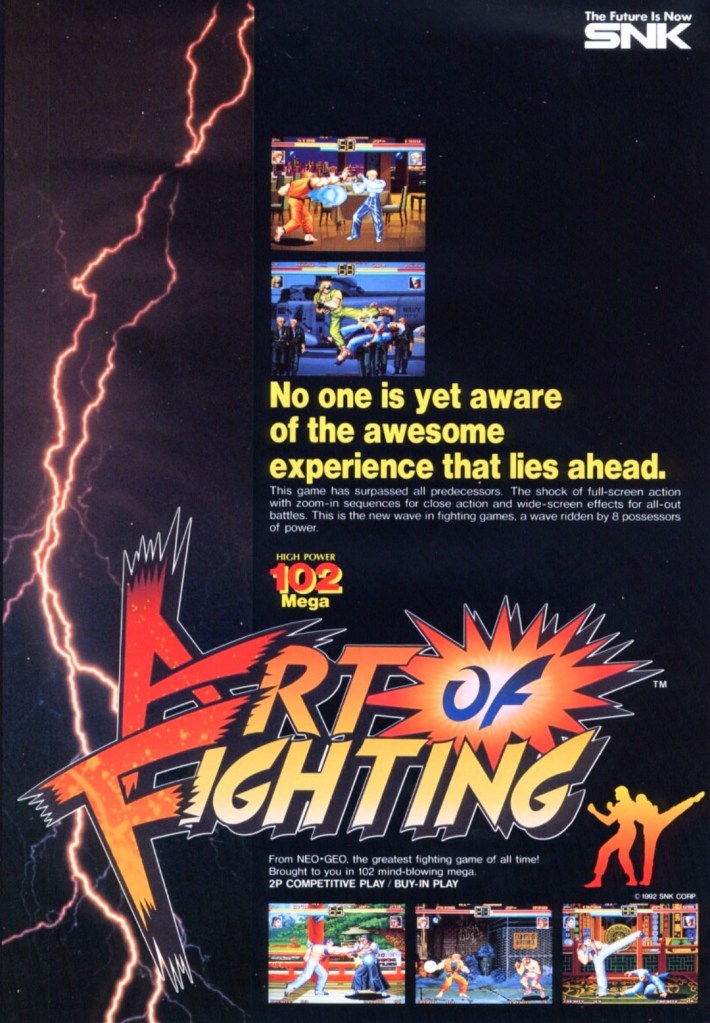
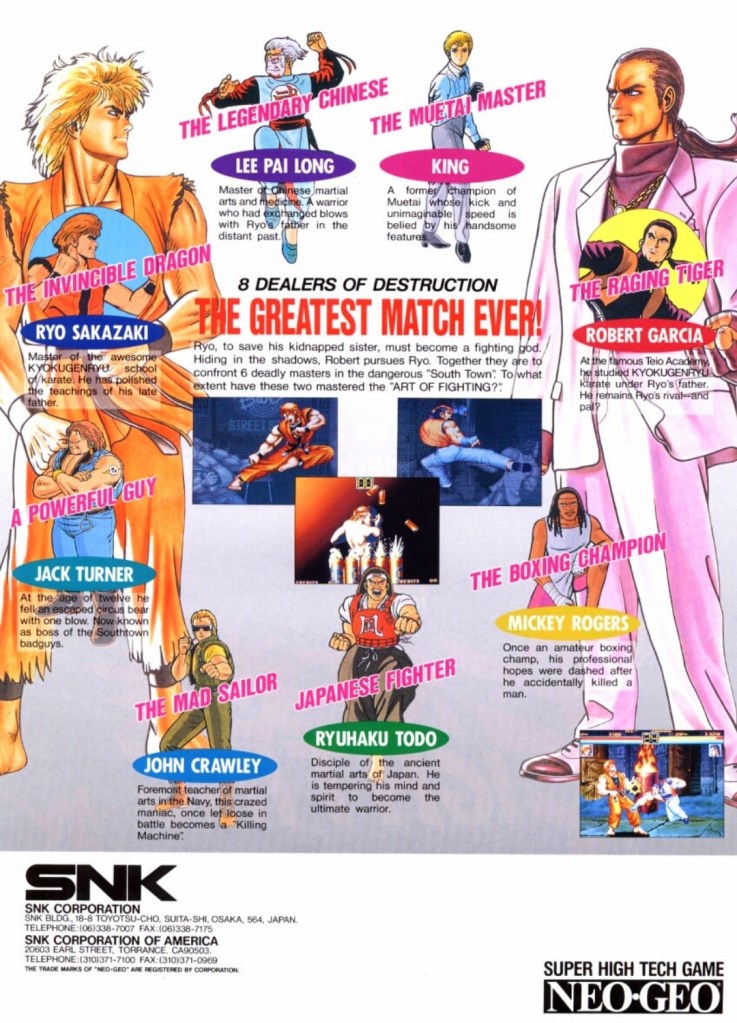
7. Art of Fighting arcade flyer
The front of the flyer.
The cast of characters showcased on the other side of the flyer.
Following the success of Fatal Fury, SNK went on to release Art of Fighting in arcades in 1992 and it became successful enough for the company to make sequels. With regards to the realm of fantasy, Art of Fighting was part of the same fictional universe as Fatal Fury and The King of Fighters, and there were times when its own characters appeared in other SNK games.
Art of Fighting’s arcade flyer had an energetic visual concept on the front with a rectangular lightning portion on the left balanced with five screenshots of the game itself. Once you get to the other side of the flyer, you will see really nice art of the characters with Ryo Sakazaki and Robert Garcia as the most dominating figures. Sakazaki and Garcia are the major characters of the Art of Fighting series. This flyer confidently introduced the characters and succeeded in making them look interesting.
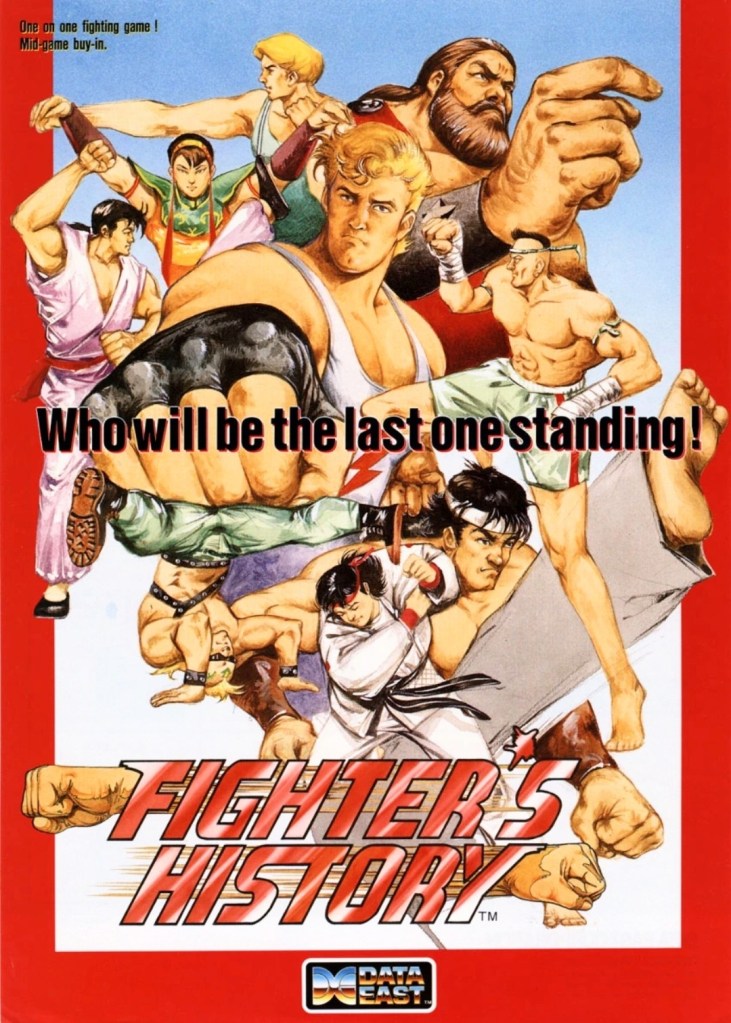
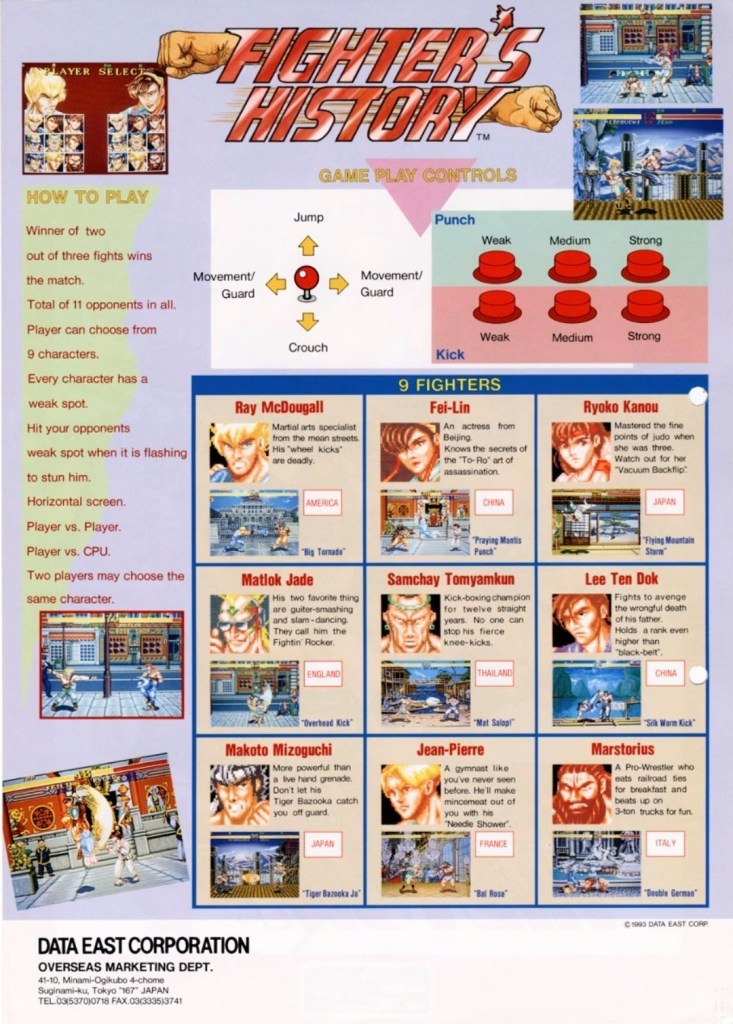
8. Fighter’s History arcade flyer and print ad
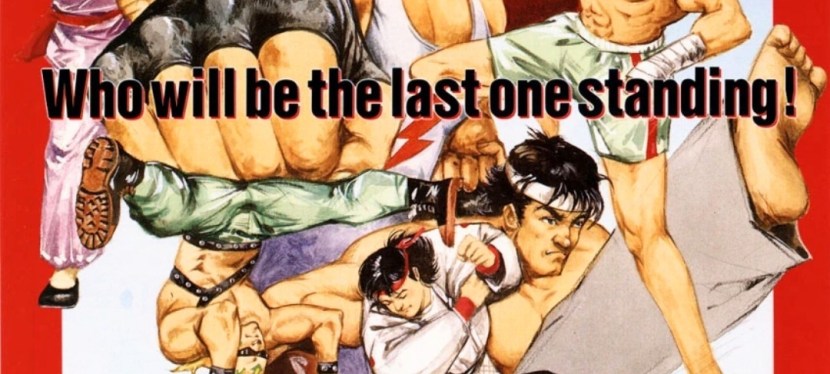
Great looking front artwork showing the game’s characters, posing and some action.
If you look closely at the controls, you will see the six-button layout and functions which are the same with those used in Street Fighter II.
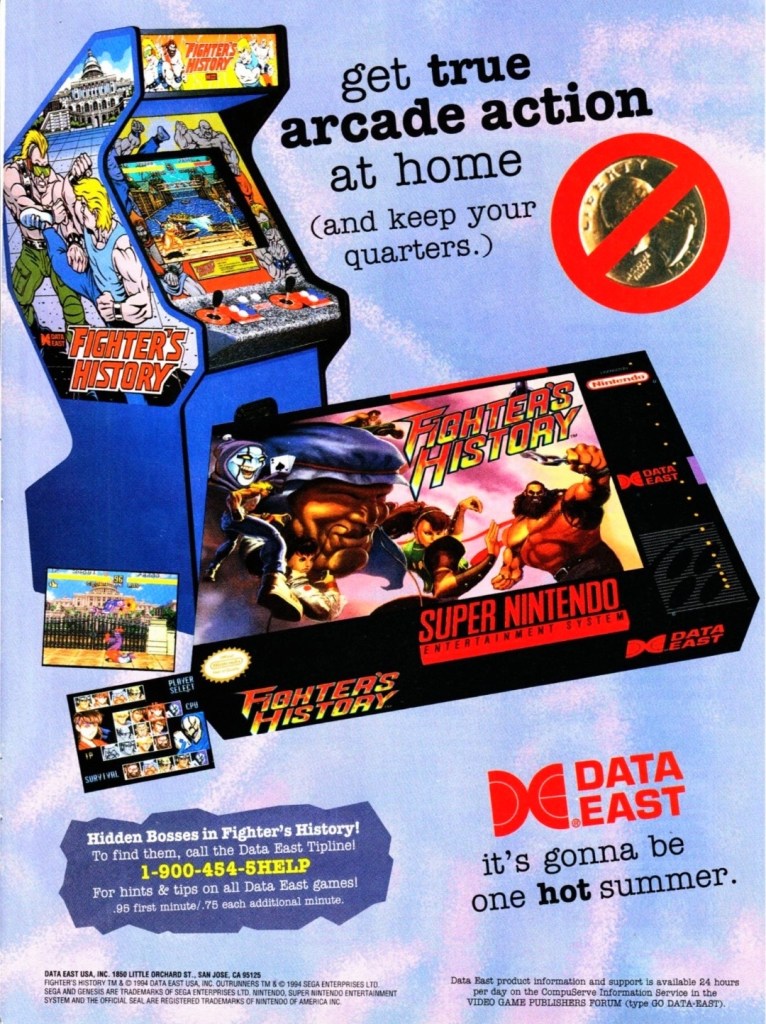
Data East offered two ways for gamers to enjoy Fighter’s History – pay a high price for the SNES version or gamers can go play the game in the arcade by dropping a few coins.
In 1993, Data East released their fighting game Fighter’s History in the arcades around the world. Along the way, the company released their arcade flyer which had a very captivating art work on the front featuring their characters and some action. The other side of the flyer showed the technical details on how to play, how the control works and who the characters are. Fighter’s History was nicely received in the arcades and the success led Data East into porting the game for the Super Nintendo Entertainment System (SNES). If you look at the print ad above, you can see how clever Data East was promoting the SNES version of the game while keeping an image of the arcade machine which serves like a subtle reminder that the same game is still available in video arcades.
Shortly after the release of Fighter’s History in the arcades, there were gamers who noticed that it had certain visual and gameplay elements that made it so familiar with what Street Fighter II had. When Capcom became aware of the similarities, they sued Data East claiming that Fighter’s History was too similar to their game and that copyright infringement was committed. Capcom lost the case ultimately and Data East went on to release two more Fighter’s History games.
9. Virtua Fighter 3 arcade flyer
Virtua Fighter 3 truly raised the standards for arcade game graphics back in 1996.
When it comes to gaming innovation and standing out among the rest, Sega did exactly those when they released Virtua Fighter 3 in arcades in 1996 and it had the best-looking and really mind-blowing graphics at the time. Developed by AM2 (led by Yu Suzuki) on the very expensive Model 3 arcade hardware, Virtua Fighter 3 broke new ground on graphics as it moved over 1 million polygons per second, had highly detailed visuals on the characters and surroundings, realistic reflection effects, detailed shining, parallel lighting and high-specular Gouraud shading to name some. Even the characters’ eyes followed the opponent’s position.
The Virtua Fighter 3 arcade flyer showcased their reflective, metallic character Dural who in turn was part of the graphical showcase (emphasizing reflections, smooth animation and liquid metal effects) when the game was previewed in the 1996 AOU event in Japan. The words “The New Standard” written on the lower-left corner of the front of the flyer was justified and truthful.
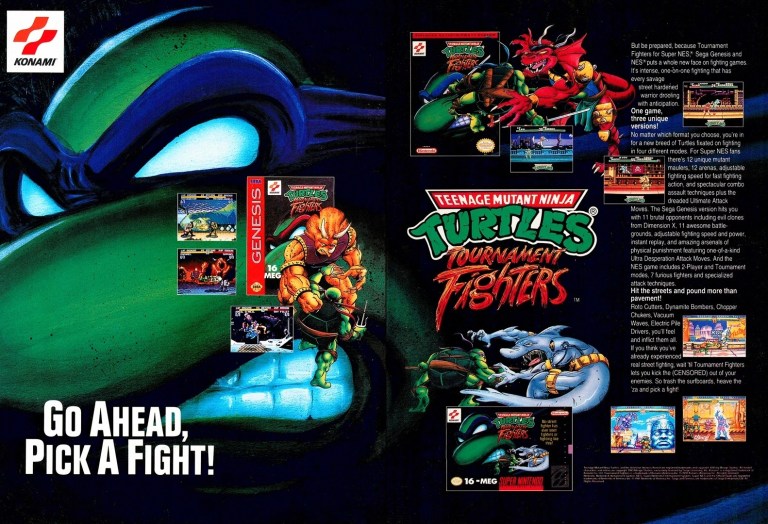
10. Teenage Mutant Ninja Turtles: Tournament Fighters print ad
This print ad had a nice visual presentation and was easily recognizable to the many TMNT fans.
In 1989, the Teenage Mutant Ninja Turtles (TMNT) franchise made quite a splash on video games which is not surprising as the multimedia franchise was already a popular in the West. More video game adaptation of TMNT were released in the early 1990s providing fans and gamers a lot of fun gameplay at the arcades (click here) and on consoles. Konami had the video game rights of TMNT and in a clear response to the sudden popularity of fighting games, they released Teenage Mutant Ninja Turtles: Tournament Fighters on the most popular game consoles of the time achieving varying levels of success critically and commercially (note: the SNES version stood out as the best). This print ad of the fighting game was effective in visually promoting the three console versions and the displayed text contained enough information to lure the attention of both fans and gamers.
Recently in the City of Las Piñas, more than seven hundred people availed of the free services that were offered during the Health and Wellness Caravan held at the TS Cruz covered court, the City Government announced via social media. The caravan was organized by the local health office and was attended by Vice Mayor April Aguilar.
To put things in perspective, posted below is an excerpt from City Government’s social media post. Some parts in boldface…
Over 700 residents of Barangay Almanza Dos benefitted from a Health and Wellness Caravan held at the TS Cruz Covered Court on Tuesday, September 10, providing a range of free health services aimed at promoting community health and well-being.
The event, organized by the City Health Office, featured services such as medical consultations, blood sugar (FBS/RBS) and cholesterol testing, blood typing, chest X-rays, ECG, and nutrition and counseling services. A highlight of the event was the presence of the Las Piñas Dental Health Bus, offering free oral examinations, oral health education, tooth extractions, oral prophylaxis, and the distribution of oral health kits. Senior citizens were given access to pneumococcal vaccines, and a Greencard Help Desk and PhilHealth registration were also made available.
City Vice Mayor April Aguilar and City Health Office OIC Dr. Juliana Gonzalez graced the event, ensuring the success of the outreach initiative that catered to the medical needs of numerous residents.
Let me end this piece by asking you readers: If you are a resident of Las Piñas City, what is your reaction to this development? Do you wish that the Health and Wellness caravan will happen in your local community soon?
For more South Metro Manila community news and developments, come back here soon. Also say NO to fake news, NO to irresponsible journalism, NO to misinformation, NO to plagiarists, NO to reckless publishers and NO to sinister propaganda when it comes to news and developments. For South Metro Manila community developments, member engagement, commerce and other relevant updates, join the growing South Metro Manila Facebook group at https://www.facebook.com/groups/342183059992673
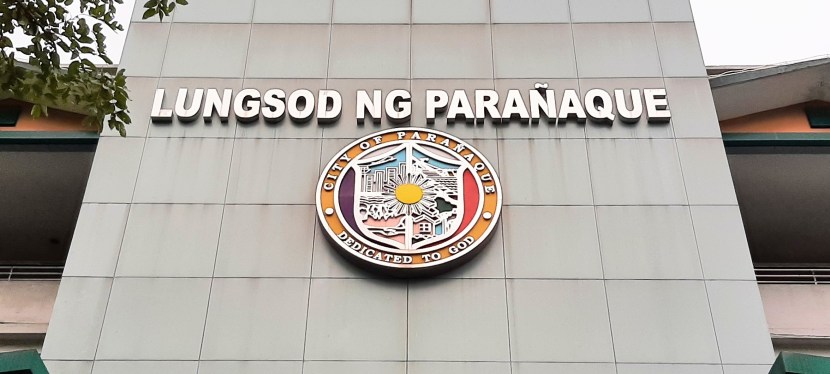
Recently in the City of Parañaque, local authorities raided a scam hub and arrested four Chinese nationals, according to a news report by the Philippine Star. The report also includes the arrest of a Chinese fugitive as a result of a separate operation in Parañaque.
To put things in perspective, posted below is the excerpt from the Philippine Star report. Some parts in boldface…
Four Chinese were arrested recently during a raid on a suspected cryptocurrency investment and love scam hub in Parañaque City.
The facility reportedly posed as a licensed Philippine offshore gaming operator to conceal its illegal activities.
Wei Hanbing, 33; Wang Bo, 32; Wang Zhaoshan, 37, and Guo Dong, 26 were detained on Aug. 31 at Camp Bagong Diwa in Taguig. Authorities have turned them over to the Bureau of Immigration (BI).
Meanwhile, Zhang Xi, 38, who is wanted by the Chinese government and the Interpol, was apprehended on Sept. 8 in Parañaque, according to BI fugitive search unit chief Rendel Ryan Sy.
Zhang allegedly led an online criminal ring that designed a computer virus to remotely control around 4,200 computers in China, which gained over seven million yuan in ill-gotten profits since 2023.
Let me end this post by asking you readers: What do you think about this recent development? If you are a resident of Parañaque, are you concerned that there could be a lot more Chinese criminals secretly doing illegal operations within your local community? Why is it that Parañaque is still a hot spot for POGOs, scam hubs and criminal activities involving Chinese nationals?
For more South Metro Manila community news and developments, come back here soon. Also say NO to fake news, NO to irresponsible journalism, NO to misinformation, NO to plagiarists, NO to reckless publishers and NO to sinister propaganda when it comes to news and developments. For South Metro Manila community developments, member engagement, commerce and other relevant updates, join the growing South Metro Manila Facebook group at https://www.facebook.com/groups/342183059992673
There is no doubt that Philippine Offshore Gaming Operators (POGOs) added a lot to criminal activities and pain in the country which is why a national ban on them was declared. Still there is a lot to uncover with regards to the processing of records of people – both foreign and local – who worked for POGOs. Recently, law enforcers raided an office that turned out to be making fake passports and ID cards for POGO workers, according to a GMA Network news report. The suspects were arrested for falsifying public documents.
To put things in perspective, posted below is an excerpt from the GMA news report. Some parts in boldface…
An office manufacturing fake documents like identification cards and passports was raided by the National Capital Region Police Office (NCRPO) in Sampaloc, Manila.
According to John Consulta’s report on “24 Oras,” it was also discovered that the group was making fake IDs and passports for Chinese and Filipinos who work for Philippine Offshore Gaming Operators (POGOs) in the country.
The location appears to be just a photocopying stall from the outside, but upon entering, the equipment and tools allegedly used to make fake IDs and documents were seen.
Pieces of evidence were recovered in the raid such as documents from the Philippine Statistics Authority (PSA), Land Transportation Office (LTO), drug tests with negative results, and agency IDs, all of which are fake.
Several Central Processing Units (CPU) of the computers were also recovered, where the files of the contractors who work at POGO are being kept.
According to the NCRPO, this started with the fake IDs and passports of the Chinese that they handed over to the scam hub in Parañaque last month.
“Medyo mahirap-hirap hanapin. Palipat-lipat sila. Ang transaction ay three different persons. We were able to arrest personalities involved in the forging, falsification at paggawa nitong items na ito, lalo na ang passport, identification card, and birth certificate,” said Police Major General Jose Melencio Nartatez Jr, NCRPO Regional Director.
(It’s a little hard to find. They move around. The transaction involves three different persons.)
Since the POGOs in the country are only valid until December, the NCRPO suspects that the Chinese are now busy making Philippine passports for them to stay in the Philippines.
“Ang kailangan nila during their travel, para undetected na maka-travel is to produce these kind of documents, lalo na ang passport,” said Nartatez.
(What they need during their travel, to be able to travel undetected is to produce these kinds of documents, especially the passport.)
Let me end this piece by asking you readers: What is your reaction to this recent development? Do you think the pieces of evidence that the law enforcers found will help them put a stop to further falsification of documents by Chinese nationals and POGO workers? Are you concerned that there may have been many Chinese nationals in the Philippine who already secured fake passports and fake ID cards to be able to stay longer in the country?
For more South Metro Manila community news and developments, come back here soon. Also say NO to fake news, NO to irresponsible journalism, NO to misinformation, NO to plagiarists, NO to reckless publishers and NO to sinister propaganda when it comes to news and developments. For South Metro Manila community developments, member engagement, commerce and other relevant updates, join the growing South Metro Manila Facebook group at https://www.facebook.com/groups/342183059992673
Recently in the City of Las Piñas, more than two thousand beneficiaries of the “Tara, Basa” program received cash aid from the City Government (in tandem with the Department of Social Welfare and Development), according to a Manila Bulletin news report. The distribution was led by Vice Mayor April Aguilar.
To put things in perspective, posted below is an excerpt from Manila Bulletin news report. Some parts in boldface…
The Las Piñas city government, in coordination with the Department of Social Welfare and Development (DSWD), distributed cash aid to 2,119 beneficiaries of its “Tara,Basa” tutoring program on Thursday, September 12.
Las Piñas city Vice-Mayor April Aguilar led the distribution held at the Verdant covered court in Barangay Pamplona Tres.
Aguilar said the beneficiaries who finished the 20-day tutorial session received P4,700 cash for their service as tutors or youth development workers.
The tutoring program is a new initiative by the DSWD aimed at employing college students from low-income families as tutors for elementary school children struggling with reading.
Through the 20-day tutorial sessions, the tutors not only help improve literacy among young learners but also provide training for parents or guardians, enabling them to continue the tutorial support at home.
Meanwhile, parents who attended the 20-day “Nanay-Tatay” sessions covering topics such as communication and child behavior, were also given cash aid for their active participation.
Let me end this piece by asking you readers: If you are a resident of Las Piñas City, what is your reaction to this development? Are you convinced that the “Tara, Basa” program is improving education as well as supporting low-income families?
For more South Metro Manila community news and developments, come back here soon. Also say NO to fake news, NO to irresponsible journalism, NO to misinformation, NO to plagiarists, NO to reckless publishers and NO to sinister propaganda when it comes to news and developments. For South Metro Manila community developments, member engagement, commerce and other relevant updates, join the growing South Metro Manila Facebook group at https://www.facebook.com/groups/342183059992673
The rehabilitation of the Ninoy Aquino International Airport (NAIA) has officially started as a result of the government’s recent turnover of airport operations to the New NAIA Infra Corp. (NNIC) which is a San Miguel-led group, according to a news report by GMA Network. To be clear, the government still owns NAIA and the operations will be handed back by the private group many years from now. Over P140 billion will be invested on managing and improving the NAIA.
To put things in perspective, posted below is an excerpt from the GMA news report. Some parts in boldface…
The government turned over Saturday the operation of the Ninoy Aquino International Airport (NAIA) to the San Miguel-led New NAIA Infra Corp., setting in motion the rehabilitation of the Philippines’ main gateway.
In a news release, the Department of Transportation (DOTr) said key officials of the agency and Manila International Airport Authority (MIAA) handed over the airport to its new private operator during a ceremony at NAIA’s Terminal 3.
“The baton has been passed and now it is our turn in NNIC to carry it forward to the finish line,” said NNIC general manager Lito Alvarez.
Transportation Undersecretary for Aviation Roberto Lim expressed support to NNIC, saying the takeover would be a precursor to a world-class and modernized NAIA.
“Today, we celebrate the competitive spirit of the winning consortium, which brings financial muscle, management expertise, and the technical operations strength and experience of Incheon Airport,” said Lim.
The turnover of NAIA’s rehabilitation, operations, and further development to NNIC, formerly SMC SAP & Co. Consortium, is seen to boost the airport capacity to meet growing demand by handling more flights and passengers, while improving service quality and compliance with International Civil Aviation Organization (ICAO) standards.
San Miguel-led NNIC is investing approximately P144 billion to manage and improve NAIA under a 15-year concession, extendable by 10 years, which would be contingent on meeting key performance targets.
The DOTr clarified that ownership of the airport will remain with the government. The agency said that at the end of the concession period, NNIC will return to the government the operations of NAIA.
The government signed the landmark concession agreement for the NAIA Public-Private Partnership (PPP) project on March 18.
Among the expected improvements in NAIA that the traveling public and other stakeholders can expect include expansion of the Passenger Terminal Buildings (PTBs), additional aircraft parking bays, increase in vehicular parking slots, installation of world-class systems and technology, more food and beverage (F&B) and retail options, more convenient land transport connectivity, among others.
Furthermore, flight delays and cancellations due issues with airport facilities are expected to be significantly reduced.
NNIC Chairman Ramon Ang said, “A world-class airport means more jobs, more tourists and a much more stronger and prosperous Philippines.“
The consortium is committing to modernize NAIA, increasing its capacity from 35 million passengers to 62 million passengers. Air traffic movement is also expected to be increased from 40 movements per hour to 48.
The rehabilitation is expected to generate at least 58,000 jobs for Filipinos.
Let me end this piece by asking you readers: What is your reaction to this recent development? Do you think that the NAIA operations will improve under the San Miguel-led group? Do you think this will lead to improved travel efficiency, convenience and comfort for millions of air travelers in the Philippines?
For more South Metro Manila community news and developments, come back here soon. Also say NO to fake news, NO to irresponsible journalism, NO to misinformation, NO to plagiarists, NO to reckless publishers and NO to sinister propaganda when it comes to news and developments. For South Metro Manila community developments, member engagement, commerce and other relevant updates, join the growing South Metro Manila Facebook group at https://www.facebook.com/groups/342183059992673






 Author Carlo Carrasco