A Look Back at Harbinger #21 (1993)

Disclaimer: This is my original work with details sourced from reading the comic book and doing personal research. Anyone who wants to use this article, in part or in whole, needs to secure first my permission and agree to cite me as the source and author. Let it be known that any unauthorized use of this article will constrain the author to pursue the remedies under R.A. No. 8293, the Revised Penal Code, and/or all applicable legal actions under the laws of the Philippines.

Welcome back superhero enthusiasts, 1990s culture enthusiasts and comic book collectors! Today we go back to the early 1990s and explore a part of the Valiant Comics shared universe through the Harbinger monthly series.

In my previous review, Sting and new recruit Natalie (Stunner) were inside the stronghold of Kaliph deep within the terrorist state of Iran. Sting’s teammates went there on a high-risk mission to rescue the two even though they had no real resources to deal with Kaliph (first appearance in issue #19) and his private army, and they also had very little time to spare. Regardless, the dangerous mission proceeded and the rescue miraculously turned out successful. The success, however, came with a certain loss.

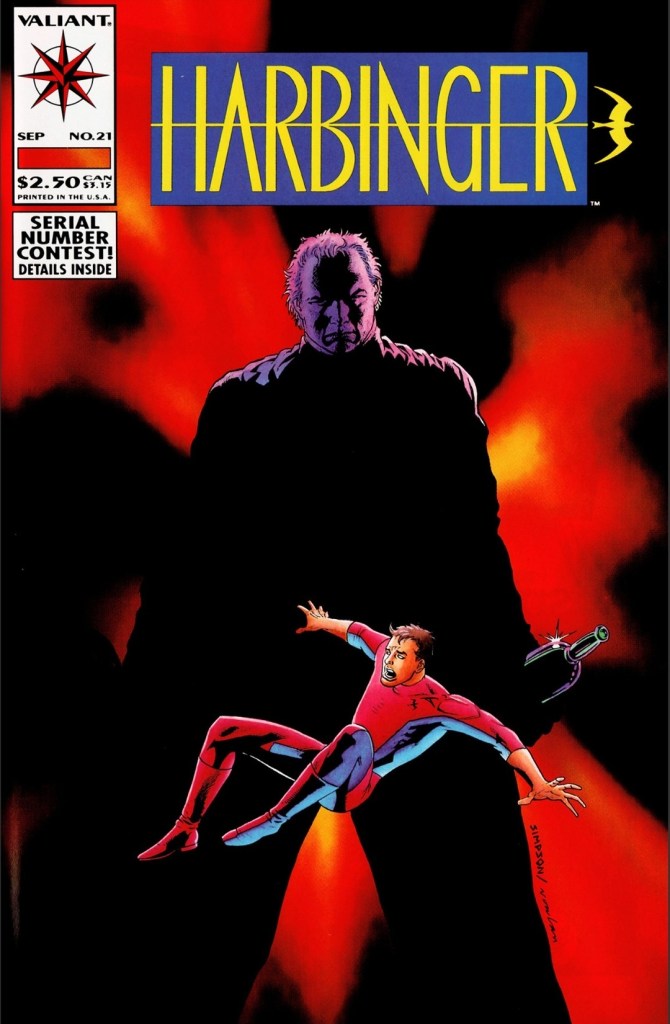
With those details laid down, here is a look back at Harbinger #21, published in 1993 by Valiant Comics with a story written by Maurice Fontenot and illustrated by Howard Simpson.

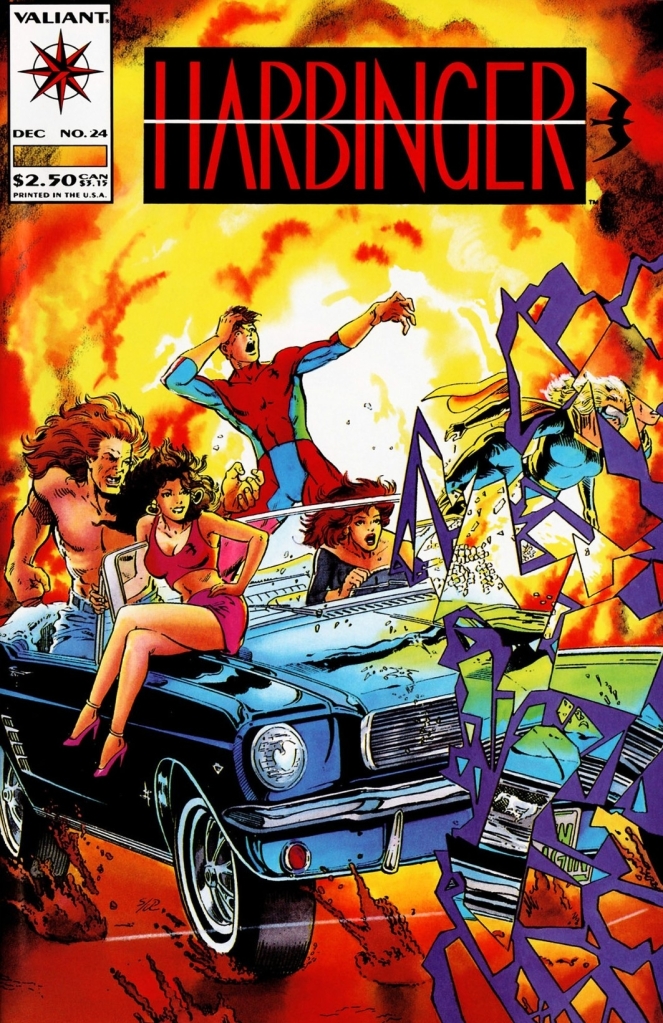
Cover.

Early story

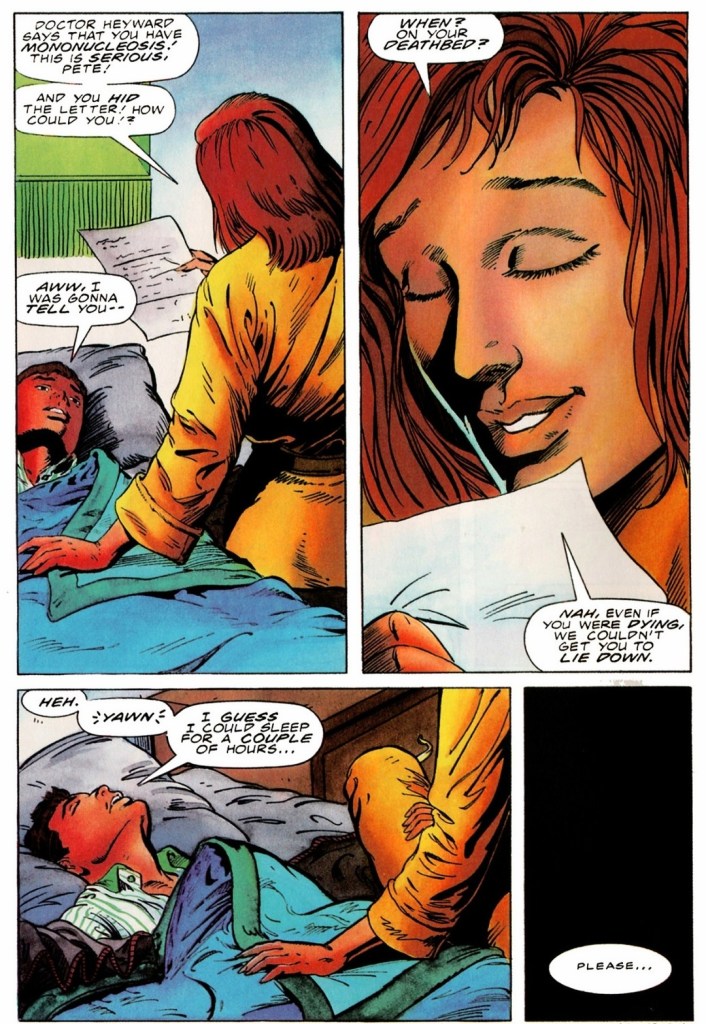
The story begins inside the New Jersey apartment occupied by Sting and his teammates. Although weeks had passed since the dangerous mission in Iran, Sting remains in weak physical condition and he had to be carried by Faith/Zepplin and Flamingo as his lover Kris checks out a letter that was hidden from her.

Even though he is obviously not feeling well, Sting lies to Kris that he is fine. Kris reads the letter which turned out to be medical results on Sting done by Doctor Heyward. Sting was diagnosed with Mononucleosis. The weak leader of the group then falls into sleep.

Sometime later, Sting endures a nightmare and wakes up sweating and feeling very troubled…

Quality

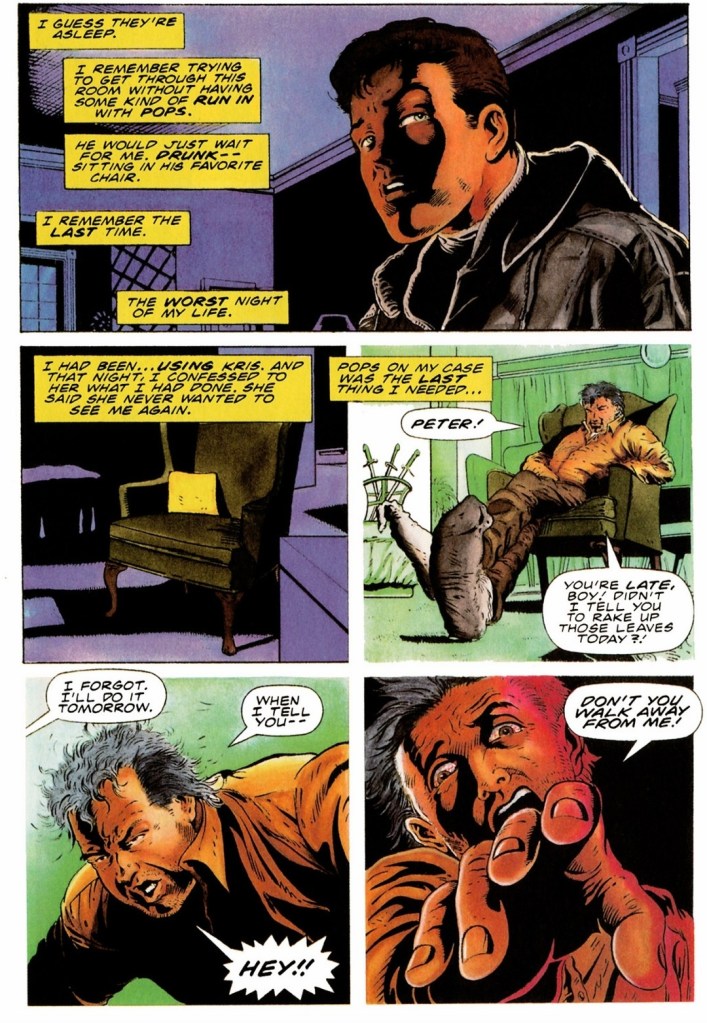
A look at Sting’s troubled relationship with his father in the past.

As a way of taking a change of direction following the previous two issues, this particular Harbinger story shifts the focus mainly on Sting and went ahead in explaining why he is such a flawed person, why he is reckless and even unworthy to be leading his teammates.

The core issue in this tale is Sting’s painful relationship with his father. Without spoiling the story details, I can say that the creative team succeed in not only dramatizing the strained father-son relationship, they also explored other elements from Sting’s past as Peter Stanchek – the young guy who had friends and lived a normal American life before his powers manifested and gradually changed everything.

More on Sting’s poor relationship with his father, the creative team came up with a pretty solid script and visuals that creatively emphasized the emotions, the pain and uncertainties on the part of the protagonist. More importantly, what they dramatized here clarified why Sting is immature, reckless and continues to live on with a distorted view of life that can be perceived as anti-family and even anti-social. Given the fact that he is unforgiving towards his father, the young team leader was revealed to be unworthy of not only of having super abilities but also unworthy of leading a group of friends who pretty much have faith in him. Sting is more than just a deeply flawed protagonist…he is also an unlikable superhero.   

Conclusion

Even though he is sick, Sting still remains dishonest with Kris.

Harbinger #21 (1993) is a very power character study of Sting and the creative team deserve admiration for what is clearly the most in-depth development of the character so far in this series. It should be noted that the story, whether intention or not, clearly dramatizes that a person who rejects his or her father is often destined for frustration, pain, suffering and other negative elements in life. Even with super powers, the negative elements won’t disappear and the personal problems will continue to last long. If there is one thing that Sting could do to save himself and his family, it would be coming to his father with forgiveness and having the strong will to make peace with him and be willing to love him unconditionally. Ultimately, this comic book sets up Sting for a potential series of events that could challenge him personally as he continues to lead his team.

Overall, Harbinger #21 (1993) is highly recommended!

+++++

Thank you for reading. If you find this article engaging, please click the like button below, share this article to others and also please consider making a donation to support my publishing. If you are looking for a copywriter to create content for your special project or business, check out my services and my portfolio. Feel free to contact me with a private message. Also please feel free to visit my Facebook page Author Carlo Carrasco and follow me on Twitter at  @HavenorFantasy as well as on Tumblr at https://carlocarrasco.tumblr.com/ and on Instagram at https://www.instagram.com/authorcarlocarrasco

A Look Back at Armorines #2 (1994)

Disclaimer: This is my original work with details sourced from reading the comic book and doing personal research. Anyone who wants to use this article, in part or in whole, needs to secure first my permission and agree to cite me as the source and author. Let it be known that any unauthorized use of this article will constrain the author to pursue the remedies under R.A. No. 8293, the Revised Penal Code, and/or all applicable legal actions under the laws of the Philippines.

Welcome back superhero enthusiasts, 1990s culture enthusiasts and comic book collectors! Today we go back to the early 1990s and explore a part of the Valiant Comics shared universe through the Armorines monthly series.

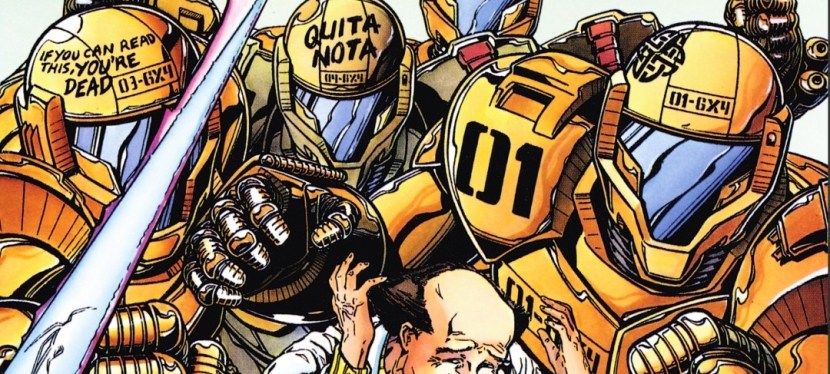
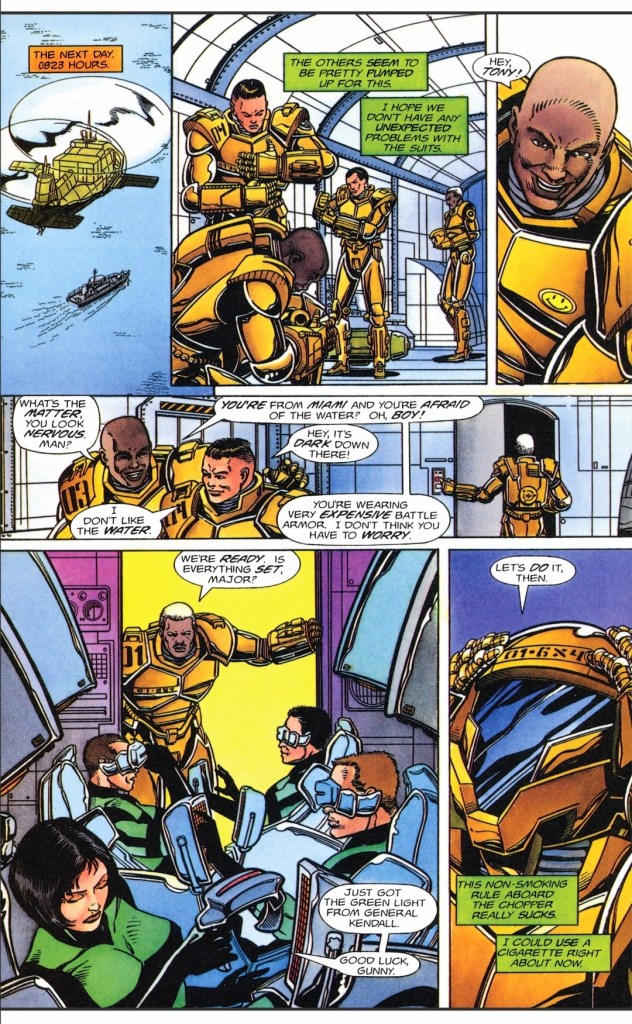
In my previous retro review, the comic book introduced us to the armored U.S. Marines (composed of members who go out on the field with armored suits and other members who serve as co-pilots via virtual reality) and their superiors. Their mission took them very deep down the ocean where they have to enter a sunken nuclear-powered submarine not knowing that something dangerous lurks there.

With those details laid down, here is a look back at Armorines , published in 1994 by Valiant Comics with a story written by Jorge Gonzalez and drawn by Jim Calafiore.

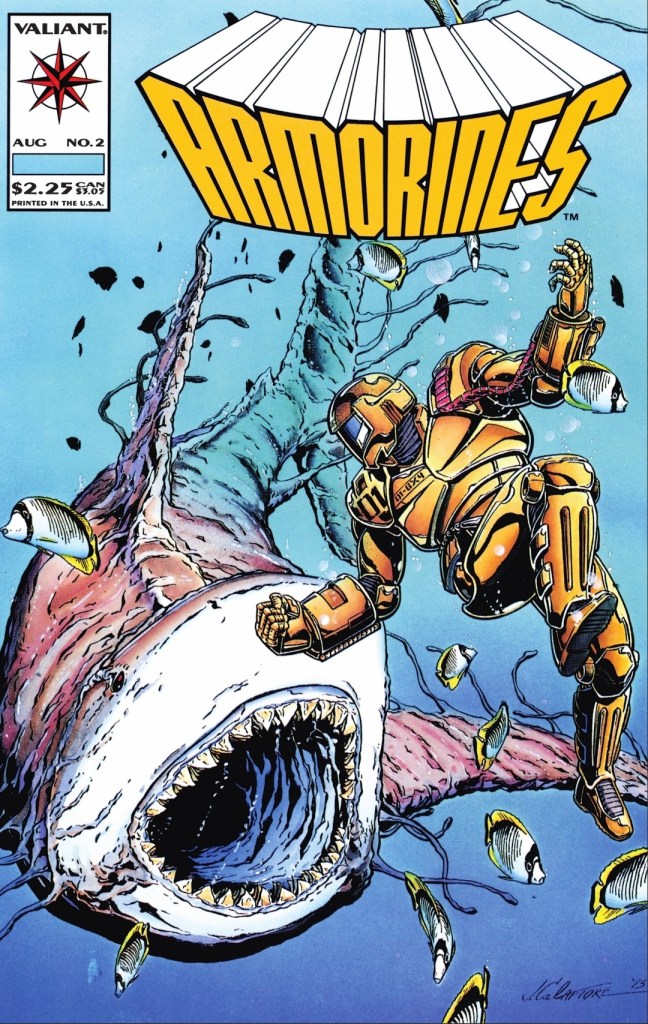
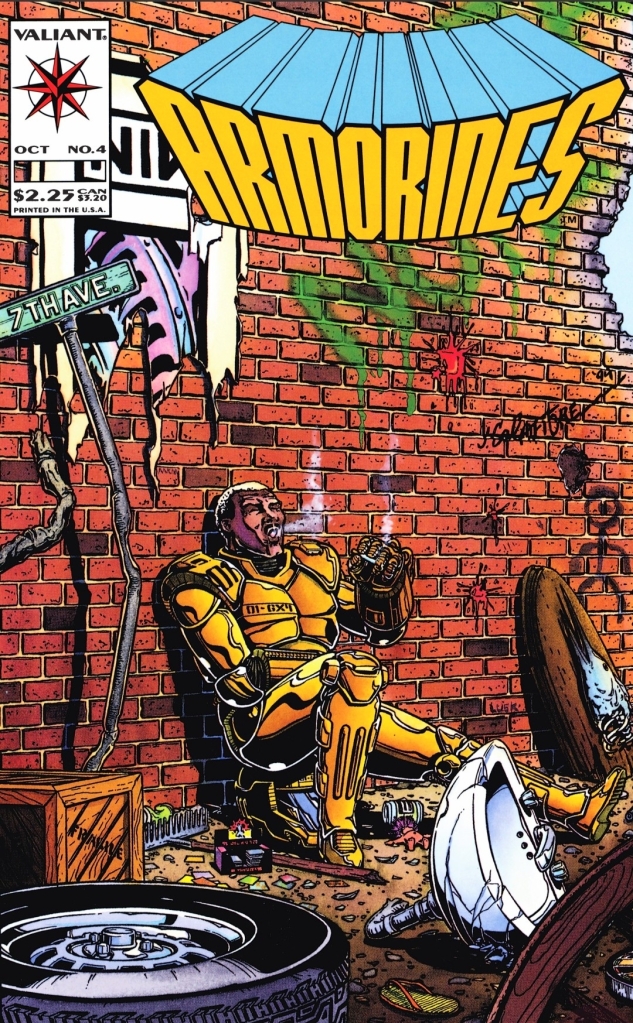
The cover.

Early story

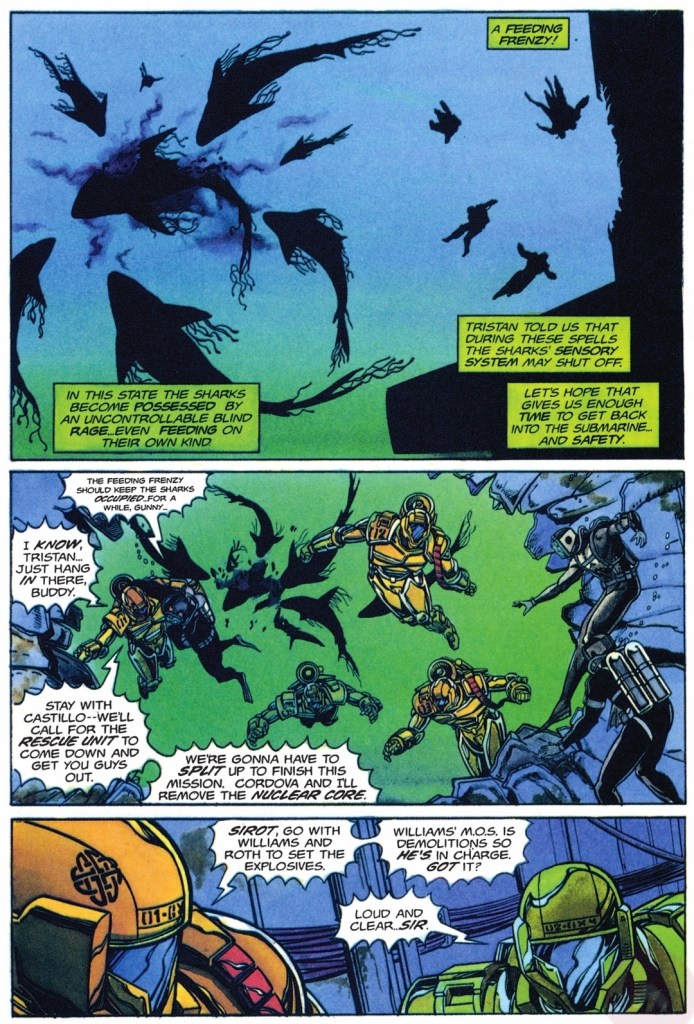
The story begins five hundred kilometers off the coast of Australia. Gunny, his armored teammates and the Navy SEALs are deep underwater on a mission at the sunken nuclear-powered submarine. They are being attacked by several large sharks that all have freakish and ruined surfaces. While the sharks don’t have any exceptional intelligence, they have lateralis systems that alert them to low-frequency vibrations and are able to detect the minute electric fields generated by the prey.

While the Armorines have energy weapons that can easily cut through flesh and hard objects, the sharks remained challenging to hit. They and the Navy SEALs struggle to keep together and focus on their mission…

Quality

Can you just imagine yourself working on a mission deep under the sea with lots of sharks swimming nearby?

As a direct follow-up to issue , this comic book shows more of what the Armorines can do on a mission even though their spotlight had to be shared with the Navy SEALs who are their partners on the mission involving the sunken submarine. The spectacle readers can look forward to here are the action scenes of the Armorines using their high-tech weapons against sharks that are many times larger than each of them. The focus of the story, unsurprisingly, is the mission inside the sunken submarine and the coordination between the armored US marines with the Navy SEALs. While there is no clear villain yet, this comic book’s script has effective writing behind it and the result is a plot that turned out to be engaging enough. If you are looking for character development, you won’t find it here.

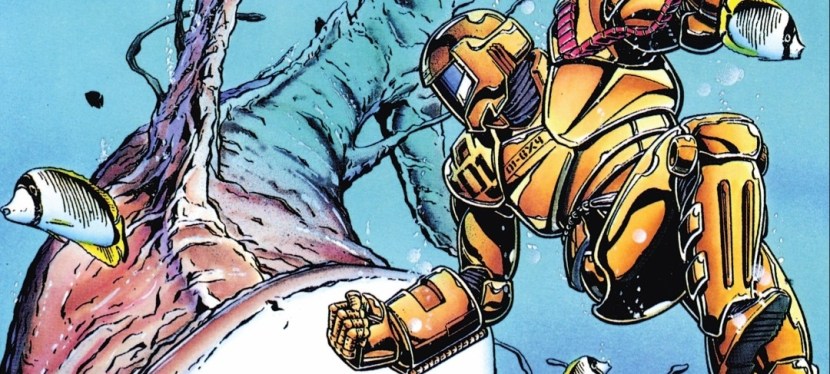
Meanwhile, Jim Calafiore’s art really shines as he successfully implemented enough visual details on the characters, the sharks, the underwater environment and the interiors of the submarine. His art on the sharks are really monstrous to look at!

Conclusion

While the Armorines did not have to worry about being shot back, the huge size, speed and the unrelenting aggression by the freaking sharks still proved to be big challenges for them.

Armorines (1994) is indeed a solid continuation and progression to what came before it. While issue was mainly a build-up and introductory story, this one shows the Armorines in action on the line of duty while working in tandem with their Navy SEAL brothers. While the mission is the main subject of the story leaving no real room left for any character development, there were two twists (note: science fiction in nature) that added to the depth of the story. Safe to say, I am motivated enough to look forward to the next issue.

Overall, Armorines (1994) is recommended.

+++++

Thank you for reading. If you find this article engaging, please click the like button below, share this article to others and also please consider making a donation to support my publishing. If you are looking for a copywriter to create content for your special project or business, check out my services and my portfolio. Feel free to contact me with a private message. Also please feel free to visit my Facebook page Author Carlo Carrasco and follow me on Twitter at  @HavenorFantasy as well as on Tumblr at https://carlocarrasco.tumblr.com/ and on Instagram at https://www.instagram.com/authorcarlocarrasco

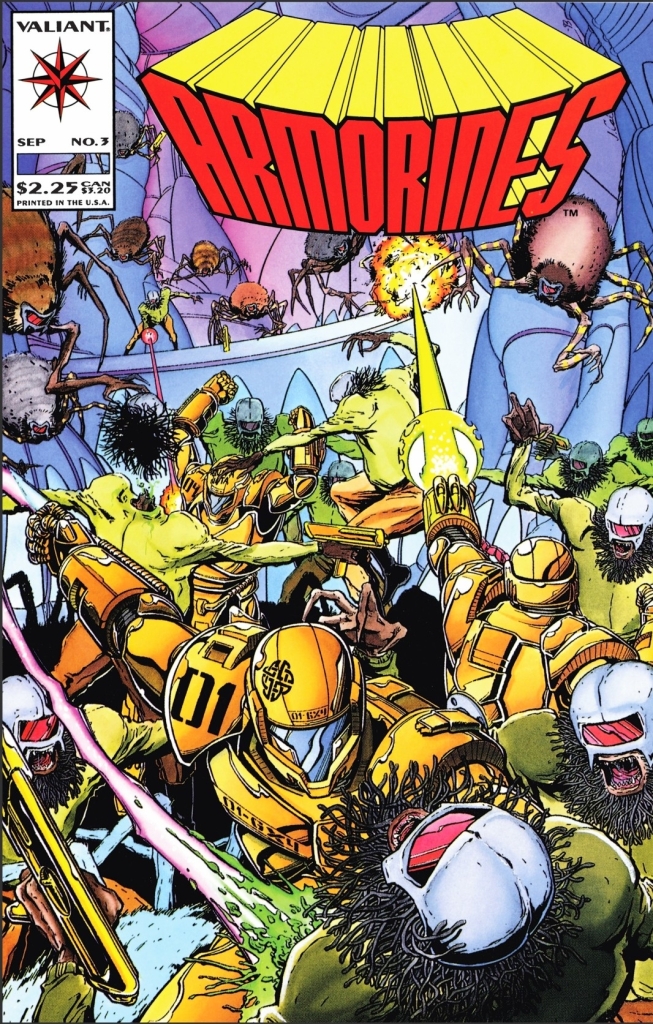
A Look Back at Armorines #1 (1994)

Disclaimer: This is my original work with details sourced from reading the comic book and doing personal research. Anyone who wants to use this article, in part or in whole, needs to secure first my permission and agree to cite me as the source and author. Let it be known that any unauthorized use of this article will constrain the author to pursue the remedies under R.A. No. 8293, the Revised Penal Code, and/or all applicable legal actions under the laws of the Philippines.

Welcome back superhero enthusiasts, 1990s culture enthusiasts and comic book collectors! Today we go back to the early 1990s and explore a part of the shared universe of Valiant Comics through the Armorines monthly series.

Before I start, I should state that the superhero concept of an armored human protagonist who could do many incredible things made possible by high technology made an impact on comic book storytelling for decades. Look at Marvel’s Iron Man and the Ultraverse’s Prototype for examples.

While Valiant Comics already had its own armored superhero with X-O Manowar (note: his armor is symbiotic, not technological), they decided to move forward with the concept of armored figures in the form of a military team.

With those details laid down, here is a look back at Armorines , published in 1994 by Valiant Comics with a story written by Jorge Gonzalez and drawn by Jim Calafiore.

The cover.

Early story

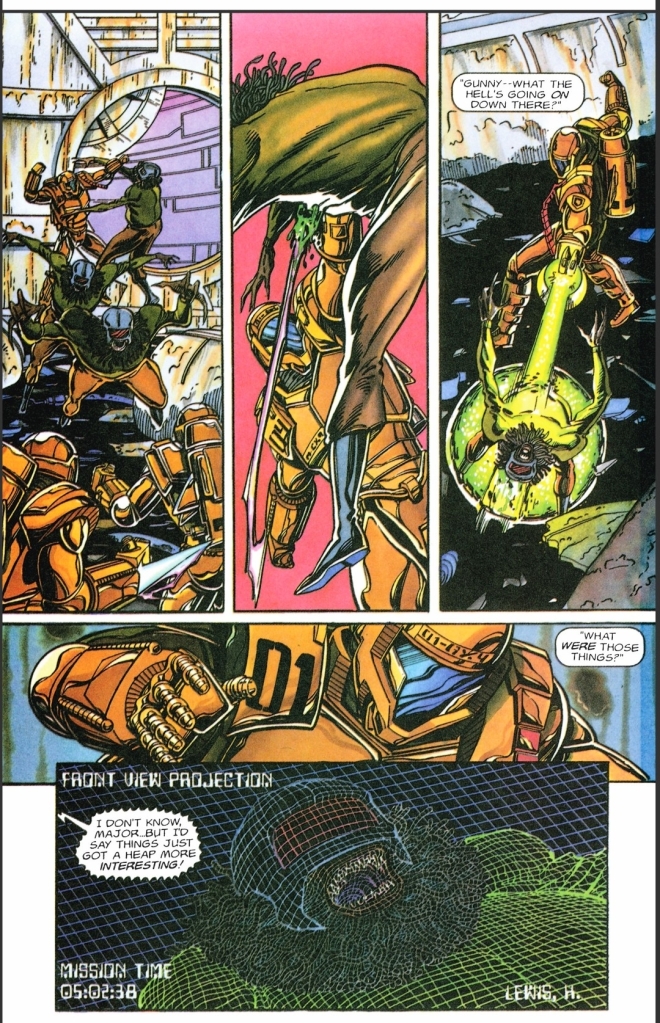
The story begins five hundred kilometers off the southern coast of Australia. Four people dive very deeply to explore nuclear-powered submarine U.S.S. Benchley which has been dormant for some time already. While exploring the interiors of the submarine, the divers got attacked by something in the dark.

At Camp Pendleton in California, an armored U.S. marine goes through an intense training session fighting machines not knowing that there could be traps waiting to get triggered. As Gunny (the armored marine in the session) falls into a trap, his teammates, General Kendall and the scientist Zahn watch the proceedings behind the scenes as another teammate (operating with virtual reality on her high-tech station) continues to communicate with him.

As time passes by, the situation gets even worse for Gunny physically…

Quality

Armorines has members who go out on the field wearing high-tech suits of armor while there are other members who serve as co-pilots using virtual technology and constant communication behind closed doors.

In terms of storytelling, the creative team focused mainly on the build-up of not just the plot but also the importance and the ways of the Armorines themselves. As weapons of the government, Armorines are an expensive team to run due to the use of very advanced technologies for operations. The Armorines have members who go out on the field wearing high-tech suits of armor that provide enhanced protection while also carrying high-tech weapons for offense. The team also has members who stay behind closed doors to use individual stations with virtual reality and enhanced communication with their brothers on the field.

When it comes to the characters, the smoking Gunnery is noticeably the one who got the most exposure and the most development. The other Armorine members got token exposure for the readers.

More on the plot itself, there is a mission that requires the Armorines to go deep underwater to solve a mystery and do something dangerous secretly. The mission was essentially all about protecting America’s top-secret weapons from falling into the wrong hands. To be clear, the mission itself happens in the 2nd half of this comic book which ultimately serves as a pay-off to the build-up the happened earlier. In fairness to the creative team, there was a good amount of suspense presented when the mission really started moving. There definitely something worth seeing during the mission.

Conclusion

In this story, Gunny is the closest thing to a definitive protagonist.

To be very clear, Armorines (1994) is not exactly the high-powered, action-packed story people could expect from seeing the armored marines looking capable of fighting terrorists and other enemies of America in militaristic fashion. This comic book’s story is indeed surprising to me and the creative team was not hesitant to push hard with the concept they came up with here. As this comic book was clearly executed with build-up, introductions and emphasizing concepts in mind, it is not surprising that the pay-off in the 2nd half led to moments of intrigue and suspense with momentum going into the next issue. Lastly, I should state that this comic book is free from political influence and its focus on the team has been very consistent.

Overall, Armorines (1994) is recommended.

+++++

Thank you for reading. If you find this article engaging, please click the like button below, share this article to others and also please consider making a donation to support my publishing. If you are looking for a copywriter to create content for your special project or business, check out my services and my portfolio. Feel free to contact me with a private message. Also please feel free to visit my Facebook page Author Carlo Carrasco and follow me on Twitter at  @HavenorFantasy as well as on Tumblr at https://carlocarrasco.tumblr.com/ and on Instagram at https://www.instagram.com/authorcarlocarrasco

A Look Back at Harbinger #20 (1993)

Disclaimer: This is my original work with details sourced from reading the comic book and doing personal research. Anyone who wants to use this article, in part or in whole, needs to secure first my permission and agree to cite me as the source and author. Let it be known that any unauthorized use of this article will constrain the author to pursue the remedies under R.A. No. 8293, the Revised Penal Code, and/or all applicable legal actions under the laws of the Philippines.

Welcome back superhero enthusiasts, 1990s culture enthusiasts and comic book collectors! Today we go back to the early 1990s and explore a part of the Valiant Comics shared universe through the Harbinger monthly series.

In my previous review, the team led by Sting daringly broke into the Harbinger Foundation’s New York facility and freed the pretty blonde Natalie Toynbee (codename: Stunner) who happened to have a big ego and was not comfortable with the organization’s rules. While Sting and his team secured Natalie as their newest member, a sinister force from Iran arrives in America. 

With those details laid down, here is a look back at Harbinger , published in 1993 by Valiant Comics with a story written by Maurice Fontenot and illustrated by Howard Simpson.

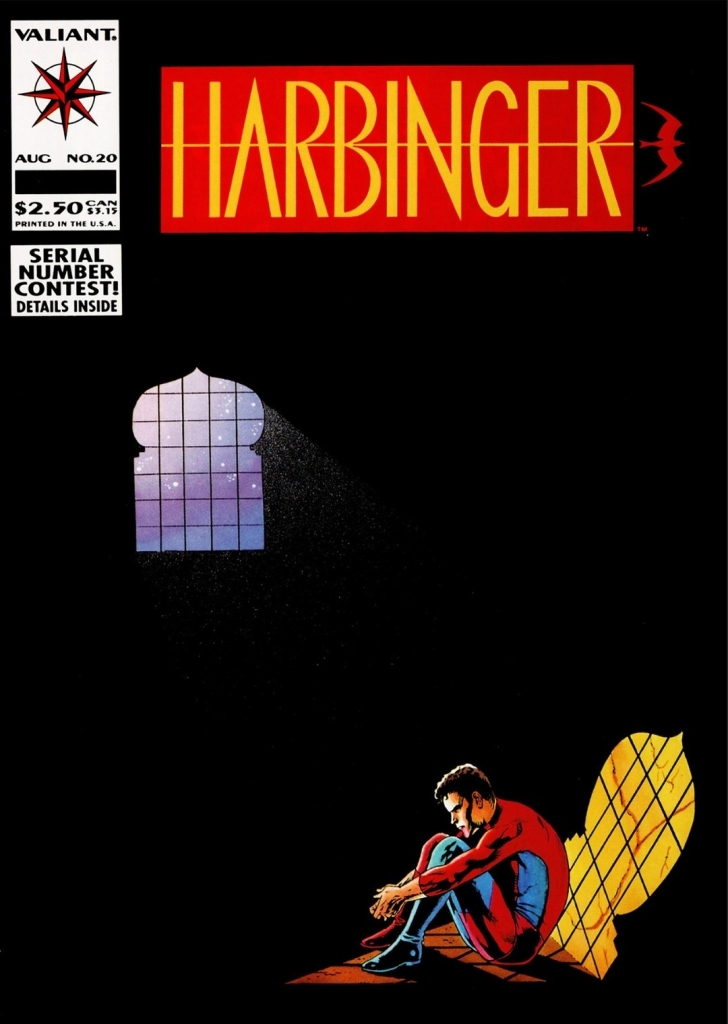
The cover.

Early story

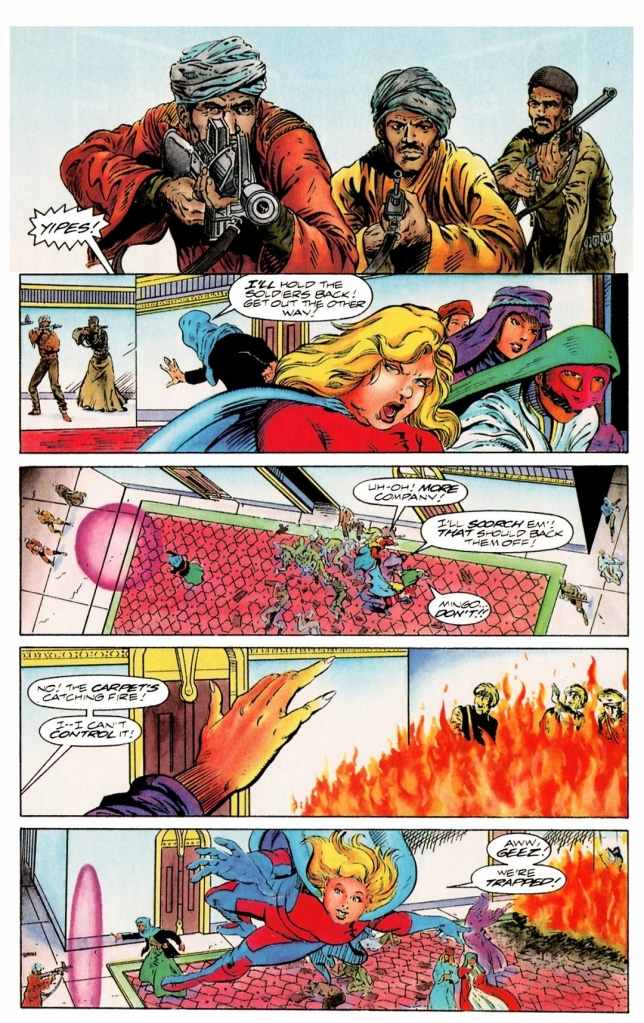
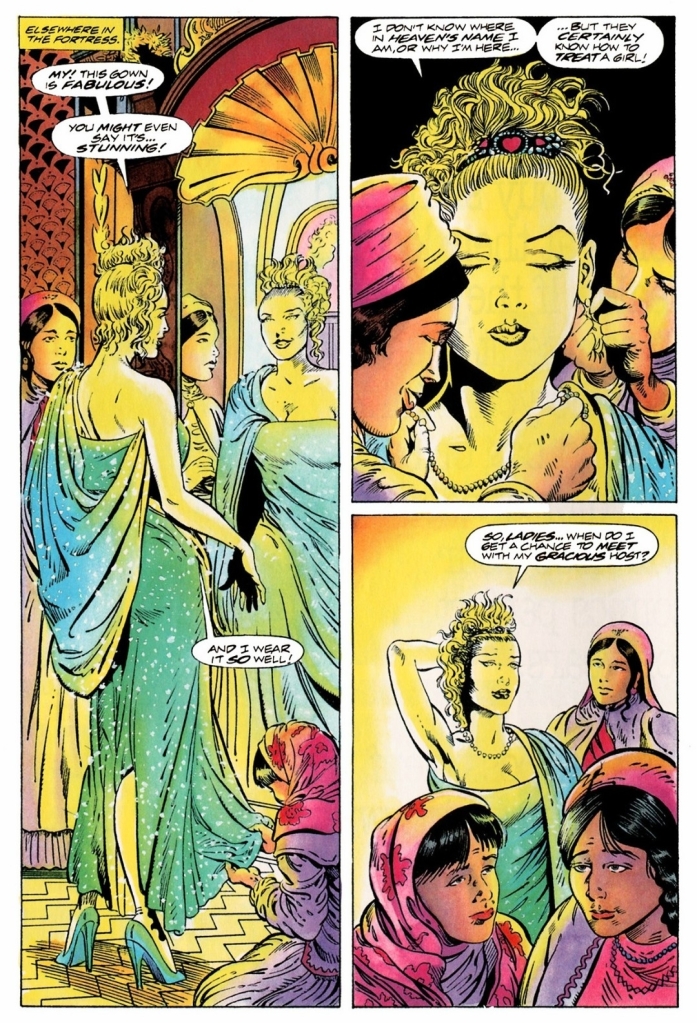
The story begins deep in the nation of Iran on February 1, 1993. Thanks to the tremendous help of Screen, the Harbinger renegades composed of Flamingo, Kris, Shatiqua and Faith/Zephyr make their way through the busy section of Mashad, carefully communicating with each other while disguised in cultural clothing. Their mission is to find the hideout of Kaliph and rescue Sting and Natalie/Stunner knowing they only have ten hours left.

Inside Kaliph’s fortress, a very weak and uneasy Sting finds himself alone in a dark room while Natalie is being treated nicely by the servants of Kaliph in preparation for dinner with the sinister master himself…

Quality

During their rescue effort, Sting’s teammates face off with the armed Iranians of Kaliph.

In terms of storytelling, this is a very solid continuation to the events that happened in the previous issue and it was a clever move by the creators to have the story set in enemy territory which easily raised the stakes for Sting’s team. While this is not the first time that the group went out on dangerous missions going into the turf of the opposition, having Iran as the setting and Kaliph as the powerful villain really made things fresh for this particular comic book series.

It should be noted that having Sting being very vulnerable added a nice layer of depth in this tale given the fact that he is still living with a false sense of maturity as well as traces of arrogance on his part believing that he could make positive changes by fighting powerful enemies and freeing powered youth from captivity without vast amounts of resources. For the newcomers reading this, Sting and his companions do not have much money to live with nor do they have technologies or connections to be powerful as a team. They simply have their own super powers and the will to move on and make things happen which makes them different compared to many other superhero teams in comics.

There are also signs of suicidal thoughts on Sting’s part as he recklessly moved to get to Kaliph even though the villain’s men were armed. By contrast, his teammates moved cautiously into Kaliph’s fortress and the way they handled the armed Iranians was believably presented. Not to be outdone here in Natalie who got a good share of the spotlight.

This comic book’s evil Iranian Kaliph was presented to be not only powerful but also talented as a business negotiator (which makes him somewhat similar with this comic book series’ super villain Toyo Harada) and even as a host of special guests. His evil nature here got emphasized further through his treatment of people as pawns of negotiations backed by his power of manipulation.

Conclusion

Natalie Toynbee being treated nicely by the servants not realizing the evil of the man she is about to meet.

Harbinger (1993) is both engaging and intriguing to read from start to finish. Having Sting’s team on a high-risk rescue mission in Iran made for a great setting and Kaliph turned out to be a more significant figure of evil. Through Kaliph and his violence-oriented servants, you will see the symbolism of the evil of Iran in real-life even though this comic book does not show any links between him and the regime that took power in 1979. Geopolitics are pretty much absent in the story but the evil presented through Kaliph make this old comic book highly relevant in relation to the evil of Iran today (for reference, click here, here, here, here, here and here). It should be noted that within the comic book, the Iranian people in general are not condemned and in real life, there are Iranians standing up against their government which itself has been sponsoring terrorists and organizing terrorism for a long time now. The brutality committed by Iran’s regime made several Iranians escape their country to be free.

Considering the very sensitive matter of Iran and other issues related with contemporary geopolitics, Harbinger (1993) not only aged well but is also a living reminder that people whose minds got poisoned with wickedness, political correctness and wokeness would not dare make a comic book showing the evil of Iran. The Leftist-oriented people prefer to make deals with terrorists (for examples, click here and here).

Overall, Harbinger (1993) is highly recommended!

+++++

Thank you for reading. If you find this article engaging, please click the like button below, share this article to others and also please consider making a donation to support my publishing. If you are looking for a copywriter to create content for your special project or business, check out my services and my portfolio. Feel free to contact me with a private message. Also please feel free to visit my Facebook page Author Carlo Carrasco and follow me on Twitter at  @HavenorFantasy as well as on Tumblr at https://carlocarrasco.tumblr.com/ and on Instagram at https://www.instagram.com/authorcarlocarrasco

A Look Back at Hulk 2099 #1 (1994)

Disclaimer: This is my original work with details sourced from reading the comic book and doing personal research. Anyone who wants to use this article, in part or in whole, needs to secure first my permission and agree to cite me as the source and author. Let it be known that any unauthorized use of this article will constrain the author to pursue the remedies under R.A. No. 8293, the Revised Penal Code, and/or all applicable legal actions under the laws of the Philippines.

Welcome back superhero enthusiasts, 1990s arts and culture enthusiasts, Marvel Comics fans and comic book collectors! Today we go back to the wild 1990s by examining one of the many tales of Marvel Comics’ 2099 line of franchises, specifically through the Hulk 2099 monthly series.

For the newcomers reading this, Hulk 2099 first appeared in 2099 Unlimited #1 (1993) which also had his origin story told. Hulk 2099 was not a mere version of the classic Incredible Hulk with a futuristic touch. In fact, the futuristic green creature highlighted the protagonist John Eisenhart as a very selfish and obsessed Hollywood studio executive who happens to stumble upon the idolaters/worshipers of the classic Hulk Bruce Banner because he was searching for new properties and stories for his studio. Hulk 2099’s origin has notable similarities to that of the classic Hulk and gamma radiation exposure is one of them. As tales of the futuristic Hulk were told through the quarterly releases of 2099 Unlimited, Marvel decided it was time to give the green creature his own monthly series.

With those details laid down, here is a look back at Hulk 2099 published in 1994 by Marvel Comics with a story written by Gerard Jones and drawn by Malcolm Davis.

The cover.

Early story

The story begins with the Hulk of 2099 destroying security droids and verbally attacking civilization. As he retains the intellect of John Eisenhart, he expresses his opposition against civilization for keeping people out of the water reclamation zone.

The story then shifts to California where Lotus Entertainment (Eisenhart’s employer) and its crew work on producing a film which is a dishonest telling of Eisenhart’s dealings with the Knights of Banner (already eliminated in 2099 Unlimited ). During the production, one of the executives notices the absence of Eisenhart.

Elsewhere, John Eisenhart drives his flying car with Knights of Banner youth survivor Gawain as his passenger. Already struggling with the guilt over the deaths of all the adult Knights of Banner members, Eisenhart intends to end his employment and cash out of his contract. Gawain remains hostile towards Eisenhart.

Quality

The creative team used flashback images that look really similar to what was told in 2099 Unlimited .

If there is anything that is very obvious to talk about, it is the fact that this tale shows a radically different John Eisenhart who wants to get out of Hollywood’s multiple mazes of crookedness as he feels very guilty over what happened to the Knights of Banner. This happens just as a new entity took corporate control of Eisenhart’s employer before he could leave the company. In many ways, Eisenhart’s distress and struggle with being guilty reminds me a lot about Hardcase of the Ultraverse and the way the creative dramatized him was engaging.

For the story, there is a lot of corporate intrigue going on and Eisenhart’s failure to quit quickly was inevitable because the new enemy he faces here has a lot to do with the sudden takeover of Lotus Entertainment. At least on face value, this looks like an attempt by the creative team to change the status quo and move Hulk 2099 to a new creative direction away from what was established in 2099 Unlimited. Without spoiling the details, I can say that something very significant happened before the comic book’s ending and it will impact readers who followed the futuristic Hulk’s stories closely in the 2099 Unlimited series.

Along the way, there is a lot of action and unfortunate physical happenings which symbolize the chaos concept of the script. The notable thing here is that you won’t see very much of Hulk 2099’s monstrous form as the script was specifically written to tell a tale that went beyond one issue. Clearly, the creative team were sparing Hulk 2099 for a conflict in the next issue.

Malcolm Davis’ art has that visceral aesthetic that fits the established look of Marvel’s 2099 universe of the time but there were instances when he showed so much happening, the visuals looked chaotic and even disorienting. In fairness, his take on Eisenhart, Quirk, Gawain and others made them looked recognizable.

Conclusion

The future of Commiewood, wokeness, and dishonesty.

While its story has little of the green monster in it, Hulk 2099 (1994) does a decent job building up the tension on top of the guilt-filled Eisenhart while setting up events that looked like a bold new creative direction was coming. By the time this comic book was published, several Hulk 2099 tales were already published in the quarterly 2099 series. On its own, this comic book lightly builds up the lore of the 2099 universe as it was clearly focused on Hulk 2099’s creative concept and characters.

While Eisenhart was indeed determined to change, it is a turnoff to see him lie and exaggerate details to protect himself from a certain corporate psychologist who is after the truth. There is also a lot of anti-corporate expressions here which seems to suggest that someone within the creative team had been thinking with socialist concepts and decided to use the script as an outlet of expression. The weird but true thing is that by today’s standards, Hollywood is filled with Commies/socialists/Marxists/liberals/woke nuts from the film crew up to the executives that run studios and produce films or shows that are dumb, lies about reality, self-centered and extensions of their ideologies. This showed that this comic book was prophetic in some ways.

Overall, Hulk 2099 (1994) is satisfactory.

+++++

Thank you for reading. If you find this article engaging, please click the like button below, share this article to others and also please consider making a donation to support my publishing. If you are looking for a copywriter to create content for your special project or business, check out my services and my portfolio. Feel free to contact me with a private message. Also please feel free to visit my Facebook page Author Carlo Carrasco and follow me on Twitter at  @HavenorFantasy as well as on Tumblr at https://carlocarrasco.tumblr.com/ and on Instagram at https://www.instagram.com/authorcarlocarrasco
A Look Back at What If #27 (1981)

Disclaimer: This is my original work with details sourced from reading the comic book and doing personal research. Anyone who wants to use this article, in part or in whole, needs to secure first my permission and agree to cite me as the source and author. Let it be known that any unauthorized use of this article will constrain the author to pursue the remedies under R.A. No. 8293, the Revised Penal Code, and/or all applicable legal actions under the laws of the Philippines.

Welcome back superhero enthusiasts, 1980s arts and culture enthusiasts, Marvel Comics fans and comic book collectors! Today we go back to the early 1980s and examine an alternate universe portrayal of the X-Men and the Dark Phoenix saga itself as told in one of the comic books of the first volume of the series What If.

So much has been discussed about the Dark Phoenix saga of the Uncanny X-Men series through the decades. A lot point to it as the greatest X-Men ever told while some called it the true X-Men epic story that Chris Claremont and John Byrne came up with. Considering its deep impact and significance on the Marvel Comics shared universe, it was only a matter of time before the publisher decided to revisit the said storyline but explore other outcomes through the What If series.

With those details laid down, here is a look back at What If #27 published in 1981 by Marvel Comics with a story written by Mary Jo Duffy and drawn by Jerry Bingham.

The cover.

Early story

The story begins with the Watcher looking back at the events that led to the Dark Phoenix saga, who got impacted and how Jean Grey used a weapon of alien origin to end her own life and prevent the Dark Phoenix from raging.

Suddenly, an alternate reality begins when Jean Grey survives and Cyclops reacts by using his optic blasts on incoming enemies until he got overwhelmed. The X-Men have been defeated and are brought to the imperial flagship of Lilandra’s grand fleet where the Shi’ar scientists prepare for the destruction of Phoenix.

Jeay Grey remains alive, floating above the X-Men and the others as Lilandra’s people prepare to start the process of the psychic lobotomizer on her. Their intention is to act upon Jean Grey’s brain and destroy certain parts of it in order to neutralize the Phoenix power within her. The operation turned out successful and Jean Grey survives once more. She and her fellow X-Men return to Earth…

Quality

This conflict between Phoenix-powered Jean Grey and Galactus is a must-see.

This early, I can say that this is a very great exploration and portrayal of the concept about Phoenix (within Jean Grey) not dying during the Dark Phoenix saga. The script of this comic book is so great (note: solid plot structure, consistent portrayals of the characters, strong build-up with solid pay-off and more), it’s almost as if Mary Jo Duffy and Chris Claremont worked together behind the scenes.

The protagonist in this story is Jean Grey and this comic book examines her struggle with adjusting her personal life and her effort to fit in once again within the X-Men while remembering fully that as Dark Phoenix, she still remains guilty of destroying an entire solar system and committing the mass murder of five billion people.

Unsurprisingly, due to the emergence of a tremendous crisis deep in space, Jean Grey gets involved with her team going to the site on a mission. This easily puts her into a situation that makes her revive the power of the Phoenix deep within herself. While the use of the tremendous power of the Phoenix to help the X-Men looked sensible at first glance, it only signified the beginning of a chain of destruction and unfortunate developments. As expected, Jean Grey can only go so far with her good nature and her free will while having the magnificent powers of the Phoenix.

While the conflicts were portrayed well, Mary Jo Duffy’s script raises key questions about the red-head X-Men member: How can Jean Grey ever achieve a normal life and level with her X-Men teammates knowing that she carries powers that make her god-like? How can she ever forget the tragic fact that as Dark Phoenix, she murdered billions in deep space? What can Charles Xavier do to lead and guide the X-Men knowing that Jean is way too powerful? Could the love of Cyclops be helpful for Jean Grey’s personal efforts to control the Phoenix power within?

Another highlight of this story is the final seven pages. The ending is very impactful and definitely something you must see.

Conclusion

This happened after Jean Grey’s survival.

What If #27 (1981) is a classic alternate reality portrayal of the Marvel Comics universe and it surely works as a companion piece to what was established in the Dark Phoenix saga. Mary Jo Duffy’s script really captured the spirit of Claremont’s X-Men and the dramatic stuff and all the build-up led to a very tremendous ending that can disturb you or even satisfy you in the most unusual way. Most notably, this comic book really answered the question about what would happen had Phoenix did not die. The 2nd tale of this comic book – the Kree Encounter – is an interesting additive.

Overall, What If #27 (1981) is highly recommended.

+++++

Thank you for reading. If you find this article engaging, please click the like button below, share this article to others and also please consider making a donation to support my publishing. If you are looking for a copywriter to create content for your special project or business, check out my services and my portfolio. Feel free to contact me with a private message. Also please feel free to visit my Facebook page Author Carlo Carrasco and follow me on Twitter at  @HavenorFantasy as well as on Tumblr at https://carlocarrasco.tumblr.com/ and on Instagram at https://www.instagram.com/authorcarlocarrasco

A Look Back at What If #31 (1982)

Disclaimer: This is my original work with details sourced from reading the comic book and doing personal research. Anyone who wants to use this article, in part or in whole, needs to secure first my permission and agree to cite me as the source and author. Let it be known that any unauthorized use of this article will constrain the author to pursue the remedies under R.A. No. 8293, the Revised Penal Code, and/or all applicable legal actions under the laws of the Philippines.

Welcome back superhero enthusiasts, 1980s arts and culture enthusiasts, Marvel Comics fans and comic book collectors! Today we go back to the early 1980s and examine an alternate universe portrayal of Wolverine and some other characters as told in one of the comic books of the first volume of the series What If.

Wolverine is one of the most iconic characters of Marvel Comics and he has been part of some of my retro reviews (click here, here, here, here, here, here and here). Wolverine made his first appearance in comics in Incredible Hulk #181 which was published way back in 1974 which marked the first conflict of the two Marvel icons. Years later, Marvel decided to revisit that event with a What If story.

With those details laid down, here is a look back at What If published in 1982 by Marvel Comics with a story written by Rick Margopoulos and drawn by Bob Budiansky.

The cover.

Early story

The story begins with Wolverine and the Hulk in combat with each other in a forest within Canada. It turns out, Wolverine was sent by Canadian authorities to capture not just the Hulk but also the Wendigo.

With the Wendigo down on the ground, Wolverine and the Hulk struggle with each other. The Canadian’s speed helped him dodge the green giant’s powerful punches and as the fight goes on, so does the impulse and emotion from within. Suddenly, Wolverine decides to deliberately disobey his orders by deciding to kill the Hulk. In a few but strategic strikes with his Adamantium claws, Wolverine kills the Hulk. The Canadian authorities eventually got rid of the corpses of the Wendigo and the Hulk.

Soon enough, news about the Hulk’s death spread like wildfire all over America catching the attention of Spider-Man, the Avengers, the Fantastic Four and General Ross and his daughter Betty…

Quality

Wolverine gets abducted not by aliens from outer space but by Magneto and his Brotherhood of Evil Mutants.

To start with, I can say that I immensely enjoyed this alternate portrayal of the events that happened in relation to Wolverine’s first-ever appearance in comics. For one thing, the concept of Wolverine actually killing the Hulk is not only shocking on its own, it also set a chain reaction of events that involved or affect a whole lot of other characters within the Marvel Comics shared universe.

Let me start with Wolverine himself. As the story was set before he joined the X-Men, you will see Wolverine as a super-powered agent of Canada whose career really goes down as he failed to restrain his wild self from killing not once but twice. This results in a Wolverine who is deeply troubled with guilt and becomes desperate believing that running away and hiding will somehow solve his dilemma.

Wolverine’s entry into a gang of evil mutants led by Magneto (note: this comic book’s main villain) is itself worth getting this comic book. This shows Magneto – always obsessed with his belief that mutants are superior to humans – putting his diabolical plan into action with Wolverine as the key participant. This itself led to Wolverine’s encounter with the X-Men (the one team he was destined in reality to be with).

The creative team clearly exerted a lot of effort to not only ensure the plot made sense but also have a solid structure that can accommodate twists, intrigue and superhero spectacle altogether complete with enough room for character development. Lastly, I should say that this comic book’s climax is both compelling and shocking to read.

Conclusion

Wolverine’s 2nd kill in this comic book.

What If (1982) is indeed a great Marvel comic book to read. It has a very engaging alternate universe portrayal of Wolverine and this paved the way for a new and fresh approach on showcasing how the X-Men and Magneto’s gang reacted with the clawed Canadian. While the scope of the consequence of Wolverine’s killing of the Hulk ultimately ending up narrowing on Marvel’s mutants could be disappointing for those who seek a bigger impact on other Marvel universe characters, what was shown here in this comic book still made sense and ultimately turned out believable. This comic book also has another tale exploring what if there was no Fantastic Four which ultimately ended up as a decent additive.

Overall, What If (1982) is highly recommended.

+++++

Thank you for reading. If you find this article engaging, please click the like button below, share this article to others and also please consider making a donation to support my publishing. If you are looking for a copywriter to create content for your special project or business, check out my services and my portfolio. Feel free to contact me with a private message. Also please feel free to visit my Facebook page Author Carlo Carrasco and follow me on Twitter at  @HavenorFantasy as well as on Tumblr at https://carlocarrasco.tumblr.com/ and on Instagram at https://www.instagram.com/authorcarlocarrasco
A Look Back at Backlash #4 (1995)

Disclaimer: This is my original work with details sourced from reading the comic book and doing personal research. Anyone who wants to use this article, in part or in whole, needs to secure first my permission and agree to cite me as the source and author. Let it be known that any unauthorized use of this article will constrain the author to pursue the remedies under R.A. No. 8293, the Revised Penal Code, and/or all applicable legal actions under the laws of the Philippines.

Welcome back superhero enthusiasts, 1990s arts and culture enthusiasts, Image Comics fans and comic book collectors! Today we go back to the wild 1990s and explore a part of the WildStorm universe through a tale of Backlash!  

In my previous retro review, as the mission of Backlash and Taboo intensified, Zealot and Void of the WildCATs got involved in the action. Pike, who had been serving S’ryn, proved to be a formidable foe for Zealot and Taboo. The Savage Dragon meanwhile proved to be more than capable of bringing down S’ryn which made Backlash less relevant in his own comic book. Just as things intensified, something big blew up.

With those details laid down, here is a look back at Backlash published in 1995 by Image Comics with a story written by Sean Ruffner, Jeff Mariotte and Booth. Booth was the artist.

The cover.

Early story

The story begins just moments after the big explosion. Savage Dragon, Backlash, Zealot, Jacob Marlowe, Taboo, Void and Jack managed to survive. In line with his duty as a police officer, Savage Dragon tells Zealot that Backlash and his friends are coming with him as they have been tagged by the government as threats to national security. Zealot then lifts her blade up to Savage Dragon’s throat and states that if Backlash had not been with them, then her lord Emp (Marlowe) may well have been assassinated.

Eventually, Void uses her power to transport Backlash, Taboo, Jack, Zealot and Marlowe away, leaving Savage Dragon behind…

Quality

A briefing about the next mission.

To put things straight, this particular comic book serves as the conclusion of the storyline (the mission specifically) that started in issue #2 while also working as a bridge going into the next storyline. The good news here is that the creative team’s work here is good enough in terms of quality.

For one thing, the team really took their time to develop Backlash and Taboo some more right after the end of the first mission. Their talk with each other as civilians inside a New York City bar was nicely written and there were a few witty moments that I found enjoyable. Along the way, there was efficient expository dialogue that explains Taboo’s past connection with Pike and the Cabal. Backlash also shared some key details of himself which ultimately made him and Taboo have something in common.

This story also shows a key flaw in Backlash’s personal integrity – his romantic involvement with Taboo made him betray his beloved Diane. For one thing, this potentially opens a series of problems that will eventually haunt him later. On another thing, it seems that the creative team have something intriguing planned for the protagonist who has clearly been sharing this comic book series’ spotlight with Taboo.

As with the previous issues, this comic book continued the build-up and emphasis of the WildStorm universe’s concepts. In terms of crossovers, Wetworks’ leader Jackson Dane makes an appearance here and his unexpected reunion with Backlash is a must-see. For the newcomers reading this, WildStorm’s Grifter (WildCATs), Backlash, Dane (Wetworks) and Deathblow are all members of Team 7 which had its series of wild stories set twenty years prior (note: think of the Vietnam War era). It was also in 1994 when the first Team 7 comic book mini-series was first published. In some ways, Backlash interacting with Grifter in the Kindred mini-series and reuniting with Dane served as creative ways to emphasize the Team 7 concept to readers.

On the visuals, Brett Booth continues to do a fine job presenting the characters (who are clearly recognizable to me) and I noticed he seems to have fun trying to test readers’ visions by carefully inserting selected X-Men characters into the background during the bar scenes as Taboo and Backlash talked. As for Dane, I like Booth’s own take on the character

Conclusion

Look carefully at the background and you will spot X-Men team members Cyclops, Jean Grey Gambit and Rogue in civilian forms.

Backlash (1995) is more of a build-up comic book that so happens to have a decent amount of action for entertainment value. The characterization scenes of Backlash and Taboo is a must-see while the conclusion of the first mission was nicely done complete with a worthy end to the crossover with WildCATs’ Zealot, Void and Jacob Marlowe. The story itself moved at a medium pace which is not surprising as there was something being built-up with the new mission in mind.

Overall, Backlash (1995) is recommended.

+++++

Thank you for reading. If you find this article engaging, please click the like button below, share this article to others and also please consider making a donation to support my publishing. If you are looking for a copywriter to create content for your special project or business, check out my services and my portfolio. Feel free to contact me with a private message. Also please feel free to visit my Facebook page Author Carlo Carrasco and follow me on Twitter at  @HavenorFantasy as well as on Tumblr at https://carlocarrasco.tumblr.com/ and on Instagram at https://www.instagram.com/authorcarlocarrasco

A Look Back at Backlash #3 (1995)

Disclaimer: This is my original work with details sourced from reading the comic book and doing personal research. Anyone who wants to use this article, in part or in whole, needs to secure first my permission and agree to cite me as the source and author. Let it be known that any unauthorized use of this article will constrain the author to pursue the remedies under R.A. No. 8293, the Revised Penal Code, and/or all applicable legal actions under the laws of the Philippines.

Welcome back superhero enthusiasts, 1990s arts and culture enthusiasts, Image Comics fans and comic book collectors! Today we go back to the wild 1990s and explore a part of the WildStorm universe through a tale of Backlash!  

In my previous retro review, Backlash and Taboo went on a mission infiltrating a special social event that attracted the rich and powerful. Jacob Marlowe, the founder and leader of WildCATs, was targeted by S’ryn and Pike who were at the said event disguised. Backlash took action but got wounded while fighting S’ryn. As the chaos continued, the Savage Dragon entered performing police duty.

With those details laid down, here is a look back at Backlash published in 1995 by Image Comics with a story written by Sean Ruffner, Jeff Mariotte and Booth. Booth was the artist.

The cover.

Early story

The story begins Jacob Marlowe trying to escape away from the party. While trying to summon his team, he gets cornered by Pike. Pike noticed that Marlowe is not fully aware about the powers he has as a Kherubim. Shortly after Marlowe gets hit, Taboo suddenly jumps in and hits Pike to free the WildCATs leader. Taking advantage of Taboo’s help fighting Pike, Marlowe calls his team by phone.

At the party venue, Savage Dragon tells S’ryn that he is under arrest. Backlash is down on the floor bleeding…

Quality

You will get to see Backlash and Savage Dragon fight each other.

If there is anything very notable here, it is the fact that the creative team not only ramped up the superhero spectacle but also emphasized crossovers by having Zealot and Void of WildCATs involved in the action as well as having Savage Dragon participate heavily during the events. This story continues what started in issue and along the way, you will see Marlowe’s Kherubim heritage emphasized as he is a high-level target of the Daemonites represented by S’ryn here.

While the plot is rather light, the high amount of action turned out to be very entertaining to see while the interactions between the characters were pretty engaging to follow. It is fun to see Backlash and Savage Dragon (Erik Larsen’s creation) conflict with each other over S’ryn. For Backlash, S’ryn is too dangerous to be handled by the local law enforcers while Savage Dragon sees him as a suspect who has to be jailed due to the chaos caused within the local jurisdiction. It should be noted that Savage Dragon was more than capable on bringing down S’ryn which essentially makes Backlash look like a failure.

Pike here noticeably became a more prominent villain. Not only was he dead serious with his mission to kill Jacob Marlowe, he proved to be a formidable foe against Taboo and even the highly proficient Zealot. This is interesting to see since Pike’s participation in the WildCATs mini-series was not too great and the dialogue the creative came up with emphasized his personality a lot.

As this is an action-heavy story, I can say that Brett Booth’s visual work here is very good. He knew how to set-up the action sequences as well as how to frame the action in sequence. There were even moments in which some aspects of his art resembled that of Jim Lee. Speaking of crossovers, Booth’s artistic take on Zealot, Void and Savage Dragon was nice to see.

Conclusion

Zealot and Void of WildCATs got involved in this story.

Backlash (1995) is another fun ride but on a higher gear and with stronger emphasis on crossover elements. To really enjoy this, one must be oriented enough with Savage Dragon and WildCATs to grasp this comic book’s concept and how the guest characters fit into the narrative. This is a meaningful crossover within the WildStorm universe. Fans of Backlash will have a lot to be engage with in this comic book.

Overall, Backlash (1995) is recommended.

+++++

Thank you for reading. If you find this article engaging, please click the like button below, share this article to others and also please consider making a donation to support my publishing. If you are looking for a copywriter to create content for your special project or business, check out my services and my portfolio. Feel free to contact me with a private message. Also please feel free to visit my Facebook page Author Carlo Carrasco and follow me on Twitter at  @HavenorFantasy as well as on Tumblr at https://carlocarrasco.tumblr.com/ and on Instagram at https://www.instagram.com/authorcarlocarrasco

A Look Back at Freex #15 (1994)

Disclaimer: This is my original work with details sourced from reading the comic book and doing personal research. Anyone who wants to use this article, in part or in whole, needs to secure first my permission and agree to cite me as the source and author. Let it be known that any unauthorized use of this article will constrain the author to pursue the remedies under R.A. No. 8293, the Revised Penal Code, and/or all applicable legal actions under the laws of the Philippines.

Welcome back superhero enthusiasts, 1990s arts and culture enthusiasts and comic book collectors! Today we go back to the wild 1990s and explore a part of Malibu Comics’ Ultraverse through a tale of Freex.  

Since after facing off with Contrary (who eventually became part of UltraForce) and her so-called school and students, Freex had been traveling far and long (refer to my previous Freex reviews here, here and here) and gained Old Man as a useful companion. Along the way, they encountered the unknown deep underground and even saw a powerful being. They even got to the city of Denver temporarily. As they went on, they found the path that led them back to civilization.

With those details laid down, here is a look back at Freex , published in 1994 by Malibu Comics with a story written by Gerard Jones and drawn by Scott Kolins. This is a flip-side comic book with Ultraverse Premiere (1994) on the other side.  

The cover.

Early story

The story begins with Freex – composed of Plug, Sweet-Face, Pressure, Anything and new member Cayman – have been traveling for some time deep underground with Old Man. They find themselves back in San Francisco, the one city that brought them together. While still a long distance away from the city proper and there are no locals who could see them, the team cautiously move to a high communications tower. Michael/Plug uses his special ability to transform himself into electronic matter and makes his way through the communications network of the city to do something very important. Cayman meanwhile becomes the object of discussion between Pressure and Sweet-Face as he has yet to share with them details about himself.

As Cayman himself was part of Contrary’s academy and joined Freex recently, he has trouble gaining the trust of the others. After wearing new clothes that Lewis found, a guy suddenly appears to them. He introduces himself to them as Evan…  

Quality

The very evil Rafferty monitoring Freex secretly and enjoying his advantage over them.

Considering what happened in the previous issues, this story feels like a breath of fresh air not only because of the new location the team got into but also because of strong twists that happened. Instead of going through fantastical encounters, Freex found themselves in situations that are more grounded with reality (within Ultraverse standards specifically) and more notably, the story emphasized crossover as Freex and Old Man encountered Firearm. The said crossover, quite cleverly, sets up Freex into a collision course with the serial killer Rafferty (who encountered The Strangers elsewhere within the Ultraverse). For the newcomers reading this, Rafferty is one of the most evil characters of the Ultraverse who has murdered a lot of people – including his own parents – and has developed tremendous hatred of Ultras.

The inclusion of Rafferty here also sheds light on the Freex’s past connection with the Night Man (click here and here). More notably, the said serial killer turned out to be so resourceful and totally obsessed with murdering people with special abilities, he became a formidable force towards Freex. This leads to a pretty powerful and twisting conclusion that must be seen.  

Conclusion

The gang by the tower.

With a good amount of intrigue, characterization spectacle, strong dialogue and the element of crossover, Freex (1994) is a pretty engaging comic book to read. The biggest feature here is having Freex in a conflict with a very obsessed killer who not only hates Ultras but also has an extensive record of murdering many people over a long period of time. In my view, the Freex-Rafferty conflict was nicely structured and it added depth to the plot. What happened in the end of this comic book should resonate with dedicated fans of Freex.

Overall, Freex (1994) is highly recommended.

+++++

Thank you for reading. If you find this article engaging, please click the like button below, share this article to others and also please consider making a donation to support my publishing. If you are looking for a copywriter to create content for your special project or business, check out my services and my portfolio. Feel free to contact me with a private message. Also please feel free to visit my Facebook page Author Carlo Carrasco and follow me on Twitter at  @HavenorFantasy as well as on Tumblr at https://carlocarrasco.tumblr.com/ and on Instagram at https://www.instagram.com/authorcarlocarrasco