A Look Back at Turok: Dinosaur Hunter #1 (1993)

Welcome back superhero enthusiasts, 1990s culture enthusiasts and comic book collectors! Today we go back to the early 1990s and explore a part of the Valiant Comics shared universe through a tale of a very notable illustrated literature character named Turok.

I say very notable because Turok, an Indian (North American native), started in comics in the 1950s published by Western Publishing through its licensee Dell Comics. The comic book series Turok: Son of Stone started from 1956 until the early 1980s. In 1989, Valiant Comics was established by former Marvel Comics editor-in-chief Jim Shooter and business partner Steven Massarsky which was the result of a failed 1988 attempt to purchase Marvel Entertainment. In 1991, Valiant published Magnus: Robot Fighter and Solar: Man of the Atom as its early titles which is notable because both characters were licensed properties from Gold Key Comics (which itself was involved in the original Turok series).

Then in 1992, a newer version of Turok was introduced by Valiant Comics in the 12th issue of Magnus: Robot Fighter and subsequently the character (along with established side-kick Andar) became involved in the Unity storyline which was Valiant’s first major crossover comics event. By the time Unity ended, the road was cleared for Valiant to further emphasize Turok for the modern comic book readers of the time.

With those details laid down, here is a look back at Turok: Dinosaur Hunter , published in 1993 by Valiant Comics with a story written by David Michelinie and drawn by Bart Sears.
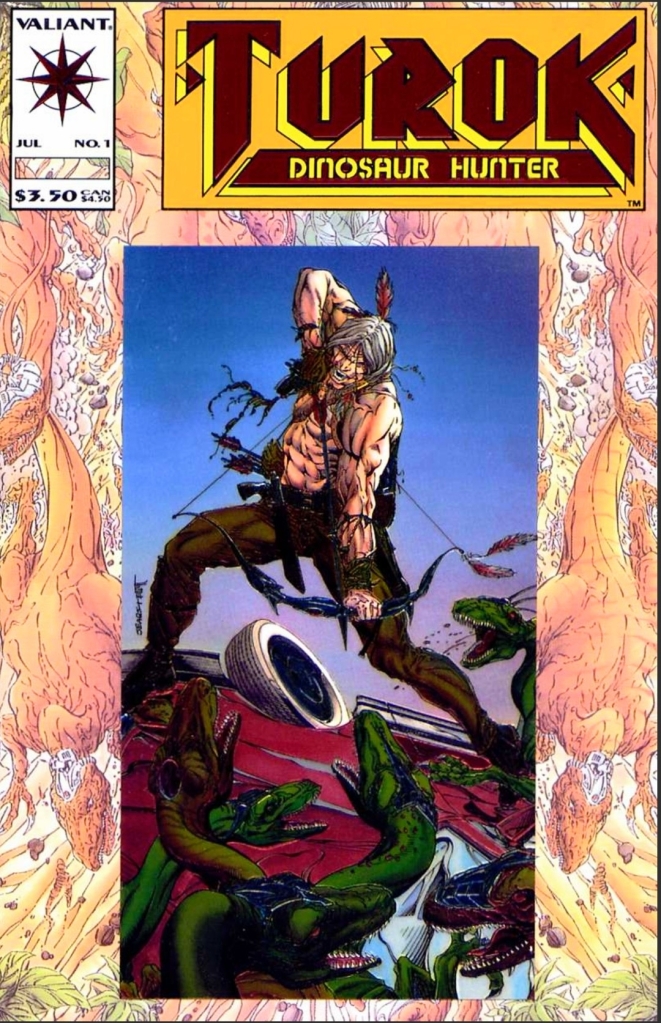
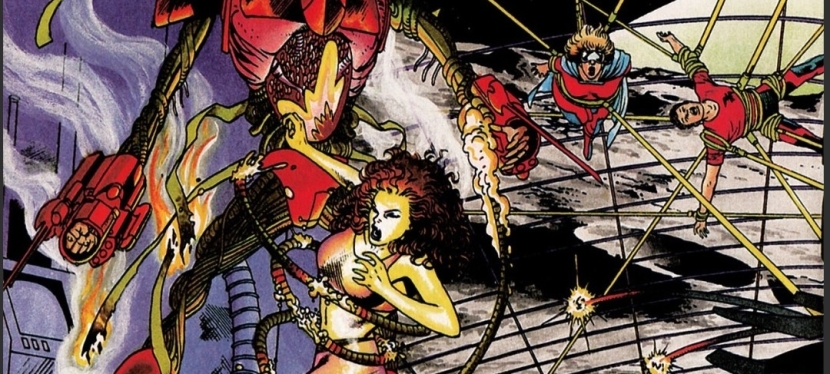
The cover.

Early story

The story begins in Colombia (note: written as Columbia in the comic book) in South America in the year 1987. Deep in the forest, Turok performs a ritual believing that his spirit is getting cleansed and purified. He remembers the times when he and Andar discovered a land – filled with dinosaurs and other animals they never encountered previously – where time no longer held much meaning.

He and Andar got involved in an armed conflict with invaders who arrived with advanced technologies. The robot fighter Magnus then got involved and helped Turok and their side turn the tide of battle. Eventually a stunning phenomenon happened as a woman who called herself Mothergod appeared. Turok and Andar foolishly submitted themselves to her and soon, they started operating in her service with violence against those who opposed her.

After encountering Archer and Armstrong, Turok realized the error of his devotion to Mothergod and eventually joined forces with Rai, X-O Manowar and others who waged battle against her.

Back in the present, an intelligent, cybernetically enhance dinosaur attacks Turok…

Quality

Very intense violence drawn by Bart Sears which reflected the high intensity of Turok’s fight with the dinosaurs.

To get straight to the point here, when it comes to emphasizing a new version of Turok for comic book readers in the early 1990s, the creative team was quite successful in achieving that goal. By the time I reached the end of this comic book, Turok’s place within the huge shared universe of Valiant got established solidly and the Michelinie-Sears duo dramatized the Indian’s struggle (being lost in time and far away from where he belongs) in South America in the late 1980s.

Being lost in time and having to deal with deadly, intelligent dinosaurs brought not only the warrior within Turok but also the determine survivor in him as well. There is a good amount of character emphasis of Turok which served as an effective balance to all the spectacle (read: uncompromised bloody violence) the creative duo prepared. Instead of using thought balloons, you will read Turok’s thoughts through narration boxes all throughout which made an effective and interesting reading experience.

Considering his great skills in hunting and fighting, Turok is not really a super protagonist. He is as vulnerable as any other person and you will get to see him suffer and become so helpless, he has no choice but to avail of assistance from South American villagers who lived by the land but are themselves very vulnerable to the savagery of the intelligent dinosaurs. The symbolism regarding vulnerability as well as the ramifications of the Unity crossover on this tale is very strong. This is indeed very solid writing by Michelinie.

As for the art, Sears’ work here is very unique and his style on drawing people, monsters and locations made this comic book a visual standout among 1993 comic books. When it comes to the graphic violence, it is clear to me that Sears enjoyed the creative freedom he got and he really emphasized his imagination as to how gruesome violence caused by dinosaurs on human beings would be. That being said, there are lots of violent action scenes and images of physical damage (damage on the flesh specifically) that remain visually disturbing to this day.

Conclusion
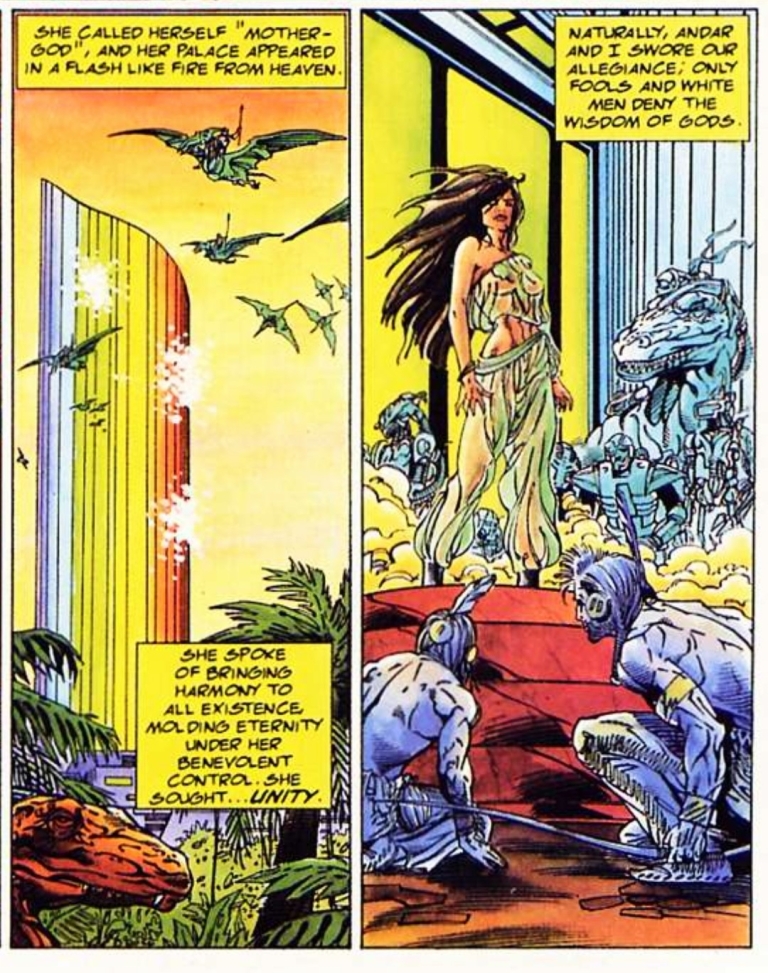
Very foolishly, Turok and Andar submitted themselves to a walking, evil idol. This should remind you that idolatry is both foolish and unholy.

Turok: Dinosaur Hunter (1993) works nice as modern portrayal of Turok and it succeeds in establishing his place within Valiant’s comic book universe thanks primarily to the Michelinie-Sears duo. Turok himself is not exactly an interesting protagonist to me but I can say it is the creators’ way of portraying him that makes the plot and the comic book work as an entertainment piece. I also liked the way Turok was emphasized as a character who got lost not only in time but also dimensionally lost as he has to live within a whole new world while focusing on survival as well as his desire to kill his rival Mon-Ark (the intelligent dinosaur). If you know your American pop culture history, you will realize that this comic book incidentally paved the way for the Turok video games (starting with 1997’s Turok: Dinosaur Hunter of Nintendo 64) that happened years later.

Overall, Turok: Dinosaur Hunter (1993) is recommended.

+++++

Thank you for reading. If you find this article engaging, please click the like button below, share this article to others and also please consider making a donation to support my publishing. If you are looking for a copywriter to create content for your special project or business, check out my services and my portfolio. Feel free to contact me with a private message. Also please feel free to visit my Facebook page Author Carlo Carrasco and follow me on Twitter at  @HavenorFantasy as well as on Tumblr at https://carlocarrasco.tumblr.com/ and on Instagram at https://www.instagram.com/authorcarlocarrasco

A Look Back at Armorines #6 (1994)

Welcome back superhero enthusiasts, 1990s culture enthusiasts and comic book collectors! Today we go back to the early 1990s and explore a part of the Valiant Comics shared universe through the Armorines monthly series.

During the said decade, Valiant Comics was notable for having crossovers that some readers found to be tightly executed in relation to continuity. The armored U.S. Marines (Armorines) and the powerful individual X-O Manowar have the spider aliens as a common enemy.

With those details laid down, here is a look back at Armorines , published in 1994 by Valiant Comics with a story written by Jorge Gonzalez and drawn by Jim Calafiore.

The cover.

Early story

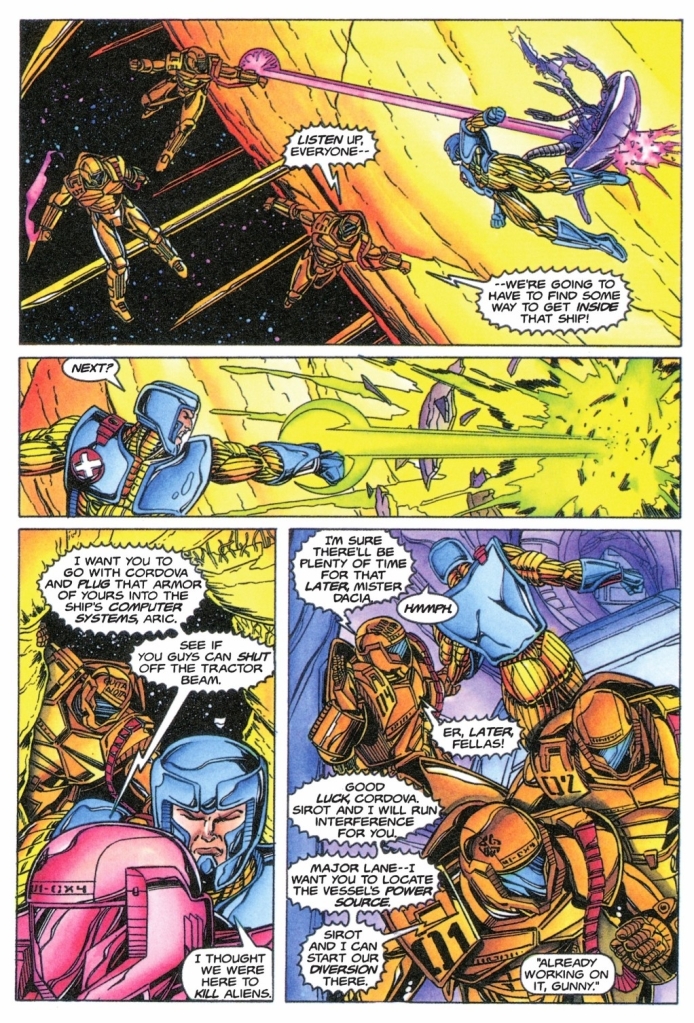
The story begins in space when the spider aliens (located inside a huge space ship) are organizing themselves to get back to their home world.

Meanwhile above the Earth, X-O Manowar significantly helps the Armorines with repairing their space shuttle. It turns out that they have been spending a long time in space and the crew has gotten exhausted after the big battle with the spider aliens. Going back home was their next objective.

Just as the crew prepares to return to Earth, the same huge space ship of the spider aliens suddenly approaches them…

Quality

The spider aliens.

Set after the crossover tale about the humans’ battle with the spider aliens in space, this tale served as a creative extension of those events utilizing space travel and sci-fi action concepts. The Armorines once again fight the spider aliens and X-O Manowar (a major Valiant character) gets heavily involved as he has a personal grudge against them. Without spoiling the plot, I can say that themes of freeing yourself from the enemy and getting back home are evident.

There is plenty of action to enjoy here and the sci-fi settings (including the interiors of the spider aliens ship) are nicely presented. I also like the fact that the tension gradually built-up as the story went on. Still, at this particular stage of this series, I could not help but feel that the Armorines have been in conflict with the spider aliens for too long.

Conclusion

There is a lot of sci-fi action to enjoy here.

Armorines (1994) is a pretty good read but I was getting tired of seeing the Armorines remaining in conflict with the spider aliens. What added strong value to the comic book was the heavy involvement (and crossover) of X-O Manowar and his interactions with the Armorines was well executed. To be clear, the story was not conclusive and at this stage, I still am interested to see what would happen next. Here is hoping that the Armorines conflict with the spider aliens will improve somehow.  

Overall, Armorines (1994) is recommended.

+++++

Thank you for reading. If you find this article engaging, please click the like button below, share this article to others and also please consider making a donation to support my publishing. If you are looking for a copywriter to create content for your special project or business, check out my services and my portfolio. Feel free to contact me with a private message. Also please feel free to visit my Facebook page Author Carlo Carrasco and follow me on Twitter at  @HavenorFantasy as well as on Tumblr at https://carlocarrasco.tumblr.com/ and on Instagram at https://www.instagram.com/authorcarlocarrasco

A Look Back at Armorines #1 (1994)

Disclaimer: This is my original work with details sourced from reading the comic book and doing personal research. Anyone who wants to use this article, in part or in whole, needs to secure first my permission and agree to cite me as the source and author. Let it be known that any unauthorized use of this article will constrain the author to pursue the remedies under R.A. No. 8293, the Revised Penal Code, and/or all applicable legal actions under the laws of the Philippines.

Welcome back superhero enthusiasts, 1990s culture enthusiasts and comic book collectors! Today we go back to the early 1990s and explore a part of the shared universe of Valiant Comics through the Armorines monthly series.

Before I start, I should state that the superhero concept of an armored human protagonist who could do many incredible things made possible by high technology made an impact on comic book storytelling for decades. Look at Marvel’s Iron Man and the Ultraverse’s Prototype for examples.

While Valiant Comics already had its own armored superhero with X-O Manowar (note: his armor is symbiotic, not technological), they decided to move forward with the concept of armored figures in the form of a military team.

With those details laid down, here is a look back at Armorines , published in 1994 by Valiant Comics with a story written by Jorge Gonzalez and drawn by Jim Calafiore.

The cover.

Early story

The story begins five hundred kilometers off the southern coast of Australia. Four people dive very deeply to explore nuclear-powered submarine U.S.S. Benchley which has been dormant for some time already. While exploring the interiors of the submarine, the divers got attacked by something in the dark.

At Camp Pendleton in California, an armored U.S. marine goes through an intense training session fighting machines not knowing that there could be traps waiting to get triggered. As Gunny (the armored marine in the session) falls into a trap, his teammates, General Kendall and the scientist Zahn watch the proceedings behind the scenes as another teammate (operating with virtual reality on her high-tech station) continues to communicate with him.

As time passes by, the situation gets even worse for Gunny physically…

Quality

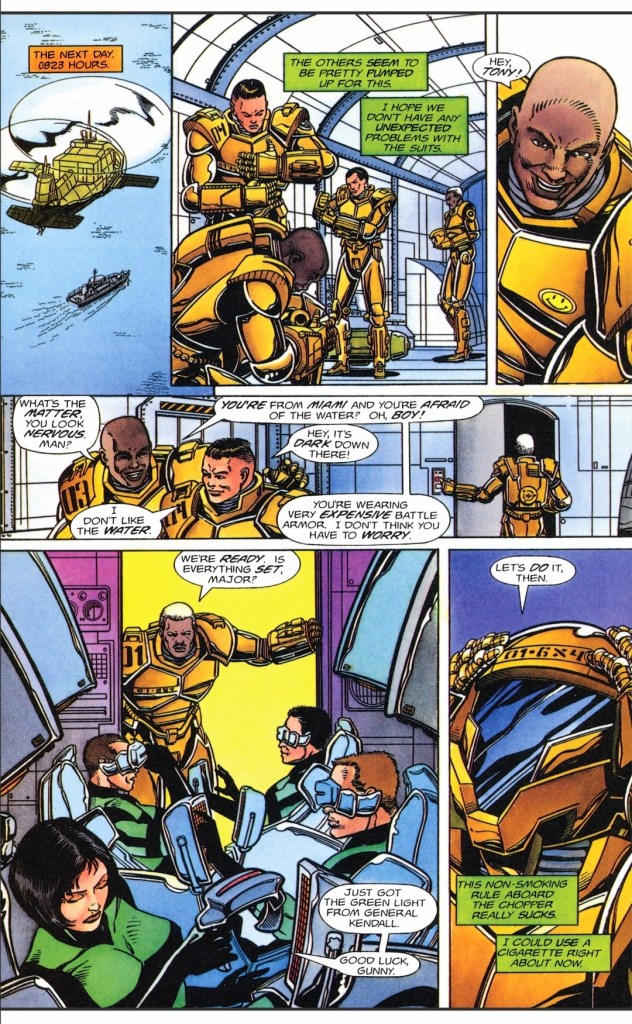
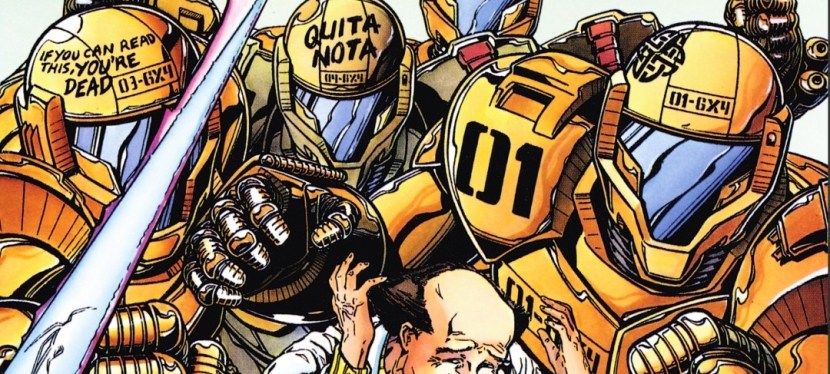
Armorines has members who go out on the field wearing high-tech suits of armor while there are other members who serve as co-pilots using virtual technology and constant communication behind closed doors.

In terms of storytelling, the creative team focused mainly on the build-up of not just the plot but also the importance and the ways of the Armorines themselves. As weapons of the government, Armorines are an expensive team to run due to the use of very advanced technologies for operations. The Armorines have members who go out on the field wearing high-tech suits of armor that provide enhanced protection while also carrying high-tech weapons for offense. The team also has members who stay behind closed doors to use individual stations with virtual reality and enhanced communication with their brothers on the field.

When it comes to the characters, the smoking Gunnery is noticeably the one who got the most exposure and the most development. The other Armorine members got token exposure for the readers.

More on the plot itself, there is a mission that requires the Armorines to go deep underwater to solve a mystery and do something dangerous secretly. The mission was essentially all about protecting America’s top-secret weapons from falling into the wrong hands. To be clear, the mission itself happens in the 2nd half of this comic book which ultimately serves as a pay-off to the build-up the happened earlier. In fairness to the creative team, there was a good amount of suspense presented when the mission really started moving. There definitely something worth seeing during the mission.

Conclusion

In this story, Gunny is the closest thing to a definitive protagonist.

To be very clear, Armorines (1994) is not exactly the high-powered, action-packed story people could expect from seeing the armored marines looking capable of fighting terrorists and other enemies of America in militaristic fashion. This comic book’s story is indeed surprising to me and the creative team was not hesitant to push hard with the concept they came up with here. As this comic book was clearly executed with build-up, introductions and emphasizing concepts in mind, it is not surprising that the pay-off in the 2nd half led to moments of intrigue and suspense with momentum going into the next issue. Lastly, I should state that this comic book is free from political influence and its focus on the team has been very consistent.

Overall, Armorines (1994) is recommended.

+++++

Thank you for reading. If you find this article engaging, please click the like button below, share this article to others and also please consider making a donation to support my publishing. If you are looking for a copywriter to create content for your special project or business, check out my services and my portfolio. Feel free to contact me with a private message. Also please feel free to visit my Facebook page Author Carlo Carrasco and follow me on Twitter at  @HavenorFantasy as well as on Tumblr at https://carlocarrasco.tumblr.com/ and on Instagram at https://www.instagram.com/authorcarlocarrasco
A Look Back at Harbinger #9 (1992)

Disclaimer: This is my original work with details sourced from reading the comic book and doing personal research. Anyone who wants to use this article, in part or in whole, needs to secure first my permission and agree to cite me as the source and author. Let it be known that any unauthorized use of this article will constrain the author to pursue the remedies under R.A. No. 8293, the Revised Penal Code, and/or all applicable legal actions under the laws of the Philippines.

Welcome back superhero enthusiasts, 1990s culture enthusiasts and comic book collectors! Today we go back to the early 1990s and explore a part of the Valiant Comics shared universe through the Harbinger monthly series.

In my previous retro review, things got totally wild as Sting, Faith, Flamingo and a pregnant Kris made their way into the middle of a war in an unknown, far-away place within the Unity crossover storyline. Even though Sting and Kris already have major challenges ahead of them related to an upcoming birth of a child, they have no choice but to help their side of powered figures (including Magnus the robot fight, Solar, X-O Manowar and others) win against Erica Pierce.

With those details laid down, here is a look back at Harbinger , published in 1992 by Valiant Comics with a story written by Jim Shooter and drawn by David Lapham. This comic book marks the 16th chapter of the Unity storyline.

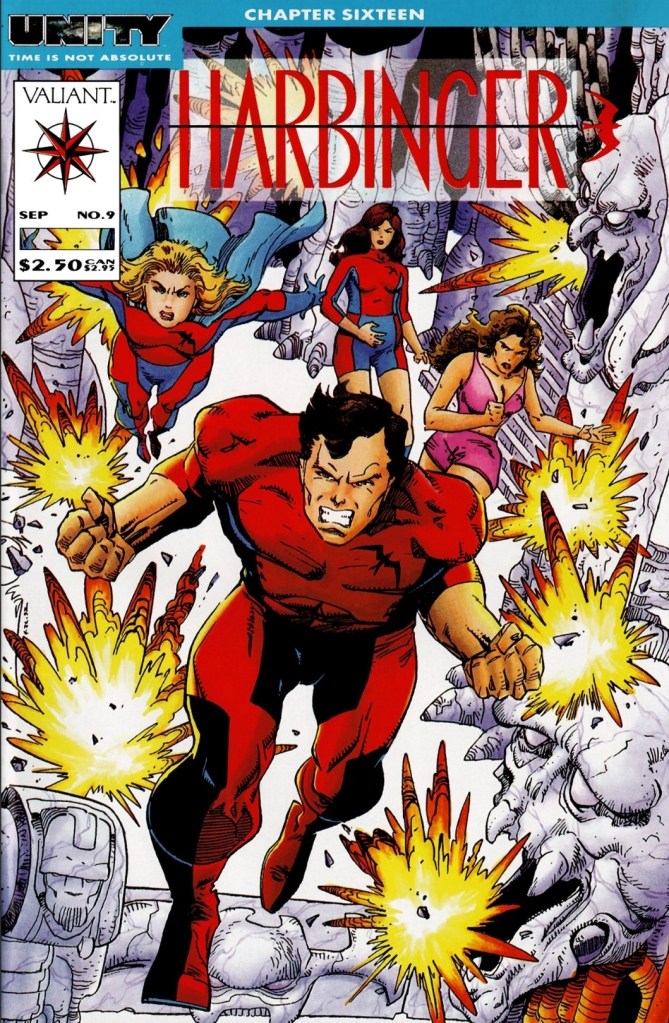
The cover.

Early story

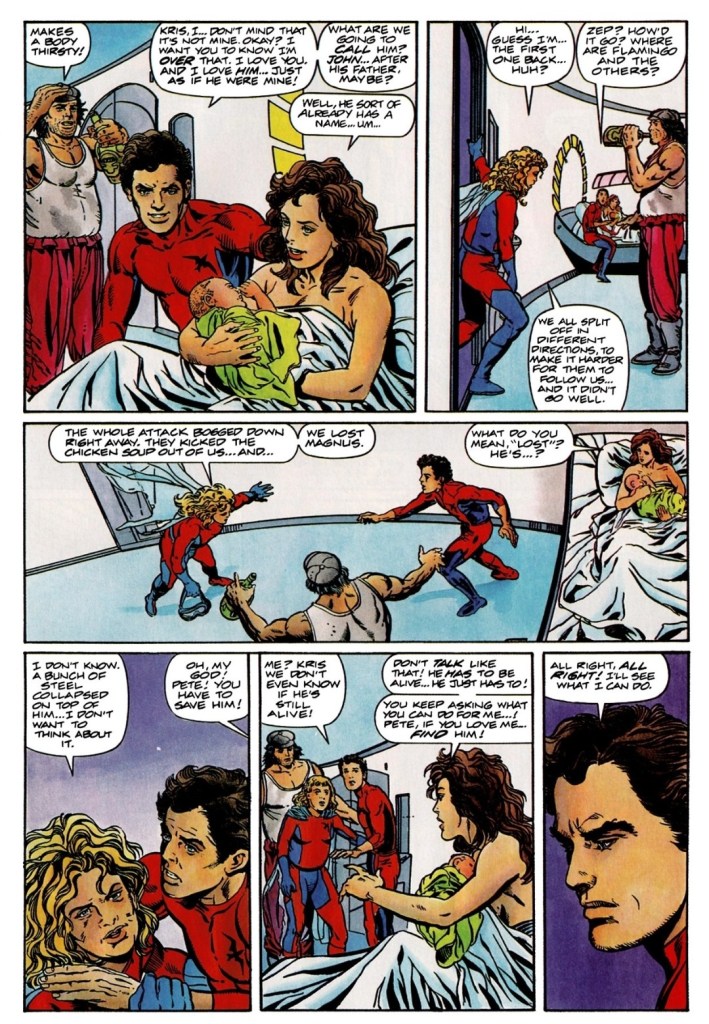
The story begins on day number 157 of Unity. Needing immediate help for his girlfriend Kris who is about to give birth, Sting flies to Armstrong who is about to acquire a bottle of liquid painkiller. Minutes later, Sting and Armstrong arrive at a high-tech place where the pregnant Kris is waiting.

Supported by Armstrong and touched by Sting, Kris eventually gives birth to a baby boy. Even though he knows that the baby is not biologically related to him, Sting still expresses his love to Kris and the child.

Suddenly, Faith arrives feeling exhausted. She said she came from battle and their group lost Magnus…

Quality

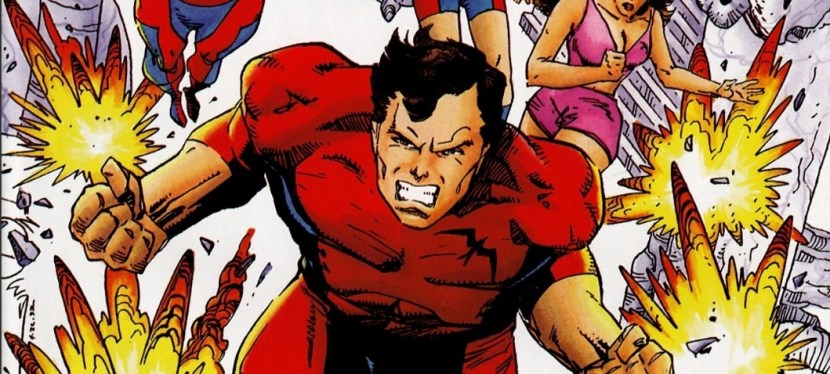
Sting, Flamingo and Faith with the other major Valiant Comics figures on a mission.

To cite the obvious, this is another high-quality story crafted by Jim Shooter who successfully told the exploits of Sting and his teammates while also highlighting crucial developments on the heroes’ campaign against Erica Pierce within the Unity storyline.

When compared to the events of issue , the stakes are much higher this time around not only for Sting, Faith, Kris and Flamingo but also for the other major figures of Valiant’s comic book universe of the time. This is very fitting as Erica Pierce, the so-called Mothergod, took steps closer on achieving her goal that would mean complete disaster for everyone. The notable thing about the way Jim Shooter crafted the narrative within this comic book is that tension gradually rises as the story goes on which leads to something really powerful happening on the final page (note: you must read it yourselves).

On character development, Sting and Kris are the ones who got characterized most. Through Sting, you will realize that even though he is very powerful, his immaturity added to his struggle on achieving goals and setting his priorities straight. Also the way he expressed his love to Kris knowing that the father of the newly born baby was none other than their late teammate Torque, I felt he said it half-heartedly mainly to give her assurance (which he could fail to give). Kris also gets her own share of the spotlight as she embraces her new role as a teenage mother.

More on the Unity story, fans of Magnus, Archer and Armstrong, Rai and Eternal Warrior will have something to enjoy here.

Conclusion

Kris is now a mother and Sting is not the father of the child.

Harbinger (1992) maintains many powerful elements that made the previous issue a great read. The difference is that this comic book has not only the stakes raised higher, but also the drama and the progressive development of Sting and Kris. In here, you will see Sting not only as a powerful teenager struggling with his priorities, but also as a key player in the struggle against Erica Pierce. Those who follow the Unity story will see a lot of engaging stuff from start to finish here.

Overall, Harbinger (1992) is highly recommended!

+++++

Thank you for reading. If you find this article engaging, please click the like button below, share this article to others and also please consider making a donation to support my publishing. If you are looking for a copywriter to create content for your special project or business, check out my services and my portfolio. Feel free to contact me with a private message. Also please feel free to visit my Facebook page Author Carlo Carrasco and follow me on Twitter at  @HavenorFantasy as well as on Tumblr at https://carlocarrasco.tumblr.com/ and on Instagram at https://www.instagram.com/authorcarlocarrasco
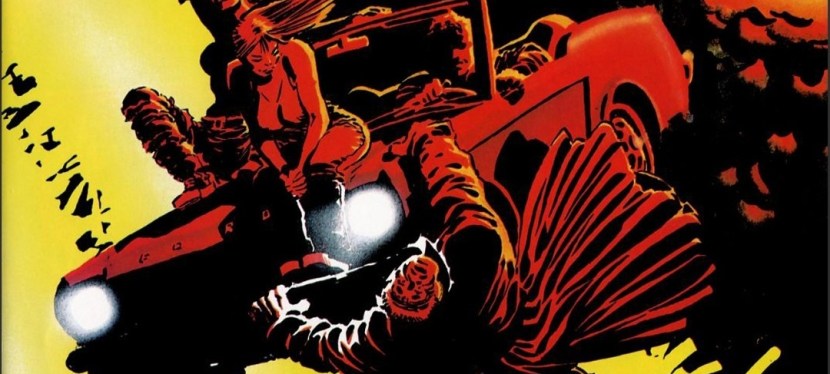
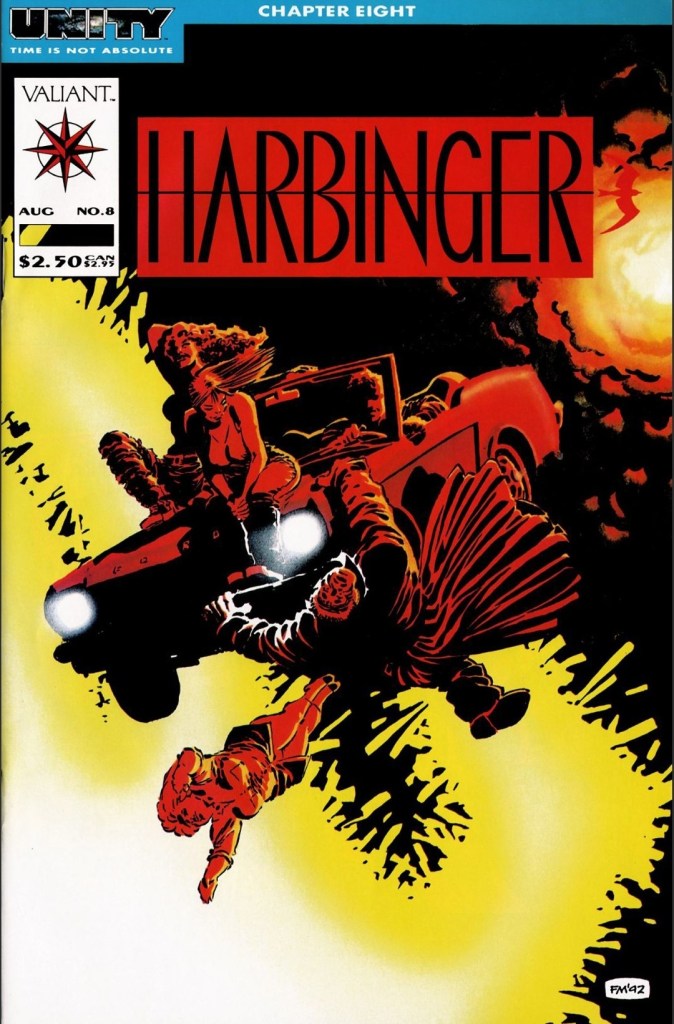
A Look Back at Harbinger #8 (1992)

Disclaimer: This is my original work with details sourced from reading the comic book and doing personal research. Anyone who wants to use this article, in part or in whole, needs to secure first my permission and agree to cite me as the source and author. Let it be known that any unauthorized use of this article will constrain the author to pursue the remedies under R.A. No. 8293, the Revised Penal Code, and/or all applicable legal actions under the laws of the Philippines.

Welcome back superhero enthusiasts, 1990s culture enthusiasts and comic book collectors! Today we go back to the early 1990s and explore a part of the Valiant Comics shared universe through the Harbinger monthly series.

In my previous retro review, Sting, Faith, Kris and Flamingo struggled with the completely unexpected new reality that their teammate Torque had died. As they mourned, Toyo Harada and his foundation just kept on operating and preparing themselves for a future conflict with the protagonists. Harada specifically perceives Sting as the most dangerous object for his organization to deal with.  

With those details laid down, here is a look back at Harbinger , published in 1992 by Valiant Comics with a story written by Jim Shooter and drawn by David Lapham.

The cover.

Early story

The story begins on April 4, 1992 inside the nice home of Dr. Heyward. There, Heyward, his wife and their two kids are enjoying the company of Faith, Sting and Flamingo. Upstairs, Kris could not fit jeans as she has gained weight. Heyward’s wife Moni arrives, offers her new clothes to wear and shares with her some insight about being in a relationship.

After dinner, Sting and Dr. Heyward have a nice chat with drinks. At the kitchen, Kris and Moni begin to talk about pregnancy with Flamingo present. As soon as Kris says that she is thinking about asking Dr. Heyward about getting an abortion, Flamingo tells her not to do it as the baby inside her all that is left of their dead teammate Torque.

Just as Kris begins to play dumb and divert attention away, a weirdly dressed teenager suddenly appears inside the home. He identifies himself as Geoff McHenry the geomancer…

Quality

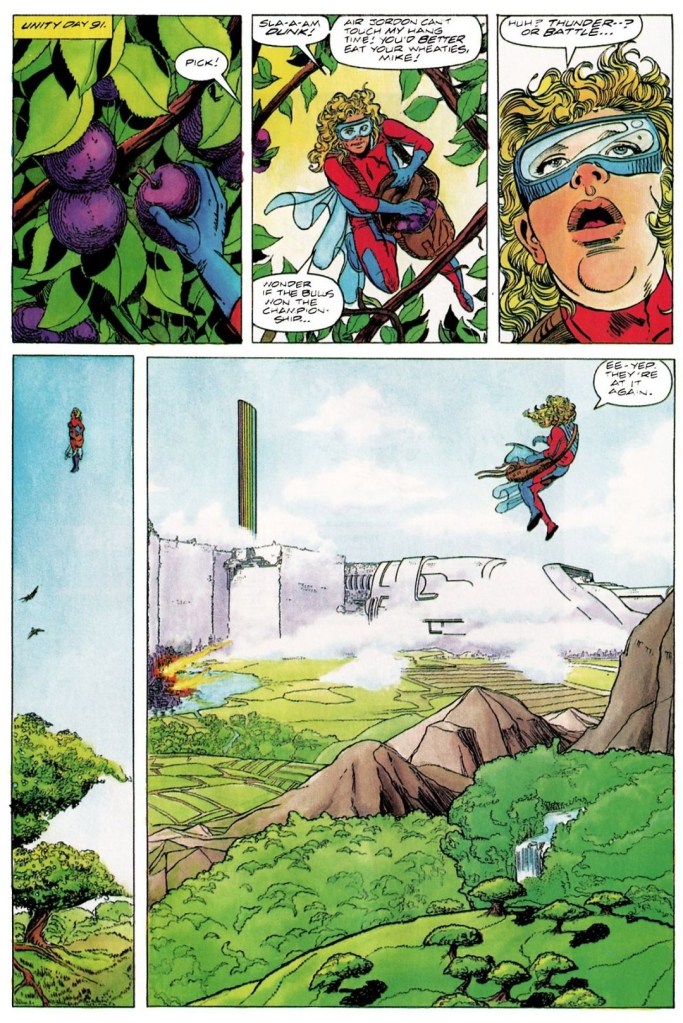
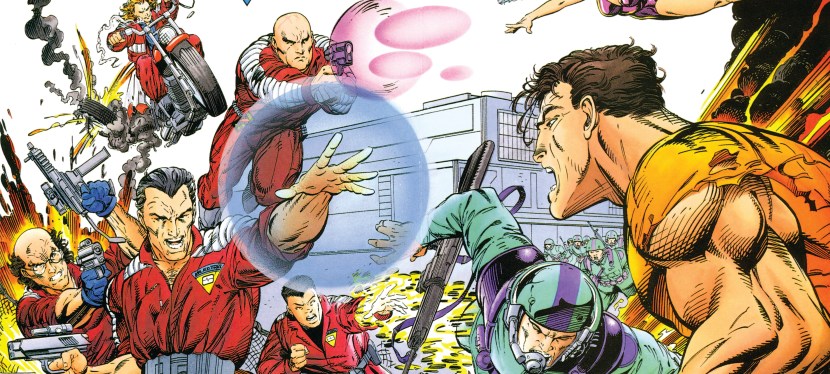
Faith collects and then flies high for a grand view.

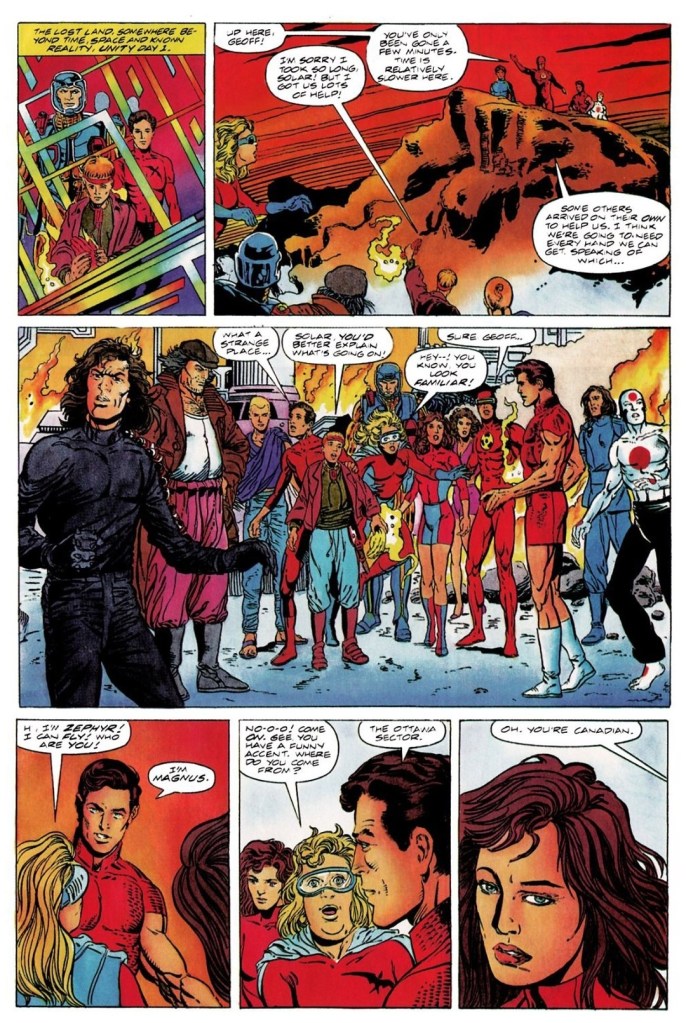
To get straight to the point, this issue of Harbinger is easily the wildest story I’ve read in this series and for a very obvious reason – it is part of the Unity crossover storyline that established the Valiant Comics universe’s overall concept. For the newcomers reading this, Unity was published in 1992 composed of eighteen chapters – beginning with Unity #0 – which saw story parts told in issues of other Valiant titles like Eternal Warrior, Archer & Armstrong, Magnus Robot Fighter, X-O Manowar, Rai and Solar Man of the Atom.

That being said, the story here is not only wilder than ever but also really went higher with its flight of fantasy which really impacted the protagonists. In her, Sting, Faith, Flamingo and even the pregnant Kris get recruited to join what turned out to be a major battle waged by a group of adult heroes (Solar, Eternal Warrior, Archer & Armstrong, X-O Manowar, Rai and others) against Erica Pierce (the Mothergod) who is obsessed with destroying the universe as she wield immense power.

More on the plot, the transition of Sting and his teammates going into battle on an unknown realm progressed very smoothly which surprised me. As there are lots of battle scenes and other forms of superhero spectacle to see, the creative team managed to maintain a compelling narrative that moved at a medium pace which makes following the exploits of the powered teenagers easy to do. Sure, you get to see the other Valiant Comics heroes share the spotlight in this comic book but Sting and his teammates are the clear protagonists.

Even though there are lots of battle scenes, Jim Shooter still succeeded in setting up a good amount of character development scenes which resulted in clear development of Sting and Kris. Not only that, Shooter convincingly captured the impulse of youth and the false sense of maturity on the part of Sting who at this point has to take special care of Kris, think about the future of becoming a father while dealing with pressure from the other Valiant superheroes who need him to really advance against Erica Pierce. This comic book’s script is very strong and richly layered!

Conclusion

Sting and his teammates stand along with the other heroes of the Valiant Comics universe.

Being the eight chapter of the Unity crossover storyline, Harbinger (1992) has this almost perfect mix of the epic superhero conflict, spectacle and characterization while maintaining sufficient focus on the exploits Sting, Faith, Kris and Flamingo. At this point of the monthly series, Sting (note: whose immense power was portrayed here) and Kris are preparing themselves for the future while failing to realize they are not really mature enough to deal with both the anticipated parenthood and the Unity conflict at hand. This comic book is a must-read as it works excellently both as a standalone story as well as a chapter of Unity. That being said, I’m looking forward to the next issue already.

Overall, Harbinger (1992) is highly recommended!

+++++

Thank you for reading. If you find this article engaging, please click the like button below, share this article to others and also please consider making a donation to support my publishing. If you are looking for a copywriter to create content for your special project or business, check out my services and my portfolio. Feel free to contact me with a private message. Also please feel free to visit my Facebook page Author Carlo Carrasco and follow me on Twitter at  @HavenorFantasy as well as on Tumblr at https://carlocarrasco.tumblr.com/ and on Instagram at https://www.instagram.com/authorcarlocarrasco

A Look Back at Harbinger #3 (1992)

Disclaimer: This is my original work with details sourced from reading the comic book and doing personal research. Anyone who wants to use this article, in part or in whole, needs to secure first my permission and agree to cite me as the source and author. Let it be known that any unauthorized use of this article will constrain the author to pursue the remedies under R.A. No. 8293, the Revised Penal Code, and/or all applicable legal actions under the laws of the Philippines.

Welcome back superhero enthusiasts, 1990s culture enthusiasts and comic book collectors! Today we go back to the early 1990s and explore a part of the Valiant Comics shared universe through the Harbinger monthly series.

In my previous retro review, Peter/Sting, Kris, Faith/Zephyr, Charlene/Flamingo and John/Torque not only found a place to stay in thanks to a really generous doctor, they went ahead infiltrating the top secret facility of the Harbinger foundation which also brought them face-to-face with the leader. At this stage, Sting and his team have established their purpose not just for survival but to achieve something they believe is right.

With those details laid down, here is a look back at Harbinger , published in 1992 by Valiant Comics with a story written by Jim Shooter and drawn by David Lapham.

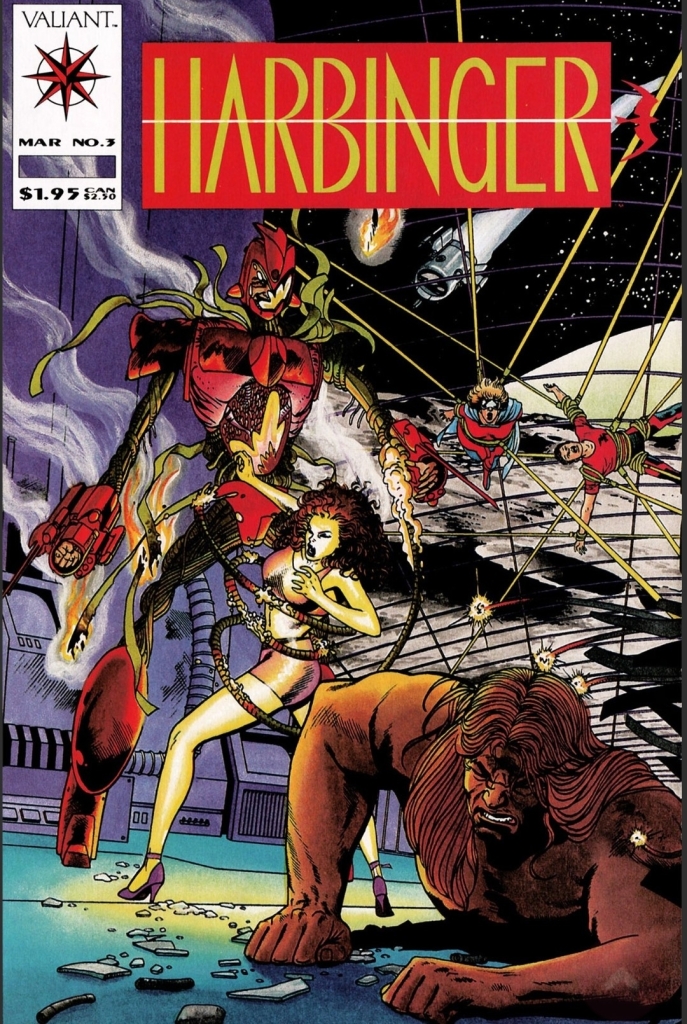
The cover.

Early story

The story begins at 9:20 AM of July 6, 1991 inside the fine summer home of Dr. Heyward. As Sting tells his teammates that they have to move to catch a flight, Faith (wearing her superhero costume) flies through to find Kris and Torque. She finds the two of them seated next together with Kris having her two hands on Torque.

Meanwhile, Flamingo fixes her face as Sting talks to her. She rejects his declaration that she is a part of their team and reveals that Torque does not care about her. Flamingo considers herself as just another hosebag. Sting then tries to lift her up by telling her that she has to take care of herself and that she is part of their team.

Sting, Faith, Flamingo, Kris and Torque then leave for the airport in a brand new vehicle they just bought (having used the money they stole from Harbinger). Their vehicle flies off to the airport with Sting on the driver’s seat…

Quality

Sting, his teammates and newcomer Ax in the heat of action.

Without spoiling the plot, I can say that the story in this comic book got even wilder than I anticipated. The high intensity of wild turnout of events in issue do not even come close to what was told right here. At the same time, this particular story clearly showed this comic book series’ own place within the literary universe of Valiant Comics and anyone who read XO-Manowar comics of this particular era will instantly recognize the recurring creatures (opposition elements) from outer space.

As expected, the character development of the main characters progressed smoothly revealing some amusing character moments that I found interesting and other times amusing. As Sting continues to act with a sense of leadership as well as a false sense of maturity, you will get to see more of Kris providing him analytical and personal support.

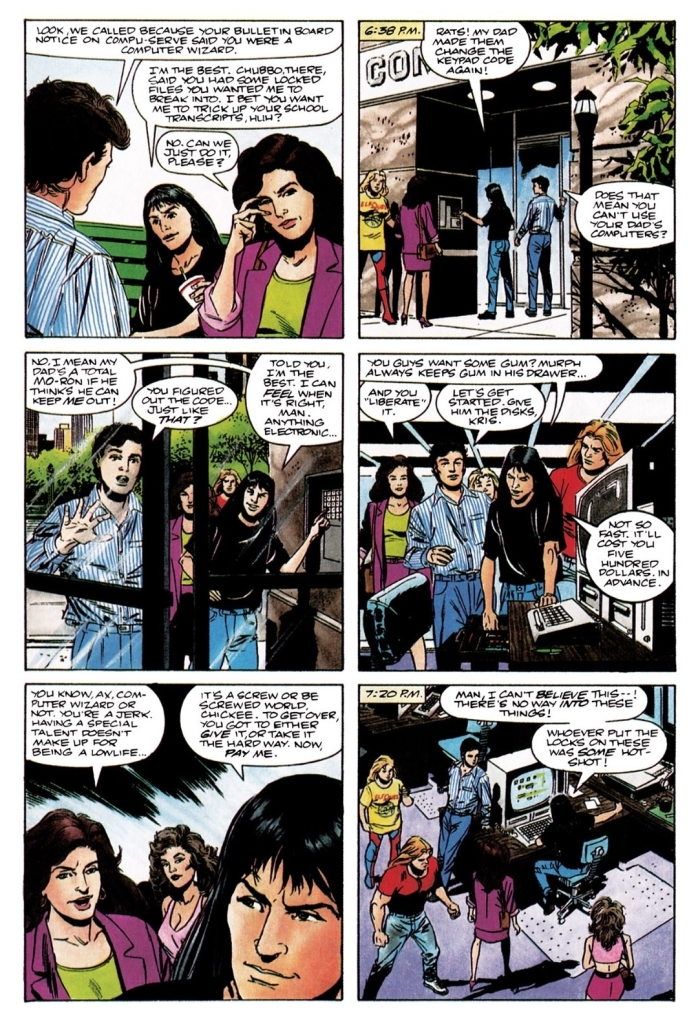
The dialogue in this comic book was written to be more dynamic and this is highlighted in the scene in which Sting and his teammates discuss what to do with their new team objective, and what to do with the computer hacker Ax who has shown Harbinger potential. That being said, Jim Shooter carefully crafted the dialogue to reflect how American teenagers in the late 1980s and early 1990s expressed themselves.

When it comes to superhero spectacle, there is a lot to enjoy here. Action scenes and the use of special abilities or super powers were executed at a moderate pace yet they were intense to look at. Each of the main characters had his/her own share of the spotlight even as the spectacle moved.

Conclusion

Meet Ax, the guy who specializes on cracking and hacking.

Harbinger (1992) is a very engaging story to read which was balanced with a good amount of spectacle, nice character moments and the wildest turn of events so far in this particular comic book series. On face value, this comic book’s core concept (which involves a lot of science fiction elements) seemed over-the-top but Jim Shooter and David Lapham succeeded in telling a story that is believable and at the same time fun. It is also within this comic book that readers will get to see more of the Valiant Comics universe elements without the need of a crossover or a cameo appearance of an established Valiant hero. This is definitely the tale of Sting and his team that was simply taken into a much higher flight of fantasy. That being said, I am looking forward to the next issue.

Overall, Harbinger (1992) is highly recommended!

+++++

Thank you for reading. If you find this article engaging, please click the like button below and also please consider sharing this article to others. If you are looking for a copywriter to create content for your special project or business, check out my services and my portfolio. Feel free to contact me with a private message. Also please feel free to visit my Facebook page Author Carlo Carrasco and follow me on Twitter at  @HavenorFantasy as well as on Tumblr at https://carlocarrasco.tumblr.com/ and on Instagram at https://www.instagram.com/authorcarlocarrasco/

A Look Back At The H.A.R.D. Corps #1

The 1990s was a decade of excess when it comes to superhero comic books. Apart from the persistent hoarding of comic books and the quest for profit, there were also these wide superhero franchises (or superhero universes) that popped up and even challenged Marvel Comics and DC Comics. Malibu Comics launched the Ultraverse while Valiant Comics came up with its own universe.

Valiant established itself nicely with popular characters like Bloodshot, X-O Manowar, Turok and Ninjak, and each one had its own regular series of comic books published. When it comes to teams, there was H.A.R.D. Corps (H.A.R.D. stood for Harbinger Active Resistance Division).

During the recent Hobby Con held at Las Piñas City, I luckily found myself a copy of The H.A.R.D. Corps and read it for the first time ever. This is my review of the comic book which has a cover drawn by the great Jim Lee.

RCO002_1472443923.jpg
Cover with art by Jim Lee.

Early story

The story begins with the 5-member team in the middle of a mission inside the secured facility of the Harbinger Foundation. Under fire from the facility’s armed personnel, the team (riding a floating vehicle) struggle to find their way and evacuate. Along the way, an oversized man called Big Boy grabbed one of their members and separated him from the others. With the situation getting worse, the captured member got “brain popped” (a remote form of self-destruction via the neural flash implanted inside the person’s brain). The remaining four manage to get away by means of aerial transport provided by their company.

Then a section of the facility exploded causing financial damage to Mr. Harada who decided to visit and inspect the site.

RCO017_1472443923~2.jpg
Expository information done cleverly.

Some time later, the H.A.R.D. Corps enjoy the privacy and security at their headquarters in the Nevada desert. Team members Shakespeare, Major Palmer, Softcore, Hammerhead and Superstar wait for instructions at the debriefing room.

Quality

The H.A.R.D. Corps is very well written by David Michelinie. Within twenty-two pages, Michelinie loaded enough details to explain the comic book’s core concept efficiently while at the same time he managed to tell an engaging story with a light touch on character development (note: there were many characters and there was not enough space for further personality emphasis). By the time the story ended, I really felt enlightened, entertained and wanting to find out what would happen next.

Michelinie’s handling of expository dialogue was done very efficiently. I’m talking about the private briefing done by an executive of the Cartel explaining to a recovering man named Kim (who was almost killed during the Los Angeles Riot) what H.A.R.D. Corps is, why the Cartel is in a race against Harada who has been manipulating Harbingers (persons with unique abilities). The Cartel opposes Harada with neural implants.

More on the team, H.A.R.D. Corps members are people who have gone through training programs and each of them had neural implants in their heads which enable them to mimic Harbinger powers (one at a time) through signals broadcast from a base station. Each of them was comatose and the use of the implants reversed the coma.

RCO007_1472443923~2.jpg
Some action for you.

When it comes to visuals, the art by David Lapham (inked by Bob Layton) was pretty good. I like the high amount of detail placed on the surroundings in most of the panels. Action shots had a good amount of impact.

Conclusion

This comic book from late 1992 is a good and engaging read. I really enjoyed it and I like its core concept about a team of enhanced individuals who are technically living properties of very business-minded people opposed to Harada. Even by today’s standards, H.A.R.D. Corps concept really stands out among all superhero team comic books.

The H.A.R.D. Corps is recommended and you can acquire a near-mint copy of it for only $4 at MileHighComics.com (as of this writing).