As the armed conflict in the Middle East continues to cause economic disruptions, hiked oil prices and impact international air travel, luxury hotels in Thailand have been cutting down their prices as a way to deal with the slowdown on tourism, according to a news report of VnExpress.
To put things in perspective, posted below is an excerpt from the news report of VnExpress. Some parts in boldface…
Luxury hotels across Thailand, the second largest economy in Southeast Asia, are rolling out deep discounts to attract domestic travelers as international arrivals weaken due to disruptions linked to the Middle East conflict.
Thai residents and expatriates are being offered discounts of up to 70% at five-star hotels, where nightly rates can typically reach US$1,000, Bloomberg reported.
At Mandarin Oriental, Bangkok, one of the capital’s most iconic riverside properties, rooms are now priced below $300 per night. In southern Thailand, a luxury resort overlooking the dramatic limestone cliffs of Railay Beach is offering stays from around $430 per night, roughly half its usual rate.
The steep promotions come as flight cancellations and airspace closures tied to the conflict in Iran disrupt key Europe-Asia travel routes, making journeys to Thailand more complex and costly.
Thailand’s Ministry of Tourism fears a loss of 596,000 visitors and 40.9 billion baht ($1.29 billion) in revenues if the conflict drags on for more than eight weeks.
Phangnga Province has already seen a sharp decline in European arrivals and estimates losses at nearly 1.7 billion baht ($52.3 million), according to its hotel association, Bangkok Post reported.
Authorities are also preparing contingency measures to offset any decline in arrivals from long-haul markets including Europe and the U.S. Thailand experienced a tourism downturn last year amid a combination of kidnapping incidents, flooding and border conflict.
The country is aiming to attract 37 million foreign visitors this year, a projected increase of more than 11% from 2025 but that target is increasingly at risk.
Let me end this piece by asking you readers: What is your reaction to this development? Does the discounting of room rates by luxury hotels in Thailand entice you to visit them? How long do you think the slump of tourism will last?
Disclaimer: This is my original work with details sourced from my personal experiences and observations during the Israel pilgrimage tour I joined and what happened during my free time. Anyone who wants to use this article, in part or in whole, needs to secure first my permission and agree to cite me as the source and author. Let it be known that any unauthorized use of this article will constrain the author to pursue the remedies under R.A. No. 8293, the Revised Penal Code, and/or all applicable legal actions under the laws of the Philippines.
Welcome back, readers and fellow followers of the Lord! This is the 11th chapter of my ongoing series of articles about the holy nation of Israel with recollections about the experiences and discoveries I had during the pilgrimage tour I joined with my local church (hosted by strategic partner Behold Israel) in 2023. To see my previous Israel tour articles, click here, here, here, here, here, here, here, here, here and here. No matter what happens in this unpredictable and chaotic world we live in, I will always stand with Israel and my faith in the Lord remains uncompromising!
In this latest edition of my Israel 2023 series, I share with you what I experienced when I visited Western Wall in the Old City of Jerusalem not once but twice. Also referred to as the Wailing Wall, the Western Wall is a very holy site and is one of the most definitive places to be in with regards to worshiping the Lord.
For starters, I share with you the very video I recorded about my first time ever to arrive at the Western Wall Plaza (note: I was with my pilgrimage tour group companions, our pastors and our hard-working local tour guide) as well as my first-ever approach (starts at 2:01 in the video) to the Western Wall itself. It’s a video of more than three minutes and it’s available for public viewing via YouTube. Watch the video below and pay attention to the details closely.
As you can see in the above video, I stopped recording before entering the perimeter to get closer to the Western Wall. What happened after was my personal discovery and my personal sensing of the Lord’s presence.
About The Western Wall
To put things in perspective, the Western Wall is a retaining wall which was part of the Temple Mount expansion that King Herod (Herod the Great) did in around 19 BC. It is one of the four supporting walls of the Temple Mount which remained intact after the destruction of the Second Jewish Temple many decades later. Above it is the Temple Mount already.
Historically, the First Jewish Temple was built on the top of Mount Moriah during the time of King Solomon. The temple was destroyed by the Babylonians in 586 BCE. In 19 BC, King Herod started rebuilding a new temple and this includes enlarging the Temple Mount platform a lot which made it 1,575 feet long and 985 feet wide. Herod had ten thousand men working and trained a thousand priests to work on the most sacred parts of the Second Jewish Temple.
The construction was done after several years but the decoration was completed in 64 AD. Six years after the Second Jewish Temple was fully completed, the Romans destroyed it but the western side of the Temple Mount survived. This happened in 70 AD, long after Lord Jesus conquered death and ascended to Heaven.
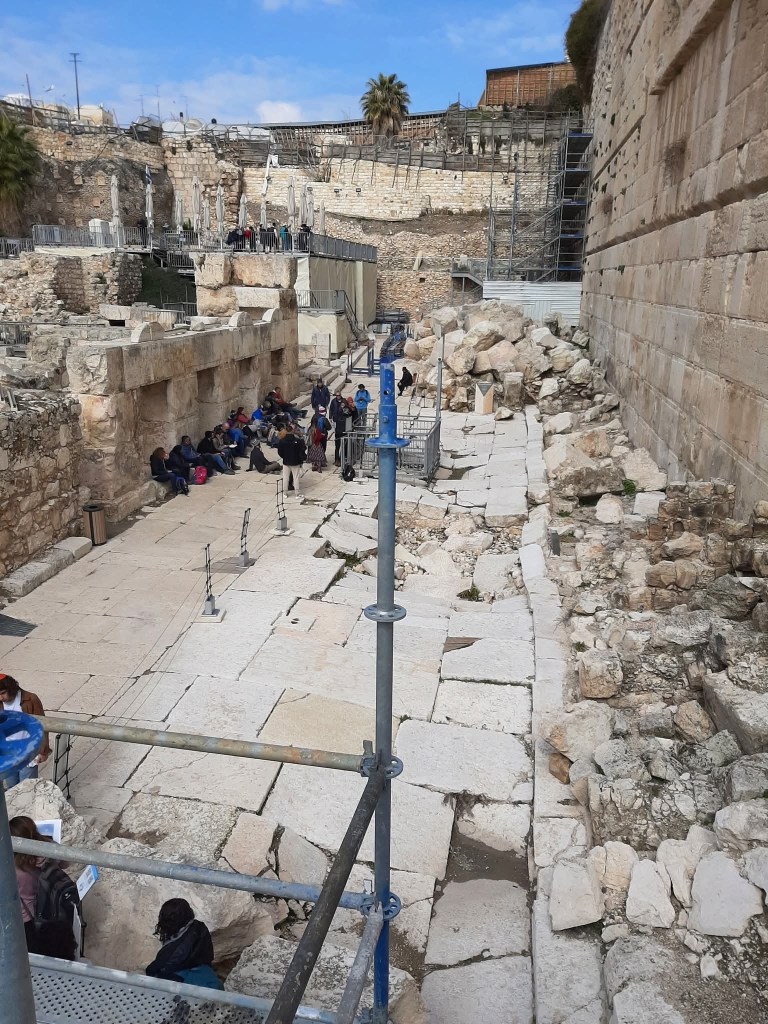
At the part of the Western Wall near the corner of the Southern Wall is this area that was massively damaged when the Romans destroyed the Second Jewish Temple. Several huge rocks that fell from above during the 70 AD destruction have remained.
The Western Wall faces westward and it is the closest in proximity to the site of the Holy of Holies, the most sacred location in the Temple for the Jewish people. Be aware that Mount Moriah is the same exact mountain where Abraham almost sacrificed his son Isaac before God sent the angel to intervene and provided the ram as the sacrifice.
For centuries, the Western Wall became a great source of influence and inspiration. It became the focus of yearning and prayer for the Jewish people for countless generations. The open-air section of the Western Wall serves as a place of worshipping the Lord and it is officially a synagogue. Apart from worship, the Western Wall keeps the memory of the Jewish Temples alive and it has also been used by the State of Israel for formal ceremonies. For centuries, pilgrims from around world came to the wall to pray and leave written noted in its ancient stones.
Physically, the Western Wall is 488 meters long and the height of the exposed section reaches a height of 40 meters above the bedrock of the eastern hill of Jerusalem (Mount Moriah). The open-air section of the wall (visible to the Prayer Plaza) is comprised of 46 layers of stone and the very large stones (that many are able to touch) were put in place during the time of King Herod (Second Jewish Temple period).
My First Visit – February 13, 2023
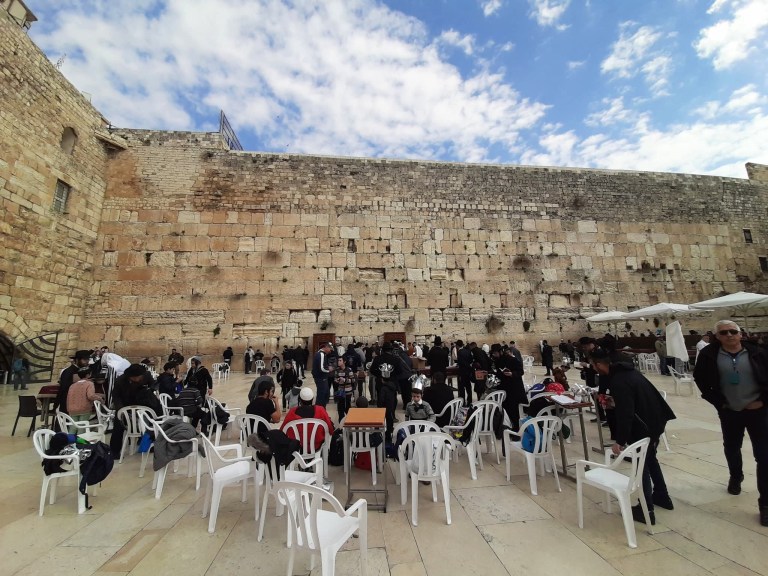
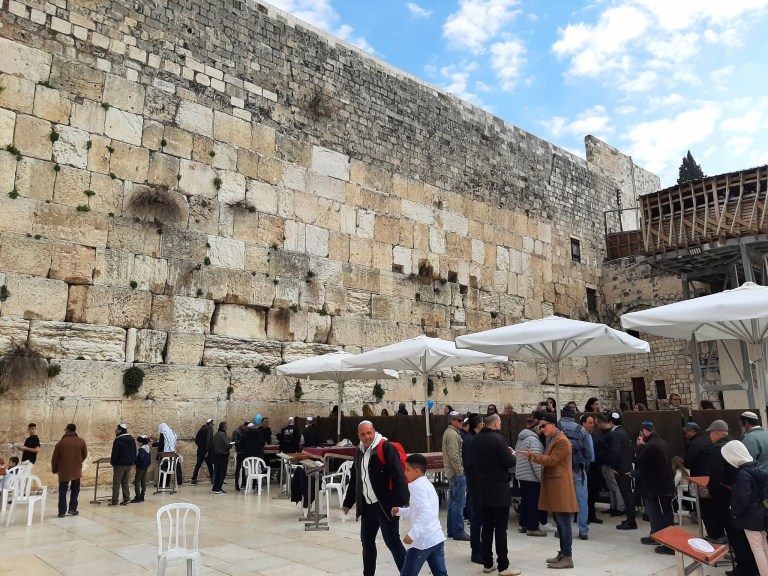
The widest shot of the Western Wall I managed to take during my first-ever visit.
After recording the video, I placed my smartphone into my pocket, entered the worship area and gradually made my way to the wall.
With my Holy Bible in my left hand, I touched the Western Wall with my right hand and started spending quality timewith the Lord God, praying to Him. With all my heart, I expressed my thanks and dedication to Lord Jesus there at the wall. I also prayed in support of Israel and the peace of Jerusalem.
Each moment I had there, I truly felt God’s presence and I did not confuse it with the wall’s visual magnificence. As I prayed, I felt the unction from the Lord to open my eyes and look straight up at the blue sky above knowing that He is spiritual, and He is in Heaven. The Lord is not inside the stones of the wall but in His Kingdom. That said, I did not worship the stones (reminder: idolatry is foolish and unholy) as I directed my worship directly to the Lord knowing He is in Heaven.
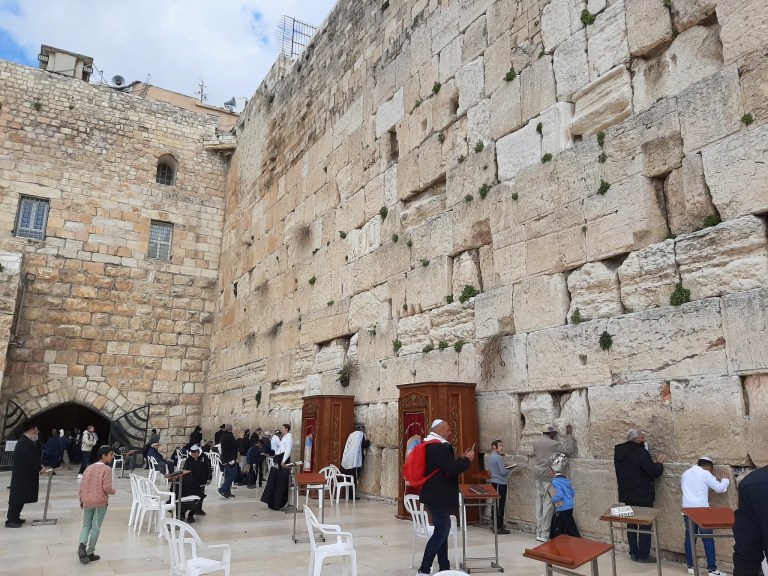
Many people praying at the wall touching it. There were others who did the same while standing or seating on a chair. In the lower-left corner of the picture is Wilson’s Arch which leads into the indoor synagogue.
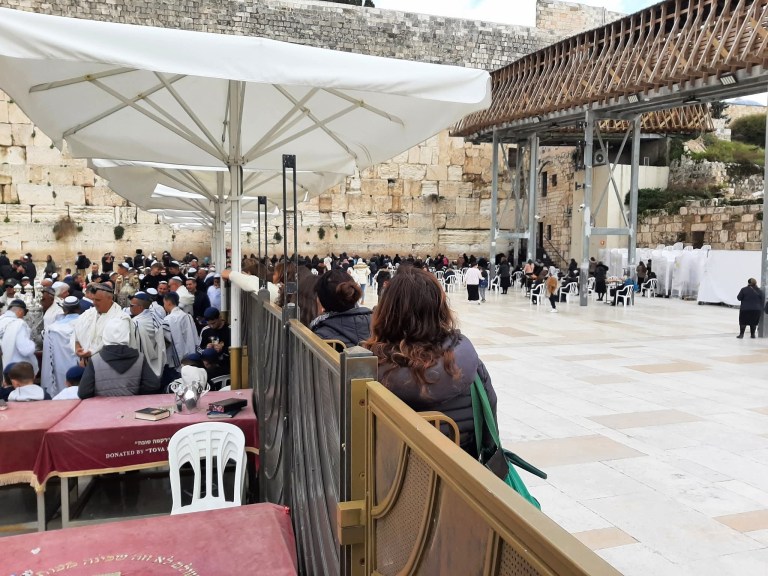
Partly seen in the background is the fence that separates the men from the women. Above everyone at the right is the platform leading to Temple Mount.
The men’s side on the left and women’s side on the right. More of the high platform leading to the Temple Mount.
Because we only had fifteen minutes to spend as our tour group had a schedule to follow, I wisely spent time to praising and honoring the Lord. Let me remind you all that Lord Jesus will someday return and He will fulfill His promise. He will return in Israel and Jerusalem will be His destination.
After praying to Him, I spent the remaining minutes looking around and observing. I was surrounded by Ultra-Orthodox Jews, National Religious Jews, rabbis, tourists and Christians. I witnessed the religious rituals and practices of the Jewish people and I know deep inside that the ties between Jews and Christians are biblical.
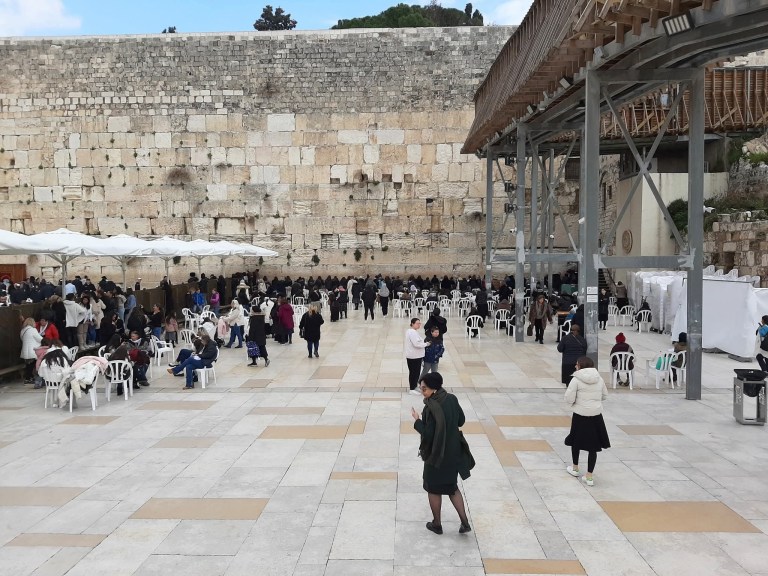
As I walked out to rejoin my pilgrimage tour group, I took shot of the women’s area of the Western Wall.
The whole area is indeed sacred and that means visitors should be respectful and should practice decency near the Western Wall. People praying to God are to be respected and when there are many others praying while touching the wall, you will really have to wait for your turn. Be mindful that the Lord is always watching you as there is simply no reason to cause disrespect, playing around and causing trouble at the Western Wall.
When my fifteen minutes ran out, I went to the exit to rejoin my tour group.
My Second Visit – February 15, 2023
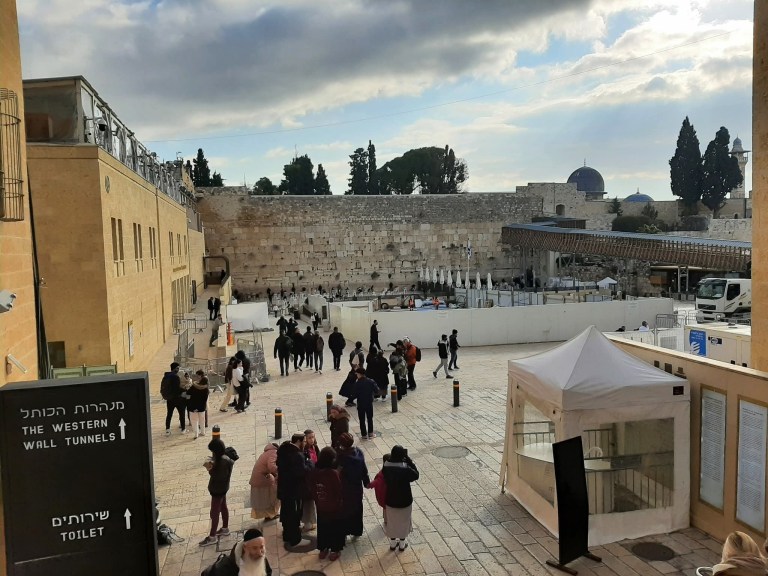
I took this shot of the Western Wall after making my way through from the Temple Mount.
Two days later, it was our tour group’s one and only rest day. After having a really early breakfast at our hotel, I marched to the Old City of Jerusalem and visited the Temple Mount for the first time ever. After spending time up there, I took the exit and made my way down to return to the Western Wall.
Once again I took time touching the wall and praying to the Lord and expressing my thanks to Him with a lot of heart. After several minutes, I took a seat to pray to Him while resting my legs. Then I noticed a North American man (who looked so much like Hillsong Church’s Phil Dooley) with the Holy Bible at one end of the fence (separating the men and the women) by the wall facing at the other direction (his back on the wall). He preached the Word of God and asked the Lord to save everyone. What he said reminded me that God has a plan for everyone, including the Jews (His chosen people) and there is still time for the lost and unsaved to realize Jesus as the Lord and the Savior of all.
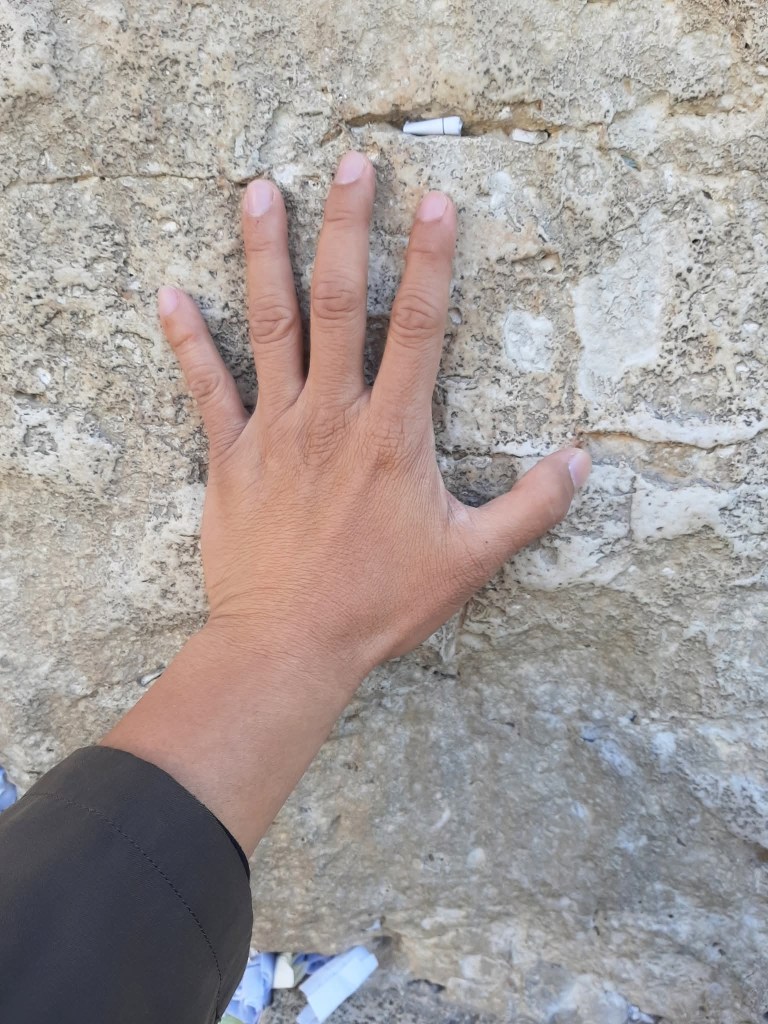
My hand touching the Western Wall. I spent much more time praying to the Lord during my 2nd visit there.
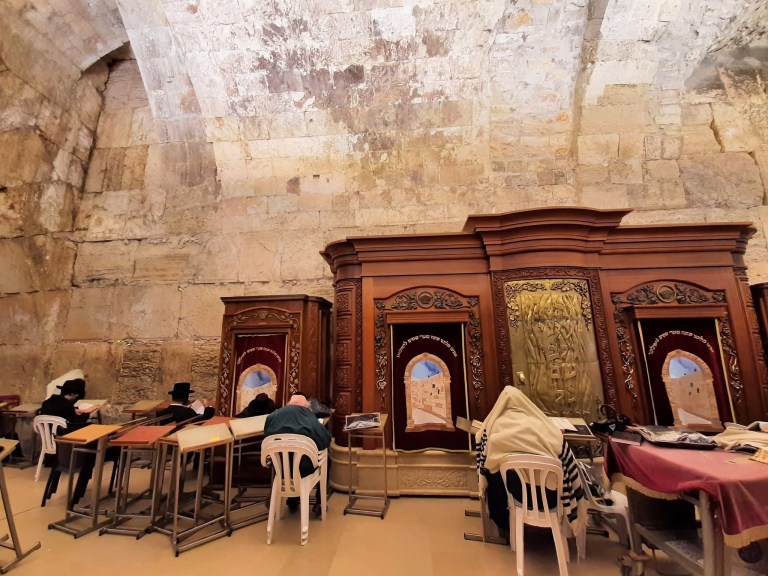
After I was done praying by the wall, I decided to visit Wilson’s Arch as I was so curious why a lot of people had been entering and exiting it. It turned out to be Western Wall tunnel (with an arch area) and inside was a synagogue where there lots of Jews read the Old Testament, the Torah and pray. At the entrance/exit, a Jewish rabbi invited me in and assured me that foreigners and non-Jews were welcome. So I went in and he showed some parts of the indoor synagogue.
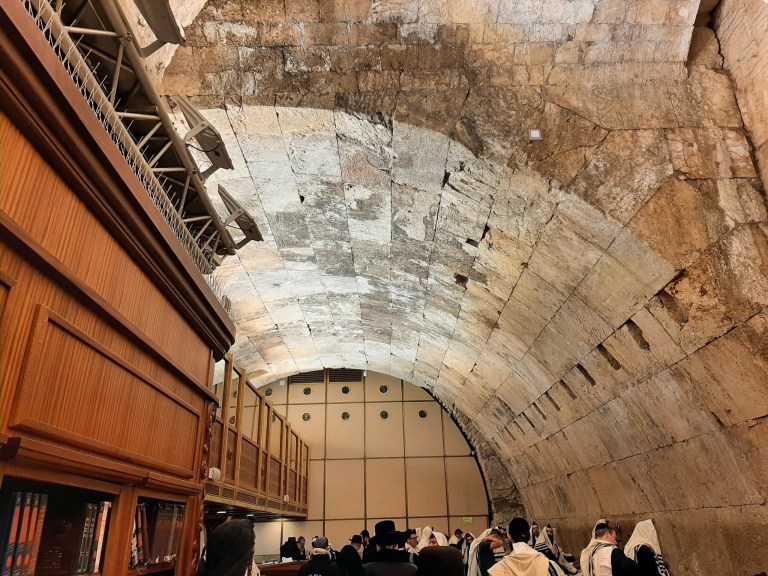
As it was a place of worship by the Jews, I was cautious moving inside and spending time observing. Carefully I only took a few photos for this feature article and it was astonishing to see more of the Western Wall indoors. Not only that, it was impressive to see the arches – including those huge stones above our heads – and it turns out they were constructed during Herod’s time and without any cement at all. There were also lots of shelves of books on both sides.
I took this shot during my short visit inside the Western Wall tunnel.
See those huge stones above everyone? Those were put into place during the time of King Herod and no cement was ever used. It is amazing to see as it was constructed without any of the modern construction technologies of today.
The Western Wall tunnel synagogue is one of the holiest synagogues in Israel due to its proximity to where the First Jewish Temple was wherein the Holy of Holies resided.
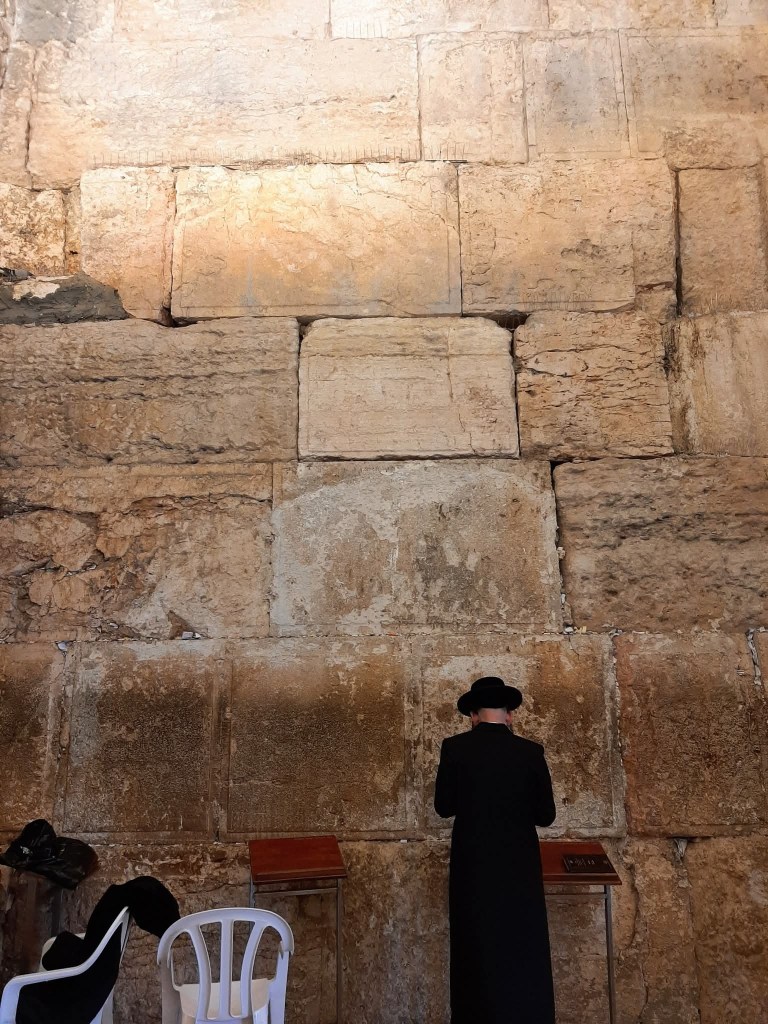
The indoor synagogue is one of the holiest synagogues in Israel due to its proximity to where the original Jewish Temple was wherein the Holy of Holies resided. Since it was my plan to revisit the Upper Room and visit both King David’s Tomb and Oskar Schindler’s grave, I eventually left the Western Wall tunnel. Before tracing my way back to the Jewish Quarter (where we visited two days prior), I took one last look back at the Western Wall. I intend to revisit it and spend quality time with the Lord there again in the future.
Biblical Significance
While it is a fact that the Western Wall was not explicitly mentioned in the Holy Bible, it has always been part of the Temple Mount since Herod’s time. To put things in perspective, we need to go back to the time when King Solomon dedicated the First Temple asking God to hear the prayers made toward it. Learn from the holy scriptures below.
that Your eyes may be open toward this temple night and day, toward the place of which You said, ‘My name shall be there,’ that You may hear the prayer which Your servant makes toward this place. And may You hear the supplication of Your servant and of Your people Israel, when they pray toward this place. Hear in heaven Your dwelling place; and when You hear, forgive.
1 Kings 8:29-30 (NKJV)
“Moreover, concerning a foreigner, who is not of Your people Israel, but has come from a far country for Your name’s sake (for they will hear of Your great name and Your strong hand and Your outstretched arm), when he comes and prays toward this temple, hear in heaven Your dwelling place, and do according to all for which the foreigner calls to You, that all peoples of the earth may know Your name and fear You, as do Your people Israel, and that they may know that this temple which I have built is called by Your name.
1 Kings 8:41-43 (NKJV)
The First Jewish Temple eventually got destroyed by the Babylonians. Centuries later, Herod executed the massive rebuilding of the Temple (Second Jewish Temple) in Jerusalem as well as the expansion of the Temple Mount itself. What was achieved drew reactions from many people who saw it and there were references of such reactions in the New Testament. For insight, read the scriptures below.
Then as He went out of the temple, one of His disciples said to Him, “Teacher, see what manner of stones and what buildings are here!”
Mark 13:1 (NKJV)
Then the Jews replied, It took forty-six years to build this temple (sanctuary), and will You raise it up in three days?
John 2:20 (AMPC)
To be clear, the forty-six years mentioned in John 2:20 refers to the massive renovation and the expansion of the Second Jewish Temple.
Long before the Second Temple got destroyed, Lord Jesus prophesied its destruction. By the time Lord Jesus made the prophesy, He was already rejected by the religious Jews. Those people refused to accept Him as their Messiah and they had disobeyed God as a result. Lord Jesus wept for Jerusalem knowing that suffering and destruction would come and it happened in 70 AD. Learn from the scriptures below.
Now as He drew near, He saw the city and wept over it, saying,
“If you had known, even you, especially in this your day, the things that make for your peace! But now they are hidden from your eyes. For days will come upon you when your enemies will build an embankment around you, surround you and close you in on every side, and level you, and your children within you, to the ground; and they will not leave in you one stone upon another, because you did not know the time of your visitation.”
Luke 19:41-44 (NKJV)
Then Jesus went out and departed from the temple, and His disciples came up to show Him the buildings of the temple. And Jesus said to them,
“Do you not see all these things? Assuredly, I say to you, not one stone shall be left here upon another, that shall not be thrown down.”
Matthew 24:1-2 (NKJV)
As it is very clear that God always has a plan for the faithful and His chosen people, it was prophesied that He would bring the Jews (scattered around the world) back to Israel in the last days. This prophecy was fulfilled in May 1948 when the modern State of Israel was formally established and a lot of Jews returned or settled in since then. Lord Jesus will return to us some time in the future and there is time for the Jews to accept Him as their Messiah, to repent and submit to Him. The other lost and unsaved people of the world still have opportunities to realize Jesus as their Lord and Savior. Very clearly, Lord Jesus is the hope of ALL nations! Learn from the scriptures below.
If any of you are driven out to the farthest parts under heaven, from there the Lord your God will gather you, and from there He will bring you. Then the Lord your God will bring you to the land which your fathers possessed, and you shall possess it. He will prosper you and multiply you more than your fathers.
Deuteronomy 30:4-5 (NKJV)
Jesus answered him,
“I assure you and most solemnly say to you, unless a person is born again [reborn from above—spiritually transformed, renewed, sanctified], he cannot [ever] see and experience the kingdom of God.”
John 3:3 (AMP)
Beloved ones, let me repeat emphatically that the gospel entrusted to me was not given to me by any man. No one taught me this revelation, for it was given to me directly by the unveiling of Jesus Christ.
By now you have heard stories of how severely I harassed and persecuted Christians and how systematically I endeavored to destroy God’s church, all because of my radical devotion to the Jewish religion. My zeal and passion for the doctrines of Judaism distinguished me among my people, for I was far more advanced in my religious instruction than others my age.
But then God called me by his grace, and chose me from my birth to be his. He was pleased to unveil his Son in me so that I would proclaim him to the peoples of the world. After I had this encounter, I kept it a secret for some time, sharing it with no one. And I had no desire to run to Jerusalem and try to impress those who had become apostles before me. Instead, I withdrew into the Arabian Desert. Then I returned to Damascus, where I had first encountered Jesus.
Galatians 1:11-17 (TPT)
For He is [Himself] our peace (our bond of unity and harmony). He has made us both [Jew and Gentile] one [body], and has broken down (destroyed, abolished) the hostile dividing wall between us,
By abolishing in His [own crucified] flesh the enmity [caused by] the Law with its decrees and ordinances [which He annulled]; that He from the two might create in Himself one new man [one new quality of humanity out of the two], so making peace.
And [He designed] to reconcile to God both [Jew and Gentile, united] in a single body by means of His cross, thereby killing the mutual enmity and bringing the feud to an end.
And He came and preached the glad tidings of peace to you who were afar off and [peace] to those who were near.
For it is through Him that we both [whether far off or near] now have an introduction (access) by one [Holy] Spirit to the Father [so that we are able to approach Him].
Therefore you are no longer outsiders (exiles, migrants, and aliens, excluded from the rights of citizens), but you now share citizenship with the saints (God’s own people, consecrated and set apart for Himself); and you belong to God’s [own] household.
You are built upon the foundation of the apostles and prophets with Christ Jesus Himself the chief Cornerstone.
In Him the whole structure is joined (bound, welded) together harmoniously, and it continues to rise (grow, increase) into a holy temple in the Lord [a sanctuary dedicated, consecrated, and sacred to the presence of the Lord].
In Him [and in fellowship with one another] you yourselves also are being built up [into this structure] with the rest, to form a fixed abode (dwelling place) of God in (by, through) the Spirit.
Ephesians 2:14-22 (AMPC)
Conclusion
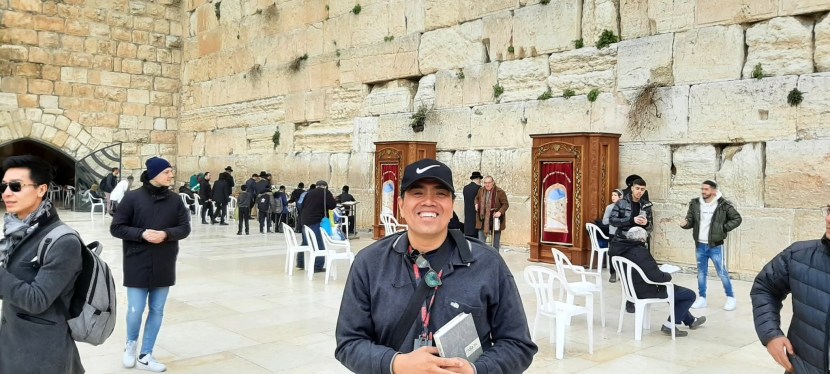
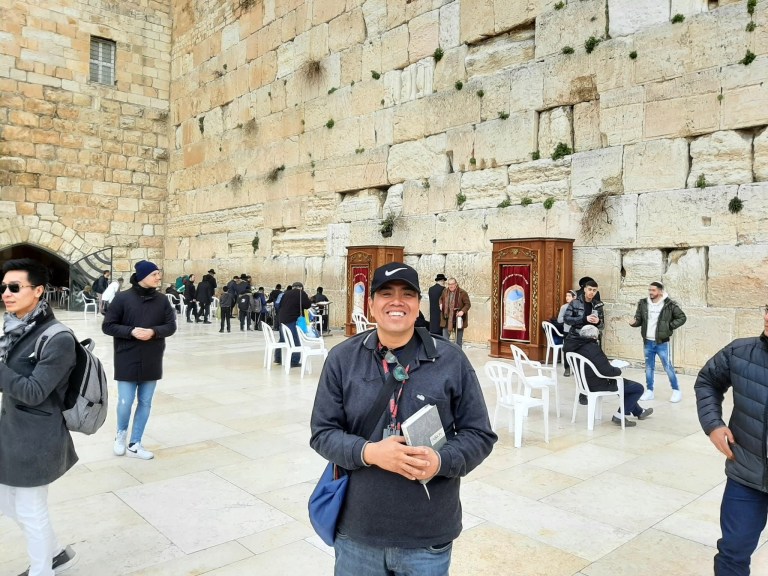
This was me during my first-ever Western Wall visit on February 13, 2023. I had The Passion Translation (TPT) Holy Bible with me. My thanks to the guy who took this picture for me.
My two visits to the Western Wall were very significant to me personally. As seen above, each visit has been different, new discoveries happened and I spent quality time with Lord. The place is holy and it is a must-visit for anyone going to Israel. If I ever visit Israel again, I would return to the Western Wall to praise, thank and honor the Lord. If you are a person of faith who is about to visit Israel for the first time, I urge you to visit the Western Wall in Jerusalem. Learn from my experiences. I also encourage you all to stand united in support of Israel, learn to love and bless the Jewish people, help the lost and unsaved come to Lord Jesus and always pray for the peace of Jerusalem.
Pray for the peace of Jerusalem! May they prosper who love you [the Holy City]!
May peace be within your walls and prosperity within your palaces!
For my brethren and companions’ sake, I will now say, Peace be within you!
For the sake of the house of the Lord our God, I will seek, inquire for, and require your good.
Psalm 122:6-9 (AMPC)
Israel is the holiest place to visit in the whole world! Visit Israel with the Holy Bible! Pray to the Lord wholeheartedly and reveal to Him your heart’s desire to visit Israel to deepen your faith in Him. Always be the fearless and aggressive church of Lord Jesus! Follow the light of Lord Jesus, keep on praying to support Israel, learn to love and bless the Jewish people and pray for the peace of Jerusalem.
Watch out for more Israel 2023 travel articles here. There is more to come! Thank you for reading.
With the joint Israel-US military operations against the Islamic terrorist regime of Iran still going on, the tourism authority of Thailand announced it is preparing measures to ease the effects of the conflict on its tourism sector, according to a news report of VnExpress. Already the conflict caused a series of economic disruptions affecting air travel and the prices of services and products offered to tourists.
To put things in perspective, posted below is an excerpt from the news report of VnExpress. Some parts in boldface…
The Tourism Authority of Thailand (TAT) is preparing measures to mitigate the impact of tensions in the Middle East on the country’s tourism sector, including proposals to stimulate domestic travel and short-haul flights.
Following consultations with private operators, TAT Governor Thapanee Kiatphaibool said the agency is promoting Thailand as a safe destination and plans to suggest the establishment of a strategic operations unit to monitor flight capacity, load factors, oil prices and travel costs.
TAT also plans to use the remaining central budget under the Thailand Summer Blast scheme, which supports inbound flights to Thailand, to back airlines and promote both major and secondary cities.
It is considering adjustments to an existing subsidy program for charter flights to cover long-haul markets, as well as incentives such as free domestic flights for international visitors and co-payment schemes to boost local tourism.
Thailand aims to capitalize on the situation by positioning itself as an aviation hub linking Europe with Asia and Australia, while adjusting flight schedules to attract more direct long-haul services. At the same time, efforts will be made to rebalance international tourism markets by focusing on China, Japan, the Republic of Korea and Southeast Asia.
Let me end this piece by asking you readers: What is your reaction to this development? Do you intend to visit Thailand over the next six months? Does the war against Iran discourage you from traveling overseas?
Having traveled to many destinations around the world, I am always mindful about how much money I carry, how much do products and services cost, and what exactly should I pay for. Vietnam, which attracted a record 21.2 million foreign tourists last year, has a disturbing trend of foreign tourists getting overcharged for services and products, according to a VnExpress news article.
To put things in perspective, posted below is an excerpt from the news report of VnExpress. Some parts in boldface…
Gouging tourists is giving Vietnam a bad name despite its sustained promotional efforts, insiders warn.
They want the authorities to hike fines manifold and deploy technology-based monitoring systems to prevent the insidious practice.
Chi Mai, 35, a Hanoi-based tour guide whose family has lived in the capital for three generations, says incidents of overcharging have become so common that they no longer surprise locals.
“Even residents buying 200 grams of pickled fruit in the Old Quarter without first checking the price can be charged double. It’s not surprising that foreign tourists are asked to pay four or five times.”
The repeated reports of such instances leave her disheartened, she says.
“If authorities fail to tackle this issue in a decisive manner, Vietnam’s international tourism promotion efforts will prove ineffective.”
On Feb. 24 an American tourist was charged VND1 million (US$38) for a seven-kilometer trip, 14 times the usual fare, by a motorbike-taxi driver in Hanoi. The driver admitted to the violation, apologized to the tourist and promised not to repeat the act.
Earlier cases also drew attention. In January Hanoi authorities fined a street vendor for charging two foreign tourists nearly four times the normal price of a conical hat.
In July 2025 a group of Filipino tourists were charged VND1.4 million ($53) for a taxi ride of less than 1 km, 50 times the normal fare.
Two months later an Australian family reportedly paid VND1.2 million for a cyclo trip, three times the regulated rate.
Overcharging and aggressive solicitation are not confined to Hanoi and have been reported across other tourist hubs such as Ho Chi Minh City and Da Nang.
Nguyen Tien Dat, CEO of Hanoi-based tour operator AZA Travel, says overcharging tends to occur more frequently in destinations with large numbers of international visitors.
He recounts a personal experience in Da Nang where a taxi driver took a longer route from the airport while Dat was on a phone call. Only after he protested strongly did the driver adjust the fare.
“Even veteran tourism professionals such as tour guides and travel agency executives can fall victim to such practices, and international visitors are even more exposed,” Mai says, adding she has frequently intervened to help tourists resolve pricing disputes.
Tran Trung Hieu, deputy director of the Hanoi Department of Tourism, acknowledges that gouging remains an issue, particularly in areas such as the Old Quarter and during major festivals.
Failure to publicly display prices and forcing customers to make purchases are fraudulent practices, he says.
The department has established a tourist hotline and increased security presence on pedestrian streets during weekends, he says.
“Price gouging, at worst, discourages visitors from returning.“
In Da Nang, the Department of Culture, Sports and Tourism has formed a rapid response team to address complaints and conducts regular inspections of tourism service providers.
There are task forces to monitor commercial fraud, counterfeit goods and non-compliance with pricing regulations.
Authorities on Phu Quoc Island recently established a tourism rapid response team to protect visitors and address service-related concerns amid a tourism boom.
Let me end this piece by asking you readers: What is your reaction to this development? If you were able to travel overseas over the past twelve months, were you excessively charged for a service or for a product you purchased? Does the trend of overcharging tourists in Vietnam discourage you from visiting the country? Do you think the authorities in Vietnam will be able to solve the problems?
Darrell Johnson Bada and Anisha Eunice Caluya were crowned champions in the junior elite division of the National Age Group Triathlon (NAGT) at the Subic Bay Freeport Zone yesterday.
The 17-year-old Bada clocked 56 minutes and 57 seconds to finish the sprint race covering 750m swim, 18km bike and 5km run. The bike stage has a distance of 20km but was reduced due to a road repair.
Euan Arrow Ramos placed second with a time of 58:57 followed by Peter Sacho Del Rosario (59:12).
“I always give my best in every race, the goal is to win and I’m glad I did it,” said Bada, a Grade 12 student at Subic Colleges in Olongapo City.
“Last year, I was in the second pack. This year, I was in the first pack and eventually won the title,” added the gold medalist at the 2025 NTT Asia Triathlon Cup Subic Bay (SuBIT).
Caluya, on the other hand, registered the best time of 1:07:09 in the women’s division. Christy Ann Perez (1:07:56) and Aira Danara Gregorio (1:08:38) were second and third, respectively.
Meanwhile, Cebuanos Kim Andrew Remolino and Matthew Justine Hermosa had a 1-2 finish in the men’s elite division of the event supported by the Philippine Sports Commission, Gatorade, Western Guaranty Corporation, Z-Bitt and SBMA Tourism.
Remolino clocked 56:17 followed by Hermosa (56:21) and Dayshaun Karl Ramos (56:44).
“I came here prepared and I’m happy with the result,” said Remolino, who together with Hermosa will join the PRISAA Regional qualifying on March 13-14 in Tagbilaran City, Bohol.
Dhana Victoria Seda-Lomboy (1:07:49) and Lady Samantha Jhunace Corpuz (1:08:42) were the top two finishers in the women’s division of NAGT, Triathlon Philippines’ grassroots and talent identification program.
The Subic Bay leg of the 2026 National Age Group Triathlon (NAGT) series was supported by the Subic Bay Metropolitan Authority (SBMA), Funtastic Subic, Terrace Hotel Subic Bay, and Fitbar.
To put things in perspective, posted below is an excerpt from news report of VnExpress. Some parts in boldface.
Israel’s national carrier El Al Israel Airlines has announced plans to launch a direct route to Hanoi capital of Vietnam as part of a broader expansion of its global network.
The airline said it is entering a new growth phase after nearly three years of focusing on key destinations in Europe, North America and Asia following the outbreak of conflict in October 2023.
Under its upcoming development strategy, El Al plans to introduce nine new routes.
From October 2026, the carrier will operate a long-haul direct service linking Tel Aviv and Hanoi. The route is expected to run three round-trip flights per week.
It should be recalled that the ties between Israel and Vietnam are indeed strong and really cooperative. That said, it makes perfect sense for the two nations to have direct flights with each other. Israelis looking for new destinations for holiday or business can visit Vietnam which is now a major tourist destination of Southeast Asia. The Vietnamese, meanwhile, can discover the Holy Land in Israel and possibly engage in business with the booming Israeli tech sector. There is a lot that Israel and Vietnam can achieve together.
To all my readers, I encourage you to accept the truth that Israel is the land God designated specifically for the Jewish people (read Genesis 35:10-12) and His command must be followed without hesitation. If you want to be blessed further by the Lord, do so by loving and blessing the Jewish people (Genesis 12:1-3). I did my part when I was in Israel. Also, let me remind you all that the ties between the Jews and Christians are truly biblical!
I encourage you all to pray to the Lord God in support of Israel, to love and bless the Jewish people, and pray for the peace of Jerusalem.
Diego Jose Dimayuga and Alaina Bouffaut of Get Coach’d Academy headed by Doray Ellis topped the super sprint U15 (13-15 years old) category of the opening leg of the 2026 National Age Group Triathlon (NAGT) series held at the Subic Bay Freeport Zone yesterday.
Dimayuga clocked 31:46 to win the gold medal in the boys division, while teammate Pio Mishael Gabriel placed second (33:31) followed by Joseph Ian Caluste of BE TRITANS (34:15).
Bouffaut and teammate Naomi Rozeboom also had a 1-2 finish in the girls division of the event sponsored by the Philippine Sports Commission, Gatorade, Western Guaranty Corporation, Z-Bitt and SBMA Tourism.
Bouffaut submitted the best time of 37:39. Rozeboom was second in 37.51, while Lauren Lee Tan placed third (37:55), beating Diego’s sister, Naomi Rosalie (37:56).
Dimayuga, the newest member of the national elite pool, and Bouffaut are scheduled to compete at the Asian Junior and U23 Championships on May 12-15 in Hong Kong.
In the super tri kids division, Marcus Jayden Balaquit of Wavemakers Swim Team and Danica Angodung were crowned champions in the 11-12 category.
Eli Juan Dela Cruz of Team Megawide and Ami Takei of Team Honu (9-10 years old); Ethan Geronimo of OJT and Francesca Bader Mendoza of Gas Coaching/Ace Seawolves (7-8 years old); and Jewel Hunter Galang and Ylianna Devera of TLTG (6 years old and under) were the other winners in the event organized by Triathlon Philippines (TriPhil) as part of its grassroots and talent identification program.
The Subic Bay leg of the 2026 National Age Group Triathlon (NAGT) series was supported by the Subic Bay Metropolitan Authority (SBMA), Funtastic Subic, Terrace Hotel Subic Bay, and Fitbar.
Welcome back, readers and fellow believers of the Lord!
It is a long-running tradition that the world we live in remains twisted, divided and chaotic. Apart from the persistent political divisions magnified by the dishonest mainstream news media, people around the world have differences in terms of culture, social classes, lifestyles, identity and geographic norms. Along the way, Satan keeps on influencing people to become his agents of evil, lying and division. The chaos just goes on and on.
Being worldly is unholy. Wordliness – which includes wickedness, corruption, idolatry, homosexuality, immorality, dishonesty, theft and a lot more negative elements – is twisted and it often leads to deterioration, division and destruction. Is it any wonder why are there so many brainwashed and paid political activists causing chaos in societies? Why do you think Islamic terrorism keeps on happening? Why do you think the Islamo-Leftists keep on empowering mass migration, illegal immigration and multiculturalism against nations of the world? Did you notice people are being deceived by the zealots of social justice, identity politics, climate change, diversity and inclusion? Satan is responsible and he has a lot of the sinners, the lost, the anarchists and the terrorists who don’t even realize they are his pawns.
No matter what happens around us and to us, we the faithful should never lose hope and we should keep on moving forward in faith and with the Holy Spirit. Lord Jesus is our Savior, our Redeem and the Hope of ALL nations! No matter how much chaos happens to us, we should never lose faith in Him and we can do His will by spreading God’s Word. God is the eternal Creator and we should remember why He redeemed us with His Son Jesus.
We should always keep worshiping the Lord wholeheartedly. Worshiping God protects your heart from going astray. Worshiping and honoring Him puts us in His path and this includes the guiding light of the Holy Spirit which shows us the way to follow. Lord Jesus achieved victory over death as well as victory over evil.
The truth is this…Satan can be defeated by having uncompromising faith in the Lord, in His Word and following the ways and commands of the Lord. Lord Jesus Himself defeated Satan long ago and you can find out how in the bible verse below.
Then Jesus was led up by the Spirit into the wilderness to be tempted by the devil. And when He had fasted forty days and forty nights, afterward He was hungry. Now when the tempter came to Him, he said, “If You are the Son of God, command that these stones become bread.”
But He answered and said,
“It is written, ‘Man shall not live by bread alone, but by every word that proceeds from the mouth of God.’ ”
Then the devil took Him up into the holy city, set Him on the pinnacle of the temple, and said to Him, “If You are the Son of God, throw Yourself down. For it is written:
‘He shall give His angels charge over you,’
and,
‘In their hands they shall bear you up,
Lest you dash your foot against a stone.’ ”
Jesus said to him,
“It is written again, ‘You shall not tempt the Lord your God.’ ”
Again, the devil took Him up on an exceedingly high mountain, and showed Him all the kingdoms of the world and their glory. And he said to Him, “All these things I will give You if You will fall down and worship me.”
Then Jesus said to him,
“Away with you, Satan! For it is written, ‘You shall worship the Lord your God, and Him only you shall serve.’ ”
Then the devil left Him, and behold, angels came and ministered to Him.
Matthew 4:1-11 (NKJV)
As seen in the above scripture, the Lord defeated Satan and by following Jesus and God’s Word, we can be protected from whatever attacks or tricks Satan throws at us the faithful. With the Lord, nothing is impossible!
Resisting the devil involves complete submission to God. Learn from the scripture below.
So be subject to God. Resist the devil [stand firm against him], and he will flee from you.
James 4:7 (AMPC)
It is clear that we the faithful should never open doors that lead to evil. We should follow the lead of the Holy Spirit and let it guide us so that we do not make mistakes. Never give any edge nor space to evil. Meanwhile, the lost, the chaotic and the unsaved who spent their lives committing evil under Satan’s influence still have time to turn around and come to Lord Jesus for submission and repentance. Learn from the scriptures below.
Jesus answered him,
I assure you, most solemnly I tell you, that unless a person is born again (anew, from above), he cannot ever see (know, be acquainted with, and experience) the kingdom of God.
John 3:3 (AMPC)
For it was fitting for Him, for whom are all things and by whom are all things, in bringing many sons to glory, to make the captain of their salvation perfect through sufferings. For both He who sanctifies and those who are being sanctified are all of one, for which reason He is not ashamed to call them brethren, saying:
“I will declare Your name to My brethren;
In the midst of the assembly I will sing praise to You.”
And again:
“I will put My trust in Him.”
And again:
“Here am I and the children whom God has given Me.”
Inasmuch then as the children have partaken of flesh and blood, He Himself likewise shared in the same, that through death He might destroy him who had the power of death, that is, the devil, and release those who through fear of death were all their lifetime subject to bondage. For indeed He does not give aid to angels, but He does give aid to the seed of Abraham. Therefore, in all things He had to be made like His brethren, that He might be a merciful and faithful High Priest in things pertaining to God, to make propitiation for the sins of the people. For in that He Himself has suffered, being tempted, He is able to aid those who are tempted.
Hebrews 2:10-15 (NKJV)
As seen above, there is indeed hope for the lost and unsaved to come to the Lord. This is why we are reminded to preach God’s Word to others and pray for them to realize the light of hope and salvation from Jesus. There are indeed a lot of people out there who rejected God or did not prioritize Him, but they have time to turn around and come to Him. After surrendering to Him, they will learn to praise, honor and thank Him eternally in His Kingdom. Learn from the scriptures below.
It is a good and delightful thing to give thanks to the Lord, to sing praises [with musical accompaniment] to Your name, O Most High,
To show forth Your loving-kindness in the morning and Your faithfulness by night,
With an instrument of ten strings and with the lute, with a solemn sound upon the lyre.
For You, O Lord, have made me glad by Your works; at the deeds of Your hands I joyfully sing.
How great are Your doings, O Lord! Your thoughts are very deep.
A man in his rude and uncultivated state knows not, neither does a [self-confident] fool understand this:
That though the wicked spring up like grass and all evildoers flourish, they are doomed to be destroyed forever.
But You, Lord, are on high forever.
For behold, Your adversaries, O Lord, for behold, Your enemies shall perish; all the evildoers shall be scattered.
Psalm 92:1-9 (AMPC)
The [uncompromisingly] righteous shall flourish like the palm tree [be long-lived, stately, upright, useful, and fruitful]; they shall grow like a cedar in Lebanon [majestic, stable, durable, and incorruptible].
Planted in the house of the Lord, they shall flourish in the courts of our God.
[Growing in grace] they shall still bring forth fruit in old age; they shall be full of sap [of spiritual vitality] and [rich in the] verdure [of trust, love, and contentment].
[They are living memorials] to show that the Lord is upright and faithful to His promises; He is my Rock, and there is no unrighteousness in Him.
Psalm 92:12-15 (AMPC)
O come, let us sing to the Lord; let us make a joyful noise to the Rock of our salvation!
Let us come before His presence with thanksgiving; let us make a joyful noise to Him with songs of praise!
For the Lord is a great God, and a great King above all gods.
In His hand are the deep places of the earth; the heights and strength of the hills are His also.
The sea is His, for He made it; and His hands formed the dry land.
O come, let us worship and bow down, let us kneel before the Lord our Maker [in reverent praise and supplication].
Psalm 95:1-6 (AMPC)
O sing to the Lord a new song; sing to the Lord, all the earth!
Sing to the Lord, bless (affectionately praise) His name; show forth His salvation from day to day.
Declare His glory among the nations, His marvelous works among all the peoples.
For great is the Lord and greatly to be praised; He is to be reverently feared and worshiped above all [so-called] gods.
For all the gods of the nations are [lifeless] idols, but the Lord made the heavens.
Honor and majesty are before Him; strength and beauty are in His sanctuary.
Ascribe to the Lord, O you families of the peoples, ascribe to the Lord glory and strength.
Give to the Lord the glory due His name; bring an offering and come [before Him] into His courts.
O worship the Lord in the beauty of holiness; tremble before and reverently fear Him, all the earth.
Say among the nations that the Lord reigns; the world also is established, so that it cannot be moved; He shall judge and rule the people righteously and with justice.
Let the heavens be glad, and let the earth rejoice; let the sea roar, and all the things which fill it;
Let the field be exultant, and all that is in it! Then shall all the trees of the wood sing for joy
Before the Lord, for He comes, for He comes to judge and govern the earth! He shall judge the world with righteousness and justice and the peoples with His faithfulness and truth.
Psalm 96:1-13 (AMPC)
Our Lord is not just all-powerful. He is also a very caring and loving Lord, the most definitive Leader and Authority we can follow with all our hearts. For as long as our faith in Him remains uncompromising, Satan, the idols and his evil influence cannot win and will end up isolated with defeat. Those who are still trapped by Satan can be freed by leading them to Jesus for repentance, submission and hope. The Lord reigns eternally and we the faithful can help the lost and unsaved realize that! Learn from the scripture below.
The Lord reigns, let the earth rejoice; let the multitude of isles and coastlands be glad!
Clouds and darkness are round about Him [as at Sinai]; righteousness and justice are the foundation of His throne.
Fire goes before Him and burns up His adversaries round about.
His lightnings illumine the world; the earth sees and trembles.
The hills melted like wax at the presence of the Lord, at the presence of the Lord of the whole earth.
The heavens declare His righteousness, and all the peoples see His glory.
Let all those be put to shame who serve graven images, who boast in idols. Fall prostrate before Him, all you gods.
Psalm 97:1-7 (AMPC)
O sing to the Lord a new song, for He has done marvelous things; His right hand and His holy arm have wrought salvation for Him.
The Lord has made known His salvation; His righteousness has He openly shown in the sight of the nations.
He has [earnestly] remembered His mercy and loving-kindness, His truth and His faithfulness toward the house of Israel; all the ends of the earth have witnessed the salvation of our God.
Make a joyful noise to the Lord, all the earth; break forth and sing for joy, yes, sing praises!
Psalm 98:1-4 (AMPC)
Make a joyful noise to the Lord, all you lands!
Serve the Lord with gladness! Come before His presence with singing!
Know (perceive, recognize, and understand with approval) that the Lord is God! It is He Who has made us, not we ourselves [and we are His]! We are His people and the sheep of His pasture.
Psalm 100:1-3 (AMPC)
Bless (affectionately, gratefully praise) the Lord, O my soul; and all that is [deepest] within me, bless His holy name!
Bless (affectionately, gratefully praise) the Lord, O my soul, and forget not [one of] all His benefits—
Who forgives [every one of] all your iniquities, Who heals [each one of] all your diseases,
Who redeems your life from the pit and corruption, Who beautifies, dignifies, and crowns you with loving-kindness and tender mercy;
Who satisfies your mouth [your necessity and desire at your personal age and situation] with good so that your youth, renewed, is like the eagle’s [strong, overcoming, soaring]!
Psalm 103:1-5 (AMPC)
All the praise, all the glory, all the thanks and all the honor to God! We the faithful are eternally secured in Heaven as we are faithful Jesus our Lord and the Hope of all nations! We the faithful can help the lost and unsaved make their way to the Lord for light and hope they need.
From this point on, I would like to reach out to the lost and the unsaved people reading this. Are you frustrated with religion? Have you been living in bondage for too long? Did the atheists and secularists fool and abused you? Were you victimized by a religious fanatic? Have you been living as a homosexual or as a toxic person? Are you fed up with being promiscuous and living with sadness? Have you spent an entire life worshiping statues, statuettes, paintings and relics? Are you addicted to something for so long?
All of that darkness can end! How? You can save yourselves by submitting to the Lord willingly and realize He is the Light! No force and no coercion here. You have time and freedom to decide to receive Jesus as your Lord and Savior. For those who have decided to get born again now and gain salvation, please read the instructions and follow the prayer that I learned from a pastor.
Are you ready? Firstly, open your heart to the Lord and pray this simple prayer in sincerity from your heart:
Father God,
I thank You. I believe Jesus is Your Son. I believe that He died for me and redeemed me from all of my sins. He took my sins and, Father, thank You for loving me and You demonstrated Your love for me through Your Son Jesus Christ. Forgive me for all of my sins. Jesus, I open my heart to You. I welcome You to enter into my heart. I confess today that You are now my Lord and Savior. Thank You for forgiveness. I receive forgiveness. Thank You for Your blood that cleansed me from all of my sins. I will follow You, Jesus. Thank You for Your plan. I receive the Holy Spirit. And Holy Spirit, help me to follow the will of God in my life in Jesus’ name. Amen.
Congratulations! You are now a child of God! You have received Holy Spirit in your heart! This is easily your greatest decision ever made and also the greatest miracle of your life. Always praise, thank and honor the Lord. No more darkness in your life caused by politics, radicalism, toxicity, rebellion, religion, unbelief, evil, idolatry, traditions and rituals! Leave behind the darkness of your life and don’t look back to it. Remember that idolatry is evil, Purgatory is a lie, penance is a deception and Satan always used religion and unbelief to prevent people from being saved by the Lord.
With Lord Jesus, you are already moving forward and the best is yet to come! You also have a personal relationship with God, a relationship that is strictly off-limits to others (even to your household members or biological family members).
Now that you are living a new life as a Christian (devoted follower of Lord Jesus), I highly encourage you to visit Israel someday. It is in Israel where the Holy Land is, and you should go there to deepen your faith in the Lord. I myself had been to Israel and I brought the Holy Bible with me to many holy sites there such as Nazareth, Galilee and its sea, the Pool of Siloam, Magdala, Via Dolorosa in Jerusalem, the Upper Room, the Temple Mount, the Jordan River and the Southern Steps to name some. I did my part deepening my faith in our Lord and praying to Him. I also did my part blessing the Jewish people during my time there, and I assure you all that the ties between Jews and Christians are biblical. Go to Israel with the Holy Bible and pray for the peace of Jerusalem.
The Holy Bible is the ultimate authority and nothing else comes close to it for it is the Word of God. Remember always that Lord Jesus did not die on the cross to start religion. He died to redeem us all and showed that we must be led by faith in Him, faith in the Holy Spirit and faith in God the Heavenly Father. He rose from the dead and made His earthly presence felt once more to those who believed in Him. Lord Jesus ascended to Heaven and He promised to return in the future. His return is what we must always remember and keep on living with holiness under the watch of God. Living as a Christian is always about the personal relationship with the Lord, and it is certainly not about religion.
The Subic Bay International Triathlon (SUBIT) – the longest running international triathlon event of the Philippines – will be held on May 2 and 3, 2026, inside the Subic Bay Freeport Zone and already online registration (note: RaceYa account is required) is ongoing.
The event is formally referred to as the 2026 NTT Asia Triathlon Cup Subic Bay International Triathlon which will be organized by Triathlon Philippines (TriPhil) and is supported by the Philippine Sports Commission (PSC), Gatorade and the Western Guaranty Corporation.
Available details
On May 2, Sprint Distance (750 Meter Swim – 20 Kilometer Bike – 5 Kilometer Run) races will be held.
On May 3, the Standard Distance (1.5 Km Swim – 40 Km Bike – 10 Km Run), Sprint Distance, Super Sprint Distance (500 M swim – 13 Km Bike – 2.5 Km Run) and Super TriKids events will take place.
Race categories are the Elite, Age Group Sprint, Age Group Standard, Age Group U15 Super Sprint and Super TriKids
Registration fees
The Early Bird period of registration fees is now in effect and the fees are as follows:
Standard Distance – P6,000 plus online registration fees
Sprint Distance – P5,500 plus online registration fees
Super Sprint Distance – P4,500 plus online registration fees
Super TriKids – P3,500 plus online registration fees
The Early Bird period of registration will last until February 28, 2026.
Effective March 1, 2026, the Regular registration fees will take effect which are as follows:
Standard Distance – P6,500 plus online registration fees
Sprint Distance – P6,000 plus online registration fees
Super Sprint Distance – P5,000 plus online registration fees
Super TriKids – P4,000 plus online registration fees
The Regular period of registration will last until March 31, 2026.
Effective April 1, 2026, the Late registration fees will take effect which are as follows:
Standard Distance – P7,500 plus online registration fees
Sprint Distance – P7,000 plus online registration fees
Super Sprint Distance – P6,000 plus online registration fees
Super TriKids – P5,000 plus online registration fees
Online banner of the 2026 NTT Asia Cup Subic Bay International Triathlon.
Other key details of the event such as the final schedules, the race maps and more will be updated at the official event page at RaceYa.
Indonesia, the 2nd largest economy of Southeast Asia, successfully attracted 15.39 million foreign visitors in 2025 and it is already looking forward to attracting even more this year, according to a news report by VnExpress.
To put things in perspective, posted below is an excerpt from the news report of VnExpress. Some parts in boldface…
Indonesia, the largest economy in Southeast Asia, welcomed 15.39 million foreign visitors in 2025, exceeding its target of 14-15 million arrivals.
“We have exceeded our target and performed better than our previous projections,” Tourism Minister Widiyanti Putri Wardhana said at a meeting in Jakarta on Wednesday, as quoted by Antara News Agency.
Government figures show that average spending per foreign visitor reached US$1,267 in 2025, surpassing the target of $1,220.
Malaysia remained the biggest contributor to Indonesia’s tourism revenue, while the United Arab Emirates posted the fastest growth in visitor numbers.
Arrivals from China rose sharply, reaching 1.34 million in 2025, the highest level in six years, according to Xinhua News Agency. The data indicates that travel from China to Indonesia has not only recovered but has also exceeded pre-pandemic levels.
By doing the math of the numbers revealed in the above news report, US$1,267 multiplied with 15.39 foreign tourists is equal to roughly US$19.5 billion in foreign tourism revenue. That is a huge economic boost for Indonesia.
Let me end this piece by asking you readers: What is your reaction to this development? Have you ever toured Indonesia? If you have visited Indonesia, what did you enjoy the most while touring there?








 Author Carlo Carrasco