A Look Back at Dazzler #24 (1983)

Disclaimer: This is my original work with details sourced from reading the comic book and doing personal research. Anyone who wants to use this article, in part or in whole, needs to secure first my permission and agree to cite me as the source and author. Let it be known that any unauthorized use of this article will constrain the author to pursue the remedies under R.A. No. 8293, the Revised Penal Code, and/or all applicable legal actions under the laws of the Philippines.

Welcome back superhero enthusiasts, 1980s culture enthusiasts and comic book collectors! Today we go back to the year 1983 to examine the Marvel Comics universe through the exploits of Dazzler!

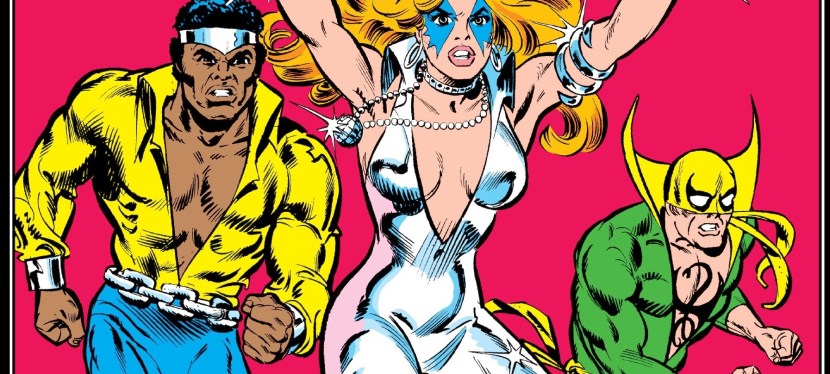
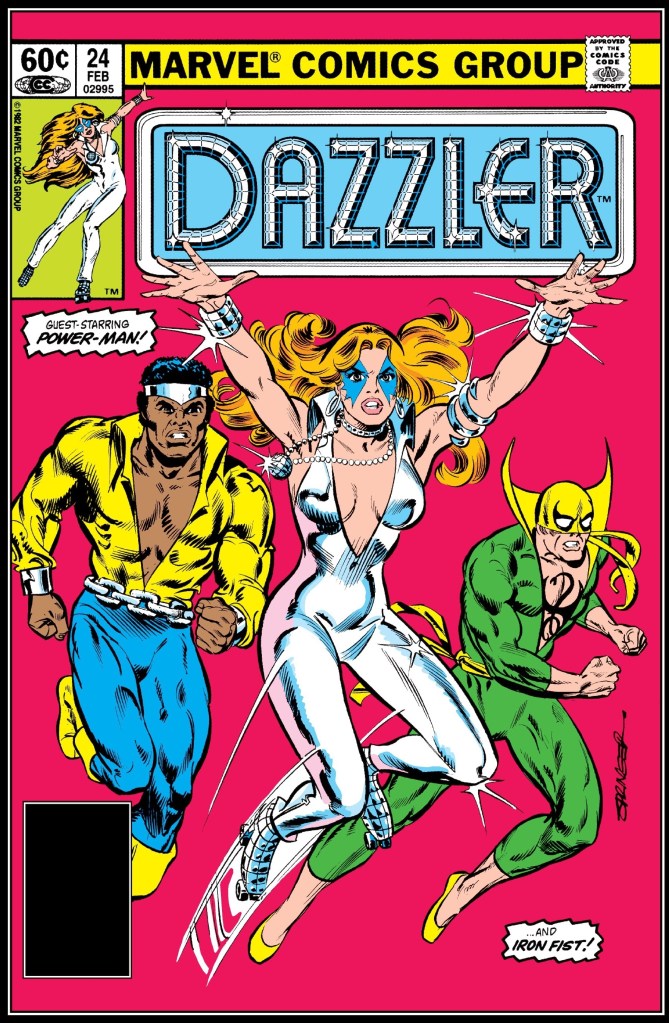
As seen in the cover of the next Dazzler comic book I reviewed, the lady has Power Man and Iron Fist with her. In short, there is a crossover within Marvel Comics’ universe just waiting to be unveiled. Who exactly will Dazzler, Power Man and Iron Fist be facing? What kind of situation are they entering into?

With those details laid down, here is a look back Dazzler #24, published by Marvel Comics in 1983 with a story written by Danny Fingeroth and drawn by the late Frank Springer.

The cover.

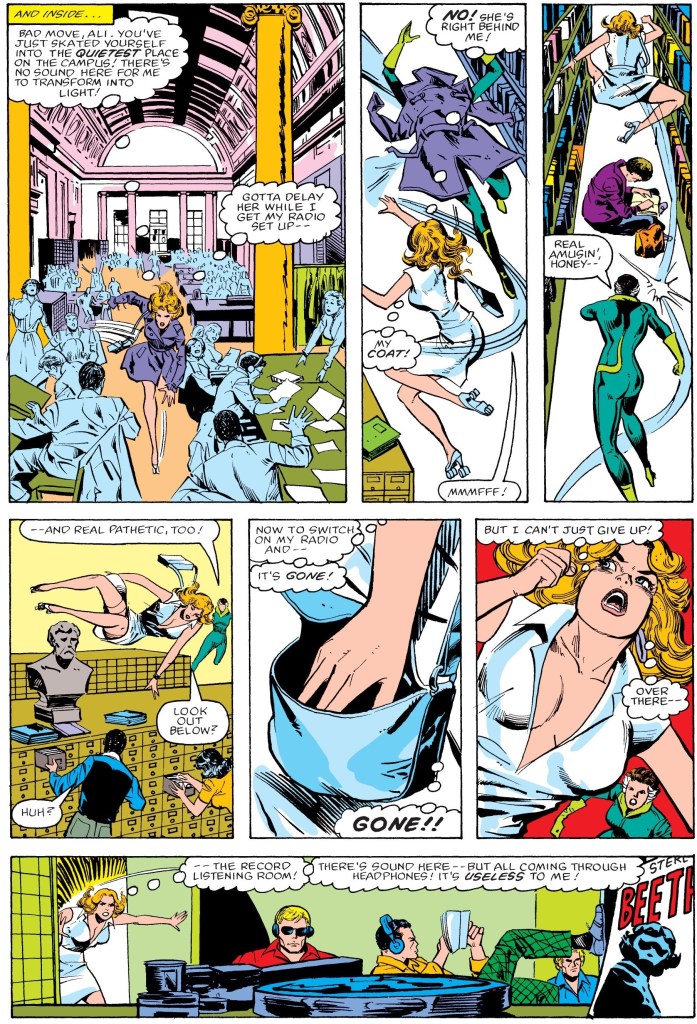
Early story

The story begins with Rogue (of the Brotherhood of Evil Mutants) breaking through the front door of the apartment of Alison Blaire who remains her target. She realizes that Dazzler is absent which is inconvenient as she believes that the singer is key in her quest to find Angel and the rest of the X-Men. Rogue makes a mess of Alison’s things in the apartment and decides to wait for her to return.

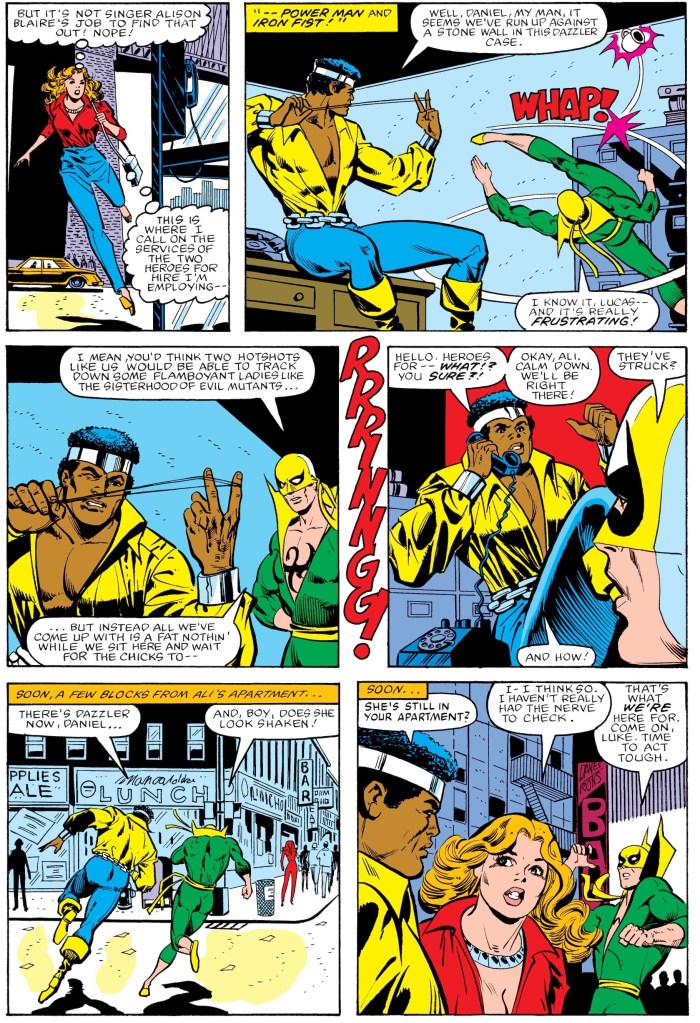
A short time later, Alison is approached by her friend Frank on her way home. He tells her that someone broke into her apartment and made a mess inside. Realizing that the trespasser is none other than Rogue (note: they encountered each other in Dazzler #22) and that she alone does not have much of a chance in fighting her, she calls Power Man and Iron Fist for their professional help…

Quality

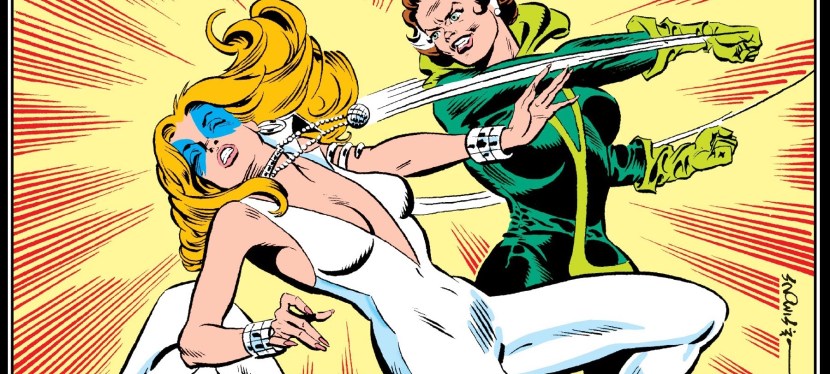
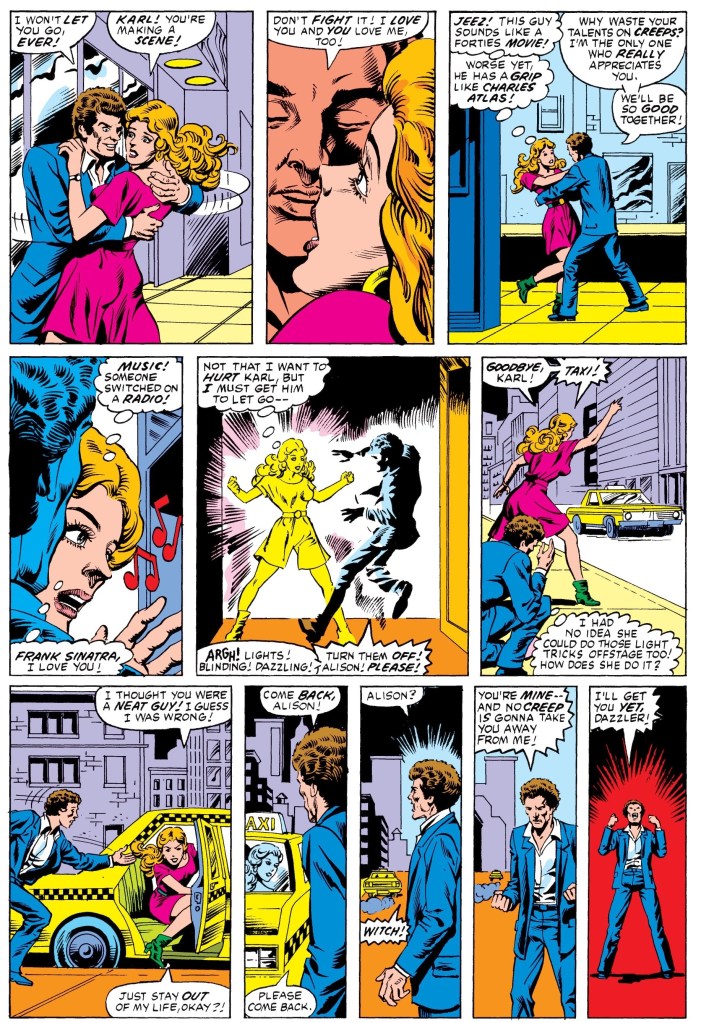
Alison Blaire desperately getting away from Rogue.

To begin with, this is one action-packed tale of Dazzler that still manages to emphasize the development of the protagonist and her newly formed bond with her half-sister Lois (who appeared a short time before this comic book was released). As a crossover set within the Marvel Comics universe, Danny Fingeroth’s story makes mention of the X-Men as Rogue continues her quest on getting Dazzler to get to Angel in order to find Charles Xavier’s team which is all part of the Brotherhood of Evil Mutant’s lust for revenge. Along the way, readers will get to see Rogue take on Power Man and Iron Fist (note: these two met with Dazzler in Dazzler #23) which was fun to see.

More on Dazzler herself, the stakes are raised again as she not only has to survive encountering Rogue but also of the fact that the powerful Brotherhood of Evil Mutants member becomes aware of Lois. I should state that there are two encounters between Dazzler and Rogue here, and each one was entertaining to read.

Conclusion

Alison Blaire plus Power Man and Iron Fist.

Dazzler #24 (1983) is a Marvel crossover tale which the creators made to add some action-packed variety while telling the story of Dazzler. That being said, the dramatic character development that this comic book series was notable for was lightened a bit to make way for the superhero spectacle. Not only does this comic book provide readers additional insight into the duo of Power Man and Iron Fist, it also showed some development about the conflict between the X-Men and the Brotherhood of Evil Mutants. Ultimately, this is one old and fun comic book to have.

If you are seriously planning to buy an existing hard copy of Dazzler #24 (1983), be aware that as of this writing, MileHighComics.com shows that the near-mint copy of the regular edition costs $57 while the near-mint copy of the newsstand edition costs $113.

Overall, Dazzler #24 (1983) is recommended.

+++++

Thank you for reading. If you find this article engaging, please click the like button below and also please consider sharing this article to others. If you are looking for a copywriter to create content for your special project or business, check out my services and my portfolio. Feel free to contact me with a private message. Also please feel free to visit my Facebook page Author Carlo Carrasco and follow me on Twitter at  @HavenorFantasy as well as on Tumblr at https://carlocarrasco.tumblr.com/
A Look Back at Dazzler #22 (1982)

Disclaimer: This is my original work with details sourced from reading the comic book and doing personal research. Anyone who wants to use this article, in part or in whole, needs to secure first my permission and agree to cite me as the source and author. Let it be known that any unauthorized use of this article will constrain the author to pursue the remedies under R.A. No. 8293, the Revised Penal Code, and/or all applicable legal actions under the laws of the Philippines.

Welcome back superhero enthusiasts, 1980s culture enthusiasts and comic book collectors! Today we go back to the 1980s to examine the Marvel Comics universe through the exploits of Dazzler!

In my retro review of Dazzler #21 (1982), I observed that the story had no good-versus-evil conflict at all as it was purely character-driven and focused a lot on the personal development of Alison Blaire/Dazzler. More notably, the story shed light on both Alison’s father (a judge) and mother (who left the judge) and how the past affected the protagonist. Very clearly, Dazzler’s development really went deep since her first-ever appearance in an X-Men comic book. Speaking of the X-Men, I must say that one of the team’s notable members had an early (not the first) appearance in the next Dazzler issue I just reviewed. That character is none other than Rogue and she looks nothing like the way Jim Lee modernized her in the 1990s.

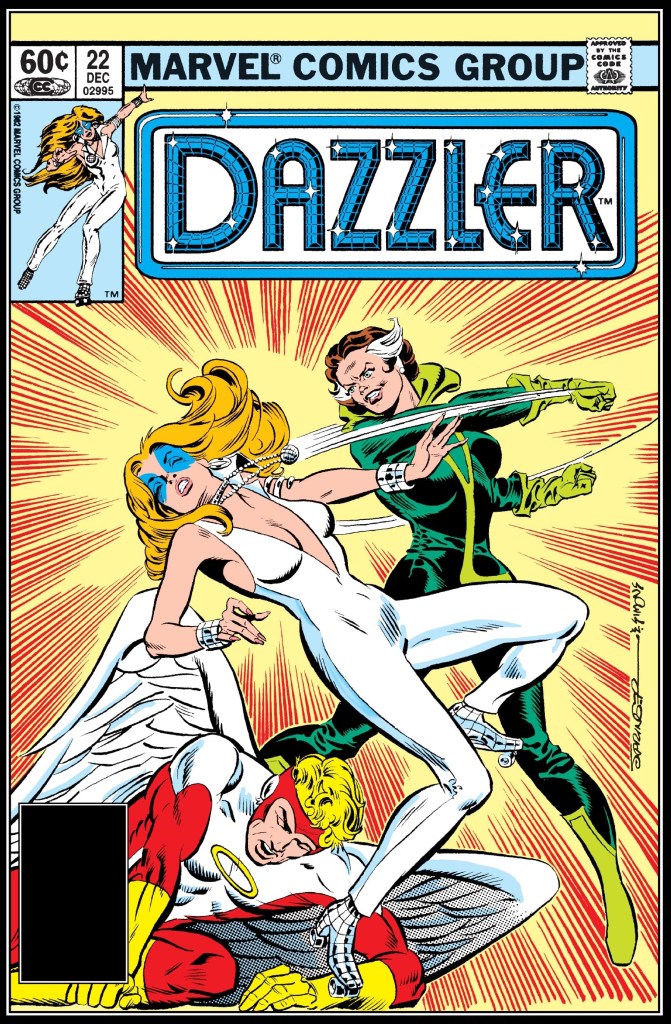
With those details laid down, here is a look back Dazzler #22, published by Marvel Comics in 1982 with a story written by Danny Fingeroth and drawn by the late Frank Springer.

The cover.

Early story

The story begins in the air high above the streets of New York City. Warren Worthington III/Angel’s flight gets disrupted as a group of hawks suddenly attack him from all sides. With quick thinking, he uses different methods to gradually lure each hawk and trick them into bumping into something to end their pursuit.

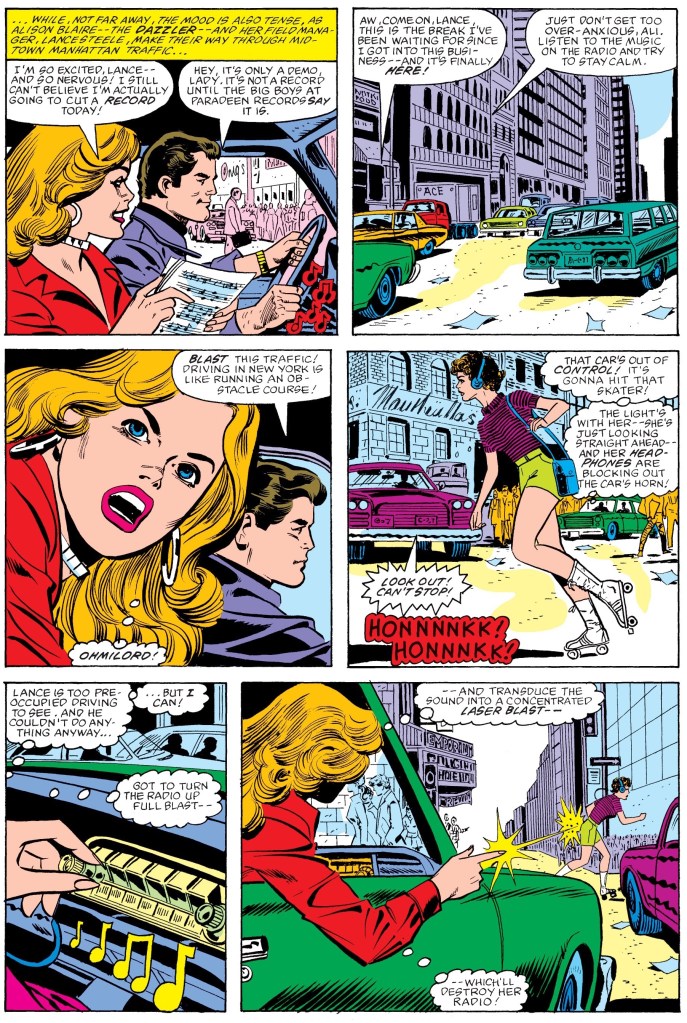
Meanwhile, as Alison Blaire rides the car driven by her field manager Lance going to the studio, she saves a roller-skating lady from colliding with a car using clever methods. At the studio, Alison prepares herself for a recording session under the watch of the perfectionist music producer L.B. Holman…

Quality

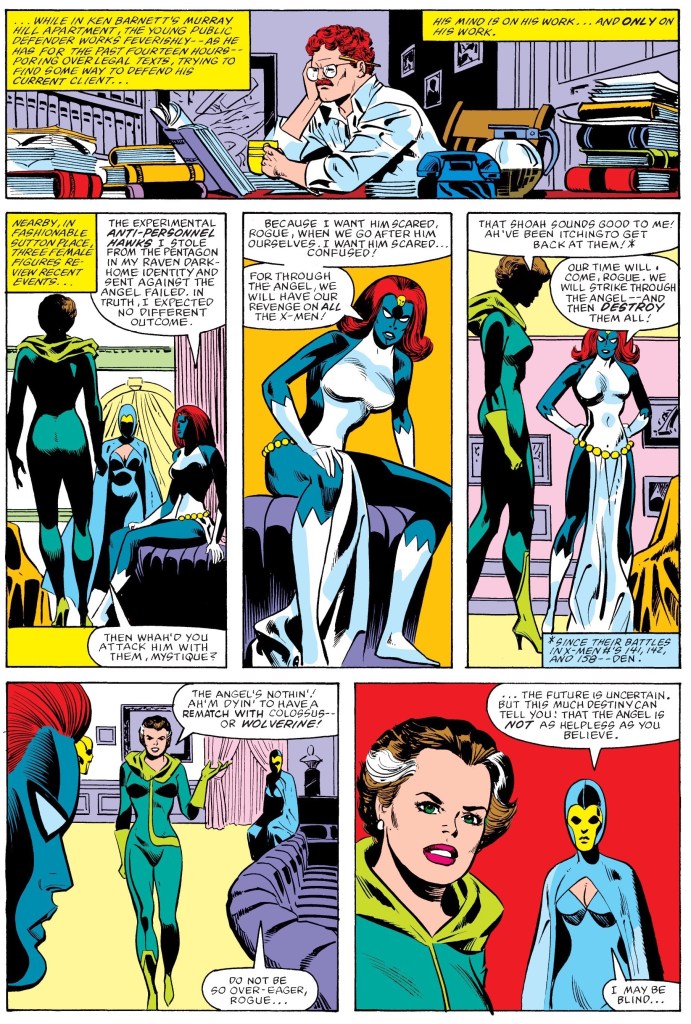
The Brotherhood of Evil Mutants led by Mystique.

As expected, the story in this comic book showed natural progression on developing the protagonist as well as her parents while also reviving the superhero trope of good-versus-evil which was clearly done for entertainment value. While the cover art had Rogue hitting Dazzler, the good-versus-evil conflict within is actually bigger than that as the story involves not only Rogue but also notable X-Men villainess Mystique plus Destiny.

As this was in the early 1980s, Rogue was not a member of the X-Men at the time and was still new (her first-ever appearance was in Avengers Annual #10 in 1981). Regarding Mystique, her appearance in this comic book was not merely just an appearance but rather an extension of the exploits of her group called the Brotherhood of Evil Mutants and it has been her desire to get back at the X-Men over what happened in Uncanny X-Men #142 (part 2 of the Days of Future Past storyline). As such, having Dazzler encounter the evil group in the presence of the X-Men’s Angel was a very strategic move by Danny Fingeroth as it emphasized the crossover aspect within the Marvel Comics universe of the time complete with pretty good dialogue and details emphasized.

This also helps remind readers of Dazzler’s previous involvement with the X-Men and cleverly gave them the idea of what would things be like if the protagonist someday really joined the team of mutants.

On character development, dramatizing Alison’s mother and father shows progress from what happened near the end of the previous issue which is a nice touch. Even Alison’s boyfriend Ken got his own share of the spotlight. What is most notable when it comes to characterization in this comic book is the smooth and fine chemistry between Alison and Warren Worthington. The two made convincing friends and how their respective circumstances brought them together here was well executed by the creators.

Conclusion

Discreetly, Alison Blaire uses her power to help someone.

Dazzler #22 (1982) is enjoyable and has that fine balance between characterization, plotting and spectacle. The good-versus-evil conflict here should really catch the attention of readers, especially those who are deeply interested with the X-Men-related characters and groups of the early 1980s. There is also enough superhero action to keep readers entertained and clearly this was done to make up for the lack of action in the very dramatic issue #21.

If you are seriously planning to buy an existing hard copy of Dazzler #22 (1982), be aware that as of this writing, MileHighComics.com shows that the near-mint copy of the regular edition costs $57 while the near-mint copy of the newsstand edition costs $113.

Overall, Dazzler #22 (1982) is recommended.

+++++

Thank you for reading. If you find this article engaging, please click the like button below and also please consider sharing this article to others. If you are looking for a copywriter to create content for your special project or business, check out my services and my portfolio. Feel free to contact me with a private message. Also please feel free to visit my Facebook page Author Carlo Carrasco and follow me on Twitter at  @HavenorFantasy as well as on Tumblr at https://carlocarrasco.tumblr.com/
A Look Back at Sludge #4 (1994)

Disclaimer: This is my original work with details sourced from reading the comic book and doing personal research. Anyone who wants to use this article, in part or in whole, needs to secure first my permission and agree to cite me as the source and author. Let it be known that any unauthorized use of this article will constrain the author to pursue the remedies under R.A. No. 8293, the Revised Penal Code, and/or all applicable legal actions under the laws of the Philippines.

Welcome back, superhero enthusiasts, 1990s culture enthusiasts and comic book collectors! Today we revisit the Ultraverse of Malibu Comics and examine one of its many stories through an issue of the Sludge comic book series.

Previously, I reviewed Sludge #3 which was a tie-in comic book to the first big crossover event of the entire Ultraverse – Break-Thru. In that issue, he encountered the “lord” Pumpkin who himself became a notable super villain in the UV. That story also showed the first major test of Sludge when it comes to resisting temptation and evil.

With those details laid down, here is a look back at Sludge #4, published by Malibu Comics in 1994 with a story written and drawn by Aaron Lopresti, and scripted by Steve Gerber.

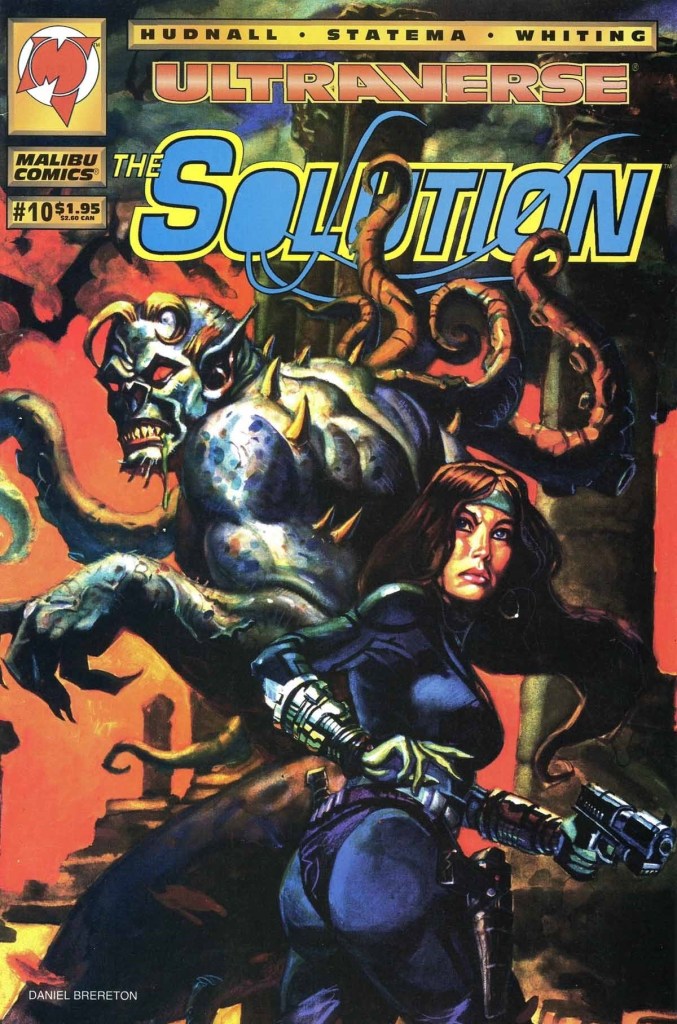
The cover.

Early story

The story begins when two black teenagers go down the city sewer to look for something as part of a job of them agreed to do for someone named Gordy. They accidentally find Sludge whose appearance and ability to talk scares them away. As the two keep running to another direction, a reptilian monster sees them. The monster grabbed and killed the taller youth, leaving the shorter one scared.

A short time later, a police officer finds the scared teenager hiding behind plants at Central Park. The survivor is in a state of shock repeating his friend’s name a lot. The police update about the boy eventually reaches the office of the New York Daily Globe and an attractive reporter named Shelley intends to follow what could be a hot scoop…

Quality

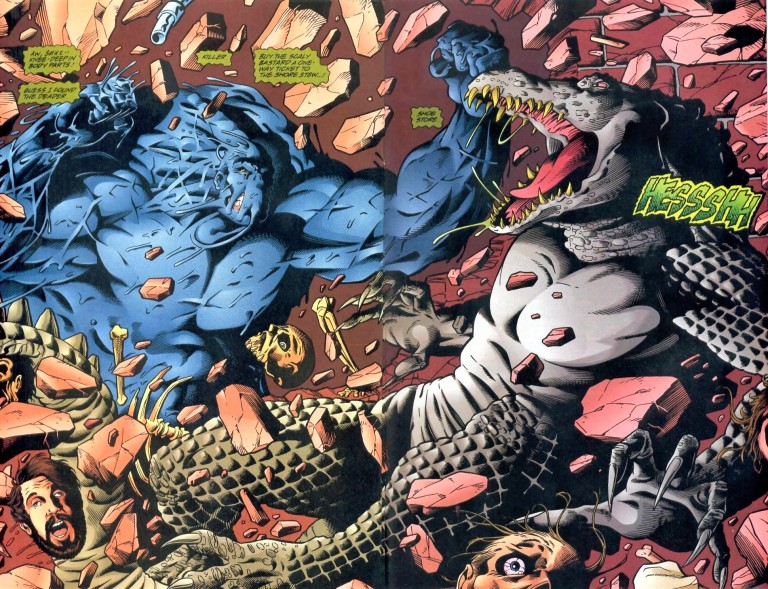
The battle between these two has a lot of stuff that should be seen.

In this comic book, I can see that the creative team of Steve Gerber and Aaron Lopresti decided to shake things up a bit when it comes to telling a new story of Sludge laced with elements of society, urban legends and journalism. The good news here is that this story is well-written and the visuals really brought the script to life for readers to be engaged with.

When it comes the elements that inspired this particular story, the concept about alligators occupying the sewers instantly reminds me of the 1980 film Alligator and along the way, Gerber-Lopresti went on pounce on the concept resulting in the introduction of a brand new Ultraverse villain in the form of a monstrous, human-like alligator named Veffir Voon Iyax which can also talk and reason like humans. This new villain is really interesting and its background about being part of a species of alligators worshipped by people from long ago sheds light on the idolatry which is both unholy and foolish.  

On the aspects of society and journalism, the story sheds light on how some people – even minors – would go to really unsafe places and do very risky jobs for a variety of reasons. The journalistic aspect of this comic book emphasizes how far journalists would go to write stories based on questionable data and that a newspaper would recklessly publish such stories even though they lacked solid evidence to prove the unbelievable is true. The newspaper journalist Shelley had quite an amount of the spotlight, she became a clear supporting character in this comic book.

In keeping up with the superhero flavor of the Ultraverse, there is a good amount of spectacle here as it has a big battle between Sludge and the monstrous alligator which is nicely presented. This is a battle between monsters that was carefully structured and executed well.

Conclusion

A look at what happens behind the scenes at a city newspaper.

Sludge #4 (1994) is both an intriguing and enjoyable read. The Gerber-Lopresti team succeeded in telling another Sludge tale that is fresh as it took inspiration from pop culture and society. At the same time, this comic book show that Sludge is clearly not the only monster in New York City’s sewers. As such, his place within the Ultraverse is really unique.

If you are seriously planning to buy an existing hard copy of Sludge #4 (1994) be aware that as of this writing, MileHighComics.com shows that the near-mint copy of the regular edition costs $16 while the near-mint copy of the newsstand edition costs $48.

Overall, Sludge #4 (1994) is recommended.

+++++

Thank you for reading. If you find this article engaging, please click the like button below and also please consider sharing this article to others. If you are looking for a copywriter to create content for your special project or business, check out my services and my portfolio. Feel free to contact me with a private message. Also please feel free to visit my Facebook page Author Carlo Carrasco and follow me on Twitter at  @HavenorFantasy as well as on Tumblr at https://carlocarrasco.tumblr.com/
A Look Back at Dazzler #21 (1982)

Disclaimer: This is my original work with details sourced from reading the comic book and doing personal research. Anyone who wants to use this article, in part or in whole, needs to secure first my permission and agree to cite me as the source and author. Let it be known that any unauthorized use of this article will constrain the author to pursue the remedies under R.A. No. 8293, the Revised Penal Code, and/or all applicable legal actions under the laws of the Philippines.

Welcome back superhero enthusiasts, 1980s culture enthusiasts and comic book collectors! Today we go back to the year 1982 to examine the Marvel Comics universe through the exploits of Dazzler!

While my most recent retro review of Dazzler was the 4th issue of its monthly series, I have decided to jump straight to issue #21 for this new retro review. By the time Dazzler #21 got published, the unusual superhero went through a lot and illustrator Frank Springer became fully established as the monthly series’ definitive artist.

With those details laid down, here is a look back Dazzler #21, published by Marvel Comics in 1982 with a story written by Danny Fingeroth and drawn by the late Frank Springer.

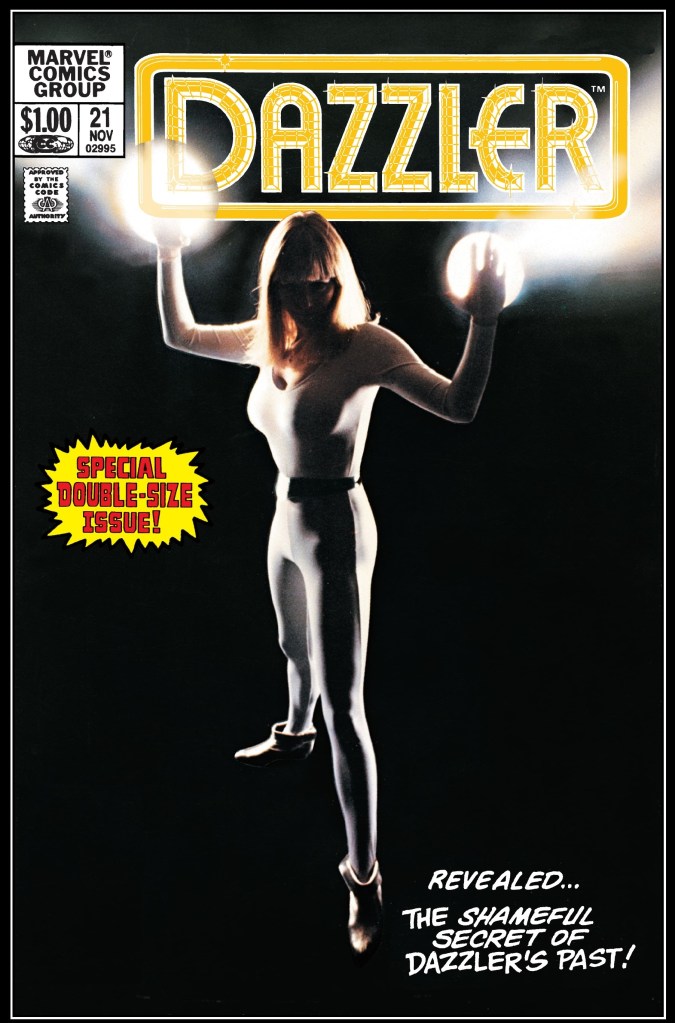
The cover.

Early story

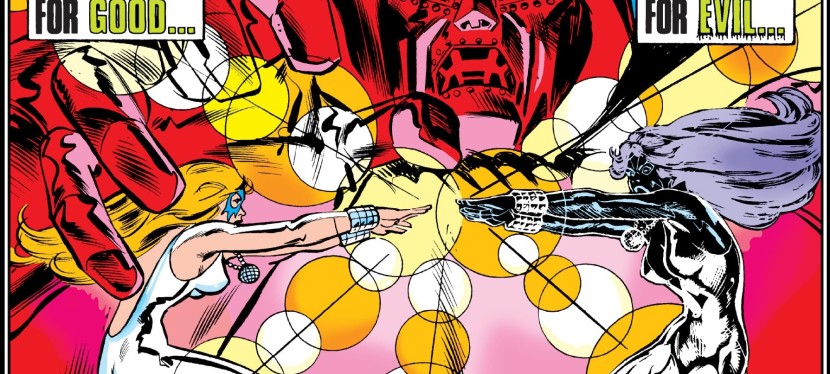
The story begins with Alison Blaire/Dazzler being carried above the buildings of New York City by Angel (Warren Worthington) of the X-Men. At this point in time, Alison’s father judge Carter Blaire snapped under the weight of turmoil related to the death of his wife and his daughter’s rebelliousness. As Dazzler, Alison had gone through intense encounters with the likes of the Incredible Hulk, She-Hulk, a top-secret syndicate that made her a test subject and even Galactus.

Recently, Bella – Alison’s grandmother – could not cope with her son’s breakdown and reached out to Warren Worthington to help her reach Alison. Since after being found, Alison had been traveling with Angel by air.

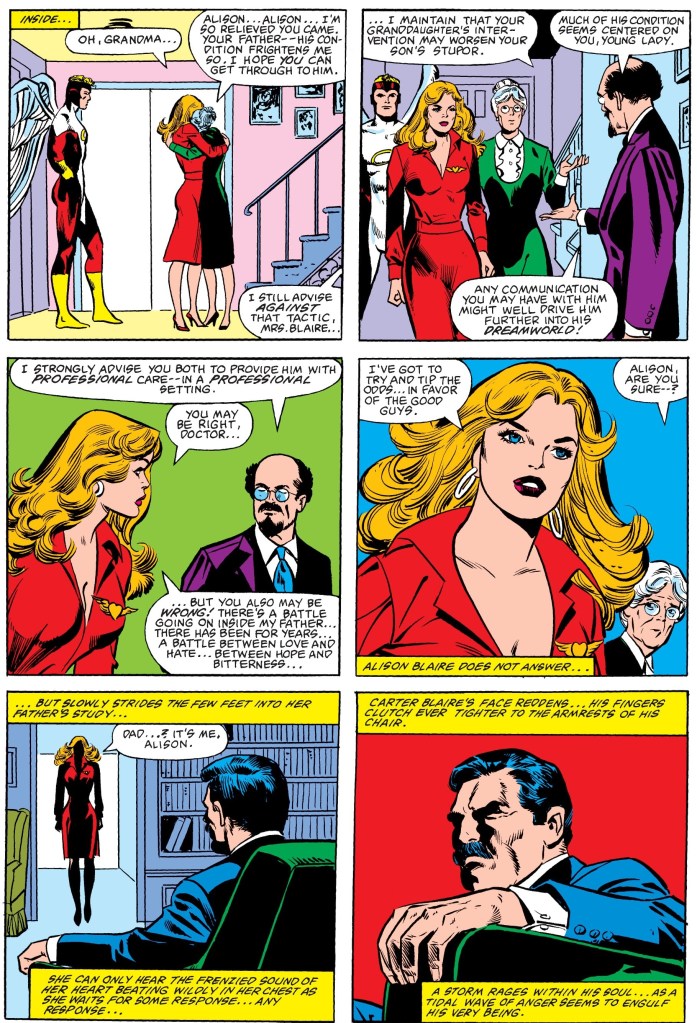
Along the way, Spider-Man sees them and recognizes Alison as Dazzler. He swings to try to get their attention but was ignored as they were so focused on their objective. A short time later, Angel and Alison arrive at judge Blaire’s home. Her grandmother greets them and tells her she hopes that she can get through to judge Blaire.

The doctor, however, advised against that tactic and states that Alison’s intervention may worsen her father’s condition as much of it was centered on her…

Quality

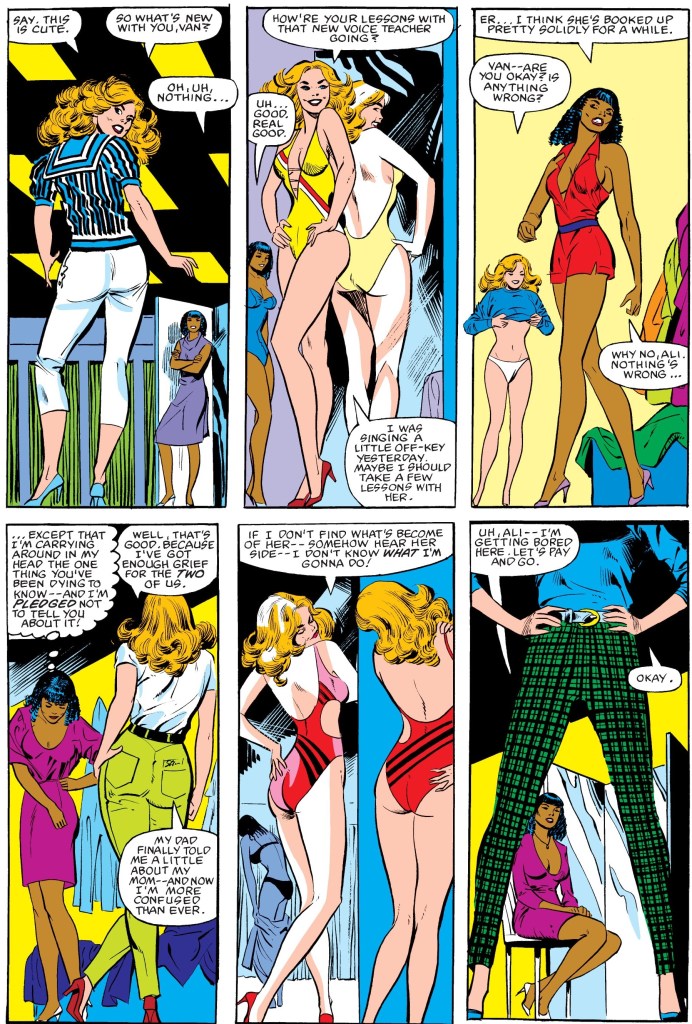
Alison Blaire and her friend Vanessa try out new clothes.

I’ll go straight to the point about what the story of this double-sized comic book is about without spoiling it. It is a pretty dramatic look at the protagonist in her civilian form as Alison Blaire. You will get to see her as Dazzler in this comic book but if you are looking for a lot of superhero moments of her or if you are looking for Dazzler in a conflict with evil elements, you won’t find it here.

More on the plot, this comic book explores deeply the emotional and personal dimensions of Alison and along the way, stories about her own past as well as the respect past events of both her father and mother got dramatized. The story tackles themes like independence, maturity, marriage, personal development, family ties and personal conflicts of interest. The good thing here is that the script by Danny Fingeroth is very well-written and it seems he did his research on constructing a personal story about Alison Blaire that is very grounded in reality. That being said, the superhero elements have been pushed aside most of the time and the ironic thing is the fact that the other Marvel superheroes – Spider-Man, Fantastic Four, The Avengers and more – appeared here as if to remind readers this is still a superhero tale.

Very clearly, this story was written for the very dedicated or even the die-hard Dazzler fans in mind. When it comes to the fun factor, the results could be mixed depending on what readers want to see in this comic book. For me personally, it is a pretty engaging story to read and at the same time it is fun enough as well.

Conclusion

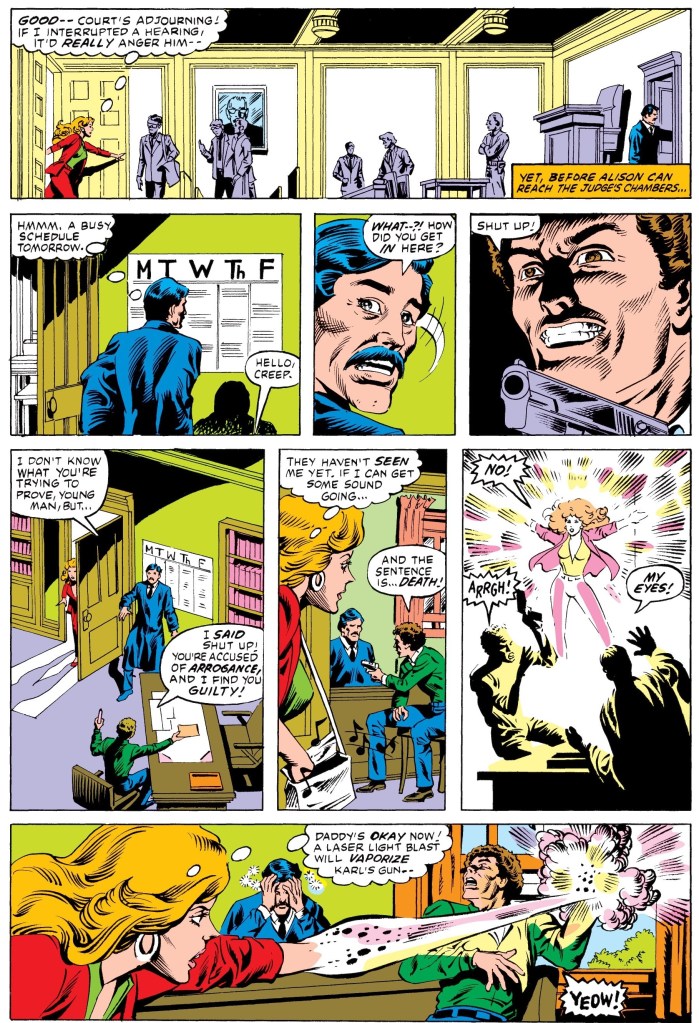
Alison tries to help her troubled father.

Dazzler #21 (1982) could be barely received or strongly received or even rejected even though it has a very rich and dramatic script. The clear lack of the superhero presentation of Dazzler in favor of heavy drama and in-depth characterization may not win the approval of readers/collectors who love superhero stuff but it will resonate with the readers who really love the character and had immersed themselves into her life. As far as characterization goes, this comic book marks a significant turning point of Dazzler herself and in its story, she really developed a lot since making her first-ever appearance in Uncanny X-Men #130. If you are a Dazzler purist who does not mind the lack of superhero spectacle, this one could engage you.

If you are seriously planning to buy an existing hard copy of Dazzler #21 (1982), be aware that as of this writing, MileHighComics.com shows that the near-mint copy of the regular edition costs $28 while the near-mint copy of the newsstand edition costs $60.

Overall, Dazzler #21 (1982) is recommended.

+++++

Thank you for reading. If you find this article engaging, please click the like button below and also please consider sharing this article to others. If you are looking for a copywriter to create content for your special project or business, check out my services and my portfolio. Feel free to contact me with a private message. Also please feel free to visit my Facebook page Author Carlo Carrasco and follow me on Twitter at  @HavenorFantasy as well as on Tumblr at https://carlocarrasco.tumblr.com/
A Look Back at WildC.A.T.S: Covert Action Teams #7 (1994)

Disclaimer: This is my original work with details sourced from reading the comic book and doing personal research. Anyone who wants to use this article, in part or in whole, needs to secure first my permission and agree to cite me as the source and author. Let it be known that any unauthorized use of this article will constrain the author to pursue the remedies under R.A. No. 8293, the Revised Penal Code, and/or all applicable legal actions under the laws of the Philippines.

Welcome back superhero enthusiasts, 1990s culture enthusiasts and comic book collectors! Today we continue revisiting Jim Lee’s flagship title under the Image Comics label – WildC.A.T.S: Covert Action Teams!

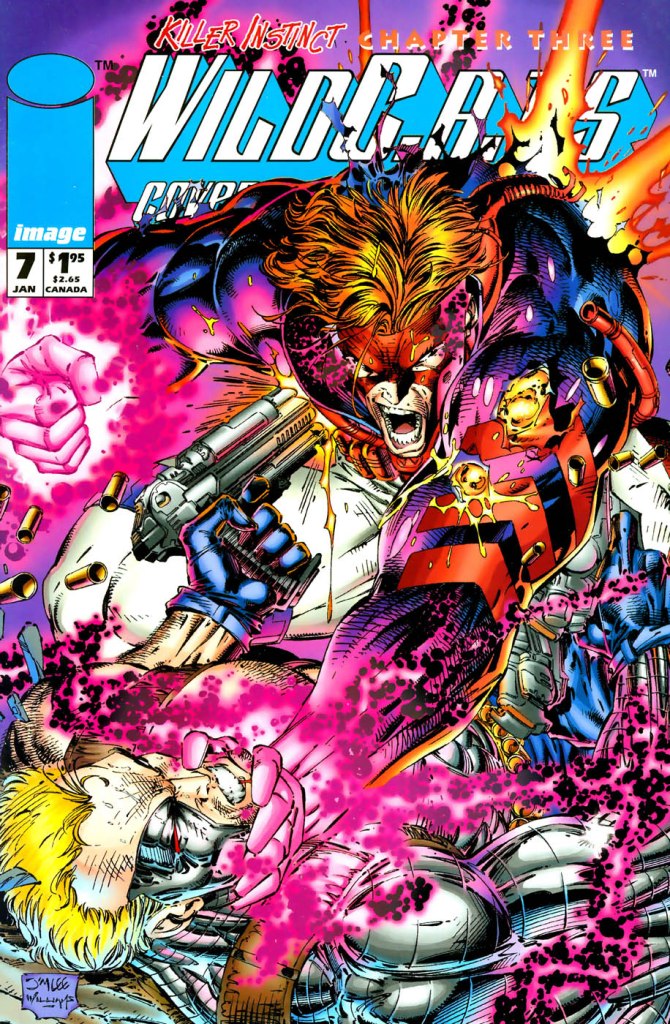
While the 3rd and 4th issues of the WildC.A.T.S: Covert Action Teams mini-series had Lee’s superhero team crossing over with Rob Liefeld’s Youngblood, a bigger crossover was agreed upon with Image Comics co-founder Marc Silvestri – Killer Instict! This marked a creative collaboration between Lee and Silvestri resulting a multiple issue crossover between WildC.A.T.S and Cyber Force. For clarification, I already mentioned in my retro review of WildC.A.T.S: Covert Action Teams #6 (1993) that its story was the first chapter of the 4-part Killer Instinct crossover. For your reference, Killer Instinct’s 2nd and 4 chapters were published as Cyber Force issues #2 and #3 of its regular series under Marc Silverstri. This WildC.A.T.S retro review is about the 3rd chapter of Killer Instinct.

With those details laid down, here is a look back WildC.A.T.S: Covert Action Teams #7, published by Image Comics in 1994 with a story written by Brandon Choi and Jim Lee. Lee did the art.

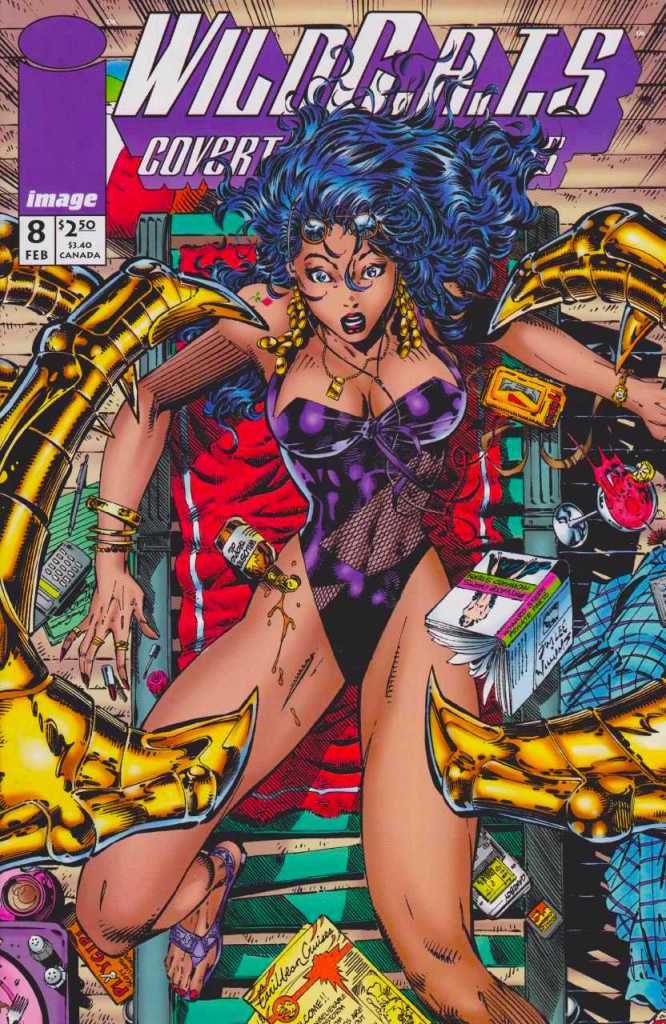
The cover.

Early story

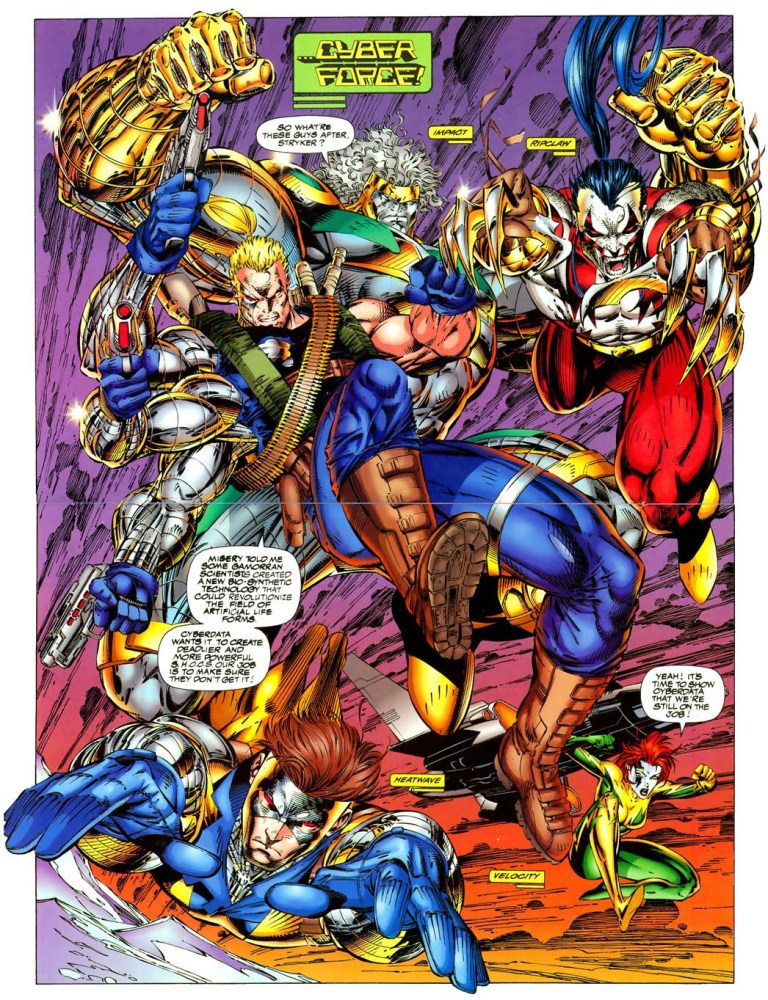
The story begins somewhere in the skies above Gamorra, off the coast of the Philippines! Stryker, the Cyber Force member with three cybernetic right arms, communicates with his teammates and tells them that if half of what Misery said is true about the new Cyberdata S.H.O.C.S., they’re in for a nasty fight and they have to hit the ground.

Stryker, Impact, Heatwave, Velocity and Ripclaw jump off their high-tech jet (which has Cyblade and Misery inside) and land safely. Using his enhanced ability of smell, Ripclaw begins detecting tracks of what they are look for.

Meanwhile at the back of the Isle of the Dead, a high-tech craft arrives with three passengers who are prepared to do a drug deal. Slowly, someone bleeding and with blades on his hands climbs into the craft surprising the passengers. He takes control of the craft, throws the passengers off and leaves.

As Cyber Force starts its ground search with Misery advising them while carefully using her telepathy on them. As Stryker enters a ravaged high-tech place, his sensors detect nothing and yet his instincts tell him something is present nearby. Standing near him is Spartan of WildC.A.T.S…

Quality

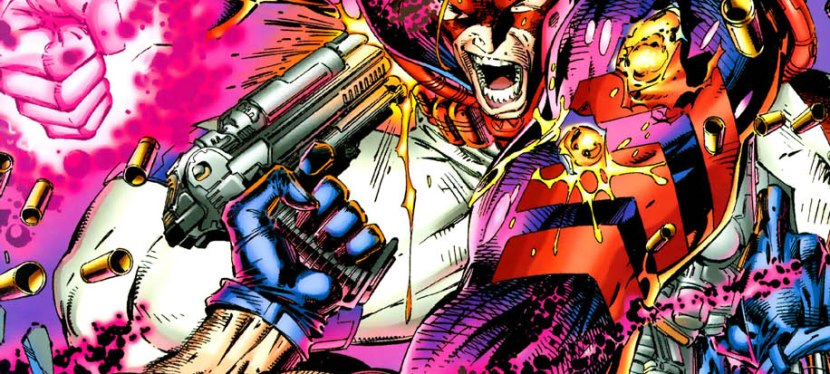
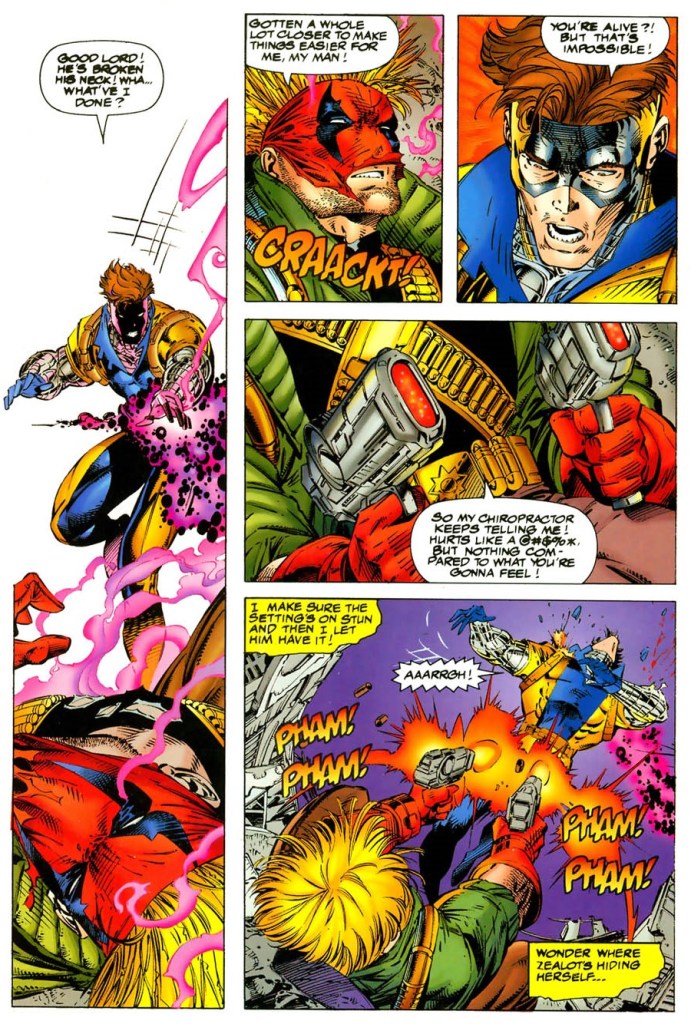
In this encounter between Grifter and Heatwave, do you notice something lacking visually?

I’ll start with the very obvious purpose of this comic book. After the build-up done in the first two chapters of the Killer Instinct storyline, this story serves as the start of what turned out to be the big pay-off as WildC.A.T.S and Cyber Force members finally got together with an action-packed battle to kick things off. From a storytelling view point, this one is mainly a WildC.A.T.S versus Cyber Force tale with really nice match-ups between their members such as Spartan-Stryker, Cyblade-Zealot and Maul-Impact to name a few. These match-ups and fights are excellently drawn by Jim Lee and I really enjoyed his own artistic visuals of Marc Silvestri’s Cyber Force.

More on the plot, it is pretty simple in concept and structure. The members of the two teams get to fight each other which gets the attention of Skywatch which itself has vested interest with the operations of Stormwatch (note: this is within the WildStorm lore) and the secret facility on that blew up (as seen in WildC.A.T.S #5). Misery remains the key factor in the story and in this tale, she gets to guide and manipulate Cyber Force to find something valuable while Warblade remains mostly absent. Apart from the battles, the absent Voodoo, Void and Jacob Marlowe have their respective spotlights mainly for the character developments as well as reminding readers about the continuing Kherubim-Daemonite conflict.

The quality of the writing is serviceable and the way I look at this comic book, it is mainly driven by spectacle and match-ups. The amount of crossover action is of top-notch quality (note: Jim Lee apparently missed out on key details while drawing Heatwave in a scene with Grifter) and clearly Jim Lee planned the visuals carefully. While there is little character development here, the ironic thing is that Misery (note: visually she is a wicked version of Jean Grey of the X-Men) is the one who gets a good chunk of the said development. Not only does she become a force in the minds of Cyber Force members, she also has her intimate moments with Ripclaw which is a reminder to readers that they have a shared past together (note: this will resonate more with those who read Cyber Force #2 of the regular series).

Conclusion

This is how Cyber Force looks like as drawn by Jim Lee.

To make things clear, WildC.A.T.S: Covert Action Teams #7 (1994) will strongly appeal to the respective fans of WildC.A.T.S and Cyber Force, to the readers who love high-quality superhero action, and to those who simply enjoy superhero crossover stories. While it is not a surprise that this comic book has great visuals, the writing this time clearly lacks depth and I really felt that the dialogue and text descriptions were done mainly to fit the obvious spectacle-led concept. If you are the kind of reader who wants storytelling and characterization prioritized in an action-packed crossover comic book, this one might not satisfy you. Ultimately, this one is a fun read even though the quality of the writing does not even come close to the quality of the visuals.  

If you are seriously planning to buy an existing hard copy of WildC.A.T.S: Covert Action Teams #7 (1994), be aware that as of this writing, MileHighComics.com shows that the near-mint copy of the regular edition costs $30 while the near-mint copy of the newsstand edition costs $90. The near-mint copy of the silver cover edition costs $300.

Overall, WildC.A.T.S: Covert Action Teams #7 (1994) is recommended.

+++++

Thank you for reading. If you find this article engaging, please click the like button below and also please consider sharing this article to others. If you are looking for a copywriter to create content for your special project or business, check out my services and my portfolio. Feel free to contact me with a private message. Also please feel free to visit my Facebook page Author Carlo Carrasco and follow me on Twitter at  @HavenorFantasy as well as on Tumblr at https://carlocarrasco.tumblr.com/
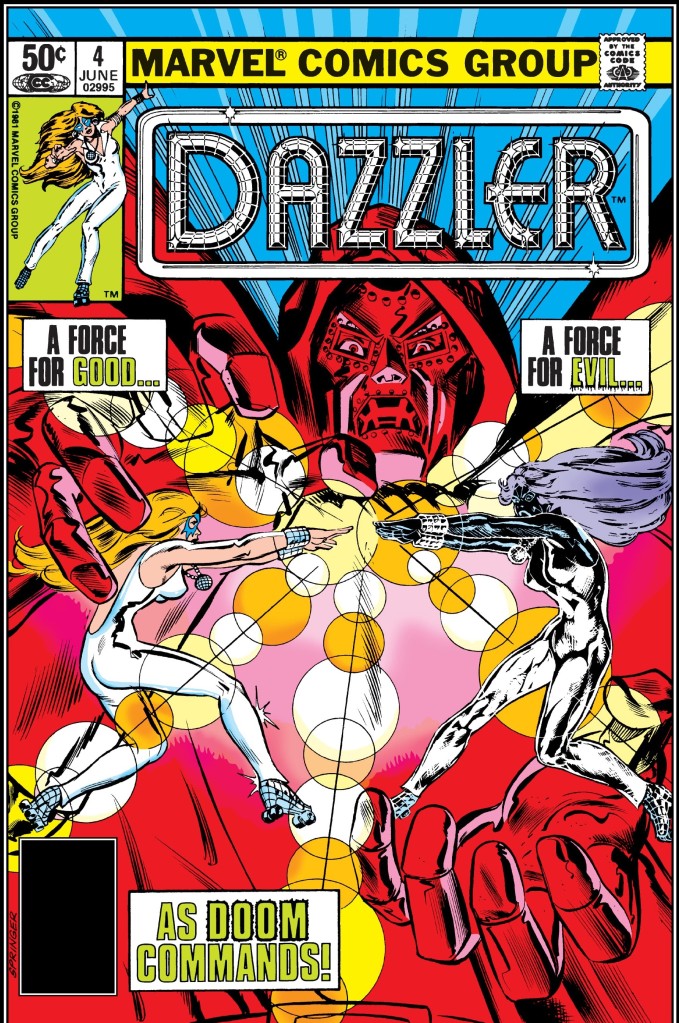
A Look Back at Dazzler #4 (1981)

Disclaimer: This is my original work with details sourced from reading the comic book and doing personal research. Anyone who wants to use this article, in part or in whole, needs to secure first my permission and agree to cite me as the source and author. Let it be known that any unauthorized use of this article will constrain the author to pursue the remedies under R.A. No. 8293, the Revised Penal Code, and/or all applicable legal actions under the laws of the Philippines.

Welcome back superhero enthusiasts, 1980s culture enthusiasts and comic book collectors! Today we go back to the year 1981 to examine the Marvel Comics universe through the exploits of Dazzler!

Last time around, Alison Blaire was preparing herself for a big event as Dazzler. The event was something needed to help her boost her career as an entertainer and the stakes were high as there were many important guests. The weird thing was that she instead got involved with one of the most fearsome super villains of Marvel – Dr. Doom!

With those details laid down, here is a look back Dazzler #4, published by Marvel Comics in 1981 with a story written by Tom DeFalco and drawn by the late Frank Springer. This was Springer’s Dazzler debut.

The cover.

Early story

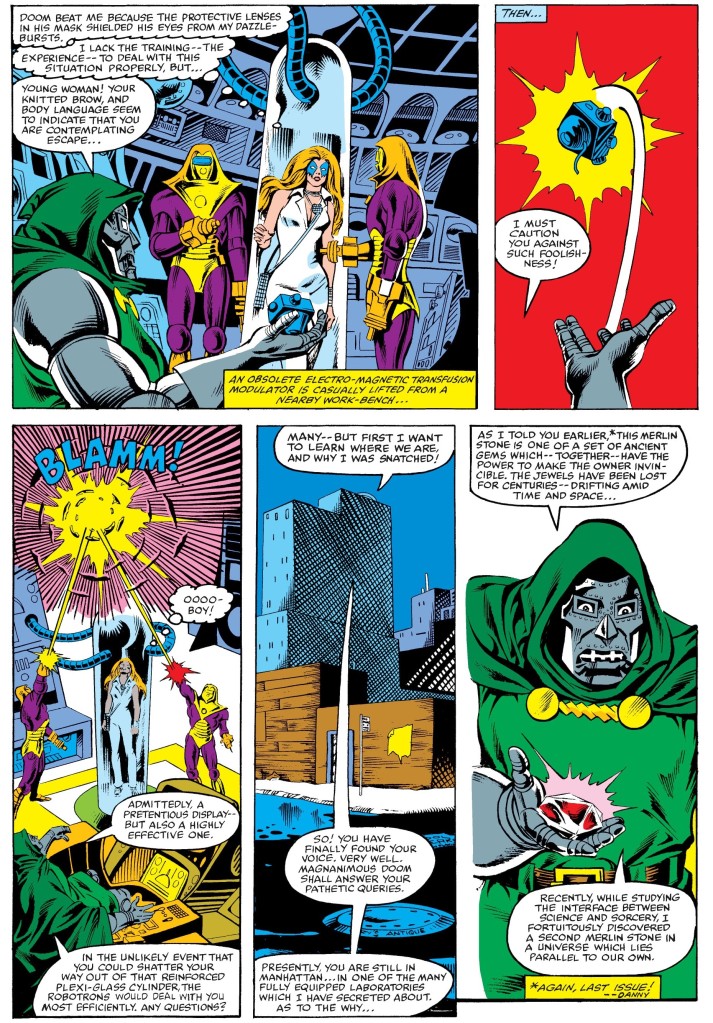
The story begins inside a secret facility. Dr. Doom tells Dazzler that the Merlin Stone he just acquired mirrors her reflections as well as his own. The said stone has unique, mystical properties that Doom believes will help him achieve his dream of domination over mankind.

Dazzler, who is trapped inside a tube and is guarded by two of Dr. Doom’s guards, tries to recover after losing consciousness a short time back. Dr. Doom expresses his observation of her special ability to convert sound into light.

Dr. Doom turns his computer on energizing the tube that contains Dazzler. She suddenly turns into energy and disappears…

Quality

Dazzler in a new dimension.

The best way to describe this comic’s story…it is one wild ride that emphasizes a different kind of fantasy for readers. This is, of course, related to Dr. Doom’s immediate quest of finding another Merlin Stone within a different dimension which directly involved Dazzler against her will.

Dazzler here was in a very wild misadventure that goes way beyond the limits of New York City. Being in a completely new dimension, she finds herself literally lost in the sea of space and encounters creatures here and there. This misadventure, however, was not written to be mindless at all. In fact, as the tale in the new dimension goes on, Dazzler was presented to be more tactical, more analytical and do things to solve problems she encountered. She also gets to use her superpower in more creative ways.

The misadventure also has key moments that test Dazzler’s resolve on a personal level. As such, these moments added to her development which also raises the stakes as to what she could potentially do once she returns back to her life. Clearly, this is a story that carefully mixes spectacle and character development without losing track of the story.

On the art of the comic book, Frank Springer’s Dazzler debut is pretty solid. Not only does he capture the look of Dazzler herself, his creative visuals really brought the dimension into life filled with images of out space, fantasy monsters and more. Apart from drawing Dazzler and Dr. Doom, Springer’s art of the Fantastic Four is pretty good to look at.

Conclusion

A helpless Dazzler in the presence of Dr. Doom.

Dazzler #4 (1981) is a fun comic book to read and as a Dazzler story, it is a worthy continuation of the events that took place in issue #3. The concept about having Dazzler under the power of Dr. Doom was nicely executed which is a very hard feat to achieve since the said super villain was known to be a major force of opposition not only against the Fantastic Four but also against Spider-Man, the X-Men and more. Dazzler’s misadventure into the other dimension was wild and yet nicely structured which led to some nice character development of hers. This comic book had a strong series start for Frank Springer who went on to draw a great majority of the issues of the Dazzler monthly series.

If you are seriously planning to buy an existing hard copy of Dazzler #4 (1981), be aware that as of this writing, MileHighComics.com shows that the near-mint copy of the regular edition costs $28 while the near-mint copy of the newsstand edition costs $60.

Overall, Dazzler #4 (1981) is recommended.

+++++

Thank you for reading. If you find this article engaging, please click the like button below and also please consider sharing this article to others. If you are looking for a copywriter to create content for your special project or business, check out my services and my portfolio. Feel free to contact me with a private message. Also please feel free to visit my Facebook page Author Carlo Carrasco and follow me on Twitter at  @HavenorFantasy as well as on Tumblr at https://carlocarrasco.tumblr.com/
A Look Back at WildC.A.T.S: Covert Action Teams #6 (1993)

Disclaimer: This is my original work with details sourced from reading the comic book and doing personal research. Anyone who wants to use this article, in part or in whole, needs to secure first my permission and agree to cite me as the source and author. Let it be known that any unauthorized use of this article will constrain the author to pursue the remedies under R.A. No. 8293, the Revised Penal Code, and/or all applicable legal actions under the laws of the Philippines.

Welcome back superhero enthusiasts, 1990s culture enthusiasts and comic book collectors! Today we continue revisiting Jim Lee’s flagship title under Image Comics – WildC.A.T.S: Covert Action Teams!

For the newcomers reading this, I recently completed reviewing the 4-issue mini-series (read my retro reviews here, here, here and here), the first issue of which was one of the launch titles published under Image Comics’ banner through Malibu Comics. Back in 2020, I reviewed issue #5 which itself was highly unusual as it marked the beginning of what was back then the regular series of WildC.A.T.S (note: starting a brand new comic book series is often done with a new issue #1). WildC.A.T.S: Covert Action Teams #5 was conveniently part of the build-up for the Killer Instinct storyline that had featured Jim Lee’s creations crossing over with Marc Silvestri’s Cyber Force.

With those details laid down, here is a look back WildC.A.T.S: Covert Action Teams #6, published by Image Comics in 1993 with a story written by Brandon Choi and Jim Lee. Lee did the art.

The cover.

Early story

The story begins with the WildC.A.T.S flying in their high-tech aircraft and observing the large explosion which marked the destruction of a top-secret research facility. Their teammate Warblade was left behind which concerns Grifter and Voodoo. Spartan says it is too risky for them to move close to the site of destruction for Warblade as their electronic counter measure and identification systems have been lost due to the explosion. Spartan also told them team that they need to fly away before the Gamorran security forces arrive.

They are too late, however, as three high-tech aircrafts of Gamorra have arrived to take them down. One of them launched several missiles at the WildC.A.T.S aircraft causing Spartan to tell Grifter to redirect all power to their shields.

As hard as he tried, Spartan could only fly their shielded jet to dodge the first four missiles and absorbing the impact of two missiles before getting hit by the other missiles launched by the other two enemy aircrafts.

While their jet got destroyed into pieces, the WildC.A.T.S managed to survive the explosion only to see themselves falling helplessly in the air. As Spartan catches Voodoo, Grifter warns him abou the incoming Gamorran aircraft…

Quality

The team but without Jacob Marlowe, Warblade, Voodoo and Void at this point of the story.

To begin with, this comic book is very much like its predecessors – a very action-packed tale laced with the occasional character moments for fun while having little room left for character development. If there is any notable change in the way this comic book’s story was told, it is the detective work done collectively by key members of WildC.A.T.S followed by exposition dumps here and there. The detective work and exposition were done primarily to add to the build-up of the crossover with Cyber Force with the revelation of a love triangle from the past involving Misery (who gave Grifter a lot of trouble in issue #5), Warblade and Ripclaw (from the other team).

As with Jim Lee’s past works, the action here is highly charged and there is a lot of spectacle to enjoy most of the way. By the time this comic book got published, the respective capabilities of the WildC.A.T.S team members have already been established and the creators pushed the creative limits further on showing what else could the main characters do as envisioned by Jim Lee. There is even this 4-page sequence showing Grifter and Zealot infiltrating one of the Gamorran aircrafts and having lots of banter along the way which was fun to read. Considering the lack of space for character development, the creators made up for it somewhat with the dialogue.

As this is the first chapter of the Killer Instinct crossover storyline, the build-up for it is not really that engaging to me personally. While Ripclaw was already established as a major Cyber Force character and Warblade was a visible yet not so dominating as a member of WildC.A.T.S, the establishment of the personal connection between them through Misery (the woman right in the middle) is just not so strong. Not even a huge exposition dump about the past could have strengthened the background. It would have been more helpful had Jim Lee and Marc Silvestri agreed to publish a prequel comic book (or pages inserted into a few comic books of WildC.A.T.S and Cyber Force) about Warblade-Misery-Ripclaw in the past as a prelude to Killer Instinct. More on Misery herself, I could not help but think of her as a distorted and more wicked version of the X-Men’s Jean Grey complete with long red hair.

Conclusion

Grifter and Zealot infiltrate a Gamorran aircraft.

WildC.A.T.S: Covert Action Teams #6 (1993) is another fun comic book to read filled with a lot of stuff that Jim Lee fans love to see again and again. As the opening chapter of Killer Instinct, the creators did the best they could to establish Misery as an important antagonist who happens to have been personally involved with Warblade and Ripclaw some years back. Sadly, the Warblade-Misery-Ripclaw triangle establishment is not so engaging and looked more like an afterthought. Still, this comic book’s story is not brainless and expanded the lore of the WildStorm universe a bit more. There is more good stuff than bad ones which make this worth reading.

If you are seriously planning to buy an existing hard copy of WildC.A.T.S: Covert Action Teams #6 (1993), be aware that as of this writing, MileHighComics.com shows that the near-mint copy of the regular edition costs $20 while the near-mint copies of gold cover edition and newsstand edition cost $300 and $60 respectively.

Overall, WildC.A.T.S: Covert Action Teams #6 (1993) is recommended.

+++++

Thank you for reading. If you find this article engaging, please click the like button below and also please consider sharing this article to others. If you are looking for a copywriter to create content for your special project or business, check out my services and my portfolio. Feel free to contact me with a private message. Also please feel free to visit my Facebook page Author Carlo Carrasco and follow me on Twitter at  @HavenorFantasy as well as on Tumblr at https://carlocarrasco.tumblr.com/
Tasty food at Saibachi Japanese restaurant in Festival Mall, Alabang

Have you been at Festival Mall in Alabang, Muntinlupa City lately? If you are craving for delicious food at one of the many Japanese restaurants inside Festival Mall, then you should take a look at Saibachi Japanese restaurant (stylized as SAI-BACHI) at the ground floor level just steps away from SM Savemore Supermaket.

In my experience, I’ve been dining at Saibachi in the mall from time to time over the past several years. Their restaurant has limited space (note: they have a counter for orders and payments, and a selection of food at a space by the wall just outside their restaurant), some chairs and their tables are small compared to those in other restaurants there. The current COVID-19 pandemic saw the imposition of limitations on how many customers could be allowed to eat inside restaurants (I’m looking at you – MMDA, Metro Manila Council and IATF). Even so, Saibachi still succeeded in staying in business and keeps on feeding customers with delicious food. Not even the pandemic and government overreach could stop them.

At this point, you must be wondering what food of Saibachi’s do I enjoy eating. Let’s move on!

Miso Soup

The single serving of Miso Soup in a small-sized cup.

For starters, I like their Miso soup which as of this writing costs P55 per single serving (small sized). In terms of taste and ingredients, it is good and satisfying to have. It is also one of the earliest items to be served to me in most of my dine-in visits at Saibachi Alabang through the years.

Futo Maki (Foto Maki according to Saibachi)

The 5-role Futo Maki set.

Saibachi’s Futo Maki is served with five pieces along with soy sauce and wasabi. Each roll is not as thick compared to what is served in other Japanese restaurants but to Saibachi’s credit, each roll is tasty and their specific selections of ingredients per roll shows precision. The 5-roll set is good enough in terms of taste and content for me personally. Those who crave for greater satisfaction with Futo Maki should consider a second set to order. The Futo Maki set nowadays costs P125 per order.

Fried Rice

A solo serving of Fried Rice.

Fried rice at Saibachi (P150 per order as of this writing) is pretty tasty on its own. The taste is strong enough, I did not need to add any condiments anymore. Their fried rice has bits of meat, carrots, egg and a few other vegetables. For a single serving, the content is satisfying enough for me dining in. For anyone who craves for greater satisfaction of fried rice, you should consider ordering Saibachi’s fried rice offerings through their delivery and catering services.

Beef Sukiyaki

A bowl of soup-style Beef Sukiyaki on the right, Miso Soup cup on the left.
A close look on the ingredients prepared in Saibachi’s Beef Sukiyaki.

This one is easily my favorite in Saibachi when dining in. At P220 per order, the Beef Sukiyaki is served by the bowl and it is what others would refer to as the “soupy type Sukiyaki” for it is prepared in soup-style. On face value, the bowl looks small but in reality, it contains a good amount of hot soup, Sotanghon-style noodles, pieces of beef, vegetables and one egg on top. Beef Sukiyaki served in other Japanese restaurants are often large (note: with lots of vegetables and ingredients served fresh apart from the soup) and prepared to feed at least three people. If you want a tasty Beef Sukiyaki for your solo enjoyment with lots of soup, enough ingredients and a strong taste, you will get it at Saibachi! Personally, I consider this as Saibachi’s dine-in special and I highly recommend it.

Chapchae

The very tasty Chapchae on display.

While they are referred to as a Japanese restaurant, Saibachi also serves non-Japanese food. Anyone who loves Korean-style noodles should order the Chapchae whenever dining in. To begin with, Saibachi’s Chapchae are really prepared to be very tasty and anyone who loves strong flavors will enjoy it. When it comes to content, I find the Chapchae solo-serving (P150 per order as of this writing) to be rather lacking. Any customer who wants more of the very delicious Chapchae should consider ordering another serving or go for the bilao-sized servings (for multiple people to enjoy).

The above-mentioned foods are the ones that I enjoyed collectively when dining inside Saibachi at Festival Mall over the past several years. That being said, I recommend their Miso Soup, Futo Maki, Fried Rice, Chapchae and Beef Sukiyaki to you readers. Apart from serving food for diners, they also serve meals of Japanese, Chinese, Korean, Filipino and Thai cuisine through delivery and catering. Going back to my previous dine-in experiences with them, they need to improve on their Beef Ramen which I must say is flawed and not exactly a satisfying ramen experience (note: the beef served had that burned taste and feel, and the noodles served did not look and feel made in store but most likely were sourced from the wholesale market).

Saibachi’s Beef Ramen needs improving.

Also, in my opinion, the interior of their restaurant inside Festival Mall needs some improving to be more comfortable for families or groups of friends (five people and more) to enjoy. I understand their restaurant space is limited and they need enough space for the kitchen personnel to work in, but I can see that some improvements could be made on the dining area. When I say improvements, I don’t mean a full renovation which can be very costly.

Ultimately, if you love Japanese food and you want it with the best possible value for your limited budget while visiting Festival Mall, I encourage you to try the food at Saibachi’s restaurant. Go there! They have lots of other food offered and their menu has lots of items for you to select.

The wide menu at the space by the wall just outside their restaurant. Look at all the choices and prices.

Let me end this piece by asking you readers: Have you dined in at Saibachi inside Festival Mall lately? What meals do you enjoy there the most? Also, have you tried ordering Saibachi’s food through delivery service or through their catering packages? How often do you eat inside their restaurant whenever you visit Festival Mall?

You may answer in the comments below. If you prefer to answer privately, you may do so by sending me a direct message online.

+++++

Thank you for reading. If you find this article engaging, please click the like button below and also please consider sharing this article to others. If you are looking for a copywriter to create content for your special project or business, check out my services and my portfolio. Feel free to contact me with a private message. Also please feel free to visit my Facebook page Author Carlo Carrasco and follow me on Twitter at  @HavenorFantasy as well as on Tumblr at https://carlocarrasco.tumblr.com/
For more South Metro Manila community news and developments, come back here soon. Also say NO to fake news, NO to irresponsible journalism, NO to misinformation, NO to plagiarists, NO to reckless publishers and NO to sinister propaganda when it comes to news and developments. For South Metro Manila community developments, member engagements, commerce and other relevant updates, join the growing South Metro Manila Facebook group at https://www.facebook.com/groups/342183059992673

A Look Back at WildC.A.T.S: Covert Action Teams #4 (1993)

Disclaimer: This is my original work with details sourced from reading the comic book and doing personal research. Anyone who wants to use this article, in part or in whole, needs to secure first my permission and agree to cite me as the source and author. Let it be known that any unauthorized use of this article will constrain the author to pursue the remedies under R.A. No. 8293, the Revised Penal Code, and/or all applicable legal actions under the laws of the Philippines.

Welcome back superhero enthusiasts, 1990s culture enthusiasts and comic book collectors! Today we revisit the early days of Image Comics through Jim Lee’s WildC.A.T.S: Covert Action Teams comic book franchise which was one of the launch titles of the said company.

Last time around, I reviewed the third issue of the WildC.A.T.S mini-series and its quality was good enough for me. Other than the visual candies delivered by Jim Lee, WildC.A.T.S: Covert Action Teams #3 featured a crossover with Rob Liefeld’s very own Youngblood which was really surprising and intriguing back in those times.

With those details laid down, here is a look back at the final issue of the mini-series…WildC.A.T.S: Covert Action Teams #4, published by Image Comics through Malibu Comics in 1993 with a story written by Brandon Choi and Jim Lee. Lee did the art.

Jim Lee drew this cover very similarly to his cover art work on X-Men #4 (1992).

Early story

The story begins with Helspont already declaring victory as well as the beginning of his operation called Reunification which involves the use of the orb to activate a stargate which would allow his brethren of Daemonites to come to Earth to not only overwhelm the Kherubim but also to conquer the whole world. In his presence are two of his deadly companies standing with him and certain members of WildC.A.T.S – including their leader Jacob Marlowe – who are down on the rough surface having been hit hard moments earlier.

Suddenly a group composed of the six Youngblood members, Vice President Dan Quayle and WildC.A.T.S’ members Voodoo and Maul approach Helspont and his companions in an attempt to make them surrender.

As Voodoo realizes her power does not affect Helspont, the vicious Daemonite strikes the group with an energy blast aided by the orb and the high technology of the place. As this happens, Grift, Void and Jacob slowly make their moves. Jacob uses his communicator to send a signal to the heavily damaged Spartan…

Quality

WildC.A.T.S face strong opposition from the Gnome and his dangerous companions.

As the final tale of the mini-series, I can say that the script made for this comic book is a pretty satisfying read from start to finish. Like in issue #3, the pace here moves fast and there is a lot of spectacle that got executed while never overwhelming its narrative. More on the narrative, the conflict between the Kherubim and Daemonites is strongly symbolized by the WildC.A.T.S and Helspont’s forces going head to head. There are some pretty notable character moments that added to the fun factor such as Jacob sarcastically telling Helspont he could not access the back-up systems for his dreaded operation to bring the Daemonites to Earth.

Of course, this is not simply a WildC.A.T.S versus Helspont story in the good-versus-evil type of way. Apart from the inclusion of Rob Liefeld’s Youngblood, there is also the other dangerous party led by the Gnome who also have a strong interest in the orb. While their participation in the story happens pretty late, they do provide serious opposition against Jacob Marlowe and his team.

As mentioned earlier, there is a lot of action that expresses the intensity of the conflicts. While there is almost no room left for any real character development, the creators managed to craft a story that never felt brainless or unintelligent. As such, there is a lot of entertaining stuff to enjoy here and I personally find the establishment of WildC.A.T.S’ core concept to be solid and worth following.

Conclusion

As Helspont emphasizes his evil plan, Jacob Marlowe makes his move.

WildC.A.T.S: Covert Action Teams #4 (1993) is a not just a fun comic book to read. It is also a worthy conclusion to its mini-series and also it succeeded in establishing the WildC.A.T.S as both Jim Lee’s passion project and as one of the most worthy early titles of Image Comics. By the time I reached the end of this comic book, it became clear to me back in 1993 that Jim Lee was moving forward to a new territory on superhero comic book creations leaving behind his legacy with Marvel and their X-Men franchise. While this comic book ended the 4-issue mini-series, the funny thing was that Jim Lee and his team went on to start a regular comic book series of WildC.A.T.S: Covert Action Teams by actually publishing issue #5 (in late 1993) instead of starting with a brand new issue #1.

If you are seriously planning to buy an existing hard copy of WildC.A.T.S: Covert Action Teams #4 (1993), be aware that as of this writing, MileHighComics.com shows that the near-mint copy of the regular edition costs $20 while the near-mint copies of newsstand edition (without card) and the numbered-and-signed edition cost $48 and $160 respectively.

Overall, WildC.A.T.S: Covert Action Teams #4 (1993) is recommended.

+++++

Thank you for reading. If you find this article engaging, please click the like button below and also please consider sharing this article to others. If you are looking for a copywriter to create content for your special project or business, check out my services and my portfolio. Feel free to contact me with a private message. Also please feel free to visit my Facebook page Author Carlo Carrasco and follow me on Twitter at  @HavenorFantasy as well as on Tumblr at https://carlocarrasco.tumblr.com/
A Look Back at WildC.A.T.S: Covert Action Teams #3 (1993)

Disclaimer: This is my original work with details sourced from reading the comic book and doing personal research. Anyone who wants to use this article, in part or in whole, needs to secure first my permission and agree to cite me as the source and author. Let it be known that any unauthorized use of this article will constrain the author to pursue the remedies under R.A. No. 8293, the Revised Penal Code, and/or all applicable legal actions under the laws of the Philippines.

Welcome back superhero enthusiasts, 1990s culture enthusiasts and comic book collectors! Today we revisit the early days of Image Comics through Jim Lee’s WildC.A.T.S: Covert Action Teams comic book franchise which was one of the launch titles of the said company.

Last time around, I reviewed the 2nd issue of WildC.A.T.S. which literally had more meat in its storytelling as the required introductions of the core characters were over. Issue #2 had some really nice revelations as it helped expand the WildStorm universe a bit more and it was intriguing to see International Operations (I/O) emphasized more as the mini-series established the Kherubim-Daemonite conflict.

With those details laid down, here is a look back at WildC.A.T.S: Covert Action Teams #3, published by Image Comics through Malibu Comics in 1993 with a story written by Brandon Choi and Jim Lee. Lee did the art.

The cover.

Early story

The story begins inside the top-secret research facility of SDI with Maul holding a Daemonite disguised as US Vice President Dan Quayle off the ground with Spartan and Voodoo near him. The problem they have, however, is that the Youngblood team is facing them ready to fight. Shaft of Youngblood demands the release of the Vice President.

With his massive build, Maul lets go of the Vice President and hits Diehard sparking a battle between his team and Youngblood. Shaft tells his teammates that as they fight the three WildC.A.T.S, he wants them alive. The impostor Vice President Quayle tells Youngblood to kill them all.

After Diehard and Badrock knock off Maul, Chapel fires several blasts at Spartan to separate him from the impostor. Shaft then fires an arrow that generates disruptive sound which prevents Voodoo from executing her power.

Elsewhere within the facility, Grifter, Jacob Marlowe, Warblade, Void and Zealot quietly make their way to the control center where the Daemonite leader Helspont is overseeing secret operations…

Quality

You love Jim Lee-style action, you will find a lot to enjoy in this comic book.

Starting with the storytelling, this one is expectedly a natural progression from issue #2 but the key difference is that the pace moved much faster as there was more emphasis on action and visual splendor. Along the way another sub-plot was dramatized complete with the showing of additional characters Attica, Slag, HARM and their superior who are after a key object that happens to be a crucial part of Helspont’s operation. The way the script was written, the narrative was told in a disciplined manner even though the pace was faster and the creators had to integrate Rob Liefeld’s Youngblood which resulted one of the earliest Image Comics crossovers that unfortunately did not justify the fancy cover art. Given the addition of Youngblood, the mentioned sub-plot and the way the script was made, there was clearly no room left for character development. In my experience, re-reading this comic book’s story was fun and engaging enough.

As this story was action-packed, fans of Jim Lee will surely enjoy what he presented here. Even by today’s standards, the art and presentation of the spectacle is great to see! Personally, I like Jim Lee’s visual take on Youngblood (except that I still find Rob Liefeld’s drawing of Chapel more detailed) and the short-but-sweet battle between the two superhero teams is quite a spectacle. In terms of visual details, Lee drew the characters and environment with a lot of detail all throughout. There were no signs of rushed art here.

Conclusion

The battle between three WildC.A.T.S members and Youngblood begins!

As mentioned earlier, WildC.A.T.S: Covert Action Teams #3 (1993) is pretty entertaining and engaging. Compared to issue #2, this one has a lot more action and the narrative moved at a faster pace without becoming brainless. At the same time, there is a clear feeling that the stakes were raised as the WildC.A.T.S made their moves in what is clearly their final objective as a team. Also a factor here is the continued emphasis on the Kherubim-Daemonite war which was executed well. More on Rob Liefeld’s Youngblood being involved in the story, this results the illusion that Image Comics back then had a shared universe (note: read the legal stuff on the bottom of the credits). The crossover done here was more of an experiment done to emphasize the cooperation between Jim Lee and Liefeld as they were co-founders of Image.

If you are seriously planning to buy an existing hard copy of WildC.A.T.S: Covert Action Teams #3 (1993), be aware that as of this writing, MileHighComics.com shows that the near-mint copy of the gimmick cover edition costs $20 while the near-mint copies of newsstand edition and the signed editions cost $60 each.

Overall, WildC.A.T.S: Covert Action Teams #3 (1993) is recommended.

+++++

Thank you for reading. If you find this article engaging, please click the like button below and also please consider sharing this article to others. If you are looking for a copywriter to create content for your special project or business, check out my services and my portfolio. Feel free to contact me with a private message. Also please feel free to visit my Facebook page Author Carlo Carrasco and follow me on Twitter at  @HavenorFantasy as well as on Tumblr at https://carlocarrasco.tumblr.com/