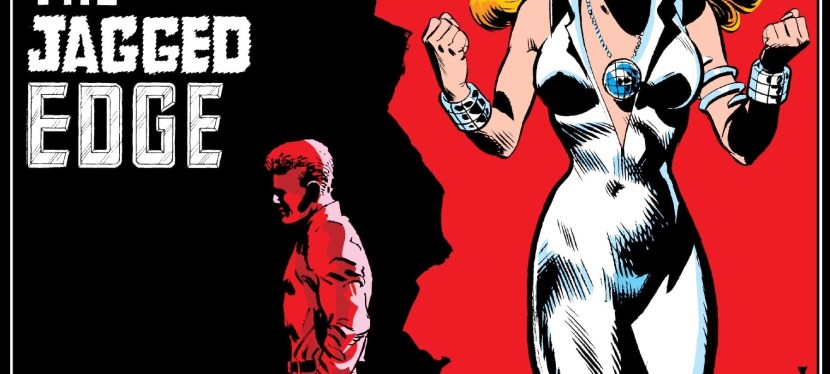
A Look Back at Dazzler #25 (1983)

Disclaimer: This is my original work with details sourced from reading the comic book and doing personal research. Anyone who wants to use this article, in part or in whole, needs to secure first my permission and agree to cite me as the source and author. Let it be known that any unauthorized use of this article will constrain the author to pursue the remedies under R.A. No. 8293, the Revised Penal Code, and/or all applicable legal actions under the laws of the Philippines.

Welcome back superhero enthusiasts, 1980s culture enthusiasts and comic book collectors! Today we go back to the year 1983 to examine the Marvel Comics universe through the exploits of Dazzler!

Today I have a review about the 25th issue of the Dazzler monthly series and it sure has this really strange looking cover with the protagonist in the foreground and a man in the background complete with a torn-page look. By the time this comic book was released, Dazzler had been through lots of misadventures, crazy superhero stuff as well as countless bouts of drama that impacted her and her existing family members. Could the creators come up with something to keep the series fresh and still engaging?

With those details laid down, here is a look back Dazzler , published by Marvel Comics in 1983 with a story written by Steve Grant and drawn by Marc Bright.
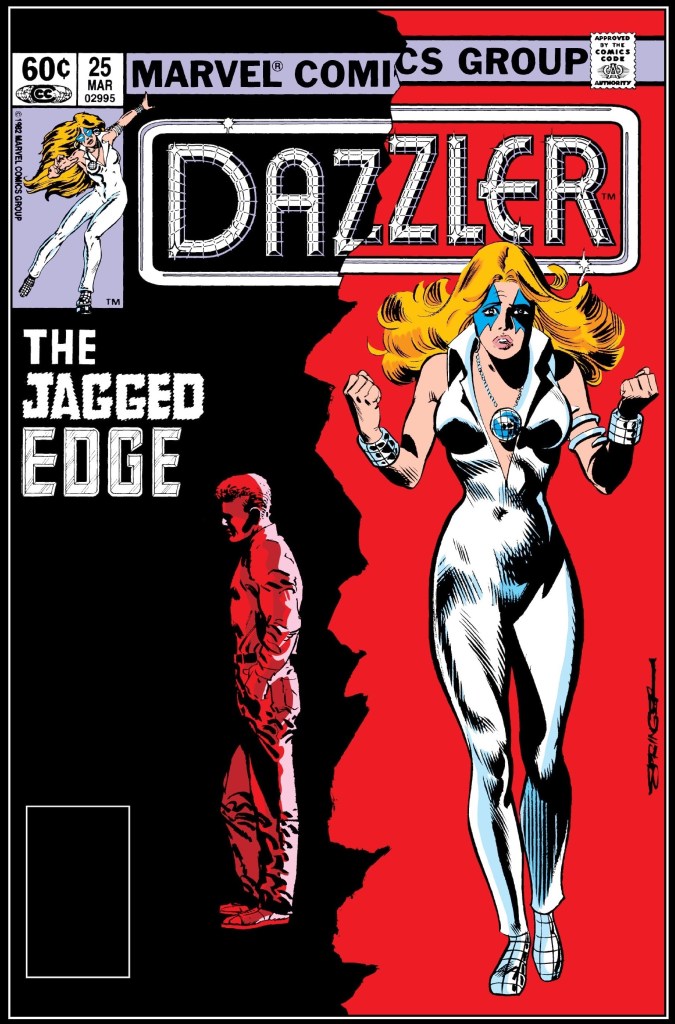
The cover.

Early story

The story begins with Alison Blaire working in front of a photographer during a photo session in the office of her manager Harry. It turns out, the photo session is a disaster for both of them. Shortly after, Alison changes her clothes and the field manager Lance arrives outside the door carrying a package for her sent by someone.

The package contained roses which delight Alison. She then reads a message that included with the roses…a message from a certain admirer. As the stakes of her entertainment career are higher than before, Alison gets advised to be extra careful with the kind of people she gets involve with.

From a distance, someone is closely watching Alison interacting with Harry and Lance using binoculars…

Quality
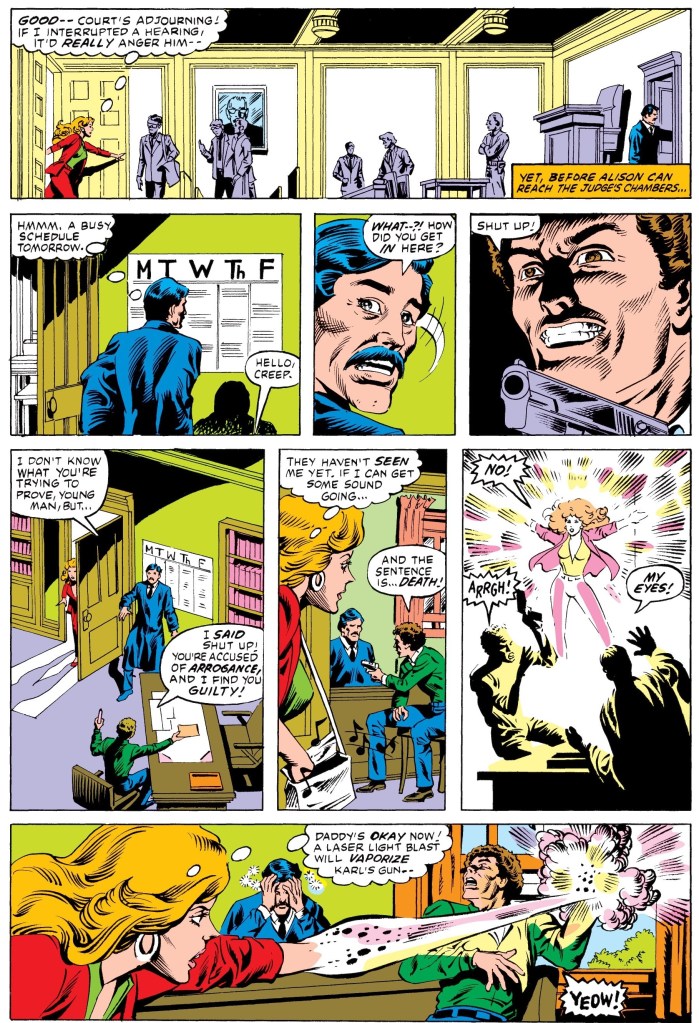
Alison in her effort to save her father.

With a new creative team doing the works, this comic book’s story was indeed an effort to shake things up for the Dazzler monthly series. It’s a tale about Dazzler encountering a fan who is more dangerous and more capable than he seems. The way the story was presented, this one was pretty light on superhero elements as the team of Steve Grant and Marc Bright decided to take a more grounded approach on telling the newest happenings in Alison Blaire’s life. In some ways, this story really felt like it was isolated from the rest of the Marvel Comics universe of the time.

While the previous issues say Alison having breakthroughs with her mother and father, as well as spending quality time with her half-sister Lois, this comic book was more about the entertainer handling herself as she encounters a very determined man who is obsessed with her. The way things were presented here, the story is pretty much character-driven but light on superhero spectacle. Lastly, I want to say that this comic book tackled the themes of personal obsession, fan madness and inner rage which were all emphasized through the new character/antagonist here.

Conclusion
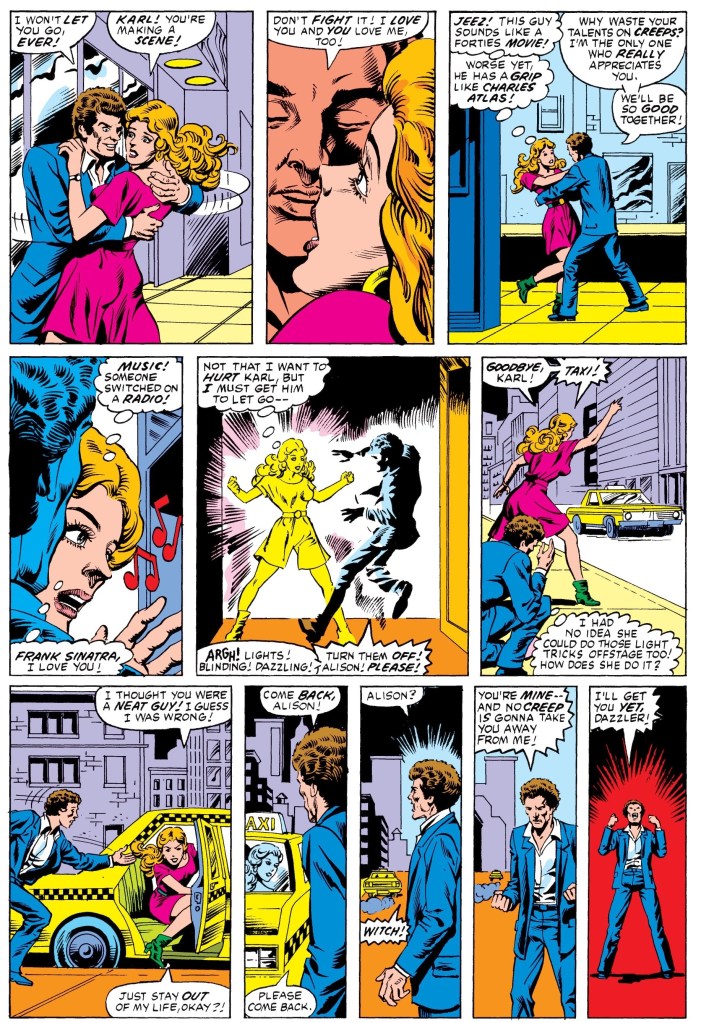
Alison in trouble.

Dazzler (1983) does not have much to entertain readers who enjoy super heroics. If superhero fun is what you are after, you are better off reading issue #24. This comic book’s biggest selling point is its character-driven story which I am confident will engage strongly with die-hard Dazzler fans. The new character/antagonist introduced in this comic book is not really that strong enough to be a worthy counterpart with Dazzler, but his sheer determination and personal obsession with the entertainer are worth a look.

If you are seriously planning to buy an existing hard copy of Dazzler (1983), be aware that as of this writing, MileHighComics.com shows that the near-mint copy of the regular edition costs $56 while the near-mint copy of the newsstand edition costs $113.

Overall, Dazzler (1983) is satisfactory.

+++++

Thank you for reading. If you find this article engaging, please click the like button below and also please consider sharing this article to others. If you are looking for a copywriter to create content for your special project or business, check out my services and my portfolio. Feel free to contact me with a private message. Also please feel free to visit my Facebook page Author Carlo Carrasco and follow me on Twitter at  @HavenorFantasy as well as on Tumblr at https://carlocarrasco.tumblr.com/

A Look Back at Sludge #5 (1994)

Disclaimer: This is my original work with details sourced from reading the comic book and doing personal research. Anyone who wants to use this article, in part or in whole, needs to secure first my permission and agree to cite me as the source and author. Let it be known that any unauthorized use of this article will constrain the author to pursue the remedies under R.A. No. 8293, the Revised Penal Code, and/or all applicable legal actions under the laws of the Philippines.

Welcome back, superhero fans, 1990s culture enthusiasts and comic book collectors! Today we revisit the Ultraverse of Malibu Comics and examine one of its many stories told through an issue of the Sludge comic book series.

In my previous retro review about Sludge #4 (1994), we got to see an inspired monster-versus-monster conflict between the protagonist and a huge, intelligent alligator aced with elements of society, urban legends, idolatry and journalism. That particular issue also showed more of the creative side of series artist Aaron Lopresti when it comes to writing. The next issue reviewed also involved Lopresti as writer.

With those details laid down, here is a look back at Sludge , published by Malibu Comics in 1994 with a story written and drawn by Aaron Lopresti.

The cover.

Early story

The story begins in New York City. Darkness descends on Manhattan like a shroud, providing haven for those who shun the light. As a man and a lady walk down the sidewalk talking to each other, a very hideous human-like monster comes out of the shadow of the alley and grabs them both.

In the sewers, Sludge hears one of the victims scream which compels him to run to where the trouble happened. As soon as he climbs out of the sewer, he sees the monster in the alley which makes eye-contact with him. As Sludge approaches the alley, the monster gets away leaving the dead bodies of the man and woman behind. As Sludge examines the dead bodies and realizes that the monster ate them, a police car with two officers arrived.

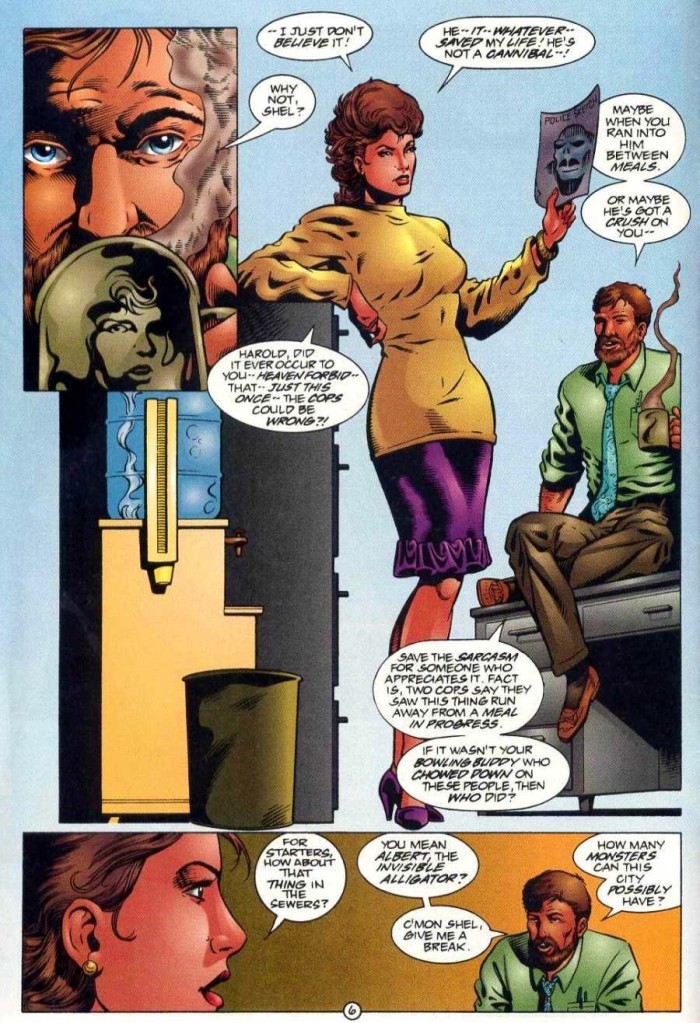
In reaction, Sludge quickly grabs one part of the police car and turns it upside down to buy himself time to get back into the sewer. The details of the encounter between the police and Sludge made it to Shelley, the same New York Daily Globe news reporter who encountered him and the intelligent alligator Veffir Voon Iyax. She discusses the newest information with her skeptical boss…

Quality

Obvious parallel to Mary Shelley’s Frankenstein here.

Let me start first with what is obvious with regards to the plot and presentation. Similar to what happened in Sludge #2, there is noticeably less spotlight on Sludge as creative space had to be used to develop the new monster, emphasize its background story (with an additional new character who has significance) and there were even scenes focused on Shelley and what goes on inside the office of her newspaper which became aware of the events that took place.

The next thing I want to point out is the creative inspiration used in this particular story. This comic book has really clear parallels to the literary classic Frankenstein: or, The Modern Prometheus and there was even a mention of its author Mary Shelley. That being said, there is a scientist-and-walking-abomination aspect with regards to the mentioned additional significant character connected with the new monster. That is not to say that this comic book copied Victor Frankenstein and his nameless monster, rather Aaron Lopresti took inspiration from them, mixed things up and implemented them in telling this new tale of Sludge. When it comes to keeping things fresh in telling another Sludge story, I can say that Lopresti succeeded.

More on the story itself, this one has a clever mix with regards to the dimensions used. In here, Sludge is more determined on helping people who shouted for help while Shelley won’t give up on finding out the truth about the tragic events in their city. Without spoiling the details, I can say that there is this deep dramatization about the monster and the new character responsible for its return from the dead.

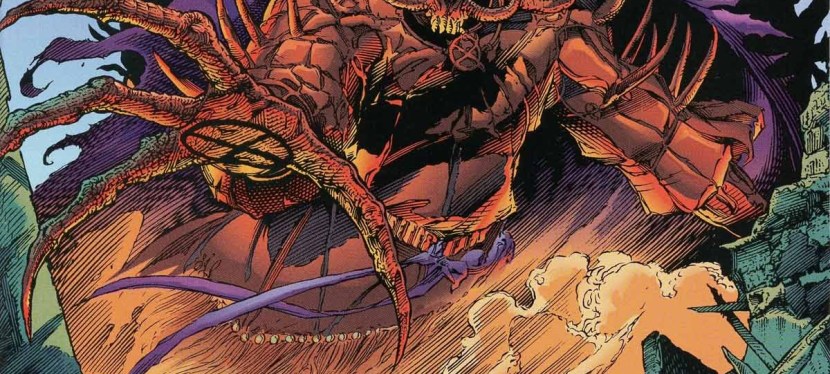
As for the quality of the writing, Aaron Lopresti’s work here is not only expressive but also impressive. There is this one page near the end that has these few yet powerful words that strongly connect with the images of Sludge and the monster (who is so creepily drawn!).  

Conclusion

This is the 2nd straight Sludge comic book that has reporter Shelley and her newspaper focused on what has been happening. At this point, Shelley had encountered Sludge.

Sludge (1994) in my view is another inspired and intriguing Ultraverse tale to read! While issue had parallels to the 1980 film Alligator, this comic book took inspiration from Mary Shelley’s most famous work of fiction which added elements about resurrection, man’s abuse of science, and the consequences of dealing with the unnatural into Sludge’s side of the Ultraverse. I should state that this comic book also has the scariest looking monster Aaron Lopresti drew for the Ultraverse at the time of publication.

If you are seriously planning to buy an existing hard copy of Sludge (1994) be aware that as of this writing, MileHighComics.com shows that the near-mint copy of the regular edition costs $16 while the near-mint copy of the newsstand edition costs $48.

Overall, Sludge (1994) is highly recommended.

+++++

Thank you for reading. If you find this article engaging, please click the like button below and also please consider sharing this article to others. If you are looking for a copywriter to create content for your special project or business, check out my services and my portfolio. Feel free to contact me with a private message. Also please feel free to visit my Facebook page Author Carlo Carrasco and follow me on Twitter at  @HavenorFantasy as well as on Tumblr at https://carlocarrasco.tumblr.com/

A Look Back at The Solution #10 (1994)

Disclaimer: This is my original work with details sourced from reading the comic book and doing personal research. Anyone who wants to use this article, in part or in whole, needs to secure first my permission and agree to cite me as the source and author. Let it be known that any unauthorized use of this article will constrain the author to pursue the remedies under R.A. No. 8293, the Revised Penal Code, and/or all applicable legal actions under the laws of the Philippines.

Welcome back superhero enthusiasts, 1990s culture enthusiasts and comic book collectors! If you’ve got a problem that needs solving, you call The Solution. For the newcomers reading this, The Solution was spearheaded by the late James Hudnall who also led the storytelling of the Hardcase monthly series.

In my previous The Solution retro comic book review, the team had to act as a result of what Aera had done long before she even joined her teammates. Alien forces had arrived on Earth which sparked a chain reaction of unfortunate events. Ultimately, Aera was taken away but not before handing over to Lela, Vurk and Dropkick the one powerful thing that the Vyr wanted – the Vorlexx.

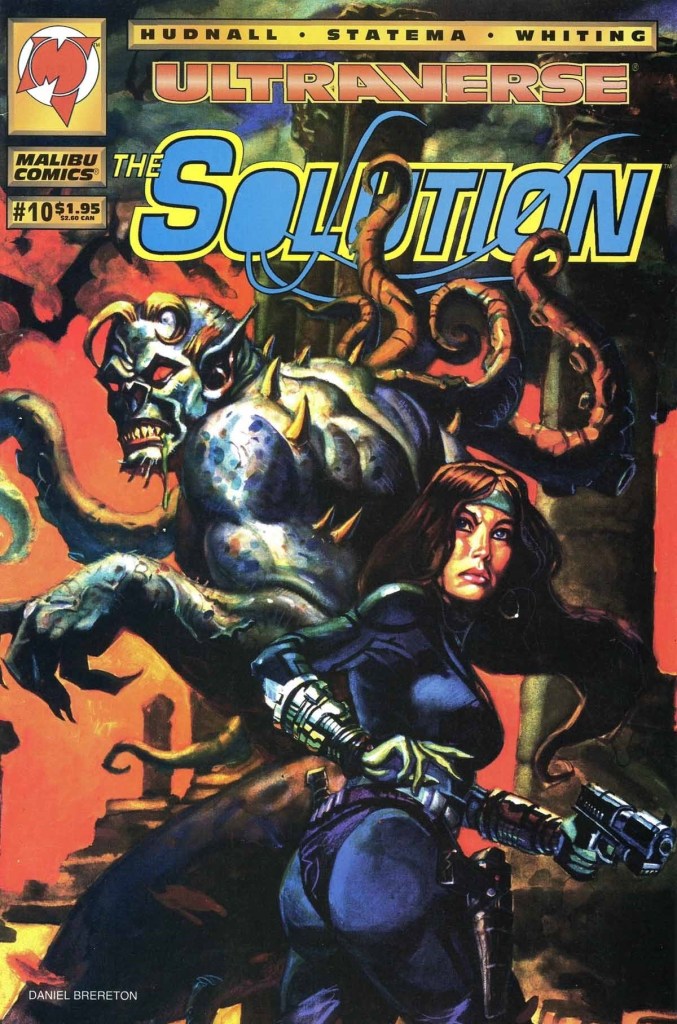
With those details laid down, here is a look back The Solution , published by Malibu Comics in 1994 with a story written by the late James Hudnall and drawn by John Statema.

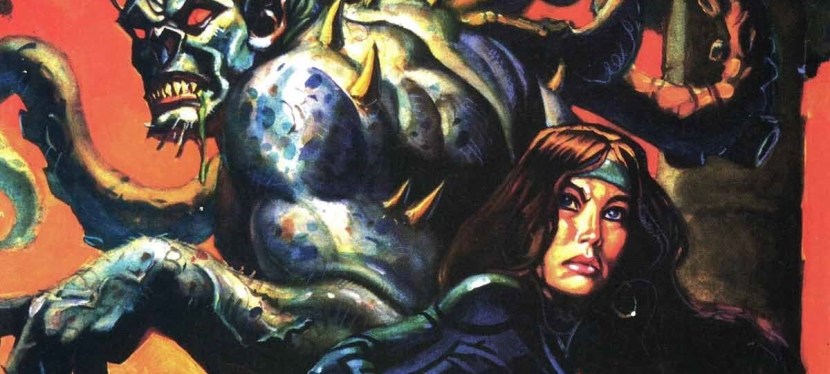
The cover.

Early story

The story begins with Dropkick hitting his alien teammate Vurk and accuses him for trying to leave their snatched teammate Aera in the hands of the Vyr. As Vurk transforms into his more monstrous form, Tech comes in between them and tells them to stop and come to their senses. As they have the Vorlexx, Tech insists that they should leave Earth before the Vyr comes back to get the precious items.

Holding the Vorlexx, Tech states that they should all travel together to Vurk’s homeworld and anticipate that the Vyr will come there searching for them. She stresses that they might stand a better chance of rescuing Aera this way. Vurk warns Tech that the Vorlexx will corrupt its user every time it gets used.

Tech issues a command to the Vorlexx and they all disappear to another world…

Quality

Lela Cho, Dropkick and Vurk struggle during their quest to save Aera.

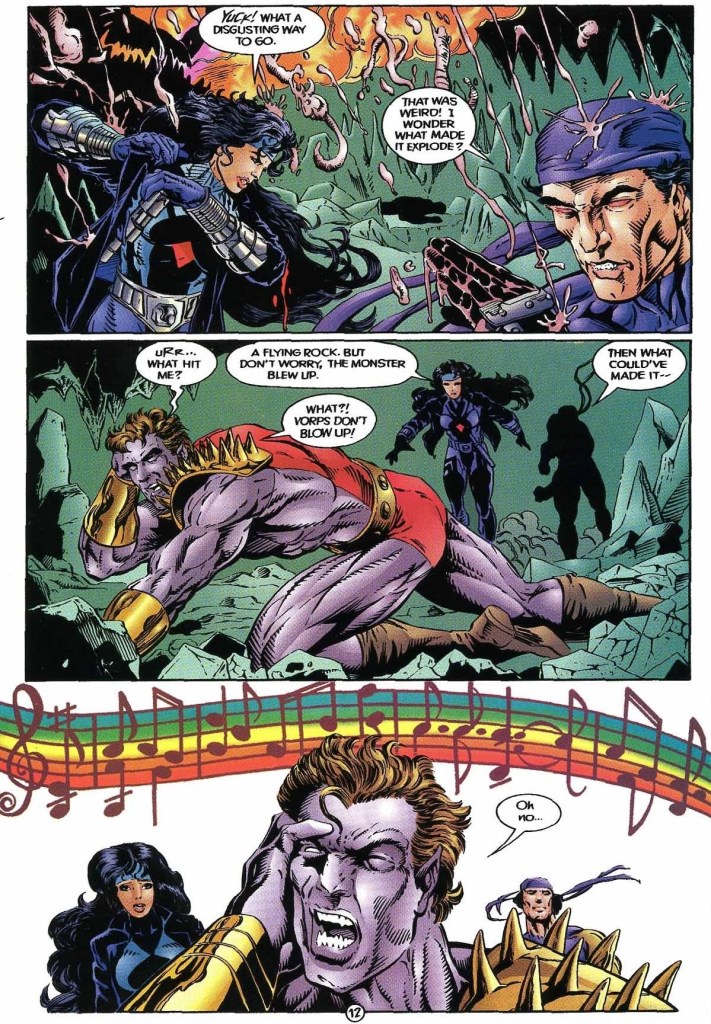
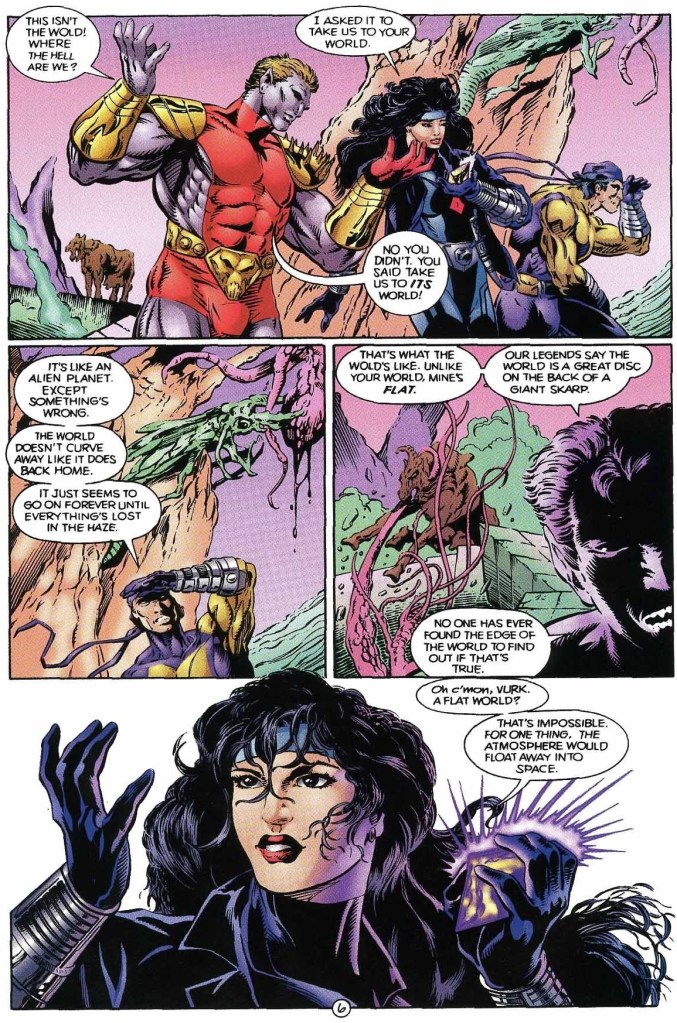
While the story of the previous issue brought the fantasy elements of the series raised really high, things went even higher this time as the team went to new worlds far away from Earth which results completely alien environments with creatures that people of Earth had not encountered. This helped pave the way for an encounter between The Solution and a giant monster that reminded about some classic sci-fi tales of EC Comics (note: the Weird Science series) from the 1950s.

More on the plot itself, James Hudnall crafted a script that succeeded in building up suspense and tension as Tech (Lela Cho), Dropkick and Vurk push through with their very difficult mission to rescue Aera. Along the way, you will get to see really nice character moments such as Lela’s leadership traits and Vurk using his knowledge of his past encounters with the Vyr.

There is also a notable twist in the tale which I won’t spoil. In fact, I encourage you readers and those who are just discovering the Ultraverse and The Solution to read this comic book to find out. That twist really added depth to the plot and resulted in some memorable reactions from The Solution.

Conclusion

The Solution arrived in an alien world by mistake.

The Solution (1994) is fun and engaging to read. As it follows The Solution’s dangerous attempt to save Aera in unknown parts of the universe, the story became more of a science fiction misadventure that remains believable and stable thanks to Hudnall’s strong writing. John Statema’s return as illustrator in this comic book easily raised the visual quality higher compared to the previous issue. I can say that Statema, by this point in this Ultraverse series, is clearly the definitive artist of The Solution.

If you are seriously planning to buy an existing hard copy of The Solution (1994), be aware that as of this writing, MileHighComics.com shows that the near-mint copy of the regular edition costs $16.

Overall, The Solution (1994) is recommended.

+++++

Thank you for reading. If you find this article engaging, please click the like button below and also please consider sharing this article to others. If you are looking for a copywriter to create content for your special project or business, check out my services and my portfolio. Feel free to contact me with a private message. Also please feel free to visit my Facebook page Author Carlo Carrasco and follow me on Twitter at  @HavenorFantasy as well as on Tumblr at https://carlocarrasco.tumblr.com/

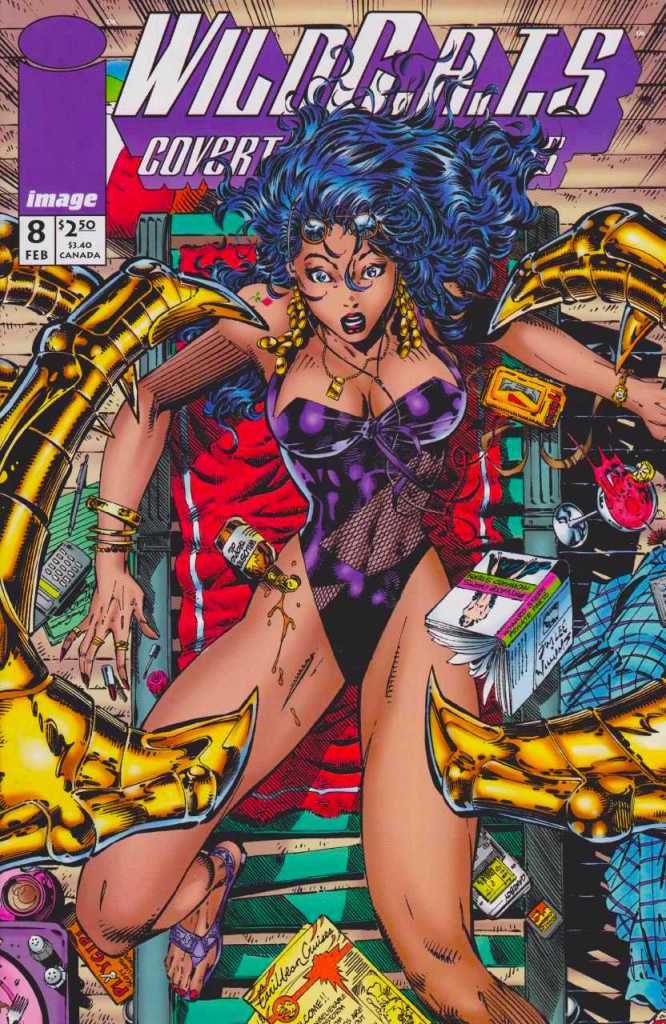
A Look Back at WildC.A.T.S: Covert Action Teams #8 (1994)

Disclaimer: This is my original work with details sourced from reading the comic book and doing personal research. Anyone who wants to use this article, in part or in whole, needs to secure first my permission and agree to cite me as the source and author. Let it be known that any unauthorized use of this article will constrain the author to pursue the remedies under R.A. No. 8293, the Revised Penal Code, and/or all applicable legal actions under the laws of the Philippines.

Welcome back superhero enthusiasts, 1990s culture enthusiasts and comic book collectors! Today we continue revisiting Jim Lee’s flagship title under the Image Comics label – WildC.A.T.S: Covert Action Teams!

In my previous retro review of WildC.A.T.S #7, that story marked the 3rd chapter of the 4-part Killer Instinct crossover storyline which brought Jim Lee’s team together with Marc Silvestri’s Cyber Force. That storyline ended in a Cyber Force comic book which leads to the questions – what is next for WildC.A.T.S? Will there be a new and fresh storyline set up for them?

With those details laid down, here is a look back WildC.A.T.S: Covert Action Teams , published by Image Comics in 1994 with a story written by Brandon Choi and Jim Lee. Lee did the art along with Richard Bennett and Scott Williams.

The cover.

Early story

The story begins inside a large bar within New York City where Cole Cash/Grifter and Zealot (both of them in civilian clothes) spend time together playing pool. There are men nearby staring at them. While Grifter tries to unwind and have fun with the game, Zealot still sticks to her warrior mindset even though they are no longer in a battle field. Suddenly, one man arrogantly pours beer on Grifter’s head while another man touches Zealot’s hair.

The two WildC.A.T.S members struck the two violators and subsequently made short physical work of the other men who tried to hurt them. After that, Zealot and Grifter talk outside. The latter receives an urgent message which compels him to leave Zealot behind and do something important…

Quality

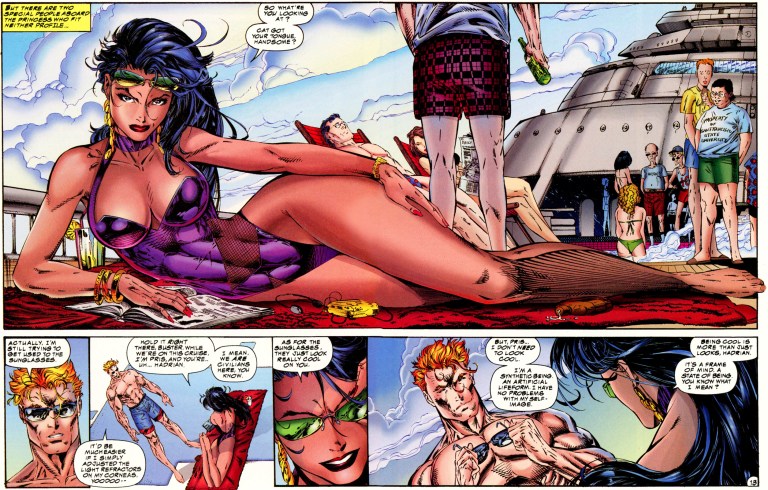
Spartan and Voodoo on holiday in their civilian forms.

I’ll be straight to the point here. If you enjoyed Jim Lee’s previous work on Marvel’s X-Men that include bombastic action, misadventures, team members appearing in swimwear and character moments, you will find that in this story which is really a transitional tale of the team taking a break from action only to find themselves facing new danger. That being said, the concept and structure of the plot in this comic book is pretty simple and it does succeed in setting up WildC.A.T.S for another misadventure while cleverly emphasizing the Kherubim-Daemonite concept of the WildStorm universe back then.

As expected, Jim Lee’s artwork here is really great to look at and he sure always finds ways to make the dialogue scenes look interesting. What stands out to me the most in this comic book are the character moments which more than made up for the lightness of the plot. While the romantic interactions between Spartan and Voodoo is interesting, the interactions between Zealot and Grifter (referred to as Brother Grifter) really gave me additional insight on their respective personalities and, more notably, their feelings for each other.

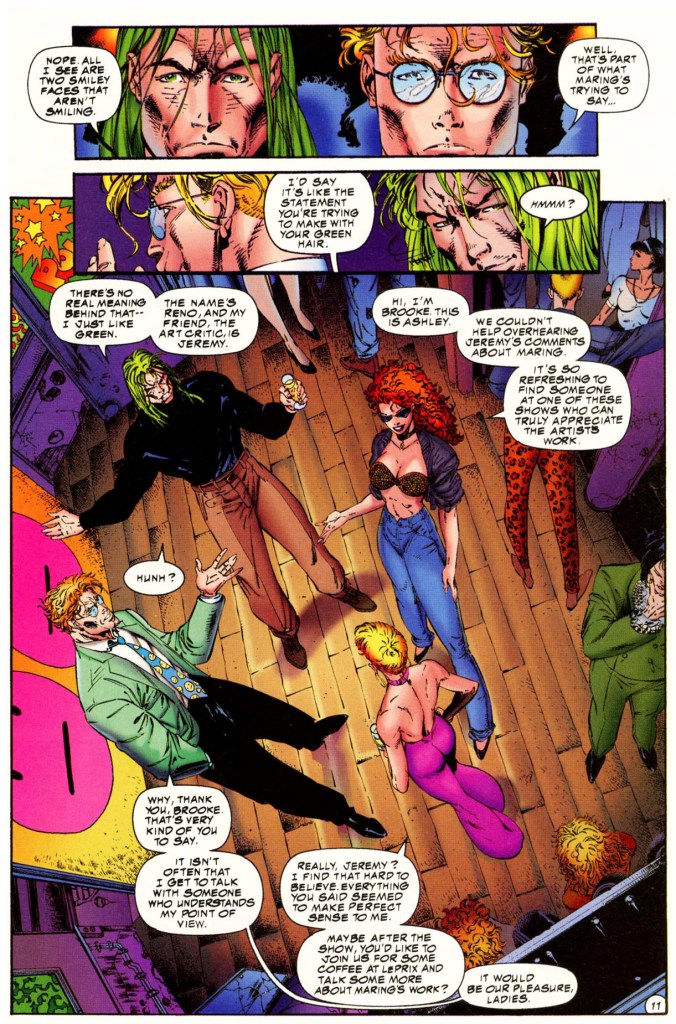
More on character moments, you will see Maul and Warblade in their respective civilian identities as Reno and Jeremy. If you only see those two as violent action performers based on the previous issues of WildC.A.T.S, you will be surprised with the way Brandon Choi and Jim Lee presented them in this story.  

Conclusion

Can you recognize Maul and Warblade?

While its story was pretty light, WildC.A.T.S: Covert Action Teams (1994) still manages to entertain me mainly due to the character moments that the creators came up with. In many ways, this comic book showed how human the team members are which is a nice change from all the action-focused stuff they were so busy with in the previous issues. Along the way, you will see a few creative gimmicks Jim Lee inserted visually, including the unofficial cameo appearance of two pretty notable members of X-Men (note: they just got married). Meanwhile, those who love Pris/Voodoo will find some extra entertainment here as this comic book has an additional short story about her past (set after WildC.A.T.S Trilogy ) which was written by Peter Seagle and drawn by Travis Charest (who would later replace Jim Lee as illustrator of this comic book series).

If you are seriously planning to buy an existing hard copy of WildC.A.T.S: Covert Action Teams (1994), be aware that as of this writing, MileHighComics.com shows that the near-mint copy of the regular edition costs $40 while the near-mint copy of the newsstand edition costs $120.

Overall, WildC.A.T.S: Covert Action Teams (1994) is recommended.

+++++

Thank you for reading. If you find this article engaging, please click the like button below and also please consider sharing this article to others. If you are looking for a copywriter to create content for your special project or business, check out my services and my portfolio. Feel free to contact me with a private message. Also please feel free to visit my Facebook page Author Carlo Carrasco and follow me on Twitter at  @HavenorFantasy as well as on Tumblr at https://carlocarrasco.tumblr.com/
A Look Back at Dazzler #24 (1983)

Disclaimer: This is my original work with details sourced from reading the comic book and doing personal research. Anyone who wants to use this article, in part or in whole, needs to secure first my permission and agree to cite me as the source and author. Let it be known that any unauthorized use of this article will constrain the author to pursue the remedies under R.A. No. 8293, the Revised Penal Code, and/or all applicable legal actions under the laws of the Philippines.

Welcome back superhero enthusiasts, 1980s culture enthusiasts and comic book collectors! Today we go back to the year 1983 to examine the Marvel Comics universe through the exploits of Dazzler!

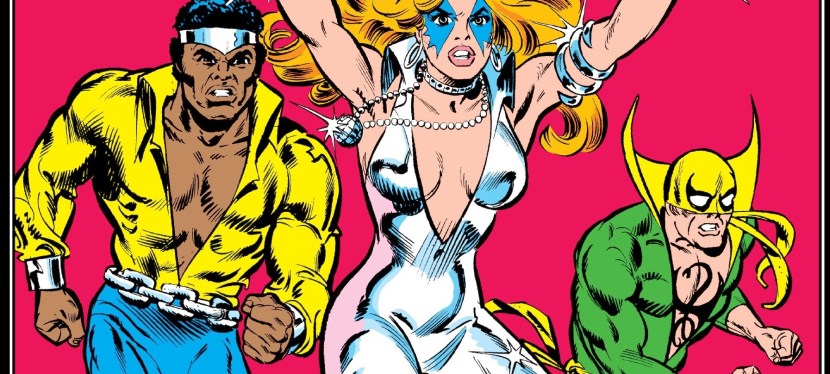
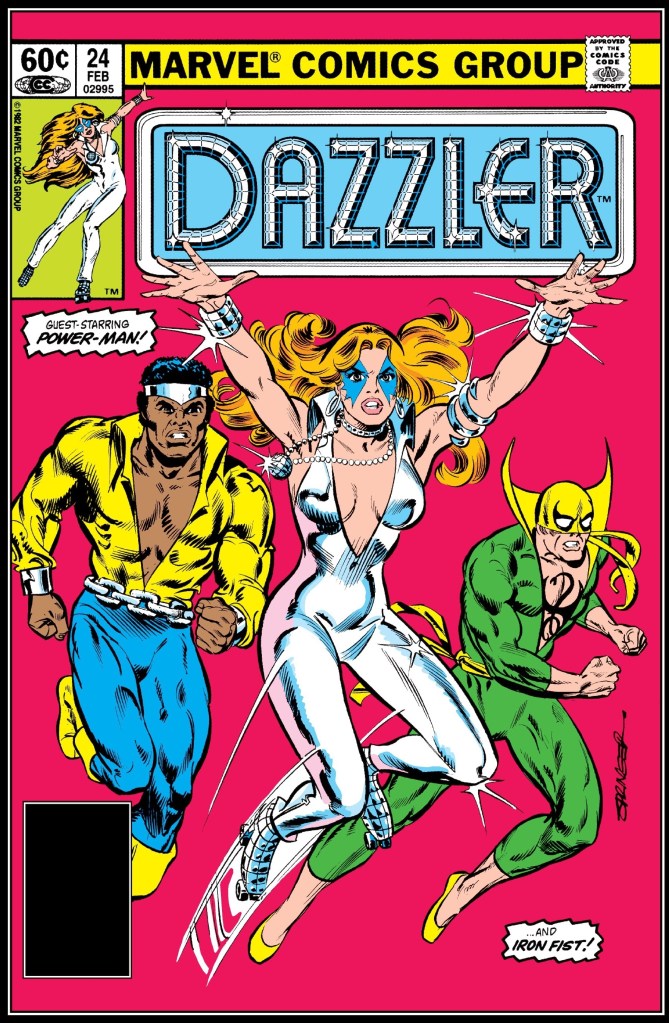
As seen in the cover of the next Dazzler comic book I reviewed, the lady has Power Man and Iron Fist with her. In short, there is a crossover within Marvel Comics’ universe just waiting to be unveiled. Who exactly will Dazzler, Power Man and Iron Fist be facing? What kind of situation are they entering into?

With those details laid down, here is a look back Dazzler #24, published by Marvel Comics in 1983 with a story written by Danny Fingeroth and drawn by the late Frank Springer.

The cover.

Early story

The story begins with Rogue (of the Brotherhood of Evil Mutants) breaking through the front door of the apartment of Alison Blaire who remains her target. She realizes that Dazzler is absent which is inconvenient as she believes that the singer is key in her quest to find Angel and the rest of the X-Men. Rogue makes a mess of Alison’s things in the apartment and decides to wait for her to return.

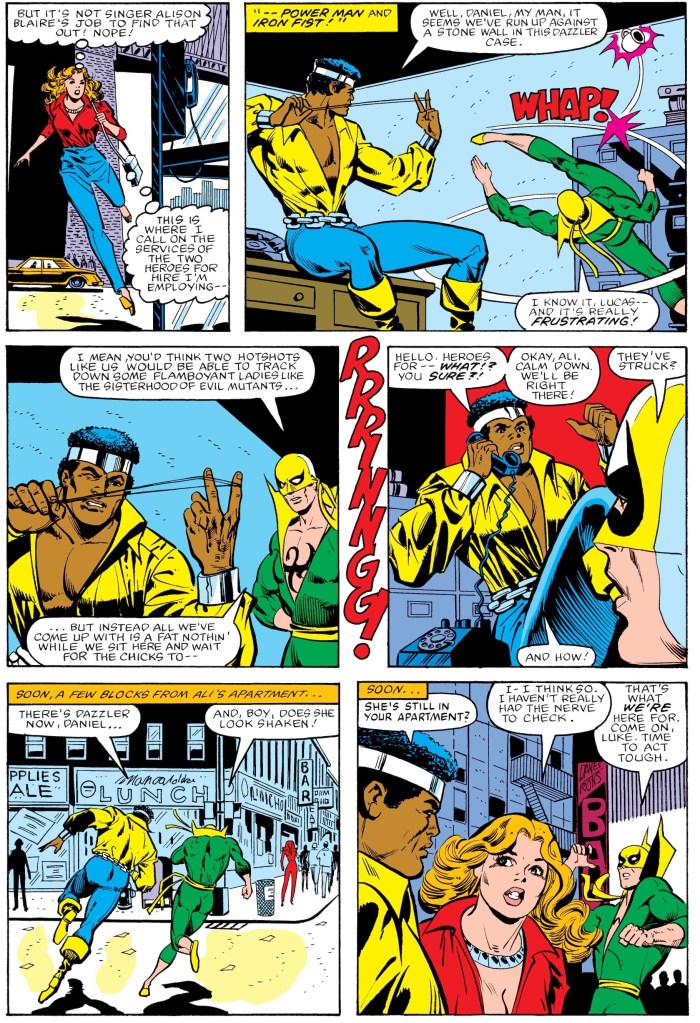
A short time later, Alison is approached by her friend Frank on her way home. He tells her that someone broke into her apartment and made a mess inside. Realizing that the trespasser is none other than Rogue (note: they encountered each other in Dazzler #22) and that she alone does not have much of a chance in fighting her, she calls Power Man and Iron Fist for their professional help…

Quality

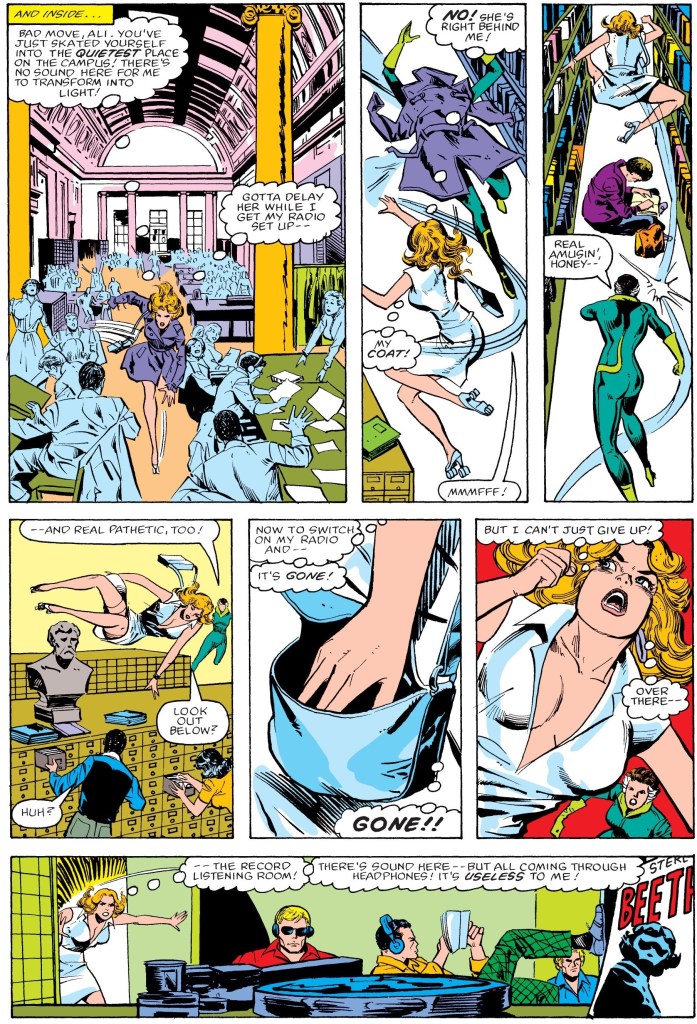
Alison Blaire desperately getting away from Rogue.

To begin with, this is one action-packed tale of Dazzler that still manages to emphasize the development of the protagonist and her newly formed bond with her half-sister Lois (who appeared a short time before this comic book was released). As a crossover set within the Marvel Comics universe, Danny Fingeroth’s story makes mention of the X-Men as Rogue continues her quest on getting Dazzler to get to Angel in order to find Charles Xavier’s team which is all part of the Brotherhood of Evil Mutant’s lust for revenge. Along the way, readers will get to see Rogue take on Power Man and Iron Fist (note: these two met with Dazzler in Dazzler ) which was fun to see.

More on Dazzler herself, the stakes are raised again as she not only has to survive encountering Rogue but also of the fact that the powerful Brotherhood of Evil Mutants member becomes aware of Lois. I should state that there are two encounters between Dazzler and Rogue here, and each one was entertaining to read.

Conclusion

Alison Blaire plus Power Man and Iron Fist.

Dazzler #24 (1983) is a Marvel crossover tale which the creators made to add some action-packed variety while telling the story of Dazzler. That being said, the dramatic character development that this comic book series was notable for was lightened a bit to make way for the superhero spectacle. Not only does this comic book provide readers additional insight into the duo of Power Man and Iron Fist, it also showed some development about the conflict between the X-Men and the Brotherhood of Evil Mutants. Ultimately, this is one old and fun comic book to have.

If you are seriously planning to buy an existing hard copy of Dazzler #24 (1983), be aware that as of this writing, MileHighComics.com shows that the near-mint copy of the regular edition costs $57 while the near-mint copy of the newsstand edition costs $113.

Overall, Dazzler #24 (1983) is recommended.

+++++

Thank you for reading. If you find this article engaging, please click the like button below and also please consider sharing this article to others. If you are looking for a copywriter to create content for your special project or business, check out my services and my portfolio. Feel free to contact me with a private message. Also please feel free to visit my Facebook page Author Carlo Carrasco and follow me on Twitter at  @HavenorFantasy as well as on Tumblr at https://carlocarrasco.tumblr.com/
A Look Back at The Solution #9 (1994)

Disclaimer: This is my original work with details sourced from reading the comic book and doing personal research. Anyone who wants to use this article, in part or in whole, needs to secure first my permission and agree to cite me as the source and author. Let it be known that any unauthorized use of this article will constrain the author to pursue the remedies under R.A. No. 8293, the Revised Penal Code, and/or all applicable legal actions under the laws of the Philippines.

Welcome back superhero enthusiasts, 1990s culture enthusiasts and comic book collectors! If you’ve got a problem that needs solving, you call The Solution. For the newcomers reading this, The Solution was an Ultraverse monthly series about a team composed of very unique individuals who help their clients solve special problems. Such operations are done with business agreements made between the team and their clients.

But what if one of the members of The Solution becomes a target of some very deadly forces that are not even human? What solutions can The Solution come up with?

With those details laid down, here is a look back The Solution , published by Malibu Comics in 1994 with a story written by the late James Hudnall and drawn by Timothy D. Divar.

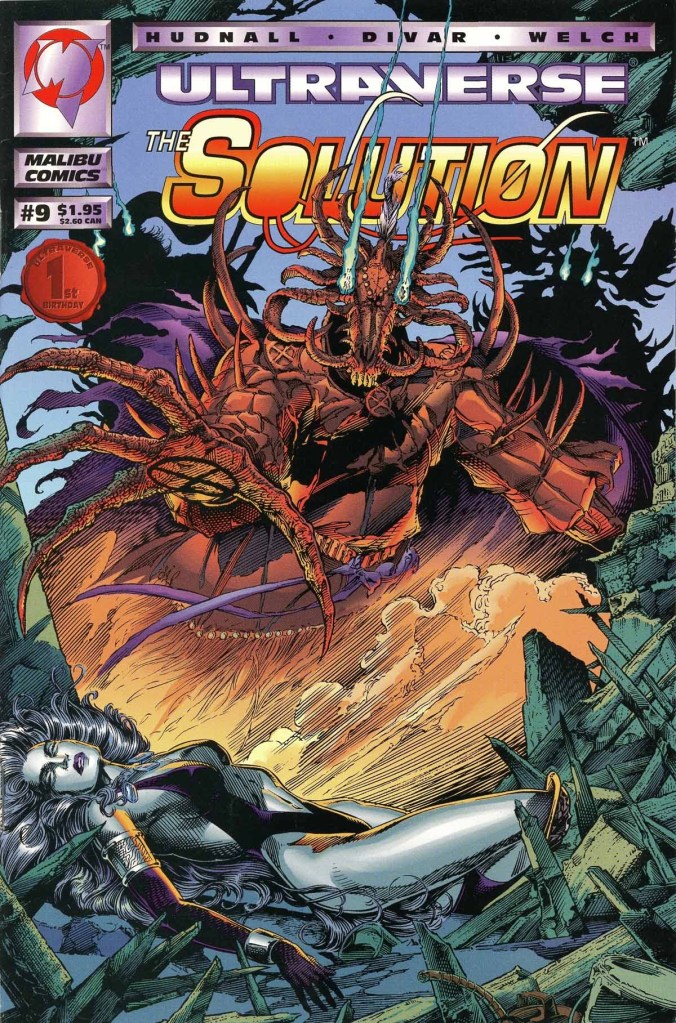
The cover.

Early story

The story begins somewhere in North America where three mystical monsters arrived on a mission to hunt. The prey they are hunting is to be taken alive and to be tortured for decades. One of them displays the image of Aera/Shadowmage.

A long distance away, in the presence of The Solution traveling by yacht, Aera senses danger and that she has been found by the monsters. The three who arrived from nowhere suddenly cast magic together and summoned a beast which arrived out of thin air. The beast is then instructed to search and hunt Shadowmage.

Over at the Chinese sea, Aera tells Lela Cho that she has been found by the mystical monsters which she previously referred to as the Vyr. She describes them to be very powerful, the most deadly and the most evil creatures on her home world. Aela admits that she does not have the power to stop the Vyr and their team cannot stop them even when combined in power. Their teammate Vurk expresses deep concern and asked Aera what she did that angered the Vyr. Vurk admits his fear of the Vyr and as long as they after Aera, the team would be better off letting them have her…

Quality

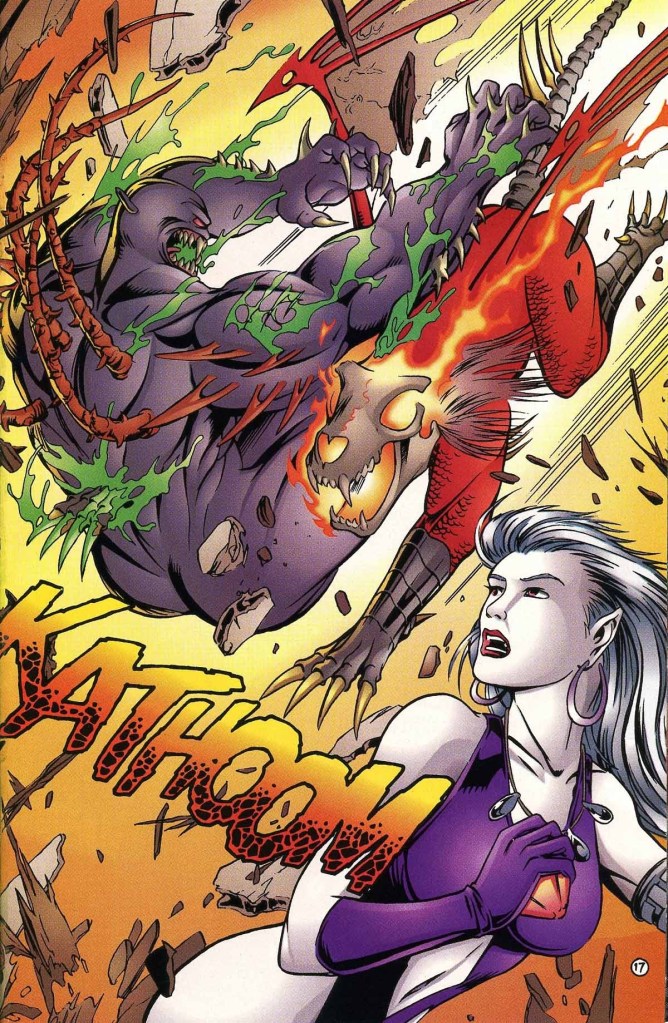
Aera, her monstrous teammate Vurk and the unstoppable monster.

When it comes to storytelling, I should say that the late James Hudnall really ramped up the fantasy aspect of this series right here. That being said, this comic book made the previous issues look more grounded in reality by comparison. Among the members of The Solution, there is a clear shift towards Aera/Shadowmage whose act from a long time ago led to the Vyr hunting her down on Earth which, unsurprisingly, gets her teammate involved. Along the way, key details from the past of Aera (a native from a foreign world) and Vurk/Outrage (the native of another world which is in conflict with Aera’s own people) get revealed which add some depth on the development of the team as a whole. The way the details were presented made for a really intriguing read in my experience.

With a story concept like this, The Solution could have been a creative mess but it turned out orderly, intriguing and engaging thanks to the way Hudnall structured the story and wrote down the dialogue and text descriptions.

If there is any weakness in this comic book’s presentation, it is the artistic style of Timothy D. Divar. Compared to issue , I find the visual quality here drop significantly and there were some shots of The Solution members looking a bit like some characters I saw in 1990s comic books published by Valiant Comics. The characters’ faces and expressions also looked clearly less detailed.

Conclusion

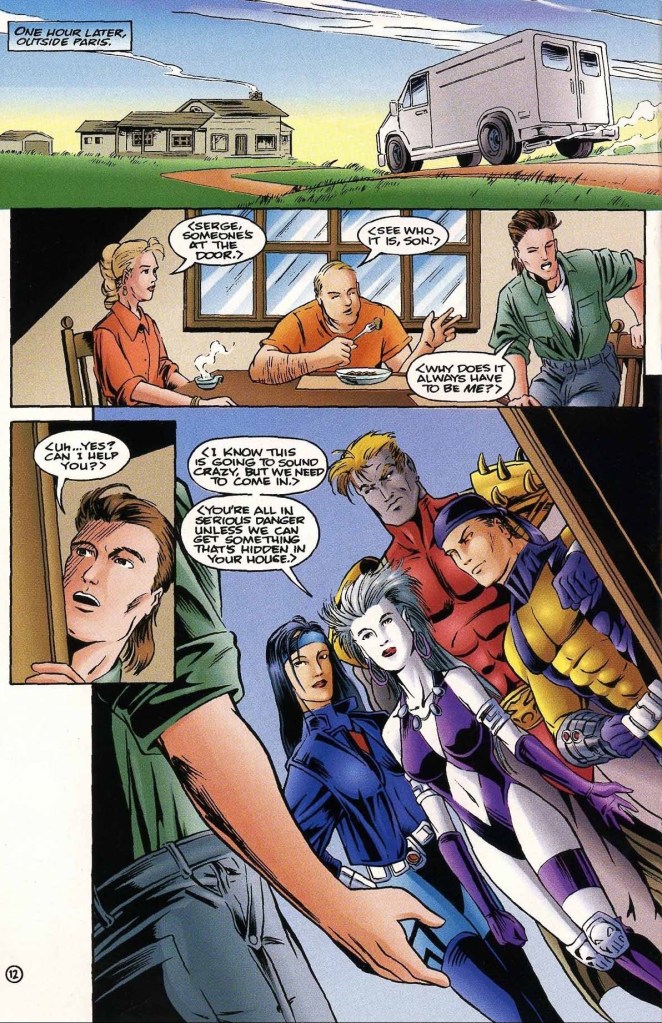
There is nothing like seeing The Solution at your household’s front door.

The Solution (1994) is a good read. The strong selling point in it is the team getting involved in a very dangerous encounter with the Vyr (which are way too powerful for them to deal with) which is the result of Aera’s dangerous act. Just as Aera explained what she did and what happened in the past, the tension in the story really went up which makes it engaging to read.

If you are seriously planning to buy an existing hard copy of The Solution (1994), be aware that as of this writing, MileHighComics.com shows that the near-mint copy of the regular edition costs $16.

Overall, The Solution (1994) is recommended.

+++++

Thank you for reading. If you find this article engaging, please click the like button below and also please consider sharing this article to others. If you are looking for a copywriter to create content for your special project or business, check out my services and my portfolio. Feel free to contact me with a private message. Also please feel free to visit my Facebook page Author Carlo Carrasco and follow me on Twitter at  @HavenorFantasy as well as on Tumblr at https://carlocarrasco.tumblr.com/
A Look Back at Dazzler #22 (1982)

Disclaimer: This is my original work with details sourced from reading the comic book and doing personal research. Anyone who wants to use this article, in part or in whole, needs to secure first my permission and agree to cite me as the source and author. Let it be known that any unauthorized use of this article will constrain the author to pursue the remedies under R.A. No. 8293, the Revised Penal Code, and/or all applicable legal actions under the laws of the Philippines.

Welcome back superhero enthusiasts, 1980s culture enthusiasts and comic book collectors! Today we go back to the 1980s to examine the Marvel Comics universe through the exploits of Dazzler!

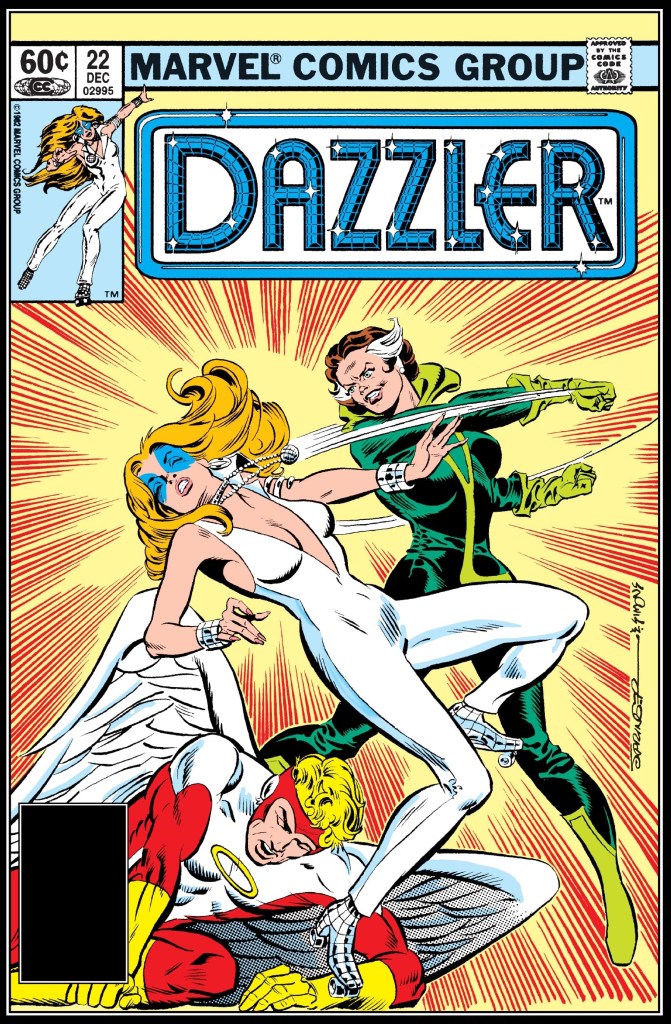
In my retro review of Dazzler #21 (1982), I observed that the story had no good-versus-evil conflict at all as it was purely character-driven and focused a lot on the personal development of Alison Blaire/Dazzler. More notably, the story shed light on both Alison’s father (a judge) and mother (who left the judge) and how the past affected the protagonist. Very clearly, Dazzler’s development really went deep since her first-ever appearance in an X-Men comic book. Speaking of the X-Men, I must say that one of the team’s notable members had an early (not the first) appearance in the next Dazzler issue I just reviewed. That character is none other than Rogue and she looks nothing like the way Jim Lee modernized her in the 1990s.

With those details laid down, here is a look back Dazzler #22, published by Marvel Comics in 1982 with a story written by Danny Fingeroth and drawn by the late Frank Springer.

The cover.

Early story

The story begins in the air high above the streets of New York City. Warren Worthington III/Angel’s flight gets disrupted as a group of hawks suddenly attack him from all sides. With quick thinking, he uses different methods to gradually lure each hawk and trick them into bumping into something to end their pursuit.

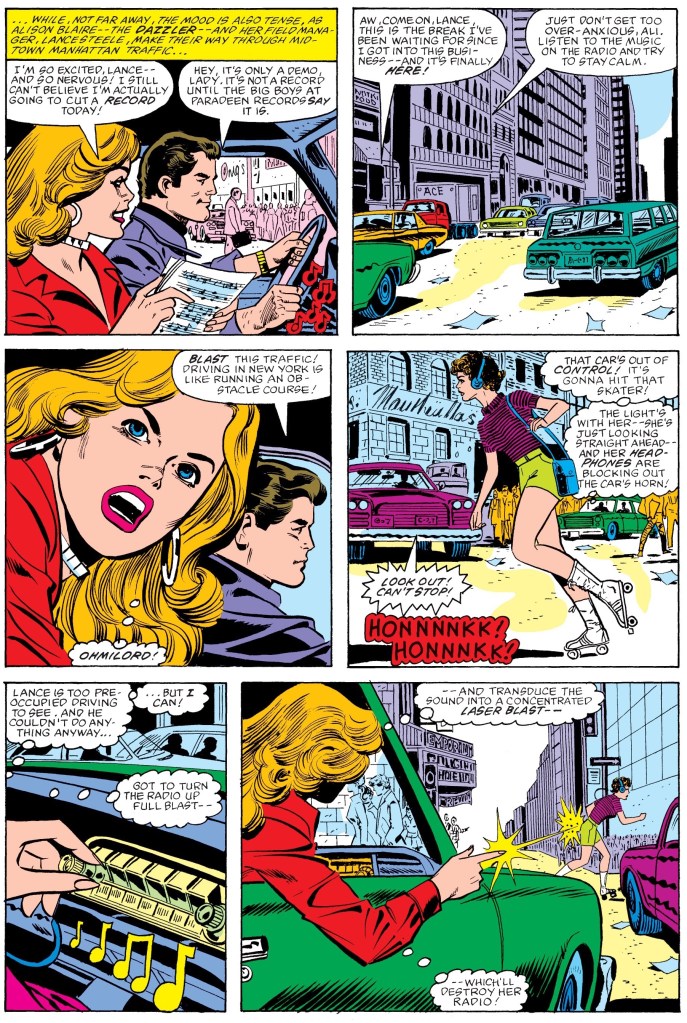
Meanwhile, as Alison Blaire rides the car driven by her field manager Lance going to the studio, she saves a roller-skating lady from colliding with a car using clever methods. At the studio, Alison prepares herself for a recording session under the watch of the perfectionist music producer L.B. Holman…

Quality

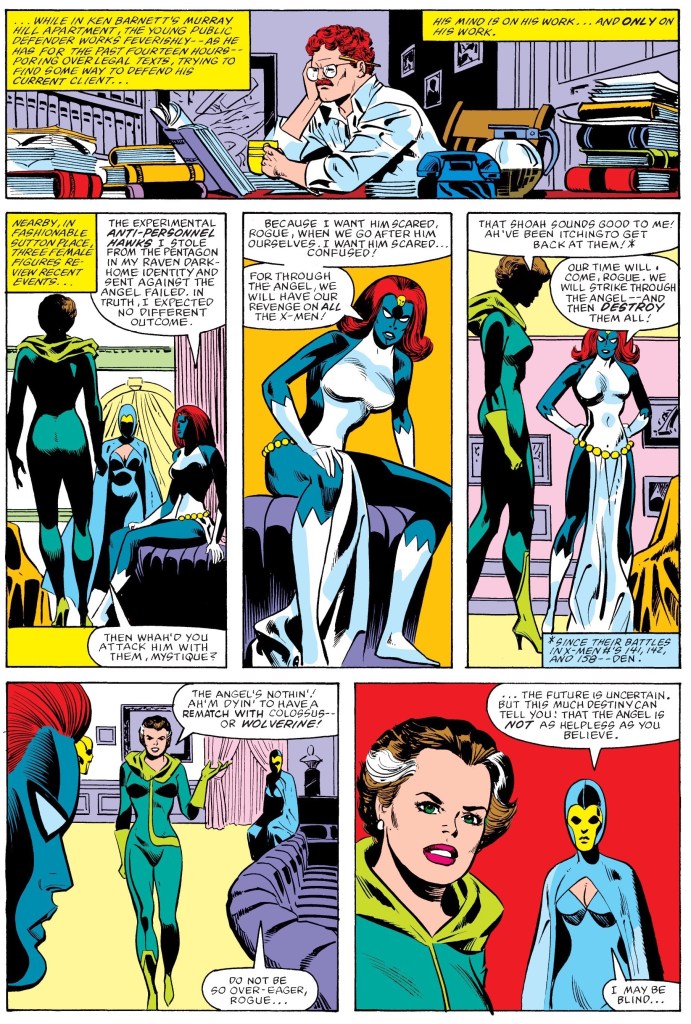
The Brotherhood of Evil Mutants led by Mystique.

As expected, the story in this comic book showed natural progression on developing the protagonist as well as her parents while also reviving the superhero trope of good-versus-evil which was clearly done for entertainment value. While the cover art had Rogue hitting Dazzler, the good-versus-evil conflict within is actually bigger than that as the story involves not only Rogue but also notable X-Men villainess Mystique plus Destiny.

As this was in the early 1980s, Rogue was not a member of the X-Men at the time and was still new (her first-ever appearance was in Avengers Annual in 1981). Regarding Mystique, her appearance in this comic book was not merely just an appearance but rather an extension of the exploits of her group called the Brotherhood of Evil Mutants and it has been her desire to get back at the X-Men over what happened in Uncanny X-Men #142 (part 2 of the Days of Future Past storyline). As such, having Dazzler encounter the evil group in the presence of the X-Men’s Angel was a very strategic move by Danny Fingeroth as it emphasized the crossover aspect within the Marvel Comics universe of the time complete with pretty good dialogue and details emphasized.

This also helps remind readers of Dazzler’s previous involvement with the X-Men and cleverly gave them the idea of what would things be like if the protagonist someday really joined the team of mutants.

On character development, dramatizing Alison’s mother and father shows progress from what happened near the end of the previous issue which is a nice touch. Even Alison’s boyfriend Ken got his own share of the spotlight. What is most notable when it comes to characterization in this comic book is the smooth and fine chemistry between Alison and Warren Worthington. The two made convincing friends and how their respective circumstances brought them together here was well executed by the creators.

Conclusion

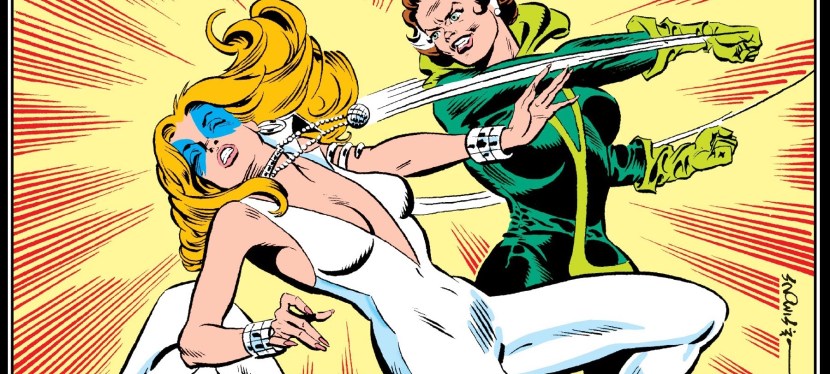
Discreetly, Alison Blaire uses her power to help someone.

Dazzler #22 (1982) is enjoyable and has that fine balance between characterization, plotting and spectacle. The good-versus-evil conflict here should really catch the attention of readers, especially those who are deeply interested with the X-Men-related characters and groups of the early 1980s. There is also enough superhero action to keep readers entertained and clearly this was done to make up for the lack of action in the very dramatic issue #21.

If you are seriously planning to buy an existing hard copy of Dazzler #22 (1982), be aware that as of this writing, MileHighComics.com shows that the near-mint copy of the regular edition costs $57 while the near-mint copy of the newsstand edition costs $113.

Overall, Dazzler #22 (1982) is recommended.

+++++

Thank you for reading. If you find this article engaging, please click the like button below and also please consider sharing this article to others. If you are looking for a copywriter to create content for your special project or business, check out my services and my portfolio. Feel free to contact me with a private message. Also please feel free to visit my Facebook page Author Carlo Carrasco and follow me on Twitter at  @HavenorFantasy as well as on Tumblr at https://carlocarrasco.tumblr.com/
A Look Back at Sludge #4 (1994)

Disclaimer: This is my original work with details sourced from reading the comic book and doing personal research. Anyone who wants to use this article, in part or in whole, needs to secure first my permission and agree to cite me as the source and author. Let it be known that any unauthorized use of this article will constrain the author to pursue the remedies under R.A. No. 8293, the Revised Penal Code, and/or all applicable legal actions under the laws of the Philippines.

Welcome back, superhero enthusiasts, 1990s culture enthusiasts and comic book collectors! Today we revisit the Ultraverse of Malibu Comics and examine one of its many stories through an issue of the Sludge comic book series.

Previously, I reviewed Sludge #3 which was a tie-in comic book to the first big crossover event of the entire Ultraverse – Break-Thru. In that issue, he encountered the “lord” Pumpkin who himself became a notable super villain in the UV. That story also showed the first major test of Sludge when it comes to resisting temptation and evil.

With those details laid down, here is a look back at Sludge , published by Malibu Comics in 1994 with a story written and drawn by Aaron Lopresti, and scripted by Steve Gerber.

The cover.

Early story

The story begins when two black teenagers go down the city sewer to look for something as part of a job of them agreed to do for someone named Gordy. They accidentally find Sludge whose appearance and ability to talk scares them away. As the two keep running to another direction, a reptilian monster sees them. The monster grabbed and killed the taller youth, leaving the shorter one scared.

A short time later, a police officer finds the scared teenager hiding behind plants at Central Park. The survivor is in a state of shock repeating his friend’s name a lot. The police update about the boy eventually reaches the office of the New York Daily Globe and an attractive reporter named Shelley intends to follow what could be a hot scoop…

Quality

The battle between these two has a lot of stuff that should be seen.

In this comic book, I can see that the creative team of Steve Gerber and Aaron Lopresti decided to shake things up a bit when it comes to telling a new story of Sludge laced with elements of society, urban legends and journalism. The good news here is that this story is well-written and the visuals really brought the script to life for readers to be engaged with.

When it comes the elements that inspired this particular story, the concept about alligators occupying the sewers instantly reminds me of the 1980 film Alligator and along the way, Gerber-Lopresti went on pounce on the concept resulting in the introduction of a brand new Ultraverse villain in the form of a monstrous, human-like alligator named Veffir Voon Iyax which can also talk and reason like humans. This new villain is really interesting and its background about being part of a species of alligators worshipped by people from long ago sheds light on the idolatry which is both unholy and foolish.  

On the aspects of society and journalism, the story sheds light on how some people – even minors – would go to really unsafe places and do very risky jobs for a variety of reasons. The journalistic aspect of this comic book emphasizes how far journalists would go to write stories based on questionable data and that a newspaper would recklessly publish such stories even though they lacked solid evidence to prove the unbelievable is true. The newspaper journalist Shelley had quite an amount of the spotlight, she became a clear supporting character in this comic book.

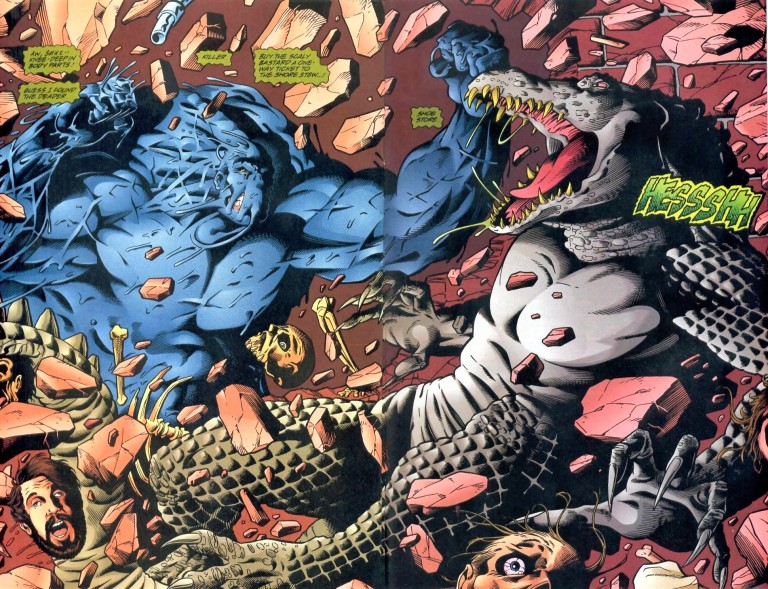
In keeping up with the superhero flavor of the Ultraverse, there is a good amount of spectacle here as it has a big battle between Sludge and the monstrous alligator which is nicely presented. This is a battle between monsters that was carefully structured and executed well.

Conclusion

A look at what happens behind the scenes at a city newspaper.

Sludge (1994) is both an intriguing and enjoyable read. The Gerber-Lopresti team succeeded in telling another Sludge tale that is fresh as it took inspiration from pop culture and society. At the same time, this comic book show that Sludge is clearly not the only monster in New York City’s sewers. As such, his place within the Ultraverse is really unique.

If you are seriously planning to buy an existing hard copy of Sludge (1994) be aware that as of this writing, MileHighComics.com shows that the near-mint copy of the regular edition costs $16 while the near-mint copy of the newsstand edition costs $48.

Overall, Sludge (1994) is recommended.

+++++

Thank you for reading. If you find this article engaging, please click the like button below and also please consider sharing this article to others. If you are looking for a copywriter to create content for your special project or business, check out my services and my portfolio. Feel free to contact me with a private message. Also please feel free to visit my Facebook page Author Carlo Carrasco and follow me on Twitter at  @HavenorFantasy as well as on Tumblr at https://carlocarrasco.tumblr.com/
A Look Back at Dazzler #21 (1982)

Disclaimer: This is my original work with details sourced from reading the comic book and doing personal research. Anyone who wants to use this article, in part or in whole, needs to secure first my permission and agree to cite me as the source and author. Let it be known that any unauthorized use of this article will constrain the author to pursue the remedies under R.A. No. 8293, the Revised Penal Code, and/or all applicable legal actions under the laws of the Philippines.

Welcome back superhero enthusiasts, 1980s culture enthusiasts and comic book collectors! Today we go back to the year 1982 to examine the Marvel Comics universe through the exploits of Dazzler!

While my most recent retro review of Dazzler was the 4th issue of its monthly series, I have decided to jump straight to issue #21 for this new retro review. By the time Dazzler #21 got published, the unusual superhero went through a lot and illustrator Frank Springer became fully established as the monthly series’ definitive artist.

With those details laid down, here is a look back Dazzler #21, published by Marvel Comics in 1982 with a story written by Danny Fingeroth and drawn by the late Frank Springer.

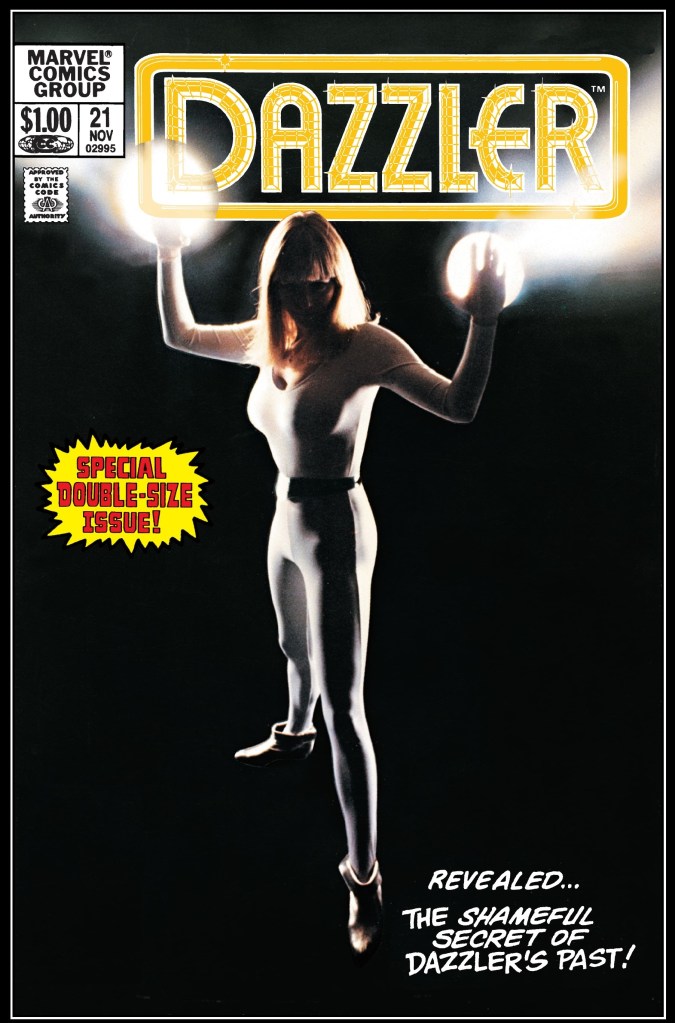
The cover.

Early story

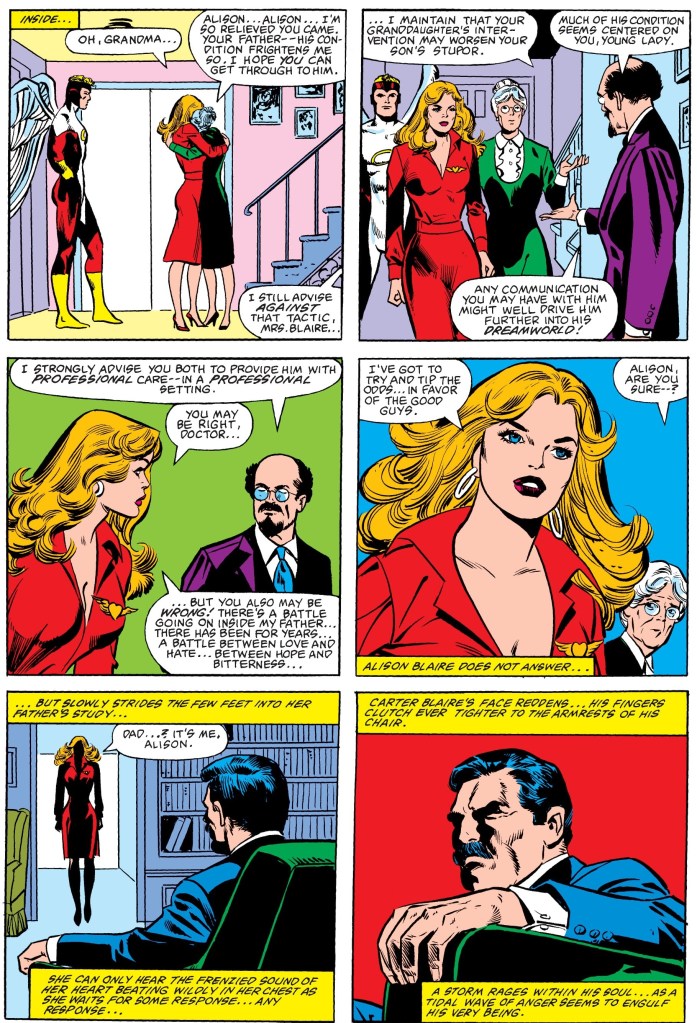
The story begins with Alison Blaire/Dazzler being carried above the buildings of New York City by Angel (Warren Worthington) of the X-Men. At this point in time, Alison’s father judge Carter Blaire snapped under the weight of turmoil related to the death of his wife and his daughter’s rebelliousness. As Dazzler, Alison had gone through intense encounters with the likes of the Incredible Hulk, She-Hulk, a top-secret syndicate that made her a test subject and even Galactus.

Recently, Bella – Alison’s grandmother – could not cope with her son’s breakdown and reached out to Warren Worthington to help her reach Alison. Since after being found, Alison had been traveling with Angel by air.

Along the way, Spider-Man sees them and recognizes Alison as Dazzler. He swings to try to get their attention but was ignored as they were so focused on their objective. A short time later, Angel and Alison arrive at judge Blaire’s home. Her grandmother greets them and tells her she hopes that she can get through to judge Blaire.

The doctor, however, advised against that tactic and states that Alison’s intervention may worsen her father’s condition as much of it was centered on her…

Quality

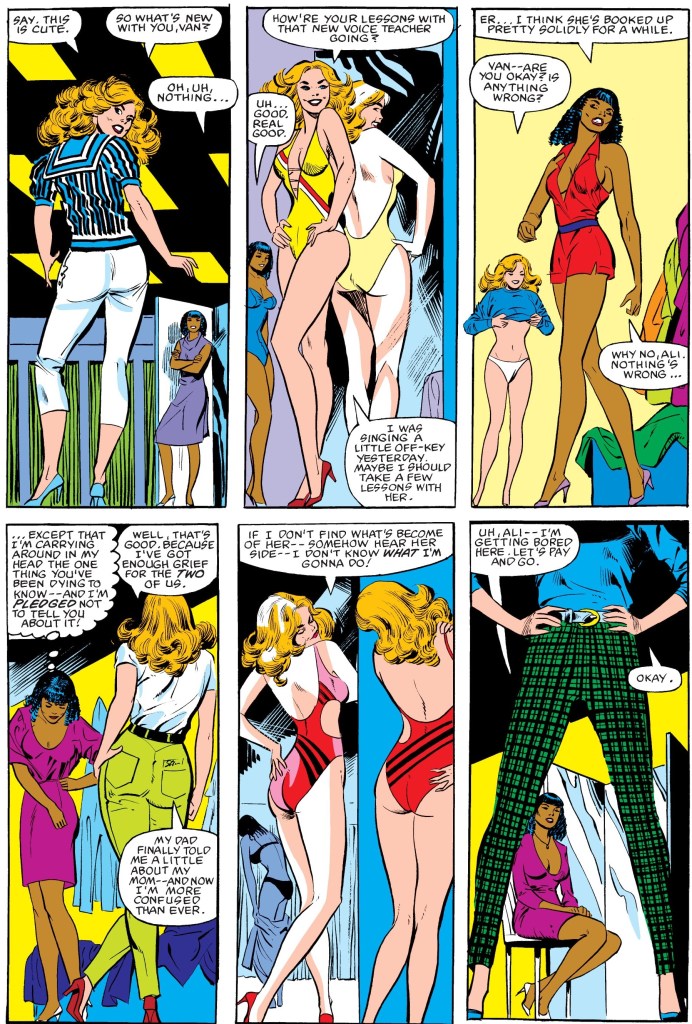
Alison Blaire and her friend Vanessa try out new clothes.

I’ll go straight to the point about what the story of this double-sized comic book is about without spoiling it. It is a pretty dramatic look at the protagonist in her civilian form as Alison Blaire. You will get to see her as Dazzler in this comic book but if you are looking for a lot of superhero moments of her or if you are looking for Dazzler in a conflict with evil elements, you won’t find it here.

More on the plot, this comic book explores deeply the emotional and personal dimensions of Alison and along the way, stories about her own past as well as the respect past events of both her father and mother got dramatized. The story tackles themes like independence, maturity, marriage, personal development, family ties and personal conflicts of interest. The good thing here is that the script by Danny Fingeroth is very well-written and it seems he did his research on constructing a personal story about Alison Blaire that is very grounded in reality. That being said, the superhero elements have been pushed aside most of the time and the ironic thing is the fact that the other Marvel superheroes – Spider-Man, Fantastic Four, The Avengers and more – appeared here as if to remind readers this is still a superhero tale.

Very clearly, this story was written for the very dedicated or even the die-hard Dazzler fans in mind. When it comes to the fun factor, the results could be mixed depending on what readers want to see in this comic book. For me personally, it is a pretty engaging story to read and at the same time it is fun enough as well.

Conclusion

Alison tries to help her troubled father.

Dazzler #21 (1982) could be barely received or strongly received or even rejected even though it has a very rich and dramatic script. The clear lack of the superhero presentation of Dazzler in favor of heavy drama and in-depth characterization may not win the approval of readers/collectors who love superhero stuff but it will resonate with the readers who really love the character and had immersed themselves into her life. As far as characterization goes, this comic book marks a significant turning point of Dazzler herself and in its story, she really developed a lot since making her first-ever appearance in Uncanny X-Men #130. If you are a Dazzler purist who does not mind the lack of superhero spectacle, this one could engage you.

If you are seriously planning to buy an existing hard copy of Dazzler #21 (1982), be aware that as of this writing, MileHighComics.com shows that the near-mint copy of the regular edition costs $28 while the near-mint copy of the newsstand edition costs $60.

Overall, Dazzler #21 (1982) is recommended.

+++++

Thank you for reading. If you find this article engaging, please click the like button below and also please consider sharing this article to others. If you are looking for a copywriter to create content for your special project or business, check out my services and my portfolio. Feel free to contact me with a private message. Also please feel free to visit my Facebook page Author Carlo Carrasco and follow me on Twitter at  @HavenorFantasy as well as on Tumblr at https://carlocarrasco.tumblr.com/
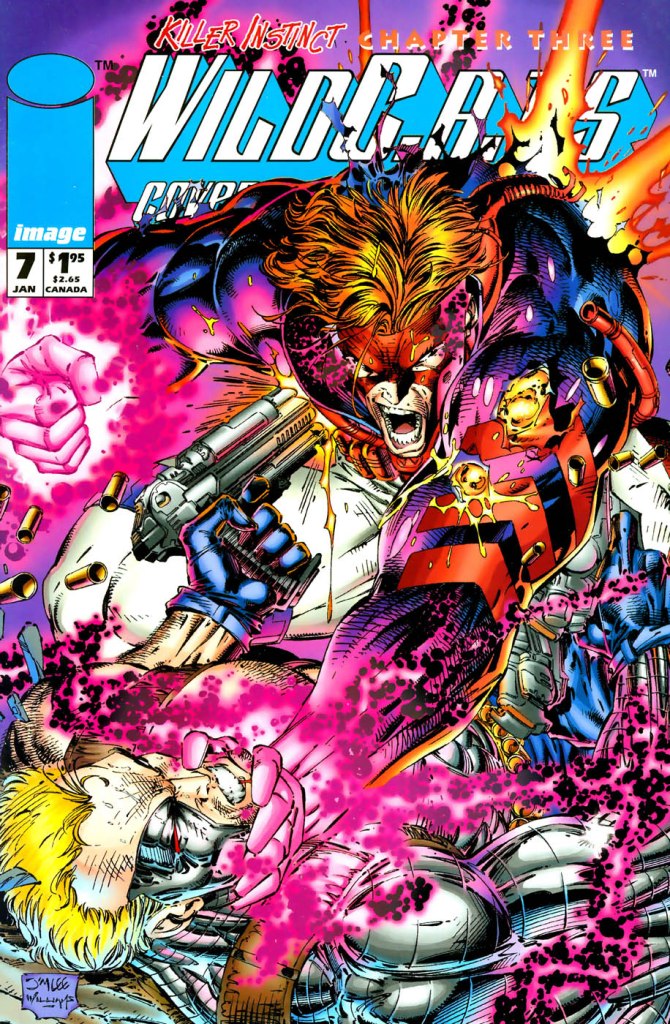
A Look Back at WildC.A.T.S: Covert Action Teams #7 (1994)

Disclaimer: This is my original work with details sourced from reading the comic book and doing personal research. Anyone who wants to use this article, in part or in whole, needs to secure first my permission and agree to cite me as the source and author. Let it be known that any unauthorized use of this article will constrain the author to pursue the remedies under R.A. No. 8293, the Revised Penal Code, and/or all applicable legal actions under the laws of the Philippines.

Welcome back superhero enthusiasts, 1990s culture enthusiasts and comic book collectors! Today we continue revisiting Jim Lee’s flagship title under the Image Comics label – WildC.A.T.S: Covert Action Teams!

While the 3rd and 4th issues of the WildC.A.T.S: Covert Action Teams mini-series had Lee’s superhero team crossing over with Rob Liefeld’s Youngblood, a bigger crossover was agreed upon with Image Comics co-founder Marc Silvestri – Killer Instict! This marked a creative collaboration between Lee and Silvestri resulting a multiple issue crossover between WildC.A.T.S and Cyber Force. For clarification, I already mentioned in my retro review of WildC.A.T.S: Covert Action Teams (1993) that its story was the first chapter of the 4-part Killer Instinct crossover. For your reference, Killer Instinct’s 2nd and 4 chapters were published as Cyber Force issues and of its regular series under Marc Silverstri. This WildC.A.T.S retro review is about the 3rd chapter of Killer Instinct.

With those details laid down, here is a look back WildC.A.T.S: Covert Action Teams , published by Image Comics in 1994 with a story written by Brandon Choi and Jim Lee. Lee did the art.

The cover.

Early story

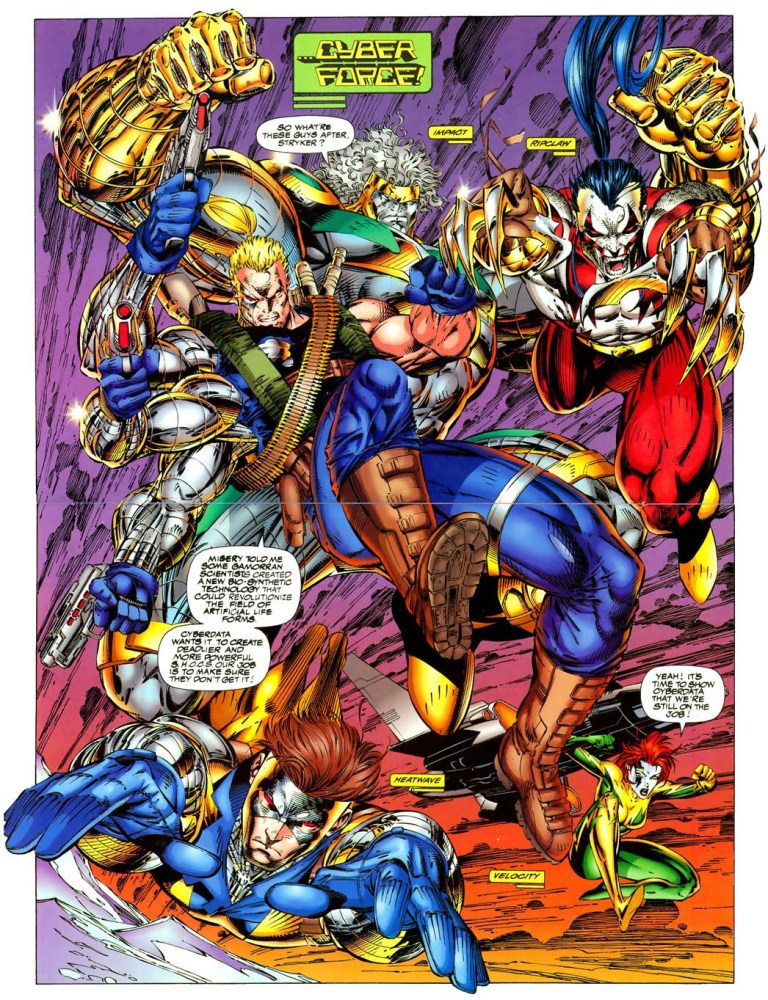
The story begins somewhere in the skies above Gamorra, off the coast of the Philippines! Stryker, the Cyber Force member with three cybernetic right arms, communicates with his teammates and tells them that if half of what Misery said is true about the new Cyberdata S.H.O.C.S., they’re in for a nasty fight and they have to hit the ground.

Stryker, Impact, Heatwave, Velocity and Ripclaw jump off their high-tech jet (which has Cyblade and Misery inside) and land safely. Using his enhanced ability of smell, Ripclaw begins detecting tracks of what they are look for.

Meanwhile at the back of the Isle of the Dead, a high-tech craft arrives with three passengers who are prepared to do a drug deal. Slowly, someone bleeding and with blades on his hands climbs into the craft surprising the passengers. He takes control of the craft, throws the passengers off and leaves.

As Cyber Force starts its ground search with Misery advising them while carefully using her telepathy on them. As Stryker enters a ravaged high-tech place, his sensors detect nothing and yet his instincts tell him something is present nearby. Standing near him is Spartan of WildC.A.T.S…

Quality

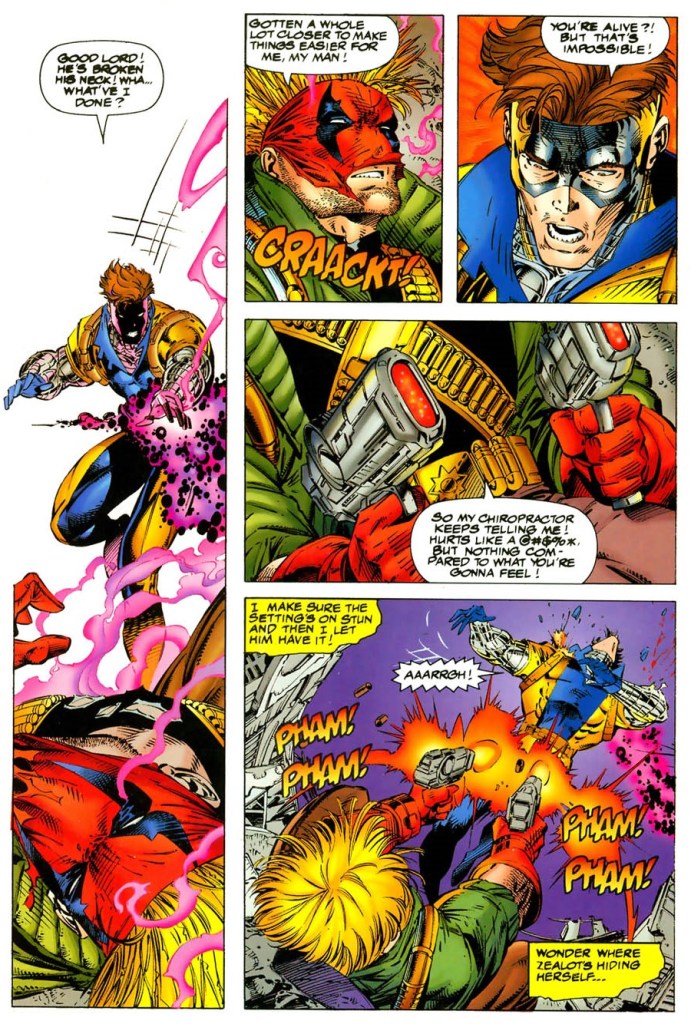
In this encounter between Grifter and Heatwave, do you notice something lacking visually?

I’ll start with the very obvious purpose of this comic book. After the build-up done in the first two chapters of the Killer Instinct storyline, this story serves as the start of what turned out to be the big pay-off as WildC.A.T.S and Cyber Force members finally got together with an action-packed battle to kick things off. From a storytelling view point, this one is mainly a WildC.A.T.S versus Cyber Force tale with really nice match-ups between their members such as Spartan-Stryker, Cyblade-Zealot and Maul-Impact to name a few. These match-ups and fights are excellently drawn by Jim Lee and I really enjoyed his own artistic visuals of Marc Silvestri’s Cyber Force.

More on the plot, it is pretty simple in concept and structure. The members of the two teams get to fight each other which gets the attention of Skywatch which itself has vested interest with the operations of Stormwatch (note: this is within the WildStorm lore) and the secret facility on that blew up (as seen in WildC.A.T.S ). Misery remains the key factor in the story and in this tale, she gets to guide and manipulate Cyber Force to find something valuable while Warblade remains mostly absent. Apart from the battles, the absent Voodoo, Void and Jacob Marlowe have their respective spotlights mainly for the character developments as well as reminding readers about the continuing Kherubim-Daemonite conflict.

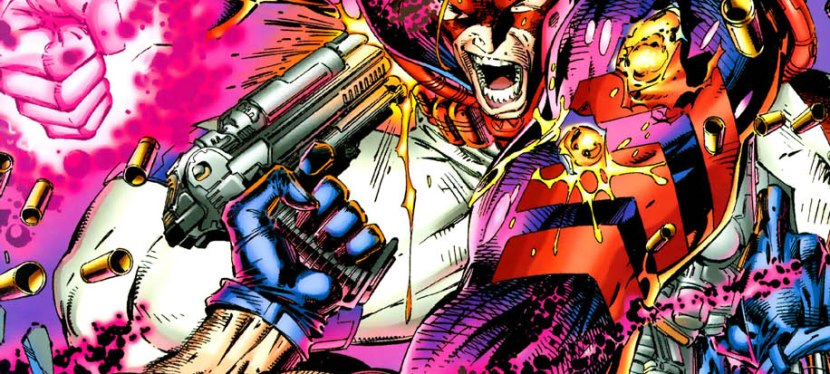
The quality of the writing is serviceable and the way I look at this comic book, it is mainly driven by spectacle and match-ups. The amount of crossover action is of top-notch quality (note: Jim Lee apparently missed out on key details while drawing Heatwave in a scene with Grifter) and clearly Jim Lee planned the visuals carefully. While there is little character development here, the ironic thing is that Misery (note: visually she is a wicked version of Jean Grey of the X-Men) is the one who gets a good chunk of the said development. Not only does she become a force in the minds of Cyber Force members, she also has her intimate moments with Ripclaw which is a reminder to readers that they have a shared past together (note: this will resonate more with those who read Cyber Force of the regular series).

Conclusion

This is how Cyber Force looks like as drawn by Jim Lee.

To make things clear, WildC.A.T.S: Covert Action Teams (1994) will strongly appeal to the respective fans of WildC.A.T.S and Cyber Force, to the readers who love high-quality superhero action, and to those who simply enjoy superhero crossover stories. While it is not a surprise that this comic book has great visuals, the writing this time clearly lacks depth and I really felt that the dialogue and text descriptions were done mainly to fit the obvious spectacle-led concept. If you are the kind of reader who wants storytelling and characterization prioritized in an action-packed crossover comic book, this one might not satisfy you. Ultimately, this one is a fun read even though the quality of the writing does not even come close to the quality of the visuals.  

If you are seriously planning to buy an existing hard copy of WildC.A.T.S: Covert Action Teams (1994), be aware that as of this writing, MileHighComics.com shows that the near-mint copy of the regular edition costs $30 while the near-mint copy of the newsstand edition costs $90. The near-mint copy of the silver cover edition costs $300.

Overall, WildC.A.T.S: Covert Action Teams (1994) is recommended.

+++++

Thank you for reading. If you find this article engaging, please click the like button below and also please consider sharing this article to others. If you are looking for a copywriter to create content for your special project or business, check out my services and my portfolio. Feel free to contact me with a private message. Also please feel free to visit my Facebook page Author Carlo Carrasco and follow me on Twitter at  @HavenorFantasy as well as on Tumblr at https://carlocarrasco.tumblr.com/