A Look Back at Superman #412 (1985)

Welcome back superhero enthusiasts, 20th century pop culture enthusiasts and comic book collectors! Today we go back to the mid-1980s to take a close look at one of the many tales published through the original Superman monthly series (first launched in 1939).

For the newcomers reading this, the original multiverse of DC Comics formally ended with Crisis on Infinite Earths (1985-1986). That being said, a lot of DC’s monthly comic book series had respective tales the reflect the closing period of the old multiverse (which lasted for decades) and the Superman monthly series of the era was part of the trend.

With those details laid down, here is a look back at Superman , published in 1985 by DC Comics with a story written by Cary Bates and drawn by Curt Swan.  
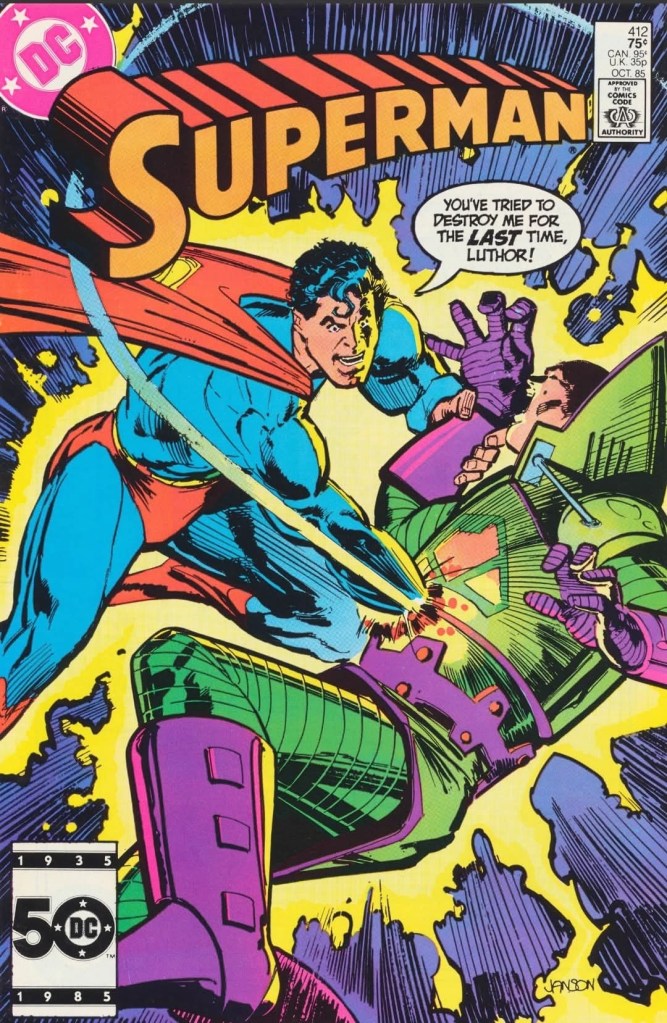
The cover.

Early story

The story begins at the unemployment bureau in Metropolis. Clark Kent, who recently lost his jobs with WGBS and the Daily Planet, stands in line and waits for his turn. Being unemployed, Clark feels troubled and other people nearby recognize him.

As his turn at the counter starts, Clark senses something and decides to get out quickly. He enters the emergency exit, changes into Superman and flies out of the building. It turns out a high-rise building accident has occurred and already several pieces of sharp glass have been falling down. To prevent further harm, Superman uses his heat vision to convert the falling glass and collectively turn them into a growing molten ball. He brings the giant molten ball to the top of the building (still in construction/expansion) and meets the hard-hat workers before flying away.

Elsewhere, Lana Lang announces news to TV viewers regarding the dismissal her of close friend Clark Kent which was the result of the fake headline news story about Superman and the NASA satellite. In another location, Lex Luthor is very pleased watching the same broadcast knowing his plan of ruining Superman succeeded and got Clark Kent as a fake news casualty. Luthor is not done with Superman yet…

Quality
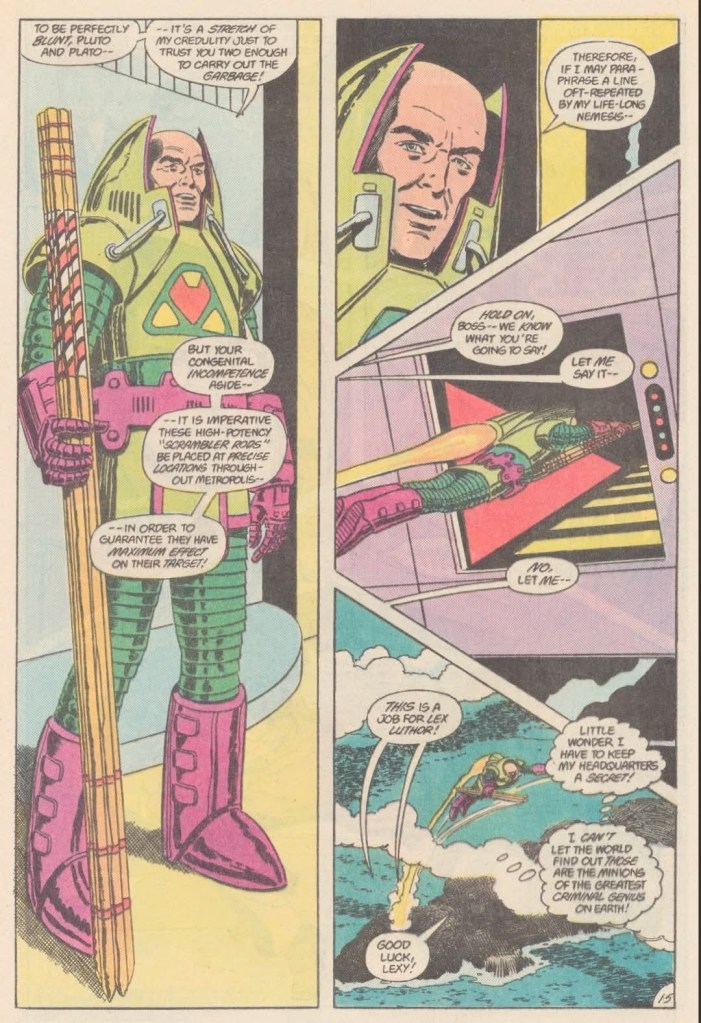
Lex Luthor here is ruthless, strategic and obsessed with defeating Superman.

I really like this Superman tale. This is a story about Superman who is still dedicated to doing acts of good by helping people with problems even though he is socially in deep trouble being unemployed as Clark Kent. Not only is the unemployment aspect relevant, the consequences of fake news and their negative effect on people made this tale more socially relevant with today’s world of fake news and unethical journalism.

Going back to Superman, it is clear that the embarrassment and unemployment of his civilian identity impacted him as a superhero. This is evident when Lana Lang accused him of betraying Clark Kent resulting in a fake news story that led to the firing by WGBS and the Daily Planet. Lana, who does not realize Superman and Clark are the same person, blamed the Man of Steel that the firing of Clark is so devastating to her as she cares for him so much (note: Clark and Lana were romantically involved during their teenage years at Smallville).  

The powerful writing by Cary Bates does not end there. In this comic book, you will see Lex Luthor execute his other plans to ruin Superman whom he personally accused over the loss of his family and his own world Lexor (click here and here for references). This is a Luthor who is not simply being evil but also someone who is well organized, strategic and even fearless. By this stage, the criminal mad scientist Luthor has accumulated a lot of resources to have his own headquarters, technologies and a dedicated staff. In some ways, Luthor in this comic book eerily resembled his financial tycoon version in the post-Crisis era (click here and here for relevance).

I should also state that the personal encounter between Superman and Luthor here is a great pay-off to the build-up that preceded it. You readers should see it for yourselves because to reveal more in this review will ruin it.

Conclusion
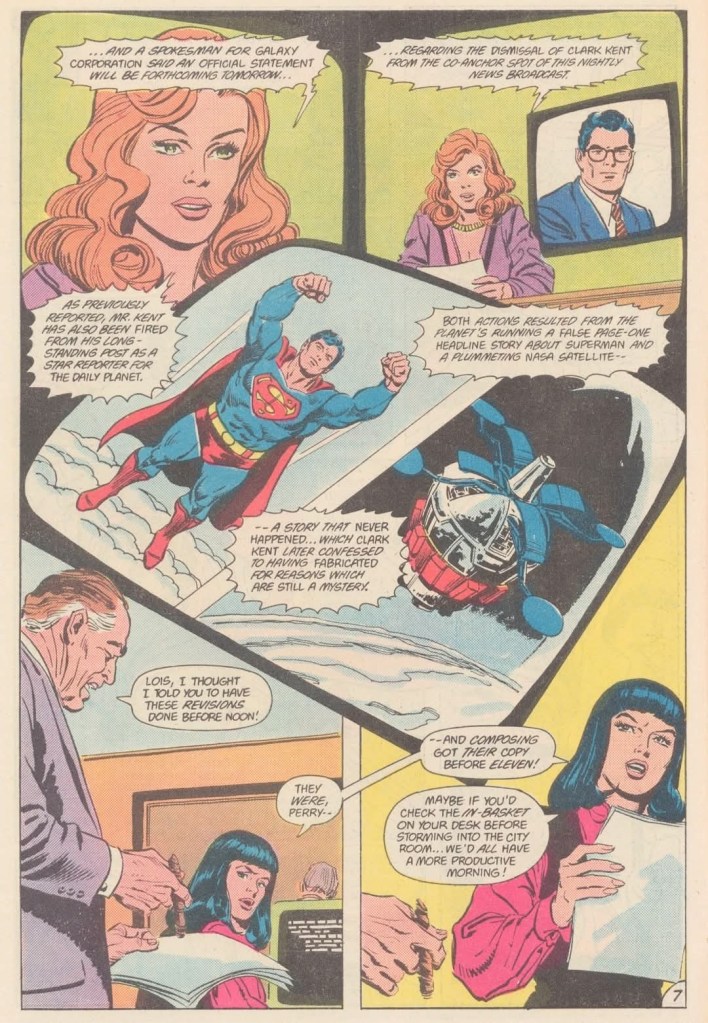
As Lana Lang delivers the news to TV viewers regarding Clark Kent and Superman, tension is brewing over at the Daily Planet.

Superman (1985) is undeniably a great Superman story published during the very late stage of the original multiverse (note: Superman #423 was one of the final tales of Superman of this particular era. Superman was part of the post-Crisis era). The portrayal of Superman being disturbed by the huge setback he suffered as a civilian is really compelling to see and his encounter with Lex Luthor really brought the tension and suspense to high levels. At the same time, the consequences of Superman’s actions (including those of his civilian form as Clark Kent) are very evident and nicely dramatized by the Bates-Swan team. You really feel that the creators were wrapping up their Superman stories and decided to move this series to a new direction knowing that the original multiverse will end. This is a must-read tale!

Overall, Superman (1985) is highly recommended.

+++++

Thank you for reading. If you find this article engaging, please click the like button below, share this article to others and also please consider making a donation to support my publishing. If you are looking for a copywriter to create content for your special project or business, check out my services and my portfolio. Feel free to contact me with a private message. Also please feel free to visit my Facebook page Author Carlo Carrasco and follow me on Twitter at  @HavenorFantasy as well as on Tumblr at https://carlocarrasco.tumblr.com/ and on Instagram at https://www.instagram.com/authorcarlocarrasco
A Look Back at Action Comics #436 (1974)

Welcome back superhero enthusiasts, 1970s arts and culture enthusiasts, DC Comics fans and comic book collectors! Today we go back to the year 1974 to take a close look at a part of the DC Comics universe through a tale of the Action Comics monthly series.

If you know the Superman lore in comics, you should be aware that Perry White (first appeared in 1940) is the editor-in-chief of the Daily Planet and is the superior of Clark Kent (Superman), Lois Lane and Jimmy Olsen. As Perry White got race-swapped (a woke move that’s also idiotic) and presented as a black man in Zack Snyder’s Man of Steel and James Gunn’s Superman (2025), be aware that the long-lasting character originated in the comics as a white man who symbolized dedication and management consistently. I still remember the live-action versions of Perry White played by Jackie Cooper in the 1978 movie and by Lane Smith in the TV series Lois & Clark: The New Adventures of Superman.

I read a lot of Superman comic books and many times Perry White appeared as a supporting character. He also appeared in the memorable crossover comic book Superman and Spider-Man, interacting with Peter Parker (Spider-Man). As a supporting character in Superman tales, Perry White occasionally provides journalistic direction or a challenge to Clark Kent who in turn tackles problems in his civilian identity or as Superman.

But what if Perry White overshadows Superman himself?

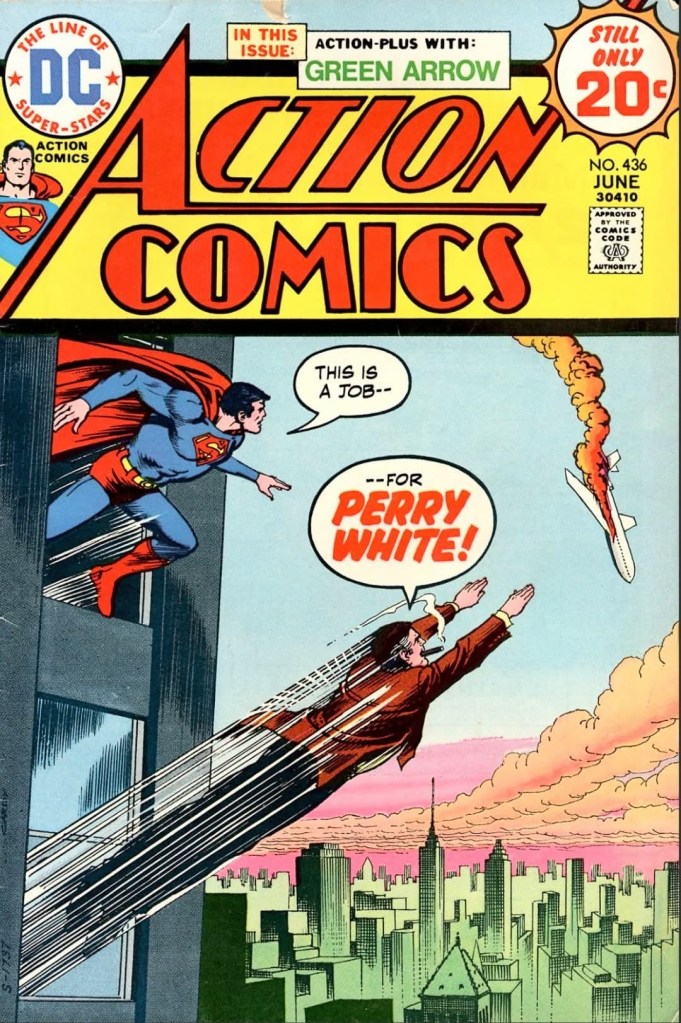
With those details laid down, here is a look back at Action Comics , published in 1974 by DC Comics with a story written by Elliot S. Maggin and drawn by Curt Swan.

The cover.

Early story

The story begins deep within Metropolis when the Daily Planet’s editor Perry White enters the Galaxy Building. White does not realize that he is being watched by two adults who turned out to have special abilities and together they levitated a gift for him before he reaches his office. The gift for Perry White was their response to the help he provided to them – the mutants – to escape the influence of Calixto sometime before. The two adults then vanished.

As White arrives in his office, Superman discreetly flies into the Galaxy Building and changed into his civilian form as Clark Kent. With his enhanced hearing, Kent heard the phone in his office ringing and quickly rushes to it. Through the phone, White (who was notified he won the Pulitzer Prize again) tells him that Edge Morgan has something big happening on both TV and on paper, and they should fly out to New York to work together…

Quality

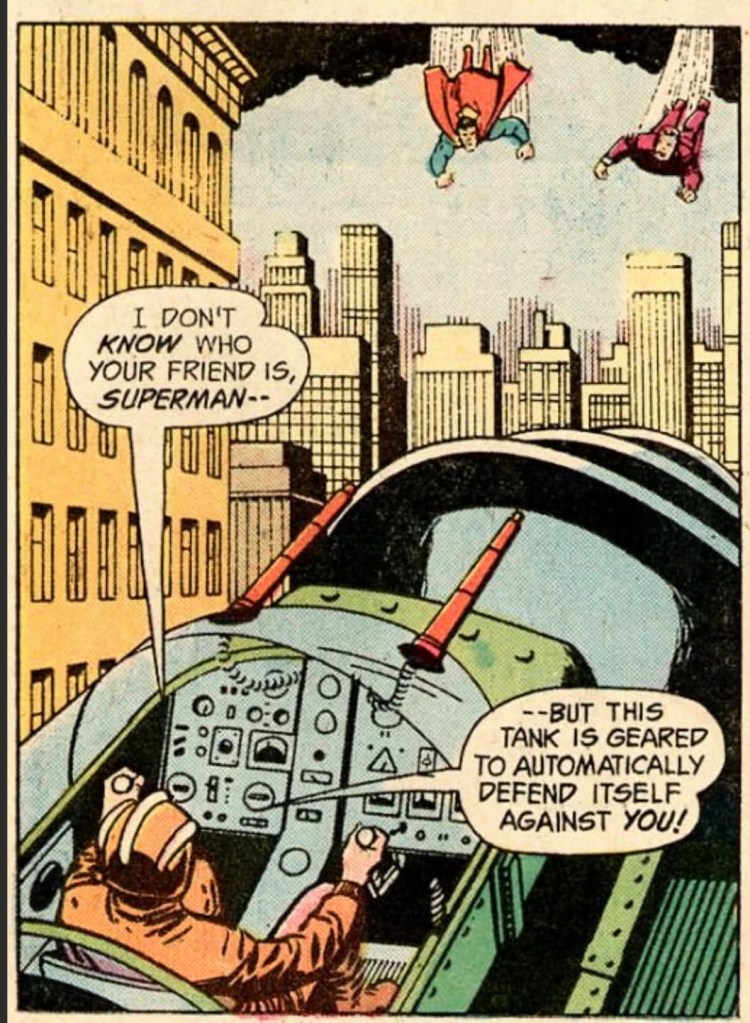
Superman and Perry White fly towards an enemy.

To get straight to the point, this Superman tale shows the wild concept of Perry White overshadowing the Man of Steel in terms of capabilities instead of journalistic power. On paper it sounds crazy but the good news is that the wild concept was told nicely and it is actually fun to follow without ever going over the top.

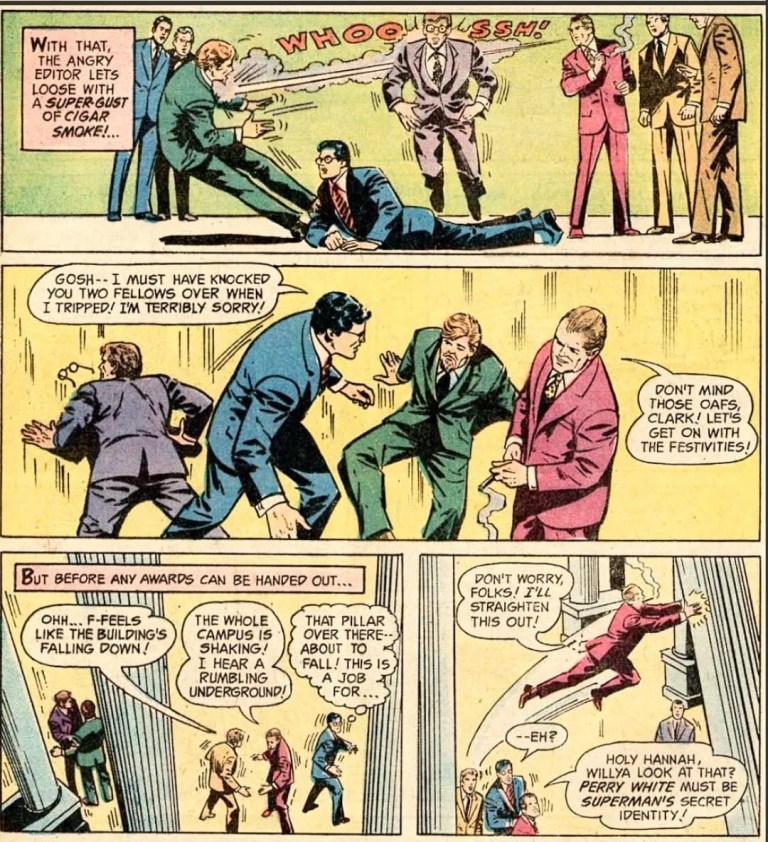
With witnesses around, Perry White uses his super powers.

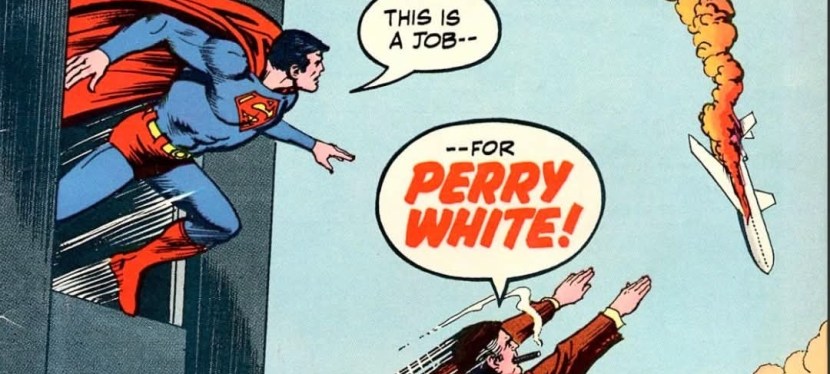
Apart from the story’s outlandish idea, the plot shows a new dimension of Perry White transforming from a supporting player (in the form of a newspaper editor) into a more heroic figure. Instead of being a helpless witness of events happening, White becomes more involved and contributes something to the prevention of disaster and even tackling evil head on. That being said, this situation allowed the creative duo to show a new side of White’s personality as he himself realizes the sudden weight and pressure that comes with having super powers, and he still has journalistic standards to live up to.

Conclusion

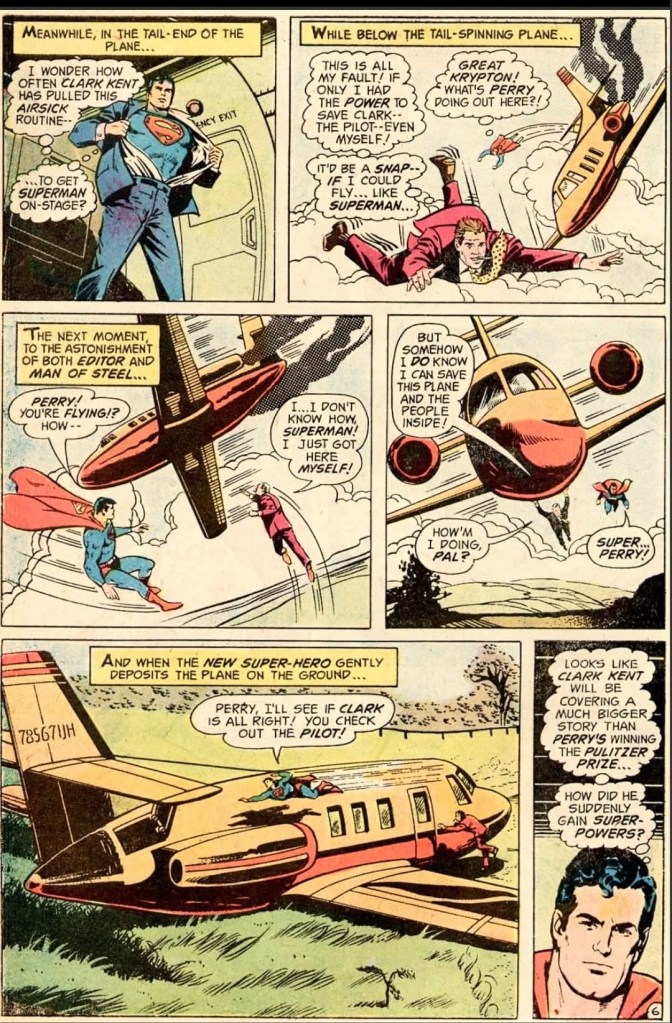
Superman is surprised to witness Perry White fly and prevent a small plane from crashing.

A product of its time, Action Comics (1974) has a short story that had a zany concept which turned out to be an entertaining read. It is nice to see Perry White actually becoming super while the storytelling done by the Maggin-Swan team never became too outlandish. Think of this comic book – which also has a short story of Green Arrow – as a bout of fun focused on Superman and Perry White. I first read this comic book as a young boy and now as an adult, it is still enjoyable to read again. No woke garbage and no Zack Snyder-style darkness here. This is classic Superman.

Overall, Action Comics (1974) is recommended.

+++++

Thank you for reading. If you find this article engaging, please click the like button below, share this article to others and also please consider making a donation to support my publishing. If you are looking for a copywriter to create content for your special project or business, check out my services and my portfolio. Feel free to contact me with a private message. Also please feel free to visit my Facebook page Author Carlo Carrasco and follow me on Twitter at  @HavenorFantasy as well as on Tumblr at https://carlocarrasco.tumblr.com/ and on Instagram at https://www.instagram.com/authorcarlocarrasco
A Look Back at Superman #77 (1993)

Disclaimer: This is my original work with details sourced from reading the comic book and doing personal research. Anyone who wants to use this article, in part or in whole, needs to secure first my permission and agree to cite me as the source and author. Let it be known that any unauthorized use of this article will constrain the author to pursue the remedies under R.A. No. 8293, the Revised Penal Code, and/or all applicable legal actions under the laws of the Philippines.

Welcome back, superheo enthusiasts, 1990s culture enthusiasts, DC Comics fans and comic book collectors! Today we revisit the post-death period of post-Crisis era Superman comic books as published in the early 1990s by DC Comics. Specifically, this is about a tale that took placed between Superman (1993) and the hyped return of the American icon in Adventures of Superman #500 (1993).

What you are about to see is a mix of drama and intrigue that took place sometime after Superman’s death as envisioned by Dan Jurgens. As with other post-death comics of the time, the supporting characters connected to Superman as well as his arch enemy Lex Luthor got their fair share of the spotlight.

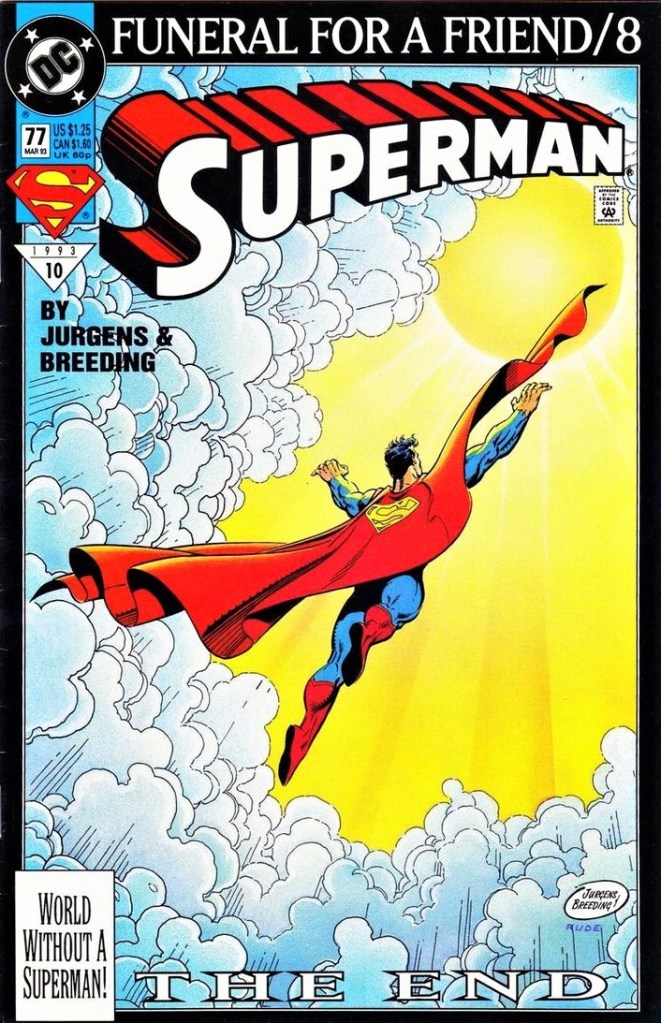
With those details laid down, here is a look back at Superman #77, published by DC Comics in 1993 with a story written and drawn by Dan Jurgens. This is part 8 of the Funeral for a Friend storyline.

The cover.

Early story

The story begins with the red-headed Lex Luthor (note: in a new physical body totally different from his previous one) in the middle of a combat session. Even though his hatred towards Superman drives him, he could not help but allow his recall of the past to distract him enough to allow one of combatants to strike him down. As Luthor recovers, the session gets interrupted when Supergirl (a clone) appears with Lois Lane beside her.

Lane shares to him a hard copy of a column that she made before it got trimmed down by the editorial team of the Daily Planet. With so much hate in him, Luthor reacts madly to the article which reveals that Superman’s dead body has been taken away by Project Cadmus. Lois tells him that they intend to cut the Man of Steel’s body for cloning.

Luthor then says he will work to get Superman back where he belongs and put Cadmus in its place for good. Moments after, as she walks away from Luthor’s building, Lois Lane expresses concern about how Martha and Jonathan Kent would react had they learned that their adopted son’s body was taken away…

Quality

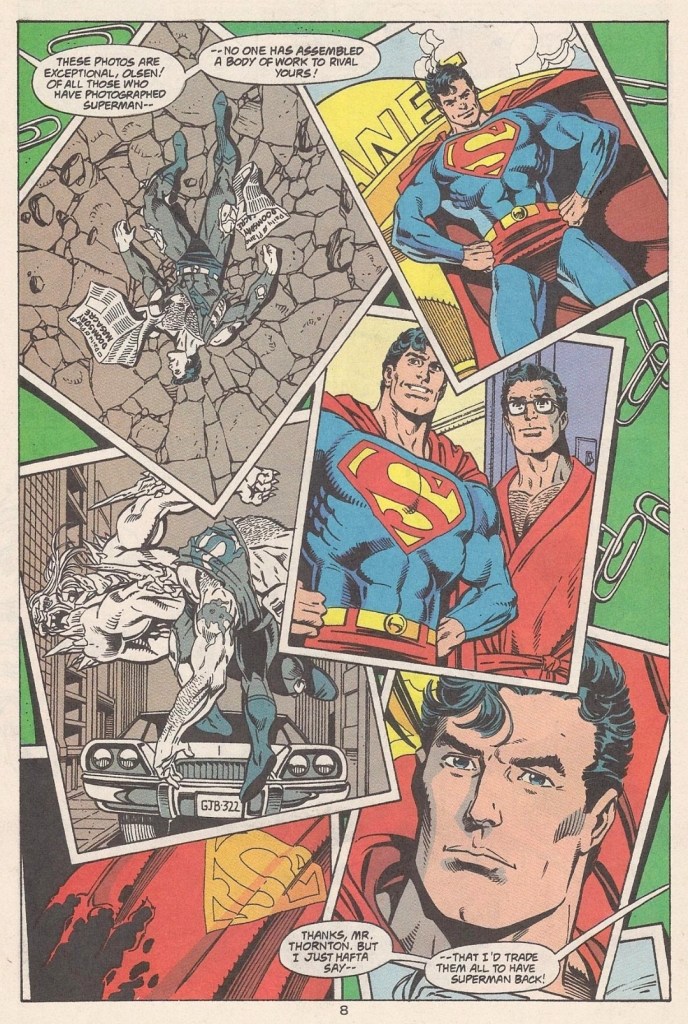
Several photographs of Superman taken by Jimmy Olsen.

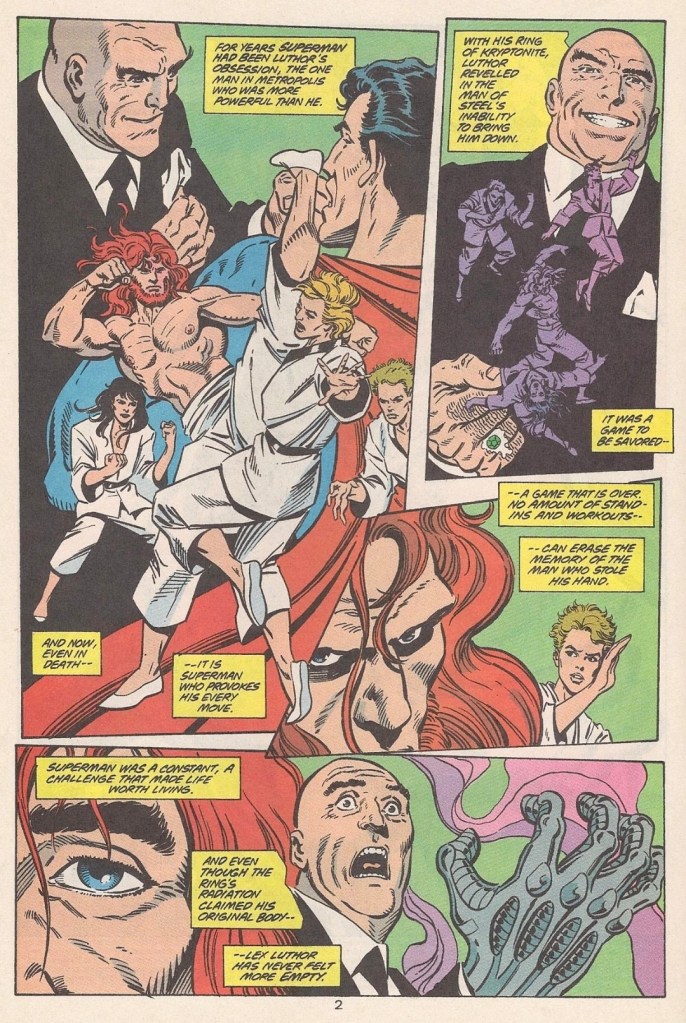
I am happy to say that Dan Jurgens crafted a really solid story in this comic book. Character development is easily the biggest feature here which is very notable on how Jurgens highlighted Lois Lane, Lex Luthor and Jimmy Olsen. Each of them had their own moments – Luthor’s obsession and hatred of Superman here will encourage you to revisit the early post-Crisis encounters between them; Lois Lane meanwhile struggles to move on as she misses Clark a lot (note: they were engaged to get married) while also trying to hard to find his missing body; Jimmy Olsen gets the big opportunity to play a major role on deciding the cover image for a printed media tribute of Superman while feeling really down as a result of the sudden death. Jurgens not only crafted the plot structure carefully, he also wrote down very rich dialogue all throughout and he cleverly used dreams and day dream sequences as exposition to give readers notable visions of the past. This is a very compelling read.

Conclusion

Visions of Lex Luthor’s past accompanying his modern day self shows cleverness and efficiency on the part of Dan Jurgens.

Superman #77 (1993) really is a great read thanks to Dan Jurgens delivering high-quality work. At this particular stage of DC Comics’ publishing history, Jurgens not only really knew Superman but he knew how to emphasize the supporting characters (all of which were impacted by the death in Superman ) and what direction to take the Funeral for a Friend storyline to. If there is anything that negatively affects the impact of this comic book, it is the dishonesty and betrayal (towards the fans) that came within Adventures of Superman (1993).

Overall, Superman #77 (1993) is recommended.

+++++

Thank you for reading. If you find this article engaging, please click the like button below and also please consider sharing this article to others. If you are looking for a copywriter to create content for your special project or business, check out my services and my portfolio. If you want to support my website, please consider making a donation. Feel free to contact me with a private message. Also please feel free to visit my Facebook page Author Carlo Carrasco and follow me on Twitter at  @HavenorFantasy as well as on Tumblr at https://carlocarrasco.tumblr.com/ and on Instagram at https://www.instagram.com/authorcarlocarrasco/.

A Look Back at Adventures of Superman #500 (1993)

Disclaimer: This is my original work with details sourced from reading the comic book and doing personal research. Anyone who wants to use this article, in part or in whole, needs to secure first my permission and agree to cite me as the source and author. Let it be known that any unauthorized use of this article will constrain the author to pursue the remedies under R.A. No. 8293, the Revised Penal Code, and/or all applicable legal actions under the laws of the Philippines.

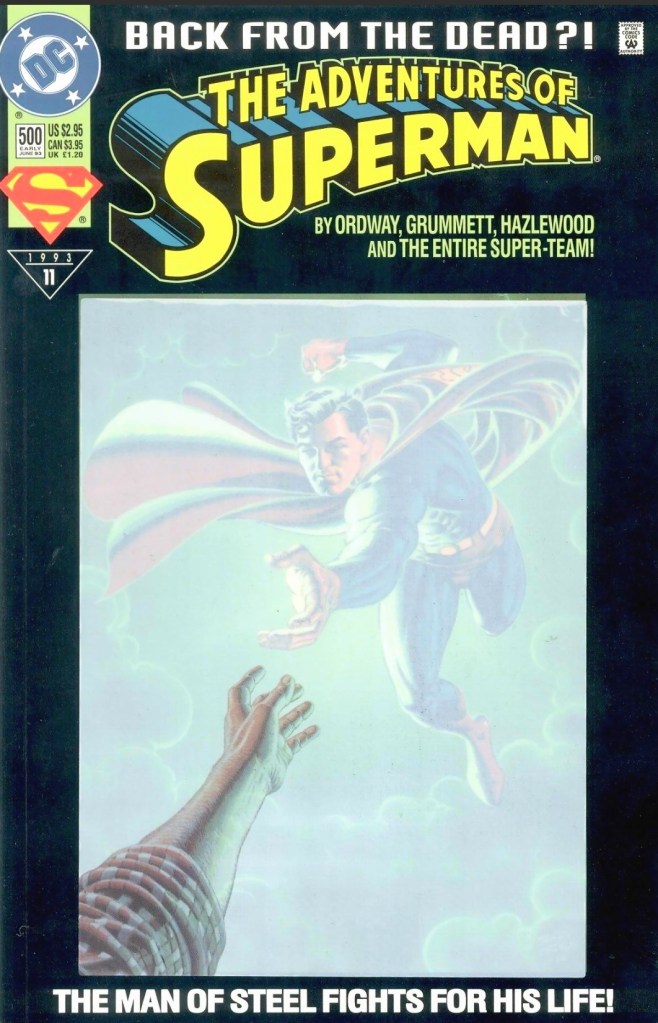
Welcome back superhero enthusiasts and comic book collectors! Today we explore a key chapter in the post-Crisis era of DC Comics through a Superman comic book. This time, however, we go revisit a comic book that literally served as a bridge between the Funeral for a Friend storyline and the eventual Reign of the Superman storyline. I am talking about the 500th issue of the Adventures of Superman monthly series.

To put things in perspective, the Funeral for a Friend storyline dramatized the immediate aftermath of Superman’s sudden death which paved the way for comic book creators to develop not only DC superheroes (affiliated with Superman specifically) but also the supporting characters linked with the Man of Steel in new and creative ways. Not only that, there was even a months-long hiatus on all Superman-related comics before Adventures of Superman was released. Back in the old days when Internet connection and online news were not yet common, I heard lots of buzz about DC resurrecting Superman from the dead which added to the anticipation of the 500th issue of Adventures of Superman.

With those details laid down, here is a look back at Adventures of Superman , published in 1993 by DC Comics with a story written by Jerry Ordway and drawn by Tom Grummett.

The cover of the premium version of this comic book.

Early story

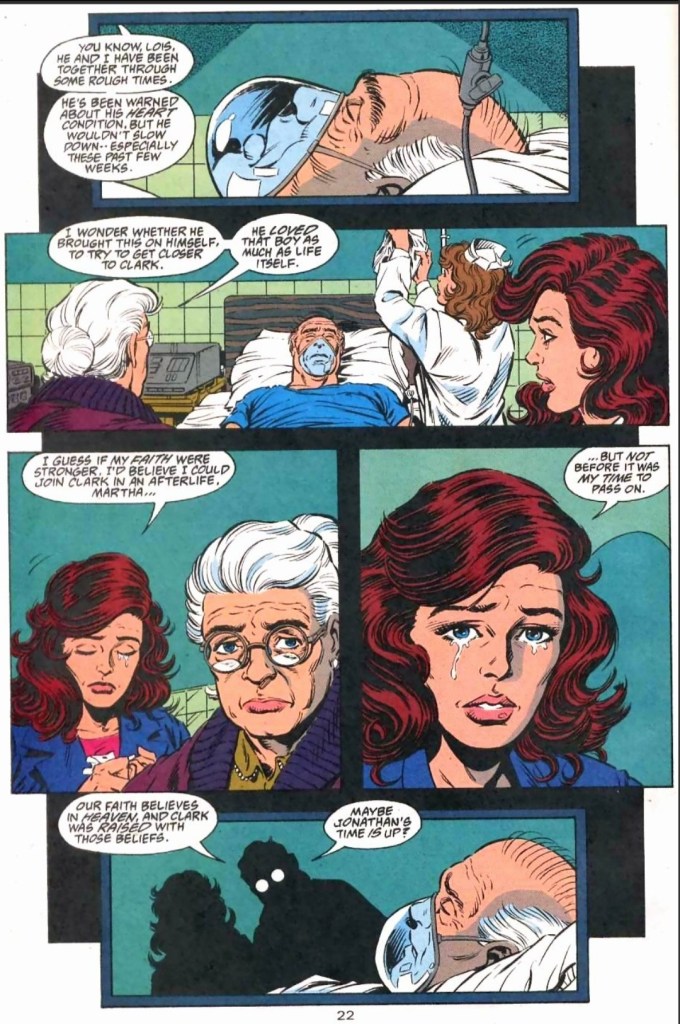
The story begins inside a Kansas hospital where medical professionals are trying to revive Jonathan Kent who lost consciousness. Martha Kent is present witnessing the efforts happen. As his physical body is being worked on, Jonathan Kent finds himself in a dream-like realm and to his shock, he meets his dead son Clark who finds himself being pulled into the bright light in the distance. Refusing to let go, Jonathan Kent accidentally tears off Clark’s clothes which reveal him as Superman in his iconic outfit. Superman tells his adoptive father to rejoin the living.

Suddenly two wraiths appeared and escorted Superman into the light. Still defiant, Jonathan then flies himself into the light to follow his son.

Back in the real world, Martha carefully monitors her husband’s health reading. After being assured by the medical staff that they won’t give up on her husband, Martha is surprised to see Lois Lane who arrived all the way from Metropolis…

Quality

Lois Lane with Martha Kent and the recovering Jonathan Kent.

Let me get straight to the point about this Superman story…this is a very dramatized approach on bringing back Superman from the dead without necessarily going all-out. As we comic book geeks know by now, the Reign of the Superman events launched with this comic book serving as a launch pad and that meant that people had to go through many comic books before finally getting to see Superman himself in resurrected form.

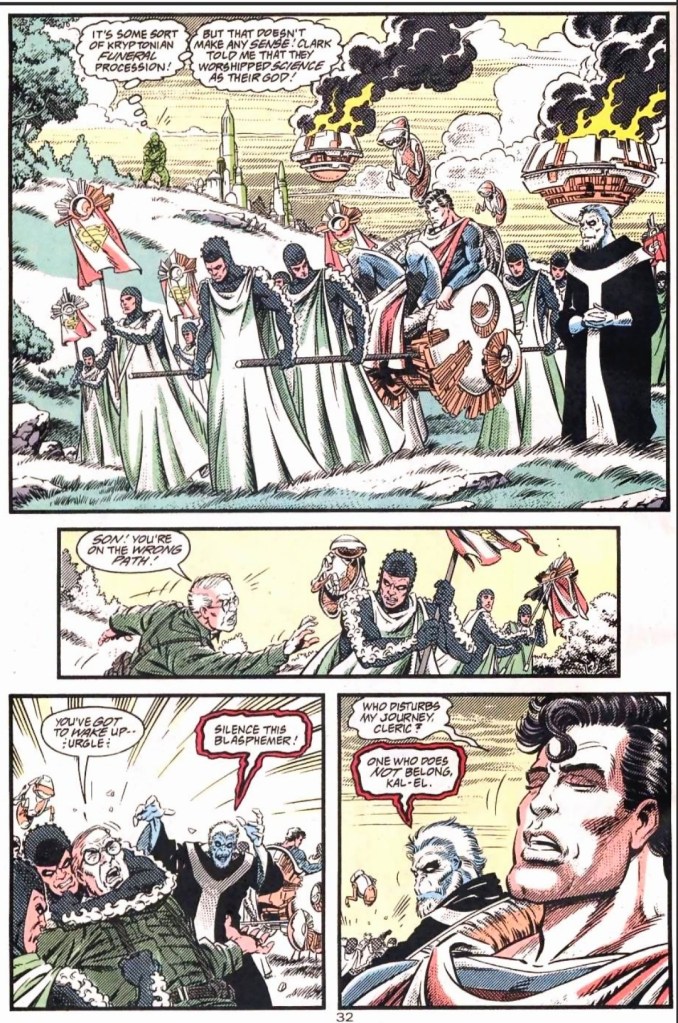
More on the story itself, the main feature here is Jonathan Kent’s struggle to follow Superman in the dream-like realm (note: DC’s version of the afterlife which is clearly not spiritual) as he was motivated by his love for him as well as his belief that the world still needs the Man of Steel as their beacon of hope. To be very clear, Jerry Ordway and Tom Grummet nicely executed their presentation of Jonathan Kent and his uncompromising effort to get his son back. The creative team’s imagination really was set into high gear which resulted in Jonathan revisiting a familiar place from his old days as a soldier, getting himself into a lair of demons, flying deep into space and visiting the realm’s own version of Krypton. Very truly, this comic book’s protagonist is Jonathan Kent and the iconic Superman was more of a supporting figure.    

While the Jonathan Kent tale is good to read, Superman’s return from the dead here ended up more as a teaser of things to come (note: the Reign of the Supermen). Considering the big promise that came with this comic book, it is indeed a disappointing pay-off towards all the build-up. Not only that, the side stories are a mixed back. The respective scenes of Lois Lane and Jimmy Olsen added weight to the narrative while the scenes of Gangbuster were pointless and looked more like hollow script filler. As for Cat Grant’s scene, it was designed to make readers feel sorry for her.

As for the scenes – each done by different creative teams – showing the new Superboy, the Eradicator, the black Man of Steel and the Cyborg Superman, these revelations really did not work to recover from the disappointing conclusion of the main story. They were more like creative distractions designed to promote what was coming in the other Superman monthly series of the time.

Conclusion

In the dreamy realm, Jonathan Kent pursues his adopted son Superman who gets treated like a living idol. The father-and-son dynamic is the most entertaining part of this tale.

Even back in the old days, Adventures of Superman (1993) was a disappointing read and it was a highly dramatized effort by DC Comics cautiously expressing that Superman’s death was nothing more than a highly deceptive publicity stunt with Dollar signs in mind.

Within the context of this comic book, the resurrection of Superman was essentially a half-step and his eventual full return in comics did not happen until months later (note: after many Reign of the Supermen stories were published). More on the resurrection aspect of this comic book, I can clearly say that Superman – no matter how iconic he is and no matter what comic book creators tried – will never ever become a beacon of hope nor a true savior for people in real life. It really does not matter that many people bought copies of Superman (the death) believing truly that they would witness the end of the American icon and witness a Superman-less future. What mattered here were the deception and the irresponsible use of a pop culture icon committed by DC Comics. Superman (1993) was the gigantic deception that sold millions while Adventures of Superman (1993) was the big follow-up deception.

The resurrection of Superman in this story does NOT make him a more significant DC Comics icon at all. I know that there are die-hard fans out there who love to compare the Man of Steel with Jesus Christ but such comparisons and forced attempts to link them together are pathetic and worthless. Superman is not real and even if he was, he could never overcome death nor could he save people. The resurrection of Lord Jesus can never be matched and only He saved people and led them to salvation in the presence of His Father, the Lord God.

By today’s standard, this comic book is much more disappointing and even worth less as a piece of American comic book history. While the work done by the Ordway-Grummett team here was not really terrible, it was the dishonesty and deception of DC Comics that led to this. In fairness to the creators, bringing back Superman after all the hype and belief invested related to his death was indeed a major obstacle for them. You could feel sorry for Ordway-Grummett.

Overall, Adventures of Superman (1993) should be avoided. If you really want to read it, try borrowing a copy. Just don’t spend anything on it.

+++++

Thank you for reading. If you find this article engaging, please click the like button below, share this article to others and also please consider making a donation to support my publishing. If you are looking for a copywriter to create content for your special project or business, check out my services and my portfolio. Feel free to contact me with a private message. Also please feel free to visit my Facebook page Author Carlo Carrasco and follow me on Twitter at  @HavenorFantasy as well as on Tumblr at https://carlocarrasco.tumblr.com/ and on Instagram at https://www.instagram.com/authorcarlocarrasco
A Look Back at Superman: The Man of Steel #20 (1993)

Disclaimer: This is my original work with details sourced from reading the comic book and doing personal research. Anyone who wants to use this article, in part or in whole, needs to secure first my permission and agree to cite me as the source and author. Let it be known that any unauthorized use of this article will constrain the author to pursue the remedies under R.A. No. 8293, the Revised Penal Code, and/or all applicable legal actions under the laws of the Philippines.

Welcome back superhero enthusiasts, 1990s culture enthusiasts and comic book collectors! Today we go back to the early 1990s and explore a key chapter in the post-Crisis era of DC Comics through a Superman comic book.

Previously, I reviewed Adventures of Superman #498 (1993) which marked the first chapter of the Funeral for a Friend storyline and dramatized the impact left behind by the death of Superman. That particular comic book had strong writing and succeeded in dramatizing how Superman’s friends, associates and other characters coped with his death with the future looking uncertain to them.

With those details laid down, here is a look back at Superman: The Man of Steel , published in 1993 by DC Comics with a story written by Louise Simonson and drawn by Jon Bogdanove. This comic book marked the third chapter of the Funeral for a Friend storyline.

The cover.

Early story

The story begins with people in Metropolis struggling to move forward not only because their hero Superman died but also because of the tremendous damage left behind by Doomsday. In his headquarters, Lex Luthor is talking with the telephone surrounded by several people with Supergirl watching. The matter being discussed was the burial of Superman at Centennial Park particularly in a structure Luthor himself donated. While he has to live on with the fact that he failed to kill Superman, Luthor tells himself he can still bury him.

At the Kent farm far away from Metropolis, Jonathan and Martha Kent are agonizing not only because of the death of their beloved son but also because they realized they cannot even get near him at his funeral as it will be organized as a major event with only the important people allowed to attend…

Quality

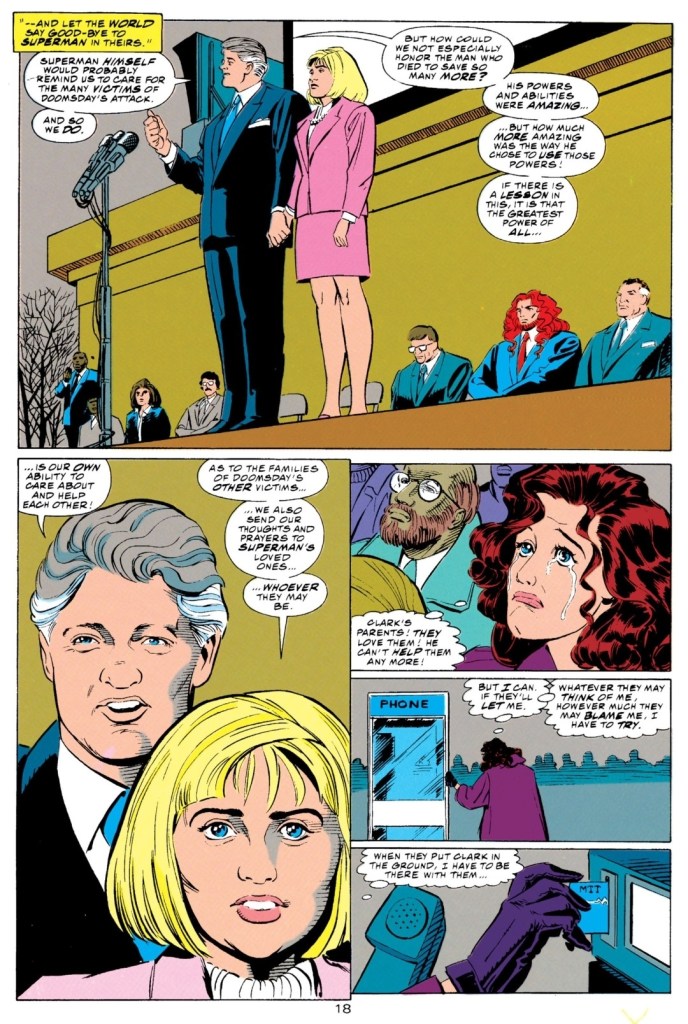
It seems like destiny to have the super villain Lex Luthor in the presence of a fictionalized Bill Clinton and Hillary Clinton during the funeral of Superman. By today’s standards, the Clintons made it normal for America to bow to terrorists and make deals with them. That being said, their inclusion in this comic book is just wrong.

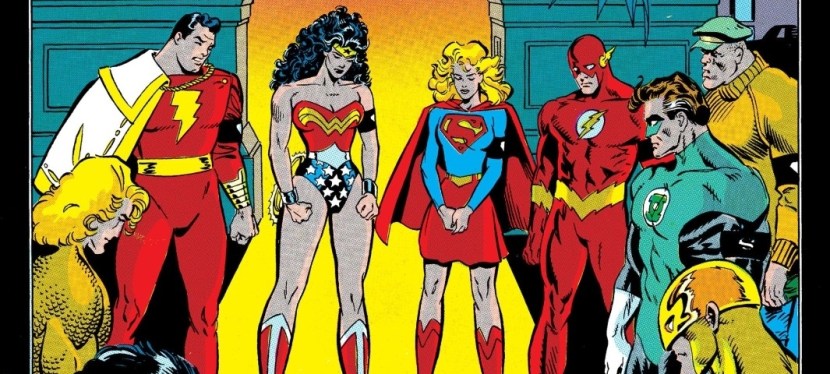
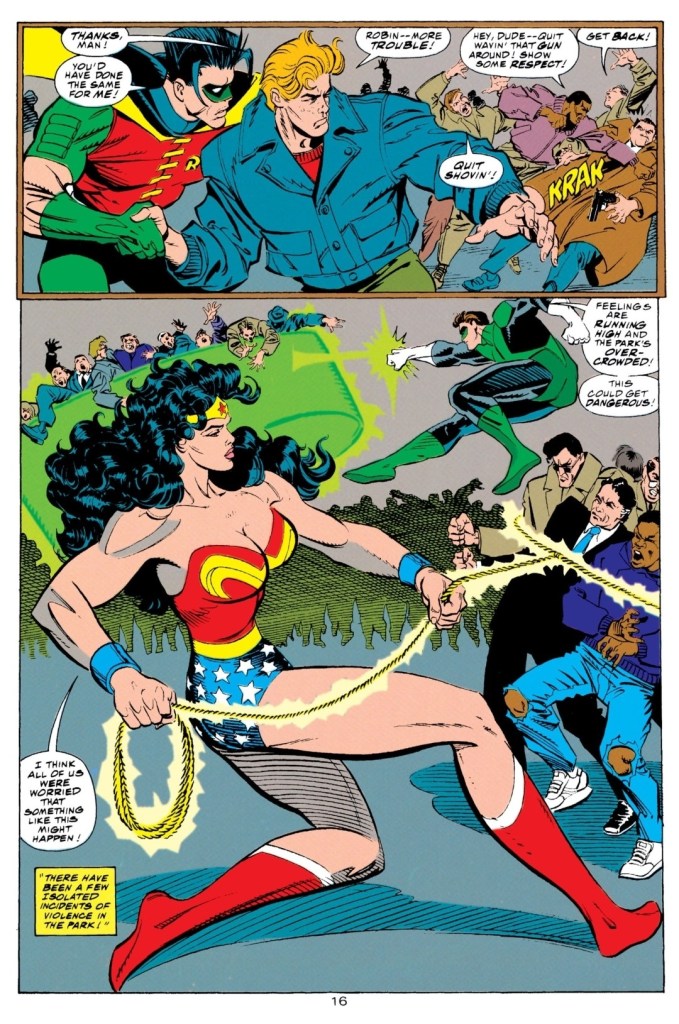
To go straight to the point, like Adventures of Superman (1993), this comic book continues to dramatize the impact of Superman’s death on Metropolis and its people in a very engaging manner. It shows that DC’s creative teams in charge of Superman comic book at the time were really organized and coordinated with each other on crafting the Funeral for a Friend storyline. What makes this comic book stand out is the funeral itself which was organized as a public event (with the burial itself done in the presence of important people – including a very evil couple from the Democrats who love abortion and terrorism) and this includes the presence of many other DC Comics superheroes like Wonder Woman, Green Lantern, The Flash, Maxima, Shazam (AKA Captain Marvel) and others. The burial had its own share of intriguing and dramatic moments emphasizing the people’s struggle to adjust themselves knowing they don’t have Superman anymore to help them.

Wonder Woman, Green Lantern and Robin help out as the huge crowd became rowdy.

More on the post-death dramatization, the creative team managed to keep Superman’s associates Lois Lane, Jimmy Olsen and the other Daily Planet people feeling uneasy over the Man of Steel’s death which makes their work covering the funeral professionally a challenge. Unsurprisingly, Lois Lane gets her own fine share of the spotlight agonizing over the fact that she lost her beloved Clark (Superman to the public) whom she was supposed to get married with. The emotional struggle within her intensified as she experiences difficulty of informing the elderly Kent couple about what happened. This is rich writing prepared by the creators.

Not only that, the creative team also went all-out with dramatizing the impact of Superman’s good deeds on the people. You will see several people from Metropolis’ general population talk about how Superman helped them or inspired them. There are certain lines of dialogue that are quite touching to read.

Conclusion

A pretty powerful portrayal of Lois Lane’s struggle on dealing with the new reality that she lost her beloved Superman.

Superman: The Man of Steel (1993) is another solid, post-death story emphasizing the new normal that Metropolis people and Superman’s friends are having difficulty adjusting to…a world without the Man of Steel. Based on the high quality of the storytelling and character development, it is easy to tell that the Superman titles’ creative teams planned ahead and prepared themselves for telling a post-death saga which was pretty risky given the iconic status of Superman and his decades-long legacy in comics and pop culture. This comic book really made Superman’s absence feel powerful and undeniable.

Overall, Superman: The Man of Steel (1993) is recommended.

+++++

Thank you for reading. If you find this article engaging, please click the like button below, share this article to others and also please consider making a donation to support my publishing. If you are looking for a copywriter to create content for your special project or business, check out my services and my portfolio. Feel free to contact me with a private message. Also please feel free to visit my Facebook page Author Carlo Carrasco and follow me on Twitter at  @HavenorFantasy as well as on Tumblr at https://carlocarrasco.tumblr.com/ and on Instagram at https://www.instagram.com/authorcarlocarrasco
A Look Back at Adventures of Superman #498 (1993)

Disclaimer: This is my original work with details sourced from reading the comic book and doing personal research. Anyone who wants to use this article, in part or in whole, needs to secure first my permission and agree to cite me as the source and author. Let it be known that any unauthorized use of this article will constrain the author to pursue the remedies under R.A. No. 8293, the Revised Penal Code, and/or all applicable legal actions under the laws of the Philippines.

Welcome back superhero enthusiasts, 1990s culture enthusiasts and comic book collectors! Today we go back to the early 1990s and explore a key chapter in the post-Crisis era of DC Comics through a Superman comic book.

To put things in perspective, the Death of Superman which climaxed in Superman (1993) was a major comic book event published by DC Comics and it sure involved a whole lot of risks taken by the creative teams. To put the storyline’s concept short, Superman was beaten by an overwhelming, deformed alien humanoid from outer space who caused massive destruction around. Having no real choice and knowing that his fellow super-powered allies could not stand a chance against the alien called Doomsday, Superman went all-in fighting and stood up against him while defending Metropolis and its people. Superman went on to sell many millions of copies and became an instant collector’s item.

Of course, just because Superman died does not mean that the shared DC universe at that time would come to an end and DC Comics had to keep on telling what happened afterwards.

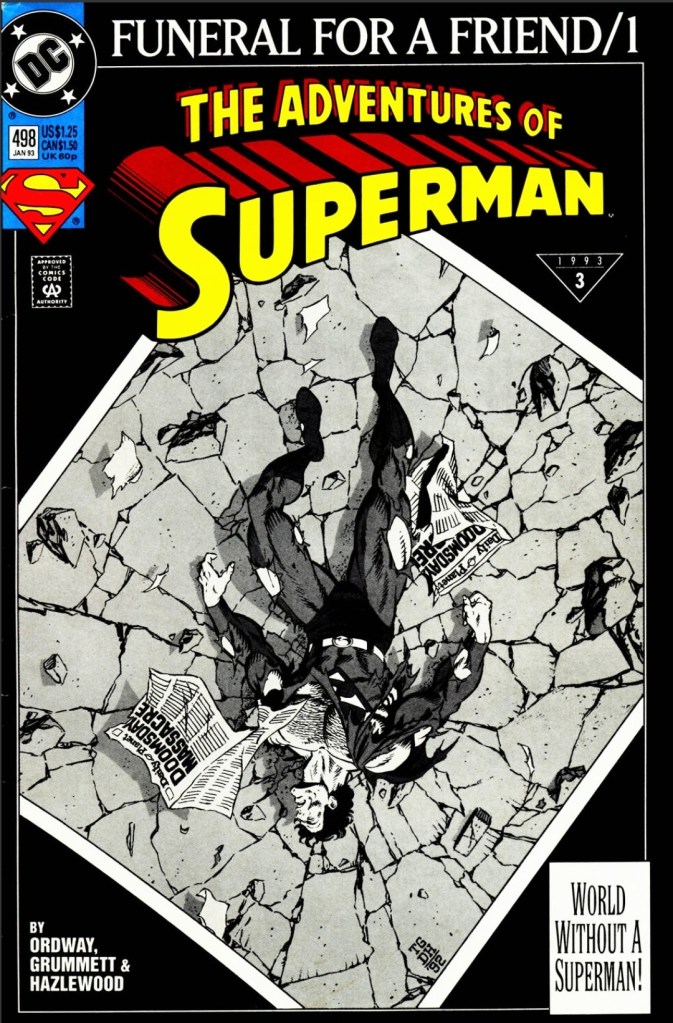
With those details laid down, here is a look back at Adventures of Superman , published in 1993 by DC Comics with a story written by Jerry Ordway and drawn by Tom Grummett. This comic book marked the first chapter of the Funeral for a Friend storyline.

The cover.

Early story

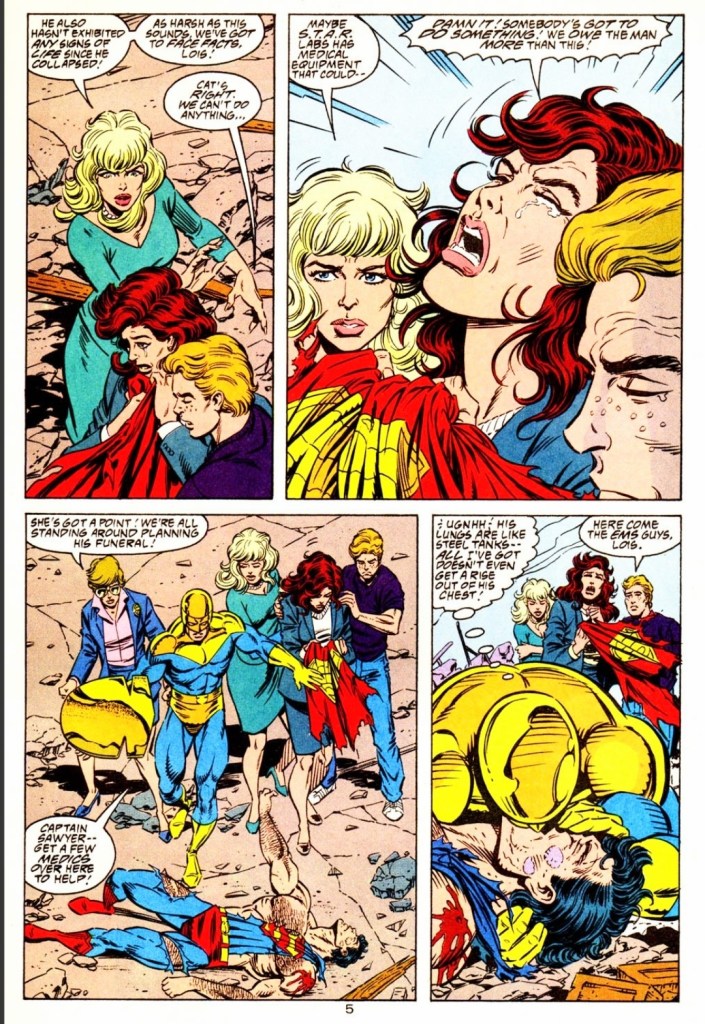
The story begins just moments after the Superman passed away in Lois Lane’s arms. Jimmy Olsen, the body of Doomsday and a few of Superman’s allies were near them. Bloodwynd and Dubbilex shared their respective findings that there is no life left in Superman. As emergency personnel slowly approach Doomsday’s body, Lois Lane turns emotional stating that someone has to do something for Superman. More emergency personnel arrive and attempt to revive the Man of Steel who remains lifeless.

Nearby, a man spots an unrecognizable human-like body among the rubble which turns out to be alive. Suddenly the red-headed tycoon Lex Luthor arrives to take care of the ruined being and walks away carrying it. Luthor refers to the being as a female…   

Quality

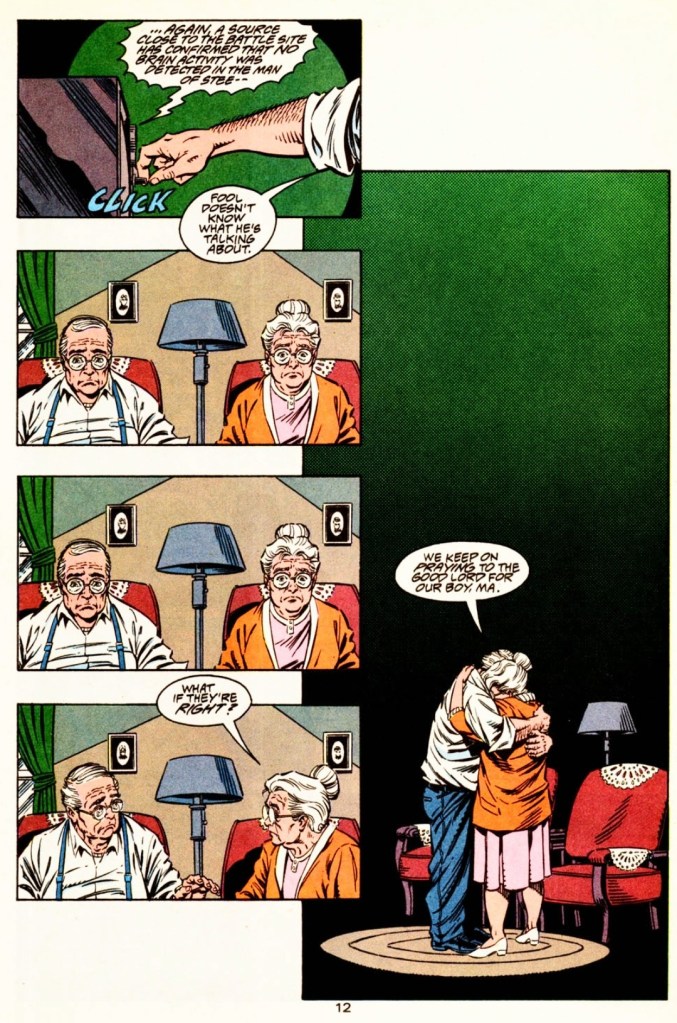
The Ordway-Grummett team should be recommended for this simple yet very dramatic look at the elderly Kent couple reacting to the death of their adopted son from Krypton.

As a post-death Superman story, it is clear that the creative team carefully explored how the many people of Metropolis would react to the sudden death of the Man of Steal while also leaving some room to set the stage to develop Lois Lane – who at this stage knew Superman’s true identity and kept it all secret – in a new way. There were also sub-plots started here particularly with Lex Luthor and Supergirl, the people working for the Daily Planet and the Kents (Clark’s earthly mother and father). The way all the dialogue and character expressions were crafted, there is an undeniable tone of discomfort and uncertainty which dominated the narrative as I read from start to finish.

What I liked the most about this story was how the creative team showed the heavy toll of Superman’s death on Lois Lane who not only has to deal with the loss of her beloved Clark (perceived by her peers to be missing as a possible victim of Doomsday’s rampage) but also do her best to keep working professionally as a journalist of the Daily Planet. I felt Lane’s pain a lot as I read on.  

Conclusion

Tension and emotions turned high in relation to Superman’s sudden death.

In my view, Adventures of Superman (1993) is a really gripping and highly dramatic post-disaster superhero tale to read. The way it was made, it strongly kicked off the Funeral for a Friend storyline with high emotions as well as an understandable amount of uncertainty that can be seen in the characters. Understandably, there is no good-versus-evil conflict in the story nor any superhero spectacle to watch out for but the sub-plots implemented added some depth which made this post-death tale worth reading. More notably, the creative team succeeded in making the people – both in the story and the reading public – start missing Superman.

Overall, Adventures of Superman (1993) is recommended.

+++++

Thank you for reading. If you find this article engaging, please click the like button below, share this article to others and also please consider making a donation to support my publishing. If you are looking for a copywriter to create content for your special project or business, check out my services and my portfolio. Feel free to contact me with a private message. Also please feel free to visit my Facebook page Author Carlo Carrasco and follow me on Twitter at  @HavenorFantasy as well as on Tumblr at https://carlocarrasco.tumblr.com/ and on Instagram at https://www.instagram.com/authorcarlocarrasco

A Look Back at Superman III comic book adaptation (1983)

Disclaimer: This is my original work with details sourced from reading the comic book and doing personal research. Anyone who wants to use this article, in part or in whole, needs to secure first my permission and agree to cite me as the source and author. Let it be known that any unauthorized use of this article will constrain the author to pursue the remedies under R.A. No. 8293, the Revised Penal Code, and/or all applicable legal actions under the laws of the Philippines.

Welcome back superhero enthusiasts, 1980s culture enthusiasts and comic book collectors! Today we go back to the year 1983 which saw the theatrical release of Superman III that featured the late Christopher Reeve as the cinematic Man of Steel.

The 1980s was a very different time with regards to Hollywood’s handling of superhero movies. The concept of a shared cinematic universe was decades away from realization. Warner Bros. back then relied on the Salkind family to produce Superman movies and the first flick in 1978 proved to be a major hit for both viewers and critics while also establishing Christopher Reeve as the definitive live-action Superman for countless people. Unsurprisingly, a sequel was released in the early 1980s which continued box office success for the stakeholders and only led to the approval of another sequel.

Along the way, the late Richard Pryor (a major comedian already) appeared on TV and talked about Superman II which eventually led to him getting hired for Superman III. The movie was released in 1983 making a little over $80 million worldwide while also getting a noticeably weaker reception from critics. More notably, Richard Pryor had a huge chunk of the film’s spotlight as Gus Gorman while the overshadowed Christopher Reeve managed to stretch his cinematic art on playing Clark Kent and Superman (note: there is also the memorable Clark versus Superman battle). Superman III very clearly had a lot more comedy in its presentation. As part of the movie’s marketing, an official comic book adaptation by DC Comics was published.

With those details laid down, here is a look back at the Superman III comic book adaptation,  published by DC Comics in 1983 with a story written by Cary Bates and art made by the late Curt Swan and Sal Amendola.

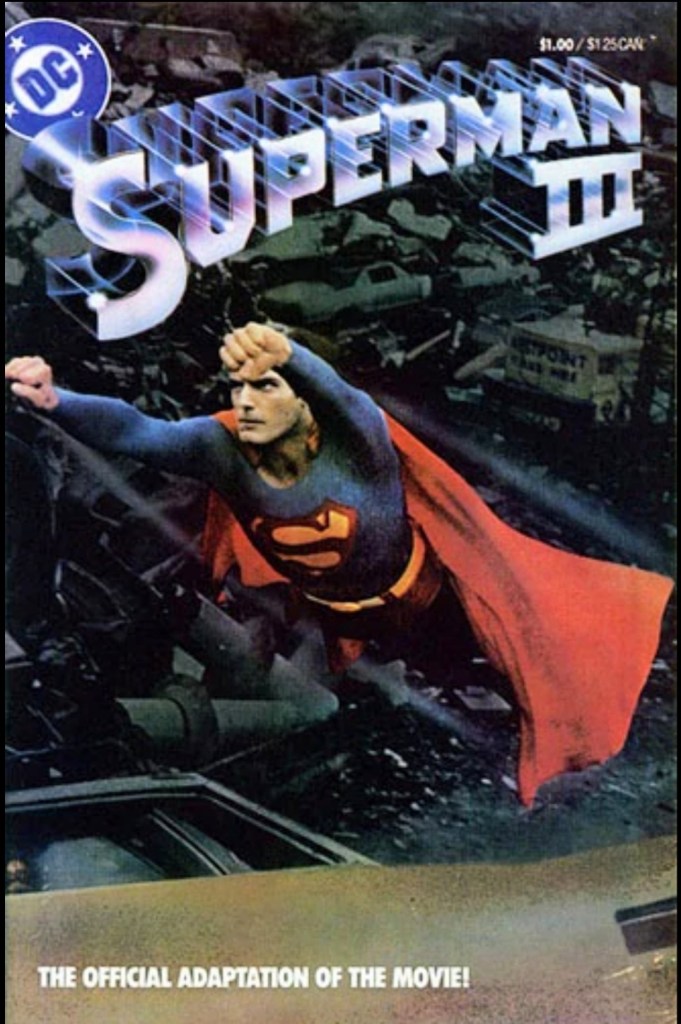
The cover.

Early story

The story begins inside the unemployment bureau of Metropolis. There, August “Gus” Gorman was told after 36 weeks of chronic unemployment, he is no longer eligible for financial assistance (read: welfare) from the city. As he was about to light his cigarette, he noticed computer job ad on the match. Gorman proceeds to the Archibald Data Processing School where he gets enrolled with several others. In front of others, Gorman does something on a computer which impressed the instructor a lot.

Over at the Daily Planet, Clark Kent/Superman, Lois Lane and Jimmy Olsen meet with Perry White at his office. Kent will be returning home to Smallville and make a news story out of it. White gives Kent his approval and then tells Lois she deserves a vacation.

Hours later, Kent and Jimmy Olsen ride the bus together going to Smallville but their ride stops as a result of a huge fire damaging a large chemical plant. A police officer reveals to Olsen that the scientists inside are worried about the plant and its stuff getting destroyed by the fire.

Kent carefully leaves the bus and discreetly changes into Superman to help solve the problem. Olsen, meanwhile, sneaks past the authorities to get to the burning chemical plant.

Over at Webcoe Industries, company head Ross Webster and his sister Vera learn that more than $85,000 worth of company funds was stolen by someone within. Just outside the office, Gus Gorman enters his fancy looking sports car which Webster, Vera and Lorelei notice. Webster asked how could one of their computer technicians afford such a vehicle worth $75,000…    

Quality

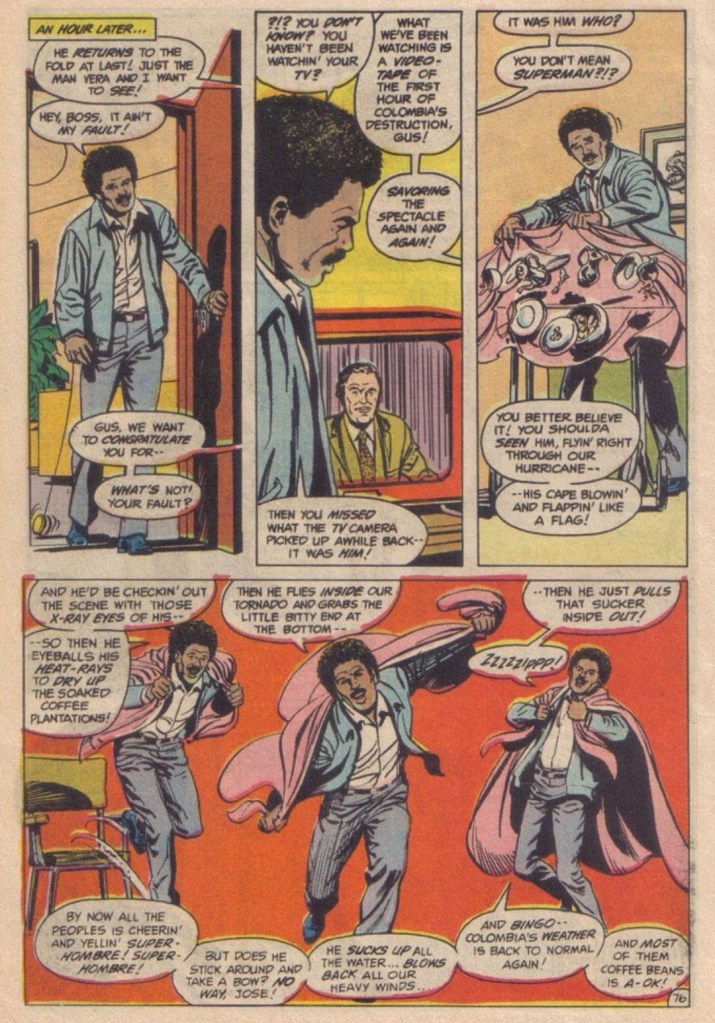
This is a creative way the comic book team used to dramatize Gus Gorman scene revealing and acting the bad news to his boss Ross Webster whose plans were thwarted by Superman.

While it is understandable that not all scenes and not all character moments from the movie  made it on print media, this comic book still managed to capture the film’s essence for the most part. The creative team pulled off their own interpretations of the events and made something entertaining and engaging even though they had to deal with the major challenge of summarizing the movie’s plot and establishing a workable comic book narrative.

I should state that the comic team creatively avoided making in-depth references about liquor and smoking which were obvious in the movie. You will not see Superman drinking liquor at a bar nor will you see Gus Gorman referring to tar listed on a cigarette pack. I suppose this was done to ensure the comic book would be released widely and be acceptable to very young readers and the parents watching them.

The battle between evil Superman and Clark Kent is best viewed in the movie. This one is a shorter and less detailed version of it.

When it comes to establishing the clear lead among all the characters featured, Superman fans should be delighted to know that the Man of Steel is indeed more prominent than Gus Gorman. Take note that in the movie, Richard Pryor’s Gus Gorman overshadowed Christopher Reeve’s Superman/Clark.

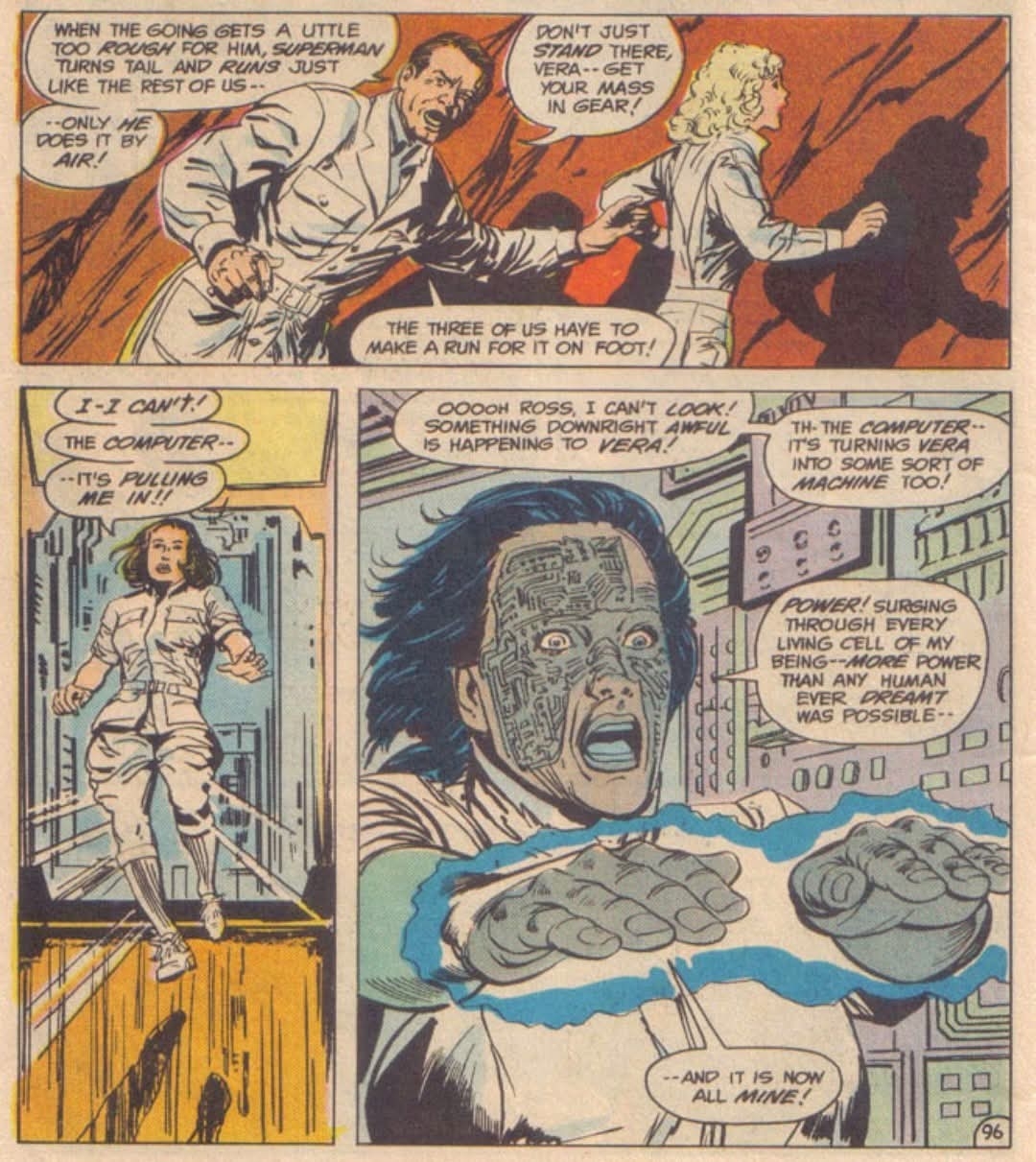
Remember the frightening sequence of Vera getting captured and turned into a cybernetic figure by the Super Computer? This is what it looks like in comic book format.

The art done by Curt Swan and Sal Amendola is decent and it seems to me that their time on visualizing Cary Bates’ script was indeed limited. That being said, it was not surprising to me that, with the exception of Ross Webster in one specific image, none of the characters resembled their cinematic counterparts. Clark Kent/Superman never resembled Christopher Reeve, and Gus Gorman looks nothing like Richard Pryor. Clearly, the artists’ focus was visualizing the narrative which they succeeded.  

Conclusion

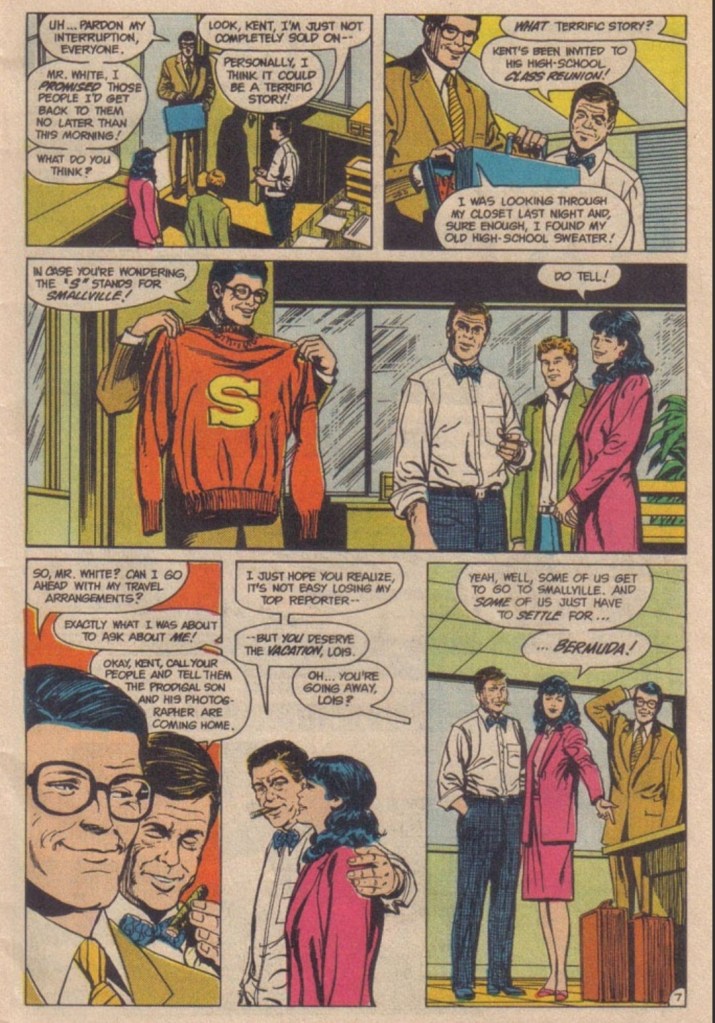
Clark Kent, Lois Lane, Jimmy Olsen and Perry White in the Daily Planet.
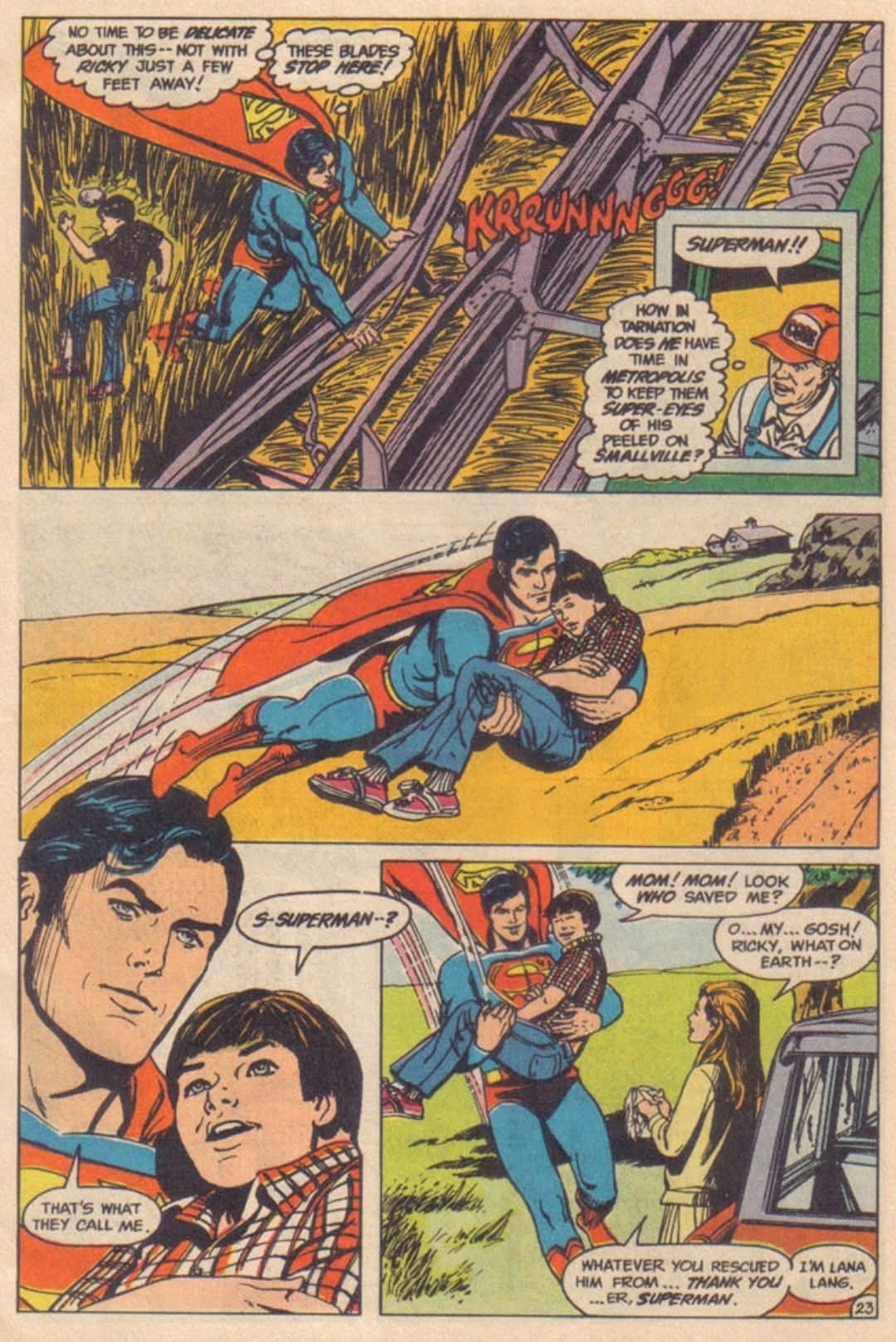
Superman saving Lana Lang’s son from certain death.

Having seen the Christopher Reeve/Richard Pryor movie in the cinema and on cable TV since 1983, I can say that Superman III (1983) is a decent adaptation. It’s not 100% faithful but it is still a worthy read as it will give you the movie’s concept and entertainment values in literary form. If you really want to full essence of film along with the cinematic moments (note: the Superman-Clark battle is the cinematic highlight) all intact, then your obvious choice is to watch the movie. If you are turned off by the movie’s wacky comedy, then the comic book adaptation will deliver to you the more serious approach on telling Superman III’s story. Let me repeat that Superman is more prominent than Gus Gorman in this comic book.

Overall, Superman III (1983) is satisfactory.

+++++

Thank you for reading. If you find this article engaging, please click the like button below and also please consider sharing this article to others. If you are looking for a copywriter to create content for your special project or business, check out my services and my portfolio. Feel free to contact me with a private message. Also please feel free to visit my Facebook page Author Carlo Carrasco and follow me on Twitter at  @HavenorFantasy as well as on Tumblr at https://carlocarrasco.tumblr.com/ and on Instagram at https://www.instagram.com/authorcarlocarrasco/
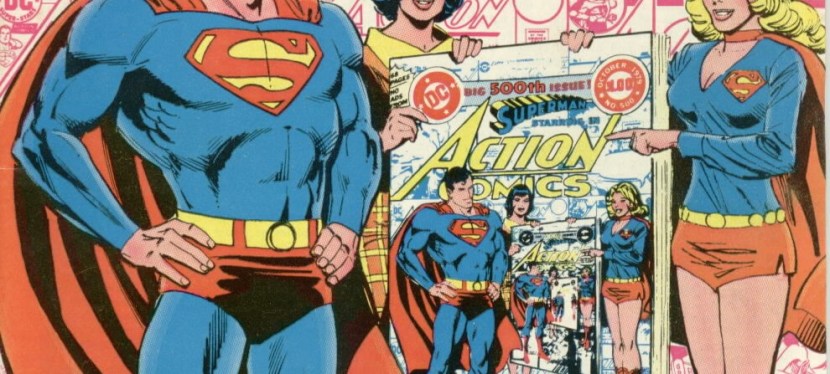
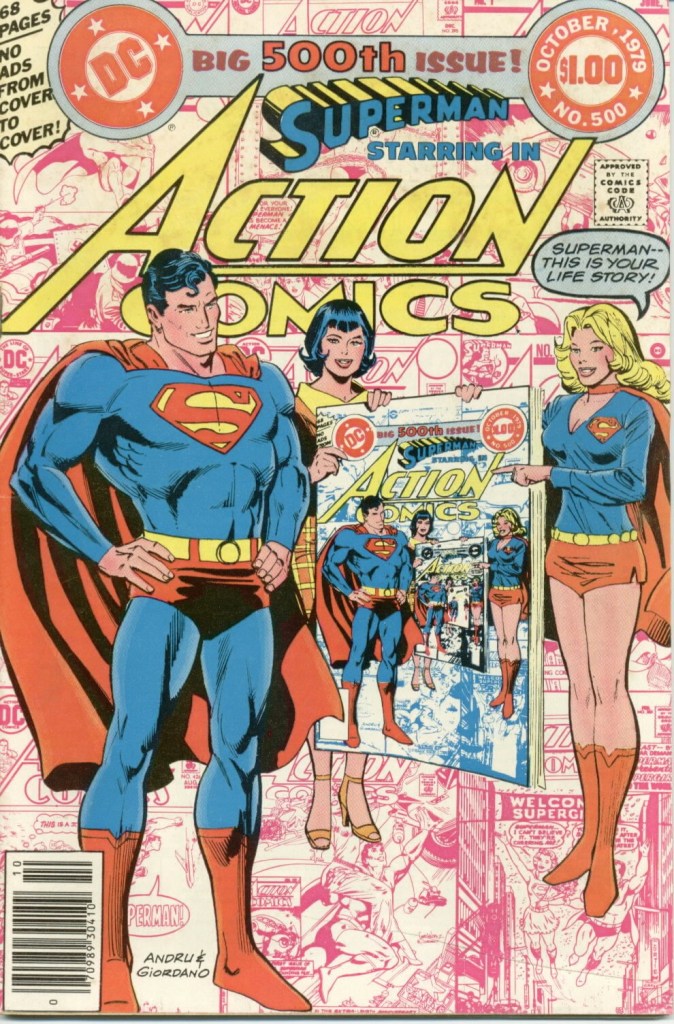
A Look Back at Action Comics #500 (1979)

Disclaimer: This is my original work with details sourced from reading the comic book and doing personal research. Anyone who wants to use this article, in part or in whole, needs to secure first my permission and agree to cite me as the source and author. Let it be known that any unauthorized use of this article will constrain the author to pursue the remedies under R.A. No. 8293, the Revised Penal Code, and/or all applicable legal actions under the laws of the Philippines.

To publish a five hundredth issue of an extensive monthly comic book series is clearly a major milestone for any publisher. To do the math, it takes a whole year to publish 12 issues on a monthly schedule. To reach five hundred issues on a monthly pace will require forty-one years and eight months’ time to publish.

Way back in the late 1970s, DC Comics achieved the said milestone with their extensive monthly series titled Action Comics which is often identified with the world’s most famous superhero – Superman! Take note that DC Comics started in 1935 while Action Comics (the first appearance of Superman) was published a few years later.

Going back to the 500th issue of Action Comics, it is easy to wonder what DC Comics’ talent came up with to celebrate the milestone. That being said, we can all find out more in this look back at Action Comics , published by DC Comics in 1979 with a story written by Martin Pasko and visualized by Curt Swan and Frank Chiaramonte.

The cover.

Early story

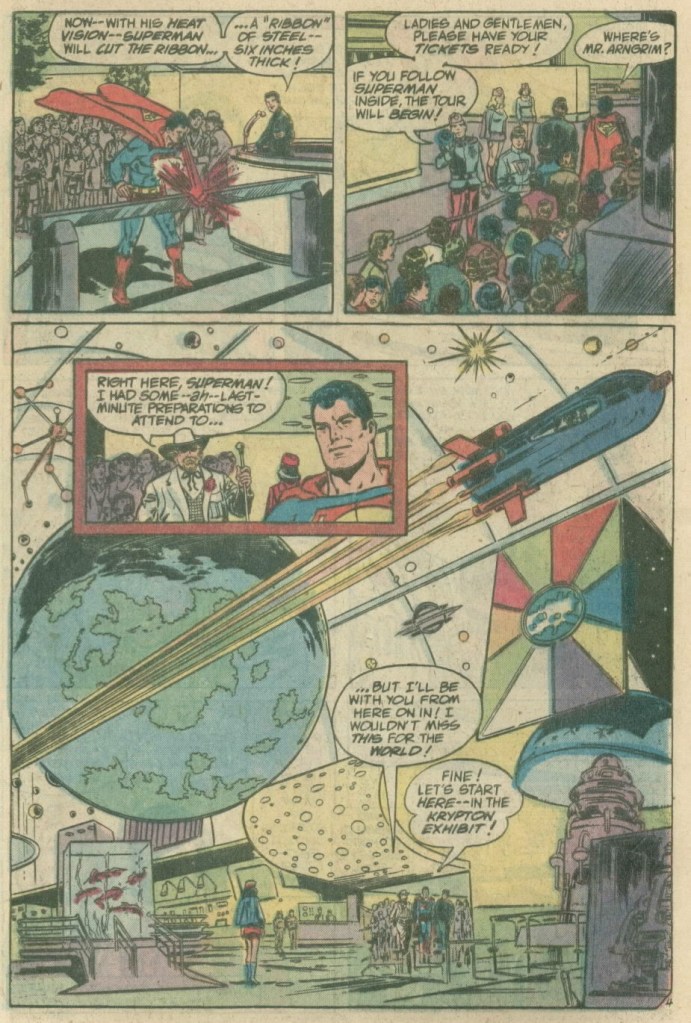
The story begins with Superman arriving at a pavilion named after him at the Metropolis World’s Fair. Countless people welcomed with lots of cheering as he lands near the mayor in the presence of the famous entrepreneur J. Robert Arngrim. Also present were Superman’s closest friends Lois Lane, Lana Lang, Jimmy Olsen and Perry White.

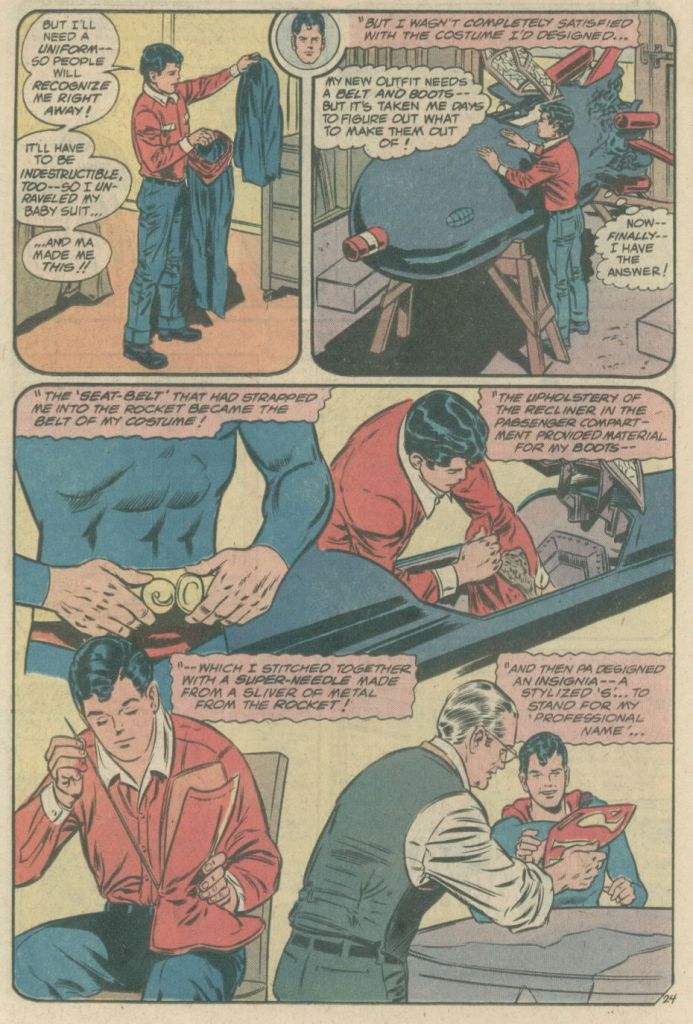
After the formal opening, Superman leads a large group of people as their tour guide. Together they arrived a wide hall containing the Krypton exhibit showcasing alien technology, architecture and life on Superman’s home planet. In response to a request by Arngrim, Superman reluctantly agrees to do a demonstration of the mind-prober ray, a machine Superman himself invented as a boy mainly to retrieve memories from his subconscious.

As the Man of Steel takes his seat on the machine in front of the tourists and Arngrim, an unidentified person located in a secret facility prepares to invade Superman’s mind…

Quality

Teenage Clark Kent gradually becoming Superboy.

To make it clear, this 500th issue of the Action Comics monthly series is an extensive, no advertisements tribute to Superman and I can say that the comic book creators really went all out to present lots of stuff to please Superman fans.

As such, the story was written to help the newer fans of the time to be more familiar of the legacy of Superman (note: this was years before Crisis on Infinite Earths happened) by revisiting and dramatizing established events of the Man of Steel’s legacy such as Jor-El (Superman’s father) failing to convince the Kryptonian science council members that their world was doomed, Superman sent to Earth as a child in a rocket before Krypton’s destruction, getting raised by an American couple after arriving on Earth, becoming Superboy (note: another pre-Crisis element), getting a job at the Daily Planet, welcoming Supergirl on Earth, and so on.

Superman leading the tour.

Of course, Superman does not reveal key details of his personal life to the people during the tour and such recollections were presented to delight us readers. Still, there is richness in the writing and the art. Even though I am already familiar with DC’s icon and the Superman-related mythos, I still had a lot of fun reading the events of Superman’s past, particularly his early years as the adopted son of the Kent couple who in turn did their best to adjust to his super abilities while raising him with good values and discipline.

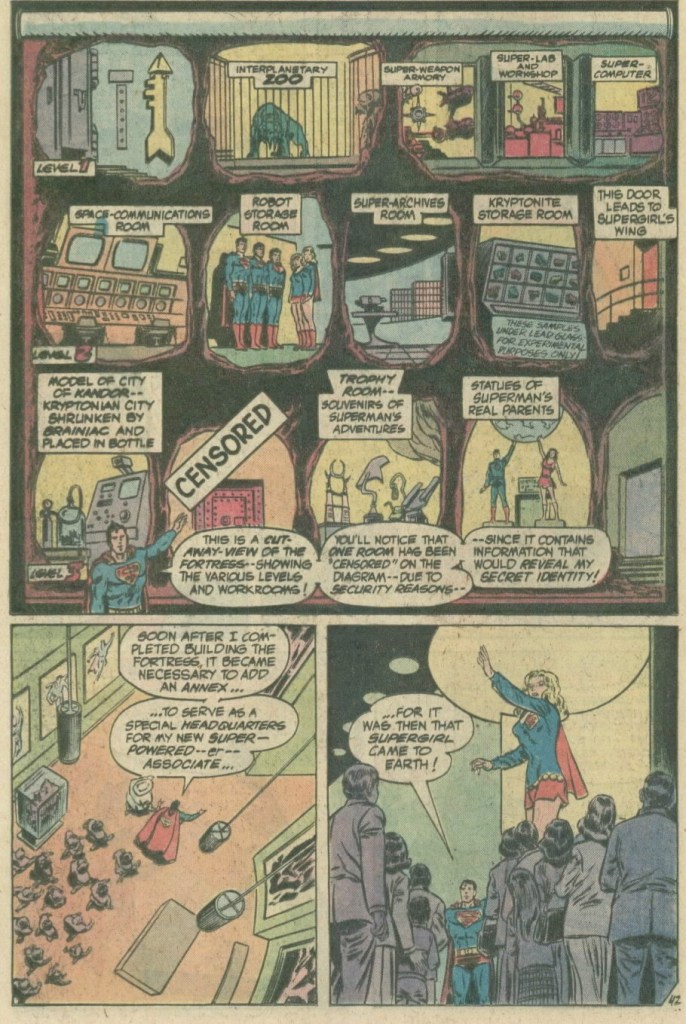
While the recollections from Superman’s past are engaging, the present-day tour at the Superman pavilion is itself quite fascinating. There were displays of supervillains such as Lex Luthor, Braniac and Parasite. There was even a collection of the different types of Kryptonite. What really nailed the present-day story was a nice twist that allowed for some new superhero spectacle and intrigue to take place.

Conclusion

The first stop of the tour – Krypton exhibit!

While this portrayal of Superman is already outdated given the time of its release, Action Comics (1979) is still a lot of fun to read and it is indeed a great tribute to DC’s most famous superhero. If you are a Superman fan who has gotten sick and tired of the way DC Comics reshaped and modernized Superman since after the end of Crisis on Infinite Earths, this comic book could be refreshing for you. It is also a lively piece of DC Comics’ history.

If you are seriously planning to buy an existing hard copy of Action Comics (1979), be aware that as of this writing, MileHighComics.com shows that the near-mint copy of the comic book costs $210.

Overall, Action Comics (1979) is highly recommended!

+++++

Thank you for reading. If you find this article engaging, please click the like button below and also please consider sharing this article to others. If you are looking for a copywriter to create content for your special project or business, check out my services and my portfolio. Feel free to contact me as well. Also please feel free to visit my Facebook page Author Carlo Carrasco and follow me at HavenorFantasy@twitter.com
A Look Back at Superman Annual #10 (1984)

Disclaimer: This is my original work with details sourced from reading the comic book and doing personal research. Anyone who wants to use this article, in part or in whole, needs to secure first my permission and agree to cite me as the source and author. Let it be known that any unauthorized use of this article will constrain the author to pursue the remedies under R.A. No. 8293, the Revised Penal Code, and/or all applicable legal actions under the laws of the Philippines.

Before DC Comics ended their original superhero multiverse with Crisis on Infinite Earths (1985-1986) to restart all over again, there were a whole lot of stories about Superman ranging from the dramatic stuff, the epic tales and right down to the most outlandish tales.

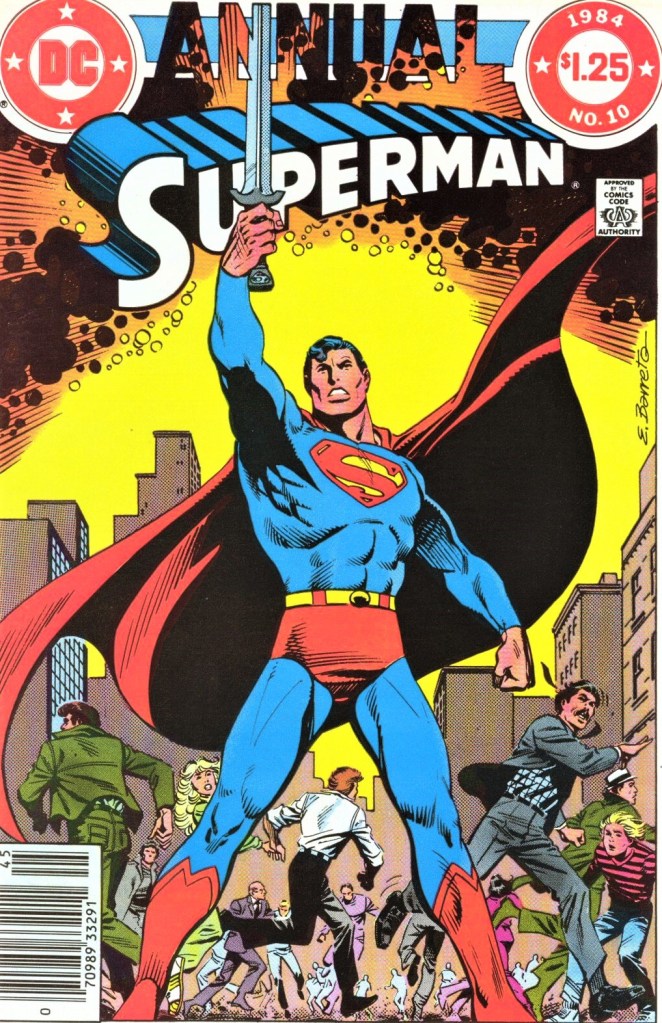
As a kid, I was fortunate enough to buy myself a copy of a 1984 Superman comic book, the cover of which really intrigued and caught my interest. It was a Superman annual comic book with a $1.25 cover price which was somewhat high at the time. Its cover showed the Man of Steel himself carrying a sword pointed up.

That image made me wonder: Why would Superman have to use a sword when he is so powerful and capable without weapons? Where did that sword come from? Who made it in the first place? Is the sword so special to Superman?

With those details laid down, here is a look back at Superman Annual , published by DC Comics in 1984 with a story written by Elliot Maggin and drawn by classic Superman artist Curt Swan.

The cover.

Early story

The story begins in a space where a group of diverse people composed of aliens and humans are gathered together watching a live video feed Superman on a large monitor above their heads. As it turns out, the Man of Steel is in space working to prevent meteoroids from entering the planet below him. He then speeds off into space heading back to Earth.

Along time ago deep in the galaxy, a big bang effect took place creating several new fragments in the vacuum of space and among them is a long, rough object that resembles a sword. As an unknown amount of time passed, the long object gradually turns into a smooth looking sword complete with a sharp blade and a letter “S” on one end that is the same as the one Superman carries. It is referred to as the sword of Superman!

In Metropolis, Clark Kent is passed by his officemate Jimmy Olsen who mentioned that he is rushing to interview the billionaire industrialist Oswald Mandias. Two days have passed and Jimmy Olsen remained missing. As his boss Perry White heads on to the office, Clark remains and changes into Superman when the coast got clear.

As the Man of Steel flies off into the city, a Galaxy Broadcasting live report on TV shows Lana Lang reporting from the Kennedy Space Center where the new space shuttle Magellan is about to make its first-ever commercial flight to launch a mysterious new communications satellite owned by Mandias Industries…

Quality

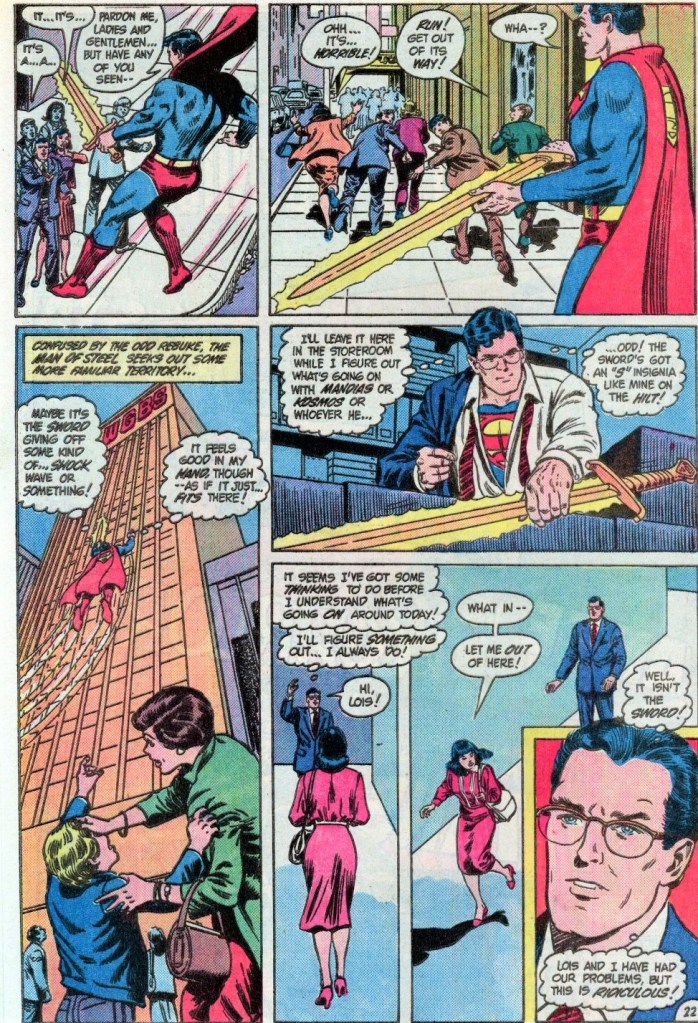
Clark Kent/Superman being a complete stranger to others added a lot to the story.
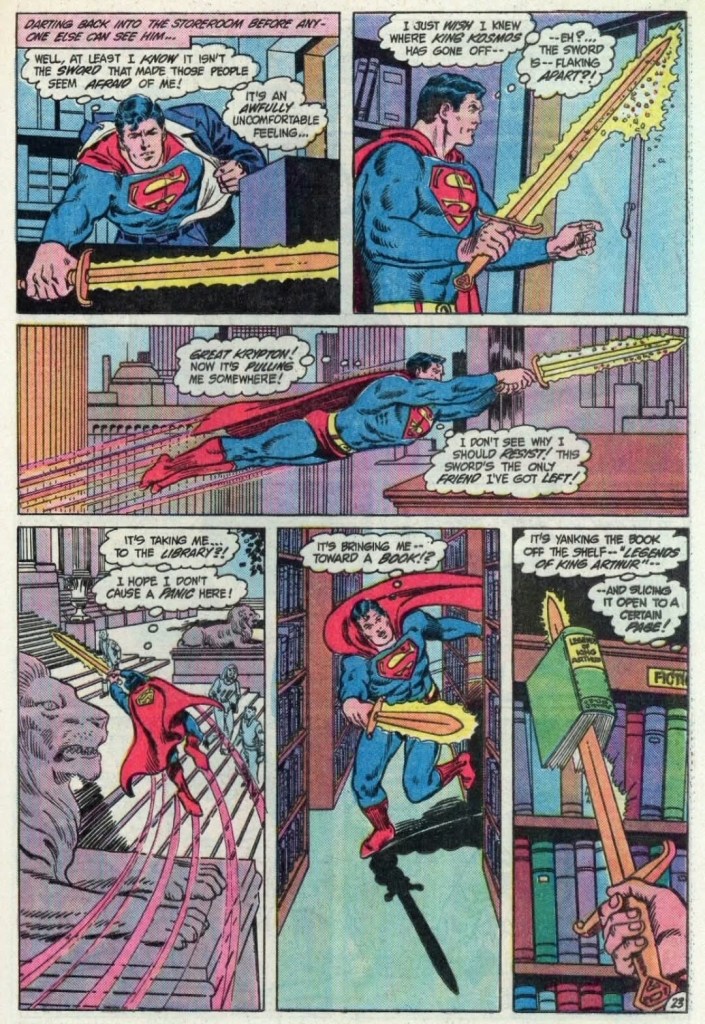
The sword led Superman to a book about the legend of King Arthur inside the city library.

Being an annual, I can say that the Sword of Superman story was well-written and nicely visualized by the creators which made it fun and engaging to read. It is a Superman story that further adds to his being an essential hero of the original DC Comics multiverse and a key factor here is the somewhat outlandish concept that the sword that he gained was an original material of the universe from the big bang and even had connections to the unseen omnipotent force.

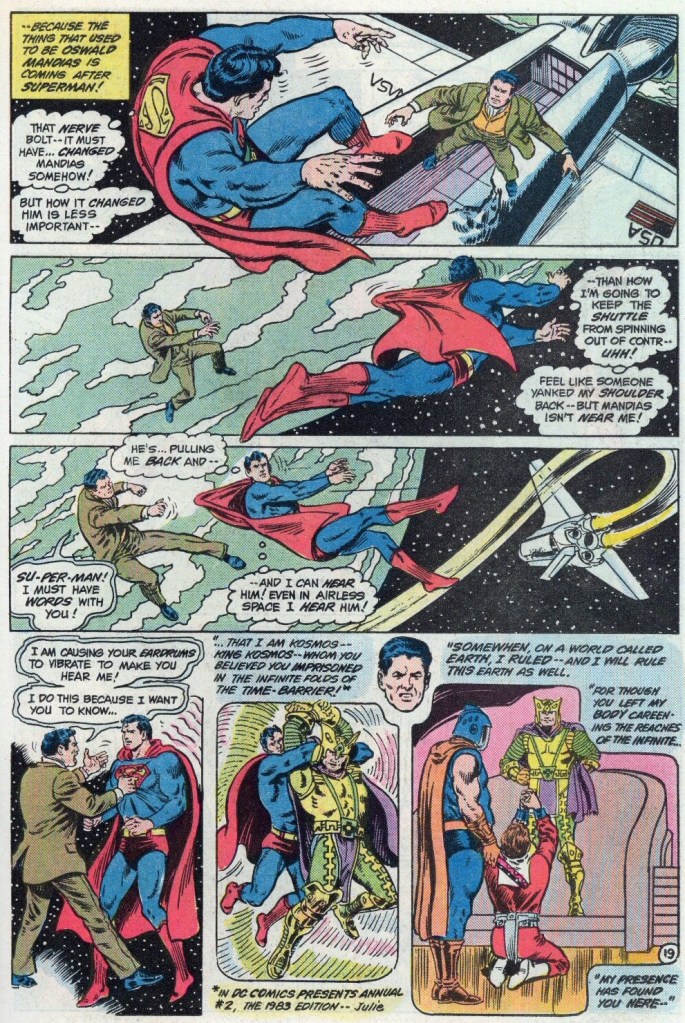
This story is not a simple, straightforward tale about Superman gaining a weapon required to defeat the supervillain King Kosmos. In fact, the sword opens up events that made the Man of Steel reevaluate himself, his situation and the people around him. King Kosmos, who is a time-travelling villain from the future (first appearance in DC Comics Presents Annual ), served not just merely as the opposition but also adds a good amount of complexity within the reality of the story. For one thing, it is very intriguing and also refreshing to see people of Metropolis (even Clark’s friend Jimmy Olsen) failing to recognize Superman and perceive him with fear. This is a one-of-a-kind story of Superman that must be read, even though it is not really an epic tale.

All throughout, there is a fine balance between spectacle and intrigue. If you pay close attention to the dialogue and details, you will understand the story better and enjoy the comic book more eventually.

Conclusion

The return of King Kosmos!

I personally enjoyed reading Superman Annual (1984) the first time back in 1984. The fact here is that after re-reading it recently, I do confirm that it is still an enjoyable comic book to read, and I am not even a Superman fan anymore. That is quite something! This is indeed a really good piece of Superman history from the pre-Crisis era. It also touches on themes about omnipotence, how ordinary people react to people who wield great power, and being whole with the entire universe.

If you are seriously planning to buy an existing hard copy of Superman Annual (1984), be aware that as of this writing, MileHighComics.com shows that the near-mint copy of the regular edition costs $35 while the near-mint copy of the newsstand edition costs $70.

Overall, Superman Annual (1984) is recommended.

+++++

Thank you for reading. If you find this article engaging, please click the like button below and also please consider sharing this article to others. If you are looking for a copywriter to create content for your special project or business, check out my services and my portfolio. Feel free to contact me as well. Also please feel free to visit my Facebook page Author Carlo Carrasco and follow me at HavenorFantasy@twitter.com
A Look Back at Superman #100 (1995)

While this old comic book may not be the best-selling Superman story of the 1990s, it is for me the most significant one as well as creator Dan Jurgens’ best work ever on the Man of Steel. I’m talking about Superman #100.

Cover
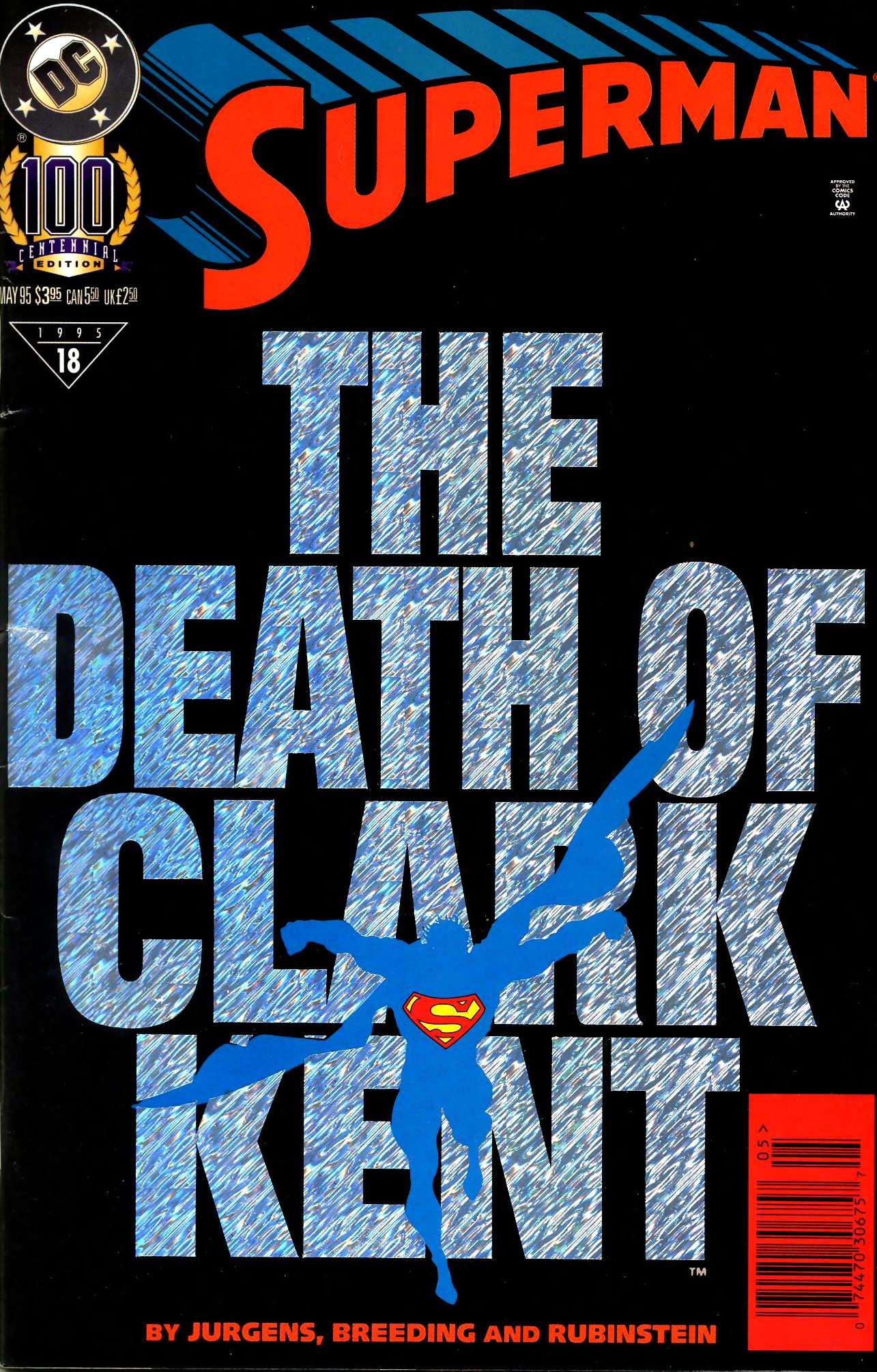
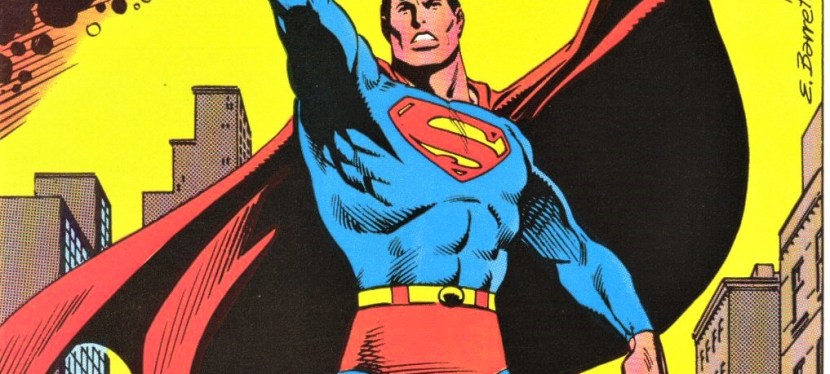
The cover.

Released in 1995 by DC Comics, Superman #100 came out with a special cover that highlighted the title “The Death of Clark Kent”. It was released with a hefty cover price of $3.95 for the United States and was pretty thick. It was written and illustrated by Dan Jurgens, the same man who worked on the best-selling Superman (The Death of Superman climax).

Early story

The story begins with Clark Kent carrying a deformed Superman object (with makeshift glasses and a knife “stabbing” the letter S) and just feet behind him was his officemate Jimmy Olsen. Hidden mostly from Olsen’s view, the object signifies that someone knows that Clark Kent and Superman are one and the same person. Carefully, Clark hides it away and starts chatting with Jimmy who is very concerned of him.

Clark recently has been struggling over the fact that someone knows his secret identity. After carefully dismissing Jimmy, he moves out as Superman to take of business before the madman (who knows his identity) makes his next move.

Superman visits his parents Jonathan and Martha Kent at their home in Smallville. He expresses to Jonathan that he believes that the madman is someone he knew from his past: Kenny Braverman (Conduit).

Quality

If there is anything that defines this comic book, it is the in-depth storytelling done by Dan Jurgens complete with intense character development as well as exploration of people from his past (all connected to Smallville).

The plot structure is quite simple. Conduit knows Superman/Clark Kent personally and is always at least a step ahead of the superhero complete with strategies mess with him personally. Superman, who came back from the dead and has been struggling to fit in with the times, finds himself at his most vulnerable state not as a super-powered guy but as a human being. To analyze things here, Superman is about to get suffer and lose a lot again but not with the temporary death he got from fighting Doomsday, but rather the demise of his personality as Clark Kent.

Art2
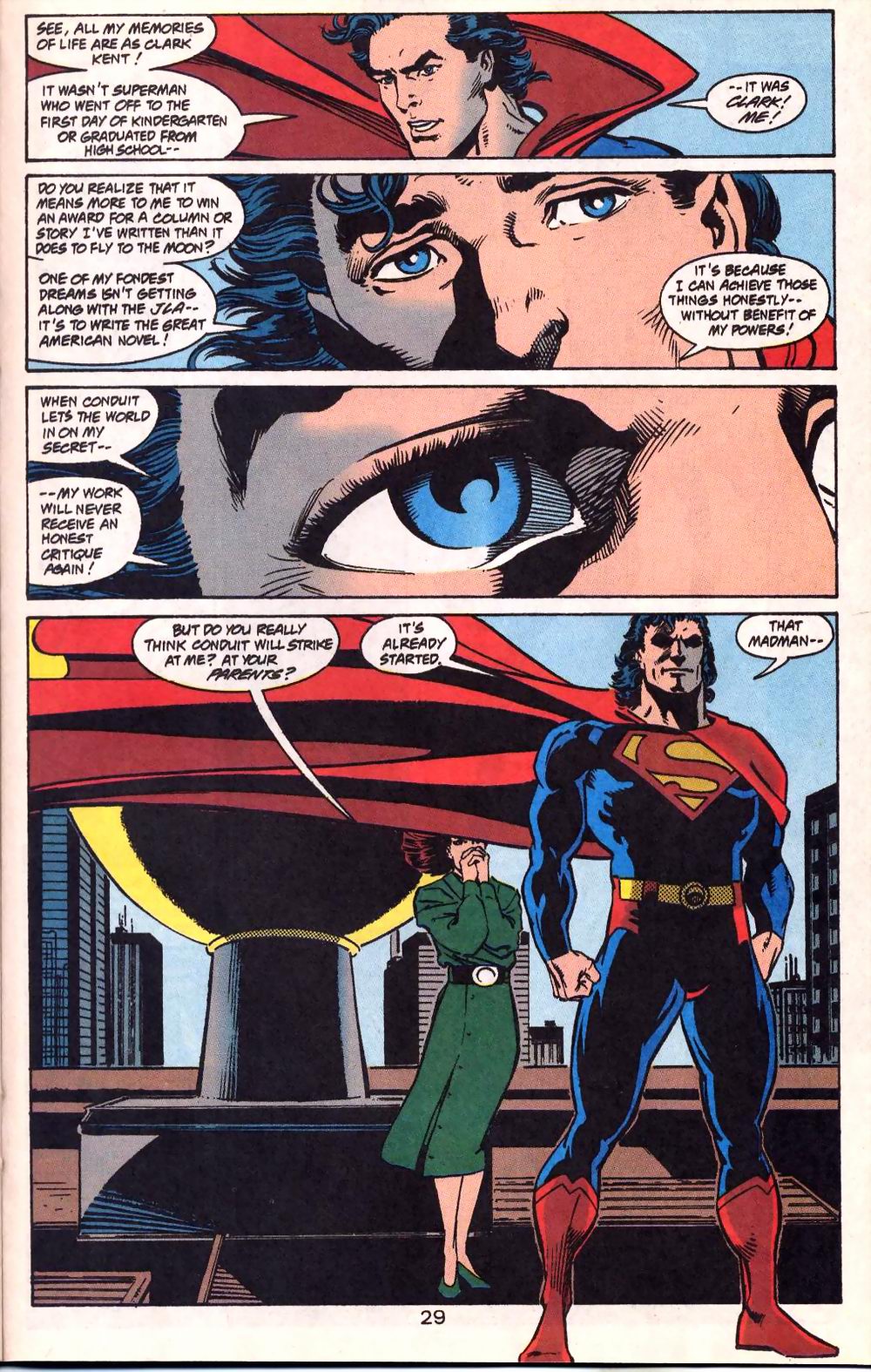
Truly one of the best Superman dialogue and characterizations ever thanks to Dan Jurgens.

Think about it. As Clark, Superman has a career, a social life, grew up the American way, intends to spend his life with Lois Lane and has ambitions of simple living that mean more to him than being with the Justice League America (note: writing the next great American novel).

The great thing here is that writer-artist Dan Jurgens humanized Superman a whole lot in this comic book and his work is excellent. Superman #100 opens up the discussion about what life would be like for the Man of Steel once his identity as Clark Kent gets ruined. The story also connects with Superman’s past (within the post-Crisis universe of DC Comics) and sheds light on his relationships with not only his parents but also with Pete Ross and Lana Lang (Clark’s ex-GF). When it comes to putting Superman in danger, Conduit’s approach is more convincing than Doomsday’s unstoppable power of destruction.

By the time I got immersed with Dan Jurgen’s storytelling and character development, the action scenes involving Superman felt justified. More importantly, this comic book shows the famous superhero being pushed to the limits in terms of personality tolerance and determination.

Conclusion

We live in an age in which established entertainment franchises get ruined by sequels or spin-offs or reboots which were mishandled by creators who tried to reinvent stuff only to fail and disappoint the fans.

Look at Star Wars Episode VIII: The Last Jedi. Director Rian Johnson had complete creative control on telling an engaging and fun Star Wars tale but ended up deforming it (disregarding Star Wars’ most defining elements), focused mainly on subverting people’s expectations and left many long-time fans disappointed and angry.

Art1
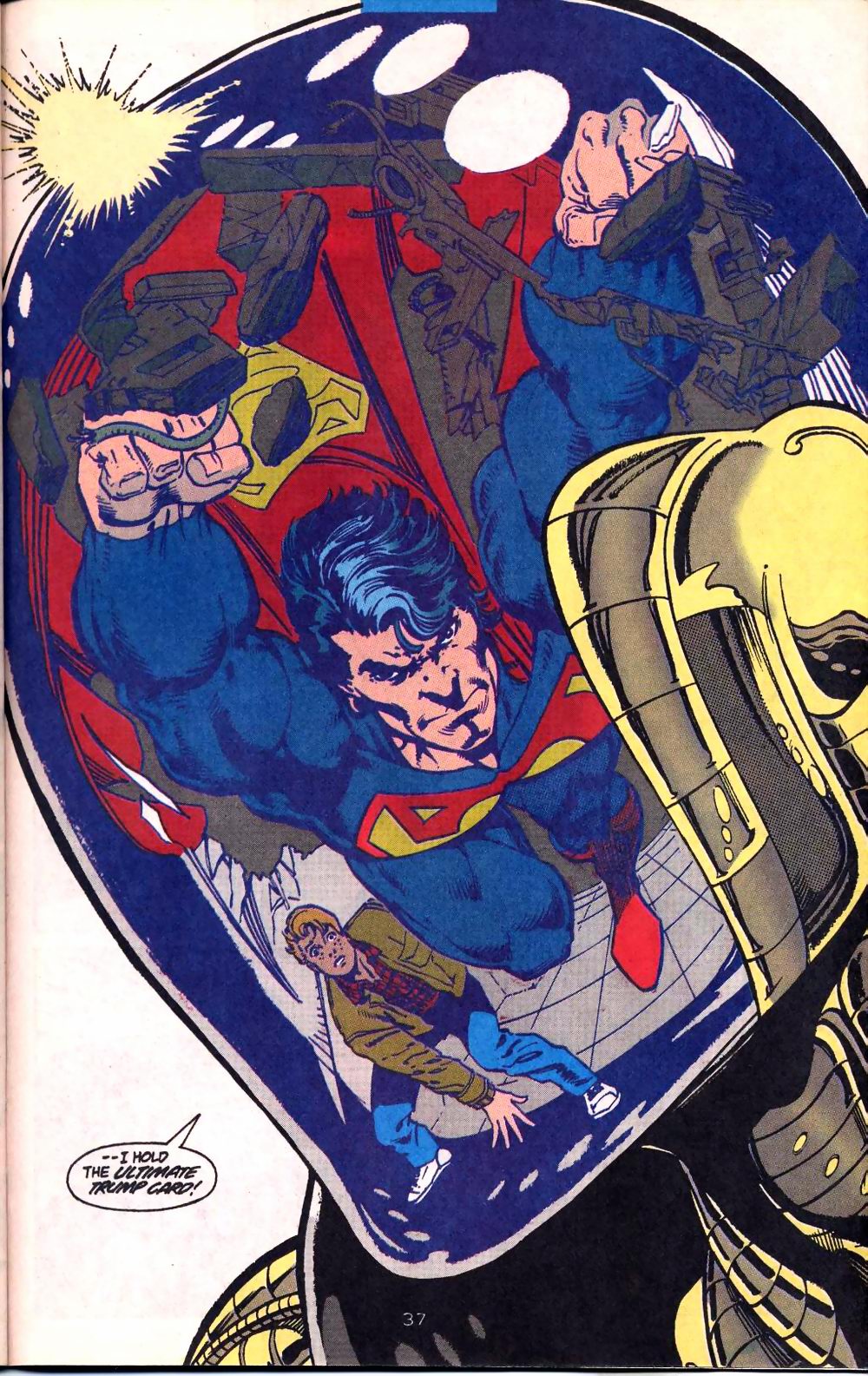
Superman going after Conduit.

Going back to Superman #100, Dan Jurgens succeeded in redefining the American icon while maintaining respect of the established past of the character and kept the elements that defined Superman. His story about the demise of Superman’s secret identity was a very fresh concept and, for a time, it paved the way for opportunities to take the Man of Steel into new creative directions without disappointing fans.

Personally, I would love to see Warner Bros. produce a new standalone Superman movie with Henry Cavill as the superhero and adapt the core elements of Jurgens’ work in Superman #100 into the screenplay. Cavill already proved he could portray Superman/Clark very humanly in Man of Steel.

Overall, Superman #100 is highly recommended.


Thank you for reading. If you find this article engaging, please click the like button below and also please consider sharing this article to others. Also my fantasy book The World of Havenor is still available in paperback and e-book format. If you are looking for a copywriter to create content for your special project or business, check out my services and my portfolio. Feel free to contact me as well. Also please feel free to visit my Facebook page Author Carlo Carrasco and follow me at HavenorFantasy@twitter.com