In what is clearly an attempt to help the Philippines attract more foreign tourists, the government is pushing to open regional tourism and business hubs to international flights which should enable foreigners to have better access to other parts of the country, according to a Manila Bulletin news report.
To put things in perspective, posted below is an excerpt from the Manila Bulletin news report. Some parts in boldface…
President Marcos has underscored the government’s push to open regional tourism and business hubs to international flights, saying these would allow foreign travelers to skip Metro Manila and head straight to their chosen destinations.
Marcos said this as he led the groundbreaking of the Caticlan Passenger Terminal Building in Aklan on Monday, July 18.
In his speech, the President said regional airports such as Caticlan are key to welcoming foreign travelers directly to Philippine destinations, bypassing Metro Manila and stimulating regional economies.
“We are slowly putting together the building blocks of our policy of opening up our tourist areas… to international travelers without having to go through the Manila Airport,” he said.
Marcos added that the new passenger terminal, which will serve as the main airport gateway to Boracay and other destinations in Western Visayas, would help ease travel to the region and boost economic activity.
“It is not just Aklan who is involved in this; it is the entire region that will be assisted by the construction of this terminal building,” he said.
Let me end this post by asking you readers: What is your reaction to this recent development? Do you think the national authorities will be able to establish new ways for foreign tourists to skip Metro Manila and move on to their chosen destinations located in other parts of the country? On a scale of 1 to 10, how would you rate the current state of tourism in the Philippines?
For more South Metro Manila community news and developments, come back here soon. Also say NO to fake news, NO to irresponsible journalism, NO to misinformation, NO to plagiarists, NO to reckless publishers and NO to sinister propaganda when it comes to news and developments. For South Metro Manila community developments, member engagement, commerce and other relevant updates, join the growing South Metro Manila Facebook group at https://www.facebook.com/groups/342183059992673
Recently in the City of Muntinlupa, several local vendors from specific locations met with Mayor Ruffy Biazon at City Hall and discussed relevant issues, according to a Manila Bulletin news report.
To put things in perspective, posted below is an excerpt from the Manila Bulletin news report. Some parts in boldface…
Muntinlupa Mayor Ruffy Biazon held a dialogue with Muslim vendors operating on sidewalks in Alabang.
Biazon said the vendors operate in the Alabang viaduct, Alabang junction, Montillano Street, Petron gas station, and Liana’s, all located in Alabang.
He recently ordered the Muntinlupa Traffic Management Bureau and cooperatives to conduct an inspection of sidewalks of the Alabang viaduct area and Alabang public market.
“Dahil nandito ang transportation hubs, I see Alabang Viaduct as the gateway of Muntinlupa. At bilang gateway, gusto natin na kapag nadaanan ito ng mga tao, ang unang impression nila: maayos, malinis, at disiplinado ang Muntinlupa (Because the transportation hubs are here, I see Alabang Viaduct as the gateway of Muntinlupa. And as a gateway, what we want is when people pass through it, their first impression is: Muntinlupa is neat, clean, and disciplined).”
He said what the city government wants is for the sidewalks to be walkable and the goods, trash and obstruction do not hinder pedestrians. On the other hand, Biazon said he recognizes that sidewalks offer income opportunities for some of the residents.
Let me end this post by asking you readers: What is your reaction to this recent development? If you are a resident of Muntinlupa City, do you think vendors should be allowed to occupy space on sidewalks to be able to do business? Do you think that obstruction on sidewalks add to the possibility of accidents happening? Do you think that vendors who are not certified residents of Muntinlupa City should not be allowed to sell in the city?
For more South Metro Manila community news and developments, come back here soon. Also say NO to fake news, NO to irresponsible journalism, NO to misinformation, NO to plagiarists, NO to reckless publishers and NO to sinister propaganda when it comes to news and developments. For South Metro Manila community developments, member engagement, commerce and other relevant updates, join the growing South Metro Manila Facebook group at https://www.facebook.com/groups/342183059992673
To put things in perspective, posted below is an excerpt from the PNA news article. Some parts in boldface…
The office leasing market sustained a strong momentum in the first half of 2025, with demand reaching 67 percent of full-year 2024, despite the withdrawal of Philippine Offshore Gaming Operators (POGO), real estate advisory firm Leechiu Property Consultants (LPC) said Thursday.
“Demand has been strong for the first half of the year. We believe it will continue. We never know what will happen, but we are optimistic about it,” Mikko Barranda, LPC director for Commercial Leasing, said during the presentation of the LPC Q2 2025 Philippine Property Market Report in Makati City.
The Information Technology and Business Process Management (IT-BPM) took up 50 percent of the total leasing activity, or 365,000 square meters, in the first half of 2025.
Traditional industries, on the other hand, accounted for 48 percent, or 354,000 sqm, of the demand, while government offices took the rest of the share at 21,000 sqm.
At least 79 percent, or 581,000 sqm, of the overall demand came from Metro Manila, with Bonifacio Global City representing 146,000 sqm, while provincial demand was at 21 percent to 159,000 sqm, with Cebu covering 81,000 sqm.
Barranda reported that the net demand has breached more than 50 percent to 271,000 sqm of the firm’s projection for the year.
“Contractions are tapering off and net take-up in terms of what we have projected back in Q1, which we feel will be at 490,000 sqm levels, were already touching 55 percent,” he said.
In the absence of POGOs, LPC Chief Executive Officer David Leechiu said this surge is already the highest since 2017.
Let me end this post by asking you readers: What is your reaction to this recent development? How far do you think the current surge of office leasing market will go by the end of the year? Do you think there are a lot more companies out there actively searching for office spaces to rent?
To put things in perspective, posted below is an excerpt from the Daily Tribune news report. Some parts in boldface…
The local government of Muntinlupa announced that three prominent hotels were recognized for their exceptional resilience in navigating various crises, from the recent pandemic to natural calamities.
In a statement, Muntinlupa Mayor Ruffy Biazon said that the awards highlight not just business success but also the steadfastness of these enterprises in the face of adversity.
Crimson Hotel secured the first prize for the Most Resilient Business Enterprise, followed by The Bellevue Manila in second place and Somerset Alabang in third.
“This isn’t just an award for business success, but for resilience amidst crisis,” Biazon said. “From the pandemic to various calamities, they have continuously remained open, provided assistance, and served as a pillar for our city.”
He also stressed that true success is measured not only by how high one reaches but by one’s fortitude during challenges.
“I salute businesses that not only recovered but also became part of the solution,” Biazon said, acknowledging the crucial role these establishments played.
“Muntinlupa’s hospitality industry, particularly its hotels, often finds itself on the front lines during disasters. These establishments frequently serve as evacuation sites and partners in emergency response efforts,” he added.
The mayor also said that resilience is not accidental as it requires deliberate planning, preparation, and effort, encompassing robust business continuity planning, comprehensive staff training, and close coordination with local government units.
Let me end this post by asking you readers: What is your reaction to this recent development? If you are a resident of Muntinlupa City, are you delighted to know that the prominent hotels played key roles in dealing with crisis?
For more South Metro Manila community news and developments, come back here soon. Also say NO to fake news, NO to irresponsible journalism, NO to misinformation, NO to plagiarists, NO to reckless publishers and NO to sinister propaganda when it comes to news and developments. For South Metro Manila community developments, member engagement, commerce and other relevant updates, join the growing South Metro Manila Facebook group at https://www.facebook.com/groups/342183059992673
Parañaque City’s 2nd District Representative Brian Yamsuan has a new proposal to create public offices at the local government level to assist senior citizens and persons with disabilities (PWDs) in their search for better job opportunities, according to a Manila Bulletin news report.
To put things in perspective, posted below is an excerpt from the news report of Manila Bulletin. Some parts in boldface…
Parañaque 2nd district Rep. Brian Raymund Yamsuan is batting for the creation of public offices at the local government level that will help persons with disabilities (PWDs) and senior citizens land jobs.
Such offices–to be known as Local Centers for Inclusive Employment (LCIEs)–will partner with the private sector to assist PWDs and seniors for this purpose. According to Yamsuan’s proposal, they will also provide access to upskilling opportunities.
“Disabled persons and seniors who are fit to work can become productive members of our economy if given the chance. However, many PWDs and elderly citizens remain poor because they find it difficult to get hired for jobs that suit them,” Yamsuan said iin a statement Tuesday, July 8.
“Sayang ang kanilang galing, dedikasyon at sipag na madadala sa kanilang trabaho kung sila ay mananatiling jobless. Sa halip na kaawaan o hindi bigyang pansin, dapat ay kinikilala natin ang kanilang mga kakayahang makapag-ambag sa paglago ng ating ekonomiya,” added Yamsuan.
(Their talent, dedication and diligence that they will bring to the workplace will go to waste if they remain jobless. Instead of pitying or ignoring them, we should recognize their capabilities to contribute to our economic growth.)
Yamsuan said he will soon re-file in the 20th Congress a bill which aims to mandate the Department of Labor and Employment (DOLE) to set up, operate and maintain job facilitation offices called LCIEs for PWDs and seniors.
These LCIEs will be established upon the request of the LGUs in capital towns, key cities and other strategic areas.
The proposed legislation was filed earlier by Yamsuan in the previous 19th Congress following extensive consultations conducted with seniors and PWDs in his home city of Parañaque.
Among the complaints aired by PWDs and senior citizens during these meetings were the perceived lack of government support in helping them find jobs that match their skills and qualifications.
Yamsuan said that despite the enactment of laws that aim to encourage the hiring of PWDs and seniors, government data show low labor participation rates in these sectors.
Figures from the Philippine Statistics Authority (PSA) reveal that only 353,000 PWDs were gainfully employed out of the 1.9 million who were within working age in 2022.
In the same year, the elderly sector faced a similar predicament where only 38.2 percent or about 965,200 of 2.54 million qualified senior citizens were employed.
A study made by the Institute for Labor Studies (ILS) found that most PWDs were unaware that they can seek assistance in finding jobs through existing Public Employment Service Offices (PESOs) in LGUs.
Let me end this post by asking you readers: What do you think about this recent development? If you are a resident of Parañaque, do you think Congressman Yamsuan’s proposal makes a lot of sense and has the potential to help senior citizens and PWDs find better job opportunities someday? Do you think the City Government of Parañaque has been neglectful towards senior citizens and PWDs on job opportunities?
For more South Metro Manila community news and developments, come back here soon. Also say NO to fake news, NO to irresponsible journalism, NO to misinformation, NO to plagiarists, NO to reckless publishers and NO to sinister propaganda when it comes to news and developments. For South Metro Manila community developments, member engagement, commerce and other relevant updates, join the growing South Metro Manila Facebook group at https://www.facebook.com/groups/342183059992673
To put things in perspective, posted below is an excerpt from the PNA news article. Some parts in boldface…
Domestic travel continues to lead the recovery of the Philippine tourism industry, with its receipts able to make up for the “shortfall” in international arrivals, real estate advisory firm Leechiu Property Consultants (LPC) said Thursday.
“Domestic travel is so big. It’s so big and strong that it can make up for, now in the short term, the shortfall of international arrivals,” Alfred Lay, LPC director for Hotels, Tourism, and Leisure, said during the presentation of the LPC Q2 2025 Philippine Property Market Report in Makati City.
“It can do that for a long time, and the long-term goal for domestic tourism would probably to double (its) size within the next five to 10 years.”
Lay noted that domestic tourism expenditure in 2024 reached PHP3.16 trillion, surpassing the pre-pandemic level of PHP3.14 trillion in 2019. Tourism contributed 8.9 percent of the country’s gross domestic product (GDP) last year.
International tourism expenditures, on the other hand, stood at PHP699 billion, up from PHP600 billion pre-pandemic levels, despite missing the 2024 targets.
In an interview, Lay said he expects inbound arrivals this year to reach at least six million.
He noted that the arrival of South Korean visitors, the Philippines’ top market, has seen a decline in the past five months, likely due to the “negative media coverage” in South Korea over security issues in the country, but long-haul tourists are increasing and have offset the decline.
According to the LPC report, Korean arrivals in the first five months of 2025 dipped 19 percent to 552,000 from 682,000 in the same period last year, while inbound arrivals from the United States, Japan, Australia, and Canada surged between 9 percent and 19.4 percent.
Additional routes and flight frequencies, he said, are likewise expected to sustain this upward momentum.
Meanwhile, Lay addressed news coverage about the affordability of travel to the Philippines, stating that the country only ranks in the “middle of the pack” in terms of hotel average daily rates (ADR) compared to Southeast Asian neighbors and competitors.
The LPC report showed that the Philippines ranks fourth in hotel ADR at PHP6,048, with Thailand (PHP8,171), Cambodia (PHP6,591), and Vietnam (PHP6,359) in the top three places.
Let me end this post by asking you readers: What is your reaction to this recent development? Do you think the tourism industry of the Philippines will do better this year with domestic travel as the main factor? Do you think it is still possible for the Philippines to attract at least six million foreign tourists by the end of this year? Do you think both the national government and private sector should work together to improve local infrastructure so that the cost of travel will go down?
There is no denying that consumers here in the Philippines prefer to use digital methods of paying over cash as more than 57% of retail transactions by volume are digital, according to a business news report by Malay Business Insight. The details were revealed by the Bangko Sentral ng Pilipinas (BSP).
To put things in perspective, posted below is an excerpt from Malaya Business Insight’s news report. Some parts in boldface…
More Filipinos are going cashless and transacting in e-money or digital cash as the most preferred payment for retail accounts, the Bangko Sentral ng Pilipinas (BSP) said in a report on Monday.
Based on the latest BSP status report, digital payments now account for 57.4 percent of retail transactions by volume as of end-2024, up from 52.8 percent in 2023. In terms of value, e-money’s share also increased to 59 percent from 55.3 percent.
The figures surpassed the government’s target range of between 52 and 54 percent as set under the Philippine Development Plan 2023–2028.
BSP Governor Eli M. Remolona Jr. said the steady year-on-year growth “reinforces the momentum built after surpassing the 2023 digitalization target of 50 percent for volume.”
He also said the upward trajectory “reflects the long-term impact of market developments, policy initiatives, and the growing trust and familiarity of Filipinos with digital payment options.”
Remolona said the BSP will continue to harness technology and finance to connect markets and ensure that “every Filipino becomes part of the formal financial system.”
They will do this by empowering banks, non-banks and the fintech sector to leverage innovation in designing financial products that are not only accessible but also more responsive to the needs of consumers.”
Let me end this post by asking you readers: What is your reaction to this recent development? When it comes to retail transactions, do you prefer to pay with cash or with a digital payment method? Do you have any e-wallets (electronic wallets) right now?
It has been more than a week since Microsoft announced its latest round of layoffs affecting not only thousands of employees but also Team Xbox, its game studios and certain game projects as well.
To be clear, this is not the first time Microsoft had layoffs this year but it is much more significant because the latest layoff round hit Xbox really hard and already Xbox fans and gamers saw their excitement about future video games drop. It is important to keep in mind that Microsoft and its Xbox division are both profitable which makes the new round of layoffs baffling to some. So far this year, over 15,000 employees were laid of by the technology giant. With the layoffs affecting Xbox’s developers and projects, there are matters that concerned both the Xbox fans and gamers who could have joined in.
Firstly, the Xbox game studio The Initiative will be closing down and their high-profile game Perfect Dark (which involved Crystal Dynamics) has officially been cancelled. This is tragic because Team Xbox had the opportunity to reboot the decades-old Perfect Dark franchise, delight the long-time PD fans while offering other gamers something new and exciting to play. A lot of gamers have been anticipating Perfect Dark for many years now only to end up frustrated.
The Perfect Dark reboot is no more!
Secondly, the successful and reliable Xbox game studio Turn 10 saw several of its employees laid off and their team will reportedly work as a supporter for Playground Games. For the newcomers reading this, Turn 10 created and built up the Forza Motorsport franchise of simulation racing games that started in 2005. To see Turn 10 get demoted and work on support duty for Playground Games on the Forza Horizon franchise is just very odd and baffling. Could this mean that Forza Motorsport (2023) is the last game of its franchise? Do you think a leaner Turn 10 will still be able to make another Forza Motorsport game?
Thirdly, the much-delayed Xbox game Everwildgot cancelled and its developer also suffered from the Microsoft layoffs. This unfortunate development only added to the perception that developer Rare (the team behind many hit games it made with Nintendo decades ago) kept going downhill creatively, critically and commercially. Considering how long the game development lasted, I can only imagine that many millions of Dollars were spent on Everwild and Microsoft decided to pull the plug.
Fourthly and most notably, Xbox head Phil Spencer’s official email (addressed to employees) related with the huge layoffs was revealed and its content has been posted below for you to see. Some parts in boldface…
Today we are sharing decisions that will impact colleagues across our organization. To position Gaming for enduring success and allow us to focus on strategic growth areas, we will end or decrease work in certain areas of the business and follow Microsoft’s lead in removing layers of management to increase agility and effectiveness. Out of respect for those impacted today, the specifics of today’s notifications and any organizational shifts will be shared by your team leaders in the coming days.
I recognize that these changes come at a time when we have more players, games, and gaming hours than ever before. Our platform, hardware, and game roadmap have never looked stronger. The success we’re seeing currently is based on tough decisions we’ve made previously. We must make choices now for continued success in future years and a key part of that strategy is the discipline to prioritize the strongest opportunities. We will protect what is thriving and concentrate effort on areas with the greatest potential, while delivering on the expectations the company has for our business. This focused approach means we can deliver exceptional games and experiences for players for generations to come.
Do you miss the good old days of Xbox? Are you a long-time Xbox gamer who became disappointed over Team Xbox’s decisions and releases? You are not alone!
Prioritizing our opportunities is essential, but that does not lessen the significance of this moment. Simply put, we would not be where we are today without the time, energy, and creativity of those whose roles are impacted. These decisions are not a reflection of the talent, creativity, and dedication of the people involved. Our momentum is not accidental—it is the result of years of dedicated effort from our teams.
HR is working directly with impacted employees to provide severance plan benefits (aligned with local laws), including pay, healthcare coverage, and job placement resources to support their transition. Employees whose roles were eliminated are encouraged to explore open positions across Microsoft Gaming, where their applications will be given priority review.
Thank you to everyone who has shaped our culture, our products, and our community. We will move forward with deep appreciation and respect for all who have contributed to this journey.
This is my opinion about Spencer’s message…as head of Xbox, Spencer is really powerless and he has no choice but to follow orders from Microsoft’s top management whose views about video game culture and interests do not really match with what we gamers and the game makers have. For Microsoft’s leadership, they have a business to run but it is clear that gaming (electronic entertainment) won’t be going away soon and they will keep investing more money in video game projects. Of course, Microsoft expects healthy returns on its investments which is why they will keep the Game Pass subscription service moving, offer games to varied users (console, computer, mobile and cloud) and they will push through with the next-generation Xbox with AMD as a bigger strategic partner.
Regarding layoffs reaching thousands, it is depressing on face value because those who lost their jobs will have to deal with the high costs of living in first world economies like the United States and in parts of Europe. However, I see an opportunity that others cannot see…the opportunity for Team Xbox to get rid of their least-productive employees as well as laying off the woke activists scattered among the employees of the many Xbox game studios. As seen in entertainment over the past several years, woke activists working in movies, video games, comic books and TV shows do not prioritize quality, do not care about the fans, and they keep on abusing the company resources as they prioritized their Leftist agenda. Is it any wonder why modern entertainment sucks? Did you notice the use of pronouns in Xbox games?
To be fair, Microsoft and Team Xbox both have been woke for years already. In America, the tone of society has changed drastically ever since Donald Trump successfully returned as United States President. Perhaps Microsoft and Xbox executives realized that they should get rid of DEI (diversity, equity and inclusion) from their business practices and corporate culture before the wave of change under Trump’s America leaves them behind. As of this writing, Trump is making America great again and the woke know they are losing the culture war.
As US President Trump is reshaping America to be great again, meritocracy has become essential too. This means DEI (diversity, equity and inclusion) really has no place in government, business, entertainment and culture. DEI must DIE!
I can only speculate that as Xbox game studios each have less employees to work with, there could be a renewed effort to focus more on making high-quality video games that are both enjoyable to play and worth the money of customers. The Outer Worlds 2, which will be released this October, has an eye-catching American price of $79.99 (regular edition) and already a lot of gamers – including The Outer Worlds fans – find the price excessive.
The way things are right now, the future of Xbox looks gloomy and the excitement of the Xbox fans and other gamers have weakened. That being said, we can only wait and see what will happen next in the near future. Perhaps a month from now, Team Xbox will clarify what direction they are headed to and what exciting projects or events fans can still look forward to.
How do you gamers feel about Xbox gaming right now? If you are an Xbox fan, are you feeling disappointed with the cancellation of Perfect Dark and Everwild? Do you think it is time for Team Xbox’s leadership to be changed now that Microsoft impacted the gaming projects and work forces?
Starting August 1, 2025, the United States of America (USA) will impose a 20% tariff on all and any Philippine-made products coming into their shores as stated in US President Donald Trump’s official letter to President Ferdinand “Bongbong” Marcos, Jr., according to a Philippine News Agency (PNA) news article. In response, the Philippines wants to renegotiate with America while there is still time.
For the newcomers reading this, America previously set a 17% tariff on the Philippines when Trump unveiled last April the many tariff rates on many nations. The Philippines was confident about the negotiations they had with their American counterparts.
To put things in perspective, posted below is an excerpt from the PNA news article. Some parts in boldface…
The Philippine government is looking to renegotiate the 20 percent tariff imposed by the Trump administration on Philippine goods, according to Philippine Ambassador to the US Jose Manuel Romualdez.
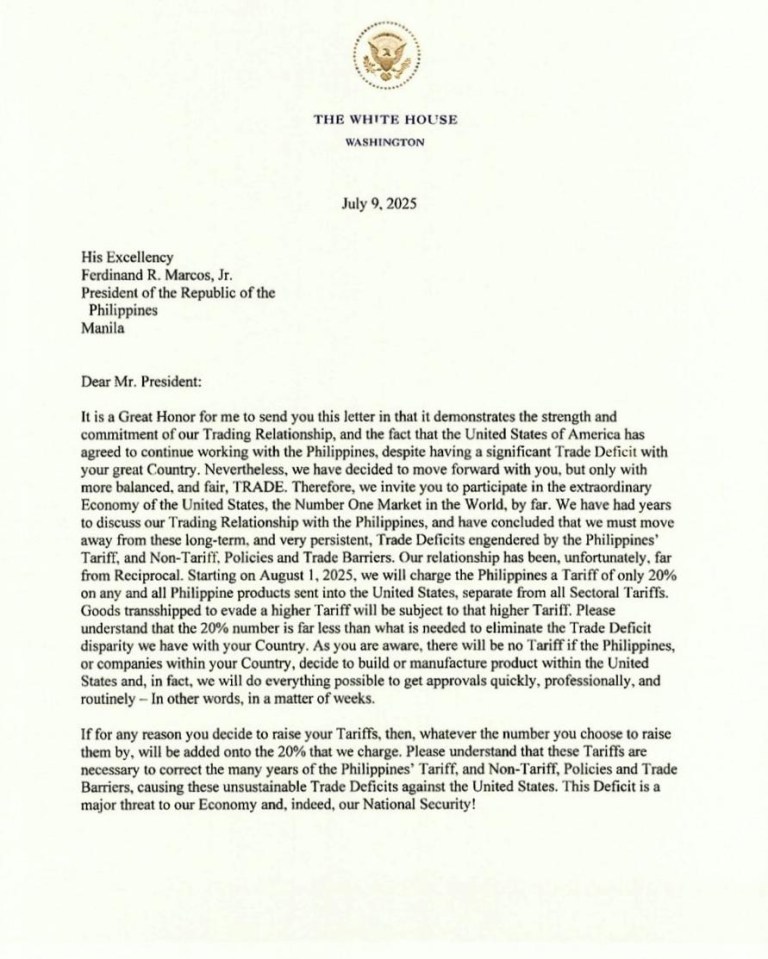
In a letter dated July 9 addressed to President Ferdinand R. Marcos Jr., US President Donald Trump announced that beginning Aug. 1, 2025, the US will raise tariffs on Philippine goods to 20 percent—up from the previously announced 17 percent rate.
In a text message to the Philippine News Agency on Thursday morning, Romualdez said Manila would formally request a review of the tariff hike from Washington D.C.
Trump, in his letter, recognized the Philippine-US trade relations and said the latter has “agreed to continue working with the Philippines, despite having a significant trade deficit.”
“Starting on August 1, 2025, we will charge the Philippines a Tariff of only 20 percent on any and all Philippine products sent into the United States, separate from all Sectoral Tariffs,” it read.
Trump said there would be “no tariff if the Philippines, or companies within” the country decide to build or manufacture products within the US.
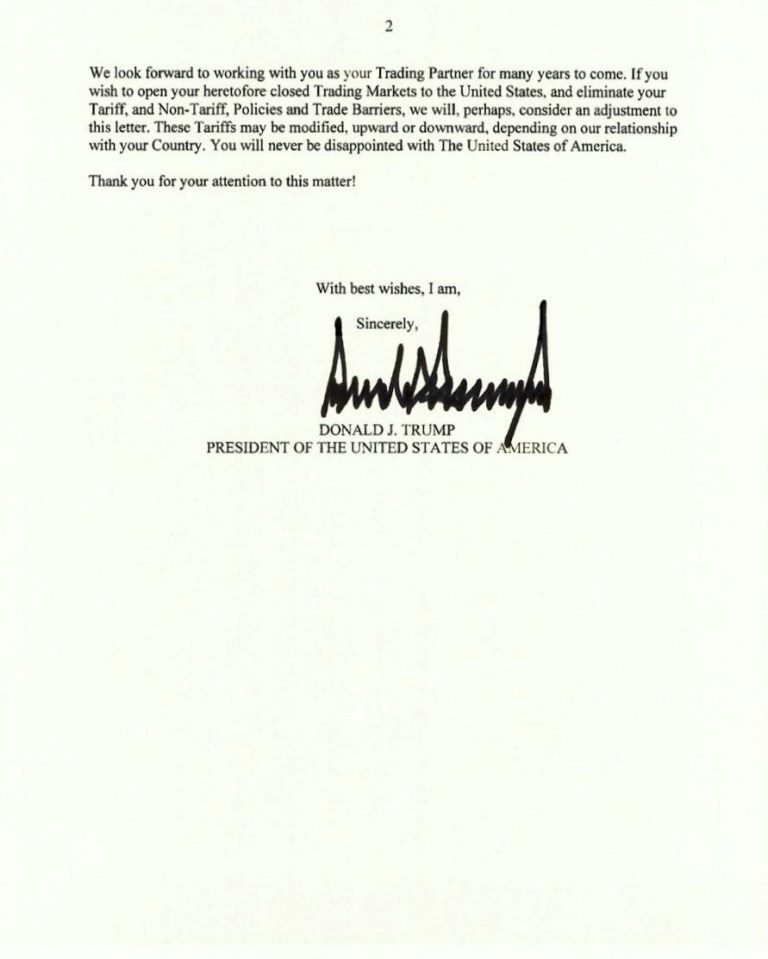
The US, he added, is also open to “reconsider an adjustment” if the country opens its “closed trading markets to the United States,” and eliminates its “tariff, and non-tariff policies and trade barriers.”
“These tariffs may be modified, upward or downward, depending on our relationship with your country,” he said.
Trump, meanwhile, warned Manila against reciprocating the move with a tariff increase.
“If for any reason you decide to raise your Tariffs, then, whatever the number you choose to raise them by, will be added onto the 20 percent that we charge,” he said.
For transparency, posted below is the 2-page letter of Trump to Marcos regarding tariffs.
The first page.
The 2nd page.
Let me end this post by asking you readers: What is your reaction to this recent development? Do you think the Philippines fell short in its recent negotiations with the United States which resulted in a higher tariff at 20%? Do you think the economic managers of the Philippines can convince America to delay, if not lower, the declared tariff? Do you think a 20% tariff rate by America will hurt the economy of the Philippines this year?
Based on the latest international tourism statistics and analysis for 2025, the Philippines is clearly failing to attract foreign tourists when compared to its Southeast Asian neighbors, according to a news article by VnExpress.
To put things in perspective, posted below is an excerpt from the VnExpress news article. Some parts in boldface…
An online debate has erupted on social media as users wonder why the Philippines, with its rich nature, culture, and cuisine, is being overlooked by foreign tourists in favor of destinations like Vietnam and Thailand.
Thea Tan, a Filipino, posted on her X account in May expressing frustration over the Philippines’ underwhelming tourism numbers despite offering what other countries dream of: breathtaking beaches, vibrant culture, incredible food, and the warmest locals.
“So, why are tourists still choosing Thailand, Vietnam, and Bali over us?” she asked.
The post quickly went viral, accumulating over 9,000 likes and hundreds of comments.
In the first quarter of the year, Malaysia topped the list of most-visited Southeast Asian countries, with 10.1 million arrivals, followed by Thailand (9.55 million), Vietnam (6 million), and Singapore (4.3 million). By April, the Philippines had only welcomed 2.1 million visitors.
In 2024, the country saw 5.9 million foreign tourists, falling short of the government’s target of 7.7 million and far behind its regional neighbors including Cambodia, which had 6.7 million visitors.
Many online users, like Tan, argue that the Philippines is not considered a top priority destination in ASEAN.
“We are tiring out tourists with poor infrastructure and complicated transportation,” Tan noted.
Even locals find domestic travel expensive and difficult, let alone for foreign visitors, according to comments on the post.
“The Philippines has beautiful beaches, delicious food, and friendly people, but it lacks roads, reliable airports, and public transportation. Most importantly, the prices here are too high,” one local shared.
Another netizen pointed out, “In all the countries you’ve mentioned, their capitals are also tourist destinations. Manila, on the other hand, is boring for tourists. We don’t have decent museums or historical tours, and moving around in Manila is not easy either.”
A netizen added, “The government isn’t investing in quality tourist facilities and infrastructure like our neighboring countries. That’s where we’re lagging behind.“
Recently, the Philippines was ranked as the most dangerous destination by U.K. financial comparison site HelloSafe in a survey dismissed by the Philippines’ tourism experts as biased and misleading.
Victor Lim, president of the Federation of Filipino-Chinese Chambers of Commerce and Industry, emphasized that the Philippines must improve its infrastructure and enhance safety measures to establish itself as a leading tourist destination in Southeast Asia, Philstar reported.
Let me end this post by asking you readers: What is your reaction to this recent development? Do you think the Department of Tourism and its strategic partners should get together and come up with hard adjustments to make the Philippines more attractive to foreigners? What do you think are the five biggest problems of the tourism industry of the country? Do you consider tourism-related awards crucial to the Philippines’ ability to attract visitors from around the world?
For more South Metro Manila community news and developments, come back here soon. Also say NO to fake news, NO to irresponsible journalism, NO to misinformation, NO to plagiarists, NO to reckless publishers and NO to sinister propaganda when it comes to news and developments. For South Metro Manila community developments, member engagement, commerce and other relevant updates, join the growing South Metro Manila Facebook group at https://www.facebook.com/groups/342183059992673