Based on the latest international tourism statistics and analysis for 2025, the Philippines is clearly failing to attract foreign tourists when compared to its Southeast Asian neighbors, according to a news article by VnExpress.
To put things in perspective, posted below is an excerpt from the VnExpress news article. Some parts in boldface…
An online debate has erupted on social media as users wonder why the Philippines, with its rich nature, culture, and cuisine, is being overlooked by foreign tourists in favor of destinations like Vietnam and Thailand.
Thea Tan, a Filipino, posted on her X account in May expressing frustration over the Philippines’ underwhelming tourism numbers despite offering what other countries dream of: breathtaking beaches, vibrant culture, incredible food, and the warmest locals.
“So, why are tourists still choosing Thailand, Vietnam, and Bali over us?” she asked.
The post quickly went viral, accumulating over 9,000 likes and hundreds of comments.
In the first quarter of the year, Malaysia topped the list of most-visited Southeast Asian countries, with 10.1 million arrivals, followed by Thailand (9.55 million), Vietnam (6 million), and Singapore (4.3 million). By April, the Philippines had only welcomed 2.1 million visitors.
In 2024, the country saw 5.9 million foreign tourists, falling short of the government’s target of 7.7 million and far behind its regional neighbors including Cambodia, which had 6.7 million visitors.
Many online users, like Tan, argue that the Philippines is not considered a top priority destination in ASEAN.
“We are tiring out tourists with poor infrastructure and complicated transportation,” Tan noted.
Even locals find domestic travel expensive and difficult, let alone for foreign visitors, according to comments on the post.
“The Philippines has beautiful beaches, delicious food, and friendly people, but it lacks roads, reliable airports, and public transportation. Most importantly, the prices here are too high,” one local shared.
Another netizen pointed out, “In all the countries you’ve mentioned, their capitals are also tourist destinations. Manila, on the other hand, is boring for tourists. We don’t have decent museums or historical tours, and moving around in Manila is not easy either.”
A netizen added, “The government isn’t investing in quality tourist facilities and infrastructure like our neighboring countries. That’s where we’re lagging behind.“
Recently, the Philippines was ranked as the most dangerous destination by U.K. financial comparison site HelloSafe in a survey dismissed by the Philippines’ tourism experts as biased and misleading.
Victor Lim, president of the Federation of Filipino-Chinese Chambers of Commerce and Industry, emphasized that the Philippines must improve its infrastructure and enhance safety measures to establish itself as a leading tourist destination in Southeast Asia, Philstar reported.
Let me end this post by asking you readers: What is your reaction to this recent development? Do you think the Department of Tourism and its strategic partners should get together and come up with hard adjustments to make the Philippines more attractive to foreigners? What do you think are the five biggest problems of the tourism industry of the country? Do you consider tourism-related awards crucial to the Philippines’ ability to attract visitors from around the world?
For more South Metro Manila community news and developments, come back here soon. Also say NO to fake news, NO to irresponsible journalism, NO to misinformation, NO to plagiarists, NO to reckless publishers and NO to sinister propaganda when it comes to news and developments. For South Metro Manila community developments, member engagement, commerce and other relevant updates, join the growing South Metro Manila Facebook group at https://www.facebook.com/groups/342183059992673
Welcome back fellow geeks, Blu-ray collectors and movie buffs!
When it comes to watching movies – both old and new – the best place for me is still the movie theater. The very large screen, high-tech sound systems and comfortable seats of the cinema all make the theater viewing experience very immersive which streaming apps and the home theater setup could never match. The cinema experience is always better than streaming.
That being said, it is disappointing for me – as a resident of Muntinlupa City here in the Philippines – that local theaters in Alabang had to close down. The original cinemas of Festival Mall, which first opened in 1998 and grew from six to ten screens, are no more. Before they were all closed down, those cinemas had deteriorated over time and I still remember how bad the projection in one of their premium cinemas was when I saw Star Trek Into Darkness in 2013. It was like I was watching a VHS copy of the movie on their screen. It was that bad!
This year, the 4-screen cinemas of Commercenter in Filinvest City had closed down (refer to my past blog posts by clicking here and here) and it is very unfortunate not just for me but also for others who enjoyed watching movies at that mall. In my experience, Commercenter was my favorite local place to watch movies at and the cinema operators were consistent with maintaining each screen, the comfortable chairs and the sound systems. At the same time, it was pretty convenient for me to park the car in the basement parking (really spacious), climb up to the cinemas at the 2nd floor (ticket counter and snacks counter were beside each other), enjoy a movie, and visit a local store or a restaurant within the mall after leaving the cinema.
With the closure of Festival Mall’s original cinemas and Commercenter cinemas, that is a combined loss of ten screens along with the many seats and equipment combined. Along the way, many people who worked directly in those lost cinemas either became unemployed or got re-assigned to a new task within the local establishment. Sadly, not too many people here in the Philippines are talking about the jobs lost with the closure of cinemas.
Cinemas of Commercenter have been closed down since March 15, 2025.
This brings me to my next point – BusinessWorld published an article exploring the current struggle of Philippine cinemas in what is now the post-pandemic era. For the newcomers reading this, the Philippines economy has been growing strongly year-by-year after the COVID-19 period ended but the nation’s cinema industry is still struggling in terms of sales and attracting paying customers. The Filipinos’ love for streaming is huge factor but there are also other reasons why not enough moviegoers are supporting cinemas.
To put things in perspective, posted below is an excerpt from the BusinessWorld article. Some parts in boldface…
KAREN LUSTAÑAS, 30, tries to watch a movie in the Philippine capital at least once a month, if the budget allows it.
“I try to save time and money for films that I really want to see,” she told BusinessWorld in a Facebook Messenger chat. “I can barely afford it, but if I’m a fan of the director or actors, I really have to watch it.”
“Otherwise, I’ll just watch it on a streaming platform,” she added.
As good as the movie industry is in imagining alternate realities, it didn’t see this one coming. Five years after the coronavirus disease 2019 (COVID-19) decimated the box office here and all over the world, movies are still struggling to come back.
Philippine gross movie ticket sales fell 3.7% year on year to $45.5 million (P2.5 billion) last year, a far cry from the $144.5 million posted in 2019, before the pandemic hit, according to US-based box office revenue tracker Box Office Mojo. In 2020, gross sales plunged 95% to $7.7 million.
Global cinema ticket sales fell 8.8% last year to €28 billion (P1.8 trillion) from 2023, the first annual drop since COVID-19, the European Audiovisual Observatory (EAO) said last month.
Regular movie ticket prices cost P300 to P400 in Metro Manila, or about half the daily minimum wage. On the other hand, the basic monthly subscription to streaming platforms like Netflix, Max (HBO) and Disney+ costs P150 to P250, and the titles are virtually endless.
“If you think about it, it’s really worth it and more practical to go with Netflix,” Ms. Lustañas, a freelancer, said.
The annual Metro Manila Film Festival (MMFF) grossed P800 million last year, hitting the target but failing to top 2023’s record P1 billion despite a week-long extension.
The pandemic forced people to watch movies at home, aiding streaming services like Netflix, whose revenue grew 14% annually to more than $39 billion last year from 2019, according to computations by BusinessWorld using data from the company’s website. Netflix subscribers also doubled to about 300 million over the five-year period.
Since 2020, local box office hits have been few and far between. The latest was Star Cinema’s My Love Will Make You Disappear starring Kim Chiu and Paulo Avelino, grossing P12 million on its opening day in March.
“Today, going to the cinema is a more intentional experience, rooted not just in the movie being shown but in the overall ambiance that brings the film to life,” Hamm E. Katipunan, Ayala Malls’ Asset Management head, said in an e-mailed reply to questions.
“It’s not just about waiting for blockbusters to hit streaming sites; Filipinos appreciate the good feeling of watching movies that are truly worth experiencing on the big screen,” he added.
While cinemas run by Ayala Malls, SM Supermalls and other mall chains have diversified their offerings, a pattern has emerged in the top-grossing Filipino films that have drawn people to cinemas.
GMA Pictures and Star Cinema’s co-production Hello, Love, Again starring Alden Richards and Kathryn Bernardo set the record for the highest opening day gross for a local film with P85 million in November, surpassing the P75-million gross from The Super Parental Guardians in 2016.
‘FORMULAIC STORIES’ – It shows that Filipinos watch a movie mainly because of its main cast, Film Development Council of the Philippines (FDCP) Chairman Jose Javier Reyes told a news briefing in March, citing a council-funded study involving 800 respondents.
“They can’t afford to go regularly to the movies anymore,” he said. “The biggest blow is that people don’t repeat screenings. They just wait for it to go on streaming platforms.”
The study, done in 2024 in collaboration with De La Salle University to explore the evolving habits, preferences and challenges shaping the local film industry, found that Filipinos from the A, B, and a small part of the C socioeconomic classes regularly watch movies.
The study, which will be released in July as part of the launch of FDCP’s Philippine Film Industry Roadmap, also found that streaming services have become the primary platform for 67% of Filipinos.
Only 21% still frequent cinemas, with many complaining about repetitive movie themes and high ticket prices.
Though stars are still the main movie drawer, the study also found that Filipinos are “sick of formulaic stories,” Mr. Reyes said. He added that the roadmap, mandated by the government, would shed light on how to better support the industry.
In October last year, President Ferdinand R. Marcos, Jr. placed the Film Academy of the Philippines under the Department of Trade and Industry (DTI) to boost Filipino film development.
Trade Secretary Ma. Cristina A. Roque earlier said the budget for the film industry would increase next year as part of the roadmap. She noted that other countries have been using movies and the creative industry to boost tourism and trade.
Mr. Reyes said movie outfits should improve the quality of their films to boost their success overseas. “In the Philippines, star power is important, but the moment you cross borders, there’s a market for people who are more interested in the material itself,” he pointed out.
Rico V. Gonzales, head of distribution at Warner Bros. Pictures Philippines, said the company supports the local industry by distributing two to three Filipino movies yearly, along with the usual foreign releases from Warner Bros. and Universal Pictures.
“It’s part of the goodwill of the company to help local producers who don’t have a distribution arm, compared with the likes of Star Cinema and GMA Pictures, which have the power to do it themselves,” he said.
The current state of the cinema industry of the Philippines is disappointing and the future looks uncertain as of this writing. While a lot of my fellow Filipinos chose streaming to watch movies in the comfort of their home, I prefer watching movies on Blu-ray and 4K Blu-ray disc format. The most phenomenal 4K Blu-ray experiences I had was Top Gun: Maverick and that movie never failed to amaze me each time I saw it using my 4K Blu-ray disc player. I also enjoyed watching my 4K Blu-ray copies of Casablanca, Interstellar, Total Recall (1990), and Star Trek: First Contact.
Going back to the state of cinema here in the Philippines, I did not watch a single movie in the cinema in 2024. In fact, the last time I saw a movie on the big screen locally was Sound of Freedom in 2023 (read my review by clicking here). This is because the new movies that were released in 2024 did not interest me at all and the fact that a lot of new Hollywood movies had woke garbage in them turned me off. Not only that, there were times when news movies from overseas were not even released in Philippine cinemas at all such as Jesus Revolution (note: I had to buy the movie on Blu-ray just to watch it).
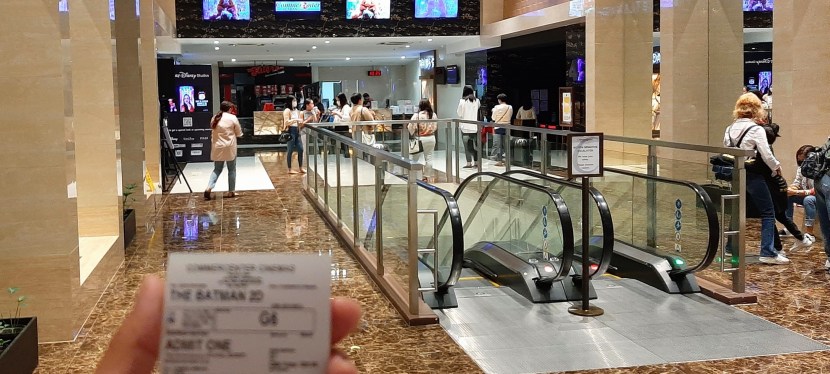
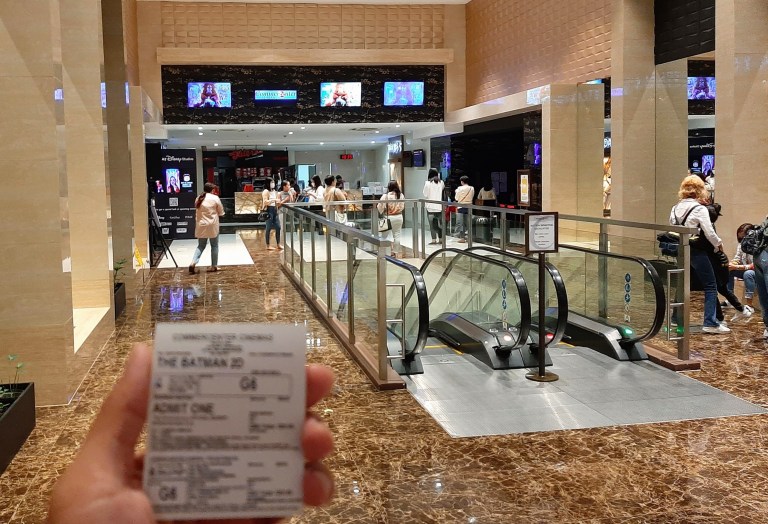
I saw The Batman at Commercenter’s cinema on March 2022.
As of this writing, the direction of the entire cinema industry of the Philippines remains uncertain and so far there were no real breakthroughs that happened. That being said, I still remember when in 2015, there were long lines of moviegoers at Commercenter waiting to enter the cinemas to watch Jurassic World. Such a memory won’t be repeated here in Alabang and without its cinemas, Commercenter’s value as a place for fun has gone way down.
As there are more signs of weakness and uncertainty, the economic managers of the Philippines officially lowered their economic growth target this year, according to a Philippine News Agency (PNA) news article.
To put things in perspective, posted below is an excerpt from the PNA news article. Some parts in boldface…
Economic managers on Thursday revised the economic growth target for this year amid mounting global uncertainties.
At a briefing after the 191st Development Budget Coordination Committee (DBCC) meeting, Budget Secretary and DBCC Chair Amenah Pangandaman said the economic growth assumption for 2025 was revised downward to 5.5 to 6.5 percent from the previous 6 to 8 percent.
For 2026 to 2028, the Philippine economy is projected to expand by 6 to 7 percent, reflecting a more cautious and resilient economic outlook amid global headwinds.
“The revisions take into account heightened global uncertainties, such as the unforeseen escalation of tensions in the Middle East and the imposition of U.S. tariffs,” Pangandaman said.
She said that despite these challenges, the DBCC remains “vigilant and ready to deploy timely and targeted measures” to mitigate their potential impact on the Philippine economy.
The budget chief said the country continues to be one of the fastest-growing economies in ASEAN driven by robust domestic demand.
To maintain this momentum, she highlighted the administration’s focus on structural reforms, including the Corporate Recovery and Tax Incentives for Enterprises to Maximize Opportunities for Reinvigorating the Economy (CREATE MORE) Act and the Public-Private Partnership (PPP) Code, both designed to enhance the country’s trade and investment competitiveness.
Pangandaman said the government will also pursue the approval and implementation of other reforms recently ratified by Congress, such as the Liberalizing the Lease of Private Lands by Foreign Investors Act, Enhanced Fiscal Regime for Large-Scale Metallic Mining Act, Accelerated and Reformed Right-of-Way (ARROW) Act, and Konektadong Pinoy Act.
The DBCC also revisited the medium-term macroeconomic assumptions to take into consideration recent global and domestic developments.
The inflation assumption for this year was cut to 2 to 3 percent from the previous 2 to 4 percent. For 2026 to 2028, the inflation assumption was retained at 2 to 4 percent.
For 2025 to 2028, crude oil price assumptions were reduced to USD60 to USD70 per barrel from USD60 to 80 per barrel, despite escalating geopolitical tensions.
The foreign exchange rate is assumed to remain stable, averaging at PHP56 to PHP58 per US dollar from 2025 through 2028, supported by lower domestic inflation.
Let me end this post by asking you readers: What is your reaction to this recent development? Do you think the economy of the Philippines is lacking momentum to achieve 6% growth this year? Do you think that inflation and unemployment will eventually rise before the year ends? Are you convinced that foreign investors are staying away from the Philippines?
Recently authorities here in the Philippines deported over one hundred Chinese nationals who previously worked for Philippine Offshore Gaming Operators (POGOs), according to a news report by GMA News.
To put things in perspective, posted below is an excerpt from the news report of the GMA News. Some parts in boldface…
Some 100 Chinese individuals who worked for Philippine Offshore Gaming Operators (POGOs) were deported to China on Tuesday.
According to Saleema Refran’s report on Balitanghali, they were deported at around 10:40 a.m.
The Presidential Anti-Organized Crime Commission (PAOCC) said China paid for the airfare of the deportees, with the goal of ensuring that they will not be able to escape.
“Importante kasi sa kanila ‘yan dahil marami silang nakukuhang impormasyon dito sa mga bosses kung paano sila nag o-operate, saan sila nag-o-operate, at anu-anong mga sistema sa money laundering ang ginagamit nila,” PAOCC Executive Director Undersecretary Gilbert Cruz said.
(It’s important to them because they get a lot of information from the bosses here. How they operate, where they operate, and what money laundering systems they use.)
“Ang ayaw kasi nila siyempre ‘yung hindi nakakarating sa China mismo ‘yung mga boss nitong operation ng POGO,” he added.
(What they really don’t want, of course, is for the bosses of these POGO operations to not arrive in China.)
Once in China, the deportees will undergo investigation for scamming, cybercrime, fraud, and money laundering.
Broken apart – Meanwhile, the Filipino partners and spouses of the deportees were emotional when saying their goodbyes, including one who even brought their six-month child.
“Sobrang sakit po kasi may anak po kami (It really hurts because we have a child),” one of the women said.
The mother is already in contact with the deportee’s family and China, and plans to follow him there with their daughter.
The former workers were arrested during anti-POGO operations in Cebu, Cavite, Parañaque, and Pasay.
They have been declared undesirable aliens due to lack of visas and work permits, and for working in illegal POGOs. Aside from these, they have also been blacklisted and can no longer return to the Philippines.
Let me end this post by asking you readers: What is your reaction to this recent development? Do you think the authorities should do more apprehending the many illegal aliens (former POGO workers) still on the loose so that more will get deported? Are you concerned that there could be many Filipinos who became personally involved with foreigners who worked in POGOs?
While a lot of Philippine offshore gaming operators (POGOs) have closed down as a result of the nationwide ban on them, there still over nine thousand illegal aliens – who used to be POGO employees – on the loose nationwide, according to a Manila Bulletin news report. It was also revealed that some of the illegal aliens are carrying infectious diseases such as tuberculosis and HIV.
To put things in perspective, posted below is an excerpt from the news report of Manila Bulletin. Some parts in boldface…
At least 9,000 undocumented foreign nationals who previously worked for Philippine offshore gaming operators (POGOs)–including those with infectious diseases such as HIV and tuberculosis–remain on the loose.
This was according to Presidential Anti-Organized Crime Commission (PAOCC) Executive Director Gilbert Cruz, who reported during the House quad-committee (quad-comm) hearing on Monday, June 9, that the agency was facing detention and deportation challenges regarding individuals linked to POGOs.
Cruz said that about 600 foreign nationals were already crammed within the PAOCC detention in Pasay City. What’s worse is that they cannot be deported because they have lost their passports.
“[We have] a monthly expenditure of millions for food and healthcare. Medical needs are [also] rising with detainees diagnosed with illness such as tuberculosis, hepatitis B, respiratory infection, and even cases of HIV,” he said.
“Actually sir dito po kami nanlulumo, three weeks ago nagpa-cremate po tayo ng isang HIV [patient] (Actually, we were saddened by the fact that we had to cremate three weeks ago an HIV patient),” he added.
The agency official said PAOCC’s detention facility was already overcrowded, as such “enforcement actions against an estimated 9,000 illegal foreign workers have been temporarily suspended”.
PAOCC said those on the loose pose risk to the society.
“‘Yung mga POGO workers, noong pumunta dito hindi naman healthy lahat yan. ‘Yung iba dyan may sakit na (Those POGO workers, when they went here, they weren’t really healthy. Some of them were already sick), that’s why we have cases of tuberculosis, HIV,” Cruz told lawmakers.
“Kapag pakalat kalat ‘yan sir, hindi natin alam kung sino pa ang kinontak o nagkaroon pa ng physical contact ‘yan (If they’re on the loose, we don’t know with whom they are having physical contact with),” he added.
Quezon 2nd district Rep. David “Jay-jay” Suarez also raised concern about illegal aliens who remain at large. He said they have become engaged in criminal activities, such as kidnapping and torture.
Let me end this post by asking you readers: What is your reaction to this recent development? Do you think there could be former POGO employees among the foreigners living in your local community? Are you concerned that the sick illegal aliens on the loose could be spreading disease all over the Philippines?
Once again, inflation in the Philippines went down as the Philippine Statistics Authority (PSA) recently confirmed that the headline inflation landed at 1.3% for the month of May 2025, according to a news article by Philippine News Agency (PNA). The said inflation result is the lowest since November of 2019.
To put things in perspective, posted below is an excerpt from the news article of PNA. Some parts in boldface…
Headline inflation further slowed to 1.3 percent in May this year from 1.4 percent in April, the lowest recorded since the 1.2 percent in November 2019, the Philippine Statistics Authority (PSA) said Thursday.
In a briefing, National Statistician Dennis Mapa said this brought the year-to-date average inflation to 1.9 percent which is at the lower end of the government’s 2 to 4 percent target range.
Mapa said the downtrend was primarily brought about by the slower increase in the index of housing, water, electricity, gas, and other fuels at 2.3 percent from 2.9 percent in April. Restaurant and accommodation services also recorded a slower inflation of 2 percent from 2.3 percent in April.
Mapa said the faster annual decline was likewise recorded in the transport index, at 2.4 percent in May from 2.1 percent in the previous month. Food inflation meanwhile remained at 0.7 percent. Mapa, however, said rice inflation was at -12.8 percent from -10.9 percent in April.
According to Mapa, the rollout of the PHP20 per kilogram rice program in line with the directives of President Ferdinand R. Marcos Jr., the “Benteng Bigas Meron Na” helped lower rice prices.
In May, the average price of regular milled rice declined to PHP43.19 per kg from PHP51.11 in May 2024. The average price of well-milled rice likewise fell to PHP49.45 per kg from PHP56.06 per kg while special rice also declined to PHP59.80 from last year’s PHP64.41 per kg.
The bottom 30 percent income households experienced zero percent inflation in May 2025, a sharp decline from 5.3 percent in the same month last year.
The National Capital Region also posted a slower inflation rate of 1.7 percent in May, down from 2.4 percent the previous month while other regions maintained a low average inflation rate of 1.2 percent.
More stable cost of living – In a separate statement, the Department of Economy, Planning, and Development (DEPDev) said the continued decline in the country’s headline inflation shows progress toward easing price pressures and achieving a more stable cost of living for Filipinos.
“We are encouraged by this development. It reflects the success of our sustained efforts to protect the purchasing power of Filipinos and ensure a more affordable cost of living,” said DEPDev officer in charge and Undersecretary for Policy and Planning Rosemarie Edillon.
To sustain this downward trend, DEPDev said the Marcos administration is committed to implementing targeted policies aimed at mitigating inflationary pressures and safeguarding the purchasing power of Filipino families.
The Food and Drug Administration (FDA) and the Department of Agriculture (DA) are strengthening their collaboration to ensure the availability of safe and effective animal vaccines amid ongoing African Swine Fever (ASF) and Avian influenza outbreaks.
Let me end this post by asking you readers: What is your reaction to this recent development? Do you think it is possible for Philippines inflation to fall below 1% by the end of the year?
In the view of the Bureau of Internal Revenue (BIR), the Philippines will become a more attractive destination for foreign investors due to the new rules streamlining the value-added tax (VAT) refund process, according to a Philippine News Agency (PNA) news article.
To put things in perspective, posted below is an excerpt from the news article of the PNA. Some parts in boldface…
The Bureau of Internal Revenue (BIR) expects the new rules streamlining the value-added tax (VAT) refund process — a key reform under the Corporate Recovery and Tax Incentives for Enterprises to Maximize Opportunities for Reinvigorating the Economy (CREATE MORE) Act – will make the Philippines a more attractive destination for foreign investors.
In a televised interview, BIR Commissioner Romeo Lumagui Jr. said the new regulations are consistent with President Ferdinand Marcos Jr.’s broader goal of making the country more business-friendly.
“Ang expectation natin, makikita ng mga dayuhang investors na seryoso ang pamahalaan na pagbutihin ang pagnenegosyo at papadaliin ang pagnenegosyo dito sa ating bayan (Our expectation is that foreign investors will see that the government is serious on business and in easing the doing of business in our country),” Lumagui was quoted as saying in a news release on Saturday.
“So, we’re hoping that it will encourage foreign investors to do business here in the Philippines,” he added.
According to the BIR chief, the main objective of CREATE MORE, as well as other BIR efforts, is to ease the doing of business and payment of taxes.
Republic Act No. 12066 or the CREATE MORE Act amended the National Internal Revenue Code to provide greater tax relief and incentives for businesses, particularly exporters.
To implement this, the BIR issued Revenue Memorandum Circular No. 37-2025 on April 10, which reduces the documentary requirements for VAT refund claims.
Under the new guidelines, certified true copies of invoices or receipts may now be submitted in place of original documents.
There was also a reduction of three documentary requirements, particularly the proofs of registration with the Securities and Exchange Commission or Department of Trade and Industry (DTI), whichever is applicable, and the copies of Import Entry and Internal Revenue Declarations/Informal Import Declaration and Entry or Single Administrative Document.
For claims involving amortized input VAT on capital goods, prior certifications from the Bureau of Customs may be reused if already submitted in past filings.
Furthermore, for VAT refund claims starting April 1, exporters are no longer required to submit actual proof of shipment, such as bills of lading.
Instead, the BIR will rely on a certification from the Export Marketing Bureau of the DTI, following a newly signed agreement between the two agencies.
“Ngayon pinadali natin ang proseso sa pakikipag-coordinate sa DTI. So, may kanya-kanyang role ang bawat isa para hindi na rin magdoble-doble ang mga requirements at pag-iimbestiga kung talagang merong mga inexport ang isang entity (We made the process easier through our coordination with the DTI. Each agency now has specific roles to prevent duplication in the submission of requirements and in investigating the goods exported by a business entity,” Lumagui explained.
“Patuloy din ang pag-e-examine natin kung ano ang pwede nating i-streamline na mga proseso para mas mapadali pa ang pagnenegosyo sa ating bayan (We also continue to examine what other processes we can streamline to make doing of business in our country easier),” he added.
Let me end this post by asking you readers: What is your reaction to this recent development? Are you convinced that the changes made will help the Philippines attract more foreign investors?
By pointing to several economic factors, the World Bank stated that it expects the economy of the Philippines to grow less than 6% per year until the year 2031, according to a Manila Bulletin news report.
To put things in perspective, posted below is an excerpt from the news article of the Manila Bulletin. Some parts in boldface…
The Philippines’ annual economic growth is expected by the World Bank Group (WBG) to remain below six percent this year until 2031.
Its newest country partnership framework (CPF) for the Philippines, covering fiscal years (FYs) 2026 to 2031, showed that the WBG forecasts Philippine gross domestic product (GDP) growth of 5.3 percent for this year, 5.4 percent for next year, and 5.5 percent for 2027—all below the more ambitious six- to eight-percent target of the Marcos Jr. administration for the second half of its term.
“The average GDP growth forecast for 2025 to 2027 is expected at 5.4 percent. Risks are mostly tilted downside and include potential retaliation by main global players that may affect global growth further, probably hitting domestic growth,” the WBG said, referring to the lingering world trade uncertainty caused by United States (US) President Donald Trump’s tariff spree.
“Increased uncertainty could trigger instability in financial markets and capital flight,” it added.
On the flipside, “the Philippines may benefit from improved margins of preference for key export products, and from lower global commodity prices (tied to lower global growth), and absent any external pressures, the prospect of continued monetary policy rate normalization” in the next three years, the WBG said.
This year, its projected 5.3-percent GDP growth rate—poised to be the slowest pace of expansion since the Philippine economy gradually reopened from the most stringent Covid-19 restrictions—was attributed by the WBG to “the direct impacts of the higher tariffs and trade policy uncertainty on demand for exports, the effects of increased global policy uncertainty on investment demand, and the indirect effects on export and investment demand through lower global growth.”
But on the upside, “these negative effects are dampened as the Philippines is mostly integrated in services rather than merchandise value chains (that have been most affected by trade policy barriers), and as public investment and private investment in non-tradables is expected to remain robust,” the WBG added.
Philippine GDP growth is seen picking up gradually to 5.7 percent in 2028, 5.8 percent both in 2029 and 2030, and 5.9 percent in 2031.
The WBG forecasts headline inflation to be in the range of three to 3.2 percent from 2025 to 2031—within the targeted two- to four-percent annual consumer price increases deemed conducive to economic growth.
As the Marcos Jr. administration embarks on fiscal consolidation to narrow the yawning budget deficit and lower the share of public debt to the economy following massive borrowings at the height of the pandemic, the WBG projected the fiscal deficit narrowing gradually from 5.7 percent of GDP in 2024 to 5.4 percent in 2025, 4.9 percent in 2026, 4.4 percent in 2027, 4.1 percent in 2028, 3.9 percent in 2029, 3.7 percent in 2030, and 3.6 percent in 2031.
Let me end this post by asking you readers: What is your reaction to this recent development? Do you think the economy of the Philippines currently does not have enough strength to exceed the crucial 6% mark for annual growth?
In an attempt to mitigate the effects of inflation on domestic prices, the Department of Agriculture (DA) recommended keeping the 15% tariff on imported rice, according to a GMA Network news report.
To put things in perspective, posted below is an excerpt from the news report of GMA. Some parts in boldface…
The Department of Agriculture (DA) has recommended retaining the 15% tariff on imported rice to help mitigate the effects of inflation in local prices.
In a public briefing on Wednesday, DA spokesperson Assistant Secretary Arnel de Mesa said that they aim on lowering the effects of inflation throughout the agricultural industry.
“Napakaimportante yan sa buong ekonomiya ng ating bansa, at masigurado din natin na maging tuloy-tuloy ang mga programa natin na mas mababang presyo ng bilihin di lamang ng bigas kundi iba pang agricultural commodities,” said de Mesa.
(It is very important to the economy of the entire country, and we should ensure that our programs to lower the prices of commodities will continue, not just rice but other agricultural commodities.)
He further said that the majority of every P100 that poor Filipino families spend were used to purchase rice.
“Mga 25% kasi ng bigas na kino-consume natin ay imported. So, kung mapapanatili natin na mababa ang taripa at 15%, mas masisigurado natin na yung pangkalahatang presyo ng bigas ay mas magiging matatag at hindi makakaapekto sa price spikes kung magkakaroon man. Yung inflation overall natin, mapapanatili nating mababa kung mananatiling mababa presyo ng bigas,” he added.
(About 25% of the rice we consume is imported. So, if we keep the tariff low at 15%, we can better ensure that the overall price of rice will remain stable and won’t affect any price spikes. We can keep or overall inflation lower if we keep the price of rice low.)
DA said that they consider the price of rice in international markets, exchange rates, logistics costs from the port of origin, and productivity in the country when considering rice tariffs.
“Napakaimportante lalo na sa panahon ng lean months, ay masigurado natin na yung imported na bigas ay maganda ang presyuhan para di maapektuhan din yung presyo ng local na supply natin. Yung timing is really important to make sure natin na mapapanatili natin na matatag ang presyuhan ng bigas,” he said.
(It is very important, especially in the lean months, that we ensure that the price of important rice will not affect the price of our local supply. The timing is really important to make sure that we keep rice pricing stable.)
Let me end this post by asking you readers: What is your reaction to this recent development? Do you think 15% tariff on imported rice is just right?
During the Israel Independence Day reception in Makati City, the government of the Philippines reaffirmed its commitment to strengthen its multifaceted partnership with Israel, according to a news article by the Philippine News Agency (PNA).
To put things in perspective, posted below is the excerpt from the PNA news article. Some parts in boldface…
The Philippine government reaffirmed its commitment to further strengthen its partnership with Israel, spanning key areas, such as agriculture and security.
Speaking at the Israel Independence Day reception in Makati on Thursday night, Foreign Affairs Undersecretary Jesus Domingo said Manila is eager to “further strengthen” this multifaceted partnership with the Jewish state.
Domingo said the two states share a deep and unique friendship rooted in history when the Philippines opened its door to Jewish people fleeing the Holocaust and voted in favor of a United Nations resolution to establish the State of Israel.
“These historical cornerstones form the bedrock of our strong bilateral ties over the decades, our relationship continues to expand,” he said, citing the dynamic Philippine-Israel cooperation on agriculture, technology and innovation, and security.
People-to-people connections, he added, have grown through tourism, culture exchanges, and the two nations’ shared democratic values.
“We are confident that by continuing to work together, we can achieve greater prosperity and security for both our nations and contribute positively to the global community,” he said.
Outgoing Israel Ambassador to the Philippines Ilan Fluss, meanwhile, conveyed similar hopes for stronger Philippine-Israel relations as he noted the new depth in the two states’ partnership over the past years.
This newest development shows the continuing growth of Israel-Philippines ties through the high level officials during the event in Makati. Even as anti-Semitism intensifies and Islamo-Leftists forces (including their mainstream news media partners-in-crime) around the world keep on condemning Israel, the government of the Philippines still recognizes the Jewish state and values Israel-Philippines ties. Pray to the Lord that President Bongbong Marcos will make moves for better engagement with Israel.
Overseas, Israel is making notable progress against the remaining forces of the Palestinian terrorist group Hamas in Gaza, while keeping a close watch on the terrorist state Iran which itself is negotiating with Trump-led America. Watch closely what will happen next and never lose sight on the deceptive moves of the sinister leaders of Qatar who openly support Palestinian terrorists, hate Israel and shamelessly propagate Islamic terrorism through Al Jazeera.
To my fellow Filipinos reading this, I encourage you to accept the truth that Israel is the land God designated specifically for the Jewish people (read Genesis 35:10-12) and His command must be followed without hesitation. If you want to be blessed further by the Lord, do so by loving and blessing the Jewish people (Genesis 12:1-3). I did my part when I was in Israel. Also, let me remind you all that the ties between the Jews and Christians are truly biblical!
I encourage you all to pray to the Lord God in support of Israel, to love and bless the Jewish people, and pray for the peace of Jerusalem. Pray to Him so that Israel-Philippines ties and cooperation will keep growing stronger and more resilient no matter what happens around the world.





 Author Carlo Carrasco