A Look Back at The Solution #11 (1994)

Disclaimer: This is my original work with details sourced from reading the comic book and doing personal research. Anyone who wants to use this article, in part or in whole, needs to secure first my permission and agree to cite me as the source and author. Let it be known that any unauthorized use of this article will constrain the author to pursue the remedies under R.A. No. 8293, the Revised Penal Code, and/or all applicable legal actions under the laws of the Philippines.

Welcome back superhero fans, enthusiasts of 1990s arts and culture, and comic book collectors! As the old saying goes…if you’ve got a problem that needs solving, you call The Solution. What if, for example, The Solution is in another world dealing with major problems and are out of reach?

In the previous two issues I reviewed (click here and here), The Solution got themselves in conflict with the powerful alien force called the Vyr as their member Shadowmage (also referred to as Aera) stole the Vorlexx from them many years prior. During the confrontation in France, the Vyr captured Aera who managed to discreetly pass the Vorlexx to Lela Cho (Tech) before their separation. Since after, The Solution traveled to different worlds with the Vorlexx and teamed up with a man called Harmonica who is knowledgeable about the Aerwan and the Darkur. Unbeknowst to them, the Vyr are watching them from a distance.

With those details laid down, here is a look back The Solution , published by Malibu Comics in 1994 with a story written by the late James Hudnall and drawn by John Statema with ink work by Barbara Kaalberg.

The cover.

Early story

The story begins with Dropkick, Harmonica, Tech and Vurk in a desperate situation. Just as they need to get away fast, Dropkick notices that the Vorlexx is not working. Harmonica points to the cliffs as the only way out. With his wings, Vurk takes Tech with him to fly up while Harmonica takes Dropkick. As soon as they arrived up the cliff, they find themselves facing the massive Aerwan army whose members are scattered across the ground and the air. An Aerwan military leader tells The Solution to surrender the Vorlexx.

Meanwhile, the Vyr are watching the live video feed of The Solution and the Aerwan army. Shadowmage, who has been restrained in a very painful and humiliating position, has been watching her friends since they exited the cave. While she still remains unharmed by her captors, she knows that her torments are just beginning. The Vyr want her to see what will happen to her friends…

Quality

In the middle of a major battle between two alien armies, The Solution were really pushed to their limits as they pursue their dangerous rescue mission of their captured teammate.

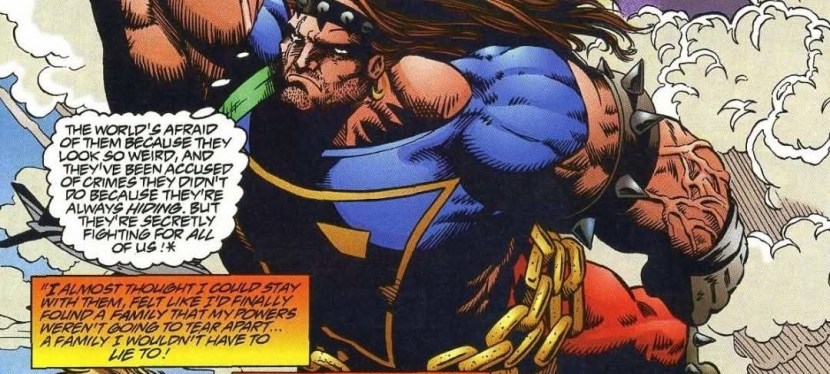
Wow! The storytelling and visual presentation in this comic book got even wilder and the sci-fi element of this particular storyline really went into overdrive! For one thing, much of the tension which started building up in issues and paid off big time in the early part of this comic book as the inevitable battle between the Darkur (Vurk’s people) and the Aerwans (Shadowmage’s people) which easily made The Solution and Harmonica ending up tiny in the middle. Of course, as this is still about the team’s desperate attempt to rescue Aera from the very powerful Vyr, you will really see Lela Cho, Vurk, Dropkick (who carries the Vorlexx) struggle a lot in close encounters with aliens just as they keep on trusting Harmonica (whom they formed an uneasy alliance with) to help them. It is compelling to see how the three mentioned Solution teammates not only struggle to survive but also strive to overcome great odds knowing that if they fail, Aera/Shadowmage will perish. Very clearly, this is a very high-stakes story that James Hudnall prepared and the way I see it, this storyline really added a lot to the development of The Solution.

As for the art, I can say that this, in my opinion, is John Statema at his grandest with the Ultraverse. While being supported by by Barbara Kaalberg’s detailed ink work, Statema really captured the wild sci-fi tale Hudnall prepared and showed The Solution within a very strange environment surrounded by death and uncertainty. A lot of this comic book’s pages are filled with action scenes (note: lots of bloody scenes but without the color red) that are also nicely structured and each member of The Solution had the appropriate dynamic visuals that fitted nicely with their respective big moments. More notably, Statema really worked hard showing the many, many Aerwans and Darkur warriors who filled the pages – especially the two 2-page shots that each showed a wide view of the field – and succeeded in presenting monsters that were scary and very alien in design.

Conclusion

This is one of two epic views in this comic book by illustrator John Statema, inker Barbara Kaalberg and the colorists. Look at all the details!

The Solution (1994) is a wild Ultraverse concept that succeeded in engaging and entertaining me from start to finish. It is a great pay-off to what was built up since The Solution and having the team lost in another world in their pursuit of their captured teammate really moved this series forward. In fact, when it comes to expanding the boundaries of the Ultraverse itself, this comic book really achieved that! This is also the most ambitious sci-fi tale of the UV that I’ve read.  The ironic thing is that this comic book is not even the conclusion to its storyline. There is still more to come and I can say I’m really motivated to read the next issue.

If you are seriously planning to buy an existing hard copy of The Solution (1994), be aware that as of this writing, MileHighComics.com shows that the near-mint copy of the regular edition costs $16 while the near-mint copy of the newsstand edition costs $48.

Overall, The Solution (1994) is highly recommended!

+++++

Thank you for reading. If you find this article engaging, please click the like button below and also please consider sharing this article to others. If you are looking for a copywriter to create content for your special project or business, check out my services and my portfolio. Feel free to contact me with a private message. Also please feel free to visit my Facebook page Author Carlo Carrasco and follow me on Twitter at  @HavenorFantasy as well as on Tumblr at https://carlocarrasco.tumblr.com/

A Look Back at Wonder Woman Gallery (1996)

Disclaimer: This is my original work with details sourced from reading the comic book and doing personal research. Anyone who wants to use this article, in part or in whole, needs to secure first my permission and agree to cite me as the source and author. Let it be known that any unauthorized use of this article will constrain the author to pursue the remedies under R.A. No. 8293, the Revised Penal Code, and/or all applicable legal actions under the laws of the Philippines.

Welcome back, superhero enthusiasts, comic book collectors and fans of Wonder Woman! I should say that this is the most unusual comic book I have reviewed so far due to its main presentation of varied artworks featuring the Queen of all Superheroes herself – Wonder Woman!

For the newcomers reading this, there were several comic books back in the 1990s that did not really tell stories but showcased artworks of varied superheroes done by several artists. Such publications were in the form of swimsuit specials, apparently inspired by Sports Illustrated’s own publications. There were WildStorm Swimsuit Special , Ballistic Studios Swimsuit Special , Homage Studios Swimsuit Special , Lady Death Swimsuit Special and the Avengelyne/Glory: Swimsuit Special to name some.

The 1990s saw a rise of eroticism in superhero comic books. Not even the Wonder Woman monthly series of that time was spared from the trend. There was a time when DC Comics hired Mike Deodato to illustrate a number of Wonder Woman comic books in the mid-1990s which resulted a more eroticized look of Diana/Wonder Woman and her fellow Amazons. John Byrne took over after Deodato and his stint was not an improvement.

While the 1990s was a weak decade of Wonder Woman comics for me personally, not all was doom and gloom. Around twenty years before Gal Gadot debuted on the big screen as the cinematic Wonder Woman, DC Comics published an art gallery of the Queen of Superheroes in the form of a comic book.

With the details established, here is a look back at Wonder Woman Gallery, published by DC Comics in 1996 featuring the works of multiple artists.

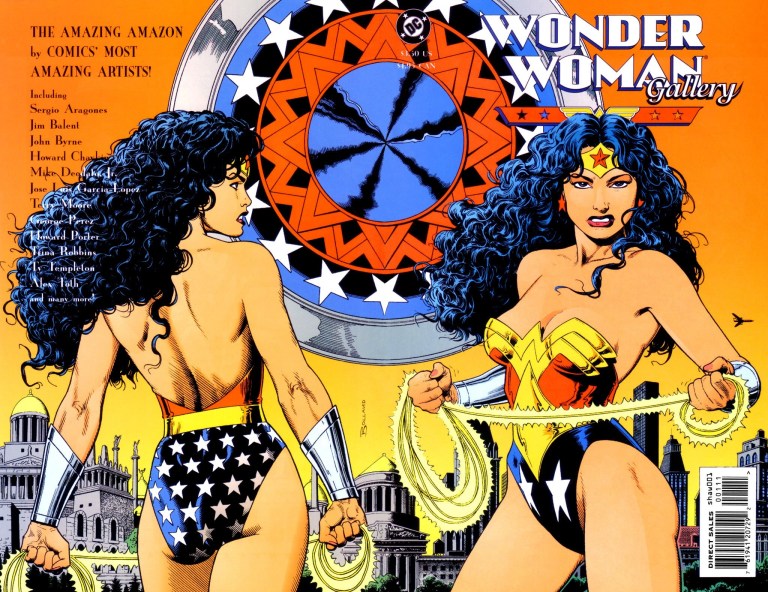
The cover.

What it is

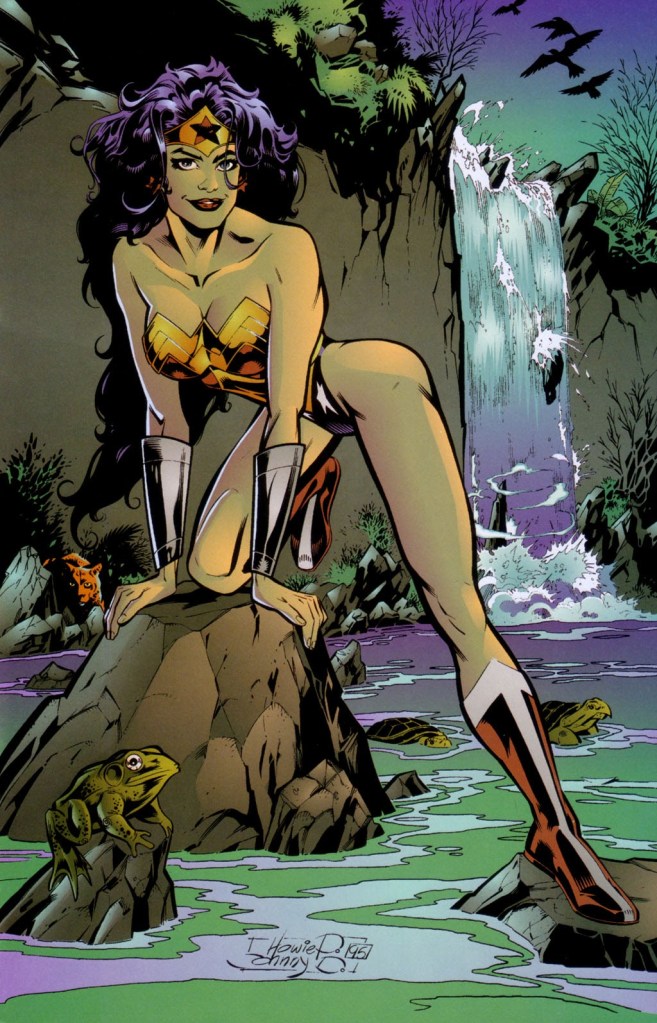
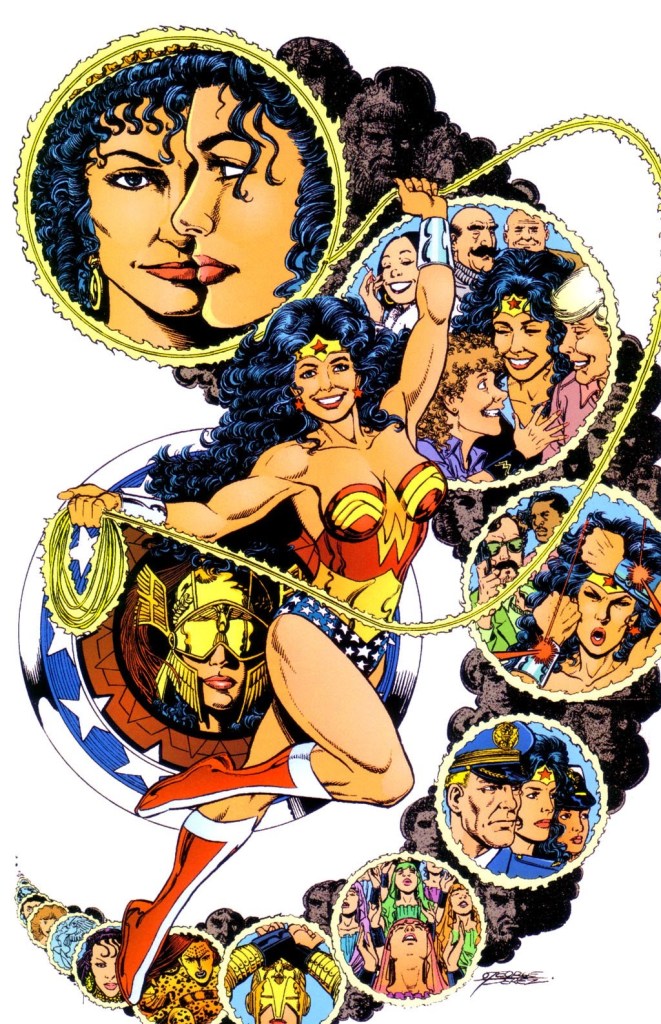
Wonder Woman Gallery is a showcase of thirty-two artworks done by George Perez, Stuart Immonen, Mike Wieringo and Richard Case, Brent Anderson, Howard Porter and John Dell, Jim Balent (misspelled as Jim Balant), Amanda Conner, Chuck Wojtkiewicz and Will Blyberg, Howard Chaykin, Steve Lightle and 22 others.

As this is an art gallery, there is clearly no story to tell. It is all artwork showcasing the different talents of the artists (and the inkers who helped them) on presenting Wonder Woman (note: the only exception here is a solo image of the forgettable WW replacement Artemis).

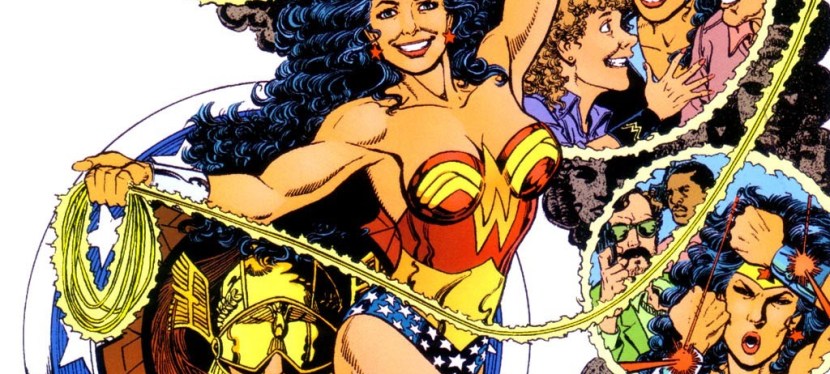
This artistic contribution by Phil Jimenez looks great.
Jill Thompson’s inspired take on Wonder Woman.
Wonder Woman by Howard Porter and John Dell.
Wonder Woman by Ivan Reis and Barbara Kaalberg.

Quality

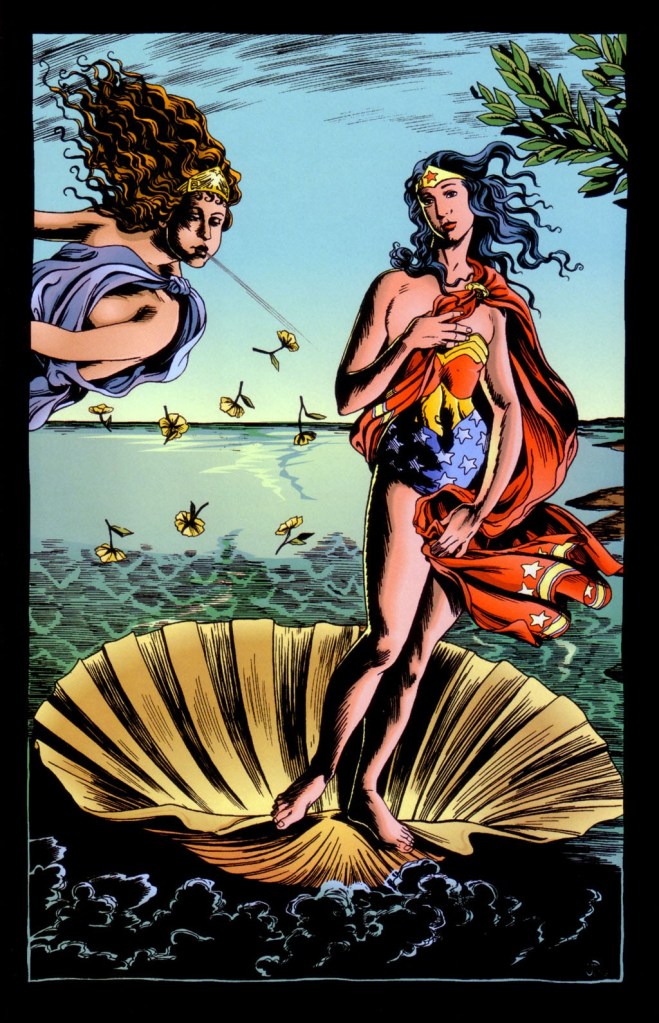
As this is an art showcase, the overall quality of the collected art here varies. Such a collection of different art styles will appeal to Wonder Woman fans depending on how they like their favorite superhero presented visually.

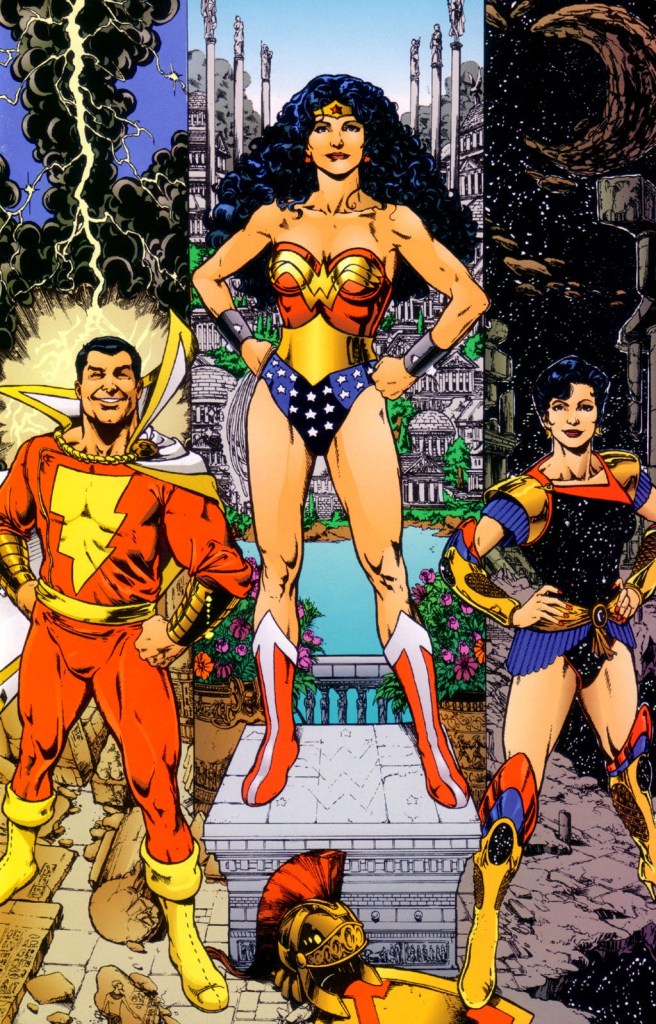
In my honest opinion, I always love the art style done by George Perez on Wonder Woman, her fellow Amazons, the supporting characters and more. His presentation here is flawless and timeless. What surprised me here in this collection is the contribution of Phil Jimenez whose quality and art style seem inspired by George Perez’s Wonder Woman legacy. As many of us know already, Jimenez later went on to become one of the top illustrators of DC Comics in the 2000s and his work here is nice to look.

There were a few artworks that showed Wonder Woman with a very cartoony look. Among them is the Wonder Woman piece done in the very distinct style of Sergio Aragones. Some art pieces here showed WW with a bizarre look and then there were a few others whose take on the Queen of Superheroes turned out good.

Conclusion

This work by George Perez is my favorite in this collection.

I can say that Wonder Woman Gallery (1996) is a published work that Wonder Woman fans will enjoy for as long as they are willing to accept images of their favorite superhero with styles ranging from realistic to cartoony, obscure and simple. Art styles aside, there is a lot here that fans will marvel at again and again, while art enthusiasts (who are not necessarily fans of the Queen of Superheroes) could find something eye-catching here.

If you are seriously planning to buy an existing hard copy of Wonder Woman Gallery (1996), be aware that as of this writing, MileHighComics.com shows that the near-mint copy of the comic book costs $40.

Overall, Wonder Woman Gallery (1996) is recommended.

+++++

Thank you for reading. If you find this article engaging, please click the like button below and also please consider sharing this article to others. If you are looking for a copywriter to create content for your special project or business, check out my services and my portfolio. Feel free to contact me as well. Also please feel free to visit my Facebook page Author Carlo Carrasco and follow me at HavenorFantasy@twitter.com