A Look Back at X-Men Adventures #3 (1993)

Disclaimer: This is my original work with details sourced from reading the comic book and doing personal research. Anyone who wants to use this article, in part or in whole, needs to secure first my permission and agree to cite me as the source and author. Let it be known that any unauthorized use of this article will constrain the author to pursue the remedies under R.A. No. 8293, the Revised Penal Code, and/or all applicable legal actions under the laws of the Philippines.

Who is the most definitive X-Men villain ever? That is none other than Magneto! Co-created by Stan Lee and Jack Kirby, Magneto made his literary debut alongside Marvel’s heroic mutants in The X-Men way back in 1963. Magneto is capable of generating and controlling magnetic fields which make him dangerous since he has the power to manipulate metal and even use them as weapons against others, plus he can even cause destruction to buildings by moving the metal in them to bring them down.

What even makes Magneto more dangerous is his very strong belief that his fellow mutants are genetically superior over humans and he does not believe in the concept of mutants and humans co-existing. Character-wise, Magneto is the complete opposite of Charles Xavier/Professor X of the X-Men.

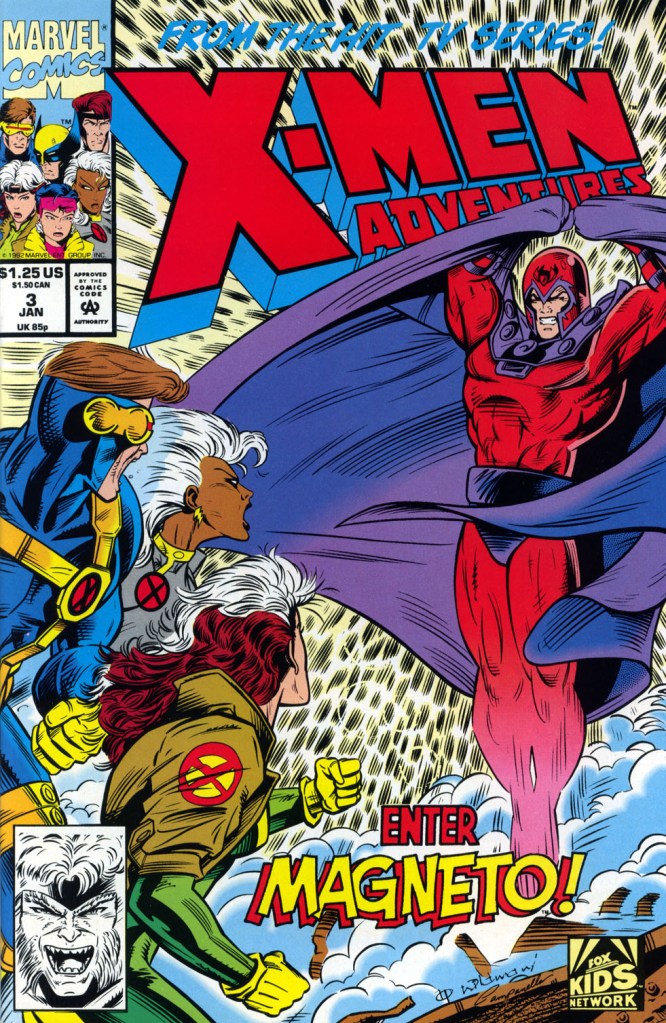
When it comes to pop culture influence, GamesRadar+ declared Magneto as the #1 best X-Men villain of all time. Even more intriguing was the super villain topping IGN’s Top 100 Comic Book Villains List. Beyond comic books, Magneto also appeared in the X-Men arcade game of 1992 made by Konami. On November 27, 1992, Magneto made his debut in the Enter Magneto episode of the popular X-Men animated series on TV. The said episode was, unsurprisingly, adapted into comic book form in issue of the X-Men Adventures monthly comic book series.

How was Magneto’s debut in the said monthly series? We can find out in this look back at X-Men Adventures , published in 1993 by Malibu Comics with a story written by Ralph Macchio and drawn by Andrew Wildman.  

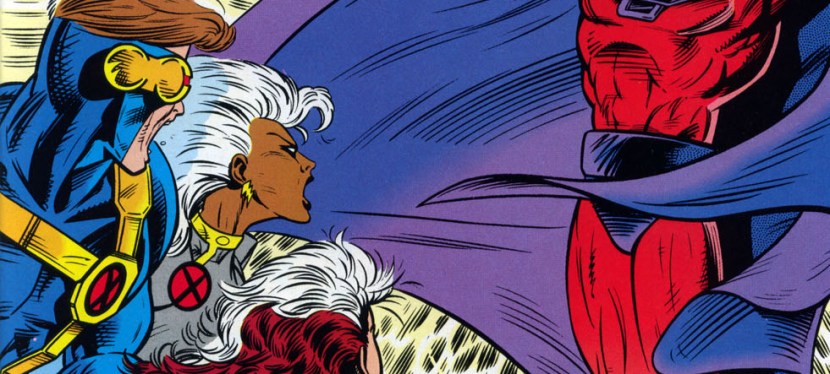
The cover.

Early story

The story begins in outer space where Asteroid M is orbiting above planet Earth completely undetected. As a meteor is on-course to collide with Asteroid M, the operator of the asteroid activates its guns and hits it. While Asteroid M got spared, a smaller meteor found itself falling into Earth’s atmosphere. As it burns through the atmosphere, Charles Xavier spots it from inside his mansion.

Xavier turns his attention to Jean Grey. As they travel together, the doors open and Sabretooth enters landing on the floor. The two have yet to know him.

Over at a prison, the captured Hank McCoy/Beast thinks deeply inside his prison cell only to suddenly witness one of the walls get smashed by some powerful force. Magneto arrives and tells him he came for him…

Quality

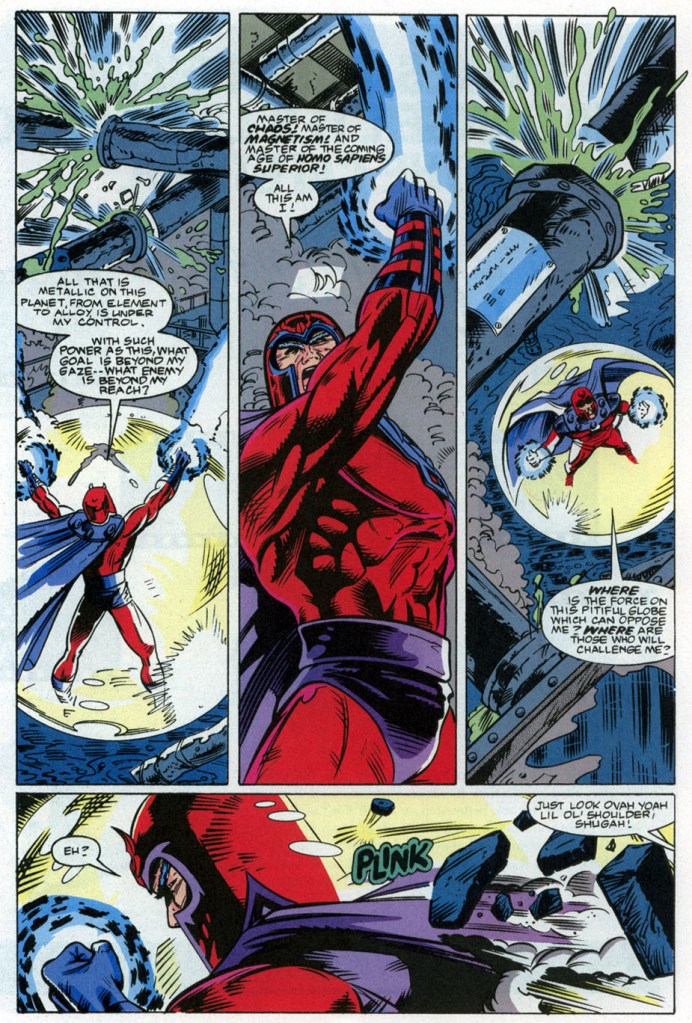
The power of Magneto.

The writing, with credit to the screenwriters behind the animated episode, is pretty solid and the essence of the said episode was very well adapted into this comic book. As this is Magneto’s debut in the X-Men Adventure series reflecting his debut in animated series, his character is portrayed very accurately and it only made perfect sense for him to approach Beast first to try to convince him join his pro-mutant movement. More on the writing, Beast’s restraint brought out more of Magneto’s hardcore beliefs and his complete opposition towards humans.

Of course, the creators did not let down their efforts to portray the struggle mutants have under the laws of human society which is strongly reflected in Beast’s court hearing with Wolverine and Cyclops (in civilian forms) observing powerlessly. The court room drama and arguments were intense.

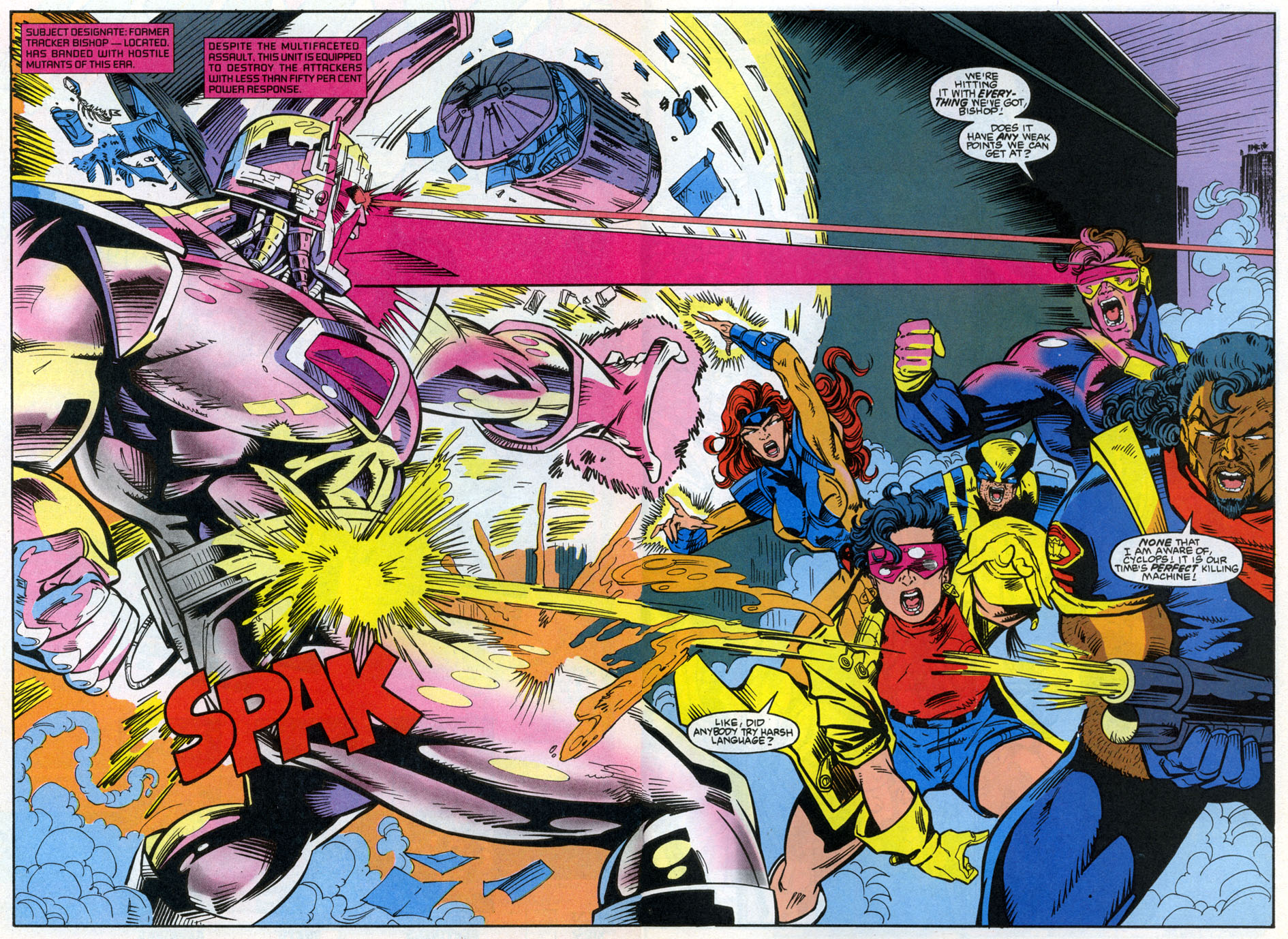
I should also state that there really was a nice build-up leading to the first battle (first half, actually) between the X-Men and Magneto. Unlike the battles in issues #1 and #2, the conflict here showed the X-Men more in danger which is only fitting considering how great the villain is.

Conclusion

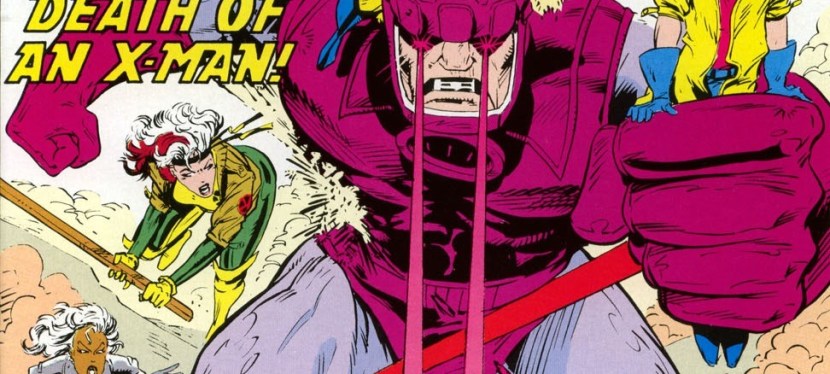
Magneto and Beast.

X-Men Adventures is a strong adaptation of the Enter Magneto episode. There is no doubt about that and most notably, the comic book creators did another good job making the TV animated episode’s concept engaging and fun to read. This comic book should be part of the collection of anyone who is passionate about Magneto.

If you are seriously planning to buy an existing hard copy of X-Men Adventures (1993), be aware that as of this writing, MileHighComics.com shows that the near-mint copy of the regular edition costs $8 while the near-mint copy of the newsstand edition costs $17.

Overall, X-Men Adventures (1993) is highly recommended!

+++++

Thank you for reading. If you find this article engaging, please click the like button below and also please consider sharing this article to others. If you are looking for a copywriter to create content for your special project or business, check out my services and my portfolio. Feel free to contact me as well. Also please feel free to visit my Facebook page Author Carlo Carrasco and follow me at HavenorFantasy@twitter.com

A Look Back at X-Men Adventures #2 (1992)

Disclaimer: This is my original work with details sourced from reading the comic book and doing personal research. Anyone who wants to use this article, in part or in whole, needs to secure first my permission and agree to cite me as the source and author. Let it be known that any unauthorized use of this article will constrain the author to pursue the remedies under R.A. No. 8293, the Revised Penal Code, and/or all applicable legal actions under the laws of the Philippines.

Having read lots of X-Men comic books, I should say that I always find the Sentinels (first appearance in The X-Men in 1965) to be more memorable as enemies of Marvel’s mutants. On face value, they only look like oversized, human-like robots but I always find them to be formidable opponents of the X-Men. These machines are not only built with sophisticated technologies, they are able to push the X-Men to their limits during battle.

These anti-mutant robots, by the way, were ranked by IGN at #38 in their Greatest Comic Book Villains chart. Long before that, the Sentinels were the featured anti-heroes in the classic X-Men comic book storyline Days of Future Past and it was no surprise that they were also featured in the 2014 movie X-Men: Days of Future Past.

And then in the early 1990s, the Sentinels were shown in the first episode of the X-Men animated series on television. The said series was also adapted into an “as seen on TV” comic book series by Marvel called X-Men Adventures.

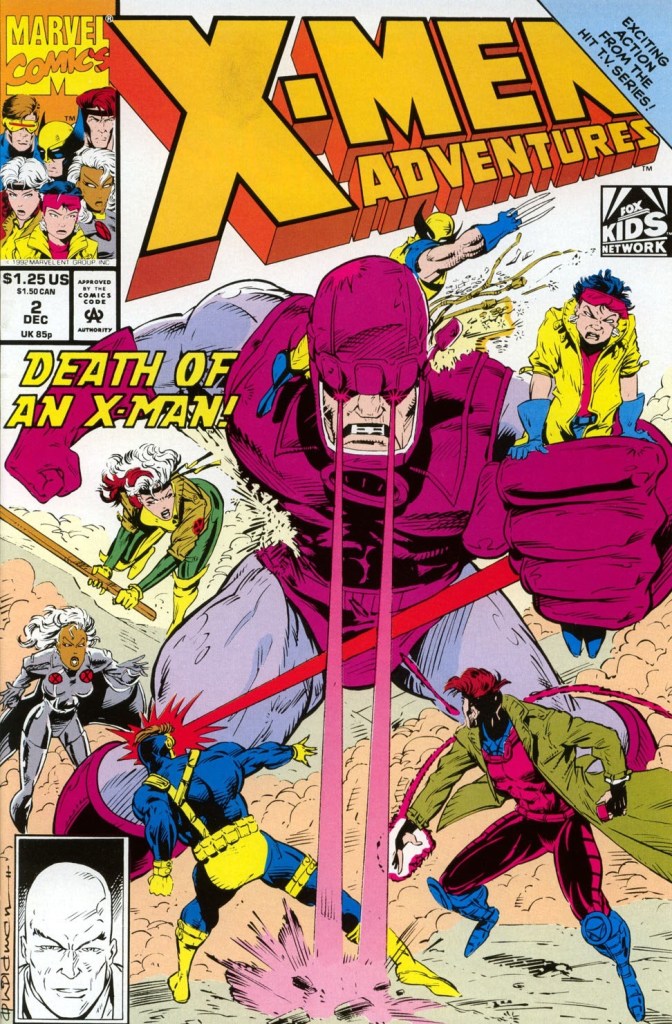
This brings me to this look back at X-Men Adventures , published in 1992 by Marvel Comics with a story by Ralph Macchio and drawn by Andrew Wildman.  

The cover.

Early story

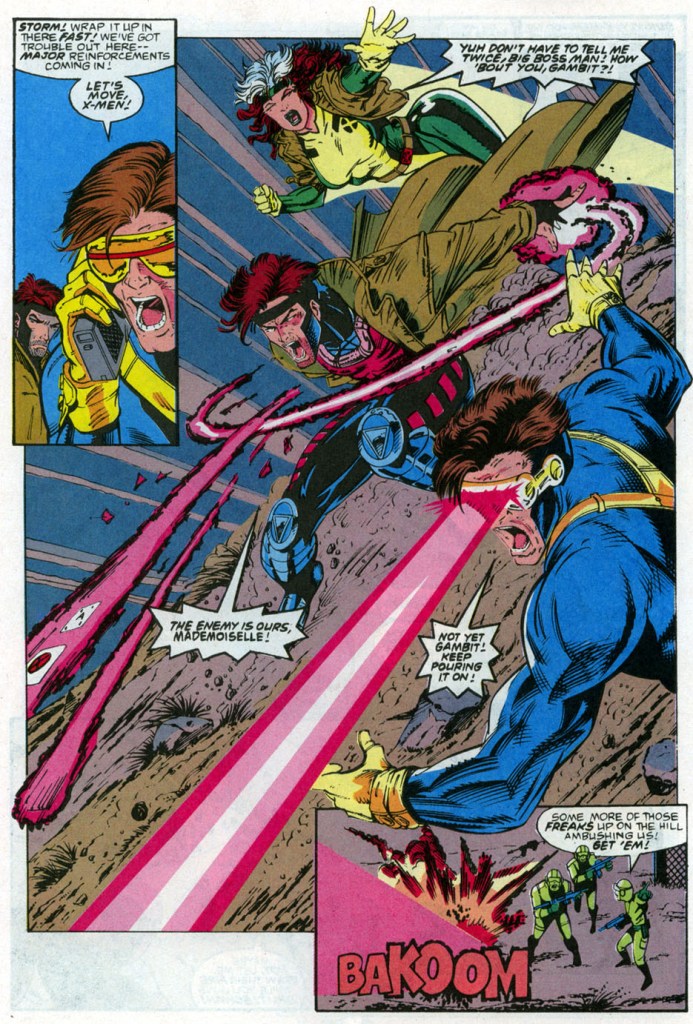
The story begins with Morph suffering from a nightmare. As he emerged from the vision, he finds himself with Storm, Beast and Wolverine. Together they work to infiltrate a federal government facility which houses the Mutant Affairs Department. Outside the walls of the facility, Rogue Gambit and Cyclops watch from a distance. Cyclops fires his optic blast at the vehicle that just dropped reinforcements that he believes were sent to stop their teammates.

Storm and her teammates break through a door instantly pushing off the security personnel followed by Beast knocking an additional guard. At the room containing the computer, Beast begins to access key information their team has been seeking…

Quality

The Sentinels and the X-Men!

Let me start with the storytelling. As an adaptation of one of the early episodes of the animated series, this comic book does a fine job of recapturing its essence complete with a nice balance between plot, exposition and spectacle. Considering the fact that the animated series was aimed for children, it’s quite intriguing to see the TV episode carrying really heavy themes – apart from the prejudice the mutants suffer from – like top federal government operations, expensive defense and weapons programs, government intrusion into people’s private lives, attempts to require minorities to get registered, etc. Those themes also made it in this comic book which made it feel like it was part of the mainstream X-Men comics of the time.

Compared to the first episode as well as its literary adaptation, this one emphasizes the Sentinels as tools of the government as part of their very expensive program to seek and monitor mutants among their citizens. Mutant Affairs director Peter Gyrich is clearly the villain who has no super powers but has the resources of the federal government and their authority to take action on mutants he perceived to be dangerous.

On the visuals, Andrew Wildman performed a solid job making each page look interesting and detailed enough. While his drawings made each character recognizable to me, it is in the spectacular scenes where he really shines. Wildman’s drawing of the Watcher on the final page of the comic book, however, looks laughable.

Conclusion

Andrew Wildman’s dynamic drawing of the X-Men in action.

While X-Men Adventures is not exactly a literary classic, it is indeed a very solid adaptation of one of the earliest episodes of the animated series of the 1990s. It succeeded on telling a compelling and enjoyable story even though it emphasized the above-mentioned serious themes. As for the iconic Sentinels, this one succeeded in explaining what they are and their place in Marvel’s universe is.

If you are seriously planning to buy an existing hard copy of X-Men Adventures (1992), be aware that as of this writing, MileHighComics.com shows that the near-mint copy of the regular edition costs $8 while the near-mint copy of the newsstand edition costs $26.

Overall, X-Men Adventures (1992) is recommended.

+++++

Thank you for reading. If you find this article engaging, please click the like button below and also please consider sharing this article to others. If you are looking for a copywriter to create content for your special project or business, check out my services and my portfolio. Feel free to contact me as well. Also please feel free to visit my Facebook page Author Carlo Carrasco and follow me at HavenorFantasy@twitter.com

A Look Back at Spider-Man 2099 #37 (1995)

Disclaimer: This is my original work with details sourced from reading the comic book and doing personal research. Anyone who wants to use this article, in part or in whole, needs to secure first my permission and agree to cite me as the source and author. Let it be known that any unauthorized use of this article will constrain the author to pursue the remedies under R.A. No. 8293, the Revised Penal Code, and/or all applicable legal actions under the laws of the Philippines.

If you’re looking for a powerful, dramatic tale of Spider-Man 2099 from the 1990s, you will find it right here in this retro review.

Before getting to the review, it is important to remember that Spider-Man 2099 was mainly driven by Peter David, who is one of the best-ever writers in the history of superhero comics in America. Many geeks I know admired his work on other Marvel titles, most notably The Incredible Hulk.

So how did he get involved in Marvel’s 2099 universe that was first launch in 1992? Check out Peter David’s words from an online interview in Doom2099.com:

The Marvel editors approached me, as they did a number of free lancers, and said we’re going to be doing a 2099 line. And we would like you [meaning me and other writers] to submit a proposal on how you would do Spider-Man 2099. We knew he was Spider-Man 2099. We knew he worked for a company called Alchemax. Beyond that there was nothing about him established. So I sat down and I thought, the last thing I want to do is have him be a relative of Peter Parker. Because that’s the obvious thing. So I created someone completely from scratch. I made him of mixed ethnicity, because I felt that by the end of the 21st century mixed ethnicity is going to be more common than it is now. So I made him half-Irish and half-Mexican because I thought that was the most combustible combination I could come up with. And I decided I would zig wherever Stan and Steve zagged when they created Spider-Man. Peter Parker was a white bred WASP. So Miguel O’Hara was a combined ethnicity. Peter was an orphan. Miguel would have a living mother. Peter was alone. I gave Miguel a brother. Peter had no idea how to handle girls and was a teenager. Miguel was in his 20s and had a fiancée. I just made the contrary move all the way. And I submitted my proposal. A week later I get a call from the Marvel editors and they said ‘we love your take on Spider-Man 2099. For starters, it’s the only one that doesn’t start with a relative of Peter Parker.’ And I went ok, that’s interesting. They asked me if I would be interested in writing. I said, sure. And that’s how I became involved in it.

Right from the start of the Spider-Man 2099 series, Peter David and illustrator Rick Leonardi established 2099’s New York City society and went on to develop Miguel O’Hara/Spider-Man 2099 deeply as well as his relationships with his family and companions, complete with his struggle working for a sinister boss at Alchemax. Things escalated further personally for the futuristic Spider-Man during my last review and we will find out what happens next.

Here is my retro comic book review of Spider-Man 2099 #37, published in 1995 by Marvel Comics with a story by Peter David and art by Andrew Wildman.

Cover
The cover of the regular edition.

Early story

The comic book opens with a quick flashback in the past when Miguel O’Hara, his then girlfriend Xina and his brother Gabe spend time at a club talking about relationships. Eventually Gabe’s date Dana arrives late. Miguel could not help but react with his mouth open.

In the present day, Miguel faces Venom 2099 who has Xina and Dana wrapped with his symbiote. In reaction to Venom’s ploy, Miguel frees Dana which broke of Venom’s right arm. Miguel and Dana moved quickly to the next room and the door shut provided them temporary refuge from Venom. Before the two separated (Miguel to fight and Dana to leave for safety), they kissed.

Even without his costume, Miguel decides to go after Venom to free Xina…

Quality

14
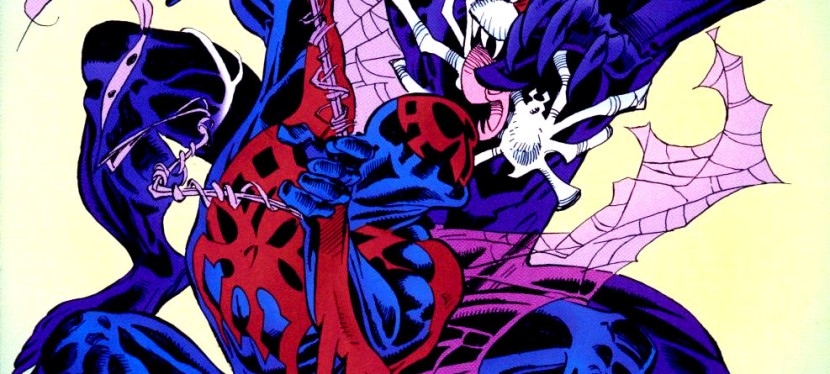
Venom 2099 is truly dangerous.

Another well-crafted comic book carrying the same strong creative energy since Venom 2099’s debut in issue #35. While it is no surprise that Peter David’s writing remains top-notch and highly compelling in showing the continued conflicts between Spider-Man and Venom of the future, he inserted some flashbacks into the past showing how Miguel O’Hara got romantically involved with Dana and how it complicated matters in his family given the fact that Dana was the GF of his brother Gabe. Those flashbacks, which some might think served as padding, are actually helpful to not only inform readers about the Miguel-Xina-Dana triangle but also give readers a new look at Miguel’s personality. All of that added in the build-up leading to the very powerful ending. After being absent in issue #36, Andrew Wildman returned strongly in visualizing this comic book. His art on the ending is something I will keep remembering for a very long time.

Conclusion

11
A flashback…

The first time I read Spider-Man 2099 #37 when it was initially released, its story and ending proved to be powerful. In this review, I do confirm it still maintains that powerful impact by today’s standards. This comic book is not only great on its own, it also showed how much Venom 2099 made life for Spider-Man 2099 go upside-down. By the time this comic book got published, Miguel O’Hara transformed a whole lot since the first issue reaching the corporate leadership of Alchemax. Clearly, this means that Spider-Man 2099 carried tremendous power with him to go against his era’s Venom (who in turn really proved to be a very dangerous menace not only to the superhero but the public as well).

If you are seriously planning to buy an existing hard copy of Spider-Man 2099 #37, be aware that as of this writing, MileHighComics.com shows that the near-mint copy of the regular edition costs $34. The near-mint copies of the “Venom 2099” regular edition and the “Venom 2099” newsstand edition cost $85 and $255 respectively.

Overall, Spider-Man 2099 #37 (1995) is highly recommended!


Thank you for reading. If you find this article engaging, please click the like button below and also please consider sharing this article to others. If you are looking for a copywriter to create content for your special project or business, check out my services and my portfolio. Feel free to contact me as well. Also please feel free to visit my Facebook page Author Carlo Carrasco and follow me at HavenorFantasy@twitter.com

A Look Back at X-Men Adventures #13 (1993)

Disclaimer: This is my original work with details sourced from reading the comic book and doing personal research. Anyone who wants to use this article, in part or in whole, needs to secure first my permission and agree to cite me as the source and author. Let it be known that any unauthorized use of this article will constrain the author to pursue the remedies under R.A. No. 8293, the Revised Penal Code, and/or all applicable legal actions under the laws of the Philippines.

It’s funny how adaptations of adaptations turn out in real life. Long before the first live-action X-Men movie was released, an animated TV series (popularly referred to as X-Men: The Animated Series or X-Men TAS) was produced and arguably brought together the fans of both the X-Men comic books along with the animated X-Men followers.

Along the way, Marvel Comics went on to publish a monthly comic book series called X-Men Adventures which themselves were adaptations of the animated series (which itself adapted stories and concepts from the comic books).

The adaptation-of-an-adaptation approach went deep further when the animated series adapted loosely the story of the classic X-Men comic book storyline Days of Future Past (by legends Chris Claremont and John Byrne) which resulted a story told in two episodes on TV. And then there was also a comic book adaptation that followed starting with X-Men Adventures which is the subject of this retro comic book review.

1
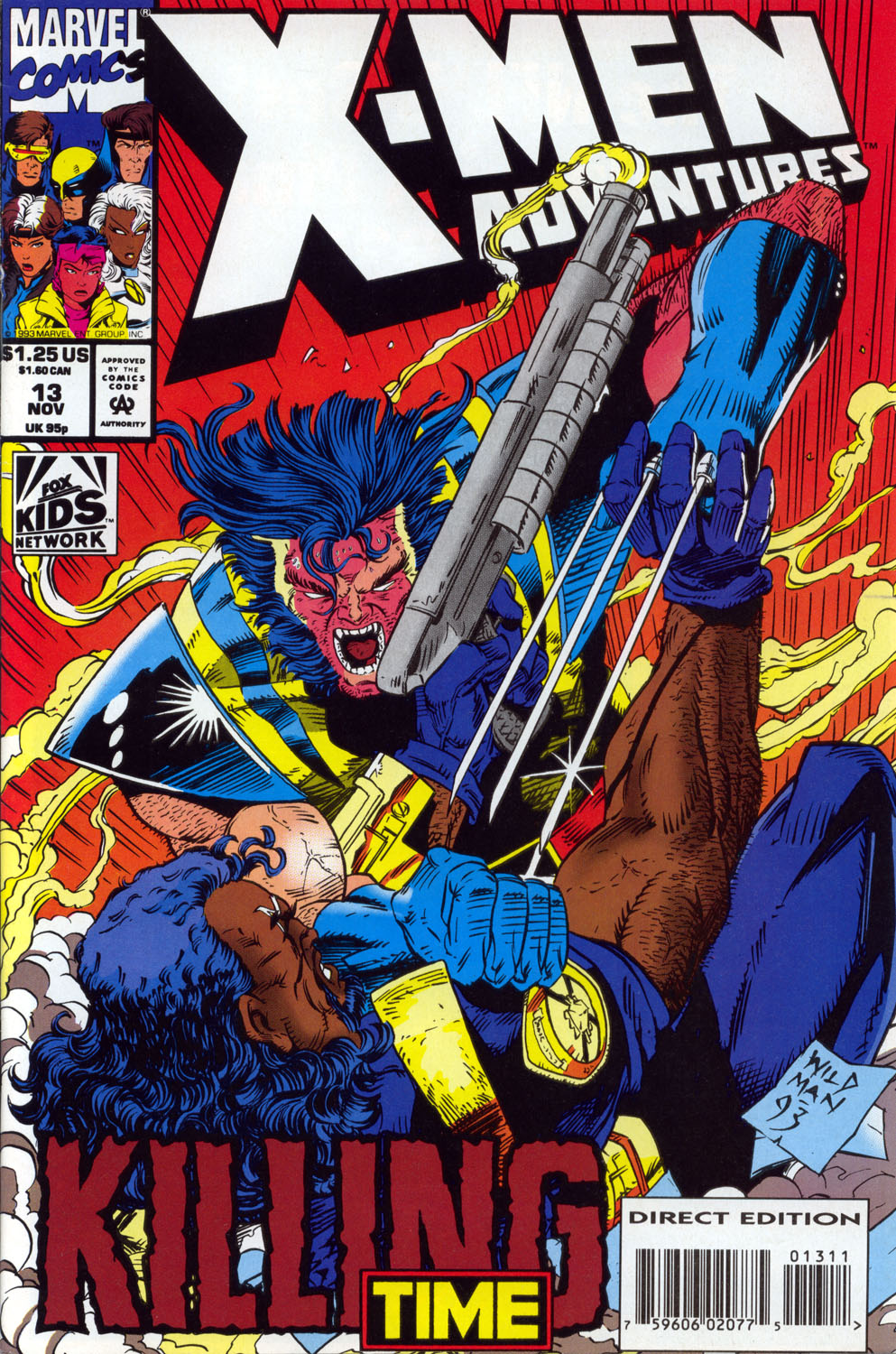
The cover.

Early story

Written by Ralph Macchio and drawn by Andrew Wildman, the comic book begins in the dark future of 2055 in New York. The city is in ruins and mutants on the loose are being hunted by Sentinels. A very old Wolverine appears to help two loose mutants but ends up getting stunned with them by Bishop who turns out to be helping the automated authority of the Sentinels.

As he turns over the captured mutants, the Sentinels betray Bishop telling him that they no longer required him. Afterwards, Bishop and Wolverine (who woke up) each carry a person under the watch of a Sentinel. Suddenly, the two other mutants use their powers to attack the Sentinel and Wolverine followed to back up their efforts. The Sentinel however grabbed Wolverine.

Quality

3
A very old Wolverine in the dark future of 2055.

With the exception of some liberties, this comic book closely followed what was told in the first of the 2-episode Days of Future Past animated adaptation. As a comic book story, the story was heavily loaded with details and exposition designed to orient readers about the setting and why the future became a time of darkness in relation to the rise of machines having ultimate power over people.

While the time travel concept of the literary classic involved the mind of Kitty Pryde going into the past, this comic book used the more common concept of having Bishop travel back through time physically which easily reminds me of Kyle Reese arriving from the future in 1984’s The Terminator.

The build-up leading to Bishop’s move to travel back through time was nicely done by the creative team. There was a lot of exposition followed by an incoming attack complete with explosions happening just as Bishop is about to leave. In short, the pay-off was worth it.

The engagement did not end there. In fact, it continued nicely as Bishop meets the X-Men in 1993 with the details of his mission carefully unveiled. Professor Charles Xavier’s reaction to future history (Sentinels taking control of the world) was dramatic and worth re-reading.

As with his other works in the X-Men Adventures comic book series, Andrew Wildman’s art is very good to look at and he knows how to make each scene look engaging whether it’s just an exchange of dialogue between characters or an action scene loaded with a lot of impact.

Conclusion

While it is only half of a 2-issue adaptation of a 2-episode animated adaptation of the Days of Future Past literary classic, X-Men Adventures is still a fun-filled reading experience complete with a lot of engaging moments.

19
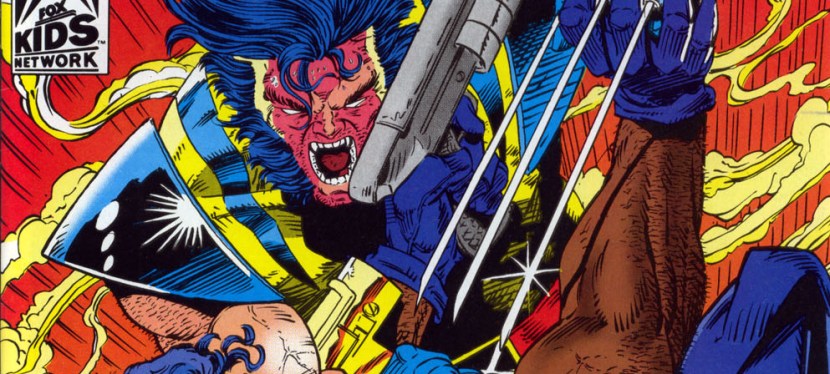
The money shot by Andrew Wildman!

If you are a serious collector of comic books, be aware that, as of this writing, a near-mint copy of X-Men Adventures costs $6 while its newsstand edition copy is worth $21 in near-mint condition according to Mile High Comics.

Overall, X-Men Adventures is highly recommended. Both dedicated X-Men fans as well as newcomers will have something a lot to enjoy with it.


Thank you for reading. If you find this article engaging, please click the like button below and also please consider sharing this article to others. If you are looking for a copywriter to create content for your special project or business, check out my services and my portfolio. Feel free to contact me as well. Also please feel free to visit my Facebook page Author Carlo Carrasco and follow me at HavenorFantasy@twitter.com

A Look Back at Spider-Man 2099 #35 (1995)

Disclaimer: This is my original work with details sourced from reading the comic book and doing personal research. Anyone who wants to use this article, in part or in whole, needs to secure first my permission and agree to cite me as the source and author. Let it be known that any unauthorized use of this article will constrain the author to pursue the remedies under R.A. No. 8293, the Revised Penal Code, and/or all applicable legal actions under the laws of the Philippines.

When Marvel Comics first launched the 2099 imprint of comic books showcasing many futuristic versions of their present-day characters – like Spider-Man, Ravage and Dr. Doom – it was inevitable that the same treatment will be applied to their popular supervillains.

In 1993, the 2099 version of Vulture was introduced and he sure proved to be one tough opponent for Spider-Man 2099. Even back then, there already was clamor for a futuristic version of Venom which at the time was riding high with readers being the featured anti-hero in several limited series (starting with Lethal Protector) of comic books.

Then in 1995, after doing a creative teaser in issue , Marvel formally introduced Venom 2099 by releasing Spider-Man 2099 #35. This is my review of the comic book written by Peter David and drawn by Andrew Wildman (X-Men Adventures).

Cover
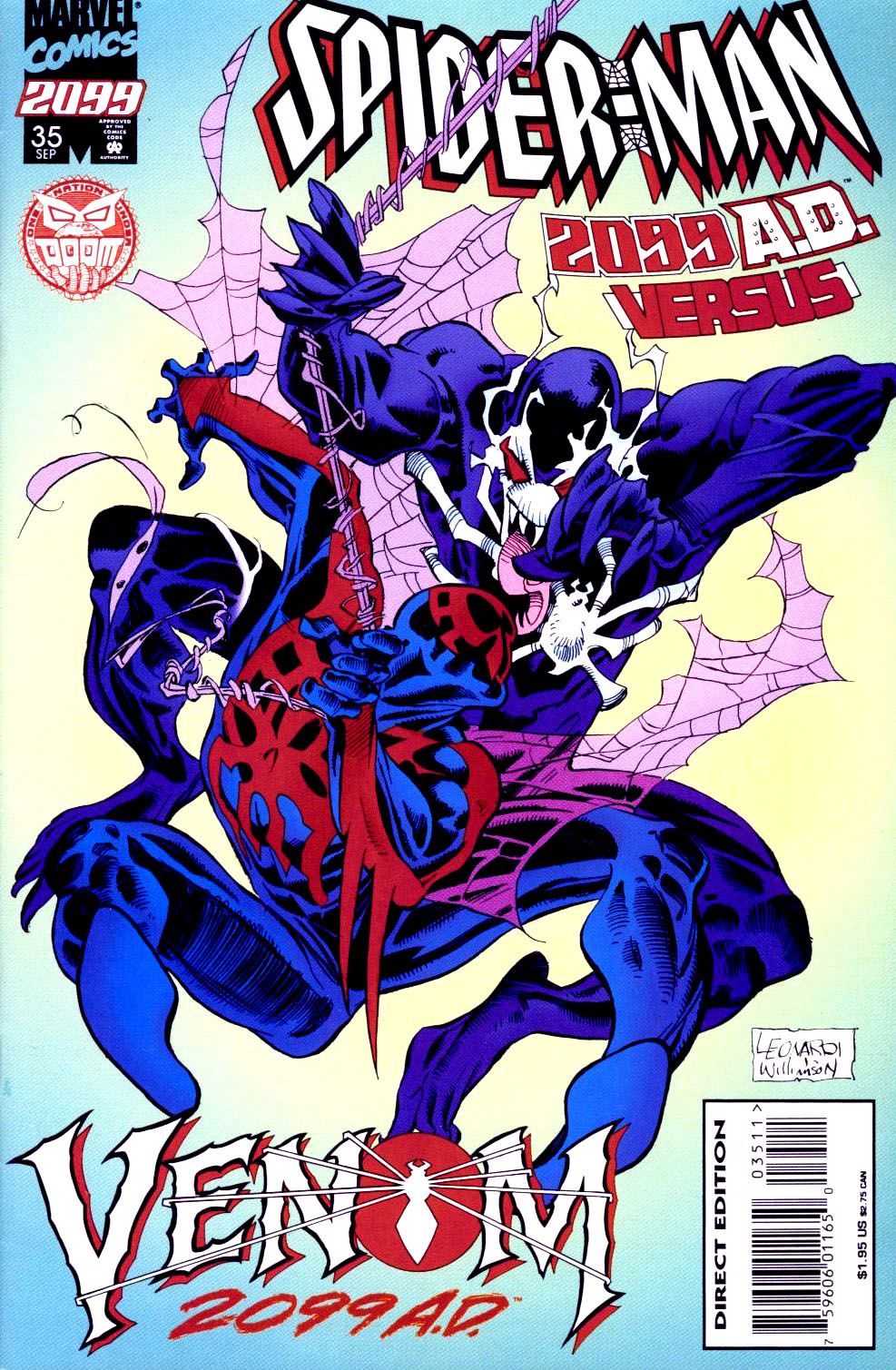
The cover drawn by Rick Leonardi.

Early story

Picking up from the events of issue , the story begins in Washington, DC with Dana freeing herself only to find out that Alchemax’s CEO Tyler Stone was down suffering from a gun shot and losing blood. Minutes later, emergency personnel take Stone’s body for immediate treatment.

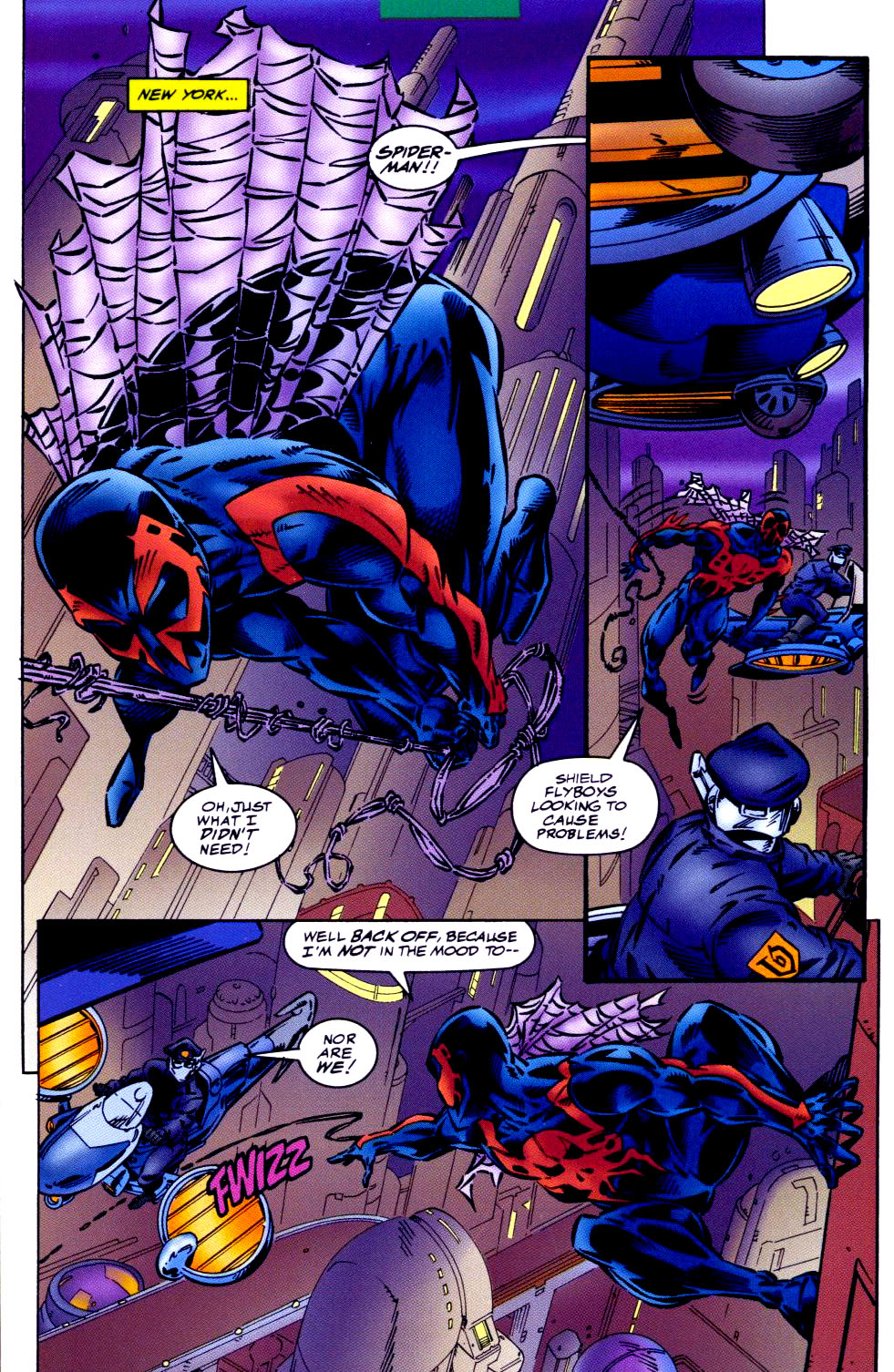
Meanwhile, Spider-Man 2099 (Miguel O’Hara) encounters the SHIELD flyboys in New York. After almost getting into trouble together, Spidey gets informed that US President Doom 2099 ordered them to leave him alone for a period of seventy-two hours while he considers a cabinet offer. Back in Washington, Dana gets interrogated by one of the authorities. President Doom enters the scene telling Dana that she will join Tyler Stone immediately in the medical center.

3
Andrew Wildman’s take on Spider-Man 2099 and the future was really nice to look at.

In New York, two guys sitting on the sidewalk witness a moving black liquid coming out of the sewer. The thing turns out to be a living symbiote (or alien costume) forming into a human-like shape – Venom 2099!

Quality

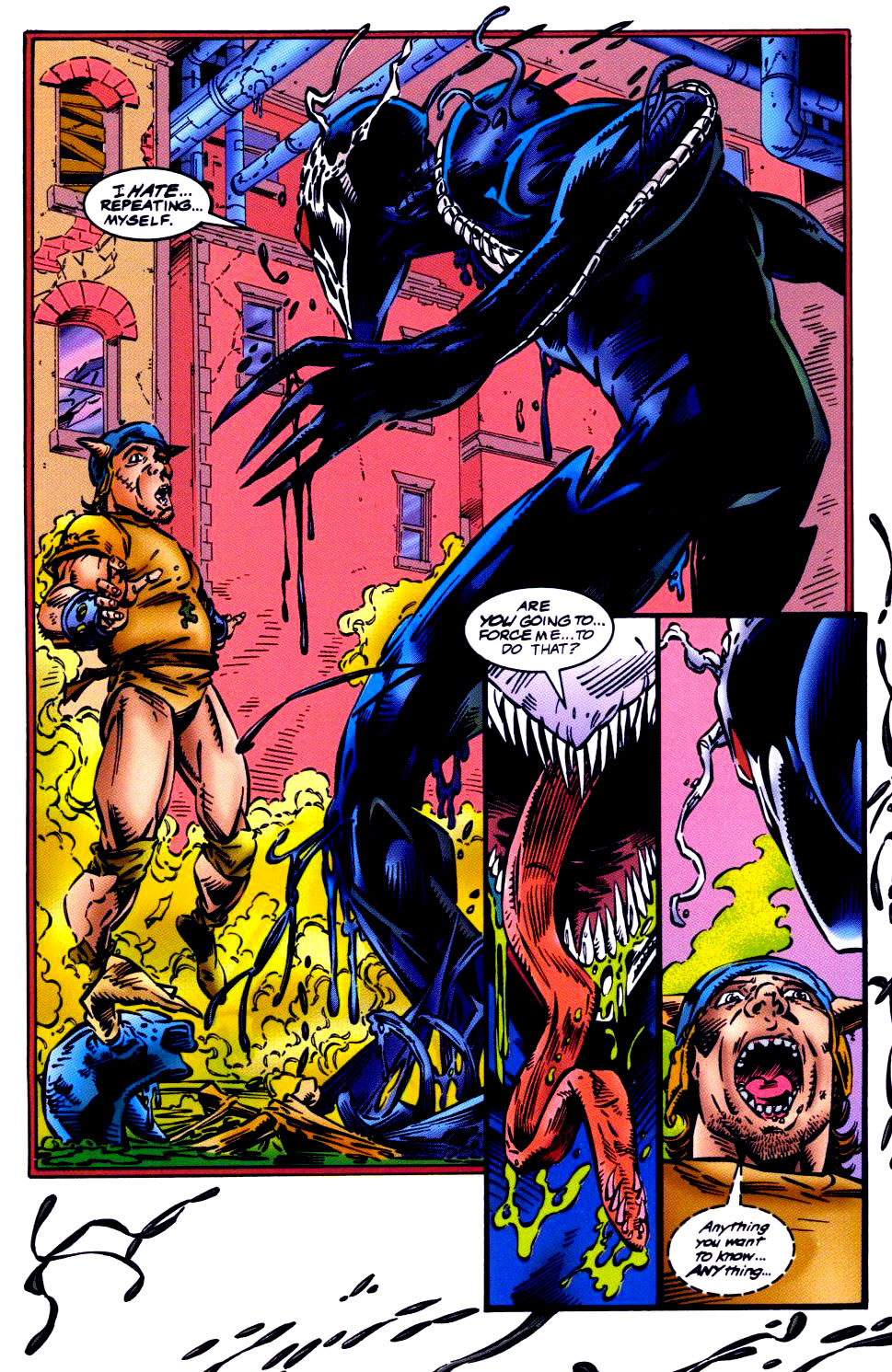
As with other comic books of this particular series, the writing by Peter David is pretty deep and engaging. The usual balance between dramatization, character development, plotting and spectacle is here once again but with a slight touch of horror in relation to the introduction of Venom of 2099. Speaking of dramatization, the portrayal of Venom 2099 as a vicious villain is similar to the 20th century Venom (Eddie Brock) but with a very powerful obsession to kill Miguel O’Hara and Tyler Stone.

Here’s an excerpt from the dialogue of Venom of 2099: Miguel O’Hara…and Tyler Stone…together again. We…I get to kill you…at the same time…how awfully…awfully…considerate. To show my appreciation…I’ll kill you slowly.

What makes this comic book unique is the artwork by Andrew Wildman who temporarily replaced regular illustrator Rick Leonardi. For comparison, I find Wildman’s art style a welcome thing in this comic book mainly because he draws with a lot more detail per panel and per page than Leonardi ever could. Instead of seeing the usual sketch-like art style of Leonardi, Wildman’s style is livelier and more expressive to look at. I also enjoyed Wildman’s visual take on Spider-Man 2099/Miguel O’Hara, Lyla, Tyle Stone, and the other established characters. Their facial expressions are also livelier to see.

9
Venom 2099 appears! Take note of the “liquid” at the edges of the page.

More on visuals, Wildman’s take on Venom 2099 is unforgettable. Like 20th century Venom, he has a dark suit, elongated jaw with rows of sharp teeth and an elongated tongue but with green acid dripping all the time. There are also those tentacles-like things that stretch from his body until the arms. Also his white-colored mask with large eyes make him look horrific.

Conclusion

Despite being shorter than the usual 22-pages, Spider-Man 2099 #35 is still a very engaging and fun old comic book to read. Its purpose was to build-up anticipation leading to the introduction of Venom 2099 was achieved nicely and the respective qualities of the writing and visuals are very good even by today’s standards. More on the presentation of Venom of 2099, it seems like Peter David took inspiration from movie director James Cameron on building-up tension and suspense before showing the villain. That’s a move I enjoyed in this comic book.

Overall, Spider-Man 2099 #35 is highly recommended. If you plan to acquire an existing and legitimate hard copy, be aware that the near-mint copy of it is over $100 for the newsstand version while the Rich Leonardi-drawn “Venom 2099 AD” cover version is priced at over $80 at MileHighComics.com as of this writing.


Thank you for reading. If you find this article engaging, please click the like button below and also please consider sharing this article to others. Also my fantasy book The World of Havenor is still available in paperback and e-book format. If you are looking for a copywriter to create content for your special project or business, check out my services and my portfolio. Feel free to contact me as well. Also please feel free to visit my Facebook page Author Carlo Carrasco and follow me at HavenorFantasy@twitter.com

A Look Back at X-Men Adventures #1

Back in 1991, Marvel Comics successfully launched X-Men #1 (Volume 2) which arguably marked what was back then a new era of the X-Men. That comic book was written by Chris Claremont and the art was done by Jim Lee with ink work by Scott Williams.

Lee was granted a lot of creative freedom and that could be seen in the way he redesigned and modernized the looks of the X-Men, especially with Cyclops (with that suspender), Rogue (that yellow-green tight suit plus brown jacket), Jean Grey (technically a swimsuit with those padding on the legs), etc.

Those re-designs were eventually adapted by the producers behind the memorable X-Men animated series of the decade which lasted five seasons.

Of course, Marvel Comics itself wanted to make more money as the said animated series launched. Alongside it, they launched a new comic book series that adapted stories from the animated series (which itself were adaptated stories from the past comic books, mainly Uncanny X-Men). This resulted the X-Men Adventures comic book series and here, I review the launch issue.

RCO001_1487469525.jpg
X-Men Adventures ’s cover.

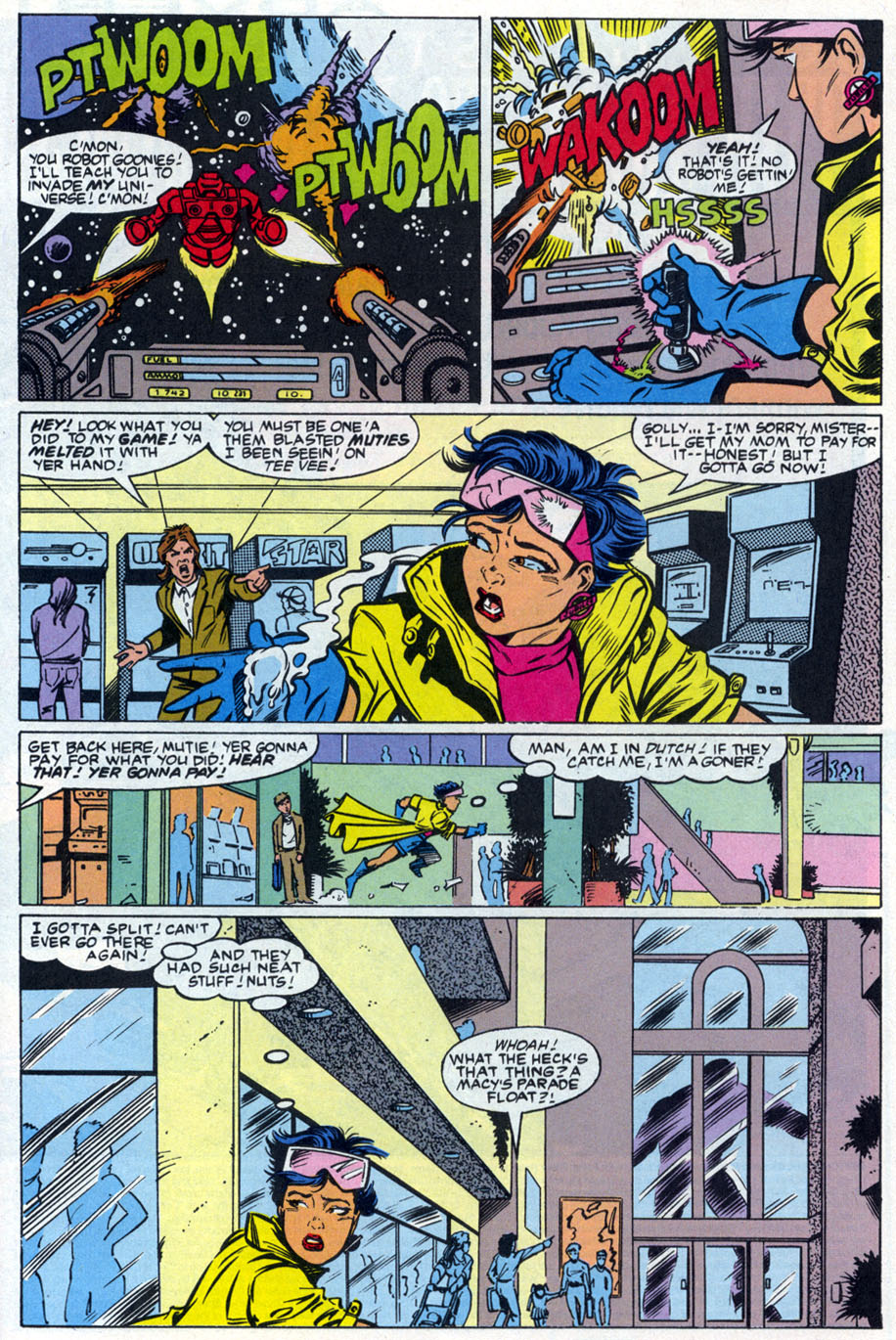
Released in 1992, X-Men Adventures adapted the memorable launch episode of the animated series. The story begins with the Watcher doing some expository dialogue as Sabretooth causes some destruction in a city. As it turned out, it was a TV news feed of him as the narrative shifts into a home in suburbs wherein a married couple talk about Jubilee. The husband Martin thought about registering Jubilee with the government which turns off wife Martha. Jubilee overheard them and predictably agonizes over her situation (note: she melted the VCR and mutants like her have been viewed negatively).

Then a Sentinel arrives in the neighborhood searching for her. Strangely enough, the Sentinel simply crushes the bedroom of Jubilee only to find out she was not there and registered an “identification error.”

RCO007_1487469525.jpg
Jubilee in trouble at the mall.

Jubilee then spends time in the shopping mall only to discover the Sentinel crashing in to find her. Within that place, X-Men members Storm, Gambit and Rogue decide to take action against the Sentinel. This is where the story really takes off.

Creatively, this comic book retells the events of the launch episode of the animated series. Writer Ralph Macchio did a serviceable job translating the episode into a decent flowing comic book.  Like the animated episode, the aspect of mutants living in fear (expressed through Jubilee) was nicely captured.

What really stands out here is the artwork by Andrew Wildman. Not only did he do a good job drawing so many characters and giving them nice facial expressions, he pulled off a good effort to insert spectacle into the comic book. The Sentinel’s crashing into the shopping mall, Rogue’s punch on the Sentinel’s head, and Wolverine’s strike against a wall using his claws all have that strong impact.

RCO013_1487469525.jpg
Andrew Wildman’s approach to action had a lot of impact.

RCO018_1487469525.jpg
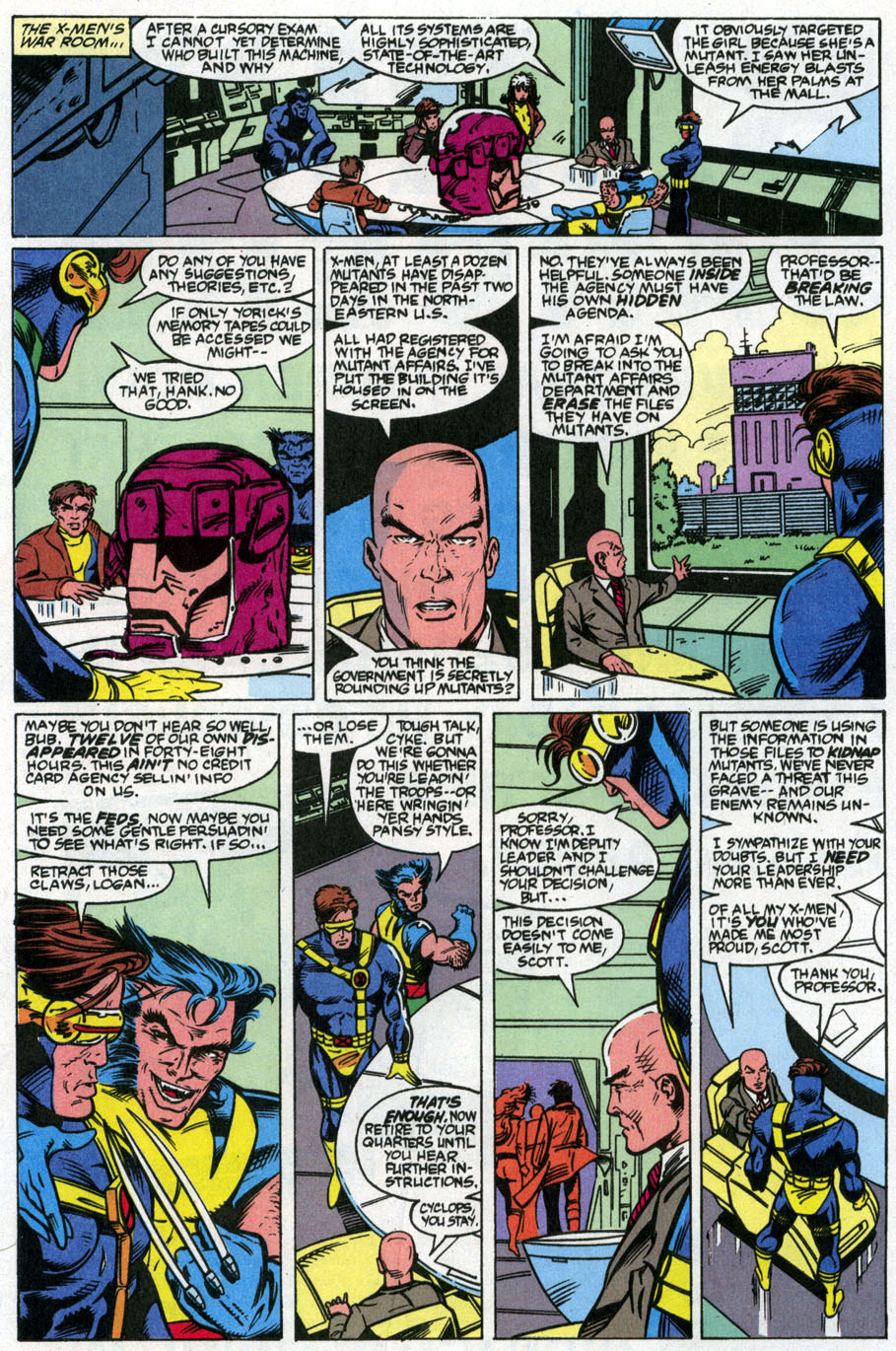
Team interaction of the X-Men.

I also like Wildman’s way of capturing the spirit and look of the X-Men, especially during the Danger Room sequence showing Beast, Morph and Gambit doing exercises. Even the scenes that feature no action but lots of talk had an interesting look and Wildman did not even rely on the method of making the characters beautiful.  No single boring moment with the art here.

Overall, X-Men Adventures is a fun read. As of now, this old comic book from 1992 is not really valuable but that just might change if ever the Walt Disney Company (which now has the other media rights to X-Men due to their acquisition of 20th Century Fox) decides to have Marvel Entertainment revive or even continue the X-Men animated series.

Whether there will be a significant development or not, X-Men Adventures is recommended.


Thank you for reading. If you find this article engaging, please click the like button below and also please consider sharing this article to others. Also my fantasy book The World of Havenor is still available in paperback and e-book format. If you are looking for a copywriter to create content for your special project or business, check out my services and my portfolio. Feel free to contact me as well. Also please feel free to visit my Facebook page Author Carlo Carrasco and follow me at HavenorFantasy@twitter.com