In the City of Las Piñas, a special program was recently launched to provide employment to local workers who were displaced by the pandemic, according to a Manila Bulletin news report.
To put things in perspective, posted below is the excerpt from the Manila Bulletin report. Some parts in boldface…
The Las Piñas Public Employment Service Office (PESO) conducted house interviews as part of its weekly employment facilitation program called “Hired on the Spot” on Monday, Nov. 14.
Mayor Imelda Aguilar said the “Hired on the Spot” program is being conducted by PESO, in coordination with the Department of Labor and Employment (DOLE), with the goal of ensuring prompt and efficient delivery of employment facilitation services.
Aguilar said the program also aims to provide employment to workers displaced by the pandemic, particularly to Las Piñas residents.
She said over 150 applicants send their resume daily to PESO and around 40 percent of the applicants get hired on the spot.
The mayor said that in addition to PESO house interviews, booths are also set-up in the city’s different barangays and partner establishments.
Let me end this piece by asking you readers: If you are a resident of Las Piñas City, what is your reaction to this development? Did you notice if the number of members of your local community remained unemployed? Do you consider unemployment a major problem in your city right now?
For more South Metro Manila community news and developments, come back here soon. Also say NO to fake news, NO to irresponsible journalism, NO to misinformation, NO to plagiarists, NO to reckless publishers and NO to sinister propaganda when it comes to news and developments. For South Metro Manila community developments, member engagements, commerce and other relevant updates, join the growing South Metro Manila Facebook group at https://www.facebook.com/groups/342183059992673
To put things in perspective, posted below is the excerpt from the PNA news article. Some parts in boldface…
The Philippine economy grew at a faster rate in the third quarter of the year at 7.6 percent, higher than the revised gross domestic product (GDP) growth in the second quarter at 7.5 percent, the Philippine Statistics Authority (PSA) reported Thursday.
In a press conference, PSA Undersecretary Dennis Mapa said this is the sixth consecutive quarter that the economy recorded expansion.
The country’s GDP growth from July to September 2022 is also higher than the 7-percent increase in the same period in 2021.
“The third quarter’s GDP exceeded the median analyst forecast of 6.3 percent,” National Economic and Development Authority (NEDA) Secretary Arsenio Balisacan said.
Balisacan said the average GDP growth for the first nine months of the year stood at 7.7 percent.
“With this, we are on track to achieving the government’s growth target of 6.5 to 7.5 percent for 2022. Given the latest GDP outturn, our economy needs to grow by 3.3 to 6.9 percent in the fourth quarter,” he said.
The PSA reported that all major industries improved their performance in the third quarter of 2022 compared to the same period last year, with agriculture, forestry and fishing growing by 2.2 percent; industry, rose to 5.8 percent; and services, up by 9.1 percent.
Services contributed 5.8 percentage points to the 7.6 percent GDP growth in the third quarter, followed by industry which shared 1.6 percentage points, and agriculture, forestry and fishing at 0.2 percentage points.
By industry, wholesale and retail trade, repair of motor vehicles and motorcycles contributed 1.9 percentage points to the GDP growth in July to September period, followed by financial and insurance services at 0.77 percentage points and construction at 0.76 percentage points.
Compared to last year, the sector of accommodation and food service activities expanded by 40.6 percent, which is the largest across industries. Transportation and storage also improved by 24.3 percent and construction increased by 12.2 percent.
“This economic performance largely benefitted from the further easing of mobility, including the resumption of face-to-face classes, which boosted consumption among Filipinos,” Balisacan said.
The NEDA chief added that the relaxation of borders and simplifying travel protocols supported the recovery and growth of local tourism and other sectors.
In terms of spending, household final consumption expenditure is the largest contributor to GDP in the previous quarter at 5.9 percentage points, exceeding the share of construction at 1.5 percent percentage points, durable equipment at 0.7 percentage points, and government final consumption expenditure at 0.1 percentage points.
“We would like to invite at the very least, for you, to have a look at the opportunities that are available. And finally I suppose at some point, since we are not so far away, to come and we will explain to you exactly what we have done and why we have done it and where we have arrived in that process of transforming the economy,” Marcos told business leaders during a roundtable meeting.
“I do not talk about recovery of the economy, I talk about transformation of the economy because the new economy is going to be different from everything that we did in 2019. And so this is what we are looking forward to and I hope to see you all in the Philippines soon,” he added.
Let me end this piece by asking you readers: What is your reaction to this recent announcement about the state of the Philippine economy? Do you look forward to a more prosperous year in 2023? Are you planning to open a new business soon? If you are an investor, are you confident about investing in the stock market and in companies?
For more South Metro Manila community news and developments, come back here soon. Also say NO to fake news, NO to irresponsible journalism, NO to misinformation, NO to plagiarists, NO to reckless publishers and NO to sinister propaganda when it comes to news and developments. For South Metro Manila community developments, member engagements, commerce and other relevant updates, join the growing South Metro Manila Facebook group at https://www.facebook.com/groups/342183059992673
Disclaimer: This is my original work with details sourced from reading the comic book and doing personal research. Anyone who wants to use this article, in part or in whole, needs to secure first my permission and agree to cite me as the source and author. Let it be known that any unauthorized use of this article will constrain the author to pursue the remedies under R.A. No. 8293, the Revised Penal Code, and/or all applicable legal actions under the laws of the Philippines.
Welcome back superhero enthusiasts, 1980s culture enthusiasts and comic book collectors! Today we go back to the year 1983 which saw the theatrical release of Superman III that featured the late Christopher Reeve as the cinematic Man of Steel.
The 1980s was a very different time with regards to Hollywood’s handling of superhero movies. The concept of a shared cinematic universe was decades away from realization. Warner Bros. back then relied on the Salkind family to produce Superman movies and the first flick in 1978 proved to be a major hit for both viewers and critics while also establishing Christopher Reeve as the definitive live-action Superman for countless people. Unsurprisingly, a sequel was released in the early 1980s which continued box office success for the stakeholders and only led to the approval of another sequel.
Along the way, the late Richard Pryor (a major comedian already) appeared on TV and talked about Superman II which eventually led to him getting hired for Superman III. The movie was released in 1983 making a little over $80 million worldwide while also getting a noticeably weaker reception from critics. More notably, Richard Pryor had a huge chunk of the film’s spotlight as Gus Gorman while the overshadowed Christopher Reeve managed to stretch his cinematic art on playing Clark Kent and Superman (note: there is also the memorable Clark versus Superman battle). Superman III very clearly had a lot more comedy in its presentation. As part of the movie’s marketing, an official comic book adaptation by DC Comics was published.
With those details laid down, here is a look back at the Superman III comic book adaptation, published by DC Comics in 1983 with a story written by Cary Bates and art made by the late Curt Swan and Sal Amendola.
The cover.
Early story
The story begins inside the unemployment bureau of Metropolis. There, August “Gus” Gorman was told after 36 weeks of chronic unemployment, he is no longer eligible for financial assistance (read: welfare) from the city. As he was about to light his cigarette, he noticed computer job ad on the match. Gorman proceeds to the Archibald Data Processing School where he gets enrolled with several others. In front of others, Gorman does something on a computer which impressed the instructor a lot.
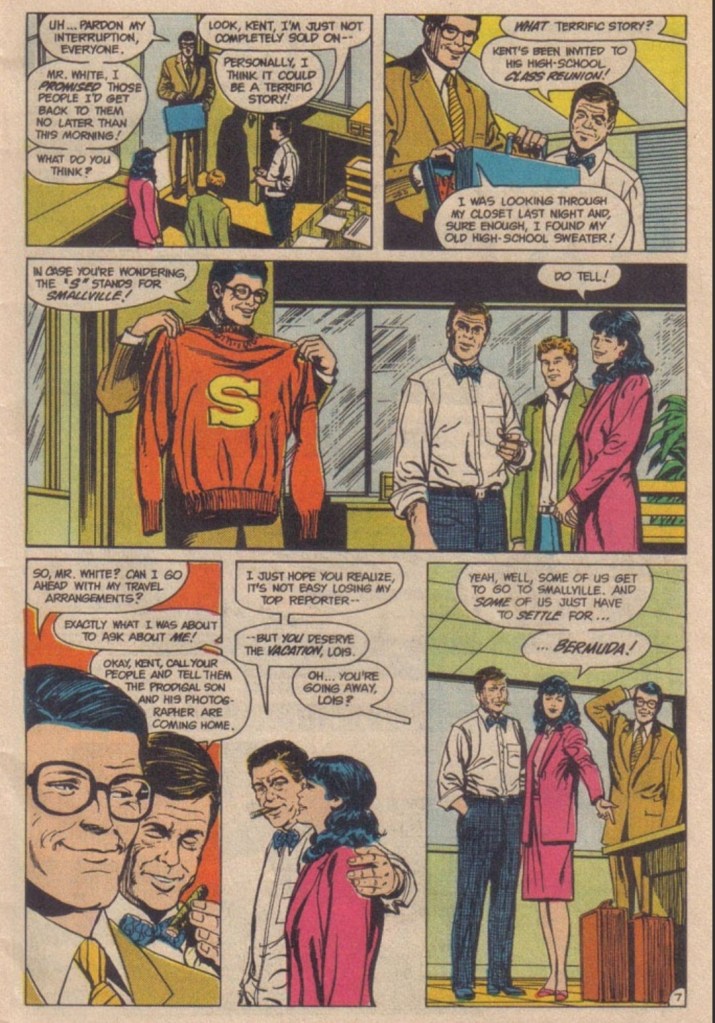
Over at the Daily Planet, Clark Kent/Superman, Lois Lane and Jimmy Olsen meet with Perry White at his office. Kent will be returning home to Smallville and make a news story out of it. White gives Kent his approval and then tells Lois she deserves a vacation.
Hours later, Kent and Jimmy Olsen ride the bus together going to Smallville but their ride stops as a result of a huge fire damaging a large chemical plant. A police officer reveals to Olsen that the scientists inside are worried about the plant and its stuff getting destroyed by the fire.
Kent carefully leaves the bus and discreetly changes into Superman to help solve the problem. Olsen, meanwhile, sneaks past the authorities to get to the burning chemical plant.
Over at Webcoe Industries, company head Ross Webster and his sister Vera learn that more than $85,000 worth of company funds was stolen by someone within. Just outside the office, Gus Gorman enters his fancy looking sports car which Webster, Vera and Lorelei notice. Webster asked how could one of their computer technicians afford such a vehicle worth $75,000…
Quality
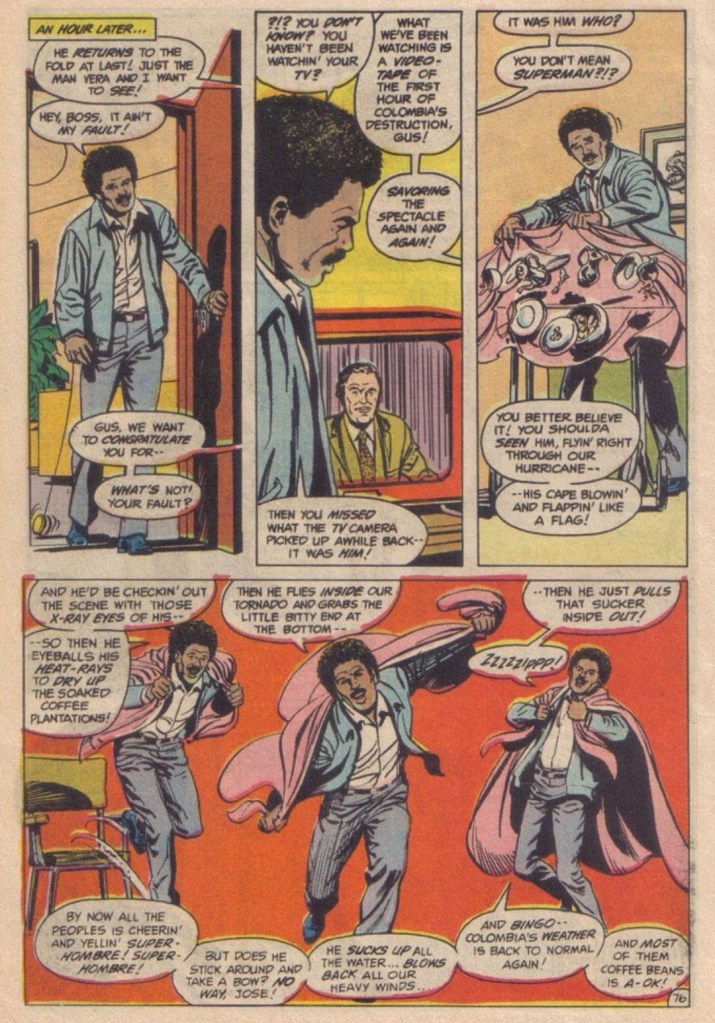
This is a creative way the comic book team used to dramatize Gus Gorman scene revealing and acting the bad news to his boss Ross Webster whose plans were thwarted by Superman.
While it is understandable that not all scenes and not all character moments from the movie made it on print media, this comic book still managed to capture the film’s essence for the most part. The creative team pulled off their own interpretations of the events and made something entertaining and engaging even though they had to deal with the major challenge of summarizing the movie’s plot and establishing a workable comic book narrative.
I should state that the comic team creatively avoided making in-depth references about liquor and smoking which were obvious in the movie. You will not see Superman drinking liquor at a bar nor will you see Gus Gorman referring to tar listed on a cigarette pack. I suppose this was done to ensure the comic book would be released widely and be acceptable to very young readers and the parents watching them.
The battle between evil Superman and Clark Kent is best viewed in the movie. This one is a shorter and less detailed version of it.
When it comes to establishing the clear lead among all the characters featured, Superman fans should be delighted to know that the Man of Steel is indeed more prominent than Gus Gorman. Take note that in the movie, Richard Pryor’s Gus Gorman overshadowed Christopher Reeve’s Superman/Clark.
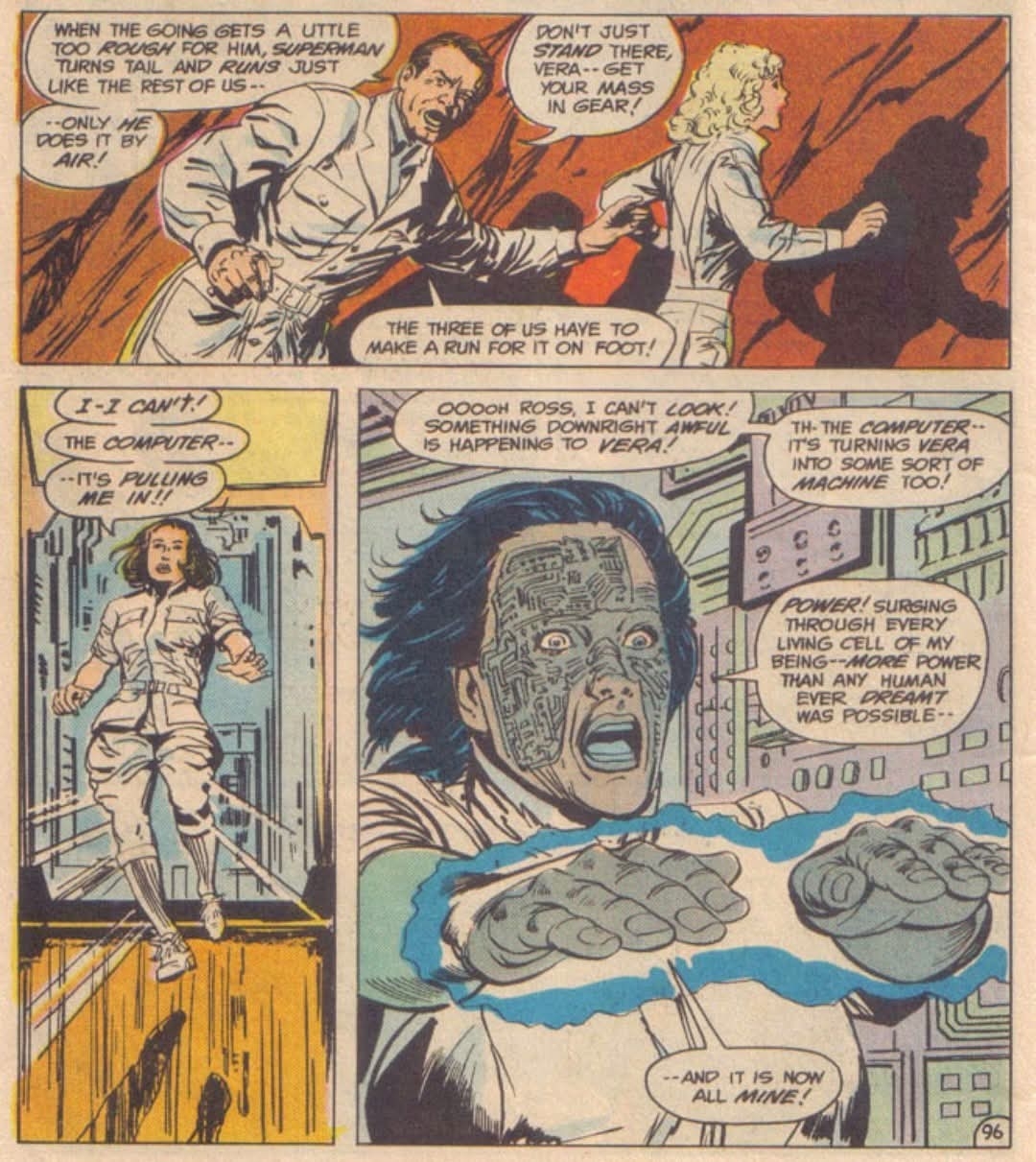
Remember the frightening sequence of Vera getting captured and turned into a cybernetic figure by the Super Computer? This is what it looks like in comic book format.
The art done by Curt Swan and Sal Amendola is decent and it seems to me that their time on visualizing Cary Bates’ script was indeed limited. That being said, it was not surprising to me that, with the exception of Ross Webster in one specific image, none of the characters resembled their cinematic counterparts. Clark Kent/Superman never resembled Christopher Reeve, and Gus Gorman looks nothing like Richard Pryor. Clearly, the artists’ focus was visualizing the narrative which they succeeded.
Conclusion
Clark Kent, Lois Lane, Jimmy Olsen and Perry White in the Daily Planet.
Superman saving Lana Lang’s son from certain death.
Having seen the Christopher Reeve/Richard Pryor movie in the cinema and on cable TV since 1983, I can say that Superman III (1983) is a decent adaptation. It’s not 100% faithful but it is still a worthy read as it will give you the movie’s concept and entertainment values in literary form. If you really want to full essence of film along with the cinematic moments (note: the Superman-Clark battle is the cinematic highlight) all intact, then your obvious choice is to watch the movie. If you are turned off by the movie’s wacky comedy, then the comic book adaptation will deliver to you the more serious approach on telling Superman III’s story. Let me repeat that Superman is more prominent than Gus Gorman in this comic book.
It’s been two days since cinemas around Metro Manila officially reopened which is a welcome move not because I personally want to watch movies on the big screen inside the theater but because the local cinema industry will contribute to the economic recovery of our nation from this ongoing COVID-19 crisis. That being said, I urge you readers – who got fully vaccinated locally – who love watching movies to take time out to support the local cinema operators and their employees by visiting their venues, buying tickets over the counter and watch movies on the big screen while following the local health protocols (note: local cinemas have invested a lot in making their venues safe and sanitized).
Be reminded that streaming will NEVER match the grandeur and immersion of the cinema! The cinema is always better than streaming. Movie venue choices aside, local moviegoers now have the opportunities to watch A Quiet Place Part II and the big blockbuster Dune (2021).
Going back to the topic of economic recovery, there is no doubt that the COVID-19 crisis combined with all the restrictions imposed by the local, regional and nation authorities brought down the national economy in 2020 along with all the economic sectors and the employees. All of these also translate into a major loss of tax revenue for the local governments, provincial governments and the national government.
In the case of the local cinema industry, the shutdown of cinemas since the pandemic started in March 2020 resulted a huge, collective industry loss of revenue according to a BusinessWorld report. I’m talking about many BILLIONS of Pesos lost!
To put things in perspective, posted below is an excerpt of the BusinessWorld report. Some parts in boldface…
The cinema industry had P19 billion in foregone revenue from March 2020 to September this year, Film Development Council of the Philippines (FDCP) Chairperson Mary Liza Diño-Seguerra said in a Teams video interview.
The loss had ballooned to P21 billion as of Oct. 11, Charmaine N. Bauzon, president of Cinema Exhibitors Association of the Philippines, told PTV News.
Local government units, which charge 10% amusement tax per movie ticket, lost P1.09 million daily from the country’s more than a thousand movie screens, according to estimates by the National Tax Research Center.
“We earned P11.5 billion yearly from the box office [before the pandemic],” Ms. Seguerra said. “We sold about 52 million tickets each year.”
Cinema operators get 50% of ticket sales, while the other half goes to producers, who then give as much as a quarter to the distributor, who’s in charge of marketing and distributing the film to the public.
Last year, cinemas in areas under a more relaxed quarantine made a measly P327,000, Ms. Seguerra said.
Take note that before the pandemic started, the local cinema industry as a whole had a work force of 300,000 employees and those who lost their jobs and income really suffered. In the City of San Juan, the Manila Bulletin reported about the reopening of local cinemas there with Mayor Francis Zamora issuing statements and leading the inspection on the venues. Posted below is an excerpt from the Manila Bulletin article.
San Juan City Mayor Francis Zamora led the inspection of cinemas in the city starting with the Greenhills Promenade Cinema.
Zamora inspected the health and safety protocols of the cinema such as the disinfection process of the establishment and the procedure of buying the tickets, which can be done before entry to the cinema or online, new seating arrangements with strict physical distancing, and the guidelines of actual movie viewing under the new normal.
“I know how Filipinos miss watching movies in silver screens which have been shut down for almost two years due to the pandemic, but now the long wait is over. With the approval of the IATF, we are allowing the opening of our cinemas in the city, provided that we take extra care and observe stringent protocols as we are still facing threats of COVID-19 despite the easing of restrictions to Alert Level 2,” Zamora said.
“I want to personally make sure that our cinemas in San Juan will be safe for all of us, not only for the moviegoers but for the employees of these establishments as well,” he added.
During Alert Level 2, the operational capacity of several businesses has been increased to accommodate more customers. It has also eased down quarantine restrictions in various indoor establishments and recreational venues including movie houses and cinemas.
Under the Inter Agency Task Force (IATF) guidelines, cinemas can accommodate up to 50 percent of its maximum venue capacity, but only those who are fully vaccinated will be allowed entry into the cinemas.
For added insight, posted below are two news videos for your viewing…
Once I again, I urge you readers based in Metro Manila and in nearby provinces who got fully vaccinated to come out to support our local cinema operators and make a contribution to economic recovery as you enjoy watching on the big screen again.
Let me end this piece by asking you readers: Now that cinemas within Metro Manila have reopened, are you planning to revisit them and watch movies on the big screens anytime soon? Does Dune (2021) interest you a lot? When was the last time you saw a movie inside the movie theater? Do you realize that as a paying customer, what you pay helps not only movie producers and cinema operators but also their employees and the varied government units (that collect amusement taxes)?
Thank you for reading. If you find this article engaging, please click the like button below and also please consider sharing this article to others. If you are looking for a copywriter to create content for your special project or business, check out my services and my portfolio. Feel free to contact me as well. Also please feel free to visit my Facebook page Author Carlo Carrasco and follow me at HavenorFantasy@twitter.com
For more South Metro Manila community news and developments, come back here soon. Also say NO to fake news, NO to irresponsible journalism, NO to misinformation, NO to plagiarists, NO to reckless publishers and NO to sinister propaganda when it comes to news and developments. For South Metro Manila community developments, member engagements, commerce and other relevant updates, join the growing South Metro Manila Facebook group at https://www.facebook.com/groups/342183059992673
It has been so long since the cinemas in Metro Manila have been closed and have not screened any new films since the start of the pandemic which negatively affected the local cinema industry’s operators and their employees. 300,000 employees to be precise.
Early this year, Inter-Agency Task Force for the Management of Emerging Infectious Diseases (IATF-EID) announced that it has allowed a variety of businesses around the Philippines to resume operations to recover from the COVID-19 crisis and cinemas were among those businesses. However the mayors of Metro Manila opposed the decision and according to the Manila Times’ news report, Metropolitan Manila Development Authority (MMDA) chairman Benhur Abalos noted that “movie theaters are enclosed and air-conditioned spaces where people stay for more than 30 minutes, conditions that increase the risk of coronavirus transmission.” Abalos lamented that there was this fear of a possible spike in COVID-19 infection if cinemas were allowed to reopen. The Department of Trade and Industry (DTI) issued a memorandum calling for the reopening of cinemas in GCQ (general community quarantine) areas starting March 5, 2021 but the said businesses remain closed.
That was back then and by now, many millions of residents of Metro Manila have been vaccinated for COVID-19, many businesses went through the Safety Seal program and a new system of community control has been implemented. Since the pandemic started, cinemas in Metro Manila were shut down with the exception of some cinemas that were turned into temporary venues for COVID-19 vaccination.
Now there is renewed hope for Metro Manila cinema operators and their employees as the Manila Bulletin reported that the IATF will discuss reopening cinemas under the Alert Level system.
To put things in perspective, posted below is an excerpt from the Manila Bulletin news report. Some parts in boldface…
Malacañang said the government’s pandemic task force is set to discuss the possible reopening of cinemas in areas under the Alert Level 3, part of the new system being implemented in Metro Manila response to the coronavirus (COVID-19) pandemic.
Presidential Spokesman Harry Roque made the statement after the Cinema Exhibitors Association of the Philippines (CEAP) appealed to the Inter-agency Task Force (IATF) for the Management of Emerging Infectious Diseases to allow the limited operations of cinemas under the Alert Level 4.
In his press briefing on Thursday, October 7, Roque said that the IATF will discuss the reopening of cinemas but not in areas under Alert Level 4.
“Ang alam ko po nasa agenda ‘yan mamaya ng IATF pero ang pagbubuaks po na pag-uusapan po ay Level 3, hindi Level 4 (I know it’s part of the agenda of the IATF later but the reopening that will be discussed will be in Alert Level 3, not Level 4),” he said.
In a Facebook post, the CEAP appealed to the IATF to allow the reopening of cinemas, ensuring that the industry values the health and well-being of its employees and moviegoers.
According to CEAP, the cinema industry has ensured that all employees are fully vaccinated against COVID-19.
The group likewise said that a number of cinemas have been awarded the Safety Seal Certification by their local government units (LGUs) which affirms that they are compliant with the minimum health standards set by the government.
The Manila Bulletin report ended mentioning that theater managers have gone through occupational safety and health training.
Let me end this piece by asking you readers: Do you believe it is high time for cinemas in Metro Manila to reopen now that many millions of people in the metropolis have been vaccinated for COVID-19 and a lot of businesses have made efforts to meet the requirements of health protocols (and the Safety Seal program)? Do you believe that the MMDA and the Metro Manila Council (MMC) actually care about the state of the 300,000 employees of the nation’s cinema industry? Do you think Abalos and the Metro Manila mayors will still make decisions out of fear as far as movie theaters are concerned?
Thank you for reading. If you find this article engaging, please click the like button below and also please consider sharing this article to others. If you are looking for a copywriter to create content for your special project or business, check out my services and my portfolio. Feel free to contact me as well. Also please feel free to visit my Facebook page Author Carlo Carrasco and follow me at HavenorFantasy@twitter.com
For more South Metro Manila community news and developments, come back here soon. Also say NO to fake news, NO to irresponsible journalism, NO to misinformation, NO to plagiarists, NO to reckless publishers and NO to sinister propaganda when it comes to news and developments. For South Metro Manila community developments, member engagements, commerce and other relevant updates, join the growing South Metro Manila Facebook group at https://www.facebook.com/groups/342183059992673
Since its implementation months ago (click here, here and here) the Safety Seal certification program has covered a lot of business establishments and offices (including government). Recently, it was reported by the Philippine News Agency (PNA) that more than 43,000 business establishments nationwide have been certified safe as Safety Seals were issued to them. This is really good news because our nation badly needs economic recovery as a lot of workers lost their jobs and income as a result of the last enhanced community quarantine (ECQ) that happened in Metro Manila as well in other regions. The national economy has clearly been damaged not only by COVID-19 but also by the lockdowns (note: observe closely how the top officials of the Metropolitan Manila Development Authority and the Metro Manila Council think and act when making their recommendations to the IATF).
To put things in perspective, posted below is an excerpt from the PNA article. Some parts in boldface…
A total of 43,332 public and private establishments nationwide have been issued safety seal certifications, an assurance to the public that health protocols are put in place amid the quarantine restrictions.
The safety seal certification program indicates the compliance of establishments to the minimum public health standards (MPHS) set by the government.
In a news release issued Tuesday, Trade Secretary Ramon Lopez said the certification program is beneficial to the country’s recovering economy as it boosts the confidence of consumers in going out and patronizing business in the new normal with the assurance that a business establishment is compliant with health protocols.
He encouraged more businesses to adopt the seal as an effective measure in curbing the spread of the Covid-19 virus.
“Businesses can do their share in the fight against the pandemic and create a healthy space for consumers to transact their purchases and for employees to gainfully and safely earn a living,” Lopez said.
Interior Secretary Eduardo Año told owners of establishments, especially those in areas under strict quarantine restrictions, to take the time to apply for a safety seal.
“Applying for a Safety Seal is not mandatory. However, business establishments are highly encouraged to apply since this will also help them attract customers which eventually leads to increased sales and profit,” he said.
Since its implementation in May 2021, a total of 85,731 applications were received by the issuing agencies as reported by the Safety Seal Technical Working Group (TWG); 50.54 percent or 43,332 applications were approved while 11.50 percent or 9,858 applications were either denied or referred to the appropriate agency.
The remaining percentage represents those that are still in the inspection process.
“I commend and congratulate the establishments that have taken the lead in securing their Safety Seal certifications. This will build confidence that their respective companies are committed to ensuring the health and safety of their stakeholders and workers,” said Labor Secretary Silvestre Bello III.
Under the program, a business establishment is eligible to apply for a safety seal given that it is duly registered, adopting the Staysafe.ph app or any other local government unit-mandated digital contact tracing application and strictly following and implementing the MPHS.
“The implementation of the Safety Seal Program is a very laudable initiative that highly reinforces our country’s response to combat Covid-19. As we gradually reopen our economy, it is important to ensure that our people are safe, and adherence to Minimum Public Health Standards is one vital key to this aspect,” Health Secretary Francisco Duque III said.
The Department of Tourism (DOT) also reaches out to tourism establishment owners to get the seal.
“The Safety Seal certification program bodes well with the DOT’s priority to ensure the health and safety of both tourists and tourism workers. Let us continue to make travel fun and safe for all,” Tourism Secretary Bernadette Romulo-Puyat said.
The Safety Seal Technical Working Group assured the public that the government exerts the best efforts with a whole-of-government and whole-of-society coordination in support of the Inter-Agency Task Force’s Prevent-Detect-Isolate-Treat-Reintegrate (PDITR) strategy.
Let me end this piece by asking you readers: As a consumer, are you confident that economic recovery will happen over the next twelve months? Are there still many business joints in your local community that are operating without Safety Seals? Do you believe that the MMDA and the Metro Manila Council should be held accountable for every job lost as a result of their recommending ECQ to the IATF?
Thank you for reading. If you find this article engaging, please click the like button below and also please consider sharing this article to others. If you are looking for a copywriter to create content for your special project or business, check out my services and my portfolio. Feel free to contact me as well. Also please feel free to visit my Facebook page Author Carlo Carrasco and follow me at HavenorFantasy@twitter.com
For more South Metro Manila community news and developments, come back here soon. Also say NO to fake news, NO to irresponsible journalism, NO to misinformation, NO to plagiarists, NO to reckless publishers and NO to sinister propaganda when it comes to news and developments. For South Metro Manila community developments, member engagements, commerce and other relevant updates, join the growing South Metro Manila Facebook group at https://www.facebook.com/groups/342183059992673
To put things in perspective, posted below is an excerpt from the PNA article. Some parts in boldface…
Department of Trade and Industry (DTI) Secretary Ramon Lopez has endorsed tweaking of community quarantine protocols by allowing more mobility for fully vaccinated individuals.
During President Rodrigo Duterte’s Talk to the People aired over the weekend, Lopez told Duterte that “it is about time to change our protocol” in terms of easing some restrictions for the vaccinated population.
“We were discussing the need to have (a) different approach in terms of solving Covid-19 (coronavirus disease 2019); not just lockdowns,” he said in mixed English and Filipino.
The DTI chief said under the new protocol, fully vaccinated individuals could be allowed in restricted economic activities, such as dine-in services in restaurants and personal care services.
He said this would allow safe reopening of the economy as fully vaccinated people have protection against the Covid-19.
People with complete vaccines are unlikely to develop severe to critical Covid-19, he added.
“These are labor intensive. These sectors, there are 2 million individuals employed in dine-in restaurants. In salons, there are around 400,000. This is nationwide,” Lopez said.
The trade official said this could be pilot tested in Metro Manila, as the National Capital Region has more than 50 percent of its eligible population for Covid-19 vaccines already got their jabs.
The above article ended stating that the guidelines of the protocol are being finalized. It is very clear that lockdown and restrictions on businesses result a massive loss of income and a rise on unemployment. The DTI Secretary’s proposal is part of an effort to ensure that the Philippine economy will recover and rebound, and if you have been paying close attention to the number of Metro Manila cities that have been vaccinating their patients, there are now millions of fully vaccinated people in the National Capital Region (NCR) combined. In the City of Las Piñas alone, their fully vaccinated patients had reached almost 315,000 as of September 11, 2021. In Muntinlupa City, the number of fully vaccinated patients is almost 200,000.
You travel along Aguirre Avenue inside BF Homes subdivision and you will see lots of restaurants, coffee shops and personal care service providers located along the long road. A lot of them have been struggling because of the prohibition on customers from entering and spending time inside those business joints. You go to Filinvest City in Alabang, Muntinlupa City, and search for a place to have a nice meal at only to be disappointed that you cannot dine inside and will have to order for take-out. Take-out and delivery are the current options that food-and-beverage joints have when it comes to serving their customers but those options are not good enough to help them survive. For me, DTI Secretary Lopez’s proposal makes sense and it will help not only the struggling businesses and the unemployed, but also improve economic activity.
Let me end this piece by asking you readers: What do you think about Secretary Lopez’s latest move? Do you believe it is time to ease the protocols with the many millions of fully vaccinated people in Metro Manila?
Thank you for reading. If you find this article engaging, please click the like button below and also please consider sharing this article to others. If you are looking for a copywriter to create content for your special project or business, check out my services and my portfolio. Feel free to contact me as well. Also please feel free to visit my Facebook page Author Carlo Carrasco and follow me at HavenorFantasy@twitter.com
For more South Metro Manila community news and developments, come back here soon. Also say NO to fake news, NO to irresponsible journalism, NO to misinformation, NO to plagiarists, NO to reckless publishers and NO to sinister propaganda when it comes to news and developments. For South Metro Manila community developments, member engagements, commerce and other relevant updates, join the growing South Metro Manila Facebook group at https://www.facebook.com/groups/342183059992673
To put things in perspective, posted below is the excerpt from the Philippine News Agency. Some parts in boldface…
The Inter-Agency Task Force for the Management of Emerging Infectious Diseases (IATF-EID) has “provisionally” approved the guidelines on the pilot implementation of granular lockdowns in Metro Manila, Malacañang announced on Friday.
Presidential Spokesperson Harry Roque, also acting as IATF-EID spokesperson, said the coronavirus disease 2019 (Covid-19) policy shift would only impose either the strictest enhanced community quarantine (ECQ) or the general community quarantine (GCQ) with four alert levels in Metro Manila.
“Sang-ayon po dito sa policy shift na gagawin natin, dalawa na lang ang quarantine classifications. Ito po ang ECQ na ipapataw ng IATF o ‘di naman kaya ay GCQ (Based on the policy shift that we will carry out, there will only be two quarantine classifications. These are the ECQ that will be imposed by the IATF or the GCQ),” Roque said in a virtual presser.
He said the localized lockdown that would be pilot-tested in Metro Manila has four levels.
The IATF-EID is still ironing out the details on the implementation of alert level 4, the strictest level, Roque said.
Roque said all areas that would be placed under an alert level system should follow the protocols that are consistent with their alert levels and issued by the National Task Force (NTF) Against Covid-19.
The classification of pilot areas and their alert levels will also be done weekly, unless otherwise specified, he added.
“Lahat po ng areas ay magpapatupad po ng granular lockdowns, sang-ayon po sa guidelines ng NTF. Ang pagkakaiba po nito, itong lockdowns na ito ay mas strikto (All areas will implement granular lockdowns, based on the guidelines of the NTF. The difference is these lockdowns are stricter),” Roque said.
With the implementation of stricter granular lockdowns, health and allied health professionals are the only ones who will be considered Authorized Persons Outside Residence (APOR), he said, noting that government workers in areas under localized lockdown would not be allowed to go out.
“‘Yun pong mga taong gobyerno ay hindi makakapagtrabaho kapag kayo po ay nasa ilalim ng localized lockdown. Hindi kayo pupuwedeng lumabas (Government workers will not be allowed to go out if their areas are under localized lockdown. They cannot go out),” Roque said.
He, however, assured that local government units and the Department of Social Welfare and Development (DSWD) would provide assistance to households that might be affected by the implementation of granular lockdowns.
“Magbibigay na po ng ayuda ang lokal na pamahalaan at ang DSWD para po hindi na kinakailangang lumabas ng kahit na sino sa mga lugar na naka-granular lockdown (Local governments and the DSWD will give assistance so residents of areas under granular lockdown would no longer need to leave their homes),” he said.
Roque did not mention when the pilot implementation of localized lockdowns would commence.
Let me end this piece by asking you readers: What do you think about the new guidelines for granular lockdown? Do you believe that the plan of using 4 alert levels for GCQ will cause a lot of confusion? Do you think that the national authorities will be able to finalize and issue the new guidelines before September 15?
How many people do you personally know lost their jobs because of the most recent flip-flop by the IATF resulting the extended MECQ? Do you believe that the IATF, the Metro Manila Council and the MMDA are paying sufficient attention to economic matters like job losses and the affected employees’ loss of income?
Thank you for reading. If you find this article engaging, please click the like button below and also please consider sharing this article to others. If you are looking for a copywriter to create content for your special project or business, check out my services and my portfolio. Feel free to contact me as well. Also please feel free to visit my Facebook page Author Carlo Carrasco and follow me at HavenorFantasy@twitter.com
For more South Metro Manila community news and developments, come back here soon. Also say NO to fake news, NO to irresponsible journalism, NO to misinformation, NO to plagiarists, NO to reckless publishers and NO to sinister propaganda when it comes to news and developments. For South Metro Manila community developments, member engagements, commerce and other relevant updates, join the growing South Metro Manila Facebook group at https://www.facebook.com/groups/342183059992673
To put things into perspective, posted below is the excerpt from the Manila Times report. Some parts in boldface…
Trade Secretary Ramon Lopez is proposing to allow vaccinated people to dine-in in restaurants and enter personal care services establishments in areas under stricter quarantine measures.
In a Viber message to reporters, Lopez said this will help spur employment in those sectors.
“Same MECQ (modified enhanced community quarantine) but [I] am pushing for allowing vaccinated to [be] allowed only in these restricted sectors like dine-in and personal care. Because we are saying that in these restricted sectors, those who are vaccinated are safer. So, we don’t expect an increase in severe critical (cases) and should not worsen ICU (intensive care unit) cases,” Lopez told reporters in a Viber message.
“We pity the dine-in workers. About one million jobs and P1.5 billion revenues gone per week in the National Capital Region (NCR),” he added.
Lopez said that on top of these, 200,000 jobs in the personal care services sector in NCR were also affected.
“For other sectors, no need for distinguishing because both the vaccinated and unvaccinated are allowed. For example, both vaccinated and unvaccinated are allowed to go to malls or ride public transport,” he said.
“Again to clarify, [vaccinated should be allowed] only in restricted sectors during lockdowns like dine-in, personal care services, and meetings, incentives, conferencing, exhibitions. If it’s not locked down, all vaccine status should be allowed subject to operating capacity,” he added.
Lopez, however, clarified that these should be allowed to operate at a maximum of 20- percent capacity.
“We believe in the vaccine. So, we should believe in the vaccinated. This should also serve as an incentive to those who are vaccinated and to encourage vaccination. With this, we help bring back jobs, open up these sectors,” said Lopez.
He said that once approved, this will be part of the new Inter-Agency Task Force for the Management of Emerging Infectious Diseases (IATF) guidelines.
Metro Manila and other Covid-19 critical areas were earlier placed under enhanced community quarantine (ECQ) until August 20.
The National Economic and Development Authority (NEDA) disclosed that the two-week ECQ will cost the Philippine economy P120 billion and aggravate poverty.
In relation to the details emphasized by Trade Secretary Lopez, the affected businesses within the restricted sectors can be relieved economically and already there are millions of vaccinated consumers available in Metro Manila to come in and support these businesses even though the maximum capacity is fixed at 20% under MECQ. The unemployed and the under-employed impacted by the ECQ/MECQ will finally get the opportunities to be hired and be able to earn much-needed income. That being said, it is a must that we pray in supporting Lopez’s proposal to get approved so that our nation as whole can recover better and that MECQ won’t be too damaging for businesses and workers anymore.
Speaking of the National Capital Region (NCR), pay close attention as to how Metropolitan Development Authority (MMDA) chairman Benhur Abalos and the members of the Metro Manila Council (MMC) will perceive and react to Lopez’s proposal of allowing food-and-beverage joints and personal care businesses to cater to vaccinated customers at limited capacity during MECQ. Take note that during the last ECQ, it was the MMDA and MMC who approved the restriction on outdoor exercise while businesses and their employees kept losing! Think about how these Metro Manila authorities think. That being said, it is essential to pray to our Lord to enlighten and guide all the government officials so they can do their jobs better and correctly.
Let me end this piece by asking you readers: Do you agree with Trade Secretary Lopez’s proposal to help the affected businesses during MECQ? If you are still unvaccinated, does this recent development encourage you at all to get vaccinated? If you are an owner of a food-and-beverage joint or a personal care services joint, what do you think about Lopez’s proposal in helping you and your employees?
Thank you for reading. If you find this article engaging, please click the like button below and also please consider sharing this article to others. If you are looking for a copywriter to create content for your special project or business, check out my services and my portfolio. Feel free to contact me as well. Also please feel free to visit my Facebook page Author Carlo Carrasco and follow me at HavenorFantasy@twitter.com
For more South Metro Manila community news and developments, come back here soon. Also say NO to fake news, NO to irresponsible journalism, NO to misinformation, NO to plagiarists, NO to reckless publishers and NO to sinister propaganda when it comes to news and developments. For South Metro Manila community developments, member engagements, commerce and other relevant updates, join the growing South Metro Manila Facebook group at https://www.facebook.com/groups/342183059992673
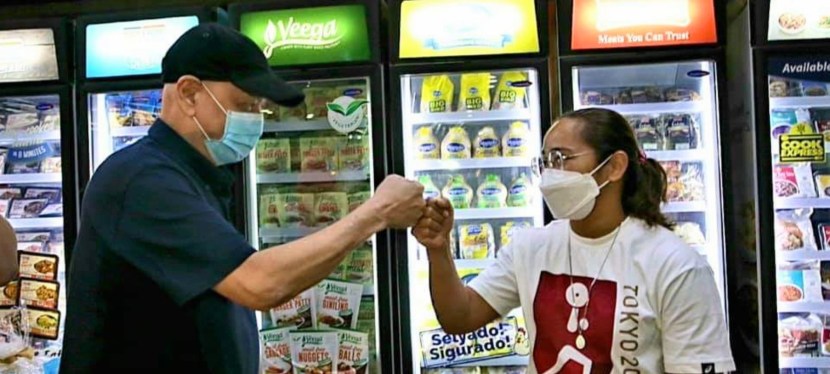
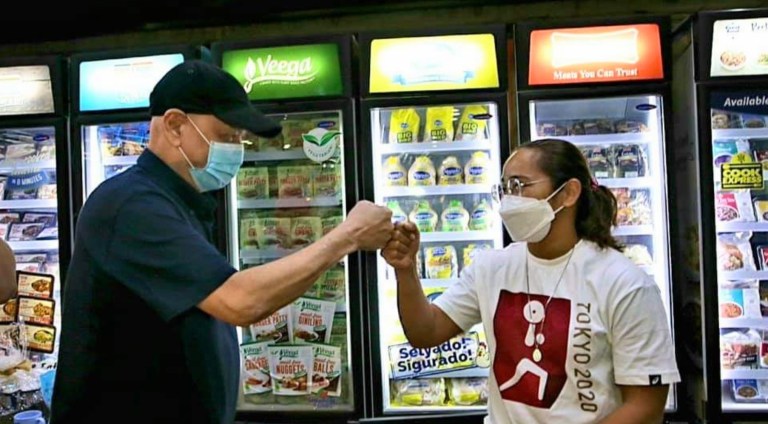
Business tycoon Ramon S. Ang with Olympic gold medalist Hidilyn Diaz. (photo from Ramon S. Ang Facebook page)
To put things in perspective, posted below is an excerpt from the Philippine News Agency (PNA) article. Some parts in boldface…
San Miguel Corp. president Ramon Ang sees Hidilyn Diaz as a game-changer after she ended the Philippines’ 97-year hunt for its first Olympic gold in Tokyo.
“Hidilyn is the country’s trailblazer in our successful Olympic gold medal quest. After years of heartbreaks, she came through for us and we are very thankful as a nation,” Ang said on Tuesday.
Diaz, together with fiancé and coach Julius Naranja, personally received the PHP10 million reward Ang pledged for anyone who would capture the then elusive gold.
Diaz won the women’s 55-kg. weightlifting event at the Tokyo Olympics on July 26, making the Philippines a part of the Olympic gold medal countries’ list.
It also served as the biggest good news the Filipinos have ever received amid the coronavirus disease 2019 pandemic.
“Her victory comes at a very crucial point in our country’s history when we are grappling with a pandemic and a lot of Filipinos are looking for hope as we fight this virus and cope with the difficulties it has brought,” Ang said.
Upon meeting at the SMC office in Pasig City, however, he gave Diaz a surprise gift.
Ang rewarded Diaz with two Magnolia Chick ‘N Juicy franchises that she could put up at her new condominium in Quezon City and at her hometown in Zamboanga City.
“With the franchise outlets, we will assist Hidilyn every step of the way in her journey as an entrepreneur so that she can also help other people in need of jobs. In addition to the physical stores, equipment, and training, we will also provide the initial stocks for free to get her started,” he added.
The generosity of Ramon S. Ang is truly amazing and genuine. Not only was the promised cash reward released to Hidilyn Diaz, he gifted her with commercial franchises which can add to our nation’s economy by creating opportunities for the unemployed to bounce back from poverty while providing choices to consumers looking for good products. I really like this because I truly believe that capitalism the way to prosperity and the most effective way to lift people up from poverty. Capitalism does socio-economic wonders while socialism only drags people down and ruins societies. As it is a fact that cash rewards/incentives from both the government and private sector cannot last forever as the cost of living only keeps going up, having a business that succeeds will keep prevent people from falling into poverty. To see Hidilyn Diaz gifted with business franchises is great!
For those who are not aware, Chick ‘N Juicy is a chicken rotisseries retail business that has many branches and it is being expanded. Chick ‘N Juicy sells chicken supplied by sister company Magnolia. Customers can order from them online with products like sweet roast chicken, garlic roast chicken, fried chicken drumsticks, chicken rice meals and more at https://www.chicknjuicyofficial.com/
Let me end this piece by asking you readers: Are you happy about our nation’s Olympic gold medalist getting rewarded and gifted by tycoon Ramon S. Ang?
Thank you for reading. If you find this article engaging, please click the like button below and also please consider sharing this article to others. If you are looking for a copywriter to create content for your special project or business, check out my services and my portfolio. Feel free to contact me as well. Also please feel free to visit my Facebook page Author Carlo Carrasco and follow me at HavenorFantasy@twitter.com









 Author Carlo Carrasco