In a move to boost the Philippines’ standing in international tourism, President Ferdinand “Bongbong” Marcos, Jr., signed into law the priority measure of providing Value Added Tax (VAT) refund for foreign tourists, according to a Philippine News Agency (PNA) news article.
To put things in perspective, posted below is an excerpt from the PNA news article. Some parts in boldface…
President Ferdinand R. Marcos Jr. on Monday signed into law a measure providing refund of Value Added Tax (VAT) for foreign tourists to attract more travelers and position the country as a “premier global shopping destination.”
Republic Act (RA) 12079 or the VAT Refund for Non-Resident Tourists will establish a VAT Refund System on locally purchased goods, Marcos said in his speech during the ceremonial signing in Malacañang.
Under the new law, tourists can claim a refund on the VAT for goods personally purchased at accredited retail outlets, provided these goods are taken out of the country within 60 days and meet a minimum transaction requirement of PHP3,000.
This initiative opens a new chapter in the Philippines’ tourism landscape, according to the President, allowing the country to compete with other tourism markets that attract tourists who are eager to take home authentic, high-quality Filipino products.
With the new law, an estimated 30 percent increase in tourist spending is projected which will benefit both large-scale industries and micro, small, and medium enterprises.
“These products tell our stories, and now, with the VAT refund, they will be able to be more accessible to global consumers, elevating once again our stature in the global market,” Marcos said.
Let me end this post by asking you readers: What is your reaction to this recent development? With the new law signed already, do you expect it to help the Philippines attract more foreign tourists as well as better spending from each of them during they stay in the country?
As some of you are already aware, I fully stand with Israel which is very connected with my uncompromising faith in the Lord. I keep on praying to Him for Israel to overwhelm its enemies, rescue the hostages and recover from the effects of the October 7, 2023 terrorist attacks committed by the Palestinian terrorist group Hamas which is sponsored by terrorist state Iran. I can assure all of you that nobody from the evil Islamo-Leftist mob, nobody from the pro-Palestine radicals, nobody from the political correctness extremists, and nobody from evil societies would stop me from supporting and loving Israel.
Now, on with the news…
In recent times, Israel and the Philippines officially signed a major agreement in relation to tourism developments and cooperation between them according to the announcement of the Israeli Embassy via social media. No less than the Minister of Tourism of Israel Haim Katz personally visited the Philippines and signed the agreement opposite Department of Tourism (DOT) secretary Christina Frasco.
To put things in perspective, posted below is the entire social media post of the Israeli Embassy. Some parts in boldface…
Israel Tourism Minister Katz Visits the Philippines, Signs Joint Declaration with DOT
Signing of the joint declaration between Israel’s Minister of Tourism Haim Katz and Philippines Department of Tourism (DOT) Secretary, Christina Garcia Frasco.
Israel’s Minister of Tourism, Haim Katz, is currently visiting the Philippines from 2-5 December 2024 as part of a strategic effort to enhance tourism relations between the two countries. Highlight of the visit is the signing of a joint declaration with the Philippines Department of Tourism (DOT) Secretary, Christina Garcia Frasco.
On December 3, Tourism Minister Katz and DOT Sec. Frasco signed the joint declaration to foster cooperation in the field of tourism between Israel and the Philippines.
“We are excited to see such strong interest from Filipino travelers to Israel,” said Minister Katz. “With the upcoming Jubilee Year, we anticipate even more Filipinos will be eager to experience the holy land and the rich history, culture, and hospitality Israel offers. We hope to see direct flights between Israel and the Philippines very soon, this will boost tourism and people to people exchange,” he shared.
Israeli Ambassador to the Philippines H.E. Ilan Fluss shared that the official visit of Minister Katz is proof of the strong, historically friendly bilateral relations between Israel and the Philippines, especially in the field of tourism. “I hope that this will encourage tourism exchanges between our nations, particularly with the visa-free travel for Filipinos to Israel and vice versa. I invite Filipinos to experience Israel not just as the Holy Land but to enjoy culinary and experience the Land of Innovation and Start-Up Nation,” he explained.
Minister Katz’s visit highlights Israel’s commitment to expanding its presence in the Philippine market, especially for divers and nature lovers. “Israelis find the Philippines an attractive destination for diving and water activities,” Ambassador Fluss said.
Since opening its tourism office in the Philippines in 2017, Israel has witnessed a remarkable 65% rise in Filipino visitors in its first year alone. In 2023, a record-breaking 33,000 Filipinos traveled to Israel.
During his stay, Minister Katz will promote Israel as a premier destination for wine enthusiasts and engage with Filipino distributors of Israeli wine. He will also meet with the Philippine Travel Agencies Association (PTAA), connect with religious leaders in Manila, and hold discussions with the President of Philippine Airlines (PAL) to advance the goal for establishing direct flights between Israel and the Philippines. This initiative aims to enhance tourism and people to people exchange by making travel between the two countries more convenient and accessible.
This latest development shows the continuing growth of Israel-Philippines ties through travel and cooperation. This opens more opportunities for my fellow Filipinos to visit the Holy Land in Israel while doing the same for Israelis to visit the Philippines for leisure and business opportunities (which will be helpful in building up the economy of the Philippines). As I said before, Israel-Philippines ties are essential!
To my fellow Filipinos reading this, I encourage you to accept the truth that Israel is the land God designated specifically for the Jewish people (read Genesis 35:10-12) and His command must be followed without hesitation. If you want to be blessed further by the Lord, do so by loving and blessing the Jewish people (Genesis 12:1-3). I did my part when I was in Israel. Also, let me remind you all that the ties between the Jews and Christians are truly biblical!
I encourage you all to pray to the Lord God in support of Israel, to love and bless the Jewish people, and pray for the peace of Jerusalem. Pray to Him so that Israel-Philippines ties and cooperation will keep growing stronger in the years to come.
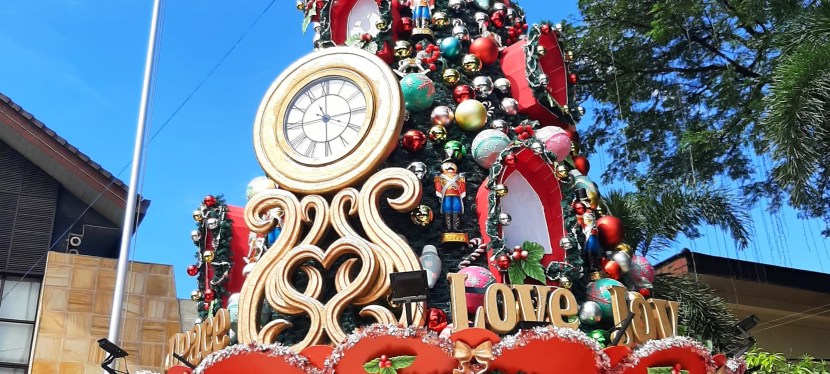
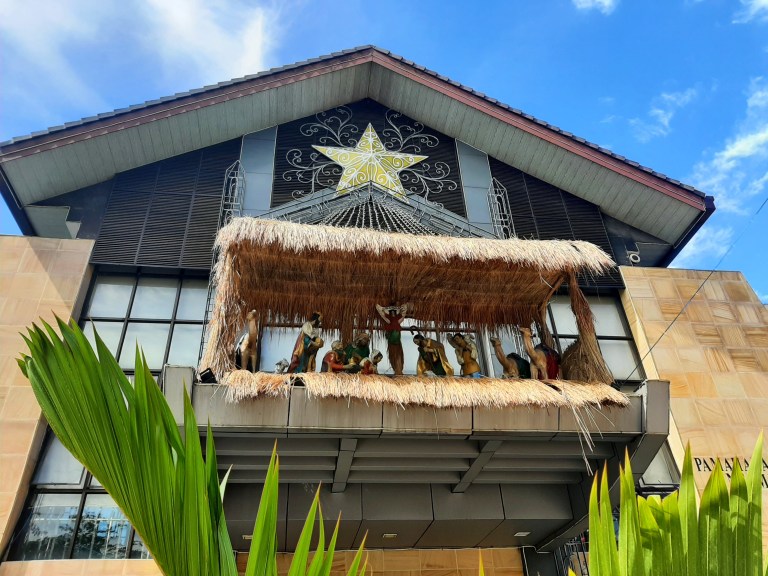
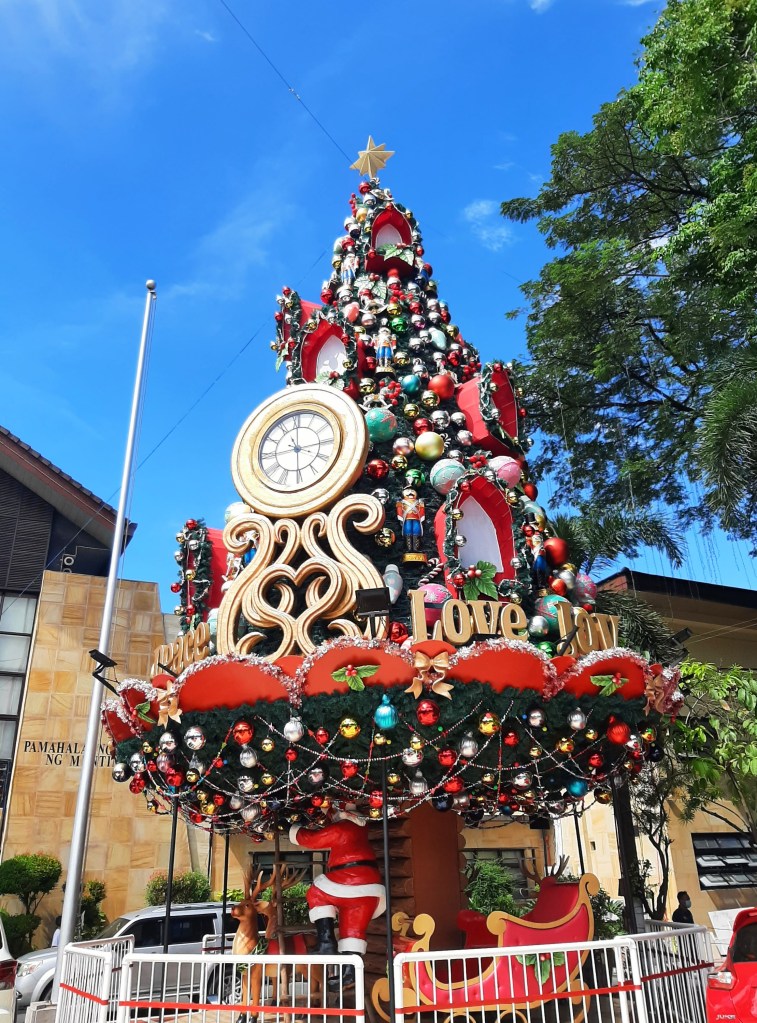
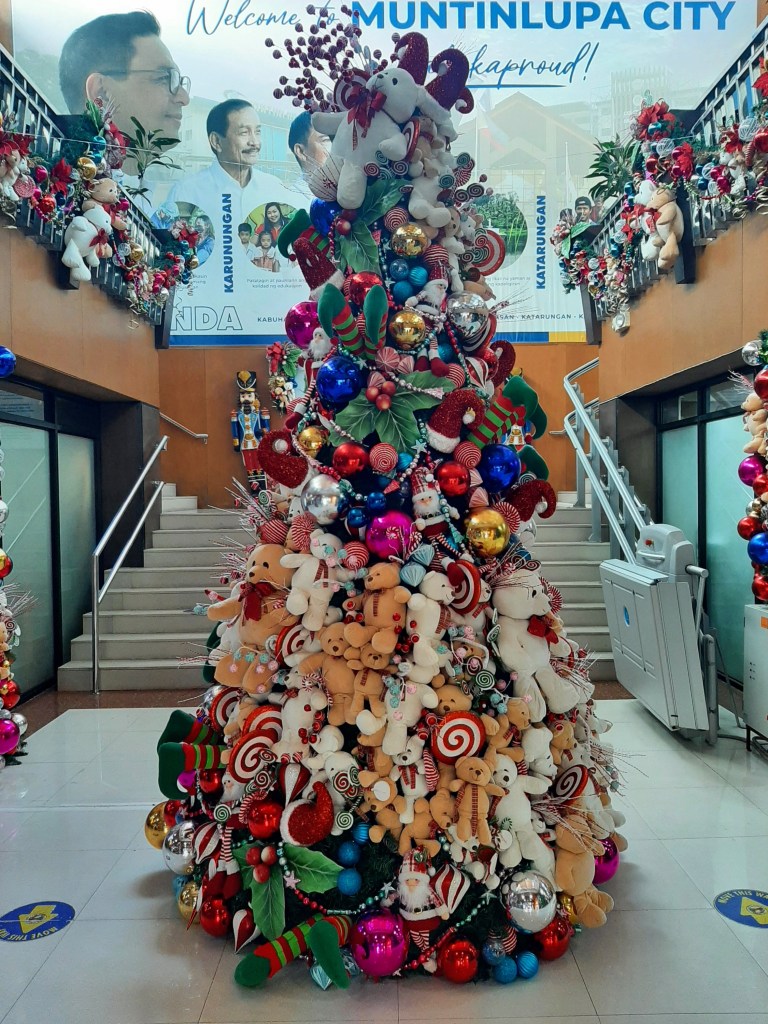
I recently visited Muntinlupa City Hall to take a close look at the Christmas decorations that were set up. Check out what I photographed and posted below for you to see. I hope you will enjoy the images.
The high Christmas decoration at the front of Muntinlupa City Hall recalling Lord Jesus as an infant who was visited by the Three Kings.
The very tall and highly decorated outdoor Christmas tree at the front of City Hall.
Check out the decorations at the exterior of this store inside City Hall.
A very artistic Christmas tree by the City Hall stairs.
Even this pillar got heavily decorated.
To put things in perspective, the decorations and tall Christmas tree outdoors were officially set up weeks ago. In fact, the City Government formally lighted the outdoor Christmas tree on the evening of November 15, 2024. You can watch it via the City Government’s social media posts by clicking here and here.
A closer look at the outdoor Christmas tree at City Hall.
If you wish to visit Muntinlupa City Hall, go visit their building along National Road (referred to by Google Maps as Manila South Road or Manila S. Road). For the precise Google Maps location of Muntinlupa City Hall, click https://maps.app.goo.gl/1GgJgaEGkshMvANu7
When celebrating Christmas wherever you are, always remember that Christmas is truly all about Lord Jesus who is our Savior and the Hope of ALL nations.
For more South Metro Manila community news and developments, come back here soon. Also say NO to fake news, NO to irresponsible journalism, NO to misinformation, NO to plagiarists, NO to reckless publishers and NO to sinister propaganda when it comes to news and developments. For South Metro Manila community developments, member engagement, commerce and other relevant updates, join the growing South Metro Manila Facebook group at https://www.facebook.com/groups/342183059992673
Recently, the Christmas spectacle at Filinvest City Central Park was launched and already it has attracted a lot of visitors who enjoyed the place, sights, special activities and facilities that were prepared this year.
To be specific, Filinvest City’s Christmas season spectacle at the park is formally titled “Cherish Every Moment of Christmas at Filinvest City” which is a program of activities and special events to delight visitors on weekend nights (Friday, Saturday and Sunday) starting from the weekend of November 29 – December 1 until the weekend of December 20 – 22.
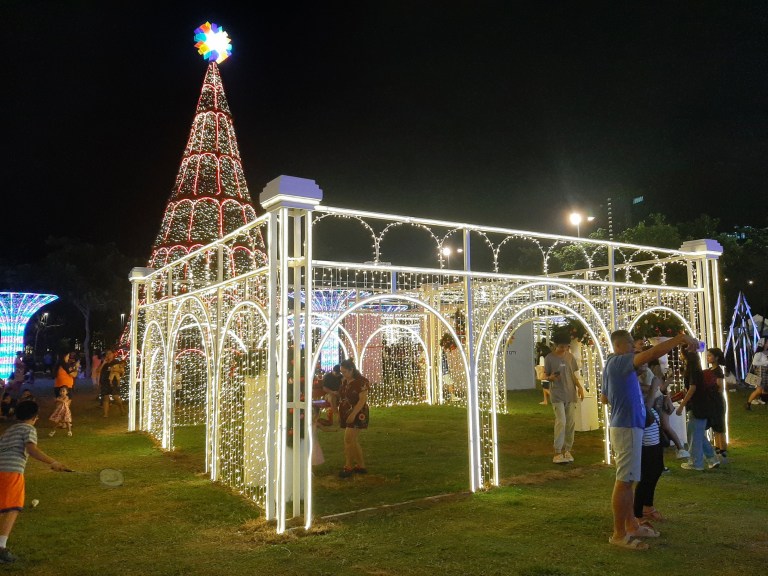
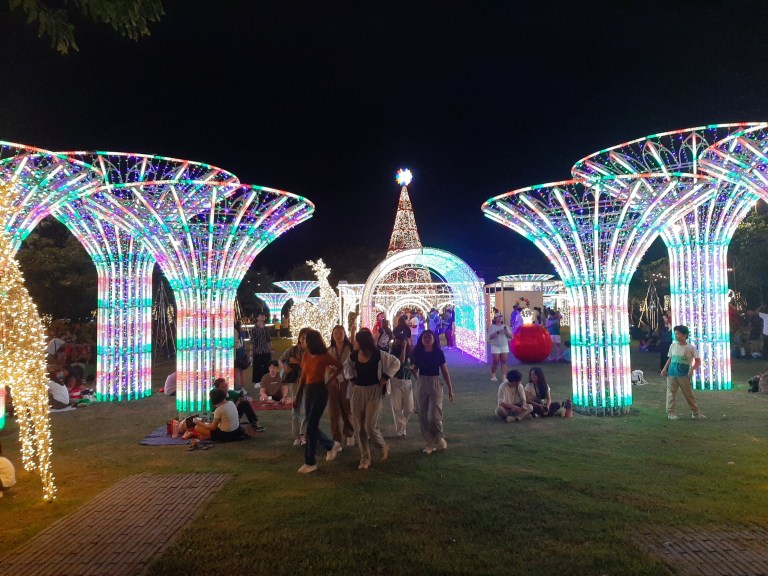
Lots of colorful lights, structures and decoration established to provide visitors the atmosphere of the season of Christmas.
Some hanging Christmas lights at this new structure with a roof.
On Friday nights, visitors can enjoy live musical performances from artists Blaster on December 13 and Munimuni on December 20. The band Over October already performed on the park on November 29. Still on Friday evenings, fireworks displays are scheduled to happen at 8PM (November 29 to December 20).
Those who want to see new facilities and decorations at the park, the Christmas Display is lighted starting 6PM to 9PM from November 29 up to January 6, 2025.
Lots of places to have your pictures taken at.
Christmas display at the Filinvest City Central Park looks livelier this year.
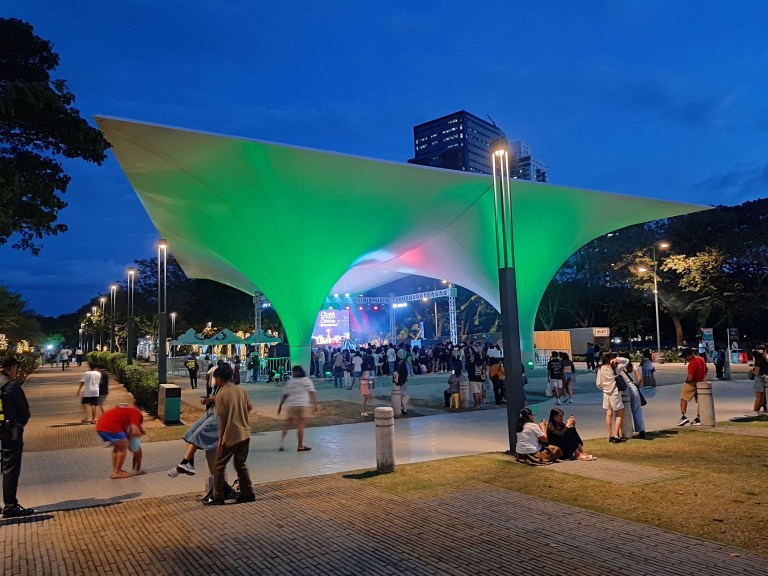
When it comes to brand new structures, Filinvest City’s The Tree is the one that stood out the most this year. The Tree is the newest events stage at the Filinvest City Central Park designed to be a suitable place for live musical performances, lighting ceremonies and other special activities. It was also made to bring the community together for celebration and connecting with each other. I personally witnessed the first live performance there on the evening of November 29 and what impressed me was the vibrant lighting and how the color of the lights changed efficiently.
This is The Tree, the brand new structure built at Filinvest City Central Park.
As I explored the different places of Filinvest City Central Park on the evening of November 29, I noticed a lot of people enjoying the place. You can see what happened by watching my video below.
In ending this post, I want to say that no matter how the organizers portrayed Christmas, always remember that Christmas is all about Lord Jesus who is the Savior and Hope of ALL nations!
That being said, as we enjoy the Christmas season and the blessings, we should never forget our Lord and Savior Jesus Christ. Learn from the holy scriptures below.
For God so greatly loved and dearly prized the world that He [even] gave up His only begotten (unique) Son, so that whoever believes in (trusts in, clings to, relies on) Him shall not perish (come to destruction, be lost) but have eternal (everlasting) life.
John 3:16 (AMPC)
For to us a Child is born, to us a Son is given; and the government shall be upon His shoulder, and His name shall be called Wonderful Counselor, Mighty God, Everlasting Father [of Eternity], Prince of Peace.
Isaiah 9:6 (AMPC)
Therefore, the honor that belongs to the Father he will now share with his Son. So if you refuse to honor the Son, you are refusing to honor the Father who sent him.
John 5:23 (TPT)
Then Jesus spoke to them again, saying,
“I am the light of the world. He who follows Me shall not walk in darkness, but have the light of life.”
John 8:12 (NKJV)
Santa Claus is not the reason of Christmas nor is he the definitive figure of the season. Lord Jesus is the one we should honor, thank and praise every Christmas. The birth of Lord Jesus in Israel thousands of years ago remains highly significant and essential. Celebrate Christmas by having unwavering faith in Lord Jesus!
For more South Metro Manila community news and developments, come back here soon. Also say NO to fake news, NO to irresponsible journalism, NO to misinformation, NO to plagiarists, NO to reckless publishers and NO to sinister propaganda when it comes to news and developments. For South Metro Manila community developments, member engagements, commerce and other relevant updates, join the growing South Metro Manila Facebook group at https://www.facebook.com/groups/342183059992673
Next month, the South Luzon Expressway (SLEX) stretch of Susanna Heights to Calamba will be wider and opened in time for the Christmas season as assured by San Miguel Corporation (SMC) chairman and CEO Ramon Ang, according to a GMA Network news report.
To put things in perspective, posted below is an excerpt from the GMA news report. Some parts in boldface…
The new configuration of the South Luzon Expressway (SLEX) from Susanna Heights, Muntinlupa to Calamba, Laguna — with six lanes on both the northbound and southbound sides —is expected to open in December in time for Christmas, San Miguel Corporation (SMC) chairman and CEO Ramon Ang has said.
In a statement on Tuesday, Ang said the at-grade expansion on SLEX, undertaken by San Miguel unit SMC SLEX Inc., was “proceeding on schedule, with the said 29-kilometer stretch slated to open in the third week of December.”
The construction of the section from Calamba to Sto. Tomas, Batangas, and the expansion of 20 bridges connecting the SLEX main carriageway will be completed by July 2025, the SMC chief said.
“This December, as our countrymen prepare to celebrate Christmas and travel more to spend time with friends and family, they can look forward to a wider, better SLEX. This will help in significantly reducing traffic buildup during the holiday rush,” Ang said.
“The SLEX expansion is a major undertaking that entailed significant effort and investment, and a lot of patience and cooperation from motorists and stakeholders. We are very glad that motorists can soon enjoy faster trips to and from Southern Luzon,” he added.
Ang said that ensuring that SLEX is fully operational throughout the construction period has been a consistent priority of the company.
“Our contractors and project teams continue to do everything they can to minimize impact on vehicle traffic,” Ang said.
Let me end this post by asking you readers: What is your reaction to this recent development? Do you plan to travel far via the SLEX this coming Christmas season?
For more South Metro Manila community news and developments, come back here soon. Also say NO to fake news, NO to irresponsible journalism, NO to misinformation, NO to plagiarists, NO to reckless publishers and NO to sinister propaganda when it comes to news and developments. For South Metro Manila community developments, member engagement, commerce and other relevant updates, join the growing South Metro Manila Facebook group at https://www.facebook.com/groups/342183059992673
Disclaimer: This is my original work with details sourced from my personal experiences and observations during the Israel pilgrimage tour I joined and what happened during my free time. Anyone who wants to use this article, in part or in whole, needs to secure first my permission and agree to cite me as the source and author. Let it be known that any unauthorized use of this article will constrain the author to pursue the remedies under R.A. No. 8293, the Revised Penal Code, and/or all applicable legal actions under the laws of the Philippines.
Welcome back, readers and fellow followers of the Lord! This is the 9th chapter of my ongoing series of articles about the holy nation of Israel with recollections about the experiences and discoveries I had during the pilgrimage tour I joined with my local church (hosted by strategic partner Behold Israel). To see my previous Israel tour articles, click here, here, here, here, here, here, here and here. No matter what happens in this world, I will always stand with Israel and my faith in the Lord remains uncompromising!
In this latest edition of my Israel 2023 series, I share with you one of the things I did during the one and only day-off (February 15, 2023) of our pilgrimage tour. This was the day I visited the Temple Mount, revisited the Western Wall and the Upper Room, and visited the grave of Oskar Schindler. After Schindler, I marched all the way from the Old City to the modern parts of Jerusalem. I had a stopover at Tmol Shilshom to recover before proceeding to Mahana Yehuda Market where I had lunch at Shakshuka Machaneh Yehuda.
During my time at Mahane Yehuda, the cold weather intensified (cloudy and slightly raining). I knew that the heat I got from consuming my lunch would not last long. Suddenly, I remembered what I had been planning to do…visit Power Coffeeworks.
I first learned about Power Coffeeworks on social media while preparing for the trip to Israel some months prior. I checked out what drinks they offered and I knew I had to visit them and enjoy something.
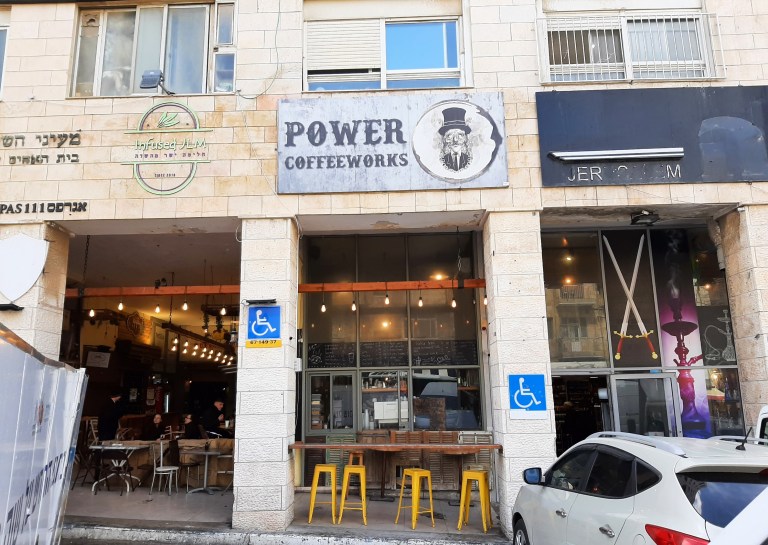
So there I was walking through the crowd at the roofed section of Mahane Yehuda. Remembering what I studied from Google Maps, I went on until I reached a certain road, crossed it and made my way to the commercial building where Power Coffeeworks was located at.
I remember smiling upon arrival outside of Power Coffeeworks as it was my intention to visit and try their coffee.
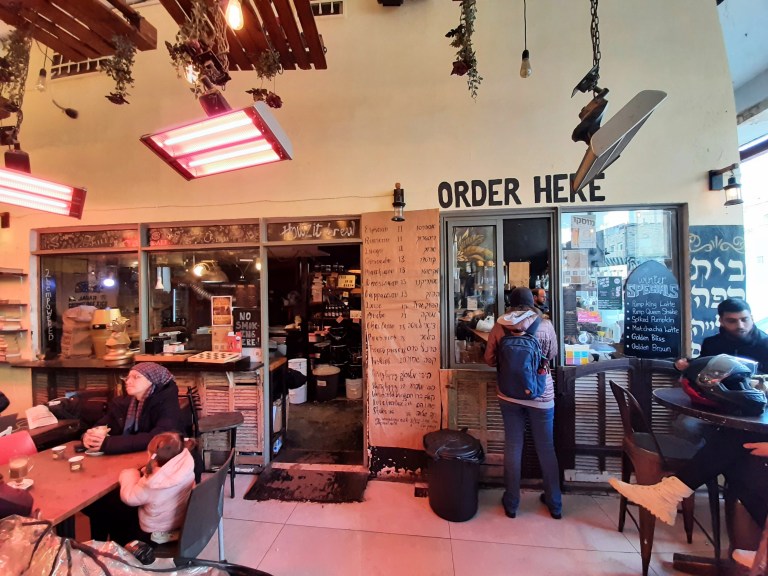
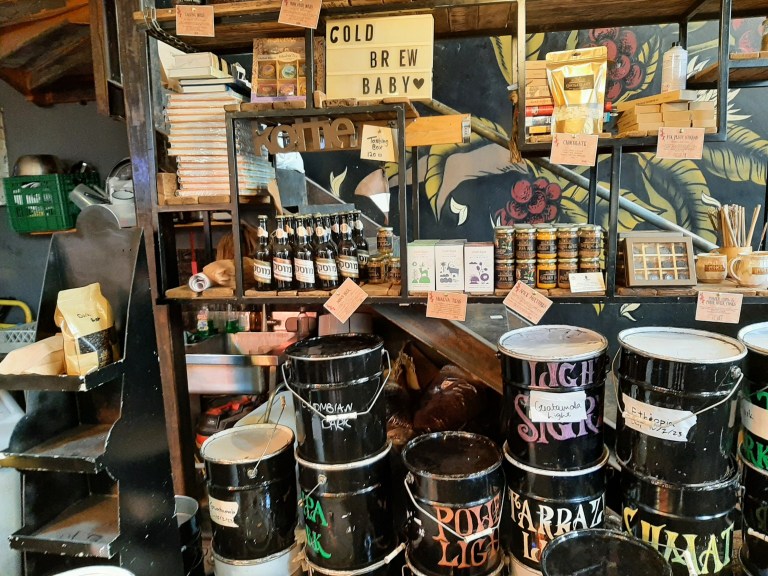
For the first several moments upon arrival, I examined Power Coffeeworks’ physical set-up, the menu and the local vibe as there were customers who arrived ahead of me. I also noticed that inside are lots of products for sale such as coffee beans, Pumpking Spice, tea and more.
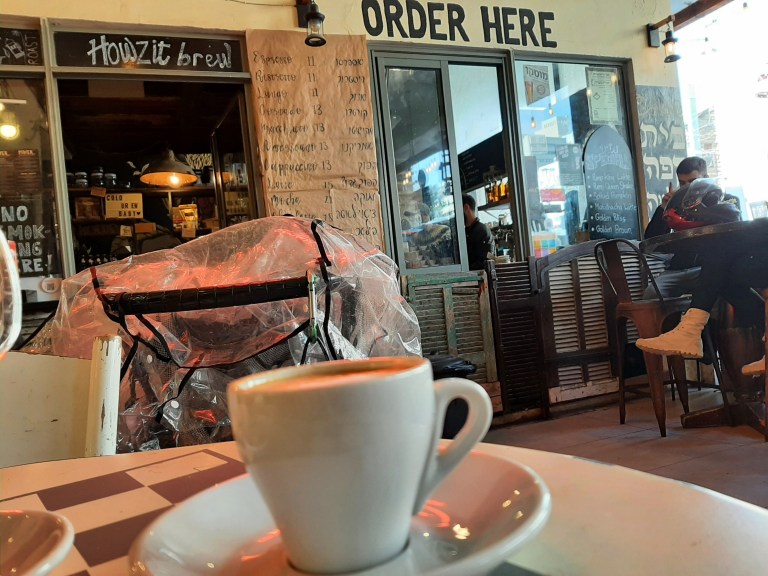
After reading the menu, I went on to order a hot Macchiato as I really needed heat and energy to endure the cold weather. Then I noticed a vacant table and chairs located close to the heater. So I went there to take a seat, enjoyed my hot Macchiato and used the free WiFi (password shared to me at the counter moments earlier) with the comforting heat from the heater. I even had a short chat with one of the coffee joint’s employees as he cleaned the table.
From my early moments at Power Coffeeworks. I like the vibe of the place.
For more than half an hour, I sat there enjoying my coffee, the place, checking updates online and re-energized myself because I planned to return to Mahana Yehuda one last time for treats before marching all the way back to our Jerusalem hotel. My feet were a bit sore by the time I arrived at the coffee joint.
Some of you reading this might be wondering what Power Coffeeworks is and why was I so interested with it. Personally, I really pursued buying (and enjoying) goods of local businesses in Israel. When it comes to coffee, I never thought about the international brands during my time in Israel as I went for Israeli enterprise.
That’s a nice display of products at Power Coffeeworks!
As for Power Coffeeworks, it describes itself as follows:
Power was inspired by the lack of excellent roasted coffee within Jerusalem. With its awesome steampunk vibe and amazing aroma, it is the perfect location for working, reading a book, spending time with friends or chatting with our amazing baristas.
Our coffee is roasted fresh daily, ground per cup and served with a huge amount of love. We are all about the taste, flavor, vibe and not to forget – the music.
Stephanie and Brandon, the owners made aliyah from Cape Town, South Africa in 2016 with their four children to Efrat, Gush Etzion. With their extensive knowledge of the hospitality industry, they decided to open Power Coffeeworks, an anglo orientated coffee roastery in Machane Yehuda Shuk.
Five years later, Power is exactly what they wanted it to be. Despite the struggles of starting a new business in a new country, Stephanie and Brandon took the coffee culture of Jerusalem to a whole new level. After three more children, Covid19 and a whole load of drama. Power coffeeworks has grown to be the number one location in Jerusalem for the best cup of coffee and an unbelievable section of coffee beans.
After spending time at Power Coffeeworks, I left as a satisfied and a happy customer. I would not hesitate to revisit the coffee joint once I return to Israel someday. I am deeply thankful to the Lord for the enterprise of Power Coffeeworks and everything else about the entire Israel pilgrimage tour I joined with my local church.
This leads to my next point: always be thankful to the Lord for the blessings you enjoyed as He is our source and the definitive provider. All the praise and glory is to Him. Learn from the holy scriptures below…
Therefore, whether you eat or drink, or whatever you do, do all to the glory of God.
1 Corinthians 10:31 (NKJV)
And my God shall supply all your need according to His riches in glory by Christ Jesus. 20 Now to our God and Father be glory forever and ever. Amen.
Philippians 4:19-20 (NKJV)
For from Him and through Him and to Him are all things. [For all things originate with Him and come from Him; all things live through Him, and all things center in and tend to consummate and to end in Him.] To Him be glory forever! Amen (so be it).
Romans 11:36 (AMPC)
“Blessed is the man who trusts in the Lord,
And whose hope is the Lord.
For he shall be like a tree planted by the waters,
Which spreads out its roots by the river,
And will not fear when heat comes;
But its leaf will be green,
And will not be anxious in the year of drought,
Nor will cease from yielding fruit.
Jeremiah 17:7-8 (NKJV)
Never forget that Israel is the land that God the Heavenly Father designated to the Jewish people and He always has great plans for them. As people of faith, we should do our part to love and bless the Jewish people. Also remember that the ties between Jews and Christians are biblical. Read the scriptures below…
Now the Lord had said to Abram:
“Get out of your country,
From your family
And from your father’s house,
To a land that I will show you.
I will make you a great nation;
I will bless you
And make your name great;
And you shall be a blessing.
I will bless those who bless you,
And I will curse him who curses you;
And in you all the families of the earth shall be blessed.”
Genesis 12:1-3 (NKJV)
Again God said to him, Your name is Jacob [supplanter]; you shall not be called Jacob any longer, but Israel shall be your name. So He called him Israel [contender with God].
And God said to him, I am God Almighty. Be fruitful and multiply; a nation and a company of nations shall come from you and kings shall be born of your stock;
The land which I gave Abraham and Isaac I will give to you, and to your descendants after you I will give the land.
Genesis 35:10-12 (AMPC)
Now therefore, if you will obey My voice in truth and keep My covenant, then you shall be My own peculiar possession and treasure from among and above all peoples; for all the earth is Mine.
And you shall be to Me a kingdom of priests, a holy nation [consecrated, set apart to the worship of God]. These are the words you shall speak to the Israelites.
Exodus 19:5-6 (AMPC)
No longer shall your name be called Abram, but your name shall be Abraham, for I have made you the father of a multitude of nations. I will make you exceedingly fruitful, and I will make you into nations, and kings shall come from you. And I will establish my covenant between me and you and your offspring after you throughout their generations for an everlasting covenant, to be God to you and to your offspring after you. And I will give to you and to your offspring after you the land of your sojournings, all the land of Canaan, for an everlasting possession, and I will be their God.”
And God said to Abraham, “As for you, you shall keep my covenant, you and your offspring after you throughout their generations.”
Genesis 17:5-9 (ESV)
Say therefore to the people of Israel, ‘I am the Lord, and I will bring you out from under the burdens of the Egyptians, and I will deliver you from slavery to them, and I will redeem you with an outstretched arm and with great acts of judgment. I will take you to be my people, and I will be your God, and you shall know that I am the Lord your God, who has brought you out from under the burdens of the Egyptians. I will bring you into the land that I swore to give to Abraham, to Isaac, and to Jacob. I will give it to you for a possession. I am the Lord.’”
Exodus 6:6-8 (ESV)
“Yet hear now, O Jacob My servant,
And Israel whom I have chosen.
Thus says the Lord who made you
And formed you from the womb, who will help you:
‘Fear not, O Jacob My servant;
And you, Jeshurun, whom I have chosen.
For I will pour water on him who is thirsty,
And floods on the dry ground;
I will pour My Spirit on your descendants,
And My blessing on your offspring;
They will spring up among the grass
Like willows by the watercourses.’
One will say, ‘I am the Lord’s’;
Another will call himself by the name of Jacob;
Another will write with his hand, ‘The Lord’s,’
And name himself by the name of Israel.
Isaiah 44:1-5 (NKJV)
“Now, show the people the pieces of wood you have written on, and tell them, ‘Lord Yahweh says this: I will gather the Israelites from the nations where they have gone. I will gather them together from everywhere and bring them to their homeland. And I will make them into a single nation in the mountainous land of Israel and give them one king to be king over them all. They will never again be divided into two nations nor split into two separate kingdoms.
Ezekiel 37:20-22 (TPT)
For God so greatly loved and dearly prized the world that He [even] gave up His only begotten (unique) Son, so that whoever believes in (trusts in, clings to, relies on) Him shall not perish (come to destruction, be lost) but have eternal (everlasting) life.
John 3:16 (AMPC)
Jesus said to him,
“I am the way, the truth, and the life. No one comes to the Father except through Me.
“If you had known Me, you would have known My Father also; and from now on you know Him and have seen Him.”
John 14:6-7 (NKJV)
And He took bread, gave thanks and broke it, and gave it to them, saying,
“This is My body which is given for you; do this in remembrance of Me.”
Likewise He also took the cup after supper, saying,
“This cup is the new covenant in My blood, which is shed for you.”
Luke 22:19-20 (NKJV)
Conclusion
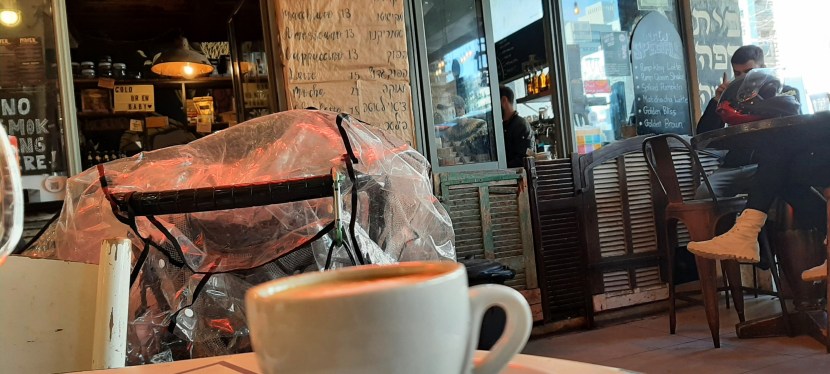
The view from my table.
I would love to return to Power Coffeeworks once I return to Jerusalem in the years to come. Only the Lord know when that time will be. No matter what happens, my faith in the Lord will never be compromised. To those of you who are interested to discover Power Coffeeworks and find out what products they offer, I encourage you to visit their official website at https://www.powercoffeeworksjerusalem.com/. Remember that once you make it to the Mahane Yehuda market, this nice coffee joint is just a short walk away.
Israel is a great and holy place to visit! Visit Israel with the Holy Bible! Pray to the Lord wholeheartedly and reveal to Him your heart’s desire to visit Israel to deepen your faith in Him. Always be the fearless and aggressive church of Lord Jesus! Follow the light of Lord Jesus, keep on praying to support Israel and for the peace of Jerusalem. Live on with uncompromising faith in Him!
Watch out for more Israel 2023 travel articles here. There is more to come!
Recently the Department of Tourism (DOT) confirmed that as of November 1, 2024, it has recorded 4.8 million international visitor arrivals, according to a Philippine News Agency (PNA) news article. That is around three million short of its 2024 target of 7.7 million.
To put things in perspective, posted below is an excerpt from the PNA news article. Some parts in boldface…
International visitor arrivals to the Philippines reached more than 4.8 million, the Department of Tourism (DOT) said on Friday.
In a statement announcing its attendance at the 2024 World Travel Market (WTM) in London, the DOT said the event would serve as an opportunity to invite more tourists from the European market, especially as it makes up a huge percentage of the foreign visitors to the country.
“The United Kingdom leads as the top European source of visitors, ranking as the Philippines’ ninth-largest source market, with 128,660 arrivals recorded from Jan. 1 to Oct. 31,” it said.
“As the UK outbound travel market rebounds, it presents a valuable opportunity for the Philippines.”
As of Nov. 1, the number of international visitors to the Philippines has reached 4,879,022, less than 3 million away from the DOT’s yearend target of 7.7 million arrivals.
With UK tourists increasingly seeking destinations that offer value for money and experience, the DOT is confident the Philippines’ “diverse landscapes, rich history, and immersive travel experiences” align well with the market’s preferences.
By doing the math, 4,879,022 international tourist arrivals covering the period of January 1 to November 1 (306 days) is equivalent to 15,944.516 per day. Multiply that current average by 366 days for 2024 (a leap year), the total would be 5,835,693 international tourist arrivals which is clearly short of the target.
Of course, it is expected that more visitors from overseas will increase sharply this December as many Filipinos based abroad will be coming home for Christmas and New Year celebrations with families. It remains to be seen how the DOT and its strategic partners will accommodate the anticipated high influx of visitors from overseas. It is recalled that the Rizal Commercial Banking Corp. (RCBC) and China Banking Corp. found the nation’s Philippine tourism recovery still lacking.
Let me end this piece by asking you readers: What is your reaction to this latest development? Do you think the DOT can still hit its 2024 target of 7.7 million international visitor arrivals by the end of December? Do you think news about crime connected with Philippine Offshore Gaming Operators (POGOs) are discouraging foreigners from visiting the Philippines? Do you wish to see the DOT get more involved with special events such as food festivals, entertainment conventions, film festivals, international sports events, car shows and the like?
In times of prosperity or hardship, Festival Mall (originally named Festival Supermall) in Filinvest City, Alabang, Muntinlupa City continues to attract families and shoppers. Since the mall’s early days in 1998, its amusement center X-Site kept on succeeding on attracting visitors and providing them bouts of varied fun in return to what the customers paid for. X-Site is a lively form of entertainment-focused capitalism that just keeps on moving forward and attracting visitors.
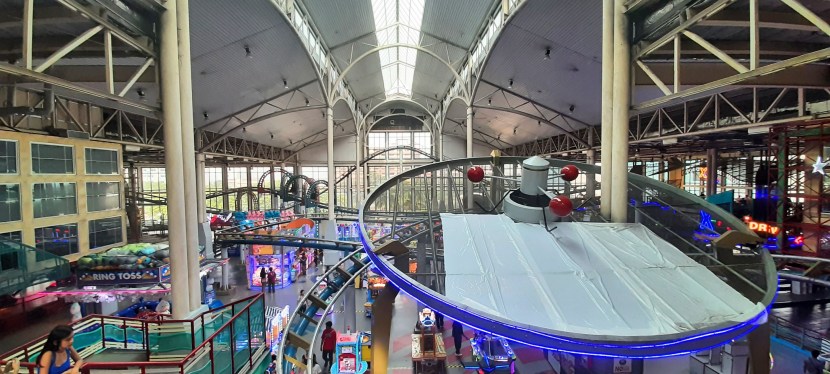
Located at the 3rd floor (note: officially referred to as the 2nd Level or 2L or 2nd Floor by the mall. The 1st floor and 2nd floor of the mall are referred to as Lower Ground Floor and Upper Ground Floor respectively), the X-Site Amusement Center has a wide floor space with a high ceiling.
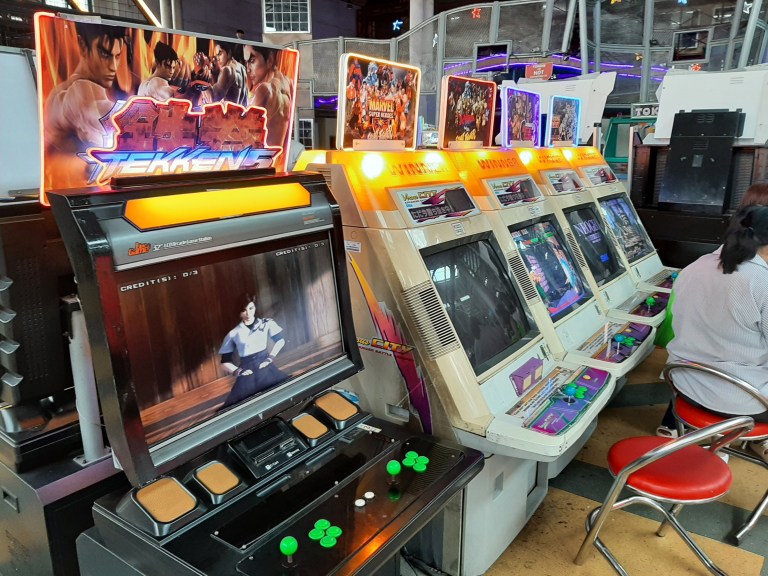
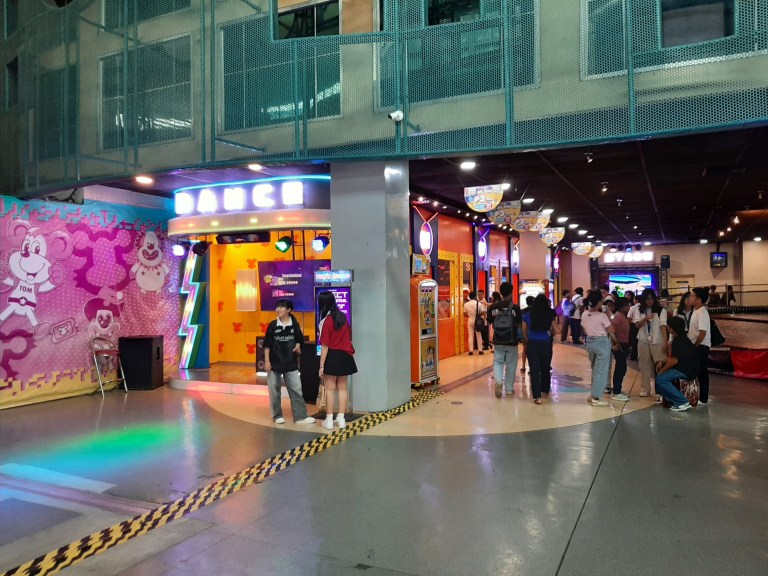
The way it was designed, X-Site has several arcade games (lots of fun retro games included), merchandiser games, a virtual reality ride, KTV booths, motion-sensing dance spot, the ring toss, entertainment stores, indoor sports games, redemption games, bumper cars, and the indoor roller coaster (which explains the need of having a high ceiling). Watch below the YouTube video and the images I prepared below.
At the arcade games section inside X-Site.
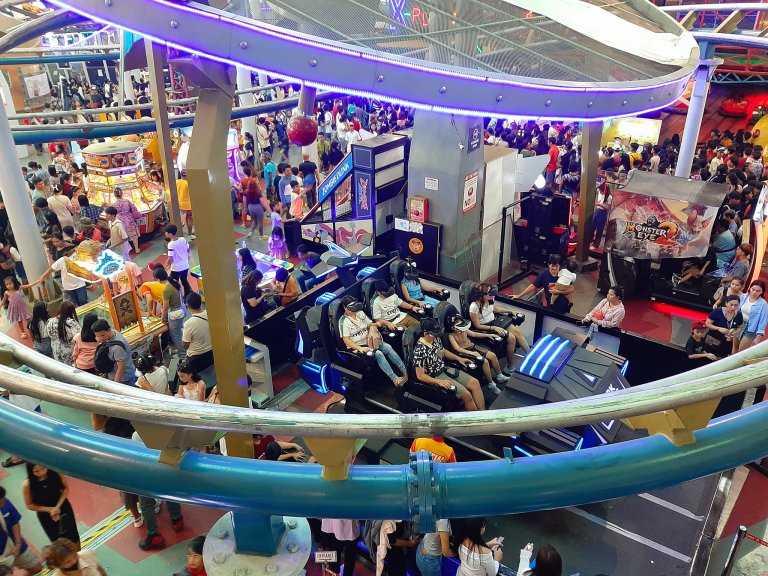
Having a high ceiling made it possible to have an indoor roller coaster (tracks above the machines and people in this image). Other amusement centers in Alabang had lower ceilings which made their places feel small or tight when compared to X-Site.
Some newer machines plus indoor sports games added into the arcade games section.
This is the place for those who love dancing and music.
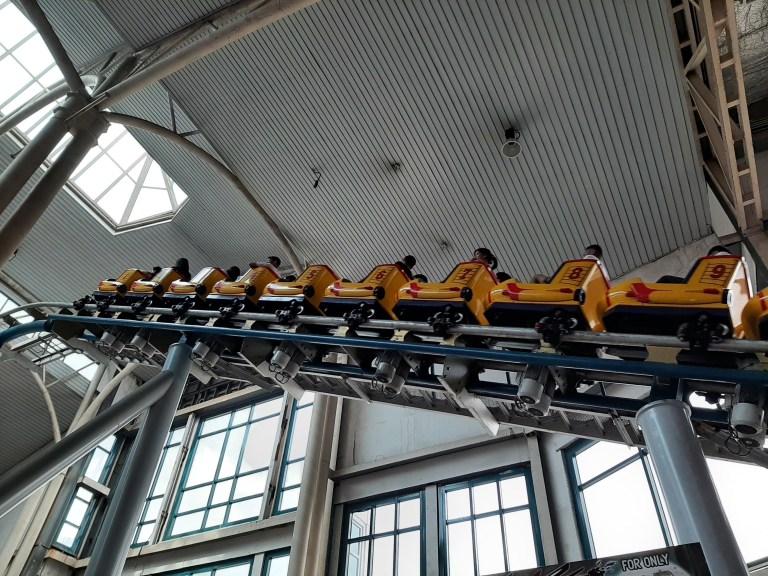
Back in 1998, I know a few friends whose had not even visited Festival Mall (at the time we talked) yet they already heard of the positive word-of-mouth feedback about the indoor roller coaster of X-Site.
The indoor roller coaster of X-Site remains a favorite ride for those who kept coming back.
On December 25, 2023, I visited Festival Mall to look around. I passed by X-Site and I saw an unusually large number of people there composed of young people, children and their parents/guardians.
For the newcomers reading this, December 25 here in the Philippines is a time of having fun during the Christmas season and also it is the day when the annual Metro Manila Film Festival (MMFF) opens in cinemas. This explains why a lot of people spend time at the shopping malls and it is a cultural thing here in the Philippines.
Considering the fact that the original cinemas of Festival Mall have deteriorated leaving only 2 or 3 screens operating (note: the mall also has modern cinemas at the expanded side), a lot of people still visited the mall to watch the MMFF movies that opened on December 25. As for the large number of people who flocked to X-Site that same day, I can only speculate that some of them might have been moviegoers passing the time as they wait for the next screening of movies to watch.
I took this shot of X-Site on December 25, 2023. Look at the high number of people on the floor.
If you plan to visit Festival Mall in Alabang and if you are craving for fun rides or games, then you might want to visit X-Site Amusement Center.
For more South Metro Manila community news and developments, come back here soon. Also say NO to fake news, NO to irresponsible journalism, NO to misinformation, NO to plagiarists, NO to reckless publishers and NO to sinister propaganda when it comes to news and developments. For South Metro Manila community developments, member engagements, commerce and other relevant updates, join the growing South Metro Manila Facebook group at https://www.facebook.com/groups/342183059992673
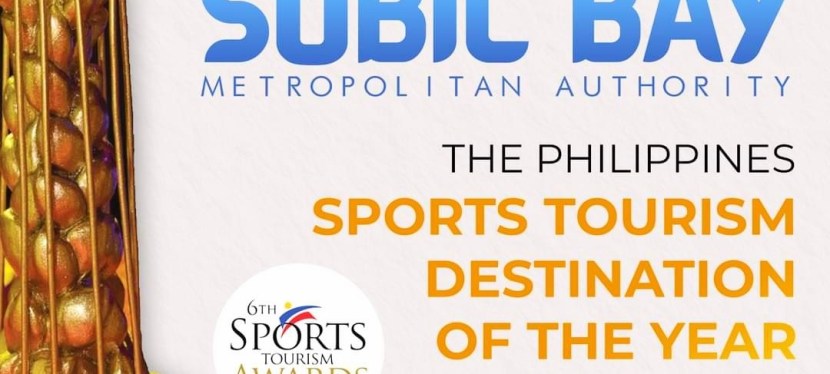
Recently the Subic Bay Metropolitan Authority (SBMA) got recognized yet again in the field of sports tourism as it won the Destination of the Year award for 2023 during the 6th Philippine Sports Tourism Awards, according to the social media announcement via the FUNtastic Subic Bay Facebook page.
To put things in perspective, posted below is an excerpt from the social media post. Some parts in boldface…
We’re thrilled to announce that Subic Bay has once again been recognized as the 𝑫𝒆𝒔𝒕𝒊𝒏𝒂𝒕𝒊𝒐𝒏𝒐𝒇𝒕𝒉𝒆𝒀𝒆𝒂𝒓 (for 2023) at the prestigious 6th Philippine Sports Tourism Awards!
From the post of FUNtastic Subic Bay on Facebook.
This marks our fourth win, following our previous victories in 2019 for Sports Tourism Destination Marketing of the Year, 2018 for Event of the Year (International), and 2017 for Destination of the Year.
We extend our heartfelt gratitude to our Chairman and Administrator Engr. Eduardo L. Aliño, the SBMA Board of Directors, the SBMA working group, our partner organizers, and all our stakeholders for their unwavering commitment to making Subic Bay a premier sports tourism destination. This achievement is a testament to our collective efforts. Congratulations to all of us!
I personally have visited the Subic Bay Freeport Zone (SBFZ) from time to time since 1994. I have witnessed how much Subic Bay evolved as a tourism destination, a shopping destination as well as a special events destination. The tourism team of the SBMA has a long track record of sports tourism development and the hosting of many kinds of sports events. That being said, it is not surprising to me that the SBMA won another sports tourism award.
For the newcomers reading this, Subic Bay was the host venue of selected events of the 2019 Southeast Asian Games (SEA Games). Each year, Triathlon Philippines (TriPhil) organizes the Subic Bay International Triathlon (SuBIT) there.
Let me end this post by asking you readers: What is your reaction to this recent development? Have you been touring Subic Bay recently? Did you ever attend a sports event held in the Subic Bay Freeport Zone?
In its pursuit to keep the public informed and oriented, the new operator of the Ninoy Aquino International Airport (NAIA) – San Miguel-led New NAIA Infra Corporation (NNIC) – recently launched its official website as well as social media accounts, according to a Manila Bulletin news report.
To put things in perspective, posted below is an excerpt from the Manila Bulletin news report. Some parts in boldface…
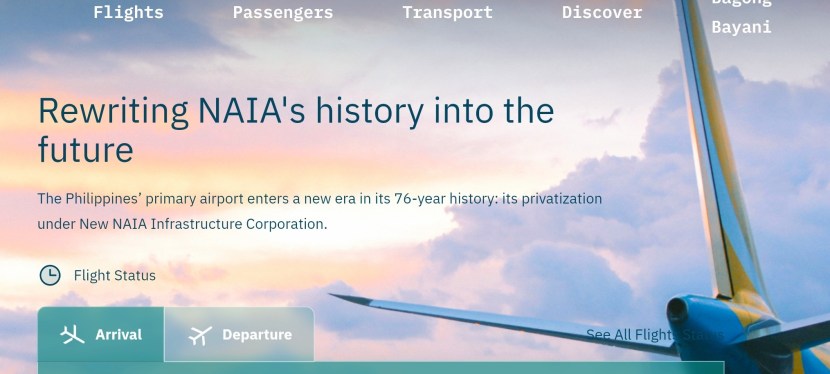
San Miguel-led New NAIA Infra Corporation (NNIC), the new private operator of the Ninoy Aquino International Airport has launched the official website and social media pages of NAIA as the transformation of the Philippines’ primary gateway begins.
The new website, www.newnaia.com.ph, focuses on providing comprehensive information about NAIA — including details on the ongoing transformation project, its progress, and the future vision for the airport.
It serves as a hub for travelers, offering real-time flight information as well as updates on airport services and amenities.
In honor of the Philippines’ modern-day heroes, the website will feature a regular section called Bagong Bayani dedicated to inspiring stories about Overseas Filipino Workers (OFWs).
NNIC has also launched its social media pages on Facebook and X (formerly Twitter)under the name newnaiaph. These will serve as additional channels for sharing updates, engaging the public, and building a community around the NAIA transformation.
The public can also connect via email (feedback@newnaia.com), hotline (+63 2 8877 1111), and SMS (TextNAIA) at +63 917 839 6242.
“The launch of our website and social media pages is part of our commitment to open communication and transparency,” said San Miguel Corporation Chairman and NNIC President and CEO Ramon S. Ang.
Let me end this piece by asking you readers: What is your reaction to this recent development? As a traveler, have you tried searching for relevant information on newnaia.com.ph? Have you been following NNIC’s accounts on Facebook and Twitter? Is the flight status tool of the official website working properly?
For more South Metro Manila community news and developments, come back here soon. Also say NO to fake news, NO to irresponsible journalism, NO to misinformation, NO to plagiarists, NO to reckless publishers and NO to sinister propaganda when it comes to news and developments. For South Metro Manila community developments, member engagement, commerce and other relevant updates, join the growing South Metro Manila Facebook group at https://www.facebook.com/groups/342183059992673









 Author Carlo Carrasco