A Look Back at Superman vs. The Amazing Spider-Man (1976)

Disclaimer: This is my original work with details sourced from reading the comic book and doing personal research. Anyone who wants to use this article, in part or in whole, needs to secure first my permission and agree to cite me as the source and author. Let it be known that any unauthorized use of this article will constrain the author to pursue the remedies under R.A. No. 8293, the Revised Penal Code, and/or all applicable legal actions under the laws of the Philippines.

Welcome back superhero enthusiasts, 20th century arts and culture enthusiasts, fans of Marvel and DC Comics, and comic book collectors! Today we go back to the year 1976 to examine what is truly a landmark event in the history of superhero comic book publishing – the first-ever superhero crossover event of Marvel Comics and DC Comics with Superman vs. The Amazing Spider-Man (also referred to as Superman vs. Spider-Man for short).

For the newcomers reading this, I previously reviewed the 2nd Superman-Spider-Man crossover comic book titled Superman and Spider-Man. That was released in 1981 and was handled by a different creative team (led by Jim Shooter as writer) compared to the 1976 crossover of the two icons of Marvel and DC. Going back to the 1970s, a crossover between Marvel and DC looked like an impossible dream as the idea of the two companies coming into agreements over the legal, creative and financial aspects was perceived to be unachievable. Indeed there were headaches and challenges during the negotiations but ultimately Marvel and DC came into an agreement to publish a special comic book featuring Superman, Spider-Man and the related supervillains and supporting characters from both sides. Take note that the two publishing giants worked together previously with publishing an official comic book adaptation of the movie The Wizard of Oz (1939).

With those details laid down, here is a look back at Superman vs. The Amazing Spider-Man, published in 1976 by Marvel Comics and DC Comics with a story written by Gerry Conway and Ross Andru. This crossover event was described as the battle of the century.

The cover.

Early story

The story begins at the World News Conference in New York City. Separated by several feet apart, Clark Kent (Superman) and Peter Parker (Spider-Man) arrive with their respective companions and associates. What the two heroes do not know is that Lex Luthor and Doctor Octopus recently escaped from prison.

Peter Parker gets berated by his boss J. Jonah Jameson for not being good enough as a photographer while Clark Kent learns the bad news from Edge Morgan that he is not wanted for the coverage of a national convention.

Shortly after, Lois Lane climbs up a scaffold to get a good view for some photography. Just as she is about to fall down, Peter Parker suddenly grabs her and pulls her to safety. After an exchange of pleasantries, Peter introduces Lois to Mary Jane Watson. Just as MJ and Lois start conversing, Superman suddenly arrives. The Superman figure then fires beams of light from eyes to Lois and MJ, causing them to vanish into thin air. It turns out, the caped figure is an impostor as Peter Parker and Clark Kent react in shock.

Peter quickly runs to the roof of the building and changes into Spider-Man. As soon as he leaps into action, he comes face to face with Superman himself…

Quality
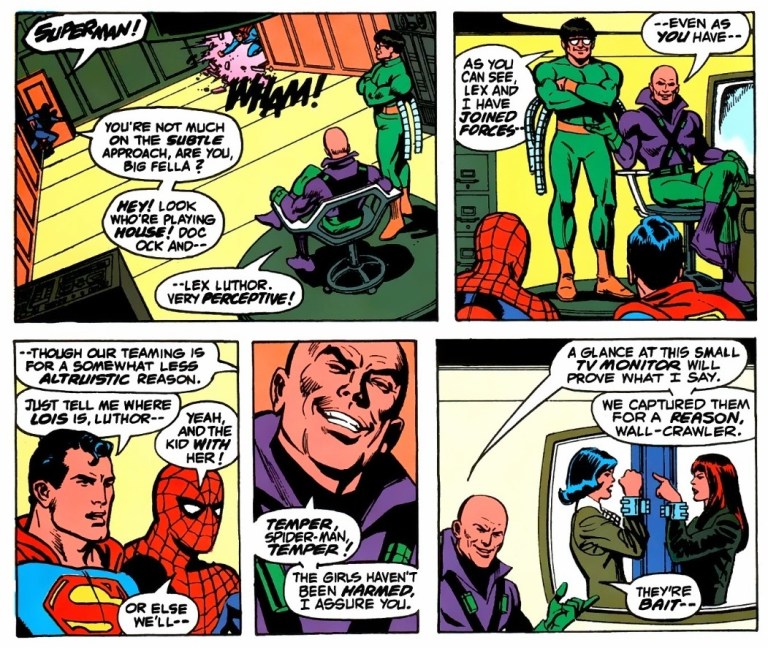
Superman, Spider-Man, Luthor, Dr. Octopus, Lois Lane and Mary Jane Watson shown in this scene.

I can loudly say that this is one pretty enjoyable crossover tale that not only featured Superman and Spider-Man, but also gave their respective mortal enemies Luthor and Dr. Octopus a good share of the spotlight. To be very clear, the story and set-up of scenes do have a somewhat restrictive structure as the creators clearly did their best to make the spotlight on the characters more or less equal in terms of imagery, dialogue amount and the sharing of dynamic shots. While some may easily complain about the so-called old and tired formula of the major characters getting into fighting each other due to a misunderstanding followed by setting aside their differences to work together, take note that the said formula worked really well in this story written by Gerry Conway.

The story concept Conway came up was clearly made to justify Superman and Spider-Man encountering each other (note: the same goes with the super villains and supporting characters) and the way he wrote the two interacting with each other worked seamlessly and convincingly. There are lots of nice exchanges of dialogue between the Man of Steel and the webslinger.

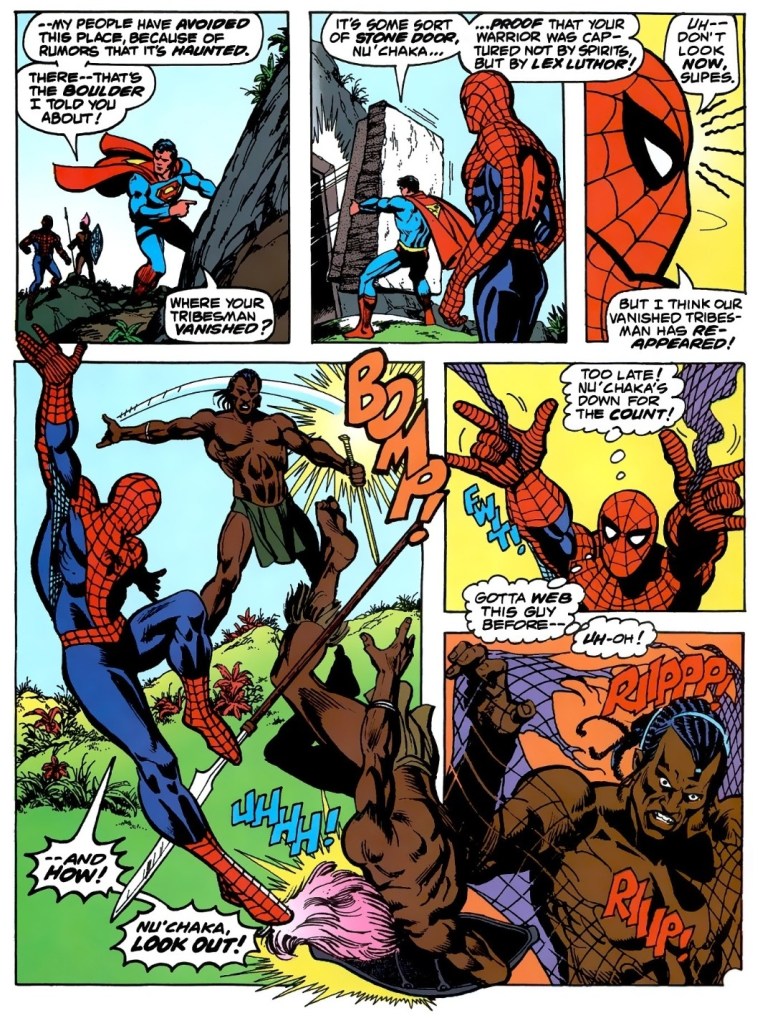
Even the superiors of Clark Kent and Peter Parker had their own crossover.
Don’t let the woke and socialists fool you. There is nothing racist in this comic book. Wokeness is foolishness. Political correctness distorts perception of reality.

Even though the script has this set of creative restrictions to ensure fairness on both Marvel and DC’s sides, the synergy of friendship and cooperation between Superman and Spider-Man is fantastic to read. Similar qualities are also evident with the scenes of Luthor and Dr. Octopus. Very clearly, the creative team did intense research on the Marvel and DC characters and found ways to create a unique mix that resonates with the fans of Superman and Spider-Man.

As expected, this comic book has lots of superhero spectacle for readers to enjoy. The superhero violence is not intense but the action scenes were entertaining to look at. In my opinion, the highlights of the spectacle here is when Superman and Spider-Man literally exchanged mortal enemies to fight with. As for the fight between the two icons as emphasized in the title, it definitely is a special event that really kicked the story into high gear.

While this is indeed a fun superhero crossover to read, there are some notable weak points here. For one thing, the plot itself lacks a strong concept and Luthor’s evil plan is very flawed and unconvincing. That being said, as I read and re-read this comic book, there never was a sense of danger building up nor was the Luthor-Dr. Octopus team ever a grave threat.

Conclusion
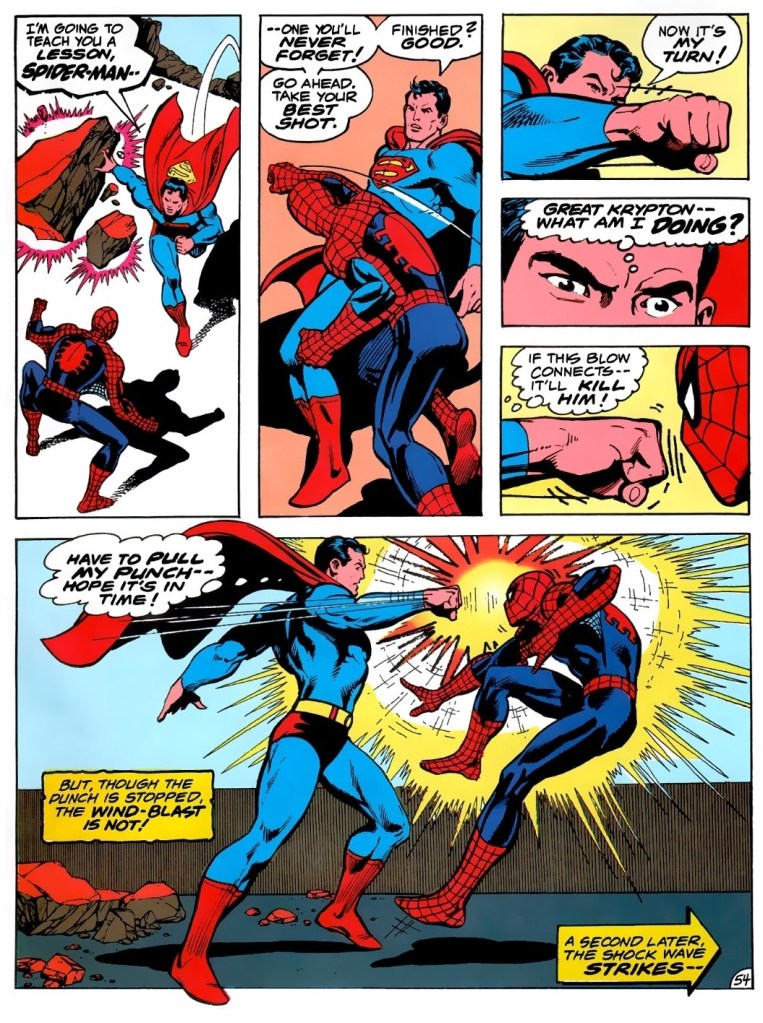
This is only a small sample of the fun in the battle between Superman and Spider-Man.

By today’s standards, Superman vs. The Amazing Spider-Man (1976) is still a fun superhero crossover comic book to read and it remains as a significant part of not just Marvel and DC’s history of collaboration but also that of inter-company superhero crossover comic book publishing in general. While it is better than many other inter-company superhero crossover comic books I have read through the decades, this one is certainly not the best one from Marvel and DC. For me, Superman and Spider-Man (1981) has a more elaborate plot, higher fun factor and deeper impact than this comic book. Meanwhile, Batman vs. The Incredible Hulk (1981) exceeded this comic book in terms of plotting, character interactions, super villain portrayals and establishing a real sense of danger that requires the super heroes to solve. Still, Superman vs. The Amazing Spider-Man (1976) remains an enjoyable read and it definitely is worthy as the strong beginning of Marvel-DC superhero crossover projects of the 1970s and 1980s. It also has more dynamic visuals than its 1981 sequel. This one is also part of the Crossover Classics: The Marvel-DC Collection paperback.

Overall, Superman vs. The Amazing Spider-Man (1976) is recommended!

+++++

Thank you for reading. If you find this article engaging, please click the like button below, share this article to others and also please consider making a donation to support my publishing. If you are looking for a copywriter to create content for your special project or business, check out my services and my portfolio. Feel free to contact me with a private message. Also please feel free to visit my Facebook page Author Carlo Carrasco and follow me on Twitter at  @HavenorFantasy as well as on Tumblr at https://carlocarrasco.tumblr.com/ and on Instagram at https://www.instagram.com/authorcarlocarrasco

A Look Back at Spider-Man 2099 #10 (1993)

Disclaimer: This is my original work with details sourced from reading the comic book and doing personal research. Anyone who wants to use this article, in part or in whole, needs to secure first my permission and agree to cite me as the source and author. Let it be known that any unauthorized use of this article will constrain the author to pursue the remedies under R.A. No. 8293, the Revised Penal Code, and/or all applicable legal actions under the laws of the Philippines.

Welcome back, superhero enthusiasts, 1990s culture enthusiasts, Marvel 2099 fans and comic book collectors! Today we revisit the Marvel 2099 franchise within Marvel Comics’ shared universe during the 1990s. Specifically speaking, we take a look back at one of the early tales of Spider-Man 2099.

In this retro comic book review, Spider-Man made it back to his home after encountering Vulture 2099 and seeing the low life and inhabitants of the people living in the old City of New York far below. His return, however, is not joyful not only because of the growing tension between Miguel O’Hara and the people his connected with but also because his mother suffered a health-related attack.

With those details laid down, here is a look back at Spider-Man 2099 , published by Marvel Comics in 1993 with a story written by Peter David and drawn by Rick Leonardi.

The cover.

Early story

The story begins inside a hospital room. Conchata O’Hara is slowly recovering and near her are her sons Miguel (Spider-Man) and Gabriel as well as Dana. Conchata starts to feel and move restlessly but for Miguel (who heard his mother call his brother Gabriel a good son), she was just acting. Conchata then gets up from her bed and Gabriel encourages his brother to talk to her. Miguel responds saying that their mother hates him because he reminds her of his father – George O’Hara. Dana and Gabriel tell him to talk to her…

Quality

Spider-Man takes on the local authorities. Does this make him a criminal or a social justice symbol? Read the comic book.

To put it straight, this comic book tells the story of the O’Hara family complete with flashbacks from key points of the past. Unsurprisingly, Peter David’s writing is very rich and in-depth with details which made it a compelling read in my experience, and it should be more engaging for readers who passionate follow Spider-Man 2099 and his civilian life as Miguel.

Without going too far with the details, I can say that this comic book explains why Miguel has a very uneasy relationship with his own mother who in turn is close with Gabriel while also resentful of George. As this is a Spider-Man 2099 story, you will see Miguel do his best to make his mother understand his views and himself better no matter the rift between them. There is also a notable superhero-related twist within the Miguel-Conchata interactions that readers who have troubled relationships with their own mothers (especially those who engage in idolatry which is foolish and unholy) will find strongly relevant personally. Miguel’s own personal assessment of his 2nd life as Spider-Man alone deserves your deep attention. Again, Peter David’s writing here is literally solid gold in terms of richness and characterization.

Conclusion

A quick look at the past of the O’Hara family.

While there is no good-versus-evil conflict for superhero enthusiasts to look forward to, Spider-Man 2099 (1993) is a highly engaging, character-driven story that highlights Miguel O’Hara on a very personal level while also having enough space to explain to readers why the O’Hara family relationships are strained. There are even flashbacks that nicely dramatized the past and the one scene in which Miguel goes out in public in full costume as Spider-Man will make you wonder what the protagonist really believes in and where he plans to take his life to. Peter David’s writing here made all the difference.

Overall, Spider-Man 2099 (1993) is recommended!

+++++

Thank you for reading. If you find this article engaging, please click the like button below and also please consider sharing this article to others. If you are looking for a copywriter to create content for your special project or business, check out my services and my portfolio. If you want to support my website, please consider making a donation. Feel free to contact me with a private message. Also please feel free to visit my Facebook page Author Carlo Carrasco and follow me on Twitter at  @HavenorFantasy as well as on Tumblr at https://carlocarrasco.tumblr.com/ and on Instagram at https://www.instagram.com/authorcarlocarrasco/.

A Look Back at Spider-Man 2099 #8 (1993)

Disclaimer: This is my original work with details sourced from reading the comic book and doing personal research. Anyone who wants to use this article, in part or in whole, needs to secure first my permission and agree to cite me as the source and author. Let it be known that any unauthorized use of this article will constrain the author to pursue the remedies under R.A. No. 8293, the Revised Penal Code, and/or all applicable legal actions under the laws of the Philippines.

Welcome back superhero enthusiasts, 1990s arts and culture enthusiasts, Marvel Comics fans and comic book collectors! Today we go back to the wild 1990s and explore the far future of 2099 within the Marvel Comics shared universe through one of the tales of Spider-Man 2099.

In my previous retro review, the futuristic Spider-Man got involved with his era’s version of Vulture (Vulture 2099 to us readers). It turns out, Vulture 2099 is not your typical evil supervillain but the leader of a group of violent radical people who are willing to dominate society with a destructive mindset even though there are other opposing groups around them. And then Spidey 2099 realized something very wrong about the Vulture which leads to a big battle between them.

With those details laid down, here is a look back at Spider-Man 2099 , published in 1993 by Marvel Comics with a story written by Peter David and drawn by Rick Leonardi.

The cover.

Early story

The story begins with Spider-Man 2099 and Vulture 2099 crashing into the interiors of the ancient St. Patrick’s Cathedral located in old New York City (underneath the modern city). Unsurprisingly, the people inside the cathedral got very surprised about the unexpected entry of the two fighters.

Elsewhere, Miguel O’Hara’s brother Gabriel helps Kasey with her head. She tells him that she saw Miguel but Gabriel does not believe her. Suddenly, members of a gang knock on the door and Kasey opens it.

Inside St. Patrick’s Cathedral, the fight between Spider-Man and Vulture continues. Spider-Man remembers that he has lapsed as a Catholic and he feels very uneasy about the trouble he and his enemy are causing inside the old church structure. Vulture suddenly throws a wooden bench at Spidey but breaks open a glass window and then goes outside. Upon looking outside, Spider-Man notices a group of Vulture’s gang…the Freakers.

Quality

The battle between Spider-Man 2099 and Vulture 2099 is intense and very compelling to read.

Here is the good news about this comic book…the story here is a fitting conclusion to what happened in issue . The conflict between Spider-Man and Vulture here was carefully crafted and there were several key moments or scenes the provided readers some breathing room to grasp and understand the society of 2099 New York as well as the conflict between the downtown social groups who are deprived of the higher standard of living many miles above them. In some ways, the social divisions portrayed in this comic book is a sad reminder about modern day America and the many radical groups or gangs of people who divide society on race, ethnicity, social class, gender and ideology.

As expected, there is a lot of action executed in the fight between Spider-Man and Vulture of 2099 but there were pauses in between. This is not surprising considering how Peter David crafted the action-packed battles Spidey 2099 had with other enemies in the comic books released before this one. Without spoiling what happened, I can say that the battle between the two was nicely built-up and the conclusion turned out very satisfying to see.

Still on the story, Peter David added some layers of complexity into the conflict that easily made things much more difficult for Spider-Man 2099 on a personal level. I’m talking about his brother Gabriel and Kasey getting involved in the gang war against the Freakers.

Vulture 2099 is once again a standout opposition figure here. Not only is his ability to fly and cause chaos above his obsessed Freakers below is symbolic, his distorted, hardcore beliefs are reflected with his unrelenting use of violence as he fights Spider-Man. Not only that, he turns out to be very philosophical thanks to the rich dialogue Peter David came up with. It is also here that the futuristic Vulture is opposed to God and being the socialist-indoctrinated person he is, he easily blames Alchemax for God’s absence. This should remind you that through Vulture 2099, evil comes with fatal attraction that people could not realize until it is too late. The futuristic Vulture has a lot of common with the evil leaders of Black Lives Matter, Antifa, the Democratic Socialists of America and the long-time regime of Iran. Lastly, I should state that radical socialists are always wrong about God and they often live with distorted perceptions about Him. Vulture 2099 qualifies as a woke figure of 2099 and ultimately wokeness is foolishness.

Speaking of sub-plots, this comic book emphasizes Tyler Stone on how he handles ambitious projects of Alchemax that he believes will benefit people. His interactions with Dana here also sheds light about his very own obsession about the future of humanity.

Conclusion

Spider-Man in trouble with the Vulture’s gang members.

With rich writing, notable in-story details and a very well designed conflict between the futuristic Spider-Man and Vulture, Spider-Man 2099 (1993) is both very engaging and entertainting to read from start to finish. It is a great pay-off to what was built-up in issue . Very notably, the conflict between Vulture 2099 and the protagonist is great to see and it is clear that Vulture is not a disposable supervillain but one of the most definitive forces of opposition against Spider-Man 2099. Of course, as comic book history turned out, Vulture 2099 made it in the crossover comic book event between classic Spider-Man and Spidey of 2099. Along the way, the creative team succeeded with expanding the lore of 2099 and the social underclass of New York.

Overall, Spider-Man 2099 (1993) is highly recommended.

+++++

Thank you for reading. If you find this article engaging, please click the like button below, share this article to others and also please consider making a donation to support my publishing. If you are looking for a copywriter to create content for your special project or business, check out my services and my portfolio. Feel free to contact me with a private message. Also please feel free to visit my Facebook page Author Carlo Carrasco and follow me on Twitter at  @HavenorFantasy as well as on Tumblr at https://carlocarrasco.tumblr.com/ and on Instagram at https://www.instagram.com/authorcarlocarrasco

A Look Back at Venom: Funeral Pyre #1 (1993)

Disclaimer: This is my original work with details sourced from reading the comic book and doing personal research. Anyone who wants to use this article, in part or in whole, needs to secure first my permission and agree to cite me as the source and author. Let it be known that any unauthorized use of this article will constrain the author to pursue the remedies under R.A. No. 8293, the Revised Penal Code, and/or all applicable legal actions under the laws of the Philippines.

Welcome back superhero enthusiasts, 1990s arts and culture enthusiasts, Marvel Comics fans and comic book collectors! Today we go back to the year 1993 and explore a part of Marvel Comics’ universe through the first-ever limited comic book series featuring one of Marvel’s most iconic supervillains – Venom.

Previously, I wrote about Venom with his appearances in What If comic books (click here and here) as well as in issues of Venom: Lethal Protector (click here and here). Venom also appeared in the disappointing crossover comic book Spider-Man Meets Spider-Man 2099.

Moving back to the year 1993, the Venom: Lethal Protector limited series ended and Marvel went on to release a 2nd limited series composed of three issues complete with an all-new creative team. That series was Venom: Funeral Pyre and the most notable thing is that Venom gets to be with the Punisher (read my other retro reviews that include the character here, here, here and here).

With those details laid down, here is a look back at Venom: Funeral Pyre published in 1993 by Marvel Comics with a story written by Carl Potts and drawn by the late Tom Lyle.

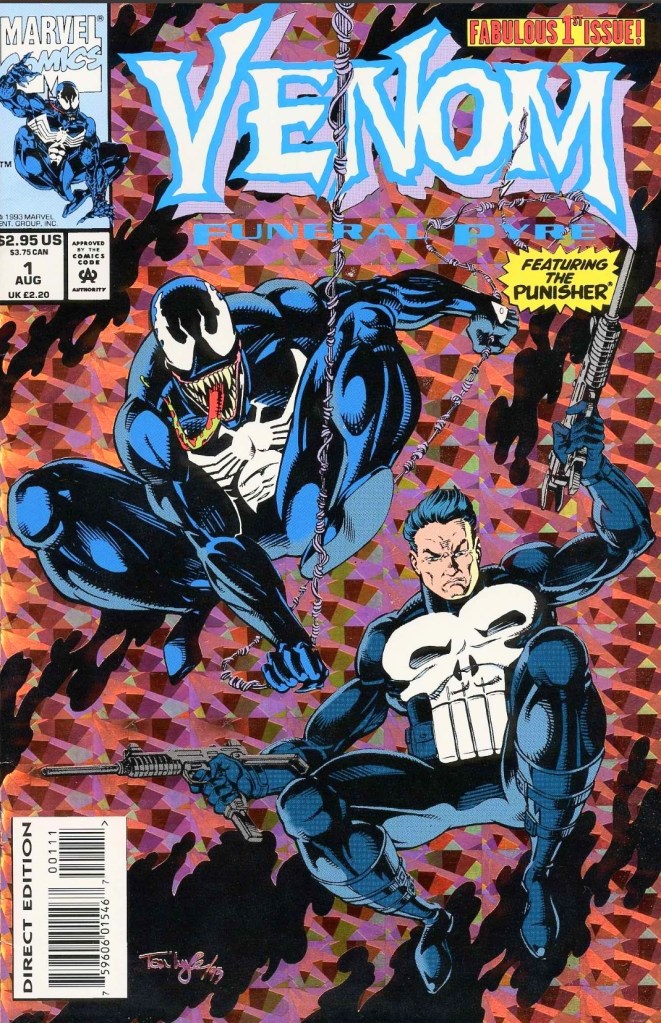
The cover.

Early story

The story begins on the streets of Oakland, California. There, a young guy named Gray Russell watches gang members severely beat up another guy which disturbs him deeply. He is part of the gang. A short time later, he rides with the gang in a car which hits a man (who managed to have his young nephew move out of harm’s way).

Somehow the man survived and moves to another direction deliberately to lure the gang away from his nephew. As the gangsters move towards a local building, Gray separates from his harsh companions to find a phone booth. Gray finds Calvin (the nephew of the man who got hit) nearby and decides to comfort him. From a distance, they heard the gangsters beat Calvin’s uncle to death.

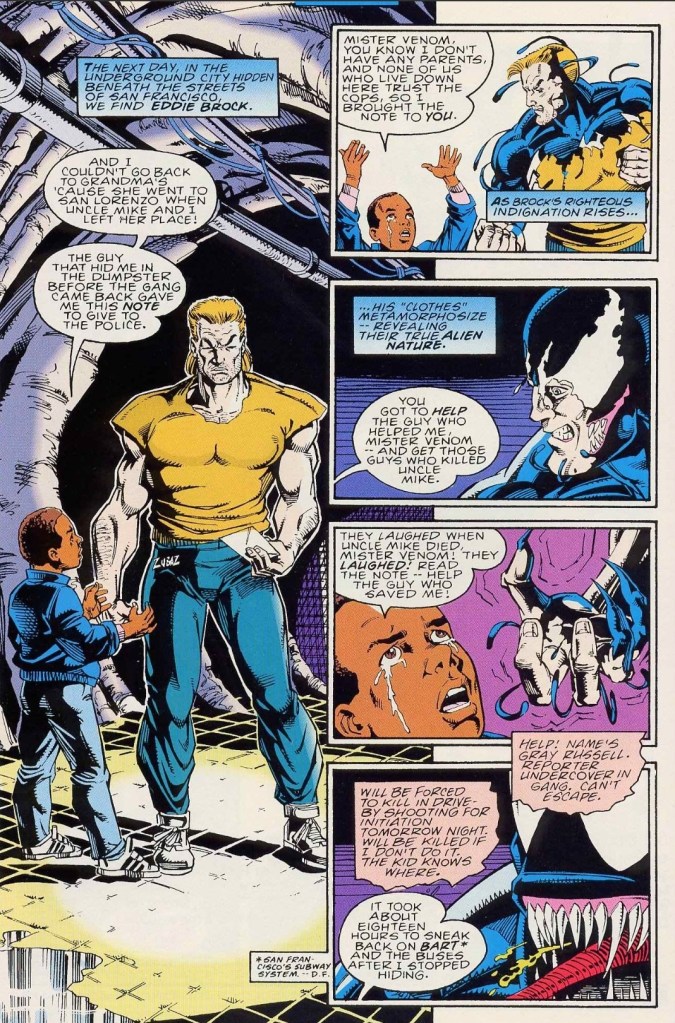
The next day in the underground city beneath San Francisco, Calvin meets Eddie Brock and hands him a note meant for the police. As Calvin reveals more details, Eddie gradually turns into Venom with his alien costume covering up his body. After learning of the death of Calvin’s uncle and hearing the young boy’s plea for help for Gray (an investigative reporter in secret within the gang), Venom agrees to help him as it is their mission to save the innocent and destroy the guilty…

Quality

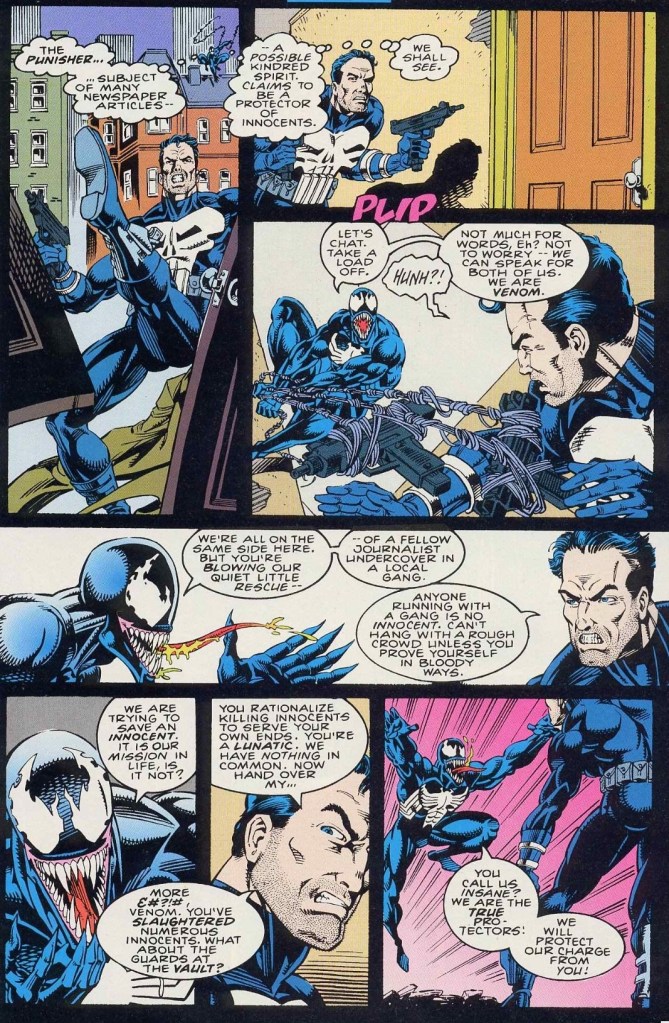
Punisher and Venom’s first-ever encounter with each other.

I want to start first the with the overall presentation crafted by the Potts-Lyle creative duo. In terms of story and setting, this comic book has a very strong urban crime vibe which is not a surprise given the fact that Carl Potts wrote lots of stories of the Punisher and his personal war against criminals. That being said, the tone is very different compared to what was shown in Venom: Lethal Protector and other Venom tales that got published before this comic book. Very clearly, this story is dark, gritty and even disturbing to read due to the subject matter of crime and senseless violence caused by people who are obsessed with violence. The fantasy elements of Venom: Lethal Protector are unsurprisingly absent here.

Carl Potts’ take on Venom’s personality is technically an extension of what was established previously. Venom, who is truly a murderer on the loose, continues to live with his very distorted code by helping the innocent by means of using violence and death on others he personally views as guilty. His getting involved in the turf of crime here is, however, a fresh approach on the super villain now acting “heroic” helping Calvin who lost his uncle. Being a former journalist himself, Eddie Brock “relates” with the investigative journalist involved with the gang.

The other major character – the Punisher – is his typical self in this story. He gets involved in the conflict in Oakland not purposely but accidentally as he was just passing by in his weapons-filled van as he heard the local police communication on local crime. The only thing notable about the way the Punisher is portrayed here is his first-ever interactions with Venom which is a crossover scene filled with a decent amount of hard action.  

Gray, the investigative journalist, is presented here as technically the third major character of the story. In some ways, he even overshadows Venom and the Punisher in key parts of this comic book. He is not really an interesting character himself but there are some interesting Marvel universe details shown from his personal memories. What is clear about this uninteresting character is that the creative team planned something with him in a key role within the core concept of this mini-series.

As for the plot itself, it clearly has a dark and gritty concept of street crime in 1990s Oakland which itself plays a big part of the build-up of the story and the eventual crossover between Venom and the Punisher. The problem is that the build-up has an uninteresting character with Gray involved and there is a lot of exposition to go through before the Venom-Punisher encounter.

The encounter between Venom and the Punisher here came with the superhero comics crossover trope of the players misunderstanding the situation and each other, and getting into a conflict very early on. Both characters have their respective obsessions and so-called codes of purposes, which predictably leads them into conflict as they stayed hard-headed towards each other. While it is flawed, the Venom-Punisher crossover here is the highlight as well as the relief from having to read all the exposition and build-up.

Conclusion

A scene like this could inspire Black Lives Matter terrorists, SJWs, woke activists and North American socialists to become violent and cause havoc around America.

Venom: Funeral Pyre (1993) is a flawed comic book that happens to highlight the Punisher and Spider-Man’s greatest nemesis of the time. It delivered on its promise of showcasing the two characters – a cold-hearted anti-crime vigilante and an alien costume-equipped murderer – in a crossover but the pay-off was barely enough when you take into account the build-up, the exposition and the involvement of the uninteresting third player named Gray. Compared to what was shown in Venom: Lethal Protector, this comic book clearly has an urban crime flavor which Carl Potts strongly implemented. As for the art, Tom Lyle showed he is really good in visualizing Venom, the Punisher and street gang wars.

Overall, Venom: Funeral Pyre (1993) is serviceable. Definitely this is not the fabulous 1st issue described on the foil cover.

+++++

Thank you for reading. If you find this article engaging, please click the like button below, share this article to others and also please consider making a donation to support my publishing. If you are looking for a copywriter to create content for your special project or business, check out my services and my portfolio. Feel free to contact me with a private message. Also please feel free to visit my Facebook page Author Carlo Carrasco and follow me on Twitter at  @HavenorFantasy as well as on Tumblr at https://carlocarrasco.tumblr.com/ and on Instagram at https://www.instagram.com/authorcarlocarrasco

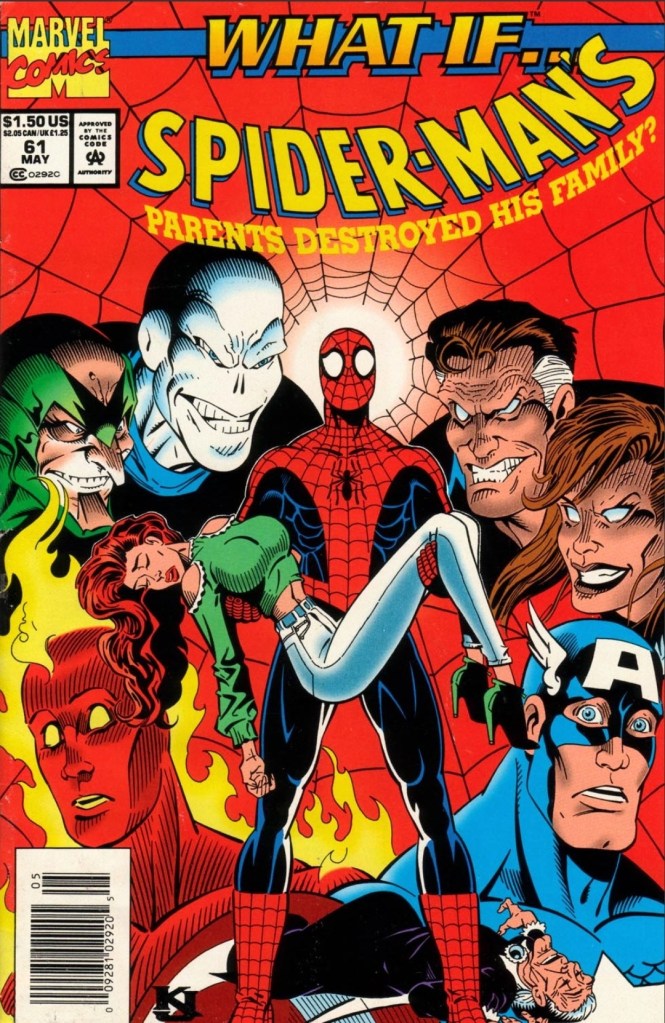
A Look Back at What If #61 (1994)

Disclaimer: This is my original work with details sourced from reading the comic book and doing personal research. Anyone who wants to use this article, in part or in whole, needs to secure first my permission and agree to cite me as the source and author. Let it be known that any unauthorized use of this article will constrain the author to pursue the remedies under R.A. No. 8293, the Revised Penal Code, and/or all applicable legal actions under the laws of the Philippines.

Welcome back superhero enthusiasts, 1990s arts and culture enthusiasts, Marvel Comics fans and comic book collectors! Today we go back to the wild 1990s and examine an alternate universe portrayal of one of Spider-Man’s many events told through the What If monthly series!

If you are looking for a portrayal of Spider-Man going over the edge and into the extremes emotionally, you are about to experience something in this retro review of mine. Some time ago, I reviewed a What If comic book about Spider-Man becoming a murderer which was compelling but ended on a whimper.

With those details laid down, here is a look back at What If published in 1994 by Marvel Comics with a story written by Kurt Busiek and drawn by Kirk Jarvinen, Andrew Wildman, Derek Yaniger and Jim Amash.

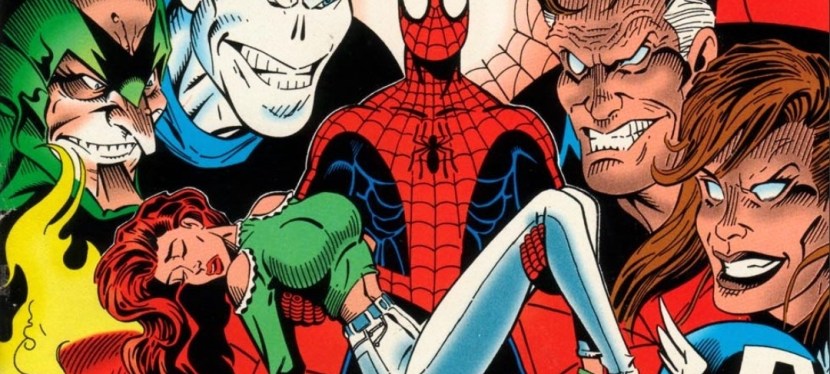
The cover.

Early story

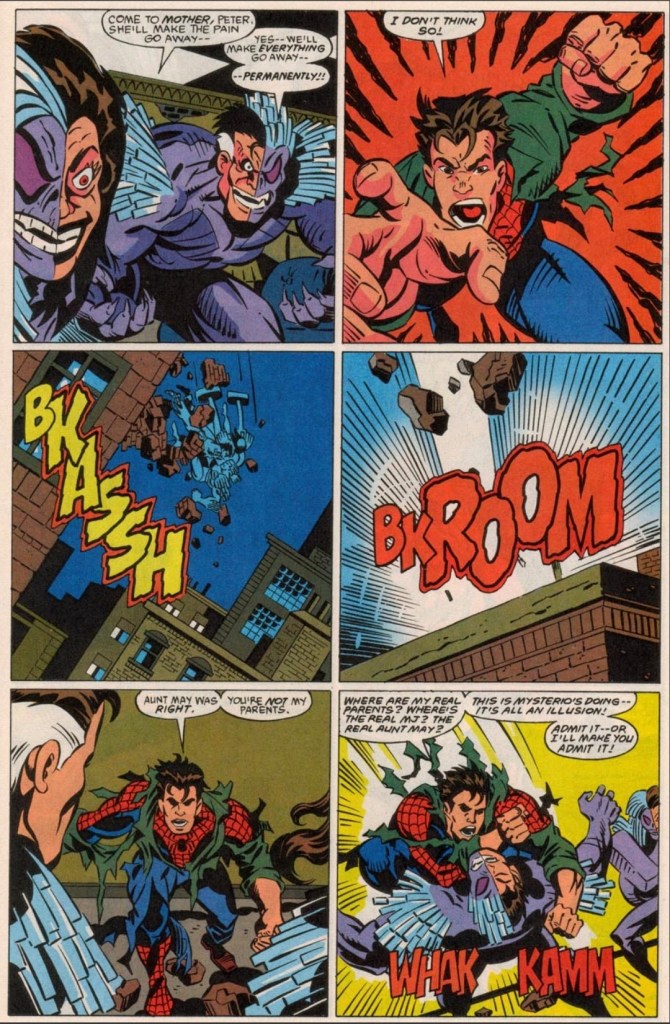
The story begins with Richard and Mary Parker (Peter Parker’s parents) arriving in the presence of Aunt May who happens to be visited by their son Peter (Spider-Man). Having learned something from a while back, Aunt May tells Richard and Mary that they are not genuine persons. Suddenly, Peter Parker’s spider sense intensifies and in an attempt to defuse the situation, he leads his aunt to walk out of the house with him. Richard and Mary watch them walk away.

It turns out, Richard and Mary are impostors and they have been working all the time for a secretive boss. Richard calls his employer under an emergency and reports that they have completed phase one of their assignment, that Aunt May knows the truth about them and is about to inform Spider-Man. Richard is then told that under no circumstances is the plan to be jeopardized and anyone who suspects must die. He is also told to flush Mary’s programming and reset her as she showed signs of acting odd to the situation.

A short time later, Richard and Mary – now in morphed forms with vastly different bodies and half their heads resembling their human selves – suddenly break into an apartment surprising Peter, his wife Mary Jane and Aunt May. Violent action by one of them accidentally ripped open Peter’s shirt, revealing his Spider-Man suit to Aunt May. Just as Peter’s aunt figures out the secret, he tells Mary Jane to grab her and get out.

However, the sight of the morphed Mary Parker shocked Aunt May and Mary Jane so much, they failed to move. Mary Parker then morphs her two hands into large, makeshift hammers, and swiftly killed Aunt May and Mary Jane. Peter is instantly shocked by their sudden deaths but deep inside, rage begins to burn…

Quality

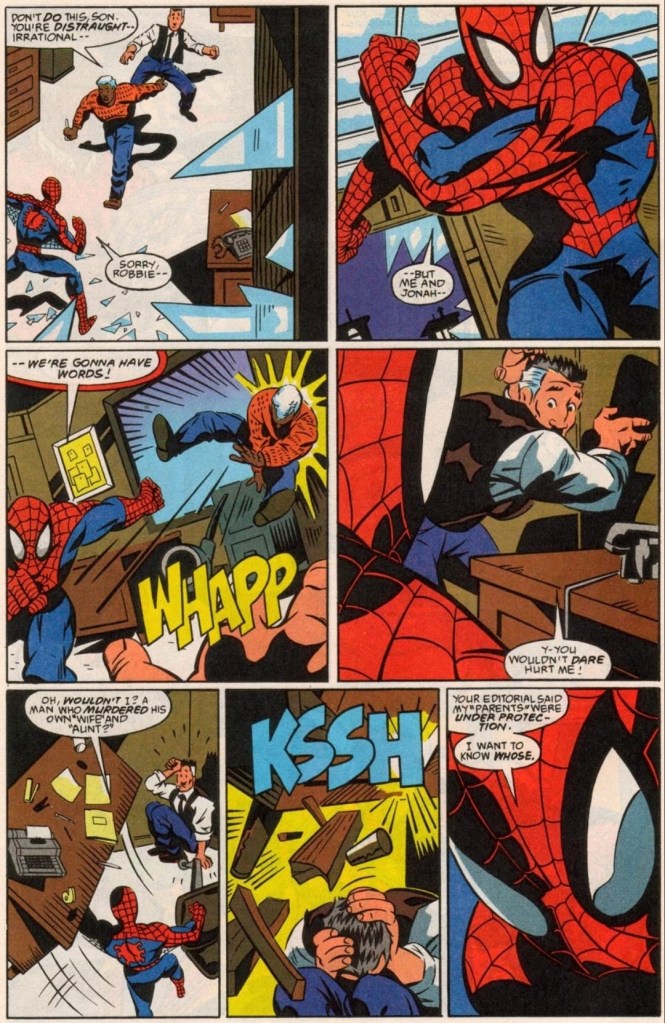
Spider-Man already over the edge and reacting violently to the abusive Daily Bugle.

I can start by confirming that Kurt Busiek’s writing is very strong and his alternate take on the events of Amazing Spider-Man (1994) is indeed very solid. In one way, I find the emotional stakes for Spider-Man has been raised a lot higher than what was portrayed in the canon story. The concept of losing his beloved family members to enemies who were impostors that looked like his long lost parents is indeed disturbing as well as emotionally charged. In relation to this, Busiek and the illustrators brought to life a Spider-Man who really went over the edge by taking matters into his own hands as the loss of beloved ones led to the blurring of the boundary between good and evil. Even the boundary between innocence and guilt gets blurred which adds more depth to the emotions of the story. As I read the story, there were moments when I felt that Spider-Man became as bad as the evil ones even though he is clearly the victim and his family was targeted.

Apart from showing Spider-Man getting outraged and pushed to the limits, Busiek inserted elements about how people perceive incidents without knowing all the facts and how easily they get manipulated by a news outlet – the Daily Bugle where Peter Parker worked as a freelance photographer – whose leader does not care about ethical journalism nor the pursuit of the truth. In this age of widespread fake news and liberal news media outlets in America doing propaganda for American Communists (read: Democrats, abortionists, LGBTQ, Black Lives Matter, Antifa, the terrorists, the climate change extremists and the socialist hordes), this particular aspect of the story makes this comic book strongly relevant to read today.

The story also sheds light on Spider-Man’s connections with other Marvel superheroes who happen to be in New York City. You will see Captain America and Johnny Storm express their concern about Spider-Man’s state of mind as they themselves still tried to figure out what really happened. In short, the superheroes here showed restraint even as Spider-Man goes to the extreme being a victim as well as a fugitive.

If there are any weak points in this comic book, it would be the art which has this cartoon-like aesthetic for much of the story. Considering the serious subject matter, the visuals are quite contradicting as they make this look like it was made for much younger readers. In fairness, the quality of the art improved during the 2nd half of the story.

Conclusion

Spider-Man takes on the impostors who looked like his parents.

As far as storytelling and characterization goes, What If (1994) succeeded a lot on portraying the iconic Spider-Man as the superhero who went over the limits of his emotions and his reasoning which is the result of the tragic deaths of two beloved family members caused by individuals who pretended to be his parents. This is a very solid story which also has a powerful ending. Where What If failed, this comic book succeeded and even exceeded it with Spider-Man truly becoming unheroic. I should state that this comic book should convince readers to go to the Amazing Spider-Man series and follow the Lifetheft storyline in issues to (which were released months before this comic book). Kurt Busiek’s script is indeed great and it is easily the driving force of the comic book.

Overall, What If (1994) is highly recommended.

+++++

Thank you for reading. If you find this article engaging, please click the like button below, share this article to others and also please consider making a donation to support my publishing. If you are looking for a copywriter to create content for your special project or business, check out my services and my portfolio. Feel free to contact me with a private message. Also please feel free to visit my Facebook page Author Carlo Carrasco and follow me on Twitter at  @HavenorFantasy as well as on Tumblr at https://carlocarrasco.tumblr.com/ and on Instagram at https://www.instagram.com/authorcarlocarrasco

A Look Back at Spider-Man 2099 #11 (1993)

Disclaimer: This is my original work with details sourced from reading the comic book and doing personal research. Anyone who wants to use this article, in part or in whole, needs to secure first my permission and agree to cite me as the source and author. Let it be known that any unauthorized use of this article will constrain the author to pursue the remedies under R.A. No. 8293, the Revised Penal Code, and/or all applicable legal actions under the laws of the Philippines.

Welcome back superhero enthusiasts, 1990s arts and culture enthusiasts, Marvel Comics fans and comic book collectors! Today we go back to the will 1990s and explore the far future of 2099 within the Marvel Comics shared universe through one of the tales of Spider-Man 2099.

Shortly after his return from the old lower city of New York, Miguel O’Hara’s personal life got more complicated and intense. Aside from that, his rift with his mother remains unresolved. Miguel then begins to assess his personal life as well as his secret life as the swinging hero Spider-Man.

With those details laid down, here is a look back at Spider-Man 2099 , published in 1993 by Marvel Comics with a story written by Peter David and drawn by Rick Leonardi.

The cover.

Early story

The story begins when armed security personnel apprehend a man for defacing Alchemax property with spray paint. As the suspect gets threatened with physical violence, Spider-Man suddenly appears and surprises the one holding the suspect down. It turns out, Spider-Man secretly knocked out one of the security personnel quietly.

The active security officer lets the suspect go and he activates his armor which turns out to be the Situation Emergency Gear (SIEGE for short) which is the result of a project between Alchemax and Stark-Fujikawa. The armored man then begins to strike at Spider-Man in response for the sudden intervention. Very notably, the security officer wearing SIEGE tells Spider-Man he apologizes for taking action and will do everything he could to harm him as little as possible…

Quality

The futuristic Spider-Man has serious opposition here.

Considering what happened in issue , this comic book ramped up the spectacle showing more of Spider-Man 2099 in action-packed conflict with one of the local authorities who happened to be armed with a powered suit of armor. The figure of opposition here is almost like a super villain but one who is not evil but rather doing what he was hired to do. Apart from being an action-filled conflict with strong sci-fi elements, this conflict symbolizes Miguel O’Hara’s willingness to put himself at risk by taking on the authorities as a deliberate violator of local law even though he himself works with Alchemax. This also shows Miguel’s recklessness as he struggled with the lack of a clear direction with his second life as Spider-Man. At this stage, Miguel’s inner rebellion against his corporation is very clear and this alone will put readers on the edge as they figure out what the deeply troubled hero plans to do next.

This comic book is not an all-out action fest. There was still enough room for Peter David to craft more of Miguel’s affairs at Alchemax, only this time he gets to meet someone who happened to be connected with one particular member of X-Men 2099 (note: this is related to the eventual 2099 crossover storyline). This only adds more intrigue into Miguel’s troubled personal life which is something you must read and find out here.

Conclusion

This comic book will make you wonder if Spider-Man 2099 himself is slowly becoming evil by getting into direct conflict with the law.

Spider-Man 2099 (1993) is a fine example of plot really thickening while also making life not only harder but more intense on the part of Miguel O’Hara. At the same time, this comic book built up something new for Spider-Man to eventually face off with. Peter David’s writing and direction of the character are very engaging to follow from start to finish.

Overall, Spider-Man 2099 (1993) is recommended.

+++++

Thank you for reading. If you find this article engaging, please click the like button below, share this article to others and also please consider making a donation to support my publishing. If you are looking for a copywriter to create content for your special project or business, check out my services and my portfolio. Feel free to contact me with a private message. Also please feel free to visit my Facebook page Author Carlo Carrasco and follow me on Twitter at  @HavenorFantasy as well as on Tumblr at https://carlocarrasco.tumblr.com/ and on Instagram at https://www.instagram.com/authorcarlocarrasco

A Look Back at Venom: Lethal Protector #3 (1993)

Disclaimer: This is my original work with details sourced from reading the comic book and doing personal research. Anyone who wants to use this article, in part or in whole, needs to secure first my permission and agree to cite me as the source and author. Let it be known that any unauthorized use of this article will constrain the author to pursue the remedies under R.A. No. 8293, the Revised Penal Code, and/or all applicable legal actions under the laws of the Philippines.

Welcome back superhero enthusiasts, 1990s arts and culture enthusiasts, Marvel Comics fans and comic book collectors! Today we go back to the year 1993 and explore a part of Marvel Comics’ universe through the first-ever limited comic book series featuring one of Marvel’s most iconic villains – Venom.

In my previous retro review, Venom discovers a long lost section of San Francisco that fell deep underground. Even though it is cut off from the resources and fresh air of modern San Francisco, the lost city section is filled with homeless people and social outcasts. Even though he helped the city dwellers by defeating the two armed mechs (employed by a powerful organization who oppose the city dwellers and are in pursuit of something related to San Francisco’s park), Venom still gets rejected by the so-called council. This only led him to returning to the surface not knowing that he is being targeted by a certain group.

With those details laid down, here is a look back at Venom: Lethal Protector , published in 1993 by Marvel Comics with a story written by David Michelinie and drawn by Mark Bagley.

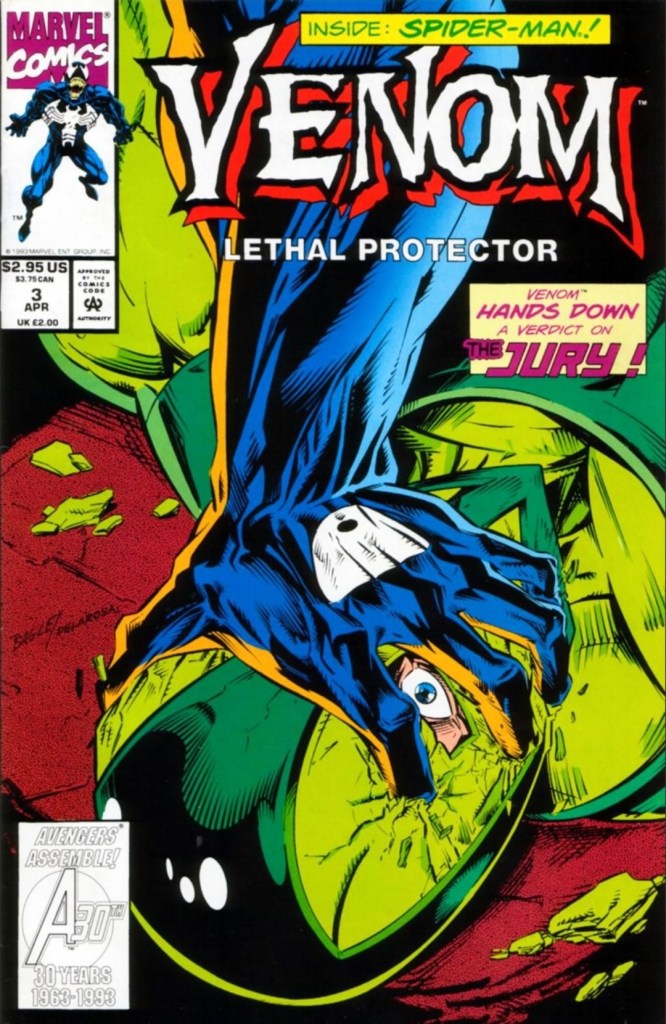
The cover.

Early story

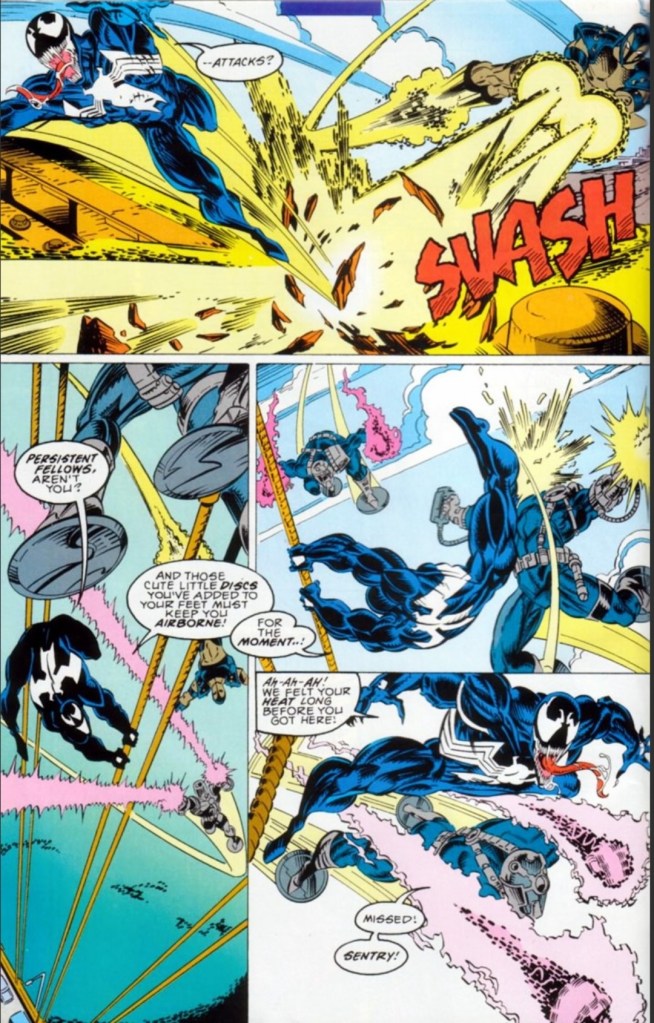
The story begins with Venom suffering from a sonic blast while being restrained by one of the armed members of the group called The Jury. Their leader (who wears a suit and necktie) introduces himself as Orwell Taylor and he addressed Venom as Mr. Brock. It turns out Taylor spent lots of time and resources researching everything about Brock and the alien costume. More shockingly, The Jury’s leader reveals that he lost his son Hugh years ago due to Venom’s arranged killing of him as he escaped from his prison cell in the federal prison called The Vault. Hugh Taylor is the first man Venom killed when he escaped.

Venom responds by say that he and his symbiote did not want to hurt anyone. This provokes Orwell Taylor into anger and he orders The Jury to kill Venom. Due to the lengthy explanations of Orwell Taylor, Venom managed to recover and regain strength which he uses to free himself and throw one Jury member to another causing quick chaos.

After punching another Jury member, Venom then moves out of the alley and away from Taylor and his team…

Quality

Very clearly, The Jury is a very formidable force of opposition. Their battle with Venom here comes with a lot of spectacle.

In terms of storytelling, this one is another improvement over issue (which itself is an improvement over issue ) as the plot got more interesting and even intriguing. For one thing, I like the fact that David Michelinie recalled Venom’s murderous escape from prison told way back in Amazing Spider-Man #315 (1989) and came up with the establishment of a very angry powerful father who formed the dangerous cybernetic team called The Jury. In a rather symbolic way, this comic book shows how Venom’s past comes back to haunt him and creatively, the battles between Venom and The Jury here are packed with a lot of action and visual dynamism delivered by Mark Bagley. The irony is that The Jury itself is not the main antagonist of this limited series as they are clearly presented to be a recurring force of opposition within Spider-Man’s realm in Marvel Comics’ shared universe of the time.

Still on the plot, the sinister organization hounding the dwellers of the lost city was revealed to be the Treece group whose leader is pursuing something very valuable to feed his greed. Still, even though this is already the third issue, the Treece organization’s presence is very subtle and as the force of opposition towards Venom, they are outclassed by The Jury.

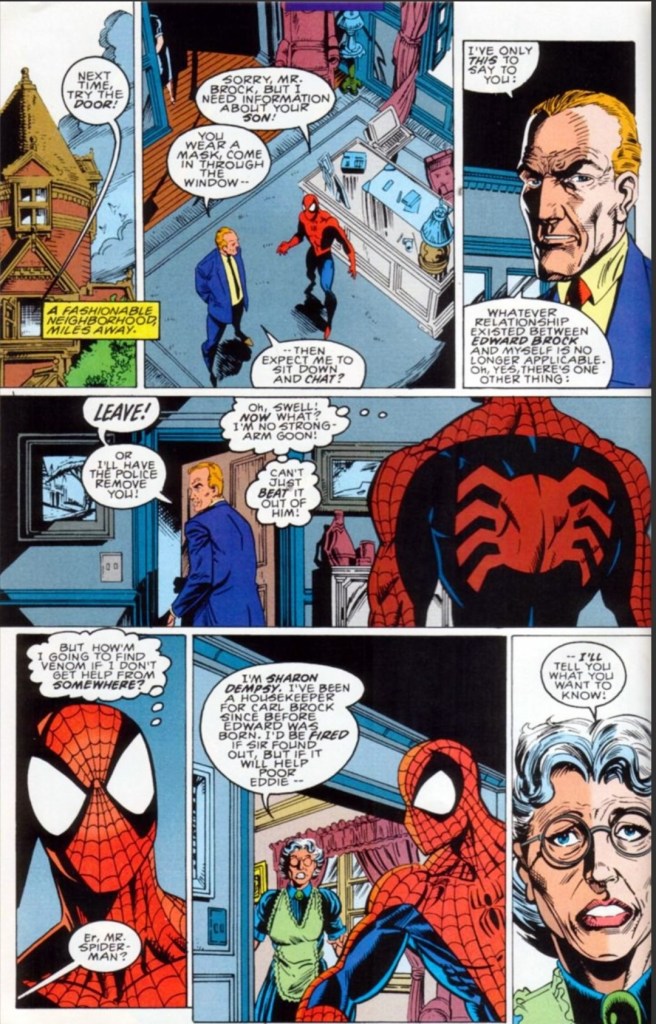
As in the previous issue, Spider-Man got a good share of the spotlight but this one is even more limiting which should delight Venom fanatics who complained about Marvel’s icon overshadowing their guy with the symbiote. Spider-Man serves mainly as a tool for exposition as the creative team showed images from the past of Eddie Brock with his father (whom Spider-Man approached for answers).

The problem here is that showing flashbacks from the past and explaining how Eddie Brock became bitter and sinister as a result of receiving almost no affection from his father ruins the mystery of Venom as a character. During the time of Todd McFarlane drawing Amazing Spider-Man comics and the early Venom tales, the mystery of Eddie Brock’s past added to the intrigue of Venom and his quick rise as the deadliest villain Spider-Man ever faced. I understand that this limited comic book series had Venom as the protagonist who was in high demand among readers of the time but for me the creative team went way too far emphasizing Eddie Brock’s past.

Nothing changes the fact that Eddie Brock aided by the alien costume is a murderer who happens to have previously been a prolific print media journalist whose career got ruined by Spider-Man which in turn led him to a downward spiral and eventually to bonding with the symbiote that once bonded with Peter Parker. The flashbacks were pointless and if there really was an attempt to humanize Eddie Brock and make him sympathetic to readers, the creative team clearly failed.

Conclusion

Spider-Man with Eddie Brock’s father in California.

Venom: Lethal Protector (1993) is a mixed bag. Its plot is clearly more intriguing and more interesting to read while there was enough creative space to show The Jury as a powerful force of opposition which is the result of Venom’s murder of Hugh Taylor (read: Amazing Spider-Man #315) while making a prison escape. The spectacle of the battle between Venom and The Jury must be seen! However, the creative team’s move to dramatize Eddie Brock’s past using flashbacks back-fired in my opinion and ultimately they destroyed whatever mystery was left behind Venom. As a protagonist, Venom has no appeal whatsoever and his portrayal here only reminds me that he works best as an antagonist opposite Spider-Man. Venom as a hero for those he perceived to be innocent and helpless remains forced and unconvincing.

Overall, Venom: Lethal Protector (1993) is satisfactory.

+++++

Thank you for reading. If you find this article engaging, please click the like button below, share this article to others and also please consider making a donation to support my publishing. If you are looking for a copywriter to create content for your special project or business, check out my services and my portfolio. Feel free to contact me with a private message. Also please feel free to visit my Facebook page Author Carlo Carrasco and follow me on Twitter at  @HavenorFantasy as well as on Tumblr at https://carlocarrasco.tumblr.com/ and on Instagram at https://www.instagram.com/authorcarlocarrasco

A Look Back at Spider-Man 2099 #9 (1993)

Disclaimer: This is my original work with details sourced from reading the comic book and doing personal research. Anyone who wants to use this article, in part or in whole, needs to secure first my permission and agree to cite me as the source and author. Let it be known that any unauthorized use of this article will constrain the author to pursue the remedies under R.A. No. 8293, the Revised Penal Code, and/or all applicable legal actions under the laws of the Philippines.

Welcome back, superhero enthusiasts, 1990s culture enthusiasts, Marvel 2099 fans and comic book collectors! Today we revisit the Marvel 2099 franchise within Marvel Comics’ shared universe during the 1990s. Specifically speaking, we take a look back at one of the early tales of Spider-Man 2099.

In this retro comic book review, the futuristic Spider-Man finally made his way back uptown after spending time in the old city of New York down below where he saw people living in poverty, violent gangs and Vulture 2099.

With those details laid down, here is a look back at Spider-Man 2099 , published by Marvel Comics in 1993 with a story written by Peter David and drawn by Kelley Jones.

The cover.

Early story

The story begins at the Wellvale where Conchata O’Hara (mother of Miguel and Gabriel) suddenly suffers an attack from inside her body. The medics were called for emergency.

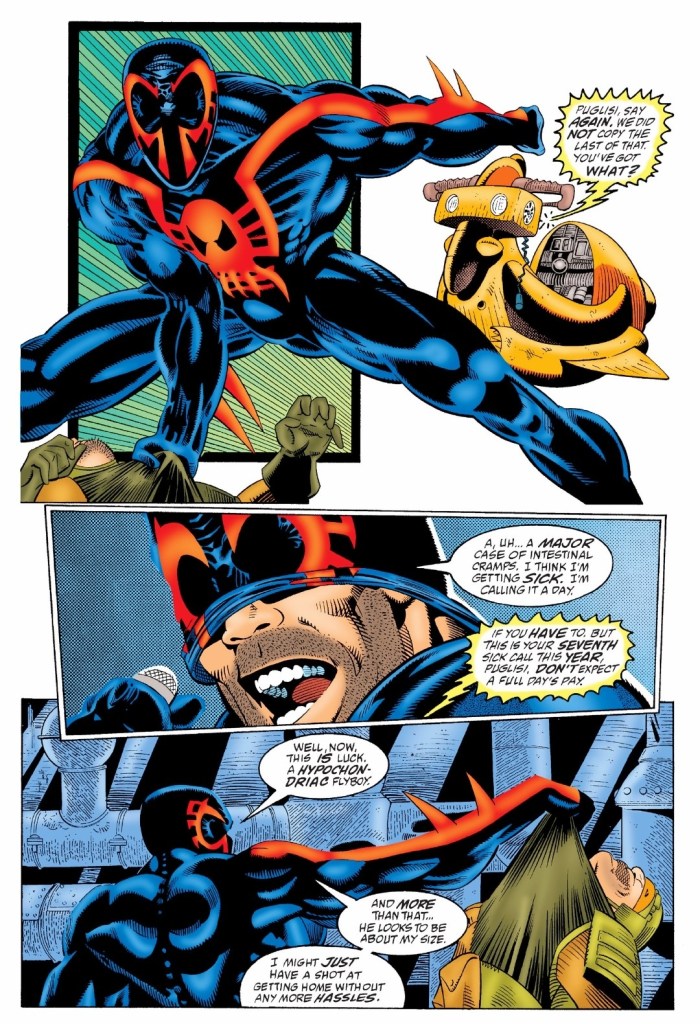
Elsewhere, Spider-Man jumps with excitement and relief after finally making it back from deep down the modern city. He almost gets hit by a hover car and decides to stop for a while at an isolated spot to calm down and reflect about what happened recently. He just defeated Vulture in battle below prior to climbing back up.

Suddenly, an armed Public Eye flyboy tries to apprehend him. After making getting near the flyboy and making himself look like he was about to submit himself, the flyboy communicates with his team. During that short moment, Spider-Man fires his organic web at the flyboy’s mouth which causes him to fire his weapon and miss. Spider-Man then knocks the flyboy out cold, leaving the communication line hanging…

Quality

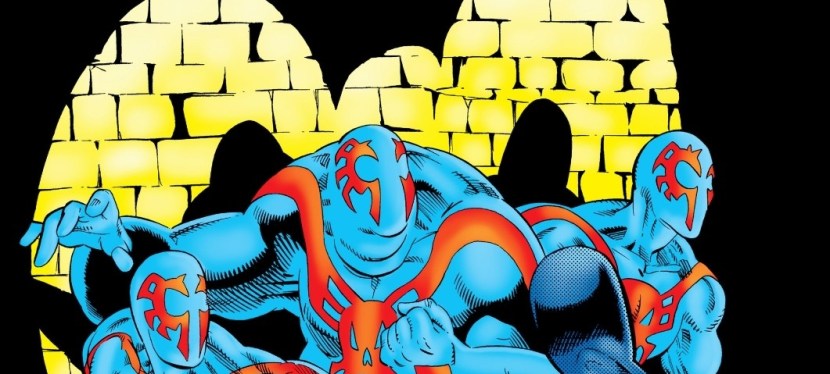
The idolaters of Spider-Man 2099 spotted.

Considering everything that happened to Spider-Man in the previous few issues set deep underneath the modern city, this tale was crafted to develop the webslinger’s personality some more while showing for the first time ever the group of Spider-Man 2099 idolaters who are so obsessed, they go around wearing their idol’s costume and even take risks imitating his physical abilities (example: crawling on the wall). There is no good-versus-evil conflict here but more exploration of the modern society Miguel O’Hara has long been part of.

For one thing, at this point of the monthly series, Spider-Man 2099’s misadventures and acts in uptown New York not only caused disturbance with the modern society watched over by Alchemax, he also sparked a new group of people who perceive him to be their holy savior. This kinda reminds me of DC Comics’ very own Sons of Batman which is a youth group inspired by Batman, and to see the Marvel 2099 have its own version of the concept is a pretty neat move by the creators.

Speaking of characterization, the complexities of the relationships between Miguel O’Hara with his brother Gabriel, his mother Conchata, his romantic interest Dana and the relationships the others have with each other begin to really grow in this issue. The good news is that Peter David not only provided solid dialogue for each character but also clearly defined their respective personality traits and thoughts about others. To see Gabriel personally reacting to Kasey’s reaction towards Spider-Man’s body was amusing and even a bit hilarious.

On the artistic side, Kelley Jones work here as guest illustrator was nice to see and certain visual elements of his work on Batman comic books also made it here. The result is a nice change of style and a new approach of showing visual details. I should state that even though his art style is radically different from that of Rick Leonardi, Jones managed to make the established characters look recognizable to me.

Conclusion

Kelley Jones’ visuals on Spider-Man 2099 is nice to see.

Spider-Man 2099 (1993) is clearly a more characterization-oriented story which is a nice change of pace and approach considering the chaotic story developments of the previous few issues. This comic book also shows that Spider-Man 2099 continues to encounter challenges in both local society and personally. The revelation of idolatry and idolaters connected to Spider-Man added a new layer of foolishness and evil to the local society (for insight, click here and here). At this stage of the monthly series, something new was clearly brewing for the futuristic webslinger and this showed that Peter David laid out his plans for the direction of the series’ narrative. Lastly, Kelley Jones’ work here really stands out.

Overall, Spider-Man 2099 (1993) is recommended!

+++++

Thank you for reading. If you find this article engaging, please click the like button below and also please consider sharing this article to others. If you are looking for a copywriter to create content for your special project or business, check out my services and my portfolio. If you want to support my website, please consider making a donation. Feel free to contact me with a private message. Also please feel free to visit my Facebook page Author Carlo Carrasco and follow me on Twitter at  @HavenorFantasy as well as on Tumblr at https://carlocarrasco.tumblr.com/ and on Instagram at https://www.instagram.com/authorcarlocarrasco/.

A Look Back at Spider-Man 2099 #26 (1994)

Disclaimer: This is my original work with details sourced from reading the comic book and doing personal research. Anyone who wants to use this article, in part or in whole, needs to secure first my permission and agree to cite me as the source and author. Let it be known that any unauthorized use of this article will constrain the author to pursue the remedies under R.A. No. 8293, the Revised Penal Code, and/or all applicable legal actions under the laws of the Philippines.

Welcome back superhero enthusiasts, 1990s arts and culture enthusiasts, Marvel Comics fans and comic book collectors! Today we go back to the will 1990s and explore the far future of 2099 within the Marvel Comics shared universe through one of the tales of Spider-Man 2099.

In my retro review of Spider-Man 2099 #25 (1994), I stated that Peter David crafted a story that connects and related well with the events of issue . Issue had a really shocking revelation and by the time I reached the end, I was compelled to revisit issue . I can say that, literally, the dots between the two comic books really connected strongly.

With those details laid down, here is a look back at Spider-Man 2099 , published in 1994 by Marvel Comics with a story written by Peter David and drawn by Joe St. Pierre.  

The cover.

Early story

The story begins inside one of the towers of Alchemax where an armored person lies down on a platform closely examined by the local staff. Tyler Stone arrives and immediately wants a report on Kasey Nash. After getting a reply from one of his personnel, he orders the removal of the armor and get her out of the facility.

Meanwhile. Spider-Man wakes up from his nightmare. He finds himself resting on an elevate tree and land surrounded by skyscrapers. He still has not recovered from learning the shocking truth that Tyler Stone – his very powerful boss at Alchemax – is his biological father. Equally disturbing to him is the fact that he never had Rapture in his system and his attempt to alter himself genetically was truly pointless and unnecessary. Miguel O’Hara then says to himself that his whole life is a lie.

As it begins to rain, Spider-Man then starts moving and swinging away…

Quality

A close call for Spider-Man 2099.

I want to make it clear that this particular story written by Peter David was clearly about developing Miguel O’Hara and exploring new depths within his personality. There is no good-versus-evil conflict here, nor were there any superhero spectacles or action scenes to find here. That being said, this comic book is not a bore at all and anyone who strongly follows Spider-Man 2099 as a serious character will have something to enjoy in terms of characterization mixed with intrigue.

As it is already clear that the tycoon Tyler Stone is the biological father of the protagonist, this particular story shows new dimensions as to where Miguel’s life could go to. In terms of characterization, you will get to see a very in-depth development of Spider-Man’s personality as well as his inner struggle with the way his life turns out. The dialogue is very well written, you will feel Miguel’s pain and you may even sympathize with him.

Considering the lack of superhero spectacle, it is great to see Peter David put strong emphasis on Spider-Man’s personality while also leaving some room for other developing sub-plots. It is intriguing to see Spider-Man having intense visual communication with a certain person whose organization empowered Kasey Nash (a lady the protagonist cares about). Speaking of relationships, you will see threads from Miguel’s past romance with a certain lady.  

When it comes to the visuals, Joe St. Pierre delivered a fresh new look while still making the established characters look recognizable. At times, the characters were drawn with a cartoony aesthetic and yet there were times that the images looked dynamic even without superhero spectacle. St. Pierre’s work here is a nice temporary change from the usual stuff of Rick Leonardi as many of his art pieces looked more detailed in comparison.

Conclusion

Something is building up…

Spider-Man 2099 (1994) is clearly a worthy follow-up to the very shocking issue . You will see a new age of darkness and uncertainty within Mguel O’Hara’s personal life as well as his emotional struggles. The lack of superhero spectacle is not a problem at all as the characterization here is very compelling to read. This coming book even has a short story that explores Spider-Man’s connection with Tyler Stone long before the incident that took place in issue .

Overall, Spider-Man 2099 (1994) is recommended.

+++++

Thank you for reading. If you find this article engaging, please click the like button below, share this article to others and also please consider making a donation to support my publishing. If you are looking for a copywriter to create content for your special project or business, check out my services and my portfolio. Feel free to contact me with a private message. Also please feel free to visit my Facebook page Author Carlo Carrasco and follow me on Twitter at  @HavenorFantasy as well as on Tumblr at https://carlocarrasco.tumblr.com/ and on Instagram at https://www.instagram.com/authorcarlocarrasco

A Look Back at Venom: Lethal Protector #2 (1993)

Disclaimer: This is my original work with details sourced from reading the comic book and doing personal research. Anyone who wants to use this article, in part or in whole, needs to secure first my permission and agree to cite me as the source and author. Let it be known that any unauthorized use of this article will constrain the author to pursue the remedies under R.A. No. 8293, the Revised Penal Code, and/or all applicable legal actions under the laws of the Philippines.

Welcome back superhero enthusiasts, 1990s arts and culture enthusiasts, Marvel Comics fans and comic book collectors! Today we go back to the year 1993 and explore a part of Marvel Comics’ universe through the first-ever limited comic book series featuring one of Marvel’s most iconic villains – Venom.

In my previous retro review, Eddie Brock returned to his hometown of San Francisco following the events of Amazing Spider-Man (1993). Living with his very distorted belief of protecting the innocent by doing unrelenting acts of violence on others, he begins to get involved with helpless people who happened to be hounded by agents of a certain private organization that wields power. Along the way, Spider-Man arrives in the city find Venom.

With those details laid down, here is a look back at Venom: Lethal Protector , published in 1993 by Marvel Comics with a story written by David Michelinie and drawn by Mark Bagley.

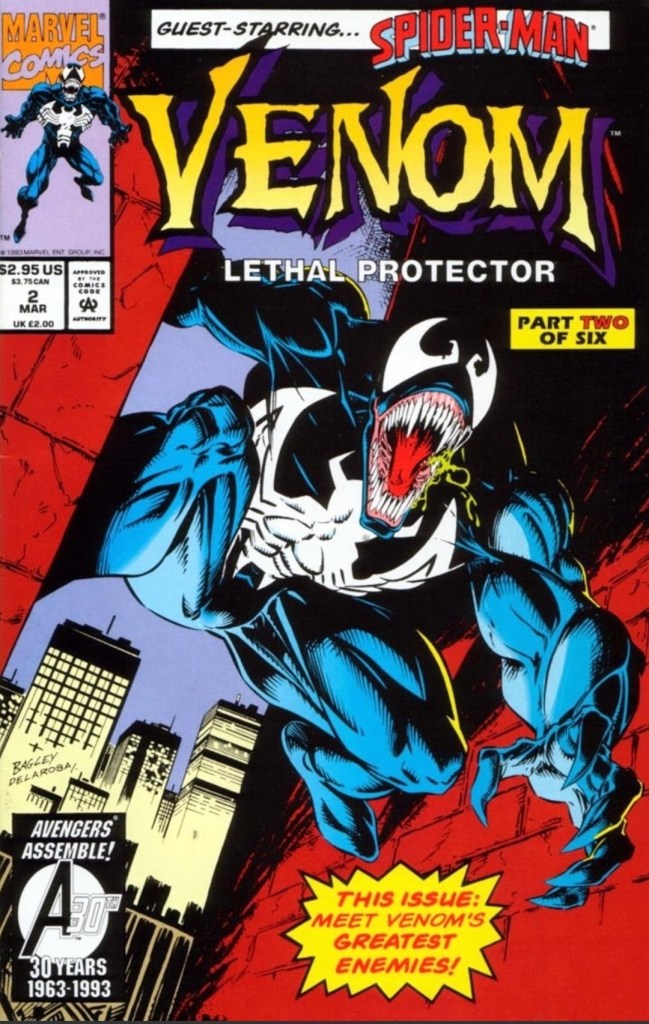
The cover.

Early story

The story begins deep underneath the city of San Francisco. Venom, who is caught by the large mechanical fist of a walking mech (piloted by a man working for Roland Treece’s organization), finds himself on the deeply buried section of the city and around them are vagrant people who settled and became residents of a local society that the rest of America does not even know exists.

As the local residents caught the attention of the pilot, Venom breaks free by smashing the mechanical fist into pieces. Another mech suddenly jumps into place near the first one. In response to the first mech’s sudden killing of a local resident (who was armed with a shotgun), Venom jumps to it and kills the pilot inside by punching into the cockpit. Venom then grabs a long sharp object and kills the pilot of the other mech with it.

While the locals were hostile and afraid of Venom, the other people (who were assisted on the surface by Venom) come to support him and tell their fellow underground residents that he is not their enemy. One of the local council members stated that a meeting at the council hall will be held and Venom will attend it…

Quality

With exposition in mind, Spider-Man here does most of the detective work. Understandably, he is not involved with the superhero spectacle.

Compared to issue , this story has a more interesting setting which is the buried and forgotten section of San Francisco which was the result of the 1906 earthquake. Showing that the lost section has a local population composed of homeless people and those who reject the modern society above was a bright idea nicely executed by the Michelinie-Bagley team as it added some depth into Marvel Comics’ own version of San Francisco.

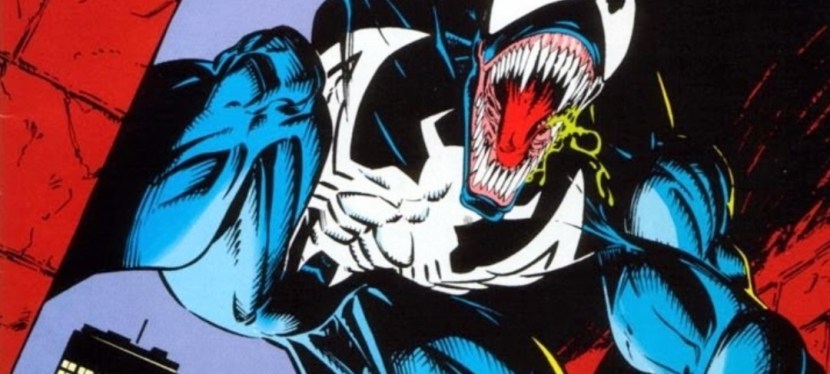
It was also in the underground city and with the residents where we get to see Venom do his own distorted acts of heroism backed by killing, and see how he fared when trying to win the trust of the locals whose members include those who read about him in the news and those who completely know nothing about him.

Through his interactions with the underground people, Eddie Brock is portrayed to be a bit more human compared to what happened in issue . For a man who has gotten very used to using extreme forms of violence and committing multiple acts of murder, it is surprising to see Brock looking and acting more civil in the presence of Americans (and perhaps illegal immigrants) who settled deep underground and established their own rules (note: Eddie Brock does not care about rules while having the alien costume). Still, you will see Venom engage in violent superhero action and even do a bit of detective work.

As with the previous issue, the iconic Spider-Man got a good share of the spotlight in the story as he searches for details about Venom which leads him to finding his rival’s estranged father. Spider-Man’s presence here is noticeably lessened compared to issue and his own search for answers creatively served as exposition. Don’t expect to see any superhero spectacle from Spider-Man.

Without spoiling details and names, I should state that this comic book marks the debut of a ream of armed mercenaries led by a powerful man who lost a son because of what Venom did in Amazing Spider-Man #315 (1989).

Conclusion

The violent nature of Venom displayed.

Venom: Lethal Protector (1993) is a marginal improvement over the first issue in terms of storytelling and setting. Part of the big build-up that happened in issue started to get paid-off in this comic book which allowed for the plot to move forward at a more satisfying pace. Venom and Spider-Man share the spotlight again, but this time the edge goes to the black-wearing murderer who also has the benefit of being part of the superhero spectacle here. At this point of the mini-series, Venom is not only facing elements of the Treece organization (which has been organizing something that could impact San Francisco and its people) but also a new force of opposition that is related to something he did a few years prior. That being said, Venom is first and foremost a murderer that Marvel wanted to make big money out of.

Overall, Venom: Lethal Protector (1993) is satisfactory.

+++++

Thank you for reading. If you find this article engaging, please click the like button below, share this article to others and also please consider making a donation to support my publishing. If you are looking for a copywriter to create content for your special project or business, check out my services and my portfolio. Feel free to contact me with a private message. Also please feel free to visit my Facebook page Author Carlo Carrasco and follow me on Twitter at  @HavenorFantasy as well as on Tumblr at https://carlocarrasco.tumblr.com/ and on Instagram at https://www.instagram.com/authorcarlocarrasco