A Look Back at Ultraverse Year One (1994)

Disclaimer: This is my original work with details sourced from reading the comic book and doing personal research. Anyone who wants to use this article, in part or in whole, needs to secure first my permission and agree to cite me as the source and author. Let it be known that any unauthorized use of this article will constrain the author to pursue the remedies under R.A. No. 8293, the Revised Penal Code, and/or all applicable legal actions under the laws of the Philippines.

Welcome back superhero enthusiasts, 1990s culture enthusiasts and comic book collectors! Today we go back to the mid-1990s which was a pretty wild time for comic collectors. To be more specific, this newest retro review revisits the Ultraverse through a comic-like publication in the form of a guide meant for UV fans and comic collectors.

The subject at hand is Ultraverse Year One which, as written on the edge of the front cover, was designed to be the “complete guide to the Ultraverse’s first year.” It is a reference guide for those who seriously want to discover each and every Ultraverse comic book that was published during its first year. In my experience as a comic collector, the Ultraverse launch in 1993 was very memorable even though my financial limitations prevented me from acquiring each and every launch comic book and subsequent releases of the time. How useful is this complete UV guide? We can go on and find out.

With those details laid down, here is a look back at Ultraverse Year One, published in 1994 by Malibu Comics.

The cover.

Quality

I can say without a doubt that this publication is indeed a complete guide to each and every Ultraverse comic book released during its first year from 1993 to 1994 specifically. You want to know exactly how many issues of Mantra, Prime, Hardcase, The Solution, Prototype, The Strangers and others were published in the first year? This one has it all listed! You want to know which UV comic book involved the talents of Steve Gerber, Norm Breyfogle, Rick Hoberg, Len Strazewski, Aaron Lopresti, George Perez, James Hudnall, Gerard Jones, Steve Englehart, Tom Mason, Terry Dodson, James Robinson, Howard Chaykin, Mike W. Barr and many others under the Malibu Comics banner? This guide has it all listed! What months were Exiles #1, Sludge #1, Firearm #0, Break-Thru #1 and Mantra #1 were published? The answers to each are included. The same can also be said when it comes to which characters appeared in each comic book.

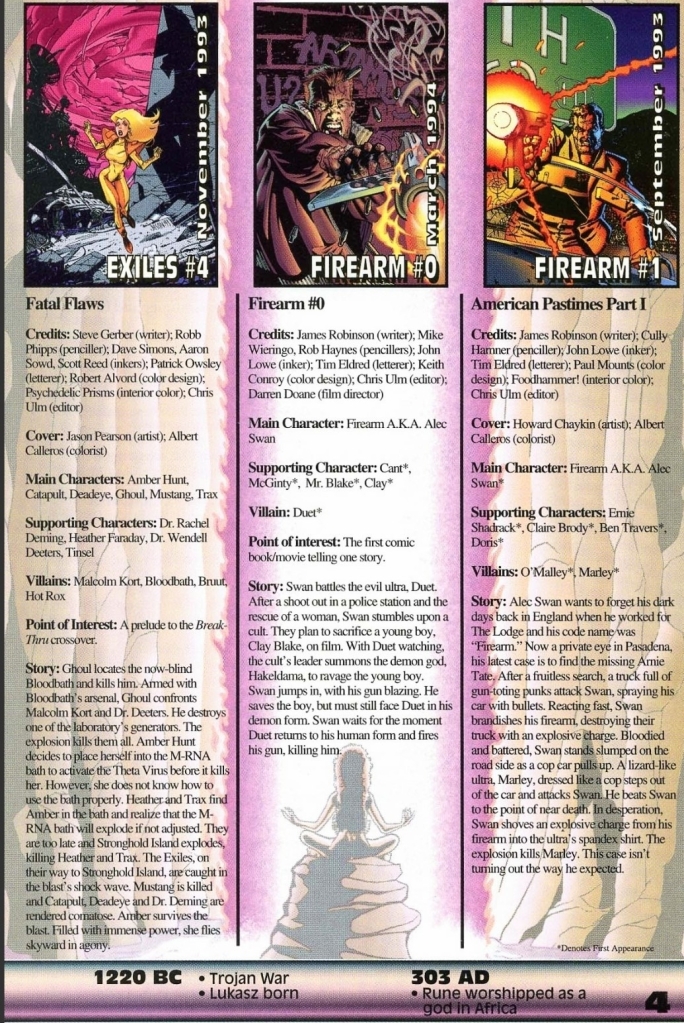
This is what each page typically looks like with details of the Ultraverse timeline on the lower part.
The timeline reveals that the male warrior Lukasz, who would later end up in woman’s body as Mantra/Eden Blake, was born in 1220 BC.

Very clearly, the Malibu Comics people worked hard to collect the essential types of information, organized them and put them all into print media form for readers and collectors to use when it comes to searching just about everything about the Ultraverse’s first year. Things did not just stop there, however.

What I found amusing to look at in each page of this Ultraverse guide are details of the shared universe’s timeline posted on the lowest part. The said timeline – which is limited to text and numbers – reveal interesting details such as what year was Lukasz (AKA Mantra) born, when did Rune begin, when was the Choice corporation established, what year did the island of Yrial’s people move up to the clouds, what years were infants injected by Wetware Mary and more. These details are actually quite encouraging to make readers discover or re-read Ultraverse comic books to see how they are dramatized on paper.

Conclusion
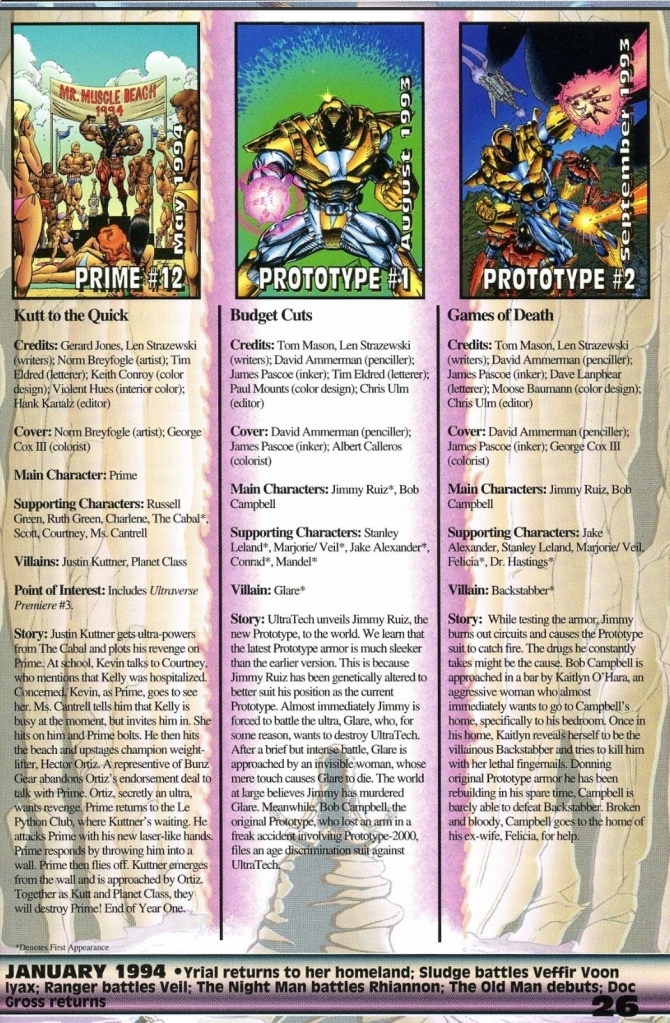
As you can see in the details above, Len Strazewski was involved in both the Prime and Prototype comic book series.

Ultraverse Year One (1994) is a pretty detailed guide that will not only help readers track down each and every UV comic book of the mentioned time period, but also help them spot the precise comic books that has characters included as well as the published works of varied comic book creators. If you are really determined to track down and buy all the Year One UV comic books, this guide is a must-have. If there are any weaknesses to mention, it would be the fact that each comic book’s entire plot got summarized in full which are actually spoilers.

Overall, Ultraverse Year One (1994) is recommended.

+++++

Thank you for reading. If you find this article engaging, please click the like button below and also please consider sharing this article to others. If you are looking for a copywriter to create content for your special project or business, check out my services and my portfolio. Feel free to contact me with a private message. Also please feel free to visit my Facebook page Author Carlo Carrasco and follow me on Twitter at  @HavenorFantasy as well as on Tumblr at https://carlocarrasco.tumblr.com/ and on Instagram at https://www.instagram.com/authorcarlocarrasco/
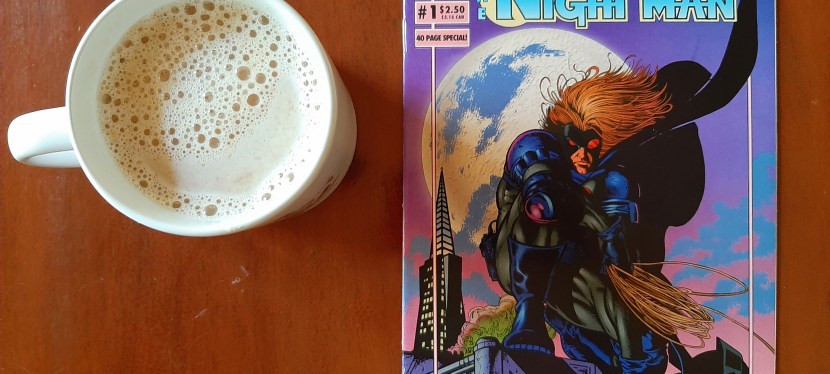
A Look Back At The Night Man #1

“I’m not who I was any more! I’m not who I’m going to be! I am the Night Man.”

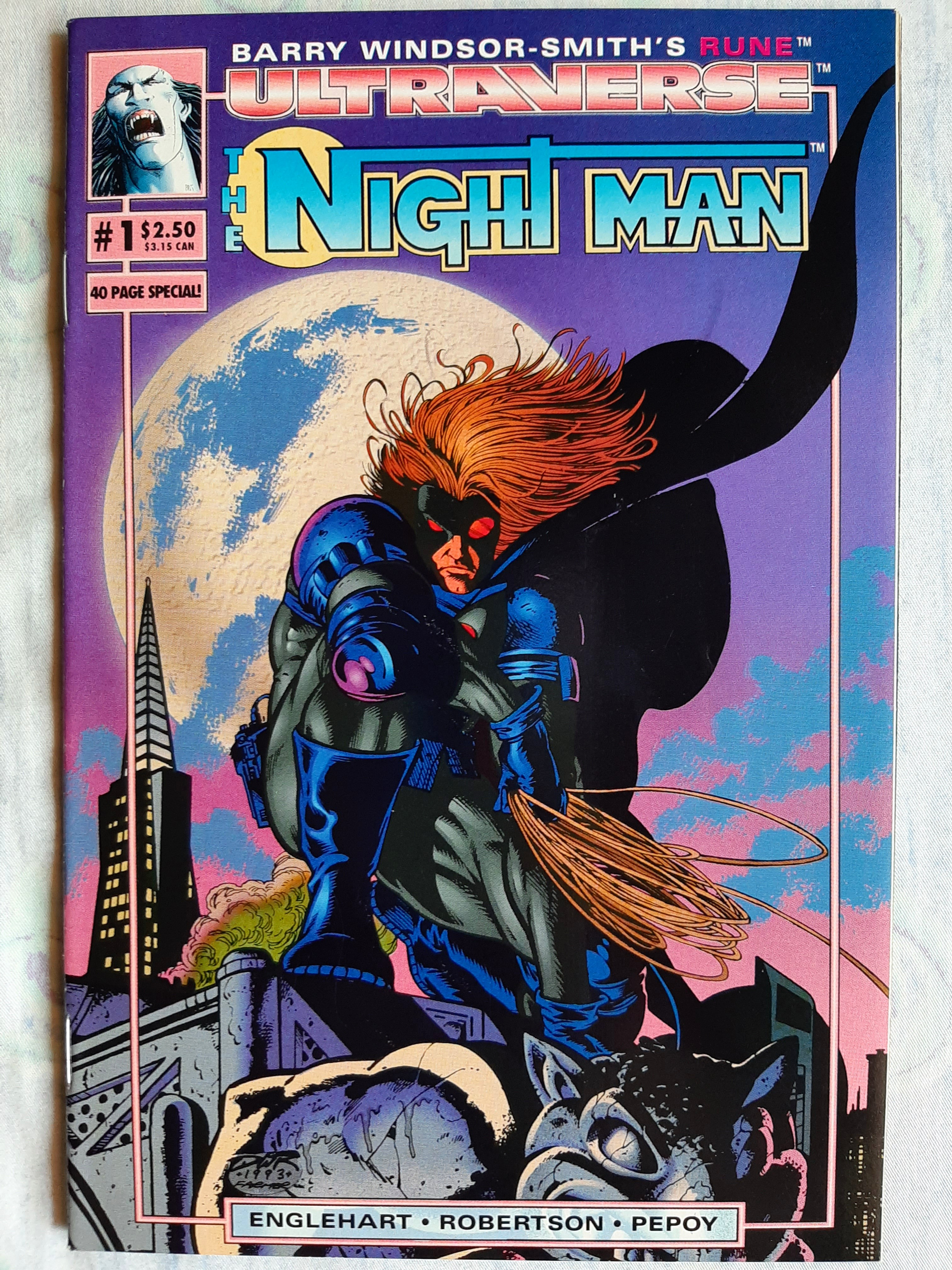
The above words were from the vigilante called the Night Man, a character co-created by comic industry veteran Steve Englehart (Avengers) and Darick Robertson for Malibu Comics’ Ultraverse franchise. Those words formally opened The Night Man which I’m reviewing here.

To put things in perspective, a vigilante is described as a member of a volunteer committee organized to suppress and punish crime summarily (as when the processes of law are viewed as inadequate) according to Merriam-Webster dictionary. To put it broadly, the vigilante is a self-appointed doer of justice.


20190609_123613.jpg
The Night Man cover.

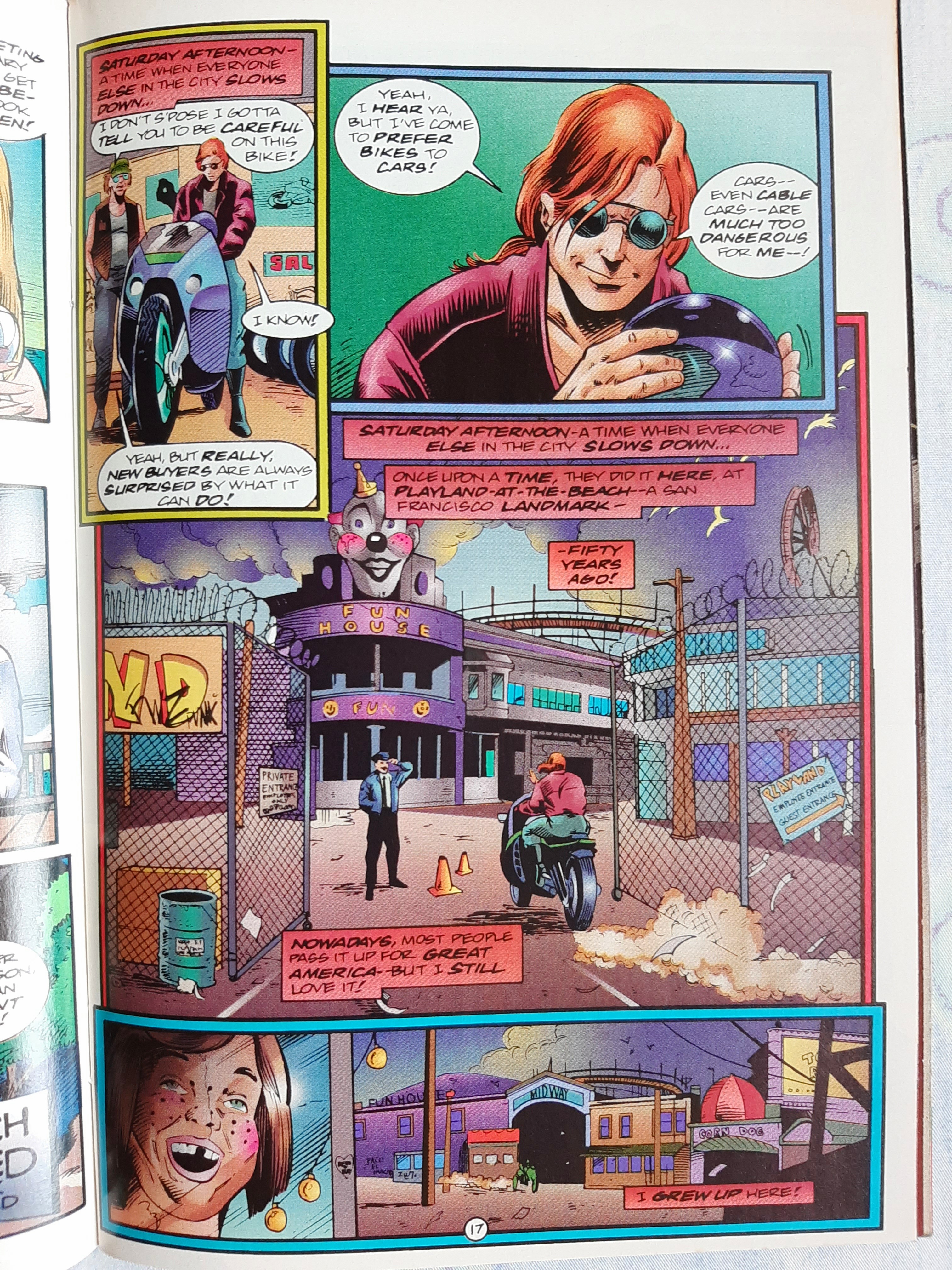
Published in 1993 by Malibu Comics, The Night Man tells the story of Johnny Domingo, a jazz player whose life changed in the pages of The Strangers (also written by Englehart) in which he (while driving a vehicle) got by a cable car (that was just hit by an energy burst from the sky) resulting a piece of shrapnel embedding into his head.

Perceived by others to be doomed, Domino strangely survived and was well enough to resume his normal life. The difference is that the incident made his eyes dilated permanently which forces him to shield them from bright light.

Just as Johnny walks down the street, he learned he gained an uncanny ability when he hears, for the first time, the evil thoughts of a man (wearing a coat and a hat) planning to kill a lady on Saturday night.

20190609_123520.jpg
The Night Man in action!

Knowing what heard, Johnny wondered if he was crazy and what if some woman would truly be in danger. He then decides to follow the man with evil thoughts and watch his moves. Eventually Johnny followed the man to a restaurant by the beach and saw him talk with a pretty waitress named Ginger who agreed to a Saturday night date.

Carelessly Johnny approached the man too closely and got noticed, forcing him to run away and got chased until he got into a taxi that drove him away.

A short time later, Johnny starts his new career as a vigilante as the Night Man.

20190609_123544.jpg

In terms of storytelling, The Night Man was nicely paced and never felt dragging. Within its twenty-eight pages of story, the comic book took gradual steps on introducing Johnny, how the incident with the cable car impacted him, how he became a vigilante for the first time and what went on in his mind as he became the Night Man. Given his rich experience as a writer, it is no surprise that Steve Englehart delivered a solid script.

It was also engaging to see Night Man being a determined yet very vulnerable vigilante. During his first mission in costume, he managed to beat a few bad guys but ended up getting hurt. This kinda reminds me of the vulnerability seen in the cinematic icon John McClane in 1988’s Die Hard.

The art by Darick Robertson, with ink work done by Andrew Pepoy, was nicely crafted. The civilian and vigilante looks of Night Man were well defined. The visualization of action nice and when Night Man gets hurt, he really looks in pain.

Going beyond Night Man, this comic book has a short preview (five pages, including credits) of Rune, a character created by Barry Windsor-Smith. Rune is described to be a voracious killer whose prey is all humanity and he is an alien leech who despoils the flesh of victims, culling their lifeblood into the essence of power. Rune is also a dying creature fighting for survival against the malignant disease burning inside of him.

Overall, The Night Man is a worthy addition to your comic collection if you are interested in the Ultraverse (which is still kept in limbo by Marvel which acquired Malibu Comics in the mid-1990s) or are interested in vigilante-type superheroes. If you are obsessed with whatever Barry Windsor-Smith created, then the Rune stuff is a must-get.

The Night Man is recommended.


Thank you for reading. If you find this article engaging, please click the like button below and also please consider sharing this article to others. Also my fantasy book The World of Havenor is still available in paperback and e-book format. If you are looking for a copywriter to create content for your special project or business, check out my services and my portfolio. Feel free to contact me as well. Also please feel free to visit my Facebook page Author Carlo Carrasco and follow me at HavenorFantasy@twitter.com


A Look Back At Ultraverse Premiere #0

What is the one thing I love most about superhero comics of the 1990s? It’s easy – the Ultraverse! Launched in 1993 by Malibu Comics during the late stage of what is now called the Comic Book Speculator Boom in Amerca, the Ultraverse was a line of superhero comic books featuring all-new characters and concepts which were the result of intense brainstorming by the founders of the Ultraverse.

Back in mid-1993 here in the Philippines, I first got to discover the Ultraverse through print ads in comic books and take note that the Internet was not yet publicly accessible. By June that year, I visited a comic book store in BF Homes, Paranaque and was astonished to see the store’s wall with multiple Ultraverse comic books on display. With my limited funds at that time, I only managed to buy Freex and Mantra . By the end of the evening, I greatly enjoyed what I read and became an Ultraverse fan ever since.

As the months passed by, I enjoyed reading more Ultraverse comic books. What was also fun to read were the special double-sized UV comic books, the Ultraverse Double Feature comic books (flip comic books) and then there was the Ultraverse Premiere #0 comic book which had a cover of Mantra drawn by the great Jim Lee! This is the one comic book I am taking a look back at.

UVprem1
The front cover drawn by Jim Lee!

So what Ultraverse Premiere #0 and what made it special other than having a cover drawn by Jim Lee? Released in late 1993, the comic book is a showcase of separate stories featuring Prime, The Strangers, Rune, Hardcase, Mantra and Freex. It is also a showcase of the respective talents of a big mix of writers and artists that include Len Strazewski, Tom Mason, Gerard Jones, Steve Englehart, Barry Windsor-Smith, Rick Hoberg, James Hudnall, Mike W. Barr, Norm Breyfogle and others.

Given its release date, the stories served as preludes leading to the stories told in the launch comic books. For example, the Hardcase story shows Tom Hawke/Hardcase with his team called The Squad performing what turned out to be their last mission leading directly to the events that started Hardcase .

UVprem3
Tom Hawke/Hardcase with his lovely teammate during his time with The Squad.

The story of Mantra in the comic book however was presented more like a side-story. Lukasz is already shown as Mantra with her mystical powers and revealing outfit in place. The short story adds a nice perspective on the personality of Mantra as well as her burden of having to take care of a daughter.

The Rune segment meanwhile was a look at the making of the character involving Barry Windsor-Smith and his art. In the text written by Chris Ulm, what caught my attention was the following segment.

After writing up the concept in the Ultraverse bible, I shortly added Rune to “Fusion”, the story of a conspiracy to develop the ultimate biological weapon by a covert group called Aladdin.

UVprem4
This opening of the Freex short story starts very strongly.

Of course, there is also the fine story of Prime by Len Strazewski and Gerard Jones with great looking art by the late Norm Breyfogle. Remember in the early pages of Prime when the overly muscular superhero claimed he saw the school coach touch the young girls? That got emphasized in the Prime short story in this comic book.

And then there is the one very memorable whole page art of Prime by Breyfogle.

UVprem2
I love this art of Prime by the late Norm Breyfogle.

The stories and art, in my view, were done with a lot of passion by the creators. They make Ultraverse Premiere #0 a worthy comic book to collect even though Marvel (which acquired Malibu Comics in the mid-1990s) screwed the Ultraverse and left the characters and concepts in limbo with no clear sign of any revival coming.

Last but not least, there is this great art of the Ultraverse characters done by Art Nichols at the rear of the comic book.

Ultraverse
The best back cover of any superhero comic book of the 1990s!

Art Nichols’ work on the back cover is fantastic and timeless in my view. It’s great multi-character art that truly captures the spirit of the Ultraverse!

If you are going out to buy old comic books, I strongly recommend Ultraverse Premiere #0.


Thank you for reading. If you find this article engaging, please click the like button below and also please consider sharing this article to others. Also my fantasy book The World of Havenor is still available in paperback and e-book format. If you are looking for a copywriter to create content for your special project or business, check out my services and my portfolio. Feel free to contact me as well. Also please feel free to visit my Facebook page Author Carlo Carrasco and follow me at HavenorFantasy@twitter.com