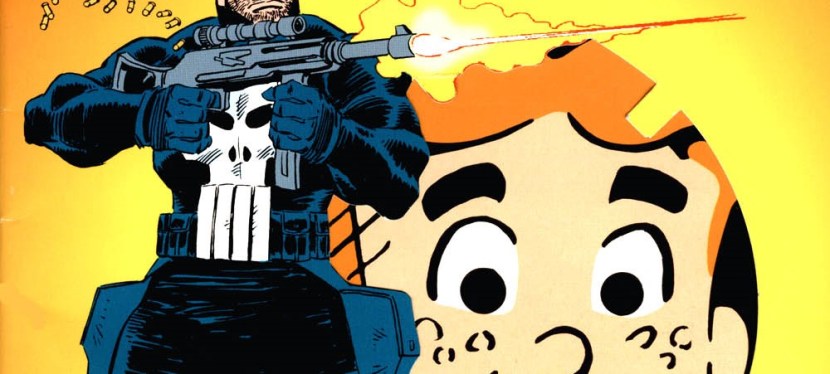
A Look Back at The Punisher Meets Archie #1 (1994)

Disclaimer: This is my original work with details sourced from reading the comic book and doing personal research. Anyone who wants to use this article, in part or in whole, needs to secure first my permission and agree to cite me as the source and author. Let it be known that any unauthorized use of this article will constrain the author to pursue the remedies under R.A. No. 8293, the Revised Penal Code, and/or all applicable legal actions under the laws of the Philippines.

Welcome back, superhero enthusiasts, comic book collectors, fans of 1990s culture, and fans of both Marvel Comics and Archie Comics! Today, I have a retro review of one of the most wild ideas for a comic book crossover that actually got published in 1994. Back then I was still in college and ramping up my comic book collection. Then one day, I saw a print ad for the Marvel-Archie special project about the iconic Archie Andrews crossing over with the Punisher!

That’s right! The unthinkable concept pushed through and way back in 1994, I ordered in advance a copy of the comic book (note: this was actually one comic book published respectively by Marvel Comics and Archie Comics but with their own packaging and slight adjustments to the title) and eventually got to read it.

Behind the scenes, the management of Archie Comics wanted to take part in the wildly popular trend of intercompany crossover comic book publishing not just to boost their sales but also establish a stronger presence in comic book specialty stores. Back then, Marvel Comics editor-in-chief Tom DeFalco and Archie Comics editor Victor Gorelick were good friends (note: DeFalco entered comic book publishing while working for Archie Comics) and sometimes they would joke with each other about potential crossover concepts between their companies. Gorelick eventually had lunch with independent comic creator Batton Lash and talked about Archie wanting to get involved with crossovers. The Archie editor told Lash about he and DeFalco joking about Archie encountering the Punisher, and in response the independent creator stated that they should really push through with it.

Lash went on to make a pitch for the series and Gorelick sent it to DeFalco. Marvel’s editor-in-chief loved it and eventually the concept was approved complete with strategic involvement in the production by key talents from both Archie and Marvel. For the artwork, Archie’s Stan Goldberg and Marvel’s John Buscema worked together to maintain different tones by means of drawing settings and characters that are specific with their respective companies. The inkwork was done by Tom Palmer.

Now you must be wondering…was the crazy crossover any good? We can find out in this look back at The Punisher Meets Archie #1, published by Marvel Comics in 1994 with a story written by Batton Lash and drawn by Punisher artist John Buscema and Archie artist Stan Goldberg.
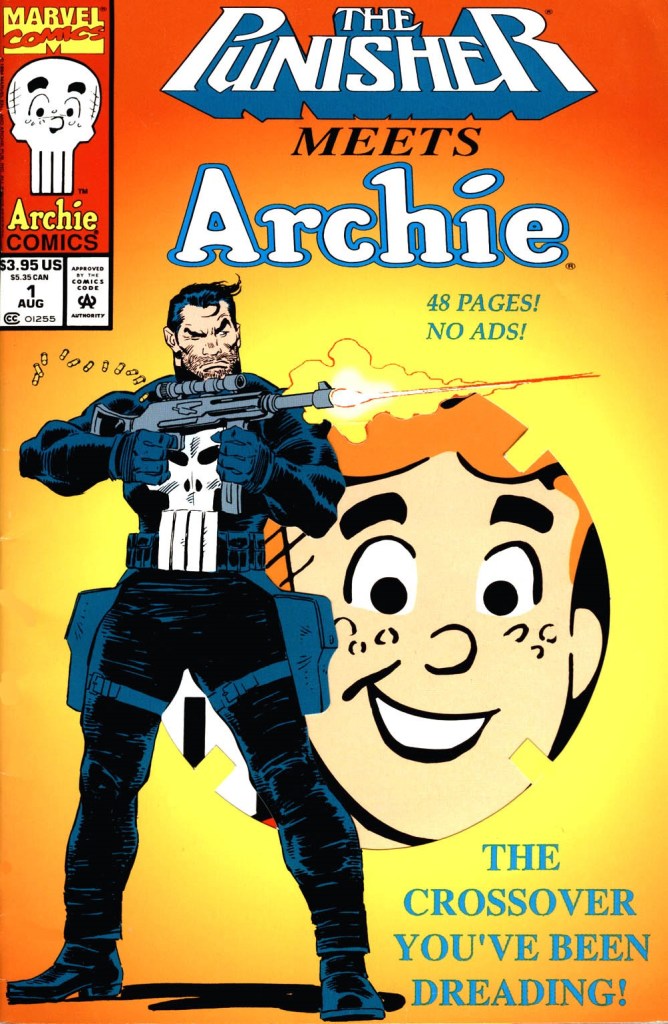
The cover with a die-cut design.

Early story

The story begins in a city where a man (in a trench coat and a cap) is seen running away from someone chasing him. As he hurriedly climbs over a wall, he hears the chaser’s gun click and responds by firing some bullets at him. The chaser climbs over the wall and he turns out to be Frank Castle, the Punisher. The Punisher notices that his target left his cap on the floor, and look at the nearby station full of people.

Inside the said station, the man who got away from the Punisher has red hair and a sinister looking face. He buys a ticket going to Riverdale.

The next day in the town of Riverdale, Archie Andrews rings the bell of the front door at the luxurious residence of the Lodge family. A little boy named Leroy (cousin of Veronica Lodge) surprises him and makes him wet using a water-filled plastic gun. In response, Archie grabs the hose nearby and unleashes water. He accidentally hits Veronica who got so angry, she decided to cancel her date with him.

Still wet, Archie walks down the sidewalk being followed by a car…

Quality
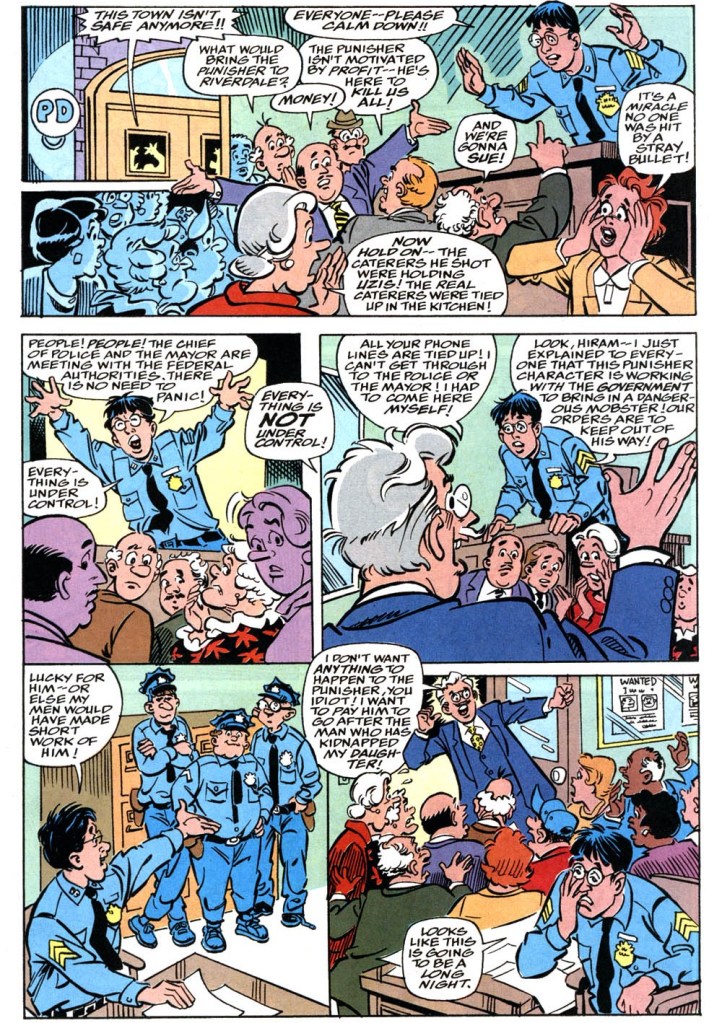
See your favorite Archie characters among them?

I’ll start with the story written by Batton Lash. To be clear, this comic book has a dominant Archie Comics tone meaning it is wholesome and fun, and at the same time never childish. The Punisher-focused scenes showed lots of signs of restraint meaning in order to connect well with the overall wholesome tone of the comic book, adulterated stuff and violent concepts related to the Punisher are absent. For me, having an overall wholesome tone works given the fact that most of the story is set in Riverdale and there are tremendously more Archie characters than there are Marvel characters.

More on the story, the concept by Batton Lash is wonderful and the way the plot was structured not only ensured a fun story but also made sense. The plot itself is pretty believable and the story is full of nice and interesting moments to read. There certainly were no boring scenes at all!

To have Punisher encounter Archie without ever using the now overuses versus-battle-type approach here was believable, sensible and even impressive. For the most part, as reflected in portrayals and dialogue, Lash captured the essence of the Archie characters and anyone who loves stories about Archie and the gang (plus Josie and the Pussycats and Katy Keene) will have a lot to enjoy here. Even the disruption in Riverdale caused by the gang of crooks and the Punisher has that strong Archie-tone and never went overboard.

Punisher, Micro Chip, the local cops and a familiar face from the Riverdale high school’s cafeteria.

With regards to Lash presenting Marvel’s vigilante, the Punisher here is subdued in terms of seriousness. While he is not portrayed to be gritty (note: he’s also less violent), he is still rugged and you will still see him firing guns during the right moments. With the reduction of violent action, Punisher does a lot more detective work and has his companion Microchip with him. While rugged, the Punisher is not as snobbish as one might think here. In fact, there are a few pleasant surprise moments in the story with regards to his encountering certain supporting characters of Archie. These moments, although they make Punished look like he’s out of character, I still find pretty delightful.

More on the characters, there is a whole bunch of them here! As the story is set in Riverdale, it comes to no surprise that supporting characters of Archie Comics are present and for the most part they were presented to delight those who love Archie and the gang. Mr. Weatherbee, Mr. Lodge, Reggie Mantle, Betty Cooper, Jughead Jones, Pop Tate, Svenson, Ms. Grundy, Professor Flutesnoot and others are here and they don’t just make mere appearances.  

As this is a special project between Marvel Comics and Archie Comics, there is a lot of fan service here and there leaning towards the interests of Archie fans. For the most part, these fan service elements (note: there are some from Marvel Comics) were actually fun to look at and I personally did not find them distracting.

Conclusion

Punisher and Micro Chip explore Riverdale as Jughead and Archie are in Pop’s place.

While it is essentially an Archie comic book in terms of storytelling and visuals and lacks the kind of adulterated stuff that Punisher fans love, The Punisher Meets Archie #1 (1994) is still a very enjoyable crossover to read, and it sure is fun from start to finish. For one thing, the concept about Archie meeting with Punisher with Riverdale as the main setting works wonderfully even by today’s standards. What was an unbelievable concept got executed nicely into a believable and fun product. I should state that this kind of intercompany crossover comic book is still one-of-a-kind and its literary value (as opposed to financial value) is undeniably high. No doubt about, this crossover is a comic book classic!

If you are seriously planning to buy an existing hard copy of The Punisher Meets Archie #1 (1994), be aware that as of this writing, MileHighComics.com shows that the near-mint copy of the regular edition costs $53 while the near-mint copies of the deluxe newsstand edition and the direct edition cost $105 and $70 respectively.

If you prefer the Archie Comics-published version – Archie Meets The Punisher #1 (1994) – be aware that the near-mint copy of the comic book costs $70 according to Mile High Comics as of this writing.
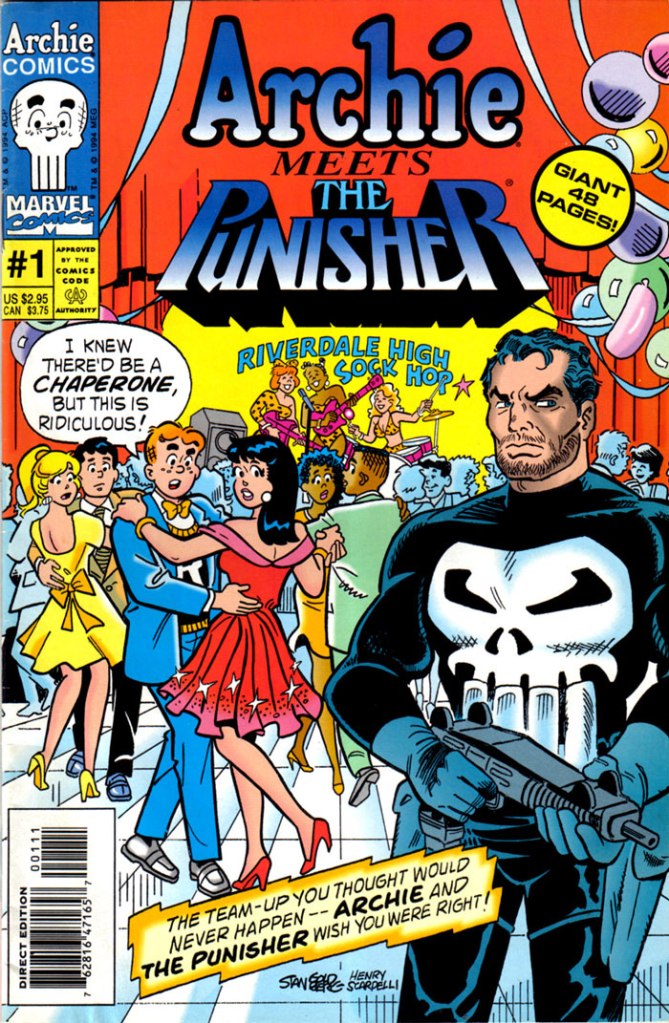
The cover of the Archie Comics-published version of the same crossover. This one is more eye-catching than that of the Marvel version.

Overall, The Punisher Meets Archie #1 (1994) is highly recommended!

+++++

Thank you for reading. If you find this article engaging, please click the like button below and also please consider sharing this article to others. If you are looking for a copywriter to create content for your special project or business, check out my services and my portfolio. Feel free to contact me as well. Also please feel free to visit my Facebook page Author Carlo Carrasco and follow me at HavenorFantasy@twitter.com
A Look Back at Fatale #1 (1996)

Disclaimer: This is my original work with details sourced from reading the comic book and doing personal research. Anyone who wants to use this article, in part or in whole, needs to secure first my permission and agree to cite me as the source and author. Let it be known that any unauthorized use of this article will constrain the author to pursue the remedies under R.A. No. 8293, the Revised Penal Code, and/or all applicable legal actions under the laws of the Philippines.

Before I start this retro comic book review, if you are a fan of comic book veteran Jim Shooter or if you are interested in his past works, check out my reviews of Warriors of Plasm issues #1, #2 and #3.

Have you ever heard about Broadway Comics? That was a short-lived comic book publisher that was established by Jim Shooter (former editor-in-chief of Marvel Comics and Valiant Comics) in the mid-1990s not so long after the closure of Defiant Comics (a certain lawsuit filed by Marvel Comics drained the company’s funds by means of legal fees). Broadway Comics published a few properties and among them is Fatale which was actually a spin-off of the company’s main series Powers That Be.

Fatale was not just another new project to help a new publisher make a splash in what was back then a lucrative comic book market. There was some inspiration from it as Shooter confirmed in his message in Fatale’s debut issue.

“As we developed Fatale, each person in our group recalled the strong women in their lives,” Shooter recalled.

“I told about my grandmothers, both whose husbands died young, both of whom raised their children alone, struggled and worked into their late eighties. Usually, there were no good jobs to be had (by women), but both did whatever they could, including dishwashing, door-to-door sales, and cleaning hotel rooms. They persevered against all odds, heroically. They taught me that self-reliance and honest work of any kind are the foundation of self-respect,” he added.

With those details laid down, here is a look back at Fatale #1, published by Broadway Comics in 1996 with a story written by Jim Shooter, Janet Jackson, Joseph A. James and Pauline Weiss with art done by J.G. Jones.

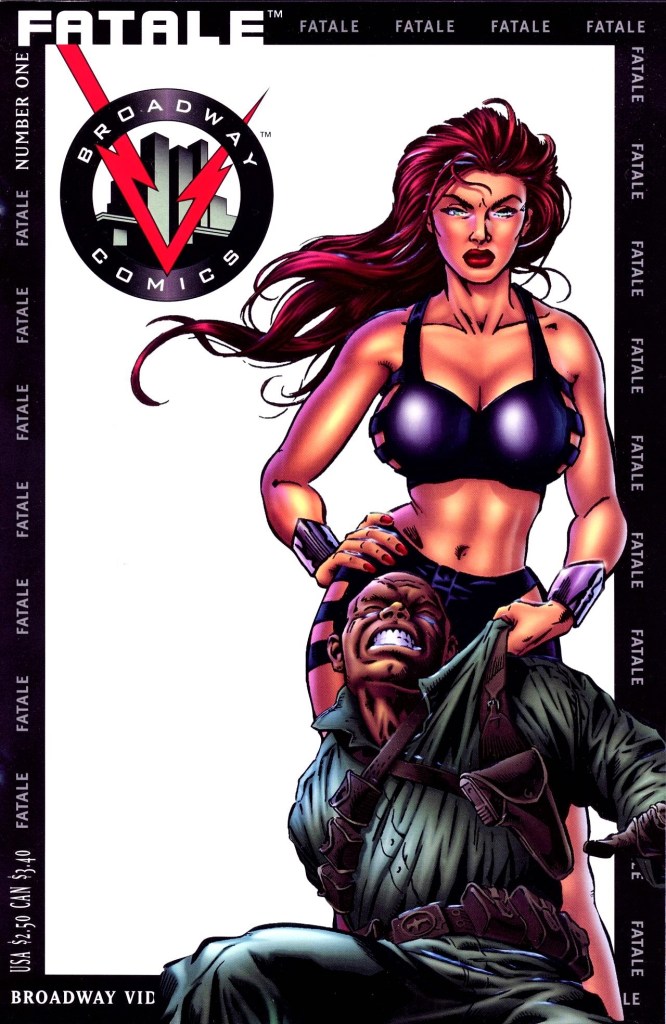
The cover.

Early story

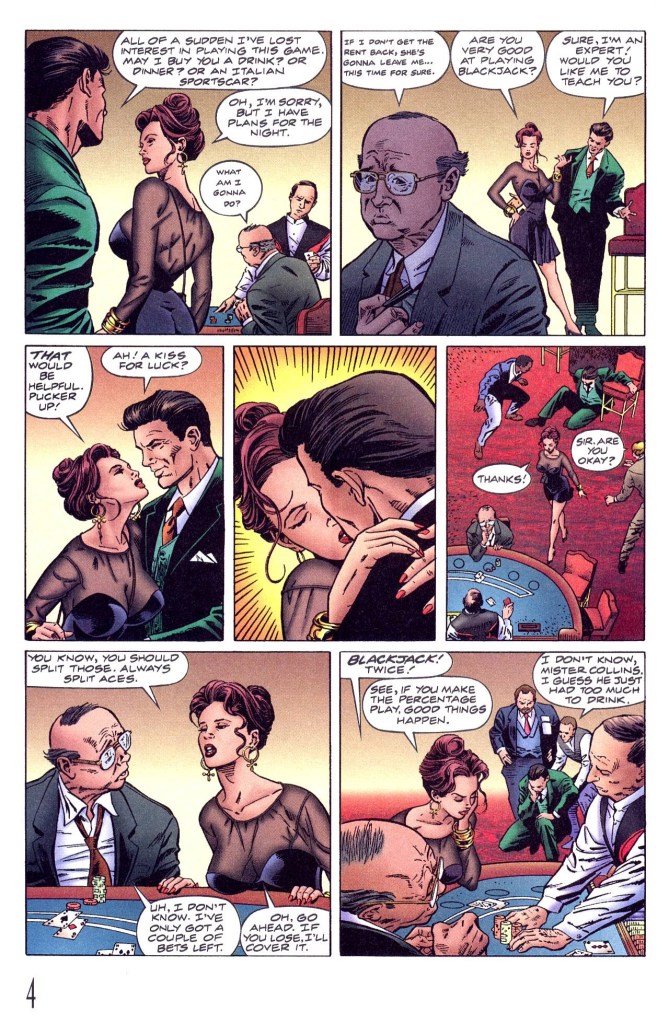
The story begins inside a casino in Atlantic City, New Jersey in September 1995. A very pretty lady walks down and attracts the attention of a few people. Her name is Desiree Hopewell and it turns out she is a gambler and she thinks luck will come to her that night. Just as she makes positive impact on a struggling gambler and starts socializing with a guy who is so attracted to her, a group of men wearing gloves and masks appeared which compels Desiree leave. She happens to be their target.

Just after exiting the casino, Desiree suddenly finds herself completely surrounded by armed people composed of those carrying shields and weapons. Even as a blast blanket successfully landed on her, Desiree finds a way to tear through it causing the armed personnel to use a drum lift on her.

Even so, Desiree continues to be hard for them to restrain and manages to move away from them…

Quality

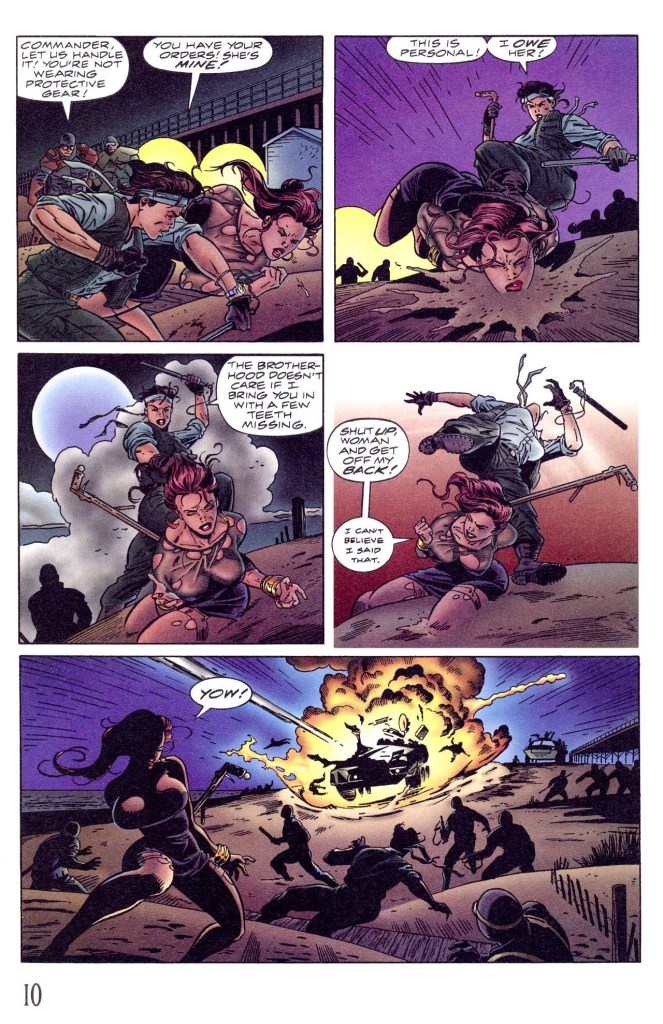
Desiree gets a break as the Brotherhood got attacked.

To start with, this comic book has a really intriguing plot laced with twists. Essentially this is the story of Desiree who is a very unusual lady with the ability to absorb something from men she kisses with on their lips (the Fatale thing). More than that, she is caught in the middle of a conflict between the Brotherhood and the Utah Faction, and she is allied with a few people trying to evade the two conflicting groups.

While the very nature of the conflict was not fully emphasized in this launch issue, Jim Shooter and his co-writers successfully defined Desiree’s nature clearly as well as her association with a man named Bill (a former Brotherhood member). That being said, this comic book is character-focused and it went to great lengths to connect readers with Desiree and the supporting cast.

When it comes to spectacle, there is a lot to enjoy here. On face value, Desiree’s uncanny ability evade the Brotherhood’s attempt to capture her was presented with superhero-inspired spectacle but never reaching the point of defining her as a superhero-type of protagonist.

Conclusion

Desiree the attraction and seasoned gambler.

Fatale #1 (1996) is a rather unusual comic book that has some literary stuff to sell to superhero enthusiasts, and at the same time it has a protagonist who supposedly got presented as a strong-willed figure for women (while showing her personal interests and views that were supposed to be relatable to women). Within the pages of this comic book, Desiree is glamorous and attractive visually. Apart from helping a lady by physically stopping the man troubling her, Desiree has not done anything genuinely heroic and is truly more of an attraction of trouble makers.

As far as storytelling goes, you have a conflict between two groups and Desiree is a target for a reason that was not clearly defined (note: saving the answers for later issues obviously). While Bill is an interesting supporting character, the others are just not too interesting. If you are looking for intrigue, entertainment and mystery, you will find some of those here.

If you are seriously planning to buy an existing hard copy of Fatale #1 (1996), be aware that as of this writing, MileHighComics.com shows that the near-mint copy of the regular edition costs $79 while the near-mint copies of the black-and-white Jim Shooter-signed edition, the black-and-white promo edition, and the Jim Shooter-signed edition cost $79, $53 and $70 respectively.

Overall, Fatale #1 (1996) is satisfactory.

+++++

Thank you for reading. If you find this article engaging, please click the like button below and also please consider sharing this article to others. If you are looking for a copywriter to create content for your special project or business, check out my services and my portfolio. Feel free to contact me as well. Also please feel free to visit my Facebook page Author Carlo Carrasco and follow me at HavenorFantasy@twitter.com
A Look Back at Shogun Warriors #1 (1979)

Disclaimer: This is my original work with details sourced from reading the comic book and doing personal research. Anyone who wants to use this article, in part or in whole, needs to secure first my permission and agree to cite me as the source and author. Let it be known that any unauthorized use of this article will constrain the author to pursue the remedies under R.A. No. 8293, the Revised Penal Code, and/or all applicable legal actions under the laws of the Philippines.

If you are fond of giant robots from Japanese pop culture as well as giant monsters and scenes of city structures getting destroyed, then you might want to take a look at the Shogun Warriors comic book series that was published by Marvel Comics from 1979 to 1980. To put things in perspective, Shogun Warriors was made possible through licensing deals and back in the 1970s, Marvel Comics had the rights to publish comic book about Japan’s famous icon Godzilla.

Specifically, Shogun Warriors involved Marvel Comics and Mattel which in turn organized a line of imported toys from Japan based on varied Japanese shows about giant robots. Among the many giant robots of the toy line, the robots Raideen, Combattler V and Dangard Ace became the featured fighting-for-good robots of the Shogun Warriors comic book series. For the literary works, Raideen was renamed as Raydeen while Combattler V was renamed as Combatra. Dangard Ace’s name was left unchanged.

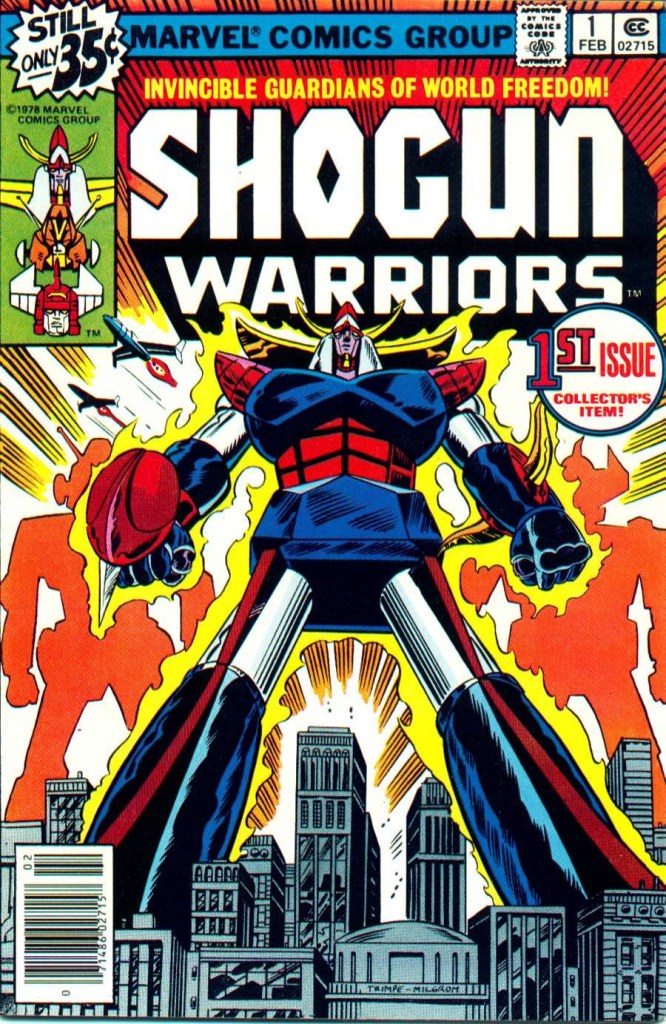
With those details laid down, here is a look back at Shogun Warriors #1, published in 1979 by Marvel Comics with a story written by Doug Moench and drawn by Herb Trimpe.

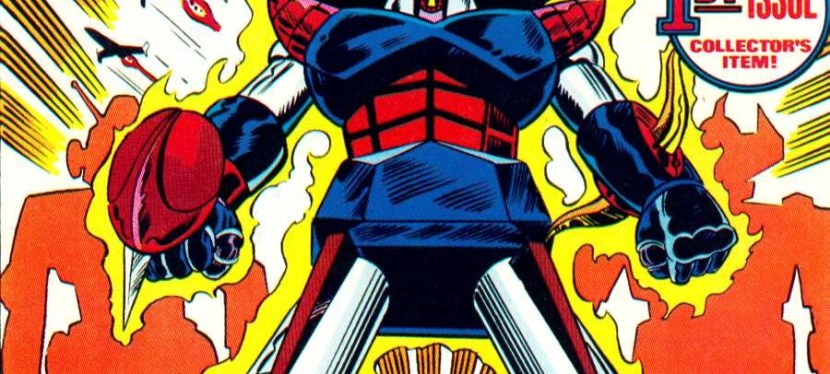
The cover.

Early story

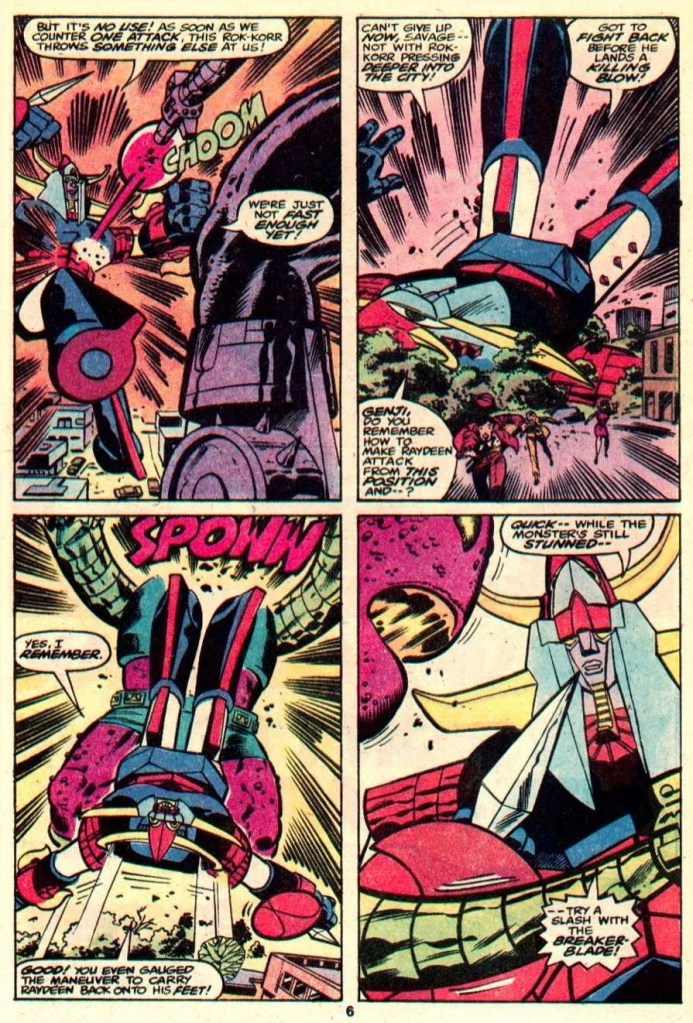
The story begins in the outskirts of Tokyo in Japan where giant robot Raydeen fights a large, tentacled creature enhanced with cybernetics. As the people on the street below them run away from the ongoing destruction, the monster fires a shot at Raydeen who blocks it but subsequently gets tied with one of the tentacles. The giant robot, which is operated by three pilots inside, breaks free and continues to fight the monster.

As the battle rages on, the city continues to get damaged heavily affecting the people…

Quality

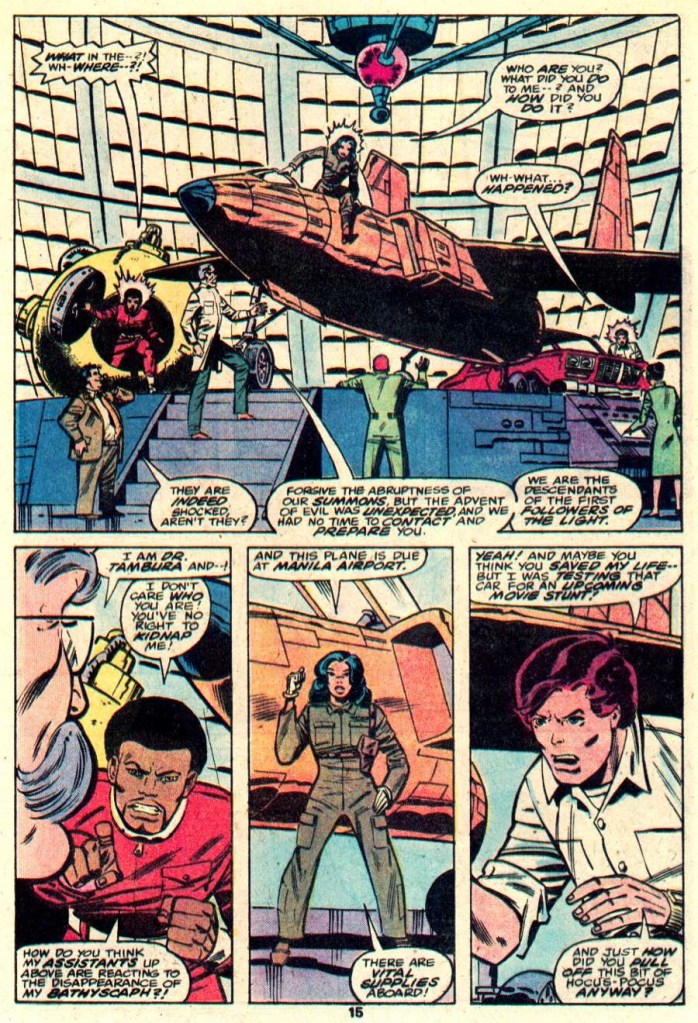
Technically the organization kidnapped three people to be the pilots of their robots for Earth’s defense.

Having seen a lot of anime TV series episodes about giant robots, I’m familiar already with the storytelling formula that often focuses first on the human characters and their struggles before shifting the narrative on the giant robots that often fight large monsters or opposition robots. This particular comic book has some of that but the way the story is structured, it is different and can be a bit jarring.

Doug Moench structured the story to have Raydeen and the monster fighting in the present time followed shortly by a flashback that took place just hours prior. The flashback, which occupies 9 of the comic book’s 18 pages, is heavily filled with exposition meant to introduce readers to the three pilots Genji Odashu/Ilongo Savage/Richard Carson, what Earth defense force The Followers of the Light is, and why there are giant monsters ravaging the world. The exposition’s writing felt crammed and rushed for reading although it still succeeds in establishing the comic book’s grand concept.

When it comes to spectacle, this comic book is loaded with giant robot action and it is quite varied in style and execution. The funny thing is that you will only get to see Raydeen in action as this is an introductory story with only 18 pages of story.

The dialogue is a bit of a mess here, particularly with the early Raydeen scenes. As the battle with the monster goes on, there are these lines of dialogue reflecting the conversations between the pilots inside Raydeen who are not shown talking until late in the comic book.

Conclusion

Raydeen and the giant monster in battle.

Shogun Warriors #1 (1979) has a nice concept and its Westernized take on portraying giant robots and human characters is clearly different from the way things were done in the varied giant robot anime TV series of Japan. There is clearly no Japanese style melodrama as this one has its characters portrayed straight with a touch of American science fiction. That being said, do not expect to see the Japan-made characters of Raideen, Combattler V and Dangard Ace appear here as new characters were made in their place. The comic book’s story structure is a bit jarring to follow and the heavy exposition dump makes reading a bit of a chore. It is fun to read but not great. Those of who are fans of Combatra and Dangard Ace will be disappointed about the near-total absence of those robots.

If you are seriously planning to buy an existing hard copy of Shogun Warriors #1 (1979), be aware that as of this writing, MileHighComics.com shows that the near-mint copy of the regular edition costs $63 while the near-mint copy of the Whitman edition costs $35.

Overall, Shogun Warriors #1 (1979) is satisfactory.

+++++

Thank you for reading. If you find this article engaging, please click the like button below and also please consider sharing this article to others. If you are looking for a copywriter to create content for your special project or business, check out my services and my portfolio. Feel free to contact me as well. Also please feel free to visit my Facebook page Author Carlo Carrasco and follow me at HavenorFantasy@twitter.com
A Look Back at Sachs & Violens #1 (1993)

Disclaimer: This is my original work with details sourced from reading the comic book and doing personal research. Anyone who wants to use this article, in part or in whole, needs to secure first my permission and agree to cite me as the source and author. Let it be known that any unauthorized use of this article will constrain the author to pursue the remedies under R.A. No. 8293, the Revised Penal Code, and/or all applicable legal actions under the laws of the Philippines.

Back in the early 1990s, I was fortunate enough to buy and read The Incredible Hulk: Future Imperfect issues #1 and #2. While each book was pretty expensive, it was all worth it because its literary and artistic content were great to read thanks to the very dynamic creative duo of Peter David and artist George Perez.

To see Future Imperfect’s story by David illustrated greatly by Perez was a magnificent read from start to finish. In 2014, Peter David confirmed that George Perez was his “single favorite artistic collaborator” and when asked as to which artists have come closest to matching the visuals he imagined while writing a comic book script, the author mentioned Perez as one of three artists to do so.

The David-Perez duo’s work together in the 1990s did not necessarily end with Future Imperfect. In fact, they took the challenge of doing an all original, adulterated, non-superhero project published through Epic Comics (Marvel Comics’ imprint that published creator-owned projects not connected with Marvel’s superhero universe) in the form of a 4-issue mini-series titled Sachs & Violens (the title itself is a play on the words “sex and violence”). Back in the 1990s, I completely missed out on that mini-series. It was only recently I finally got to start reading it.

With those details laid down, here is a look back at Sachs & Violens #1, published by Epic Comics in 1993 with a story written by Peter David and drawn by George Perez.

The cover.

Early story

The story begins in the bedroom deep within the city of New York. A pretty lady arrives, takes off her undergarment and high heels and approaches a smoking man on the bed. As they start making love with each other, a shadowy figure with a bladed weapon approaches them slowly. As the lady notices something going on, a powerful strike happens spreading blood around.

Suddenly, someone yells “Cut!” The lights got turned on and it turns out what happened was a night-time photographic session in which the director expresses his disappointment over what happened.

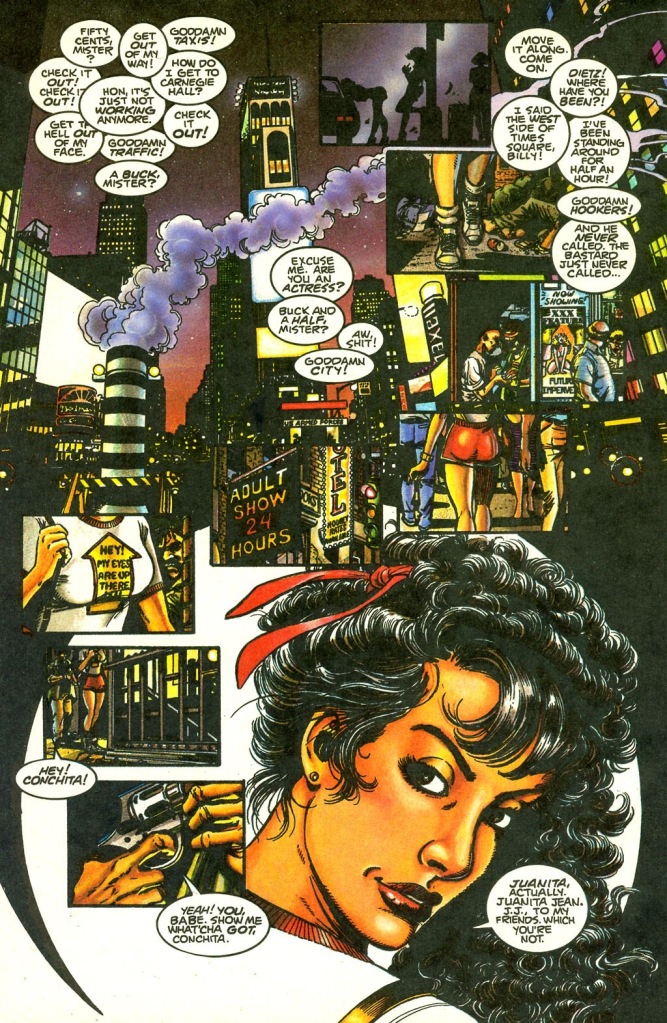
Elsewhere, life in the city goes on during the night. The traffic is frustrating some people. Prostitutes on the sidewalk are doing what they can to attract potential customers. Night clubc and sex shows are rampant. Among the many people walking is a pretty lady named Juanita Jean (nicknamed J.J.) who attracts the attention of a man armed with a gun. In response to his move on her, J.J. fights back by hitting his right wrist, kicking him on the groin and his chin, and knocking him out. Afterwards, she arrives at a photo studio apologizing to the photographer (Violens) for her lateness.

After some talking, J.J. proceeds to change into very erotic attire and posed sexy in front of the camera…

Quality

J.J. Sachs at the police station.

I can start by saying that this comic book is one of the most unusual works I have ever read from either Peter David or George Perez, and it’s more than just its non-superhero concept and presentation.

Starting with the visuals, this is one of the more unique works of George Perez and it surely is a fresh change after seeing so many of his superhero-related comic book works (especially the post-Crisis Wonder Woman). The usual elements of Perez’s art are here: pages with multiple panels, high detail maintained throughout even in images full of people and location stuff, beautiful looking women and the like. As this is an adulterated comic book, the level of visual eroticism got ramped up high although there were clear signs of restraint.   

With regards to the quality of the writing, this is a very adulterated tale about murder and a series of unfortunate events that disturb the public and, incidentally, motivate J.J. Sachs (a softcore porn model) and Ernie Violens (a former Vietnam War veteran working presently as a photographer) to take action. The pacing of the story is decent with lots of build-up dominating the comic book. The dialogue is witty and the main characters really have their own unique patterns of verbal expression. While the script has passionate work written all over, it is not exactly an entertaining read for me. In fact, I find the tale rather sadistic and not even its elements of intrigue and twists could engage me. This is definitely not the comic book you want to read for fun.

Conclusion

Sachs’ introduction.

Even though it has great visuals and a script written passionately (note: Peter David even wrote his opinion about sex and violence in the comic book), I am actually turned off by Sachs & Violens #1 (1993). Other than being made with adults in mind, its really a story of murder that sets off events sparking the protagonists to do something rebellious in nature. While there is indeed an antagonist, the distinction between good and evil remains unconvincing in the story. I can say that die hard fans of Peter David and George Perez will find this comic book more appealing, and there is a good chance that readers seeking material with sex and violence will enjoy it. I personally did not enjoy this one.

If you are seriously planning to buy an existing hard copy of Sachs & Violens #1 (1993), be aware that as of this writing, MileHighComics.com shows that the near-mint copy of the regular edition costs $18 while the near-mint copies of the limited edition, the platinum edition and the signed platinum edition cost $105, $70 and $140 respectively.

Overall, Sachs & Violens #1 (1993) is not recommended.

+++++

Thank you for reading. If you find this article engaging, please click the like button below and also please consider sharing this article to others. If you are looking for a copywriter to create content for your special project or business, check out my services and my portfolio. Feel free to contact me as well. Also please feel free to visit my Facebook page Author Carlo Carrasco and follow me at HavenorFantasy@twitter.com
A Look Back at Ravage 2099 #8 (1993)

Disclaimer: This is my original work with details sourced from reading the comic book and doing personal research. Anyone who wants to use this article, in part or in whole, needs to secure first my permission and agree to cite me as the source and author. Let it be known that any unauthorized use of this article will constrain the author to pursue the remedies under R.A. No. 8293, the Revised Penal Code, and/or all applicable legal actions under the laws of the Philippines.

Welcome back, superhero enthusiasts, comic book collectors and fans of Marvel. Today we revisit the original 2099 universe that Marvel Comics launched in the 1990s. We go back to the said universe through the eyes of Ravage 2099, the original 2099 character co-created by the late Stan Lee and artist Paul Ryan.

Before proceeding with my next retro comic book review of Ravage 2099, I want to stress that there was a time when the late Steve Ditko nearly launched Ravage 2099 with Stan Lee. For the newcomers reading this, Steve Ditko and Stan Lee are recognized for co-creating the iconic Spider-Man and to even imagine the two creators almost getting involved with the 2099 universe’s original hero is intriguing.

Marvel tried to get Ditko to work with Lee on Ravage 2099 early on. Then Marvel Comic editor-in-chief Tom DeFalco revealed that, on behalf of Lee, he called Steve Ditko who eventually attended a meeting which reunited them. After having a terrific discussion with Lee, Ditko cordially turned down the project. DeFalco stated that Ditko just did not agree with some of the philosophical underpinnings.

“Steve walked away, and I could tell he was really thrilled to have seen Stan,” DeFalco added.

With that short history over, here is a look back at Ravage 2099 #8, published in 1993 by Marvel Comics plotted by Stan Lee, scripted by Pat Mills and Tony Skinner and drawn by Gran Miehm. This was Stan Lee’s final work of writing a Marvel 2099 story.

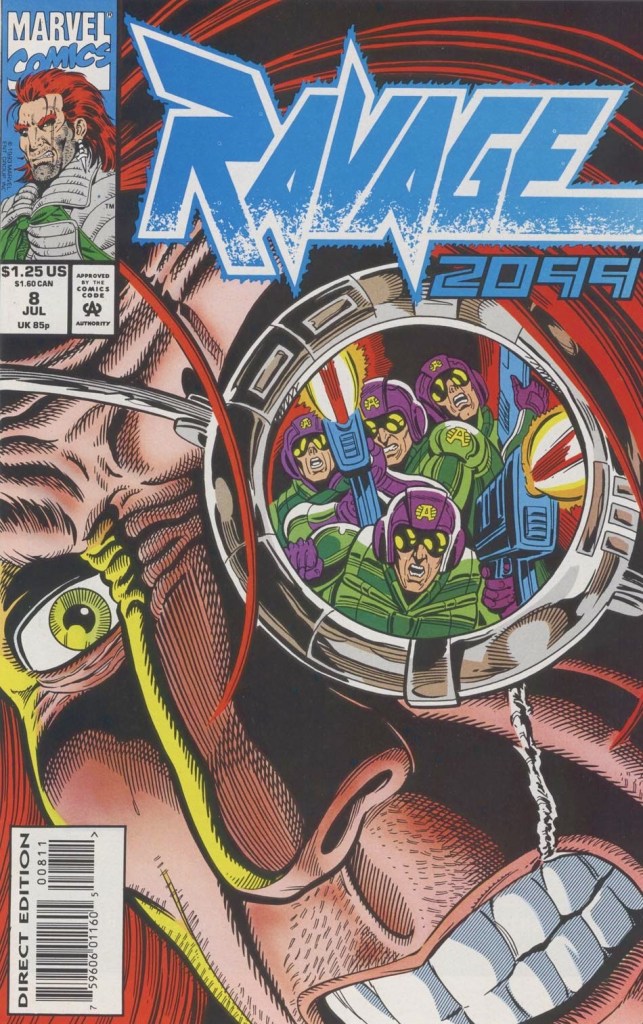
The cover.

Early story

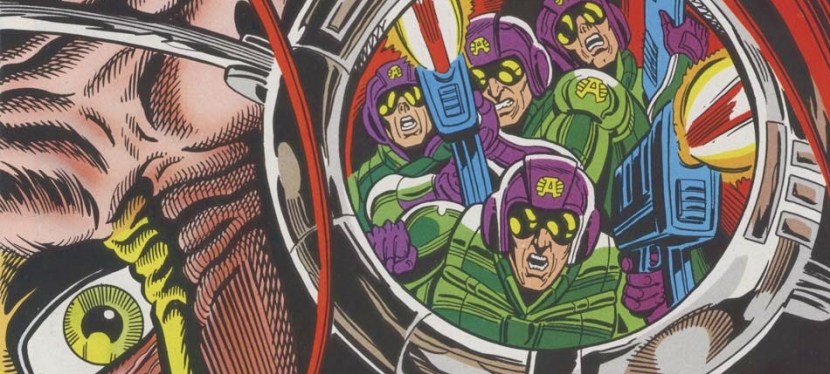
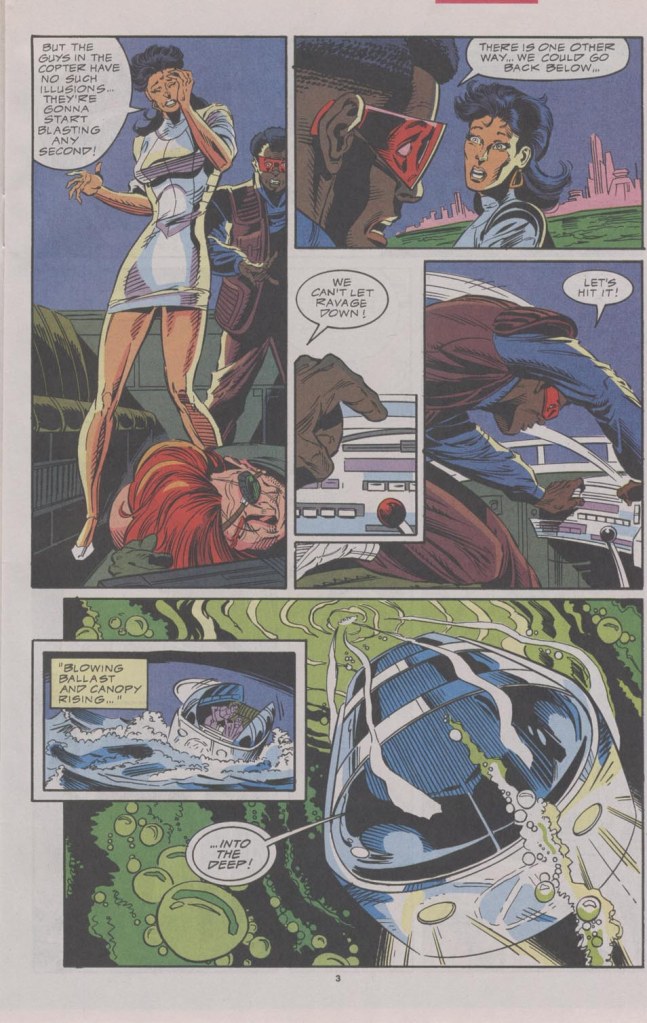
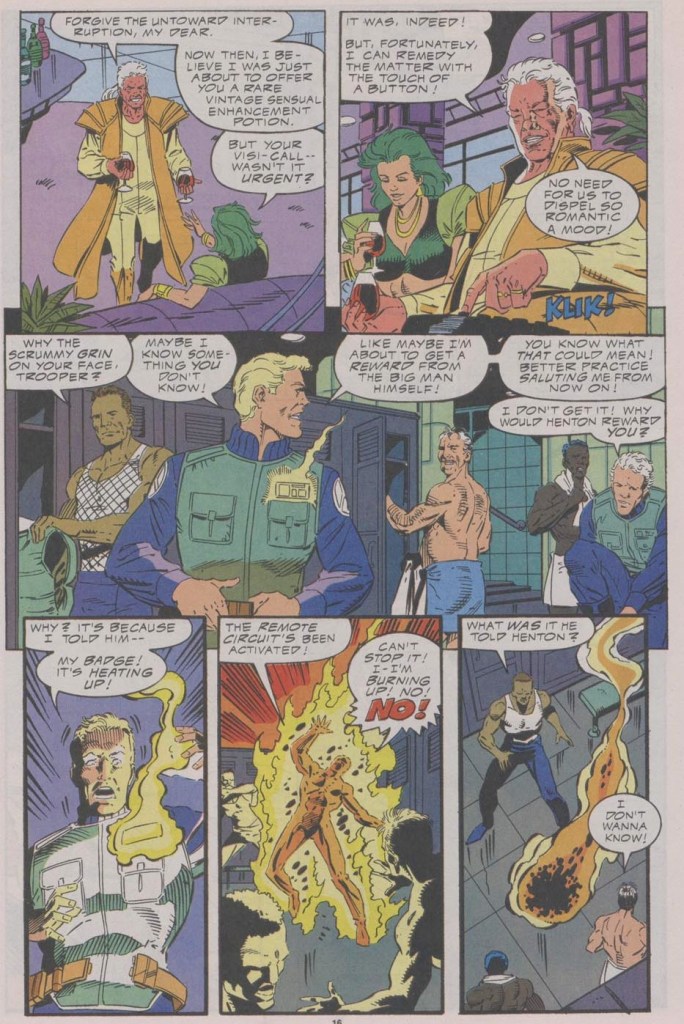
The story begins with a weakened Ravage, Tiana and Dack already in trouble as a Public Eye battle copter approaches them. The three just escaped from an underwater city using an old vehicle from the Fantastic Four. While Tiana expressed that there is no way they could outfight or outfly Public Eye, Dack reminds her that Ravage is their only hope and because of him, they got away from the aquatic beings and survived.

Dack then send their vehicle (which instantly blew ballast and raised a canopy) under water to escape from Public Eye. The effort was futile as the battle copter captures their vehicle and pulls it out of the water using a magnetic beam.

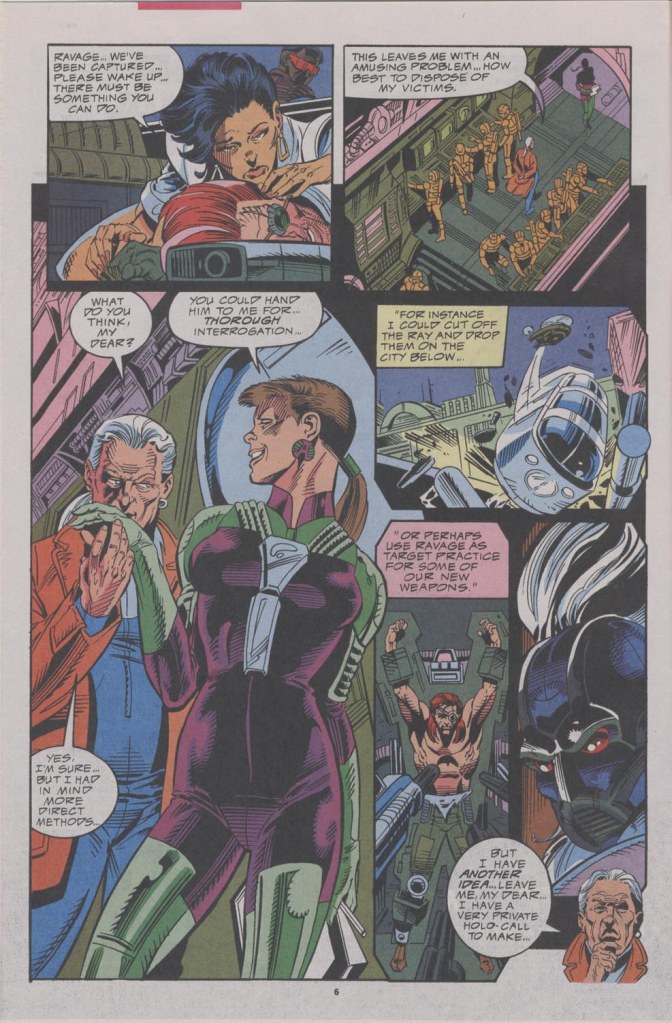
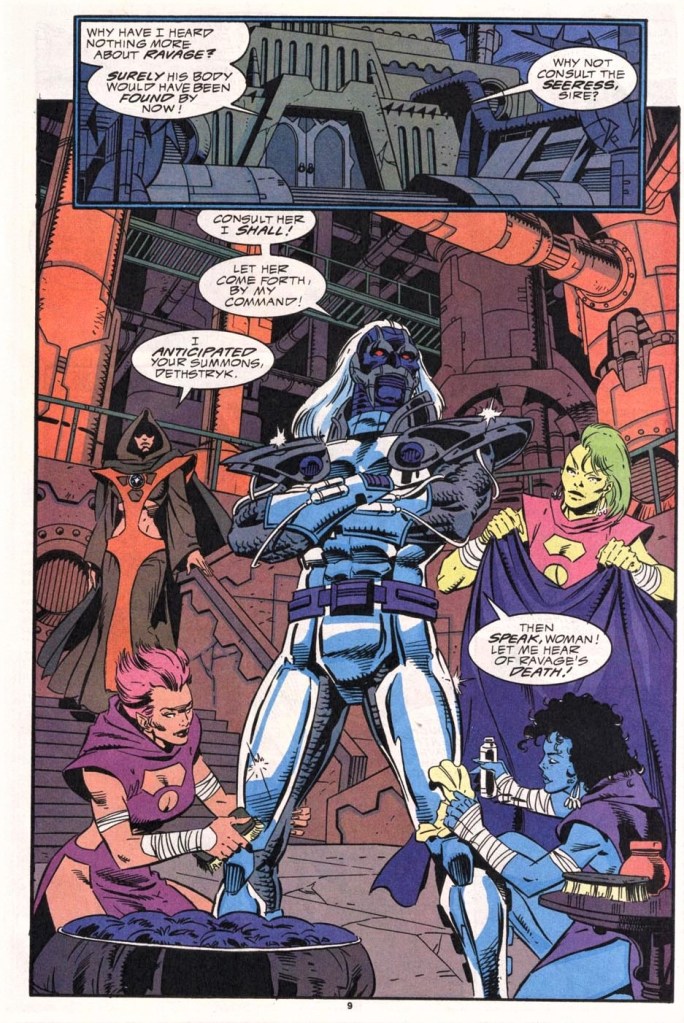
Knowing this development, Anderthorp Henton makes a confidential holo-call with Dethstryk and tells him that Ravage is in his possession. Henton also states that he intends to kill Ravage. Dethstryk demands Henton to deliver Ravage to him, insisting that it should be he who should kill him.

While captured in transit, Ravage struggles to write his instruction to his companions to take his gloves off…

Quality

Henton and his team with Ravage and his companions captured.

Finally, after going through the first seven issues that resulted unsatisfying plots, recycling of character elements and forcibly stretching the narrative, this particular issue has a story that combines doubtful heroism with a believable objective. Of course, it should be noted that Stan Lee provided the plot while leaving the scripting and pacing to two other writers who eventually took over the writing duties of Ravage 2099.

There were some improvements to the quality of the dialogue and narration (by Ravage). This comic book’s story was paced decently and there was not a single moment of stretching the narrative unrealistically. By this stage of the series, Ravage’s status as a heroic figure improved once again as he was given a purpose to fulfill. While we have seen him help Tiana or Dack escape from the bad guys, this story has him being more strategic and more determined to really solve a mystery while overcoming opposition.

Henton in this story, fortunately, is not a repeat of his cruel, cold-hearted self from the previous issues. This story reveals his link with Dethstryk and new insight as to who or what really controls Alchemax and its top officials. As such, there were some unexpected elements that transpired in the story.

Visually, Gran Miehm provided decent art and for the most part, Ravage and the other characters remained recognizable although I notice Dack looking more like a young adult than the teenager he really is.

Conclusion

Dack makes a move to help them get away.

Ravage 2099 #8 (1993) was Stan Lee’s last work with this particular series of the 2099 universe and thanks to the new writers who took scripting duties, this one has a satisfying story, higher quality dialogue and a more focused narrative. In retrospect, it was already too little and too late to salvage the Ravage 2099 series due to the inconsistent and overall weak storytelling that dominated the first seven issues.

If you are seriously planning to buy an existing hard copy of Ravage 2099 #8 (1993), be aware that as of this writing, MileHighComics.com shows that the near-mint copy of the regular edition costs $14 while the near-mint copy of the newsstand edition costs $42.

Overall, Ravage 2099 #8 (1993) is satisfactory.

+++++

Thank you for reading. If you find this article engaging, please click the like button below and also please consider sharing this article to others. If you are looking for a copywriter to create content for your special project or business, check out my services and my portfolio. Feel free to contact me as well. Also please feel free to visit my Facebook page Author Carlo Carrasco and follow me at HavenorFantasy@twitter.com
A Look Back at X-Men #4 (1992)

Disclaimer: This is my original work with details sourced from reading the comic book and doing personal research. Anyone who wants to use this article, in part or in whole, needs to secure first my permission and agree to cite me as the source and author. Let it be known that any unauthorized use of this article will constrain the author to pursue the remedies under R.A. No. 8293, the Revised Penal Code, and/or all applicable legal actions under the laws of the Philippines.

Welcome back, superhero enthusiasts, comic book collectors and X-Men fans! Previously, I reviewed X-Men #3 (1991) which, at the time of its release, marked the end of the era of Chris Claremont who spearheaded the development and storytelling of the X-Men since the mid-1970s. Along the way, he clashed with X-Men books editor Bob Harras behind the scenes at the headquarters of Marvel Comics which was a factor to his departure. It is notable that Claremont returned to Marvel in 1997 as editorial director.

Going back to 1991, Marvel had Jim Lee as their top-notch talent to sell loads of X-Men comic books to buyers. Inevitably as Claremont departed, Marvel bet big on Lee and supported his move to set a new creative direction for the X-Men.

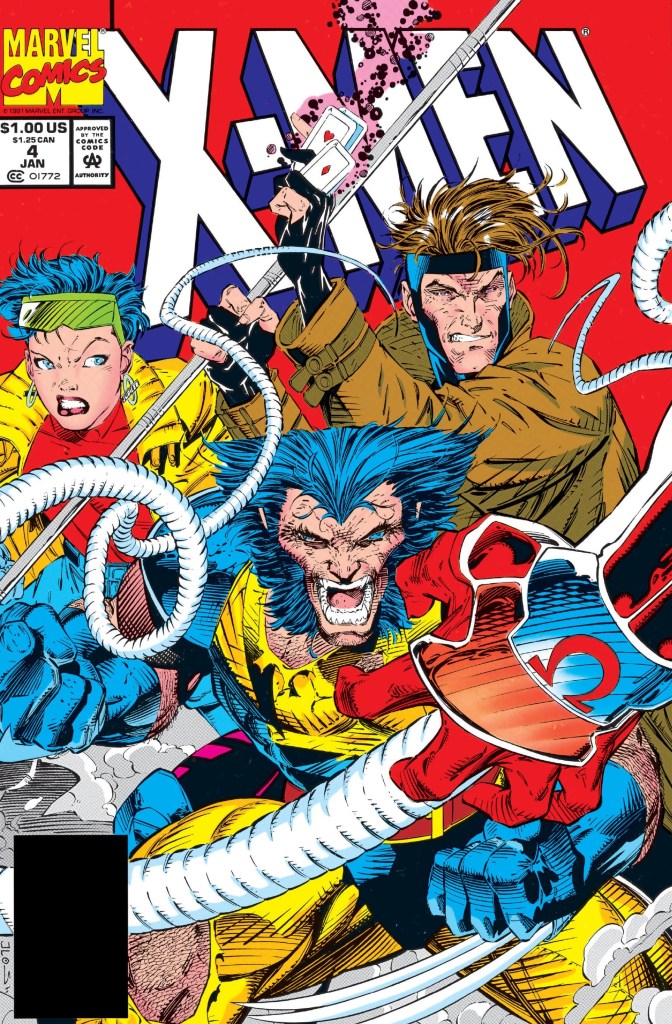
With those details laid down, here is a look back at X-Men #4, published in 1992 by Marvel Comics with a story by Jim Lee and John Byrne. Lee drew the comic book with Scott Williams as the inker.

The cover.

Early story

The story begins in a secret facility in the South Pacific. A sleeping figure wakes up and the men wearing protective suits near him carefully observe his moves. Suddenly, the men died horribly. The figure, with white-colored skin and long blond hair, says, “Who has brought me back from the dark domain of death? Who has summoned Omega Red?”

Behind a protective window, a man starts talking to Omega Red and he shows him a picture of Wolverine (in his civilian identity). Omega Red recognizes Logan…

Quality

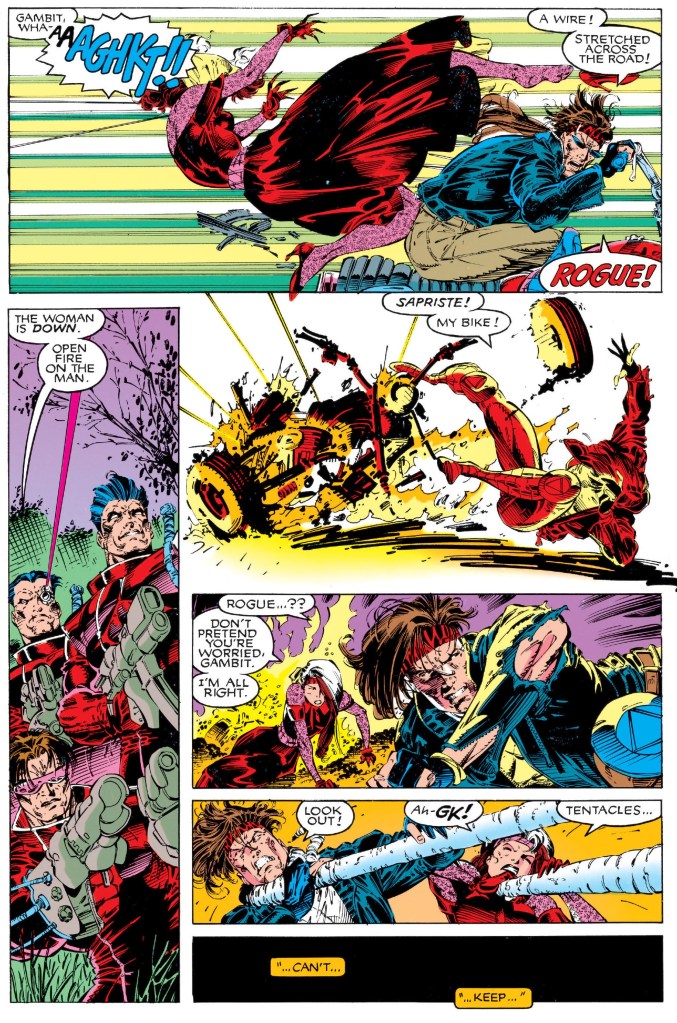
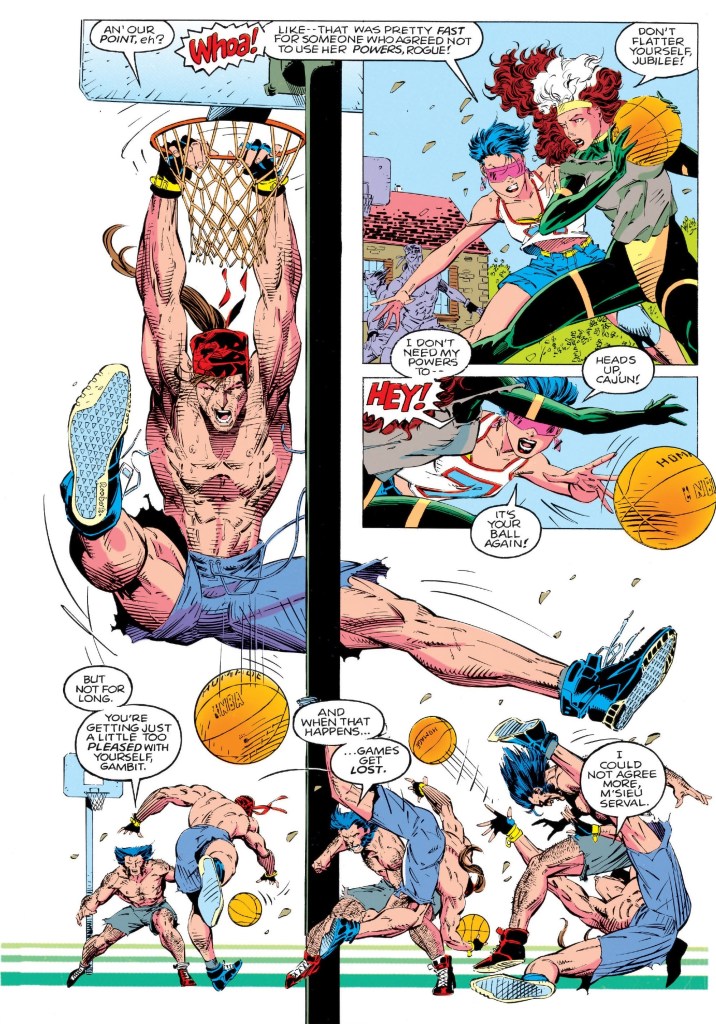
Gambit and Rogue in the heat of action.

Being one of the first X-Men comic books published in the so-called post-Claremont era, this comic book has a solid story and a lively presentation of the X-Men’s Blue Team members. I figured that John Byrne delivered the solid dialogue given his previous experience of working on X-Men comics (as an illustrator) as well as being the writer and artist of the memorable The Man of Steel mini-series (with DC Comics, rebooting Superman in the post-Crisis era).

While the basketball scene had true-to-character portrayals of Wolverine, Gambit, Psylocke and Jubilee complete with stylish dialogue per character, there is consistency on the portrayal of Moira MacTaggert who is understandably struggling to recover given the events of X-Men #1 to #3. The same goes with Charles Xavier. The way the script was written with strong focus on the established characters, it’s almost as if Chris Claremont never left.

The biggest feature of this comic book is the debut of the deadly mutant Omega Red who is of Russian heritage and Russia’s own parallel to the United States’ own super soldier Captain America. In pop culture, Omega Red is one of the top villains in comic books ever and this comic book sets up his sudden rise to prominence. Symbolically, Omega Red is a co-creation of Jim Lee and John Byrne and it is pretty fitting for this comic book of the post-Claremont era to feature him.

Conclusion

You love basketball?

There is no doubt that even by today’s standards, X-Men #4 (1992) is a great read and a landmark issue in X-Men comic book history. Given its content, this one will always be remembered as the start of Omega Red who later on proved to be one of the deadliest villains Marvel’s mutants ever encountered. The villain went on to appear in the video games X-Men: Children of the Atom, Marvel Super Heroes vs. Street Fighter and Marvel vs. Capcom 2.

If you are seriously planning to buy an existing hard copy of X-Men #4 (1992), be aware that as of this writing, MileHighComics.com shows that the near-mint copy of the regular edition costs $125 while the near-mint copy of the newsstand edition costs $375.

Overall, X-Men #4 (1992) is highly recommended!

+++++

Thank you for reading. If you find this article engaging, please click the like button below and also please consider sharing this article to others. If you are looking for a copywriter to create content for your special project or business, check out my services and my portfolio. Feel free to contact me as well. Also please feel free to visit my Facebook page Author Carlo Carrasco and follow me at HavenorFantasy@twitter.com
A Look Back at Ravage 2099 #7 (1993)

Disclaimer: This is my original work with details sourced from reading the comic book and doing personal research. Anyone who wants to use this article, in part or in whole, needs to secure first my permission and agree to cite me as the source and author. Let it be known that any unauthorized use of this article will constrain the author to pursue the remedies under R.A. No. 8293, the Revised Penal Code, and/or all applicable legal actions under the laws of the Philippines.

If there is anything that truly defines the 2099 universe of Marvel Comics, it is the sci-fi element. Science fiction that not only shows one possible future of Marvel’s United States but also how immense futuristic technology is present all around the people who are undoubtedly impacted by it all. Whether it is within the metropolis (think Spider-Man 2099) or in the wilderness (think X-Men 2099), the sci-fi element clearly defines the 2099 universe.

In the middle of it, there was Ravage (co-created by the late Stan Lee and artist Paul Ryan) who went from a corporate executive to a violent rebel. In my last review, Ravage escaped the toxic island and returned to the metropolis only to realize that his pals Dack and Tiana have been captured again.

To find out what happens next, here is a look back at Ravage 2099 #7, published in 1993 by Marvel Comics with a story written by Stan Lee and drawn by Paul Ryan.

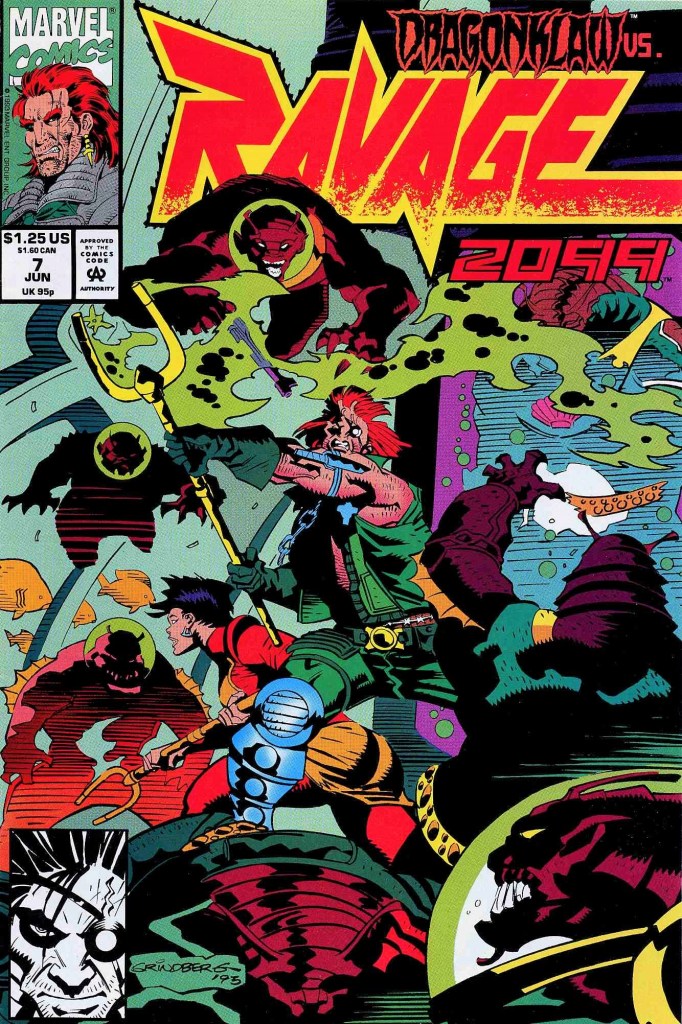
The cover.

Early story

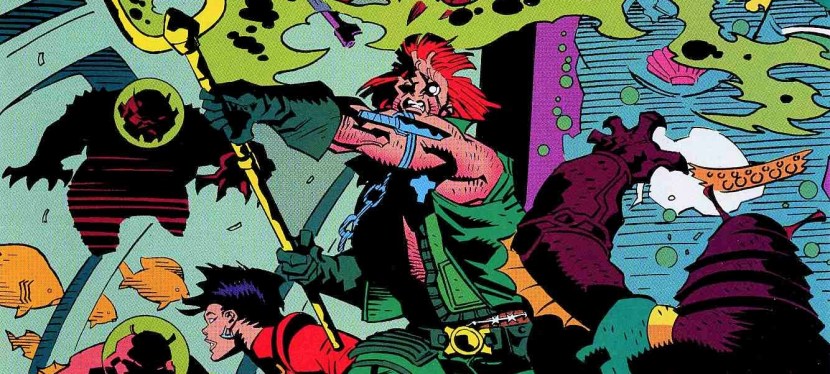
The story begins with Ravage struggling to save Dack and Tiana from different captors, both already separated from each other. Ravage springs into action taking control of the remaining section of the Fantastic Four’s Fantasticar and decides to try to save Dack while facing floating armed personnel. After successfully getting to two armed men hit each other, Ravage chases the flying craft and thanks to his gadget, he is able to hit one of the craft’s personnel.

After a few moments of struggle, Ravage manages to save Dack. He tells the young guy he will drop him off somewhere safe. Dack tells him that he will be blasted on sight by the Public Eye personnel and this convinces Ravage to take him on his dangerous attempt to rescue Tiana from the aquatic invaders…

Quality

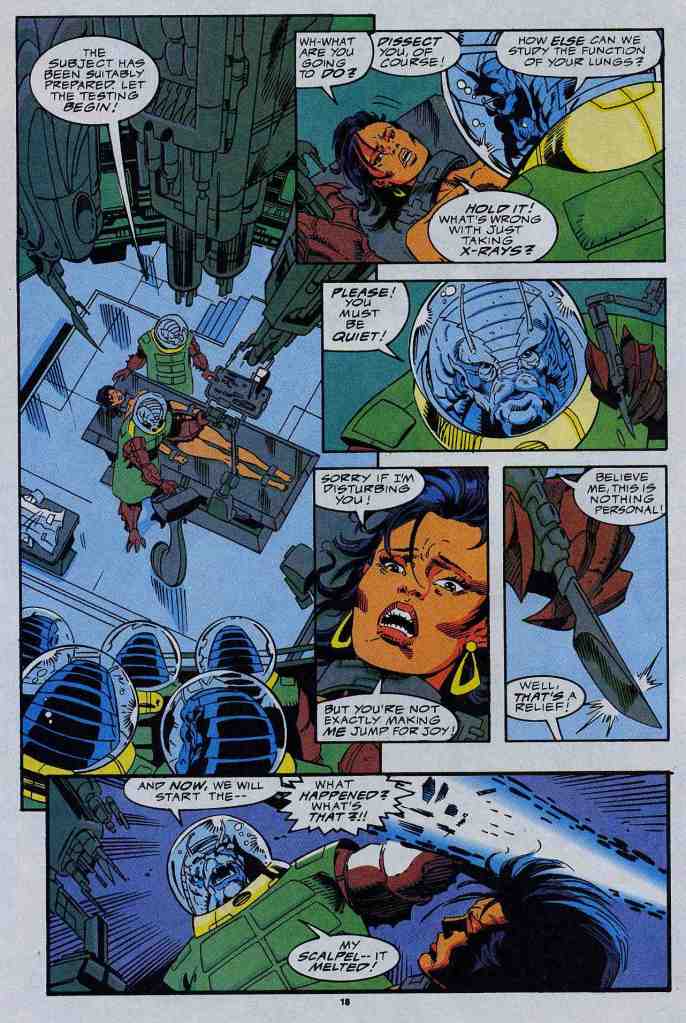
I wonder if the social justice warriors (SJWs), the feminists, the socialists and so-called progressives will find this scene offensive to their feelings and beliefs.

Let me first point out the obvious weaknesses of the script Stan Lee wrote: repetition and lack of creative ideas. Alchemax’s Anderthorp Henton being portrayed as ruthless and evil towards his loyal employees yet again – check. Tiana captured again – check. Dack captured again – check. Anderthorp Henton being nice to ladies – check. Tiana being eroticized visually in a state of helplessness – check. Having these repetitions seem to be Stan Lee’s way of filling the script just to ensure there are 22 pages of story to be made.

In fairness to the late Lee, he did something new for this comic book – revealing the underwater lair of the aquatic invaders and having Ravage and Dack involved. The change of environment made this comic book look and feel refreshing, and this added a lot to the science fiction element of the 2099 universe of Marvel. However, it was all a temporary place to show off Ravage doing something heroic. In terms of storytelling, Lee missed out on the opportunity to emphasize to readers why they intend to invade the surface, why are they obsessed on eliminating the human race, and what is the true value of their planned on experiment on naked Tiana (other than learning how to process oxygen).

Another positive point here is Ravage doing heroic acts at last. It’s all technically a repeat of the title character saving his companions but ultimately it helps this comic book achieve its goal of portraying Ravage as a determined and flawed hero. It definitely is much better than his struggle to survive in the toxic island.

Conclusion

An action-packed chase.

As usual, Ravage 2099 #7 (1993) is another flawed comic book like the previous issues. It has, however, more good stuff than bad stuff. True, the repetition of creative elements hurt it but it still has enough entertainment value to justify a read.

If you are seriously planning to buy an existing hard copy of Ravage 2099 #7 (1993), be aware that as of this writing, MileHighComics.com shows that the near-mint copy of the regular edition costs $8 while the near-mint copy of the newsstand edition costs $26.

Overall, Ravage 2099 #7 (1993) is satisfactory.

+++++

Thank you for reading. If you find this article engaging, please click the like button below and also please consider sharing this article to others. If you are looking for a copywriter to create content for your special project or business, check out my services and my portfolio. Feel free to contact me as well. Also please feel free to visit my Facebook page Author Carlo Carrasco and follow me at HavenorFantasy@twitter.com
A Look Back at Ravage 2099 #6 (1993)

Disclaimer: This is my original work with details sourced from reading the comic book and doing personal research. Anyone who wants to use this article, in part or in whole, needs to secure first my permission and agree to cite me as the source and author. Let it be known that any unauthorized use of this article will constrain the author to pursue the remedies under R.A. No. 8293, the Revised Penal Code, and/or all applicable legal actions under the laws of the Philippines.

Welcome back, superhero enthusiasts, comic book collectors, pop culture geeks and fans of Marvel Comics! Today, we will revisit the 2099 universe that Marvel established in the 1990s through another issue of Ravage 2099 which featured the writing and imagination of the late Stan Lee. Lee wrote the first eight issues of the said series.

For the newcomers reading this, Ravage is a co-creation of Lee and illustrator Paul Ryan. Compared to the other major characters of the 2099 universe of Marvel, Ravage is an all-original character who went from being a corporate executive to a hard-hitting rebel. Last time around, Ravage struggled with his new found power (energy within his fists) while still being hunted by Dethstryk’s thugs.

With those details laid down, here is a look back at Ravage 2099 #6, published by Marvel Comics in 1993 with a story written by Stan Lee and drawn by Paul Ryan.

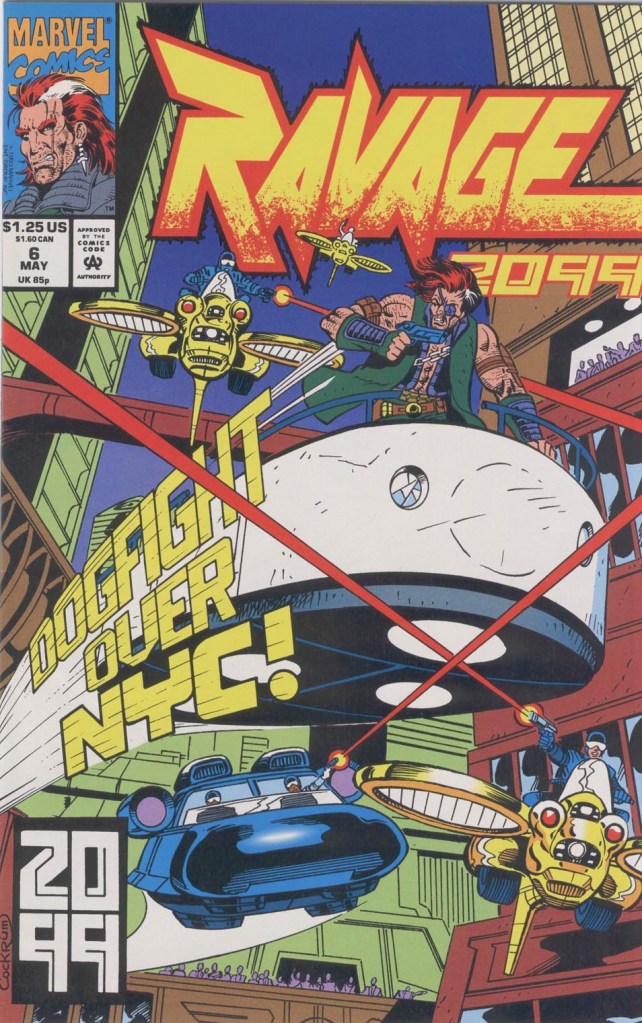
The cover.

Early story

The story begins at a far-away island. Dethstryk’s thugs just attacked Ravage and his native companion in a cave, destroying the interior and causing a cave-in. Believing that Ravage is dead, the last of the thugs left the rubble behind. As it turned out, Ravage is still alive and uses his newfound power to free himself, pushing all the rocks off as if they were like pebbles. He realizes that the more he uses his power, the weaker he gets. Due to his being exposed to the island’s toxic environment, his condition continues to deteriorate. He uses one of the gadgets to aid him in seeing.

After looking around further in the ruined cave, he discovers a relic from the past – the Fantastic Four’s Fantasticar…

Quality

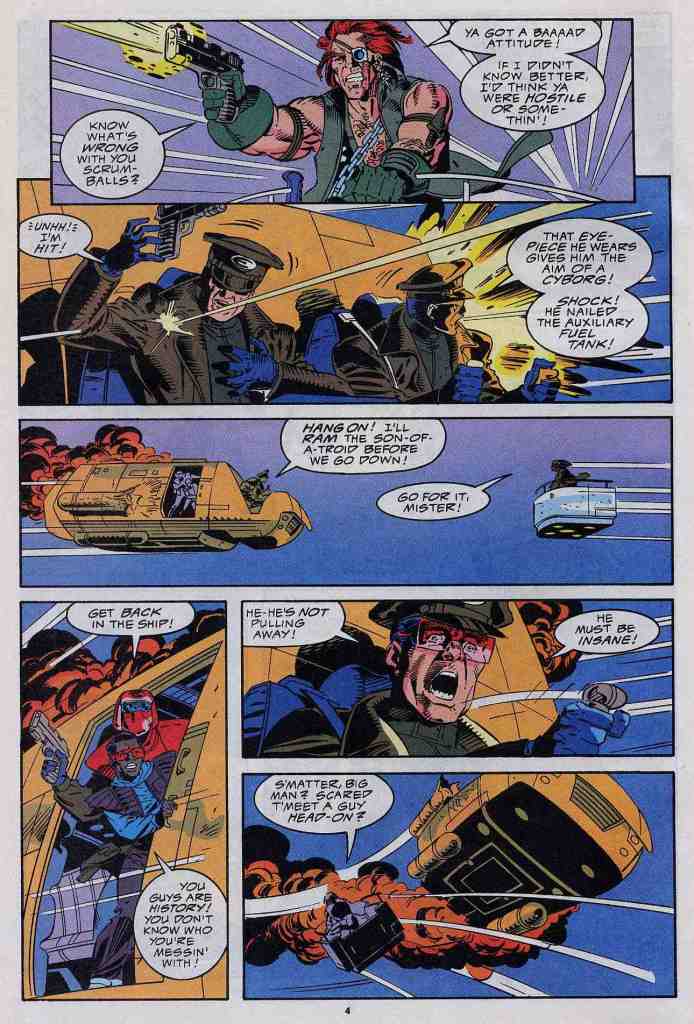
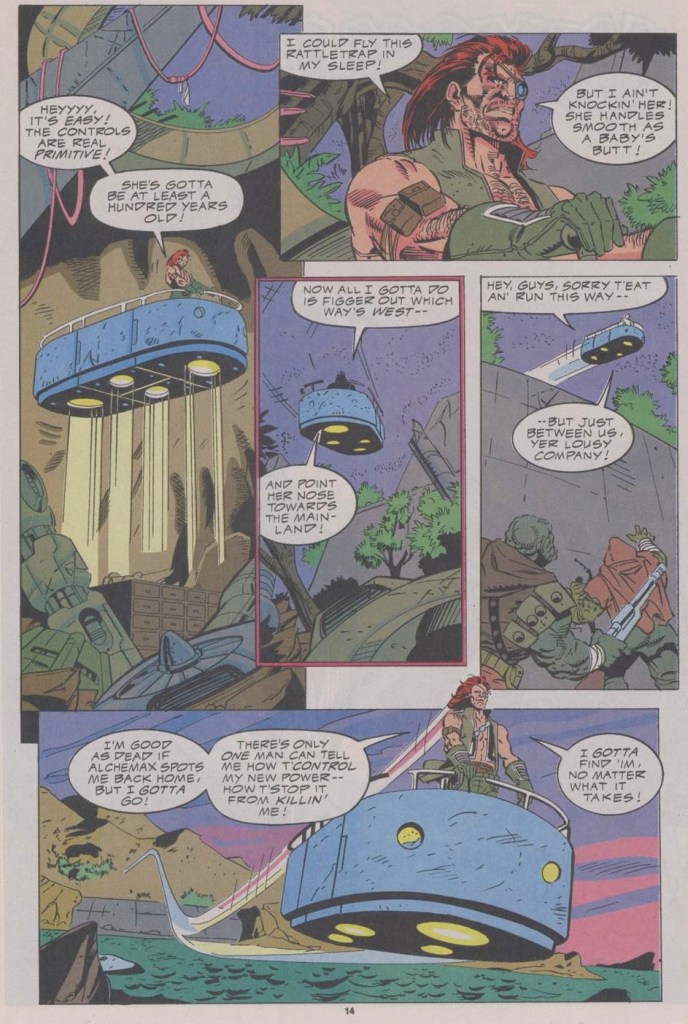
Ravage uses the old vehicle made by the Fantastic Four.

If you are looking for something adventurous or fun while following Ravage, you won’t find much here. Without spoiling the plot, this one has Ravage preparing himself for survival and moving back to civilization. There is not much heroic acts from the title character here and I noticed that Stan Lee’s script is filled with lots of filler-type dialogue designed to prolong scenes (that were meant to be short but had to be stretched) and fill the page. Really, there is not much stuff to engage you with here.

The build-up in issue #5 regarding the sub-plots for Tiana, Dack and the invaders from the sea had too little pay-off here but, in fairness, it does set up something for the next issue. I should also state that Stan Lee did not really do much with the villains – Dethstryk and Anderthorp Henton – and ended up recycling ways to show how cruel, cold-blooded and evil they are WITHOUT ever raising the stakes in their conflict with Ravage.

Conclusion

Just another scene to show how evil and ruthless Anderthorp Henton is towards his own employee. This should make you wonder what Stan Lee really thought about corporations, the labor union and the Leftist forces.

Once again, the Ravage 2099 series at this point only showed the lack of consistency in terms of quality and reader engagement. Ravage 2099 #6 has a story that is actually hollow and the creators resorted to stretching sequences to create the illusion that there is depth throughout. Clearly this is a step down from the previous issue.

If you are seriously planning to buy an existing hard copy of Ravage 2099 #6 (1993), be aware that as of this writing, MileHighComics.com shows that the near-mint copy of the regular edition costs $8 while the near-mint copy of the newsstand edition costs $26.

Overall, Ravage 2099 #6 (1993) is not recommended but if you really want to acquire a copy of it, better wait until the price reaches fifty cents.

+++++

Thank you for reading. If you find this article engaging, please click the like button below and also please consider sharing this article to others. If you are looking for a copywriter to create content for your special project or business, check out my services and my portfolio. Feel free to contact me as well. Also please feel free to visit my Facebook page Author Carlo Carrasco and follow me at HavenorFantasy@twitter.com
A Look Back at 2099 Unlimited #1 (1993)

Disclaimer: This is my original work with details sourced from reading the comic book and doing personal research. Anyone who wants to use this article, in part or in whole, needs to secure first my permission and agree to cite me as the source and author. Let it be known that any unauthorized use of this article will constrain the author to pursue the remedies under R.A. No. 8293, the Revised Penal Code, and/or all applicable legal actions under the laws of the Philippines.

During the first half of 1993, Marvel Comics had published four monthly series of their 2099 franchise of comic books: Spider-Man 2099, Ravage 2099, Doom 2099 and Punisher 2099. X-Men 2099 debuted in the 2nd half of 1993 but months before that happened, Marvel went ahead with expanding their 2099 franchise by launching what was back then a new, quarterly comic book series simply titled 2099 Unlimited.

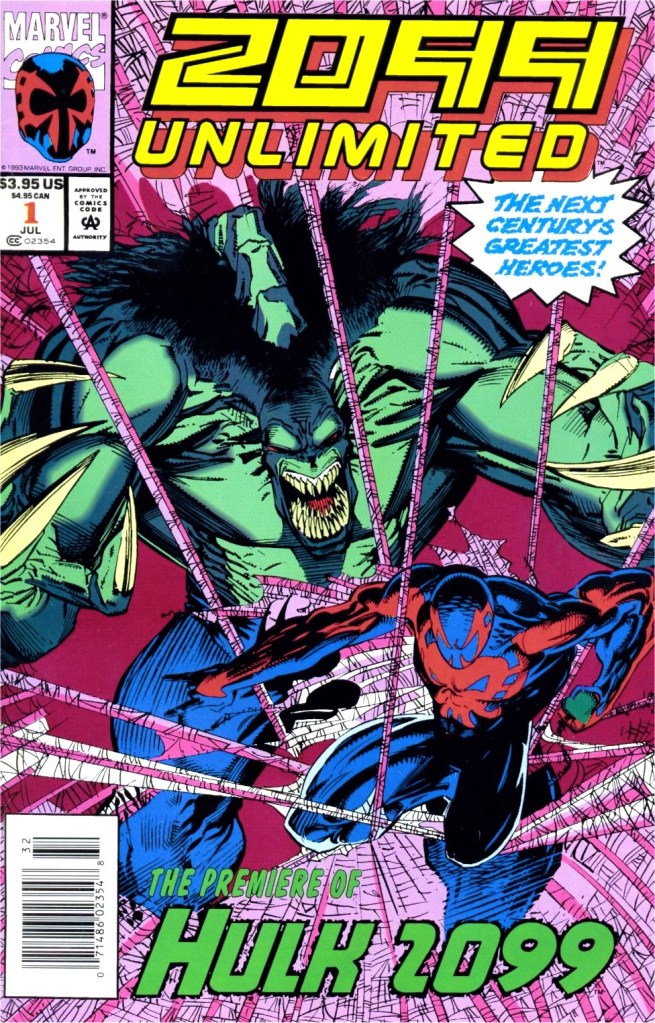
That being said, the mentioned quarterly series was officially launched with 2099 Unlimited #1 which, as its cover showed, featured Spider-Man 2099 as well as Hulk 2099. The comic book came with a high price of $3.95 on its cover and it had 64 pages of content (including ads and bulletins). I myself bought a copy of it as soon as it appeared on the shelves of the local comic book store here in the Philippines.

Was the debut comic book fun? Is it good by today’s standards? We can all find out in this look back at 2099 Unlimited #1, published in 1993 by Marvel Comics with stories written by Evan Skolnick and Gerard Jones, and drawn by Chris Wozniak and Dwayne Turner.

The cover.

Early stories

“Nothing ever changes!” – the story begins at New York City’s Koop Memorial Hospital where an investigation is happening. A married couple arrives and noticed the unusual activity happening there. As they arrive at another floor to visit their son Michael, they noticed the hallway is full of dead bodies. They panic and start running to find their son. Suddenly a muscular man appears and kills the husband, stating his action is justified by his belief about the natural order of things and his effort to ensure humanity’s survival. The killer escapes.

Weeks later, Spider-Man/Miguel O’Hara returns home from fighting crime just in time to rush and prepare himself for his date with Anna. During their date, Anna talks about her sister who has a rare genetic deformity. She intends to visit her sister at the hospital, and Miguel asked if she wants him to come along…

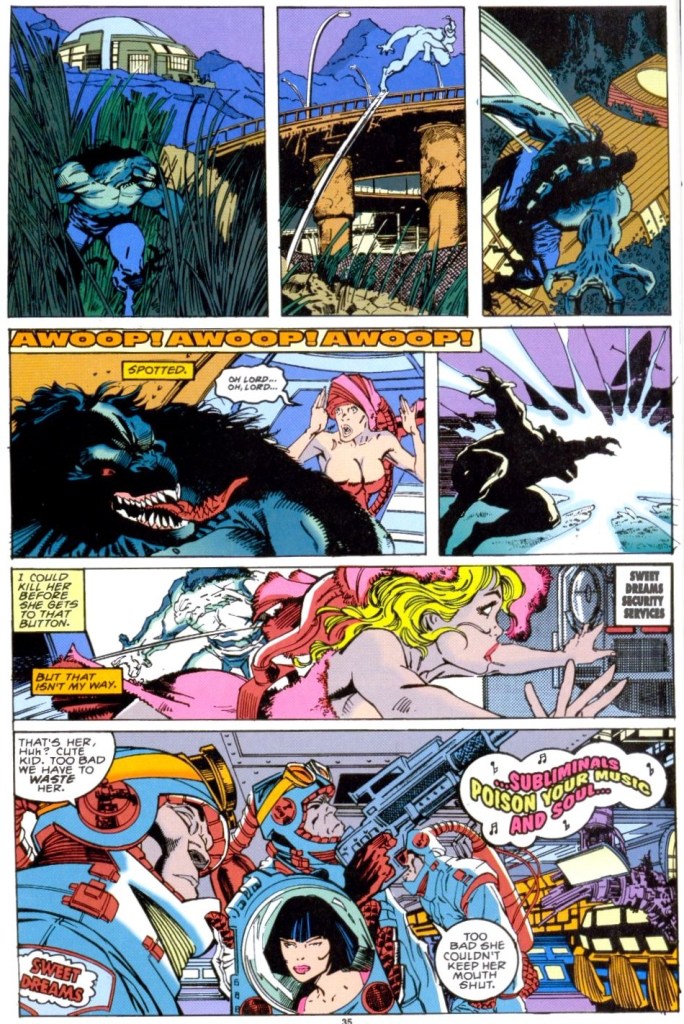
“Hulk 2099” – the story begins in the Mojave Desert with the Hulk traveling alone in the middle of the night. He has been traveling for over three hundred miles alone hunting something. The Hulk arrives at the private residence of a lady who spots him and alerts the armed personnel of Sweat Dreams Security Services. Soon enough, Sweet Dreams personnel arrive and its tank charges at the green monster…

Quality

Imagine Hulk 2099 trespassing on your property.

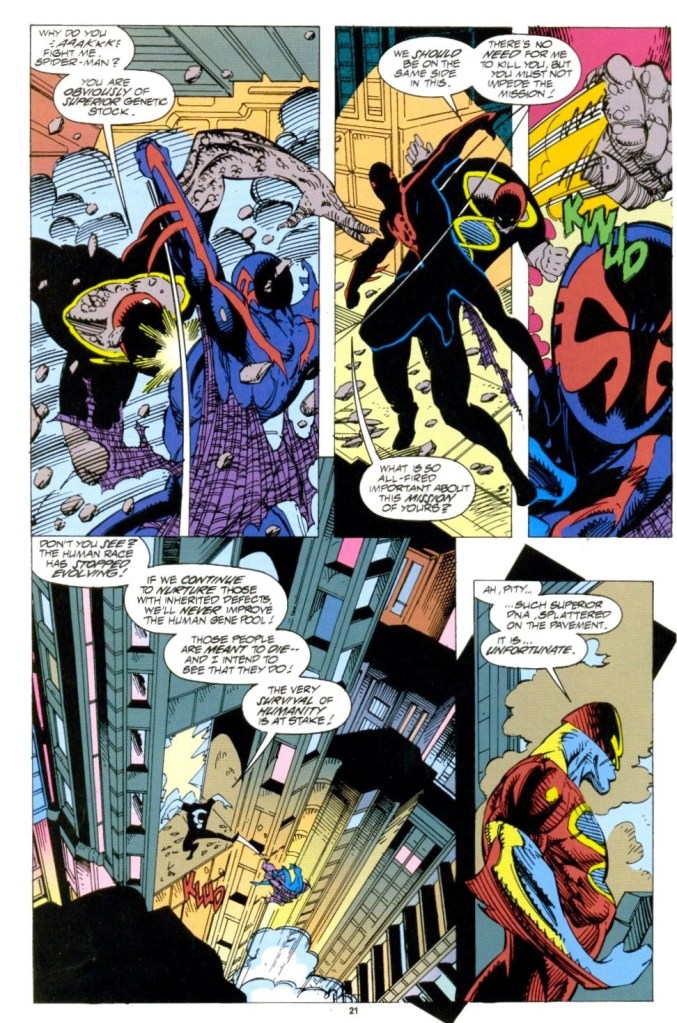
The first story featuring Spider-Man 2099 has a pretty interesting concept that was nicely executed and proved to be surprisingly satisfying. The creative team introduced the new villain Mutagen and they succeeded in building his personality (including his obsession with perfecting human genetics and altering the so-called gene pool) which resulted a justified conflict with Spider-Man. The character development, focused mainly on Mutagen, was well done and by the end of the story, he became a pretty interesting villain.

As for Spider-Man, his character development was pretty limited to his interactions with Anna laced with little references to his career with Alchemax, and there were no references to his personal life and the people who mattered most to him. Clearly, the first story was more about Mutagen than Spider-Man, and it has a very satisfying conflict between the two. I also enjoyed the way the creative team presented Mutagen being able to adapt to his environment and the attacks Spider-Man threw at him. While the story is strong, I should say that Chris Wozniak’s art is uneven. His drawings on Mutagen were pretty details but the same cannot be said about his art on Spider-Man.

The second story, featuring Hulk of 2099, is the actual gem in this comic book. Not only was it the first-ever appearance of the character, it unsurprisingly took inspiration from the origin of the classic Hulk (Bruce Banner) and made some twists with themes of the business of entertainment and the human desire of idolatry (always unholy). The new Hulk here is an entertainment executive named John Eisenhart who has been researching the Knights of Banner, a group of people who worship the classic Hulk. What he does in the real world and with people, he strives to make something out of them to boost his career and stand out in the business of amusement. Eisenhart sees Banner’s idolaters having the makings of a new cult of Thor complete with living in isolation

Eisenhart is not the typical good-natured protagonist. Quite the opposite in fact as he is obsessed with success and is a walking tool of Hollywood who exploits people and insists that being civilized is essential and that strength is knowing where the power is. That being said, this story has a lot of build-up on Hulk 2099 while still having sufficient space to tell his origin that arguably links him with the legacy of Banner Hulk. For the most part, the bouts of build-up resulted worthy pay-offs that readers can enjoy.

More on Hulk 2099 himself, this version of the classic character is more monstrous and freakish looking. While Hulk 2099 maintains the intelligence of Eisenhart, he still is deadly and unpredictable. Supporting characters like Gawain and Quirk both lacked scenes and dialogue but that is not surprising since the focus of the comic book is on Hulk 2099. For the art, Dwayne Turner’s work here is satisfying.

Conclusion

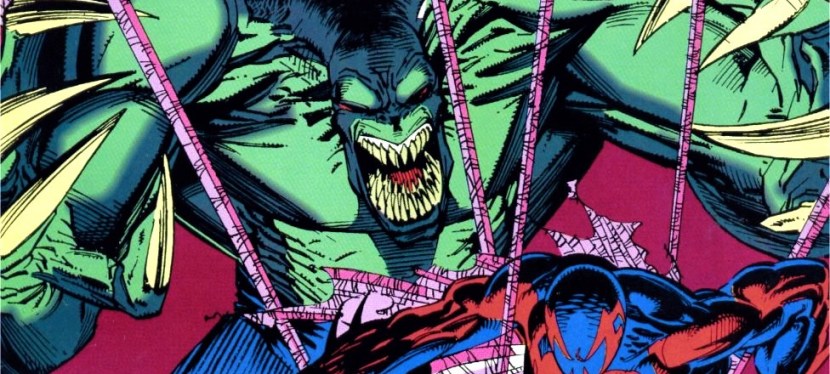
Spider-Man 2099 and Mutagen in battle!

When I first read this way back in 1993, I felt underwhelmed. By today’s standards, 2099 Unlimited #1 (1993) surprisingly aged well and it is actually deeper, more meaningful and engaging than I previously thought. Apart from Hulk 2099’s debut, the introduction of Mutagen was pretty engaging and he had a lot of potential to be a major 2099 universe villain. Too bad that Mutagen was not used to be a nemesis against Ravage 2099 or Punisher 2099 or even X-Men 2099. Hulk 2099 meanwhile went on to have a dedicated monthly series which came at a time when the 2099 imprint and the comic book industry in general went way down. This comic book, in my opinion, is more cerebral than it looks and that is thanks to the writers.

If you are seriously planning to buy an existing hard copy of 2099 Unlimited #1 (1993), be aware that as of this writing, MileHighComics.com shows that the near-mint copy of the regular edition costs $15 while the near-mint copy of the newsstand edition costs $32.

Overall, 2099 Unlimited #1 (1993) is recommended.

+++++

Thank you for reading. If you find this article engaging, please click the like button below and also please consider sharing this article to others. If you are looking for a copywriter to create content for your special project or business, check out my services and my portfolio. Feel free to contact me as well. Also please feel free to visit my Facebook page Author Carlo Carrasco and follow me at HavenorFantasy@twitter.com

A Look Back at Ravage 2099 #5 (1993)

Disclaimer: This is my original work with details sourced from reading the comic book and doing personal research. Anyone who wants to use this article, in part or in whole, needs to secure first my permission and agree to cite me as the source and author. Let it be known that any unauthorized use of this article will constrain the author to pursue the remedies under R.A. No. 8293, the Revised Penal Code, and/or all applicable legal actions under the laws of the Philippines.

Welcome back, superhero enthusiasts, comic book collectors and fans of Marvel’s 2099 universe! Do you want to see more of 2099 stories written by the late Stan Lee? There is Ravage 2099, the one original character for the 2099 universe co-created by Lee and illustrator Paul Ryan. In my last review, the story had Ravage desperately trying to survive in an island which is toxic and filled with lots of bad guys hunting him down.  

With those details laid down, here is a look back at Ravage 2099 #5, published in 1993 by Marvel Comics with a story written by Stan Lee and drawn by Paul Ryan.

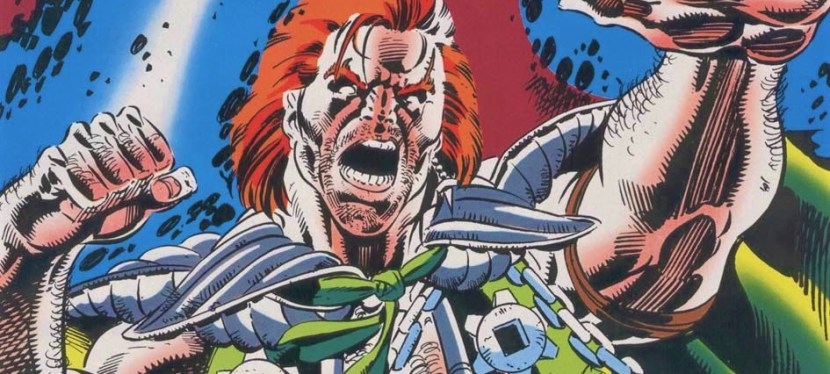
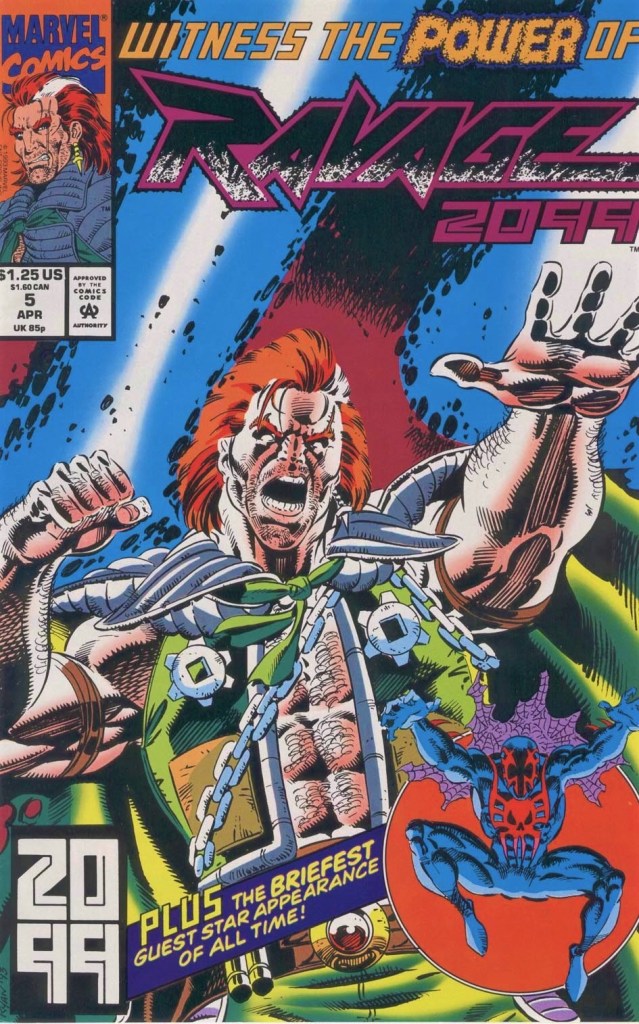
The cover.

Early story

The story begins with Ravage, in the presence of Ursell (the one who saved his life), reacting to his hands burning with light-blue flame. Ursell states it is the radiation causing it. Ravage accuses him of turning him into a troid and that he is not better than Dethstryk, the ruler on the island. As he could not control his anger, Ravage attacks Ursell (who told him his hands are lethal as they destroy what they touch).

Outside, one Dethstryk’s troops spots light (the result of Ravage’s energetic hands) coming from the same cave Ravage and Ursell are in. Eventually Ravage calms down and the energy of his hands weaken. Ursell hands him gloves (composed of complex molecular formula) which help him contain the energy but only for one hour.

Suddenly, Dethstryk’s thugs spot the two in the cave. One of them identifies Ursell as the betrayer of their leader…

Quality

I wonder if SJWs, socialists, Communists and the radicalized feminists will find this image offensive…

In terms of storytelling, this comic book is a big improvement over the last issue. While issue #4 was pretty much limited to Ravage just struggling to survive, this one had more elements of discovery and surprise which made it feel fresh. Ravage having his hands energetic and getting bothered deeply by it was a nice touch to spice up the character while building him up to be potentially more powerful. I also enjoyed the sub-plot in which Tiana, who has been portrayed as an erotic damsel-in-distress since issue #1, finally gets to do something important with trying to free the troubled youth Dack. Not only that, there is also another sub-plot involving a race of aquatic creatures that seek to invade the surface.

Conclusion

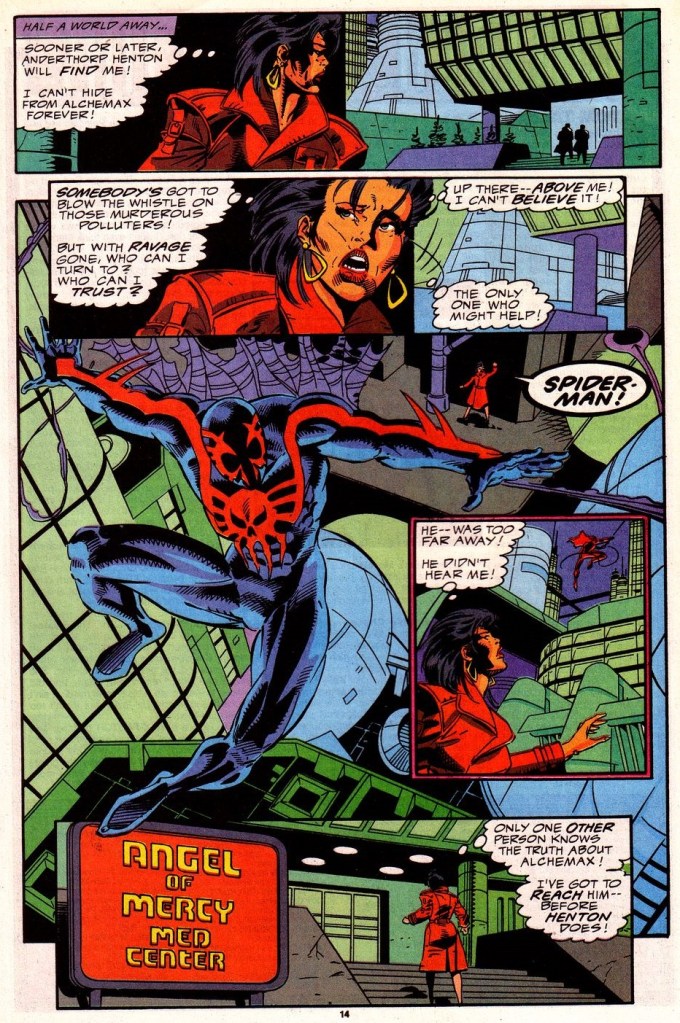
Spider-Man 2099’s very brief appearance!

Ravage 2099 #5 (1993) is fun to read and surprisingly engaging as it is a big improvement over issue #4. Considering the uneven quality of this particular series, it’s nice to see Stan Lee make storytelling improvements just as they are needed. Still the quality of dialogue is sub-par and there were corny lines like Ravage saying, “You’re cornier than breakfast cereal!”

If you are seriously planning to buy an existing hard copy of Ravage 2099 #5 (1993), be aware that as of this writing, MileHighComics.com shows that the near-mint copy of the regular edition costs $8 while the near-mint copy of the newsstand edition costs $24.
Overall, Ravage 2099 #5 (1993) is satisfactory.

+++++

Thank you for reading. If you find this article engaging, please click the like button below and also please consider sharing this article to others. If you are looking for a copywriter to create content for your special project or business, check out my services and my portfolio. Feel free to contact me as well. Also please feel free to visit my Facebook page Author Carlo Carrasco and follow me at HavenorFantasy@twitter.com