A Look Back at The Strangers #16 (1994)

Disclaimer: This is my original work with details sourced from reading the comic book and doing personal research. Anyone who wants to use this article, in part or in whole, needs to secure first my permission and agree to cite me as the source and author. Let it be known that any unauthorized use of this article will constrain the author to pursue the remedies under R.A. No. 8293, the Revised Penal Code, and/or all applicable legal actions under the laws of the Philippines.

Welcome back Ultraverse fans, geeks and comic book collectors! Here is another trip back into the Ultraverse, which for me is the most defining line of superhero comics that was realized in the 1990s. The UV lasted for only a few years and along the way publisher Malibu Comics got acquired by Marvel Comics.

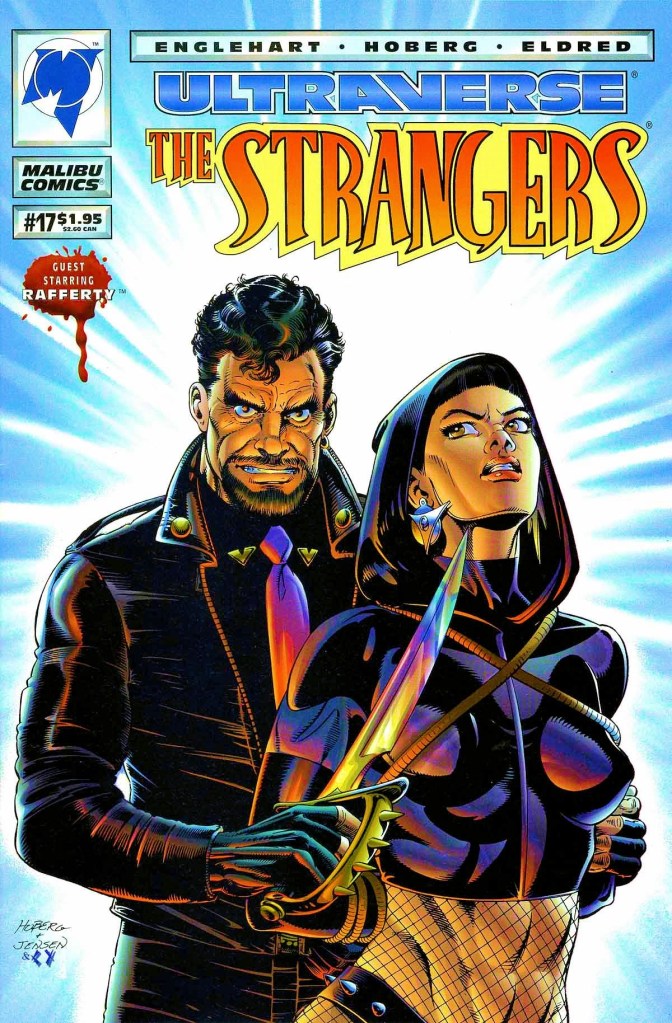
History aside, we are about to explore The Strangers again in the sixteenth issue of the monthly series that was spearheaded mainly by the creative duo of Steve Englehart and Rick Hoberg. Here is a look back at The Strangers , published in 1994 by Malibu Comics with a story written by Englehart and drawn by Hoberg.

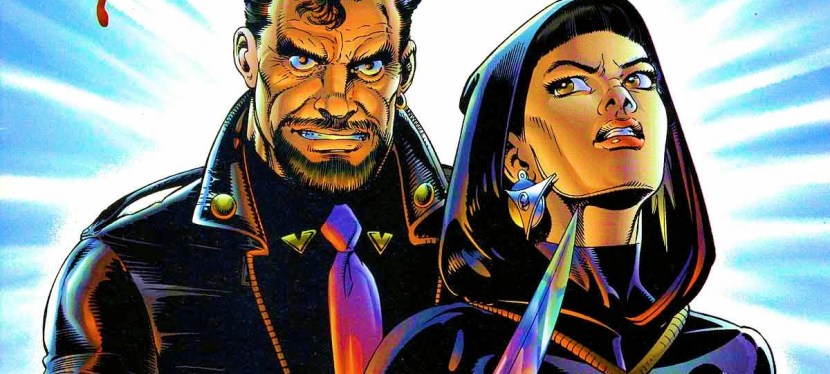
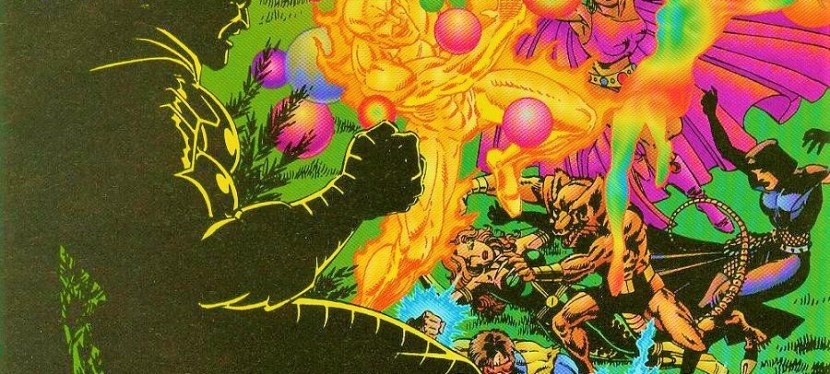
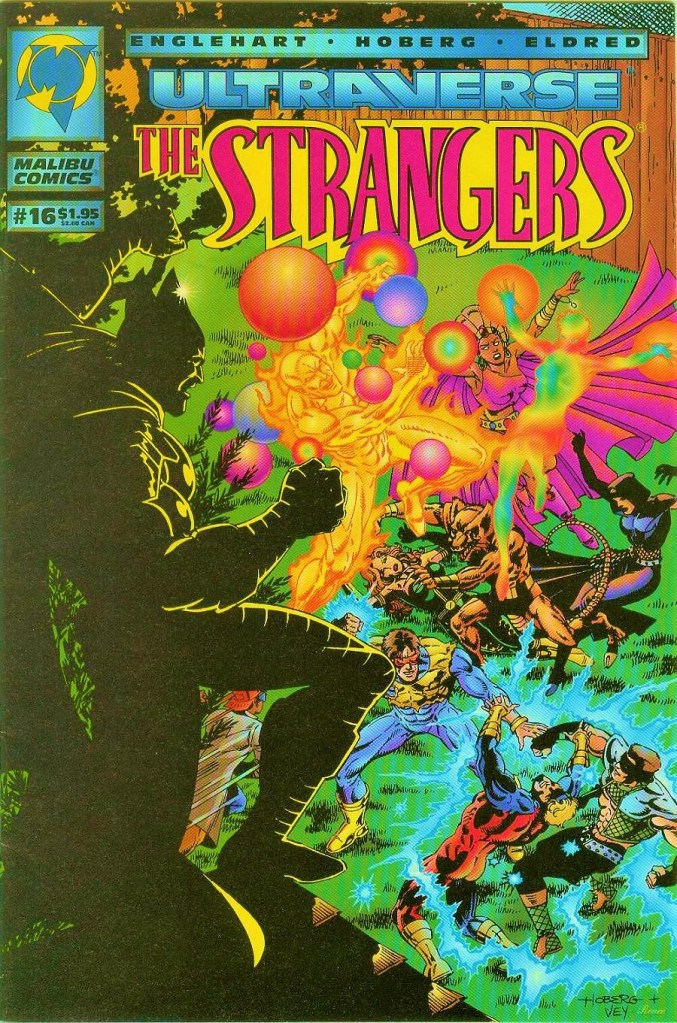
The cover.

Early story

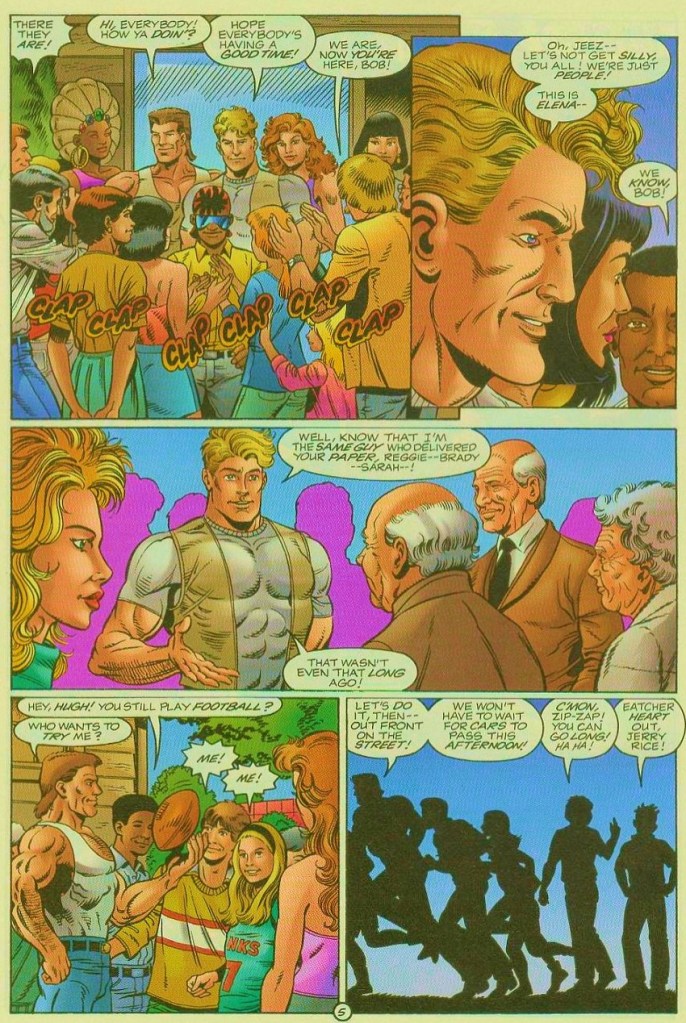
The story begins in a local community in California wherein one of the houses is hosting a block party. Already a disturbance to the neighbors (note: police officers had to temporarily close down a short stretch of the public road and restricted others from getting near), the said party offers people a chance to meet in person Atom Bob who has his teammates with him.

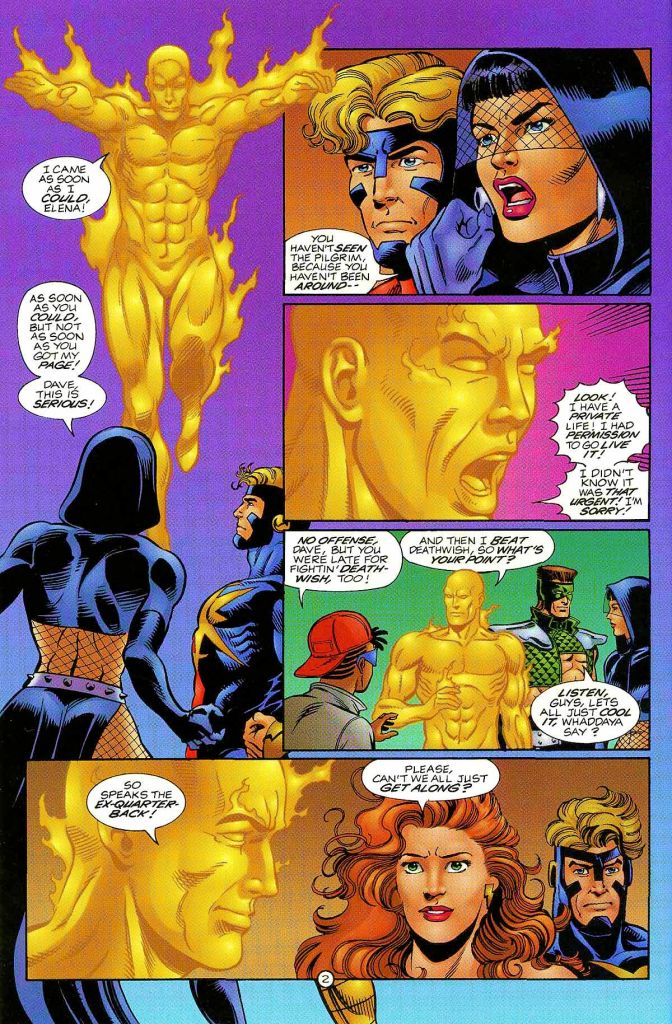
During a private meeting, The Strangers discuss what they encountered lately (note: this refers to their encounters with Gangsta and Brazen. Also involved was someone called the Pilgrim. As they keep talking, Lady Killer stressed that they all need to be ready for further encounters.

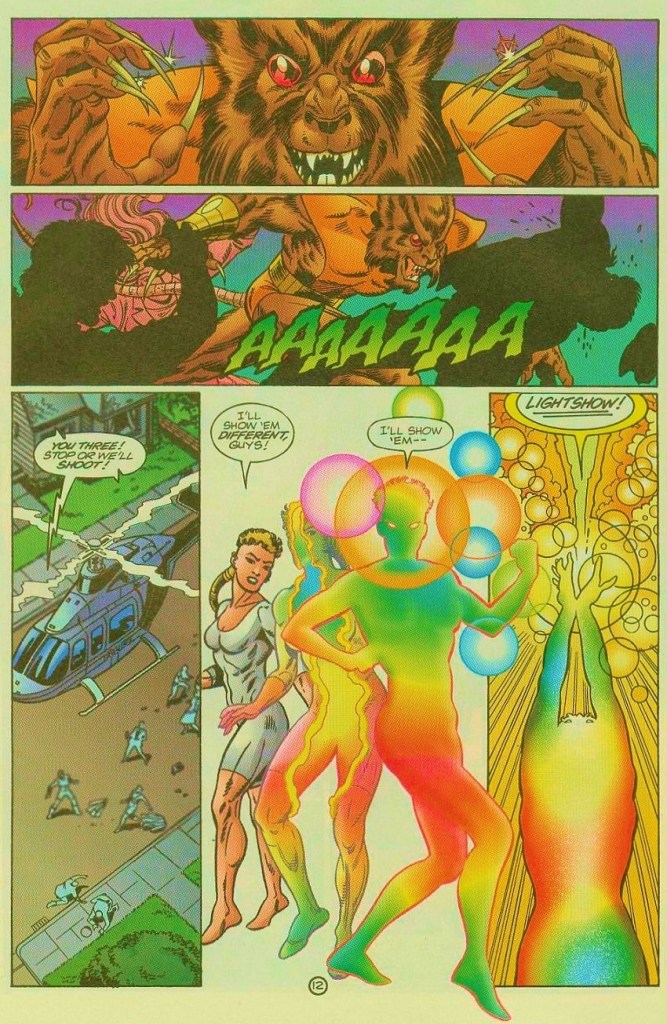
Meanwhile in the downtown area of the city, three costumed characters (who previously road a cable car just like The Strangers) are plotting something…

Quality

Meet the opposition.

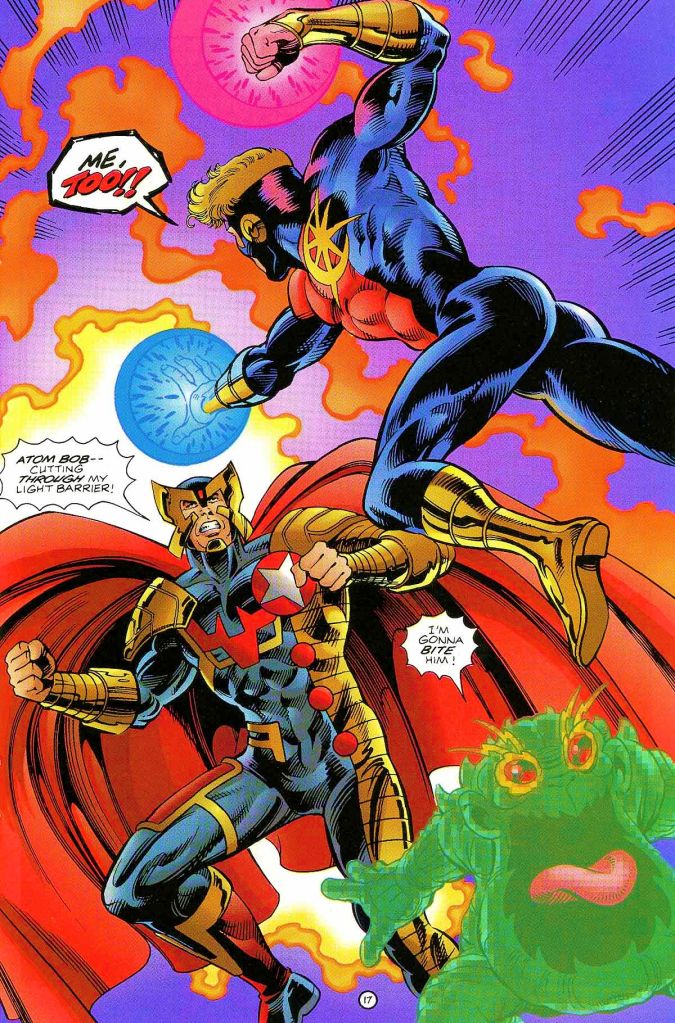
Let me start first with the art done by Rick Hoberg with ink work by Tim Eldred. I should state that since issue , Hoberg not only drew characters, places, creatures and backgrounds with his captivating style, he also maintained a high level of quality and proved he can bring any comic book script into life with images. His art is so good, this comic book is fun reading again and again. I should also state that the coloring for this story is very lively and more dream-like in style thanks to the color design by Moose Baumann and interior color by Prisms.

When it comes to the story, this comic book’s concept is pretty unique and Steve Englehart deserves credit for coming up with something fresh while still leaving room for spectacle and characterization. The idea of a block party held in the middle of a community of family homes celebrating the presence of superheroes is cool and it opened up new ways to define the characters not to mention emphasizing how their presence affects people not on the city level but on the local community! Having worked as a local community newspaper journalist myself, I know what’s it like when local communities have special activities or events that bring together (or captivate) the neighbors. Along the way, the dialogue is varied (note: lots of characters other than The Strangers had lines), the portrayal of The Strangers is consistent and the story’s pace flowed smoothly.

Speaking of characterization, there is notable focus on Atom Bob and Lady Killer who already have feelings for each other. As the home of Atom Bob’s family serves as the venue of the party, you will get to see the character interact with the local neighbors and others he personally knew for a long time which is a very refreshing way of developing him. Lady Killer meanwhile tries to maintain balance between being the team’s professional leader and having feelings for Atom Bob while trying to respect his parents.

And then there is a growing group of ultras who intend to destroy The Strangers. It was at this stage in The Strangers monthly series in which a genuine opposition against the title team really started to take shape. The good news is that the Pilgrim and the other opposing ultras were not portrayed as generic bad guys but people who are struggling and have a cause.

Conclusion

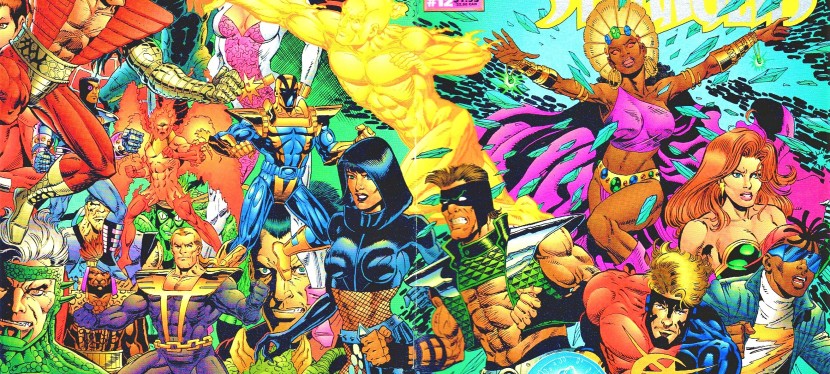
The Strangers and the guests at the party.

There is no doubt that The Strangers (1994) is a whole lot of fun, very compelling and intriguing to read from start to finish. Anyone who loves the title team will find something to enjoy and follow, while those who keep on enjoying the conflict between good-and-evil will find something new and entertaining here. Steve Englehart and Rick Hoberg not only continued to deliver high-quality superhero stories with The Strangers, they really were one of the best creative duos of the 1990s.

If you are seriously planning to buy an existing hard copy of The Strangers (1994), be aware that as of this writing, MileHighComics.com shows that the near-mint copy of the comic book costs $8.

Overall, The Strangers (1994) is highly recommended!

+++++

Thank you for reading. If you find this article engaging, please click the like button below and also please consider sharing this article to others. If you are looking for a copywriter to create content for your special project or business, check out my services and my portfolio. Feel free to contact me as well. Also please feel free to visit my Facebook page Author Carlo Carrasco and follow me at HavenorFantasy@twitter.com

A Look Back at The Strangers #12 (1994)

Disclaimer: This is my original work with details sourced from reading the comic book and doing personal research. Anyone who wants to use this article, in part or in whole, needs to secure first my permission and agree to cite me as the source and author. Let it be known that any unauthorized use of this article will constrain the author to pursue the remedies under R.A. No. 8293, the Revised Penal Code, and/or all applicable legal actions under the laws of the Philippines.

Welcome back, Ultraverse fans and superhero comic book geeks and collectors! Today I will be reviewing another one of the Ultraverse anniversary celebration comic books. Apart from the usual superhero stuff, there is a touch of historical fiction in the UV anniversary comic book I reviewed and I can say that, if ever more people out there will discover it, it can spark more discussions and even debates about a certain figure of world history as well as the relevance of indigenous people.

Now we can proceed with this look back at The Strangers , published in 1994 by Malibu Comics with a story written by Steve Englehart and drawn by Rick Hoberg.

The cover.

Early story

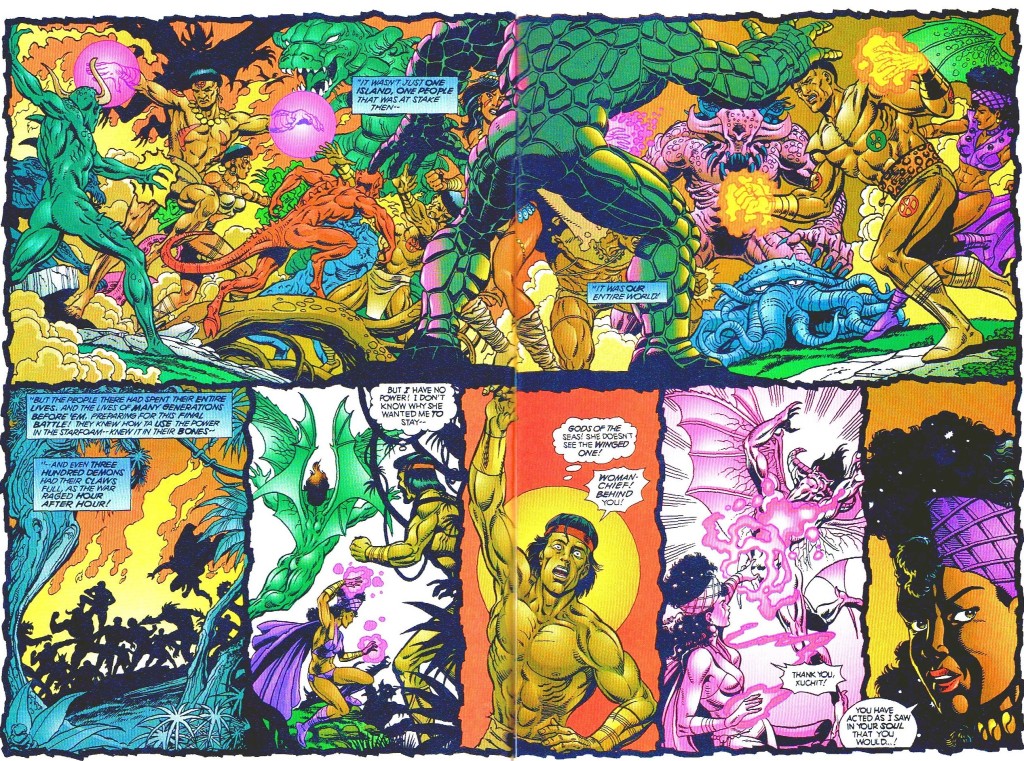
The story begins in the middle of the thick jungle of a floating island. Yrial, who has spent significant time with The Strangers representing her tribe, is held captive by her own people inside a crystal. She is being accused of betrayal of her tribe as a consequence of her involvement with her teammates from the civilized world. Yrial denies the charges and insisted that the rise of The Strangers signifies that their solitude is over.

Eventually Grenade, Zip-Zap, Lady Killer, Electrocute, Spectral and Atom Bob arrive to fight in an attempt help their trapped teammate. The action halts as soon as Lady Killer tells Chief Aula that they know the great secret as they have been to the other side (refer to the previous past issues leading to this)…

Quality

The fictional tribe is definitely cursed for they lived with sorcery, idolatry and rituals sourced from ancient evil.

I will start first with the storytelling. Steve Englehart’s writing is excellent and he clearly did his research about a key part of world history and made an intriguing and compelling fictional story out of it. This is, in fact, one of the most intriguing superhero stories of the 1990s that I have ever read and it is a very lively reminder that storytelling alone can impact readers deeply when it is greatly made.

With regards to the historical fiction aspect of this comic book, I should state that doing a fantasized version of the European explorer Christopher Columbus and connecting him and his crew with the history of the in-comic tribe was a stroke of genius. This was indeed the main selling point of this comic book!

Rick Hoberg, who worked a lot with Englehart and set the definitive look of The Strangers, made great visuals and the images are also much more diverse given the historical fiction aspect of this comic book. Hoberg really brought Englehart’s script to life and his visuals look finely paced with the narrative.  

With regards to the emphasis on magic, it should be noted that it is an abomination and in the context of the story, it is a cursed thing and not really a strength of the in-comic tribe. As for the other world (and the demons it is filled with) that the tribe is aware of, it symbolizes the realm of evil. By the end of the story, you will realize that the tribe living on the floating island are indeed a cursed people and not merely isolated using magic. They are also idolaters and practice rituals sourced from evil long ago. For meaning, learn from the holy scriptures below and you will realize that you would NOT want to be like the story’s tribe. You are better off following Lord Jesus and believe in His salvation.

“But the cowardly, unbelieving, abominable, murderers, sexually immoral, sorcerers, idolaters, and all liars shall have their part in the lake which burns with fire and brimstone, which is the second death.”

Revelation 21:8 (NKJV)

Wonderfully blessed are those who wash their robes white so they can access the Tree of Life and enter the city of bliss by its open gates. Those not permitted to enter are outside: the malicious hypocrites, the sexually immoral, sorcerers, murderers, idolaters, and every lover of lies.

Revelation 22:14-15 (TPT)

Conclusion

The team nicely drawn by Rick Hoberg.

Among the anniversary issues of the Ultraverse I have reviewed as of this writing, I should state that The Strangers (1994) is the best one yet! Entertainment value aside, the focus on Christopher Columbus and indigenous people should interest people who have varying views about them. Christopher Columbus remains a divisive historical figure as some people admired his achievements on world exploration while others condemned him as an evil, bloodthirsty man who negatively impacted indigenous people he encountered. Whatever your views of Columbus and indigenous people are right now, I recommend you read this comic book. For those who love superhero stuff, you will find a lot to enjoy here.

If you are seriously planning to buy an existing hard copy of The Strangers (1994), be aware that as of this writing, MileHighComics.com shows that the near-mint copy of the comic book costs $8.

Overall, The Strangers (1994) is highly recommended.

+++++

Thank you for reading. If you find this article engaging, please click the like button below and also please consider sharing this article to others. If you are looking for a copywriter to create content for your special project or business, check out my services and my portfolio. Feel free to contact me as well. Also please feel free to visit my Facebook page Author Carlo Carrasco and follow me at HavenorFantasy@twitter.com

A Look Back at The Solution #4 (1993)

Disclaimer: This is my original work with details sourced from reading the comic book and doing personal research. Anyone who wants to use this article, in part or in whole, needs to secure first my permission and agree to cite me as the source and author. Let it be known that any unauthorized use of this article will constrain the author to pursue the remedies under R.A. No. 8293, the Revised Penal Code, and/or all applicable legal actions under the laws of the Philippines.

Welcome back Ultraverse fans and superhero comic book collectors! This is my continuing look back at spin-off tales connected to Break-Thru, the year-ending big crossover event of the Ultraverse which not only mixed the many UV characters together but also impact them.

This time, we examine events connected to Break-Thru in a story written by the late James Hudnall and told through the exploits and struggles of a superhero team (plus one major UV superhero) he handled – The Solution! Here now is a look back at The Solution , published in 1993 by Malibu Comics with a story written by Hudnall and drawn by Darick Robertson.

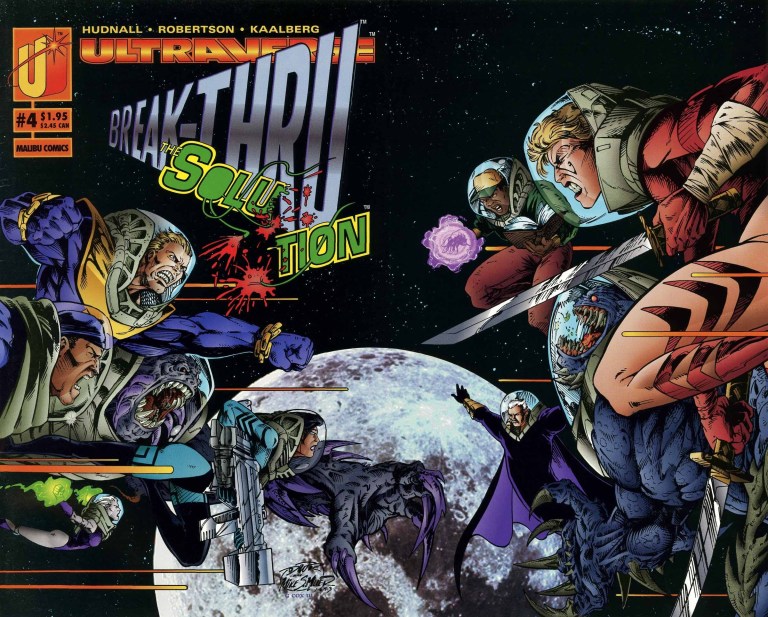
The cover.

Early story

Set a short time after the end of the Break-Thru-related Hardcase #7, the story begins in outer space. Inside a space craft heading towards the moon, Lela Cho/Tech records a new entry into her diary reflecting of how crazy things turned out for her and her teammates. On her end, she pursued getting her corporation back and then took a job that landed her on board a UFO. As it turns out, her team has been hired to find a mysterious object which might provide explanations as to why ultras suddenly appeared all over the world.

Considering the very high stakes of the mission, The Solution had to partner with Hardcase and his companion Choice. This is because they are trying to catch up with another team of ultras (composed of Trouble, Death Dance, Gate, Needler, Gun Nut, Book and Meathook) who were sponsored by Rex Mundi, the rival of The Solution’s client Regina…  

Quality

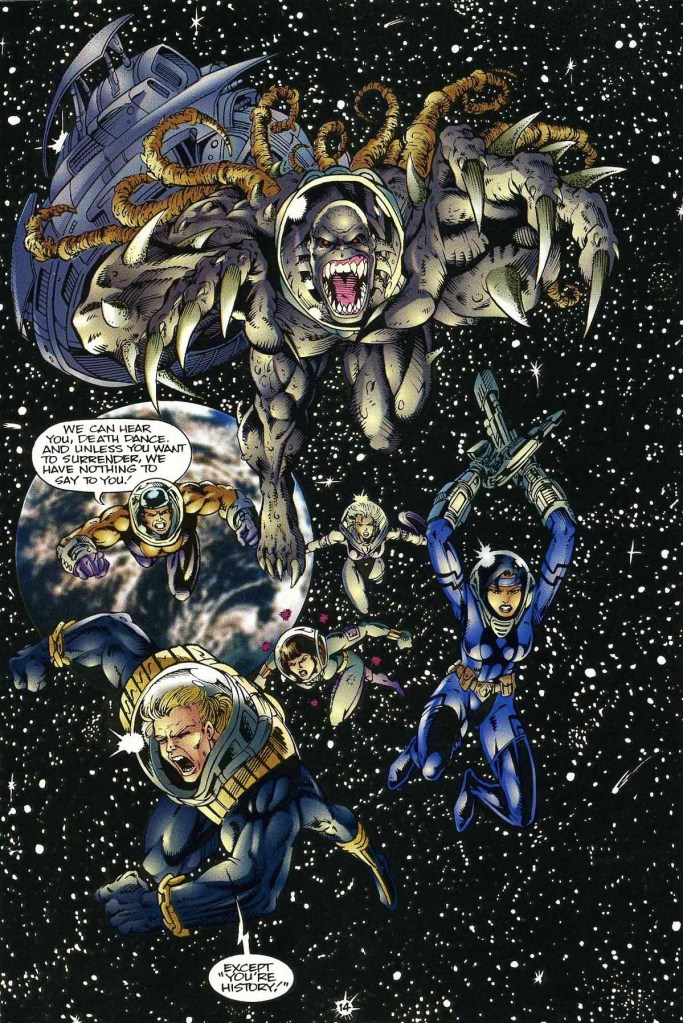
A nice shot of The Solution with Hardcase and Choice in space.

As this was a build-up type of story meant to connect and add depth to the Break-Thru crossover, the plot was pretty simple and yet it was loaded with a lot of engaging stuff. Given the fact that James Hudnall led the writing for both Hardcase and The Solution, I just love the way he had these ultra heroes interact with each and the way they learned to get to know each other and adjust with one another was done in believable fashion. To say that Hudnall knew the characters deeply and treated them like real people is pretty true.

As expected, there is a good amount of spectacle in the form of action scenes and the fun thing about it is that the battle took place in space. There were match-ups between The Solution’s members and the Rex Mundi-sponsored team which were short and yet filled with interesting banter and satisfying action.

Conclusion

A really nice interaction.

I can declare that The Solution (1993) is more than just a build-up comic book leading to a much bigger event. The characterization as well as the interactions between Hardcase and The Solution members alone make this comic book a must-read. This comic book also works well to prepare you for the subsequent events that took place in Break-Thru .

If you are seriously planning to buy an existing hard copy of The Solution (1993), be aware that as of this writing, MileHighComics.com shows that the near-mint copy of the regular edition costs $8 while the near-mint copy of the newsstand edition costs $26.

Overall, The Solution (1993) is recommended.

+++++

Thank you for reading. If you find this article engaging, please click the like button below and also please consider sharing this article to others. If you are looking for a copywriter to create content for your special project or business, check out my services and my portfolio. Feel free to contact me as well. Also please feel free to visit my Facebook page Author Carlo Carrasco and follow me at HavenorFantasy@twitter.com

A Look Back at Mantra #6 (1993)

Disclaimer: This is my original work with details sourced from reading the comic book and doing personal research. Anyone who wants to use this article, in part or in whole, needs to secure first my permission and agree to cite me as the source and author. Let it be known that any unauthorized use of this article will constrain the author to pursue the remedies under R.A. No. 8293, the Revised Penal Code, and/or all applicable legal actions under the laws of the Philippines.

Hey Ultraverse fans and superhero comic book collectors! Are you interested in another look at the Break-Thru crossover through the eyes of Mantra? For the newcomers reading this, Break-Thru was a year-ending crossover that literally gathered many of the Ultraverse characters together in an event that affected their world. The said crossover impacted other characters of the Ultraverse through specific comic books such as Prototype #5, Hardcase #7, The Strangers #7 and Solitaire #2 to name some.

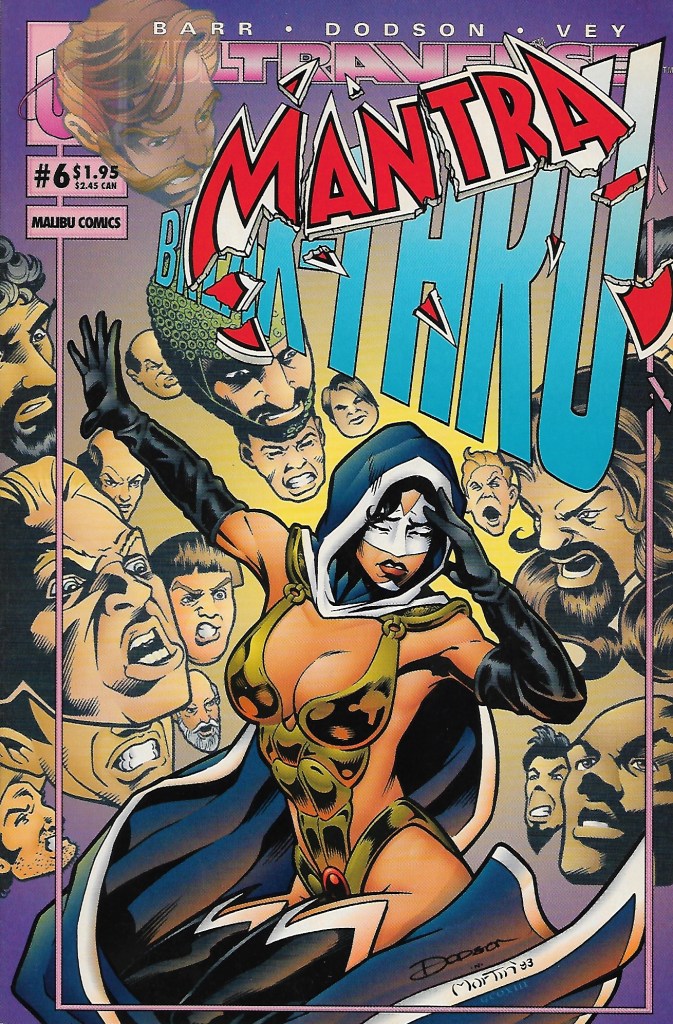
Now we have here is another view of Break-Thru in this look back at Mantra , published in 1993 by Malibu Comics with a story written by Mike W. Barr and drawn by Terry Dodson.
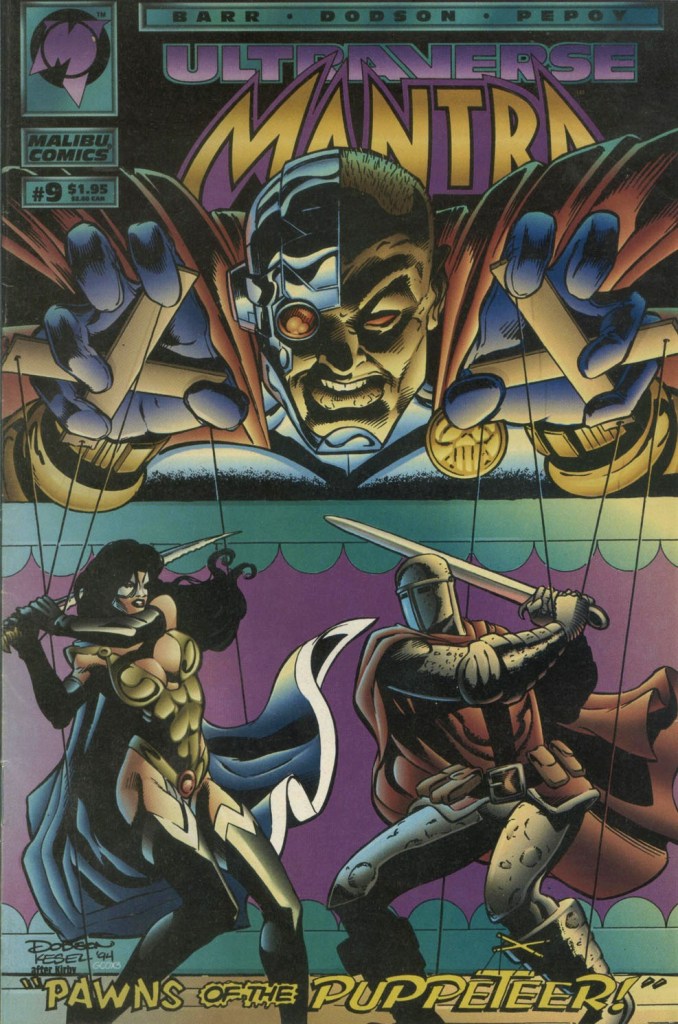
The cover.

Early story

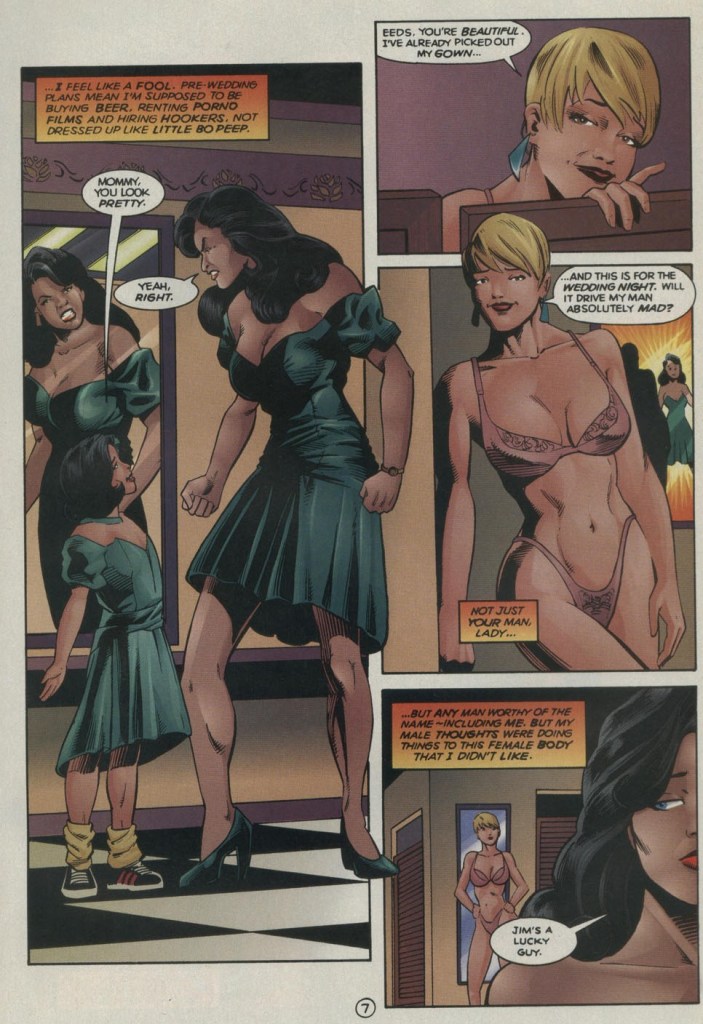
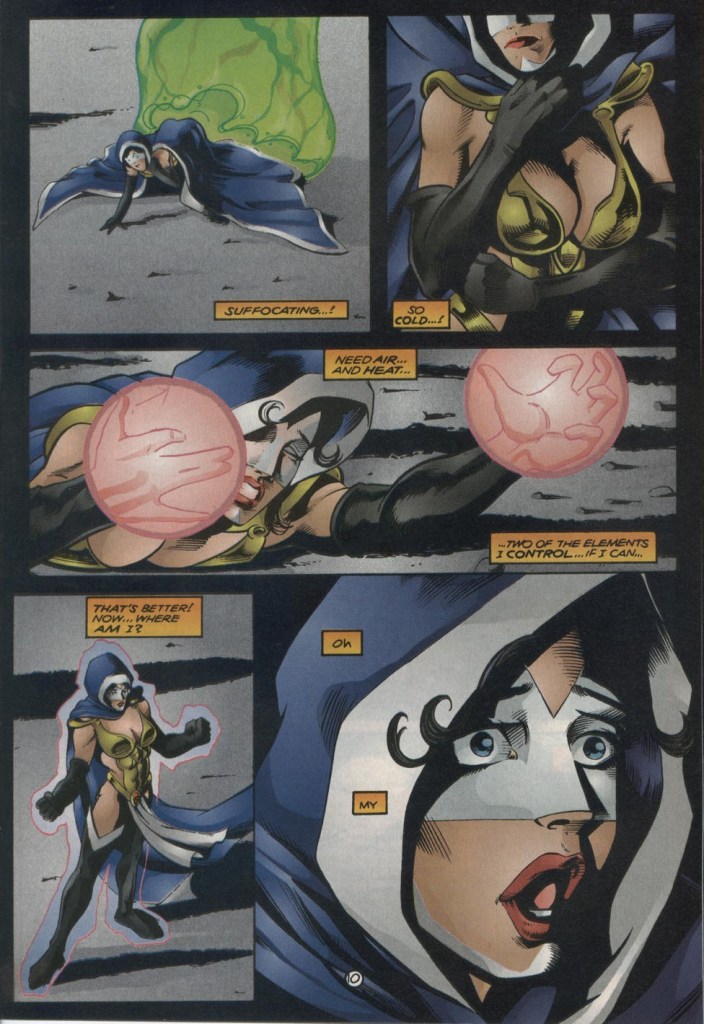
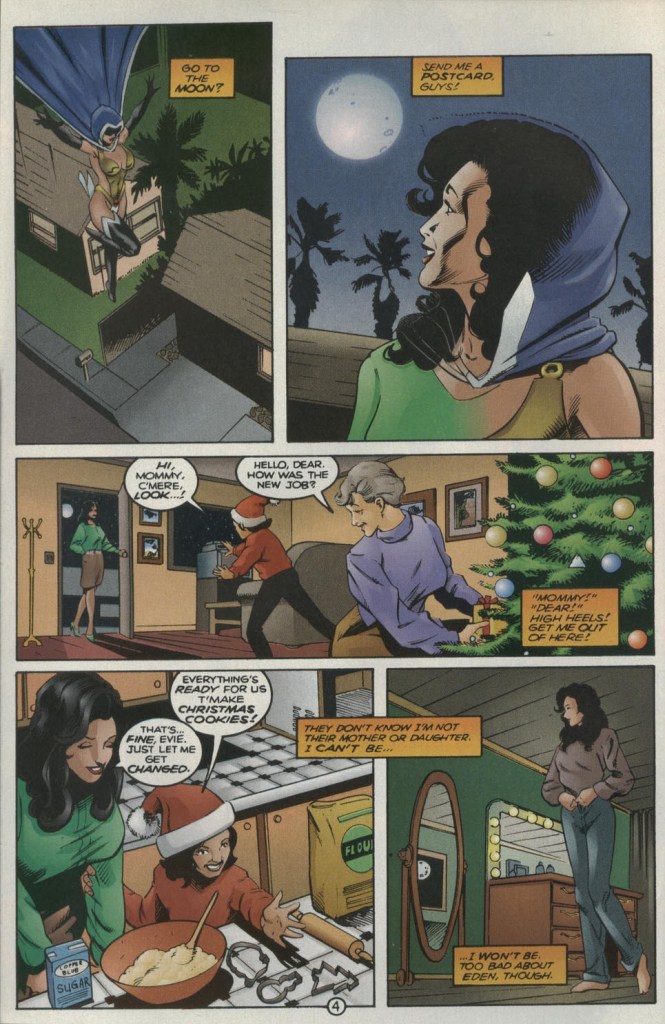
The story begins with Mantra flying during the night thinking about what happened as several Ultras made their way to the moon to fight an entity there that has been mentally contacting a girl named Amber. She thought about her new career at Aladdin as Eden Blake and intends to find ways to transfer her mind into a male body somehow.

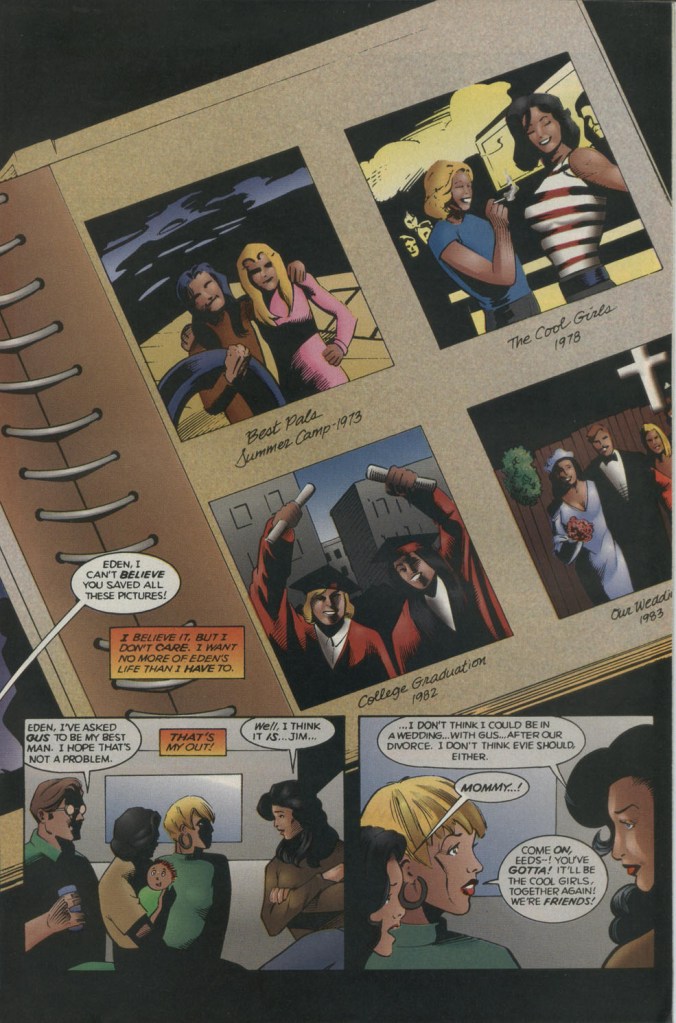
Mantra arrives home and instantly changes appearance into Eden in civilian clothes. Upon entering the home, her little daughter (note: nobody in her family is aware that Eden’s soul has been displaced with that of Lukasz’s soul) arrives to greet her back in the presence of Eden’s mother. The daughter is every excited to start making Christmas cookies.

After spending some time alone in the bedroom, Mantra realizes something on the moon and decides to leave pretending she has to go back to work. This saddens Eden’s daughter…

Quality

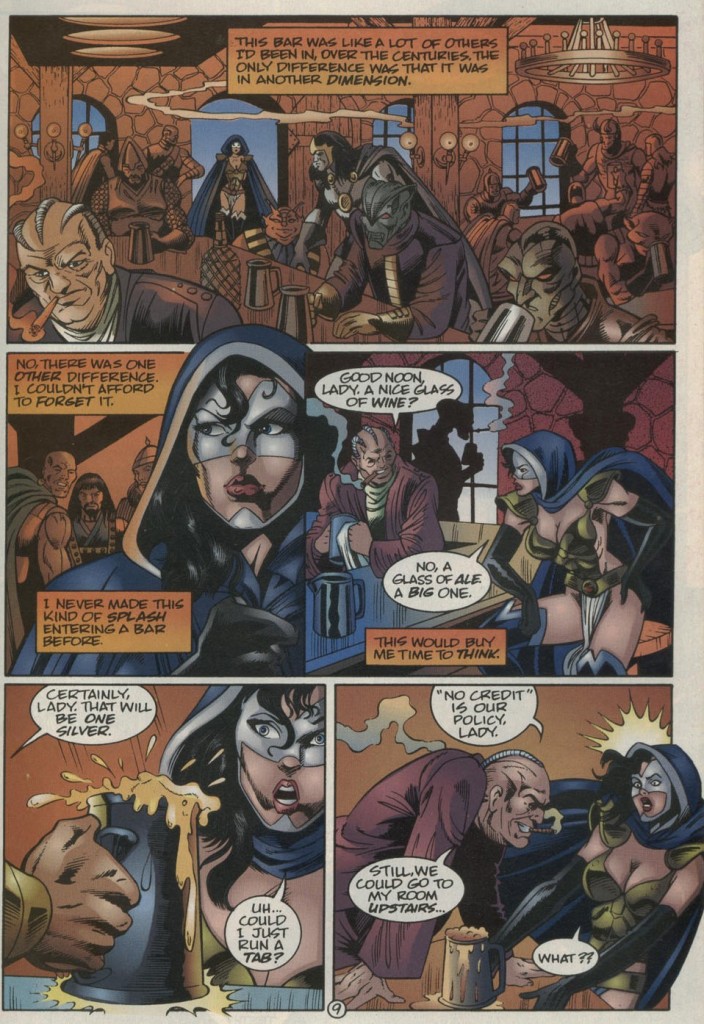
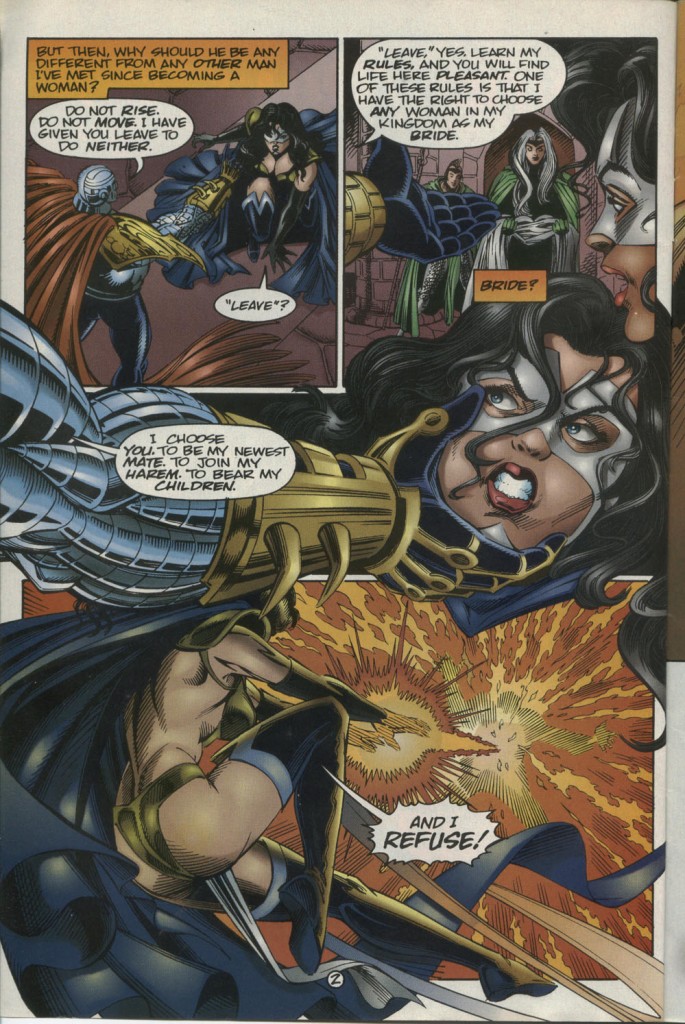
Mantra in the middle of somewhere.

This comic book is not the good-versus-evil type of story. Rather it is more about personal struggle and threads from the past that challenge Mantra, and it is well written. At the same time, the story serves as a build-up leading to the big events that took place in Break-Thru (the conclusion of the big crossover). Getting to know the entity through the experience and view of Mantra is alone a solid reason to read this comic book. In fact, what you will learn here will help you prepare yourself to understand the Break-Thru crossover comic books and the concepts they featured.

Conclusion

Another glimpse on the life of Eden Blake and her family.

Mantra (1993) is an engaging and enjoyable read. It is not only a mere build-up for Break-Thru, it also reveals more about Lukasz (who occupies the body of Eden/Mantra) and why his past haunts him which alone adds a new layer of depth to his character. There are few scenes of spectacle here and there but the strong writing by Mike W. Barr saved it from becoming a complete bore.

If you are seriously planning to buy an existing hard copy of Mantra (1993), be aware that as of this writing, MileHighComics.com shows that the near-mint copy of this comic book costs $8.

Overall, Mantra (1993) is recommended.

+++++

Thank you for reading. If you find this article engaging, please click the like button below and also please consider sharing this article to others. If you are looking for a copywriter to create content for your special project or business, check out my services and my portfolio. Feel free to contact me as well. Also please feel free to visit my Facebook page Author Carlo Carrasco and follow me at HavenorFantasy@twitter.com
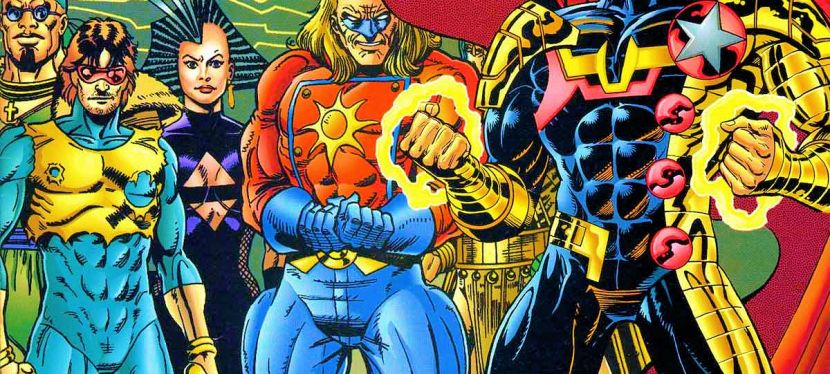
A Look Back at Prime #15 (1994)

Disclaimer: This is my original work with details sourced from reading the comic book and doing personal research. Anyone who wants to use this article, in part or in whole, needs to secure first my permission and agree to cite me as the source and author. Let it be known that any unauthorized use of this article will constrain the author to pursue the remedies under R.A. No. 8293, the Revised Penal Code, and/or all applicable legal actions under the laws of the Philippines.

Hey Ultraverse fans and superhero comic book geeks! For those of you who read several comic book of Prime, do you enjoy his struggles on setting things right? That is a theme that will be explored in this new Prime retro comic book review.

The good news here is that the legendary George Perez is involved. Now that the details have been set, here is a look back at Prime , published in 1994 by Malibu Comics with a story written by Len Strazewski and Gerard Jones, and art done by George Perez with ink work by Dennis Jensen.

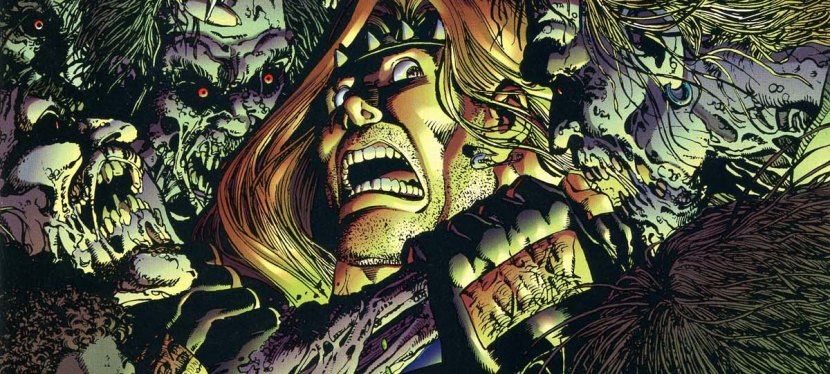
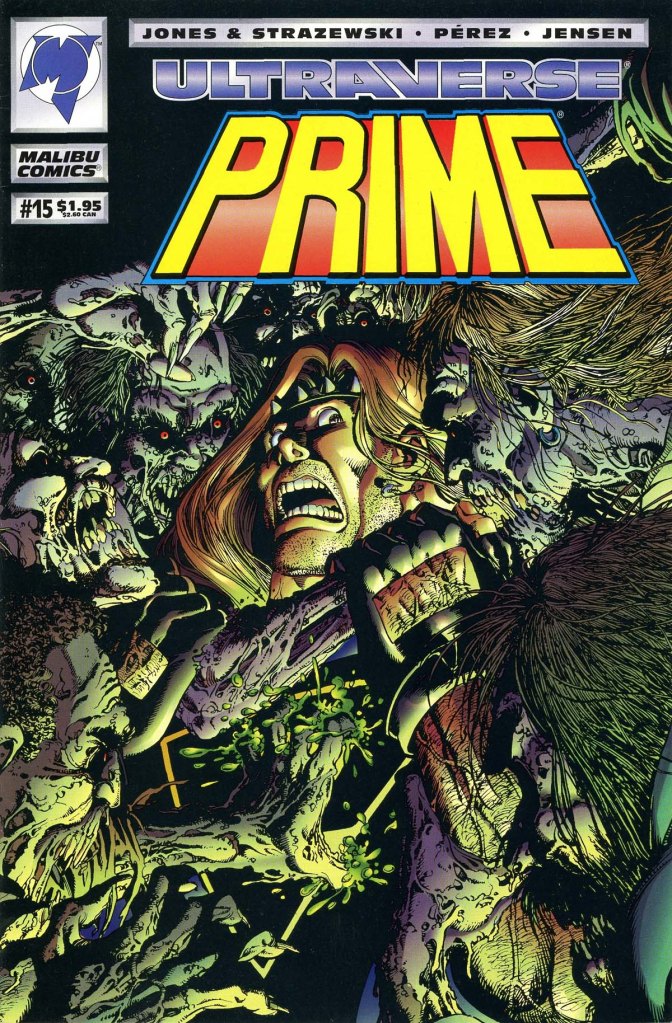
The cover.

Early story

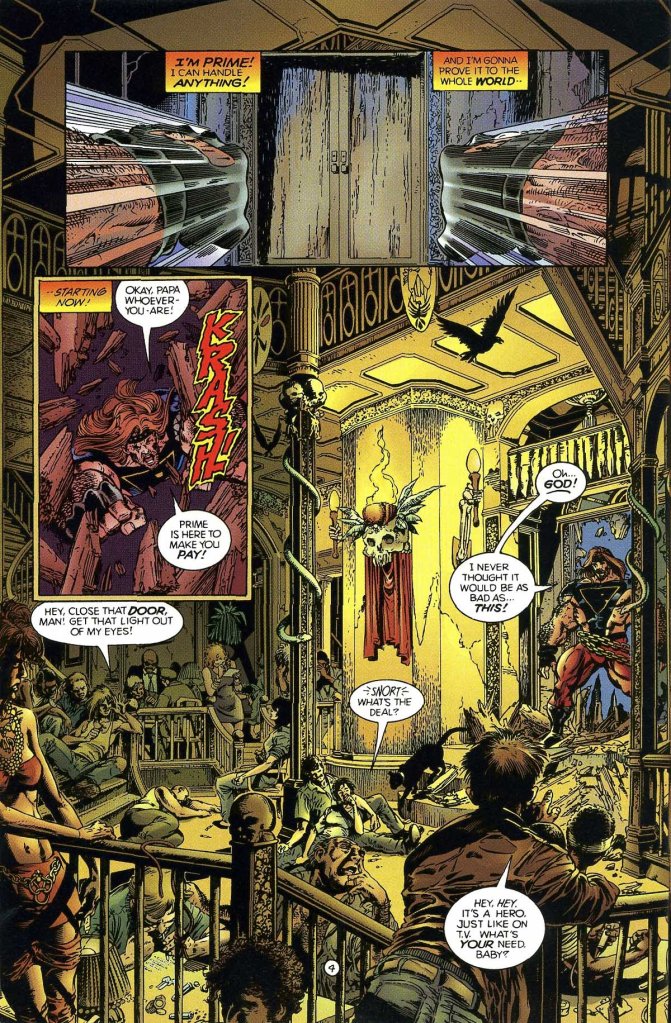
The story begins with Prime’s arrival at a creepy, old looking residence somewhere in Hollywood. He learned that inside the place is the secret headquarters of a drug trafficking operation that allegedly affected half of Los Angeles.

Previously, he beat up a man in front of several abandoned youth and left him bloody. Under intense pain, the man revealed to him where to find the drug trafficking operation leader as well as the parents of the youth. The boss was described as Papa Verite. The man told Prime he can find Papa Verite but cannot touch him.

As he walks towards the front door, Prime thought to himself: Maybe he thought I didn’t have the guts to hurt this “Papa.” Maybe he thinks Prime’s a nice boy, like he used to be! Maybe I should’ve hurt him worse to show him I’ve changed! I’m not just a freaked-out 13-year-old with an ultra-powered body anymore! I’m not just a helpless kid named Kevin whose dad ran out on him! I’m Prime! I can handle anything!

After breaking through the front door, what Prime discovers inside is very disturbing…

Quality

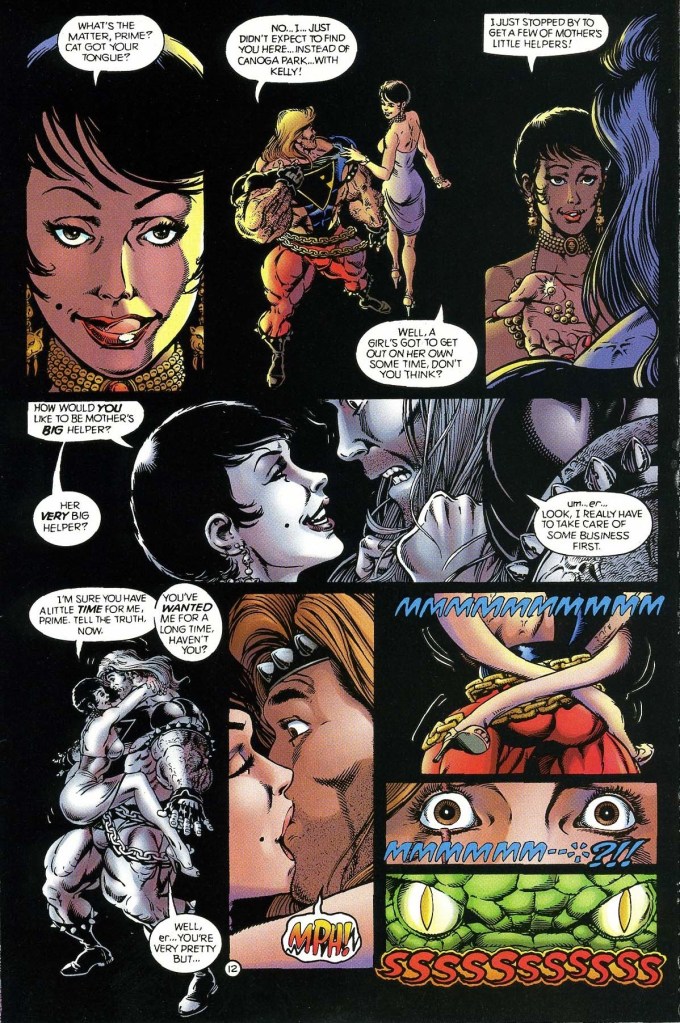
A rather disturbing scene since Prime is truly a teenage boy inside all that muscle.

Let me be clear from the start that, once again, the writing by Strazewski and Jones is very strong. To start with, the story has a theme about doing the right things (including helping others by means of getting rid of someone who made victims out of them) without consulting or informing the local authorities. In a way, Prime moved and acted like a vigilante facing criminal elements related to illegal drugs. There were also elements of military conspiracy, molestation and indecent relationship.

When it comes to characterization, it comes to no surprise that Prime (who really is a teenager inside his body) is pushed to the limits of his emotions with his ability to withstand pressure really tested by the presence of certain people from his past who haunted him. Prime is convincing when he is shown with the impulse and arrogance of a teenager who would not stop when he wants to set things right.

The art by George Perez, unsurprisingly, is great to look at. You won’t just see Prime and familiar characters drawn in high detail with the distinct art style of Perez here. What you will see is how creative the famous illustrator proved he is with the visual presentation complete with very expressive facial expressions. More on the characters, Perez also implemented horror elements to his drawings and he really succeeded in making some scary images here and there.

Conclusion

Striking art by George Perez.

This is a very solid read. Prime (1994) is actually a horror themed tale laced with crime elements and drama all molded into a superhero story. There is an element of good-versus-evil here but in my view, it’s a dramatization of Prime being pushed to the limits of his emotions and his sanity. In a way, it is a stress test for the overly muscular major Ultraverse hero that happens to be quite engaging to read.

If you are seriously planning to buy an existing hard copy of Prime (1994), be aware that as of this writing, MileHighComics.com shows that the near-mint copy of the comic book costs $8.

Overall, Prime (1994) is recommended.

+++++

Thank you for reading. If you find this article engaging, please click the like button below and also please consider sharing this article to others. If you are looking for a copywriter to create content for your special project or business, check out my services and my portfolio. Feel free to contact me as well. Also please feel free to visit my Facebook page Author Carlo Carrasco and follow me at HavenorFantasy@twitter.com

A Look Back at Prime #12 (1994)

Disclaimer: This is my original work with details sourced from reading the comic book and doing personal research. Anyone who wants to use this article, in part or in whole, needs to secure first my permission and agree to cite me as the source and author. Let it be known that any unauthorized use of this article will constrain the author to pursue the remedies under R.A. No. 8293, the Revised Penal Code, and/or all applicable legal actions under the laws of the Philippines.

Hey Ultraverse fans and superhero comic book enthusiasts! Are you ready for another tale of Prime? What I am about to review is one of the anniversary Ultraverse issues published by Malibu Comics.

What could be new or special to justify the anniversary of the Prime monthly series? We can all find out in this look back at Prime , published by Malibu Comics with a story written by Len Strazweski and Gerard Jones, and drawn by the late Norm Breyfogle.

The cover.

Early story

The story begins with a young guy named Kuttner who tests his deadly ability to easily cut through solid objects with his powered blades on his hands. He is driven to get revenge against Prime who broke his hand previously. Kuttner, whose career in entertainment had declined, thinks he can establish a new career for himself as a powered being and Prime is his first target.

Meanwhile at school, Kevin Green (Prime) is struggling with the stress over his parents’ separation which he is guilty of. He finds it very weird to be back in school after everything he went through such as his struggles with Colonel Samuels, the Federal Government, Break-Thru and more. After slamming his locker shut, students begin to move away from him…

Quality

Symbolically, Prime meets Norm Breyfogle.

To begin with, the writing by Len Strazewski and Gerard Jones is very solid as expected. That being said, the real heart of the story in this comic book is Kevin Green’s personal struggle with life not just with the difficulty of balancing himself between his personal life and being a superhero, but also his place in local society being tainted as a result of his acts as Prime. The way that the events of the previous issues affected (in negative ways) the local community’s perception of Kevin was very compelling and straight to the point.

The strong writing, unsurprisingly, worked very well with the character development. Kevin was presented to be struggling with making the right decisions and he struggles to analyze what would happen if he presents himself to others as Prime or as simply himself. As for the scene between Prime and Kelly’s mother, there was that touch of awkwardness (through Prime) that was present as the scene raised the disturbing idea of the two possibly getting involved sexually.

When it comes to the spectacle of action, there is little to be seen here but the good news is that Norm Breyfogle illustrated them to be energetic and eye-catching. The late illustrator really knew hot to ramp up the energy for the readers making the most out of what it is limited.

Conclusion

The tremendous strength of Prime!

Prime is a pretty engaging read. Was it worth the anniversary promotion? It is indeed! If you look back at Prime and read all the succeeding issues leading to this one, you will notice how much Kevin Green changed as well as how his personal growth moved. In a way, Prime symbolizes the growing-up pains Kevin keeps on having.

It should be stated that being 64-pages, Prime is actually one of Malibu’s flip issues. The other side of this comic book is Ultraverse Premiere which contains standalone short stories of Prime, War Strike and a certain villain. This comic book also has “A Primo Farewell” which is a nice tribute (by today’s standards) to Norm Breyfogle. For the newcomers reading this, Breyfogle was one of outstanding comic book artists in America and before joining Malibu Comics, he worked for other publishers like Marvel Comics, DC Comics, Eclipse Comics and First Comics. At DC Comics, his work on their icon Batman is widely remembered. Breyfogle passed away in 2018.

If you are seriously planning to buy an existing hard copy of Prime (1994), be aware that as of this writing, MileHighComics.com shows that the near-mint copy of the comic book costs $8.

Overall, Prime (1994) is highly recommended!

+++++

Thank you for reading. If you find this article engaging, please click the like button below and also please consider sharing this article to others. If you are looking for a copywriter to create content for your special project or business, check out my services and my portfolio. Feel free to contact me as well. Also please feel free to visit my Facebook page Author Carlo Carrasco and follow me at HavenorFantasy@twitter.com

A Look Back at Mantra #7 (1994)

Disclaimer: This is my original work with details sourced from reading the comic book and doing personal research. Anyone who wants to use this article, in part or in whole, needs to secure first my permission and agree to cite me as the source and author. Let it be known that any unauthorized use of this article will constrain the author to pursue the remedies under R.A. No. 8293, the Revised Penal Code, and/or all applicable legal actions under the laws of the Philippines.

Hey Ultraverse fans and superhero comic book enthusiasts! If you want to see more of Mantra and Prime cross over with each other and find out if they would impact the entire Ultraverse somehow, then you’re in for something here.

Here is a look back at Mantra , published in 1994 by Malibu Comics with a story written by Mike W. Barr and illustrated by Terry Dodson. This one follows the events that took place in Prime #8 (1994).

The cover.

Early story

The story begins with Mantra already captured by the Baby Doctor (a super being feared by Colonel Samuels) and his hideous companions. Prime, who was slowed temporarily by Samuels and his soldiers, flies chasing the vehicle carrying Mantra, even distracting the mother, daughter and son of Eden Blake/Mantra.

A short time later, Mantra wakes up and gets much needed assistance by Prime who breaks into the vehicle and fight those who took her captive. After much action, the moving vehicles crashes and Prime helps Mantra…

Quality

Prime to the rescue!

I’ll start with the storytelling and characterization. While Prime marked the actual start of Prime and Mantra getting to know each other more, this story takes their alliance a few notches higher with an emphasis on the big guy (who is actually teenager Kevin Green inside the body) starting to care more for the beautiful eternal warrior (with the soul of the man Lukasz). I also find it refreshing to see Mantra more helpless and Lukasz (the occupant in the body of Mantra/Eden Blake) actually struggles in a really weakened physical state (this points to what happened near the end of Prime ).

The stakes have been raised in the sense that more information about Prime’s origin was revealed and, more notably, the Doc (Baby Doctor) is a more intriguing character in the Ultraverse and this comic book makes clear why Col. Samuels is afraid of him. I liked the way Mike W. Barr used science fiction concept of genetics and even gender to add a strong element of intrigue in the plot. Speaking of gender, there are a few moments that hint of homosexuality which will make you question how much Lukasz is changing the longer her stays in a woman’s body.

Conclusion

Prime getting involved with Mantra.

Mantra is a well-written comic book that succeeded in raising the stakes, deepening the Mantra-Prime friendship while delivering a satisfying, action-packed misadventure. The Doc meanwhile proved to be a worthy addition into the Ultraverse.

If you are seriously planning to buy an existing hard copy of Mantra (1994), be aware that as of this writing, MileHighComics.com shows that the near-mint copy of the regular edition costs $8 while the near-mint copy of the newsstand edition costs $26.

Overall, Mantra (1994) is recommended.

+++++

Thank you for reading. If you find this article engaging, please click the like button below and also please consider sharing this article to others. If you are looking for a copywriter to create content for your special project or business, check out my services and my portfolio. Feel free to contact me as well. Also please feel free to visit my Facebook page Author Carlo Carrasco and follow me at HavenorFantasy@twitter.com

A Look Back at WildC.A.T.s: Covert Action Teams #1 (1992)

Disclaimer: This is my original work with details sourced from reading the comic book and doing personal research. Anyone who wants to use this article, in part or in whole, needs to secure first my permission and agree to cite me as the source and author. Let it be known that any unauthorized use of this article will constrain the author to pursue the remedies under R.A. No. 8293, the Revised Penal Code, and/or all applicable legal actions under the laws of the Philippines.

Before he became the co-publisher of DC Comics, the great Jim Lee made his debut in the comic book industry as an illustrator for Marvel Comics. Just a few short years after that, he became a fan-favorite of X-Men fans and was a major factor in the massive sales success of 1991’s X-Men #1 (Volume 2). Not only did that particular comic book established a long-lasting sales record for all comic books, Lee’s designs and visual concepts for the X-Men were adapted by the producers and creators of the fan-favorite X-Men: The Animated Series (1992-1997).

For the newcomers reading this, Jim Lee’s tenure with Marvel Comics ended in December 1991 when he, Rob Liefeld and Todd McFarlane met with the publisher and expressed that Marvel’s policies toward them were unfair and they were not rewarded well for their work. To put things in perspective, Jim Lee’s X-Men , Rob Liefeld’s X-Force and Todd McFarlane’s Spider-Man were respectively million-sellers. As such, Lee, Liefeld, McFarlane plus some more creators left Marvel and went on to establish Image Comics (which involved a production and distribution deal with Malibu Comics).

In 1992, Jim Lee’s dream project – with concepts first created in 1986 – came through free from the constraints he endured from Marvel’s editorial team and strict policies. That’s dream project was WildC.A.T.s: Covert Action Teams , which is the feature of this retro comic book review.

But before we start the review, here’s a quick look back at the conceptual history of WildC.A.T.s as written by Jim Lee himself.

“I created my first ‘professional’ comic book submission in the summer of 1986 entitled The Wild Boys involving an espionage agency called International Operations. The co-writer of that sublime piece of work was coincidentally enough – Brandon Choi – who at the time was still in college getting a double major in history and politics,” Lee wrote in the comic book’s intro.

Now that we’re done with the history, here is a look back at WildC.A.T.s: Covert Action Teams , published in 1992 through Image Comics with a story co-written by Jim Lee and Brandon Choi. Lee illustrated the comic book with ink work done by Scott Williams.

The cover.

Early story

The story begins in Antarctica in 1986. There, two men braved the cold weather searching for something with information they learned from IO (International Operations). Suddenly an orb rises from the snow and then an image of a lady wearing silver tights and wielding energy appears in front of them. After demanding them to let her have the orb, she and the energy field fade away.

In 1992, at the crisis control facility of IO in Virginia, IO’s executives carefully view video footage of Georgetown which was hit by an explosion. They suspect rogue C.A.T.s (covert action teams) could have been involved. Suddenly, the same energy field from six years earlier forms in their presence with the same lady appearing for a few moments. The energy field fades away.

In the present day, a dwarf named Jacob Marlowe wakes up in the middle of garbage in an alley. After getting hurt by two troublemakers, the same silver lady from the past appears and uses her energetic power to save Jacob. She introduces her to him as Void, claiming he came for him and she knows he was once a lord named Emp. She tells him the Cabal is a threat to humans on Earth…

Quality

Clearly Jim Lee took inspiration from John Woo’s action movies.

When it comes to the presentation of the story, the comic book starts in a deliberately cryptic way. It’s like having very short prologues back to back and, fortunately, it works well to capture attention while building up slowly its concept. The story really begins when Jacob Marlowe arrives at his headquarters with Void as his enduring advisor and executor. The introductions of each of the team’s members – Spartan, Warblade, Maul, Grifter, Zealot and Voodoo – were decently done and never felt rushed as Jim Lee and Brandon Choi carefully paced the storytelling and really tried to balance exposition and spectacle. That being said, similar results happened with regards to the comic book’s spotlight on the Cabal and its evil leader.

With regards to the presentation of the classic conflict between good and evil, Lee and Choi came up with the concept of planet Earth being slowly infiltrated by Daemonites (who originated in outer space) with the Cabal serving like an anchor with an organized set-up for domination. Over at the WildC.A.T.s, Marlowe formed a team to fight and stop the Cabal since the lives of the people of Earth are at stake. This is a really nice concept serving as the foundation, and the irony is that, in this comic book specifically, IO was on the sideline.

When it comes to the visuals, Jim Lee must have enjoyed the liberty he had in illustrating this comic book…free from the editorial interference from Marvel and free too from the restrictions of the Comics Code Authority (CCA). The result here is a visual presentation showing more Lee’s creativity and a style different somewhat from his final works on X-Men. He clearly took more inspiration from action movies and the violence is somewhat more mature to look at. It should be noted that Scott Williams helped Lee’s art shine.

Conclusion

These two pages remind me somewhat of the X-Men, their jet and the Danger Room.

By today’s standards, WildC.A.T.s: Covert Action Teams is surprisingly still a good superhero team comic book to read. It’s not a literary classic but it proved to be compelling and fun enough to read from start to finish. It has a decent amount of action here and there which is understandable since Choi and Lee had to build up the concepts and the plot. If there were any weak spots, this comic book is almost devoid of character development and the clear lack of a lead character (which is still needed even for a superhero team comic book).

If you are seriously planning to buy an existing hard copy of WildC.A.T.s: Covert Action Teams (1992), be aware that as of this writing, MileHighComics.com shows that the near-mint copy of the regular edition costs $5 while the near-mint copy of the newsstand edition is priced at $16. The near-mint copy of the 3D edition costs $9 while the near-mint copy of the gold cover edition is priced at $42.

Overall, WildC.A.T.s: Covert Action Teams (1992) is recommended.

+++++

Thank you for reading. If you find this article engaging, please click the like button below and also please consider sharing this article to others. If you are looking for a copywriter to create content for your special project or business, check out my services and my portfolio. Feel free to contact me as well. Also please feel free to visit my Facebook page Author Carlo Carrasco and follow me at HavenorFantasy@twitter.com
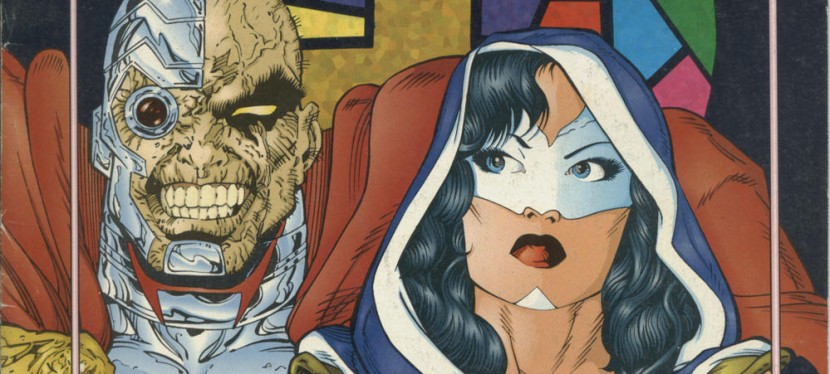
A Look Back at Prime #8 (1994)

Disclaimer: This is my original work with details sourced from reading the comic book and doing personal research. Anyone who wants to use this article, in part or in whole, needs to secure first my permission and agree to cite me as the source and author. Let it be known that any unauthorized use of this article will constrain the author to pursue the remedies under R.A. No. 8293, the Revised Penal Code, and/or all applicable legal actions under the laws of the Philippines.

Is Prime your favorite caped hero among the many heroes of the Ultraverse? For the newcomers reading this, Prime is an overly muscular hero of the Ultraverse who is actually a kid deep inside his fake flesh. Prime was one of the major heroes of the Ultraverse and was part of UltraForce alongside Hardcase and Prototype (two other major heroes).

In late 1993, a 2-part Ultraverse crossover was published titled Break-Thru and, with the art of the legendary George Perez, it was a big mix of characters from the UV. Prime had a role in Break-Thru and we can see what happened to him after the end of the said crossover in this look back at Prime published in 1994 by Malibu Comics and written by Len Strazewski and Gerard Jones with art done by the late Norm Breyfogle.

The cover.

Early story

The story begins in outer space with Prime and Prototype re-entering planet Earth. With the heat intensifying, Prime is worried that he won’t be able to make it safely on earth. Prototype, who is flying behind him, wonders if Prime knows what he is doing by leading the way. Prototype’s life is at stake as he relies on Prime to be his flying front shield (note: for the way the flight turned out in Prototype’s perspective, read Prototype #6).

Due to the instability and intense heat, the two ultras got separated flying down. Remembering the strip of Mantra’s cape, Prime uses it and manages to receive faint communication with Mantra. Prime eventually crashes into a swimming pool. With Prime’s flesh quickly dissolving, teenage Kevin Green is exposed naked underwater and struggles. Suddenly, water pushes him up several feet and finds himself being assisted by Mantra.

The naked Kevin is carried by Mantra who transform herself into Eden Blake…

Quality

The pressure on the parents of Kevin.

Storywise, this one is a solid follow-up to the Break-Thru crossover and it succeeds in developing Prime further thanks to the combined efforts of Len Strazewski and Gerard Jones. With the narrative shifted away from Break-Thru, the story emphasizes the actions of the covert operations led by Colonel Samuels who simply won’t let Prime go free given the US government’s interests. What Samuels does not know is that someone sinister and hidden is spying on their operations. That someone is also interested in Prime and this alone added a lot of intrigue into the story.

As usual, the character development is very solid. I love the way Strazewski and Jones raise the stakes on the parents of Kevin and made them more troubled knowing their son’s involvement with the military. Kevin’s father, meanwhile, is living with the guilt of keeping the big secrets of the past.

When it comes to crossovers and interactions, the exchange between Kevin/Prime and Eden/Mantra is very compelling to read. Mantra, who knows Prime’s secret, tries to keep her identity secret. Already working for Aladdin under her Eden Blake identity, she sees an opportunity to learn more about Colonel Samuels through Kevin. For his part, Kevin wants to go home instead of getting involved again with the colonel. As their dialogue goes on, the tension really strengthened and added to the plot.   

Without revealing too much, I should state that the introduction of a new character really shook the story and the big fight that followed was a great payoff to all the build-up.

Conclusion

Kevin and Mantra together.

Prime is an excellent superhero comic book! The creative team of Strazewski-Jones-Breyfogle really crafted a post-Break-Thru story that did not slowed down and kept raising the stakes and the intrigue. Suspense, excitement, drama and intrigue made a great mix here.

If you are seriously planning to buy an existing hard copy of Prime (1994), be aware that as of this writing, MileHighComics.com shows that the near-mint copy of the regular edition costs $8 while the near-mint copy of the newsstand edition costs $26.

Overall, Prime (1994) is highly recommended!

+++++

Thank you for reading. If you find this article engaging, please click the like button below and also please consider sharing this article to others. If you are looking for a copywriter to create content for your special project or business, check out my services and my portfolio. Feel free to contact me as well. Also please feel free to visit my Facebook page Author Carlo Carrasco and follow me at HavenorFantasy@twitter.com
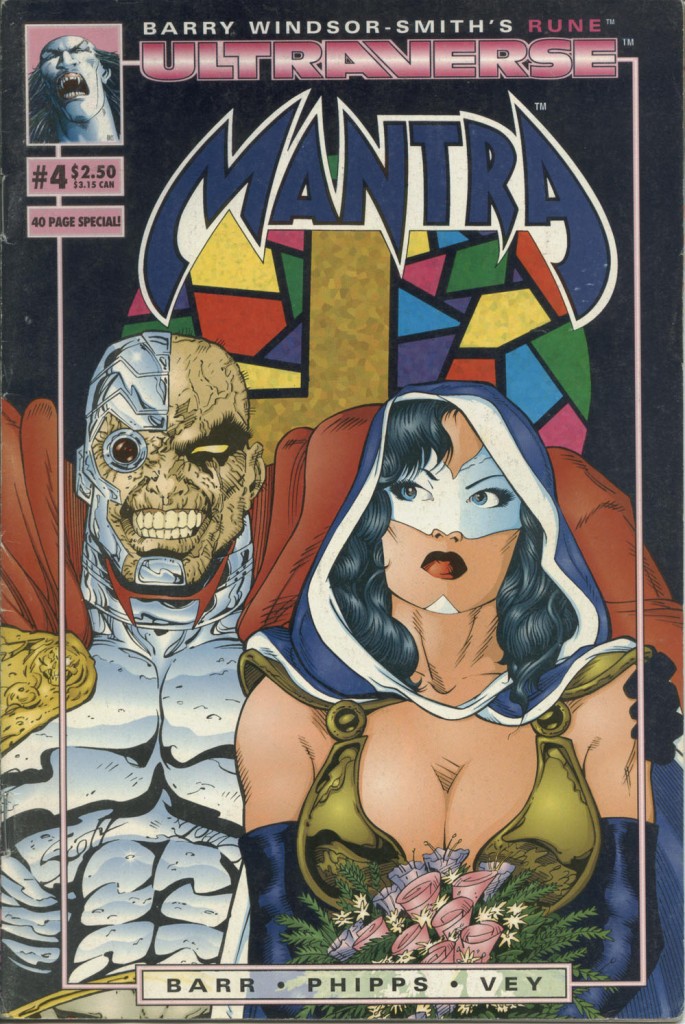
A Look Back at Mantra #5 (1993)

Disclaimer: This is my original work with details sourced from reading the comic book and doing personal research. Anyone who wants to use this article, in part or in whole, needs to secure first my permission and agree to cite me as the source and author. Let it be known that any unauthorized use of this article will constrain the author to pursue the remedies under R.A. No. 8293, the Revised Penal Code, and/or all applicable legal actions under the laws of the Philippines.

Welcome back, Ultraverse fans and comic book collectors! Would you happen to be a fan of illustrator Terry Dodson? I first saw his professional work when I read Mantra #1 way back in 1993 just as my fellow comic book collectors were discovering the newly launched Ultraverse. After the Ultraverse ended, Dodson went on to work for Marvel Comics with projects such as the Storm mini-series and X-Men related comic books. In 2000, Dodson went to DC Comics and his project with them was illustrating issues of the Harley Quinn series. He even got to work on Wonder Woman comic books six years later.

You must be wondering – how did Terry Dodson first broke into the comic book industry and what was his first project? Check out this excerpt from a published interview.

How did you break into comic books?

By doing portfolio samples and taking them to conventions and showing them around. At first it was difficult to hear the critiques, but later on that’s what I wanted to know. What I was doing wrong. Fortunately, when I broke in 1993, they were handing out jobs to anybody with a pulse. I got my first job on Mantra, for the new Malibu Ultraverse.

See? It turns out Mantra of the Ultraverse was his comic book debut.

Now that the history lesson is done, we can see more of Dodson’s work on Mantra in the look back at Mantra , published in 1993 by Malibu Comics with a story written by Mike W. Barr and drawn by Dodson.

The cover.

Early story

The story begins when a man named Strauss faces Mantra and Warstryke. The armed guy presses Strauss for details about some defective merchandise while Mantra mentions to him about their deal. Strauss shows defiance by defending himself with a green field to protect him. Mantra blocks the flow of air into the field, forcing Strauss to give up and lose his protective field.

After a short talk with Strauss, Mantra and Warstrike chat on top of the building. In reaction to Mantra’s handshake as a sign of thanks for helping, the armed guy tries to get sexually involved with the mystical warrior even though he knows Mantra has a male soul occupying a woman’s body. Mantra defies him and flies away.

Along the way, a demon spots Mantra flying through the air. It turns out he has been looking for her and decides to make a move in pursuit of her…

Quality

What do I think about the story by Mike W. Barr? I find it brilliantly written. As the cliffhanger ending of issue got resolved early, the narrative smoothly shifts into Mantra’s other struggle – being a mother to Eden Blake’s children whom she lost quality time with due to superhero pursuits. There was also this really compelling drama between Eden and her mother (who in turn believes her daughter is failing her responsibility as a parent).

Lukasz – the male soul in Eden/Mantra’s beautiful body – is still obsessed with pursuing his search for answers but even so, he cannot simply abandon the family and household of the woman whose soul he displaced. In this particular comic book, Lukasz continued to adjust in his unexpected life as Eden.

I really like the way Mike W. Barr dramatized Lukasz dealing with family matters as well as career matters. All that led to what I would call the most unexpected superhero misadventures I’ve ever read that has something to do with the dimension of hand-drawn animation. That is something you, my readers, should read to find out. It is something very enjoyable!

In terms of visuals, this comic book showed more of the creativity of Terry Dodson. If you already enjoyed his art in the early Mantra issues, you will see something new and fresh here.

Conclusion

Mantra returns home to the family.

Undoubtedly Mantra is a great comic book to read as it has an excellent mix of drama, intrigue, characterization and many bouts of great spectacle (which nicely paid-off on all the build-up). By this stage in the Mantra monthly series, Lukasz/Eden/Mantra got developed more and the stakes have been raised in relation to Eden’s meeting with her boss.

If you are seriously planning to buy an existing hard copy of Mantra (1993), be aware that as of this writing, MileHighComics.com shows that the near-mint copy of the regular edition costs $8 while the near-mint copy of the newsstand edition costs $26.
Overall, Mantra (1993) is highly recommended!

+++++

Thank you for reading. If you find this article engaging, please click the like button below and also please consider sharing this article to others. If you are looking for a copywriter to create content for your special project or business, check out my services and my portfolio. Feel free to contact me as well. Also please feel free to visit my Facebook page Author Carlo Carrasco and follow me at HavenorFantasy@twitter.com