A Look Back at Punisher 2099 #3 (1993)

Welcome back superhero enthusiasts, 1990s culture enthusiasts and comic book collectors! Today we go back to the year 1996 and explore a part of the Marvel 2099 comics universe through a tale of the Punisher 2099 monthly series.

In my previous retro review, the futuristic Punisher moved on from the deaths of his family members. Influenced strongly by the writings of the late Punisher Frank Castle, Jake Gallows begins operating as a vigilante even though he still has a full-time career as a law enforcer with Private Eye. Not only that, he gets opportunities to face off once again with Kron Stone (Venom 2099 himself) who is responsible for the deaths of Jake’s family.

With those details laid down, here is a look back at Punisher 2099 , published in 1993 by Marvel Comics with a story written by Pat Mills and Tony Skinner, and drawn by Tom Morgan.

The cover.

Early story

The story begins on one snowy night within the city. A lady who has grown very addicted with Total Reality makes a deal with a sinister merchant and makes her escape out of reality and into a living digital realm without caring about the consequences she will physically experience.

A black ambulance arrives and out comes the Punisher who hits the merchant hard enough with his weapon for a quick knockout. He then takes off the lady’s optical device (note: this should remind you somewhat of Microsoft’s HoloLens in terms of physical similarities) which brings her back to reality. Gallows knows fully well that Total Reality can actually kill users who do not practice any restraint, and he then crushes the lady’s device. Instead of thanking the Punisher, she expresses her frustration and anger to him before leaving.

Afterwards, Gallows brings the merchant into the black ambulance and puts him on stretcher. There are sharp devices nearby that can kill the merchant if he makes any attempt to escape…

Quality

Among his colleagues at work, Jake Gallows simply acts as he himself is the Punisher captured on video (but his face has been protected digitally).

While the first two issues of this monthly formed the origin and establishment of Punisher 2099, this comic book shows him doing vigilante work and acting as judge, jury and executioner all together. Going back to issue , the creative team made it clear that in 2099, justice can be bought and punishment for criminals is much softer compared to how it was in the 20th century. This alone serves as a powerful motivation for Jake Gallows to bring back old-fashioned, harsh punishment for criminals even if it means he has to do it by himself outside of the law. This is the core concept of this comic book and along the way, there is this build-up of the villain Fearmaster and his henchman Multi-Fractor.

More on the story, the creative team took their time to develop Jakes Gallows and emphasize how his mind functions each time he works secretly as a vigilante (who cannot be identified visually) and privately as a Private Eye cop (the organization’s psychologist noticed something about him). More on his secret as the Punisher, it turns out Gallows was able to establish a secret prison complex, equipment for crime-fighting and even a deadly chair underground.

As he continues to be obsessed with fighting criminals with the harsh ways of the past, the futuristic Punisher symbolically becomes a questionable protagonist. On face value, he seems to be good by simply opposing crime and yet he seems to be evil as he commits acts outside of 2099’s laws.

Conclusion

Clearly acting out of the law, the Punisher of the future imprisons criminals and acts as judge, jury and executioner without hesitation. This also shows his dark side.

With its simply concept, Punisher 2099 (1993) succeeds in defining the futuristic Punisher’s motives, intentions and execution. Compared to Frank Castle Punisher, Jake Gallows lives in a society which has laws that are so weak to push back against crime, justice becomes hollow and even laughable. That being said, this comic book is very socially relevant (note: Leftists in America weakened laws which benefited criminals, supported illegal immigrants at the expense of citizens, and have varied movements of arrogant protesters and activists who intimidated people and caused serious damage around the country) and what has been happening in America under the influence of the Democrats makes the dark future of 2099 looking like it could happen. At the same time, the Punisher in this story incidentally became somewhat unlikable as his crime-fighting obsession is gradually turning him into becoming as bad as the bad guys. This is a lively reminder that even in a society that is plagued with crime and weak justice, vigilantism is still a big no-no and it is also very destructive. To be a vigilante means becoming wicked.

Overall, Punisher 2099 (1993) is satisfactory.

+++++

Thank you for reading. If you find this article engaging, please click the like button below, share this article to others and also please consider making a donation to support my publishing. If you are looking for a copywriter to create content for your special project or business, check out my services and my portfolio. Feel free to contact me with a private message. Also please feel free to visit my Facebook page Author Carlo Carrasco and follow me on Twitter at  @HavenorFantasy as well as on Tumblr at https://carlocarrasco.tumblr.com/ and on Instagram at https://www.instagram.com/authorcarlocarrasco

A Look Back at Spider-Man 2099 #42 (1996)

Welcome back superhero enthusiasts, 1990s culture enthusiasts and comic book collectors! Today we go back to the year 1996 and explore a part of the Marvel 2099 comics universe through a tale of the Spider-Man 2099 monthly series.

In my previous retro review, the futuristic webslinger encountered a group of dangerous people who are convinced that he betrayed them by becoming a corporate tool (note: the result of Goblin 2099 poisoning people’s minds). Not only that, the still-recovering Tyler Stone came back at Alchemax, saw his captured son Kron (Venom 2099 himself) and cold heartedly ordered his execution.

With those details laid down, here is a look back at Spider-Man 2099 #42, published in 1996 by Marvel Comics with a story written by Peter David and drawn by Andrew Wildman.

The cover.

Early story

The story begins with Miguel O’Hara now wielding tremendous corporate power at Alchemax where he is surrounded by managers. Some time had passed since he prevented Tyler Stone from returning to power and he made it known to him that he is aware that they are biologically father-and-son. Miguel then played “duck, duck, goose” on the managers while he stood up on his desk. He made clear to them that he is aware of their so-called game of “who can jerk the new boost and get the most for himself?”

Miguel then tells them that he will review their requests and address their concerns in his own time and his own way. They get dismissed by him. Miguel then meets someone who just arrived for the post of office secretary.

Meanwhile in the downtown section of New York, Raff and Kasey watch a union group composed of construction guys, watchdogs, sewer workers and truckers marching down the street and making noise. As Kasey wonders where the group was heading, she notices a man named Boru whom she previously heard was dead…

Quality

Spider-Man 2099 faces a tough opponent.

Storywise, this tale by Peter David moved away from the themes of issues and by focusing more on Miguel’s newest rise in Alchemax’s corporate hierarchy and how this adds more tension to his already troubled living as a secret superhero, an executive and as a person. By this stage, he knows Tyler Stone is his true father and the man known as Venom 2099 is his half-brother and relationships within his family are far from being normal or ideal. Still on the corporate aspect, a very notable person gets to work as Miguel’s new secretary which I won’t spoil here because I can say that the build-up and pay-off are well worth reading. The new secretary also added to the further development of specific characters and what was dramatized here will compel you to revisit earlier issues of the Spider-Man 2099 series. As always, Peter David’s writing is rich here.

Outside of Alchemax, the group led by Boru (who is symbolically a leader of hardened and desperate labor union members) emerges as an intimidating force of opposition for Miguel, the corporation he leads and even in his Spider-Man identity. Boru himself is quite a strong opponent for Spidey and the way their battle ended is something can intrigue readers or even frustrate die-hard fans of the protagonist. These conflicts, combined with Miguel’s struggle with all the tension hitting him from all angles, made this tale very intriguing and compelling to read.

Conclusion

While walking through the city, Miguel O’Hara spots members of Fantastic Four 2099 in conflict with Stark-Fujikawa.

Spider-Man 2099 #42 (1996) may not look like the expected continuation of what was built up in the previous two issues but its standalone story combined with strong twists, in-depth character development and sheer intrigue in key points of the story made this a must-read. I can also say that I am motivated to find out what happens next, especially given how this particular tale ended.

Overall, Spider-Man 2099 #42 (1996) is highly recommended!

+++++

Thank you for reading. If you find this article engaging, please click the like button below, share this article to others and also please consider making a donation to support my publishing. If you are looking for a copywriter to create content for your special project or business, check out my services and my portfolio. Feel free to contact me with a private message. Also please feel free to visit my Facebook page Author Carlo Carrasco and follow me on Twitter at  @HavenorFantasy as well as on Tumblr at https://carlocarrasco.tumblr.com/ and on Instagram at https://www.instagram.com/authorcarlocarrasco

A Look Back at Spider-Man 2099 #41 (1996)

Welcome back superhero enthusiasts, 1990s culture enthusiasts and comic book collectors! Today we go back to the year 1996 and explore a part of the Marvel 2099 comics universe through a tale of the Spider-Man 2099 monthly series.

In my previous retro review, the futuristic webslinger encountered Goblin 2099 (note: the futuristic take on Green Goblin) who proved to be very dangerous not with weapons nor physical attacks but with influence members of the local society to rebel against him believing that he is a corporate asset. How much influence Goblin had on the people at the expense of Spider-Man is just waiting to be discovered.

With those details laid down, here is a look back at Spider-Man 2099 , published in 1996 by Marvel Comics with a story written by Peter David and drawn by Andrew Wildman

The cover.

Early story

The story begins with Miguel O’Hara visiting a ruined place with armed personnel escorting him. It turns out the site was the White House and Doom 2099 has already fallen as President of the United States. Miguel seeks closure as he spends time at the ruins and eventually finds the name plate from the office of Tyler Stone (Miguel’s biological father).

Meanwhile at Alchemax, corporate personnel got surprised to see Tyler Stone return confined to a hovechair due to his fragile and weakened state. This turned out to be his first time to be at work since he got shot.

Inside the laboratory, Tyler sees his deranged son Kron (Venom 2099) contained behind solid glass like a mere scientific specimen for study. After learning key details about the symbiote and how it affected his son, Tyler gives the order to have Kron executed…

Quality

Even though Goblin 2099 was not present, this scene shows how much the said villain poisoned the minds of people to harm Spider-Man.

Let me start with the writing by Peter David. It is clear to me that David confidently wrote this story to maintain the flow of intrigue, emphasize how local society’s changing, how the external events affect others and, most notably, managing to push Spider-Man 2099 to the edge complete with a brewing conflict with the very powerful Tyler Stone.  

At this stage of the monthly series of the 1990s, Miguel O’Hara’s rise within the corporate structure of Alchemax got emphasized again and Peter David inserted growing tensions for the protagonist effectively blurring the boundary that separates personal life from the corporate career. That being said, the futuristic Spider-Man in his civilian identity literally entered a gray area which will compel readers to speculate if he was still in control of matters or if he was slowly becoming evil as he gains power (this makes him comparable with the tycoon Tyler).

Still on the character development aspect of this comic book, Miguel here still showed his fragile side as the death of Dana left him with a lot of pain deep inside (which was dramatically emphasized by Andrew Wildman through his art in one very particular page). This furthers adds to questions about the sanity and mental stability of the protagonist who already wields so much power as Spider-Man and as an Alchemax executive.

Speaking of Alchemax, Tyler Stone here appeared more sinister than before and being unable to stand did not hinder him at all. His cold-hearted move to have his own biological son Kron (the futuristic Venom and the same guy responsible for the deaths of Punisher 2099’s family) executed clearly shows not only his sadistic nature but also the fact that he is living with pure worldly beliefs. His believes are so worldly, he does not really care about his own offspring. Ironically, this suggests that Tyler could be as twisted and evil as his murderous son Kron. Lastly, the connections between the late Dana and Tyler and Miguel is indeed morally disturbing.

While the cover art showed Goblin 2099, the new antagonist is nowhere to be found in this comic book. However in a very symbolic fashion, Goblin’s influence remained lively through a number of people who condemned Spider-Man 2099 so much, they went as far as actually hurting an idolater of the webslinger. This part of the story is a strong reminder that idolatry is unholy and foolish, that religion is corrupted and will never lead believers to salvation, and that socialism attacking capitalism remained a social disease in the far future.

Conclusion

Tyler Stone and his son Kron (Venom 2099) are both very evil. They have different ways of being evil.

Spider-Man 2099 (1996) is indeed a great comic book to read from start to finish. Not only will you get to see the futuristic Spidey struggle with the tension both personally and professionally, you will see the big impact of Dana’s death on him too. The portrayal of negative changes in the local society (at least the society Spider-Man is part of) is pretty dramatic and what Peter David imagined about Marvel 2099 still remains socially relevant to this day. Lastly, this comic book ended very powerfully and was enough to convince me to see what happens next.

Overall, Spider-Man 2099 (1996) is highly recommended!

+++++

Thank you for reading. If you find this article engaging, please click the like button below, share this article to others and also please consider making a donation to support my publishing. If you are looking for a copywriter to create content for your special project or business, check out my services and my portfolio. Feel free to contact me with a private message. Also please feel free to visit my Facebook page Author Carlo Carrasco and follow me on Twitter at  @HavenorFantasy as well as on Tumblr at https://carlocarrasco.tumblr.com/ and on Instagram at https://www.instagram.com/authorcarlocarrasco

A Look Back at Punisher 2099 #2 (1993)

Disclaimer: This is my original work with details sourced from reading the comic book and doing personal research. Anyone who wants to use this article, in part or in whole, needs to secure first my permission and agree to cite me as the source and author. Let it be known that any unauthorized use of this article will constrain the author to pursue the remedies under R.A. No. 8293, the Revised Penal Code, and/or all applicable legal actions under the laws of the Philippines.

Welcome back superhero enthusiasts, 1990s culture enthusiasts and comic book collectors! Today we revisit the future of 2099 through the Punisher 2099 monthly series.

For the newcomers reading this, Punisher of 2099 is Jake Gallows who works during the day as a law enforcer which is a nice contrast to the concept of the classic Punisher identified as Frank Castle. In Punisher 2099 (1993), Jake Gallows witnesses the demise of his family that got attacked by a gang of killers led by Kron Stone who is not only the son of Alchemax’s Tyler Stone but also became the deadliest nemesis of Spider-Man 2099.

With those details laid down, here is a look back at Punisher 2099 , published by Marvel Comics in 1993 with a story written by Pat Mills and Tony Skinner, with art by Tom Morgan.

The cover.

Early story

The story begins with a funeral of Jake Gallows’ lost family members held at the church of Thor. In accordance to the traditions of the Thor religion, the dead bodies were placed on a burning boat floating on the water just outside the church building. As he and his fellow law enforcers watch the ritual happen, Jake confirms that he and the church of Thor do not believe in forgiveness and he himself believes in revenge.

When he is not on duty, Jake goes out as the Punisher hunting and killing criminals in his own brutal ways. Even as he does not wear a mask nor a helmet, his face is digitally covered from detection of security cameras thanks to a special technology he uses to protect his identity.

Meanwhile at an amusement park, lots of children enjoy floating in the air within an anti-gravity chamber. Kron Stone and his fellow killers arrive as they attempt to murder the children. Punisher suddenly comes out and successfully kills Stone’s companions, leaving them together in a standoff…

Quality

The Punisher has someone assisting him.

While the sub-par issue was composed mostly of the build-up and emphasis of the futuristic Punisher, this story is pretty much a big pay-off to it. Quite predictably, Jake gets to meet with the gang leader responsible for the death of his family in this issue not once but twice. Along the way, the comic book writers got to emphasize Kron Stone’s wickedness more as well as his continued disregard of human life. This time, Stone’s willingness to kill many children is very disturbing and Tom Morgan’s art style clearly emphasized the villain’s evil.

Within this comic book is a visual tour of the Gallows residence which has a large underground facility and pieces of technology that Jake uses for his campaign against crime (this makes Punisher 2099 becoming similar with Batman and his Bat Cave). He also has a technology oriented partner named Matt who helps him establish a working base of operations.

There is also a sub-plot about the side of crime with the introduction of the Fearmaster who, like Tyler Stone, is with Alchemax and has influence over Public Eye. Unsurprisingly, his introduction is short.

Conclusion

Jake Gallows and Kron Stone (AKA Venom 2099) meet again, only this time the former is now in his form as the Punisher.

The best way to describe Punisher 2099 (1993) is that its plot really thickened and unlike issue , this one has a more interesting story and the presentation done by the creative team has some entertainment value. While this is unsurprisingly the natural progression of defining the futuristic Punisher to readers, it is also a successful way of expanding his own part of the 2099 universe complete with the introduction of a new villain and conspiracy that connects to both criminals and law enforcers. To be clear, this is far from being an excellent comic book but it is clear that this one is an improvement over issue . In retrospect, the one thing that adds weight to this comic book is not Punisher himself nor the creative concepts involved, but rather the presence of Kron Stone who later on became Venom 2099 (read my retro reviews involving him in Spider-Man 2099 issues #35, #36, #37, #38 and #39).

If you are seriously planning to buy an existing hard copy of Punisher 2099 (1993) be aware that as of this writing, MileHighComics.com shows that the near-mint copy of the regular edition costs $90 while the near-mint copy of the newsstand edition costs $200.

Overall, Punisher 2099 (1993) is satisfactory.

+++++

Thank you for reading. If you find this article engaging, please click the like button below and also please consider sharing this article to others. If you are looking for a copywriter to create content for your special project or business, check out my services and my portfolio. Feel free to contact me with a private message. Also please feel free to visit my Facebook page Author Carlo Carrasco and follow me on Twitter at  @HavenorFantasy as well as on Tumblr at https://carlocarrasco.tumblr.com/

A Look Back at Spider-Man 2099 #39 (1996)

Disclaimer: This is my original work with details sourced from reading the comic book and doing personal research. Anyone who wants to use this article, in part or in whole, needs to secure first my permission and agree to cite me as the source and author. Let it be known that any unauthorized use of this article will constrain the author to pursue the remedies under R.A. No. 8293, the Revised Penal Code, and/or all applicable legal actions under the laws of the Philippines.

Welcome back, superhero enthusiasts, 1990s culture enthusiasts and comic book collectors! Today we revisit the world of 2099 within the universe of Marvel Comics back in the 1990s, specifically through the Spider-Man 2099 monthly series.

In this retro review, the Venom 2099 storyline continues (for my previous reviews, click here, here, here and here). Since my previous review, the futuristic Venom has been captured by Spider-Man and is now in the custody of Alchemax where Miguel O’Hara (Spider-Man of 2099) holds considerable power and authority. As seen in issue #38, Miguel’s rage was clearly affecting him and pushed him to the point of wanting revenge (by means of death, no less) over the death of Dana.

With those details laid down, here is a look back at Spider-Man 2099 #39, published in 1996 by Marvel Comics with a story written by Peter David and drawn by Andrew Wildman.

The cover.

Early story

The story begins with Miguel O’Hara, still impacted by Dana’s death and what he personally discovered about Venom, walking through the offices of an Alchemax building where several employees greet him formally which he does not seem to enjoy. He walks into a laboratory where he sees the two that compose Venom – Kron Stone and the symbiote (living costume) – contained separately with hard glass containers.

Kron Stone, who is related to the powerful Tyler Stone and was responsible for the death of the family of Jake Gallows/Punisher 2099, was declared dead which puzzles Miguel. As the two exchange words, it turns out Kron and Miguel knew each other from long ago. Upon the orders of Miguel, the scientists left the laboratory which gave their boss more privacy to exchange words with the trapped Kron who called him gutless.

Miguel then releases Kron from containment (but still separated from the symbiote), declares terms for their private fist fight (which Kron accepts), and begins to fight him…

Quality

Spider-Man, in his form as Miguel O’Hara, spends time with Xina.

Not surprisingly, the high level of quality and engagement of the writing here is successfully maintained by Peter David and it is very clear to me that he had planned to dramatically shift the direction of the Spider-Man 2099 series and impact the key characters as the story of Venom 2099 went on.

That being said, Peter David went on to not only show Miguel literally burning with rage but also dramatized his move towards the extreme. Not only do we get to see Miguel really abusing his Alchemax authority, he also gets violent with Kron Stone who was powerless without the symbiote. These scenes clearly show that the border that separates good and evil got blurred which showed a very dark side of Miguel O’Hara struggling with his rage, emotions and whatever sanity he still has left.

To be clear, the story here was not purely about Miguel and Kron. There is also the scene in which a cooled down Miguel spends time with Xina who made clear to him her reaction over Dana’s death. Peter David also took the opportunity to not only show more of the return Vulture 2099 but also brought in the 2099 version of Green Goblin simply called Goblin who clearly has an agenda against Spider-Man which adds to the suspense and the overall narrative of the series. The appearance of Goblin also sheds light on the nature of vigilantism and elements of chaos within the 2099 universe.

Conclusion

Miguel and his half-brother Kron Stone begin their fight.

I can say that Spider-Man 2099 #39 (1996) is a very solid read. Not only did the Venom 2099 storyline reflect the serious changes on the characters, it is also led to a bold new direction for the monthly series. Carrying on the dramatic stuff from the previous issues, this comic book also serves as a character examination on Miguel O’Hara which will compel not only the fans but also comic book readers to reflect about what they knew about Spider-Man of the far future and speculate as to how he will turn out and how he would impact the people around him.

If you are seriously planning to buy an existing hard copy of Spider-Man 2099 #39 (1996) be aware that as of this writing, MileHighComics.com shows that the near-mint copy of the regular edition costs $80 while the near-mint copy of the newsstand edition costs $240.

Overall, Spider-Man 2099 #39 (1996) is highly recommended.

+++++

Thank you for reading. If you find this article engaging, please click the like button below and also please consider sharing this article to others. If you are looking for a copywriter to create content for your special project or business, check out my services and my portfolio. Feel free to contact me with a private message. Also please feel free to visit my Facebook page Author Carlo Carrasco and follow me on Twitter at  @HavenorFantasy as well as on Tumblr at https://carlocarrasco.tumblr.com/

A Look Back at Spider-Man 2099 #35 (1995)

Disclaimer: This is my original work with details sourced from reading the comic book and doing personal research. Anyone who wants to use this article, in part or in whole, needs to secure first my permission and agree to cite me as the source and author. Let it be known that any unauthorized use of this article will constrain the author to pursue the remedies under R.A. No. 8293, the Revised Penal Code, and/or all applicable legal actions under the laws of the Philippines.

When Marvel Comics first launched the 2099 imprint of comic books showcasing many futuristic versions of their present-day characters – like Spider-Man, Ravage and Dr. Doom – it was inevitable that the same treatment will be applied to their popular supervillains.

In 1993, the 2099 version of Vulture was introduced and he sure proved to be one tough opponent for Spider-Man 2099. Even back then, there already was clamor for a futuristic version of Venom which at the time was riding high with readers being the featured anti-hero in several limited series (starting with Lethal Protector) of comic books.

Then in 1995, after doing a creative teaser in issue , Marvel formally introduced Venom 2099 by releasing Spider-Man 2099 #35. This is my review of the comic book written by Peter David and drawn by Andrew Wildman (X-Men Adventures).

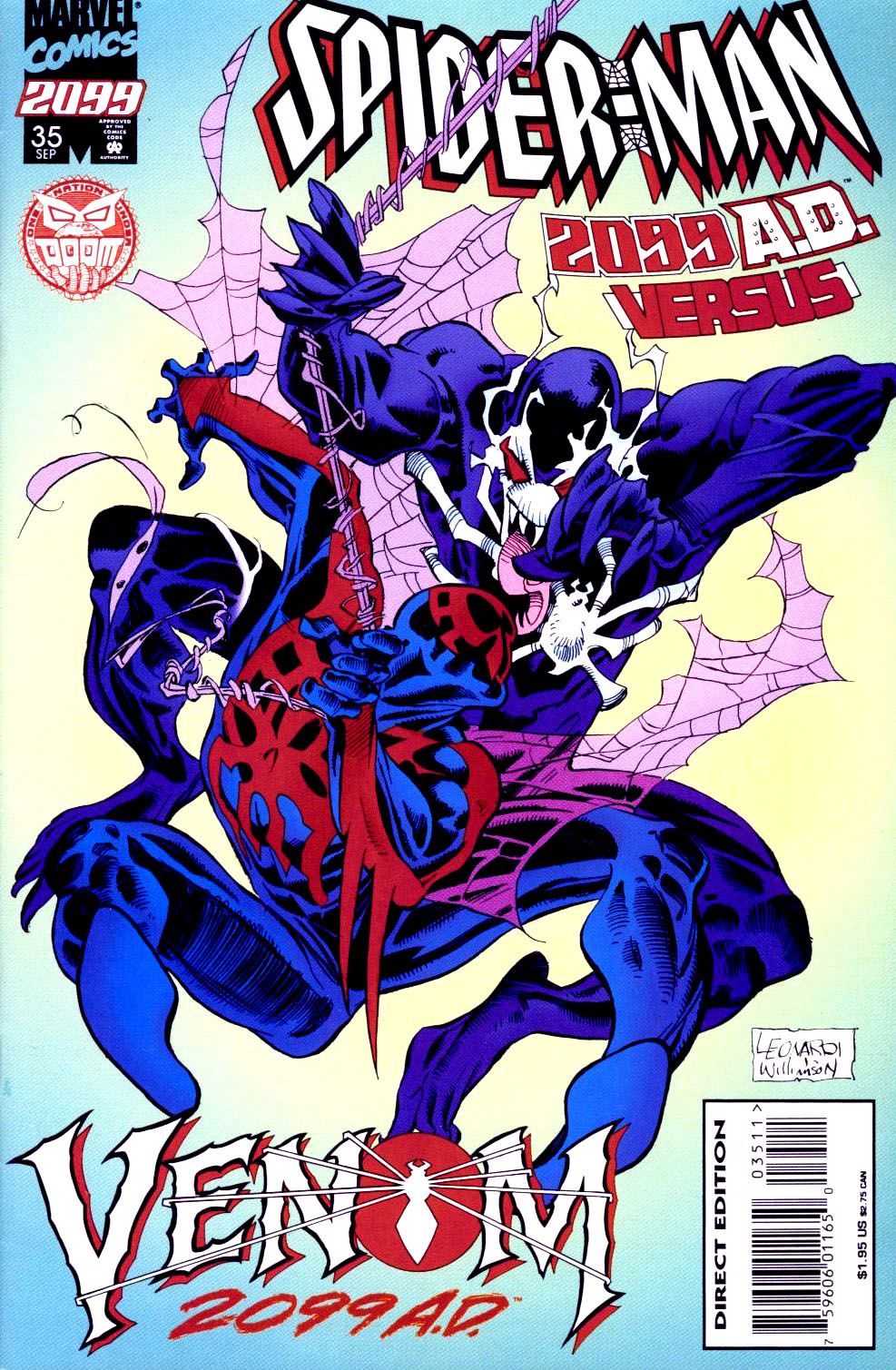
Cover
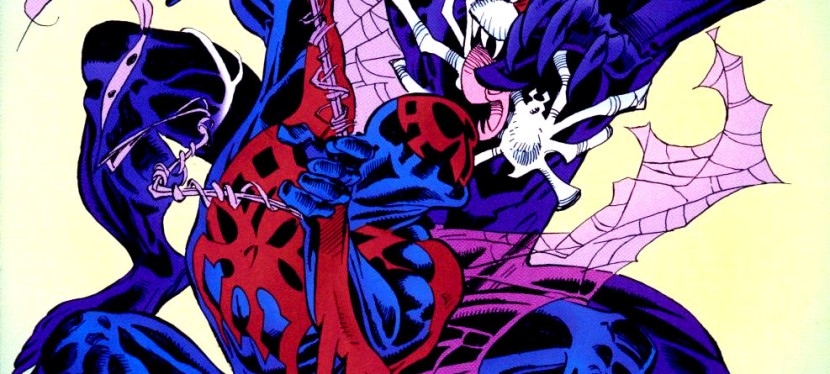
The cover drawn by Rick Leonardi.

Early story

Picking up from the events of issue , the story begins in Washington, DC with Dana freeing herself only to find out that Alchemax’s CEO Tyler Stone was down suffering from a gun shot and losing blood. Minutes later, emergency personnel take Stone’s body for immediate treatment.

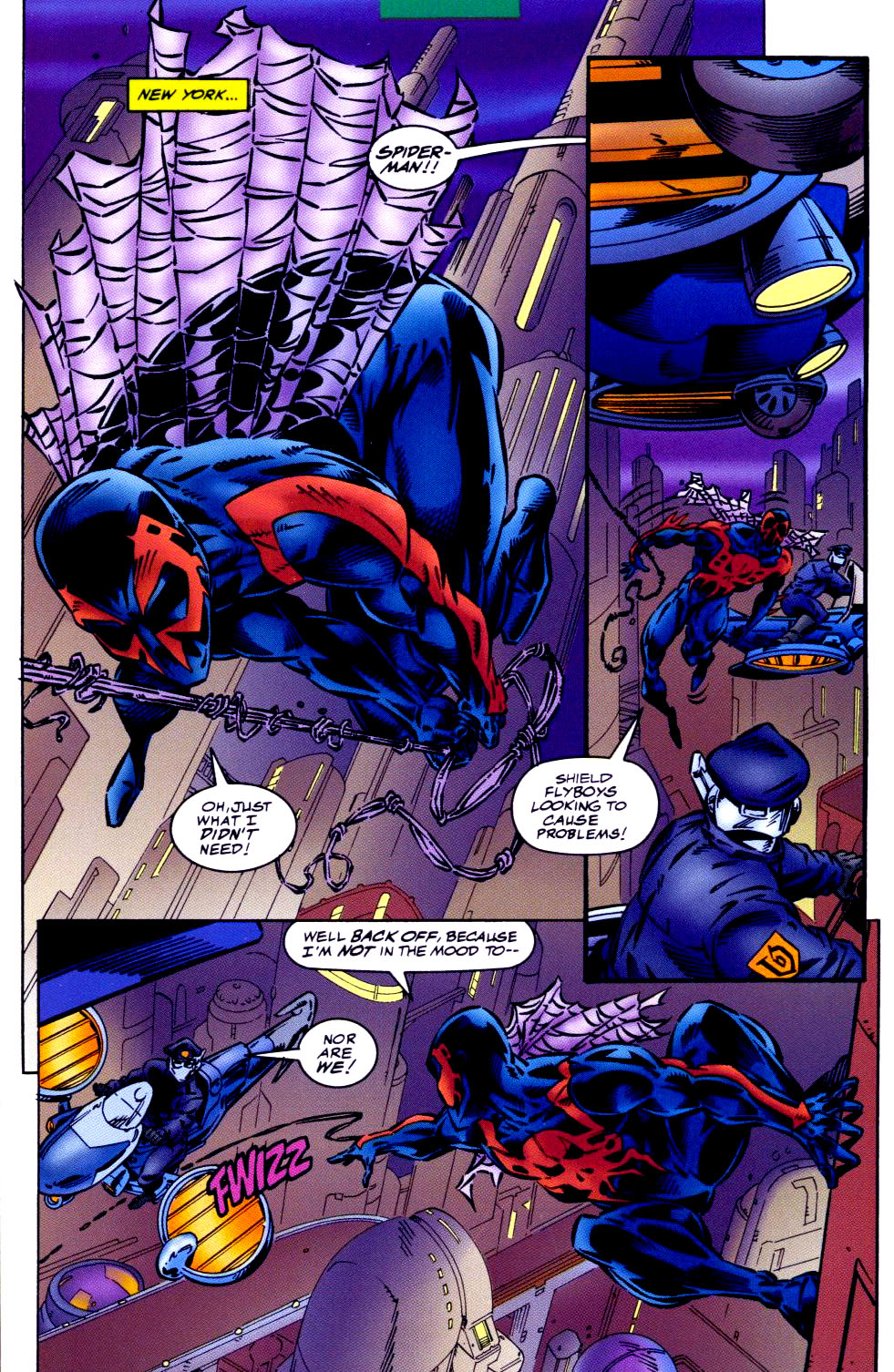
Meanwhile, Spider-Man 2099 (Miguel O’Hara) encounters the SHIELD flyboys in New York. After almost getting into trouble together, Spidey gets informed that US President Doom 2099 ordered them to leave him alone for a period of seventy-two hours while he considers a cabinet offer. Back in Washington, Dana gets interrogated by one of the authorities. President Doom enters the scene telling Dana that she will join Tyler Stone immediately in the medical center.

3
Andrew Wildman’s take on Spider-Man 2099 and the future was really nice to look at.

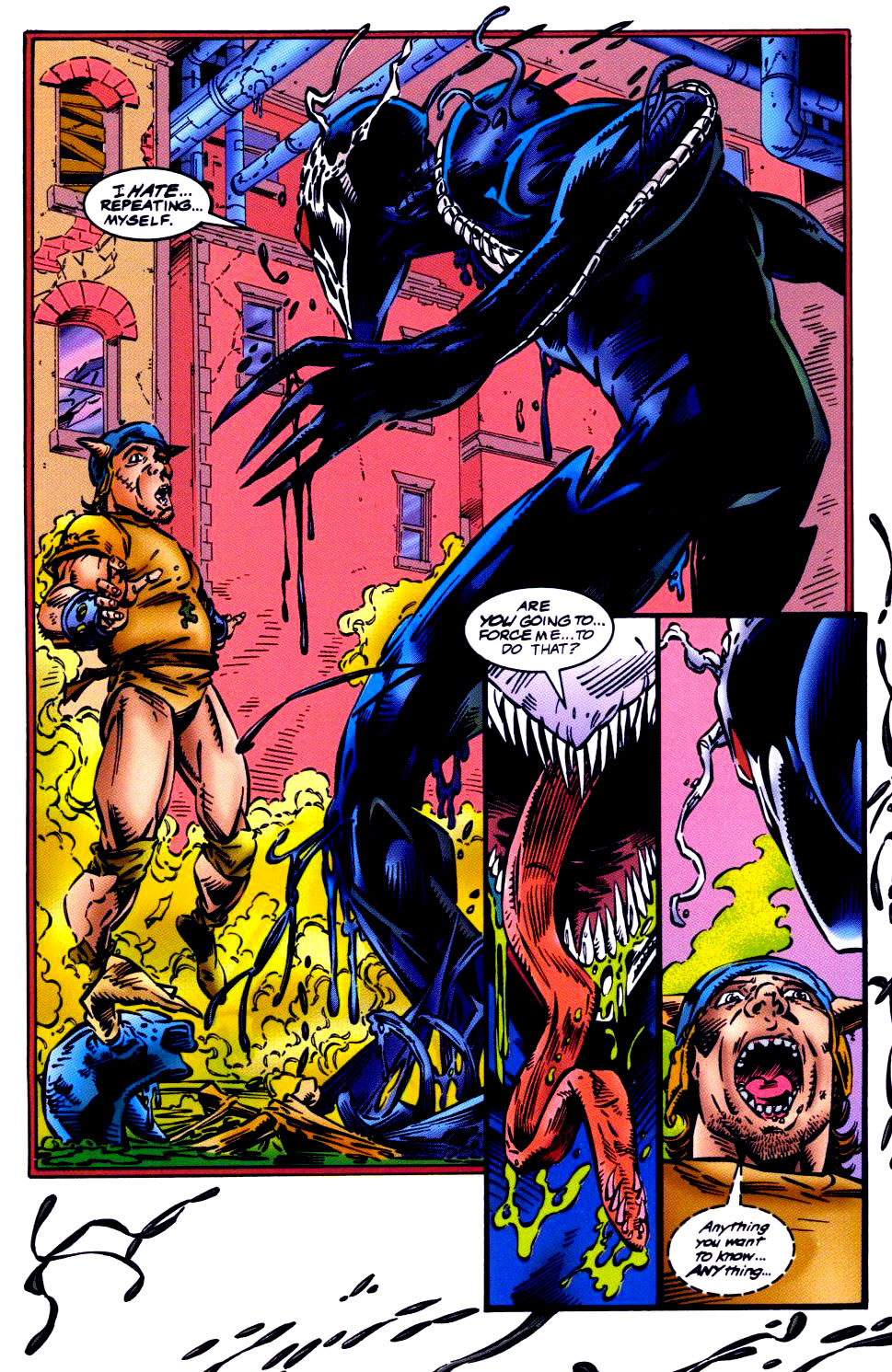
In New York, two guys sitting on the sidewalk witness a moving black liquid coming out of the sewer. The thing turns out to be a living symbiote (or alien costume) forming into a human-like shape – Venom 2099!

Quality

As with other comic books of this particular series, the writing by Peter David is pretty deep and engaging. The usual balance between dramatization, character development, plotting and spectacle is here once again but with a slight touch of horror in relation to the introduction of Venom of 2099. Speaking of dramatization, the portrayal of Venom 2099 as a vicious villain is similar to the 20th century Venom (Eddie Brock) but with a very powerful obsession to kill Miguel O’Hara and Tyler Stone.

Here’s an excerpt from the dialogue of Venom of 2099: Miguel O’Hara…and Tyler Stone…together again. We…I get to kill you…at the same time…how awfully…awfully…considerate. To show my appreciation…I’ll kill you slowly.

What makes this comic book unique is the artwork by Andrew Wildman who temporarily replaced regular illustrator Rick Leonardi. For comparison, I find Wildman’s art style a welcome thing in this comic book mainly because he draws with a lot more detail per panel and per page than Leonardi ever could. Instead of seeing the usual sketch-like art style of Leonardi, Wildman’s style is livelier and more expressive to look at. I also enjoyed Wildman’s visual take on Spider-Man 2099/Miguel O’Hara, Lyla, Tyle Stone, and the other established characters. Their facial expressions are also livelier to see.

9
Venom 2099 appears! Take note of the “liquid” at the edges of the page.

More on visuals, Wildman’s take on Venom 2099 is unforgettable. Like 20th century Venom, he has a dark suit, elongated jaw with rows of sharp teeth and an elongated tongue but with green acid dripping all the time. There are also those tentacles-like things that stretch from his body until the arms. Also his white-colored mask with large eyes make him look horrific.

Conclusion

Despite being shorter than the usual 22-pages, Spider-Man 2099 #35 is still a very engaging and fun old comic book to read. Its purpose was to build-up anticipation leading to the introduction of Venom 2099 was achieved nicely and the respective qualities of the writing and visuals are very good even by today’s standards. More on the presentation of Venom of 2099, it seems like Peter David took inspiration from movie director James Cameron on building-up tension and suspense before showing the villain. That’s a move I enjoyed in this comic book.

Overall, Spider-Man 2099 #35 is highly recommended. If you plan to acquire an existing and legitimate hard copy, be aware that the near-mint copy of it is over $100 for the newsstand version while the Rich Leonardi-drawn “Venom 2099 AD” cover version is priced at over $80 at MileHighComics.com as of this writing.


Thank you for reading. If you find this article engaging, please click the like button below and also please consider sharing this article to others. Also my fantasy book The World of Havenor is still available in paperback and e-book format. If you are looking for a copywriter to create content for your special project or business, check out my services and my portfolio. Feel free to contact me as well. Also please feel free to visit my Facebook page Author Carlo Carrasco and follow me at HavenorFantasy@twitter.com