Disclaimer: This is my original work with details sourced from reading the comic book and doing personal research. Anyone who wants to use this article, in part or in whole, needs to secure first my permission and agree to cite me as the source and author. Let it be known that any unauthorized use of this article will constrain the author to pursue the remedies under R.A. No. 8293, the Revised Penal Code, and/or all applicable legal actions under the laws of the Philippines.
Like anyone of you guys and gals reading this, I’ve been limited to staying mostly at home as a result of the community quarantine imposed by the local authorities in response to the Coronvirus disease COVID-19 that started in China and has since turned into a global pandemic. Many people lose their jobs and have no income. Varied industries have been shut down. People are struggling to follow local authorities while there are some depending on relief goods (food, water and essential supplies) released by their respective governments or by charitable organizations.
The pandemic affected the entertainment industry too. As such, the much-awaited threatrical opening of the Wonder Woman 1984 movie had to be delayed by Warner Bros. from June 2020 to August 2020.
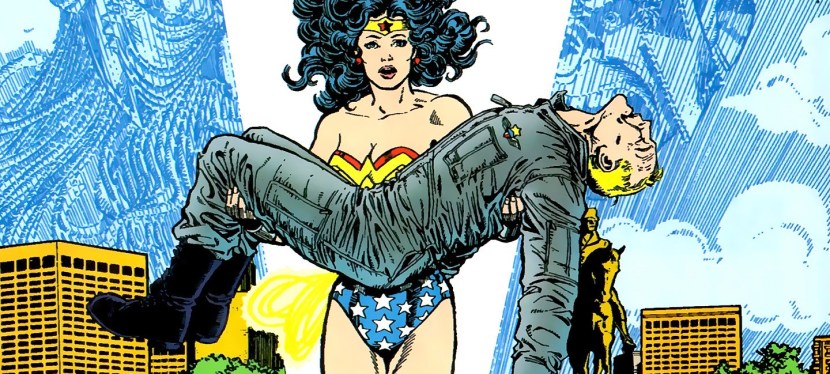
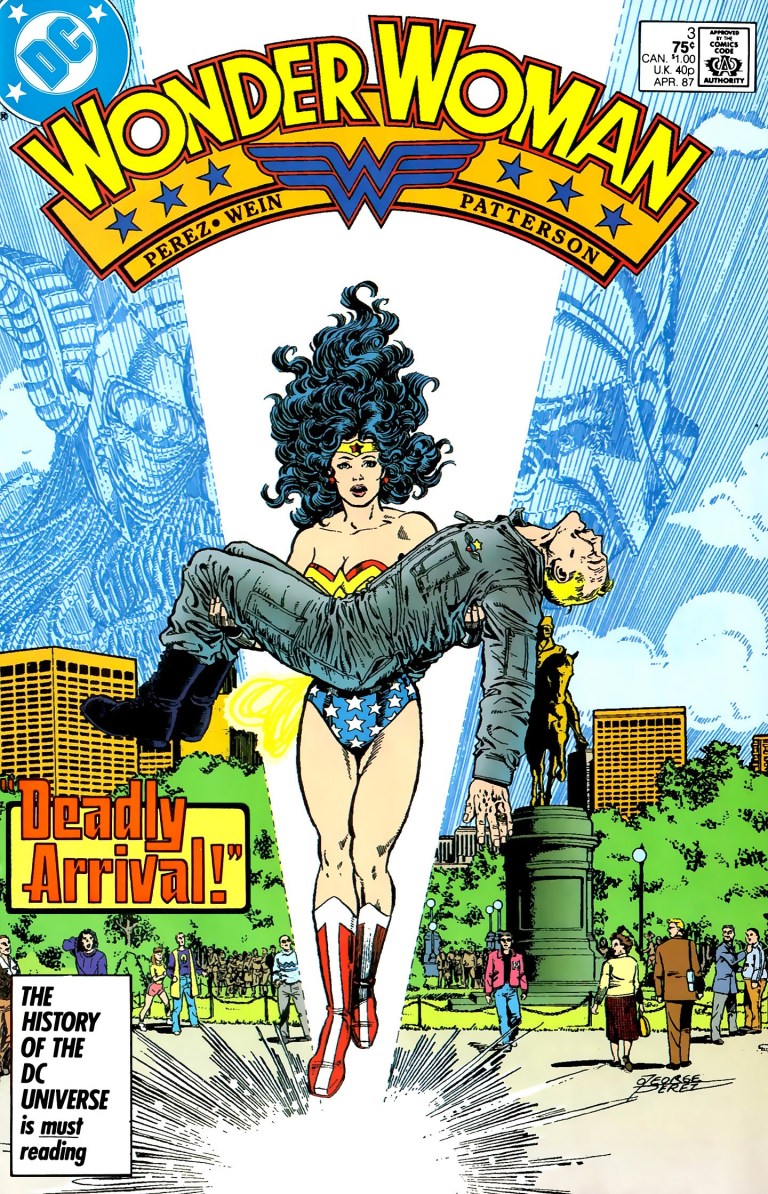
While waiting for the big movie to come out, let’s take a nice look back at Wonder Woman #3 published by DC Comics in 1987 with a story co-written by the late Len Wein and the legendary George Perez who worked on the art (inked by Bruce D. Patterson).
The cover by George Perez.
Early story
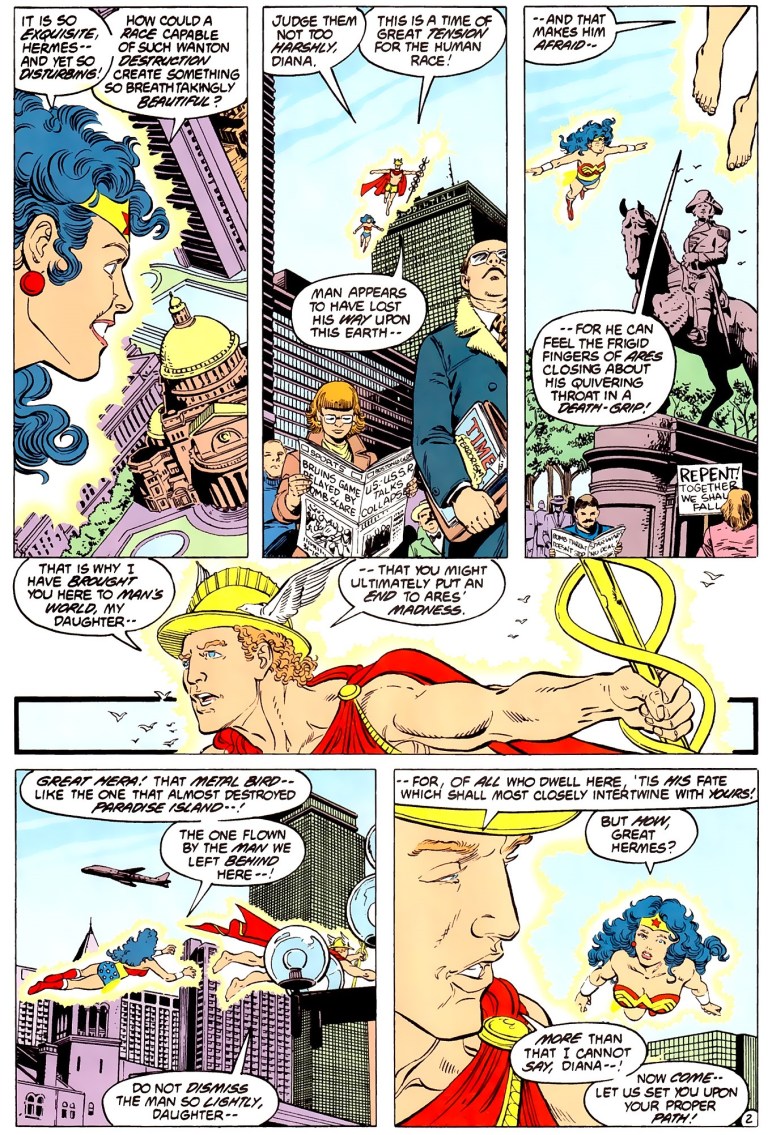
The story begins with Wonder Woman and Hermes arriving in the City of Boston in the United States. While flying in the air, princess Diana expressed her amazement of the city finding it exquisite and yet so disturbing. Even as Hermes cautions her from judging the people of man’s world, he states that man appears to have lost his way on Earth which makes him afraid and vulnerable to the influence of Ares.
He tells Wonder Woman that he led her to man’s world so that she could end the madness Ares has been causing on the people. Together they fly off to pursue the next objective.
Wonder Woman and Hermes arrive in Boston.
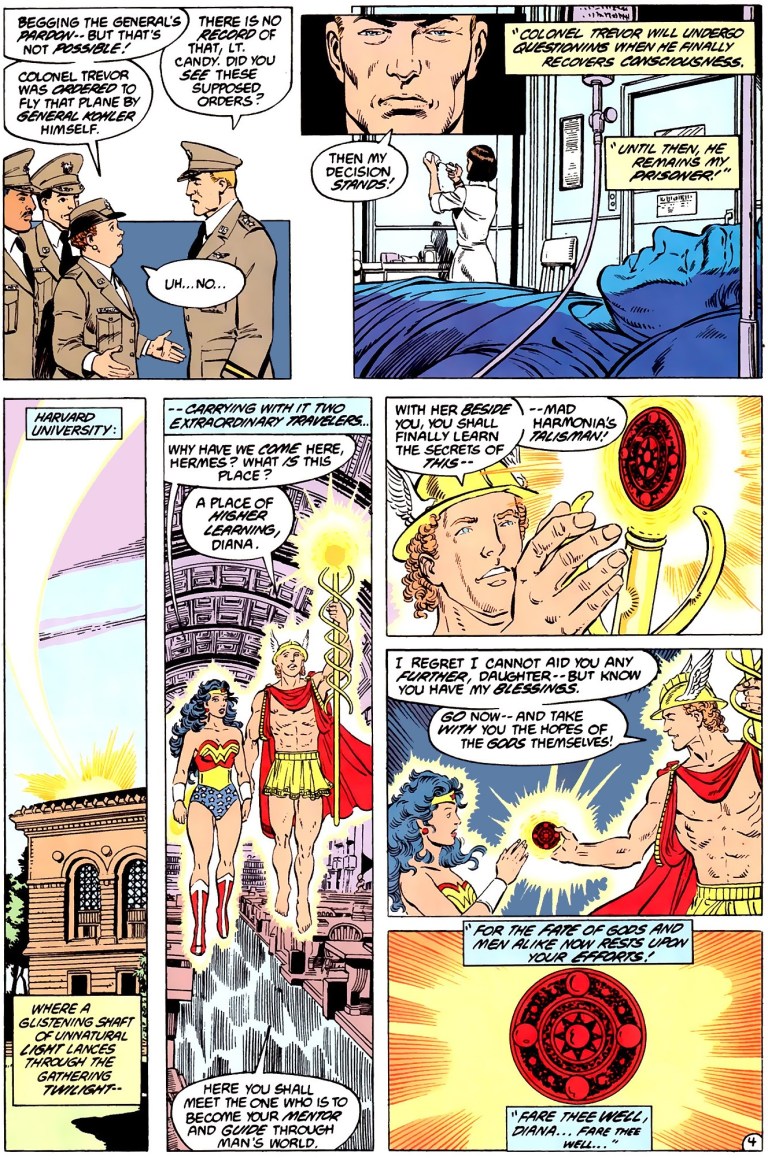
Meanwhile at the Hanscom Air Force Base, a general arrives to check on Steve Trevor who is recovering from the incident that happened at Themyscira (in issue #2). As it turns out, Trevor is under arrest as he is wanted for questioning in relation to the shocking murder of another general. It was also stated that Trevor returned without the jet he used….
Quality
If there is anything that stood out for me personally in Wonder Woman #3, it is the wonder that comes with discovery which was greatly pulled off by Len Wein and George Perez. As Wonder Woman arrives in Boston, observes how strange the society is to her and how she adjusts to the place and people around her, I got very engaged along the way. What Wonder Woman discovers and learns, I discovered and learned as well. In some ways, her discovery of man’s world (through Boston) reminded me of what I experienced during my first arrival in San Francisco, California decades ago. It should be noted that the dialogue is very rich continuing nicely from what was started in issue #1.
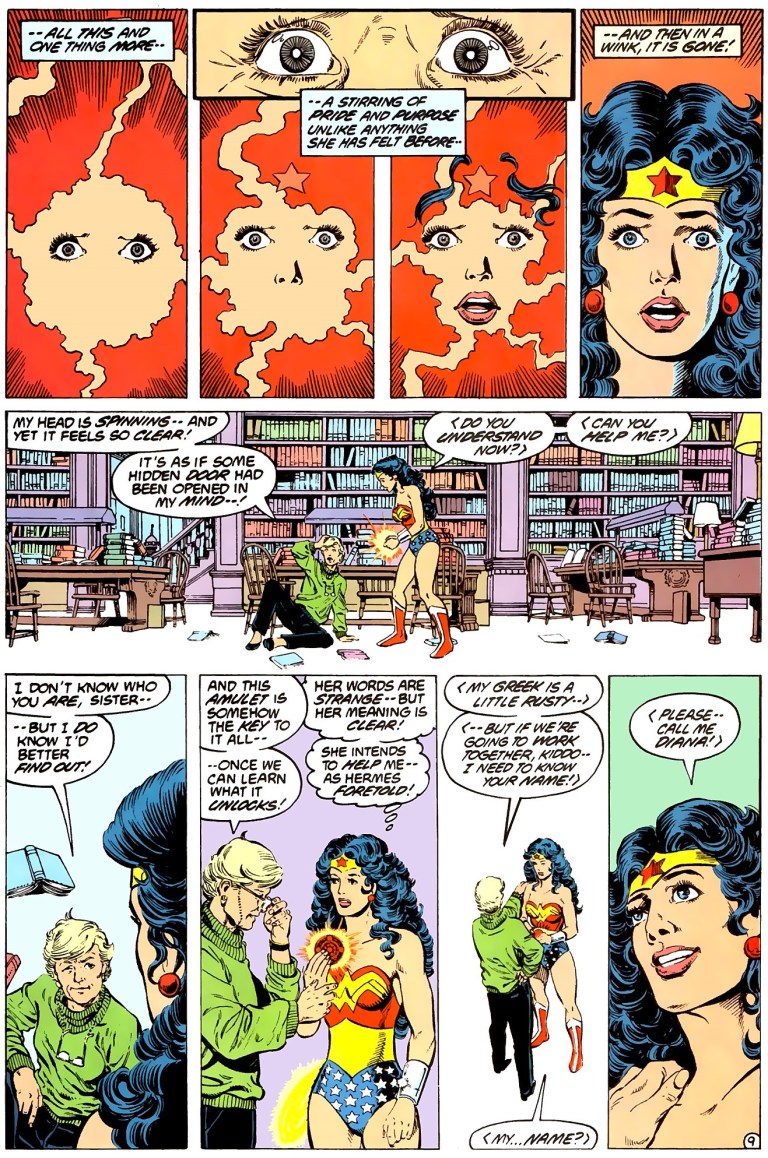
Wonder Woman and Julia Kapatelis slowly communicating with each other.
Like in the first two issues, there is also a nice build-up of suspense which is connected with the fusion of both fantasy elements and Greek mythology. This comic book cleverly reminds readers what is happening behind the scenes in the fantasy realm (within the story that is) just as Wonder Woman and the people in man’s world move on with their respective exploits. Such suspense is very well used on adding depth to the plot while paving the way for sub-plots.
Also worth mentioning here is the introduction of professor Julia Kapatelis and her teenage daughter Vanessa as supporting characters who will prove to be crucial to Wonder Woman’s adjustment into their society. Personally, I just love the way the creators showed that Wonder Woman does not speak English and had yet to learn the language which added some depth into her first encounter with Julia.
Conclusion
I really had a great time reading Wonder Woman #3. This is a significant comic book as it marked Wonder Woman’s first arrival in man’s world during the Post-Crisis era (after Crisis on Infinite Earths) and a true modernization of the icon as well as her literary story during the Reagan years. As many true Wonder Woman fans already know, George Perez’s leading on reintroducing Wonder Woman in the 1980s is better and more dramatic than the Golden Age Wonder Woman.
Steve Trevor recovering and Wonder Woman and Hermes arrive at Harvard University.
If you are seriously planning to buy an existing hard copy of Wonder Woman #3 (1987), be aware that as of this writing, MileHighComics.com shows that the near-mint copy of the regular edition costs $24 while the newsstand edition’s near-mint copy is priced at $51. As for the edition that does not have the month printed on the cover, the near-mint copy is worth $77.
Overall, Wonder Woman #3 (1987) is highly recommended!
Thank you for reading. If you find this article engaging, please click the like button below and also please consider sharing this article to others. If you are looking for a copywriter to create content for your special project or business, check out my services and my portfolio. Feel free to contact me as well. Also please feel free to visit my Facebook page Author Carlo Carrasco and follow me at HavenorFantasy@twitter.com
Disclaimer: This is my original work with details sourced from reading the comic book and doing personal research. Anyone who wants to use this article, in part or in whole, needs to secure first my permission and agree to cite me as the source and author. Let it be known that any unauthorized use of this article will constrain the author to pursue the remedies under R.A. No. 8293, the Revised Penal Code, and/or all applicable legal actions under the laws of the Philippines.
As seen many times in the history of American comic book publishing, there is the ever-present male superhero with the clean short hair, a muscular build, a tight body suit and a cape. Such a superhero has the so-called classic ability to fly and as well having superhuman strength. To put things in perspective, this is the so-called Superman influence on superhero comics. Superman is undoubtedly an icon of not just American pop culture but also of the United States culture in general.
Considering Superman’s iconic status, it is no surprise that many other publishers imitated the character to add some zest into their own superhero comic book franchise. For the Ultraverse of Malibu Comics, their own parallel to DC Comics’ Superman is none other than Prime (who is also inspired somewhat by Shazam/Captain Marvel).
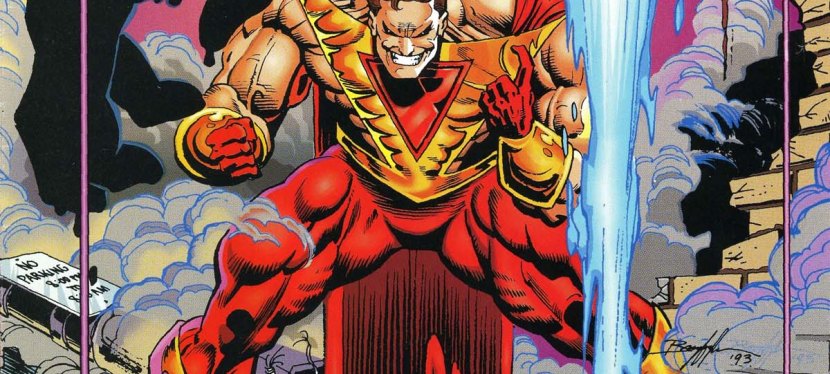
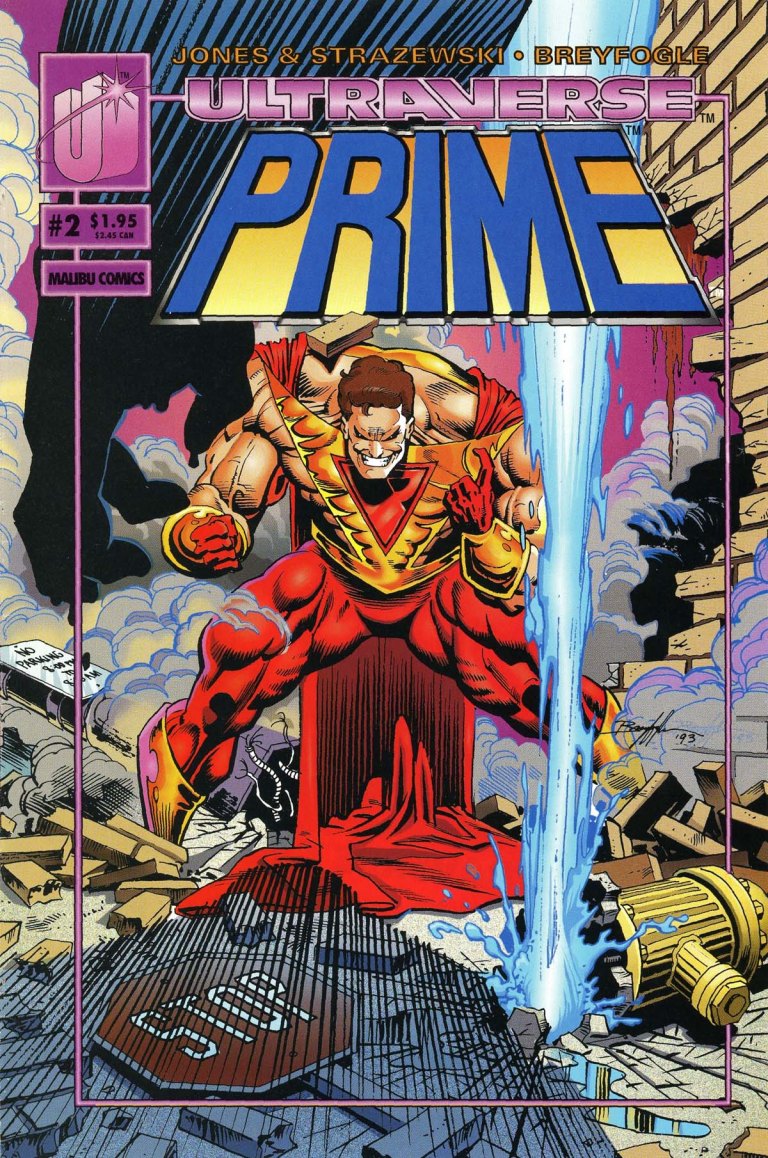
A great looking cover by the late Norm Breyfogle.
For this retro comic book review, we’ll take a close look at Prime #2, the Ultraverse comic book published by Malibu Comics in 1993 with a story co-written by Gerard Jones and Len Strazewski, and art by the late Norm Breyfogle. Previously, I reviewed Prime #1 which you can right here.
Early story
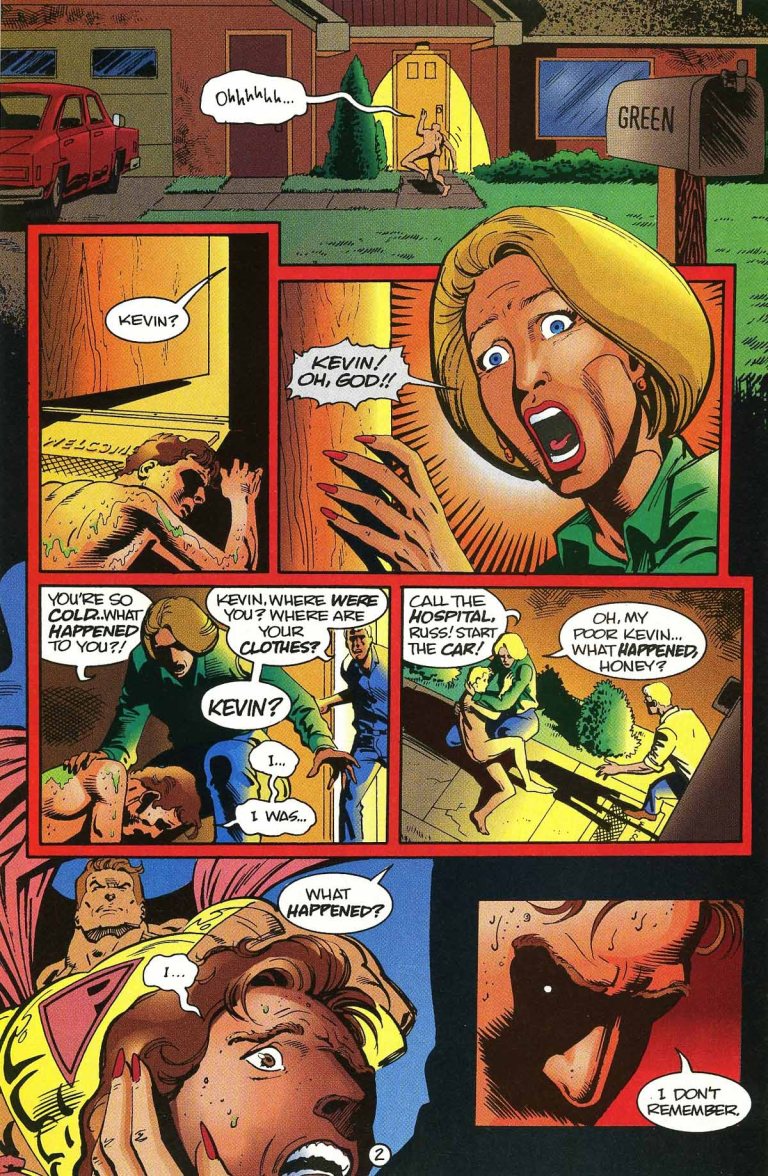
The story begins with teenager Kevin Green struggling heading home in the suburb at night completely naked. After Kevin falls down just outside the front door, his mother opens it and was shocked to see him naked (with some traces of green slim on his skin). Kevin could not recall what happened to him.
Imagine yourself being naked walking home in the middle of the night within the local community.
Shortly after, Kevin is in the hospital with his parents. The doctor could not figure out what’s wrong with Kevin and only stated that his failure to remember could be the result of psychological trauma. Alone in the room, Kevin watches TV news footage of Prime (himself under disguise) and his parents arrive. His mother tells him that he will be okay.
Meanwhile in a discreet location, two men are analyzing the recent appearance of Prime in Somalia. One of them orders the release of Organism 8….
Quality
Prime #2 is clearly a strong follow-up to the launch issue. Co-writers Gerard Jones and Len Strazewski crafted a story that took its time to flesh out Kevin Green/Prime while simultaneously building up suspense and details regarding a sinister force that has links with the government, and they won’t stop until they get their target Prime.
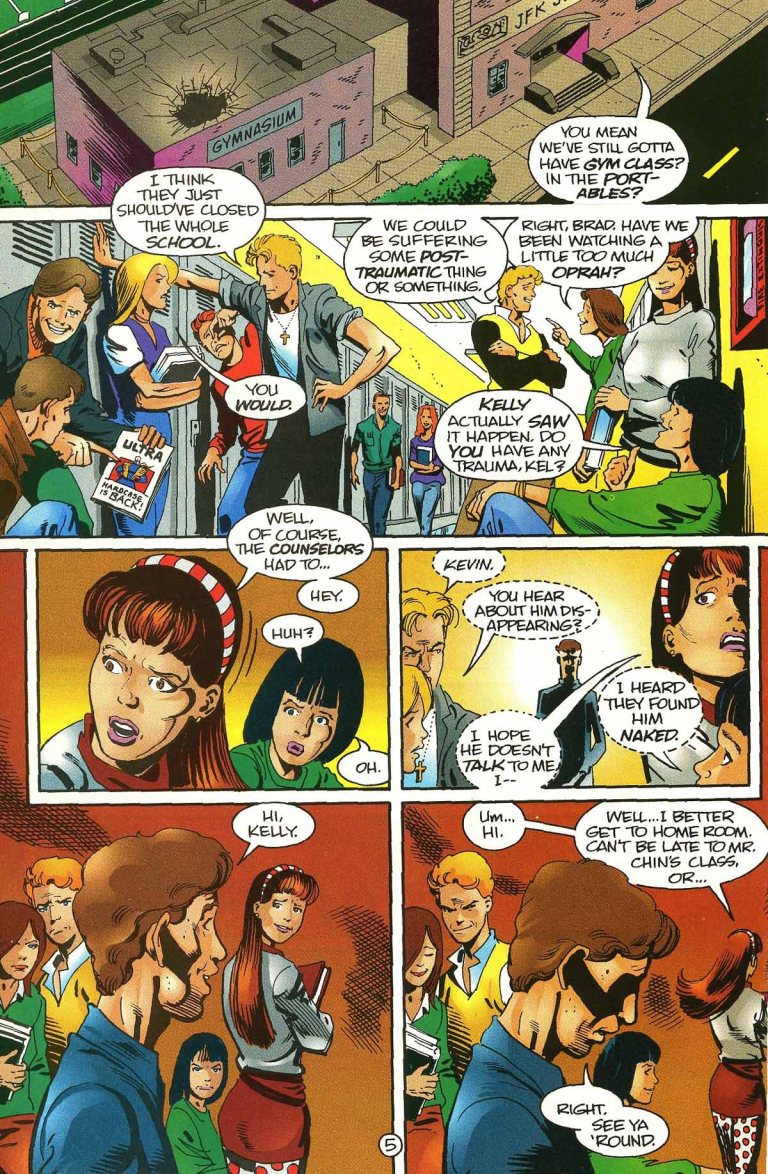
On character development, this comic book takes a deeper look at the private life of Kevin (who only appeared as himself at the end of issue #1) especially at his high school. Here, the school is still recovering from the damage Prime caused (including hurting the school’s coach).
The highlight in this comic book is the exploration of the friendship between Kevin and Kelly. As such, the suspense related to the two really started to build up given the fact that in issue #1, Kevin appeared in front of her not as himself but as his superhero form as Prime. Kelly found it cool that Prime talked to her although she’s disturbed to see him seriously injure their coach. Kevin himself is struggling with the weight of not only keeping his superhero identity secret but also with the consequences of the violence he caused as Prime. Even worse, many students in his school find him a freak but Kelly remains sympathetic to him.
At school…
Visually, this is still a very good looking comic book. Norm Breyfogle’s art is very lively whether he draws out the local community that Kevin belongs to, draws the action scenes, draws the monstrous Organism 8, and emphasizing more of Prime. I also love the way Breyfogle drew the facial expressions. For the newcomers reading this, Breyfogle’s style has a cartoonish look but never backs down with comic book-style spectacle.
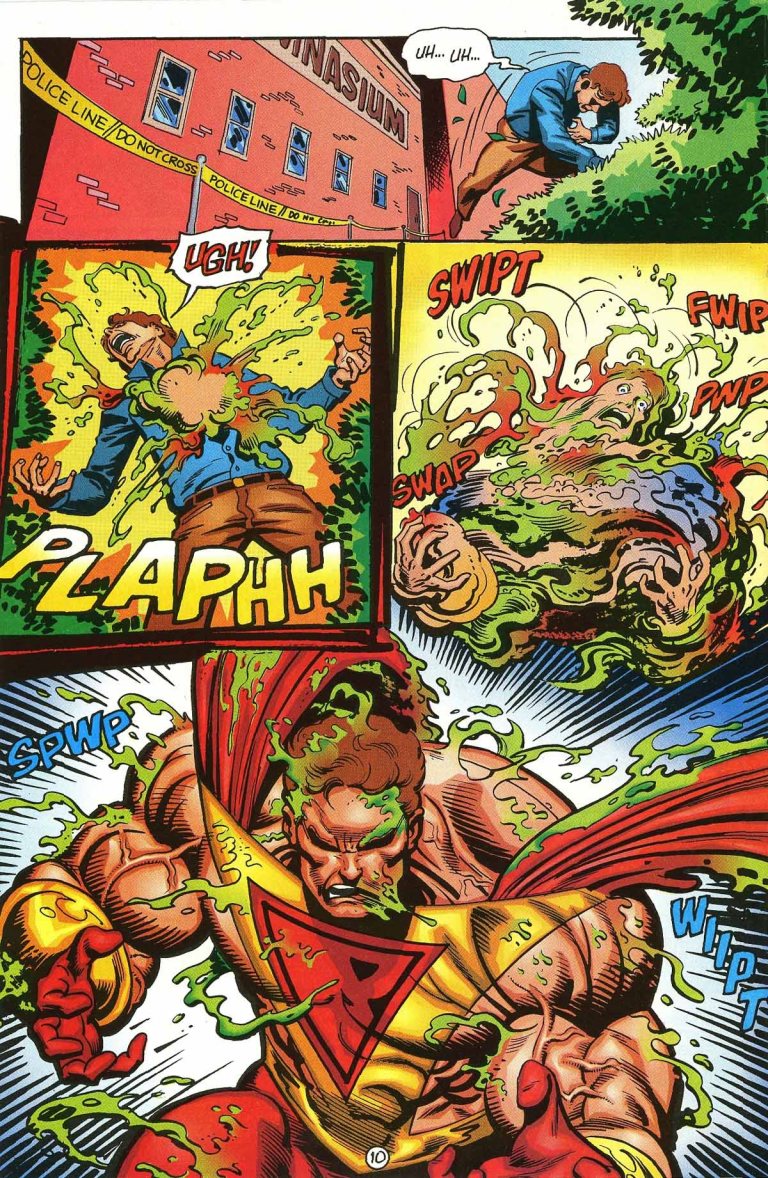
The spectacle of this comic book, unsurprisingly, looks very good. The action scenes show a lot of power and seeing Prime and Organism 8 hit each other is no less brutal.
Conclusion
Norm Breyfogle’s great visuals on Kevin Green becoming Prime!
While Prime #1 was a tremendous creative kick-off for its superhero and its own series, Prime #2 is a very solid progression. This comic book marked the beginning of the build-up of suspense as well as the friendship between Kevin and Kelly, and ultimately it was a fun and compelling reading experience.
If you are seriously planning to buy an existing hard copy of Prime #2, be aware that as of this writing, MileHighComics.com shows that the near-mint copy of the regular edition costs $4 while the near-mint copy of the newsstand edition costs $8.
Overall, Prime #2 is highly recommended.
Thank you for reading. If you find this article engaging, please click the like button below and also please consider sharing this article to others. If you are looking for a copywriter to create content for your special project or business, check out my services and my portfolio. Feel free to contact me as well. Also please feel free to visit my Facebook page Author Carlo Carrasco and follow me at HavenorFantasy@twitter.com
Disclaimer: This is my original work with details sourced from reading the comic book and doing personal research. Anyone who wants to use this article, in part or in whole, needs to secure first my permission and agree to cite me as the source and author. Let it be known that any unauthorized use of this article will constrain the author to pursue the remedies under R.A. No. 8293, the Revised Penal Code, and/or all applicable legal actions under the laws of the Philippines.
After the end of publishing their landmark maxi-series Crisis on Infinite Earths, DC Comics gained an all-new slate to literally fill up by rebooting their entire superhero comics universe. They started the new universe (now referred to as the Post-Crisis Universe) with Superman, Batman and some others.
Then in late 1986, DC Comics reintroduced the post-Crisis version of Wonder Woman creatively led by the legendary George Perez (who was assisted by writer Greg Potter) with the release of the comic book Wonder Woman #1 (cover dated February 1987). That particular comic book retold (in great detail with Greek mythology) the origin of the Amazons who were reincarnated women (the souls of which came from women whose deaths were caused by men). The Amazons and Hippolyta (Hippolyte in this comic book) eventually got betrayed by Heracles and his men leading to a period of tremendous hardship. Beatings were obvious and rape was implied.
After getting freed, they are sent to the island of Themyscira. It was there when Hippolyta learned that she died previously as a pregnant woman. Using the clay of the island, the Amazons’ queen formed an infant girl. Then after communicating with the midwives in the spiritual realm, the soul of Hippolyta’ unborn daughter arrived into the clay child. This marked the birth of Princess Diana who would become Wonder Woman. For the newcomers reading this, Diana is the only Amazon who grew up from child to adult in Themyscira.
Right here is my retro comic book review of Wonder Woman #2 published in 1987 by DC Comics with the story done by George Perez and Greg Potter. The art was done by Perez.
Cover drawn by George Perez.
Early story
The story begins in man’s world, at an American military base. Colonel Steve Trevor meets with his superior General Kohler who tells him that he has been chosen for a special mission which involves the use a new, modified fighter plane. Steve reacted that the coordinated provided lead to nothing out there. The general instructs him to shut his mouth and do what he was ordered to do.
In Themyscira, Princess Diana is set to start her first-ever mission as Wonder Woman. Her mission pits her against a god gone mad, and her mother Hippolyta and the Amazons are deeply concerned. Suddenly, the Lasso of Truth from Olympus arrives which Diana picks up. Immediately after that, the messenger of the gods Hermes arrives marking the first time in centuries that any Amazon saw him.
After a brief talk, Diana travels away with Hermes who could only guide her. They disappeared suddenly surprising the Amazons and Hippolyta who was not given an opportunity to bid farewell to her daughter.
Quality
As expected, Wonder Woman #2 has great qualities with regards to storytelling, characterization and artwork. With Greg Potter assisting George Perez, this comic book told not one but three story arcs each with a good amount of details and, amazingly, such stories were told rather efficiently complete with very believable dialogue. I’m talking about impressive writings and descriptions of the characters, apart from Wonder Woman herself, that include the Amazons, the gods and goddesses of Olympus and the American military.
The story also comes with a very nice touch of discovery which readers can easily relate with through Wonder Woman. As Diana develops and learns more, the reader gets connected with her even more. This is the Queen of Superheroes I’m talking about and the writing is truly excellent.
At the same time, continuing with what was first presented in Wonder Woman #1, this comic book also explores how much of a threat Ares (god of war) truly is not only to Wonder Woman and her Amazons but also on people in man’s world. The build-up of the tension is really nice and the pay-off is worth it.
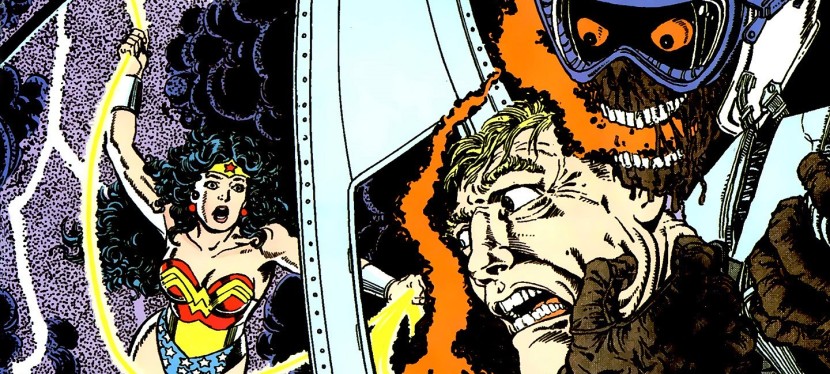
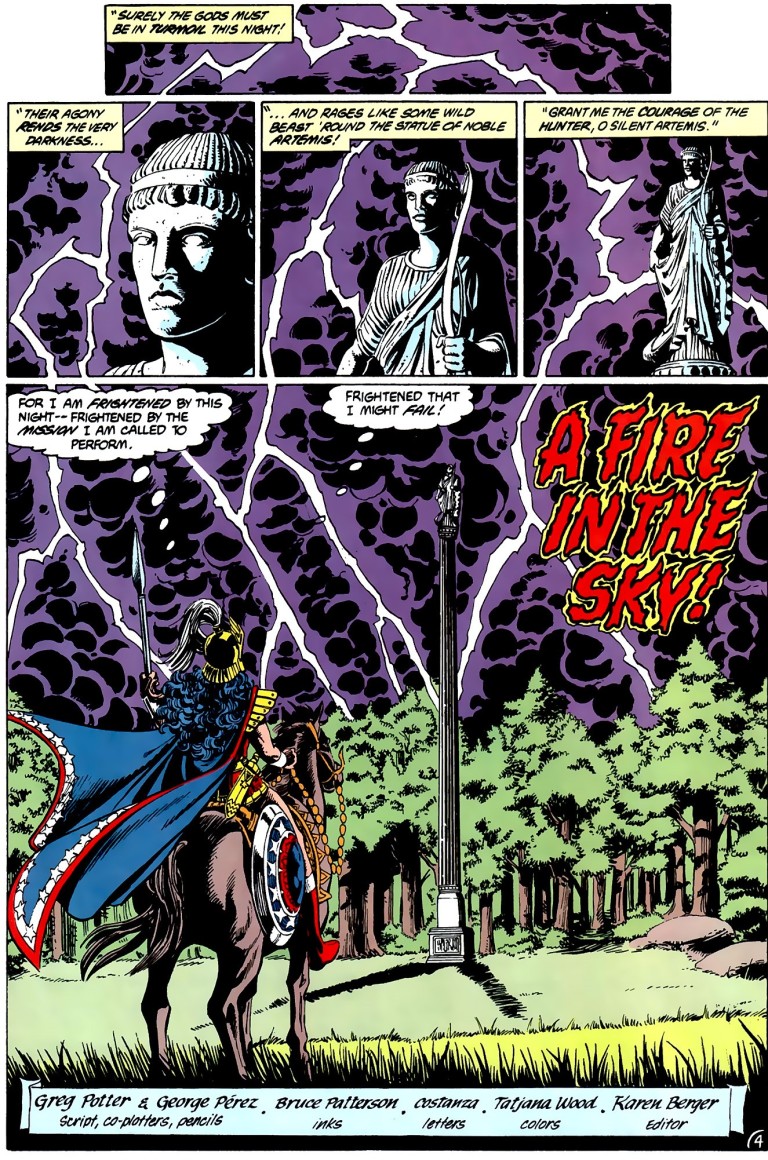
Unsurprisingly, this comic book has great looking art. It’s done by George Perez after all supported with ink work by Bruce Patterson. Perez knows how to dramatize characters, pull of amazing shots of action and other forms of spectacle, and most of all, illustrate the very visual elements of Greek mythology complete with other visual concepts of the fantasy genre.
Conclusion
As it is clear it is not the launch issue of its monthly series, Wonder Woman #2 is still very significant as it marks the first-ever mission of Wonder Woman in the post-Crisis universe of DC Comics and also her first encounter with a modernized (for the 1980s specifically) Steve Trevor. Remember the first time Diana and Steve met in 2017 Wonder Woman movie? Remember how Wonder Woman reacted to see a mortal man for the first time ever as played by Gal Gadot and Chris Pine on the big screen? You will see some common elements between the film and this comic book about the two characters. Even the Amazons’ reaction to Steve alone makes this comic book worth reading and it should encourage readers to go back to first issue to understand the details about the Amazons’ culture and mindset.
Heavy inspiration about Greek mythology, culture and arts is evident not only in the artwork by Perez but also on the script itself.
If you are seriously considering acquiring an existing copy of Wonder Woman #2, be aware that according to MileHighComics.com as of this writing, a near-mint copy of the regular edition costs $24, while a near-mint copy of the newsstand edition costs $49. As for the other edition that does not have a month printed on the cover, a near-mint copy costs $77.
Overall, Wonder Woman #2 (1987) is highly recommended!
Thank you for reading. If you find this article engaging, please click the like button below and also please consider sharing this article to others. If you are looking for a copywriter to create content for your special project or business, check out my services and my portfolio. Feel free to contact me as well. Also please feel free to visit my Facebook page Author Carlo Carrascoand follow me at HavenorFantasy@twitter.com
Disclaimer: This is my original work with details sourced from reading the comic book and doing personal research. Anyone who wants to use this article, in part or in whole, needs to secure first my permission and agree to cite me as the source and author. Let it be known that any unauthorized use of this article will constrain the author to pursue the remedies under R.A. No. 8293, the Revised Penal Code, and/or all applicable legal actions under the laws of the Philippines.
Very recently, Warner Bros. announced that due to the ongoing coronavirus disease COVID-19 pandemic, it has decided to reschedule the release of Wonder Woman 1984 to August 2020.
While fans, geeks and moviegoers have to wait a bit longer for the much-awaited movie, we can take time out to look back to the year 1987 when DC Comics published the comic book Wonder Woman #9 written (plot) and illustrated by the legendary George Perez with scripting done by the late Len Wein.
Remember seeing Dr. Barbara Minerva (Cheetah) played by Kristen Wiig in Wonder Woman 1984? This comic book marked the debut of the post-Crisis Cheetah whose civilian personality is Dr. Barbara Minerva (her literary debut was in Wonder Woman #7). To make history short, the original Cheetah that appeared in 1943’s Wonder Woman #6 was Priscilla Rich while the second Cheetah was Deborah Domaine (Priscilla Rich’s niece). Dr. Minerva is the third and arguably the most modernized and most popular Cheetah.
With the history talk over, here we go with Wonder Woman #9!
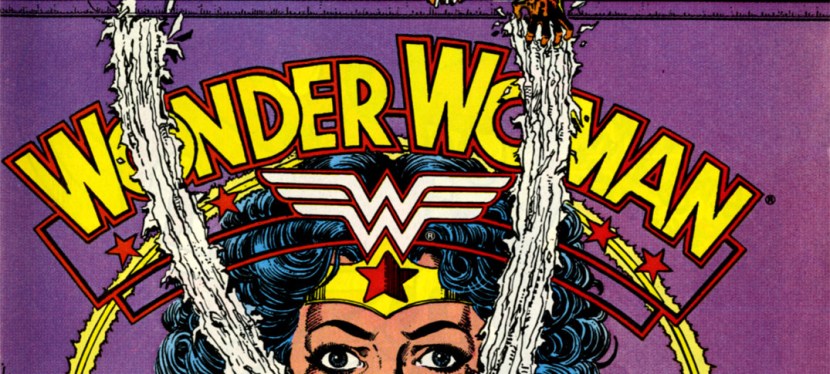
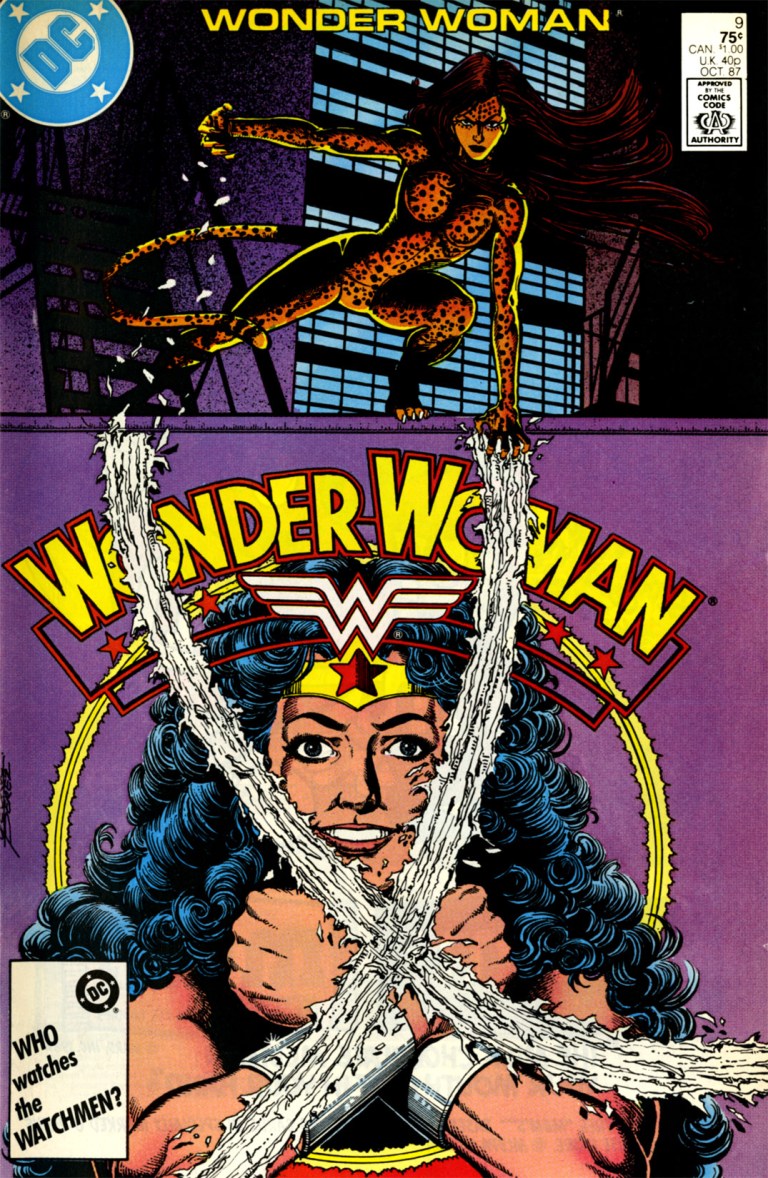
The cover drawn by George Perez.
Early Story
The story begins with a ritual performed by a short, old man with a knife. He cuts the skin of a naked woman and collects some of her blood. He uses the blood to feed a plant he believes to be a god (the plant-god). Afterwards he returns to the naked woman and covers her with the cloth.
The next morning, at another location, Wonder Woman flies happily in the air. Below her were publicist Myndi Mayer, Julia (Diana’s host and personal educator) and teenager Vanessa.
It turns out, Wonder Woman, who strongly values honor, was happy to have received a letter from Dr. Barbara Minerva. Julia however is not confident and based on her research, she described Minerva as “shady as your average weeping willow.”
Myndi, who is looking for the next great scoop, dismisses Julia’s concern and remains focused on accompanying Wonder Woman to meeting Minerva.
Quality
Apart from marking the first appearance of Cheetah (no longer a lady wearing a silly costume) in the post-Crisis era of DC Comics, Wonder Woman #9 is still a very compelling and fun comic book to read. Its great quality combined with a solid concept can be attributed to George Perez.
On storytelling, Perez and Wein delivered a solid balance between spectacle, characterization, plotting and mystery. The presentation of Dr. Minerva as an accomplished yet arrogant archaeologist is a clever concept of having her involved with Wonder Woman who in turn also has a personal interest in relics and evidences of established cultures and societies (given the Amazonian society Diana came from). Minerva’s transformation and first action as Cheetah is indeed excellent to read.
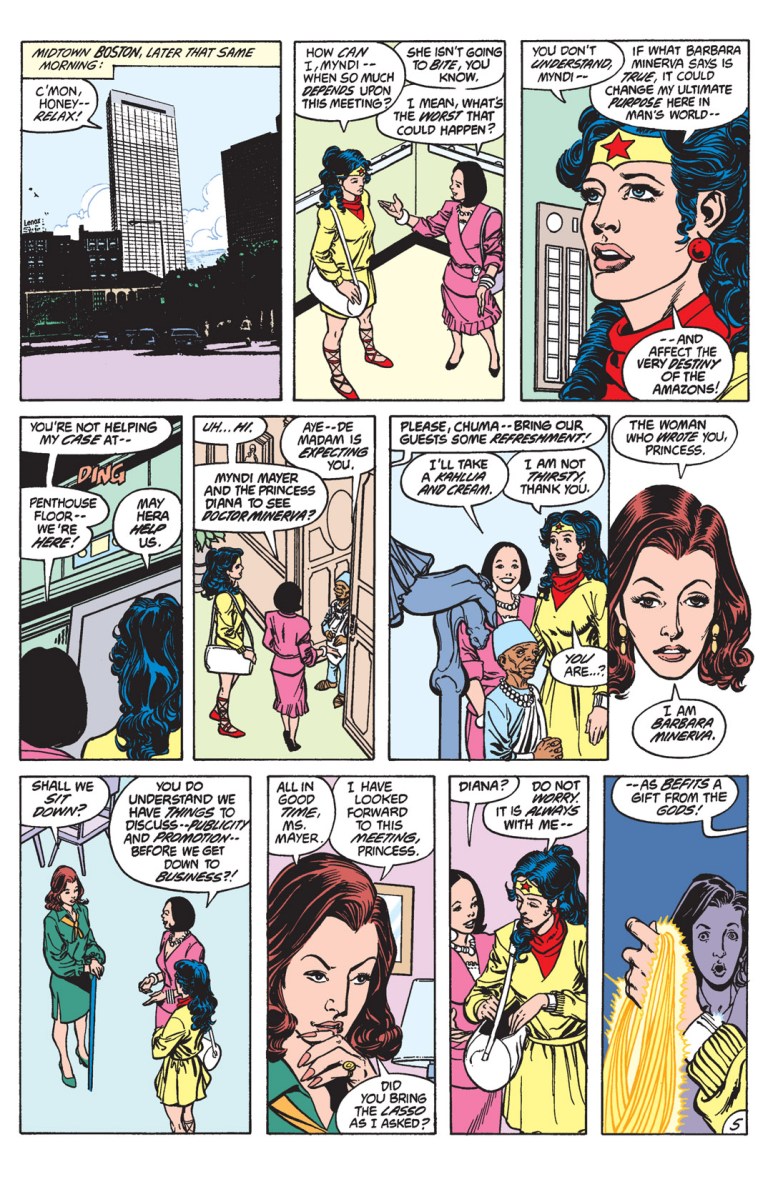
Diana/Wonder Woman and Dr. Minerva/Cheetah meet for the first time ever.
Being one of the greatest comic book illustrators ever, it is no surprise that this comic book still looks great! Even though Perez used a lot of panels per page, the amount of visual details as well as the maintenance of his art style remain high.
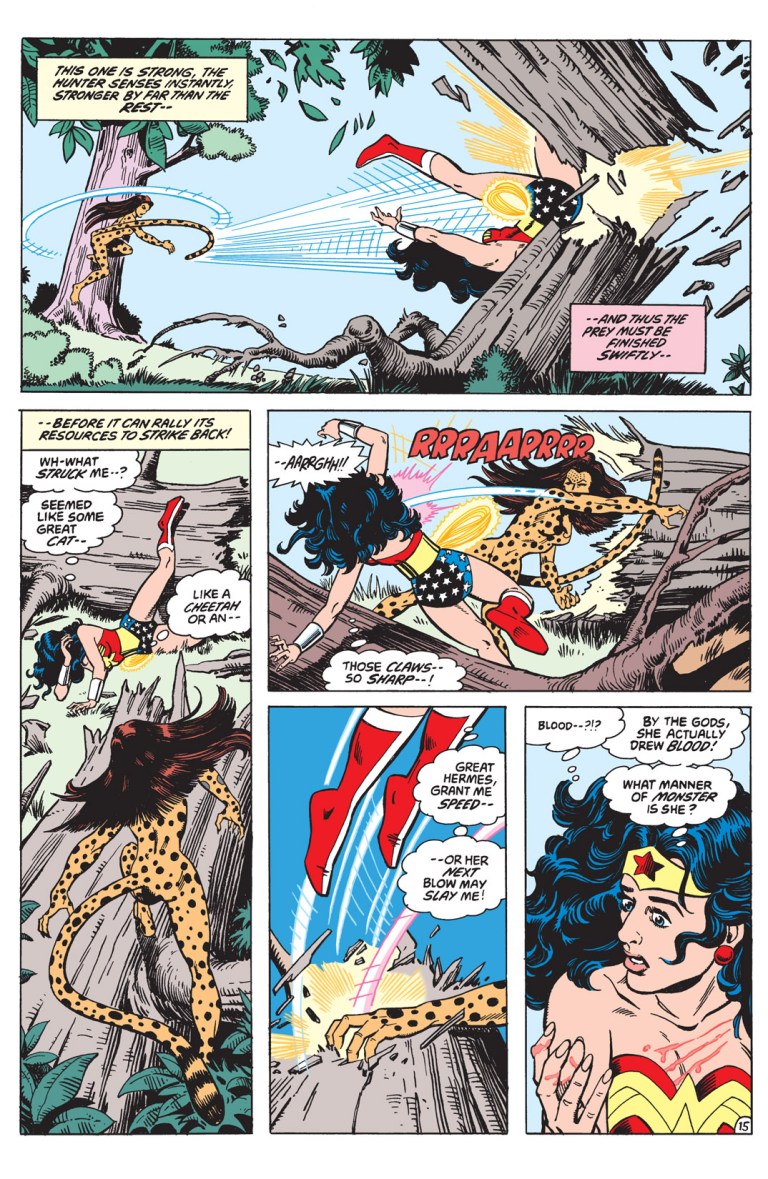
When it comes to the first-ever battle between Cheetah and Wonder Woman, Perez pulled no punches back with the spectacle. There is a good amount of brutal action which so enjoyable to see and I can only hope that director Patty Jenkins took inspiration from the comic’s action scenes for Wonder Woman 1984 (a conflict between the Queen of Superheroes and the animalistic villainess on the big screen is inevitable).
Brutal action between Cheetah and Wonder Woman!
On characterization, this comic book continued to deliver the good and believable development of Wonder Woman who is still adjusting to Man’s World. To put it short, it is not exclusively focused on Cheetah and Wonder Woman (whose encounters were the highlights). You will get to see how much Diana adjusted with modern society, what she thought about how modern society’s members perceived her and how close she got with Julia and Vanessa while still keeping strong with her Amazonian values.
Going back to Cheetah, the development of Dr. Minerva changing into her animalistic form is very well handled by the creators. There are enough details that explained her physical transformation and her uncanny abilities, not to mention showing her being able to give Wonder Woman a good amount of trouble. This way of modernizing the literary Cheetah is, indeed, very compelling and definitive. By reading this comic book, you will realize why this particular version of Cheetah was chosen to be part of Wonder Woman 1984.
For the collectors reading this, if you are serious on getting an existing copy of Wonder Woman #9, be aware that, as of this writing, a near-mint copy costs $77 according to MileHighComics.com
Overall, Wonder Woman #9 (1987) is highly recommended! It’s a great collector’s item too!
In ending this, watch this first official movie trailer of Wonder Woman 1984.
Thank you for reading. If you find this article engaging, please click the like button below and also please consider sharing this article to others. If you are looking for a copywriter to create content for your special project or business, check out my services and my portfolio. Feel free to contact me as well. Also please feel free to visit my Facebook page Author Carlo Carrasco and follow me at HavenorFantasy@twitter.com
Disclaimer: This is my original work with details sourced from reading the comic book and doing personal research. Anyone who wants to use this article, in part or in whole, needs to secure first my permission and agree to cite me as the source and author. Let it be known that any unauthorized use of this article will constrain the author to pursue the remedies under R.A. No. 8293, the Revised Penal Code, and/or all applicable legal actions under the laws of the Philippines.
I just love it when comic book creators really pushed their creativity and bold concepts to make an anniversary celebration comic book fun, engaging and memorable. As seen in the history of American superhero comics, such great comic books become essential when their concept sets a new standard of quality or when it sets its series (and its featured superhero) to a new and well accepted direction (which then opens up many opportunities to keep the series and the superhero fresh creatively).
Such greatness was achieved by DC Comics and its creators with Action Comics #544 published in 1983.
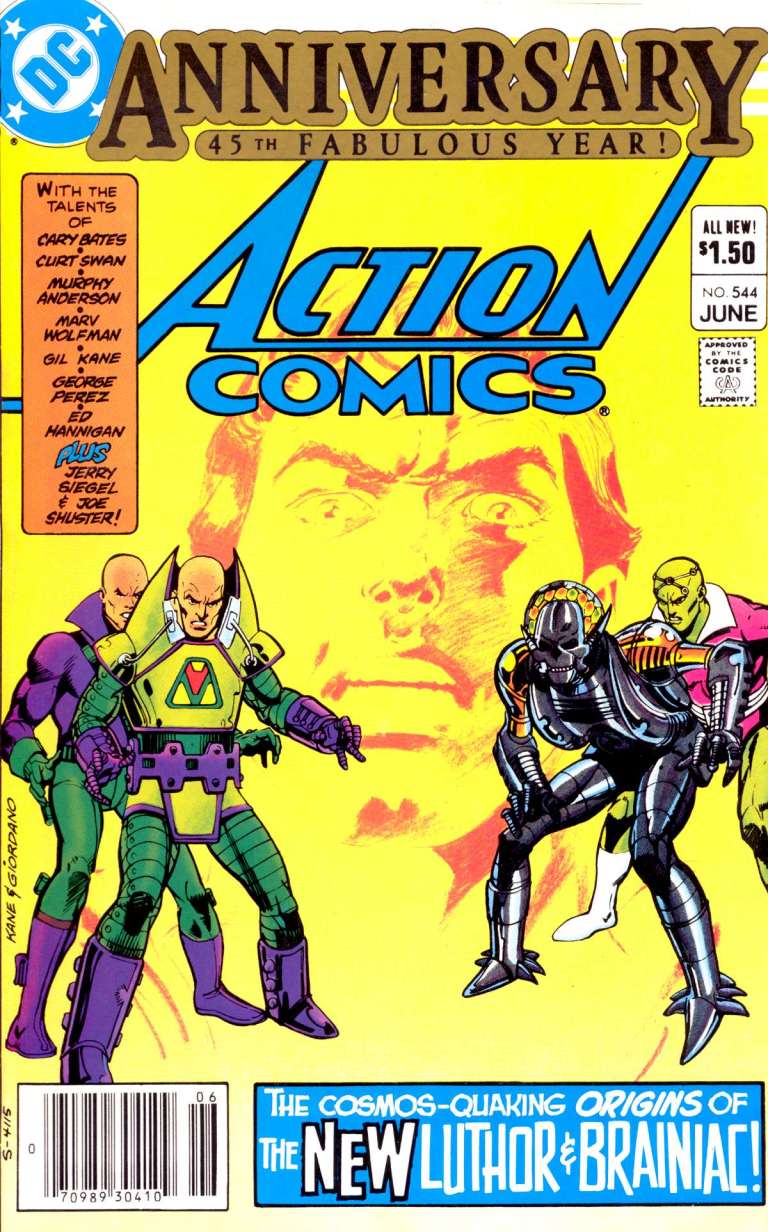
The cover.
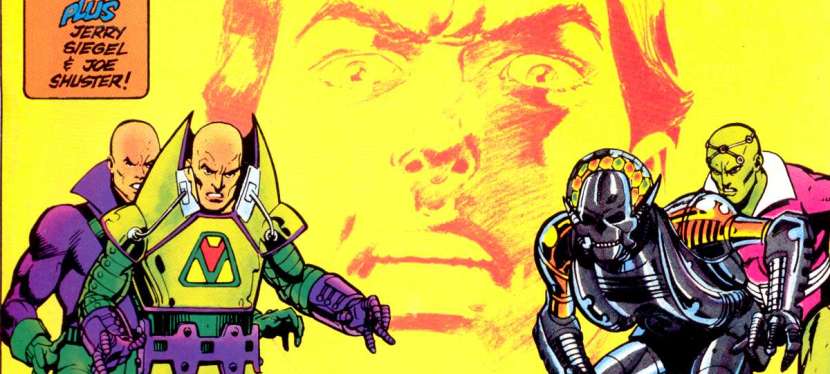
As seen in the cover above done by artists Gil Kane and Dick Giordano, Superman in the background could do nothing but be surprised to see his two foes Lex Luthor and Braniac presented in doubles reflecting a change of design – Luthor getting his now iconic powered suit of armor and Brainiac having a more robotic design.
So you must be wondering…how is the quality of the story and art of this particular comic book that celebration Superman’s 45th anniversary?
We can now start with my retro comic book review of Action Comics #544.
Early Stories
This special-sized comic book features not one but two separate Superman stories titled “Luthor Unleashed!” (written by Cary Bates and drawn by Curt Swan) and “Rebirth” (by Marv Wolfman and Gil Kane).
“Luthor Unleashed!” begins with Luthor already down on the ground hurting from the crash of his aircraft and with Superman present. Even though Luthor’s already helpless, Superman flies away to an unknow destination confident that the super villain will still be there once he returns. However, Luthor got assisted by a robot of his who took him to a secret lair and rode a spacecraft going into deep space. Luthor arrives on the planet called Lexor.
“Rebirth” begins with Superman saving a lady and dog from getting hit by a car on the city street. Afterwards, he flies into space and arrives at a computerized planet that Brainiac created. Just nearby, the star of Epsilon 4 is about to go supernova which prompts him to do something so that many lives will be saved.
Quality
Visually, the art of both stories, respectively done by Curt Swan (arguably the most memorable artist to draw Superman during the pre-Crisis age) and Gil Kane is still good to look at. Both artists knew how to frame the action in interesting ways, put enough details on the people and environment surrounding Superman or Luthor or Brainiac.
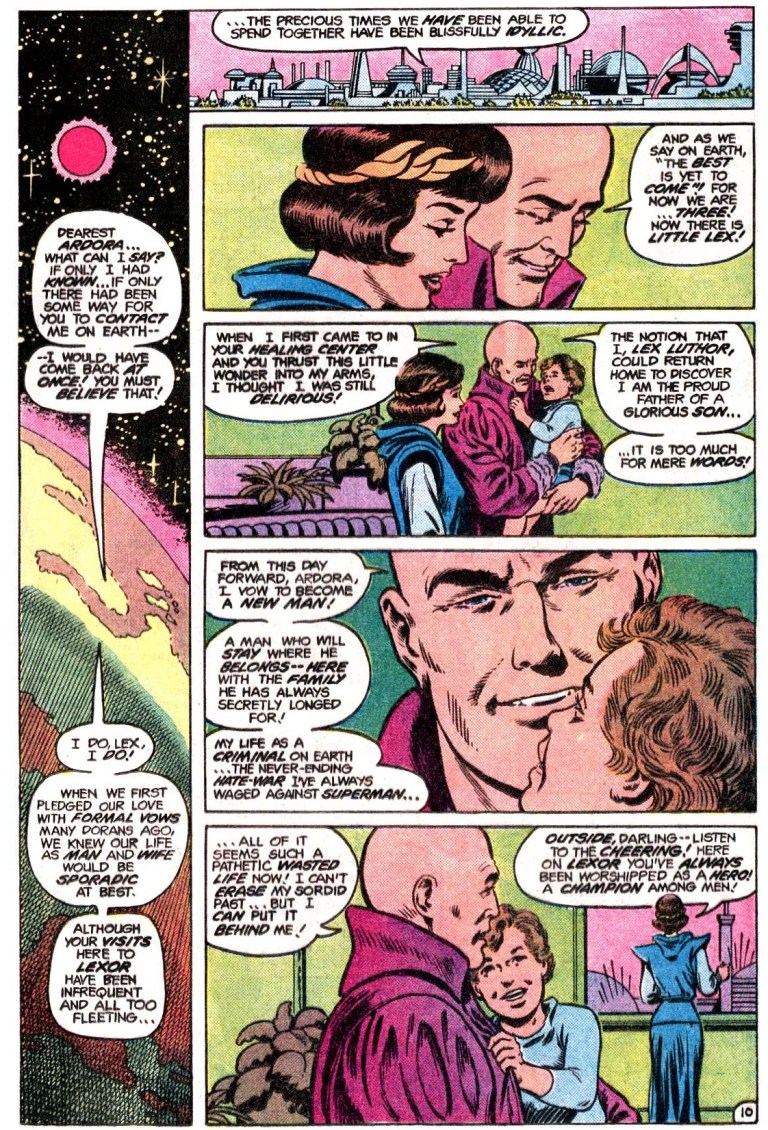
When it comes to the storytelling and characterization, not only were both stories really well written, they succeeded in humanizing Luthor and Brainiac. In “Luthor Unleashed!”, the portrayal of Lex Luthor as a family man (he has a wife and a child) as well as a highly revered leader among the citizens of Lexor was excellently done. By just reading that story, it really looked like Luthor could have been a great contributor for the good of the DC Multiverse had he not been a super villain. What writer Cary Bates made clear was that Luthor’s hatred for Supermen was deeply embedded within him.
Lex Luthor the husband and father.
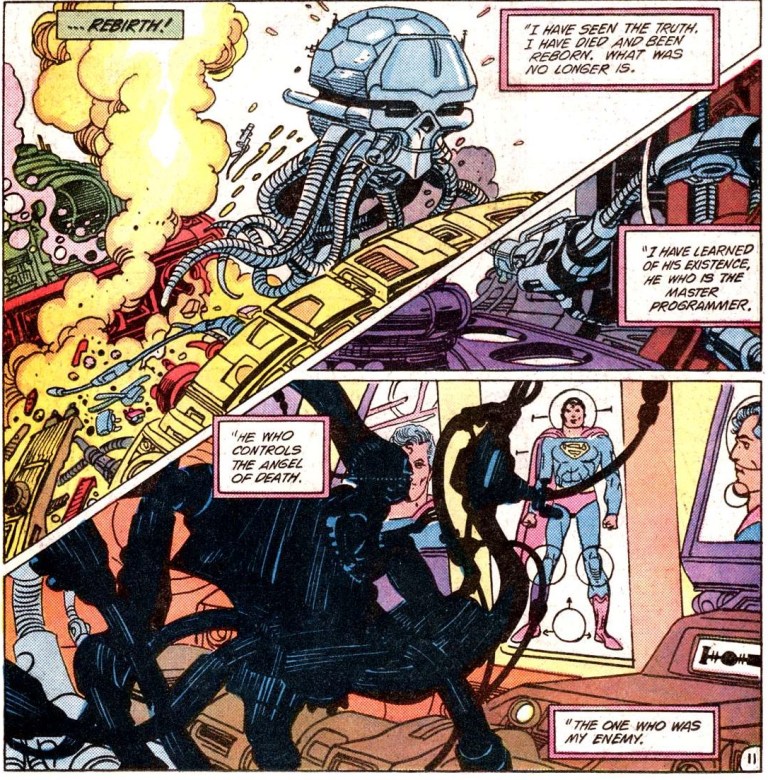
The story of Brainiac meanwhile was very engaging. Marv Wolfman really went all-out on portraying the death and rebirth of Brainiac who got reshaped in the form of a futuristic robot armed with his own octopus-like spaceship. What is great about this cybernetic form of Brainiac was that he not only looked more sinister but also proved to be a more dangerous super villain than before. Also, Superman’s first encounter with Brainiac in his new form is very memorable.
A great debut for Brainiac in his new form.
Conclusion
While Action Comics #544 is a celebration of Superman’s 45th anniversary, it is truly a showcase of the two classic super villains who not only got new looks but also went on to become more challenging to Superman on a new and higher level. Before he got his iconic powered suit of armor (designed by the great George Perez), Luthor was not much of a physical challenge to Superman. Before he got his robotic body, Brainiac was not as deadly and had much less resources to be cause chaos to Superman and others. To say the least, this comic book is a true classic of superhero literature!
If you are a collector, be aware that as of this writing, a near-mint copy of the newsstand edition of Action Comics #544 is now worth $77 while its other edition’s near-mint copy is worth $39 at MileHighComics.com.
Overall, Action Comics #544 is highly recommended. This great comic book also has another thing of value: great inspiration and references that Warner Bros. should use when making a new Superman movie with Luthor and Brainiac as the super villains.
Thank you for reading. If you find this article engaging, please click the like button below and also please consider sharing this article to others. If you are looking for a copywriter to create content for your special project or business, check out my services and my portfolio. Feel free to contact me as well. Also please feel free to visit my Facebook page Author Carlo Carrasco and follow me at HavenorFantasy@twitter.com
Disclaimer: This is my original work with details sourced from reading the comic book and doing personal research. Anyone who wants to use this article, in part or in whole, needs to secure first my permission and agree to cite me as the source and author. Let it be known that any unauthorized use of this article will constrain the author to pursue the remedies under R.A. No. 8293, the Revised Penal Code, and/or all applicable legal actions under the laws of the Philippines.
To understand Bloodshot before reviewing the early-1990s comic book Bloodshot #1, here’s a look at the history of Valiant Comics.
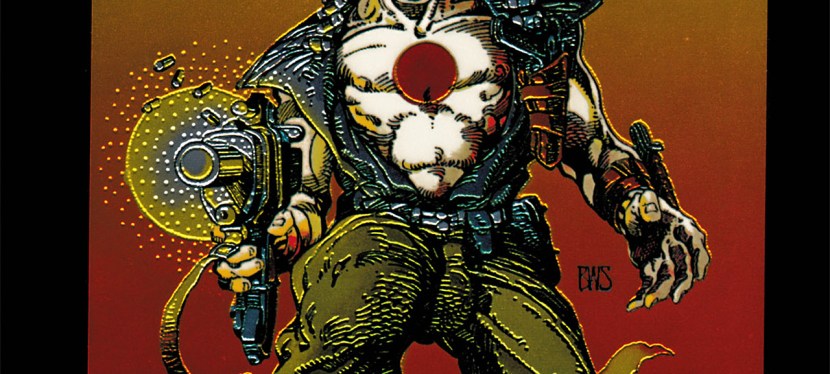
The cover with chromium and Bloodshot drawn by Barry Windsor-Smith.
In the late 1980s, a team composed of former Marvel Comics Editor-in-Chief, former Allman Brothers Band manager Steve Massarsky and some investors failed in their bid to acquire Marvel Enterprises. Instead of letting their failure stop them, they went on to establish Voyager Communications with the backing of Triumph Capital. Voyager then created the imprint Valiant Comics which went on to launch its first titles in 1991 with Magnus, Robot Fighter (which started in the 1960s in comics published by Gold Key) and Solar, Man of the Atom (also started in the 1960s through Gold Key comics).
Subsequently Valiant’s first original superhero Rai was introduced followed by other original properties like Harbinger and Eternal Warrior. It was within the pages of Eternal Warrior #4 Bloodshot made his first appearance followed by a first full appearance in Rai #0.
Then in November 1992, the same month DC Comics released Superman #75 (The Death of Superman, Valiant released Bloodshot #1 with a cover price of $3.50 (cover dated February 1993) and a very eye-catching chromium cover of Bloodshot drawn by Barry Windsor-Smith.
Now that the history lesson is done, we can finally explore Bloodshot #1 (written by Ken VanHook and drawn by Don Perlin) in this retro comic book review.
Early Story
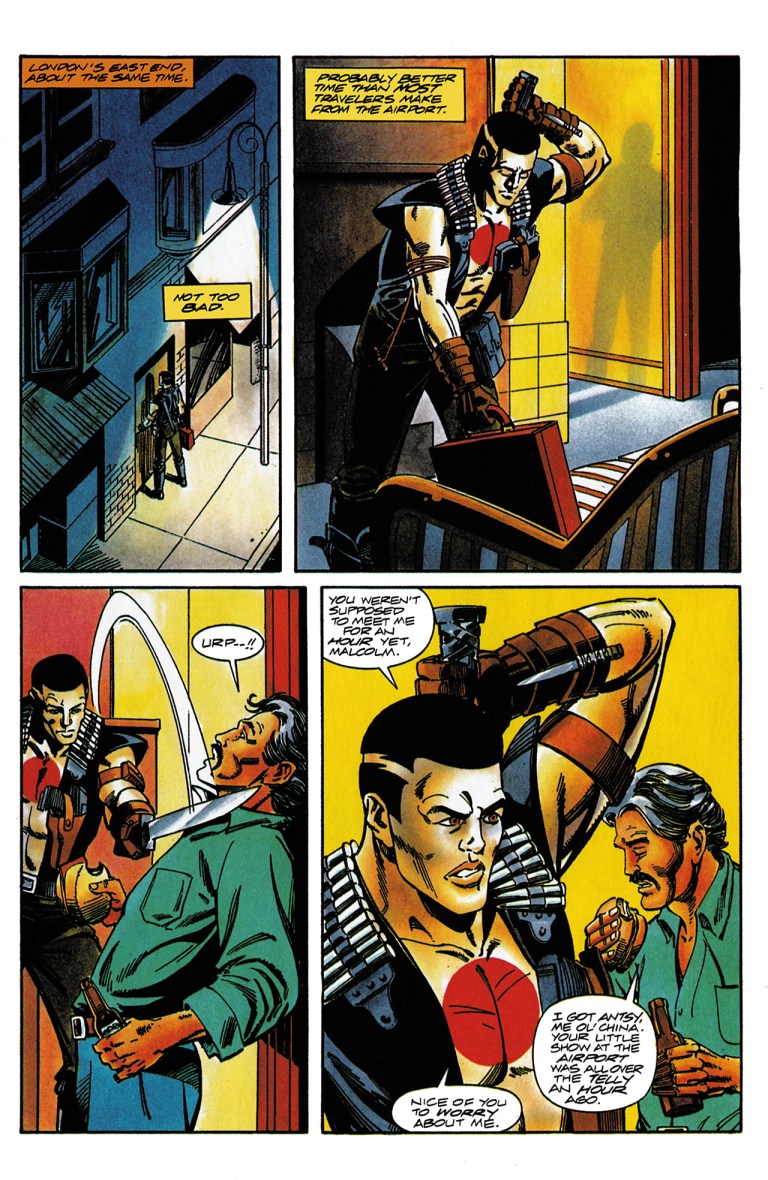
The story begins at Heathrow Airport in the United Kingdom. Immediately after a man and a woman (both wearing coats and hats) performed an exchange with a briefcase, two other men (also wearing coats) reacted to them but Bloodshot jumps into the action firing his gun, taking a shot to his arm and grabbing the briefcase. Bloodshot escapes from the airport.
Adulterated action!
Behind the scenes, an old man meets with Thompson and Otomo informing them that Bloodshot was an experiment of theirs under Project Rising Spirit. The project was disrupted when a young blonde male got to Bloodshot and adjusted one of the devices. The young guy was caught by one of the operators until Bloodshot (still bald and naked) got up, attacked the personnel (freeing the young guy), gathered data from their computers and escape.
The old man noticed Bloodshot’s rampage at Heathrow Airport and was able to identify him. He issues orders to Thompson and Otomo.
“I want him returned—I do not care the condition,” he said.
Quality
Looking beyond the eye-catching chromium cover, Bloodshot #1 from the early 1990s is actually engaging and intriguing to read. While it is a superhero comic book, it sure has a dark and gritty tone as well as being noticeably grounded with reality.
With the spectacle, the action is violent and somewhat bloody. It may look tame by today’s standards but back in the 1990s, this was exceptional and it really aimed towards older comic book readers. To put things in perspective, comparing this comic book with the typical Marvel or DC Comics superhero comic book is like comparing an R-rated action film to a PG-13 action or adventure film. Don Perlin’s artwork has a nice flow when it comes to the action and the dialogue scenes.
The writing by Kevin VanHook is good even by today’s standards. I like the way he handled expository dialogue in the first half of the comic book and from that point on, the spotlight was on Bloodshot and his exploits.
There are some weak spots in this comic book. There really was no room for real character development with Bloodshot. The comic book eerily reflected the hero’s approach to doing things: no slowing down, time to take action from here. That’s not to say it is a brainless read but rather the plotting is decent and relied on the spectacle to make up for the absence of character development. That being said, Bloodshot as a hero who was a victim under his handlers, is hard to like. Based on this comic book alone, he is a rampaging killer looking as evil as the bad guys. It does not help that he is very unstoppable (because of nanites in his blood system which worked to enhance and heal him) and, at least in this comic book, there’s no real sense of danger for him.
When it comes to supporting characters like Sinclair and Malcolm, I can’t help but keep remembering Commissioner Gordon and butler Alfred Pennyworth in the Batman comics.
Conclusion
While it has some flaws in its presentation, Bloodshot #1 is still good and fun to read. On face value, Bloodshot looks like a typical macho action hero with guns but he actually has an interesting personality even though character development was badly lacking in this particular comic book. I also enjoyed the creator’s approach on emphasizing realism by using gangs and secret sinister organizations (which conduct unethical scientific experiments on people) on the background showing that Bloodshot himself is small player in a dangerous game of secret operations.
As a standalone story, Bloodshot #1 has more than enough good stuff to make up for its flaws and it is worth reading by today’s standards. This is the true value of the comic book that its flashy chromium cover does not reflect. In other words, this comic book is more than just a gimmick.
If you are a collector, be aware that as of this writing, Bloodshot #1 is worth over $40 for a near-mint copy according to Mile High Comics.
Overall, Bloodshot #1 (1993) is recommended. As a piece of amusement, the comic book is so much better than the Vin Diesel Bloodshot movie. That says a lot!
Disclaimer: This is my original work with details sourced by means of watching the movie and doing research. Anyone who wants to use this article, in part or in whole, needs to secure first my permission and agree to cite me as the source and author. Let it be known that any unauthorized use of this article will constrain the author to pursue the remedies under R.A. No. 8293, the Revised Penal Code, and/or all applicable legal actions under the laws of the Philippines.
I just love watching superhero movies, especially the ones that were well crafted by the filmmakers complete with solid storytelling, sufficient spectacle as well as memorable performances by the hired talents (both behind and in front of the camera).
Of all the superhero movies made by the forces of Hollywood starting with 1978’s Superman, I can clearly say that 2017’s Wonder Woman is my favorite. Don’t get me wrong. I did not limit myself to just DC Comics superhero movies. I saw all the X-Men movies and their spinoffs, almost all the Spider-Man flicks, almost all of the Marvel Cinematic Universe movies and even the obscure ones. Along the way, there were some great superhero flicks that became modern-day classics like Logan and Avengers: Infinity War.
Still it is the Gal Gadot-led, Patty Jenkins-directed Wonder Woman that I loved watching the most.
Let’s start with my retro review of Wonder Woman, the one film that arguably saved the DC Comics Cinematic Universe for Warner Bros.
The Wonder Woman movie poster from 2017.
Early Story
The story begins sometime after the end of Batman v. Superman: Dawn of Justice during which Diana finds a long lost photograph recovered by Bruce Wayne. Then she remembers her past in Themyscira where she grew up as the only little girl among the women called the Amazons and her mother is none other than Queen Hippolyta. Concerned that the wicked Aries is still alive, Hippolyta’s sister Antiope trains Diana (initially in secret until they were discovered) to be strong, brave and more capable than their fellow Amazon warriors.
One day, Steve Trevor arrives in Themyscira becoming the first-ever man Diana ever met. Tension rises when the Germans (from World War I Earth) arrive on their island causing the Amazons to fight in defense. A lot of people lost their lives, including someone very close to Diana.
While interrogated with the Lasso of Truth, Steve reveals who he is and what he has been doing. He states that back in his world, World War I is ravaging the world costing many people their lives. This causes Diana to stand up and stop the war somehow (she believes Aries is responsible). Queen Hippolyta disapproves of Diana’s analysis. After privately meeting with Steve, Diana then starts her move for a mission to stop the war in Man’s World.
Quality
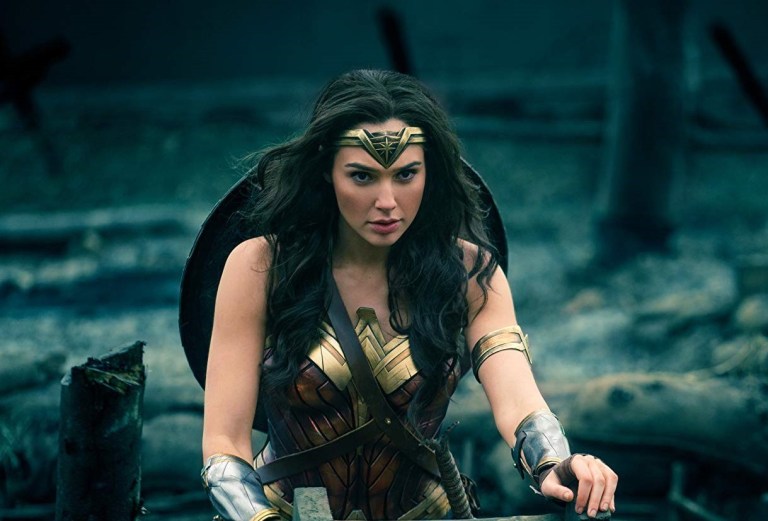
Gal Gadot as Wonder Woman in the middle of German soldiers.
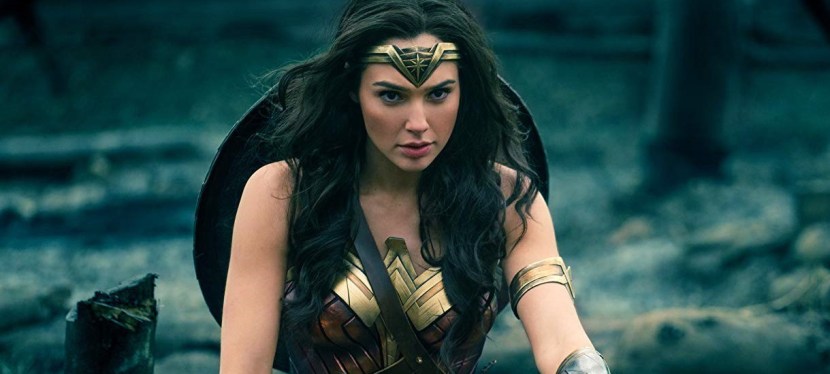
Let me start with the performances. Gal Gadot definitely IS Wonder Woman in this movie. Regardless of how many versions of Wonder Woman there are in comics, the Israeli actress truly captured the essence of Diana’s early development which includes her special place among the Amazons (note: she is the only Amazon who was born in Themyscira and grew up from infant into a mature woman), her fateful meeting with Steve Trevor, her entry into Man’s World and how she adapts with the events and people outside of Themyscira. Wonder Woman’s purity on saving the world, doing what is right and emphasizing love and compassion were all nicely translated into cinematic art by Gal Gadot. From doing the action scenes to saving people, speaking her mind among her fellow Amazons and interacting with others as she adapts with Man’s World, I really love Gadot’s work on bringing Wonder Woman to life. As her cinematic work is great, there is no doubt that Gadot will always be iconic to fans of the Queen of Superheroes and superhero enthusiasts in general in the decades to come right beside Lynda Carter (who played the icon on TV), Christopher Reeve (Superman), Robert Downey, Jr. (Iron Man) and Chris Evans (Captain America). Meanwhile, the portrayals of Diana as an 8-year-old girl as well as a 12-year-old were perfectly done by Lilly Aspell (who is truly skilled with horse riding) and Emily Carey.
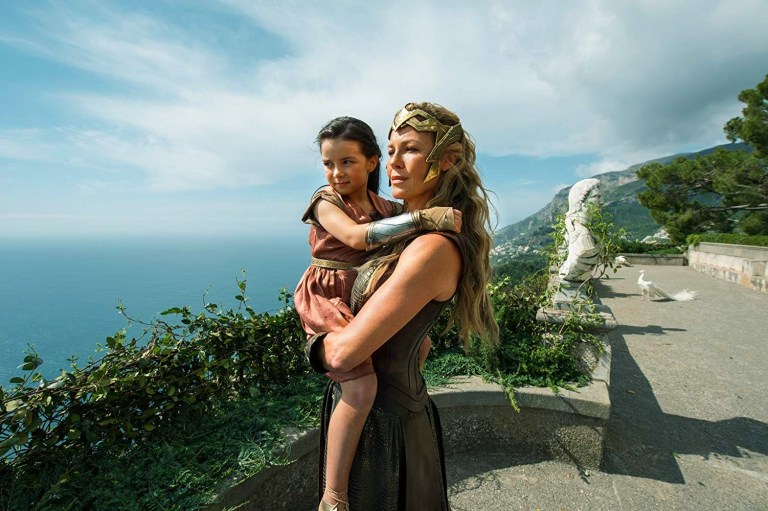
Lilly Aspell as young Diana with Connie Nielsen as Queen Hippolyta.
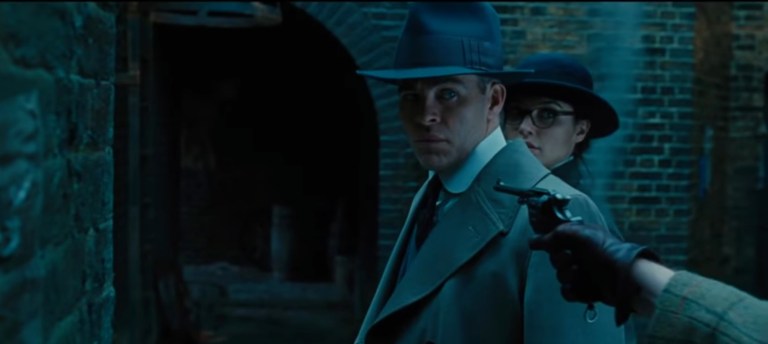
Chris Pine is excellent as Steve Trevor who is portrayed to be very dedicated to his work, brave in what he does and still shows compassion instead of arrogance towards others. He also has great chemistry with Gal Gadot and, like in the comic books, their relationship is nicely translated on the big screen. Pine’s performance here is, in my view, the best superhero movie supporting role to date.
Chris Pine as Steve Trevor with Gal Gadot as Diana in disguise.
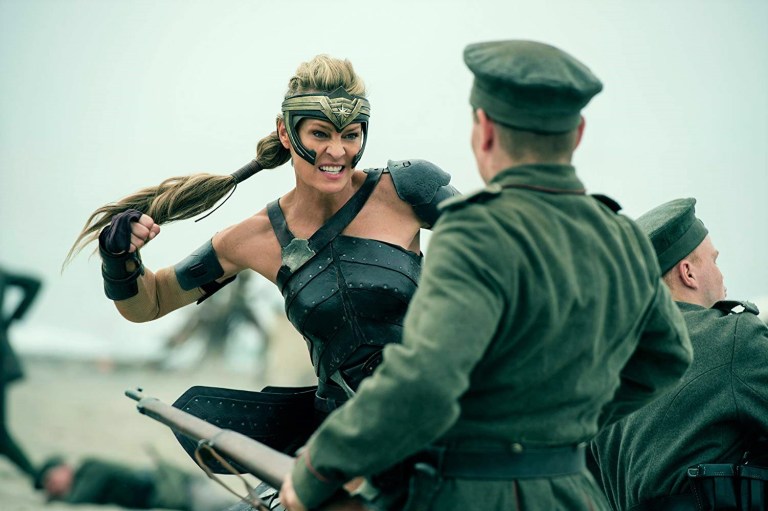
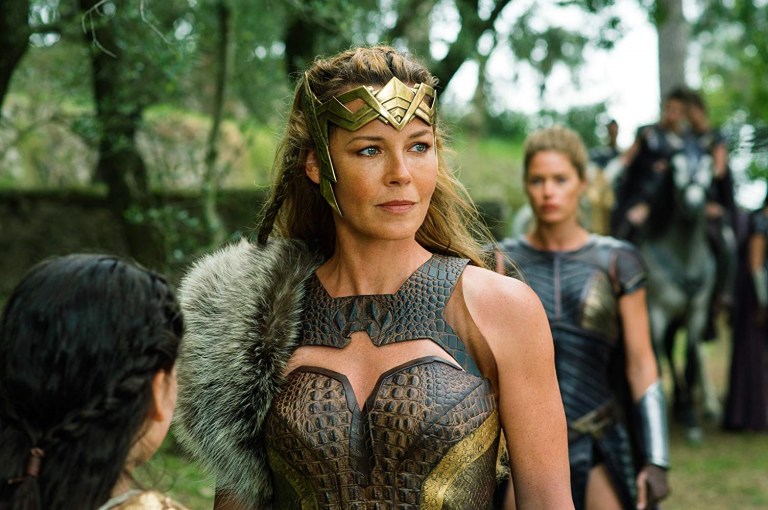
Connie Nielsen meanwhile is great in playing Queen Hippolyta and all throughout, there is always a sense of leadership complete with a touch of motherly love just like in the comic books. Her sister Antiope was nicely portrayed by Robin Wright as the one Amazon who taught Diana to be brave, strong and highly capable as an Amazon warrior.
Danny Huston, who played the lead villain in the 2009 movie X-Men Origins: Wolverine, played yet another military bad guy here but this time he’s a World War I German officer. He’s a villain with a purpose who not only fights for the glory of Germany but also strongly believes that war is natural and inevitable for humanity. In some ways, Huston’s Ludendorff reminds me Michael Shannon’s General Zod in Man of Steel.
Robin Wright is excellent as Antiope.
When it comes to presentation, this film is Patty Jenkins’ 2nd movie as director (her debut was way back in 2003) and the great turnout of Wonder Woman as a high quality movie (as opposed to being a critical and commercial success) only proved yet again that the old saying in Hollywood – The director’s second movie is his/her best movie – is true. Jenkins, who also worked on television, not only prepared a lot to make this movie but also researched Wonder Woman, developed ways to get the most out of the cast members, tweak the written story of the film (by Allan Heinberg, Zach Snyder and Jason Fuchs) and, most notably, she led the production with a lot of passion. To put it short, Wonder Woman is a labor of love (and the No Man’s Land scene is iconic) that not only resonated with fans of the Queen of Superheroes but also with the film critics and moviegoers.
Regarding storytelling, I noticed that a key story from Wonder Woman’s origin in the comics (the contest of the Amazons) did not happen at all in the film. While there were die-hard fans of the icon who complained about it, I felt that the contest of the Amazons would have made this movie more complicated and surely would have lessened the impact of World War I as a key story element. Since the purpose of this movie was to emphasize Diana’s origin and her entry into Man’s World with a major mission, I believe that the contest of the Amazons can be made cinematically later in a future movie.
The way the story was told cinematically, it also captured Diana’s reactions to the events that happened around her. The scene in which she saw the village destroyed showed how death and destruction compelled Wonder Woman to accomplish her mission even though others find ending the war impossible. Along the way, the actors – specifically Gal Gadot – really added life into the narrative with their strong performances.
When it comes to on-screen humor, which is popular among moviegoers and is almost a requirement for most new superhero movies that come out, having it done by supporting players Lucy Davis and Saïd Taghmaoui was a clever move since it allows Gal Gadot to portray Wonder Woman without any performance disruption. Considering her short screen time, Davis as Etta Candy is really funny. The amount of humor in this film, in my view, was just right and never annoying.
Spectacle? Wonder Woman is loaded with action, stunts and exciting stuff! The action involving Wonder Woman was brutal and satisfying to watch, and Patty Jenkins’ use of slow motion on key moments was great (even comparable to John Woo’s past work) and at the same time not too excessive. The Themyscira battle between the Germans and the Amazons at the beach was engaging and strategically filmed. Also, it was fitting that the action ramped up nicely starting with the iconic No Man’s Land sequence. The final battle in the film, unsurprisingly, had lots of computer-generated images (CGI) which is understandable considering the fantasy element of Wonder Woman.
More on the action, I love the way Patty Jenkins had Gal Gadot, Robin Wright, Connie Nielsen and Chris Pine perform the action themselves which all made their characters even more believable. Of course, there were certain moments in which stunt doubles were used to do the more dangerous moments on behalf of the actors.
This happened just before the iconic No Man’s Land scene.
Apart from the core cast, a lot of the actresses playing the Amazons trained for several months not just to look the part but also to perform action sequences using weapons with actual skill. The stunt coordinators and specialists hired by the filmmakers deserve praise for contributing nicely on making the cinematic Amazons highly believable. This alone not only makes Wonder Woman stand out nicely among all Hollywood superhero movies but also reflects nicely what was portrayed in the comic books.
The production design is also top-notch. I love the scenic locations of Italy used for scenes set in Themyscira. The filmmakers also did a great job recapturing the look of World War I Europe from the historical pictures to the big screen. The costume designs were fantastic, and the standout designs were, unsurprisingly, the costumes of the Amazons which really made their fantasy culture look believable. The filmmakers decided to have much more colorful visuals instead of following the look of Man of Steel, Batman v. Superman: Dawn of Justice and Suicide Squad.
On the music, the work by Rupert Gregson-Williams was great. His rendition of the Wonder Woman theme was very lively to listen to. The same can be said about the music he provided in the memorable No Man’s Land scene which had a nice build-up as Wonder Woman made her first full appearance in costume on the field. Other tunes played in the film suited the scenes well.
If there were any weak spots in this movie, it would be certain shots of action that were not filmed with precision. I’m talking about filming action scenes way too close to the camera combined with music video-style editing that’s supposed to make film look flashy. It’s not only disorienting, it also took me out of the movie.
Conclusion
Overall, Wonder Woman is one of the best-ever superhero movies ever made and easily my favorite of them all. It has an excellent balance between storytelling, character development and spectacle, and Gal Gadot gave the performance of a lifetime not only by bringing Wonder Woman into life in cinematic form but also emphasizing what the Queen of Superheroes stood for. As part of the current DC Comics Cinematic Universe, this movie stood out by having optimism and heroism as core themes (as opposed to the dark, gritty and even cynical approach of Man of Steel, Batman v. Superman: Dawn of Justice and Suicide Squad) and, more importantly, by focusing strongly on Wonder Woman instead of building up for the Justice League movie (which was released months after this one).
Apart from high-quality production values and a strong creative approach, the cast and cinematic performances are easily among the best in the superhero movie genre. Chris Pine’s Steve Trevor is an excellent example of a supporting role that is engaging without ever overshadowing the lead role. By the end of the film, you will realize the impact that Queen Hippolyta and Antiope had on Diana’s personal development.
Connie Nielsen made a great queen and mother in this movie.
Being strongly focused on heroism with optimism, director Patty Jenkins and her crew succeeded in making this film without ever succumbing to the extreme views of the Political Left in Hollywood and the loudmouth social feminists. When I see the battle between the Amazons and the German soldiers on the beach of Themyscira happen, I simply saw armed women defending their homeland not from men who intend to rape them but rather men who had no right to intrude in the first place. Even as there were scenes showing men in power in World War I Europe (putting Diana in a powerless position), there still was no feminist-inspired hatred towards men. Also the bond between Steve and Diana developing from friendship into a romantic relationship literally shut the door on extreme feminism.
As a Wonder Woman-focused story, this film succeeded on emphasizing the Queen of Superheroes to both long-time fans and mainstream moviegoers. This movie also had a nice mix of having a fantasy setting with Themyscira moving on to a historic setting with World War I Europe. On the origins of Wonder Woman herself, I don’t mind at all that the contest of Amazons was not told because this movie’s concept is already great to begin with and its running time of 141 minutes was just right.
Gal Gadot will be remembered for a very long time for her excellent portray of Wonder Woman in cinema.
With all the greatness it was made with, I kept coming back to Wonder Woman when replaying superhero movies here at the comfort of home. In the cinemas back in 2017, I saw the film three times. Ultimately, I can say out loud that Wonder Woman is highly recommended and it is truly essential!
Thank you for reading. If you find this article engaging, please click the like button below and also please consider sharing this article to others. Also my fantasy book The World of Havenoris still available in paperback and e-book format. If you are looking for a copywriter to create content for your special project or business, check out my services and my portfolio. Feel free to contact me as well. Also please feel free to visit my Facebook page Author Carlo Carrasco and follow me at HavenorFantasy@twitter.com
Disclaimer: This is my original work with details sourced from reading the comic book and doing personal research. Anyone who wants to use this article, in part or in whole, needs to secure first my permission and agree to cite me as the source and author. Let it be known that any unauthorized use of this article will constrain the author to pursue the remedies under R.A. No. 8293, the Revised Penal Code, and/or all applicable legal actions under the laws of the Philippines.
Long ago in the history of American comic book publishing, there was a time when superhero comic book storytelling were not told as dramatic serials but rather as standalone stories laced with outlandish ideas.
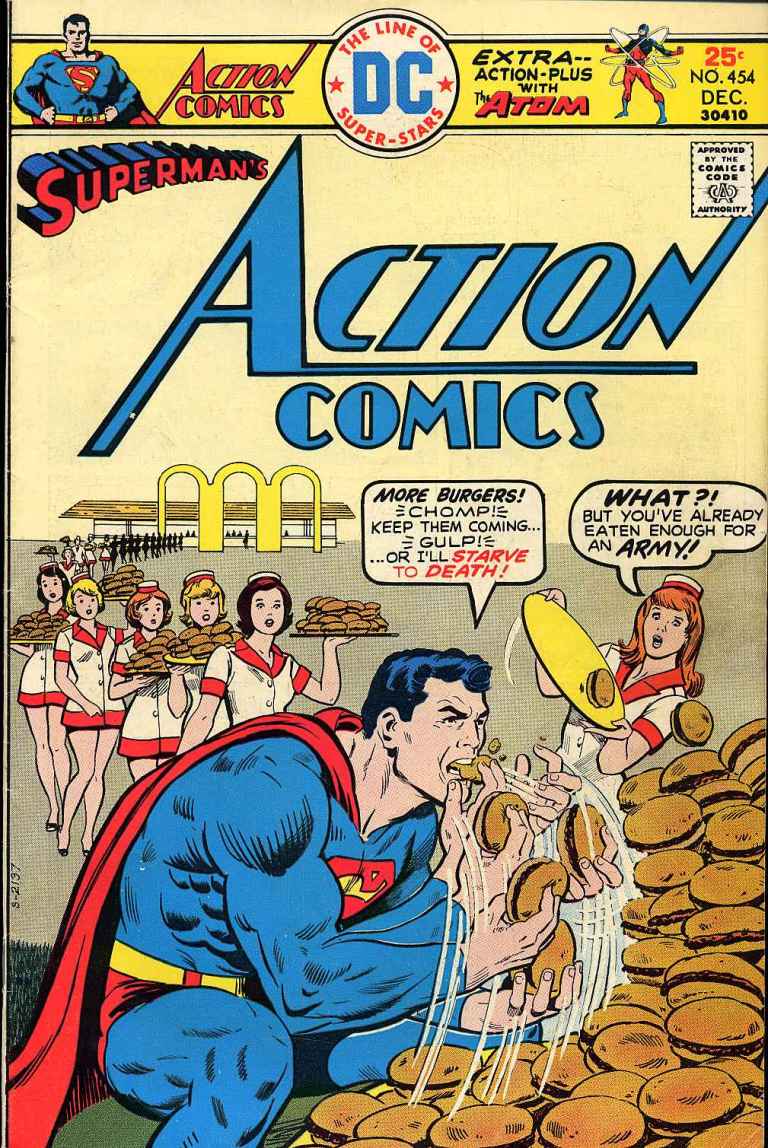
For this retro comic book review, we go back to the year 1977 as we focus on a Superman story that would not be told again in this day and age. To say the least, its cover art is, by today’s standard, over-the-top in terms of presentation. kapiHere is my look back at Action Comics #454 published by DC Comics with a story by Cary Bates and visuals by Curt Swan and Tex Blaisdell.
The cover.
Early Story
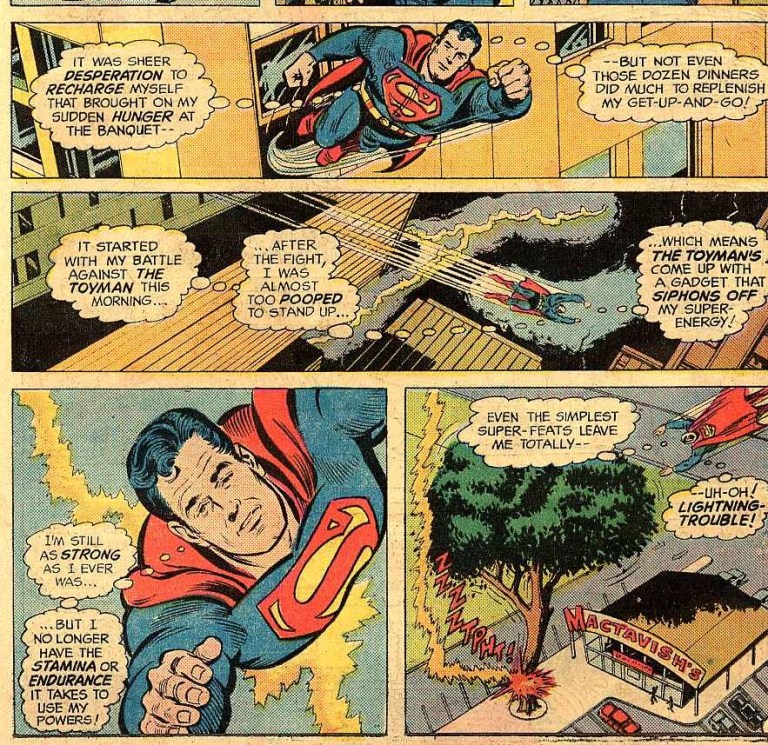
The comic book opens with a preview of things to come showing a weak Superman urged by a few people to fly and chase the Toyman.
And then there was the question: What good are super-powers without the stamina and endurance it takes to use them?
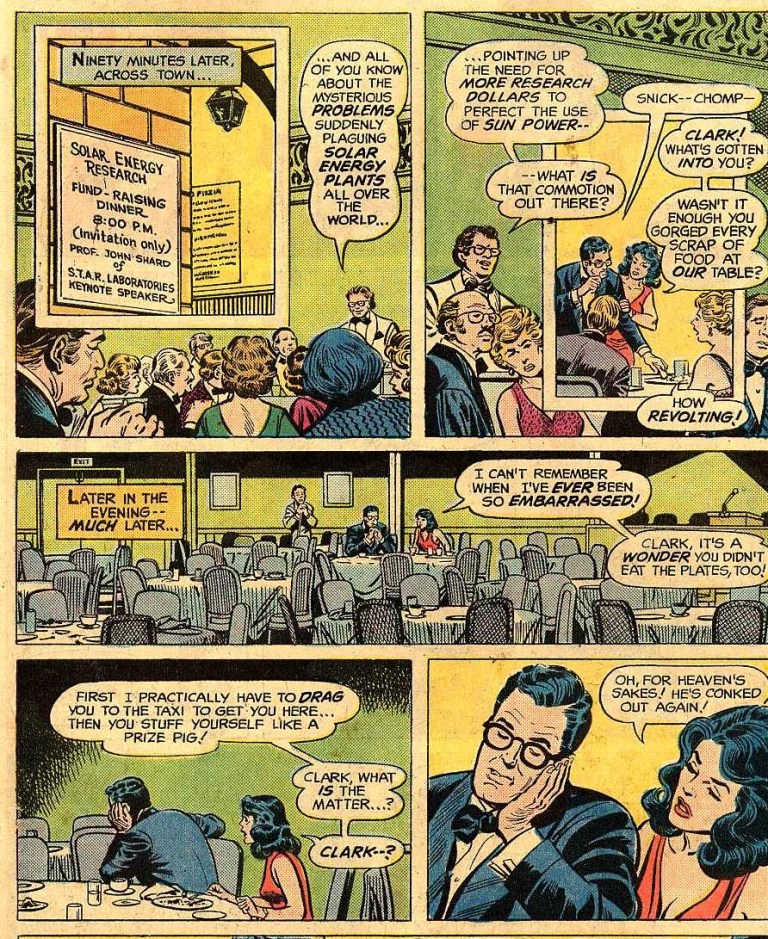
The story begins with the Toyman escaping after pulling off a bank robbery. As he flies higher, he sees Superman coming towards him. After using a trick to delay Superman, Toyman uses a special trick to twirl Superman at high speed and literally throws him away to an unknown destination. The villain escaped and, some time later, Clark Kent/Superman finds himself too tired and drained. Because of this, he becomes desperate to consume food and beverages just to keep going. This problem affects both his career and social life.
When was the last time you saw Clark Kent so exhausted?
Quality
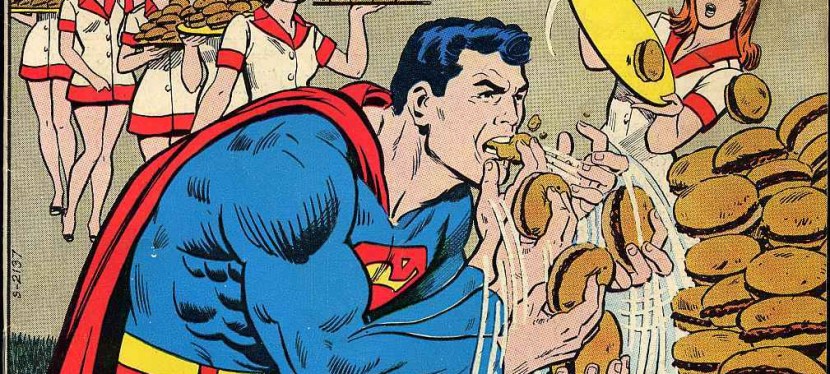
Action Comics #454 explores what would happen if Superman lacks energy and requires a lot of rest and many meals to stay active. To see him eat as many as sixty hamburgers per minute is quite funny to see.
Being weak puts Superman at a disadvantage when it comes to stopping the criminal Toyman. As the Man of Steel flies at high speed to chase the bad guy flying in a personal aircraft, the chase drains him a lot.
When it comes to storytelling, this one is pretty short lasting only thirteen pages. What I find impressive is that the creators managed to tell a standalone story of good-versus-evil as well as answering the question as to what caused Superman to be so weak in the first place.
Superman flying tired.
Conclusion
To put it clearly, Action Comics #454 is definitely a very short literary escapade that still manages to be fun to read. It sure is outlandish and I strongly doubt DC Comics will want to put Superman through heavy eating in today’s age of comics. Is this comic book a classic? Not exactly but it sure is a satisfying, fun read from an era when outlandish superhero storytelling in comic books was the norm. If you are seeking this as a collector’s item, be aware that a near-mint copy of Action Comics #454 is worth $23 at MileHighComics.com as of this writing.
Overall, Action Comics #454 is recommended.
Thank you for reading. If you find this article engaging, please click the like button below and also please consider sharing this article to others. Also my fantasy book The World of Havenoris still available in paperback and e-book format. If you are looking for a copywriter to create content for your special project or business, check out my services and my portfolio. Feel free to contact me as well. Also please feel free to visit my Facebook page Author Carlo Carrasco and follow me at HavenorFantasy@twitter.com
As I mentioned before, I never read a single comic book about Birds of Prey. Apart from previously knowing Harley Quinn, Black Canary (from the 1980s specifically) and Huntress (from the 1990s), I had minimal knowledge of the DC Comics’ title as well as modest expectations entering the cinema yesterday to watch Birds of Prey: and the Fantabulous Emancipation of One Harley Quinn which is the latest superhero production from Warner Bros.
Right now, I’m happy to share to you that the R-rated movie proved to be a fun-filled watch and is proof that the DC Comics Cinematic Universe is still moving forward (in terms of engagement, enjoyment and creativity) towards greatness.
Here is my movie review of Birds of Prey.
Early Story
The story begins with a look into the past of Harley Quinn (Margot Robbie) moving forward until her breakup with the supervillain Joker (don’t expect to see Jared Leto’s image). Through narration and clever visuals, Harley is now living a new life. Along the way, there is a club within Gotham City bustling with life which Harley haves fun at and eventually she encounters the club owner Roman/Black Mask (Ewan McGregor) who is not what he seems. After getting drunk and becoming vulnerable to men with sinister intentions, Dinah/Black Canary (Jurnee Smollett-Bell), who sings at the club, comes to her rescue. After recovering, Harley moves on to destroy a huge facility of Ace Chemicals which further sets events off…
Quality
While the screenplay by Christina Hodson (Bumblebee) lacked storytelling depth and character development, director Cathy Yan and her team still managed to craft a superhero film that was fun, action-packed and, surprisingly, not too reliant on computer-generated visual effects.
To make up for the lack of story depth, the movie relied mainly on the performances of the actors to bring their characters to life. Margot Robbie really excelled in playing Harley Quinn inside and out. While this latest cinematic portrayal does not have Harley insane, she’s still crazier than in Suicide Squad. Robbie’s act this time is more creative, more adulterated (which is the way the go), more daring with action and also more comedic. From this point on, I should say that Warner Bros. should rehire Robbie to play Harley Quinn in even more DC Comics movies.
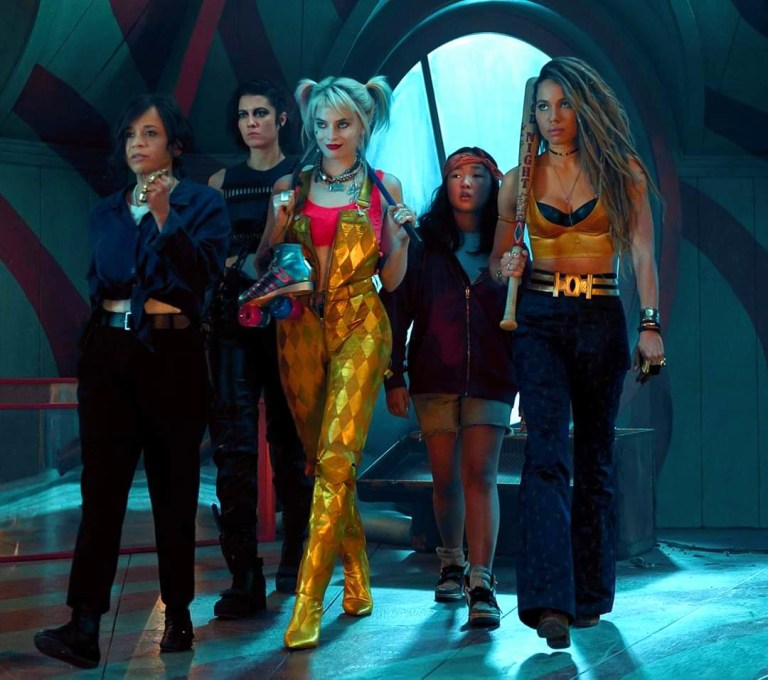
Here come the ladies: Renee Montoya, Huntress, Harley Quinn, Cassandra Cain and Black Canary.
Rosie Perez as Gotham City police officer Renee Montoya delivered a strong presence as the law enforcement element in the film and through her, we get to see the culture of the local police. Don’t expect her to have any links with police commissioner Gordon or Batman, though. Jurnee Smollet-Bell as the cinematic Black Canary is one of the stronger performers even though her version of the character is radically different from the one I read in the comic books long ago. Ella Jay Basco, an actress of Filipino and Korean heritage, as the orphan Cassandra Cain is clearly the movie’s representative (and attraction to) of the youth. Performance-wise, Basco delivered a nice performance even though her character (who in the comics is one of many who became Batgirl) lacks depth. Fortunately for us moviegoers, she is not the whiny teenager who annoy viewers and, more importantly, she delivered nicely in her part of the film’s plot. Mary Elizabeth Winstead is good as the cinematic Huntress. It’s too bad her on-screen presence is not long enough to be enjoyed, nor were moviegoers given better opportunities to know the Huntress better.
The most outstanding performance in the movie was delivered by Ewan McGregor as Black Mask. McGregor, who is a naturally artistic actor, is very colorful with his portrayal of a supervillain who, unlike many other such antagonists in other superhero movies, is charismatic, suave and yet cruel to the core. This cinematic Black Mask is not your generic action movie villain and, as such, hiring McGregor was one of the best moves made by Warner Bros. I honestly find McGregor a worthy adversary versus Margot Robbie when it comes to cinematic artistry.
When it comes to spectacle, Birds of Prey is heavily loaded with hard-hitting action plus some bloody shots that make it standout among the many superhero movies released in this current century. For one thing, the actresses themselves took an active part in doing action and the stunts they could pull of on their own (the harder stuff were understandably done by stunt doubles). Watching Harley Quinn beat up the bad guys with that large hammer, the baseball bat and other stuff were not only hard-hitting but also creative without ever looking choreographed. Black Canary’s high kicks were notable. Renee Montoya’s reliance on guns and hard action were symbolic throwbacks to the police movies of the past. Huntress meanwhile showed how deadly her small but powerful crossbow can be on-screen.
Late in the film is a certain long-take action sequence filled with the characters struggling with the bad guys simultaneously (without using computer-generated imagery) which was cleverly filmed with nice timing as the camera moved on very steadily. That sequence, even though short, is worth watching again and again. Oh yes, there are no shaky camera sequences shot!
The action scenes, in my opinion, came into play at the right time whenever I felt enough dialogue and exposition were made. This shows that the filmmakers pulled off the right moves with the pacing to ensure that people are kept entertained while still maintaining some storytelling sense which is quite an achievement since the film’s plot lacked depth. The stunts, meanwhile, are really nice to watch.
As for the brewing arguments and anticipation that Birds of Prey is a leftist and feminist piece of propaganda, I should say that such influences are more on the visual side than on the dialogue. Even though Ewan McGregor publicly said the movie is feminist, it’s not too strong. The feminism is more visible in images of the ladies fighting the bad guys who are varied with their looks – muscular, tall, big, beards, etc. The feminism is obvious with the ladies teaming up together and that is not surprising at all. Even though it has feminism elements, Birds of Prey is still pretty much a superhero movie on its own. You want a movie with stronger and more blatant feminism? Watch Star Wars: The Last Jedi instead. Maybe you want to try Elizabeth Banks’ failure Charlie’s Angels.
Conclusion
With strong and creative performances plus loads of fun stuff that more than made up for the lack of story depth and character development, Birds of Prey is an enjoyable superhero movie that is worthy of being part of the current DC Comics Cinematic Universe. Without relying on fan service, this movie expands the current cinematic universe’ presentation of Gotham City and shows the other parts of it away from Batman.
Even if you have not read any Birds of Prey comics, this movie will still prove to be entertaining. Just don’t expect to see the more iconic DC Comics characters and don’t expect to see heavy amounts of computer-generated images on-screen. Birds of Prey is more grounded and for a production of roughly $100 million, the production values still look high.
Overall, Birds of Prey is highly recommended and I encourage you to watch it in the cinemas as soon as possible. And if you have the extra money, watch it on an IMAX screen as the film was optimized for the format.
Thank you for reading. If you find this article engaging, please click the like button below and also please consider sharing this article to others. Also my fantasy book The World of Havenoris still available in paperback and e-book format. If you are looking for a copywriter to create content for your special project or business, check out my services and my portfolio. Feel free to contact me as well. Also please feel free to visit my Facebook page Author Carlo Carrasco and follow me at HavenorFantasy@twitter.com
As far as superhero movies go, 2020 is looking interesting as there is no new Avengers movie coming out this year. After the climax of last year’s Avengers: Endgame, Marvel Studios is gradually building up new anticipation of the Marvel Cinematic Universe with Black Widow. Sony Pictures has Bloodshot which is the first live-action film adaptation of any of Valiant’s comic book properties. Warner Bros. has the highly anticipated Wonder Woman 1984 set for June.
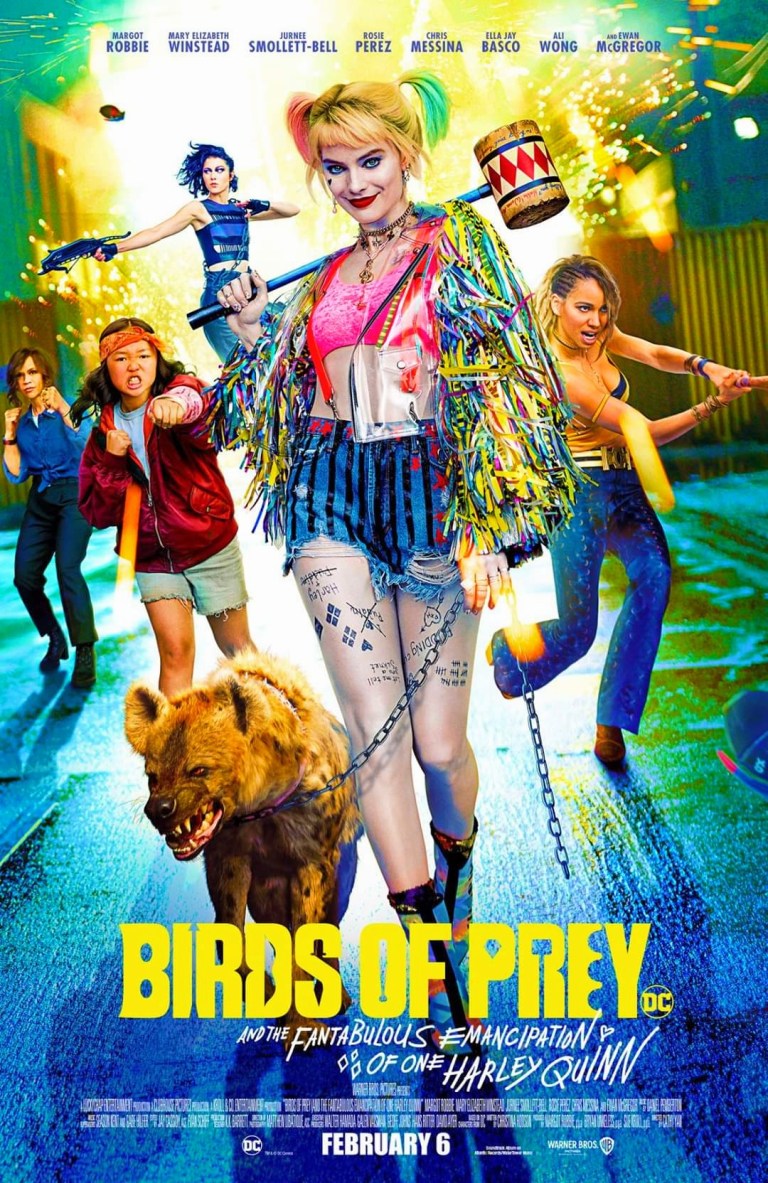
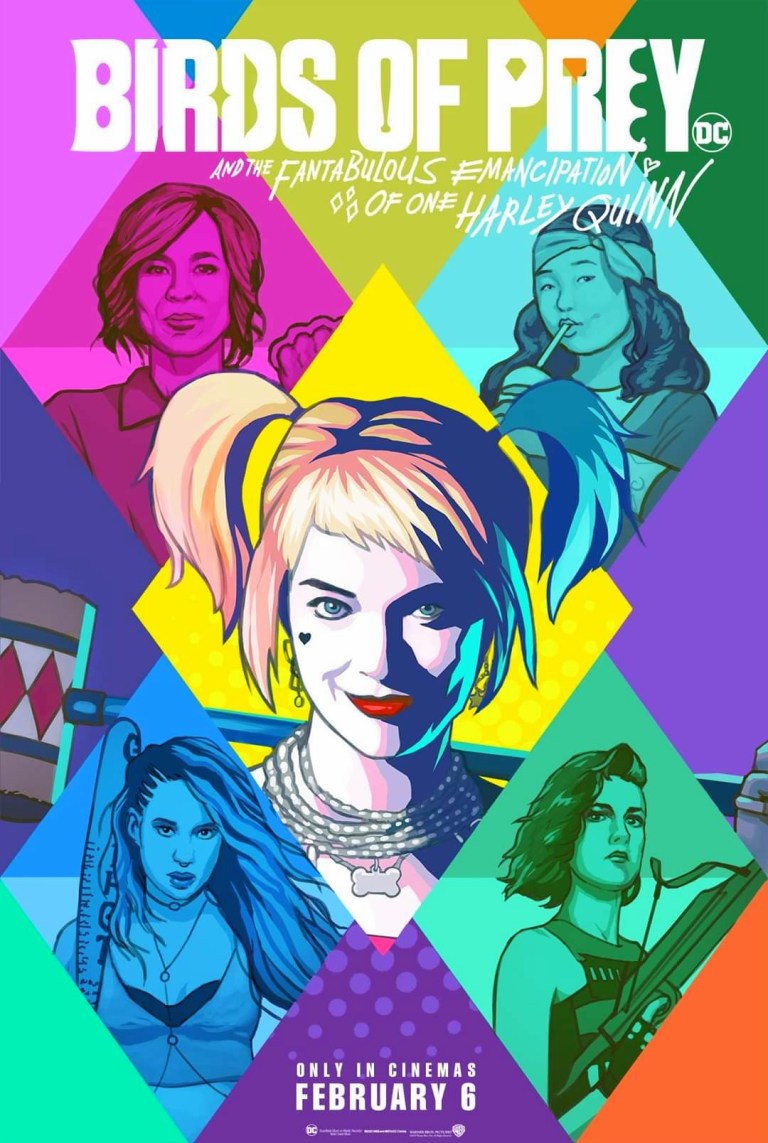
Before Wonder Woman 1984, Warner Bros. will start their 2020 superhero movie journey with Birds of Prey which will open in cinemas on February 5-6-7 in varied parts of the world. For your viewing pleasure, below are the movie poster and the first movie trailer.
According to the movie’s page at IMDB.com and the above movie trailer, the movie is set some time after the events of Suicide Squad as Harley Quinn left Joker..…looking for a fresh start. This leads her to encountering Black Canary, Huntress and Renee Montoya and they band together to save a young lady who has been targeted by Black Mask. This leads to a conflict between the ladies and Black Mask’s gang.
The gang with Harley Quinn.
In the United States, the review and classification board MPAA rated Birds of Prey with an R (restricted) for strong violence and language throughout, and some sexual and drug material. If the movie trailers are any indication, this movie is looking like it will have some really intense action scenes and harder acts of violence.
In my honest opinion, crafting a superhero movie that is more intense, more adulterated and more expressive than the usual Hollywood superhero movie can work wonders for as long as the film’s presentation is nicely done and makes the best out of its fantasy concept.
In the case of Birds of Prey, the trailers suggest that Harley Quinn is more insane (than being crazy in the Suicide Squad movie) not only with her personality but also with the way she fights others. I’m expecting to hear Harley and Black Mask say F-words in the movie. While so far nothing has been shown in the previews, I’m anticipating that there will be scenes showing Huntress fire her arrows and kill gang members violently.
Some of you may be wondering…what exactly are the Birds of Prey? Is that a popular comic book franchise? When did it start?
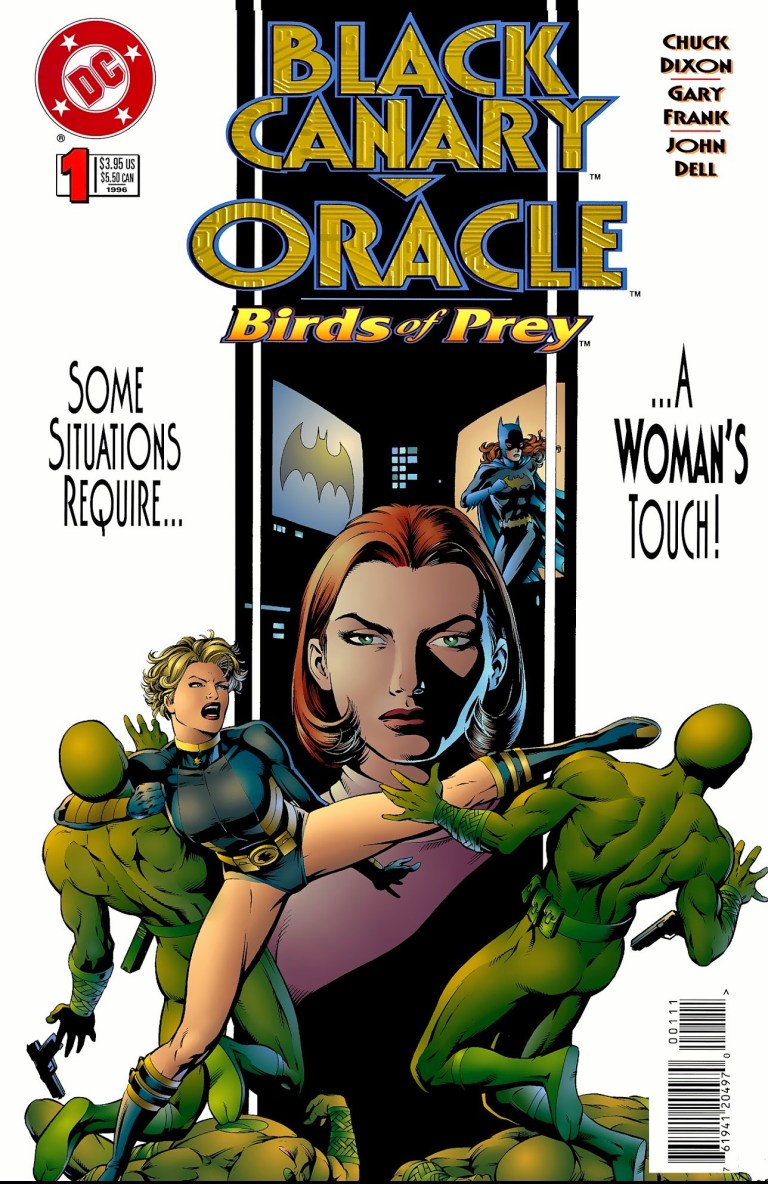
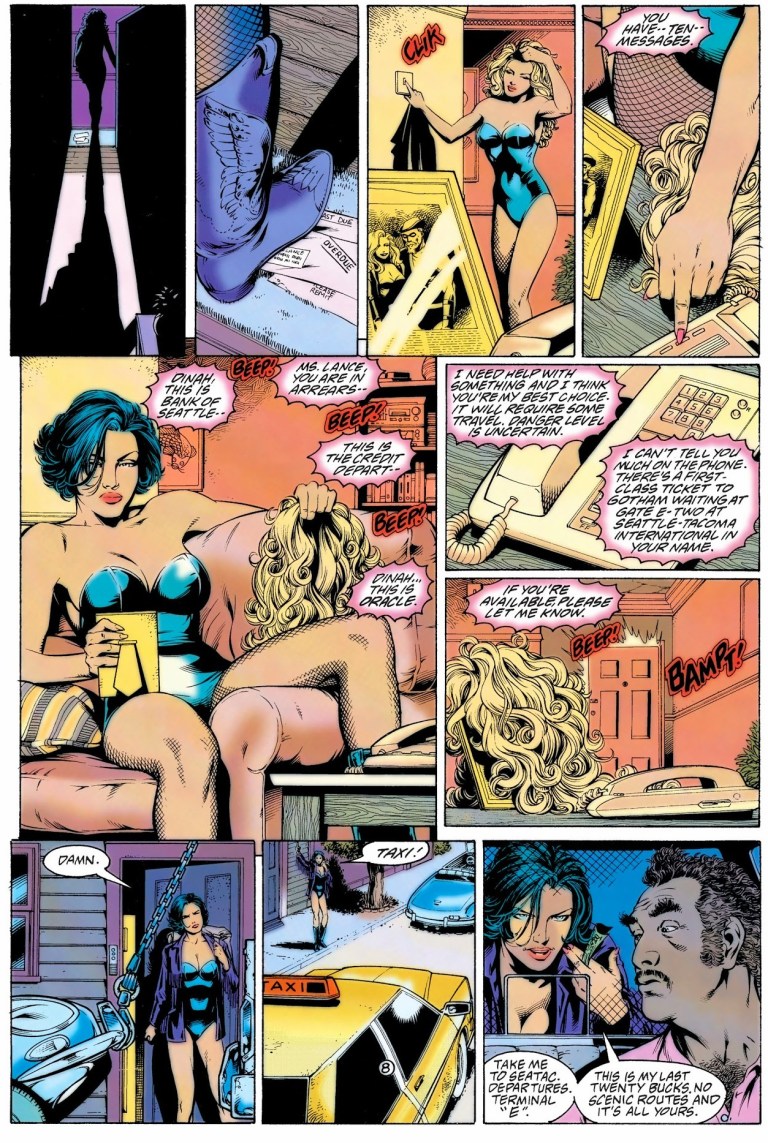
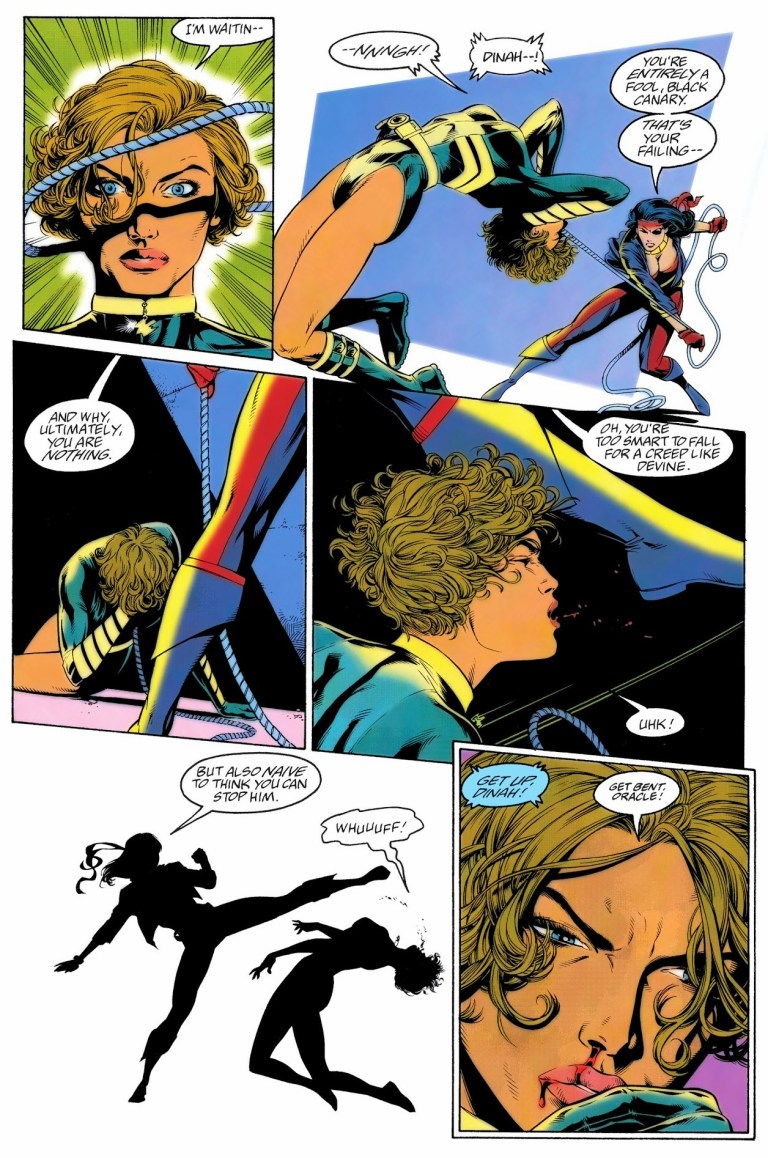
Historically, Birds of Prey started in the mid-1990s with the one-shot comic book Black Canary/Oracle: Birds of Prey #1 written by Chuck Dixon and drawn by Gary Frank. That comic book featured mainly Black Canary (specifically Dinah Lance) and Barbara Gordon. For your viewing pleasure, posted below are the front cover and two pages.
The cover.This is Dinah/Black Canary.Hard-hitting action!
I never read any Birds of Prey comic book before. I’m not exactly a fan of Harley Quinn and her performer Margot Robbie. Still, because Birds of Prey is the latest DC Comics Cinematic Universe entry, I plan to watch it and review it here. Also it has been a long time since the highly talented Ewan McGregor had a memorable cinematic performance. I really find its concept intriguing. Warner Bros. and the filmmakers (Walter Hamada and Suicide Squad director credited as Executive Producers, plus Margot Robbie is a producer) are taking a huge risk to sell this $100 million production with an R-rating.
In closing this, here is the 2nd trailer.
Thank you for reading. If you find this article engaging, please click the like button below and also please consider sharing this article to others. Also my fantasy book The World of Havenoris still available in paperback and e-book format. If you are looking for a copywriter to create content for your special project or business, check out my services and my portfolio. Feel free to contact me as well. Also please feel free to visit my Facebook page Author Carlo Carrasco and follow me at HavenorFantasy@twitter.com










 Author Carlo Carrasco