A Look Back at UltraForce #0 (1994)

Disclaimer: This is my original work with details sourced from reading the comic book and doing personal research. Anyone who wants to use this article, in part or in whole, needs to secure first my permission and agree to cite me as the source and author. Let it be known that any unauthorized use of this article will constrain the author to pursue the remedies under R.A. No. 8293, the Revised Penal Code, and/or all applicable legal actions under the laws of the Philippines.

Hey everyone! I bet you heard the sad news about the layoffs over at DC Comics which is the result of a corporate restructuring on the part of AT&T. With the ongoing pandemic of COVID-19, restructuring in the private sector is inevitable with the intention of keeping business surviving. Already I noticed some people are divided over the DC Comics layoffs – some people condemned the corporate hierarchy for laying off DC’s employees while some believe it is necessary to keep long-time comic book publisher alive. As for the socialist and Communist-minded critics, I wonder if they prefer the State Government of California (led by a tyrant governor) to fully take over DC Comics just to prevent layoffs and still be able to provide financial assistance (including taxpayers’ money) to illegal immigrants.

Wow. Just about any news development can get politicized. Regardless, the Political Left clearly support criminals, embrace corruption, move to destroy capitalism and move to betray their fellow citizens. Anyway, enough with the current events. If you want some escapism from the harshness of reality, then join me on my look back at UltraForce #0, published in 1994 by Malibu Comics with a story by Gerard Jones and illustrated by the legendary George Perez.
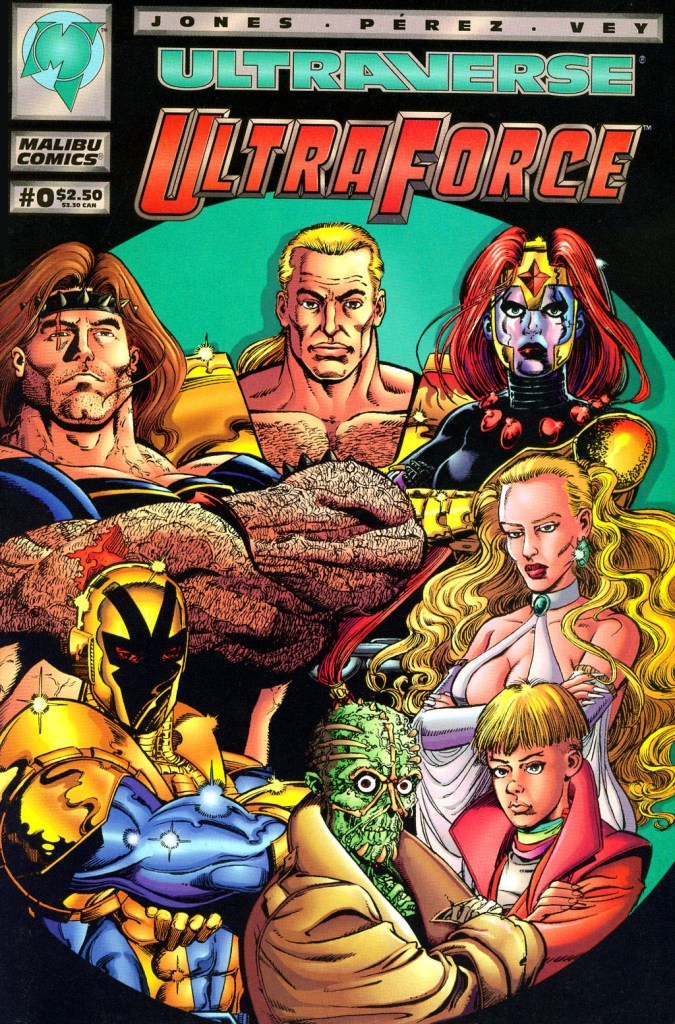
Great cover by George Perez.

Early story

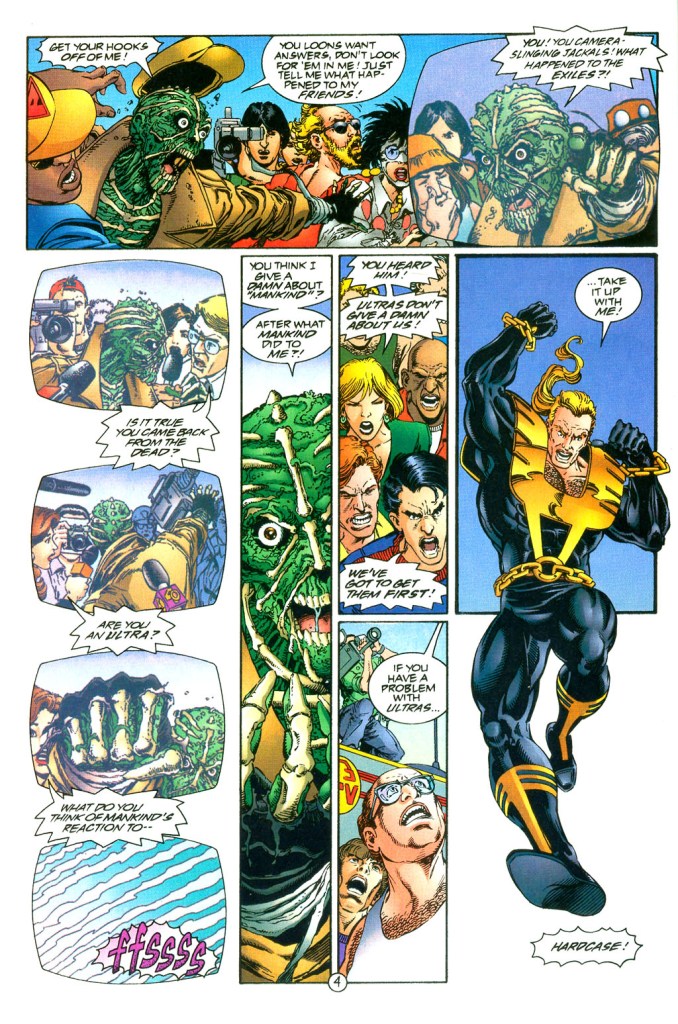
The story begins at a cemetery where Ghoul rises from the grave and disturbs a man and a woman who planned to have a good time together that evening. The next morning on the streets of Hollywood, police officers struggle to separate the people who condemned ultras apart from those who believe in the ultras. Ghoul, now wearing a trench coat, is in the middle of the crowd and it turns out he is looking for his friends…the Exiles. Suddenly, Hardcase comes in and easily catches the attention of the aggressive news media who asked questions such as:

“As the most visible ultra, do you feel ultras should be feared or worshipped?”

“What about the accountability of corporate-sponsored ultras like Prototype?”

“How do we contain an out-of-control vigilante like Prime?”

Given his experience as a celebrity, Hardcase carefully explains that even though most ultras try to do the right thing, they are not accountable for each other. Elsewhere, young Kevin Green watches the live feed of Hardcase on TV. In response to what he saw and heard about having ultras held accountable, Kevin becomes fascinated with the idea of a team of ultras who are united and cannot be beaten by the government.

Suddenly Kevin’s chest begins to hurt and moves out of the house leaving his mother. After hiding himself behind the bush, he transforms into Prime and flies away to show the world what ultras can do when he leads them…

Quality
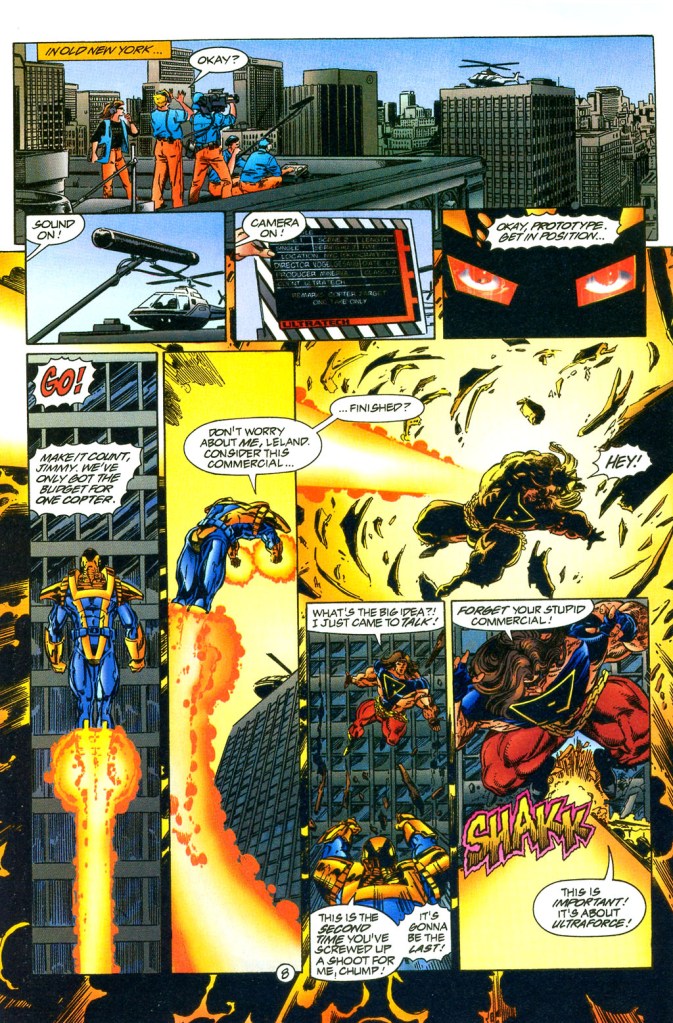
Premier rivals Prime and Prototype meet again!

I’ll cut to the chase. While UltraForce #1 showed how very notable superheroes of the Ultraverse banded together, this story cleverly explained what happened just a short time prior to that story. The very good news here is that the script written by Jones is very detailed and told a really cohesive story of its which was greatly brought to life visually by George Perez (which should not be a surprise at all). In fact, UltraForce #0 (which had some of its content previewed in the pages of Wizard Magazine) and #1 form one single narrative which was made with really high quality writing and visuals. It also showcases amazing production values by the creative teams at Malibu Comics.

For the newcomers reading this, this comic book sheds light on the impact ultras have on society and why people get divided when it comes to living knowing that someone much more powerful than them could suddenly impact their way of life. To put it short, this comic book’s social concept will keep you thinking and speculating. More on the writing, like the 1st issue, the storytelling here is certainly unpredictable (but still manages to tell a cohesive tale) and will keep you guessing what would happen next. Definitely this is not typical superhero story about someone saving the day and restoring the peace. Finally, I do confirm that this comic book is very loaded with spectacle and the pace of the story moves quite fast. By the end of this comic book, you will not only anticipate the following events (in issue #1) but also get to know Prime and the others better and be entertained a lot.
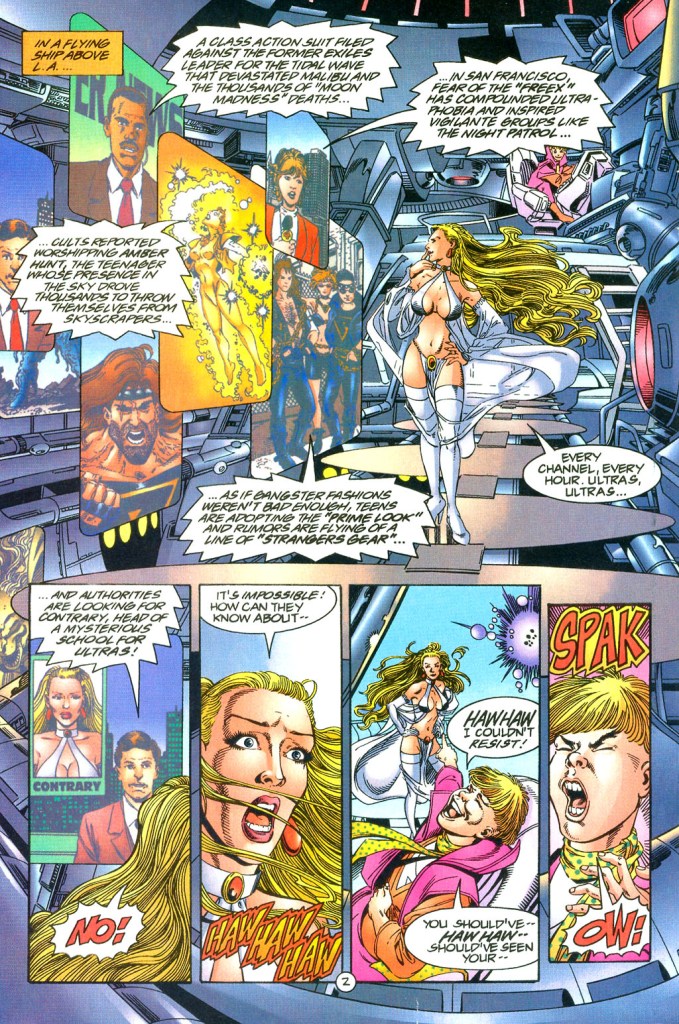
Contrary and Pixx inside their secret ship.

Conclusion

Hardcase comes in as Ghoul struggles with all the attention.

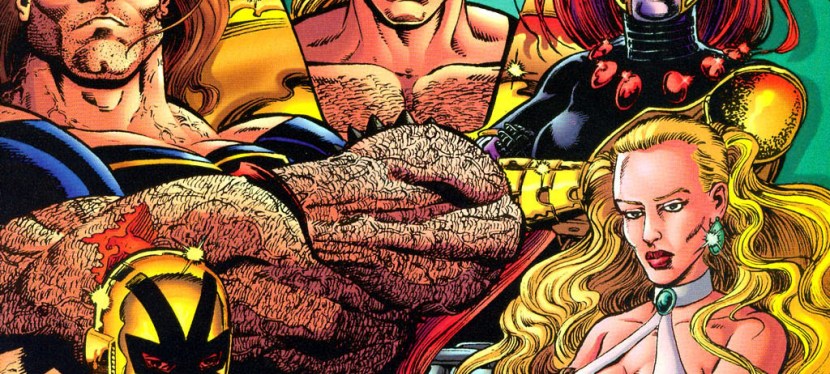
I’ll say it out loud – UltraForce #0 is a great comic book (as great as issue #1) and it truly is one of the best Ultraverse comic books as well as one of the finest works done by Malibu Comics! As a superhero team concept, UltraForce is clearly the most symbolic team of the Ultraverse not just because it has major players like Prime, Hardcase and Prototype together but also with the way they were defined literally and visually. For more on the concept of UltraForce, check out the words of then Ultraverse editor Chris Ulm.

“UltraForce is the unluckiest group in the Ultraverse. Each one has their own conception of the what mission of UltraForce is. Each fancies themselves the leader. But somehow, they are able to forge a new kind of team that is greater than the sum of its parts,” wrote Ulm in the comic book.

If you are seriously planning to buy an existing hard copy of UltraForce #0 (1994), be aware that as of this writing, MileHighComics.com shows that the near-mint copy of the regular edition costs $4.

Overall, UltraForce #0 (1994) is highly recommended!

+++++

Thank you for reading. If you find this article engaging, please click the like button below and also please consider sharing this article to others. If you are looking for a copywriter to create content for your special project or business, check out my services and my portfolio. Feel free to contact me as well. Also please feel free to visit my Facebook page Author Carlo Carrasco and follow me at HavenorFantasy@twitter.com

A Look Back at V #1 (1985)

Disclaimer: This is my original work with details sourced from reading the comic book, watching the V mini-series (Original Miniseries and The Final Battle) and the 1984 TV series, and doing personal research. Anyone who wants to use this article, in part or in whole, needs to secure first my permission and agree to cite me as the source and author. Let it be known that any unauthorized use of this article will constrain the author to pursue the remedies under R.A. No. 8293, the Revised Penal Code, and/or all applicable legal actions under the laws of the Philippines.

Back in the 1980s – a time when Netflix, Blu-ray, social and other forms of digital entertainment were not yet realized – watching a special show on television was really something. During that particular decade, science fiction in cinema was already popular (thanks to George Lucas and Star Wars plus the resurgence of Star Trek) but there was still room for growth on the TV market.

IMDBcoverpic
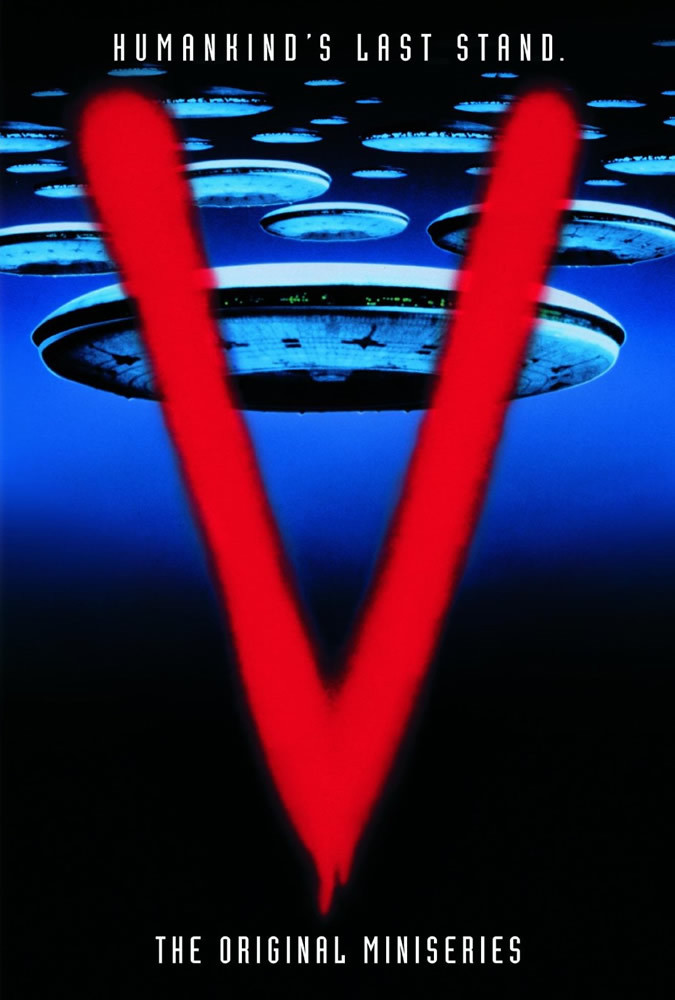
The cover of V: The Original Miniseries. (source – IMDB.com)

Then came the very memorable sci-fi TV mini-series titled V (also referred to as V: The Original Miniseries) in 1983 which not only became a big hit with viewers but also brought the sci-fi concept of reptiloids (reptilian humanoids) to the mainstream. The mini-series also had parallels to the Nazis and the Holocaust. The original mini-series was such a big hit, it spawned a sequel mini-series titled V: The Final Battle (1984) and even a TV series (1984-1985).

IMDBpic
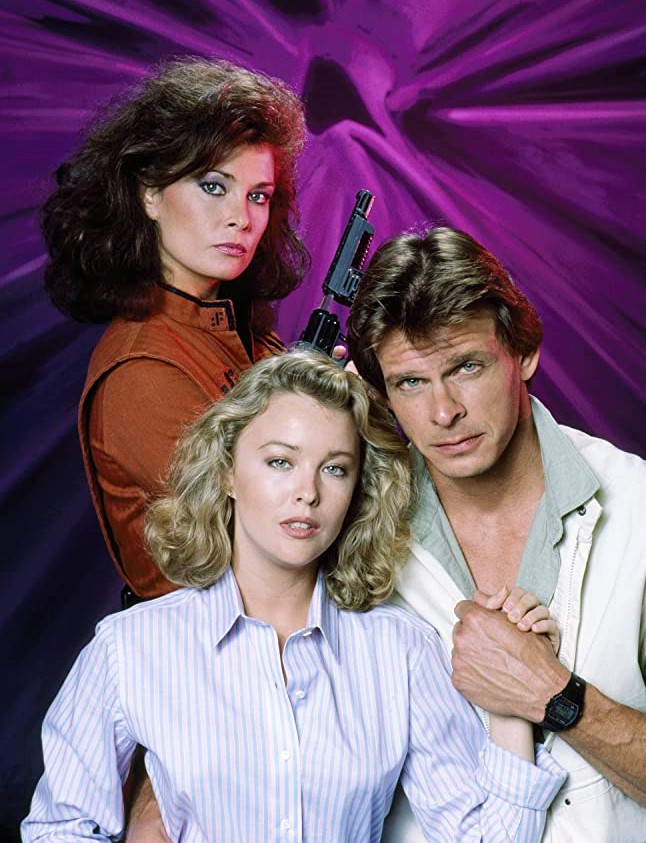
Jane Badler as Diana, Faye Grant as Julie Parrish and Marc Singer as Mike Donovan. (source – IMDB.com)

Created by Kenneth Johnson, V became a popular franchise and made stars out of Marc Singer (The Beastmaster), Faye Grant, Michael Ironside (Total Recall) and Jane Badler. Even though there never was a movie made, V was popular enough to have a line of novels, a video game and even a comic book series!

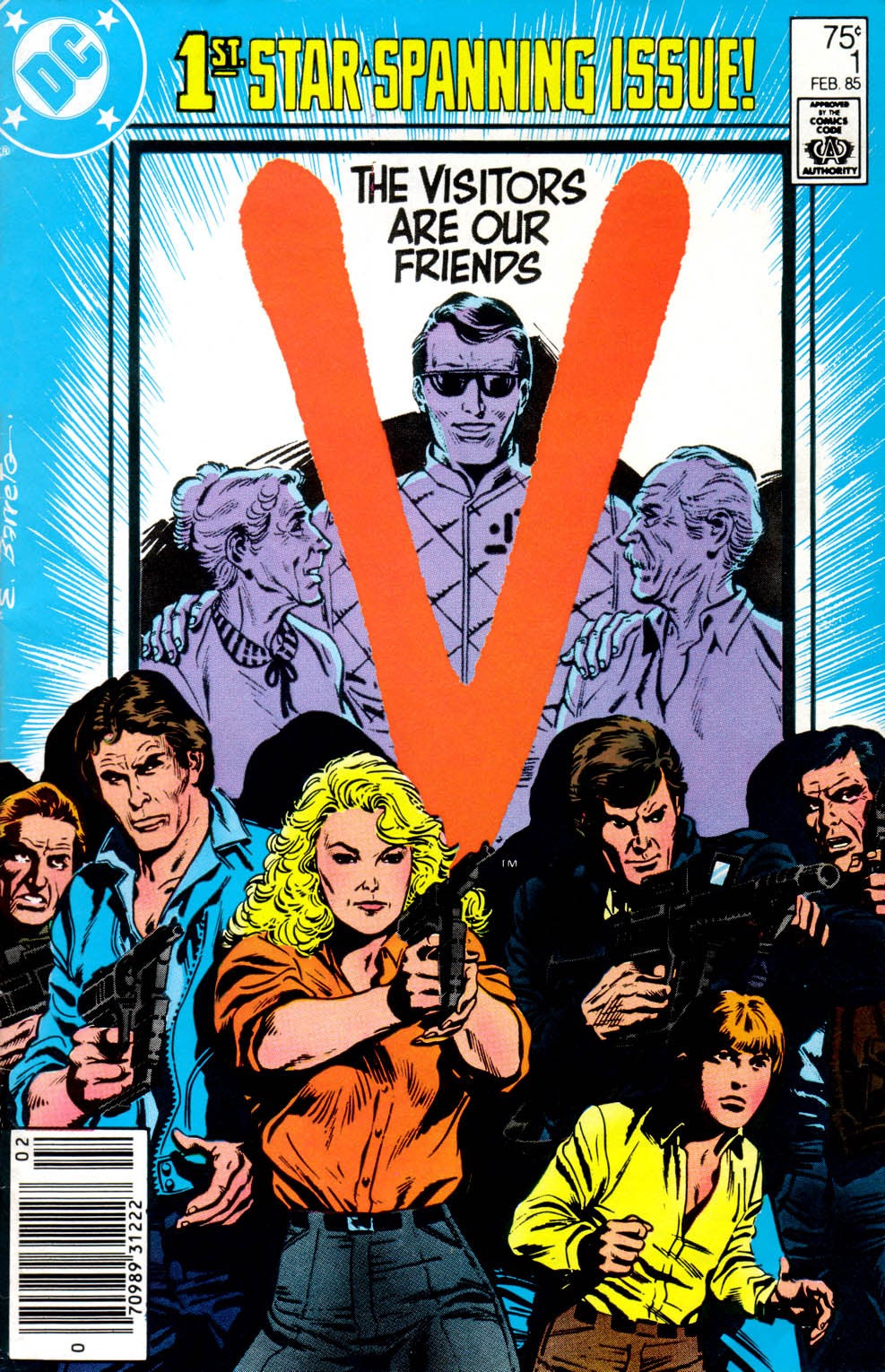
With the history lesson done, it’s high time to start taking a look back at V #1, published in 1985 by DC Comics with a story written by Cary Bates and illustrated by Carmine Infantino.

Cover
The cover.

Early story

The story begins in the city of Los Angeles, California, with millions of locals try to co-exist with the visitors (reptilian beings disguised as humans) who are armed and still have power over Earth’s people. Los Angeles stands as a so-called neutral zone but some things are not what they seem.

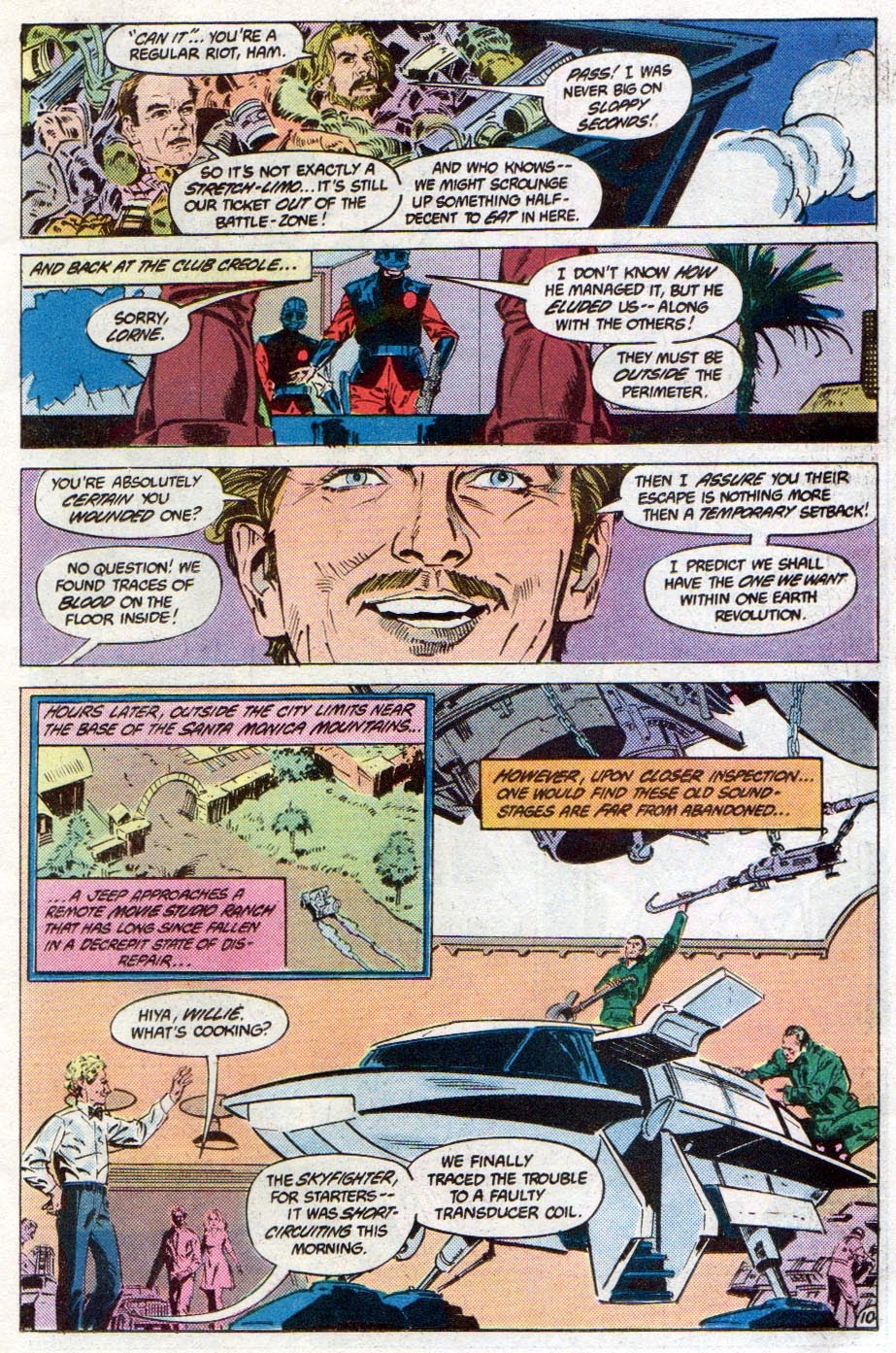
Inside a restaurant, Mike Donovan, Julie Parrish, Ham Tyler and Chris Farber talk about their situation. For Ham and Chris, the neutral zone stinks but for Mike, the current situation spares the city from turning into an open battlefield. Suddenly, three men wearing trench coats standing by the bar pull their guns out and fire at Mike and his companions who take cover…

Quality

9
The struggle between the resistance and the visitors goes on.

Before discussing the quality of this comic book, I should state that having sufficient knowledge about the two TV mini-series and the TV series is required in order to understand what has been going on in the literary tale and who the characters are.

On quality, let’s start with the storytelling done by Cary Bates. It is clear Bates carefully researched the TV materials to make a comic book script that pretty much captures not only the essence of V but also the notable differences of each character (examples: Tyler is sarcastic, Mike is determined, Willie occasionally speaks with a misplaced word, and Diana is sadistic). This comic book’s plot was written to be aligned with the events of the TV series as it is clear that its tale took place some time after the climax of V: The Final Battle.

When it comes to translating V’s essence from TV to comic book format, Bates script worked surprisingly well and more importantly there was a careful balance between exposition, plotting, spectacle and suspense. When it comes to character development, what you get from the TV series (in terms of doing characterization) is also present here.

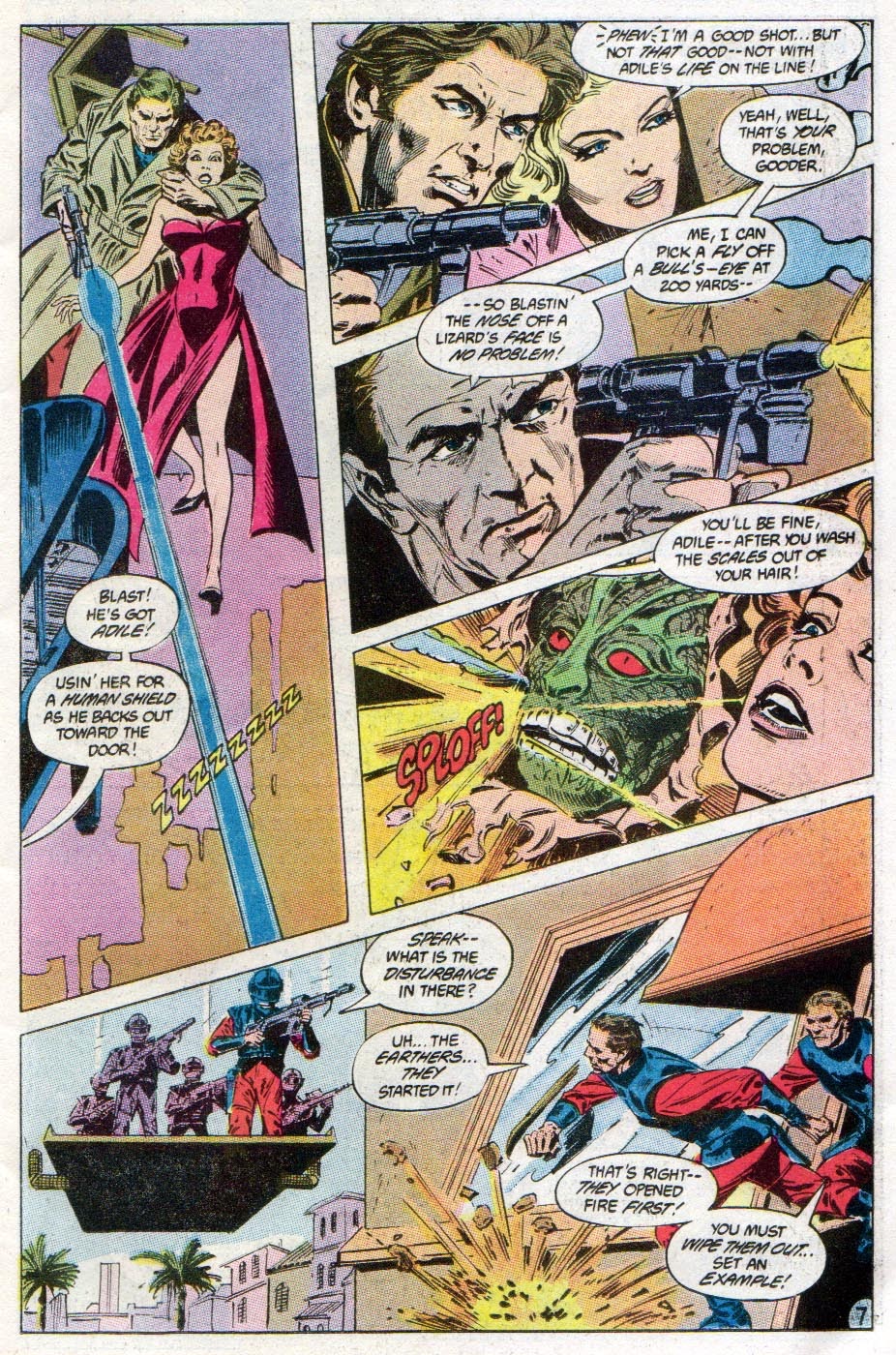
When it comes to visuals, Carmine Infantino’s work is serviceable. The artist did what was possible with the script provided although there were key moments in which the panels and drawings were structured to be a little disorienting. Was this Infantino’s way of trying to be dynamic with the visuals? Lastly, don’t expect to see the major characters resemble their TV counterparts. Ham does not look like Michael Ironside, Mike does not look like Marc Singer and Julie does not look like Faye Grant.

Conclusion

6
Recognize Mike, Julie and Ham here?

I can say it straight that V #1 is a solid science fiction comic book that specifically will strongly resonate with fans of the V franchise’s entertainment of the 1980s. This comic book strongly captures the essence of the V franchise, specifically the TV series itself, and the good news is that the major characters are nicely dramatized which should delight fans. That being said, it’s tricky to recommend this to people who did not grow up with nor knew the V mini-series and TV series. When it comes to trading and making money out of this comic book, you could be in luck.

If you are seriously planning to buy an existing hard copy of V #1 (1985), be aware that as of this writing, MileHighComics.com shows that the near-mint copy of the regular edition costs $28 while the near-mint copy of the newsstand edition costs $33.

Overall, V #1 (1985) is highly recommended specifically for the fans and the collectors. Those who are not oriented with the franchise need to see the mini-series and TV series first in order to realize this comic book’s value.


Thank you for reading. If you find this article engaging, please click the like button below and also please consider sharing this article to others. If you are looking for a copywriter to create content for your special project or business, check out my services and my portfolio. Feel free to contact me as well. Also please feel free to visit my Facebook page Author Carlo Carrasco and follow me at HavenorFantasy@twitter.com
A Look Back at Batman versus Predator II: Bloodmatch #1 (1995)

Disclaimer: This is my original work with details sourced from reading the comic book and doing personal research. Anyone who wants to use this article, in part or in whole, needs to secure first my permission and agree to cite me as the source and author. Let it be known that any unauthorized use of this article will constrain the author to pursue the remedies under R.A. No. 8293, the Revised Penal Code, and/or all applicable legal actions under the laws of the Philippines.

If there is anything I love about the comic book format in relation to creative fiction, it is the fact that the said format allows certain crossover match-ups (that could not be realized in movie or TV format) to happen. In this case, I’m talking about having the science fiction monster warrior Predator in conflict with Batman.

Historically, in the early 1990s, DC Comics and Dark Horse Comics teamed up to publish the highly memorable crossover Batman versus Predator with the creative talents of Dave Gibbons, Andy Kubert and Adam Kubert.

The two publishers did not stop there. In 1995, they teamed up again to bring the two pop culture icons together but with a brand new story, a new creative team and with the involvement of the Huntress to support Batman. I was in college back in 1995 and you can’t imagine how surprised I was to see the first issue of the 2nd Batman-Predator crossover displayed on the shelf of the comic book store I visited. I was surprised because there was not much media spotlight for it in the comic book industry magazines I read.

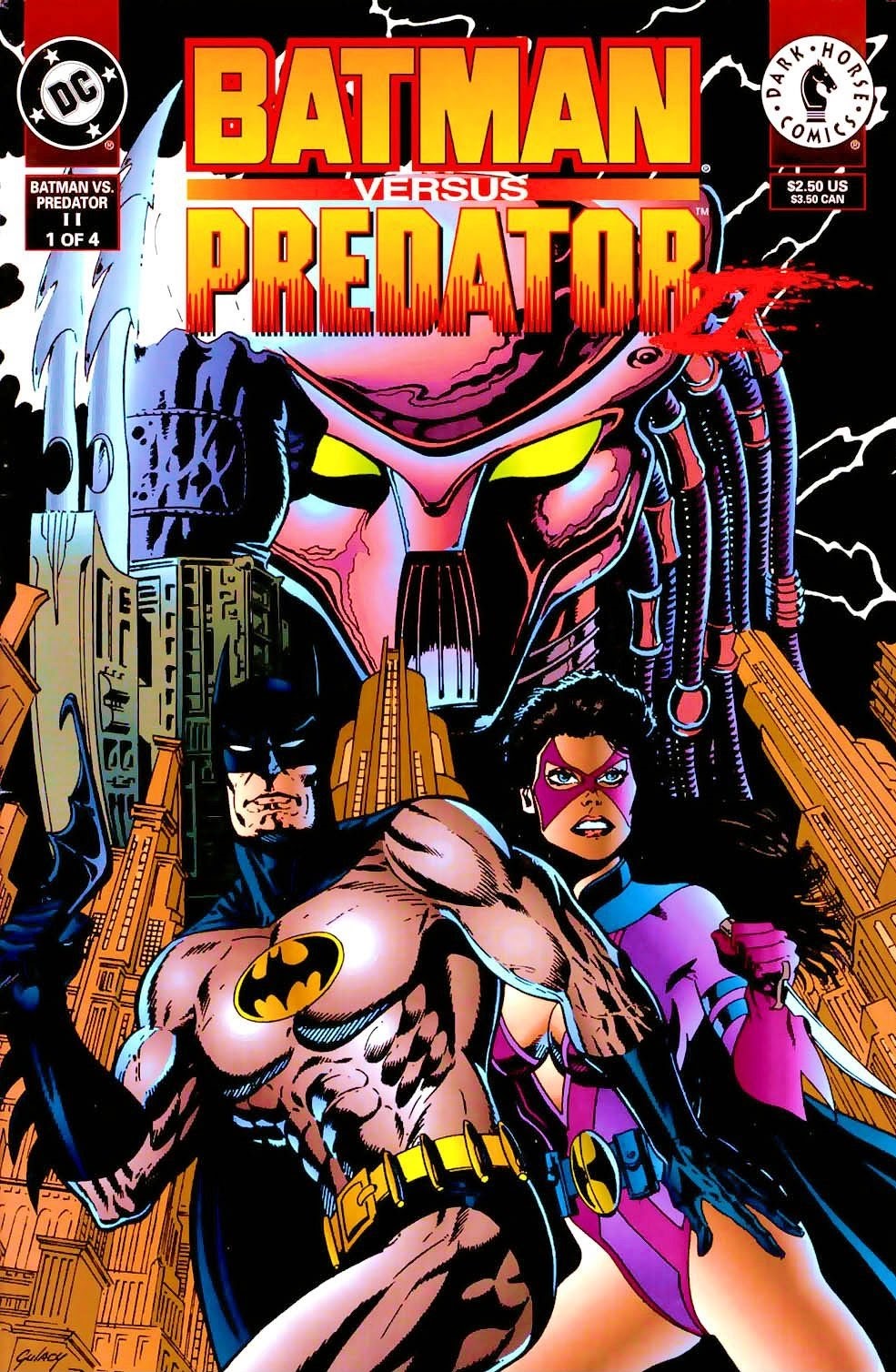
That being said, here is a look back at Batman versus Predator II: Bloodmatch #1, published in 1995 by DC Comics and Dark Horse Comics with a story written by Doug Moench and drawn by Paul Gulacy.

Cover
The cover.

Early story

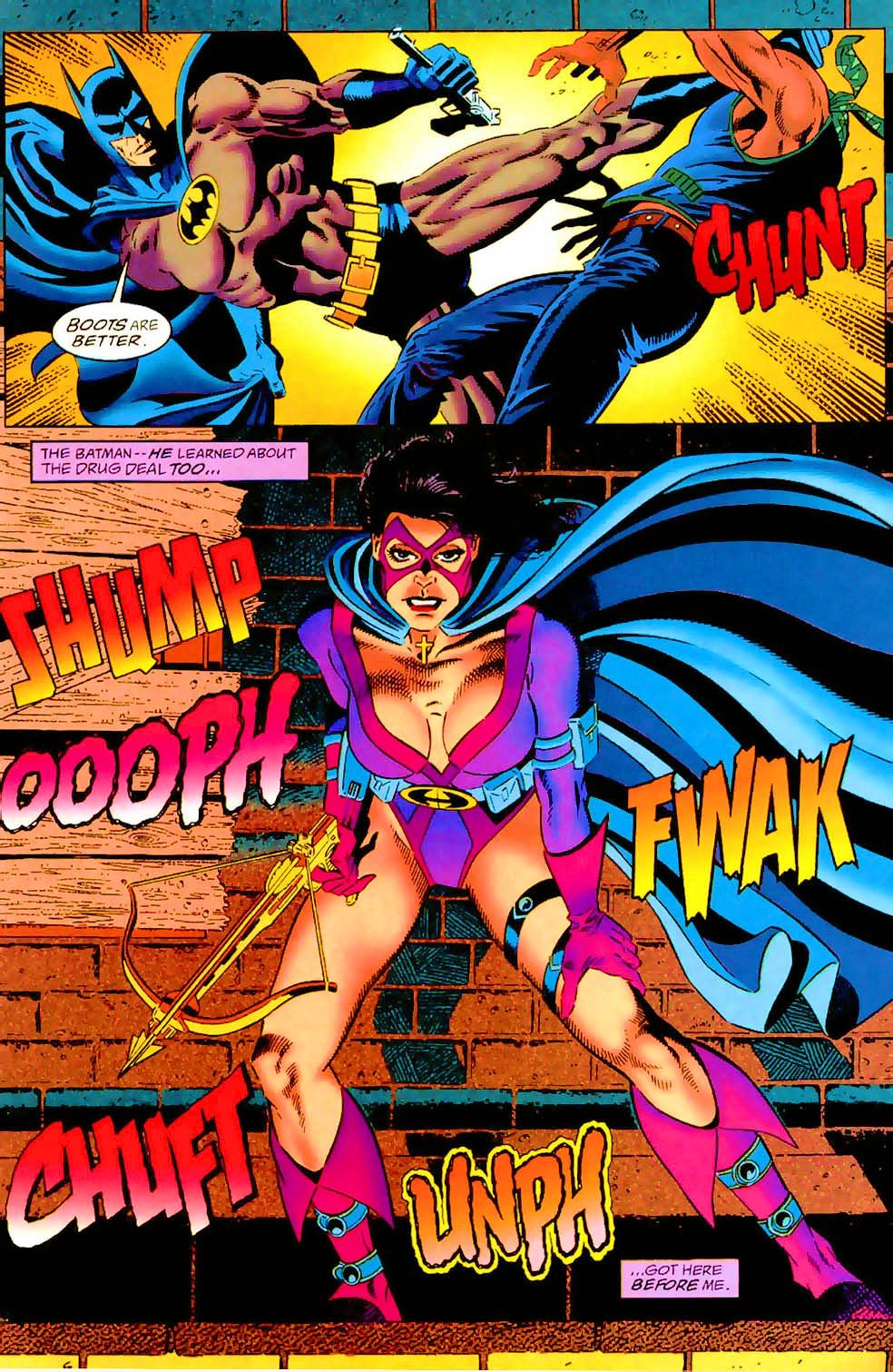
The story begins in the city where three guys are about to complete an illegal drugs deal by the dock. As one of the dealers fires his gun at the other party, Batman breaks into the scene to bring him down and pressures him to reveal the location of Terraro. As the downed thug tries to shoot Batman, an arrow fired by the Huntress hits his arm which caught the Dark Knight by surprise.

After knocking the thug out, Batman and the Huntress talk. It turns out both of them are after Terraro. The Huntress leaves as Batman remains to do some detective work on the three men.

Meanwhile from a far distance, a Predator reviews archived video footage of Bruce Wayne/Batman’s final encounter with a Predator (as told in the final issue of the first Batman Versus Predator series) and listens to the audio recording. The Predator is preparing himself to fight Batman by doing research (including familiarizing himself with how Bruce Wayne and his butler Alfred sound like) and he uses his deadly disc to cut off the head of a statue resembling the Dark Knight…

Quality

28
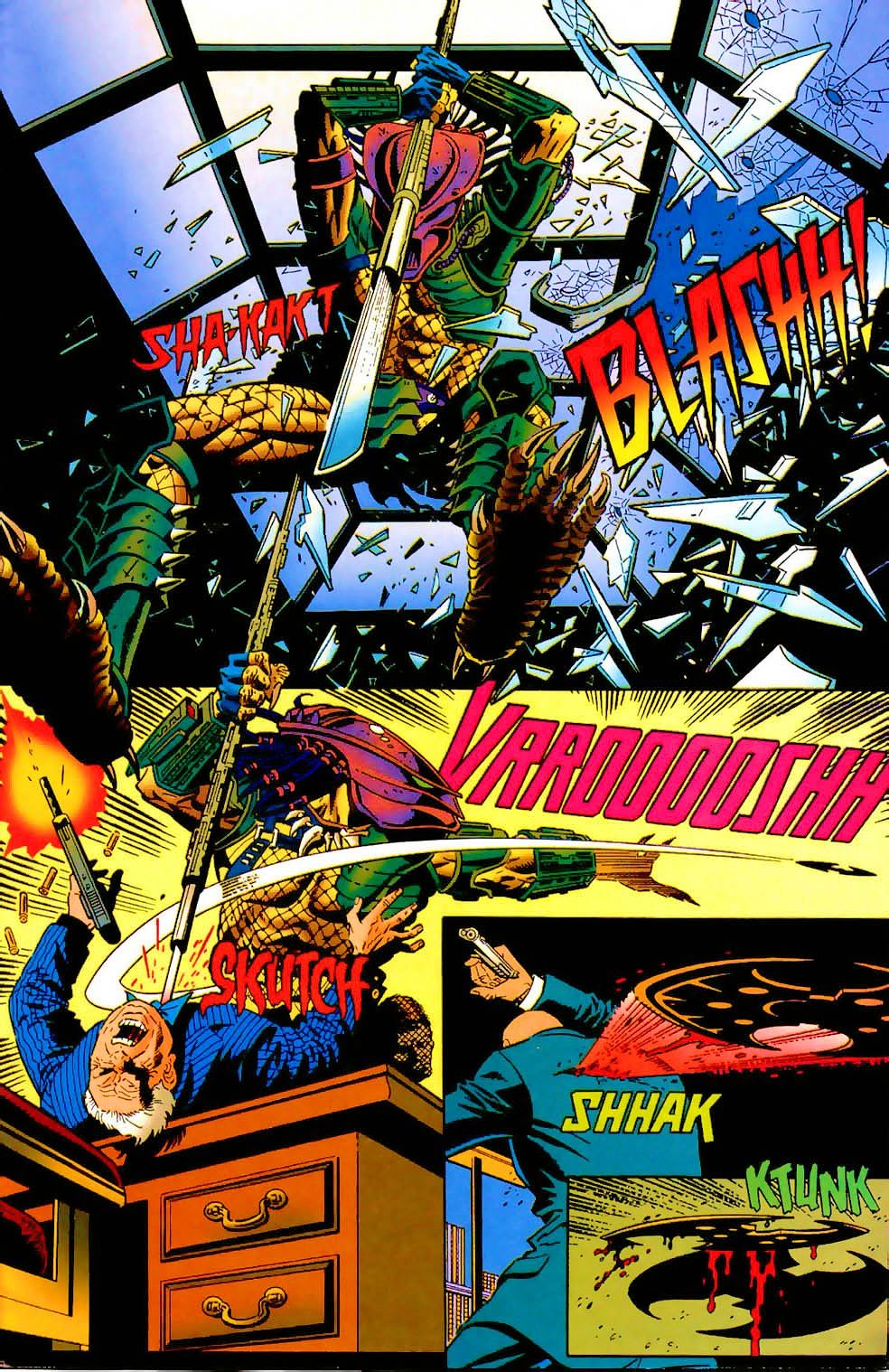
The Predator in action!

Let me start with the story. This comic book essentially tells a crime story mixed with some sci-fi elements. Unsurprisingly, there is a lot of exposition used to help build-up the expected conflict between Batman and the Predator. That’s not to say that the story is hollow. In fact, I still found it compelling even though some of the spotlight was spent on the Huntress who is clearly involved in the crime tale. To say the least, the Huntress adds variety to what could have been a typical Batman-does-all-the-detective-work story.

Batman, who by this time gained tremendous knowledge about the Predator, turns out to be targeted as “dead meat” by a gang leader and it’s nice to see him solve the crime problem while being at odds with the Huntress whom he finds to be too eager and reckless.

As for the Predator, unsurprisingly the alien warrior appears sparingly but that’s not a problem at all. In fact, the writer implemented the spotlight on the Predator without ever overdoing it which added nicely into the anticipation of the so-called rematch with Batman. I also liked how the Predator was portrayed in dealing with the criminal and law elements of the city.

As for the visuals, this one is a mixed bag for me. Firstly, I like the more vibrant and stylish use of colors which made this comic book look radically different from the dark, gritty and less colorful visuals of its predecessor. Secondly, Paul Gulacy’s art on drawing people lack punch and consistency. There were times that his drawings of Batman and Huntress were good, other times not. His work on the Predator is good, however. What Gulacy excelled in was drawing action scenes which are not only dynamic in presentation but also went strong with the violence (lots of bloody scenes, weapons penetrating the body, etc.) which reminded me a lot about the first two Predator movies. Gulacy’s take on the Batmobile looks corny.

Conclusion

6
The Huntress watches as Batman takes action.

Way back in 1995, I enjoyed reading Batman versus Predator II: Bloodmatch #1 the day I first bought it. Today, I still find it enjoyable to read. It has a nice mix of suspense and spectacle, and the creative team was granted a lot of creative freedom to tell the story with mature readers in mind. The story was well paced and the build-up was worth the time.

If you are seriously planning to buy an existing hard copy of Batman versus Predator II: Bloodmatch #1 (1995), be aware that as of this writing, MileHighComics.com shows that the near-mint copy of the regular edition costs $23 while the near-mint copy of the promotional version with a poster costs $40.

Overall, Batman versus Predator II: Bloodmatch #1 (1995) is highly recommended!


Thank you for reading. If you find this article engaging, please click the like button below and also please consider sharing this article to others. If you are looking for a copywriter to create content for your special project or business, check out my services and my portfolio. Feel free to contact me as well. Also please feel free to visit my Facebook page Author Carlo Carrasco and follow me at HavenorFantasy@twitter.com
A Look Back at Total Recall Movie Special #1

Disclaimer: This is my original work with details sourced from reading the comic book, watching the movie and doing personal research. Anyone who wants to use this article, in part or in whole, needs to secure first my permission and agree to cite me as the source and author. Let it be known that any unauthorized use of this article will constrain the author to pursue the remedies under R.A. No. 8293, the Revised Penal Code, and/or all applicable legal actions under the laws of the Philippines.

I already published that I really love the 1990 sci-fi action movie Total Recall which starred Arnold Schwarzenegger, Sharon Stone, Michael Ironside and Rachel Ticotin under the direction of the highly talented Paul Verhoeven. The movie is one of my all-time favorites and most notably it has aesthetics that are totally unique mainly due to the combined expressions and artistry of Schwarzenegger and Verhoeven. Behind it all, Total Recall would not have been realized without the short story We Can Remember It For You Wholesale written by the late sci-fi author Philip K. Dick whose published works led to other movies from Hollywood.

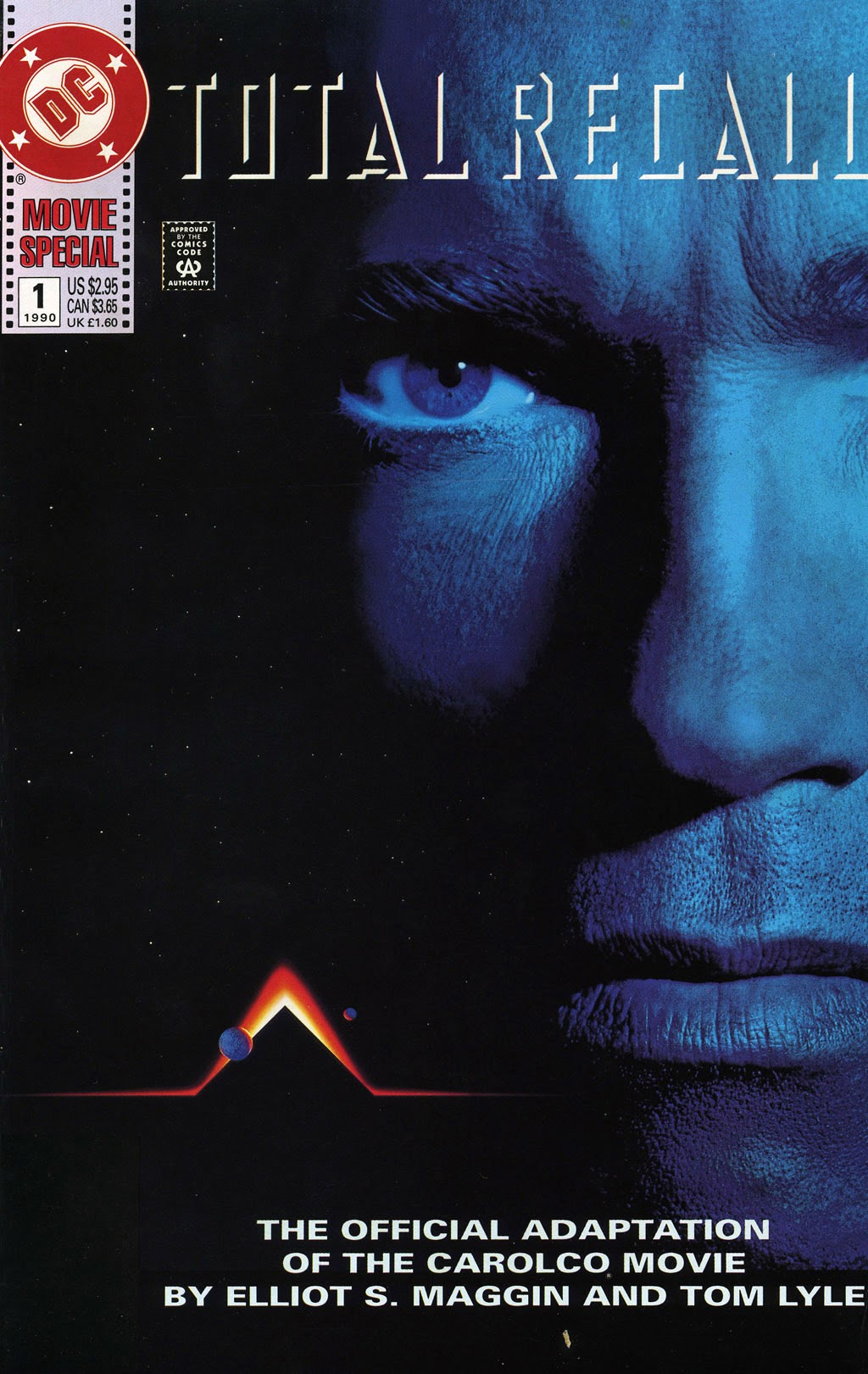
As part of a business strategy, Total Recall also had multi-media releases in the form of a novel (by Piers Anthony), video games and a comic book published by DC Comics. Very recently I was able to finally read the comic book adaptation of the film titled Total Recall Movie Special #1. It had a cover that was technically a copy of the American movie poster with Arnold Schwarzenegger’s face dominating it and it came with a cover price of $2.95 which was pretty high for 1990.

Is the comic book adaptation any good? Does it capture the essence of the blockbuster film? We can find out by finally starting this look back at Total Recall Movie Special #1, published in 1990 by DC Comics with a story written by Elliot S. Maggin and drawn by the late Tom Lyle (read my first article of Lyle’s work).

Cover
The cover of the comic book.

Early story

The story begins on the surface of planet Mars where a man and a woman (both wearing space suits) walk together heading towards an unknown destination. Suddenly a small stone cracks the glass face shield of the man’s helmet exposing him to the deadly atmosphere of Mars.

2
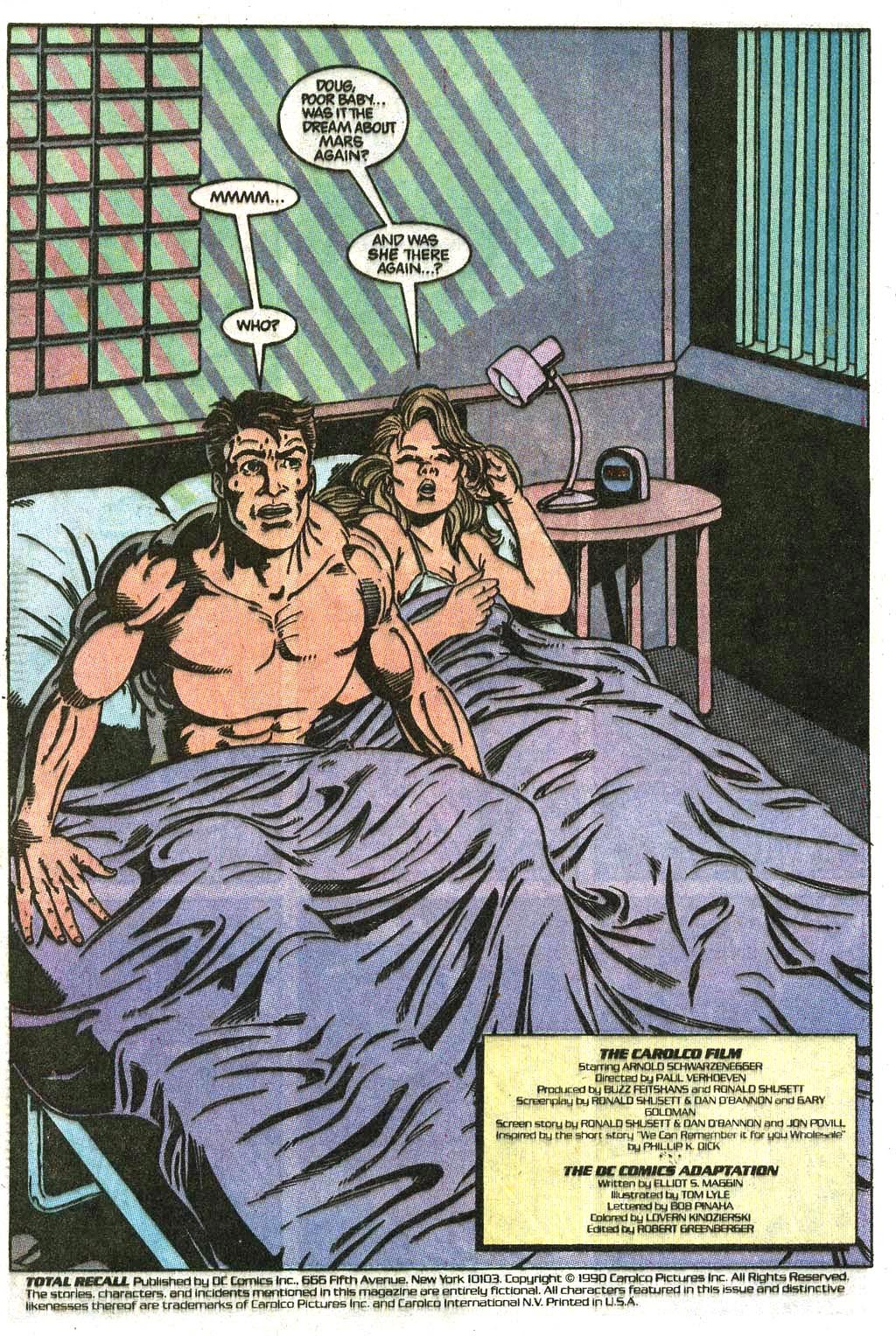
Like in the movie, Douglas Quaid and Lori wake up.

It turns out it was just a dream for Douglas Quaid who was in bed with his wife Lori. The dream turned out to be a recurring one as Lori asked him if the dream lady was in there again. Lori then asked Doug who the dream lady was. A short time later, Doug reports to work and while doing construction work on the field, he asked a colleague about Rekall (note: he saw a video ad of it on his way to work). The guy told Doug about someone getting lobotomized at Rekall and discouraged him from availing of their service.

7
Douglas Quaid at Rekall for his virtual holiday.

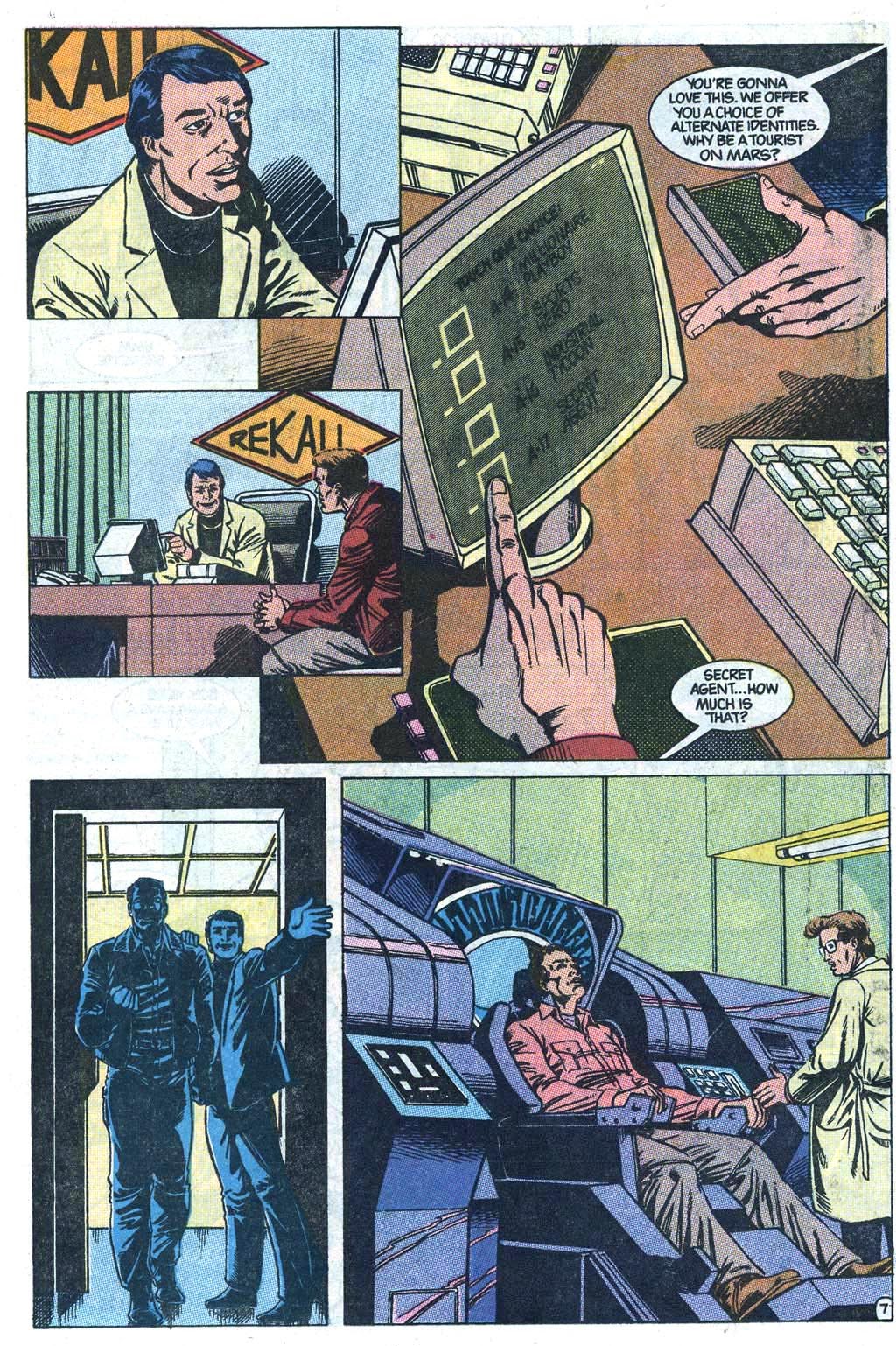
Doug eventually visits Rekall after work and availed of their virtual holiday as a secret agent. Something goes wrong as Doug goes berserk while strapped on one of Rekall’s seats. Dr. Lull (in-charge of the operation) explains to her boss that Doug was not acting out his virtual holiday as her team has not even implanted it yet on him…

Quality

14
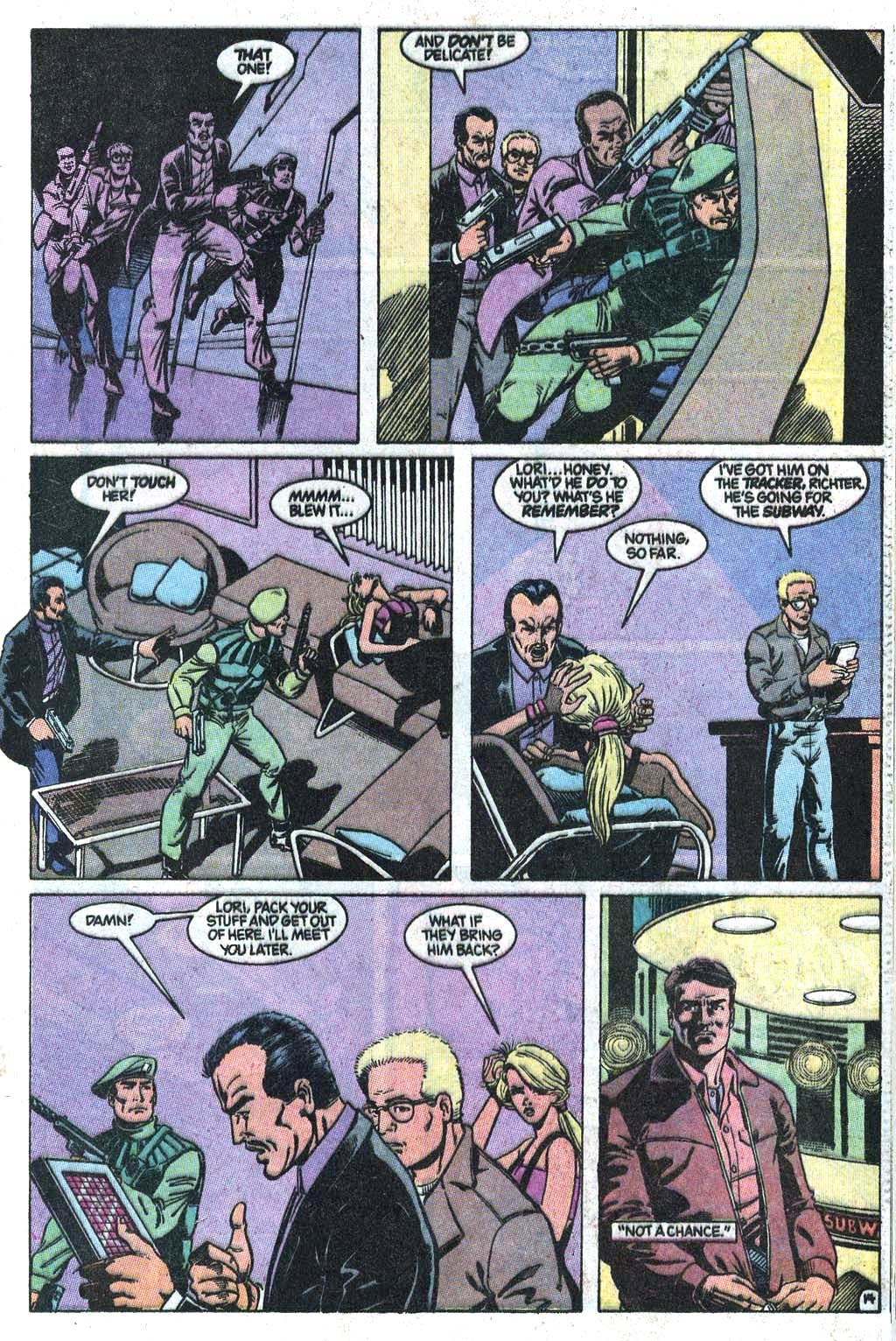
The bad guys on the hunt for Douglas Quaid.

When it comes to presenting the story, Elliot S. Maggin clearly paid close attention to the details, the plot and dialogue of the movie while implementing adjustments along with artist Tom Lyle to make the story work in comic book format. Clearly, this is not a word-for-word, scene-for-scene adaptation but it comes close to capturing the essence of the film. Unsurprisingly, the comic book adaptation never captured the unique Schwarzenegger-Verhoeven aesthetics of the movie but it still performed well on replicating the sci-fi, hard action moments. I find it surprising that Total Recall Movie Special #1 carried the seal of approval of the Comics Code Authority (CCA) as there were some bloody shots and several moments of strong violence inspired by the R-rated film.

When it comes to the visuals, Tom Lyle succeeded in capturing the sci-fi look of the movie and even had the literary Douglas Quaid occasionally resemble Arnold Schwarzenegger. Lyle’s drawings on other characters like Lori, Melina, Coohagen and Richter looked NOTHING like the actors who played them but that’s not a problem at all as this gives this comic book its own unique touch. In fact, there were some drawings of people that sometimes reminded me of what I saw in EC Comics’ Weird Science comic books.

While Lyle scored nicely with the action scenes, his own drawings of planet Mars and the human colony are quite nice to look at. With regards to the urban environment, Lyle drew a nice mix of 20th century inspired urban areas laced with futurism. Unsurprisingly, the futurism got stronger when the story was set in Mars.

If there is anything lacking with the art, it would be visual dynamism. This can be forgiven however given the high amount of dialogue and story details that had to be presented with each page carrying a lot of panels.

Conclusion

23
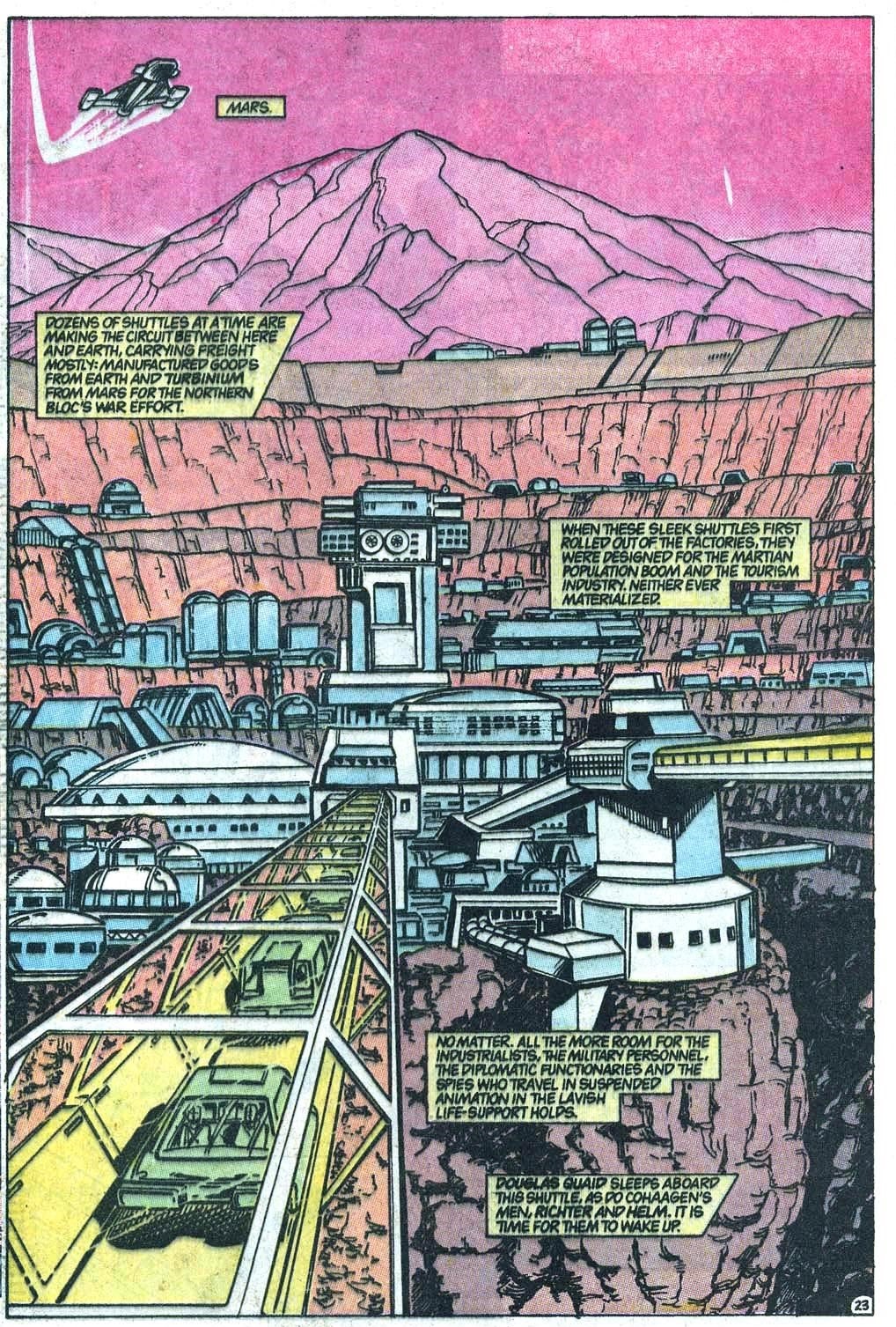
The human colony in planet Mars.

I can say it out loud that Total Recall Movie Special #1 is a fun read and serves nicely as a literary companion to the cinematic masterpiece Total Recall. As a comic book adaptation of a blockbuster movie, this one is pretty good and in some ways captured some of the flair of the film even as it never successfully replicated the Verhoeven-Schwarzenegger aesthetic in the film. Really, if you want the best of Total Recall you really should watch the movie. This comic book on its own is entertaining and should encourage you to watch the film.

If you are seriously planning to buy an existing hard copy of Total Recall Movie Special #1 (1990), be aware that as of this writing, MileHighComics.com shows that the near-mint copy of the regular edition costs $11 while the near-mint copy of the newsstand edition costs $31. If you are looking for something more valuable, the near-mint copy of the numbered-and-signed edition of the comic book costs $51.

Overall, Total Recall Movie Special #1 (1990) is highly recommended!


Thank you for reading. If you find this article engaging, please click the like button below and also please consider sharing this article to others. If you are looking for a copywriter to create content for your special project or business, check out my services and my portfolio. Feel free to contact me as well. Also please feel free to visit my Facebook page Author Carlo Carrasco and follow me at HavenorFantasy@twitter.com
A Look Back at Robin III #3

Disclaimer: This is my original work with details sourced from reading the comic book and doing personal research. Anyone who wants to use this article, in part or in whole, needs to secure first my permission and agree to cite me as the source and author. Let it be known that any unauthorized use of this article will constrain the author to pursue the remedies under R.A. No. 8293, the Revised Penal Code, and/or all applicable legal actions under the laws of the Philippines.

Before I start this retro comic book review of Robin III #3, let me explain that the illustrator of the comic book, Tom Lyle, passed away last November over health-related reasons. Before dying, he had a surgery in October 2019 to remove a blood clot in his brain and subsequently fell into a coma. Apart from drawing comics, Tom Lyle was a professor of art at Georgia’s Savannah College of Art and Design (SCAD). For a look at Lyle’s expertise, watch the video from 2017 below.

When it comes to the comic book industry, Lyle started his career with AC Comics and Eclipse Comics back in the 1980s. In 1988, he worked on the art of Starman for DC Comics and went on to work on the company’s other properties and played a major role with the publishing of the three mini-series featuring Batman’s sidekick Robin (Tim Drake specifically).

After leaving DC Comics, he joined Marvel Comics as one of their illustrators on the Spider-Man monthly series. He quickly got involved in the Maximum Carnage crossover and made bigger waves with Spider-Man readers with the Clone Saga. Lyle is widely credited for designing the Scarlet Spider. With regards to his death, Marvel Comics published online a tribute for him.

Now that the short history lesson is over, let’s take a look back at Robin III #3 published by DC Comics in 1993 with a story by Chuck Dixon and art by Tom Lyle.

Cover
The cover.

Early story

The story begins in school where Tim Drake/Robin gets confronted by his superior who noticed the bruises he got. As Tim tries to keep his secrets, the superior Ms. Hollingsworth knows that he was cared for by Bruce Wayne (Batman) while his father was in a coma. She also knows that he lives on a property bordering the estate of Wayne. She makes clear that he can speak openly to her and Tim simply denies that Bruce would never hit him. He states: “An upperclassman…a senior…I think…big kid.”

Eventually the meeting ended and Tim leaves struggling over thinking about the complications he is experiencing with his double life as a student and as a crime fighter. Since he cannot get involved with Batman and Alfred, he spends some time with Harold (who was so busy working on a machine) and eventually goes home. His father notices Tim’s bruises and states that he spends too much time at Wayne’s. This leaves Tim more conflicted within.

Elsewhere, a muscular man called Sir Edmund easily beats up his loyal followers in a bout of combat. His assistant Lynx arrives and informs him that their turf is in danger with the arrival of Russians with KGBeast involved.

In the evening, Robin meets the Huntress and start their next mission…

Quality

13
Hard action with a smooth flow of sequence by Tom Lyle.

For a story set within the realm of Batman and, at the same time, does not have Batman at all, this Robin-centered comic book is well written and engaging. To say the least, showing Tim Drake struggling with his civilian life and crime-fighting life made Robin a literary symbol about the false maturity that youth in real life often experience. That false maturity is nicely portrayed with the superhero aesthetics and fantasy elements.

Quite predictably, Robin performs detective work and analyzes crime situations like Batman only this time, he gets involved with the Huntress (note: this mini-series carries the storyline title of “Cry of the Huntress”) to find out more answers and solve the crime problem. Being a product of the early 1990s, it is no surprise that the story has fictional portrayals about the Russians (with KGBeast leading the so-called invasion of the city) and even mentioning Afghans.

14
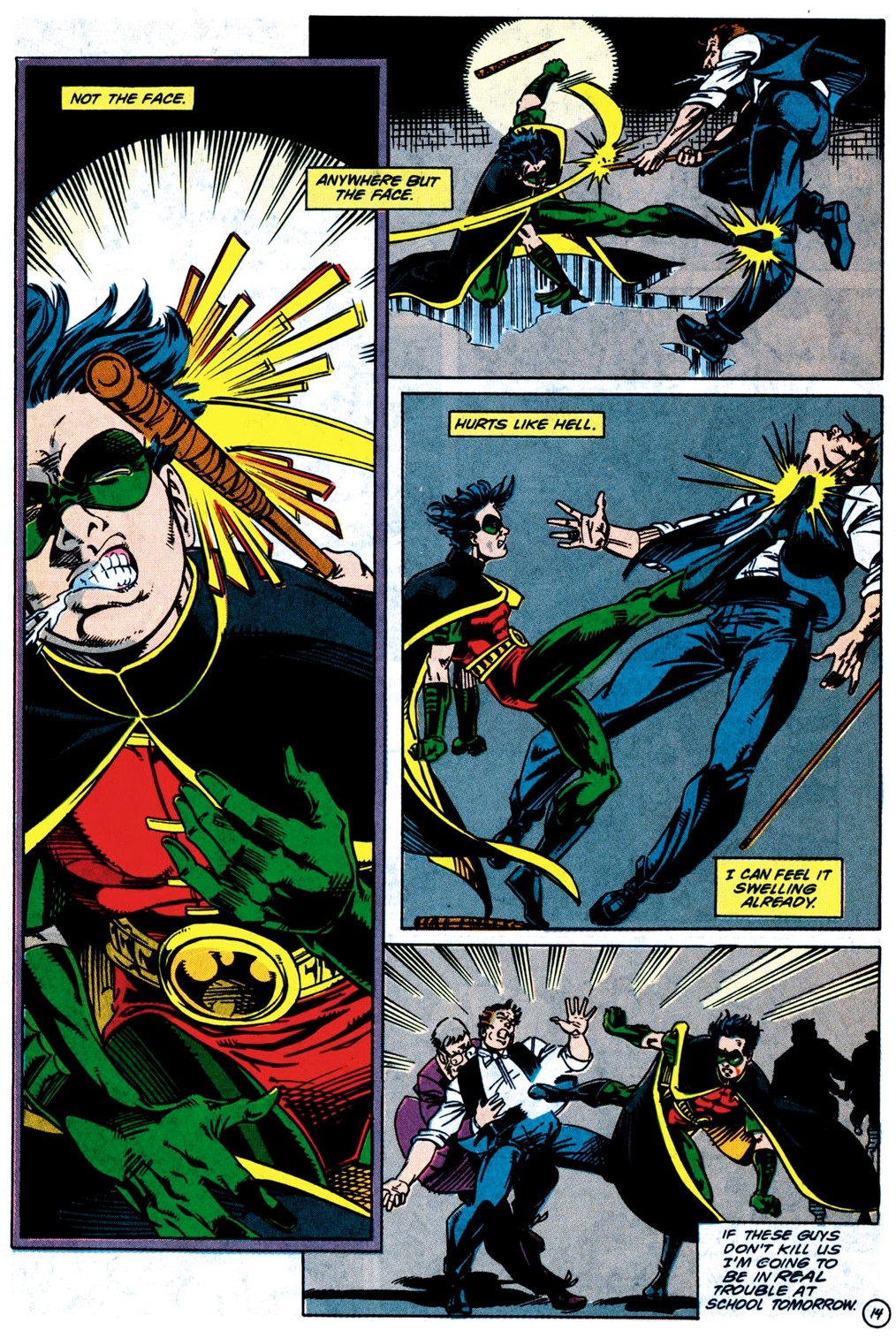
Hurting Robin on the head led to hard reactions.

Apart from the storytelling, the art by Tom Lyle here remains good to look at. Each scene, whether is it a talking scene or an action scene, looks good and Lyle has a nice touch on drawing facial expressions. When it comes to the spectacle, Lyle really shows how good he is with drawing hard-hitting physical action. I should also state how smooth the sequencing of action is drawn by him.

Conclusion

16
Robin and the Huntress make an odd crime-fighting duo.

To make things clear, Robin III #3 is the first-ever Tom Lyle-drawn comic book I ever bought and read. By today’s standards, the comic book is still fun to read and it is compelling enough to make readers interested to read more of the mini-series. However, if seeing more of Robin fighting crime by himself is your type of Robin story, then this may not be compelling for you.

If you are seriously planning to buy an existing hard copy of Robin III #3, be aware that as of this writing, MileHighComics.com shows that the near-mint copy of the regular edition and the newsstand edition of the direct version costs $4 and $6 respectively. Meanwhile, the near-mint copy of the bagged edition and the unbagged edition of the deluxe version costs $4. To be clear, the deluxe version of Robin III #3 in bagged form comes with a moving cover, a second reversible cover and additional artwork.

Overall, Robin III #3 is recommended.


Thank you for reading. If you find this article engaging, please click the like button below and also please consider sharing this article to others. If you are looking for a copywriter to create content for your special project or business, check out my services and my portfolio. Feel free to contact me as well. Also please feel free to visit my Facebook page Author Carlo Carrasco and follow me at HavenorFantasy@twitter.com
A Look Back at Wonder Woman #1 (1987)

Disclaimer: This is my original work with details sourced from reading the comic book and doing personal research. Anyone who wants to use this article, in part or in whole, needs to secure first my permission and agree to cite me as the source and author. Let it be known that any unauthorized use of this article will constrain the author to pursue the remedies under R.A. No. 8293, the Revised Penal Code, and/or all applicable legal actions under the laws of the Philippines.

Hey Wonder Woman and superhero fans! By now, many of you are aware that I wrote and published several retro comic book reviews about the Post-Crisis Wonder Woman specifically the comic books that involved the legendary George Perez, Greg Potter and the late Len Wein. For today, I’ll be reviewing Wonder Woman #1 (1987), the landmark comic book that marked the start of what was back then the new age of greatness of Wonder Woman, the Queen of all Superheroes!

Before starting my review, let’s take a short look back at the publishing history with the online research I did.

In the mid-1980s, DC Comics published the maxi-series Crisis on Infinite Earths to not only celebrate their 50th anniversary but also to conclude what was the original multi-verse (multiple universes) of the publisher. Written by Marv Wolfman and drawn by George Perez, Crisis on Infinte Earths became critically acclaimed and a major seller as the saga saw the deaths of hundreds of characters, destruction of worlds and ultimately paved the way for DC Comics to reboot their superhero universe entirely.

And then the post-Crisis era of DC Comics happened. After Superman and Batman were successfully reintroduced, the Queen of all Superheroes herself – Wonder Woman – was up for a relaunch.

While detailed descriptions about what happened behind the scenes at DC Comics regarding the Wonder Woman reboot have been published, writer Greg Potter himself made some clarifications to set the record straight. For all of you readers and Wonder Woman fans, posted below is Potter’s clarification published with his permission.


The ideas for the rebooted Wonder Woman did not start with brainstorming between Janice Race and me. Having recently finished my Jemm Son of Saturn series, I was approached at a comic con in Chicago by Dick Giordano. He asked if I would like to submit a proposal for a rebooted Wonder Woman series. I sent him my ideas and he approved them. Dick then assigned Janice to the book (she had been my editor on Jemm) and I began writing the script for issue number one. It was after that that George walked into Janice’s office and offered his services as illustrator with a proviso that he also had a hand in plotting the stories.

Janice accepted and George and I subsequently met in her office to discuss our working relationship going forward. George and I agreed that the focus of the character would be her identity as an Amazon who’d lived in the Ancient Greek tradition and knew little about the outside world. I knew a great deal about Greek mythology but George knew even more. He supplied me with a book on the Greek gods that was extremely helpful in writing the first book. I in turn supplied him with many photos of Boston (I once had lived there) which he used in his artwork to make the backgrounds authentic.

It was a wonderful collaboration and made for a great introduction to the new Diana.


Eventually George Perez got involved in the creative process at DC. The famed illustrator and Potter worked closely on reintroducing Wonder Woman with an established identity and a rich cultural background. Indeed, something special transpired before the first issue got published.

“That was the background of the Wonder Woman character, which I felt was also the thing that made her unique as a character, and I thought that it had been downplayed in order to make her more of a standard superhero,” Perez stated.

Perez and Potter were co-writers. Perez himself conducted research on mythology which served as the foundation of the fantasy element of the planed post-Crisis Wonder Woman monthly series. This involved portrayals of deities of Olympus whose acts affect the Amazons living in the flesh. Apart from the fantasy and mythology, Perez implemented some key elements (specifically involving feminism and humanism) thanks to his discussion with Wonder Woman editor Karen Berger.

“A lot of research went into this first issue, and my bookshelves are full of reference material on mythology, Greek hairstyles, armor, clothing and even attitudes of the time. Some compromises were made where different references contradicted each other, but no decision was made without thought. We all have fallen in love with this project and want everyone to share in our excitement,” Perez wrote in the introduction in Wonder Woman #1 (1987).

Now that the history lesson is over, we can now all take a look back at Wonder Woman #1, published in 1987 by DC Comics with a story co-written by Greg Potter and George Perez. The art was done by Perez supported by the ink work of Bruce Patterson.

Cover
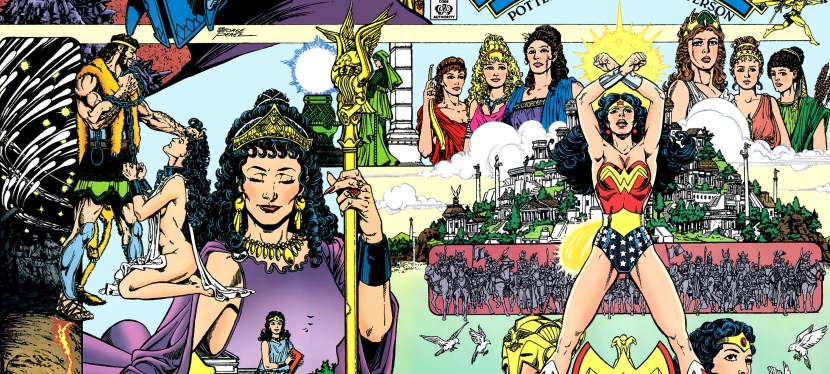
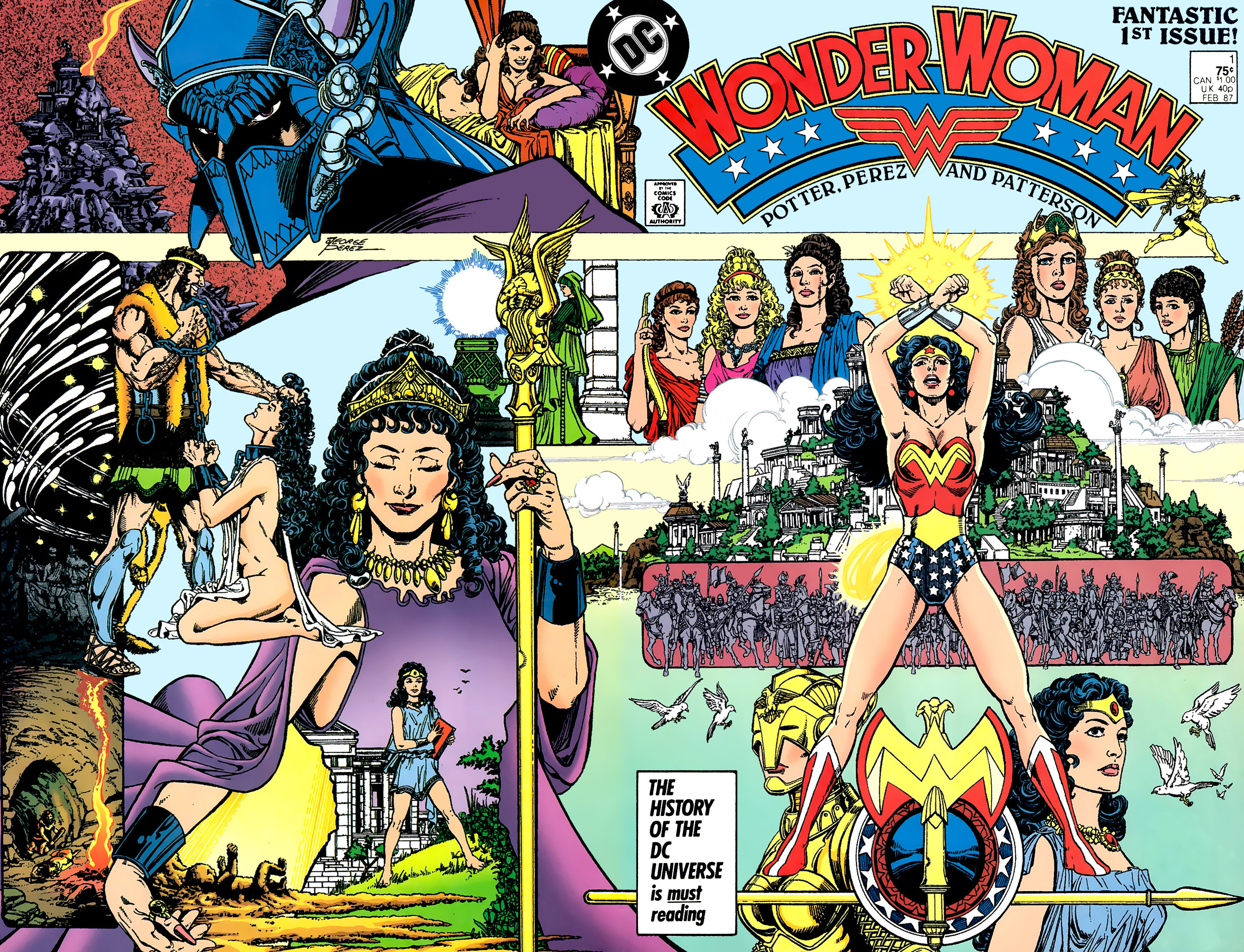
A very magnificent looking cover by George Perez.

Early story

The story begins in the distant past of 30,000 B.C. Inside a cave, a man hits a pregnant woman’s head with his club instantly killing her and the unborn child.

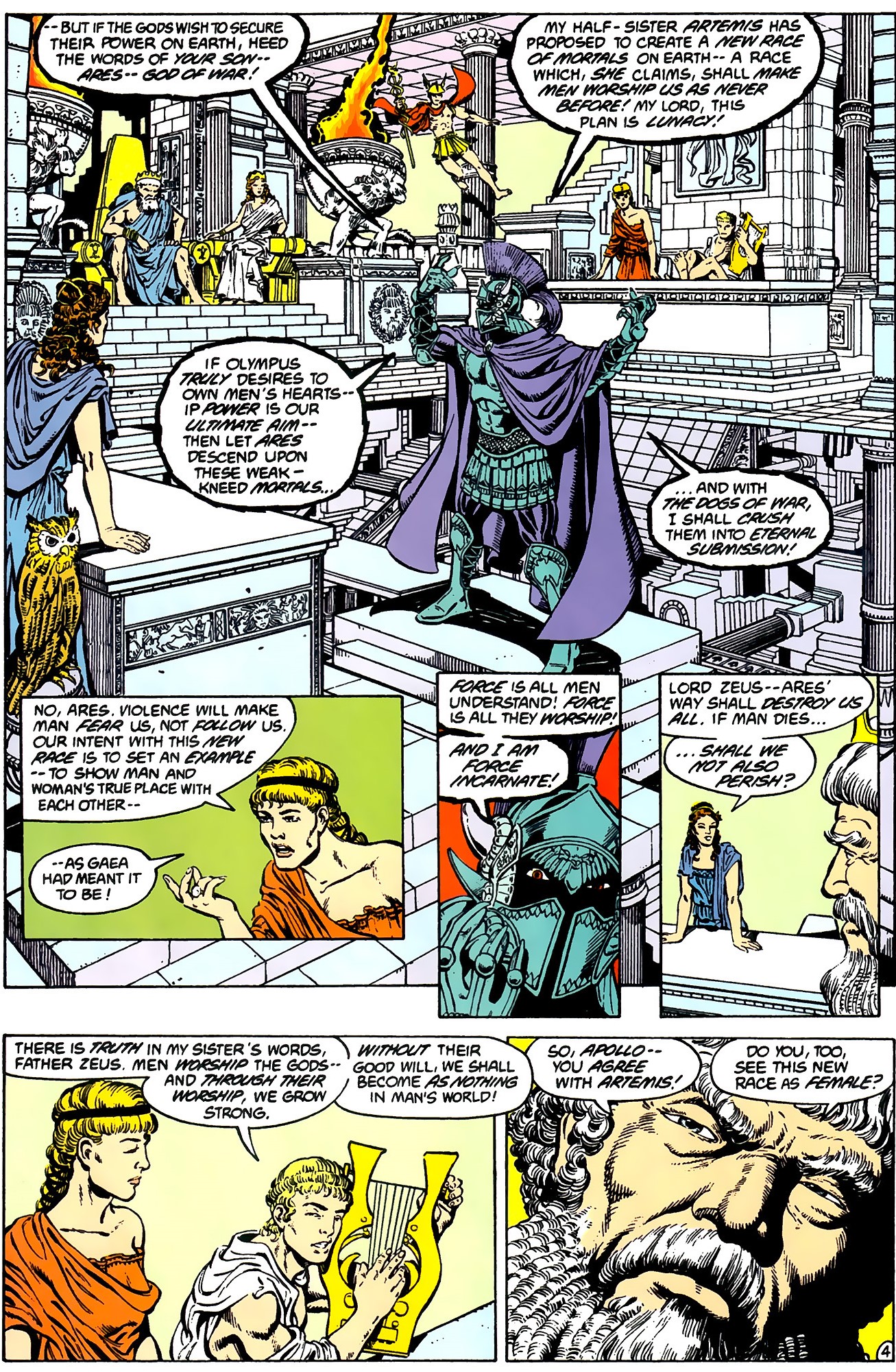
In 1,200 B.C. at Mount Olympus, the god of war Ares tells his father Zeus (with the presence of other deities watching) that if Olympus truly desires to own the hearts of men and gain power, they should let him descend upon mortals. Ares views the mortals as weak and stressed that he could crush them all into eternal submission.

But Artemis (Ares’ half-sister), whose plan to create a new race of mortals on Earth was vehemently opposed by the god of war, responded by stressing that violence will make men fear them and not follow them. She stressed that the intention behind the plan was to set an example by showing man and woman’s true place with each other. The new race of mortals was planned to be female. Zeus, who is aware of the plan, leaves and tells the others to settle the plan among themselves. For his part, Ares leaves Olympus laughing.

With the many souls stuck in limbo for generations available to them, the deities Aphrodite, Artemis, Athena, Hestia and Demeter create the Amazons who appeared with adult bodies. The first to come out among them all was Hippolyte, the mother of Diana/Wonder Woman. In the presence of the many Amazons, Hippolyte was declared queen by the deities…

Quality

27
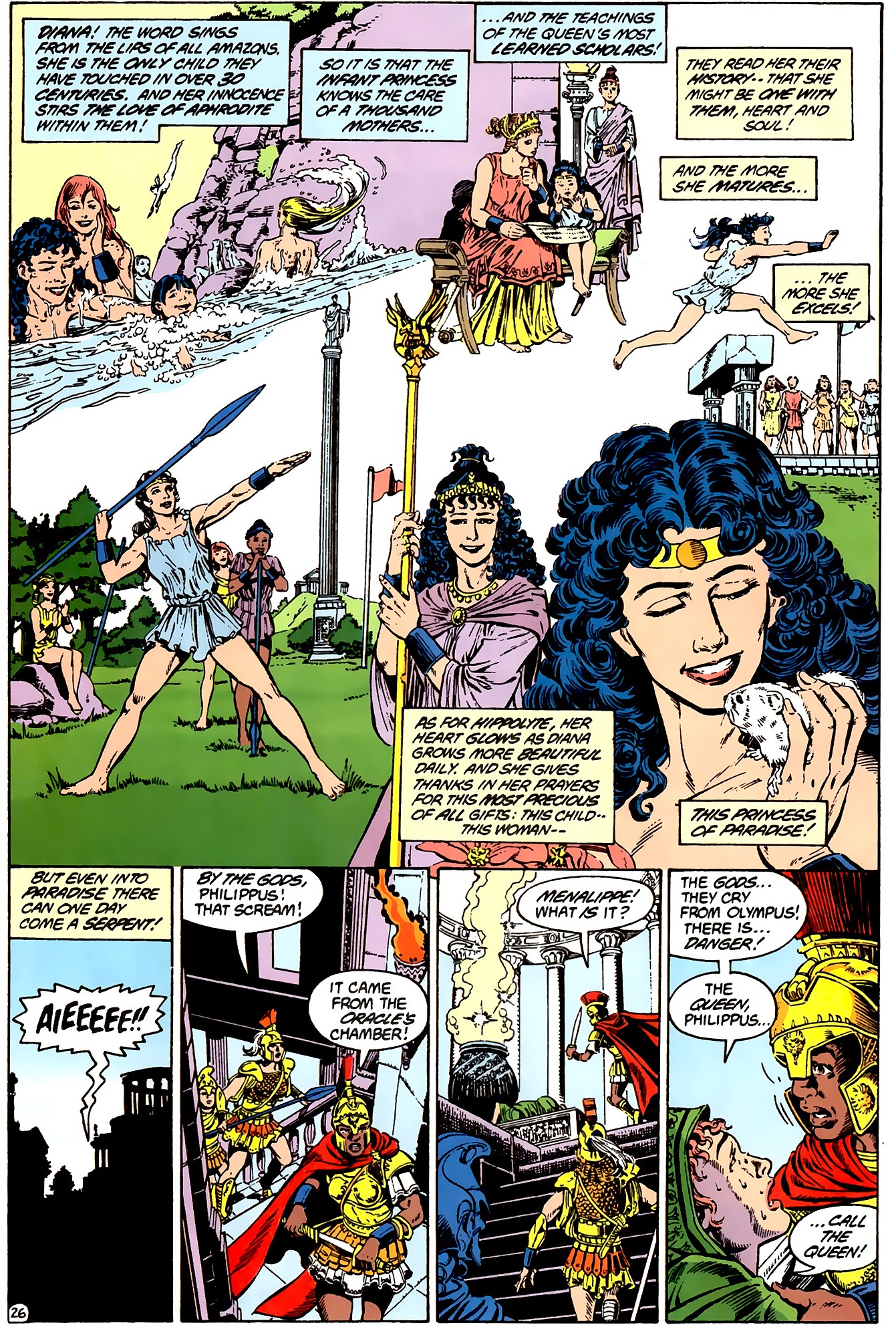
Diana was the only child to grow up with the Amazons.

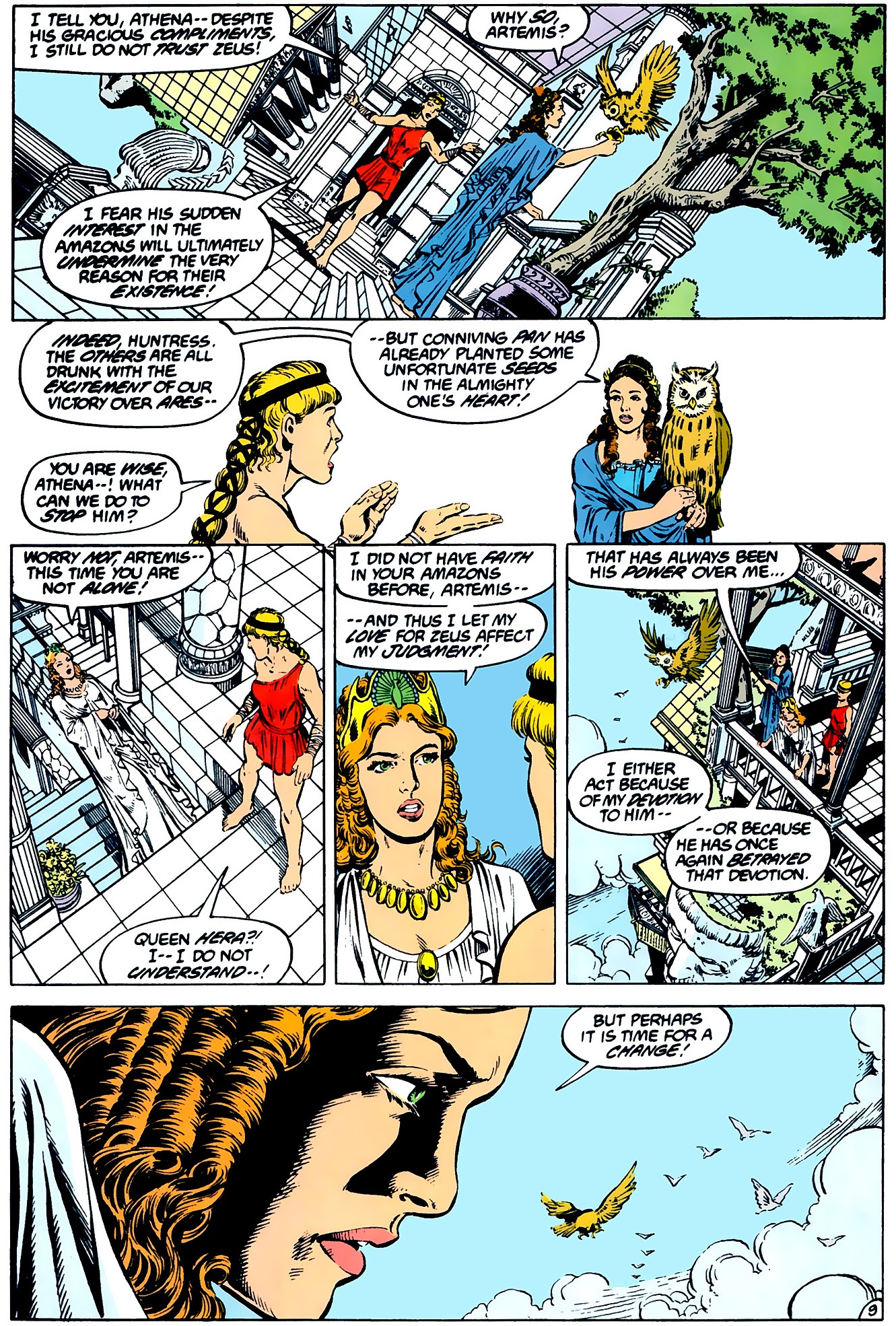
When it comes to quality of storytelling, art, characterization and spectacle, Wonder Woman #1 is unquestionably an excellent comic book even by today’s standards! For the story, Greg Potter and George Perez crafted an epic fantasy tale retelling the origin of not only Wonder Woman but also of the Amazons complete with a very inspired portrayal of the deities of Olympus who actions and decisions affect the mortals. I should mention here that the portrayal of the mother-and-daughter relationship between Queen Hippolyte and Princess Diana really was compelling to see. Not only that, there were also elements of gender conflict, intrigue and worship portrayed.

It is clear that Perez really studied mythology and Greek culture to create a story that is still believable when it comes to emphasizing Wonder Woman for what was back then the modern readers of 1987 from the superhero geeks to long-time Wonder Woman fans and to girls and women in general. More than that, this story is timeless and clearly it is an illustrated literature classic on its own right.

24
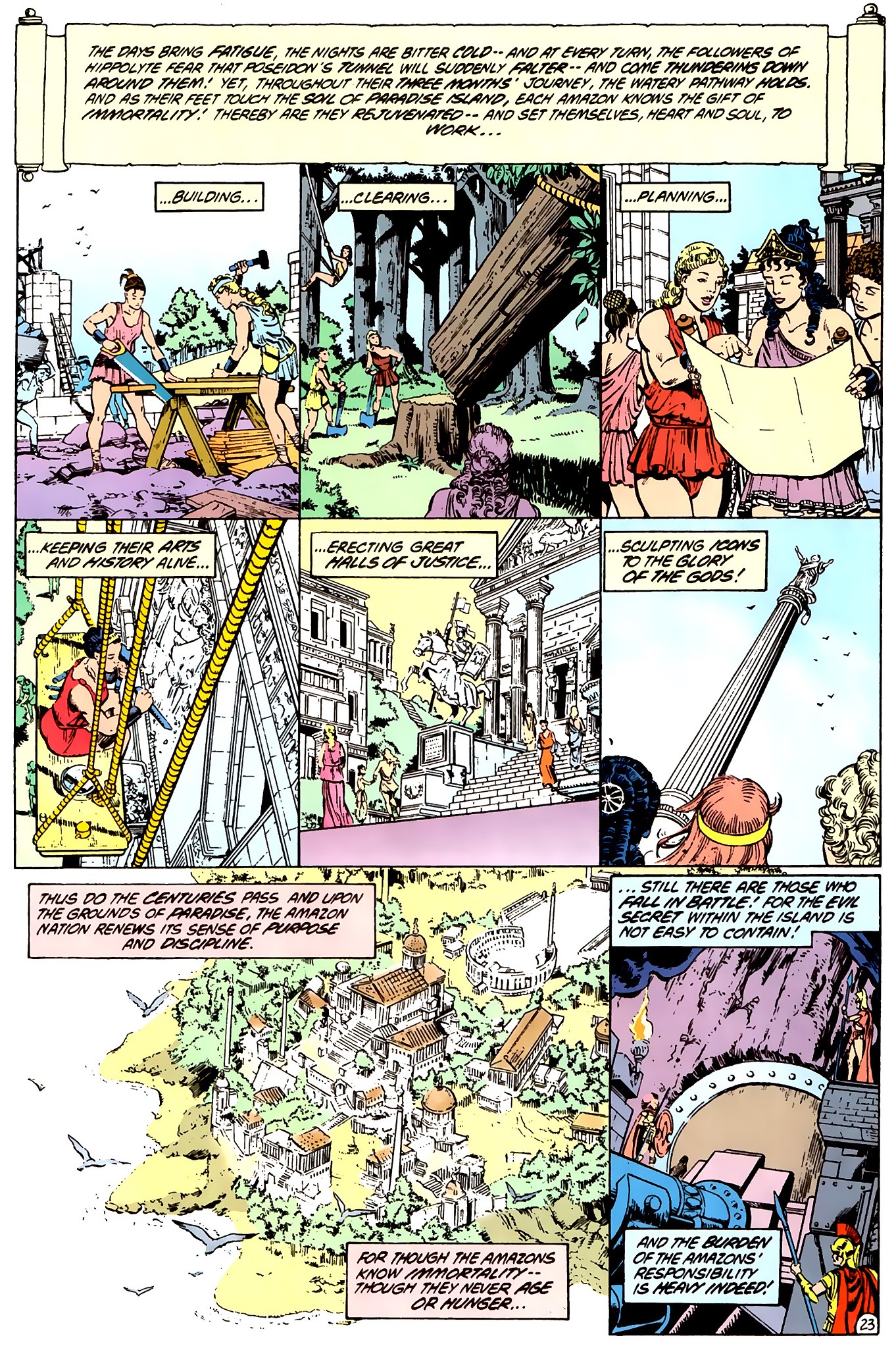
This is how the Amazons built their society in Themyscira.

The comic book has over thirty pages of story and art, with the pace ranging from medium to fast. As such, it managed to completely tell the stories of the Amazons and Princess Diana in just one comic book. By the time I finished this comic book, I got enlightened about the background of the Amazons and Wonder Woman herself.

When it comes to the art, each and every page of Wonder Woman #1 is very beautifully drawn by George Perez. His research on Greek culture and mythology is nicely reflected in his drawings. Just look at how he visualizes Olympus, the armor worn by soldiers, the clothes, the hairstyles, the coliseum, the architecture and more complete with a good amount of details visualized. The final page Perez drew remains very stunning, inspiring and heroic!

Conclusion

5
The deities of Olympus.

There is no doubt in my mind that Wonder Woman #1 of 1987 is truly one of the greatest superhero comic books ever published. The creative team succeeded in not only reintroducing Wonder Woman, her people and their part in the post-Crisis DC Comics universe, they also succeeded in modernizing them as well as dramatizing their origins altogether within the 32 pages of this comic book.

While it is a fact that a lot of people nowadays are highly familiar with the cinematic Wonder Woman (memorably played by Gal Gadot), for me the post-Crisis version of the Queen of Superheroes remains the definitive version and I can only wish that director Patty Jenkins would adapt more elements from this. It should be noted that this particular rebooted Wonder Woman is believable and can be taken more seriously among all superheroes.

If you are seriously planning to buy an existing hard copy of Wonder Woman #1 (1987), be aware that as of this writing, MileHighComics.com shows that the near-mint copy of the regular edition costs $51. The near-mint copies of the newsstand edition and the edition without a month printed cost$102 and $153 respectively.

Overall, Wonder Woman #1 (1987) is highly recommended! 


Thank you for reading. If you find this article engaging, please click the like button below and also please consider sharing this article to others. If you are looking for a copywriter to create content for your special project or business, check out my services and my portfolio. Feel free to contact me as well. Also please feel free to visit my Facebook page Author Carlo Carrasco and follow me at HavenorFantasy@twitter.com
A Look Back at Wonder Woman #8 (1987)

Disclaimer: This is my original work with details sourced from reading the comic book and doing personal research. Anyone who wants to use this article, in part or in whole, needs to secure first my permission and agree to cite me as the source and author. Let it be known that any unauthorized use of this article will constrain the author to pursue the remedies under R.A. No. 8293, the Revised Penal Code, and/or all applicable legal actions under the laws of the Philippines.

With the combined talents of George Perez, Len Wein, Greg Potter plus others, the reintroduction of Wonder Woman during the early stage of the Post-Crisis era of DC Comics is not only great but an essential read and a true superhero literature classic! When it comes to the presentation, the origin of not only Wonder Woman but also the Amazons was retold with a stronger emphasis on Greek mythology.

To put things in perspective, Wonder Woman #6 saw Ares’ plan on completely ruining man’s world defeated while Wonder Woman #7 saw the revival of Princess Diana as the deities of Olympus bless her and the Amazons. Where could George Perez, Len Wein and the creative team take the post-Crisis Wonder Woman story to?

That we will precisely find out in this look back at Wonder Woman #8, published by DC Comics in 1987 with a story written by George Perez and Len Wein. The art was done by Perez and inked by Bruce D. Patterson.

Cover
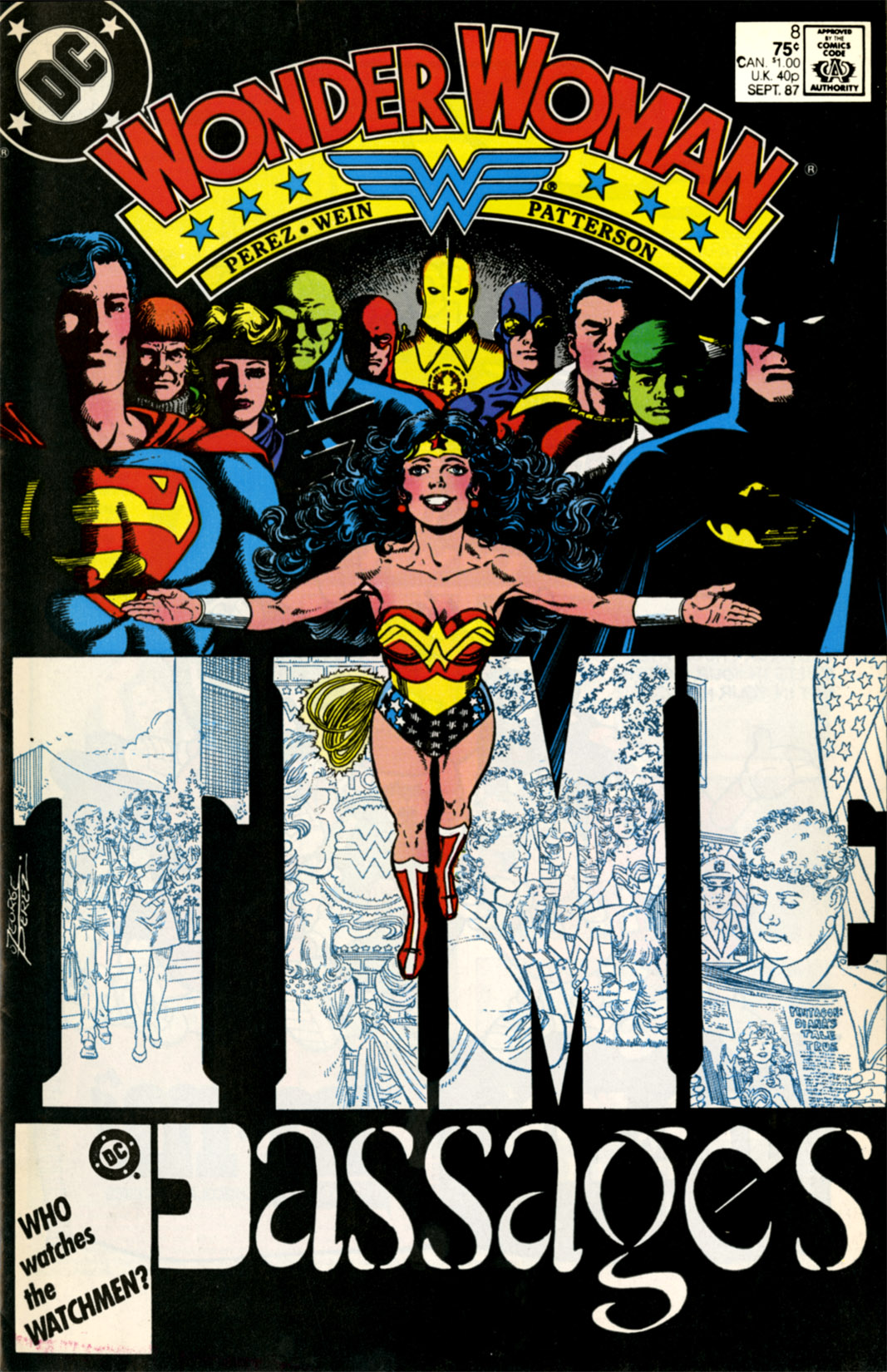
The cover.

Early story

The story begins in Boston, specifically at the Harvard University office of academic veteran Julia Kapatelis. She starts typing her recollections about Diana who, by this time, became a celebrated figure with the public thanks in part to Myndi Mayer’s publicity engine. Julia expressed how astonished she was with Wonder Woman’s ability to assimilate a lot of information so quickly (note: when she first arrived in man’s world, she did not even know how to speak English).

She recalled during their time at the United Nations that there were some nations that refused to listen to her and that the delegate from Russia protested Wonder Woman’s star-spangled costume on political grounds.

While Wonder Woman is loved by the public, there still were those who opposed her. Julia recalls the national campaign to outlaw all superheroes launched by the psychologist G. Gordon Godfrey who even won the support of some of America’s political figures. Julia also noticed the effects of Godfrey’s campaign on the minds of some of her students and the division that followed.

Wonder Women went on to interact with other superheroes as she strived to do good and save people. She even got invited to join the newly reformed Justice League with Superman, Batman, the Flash and many others present…

Quality

16
Wonder Woman as recalled by Vanessa.

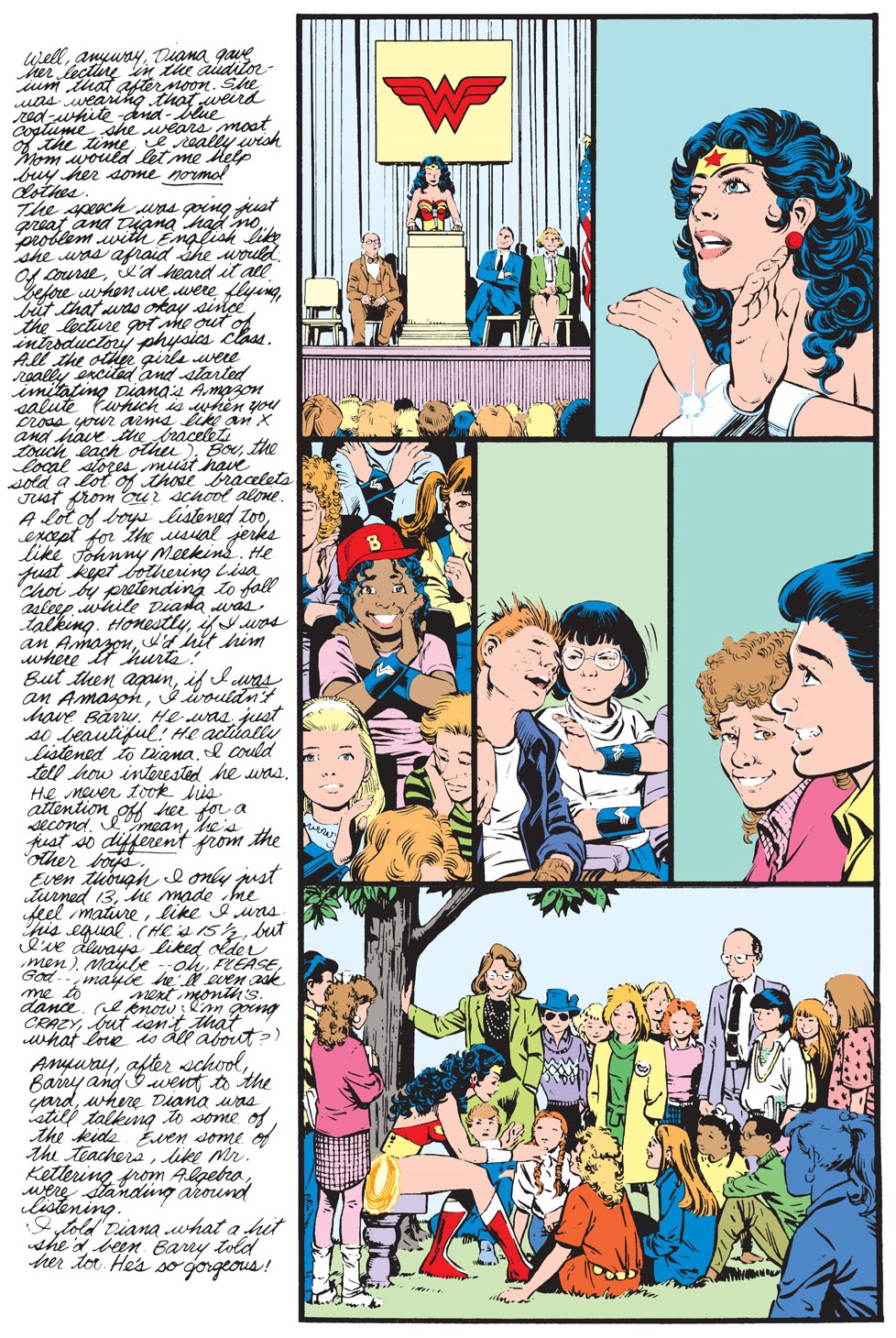
Before describing the quality of this comic book, I should state that Wonder Woman #8 is not your typical superhero comic book at all. In reality, to reflect the title Time Passages, this one is technically a collection of journals that efficiently showed how much has changed for Wonder Woman and the people around her since after the Ares Affair happened.

When it comes to quality, each journal fictionally authored by Julia Kapatelis, Etta Candy, Vanessa Kapatelis and Myndi Mayer, was well-written by Perez and Wein. Apart from describing what happened and how much had changed with Wonder Woman in their presence, each character’s journal had its own distinct view apart from style of writing. Each journal is important to read and through them you will realize how much impact Wonder Woman had on their society and on themselves.

Still on the writing, there were some pages that provided relief to readers. In between the journals are story pages focused on Dr. Barbara Minerva and her short male companion which served as the build-up leading to the first appearance of the post-Crisis Cheetah.

And there is all the beautiful art provided by Perez. Each page of a fictional journal has artwork that visualize what was told. There are also whole pages highlighting the passage of time and the characters who made each journal. Even with the unusual format used, this is still very good looking comic book to see!

Conclusion

10
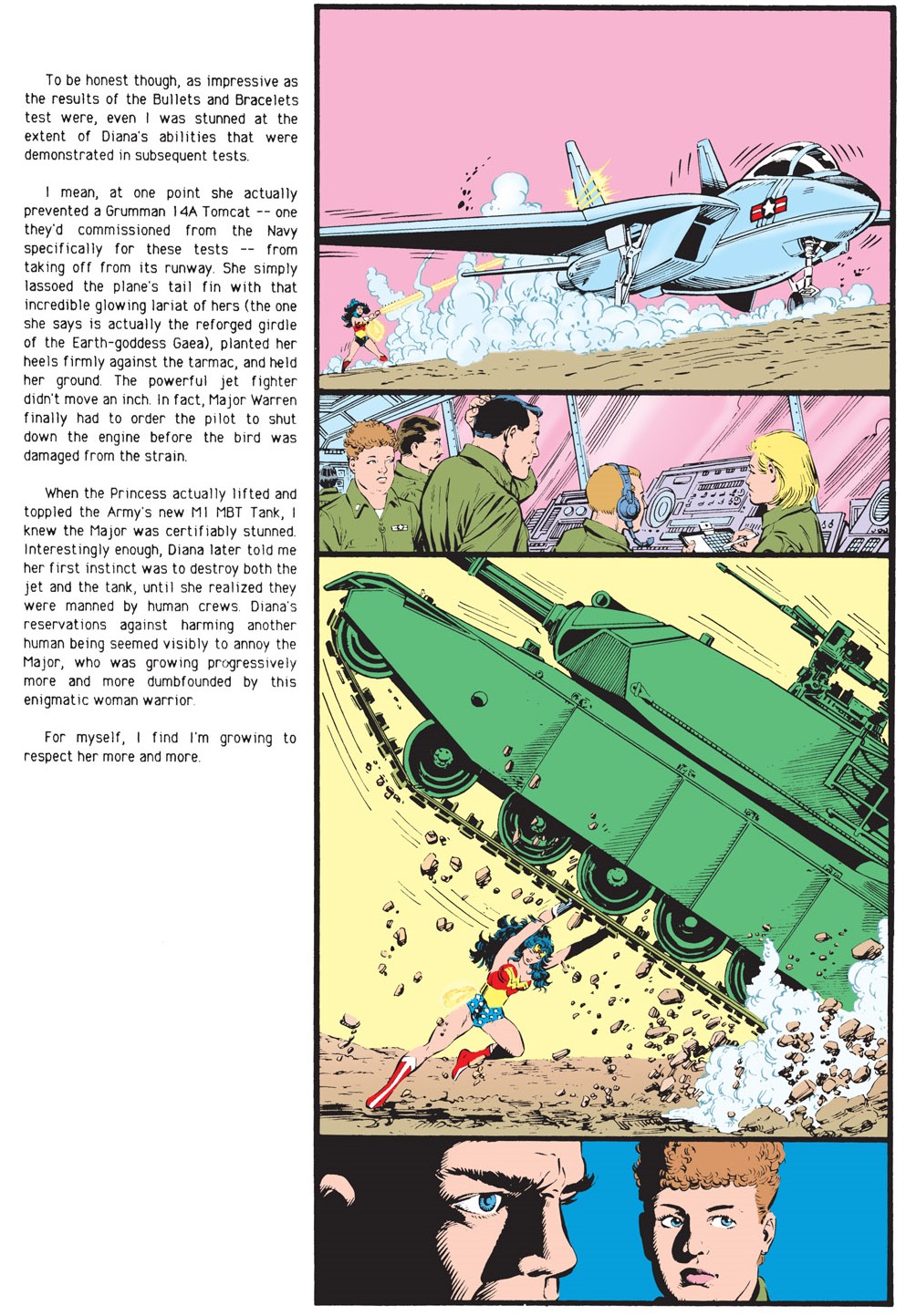
The test of Wonder Woman with the military as recalled by Etta Candy.

To describe it bluntly, Wonder Woman #8 is an exposition-heavy, very wordy, time-passing comic book that succeeds in what it was meant to achieve: move Wonder Woman’s post-Crisis development forward efficiently (note: without having to create multiple comic books reflecting the events told) while emphasizing how people look at her, how she connects with other DC Comics superheroes and the like. It was nicely crafted by Perez and the creative team and each page showed that a lot of special care was done. With regards to modernizing Wonder Woman for the 1980s, this comic book is a success.

If you are seriously planning to buy an existing hard copy of Wonder Woman #8 (1987), be aware that as of this writing, MileHighComics.com shows that the near-mint copy of the regular edition costs $26 while the near-mint copy of the newsstand edition costs $51.

Overall, Wonder Woman #8 (1987) is highly recommended!


Thank you for reading. If you find this article engaging, please click the like button below and also please consider sharing this article to others. If you are looking for a copywriter to create content for your special project or business, check out my services and my portfolio. Feel free to contact me as well. Also please feel free to visit my Facebook page Author Carlo Carrasco and follow me at HavenorFantasy@twitter.com

A Look Back at Wonder Woman #7 (1987)

Disclaimer: This is my original work with details sourced from reading the comic book and doing personal research. Anyone who wants to use this article, in part or in whole, needs to secure first my permission and agree to cite me as the source and author. Let it be known that any unauthorized use of this article will constrain the author to pursue the remedies under R.A. No. 8293, the Revised Penal Code, and/or all applicable legal actions under the laws of the Philippines.

Having seen Wonder Woman in cinemas in 2017 and having reviewed the comic book Wonder Woman #6 of 1987 recently, I can say that I enjoyed the two different battles between the Queen of Superheroes and the war deity Ares. Both battles had their respective styles of art and presentation and there were a few similarities between them.

I like both conflicts equally and that’s in relation to very different formats used – cinematic and comic book. Also, the Wonder Woman-Ares battles served as effective story turning points on both the big screen and the comic book. In the case of the Post-Crisis era of DC Comics, the major battle was the climax of the brewing, global military aggression (due to Ares influencing people of man’s world to destroy each other) in which Wonder Woman got involved not only with the Cold War but also with the connections between man’s world, Themyscira and Olympus.

That being said, now is time to move forward with the Post-Crisis Wonder Woman saga with this look back at Wonder Woman #7, published in 1987 by DC Comics with a story co-written by George Perez and Len Wein. Perez drew the story which was inked by Bruce D. Patterson.

Cover
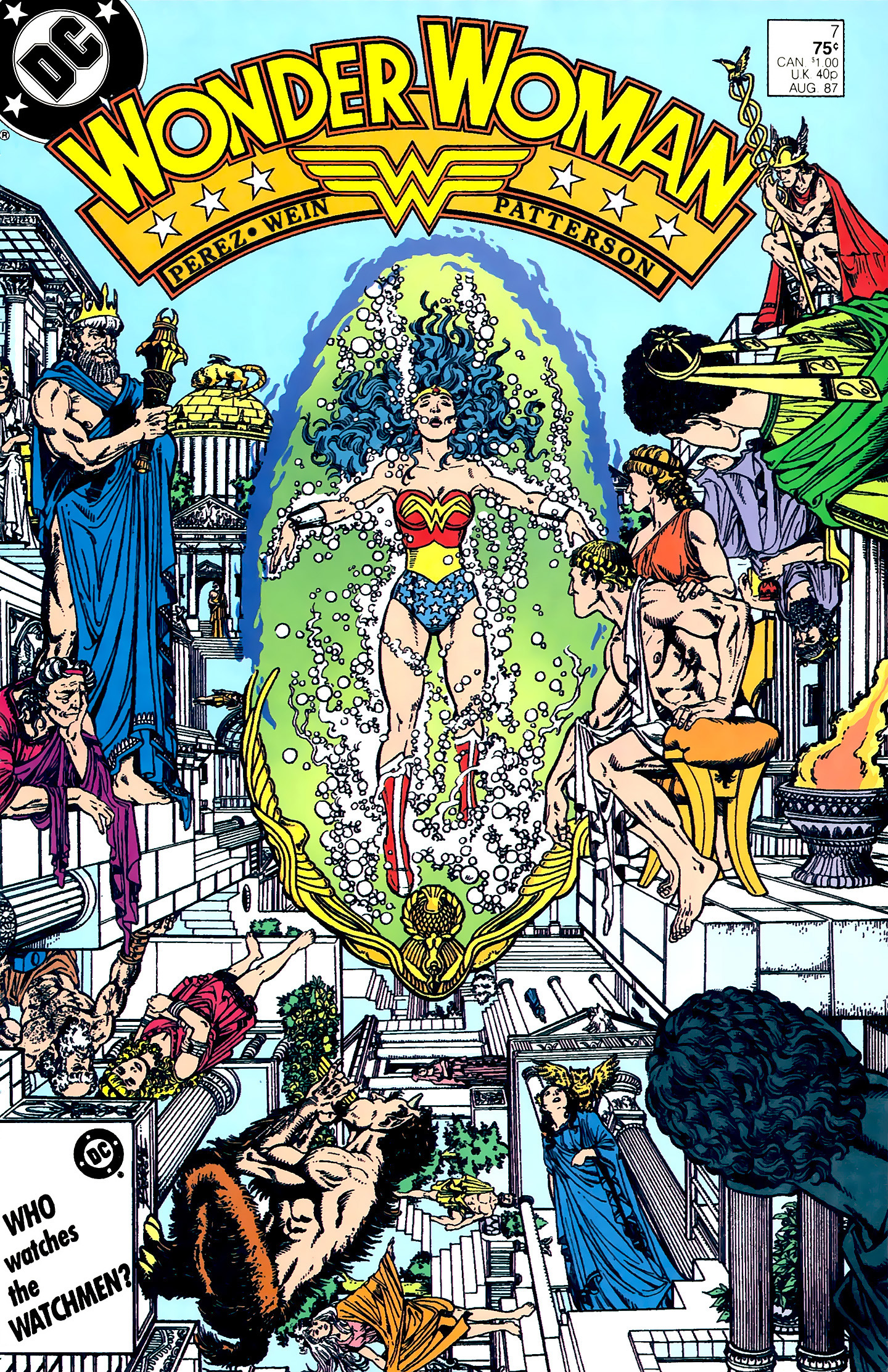
The cover.

Early story

The story begins in Olympus with Hermes spreading the news that the threat by Ares has ended. Zeus declares the news are true and issues a decree of a feast of celebration. The others smiled in reaction. As others make merry to the music of the spheres, Athena reminds Zeus that Prince Diana/Wonder Woman lies at death’s threshold emphasizing the her victory of Ares came at such a high price. Realizing the Amazons’ value, Zeus decides to keep a closer look at them.

Over at Themyscira, the Amazons (under the watch of Queen Hippolyte) perform a ritual of revival for their fallen sister Diana. They noticed no progress has been made. From high above, Zeus and his fellow deities watch…

Quality

9
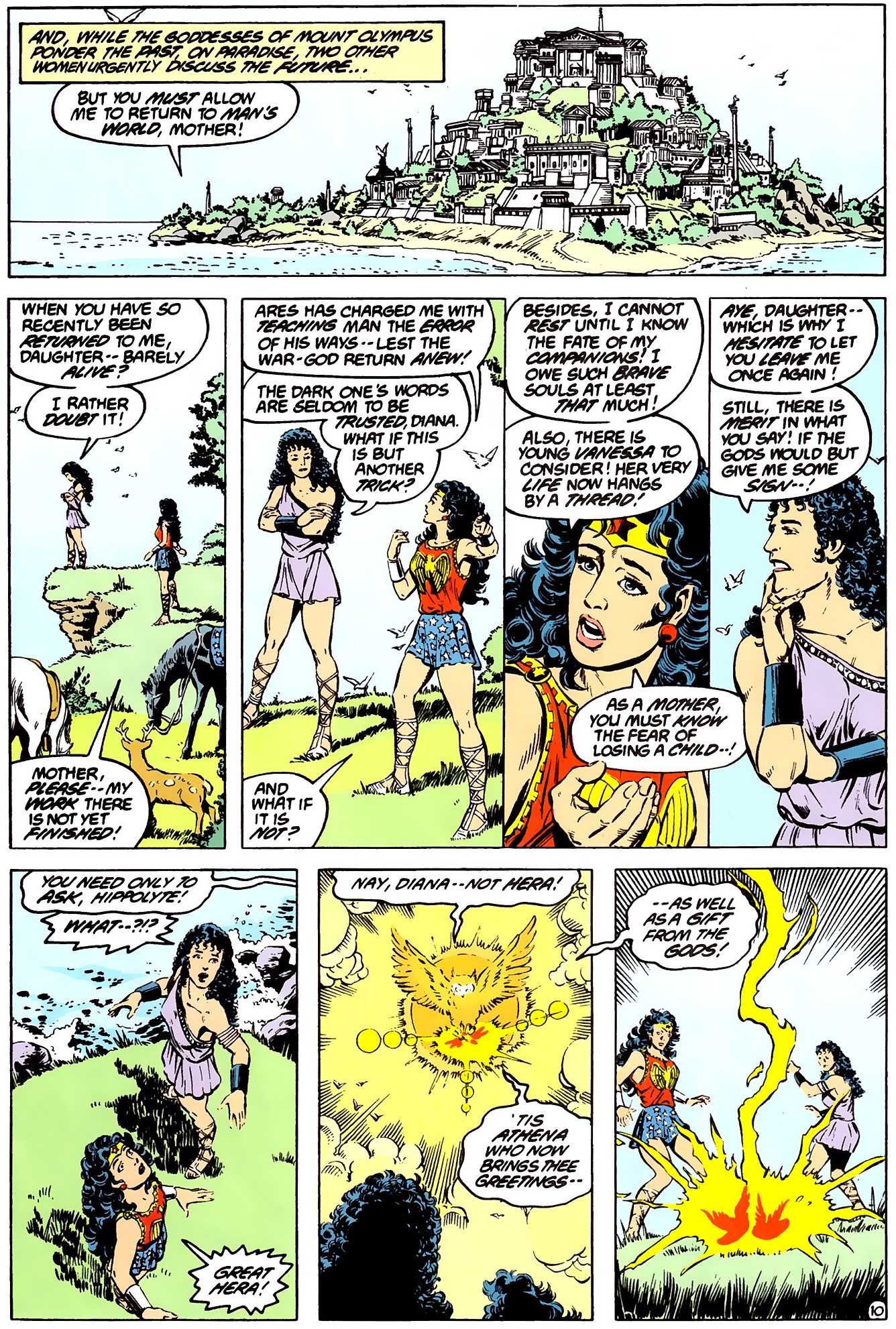
A mother-daughter scene.

Top-notch quality once again achieved by the creative team led by George Perez and Len Wein. While the previous two issues had high fantasy concepts with battles as the highlights, Wonder Woman #7 is much more character-driven showing Wonder Woman’s recovery from the great battle and how the Greek deities’ view of the Amazons changed as a result of Ares’ defeat. Specifically, there is a lot of richness emphasizing Wonder Woman’s continued development as the daughter of Queen Hippolyte and as the continued doer of missions as her people’s representative in man’s world. I also like the way the comic book creators explored the divisions between the deities of Olympus.

Without spoiling all the details, this story resolved the crisis on the part of Vanessa, the young daughter of Julia Kapatelis and it also added to Diana’s evolution as a loving and caring superhero. The academic professional Julia – who has grown into a close friend of Wonder Woman’s – also was developed nicely here. And then there is the introduction of someone who is very savvy with the media.

In stark contrast to issues #4, #5 and #6, Wonder Woman #7 does not have any superhero action as it was much more focused on character development. That’s not to say that it is all just characters talking several lines of dialogue and looking dramatic. This story still has that epic fantasy look as it provides readers a good look at Olympus. This comic book really pushed the narrative far more than the three previous issues.

Conclusion

8
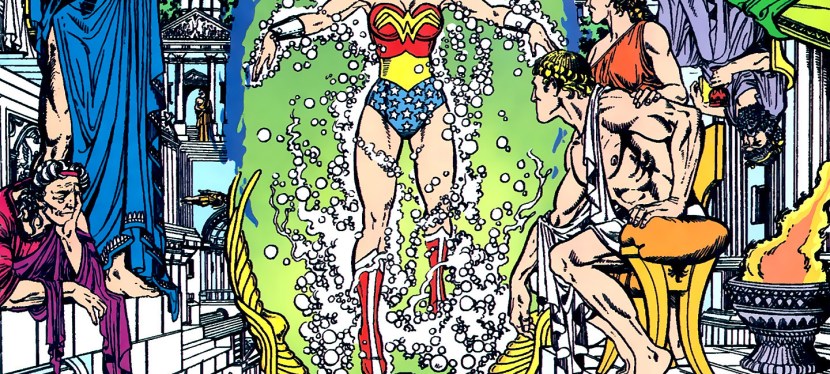
The deities in the spiritual realm.

Another great comic book this truly is. Then again, it should not be a surprise at all considering the great talents of George Perez and Len Wein combined. By the time I finished reviewing Wonder Woman #7, I am convinced that the creative team in-charge of this Post-Crisis version of the Queen of Superheroes not only worked with a high level of confidence but also carefully crafted their plans on reintroducing Wonder Woman with the 1980s in mind and making her much more relevant with the public. Storywise, this comic book marks a turning point in the Wonder Woman monthly series.

Other than being another great Wonder Woman story, Wonder Woman #7 also marks the first-ever appearance of Dr. Barbara Minerva (in civilian form specifically) who would later become the Post-Crisis era’s Cheetah a few issues later. For the newcomers reading this, Barbara Minerva/Cheetah was portrayed by Kristen Wiig in the upcoming superhero movie Wonder Woman 1984. With regards to that movie, reading Wonder Woman #9 is a must!

If you are seriously planning to buy an existing hard copy of Wonder Woman #7 (1987), be aware that as of this writing, MileHighComics.com shows that the near-mint copy of the regular edition costs $77 while the near-mint copy of the newsstand edition costs $153.

Overall, Wonder Woman #7 (1987) is highly recommended!


Thank you for reading. If you find this article engaging, please click the like button below and also please consider sharing this article to others. If you are looking for a copywriter to create content for your special project or business, check out my services and my portfolio. Feel free to contact me as well. Also please feel free to visit my Facebook page Author Carlo Carrasco and follow me at HavenorFantasy@twitter.com
A Look Back at Action Comics #545

Disclaimer: This is my original work with details sourced from reading the comic book and doing personal research. Anyone who wants to use this article, in part or in whole, needs to secure first my permission and agree to cite me as the source and author. Let it be known that any unauthorized use of this article will constrain the author to pursue the remedies under R.A. No. 8293, the Revised Penal Code, and/or all applicable legal actions under the laws of the Philippines.

Action Comics #544 was, indeed, a very memorable comic book to read. For a comic book about Superman and the celebration of his 45th anniversary, Action Comics #544 was more about the drastic reform (and improvement) of the super villains Lex Luthor (gaining a powered suit of armor) and Brainiac (becoming fully robotic). That particular issue ended with Superman actually getting defeated and knocked down during his first encounter with the now metallic Brainiac (who also had a huge squid-like space ship of his own).

The story continues with this look back at Action Comics #545, published by DC Comics in 1983 with a story written by Marv Wolfman and illustrated by Gil Kane.

Cover
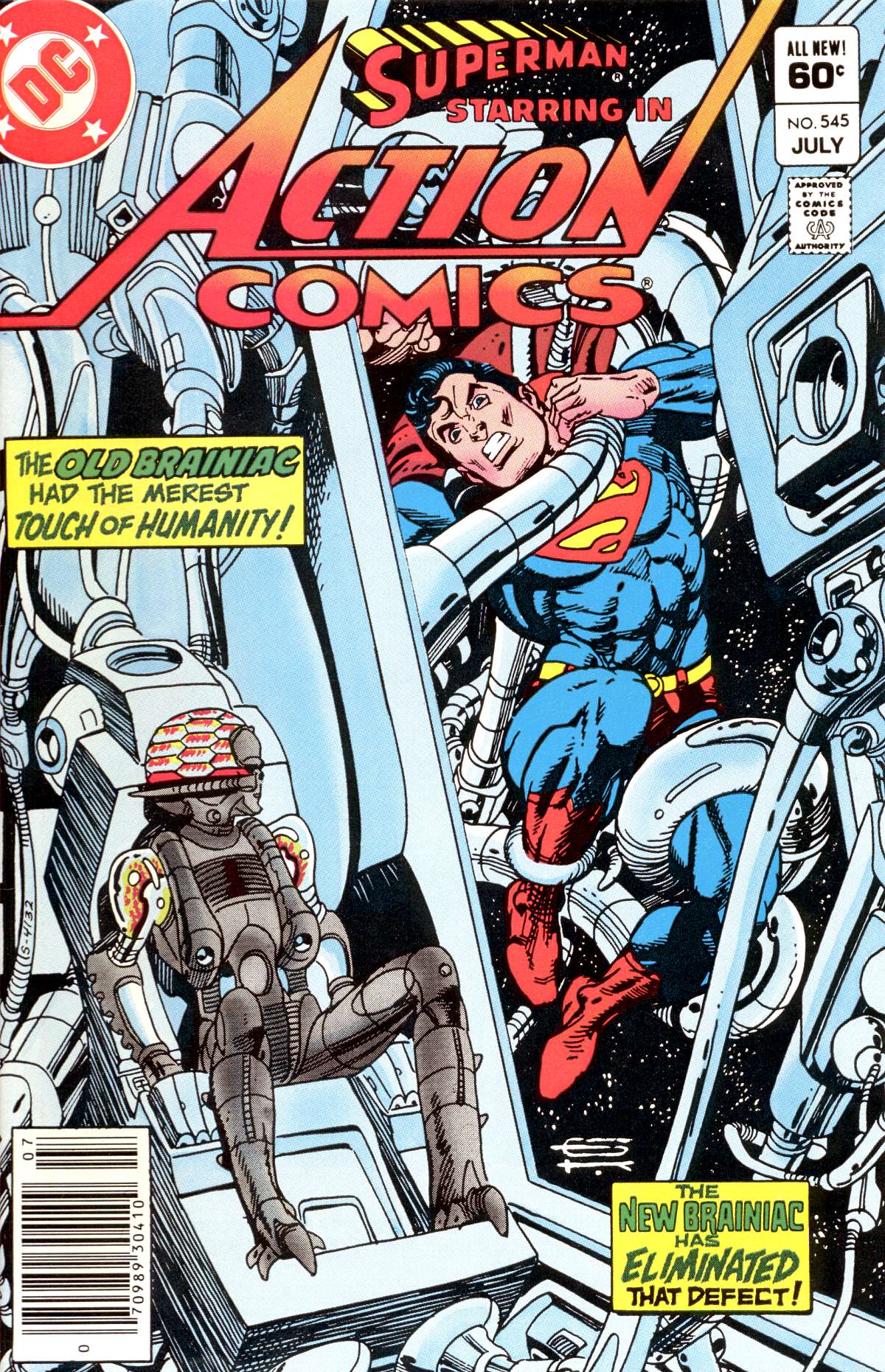
The cover.

Early story

The story begins with Superman already down on the ground on an alien world in the presence of Brainiac and the strange beings (natives of the planet) standing near him. Braniac explains to him that his red-sun missile brought him down and states: With but the merest thought I can and will destroy you! For only with your death can I be victorious in my battle against he-who-created-us-all! With you dead, this universe and all others will be mine to rule!

After much talking, Brainiac puts the weakened Superman into his small ship and brings into him the main ship (Brainiac’s flyer). Before departing, Brainiac’s flyer fires a powerful blast killing many of the planet’s natives.

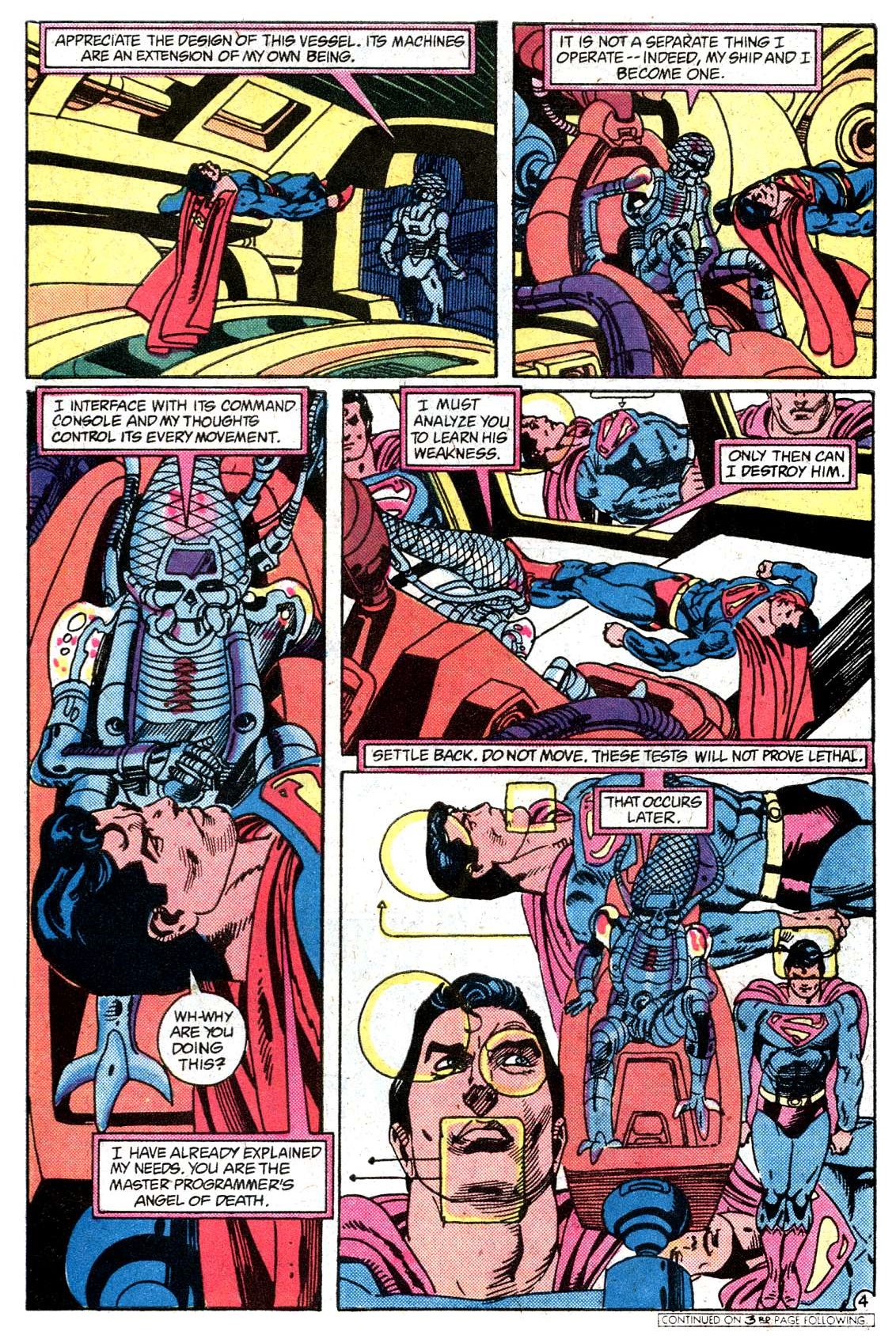
Superman is conscious but is too weak to get up. Brainiac then starts analyzing him using his ship’s state-of-the-art equipment…

Quality

11
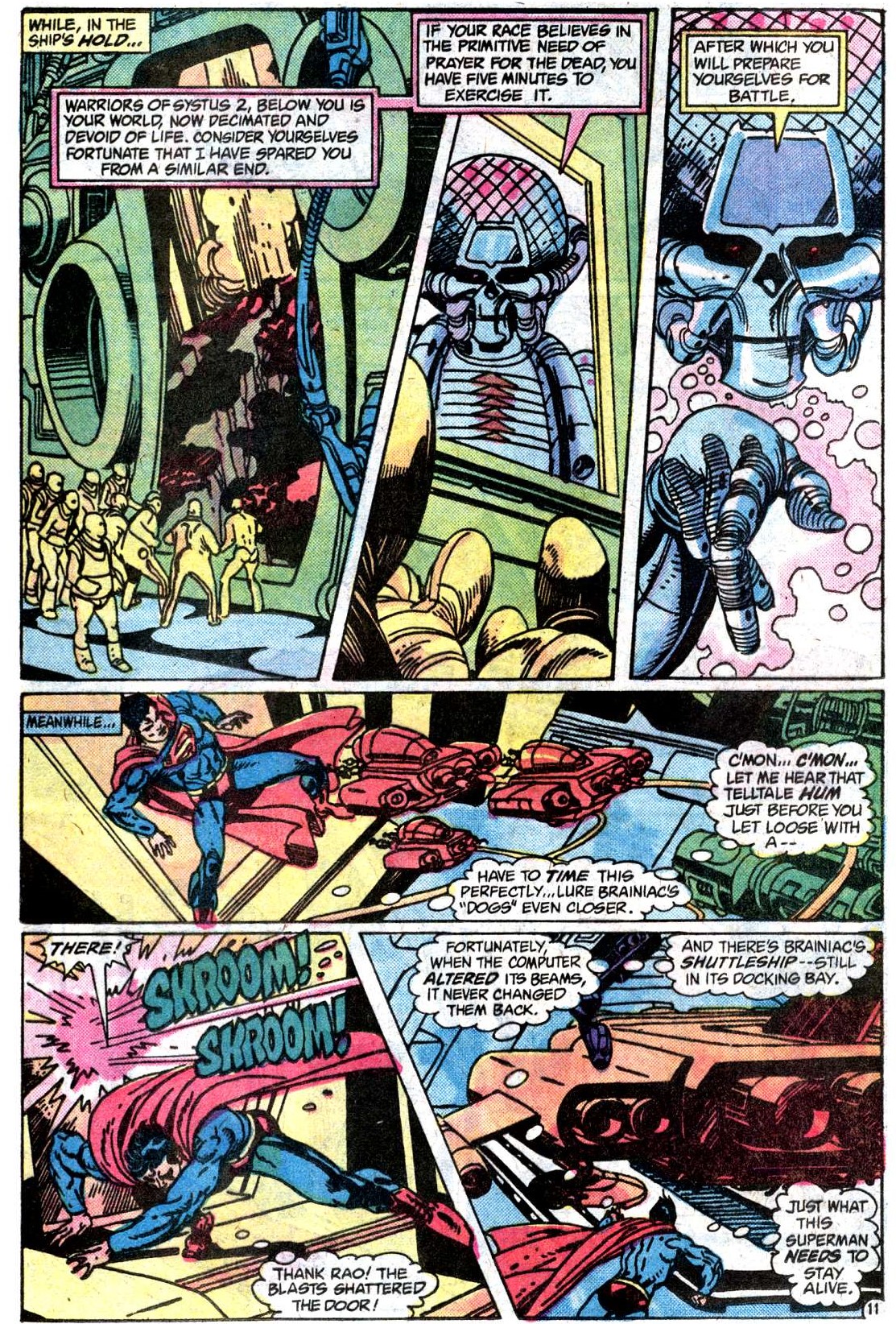
The new Brainiac’s power is felt all over.

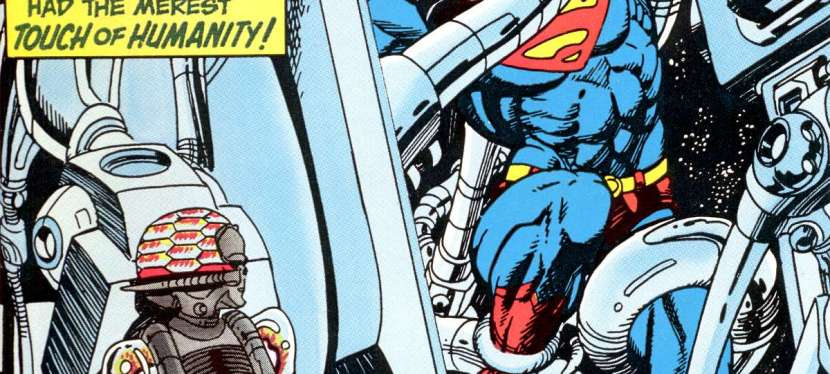
Let me start with the story. Written by the legendary Marv Wolfman (who went on to author Crisis on Infinite Earths), Action Comics #545 is the highly compelling extension of the first encounter between Superman and the highly enhanced Brainiac. Continuing from the events that took place in issue #544, this comic book further emphasizes Brainiac’s new technology and new capabilities complete with revisions in his programming which make him even deadlier than his previous form. While Brainiac is cold and very calculating like a computer, there are still threads of humanity in him, mainly in the form of expressions.

Along the way, Superman is portrayed to be very vulnerable and in more danger than usual. The situation is so bad for him, Superman realizes that attacking Brainiac would be suicidal. Since he could not afford to take the risk to defeat Brainiac, the Man of Steel relied more on his instinct and observations to solve problems.

On the art, Gil Kane delivered pretty good visuals. While his take on Superman makes the icon recognizable, it is his art on Brainiac and the futuristic technologies that really shined. Even by today’s standards of comic book art and sci-fi concepts, Brainiac, his ship and all other forms of technology still look futuristic!

Conclusion

4
A very vulnerable Superman being scanned by Brainiac.

Very entertaining and compelling! That’s how I describe Action Comics #545 and it definitely is a great continuation of the Brainiac story that was featured in issue #544. Lots of action spectacle and intrigue all through the story. While Brainiac’s new abilities and revamped personality were compelling to read, it should be noted that Superman in this comic book thinks more, becomes more strategic and makes decisions knowing he has been weakened. This is a Superman who strives to survive.

As for Brainiac, this comic book shows his rise as one of the premier super villains of DC Comics leading to the events of Crisis on Infinite Earths. The ending here has a very powerful image!

If you are seriously planning to buy an existing hard copy of Action Comics #545, be aware that as of this writing, MileHighComics.com shows that the near-mint copy of the regular edition costs $18 while the near-mint copy of the newsstand edition costs $36.

Overall, Action Comics #545 is highly recommended!


Thank you for reading. If you find this article engaging, please click the like button below and also please consider sharing this article to others. If you are looking for a copywriter to create content for your special project or business, check out my services and my portfolio. Feel free to contact me as well. Also please feel free to visit my Facebook page Author Carlo Carrasco and follow me at HavenorFantasy@twitter.com
Henry Cavill in talks to return as the cinematic Superman!

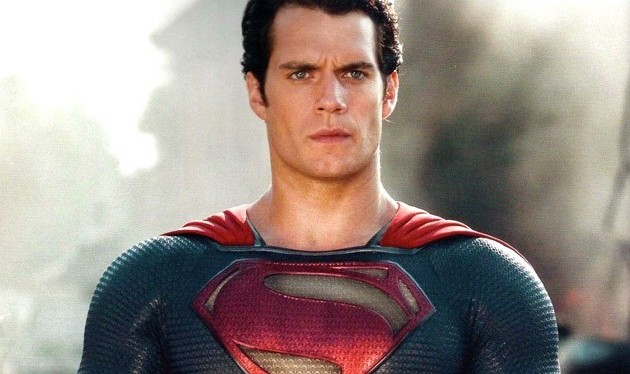
Shortly after the launch of this website, I published an article expressing what I’d like to see in a Man of Steel sequel. Among the key things I mentioned was that I wanted to see Henry Cavill play Superman as a more inspiring and optimistic superhero. That was back in January 2019.

superman1
Henry Cavill in 2013’s Man of Steel.

Today there is a lot of buzz online about the return of Cavill as Superman (note: he last played him in the Justice League movie which in turn will be presented in Zack Snyder’s own vision next year on HBO Max) got reported by Deadline.com and Variety.com
Both hot reports shared similar key details but I found Deadline’s content more helpful. Here’s an excerpt from Deadline.com in italicized blue text.
While there is not a Man of Steel sequel in the works, we’re hearing that Henry Cavill is in talks to reprise his role as Superman in the Warner Bros. DC Universe.

We hear Cavill could come back in a couple of different ways, not a standalone film, but there are plans to put him back in the big red cape again sources with knowledge tell us.

Warner Bros. is not developing a Man of Steel sequel, and Wonder Woman 1984, Suicide Squad are in the can, and Superman isn’t expected to make a cameo in Matt Reeves’ The Batman. Other projects where Cavill could make a cameo are Shazam 2, Dwayne Johnson’s Black Adam or Aquaman 2, which are the next productions to be prepped once COVID-19 safety restrictions lift.

Previously in a Men’s Health interview, the British actor stated he had not given up on the role even though the last time he played the DC Comics icon was in late-2017 in the Justice League movie. The Superman who appeared in the Shazam movie of 2019 was NOT played by Cavill.

In relation to the Warner Bros. superhero movies mentioned in the excerpt above, it seems that integrating Cavill’s Superman in the ongoing DC Comics cinematic universe will take a while and it is understandable that a standalone movie featuring Superman still has not been planned. It will take a few more years for a Superman movie project to be made to say the least and that includes financing, writing the best screenplay possible, hiring/rehiring actors and finding the right director (I hope they hire James Wan) who could get the most out of Cavill.

As such, the best that Warner Bros. could do with the cinematic Superman is have him in short appearances or cameos in future DC Comics movies about Shazam (the sequel), Black Adam (Dwayne Johnson’s vehicle) and Aquaman (the sequel).

Speaking of Shazam and Black Adam, it would be nice to see Cavill’s Superman in those characters’ respective films. I don’t mean Cavill sharing the spotlight with Zachary Levi and Dwayne Johnson, but having his cinematic Superman appear with Shazam and Black Adam with sufficient screen time to satisfy the fans. Considering the literary history Superman has with Shazam and Black Adam, cinematic cameo appearances would be insufficient in my view. Of course, the Shazam sequel and the Black Adam movie have their respective concepts by now and accommodating Superman will be limited at best.

As such, when it comes to making a true standalone Superman movie in the years to come, I would love to see Henry Cavill and Dwayne Johnson clash as Superman and Black Adam! That concept would be great for the much-delayed Man of Steel sequel! For such a project, I would insist that Warner Bros. hire James Wan to direct.

As for the cinematic Superman possibly appearing in the Aquaman sequel, that would be nice even if it will end up as a short appearance. I honestly believe that Cavill and Jason Momoa can work well together on the big screen with a more focused screenplay.

If there is a breakthrough regarding the talks between Henry Cavill and Warner Bros., I’ll update you readers. Right now, even though the world has been set back by the COVID-19 crisis, Warner Bros. is in a better position to be more competitive when it comes to superhero movies. Cavill’s return as Superman will add more punch once it has been finalized.

In ending this, here are a few Cavill Superman videos for your enjoyment.


Thank you for reading. If you find this article engaging, please click the like button below and also please consider sharing this article to others. If you are looking for a copywriter to create content for your special project or business, check out my services and my portfolio. Feel free to contact me as well. Also please feel free to visit my Facebook page Author Carlo Carrasco and follow me at HavenorFantasy@twitter.com